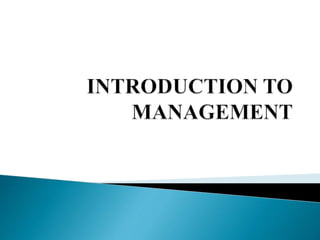
 Peter F. Drucker : "Management is an organ; organs can be
described and defined only through their functions".
 Henry Fayol : "To mange is to forecast and plan, to organize, to
compound, to co-ordinate and to control.”
 Wheeler: "Management is centered in the administrators or
managers of the firm who integrate men, material and money into
an effective operating limit."
Planning
a) Determination of long and short-range objectives
b) Development of strategies and courses of actions to be followed for the
achievement of these objectives
c) Formulation of policies, procedures, and rules, etc., for the implementation of
strategies, and plans
(a) Identification of activities required for the achievement of
objectives and implementation of plans.
(b) Grouping the activities so as to create self-contained jobs.
(c) Assignment of jobs to employees.
(d) Delegation of authority so as to enable them to perform their jobs
and to command the resources needed for their performance.
(e) Establishment of a network of coordinating relationships.
(a) Manpower planning involving determination of the number and the
kind of personnel required.
(b) Recruitment for attracting adequate number of potential employees
to seek jobs in the enterprise.
(c) Selection of the most suitable persons for the jobs under
consideration.
(d) Placement, induction and orientation.
(e) Transfers, promotions, termination and layoff.
(f) Training and development of employees.
(a) Communication
(b) Motivation
(c) Leadership
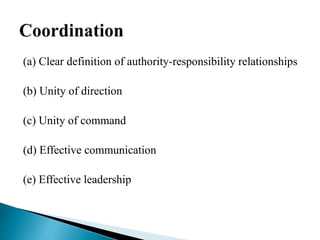
(a) Clear definition of authority-responsibility relationships
(b) Unity of direction
(c) Unity of command
(d) Effective communication
(e) Effective leadership
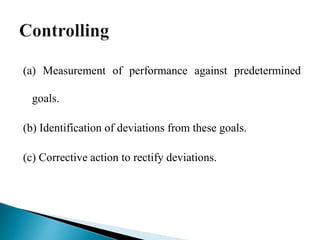
(a) Measurement of performance against predetermined
goals.
(b) Identification of deviations from these goals.
(c) Corrective action to rectify deviations.
 Management as a Science
 Management as an art
 Management as a Profession
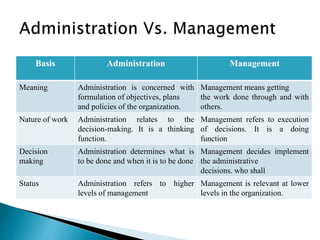
Basis Administration Management
Meaning Administration is concerned with
formulation of objectives, plans
and policies of the organization.
Management means getting
the work done through and with
others.
Nature of work Administration relates to the
decision-making. It is a thinking
function.
Management refers to execution
of decisions. It is a doing
function
Decision
making
Administration determines what is
to be done and when it is to be done
Management decides implement
the administrative
decisions. who shall
Status Administration refers to higher
levels of management
Management is relevant at lower
levels in the organization.
Top management
(a) To establish the objectives or goals of the enterprise.
(b) To make policies and frame plans to attain the objectives laid.
(c) To set up an organizational frame work to conduct the operations as per plans.
(d) To assemble the resources of money, men, materials, machines and methods to put
the plans into action.
(e) To exercise effective control of the operations.
(f) To provide overall leadership to the enterprise.
(a) To interpret the policies chalked out by top management.
(b) To prepare the organizational set up in their own departments for
fulfilling the objectives implied in various business policies.
(c) To recruit and select suitable operative and supervisory staff.
(d) To assign activities, duties and responsibilities for timely
implementation of the plans.
(e) To compile all the instructions and issue them to supervisor under their
control.
(f) To motivate personnel to attain higher productivity and to reward
them properly.
(g) To cooperate with the other departments for ensuring a smooth
functioning of the entire organization.
(h) To collect reports and information on performance in their
departments.
(i) To report to top management
(j) To make suitable recommendations to the top management for the
better execution of plans and policies.
a) Authority and responsibility is limited. They pass on the instructions of
the middle management to workers.
b) They interpret and divide the plans of the management into short-range
operating plans.
c) They allot various jobs to the workers, evaluate their performance and
report to the middle level management.
d) They are more concerned with direction and control functions of
management. They devote more time in the supervision of the workers.
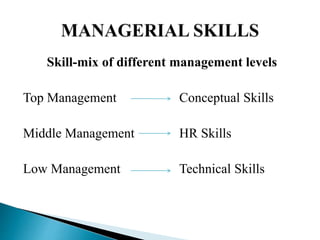
Skill-mix of different management levels
Top Management Conceptual Skills
Middle Management HR Skills
Low Management Technical Skills
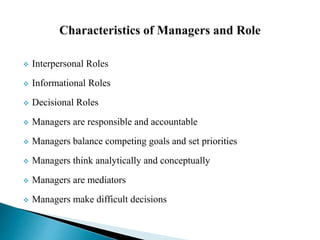
 Interpersonal Roles
 Informational Roles
 Decisional Roles
 Managers are responsible and accountable
 Managers balance competing goals and set priorities
 Managers think analytically and conceptually
 Managers are mediators
 Managers make difficult decisions
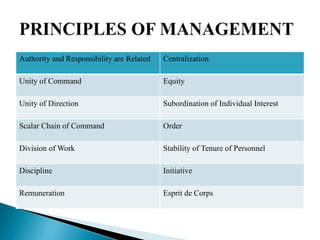
Authority and Responsibility are Related Centralization
Unity of Command Equity
Unity of Direction Subordination of Individual Interest
Scalar Chain of Command Order
Division of Work Stability of Tenure of Personnel
Discipline Initiative
Remuneration Esprit de Corps
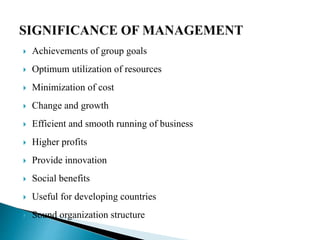
 Achievements of group goals
 Optimum utilization of resources
 Minimization of cost
 Change and growth
 Efficient and smooth running of business
 Higher profits
 Provide innovation
 Social benefits
 Useful for developing countries
 Sound organization structure
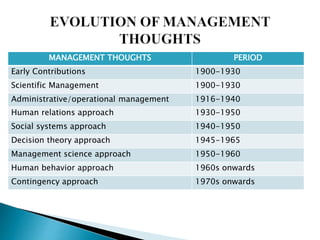
MANAGEMENT THOUGHTS PERIOD
Early Contributions 1900-1930
Scientific Management 1900-1930
Administrative/operational management 1916-1940
Human relations approach 1930-1950
Social systems approach 1940-1950
Decision theory approach 1945-1965
Management science approach 1950-1960
Human behavior approach 1960s onwards
Contingency approach 1970s onwards
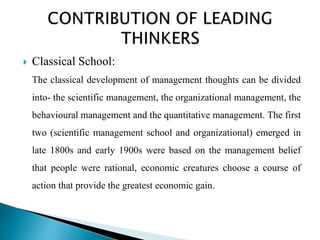
 Classical School:
The classical development of management thoughts can be divided
into- the scientific management, the organizational management, the
behavioural management and the quantitative management. The first
two (scientific management school and organizational) emerged in
late 1800s and early 1900s were based on the management belief
that people were rational, economic creatures choose a course of
action that provide the greatest economic gain.
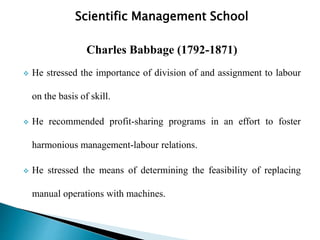
Scientific Management School
Charles Babbage (1792-1871)
 He stressed the importance of division of and assignment to labour
on the basis of skill.
 He recommended profit-sharing programs in an effort to foster
harmonious management-labour relations.
 He stressed the means of determining the feasibility of replacing
manual operations with machines.
Taylor’s Principle Related Management Activity
Develop a science for each job with
standardized work implements and
efficient methods for all to follow.
Complete time-and-motion study to
determine the best way to do each task.
Scientifically select workers with
skills and abilities that match each
job, and train them in the most
efficient ways to accomplish tasks.
Use job descriptions to select
employees, set up formal training
systems, and establish optimal work
standards to follow.
Ensure cooperation through
incentives and provide the work
environment that reinforces optimal
work results in a scientific manner.
Develop incentive pay, such as piece-
rate system, to reward productivity, and
encourage safe condition by using
proper implements.
Divide responsibility for managing
and for working, while supporting
individuals in work groups for what
they do best. Some people are more
capable of managing, whereas others
are better at performing tasks laid out
for them.
Promote leaders who guide, not do, the
work; create a sense of responsibility
for group results by panning tasks and
helping workers to achieve those
results.
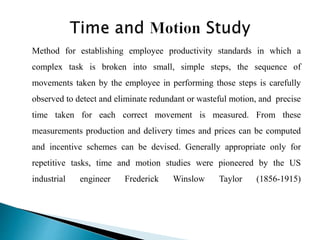
Method for establishing employee productivity standards in which a
complex task is broken into small, simple steps, the sequence of
movements taken by the employee in performing those steps is carefully
observed to detect and eliminate redundant or wasteful motion, and precise
time taken for each correct movement is measured. From these
measurements production and delivery times and prices can be computed
and incentive schemes can be devised. Generally appropriate only for
repetitive tasks, time and motion studies were pioneered by the US
industrial engineer Frederick Winslow Taylor (1856-1915)
 Henry Gantt (1861-1919)
He was a consulting engineer who specialized in control system for shop
scheduling. He sought to increase workers efficiency through scientific
investigation.
His bonus systems were similar to the modern gain sharing techniques
whereby employees are motivated to higher levels of performance by
the potential of sharing in the profit generated.
In doing so, Gantt expanded the scope of scientific management to
encompass the work of managers as well as that of operatives.
 Frank (1868-1924) and Lillian (1878-1972) Gilbreth:
Frank Gilbreth, a construction contractor by back ground, gave up
his contracting career in 1912 to study scientific management after
hearing Taylor’s speak at a professional meeting. Along with his
wife Lillian, a psychologist, he studied work arrangements to
eliminate wasteful hand-body-motion. Frank specialized in research
that had a dramatic impact on medical surgery and, through his time
and motion findings, surgeons saved many lives. Lillian is known as
‘first lady of management’ and devoted most of her research to the
human side of management. Frank Gilbreth is probably best known
for his experiments in reducing the number of motions in rick
laying.
 The organizational school of management
placed emphasis on the development of
management principles for managing the
complete organization.
 Henri Fayol (1841-1925):
According to Fayol, all managerial tasks could be classified into one of
the following six groups:
• Technical (related to production)
• Commercial (buying, selling and exchange)
• Financial (search for capital and its optimum use)
• Security (protection for property and person)
• Accounting (recording and taking stock of costs, profits, and liabilities,
keeping balance sheets, and compiling statistics)
• Managerial (planning, organizing, commanding, coordinating and
control)
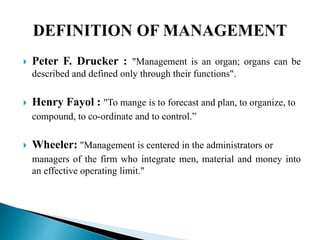
• Planning meant developing a course of action that would help the
organization achieve its objectives.
• Organizing meant mobilizing the employees and other resources of
the organization in accordance with the plan.
• Commanding meant directing the employees and getting the job
done.
• Coordinating meant achieving harmony among the various activities.
• Controlling meant monitoring performance to ensure that the plan is
properly followed.

Introduction to management

  • 2.
     Peter F.Drucker : "Management is an organ; organs can be described and defined only through their functions".  Henry Fayol : "To mange is to forecast and plan, to organize, to compound, to co-ordinate and to control.”  Wheeler: "Management is centered in the administrators or managers of the firm who integrate men, material and money into an effective operating limit."
  • 3.
    Planning a) Determination oflong and short-range objectives b) Development of strategies and courses of actions to be followed for the achievement of these objectives c) Formulation of policies, procedures, and rules, etc., for the implementation of strategies, and plans
  • 4.
    (a) Identification ofactivities required for the achievement of objectives and implementation of plans. (b) Grouping the activities so as to create self-contained jobs. (c) Assignment of jobs to employees. (d) Delegation of authority so as to enable them to perform their jobs and to command the resources needed for their performance. (e) Establishment of a network of coordinating relationships.
  • 5.
    (a) Manpower planninginvolving determination of the number and the kind of personnel required. (b) Recruitment for attracting adequate number of potential employees to seek jobs in the enterprise. (c) Selection of the most suitable persons for the jobs under consideration. (d) Placement, induction and orientation. (e) Transfers, promotions, termination and layoff. (f) Training and development of employees.
  • 6.
  • 7.
    (a) Clear definitionof authority-responsibility relationships (b) Unity of direction (c) Unity of command (d) Effective communication (e) Effective leadership
  • 8.
    (a) Measurement ofperformance against predetermined goals. (b) Identification of deviations from these goals. (c) Corrective action to rectify deviations.
  • 9.
     Management asa Science  Management as an art  Management as a Profession
  • 10.
    Basis Administration Management MeaningAdministration is concerned with formulation of objectives, plans and policies of the organization. Management means getting the work done through and with others. Nature of work Administration relates to the decision-making. It is a thinking function. Management refers to execution of decisions. It is a doing function Decision making Administration determines what is to be done and when it is to be done Management decides implement the administrative decisions. who shall Status Administration refers to higher levels of management Management is relevant at lower levels in the organization.
  • 11.
    Top management (a) Toestablish the objectives or goals of the enterprise. (b) To make policies and frame plans to attain the objectives laid. (c) To set up an organizational frame work to conduct the operations as per plans. (d) To assemble the resources of money, men, materials, machines and methods to put the plans into action. (e) To exercise effective control of the operations. (f) To provide overall leadership to the enterprise.
  • 12.
    (a) To interpretthe policies chalked out by top management. (b) To prepare the organizational set up in their own departments for fulfilling the objectives implied in various business policies. (c) To recruit and select suitable operative and supervisory staff. (d) To assign activities, duties and responsibilities for timely implementation of the plans. (e) To compile all the instructions and issue them to supervisor under their control.
  • 13.
    (f) To motivatepersonnel to attain higher productivity and to reward them properly. (g) To cooperate with the other departments for ensuring a smooth functioning of the entire organization. (h) To collect reports and information on performance in their departments. (i) To report to top management (j) To make suitable recommendations to the top management for the better execution of plans and policies.
  • 14.
    a) Authority andresponsibility is limited. They pass on the instructions of the middle management to workers. b) They interpret and divide the plans of the management into short-range operating plans. c) They allot various jobs to the workers, evaluate their performance and report to the middle level management. d) They are more concerned with direction and control functions of management. They devote more time in the supervision of the workers.
  • 15.
    Skill-mix of differentmanagement levels Top Management Conceptual Skills Middle Management HR Skills Low Management Technical Skills
  • 16.
     Interpersonal Roles Informational Roles  Decisional Roles  Managers are responsible and accountable  Managers balance competing goals and set priorities  Managers think analytically and conceptually  Managers are mediators  Managers make difficult decisions
  • 17.
    Authority and Responsibilityare Related Centralization Unity of Command Equity Unity of Direction Subordination of Individual Interest Scalar Chain of Command Order Division of Work Stability of Tenure of Personnel Discipline Initiative Remuneration Esprit de Corps
  • 18.
     Achievements ofgroup goals  Optimum utilization of resources  Minimization of cost  Change and growth  Efficient and smooth running of business  Higher profits  Provide innovation  Social benefits  Useful for developing countries  Sound organization structure
  • 19.
    MANAGEMENT THOUGHTS PERIOD EarlyContributions 1900-1930 Scientific Management 1900-1930 Administrative/operational management 1916-1940 Human relations approach 1930-1950 Social systems approach 1940-1950 Decision theory approach 1945-1965 Management science approach 1950-1960 Human behavior approach 1960s onwards Contingency approach 1970s onwards
  • 20.
     Classical School: Theclassical development of management thoughts can be divided into- the scientific management, the organizational management, the behavioural management and the quantitative management. The first two (scientific management school and organizational) emerged in late 1800s and early 1900s were based on the management belief that people were rational, economic creatures choose a course of action that provide the greatest economic gain.
  • 21.
    Scientific Management School CharlesBabbage (1792-1871)  He stressed the importance of division of and assignment to labour on the basis of skill.  He recommended profit-sharing programs in an effort to foster harmonious management-labour relations.  He stressed the means of determining the feasibility of replacing manual operations with machines.
  • 22.
    Taylor’s Principle RelatedManagement Activity Develop a science for each job with standardized work implements and efficient methods for all to follow. Complete time-and-motion study to determine the best way to do each task. Scientifically select workers with skills and abilities that match each job, and train them in the most efficient ways to accomplish tasks. Use job descriptions to select employees, set up formal training systems, and establish optimal work standards to follow. Ensure cooperation through incentives and provide the work environment that reinforces optimal work results in a scientific manner. Develop incentive pay, such as piece- rate system, to reward productivity, and encourage safe condition by using proper implements. Divide responsibility for managing and for working, while supporting individuals in work groups for what they do best. Some people are more capable of managing, whereas others are better at performing tasks laid out for them. Promote leaders who guide, not do, the work; create a sense of responsibility for group results by panning tasks and helping workers to achieve those results.
  • 23.
    Method for establishingemployee productivity standards in which a complex task is broken into small, simple steps, the sequence of movements taken by the employee in performing those steps is carefully observed to detect and eliminate redundant or wasteful motion, and precise time taken for each correct movement is measured. From these measurements production and delivery times and prices can be computed and incentive schemes can be devised. Generally appropriate only for repetitive tasks, time and motion studies were pioneered by the US industrial engineer Frederick Winslow Taylor (1856-1915)
  • 24.
     Henry Gantt(1861-1919) He was a consulting engineer who specialized in control system for shop scheduling. He sought to increase workers efficiency through scientific investigation. His bonus systems were similar to the modern gain sharing techniques whereby employees are motivated to higher levels of performance by the potential of sharing in the profit generated. In doing so, Gantt expanded the scope of scientific management to encompass the work of managers as well as that of operatives.
  • 25.
     Frank (1868-1924)and Lillian (1878-1972) Gilbreth: Frank Gilbreth, a construction contractor by back ground, gave up his contracting career in 1912 to study scientific management after hearing Taylor’s speak at a professional meeting. Along with his wife Lillian, a psychologist, he studied work arrangements to eliminate wasteful hand-body-motion. Frank specialized in research that had a dramatic impact on medical surgery and, through his time and motion findings, surgeons saved many lives. Lillian is known as ‘first lady of management’ and devoted most of her research to the human side of management. Frank Gilbreth is probably best known for his experiments in reducing the number of motions in rick laying.
  • 26.
     The organizationalschool of management placed emphasis on the development of management principles for managing the complete organization.
  • 27.
     Henri Fayol(1841-1925): According to Fayol, all managerial tasks could be classified into one of the following six groups: • Technical (related to production) • Commercial (buying, selling and exchange) • Financial (search for capital and its optimum use) • Security (protection for property and person) • Accounting (recording and taking stock of costs, profits, and liabilities, keeping balance sheets, and compiling statistics) • Managerial (planning, organizing, commanding, coordinating and control)
  • 28.
    • Planning meantdeveloping a course of action that would help the organization achieve its objectives. • Organizing meant mobilizing the employees and other resources of the organization in accordance with the plan. • Commanding meant directing the employees and getting the job done. • Coordinating meant achieving harmony among the various activities. • Controlling meant monitoring performance to ensure that the plan is properly followed.