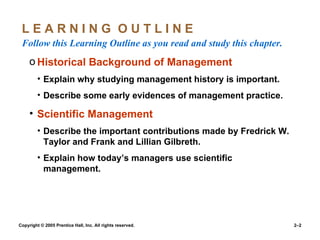
L E A R N I N G  O U T L I N E  Follow this Learning Outline as you read and study this chapter. Historical Background of Management Explain why studying management history is important. Describe some early evidences of management practice. Scientific Management Describe the important contributions made by Fredrick W. Taylor and Frank and Lillian Gilbreth. Explain how today’s managers use scientific management.
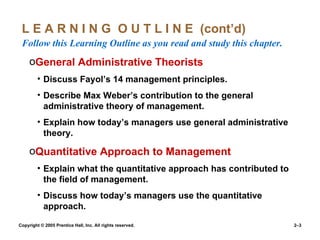
L E A R N I N G  O U T L I N E  (cont’d)  Follow this Learning Outline as you read and study this chapter. General Administrative Theorists Discuss Fayol’s 14 management principles. Describe Max Weber’s contribution to the general administrative theory of management. Explain how today’s managers use general administrative theory. Quantitative Approach to Management Explain what the quantitative approach has contributed to the field of management. Discuss how today’s managers use the quantitative approach.
L E A R N I N G  O U T L I N E  (cont’d)  Follow this Learning Outline as you read and study this chapter. Toward Understanding Organizational Behavior Describe the contributions of the early advocates of OB. Explain the contributions of the Hawthorne Studies to the field of management. Discuss how today’s managers use the behavioral approach. The Systems Approach Describe an organization using the systems approach. Discuss how the systems approach is appropriate for understanding management.
L E A R N I N G  O U T L I N E  (cont’d)  Follow this Learning Outline as you read and study this chapter. The Contingency Approach Explain how the contingency approach differs from the early theories of management. Discuss how the contingency approach is appropriate for studying management. Current Issues and Trends Explain why we need to look at the current trends and issues facing managers. Describe the current trends and issues facing managers.
Historical Background of Management Ancient Management Egypt (pyramids) and China (Great Wall) Venetians (floating warship assembly lines) Adam Smith Published  “The Wealth of Nations”  in 1776 Advocated the division of labor (job specialization) to increase the productivity of workers Industrial Revolution Substituted machine power for human labor Created large organizations in need of management
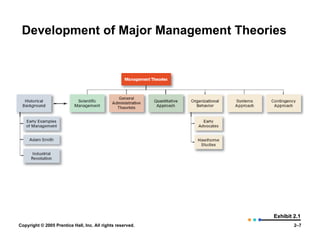
Development of Major Management Theories Exhibit 2.1
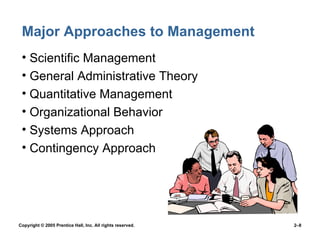
Major Approaches to Management Scientific Management General Administrative Theory Quantitative Management Organizational Behavior Systems Approach Contingency Approach
Scientific Management Fredrick Winslow Taylor The “father” of scientific management Published  Principles of Scientific Management  (1911) The theory of scientific management Using scientific methods to define the “one best way” for a job to be done: Putting the right person on the job with the correct tools and equipment. Having a standardized method of doing the job. Providing an economic incentive to the worker.
Taylor’s Five Principles of Management Exhibit 2.2 Develop a science for each element of an individual’s work, which will replace the old rule-of-thumb method. Scientifically select and then train, teach, and develop the worker. Heartily cooperate with the workers so as to ensure that all work is done in accordance with the principles of the science that has been developed.  Divide work and responsibility almost equally between management and workers.  Management takes over all work for which it is better fitted than the workers.
Scientific Management (cont’d) Frank and Lillian Gilbreth Focused on increasing worker productivity through the reduction of wasted motion Developed the microchronometer to time worker motions and optimize performance How Do Today’s Managers Use Scientific Management? Use time and motion studies to increase productivity Hire the best qualified employees Design incentive systems based on output
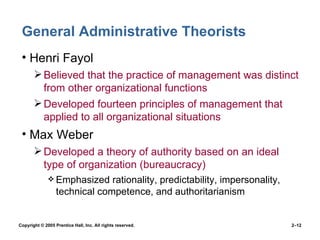
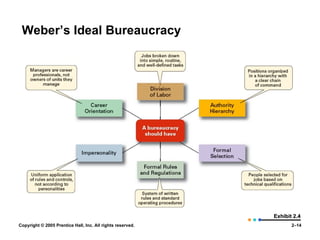
General Administrative Theorists Henri Fayol Believed that the practice of management was distinct from other organizational functions  Developed fourteen principles of management that applied to all organizational situations Max Weber Developed a theory of authority based on an ideal type of organization (bureaucracy) Emphasized rationality, predictability, impersonality, technical competence, and authoritarianism
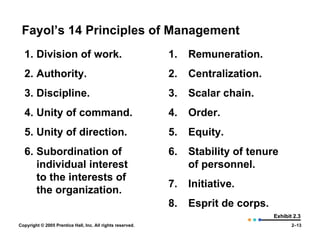
Fayol’s 14 Principles of Management Exhibit 2.3 Division of work. Authority. Discipline. Unity of command. Unity of direction. Subordination of individual interest to the interests of the organization. Remuneration. Centralization. Scalar chain. Order. Equity. Stability of tenure of personnel. Initiative. Esprit de corps.
Weber’s Ideal Bureaucracy Exhibit 2.4
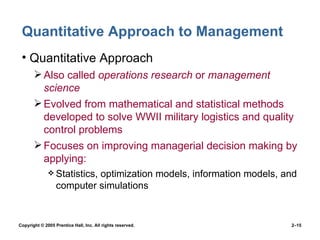
Quantitative Approach to Management Quantitative Approach Also called  operations research  or  management science Evolved from mathematical and statistical methods developed to solve WWII military logistics and quality control problems Focuses on improving managerial decision making by applying: Statistics, optimization models, information models, and computer simulations
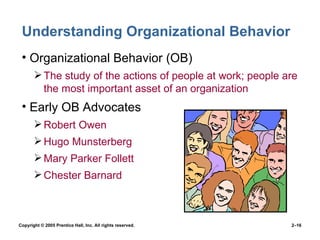
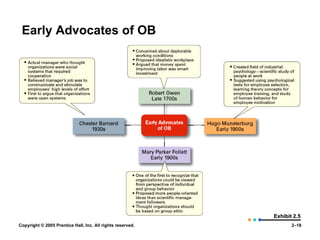
Understanding Organizational Behavior  Organizational Behavior (OB) The study of the actions of people at work; people are the most important asset of an organization Early OB Advocates Robert Owen Hugo Munsterberg Mary Parker Follett Chester Barnard
The Hawthorne Studies A series of productivity experiments conducted at Western Electric from 1927 to 1932. Experimental findings Productivity unexpectedly increased under imposed adverse working conditions. The effect of incentive plans was less than expected. Research conclusion Social norms, group standards and attitudes more strongly influence individual output and work behavior than do monetary incentives.
Early Advocates of OB Exhibit 2.5
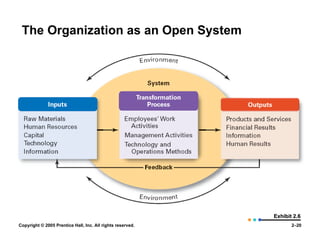
The Systems Approach System Defined A set of interrelated and interdependent parts arranged in a manner that produces a unified whole. Basic Types of Systems Closed systems Are not influenced by and do not interact with their environment (all system input and output is internal). Open systems Dynamically interact to their environments by taking in inputs and transforming them into outputs that are distributed into their environments.
The Organization as an Open System Exhibit 2.6
Implications of the Systems Approach Coordination of the organization’s parts is essential for proper functioning of the entire organization. Decisions and actions taken in one area of the  organization will have an effect in other areas of the organization. Organizations are not self-contained and, therefore, must adapt to changes in their external environment.
The Contingency Approach Contingency Approach Defined Also sometimes called the  situational approach. There is no one universally applicable set of management principles (rules) by which to manage organizations. Organizations are individually different, face different situations (contingency variables), and require different ways of managing.
Popular Contingency Variables Exhibit 2.7 Organization size Routineness of task technology Environmental uncertainty Individual differences
Current Trends and Issues Globalization Ethics Workforce Diversity Entrepreneurship E-business Knowledge Management Learning Organizations Quality Management
Current Trends and Issues (cont’d) Globalization Management in international organizations Political and cultural challenges of operating in a global market Ethics Increased emphasis on ethics education in college curriculums Increased creation and use of codes of ethics by businesses
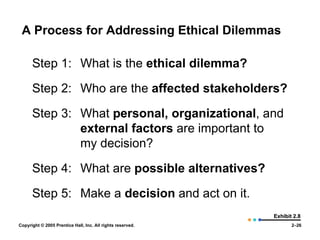
A Process for Addressing Ethical Dilemmas Exhibit 2.8 Step 1: What is the  ethical dilemma? Step 2: Who are the  affected stakeholders? Step 3: What  personal, organizational , and  external factors  are important to  my decision? Step 4: What are  possible alternatives? Step 5: Make a  decision  and act on it.
Current Trends and Issues (cont’d) Workforce Diversity Increasing heterogeneity in the workforce More gender, minority, ethnic, and other forms of diversity in employees Aging workforce Older employees who work longer and do not retire The increased costs of public and private benefits for older workers An increasing demand for products and services related to aging.
Current Trends and Issues (cont’d) Entrepreneurship Defined The process whereby an individual or group of individuals use organized efforts to create value and grow by fulfilling wants and needs through innovation and uniqueness. Entrepreneurship process Pursuit of opportunities Innovation in products, services, or business methods Desire for continual growth of the organization
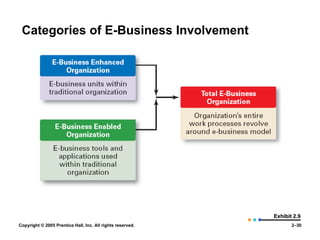
Current Trends and Issues (cont’d) E-Business (Electronic Business) The work preformed by an organization using electronic linkages to its key constituencies E-commerce: the sales and marketing component of an e-business Categories of E-Businesses E-business enhanced organization E-business enabled organization Total e-business organization
Categories of E-Business Involvement Exhibit 2.9
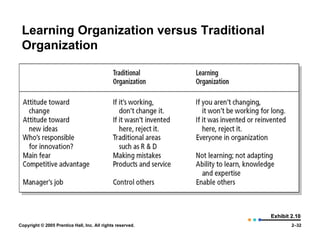
Current Trends and Issues (cont’d) Knowledge Management The cultivation of a learning culture where organizational members systematically gather and share knowledge with others in order to achieve better performance. Learning Organization An organization that has developed the capacity to continuously learn, adapt, and change.
Learning Organization versus Traditional Organization Exhibit 2.10
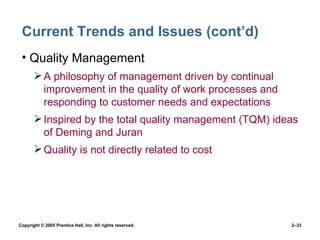
Current Trends and Issues (cont’d) Quality Management A philosophy of management driven by continual improvement in the quality of work processes and responding to customer needs and expectations Inspired by the total quality management (TQM) ideas of Deming and Juran Quality is not directly related to cost
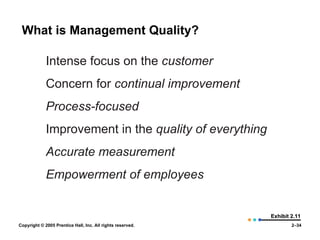
What is Management Quality?  Exhibit 2.11 Intense focus on the  customer Concern for  continual improvement Process-focused Improvement in the  quality of everything  Accurate measurement Empowerment of employees

Capítulo 2

  • 1.
  • 2.
    L E AR N I N G O U T L I N E Follow this Learning Outline as you read and study this chapter. Historical Background of Management Explain why studying management history is important. Describe some early evidences of management practice. Scientific Management Describe the important contributions made by Fredrick W. Taylor and Frank and Lillian Gilbreth. Explain how today’s managers use scientific management.
  • 3.
    L E AR N I N G O U T L I N E (cont’d) Follow this Learning Outline as you read and study this chapter. General Administrative Theorists Discuss Fayol’s 14 management principles. Describe Max Weber’s contribution to the general administrative theory of management. Explain how today’s managers use general administrative theory. Quantitative Approach to Management Explain what the quantitative approach has contributed to the field of management. Discuss how today’s managers use the quantitative approach.
  • 4.
    L E AR N I N G O U T L I N E (cont’d) Follow this Learning Outline as you read and study this chapter. Toward Understanding Organizational Behavior Describe the contributions of the early advocates of OB. Explain the contributions of the Hawthorne Studies to the field of management. Discuss how today’s managers use the behavioral approach. The Systems Approach Describe an organization using the systems approach. Discuss how the systems approach is appropriate for understanding management.
  • 5.
    L E AR N I N G O U T L I N E (cont’d) Follow this Learning Outline as you read and study this chapter. The Contingency Approach Explain how the contingency approach differs from the early theories of management. Discuss how the contingency approach is appropriate for studying management. Current Issues and Trends Explain why we need to look at the current trends and issues facing managers. Describe the current trends and issues facing managers.
  • 6.
    Historical Background ofManagement Ancient Management Egypt (pyramids) and China (Great Wall) Venetians (floating warship assembly lines) Adam Smith Published “The Wealth of Nations” in 1776 Advocated the division of labor (job specialization) to increase the productivity of workers Industrial Revolution Substituted machine power for human labor Created large organizations in need of management
  • 7.
    Development of MajorManagement Theories Exhibit 2.1
  • 8.
    Major Approaches toManagement Scientific Management General Administrative Theory Quantitative Management Organizational Behavior Systems Approach Contingency Approach
  • 9.
    Scientific Management FredrickWinslow Taylor The “father” of scientific management Published Principles of Scientific Management (1911) The theory of scientific management Using scientific methods to define the “one best way” for a job to be done: Putting the right person on the job with the correct tools and equipment. Having a standardized method of doing the job. Providing an economic incentive to the worker.
  • 10.
    Taylor’s Five Principlesof Management Exhibit 2.2 Develop a science for each element of an individual’s work, which will replace the old rule-of-thumb method. Scientifically select and then train, teach, and develop the worker. Heartily cooperate with the workers so as to ensure that all work is done in accordance with the principles of the science that has been developed. Divide work and responsibility almost equally between management and workers. Management takes over all work for which it is better fitted than the workers.
  • 11.
    Scientific Management (cont’d)Frank and Lillian Gilbreth Focused on increasing worker productivity through the reduction of wasted motion Developed the microchronometer to time worker motions and optimize performance How Do Today’s Managers Use Scientific Management? Use time and motion studies to increase productivity Hire the best qualified employees Design incentive systems based on output
  • 12.
    General Administrative TheoristsHenri Fayol Believed that the practice of management was distinct from other organizational functions Developed fourteen principles of management that applied to all organizational situations Max Weber Developed a theory of authority based on an ideal type of organization (bureaucracy) Emphasized rationality, predictability, impersonality, technical competence, and authoritarianism
  • 13.
    Fayol’s 14 Principlesof Management Exhibit 2.3 Division of work. Authority. Discipline. Unity of command. Unity of direction. Subordination of individual interest to the interests of the organization. Remuneration. Centralization. Scalar chain. Order. Equity. Stability of tenure of personnel. Initiative. Esprit de corps.
  • 14.
  • 15.
    Quantitative Approach toManagement Quantitative Approach Also called operations research or management science Evolved from mathematical and statistical methods developed to solve WWII military logistics and quality control problems Focuses on improving managerial decision making by applying: Statistics, optimization models, information models, and computer simulations
  • 16.
    Understanding Organizational Behavior Organizational Behavior (OB) The study of the actions of people at work; people are the most important asset of an organization Early OB Advocates Robert Owen Hugo Munsterberg Mary Parker Follett Chester Barnard
  • 17.
    The Hawthorne StudiesA series of productivity experiments conducted at Western Electric from 1927 to 1932. Experimental findings Productivity unexpectedly increased under imposed adverse working conditions. The effect of incentive plans was less than expected. Research conclusion Social norms, group standards and attitudes more strongly influence individual output and work behavior than do monetary incentives.
  • 18.
    Early Advocates ofOB Exhibit 2.5
  • 19.
    The Systems ApproachSystem Defined A set of interrelated and interdependent parts arranged in a manner that produces a unified whole. Basic Types of Systems Closed systems Are not influenced by and do not interact with their environment (all system input and output is internal). Open systems Dynamically interact to their environments by taking in inputs and transforming them into outputs that are distributed into their environments.
  • 20.
    The Organization asan Open System Exhibit 2.6
  • 21.
    Implications of theSystems Approach Coordination of the organization’s parts is essential for proper functioning of the entire organization. Decisions and actions taken in one area of the organization will have an effect in other areas of the organization. Organizations are not self-contained and, therefore, must adapt to changes in their external environment.
  • 22.
    The Contingency ApproachContingency Approach Defined Also sometimes called the situational approach. There is no one universally applicable set of management principles (rules) by which to manage organizations. Organizations are individually different, face different situations (contingency variables), and require different ways of managing.
  • 23.
    Popular Contingency VariablesExhibit 2.7 Organization size Routineness of task technology Environmental uncertainty Individual differences
  • 24.
    Current Trends andIssues Globalization Ethics Workforce Diversity Entrepreneurship E-business Knowledge Management Learning Organizations Quality Management
  • 25.
    Current Trends andIssues (cont’d) Globalization Management in international organizations Political and cultural challenges of operating in a global market Ethics Increased emphasis on ethics education in college curriculums Increased creation and use of codes of ethics by businesses
  • 26.
    A Process forAddressing Ethical Dilemmas Exhibit 2.8 Step 1: What is the ethical dilemma? Step 2: Who are the affected stakeholders? Step 3: What personal, organizational , and external factors are important to my decision? Step 4: What are possible alternatives? Step 5: Make a decision and act on it.
  • 27.
    Current Trends andIssues (cont’d) Workforce Diversity Increasing heterogeneity in the workforce More gender, minority, ethnic, and other forms of diversity in employees Aging workforce Older employees who work longer and do not retire The increased costs of public and private benefits for older workers An increasing demand for products and services related to aging.
  • 28.
    Current Trends andIssues (cont’d) Entrepreneurship Defined The process whereby an individual or group of individuals use organized efforts to create value and grow by fulfilling wants and needs through innovation and uniqueness. Entrepreneurship process Pursuit of opportunities Innovation in products, services, or business methods Desire for continual growth of the organization
  • 29.
    Current Trends andIssues (cont’d) E-Business (Electronic Business) The work preformed by an organization using electronic linkages to its key constituencies E-commerce: the sales and marketing component of an e-business Categories of E-Businesses E-business enhanced organization E-business enabled organization Total e-business organization
  • 30.
    Categories of E-BusinessInvolvement Exhibit 2.9
  • 31.
    Current Trends andIssues (cont’d) Knowledge Management The cultivation of a learning culture where organizational members systematically gather and share knowledge with others in order to achieve better performance. Learning Organization An organization that has developed the capacity to continuously learn, adapt, and change.
  • 32.
    Learning Organization versusTraditional Organization Exhibit 2.10
  • 33.
    Current Trends andIssues (cont’d) Quality Management A philosophy of management driven by continual improvement in the quality of work processes and responding to customer needs and expectations Inspired by the total quality management (TQM) ideas of Deming and Juran Quality is not directly related to cost
  • 34.
    What is ManagementQuality? Exhibit 2.11 Intense focus on the customer Concern for continual improvement Process-focused Improvement in the quality of everything Accurate measurement Empowerment of employees