Project: Ghana Emergency Medicine Collaborative 
Document Title: Arthritis and Arthrocentesis 
Author(s): Joe Lex, MD (Temple University School of Medicine) 
License: Unless otherwise noted, this material is made available under the 
terms of the Creative Commons Attribution Share Alike-3.0 License: 
http://creativecommons.org/licenses/by-sa/3.0/ 
We have reviewed this material in accordance with U.S. Copyright Law and have tried to maximize your ability to 
use, share, and adapt it. These lectures have been modified in the process of making a publicly shareable 
version. The citation key on the following slide provides information about how you may share and adapt this 
material. 
Copyright holders of content included in this material should contact open.michigan@umich.edu with any 
questions, corrections, or clarification regarding the use of content. 
For more information about how to cite these materials visit http://open.umich.edu/privacy-and-terms-use. 
Any medical information in this material is intended to inform and educate and is not a tool for self-diagnosis or a 
replacement for medical evaluation, advice, diagnosis or treatment by a healthcare professional. Please speak to 
your physician if you have questions about your medical condition. 
Viewer discretion is advised: Some medical content is graphic and may not be suitable for all viewers. 
1
Attribution Key 
for more information see: http://open.umich.edu/wiki/AttributionPolicy 
Use + Share + Adapt 
Make Your Own Assessment 
Creative Commons – Attribution License 
Creative Commons – Attribution Share Alike License 
Creative Commons – Attribution Noncommercial License 
Creative Commons – Attribution Noncommercial Share Alike License 
GNU – Free Documentation License 
Creative Commons – Zero Waiver 
Public Domain – Ineligible: Works that are ineligible for copyright protection in the U.S. (17 USC § 102(b)) *laws in your jurisdiction may differ 
Public Domain – Expired: Works that are no longer protected due to an expired copyright term. 
Public Domain – Government: Works that are produced by the U.S. Government. (17 USC § 105) 
Public Domain – Self Dedicated: Works that a copyright holder has dedicated to the public domain. 
Fair Use: Use of works that is determined to be Fair consistent with the U.S. Copyright Act. (17 USC § 107) *laws in your jurisdiction may differ 
Our determination DOES NOT mean that all uses of this 3rd-party content are Fair Uses and we DO NOT guarantee that your use of the content is Fair. 
To use this content you should do your own independent analysis to determine whether or not your use will be Fair. 
{ Content the copyright holder, author, or law permits you to use, share and adapt. } 
{ Content Open.Michigan believes can be used, shared, and adapted because it is ineligible for copyright. } 
{ Content Open.Michigan has used under a Fair Use determination. } 
2
Arthritis and Arthrocentesis Joe Lex, MD, FACEP, MAAEM Temple University School of Medicine 
3
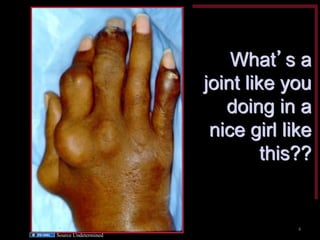
What’s a joint like you doing in a nice girl like this?? 
Source Undetermined 
4
Objectives 1. Differentiate among the three types of joints 2. Explain the pathology of joint inflammation 3. Develop a differential for arthritis, based on number of joints involved, location, and other characteristics 
5
Objectives 4. Explain usefulness of various synovial fluid studies. 5. Demonstrate an appropriate technique for large joint arthrocentesis 6. Explain the pathophysiology and treatment for gout 
6
Objectives 7. Differentiate “rheumatic fever” from “rheumatoid arthritis” from “rheumatism” 8. Be aware of quackery as it applies to treatment of arthritis 
7
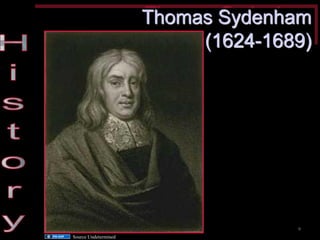
History of Arthritides •1680s: Sydenham describes gout, rheumatism, chorea •1808: term “rheumatic fever” •1876: urate crystals postulated to cause gout •1883: gonococcal arthritis •1907: osteoarthritis described 
8
Thomas Sydenham (1624-1689) 
Source Undetermined 
9
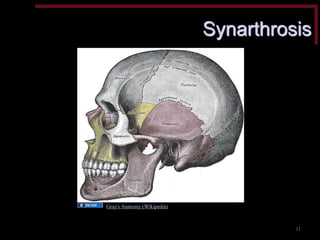
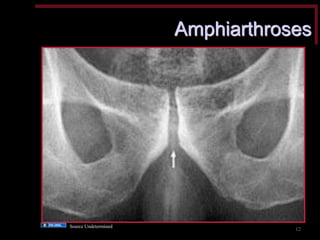
Three Joint Types •Synarthroses: suture lines of skull •Amphiarthroses: fibrocartilaginous unions of pubic symphysis and lower third of sacroiliac joint •Diarthroses = Synovial: most other joints 
10
Synarthrosis 
Gray's Anatomy (Wikipedia) 
11
Amphiarthroses 
Source Undetermined 
12
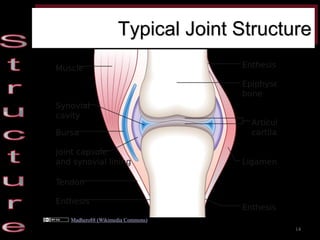
Diarthrosis = Synovial Joints •Subchondral bone, convex against concave, covered by cartilage •Cartilage: collagen + proteoglycan •Lubricated, slide on each other •Surrounded by capsule supported by ligaments, tendons, and muscle •Lined with synovial membrane 
13
Typical Joint Structure 
Madhero88 (Wikimedia Commons) 
14
Pathophysiology •Joint trauma causes decreased proteoglycans –If trauma persistent, damage irreparable •Inflammation characterized by polymorphonuclear white cells –May be immunologic (rheumatoid, reactive) 
15
Joint vs. Periarticular Arthritis •Generalized pain, warmth, swelling, tenderness •Discomfort  with joint motion Periarticular inflammation: bursitis, tendinitis, localized cellulitis •Focal tenderness, swelling not uniform •Pain only with certain movements 
16
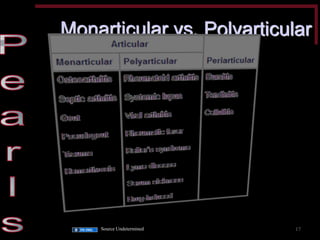
Monarticular vs. Polyarticular 
Source Undetermined 
17
If Polyarticular and… …symmetric  rheumatoid, drug induced …asymmetric  rubella, acute rheumatic fever, gonococcal …migratory  gonococcal or rubella 
18
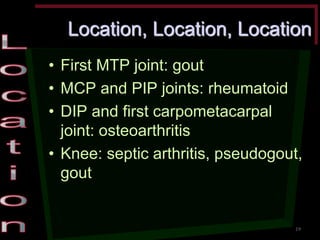
Location, Location, Location •First MTP joint: gout •MCP and PIP joints: rheumatoid •DIP and first carpometacarpal joint: osteoarthritis •Knee: septic arthritis, pseudogout, gout 
19
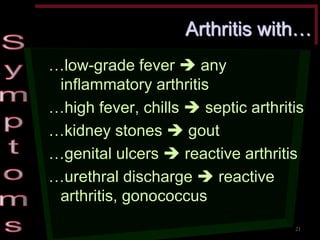
Causes of Migratory Arthritis •Rheumatic fever •Subacute bacterial endocarditis •Henoch-Schönlein purpura •Cefaclor (Ceclor®) hypersensitivity (kids) •Septicemia: staphylococcal, streptococcal, meningococcal, gonococcal •Mycoplasma, histoplasmosis, coccidioidomycosis •Lyme disease 
20
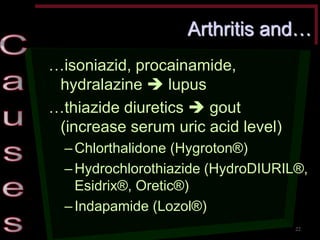
Arthritis with… …low-grade fever  any inflammatory arthritis …high fever, chills  septic arthritis …kidney stones  gout …genital ulcers  reactive arthritis …urethral discharge  reactive arthritis, gonococcus 
21
Arthritis and… …isoniazid, procainamide, hydralazine  lupus …thiazide diuretics  gout (increase serum uric acid level) –Chlorthalidone (Hygroton®) –Hydrochlorothiazide (HydroDIURIL®, Esidrix®, Oretic®) –Indapamide (Lozol®) 
22
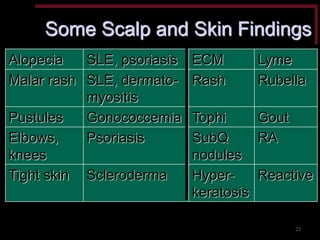
Some Scalp and Skin Findings 
Alopecia 
SLE, psoriasis 
ECM 
Lyme 
Malar rash 
SLE, dermato- myositis 
Rash 
Rubella 
Pustules 
Gonococcemia 
Tophi 
Gout 
Elbows, knees 
Psoriasis 
SubQ nodules 
RA 
Tight skin 
Scleroderma 
Hyper- keratosis 
Reactive 
23
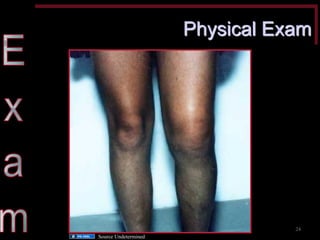
Physical Exam 
Source Undetermined 
24
Physical Exam 1.Warmth and effusion 2.Synovial thickening 3.Deformity 4.Tenderness: generalized or localized, articular or periarticular 5.Limited range of motion 6.Pain on movement 
25
Lab Studies •Limited diagnostic value •“Screening tests” –Bacterial: usually elevated WBC –Chronic rheumatic: mild anemia –ESR/CRP  in most inflammatory •RF, ANA, ASO titers, Lyme serologies: for follow-up •Uric acid: not helpful in gout 
26
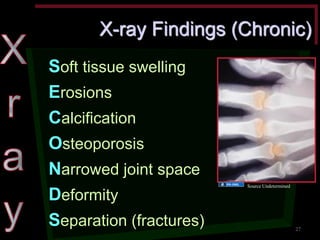
X-ray Findings (Chronic) Soft tissue swelling Erosions Calcification Osteoporosis Narrowed joint space Deformity Separation (fractures) 
Source Undetermined 
27
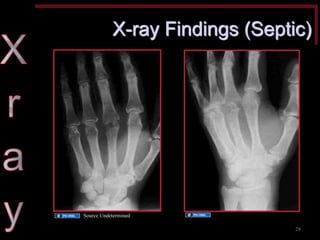
X-ray Findings (Septic) 
Source Undetermined 
Source Undetermined 
28
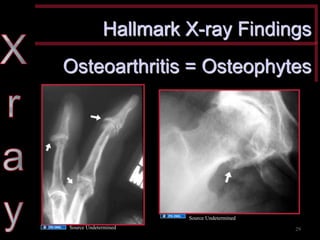
Hallmark X-ray Findings 
Osteoarthritis = Osteophytes 
Source Undetermined 
Source Undetermined 
29
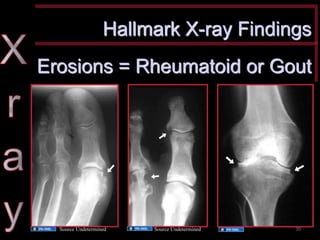
Hallmark X-ray Findings 
Erosions = Rheumatoid or Gout 
Source Undetermined 
Source Undetermined 
Source Undetermined 
30
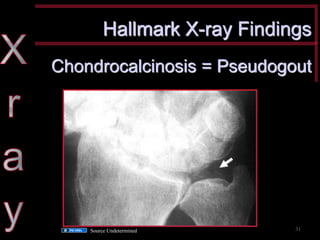
Hallmark X-ray Findings 
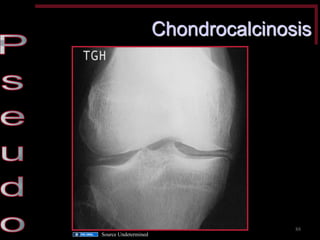
Chondrocalcinosis = Pseudogout 
Source Undetermined 
31
Hallmark X-ray Findings 
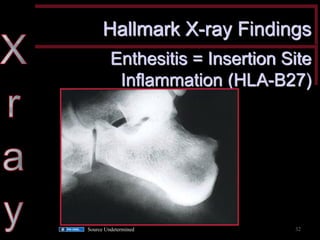
Enthesitis = Insertion Site Inflammation (HLA-B27) 
Source Undetermined 
32
Other Imaging •Ultrasound: joint effusions; tendons and ligaments of shoulder •CT scan: SI, sternoclavicular joint •MRI: knee cruciate ligaments •Contrast MRI: differentiate synovitis from synovial fluid in rheumatoid disease 
33
Other Imaging •99mtechnetium methylene diphosphonate (99mTc MDP) –Osteomyelitis, stress fractures •Gallium: gathers at proliferation of serum proteins and leukocytes –Infection 
34
Arthrocentesis 
35
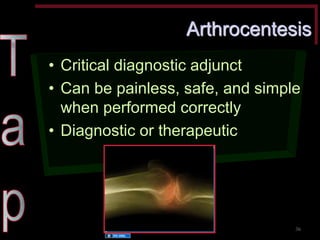
Arthrocentesis •Critical diagnostic adjunct •Can be painless, safe, and simple when performed correctly •Diagnostic or therapeutic 
Source Undetermined 
36
Indications •Obtain joint fluid for analysis •Drain tense hemarthroses •Instill analgesics and anti- inflammatory agents •Prosthetic joints: only to rule out infection 
37
Contraindications •Absolute: infection of any kind covers area to be punctured •Relative –Bleeding diatheses, anticoagulant therapy –Bacteremia 
38
Procedure •Cleanse skin with povidone-iodine, then air dry •Remove povidone-iodine with isopropyl alcohol –Intra-articular povidone-iodine can cause chemical irritation, inhibit bacterial growth leading to spuriously negative cultures in early septic joint 
39
Procedure •Place sterile drapes •Inject local anesthetic into skin –25- to 30-gauge needle –Intraarticular anesthetic can inhibit bacterial growth, cause spuriously negative culture in early septic joint 
40
Procedure •Aspirate large joints with large- bore needle (18 or 19 gauge) –Smaller joints: smaller-bore needle •Choose syringe size based on anticipated fluid volume •Remove as much fluid as possible –Optimizes diagnosis –Relieves pain from distention 
41
Arthrocentesis •Fat globules: diagnostic of fracture •Intraarticular morphine can provide relief for up to 24 hours –1 to 5 mg diluted in normal saline solution to a total volume of 30 ml 
42
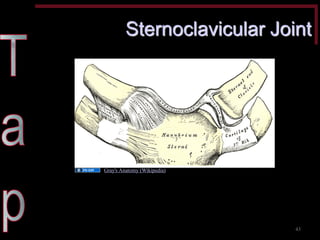
Sternoclavicular Joint 
43 
Gray's Anatomy (Wikipedia)
Elbow – Lateral Approach 
Flex elbow 90o Prep skin Insert needle in palpable bony notch between lateral epicondyle and olecranon 
44
Knee – Lateral Approach 
Extend knee, quadriceps and patella relaxed so patella can move mediolaterally. Needle into joint space just lateral to patella near its upper pole, parallel to the posterior (articular) surface. 
45
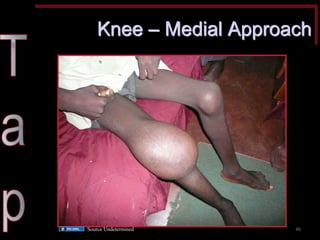
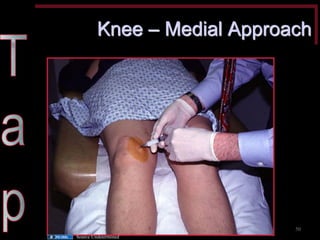
Knee – Medial Approach 
46 
Source Undetermined
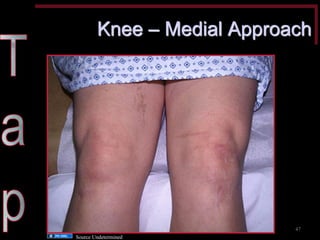
Knee – Medial Approach 
47 
Source Undetermined
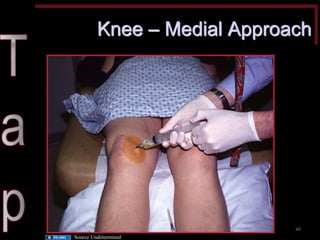
Knee – Medial Approach 
48 
Source Undetermined
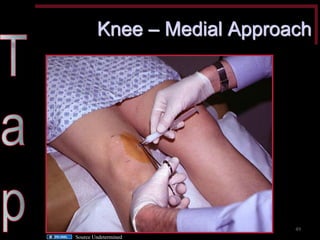
Knee – Medial Approach 
49 
Source Undetermined
Knee – Medial Approach 
50 
Source Undetermined
Knee – Medial vs. Lateral •Follow “Sutton’s Law” •William “Slick Willie” Sutton (1901 – 1980): professional bank robber 
51
Ankle 
Palpate the medial and lateral malleoli with your thumb and index finger. The joint space is located one to one and a half cm above the line joining the tips of the malleoli. 
52
Ankle 
Palpate the dorsalis pedis artery and choose a puncture site anywhere on the anterior aspect of the ankle, avoiding the dorsalis pedis artery. 
53
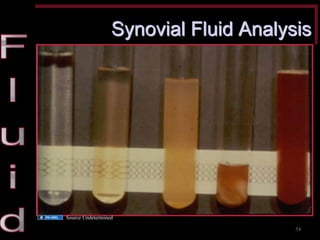
Synovial Fluid Analysis 
54 
Source Undetermined
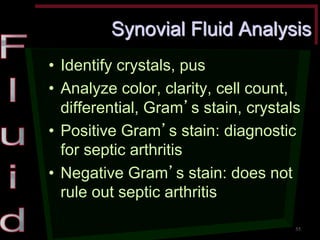
Synovial Fluid Analysis •Identify crystals, pus •Analyze color, clarity, cell count, differential, Gram’s stain, crystals •Positive Gram’s stain: diagnostic for septic arthritis •Negative Gram’s stain: does not rule out septic arthritis 
55
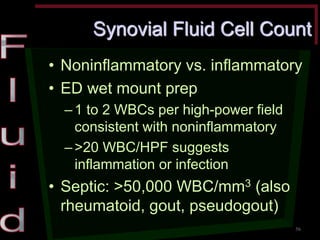
Synovial Fluid Cell Count •Noninflammatory vs. inflammatory •ED wet mount prep –1 to 2 WBCs per high-power field consistent with noninflammatory –>20 WBC/HPF suggests inflammation or infection •Septic: >50,000 WBC/mm3 (also rheumatoid, gout, pseudogout) 
56
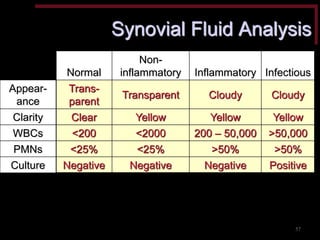
Normal 
Non- inflammatory 
Inflammatory 
Infectious 
Trans- parent 
Transparent 
Cloudy 
Cloudy 
Clear 
Yellow 
Yellow 
Yellow 
<200 
<2000 
200 – 50,000 
>50,000 
<25% 
<25% 
>50% 
>50% 
Negative 
Negative 
Negative 
Positive 
Appear- ance 
Clarity 
WBCs 
PMNs 
Culture 
Synovial Fluid Analysis 
57
Other Synovial Fluid Analysis •Glucose, lactic acid, viscosity, mucin clot, and total protein: limited utility, not recommended •Appropriate container –Cellular analysis: lavender (ethylenediaminetetraacetic acid) –Crystal analysis: green (heparin) –Chemical analysis, serology: red 
58
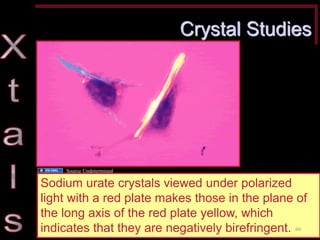
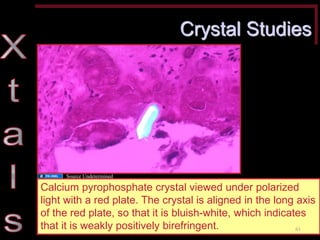
Crystal Studies •Monosodium urate: needle shaped, birefringent negative –Parallel to compensator: yellow –Perpendicular: blue •Calcium pyrophosphate: polymorphic, birefringent positive –Parallel to compensator: blue –Perpendicular: yellow 
59
Crystal Studies 
Sodium urate crystals viewed under polarized light with a red plate makes those in the plane of the long axis of the red plate yellow, which indicates that they are negatively birefringent. 
60 
Source Undetermined
Crystal Studies 
Calcium pyrophosphate crystal viewed under polarized light with a red plate. The crystal is aligned in the long axis of the red plate, so that it is bluish-white, which indicates that it is weakly positively birefringent. 
61 
Source Undetermined
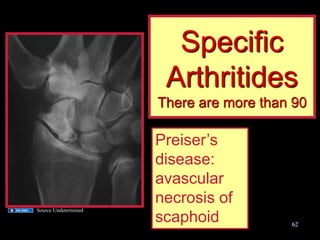
Specific Arthritides There are more than 90 
Preiser’s disease: avascular necrosis of scaphoid 
62 
Source Undetermined
Septic Arthritis •Hematogenous spread •Direct inoculation •Direct spread from bony or soft tissue infections 
63
Septic Arthritis •Synovium infected before degrading enzymes released •Children: hematogenous most common •Postoperative infection: ~10% of joint surgeries 
64
Causes •Staphylococcus aureus: most common (even in sickle cell) •Others: streptococcus, Gram negatives, anaerobes •N. gonorrhoeae: 20% monarticular •<6 months: E. coli, group B strep •IV drug users: S. aureus, Gram negatives 
65
Clinical Features •Based on host’s concurrent medical conditions •Painful, hot, swollen •Typical: single joint –Knee: 40% to 50% –Hip: 13% to 20% –Shoulder: 10% to 15% •20% polyarticular 
66
Clinical Features •History of fever: 80% •Shaking chills: 20% •Elevated sedimentation rate more common than leukocytosis •Blood cultures grow causative organism ~50% of the time •Radiographs not often useful 
67
Management •Admit for joint drainage, IV antibiotics •Empiric therapy based on Gram’s stain •Parenteral narcotic analgesics, articular immobilization control pain and discomfort 
68
Gouty Arthritis 
69
Gouty Arthritis •Pod = foot; agra = trap, hunt •Podagra: foot goddess, a bad- tempered virgin, who attacked victims after they overindulged •Father was Dionysus (Bacchus), god of wine •Mother was Aphrodite (Venus), goddess of love 
70
Gouty Arthritis •Thought to be limited to men who had indulged in dietary or sexual excess 
71
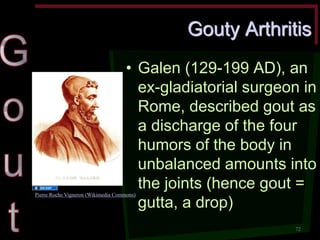
Gouty Arthritis •Galen (129-199 AD), an ex-gladiatorial surgeon in Rome, described gout as a discharge of the four humors of the body in unbalanced amounts into the joints (hence gout = gutta, a drop) 
72 
Pierre Roche Vigneron (Wikimedia Commons)
Be temperate in wine, in eating, girls and sloth Or the gout will seize you and plague you both 
73 
Benjamin Franklin:
Pathophysiology •Uric acid crystal deposits from supersaturated extracellular fluid •Risk factors: obesity, hypertension, diabetes, alcohol, proximal loop diuretics, lead poisoning •During attack: crystals ingested by PMNs  inflammation 
74
Pathophysiology •Middle-aged men, post- menopausal women •Increased uric acid usually present for 20 years before first attack •Uric acid often normal 
75
Presentation •Great toe MTP joint in 75% –Also tarsal, ankle, knee, wrist –Up to 40% polyarticular •Pain excruciating at onset –Can mimic septic joint –Usually self-limited •Systemic symptoms usually minimal or absent 
76
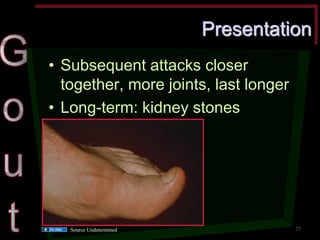
Presentation •Subsequent attacks closer together, more joints, last longer •Long-term: kidney stones 
77 
Source Undetermined
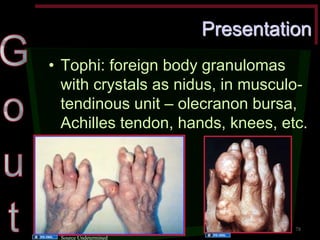
Presentation •Tophi: foreign body granulomas with crystals as nidus, in musculo- tendinous unit – olecranon bursa, Achilles tendon, hands, knees, etc. 
78 
Source Undetermined 
Source Undetermined
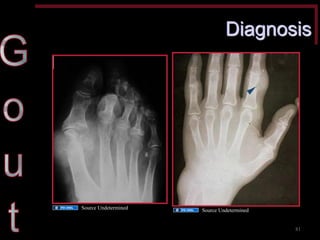
Diagnosis •Rule out cellulitis, septic arthritis particularly if knee joint •All may have fever, leukocytosis, elevated ESR •Uric acid level not helpful •X-rays: soft-tissue swelling (acute) or joint destruction (chronic) 
79
Uric Acid Levels •Uric acid normal in ~40% •Tophi can form in cool body areas without hyperuricemia •Acute attack  pain  increased cortisol  uric acid diuresis  normalized level 
80
Diagnosis 
81 
Source Undetermined 
Source Undetermined
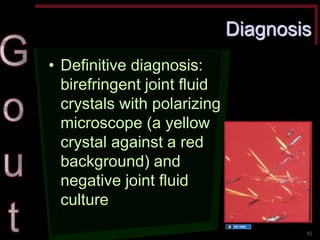
Diagnosis •Definitive diagnosis: birefringent joint fluid crystals with polarizing microscope (a yellow crystal against a red background) and negative joint fluid culture 
82 
Source Undetermined
Acute Therapy – Colchicine •Not diagnostic: works on pseudogout •Contraindication: hematologic, renal, hepatic dysfunction •Extravasation from IV  tissue necrosis 
83
Acute Therapy – Colchicine •Inhibits microtubule formation •Most effective in first 24 hours •0.6 mg / hour until pain controlled, max 6 mg or side effects (GI) •Average toxic dose: 6.7 mg •Toxicity precedes improvement in more than 50% 
84
Acute Therapy – Other •NSAIDs effective, indomethacin most common (75 to 200 mg/day) –Contraindicated in PUD, GI bleed •If resistant: prednisone taper –40 mg/day first 3 to 5 days •Adrenocorticotrophic hormone –ACTH 40 IU to 80 IU IM 
85
Pseudogout •Calcium pyrophosphate dihydrate (CPPD) crystal-deposition disease •Knee: most common joint •Polyarticular possible •Pain less severe, patients older •Risk: hypothyroid, Wilson’s disease, hyperparathyroid, hemochromatosis, etc. 
86
Diagnosis •Common: elevated ESR, WBC •X-ray may show joint calcification •Joint fluid –Weakly positive birefringent crystals on polarized microscopy –Appear rhomboidal on regular light microscopy •Treatment: same as gout 
87
Chondrocalcinosis 
88 
Source Undetermined
Osteoarthritis •Degenerative joint disease •Most common form of arthritis •Loss of articular cartilage, reactive changes at joint margins •Synovitis in advanced disease •May have painful bone-to-bone interface 
89
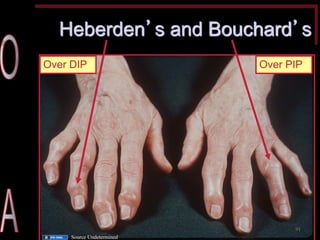
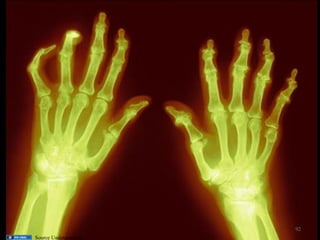
Presentation / Diagnosis •Chief complaint: pain •No systemic symptoms •Hands: Bouchard’s, Heberden’s nodes (osteophyte spurs) •Knee: active & passive crepitus •Routine lab tests: normal •Radiographs: joint- space narrowing, osteophyte formation 
90
Heberden’s and Bouchard’s 
Over DIP 
Over PIP 
91 
Source Undetermined
92 
Source Undetermined
Treatment •Judicious exercise for muscle strengthening •Relieve muscle spasm •Support joint •Acetaminophen comparable to ibuprofen for short-term treatment •Ultimately joint replacement 
93
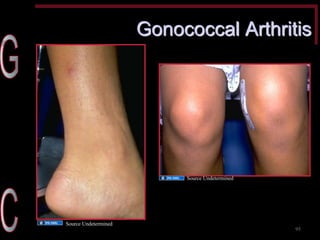
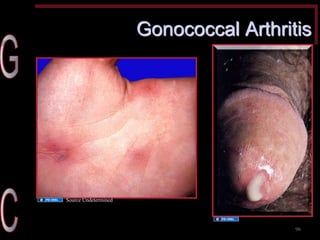
Gonococcal Arthritis •Woman : men :: 4:1 •Fever, chills, arthralgias, migratory tenosynovitis •Progresses to arthritis: knee, ankle, wrist •Characteristic rash: countable hemorrhagic necrotic pustules •Rarely have cervicitis or urethritis 
94
Gonococcal Arthritis 
95 
Source Undetermined 
Source Undetermined
Gonococcal Arthritis 
96 
Source Undetermined 
Source Undetermined
Diagnosis •Blood cultures usually negative •Synovial fluid cultures positive in less than 50% •Gram’s stain positive more often than culture •Cervical, urethral, pharyngeal, rectal cultures positive ~75% 
97
Treatment •Admit to hospital •Ceftriaxone 1 g IM or IV daily, and 24 to 48 hours after improvement •Ciprofloxacin 500 mg twice daily orally for total 7 days of antibiotics •Spectinomycin 2 grams IM every 12 hours if beta-lactam allergic 
98
Viral Arthritis •Most common: rubella, hepatitis B •Also mumps, adenoviruses, Epstein-Barr virus, enteroviruses •Deposition of soluble immune complexes in synovium with resultant inflammation 
99
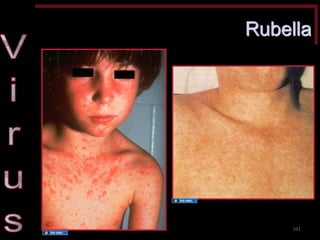
Rubella Arthritis •Often young women •Rash several days before •Acute, symmetric, usually polyarticular •Resolves within weeks •Recent infection or vaccination •Virus isolated from synovial fluid 
100
Rubella 
101 
Source Undetermined 
Source Undetermined
Hepatitis B Arthritis •Usually with or after prodrome of fever and lymphadenopathy •Often precedes jaundice •May be sudden and severe •PIP, knee, ankle, MP joints most commonly involved •Salicylates may be helpful 
102
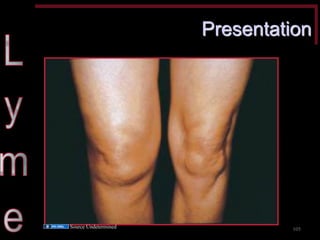
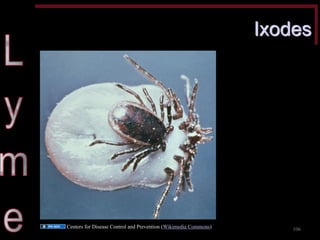
Lyme •Spirochete: Borrelia burgdorferi •Vector: Ixodes dammini on East Coast and Midwest •Arthritis late manifestation •Within 6 months, half of untreated have frank arthritis –Asymmetric –Most common in knees 
103
Presentation •Minimal joint pain, usually afebrile •Severity of initial presentation predictive of subsequent arthritis •Chronic arthritis more common in patients positive for HLA-DR4 •Joint fluid inflammatory with PMN predominance •Diagnosis is clinical 
104
Presentation 
105 
Source Undetermined
Ixodes 
106 
Centers for Disease Control and Prevention (Wikimedia Commons)
Spondyloarthropathies •Seronegative: negative rheumatoid factor •Sacroiliac involvement •Peripheral joint inflammation •Changes of ligamentous and tendinous insertion into bone •Genetic: HLA-B27 
107
Spondyloarthropathies •Ankylosing spondylitis •Reactive arthritis (e.g. Reiter’s syndrome) •Psoriatic arthritis •Arthropathy of inflammatory bowel disease 
108
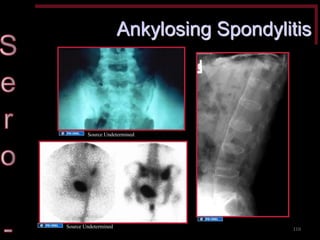
Ankylosing Spondylitis •Male predominance •Back pain •X-ray evidence of sacroiliitis •Symmetrically squared vertebral bodies, then “bamboo spine” •Morning stiffness, improves with exercise 
109
Ankylosing Spondylitis 
110 
Source Undetermined 
Source Undetermined 
Source Undetermined
Ankylosing Spondylitis •Uveitis: most common extra- articular manifestation •Peripheral joints involved in ~30% of patients with enthesopathic involvement (plantar fasciitis and Achilles tendinitis) •Goal of therapy: control pain, decrease inflammation 
111
Reactive Arthritis •AKA arthritis urethritica, venereal arthritis, polyarteritis enterica •Described by German military physician Hans Reiter in 1916 •“Reiter's syndrome” being phased out, partly due to Reiter's typhoid experiments in Nazi concentration camps 
112
Reactive Arthritis •Occurs in genetically susceptible host after infection with GU C. trachomatis, or GI shigella, salmonella, yersinia, campylobacter •Disease of men 15 to 35 years old; arthritis develops 2 to 6 weeks after episode of urethritis or dysentery 
113
Reactive Arthritis •Polyarticular, asymmetric •Weight-bearing joints of lower extremities commonly involved: knees, ankles, feet, particularly heels (“lover’s heel”) 
114
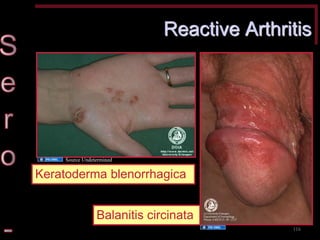
Reactive Arthritis •Other signs appear early •Conjunctivitis, progress to iritis, uveitis, corneal ulceration •Painless ulcers mouth, tongue, glans penis (balanitis circinata) •Sausage-like fingers and toes •Keratoderma blennorrhagica on palms and soles 
115
Reactive Arthritis 
Keratoderma blenorrhagica 
Balanitis circinata 
116 
Source Undetermined 
Source Undetermined
Reactive Arthritis •Synovial fluid: inflammatory with predominance of PMNs •Antigens in synovial membrane and joint fluid, cultures sterile •Increased ESR, WBC •HLA-B27 antigen in ~80% •Enthesopathic x-rays, particularly at IP joint of great toe 
117
Reactive Arthritis •NSAID two or three times daily •Doxycycline twice daily x 3 months •Intra-articular steroid injections •If persistent: Sulfasalazine •Chronic therapy for erosive, deforming disease –Methotrexate –Azathioprine (Imuran) 
118
What Happened to Reiter’s? 
119
What Happened to Reiter’s? •Hans Julius Reiter (1881 – 1969) •German military physician on Western Front in 1st Hungarian Army •1916: described German Lieutenant with non-gonococcal urethritis, arthritis and uveitis 
120
What Happened to Reiter’s? •Not the first, but he got credit •Member of the SS during WWII •Designed typhus inoculation experiments that killed more than 250 prisoners at Buchenwald •Convicted as war criminal 
121
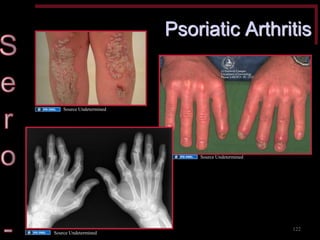
Psoriatic Arthritis 
122 
Source Undetermined 
Source Undetermined 
Source Undetermined
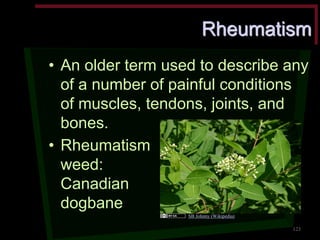
Rheumatism •An older term used to describe any of a number of painful conditions of muscles, tendons, joints, and bones. 
•Rheumatism weed: Canadian dogbane 
123 
SB Johnny (Wikipedia)
Acute Rheumatic Fever •Believed to result from Group A streptococcus pharyngitis •Exact mechanism unclear •In decline since antibiotics •Probable abnormal humoral response to antigens 
124
Clinical Syndrome •Recurring self-limited episodes of fever associated with polyarthritis, carditis / valvulitis, rash, subcutaneous nodules, or chorea •Occurs 2 to 3 weeks after streptococcal pharyngitis 
125
Diagnosis – Jones Criteria •Two major, or one major and two minor, criteria with evidence recent Group A streptococcal infection •Major manifestations: polyarthritis, carditis, chorea, erythema marginatum, subcutaneous nodules •Migratory arthritis in large joints 
126
Diagnosis – Jones Criteria •Involves heart in ~50% •Pericarditis, congestive heart failure, valvular dysfunction, cardiomegaly •Neurologic: Sydenham’s chorea, weakness, behavioral disturbance •Sparing of sensory functions 
127
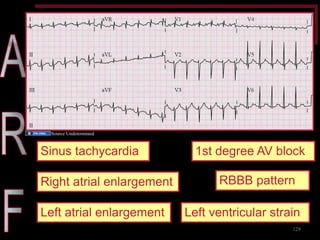
Diagnosis – Jones Criteria 
Sinus tachycardia 
Right atrial enlargement 
Left atrial enlargement 
Left ventricular strain 
RBBB pattern 
1st degree AV block 
128 
Source Undetermined
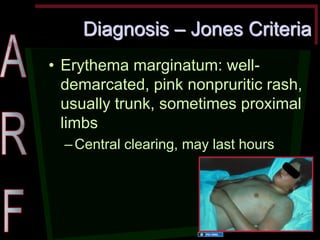
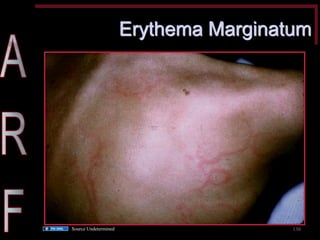
Diagnosis – Jones Criteria •Erythema marginatum: well- demarcated, pink nonpruritic rash, usually trunk, sometimes proximal limbs –Central clearing, may last hours 
129 
Source Undetermined
Erythema Marginatum 
130 
Source Undetermined
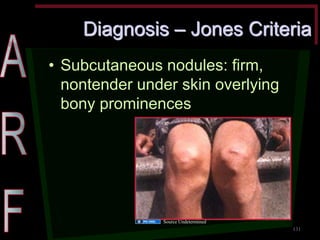
Diagnosis – Jones Criteria •Subcutaneous nodules: firm, nontender under skin overlying bony prominences 
131 
Source Undetermined
Laboratory Work-Up •Throat culture, ESR, CRP, ASO •Anti-DNase B 95% sensitive •Streptozyme test also documents recent streptococcal infection •Synovial fluid –Inflammatory (average WBC 16K) –Negative culture 
132
Post-Streptococcal •Reactive arthritis: closely related to ARF but distinct clinical entity •Sterile oligoarthritis associated with distant bacterial infection •Carditis rare, arthritis often severe •Treatment: penicillin, erythromycin •Arthritis responds to salicylates 
133
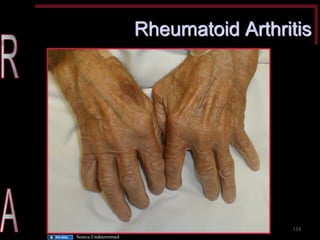
Rheumatoid Arthritis 
134 
Source Undetermined
Rheumatoid Arthritis •Usually chronic: >20% acute •Women 2 to 3 x more than men •Immune complexes stimulate PMNs to release enzymes •Synovial cells proliferate, produce more inflammatory substances 
135
Presentation •Prodrome: fatigue, weakness, musculoskeletal pain •Symmetric joint swelling: hands (MP, PIP joints), wrists, elbows •Difficult to distinguish from viral arthropathy 
136
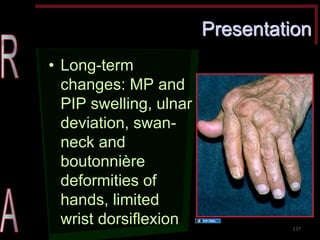
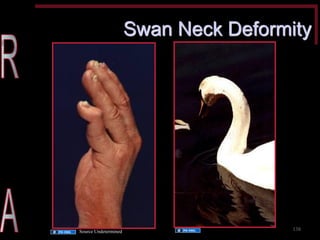
Presentation •Long-term changes: MP and PIP swelling, ulnar deviation, swan- neck and boutonnière deformities of hands, limited wrist dorsiflexion 
137 
Source Undetermined
Swan Neck Deformity 
138 
Source Undetermined 
Source Undetermined
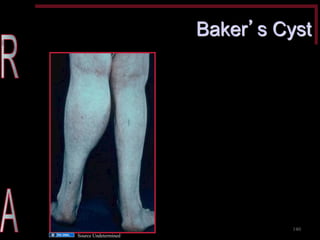
Presentation •Knee: effusion, muscle atrophy, Baker’s cyst •Retrocalcaneal bursa •Subcutaneous nodules, pulmonary fibrosis, mononeuritis multiplex •Sjögren’s and Felty’s syndromes 
139
Baker’s Cyst 
140 
Source Undetermined
Subcutaneous Nodules 
141 
Source Undetermined
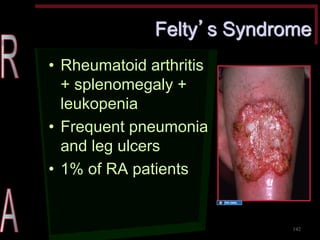
Felty’s Syndrome •Rheumatoid arthritis + splenomegaly + leukopenia •Frequent pneumonia and leg ulcers •1% of RA patients 
142 
Source Undetermined
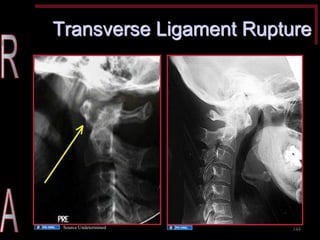
Transverse Ligament Rupture •C1 on C2 subluxation in 70% –Frank dislocation in 25% –Cord compression in 11% •With myelopathy: –5 years survival 80% –10 year survival 28% •Anterior instability more common than posterior instability 
143
Transverse Ligament Rupture 
144 
Source Undetermined 
Source Undetermined
Treatment •Movement increases inflammation: initial treatment rest •Suppress inflammation: steroids, salicylates, gold, penicillamine, azathioprine, methotrexate, cyclosporine, sulfasalazine 
145
Nontraditional Thinking •The Mycoplasma Theory: joint pain caused by subclinical mycoplasma infection, improves with doxycycline •Glucosamine and chondroitin: possibly useful in osteoarthritis 
146
Known Not to Work ALFALFA - LAPACHOL - ALOE VERA - MACROBIOTIC DIET - AMINO ACIDS - MA-HUANG - ANT VENOM - MANDELL ARTHRITIS DIET - ARNICA MEGAVITAMIN THERAPY - ASCORBIC ACID - NATURAL AND ORGANIC FOODS - BARK TEAS - NIGHTSHADE VEGETABLES - BEE POLLEN - OZONE - BIOTIN - P VITAMINS - BOWEL CLEANSING - PABA - CHUIFONG TOUKUWAN - PANAX - CINNAMON - PAU D'ARCO - CLAY ENEMAS - POWDERED ANT - CLEMANTIS PROPOLIS - ROYAL JELLY - CLOVES - RAW MILK - COD LIVER OIL - RHUS TOXICODENDRON - COENZYME Q-10 - ROSE HIPS - COFFEE ENEMAS - RUTIN - COICIS SEMEN - SASSAFRAS - COLONICS - SELENIUM - COPPER BRACELETS - SHARK CARTILAGE - CYTOTOXIC TESTING - SNAKE VENOM - DEVIL'S CLAW - SOAPWEED - DISMUTASE (SUPEROXIDE DISMUTASE) - SPANISH BAYONET - DONG DIET - SPANISH FLY - ELIMINATION DIETS - STEPHANIA - FEVERFEW - TANG-KUEI - FIT FOR LIFE DIET - TEAS (FEVERFEW, GINSENG, SASSAFRAS) - FO-TI - THIAMINE - GARLIC - VEGETARIAN DIETS - GERMANIUM - VOLCANIC ASH - FASTING - GINSENG - WATER ENEMA - GREEN-LIPPED MUSSEL - WOOD SPIDER - HAIR ANALYSIS - YUCCA - HOMEOPATHY - ZEN MACROBIOTICS - HYDROGEN PEROXIDE - ZINC - KELP 
147
Pearls •The number and distribution of joints involved helps pinpoint the most likely cause of arthritis. •Monarthritis is septic arthritis until proven otherwise. •Negative Gram’s stain of synovial fluid does not rule out bacterial arthritis. 
148
Pearls •The most definitive test for evaluating an inflamed joint for the possibility of bacterial infection is examination of synovial fluid. •Delays in the diagnosis and treatment of septic arthritis worsen outcomes. 
149

GEMC- Arthritis and Arthrocentesis- Resident Training

  • 1.
    Project: Ghana EmergencyMedicine Collaborative Document Title: Arthritis and Arthrocentesis Author(s): Joe Lex, MD (Temple University School of Medicine) License: Unless otherwise noted, this material is made available under the terms of the Creative Commons Attribution Share Alike-3.0 License: http://creativecommons.org/licenses/by-sa/3.0/ We have reviewed this material in accordance with U.S. Copyright Law and have tried to maximize your ability to use, share, and adapt it. These lectures have been modified in the process of making a publicly shareable version. The citation key on the following slide provides information about how you may share and adapt this material. Copyright holders of content included in this material should contact open.michigan@umich.edu with any questions, corrections, or clarification regarding the use of content. For more information about how to cite these materials visit http://open.umich.edu/privacy-and-terms-use. Any medical information in this material is intended to inform and educate and is not a tool for self-diagnosis or a replacement for medical evaluation, advice, diagnosis or treatment by a healthcare professional. Please speak to your physician if you have questions about your medical condition. Viewer discretion is advised: Some medical content is graphic and may not be suitable for all viewers. 1
  • 2.
    Attribution Key formore information see: http://open.umich.edu/wiki/AttributionPolicy Use + Share + Adapt Make Your Own Assessment Creative Commons – Attribution License Creative Commons – Attribution Share Alike License Creative Commons – Attribution Noncommercial License Creative Commons – Attribution Noncommercial Share Alike License GNU – Free Documentation License Creative Commons – Zero Waiver Public Domain – Ineligible: Works that are ineligible for copyright protection in the U.S. (17 USC § 102(b)) *laws in your jurisdiction may differ Public Domain – Expired: Works that are no longer protected due to an expired copyright term. Public Domain – Government: Works that are produced by the U.S. Government. (17 USC § 105) Public Domain – Self Dedicated: Works that a copyright holder has dedicated to the public domain. Fair Use: Use of works that is determined to be Fair consistent with the U.S. Copyright Act. (17 USC § 107) *laws in your jurisdiction may differ Our determination DOES NOT mean that all uses of this 3rd-party content are Fair Uses and we DO NOT guarantee that your use of the content is Fair. To use this content you should do your own independent analysis to determine whether or not your use will be Fair. { Content the copyright holder, author, or law permits you to use, share and adapt. } { Content Open.Michigan believes can be used, shared, and adapted because it is ineligible for copyright. } { Content Open.Michigan has used under a Fair Use determination. } 2
  • 3.
    Arthritis and ArthrocentesisJoe Lex, MD, FACEP, MAAEM Temple University School of Medicine 3
  • 4.
    What’s a jointlike you doing in a nice girl like this?? Source Undetermined 4
  • 5.
    Objectives 1. Differentiateamong the three types of joints 2. Explain the pathology of joint inflammation 3. Develop a differential for arthritis, based on number of joints involved, location, and other characteristics 5
  • 6.
    Objectives 4. Explainusefulness of various synovial fluid studies. 5. Demonstrate an appropriate technique for large joint arthrocentesis 6. Explain the pathophysiology and treatment for gout 6
  • 7.
    Objectives 7. Differentiate“rheumatic fever” from “rheumatoid arthritis” from “rheumatism” 8. Be aware of quackery as it applies to treatment of arthritis 7
  • 8.
    History of Arthritides•1680s: Sydenham describes gout, rheumatism, chorea •1808: term “rheumatic fever” •1876: urate crystals postulated to cause gout •1883: gonococcal arthritis •1907: osteoarthritis described 8
  • 9.
    Thomas Sydenham (1624-1689) Source Undetermined 9
  • 10.
    Three Joint Types•Synarthroses: suture lines of skull •Amphiarthroses: fibrocartilaginous unions of pubic symphysis and lower third of sacroiliac joint •Diarthroses = Synovial: most other joints 10
  • 11.
  • 12.
  • 13.
    Diarthrosis = SynovialJoints •Subchondral bone, convex against concave, covered by cartilage •Cartilage: collagen + proteoglycan •Lubricated, slide on each other •Surrounded by capsule supported by ligaments, tendons, and muscle •Lined with synovial membrane 13
  • 14.
    Typical Joint Structure Madhero88 (Wikimedia Commons) 14
  • 15.
    Pathophysiology •Joint traumacauses decreased proteoglycans –If trauma persistent, damage irreparable •Inflammation characterized by polymorphonuclear white cells –May be immunologic (rheumatoid, reactive) 15
  • 16.
    Joint vs. PeriarticularArthritis •Generalized pain, warmth, swelling, tenderness •Discomfort  with joint motion Periarticular inflammation: bursitis, tendinitis, localized cellulitis •Focal tenderness, swelling not uniform •Pain only with certain movements 16
  • 17.
    Monarticular vs. Polyarticular Source Undetermined 17
  • 18.
    If Polyarticular and……symmetric  rheumatoid, drug induced …asymmetric  rubella, acute rheumatic fever, gonococcal …migratory  gonococcal or rubella 18
  • 19.
    Location, Location, Location•First MTP joint: gout •MCP and PIP joints: rheumatoid •DIP and first carpometacarpal joint: osteoarthritis •Knee: septic arthritis, pseudogout, gout 19
  • 20.
    Causes of MigratoryArthritis •Rheumatic fever •Subacute bacterial endocarditis •Henoch-Schönlein purpura •Cefaclor (Ceclor®) hypersensitivity (kids) •Septicemia: staphylococcal, streptococcal, meningococcal, gonococcal •Mycoplasma, histoplasmosis, coccidioidomycosis •Lyme disease 20
  • 21.
    Arthritis with… …low-gradefever  any inflammatory arthritis …high fever, chills  septic arthritis …kidney stones  gout …genital ulcers  reactive arthritis …urethral discharge  reactive arthritis, gonococcus 21
  • 22.
    Arthritis and… …isoniazid,procainamide, hydralazine  lupus …thiazide diuretics  gout (increase serum uric acid level) –Chlorthalidone (Hygroton®) –Hydrochlorothiazide (HydroDIURIL®, Esidrix®, Oretic®) –Indapamide (Lozol®) 22
  • 23.
    Some Scalp andSkin Findings Alopecia SLE, psoriasis ECM Lyme Malar rash SLE, dermato- myositis Rash Rubella Pustules Gonococcemia Tophi Gout Elbows, knees Psoriasis SubQ nodules RA Tight skin Scleroderma Hyper- keratosis Reactive 23
  • 24.
    Physical Exam SourceUndetermined 24
  • 25.
    Physical Exam 1.Warmthand effusion 2.Synovial thickening 3.Deformity 4.Tenderness: generalized or localized, articular or periarticular 5.Limited range of motion 6.Pain on movement 25
  • 26.
    Lab Studies •Limiteddiagnostic value •“Screening tests” –Bacterial: usually elevated WBC –Chronic rheumatic: mild anemia –ESR/CRP  in most inflammatory •RF, ANA, ASO titers, Lyme serologies: for follow-up •Uric acid: not helpful in gout 26
  • 27.
    X-ray Findings (Chronic)Soft tissue swelling Erosions Calcification Osteoporosis Narrowed joint space Deformity Separation (fractures) Source Undetermined 27
  • 28.
    X-ray Findings (Septic) Source Undetermined Source Undetermined 28
  • 29.
    Hallmark X-ray Findings Osteoarthritis = Osteophytes Source Undetermined Source Undetermined 29
  • 30.
    Hallmark X-ray Findings Erosions = Rheumatoid or Gout Source Undetermined Source Undetermined Source Undetermined 30
  • 31.
    Hallmark X-ray Findings Chondrocalcinosis = Pseudogout Source Undetermined 31
  • 32.
    Hallmark X-ray Findings Enthesitis = Insertion Site Inflammation (HLA-B27) Source Undetermined 32
  • 33.
    Other Imaging •Ultrasound:joint effusions; tendons and ligaments of shoulder •CT scan: SI, sternoclavicular joint •MRI: knee cruciate ligaments •Contrast MRI: differentiate synovitis from synovial fluid in rheumatoid disease 33
  • 34.
    Other Imaging •99mtechnetiummethylene diphosphonate (99mTc MDP) –Osteomyelitis, stress fractures •Gallium: gathers at proliferation of serum proteins and leukocytes –Infection 34
  • 35.
  • 36.
    Arthrocentesis •Critical diagnosticadjunct •Can be painless, safe, and simple when performed correctly •Diagnostic or therapeutic Source Undetermined 36
  • 37.
    Indications •Obtain jointfluid for analysis •Drain tense hemarthroses •Instill analgesics and anti- inflammatory agents •Prosthetic joints: only to rule out infection 37
  • 38.
    Contraindications •Absolute: infectionof any kind covers area to be punctured •Relative –Bleeding diatheses, anticoagulant therapy –Bacteremia 38
  • 39.
    Procedure •Cleanse skinwith povidone-iodine, then air dry •Remove povidone-iodine with isopropyl alcohol –Intra-articular povidone-iodine can cause chemical irritation, inhibit bacterial growth leading to spuriously negative cultures in early septic joint 39
  • 40.
    Procedure •Place steriledrapes •Inject local anesthetic into skin –25- to 30-gauge needle –Intraarticular anesthetic can inhibit bacterial growth, cause spuriously negative culture in early septic joint 40
  • 41.
    Procedure •Aspirate largejoints with large- bore needle (18 or 19 gauge) –Smaller joints: smaller-bore needle •Choose syringe size based on anticipated fluid volume •Remove as much fluid as possible –Optimizes diagnosis –Relieves pain from distention 41
  • 42.
    Arthrocentesis •Fat globules:diagnostic of fracture •Intraarticular morphine can provide relief for up to 24 hours –1 to 5 mg diluted in normal saline solution to a total volume of 30 ml 42
  • 43.
    Sternoclavicular Joint 43 Gray's Anatomy (Wikipedia)
  • 44.
    Elbow – LateralApproach Flex elbow 90o Prep skin Insert needle in palpable bony notch between lateral epicondyle and olecranon 44
  • 45.
    Knee – LateralApproach Extend knee, quadriceps and patella relaxed so patella can move mediolaterally. Needle into joint space just lateral to patella near its upper pole, parallel to the posterior (articular) surface. 45
  • 46.
    Knee – MedialApproach 46 Source Undetermined
  • 47.
    Knee – MedialApproach 47 Source Undetermined
  • 48.
    Knee – MedialApproach 48 Source Undetermined
  • 49.
    Knee – MedialApproach 49 Source Undetermined
  • 50.
    Knee – MedialApproach 50 Source Undetermined
  • 51.
    Knee – Medialvs. Lateral •Follow “Sutton’s Law” •William “Slick Willie” Sutton (1901 – 1980): professional bank robber 51
  • 52.
    Ankle Palpate themedial and lateral malleoli with your thumb and index finger. The joint space is located one to one and a half cm above the line joining the tips of the malleoli. 52
  • 53.
    Ankle Palpate thedorsalis pedis artery and choose a puncture site anywhere on the anterior aspect of the ankle, avoiding the dorsalis pedis artery. 53
  • 54.
    Synovial Fluid Analysis 54 Source Undetermined
  • 55.
    Synovial Fluid Analysis•Identify crystals, pus •Analyze color, clarity, cell count, differential, Gram’s stain, crystals •Positive Gram’s stain: diagnostic for septic arthritis •Negative Gram’s stain: does not rule out septic arthritis 55
  • 56.
    Synovial Fluid CellCount •Noninflammatory vs. inflammatory •ED wet mount prep –1 to 2 WBCs per high-power field consistent with noninflammatory –>20 WBC/HPF suggests inflammation or infection •Septic: >50,000 WBC/mm3 (also rheumatoid, gout, pseudogout) 56
  • 57.
    Normal Non- inflammatory Inflammatory Infectious Trans- parent Transparent Cloudy Cloudy Clear Yellow Yellow Yellow <200 <2000 200 – 50,000 >50,000 <25% <25% >50% >50% Negative Negative Negative Positive Appear- ance Clarity WBCs PMNs Culture Synovial Fluid Analysis 57
  • 58.
    Other Synovial FluidAnalysis •Glucose, lactic acid, viscosity, mucin clot, and total protein: limited utility, not recommended •Appropriate container –Cellular analysis: lavender (ethylenediaminetetraacetic acid) –Crystal analysis: green (heparin) –Chemical analysis, serology: red 58
  • 59.
    Crystal Studies •Monosodiumurate: needle shaped, birefringent negative –Parallel to compensator: yellow –Perpendicular: blue •Calcium pyrophosphate: polymorphic, birefringent positive –Parallel to compensator: blue –Perpendicular: yellow 59
  • 60.
    Crystal Studies Sodiumurate crystals viewed under polarized light with a red plate makes those in the plane of the long axis of the red plate yellow, which indicates that they are negatively birefringent. 60 Source Undetermined
  • 61.
    Crystal Studies Calciumpyrophosphate crystal viewed under polarized light with a red plate. The crystal is aligned in the long axis of the red plate, so that it is bluish-white, which indicates that it is weakly positively birefringent. 61 Source Undetermined
  • 62.
    Specific Arthritides Thereare more than 90 Preiser’s disease: avascular necrosis of scaphoid 62 Source Undetermined
  • 63.
    Septic Arthritis •Hematogenousspread •Direct inoculation •Direct spread from bony or soft tissue infections 63
  • 64.
    Septic Arthritis •Synoviuminfected before degrading enzymes released •Children: hematogenous most common •Postoperative infection: ~10% of joint surgeries 64
  • 65.
    Causes •Staphylococcus aureus:most common (even in sickle cell) •Others: streptococcus, Gram negatives, anaerobes •N. gonorrhoeae: 20% monarticular •<6 months: E. coli, group B strep •IV drug users: S. aureus, Gram negatives 65
  • 66.
    Clinical Features •Basedon host’s concurrent medical conditions •Painful, hot, swollen •Typical: single joint –Knee: 40% to 50% –Hip: 13% to 20% –Shoulder: 10% to 15% •20% polyarticular 66
  • 67.
    Clinical Features •Historyof fever: 80% •Shaking chills: 20% •Elevated sedimentation rate more common than leukocytosis •Blood cultures grow causative organism ~50% of the time •Radiographs not often useful 67
  • 68.
    Management •Admit forjoint drainage, IV antibiotics •Empiric therapy based on Gram’s stain •Parenteral narcotic analgesics, articular immobilization control pain and discomfort 68
  • 69.
  • 70.
    Gouty Arthritis •Pod= foot; agra = trap, hunt •Podagra: foot goddess, a bad- tempered virgin, who attacked victims after they overindulged •Father was Dionysus (Bacchus), god of wine •Mother was Aphrodite (Venus), goddess of love 70
  • 71.
    Gouty Arthritis •Thoughtto be limited to men who had indulged in dietary or sexual excess 71
  • 72.
    Gouty Arthritis •Galen(129-199 AD), an ex-gladiatorial surgeon in Rome, described gout as a discharge of the four humors of the body in unbalanced amounts into the joints (hence gout = gutta, a drop) 72 Pierre Roche Vigneron (Wikimedia Commons)
  • 73.
    Be temperate inwine, in eating, girls and sloth Or the gout will seize you and plague you both 73 Benjamin Franklin:
  • 74.
    Pathophysiology •Uric acidcrystal deposits from supersaturated extracellular fluid •Risk factors: obesity, hypertension, diabetes, alcohol, proximal loop diuretics, lead poisoning •During attack: crystals ingested by PMNs  inflammation 74
  • 75.
    Pathophysiology •Middle-aged men,post- menopausal women •Increased uric acid usually present for 20 years before first attack •Uric acid often normal 75
  • 76.
    Presentation •Great toeMTP joint in 75% –Also tarsal, ankle, knee, wrist –Up to 40% polyarticular •Pain excruciating at onset –Can mimic septic joint –Usually self-limited •Systemic symptoms usually minimal or absent 76
  • 77.
    Presentation •Subsequent attackscloser together, more joints, last longer •Long-term: kidney stones 77 Source Undetermined
  • 78.
    Presentation •Tophi: foreignbody granulomas with crystals as nidus, in musculo- tendinous unit – olecranon bursa, Achilles tendon, hands, knees, etc. 78 Source Undetermined Source Undetermined
  • 79.
    Diagnosis •Rule outcellulitis, septic arthritis particularly if knee joint •All may have fever, leukocytosis, elevated ESR •Uric acid level not helpful •X-rays: soft-tissue swelling (acute) or joint destruction (chronic) 79
  • 80.
    Uric Acid Levels•Uric acid normal in ~40% •Tophi can form in cool body areas without hyperuricemia •Acute attack  pain  increased cortisol  uric acid diuresis  normalized level 80
  • 81.
    Diagnosis 81 SourceUndetermined Source Undetermined
  • 82.
    Diagnosis •Definitive diagnosis:birefringent joint fluid crystals with polarizing microscope (a yellow crystal against a red background) and negative joint fluid culture 82 Source Undetermined
  • 83.
    Acute Therapy –Colchicine •Not diagnostic: works on pseudogout •Contraindication: hematologic, renal, hepatic dysfunction •Extravasation from IV  tissue necrosis 83
  • 84.
    Acute Therapy –Colchicine •Inhibits microtubule formation •Most effective in first 24 hours •0.6 mg / hour until pain controlled, max 6 mg or side effects (GI) •Average toxic dose: 6.7 mg •Toxicity precedes improvement in more than 50% 84
  • 85.
    Acute Therapy –Other •NSAIDs effective, indomethacin most common (75 to 200 mg/day) –Contraindicated in PUD, GI bleed •If resistant: prednisone taper –40 mg/day first 3 to 5 days •Adrenocorticotrophic hormone –ACTH 40 IU to 80 IU IM 85
  • 86.
    Pseudogout •Calcium pyrophosphatedihydrate (CPPD) crystal-deposition disease •Knee: most common joint •Polyarticular possible •Pain less severe, patients older •Risk: hypothyroid, Wilson’s disease, hyperparathyroid, hemochromatosis, etc. 86
  • 87.
    Diagnosis •Common: elevatedESR, WBC •X-ray may show joint calcification •Joint fluid –Weakly positive birefringent crystals on polarized microscopy –Appear rhomboidal on regular light microscopy •Treatment: same as gout 87
  • 88.
  • 89.
    Osteoarthritis •Degenerative jointdisease •Most common form of arthritis •Loss of articular cartilage, reactive changes at joint margins •Synovitis in advanced disease •May have painful bone-to-bone interface 89
  • 90.
    Presentation / Diagnosis•Chief complaint: pain •No systemic symptoms •Hands: Bouchard’s, Heberden’s nodes (osteophyte spurs) •Knee: active & passive crepitus •Routine lab tests: normal •Radiographs: joint- space narrowing, osteophyte formation 90
  • 91.
    Heberden’s and Bouchard’s Over DIP Over PIP 91 Source Undetermined
  • 92.
  • 93.
    Treatment •Judicious exercisefor muscle strengthening •Relieve muscle spasm •Support joint •Acetaminophen comparable to ibuprofen for short-term treatment •Ultimately joint replacement 93
  • 94.
    Gonococcal Arthritis •Woman: men :: 4:1 •Fever, chills, arthralgias, migratory tenosynovitis •Progresses to arthritis: knee, ankle, wrist •Characteristic rash: countable hemorrhagic necrotic pustules •Rarely have cervicitis or urethritis 94
  • 95.
    Gonococcal Arthritis 95 Source Undetermined Source Undetermined
  • 96.
    Gonococcal Arthritis 96 Source Undetermined Source Undetermined
  • 97.
    Diagnosis •Blood culturesusually negative •Synovial fluid cultures positive in less than 50% •Gram’s stain positive more often than culture •Cervical, urethral, pharyngeal, rectal cultures positive ~75% 97
  • 98.
    Treatment •Admit tohospital •Ceftriaxone 1 g IM or IV daily, and 24 to 48 hours after improvement •Ciprofloxacin 500 mg twice daily orally for total 7 days of antibiotics •Spectinomycin 2 grams IM every 12 hours if beta-lactam allergic 98
  • 99.
    Viral Arthritis •Mostcommon: rubella, hepatitis B •Also mumps, adenoviruses, Epstein-Barr virus, enteroviruses •Deposition of soluble immune complexes in synovium with resultant inflammation 99
  • 100.
    Rubella Arthritis •Oftenyoung women •Rash several days before •Acute, symmetric, usually polyarticular •Resolves within weeks •Recent infection or vaccination •Virus isolated from synovial fluid 100
  • 101.
    Rubella 101 SourceUndetermined Source Undetermined
  • 102.
    Hepatitis B Arthritis•Usually with or after prodrome of fever and lymphadenopathy •Often precedes jaundice •May be sudden and severe •PIP, knee, ankle, MP joints most commonly involved •Salicylates may be helpful 102
  • 103.
    Lyme •Spirochete: Borreliaburgdorferi •Vector: Ixodes dammini on East Coast and Midwest •Arthritis late manifestation •Within 6 months, half of untreated have frank arthritis –Asymmetric –Most common in knees 103
  • 104.
    Presentation •Minimal jointpain, usually afebrile •Severity of initial presentation predictive of subsequent arthritis •Chronic arthritis more common in patients positive for HLA-DR4 •Joint fluid inflammatory with PMN predominance •Diagnosis is clinical 104
  • 105.
  • 106.
    Ixodes 106 Centersfor Disease Control and Prevention (Wikimedia Commons)
  • 107.
    Spondyloarthropathies •Seronegative: negativerheumatoid factor •Sacroiliac involvement •Peripheral joint inflammation •Changes of ligamentous and tendinous insertion into bone •Genetic: HLA-B27 107
  • 108.
    Spondyloarthropathies •Ankylosing spondylitis•Reactive arthritis (e.g. Reiter’s syndrome) •Psoriatic arthritis •Arthropathy of inflammatory bowel disease 108
  • 109.
    Ankylosing Spondylitis •Malepredominance •Back pain •X-ray evidence of sacroiliitis •Symmetrically squared vertebral bodies, then “bamboo spine” •Morning stiffness, improves with exercise 109
  • 110.
    Ankylosing Spondylitis 110 Source Undetermined Source Undetermined Source Undetermined
  • 111.
    Ankylosing Spondylitis •Uveitis:most common extra- articular manifestation •Peripheral joints involved in ~30% of patients with enthesopathic involvement (plantar fasciitis and Achilles tendinitis) •Goal of therapy: control pain, decrease inflammation 111
  • 112.
    Reactive Arthritis •AKAarthritis urethritica, venereal arthritis, polyarteritis enterica •Described by German military physician Hans Reiter in 1916 •“Reiter's syndrome” being phased out, partly due to Reiter's typhoid experiments in Nazi concentration camps 112
  • 113.
    Reactive Arthritis •Occursin genetically susceptible host after infection with GU C. trachomatis, or GI shigella, salmonella, yersinia, campylobacter •Disease of men 15 to 35 years old; arthritis develops 2 to 6 weeks after episode of urethritis or dysentery 113
  • 114.
    Reactive Arthritis •Polyarticular,asymmetric •Weight-bearing joints of lower extremities commonly involved: knees, ankles, feet, particularly heels (“lover’s heel”) 114
  • 115.
    Reactive Arthritis •Othersigns appear early •Conjunctivitis, progress to iritis, uveitis, corneal ulceration •Painless ulcers mouth, tongue, glans penis (balanitis circinata) •Sausage-like fingers and toes •Keratoderma blennorrhagica on palms and soles 115
  • 116.
    Reactive Arthritis Keratodermablenorrhagica Balanitis circinata 116 Source Undetermined Source Undetermined
  • 117.
    Reactive Arthritis •Synovialfluid: inflammatory with predominance of PMNs •Antigens in synovial membrane and joint fluid, cultures sterile •Increased ESR, WBC •HLA-B27 antigen in ~80% •Enthesopathic x-rays, particularly at IP joint of great toe 117
  • 118.
    Reactive Arthritis •NSAIDtwo or three times daily •Doxycycline twice daily x 3 months •Intra-articular steroid injections •If persistent: Sulfasalazine •Chronic therapy for erosive, deforming disease –Methotrexate –Azathioprine (Imuran) 118
  • 119.
    What Happened toReiter’s? 119
  • 120.
    What Happened toReiter’s? •Hans Julius Reiter (1881 – 1969) •German military physician on Western Front in 1st Hungarian Army •1916: described German Lieutenant with non-gonococcal urethritis, arthritis and uveitis 120
  • 121.
    What Happened toReiter’s? •Not the first, but he got credit •Member of the SS during WWII •Designed typhus inoculation experiments that killed more than 250 prisoners at Buchenwald •Convicted as war criminal 121
  • 122.
    Psoriatic Arthritis 122 Source Undetermined Source Undetermined Source Undetermined
  • 123.
    Rheumatism •An olderterm used to describe any of a number of painful conditions of muscles, tendons, joints, and bones. •Rheumatism weed: Canadian dogbane 123 SB Johnny (Wikipedia)
  • 124.
    Acute Rheumatic Fever•Believed to result from Group A streptococcus pharyngitis •Exact mechanism unclear •In decline since antibiotics •Probable abnormal humoral response to antigens 124
  • 125.
    Clinical Syndrome •Recurringself-limited episodes of fever associated with polyarthritis, carditis / valvulitis, rash, subcutaneous nodules, or chorea •Occurs 2 to 3 weeks after streptococcal pharyngitis 125
  • 126.
    Diagnosis – JonesCriteria •Two major, or one major and two minor, criteria with evidence recent Group A streptococcal infection •Major manifestations: polyarthritis, carditis, chorea, erythema marginatum, subcutaneous nodules •Migratory arthritis in large joints 126
  • 127.
    Diagnosis – JonesCriteria •Involves heart in ~50% •Pericarditis, congestive heart failure, valvular dysfunction, cardiomegaly •Neurologic: Sydenham’s chorea, weakness, behavioral disturbance •Sparing of sensory functions 127
  • 128.
    Diagnosis – JonesCriteria Sinus tachycardia Right atrial enlargement Left atrial enlargement Left ventricular strain RBBB pattern 1st degree AV block 128 Source Undetermined
  • 129.
    Diagnosis – JonesCriteria •Erythema marginatum: well- demarcated, pink nonpruritic rash, usually trunk, sometimes proximal limbs –Central clearing, may last hours 129 Source Undetermined
  • 130.
    Erythema Marginatum 130 Source Undetermined
  • 131.
    Diagnosis – JonesCriteria •Subcutaneous nodules: firm, nontender under skin overlying bony prominences 131 Source Undetermined
  • 132.
    Laboratory Work-Up •Throatculture, ESR, CRP, ASO •Anti-DNase B 95% sensitive •Streptozyme test also documents recent streptococcal infection •Synovial fluid –Inflammatory (average WBC 16K) –Negative culture 132
  • 133.
    Post-Streptococcal •Reactive arthritis:closely related to ARF but distinct clinical entity •Sterile oligoarthritis associated with distant bacterial infection •Carditis rare, arthritis often severe •Treatment: penicillin, erythromycin •Arthritis responds to salicylates 133
  • 134.
    Rheumatoid Arthritis 134 Source Undetermined
  • 135.
    Rheumatoid Arthritis •Usuallychronic: >20% acute •Women 2 to 3 x more than men •Immune complexes stimulate PMNs to release enzymes •Synovial cells proliferate, produce more inflammatory substances 135
  • 136.
    Presentation •Prodrome: fatigue,weakness, musculoskeletal pain •Symmetric joint swelling: hands (MP, PIP joints), wrists, elbows •Difficult to distinguish from viral arthropathy 136
  • 137.
    Presentation •Long-term changes:MP and PIP swelling, ulnar deviation, swan- neck and boutonnière deformities of hands, limited wrist dorsiflexion 137 Source Undetermined
  • 138.
    Swan Neck Deformity 138 Source Undetermined Source Undetermined
  • 139.
    Presentation •Knee: effusion,muscle atrophy, Baker’s cyst •Retrocalcaneal bursa •Subcutaneous nodules, pulmonary fibrosis, mononeuritis multiplex •Sjögren’s and Felty’s syndromes 139
  • 140.
    Baker’s Cyst 140 Source Undetermined
  • 141.
    Subcutaneous Nodules 141 Source Undetermined
  • 142.
    Felty’s Syndrome •Rheumatoidarthritis + splenomegaly + leukopenia •Frequent pneumonia and leg ulcers •1% of RA patients 142 Source Undetermined
  • 143.
    Transverse Ligament Rupture•C1 on C2 subluxation in 70% –Frank dislocation in 25% –Cord compression in 11% •With myelopathy: –5 years survival 80% –10 year survival 28% •Anterior instability more common than posterior instability 143
  • 144.
    Transverse Ligament Rupture 144 Source Undetermined Source Undetermined
  • 145.
    Treatment •Movement increasesinflammation: initial treatment rest •Suppress inflammation: steroids, salicylates, gold, penicillamine, azathioprine, methotrexate, cyclosporine, sulfasalazine 145
  • 146.
    Nontraditional Thinking •TheMycoplasma Theory: joint pain caused by subclinical mycoplasma infection, improves with doxycycline •Glucosamine and chondroitin: possibly useful in osteoarthritis 146
  • 147.
    Known Not toWork ALFALFA - LAPACHOL - ALOE VERA - MACROBIOTIC DIET - AMINO ACIDS - MA-HUANG - ANT VENOM - MANDELL ARTHRITIS DIET - ARNICA MEGAVITAMIN THERAPY - ASCORBIC ACID - NATURAL AND ORGANIC FOODS - BARK TEAS - NIGHTSHADE VEGETABLES - BEE POLLEN - OZONE - BIOTIN - P VITAMINS - BOWEL CLEANSING - PABA - CHUIFONG TOUKUWAN - PANAX - CINNAMON - PAU D'ARCO - CLAY ENEMAS - POWDERED ANT - CLEMANTIS PROPOLIS - ROYAL JELLY - CLOVES - RAW MILK - COD LIVER OIL - RHUS TOXICODENDRON - COENZYME Q-10 - ROSE HIPS - COFFEE ENEMAS - RUTIN - COICIS SEMEN - SASSAFRAS - COLONICS - SELENIUM - COPPER BRACELETS - SHARK CARTILAGE - CYTOTOXIC TESTING - SNAKE VENOM - DEVIL'S CLAW - SOAPWEED - DISMUTASE (SUPEROXIDE DISMUTASE) - SPANISH BAYONET - DONG DIET - SPANISH FLY - ELIMINATION DIETS - STEPHANIA - FEVERFEW - TANG-KUEI - FIT FOR LIFE DIET - TEAS (FEVERFEW, GINSENG, SASSAFRAS) - FO-TI - THIAMINE - GARLIC - VEGETARIAN DIETS - GERMANIUM - VOLCANIC ASH - FASTING - GINSENG - WATER ENEMA - GREEN-LIPPED MUSSEL - WOOD SPIDER - HAIR ANALYSIS - YUCCA - HOMEOPATHY - ZEN MACROBIOTICS - HYDROGEN PEROXIDE - ZINC - KELP 147
  • 148.
    Pearls •The numberand distribution of joints involved helps pinpoint the most likely cause of arthritis. •Monarthritis is septic arthritis until proven otherwise. •Negative Gram’s stain of synovial fluid does not rule out bacterial arthritis. 148
  • 149.
    Pearls •The mostdefinitive test for evaluating an inflamed joint for the possibility of bacterial infection is examination of synovial fluid. •Delays in the diagnosis and treatment of septic arthritis worsen outcomes. 149