Project: Ghana Emergency Medicine Collaborative 
! 
Document Title: Oncologic Emergencies 
! 
Author(s): Jim Holliman, M.D., F.A.E.C.P., Uniformed Services University, 
2013 
! 
License: Unless otherwise noted, this material is made available under the 
terms of the Creative Commons Attribution Share Alike-3.0 License: 
http://creativecommons.org/licenses/by-sa/3.0/ 
We have reviewed this material in accordance with U.S. Copyright Law and have tried to maximize your 
ability to use, share, and adapt it. These lectures have been modified in the process of making a publicly 
shareable version. The citation key on the following slide provides information about how you may share and 
adapt this material. ! 
Copyright holders of content included in this material should contact open.michigan@umich.edu with any 
questions, corrections, or clarification regarding the use of content. ! 
For more information about how to cite these materials visit http://open.umich.edu/privacy-and-terms-use. ! 
Any medical information in this material is intended to inform and educate and is not a tool for self-diagnosis 
or a replacement for medical evaluation, advice, diagnosis or treatment by a healthcare professional. Please 
speak to your physician if you have questions about your medical condition. ! 
Viewer discretion is advised: Some medical content is graphic and may not be suitable for all viewers. 
1
Attribution Key 
! 
for more information see: http://open.umich.edu/wiki/AttributionPolicy 
Use + Share + Adapt 
{ Content the copyright holder, author, or law permits you to use, share and adapt. } 
Public Domain – Government: Works that are produced by the U.S. Government. (17 USC § 105) 
Public Domain – Expired: Works that are no longer protected due to an expired copyright term. 
Public Domain – Self Dedicated: Works that a copyright holder has dedicated to the public domain. 
Creative Commons – Zero Waiver 
Creative Commons – Attribution License 
Creative Commons – Attribution Share Alike License 
Creative Commons – Attribution Noncommercial License 
Creative Commons – Attribution Noncommercial Share Alike License 
GNU – Free Documentation License 
Make Your Own Assessment 
{ Content Open.Michigan believes can be used, shared, and adapted because it is ineligible for copyright. } 
Public Domain – Ineligible: Works that are ineligible for copyright protection in the U.S. (17 USC § 102(b)) *laws in 
your jurisdiction may differ 
{ Content Open.Michigan has used under a Fair Use determination. } 
Fair Use: Use of works that is determined to be Fair consistent with the U.S. Copyright Act. (17 USC § 107) *laws in your 
jurisdiction may differ 
Our determination DOES NOT mean that all uses of this 3rd-party content are Fair Uses and we DO NOT guarantee that 
your use of the content is Fair. 
2 
To use this content you should do your own independent analysis to determine whether or not your use will be Fair.
Oncologic ! 
Emergencies 
Jim Holliman, M.D., F.A.C.E.P.! 
Professor of Military and Emergency Medicine! 
Uniformed Services University of the Health Sciences! 
Clinical Professor of Emergency Medicine! 
George Washington University! 
Bethesda, Maryland, U.S.A. 
3
Oncologic Emergencies! 
Introduction 
• Malignancy is 2nd leading cause of 
death in U.S.! 
• Now cancer has 52 % 5 year survival 
overall! 
• Rx of complications can be life-saving 
since causative tumor often is curable! 
• Rx of complications can, at a 
minimum, improve quality of life 
4
List of Major Emergency 
Complications of Malignancy 
• Upper airway obstruction! 
• Malignant pericardial tamponade! 
• Superior vena cava syndrome! 
• Acute spinal cord compression! 
• Hypercalcemia! 
• Hyperviscosity syndrome! 
• Hyperleukocytic syndrome! 
• Acute tumor lysis syndrome! 
• SIADH! 
• Adrenal insufficiency / crisis ! 
• Thrombocytopenia / hemorrhage! 
• Immunosuppression / infection 
5
Upper Airway Obstruction by 
Malignancy 
• Causative tumors :! 
• Laryngeal ca! 
• Thyroid ca! 
• Lymphoma! 
• Metastatic lung ca! 
• Retropharyngeal abscess 
6
Upper Airway Obstruction by 
Malignancy 
• Symptoms! 
• Voice change! 
• Hoarseness! 
• Neck fullness! 
• Dysphagia! 
• Stridor! 
• Dyspnea! 
• Usually progresses & presents subacutely, 
unless food aspiration, infection, hemorrhage, or 
inspissated secretions occur 
7
Upper Airway Obstruction by 
Malignancy 
• Diagnosis! 
• Lateral soft tissue neck film! 
• CXR! 
• Fiberoptic laryngoscopy 
8
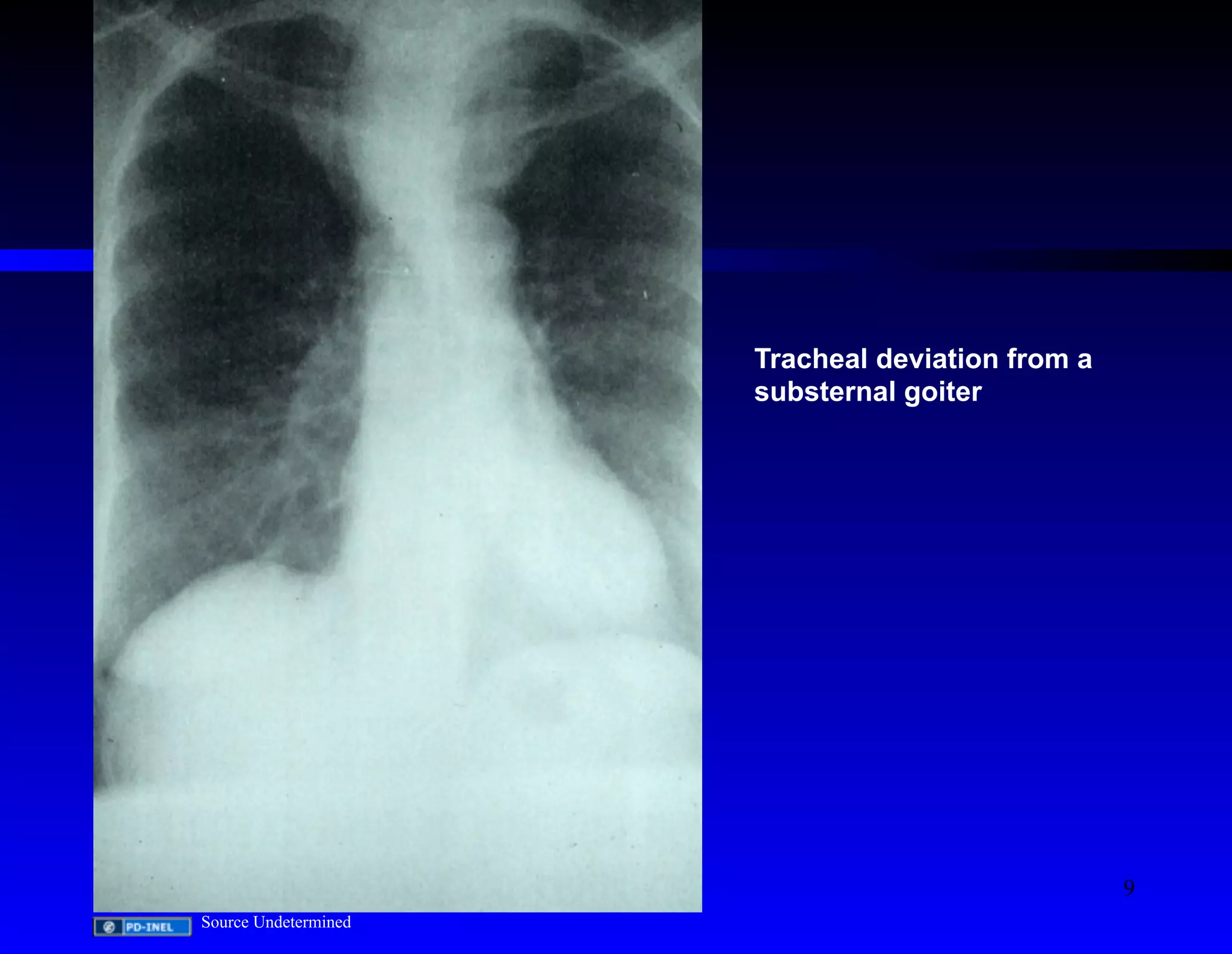
Tracheal deviation from a 
substernal goiter 
Source Undetermined 
9
Upper Airway Obstruction by 
Malignancy 
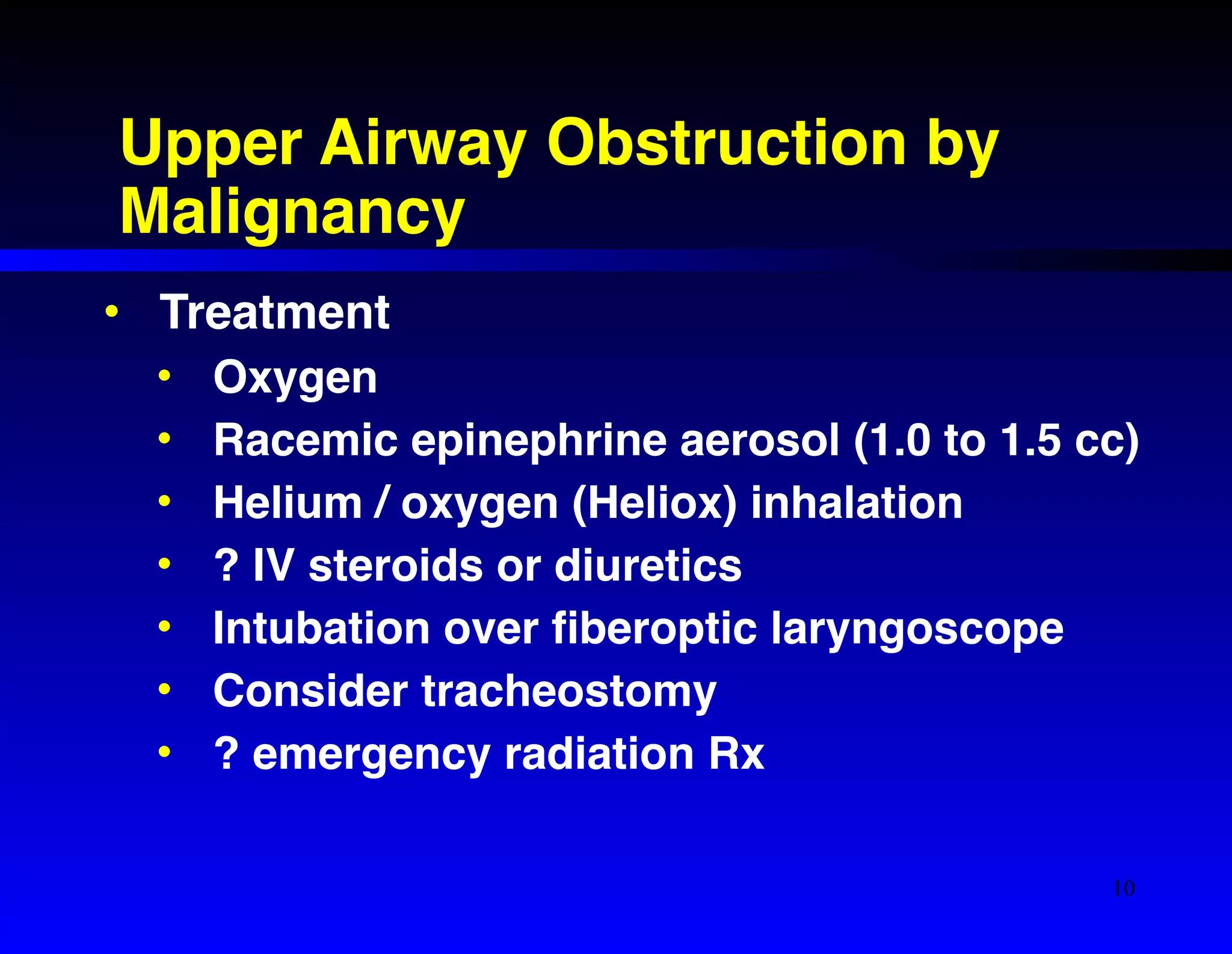
• Treatment! 
• Oxygen! 
• Racemic epinephrine aerosol (1.0 to 1.5 cc)! 
• Helium / oxygen (Heliox) inhalation! 
• ? IV steroids or diuretics! 
• Intubation over fiberoptic laryngoscope! 
• Consider tracheostomy! 
• ? emergency radiation Rx 
10
Malignant Pericardial 
Tamponade 
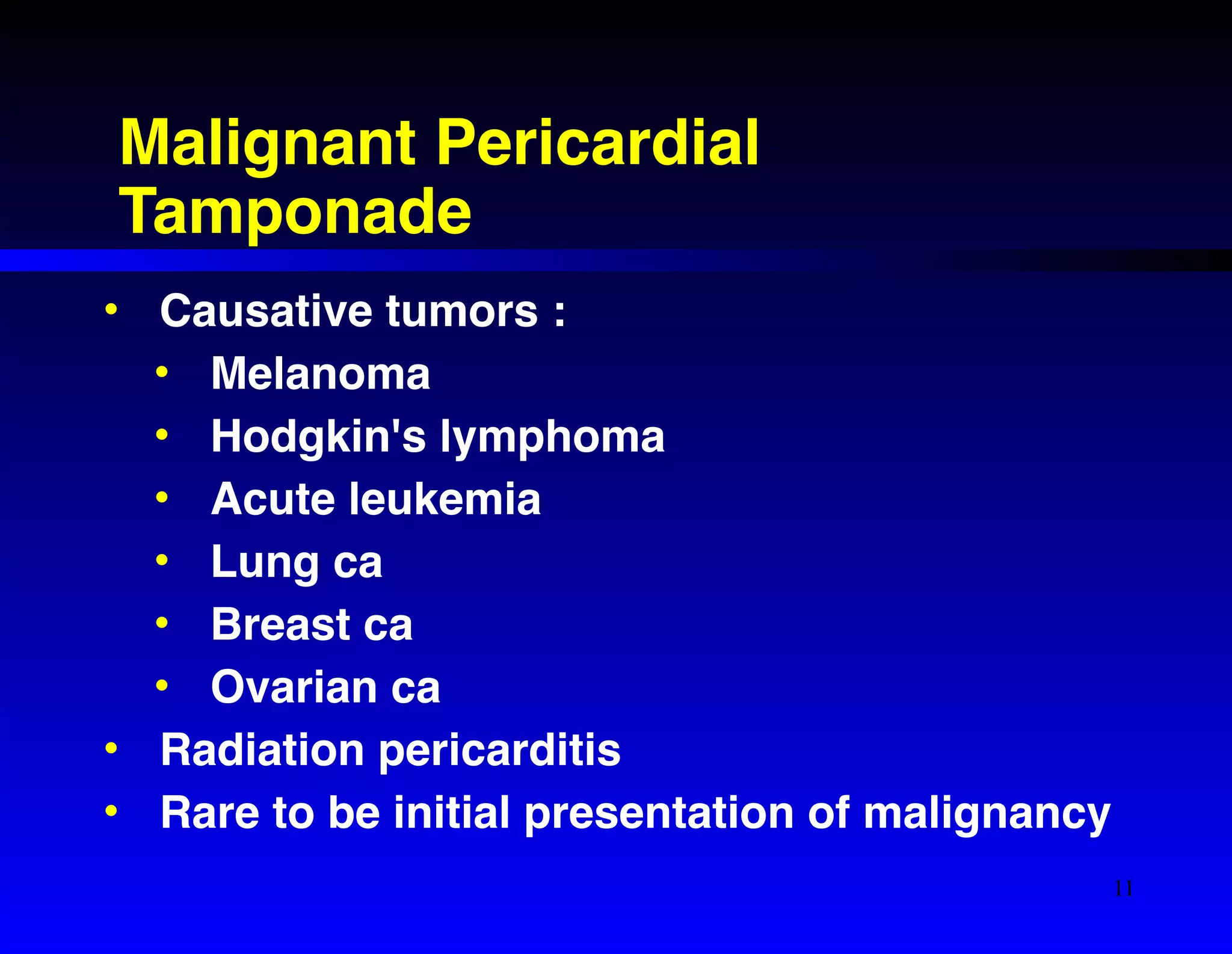
• Causative tumors :! 
• Melanoma! 
• Hodgkin's lymphoma! 
• Acute leukemia! 
• Lung ca! 
• Breast ca! 
• Ovarian ca! 
• Radiation pericarditis! 
• Rare to be initial presentation of malignancy 
11
Malignant Pericardial 
Tamponade 
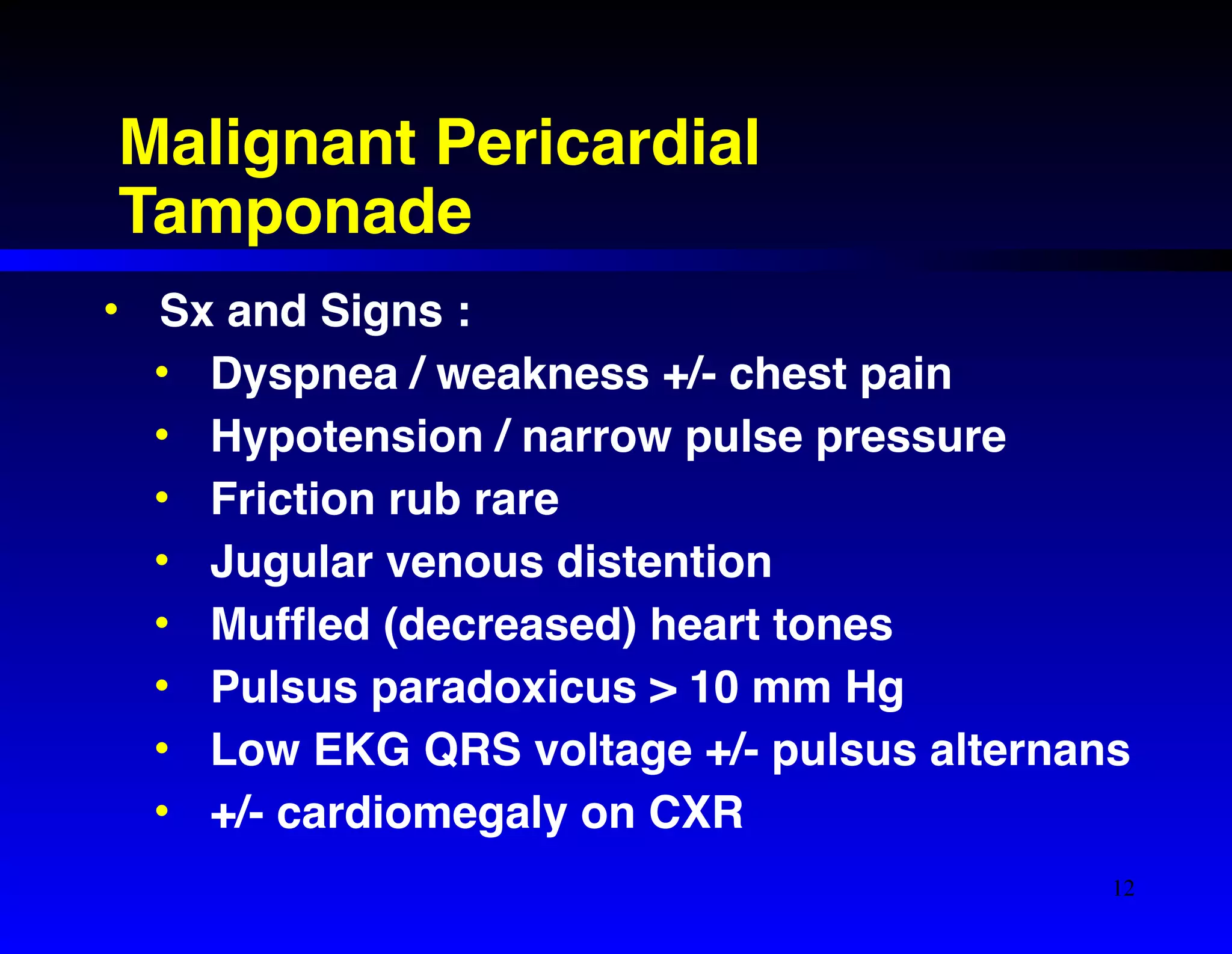
• Sx and Signs :! 
• Dyspnea / weakness +/- chest pain! 
• Hypotension / narrow pulse pressure! 
• Friction rub rare! 
• Jugular venous distention! 
• Muffled (decreased) heart tones! 
• Pulsus paradoxicus > 10 mm Hg! 
• Low EKG QRS voltage +/- pulsus alternans! 
• +/- cardiomegaly on CXR 
12
Malignant Pericardial 
Tamponade 
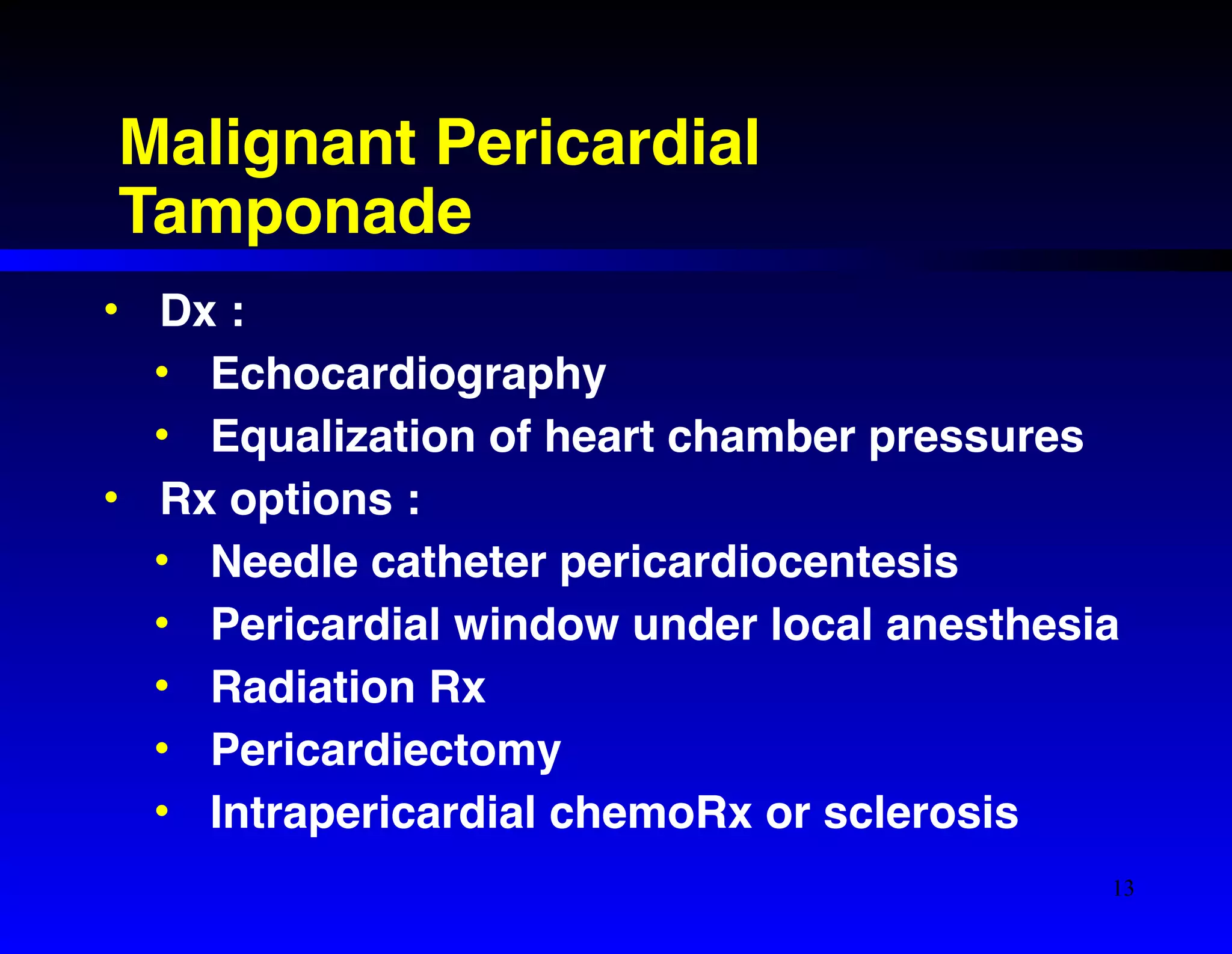
• Dx :! 
• Echocardiography! 
• Equalization of heart chamber pressures! 
• Rx options :! 
• Needle catheter pericardiocentesis! 
• Pericardial window under local anesthesia! 
• Radiation Rx! 
• Pericardiectomy! 
• Intrapericardial chemoRx or sclerosis 
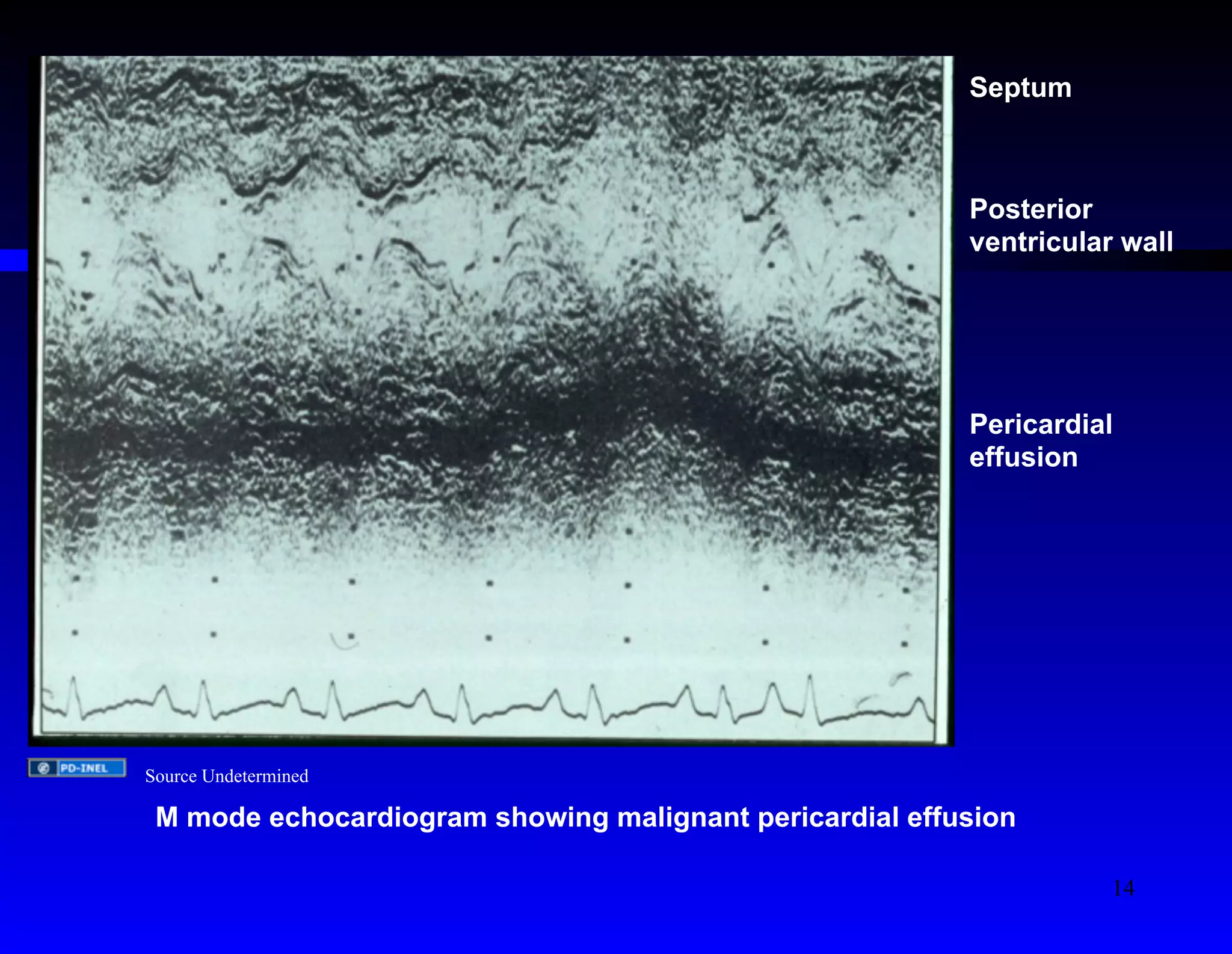
13
Septum 
Posterior 
ventricular wall 
Pericardial 
effusion 
Source Undetermined 
M mode echocardiogram showing malignant pericardial effusion 
14
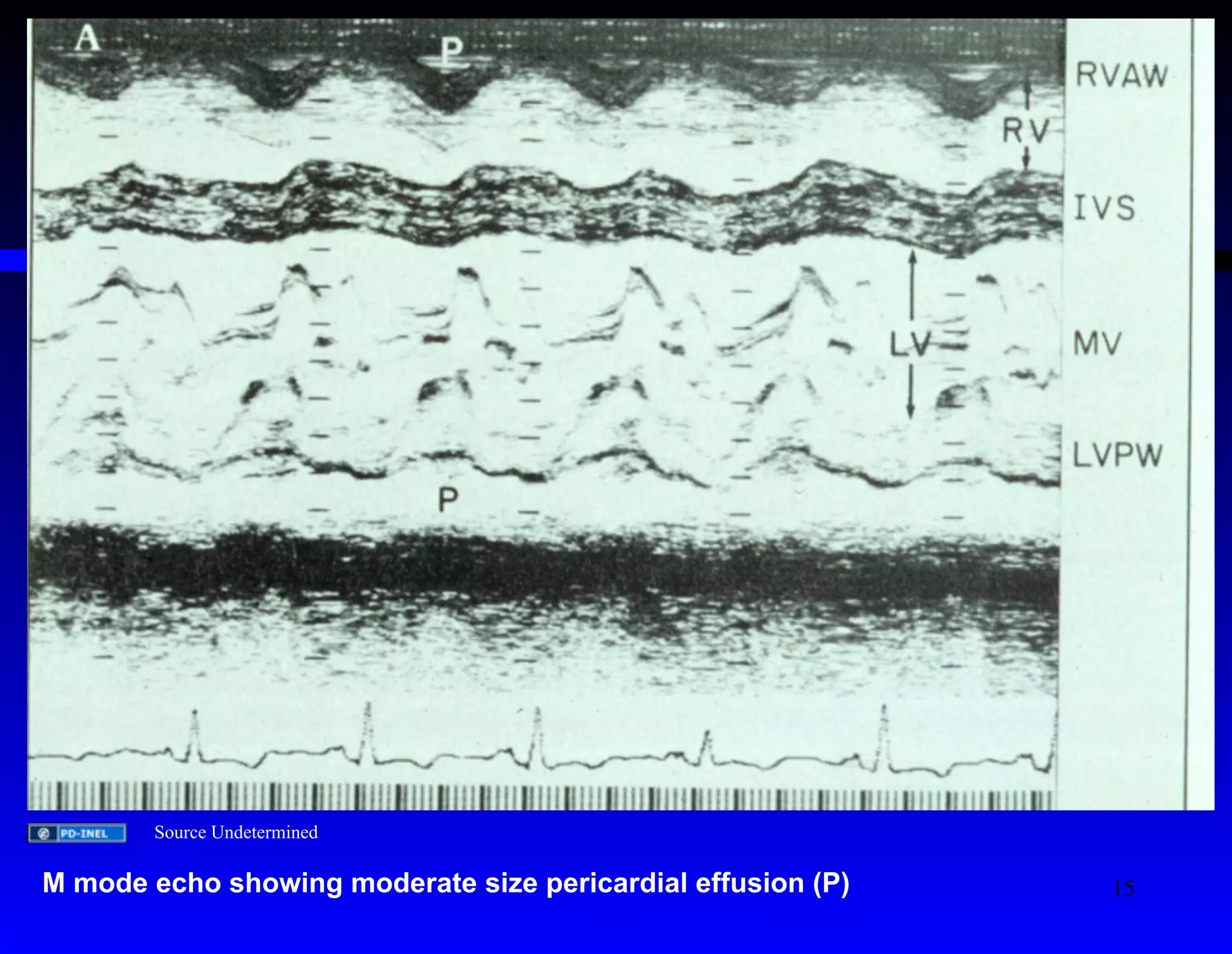
Source Undetermined 
M mode echo showing moderate size pericardial effusion (P) 
15
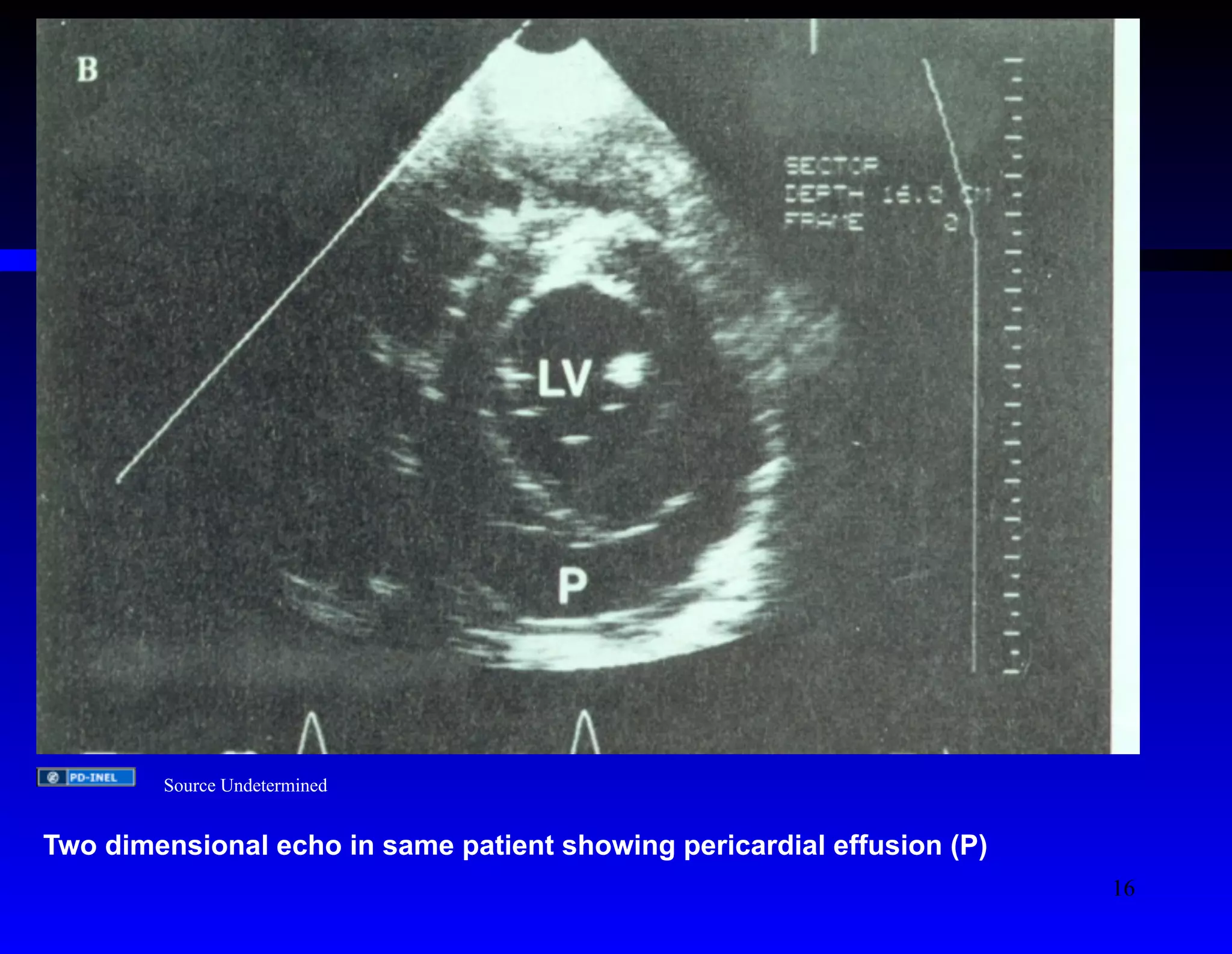
Source Undetermined 
Two dimensional echo in same patient showing pericardial effusion (P) 
16
Superior Vena Cava (SVC) 
Syndrome 
• Causative tumors :! 
• Small cell (oat cell) lung ca! 
• Squamous cell lung ca! 
• Lymphoma! 
• Anaplastic mediastinal ca! 
• SVC thrombosis from indwelling 
catheter! 
• Sx are due to SVC compression or 
occlusion 
17
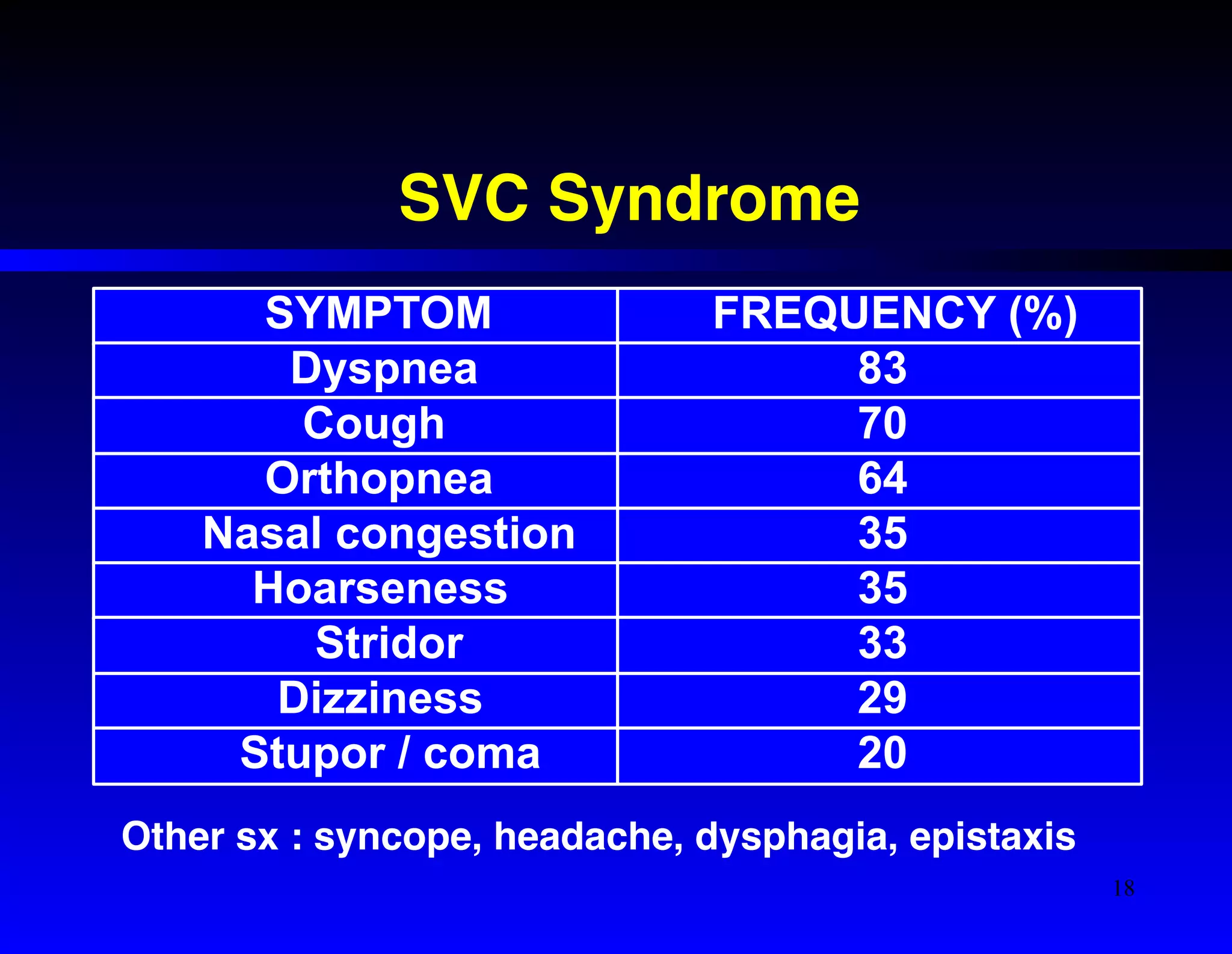
SVC Syndrome 
SYMPTOM FREQUENCY (%) 
Dyspnea 83 
Cough 70 
Orthopnea 64 
Nasal congestion 35 
Hoarseness 35 
Stridor 33 
Dizziness 29 
Stupor / coma 20 
Other sx : syncope, headache, dysphagia, epistaxis 
18
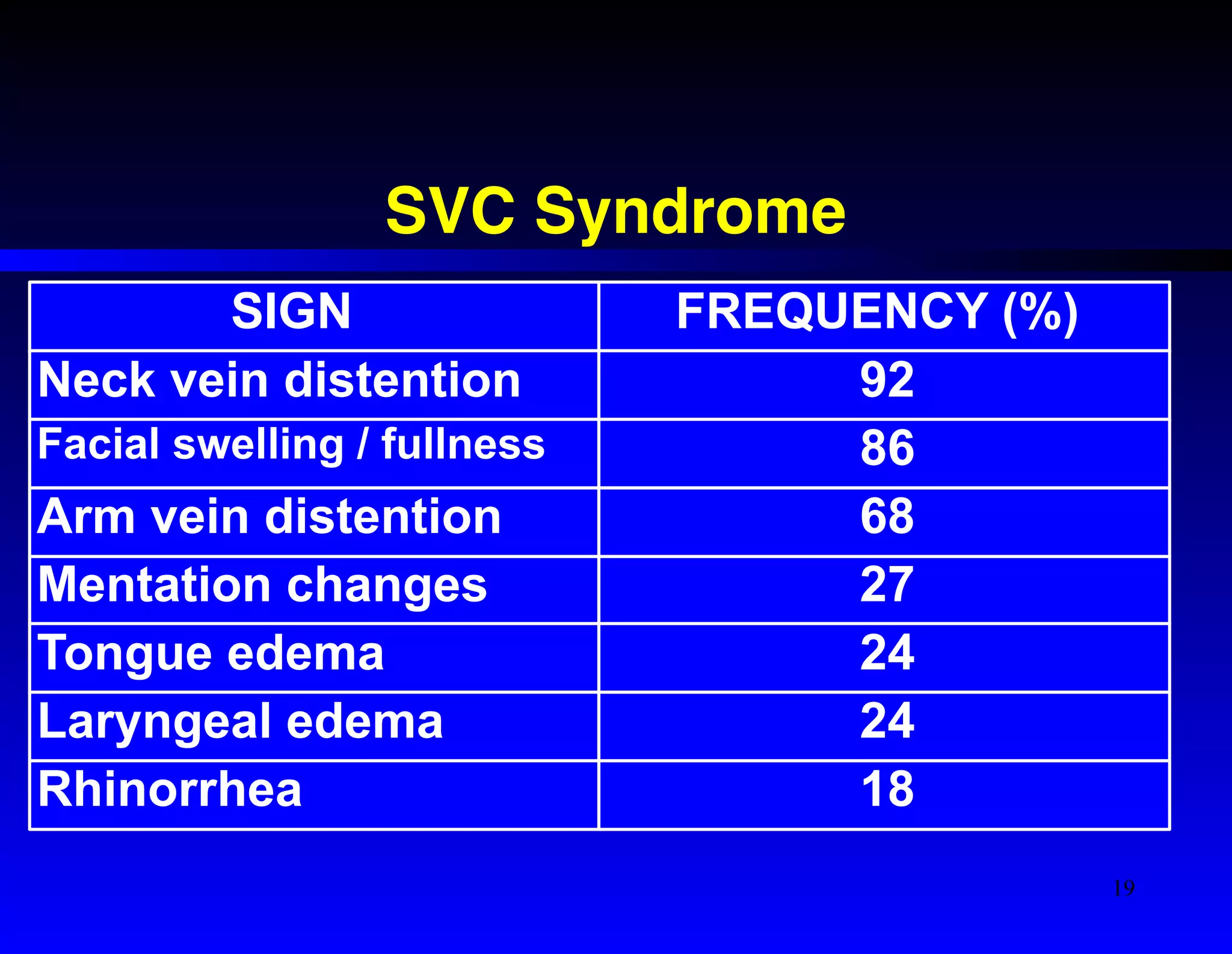
SVC Syndrome 
SIGN FREQUENCY (%) 
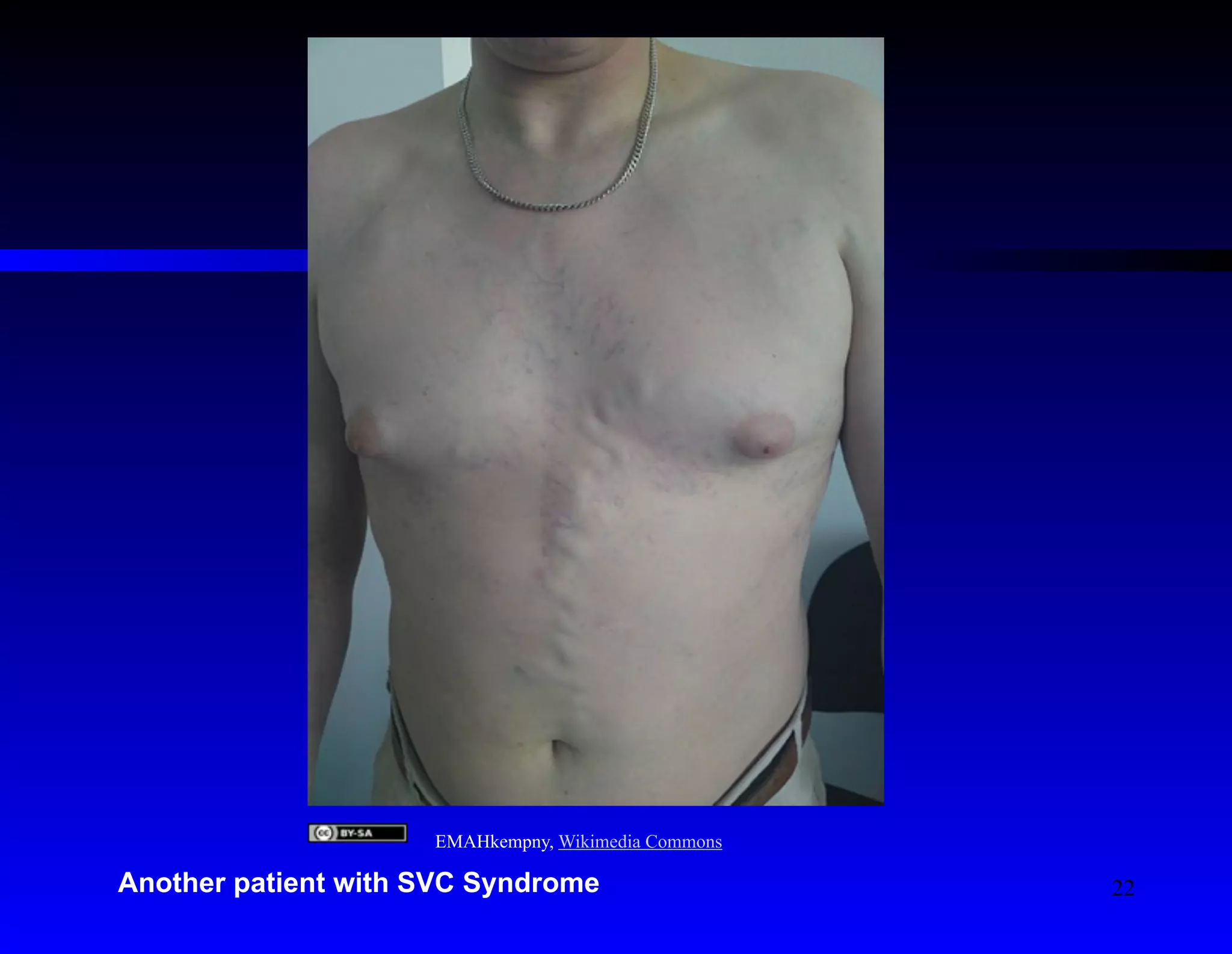
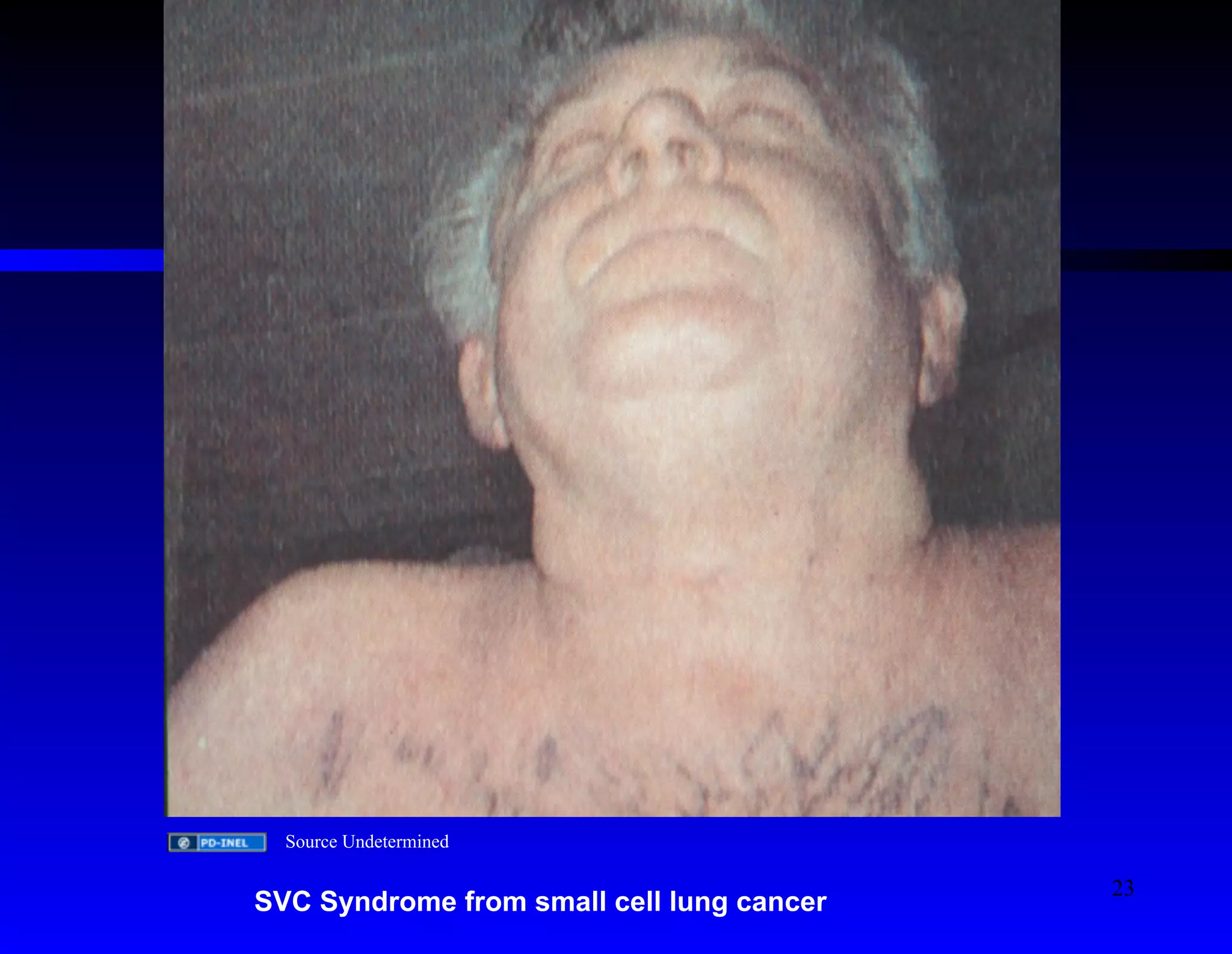
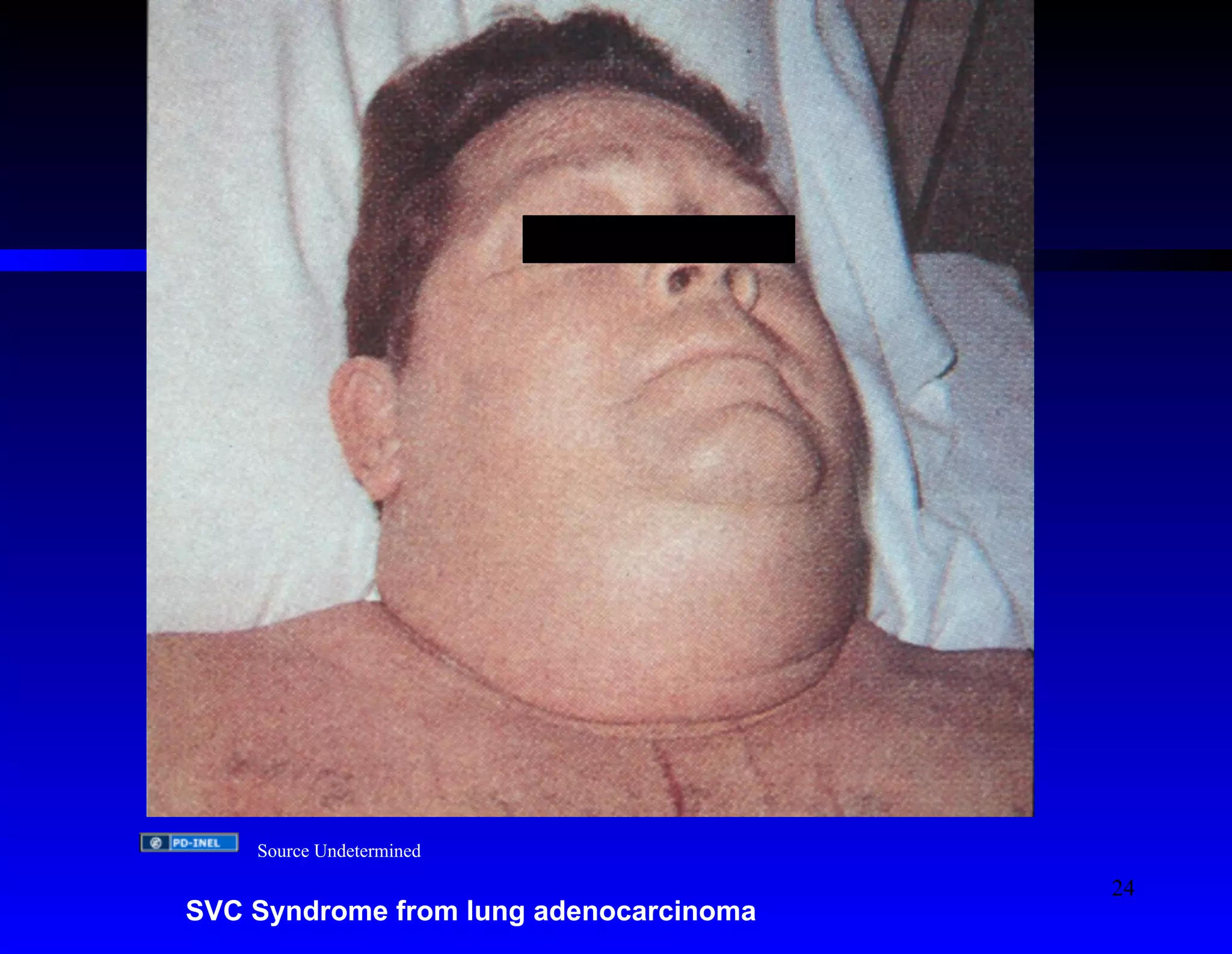
Neck vein distention 92 
Facial swelling / fullness 86 
Arm vein distention 68 
Mentation changes 27 
Tongue edema 24 
Laryngeal edema 24 
Rhinorrhea 18 
19
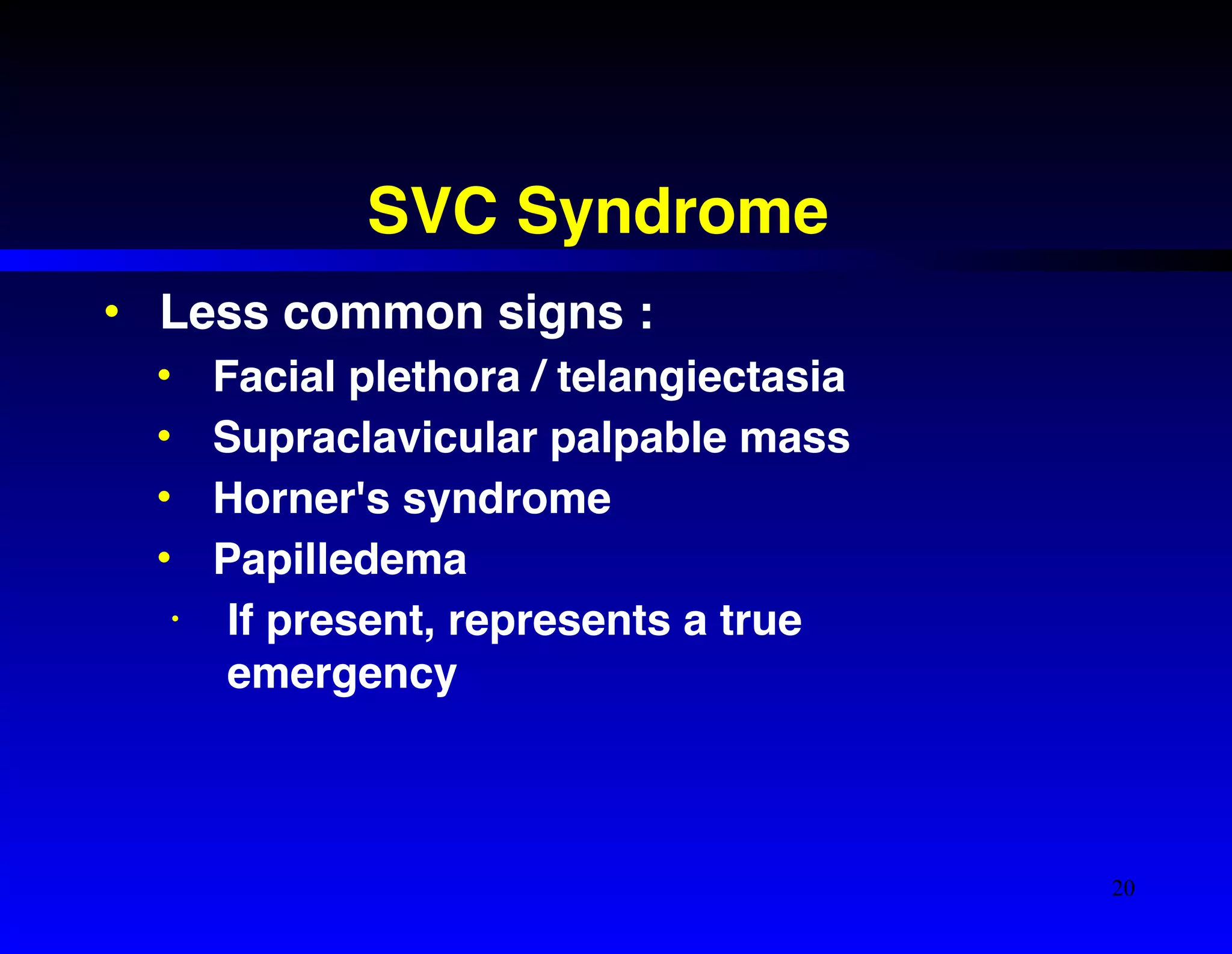
SVC Syndrome 
• Less common signs :! 
• Facial plethora / telangiectasia! 
• Supraclavicular palpable mass! 
• Horner's syndrome! 
• Papilledema ! 
• If present, represents a true 
emergency 
20
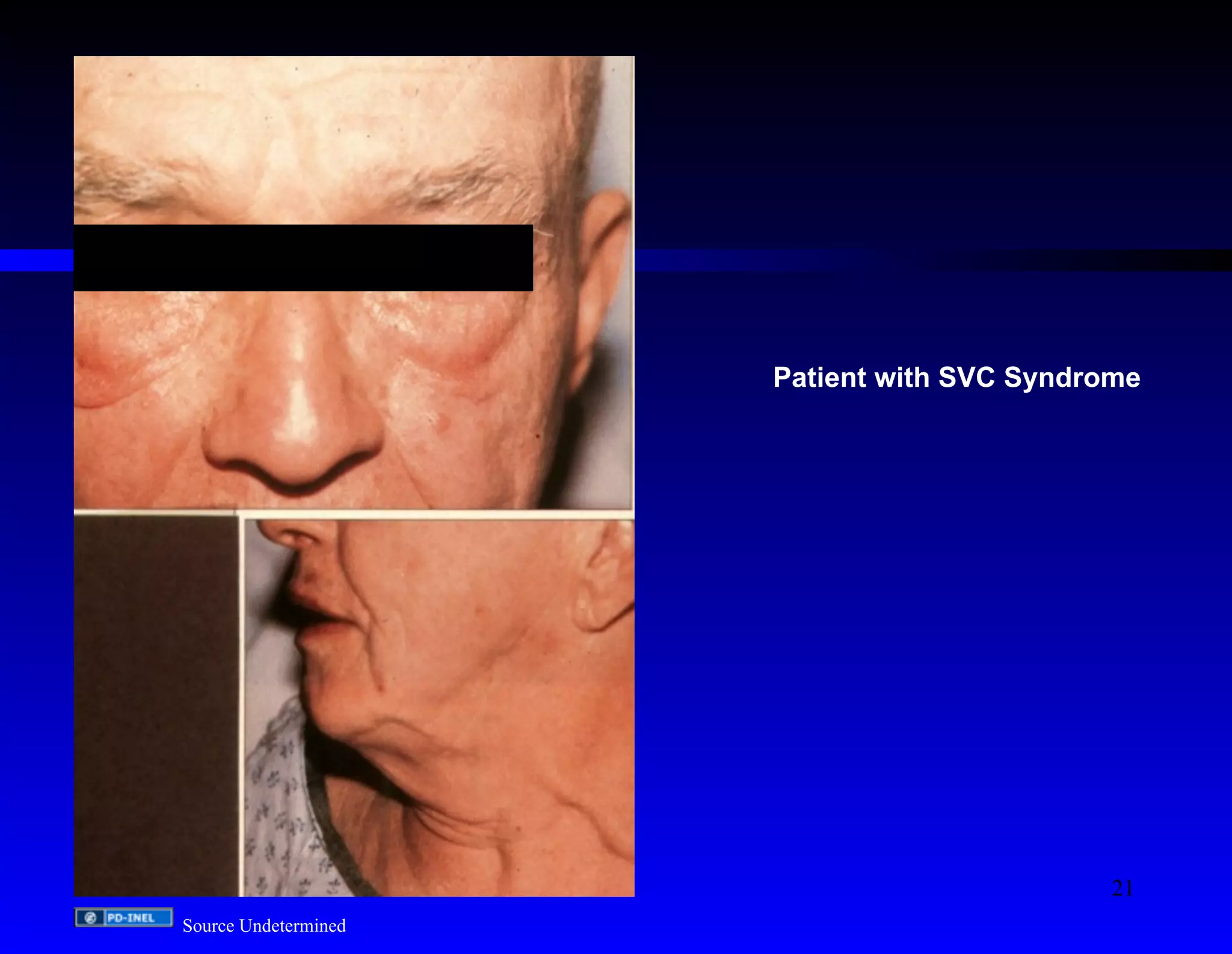
Patient with SVC Syndrome 
Source Undetermined 
21
EMAHkempny, Wikimedia Commons 
Another patient with SVC Syndrome 
22
Source Undetermined 
SVC Syndrome from small cell lung cancer 
23
Source Undetermined 
SVC Syndrome from lung adenocarcinoma 
24
SVC Syndrome 
• Diagnosis! 
• CXR abnormal in 84 %! 
• Confirm with (one of ) :! 
• Chest CT with contrast! 
• MRI! 
• Contrast venography! 
• Tc99m radionuclide venography 
25
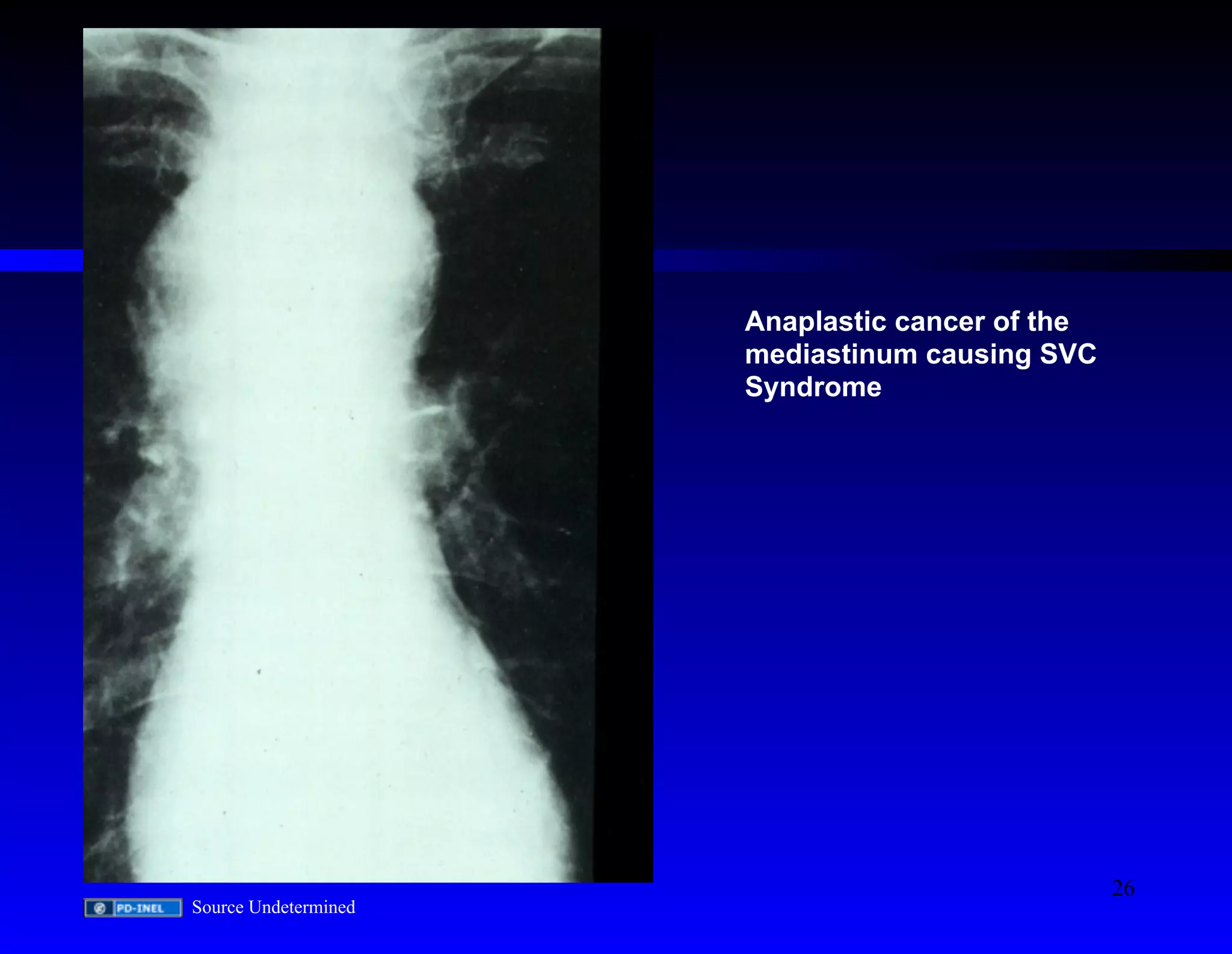
Anaplastic cancer of the 
mediastinum causing SVC 
Syndrome 
Source Undetermined 
26
Source Undetermined 
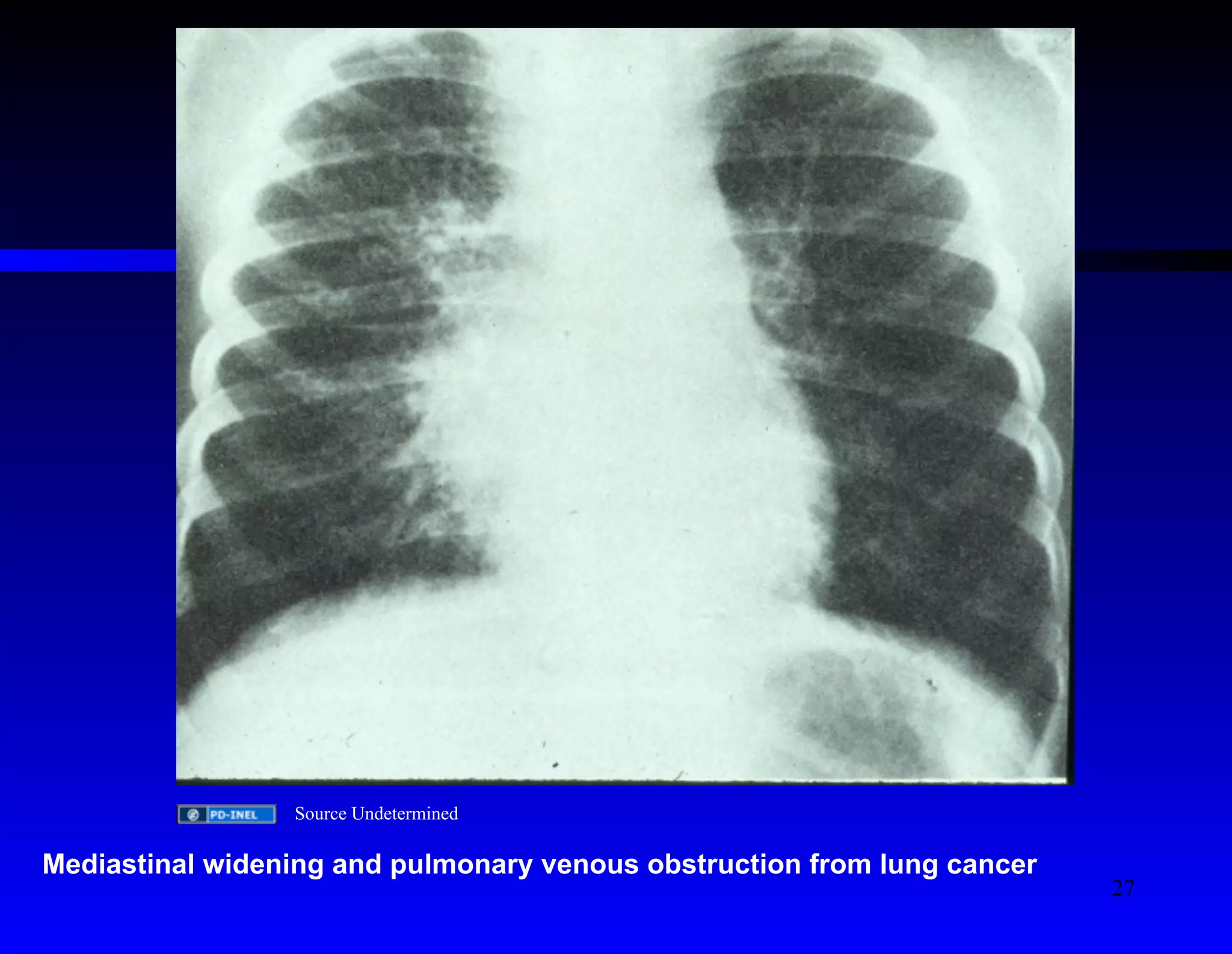
Mediastinal widening and pulmonary venous obstruction from lung cancer 
27
Source Undetermined 
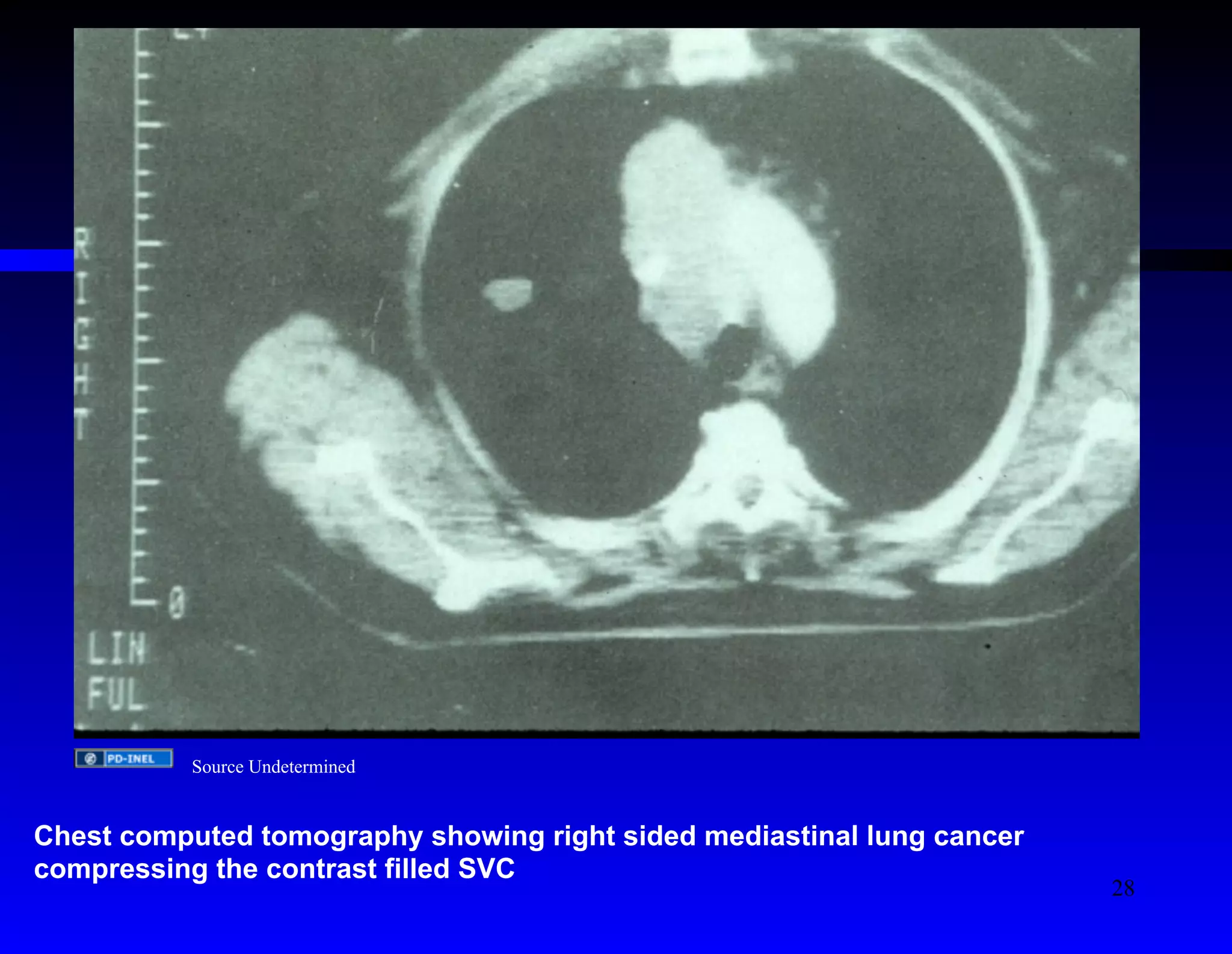
Chest computed tomography showing right sided mediastinal lung cancer 
compressing the contrast filled SVC 
28
Source Undetermined 
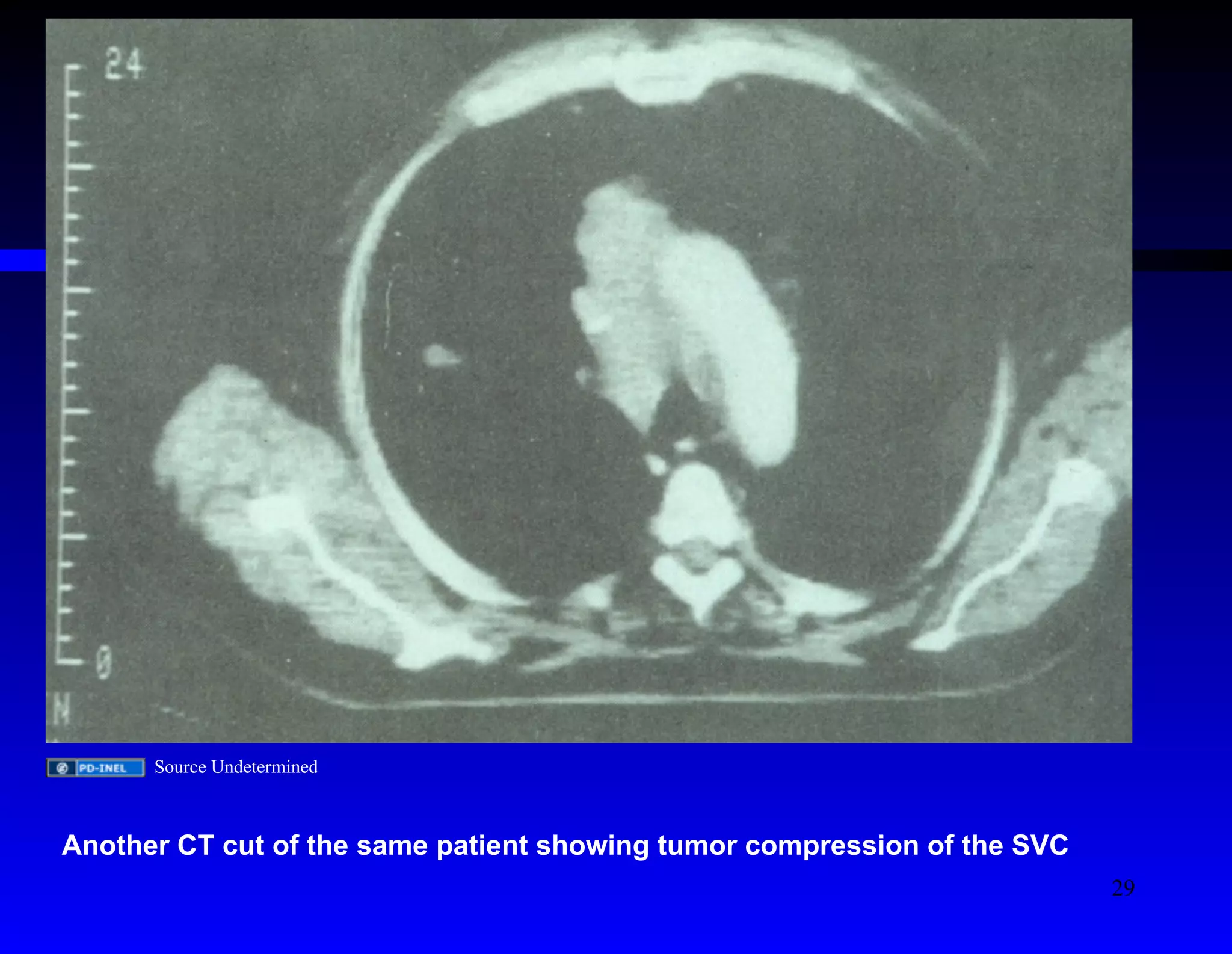
Another CT cut of the same patient showing tumor compression of the SVC 
29
Source Undetermined 
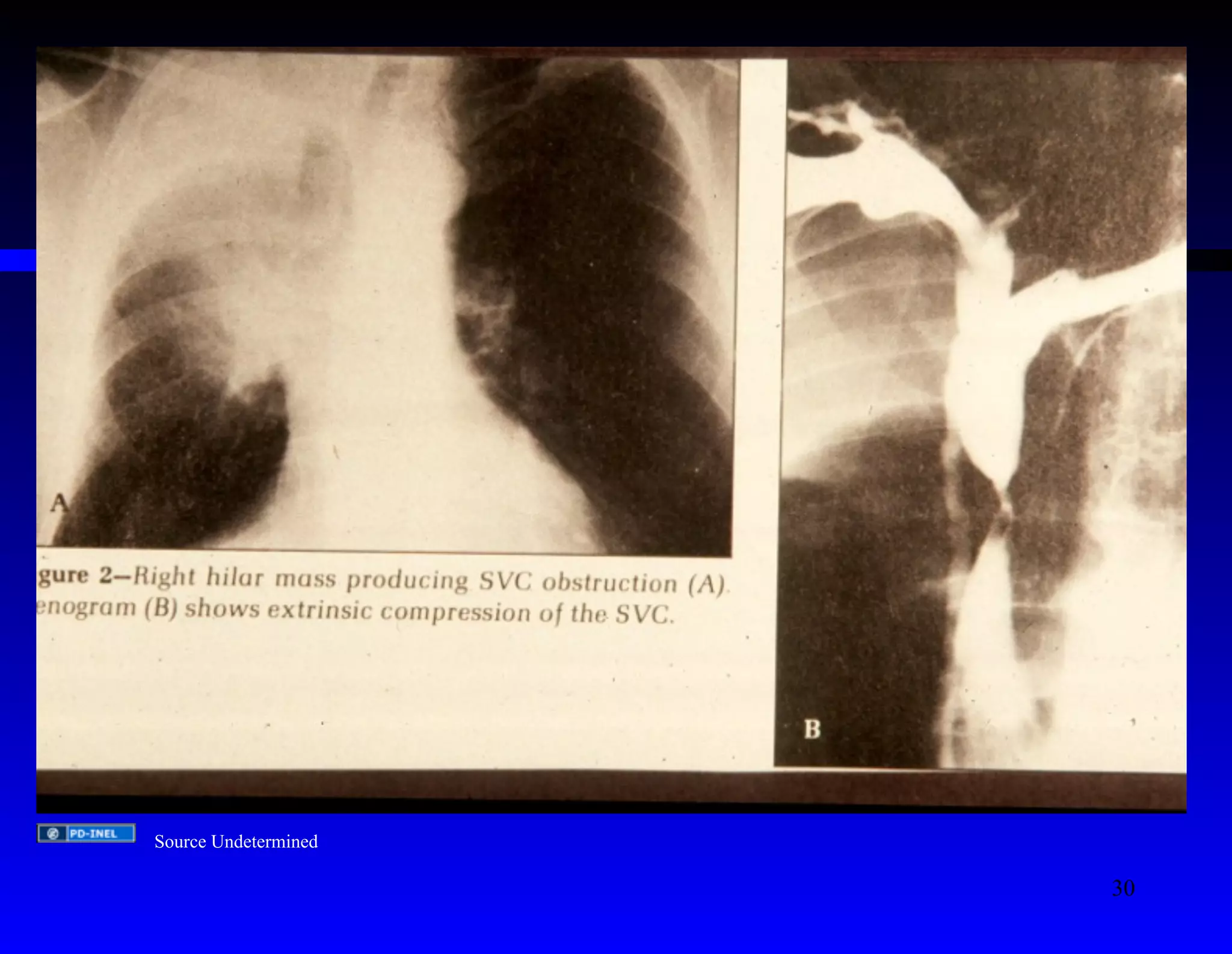
30
Source Undetermined 
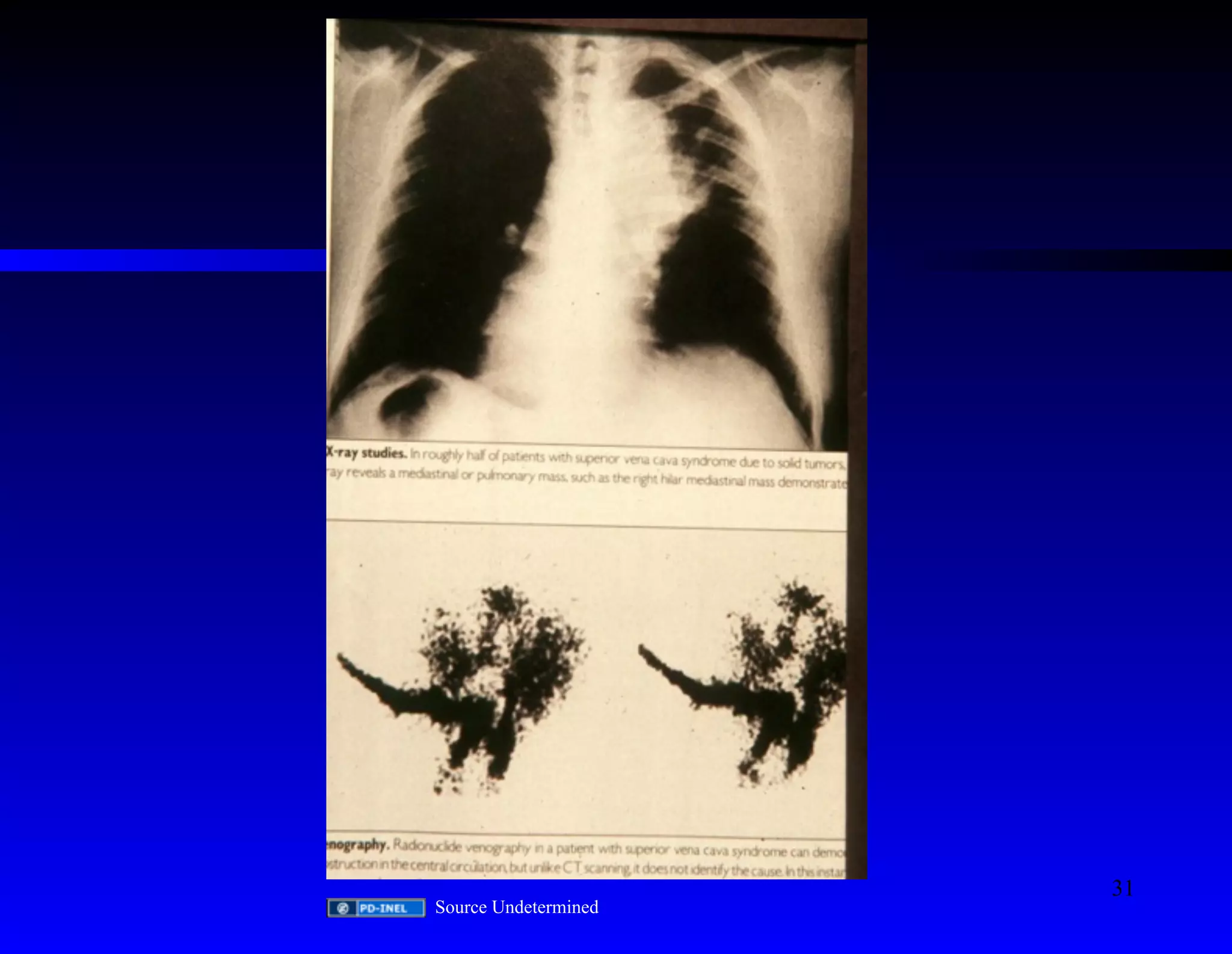
31
Source Undetermined 
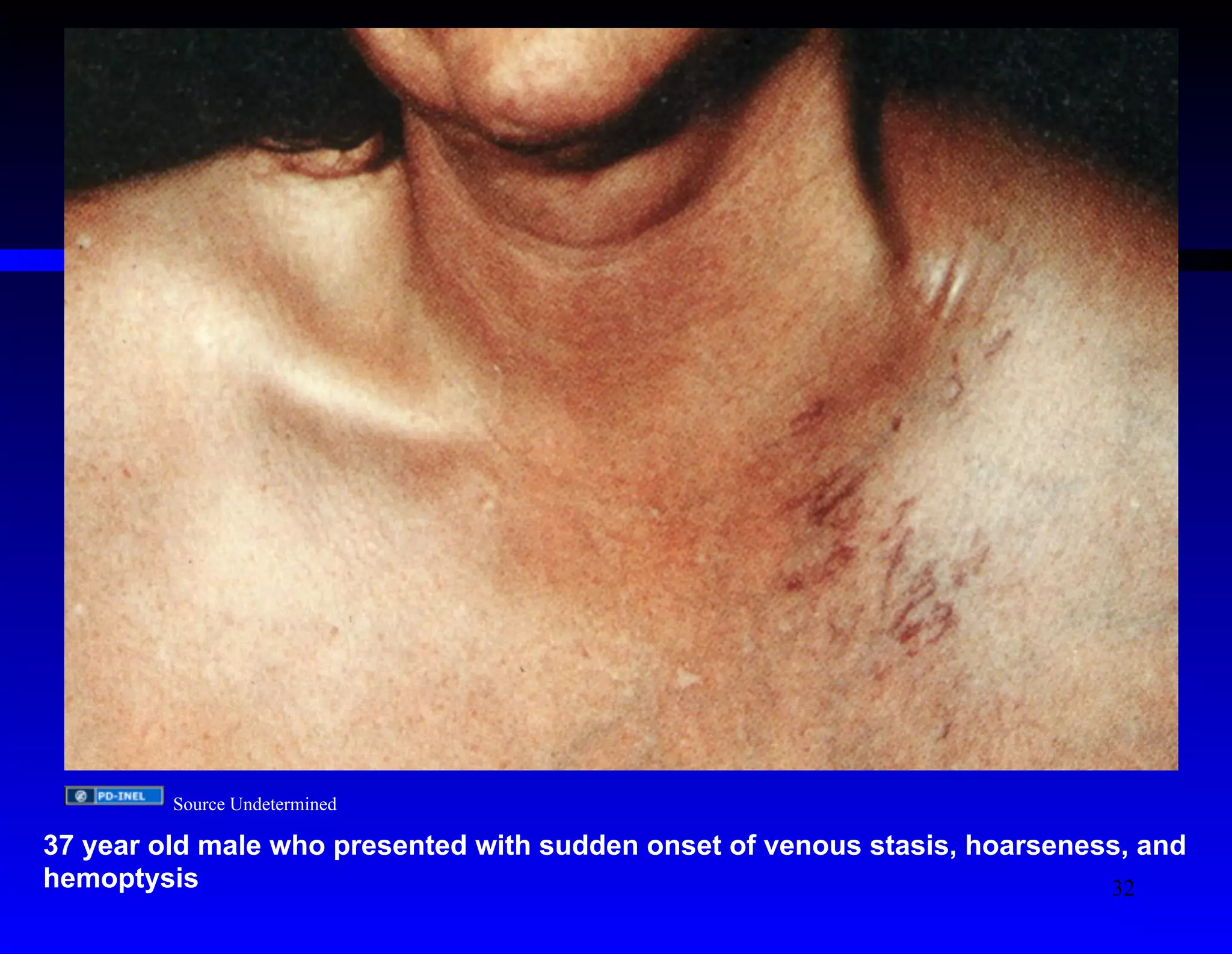
37 year old male who presented with sudden onset of venous stasis, hoarseness, and 
hemoptysis 
32
Source Undetermined 
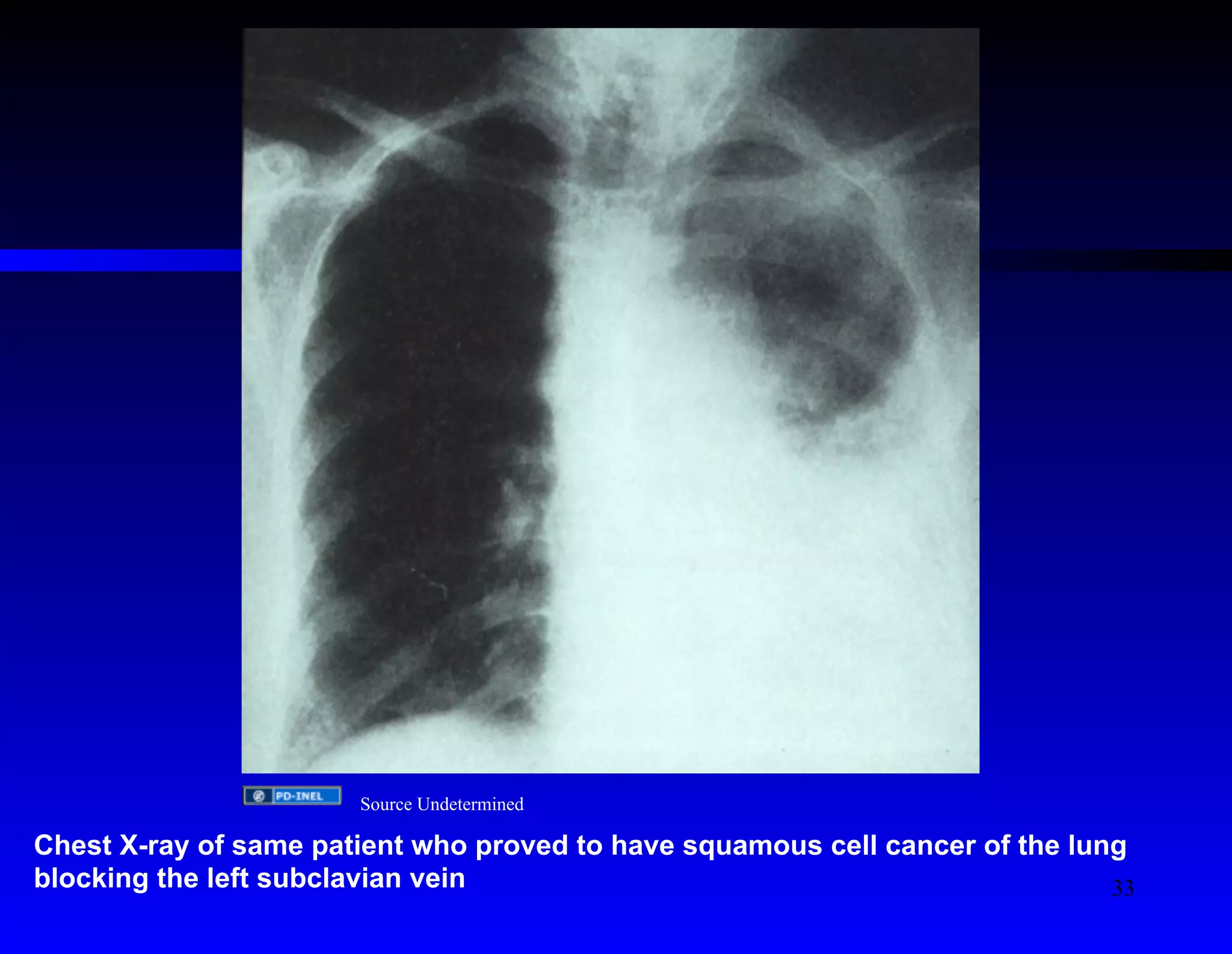
Chest X-ray of same patient who proved to have squamous cell cancer of the lung 
blocking the left subclavian vein 
33
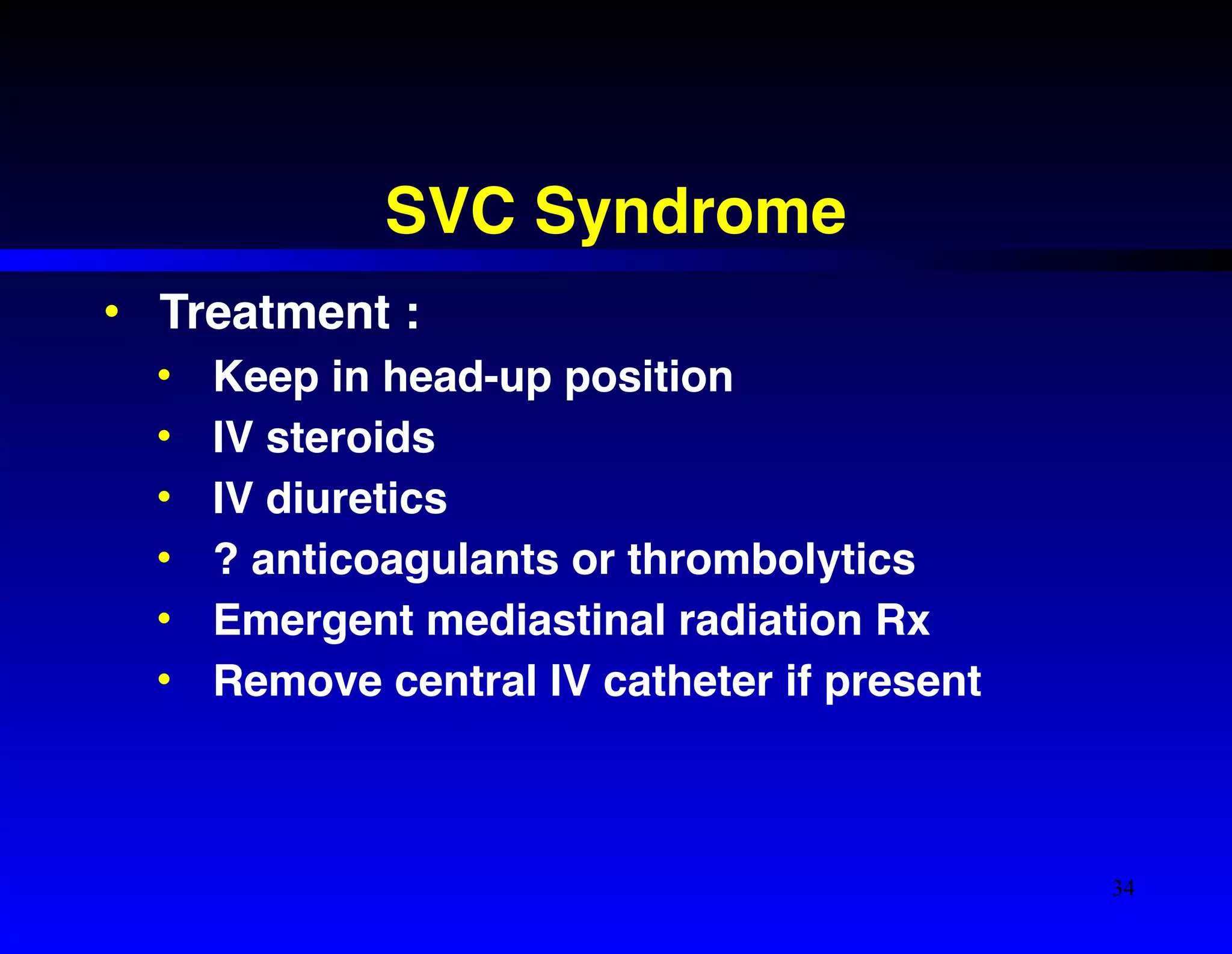
SVC Syndrome 
• Treatment :! 
• Keep in head-up position! 
• IV steroids! 
• IV diuretics! 
• ? anticoagulants or thrombolytics! 
• Emergent mediastinal radiation Rx! 
• Remove central IV catheter if present 
34
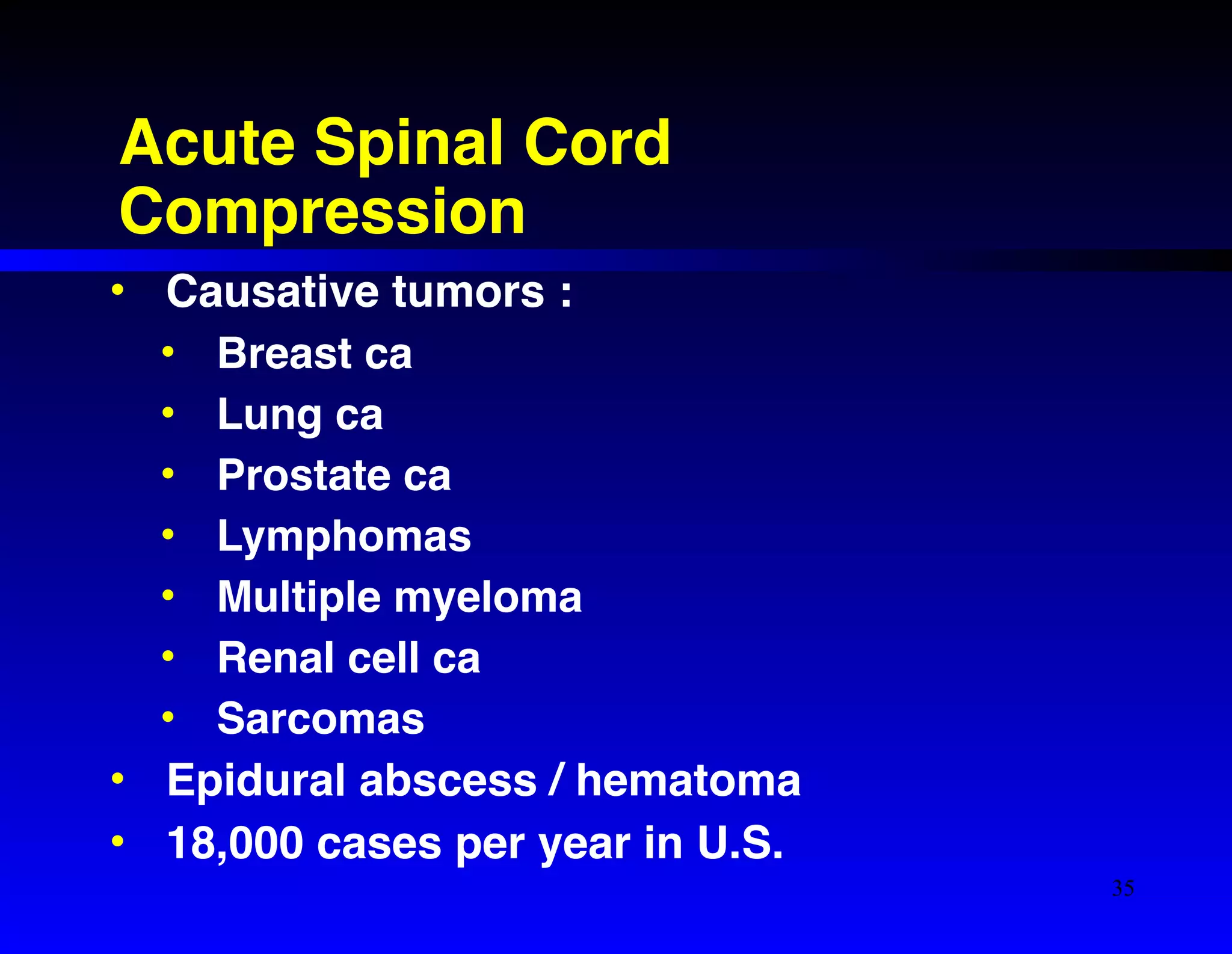
Acute Spinal Cord 
Compression 
• Causative tumors :! 
• Breast ca! 
• Lung ca! 
• Prostate ca! 
• Lymphomas! 
• Multiple myeloma! 
• Renal cell ca! 
• Sarcomas! 
• Epidural abscess / hematoma! 
• 18,000 cases per year in U.S. 
35
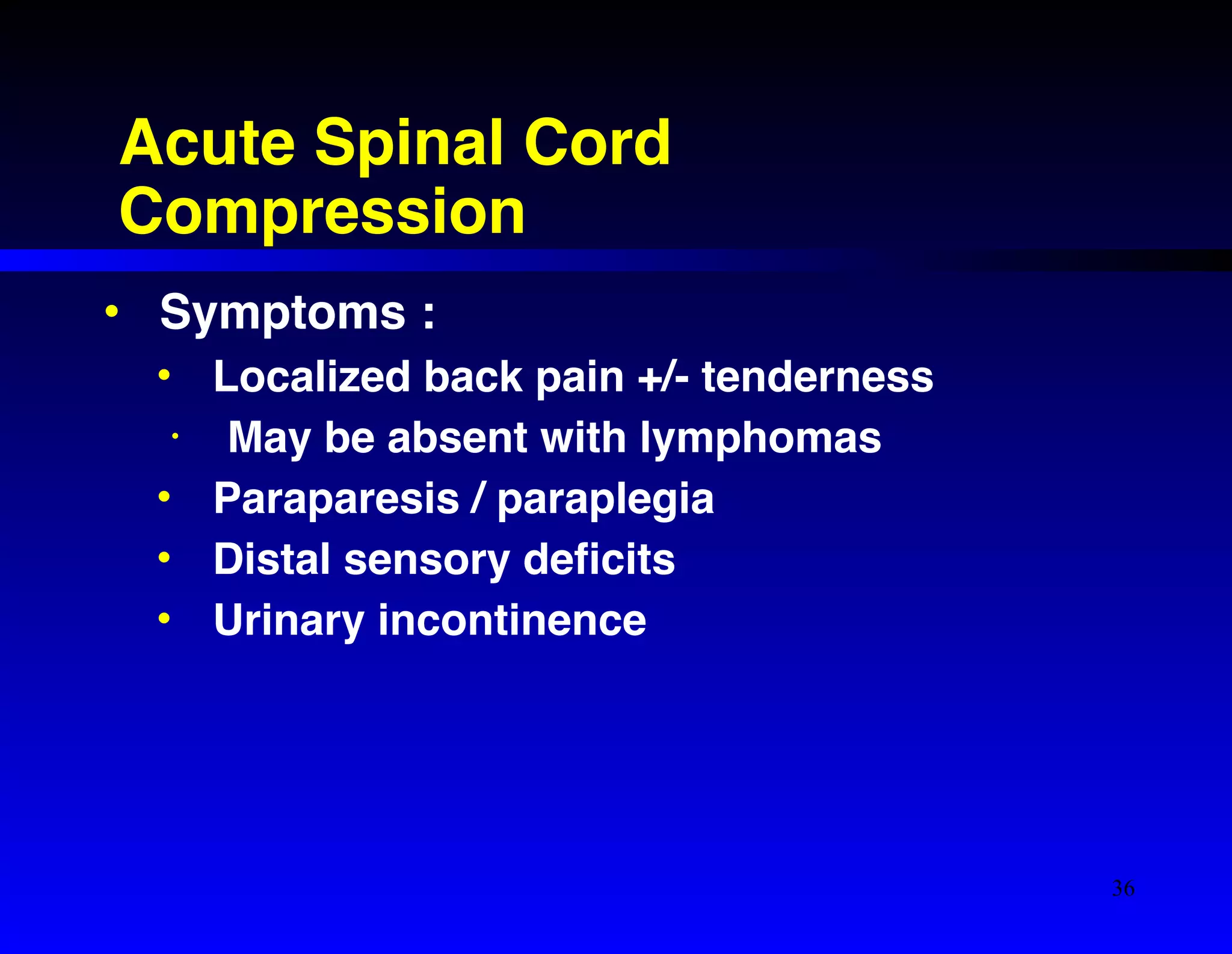
Acute Spinal Cord 
Compression 
• Symptoms :! 
• Localized back pain +/- tenderness! 
• May be absent with lymphomas! 
• Paraparesis / paraplegia! 
• Distal sensory deficits! 
• Urinary incontinence 
36
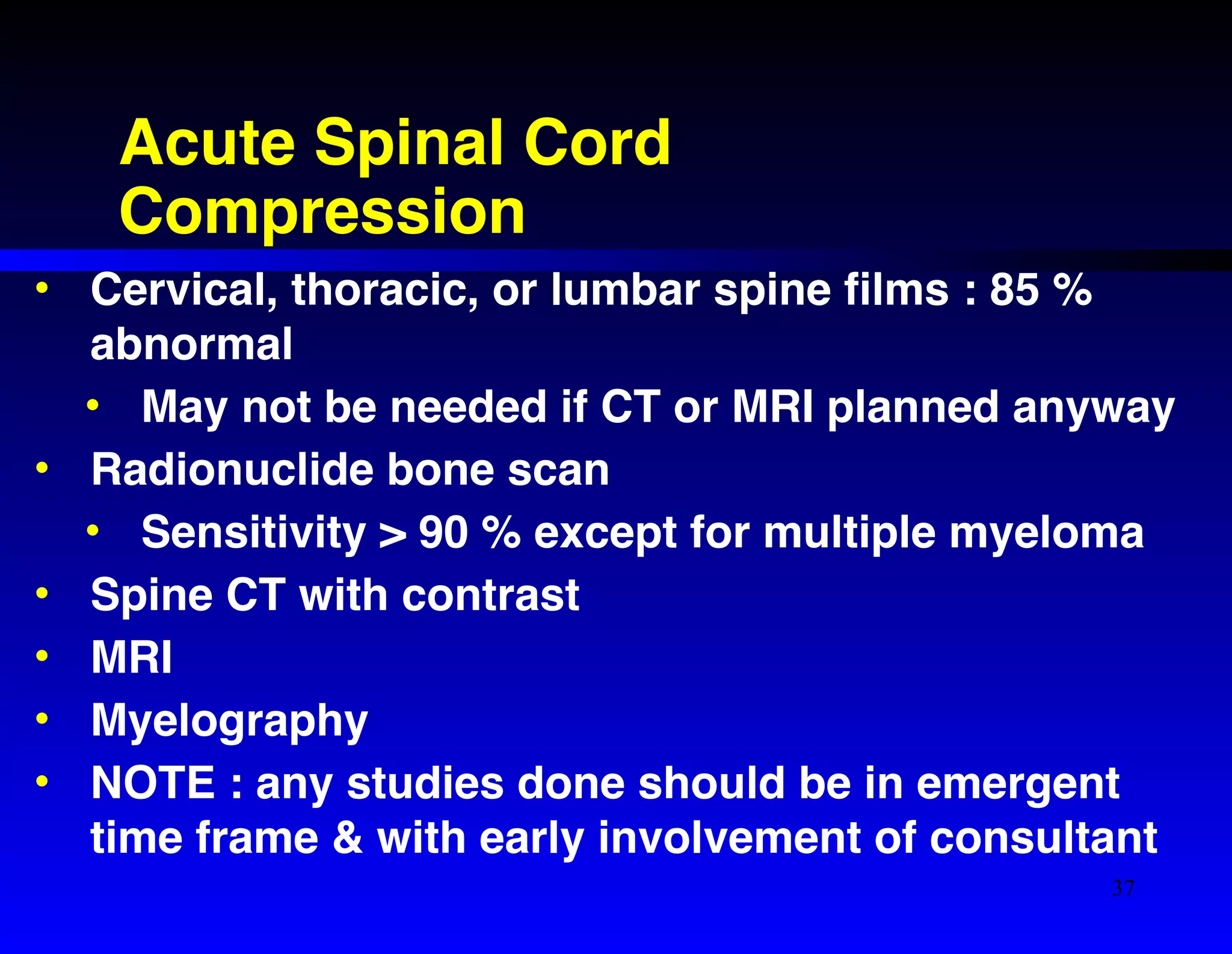
Acute Spinal Cord 
Compression 
• Cervical, thoracic, or lumbar spine films : 85 % 
abnormal! 
• May not be needed if CT or MRI planned anyway! 
• Radionuclide bone scan ! 
• Sensitivity > 90 % except for multiple myeloma! 
• Spine CT with contrast! 
• MRI! 
• Myelography! 
• NOTE : any studies done should be in emergent 
time frame & with early involvement of consultant 
37
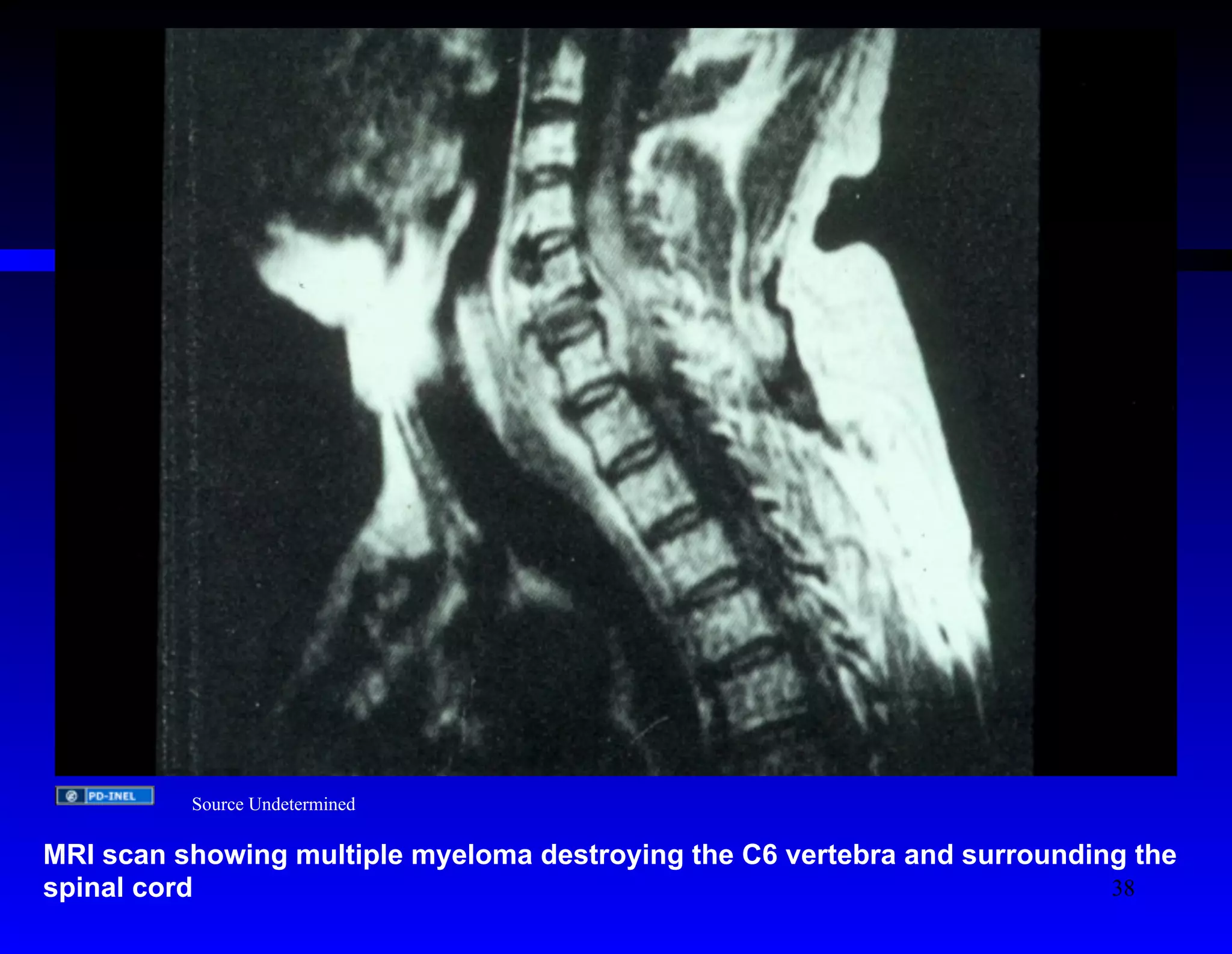
Source Undetermined 
MRI scan showing multiple myeloma destroying the C6 vertebra and surrounding the 
spinal cord 
38
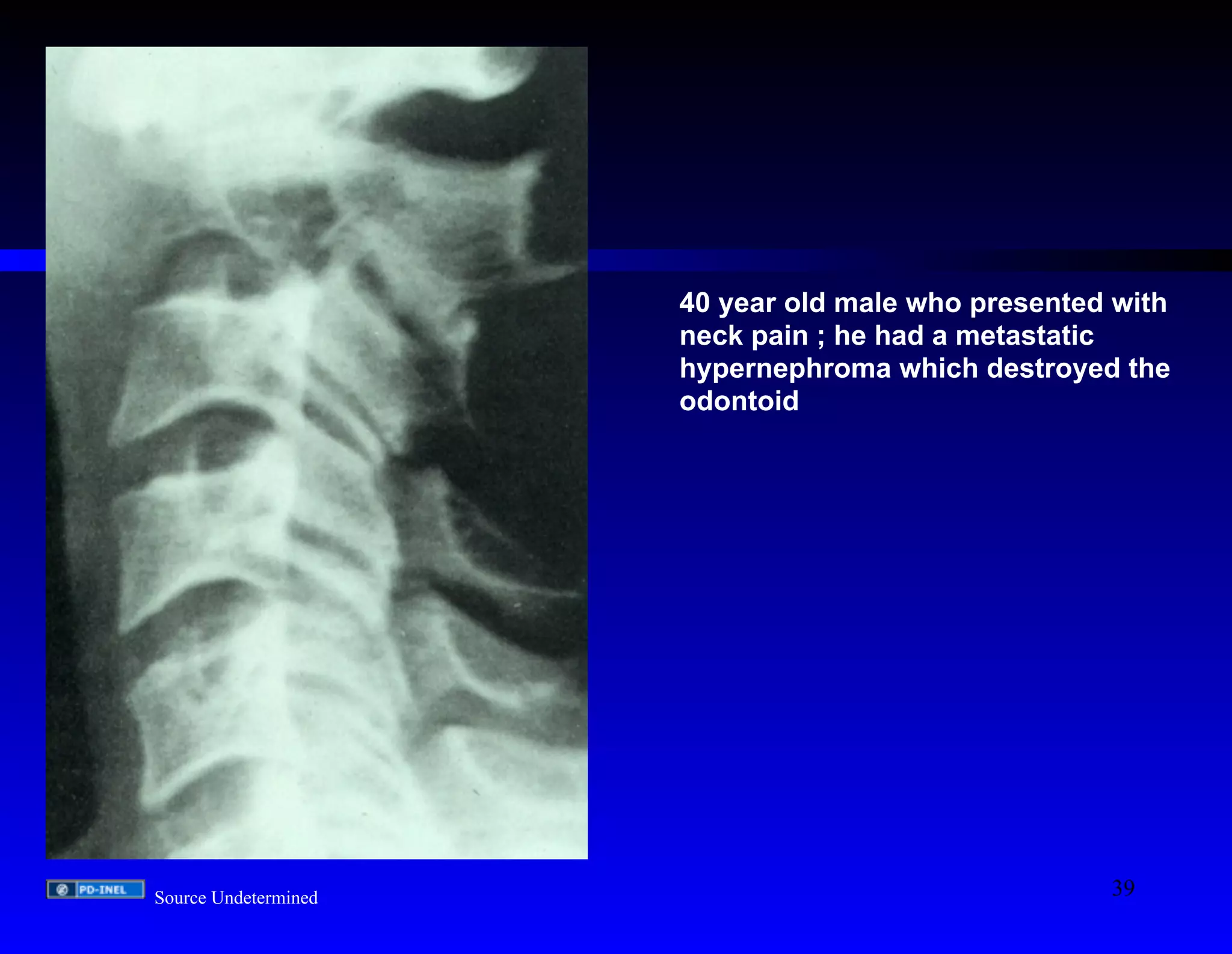
40 year old male who presented with 
neck pain ; he had a metastatic 
hypernephroma which destroyed the 
odontoid 
Source Undetermined 39
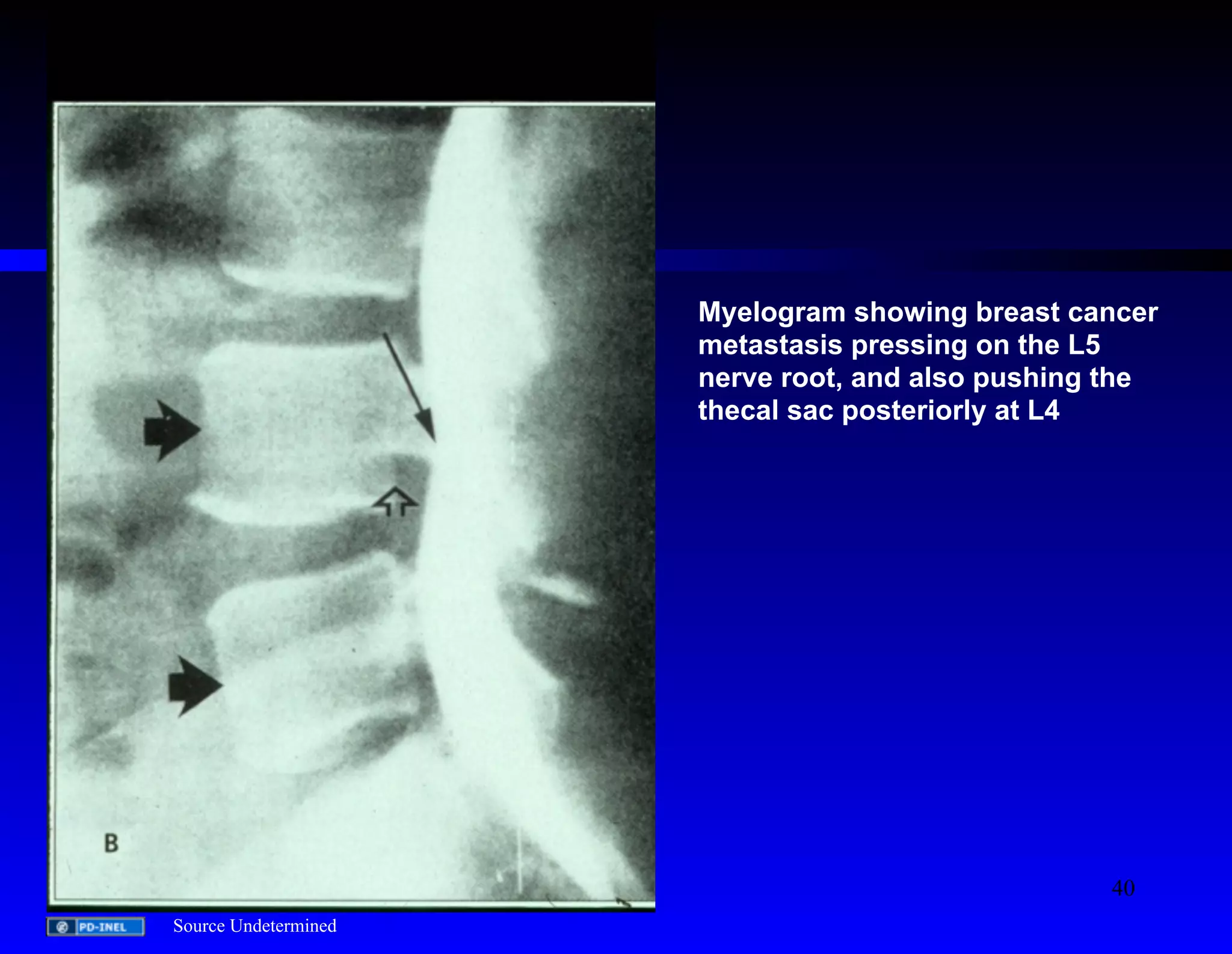
Myelogram showing breast cancer 
metastasis pressing on the L5 
nerve root, and also pushing the 
thecal sac posteriorly at L4 
Source Undetermined 
40
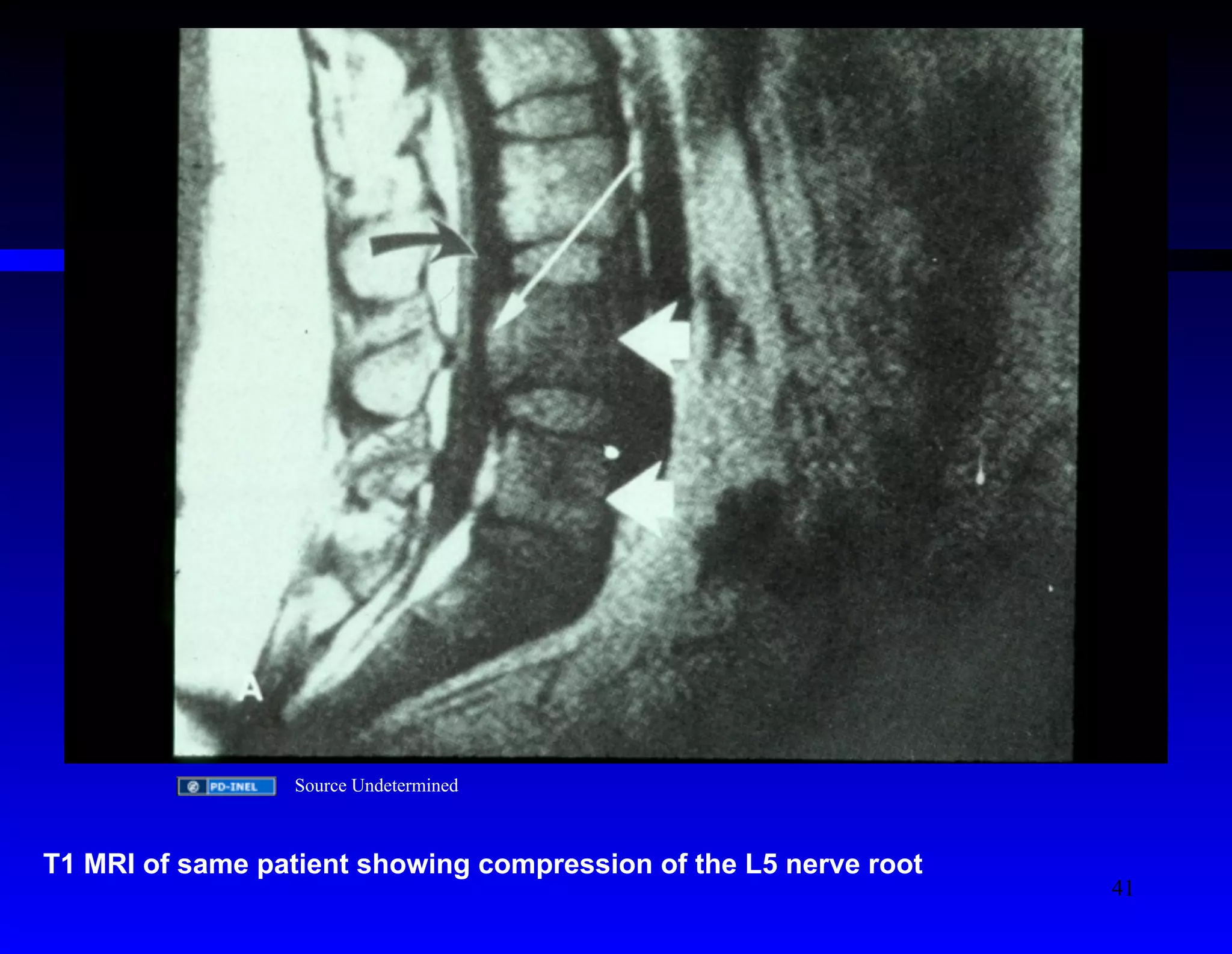
Source Undetermined 
T1 MRI of same patient showing compression of the L5 nerve root 
41
Acute Spinal Cord 
Compression 
• Treatment! 
• Spine immobilization! 
• Foley catheter! 
• ? IV steroids / diuretic / mannitol! 
• Emergent decompressive laminectomy 
or radiation Rx 
42
Hypercalcemia of Malignancy 
• Causative tumors! 
• Metastatic breast, lung, or prostate ca! 
• Multiple myeloma! 
• Non-Hodgkin's lymphoma! 
• Adult T-cell lymphoma / leukemia! 
• Renal cell ca! 
• Head & neck squamous cell ca 
43
Malignancy Hypercalcemia 
• Symptoms! 
• Vague malaise / weakness! 
• Polydipsia! 
• Lethargy / confusion! 
• Constipation ! 
• Vomiting! 
• Back pain! 
• Can have coma or seizures 
44
Malignancy Hypercalcemia 
• Diagnosis! 
• Total & ionized serum calcium! 
• Serum albumin sometimes helpful! 
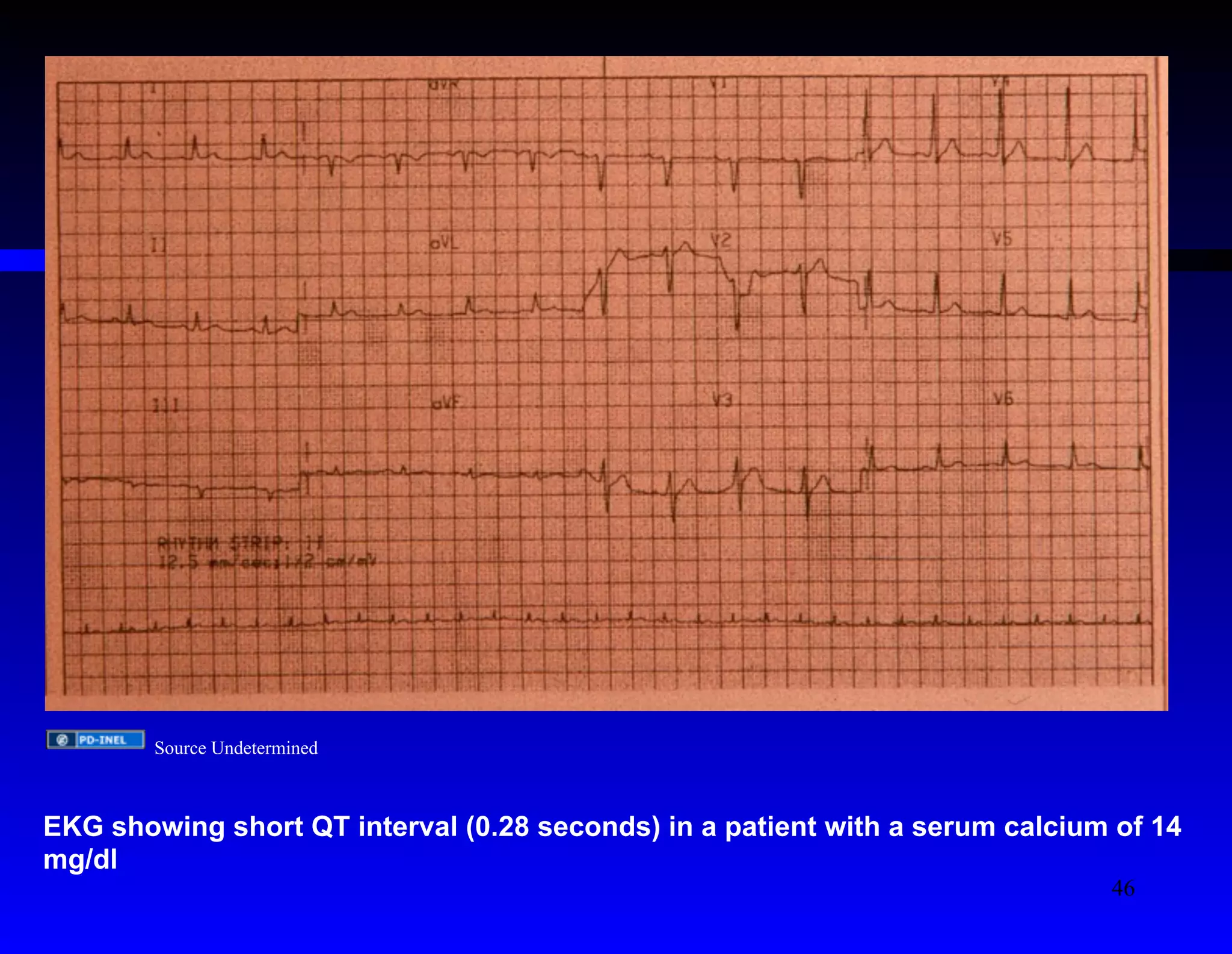
• EKG shows short QT interval! 
• May show low voltage, long PR! 
• Discrete skeletal lesions not 
demonstrable in 30 % of patients! 
• Serum levels > 12 mg % dangerous 
45
Source Undetermined 
EKG showing short QT interval (0.28 seconds) in a patient with a serum calcium of 14 
mg/dl 
46
Malignancy Hypercalcemia! 
Treatment 
• IV hydration with normal saline! 
• Diuresis with IV furosemide! 
• Only after fluid loading ; avoid thiazides! 
• IV steroids! 
• Etidronate (7.5 mg/kg/day IV for 3 days)! 
• Mithramycin (15 to 25 mcg/kg/day IV x 3 days)! 
• Radiation Rx to tumor site(s)! 
• Rarely may need hemodialysis 
47
Considerations for Use of Etidronate 
(Didronel) for Rx of Malignant Hypercalcemia 
• Acts mainly to reduce bone resorption! 
• Mainly excreted renally! 
• Causes some degree of hyperphosphatemia! 
• Should be withheld if creatinine > 5 mg %! 
• Dose (must be diluted in 250 cc NS) :! 
• 7.5 mg/kg/day IV for 3 days! 
• Dose should be given over 2 hours! 
• Followup Rx with oral tablets! 
• 20 mg/kg/day for 30 days 
48
Use of Mithramycin (Plicamycin) for Rx 
of Malignancy Hypercalcemia 
• Acts as antineoplastic agent! 
• Method of action on hypercalcemia 
not known! 
• Main complication is bleeding! 
• GI side effects common! 
• Can cause thrombocytopenia! 
• Most useful as second agent for 
cases not responsive to etidronate 
49
Hyperviscosity Syndrome 
• Basic cause is elevation of serum 
proteins producing sludging & 
reduction in microcirculatory 
perfusion! 
• Serum viscosity is normally 1.4 to 1.8 
times that of water! 
• Symptoms develop at viscosity > 5 
50
Hyperviscosity Syndrome 
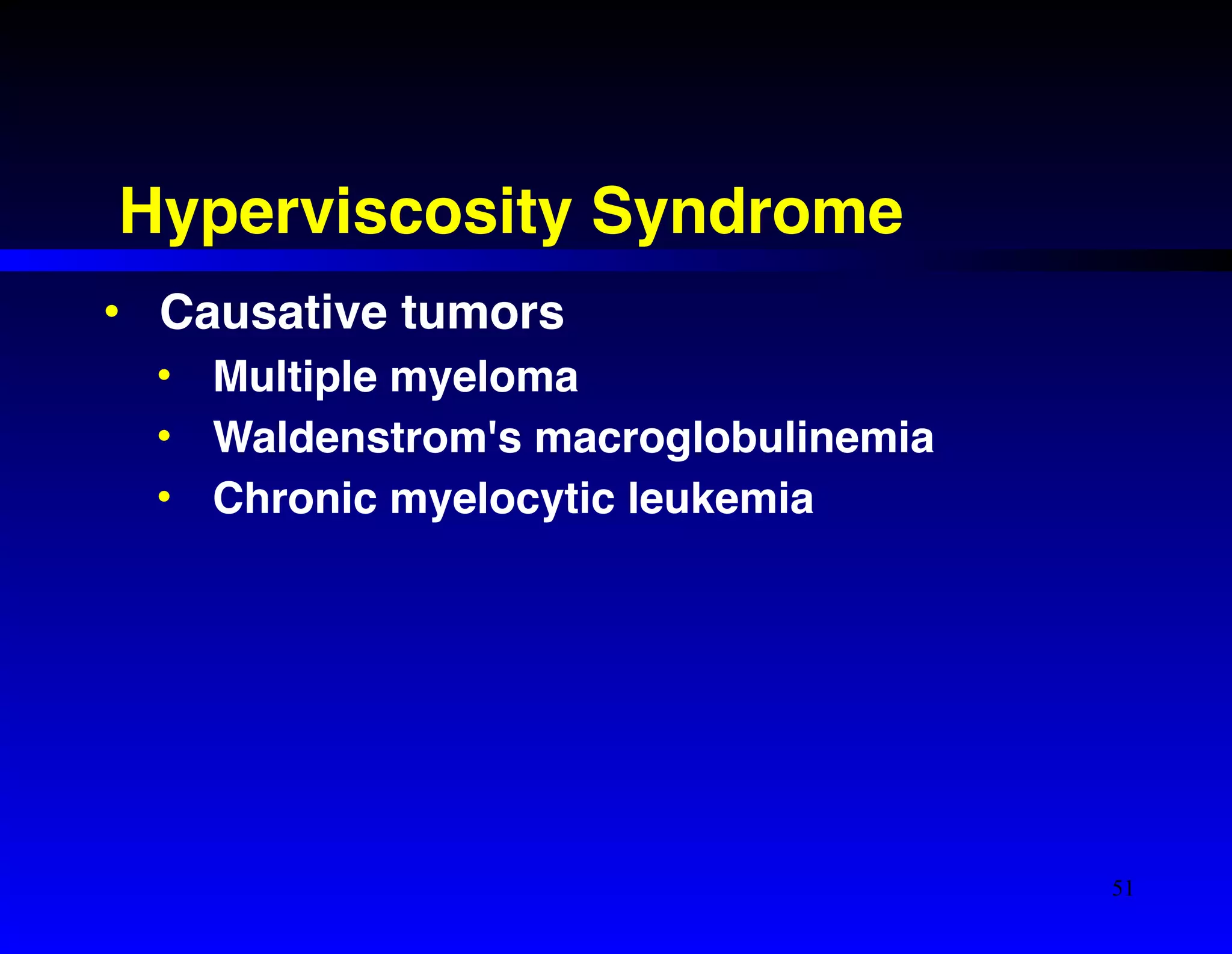
• Causative tumors! 
• Multiple myeloma! 
• Waldenstrom's macroglobulinemia! 
• Chronic myelocytic leukemia 
51
Hyperviscosity Syndrome! 
Symptoms 
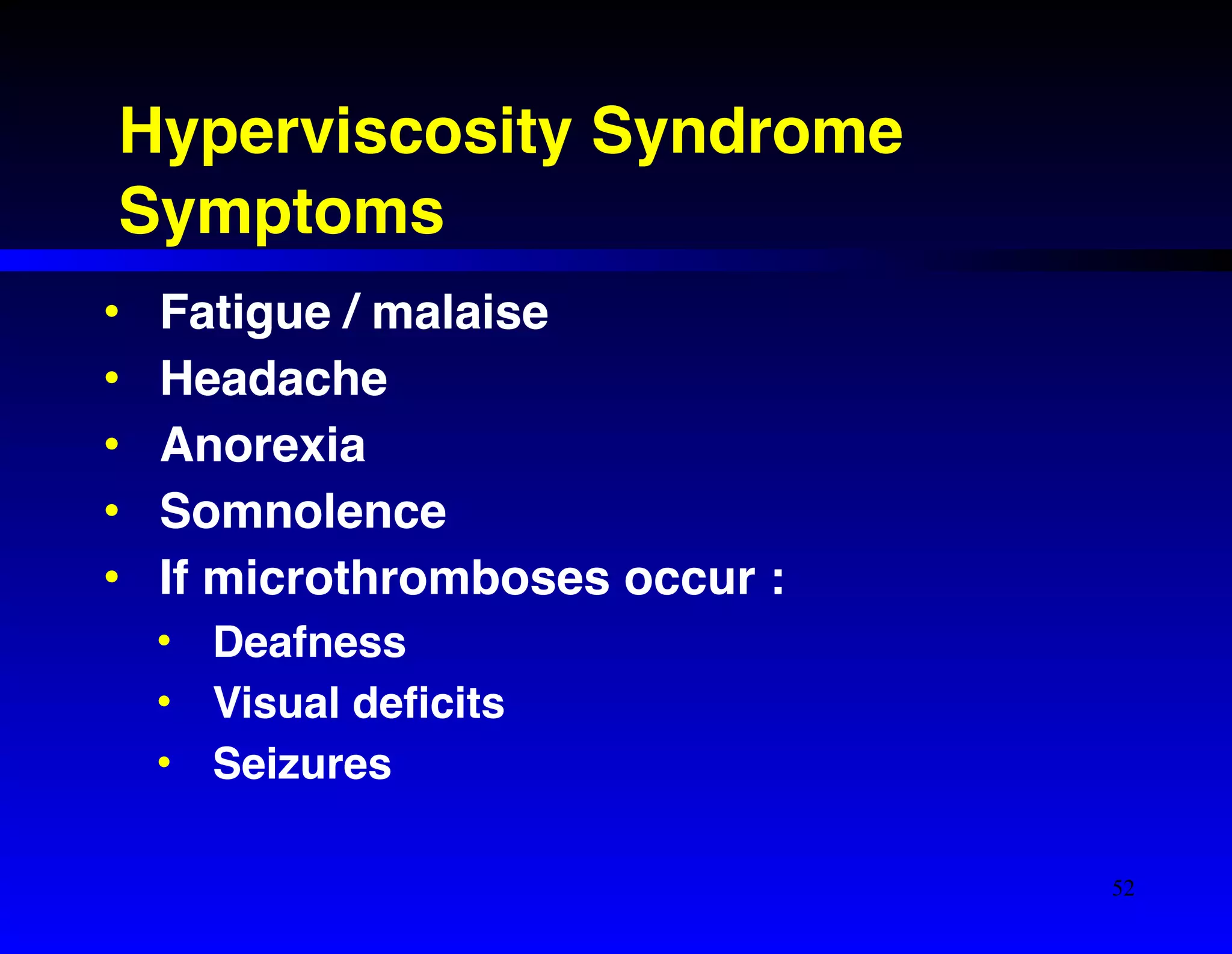
• Fatigue / malaise! 
• Headache! 
• Anorexia! 
• Somnolence! 
• If microthromboses occur :! 
• Deafness! 
• Visual deficits! 
• Seizures 
52
Hyperviscosity Syndrome! 
Diagnosis 
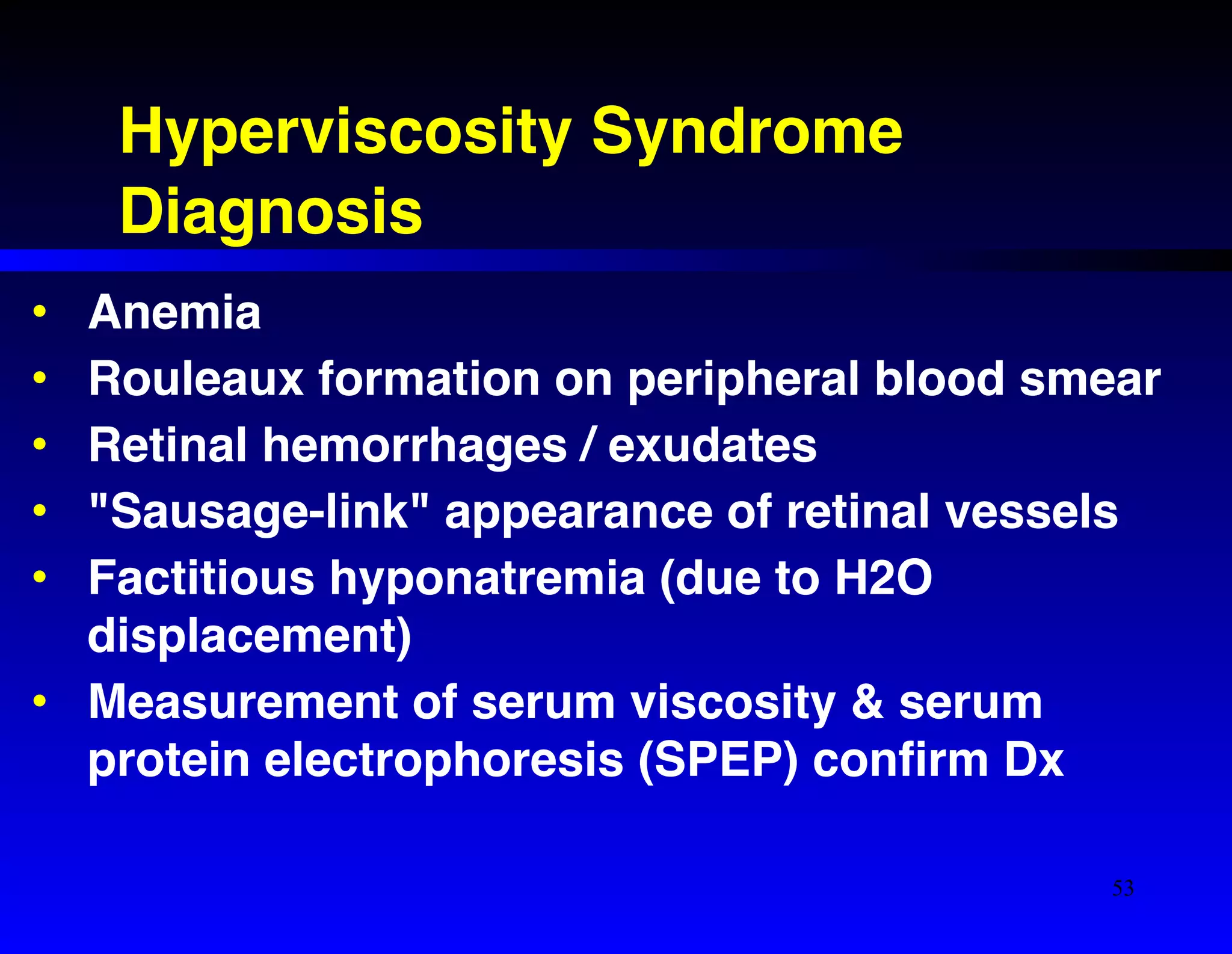
• Anemia! 
• Rouleaux formation on peripheral blood smear! 
• Retinal hemorrhages / exudates! 
• "Sausage-link" appearance of retinal vessels! 
• Factitious hyponatremia (due to H2O 
displacement)! 
• Measurement of serum viscosity & serum 
protein electrophoresis (SPEP) confirm Dx 
53
Hyperviscosity Syndrome! 
Treatment 
• If comatose :! 
• Emergent 2 unit phlebotomy & saline 
infusion! 
• Rehydration with IV saline! 
• Emergency plasmapheresis! 
• If patient has CML & massive 
leucocytosis : leukopheresis & 
concurrent chemoRx 
54
Hyperleukocytic Syndrome 
• Usually occurs in new onset acute myelocytic 
leukemia! 
• Can occur in CML with blast crisis! 
• WBC > 100 k in AML is dangerous! 
• WBC > 250 k in CML is dangerous! 
• Myeloblasts invade & damage vessel walls, 
esp. in brain & lung! 
• Serum analyses show pseudohypoxia, 
pseudohyperkalemia, & pseudohypoglycemia 
55
Hyperleukocytic Syndrome 
• Symptoms! 
• Marked dyspnea! 
• Headache, confusion! 
• Signs! 
• Hypoxia! 
• Diffuse lung infiltrates! 
• Neuro deficits 
56
Hyperleukocytic Syndrome! 
Treatment 
• Temporizing with leukopheresis! 
• Load with allopurinol (600 mg/M2)! 
• Then give hydroxyurea 3 to 5 gm/M2! 
• Brain radiation Rx for CNS 
leukostasis! 
• Definitive chemoRx once WBC 
decreased 
57
Acute Tumor Lysis Syndrome 
• Usually occurs 6 to 72 hours after 
initiation of chemoRx or radiation Rx! 
• Due to rapid release of cell contents 
into bloodstream! 
• Most common tumor causes :! 
• Leukemias (with high WBC counts)! 
• Lymphomas! 
• Small cell ca! 
• Metastatic adenoca 
58
Acute Tumor Lysis Syndrome! 
Etiologic Factors 
• Large tumor burden! 
• High growth fraction! 
• High preRx serum LDH or uric acid! 
• Preexisting renal insufficiency 
59
Acute Tumor Lysis Syndrome 
• Main life-threatening problems :! 
• Hyperkalemia! 
• Hyperuricemia (causes uric acid 
nephropathy)! 
• Hyperphosphatemia with secondary 
hypocalcemia! 
• Can result in acute renal failure & 
arrhythmias 
60
Acute Tumor Lysis Syndrome! 
Treatment 
• Stop the chemoRx! 
• Aggressive IV hydration / diuresis! 
• +/- alkalinize urine to pH 7! 
• Decreases urate but may worsen hypocalcemic tetany! 
• CaCl2, NaHCO3, glucose / insulin, kayexalate for 
hyperkalemia! 
• Emergency hemodialysis! 
• If K > 6, urate > 10, creat. > 10, or unable to tolerate diuresis! 
• Can use allopurinol for prevention 
61
Syndrome of Inappropriate Antidiuretic 
Hormone Secretion (SIADH) 
• Causative tumors :! 
• Small cell lung ca most common (ectopic ADH)! 
• Pancreatic ca! 
• Bowel ca! 
• Thymus ca! 
• Prostate ca! 
• Lymphosarcoma! 
• Any brain tumor! 
• Vincristine or cyclophosphamide! 
• Other meds (narcotics, phenothiazines, etc.) 
62
SIADH! 
Symptoms 
• Altered mental status! 
• lethargy! 
• confusion! 
• Anorexia, nausea, vomiting! 
• Peripheral edema! 
• If severe, coma or seizures 
63
SIADH! 
Diagnosis 
• Normal renal, thyroid, adrenal, & 
cardiac function! 
• Absence of diuretic Rx! 
• Euvolemia or hypervolemia! 
• Hyponatremia with less than 
maximally dilute urine! 
• Excessive urine Na excretion (> 30 
meq/liter) 
64
SIADH! 
Treatment 
• Serum Na > 125 usually not require Rx! 
• Fluid restriction only, if mild! 
• Furosemide with NS bolus (increases free water 
clearance)! 
• Hypertonic saline (3 %) only needed for :! 
• seizures! 
• coma! 
• cardiovascular compromise! 
• Only correct at about 1 meq/liter/hour (if too fast can cause 
central pontine myelinolysis)! 
• Seizure control with benzodiazepines 
65
Malignancy - Caused Adrenal 
Crisis 
• Causative tumors :! 
• Melanoma! 
• Lung ca! 
• Breast ca! 
• Renal & other retroperitoneal ca's! 
• Withdrawl of chronic steroid Rx! 
• Infection of adrenals! 
• Adrenal hemorrhage! 
• Aminoglutethamide chemoRx 
66
Malignancy - Caused Adrenal 
Crisis 
• Symptoms! 
• weakness, lethargy! 
• thirst! 
• Signs! 
• Dehydration! 
• Hypotension! 
• Hyponatremia, hyperkalemia, 
hypoglycemia, azotemia, +/- 
eosinophilia 
67
Malignancy - Caused Adrenal 
Crisis 
• Diagnosis! 
• Serum electrolytes, BUN! 
• Serum cortisol (draw prior to Rx)! 
• Computed tomography of 
retroperitoneum (+/- MRI)! 
• Start Rx prior to full workup 
68
Malignancy - Caused Adrenal Crisis! 
Treatment 
• IV fluid bolus (NS)! 
• IV steroids (at least 300 mg 
equivalents of hydrocortisone per day 
initially)! 
• +/- calcium, NaHCO3, glucose / insulin 
for hyperkalemia! 
• IV glucose! 
• Evaluate for source of infection! 
• Maintain steroid coverage 
69
Hemorrhagic Syndromes in 
Malignancy * 
• Thrombocytopenia! 
• Disseminated intravascular coagulation (DIC)! 
• Decreased clotting factors! 
• Primary fibrinolysis! 
• Platelet dysfunction! 
• Vascular defects! 
• Circulating anticoagulants 
(* in decreasing 
order of 
probability) 
70
Mechanisms of 
Thrombocytopenia in Malignancy 
• ChemoRx! 
• Radiation Rx! 
• Bone marrow tumor infiltration! 
• Hypersplenism! 
• DIC! 
• Infection - induced! 
• ITP 
71
Thrombocytopenia in 
Malignancy 
• Avoid all NSAID's! 
• Spontaneous bleeds can occur if 
platelets < 10 K! 
• Platelet transfusion indications :! 
• count < 5000! 
• Any CNS bleed (even if count > 10 k)! 
• Avoid in consumptive states! 
• Use HLA matched single donor 
platelets if sensitized 
72
Malignancy - Related DIC 
• Possible with any tumor but usually due to :! 
• acute leukemia (esp. promyelocytic)! 
• pancreas ca ! 
• prostate ca! 
• Can be acute or chronic! 
• Acute : platelets, PT, PTT, FDP, fibrinogen! 
• Rx with platelets & clotting factors! 
• May need tumor debulking! 
• Chronic : lab results may be near normal ; Rx 
intravascular thrombosis with heparin 
73
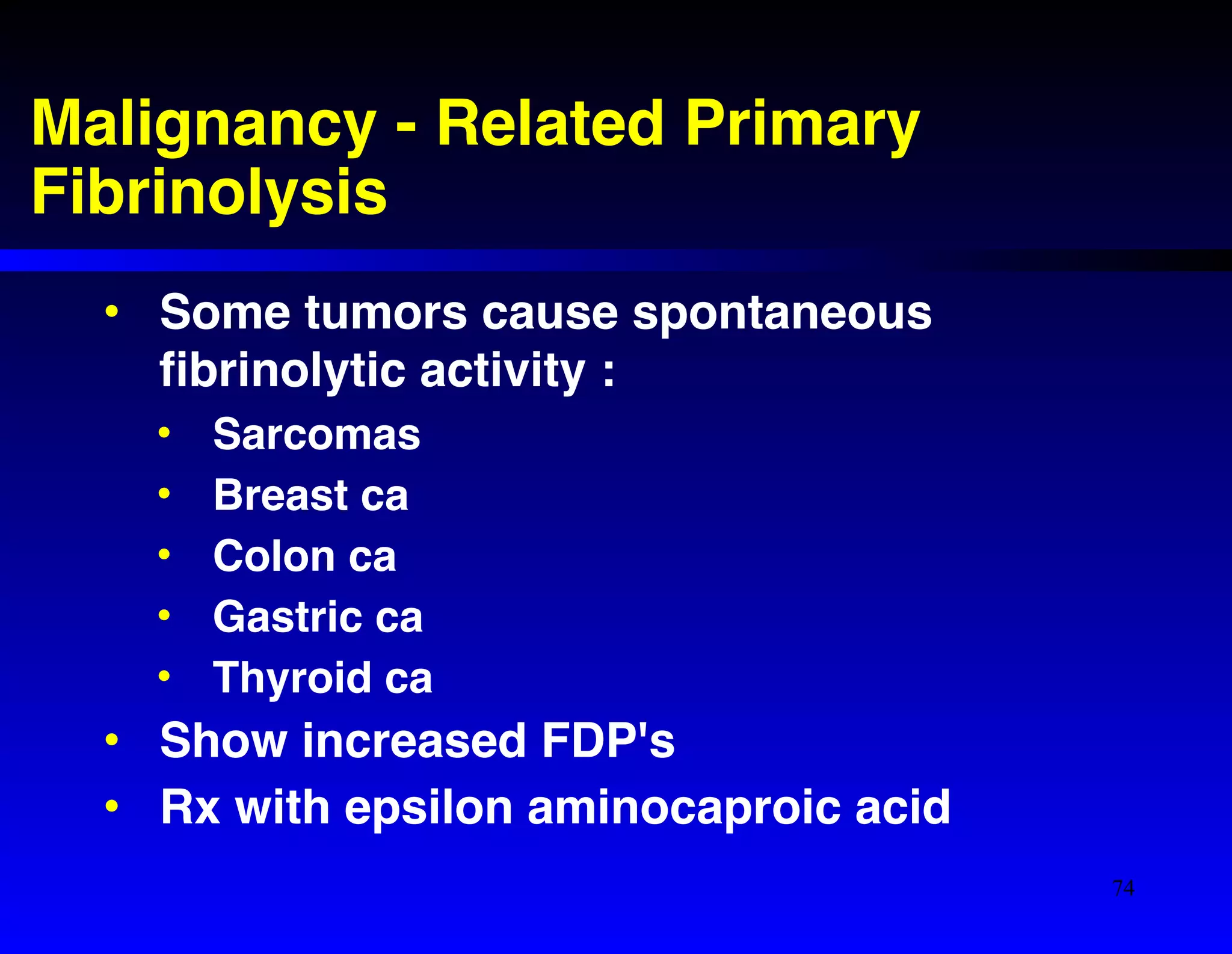
Malignancy - Related Primary 
Fibrinolysis 
• Some tumors cause spontaneous 
fibrinolytic activity :! 
• Sarcomas! 
• Breast ca! 
• Colon ca! 
• Gastric ca! 
• Thyroid ca! 
• Show increased FDP's! 
• Rx with epsilon aminocaproic acid 
74
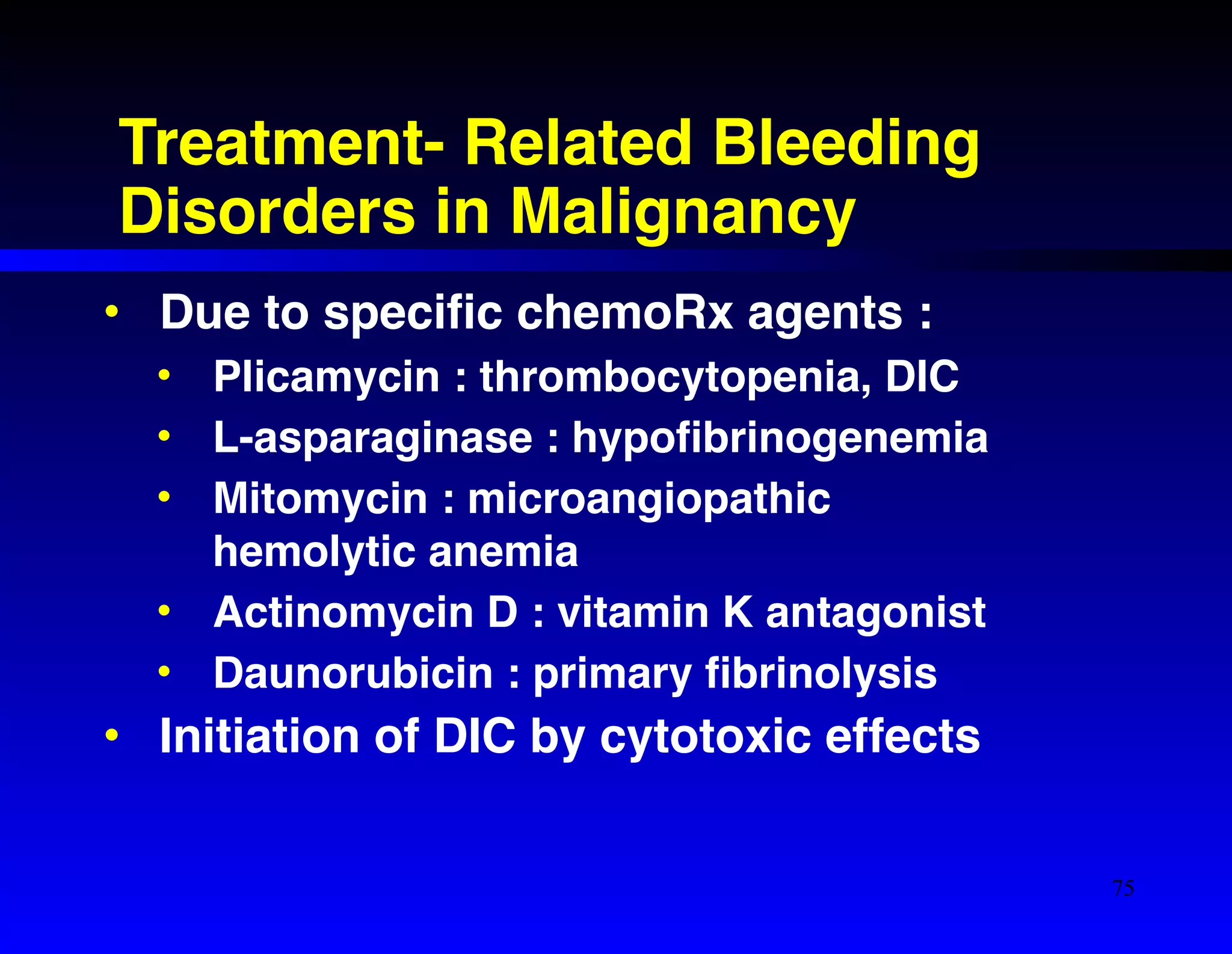
Treatment- Related Bleeding 
Disorders in Malignancy 
• Due to specific chemoRx agents :! 
• Plicamycin : thrombocytopenia, DIC! 
• L-asparaginase : hypofibrinogenemia! 
• Mitomycin : microangiopathic 
hemolytic anemia! 
• Actinomycin D : vitamin K antagonist! 
• Daunorubicin : primary fibrinolysis! 
• Initiation of DIC by cytotoxic effects 
75
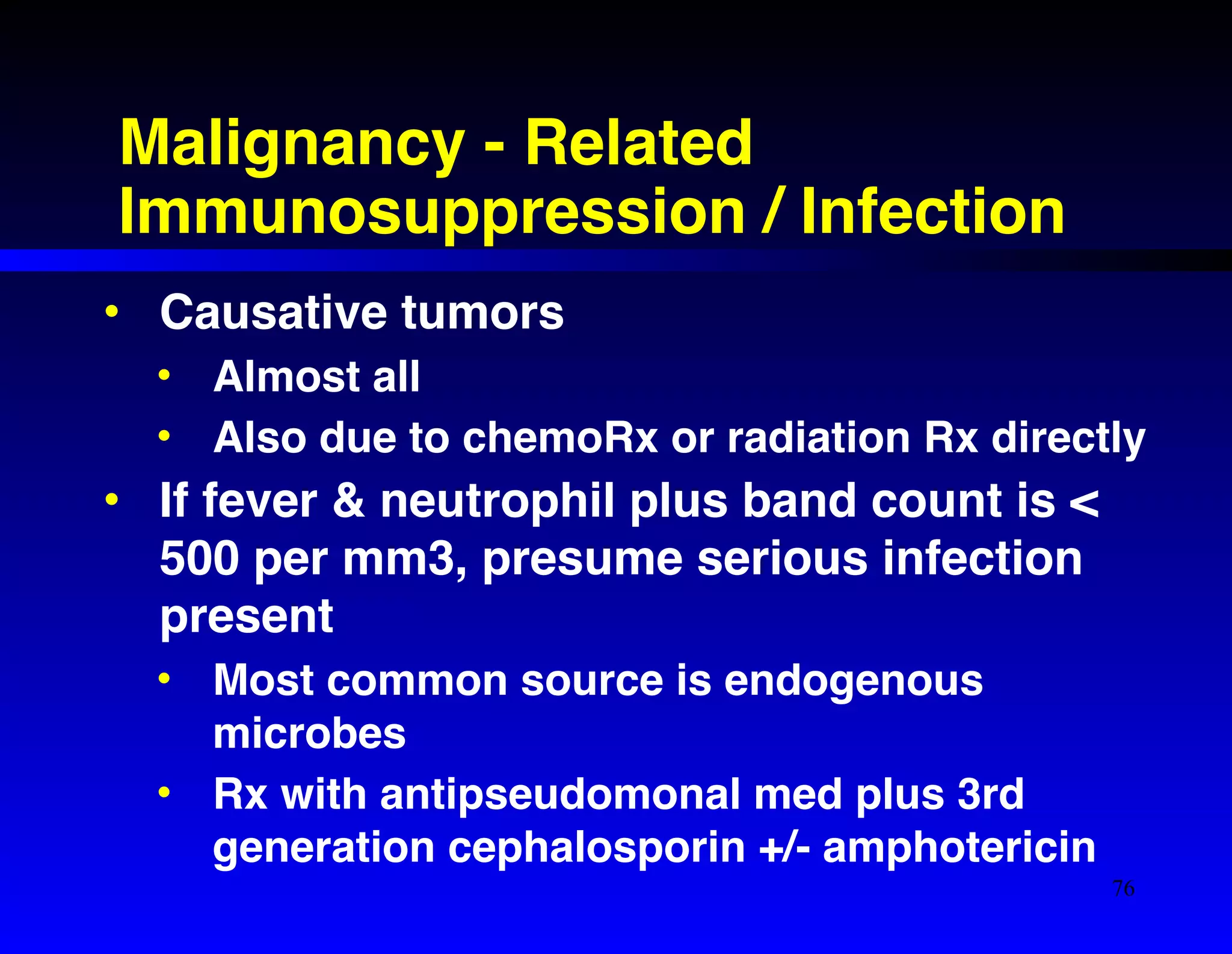
Malignancy - Related 
Immunosuppression / Infection 
• Causative tumors! 
• Almost all! 
• Also due to chemoRx or radiation Rx directly! 
• If fever & neutrophil plus band count is < 
500 per mm3, presume serious infection 
present! 
• Most common source is endogenous 
microbes! 
• Rx with antipseudomonal med plus 3rd 
generation cephalosporin +/- amphotericin 
76
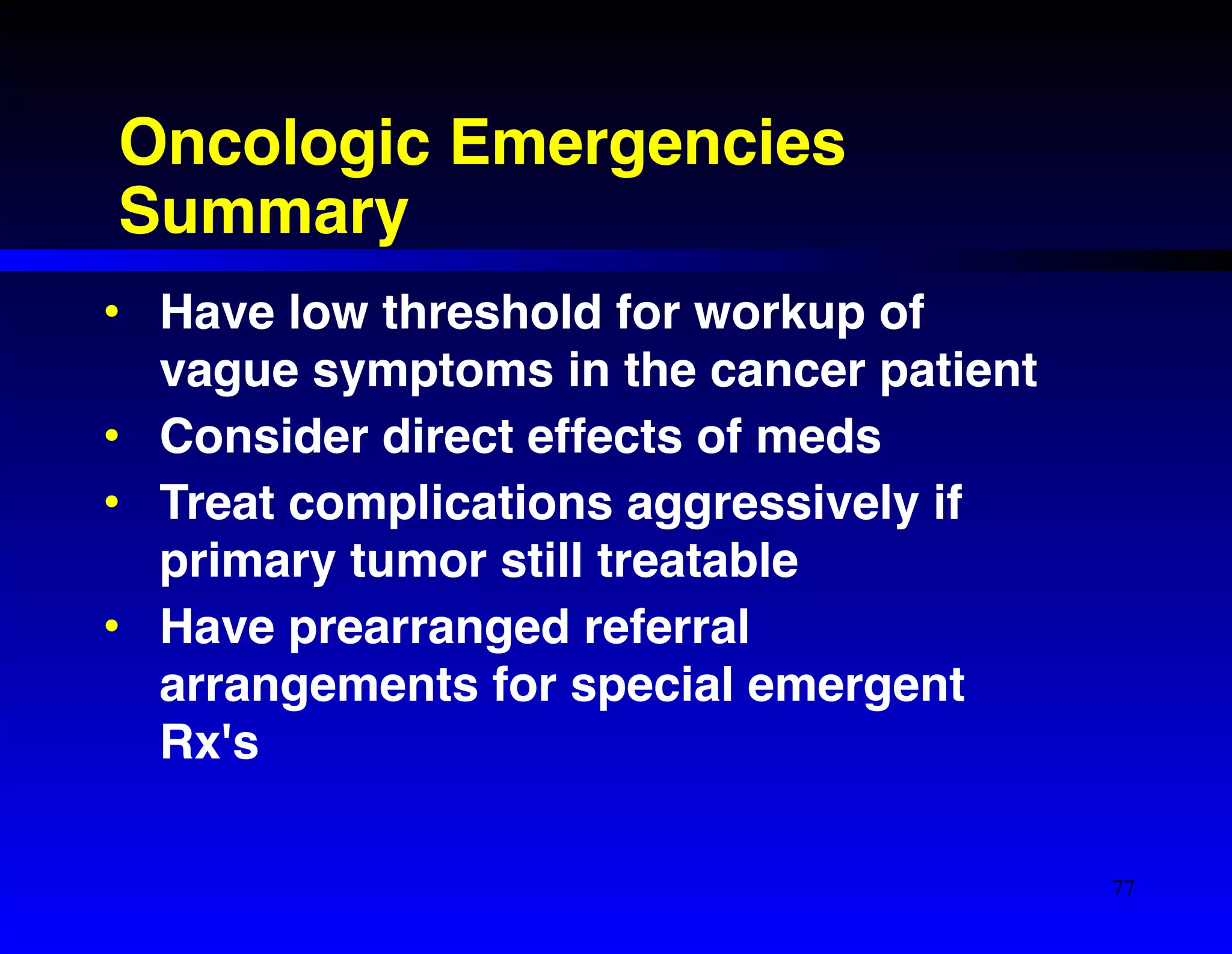
Oncologic Emergencies 
Summary 
• Have low threshold for workup of 
vague symptoms in the cancer patient! 
• Consider direct effects of meds! 
• Treat complications aggressively if 
primary tumor still treatable! 
• Have prearranged referral 
arrangements for special emergent 
Rx's 
77

GEMC- Oncologic Emergencies- Resident Training

  • 1.
    Project: Ghana EmergencyMedicine Collaborative ! Document Title: Oncologic Emergencies ! Author(s): Jim Holliman, M.D., F.A.E.C.P., Uniformed Services University, 2013 ! License: Unless otherwise noted, this material is made available under the terms of the Creative Commons Attribution Share Alike-3.0 License: http://creativecommons.org/licenses/by-sa/3.0/ We have reviewed this material in accordance with U.S. Copyright Law and have tried to maximize your ability to use, share, and adapt it. These lectures have been modified in the process of making a publicly shareable version. The citation key on the following slide provides information about how you may share and adapt this material. ! Copyright holders of content included in this material should contact open.michigan@umich.edu with any questions, corrections, or clarification regarding the use of content. ! For more information about how to cite these materials visit http://open.umich.edu/privacy-and-terms-use. ! Any medical information in this material is intended to inform and educate and is not a tool for self-diagnosis or a replacement for medical evaluation, advice, diagnosis or treatment by a healthcare professional. Please speak to your physician if you have questions about your medical condition. ! Viewer discretion is advised: Some medical content is graphic and may not be suitable for all viewers. 1
  • 2.
    Attribution Key ! for more information see: http://open.umich.edu/wiki/AttributionPolicy Use + Share + Adapt { Content the copyright holder, author, or law permits you to use, share and adapt. } Public Domain – Government: Works that are produced by the U.S. Government. (17 USC § 105) Public Domain – Expired: Works that are no longer protected due to an expired copyright term. Public Domain – Self Dedicated: Works that a copyright holder has dedicated to the public domain. Creative Commons – Zero Waiver Creative Commons – Attribution License Creative Commons – Attribution Share Alike License Creative Commons – Attribution Noncommercial License Creative Commons – Attribution Noncommercial Share Alike License GNU – Free Documentation License Make Your Own Assessment { Content Open.Michigan believes can be used, shared, and adapted because it is ineligible for copyright. } Public Domain – Ineligible: Works that are ineligible for copyright protection in the U.S. (17 USC § 102(b)) *laws in your jurisdiction may differ { Content Open.Michigan has used under a Fair Use determination. } Fair Use: Use of works that is determined to be Fair consistent with the U.S. Copyright Act. (17 USC § 107) *laws in your jurisdiction may differ Our determination DOES NOT mean that all uses of this 3rd-party content are Fair Uses and we DO NOT guarantee that your use of the content is Fair. 2 To use this content you should do your own independent analysis to determine whether or not your use will be Fair.
  • 3.
    Oncologic ! Emergencies Jim Holliman, M.D., F.A.C.E.P.! Professor of Military and Emergency Medicine! Uniformed Services University of the Health Sciences! Clinical Professor of Emergency Medicine! George Washington University! Bethesda, Maryland, U.S.A. 3
  • 4.
    Oncologic Emergencies! Introduction • Malignancy is 2nd leading cause of death in U.S.! • Now cancer has 52 % 5 year survival overall! • Rx of complications can be life-saving since causative tumor often is curable! • Rx of complications can, at a minimum, improve quality of life 4
  • 5.
    List of MajorEmergency Complications of Malignancy • Upper airway obstruction! • Malignant pericardial tamponade! • Superior vena cava syndrome! • Acute spinal cord compression! • Hypercalcemia! • Hyperviscosity syndrome! • Hyperleukocytic syndrome! • Acute tumor lysis syndrome! • SIADH! • Adrenal insufficiency / crisis ! • Thrombocytopenia / hemorrhage! • Immunosuppression / infection 5
  • 6.
    Upper Airway Obstructionby Malignancy • Causative tumors :! • Laryngeal ca! • Thyroid ca! • Lymphoma! • Metastatic lung ca! • Retropharyngeal abscess 6
  • 7.
    Upper Airway Obstructionby Malignancy • Symptoms! • Voice change! • Hoarseness! • Neck fullness! • Dysphagia! • Stridor! • Dyspnea! • Usually progresses & presents subacutely, unless food aspiration, infection, hemorrhage, or inspissated secretions occur 7
  • 8.
    Upper Airway Obstructionby Malignancy • Diagnosis! • Lateral soft tissue neck film! • CXR! • Fiberoptic laryngoscopy 8
  • 9.
    Tracheal deviation froma substernal goiter Source Undetermined 9
  • 10.
    Upper Airway Obstructionby Malignancy • Treatment! • Oxygen! • Racemic epinephrine aerosol (1.0 to 1.5 cc)! • Helium / oxygen (Heliox) inhalation! • ? IV steroids or diuretics! • Intubation over fiberoptic laryngoscope! • Consider tracheostomy! • ? emergency radiation Rx 10
  • 11.
    Malignant Pericardial Tamponade • Causative tumors :! • Melanoma! • Hodgkin's lymphoma! • Acute leukemia! • Lung ca! • Breast ca! • Ovarian ca! • Radiation pericarditis! • Rare to be initial presentation of malignancy 11
  • 12.
    Malignant Pericardial Tamponade • Sx and Signs :! • Dyspnea / weakness +/- chest pain! • Hypotension / narrow pulse pressure! • Friction rub rare! • Jugular venous distention! • Muffled (decreased) heart tones! • Pulsus paradoxicus > 10 mm Hg! • Low EKG QRS voltage +/- pulsus alternans! • +/- cardiomegaly on CXR 12
  • 13.
    Malignant Pericardial Tamponade • Dx :! • Echocardiography! • Equalization of heart chamber pressures! • Rx options :! • Needle catheter pericardiocentesis! • Pericardial window under local anesthesia! • Radiation Rx! • Pericardiectomy! • Intrapericardial chemoRx or sclerosis 13
  • 14.
    Septum Posterior ventricularwall Pericardial effusion Source Undetermined M mode echocardiogram showing malignant pericardial effusion 14
  • 15.
    Source Undetermined Mmode echo showing moderate size pericardial effusion (P) 15
  • 16.
    Source Undetermined Twodimensional echo in same patient showing pericardial effusion (P) 16
  • 17.
    Superior Vena Cava(SVC) Syndrome • Causative tumors :! • Small cell (oat cell) lung ca! • Squamous cell lung ca! • Lymphoma! • Anaplastic mediastinal ca! • SVC thrombosis from indwelling catheter! • Sx are due to SVC compression or occlusion 17
  • 18.
    SVC Syndrome SYMPTOMFREQUENCY (%) Dyspnea 83 Cough 70 Orthopnea 64 Nasal congestion 35 Hoarseness 35 Stridor 33 Dizziness 29 Stupor / coma 20 Other sx : syncope, headache, dysphagia, epistaxis 18
  • 19.
    SVC Syndrome SIGNFREQUENCY (%) Neck vein distention 92 Facial swelling / fullness 86 Arm vein distention 68 Mentation changes 27 Tongue edema 24 Laryngeal edema 24 Rhinorrhea 18 19
  • 20.
    SVC Syndrome •Less common signs :! • Facial plethora / telangiectasia! • Supraclavicular palpable mass! • Horner's syndrome! • Papilledema ! • If present, represents a true emergency 20
  • 21.
    Patient with SVCSyndrome Source Undetermined 21
  • 22.
    EMAHkempny, Wikimedia Commons Another patient with SVC Syndrome 22
  • 23.
    Source Undetermined SVCSyndrome from small cell lung cancer 23
  • 24.
    Source Undetermined SVCSyndrome from lung adenocarcinoma 24
  • 25.
    SVC Syndrome •Diagnosis! • CXR abnormal in 84 %! • Confirm with (one of ) :! • Chest CT with contrast! • MRI! • Contrast venography! • Tc99m radionuclide venography 25
  • 26.
    Anaplastic cancer ofthe mediastinum causing SVC Syndrome Source Undetermined 26
  • 27.
    Source Undetermined Mediastinalwidening and pulmonary venous obstruction from lung cancer 27
  • 28.
    Source Undetermined Chestcomputed tomography showing right sided mediastinal lung cancer compressing the contrast filled SVC 28
  • 29.
    Source Undetermined AnotherCT cut of the same patient showing tumor compression of the SVC 29
  • 30.
  • 31.
  • 32.
    Source Undetermined 37year old male who presented with sudden onset of venous stasis, hoarseness, and hemoptysis 32
  • 33.
    Source Undetermined ChestX-ray of same patient who proved to have squamous cell cancer of the lung blocking the left subclavian vein 33
  • 34.
    SVC Syndrome •Treatment :! • Keep in head-up position! • IV steroids! • IV diuretics! • ? anticoagulants or thrombolytics! • Emergent mediastinal radiation Rx! • Remove central IV catheter if present 34
  • 35.
    Acute Spinal Cord Compression • Causative tumors :! • Breast ca! • Lung ca! • Prostate ca! • Lymphomas! • Multiple myeloma! • Renal cell ca! • Sarcomas! • Epidural abscess / hematoma! • 18,000 cases per year in U.S. 35
  • 36.
    Acute Spinal Cord Compression • Symptoms :! • Localized back pain +/- tenderness! • May be absent with lymphomas! • Paraparesis / paraplegia! • Distal sensory deficits! • Urinary incontinence 36
  • 37.
    Acute Spinal Cord Compression • Cervical, thoracic, or lumbar spine films : 85 % abnormal! • May not be needed if CT or MRI planned anyway! • Radionuclide bone scan ! • Sensitivity > 90 % except for multiple myeloma! • Spine CT with contrast! • MRI! • Myelography! • NOTE : any studies done should be in emergent time frame & with early involvement of consultant 37
  • 38.
    Source Undetermined MRIscan showing multiple myeloma destroying the C6 vertebra and surrounding the spinal cord 38
  • 39.
    40 year oldmale who presented with neck pain ; he had a metastatic hypernephroma which destroyed the odontoid Source Undetermined 39
  • 40.
    Myelogram showing breastcancer metastasis pressing on the L5 nerve root, and also pushing the thecal sac posteriorly at L4 Source Undetermined 40
  • 41.
    Source Undetermined T1MRI of same patient showing compression of the L5 nerve root 41
  • 42.
    Acute Spinal Cord Compression • Treatment! • Spine immobilization! • Foley catheter! • ? IV steroids / diuretic / mannitol! • Emergent decompressive laminectomy or radiation Rx 42
  • 43.
    Hypercalcemia of Malignancy • Causative tumors! • Metastatic breast, lung, or prostate ca! • Multiple myeloma! • Non-Hodgkin's lymphoma! • Adult T-cell lymphoma / leukemia! • Renal cell ca! • Head & neck squamous cell ca 43
  • 44.
    Malignancy Hypercalcemia •Symptoms! • Vague malaise / weakness! • Polydipsia! • Lethargy / confusion! • Constipation ! • Vomiting! • Back pain! • Can have coma or seizures 44
  • 45.
    Malignancy Hypercalcemia •Diagnosis! • Total & ionized serum calcium! • Serum albumin sometimes helpful! • EKG shows short QT interval! • May show low voltage, long PR! • Discrete skeletal lesions not demonstrable in 30 % of patients! • Serum levels > 12 mg % dangerous 45
  • 46.
    Source Undetermined EKGshowing short QT interval (0.28 seconds) in a patient with a serum calcium of 14 mg/dl 46
  • 47.
    Malignancy Hypercalcemia! Treatment • IV hydration with normal saline! • Diuresis with IV furosemide! • Only after fluid loading ; avoid thiazides! • IV steroids! • Etidronate (7.5 mg/kg/day IV for 3 days)! • Mithramycin (15 to 25 mcg/kg/day IV x 3 days)! • Radiation Rx to tumor site(s)! • Rarely may need hemodialysis 47
  • 48.
    Considerations for Useof Etidronate (Didronel) for Rx of Malignant Hypercalcemia • Acts mainly to reduce bone resorption! • Mainly excreted renally! • Causes some degree of hyperphosphatemia! • Should be withheld if creatinine > 5 mg %! • Dose (must be diluted in 250 cc NS) :! • 7.5 mg/kg/day IV for 3 days! • Dose should be given over 2 hours! • Followup Rx with oral tablets! • 20 mg/kg/day for 30 days 48
  • 49.
    Use of Mithramycin(Plicamycin) for Rx of Malignancy Hypercalcemia • Acts as antineoplastic agent! • Method of action on hypercalcemia not known! • Main complication is bleeding! • GI side effects common! • Can cause thrombocytopenia! • Most useful as second agent for cases not responsive to etidronate 49
  • 50.
    Hyperviscosity Syndrome •Basic cause is elevation of serum proteins producing sludging & reduction in microcirculatory perfusion! • Serum viscosity is normally 1.4 to 1.8 times that of water! • Symptoms develop at viscosity > 5 50
  • 51.
    Hyperviscosity Syndrome •Causative tumors! • Multiple myeloma! • Waldenstrom's macroglobulinemia! • Chronic myelocytic leukemia 51
  • 52.
    Hyperviscosity Syndrome! Symptoms • Fatigue / malaise! • Headache! • Anorexia! • Somnolence! • If microthromboses occur :! • Deafness! • Visual deficits! • Seizures 52
  • 53.
    Hyperviscosity Syndrome! Diagnosis • Anemia! • Rouleaux formation on peripheral blood smear! • Retinal hemorrhages / exudates! • "Sausage-link" appearance of retinal vessels! • Factitious hyponatremia (due to H2O displacement)! • Measurement of serum viscosity & serum protein electrophoresis (SPEP) confirm Dx 53
  • 54.
    Hyperviscosity Syndrome! Treatment • If comatose :! • Emergent 2 unit phlebotomy & saline infusion! • Rehydration with IV saline! • Emergency plasmapheresis! • If patient has CML & massive leucocytosis : leukopheresis & concurrent chemoRx 54
  • 55.
    Hyperleukocytic Syndrome •Usually occurs in new onset acute myelocytic leukemia! • Can occur in CML with blast crisis! • WBC > 100 k in AML is dangerous! • WBC > 250 k in CML is dangerous! • Myeloblasts invade & damage vessel walls, esp. in brain & lung! • Serum analyses show pseudohypoxia, pseudohyperkalemia, & pseudohypoglycemia 55
  • 56.
    Hyperleukocytic Syndrome •Symptoms! • Marked dyspnea! • Headache, confusion! • Signs! • Hypoxia! • Diffuse lung infiltrates! • Neuro deficits 56
  • 57.
    Hyperleukocytic Syndrome! Treatment • Temporizing with leukopheresis! • Load with allopurinol (600 mg/M2)! • Then give hydroxyurea 3 to 5 gm/M2! • Brain radiation Rx for CNS leukostasis! • Definitive chemoRx once WBC decreased 57
  • 58.
    Acute Tumor LysisSyndrome • Usually occurs 6 to 72 hours after initiation of chemoRx or radiation Rx! • Due to rapid release of cell contents into bloodstream! • Most common tumor causes :! • Leukemias (with high WBC counts)! • Lymphomas! • Small cell ca! • Metastatic adenoca 58
  • 59.
    Acute Tumor LysisSyndrome! Etiologic Factors • Large tumor burden! • High growth fraction! • High preRx serum LDH or uric acid! • Preexisting renal insufficiency 59
  • 60.
    Acute Tumor LysisSyndrome • Main life-threatening problems :! • Hyperkalemia! • Hyperuricemia (causes uric acid nephropathy)! • Hyperphosphatemia with secondary hypocalcemia! • Can result in acute renal failure & arrhythmias 60
  • 61.
    Acute Tumor LysisSyndrome! Treatment • Stop the chemoRx! • Aggressive IV hydration / diuresis! • +/- alkalinize urine to pH 7! • Decreases urate but may worsen hypocalcemic tetany! • CaCl2, NaHCO3, glucose / insulin, kayexalate for hyperkalemia! • Emergency hemodialysis! • If K > 6, urate > 10, creat. > 10, or unable to tolerate diuresis! • Can use allopurinol for prevention 61
  • 62.
    Syndrome of InappropriateAntidiuretic Hormone Secretion (SIADH) • Causative tumors :! • Small cell lung ca most common (ectopic ADH)! • Pancreatic ca! • Bowel ca! • Thymus ca! • Prostate ca! • Lymphosarcoma! • Any brain tumor! • Vincristine or cyclophosphamide! • Other meds (narcotics, phenothiazines, etc.) 62
  • 63.
    SIADH! Symptoms •Altered mental status! • lethargy! • confusion! • Anorexia, nausea, vomiting! • Peripheral edema! • If severe, coma or seizures 63
  • 64.
    SIADH! Diagnosis •Normal renal, thyroid, adrenal, & cardiac function! • Absence of diuretic Rx! • Euvolemia or hypervolemia! • Hyponatremia with less than maximally dilute urine! • Excessive urine Na excretion (> 30 meq/liter) 64
  • 65.
    SIADH! Treatment •Serum Na > 125 usually not require Rx! • Fluid restriction only, if mild! • Furosemide with NS bolus (increases free water clearance)! • Hypertonic saline (3 %) only needed for :! • seizures! • coma! • cardiovascular compromise! • Only correct at about 1 meq/liter/hour (if too fast can cause central pontine myelinolysis)! • Seizure control with benzodiazepines 65
  • 66.
    Malignancy - CausedAdrenal Crisis • Causative tumors :! • Melanoma! • Lung ca! • Breast ca! • Renal & other retroperitoneal ca's! • Withdrawl of chronic steroid Rx! • Infection of adrenals! • Adrenal hemorrhage! • Aminoglutethamide chemoRx 66
  • 67.
    Malignancy - CausedAdrenal Crisis • Symptoms! • weakness, lethargy! • thirst! • Signs! • Dehydration! • Hypotension! • Hyponatremia, hyperkalemia, hypoglycemia, azotemia, +/- eosinophilia 67
  • 68.
    Malignancy - CausedAdrenal Crisis • Diagnosis! • Serum electrolytes, BUN! • Serum cortisol (draw prior to Rx)! • Computed tomography of retroperitoneum (+/- MRI)! • Start Rx prior to full workup 68
  • 69.
    Malignancy - CausedAdrenal Crisis! Treatment • IV fluid bolus (NS)! • IV steroids (at least 300 mg equivalents of hydrocortisone per day initially)! • +/- calcium, NaHCO3, glucose / insulin for hyperkalemia! • IV glucose! • Evaluate for source of infection! • Maintain steroid coverage 69
  • 70.
    Hemorrhagic Syndromes in Malignancy * • Thrombocytopenia! • Disseminated intravascular coagulation (DIC)! • Decreased clotting factors! • Primary fibrinolysis! • Platelet dysfunction! • Vascular defects! • Circulating anticoagulants (* in decreasing order of probability) 70
  • 71.
    Mechanisms of Thrombocytopeniain Malignancy • ChemoRx! • Radiation Rx! • Bone marrow tumor infiltration! • Hypersplenism! • DIC! • Infection - induced! • ITP 71
  • 72.
    Thrombocytopenia in Malignancy • Avoid all NSAID's! • Spontaneous bleeds can occur if platelets < 10 K! • Platelet transfusion indications :! • count < 5000! • Any CNS bleed (even if count > 10 k)! • Avoid in consumptive states! • Use HLA matched single donor platelets if sensitized 72
  • 73.
    Malignancy - RelatedDIC • Possible with any tumor but usually due to :! • acute leukemia (esp. promyelocytic)! • pancreas ca ! • prostate ca! • Can be acute or chronic! • Acute : platelets, PT, PTT, FDP, fibrinogen! • Rx with platelets & clotting factors! • May need tumor debulking! • Chronic : lab results may be near normal ; Rx intravascular thrombosis with heparin 73
  • 74.
    Malignancy - RelatedPrimary Fibrinolysis • Some tumors cause spontaneous fibrinolytic activity :! • Sarcomas! • Breast ca! • Colon ca! • Gastric ca! • Thyroid ca! • Show increased FDP's! • Rx with epsilon aminocaproic acid 74
  • 75.
    Treatment- Related Bleeding Disorders in Malignancy • Due to specific chemoRx agents :! • Plicamycin : thrombocytopenia, DIC! • L-asparaginase : hypofibrinogenemia! • Mitomycin : microangiopathic hemolytic anemia! • Actinomycin D : vitamin K antagonist! • Daunorubicin : primary fibrinolysis! • Initiation of DIC by cytotoxic effects 75
  • 76.
    Malignancy - Related Immunosuppression / Infection • Causative tumors! • Almost all! • Also due to chemoRx or radiation Rx directly! • If fever & neutrophil plus band count is < 500 per mm3, presume serious infection present! • Most common source is endogenous microbes! • Rx with antipseudomonal med plus 3rd generation cephalosporin +/- amphotericin 76
  • 77.
    Oncologic Emergencies Summary • Have low threshold for workup of vague symptoms in the cancer patient! • Consider direct effects of meds! • Treat complications aggressively if primary tumor still treatable! • Have prearranged referral arrangements for special emergent Rx's 77