Project: Ghana Emergency Medicine Collaborative 
! 
Document Title: Cardiac Evaluation 
! 
Author(s): Joe Lex, MD (Temple University School of Medicine) 
! 
License: Unless otherwise noted, this material is made available under the 
terms of the Creative Commons Attribution Share Alike-3.0 License: 
http://creativecommons.org/licenses/by-sa/3.0/ 
We have reviewed this material in accordance with U.S. Copyright Law and have tried to maximize your 
ability to use, share, and adapt it. These lectures have been modified in the process of making a publicly 
shareable version. The citation key on the following slide provides information about how you may share and 
adapt this material. ! 
Copyright holders of content included in this material should contact open.michigan@umich.edu with any 
questions, corrections, or clarification regarding the use of content. ! For more information about how to cite these materials visit http://open.umich.edu/privacy-and-terms-use. ! 
Any medical information in this material is intended to inform and educate and is not a tool for self-diagnosis 
or a replacement for medical evaluation, advice, diagnosis or treatment by a healthcare professional. Please 
speak to your physician if you have questions about your medical condition. ! 
Viewer discretion is advised: Some medical content is graphic and may not be suitable for all viewers. 
1
Attribution Key 
! 
for more information see: http://open.umich.edu/wiki/AttributionPolicy 
Use + Share + Adapt 
{ Content the copyright holder, author, or law permits you to use, share and adapt. } 
Public Domain – Government: Works that are produced by the U.S. Government. (17 USC § 105) 
Public Domain – Expired: Works that are no longer protected due to an expired copyright term. 
Public Domain – Self Dedicated: Works that a copyright holder has dedicated to the public domain. 
Creative Commons – Zero Waiver 
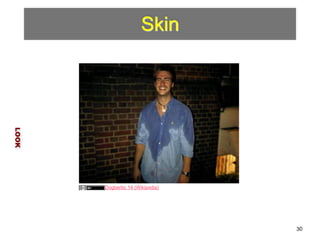
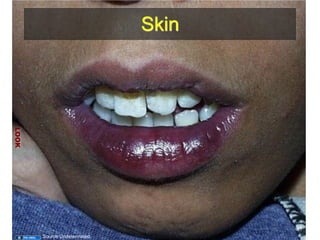
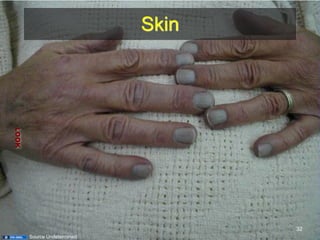
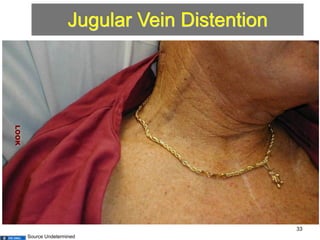
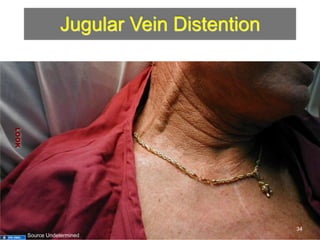
Creative Commons – Attribution License 
Creative Commons – Attribution Share Alike License 
Creative Commons – Attribution Noncommercial License 
Creative Commons – Attribution Noncommercial Share Alike License 
GNU – Free Documentation License 
Make Your Own Assessment 
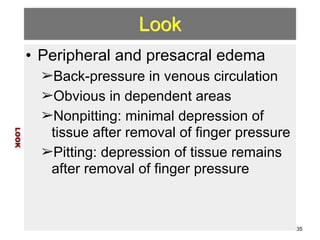
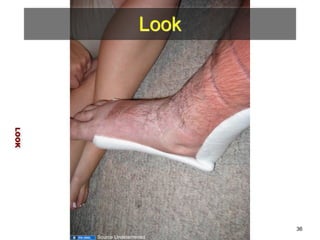
{ Content Open.Michigan believes can be used, shared, and adapted because it is ineligible for copyright. } 
Public Domain – Ineligible: Works that are ineligible for copyright protection in the U.S. (17 USC § 102(b)) *laws in 
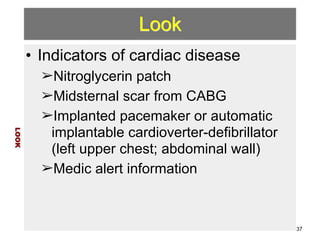
your jurisdiction may differ 
{ Content Open.Michigan has used under a Fair Use determination. } 
Fair Use: Use of works that is determined to be Fair consistent with the U.S. Copyright Act. (17 USC § 107) *laws in your 
jurisdiction may differ 
Our determination DOES NOT mean that all uses of this 3rd-party content are Fair Uses and we DO NOT guarantee that 
your use of the content is Fair. 
To use this content you should do your own independent analysis to determine whether or not your use will be Fair. 
2
Cardiac Evaluation 
Joe Lex, MD, FACEP, FAAEM 
Department of Emergency Medicine 
Temple University School of Medicine 
Philadelphia, PA 19140 
3
Assessment of Cardiac Patient 
• Chief complaint 
• History of event and significant past 
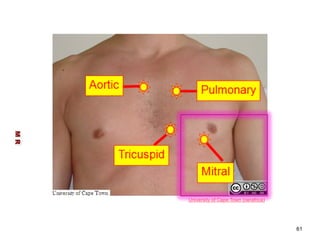
medical history 
• Physical exam 
4
Chief Complaint 
• Cardiac disease chief complaints 
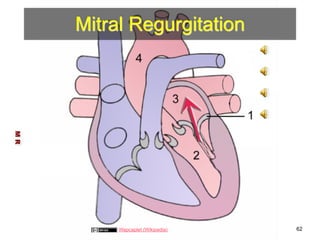
➢Chest pain or discomfort 
• Shoulder, arm, neck, or jaw pain or 
discomfort 
➢Dyspnea 
➢Syncope 
➢Abnormal heart beat or palpitations 
➢May vary 
C C 
5
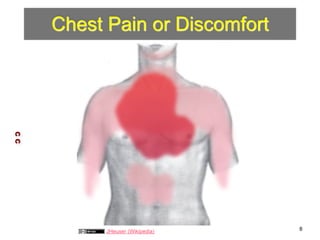
Chest Pain or Discomfort 
• Common chief complaint in 
myocardial infarction 
• Noncardiac causes of chest pain 
➢Pulmonary embolus 
➢Pleurisy 
➢Reflux esophagitis 
• History of chest pain is important 
➢OPQRST method 
C C 
6
Chest Pain or Discomfort 
• Onset of the event 
• Provocation or Palliation 
• Quality of the pain 
• Region and Radiation 
• Severity 
• Time (history) 
C C 
7
Chest Pain or Discomfort 
C C 
JHeuser (Wikipedia) 8
The Angina Monologue 
C C 
Chest tight… 
Short of breath… 
Sweaty… 
9
Dyspnea 
SOB 
Who are 
you calling 
an SOB?!?! 
10
Dyspnea 
• May occur with ACS 
• Symptom of heart failure 
• Dyspnea unrelated to heart disease 
➢Chronic obstructive pulmonary 
disease 
➢Respiratory infection 
➢Pulmonary embolus 
➢Asthma 
SOB 
11
Dyspnea 
• Duration 
• Circumstances of onset 
• What aggravates or relieves, 
including medications 
• Previous episodes 
• Associated symptoms 
• Orthopnea 
• Prior cardiac problems 
SOB 
12
Syncope 
SYNCOPE 
13
Syncope 
• Sudden decrease in cerebral 
perfusion 
• Cardiac causes decrease cardiac 
output 
➢Dysrhythmias 
SYNCOPE 
14
Syncope 
• Noncardiac causes of syncope 
➢Stroke (note – I disagree) 
➢Drug or alcohol intoxication 
➢Aortic stenosis 
➢Pulmonary embolism 
➢Hypoglycemia (depends on how you 
define syncope) 
SYNCOPE 
15
Syncope—History 
• Aura: nausea, weak, lighthead 
• Circumstances: position before 
event, pain, stress 
• Duration of syncopal episode 
• Symptoms before syncope 
• Other symptoms 
• Previous episodes 
SYNCOPE 
16
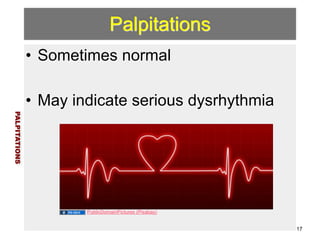
Palpitations 
• Sometimes normal 
! 
• May indicate serious dysrhythmia 
PALPITATIONS 
17 
PublicDomainPictures (Pixabay)
Palpitations 
• History and physical exam 
➢Pulse rate (if obtained) 
➢Regular versus irregular rhythm 
➢Circumstances 
➢Duration 
➢Chest pain, diaphoresis, syncope, 
confusion, dyspnea 
➢Previous episodes 
➢Medications 
PALPITATIONS 
18
Significant Past Medical History 
• Is the patient taking prescription 
meds, particularly cardiac meds? 
➢Digoxin 
➢Furosemide or other diuretic 
➢Nitroglycerin 
➢Beta blockers 
• Is the patient being treated for any 
other illness? 
PMH 
19
Significant Past Medical History 
• ACS or angina 
• CABG or PCI 
• Implanted pacemaker or ICD 
• Heart failure 
• Hypertension 
• Diabetes 
• Chronic lung disease 
PMH 
20
Significant Past Medical History 
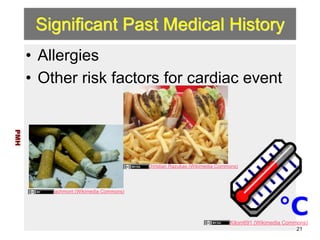
• Allergies 
• Other risk factors for cardiac event 
PMH 
21 
bachmont (Wikimedia Commons) 
Christian Razukas (Wikimedia Commons) 
Kilom691 (Wikimedia Commons)
Physical Examination 
22
Physical Examination 
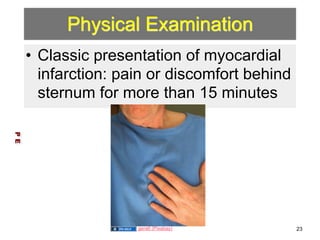
• Classic presentation of myocardial 
infarction: pain or discomfort behind 
sternum for more than 15 minutes 
P E 
geralt (Pixabay) 23
Physical Examination 
• Other signs and symptoms 
➢Apprehension 
➢Diaphoresis 
➢Dyspnea 
➢Nausea and vomiting 
➢Sense of impending doom 
• Atypical presentations 
P E 
24
Nausea & Vomiting 
25 
tt2times (Flickr)
Sense of Impending Doom 
26 
dcosand (Flickr)
Initial Assessment 
• Level of consciousness 
• Respirations 
• Pulse (rate, regularity) 
• Blood pressure 
• Skin 
P E 
27
Physical Examination 
Look 
Listen 
Feel 
P E 
28
Look 
• Skin color, capillary refill, skin 
moisture 
➢Oxygenation: pulse oximetry 
➢Cardiac function: peripheral perfusion 
• Jugular vein distention (JVD) 
➢Evaluate with head elevated to 45o 
➢Difficult to assess in obese patients 
LOOK 
29
Skin 
LOOK 
30 
Dogbertio 14 (Wikipedia)
Skin 
LOOK 
31 
Source Undetermined
Skin 
LOOK 
32 
Source Undetermined
Jugular Vein Distention 
LOOK 
33 
Source Undetermined
Jugular Vein Distention 
LOOK 
34 
Source Undetermined
Look 
• Peripheral and presacral edema 
➢Back-pressure in venous circulation 
➢Obvious in dependent areas 
➢Nonpitting: minimal depression of 
tissue after removal of finger pressure 
➢Pitting: depression of tissue remains 
after removal of finger pressure 
LOOK 
35
Look 
LOOK 
36 
Source Undetermined
Look 
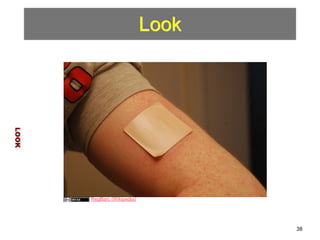
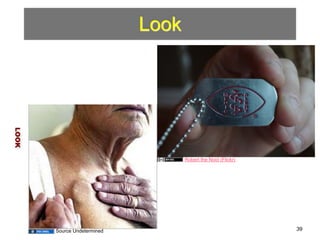
• Indicators of cardiac disease 
➢Nitroglycerin patch 
➢Midsternal scar from CABG 
➢Implanted pacemaker or automatic 
implantable cardioverter-defibrillator 
(left upper chest; abdominal wall) 
➢Medic alert information 
LOOK 
37
Look 
LOOK 
38 
RegBarc (Wikipedia)
Look 
LOOK 
Robert the Noid (Flickr) 
Source Undetermined 39
Listen 
• Lung sounds 
➢Equality 
➢Adventitious sounds: may indicate 
pulmonary congestion or edema 
• Heart sounds 
➢Gallops 
LISTEN 
40
Heart Sounds 
• Auscultate for: 
➢Frequency (pitch) 
➢Intensity (loudness) 
➢Duration 
➢Timing in the cardiac cycle 
LISTEN 
41
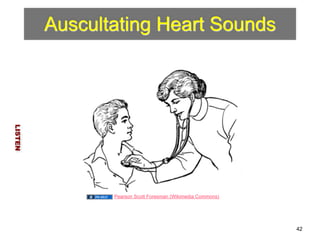
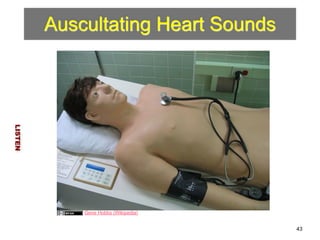
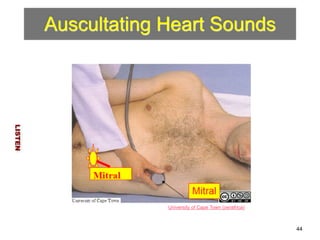
Auscultating Heart Sounds 
LISTEN 
42 
Pearson Scott Foresman (Wikimedia Commons)
Auscultating Heart Sounds 
LISTEN 
43 
Gene Hobbs (Wikipedia)
Auscultating Heart Sounds 
LISTEN 
44 
University of Cape Town (oerafrica)
Point of Maximal Impulse (PMI) 
• Apical impulse 
➢Visible and palpable 
➢Produced by contraction of left 
ventricle 
• Pulse deficits noted by palpating or 
auscultating apical impulse and 
carotid pulse simultaneously 
FEEL 
45
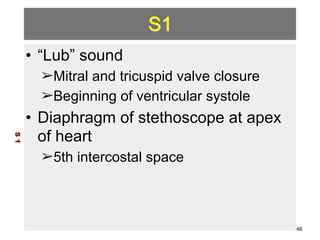
S1 
• “Lub” sound 
➢Mitral and tricuspid valve closure 
➢Beginning of ventricular systole 
• Diaphragm of stethoscope at apex 
of heart 
➢5th intercostal space 
S 1 
46
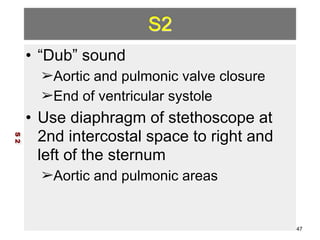
S2 
• “Dub” sound 
➢Aortic and pulmonic valve closure 
➢End of ventricular systole 
• Use diaphragm of stethoscope at 
2nd intercostal space to right and 
left of the sternum 
➢Aortic and pulmonic areas 
S 2 
47
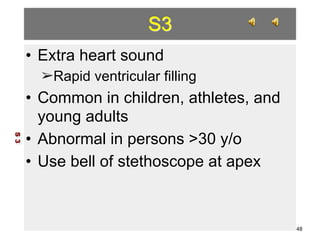
S3 
• Extra heart sound 
➢Rapid ventricular filling 
• Common in children, athletes, and 
young adults 
• Abnormal in persons >30 y/o 
• Use bell of stethoscope at apex 
S 3 
48
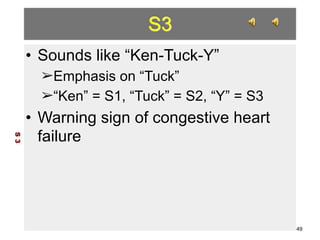
S3 
• Sounds like “Ken-Tuck-Y” 
➢Emphasis on “Tuck” 
➢“Ken” = S1, “Tuck” = S2, “Y” = S3 
• Warning sign of congestive heart 
failure 
S 3 
49
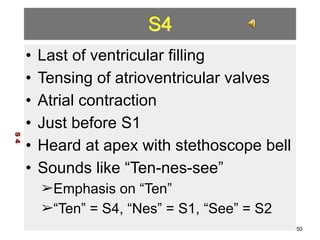
S4 
• Last of ventricular filling 
• Tensing of atrioventricular valves 
• Atrial contraction 
• Just before S1 
• Heard at apex with stethoscope bell 
• Sounds like “Ten-nes-see” 
➢Emphasis on “Ten” 
➢“Ten” = S4, “Nes” = S1, “See” = S2 
S 4 
50
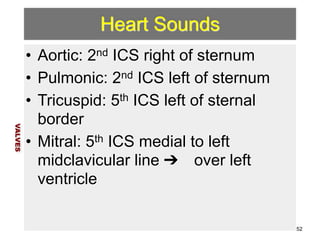
Heart Sounds 
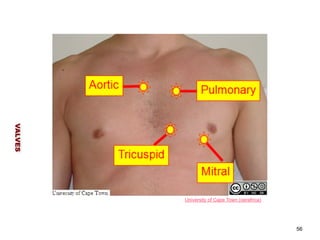
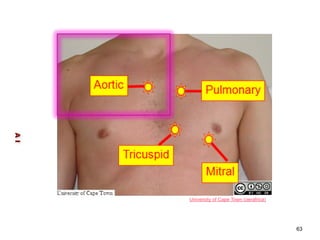
• Aortic: 2nd ICS right of sternum 
• Pulmonic: 2nd ICS left of sternum 
• Tricuspid: 5th ICS left of sternal 
border 
• Mitral: 5th ICS medial to left 
midclavicular line ➔ over left 
ventricle 
VALVES 
52
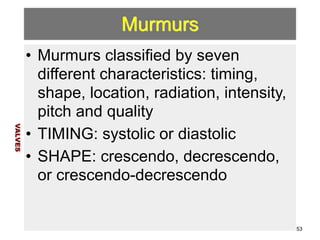
Murmurs 
• Murmurs classified by seven 
different characteristics: timing, 
shape, location, radiation, intensity, 
pitch and quality 
• TIMING: systolic or diastolic 
• SHAPE: crescendo, decrescendo, 
or crescendo-decrescendo 
VALVES 
53
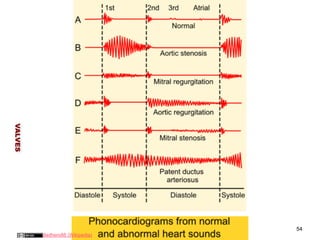
VALVES 
54 
Madhero88 (Wikipedia)
Murmurs 
• LOCATION: 6 places on anterior 
chest to listen for heart murmurs 
➢Five of six adjacent to sternum; 
each roughly corresponds to 
specific part of the heart 
➢Four places usually more than 
adequate 
VALVES 
55
VALVES 
56 
University of Cape Town (oerafrica)
Murmurs 
• RADIATION: to where does the 
sound of the murmur radiate? 
➢Rule of thumb: sound radiates in 
direction of blood flow 
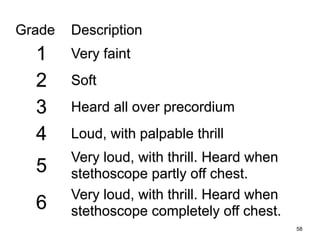
• INTENSITY: loudness of murmur, 
➢Graded on scale from 0 – 6 / 6 
VALVES 
57
Grade Description 
1 Very faint 
2 Soft 
3 Heard all over precordium 
4 Loud, with palpable thrill 
5 Very loud, with thrill. Heard when 
stethoscope partly off chest. 
6 Very loud, with thrill. Heard when 
stethoscope completely off chest. 
58
Murmurs 
• PITCH: low, medium or high 
➢Determined by whether it can be 
auscultated best with bell or 
diaphragm of stethoscope 
• QUALITY: blowing, harsh, honking, 
rumbling, musical 
VALVES 
59
Murmurs 
Three important murmurs in EM 
1. Mitral regurgitation ➔ may 
indicate blown papillary muscle in 
acute MI 
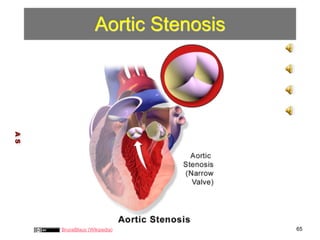
2. Aortic stenosis in syncope ➔ 
may determine cause 
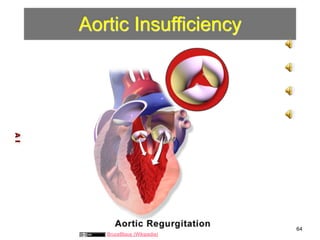
3. Aortic insufficiency in syncope, 
chest pain ➔ aortic dissection 
VALVES 
60
M R 
61 
University of Cape Town (oerafrica)
Mitral Regurgitation 
M R 
Wapcaplet (Wikipedia) 62
A I 
63 
University of Cape Town (oerafrica)
Aortic Insufficiency 
A I 
64 
BruceBlaus (Wikipedia)
Aortic Stenosis 
A S 
BruceBlaus (Wikipedia) 65
Feel 
• Peripheral or presacral edema 
• Pulse 
➢Rate 
➢Regularity 
➢Equality 
➢Pulse deficit 
➢Pulsus paradoxus 
➢Pulsus alternans 
FEEL 
66
Feel 
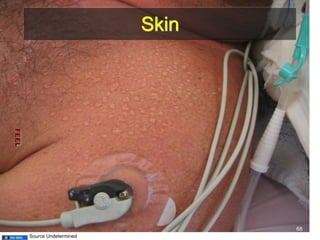
• Skin 
➢Diaphoretic, pale skin 
• Peripheral vasoconstriction 
• Sympathetic stimulation 
➢Cyanosis 
• Poor oxygenation 
➢Fever 
• Infection 
FEEL 
67
Skin 
FEEL 
68 
Source Undetermined
Putting It All Together 
EXAM 
69 
Source Undetermined
Conclusions 
• Chief complaint 
• Brief history 
• Physical exam: look, listen, feel 
• Think binary: murmur, yes or no; 
abnormal breath sounds, yes or no 
70

GEMC- Cardiac Evalutation- Resident Training

  • 1.
    Project: Ghana EmergencyMedicine Collaborative ! Document Title: Cardiac Evaluation ! Author(s): Joe Lex, MD (Temple University School of Medicine) ! License: Unless otherwise noted, this material is made available under the terms of the Creative Commons Attribution Share Alike-3.0 License: http://creativecommons.org/licenses/by-sa/3.0/ We have reviewed this material in accordance with U.S. Copyright Law and have tried to maximize your ability to use, share, and adapt it. These lectures have been modified in the process of making a publicly shareable version. The citation key on the following slide provides information about how you may share and adapt this material. ! Copyright holders of content included in this material should contact open.michigan@umich.edu with any questions, corrections, or clarification regarding the use of content. ! For more information about how to cite these materials visit http://open.umich.edu/privacy-and-terms-use. ! Any medical information in this material is intended to inform and educate and is not a tool for self-diagnosis or a replacement for medical evaluation, advice, diagnosis or treatment by a healthcare professional. Please speak to your physician if you have questions about your medical condition. ! Viewer discretion is advised: Some medical content is graphic and may not be suitable for all viewers. 1
  • 2.
    Attribution Key ! for more information see: http://open.umich.edu/wiki/AttributionPolicy Use + Share + Adapt { Content the copyright holder, author, or law permits you to use, share and adapt. } Public Domain – Government: Works that are produced by the U.S. Government. (17 USC § 105) Public Domain – Expired: Works that are no longer protected due to an expired copyright term. Public Domain – Self Dedicated: Works that a copyright holder has dedicated to the public domain. Creative Commons – Zero Waiver Creative Commons – Attribution License Creative Commons – Attribution Share Alike License Creative Commons – Attribution Noncommercial License Creative Commons – Attribution Noncommercial Share Alike License GNU – Free Documentation License Make Your Own Assessment { Content Open.Michigan believes can be used, shared, and adapted because it is ineligible for copyright. } Public Domain – Ineligible: Works that are ineligible for copyright protection in the U.S. (17 USC § 102(b)) *laws in your jurisdiction may differ { Content Open.Michigan has used under a Fair Use determination. } Fair Use: Use of works that is determined to be Fair consistent with the U.S. Copyright Act. (17 USC § 107) *laws in your jurisdiction may differ Our determination DOES NOT mean that all uses of this 3rd-party content are Fair Uses and we DO NOT guarantee that your use of the content is Fair. To use this content you should do your own independent analysis to determine whether or not your use will be Fair. 2
  • 3.
    Cardiac Evaluation JoeLex, MD, FACEP, FAAEM Department of Emergency Medicine Temple University School of Medicine Philadelphia, PA 19140 3
  • 4.
    Assessment of CardiacPatient • Chief complaint • History of event and significant past medical history • Physical exam 4
  • 5.
    Chief Complaint •Cardiac disease chief complaints ➢Chest pain or discomfort • Shoulder, arm, neck, or jaw pain or discomfort ➢Dyspnea ➢Syncope ➢Abnormal heart beat or palpitations ➢May vary C C 5
  • 6.
    Chest Pain orDiscomfort • Common chief complaint in myocardial infarction • Noncardiac causes of chest pain ➢Pulmonary embolus ➢Pleurisy ➢Reflux esophagitis • History of chest pain is important ➢OPQRST method C C 6
  • 7.
    Chest Pain orDiscomfort • Onset of the event • Provocation or Palliation • Quality of the pain • Region and Radiation • Severity • Time (history) C C 7
  • 8.
    Chest Pain orDiscomfort C C JHeuser (Wikipedia) 8
  • 9.
    The Angina Monologue C C Chest tight… Short of breath… Sweaty… 9
  • 10.
    Dyspnea SOB Whoare you calling an SOB?!?! 10
  • 11.
    Dyspnea • Mayoccur with ACS • Symptom of heart failure • Dyspnea unrelated to heart disease ➢Chronic obstructive pulmonary disease ➢Respiratory infection ➢Pulmonary embolus ➢Asthma SOB 11
  • 12.
    Dyspnea • Duration • Circumstances of onset • What aggravates or relieves, including medications • Previous episodes • Associated symptoms • Orthopnea • Prior cardiac problems SOB 12
  • 13.
  • 14.
    Syncope • Suddendecrease in cerebral perfusion • Cardiac causes decrease cardiac output ➢Dysrhythmias SYNCOPE 14
  • 15.
    Syncope • Noncardiaccauses of syncope ➢Stroke (note – I disagree) ➢Drug or alcohol intoxication ➢Aortic stenosis ➢Pulmonary embolism ➢Hypoglycemia (depends on how you define syncope) SYNCOPE 15
  • 16.
    Syncope—History • Aura:nausea, weak, lighthead • Circumstances: position before event, pain, stress • Duration of syncopal episode • Symptoms before syncope • Other symptoms • Previous episodes SYNCOPE 16
  • 17.
    Palpitations • Sometimesnormal ! • May indicate serious dysrhythmia PALPITATIONS 17 PublicDomainPictures (Pixabay)
  • 18.
    Palpitations • Historyand physical exam ➢Pulse rate (if obtained) ➢Regular versus irregular rhythm ➢Circumstances ➢Duration ➢Chest pain, diaphoresis, syncope, confusion, dyspnea ➢Previous episodes ➢Medications PALPITATIONS 18
  • 19.
    Significant Past MedicalHistory • Is the patient taking prescription meds, particularly cardiac meds? ➢Digoxin ➢Furosemide or other diuretic ➢Nitroglycerin ➢Beta blockers • Is the patient being treated for any other illness? PMH 19
  • 20.
    Significant Past MedicalHistory • ACS or angina • CABG or PCI • Implanted pacemaker or ICD • Heart failure • Hypertension • Diabetes • Chronic lung disease PMH 20
  • 21.
    Significant Past MedicalHistory • Allergies • Other risk factors for cardiac event PMH 21 bachmont (Wikimedia Commons) Christian Razukas (Wikimedia Commons) Kilom691 (Wikimedia Commons)
  • 22.
  • 23.
    Physical Examination •Classic presentation of myocardial infarction: pain or discomfort behind sternum for more than 15 minutes P E geralt (Pixabay) 23
  • 24.
    Physical Examination •Other signs and symptoms ➢Apprehension ➢Diaphoresis ➢Dyspnea ➢Nausea and vomiting ➢Sense of impending doom • Atypical presentations P E 24
  • 25.
    Nausea & Vomiting 25 tt2times (Flickr)
  • 26.
    Sense of ImpendingDoom 26 dcosand (Flickr)
  • 27.
    Initial Assessment •Level of consciousness • Respirations • Pulse (rate, regularity) • Blood pressure • Skin P E 27
  • 28.
    Physical Examination Look Listen Feel P E 28
  • 29.
    Look • Skincolor, capillary refill, skin moisture ➢Oxygenation: pulse oximetry ➢Cardiac function: peripheral perfusion • Jugular vein distention (JVD) ➢Evaluate with head elevated to 45o ➢Difficult to assess in obese patients LOOK 29
  • 30.
    Skin LOOK 30 Dogbertio 14 (Wikipedia)
  • 31.
    Skin LOOK 31 Source Undetermined
  • 32.
    Skin LOOK 32 Source Undetermined
  • 33.
    Jugular Vein Distention LOOK 33 Source Undetermined
  • 34.
    Jugular Vein Distention LOOK 34 Source Undetermined
  • 35.
    Look • Peripheraland presacral edema ➢Back-pressure in venous circulation ➢Obvious in dependent areas ➢Nonpitting: minimal depression of tissue after removal of finger pressure ➢Pitting: depression of tissue remains after removal of finger pressure LOOK 35
  • 36.
    Look LOOK 36 Source Undetermined
  • 37.
    Look • Indicatorsof cardiac disease ➢Nitroglycerin patch ➢Midsternal scar from CABG ➢Implanted pacemaker or automatic implantable cardioverter-defibrillator (left upper chest; abdominal wall) ➢Medic alert information LOOK 37
  • 38.
    Look LOOK 38 RegBarc (Wikipedia)
  • 39.
    Look LOOK Robertthe Noid (Flickr) Source Undetermined 39
  • 40.
    Listen • Lungsounds ➢Equality ➢Adventitious sounds: may indicate pulmonary congestion or edema • Heart sounds ➢Gallops LISTEN 40
  • 41.
    Heart Sounds •Auscultate for: ➢Frequency (pitch) ➢Intensity (loudness) ➢Duration ➢Timing in the cardiac cycle LISTEN 41
  • 42.
    Auscultating Heart Sounds LISTEN 42 Pearson Scott Foresman (Wikimedia Commons)
  • 43.
    Auscultating Heart Sounds LISTEN 43 Gene Hobbs (Wikipedia)
  • 44.
    Auscultating Heart Sounds LISTEN 44 University of Cape Town (oerafrica)
  • 45.
    Point of MaximalImpulse (PMI) • Apical impulse ➢Visible and palpable ➢Produced by contraction of left ventricle • Pulse deficits noted by palpating or auscultating apical impulse and carotid pulse simultaneously FEEL 45
  • 46.
    S1 • “Lub”sound ➢Mitral and tricuspid valve closure ➢Beginning of ventricular systole • Diaphragm of stethoscope at apex of heart ➢5th intercostal space S 1 46
  • 47.
    S2 • “Dub”sound ➢Aortic and pulmonic valve closure ➢End of ventricular systole • Use diaphragm of stethoscope at 2nd intercostal space to right and left of the sternum ➢Aortic and pulmonic areas S 2 47
  • 48.
    S3 • Extraheart sound ➢Rapid ventricular filling • Common in children, athletes, and young adults • Abnormal in persons >30 y/o • Use bell of stethoscope at apex S 3 48
  • 49.
    S3 • Soundslike “Ken-Tuck-Y” ➢Emphasis on “Tuck” ➢“Ken” = S1, “Tuck” = S2, “Y” = S3 • Warning sign of congestive heart failure S 3 49
  • 50.
    S4 • Lastof ventricular filling • Tensing of atrioventricular valves • Atrial contraction • Just before S1 • Heard at apex with stethoscope bell • Sounds like “Ten-nes-see” ➢Emphasis on “Ten” ➢“Ten” = S4, “Nes” = S1, “See” = S2 S 4 50
  • 51.
    Heart Sounds •Aortic: 2nd ICS right of sternum • Pulmonic: 2nd ICS left of sternum • Tricuspid: 5th ICS left of sternal border • Mitral: 5th ICS medial to left midclavicular line ➔ over left ventricle VALVES 52
  • 52.
    Murmurs • Murmursclassified by seven different characteristics: timing, shape, location, radiation, intensity, pitch and quality • TIMING: systolic or diastolic • SHAPE: crescendo, decrescendo, or crescendo-decrescendo VALVES 53
  • 53.
  • 54.
    Murmurs • LOCATION:6 places on anterior chest to listen for heart murmurs ➢Five of six adjacent to sternum; each roughly corresponds to specific part of the heart ➢Four places usually more than adequate VALVES 55
  • 55.
    VALVES 56 Universityof Cape Town (oerafrica)
  • 56.
    Murmurs • RADIATION:to where does the sound of the murmur radiate? ➢Rule of thumb: sound radiates in direction of blood flow • INTENSITY: loudness of murmur, ➢Graded on scale from 0 – 6 / 6 VALVES 57
  • 57.
    Grade Description 1Very faint 2 Soft 3 Heard all over precordium 4 Loud, with palpable thrill 5 Very loud, with thrill. Heard when stethoscope partly off chest. 6 Very loud, with thrill. Heard when stethoscope completely off chest. 58
  • 58.
    Murmurs • PITCH:low, medium or high ➢Determined by whether it can be auscultated best with bell or diaphragm of stethoscope • QUALITY: blowing, harsh, honking, rumbling, musical VALVES 59
  • 59.
    Murmurs Three importantmurmurs in EM 1. Mitral regurgitation ➔ may indicate blown papillary muscle in acute MI 2. Aortic stenosis in syncope ➔ may determine cause 3. Aortic insufficiency in syncope, chest pain ➔ aortic dissection VALVES 60
  • 60.
    M R 61 University of Cape Town (oerafrica)
  • 61.
    Mitral Regurgitation MR Wapcaplet (Wikipedia) 62
  • 62.
    A I 63 University of Cape Town (oerafrica)
  • 63.
    Aortic Insufficiency AI 64 BruceBlaus (Wikipedia)
  • 64.
    Aortic Stenosis AS BruceBlaus (Wikipedia) 65
  • 65.
    Feel • Peripheralor presacral edema • Pulse ➢Rate ➢Regularity ➢Equality ➢Pulse deficit ➢Pulsus paradoxus ➢Pulsus alternans FEEL 66
  • 66.
    Feel • Skin ➢Diaphoretic, pale skin • Peripheral vasoconstriction • Sympathetic stimulation ➢Cyanosis • Poor oxygenation ➢Fever • Infection FEEL 67
  • 67.
    Skin FEEL 68 Source Undetermined
  • 68.
    Putting It AllTogether EXAM 69 Source Undetermined
  • 69.
    Conclusions • Chiefcomplaint • Brief history • Physical exam: look, listen, feel • Think binary: murmur, yes or no; abnormal breath sounds, yes or no 70