



Project: Ghana Emergency Medicine Collaborative 
! 
Document Title: Test-Taking Skills 
! 
Author(s): Joe Lex, MD, FACEP, FAAEM, MAAEM (Temple University) 2013 
! 
License: Unless otherwise noted, this material is made available under the 
terms of the Creative Commons Attribution Share Alike-3.0 License: 
http://creativecommons.org/licenses/by-sa/3.0/ 
We have reviewed this material in accordance with U.S. Copyright Law and have tried to maximize your 
ability to use, share, and adapt it. These lectures have been modified in the process of making a publicly 
shareable version. The citation key on the following slide provides information about how you may share and 
adapt this material. ! 
Copyright holders of content included in this material should contact open.michigan@umich.edu with any 
questions, corrections, or clarification regarding the use of content. ! For more information about how to cite these materials visit http://open.umich.edu/privacy-and-terms-use. ! 
Any medical information in this material is intended to inform and educate and is not a tool for self-diagnosis 
or a replacement for medical evaluation, advice, diagnosis or treatment by a healthcare professional. Please 
speak to your physician if you have questions about your medical condition. ! 
Viewer discretion is advised: Some medical content is graphic and may not be suitable for all viewers. 
1
Attribution Key 
! 
for more information see: http://open.umich.edu/wiki/AttributionPolicy 
Use + Share + Adapt 
{ Content the copyright holder, author, or law permits you to use, share and adapt. } 
Public Domain – Government: Works that are produced by the U.S. Government. (17 USC § 105) 
Public Domain – Expired: Works that are no longer protected due to an expired copyright term. 
Public Domain – Self Dedicated: Works that a copyright holder has dedicated to the public domain. 
Creative Commons – Zero Waiver 
Creative Commons – Attribution License 
Creative Commons – Attribution Share Alike License 
Creative Commons – Attribution Noncommercial License 
Creative Commons – Attribution Noncommercial Share Alike License 
GNU – Free Documentation License 
Make Your Own Assessment 
{ Content Open.Michigan believes can be used, shared, and adapted because it is ineligible for copyright. } 
Public Domain – Ineligible: Works that are ineligible for copyright protection in the U.S. (17 USC § 102(b)) *laws in 
your jurisdiction may differ 
{ Content Open.Michigan has used under a Fair Use determination. } 
Fair Use: Use of works that is determined to be Fair consistent with the U.S. Copyright Act. (17 USC § 107) *laws in your 
jurisdiction may differ 
Our determination DOES NOT mean that all uses of this 3rd-party content are Fair Uses and we DO NOT guarantee that 
your use of the content is Fair. 
To use this content you should do your own independent analysis to determine whether 2 
or not your use will be Fair.
Test-Taking Skills 
Joe Lex, MD 
FACEP, FAAEM, MAAEM 
Associate Professor of Emergency Medicine 
Temple University School of Medicine 
Philadelphia, PA USA
Commercial Disclosures 
NONE
Who Do We Resist Tests? 
• They classify us 
• They categorize us 
• They frequently reward people who 
memorize and penalize people who 
analyze 
• Conformity is frequently an asset, 
creativity a liability
Will They Ever Go Away? 
• No 
• Despite all the tests in high school, 
college, medical school, and 
residency, you will be taking them for 
the rest of your life 
• Emergency medicine: recertify every 
10 years
Why Are We Uncomfortable? 
• It’s an unfamiliar space: you can’t get 
access to the room before you do the 
test 
• Once you’re there, make your space 
comfortable 
• Avoid window seats: distraction
Why Are We Uncomfortable? 
• There’s a large gray area between 
knowing and not knowing an answer 
• We tend to look for “extra meaning” 
rather than take each question at face 
value
And yet… 
• We can’t take them for granted 
• Poor score ➔ lose board certification 
➔ lose hospital privileges ➔ no 
work 
• Board prep books may help you
What Are They Testing? 
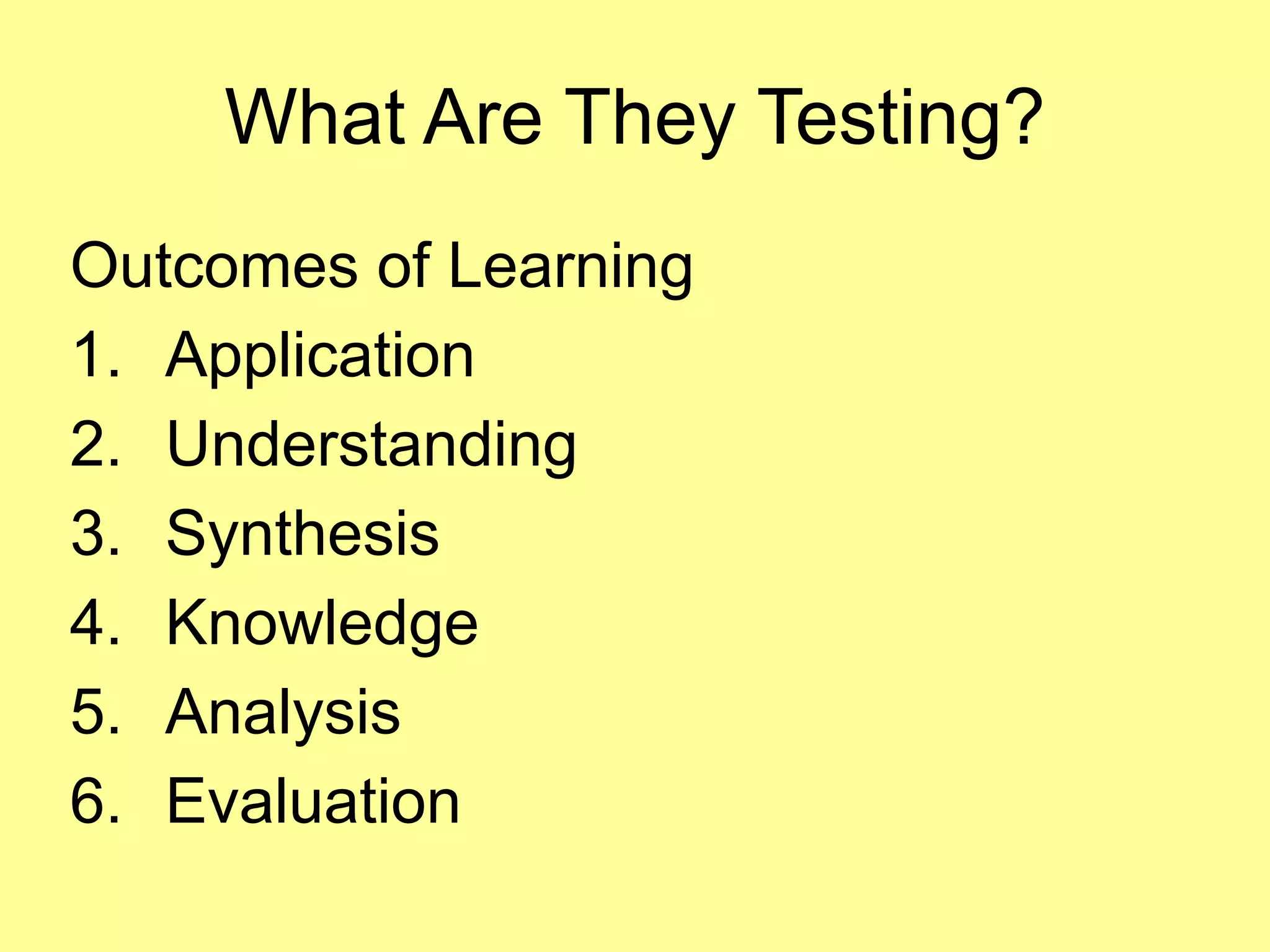
Outcomes of Learning 
1. Application 
2. Understanding 
3. Synthesis 
4. Knowledge 
5. Analysis 
6. Evaluation
What Are They Testing? 
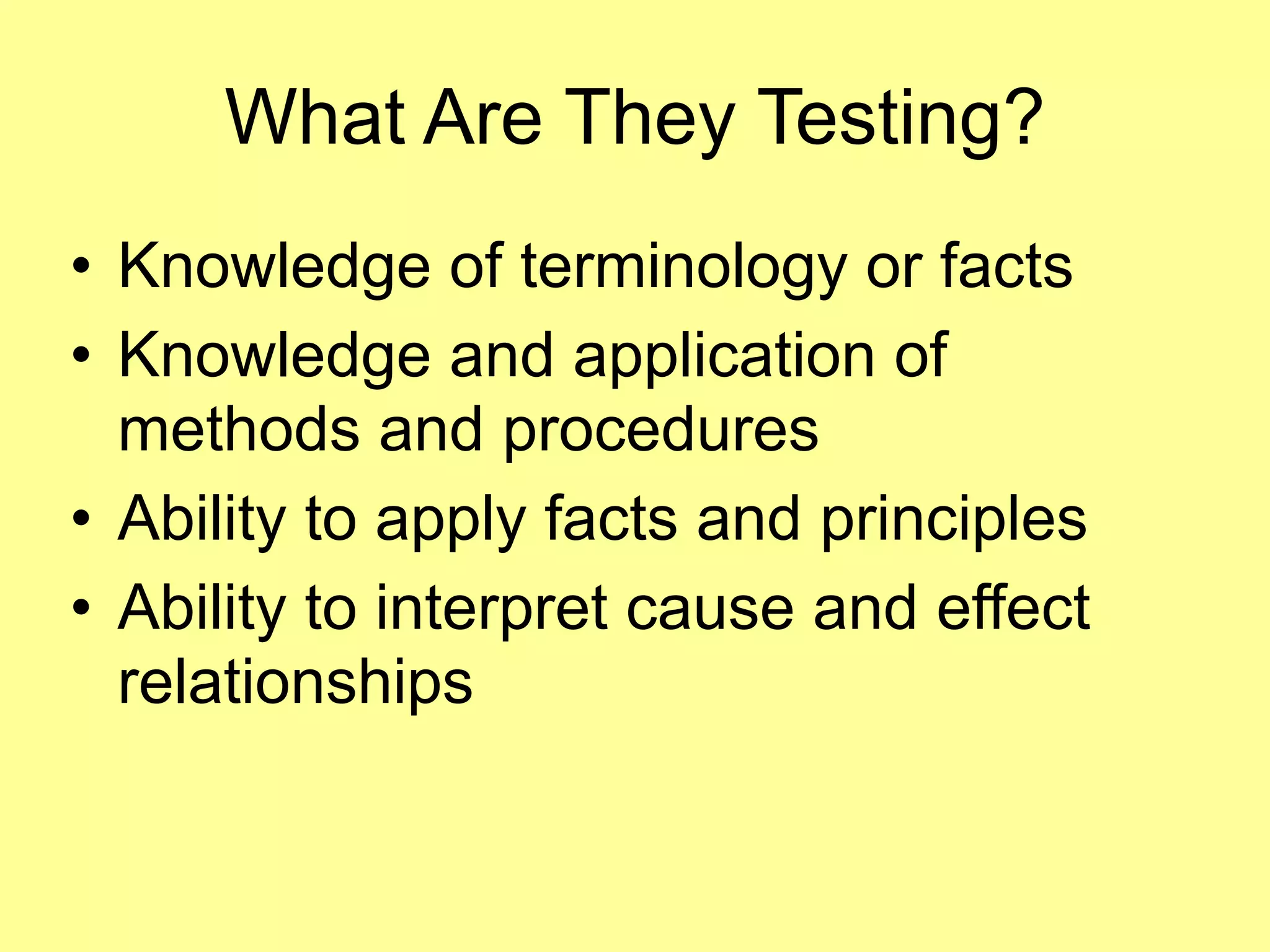
• Knowledge of terminology or facts 
• Knowledge and application of 
methods and procedures 
• Ability to apply facts and principles 
• Ability to interpret cause and effect 
relationships
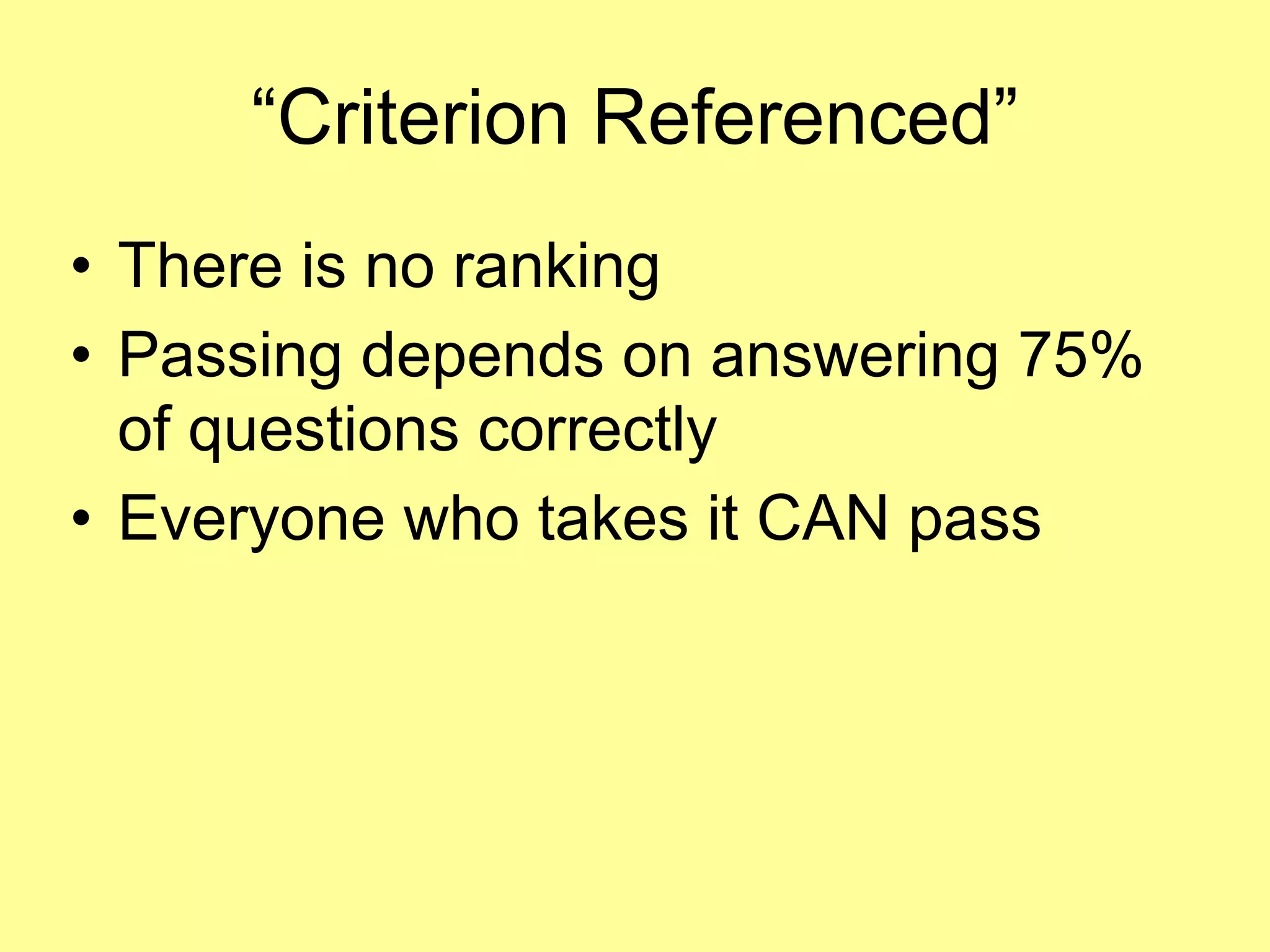
“Criterion Referenced” 
• There is no ranking 
• Passing depends on answering 75% 
of questions correctly 
• Everyone who takes it CAN pass
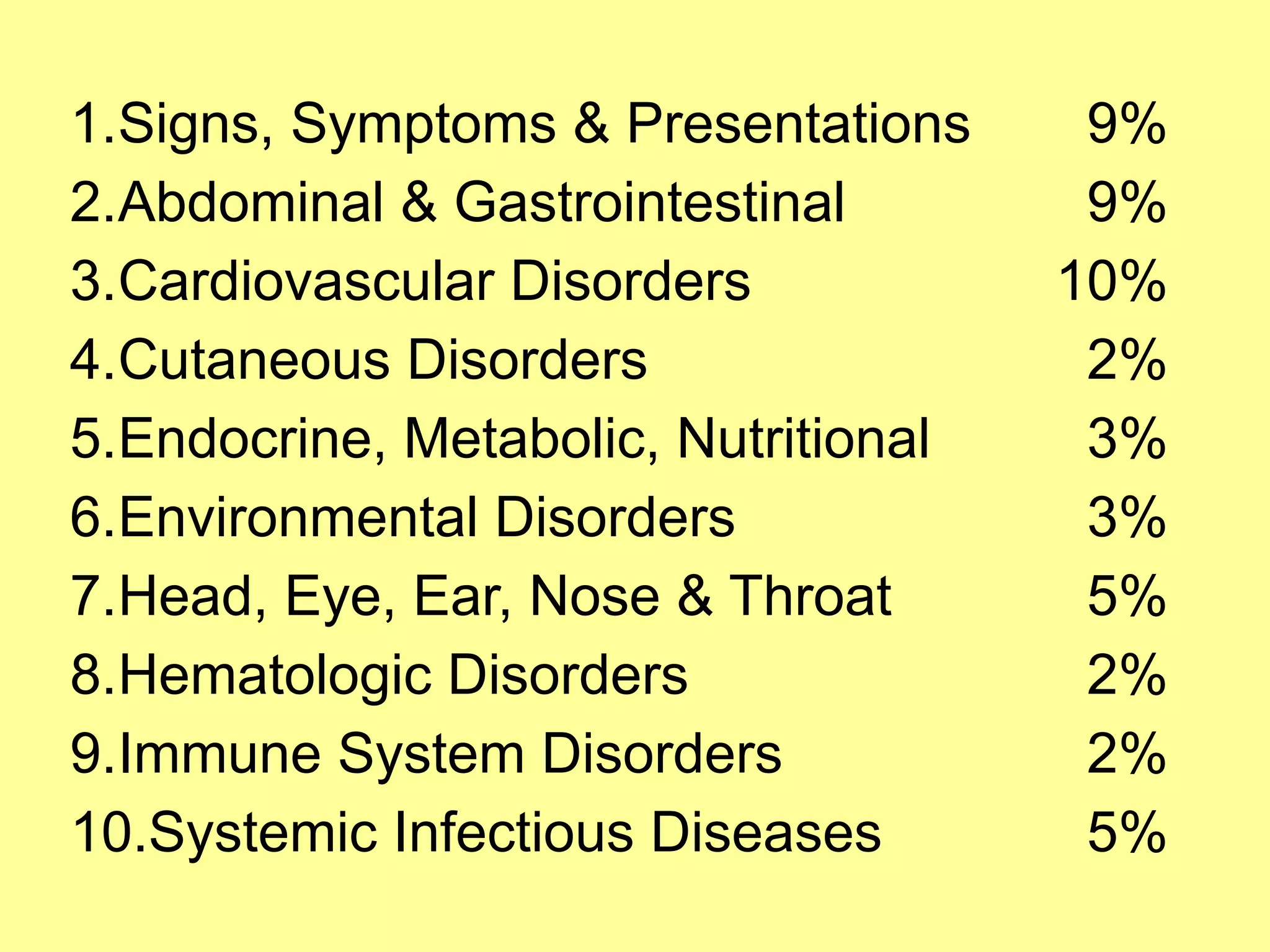
1.Signs, Symptoms & Presentations 
2.Abdominal & Gastrointestinal 
3.Cardiovascular Disorders 
4.Cutaneous Disorders 
5.Endocrine, Metabolic, Nutritional 
6.Environmental Disorders 
7.Head, Eye, Ear, Nose & Throat 
8.Hematologic Disorders 
9.Immune System Disorders 
10.Systemic Infectious Diseases 
9% 
9% 
10% 
2% 
3% 
3% 
5% 
2% 
2% 
5%
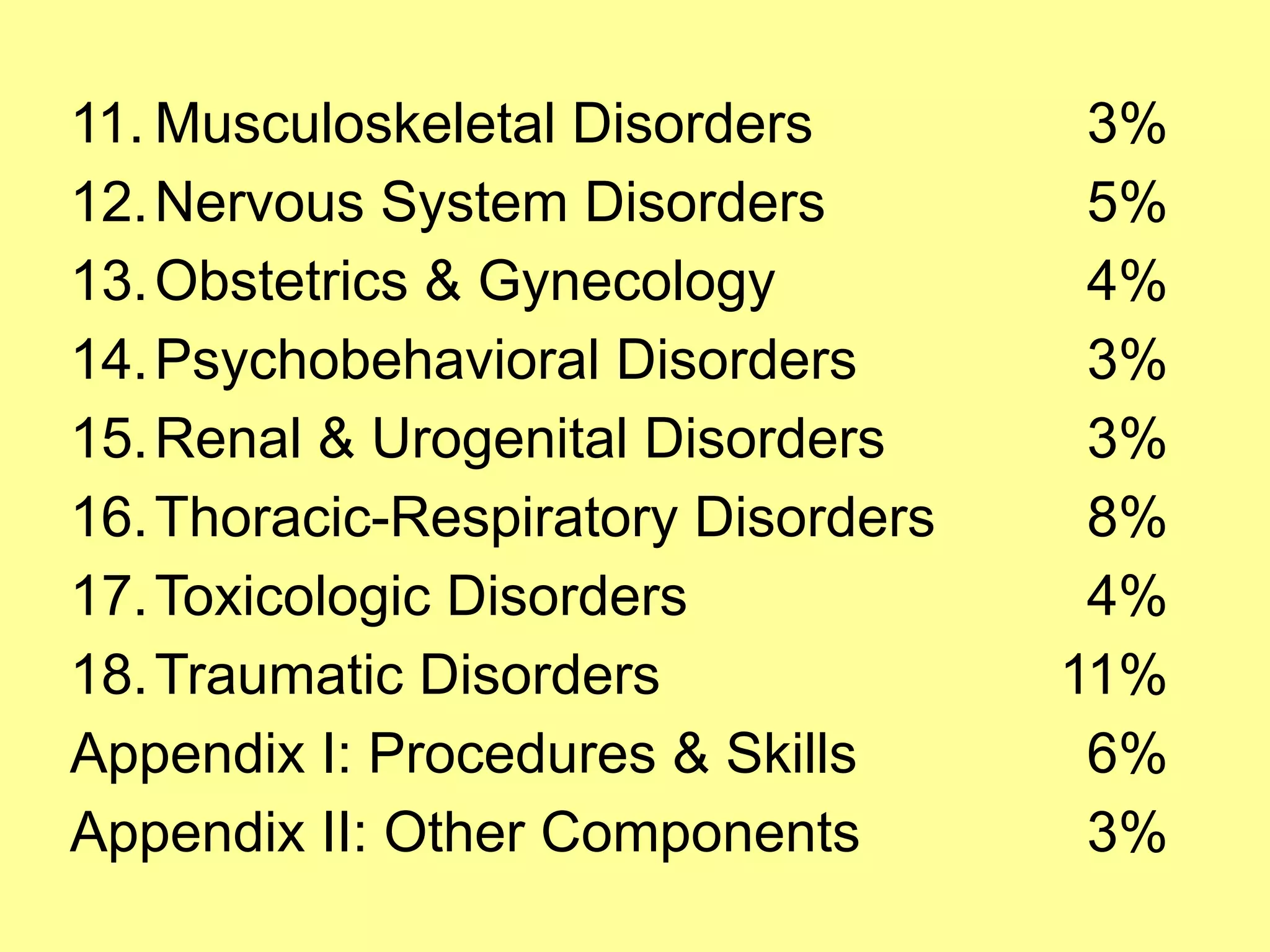
11. Musculoskeletal Disorders 
12.Nervous System Disorders 
13.Obstetrics & Gynecology 
14.Psychobehavioral Disorders 
15.Renal & Urogenital Disorders 
16.Thoracic-Respiratory Disorders 
17.Toxicologic Disorders 
18.Traumatic Disorders 
Appendix I: Procedures & Skills 
Appendix II: Other Components 
3% 
5% 
4% 
3% 
3% 
8% 
4% 
11% 
6% 
3%
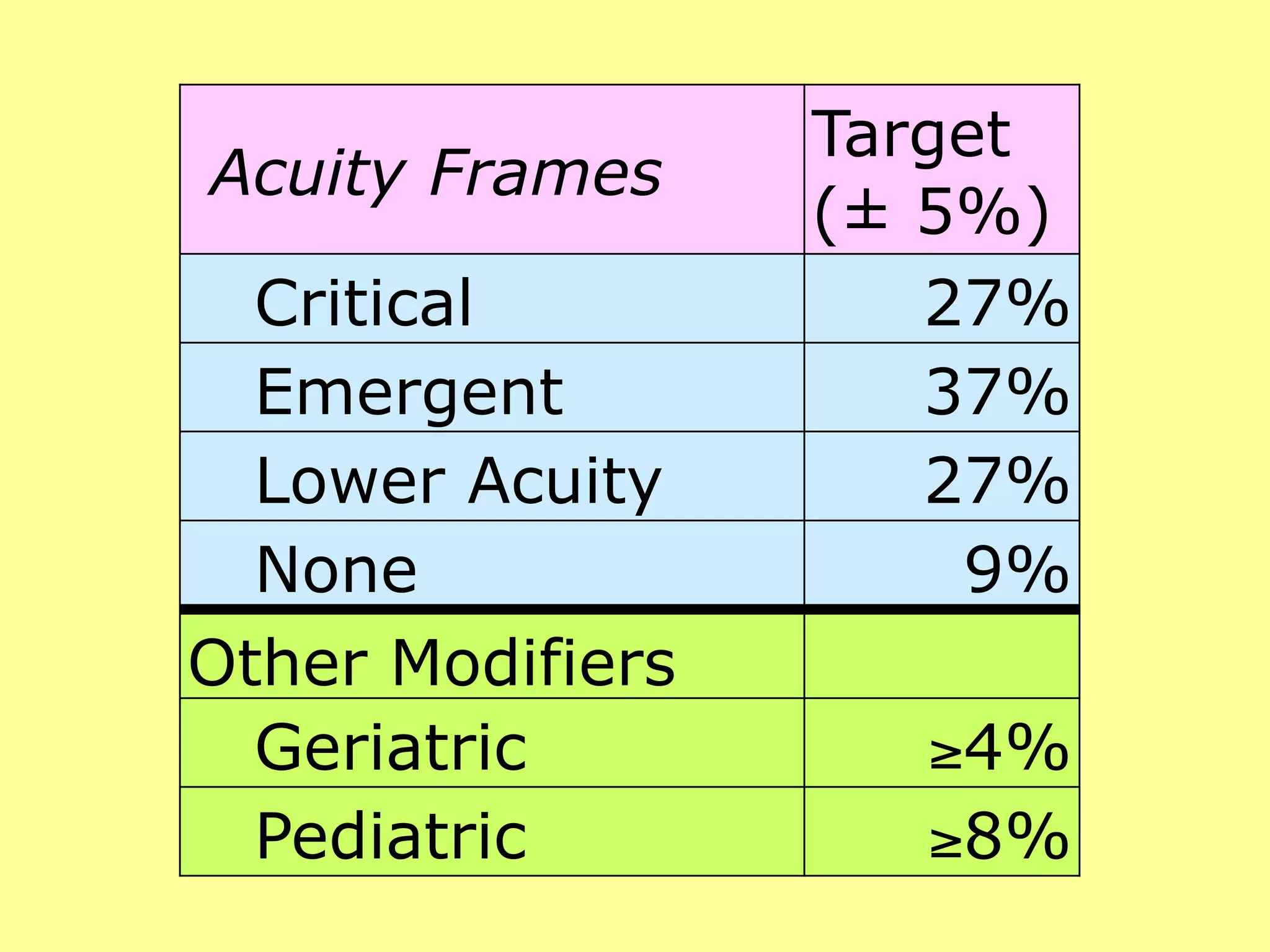
Acuity Frames Target 
(± 5%) 
Critical 27% 
Emergent 37% 
Lower Acuity 27% 
None 9% 
Other Modifiers 
Geriatric ≥4% 
Pediatric ≥8%
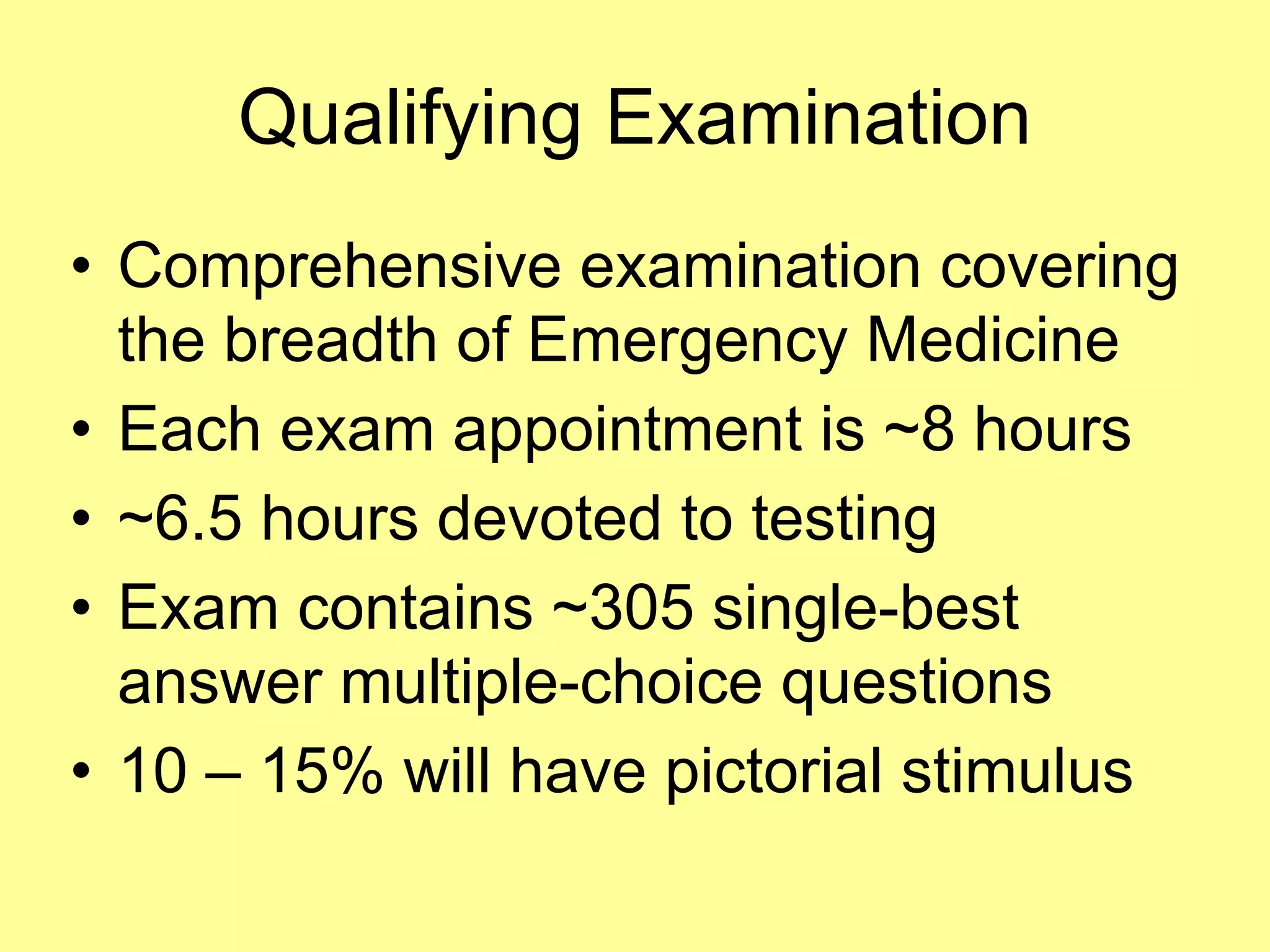
Qualifying Examination 
• Comprehensive examination covering 
the breadth of Emergency Medicine 
• Each exam appointment is ~8 hours 
• ~6.5 hours devoted to testing 
• Exam contains ~305 single-best 
answer multiple-choice questions 
• 10 – 15% will have pictorial stimulus
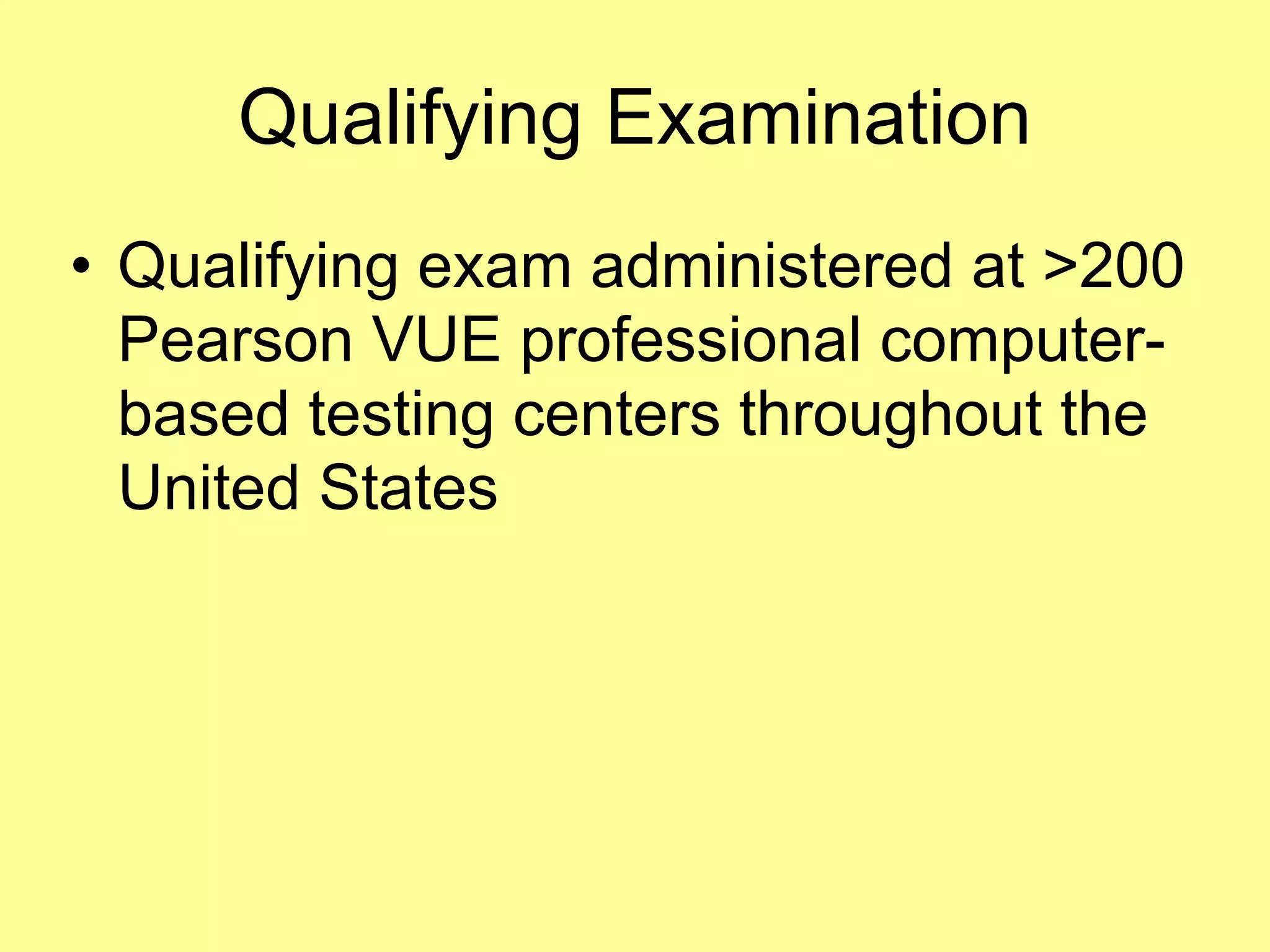
Qualifying Examination 
• Qualifying exam administered at >200 
Pearson VUE professional computer-based 
testing centers throughout the 
United States
Continuing Certification 
• Measures knowledge base for 
practice of EM 
• Comprehensive: based on EM Model 
• Typically in 10th year of Maintenance 
of Certification cycle 
• Questions based on the Model of the 
Clinical Practice of EM
Continuing Certification 
• Five and one-quarter hour, secure, 
proctored examination 
• Administered over 6 consecutive days 
in >200 Pearson VUE testing centers 
around United States and Canada
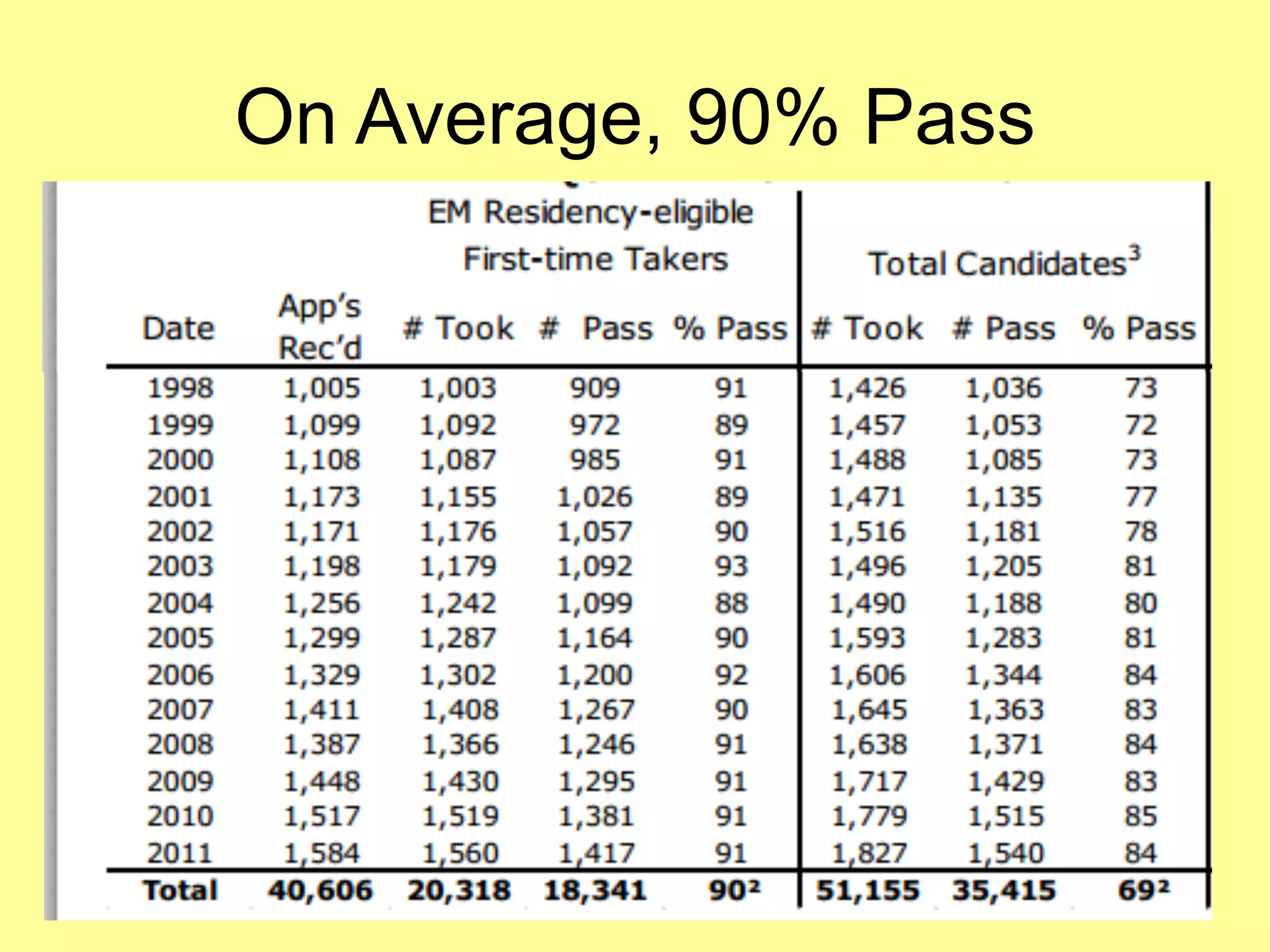
On Average, 90% Pass
Bad Questions Thrown Out 
• After test given, results analyzed so 
that poorly-designed questions are 
discarded before scoring 
• Field testing of new questions done 
every year
“Standard of Care” 
• Practice guideline in small rural 
hospital may vary from Big City 
General 
• Practice in Ghana almost certainly 
varies from practice in Canada 
• Content based on national, not 
regional, standard of care
SOME 
CLUES
Confidence Builders 
• Think good thoughts: “I will do well on 
this test; I expect to do well.” 
• Some tension dissipates when you 
start the test: you can’t think about 
tension while answering questions 
• Answer all the easy ones first: flag the 
tough ones and come back to them
Work Quickly 
• Multiple-choice test is the right place 
to be rapid-fire 
• Read through the question and 
determine the answer before you look 
at the choices 
• If your answer seems obvious, it 
probably is
Some Clues 
• If the stem has many complicated 
statements, isolate them – understand 
each part
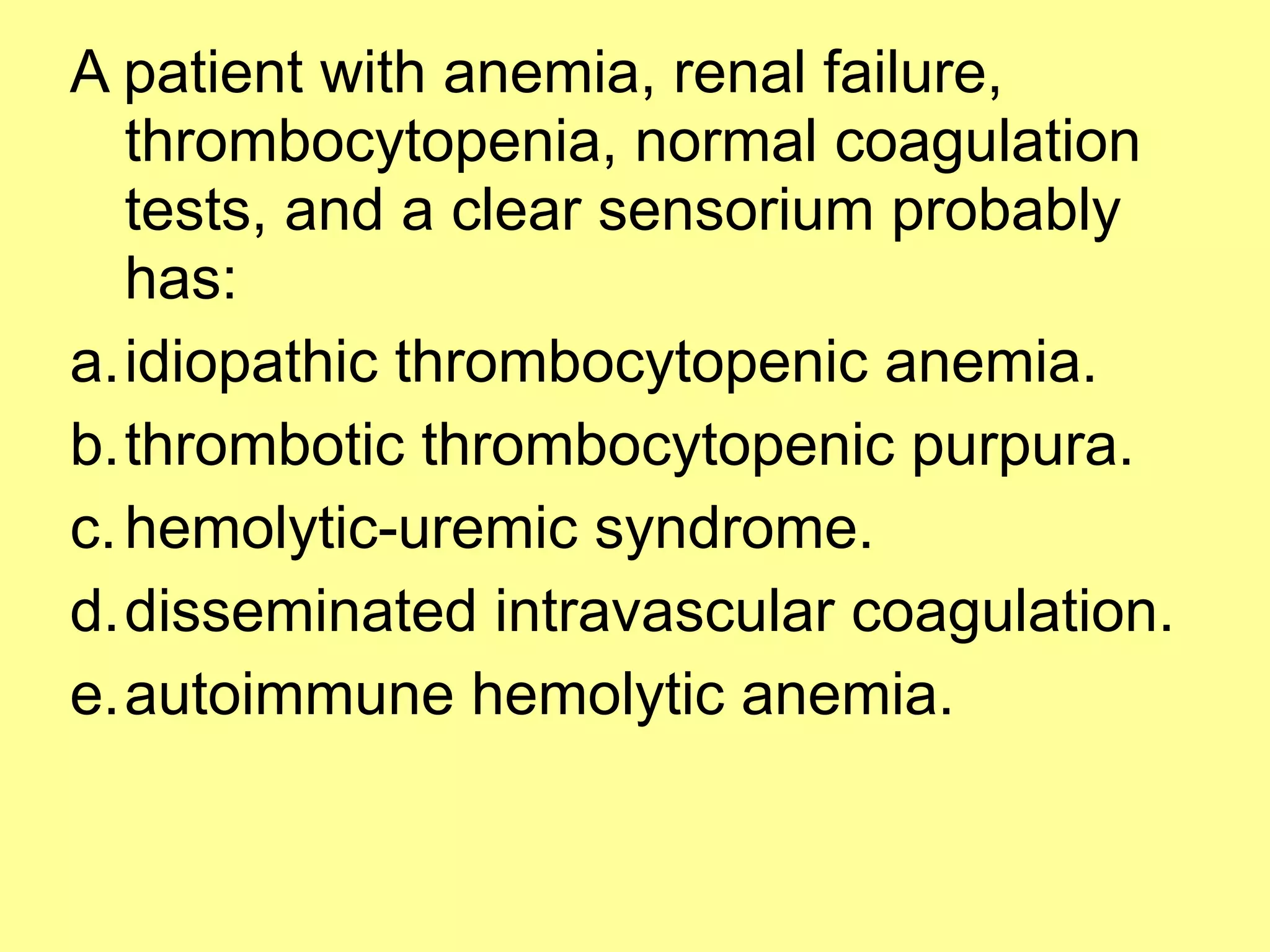
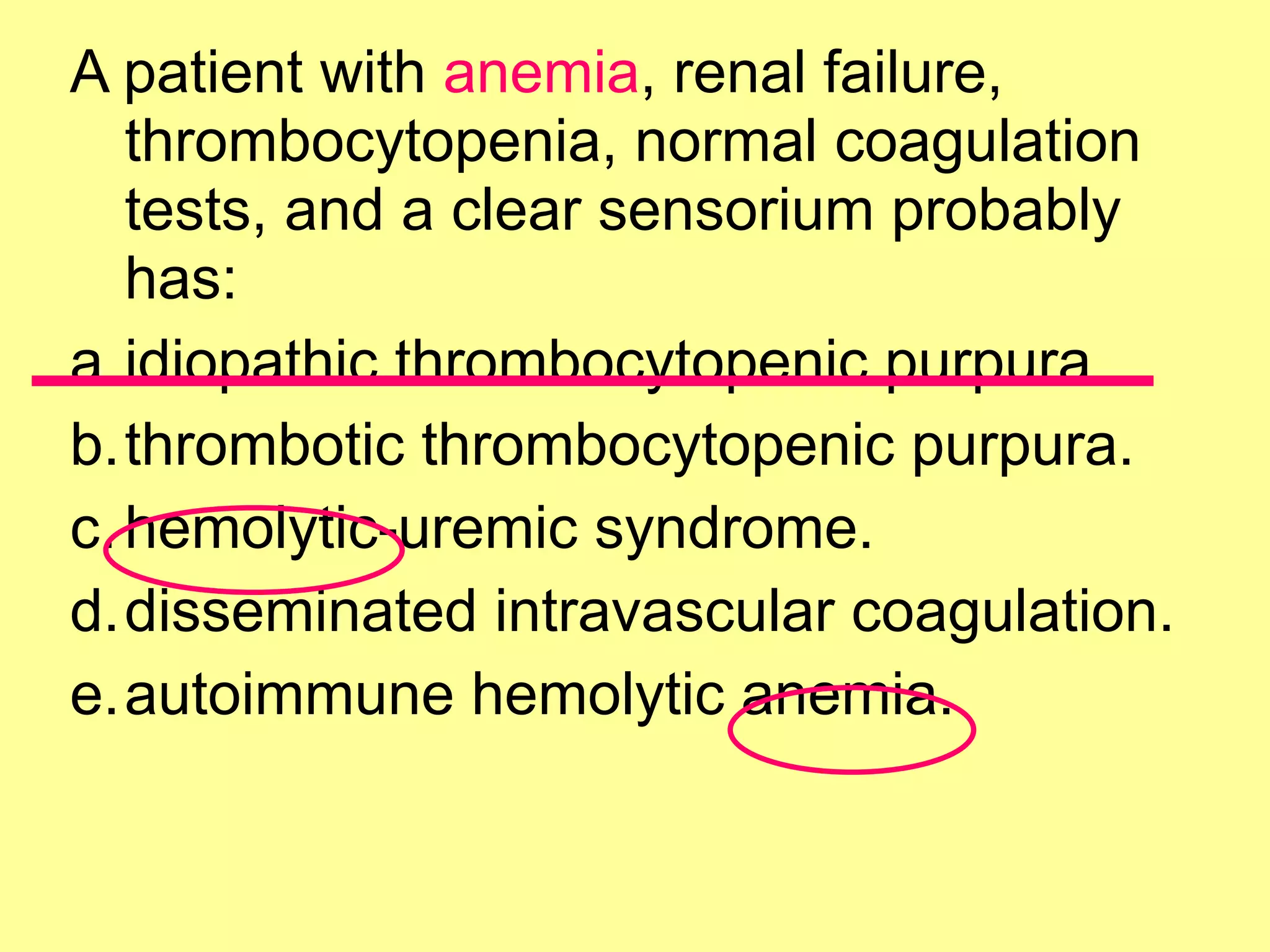
A patient with anemia, renal failure, 
thrombocytopenia, normal coagulation 
tests, and a clear sensorium probably 
has: 
a.idiopathic thrombocytopenic anemia. 
b.thrombotic thrombocytopenic purpura. 
c.hemolytic-uremic syndrome. 
d.disseminated intravascular coagulation. 
e.autoimmune hemolytic anemia.
A patient with anemia, renal failure, 
thrombocytopenia, normal coagulation 
tests, and a clear sensorium probably 
has: 
a.idiopathic thrombocytopenic purpura. 
b.thrombotic thrombocytopenic purpura. 
c.hemolytic-uremic syndrome. 
d.disseminated intravascular coagulation. 
e.autoimmune hemolytic anemia.
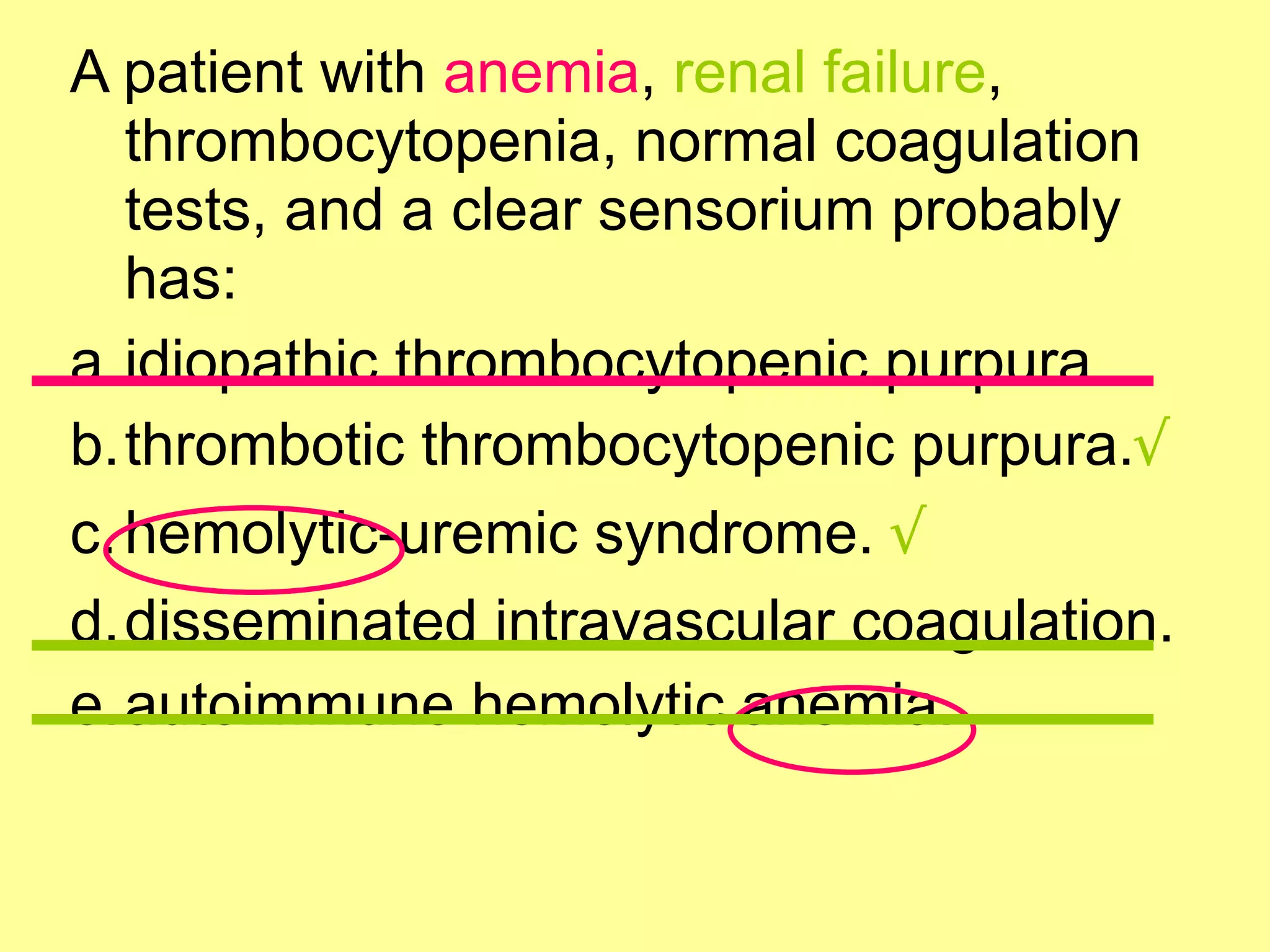
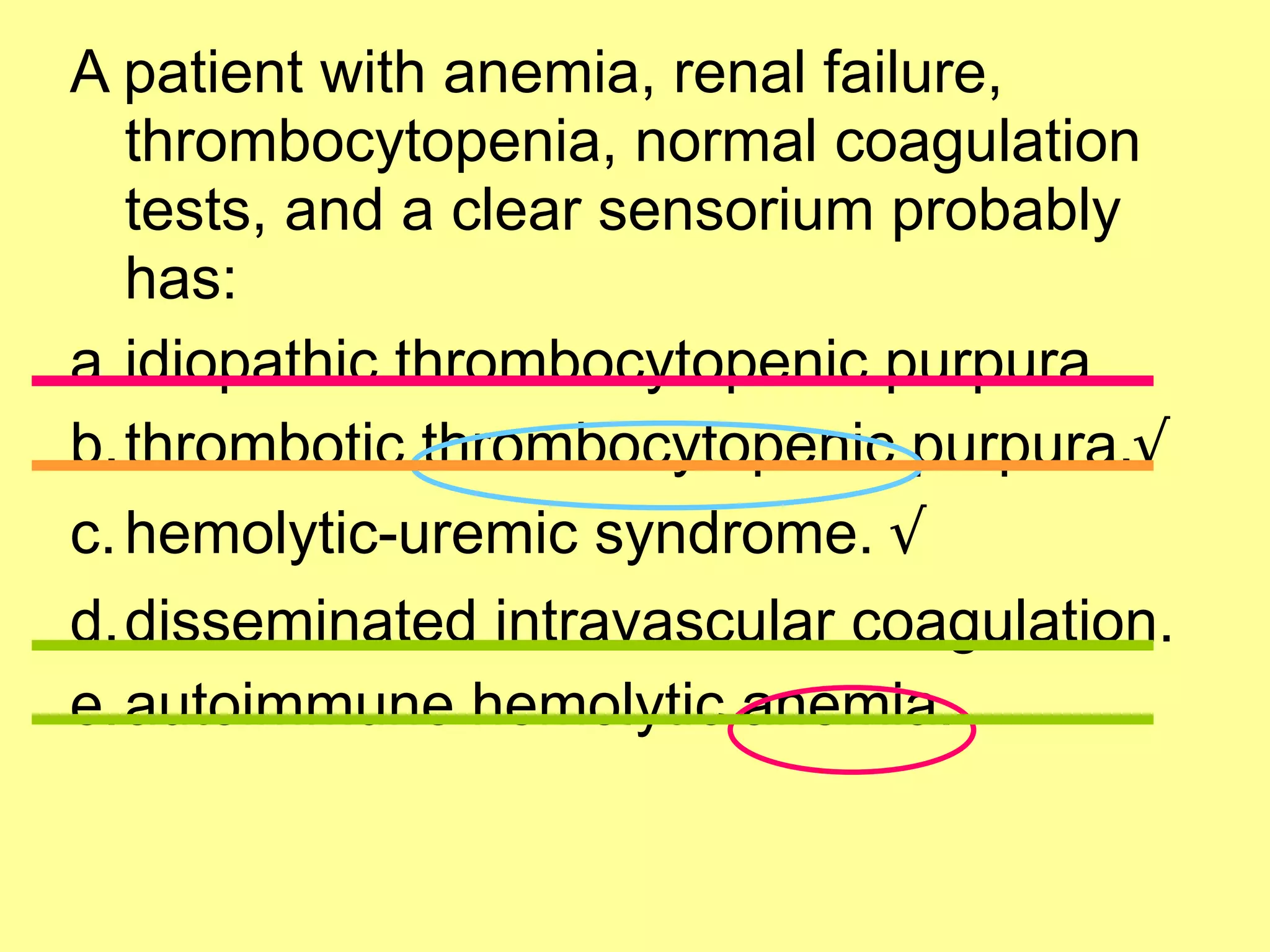
A patient with anemia, renal failure, 
thrombocytopenia, normal coagulation 
tests, and a clear sensorium probably 
has: 
a.idiopathic thrombocytopenic purpura. 
b.thrombotic thrombocytopenic purpura.√ 
c.hemolytic-uremic syndrome. √ 
d.disseminated intravascular coagulation. 
e.autoimmune hemolytic anemia.
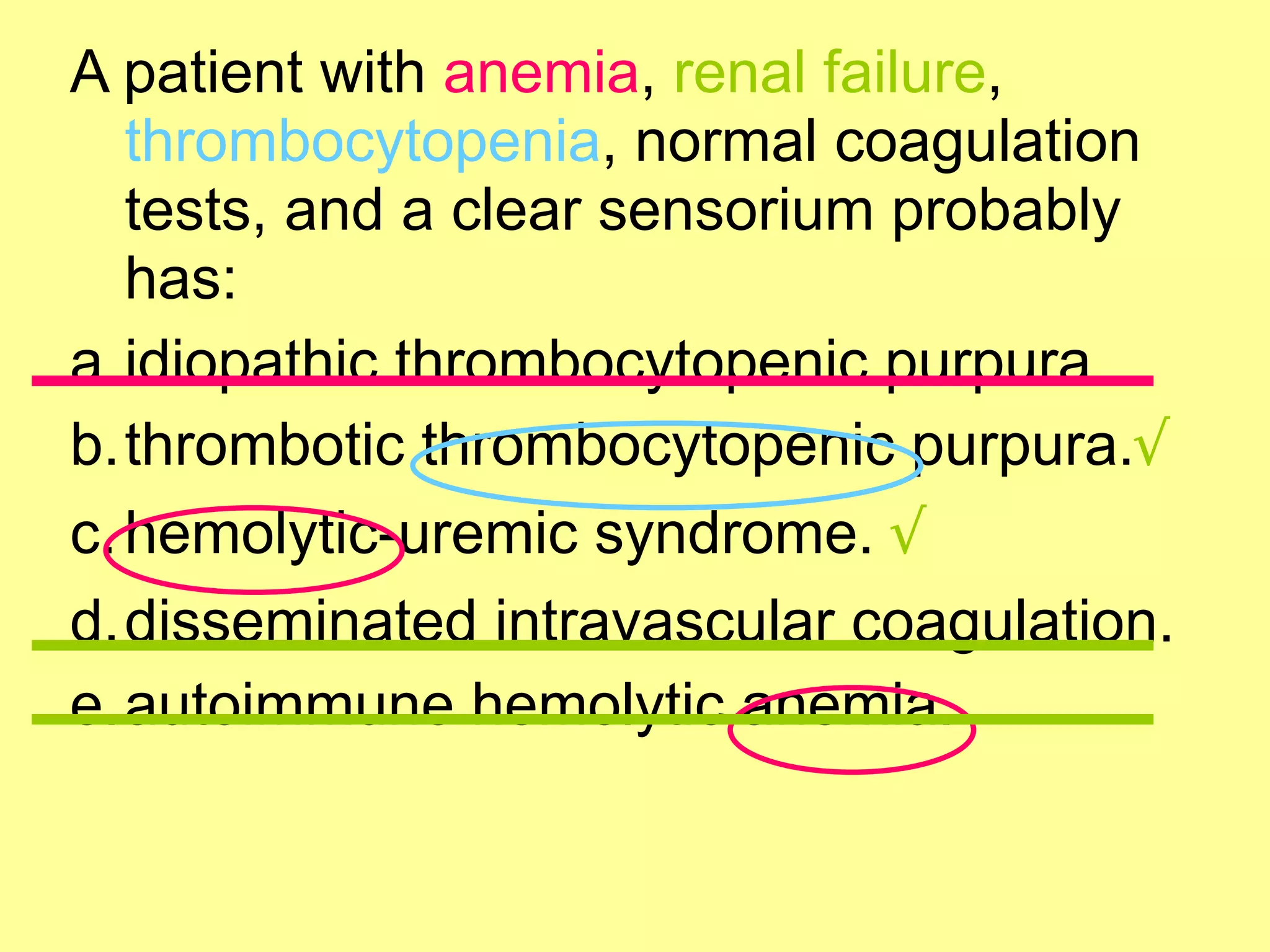
A patient with anemia, renal failure, 
thrombocytopenia, normal coagulation 
tests, and a clear sensorium probably 
has: 
a.idiopathic thrombocytopenic purpura. 
b.thrombotic thrombocytopenic purpura.√ 
c.hemolytic-uremic syndrome. √ 
d.disseminated intravascular coagulation. 
e.autoimmune hemolytic anemia.
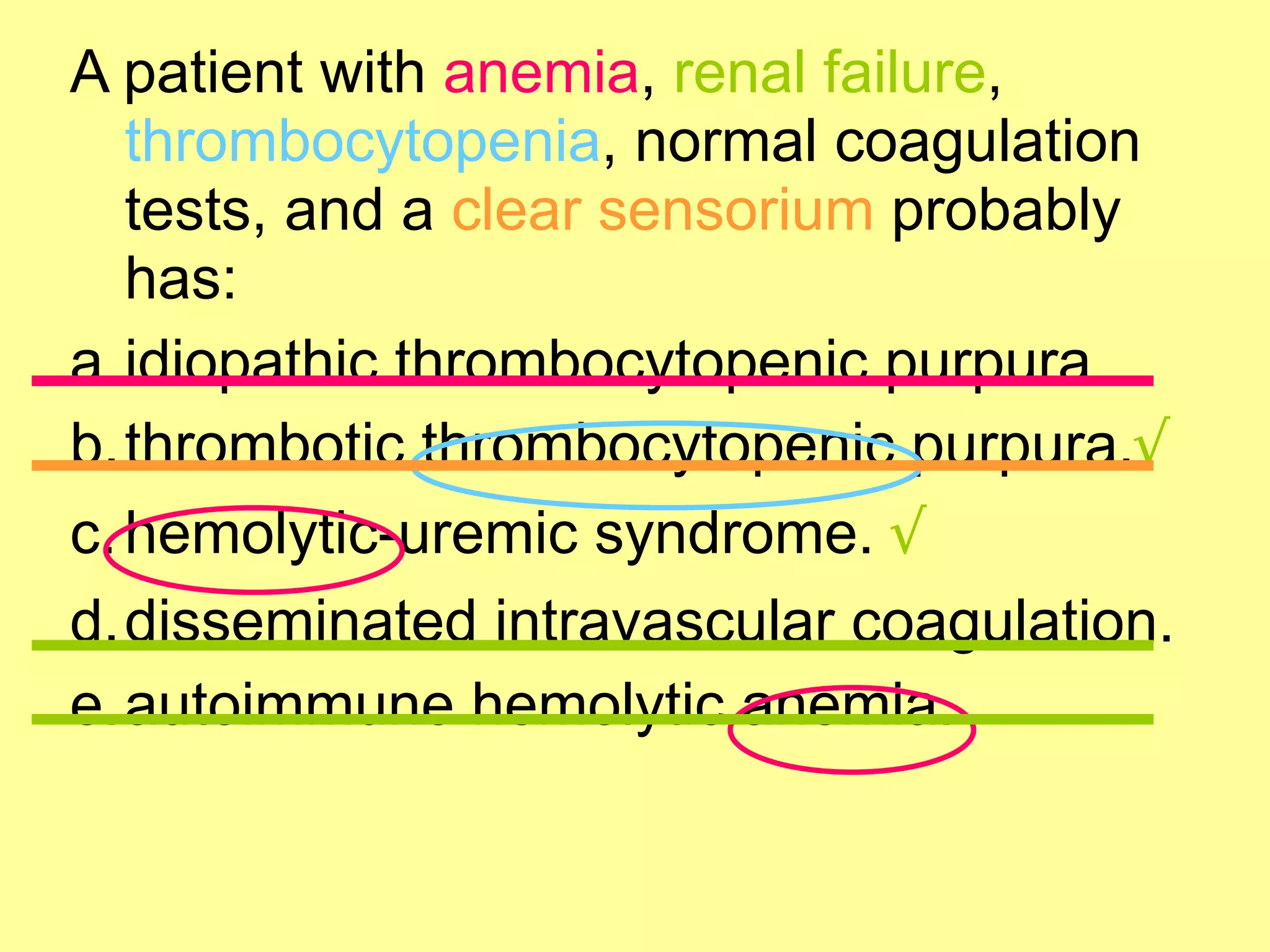
A patient with anemia, renal failure, 
thrombocytopenia, normal coagulation 
tests, and a clear sensorium probably 
has: 
a.idiopathic thrombocytopenic purpura. 
b.thrombotic thrombocytopenic purpura.√ 
c.hemolytic-uremic syndrome. √ 
d.disseminated intravascular coagulation. 
e.autoimmune hemolytic anemia.
A patient with anemia, renal failure, 
thrombocytopenia, normal coagulation 
tests, and a clear sensorium probably 
has: 
a.idiopathic thrombocytopenic purpura. 
b.thrombotic thrombocytopenic purpura.√ 
c.hemolytic-uremic syndrome. √ 
d.disseminated intravascular coagulation. 
e.autoimmune hemolytic anemia.
Some Clues 
• Answer may be first, second, or even 
third generation
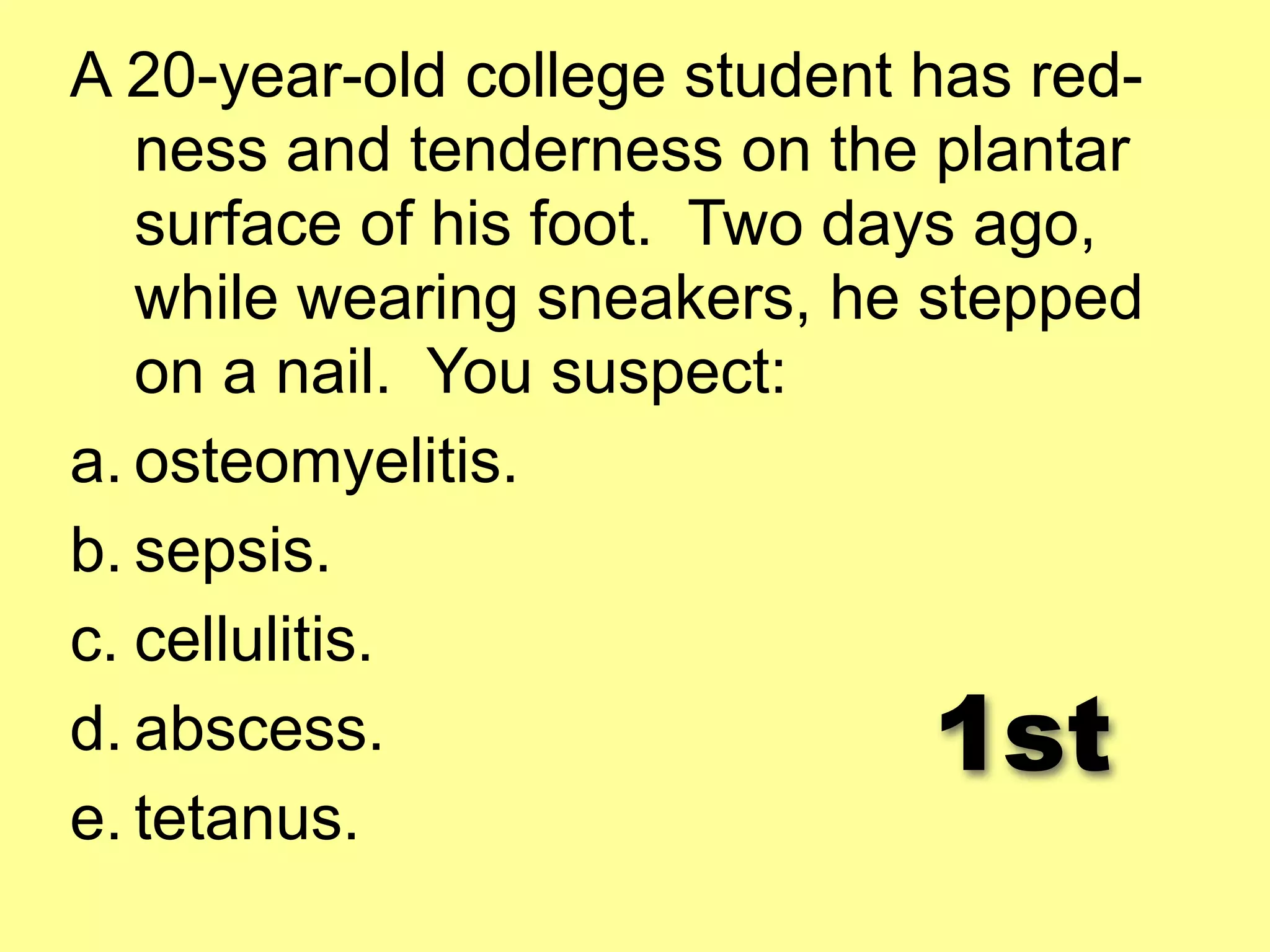
A 20-year-old college student has red-ness 
and tenderness on the plantar 
surface of his foot. Two days ago, 
while wearing sneakers, he stepped 
on a nail. You suspect: 
a. osteomyelitis. 
b. sepsis. 
c. cellulitis. 
d. abscess. 
1st 
e. tetanus.
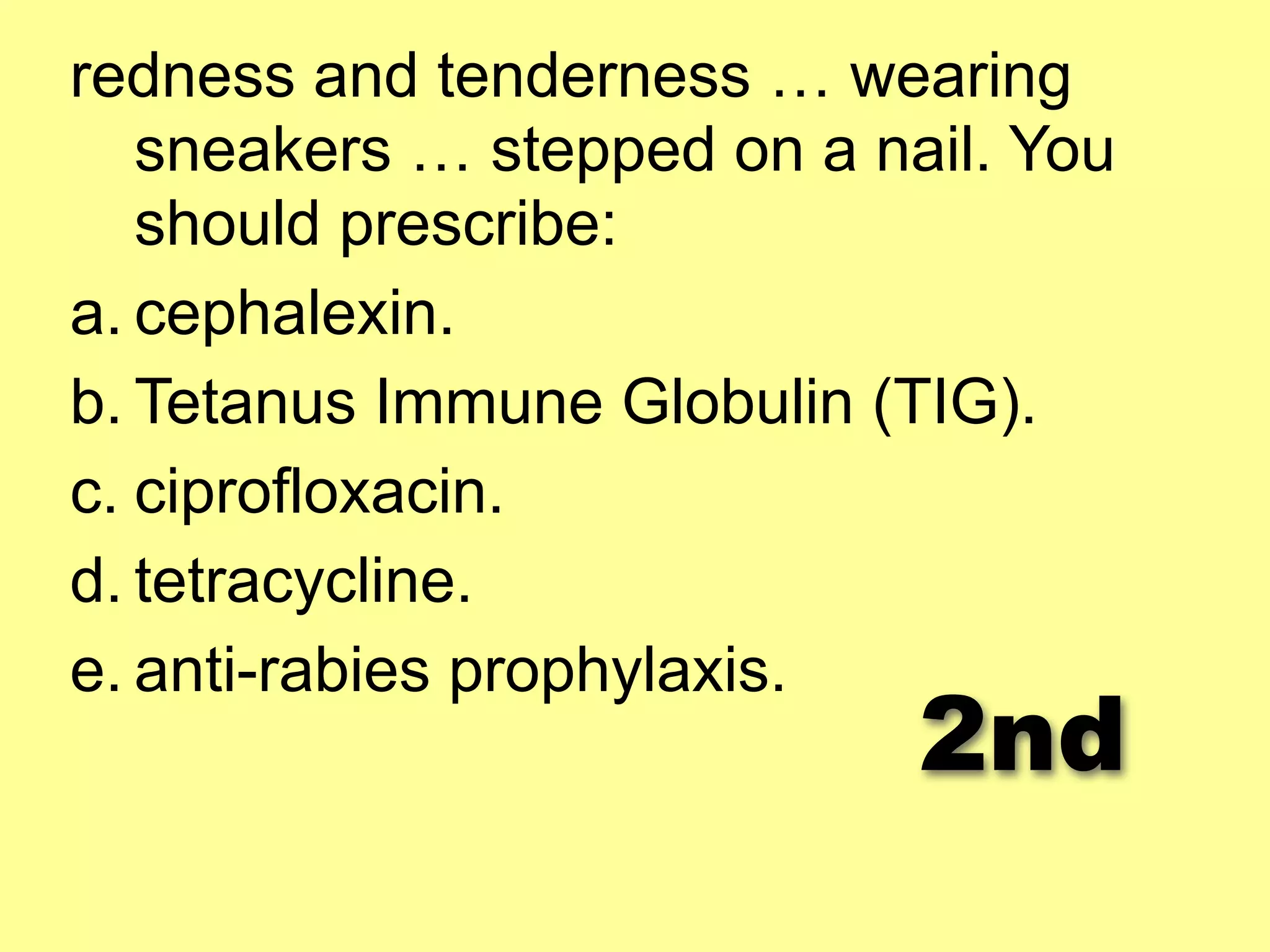
redness and tenderness … wearing 
sneakers … stepped on a nail. You 
should prescribe: 
a. cephalexin. 
b. Tetanus Immune Globulin (TIG). 
c. ciprofloxacin. 
d. tetracycline. 
e. anti-rabies prophylaxis. 2nd
redness and tenderness … wearing 
sneakers … stepped on a nail. Long 
term effects of the appropriate 
medication might include: 
a. tendon rupture and tendonitis. 
b. seizures. 
c. double vision. 
d. prostatic hypertrophy. 
e. hypospadias. 3rd
Some Clues 
• Some answers are obviously wrong: 
move on 
• Some answers are partly wrong: 
move on 
• Some answers are correct 
statements, but do not answer the 
question
Some Clues 
• Two answers direct opposites: one of 
them is probably correct 
• Two answers very similar, few words 
apart: one of them is probably correct 
• Answers using always, never, all, and 
none are probably wrong 
• Look for qualifiers: seldom, generally, 
tend to be
Some Clues 
• Certain key descriptive words may 
give you the correct answer 
–“classic” or “routinely” 
• Sometimes you find the answer in 
another question 
• If the answer disagrees in tense with 
the question, it is probably wrong
Some Clues 
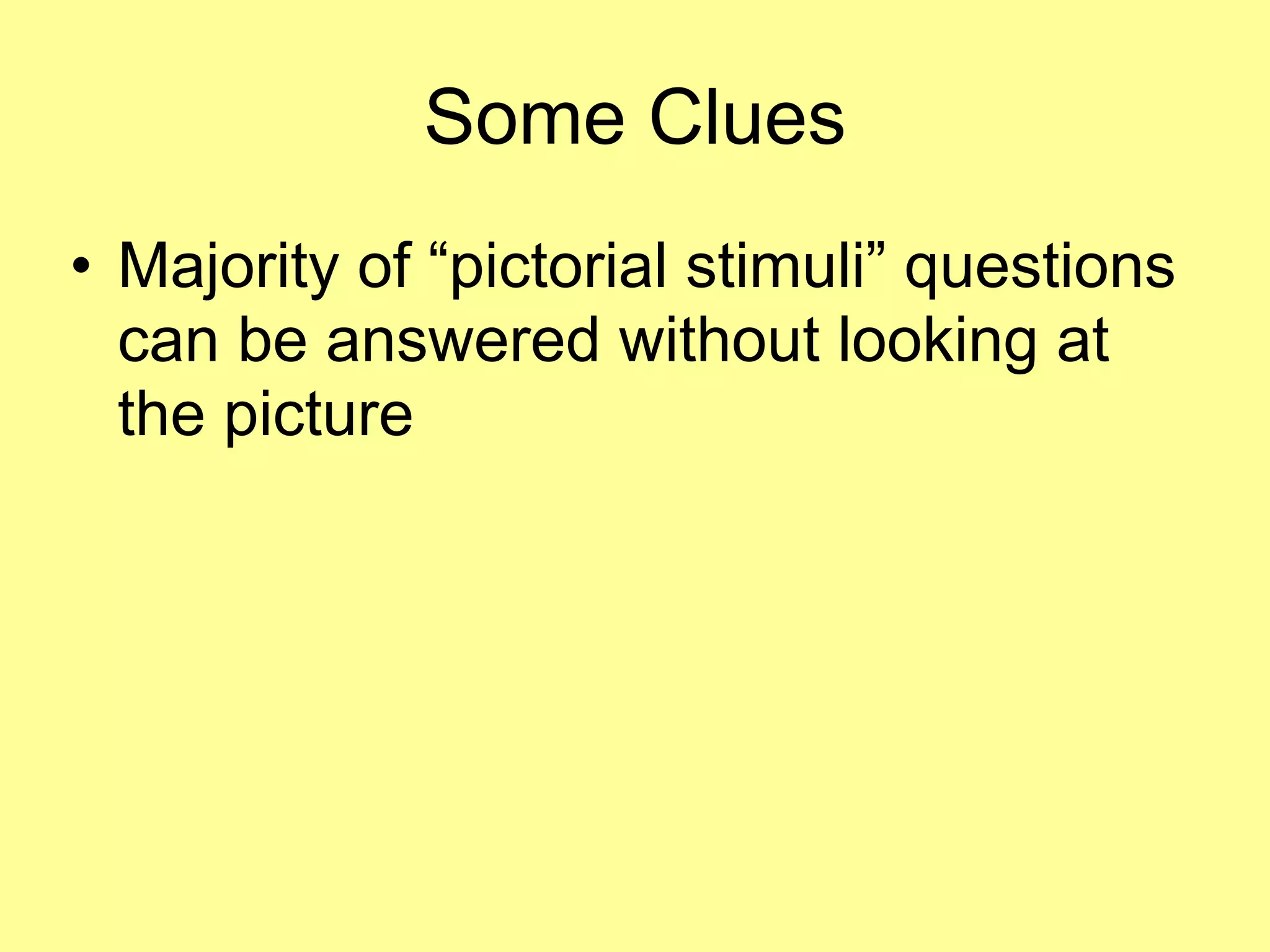
• Majority of “pictorial stimuli” questions 
can be answered without looking at 
the picture
Some Clues 
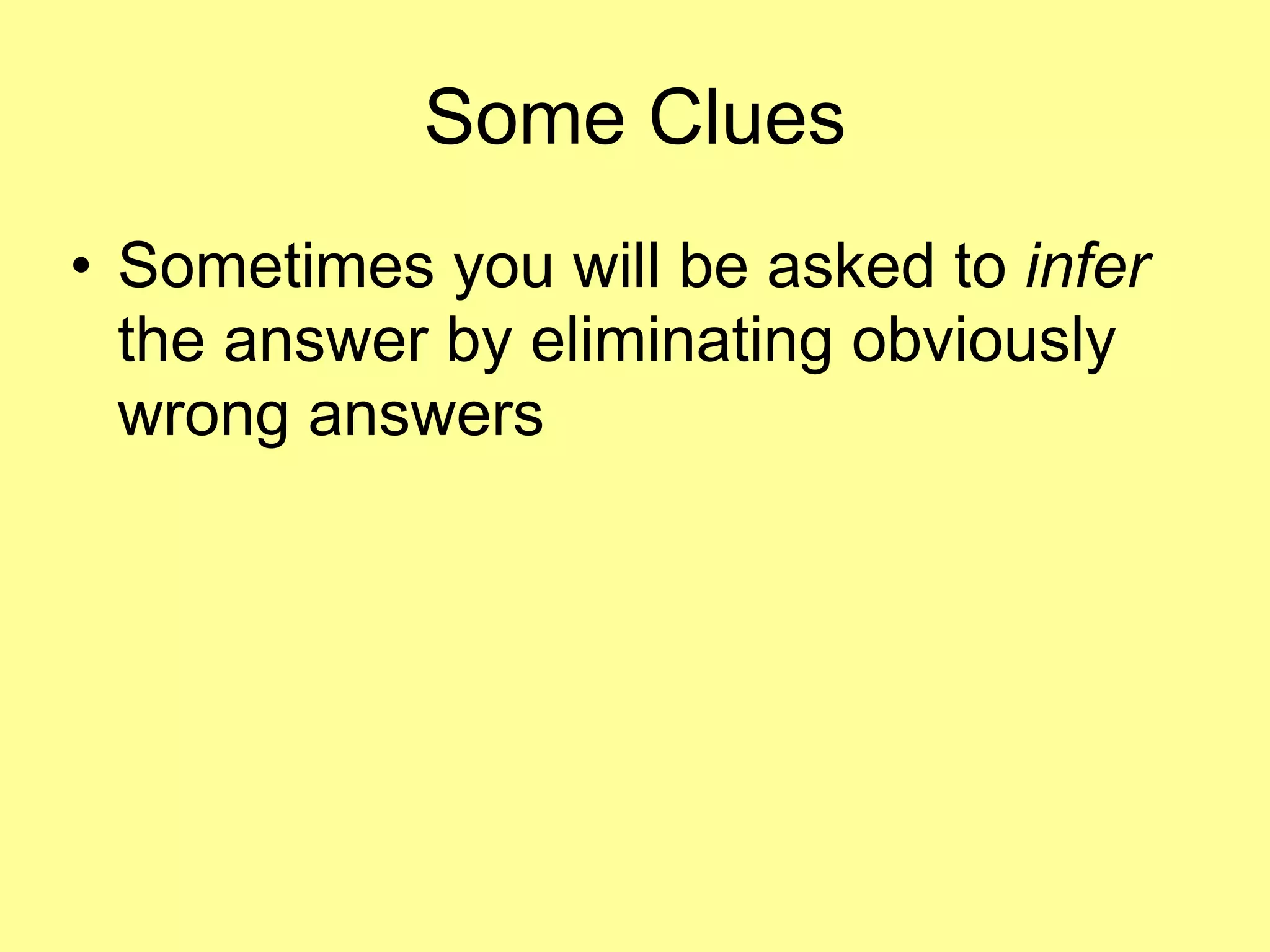
• Sometimes you will be asked to infer 
the answer by eliminating obviously 
wrong answers
Some Clues 
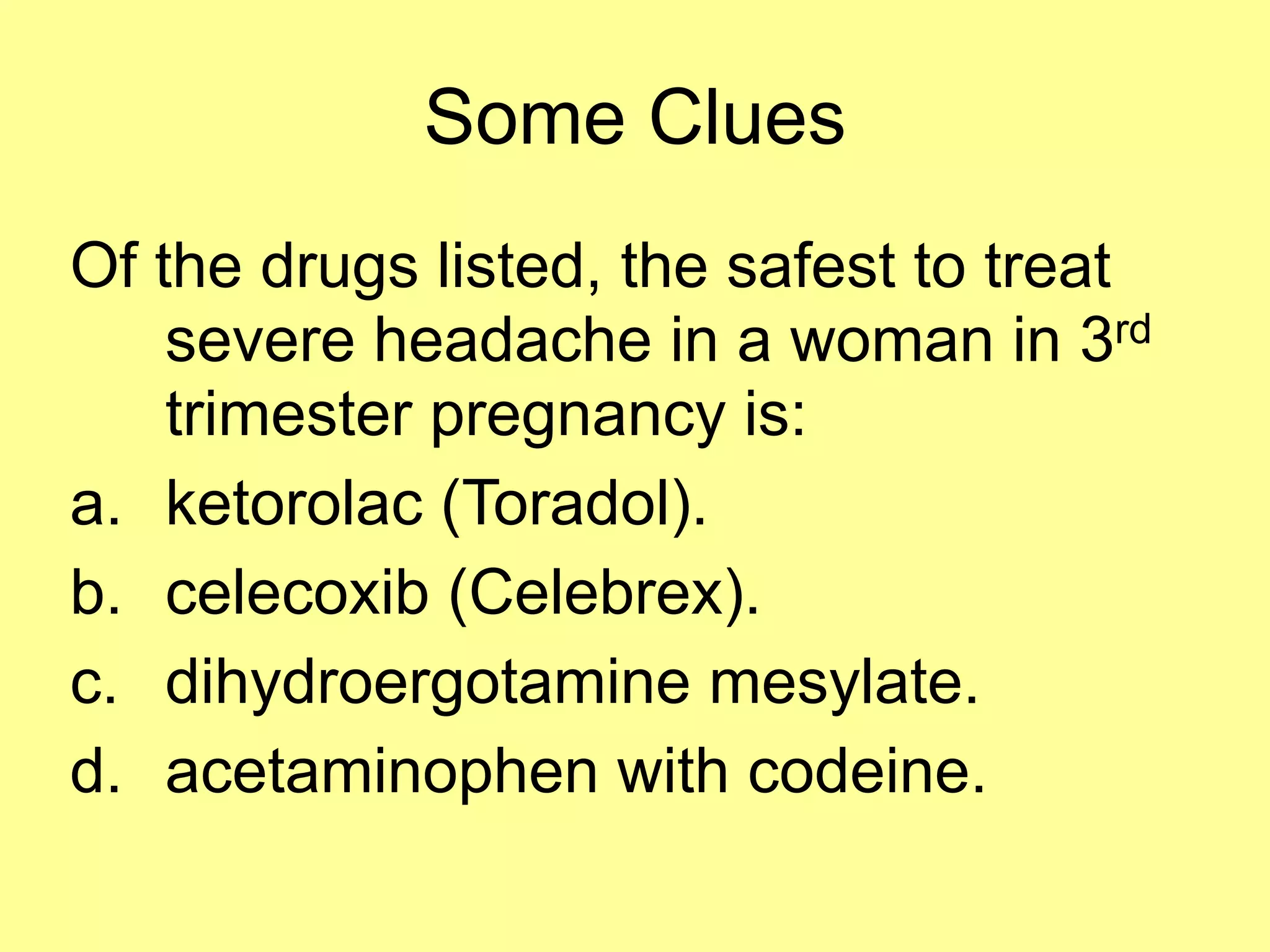
Of the drugs listed, the safest to treat 
severe headache in a woman in 3rd 
trimester pregnancy is: 
a. ketorolac (Toradol). 
b. celecoxib (Celebrex). 
c. dihydroergotamine mesylate. 
d. acetaminophen with codeine.
Guessing… 
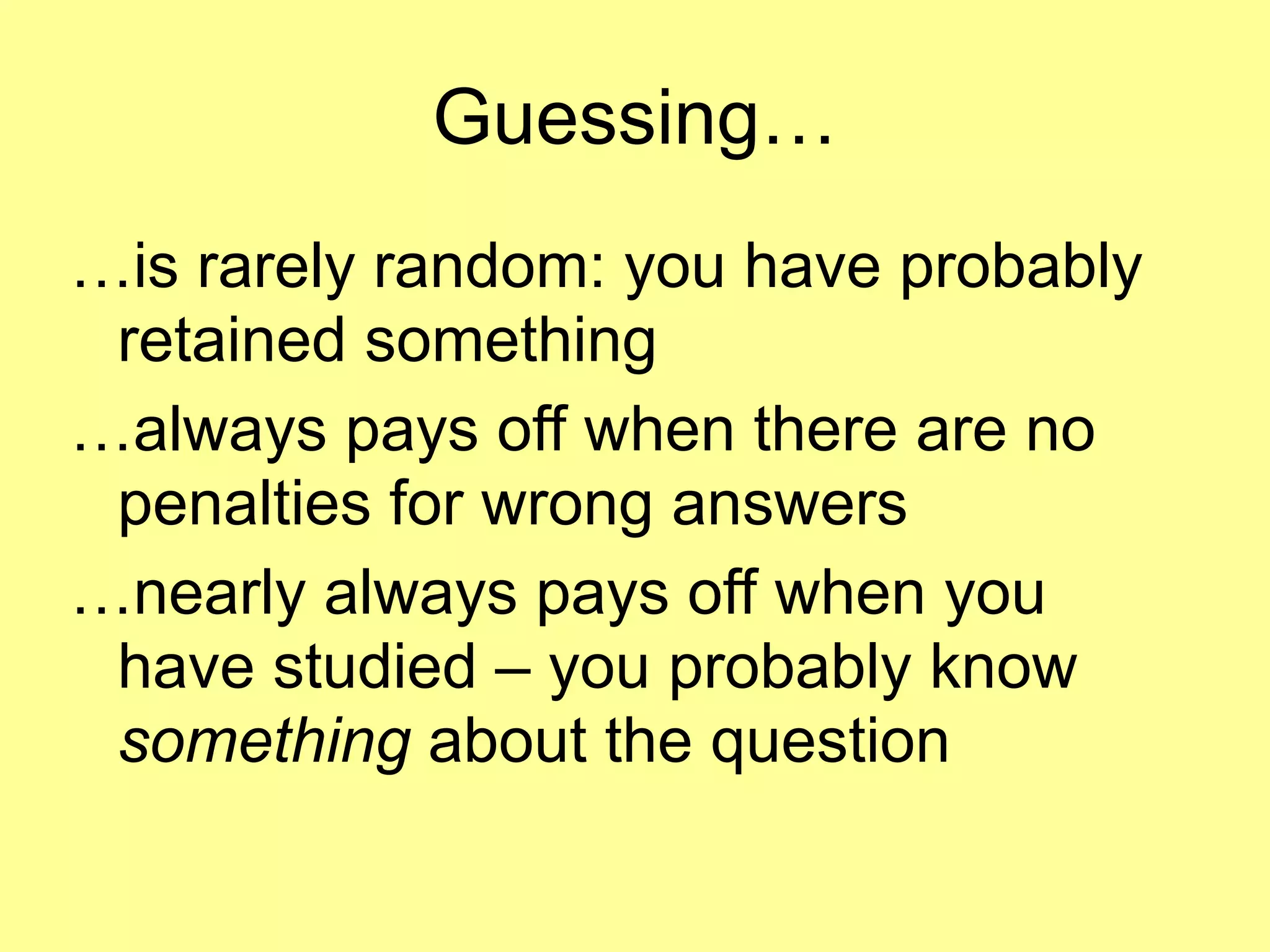
…is rarely random: you have probably 
retained something 
…always pays off when there are no 
penalties for wrong answers 
…nearly always pays off when you 
have studied – you probably know 
something about the question
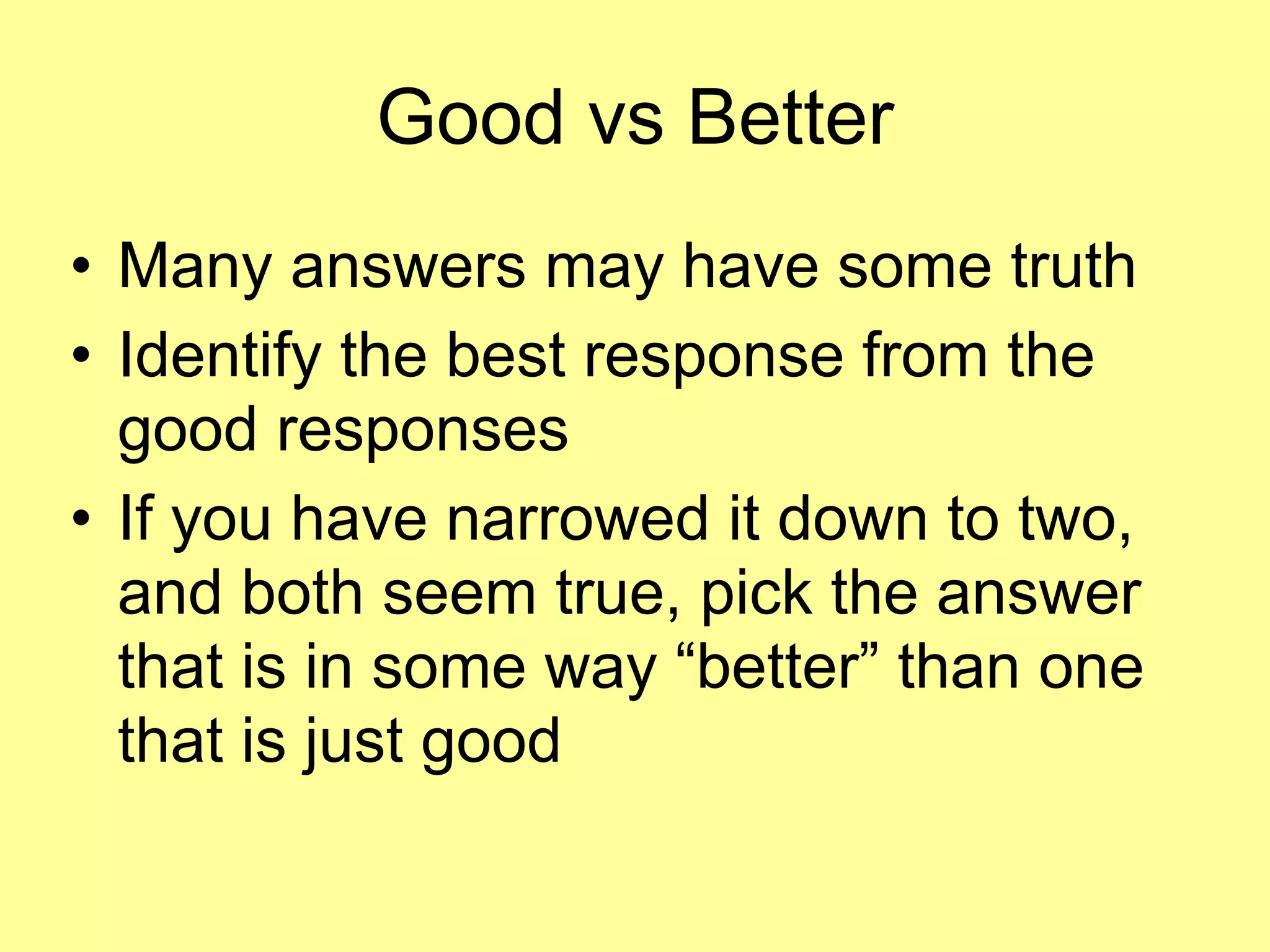
Good vs Better 
• Many answers may have some truth 
• Identify the best response from the 
good responses 
• If you have narrowed it down to two, 
and both seem true, pick the answer 
that is in some way “better” than one 
that is just good
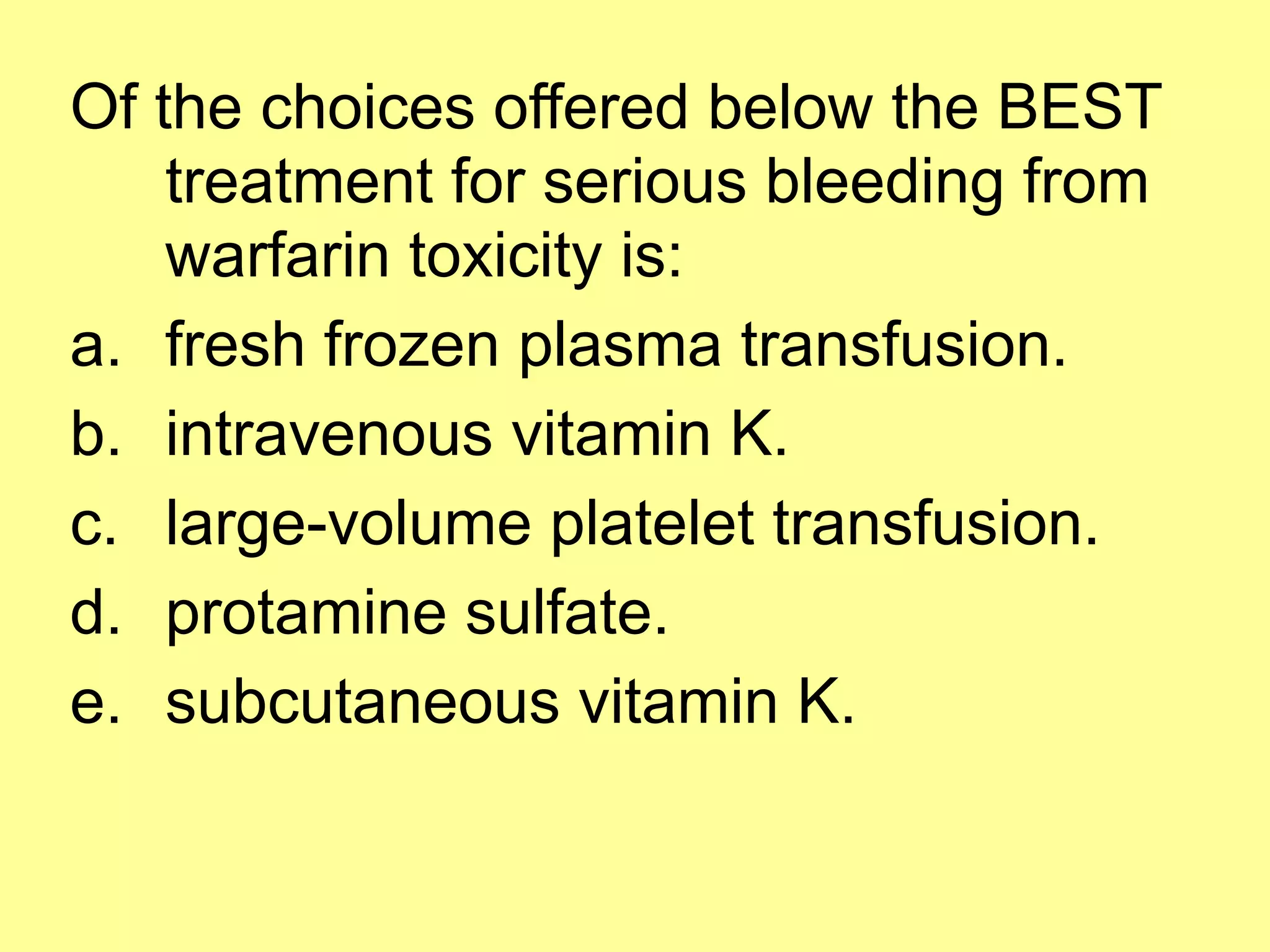
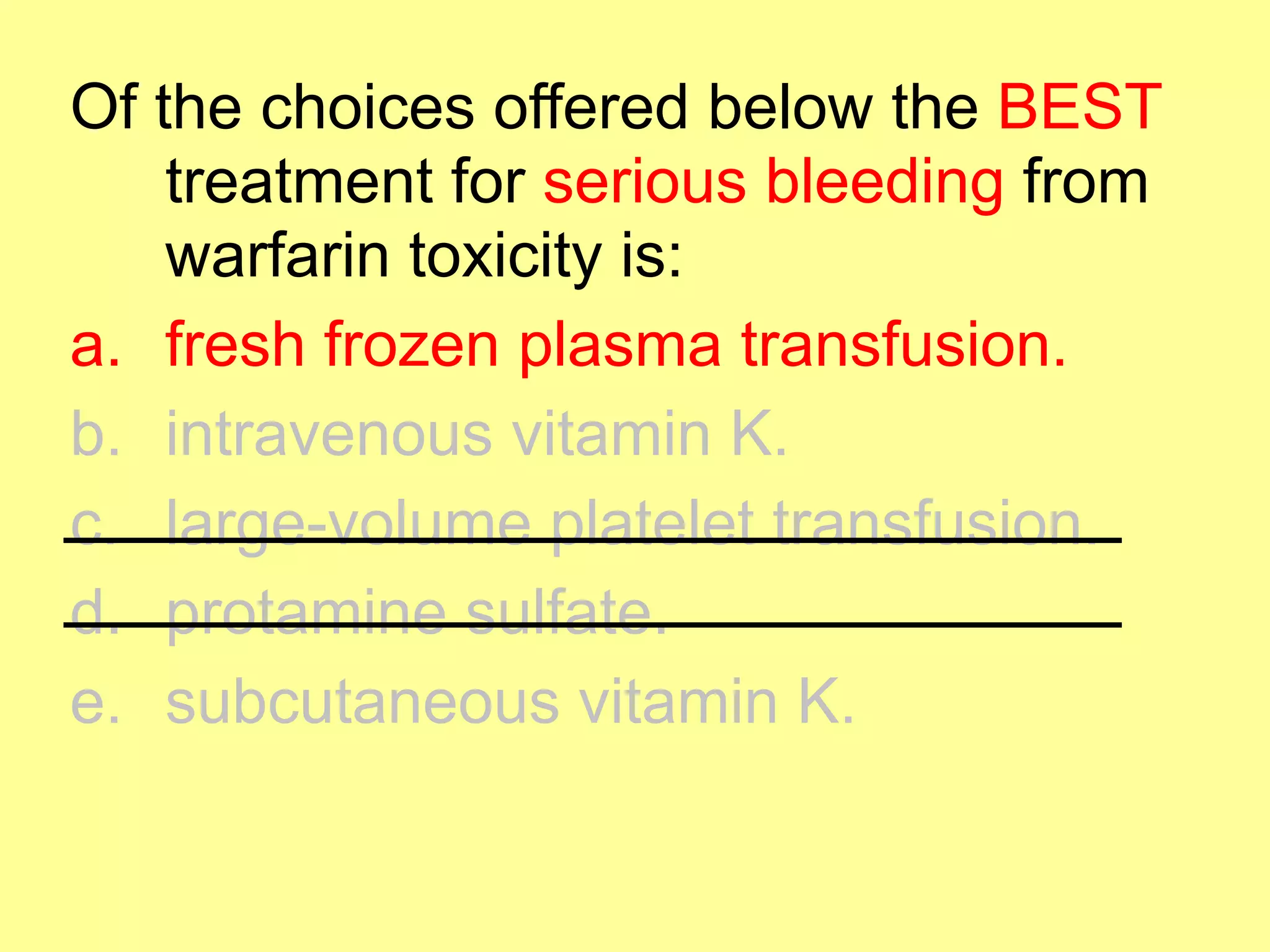
Of the choices offered below the BEST 
treatment for serious bleeding from 
warfarin toxicity is: 
a. fresh frozen plasma transfusion. 
b. intravenous vitamin K. 
c. large-volume platelet transfusion. 
d. protamine sulfate. 
e. subcutaneous vitamin K.
Of the choices offered below the BEST 
treatment for serious bleeding from 
warfarin toxicity is: 
a. fresh frozen plasma transfusion. 
b. intravenous vitamin K. 
c. large-volume platelet transfusion. 
d. protamine sulfate. 
e. subcutaneous vitamin K.
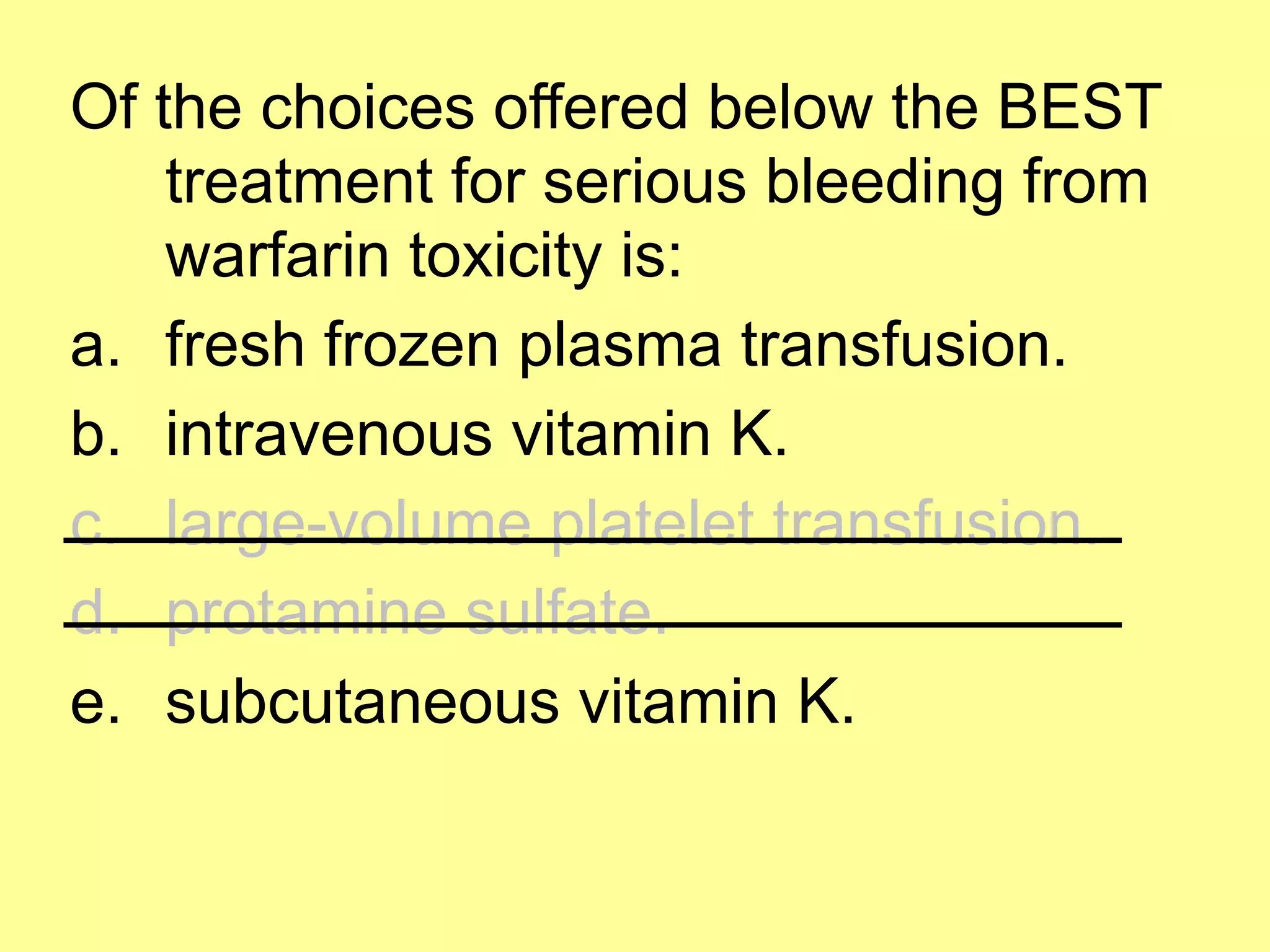
Of the choices offered below the BEST 
treatment for serious bleeding from 
warfarin toxicity is: 
a. fresh frozen plasma transfusion. 
b. intravenous vitamin K. 
c. large-volume platelet transfusion. 
d. protamine sulfate. 
e. subcutaneous vitamin K.
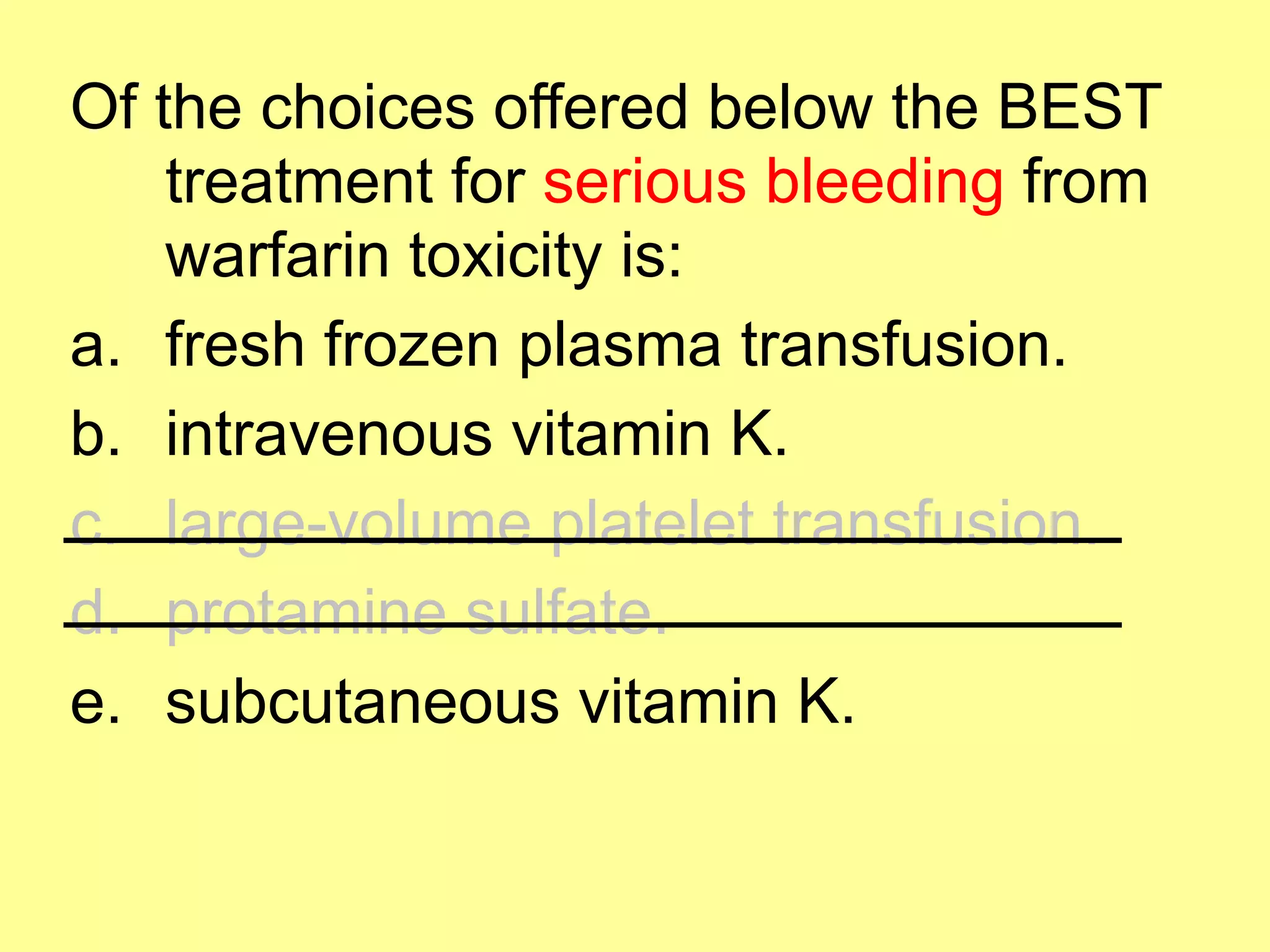
Of the choices offered below the BEST 
treatment for serious bleeding from 
warfarin toxicity is: 
a. fresh frozen plasma transfusion. 
b. intravenous vitamin K. 
c. large-volume platelet transfusion. 
d. protamine sulfate. 
e. subcutaneous vitamin K.
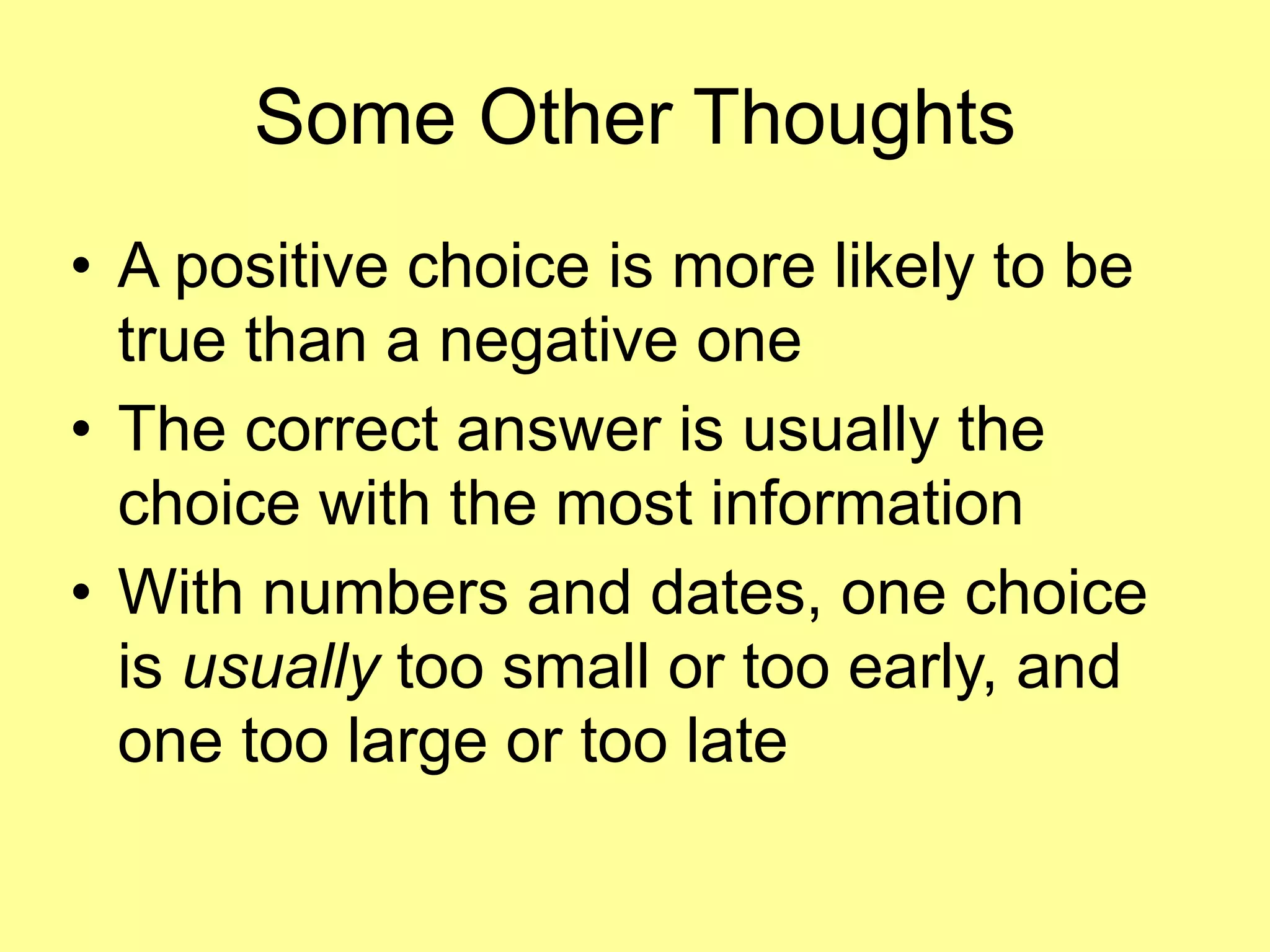
Some Other Thoughts 
• A positive choice is more likely to be 
true than a negative one 
• The correct answer is usually the 
choice with the most information 
• With numbers and dates, one choice 
is usually too small or too early, and 
one too large or too late
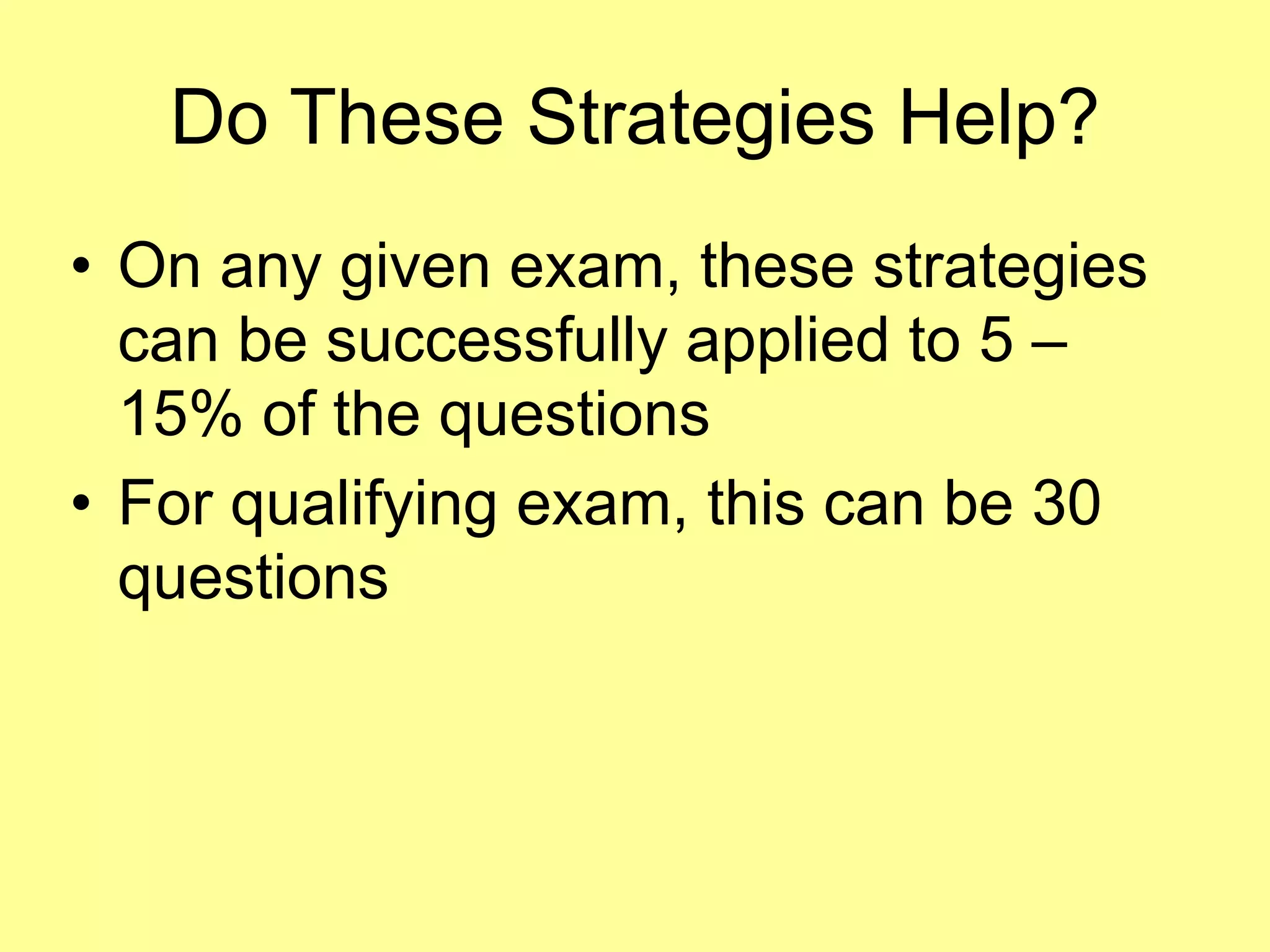
Do These Strategies Help? 
• On any given exam, these strategies 
can be successfully applied to 5 – 
15% of the questions 
• For qualifying exam, this can be 30 
questions
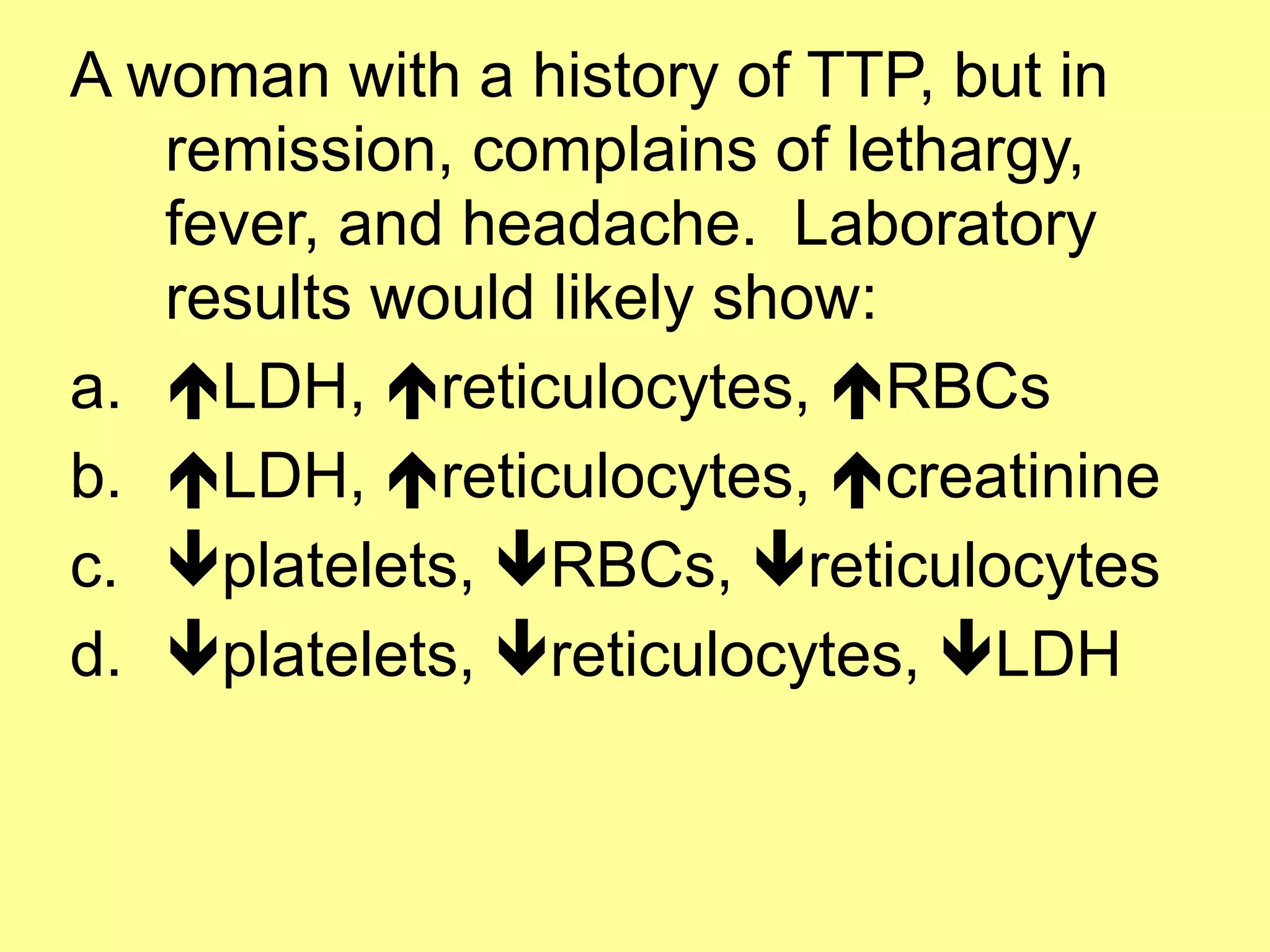
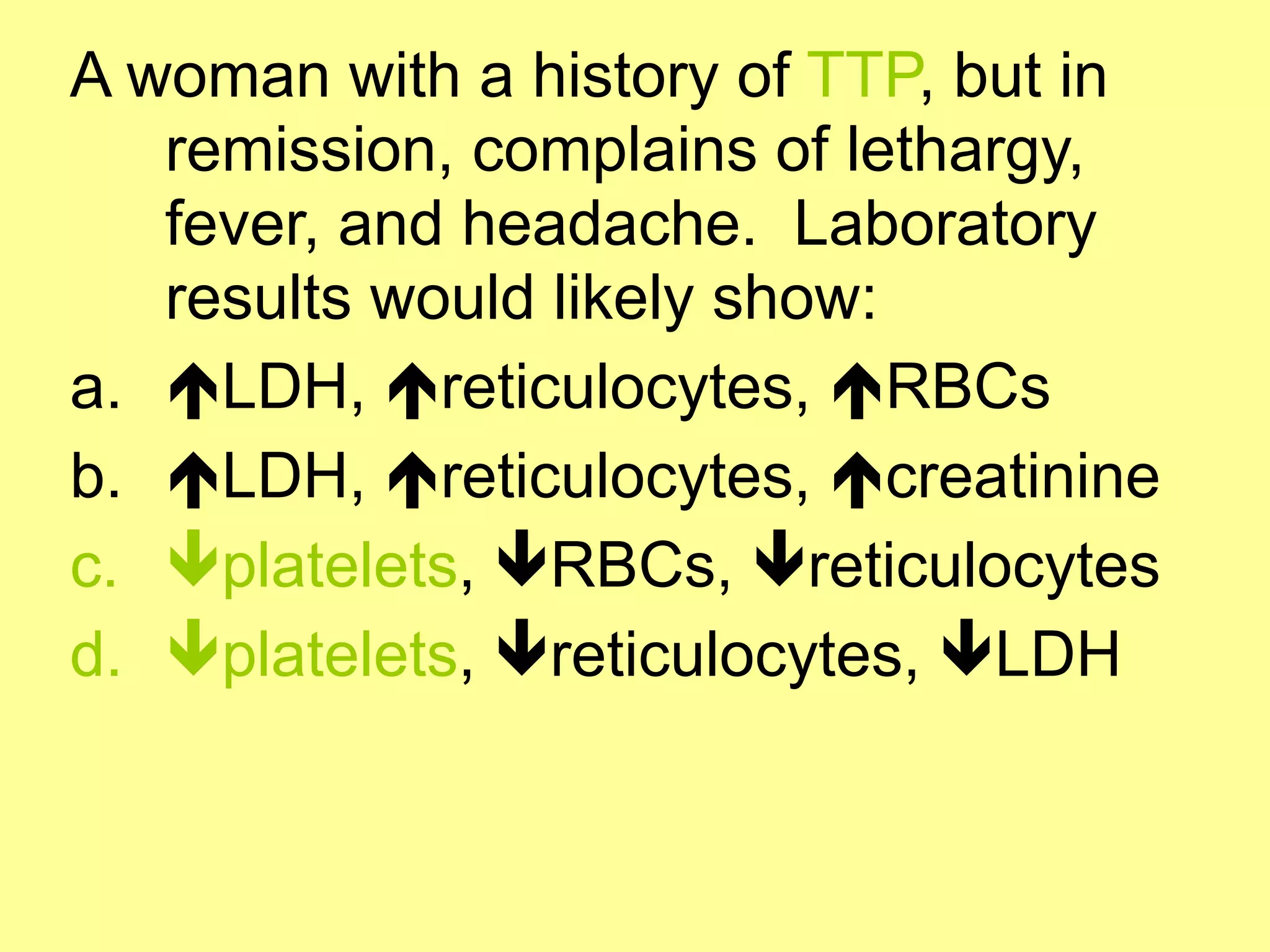
A woman with a history of TTP, but in 
remission, complains of lethargy, 
fever, and headache. Laboratory 
results would likely show: 
a. !LDH, !reticulocytes, !RBCs 
b. !LDH, !reticulocytes, !creatinine 
c. "platelets, "RBCs, "reticulocytes 
d. "platelets, "reticulocytes, "LDH
A woman with a history of TTP, but in 
remission, complains of lethargy, 
fever, and headache. Laboratory 
results would likely show: 
a. !LDH, !reticulocytes, !RBCs 
b. !LDH, !reticulocytes, !creatinine 
c. "platelets, "RBCs, "reticulocytes 
d. "platelets, "reticulocytes, "LDH
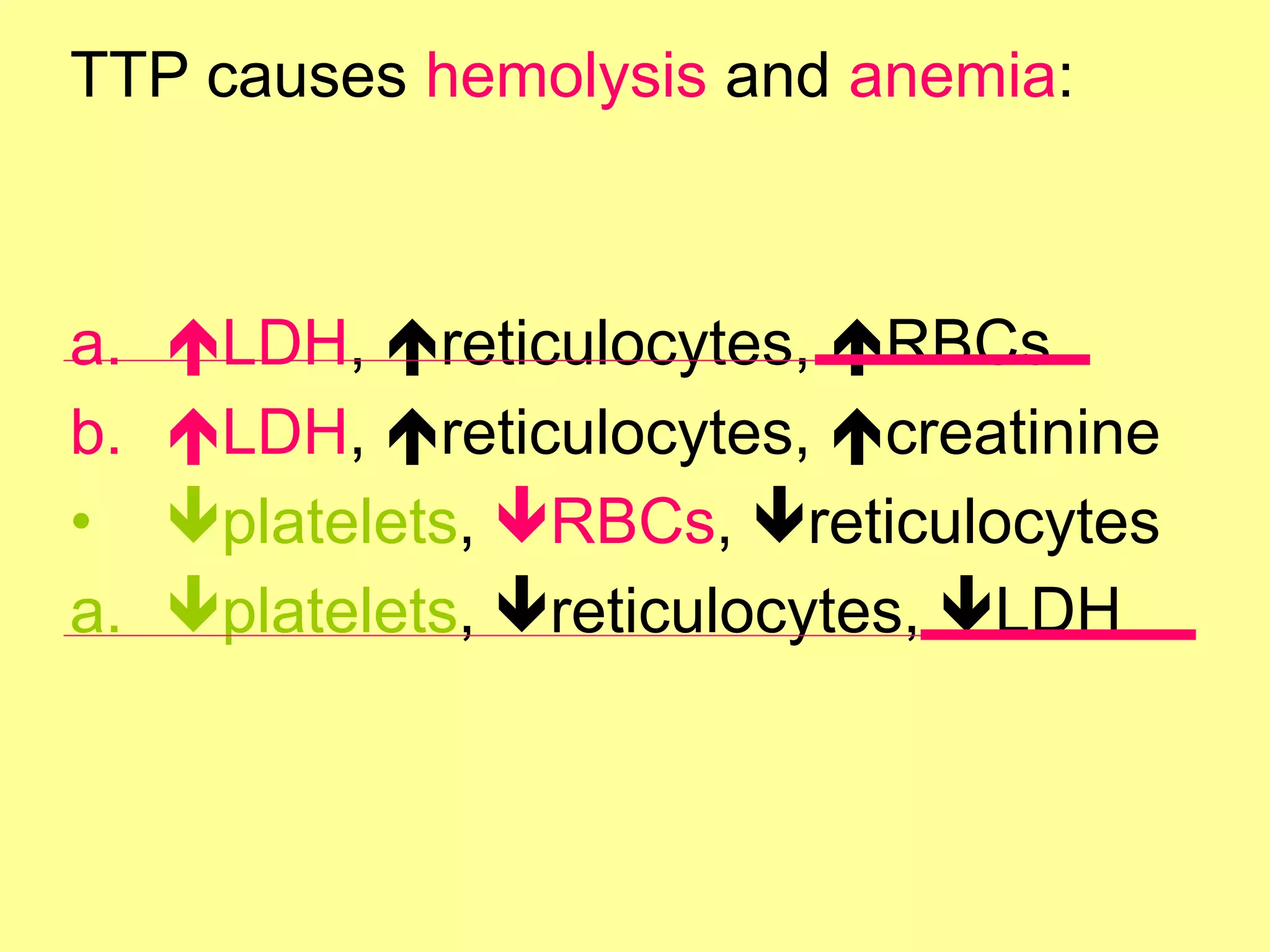
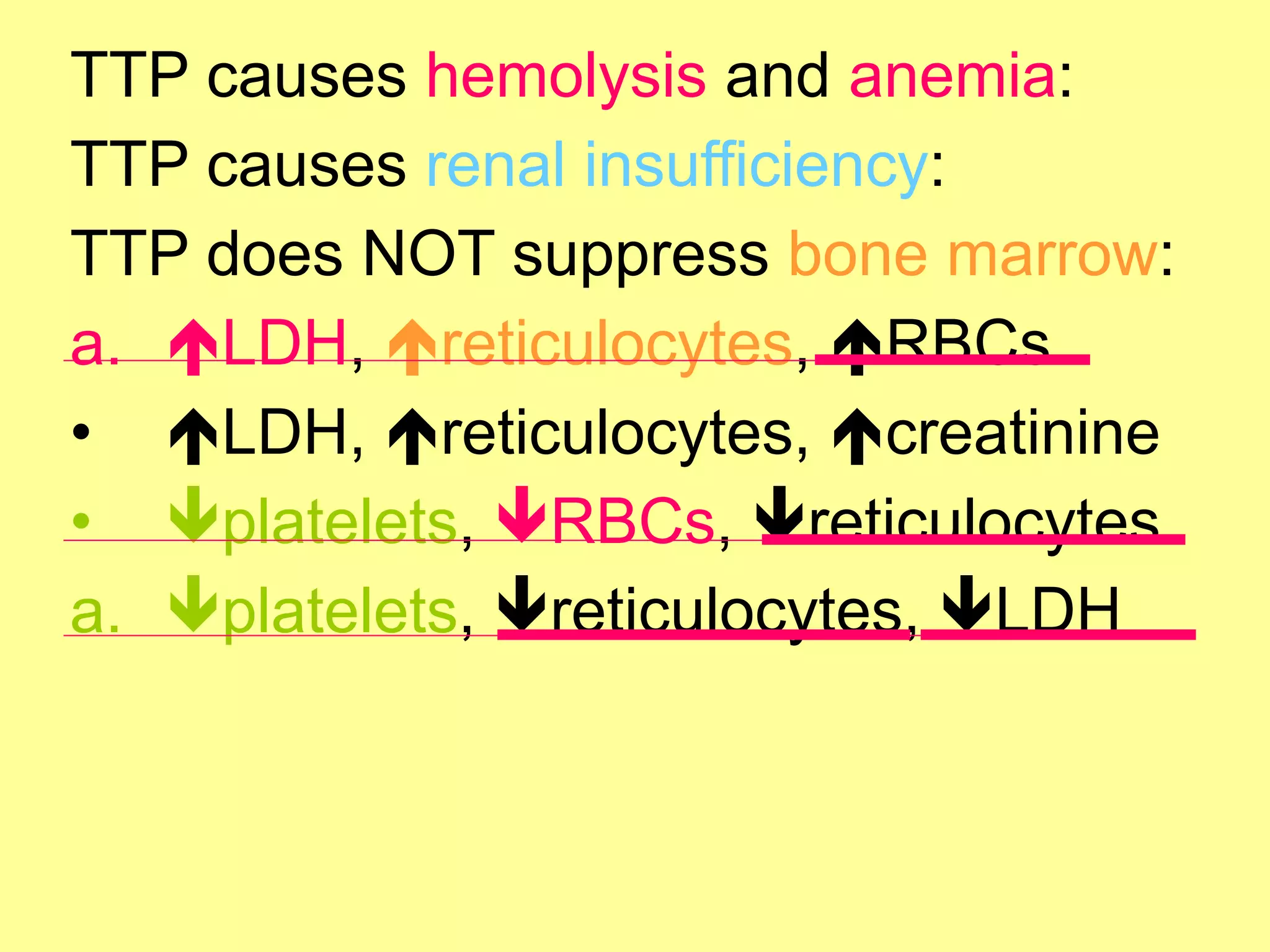
TTP causes hemolysis and anemia: 
! 
! 
a. !LDH, !reticulocytes, !RBCs 
b. !LDH, !reticulocytes, !creatinine 
• "platelets, "RBCs, "reticulocytes 
a. "platelets, "reticulocytes, "LDH
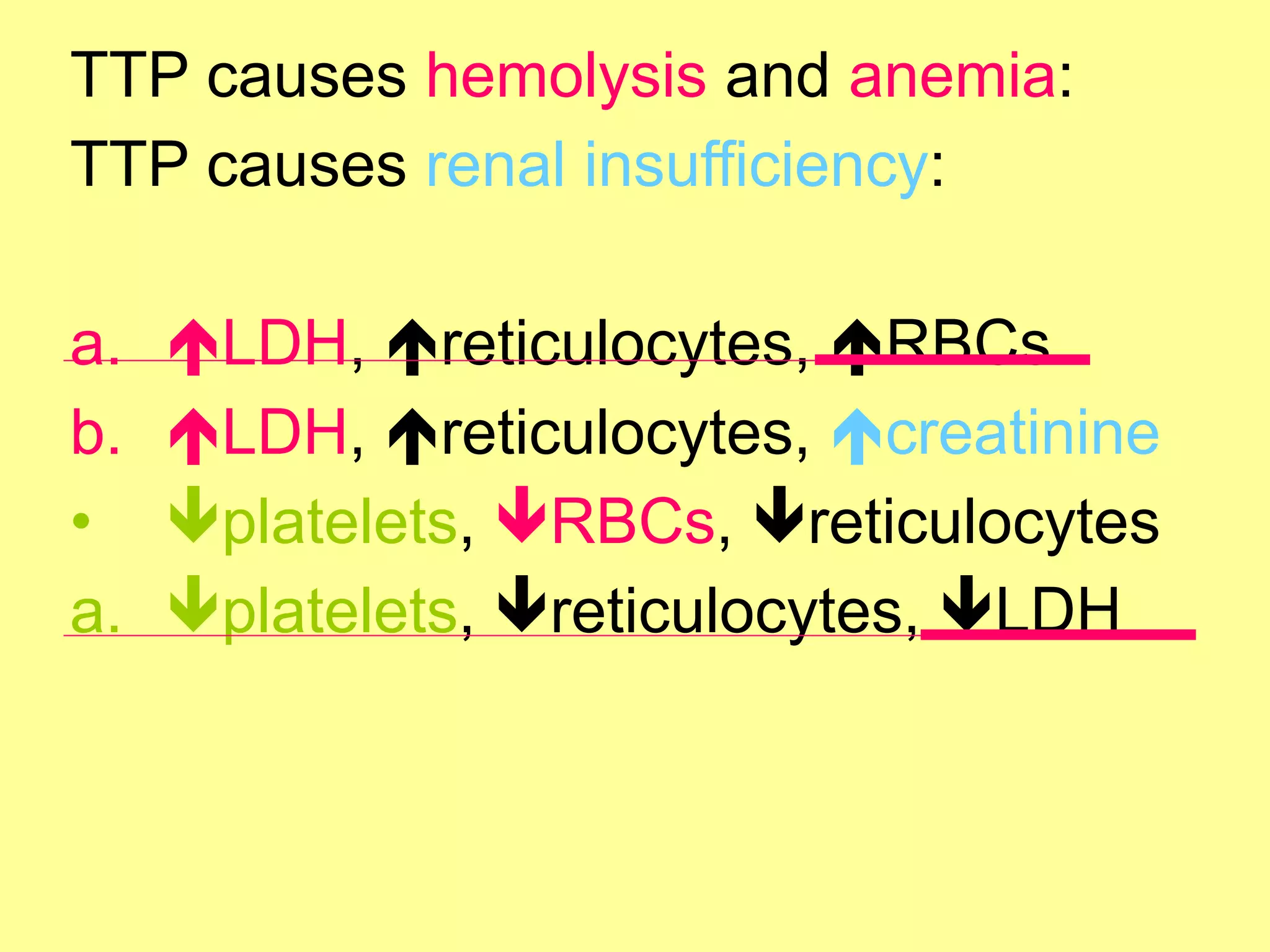
TTP causes hemolysis and anemia: 
TTP causes renal insufficiency: 
! 
a. !LDH, !reticulocytes, !RBCs 
b. !LDH, !reticulocytes, !creatinine 
• "platelets, "RBCs, "reticulocytes 
a. "platelets, "reticulocytes, "LDH
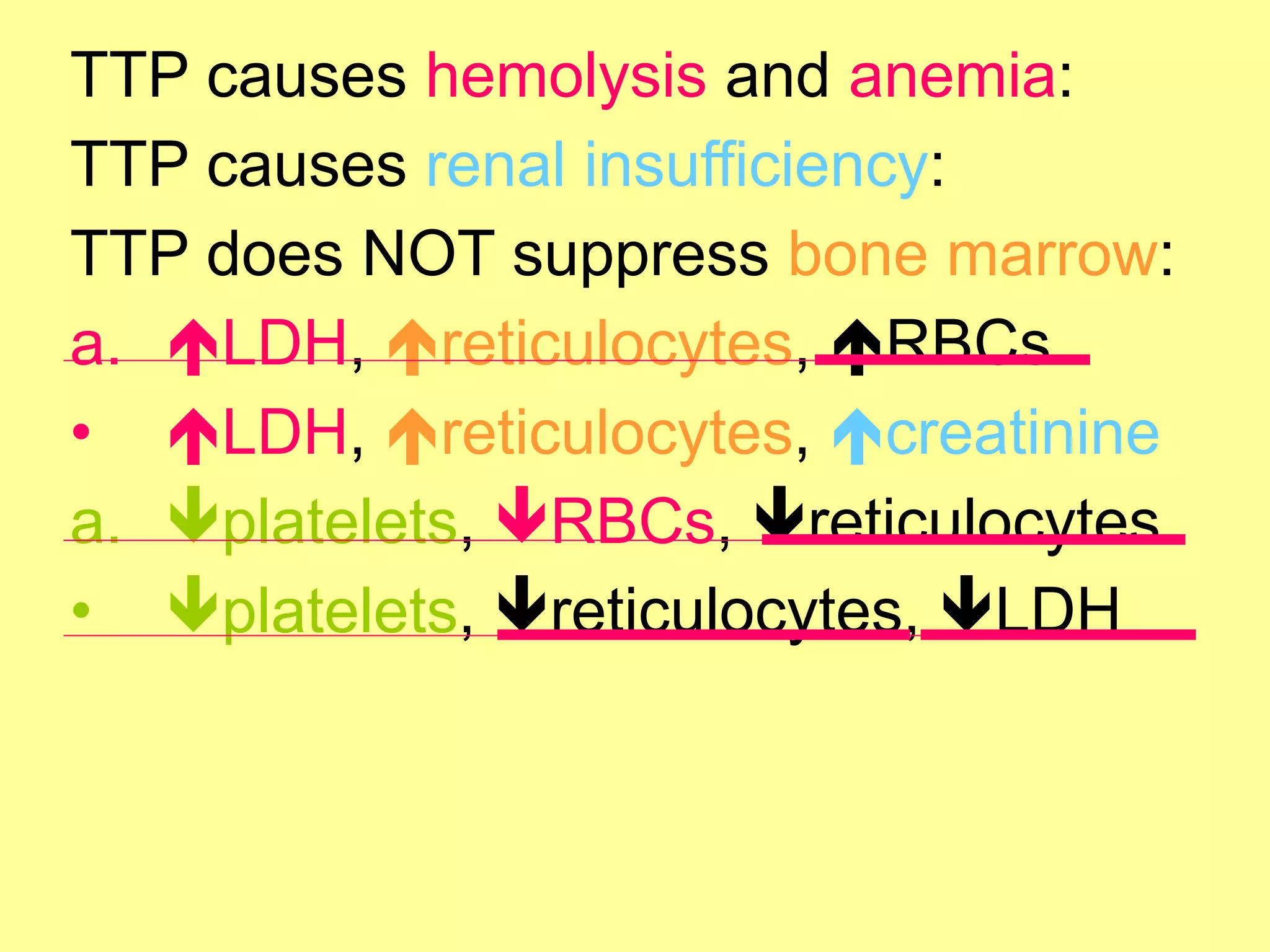
TTP causes hemolysis and anemia: 
TTP causes renal insufficiency: 
TTP does NOT suppress bone marrow: 
a. !LDH, !reticulocytes, !RBCs 
• !LDH, !reticulocytes, !creatinine 
a. "platelets, "RBCs, "reticulocytes 
• "platelets, "reticulocytes, "LDH
TTP causes hemolysis and anemia: 
TTP causes renal insufficiency: 
TTP does NOT suppress bone marrow: 
a. !LDH, !reticulocytes, !RBCs 
• !LDH, !reticulocytes, !creatinine 
• "platelets, "RBCs, "reticulocytes 
a. "platelets, "reticulocytes, "LDH
Some Other Thoughts 
• Consider how easily you would be 
distracted if someone else testing 
along side you had “the sniffles” or 
was chewing gum 
–Ear plugs, maybe? 
• There is no “hidden agenda” 
–Questions are designed to be fair
Should I Really Read a Textbook? 
• Yes – at least one cover-to-cover 
• Tintinalli: compendium of EM that 
assumes you already know the basics 
• Rosen: assumes you know nothing, 
spells out concepts and principles 
• Harwood-Nuss, Adams, etc: in-between
Should I Take a Review Course? 
• Depends on how you best learn 
• Several are very good 
• Ohio ACEP has one for years 
• So does Pennsylvania ACEP 
• National EM Board Review: Rick 
Bukata and crew 
• AAEM keeps it to three days
Should I Read a Review Book? 
• How do you best learn? 
• Harrigan / Ufberg / Tripp: Emergency 
Medicine Review: Preparing for the 
Boards 
• Schofer / Mattu / et al: Emergency 
Medicine: A Focused Review of the 
Core Curriculum (disclaimer)
Should I Practice with Questions? 
• Absolutely 
• Peer VIII: Physician's Evaluation and 
Educational Review in Emergency 
Medicine, Vol 8: Questions and 
Answers 
• Lex: Emergency Medicine Q&A: 
Pearls of Wisdom, Third Edition 
(disclaimer)
Should I Practice with Questions? 
• Aldeen: 1,000 Questions to Help You 
Pass the Emergency Medicine Boards 
• Challenger Corporation: 
www.chall.com
And finally… 
If you flat out don’t know an answer… 
…and the choices are a, b, c, d 
CHOOSE C 
…and the choices are a, b, c, d, e 
ALTERNATE BETWEEN B & D
And finally… 
• As someone who has written more 
than a 1000 questions over the last 
ten years, that’s where I try to put the 
answers on the toughest questions.
THANK YOU... 
AND GOOD 
LUCK

GEMC- Test-Taking Skills- Resident Training

  • 1.
    Project: Ghana EmergencyMedicine Collaborative ! Document Title: Test-Taking Skills ! Author(s): Joe Lex, MD, FACEP, FAAEM, MAAEM (Temple University) 2013 ! License: Unless otherwise noted, this material is made available under the terms of the Creative Commons Attribution Share Alike-3.0 License: http://creativecommons.org/licenses/by-sa/3.0/ We have reviewed this material in accordance with U.S. Copyright Law and have tried to maximize your ability to use, share, and adapt it. These lectures have been modified in the process of making a publicly shareable version. The citation key on the following slide provides information about how you may share and adapt this material. ! Copyright holders of content included in this material should contact open.michigan@umich.edu with any questions, corrections, or clarification regarding the use of content. ! For more information about how to cite these materials visit http://open.umich.edu/privacy-and-terms-use. ! Any medical information in this material is intended to inform and educate and is not a tool for self-diagnosis or a replacement for medical evaluation, advice, diagnosis or treatment by a healthcare professional. Please speak to your physician if you have questions about your medical condition. ! Viewer discretion is advised: Some medical content is graphic and may not be suitable for all viewers. 1
  • 2.
    Attribution Key ! for more information see: http://open.umich.edu/wiki/AttributionPolicy Use + Share + Adapt { Content the copyright holder, author, or law permits you to use, share and adapt. } Public Domain – Government: Works that are produced by the U.S. Government. (17 USC § 105) Public Domain – Expired: Works that are no longer protected due to an expired copyright term. Public Domain – Self Dedicated: Works that a copyright holder has dedicated to the public domain. Creative Commons – Zero Waiver Creative Commons – Attribution License Creative Commons – Attribution Share Alike License Creative Commons – Attribution Noncommercial License Creative Commons – Attribution Noncommercial Share Alike License GNU – Free Documentation License Make Your Own Assessment { Content Open.Michigan believes can be used, shared, and adapted because it is ineligible for copyright. } Public Domain – Ineligible: Works that are ineligible for copyright protection in the U.S. (17 USC § 102(b)) *laws in your jurisdiction may differ { Content Open.Michigan has used under a Fair Use determination. } Fair Use: Use of works that is determined to be Fair consistent with the U.S. Copyright Act. (17 USC § 107) *laws in your jurisdiction may differ Our determination DOES NOT mean that all uses of this 3rd-party content are Fair Uses and we DO NOT guarantee that your use of the content is Fair. To use this content you should do your own independent analysis to determine whether 2 or not your use will be Fair.
  • 3.
    Test-Taking Skills JoeLex, MD FACEP, FAAEM, MAAEM Associate Professor of Emergency Medicine Temple University School of Medicine Philadelphia, PA USA
  • 4.
  • 5.
    Who Do WeResist Tests? • They classify us • They categorize us • They frequently reward people who memorize and penalize people who analyze • Conformity is frequently an asset, creativity a liability
  • 6.
    Will They EverGo Away? • No • Despite all the tests in high school, college, medical school, and residency, you will be taking them for the rest of your life • Emergency medicine: recertify every 10 years
  • 7.
    Why Are WeUncomfortable? • It’s an unfamiliar space: you can’t get access to the room before you do the test • Once you’re there, make your space comfortable • Avoid window seats: distraction
  • 8.
    Why Are WeUncomfortable? • There’s a large gray area between knowing and not knowing an answer • We tend to look for “extra meaning” rather than take each question at face value
  • 9.
    And yet… •We can’t take them for granted • Poor score ➔ lose board certification ➔ lose hospital privileges ➔ no work • Board prep books may help you
  • 10.
    What Are TheyTesting? Outcomes of Learning 1. Application 2. Understanding 3. Synthesis 4. Knowledge 5. Analysis 6. Evaluation
  • 11.
    What Are TheyTesting? • Knowledge of terminology or facts • Knowledge and application of methods and procedures • Ability to apply facts and principles • Ability to interpret cause and effect relationships
  • 12.
    “Criterion Referenced” •There is no ranking • Passing depends on answering 75% of questions correctly • Everyone who takes it CAN pass
  • 13.
    1.Signs, Symptoms &Presentations 2.Abdominal & Gastrointestinal 3.Cardiovascular Disorders 4.Cutaneous Disorders 5.Endocrine, Metabolic, Nutritional 6.Environmental Disorders 7.Head, Eye, Ear, Nose & Throat 8.Hematologic Disorders 9.Immune System Disorders 10.Systemic Infectious Diseases 9% 9% 10% 2% 3% 3% 5% 2% 2% 5%
  • 14.
    11. Musculoskeletal Disorders 12.Nervous System Disorders 13.Obstetrics & Gynecology 14.Psychobehavioral Disorders 15.Renal & Urogenital Disorders 16.Thoracic-Respiratory Disorders 17.Toxicologic Disorders 18.Traumatic Disorders Appendix I: Procedures & Skills Appendix II: Other Components 3% 5% 4% 3% 3% 8% 4% 11% 6% 3%
  • 15.
    Acuity Frames Target (± 5%) Critical 27% Emergent 37% Lower Acuity 27% None 9% Other Modifiers Geriatric ≥4% Pediatric ≥8%
  • 16.
    Qualifying Examination •Comprehensive examination covering the breadth of Emergency Medicine • Each exam appointment is ~8 hours • ~6.5 hours devoted to testing • Exam contains ~305 single-best answer multiple-choice questions • 10 – 15% will have pictorial stimulus
  • 17.
    Qualifying Examination •Qualifying exam administered at >200 Pearson VUE professional computer-based testing centers throughout the United States
  • 18.
    Continuing Certification •Measures knowledge base for practice of EM • Comprehensive: based on EM Model • Typically in 10th year of Maintenance of Certification cycle • Questions based on the Model of the Clinical Practice of EM
  • 19.
    Continuing Certification •Five and one-quarter hour, secure, proctored examination • Administered over 6 consecutive days in >200 Pearson VUE testing centers around United States and Canada
  • 20.
  • 21.
    Bad Questions ThrownOut • After test given, results analyzed so that poorly-designed questions are discarded before scoring • Field testing of new questions done every year
  • 22.
    “Standard of Care” • Practice guideline in small rural hospital may vary from Big City General • Practice in Ghana almost certainly varies from practice in Canada • Content based on national, not regional, standard of care
  • 23.
  • 24.
    Confidence Builders •Think good thoughts: “I will do well on this test; I expect to do well.” • Some tension dissipates when you start the test: you can’t think about tension while answering questions • Answer all the easy ones first: flag the tough ones and come back to them
  • 25.
    Work Quickly •Multiple-choice test is the right place to be rapid-fire • Read through the question and determine the answer before you look at the choices • If your answer seems obvious, it probably is
  • 26.
    Some Clues •If the stem has many complicated statements, isolate them – understand each part
  • 27.
    A patient withanemia, renal failure, thrombocytopenia, normal coagulation tests, and a clear sensorium probably has: a.idiopathic thrombocytopenic anemia. b.thrombotic thrombocytopenic purpura. c.hemolytic-uremic syndrome. d.disseminated intravascular coagulation. e.autoimmune hemolytic anemia.
  • 28.
    A patient withanemia, renal failure, thrombocytopenia, normal coagulation tests, and a clear sensorium probably has: a.idiopathic thrombocytopenic purpura. b.thrombotic thrombocytopenic purpura. c.hemolytic-uremic syndrome. d.disseminated intravascular coagulation. e.autoimmune hemolytic anemia.
  • 29.
    A patient withanemia, renal failure, thrombocytopenia, normal coagulation tests, and a clear sensorium probably has: a.idiopathic thrombocytopenic purpura. b.thrombotic thrombocytopenic purpura.√ c.hemolytic-uremic syndrome. √ d.disseminated intravascular coagulation. e.autoimmune hemolytic anemia.
  • 30.
    A patient withanemia, renal failure, thrombocytopenia, normal coagulation tests, and a clear sensorium probably has: a.idiopathic thrombocytopenic purpura. b.thrombotic thrombocytopenic purpura.√ c.hemolytic-uremic syndrome. √ d.disseminated intravascular coagulation. e.autoimmune hemolytic anemia.
  • 31.
    A patient withanemia, renal failure, thrombocytopenia, normal coagulation tests, and a clear sensorium probably has: a.idiopathic thrombocytopenic purpura. b.thrombotic thrombocytopenic purpura.√ c.hemolytic-uremic syndrome. √ d.disseminated intravascular coagulation. e.autoimmune hemolytic anemia.
  • 32.
    A patient withanemia, renal failure, thrombocytopenia, normal coagulation tests, and a clear sensorium probably has: a.idiopathic thrombocytopenic purpura. b.thrombotic thrombocytopenic purpura.√ c.hemolytic-uremic syndrome. √ d.disseminated intravascular coagulation. e.autoimmune hemolytic anemia.
  • 33.
    Some Clues •Answer may be first, second, or even third generation
  • 34.
    A 20-year-old collegestudent has red-ness and tenderness on the plantar surface of his foot. Two days ago, while wearing sneakers, he stepped on a nail. You suspect: a. osteomyelitis. b. sepsis. c. cellulitis. d. abscess. 1st e. tetanus.
  • 35.
    redness and tenderness… wearing sneakers … stepped on a nail. You should prescribe: a. cephalexin. b. Tetanus Immune Globulin (TIG). c. ciprofloxacin. d. tetracycline. e. anti-rabies prophylaxis. 2nd
  • 36.
    redness and tenderness… wearing sneakers … stepped on a nail. Long term effects of the appropriate medication might include: a. tendon rupture and tendonitis. b. seizures. c. double vision. d. prostatic hypertrophy. e. hypospadias. 3rd
  • 37.
    Some Clues •Some answers are obviously wrong: move on • Some answers are partly wrong: move on • Some answers are correct statements, but do not answer the question
  • 38.
    Some Clues •Two answers direct opposites: one of them is probably correct • Two answers very similar, few words apart: one of them is probably correct • Answers using always, never, all, and none are probably wrong • Look for qualifiers: seldom, generally, tend to be
  • 39.
    Some Clues •Certain key descriptive words may give you the correct answer –“classic” or “routinely” • Sometimes you find the answer in another question • If the answer disagrees in tense with the question, it is probably wrong
  • 40.
    Some Clues •Majority of “pictorial stimuli” questions can be answered without looking at the picture
  • 41.
    Some Clues •Sometimes you will be asked to infer the answer by eliminating obviously wrong answers
  • 42.
    Some Clues Ofthe drugs listed, the safest to treat severe headache in a woman in 3rd trimester pregnancy is: a. ketorolac (Toradol). b. celecoxib (Celebrex). c. dihydroergotamine mesylate. d. acetaminophen with codeine.
  • 43.
    Guessing… …is rarelyrandom: you have probably retained something …always pays off when there are no penalties for wrong answers …nearly always pays off when you have studied – you probably know something about the question
  • 44.
    Good vs Better • Many answers may have some truth • Identify the best response from the good responses • If you have narrowed it down to two, and both seem true, pick the answer that is in some way “better” than one that is just good
  • 45.
    Of the choicesoffered below the BEST treatment for serious bleeding from warfarin toxicity is: a. fresh frozen plasma transfusion. b. intravenous vitamin K. c. large-volume platelet transfusion. d. protamine sulfate. e. subcutaneous vitamin K.
  • 46.
    Of the choicesoffered below the BEST treatment for serious bleeding from warfarin toxicity is: a. fresh frozen plasma transfusion. b. intravenous vitamin K. c. large-volume platelet transfusion. d. protamine sulfate. e. subcutaneous vitamin K.
  • 47.
    Of the choicesoffered below the BEST treatment for serious bleeding from warfarin toxicity is: a. fresh frozen plasma transfusion. b. intravenous vitamin K. c. large-volume platelet transfusion. d. protamine sulfate. e. subcutaneous vitamin K.
  • 48.
    Of the choicesoffered below the BEST treatment for serious bleeding from warfarin toxicity is: a. fresh frozen plasma transfusion. b. intravenous vitamin K. c. large-volume platelet transfusion. d. protamine sulfate. e. subcutaneous vitamin K.
  • 49.
    Some Other Thoughts • A positive choice is more likely to be true than a negative one • The correct answer is usually the choice with the most information • With numbers and dates, one choice is usually too small or too early, and one too large or too late
  • 50.
    Do These StrategiesHelp? • On any given exam, these strategies can be successfully applied to 5 – 15% of the questions • For qualifying exam, this can be 30 questions
  • 51.
    A woman witha history of TTP, but in remission, complains of lethargy, fever, and headache. Laboratory results would likely show: a. !LDH, !reticulocytes, !RBCs b. !LDH, !reticulocytes, !creatinine c. "platelets, "RBCs, "reticulocytes d. "platelets, "reticulocytes, "LDH
  • 52.
    A woman witha history of TTP, but in remission, complains of lethargy, fever, and headache. Laboratory results would likely show: a. !LDH, !reticulocytes, !RBCs b. !LDH, !reticulocytes, !creatinine c. "platelets, "RBCs, "reticulocytes d. "platelets, "reticulocytes, "LDH
  • 53.
    TTP causes hemolysisand anemia: ! ! a. !LDH, !reticulocytes, !RBCs b. !LDH, !reticulocytes, !creatinine • "platelets, "RBCs, "reticulocytes a. "platelets, "reticulocytes, "LDH
  • 54.
    TTP causes hemolysisand anemia: TTP causes renal insufficiency: ! a. !LDH, !reticulocytes, !RBCs b. !LDH, !reticulocytes, !creatinine • "platelets, "RBCs, "reticulocytes a. "platelets, "reticulocytes, "LDH
  • 55.
    TTP causes hemolysisand anemia: TTP causes renal insufficiency: TTP does NOT suppress bone marrow: a. !LDH, !reticulocytes, !RBCs • !LDH, !reticulocytes, !creatinine a. "platelets, "RBCs, "reticulocytes • "platelets, "reticulocytes, "LDH
  • 56.
    TTP causes hemolysisand anemia: TTP causes renal insufficiency: TTP does NOT suppress bone marrow: a. !LDH, !reticulocytes, !RBCs • !LDH, !reticulocytes, !creatinine • "platelets, "RBCs, "reticulocytes a. "platelets, "reticulocytes, "LDH
  • 57.
    Some Other Thoughts • Consider how easily you would be distracted if someone else testing along side you had “the sniffles” or was chewing gum –Ear plugs, maybe? • There is no “hidden agenda” –Questions are designed to be fair
  • 58.
    Should I ReallyRead a Textbook? • Yes – at least one cover-to-cover • Tintinalli: compendium of EM that assumes you already know the basics • Rosen: assumes you know nothing, spells out concepts and principles • Harwood-Nuss, Adams, etc: in-between
  • 59.
    Should I Takea Review Course? • Depends on how you best learn • Several are very good • Ohio ACEP has one for years • So does Pennsylvania ACEP • National EM Board Review: Rick Bukata and crew • AAEM keeps it to three days
  • 60.
    Should I Reada Review Book? • How do you best learn? • Harrigan / Ufberg / Tripp: Emergency Medicine Review: Preparing for the Boards • Schofer / Mattu / et al: Emergency Medicine: A Focused Review of the Core Curriculum (disclaimer)
  • 61.
    Should I Practicewith Questions? • Absolutely • Peer VIII: Physician's Evaluation and Educational Review in Emergency Medicine, Vol 8: Questions and Answers • Lex: Emergency Medicine Q&A: Pearls of Wisdom, Third Edition (disclaimer)
  • 62.
    Should I Practicewith Questions? • Aldeen: 1,000 Questions to Help You Pass the Emergency Medicine Boards • Challenger Corporation: www.chall.com
  • 63.
    And finally… Ifyou flat out don’t know an answer… …and the choices are a, b, c, d CHOOSE C …and the choices are a, b, c, d, e ALTERNATE BETWEEN B & D
  • 64.
    And finally… •As someone who has written more than a 1000 questions over the last ten years, that’s where I try to put the answers on the toughest questions.
  • 65.