Numeral Systems
Binary, Decimal and Hexadecimal Numbers
Svetlin Nakov
Telerik Corporation
www.telerik.com
Table of Contents
1. Numerals Systems
Binary and Decimal Numbers
Hexadecimal Numbers
Conversion between Numeral Systems
3. Representation of Numbers
Positive and Negative Integer Numbers
Floating-Point Numbers
4. Text Representation
2
Numeral Systems
Conversion between Numeral Systems
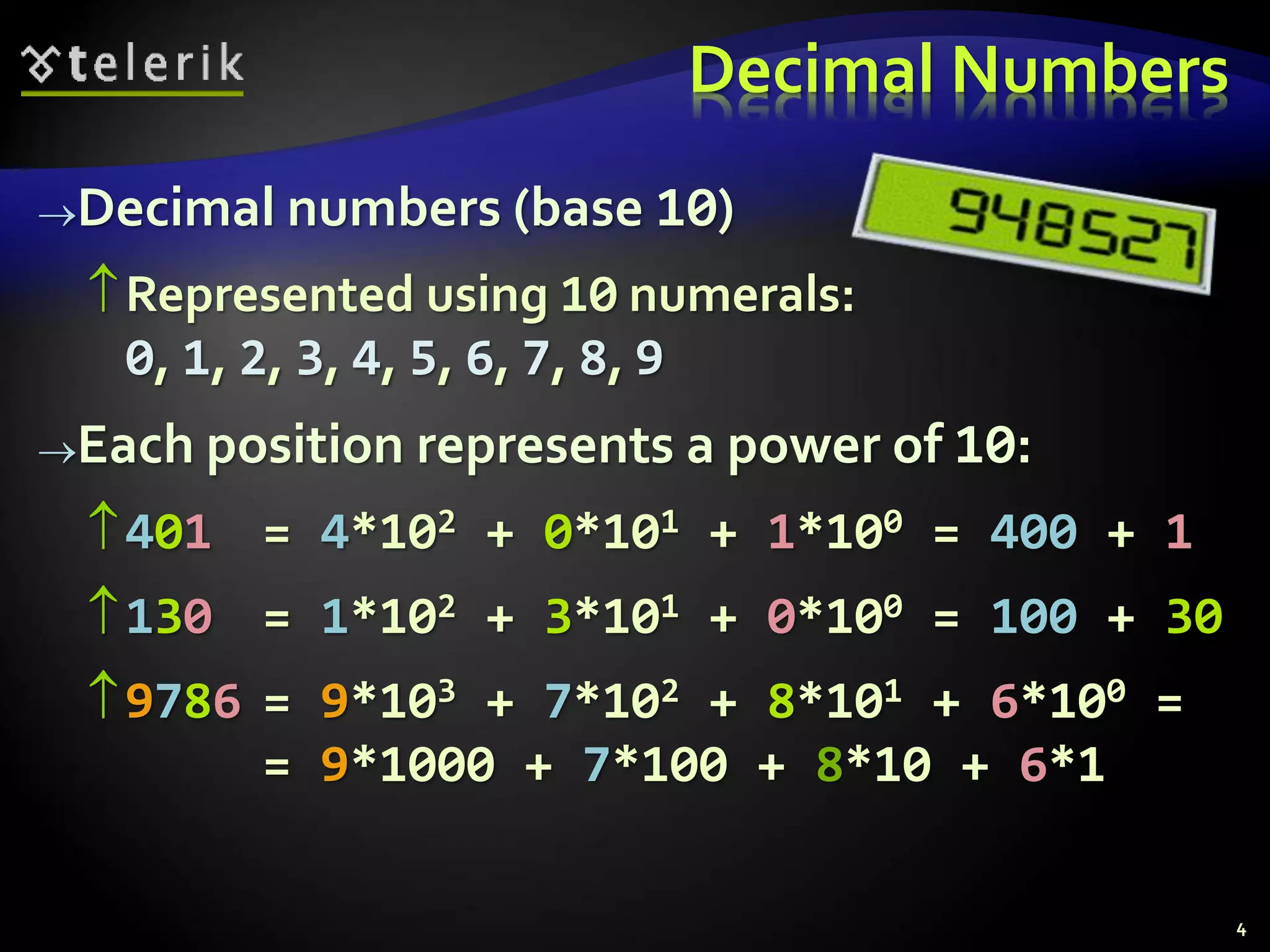
Decimal numbers (base 10)
Represented using 10 numerals:
0, 1, 2, 3, 4, 5, 6, 7, 8, 9
Each position represents a power of 10:
401 = 4*102 + 0*101 + 1*100 = 400 + 1
130 = 1*102 + 3*101 + 0*100 = 100 + 30
9786 = 9*103 + 7*102 + 8*101 + 6*100 =
= 9*1000 + 7*100 + 8*10 + 6*1
Decimal Numbers
4
Binary Numeral System
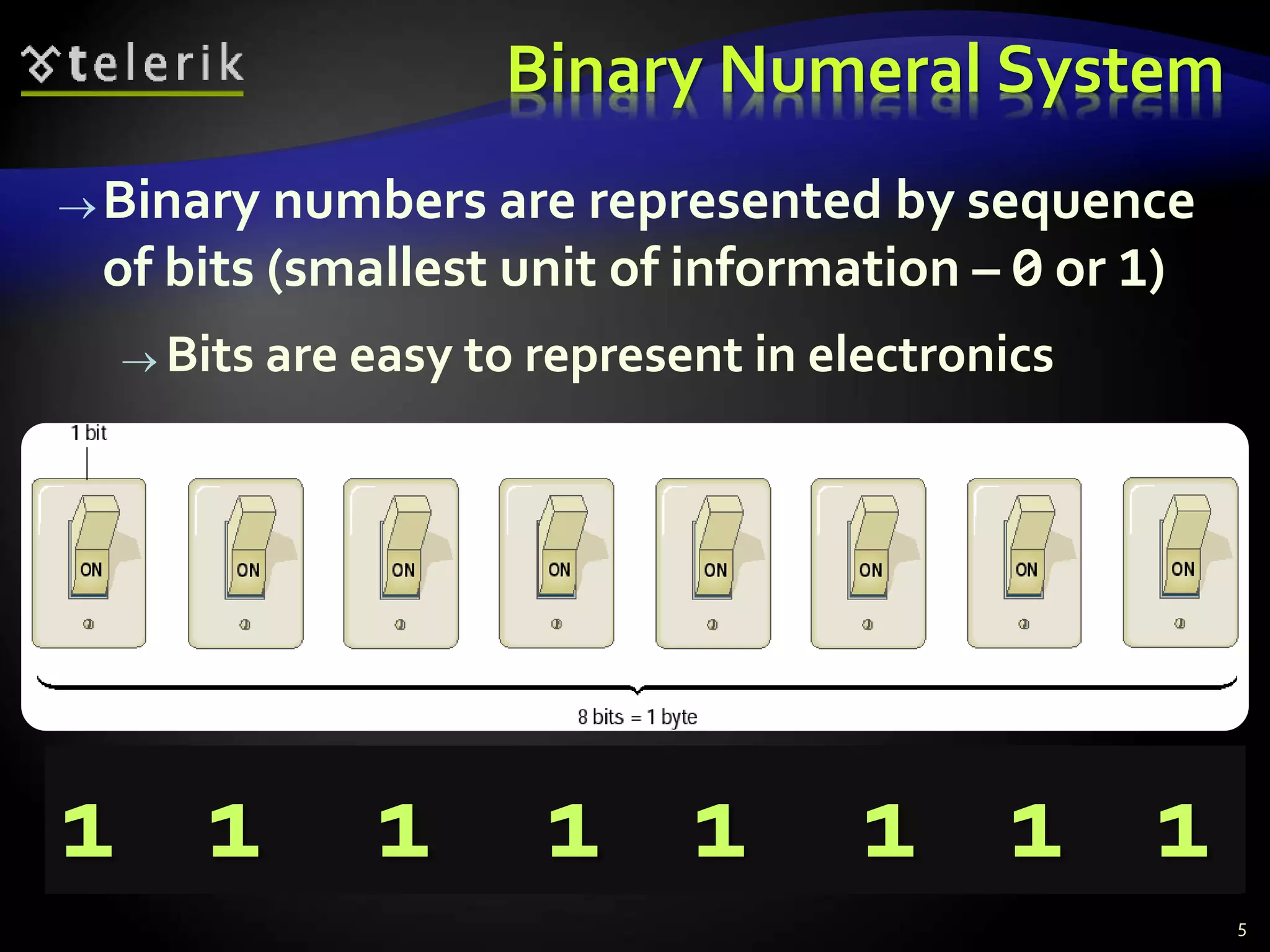
5
1 0 1 1 0 0 1 01 0 0 1 0 0 1 01 0 0 1 0 0 1 11 1 1 1 1 1 1 1
Binary numbers are represented by sequence
of bits (smallest unit of information – 0 or 1)
 Bits are easy to represent in electronics
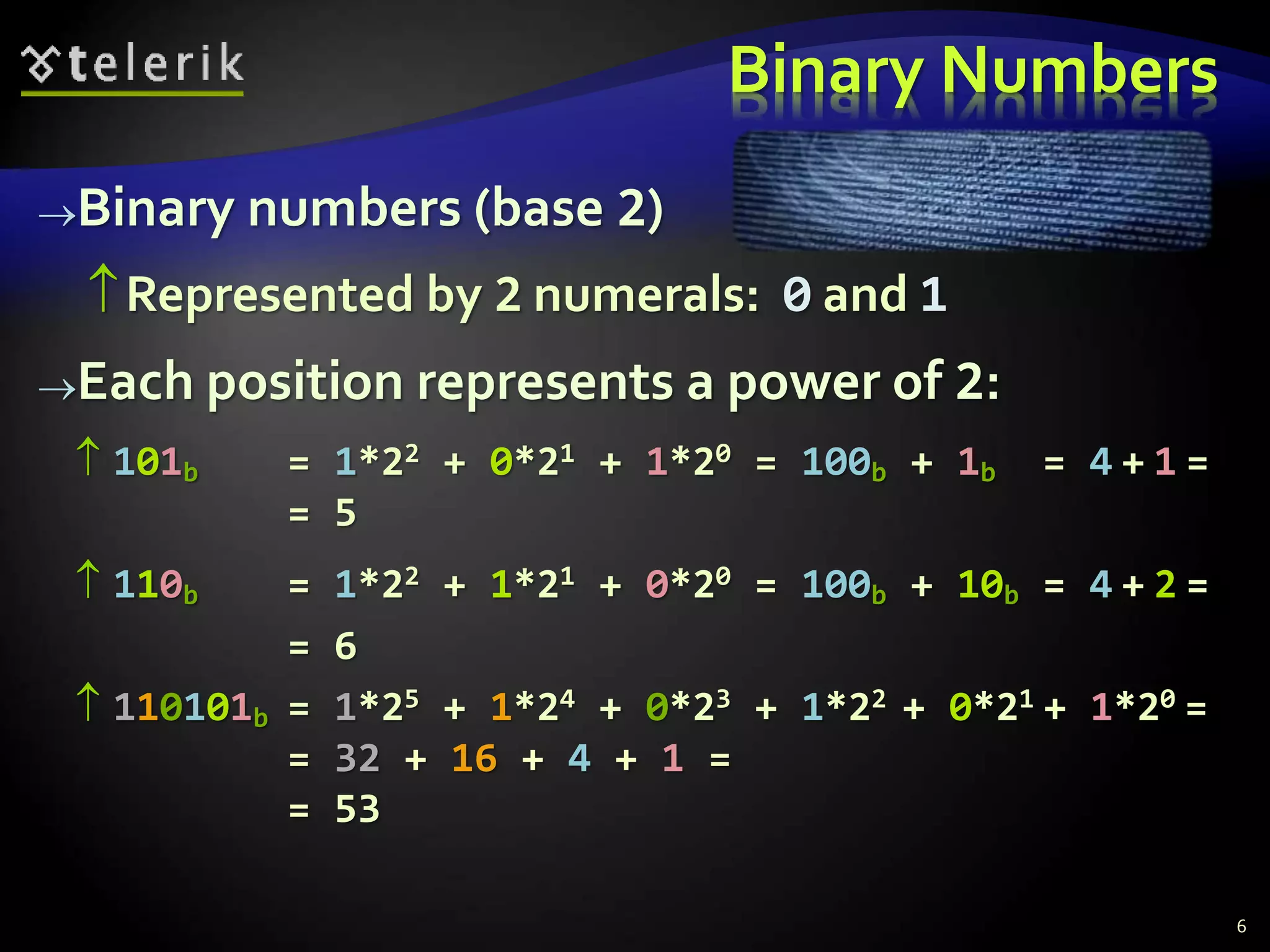
Binary numbers (base 2)
Represented by 2 numerals: 0 and 1
Each position represents a power of 2:
 101b = 1*22 + 0*21 + 1*20 = 100b + 1b = 4 + 1 =
= 5
 110b = 1*22 + 1*21 + 0*20 = 100b + 10b = 4 + 2 =
= 6
 110101b = 1*25 + 1*24 + 0*23 + 1*22 + 0*21 + 1*20 =
= 32 + 16 + 4 + 1 =
= 53
Binary Numbers
6
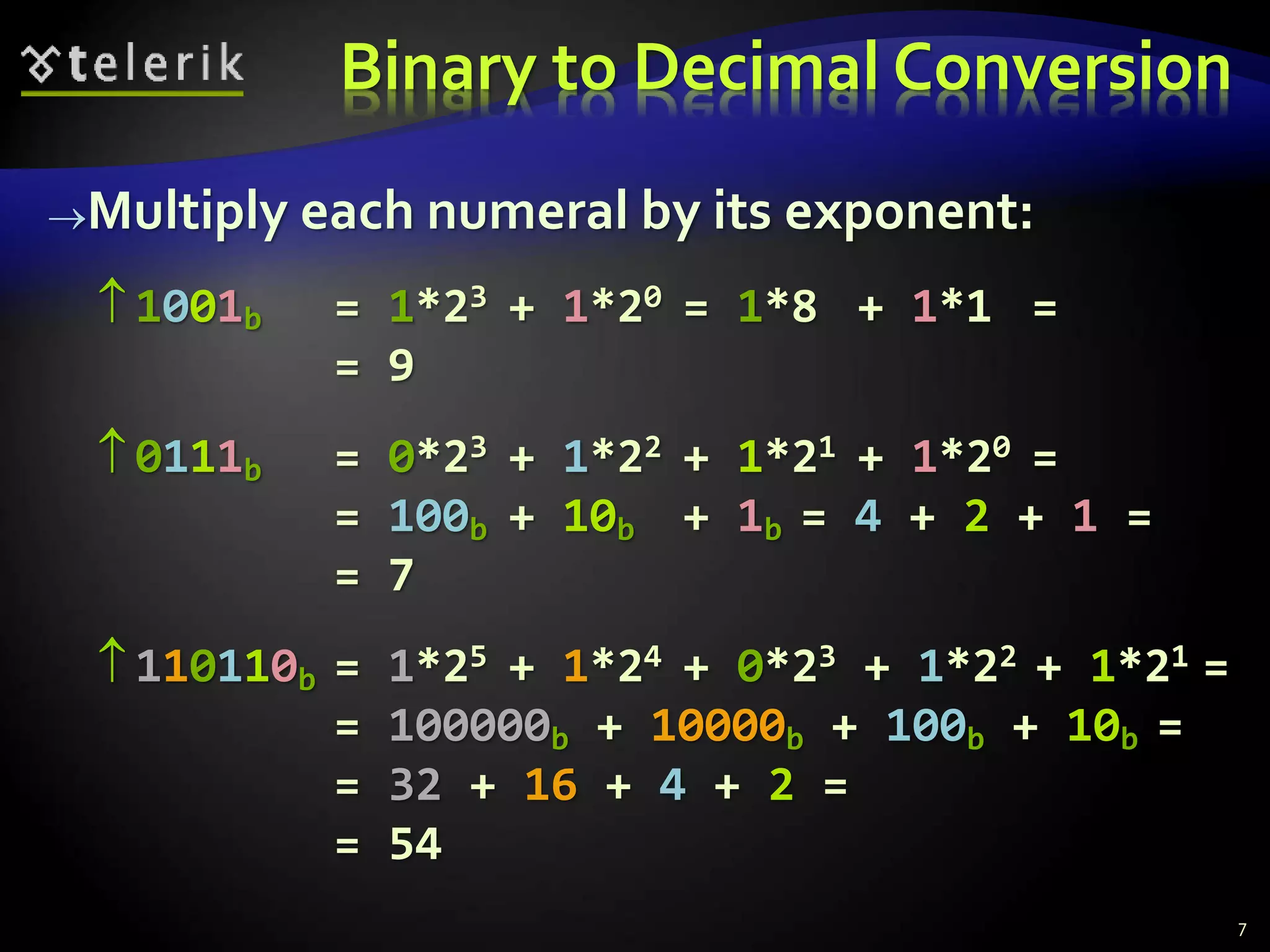
Binary to Decimal Conversion
Multiply each numeral by its exponent:
 1001b = 1*23 + 1*20 = 1*8 + 1*1 =
= 9
 0111b = 0*23 + 1*22 + 1*21 + 1*20 =
= 100b + 10b + 1b = 4 + 2 + 1 =
= 7
 110110b = 1*25 + 1*24 + 0*23 + 1*22 + 1*21 =
= 100000b + 10000b + 100b + 10b =
= 32 + 16 + 4 + 2 =
= 54
7
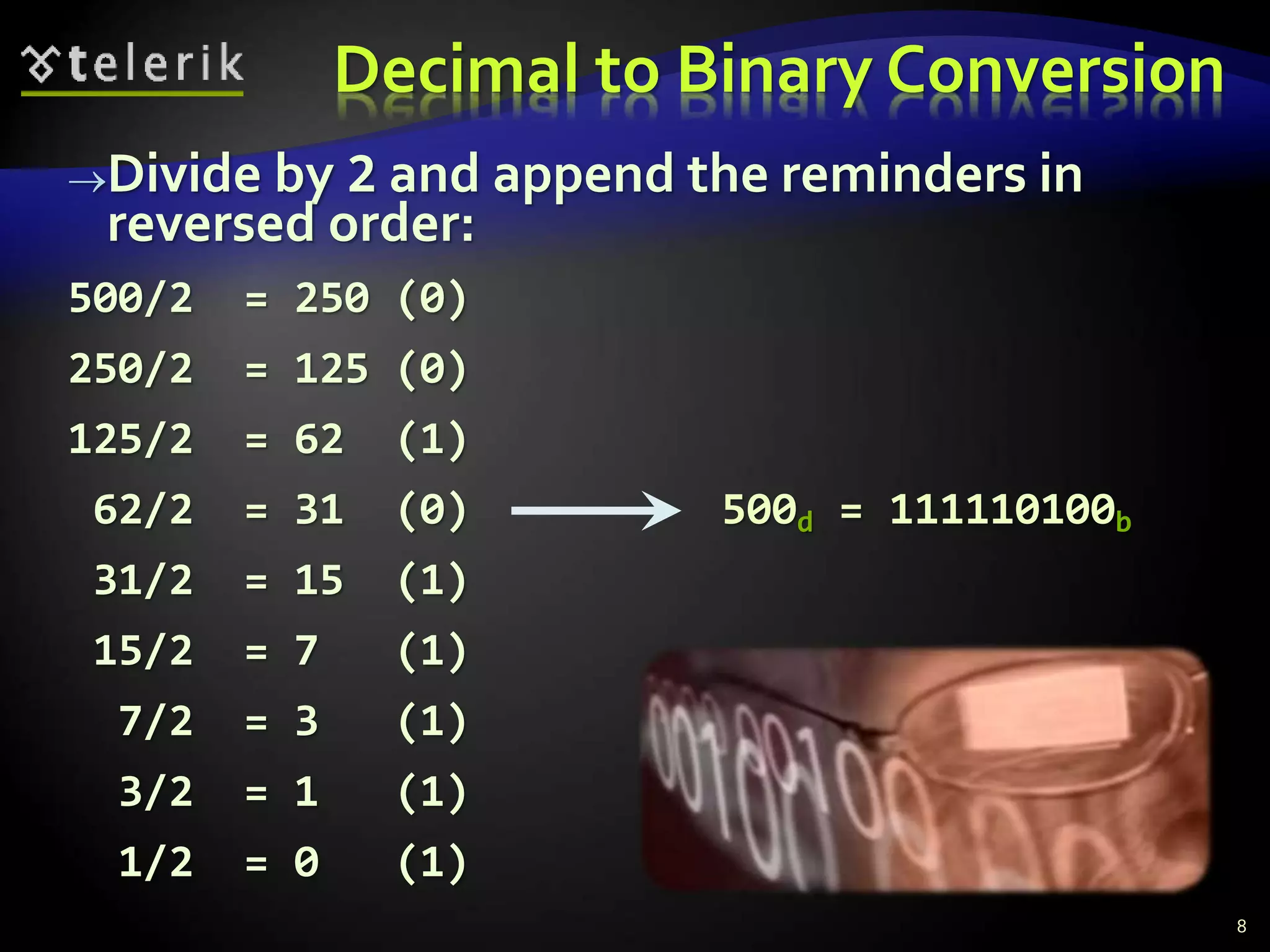
Decimal to Binary Conversion
Divide by 2 and append the reminders in
reversed order:
500/2 = 250 (0)
250/2 = 125 (0)
125/2 = 62 (1)
62/2 = 31 (0) 500d = 111110100b
31/2 = 15 (1)
15/2 = 7 (1)
7/2 = 3 (1)
3/2 = 1 (1)
1/2 = 0 (1)
8
Hexadecimal Numbers
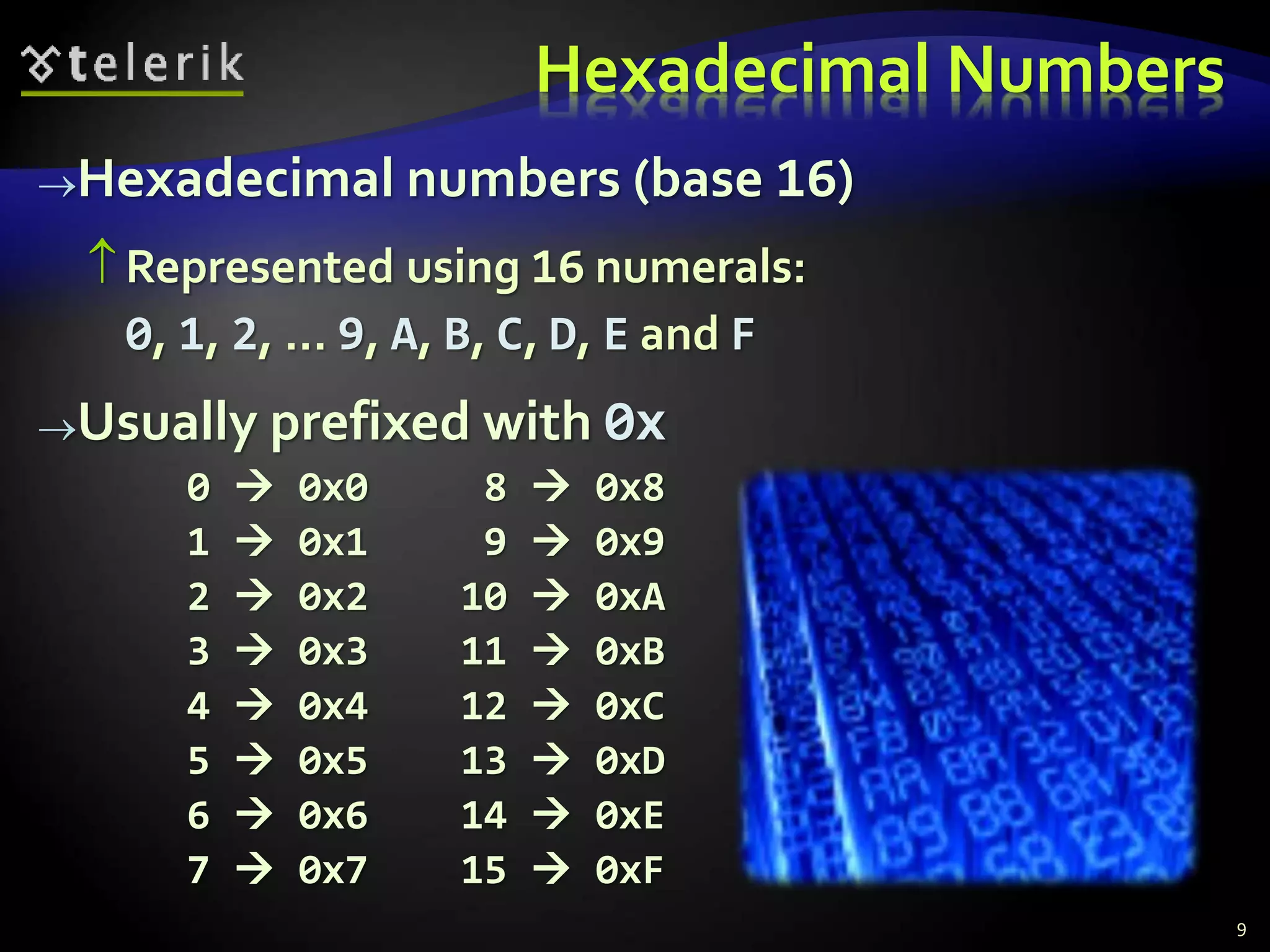
Hexadecimal numbers (base 16)
 Represented using 16 numerals:
0, 1, 2, ... 9, A, B, C, D, E and F
Usually prefixed with 0x
0  0x0 8  0x8
1  0x1 9  0x9
2  0x2 10  0xA
3  0x3 11  0xB
4  0x4 12  0xC
5  0x5 13  0xD
6  0x6 14  0xE
7  0x7 15  0xF
9
Hexadecimal Numbers (2)
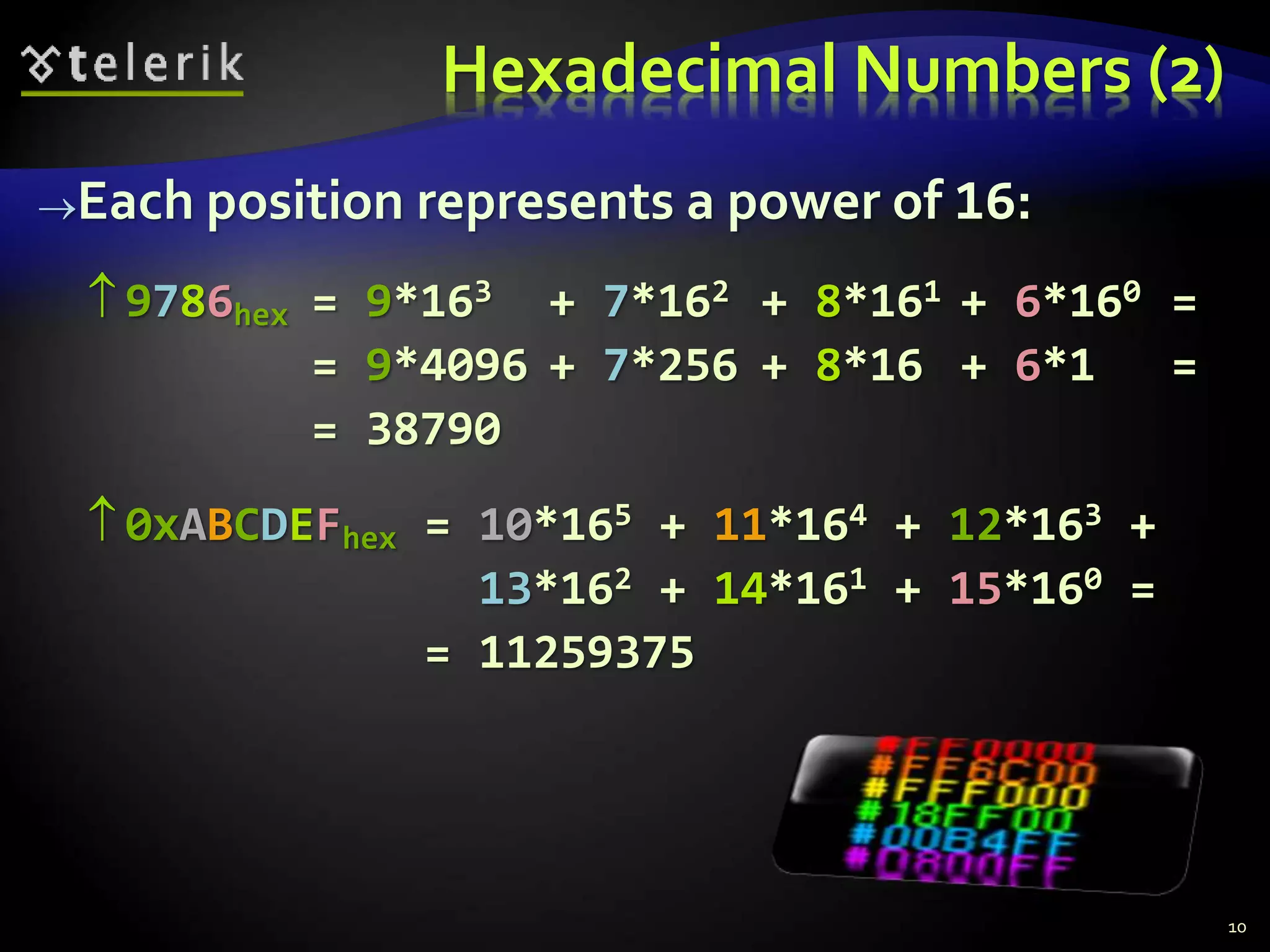
Each position represents a power of 16:
 9786hex = 9*163 + 7*162 + 8*161 + 6*160 =
= 9*4096 + 7*256 + 8*16 + 6*1 =
= 38790
 0xABCDEFhex = 10*165 + 11*164 + 12*163 +
13*162 + 14*161 + 15*160 =
= 11259375
10
Hexadecimal to Decimal
Conversion
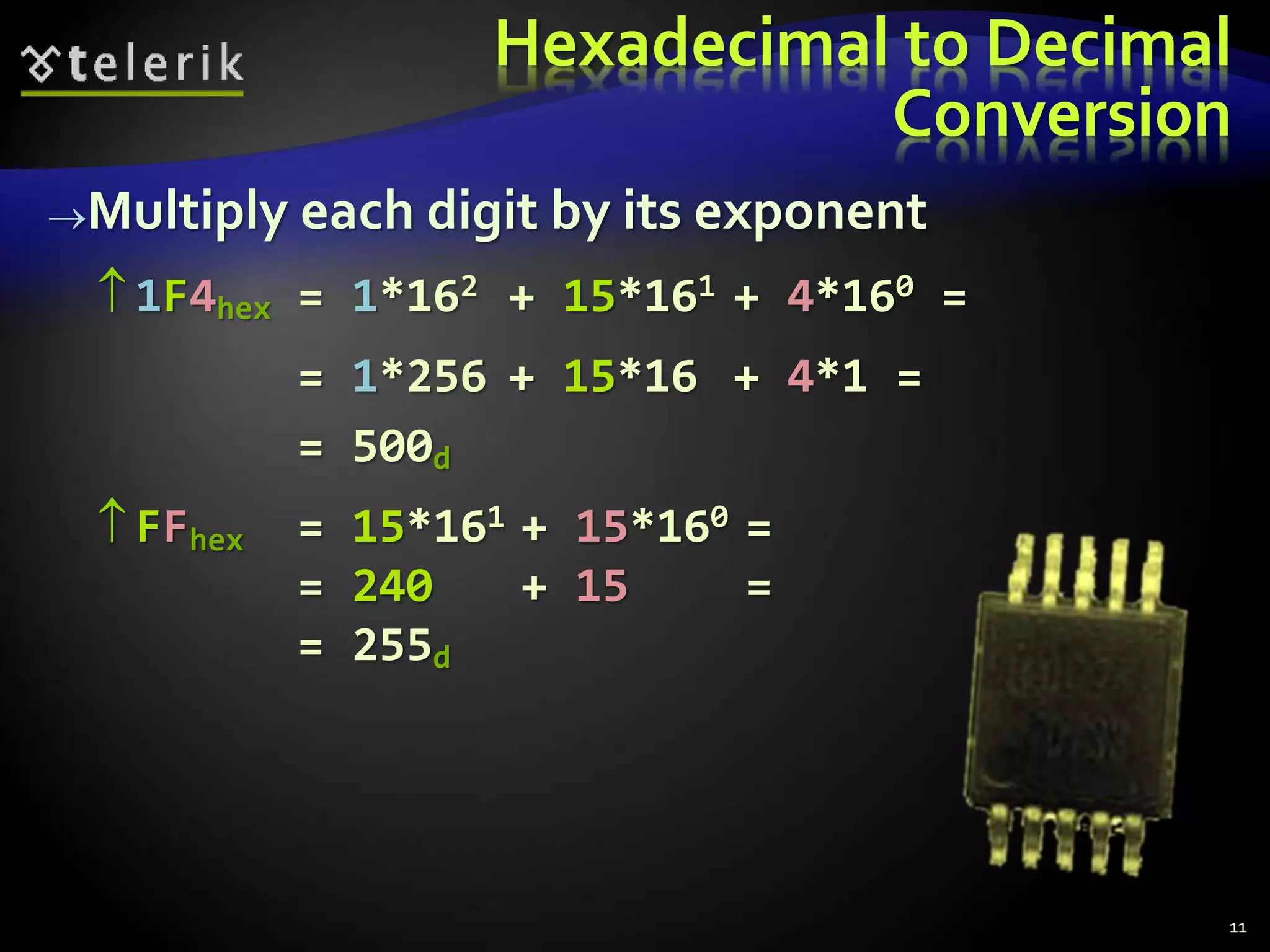
Multiply each digit by its exponent
 1F4hex = 1*162 + 15*161 + 4*160 =
= 1*256 + 15*16 + 4*1 =
= 500d
 FFhex = 15*161 + 15*160 =
= 240 + 15 =
= 255d
11
Decimal to Hexadecimal
Conversion
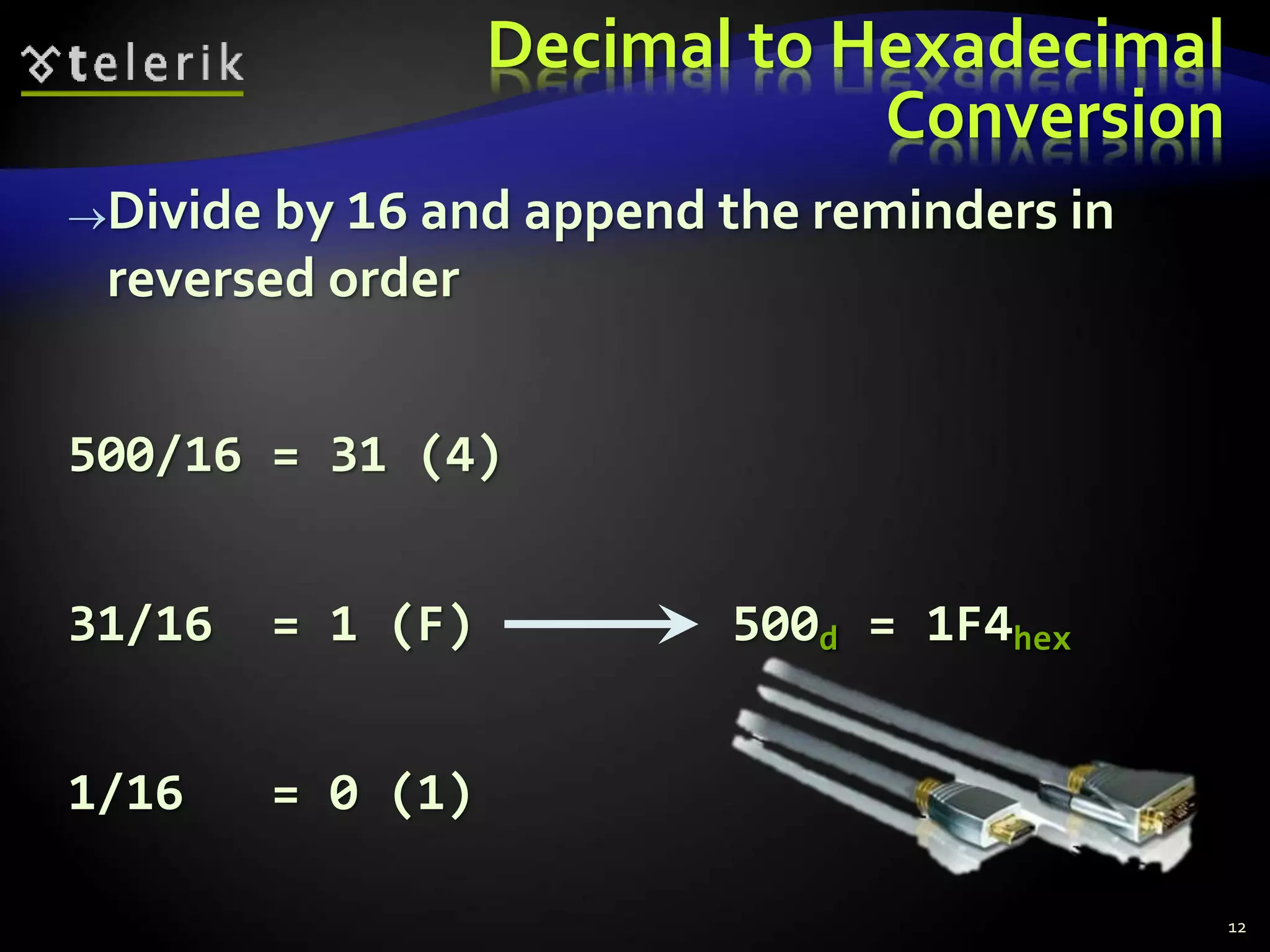
Divide by 16 and append the reminders in
reversed order
500/16 = 31 (4)
31/16 = 1 (F) 500d = 1F4hex
1/16 = 0 (1)
12
Binary to Hexadecimal
(and Back) Conversion
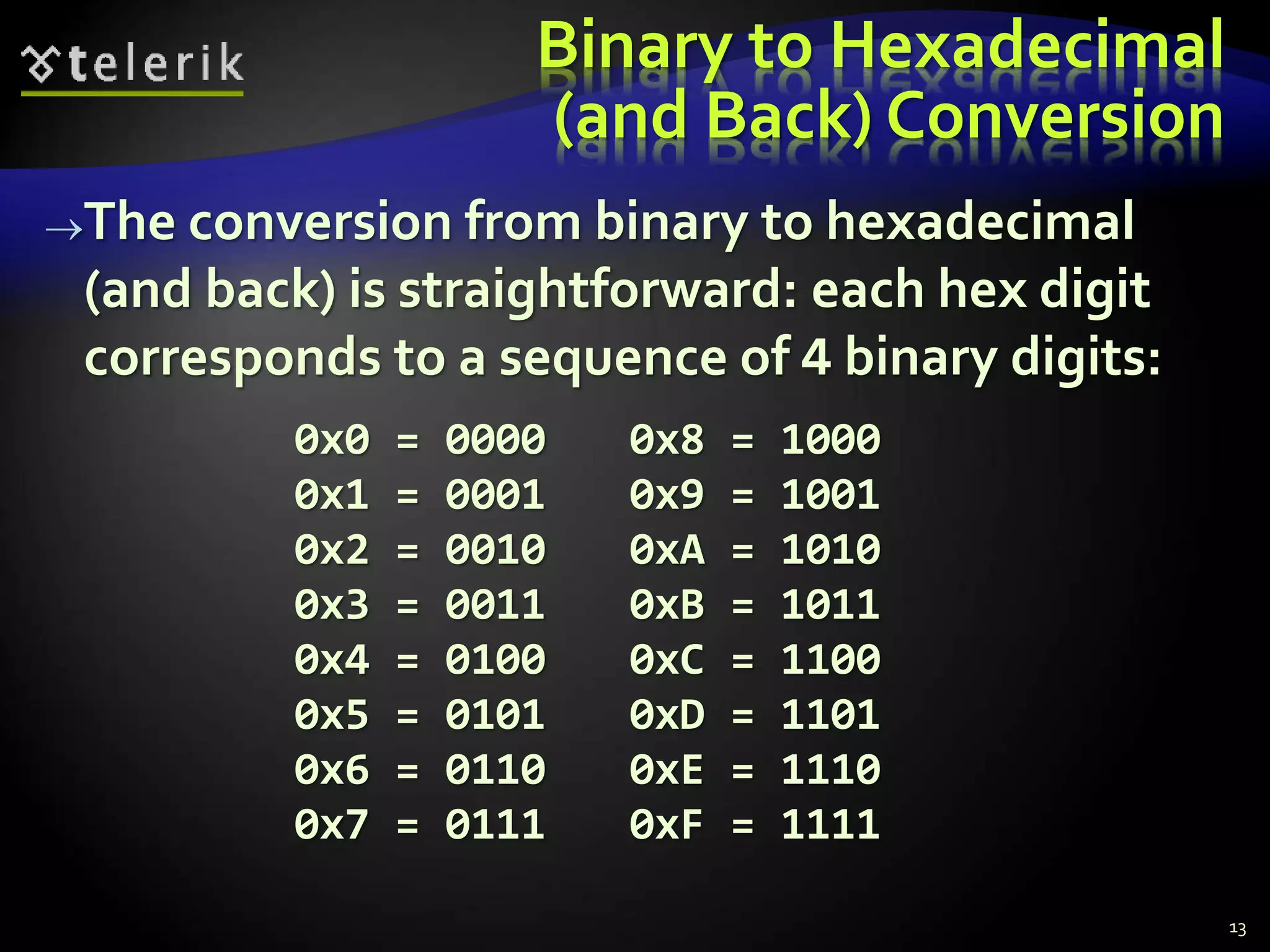
The conversion from binary to hexadecimal
(and back) is straightforward: each hex digit
corresponds to a sequence of 4 binary digits:
0x0 = 0000 0x8 = 1000
0x1 = 0001 0x9 = 1001
0x2 = 0010 0xA = 1010
0x3 = 0011 0xB = 1011
0x4 = 0100 0xC = 1100
0x5 = 0101 0xD = 1101
0x6 = 0110 0xE = 1110
0x7 = 0111 0xF = 1111
13
Numbers Representation
Positive and Negative Integers and
Floating-Point Numbers
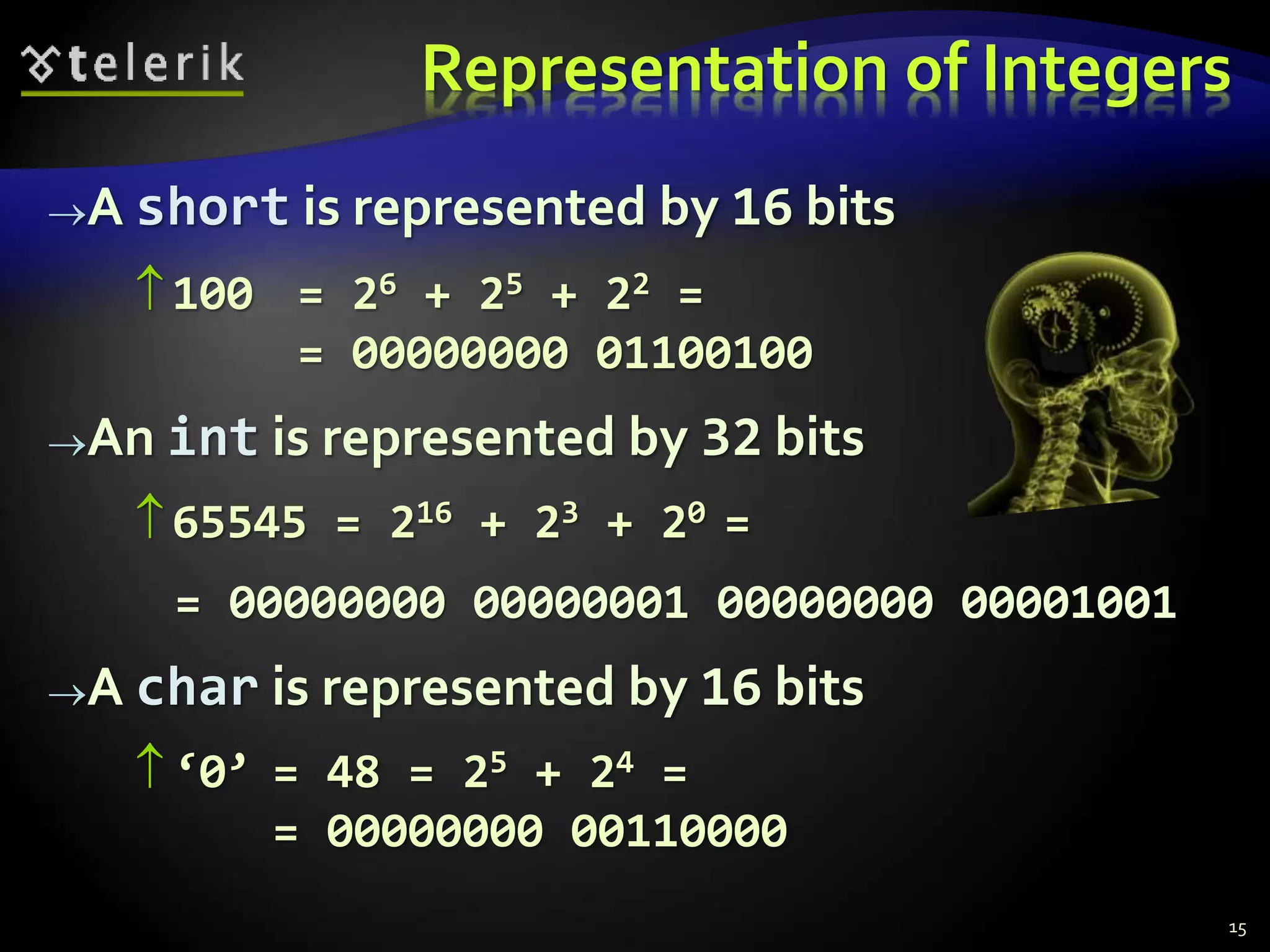
Representation of Integers
A short is represented by 16 bits
100 = 26 + 25 + 22 =
= 00000000 01100100
An int is represented by 32 bits
65545 = 216 + 23 + 20 =
= 00000000 00000001 00000000 00001001
A char is represented by 16 bits
‘0’ = 48 = 25 + 24 =
= 00000000 00110000
15
Positive and Negative Numbers
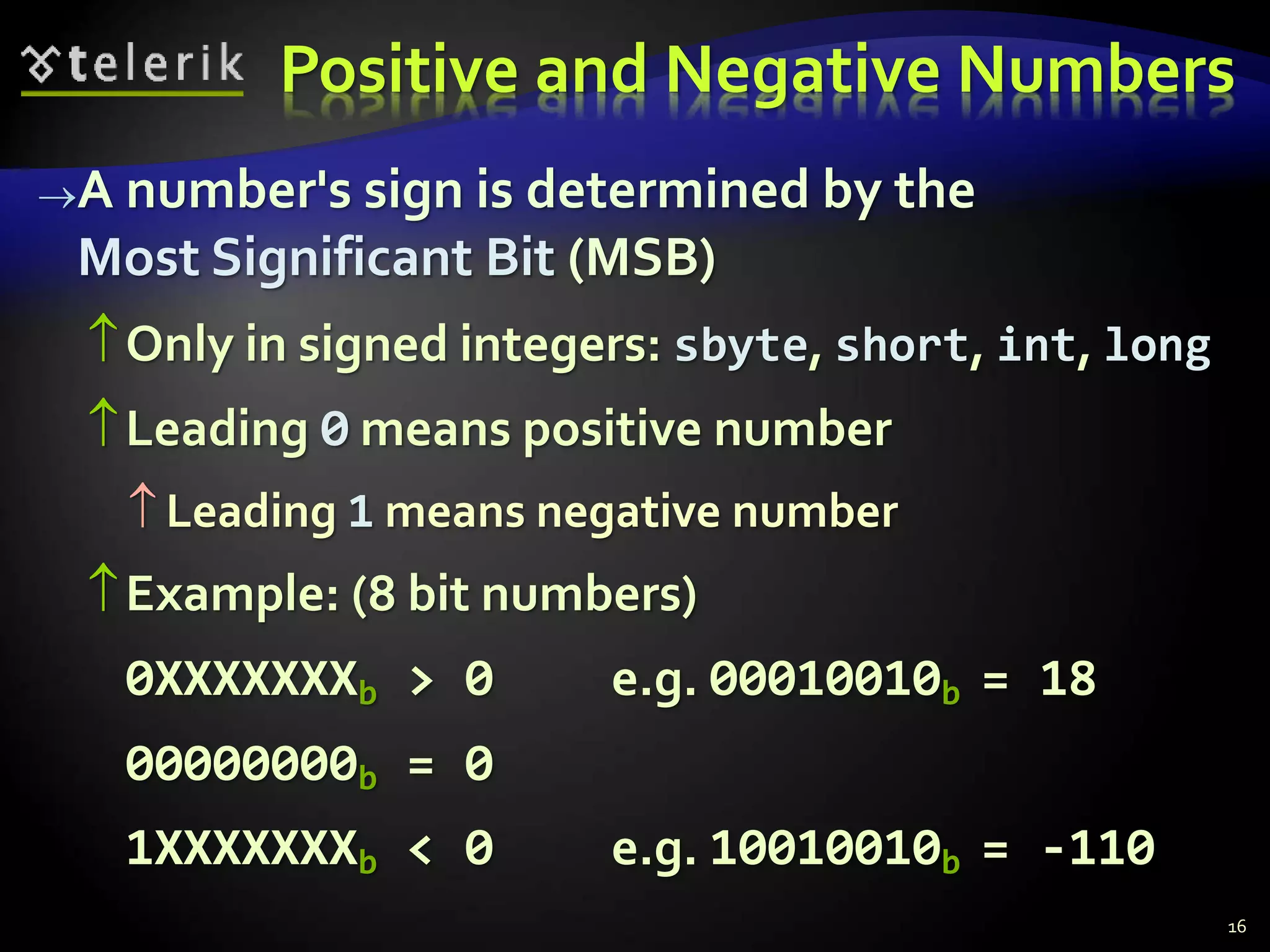
A number's sign is determined by the
Most Significant Bit (MSB)
Only in signed integers: sbyte, short, int, long
Leading 0 means positive number
 Leading 1 means negative number
Example: (8 bit numbers)
0XXXXXXXb > 0 e.g. 00010010b = 18
00000000b = 0
1XXXXXXXb < 0 e.g. 10010010b = -110
16
Positive and Negative Numbers (2)
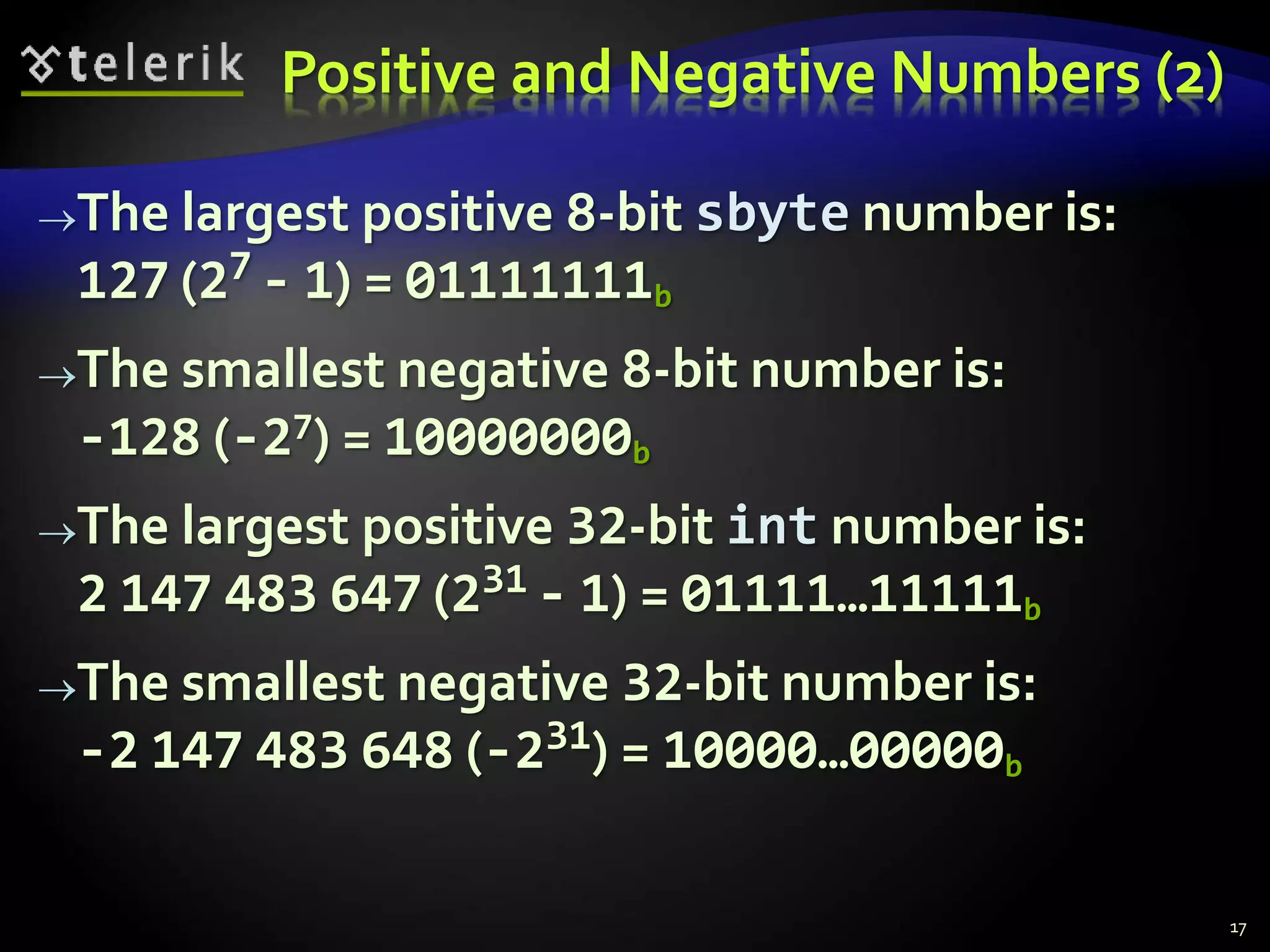
The largest positive 8-bit sbyte number is:
127 (27 - 1) = 01111111b
The smallest negative 8-bit number is:
-128 (-27) = 10000000b
The largest positive 32-bit int number is:
2 147 483 647 (231 - 1) = 01111…11111b
The smallest negative 32-bit number is:
-2 147 483 648 (-231) = 10000…00000b
17
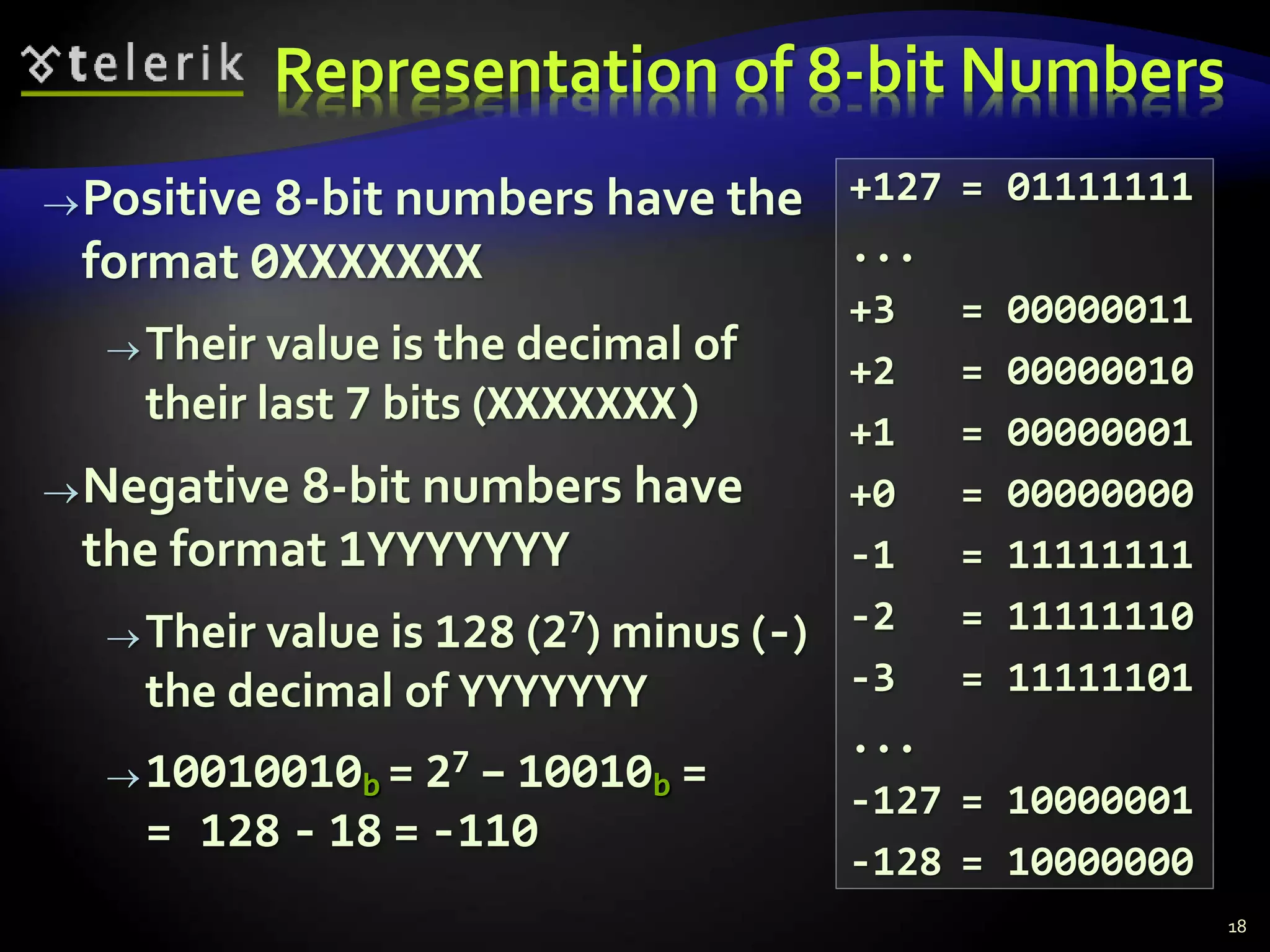
Representation of 8-bit Numbers
+127 = 01111111
...
+3 = 00000011
+2 = 00000010
+1 = 00000001
+0 = 00000000
-1 = 11111111
-2 = 11111110
-3 = 11111101
...
-127 = 10000001
-128 = 10000000
Positive 8-bit numbers have the
format 0XXXXXXX
Their value is the decimal of
their last 7 bits (XXXXXXX)
Negative 8-bit numbers have
the format 1YYYYYYY
Their value is 128 (27) minus (-)
the decimal of YYYYYYY
10010010b = 27 – 10010b =
= 128 - 18 = -110
18
Floating-Point Numbers
Floating-point numbers representation
(according to the IEEE 754 standard*):
Example:
19
2k-1 20 2-1 2-2 2-n
S P0 ... Pk-1 M0 M1 ... Mn-1
Sign Exponent Mantissa
1 10000011 01010010100000000000000
Mantissa = 1,322265625Exponent = 4Sign = -1
Bits [22…0]Bits [30…23]Bit 31
* See http://en.wikipedia.org/wiki/Floating_point
Text Representation in
Computer Systems
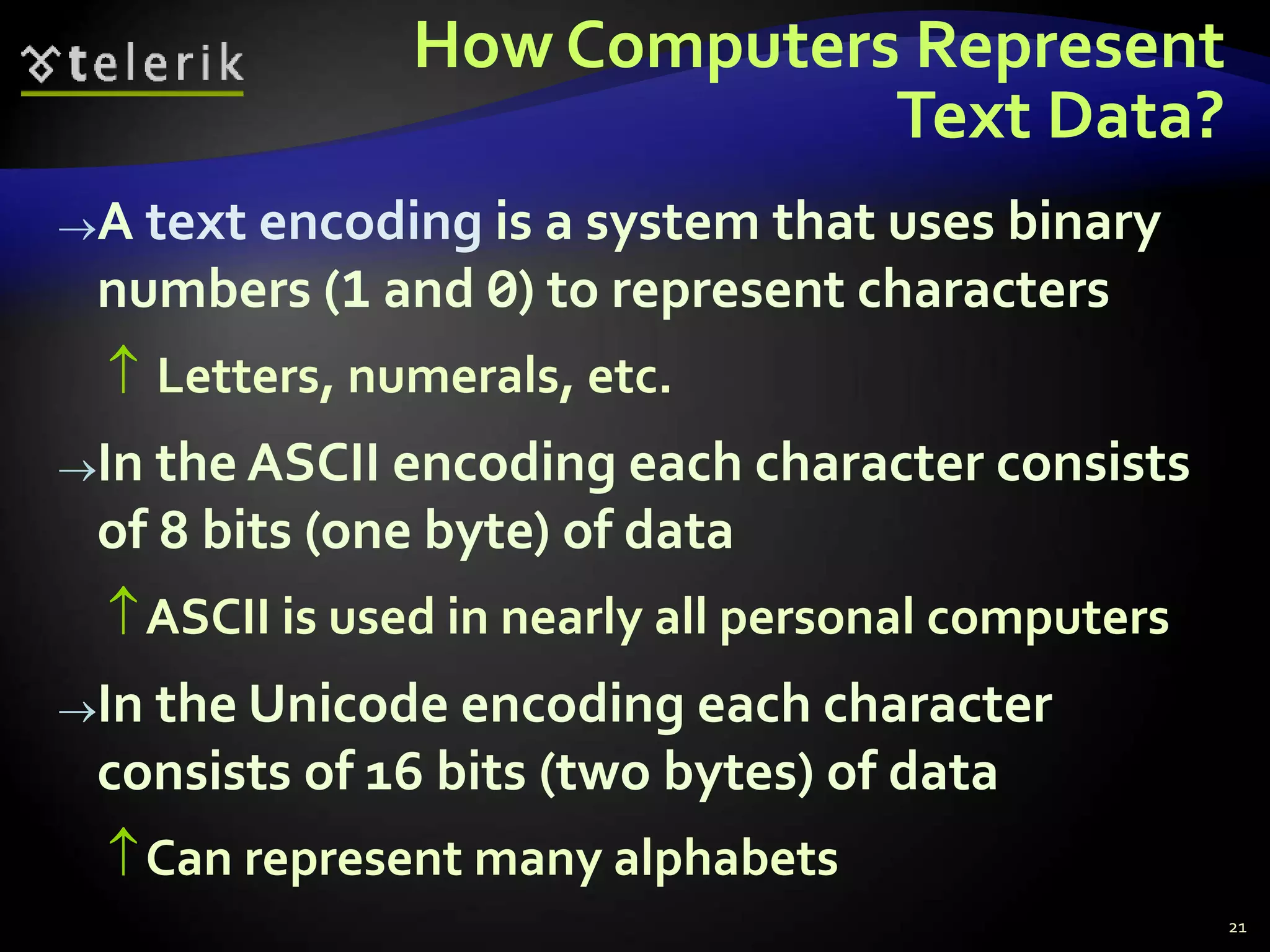
How Computers Represent
Text Data?
A text encoding is a system that uses binary
numbers (1 and 0) to represent characters
 Letters, numerals, etc.
In the ASCII encoding each character consists
of 8 bits (one byte) of data
ASCII is used in nearly all personal computers
In the Unicode encoding each character
consists of 16 bits (two bytes) of data
Can represent many alphabets
21
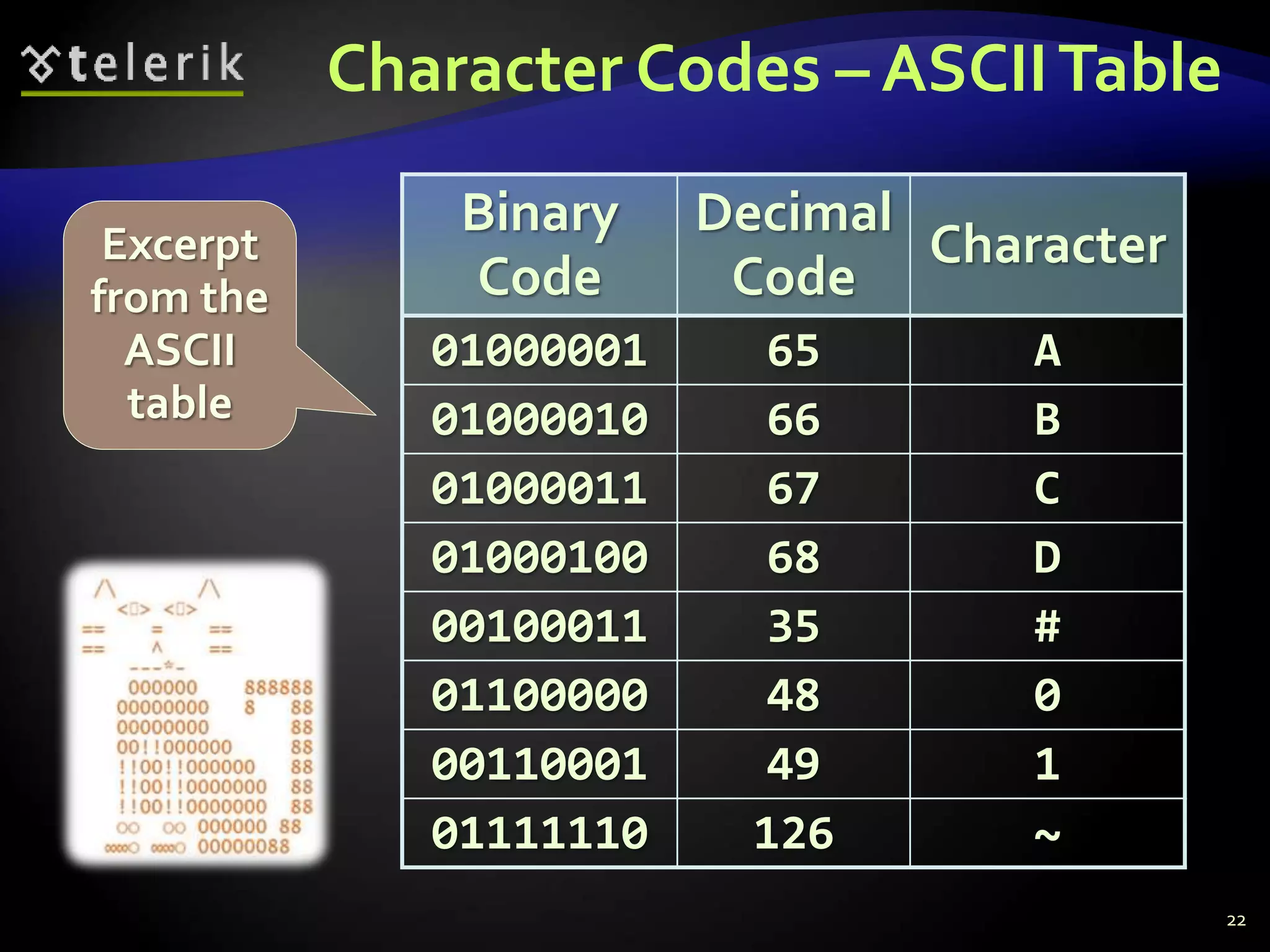
Character Codes – ASCIITable
Excerpt
from the
ASCII
table
Binary
Code
Decimal
Code
Character
01000001 65 A
01000010 66 B
01000011 67 C
01000100 68 D
00100011 35 #
01100000 48 0
00110001 49 1
01111110 126 ~
22
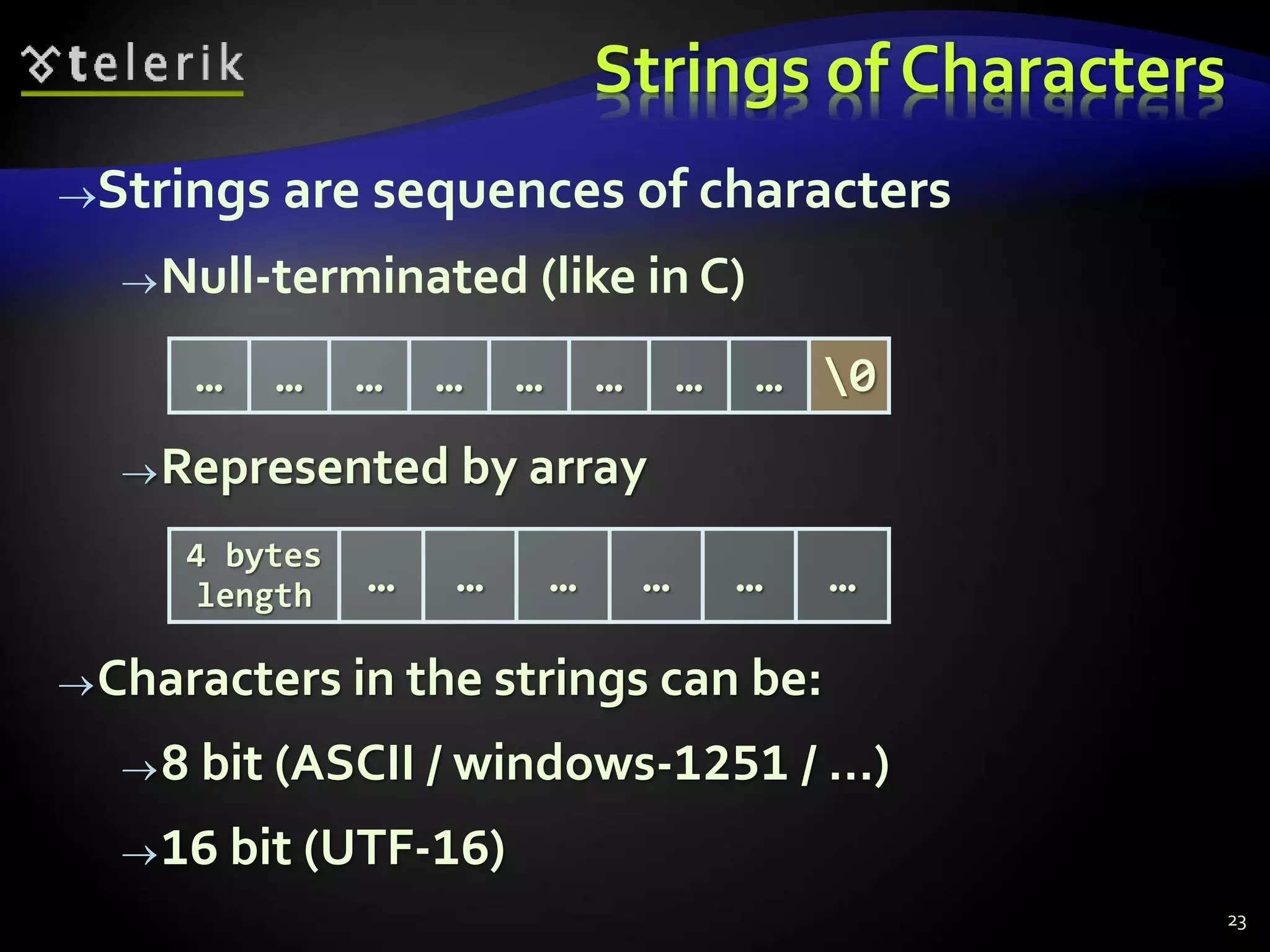
Strings of Characters
Strings are sequences of characters
Null-terminated (like in C)
Represented by array
Characters in the strings can be:
8 bit (ASCII / windows-1251 / …)
16 bit (UTF-16)
… … … … … … … … 0
4 bytes
length … … … … … …
23
Questions?
Numeral Systems
http://academy.telerik.com
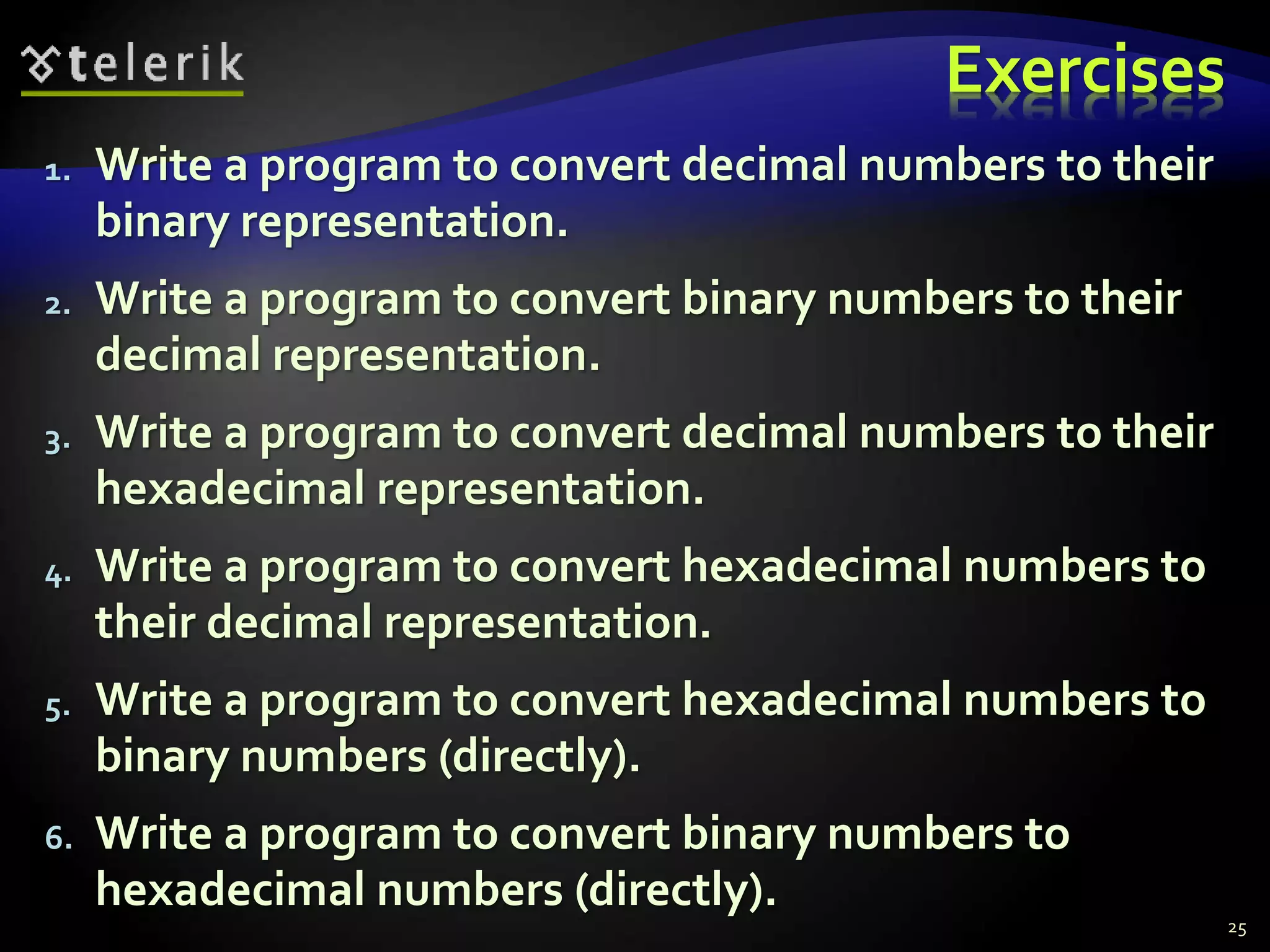
Exercises
1. Write a program to convert decimal numbers to their
binary representation.
2. Write a program to convert binary numbers to their
decimal representation.
3. Write a program to convert decimal numbers to their
hexadecimal representation.
4. Write a program to convert hexadecimal numbers to
their decimal representation.
5. Write a program to convert hexadecimal numbers to
binary numbers (directly).
6. Write a program to convert binary numbers to
hexadecimal numbers (directly).
25
Exercises (2)
7. Write a program to convert from any numeral system
of given base s to any other numeral system of base
d (2 ≤ s, d ≤ 16).
8. Write a program that shows the binary
representation of given 16-bit signed integer number
(the C# type short).
9. * Write a program that shows the internal binary
representation of given 32-bit signed floating-point
number in IEEE 754 format (the C# type float).
Example: -27,25  sign = 1, exponent = 10000011,
mantissa = 10110100000000000000000.
26

08 Numeral systems

  • 1.
    Numeral Systems Binary, Decimaland Hexadecimal Numbers Svetlin Nakov Telerik Corporation www.telerik.com
  • 2.
    Table of Contents 1.Numerals Systems Binary and Decimal Numbers Hexadecimal Numbers Conversion between Numeral Systems 3. Representation of Numbers Positive and Negative Integer Numbers Floating-Point Numbers 4. Text Representation 2
  • 3.
  • 4.
    Decimal numbers (base10) Represented using 10 numerals: 0, 1, 2, 3, 4, 5, 6, 7, 8, 9 Each position represents a power of 10: 401 = 4*102 + 0*101 + 1*100 = 400 + 1 130 = 1*102 + 3*101 + 0*100 = 100 + 30 9786 = 9*103 + 7*102 + 8*101 + 6*100 = = 9*1000 + 7*100 + 8*10 + 6*1 Decimal Numbers 4
  • 5.
    Binary Numeral System 5 10 1 1 0 0 1 01 0 0 1 0 0 1 01 0 0 1 0 0 1 11 1 1 1 1 1 1 1 Binary numbers are represented by sequence of bits (smallest unit of information – 0 or 1)  Bits are easy to represent in electronics
  • 6.
    Binary numbers (base2) Represented by 2 numerals: 0 and 1 Each position represents a power of 2:  101b = 1*22 + 0*21 + 1*20 = 100b + 1b = 4 + 1 = = 5  110b = 1*22 + 1*21 + 0*20 = 100b + 10b = 4 + 2 = = 6  110101b = 1*25 + 1*24 + 0*23 + 1*22 + 0*21 + 1*20 = = 32 + 16 + 4 + 1 = = 53 Binary Numbers 6
  • 7.
    Binary to DecimalConversion Multiply each numeral by its exponent:  1001b = 1*23 + 1*20 = 1*8 + 1*1 = = 9  0111b = 0*23 + 1*22 + 1*21 + 1*20 = = 100b + 10b + 1b = 4 + 2 + 1 = = 7  110110b = 1*25 + 1*24 + 0*23 + 1*22 + 1*21 = = 100000b + 10000b + 100b + 10b = = 32 + 16 + 4 + 2 = = 54 7
  • 8.
    Decimal to BinaryConversion Divide by 2 and append the reminders in reversed order: 500/2 = 250 (0) 250/2 = 125 (0) 125/2 = 62 (1) 62/2 = 31 (0) 500d = 111110100b 31/2 = 15 (1) 15/2 = 7 (1) 7/2 = 3 (1) 3/2 = 1 (1) 1/2 = 0 (1) 8
  • 9.
    Hexadecimal Numbers Hexadecimal numbers(base 16)  Represented using 16 numerals: 0, 1, 2, ... 9, A, B, C, D, E and F Usually prefixed with 0x 0  0x0 8  0x8 1  0x1 9  0x9 2  0x2 10  0xA 3  0x3 11  0xB 4  0x4 12  0xC 5  0x5 13  0xD 6  0x6 14  0xE 7  0x7 15  0xF 9
  • 10.
    Hexadecimal Numbers (2) Eachposition represents a power of 16:  9786hex = 9*163 + 7*162 + 8*161 + 6*160 = = 9*4096 + 7*256 + 8*16 + 6*1 = = 38790  0xABCDEFhex = 10*165 + 11*164 + 12*163 + 13*162 + 14*161 + 15*160 = = 11259375 10
  • 11.
    Hexadecimal to Decimal Conversion Multiplyeach digit by its exponent  1F4hex = 1*162 + 15*161 + 4*160 = = 1*256 + 15*16 + 4*1 = = 500d  FFhex = 15*161 + 15*160 = = 240 + 15 = = 255d 11
  • 12.
    Decimal to Hexadecimal Conversion Divideby 16 and append the reminders in reversed order 500/16 = 31 (4) 31/16 = 1 (F) 500d = 1F4hex 1/16 = 0 (1) 12
  • 13.
    Binary to Hexadecimal (andBack) Conversion The conversion from binary to hexadecimal (and back) is straightforward: each hex digit corresponds to a sequence of 4 binary digits: 0x0 = 0000 0x8 = 1000 0x1 = 0001 0x9 = 1001 0x2 = 0010 0xA = 1010 0x3 = 0011 0xB = 1011 0x4 = 0100 0xC = 1100 0x5 = 0101 0xD = 1101 0x6 = 0110 0xE = 1110 0x7 = 0111 0xF = 1111 13
  • 14.
    Numbers Representation Positive andNegative Integers and Floating-Point Numbers
  • 15.
    Representation of Integers Ashort is represented by 16 bits 100 = 26 + 25 + 22 = = 00000000 01100100 An int is represented by 32 bits 65545 = 216 + 23 + 20 = = 00000000 00000001 00000000 00001001 A char is represented by 16 bits ‘0’ = 48 = 25 + 24 = = 00000000 00110000 15
  • 16.
    Positive and NegativeNumbers A number's sign is determined by the Most Significant Bit (MSB) Only in signed integers: sbyte, short, int, long Leading 0 means positive number  Leading 1 means negative number Example: (8 bit numbers) 0XXXXXXXb > 0 e.g. 00010010b = 18 00000000b = 0 1XXXXXXXb < 0 e.g. 10010010b = -110 16
  • 17.
    Positive and NegativeNumbers (2) The largest positive 8-bit sbyte number is: 127 (27 - 1) = 01111111b The smallest negative 8-bit number is: -128 (-27) = 10000000b The largest positive 32-bit int number is: 2 147 483 647 (231 - 1) = 01111…11111b The smallest negative 32-bit number is: -2 147 483 648 (-231) = 10000…00000b 17
  • 18.
    Representation of 8-bitNumbers +127 = 01111111 ... +3 = 00000011 +2 = 00000010 +1 = 00000001 +0 = 00000000 -1 = 11111111 -2 = 11111110 -3 = 11111101 ... -127 = 10000001 -128 = 10000000 Positive 8-bit numbers have the format 0XXXXXXX Their value is the decimal of their last 7 bits (XXXXXXX) Negative 8-bit numbers have the format 1YYYYYYY Their value is 128 (27) minus (-) the decimal of YYYYYYY 10010010b = 27 – 10010b = = 128 - 18 = -110 18
  • 19.
    Floating-Point Numbers Floating-point numbersrepresentation (according to the IEEE 754 standard*): Example: 19 2k-1 20 2-1 2-2 2-n S P0 ... Pk-1 M0 M1 ... Mn-1 Sign Exponent Mantissa 1 10000011 01010010100000000000000 Mantissa = 1,322265625Exponent = 4Sign = -1 Bits [22…0]Bits [30…23]Bit 31 * See http://en.wikipedia.org/wiki/Floating_point
  • 20.
  • 21.
    How Computers Represent TextData? A text encoding is a system that uses binary numbers (1 and 0) to represent characters  Letters, numerals, etc. In the ASCII encoding each character consists of 8 bits (one byte) of data ASCII is used in nearly all personal computers In the Unicode encoding each character consists of 16 bits (two bytes) of data Can represent many alphabets 21
  • 22.
    Character Codes –ASCIITable Excerpt from the ASCII table Binary Code Decimal Code Character 01000001 65 A 01000010 66 B 01000011 67 C 01000100 68 D 00100011 35 # 01100000 48 0 00110001 49 1 01111110 126 ~ 22
  • 23.
    Strings of Characters Stringsare sequences of characters Null-terminated (like in C) Represented by array Characters in the strings can be: 8 bit (ASCII / windows-1251 / …) 16 bit (UTF-16) … … … … … … … … 0 4 bytes length … … … … … … 23
  • 24.
  • 25.
    Exercises 1. Write aprogram to convert decimal numbers to their binary representation. 2. Write a program to convert binary numbers to their decimal representation. 3. Write a program to convert decimal numbers to their hexadecimal representation. 4. Write a program to convert hexadecimal numbers to their decimal representation. 5. Write a program to convert hexadecimal numbers to binary numbers (directly). 6. Write a program to convert binary numbers to hexadecimal numbers (directly). 25
  • 26.
    Exercises (2) 7. Writea program to convert from any numeral system of given base s to any other numeral system of base d (2 ≤ s, d ≤ 16). 8. Write a program that shows the binary representation of given 16-bit signed integer number (the C# type short). 9. * Write a program that shows the internal binary representation of given 32-bit signed floating-point number in IEEE 754 format (the C# type float). Example: -27,25  sign = 1, exponent = 10000011, mantissa = 10110100000000000000000. 26

Editor's Notes