NUMBER SYSTEM
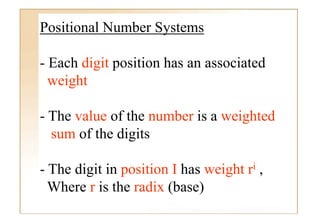
Positional Number Systems

- Each digit position has an associated
  weight

- The value of the number i a weighted
   h    l    f h      b is      i h d
  sum of the digits

- Th di it i position I h weight ri ,
  The digit in    iti    has i ht
  Where r is the radix (base)
                       (    )
O
Octal and Hexadecimal Numbers
- Radix 8 and 16
- Useful for representing multi-bit numbers
               p        g
-Conversion from binary is done
by separating the bits into groups of
three or four (R-L) and replace each group
with the corresponding octal or hexadecimal
number
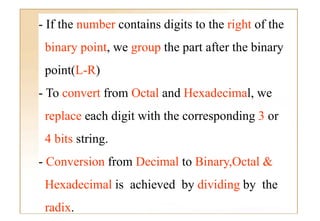
- If the number contains digits to the right of the
 binary point, we group the part after the binary
 point(L-R)
- To convert from Octal and Hexadecimal, we
 replace each digit with the corresponding 3 or
 4 bits string
        string.
- Conversion from Decimal to Binary,Octal &
                                  y,
 Hexadecimal is achieved by dividing by the
 radix.
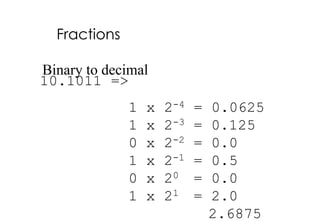
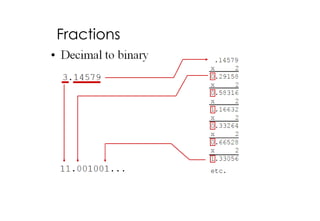
Fractions

Binary to decimal
10.1011 >
10 1011 =>
              1   x   2-4    =   0.0625
              1   x   2-3    =   0.125
              0   x   2-22   =   0.0
                                 0 0
              1   x   2-1    =   0.5
              0   x   20     =   0.0
              1   x   21     =   2.0
                                 2 0
                                 2.6875
Fractions
Fractions
(0.375)10
0.375 X 2 = 0.750 0
0.750 X 2 = 1.500 1
1.500
1 500 X 2 = 1 000 1
            1.000
000 X 0 = 0          0
      (0.375)10= (0.011)2
• Octal Addition (&
  Subtraction)
• 11
  456
  123
  601
Hexadecimal Addition (&
            Subtraction)
A   C   5   A   9
E   D   6   9   4
                D
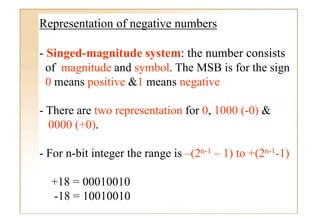
Representation of negative numbers
 ep ese tat o o egat ve u be s

- Singed-magnitude system: the number consists
  Singed magnitude
  of magnitude and symbol. The MSB is for the sign
  0 means positive &1 means negative

- There are two representation for 0 1000 ( 0) &
                                   0,     (-0)
  0000 (+0).

- For n-bit integer the range is –(2n-1 – 1) to +(2n-1-1)

  +18 = 00010010
  -18 = 10010010
   18
- One complement : The MSB is for the sign.

- Boolean complement all bits to negate
   +18 = 00010010
   -18 = 11101101

- Two representations of zero: 0000 (+0)
                               1111 (-0)

- The range is –(2n-1 – 1) to +(2n-1-1).
                (2n            (2n 1).
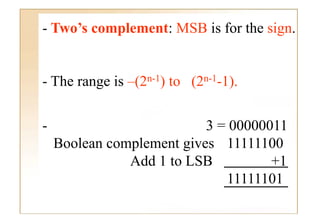
- Two’s complement: MSB is for the sign
                                   sign.


- The range is –(2n-1) to (2n-1-1)
                (2             -1).

-                          3 = 00000011
    Boolean complement gives 11111100
    B l         l        i
               Add 1 to LSB          +1
                              11111101
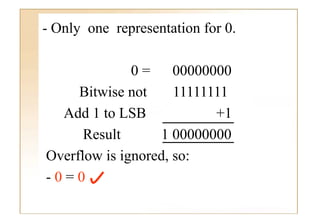
- Only one representation for 0
                              0.

              0 = 00000000
     Bitwise not     11111111
  Add 1 t LSB
         to                +1
      Result       1 00000000
Overflow is ignored, so:
-0=0
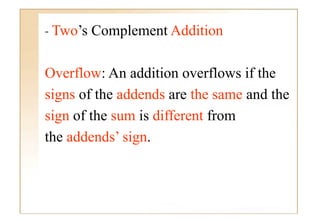
-T ’
 Two’s   C
         Complement Additi
             l    t Addition

Overflow: An addition overflows if the
signs of the addends are the same and the
sign of the sum i diff
 i    f h       is different f
                             from
the addends’ sign
    addends sign.
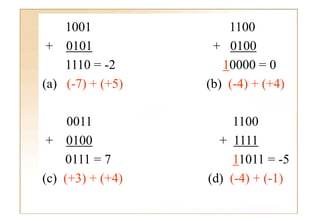
1001              1100
 + 0101            + 0100
    1110 = -2        10000 = 0
(a) ( 7) + (+5)
    (-7)          (b) ( 4) + (+4)
                      (-4)

     0011              1100
 + 0100             + 1111
    0111 = 7           11011 = -5
(c) (+3) + (+4)   (d) (-4) + (-1)
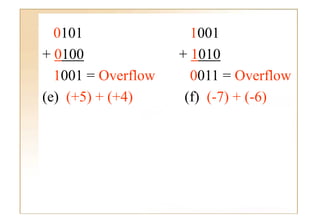
0101                1001
+ 0100              + 1010
  1001 = Overflow     0011 = Overflow
(e) (+5) + (+4)      (f) (-7) + (-6)
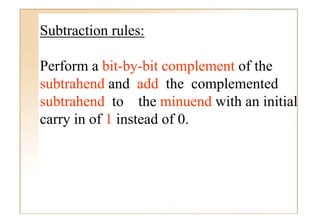
Subtraction l
S bt ti rules:

Perform a bit-by-bit complement of the
subtrahend and add the complemented
subtrahend to the minuend with an initial
carry in of 1 instead of 0.
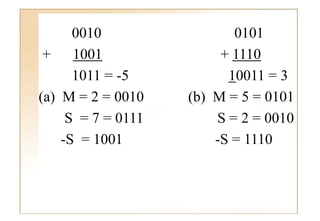
0010                  0101
 + 1001                  + 1110
      1011 = -5            10011 = 3
(a) M = 2 = 0010    (b) M = 5 = 0101
     S = 7 = 0111       S = 2 = 0010
    -S = 1001
     S                  -S = 1110
                         S
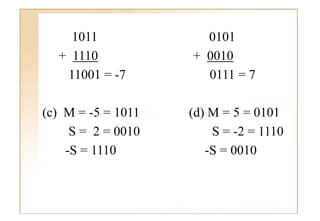
1011              0101
  + 1110            + 0010
   11001 = -7         0111 = 7

(c)
( ) M = -5 = 1011
         5          (d) M = 5 = 0101
     S = 2 = 0010       S = -2 = 1110
    -S = 1110          -S = 0010
0111                1010
 + 0111              + 1100
   1110 = Overflow    10110 = Overflow

(e) M = 7 = 0111     (f) M = -6 = 1010
     S = -7 = 1001
          7               S = 4 = 0100
    -S = 0111                -S = 1100
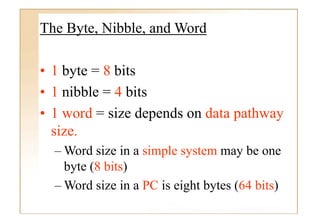
The Byte Nibble, and Word
    Byte, Nibble

• 1 byte = 8 bits
• 1 nibble = 4 bits
• 1 word = size depends on d t pathway
        d i d        d     data th
  size.
  – Word size in a simple system may be one
    byte (8 bits)
  – Word size in a PC is eight bytes (64 bits)
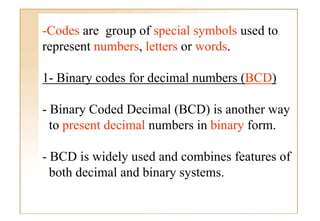
-Codes are group of special symbols used t
 C d               f      i l    b l   d to
represent numbers, letters or words.

1- Binary codes for decimal numbers (BCD)
        y                           (   )

- Binary Coded Decimal (BCD) is another way
  to present decimal numbers in binary form.

- BCD is widely used and combines features of
  both decimal and binary systems.
- Each digit of a decimal is represented by its
  four bit
  four-bit binary equivalent (1 to 9)

- To represent the decimal number 10 we need
                           n mber     e
  eight bits (0001 0000)
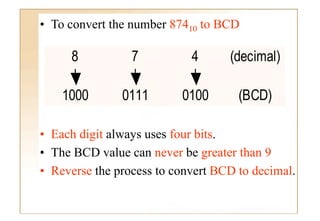
• To convert the number 87410 to BCD

     8           7          4      (decimal)

    1000       0111       0100       (BCD)

• Each digit always uses four bits.
   ac d g t a ways        ou b ts.
• The BCD value can never be greater than 9
• Reverse the process to convert BCD to decimal.
• BCD i not a number system.
      is t       b      t

• BCD is a decimal number with each digit
  encoded to its binary equivalent.
                        equivalent

• A BCD number is not the same as a straight
  binary number.
         number

• The primary advantage of BCD is the relative
  ease of converting to and from decimal.
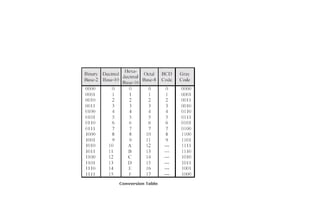
Decimal Binary Octal Hexadecimal   BCD
   0      0     0         0          0
   1      1     1         1        0001
   2      10    2         2        0010
   3      11    3         3        0011
   4     100    4         4        0100
   5     101    5         5        0101
   6     110    6         6        0110
   7     111    7         7        0111
   8     1000   10        8        1000
   9     1001   11        9        1001
  10     1010   12       A       0001 0000
  11     1011   13       B       0001 0001
  12     1100   14       C       0001 0010
  13     1101   15       D       0001 0011
  14     1110   16       E       0001 0100
  15     1111   17        F      0001 0101
2
2- American Standard Code for Information
   Interchange (ASCII)

- It is a seven bit code. It has 27 possible code
groups.

- Represents characters and functions found on
a computer keyboard.

- Examples of use are: to transfer information
between computers, between computers and
printers, and f i
  i         d for internal storage.
                         l
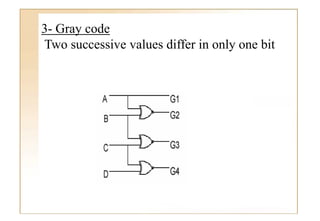
3-
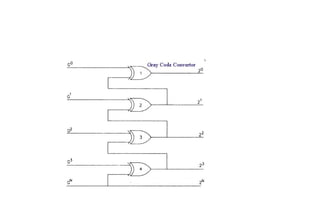
3 Gray code
Two successive values differ in only one bit
• 4- Codes for detecting and correcting
  errors

•   Error means corruption of data
                              data.
•       - Parity Bit
•       - Hamming C d
                  i  Code
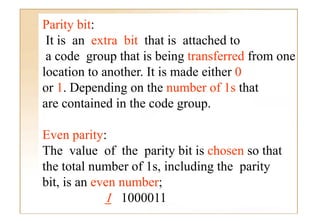
Parity bit:
 It is an extra bit that is attached to
 a code group that is being transferred from one
location to another. It is made either 0
or 1 Depending on the number of 1 that
    1.      di        h       b    f 1s h
are contained in the code group.

Even parity:
The value of the parity bit is chosen so that
the total number of 1s including the parity
                    1s,
bit, is an even number;
             1 1000011
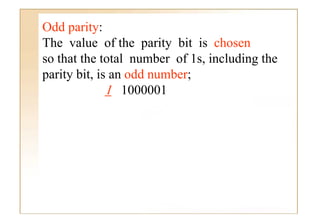
Odd parity:
The value of the parity bit is chosen
so th t th t t l number of 1 i l di th
   that the total      b   f 1s, including the
parity bit, is an odd number;
              1 1000001
Assignment (1)

1- Indicate whether or not overflow occurs
when adding the following 8-bits
                            8 bits
two’s complement numbers 00100110
                             + 01011010
(2.12 d textbok2)

2- 2-1.c (textbook1)
3- 2-11.c
4 2 19.c
4- 2-19.c
5- 2-24

Number system

  • 1.
  • 2.
    Positional Number Systems -Each digit position has an associated weight - The value of the number i a weighted h l f h b is i h d sum of the digits - Th di it i position I h weight ri , The digit in iti has i ht Where r is the radix (base) ( )
  • 3.
    O Octal and HexadecimalNumbers - Radix 8 and 16 - Useful for representing multi-bit numbers p g -Conversion from binary is done by separating the bits into groups of three or four (R-L) and replace each group with the corresponding octal or hexadecimal number
  • 4.
    - If thenumber contains digits to the right of the binary point, we group the part after the binary point(L-R) - To convert from Octal and Hexadecimal, we replace each digit with the corresponding 3 or 4 bits string string. - Conversion from Decimal to Binary,Octal & y, Hexadecimal is achieved by dividing by the radix.
  • 5.
    Fractions Binary to decimal 10.1011> 10 1011 => 1 x 2-4 = 0.0625 1 x 2-3 = 0.125 0 x 2-22 = 0.0 0 0 1 x 2-1 = 0.5 0 x 20 = 0.0 1 x 21 = 2.0 2 0 2.6875
  • 6.
  • 7.
    Fractions (0.375)10 0.375 X 2= 0.750 0 0.750 X 2 = 1.500 1 1.500 1 500 X 2 = 1 000 1 1.000 000 X 0 = 0 0 (0.375)10= (0.011)2
  • 8.
    • Octal Addition(& Subtraction) • 11 456 123 601
  • 9.
    Hexadecimal Addition (& Subtraction) A C 5 A 9 E D 6 9 4 D
  • 10.
    Representation of negativenumbers ep ese tat o o egat ve u be s - Singed-magnitude system: the number consists Singed magnitude of magnitude and symbol. The MSB is for the sign 0 means positive &1 means negative - There are two representation for 0 1000 ( 0) & 0, (-0) 0000 (+0). - For n-bit integer the range is –(2n-1 – 1) to +(2n-1-1) +18 = 00010010 -18 = 10010010 18
  • 11.
    - One complement: The MSB is for the sign. - Boolean complement all bits to negate +18 = 00010010 -18 = 11101101 - Two representations of zero: 0000 (+0) 1111 (-0) - The range is –(2n-1 – 1) to +(2n-1-1). (2n (2n 1).
  • 12.
    - Two’s complement:MSB is for the sign sign. - The range is –(2n-1) to (2n-1-1) (2 -1). - 3 = 00000011 Boolean complement gives 11111100 B l l i Add 1 to LSB +1 11111101
  • 13.
    - Only onerepresentation for 0 0. 0 = 00000000 Bitwise not 11111111 Add 1 t LSB to +1 Result 1 00000000 Overflow is ignored, so: -0=0
  • 14.
    -T ’ Two’s C Complement Additi l t Addition Overflow: An addition overflows if the signs of the addends are the same and the sign of the sum i diff i f h is different f from the addends’ sign addends sign.
  • 15.
    1001 1100 + 0101 + 0100 1110 = -2 10000 = 0 (a) ( 7) + (+5) (-7) (b) ( 4) + (+4) (-4) 0011 1100 + 0100 + 1111 0111 = 7 11011 = -5 (c) (+3) + (+4) (d) (-4) + (-1)
  • 16.
    0101 1001 + 0100 + 1010 1001 = Overflow 0011 = Overflow (e) (+5) + (+4) (f) (-7) + (-6)
  • 17.
    Subtraction l S btti rules: Perform a bit-by-bit complement of the subtrahend and add the complemented subtrahend to the minuend with an initial carry in of 1 instead of 0.
  • 18.
    0010 0101 + 1001 + 1110 1011 = -5 10011 = 3 (a) M = 2 = 0010 (b) M = 5 = 0101 S = 7 = 0111 S = 2 = 0010 -S = 1001 S -S = 1110 S
  • 19.
    1011 0101 + 1110 + 0010 11001 = -7 0111 = 7 (c) ( ) M = -5 = 1011 5 (d) M = 5 = 0101 S = 2 = 0010 S = -2 = 1110 -S = 1110 -S = 0010
  • 20.
    0111 1010 + 0111 + 1100 1110 = Overflow 10110 = Overflow (e) M = 7 = 0111 (f) M = -6 = 1010 S = -7 = 1001 7 S = 4 = 0100 -S = 0111 -S = 1100
  • 21.
    The Byte Nibble,and Word Byte, Nibble • 1 byte = 8 bits • 1 nibble = 4 bits • 1 word = size depends on d t pathway d i d d data th size. – Word size in a simple system may be one byte (8 bits) – Word size in a PC is eight bytes (64 bits)
  • 22.
    -Codes are groupof special symbols used t C d f i l b l d to represent numbers, letters or words. 1- Binary codes for decimal numbers (BCD) y ( ) - Binary Coded Decimal (BCD) is another way to present decimal numbers in binary form. - BCD is widely used and combines features of both decimal and binary systems.
  • 23.
    - Each digitof a decimal is represented by its four bit four-bit binary equivalent (1 to 9) - To represent the decimal number 10 we need n mber e eight bits (0001 0000)
  • 24.
    • To convertthe number 87410 to BCD 8 7 4 (decimal) 1000 0111 0100 (BCD) • Each digit always uses four bits. ac d g t a ways ou b ts. • The BCD value can never be greater than 9 • Reverse the process to convert BCD to decimal.
  • 25.
    • BCD inot a number system. is t b t • BCD is a decimal number with each digit encoded to its binary equivalent. equivalent • A BCD number is not the same as a straight binary number. number • The primary advantage of BCD is the relative ease of converting to and from decimal.
  • 26.
    Decimal Binary OctalHexadecimal BCD 0 0 0 0 0 1 1 1 1 0001 2 10 2 2 0010 3 11 3 3 0011 4 100 4 4 0100 5 101 5 5 0101 6 110 6 6 0110 7 111 7 7 0111 8 1000 10 8 1000 9 1001 11 9 1001 10 1010 12 A 0001 0000 11 1011 13 B 0001 0001 12 1100 14 C 0001 0010 13 1101 15 D 0001 0011 14 1110 16 E 0001 0100 15 1111 17 F 0001 0101
  • 27.
    2 2- American StandardCode for Information Interchange (ASCII) - It is a seven bit code. It has 27 possible code groups. - Represents characters and functions found on a computer keyboard. - Examples of use are: to transfer information between computers, between computers and printers, and f i i d for internal storage. l
  • 28.
    3- 3 Gray code Twosuccessive values differ in only one bit
  • 31.
    • 4- Codesfor detecting and correcting errors • Error means corruption of data data. • - Parity Bit • - Hamming C d i Code
  • 32.
    Parity bit: Itis an extra bit that is attached to a code group that is being transferred from one location to another. It is made either 0 or 1 Depending on the number of 1 that 1. di h b f 1s h are contained in the code group. Even parity: The value of the parity bit is chosen so that the total number of 1s including the parity 1s, bit, is an even number; 1 1000011
  • 33.
    Odd parity: The valueof the parity bit is chosen so th t th t t l number of 1 i l di th that the total b f 1s, including the parity bit, is an odd number; 1 1000001
  • 34.
    Assignment (1) 1- Indicatewhether or not overflow occurs when adding the following 8-bits 8 bits two’s complement numbers 00100110 + 01011010 (2.12 d textbok2) 2- 2-1.c (textbook1) 3- 2-11.c 4 2 19.c 4- 2-19.c 5- 2-24