Numeral Systems Binary, Decimal and Hexadecimal Numbers Svetlin Nakov Telerik Corporation www.telerik.com
Table of Contents Numerals Systems Binary and Decimal Numbers Hexadecimal Numbers Conversion between Numeral Systems Representation of Numbers Positive and Negative Integer Numbers Floating-Point Numbers Text Representation
Numeral Systems Conversion between Numeral Systems
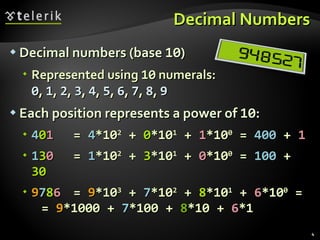
Decimal numbers (base  10 ) Represented using  10  numerals:  0 ,  1 ,  2 ,  3 ,  4 ,  5 ,  6 ,  7 ,  8 ,  9 Each position represents a power of  10 :  4 0 1 =  4 *10 2  +  0 *10 1  +  1 *10 0  =  400  +  1 1 3 0 =  1 *10 2  +  3 *10 1  +   0 *10 0  =  100  +  30 9 7 8 6 =  9 *10 3  +  7 *10 2  +  8 *10 1  +  6 *10 0  = =  9 *1000 +   7 *100 +  8 *10 +  6 *1  Decimal Numbers
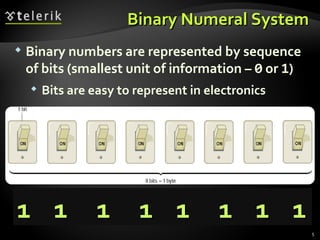
Binary Numeral System 1  0  1  1  0  0  1  0 1  0  0  1  0  0  1  0 1  0  0  1  0  0  1  1 1  1  1  1  1  1  1  1 Binary numbers are represented by sequence of bits (smallest unit of information –  0  or  1 ) Bits are easy to represent in electronics
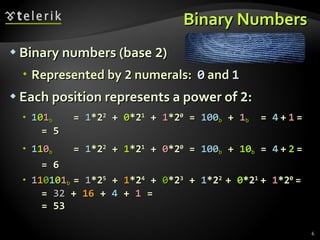
Binary numbers (base  2 ) Represented by  2  numerals:  0  and  1 Each position represents a power of  2 :  1 0 1 b =  1 *2 2  +  0 *2 1  +  1 *2 0  =  100 b  +  1 b   =  4   +   1   = = 5 1 1 0 b =  1 *2 2  +  1 *2 1  +  0 *2 0  =  100 b  +  10 b  =  4   +   2   = = 6 1 1 0 1 0 1 b =  1 *2 5  +  1 *2 4  +  0 *2 3  +  1 *2 2  +  0 *2 1   +  1 *2 0   = =  32  +  16  +  4  +  1  = =  53 Binary Numbers
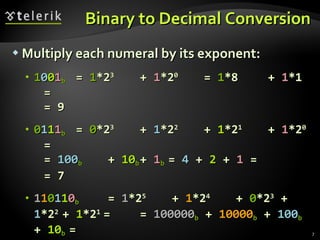
Binary to Decimal Conversion Multiply each numeral by its exponent: 1 0 0 1 b =  1 *2 3 +  1 *2 0 =  1 *8 +  1 *1 = = 9 0 1 1 1 b =  0 *2 3 +  1 *2 2 +  1 *2 1 +  1 *2 0 = =  100 b +  10 b +  1 b   =  4  +  2  +  1  = = 7 1 1 0 1 1 0 b =  1 *2 5 +  1 *2 4 +  0 *2 3  +  1 *2 2  +  1 *2 1   =  =  100000 b  +  10000 b  +  100 b  +  10 b  =  =  32  +  16  +  4  +  2  =  = 54
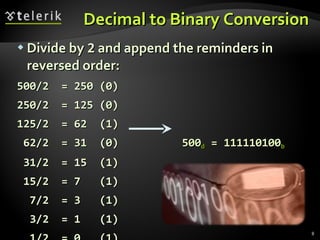
Decimal to Binary Conversion Divide by  2  and append the reminders in reversed order: 500/2  = 250 (0) 250/2  = 125 (0) 125/2  = 62  (1) 62/2  = 31  (0)  500 d  = 111110100 b 31/2  = 15  (1) 15/2  = 7  (1) 7/2  = 3  (1) 3/2  = 1  (1) 1/2  = 0  (1)
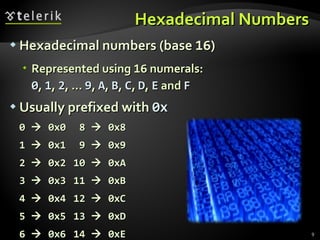
Hexadecimal Numbers Hexadecimal numbers (base  16 ) Represented using  16  numerals:  0 ,  1 ,  2 , ...  9 ,  A ,  B ,  C ,  D ,  E  and  F Usually prefixed with  0x 0    0x0  8    0x8 1    0x1  9    0x9 2    0x2 10    0xA 3    0x3 11    0xB 4    0x4 12    0xC 5    0x5 13    0xD 6    0x6 14    0xE 7    0x7 15    0xF
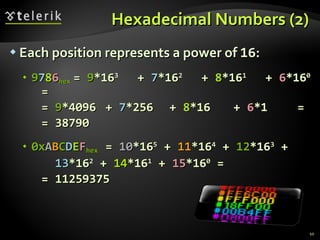
Hexadecimal Numbers (2) Each position represents a power of  16 :  9 7 8 6 hex =  9 *16 3 +  7 *16 2 +  8 *16 1 +  6 *16 0 = =  9 *4096 +  7 *256 +  8 *16 +  6 *1 = = 38790 0x A B C D E F hex =  10 *16 5  +  11 *16 4  +  12 *16 3  +   13 *16 2  +  14 *16 1  +   15 *16 0  = = 11259375
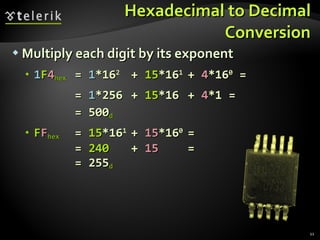
Hexadecimal to Decimal Conversion Multiply each digit by its exponent 1 F 4 hex =   1 *16 2 +  15 *16 1 +  4 *16 0  = =  1 *256 +  15 *16 +  4 *1 = =   500 d F F hex =  15 *16 1 +  15 *16 0 = =  240 +  15 = = 255 d
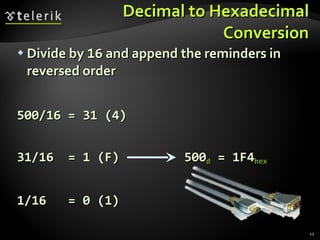
Decimal to Hexadecimal Conversion Divide by  16  and append the reminders in reversed order 500/16 = 31 (4)  31/16  = 1 (F)  500 d  = 1F4 hex 1/16  = 0 (1)
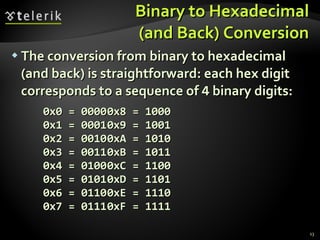
Binary to Hexadecimal (and Back) Conversion The conversion from binary to hexadecimal (and back) is straightforward: each hex digit corresponds to a sequence of  4  binary digits: 0x0 = 0000 0x8 = 1000 0x1 = 0001 0x9 = 1001 0x2 = 0010 0xA = 1010 0x3 = 0011 0xB = 1011 0x4 = 0100 0xC = 1100 0x5 = 0101 0xD = 1101 0x6 = 0110 0xE = 1110 0x7 = 0111 0xF = 1111
Numbers Representation Positive and Negative Integers and Floating-Point Numbers
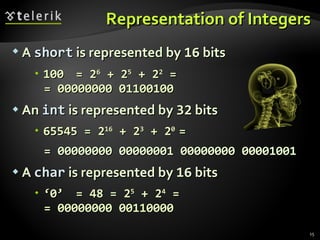
Representation of Integers A  short  is represented by  16  bits   100 = 2 6  + 2 5  + 2 2  = = 00000000 01100100 An  int  is represented by  32  bits  65545 = 2 16  + 2 3  + 2 0  = = 00000000 00000001 00000000 00001001 A  char  is represented by  16  bits  ‘ 0’ = 48 = 2 5  + 2 4  = = 00000000 00110000
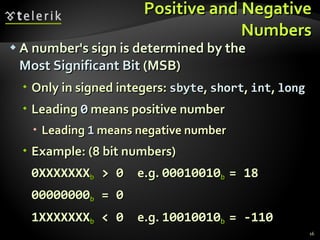
Positive and Negative Numbers A number's sign is determined by the Most Significant Bit   (MSB) Only in signed integers:  sbyte ,  short ,  int ,  long Leading  0  means positive number Leading  1  means negative number Example: (8 bit numbers) 0XXXXXXX b  > 0 e.g.  00010010 b  = 18 00000000 b   = 0 1XXXXXXX b  < 0 e.g.  10010010 b  = -110
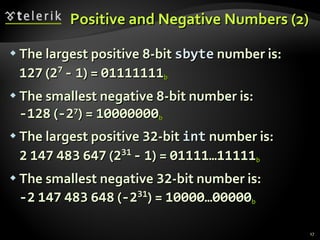
Positive and Negative Numbers (2) The largest positive 8-bit  sbyte  number is: 127   ( 2 7   -   1 ) =  01111111 b The smallest negative 8-bit number is: -128  ( -2 7 ) =  10000000 b The largest positive  32 -bit  int  number is: 2   147   483   647   ( 2 31   -   1 ) =  01111…11111 b The smallest negative  32 -bit number is: -2   147   483   648  ( -2 31 ) =  10000…00000 b
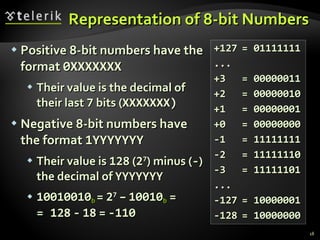
Representation of 8-bit Numbers +127 = 01111111 ... +3 = 00000011 +2 = 00000010 +1 = 00000001 +0 = 00000000 -1 = 11111111 -2 = 11111110 -3 = 11111101 ... -127 = 10000001 -128 = 10000000 Positive 8-bit numbers have the format  0XXXXXXX Their value is the decimal of their last  7  bits ( XXXXXXX) Negative 8-bit numbers have the format  1YYYYYYY Their value is  128  ( 2 7 ) minus ( - ) the decimal of  YYYYYYY 10010010 b   =   2 7   –   10010 b   = = 128   -   18   =   -110
Floating-Point Numbers Floating-point numbers representation (according to the IEEE  754  standard*): Example: 1 10000011 01010010100000000000000 Mantissa =  1,3222656 25 Exponent = 4 Sign  =  - 1 Bits [2 2 … 0 ] Bits [3 0 … 23 ] Bit  31 * See  http://en.wikipedia.org/wiki/Floating_point 2 k - 1 2 0 2 - 1 2 - 2 2 - n S P 0 ... P k - 1 M 0 M 1 ... M n - 1 Sign Exponent Mantissa
Text Representation in Computer Systems
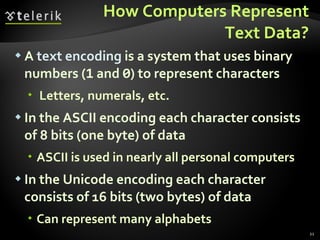
How Computers Represent Text Data? A  text encoding  is a system that uses binary numbers ( 1  and  0 ) to   represent characters Letters, numerals, etc.  In the ASCII encoding each character consists of 8 bits (one byte) of data ASCII is used in nearly all personal computers In the Unicode encoding each character consists of 16 bits (two bytes) of data Can represent many alphabets
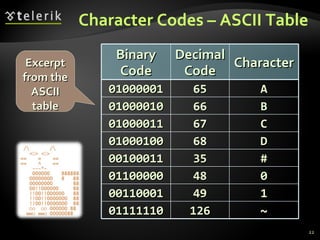
Character Codes – ASCII Table Excerpt from the ASCII table Binary Code Decimal Code Character 01000001 65 A 01000010 66 B 01000011 67 C 01000100 68 D 0 0100011 35 # 011 0 0000 48 0 00110001 49 1 01111110 126 ~
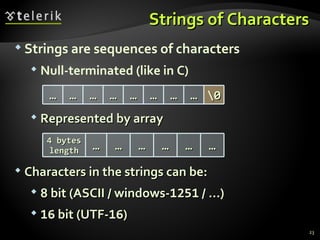
Strings of Characters Strings are sequences of characters Null-terminated (like in C) Represented by array Characters in the strings can be: 8 bit (ASCII / windows- 1251  / …) 16  bit (UTF- 16 ) … … … … … … … … \0 4 bytes length … … … … … …
Numeral Systems http://academy.telerik.com
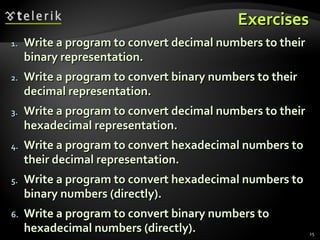
Exercises Write a program to convert decimal numbers to their binary representation. Write a program to convert binary numbers to their decimal representation. Write a program to convert decimal numbers to their hexadecimal representation. Write a program to convert hexadecimal numbers to their decimal representation. Write a program to convert hexadecimal numbers to binary numbers (directly). Write a program to convert binary numbers to hexadecimal numbers (directly).
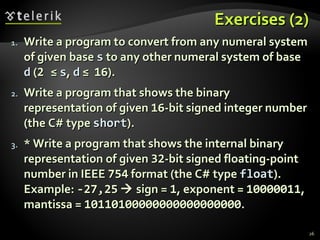
Exercises (2) Write a program to convert from any numeral system of given base  s  to any other numeral system of base  d  ( 2  ≤  s ,  d  ≤  16 ). Write a program that shows the binary representation of given  16 -bit signed integer number (the C# type  short ). * Write a program that shows the internal binary representation of given  32 -bit signed floating-point number in IEEE  754  format (the C# type  float ). Example:  -27,25     sign =  1 , exponent =  10000011 , mantissa =  10110100000000000000000 .

08. Numeral Systems

  • 1.
    Numeral Systems Binary,Decimal and Hexadecimal Numbers Svetlin Nakov Telerik Corporation www.telerik.com
  • 2.
    Table of ContentsNumerals Systems Binary and Decimal Numbers Hexadecimal Numbers Conversion between Numeral Systems Representation of Numbers Positive and Negative Integer Numbers Floating-Point Numbers Text Representation
  • 3.
    Numeral Systems Conversionbetween Numeral Systems
  • 4.
    Decimal numbers (base 10 ) Represented using 10 numerals: 0 , 1 , 2 , 3 , 4 , 5 , 6 , 7 , 8 , 9 Each position represents a power of 10 : 4 0 1 = 4 *10 2 + 0 *10 1 + 1 *10 0 = 400 + 1 1 3 0 = 1 *10 2 + 3 *10 1 + 0 *10 0 = 100 + 30 9 7 8 6 = 9 *10 3 + 7 *10 2 + 8 *10 1 + 6 *10 0 = = 9 *1000 + 7 *100 + 8 *10 + 6 *1 Decimal Numbers
  • 5.
    Binary Numeral System1 0 1 1 0 0 1 0 1 0 0 1 0 0 1 0 1 0 0 1 0 0 1 1 1 1 1 1 1 1 1 1 Binary numbers are represented by sequence of bits (smallest unit of information – 0 or 1 ) Bits are easy to represent in electronics
  • 6.
    Binary numbers (base 2 ) Represented by 2 numerals: 0 and 1 Each position represents a power of 2 : 1 0 1 b = 1 *2 2 + 0 *2 1 + 1 *2 0 = 100 b + 1 b = 4 + 1 = = 5 1 1 0 b = 1 *2 2 + 1 *2 1 + 0 *2 0 = 100 b + 10 b = 4 + 2 = = 6 1 1 0 1 0 1 b = 1 *2 5 + 1 *2 4 + 0 *2 3 + 1 *2 2 + 0 *2 1 + 1 *2 0 = = 32 + 16 + 4 + 1 = = 53 Binary Numbers
  • 7.
    Binary to DecimalConversion Multiply each numeral by its exponent: 1 0 0 1 b = 1 *2 3 + 1 *2 0 = 1 *8 + 1 *1 = = 9 0 1 1 1 b = 0 *2 3 + 1 *2 2 + 1 *2 1 + 1 *2 0 = = 100 b + 10 b + 1 b = 4 + 2 + 1 = = 7 1 1 0 1 1 0 b = 1 *2 5 + 1 *2 4 + 0 *2 3 + 1 *2 2 + 1 *2 1 = = 100000 b + 10000 b + 100 b + 10 b = = 32 + 16 + 4 + 2 = = 54
  • 8.
    Decimal to BinaryConversion Divide by 2 and append the reminders in reversed order: 500/2 = 250 (0) 250/2 = 125 (0) 125/2 = 62 (1) 62/2 = 31 (0) 500 d = 111110100 b 31/2 = 15 (1) 15/2 = 7 (1) 7/2 = 3 (1) 3/2 = 1 (1) 1/2 = 0 (1)
  • 9.
    Hexadecimal Numbers Hexadecimalnumbers (base 16 ) Represented using 16 numerals: 0 , 1 , 2 , ... 9 , A , B , C , D , E and F Usually prefixed with 0x 0  0x0 8  0x8 1  0x1 9  0x9 2  0x2 10  0xA 3  0x3 11  0xB 4  0x4 12  0xC 5  0x5 13  0xD 6  0x6 14  0xE 7  0x7 15  0xF
  • 10.
    Hexadecimal Numbers (2)Each position represents a power of 16 : 9 7 8 6 hex = 9 *16 3 + 7 *16 2 + 8 *16 1 + 6 *16 0 = = 9 *4096 + 7 *256 + 8 *16 + 6 *1 = = 38790 0x A B C D E F hex = 10 *16 5 + 11 *16 4 + 12 *16 3 + 13 *16 2 + 14 *16 1 + 15 *16 0 = = 11259375
  • 11.
    Hexadecimal to DecimalConversion Multiply each digit by its exponent 1 F 4 hex = 1 *16 2 + 15 *16 1 + 4 *16 0 = = 1 *256 + 15 *16 + 4 *1 = = 500 d F F hex = 15 *16 1 + 15 *16 0 = = 240 + 15 = = 255 d
  • 12.
    Decimal to HexadecimalConversion Divide by 16 and append the reminders in reversed order 500/16 = 31 (4) 31/16 = 1 (F) 500 d = 1F4 hex 1/16 = 0 (1)
  • 13.
    Binary to Hexadecimal(and Back) Conversion The conversion from binary to hexadecimal (and back) is straightforward: each hex digit corresponds to a sequence of 4 binary digits: 0x0 = 0000 0x8 = 1000 0x1 = 0001 0x9 = 1001 0x2 = 0010 0xA = 1010 0x3 = 0011 0xB = 1011 0x4 = 0100 0xC = 1100 0x5 = 0101 0xD = 1101 0x6 = 0110 0xE = 1110 0x7 = 0111 0xF = 1111
  • 14.
    Numbers Representation Positiveand Negative Integers and Floating-Point Numbers
  • 15.
    Representation of IntegersA short is represented by 16 bits 100 = 2 6 + 2 5 + 2 2 = = 00000000 01100100 An int is represented by 32 bits 65545 = 2 16 + 2 3 + 2 0 = = 00000000 00000001 00000000 00001001 A char is represented by 16 bits ‘ 0’ = 48 = 2 5 + 2 4 = = 00000000 00110000
  • 16.
    Positive and NegativeNumbers A number's sign is determined by the Most Significant Bit (MSB) Only in signed integers: sbyte , short , int , long Leading 0 means positive number Leading 1 means negative number Example: (8 bit numbers) 0XXXXXXX b > 0 e.g. 00010010 b = 18 00000000 b = 0 1XXXXXXX b < 0 e.g. 10010010 b = -110
  • 17.
    Positive and NegativeNumbers (2) The largest positive 8-bit sbyte number is: 127 ( 2 7 - 1 ) = 01111111 b The smallest negative 8-bit number is: -128 ( -2 7 ) = 10000000 b The largest positive 32 -bit int number is: 2 147 483 647 ( 2 31 - 1 ) = 01111…11111 b The smallest negative 32 -bit number is: -2 147 483 648 ( -2 31 ) = 10000…00000 b
  • 18.
    Representation of 8-bitNumbers +127 = 01111111 ... +3 = 00000011 +2 = 00000010 +1 = 00000001 +0 = 00000000 -1 = 11111111 -2 = 11111110 -3 = 11111101 ... -127 = 10000001 -128 = 10000000 Positive 8-bit numbers have the format 0XXXXXXX Their value is the decimal of their last 7 bits ( XXXXXXX) Negative 8-bit numbers have the format 1YYYYYYY Their value is 128 ( 2 7 ) minus ( - ) the decimal of YYYYYYY 10010010 b = 2 7 – 10010 b = = 128 - 18 = -110
  • 19.
    Floating-Point Numbers Floating-pointnumbers representation (according to the IEEE 754 standard*): Example: 1 10000011 01010010100000000000000 Mantissa = 1,3222656 25 Exponent = 4 Sign = - 1 Bits [2 2 … 0 ] Bits [3 0 … 23 ] Bit 31 * See http://en.wikipedia.org/wiki/Floating_point 2 k - 1 2 0 2 - 1 2 - 2 2 - n S P 0 ... P k - 1 M 0 M 1 ... M n - 1 Sign Exponent Mantissa
  • 20.
    Text Representation inComputer Systems
  • 21.
    How Computers RepresentText Data? A text encoding is a system that uses binary numbers ( 1 and 0 ) to represent characters Letters, numerals, etc. In the ASCII encoding each character consists of 8 bits (one byte) of data ASCII is used in nearly all personal computers In the Unicode encoding each character consists of 16 bits (two bytes) of data Can represent many alphabets
  • 22.
    Character Codes –ASCII Table Excerpt from the ASCII table Binary Code Decimal Code Character 01000001 65 A 01000010 66 B 01000011 67 C 01000100 68 D 0 0100011 35 # 011 0 0000 48 0 00110001 49 1 01111110 126 ~
  • 23.
    Strings of CharactersStrings are sequences of characters Null-terminated (like in C) Represented by array Characters in the strings can be: 8 bit (ASCII / windows- 1251 / …) 16 bit (UTF- 16 ) … … … … … … … … \0 4 bytes length … … … … … …
  • 24.
  • 25.
    Exercises Write aprogram to convert decimal numbers to their binary representation. Write a program to convert binary numbers to their decimal representation. Write a program to convert decimal numbers to their hexadecimal representation. Write a program to convert hexadecimal numbers to their decimal representation. Write a program to convert hexadecimal numbers to binary numbers (directly). Write a program to convert binary numbers to hexadecimal numbers (directly).
  • 26.
    Exercises (2) Writea program to convert from any numeral system of given base s to any other numeral system of base d ( 2 ≤ s , d ≤ 16 ). Write a program that shows the binary representation of given 16 -bit signed integer number (the C# type short ). * Write a program that shows the internal binary representation of given 32 -bit signed floating-point number in IEEE 754 format (the C# type float ). Example: -27,25  sign = 1 , exponent = 10000011 , mantissa = 10110100000000000000000 .

Editor's Notes

  • #3 (c) 2007 National Academy for Software Development - http://academy.devbg.org. All rights reserved. Unauthorized copying or re-distribution is strictly prohibited.* ##
  • #4 (c) 2007 National Academy for Software Development - http://academy.devbg.org. All rights reserved. Unauthorized copying or re-distribution is strictly prohibited.* ##
  • #5 (c) 2007 National Academy for Software Development - http://academy.devbg.org. All rights reserved. Unauthorized copying or re-distribution is strictly prohibited.* ##
  • #7 (c) 2007 National Academy for Software Development - http://academy.devbg.org. All rights reserved. Unauthorized copying or re-distribution is strictly prohibited.* ##
  • #8 (c) 2007 National Academy for Software Development - http://academy.devbg.org. All rights reserved. Unauthorized copying or re-distribution is strictly prohibited.* ##
  • #9 (c) 2007 National Academy for Software Development - http://academy.devbg.org. All rights reserved. Unauthorized copying or re-distribution is strictly prohibited.* ##
  • #10 (c) 2007 National Academy for Software Development - http://academy.devbg.org. All rights reserved. Unauthorized copying or re-distribution is strictly prohibited.* ##
  • #11 (c) 2007 National Academy for Software Development - http://academy.devbg.org. All rights reserved. Unauthorized copying or re-distribution is strictly prohibited.* ##
  • #12 (c) 2007 National Academy for Software Development - http://academy.devbg.org. All rights reserved. Unauthorized copying or re-distribution is strictly prohibited.* ##
  • #13 (c) 2007 National Academy for Software Development - http://academy.devbg.org. All rights reserved. Unauthorized copying or re-distribution is strictly prohibited.* ##
  • #15 (c) 2007 National Academy for Software Development - http://academy.devbg.org. All rights reserved. Unauthorized copying or re-distribution is strictly prohibited.* ##
  • #16 (c) 2007 National Academy for Software Development - http://academy.devbg.org. All rights reserved. Unauthorized copying or re-distribution is strictly prohibited.* ##
  • #17 (c) 2007 National Academy for Software Development - http://academy.devbg.org. All rights reserved. Unauthorized copying or re-distribution is strictly prohibited.* ##
  • #18 (c) 2007 National Academy for Software Development - http://academy.devbg.org. All rights reserved. Unauthorized copying or re-distribution is strictly prohibited.* ##
  • #19 (c) 2007 National Academy for Software Development - http://academy.devbg.org. All rights reserved. Unauthorized copying or re-distribution is strictly prohibited.* ##
  • #21 (c) 2007 National Academy for Software Development - http://academy.devbg.org. All rights reserved. Unauthorized copying or re-distribution is strictly prohibited.* ##
  • #22 (c) 2007 National Academy for Software Development - http://academy.devbg.org. All rights reserved. Unauthorized copying or re-distribution is strictly prohibited.* ##
  • #23 (c) 2007 National Academy for Software Development - http://academy.devbg.org. All rights reserved. Unauthorized copying or re-distribution is strictly prohibited.* ##
  • #26 (c) 2007 National Academy for Software Development - http://academy.devbg.org. All rights reserved. Unauthorized copying or re-distribution is strictly prohibited.* ##