Coagulation-Flocculation-
Settling
Colloids
• Colloidal solids of water are 0.01 to 1 micron in size
– A size range that cause turbidity (scattering of light) – turbidity is an
indirect measure for colloids concentration!
– A size range at which colloids instead of settling/flotation show
brownian motion
• Colloids have surface charge – same charge (usually negative) for all
the colloids in a body of water
– Because of smaller size the surface charges become important and
influence the colloids behavior
– Because of the surface charges, forces of repulsion develop among the
colloids and stabilize (collisions do not result in floc formation)
• Charged colloids are surrounded by clouds of ions (strongly held
inner layer and loosely held outer layer)
– The inner layer moves along the moving colloid
• Potential difference exists between the colloid surface and the body
of water – indicated as Psi potential and as Zeta potential
– Potential between the colloid surface and the body of water is Psi
potential and that between the slipping plane and the body of water is
Zeta potential
Coagulation-flocculation
• Employed to transform colloidal solids into suspended solids
(for turbidity removal)
• Involves destabilizaion of colloids, by chemical (coagulant)
dosing, and floc formation, by particle collisions
– Surface charge of the colloids is neutralized (by high valency
cations dosed)
– Thickness of the electrical double layer is reduced (by the dosed
electrolyte)
– Zeta potential is reduced from typical -12 to -40 mV to ±0.5 mV
– Forces of repulsion are overcome and the Vander Waals forces of
attraction make the collisions successful (floc formation)
– Often called as perielectric coagulation
• Over dose of a coagulant can result in the colloidal charge
reversal and restabilization of colloids
• In the absence of initial rapid mixing, the dosed coagulant can
undergo polymerization and become ineffective as a coagulant
Coagulation-flocculation
• Colloids of the water can also be enmeshed in the hydrous
oxide flocs formed from the added coagulant
– Often called as orthokinetic coagulation
• Brownian motion of destabilized colloids result in flocculation
(micro-flocculation or perikinetic flocculation)
– Increasing floc size (> 1 to 10 μ) makes the brownian motion less
effective in the flocculation process
• Velocity gradient (induced by mixing and by the differential
settling of the flocs) brings about the flocculation
– Often called as macro-flocculation or orthokinetic flocculation
• Coagulant aids (activated silica and polyelectrolites) support the
flocculation process
• Activated silica binds together the micro hydrous oxide flocs
• Polyelctrolites (high molecular weight polymers) form bridges
among the flocs
• If not properly mixed in the water, the dosed polyelectrolite can
fold back on itself and become less effective
Coagulating and Flocculating Agents
• Typical coagulants (coagulating agents)
– Alum (Al2(SO4)3.18 H2O), and polyaluminum chloride (pre-
hydrolyzed aluminum salt)
– Ferrous sulfate, ferric sulfate and ferric chloride (iron salts are
usually not used in water treatment) and polyiron chloride (pre-
hydrolyzed iron salt)
– Lime (not a coagulant) but used to adjust the water pH
• Typical flocculants (flocculating agents)
– Natural polymers of biological origin (alginates, cellulose
derivatives , etc.)
– Synthetic polyelctrolites
– Activated alumina
– Polyelectrolites (high molecular weight polymers)
Coagulants
Alum
• Alum consumes alkalinity and forms aluminum hydroxide
flocs, which are least soluble at 7 pH
– Alkalinity consumed is 0.45 grams per gram of alum dosed
• Under acidic conditions the aluminum flocs can dissociate and
release Al3+ ions
– Under alkaline conditions the flocs can dissociate and release
AlO2
- ions
Iron salts
• Ferrous iron forms ferrous bicarbonate on reacting with
alkalinity
– 0.36 g of alkalinity per gram of ferrous sulfate is consumed
OHCOCaSOOHAlOHSOAlHCOCa 2243234223 1863)(218.)()(3 
OHCaSOHCOFeHCOCaOHFeSO 24232324 7)()(7. 
Coagulants
Iron salts
• Ferrous bicarbonate can dissociate to form ferrous hydroxide
and/or it can combine with lime to produce ferrous hydroxide
– 0.4 g of lime is consumed per gram of ferrous sulfate added
• Dissolved oxygen can oxidize ferrous hydroxide into ferric
hydroxide precipitate
– 0.029 grams of oxygen per gram of ferrous sulfate is consumed
in this oxidation
• Ferric flocs are positive below 6 pH and negative above 8 pH
2223 )()( COOHFeHCOFe 
OHCaCOOHFeOHCaHCOFe 232223 22)()(2)( 
3222 )(
2
1
4
1
)( OHFeOHOOHFe 
Coagulants
Iron salts
• Ferric chloride and ferric sulfate produce insoluble ferric
hydroxide flocs (insoluble in the 3 to 13 pH range) on reacting
with alkalinity/lime
– Every gram of ferric chloride may require 0.925 grams of
alkalinity or 0.518 grams of lime
– Every gram of ferric sulfate may require 0.42 grams of lime
Lime
• Can precipitate bicarbonate as calcium carbonate (>8-8.5 pH)
• Addition results in neutralization and metal precipitation
• Reacts with ortho-phosphate and forms calciumhydroxy
apatite precipitate at pH >10.
223233 63)(2)(32 COCaClOHFeHCOCaFeCl 
2323 3)(2)(32 CaClOHFeOHCaFeCl 
432342 3)(2)(3)( CaSOOHFeOHCaSOFe 
Precipitation by coagulating chemicals
• Addition of chemicals (coagulating and flocculating agents and
lime) can alter the physical state of dissolved solids
– Metals can be precipitated as carbonates and hydroxides with
addition of lime and altering pH
• Calcium carbonate and magnesium hydroxide
• Hydroxides of many heavy metals
– Fluoride can be precipitated as calcium fluoride and/or it can be
adsorbed on magnesium hydroxide flocs
– Phosphate precipitation with alum and iron can occur -
Hydroxyapatite can be formed at higher pH (>10)
• Co-precipitation of metals through adsorption (on iron or
aluminum flocs) can occur
– Arsenic and cadmium can be co-precipitated
• Hexavalent chromium can be reduced to trivalent from (by
ferrous iron) at lower pH (~>3.0)
Flocculants
Activated silica (a short chain polymer)
• Binds together micrfine aluminum hydrate particles
• Usual dosage is 5-10 mg/l
Polyelectrolytes
• Form inter-particle bridges among the particles/charged flocs
• Initial mixing of the polymer with colloids within a few
seconds is must
• Three types of synthetic poly-electrolytes:
– Cationic: Can also serve as a coagulant (preferred to avoid
chemical buildup) - adsorbs on negative flocs – dose is 2-5 mg/l
The cationic polyelectrolytes bring about coagulation by charge
neutralization and flocculation by bridging
– Anionic: Replace the anionic groups of colloids and permit
hydrogen bonding – dose is 0.25 to 1.0 mg/l
– Nonionic: adsorbs and flocculates by hydrogen bonding with the
polar groups in the polymer – dose is 0.25 to 1.0 mg/l
Laboratory Experimentation
Involves finding
• Optimum pH (dose of lime)
• Optimum dose of Coagulant
• Appropriate dose of Polyelectrolyte/flocculating agent
Find rough dose of coagulant at 6 pH
• Take known volume of sample and adjust its pH to 6
• Add coagulant in small increments till visible flocs appear
• After each addition rapid mix for 1 min., slow mix for 3 min. and
observe for visible flocs
Find optimum pH
• Take 1.0/1.5/2.0 liters of sample into each of the 5/6 beakers of
a Jar Test Apparatus and adjust pH to 4, 5, 6, 7, 8 and 9
• Apply rough dose of coagulant, rapid mix for 3 min., slow mix
for 12 min., and allow the formed flocs to settle for 30 min.
• Measure turbidity of the supernatant in the samples – pH of
the sample at which the turbidity is minimum is optimum pH
Find optimum dose of the coagulant
• Take sample into 6 beakers and adjust to optimum pH
• Apply a range of coagulant doses (60% to 120% of rough dose),
rapid mix for 3 min., slow mix for 12 min. and allow flocs to settle
for 30 min.
• Measure turbidity of the supernatant, and find optimum dose of
coagulant for coagulation-flocculation
Find appropriate dose of the polyelectrolyte
• Take sample into 6 beakers and adjust to optimum pH
• Apply optimum dose of coagulant to all, rapid mix for 3 min.,
apply a range of polyelectrolyte doses (upto 5 mg/l)
• Slow mix for 12 min. and allow flocs to settle for 30 min.
• Measure turbidity of supernatant and find the appropriate dose
(at which desired level of turbidity removal is achieved)
Laboratory Experimentation
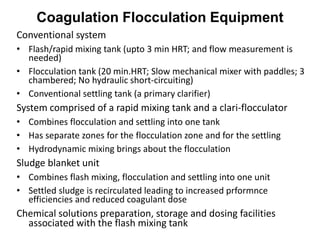
Coagulation Flocculation Equipment
Conventional system
• Flash/rapid mixing tank (upto 3 min HRT; and flow measurement is
needed)
• Flocculation tank (20 min.HRT; Slow mechanical mixer with paddles; 3
chambered; No hydraulic short-circuiting)
• Conventional settling tank (a primary clarifier)
System comprised of a rapid mixing tank and a clari-flocculator
• Combines flocculation and settling into one tank
• Has separate zones for the flocculation zone and for the settling
• Hydrodynamic mixing brings about the flocculation
Sludge blanket unit
• Combines flash mixing, flocculation and settling into one unit
• Settled sludge is recirculated leading to increased prformnce
efficiencies and reduced coagulant dose
Chemical solutions preparation, storage and dosing facilities
associated with the flash mixing tank
Removal of flocs, TSS and colloids
• Flocs formed from the coagulation-flocculation of colloids and
suspended solids present in water are removed
• Sedimentation (higher density, larger particle size, higher
gravitational force than buoyancy force and sufficiently large
settling velocity)
– Primary clarifiers and clari-flocculators
– Plate settlers and tube settlers
• Flotation (particle density closer to water, making particles
lighter by microscopic air bubble attachment, and higher
buoyancy force than gravitational force)
• Filtration (polishing or further removal of flocs, TSS and even
colloids including bacteria)
– Rapid gravity filters for the removal of flocs and TSS when
concentration is relatively less
– Slow sand filters specially to remove colloids including bacteria
– Relatively higher levels of flocs and TSS (>20 or 40 mg/L) can be
removed by roughing filters (used as prefilters)
Terminal settling velocity of (floc) particles
gVpparticle gVpfluid
2
2
pfluidpd vAC 
ppdv3
p
fluid
fluidparticle
d
p d
C
g
v







 



3
4
34.0
324

RR
d
NN
C

pp
R
dv
N 
Where
Where
Gravitational force, buoyancy force and drag force
Net force, settling velocity and terminal settling velocity
For laminar flow



18
2
p
w
wp
p
dg
v





 

Vt for laminar flow
p
w
wp
p dgv 




 



33.3
Vt for turbulent flow
 is 1.003 x 10⁻⁶
Kinematic viscosity
for water
Types of settling
• Discrete particle settling (particles settle at their terminal
settling velocities)
• Higher the specific gravity and larger the particle size larger will
the settling velocity
• Flocculation settling (flocculation if occurring increases
particles’ size and thus their settling velocities)
• Size and density ranges of particles, concentration of particles,
duration or depth of settling, and velocity gradient in the
system influence the settling velocities of particles
• Hindered settling and zone or compression settling (settling
together of large number of particles (TSS/Flocs >500 mg/L)
• Particle settling velocities are negatively influenced (hindered
settling)
• Settling velocities range is narrowed down, and particles settle
together as a blanket (zone/compression settling)
Water treatment by coagulation-flocculation-settling involves
flocculation settling of the TSS and the flocs formed
Settling column
• Height: 2.0 to 2.5 m (depth of the clarifier or clari-flocculator)
• Diameter: >150 mm (to make the influence of walls insignificant)
and <250 mm (to the keep sample required small and practicable)
• Sampling ports: 5 (including the bottom one at equidistance)
facilitate representative samples extraction from column center line
Settling column test
• To begin with ensure uniform distribution of particle size from top to
bottom of the column
• Suggested test duration: ≥ the depth/overflow rate of the clarifier
• Draw samples at different time intervals and analyze TSS removal
• Plot % removal against time and the settling profile graph
• Read overall removal efficiencies against settling time/ overflow rate
from the settling profile graph
Settling column test





 





 
 


2
(%) 1
1
nn
n
h
n RR
H
h
R
Settling Column Settling Profile Graph
Sedimentation or Clari-flocculation Tank
• Objective: Removal of settlable solids/flocs and floating
materials from flocculated water with desired efficiency
• Flocculation is often designed into the clarification/
sedimentation (known as clari-flocculation)
• Either rectangular or circular tanks are used
– Multiple rectangular tanks require relatively less land and initial
construction cost is also relatively less
• Typical sedimentation tank (or clari-flocculator) has
– Settling zone, flocculation zone and sludge zone
– Inlet section (and flocculation zone)
– Outlet section (scum retention baffle, overflow weir and
clarified water collection trough)
– Facilities and provisions a) for scrapping, collection and removal
of the settled sludge and b) for the entrapment, skimming,
collection and removal of floating materials
Central rotating mechanism with radial settled sludge scrapping
arms at the bottom and with radial skimmer arms at the top
Characterized by
• Central feeding of coagulated water for flocculation
• Radial outward and upward flow of flocculated water for clarification
• Peripheral weir overflow of clear water and collection into trough
• Settled sludge scrapping over the sloping bottom towards the centre
by a central rotating mechanism and removing as underflow sludge
Center well (of 15-20% of diameter, 1.0 - 2.5 m depth and ~ 20
min. HRT)
• Open from both top and bottom, and separated from settling zone
by a baffle
• Shaped for spiraling motion of water and for gradually decreasing
levels of hydrodynamic mixing from top to bottom
• Inlet has arrangements for energy dissipation from the inlet water
and for uniform distribution of water
– Water is discharged into the well within the upper 0.5-0.7 m at 0.3 to
0.45 m/sec flow velocity
• Flocculated water flows radialy outwards from the well bottom
Circular clariflocculator
Settling/Clarification zone
• Settling/clarification area: (SF.Q)/(OFR)
• Settling zone depth (sidewall depth): (Q.HRT.SF)/(settling area)
• SF (Safety Factor) is taken as 1.25 to 1.75) – it takes care of the
– Flow short-circuiting and inlet and outlet disturbances
– Disturbances created by the rotating mechanism to scrap the settled
sludge and to collect the floating scum
– Wind effects and water temperature variations
Clarified water outlet section
• Scum baffle, Overflow weir and Clarified water collection trough
• Scum baffle: Floating material retaining or entrapping baffle
• Overflow weir: Length should be sufficient to avoid weir overloading,
and subsequent density currents and sludge or flocs washout
– Typical loading for clarifiers/clari-flocculators: ~ 250 m3/m.day
• Clarified water collection trough: width, depth (+ freeboard) and
slope should be chosen to avoid flooding during peak flows
– Sizing of the trough outlet and ensuring minimum flow velocity (0.4
m/sec.) are important
Circular clariflocculator
Clarified sewage
Collection trough
Scum retaining baffle
Distribution baffle
of central well
Scrapper arm
Skimmer bladeCentral well
Central pier
Influent pipe Sludge draw-off pipe
Central rotating
equipment
Sludge trough
Tangential openings in the pier
for the distribution of the influent
Slope 1 in 12
Side wall
of clarifier
0.5m
0.3m
0.3m
0.3m
0.6m Central pier Sludge trough
0.5 m
1.5 m
0.5 m
Sludge draw-off pipe
Influent pipe
Primary clarifier
Section to show side wall with
clarified sewage collection trough Bottom sludge trough and outlet
3.0 m
Bottom settled sludge zone
• Smaller tanks (<5 m diameter) have hopper bottom (> 1 in 1 slope)
– Settled solids slide on the sloping bottom towards the center and
drained out through a sludge underdrain
• Larger diameter tanks have 1 in 12 to 64 or lesser bottom slope and
have a hollow central pier supporting a central rotating mechanism
– Settled solids are scrapped to the center into the sludge trough (around
the central pier) and drained out through a sludge underdrain
Central rotating mechanism
• In smaller tanks (< 9.0 m dia.) the central rotating mechanism is
supported on beams spanning the tank
• In larger tanks the mechanism is supported on a hollow central pier,
and a walkway/bridge provides access to the center
• A freely hanging cage (covering the central pier and supported over
bearings on the central pier) supports raking arms at the bottom and
skimmer arms at the top
• The cage is rotated at the desired speed through connecting to an
electrical drive through a gear box
Circular clariflocculator
Hollow central pier (>0.3 m above the liquid level)
• Supports the central rotating mechanism
• Accommodates the water inlet coming from the underneath
• Has multiple tangential openings at 0.5 - 0.7 m depth from liquid
level to allow the influent water into the flocculation zone
Radial raker arms
• Hinged to and supported from the cage (can be raised and moved
forward when obstrcuted by any larger object on the tank bottom)
• Has multiple scraper blades (with rubber washers touching the tank
bottom) on the raker arm
• The blades are appropriately oriented for scrapping the settled
sludge towards the center with the rotation of the raker arm
Skimmer arm
• Hinged to and supported from the cage (can vertically play!)
• Has a single horizontal blade partially submerged in water
• Carry floating material in front and forces to fall into the scum trough
Circular clariflocculator
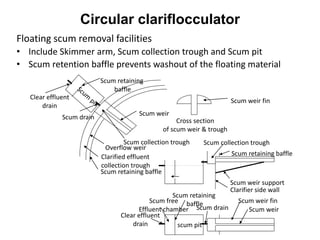
Floating scum removal facilities
• Include Skimmer arm, Scum collection trough and Scum pit
• Scum retention baffle prevents washout of the floating material
Circular clariflocculator
Scum retaining baffle
Clarified effluent
collection trough
Overflow weir
Scum collection trough
Scum drain
Clear effluent
drain
Scum retaining
baffle
Scum weir
Cross section
of scum weir & trough
scum pit
Scum weir
Scum collection trough
Scum retaining baffle
Scum weir support
Scum weir fin
Scum weir fin
Scum drain
Scum retaining
baffleScum free
Effluent chamber
Clear effluent
drain
Clarifier side wall
Rectangular Clarifier
Inlet section
• Full width inlet channels are used
• Vertical velocity component of the influent is reduced by
• submerged ports/orifices (flow velocities through these is 3-9 m/min.)
• wide gates and slotted baffles in the inlet channel
• Inlet baffles (extending 150 mm below and 300 mm above the water
surface) for vertical velocity reduction and proper water distribution
Outlet
• Clarified effluent is collected into collection troughs through overflow weir
– washout of floating scum is prevented by scum baffle
• Weir length is designed to avoid density current and sludge washout
Settled sludge
• Collected at the inlet end and pumped out
• Unending moving chain with full width flights is used for scrapping the
settled sludge
– Scraper flights (of wood or fiberglass) run full channel width (provided
at 3.0 m interval on the chains interval
– Single or multiple sludge hoppers or a traversing trough is provided in
the inlet end
Rectangular Clarifiers
• Settled sludge is collected at the inlet end
• Chain and flight solids collectors are used for the settled
sludge scrapping
– Scraper flights (of wood or fiberglass) run full channel width
(provided at 3.0 m interval on the chains interval
– Single or multiple sludge hoppers or a traversing trough is
provided in the inlet end
Rectangular
Primary Sedimentation Tank
Traveling bridge type collectors
– Travel up and down the tank on rubber wheels or on rails
supported on the sidewalls
– Scrapper blades are suspended from the bridge (returning
scraper blades lifted free of the solids blanket)
Facilities and provisions for floating material
entrapment, skimming, collection and removal
• Floating scum is collected at the effluent end
• Floating scum is skimmed and carried to the effluent end
and entrapped for avoiding overflow into the clarified
effluent trough
– Flights returning at the liquid surface can be used
– Water showers can be used to push forward the floating
scum
– Baffle is provided in front of the overflow weir for the scum
entrapment until removed
Rectangular Primary Sedimentation Tank
• In small tanks scum draw-down facility consisting of a
horizontal, slotted pipe that can be rotated by a lever or screw
can be used
– Limitation - creates large volume of scum liquor
• Transverse rotating helical wiper attached to a shaft can also
be used for scum removal
– Scum is removed from the water surface and moved over an
inclined apron for discharge to a cross-collecting scum trough
Other provisions and facilities
• Tanks have sloping bottom towards the influent end
• Influent end has sludge hoppers or a sludge trench
• Scum pit is provided for storing the scum liquid removed
• Sludge pump, piping and tank may be there to remove the
collected sludge from the sludge hopper or trench
Rectangular
Primary Sedimentation Tank
Design of primary clarifier
• Overflow rate and hydraulic retention time obtained from
the settling test and settling profile diagram are used to
find surface area and depth of the clarifier
• Safety factor of 1.25 to 1.75 is used to take into account
– Inlet and outlet disturbances
– Disturbances created by the rotating mechanism to scrap the
settled sludge and to collect the floating scum
– Wind effects
– Temperature variations
– Flow short-circuiting
• Design also takes into account the following:
– Horizontal flow velocity (below the scour velocity)
– Weir overflow rate (below a limit to avoid density currents)
– Weir overflow balancing to avoid short-circuiting problems
– Flooding of collection trough
Detention time 1.5 to 2.5 hours (2.0 hr.)
Overflow rate
Average flow 30-50 m3/m2.day (40)
Peak flow 80-120 m3/m2.day (100)
Weir loading 125-500 m3/m.day (250)
Rectangular tanks
Depth 3-4.9 (4.3)
Length 15-90 (24-40)
Width 3-24 (4.9-9.8)
Flight speed 0.6-1.2 m/min (0.9)
Circular tank
Diameter 3-60 (12-45)
Bottom slope 1 in 16 to 1 in 6 (1 in 12)
Flight speed 0.02-0.05 rpm (0.03)
Primary Sedimentation Tank
Short circuiting and hydraulic stability
• Tracer studies can be used for determining short-circuiting
problems
• Method of influent flow distribution can also affect short
circuiting
Temperature difference of 1°C between incoming
wastewater and wastewater of the tank can cause
density current
Wind blowing across the top of an open sedimentation
tank can cause circulation cell to form – this reduces
effective volumetric capacity of the tank
Surface loading rates (overflow rates)
• There can be regulations prescribing limits to surface
loading rates
• Overflow rates must be set low enough to ensure
satisfactory performance at peak rates of flow
Primary Sedimentation Tank
Detention time
• Solids reaching the settling tank are susceptible to flocculation
• Flocculation is aided by eddying motion of fluid within the tank
• Level of flocculation depends on the time elapsed (detention
time)
• In cold climates, because of increase in water viscosity,
detention time required also increases (1.38 time more HRT for
10°C water that when temperature is 20°C)
Weir loading rates
• Have little effect on efficiency of primary settling tanks
Primary sludge characteristics and quantities
• Factors influencing are
– Characteristics of untreated water (strength and freshness)
– Period of sedimentation
– Conditions of the deposited solids
– Period between solids removal operations
Primary Sedimentation Tank

07 coagulation-flocculation-settling

  • 1.
  • 2.
    Colloids • Colloidal solidsof water are 0.01 to 1 micron in size – A size range that cause turbidity (scattering of light) – turbidity is an indirect measure for colloids concentration! – A size range at which colloids instead of settling/flotation show brownian motion • Colloids have surface charge – same charge (usually negative) for all the colloids in a body of water – Because of smaller size the surface charges become important and influence the colloids behavior – Because of the surface charges, forces of repulsion develop among the colloids and stabilize (collisions do not result in floc formation) • Charged colloids are surrounded by clouds of ions (strongly held inner layer and loosely held outer layer) – The inner layer moves along the moving colloid • Potential difference exists between the colloid surface and the body of water – indicated as Psi potential and as Zeta potential – Potential between the colloid surface and the body of water is Psi potential and that between the slipping plane and the body of water is Zeta potential
  • 3.
    Coagulation-flocculation • Employed totransform colloidal solids into suspended solids (for turbidity removal) • Involves destabilizaion of colloids, by chemical (coagulant) dosing, and floc formation, by particle collisions – Surface charge of the colloids is neutralized (by high valency cations dosed) – Thickness of the electrical double layer is reduced (by the dosed electrolyte) – Zeta potential is reduced from typical -12 to -40 mV to ±0.5 mV – Forces of repulsion are overcome and the Vander Waals forces of attraction make the collisions successful (floc formation) – Often called as perielectric coagulation • Over dose of a coagulant can result in the colloidal charge reversal and restabilization of colloids • In the absence of initial rapid mixing, the dosed coagulant can undergo polymerization and become ineffective as a coagulant
  • 5.
    Coagulation-flocculation • Colloids ofthe water can also be enmeshed in the hydrous oxide flocs formed from the added coagulant – Often called as orthokinetic coagulation • Brownian motion of destabilized colloids result in flocculation (micro-flocculation or perikinetic flocculation) – Increasing floc size (> 1 to 10 μ) makes the brownian motion less effective in the flocculation process • Velocity gradient (induced by mixing and by the differential settling of the flocs) brings about the flocculation – Often called as macro-flocculation or orthokinetic flocculation • Coagulant aids (activated silica and polyelectrolites) support the flocculation process • Activated silica binds together the micro hydrous oxide flocs • Polyelctrolites (high molecular weight polymers) form bridges among the flocs • If not properly mixed in the water, the dosed polyelectrolite can fold back on itself and become less effective
  • 6.
    Coagulating and FlocculatingAgents • Typical coagulants (coagulating agents) – Alum (Al2(SO4)3.18 H2O), and polyaluminum chloride (pre- hydrolyzed aluminum salt) – Ferrous sulfate, ferric sulfate and ferric chloride (iron salts are usually not used in water treatment) and polyiron chloride (pre- hydrolyzed iron salt) – Lime (not a coagulant) but used to adjust the water pH • Typical flocculants (flocculating agents) – Natural polymers of biological origin (alginates, cellulose derivatives , etc.) – Synthetic polyelctrolites – Activated alumina – Polyelectrolites (high molecular weight polymers)
  • 7.
    Coagulants Alum • Alum consumesalkalinity and forms aluminum hydroxide flocs, which are least soluble at 7 pH – Alkalinity consumed is 0.45 grams per gram of alum dosed • Under acidic conditions the aluminum flocs can dissociate and release Al3+ ions – Under alkaline conditions the flocs can dissociate and release AlO2 - ions Iron salts • Ferrous iron forms ferrous bicarbonate on reacting with alkalinity – 0.36 g of alkalinity per gram of ferrous sulfate is consumed OHCOCaSOOHAlOHSOAlHCOCa 2243234223 1863)(218.)()(3  OHCaSOHCOFeHCOCaOHFeSO 24232324 7)()(7. 
  • 8.
    Coagulants Iron salts • Ferrousbicarbonate can dissociate to form ferrous hydroxide and/or it can combine with lime to produce ferrous hydroxide – 0.4 g of lime is consumed per gram of ferrous sulfate added • Dissolved oxygen can oxidize ferrous hydroxide into ferric hydroxide precipitate – 0.029 grams of oxygen per gram of ferrous sulfate is consumed in this oxidation • Ferric flocs are positive below 6 pH and negative above 8 pH 2223 )()( COOHFeHCOFe  OHCaCOOHFeOHCaHCOFe 232223 22)()(2)(  3222 )( 2 1 4 1 )( OHFeOHOOHFe 
  • 9.
    Coagulants Iron salts • Ferricchloride and ferric sulfate produce insoluble ferric hydroxide flocs (insoluble in the 3 to 13 pH range) on reacting with alkalinity/lime – Every gram of ferric chloride may require 0.925 grams of alkalinity or 0.518 grams of lime – Every gram of ferric sulfate may require 0.42 grams of lime Lime • Can precipitate bicarbonate as calcium carbonate (>8-8.5 pH) • Addition results in neutralization and metal precipitation • Reacts with ortho-phosphate and forms calciumhydroxy apatite precipitate at pH >10. 223233 63)(2)(32 COCaClOHFeHCOCaFeCl  2323 3)(2)(32 CaClOHFeOHCaFeCl  432342 3)(2)(3)( CaSOOHFeOHCaSOFe 
  • 10.
    Precipitation by coagulatingchemicals • Addition of chemicals (coagulating and flocculating agents and lime) can alter the physical state of dissolved solids – Metals can be precipitated as carbonates and hydroxides with addition of lime and altering pH • Calcium carbonate and magnesium hydroxide • Hydroxides of many heavy metals – Fluoride can be precipitated as calcium fluoride and/or it can be adsorbed on magnesium hydroxide flocs – Phosphate precipitation with alum and iron can occur - Hydroxyapatite can be formed at higher pH (>10) • Co-precipitation of metals through adsorption (on iron or aluminum flocs) can occur – Arsenic and cadmium can be co-precipitated • Hexavalent chromium can be reduced to trivalent from (by ferrous iron) at lower pH (~>3.0)
  • 11.
    Flocculants Activated silica (ashort chain polymer) • Binds together micrfine aluminum hydrate particles • Usual dosage is 5-10 mg/l Polyelectrolytes • Form inter-particle bridges among the particles/charged flocs • Initial mixing of the polymer with colloids within a few seconds is must • Three types of synthetic poly-electrolytes: – Cationic: Can also serve as a coagulant (preferred to avoid chemical buildup) - adsorbs on negative flocs – dose is 2-5 mg/l The cationic polyelectrolytes bring about coagulation by charge neutralization and flocculation by bridging – Anionic: Replace the anionic groups of colloids and permit hydrogen bonding – dose is 0.25 to 1.0 mg/l – Nonionic: adsorbs and flocculates by hydrogen bonding with the polar groups in the polymer – dose is 0.25 to 1.0 mg/l
  • 12.
    Laboratory Experimentation Involves finding •Optimum pH (dose of lime) • Optimum dose of Coagulant • Appropriate dose of Polyelectrolyte/flocculating agent Find rough dose of coagulant at 6 pH • Take known volume of sample and adjust its pH to 6 • Add coagulant in small increments till visible flocs appear • After each addition rapid mix for 1 min., slow mix for 3 min. and observe for visible flocs Find optimum pH • Take 1.0/1.5/2.0 liters of sample into each of the 5/6 beakers of a Jar Test Apparatus and adjust pH to 4, 5, 6, 7, 8 and 9 • Apply rough dose of coagulant, rapid mix for 3 min., slow mix for 12 min., and allow the formed flocs to settle for 30 min. • Measure turbidity of the supernatant in the samples – pH of the sample at which the turbidity is minimum is optimum pH
  • 13.
    Find optimum doseof the coagulant • Take sample into 6 beakers and adjust to optimum pH • Apply a range of coagulant doses (60% to 120% of rough dose), rapid mix for 3 min., slow mix for 12 min. and allow flocs to settle for 30 min. • Measure turbidity of the supernatant, and find optimum dose of coagulant for coagulation-flocculation Find appropriate dose of the polyelectrolyte • Take sample into 6 beakers and adjust to optimum pH • Apply optimum dose of coagulant to all, rapid mix for 3 min., apply a range of polyelectrolyte doses (upto 5 mg/l) • Slow mix for 12 min. and allow flocs to settle for 30 min. • Measure turbidity of supernatant and find the appropriate dose (at which desired level of turbidity removal is achieved) Laboratory Experimentation
  • 14.
    Coagulation Flocculation Equipment Conventionalsystem • Flash/rapid mixing tank (upto 3 min HRT; and flow measurement is needed) • Flocculation tank (20 min.HRT; Slow mechanical mixer with paddles; 3 chambered; No hydraulic short-circuiting) • Conventional settling tank (a primary clarifier) System comprised of a rapid mixing tank and a clari-flocculator • Combines flocculation and settling into one tank • Has separate zones for the flocculation zone and for the settling • Hydrodynamic mixing brings about the flocculation Sludge blanket unit • Combines flash mixing, flocculation and settling into one unit • Settled sludge is recirculated leading to increased prformnce efficiencies and reduced coagulant dose Chemical solutions preparation, storage and dosing facilities associated with the flash mixing tank
  • 18.
    Removal of flocs,TSS and colloids • Flocs formed from the coagulation-flocculation of colloids and suspended solids present in water are removed • Sedimentation (higher density, larger particle size, higher gravitational force than buoyancy force and sufficiently large settling velocity) – Primary clarifiers and clari-flocculators – Plate settlers and tube settlers • Flotation (particle density closer to water, making particles lighter by microscopic air bubble attachment, and higher buoyancy force than gravitational force) • Filtration (polishing or further removal of flocs, TSS and even colloids including bacteria) – Rapid gravity filters for the removal of flocs and TSS when concentration is relatively less – Slow sand filters specially to remove colloids including bacteria – Relatively higher levels of flocs and TSS (>20 or 40 mg/L) can be removed by roughing filters (used as prefilters)
  • 19.
    Terminal settling velocityof (floc) particles gVpparticle gVpfluid 2 2 pfluidpd vAC  ppdv3 p fluid fluidparticle d p d C g v             3 4 34.0 324  RR d NN C  pp R dv N  Where Where Gravitational force, buoyancy force and drag force Net force, settling velocity and terminal settling velocity For laminar flow    18 2 p w wp p dg v         Vt for laminar flow p w wp p dgv           33.3 Vt for turbulent flow  is 1.003 x 10⁻⁶ Kinematic viscosity for water
  • 20.
    Types of settling •Discrete particle settling (particles settle at their terminal settling velocities) • Higher the specific gravity and larger the particle size larger will the settling velocity • Flocculation settling (flocculation if occurring increases particles’ size and thus their settling velocities) • Size and density ranges of particles, concentration of particles, duration or depth of settling, and velocity gradient in the system influence the settling velocities of particles • Hindered settling and zone or compression settling (settling together of large number of particles (TSS/Flocs >500 mg/L) • Particle settling velocities are negatively influenced (hindered settling) • Settling velocities range is narrowed down, and particles settle together as a blanket (zone/compression settling) Water treatment by coagulation-flocculation-settling involves flocculation settling of the TSS and the flocs formed
  • 21.
    Settling column • Height:2.0 to 2.5 m (depth of the clarifier or clari-flocculator) • Diameter: >150 mm (to make the influence of walls insignificant) and <250 mm (to the keep sample required small and practicable) • Sampling ports: 5 (including the bottom one at equidistance) facilitate representative samples extraction from column center line Settling column test • To begin with ensure uniform distribution of particle size from top to bottom of the column • Suggested test duration: ≥ the depth/overflow rate of the clarifier • Draw samples at different time intervals and analyze TSS removal • Plot % removal against time and the settling profile graph • Read overall removal efficiencies against settling time/ overflow rate from the settling profile graph Settling column test                   2 (%) 1 1 nn n h n RR H h R
  • 22.
  • 24.
    Sedimentation or Clari-flocculationTank • Objective: Removal of settlable solids/flocs and floating materials from flocculated water with desired efficiency • Flocculation is often designed into the clarification/ sedimentation (known as clari-flocculation) • Either rectangular or circular tanks are used – Multiple rectangular tanks require relatively less land and initial construction cost is also relatively less • Typical sedimentation tank (or clari-flocculator) has – Settling zone, flocculation zone and sludge zone – Inlet section (and flocculation zone) – Outlet section (scum retention baffle, overflow weir and clarified water collection trough) – Facilities and provisions a) for scrapping, collection and removal of the settled sludge and b) for the entrapment, skimming, collection and removal of floating materials Central rotating mechanism with radial settled sludge scrapping arms at the bottom and with radial skimmer arms at the top
  • 25.
    Characterized by • Centralfeeding of coagulated water for flocculation • Radial outward and upward flow of flocculated water for clarification • Peripheral weir overflow of clear water and collection into trough • Settled sludge scrapping over the sloping bottom towards the centre by a central rotating mechanism and removing as underflow sludge Center well (of 15-20% of diameter, 1.0 - 2.5 m depth and ~ 20 min. HRT) • Open from both top and bottom, and separated from settling zone by a baffle • Shaped for spiraling motion of water and for gradually decreasing levels of hydrodynamic mixing from top to bottom • Inlet has arrangements for energy dissipation from the inlet water and for uniform distribution of water – Water is discharged into the well within the upper 0.5-0.7 m at 0.3 to 0.45 m/sec flow velocity • Flocculated water flows radialy outwards from the well bottom Circular clariflocculator
  • 26.
    Settling/Clarification zone • Settling/clarificationarea: (SF.Q)/(OFR) • Settling zone depth (sidewall depth): (Q.HRT.SF)/(settling area) • SF (Safety Factor) is taken as 1.25 to 1.75) – it takes care of the – Flow short-circuiting and inlet and outlet disturbances – Disturbances created by the rotating mechanism to scrap the settled sludge and to collect the floating scum – Wind effects and water temperature variations Clarified water outlet section • Scum baffle, Overflow weir and Clarified water collection trough • Scum baffle: Floating material retaining or entrapping baffle • Overflow weir: Length should be sufficient to avoid weir overloading, and subsequent density currents and sludge or flocs washout – Typical loading for clarifiers/clari-flocculators: ~ 250 m3/m.day • Clarified water collection trough: width, depth (+ freeboard) and slope should be chosen to avoid flooding during peak flows – Sizing of the trough outlet and ensuring minimum flow velocity (0.4 m/sec.) are important Circular clariflocculator
  • 27.
    Clarified sewage Collection trough Scumretaining baffle Distribution baffle of central well Scrapper arm Skimmer bladeCentral well Central pier Influent pipe Sludge draw-off pipe Central rotating equipment Sludge trough Tangential openings in the pier for the distribution of the influent Slope 1 in 12 Side wall of clarifier 0.5m 0.3m 0.3m 0.3m 0.6m Central pier Sludge trough 0.5 m 1.5 m 0.5 m Sludge draw-off pipe Influent pipe Primary clarifier Section to show side wall with clarified sewage collection trough Bottom sludge trough and outlet 3.0 m
  • 28.
    Bottom settled sludgezone • Smaller tanks (<5 m diameter) have hopper bottom (> 1 in 1 slope) – Settled solids slide on the sloping bottom towards the center and drained out through a sludge underdrain • Larger diameter tanks have 1 in 12 to 64 or lesser bottom slope and have a hollow central pier supporting a central rotating mechanism – Settled solids are scrapped to the center into the sludge trough (around the central pier) and drained out through a sludge underdrain Central rotating mechanism • In smaller tanks (< 9.0 m dia.) the central rotating mechanism is supported on beams spanning the tank • In larger tanks the mechanism is supported on a hollow central pier, and a walkway/bridge provides access to the center • A freely hanging cage (covering the central pier and supported over bearings on the central pier) supports raking arms at the bottom and skimmer arms at the top • The cage is rotated at the desired speed through connecting to an electrical drive through a gear box Circular clariflocculator
  • 29.
    Hollow central pier(>0.3 m above the liquid level) • Supports the central rotating mechanism • Accommodates the water inlet coming from the underneath • Has multiple tangential openings at 0.5 - 0.7 m depth from liquid level to allow the influent water into the flocculation zone Radial raker arms • Hinged to and supported from the cage (can be raised and moved forward when obstrcuted by any larger object on the tank bottom) • Has multiple scraper blades (with rubber washers touching the tank bottom) on the raker arm • The blades are appropriately oriented for scrapping the settled sludge towards the center with the rotation of the raker arm Skimmer arm • Hinged to and supported from the cage (can vertically play!) • Has a single horizontal blade partially submerged in water • Carry floating material in front and forces to fall into the scum trough Circular clariflocculator
  • 30.
    Floating scum removalfacilities • Include Skimmer arm, Scum collection trough and Scum pit • Scum retention baffle prevents washout of the floating material Circular clariflocculator Scum retaining baffle Clarified effluent collection trough Overflow weir Scum collection trough Scum drain Clear effluent drain Scum retaining baffle Scum weir Cross section of scum weir & trough scum pit Scum weir Scum collection trough Scum retaining baffle Scum weir support Scum weir fin Scum weir fin Scum drain Scum retaining baffleScum free Effluent chamber Clear effluent drain Clarifier side wall
  • 31.
  • 32.
    Inlet section • Fullwidth inlet channels are used • Vertical velocity component of the influent is reduced by • submerged ports/orifices (flow velocities through these is 3-9 m/min.) • wide gates and slotted baffles in the inlet channel • Inlet baffles (extending 150 mm below and 300 mm above the water surface) for vertical velocity reduction and proper water distribution Outlet • Clarified effluent is collected into collection troughs through overflow weir – washout of floating scum is prevented by scum baffle • Weir length is designed to avoid density current and sludge washout Settled sludge • Collected at the inlet end and pumped out • Unending moving chain with full width flights is used for scrapping the settled sludge – Scraper flights (of wood or fiberglass) run full channel width (provided at 3.0 m interval on the chains interval – Single or multiple sludge hoppers or a traversing trough is provided in the inlet end Rectangular Clarifiers
  • 33.
    • Settled sludgeis collected at the inlet end • Chain and flight solids collectors are used for the settled sludge scrapping – Scraper flights (of wood or fiberglass) run full channel width (provided at 3.0 m interval on the chains interval – Single or multiple sludge hoppers or a traversing trough is provided in the inlet end Rectangular Primary Sedimentation Tank
  • 34.
    Traveling bridge typecollectors – Travel up and down the tank on rubber wheels or on rails supported on the sidewalls – Scrapper blades are suspended from the bridge (returning scraper blades lifted free of the solids blanket) Facilities and provisions for floating material entrapment, skimming, collection and removal • Floating scum is collected at the effluent end • Floating scum is skimmed and carried to the effluent end and entrapped for avoiding overflow into the clarified effluent trough – Flights returning at the liquid surface can be used – Water showers can be used to push forward the floating scum – Baffle is provided in front of the overflow weir for the scum entrapment until removed Rectangular Primary Sedimentation Tank
  • 35.
    • In smalltanks scum draw-down facility consisting of a horizontal, slotted pipe that can be rotated by a lever or screw can be used – Limitation - creates large volume of scum liquor • Transverse rotating helical wiper attached to a shaft can also be used for scum removal – Scum is removed from the water surface and moved over an inclined apron for discharge to a cross-collecting scum trough Other provisions and facilities • Tanks have sloping bottom towards the influent end • Influent end has sludge hoppers or a sludge trench • Scum pit is provided for storing the scum liquid removed • Sludge pump, piping and tank may be there to remove the collected sludge from the sludge hopper or trench Rectangular Primary Sedimentation Tank
  • 36.
    Design of primaryclarifier • Overflow rate and hydraulic retention time obtained from the settling test and settling profile diagram are used to find surface area and depth of the clarifier • Safety factor of 1.25 to 1.75 is used to take into account – Inlet and outlet disturbances – Disturbances created by the rotating mechanism to scrap the settled sludge and to collect the floating scum – Wind effects – Temperature variations – Flow short-circuiting • Design also takes into account the following: – Horizontal flow velocity (below the scour velocity) – Weir overflow rate (below a limit to avoid density currents) – Weir overflow balancing to avoid short-circuiting problems – Flooding of collection trough
  • 37.
    Detention time 1.5to 2.5 hours (2.0 hr.) Overflow rate Average flow 30-50 m3/m2.day (40) Peak flow 80-120 m3/m2.day (100) Weir loading 125-500 m3/m.day (250) Rectangular tanks Depth 3-4.9 (4.3) Length 15-90 (24-40) Width 3-24 (4.9-9.8) Flight speed 0.6-1.2 m/min (0.9) Circular tank Diameter 3-60 (12-45) Bottom slope 1 in 16 to 1 in 6 (1 in 12) Flight speed 0.02-0.05 rpm (0.03) Primary Sedimentation Tank
  • 38.
    Short circuiting andhydraulic stability • Tracer studies can be used for determining short-circuiting problems • Method of influent flow distribution can also affect short circuiting Temperature difference of 1°C between incoming wastewater and wastewater of the tank can cause density current Wind blowing across the top of an open sedimentation tank can cause circulation cell to form – this reduces effective volumetric capacity of the tank Surface loading rates (overflow rates) • There can be regulations prescribing limits to surface loading rates • Overflow rates must be set low enough to ensure satisfactory performance at peak rates of flow Primary Sedimentation Tank
  • 39.
    Detention time • Solidsreaching the settling tank are susceptible to flocculation • Flocculation is aided by eddying motion of fluid within the tank • Level of flocculation depends on the time elapsed (detention time) • In cold climates, because of increase in water viscosity, detention time required also increases (1.38 time more HRT for 10°C water that when temperature is 20°C) Weir loading rates • Have little effect on efficiency of primary settling tanks Primary sludge characteristics and quantities • Factors influencing are – Characteristics of untreated water (strength and freshness) – Period of sedimentation – Conditions of the deposited solids – Period between solids removal operations Primary Sedimentation Tank