INTEGRATED WATER RESOURCE MANAGEMENT
MK 16: Fostering Evidence-based IWRM in The Stung Pursat
Catchment (Tonle Sap Great Lake), Cambodia
3rd Mekong Forum on Water, Food and Energy
Mr. Mao Hak, Project Investigator,
Deputy Director General of Technical
Affairs, MOWRAM
November 21, 2013
PRESENTATION OUTLINE
 The MK 16 Project

 Project Site
 Why Integrated Water Resource Management?
 What and How of IWRM
 Establishing a collective meaning of IWRM in Pursat
 Stakeholder Analysis
 Localizing IWRM through MSP
 Today’s exercise
THE MK 16 PROJECT
› Fostering Evidence-based IWRM in the Stung Pursat
catchment (Tonle Sap Great Lake), Cambodia is jointly
implemented by Tonle Sap Authority, Ministry of Water
Resources and Meteorology, Supreme National Economic
Council, Hatfield Consultant Partnership, and Culture and
Environment Preservation Association.
› Project recognizes firm relationship between knowledge
and effective water management, and potential for
translating IWRM into better governance practice.

In order to address water resources issues and
develop IWRM capacities, there is a need for
collaboration between related sectors and proper
use of scientific data and analysis to inform
decisions.

3
PROJECT SITE
 Stung Pursat is listed as one of Cambodia’s priority
catchments due to its rich natural resources and wildlife
sanctuaries (many ongoing and future development).
 Catchment of 5,965 km2 that discharges an average of 2,818
Million Cubic Meters (MCM) a year into the Great Lake.

Catchment Area (ha)
1,100,000
900,000
700,000
500,000
300,000
100,000
(100,000)

4
Diagram in Pursat River Basin
Dam No.3&5 (Irrigation,
Ve=50MCM,MOWRAM)

Dam No.1(Hydro-electricity,
Ve=1,014MCM, MIME)

Dam No.3 &No.5

16,,100

10,000

All relevant data and information on these structures are collected, including
Damnak in order to complete water demand and water
Damnak Ampil Extension
primary hydrological data, Ampil
20,100
2,519
balance analyses.
Orokar

Svay Donkeo River

Interacting impacts between the proposed hydropower dams and the
irrigation diversion system, as well as recorded data for the canal or its
diversion structures on the Pursat River are unknown.
Damnak Cheoukrom (B.P Ponley)

Anlong Roung

Kbal Houng (R)

Kbal Houng (L)

Wat Chre

Boeung Khnar River

1,000
Krouch Seuchi
This 4,700
information provide input Wat Loung
for developing water allocation
Loloksar
1,000
Anlong Svay
2,410
580
scenarios, and aid in the predicting potential impacts of hydropower and
795
Pursat
water withdrawal in the catchment.
Roneam Prayol
1,500

1,227
1,200
2,000
Kampang
In addition, these data and analyses helps fostering multi-stakeholder
1400
platforms (MSPs), which can improve coordination required for managing
Wat leab &
Koh Ksach
Charek
B.Kantoo
catchment’s water resources.
360
717

Legend

11,000

Kampout Ang

Irrigation System

20
Area(ha)

5

Tonle Sap lake
6

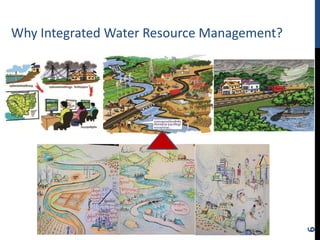
Why Integrated Water Resource Management?
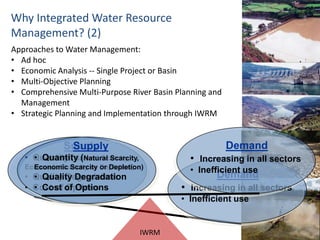
Why Integrated Water Resource
Management? (2)
Approaches to Water Management:
• Ad hoc
• Economic Analysis -- Single Project or Basin
• Multi-Objective Planning
• Comprehensive Multi-Purpose River Basin Planning and
Management
• Strategic Planning and Implementation through IWRM

Demand

Supply
Supply
• Quantity (Natural Scarcity,

• Increasing in all sectors

Economic Scarcity or Depletion)

• Inefficient use

• Quality Degradation
• Cost of of Options
• Cost Options

Demand

• Increasing in all sectors
• Inefficient use

IWRM
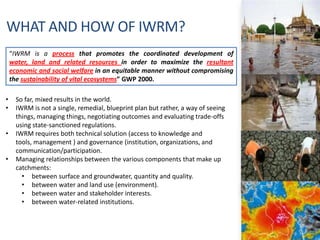
WHAT AND HOW OF IWRM?
“IWRM is a process that promotes the coordinated development of
water, land and related resources in order to maximize the resultant
economic and social welfare in an equitable manner without compromising
the sustainability of vital ecosystems” GWP 2000.
•
•

•
•

So far, mixed results in the world.
IWRM is not a single, remedial, blueprint plan but rather, a way of seeing
things, managing things, negotiating outcomes and evaluating trade-offs
using state-sanctioned regulations.
IWRM requires both technical solution (access to knowledge and
tools, management ) and governance (institution, organizations, and
communication/participation.
Managing relationships between the various components that make up
catchments:
• between surface and groundwater, quantity and quality.
• between water and land use (environment).
• between water and stakeholder interests.
• between water-related institutions.

8
Establishing a collective meaning of IWRM
What we want to achieve for Pursat Basin?
 Goal of IWRM at the river basin level is to
achieve water security(1) for all purposes, as well
as manage risks while responding to, and
mitigating, disasters.

Water security = capacity to provide sufficient and
sustainable quantity and quality of water for all types of
water services and protect society and the environment
from water-related disasters (ADB).

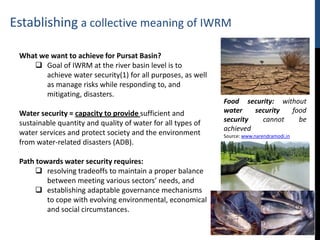
Food security: without
water
security
food
security
cannot
be
achieved
Source: www.narendramodi.in

9

Path towards water security requires:
 resolving tradeoffs to maintain a proper balance
between meeting various sectors’ needs, and
 establishing adaptable governance mechanisms
to cope with evolving environmental, economical
and social circumstances.
STAKEHOLDER ANALYSIS
Need to understand the complexity of interests and
motivations, power relation, evaluate and predict impacts, and assess
human capacity.
Provide information regarding:
• Individuals, groups and institutions that will be affected by and
should benefit from resources development and management;
and
• Individuals, groups and institutions who can influence, and
contribute to, the resources development and management
processes.

One who has a share or an
interest, as in an enterprise

To be mapped according to their comparative influence (power) and
interest (extent of being affected) within a certain system.

10
LOCALIZING IWRM THROUGH MULTI-STAKEHOLDER
PLATFORM
A BODY OF PEOPLE belonging to
various schools of thought/
perspectives, sectors, expertise, a
nd organizations – government
(national, provincial, and
municipal), CSOs (including
academic institutions), and
community-based natural
resource communities.
A BODY OF PEOPLE who are all
stakeholder
(users, regulators, learners) of
Stung Pursat.
A BODY OF PEOPLE who are
gathered to use the principles of
integrated water resource
management to collectively and
coherently manage the use and
development of Stung Pursat.

Participatory: Based on
consultation with a wide range
of interested and affected
parties;
Informed: Based on wide range
of information; and
Cyclical/iterative: Based on
evolving national
policies, priorities, scientific
finding and systematic
monitoring and evaluation of
existing strategies and policies.
LOCALIZING IWRM THROUGH MULTI-STAKEHOLDER PLATFORM (2)
STUNG PURSAT MSP MISSION
Existing Drivers

To serve as a problem-solving and planning
platform for concerned Pursat stakeholders to
agree on action and strategies for solving the
identified problem based on knowledge and a
strong convening power to help increase
trust/confidence among stakeholders and
facilitate agreements between various interest
holders/groups

Internal
Forces
External
Forces

Water
Vision/
Policy

Outputs

INITIATION
MSP
Established
as an informal
platform

Activities

Awareness in
IWRM

Government
Commitment

STUNG PURSAT VISION
MK 16 has initiated the MSP as an informal
Green and prosperous discussed. platform and broughtfor
together several stakeholders as Pursat catchment
meeting multiple needs and uses of its
community, based on IWRM principles and
informed and collaborative decisions, which
ensure social equity and harmony, and longterm sustainable development
TODAY’S EXERCISE
1.
2.

The process of catchment management
A debate on IWRM, which will be organized around three points:
i.

ii.

iii.

3.

Stakeholders: Who are the important stakeholders in catchment
management and how are they different? How can the works of the
most influential be regulated? What is the role of the government
(national and sub-national) and multi-stakeholder platforms?
Human and natural changes: What are the current and anticipated
human-induced and natural changes in the Mekong, and how is your
catchment influenced by and contributing to these changes? What
political and practical implications will this have for catchment
management?
Strategies and Solutions: How can the challenges above be addressed
through governance? What models/ strategies have worked elsewhere?
How can these strategies be adopted for Mekong and your catchment?
What will be the requirements for implementing these strategies?

Questions and Answers session
14

THANK YOU VERY MUCH FOR YOUR
ATTENSION!

Integrated water resource management

  • 1.
    INTEGRATED WATER RESOURCEMANAGEMENT MK 16: Fostering Evidence-based IWRM in The Stung Pursat Catchment (Tonle Sap Great Lake), Cambodia 3rd Mekong Forum on Water, Food and Energy Mr. Mao Hak, Project Investigator, Deputy Director General of Technical Affairs, MOWRAM November 21, 2013
  • 2.
    PRESENTATION OUTLINE  TheMK 16 Project  Project Site  Why Integrated Water Resource Management?  What and How of IWRM  Establishing a collective meaning of IWRM in Pursat  Stakeholder Analysis  Localizing IWRM through MSP  Today’s exercise
  • 3.
    THE MK 16PROJECT › Fostering Evidence-based IWRM in the Stung Pursat catchment (Tonle Sap Great Lake), Cambodia is jointly implemented by Tonle Sap Authority, Ministry of Water Resources and Meteorology, Supreme National Economic Council, Hatfield Consultant Partnership, and Culture and Environment Preservation Association. › Project recognizes firm relationship between knowledge and effective water management, and potential for translating IWRM into better governance practice. In order to address water resources issues and develop IWRM capacities, there is a need for collaboration between related sectors and proper use of scientific data and analysis to inform decisions. 3
  • 4.
    PROJECT SITE  StungPursat is listed as one of Cambodia’s priority catchments due to its rich natural resources and wildlife sanctuaries (many ongoing and future development).  Catchment of 5,965 km2 that discharges an average of 2,818 Million Cubic Meters (MCM) a year into the Great Lake. Catchment Area (ha) 1,100,000 900,000 700,000 500,000 300,000 100,000 (100,000) 4
  • 5.
    Diagram in PursatRiver Basin Dam No.3&5 (Irrigation, Ve=50MCM,MOWRAM) Dam No.1(Hydro-electricity, Ve=1,014MCM, MIME) Dam No.3 &No.5 16,,100 10,000 All relevant data and information on these structures are collected, including Damnak in order to complete water demand and water Damnak Ampil Extension primary hydrological data, Ampil 20,100 2,519 balance analyses. Orokar Svay Donkeo River Interacting impacts between the proposed hydropower dams and the irrigation diversion system, as well as recorded data for the canal or its diversion structures on the Pursat River are unknown. Damnak Cheoukrom (B.P Ponley) Anlong Roung Kbal Houng (R) Kbal Houng (L) Wat Chre Boeung Khnar River 1,000 Krouch Seuchi This 4,700 information provide input Wat Loung for developing water allocation Loloksar 1,000 Anlong Svay 2,410 580 scenarios, and aid in the predicting potential impacts of hydropower and 795 Pursat water withdrawal in the catchment. Roneam Prayol 1,500 1,227 1,200 2,000 Kampang In addition, these data and analyses helps fostering multi-stakeholder 1400 platforms (MSPs), which can improve coordination required for managing Wat leab & Koh Ksach Charek B.Kantoo catchment’s water resources. 360 717 Legend 11,000 Kampout Ang Irrigation System 20 Area(ha) 5 Tonle Sap lake
  • 6.
    6 Why Integrated WaterResource Management?
  • 7.
    Why Integrated WaterResource Management? (2) Approaches to Water Management: • Ad hoc • Economic Analysis -- Single Project or Basin • Multi-Objective Planning • Comprehensive Multi-Purpose River Basin Planning and Management • Strategic Planning and Implementation through IWRM Demand Supply Supply • Quantity (Natural Scarcity, • Quantity (Natural Scarcity, • Increasing in all sectors Economic Scarcity or Depletion) Economic Scarcity or Depletion) • Inefficient use • Quality Degradation • Quality Degradation • Cost of of Options • Cost Options Demand • Increasing in all sectors • Inefficient use IWRM
  • 8.
    WHAT AND HOWOF IWRM? “IWRM is a process that promotes the coordinated development of water, land and related resources in order to maximize the resultant economic and social welfare in an equitable manner without compromising the sustainability of vital ecosystems” GWP 2000. • • • • So far, mixed results in the world. IWRM is not a single, remedial, blueprint plan but rather, a way of seeing things, managing things, negotiating outcomes and evaluating trade-offs using state-sanctioned regulations. IWRM requires both technical solution (access to knowledge and tools, management ) and governance (institution, organizations, and communication/participation. Managing relationships between the various components that make up catchments: • between surface and groundwater, quantity and quality. • between water and land use (environment). • between water and stakeholder interests. • between water-related institutions. 8
  • 9.
    Establishing a collectivemeaning of IWRM What we want to achieve for Pursat Basin?  Goal of IWRM at the river basin level is to achieve water security(1) for all purposes, as well as manage risks while responding to, and mitigating, disasters. Water security = capacity to provide sufficient and sustainable quantity and quality of water for all types of water services and protect society and the environment from water-related disasters (ADB). Food security: without water security food security cannot be achieved Source: www.narendramodi.in 9 Path towards water security requires:  resolving tradeoffs to maintain a proper balance between meeting various sectors’ needs, and  establishing adaptable governance mechanisms to cope with evolving environmental, economical and social circumstances.
  • 10.
    STAKEHOLDER ANALYSIS Need tounderstand the complexity of interests and motivations, power relation, evaluate and predict impacts, and assess human capacity. Provide information regarding: • Individuals, groups and institutions that will be affected by and should benefit from resources development and management; and • Individuals, groups and institutions who can influence, and contribute to, the resources development and management processes. One who has a share or an interest, as in an enterprise To be mapped according to their comparative influence (power) and interest (extent of being affected) within a certain system. 10
  • 11.
    LOCALIZING IWRM THROUGHMULTI-STAKEHOLDER PLATFORM A BODY OF PEOPLE belonging to various schools of thought/ perspectives, sectors, expertise, a nd organizations – government (national, provincial, and municipal), CSOs (including academic institutions), and community-based natural resource communities. A BODY OF PEOPLE who are all stakeholder (users, regulators, learners) of Stung Pursat. A BODY OF PEOPLE who are gathered to use the principles of integrated water resource management to collectively and coherently manage the use and development of Stung Pursat. Participatory: Based on consultation with a wide range of interested and affected parties; Informed: Based on wide range of information; and Cyclical/iterative: Based on evolving national policies, priorities, scientific finding and systematic monitoring and evaluation of existing strategies and policies.
  • 12.
    LOCALIZING IWRM THROUGHMULTI-STAKEHOLDER PLATFORM (2) STUNG PURSAT MSP MISSION Existing Drivers To serve as a problem-solving and planning platform for concerned Pursat stakeholders to agree on action and strategies for solving the identified problem based on knowledge and a strong convening power to help increase trust/confidence among stakeholders and facilitate agreements between various interest holders/groups Internal Forces External Forces Water Vision/ Policy Outputs INITIATION MSP Established as an informal platform Activities Awareness in IWRM Government Commitment STUNG PURSAT VISION MK 16 has initiated the MSP as an informal Green and prosperous discussed. platform and broughtfor together several stakeholders as Pursat catchment meeting multiple needs and uses of its community, based on IWRM principles and informed and collaborative decisions, which ensure social equity and harmony, and longterm sustainable development
  • 13.
    TODAY’S EXERCISE 1. 2. The processof catchment management A debate on IWRM, which will be organized around three points: i. ii. iii. 3. Stakeholders: Who are the important stakeholders in catchment management and how are they different? How can the works of the most influential be regulated? What is the role of the government (national and sub-national) and multi-stakeholder platforms? Human and natural changes: What are the current and anticipated human-induced and natural changes in the Mekong, and how is your catchment influenced by and contributing to these changes? What political and practical implications will this have for catchment management? Strategies and Solutions: How can the challenges above be addressed through governance? What models/ strategies have worked elsewhere? How can these strategies be adopted for Mekong and your catchment? What will be the requirements for implementing these strategies? Questions and Answers session
  • 14.
    14 THANK YOU VERYMUCH FOR YOUR ATTENSION!

Editor's Notes

  • #11 If interest groups see that their interests are threatened, they would use their powers and influences to prevent other group objectives from being achieved