www.iwmi.org
A water-secure world
Water and the Sustainable
Development Goals (SDG)
Peter G. McCornick, PhD, PE, D.WRE.
World Water Day Dialogue:
Water, jobs and prosperity in Sri Lanka - Partnerships for sustainability
International Water Management Institute
Pelawatta, Sri Lanka
March 23rd, 2016
www.iwmi.org
A water-secure world
World Economic Forum, Global Risks Report 2016
Water Risk
www.iwmi.org
A water-secure world
Van der Bliek, McCornick & Clark (2014)
Sustainable Development Goals (SDG)
www.iwmi.org
A water-secure world
Context is crucial
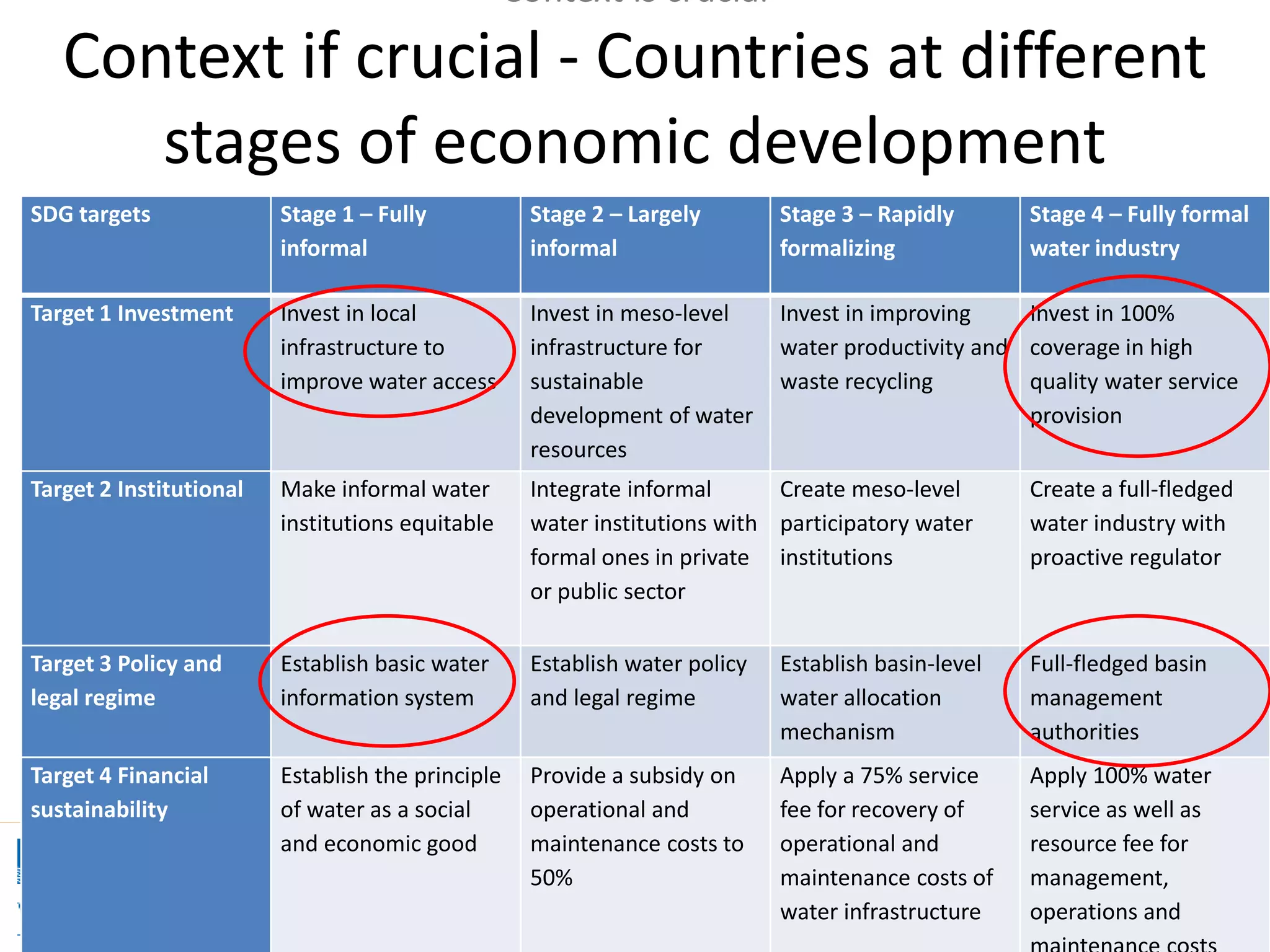
Context if crucial - Countries at different
stages of economic development
SDG targets Stage 1 – Fully
informal
Stage 2 – Largely
informal
Stage 3 – Rapidly
formalizing
Stage 4 – Fully formal
water industry
Target 1 Investment Invest in local
infrastructure to
improve water access
Invest in meso-level
infrastructure for
sustainable
development of water
resources
Invest in improving
water productivity and
waste recycling
Invest in 100%
coverage in high
quality water service
provision
Target 2 Institutional Make informal water
institutions equitable
Integrate informal
water institutions with
formal ones in private
or public sector
Create meso-level
participatory water
institutions
Create a full-fledged
water industry with
proactive regulator
Target 3 Policy and
legal regime
Establish basic water
information system
Establish water policy
and legal regime
Establish basin-level
water allocation
mechanism
Full-fledged basin
management
authorities
Target 4 Financial
sustainability
Establish the principle
of water as a social
and economic good
Provide a subsidy on
operational and
maintenance costs to
50%
Apply a 75% service
fee for recovery of
operational and
maintenance costs of
water infrastructure
Apply 100% water
service as well as
resource fee for
management,
operations and
www.iwmi.org
A water-secure world
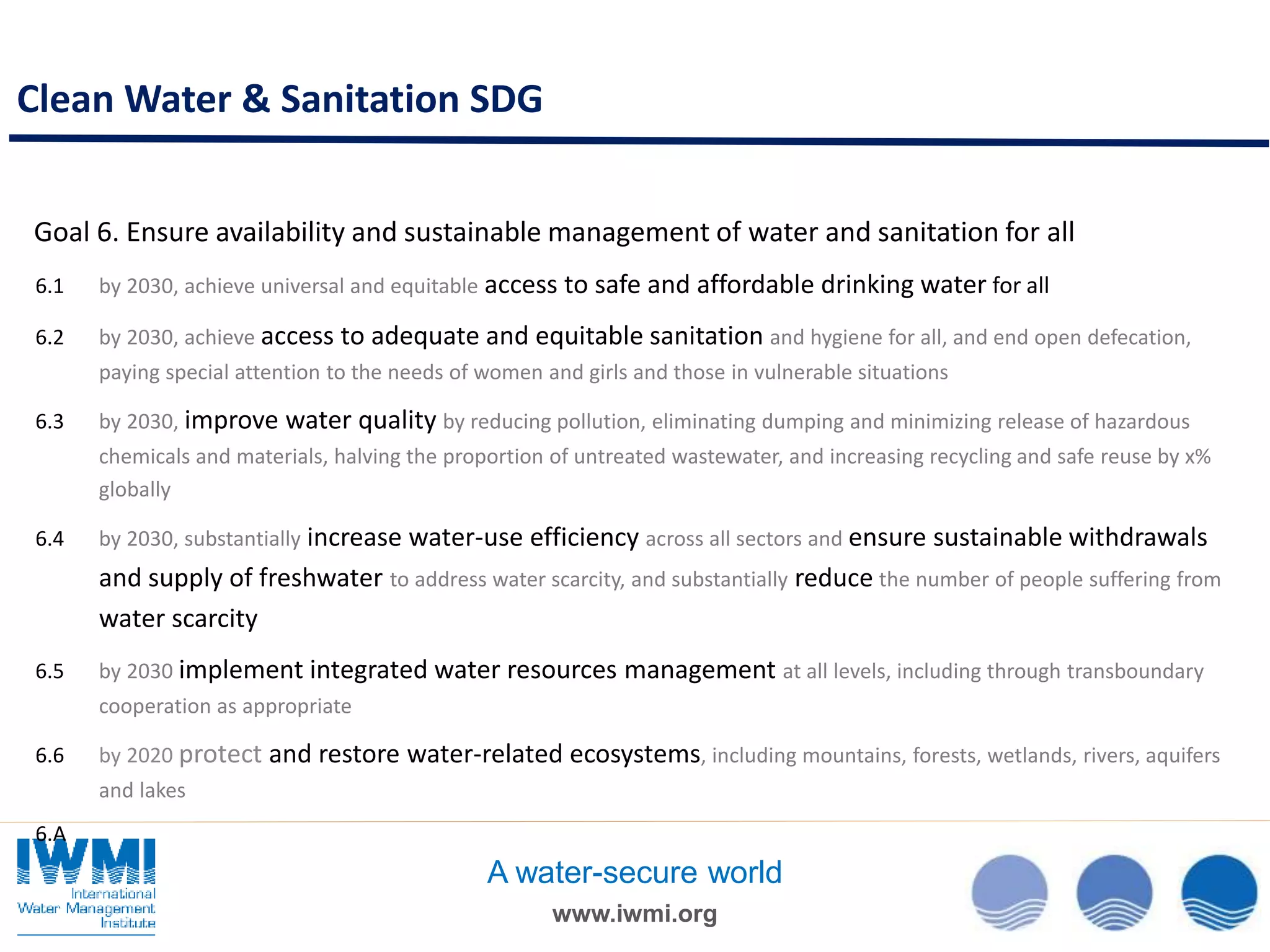
Goal 6. Ensure availability and sustainable management of water and sanitation for all
6.1 by 2030, achieve universal and equitable access to safe and affordable drinking water for all
6.2 by 2030, achieve access to adequate and equitable sanitation and hygiene for all, and end open defecation,
paying special attention to the needs of women and girls and those in vulnerable situations
6.3 by 2030, improve water quality by reducing pollution, eliminating dumping and minimizing release of hazardous
chemicals and materials, halving the proportion of untreated wastewater, and increasing recycling and safe reuse by x%
globally
6.4 by 2030, substantially increase water-use efficiency across all sectors and ensure sustainable withdrawals
and supply of freshwater to address water scarcity, and substantially reduce the number of people suffering from
water scarcity
6.5 by 2030 implement integrated water resources management at all levels, including through transboundary
cooperation as appropriate
6.6 by 2020 protect and restore water-related ecosystems, including mountains, forests, wetlands, rivers, aquifers
and lakes
6.A
Clean Water & Sanitation SDG
www.iwmi.org
A water-secure world
Managing groundwater sustainably
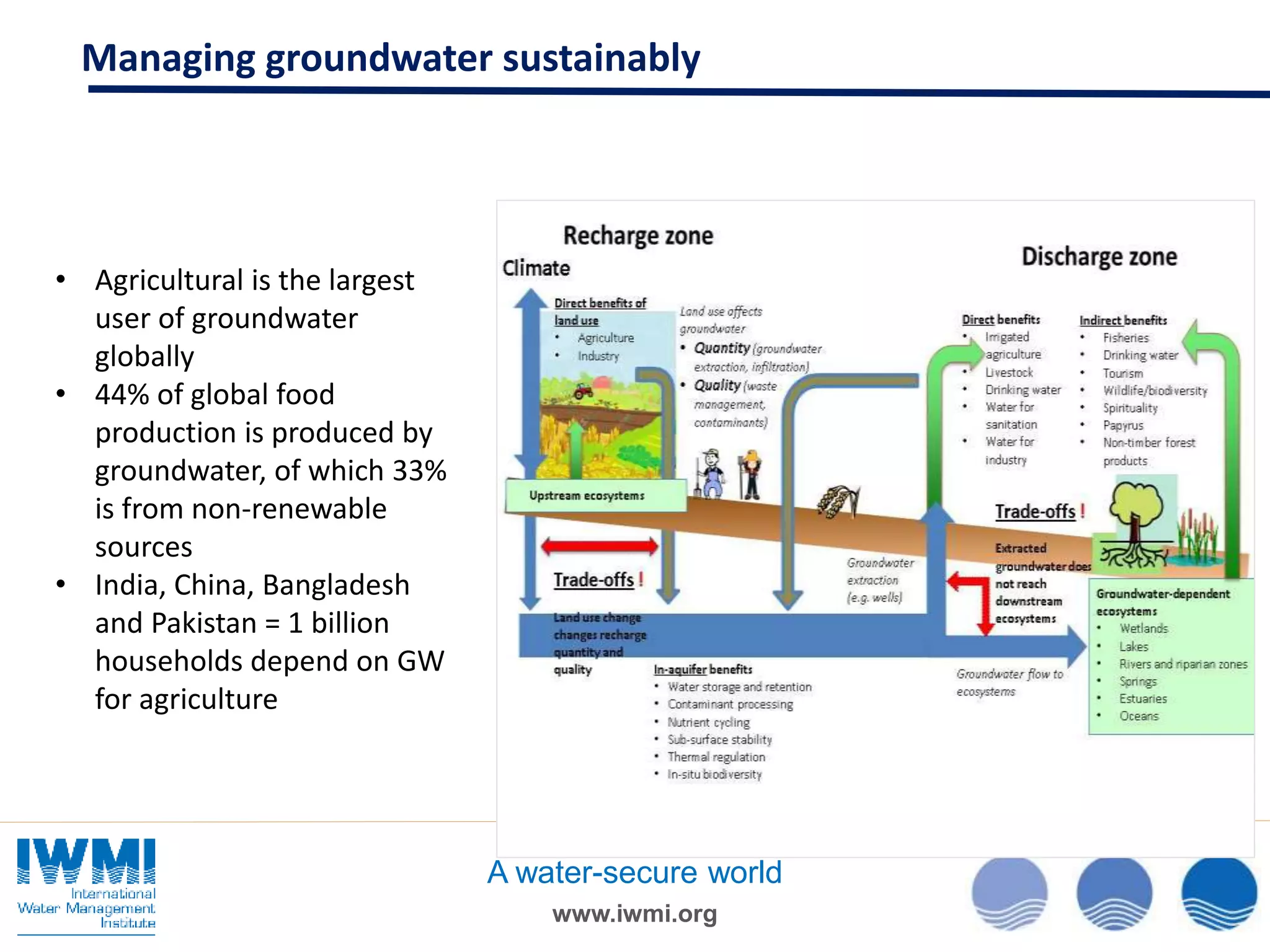
• Agricultural is the largest
user of groundwater
globally
• 44% of global food
production is produced by
groundwater, of which 33%
is from non-renewable
sources
• India, China, Bangladesh
and Pakistan = 1 billion
households depend on GW
for agriculture
www.iwmi.org
A water-secure world
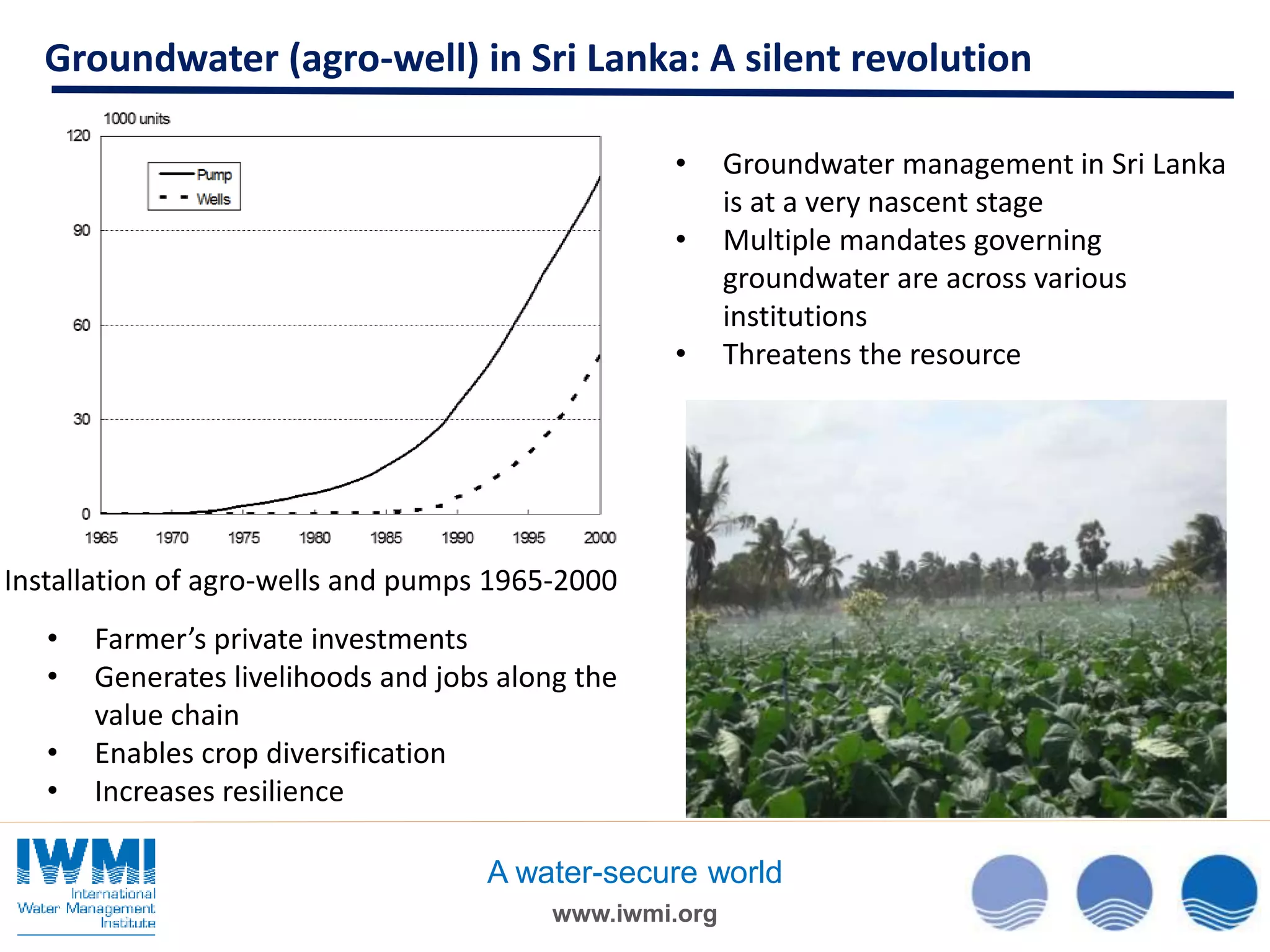
Installation of agro-wells and pumps 1965-2000
• Groundwater management in Sri Lanka
is at a very nascent stage
• Multiple mandates governing
groundwater are across various
institutions
• Threatens the resource
Groundwater (agro-well) in Sri Lanka: A silent revolution
• Farmer’s private investments
• Generates livelihoods and jobs along the
value chain
• Enables crop diversification
• Increases resilience
www.iwmi.org
A water-secure world
Managing groundwater sustainably
Rehabilitation
Revitalization is more than just rehabilitation
InternationalWaterManagementInstitute
Pehur High Level Canal,
Pakistan
DavidMolden/IWMI
Productivity
Functioning Ecosystems
HamishJohnAppleby/IWMI
RichardSteckel/IWMI
People
Revitalizing irrigation systems for food, water, energy and ecosystems
services
www.iwmi.org
A water-secure world
• One million new farm tube-
wells are sunk in India every
year, each one relying on
electric or diesel powered
pumps.
• It takes an average of roughly
2,500 liters of water to produce
1 liter of liquid biofuel - the
same amount needed, on
average, to produce food for
one person for one day.
Water, Energy, Food & Environment
SDG 6, 7, 2, 14 and others
www.iwmi.org
A water-secure world
SDG targets on wastewater
management, recycling &
reuse: other nexus benefits
→ reduced energy for
chemical fertilizers, recovery
of nutrients
Multiple benefits from wastewater reuse,
food security and energy reduction
www.iwmi.org
A water-secure world
• SDG 12.5 - substantially reduce waste generation through prevention,
reduction, recycling and reuse
• SDG 6.6.1 on water related ecosystems
Safeguarding our water bodies
Solid waste
Liquid waste
Eravur
Kalmunai
Co-
Composti
ng
Partnering with the Central Environmental
Authority (CEA) to facilitate its use in Sri Lanka
www.iwmi.org
A water-secure world
• Achieving the SDG goal 6.6.1 on water related ecosystems
• Working with the Central Environmental Authority (CEA) to facilitate its
use in Sri Lanka
Healthy Rivers
How much water should be left in rivers to ensure they remain healthy?
(Sri Lanka Environmental Flow Calculator)
www.iwmi.org
A water-secure world
Ratnapura
Nuwara Eliya
Anuradhapura
Vulnerabilityindex
• Directly relevant to SDG Goal 13: Take urgent
action to combat climate change and its impacts
• Identify highly vulnerable areas
• Identify river basins which have the highest
potential (best candidates) for further increases
in surface water storage capacity
• Provide capacity building and expert advice to
the Ministry of Mahaweli Development and
Environment on climate change
Adapting to Climate Change
Improved water management is critical
www.iwmi.org
A water-secure world
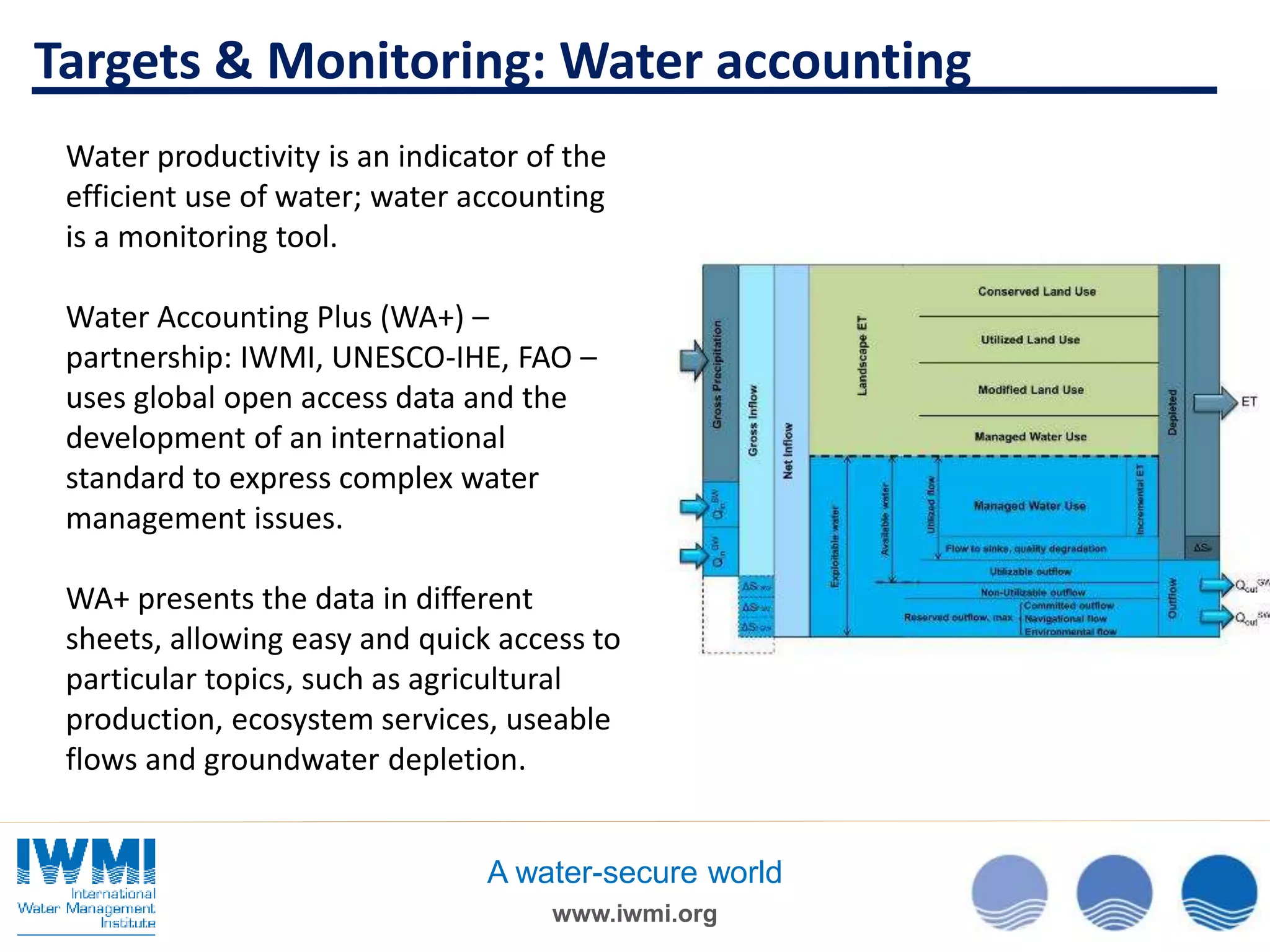
Water productivity is an indicator of the
efficient use of water; water accounting
is a monitoring tool.
Water Accounting Plus (WA+) –
partnership: IWMI, UNESCO-IHE, FAO –
uses global open access data and the
development of an international
standard to express complex water
management issues.
WA+ presents the data in different
sheets, allowing easy and quick access to
particular topics, such as agricultural
production, ecosystem services, useable
flows and groundwater depletion.
Targets & Monitoring: Water accounting
www.iwmi.org
A water-secure world
Partnerships: Achieving all water-related goals will
require a broad partnership within the water sector
and beyond
Opportunities for Growth: Emphasis should be on
facilitating a sustainable and equitable growth path.
Balancing the Scales: Large scale investments in
water resources and agriculture need to
complement, rather than undermine, small-scale
producers
Integration: Thinking across sectors and out of the
‘sectoral boxes’ has produced practical solutions
Overarching messages
www.iwmi.org
A water-secure world
• Consider the contextual realities in a given
country
• Determine practical national targets,
requirements and solutions for achieving targets
and measuring progress
• Identify evidence-based solutions and
interventions
Further Steps
www.iwmi.org
A water-secure world

Water and the Sustainable Development Goals (SDGs)

  • 1.
    www.iwmi.org A water-secure world Waterand the Sustainable Development Goals (SDG) Peter G. McCornick, PhD, PE, D.WRE. World Water Day Dialogue: Water, jobs and prosperity in Sri Lanka - Partnerships for sustainability International Water Management Institute Pelawatta, Sri Lanka March 23rd, 2016
  • 2.
    www.iwmi.org A water-secure world WorldEconomic Forum, Global Risks Report 2016 Water Risk
  • 3.
    www.iwmi.org A water-secure world Vander Bliek, McCornick & Clark (2014) Sustainable Development Goals (SDG)
  • 4.
    www.iwmi.org A water-secure world Contextis crucial Context if crucial - Countries at different stages of economic development SDG targets Stage 1 – Fully informal Stage 2 – Largely informal Stage 3 – Rapidly formalizing Stage 4 – Fully formal water industry Target 1 Investment Invest in local infrastructure to improve water access Invest in meso-level infrastructure for sustainable development of water resources Invest in improving water productivity and waste recycling Invest in 100% coverage in high quality water service provision Target 2 Institutional Make informal water institutions equitable Integrate informal water institutions with formal ones in private or public sector Create meso-level participatory water institutions Create a full-fledged water industry with proactive regulator Target 3 Policy and legal regime Establish basic water information system Establish water policy and legal regime Establish basin-level water allocation mechanism Full-fledged basin management authorities Target 4 Financial sustainability Establish the principle of water as a social and economic good Provide a subsidy on operational and maintenance costs to 50% Apply a 75% service fee for recovery of operational and maintenance costs of water infrastructure Apply 100% water service as well as resource fee for management, operations and
  • 5.
    www.iwmi.org A water-secure world Goal6. Ensure availability and sustainable management of water and sanitation for all 6.1 by 2030, achieve universal and equitable access to safe and affordable drinking water for all 6.2 by 2030, achieve access to adequate and equitable sanitation and hygiene for all, and end open defecation, paying special attention to the needs of women and girls and those in vulnerable situations 6.3 by 2030, improve water quality by reducing pollution, eliminating dumping and minimizing release of hazardous chemicals and materials, halving the proportion of untreated wastewater, and increasing recycling and safe reuse by x% globally 6.4 by 2030, substantially increase water-use efficiency across all sectors and ensure sustainable withdrawals and supply of freshwater to address water scarcity, and substantially reduce the number of people suffering from water scarcity 6.5 by 2030 implement integrated water resources management at all levels, including through transboundary cooperation as appropriate 6.6 by 2020 protect and restore water-related ecosystems, including mountains, forests, wetlands, rivers, aquifers and lakes 6.A Clean Water & Sanitation SDG
  • 6.
    www.iwmi.org A water-secure world Managinggroundwater sustainably • Agricultural is the largest user of groundwater globally • 44% of global food production is produced by groundwater, of which 33% is from non-renewable sources • India, China, Bangladesh and Pakistan = 1 billion households depend on GW for agriculture
  • 7.
    www.iwmi.org A water-secure world Installationof agro-wells and pumps 1965-2000 • Groundwater management in Sri Lanka is at a very nascent stage • Multiple mandates governing groundwater are across various institutions • Threatens the resource Groundwater (agro-well) in Sri Lanka: A silent revolution • Farmer’s private investments • Generates livelihoods and jobs along the value chain • Enables crop diversification • Increases resilience
  • 8.
  • 9.
    Rehabilitation Revitalization is morethan just rehabilitation InternationalWaterManagementInstitute Pehur High Level Canal, Pakistan DavidMolden/IWMI Productivity Functioning Ecosystems HamishJohnAppleby/IWMI RichardSteckel/IWMI People Revitalizing irrigation systems for food, water, energy and ecosystems services
  • 10.
    www.iwmi.org A water-secure world •One million new farm tube- wells are sunk in India every year, each one relying on electric or diesel powered pumps. • It takes an average of roughly 2,500 liters of water to produce 1 liter of liquid biofuel - the same amount needed, on average, to produce food for one person for one day. Water, Energy, Food & Environment SDG 6, 7, 2, 14 and others
  • 11.
    www.iwmi.org A water-secure world SDGtargets on wastewater management, recycling & reuse: other nexus benefits → reduced energy for chemical fertilizers, recovery of nutrients Multiple benefits from wastewater reuse, food security and energy reduction
  • 12.
    www.iwmi.org A water-secure world •SDG 12.5 - substantially reduce waste generation through prevention, reduction, recycling and reuse • SDG 6.6.1 on water related ecosystems Safeguarding our water bodies Solid waste Liquid waste Eravur Kalmunai Co- Composti ng Partnering with the Central Environmental Authority (CEA) to facilitate its use in Sri Lanka
  • 13.
    www.iwmi.org A water-secure world •Achieving the SDG goal 6.6.1 on water related ecosystems • Working with the Central Environmental Authority (CEA) to facilitate its use in Sri Lanka Healthy Rivers How much water should be left in rivers to ensure they remain healthy? (Sri Lanka Environmental Flow Calculator)
  • 14.
    www.iwmi.org A water-secure world Ratnapura NuwaraEliya Anuradhapura Vulnerabilityindex • Directly relevant to SDG Goal 13: Take urgent action to combat climate change and its impacts • Identify highly vulnerable areas • Identify river basins which have the highest potential (best candidates) for further increases in surface water storage capacity • Provide capacity building and expert advice to the Ministry of Mahaweli Development and Environment on climate change Adapting to Climate Change Improved water management is critical
  • 15.
    www.iwmi.org A water-secure world Waterproductivity is an indicator of the efficient use of water; water accounting is a monitoring tool. Water Accounting Plus (WA+) – partnership: IWMI, UNESCO-IHE, FAO – uses global open access data and the development of an international standard to express complex water management issues. WA+ presents the data in different sheets, allowing easy and quick access to particular topics, such as agricultural production, ecosystem services, useable flows and groundwater depletion. Targets & Monitoring: Water accounting
  • 16.
    www.iwmi.org A water-secure world Partnerships:Achieving all water-related goals will require a broad partnership within the water sector and beyond Opportunities for Growth: Emphasis should be on facilitating a sustainable and equitable growth path. Balancing the Scales: Large scale investments in water resources and agriculture need to complement, rather than undermine, small-scale producers Integration: Thinking across sectors and out of the ‘sectoral boxes’ has produced practical solutions Overarching messages
  • 17.
    www.iwmi.org A water-secure world •Consider the contextual realities in a given country • Determine practical national targets, requirements and solutions for achieving targets and measuring progress • Identify evidence-based solutions and interventions Further Steps
  • 18.

Editor's Notes

  • #4 Partnerships: Achieving all water-related goals will require a broad partnership within the water sector and beyond – and including the science community Opportunities for Growth: The emphasis should be on facilitating a sustainable and equitable growth path. Balancing the Scales: large scale investments in water resources and agriculture need to complement, rather than undermine, small-scale producers Integration: thinking across sectors and out of the ‘sectoral boxes’ has produced practical solutions
  • #10 Pehur Highl Level Canal
  • #16 Water productivity is an indicator of the efficient use of water; water accounting is a monitoring tool. Quantified water accounts can be used to set management targets and subsequently monitor these targets. Water Accounting Plus (WA+) – partnership: IWMI, UNESCO-IHE, FAO – uses global open access data and the development of an international standard to express complex water management issues. WA+ presents the data in different sheets, allowing easy and quick access to particular topics, such as agricultural production, ecosystem services, useable flows and groundwater depletion. Resource sheet is shown here.