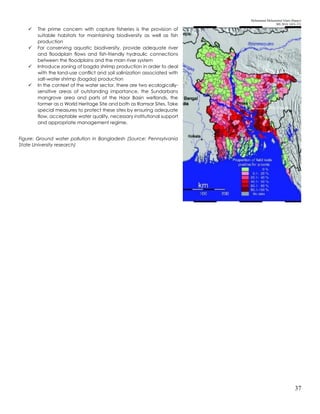
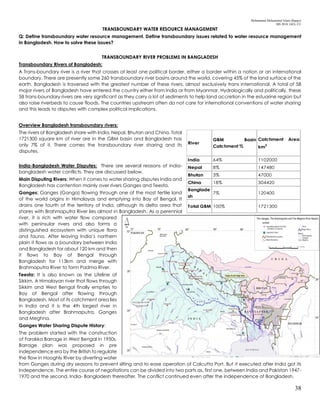
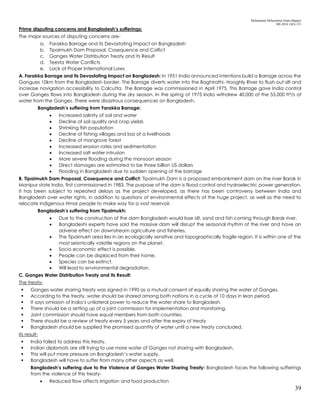
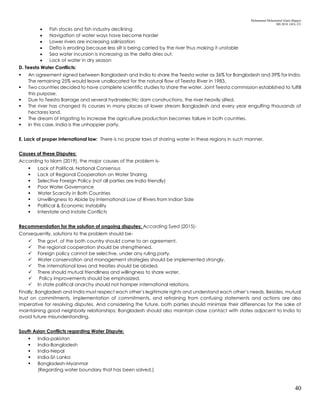
1
Water Resource Management
Hand Notes
Mohammad Mohaiminul Islam
B.Sc., M.Sc.
Department of Geography & Environmental Studies
University of Chittagong
mohaiminul.ges@std.cu.ac.bd
Mohammad Mohaiminul Islam (Bappy)
MS 2018, GES, CU
2
INTRODUCTION TO WATER RESOURCE MANAGEMENT
Q. What do you understand by water resource management? Discuss the fundamental concept, scope, goal and Importance
in the context of Bangladesh.
Water Resource:
The concept of water resources is multidimensional. It is not limited only to its physical measure (hydrological and
hydrogeological), the ‘flows and stocks’, but encompasses other more qualitative, environmental and socio-economic
dimensions (FAO, 2003). Water resources are natural resources of water that are potentially useful. Uses of water include
agricultural, industrial, household, recreational and environmental activities. All living things require water to grow and
reproduce (USGS, 2009).
Water Resource Management:
 According to Rola, Pulhin and Hall (2018), Water resource management is the formulation and evaluation of alternative
plans to accomplish water development objectives such as water supply management, water excess management,
including environmental protection for sustainable use of water resources.
 Water Resource Management is a process which promotes the coordinated development and management of water,
land and related resources in order to maximise the resultant economic and social welfare in an equitable manner,
without compromising the sustainability of vital ecosystems (Kumar, 2019).
 According to Banglapedia, Water Resources Management aims at managing the tasks required to generate water and
produce water related goods and services for the benefits of the society as a whole. It includes physical intervention,
related financial management, institutional arrangement, legislation, and regulations.
Fundamental Concept of Water Resource Management:
Water resource management is the activity of planning, developing, distributing and managing the optimum use of water
resources. It is a sub-set of water cycle management. The fundamental concept of water resource management includes
the management of water resources through multiple processes. It is also a decision making act in resource management
study. The key concepts of water resource management are-
 Formulation of alternative plans for water development.
 Evaluation of alternative plans for water development.
 Management of water supply.
 Management of water excessiveness.
 Management of the mass access to water.
 Management of water resource for environmental
protection.
 Management of water resource for sustainable
development.
 Coordination of development and management of
water.
 Strengthening the sustainability of water resource.
 Management of water resource for social wellbeing.
 Management of water resource for environmental
balance.
Scope of Water Resource Management:
 Water resources assessment
 Development, conservation and control of water
resource
 Making emphasis on policies and strategies regarding
water resource
 planning and design of water resource systems and
operation
 Maintenance and administration of water resource
systems
 Water demand and consumption study
 Applied surface and groundwater hydrology
 Water management techniques
 Simulation and modelling of water resource systems
 Forecasting and control of quantity and quality of water
 Economic and social aspects of water use
 Legislation of water usage
 Water resources protection
 Human intervention in water cycle
 Sectoral usage of water resource
 Management of flood
 Water power development
 Water disputes
 Water and environmental issues
Goal/Importance of Water Resource Management:
 Assessing the availability water resource
 Assessing the quality and quantity of water resource
 Ensuring the sustainability of water resource
Mohammad Mohaiminul Islam (Bappy)
MS 2018, GES, CU
3
 Ensuring the accessibility of water resource
 Solving the disputes of water resource distribution
 Making plans and policy for water resource
 Comprehending the hydrological aspects of water resource
 Managing the water resource and its usage for environmental/ecosystem balance.
 Balance between demand and consumption of water resource.
 Coordination of water plans, policies and monitoring and management bodies.
Q: What is integrated water resource management (IWRM)? Explain the framework for integrated water resource
management (IWRM). Explain that geographical knowledge is basic need for IWRM.
IWRM:
According GWP (2011), Integrated Water Resources Management (IWRM) is a process which promotes the coordinated
development and management of water, land and related resources in order to maximise economic and social welfare in
an equitable manner without compromising the sustainability of vital ecosystems and the environment.
IWRM Concept:
 WRM helps to protect the world’s environment, foster economic growth and sustainable agricultural development,
promote democratic participation in governance, and improve human health. Worldwide, water policy and
management are beginning to reflect the fundamentally interconnected nature of hydrological resources, and IWRM
is emerging as an accepted alternative to the sector-by-sector, top-down management style that has dominated in
the past.
 The basis of IWRM is that the many different uses of finite water resources are interdependent. High irrigation demands
and polluted drainage flows from agriculture mean less freshwater for drinking or industrial use; contaminated municipal
and industrial wastewater pollutes rivers and threatens ecosystems; if water has to be left in a river to protect fisheries
and ecosystems, less can be diverted to grow crops. There are plenty more examples of the basic theme that
unregulated use of scarce water resources is wasteful and inherently unsustainable.
 Integrated Water Resources Management is a cross-sectoral policy approach, designed to replace the traditional,
fragmented sectoral approach to water resources and management that has led to poor services and unsustainable
resource use. IWRM is based on the understanding that water resources are an integral component of the ecosystem,
a natural resource, and a social and economic good.
IWRM Framework: There are 3 framework principles, 4 Dublin principles and 7 factors of IWRM. Together, they can provide a
precise framework and concept of IWRM. They are-
3 Framework Principles of IWRM-
IWRM rests upon three principles that together act as the overall framework according to International Conference on Water
and the Environment in 1992.
1. Social equity: ensuring equal access for all users (particularly marginalised and poorer user groups) to an adequate
quantity and quality of water necessary to sustain human well-being.
2. Economic efficiency: bringing the greatest benefit to the greatest number of users possible with the available
financial and water resources.
3. Ecological sustainability: requiring that aquatic ecosystems are acknowledged as users and that adequate
allocation is made to sustain their natural functioning.
4 Dublin Principles-
In January, 1992, the International Conference on Water and the Environment (ICWE) was held in Dublin, Ireland to serve as
the preparatory event, with respect to water issues based on the following four guiding principles (ICWE, 1992):
1. Principle one recognized fresh water as a finite, vulnerable, and essential resource, and suggested that water should
be managed in an integrated manner.
2. Principle two suggested a participatory approach, involving users, planners, and policymakers, at all levels of water
development and management.
3. Principle three recognized women’s central role in the provision, management, and safeguarding of water.
4. Principle four suggested that water should be considered as an economic good.
Mohammad Mohaiminul Islam (Bappy)
MS 2018, GES, CU
4
7 Factors towards a successful implementation of IWRM-
1. Privatization: Privatization and public-private partnership were extensively disseminated at the Hague forum, the Bonn
conference, and the WSSD summit. Although the privatization concept presently discourages subsidies, it overlooks the
fact that, in Europe, initial water infrastructure development was based on massive subsidies. Some critics fear that
privatization may encourage fragmentation, which IWRM seems to overcome. Privatization of the marketable aspects
of water may result in single-purpose planning and management, which raises a question of open information channels
and transparency.
2. Water as an Economic Good: Water is recognized as an economic good in many international declarations, such as
those reviewed above, as well as in the policies of major lenders and donors. However, there is a risk in fostering the
notion of water as a commodity, because it shifts the public perception away from a sense of water as a common
good, and from a shared duty and responsibility. A simple and straightforward solution, designed on the basis of pure
economic efficiency, has the potential of ending up unsustainable.
3. Transboundary River Basin Management: Water should be recognized as a tool for community development, peace
building, and preventive diplomacy. Water can have an overreaching value capable of coalescing conflicting
interests and facilitating consensus building among societies. To incorporate all of the physical, political, and economic
characteristics for a river basin, a process for cooperative watershed management is vital. For this reason, water should
be managed based on river basins, not only on administrative boundaries.
4. Restoration and Ecology: In the last three decades, the highly visible effects of environmental degradation have
sparked public outcry, particularly in the United States and Europe, resulting in river restoration initiatives.
“Channelization” is the term used to embrace all processes of river channel engineering for the purposes of flood
control, drainage improvement, maintenance of navigation, reduction of bank erosion, and relocation for highway
construction.
5. Fisheries and Aquaculture: Fisheries and aquaculture are crucial for human survival and poverty reduction; they provide
an inexpensive source of protein to meet nutritional demands in many parts of the world, and therefore should
command special attention within IWRM.
6. Need to Focus on Past IWRM Experience - Integrating Lessons Learned: Although IWRM has received increasing
international attention in recent decades, historical precedents present lessons. The current IWRM mechanisms have
not properly considered similar previous attempts. Lessons from past initiatives are vital to the implementation of IWRM
principles and policies.
7. Spiritual and Cultural Aspects of Water: Water is the common symbol of humanity, social equity, and justice. It is one of
our compelling links with the sacred, with nature, and with our cultural heritage (Dooge, 2003). A case in point is the
Ganges River in South Asia, which has a very strong spiritual and cultural significance to all Indians, Bangladeshis, and
Nepalese. Regrettably, the current IWRM mechanism does not acknowledge water’s spiritual and cultural dimensions.
Without recognizing these, it is possible that all efforts towards sustainable water resources management may be
piecemeal and ephemeral.
Geographical knowledge is basic need for IWRM:
 Geography studies social equity which is an element of IWRM.
 Geography studies economic development which is an element of IWRM.
 Geography studies ecology and ecosystem which is an element of IWRM.
 Geography studies sustainable development which is an element of IWRM.
 Geography studies hydrology which is an element of IWRM.
 Geography studies environmental restoration which is an element of IWRM.
 Geography studies environmental sustainability which is an element of IWRM.
 Geography studies environmental issues which is an element of IWRM.
 Geography studies fisheries which is an element of IWRM.
 Geography studies resource management which is an element of IWRM.
 Geography studies culture and its assimilation which is an element of IWRM.
 Geography studies spatial aspects which is an element of IWRM.
 Geography studies planning and management of environmental elements that is related to IWRM.
Q: Discuss WRM/IWRM in the context of Bangladesh.
According to Banglapedia, Water Resources Management aims at managing the tasks required to generate water and
produce water related goods and services for the benefits of the society as a whole. It includes physical intervention, related
financial management, institutional arrangement, legislation, and regulations.
Mohammad Mohaiminul Islam (Bappy)
MS 2018, GES, CU
5
And, according GWP (2011), Integrated Water Resources Management (IWRM) is a process which promotes the coordinated
development and management of water, land and related resources in order to maximise economic and social welfare in
an equitable manner without compromising the sustainability of vital ecosystems and the environment.
Water Resource System in Bangladesh
Water Resources System (WRS) consists of various components of the natural system, human made infrastructure, and the
institutional arrangements to regulate and control the availability and access of users to these components.
In Bangladesh agriculture is the principal economic activity and the main user of water. Water also has domestic, commercial
and industrial use. The in-stream flows and water storage support fisheries, forestry, navigation, pollution control, salinity control,
nature conservation and recreational facilities. The natural subsystems of WRS of the country are:
(a) The inter-linked system of rivers, estuaries, canals, khals etc
(b) The floodplain
(c) Wetlands
(d) Haors, baors, beels, lakes
(e) Ponds
(f) Inter tidal lands and water
(g) Groundwater aquifers
Water Sources of Bangladesh
The water sources of Bangladesh includes-
1. Rainfall
2. Transboundary flow
3. Standing water bodies
4. Seasonal wetlands
5. In-stream storage
6. Groundwater
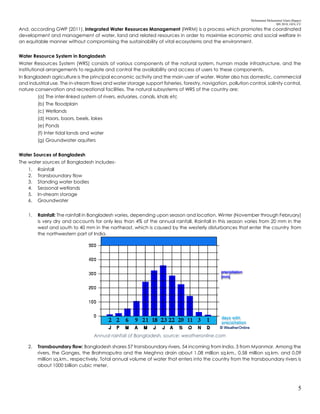
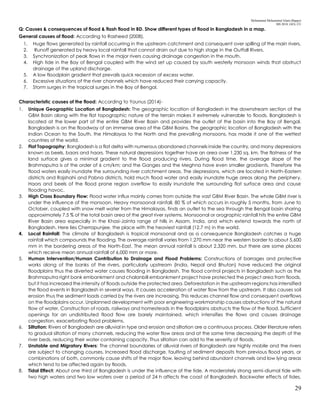
1. Rainfall: The rainfall in Bangladesh varies, depending upon season and location. Winter (November through February)
is very dry and accounts for only less than 4% of the annual rainfall. Rainfall in this season varies from 20 mm in the
west and south to 40 mm in the northeast, which is caused by the westerly disturbances that enter the country from
the northwestern part of India.
Annual rainfall of Bangladesh, source: weatheronline.com
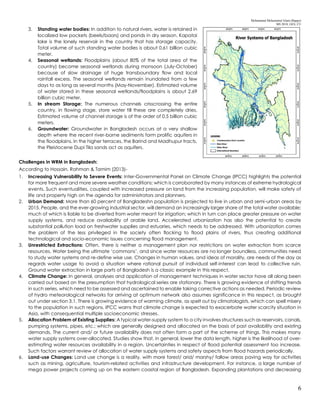
2. Transboundary flow: Bangladesh shares 57 transboundary rivers, 54 incoming from India, 3 from Myanmar. Among the
rivers, the Ganges, the Brahmaputra and the Meghna drain about 1.08 million sq.km., 0.58 million sq.km. and 0.09
million sq.km., respectively. Total annual volume of water that enters into the country from the transboundary rivers is
about 1000 billion cubic meter.
Mohammad Mohaiminul Islam (Bappy)
MS 2018, GES, CU
6
3. Standing water bodies: In addition to natural rivers, water is retained in
localized low pockets (beels/baors) and ponds in dry season. Kapatai
lake is the lonely reservoir in the country that has storage capacity.
Total volume of such standing water bodies is about 0.61 billion cubic
meter.
4. Seasonal wetlands: Floodplains (about 80% of the total area of the
country) become seasonal wetlands during monsoon (July-October)
because of slow drainage of huge transboundary flow and local
rainfall excess. The seasonal wetlands remain inundated from a few
days to as long as several months (May-November). Estimated volume
of water stored in these seasonal wetlands/floodplains is about 2.69
billion cubic meter.
5. In stream Storage: The numerous channels crisscrossing the entire
country, in flowing stage, store water till these are completely dries.
Estimated volume of channel storage is of the order of 0.5 billion cubic
meters.
6. Groundwater: Groundwater in Bangladesh occurs at a very shallow
depth where the recent river-borne sediments form prolific aquifers in
the floodplains. In the higher terraces, the Barind and Madhupur tracts,
the Pleistocene Dupi Tila sands act as aquifers.
Challenges in WRM in Bangladesh:
According to Hossain, Rahman & Tamim (2013)-
1. Increasing Vulnerability to Severe Events: Inter-Governmental Panel on Climate Change (IPCC) highlights the potential
for more frequent and more severe weather conditions; which is corroborated by many instances of extreme hydrological
events. Such eventualities, coupled with increased pressure on land from the increasing population, will make safety of
life and property high on the agenda for administrators and planners.
2. Urban Demand: More than 60 percent of Bangladeshn population is projected to live in urban and semi-urban areas by
2015. People, and the ever-growing industrial sector, will demand an increasingly larger share of the total water available;
much of which is liable to be diverted from water meant for irrigation; which in turn can place greater pressure on water
supply systems, and reduce availability of arable land. Accelerated urbanization has also the potential to create
substantial pollution load on freshwater supplies and estuaries, which needs to be addressed. With urbanization comes
the problem of the less privileged in the society often flocking to flood plains of rivers, thus creating additional
technological and socio-economic issues concerning flood management.
3. Unrestricted Extractions: Often, there is neither a management plan nor restrictions on water extraction from scarce
resources. Water being the ultimate ‘commons’, and since water resources are no longer boundless, communities need
to study water systems and re-define wise use. Changes in human values, and ideas of morality, are needs of the day as
regards water usage to avoid a situation where rational pursuit of individual self-interest can lead to collective ruin.
Ground water extraction in large parts of Bangladesh is a classic example in this respect.
4. Climate Change: In general, analyses and application of management techniques in water sector have all along been
carried out based on the presumption that hydrological series are stationary. There is growing evidence of shifting trends
in such series, which need to be assessed and ascertained to enable taking corrective actions as needed. Periodic review
of hydro meteorological networks for arriving at optimum network also assumes significance in this respect, as brought
out under section 3.1. There is growing evidence of warming climate, as spelt out by climatologists, which can spell misery
to the population in such regions. IPCC warns that climate change is expected to exacerbate water scarcity situation in
Asia, with consequential multiple socioeconomic stresses.
5. Allocation Problem of Existing Supplies: A typical water-supply system to a city involves structures such as reservoirs, canals,
pumping systems, pipes, etc.; which are generally designed and allocated on the basis of past availability and existing
demands. The current and/ or future availability does not often form a part of the scheme of things. This makes many
water supply systems over-allocated. Studies show that, in general, lower the data length, higher is the likelihood of over-
estimating water resources availability in a region. Uncertainties in respect of flood potential assessment too increase.
Such factors warrant review of allocation of water supply systems and safety aspects from flood hazards periodically.
6. Land-use Changes: Land use change is a reality, with more forest/ arid/ marshy/ fallow areas paving way for activities
such as mining, agriculture, tourism-related activities and infrastructure development. For instance, a large number of
mega power projects coming up on the eastern coastal region of Bangladesh. Expanding plantations and decreasing
Mohammad Mohaiminul Islam (Bappy)
MS 2018, GES, CU
7
forest cover also play a major part in this scenario. Changes to land use, even within agricultural lands, have substantial
implications for both water availability and use.
7. Environmental Requirements: Environmental concerns are foremost on the minds of administrators, planners and the
general populace; with the result that there is a steadily increasing awareness and emphasis on the requirements of
environmental flows in any river system towards maintaining ecosystems such as wetland and in-stream environs. We
have begun accepting the rights of nature, treating rivers, estuaries, forests and the like not as simply properties, but
entities who have their own right to flourish. The day is not far of wherein this right would be put into statute, which would
enable a vigilant citizen to file a suit on behalf of, say the injured watershed, arguing that its health is crucial to the
common good. In the above context, the ensuing sections detail the wherewithal to counter the issues by sustained
scientific and technological initiatives in the hydrological services regime.
Water Regulatory Authority in Bangladesh:
There are some regulatory authorities to implement and supervise the noted activities according to various policies and acts
on water. Some of the regulatory bodies are-
 Ministry of Water Resources,
 Bangladesh Water Development Board (BWDB),
 Water Resources Planning Organization (WARPO),
 River Research Institute (RRI),
 Joint Rivers Commission (JRC),
 Dhaka WASA etc.
Major Plans and Policy in Bangladesh and Their Evaluation:
Existing Policies for Water Management Bangladesh has various national policies for different key sectors to accelerate the
balanced way of development. There are several policies and acts for formulating the rules and regulations on general usage
on water. The major policies and acts are:
a. National Water Policy (1999);
b. Coastal Zone Policy (2005);
c. Coastal Development Strategy (2006);
d. National Water Management Plan: Development Strategy (2011);
e. Bangladesh Water Act 2013.
Plan Year Comment
National Water Policy 1999 Efficient plan but poor reporting system, lacking resources.
Development Strategy of the National Water
Management Plan
2001 Powerful strategies but weak reporting system, GO and NGO help
available.
National Water Management Plan 2004 Well stated, details, efficient and has a funding plan as well, may
face some challenges in funding
Adapted from Chan, Roy and Chaffin (2013).
National Water Management Plan (NWMP): The draft NWMP was prepared by WARPO in 2001. The plan is to be updated
every five years. The plan identified 84 programmes, which are grouped both into eight sub sectoral clusters, as well as eight
planning regions. The eight sub clusters are the Institutional Development, Enabling Environment, Main Rivers, Towns and Rural
Areas, Major Cities, Disaster Management, Agriculture and Water Management, and Environment and Aquatic Resources.
The eight planning regions are South West Region, North East Region, North Central Region, Northwest Region, South Central
Region, South East Region, Eastern Hills Region, and Rivers and Estuary Region. Priority is given to the institutional development,
enabling environment, and water supply and sanitation. The estimated investment cost of the plan over 25 years is Tk 91,457
crore ($18 billion).
Politics and Decision Making:
Bangladesh has strong elements of democracy, e.g., freedom of the press and media. However, there is a recognized lack
of transparency and accountability in environmental decision-making processes in Bangladesh. The current political system
is essentially a “winner take all” system due to the outright exclusion of political opposition from a legitimate place in the
democratic polity, the undue influence of state institutions to achieve political interests, and the general politicization of
bureaucracy. Bureaucratic complexities common to many forms of democratic governance affect administrative functions
Mohammad Mohaiminul Islam (Bappy)
MS 2018, GES, CU
8
in Bangladesh, and with very few enforceable checks and balances in government, give rise to petty corruption and crime
across the water management administration. Although corruption of public officials is a state-wide issue, it has implicit and
explicit associations with institutions and/or organizations that manage water resources. For example, protracted or corrupt
bureaucratic procedures and a lack of transparency in most public services offices is a major barrier to implementing the
Rights to Information Act of 2009—the application of which is very important measure for obtaining water management data
from the Ministry of Water Resources to support IWRM and improved water decision making.
Key Strategies of Water Management:
 Water Allocation: Apportioning of water to major users and uses; maintaining minimum levels for social and environmental
use, while addressing equity and development needs of society.
 River basin planning: Preparing and updating the basin plan as per need by incorporating stakeholder views on
development and management priorities for the basin.
 Stakeholder participation: Implementing stakeholder participation as a basis for decision making that takes into account
the best interests of society and the environment in the development and use of water resources in the basin.
 Pollution control: Managing pollution using socially acceptable principles and appropriate incentives to mitigate
environmental and social impacts.
 Monitoring: Implementing effective monitoring systems, which provide needed management information to identify and
respond to infringement of laws/ regulations/ permits.
 Economic and financial management: Applying economic and financial tools for investment and cost recovery to
support the goals of equitable access and sustainable benefits to society.
 Information management: Providing essential data necessary to make informed and transparent decisions towards
sustainable management of water resources.
Policy recommendations:
The water policy lays down the broad principles of development of water resources and their rational utilization under several
challenges:
 Alternating flood and water scarcity during the wet and the dry seasons;
 Ever-expanding water needs of a growing economy and population;
 Massive river sedimentation and bank erosion;
 Providing total water quality management;
 The lack of control over Trans Boundary Rivers;
 The difficulty of managing the deltaic plain;
 The virtual absence of unsettled land for building water structures.
The policy and strategies, however, keep a continuous direction on the way of serving best welfare to the common people.
But that is a small part of achieving the common interest as because it is by and large dependent on the executing
mechanism of the regulations by practice. It is purely the responsibilities of the governmental authority to run the proper
activities according to the policy in view of serving the common people. Otherwise, the policies remain only on the papers.
Q: Narrate global and country water resource availability profile. Why water is most important natural resource?
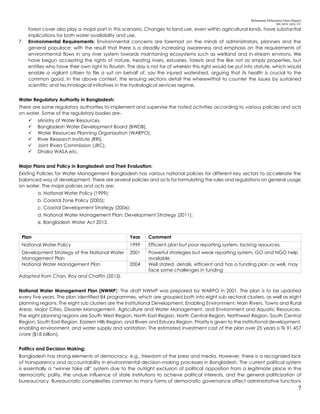
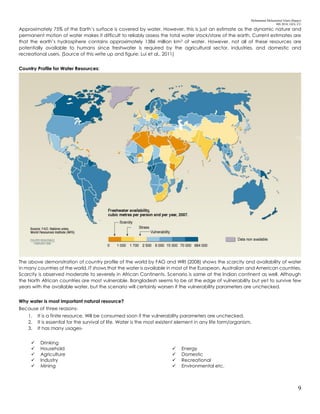
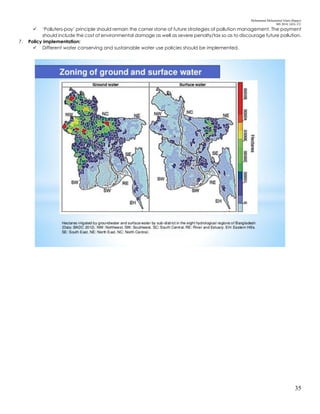
The Global Water Availability scenario is demonstrated below.
Mohammad Mohaiminul Islam (Bappy)
MS 2018, GES, CU
9
Approximately 75% of the Earth’s surface is covered by water. However, this is just an estimate as the dynamic nature and
permanent motion of water makes it difficult to reliably assess the total water stock/store of the earth. Current estimates are
that the earth’s hydrosphere contains approximately 1386 million km3 of water. However, not all of these resources are
potentially available to humans since freshwater is required by the agricultural sector, industries, and domestic and
recreational users. (Source of this write up and figure: Lui et al., 2011)
Country Profile for Water Resources:
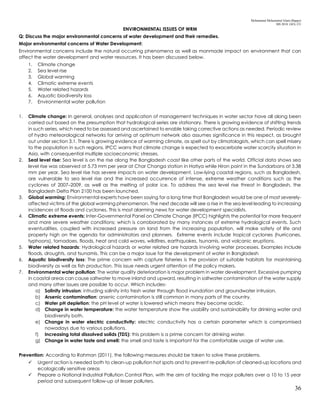
The above demonstration of country profile of the world by FAO and WRI (2008) shows the scarcity and availability of water
in many countries of the world. IT shows that the water is available in most of the European, Australian and American countries.
Scarcity is observed moderate to severely in African Continents. Scenario is same at the Indian continent as well. Although
the North African countries are most vulnerable. Bangladesh seems to be at the edge of vulnerability but yet to survive few
years with the available water, but the scenario will certainly worsen if the vulnerability parameters are unchecked.
Why water is most important natural resource?
Because of three reasons-
1. It is a finite resource. Will be consumed soon if the vulnerability parameters are unchecked.
2. It is essential for the survival of life. Water is the most existent element in any life form/organism.
3. It has many usages-
 Drinking
 Household
 Agriculture
 Industry
 Mining
 Energy
 Domestic
 Recreational
 Environmental etc.
Mohammad Mohaiminul Islam (Bappy)
MS 2018, GES, CU
10
PHASE OF HUMAN INTERVENTION IN WATER CYCLE
Q: What are the major phases of human intervention in water cycle? Explain.
Water cycle:
The water cycle or hydrological cycle describe the continuous movement of water on the earth’s surface, through the soils
and geological materials and into the atmosphere. It is the process of how water moves on, in and above the earth
(Pennington & Cech, 2010).
Human intervention in water cycle:
There are many types of human activity, which can affect the hydrological cycle in different physiographic conditions and
time-space scales, i. e. from local scales to global ones. Details are described below.
Factors of human intervention in water cycle:
According to the nature and scale of human impact on hydrological cycle components (precipitation evaporation, runoff),
all the factors of human activity may be combined into the following groups:
1) Factors connected with transformation of the Earth’s land surface.
These are:
 forest clearance and afforestation (natural and artificial);
 land plowing, agrotechnical practices, use of meadows as pastures, etc.;
 urbanization;
 construction of reservoirs and hydromelioration practices (irrigation, drainage of swamps and
waterlogged areas).
2) Factors directly connected with water diversions from the channel network (including lakes and reservoirs), the
use of this water by different users and return of the used water to the water bodies.
3) Factors affecting water balance components by changing general meteorological and climatic characteristic
(Shiklomanov, 2009).
Human influence on hydrological cycle:
According to Shiklomanov (2004)-
i. Intervention through land cover change in river basin: Human activities that change the land cover of river basins and
are aimed at regulating the water fluxes in nature can considerably change the hydrological cycle of the separate river
basins, and even of large regions.
ii. Interruption of natural hydrological cycle: Due to human activities, the natural hydrological cycle of most river basins is
becoming more and more transformed and regimented. The main stream flow regulation methods are construction of
dams, levees, barrages, and dikes, which provide water accumulation, decreasing flood flow, and increasing low flow.
The major effects of reservoir construction on the hydrological cycle (excepting runoff control) are an increase of
evaporation and a rise of groundwater table. In dry regions, evaporation losses from the reservoir water surface may be
so large that they seriously compromise any potential gains. At the same time, in the conditions of moderate climate, the
reservoir losses on evaporation are relatively small.
iii. Intervention through irrigation: The impact of irrigation on the hydrological cycle is especially revealing in the arid regions,
but it is also considerable in regions with moderate climate where irrigation is of supplementary character. Diversion of
water for irrigation purposes from surface or groundwater resources modifies the natural hydrological processes. It is
common for runoff and evaporation from irrigated areas to increase significantly.
iv. Intervention through drainage: To remove excess water from waterlogged soils, drainage is applied in many regions of
the world. The primary effect of drainage is the lowering of the groundwater table and the extension of the layer with
unsaturated soil. As a result, evapotranspiration may considerably drop (in some cases, by more than 50 percent).
v. Intervention through extraction of ground water: Because the quality of groundwater is mostly far better than that of
surface water, and its temperature is relatively constant, large volumes of groundwater are extracted for domestic and
industrial use in different regions of the world. If groundwater is extracted from confined aquifers below impermeable
layers, the groundwater table is not, or is only slightly, affected. However, at some river basins the groundwater table
often drops steeply, and this may reduce the surface runoff and the lower level of the small rivers. In many coastal areas,
the extraction of groundwater leads to the seawater intrusion.
vi. Intervention through agriculture and forestry practice: The effects of agricultural and forestry practices on the hydrological
cycle are less apparent, and depend, to a significant extent, on the physiographic and climatic conditions. It is evident
that ploughing, especially contour ploughing, usually breaks up overland flow and increases infiltration. Some special
Mohammad Mohaiminul Islam (Bappy)
MS 2018, GES, CU
11
types of ploughing may increase the depression and detention storage on gentle slopes from about 8–10mm (in the
natural conditions) to 30–40mm. Tillage and the activity of plant root systems modify the structure of the upper soil layer
and change not only the vertical permeability, but also the water retention capacity. Extension of vegetation cover and
the leaves area increases the interception of precipitation and evapotranspiration. Control of overland flow by dense
permanent grasses on steeper slopes can reduce storm runoff from small watersheds by 20–25 percent.
vii. Intervention through deforestation: The main clearly-expressed effects of deforestation on the hydrological cycle of a river
basin are the increases in transpiration and interception of precipitation, which in turn result in a decrease of the volume
of total runoff. Deforestation reduces infiltration and improves the conditions for overland flow. As a consequence, flood
runoff and peak discharges may significantly increase. At the same time, the higher infiltration of forest soils increases the
opportunity for recharge groundwater, and the flow of small rivers tends to be more sustained, especially in the case of
the generation of snowmelt runoff, when forests further sustain flow by delaying the snowmelt. A rise in the groundwater
table and an increase of ground runoff may also raise the low flow of medium- and large-sized rivers. Such effects often
result in the conclusion that forests increase runoff.
viii. Intervention through run off disruption: Long-term observations have also shown the strong dependence of runoff volume
on the type of vegetal cover. Conversion of hardwood to pine reduced the annual runoff by 25 cm and produced
significant reductions of monthly runoff. At the same time, forest cutting has led to a considerable increase in flood peaks.
Similar results have been also received on the basis of analyzing data obtained in other physiographic conditions.
ix. Intervention through marine water cycle disruption: Large-scale human manipulation of water has significantly altered
global patterns of streamflow. Resulting changes in sea level, ocean salinity, and in biophysical properties of the land
surface could ultimately generate climate feedbacks.
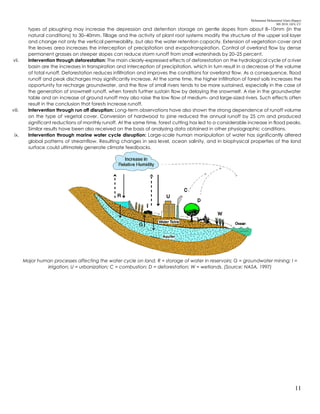
Major human processes affecting the water cycle on land. R = storage of water in reservoirs; G = groundwater mining; I =
irrigation; U = urbanization; C = combustion; D = deforestation; W = wetlands. (Source: NASA, 1997)
Mohammad Mohaiminul Islam (Bappy)
MS 2018, GES, CU
12
WATER AS FINITE RESOURCE
Q: Determine the status of water as a resource. Is water renewable finite resource? Explain your logic.
Introduction
Water is a finite resource of the world that is available in many forms but all of them are not usable, some of them are. Thus
the major portion of the global budget is not available for human usage. Consequently the amount of water is neither infinite,
nor adequate for the global population and their ongoing demand. Besides water needs to be recharged and recycled
through hydrological processes. Based on these facts, water can be declared as a finite resource. Nevertheless, there are
also many other concerning issues about water resources and its management.
Water Resource
The concept of water resources is multidimensional. It is not limited only to its physical measure (hydrological and
hydrogeological), the ‘flows and stocks’, but encompasses other more qualitative, environmental and socio-economic
dimensions (FAO, 2003). Water resources are natural resources of water that are potentially useful. Uses of water include
agricultural, industrial, household, recreational and environmental activities. All living things require water to grow and
reproduce (USGS, 2009).
Finiteness of Water Resource
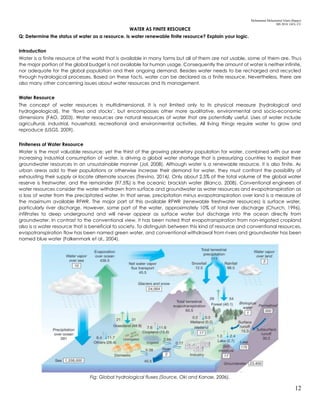
Water is the most valuable resource; yet the thirst of the growing planetary population for water, combined with our ever
increasing industrial consumption of water, is driving a global water shortage that is pressurizing countries to exploit their
groundwater resources in an unsustainable manner (Jol, 2008). Although water is a renewable resource, it is also finite. As
urban areas add to their populations or otherwise increase their demand for water, they must confront the possibility of
exhausting their supply or locate alternate sources (Trevino, 2014). Only about 2.5% of the total volume of the global water
reserve is freshwater, and the remainder (97.5%) is the oceanic brackish water (Blanco, 2008). Conventional engineers of
water resources consider the water withdrawn from surface and groundwater as water resources and evapotranspiration as
a loss of water from the precipitated water. In that sense, precipitation minus evapotranspiration over land is a measure of
the maximum available RFWR. The major part of this available RFWR (renewable freshwater resources) is surface water,
particularly river discharge. However, some part of the water, approximately 10% of total river discharge (Church, 1996),
infiltrates to deep underground and will never appear as surface water but discharge into the ocean directly from
groundwater. In contrast to the conventional view, it has been noted that evapotranspiration from non-irrigated cropland
also is a water resource that is beneficial to society. To distinguish between this kind of resource and conventional resources,
evapotranspiration flow has been named green water, and conventional withdrawal from rivers and groundwater has been
named blue water (Falkenmark et al., 2004).
Fig: Global hydrological fluxes (Source, Oki and Kanae, 2006).
Mohammad Mohaiminul Islam (Bappy)
MS 2018, GES, CU
13
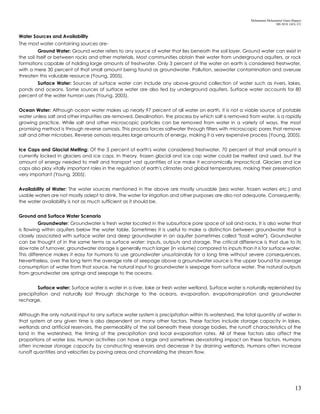
Water Sources and Availability
The most water containing sources are-
Ground Water: Ground water refers to any source of water that lies beneath the soil layer. Ground water can exist in
the soil itself or between rocks and other materials. Most communities obtain their water from underground aquifers, or rock
formations capable of holding large amounts of freshwater. Only 3 percent of the water on earth is considered freshwater,
with a mere 30 percent of that small amount being found as groundwater. Pollution, seawater contamination and overuse
threaten this valuable resource (Young, 2005).
Surface Water: Sources of surface water can include any above-ground collection of water such as rivers, lakes,
ponds and oceans. Some sources of surface water are also fed by underground aquifers. Surface water accounts for 80
percent of the water human uses (Young, 2005).
Ocean Water: Although ocean water makes up nearly 97 percent of all water on earth, it is not a viable source of potable
water unless salt and other impurities are removed. Desalination, the process by which salt is removed from water, is a rapidly
growing practice. While salt and other microscopic particles can be removed from water in a variety of ways, the most
promising method is through reverse osmosis. This process forces saltwater through filters with microscopic pores that remove
salt and other microbes. Reverse osmosis requires large amounts of energy, making it a very expensive process (Young, 2005).
Ice Caps and Glacial Melting: Of the 3 percent of earth's water considered freshwater, 70 percent of that small amount is
currently locked in glaciers and ice caps. In theory, frozen glacial and ice cap water could be melted and used, but the
amount of energy needed to melt and transport vast quantities of ice make it economically impractical. Glaciers and ice
caps also play vitally important roles in the regulation of earth's climates and global temperatures, making their preservation
very important (Young, 2005).
Availability of Water: The water sources mentioned in the above are mostly unusable (sea water, frozen waters etc.) and
usable waters are not mostly adept to drink. The water for irrigation and other purposes are also not adequate. Consequently,
the water availability is not as much sufficient as it should be.
Ground and Surface Water Scenario
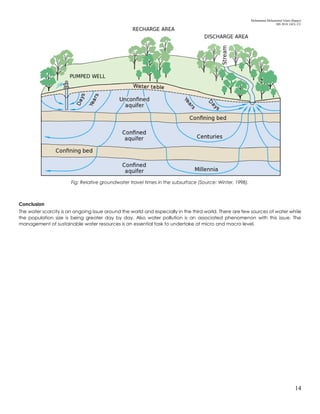
Groundwater: Groundwater is fresh water located in the subsurface pore space of soil and rocks. It is also water that
is flowing within aquifers below the water table. Sometimes it is useful to make a distinction between groundwater that is
closely associated with surface water and deep groundwater in an aquifer (sometimes called "fossil water"). Groundwater
can be thought of in the same terms as surface water: inputs, outputs and storage. The critical difference is that due to its
slow rate of turnover, groundwater storage is generally much larger (in volume) compared to inputs than it is for surface water.
This difference makes it easy for humans to use groundwater unsustainably for a long time without severe consequences.
Nevertheless, over the long term the average rate of seepage above a groundwater source is the upper bound for average
consumption of water from that source. he natural input to groundwater is seepage from surface water. The natural outputs
from groundwater are springs and seepage to the oceans.
Surface water: Surface water is water in a river, lake or fresh water wetland. Surface water is naturally replenished by
precipitation and naturally lost through discharge to the oceans, evaporation, evapotranspiration and groundwater
recharge.
Although the only natural input to any surface water system is precipitation within its watershed, the total quantity of water in
that system at any given time is also dependent on many other factors. These factors include storage capacity in lakes,
wetlands and artificial reservoirs, the permeability of the soil beneath these storage bodies, the runoff characteristics of the
land in the watershed, the timing of the precipitation and local evaporation rates. All of these factors also affect the
proportions of water loss. Human activities can have a large and sometimes devastating impact on these factors. Humans
often increase storage capacity by constructing reservoirs and decrease it by draining wetlands. Humans often increase
runoff quantities and velocities by paving areas and channelizing the stream flow.
Mohammad Mohaiminul Islam (Bappy)
MS 2018, GES, CU
14
Fig: Relative groundwater travel times in the subsurface (Source: Winter, 1998).
Conclusion
The water scarcity is an ongoing issue around the world and especially in the third world. There are few sources of water while
the population size is being greater day by day. Also water pollution is an associated phenomenon with this issue. The
management of sustainable water resources is an essential task to undertake at micro and macro level.
Mohammad Mohaiminul Islam (Bappy)
MS 2018, GES, CU
15
FRESH WATER DEMAND SECTOR
Q: What is freshwater demand and utilization? Explain the consumptive and non-consumptive usage of freshwater. Explain
nature and magnitude of freshwater utilization in Bangladesh/what are the major sector of freshwater utilizations usage and
demand? Explain.
Freshwater demand & utilization:
Freshwater is any naturally occurring water except seawater and brackish water. Fresh water includes water in ice sheets, ice
caps, glaciers, icebergs, bogs, ponds, lakes, rivers, streams, and even underground water called groundwater. Fresh water is
generally characterized by having low concentrations of dissolved salts and other total dissolved solids. The desire,
requirement, necessity and needs of such water bodies among the mass people can be termed as freshwater demand. The
collection, conservation, consumption, application for real world tasks of such water is called as fresh water utilization
(Adapted from Gleick, 2003).
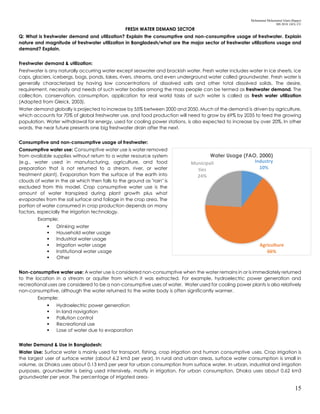
Water demand globally is projected to increase by 55% between 2000 and 2050. Much of the demand is driven by agriculture,
which accounts for 70% of global freshwater use, and food production will need to grow by 69% by 2035 to feed the growing
population. Water withdrawal for energy, used for cooling power stations, is also expected to increase by over 20%. In other
words, the near future presents one big freshwater drain after the next.
Consumptive and non-consumptive usage of freshwater:
Consumptive water use: Consumptive water use is water removed
from available supplies without return to a water resource system
(e.g., water used in manufacturing, agriculture, and food
preparation that is not returned to a stream, river, or water
treatment plant). Evaporation from the surface of the earth into
clouds of water in the air which then falls to the ground as "rain" is
excluded from this model. Crop consumptive water use is the
amount of water transpired during plant growth plus what
evaporates from the soil surface and foliage in the crop area. The
portion of water consumed in crop production depends on many
factors, especially the irrigation technology.
Example:
 Drinking water
 Household water usage
 Industrial water usage
 Irrigation water usage
 Institutional water usage
 Other
Non-consumptive water use: A water use is considered non-consumptive when the water remains in or is immediately returned
to the location in a stream or aquifer from which it was extracted. For example, hydroelectric power generation and
recreational uses are considered to be a non-consumptive uses of water. Water used for cooling power plants is also relatively
non-consumptive, although the water returned to the water body is often significantly warmer.
Example:
 Hydroelectric power generation
 In land navigation
 Pollution control
 Recreational use
 Lose of water due to evaporation
Water Demand & Use in Bangladesh:
Water Use: Surface water is mainly used for transport, fishing, crop irrigation and human consumptive uses. Crop irrigation is
the largest user of surface water (about 6.2 km3 per year). In rural and urban areas, surface water consumption is small in
volume, as Dhaka uses about 0.13 km3 per year for urban consumption from surface water. In urban, industrial and irrigation
purposes, groundwater is being used intensively, mostly in irrigation. For urban consumption, Dhaka uses about 0.62 km3
groundwater per year. The percentage of irrigated area-
Industry
10%
Agriculture
66%
Municipali
ties
24%
Water Usage (FAO, 2000)
Mohammad Mohaiminul Islam (Bappy)
MS 2018, GES, CU
16
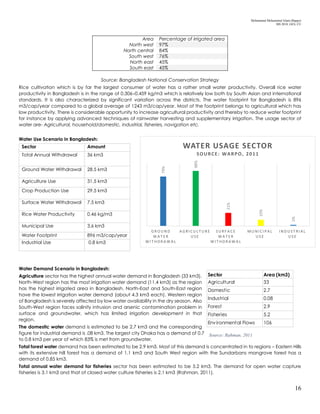
Source: Bangladesh National Conservation Strategy
Rice cultivation which is by far the largest consumer of water has a rather small water productivity. Overall rice water
productivity in Bangladesh is in the range of 0.306–0.459 kg/m3 which is relatively low both by South Asian and international
standards. It is also characterized by significant variation across the districts. The water footprint for Bangladesh is 896
m3/cap/year compared to a global average of 1243 m3/cap/year. Most of the footprint belongs to agricultural which has
low productivity. There is considerable opportunity to increase agricultural productivity and thereby to reduce water footprint
for instance by applying advanced techniques of rainwater harvesting and supplementary irrigation. The usage sector of
water are- Agricultural, household/domestic, industrial, fisheries, navigation etc.
Water Use Scenario in Bangladesh:
Sector Amount
Total Annual Withdrawal 36 km3
Ground Water Withdrawal 28.5 km3
Agriculture Use 31.5 km3
Crop Production Use 29.5 km3
Surface Water Withdrawal 7.5 km3
Rice Water Productivity 0.46 kg/m3
Municipal Use 3.6 km3
Water Footprint 896 m3/cap/year
Industrial Use 0.8 km3
Water Demand Scenario in Bangladesh:
Agriculture sector has the highest annual water demand in Bangladesh (33 km3).
North-West region has the most irrigation water demand (11.4 km3) as the region
has the highest irrigated area in Bangladesh. North-East and South-East region
have the lowest irrigation water demand (about 4.3 km3 each). Western region
of Bangladesh is severely affected by low water availability in the dry season. Also
South-West region faces salinity intrusion and arsenic contamination problem in
surface and groundwater, which has limited irrigation development in that
region.
The domestic water demand is estimated to be 2.7 km3 and the corresponding
figure for industrial demand is .08 km3. The largest city Dhaka has a demand of 0.7
to 0.8 km3 per year of which 83% is met from groundwater.
Total forest water demand has been estimated to be 2.9 km3. Most of this demand is concentrated in to regions – Eastern Hills
with its extensive hill forest has a demand of 1.1 km3 and South West region with the Sundarbans mangrove forest has a
demand of 0.85 km3.
Total annual water demand for fisheries sector has been estimated to be 5.2 km3. The demand for open water capture
fisheries is 3.1 km3 and that of closed water culture fisheries is 2.1 km3 (Rahman, 2011).
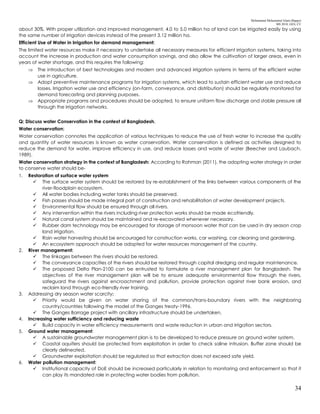
Area Percentage of irrigated area
North west 97%
North central 84%
South west 76%
North east 45%
South east 45%
79%
88%
21%
10%
2%
GROUND
W A T E R
W IT H DRA W A L
A GRIC ULT URE
US E
S URF A C E
W A T E R
W IT H DRA W A L
MUNIC IP A L
US E
INDUS T RIA L
US E
WATER USAGE SECTOR
SOURCE: WARPO, 2011
Sector Area (km3)
Agricultural 33
Domestic 2.7
Industrial 0.08
Forest 2.9
Fisheries 5.2
Environmental Flows 106
Source: Rahman, 2011
Mohammad Mohaiminul Islam (Bappy)
MS 2018, GES, CU
17
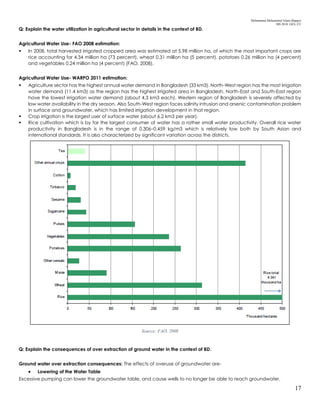
Q: Explain the water utilization in agricultural sector in details in the context of BD.
Agricultural Water Use- FAO 2008 estimation:
 In 2008, total harvested irrigated cropped area was estimated at 5.98 million ha, of which the most important crops are
rice accounting for 4.34 million ha (73 percent), wheat 0.31 million ha (5 percent), potatoes 0.26 million ha (4 percent)
and vegetables 0.24 million ha (4 percent) (FAO, 2008).
Agricultural Water Use- WARPO 2011 estimation:
 Agriculture sector has the highest annual water demand in Bangladesh (33 km3). North-West region has the most irrigation
water demand (11.4 km3) as the region has the highest irrigated area in Bangladesh. North-East and South-East region
have the lowest irrigation water demand (about 4.3 km3 each). Western region of Bangladesh is severely affected by
low water availability in the dry season. Also South-West region faces salinity intrusion and arsenic contamination problem
in surface and groundwater, which has limited irrigation development in that region.
 Crop irrigation is the largest user of surface water (about 6.2 km3 per year).
 Rice cultivation which is by far the largest consumer of water has a rather small water productivity. Overall rice water
productivity in Bangladesh is in the range of 0.306–0.459 kg/m3 which is relatively low both by South Asian and
international standards. It is also characterized by significant variation across the districts.
Source: FAO, 2008
Q: Explain the consequences of over extraction of ground water in the context of BD.
Ground water over extraction consequences: The effects of overuse of groundwater are-
 Lowering of the Water Table
Excessive pumping can lower the groundwater table, and cause wells to no longer be able to reach groundwater.
Mohammad Mohaiminul Islam (Bappy)
MS 2018, GES, CU
18
 Increased Costs
As the water table lowers, the water must be pumped farther to reach
the surface, using more energy. In extreme cases, using such a well can
be cost prohibitive.
 Reduced Surface Water Supplies
Groundwater and surface water are connected. When groundwater is
overused, the lakes, streams, and rivers connected to groundwater can
also have their supply diminished.
 Land Subsidence
Land subsidence occurs when there is a loss of support below ground.
This is most often caused by human activities, mainly from the overuse
of groundwater, when the soil collapses, compacts, and drops.
 Water Quality Concerns
Excessive pumping in coastal areas can cause saltwater to move inland
and upward, resulting in saltwater contamination of the water supply
and many other issues are possible to occur. Which includes-
 Salinity intrusion
 Arsenic contamination
 Water pH depletion
 Change in water temperature
 Change in water electric conductivity
 Increasing total dissolved solids (TDS)
 Change in water taste and smell
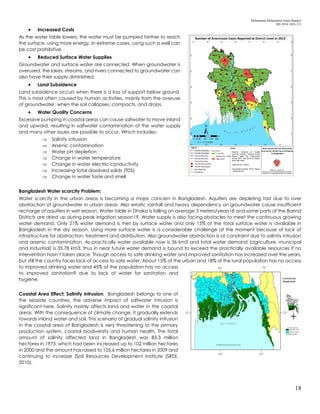
Bangladesh Water scarcity Problem:
Water scarcity in the urban areas is becoming a major concern in Bangladesh. Aquifers are depleting fast due to over
abstraction of groundwater in urban areas. Also erratic rainfall and heavy dependency on groundwater cause insufficient
recharge of aquifers in wet season. Water table in Dhaka is falling on average 3 meters/years18 and some parts of the Barind
Districts are dried up during peak irrigation season19. Water supply is also facing obstacles to meet the continuous growing
water demand. Only 21% water demand is met by surface water and only 15% of the total surface water is available in
Bangladesh in the dry season. Using more surface water is a considerable challenge at the moment because of lack of
infrastructure for abstraction, treatment and distribution. Also groundwater abstraction is at constraint due to salinity intrusion
and arsenic contamination. As practically water available now is 36 km3 and total water demand (agriculture, municipal
and industrial) is 35.78 km3, thus in near future water demand is bound to exceed the practically available resources if no
intervention hasn’t taken place. Though access to safe drinking water and improved sanitation has increased over the years,
but still the country faces lack of access to safe water. About 15% of the urban and 18% of the rural population has no access
to improved drinking water and 45% of the population has no access
to improved sanitation9 due to lack of water for sanitation and
hygiene.
Coastal Area Effect; Salinity Intrusion: Bangladesh belongs to one of
the seaside countries, the adverse impact of saltwater intrusion is
significant here. Salinity mainly affects land and water in the coastal
areas. With the consequence of climate change, it gradually extends
towards inland water and soil. This scenario of gradual salinity intrusion
in the coastal area of Bangladesh is very threatening to the primary
production system, coastal biodiversity and human health. The total
amount of salinity affected land in Bangladesh was 83.3 million
hectares in 1973, which had been increased up to 102 million hectares
in 2000 and the amount has raised to 105.6 million hectares in 2009 and
continuing to increase (Soil Resources Development Institute (SRDI,
2010).
Mohammad Mohaiminul Islam (Bappy)
MS 2018, GES, CU
19
Agricultural Use Effect: The use of irrigation water causes ground water depletion. The fallow water meets river and causes
intoxication of water. Over use of pesticides not only infiltrate to ground water but also intoxicates the river/pond/canal water.
According to FAO, Improperly managed agricultural activities may impact surface water by contributing nutrients, pesticides,
sediment, and bacteria, or by altering stream flow. Fertilizer and pesticide use, tillage, irrigation, and tile drainage can affect
water quality and hydrology.
Urban Water Issues: Bangladesh has one of the highest population densities in the world, with a population of 165 million living
within 57,000 square miles. Of those 165 million people, 5 million lack safe water and 85 million lack improved sanitation. Lack
of access to safe water and improved sanitation facilities in rural areas, overcrowded conditions, and a lack of healthy ways
of disposing waste in urban centers, all contribute to the water and sanitation crisis in Bangladesh. Bangladesh is known as
the birthplace of microfinance and has seen vibrant and sustained growth of the sector. The result has been enormous impact
on financial inclusion of those living in poverty, particularly women.
Dhaka Water Supply and Sewerage Authority (Wasa), the sole legal entity to develop and maintain a water supply system
for Dhaka metropolitan and its surrounding areas estimates that per capita water demand in Dhaka is 150 litres per day. A
study by Brac Institute of Governance and Development (BIGD), Brac University found that, on average, per capita water
usage is 310 litres per day among the households in the formal settlements—more than twice as high as the estimation.
Meanwhile, per capita usage is just 85 litres per day among the households in informal settlements (e.g. slums) with metered
Dhaka Wasa connections. Furthermore, inequality increases with increasing wealth, for example, areas such as Gulshan and
Banani have by far the highest per capita usage—509 litres. The study findings not only demonstrate the wide inequality in
water usage between households in the formal and informal settlements but also indicate to huge inefficiency in water usage
in formal settlements. In households with per capita income less than Tk 3,000, per capita water usage is less than 200 litres,
whereas with per capita income of 9,000 and above, usage is 441 litres.
Mohammad Mohaiminul Islam (Bappy)
MS 2018, GES, CU
20
WATER POWER DEVELOPMENT
Q: Discuss multipurpose uses and multiple benefit of dams. Discuss dam-debate: multipurpose benefit vs. socio-environmental
concern. Pros and cons of Tipaimukh dam.
Multipurpose Dam:
A multipurpose dam may combine storing and supplying water for irrigation, industry and human consumption with other uses
such as flood control, power generation, navigation, run-off storage and water discharge regulation.
Merits of Multi-Purpose Projects:
Multi-purpose projects are very much conducive to economic development of the country. The following are some of the
important advantages of such projects:
1. Irrigation Facility: Extension of irrigation facility is one of the important objectives and advantage of multipurpose projects.
These projects can stimulate the agricultural productivity for meeting the growing requirement of food and raw materials
required for increasing non-farm activities.
2. Flood Control: Another important objective of such projects is to control the occurrence of floods creating havocs on the
economy.
3. Generating Electricity: Multi-purpose projects help to generate hydro-electricity on a large scale basis, which is very much
important for the development of industry.
4. Navigation: Such projects can create navigation facility in the country by developing ferrying services for transportation,
raise fleet capacity and thereby can reduce the traffic load on rail and road transport.
5. Forests and Fisheries: These projects can help to raise forestry on the banks of the canals. Moreover, it can also encourage
the development of fisheries in the reservoirs.
6. Drinking Water: Such projects facilitate the development of safe drinking water projects for the adjoining areas.
7. Development of Industry and Employment Generation: Such projects can create a favourable climate for the development
of industry by offering the facilities like cheaper power, better water transport, availability of raw materials at cheaper rates
for agro-based industries etc.
Moreover, by developing agriculture, industry and infrastructural services, these projects can generate adequate volume of
employment opportunities in the farm and non-farm sector. All these would help to raise the standard of living of the people
of those adjoining regions reaping benefits from such projects.
8. Recreation: Multi-purpose projects can also facilitate to develop recreation facilities in the form of picnic resorts, holiday
resorts etc. which are having much commercial viability nowadays.
Demerits of Multi-Purpose Projects: Multi-purpose projects commissioned in India has already derived impressive results in
respect of creation of irrigation potential and also in the generation of hydroelectric power. the irrigation potential so far
developed by larger and medium projects has increased from 10 million hectares in 1950-51 to 34 million hectares in 1997-98.
Total installed capacity of hydro-electric project in India has also increased fron 0.6 gW in 1950-51 ro 21.7 gW in 1996-97. In
spite of its achievements, the multi-purpose projects in India are subjected to the following controversies.
1. Exaggerated Benefits on Irrigation: It has been argued that irrigation benefits derived out of multi-purpose projects are
exaggerated because the actual area irrigated by these projects is much less due to delay in the construction of field
channels and water routes. Moreover delay in completion of these projects has resulted in high escalation of its cost.
2. Higher Cost of Hydropower: Although hydro power is having the advantage of low operating cost, renewable source and
eco-friendly but at the same time it is also subjected to long gestation period, delay in commissioning the project resulting
escalation of project cost and higher initial cost. All these have resulted in a comparatively higher unit cost of generation in
respect of hydro power.
3. Least Flood Control Benefit: The multi-purpose projects have also failed to derive maximum benefit in respect of flood control
as the embankments, drainage channels and flood protection schemes have failed miserably to achieve results.
4. Adverse Environmental Impact: Finally, the multi-purpose projects have resulted serious adverse environmental impact in
respect of degradation of soil content arising out of waterlogging and soil salinity in its command areas.
Considering these negative sides, Dr. B.B. Vora has rightly observed,“The future of major and medium irrigation is dim and the
country has neither the resources nor the time for creating additional gross potential of some 26 million hectares of irrigation
through this route. Hence minor irrigation, particularly through the use of ground water, must be the mainstay for all future
places.” Management of big dams is also being done at exorbitant financial and ecological costs.
Mohammad Mohaiminul Islam (Bappy)
MS 2018, GES, CU
21
But the management of minor projects has resulted in maximum use of water resources and better control. Thus, in recent
times, basic questions have been raised from various organisations about the standing conventional emphasis and grounds
on the multi-purpose river valley projects. It is time to re-evaluate the irrigation policy of the country in a judicious manner and
to formulate the policy with new directives and emphasis.
Pros and cons of Tipaimukh Dam:
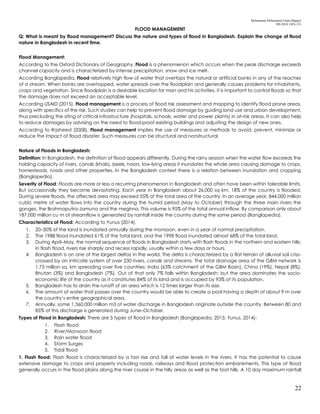
Tipaimukh Dam is a proposed embankment
dam on the river Barak in Manipur state India,
first commissioned in 1983. The purpose of the
dam is flood control and hydroelectric power
generation. It has been subject to repeated
delays as the project developed, as there
has been controversy between India and
Bangladesh over water rights, in addition to
questions of environmental effects of the
huge project, as well as the need to relocate
indigenous Hmar people to make way for a
vast reservoir.
Mechanics: The dam is planned to be 390m
long and 162.8m high, across the Barak River,
which enters Bangladesh below the
proposed dam location. The dam's crest
elevation will be at an altitude of about 180
m. above mean sea level, with a maximum
reservoir level of 178 m. The dam was
originally designed for flood control, to
contain waters in the lower Barak valley.
Hydro-power generation was later
incorporated into the project. Capable of
1500 MW.
Advantages for Bangladesh:
(i) Due to its construction it will be possible to control flood due to Barak river and its tributaries in Sylhet region.
(ii) Considerable portion of land can be saved from inundation during the rainy season.
(iii) During winter irrigation may be easier due to higher level of water.
(iv) There will be less silting in the tributaries of Barak river.
(v) There will be less erosion in these rivers.
Disadvantages for Bangladesh:
(i) Due to the construction of the dam Bangladesh would lose silt, sand and fish coming through Barak river.
(ii) Bangladeshi experts have said the massive dam will disrupt the seasonal rhythm of the river and have an adverse effect
on downstream agriculture and fisheries.
(iii) The Tipaimukh area lies in an ecologically sensitive and topographically fragile region. It is within one of the most
seismically volatile regions on the planet.
(iv) Socio economic effect is possible.
(v) People can be displaced from their home.
(vi) Species can be extinct.
(vii) Will lead to environmental degradation.
Possible affected area by tipaimukh Dam (Sikder & Elahi, 2013)
Mohammad Mohaiminul Islam (Bappy)
MS 2018, GES, CU
22
FLOOD MANAGEMENT
Q: What is meant by flood management? Discuss the nature and types of flood in Bangladesh. Explain the change of flood
nature in Bangladesh in recent time.
Flood Management:
According to the Oxford Dictionary of Geography, Flood is a phenomenon which occurs when the peak discharge exceeds
channel capacity and is characterized by intense precipitation, snow and ice melt.
According Banglapedia, Flood relatively high flow of water that overtops the natural or artificial banks in any of the reaches
of a stream. When banks are overtopped, water spreads over the floodplain and generally causes problems for inhabitants,
crops and vegetation. Since floodplain is a desirable location for man and his activities, it is important to control floods so that
the damage does not exceed an acceptable level.
According USAID (2015), Flood management is a process of flood risk assessment and mapping to identify flood prone areas,
along with specifics of the risk. Such studies can help to prevent flood damage by guiding land use and urban development,
thus precluding the siting of critical infrastructure (hospitals, schools, water and power plants) in at-risk areas. It can also help
to reduce damages by advising on the need to flood-proof existing buildings and adjusting the design of new ones.
According to Rasheed (2008), Flood management implies the use of measures or methods to avoid, prevent, minimize or
reduce the impact of flood disaster. Such measures can be structural and nonstructural.
Nature of Floods in Bangladesh:
Definition: In Bangladesh, the definition of flood appears differently. During the rainy season when the water flow exceeds the
holding capacity of rivers, canals (khals), beels, haors, low-lying areas it inundates the whole area causing damage to crops,
homesteads, roads and other properties. In the Bangladesh context there is a relation between inundation and cropping
(Banglapedia).
Severity of Flood: Floods are more or less a recurring phenomenon in Bangladesh and often have been within tolerable limits.
But occasionally they become devastating. Each year in Bangladesh about 26,000 sq km, 18% of the country is flooded.
During severe floods, the affected area may exceed 55% of the total area of the country. In an average year, 844,000 million
cubic metre of water flows into the country during the humid period (May to October) through the three main rivers the
ganges, the Brahmaputra-Jamuna and the meghna. This volume is 95% of the total annual inflow. By comparison only about
187,000 million cu m of streamflow is generated by rainfall inside the country during the same period (Banglapedia).
Characteristics of Flood: According to Yunus (2014),
1. 20–30% of the land is inundated annually during the monsoon, even in a year of normal precipitation.
2. The 1988 flood inundated 61% of the total land, and the 1998 flood inundated almost 68% of the total land.
3. During April–May, the normal sequence of floods in Bangladesh starts with flash floods in the northern and eastern hills;
in flash flood, rivers rise sharply and recess rapidly, usually within a few days or hours.
4. Bangladesh is on one of the largest deltas in the world. The delta is characterized by a flat terrain of alluvial soil criss-
crossed by an intricate system of over 230 rivers, canals and streams. The total drainage area of the GBM network is
1.75 million sq. km spreading over five countries: India (63% catchment of the GBM Basin), China (19%), Nepal (8%),
Bhutan (3%) and Bangladesh (7%). Out of that only 7% falls within Bangladesh; but the area dominates the socio-
economic life of the country as it constitutes 84% of its land and is occupied by 93% of its population.
5. Bangladesh has to drain the runoff of an area which is 12 times larger than its size.
6. The amount of water that passes over the country would be able to create a pool having a depth of about 9 m over
the country’s entire geographical area.
7. Annually, some 1,360,000 million m3 of water discharge in Bangladesh originate outside the country. Between 80 and
85% of this discharge is generated during June–October.
Types of Flood in Bangladesh: There are 5 types of flood in Bangladesh (Banglapedia, 2015; Yunus, 2014)-
1. Flash flood
2. River/Monsoon flood
3. Rain water flood
4. Storm Surges
5. Tidal flood
1. Flash flood: Flash flood is characterized by a fast rise and fall of water levels in the rivers. It has the potential to cause
extensive damage to crops and property including roads, railways and flood protection embankments. This type of flood
generally occurs in the flood plains along the river course in the hilly areas as well as the foot hills. A 10 day maximum rainfall
Mohammad Mohaiminul Islam (Bappy)
MS 2018, GES, CU
23
exceeding 300 mm is considered as an index for a flash flood in any given area. This type of flood is common along the
northern, north eastern and south eastern parts of Bangladesh.
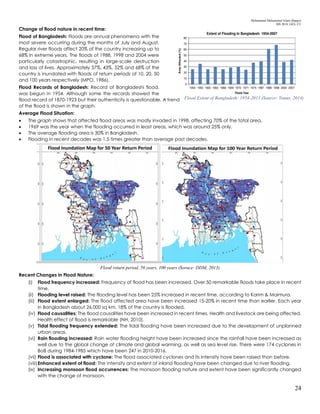
2. River/Monsoon Flood: River flood is
characterized by a slow rise of water levels
and gradual inundation of large areas
through over bank spilling. This is caused
by excessive rainfall in the river catchment
outside Bangladesh. This is the most
common flood occurring in Bangladesh.
In normal years about 30 % of the land
area is inundated; in the case of a
devastating flood it is 50–70 %. When there
is simultaneous rise of water level in the
three main rivers, the flood becomes
devastating, for example, the 1998 flood,
and the most devastating flood in the last
century. The Brahmaputra starts to rise in
March due to snow melt causing its first
peak in late May and early June, followed
by subsequent peaks up to the end of
August due to heavy monsoon rain over
the catchment. As the river flood usually
affects large flood plain areas, it causes
significant damage to crops, homesteads,
livestock, plants, and infrastructure. It also
causes extensive river bank erosion. The
determinants of the extent of devastation
from river floods are timing, depth and
duration of flooding.
3. Rain Water Flood: Rain water flood is
most common in low-lying and drainage
restricted areas of Bangladesh. These
floods are caused by heavy rainfall
occurring over the flood plains within
Bangladesh, generating water volumes in
excess of drainage capacity. The amount
and intensity of local rainfall and the water
level of major rivers determines the extent,
depth and duration of rain water flooding.
Damage is particularly severe when rain
water floods coincide with high river floods
4. Storm Surge: These involve sudden but
temporary flooding of coastal areas with
brackish or saline sea water. In fact storm surges are raised sea-levels caused by a combination of low barometric pressure
and strong onshore winds associated with tropical cyclones. The extent of storm surge floods depends on several factors: the
height of the storm surge at the coast, the relief of the adjoining land, whether or not a coastal embankment exists, the
impedance of water flow by settlement, trees, crops and road embankments.
5. Tidal Flood: It happens in Bangladesh in short duration, height is generally 3m to 6m, blocks inland flood drainage. It is the
temporary inundation of low-lying areas, especially streets, during exceptionally high tide events, such as at full and new
moons. The highest tides of the year may be known as the king tide, with the month varying by location. Tidal flooding is
capable of majorly inhibiting natural gravity-based drainage systems in low-lying areas when it reaches levels that are below
visible inundation of the surface, but which are high enough to incapacitate the lower drainage or sewer system. Thus, even
normal rainfall or storm surge events can cause greatly amplified flooding effects. One passive solution to intrusion through
drainage systems are one way back-flow valves in drainage ways. However, while this may prevent a majority of the tidal
intrusion, it also inhibits drainage during exceptionally high tides that shut the valves.
Mohammad Mohaiminul Islam (Bappy)
MS 2018, GES, CU
24
Change of flood nature in recent time:
Flood of Bangladesh: Floods are annual phenomena with the
most severe occurring during the months of July and August.
Regular river floods affect 20% of the country increasing up to
68% in extreme years. The floods of 1988, 1998 and 2004 were
particularly catastrophic, resulting in large-scale destruction
and loss of lives. Approximately 37%, 43%, 52% and 68% of the
country is inundated with floods of return periods of 10, 20, 50
and 100 years respectively (MPO, 1986).
Flood Records of Bangladesh: Record of Bangladeshi flood,
was begun in 1954. Although some the records showed the
flood record of 1870-1923 but their authenticity is questionable. A trend
of the flood is shown in the graph.
Average Flood Situation:
 The graph shows that affected flood areas was mostly invaded in 1998, affecting 70% of the total area.
 1969 was the year when the flooding occurred in least areas, which was around 25% only.
 The average flooding area is 30% in Bangladesh.
 Flooding in recent decades was 1.5 times greater than average past decades.
Flood return period, 50 years, 100 years (Soruce: DDM, 2013)
Recent Changes in Flood Nature:
(i) Flood frequency increased: Frequency of flood has been increased. Over 50 remarkable floods take place in recent
time.
(ii) Flooding level raised: The flooding level has been 25% increased in recent time, according to Karim & Maimura.
(iii) Flood extent enlarged: The flood affected area have been increased 15-20% in recent time than earlier. Each year
in Bangladesh about 26,000 sq km, 18% of the country is flooded.
(iv) Flood causalities: The flood causalities have been increased in recent times. Health and livestock are being affected.
Health effect of flood is remarkable (NH, 2010).
(v) Tidal flooding frequency extended: The tidal flooding have been increased due to the development of unplanned
urban areas.
(vi) Rain flooding increased: Rain water flooding height have been increased since the rainfall have been increased as
well due to the global change of climate and global warming, as well as sea level rise. There were 174 cyclones in
BoB during 1984-1985 which have been 247 in 2010-2016.
(vii) Flood is associated with cyclone: The flood associated cyclones and its intensity have been raised than before.
(viii)Enhanced extent of flood: The intensity and extent of inland flooding have been changed due to river flooding.
(ix) Increasing monsoon flood occurrences: The monsoon flooding nature and extent have been significantly changed
with the change of monsoon.
Flood Extent of Bangladesh: 1954-2013 (Source: Yunus, 2014)
Mohammad Mohaiminul Islam (Bappy)
MS 2018, GES, CU
25
(x) Flood is being dominated by rainfall: Excessive rainfall intensifies the flood occurrence.
(xi) Flood is associated with climate change: Climate change and global climate anomalies affect the flooding
occurrence.
(xii) SLR and flood: Sea level rise causes intensity and frequency raising of flooding.
(xiii) Siltation and river over flow: Siltation have been increased in notable amount which influences the river overflow.
(xiv)River migrations increased: River migration have been influencing the change of flood nature.
(xv) Flood affected regionalization in Bangladesh: Flood intensity have been increased in-
a) South West region
b) South West region
c) South Central region
d) North East region
e) North Central region
f) All coastal regions
A historical analysis of flood from 1970-2000:
 1974 In Mymensingh about 10,360 sq km area was flooded. People and cattle were severely affected and more than
100,000 houses were destroyed.
 1987 Catastrophic flood occurred in July-August. Affected 57,300 sq km (about 40% of the total area of the country) and
estimated to be a once in 30-70 year event. Excessive rainfall both inside and outside of the country was the main cause
of the flood. The seriously affected regions were on the western side of the Brahmaputra, the area below the confluence
of the Ganges and the Brahmaputra, considerable areas north of Khulna and finally some areas adjacent to the
Meghalaya hills.
 1988 Catastrophic flood occurred in August-September. Inundated about 82,000 sq km (about 60% of the area) and its
return period is estimated to be 50-100 years. Rainfall together with synchronisation of very high flows of all the three major
rivers of the country in only three days aggravated the flood. Dhaka, the capital of Bangladesh, was severely affected.
The flood lasted 15 to 20 days.
 1989 Flooded Sylhet, sirajganj and maulvi bazar and 600,000 people were trapped by water.
 1993 Severe rains all over the country, thousands of hectares of crops went under water. Twenty-eight districts were
flooded.
 1998 Over two-thirds of the total area of the country was flooded. It compares with the catastrophic flood of 1988 so far
as the extent of flooding is concerned. A combination of heavy rainfall within and outside the country, synchronisation of
peak flows of the major rivers and a very strong backwater effect coalesced into a mix that resulted in the worst flood in
recorded history. The flood lasted for more than two months.
 2000 Five southwestern districts of Bangladesh bordering India were devastated by flood rendering nearly 3 million people
homeless. The flood was caused due to the outcome of the failure of small river dykes in West Bengal that were
overtopped by excessive water collected through heavy downpour.
 2007 Cyclone Sidr, was a tropical cyclone that resulted in one of the worst natural disasters in Bangladesh. The fourth
named storm of the 2007 North Indian Ocean cyclone season, Sidr formed in the central Bay of Bengal, and quickly
strengthened to reach peak 1-minute sustained winds of 260 km/h, making it a Category-5 equivalent tropical cyclone
on the Saffir-Simpson Scale. The storm eventually made landfall in Bangladesh on November 15, 2007, causing large-scale
evacuations. At least 3,447 deaths have been blamed on the storm, with some estimates reaching 15,000.
Q: Differentiate between flood and inundation. Justify that regular inundation is expected while flood is unwanted.
Flood & Inundation:
Flood Inundation
Flood relatively high flow of water that overtops the natural
or artificial banks in any of the reaches of a stream.
Inundation is the periodical wetting and drying as a result of
tidal cycle at a particular land.
Flooding is supposed to have a longer time scale. Inundation time scale is shorter.
Flood is and irregular event. Inundation is a regular event.
Flood is a natural hazard. Inundation is a normal natural occurrence.
Flood occurs hardly. Inundation occurs very often.
Flood is associated with meteorological factors. Inundation is associated with tidal force.
Flood is unwanted. Inundation is expected.
Flood takes longer time to form. Inundation takes short period of time to form.
Mohammad Mohaiminul Islam (Bappy)
MS 2018, GES, CU
26
Alternative definitions and differences of flood and inundation: The term flood and inundation created many disagreement
among the researchers.
 According to Flick & Chadwick (2012), flood is a periodic occurrence districted with the overflow of water of mean sea
level, while inundation is a permanent submergence of a land.
 According to some hydrologists, flood is a term connoting the event of natural hazard while inundation refers to the act
of water overflowing the ground. Flood is associated with many phenomena including inundation.
Regular inundation is expected while flood is unwanted:
By stating- “Regular inundation is expected while flood is unwanted”, it is has established that the flood is a natural hazard
while the inundation is a natural occurrence. In this perspective, the definition of flood and inundation would be-
Flood relatively high flow of water that overtops the natural or artificial banks in any of the reaches of a stream. While
inundation is the periodical wetting and drying as a result of tidal cycle at a particular land.
The flowing arguments support the statement- regular inundation is expected while flood is unwanted-
 Flood is a natural hazard, it has devastating consequences, while inundation have merely any devastating consequence.
The effect of inundation is limited.
 Although inundation may create temporary discomfort among the inhabitants of inundated area, but flood is worse and
it is able to damage properties and take lives.
 Flooding is supposed to have a longer time scale. Inundation time scale is shorter.
 Flood is and irregular event. Inundation is a regular event.
 Flood is a natural hazard. Inundation is a normal natural occurrence.
 Flood occurs hardly. Inundation occurs very often.
 Flood is associated with meteorological factors. Inundation is associated with tidal force.
 Flood takes longer time to form. Inundation takes short period of time to form.
It can be established now that- Regular inundation is expected while flood is unwanted.
Q: Discuss various structural and non-structural flood management measures normally practiced in BD and their limitations.
Structural methods of flood management: The
structural flood management methods include the
improvement, establishment, emphasis,
management and implying of building up/construct
physical structures in order to mitigate the effect of
flood. Those are discussed below.
According to Rasheed (2008)-
i. Embankment: Since 1960, more than 8000 km of
embankment have been established
throughout the country by BWDB. The purpose of
building embankment
a) Prevent spilling of flood water into
floodplain.
b) Prevent saline water at the coastal area
to merge into the freshwater.
Embankment helps to spilling and merging of
flood water and it is very fruitful for the low lying
lands of Sylhet and Mymensing in the monsoon
period.
Limitations:
1. Embankments are often eroded way with land erosion.
2. It hampers the fertility of the surrounding land.
3. Not much of well maintained.
Mohammad Mohaiminul Islam (Bappy)
MS 2018, GES, CU
27
ii. Drainage & Channel Improvement: This is
a vital process of flood management.
Drainage and channel improvement
mostly applies at the southwestern part of
Bangladesh where many distributaries of
Ganges offtake. It is performed by two
different techniques. It also helps to keep
the inland navigation root open.
a) Loop cutting: It refers to the removal of crooked part of a river, make it straighter and to allow easier flow of
water.
b) Dredging: Dredging is a process of uprooting the excessive accumulation of deposition in the river bed. It
increases the capacity water conveyance of the river.
Limitations:
1. It is very expensive measure.
2. Not economically feasible for all of the rivers.
3. Not appropriate for all of the rivers.
iii. River Training: River training refers to build up some structure
with a view to controlling the flow and behavior of water in
the river channels. Before 1970, the river training activities were
confined to using bamboos and other low cost materials,
nowadays it has been extended to using modern building
materials to construct river training structures. In Bangladesh,
currently 3 forms of river training are available-
a) Guide bank: Guide bank of a river connotes an
artificially constructed bank which goes slightly
differently along with the natural bank in order to
control the direction of river flow without causing any
damage to the constructed bank.
b) Groynes and spurs: A groyne is a rigid hydraulic structure
built from a bank that interrupts water flow and limits the
movement of sediment. Spurs are embankment type
structures constructed transverse to the river flow to
protect the bank by deflecting the current away from
the bank.
c) Bank protection structures: Bank protection structures
like vegetal cover and bamboo porcupines for small
rivers, revetment for medium sized river and brick
mattresses, concrete blocks and boulder for medium
and large rivers.
Limitations: The river training structures are not well built up and vulnerable to the high velocity of river flow as well
as they cannot withstand the powerful waves that originate during tsunami.
Mohammad Mohaiminul Islam (Bappy)
MS 2018, GES, CU
28
Non-Structural Methods: Non-structural methods are some procedures that includes planning, warning and flood preparations
in order fight with flood not with only infrastructure but also with knowledge.
According to Rasheed (2008), these methods are-
i. Flood forecasting & warning: Flood forecasting and warning is a very fruitful system to prevent the effectiveness of flood.
The method refers to predicting the upcoming flood with past meteorological and relevant data and warning people in
accordance with such predictions and inferences.
It has the following 4 elements-
a) Real time rainfall and water level data collection
b) Meteorological forecasting
c) Flood forecasting
d) Flood warning dissemination
Limitations:
1) 93% of GBM basin is outside of the country, forecast may not be correct.
2) Need regional cooperation at international level to get the data of outlying part of GBM basin.
3) Need frequent data with shortest interval of time.
4) Also man made factors like the controlling of flood with barrage and dam cannot be predicted.
ii. Flood proofing: Flood proofing refers to the adoption of long term non-structural measures and sometimes in association
with minor structural measures to avoid and mitigate the adverse impact of flood. It has not been designed to prevent
the flood inundation, but to mitigate the effect of flood, eliminating the losses and lastly, cope with the flood with least
disruption. Possible non-structural flood proofing methods are-
a) Land use control and taking legal initiatives to restrict people establishing settlements in highly flood prone zones.
b) Incentives to motivate people to adopt nonstructural flood protection measures.
c) Community awareness building programme and training on cost-effective flood protection measure.
d) Ensuring the use of public/govt. buildings as a shelter during flood.
There are some minor structural measures as well in flood proofing. They are-
a) Raising homestead floors.
b) Strengthening the house walls.
c) Provision of storage facilities above the flood level.
d) Improvising the earthen mounds to be used as a flood shelter.
e) Raising the levels of flood vulnerable road networks.
f) Provision of boat to transportation during flood.
g) Small scale local flood protection and drainage initiatives.
Limitations:
1) Time and money consuming measures.
2) Need huge manpower to successfully implementing the measures.
iii. Flood preparedness: The term refers to the readiness and ability of the society to forecast floods and take precautionary
measures in advance and to respond and cope with the flood during its incidence as well as to provide rescue, relief
and other post flood assistance. It has 4 stages-
1) Normal time: collection of data related to flood, coordination with the ministry of flood and disaster
management, and budget provisions for maintenance of flood protection structures.
2) Alert and warning stage: dissemination of flood warning for flash floods, checking the work capability of the flood
shelters and stocking supplies and commodities.
3) Disaster stage: Nonstop dissemination of flood information, govt. and non-governmental collaboration in order
to provide assistance, relief and necessities to the flood affected people.
4) Rehabilitation stage: Assessing the loss, damage and other flood impacts, restoring the flood facilities, rebuilding
damage infrastructures and making plans and policies for the future flood.
Limitation: Need skilled, enthusiast and cordial volunteers and workers.
iv. Floodplain zoning: It connotes marking the flood prone areas, safe zones, semi vulnerable areas etc. in order take
legalized actions to encourage or discourage people in living a particular area. There are some recommendations for
such programme-
a) Deeply flooded wetlands (haors, beels) should be designated conservation areas to serve as a storage and flood
flow zone (where we let the flood flow).
b) Regularly flooded area should be used for cropping restricted for settlements.
c) Specific crop should be recommended depending the flood depth and the nature of land.
Limitations: There is a scarcity of lands in Bangladesh to implement such zoning.
Mohammad Mohaiminul Islam (Bappy)
MS 2018, GES, CU
29
Q: Causes & consequences of flood & flash flood in BD. Show different types of flood in Bangladesh in a map.
General causes of flood: According to Rasheed (2008),
1. Huge flows generated by rainfall occurring in the upstream catchment and consequent over spilling of the main rivers.
2. Runoff generated by heavy local rainfall that cannot drain out due to high stage in the Outfall Rivers.
3. Synchronization of peak flows in the major rivers causing drainage congestion in the mouth.
4. High tide in the Bay of Bengal coupled with the wind set up caused by south westerly monsoon winds that obstruct
drainage of the upland discharge.
5. A low floodplain gradient that prevails quick recession of excess water.
6. Excessive situations of the river channels which have reduced their carrying capacity.
7. Storm surges in the tropical surges in the Bay of Bengal.
Characteristic causes of the flood: According to Younus (2014)-
1. Unique Geographic Location of Bangladesh: The geographic location of Bangladesh in the downstream section of the
GBM Basin along with the flat topographic nature of the terrain makes it extremely vulnerable to floods. Bangladesh is
located at the lower part of the entire GBM River Basin and provides the outlet of the basin into the Bay of Bengal.
Bangladesh is on the floodway of an immense area of the GBM Basins. The geographic location of Bangladesh with the
Indian Ocean to the South, the Himalayas to the North and the prevailing monsoons, has made it one of the wettest
countries of the world.
2. Flat Topography: Bangladesh is a flat delta with numerous abandoned channels inside the country, and many depressions
known as beels, baors and haors. These natural depressions together have an area over 1,230 sq. km. The flatness of the
land surface gives a minimal gradient to the flood producing rivers. During flood time, the average slope of the
Brahmaputra is of the order of 6 cm/km; and the Ganges and the Meghna have even smaller gradients. Therefore the
flood waters easily inundate the surrounding river catchment areas. The depressions, which are located in North-Eastern
districts and Rajshahi and Pabna districts, hold much flood water and easily inundate huge areas along the periphery.
Haors and beels of the flood prone region overflow to easily inundate the surrounding flat surface area and cause
flooding havoc.
3. High Cross Boundary Flow: Flood water influx mainly comes from outside the vast GBM River Basin. The whole GBM river is
under the influence of the monsoon. Heavy monsoonal rainfall, 80 % of which occurs in roughly 5 months, from June to
October, coupled with snow melt water from the Himalayas, finds an outlet to the sea through the Bengal basin sharing
approximately 7.5 % of the total basin area of the great river systems. Monsoonal or orographic rainfall hits the entire GBM
River Basin area especially in the Khasi-Jainta range of hills in Assam, India, and which extend towards the north of
Bangladesh. Here lies Cherrapunjee, the place with the heaviest rainfall (12.7 m) in the world.
4. Local Rainfall: The climate of Bangladesh is tropical monsoonal and as a consequence Bangladesh catches a huge
rainfall which compounds the flooding. The average rainfall varies from 1,270 mm near the western border to about 5,600
mm in the bordering areas of the North-East. The mean annual rainfall is about 2,320 mm, but there are some places
which receive mean annual rainfall of 6,000 mm or more.
5. Human Intervention/Human Contribution to Drainage and Flood Problems: Constructions of barrages and protective
works along of the banks of the rivers, particularly upstream (India, Nepal and Bhutan) have reduced the original
floodplains thus the diverted water causes flooding in Bangladesh. The flood control projects in Bangladesh such as the
Brahmaputra right bank embankment and chalanbill embankment project have protected the project area from floods,
but it has increased the intensity of floods outside the protected area. Deforestation in the upstream regions has intensified
the flood events in Bangladesh in several ways. It causes acceleration of water flow from the upstream. It also causes soil
erosion thus the sediment loads carried by the rivers are increasing. This reduces channel flow and consequent overflows
on the floodplains occur. Unplanned development with poor engineering workmanship causes obstructions of the natural
flow of water. Construction of roads, railways and homesteads in the floodplains obstructs the flow of the flood. Sufficient
openings for an undistributed flood flow are barely maintained, which intensifies the flows and causes drainage
congestion, exacerbating flood problems.
6. Siltation: Rivers of Bangladesh are alluvial in type and erosion and siltation are a continuous process. Older literature refers
to gradual siltation of many channels, reducing the water flow areas and at the same time decreasing the depth of the
river beds, reducing their water containing capacity. Thus siltation can add to the severity of floods.
7. Unstable and Migratory Rivers: The channel boundaries of alluvial rivers of Bangladesh are highly mobile and the rivers
are subject to changing courses. Increased flood discharge, faulting of sediment deposits from previous flood years, or
combinations of both, commonly cause shifts of the major flow, leaving behind abundant channels and low lying areas
which tend to be affected again by floods.
8. Tidal Effect: About one third of Bangladesh is under the influence of the tide. A moderately strong semi-diurnal tide with
two high waters and two low waters over a period of 24 h affects the coast of Bangladesh. Backwater effects of tides,
Mohammad Mohaiminul Islam (Bappy)
MS 2018, GES, CU
30
from the Bay of Bengal, particularly spring tides, prevent efficient drainage of flood waters causing flooding in the low-
lying coastal areas. Flooding of the haor areas of Sylhet and Mymensingh is also affected by the tidal effect as it obstructs
drainage of water of the river Meghna at Chandpur.
9. Sea-Level Rise: The rise of the local mean sea-level by about 1 m during the monsoon due to the effect of south westerly
wind adversely affects efficient drainage of flood water and raises water levels near the mouth of Meghna. Ultimately
this affects all the interconnected channel network of the country
10. Over: Land Storage Water channels in Bangladesh are interconnected; the two main rivers Ganges and Brahmaputra
unite at Gualanda and this combined flow unites with the Meghna, another main river, at Chandpur. The rise of water
level at the confluence due to floods in either of the rivers slows down the flow in the other river due to the back water
effect. If both of the rivers flow above danger level at the same time the subsequent flood would be more severe and
long standing as seen in 1988 and 1998.
Consequences of flood:
 Drowning human and livestock
 Loss of animal
 Loss of properties
 Loss of shelter
 Ruining of agricultural crop
 Lack of food
 Snake bites
 Loss of lives
 Destruction of infrastructure
 Destruction of road network
 Lack of drinking water
 Spread of water borne diseases
 Loss of land
 Loss of trees and vegetation
 Erosion of lands
 Riverbank erosion
 Water logging in urban areas
 Environmental damage
 Mass migration
 Impact on economy
 Extinction of species
 Soil salinity intrusion
 Water salinity intrusion
 Pollution of groundwater
 Outbreak of several diseases
Q: Differentiate between flood and water logging.
Flood occurs when the peak discharge exceeds channel capacity, in other words, flood happens when river channel reaches
its maximum holding capacity and then river water flows over the land. On the other hand, water logging happens when the
water quantity reaches at the highest level of soil infiltration and soul cannot allow any more water to infiltrate it due its highest
saturated condition. Then the water remains on the soil for long time. Flood is associated with river/ocean only, where water
logging can happen without the existence of river, through heavy rainfall. Flooding usually includes salinity intrusion while it is
not necessarily happen during water logging.
Q: Show different types of flood in Bangladesh in a map.
Mohammad Mohaiminul Islam (Bappy)
MS 2018, GES, CU
31
WATER QUALITY
Q: Discuss major classes of water pollution with characteristics and control strategy in brief.
Water Pollution:
Water pollution is the contamination of water bodies (like oceans, seas, lakes, rivers, aquifers, and groundwater) usually
caused due to human activities. Water pollution is any change in the physical, chemical or biological properties of water that
will have a detrimental consequence of any living organism.
Sources:
 Domestic Waste
 Industrial effluents
 Insecticides and pesticides
 Detergents and Fertilizers
 Thermal pollution
 Oil spillage
 Acid rain pollutions
 Radioactive wasters
Point and Non-point Sources:
Point sources, where pollutants have a definite source, like industrial, sewerage etc. Non point sources, where pollutants do
not have a definite source like-runoff from anywhere.
Effects of Pollution of Water:
 Diseases: In humans, drinking or consuming polluted water in any way has many disastrous effects on our health. It causes
typhoid, cholera, hepatitis and various other diseases.
 Destruction of Ecosystems: Ecosystems are extremely dynamic and respond to even small changes in the environment.
Water pollution can cause an entire ecosystem to collapse if left unchecked.
 Eutrophication: Chemicals in a water body, encourage the growth of algae. These algae form a layer on top of the pond
or lake. Bacteria feed on this algae and this decreases the amount of oxygen in the water body, severely affecting the
aquatic life there.
 Effects the food chain: Disruption in food chains happens when toxins and pollutants in the water are consumed by
aquatic animals (fish, shellfish etc.) which are then consumed by humans.
 Effects on infrastructures: Mostly due to acid rain.
Prevention:
1. Save Water: Conserving water is our first aim. Water wastage is a major problem globally and we are only now waking
up to the issue. Simply small changes you can make domestically will make a huge difference.
2. Better treatment of sewage: So treating waste products before disposing of it in a water body helps reduce water
pollution on a large scale. Agriculture or other industries can reuse this wastewater by reducing its toxic contents.
3. Use environmentally friendly products: By using soluble products that do not go on to become pollutants, we can reduce
the amount of water pollution caused by a household.
According to Gupta (2016)-
 There should be ban on washing of clothes and laundry alongside the river bank.
 Industries should install Effluent Treatment Plant (ETP) to control the pollution at source.
 All towns and cities must have Sewage Treatment Plants (STPs) that clean up the sewage effluents.
 Improper use of fertilizers, herbicides and pesticides in farming should be stopped and organic methods of farming should
be adopted. Cropping practices in riparian zone should be banned to protect the riparian vegetation growing there.
 Religious practices that pollute river water by dumping colorful paints of idols containing harmful synthetic chemicals
should be stopped.
 Rain water harvesting should be practiced to prevent the depletion of water table.
 Making people aware of the problem is the first step to prevent water pollution. Hence, importance of water and pollution
prevention measures should be a part of awareness and education programme.
 Polluter pays principle should be adopted so that the polluters will be the first people to suffer by way of paying the cost
for the pollution. Ultimately, the polluter pays principle should be designed to prevent people from polluting and making
them behave in an environmentally responsible manner.
 As riparian vegetation helps in making the river water clean because of the multiple functions, to prevent people from
felling and clearing down of riparian forest zones for road construction, agricultural practices, recreational and tourism ,
sand mining, quarrying and clay mining etc. community should play a regulatory role.
Mohammad Mohaiminul Islam (Bappy)
MS 2018, GES, CU
32
WATER CONSERVATION AND DEMAND MANAGEMENT
Q: What is sectoral prioritization of water use (sectoral demand and utilization according to priorities)?
Sectoral prioritization: Sectoral prioritization of water use refers to the utilization of the water in accordance with the
chronology of sectors based on their demands or necessities. The demand sector of water is as follows according to their
priorities (Source: Bangladesh National Conservation Strategy, 2011)-
1. Agriculture
2. Fisheries
3. Forest
4. Domestic
5. Industrial
1. Agricultural demand: Agriculture sector has the highest annual water demand in Bangladesh (33 km3). North-West
region has the most irrigation water demand (11.4 km3) as the region has the highest irrigated area in Bangladesh.
North-East and South-East region have the lowest irrigation water demand (about 4.3 km3 each). Western region of
Bangladesh is severely affected by low water availability in the dry season. Also South-West region faces salinity
intrusion and arsenic contamination problem in surface and groundwater, which has limited irrigation development
in that region.
2. Fisheries demand: Total annual water demand for fisheries sector has been estimated to be 5.2 km3. The demand for
open water capture fisheries is 3.1 km3 and that of closed water culture fisheries is 2.1 km3 (Rahman, 2011).
3. Forest demand: Total forest water demand has been estimated to be 2.9 km3. Most of this demand is concentrated
in to regions – Eastern Hills with its extensive hill forest has a demand of 1.1 km3 and South West region with the
Sundarbans mangrove forest has a demand of 0.85 km3.
4. Domestic demand: The domestic water demand is estimated to be 2.7 km3 and the corresponding figure for industrial
demand is .08 km3. The largest city Dhaka has a demand of 0.7 to 0.8 km3 per year of which 83% is met from
groundwater.
5. Industrial demand: Industrial water demand are at least demand in Bangladesh. The demand is 0.08 cubic kilometers.
Industrial water use includes water used for such purposes as fabricating, processing, washing, diluting, cooling, or
transporting a product; incorporating water into a product; or for sanitation needs within the manufacturing facility.
SECTOR AREA (KM3) PRORITIZATION RANK
AGRICULTURAL 33 1
FISHERIES 5.2 2
FOREST 2.9 3
DOMESTIC 2.7 4
INDUSTRIAL 0.08 5
Figure: Water demand prioritization in Bangladesh (Source: Bangladesh National Conservation Strategy, 2011)
Q: Discuss water demand management tools with reference to water pricing and irrigation efficiency.
Water demand management:
According to GWP, water demand management refers to a set of tools and methods to maximize the utilization of the
available water and minimize water losses and conserve water resources, promote effective water use efficiency, to adapt
with the challenge of water scarcity in order to reduce the gap between supply and demand.
Water Demand Management tools in the context of Bangladesh:
The water demand management tools require three set of tools that are-
1. Demand Management through Water Pricing
2. Demand Management through Non-market Measures
3. Demand Management through Efficient Use of Water in Irrigation (Irrigation Efficiency)
1. Demand Management through Water Pricing: It refers to the controlling of water price in such way that does not exceed
the affordable capability of poor people and does not become overly cheap of water usage for business purpose. The
water pricing methods should be as below.
Mohammad Mohaiminul Islam (Bappy)
MS 2018, GES, CU
33
A. Groundwater Pricing: This type of pricing is preferable for agricultural sectors. For the domestic use, such types of
water pricing will hamper the basic rights of water for poor. About 98% of total water is supplied from ground
water in Bangladesh urban areas. Charges for groundwater are currently not properly established in this country.
Moreover, charges are not volumetric and such policies have also contributed to water wastage and misuse.
Groundwater management should include tariffs that cover the energy costs of retrieving the water and the
installation of meters. Options to make volumetric charging easier could include increase block approach—
selling water to water companies by volume and leaving them to arrange distribution and charging amongst
their clients according to usage. It would be much easier to implement changes in groundwater pricing if the
public were better informed about the environmental and fiscal issues involved, and the risk of unsustainable
consumption resulting from over extraction from groundwater resources.
B. Volumetric prices: This type of pricing is suitable for agricultural and industrial purpose. With volumetric water
pricing, the charge is based on the amount of water delivered. All water units are priced the same independent
of the use, and consumers pay proportionally to their water consumption. The economic optimal pricing rule
requires that price should be set equal to the marginal cost of providing the water, and it requires accurate
measurement of water through meters. The advantage of this pricing method is that it encourages farmers to
limit their water use. Also, it is easy to understand in the sense that you pay for the quantity of water delivered to
the supply station.
C. Block pricing: Block pricing involves varying the water price when water use for a set time exceeds a set volume.
If high water charges are a concern, an increasing block charge can be used. The price of the first block can be
set below O&M (operation and maintenance) costs. The second and later blocks are raised to higher rates that
cover O&M costs and reflect the marginal cost of operations.
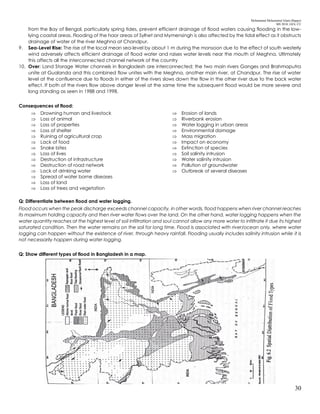
2. Demand Management through Non-market Measures: Demand management through non-market measures are more
effective than the water pricing. The demand can be managed through the following way.
A. An Increasing Water Use Efficiency: Water use efficiency can be increased by:
 Practicing ADW (Alternate Drying and Wetting) for rice irrigation
 Drip irrigation
 Cropping pattern based on the product value per unit of water
 Raising awareness among consumers about the importance of water conservation.
 Provide information and consulting services.
B. Technical Measures: Technical is an essential tool for effective management of water demand. The demand of
water supply in RCC is increasing day by day but the water is not available to meet this demand. In this
circumstance technical improvement is very essential. By technological improvement waste water can be re
used. As a result, the pressure will decrease from existing supply. However, technical measures are-
 Decreasing water supply pressure
 Changing supply schedule.
 Water recycling and reuse etc.
C. Increasing Institutional Capacity: Increasing institutional capacity is also a very important tool to manage the
water demand. Institutional capacity can be increased through-
 By introducing improved technology
 Training
 Direct initiatives by governments and water suppliers by providing services, installing conserving
equipment, fixing leaks.
3. Demand Management through Efficient Use of Water in Irrigation
(Irrigation Efficiency):
Irrigation efficiency: The term irrigation efficiency expresses the
performance of a complete irrigation system or components of the
system. Irrigation efficiency is defined as the ratio between the
amount of water used to meet the consumptive use requirement of
crop plus that necessary to maintain a favorable salt balance in the
crop root zone to the total volume of water diverted, stored or
pumped for irrigation. Thus, water applied by the irrigation system
and not being made available to be taken up by plant roots is
wasted and reduces irrigation efficiency.
Irrigation efficiency in Bangladesh: In Bangladesh, about 94% of the
irrigated land is under small and minor irrigation. But sub-optimal use
of these irrigation devices and unplanned cropping activities have
resulted in low irrigation coverage. The irrigation efficiency is only
Mohammad Mohaiminul Islam (Bappy)
MS 2018, GES, CU
34
about 30%. With proper utilization and improved management, 4.0 to 5.0 million ha of land can be irrigated easily by using
the same number of irrigation devices instead of the present 3.12 million ha.
Efficient Use of Water in Irrigation for demand management:
The limited water resources make it necessary to undertake all necessary measures for efficient irrigation systems, taking into
account the increase in production and water consumption savings, and also allow the cultivation of larger areas, even in
years of water shortage, and this requires the following:
 The introduction of best technologies and modern and advanced irrigation systems in terms of the efficient water
use in agriculture.
 Adopt preventive maintenance programs for irrigation systems, which lead to sustain efficient water use and reduce
losses. Irrigation water use and efficiency (on-farm, conveyance, and distribution) should be regularly monitored for
demand forecasting and planning purposes.
 Appropriate programs and procedures should be adopted, to ensure uniform flow discharge and stable pressure all
through the irrigation networks.
Q: Discuss water Conservation in the context of Bangladesh.
Water conservation:
Water conservation connotes the application of various techniques to reduce the use of fresh water to increase the quality
and quantity of water resources is known as water conservation. Water conservation is defined as activities designed to
reduce the demand for water, improve efficiency in use, and reduce losses and waste of water (Beecher and Laubach,
1989).
Water conservation strategy in the context of Bangladesh: According to Rahman (2011), the adopting water strategy in order
to conserve water should be-
1. Restoration of surface water system
 The surface water system should be restored by re-establishment of the links between various components of the
river-floodplain ecosystem.
 All water bodies including water tanks should be preserved.
 Fish passes should be made integral part of construction and rehabilitation of water development projects.
 Environmental flow should be ensured through all rivers.
 Any intervention within the rivers including river protection works should be made ecofriendly.
 Natural canal system should be maintained and re-excavated whenever necessary.
 Rubber dam technology may be encouraged for storage of monsoon water that can be used in dry season crop
land irrigation.
 Rain water harvesting should be encouraged for construction works, car washing, car cleaning and gardening.
 An ecosystem approach should be adopted for water resources management of the country.
2. River management:
 The linkages between the rivers should be restored.
 The conveyance capacities of the rivers should be restored through capital dredging and regular maintenance.
 The proposed Delta Plan-2100 can be entrusted to formulate a river management plan for Bangladesh. The
objectives of the river management plan will be to ensure adequate environmental flow through the rivers,
safeguard the rivers against encroachment and pollution, provide protection against river bank erosion, and
reclaim land through eco-friendly river training.
3. Addressing dry season water scarcity:
 Priority would be given on water sharing of the common/trans-boundary rivers with the neighboring
country/countries following the model of the Ganges treaty-1996.
 The Ganges Barrage project with ancillary infrastructure should be undertaken.
4. Increasing water sufficiency and reducing waste
 Build capacity in water efficiency measurements and waste reduction in urban and irrigation sectors.
5. Ground water management:
 A sustainable groundwater management plan is to be developed to reduce pressure on ground water system.
 Coastal aquifers should be protected from exploitation in order to check saline intrusion. Buffer zone should be
clearly delineated.
 Groundwater exploitation should be regulated so that extraction does not exceed safe yield.
6. Water pollution management:
 Institutional capacity of DoE should be increased particularly in relation to monitoring and enforcement so that it
can play its mandated role in protecting water bodies from pollution.
Mohammad Mohaiminul Islam (Bappy)
MS 2018, GES, CU
35
 ‘Polluters-pay’ principle should remain the corner stone of future strategies of pollution management. The payment
should include the cost of environmental damage as well as severe penalty/tax so as to discourage future pollution.
7. Policy implementation:
 Different water conserving and sustainable water use policies should be implemented.
Mohammad Mohaiminul Islam (Bappy)
MS 2018, GES, CU
36
ENVIRONMENTAL ISSUES OF WRM
Q: Discuss the major environmental concerns of water development and their remedies.
Major environmental concerns of Water Development:
Environmental concerns include the natural occurring phenomena as well as manmade impact on environment that can
affect the water development and water resources. It has been discussed below.
1. Climate change
2. Sea level rise
3. Global warming
4. Climatic extreme events
5. Water related hazards
6. Aquatic biodiversity loss
7. Environmental water pollution
1. Climate change: In general, analyses and application of management techniques in water sector have all along been
carried out based on the presumption that hydrological series are stationary. There is growing evidence of shifting trends
in such series, which need to be assessed and ascertained to enable taking corrective actions as needed. Periodic review
of hydro meteorological networks for arriving at optimum network also assumes significance in this respect, as brought
out under section 3.1. There is growing evidence of warming climate, as spelt out by climatologists, which can spell misery
to the population in such regions. IPCC warns that climate change is expected to exacerbate water scarcity situation in
Asia, with consequential multiple socioeconomic stresses.
2. Seal level rise: Sea level is on the rise along the Bangladesh coast like other parts of the world. Official data shows sea
level rise was observed at 5.73 mm per year at Char Changa station in Hatiya while Hiron point in the Sundarbans at 3.38
mm per year. Sea level rise has severe impacts on water development. Low-lying coastal regions, such as Bangladesh,
are vulnerable to sea level rise and the increased occurrence of intense, extreme weather conditions such as the
cyclones of 2007–2009, as well as the melting of polar ice. To address the sea level rise threat in Bangladesh, the
Bangladesh Delta Plan 2100 has been launched.
3. Global warming: Environmental experts have been saying for a long time that Bangladesh would be one of most severely-
affected victims of the global warming phenomenon. The next decade will see a rise in the sea level leading to increasing
incidences of floods and cyclones. This is most alarming news for water development specialists.
4. Climatic extreme events: Inter-Governmental Panel on Climate Change (IPCC) highlights the potential for more frequent
and more severe weather conditions; which is corroborated by many instances of extreme hydrological events. Such
eventualities, coupled with increased pressure on land from the increasing population, will make safety of life and
property high on the agenda for administrators and planners. Extreme events include tropical cyclones (hurricanes,
typhoons), tornadoes, floods, heat and cold waves, wildfires, earthquakes, tsunamis, and volcanic eruptions.
5. Water related hazards: Hydrological hazards or water related are hazards involving water processes. Examples include
floods, droughts, and tsunamis. This can be a major issue for the development of water in Bangladesh
6. Aquatic biodiversity loss: The prime concern with capture fisheries is the provision of suitable habitats for maintaining
biodiversity as well as fish production. This issue needs urgent attention of the policy makers.
7. Environmental water pollution: The water quality deterioration is major problem in water development. Excessive pumping
in coastal areas can cause saltwater to move inland and upward, resulting in saltwater contamination of the water supply
and many other issues are possible to occur. Which includes-
a) Salinity intrusion: intruding salinity into fresh water through flood inundation and groundwater intrusion.
b) Arsenic contamination: arsenic contamination is still common in many parts of the country.
c) Water pH depletion: the pH level of water is lowered which means they become acidic.
d) Change in water temperature: the water temperature show the usability and sustainability for drinking water and
biodiversity both.
e) Change in water electric conductivity: electric conductivity has a certain parameter which is compromised
nowadays due to various pollutions.
f) Increasing total dissolved solids (TDS): this problem is a prime concern for drinking water.
g) Change in water taste and smell: the smell and taste is important for the comfortable usage of water use.
Prevention: According to Rahman (2011), the following measures should be taken to solve these problems.
 Urgent action is needed both to clean-up pollution hot spots and to prevent re-pollution of cleaned-up locations and
ecologically sensitive areas
 Prepare a National Industrial Pollution Control Plan, with the aim of tackling the major polluters over a 10 to 15 year
period and subsequent follow-up of lesser polluters.
Mohammad Mohaiminul Islam (Bappy)
MS 2018, GES, CU
37
 The prime concern with capture fisheries is the provision of
suitable habitats for maintaining biodiversity as well as fish
production
 For conserving aquatic biodiversity, provide adequate river
and floodplain flows and fish-friendly hydraulic connections
between the floodplains and the main river system
 Introduce zoning of bagda shrimp production in order to deal
with the land-use conflict and soil salinization associated with
salt-water shrimp (bagda) production
 In the context of the water sector, there are two ecologically-
sensitive areas of outstanding importance, the Sundarbans
mangrove area and parts of the Haor Basin wetlands, the
former as a World Heritage Site and both as Ramsar Sites. Take
special measures to protect these sites by ensuring adequate
flow, acceptable water quality, necessary institutional support
and appropriate management regime.
Figure: Ground water pollution in Bangladesh (Source: Pennsylvania
State University research)
Mohammad Mohaiminul Islam (Bappy)
MS 2018, GES, CU
38
TRANSBOUNDARY WATER RESOURCE MANAGEMENT
Q: Define transboundary water resource management. Define transboundary issues related to water resource management
in Bangladesh. How to solve these issues?
TRANSBOUNDARY RIVER PROBLEMS IN BANGLADESH
Transboundary Rivers of Bangladesh:
A Trans-boundary river is a river that crosses at least one political border, either a border within a nation or an international
boundary. There are presently some 260 transboundary river basins around the world, covering 45% of the land surface of the
earth. Bangladesh is traversed with the greatest number of these rivers, almost exclusively trans international. A total of 58
major rivers of Bangladesh have entered the country either from India or from Myanmar. Hydrologically and politically, these
58 trans-boundary rivers are very significant as they carry a lot of sediments to help land accretion in the estuarine region but
also raise riverbeds to cause floods. The countries upstream often do not care for international conventions of water sharing
and this leads to disputes with complex political implications.
Overview Bangladesh transboundary rivers:
The rivers of Bangladesh share with India, Nepal, Bhutan and China. Total
1721300 square km of river are in the GBM basin and Bangladesh has
only 7% of it. There comes the transboundary river sharing and its
disputes.
India-Bangladesh Water Disputes: There are several reasons of india-
bangladesh water conflicts. They are discussed below.
Main Disputing Rivers: When it comes to water sharing disputes India and
Bangladesh has contention mainly over rivers Ganges and Teesta.
Ganges: Ganges (Ganga) flowing through one of the most fertile land
of the world origins in Himalayas and emptying into Bay of Bengal. It
drains one fourth of the territory of India, although its delta area that
shares with Brahmaputra River lies almost in Bangladesh. As a perennial
river, it is rich with water flow compared
with peninsular rivers and also forms a
distinguished ecosystem with unique flora
and fauna. After leaving India’s northern
plain it flows as a boundary between India
and Bangladesh for about 120 km and then
it flows to Bay of Bengal through
Bangladesh for 113km and merge with
Brahmaputra River to form Padma River.
Teesta: It is also known as the Lifeline of
Sikkim. A Himalayan river that flows through
Sikkim and West Bengal finally empties to
Bay of Bengal after flowing through
Bangladesh. Most of its catchment area lies
in India and it is the 4th largest river in
Bangladesh after Brahmaputra, Ganges
and Meghna.
Ganges Water Sharing Dispute History:
The problem started with the construction
of Farakka Barrage in West Bengal in 1950s.
Barrage plan was proposed in pre
independence era by the British to regulate
the flow in Hooghly River by diverting water
from Ganges during dry seasons to prevent silting and to ease operation of Calcutta Port. But it executed after India got its
Independence. The entire course of negotiations can be divided into two parts as, first one, between India and Pakistan 1947-
1970 and the second, India- Bangladesh thereafter. The conflict continued even after the independence of Bangladesh.
River
GBM Basin
Catchment %
Catchment Area
km
2
India 64% 1102000
Nepal 8% 147480
Bhutan 3% 47000
China 18% 304420
Banglade
sh
7% 120400
Total GBM 100% 1721300
Mohammad Mohaiminul Islam (Bappy)
MS 2018, GES, CU
39
Prime disputing concerns and Bangladesh’s sufferings:
The major sources of disputing concerns are-
a. Farakka Barrage and its Devastating Impact on Bangladesh
b. Tipaimukh Dam Proposal, Cosequence and Colfict
c. Ganges Water Distribution Treaty and its Result
d. Teesta Water Conflicts
e. Lack of Proper International Laws
A. Farakka Barrage and its Devastating Impact on Bangladesh: In 1951 India announced intentions build a Barrage across the
Gangues 10km from the Bangladesh border. The Barrage diverts water into the Baghirathi- Hooghly River to flush out silt and
increase navigation accessibility to Calcutta. The Barrage was commissioned in April 1975. This Barrage gave India control
over Ganges flows into Bangladesh during the dry season. In the spring of 1975 India withdrew 40,000 of the 55,000 ft³/s of
water from the Ganges. There were disastrous consequences on Bangladesh.
Bangladesh’s suffering from Farakka Barrage:
 Increased salinity of soil and water
 Decline of soil quality and crop yields
 Shrinking fish population
 Decline of fishing villages and loss of a livelihoods
 Decline of mangrove forest
 Increased erosion rates and sedimentation
 Increased salt water intrusion
 More severe flooding during the monsoon season
 Direct damages are estimated to be three billion US dollars
 Flooding in Bangladesh due to sudden opening of the barrage
B. Tipaimukh Dam Proposal, Cosequence and Colfict: Tipaimukh Dam is a proposed embankment dam on the river Barak in
Manipur state India, first commissioned in 1983. The purpose of the dam is flood control and hydroelectric power generation.
It has been subject to repeated delays as the project developed, as there has been controversy between India and
Bangladesh over water rights, in addition to questions of environmental effects of the huge project, as well as the need to
relocate indigenous Hmar people to make way for a vast reservoir.
Bangladesh’s suffering from Tipaimukh:
 Due to the construction of the dam Bangladesh would lose silt, sand and fish coming through Barak river.
 Bangladeshi experts have said the massive dam will disrupt the seasonal rhythm of the river and have an
adverse effect on downstream agriculture and fisheries.
 The Tipaimukh area lies in an ecologically sensitive and topographically fragile region. It is within one of the
most seismically volatile regions on the planet.
 Socio economic effect is possible.
 People can be displaced from their home.
 Species can be extinct.
 Will lead to environmental degradation.
C. Ganges Water Distribution Treaty and its Result:
The treaty-
 Ganges water sharing treaty was signed in 1990 as a mutual consent of equally sharing the water of Ganges.
 According to the treaty, water should be shared among both nations in a cycle of 10 days in lean period.
 It says omission of India’s unilateral power to reduce the water share to Bangladesh.
 There should be a setting up of a joint commission for implementation and monitoring.
 Joint commission should have equal members from both countries.
 There should be a review of treaty every 5 years and after the expiry of treaty
 Bangladesh should be supplied the promised quantity of water until a new treaty concluded.
Its result-
 India failed to address this treaty.
 Indian diplomats are still trying to use more water of Ganges not sharing with Bangladesh.
 This will put more pressure on Bangladesh’s water supply.
 Bangladesh will have to suffer from many other aspects as well.
Bangladesh’s suffering due to the Violence of Ganges Water Sharing Treaty: Bangladesh faces the following sufferings
from the violence of this treaty-
 Reduced flow affects irrigation and food production
Mohammad Mohaiminul Islam (Bappy)
MS 2018, GES, CU
40
 Fish stocks and fish industry declining
 Navigation of water ways have become harder
 Lower rivers are increasing salinization
 Delta is eroding because less silt is being carried by the river thus making it unstable
 Sea water incursion is increasing as the delta dries out.
 Lack of water in dry season
D. Teesta Water Conflicts:
 An agreement signed between Bangladesh and India to share the Teesta water as 36% for Bangladesh and 39% for India.
The remaining 25% would leave unallocated for the natural flow of Teesta River in 1983.
 Two countries decided to have complete scientific studies to share the water. Joint Teesta commission established to fulfill
this purpose.
 Due to Teesta Barrage and several hydroelectric dam constructions, the river heavily silted.
 The river has changed its courses in many places of lower stream Bangladesh and every year engulfing thousands of
hectares land.
 The dream of irrigating to increase the agriculture production becomes failure in both countries.
 In this case, India is the unhappier party.
E. Lack of proper international law: There is no proper laws of sharing water in these regions in such manner.
Causes of these Disputes:
According to Islam (2019), the major causes of the problem is-
 Lack of Political, National Consensus
 Lack of Regional Cooperation on Water Sharing
 Selective Foreign Policy (not all parties are India friendly)
 Poor Water Governance
 Water Scarcity in Both Countries
 Unwillingness to Abide by International Law of Rivers from Indian Side
 Political & Economic Instability
 Interstate and Instate Conflicts
Recommendation for the solution of ongoing disputes: According Syed (2015)-
Consequently, solutions to the problem should be-
 The govt. of the both country should come to an agreement.
 The regional cooperation should be strengthened.
 Foreign policy cannot be selective, under any ruling party.
 Water conservation and management strategies should be implemented strongly.
 The international laws and treaties should be abided.
 There should mutual friendliness and willingness to share water.
 Policy improvements should be emphasized.
 In state political anarchy should not hamper international relations.
Finally, Bangladesh and India must respect each other’s legitimate rights and understand each other’s needs. Besides, mutual
trust on commitments, implementation of commitments, and refraining from confusing statements and actions are also
imperative for resolving disputes. And considering the future, both parties should minimize their differences for the sake of
maintaining good neighborly relationships; Bangladesh should also maintain close contact with states adjacent to India to
avoid future misunderstanding.
South Asian Conflicts regarding Water Dispute:
 India-pakistan
 India-Bangladesh
 India-Nepal
 India-Sri Lanka
 Bangladesh-Myanmar
(Regarding water boundary that has been solved.)
Mohammad Mohaiminul Islam (Bappy)
MS 2018, GES, CU
41
Soultions to these problems according to Syed (2015)-
Effective policies: All countries within South Asia should implement policies which favor their mutual use of the rivers. These
countries should to use rivers which complement its goals as long as national interests are not affected. For example, when
both countries are constructing dams, mutual consultation will enable then to draft policies which favor both countries and
reduces destructive effects of this construction to the other country. Just as the two countries are collaborating to fight
terrorism, they should also collaborate to ensure that they both achieve their objectives regarding the availability and use of
the water resource.
Dialog: Dialog is the most effective way in which the dispute over water can be resolved. Other measures such as aggression
or violence will only lead to losses among both countries. It is imperative that the issue is sorted soon in order to prevent further
conflict or bloodshed which may occur as a result of the conflict. Treaties which are based on dialog have settled many fired
disputes over water in South Asia like the Indus Water Treaty and Mahakali Treaty.
Developing new treaties: The establishment of a new treaty is another way in which the conflict maybe resolved. However,
when the treaty was initially established, future projections on water needs for both countries should adequately assessed.
The already existing treaties should be re-negotiate to clearly explain how the water maybe used by both countries to achieve
mutual benefit. New treaty should project future trends as far as water consumption is concerned to avoid other future
conflicts relating to water use. For instance, it is about time that the ‘National Water policy – 2002’ should be altered again
and should update the demand and supply of modern water management methodology and conservation technology.
Mohammad Mohaiminul Islam (Bappy)
MS 2018, GES, CU
42
SHORT NOTES
Land Use Change and Flooding
Land-cover change (urbanisation, deforestation, and
cultivation) results in increased flood frequency and severity.
Mechanisms include-
 reduced infiltration capacity
 lower soil porosity
 loss of vegetation and forest clearing
 meaning lower evapotranspiration
Hydrological Cycles
What is Hydrological: It describes the exchanges of water
between the oceans, atmosphere, land surface, biosphere,
soils, groundwater systems, and the solid Earth.
Components of Hydrological Cycles
1. Runoff
it is the water flowing over the land making its way towards
rivers, lakes, oceans etc. as surface or subsurface flow.
1. Surface runoff: it is the running water over the land
and which ultimately discharge water to the sea.
2. Subsurface runoff: The water getting infiltrated into
pervious soil mass, making its way towards rivers and
lakes can be termed as subsurface runoff.
2. Precipitation: It is the fall of moisture from atmosphere to
the earth’s surface in any form. Example: rain, hail, snow,
sleet, glaze, drizzle, snowflakes.
3. Evaporation: It is the conversion of natural liquids like water
into gaseous form like air.
4. Condensation: It is the conversion of a vapor or gas to a
liquid.
5. Transpiration: it is the evaporation taking place from any
plant or greenery. Example, water droplet on a leaf getting
evaporated into atmosphere
6. Evapotranspiration: it is the combination of evaporation
and transpiration.
7. Infiltration: It is the process of filtration of water to the inner
layers of soil based on its structure and nature. Pervious soils
go through more infiltration than impervious. Infiltration in soils
like sand, gravel and coarser material is more and for finer soil
particles like clay and silt, infiltration is less.
Infiltration is inversely proportional to runoff. In a soil, if
infiltration is less, then runoff is more, similarly more infiltration
gives less runoff. Example: bitumen roads has more runoff
than metallic red mud roads
Process of Hydrological Cycle: Process of hydrological cycle
starts with oceans. Water in oceans, gets evaporated due to
heat energy provided by solar radiation and forms water
vapor. This water vapor moves upwards to higher altitudes
forming clouds.
Most of the clouds condense and precipitate in any form like
rain, hail, snow, sleet. And a part of clouds is driven to land
by winds. Precipitation, while falling to the ground, some part
of it evaporates back to atmosphere.
Portion of water that reaches the ground, enters the earth’s
surface infiltrating various strata of soil and enhancing the
moisture content as well as water table.
Vegetation sends a portion of water from earth’s surface
back to atmosphere through the process of transpiration.
Once water percolates and infiltrates the earth’s surface,
runoff is formed over the land, flowing through the contours
of land heading towards river and lakes and finally joins into
oceans after many years. Some amount of water is retained
as depression storage.
Further again the process of this hydrological cycle continues
by blowing of cool air over ocean, carrying water molecules,
forming into water vapor then clouds getting condensed
and precipitates as rainfall. Similarly, then water gets
percolate into soil, increasing water table then formation of
runoff waters heading towards water bodies. Thus the cyclic
process continues.
Depression Storage: it is the part of precipitation required to
fill depression zones of land.
Interception: Part of precipitation required to wet the surface
of soil, buildings and all pervious surfaces.
Hydropower development and population displacement
concerns
Hydropower development projects lead to eight destructive
displacement risks for indigenous populations:
i. Landlessness
ii. Joblessness
iii. Homelessness
iv. Marginalization
v. food insecurity
vi. increased morbidity
vii. lost access to common resources
viii. community dislodgment
Hydro-Politics
Water politics, sometimes called hydropolitics, is politics
affected by the availability of water and water resources, a
necessity for all life forms and human development. The first
use of the term, hydropolitics, came in the book Hydropolitics
of the Nile Valley.
Mohammad Mohaiminul Islam (Bappy)
MS 2018, GES, CU
43
Water will play a critical role in reshaping policies and
economy of the 21st century. As the national water resources
are getting polluted and becoming insufficient due to rapid
increase in population, inefficient uses, migration to urban
sections, industrial activities and current global warming and
climate change, significance of international surface and
groundwaters are increasing. Limiting impacts of water on
social and economic development of countries especially of
some regions of the world will no-doubt bring the current
problems into an upper level. Such a case will bring national
and international water use policies (Hydropolitics) into more
forefront than today.
Watershed Management
Watershed management is a term used to describe the
process of implementing land use practices and water
management practices to protect and improve the quality
of the water and other natural resources within a watershed
by managing the use of those land and water resources in a
comprehensive manner.
Watershed management processes:
 Delineate and map the watershed’s boundaries and the
smaller drainage basins within the watershed;
 Inventory and map the resources in the watershed;
 Inventory and map the natural and manmade drainage
systems in the watershed;
 Inventory and map land use and land cover;
 Inventory and map soils;
 Identify areas of erosion, including stream banks and
construction sites;
 Identify the quality of water resources in the watershed
as a baseline; and
 Inventory and map pollution sources, both point sources
(such as industrial discharge pipes) and nonpoint sources
(such as municipal storm water systems, failing septic
systems, illicit discharges).
Ganges Dependent Area
Ganges Dependent Area (GDA) the area directly influenced
by the ganges river in terms of historic linkages, current direct
impact and potentially commanded land. The GDA
encompasses the whole of the southwest area of the country
(with the exception of Bhola Island) plus a strip of land along
the left banks of the Ganges and the padma, which relates
directly to these two rivers. For water resource planning,
Bangladesh has been divided into regions based on
hydrological conditions. The GDA is located mainly in the
Southwest Region (SWR) and the South Central Region (SCR),
which together make up the Southwest Area (SWA), with
small parts of the Northwest and Northcentral Regions
making up the balance.
The Ganges Dependent Area is generally low-lying with
gentle slopes with few elevations exceeding 14m above sea
level, even at 250 km from the coastline. While the northern
part is characterised by a rolling topography which drops at
a slope of 1:7500 to about 6m above sea level along a line
through jessore to faridpur, the topography south and east of
this line becomes much flatter and the number of beels and
depressions increases. The tidal limit is approximately
coincident with the 6m contour, with average tides at the
coast of 2.7m, greater in the west than in the east.
Marine water pollution
Marine pollution is a combination of chemicals and trash,
most of which comes from land sources and is washed or
blown into the ocean. This pollution results in damage to the
environment, to the health of all organisms, and to economic
structures worldwide (National Geographic).
Types of Marine Pollution-
Eutrophication: When there is an excess of chemical nutrients
mainly nitrates and phosphates in the water, it leads to
eutrophication or nutrient pollution.
Acidification: Oceans act as a natural reservoir for absorbing
the carbon dioxide from the Earth’s atmosphere. But, due to
rising level of carbon dioxide in the atmosphere, the oceans
across the world are becoming acidic in nature, as a
consequence, it leads to acidification of oceans.
Toxins: Toxins such as pesticides, DDT, PCBs, furans, TBT,
radioactive waste, phenols etc. May cause genetic
deformation of aquatic species.
Plastics: Plastic dumped and found in the oceans are
dangerous for the marine life forms and wildlife, as sometimes
it strangles and chokes them to death. The rising levels of
plastic dumps found in the oceans are suffocating, ingesting,
and entangling the life underwater as well as above it.

Water Resource Management

  • 1.
    1 Water Resource Management HandNotes Mohammad Mohaiminul Islam B.Sc., M.Sc. Department of Geography & Environmental Studies University of Chittagong mohaiminul.ges@std.cu.ac.bd
  • 2.
    Mohammad Mohaiminul Islam(Bappy) MS 2018, GES, CU 2 INTRODUCTION TO WATER RESOURCE MANAGEMENT Q. What do you understand by water resource management? Discuss the fundamental concept, scope, goal and Importance in the context of Bangladesh. Water Resource: The concept of water resources is multidimensional. It is not limited only to its physical measure (hydrological and hydrogeological), the ‘flows and stocks’, but encompasses other more qualitative, environmental and socio-economic dimensions (FAO, 2003). Water resources are natural resources of water that are potentially useful. Uses of water include agricultural, industrial, household, recreational and environmental activities. All living things require water to grow and reproduce (USGS, 2009). Water Resource Management:  According to Rola, Pulhin and Hall (2018), Water resource management is the formulation and evaluation of alternative plans to accomplish water development objectives such as water supply management, water excess management, including environmental protection for sustainable use of water resources.  Water Resource Management is a process which promotes the coordinated development and management of water, land and related resources in order to maximise the resultant economic and social welfare in an equitable manner, without compromising the sustainability of vital ecosystems (Kumar, 2019).  According to Banglapedia, Water Resources Management aims at managing the tasks required to generate water and produce water related goods and services for the benefits of the society as a whole. It includes physical intervention, related financial management, institutional arrangement, legislation, and regulations. Fundamental Concept of Water Resource Management: Water resource management is the activity of planning, developing, distributing and managing the optimum use of water resources. It is a sub-set of water cycle management. The fundamental concept of water resource management includes the management of water resources through multiple processes. It is also a decision making act in resource management study. The key concepts of water resource management are-  Formulation of alternative plans for water development.  Evaluation of alternative plans for water development.  Management of water supply.  Management of water excessiveness.  Management of the mass access to water.  Management of water resource for environmental protection.  Management of water resource for sustainable development.  Coordination of development and management of water.  Strengthening the sustainability of water resource.  Management of water resource for social wellbeing.  Management of water resource for environmental balance. Scope of Water Resource Management:  Water resources assessment  Development, conservation and control of water resource  Making emphasis on policies and strategies regarding water resource  planning and design of water resource systems and operation  Maintenance and administration of water resource systems  Water demand and consumption study  Applied surface and groundwater hydrology  Water management techniques  Simulation and modelling of water resource systems  Forecasting and control of quantity and quality of water  Economic and social aspects of water use  Legislation of water usage  Water resources protection  Human intervention in water cycle  Sectoral usage of water resource  Management of flood  Water power development  Water disputes  Water and environmental issues Goal/Importance of Water Resource Management:  Assessing the availability water resource  Assessing the quality and quantity of water resource  Ensuring the sustainability of water resource
  • 3.
    Mohammad Mohaiminul Islam(Bappy) MS 2018, GES, CU 3  Ensuring the accessibility of water resource  Solving the disputes of water resource distribution  Making plans and policy for water resource  Comprehending the hydrological aspects of water resource  Managing the water resource and its usage for environmental/ecosystem balance.  Balance between demand and consumption of water resource.  Coordination of water plans, policies and monitoring and management bodies. Q: What is integrated water resource management (IWRM)? Explain the framework for integrated water resource management (IWRM). Explain that geographical knowledge is basic need for IWRM. IWRM: According GWP (2011), Integrated Water Resources Management (IWRM) is a process which promotes the coordinated development and management of water, land and related resources in order to maximise economic and social welfare in an equitable manner without compromising the sustainability of vital ecosystems and the environment. IWRM Concept:  WRM helps to protect the world’s environment, foster economic growth and sustainable agricultural development, promote democratic participation in governance, and improve human health. Worldwide, water policy and management are beginning to reflect the fundamentally interconnected nature of hydrological resources, and IWRM is emerging as an accepted alternative to the sector-by-sector, top-down management style that has dominated in the past.  The basis of IWRM is that the many different uses of finite water resources are interdependent. High irrigation demands and polluted drainage flows from agriculture mean less freshwater for drinking or industrial use; contaminated municipal and industrial wastewater pollutes rivers and threatens ecosystems; if water has to be left in a river to protect fisheries and ecosystems, less can be diverted to grow crops. There are plenty more examples of the basic theme that unregulated use of scarce water resources is wasteful and inherently unsustainable.  Integrated Water Resources Management is a cross-sectoral policy approach, designed to replace the traditional, fragmented sectoral approach to water resources and management that has led to poor services and unsustainable resource use. IWRM is based on the understanding that water resources are an integral component of the ecosystem, a natural resource, and a social and economic good. IWRM Framework: There are 3 framework principles, 4 Dublin principles and 7 factors of IWRM. Together, they can provide a precise framework and concept of IWRM. They are- 3 Framework Principles of IWRM- IWRM rests upon three principles that together act as the overall framework according to International Conference on Water and the Environment in 1992. 1. Social equity: ensuring equal access for all users (particularly marginalised and poorer user groups) to an adequate quantity and quality of water necessary to sustain human well-being. 2. Economic efficiency: bringing the greatest benefit to the greatest number of users possible with the available financial and water resources. 3. Ecological sustainability: requiring that aquatic ecosystems are acknowledged as users and that adequate allocation is made to sustain their natural functioning. 4 Dublin Principles- In January, 1992, the International Conference on Water and the Environment (ICWE) was held in Dublin, Ireland to serve as the preparatory event, with respect to water issues based on the following four guiding principles (ICWE, 1992): 1. Principle one recognized fresh water as a finite, vulnerable, and essential resource, and suggested that water should be managed in an integrated manner. 2. Principle two suggested a participatory approach, involving users, planners, and policymakers, at all levels of water development and management. 3. Principle three recognized women’s central role in the provision, management, and safeguarding of water. 4. Principle four suggested that water should be considered as an economic good.
  • 4.
    Mohammad Mohaiminul Islam(Bappy) MS 2018, GES, CU 4 7 Factors towards a successful implementation of IWRM- 1. Privatization: Privatization and public-private partnership were extensively disseminated at the Hague forum, the Bonn conference, and the WSSD summit. Although the privatization concept presently discourages subsidies, it overlooks the fact that, in Europe, initial water infrastructure development was based on massive subsidies. Some critics fear that privatization may encourage fragmentation, which IWRM seems to overcome. Privatization of the marketable aspects of water may result in single-purpose planning and management, which raises a question of open information channels and transparency. 2. Water as an Economic Good: Water is recognized as an economic good in many international declarations, such as those reviewed above, as well as in the policies of major lenders and donors. However, there is a risk in fostering the notion of water as a commodity, because it shifts the public perception away from a sense of water as a common good, and from a shared duty and responsibility. A simple and straightforward solution, designed on the basis of pure economic efficiency, has the potential of ending up unsustainable. 3. Transboundary River Basin Management: Water should be recognized as a tool for community development, peace building, and preventive diplomacy. Water can have an overreaching value capable of coalescing conflicting interests and facilitating consensus building among societies. To incorporate all of the physical, political, and economic characteristics for a river basin, a process for cooperative watershed management is vital. For this reason, water should be managed based on river basins, not only on administrative boundaries. 4. Restoration and Ecology: In the last three decades, the highly visible effects of environmental degradation have sparked public outcry, particularly in the United States and Europe, resulting in river restoration initiatives. “Channelization” is the term used to embrace all processes of river channel engineering for the purposes of flood control, drainage improvement, maintenance of navigation, reduction of bank erosion, and relocation for highway construction. 5. Fisheries and Aquaculture: Fisheries and aquaculture are crucial for human survival and poverty reduction; they provide an inexpensive source of protein to meet nutritional demands in many parts of the world, and therefore should command special attention within IWRM. 6. Need to Focus on Past IWRM Experience - Integrating Lessons Learned: Although IWRM has received increasing international attention in recent decades, historical precedents present lessons. The current IWRM mechanisms have not properly considered similar previous attempts. Lessons from past initiatives are vital to the implementation of IWRM principles and policies. 7. Spiritual and Cultural Aspects of Water: Water is the common symbol of humanity, social equity, and justice. It is one of our compelling links with the sacred, with nature, and with our cultural heritage (Dooge, 2003). A case in point is the Ganges River in South Asia, which has a very strong spiritual and cultural significance to all Indians, Bangladeshis, and Nepalese. Regrettably, the current IWRM mechanism does not acknowledge water’s spiritual and cultural dimensions. Without recognizing these, it is possible that all efforts towards sustainable water resources management may be piecemeal and ephemeral. Geographical knowledge is basic need for IWRM:  Geography studies social equity which is an element of IWRM.  Geography studies economic development which is an element of IWRM.  Geography studies ecology and ecosystem which is an element of IWRM.  Geography studies sustainable development which is an element of IWRM.  Geography studies hydrology which is an element of IWRM.  Geography studies environmental restoration which is an element of IWRM.  Geography studies environmental sustainability which is an element of IWRM.  Geography studies environmental issues which is an element of IWRM.  Geography studies fisheries which is an element of IWRM.  Geography studies resource management which is an element of IWRM.  Geography studies culture and its assimilation which is an element of IWRM.  Geography studies spatial aspects which is an element of IWRM.  Geography studies planning and management of environmental elements that is related to IWRM. Q: Discuss WRM/IWRM in the context of Bangladesh. According to Banglapedia, Water Resources Management aims at managing the tasks required to generate water and produce water related goods and services for the benefits of the society as a whole. It includes physical intervention, related financial management, institutional arrangement, legislation, and regulations.
  • 5.
    Mohammad Mohaiminul Islam(Bappy) MS 2018, GES, CU 5 And, according GWP (2011), Integrated Water Resources Management (IWRM) is a process which promotes the coordinated development and management of water, land and related resources in order to maximise economic and social welfare in an equitable manner without compromising the sustainability of vital ecosystems and the environment. Water Resource System in Bangladesh Water Resources System (WRS) consists of various components of the natural system, human made infrastructure, and the institutional arrangements to regulate and control the availability and access of users to these components. In Bangladesh agriculture is the principal economic activity and the main user of water. Water also has domestic, commercial and industrial use. The in-stream flows and water storage support fisheries, forestry, navigation, pollution control, salinity control, nature conservation and recreational facilities. The natural subsystems of WRS of the country are: (a) The inter-linked system of rivers, estuaries, canals, khals etc (b) The floodplain (c) Wetlands (d) Haors, baors, beels, lakes (e) Ponds (f) Inter tidal lands and water (g) Groundwater aquifers Water Sources of Bangladesh The water sources of Bangladesh includes- 1. Rainfall 2. Transboundary flow 3. Standing water bodies 4. Seasonal wetlands 5. In-stream storage 6. Groundwater 1. Rainfall: The rainfall in Bangladesh varies, depending upon season and location. Winter (November through February) is very dry and accounts for only less than 4% of the annual rainfall. Rainfall in this season varies from 20 mm in the west and south to 40 mm in the northeast, which is caused by the westerly disturbances that enter the country from the northwestern part of India. Annual rainfall of Bangladesh, source: weatheronline.com 2. Transboundary flow: Bangladesh shares 57 transboundary rivers, 54 incoming from India, 3 from Myanmar. Among the rivers, the Ganges, the Brahmaputra and the Meghna drain about 1.08 million sq.km., 0.58 million sq.km. and 0.09 million sq.km., respectively. Total annual volume of water that enters into the country from the transboundary rivers is about 1000 billion cubic meter.
  • 6.
    Mohammad Mohaiminul Islam(Bappy) MS 2018, GES, CU 6 3. Standing water bodies: In addition to natural rivers, water is retained in localized low pockets (beels/baors) and ponds in dry season. Kapatai lake is the lonely reservoir in the country that has storage capacity. Total volume of such standing water bodies is about 0.61 billion cubic meter. 4. Seasonal wetlands: Floodplains (about 80% of the total area of the country) become seasonal wetlands during monsoon (July-October) because of slow drainage of huge transboundary flow and local rainfall excess. The seasonal wetlands remain inundated from a few days to as long as several months (May-November). Estimated volume of water stored in these seasonal wetlands/floodplains is about 2.69 billion cubic meter. 5. In stream Storage: The numerous channels crisscrossing the entire country, in flowing stage, store water till these are completely dries. Estimated volume of channel storage is of the order of 0.5 billion cubic meters. 6. Groundwater: Groundwater in Bangladesh occurs at a very shallow depth where the recent river-borne sediments form prolific aquifers in the floodplains. In the higher terraces, the Barind and Madhupur tracts, the Pleistocene Dupi Tila sands act as aquifers. Challenges in WRM in Bangladesh: According to Hossain, Rahman & Tamim (2013)- 1. Increasing Vulnerability to Severe Events: Inter-Governmental Panel on Climate Change (IPCC) highlights the potential for more frequent and more severe weather conditions; which is corroborated by many instances of extreme hydrological events. Such eventualities, coupled with increased pressure on land from the increasing population, will make safety of life and property high on the agenda for administrators and planners. 2. Urban Demand: More than 60 percent of Bangladeshn population is projected to live in urban and semi-urban areas by 2015. People, and the ever-growing industrial sector, will demand an increasingly larger share of the total water available; much of which is liable to be diverted from water meant for irrigation; which in turn can place greater pressure on water supply systems, and reduce availability of arable land. Accelerated urbanization has also the potential to create substantial pollution load on freshwater supplies and estuaries, which needs to be addressed. With urbanization comes the problem of the less privileged in the society often flocking to flood plains of rivers, thus creating additional technological and socio-economic issues concerning flood management. 3. Unrestricted Extractions: Often, there is neither a management plan nor restrictions on water extraction from scarce resources. Water being the ultimate ‘commons’, and since water resources are no longer boundless, communities need to study water systems and re-define wise use. Changes in human values, and ideas of morality, are needs of the day as regards water usage to avoid a situation where rational pursuit of individual self-interest can lead to collective ruin. Ground water extraction in large parts of Bangladesh is a classic example in this respect. 4. Climate Change: In general, analyses and application of management techniques in water sector have all along been carried out based on the presumption that hydrological series are stationary. There is growing evidence of shifting trends in such series, which need to be assessed and ascertained to enable taking corrective actions as needed. Periodic review of hydro meteorological networks for arriving at optimum network also assumes significance in this respect, as brought out under section 3.1. There is growing evidence of warming climate, as spelt out by climatologists, which can spell misery to the population in such regions. IPCC warns that climate change is expected to exacerbate water scarcity situation in Asia, with consequential multiple socioeconomic stresses. 5. Allocation Problem of Existing Supplies: A typical water-supply system to a city involves structures such as reservoirs, canals, pumping systems, pipes, etc.; which are generally designed and allocated on the basis of past availability and existing demands. The current and/ or future availability does not often form a part of the scheme of things. This makes many water supply systems over-allocated. Studies show that, in general, lower the data length, higher is the likelihood of over- estimating water resources availability in a region. Uncertainties in respect of flood potential assessment too increase. Such factors warrant review of allocation of water supply systems and safety aspects from flood hazards periodically. 6. Land-use Changes: Land use change is a reality, with more forest/ arid/ marshy/ fallow areas paving way for activities such as mining, agriculture, tourism-related activities and infrastructure development. For instance, a large number of mega power projects coming up on the eastern coastal region of Bangladesh. Expanding plantations and decreasing
  • 7.
    Mohammad Mohaiminul Islam(Bappy) MS 2018, GES, CU 7 forest cover also play a major part in this scenario. Changes to land use, even within agricultural lands, have substantial implications for both water availability and use. 7. Environmental Requirements: Environmental concerns are foremost on the minds of administrators, planners and the general populace; with the result that there is a steadily increasing awareness and emphasis on the requirements of environmental flows in any river system towards maintaining ecosystems such as wetland and in-stream environs. We have begun accepting the rights of nature, treating rivers, estuaries, forests and the like not as simply properties, but entities who have their own right to flourish. The day is not far of wherein this right would be put into statute, which would enable a vigilant citizen to file a suit on behalf of, say the injured watershed, arguing that its health is crucial to the common good. In the above context, the ensuing sections detail the wherewithal to counter the issues by sustained scientific and technological initiatives in the hydrological services regime. Water Regulatory Authority in Bangladesh: There are some regulatory authorities to implement and supervise the noted activities according to various policies and acts on water. Some of the regulatory bodies are-  Ministry of Water Resources,  Bangladesh Water Development Board (BWDB),  Water Resources Planning Organization (WARPO),  River Research Institute (RRI),  Joint Rivers Commission (JRC),  Dhaka WASA etc. Major Plans and Policy in Bangladesh and Their Evaluation: Existing Policies for Water Management Bangladesh has various national policies for different key sectors to accelerate the balanced way of development. There are several policies and acts for formulating the rules and regulations on general usage on water. The major policies and acts are: a. National Water Policy (1999); b. Coastal Zone Policy (2005); c. Coastal Development Strategy (2006); d. National Water Management Plan: Development Strategy (2011); e. Bangladesh Water Act 2013. Plan Year Comment National Water Policy 1999 Efficient plan but poor reporting system, lacking resources. Development Strategy of the National Water Management Plan 2001 Powerful strategies but weak reporting system, GO and NGO help available. National Water Management Plan 2004 Well stated, details, efficient and has a funding plan as well, may face some challenges in funding Adapted from Chan, Roy and Chaffin (2013). National Water Management Plan (NWMP): The draft NWMP was prepared by WARPO in 2001. The plan is to be updated every five years. The plan identified 84 programmes, which are grouped both into eight sub sectoral clusters, as well as eight planning regions. The eight sub clusters are the Institutional Development, Enabling Environment, Main Rivers, Towns and Rural Areas, Major Cities, Disaster Management, Agriculture and Water Management, and Environment and Aquatic Resources. The eight planning regions are South West Region, North East Region, North Central Region, Northwest Region, South Central Region, South East Region, Eastern Hills Region, and Rivers and Estuary Region. Priority is given to the institutional development, enabling environment, and water supply and sanitation. The estimated investment cost of the plan over 25 years is Tk 91,457 crore ($18 billion). Politics and Decision Making: Bangladesh has strong elements of democracy, e.g., freedom of the press and media. However, there is a recognized lack of transparency and accountability in environmental decision-making processes in Bangladesh. The current political system is essentially a “winner take all” system due to the outright exclusion of political opposition from a legitimate place in the democratic polity, the undue influence of state institutions to achieve political interests, and the general politicization of bureaucracy. Bureaucratic complexities common to many forms of democratic governance affect administrative functions
  • 8.
    Mohammad Mohaiminul Islam(Bappy) MS 2018, GES, CU 8 in Bangladesh, and with very few enforceable checks and balances in government, give rise to petty corruption and crime across the water management administration. Although corruption of public officials is a state-wide issue, it has implicit and explicit associations with institutions and/or organizations that manage water resources. For example, protracted or corrupt bureaucratic procedures and a lack of transparency in most public services offices is a major barrier to implementing the Rights to Information Act of 2009—the application of which is very important measure for obtaining water management data from the Ministry of Water Resources to support IWRM and improved water decision making. Key Strategies of Water Management:  Water Allocation: Apportioning of water to major users and uses; maintaining minimum levels for social and environmental use, while addressing equity and development needs of society.  River basin planning: Preparing and updating the basin plan as per need by incorporating stakeholder views on development and management priorities for the basin.  Stakeholder participation: Implementing stakeholder participation as a basis for decision making that takes into account the best interests of society and the environment in the development and use of water resources in the basin.  Pollution control: Managing pollution using socially acceptable principles and appropriate incentives to mitigate environmental and social impacts.  Monitoring: Implementing effective monitoring systems, which provide needed management information to identify and respond to infringement of laws/ regulations/ permits.  Economic and financial management: Applying economic and financial tools for investment and cost recovery to support the goals of equitable access and sustainable benefits to society.  Information management: Providing essential data necessary to make informed and transparent decisions towards sustainable management of water resources. Policy recommendations: The water policy lays down the broad principles of development of water resources and their rational utilization under several challenges:  Alternating flood and water scarcity during the wet and the dry seasons;  Ever-expanding water needs of a growing economy and population;  Massive river sedimentation and bank erosion;  Providing total water quality management;  The lack of control over Trans Boundary Rivers;  The difficulty of managing the deltaic plain;  The virtual absence of unsettled land for building water structures. The policy and strategies, however, keep a continuous direction on the way of serving best welfare to the common people. But that is a small part of achieving the common interest as because it is by and large dependent on the executing mechanism of the regulations by practice. It is purely the responsibilities of the governmental authority to run the proper activities according to the policy in view of serving the common people. Otherwise, the policies remain only on the papers. Q: Narrate global and country water resource availability profile. Why water is most important natural resource? The Global Water Availability scenario is demonstrated below.
  • 9.
    Mohammad Mohaiminul Islam(Bappy) MS 2018, GES, CU 9 Approximately 75% of the Earth’s surface is covered by water. However, this is just an estimate as the dynamic nature and permanent motion of water makes it difficult to reliably assess the total water stock/store of the earth. Current estimates are that the earth’s hydrosphere contains approximately 1386 million km3 of water. However, not all of these resources are potentially available to humans since freshwater is required by the agricultural sector, industries, and domestic and recreational users. (Source of this write up and figure: Lui et al., 2011) Country Profile for Water Resources: The above demonstration of country profile of the world by FAO and WRI (2008) shows the scarcity and availability of water in many countries of the world. IT shows that the water is available in most of the European, Australian and American countries. Scarcity is observed moderate to severely in African Continents. Scenario is same at the Indian continent as well. Although the North African countries are most vulnerable. Bangladesh seems to be at the edge of vulnerability but yet to survive few years with the available water, but the scenario will certainly worsen if the vulnerability parameters are unchecked. Why water is most important natural resource? Because of three reasons- 1. It is a finite resource. Will be consumed soon if the vulnerability parameters are unchecked. 2. It is essential for the survival of life. Water is the most existent element in any life form/organism. 3. It has many usages-  Drinking  Household  Agriculture  Industry  Mining  Energy  Domestic  Recreational  Environmental etc.
  • 10.
    Mohammad Mohaiminul Islam(Bappy) MS 2018, GES, CU 10 PHASE OF HUMAN INTERVENTION IN WATER CYCLE Q: What are the major phases of human intervention in water cycle? Explain. Water cycle: The water cycle or hydrological cycle describe the continuous movement of water on the earth’s surface, through the soils and geological materials and into the atmosphere. It is the process of how water moves on, in and above the earth (Pennington & Cech, 2010). Human intervention in water cycle: There are many types of human activity, which can affect the hydrological cycle in different physiographic conditions and time-space scales, i. e. from local scales to global ones. Details are described below. Factors of human intervention in water cycle: According to the nature and scale of human impact on hydrological cycle components (precipitation evaporation, runoff), all the factors of human activity may be combined into the following groups: 1) Factors connected with transformation of the Earth’s land surface. These are:  forest clearance and afforestation (natural and artificial);  land plowing, agrotechnical practices, use of meadows as pastures, etc.;  urbanization;  construction of reservoirs and hydromelioration practices (irrigation, drainage of swamps and waterlogged areas). 2) Factors directly connected with water diversions from the channel network (including lakes and reservoirs), the use of this water by different users and return of the used water to the water bodies. 3) Factors affecting water balance components by changing general meteorological and climatic characteristic (Shiklomanov, 2009). Human influence on hydrological cycle: According to Shiklomanov (2004)- i. Intervention through land cover change in river basin: Human activities that change the land cover of river basins and are aimed at regulating the water fluxes in nature can considerably change the hydrological cycle of the separate river basins, and even of large regions. ii. Interruption of natural hydrological cycle: Due to human activities, the natural hydrological cycle of most river basins is becoming more and more transformed and regimented. The main stream flow regulation methods are construction of dams, levees, barrages, and dikes, which provide water accumulation, decreasing flood flow, and increasing low flow. The major effects of reservoir construction on the hydrological cycle (excepting runoff control) are an increase of evaporation and a rise of groundwater table. In dry regions, evaporation losses from the reservoir water surface may be so large that they seriously compromise any potential gains. At the same time, in the conditions of moderate climate, the reservoir losses on evaporation are relatively small. iii. Intervention through irrigation: The impact of irrigation on the hydrological cycle is especially revealing in the arid regions, but it is also considerable in regions with moderate climate where irrigation is of supplementary character. Diversion of water for irrigation purposes from surface or groundwater resources modifies the natural hydrological processes. It is common for runoff and evaporation from irrigated areas to increase significantly. iv. Intervention through drainage: To remove excess water from waterlogged soils, drainage is applied in many regions of the world. The primary effect of drainage is the lowering of the groundwater table and the extension of the layer with unsaturated soil. As a result, evapotranspiration may considerably drop (in some cases, by more than 50 percent). v. Intervention through extraction of ground water: Because the quality of groundwater is mostly far better than that of surface water, and its temperature is relatively constant, large volumes of groundwater are extracted for domestic and industrial use in different regions of the world. If groundwater is extracted from confined aquifers below impermeable layers, the groundwater table is not, or is only slightly, affected. However, at some river basins the groundwater table often drops steeply, and this may reduce the surface runoff and the lower level of the small rivers. In many coastal areas, the extraction of groundwater leads to the seawater intrusion. vi. Intervention through agriculture and forestry practice: The effects of agricultural and forestry practices on the hydrological cycle are less apparent, and depend, to a significant extent, on the physiographic and climatic conditions. It is evident that ploughing, especially contour ploughing, usually breaks up overland flow and increases infiltration. Some special
  • 11.
    Mohammad Mohaiminul Islam(Bappy) MS 2018, GES, CU 11 types of ploughing may increase the depression and detention storage on gentle slopes from about 8–10mm (in the natural conditions) to 30–40mm. Tillage and the activity of plant root systems modify the structure of the upper soil layer and change not only the vertical permeability, but also the water retention capacity. Extension of vegetation cover and the leaves area increases the interception of precipitation and evapotranspiration. Control of overland flow by dense permanent grasses on steeper slopes can reduce storm runoff from small watersheds by 20–25 percent. vii. Intervention through deforestation: The main clearly-expressed effects of deforestation on the hydrological cycle of a river basin are the increases in transpiration and interception of precipitation, which in turn result in a decrease of the volume of total runoff. Deforestation reduces infiltration and improves the conditions for overland flow. As a consequence, flood runoff and peak discharges may significantly increase. At the same time, the higher infiltration of forest soils increases the opportunity for recharge groundwater, and the flow of small rivers tends to be more sustained, especially in the case of the generation of snowmelt runoff, when forests further sustain flow by delaying the snowmelt. A rise in the groundwater table and an increase of ground runoff may also raise the low flow of medium- and large-sized rivers. Such effects often result in the conclusion that forests increase runoff. viii. Intervention through run off disruption: Long-term observations have also shown the strong dependence of runoff volume on the type of vegetal cover. Conversion of hardwood to pine reduced the annual runoff by 25 cm and produced significant reductions of monthly runoff. At the same time, forest cutting has led to a considerable increase in flood peaks. Similar results have been also received on the basis of analyzing data obtained in other physiographic conditions. ix. Intervention through marine water cycle disruption: Large-scale human manipulation of water has significantly altered global patterns of streamflow. Resulting changes in sea level, ocean salinity, and in biophysical properties of the land surface could ultimately generate climate feedbacks. Major human processes affecting the water cycle on land. R = storage of water in reservoirs; G = groundwater mining; I = irrigation; U = urbanization; C = combustion; D = deforestation; W = wetlands. (Source: NASA, 1997)
  • 12.
    Mohammad Mohaiminul Islam(Bappy) MS 2018, GES, CU 12 WATER AS FINITE RESOURCE Q: Determine the status of water as a resource. Is water renewable finite resource? Explain your logic. Introduction Water is a finite resource of the world that is available in many forms but all of them are not usable, some of them are. Thus the major portion of the global budget is not available for human usage. Consequently the amount of water is neither infinite, nor adequate for the global population and their ongoing demand. Besides water needs to be recharged and recycled through hydrological processes. Based on these facts, water can be declared as a finite resource. Nevertheless, there are also many other concerning issues about water resources and its management. Water Resource The concept of water resources is multidimensional. It is not limited only to its physical measure (hydrological and hydrogeological), the ‘flows and stocks’, but encompasses other more qualitative, environmental and socio-economic dimensions (FAO, 2003). Water resources are natural resources of water that are potentially useful. Uses of water include agricultural, industrial, household, recreational and environmental activities. All living things require water to grow and reproduce (USGS, 2009). Finiteness of Water Resource Water is the most valuable resource; yet the thirst of the growing planetary population for water, combined with our ever increasing industrial consumption of water, is driving a global water shortage that is pressurizing countries to exploit their groundwater resources in an unsustainable manner (Jol, 2008). Although water is a renewable resource, it is also finite. As urban areas add to their populations or otherwise increase their demand for water, they must confront the possibility of exhausting their supply or locate alternate sources (Trevino, 2014). Only about 2.5% of the total volume of the global water reserve is freshwater, and the remainder (97.5%) is the oceanic brackish water (Blanco, 2008). Conventional engineers of water resources consider the water withdrawn from surface and groundwater as water resources and evapotranspiration as a loss of water from the precipitated water. In that sense, precipitation minus evapotranspiration over land is a measure of the maximum available RFWR. The major part of this available RFWR (renewable freshwater resources) is surface water, particularly river discharge. However, some part of the water, approximately 10% of total river discharge (Church, 1996), infiltrates to deep underground and will never appear as surface water but discharge into the ocean directly from groundwater. In contrast to the conventional view, it has been noted that evapotranspiration from non-irrigated cropland also is a water resource that is beneficial to society. To distinguish between this kind of resource and conventional resources, evapotranspiration flow has been named green water, and conventional withdrawal from rivers and groundwater has been named blue water (Falkenmark et al., 2004). Fig: Global hydrological fluxes (Source, Oki and Kanae, 2006).
  • 13.
    Mohammad Mohaiminul Islam(Bappy) MS 2018, GES, CU 13 Water Sources and Availability The most water containing sources are- Ground Water: Ground water refers to any source of water that lies beneath the soil layer. Ground water can exist in the soil itself or between rocks and other materials. Most communities obtain their water from underground aquifers, or rock formations capable of holding large amounts of freshwater. Only 3 percent of the water on earth is considered freshwater, with a mere 30 percent of that small amount being found as groundwater. Pollution, seawater contamination and overuse threaten this valuable resource (Young, 2005). Surface Water: Sources of surface water can include any above-ground collection of water such as rivers, lakes, ponds and oceans. Some sources of surface water are also fed by underground aquifers. Surface water accounts for 80 percent of the water human uses (Young, 2005). Ocean Water: Although ocean water makes up nearly 97 percent of all water on earth, it is not a viable source of potable water unless salt and other impurities are removed. Desalination, the process by which salt is removed from water, is a rapidly growing practice. While salt and other microscopic particles can be removed from water in a variety of ways, the most promising method is through reverse osmosis. This process forces saltwater through filters with microscopic pores that remove salt and other microbes. Reverse osmosis requires large amounts of energy, making it a very expensive process (Young, 2005). Ice Caps and Glacial Melting: Of the 3 percent of earth's water considered freshwater, 70 percent of that small amount is currently locked in glaciers and ice caps. In theory, frozen glacial and ice cap water could be melted and used, but the amount of energy needed to melt and transport vast quantities of ice make it economically impractical. Glaciers and ice caps also play vitally important roles in the regulation of earth's climates and global temperatures, making their preservation very important (Young, 2005). Availability of Water: The water sources mentioned in the above are mostly unusable (sea water, frozen waters etc.) and usable waters are not mostly adept to drink. The water for irrigation and other purposes are also not adequate. Consequently, the water availability is not as much sufficient as it should be. Ground and Surface Water Scenario Groundwater: Groundwater is fresh water located in the subsurface pore space of soil and rocks. It is also water that is flowing within aquifers below the water table. Sometimes it is useful to make a distinction between groundwater that is closely associated with surface water and deep groundwater in an aquifer (sometimes called "fossil water"). Groundwater can be thought of in the same terms as surface water: inputs, outputs and storage. The critical difference is that due to its slow rate of turnover, groundwater storage is generally much larger (in volume) compared to inputs than it is for surface water. This difference makes it easy for humans to use groundwater unsustainably for a long time without severe consequences. Nevertheless, over the long term the average rate of seepage above a groundwater source is the upper bound for average consumption of water from that source. he natural input to groundwater is seepage from surface water. The natural outputs from groundwater are springs and seepage to the oceans. Surface water: Surface water is water in a river, lake or fresh water wetland. Surface water is naturally replenished by precipitation and naturally lost through discharge to the oceans, evaporation, evapotranspiration and groundwater recharge. Although the only natural input to any surface water system is precipitation within its watershed, the total quantity of water in that system at any given time is also dependent on many other factors. These factors include storage capacity in lakes, wetlands and artificial reservoirs, the permeability of the soil beneath these storage bodies, the runoff characteristics of the land in the watershed, the timing of the precipitation and local evaporation rates. All of these factors also affect the proportions of water loss. Human activities can have a large and sometimes devastating impact on these factors. Humans often increase storage capacity by constructing reservoirs and decrease it by draining wetlands. Humans often increase runoff quantities and velocities by paving areas and channelizing the stream flow.
  • 14.
    Mohammad Mohaiminul Islam(Bappy) MS 2018, GES, CU 14 Fig: Relative groundwater travel times in the subsurface (Source: Winter, 1998). Conclusion The water scarcity is an ongoing issue around the world and especially in the third world. There are few sources of water while the population size is being greater day by day. Also water pollution is an associated phenomenon with this issue. The management of sustainable water resources is an essential task to undertake at micro and macro level.
  • 15.
    Mohammad Mohaiminul Islam(Bappy) MS 2018, GES, CU 15 FRESH WATER DEMAND SECTOR Q: What is freshwater demand and utilization? Explain the consumptive and non-consumptive usage of freshwater. Explain nature and magnitude of freshwater utilization in Bangladesh/what are the major sector of freshwater utilizations usage and demand? Explain. Freshwater demand & utilization: Freshwater is any naturally occurring water except seawater and brackish water. Fresh water includes water in ice sheets, ice caps, glaciers, icebergs, bogs, ponds, lakes, rivers, streams, and even underground water called groundwater. Fresh water is generally characterized by having low concentrations of dissolved salts and other total dissolved solids. The desire, requirement, necessity and needs of such water bodies among the mass people can be termed as freshwater demand. The collection, conservation, consumption, application for real world tasks of such water is called as fresh water utilization (Adapted from Gleick, 2003). Water demand globally is projected to increase by 55% between 2000 and 2050. Much of the demand is driven by agriculture, which accounts for 70% of global freshwater use, and food production will need to grow by 69% by 2035 to feed the growing population. Water withdrawal for energy, used for cooling power stations, is also expected to increase by over 20%. In other words, the near future presents one big freshwater drain after the next. Consumptive and non-consumptive usage of freshwater: Consumptive water use: Consumptive water use is water removed from available supplies without return to a water resource system (e.g., water used in manufacturing, agriculture, and food preparation that is not returned to a stream, river, or water treatment plant). Evaporation from the surface of the earth into clouds of water in the air which then falls to the ground as "rain" is excluded from this model. Crop consumptive water use is the amount of water transpired during plant growth plus what evaporates from the soil surface and foliage in the crop area. The portion of water consumed in crop production depends on many factors, especially the irrigation technology. Example:  Drinking water  Household water usage  Industrial water usage  Irrigation water usage  Institutional water usage  Other Non-consumptive water use: A water use is considered non-consumptive when the water remains in or is immediately returned to the location in a stream or aquifer from which it was extracted. For example, hydroelectric power generation and recreational uses are considered to be a non-consumptive uses of water. Water used for cooling power plants is also relatively non-consumptive, although the water returned to the water body is often significantly warmer. Example:  Hydroelectric power generation  In land navigation  Pollution control  Recreational use  Lose of water due to evaporation Water Demand & Use in Bangladesh: Water Use: Surface water is mainly used for transport, fishing, crop irrigation and human consumptive uses. Crop irrigation is the largest user of surface water (about 6.2 km3 per year). In rural and urban areas, surface water consumption is small in volume, as Dhaka uses about 0.13 km3 per year for urban consumption from surface water. In urban, industrial and irrigation purposes, groundwater is being used intensively, mostly in irrigation. For urban consumption, Dhaka uses about 0.62 km3 groundwater per year. The percentage of irrigated area- Industry 10% Agriculture 66% Municipali ties 24% Water Usage (FAO, 2000)
  • 16.
    Mohammad Mohaiminul Islam(Bappy) MS 2018, GES, CU 16 Source: Bangladesh National Conservation Strategy Rice cultivation which is by far the largest consumer of water has a rather small water productivity. Overall rice water productivity in Bangladesh is in the range of 0.306–0.459 kg/m3 which is relatively low both by South Asian and international standards. It is also characterized by significant variation across the districts. The water footprint for Bangladesh is 896 m3/cap/year compared to a global average of 1243 m3/cap/year. Most of the footprint belongs to agricultural which has low productivity. There is considerable opportunity to increase agricultural productivity and thereby to reduce water footprint for instance by applying advanced techniques of rainwater harvesting and supplementary irrigation. The usage sector of water are- Agricultural, household/domestic, industrial, fisheries, navigation etc. Water Use Scenario in Bangladesh: Sector Amount Total Annual Withdrawal 36 km3 Ground Water Withdrawal 28.5 km3 Agriculture Use 31.5 km3 Crop Production Use 29.5 km3 Surface Water Withdrawal 7.5 km3 Rice Water Productivity 0.46 kg/m3 Municipal Use 3.6 km3 Water Footprint 896 m3/cap/year Industrial Use 0.8 km3 Water Demand Scenario in Bangladesh: Agriculture sector has the highest annual water demand in Bangladesh (33 km3). North-West region has the most irrigation water demand (11.4 km3) as the region has the highest irrigated area in Bangladesh. North-East and South-East region have the lowest irrigation water demand (about 4.3 km3 each). Western region of Bangladesh is severely affected by low water availability in the dry season. Also South-West region faces salinity intrusion and arsenic contamination problem in surface and groundwater, which has limited irrigation development in that region. The domestic water demand is estimated to be 2.7 km3 and the corresponding figure for industrial demand is .08 km3. The largest city Dhaka has a demand of 0.7 to 0.8 km3 per year of which 83% is met from groundwater. Total forest water demand has been estimated to be 2.9 km3. Most of this demand is concentrated in to regions – Eastern Hills with its extensive hill forest has a demand of 1.1 km3 and South West region with the Sundarbans mangrove forest has a demand of 0.85 km3. Total annual water demand for fisheries sector has been estimated to be 5.2 km3. The demand for open water capture fisheries is 3.1 km3 and that of closed water culture fisheries is 2.1 km3 (Rahman, 2011). Area Percentage of irrigated area North west 97% North central 84% South west 76% North east 45% South east 45% 79% 88% 21% 10% 2% GROUND W A T E R W IT H DRA W A L A GRIC ULT URE US E S URF A C E W A T E R W IT H DRA W A L MUNIC IP A L US E INDUS T RIA L US E WATER USAGE SECTOR SOURCE: WARPO, 2011 Sector Area (km3) Agricultural 33 Domestic 2.7 Industrial 0.08 Forest 2.9 Fisheries 5.2 Environmental Flows 106 Source: Rahman, 2011
  • 17.
    Mohammad Mohaiminul Islam(Bappy) MS 2018, GES, CU 17 Q: Explain the water utilization in agricultural sector in details in the context of BD. Agricultural Water Use- FAO 2008 estimation:  In 2008, total harvested irrigated cropped area was estimated at 5.98 million ha, of which the most important crops are rice accounting for 4.34 million ha (73 percent), wheat 0.31 million ha (5 percent), potatoes 0.26 million ha (4 percent) and vegetables 0.24 million ha (4 percent) (FAO, 2008). Agricultural Water Use- WARPO 2011 estimation:  Agriculture sector has the highest annual water demand in Bangladesh (33 km3). North-West region has the most irrigation water demand (11.4 km3) as the region has the highest irrigated area in Bangladesh. North-East and South-East region have the lowest irrigation water demand (about 4.3 km3 each). Western region of Bangladesh is severely affected by low water availability in the dry season. Also South-West region faces salinity intrusion and arsenic contamination problem in surface and groundwater, which has limited irrigation development in that region.  Crop irrigation is the largest user of surface water (about 6.2 km3 per year).  Rice cultivation which is by far the largest consumer of water has a rather small water productivity. Overall rice water productivity in Bangladesh is in the range of 0.306–0.459 kg/m3 which is relatively low both by South Asian and international standards. It is also characterized by significant variation across the districts. Source: FAO, 2008 Q: Explain the consequences of over extraction of ground water in the context of BD. Ground water over extraction consequences: The effects of overuse of groundwater are-  Lowering of the Water Table Excessive pumping can lower the groundwater table, and cause wells to no longer be able to reach groundwater.
  • 18.
    Mohammad Mohaiminul Islam(Bappy) MS 2018, GES, CU 18  Increased Costs As the water table lowers, the water must be pumped farther to reach the surface, using more energy. In extreme cases, using such a well can be cost prohibitive.  Reduced Surface Water Supplies Groundwater and surface water are connected. When groundwater is overused, the lakes, streams, and rivers connected to groundwater can also have their supply diminished.  Land Subsidence Land subsidence occurs when there is a loss of support below ground. This is most often caused by human activities, mainly from the overuse of groundwater, when the soil collapses, compacts, and drops.  Water Quality Concerns Excessive pumping in coastal areas can cause saltwater to move inland and upward, resulting in saltwater contamination of the water supply and many other issues are possible to occur. Which includes-  Salinity intrusion  Arsenic contamination  Water pH depletion  Change in water temperature  Change in water electric conductivity  Increasing total dissolved solids (TDS)  Change in water taste and smell Bangladesh Water scarcity Problem: Water scarcity in the urban areas is becoming a major concern in Bangladesh. Aquifers are depleting fast due to over abstraction of groundwater in urban areas. Also erratic rainfall and heavy dependency on groundwater cause insufficient recharge of aquifers in wet season. Water table in Dhaka is falling on average 3 meters/years18 and some parts of the Barind Districts are dried up during peak irrigation season19. Water supply is also facing obstacles to meet the continuous growing water demand. Only 21% water demand is met by surface water and only 15% of the total surface water is available in Bangladesh in the dry season. Using more surface water is a considerable challenge at the moment because of lack of infrastructure for abstraction, treatment and distribution. Also groundwater abstraction is at constraint due to salinity intrusion and arsenic contamination. As practically water available now is 36 km3 and total water demand (agriculture, municipal and industrial) is 35.78 km3, thus in near future water demand is bound to exceed the practically available resources if no intervention hasn’t taken place. Though access to safe drinking water and improved sanitation has increased over the years, but still the country faces lack of access to safe water. About 15% of the urban and 18% of the rural population has no access to improved drinking water and 45% of the population has no access to improved sanitation9 due to lack of water for sanitation and hygiene. Coastal Area Effect; Salinity Intrusion: Bangladesh belongs to one of the seaside countries, the adverse impact of saltwater intrusion is significant here. Salinity mainly affects land and water in the coastal areas. With the consequence of climate change, it gradually extends towards inland water and soil. This scenario of gradual salinity intrusion in the coastal area of Bangladesh is very threatening to the primary production system, coastal biodiversity and human health. The total amount of salinity affected land in Bangladesh was 83.3 million hectares in 1973, which had been increased up to 102 million hectares in 2000 and the amount has raised to 105.6 million hectares in 2009 and continuing to increase (Soil Resources Development Institute (SRDI, 2010).
  • 19.
    Mohammad Mohaiminul Islam(Bappy) MS 2018, GES, CU 19 Agricultural Use Effect: The use of irrigation water causes ground water depletion. The fallow water meets river and causes intoxication of water. Over use of pesticides not only infiltrate to ground water but also intoxicates the river/pond/canal water. According to FAO, Improperly managed agricultural activities may impact surface water by contributing nutrients, pesticides, sediment, and bacteria, or by altering stream flow. Fertilizer and pesticide use, tillage, irrigation, and tile drainage can affect water quality and hydrology. Urban Water Issues: Bangladesh has one of the highest population densities in the world, with a population of 165 million living within 57,000 square miles. Of those 165 million people, 5 million lack safe water and 85 million lack improved sanitation. Lack of access to safe water and improved sanitation facilities in rural areas, overcrowded conditions, and a lack of healthy ways of disposing waste in urban centers, all contribute to the water and sanitation crisis in Bangladesh. Bangladesh is known as the birthplace of microfinance and has seen vibrant and sustained growth of the sector. The result has been enormous impact on financial inclusion of those living in poverty, particularly women. Dhaka Water Supply and Sewerage Authority (Wasa), the sole legal entity to develop and maintain a water supply system for Dhaka metropolitan and its surrounding areas estimates that per capita water demand in Dhaka is 150 litres per day. A study by Brac Institute of Governance and Development (BIGD), Brac University found that, on average, per capita water usage is 310 litres per day among the households in the formal settlements—more than twice as high as the estimation. Meanwhile, per capita usage is just 85 litres per day among the households in informal settlements (e.g. slums) with metered Dhaka Wasa connections. Furthermore, inequality increases with increasing wealth, for example, areas such as Gulshan and Banani have by far the highest per capita usage—509 litres. The study findings not only demonstrate the wide inequality in water usage between households in the formal and informal settlements but also indicate to huge inefficiency in water usage in formal settlements. In households with per capita income less than Tk 3,000, per capita water usage is less than 200 litres, whereas with per capita income of 9,000 and above, usage is 441 litres.
  • 20.
    Mohammad Mohaiminul Islam(Bappy) MS 2018, GES, CU 20 WATER POWER DEVELOPMENT Q: Discuss multipurpose uses and multiple benefit of dams. Discuss dam-debate: multipurpose benefit vs. socio-environmental concern. Pros and cons of Tipaimukh dam. Multipurpose Dam: A multipurpose dam may combine storing and supplying water for irrigation, industry and human consumption with other uses such as flood control, power generation, navigation, run-off storage and water discharge regulation. Merits of Multi-Purpose Projects: Multi-purpose projects are very much conducive to economic development of the country. The following are some of the important advantages of such projects: 1. Irrigation Facility: Extension of irrigation facility is one of the important objectives and advantage of multipurpose projects. These projects can stimulate the agricultural productivity for meeting the growing requirement of food and raw materials required for increasing non-farm activities. 2. Flood Control: Another important objective of such projects is to control the occurrence of floods creating havocs on the economy. 3. Generating Electricity: Multi-purpose projects help to generate hydro-electricity on a large scale basis, which is very much important for the development of industry. 4. Navigation: Such projects can create navigation facility in the country by developing ferrying services for transportation, raise fleet capacity and thereby can reduce the traffic load on rail and road transport. 5. Forests and Fisheries: These projects can help to raise forestry on the banks of the canals. Moreover, it can also encourage the development of fisheries in the reservoirs. 6. Drinking Water: Such projects facilitate the development of safe drinking water projects for the adjoining areas. 7. Development of Industry and Employment Generation: Such projects can create a favourable climate for the development of industry by offering the facilities like cheaper power, better water transport, availability of raw materials at cheaper rates for agro-based industries etc. Moreover, by developing agriculture, industry and infrastructural services, these projects can generate adequate volume of employment opportunities in the farm and non-farm sector. All these would help to raise the standard of living of the people of those adjoining regions reaping benefits from such projects. 8. Recreation: Multi-purpose projects can also facilitate to develop recreation facilities in the form of picnic resorts, holiday resorts etc. which are having much commercial viability nowadays. Demerits of Multi-Purpose Projects: Multi-purpose projects commissioned in India has already derived impressive results in respect of creation of irrigation potential and also in the generation of hydroelectric power. the irrigation potential so far developed by larger and medium projects has increased from 10 million hectares in 1950-51 to 34 million hectares in 1997-98. Total installed capacity of hydro-electric project in India has also increased fron 0.6 gW in 1950-51 ro 21.7 gW in 1996-97. In spite of its achievements, the multi-purpose projects in India are subjected to the following controversies. 1. Exaggerated Benefits on Irrigation: It has been argued that irrigation benefits derived out of multi-purpose projects are exaggerated because the actual area irrigated by these projects is much less due to delay in the construction of field channels and water routes. Moreover delay in completion of these projects has resulted in high escalation of its cost. 2. Higher Cost of Hydropower: Although hydro power is having the advantage of low operating cost, renewable source and eco-friendly but at the same time it is also subjected to long gestation period, delay in commissioning the project resulting escalation of project cost and higher initial cost. All these have resulted in a comparatively higher unit cost of generation in respect of hydro power. 3. Least Flood Control Benefit: The multi-purpose projects have also failed to derive maximum benefit in respect of flood control as the embankments, drainage channels and flood protection schemes have failed miserably to achieve results. 4. Adverse Environmental Impact: Finally, the multi-purpose projects have resulted serious adverse environmental impact in respect of degradation of soil content arising out of waterlogging and soil salinity in its command areas. Considering these negative sides, Dr. B.B. Vora has rightly observed,“The future of major and medium irrigation is dim and the country has neither the resources nor the time for creating additional gross potential of some 26 million hectares of irrigation through this route. Hence minor irrigation, particularly through the use of ground water, must be the mainstay for all future places.” Management of big dams is also being done at exorbitant financial and ecological costs.
  • 21.
    Mohammad Mohaiminul Islam(Bappy) MS 2018, GES, CU 21 But the management of minor projects has resulted in maximum use of water resources and better control. Thus, in recent times, basic questions have been raised from various organisations about the standing conventional emphasis and grounds on the multi-purpose river valley projects. It is time to re-evaluate the irrigation policy of the country in a judicious manner and to formulate the policy with new directives and emphasis. Pros and cons of Tipaimukh Dam: Tipaimukh Dam is a proposed embankment dam on the river Barak in Manipur state India, first commissioned in 1983. The purpose of the dam is flood control and hydroelectric power generation. It has been subject to repeated delays as the project developed, as there has been controversy between India and Bangladesh over water rights, in addition to questions of environmental effects of the huge project, as well as the need to relocate indigenous Hmar people to make way for a vast reservoir. Mechanics: The dam is planned to be 390m long and 162.8m high, across the Barak River, which enters Bangladesh below the proposed dam location. The dam's crest elevation will be at an altitude of about 180 m. above mean sea level, with a maximum reservoir level of 178 m. The dam was originally designed for flood control, to contain waters in the lower Barak valley. Hydro-power generation was later incorporated into the project. Capable of 1500 MW. Advantages for Bangladesh: (i) Due to its construction it will be possible to control flood due to Barak river and its tributaries in Sylhet region. (ii) Considerable portion of land can be saved from inundation during the rainy season. (iii) During winter irrigation may be easier due to higher level of water. (iv) There will be less silting in the tributaries of Barak river. (v) There will be less erosion in these rivers. Disadvantages for Bangladesh: (i) Due to the construction of the dam Bangladesh would lose silt, sand and fish coming through Barak river. (ii) Bangladeshi experts have said the massive dam will disrupt the seasonal rhythm of the river and have an adverse effect on downstream agriculture and fisheries. (iii) The Tipaimukh area lies in an ecologically sensitive and topographically fragile region. It is within one of the most seismically volatile regions on the planet. (iv) Socio economic effect is possible. (v) People can be displaced from their home. (vi) Species can be extinct. (vii) Will lead to environmental degradation. Possible affected area by tipaimukh Dam (Sikder & Elahi, 2013)
  • 22.
    Mohammad Mohaiminul Islam(Bappy) MS 2018, GES, CU 22 FLOOD MANAGEMENT Q: What is meant by flood management? Discuss the nature and types of flood in Bangladesh. Explain the change of flood nature in Bangladesh in recent time. Flood Management: According to the Oxford Dictionary of Geography, Flood is a phenomenon which occurs when the peak discharge exceeds channel capacity and is characterized by intense precipitation, snow and ice melt. According Banglapedia, Flood relatively high flow of water that overtops the natural or artificial banks in any of the reaches of a stream. When banks are overtopped, water spreads over the floodplain and generally causes problems for inhabitants, crops and vegetation. Since floodplain is a desirable location for man and his activities, it is important to control floods so that the damage does not exceed an acceptable level. According USAID (2015), Flood management is a process of flood risk assessment and mapping to identify flood prone areas, along with specifics of the risk. Such studies can help to prevent flood damage by guiding land use and urban development, thus precluding the siting of critical infrastructure (hospitals, schools, water and power plants) in at-risk areas. It can also help to reduce damages by advising on the need to flood-proof existing buildings and adjusting the design of new ones. According to Rasheed (2008), Flood management implies the use of measures or methods to avoid, prevent, minimize or reduce the impact of flood disaster. Such measures can be structural and nonstructural. Nature of Floods in Bangladesh: Definition: In Bangladesh, the definition of flood appears differently. During the rainy season when the water flow exceeds the holding capacity of rivers, canals (khals), beels, haors, low-lying areas it inundates the whole area causing damage to crops, homesteads, roads and other properties. In the Bangladesh context there is a relation between inundation and cropping (Banglapedia). Severity of Flood: Floods are more or less a recurring phenomenon in Bangladesh and often have been within tolerable limits. But occasionally they become devastating. Each year in Bangladesh about 26,000 sq km, 18% of the country is flooded. During severe floods, the affected area may exceed 55% of the total area of the country. In an average year, 844,000 million cubic metre of water flows into the country during the humid period (May to October) through the three main rivers the ganges, the Brahmaputra-Jamuna and the meghna. This volume is 95% of the total annual inflow. By comparison only about 187,000 million cu m of streamflow is generated by rainfall inside the country during the same period (Banglapedia). Characteristics of Flood: According to Yunus (2014), 1. 20–30% of the land is inundated annually during the monsoon, even in a year of normal precipitation. 2. The 1988 flood inundated 61% of the total land, and the 1998 flood inundated almost 68% of the total land. 3. During April–May, the normal sequence of floods in Bangladesh starts with flash floods in the northern and eastern hills; in flash flood, rivers rise sharply and recess rapidly, usually within a few days or hours. 4. Bangladesh is on one of the largest deltas in the world. The delta is characterized by a flat terrain of alluvial soil criss- crossed by an intricate system of over 230 rivers, canals and streams. The total drainage area of the GBM network is 1.75 million sq. km spreading over five countries: India (63% catchment of the GBM Basin), China (19%), Nepal (8%), Bhutan (3%) and Bangladesh (7%). Out of that only 7% falls within Bangladesh; but the area dominates the socio- economic life of the country as it constitutes 84% of its land and is occupied by 93% of its population. 5. Bangladesh has to drain the runoff of an area which is 12 times larger than its size. 6. The amount of water that passes over the country would be able to create a pool having a depth of about 9 m over the country’s entire geographical area. 7. Annually, some 1,360,000 million m3 of water discharge in Bangladesh originate outside the country. Between 80 and 85% of this discharge is generated during June–October. Types of Flood in Bangladesh: There are 5 types of flood in Bangladesh (Banglapedia, 2015; Yunus, 2014)- 1. Flash flood 2. River/Monsoon flood 3. Rain water flood 4. Storm Surges 5. Tidal flood 1. Flash flood: Flash flood is characterized by a fast rise and fall of water levels in the rivers. It has the potential to cause extensive damage to crops and property including roads, railways and flood protection embankments. This type of flood generally occurs in the flood plains along the river course in the hilly areas as well as the foot hills. A 10 day maximum rainfall
  • 23.
    Mohammad Mohaiminul Islam(Bappy) MS 2018, GES, CU 23 exceeding 300 mm is considered as an index for a flash flood in any given area. This type of flood is common along the northern, north eastern and south eastern parts of Bangladesh. 2. River/Monsoon Flood: River flood is characterized by a slow rise of water levels and gradual inundation of large areas through over bank spilling. This is caused by excessive rainfall in the river catchment outside Bangladesh. This is the most common flood occurring in Bangladesh. In normal years about 30 % of the land area is inundated; in the case of a devastating flood it is 50–70 %. When there is simultaneous rise of water level in the three main rivers, the flood becomes devastating, for example, the 1998 flood, and the most devastating flood in the last century. The Brahmaputra starts to rise in March due to snow melt causing its first peak in late May and early June, followed by subsequent peaks up to the end of August due to heavy monsoon rain over the catchment. As the river flood usually affects large flood plain areas, it causes significant damage to crops, homesteads, livestock, plants, and infrastructure. It also causes extensive river bank erosion. The determinants of the extent of devastation from river floods are timing, depth and duration of flooding. 3. Rain Water Flood: Rain water flood is most common in low-lying and drainage restricted areas of Bangladesh. These floods are caused by heavy rainfall occurring over the flood plains within Bangladesh, generating water volumes in excess of drainage capacity. The amount and intensity of local rainfall and the water level of major rivers determines the extent, depth and duration of rain water flooding. Damage is particularly severe when rain water floods coincide with high river floods 4. Storm Surge: These involve sudden but temporary flooding of coastal areas with brackish or saline sea water. In fact storm surges are raised sea-levels caused by a combination of low barometric pressure and strong onshore winds associated with tropical cyclones. The extent of storm surge floods depends on several factors: the height of the storm surge at the coast, the relief of the adjoining land, whether or not a coastal embankment exists, the impedance of water flow by settlement, trees, crops and road embankments. 5. Tidal Flood: It happens in Bangladesh in short duration, height is generally 3m to 6m, blocks inland flood drainage. It is the temporary inundation of low-lying areas, especially streets, during exceptionally high tide events, such as at full and new moons. The highest tides of the year may be known as the king tide, with the month varying by location. Tidal flooding is capable of majorly inhibiting natural gravity-based drainage systems in low-lying areas when it reaches levels that are below visible inundation of the surface, but which are high enough to incapacitate the lower drainage or sewer system. Thus, even normal rainfall or storm surge events can cause greatly amplified flooding effects. One passive solution to intrusion through drainage systems are one way back-flow valves in drainage ways. However, while this may prevent a majority of the tidal intrusion, it also inhibits drainage during exceptionally high tides that shut the valves.
  • 24.
    Mohammad Mohaiminul Islam(Bappy) MS 2018, GES, CU 24 Change of flood nature in recent time: Flood of Bangladesh: Floods are annual phenomena with the most severe occurring during the months of July and August. Regular river floods affect 20% of the country increasing up to 68% in extreme years. The floods of 1988, 1998 and 2004 were particularly catastrophic, resulting in large-scale destruction and loss of lives. Approximately 37%, 43%, 52% and 68% of the country is inundated with floods of return periods of 10, 20, 50 and 100 years respectively (MPO, 1986). Flood Records of Bangladesh: Record of Bangladeshi flood, was begun in 1954. Although some the records showed the flood record of 1870-1923 but their authenticity is questionable. A trend of the flood is shown in the graph. Average Flood Situation:  The graph shows that affected flood areas was mostly invaded in 1998, affecting 70% of the total area.  1969 was the year when the flooding occurred in least areas, which was around 25% only.  The average flooding area is 30% in Bangladesh.  Flooding in recent decades was 1.5 times greater than average past decades. Flood return period, 50 years, 100 years (Soruce: DDM, 2013) Recent Changes in Flood Nature: (i) Flood frequency increased: Frequency of flood has been increased. Over 50 remarkable floods take place in recent time. (ii) Flooding level raised: The flooding level has been 25% increased in recent time, according to Karim & Maimura. (iii) Flood extent enlarged: The flood affected area have been increased 15-20% in recent time than earlier. Each year in Bangladesh about 26,000 sq km, 18% of the country is flooded. (iv) Flood causalities: The flood causalities have been increased in recent times. Health and livestock are being affected. Health effect of flood is remarkable (NH, 2010). (v) Tidal flooding frequency extended: The tidal flooding have been increased due to the development of unplanned urban areas. (vi) Rain flooding increased: Rain water flooding height have been increased since the rainfall have been increased as well due to the global change of climate and global warming, as well as sea level rise. There were 174 cyclones in BoB during 1984-1985 which have been 247 in 2010-2016. (vii) Flood is associated with cyclone: The flood associated cyclones and its intensity have been raised than before. (viii)Enhanced extent of flood: The intensity and extent of inland flooding have been changed due to river flooding. (ix) Increasing monsoon flood occurrences: The monsoon flooding nature and extent have been significantly changed with the change of monsoon. Flood Extent of Bangladesh: 1954-2013 (Source: Yunus, 2014)
  • 25.
    Mohammad Mohaiminul Islam(Bappy) MS 2018, GES, CU 25 (x) Flood is being dominated by rainfall: Excessive rainfall intensifies the flood occurrence. (xi) Flood is associated with climate change: Climate change and global climate anomalies affect the flooding occurrence. (xii) SLR and flood: Sea level rise causes intensity and frequency raising of flooding. (xiii) Siltation and river over flow: Siltation have been increased in notable amount which influences the river overflow. (xiv)River migrations increased: River migration have been influencing the change of flood nature. (xv) Flood affected regionalization in Bangladesh: Flood intensity have been increased in- a) South West region b) South West region c) South Central region d) North East region e) North Central region f) All coastal regions A historical analysis of flood from 1970-2000:  1974 In Mymensingh about 10,360 sq km area was flooded. People and cattle were severely affected and more than 100,000 houses were destroyed.  1987 Catastrophic flood occurred in July-August. Affected 57,300 sq km (about 40% of the total area of the country) and estimated to be a once in 30-70 year event. Excessive rainfall both inside and outside of the country was the main cause of the flood. The seriously affected regions were on the western side of the Brahmaputra, the area below the confluence of the Ganges and the Brahmaputra, considerable areas north of Khulna and finally some areas adjacent to the Meghalaya hills.  1988 Catastrophic flood occurred in August-September. Inundated about 82,000 sq km (about 60% of the area) and its return period is estimated to be 50-100 years. Rainfall together with synchronisation of very high flows of all the three major rivers of the country in only three days aggravated the flood. Dhaka, the capital of Bangladesh, was severely affected. The flood lasted 15 to 20 days.  1989 Flooded Sylhet, sirajganj and maulvi bazar and 600,000 people were trapped by water.  1993 Severe rains all over the country, thousands of hectares of crops went under water. Twenty-eight districts were flooded.  1998 Over two-thirds of the total area of the country was flooded. It compares with the catastrophic flood of 1988 so far as the extent of flooding is concerned. A combination of heavy rainfall within and outside the country, synchronisation of peak flows of the major rivers and a very strong backwater effect coalesced into a mix that resulted in the worst flood in recorded history. The flood lasted for more than two months.  2000 Five southwestern districts of Bangladesh bordering India were devastated by flood rendering nearly 3 million people homeless. The flood was caused due to the outcome of the failure of small river dykes in West Bengal that were overtopped by excessive water collected through heavy downpour.  2007 Cyclone Sidr, was a tropical cyclone that resulted in one of the worst natural disasters in Bangladesh. The fourth named storm of the 2007 North Indian Ocean cyclone season, Sidr formed in the central Bay of Bengal, and quickly strengthened to reach peak 1-minute sustained winds of 260 km/h, making it a Category-5 equivalent tropical cyclone on the Saffir-Simpson Scale. The storm eventually made landfall in Bangladesh on November 15, 2007, causing large-scale evacuations. At least 3,447 deaths have been blamed on the storm, with some estimates reaching 15,000. Q: Differentiate between flood and inundation. Justify that regular inundation is expected while flood is unwanted. Flood & Inundation: Flood Inundation Flood relatively high flow of water that overtops the natural or artificial banks in any of the reaches of a stream. Inundation is the periodical wetting and drying as a result of tidal cycle at a particular land. Flooding is supposed to have a longer time scale. Inundation time scale is shorter. Flood is and irregular event. Inundation is a regular event. Flood is a natural hazard. Inundation is a normal natural occurrence. Flood occurs hardly. Inundation occurs very often. Flood is associated with meteorological factors. Inundation is associated with tidal force. Flood is unwanted. Inundation is expected. Flood takes longer time to form. Inundation takes short period of time to form.
  • 26.
    Mohammad Mohaiminul Islam(Bappy) MS 2018, GES, CU 26 Alternative definitions and differences of flood and inundation: The term flood and inundation created many disagreement among the researchers.  According to Flick & Chadwick (2012), flood is a periodic occurrence districted with the overflow of water of mean sea level, while inundation is a permanent submergence of a land.  According to some hydrologists, flood is a term connoting the event of natural hazard while inundation refers to the act of water overflowing the ground. Flood is associated with many phenomena including inundation. Regular inundation is expected while flood is unwanted: By stating- “Regular inundation is expected while flood is unwanted”, it is has established that the flood is a natural hazard while the inundation is a natural occurrence. In this perspective, the definition of flood and inundation would be- Flood relatively high flow of water that overtops the natural or artificial banks in any of the reaches of a stream. While inundation is the periodical wetting and drying as a result of tidal cycle at a particular land. The flowing arguments support the statement- regular inundation is expected while flood is unwanted-  Flood is a natural hazard, it has devastating consequences, while inundation have merely any devastating consequence. The effect of inundation is limited.  Although inundation may create temporary discomfort among the inhabitants of inundated area, but flood is worse and it is able to damage properties and take lives.  Flooding is supposed to have a longer time scale. Inundation time scale is shorter.  Flood is and irregular event. Inundation is a regular event.  Flood is a natural hazard. Inundation is a normal natural occurrence.  Flood occurs hardly. Inundation occurs very often.  Flood is associated with meteorological factors. Inundation is associated with tidal force.  Flood takes longer time to form. Inundation takes short period of time to form. It can be established now that- Regular inundation is expected while flood is unwanted. Q: Discuss various structural and non-structural flood management measures normally practiced in BD and their limitations. Structural methods of flood management: The structural flood management methods include the improvement, establishment, emphasis, management and implying of building up/construct physical structures in order to mitigate the effect of flood. Those are discussed below. According to Rasheed (2008)- i. Embankment: Since 1960, more than 8000 km of embankment have been established throughout the country by BWDB. The purpose of building embankment a) Prevent spilling of flood water into floodplain. b) Prevent saline water at the coastal area to merge into the freshwater. Embankment helps to spilling and merging of flood water and it is very fruitful for the low lying lands of Sylhet and Mymensing in the monsoon period. Limitations: 1. Embankments are often eroded way with land erosion. 2. It hampers the fertility of the surrounding land. 3. Not much of well maintained.
  • 27.
    Mohammad Mohaiminul Islam(Bappy) MS 2018, GES, CU 27 ii. Drainage & Channel Improvement: This is a vital process of flood management. Drainage and channel improvement mostly applies at the southwestern part of Bangladesh where many distributaries of Ganges offtake. It is performed by two different techniques. It also helps to keep the inland navigation root open. a) Loop cutting: It refers to the removal of crooked part of a river, make it straighter and to allow easier flow of water. b) Dredging: Dredging is a process of uprooting the excessive accumulation of deposition in the river bed. It increases the capacity water conveyance of the river. Limitations: 1. It is very expensive measure. 2. Not economically feasible for all of the rivers. 3. Not appropriate for all of the rivers. iii. River Training: River training refers to build up some structure with a view to controlling the flow and behavior of water in the river channels. Before 1970, the river training activities were confined to using bamboos and other low cost materials, nowadays it has been extended to using modern building materials to construct river training structures. In Bangladesh, currently 3 forms of river training are available- a) Guide bank: Guide bank of a river connotes an artificially constructed bank which goes slightly differently along with the natural bank in order to control the direction of river flow without causing any damage to the constructed bank. b) Groynes and spurs: A groyne is a rigid hydraulic structure built from a bank that interrupts water flow and limits the movement of sediment. Spurs are embankment type structures constructed transverse to the river flow to protect the bank by deflecting the current away from the bank. c) Bank protection structures: Bank protection structures like vegetal cover and bamboo porcupines for small rivers, revetment for medium sized river and brick mattresses, concrete blocks and boulder for medium and large rivers. Limitations: The river training structures are not well built up and vulnerable to the high velocity of river flow as well as they cannot withstand the powerful waves that originate during tsunami.
  • 28.
    Mohammad Mohaiminul Islam(Bappy) MS 2018, GES, CU 28 Non-Structural Methods: Non-structural methods are some procedures that includes planning, warning and flood preparations in order fight with flood not with only infrastructure but also with knowledge. According to Rasheed (2008), these methods are- i. Flood forecasting & warning: Flood forecasting and warning is a very fruitful system to prevent the effectiveness of flood. The method refers to predicting the upcoming flood with past meteorological and relevant data and warning people in accordance with such predictions and inferences. It has the following 4 elements- a) Real time rainfall and water level data collection b) Meteorological forecasting c) Flood forecasting d) Flood warning dissemination Limitations: 1) 93% of GBM basin is outside of the country, forecast may not be correct. 2) Need regional cooperation at international level to get the data of outlying part of GBM basin. 3) Need frequent data with shortest interval of time. 4) Also man made factors like the controlling of flood with barrage and dam cannot be predicted. ii. Flood proofing: Flood proofing refers to the adoption of long term non-structural measures and sometimes in association with minor structural measures to avoid and mitigate the adverse impact of flood. It has not been designed to prevent the flood inundation, but to mitigate the effect of flood, eliminating the losses and lastly, cope with the flood with least disruption. Possible non-structural flood proofing methods are- a) Land use control and taking legal initiatives to restrict people establishing settlements in highly flood prone zones. b) Incentives to motivate people to adopt nonstructural flood protection measures. c) Community awareness building programme and training on cost-effective flood protection measure. d) Ensuring the use of public/govt. buildings as a shelter during flood. There are some minor structural measures as well in flood proofing. They are- a) Raising homestead floors. b) Strengthening the house walls. c) Provision of storage facilities above the flood level. d) Improvising the earthen mounds to be used as a flood shelter. e) Raising the levels of flood vulnerable road networks. f) Provision of boat to transportation during flood. g) Small scale local flood protection and drainage initiatives. Limitations: 1) Time and money consuming measures. 2) Need huge manpower to successfully implementing the measures. iii. Flood preparedness: The term refers to the readiness and ability of the society to forecast floods and take precautionary measures in advance and to respond and cope with the flood during its incidence as well as to provide rescue, relief and other post flood assistance. It has 4 stages- 1) Normal time: collection of data related to flood, coordination with the ministry of flood and disaster management, and budget provisions for maintenance of flood protection structures. 2) Alert and warning stage: dissemination of flood warning for flash floods, checking the work capability of the flood shelters and stocking supplies and commodities. 3) Disaster stage: Nonstop dissemination of flood information, govt. and non-governmental collaboration in order to provide assistance, relief and necessities to the flood affected people. 4) Rehabilitation stage: Assessing the loss, damage and other flood impacts, restoring the flood facilities, rebuilding damage infrastructures and making plans and policies for the future flood. Limitation: Need skilled, enthusiast and cordial volunteers and workers. iv. Floodplain zoning: It connotes marking the flood prone areas, safe zones, semi vulnerable areas etc. in order take legalized actions to encourage or discourage people in living a particular area. There are some recommendations for such programme- a) Deeply flooded wetlands (haors, beels) should be designated conservation areas to serve as a storage and flood flow zone (where we let the flood flow). b) Regularly flooded area should be used for cropping restricted for settlements. c) Specific crop should be recommended depending the flood depth and the nature of land. Limitations: There is a scarcity of lands in Bangladesh to implement such zoning.
  • 29.
    Mohammad Mohaiminul Islam(Bappy) MS 2018, GES, CU 29 Q: Causes & consequences of flood & flash flood in BD. Show different types of flood in Bangladesh in a map. General causes of flood: According to Rasheed (2008), 1. Huge flows generated by rainfall occurring in the upstream catchment and consequent over spilling of the main rivers. 2. Runoff generated by heavy local rainfall that cannot drain out due to high stage in the Outfall Rivers. 3. Synchronization of peak flows in the major rivers causing drainage congestion in the mouth. 4. High tide in the Bay of Bengal coupled with the wind set up caused by south westerly monsoon winds that obstruct drainage of the upland discharge. 5. A low floodplain gradient that prevails quick recession of excess water. 6. Excessive situations of the river channels which have reduced their carrying capacity. 7. Storm surges in the tropical surges in the Bay of Bengal. Characteristic causes of the flood: According to Younus (2014)- 1. Unique Geographic Location of Bangladesh: The geographic location of Bangladesh in the downstream section of the GBM Basin along with the flat topographic nature of the terrain makes it extremely vulnerable to floods. Bangladesh is located at the lower part of the entire GBM River Basin and provides the outlet of the basin into the Bay of Bengal. Bangladesh is on the floodway of an immense area of the GBM Basins. The geographic location of Bangladesh with the Indian Ocean to the South, the Himalayas to the North and the prevailing monsoons, has made it one of the wettest countries of the world. 2. Flat Topography: Bangladesh is a flat delta with numerous abandoned channels inside the country, and many depressions known as beels, baors and haors. These natural depressions together have an area over 1,230 sq. km. The flatness of the land surface gives a minimal gradient to the flood producing rivers. During flood time, the average slope of the Brahmaputra is of the order of 6 cm/km; and the Ganges and the Meghna have even smaller gradients. Therefore the flood waters easily inundate the surrounding river catchment areas. The depressions, which are located in North-Eastern districts and Rajshahi and Pabna districts, hold much flood water and easily inundate huge areas along the periphery. Haors and beels of the flood prone region overflow to easily inundate the surrounding flat surface area and cause flooding havoc. 3. High Cross Boundary Flow: Flood water influx mainly comes from outside the vast GBM River Basin. The whole GBM river is under the influence of the monsoon. Heavy monsoonal rainfall, 80 % of which occurs in roughly 5 months, from June to October, coupled with snow melt water from the Himalayas, finds an outlet to the sea through the Bengal basin sharing approximately 7.5 % of the total basin area of the great river systems. Monsoonal or orographic rainfall hits the entire GBM River Basin area especially in the Khasi-Jainta range of hills in Assam, India, and which extend towards the north of Bangladesh. Here lies Cherrapunjee, the place with the heaviest rainfall (12.7 m) in the world. 4. Local Rainfall: The climate of Bangladesh is tropical monsoonal and as a consequence Bangladesh catches a huge rainfall which compounds the flooding. The average rainfall varies from 1,270 mm near the western border to about 5,600 mm in the bordering areas of the North-East. The mean annual rainfall is about 2,320 mm, but there are some places which receive mean annual rainfall of 6,000 mm or more. 5. Human Intervention/Human Contribution to Drainage and Flood Problems: Constructions of barrages and protective works along of the banks of the rivers, particularly upstream (India, Nepal and Bhutan) have reduced the original floodplains thus the diverted water causes flooding in Bangladesh. The flood control projects in Bangladesh such as the Brahmaputra right bank embankment and chalanbill embankment project have protected the project area from floods, but it has increased the intensity of floods outside the protected area. Deforestation in the upstream regions has intensified the flood events in Bangladesh in several ways. It causes acceleration of water flow from the upstream. It also causes soil erosion thus the sediment loads carried by the rivers are increasing. This reduces channel flow and consequent overflows on the floodplains occur. Unplanned development with poor engineering workmanship causes obstructions of the natural flow of water. Construction of roads, railways and homesteads in the floodplains obstructs the flow of the flood. Sufficient openings for an undistributed flood flow are barely maintained, which intensifies the flows and causes drainage congestion, exacerbating flood problems. 6. Siltation: Rivers of Bangladesh are alluvial in type and erosion and siltation are a continuous process. Older literature refers to gradual siltation of many channels, reducing the water flow areas and at the same time decreasing the depth of the river beds, reducing their water containing capacity. Thus siltation can add to the severity of floods. 7. Unstable and Migratory Rivers: The channel boundaries of alluvial rivers of Bangladesh are highly mobile and the rivers are subject to changing courses. Increased flood discharge, faulting of sediment deposits from previous flood years, or combinations of both, commonly cause shifts of the major flow, leaving behind abundant channels and low lying areas which tend to be affected again by floods. 8. Tidal Effect: About one third of Bangladesh is under the influence of the tide. A moderately strong semi-diurnal tide with two high waters and two low waters over a period of 24 h affects the coast of Bangladesh. Backwater effects of tides,
  • 30.
    Mohammad Mohaiminul Islam(Bappy) MS 2018, GES, CU 30 from the Bay of Bengal, particularly spring tides, prevent efficient drainage of flood waters causing flooding in the low- lying coastal areas. Flooding of the haor areas of Sylhet and Mymensingh is also affected by the tidal effect as it obstructs drainage of water of the river Meghna at Chandpur. 9. Sea-Level Rise: The rise of the local mean sea-level by about 1 m during the monsoon due to the effect of south westerly wind adversely affects efficient drainage of flood water and raises water levels near the mouth of Meghna. Ultimately this affects all the interconnected channel network of the country 10. Over: Land Storage Water channels in Bangladesh are interconnected; the two main rivers Ganges and Brahmaputra unite at Gualanda and this combined flow unites with the Meghna, another main river, at Chandpur. The rise of water level at the confluence due to floods in either of the rivers slows down the flow in the other river due to the back water effect. If both of the rivers flow above danger level at the same time the subsequent flood would be more severe and long standing as seen in 1988 and 1998. Consequences of flood:  Drowning human and livestock  Loss of animal  Loss of properties  Loss of shelter  Ruining of agricultural crop  Lack of food  Snake bites  Loss of lives  Destruction of infrastructure  Destruction of road network  Lack of drinking water  Spread of water borne diseases  Loss of land  Loss of trees and vegetation  Erosion of lands  Riverbank erosion  Water logging in urban areas  Environmental damage  Mass migration  Impact on economy  Extinction of species  Soil salinity intrusion  Water salinity intrusion  Pollution of groundwater  Outbreak of several diseases Q: Differentiate between flood and water logging. Flood occurs when the peak discharge exceeds channel capacity, in other words, flood happens when river channel reaches its maximum holding capacity and then river water flows over the land. On the other hand, water logging happens when the water quantity reaches at the highest level of soil infiltration and soul cannot allow any more water to infiltrate it due its highest saturated condition. Then the water remains on the soil for long time. Flood is associated with river/ocean only, where water logging can happen without the existence of river, through heavy rainfall. Flooding usually includes salinity intrusion while it is not necessarily happen during water logging. Q: Show different types of flood in Bangladesh in a map.
  • 31.
    Mohammad Mohaiminul Islam(Bappy) MS 2018, GES, CU 31 WATER QUALITY Q: Discuss major classes of water pollution with characteristics and control strategy in brief. Water Pollution: Water pollution is the contamination of water bodies (like oceans, seas, lakes, rivers, aquifers, and groundwater) usually caused due to human activities. Water pollution is any change in the physical, chemical or biological properties of water that will have a detrimental consequence of any living organism. Sources:  Domestic Waste  Industrial effluents  Insecticides and pesticides  Detergents and Fertilizers  Thermal pollution  Oil spillage  Acid rain pollutions  Radioactive wasters Point and Non-point Sources: Point sources, where pollutants have a definite source, like industrial, sewerage etc. Non point sources, where pollutants do not have a definite source like-runoff from anywhere. Effects of Pollution of Water:  Diseases: In humans, drinking or consuming polluted water in any way has many disastrous effects on our health. It causes typhoid, cholera, hepatitis and various other diseases.  Destruction of Ecosystems: Ecosystems are extremely dynamic and respond to even small changes in the environment. Water pollution can cause an entire ecosystem to collapse if left unchecked.  Eutrophication: Chemicals in a water body, encourage the growth of algae. These algae form a layer on top of the pond or lake. Bacteria feed on this algae and this decreases the amount of oxygen in the water body, severely affecting the aquatic life there.  Effects the food chain: Disruption in food chains happens when toxins and pollutants in the water are consumed by aquatic animals (fish, shellfish etc.) which are then consumed by humans.  Effects on infrastructures: Mostly due to acid rain. Prevention: 1. Save Water: Conserving water is our first aim. Water wastage is a major problem globally and we are only now waking up to the issue. Simply small changes you can make domestically will make a huge difference. 2. Better treatment of sewage: So treating waste products before disposing of it in a water body helps reduce water pollution on a large scale. Agriculture or other industries can reuse this wastewater by reducing its toxic contents. 3. Use environmentally friendly products: By using soluble products that do not go on to become pollutants, we can reduce the amount of water pollution caused by a household. According to Gupta (2016)-  There should be ban on washing of clothes and laundry alongside the river bank.  Industries should install Effluent Treatment Plant (ETP) to control the pollution at source.  All towns and cities must have Sewage Treatment Plants (STPs) that clean up the sewage effluents.  Improper use of fertilizers, herbicides and pesticides in farming should be stopped and organic methods of farming should be adopted. Cropping practices in riparian zone should be banned to protect the riparian vegetation growing there.  Religious practices that pollute river water by dumping colorful paints of idols containing harmful synthetic chemicals should be stopped.  Rain water harvesting should be practiced to prevent the depletion of water table.  Making people aware of the problem is the first step to prevent water pollution. Hence, importance of water and pollution prevention measures should be a part of awareness and education programme.  Polluter pays principle should be adopted so that the polluters will be the first people to suffer by way of paying the cost for the pollution. Ultimately, the polluter pays principle should be designed to prevent people from polluting and making them behave in an environmentally responsible manner.  As riparian vegetation helps in making the river water clean because of the multiple functions, to prevent people from felling and clearing down of riparian forest zones for road construction, agricultural practices, recreational and tourism , sand mining, quarrying and clay mining etc. community should play a regulatory role.
  • 32.
    Mohammad Mohaiminul Islam(Bappy) MS 2018, GES, CU 32 WATER CONSERVATION AND DEMAND MANAGEMENT Q: What is sectoral prioritization of water use (sectoral demand and utilization according to priorities)? Sectoral prioritization: Sectoral prioritization of water use refers to the utilization of the water in accordance with the chronology of sectors based on their demands or necessities. The demand sector of water is as follows according to their priorities (Source: Bangladesh National Conservation Strategy, 2011)- 1. Agriculture 2. Fisheries 3. Forest 4. Domestic 5. Industrial 1. Agricultural demand: Agriculture sector has the highest annual water demand in Bangladesh (33 km3). North-West region has the most irrigation water demand (11.4 km3) as the region has the highest irrigated area in Bangladesh. North-East and South-East region have the lowest irrigation water demand (about 4.3 km3 each). Western region of Bangladesh is severely affected by low water availability in the dry season. Also South-West region faces salinity intrusion and arsenic contamination problem in surface and groundwater, which has limited irrigation development in that region. 2. Fisheries demand: Total annual water demand for fisheries sector has been estimated to be 5.2 km3. The demand for open water capture fisheries is 3.1 km3 and that of closed water culture fisheries is 2.1 km3 (Rahman, 2011). 3. Forest demand: Total forest water demand has been estimated to be 2.9 km3. Most of this demand is concentrated in to regions – Eastern Hills with its extensive hill forest has a demand of 1.1 km3 and South West region with the Sundarbans mangrove forest has a demand of 0.85 km3. 4. Domestic demand: The domestic water demand is estimated to be 2.7 km3 and the corresponding figure for industrial demand is .08 km3. The largest city Dhaka has a demand of 0.7 to 0.8 km3 per year of which 83% is met from groundwater. 5. Industrial demand: Industrial water demand are at least demand in Bangladesh. The demand is 0.08 cubic kilometers. Industrial water use includes water used for such purposes as fabricating, processing, washing, diluting, cooling, or transporting a product; incorporating water into a product; or for sanitation needs within the manufacturing facility. SECTOR AREA (KM3) PRORITIZATION RANK AGRICULTURAL 33 1 FISHERIES 5.2 2 FOREST 2.9 3 DOMESTIC 2.7 4 INDUSTRIAL 0.08 5 Figure: Water demand prioritization in Bangladesh (Source: Bangladesh National Conservation Strategy, 2011) Q: Discuss water demand management tools with reference to water pricing and irrigation efficiency. Water demand management: According to GWP, water demand management refers to a set of tools and methods to maximize the utilization of the available water and minimize water losses and conserve water resources, promote effective water use efficiency, to adapt with the challenge of water scarcity in order to reduce the gap between supply and demand. Water Demand Management tools in the context of Bangladesh: The water demand management tools require three set of tools that are- 1. Demand Management through Water Pricing 2. Demand Management through Non-market Measures 3. Demand Management through Efficient Use of Water in Irrigation (Irrigation Efficiency) 1. Demand Management through Water Pricing: It refers to the controlling of water price in such way that does not exceed the affordable capability of poor people and does not become overly cheap of water usage for business purpose. The water pricing methods should be as below.
  • 33.
    Mohammad Mohaiminul Islam(Bappy) MS 2018, GES, CU 33 A. Groundwater Pricing: This type of pricing is preferable for agricultural sectors. For the domestic use, such types of water pricing will hamper the basic rights of water for poor. About 98% of total water is supplied from ground water in Bangladesh urban areas. Charges for groundwater are currently not properly established in this country. Moreover, charges are not volumetric and such policies have also contributed to water wastage and misuse. Groundwater management should include tariffs that cover the energy costs of retrieving the water and the installation of meters. Options to make volumetric charging easier could include increase block approach— selling water to water companies by volume and leaving them to arrange distribution and charging amongst their clients according to usage. It would be much easier to implement changes in groundwater pricing if the public were better informed about the environmental and fiscal issues involved, and the risk of unsustainable consumption resulting from over extraction from groundwater resources. B. Volumetric prices: This type of pricing is suitable for agricultural and industrial purpose. With volumetric water pricing, the charge is based on the amount of water delivered. All water units are priced the same independent of the use, and consumers pay proportionally to their water consumption. The economic optimal pricing rule requires that price should be set equal to the marginal cost of providing the water, and it requires accurate measurement of water through meters. The advantage of this pricing method is that it encourages farmers to limit their water use. Also, it is easy to understand in the sense that you pay for the quantity of water delivered to the supply station. C. Block pricing: Block pricing involves varying the water price when water use for a set time exceeds a set volume. If high water charges are a concern, an increasing block charge can be used. The price of the first block can be set below O&M (operation and maintenance) costs. The second and later blocks are raised to higher rates that cover O&M costs and reflect the marginal cost of operations. 2. Demand Management through Non-market Measures: Demand management through non-market measures are more effective than the water pricing. The demand can be managed through the following way. A. An Increasing Water Use Efficiency: Water use efficiency can be increased by:  Practicing ADW (Alternate Drying and Wetting) for rice irrigation  Drip irrigation  Cropping pattern based on the product value per unit of water  Raising awareness among consumers about the importance of water conservation.  Provide information and consulting services. B. Technical Measures: Technical is an essential tool for effective management of water demand. The demand of water supply in RCC is increasing day by day but the water is not available to meet this demand. In this circumstance technical improvement is very essential. By technological improvement waste water can be re used. As a result, the pressure will decrease from existing supply. However, technical measures are-  Decreasing water supply pressure  Changing supply schedule.  Water recycling and reuse etc. C. Increasing Institutional Capacity: Increasing institutional capacity is also a very important tool to manage the water demand. Institutional capacity can be increased through-  By introducing improved technology  Training  Direct initiatives by governments and water suppliers by providing services, installing conserving equipment, fixing leaks. 3. Demand Management through Efficient Use of Water in Irrigation (Irrigation Efficiency): Irrigation efficiency: The term irrigation efficiency expresses the performance of a complete irrigation system or components of the system. Irrigation efficiency is defined as the ratio between the amount of water used to meet the consumptive use requirement of crop plus that necessary to maintain a favorable salt balance in the crop root zone to the total volume of water diverted, stored or pumped for irrigation. Thus, water applied by the irrigation system and not being made available to be taken up by plant roots is wasted and reduces irrigation efficiency. Irrigation efficiency in Bangladesh: In Bangladesh, about 94% of the irrigated land is under small and minor irrigation. But sub-optimal use of these irrigation devices and unplanned cropping activities have resulted in low irrigation coverage. The irrigation efficiency is only
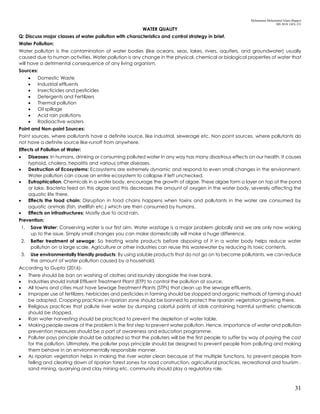
  • 34.
    Mohammad Mohaiminul Islam(Bappy) MS 2018, GES, CU 34 about 30%. With proper utilization and improved management, 4.0 to 5.0 million ha of land can be irrigated easily by using the same number of irrigation devices instead of the present 3.12 million ha. Efficient Use of Water in Irrigation for demand management: The limited water resources make it necessary to undertake all necessary measures for efficient irrigation systems, taking into account the increase in production and water consumption savings, and also allow the cultivation of larger areas, even in years of water shortage, and this requires the following:  The introduction of best technologies and modern and advanced irrigation systems in terms of the efficient water use in agriculture.  Adopt preventive maintenance programs for irrigation systems, which lead to sustain efficient water use and reduce losses. Irrigation water use and efficiency (on-farm, conveyance, and distribution) should be regularly monitored for demand forecasting and planning purposes.  Appropriate programs and procedures should be adopted, to ensure uniform flow discharge and stable pressure all through the irrigation networks. Q: Discuss water Conservation in the context of Bangladesh. Water conservation: Water conservation connotes the application of various techniques to reduce the use of fresh water to increase the quality and quantity of water resources is known as water conservation. Water conservation is defined as activities designed to reduce the demand for water, improve efficiency in use, and reduce losses and waste of water (Beecher and Laubach, 1989). Water conservation strategy in the context of Bangladesh: According to Rahman (2011), the adopting water strategy in order to conserve water should be- 1. Restoration of surface water system  The surface water system should be restored by re-establishment of the links between various components of the river-floodplain ecosystem.  All water bodies including water tanks should be preserved.  Fish passes should be made integral part of construction and rehabilitation of water development projects.  Environmental flow should be ensured through all rivers.  Any intervention within the rivers including river protection works should be made ecofriendly.  Natural canal system should be maintained and re-excavated whenever necessary.  Rubber dam technology may be encouraged for storage of monsoon water that can be used in dry season crop land irrigation.  Rain water harvesting should be encouraged for construction works, car washing, car cleaning and gardening.  An ecosystem approach should be adopted for water resources management of the country. 2. River management:  The linkages between the rivers should be restored.  The conveyance capacities of the rivers should be restored through capital dredging and regular maintenance.  The proposed Delta Plan-2100 can be entrusted to formulate a river management plan for Bangladesh. The objectives of the river management plan will be to ensure adequate environmental flow through the rivers, safeguard the rivers against encroachment and pollution, provide protection against river bank erosion, and reclaim land through eco-friendly river training. 3. Addressing dry season water scarcity:  Priority would be given on water sharing of the common/trans-boundary rivers with the neighboring country/countries following the model of the Ganges treaty-1996.  The Ganges Barrage project with ancillary infrastructure should be undertaken. 4. Increasing water sufficiency and reducing waste  Build capacity in water efficiency measurements and waste reduction in urban and irrigation sectors. 5. Ground water management:  A sustainable groundwater management plan is to be developed to reduce pressure on ground water system.  Coastal aquifers should be protected from exploitation in order to check saline intrusion. Buffer zone should be clearly delineated.  Groundwater exploitation should be regulated so that extraction does not exceed safe yield. 6. Water pollution management:  Institutional capacity of DoE should be increased particularly in relation to monitoring and enforcement so that it can play its mandated role in protecting water bodies from pollution.
  • 35.
    Mohammad Mohaiminul Islam(Bappy) MS 2018, GES, CU 35  ‘Polluters-pay’ principle should remain the corner stone of future strategies of pollution management. The payment should include the cost of environmental damage as well as severe penalty/tax so as to discourage future pollution. 7. Policy implementation:  Different water conserving and sustainable water use policies should be implemented.
  • 36.
    Mohammad Mohaiminul Islam(Bappy) MS 2018, GES, CU 36 ENVIRONMENTAL ISSUES OF WRM Q: Discuss the major environmental concerns of water development and their remedies. Major environmental concerns of Water Development: Environmental concerns include the natural occurring phenomena as well as manmade impact on environment that can affect the water development and water resources. It has been discussed below. 1. Climate change 2. Sea level rise 3. Global warming 4. Climatic extreme events 5. Water related hazards 6. Aquatic biodiversity loss 7. Environmental water pollution 1. Climate change: In general, analyses and application of management techniques in water sector have all along been carried out based on the presumption that hydrological series are stationary. There is growing evidence of shifting trends in such series, which need to be assessed and ascertained to enable taking corrective actions as needed. Periodic review of hydro meteorological networks for arriving at optimum network also assumes significance in this respect, as brought out under section 3.1. There is growing evidence of warming climate, as spelt out by climatologists, which can spell misery to the population in such regions. IPCC warns that climate change is expected to exacerbate water scarcity situation in Asia, with consequential multiple socioeconomic stresses. 2. Seal level rise: Sea level is on the rise along the Bangladesh coast like other parts of the world. Official data shows sea level rise was observed at 5.73 mm per year at Char Changa station in Hatiya while Hiron point in the Sundarbans at 3.38 mm per year. Sea level rise has severe impacts on water development. Low-lying coastal regions, such as Bangladesh, are vulnerable to sea level rise and the increased occurrence of intense, extreme weather conditions such as the cyclones of 2007–2009, as well as the melting of polar ice. To address the sea level rise threat in Bangladesh, the Bangladesh Delta Plan 2100 has been launched. 3. Global warming: Environmental experts have been saying for a long time that Bangladesh would be one of most severely- affected victims of the global warming phenomenon. The next decade will see a rise in the sea level leading to increasing incidences of floods and cyclones. This is most alarming news for water development specialists. 4. Climatic extreme events: Inter-Governmental Panel on Climate Change (IPCC) highlights the potential for more frequent and more severe weather conditions; which is corroborated by many instances of extreme hydrological events. Such eventualities, coupled with increased pressure on land from the increasing population, will make safety of life and property high on the agenda for administrators and planners. Extreme events include tropical cyclones (hurricanes, typhoons), tornadoes, floods, heat and cold waves, wildfires, earthquakes, tsunamis, and volcanic eruptions. 5. Water related hazards: Hydrological hazards or water related are hazards involving water processes. Examples include floods, droughts, and tsunamis. This can be a major issue for the development of water in Bangladesh 6. Aquatic biodiversity loss: The prime concern with capture fisheries is the provision of suitable habitats for maintaining biodiversity as well as fish production. This issue needs urgent attention of the policy makers. 7. Environmental water pollution: The water quality deterioration is major problem in water development. Excessive pumping in coastal areas can cause saltwater to move inland and upward, resulting in saltwater contamination of the water supply and many other issues are possible to occur. Which includes- a) Salinity intrusion: intruding salinity into fresh water through flood inundation and groundwater intrusion. b) Arsenic contamination: arsenic contamination is still common in many parts of the country. c) Water pH depletion: the pH level of water is lowered which means they become acidic. d) Change in water temperature: the water temperature show the usability and sustainability for drinking water and biodiversity both. e) Change in water electric conductivity: electric conductivity has a certain parameter which is compromised nowadays due to various pollutions. f) Increasing total dissolved solids (TDS): this problem is a prime concern for drinking water. g) Change in water taste and smell: the smell and taste is important for the comfortable usage of water use. Prevention: According to Rahman (2011), the following measures should be taken to solve these problems.  Urgent action is needed both to clean-up pollution hot spots and to prevent re-pollution of cleaned-up locations and ecologically sensitive areas  Prepare a National Industrial Pollution Control Plan, with the aim of tackling the major polluters over a 10 to 15 year period and subsequent follow-up of lesser polluters.
  • 37.
    Mohammad Mohaiminul Islam(Bappy) MS 2018, GES, CU 37  The prime concern with capture fisheries is the provision of suitable habitats for maintaining biodiversity as well as fish production  For conserving aquatic biodiversity, provide adequate river and floodplain flows and fish-friendly hydraulic connections between the floodplains and the main river system  Introduce zoning of bagda shrimp production in order to deal with the land-use conflict and soil salinization associated with salt-water shrimp (bagda) production  In the context of the water sector, there are two ecologically- sensitive areas of outstanding importance, the Sundarbans mangrove area and parts of the Haor Basin wetlands, the former as a World Heritage Site and both as Ramsar Sites. Take special measures to protect these sites by ensuring adequate flow, acceptable water quality, necessary institutional support and appropriate management regime. Figure: Ground water pollution in Bangladesh (Source: Pennsylvania State University research)
  • 38.
    Mohammad Mohaiminul Islam(Bappy) MS 2018, GES, CU 38 TRANSBOUNDARY WATER RESOURCE MANAGEMENT Q: Define transboundary water resource management. Define transboundary issues related to water resource management in Bangladesh. How to solve these issues? TRANSBOUNDARY RIVER PROBLEMS IN BANGLADESH Transboundary Rivers of Bangladesh: A Trans-boundary river is a river that crosses at least one political border, either a border within a nation or an international boundary. There are presently some 260 transboundary river basins around the world, covering 45% of the land surface of the earth. Bangladesh is traversed with the greatest number of these rivers, almost exclusively trans international. A total of 58 major rivers of Bangladesh have entered the country either from India or from Myanmar. Hydrologically and politically, these 58 trans-boundary rivers are very significant as they carry a lot of sediments to help land accretion in the estuarine region but also raise riverbeds to cause floods. The countries upstream often do not care for international conventions of water sharing and this leads to disputes with complex political implications. Overview Bangladesh transboundary rivers: The rivers of Bangladesh share with India, Nepal, Bhutan and China. Total 1721300 square km of river are in the GBM basin and Bangladesh has only 7% of it. There comes the transboundary river sharing and its disputes. India-Bangladesh Water Disputes: There are several reasons of india- bangladesh water conflicts. They are discussed below. Main Disputing Rivers: When it comes to water sharing disputes India and Bangladesh has contention mainly over rivers Ganges and Teesta. Ganges: Ganges (Ganga) flowing through one of the most fertile land of the world origins in Himalayas and emptying into Bay of Bengal. It drains one fourth of the territory of India, although its delta area that shares with Brahmaputra River lies almost in Bangladesh. As a perennial river, it is rich with water flow compared with peninsular rivers and also forms a distinguished ecosystem with unique flora and fauna. After leaving India’s northern plain it flows as a boundary between India and Bangladesh for about 120 km and then it flows to Bay of Bengal through Bangladesh for 113km and merge with Brahmaputra River to form Padma River. Teesta: It is also known as the Lifeline of Sikkim. A Himalayan river that flows through Sikkim and West Bengal finally empties to Bay of Bengal after flowing through Bangladesh. Most of its catchment area lies in India and it is the 4th largest river in Bangladesh after Brahmaputra, Ganges and Meghna. Ganges Water Sharing Dispute History: The problem started with the construction of Farakka Barrage in West Bengal in 1950s. Barrage plan was proposed in pre independence era by the British to regulate the flow in Hooghly River by diverting water from Ganges during dry seasons to prevent silting and to ease operation of Calcutta Port. But it executed after India got its Independence. The entire course of negotiations can be divided into two parts as, first one, between India and Pakistan 1947- 1970 and the second, India- Bangladesh thereafter. The conflict continued even after the independence of Bangladesh. River GBM Basin Catchment % Catchment Area km 2 India 64% 1102000 Nepal 8% 147480 Bhutan 3% 47000 China 18% 304420 Banglade sh 7% 120400 Total GBM 100% 1721300
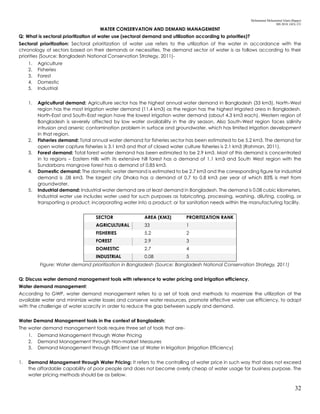
  • 39.
    Mohammad Mohaiminul Islam(Bappy) MS 2018, GES, CU 39 Prime disputing concerns and Bangladesh’s sufferings: The major sources of disputing concerns are- a. Farakka Barrage and its Devastating Impact on Bangladesh b. Tipaimukh Dam Proposal, Cosequence and Colfict c. Ganges Water Distribution Treaty and its Result d. Teesta Water Conflicts e. Lack of Proper International Laws A. Farakka Barrage and its Devastating Impact on Bangladesh: In 1951 India announced intentions build a Barrage across the Gangues 10km from the Bangladesh border. The Barrage diverts water into the Baghirathi- Hooghly River to flush out silt and increase navigation accessibility to Calcutta. The Barrage was commissioned in April 1975. This Barrage gave India control over Ganges flows into Bangladesh during the dry season. In the spring of 1975 India withdrew 40,000 of the 55,000 ft³/s of water from the Ganges. There were disastrous consequences on Bangladesh. Bangladesh’s suffering from Farakka Barrage:  Increased salinity of soil and water  Decline of soil quality and crop yields  Shrinking fish population  Decline of fishing villages and loss of a livelihoods  Decline of mangrove forest  Increased erosion rates and sedimentation  Increased salt water intrusion  More severe flooding during the monsoon season  Direct damages are estimated to be three billion US dollars  Flooding in Bangladesh due to sudden opening of the barrage B. Tipaimukh Dam Proposal, Cosequence and Colfict: Tipaimukh Dam is a proposed embankment dam on the river Barak in Manipur state India, first commissioned in 1983. The purpose of the dam is flood control and hydroelectric power generation. It has been subject to repeated delays as the project developed, as there has been controversy between India and Bangladesh over water rights, in addition to questions of environmental effects of the huge project, as well as the need to relocate indigenous Hmar people to make way for a vast reservoir. Bangladesh’s suffering from Tipaimukh:  Due to the construction of the dam Bangladesh would lose silt, sand and fish coming through Barak river.  Bangladeshi experts have said the massive dam will disrupt the seasonal rhythm of the river and have an adverse effect on downstream agriculture and fisheries.  The Tipaimukh area lies in an ecologically sensitive and topographically fragile region. It is within one of the most seismically volatile regions on the planet.  Socio economic effect is possible.  People can be displaced from their home.  Species can be extinct.  Will lead to environmental degradation. C. Ganges Water Distribution Treaty and its Result: The treaty-  Ganges water sharing treaty was signed in 1990 as a mutual consent of equally sharing the water of Ganges.  According to the treaty, water should be shared among both nations in a cycle of 10 days in lean period.  It says omission of India’s unilateral power to reduce the water share to Bangladesh.  There should be a setting up of a joint commission for implementation and monitoring.  Joint commission should have equal members from both countries.  There should be a review of treaty every 5 years and after the expiry of treaty  Bangladesh should be supplied the promised quantity of water until a new treaty concluded. Its result-  India failed to address this treaty.  Indian diplomats are still trying to use more water of Ganges not sharing with Bangladesh.  This will put more pressure on Bangladesh’s water supply.  Bangladesh will have to suffer from many other aspects as well. Bangladesh’s suffering due to the Violence of Ganges Water Sharing Treaty: Bangladesh faces the following sufferings from the violence of this treaty-  Reduced flow affects irrigation and food production
  • 40.
    Mohammad Mohaiminul Islam(Bappy) MS 2018, GES, CU 40  Fish stocks and fish industry declining  Navigation of water ways have become harder  Lower rivers are increasing salinization  Delta is eroding because less silt is being carried by the river thus making it unstable  Sea water incursion is increasing as the delta dries out.  Lack of water in dry season D. Teesta Water Conflicts:  An agreement signed between Bangladesh and India to share the Teesta water as 36% for Bangladesh and 39% for India. The remaining 25% would leave unallocated for the natural flow of Teesta River in 1983.  Two countries decided to have complete scientific studies to share the water. Joint Teesta commission established to fulfill this purpose.  Due to Teesta Barrage and several hydroelectric dam constructions, the river heavily silted.  The river has changed its courses in many places of lower stream Bangladesh and every year engulfing thousands of hectares land.  The dream of irrigating to increase the agriculture production becomes failure in both countries.  In this case, India is the unhappier party. E. Lack of proper international law: There is no proper laws of sharing water in these regions in such manner. Causes of these Disputes: According to Islam (2019), the major causes of the problem is-  Lack of Political, National Consensus  Lack of Regional Cooperation on Water Sharing  Selective Foreign Policy (not all parties are India friendly)  Poor Water Governance  Water Scarcity in Both Countries  Unwillingness to Abide by International Law of Rivers from Indian Side  Political & Economic Instability  Interstate and Instate Conflicts Recommendation for the solution of ongoing disputes: According Syed (2015)- Consequently, solutions to the problem should be-  The govt. of the both country should come to an agreement.  The regional cooperation should be strengthened.  Foreign policy cannot be selective, under any ruling party.  Water conservation and management strategies should be implemented strongly.  The international laws and treaties should be abided.  There should mutual friendliness and willingness to share water.  Policy improvements should be emphasized.  In state political anarchy should not hamper international relations. Finally, Bangladesh and India must respect each other’s legitimate rights and understand each other’s needs. Besides, mutual trust on commitments, implementation of commitments, and refraining from confusing statements and actions are also imperative for resolving disputes. And considering the future, both parties should minimize their differences for the sake of maintaining good neighborly relationships; Bangladesh should also maintain close contact with states adjacent to India to avoid future misunderstanding. South Asian Conflicts regarding Water Dispute:  India-pakistan  India-Bangladesh  India-Nepal  India-Sri Lanka  Bangladesh-Myanmar (Regarding water boundary that has been solved.)
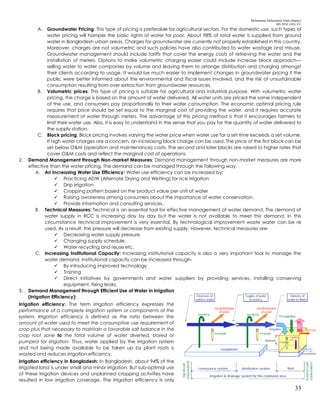
  • 41.
    Mohammad Mohaiminul Islam(Bappy) MS 2018, GES, CU 41 Soultions to these problems according to Syed (2015)- Effective policies: All countries within South Asia should implement policies which favor their mutual use of the rivers. These countries should to use rivers which complement its goals as long as national interests are not affected. For example, when both countries are constructing dams, mutual consultation will enable then to draft policies which favor both countries and reduces destructive effects of this construction to the other country. Just as the two countries are collaborating to fight terrorism, they should also collaborate to ensure that they both achieve their objectives regarding the availability and use of the water resource. Dialog: Dialog is the most effective way in which the dispute over water can be resolved. Other measures such as aggression or violence will only lead to losses among both countries. It is imperative that the issue is sorted soon in order to prevent further conflict or bloodshed which may occur as a result of the conflict. Treaties which are based on dialog have settled many fired disputes over water in South Asia like the Indus Water Treaty and Mahakali Treaty. Developing new treaties: The establishment of a new treaty is another way in which the conflict maybe resolved. However, when the treaty was initially established, future projections on water needs for both countries should adequately assessed. The already existing treaties should be re-negotiate to clearly explain how the water maybe used by both countries to achieve mutual benefit. New treaty should project future trends as far as water consumption is concerned to avoid other future conflicts relating to water use. For instance, it is about time that the ‘National Water policy – 2002’ should be altered again and should update the demand and supply of modern water management methodology and conservation technology.
  • 42.
    Mohammad Mohaiminul Islam(Bappy) MS 2018, GES, CU 42 SHORT NOTES Land Use Change and Flooding Land-cover change (urbanisation, deforestation, and cultivation) results in increased flood frequency and severity. Mechanisms include-  reduced infiltration capacity  lower soil porosity  loss of vegetation and forest clearing  meaning lower evapotranspiration Hydrological Cycles What is Hydrological: It describes the exchanges of water between the oceans, atmosphere, land surface, biosphere, soils, groundwater systems, and the solid Earth. Components of Hydrological Cycles 1. Runoff it is the water flowing over the land making its way towards rivers, lakes, oceans etc. as surface or subsurface flow. 1. Surface runoff: it is the running water over the land and which ultimately discharge water to the sea. 2. Subsurface runoff: The water getting infiltrated into pervious soil mass, making its way towards rivers and lakes can be termed as subsurface runoff. 2. Precipitation: It is the fall of moisture from atmosphere to the earth’s surface in any form. Example: rain, hail, snow, sleet, glaze, drizzle, snowflakes. 3. Evaporation: It is the conversion of natural liquids like water into gaseous form like air. 4. Condensation: It is the conversion of a vapor or gas to a liquid. 5. Transpiration: it is the evaporation taking place from any plant or greenery. Example, water droplet on a leaf getting evaporated into atmosphere 6. Evapotranspiration: it is the combination of evaporation and transpiration. 7. Infiltration: It is the process of filtration of water to the inner layers of soil based on its structure and nature. Pervious soils go through more infiltration than impervious. Infiltration in soils like sand, gravel and coarser material is more and for finer soil particles like clay and silt, infiltration is less. Infiltration is inversely proportional to runoff. In a soil, if infiltration is less, then runoff is more, similarly more infiltration gives less runoff. Example: bitumen roads has more runoff than metallic red mud roads Process of Hydrological Cycle: Process of hydrological cycle starts with oceans. Water in oceans, gets evaporated due to heat energy provided by solar radiation and forms water vapor. This water vapor moves upwards to higher altitudes forming clouds. Most of the clouds condense and precipitate in any form like rain, hail, snow, sleet. And a part of clouds is driven to land by winds. Precipitation, while falling to the ground, some part of it evaporates back to atmosphere. Portion of water that reaches the ground, enters the earth’s surface infiltrating various strata of soil and enhancing the moisture content as well as water table. Vegetation sends a portion of water from earth’s surface back to atmosphere through the process of transpiration. Once water percolates and infiltrates the earth’s surface, runoff is formed over the land, flowing through the contours of land heading towards river and lakes and finally joins into oceans after many years. Some amount of water is retained as depression storage. Further again the process of this hydrological cycle continues by blowing of cool air over ocean, carrying water molecules, forming into water vapor then clouds getting condensed and precipitates as rainfall. Similarly, then water gets percolate into soil, increasing water table then formation of runoff waters heading towards water bodies. Thus the cyclic process continues. Depression Storage: it is the part of precipitation required to fill depression zones of land. Interception: Part of precipitation required to wet the surface of soil, buildings and all pervious surfaces. Hydropower development and population displacement concerns Hydropower development projects lead to eight destructive displacement risks for indigenous populations: i. Landlessness ii. Joblessness iii. Homelessness iv. Marginalization v. food insecurity vi. increased morbidity vii. lost access to common resources viii. community dislodgment Hydro-Politics Water politics, sometimes called hydropolitics, is politics affected by the availability of water and water resources, a necessity for all life forms and human development. The first use of the term, hydropolitics, came in the book Hydropolitics of the Nile Valley.
  • 43.
    Mohammad Mohaiminul Islam(Bappy) MS 2018, GES, CU 43 Water will play a critical role in reshaping policies and economy of the 21st century. As the national water resources are getting polluted and becoming insufficient due to rapid increase in population, inefficient uses, migration to urban sections, industrial activities and current global warming and climate change, significance of international surface and groundwaters are increasing. Limiting impacts of water on social and economic development of countries especially of some regions of the world will no-doubt bring the current problems into an upper level. Such a case will bring national and international water use policies (Hydropolitics) into more forefront than today. Watershed Management Watershed management is a term used to describe the process of implementing land use practices and water management practices to protect and improve the quality of the water and other natural resources within a watershed by managing the use of those land and water resources in a comprehensive manner. Watershed management processes:  Delineate and map the watershed’s boundaries and the smaller drainage basins within the watershed;  Inventory and map the resources in the watershed;  Inventory and map the natural and manmade drainage systems in the watershed;  Inventory and map land use and land cover;  Inventory and map soils;  Identify areas of erosion, including stream banks and construction sites;  Identify the quality of water resources in the watershed as a baseline; and  Inventory and map pollution sources, both point sources (such as industrial discharge pipes) and nonpoint sources (such as municipal storm water systems, failing septic systems, illicit discharges). Ganges Dependent Area Ganges Dependent Area (GDA) the area directly influenced by the ganges river in terms of historic linkages, current direct impact and potentially commanded land. The GDA encompasses the whole of the southwest area of the country (with the exception of Bhola Island) plus a strip of land along the left banks of the Ganges and the padma, which relates directly to these two rivers. For water resource planning, Bangladesh has been divided into regions based on hydrological conditions. The GDA is located mainly in the Southwest Region (SWR) and the South Central Region (SCR), which together make up the Southwest Area (SWA), with small parts of the Northwest and Northcentral Regions making up the balance. The Ganges Dependent Area is generally low-lying with gentle slopes with few elevations exceeding 14m above sea level, even at 250 km from the coastline. While the northern part is characterised by a rolling topography which drops at a slope of 1:7500 to about 6m above sea level along a line through jessore to faridpur, the topography south and east of this line becomes much flatter and the number of beels and depressions increases. The tidal limit is approximately coincident with the 6m contour, with average tides at the coast of 2.7m, greater in the west than in the east. Marine water pollution Marine pollution is a combination of chemicals and trash, most of which comes from land sources and is washed or blown into the ocean. This pollution results in damage to the environment, to the health of all organisms, and to economic structures worldwide (National Geographic). Types of Marine Pollution- Eutrophication: When there is an excess of chemical nutrients mainly nitrates and phosphates in the water, it leads to eutrophication or nutrient pollution. Acidification: Oceans act as a natural reservoir for absorbing the carbon dioxide from the Earth’s atmosphere. But, due to rising level of carbon dioxide in the atmosphere, the oceans across the world are becoming acidic in nature, as a consequence, it leads to acidification of oceans. Toxins: Toxins such as pesticides, DDT, PCBs, furans, TBT, radioactive waste, phenols etc. May cause genetic deformation of aquatic species. Plastics: Plastic dumped and found in the oceans are dangerous for the marine life forms and wildlife, as sometimes it strangles and chokes them to death. The rising levels of plastic dumps found in the oceans are suffocating, ingesting, and entangling the life underwater as well as above it.