7 de outubro de 2016 | 1
SistemasAutomóveis
ICE: energy efficiency,
input/output flow and emissions
control
Mário Alves (mjf@isep.ipp.pt)
7 de outubro de 2016 | 2
SistemasAutomóveis
Outline
• Energy efficiency in ICE vehicles
• Energy contained in common fuel types
• Input/output flow
• Exhaust gases and pollutant emissions
• European emission standards
• Pollutant emissions mitigation methods
• Air/fuel ratio
• Catalytic converter operation
• Guidelines for optimal engine control
7 de outubro de 2016 | 3
SistemasAutomóveis
ICE: energy efficiency
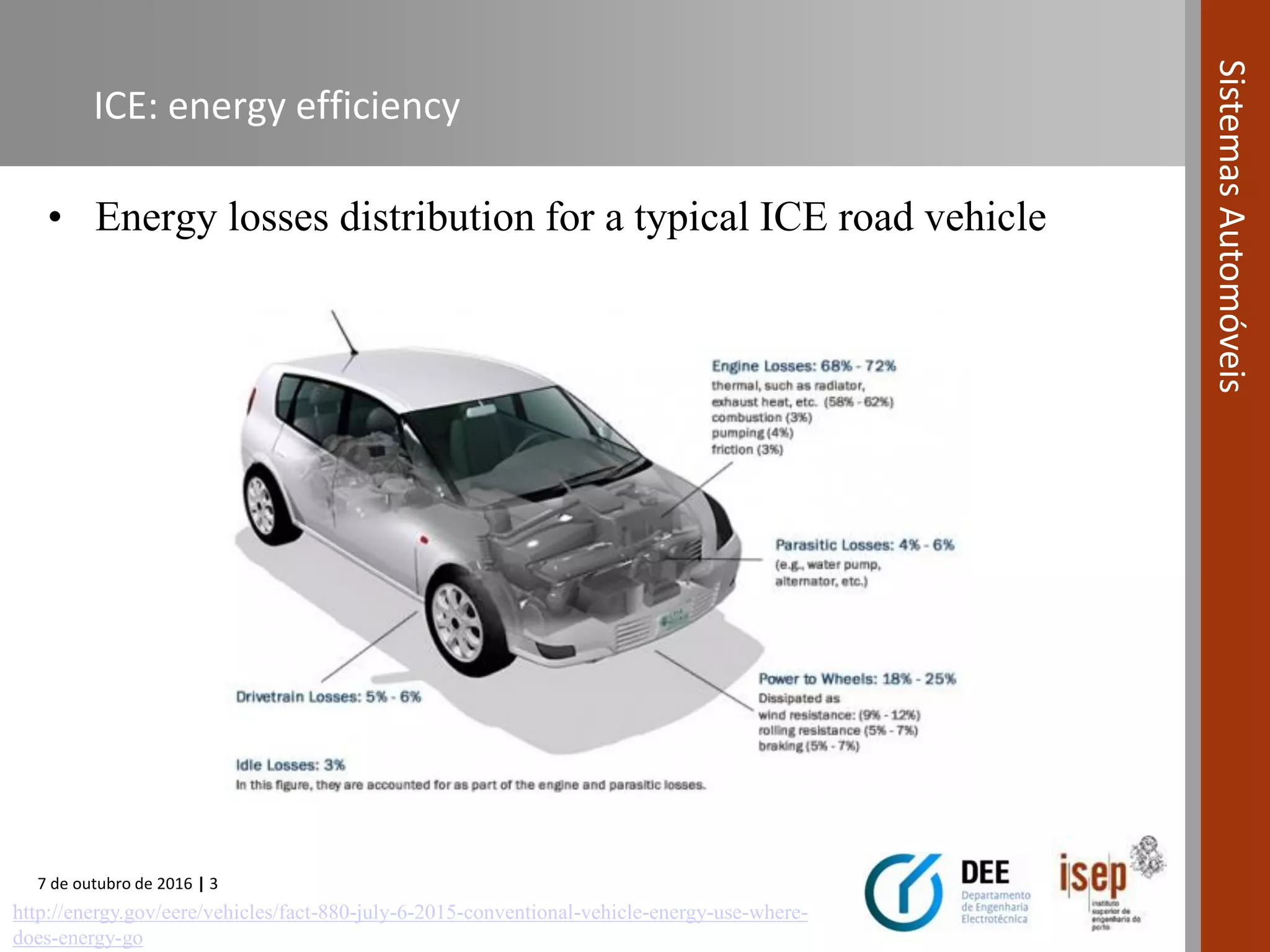
• Energy losses distribution for a typical ICE road vehicle
http://energy.gov/eere/vehicles/fact-880-july-6-2015-conventional-vehicle-energy-use-where-
does-energy-go
7 de outubro de 2016 | 4
SistemasAutomóveis
ICE: energy efficiency
• Energy losses distribution for typical ICE road vehicle [1]
[1] http://energy.gov/eere/vehicles/fact-880-july-6-2015-conventional-vehicle-energy-use-where-
does-energy-go
7 de outubro de 2016 | 5
SistemasAutomóveis
ICE: energy efficiency
• Energy losses distribution for typical ICE road vehicle [1]
Types of Losses
Types of Driving
Combined City Highway
Engine Losses 68-72% 71-75% 64-69%
Thermal - radiator, exhaust heat, etc. 58-62% 60-64% 56-60%
Combustion 3% 3% 3%
Pumping 4% 5% 3%
Friction 3% 3% 3%
Parasitic Losses
(water & oil pumps, alternator, A/C,
synchroning belt, turbocharger)
4-6% 5-7% 3-4%
Power to Wheels
dissipated as:
18-25% 14-20% 22-30%
Wind Resistance 9-12% 3-5% 13-19%
Rolling Resistance 5-7% 3-5% 6-9%
Braking 5-7% 7-10% 2-3%
Drivetrain Losses 5-6% 4-5% 4-7%
Idle Losses 3% 6% 0%
[1] http://energy.gov/eere/vehicles/fact-880-july-6-2015-conventional-vehicle-energy-use-where-
does-energy-go
7 de outubro de 2016 | 6
SistemasAutomóveis
ICE: energy efficiency
[2] http://www.nature.com/nature/journal/v488/n7411/fig_tab/nature11475_F2.html
• Energy losses distribution for a conventional vehicle [2]
7 de outubro de 2016 | 7
SistemasAutomóveis
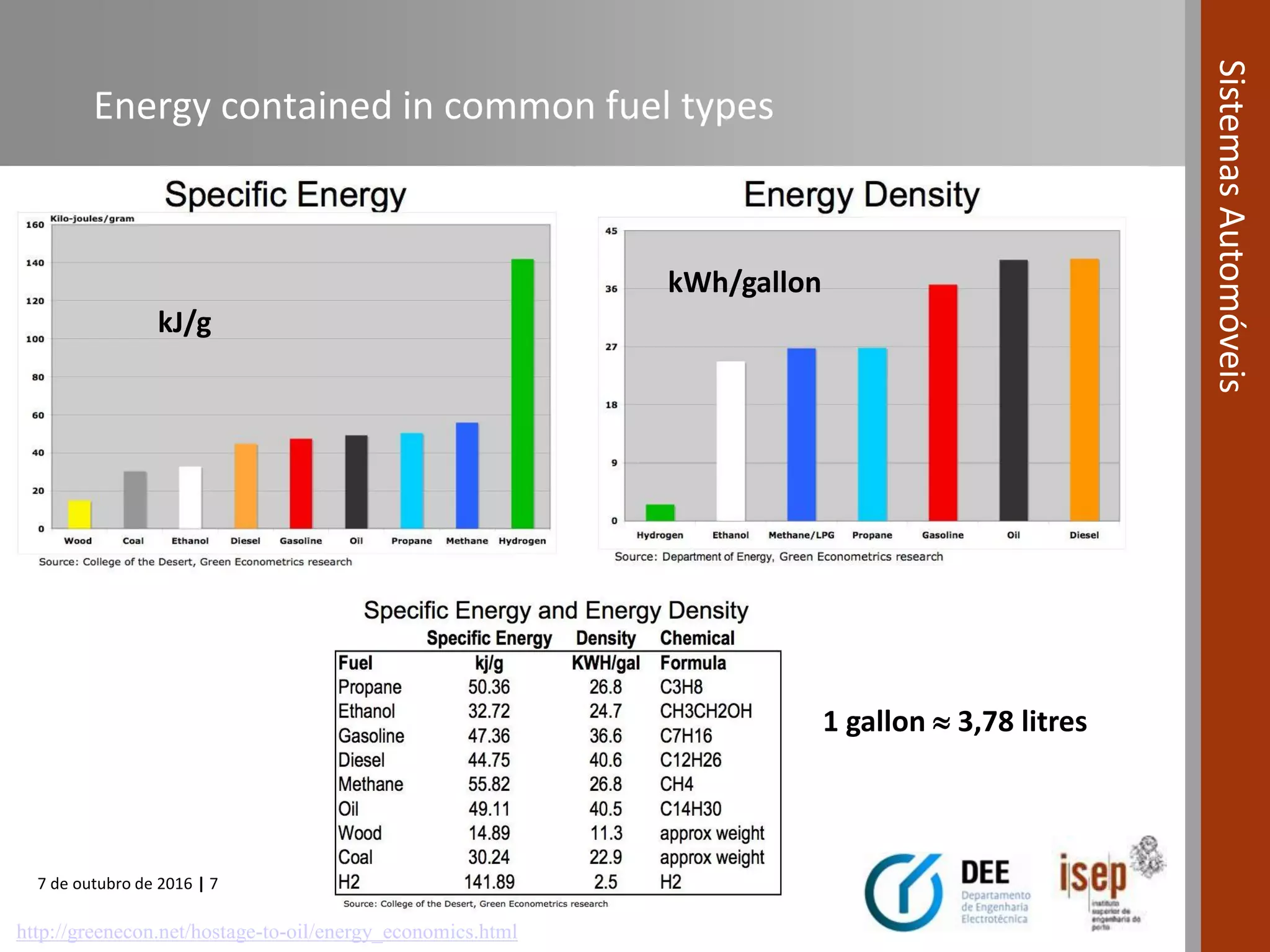
Energy contained in common fuel types
http://greenecon.net/hostage-to-oil/energy_economics.html
kJ/g
kWh/gallon
1 gallon  3,78 litres
7 de outubro de 2016 | 8
SistemasAutomóveis
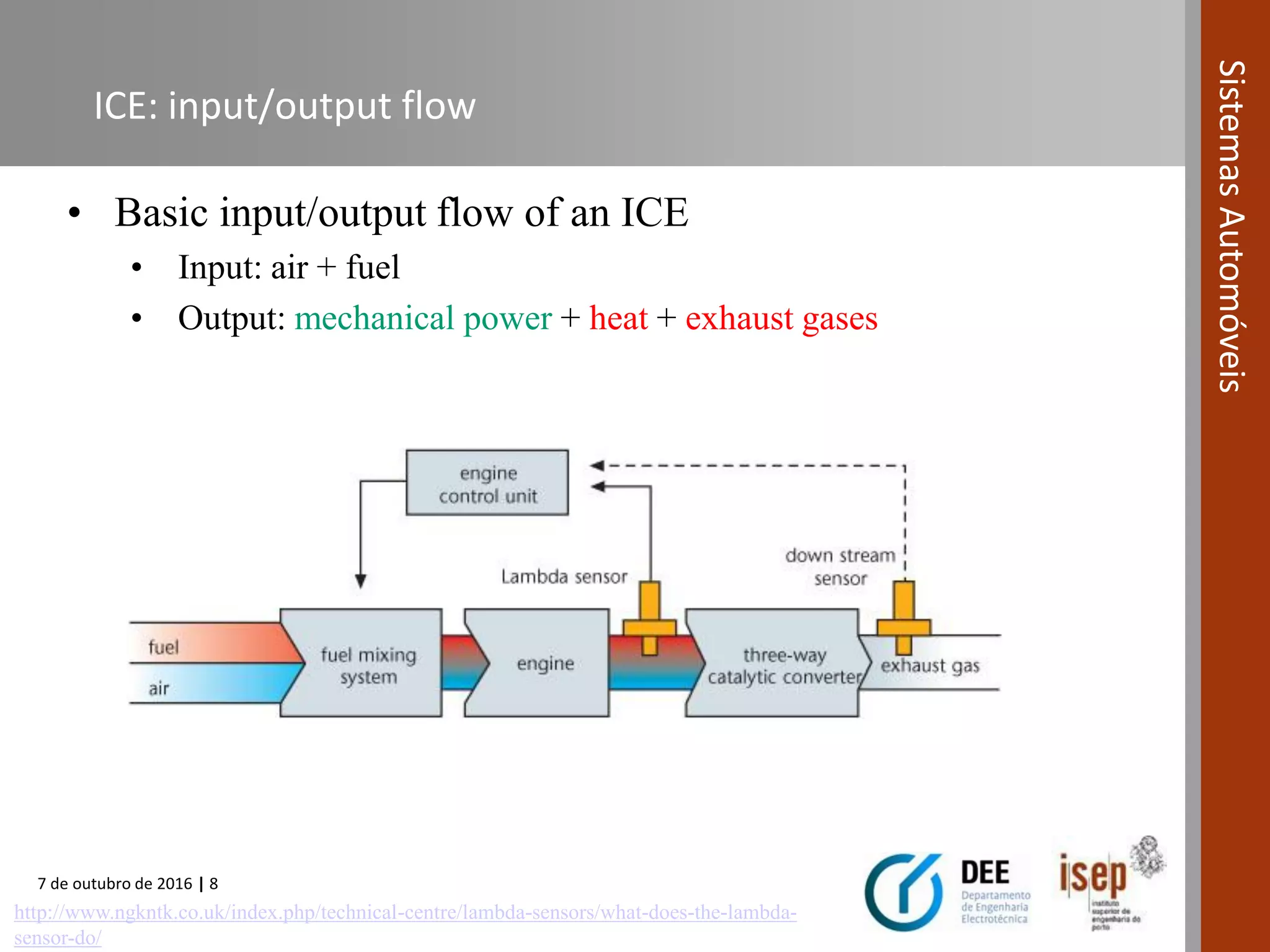
ICE: input/output flow
• Basic input/output flow of an ICE
• Input: air + fuel
• Output: mechanical power + heat + exhaust gases
http://www.ngkntk.co.uk/index.php/technical-centre/lambda-sensors/what-does-the-lambda-
sensor-do/
7 de outubro de 2016 | 9
SistemasAutomóveis
ICE: exhaust gases and pollutant emissions
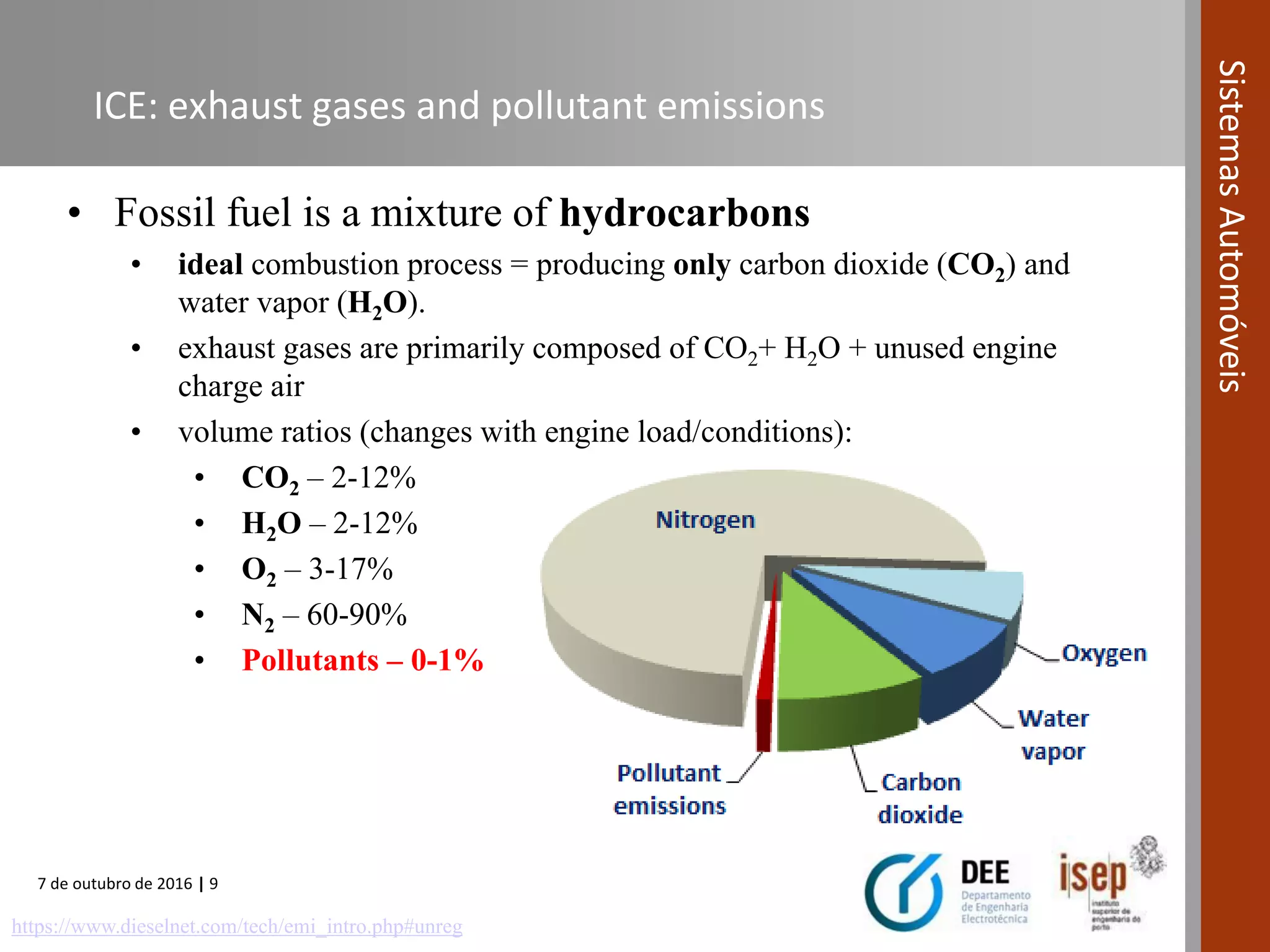
• Fossil fuel is a mixture of hydrocarbons
• ideal combustion process = producing only carbon dioxide (CO2) and
water vapor (H2O).
• exhaust gases are primarily composed of CO2+ H2O + unused engine
charge air
• volume ratios (changes with engine load/conditions):
• CO2 – 2-12%
• H2O – 2-12%
• O2 – 3-17%
• N2 – 60-90%
• Pollutants – 0-1%
https://www.dieselnet.com/tech/emi_intro.php#unreg
7 de outubro de 2016 | 10
SistemasAutomóveis
ICE: exhaust gases and pollutant emissions
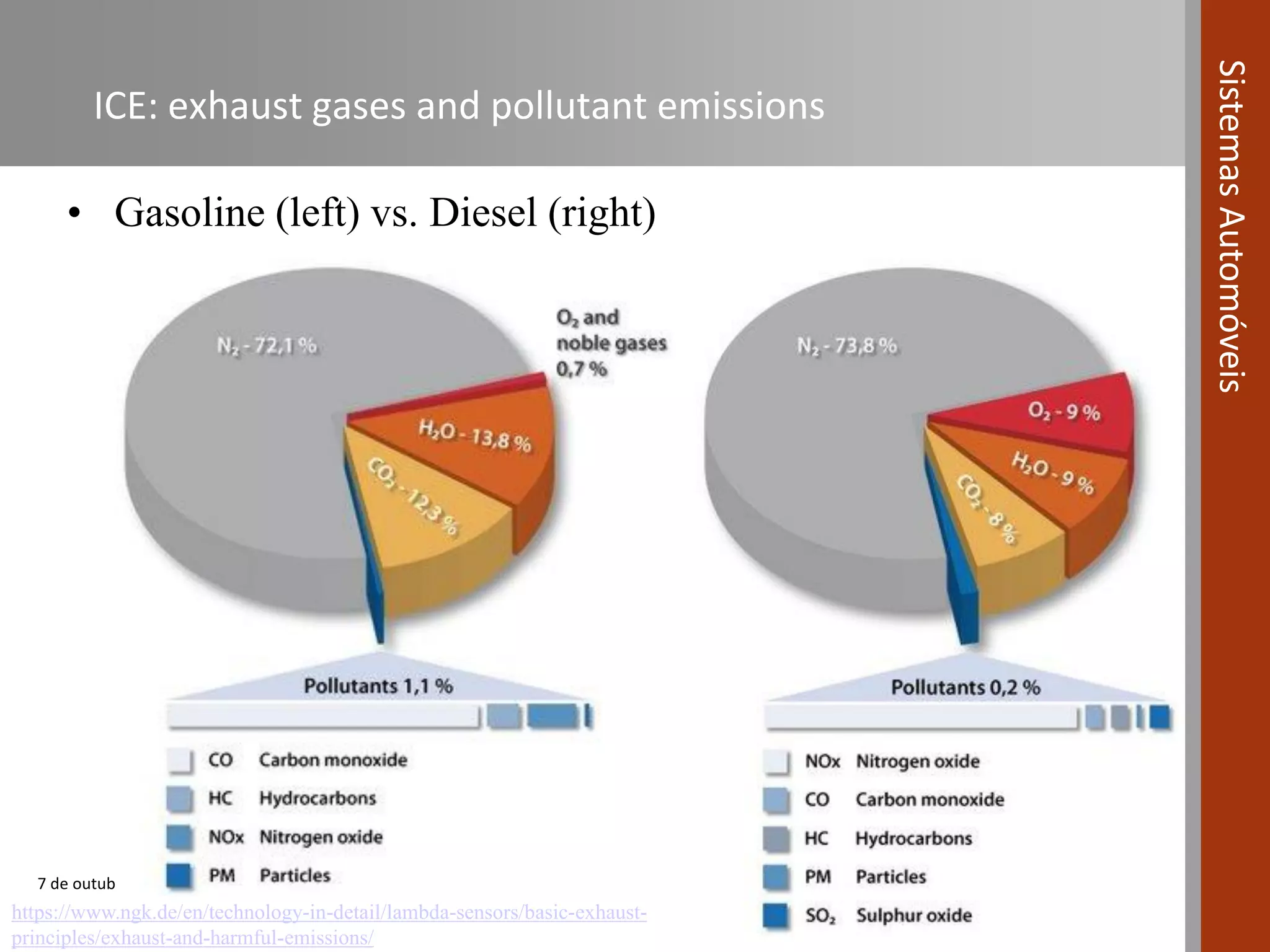
• Gasoline (left) vs. Diesel (right)
https://www.ngk.de/en/technology-in-detail/lambda-sensors/basic-exhaust-
principles/exhaust-and-harmful-emissions/
7 de outubro de 2016 | 11
SistemasAutomóveis
ICE: exhaust gases and pollutant emissions
• Main exhaust gases are innocuous to health/environment
• except for CO2 due to its greenhouse gas properties
• Pollutant emissions:
• unburned hydrocarbons (HC), carbon monoxide (CO), nitrogen oxides
(NOx) and particulate matter (PM)
• affect human health and/or environment
• originate from various non-ideal processes during combustion:
• incomplete combustion of fuel
• reactions between mixture components under high temperature and
pressure
• combustion of engine lubricating oil and oil additives
• combustion of non-hydrocarbon components of diesel fuel, such as
sulfur compounds and fuel additives
https://www.dieselnet.com/tech/emi_intro.php#unreg
7 de outubro de 2016 | 12
SistemasAutomóveis
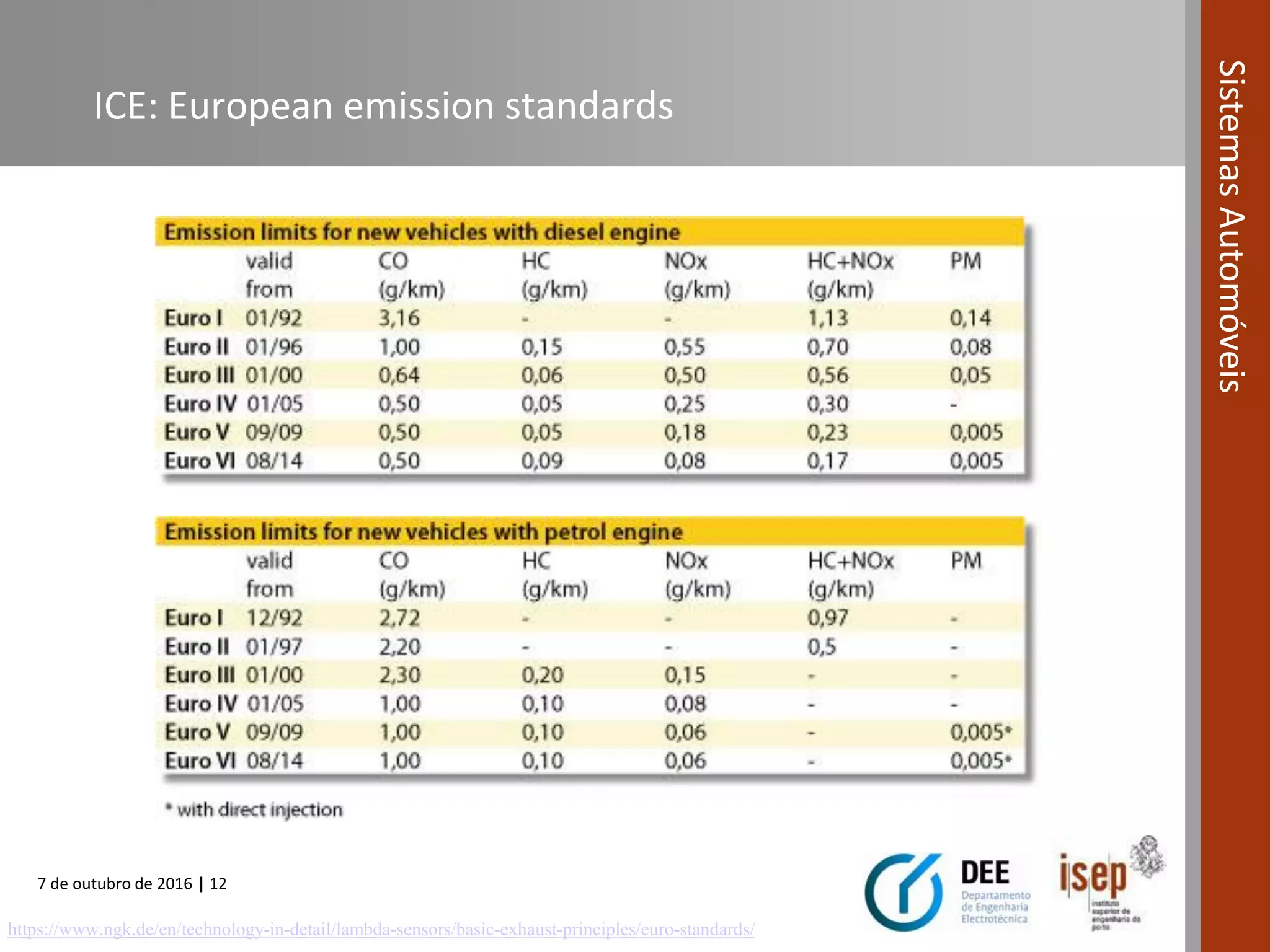
ICE: European emission standards
https://www.ngk.de/en/technology-in-detail/lambda-sensors/basic-exhaust-principles/euro-standards/
7 de outubro de 2016 | 13
SistemasAutomóveis
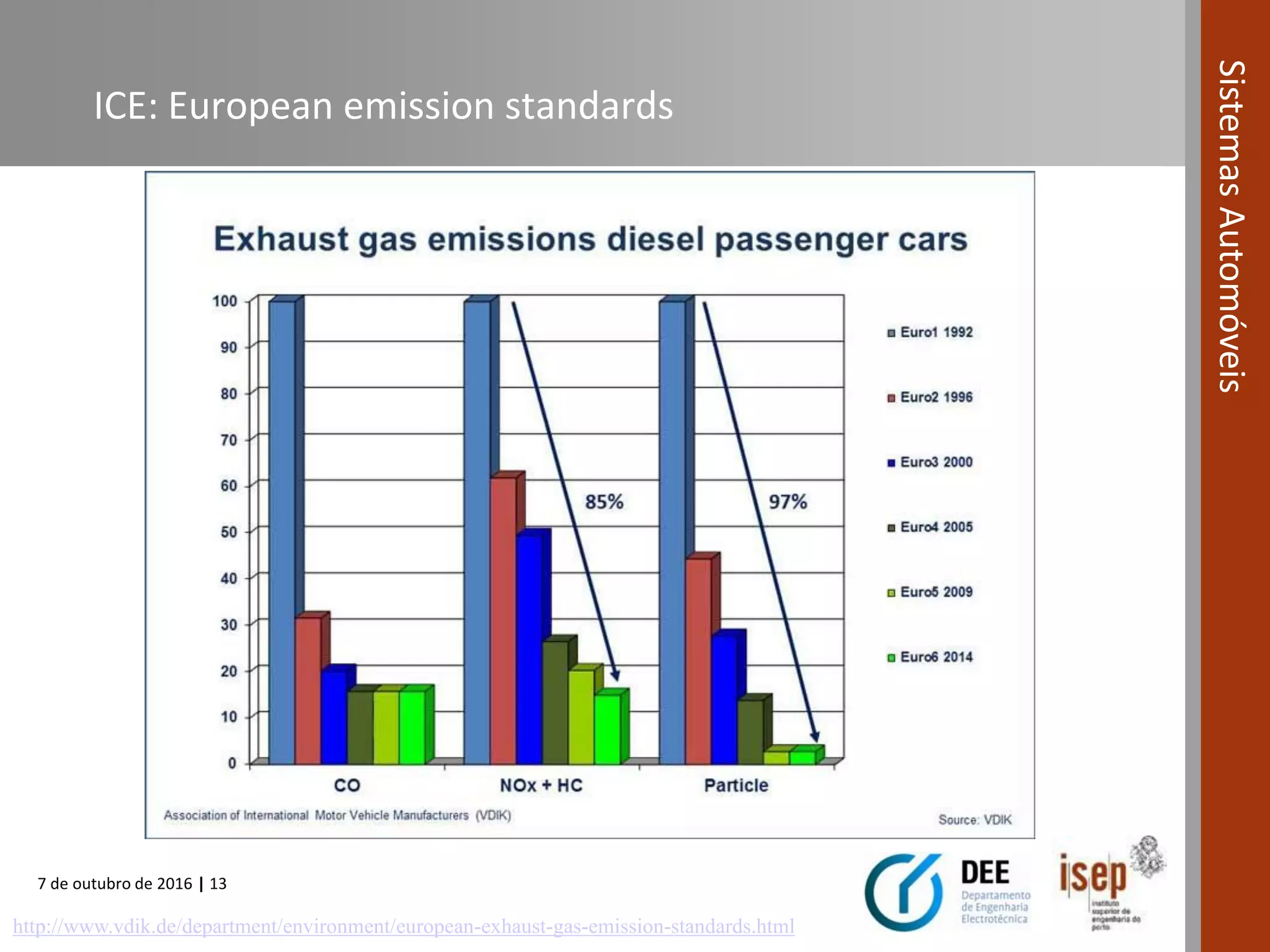
ICE: European emission standards
http://www.vdik.de/department/environment/european-exhaust-gas-emission-standards.html
7 de outubro de 2016 | 14
SistemasAutomóveis
ICE: emissions mitigation
• Ways to mitigate pollutant emissions:
• optimizing fuel’s chemical properties
• optimizing ICE design for energy efficiency & emissions
mitigation (e.g. fuel consumption, adaptive cylinder mngmt)
• optimizing ICE operation (e.g. air/fuel ratio, fuel rail pressure,
fuel injection, EGR)
• using/optimizing catalyst converters & particle matter filters
• Air/fuel ratio (lambda factor) is paramount
• for proper ICE operation
• to maximize power
• to minimize fuel consumption
• to minimize pollutant emissions
http://www.pelicanparts.com/techarticles/mult_air_fuel_monitor/FIG2.JPG
7 de outubro de 2016 | 15
SistemasAutomóveis
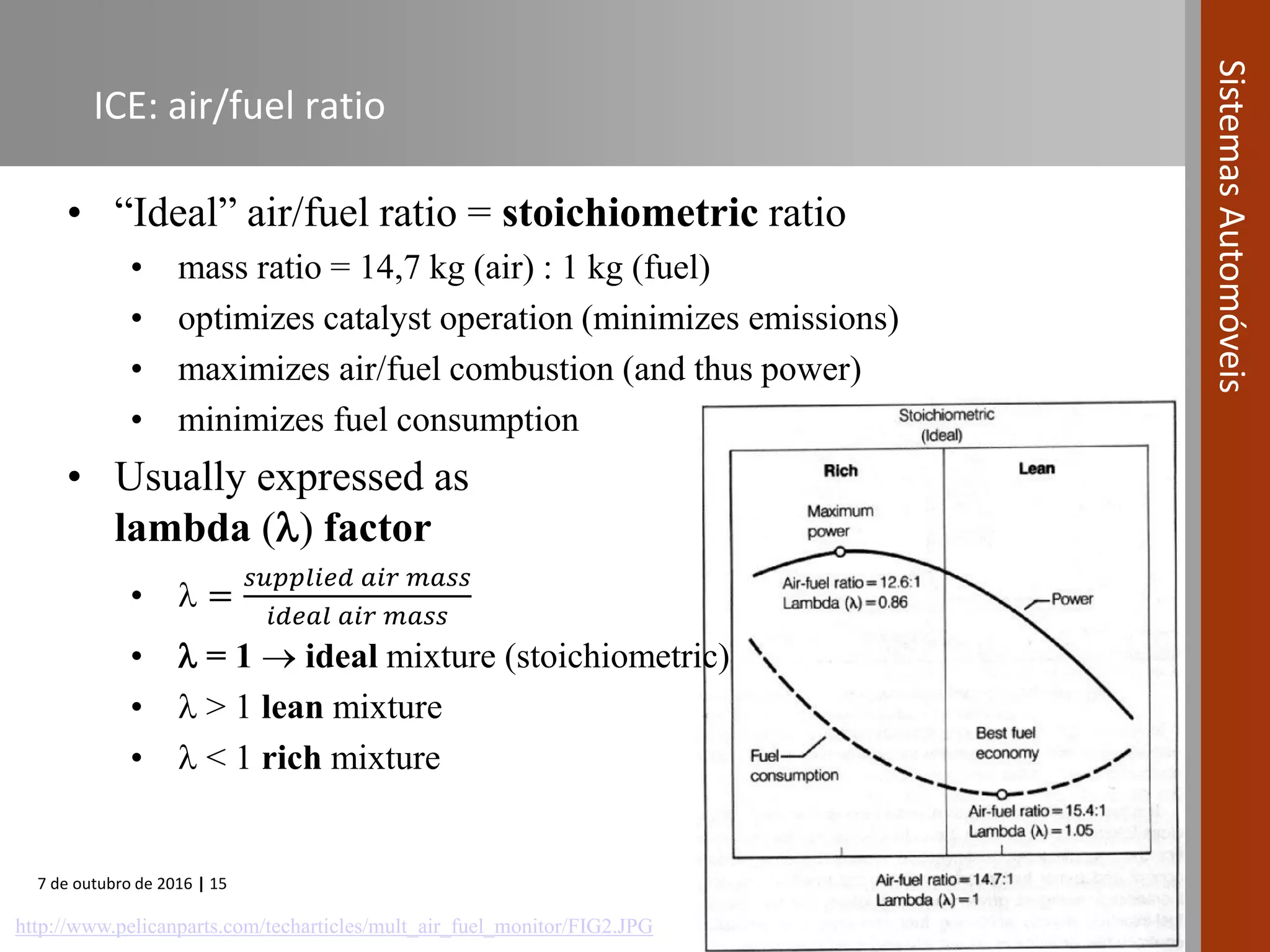
ICE: air/fuel ratio
• “Ideal” air/fuel ratio = stoichiometric ratio
• mass ratio = 14,7 kg (air) : 1 kg (fuel)
• optimizes catalyst operation (minimizes emissions)
• maximizes air/fuel combustion (and thus power)
• minimizes fuel consumption
• Usually expressed as
lambda () factor
•  =
𝑠𝑢𝑝𝑝𝑙𝑖𝑒𝑑 𝑎𝑖𝑟 𝑚𝑎𝑠𝑠
𝑖𝑑𝑒𝑎𝑙 𝑎𝑖𝑟 𝑚𝑎𝑠𝑠
•  = 1  ideal mixture (stoichiometric)
•  > 1 lean mixture
•  < 1 rich mixture
http://www.pelicanparts.com/techarticles/mult_air_fuel_monitor/FIG2.JPG
7 de outubro de 2016 | 16
SistemasAutomóveis
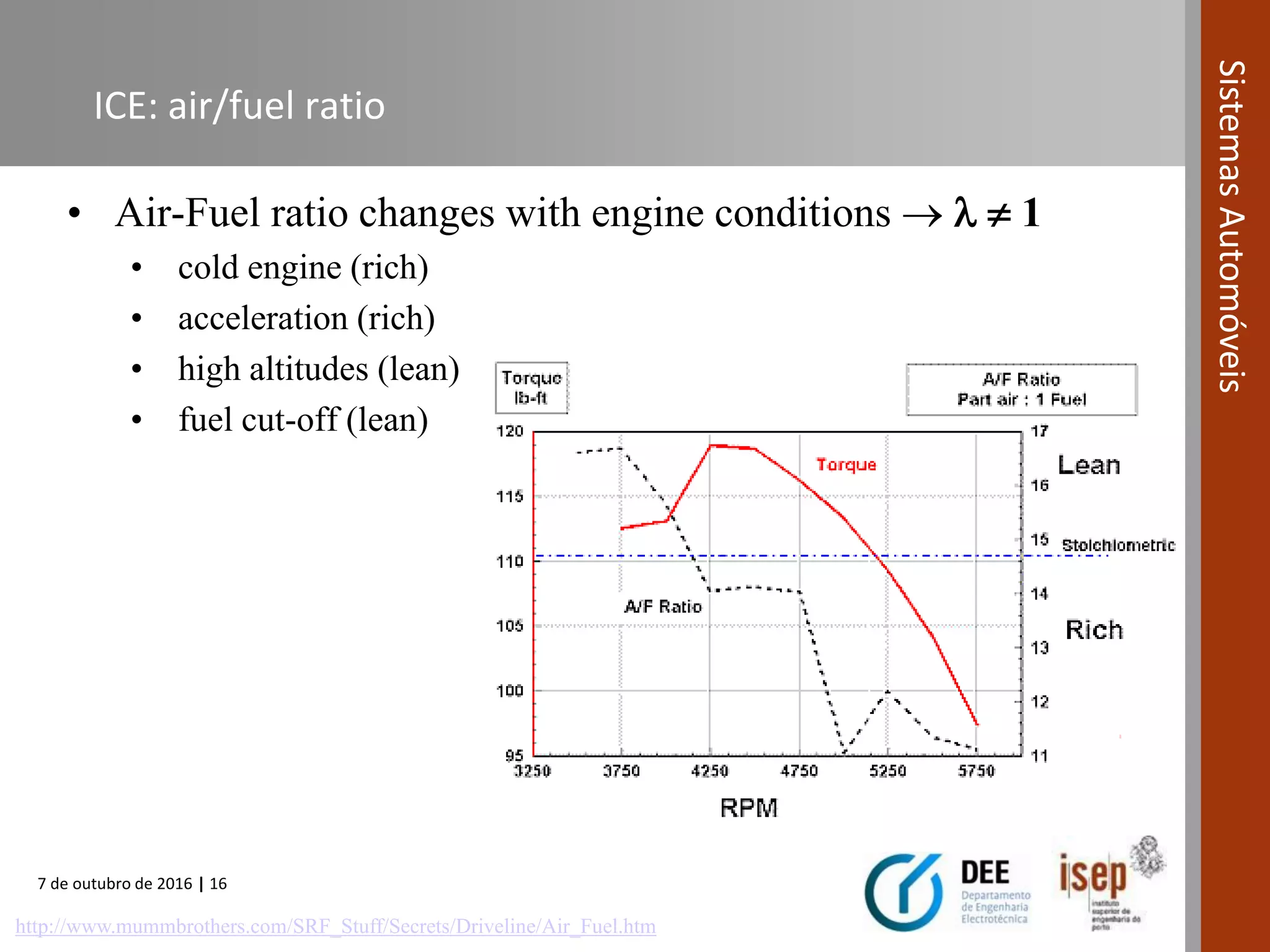
ICE: air/fuel ratio
• Air-Fuel ratio changes with engine conditions    1
• cold engine (rich)
• acceleration (rich)
• high altitudes (lean)
• fuel cut-off (lean)
http://www.mummbrothers.com/SRF_Stuff/Secrets/Driveline/Air_Fuel.htm
7 de outubro de 2016 | 17
SistemasAutomóveis
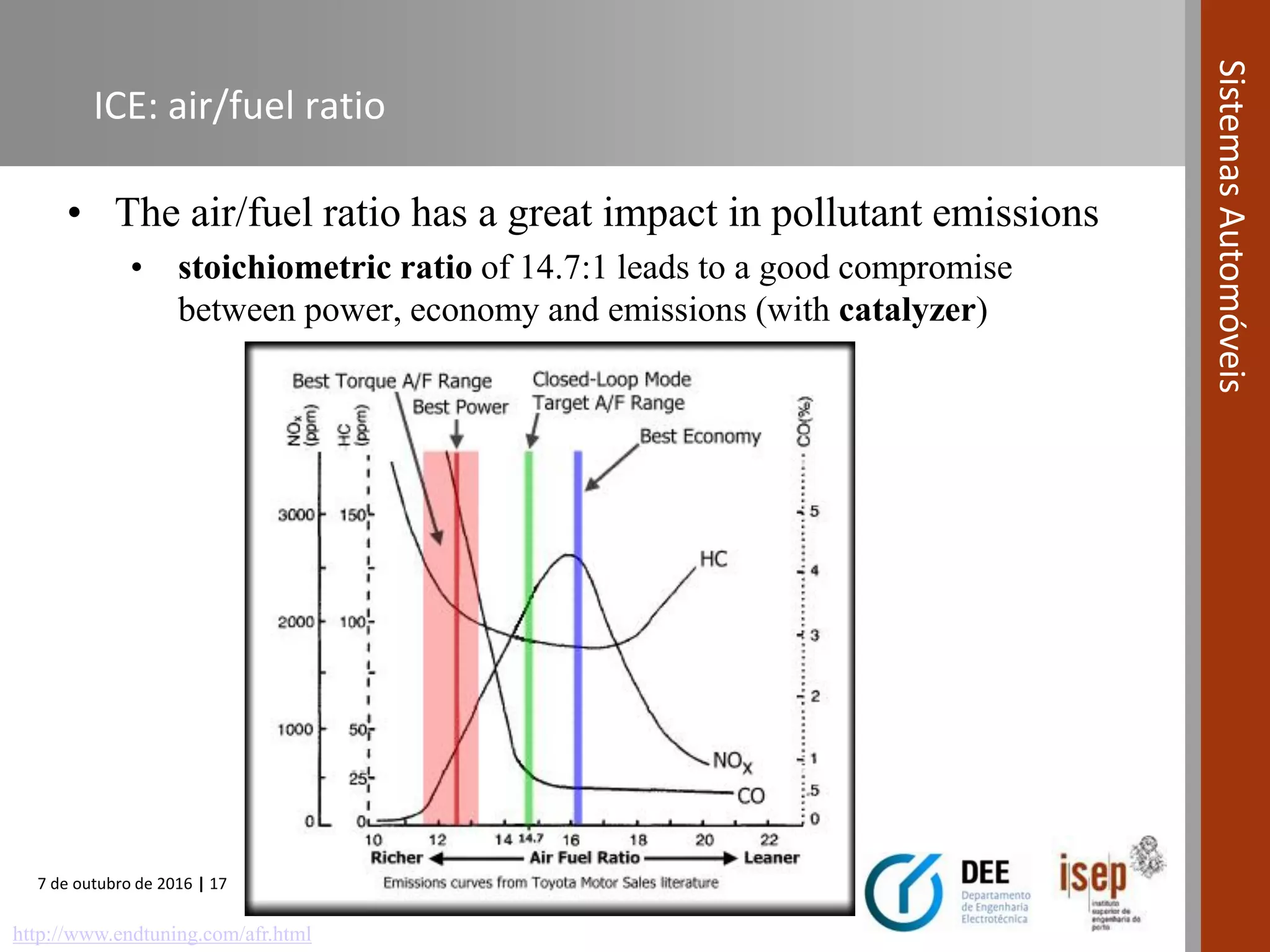
ICE: air/fuel ratio
• The air/fuel ratio has a great impact in pollutant emissions
• stoichiometric ratio of 14.7:1 leads to a good compromise
between power, economy and emissions (with catalyzer)
http://www.endtuning.com/afr.html
7 de outubro de 2016 | 18
SistemasAutomóveis
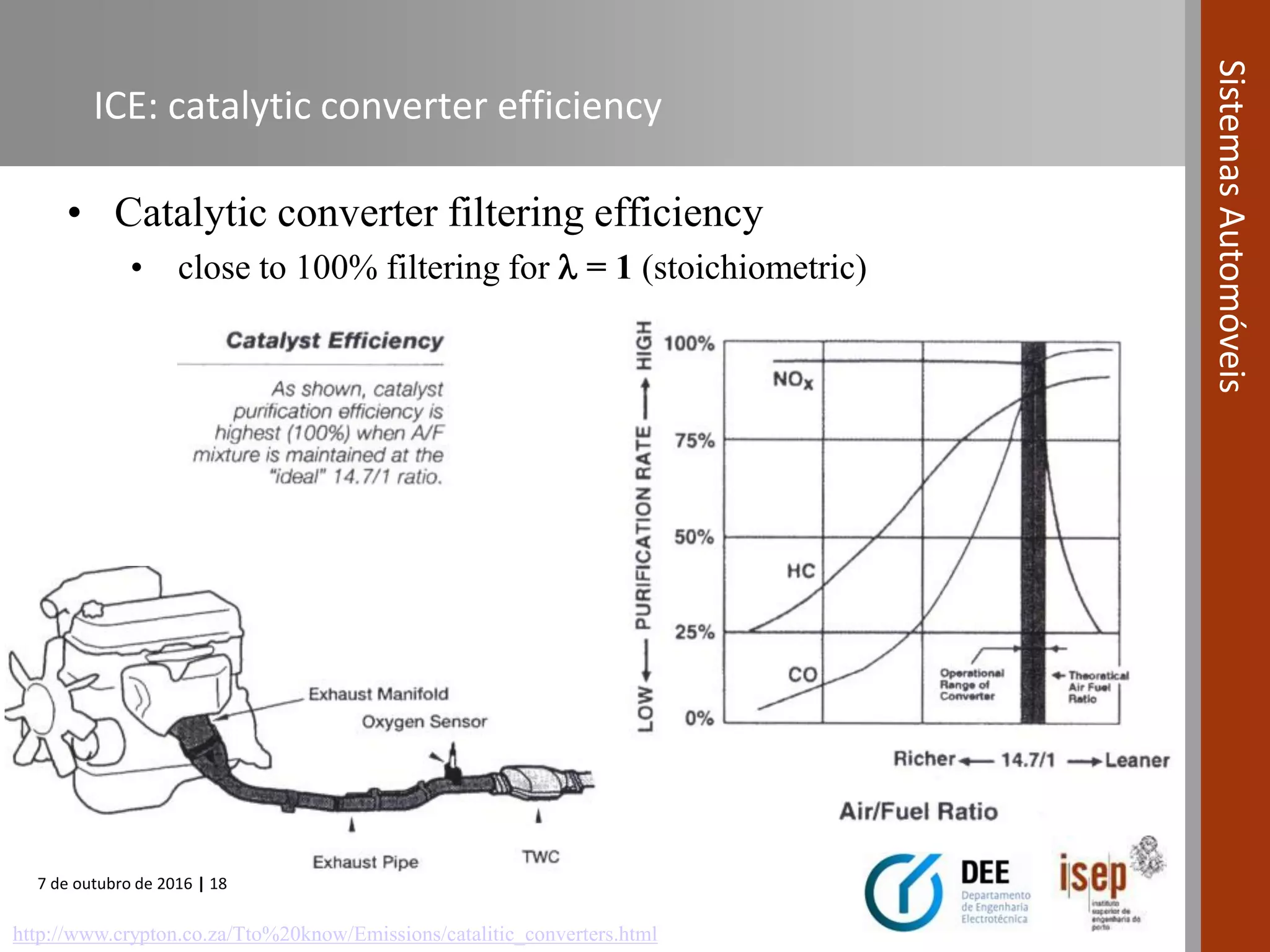
ICE: catalytic converter efficiency
• Catalytic converter filtering efficiency
• close to 100% filtering for  = 1 (stoichiometric)
http://www.crypton.co.za/Tto%20know/Emissions/catalitic_converters.html
7 de outubro de 2016 | 19
SistemasAutomóveis
ICE: catalytic converter and lambda sensor operation
• 3-way (catalytic converter) = 3 tasks
1. Reduction of nitrogen oxides to nitrogen and oxygen: 2NOx → xO2 + N2
2. Oxidation of carbon monoxide to carbon dioxide: 2CO + O2 → 2CO2
3. Oxidation of unburnt hydrocarbons (HC) to carbon dioxide and water:
[NOx] + [CO, HC] → N2 + CO2 + H2O
http://www.crypton.co.za/Tto%20know/Emissions/catalitic_converters.html
ECU basic algorithm (closed-loop, real-time)
1. oxygen (or lambda) sensor gives air/fuel ratio to ECU
2. ECU computes optimal control parameters (injection timing/duration,…)
3. secondary oxygen sensor enables to check catalytic converter failures
7 de outubro de 2016 | 20
SistemasAutomóveis
ICE: guidelines for optimal engine control
• For optimized operation, it is mandatory for the engine ECU
to:
• monitor all relevant physical quantities, e.g.:
• intake air pressure (depression)
• crankshaft rotational speed (RPM) and position (angular)
• engine (coolant) and intake air temperature
• throttle position (angular)
• vibration (knock)
• …
• control (closed-loop real-time) all relevant systems, e.g.:
• air/fuel ratio: injection timing + fuel quantity + intake air flow
• ignition timing (SI engines)
• exhaust gas recirculation (EGR)
• adaptive intake/exhaust valve timing control
• adaptive cylinders activation/deactivation
• pre-heating systems (glow plugs in CI, oxygen sensors)
• …
7 de outubro de 2016 | 21
SistemasAutomóveis
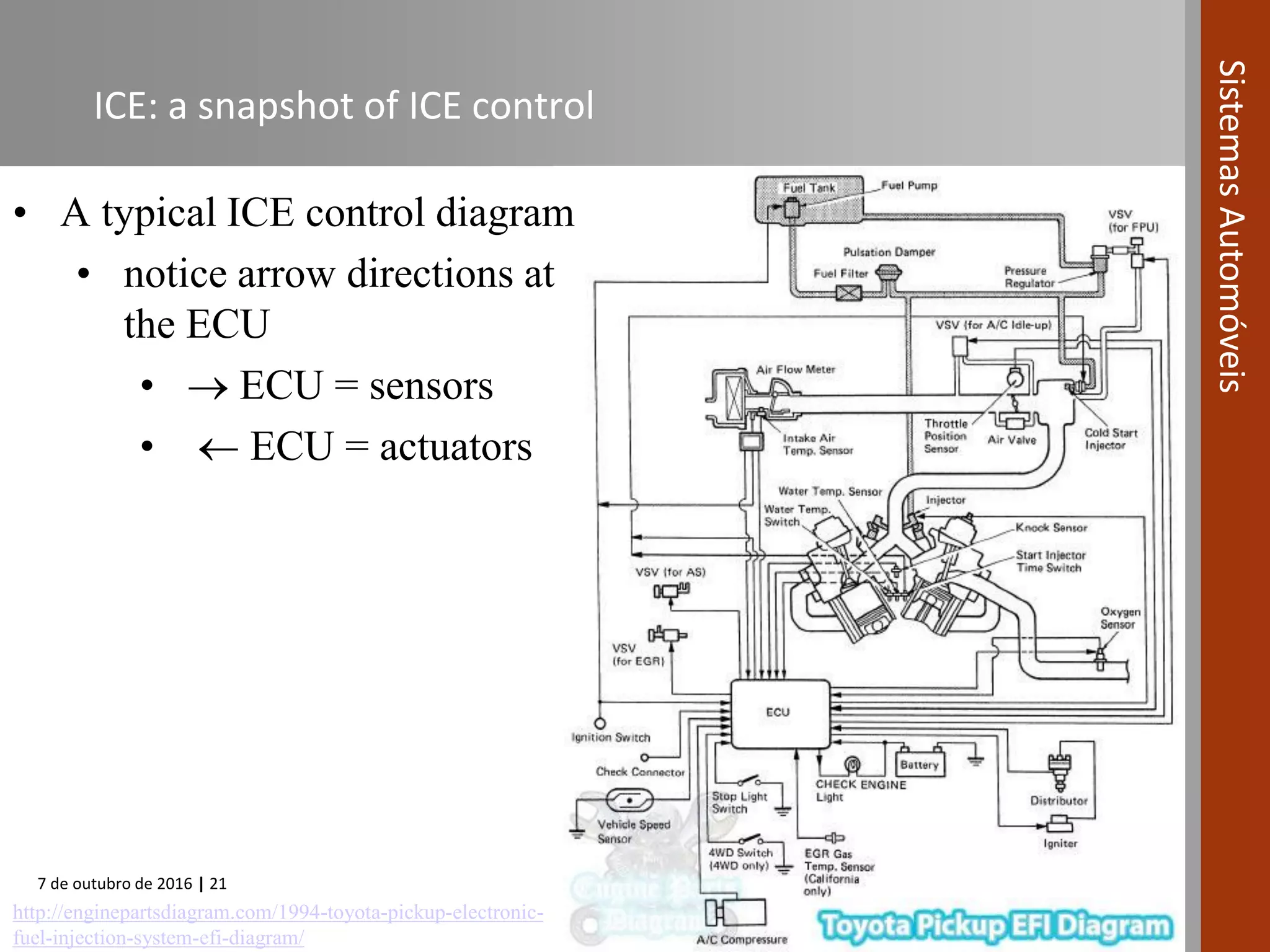
ICE: a snapshot of ICE control
• A typical ICE control diagram
• notice arrow directions at
the ECU
•  ECU = sensors
•  ECU = actuators
http://enginepartsdiagram.com/1994-toyota-pickup-electronic-
fuel-injection-system-efi-diagram/
7 de outubro de 2016 | 22
SistemasAutomóveis
Tips for saving fuel
• Do not warm up at idle – drive immediately after starting the engine
• Always drive in the highest possible gear
• Be light with the accelerator pedal 
• Do not overspeed – fuel consumption increases disproportionately high over 100
km/h (due to drag force and more frequent braking/acceleration)
• Keep enough distance from the vehicle ahead; this improves safety and enables
smoother braking/acceleration
• Release the accelerator pedal when travelling downwards (do not use the neutral
position); this allows engine-assisted braking and cutting-off injection.
• Switch off the engine both at metro/railway crossings and whenever you predict
longer wait times at traffic lights; you begin saving fuel after just 30 seconds
• Avoid superfluous cargo, rooftop equipment or mechanical loads (such as air
conditioning, defoggers)
• Regularly check tire pressure; use recommended pressure for predicted load
• Use synthetic engine oil and low-rolling-resistance tires
• Regularly check glow/ignition plugs and fuel injection
7 de outubro de 2016 | 23
SistemasAutomóveis
Glossary (English/Portuguese)
7 de outubro de 2016 | 24
SistemasAutomóveis
Recommended bibliography

Automotive Systems course (Module 02) - Internal Combustion Engine: energy efficiency, input/output flow and emissions control

  • 1.
    7 de outubrode 2016 | 1 SistemasAutomóveis ICE: energy efficiency, input/output flow and emissions control Mário Alves (mjf@isep.ipp.pt)
  • 2.
    7 de outubrode 2016 | 2 SistemasAutomóveis Outline • Energy efficiency in ICE vehicles • Energy contained in common fuel types • Input/output flow • Exhaust gases and pollutant emissions • European emission standards • Pollutant emissions mitigation methods • Air/fuel ratio • Catalytic converter operation • Guidelines for optimal engine control
  • 3.
    7 de outubrode 2016 | 3 SistemasAutomóveis ICE: energy efficiency • Energy losses distribution for a typical ICE road vehicle http://energy.gov/eere/vehicles/fact-880-july-6-2015-conventional-vehicle-energy-use-where- does-energy-go
  • 4.
    7 de outubrode 2016 | 4 SistemasAutomóveis ICE: energy efficiency • Energy losses distribution for typical ICE road vehicle [1] [1] http://energy.gov/eere/vehicles/fact-880-july-6-2015-conventional-vehicle-energy-use-where- does-energy-go
  • 5.
    7 de outubrode 2016 | 5 SistemasAutomóveis ICE: energy efficiency • Energy losses distribution for typical ICE road vehicle [1] Types of Losses Types of Driving Combined City Highway Engine Losses 68-72% 71-75% 64-69% Thermal - radiator, exhaust heat, etc. 58-62% 60-64% 56-60% Combustion 3% 3% 3% Pumping 4% 5% 3% Friction 3% 3% 3% Parasitic Losses (water & oil pumps, alternator, A/C, synchroning belt, turbocharger) 4-6% 5-7% 3-4% Power to Wheels dissipated as: 18-25% 14-20% 22-30% Wind Resistance 9-12% 3-5% 13-19% Rolling Resistance 5-7% 3-5% 6-9% Braking 5-7% 7-10% 2-3% Drivetrain Losses 5-6% 4-5% 4-7% Idle Losses 3% 6% 0% [1] http://energy.gov/eere/vehicles/fact-880-july-6-2015-conventional-vehicle-energy-use-where- does-energy-go
  • 6.
    7 de outubrode 2016 | 6 SistemasAutomóveis ICE: energy efficiency [2] http://www.nature.com/nature/journal/v488/n7411/fig_tab/nature11475_F2.html • Energy losses distribution for a conventional vehicle [2]
  • 7.
    7 de outubrode 2016 | 7 SistemasAutomóveis Energy contained in common fuel types http://greenecon.net/hostage-to-oil/energy_economics.html kJ/g kWh/gallon 1 gallon  3,78 litres
  • 8.
    7 de outubrode 2016 | 8 SistemasAutomóveis ICE: input/output flow • Basic input/output flow of an ICE • Input: air + fuel • Output: mechanical power + heat + exhaust gases http://www.ngkntk.co.uk/index.php/technical-centre/lambda-sensors/what-does-the-lambda- sensor-do/
  • 9.
    7 de outubrode 2016 | 9 SistemasAutomóveis ICE: exhaust gases and pollutant emissions • Fossil fuel is a mixture of hydrocarbons • ideal combustion process = producing only carbon dioxide (CO2) and water vapor (H2O). • exhaust gases are primarily composed of CO2+ H2O + unused engine charge air • volume ratios (changes with engine load/conditions): • CO2 – 2-12% • H2O – 2-12% • O2 – 3-17% • N2 – 60-90% • Pollutants – 0-1% https://www.dieselnet.com/tech/emi_intro.php#unreg
  • 10.
    7 de outubrode 2016 | 10 SistemasAutomóveis ICE: exhaust gases and pollutant emissions • Gasoline (left) vs. Diesel (right) https://www.ngk.de/en/technology-in-detail/lambda-sensors/basic-exhaust- principles/exhaust-and-harmful-emissions/
  • 11.
    7 de outubrode 2016 | 11 SistemasAutomóveis ICE: exhaust gases and pollutant emissions • Main exhaust gases are innocuous to health/environment • except for CO2 due to its greenhouse gas properties • Pollutant emissions: • unburned hydrocarbons (HC), carbon monoxide (CO), nitrogen oxides (NOx) and particulate matter (PM) • affect human health and/or environment • originate from various non-ideal processes during combustion: • incomplete combustion of fuel • reactions between mixture components under high temperature and pressure • combustion of engine lubricating oil and oil additives • combustion of non-hydrocarbon components of diesel fuel, such as sulfur compounds and fuel additives https://www.dieselnet.com/tech/emi_intro.php#unreg
  • 12.
    7 de outubrode 2016 | 12 SistemasAutomóveis ICE: European emission standards https://www.ngk.de/en/technology-in-detail/lambda-sensors/basic-exhaust-principles/euro-standards/
  • 13.
    7 de outubrode 2016 | 13 SistemasAutomóveis ICE: European emission standards http://www.vdik.de/department/environment/european-exhaust-gas-emission-standards.html
  • 14.
    7 de outubrode 2016 | 14 SistemasAutomóveis ICE: emissions mitigation • Ways to mitigate pollutant emissions: • optimizing fuel’s chemical properties • optimizing ICE design for energy efficiency & emissions mitigation (e.g. fuel consumption, adaptive cylinder mngmt) • optimizing ICE operation (e.g. air/fuel ratio, fuel rail pressure, fuel injection, EGR) • using/optimizing catalyst converters & particle matter filters • Air/fuel ratio (lambda factor) is paramount • for proper ICE operation • to maximize power • to minimize fuel consumption • to minimize pollutant emissions http://www.pelicanparts.com/techarticles/mult_air_fuel_monitor/FIG2.JPG
  • 15.
    7 de outubrode 2016 | 15 SistemasAutomóveis ICE: air/fuel ratio • “Ideal” air/fuel ratio = stoichiometric ratio • mass ratio = 14,7 kg (air) : 1 kg (fuel) • optimizes catalyst operation (minimizes emissions) • maximizes air/fuel combustion (and thus power) • minimizes fuel consumption • Usually expressed as lambda () factor •  = 𝑠𝑢𝑝𝑝𝑙𝑖𝑒𝑑 𝑎𝑖𝑟 𝑚𝑎𝑠𝑠 𝑖𝑑𝑒𝑎𝑙 𝑎𝑖𝑟 𝑚𝑎𝑠𝑠 •  = 1  ideal mixture (stoichiometric) •  > 1 lean mixture •  < 1 rich mixture http://www.pelicanparts.com/techarticles/mult_air_fuel_monitor/FIG2.JPG
  • 16.
    7 de outubrode 2016 | 16 SistemasAutomóveis ICE: air/fuel ratio • Air-Fuel ratio changes with engine conditions    1 • cold engine (rich) • acceleration (rich) • high altitudes (lean) • fuel cut-off (lean) http://www.mummbrothers.com/SRF_Stuff/Secrets/Driveline/Air_Fuel.htm
  • 17.
    7 de outubrode 2016 | 17 SistemasAutomóveis ICE: air/fuel ratio • The air/fuel ratio has a great impact in pollutant emissions • stoichiometric ratio of 14.7:1 leads to a good compromise between power, economy and emissions (with catalyzer) http://www.endtuning.com/afr.html
  • 18.
    7 de outubrode 2016 | 18 SistemasAutomóveis ICE: catalytic converter efficiency • Catalytic converter filtering efficiency • close to 100% filtering for  = 1 (stoichiometric) http://www.crypton.co.za/Tto%20know/Emissions/catalitic_converters.html
  • 19.
    7 de outubrode 2016 | 19 SistemasAutomóveis ICE: catalytic converter and lambda sensor operation • 3-way (catalytic converter) = 3 tasks 1. Reduction of nitrogen oxides to nitrogen and oxygen: 2NOx → xO2 + N2 2. Oxidation of carbon monoxide to carbon dioxide: 2CO + O2 → 2CO2 3. Oxidation of unburnt hydrocarbons (HC) to carbon dioxide and water: [NOx] + [CO, HC] → N2 + CO2 + H2O http://www.crypton.co.za/Tto%20know/Emissions/catalitic_converters.html ECU basic algorithm (closed-loop, real-time) 1. oxygen (or lambda) sensor gives air/fuel ratio to ECU 2. ECU computes optimal control parameters (injection timing/duration,…) 3. secondary oxygen sensor enables to check catalytic converter failures
  • 20.
    7 de outubrode 2016 | 20 SistemasAutomóveis ICE: guidelines for optimal engine control • For optimized operation, it is mandatory for the engine ECU to: • monitor all relevant physical quantities, e.g.: • intake air pressure (depression) • crankshaft rotational speed (RPM) and position (angular) • engine (coolant) and intake air temperature • throttle position (angular) • vibration (knock) • … • control (closed-loop real-time) all relevant systems, e.g.: • air/fuel ratio: injection timing + fuel quantity + intake air flow • ignition timing (SI engines) • exhaust gas recirculation (EGR) • adaptive intake/exhaust valve timing control • adaptive cylinders activation/deactivation • pre-heating systems (glow plugs in CI, oxygen sensors) • …
  • 21.
    7 de outubrode 2016 | 21 SistemasAutomóveis ICE: a snapshot of ICE control • A typical ICE control diagram • notice arrow directions at the ECU •  ECU = sensors •  ECU = actuators http://enginepartsdiagram.com/1994-toyota-pickup-electronic- fuel-injection-system-efi-diagram/
  • 22.
    7 de outubrode 2016 | 22 SistemasAutomóveis Tips for saving fuel • Do not warm up at idle – drive immediately after starting the engine • Always drive in the highest possible gear • Be light with the accelerator pedal  • Do not overspeed – fuel consumption increases disproportionately high over 100 km/h (due to drag force and more frequent braking/acceleration) • Keep enough distance from the vehicle ahead; this improves safety and enables smoother braking/acceleration • Release the accelerator pedal when travelling downwards (do not use the neutral position); this allows engine-assisted braking and cutting-off injection. • Switch off the engine both at metro/railway crossings and whenever you predict longer wait times at traffic lights; you begin saving fuel after just 30 seconds • Avoid superfluous cargo, rooftop equipment or mechanical loads (such as air conditioning, defoggers) • Regularly check tire pressure; use recommended pressure for predicted load • Use synthetic engine oil and low-rolling-resistance tires • Regularly check glow/ignition plugs and fuel injection
  • 23.
    7 de outubrode 2016 | 23 SistemasAutomóveis Glossary (English/Portuguese)
  • 24.
    7 de outubrode 2016 | 24 SistemasAutomóveis Recommended bibliography