Ignition
SubmittedTo:
Sir Rizwan Zafar
Submitted By:
Umar Fayyaz
Adnan Imran
Introduction
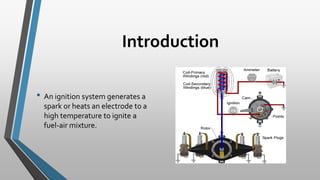
• An ignition system generates a
spark or heats an electrode to a
high temperature to ignite a
fuel-air mixture.
Energy Required for Ignition System
• The required energy is depends upon to an extent on the rise time and pulse
width of arc
• Energy level for a standardized mixture may be low as 0.002mJ.
• In general it may be considered that 1mJ. Is sufficient to produce ignition of
fuel-air mixture.
Spark Energy &Time Duration
• Spark energy & duration are to be sufficient to initiate the combustion
• For a homogenous mixture spark energy of 1mJ for duration of few micro
seconds suffice to initiate the combustion
• If spark energy exceed to 40mJ & duration is longer than the 0.5 micro
second, reliable ignition is obtained.
Ignition System
• The ignition systems are classified depending upon how the primary energy
for operating the circuit is made available as:
1. Battery Ignition System
2. Magneto Ignition System
Requirements of Ignition System
• It should provide a good spark b/w the electrodes of the plugs at the correct
timing
• It should function efficiently over the entire range of engine speed
• It should be light, effective & reliable in service
• It should be compact and easy to maintain
• It should be continent and easy to handle
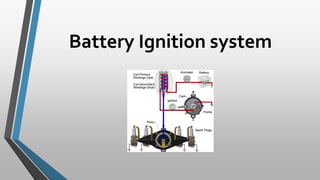
Battery Ignition system
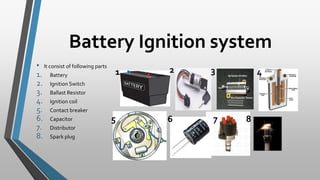
• It consist of following parts
1. Battery
2. Ignition Switch
3. Ballast Resistor
4. Ignition coil
5. Contact breaker
6. Capacitor
7. Distributor
8. Spark plug
1 2 3 4
5 6 7 8
Ignition Parts
• Battery: Provides power for system
Two types of battery are used for spark ignition engines
I. Lead acid Battery
II. Alkaline Battery
• Ignition Switches: Allows driver to turn ignition on and off.
Battery is connected to primary winding of the ignition coil through an ignition switch &
ballast resistor.
Ignition Parts
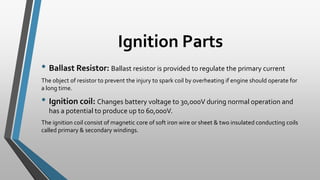
• Ballast Resistor: Ballast resistor is provided to regulate the primary current
The object of resistor to prevent the injury to spark coil by overheating if engine should operate for
a long time.
• Ignition coil: Changes battery voltage to 30,000V during normal operation and
has a potential to produce up to 60,000V.
The ignition coil consist of magnetic core of soft iron wire or sheet & two insulated conducting coils
called primary & secondary windings.
Ignition Parts
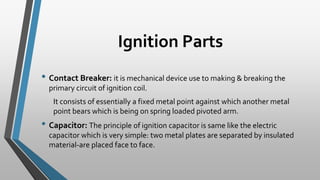
• Contact Breaker: it is mechanical device use to making & breaking the
primary circuit of ignition coil.
It consists of essentially a fixed metal point against which another metal
point bears which is being on spring loaded pivoted arm.
• Capacitor: The principle of ignition capacitor is same like the electric
capacitor which is very simple: two metal plates are separated by insulated
material-are placed face to face.
Ignition Parts
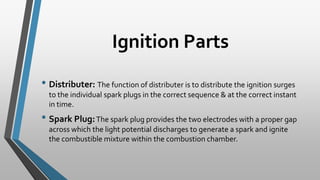
• Distributer: The function of distributer is to distribute the ignition surges
to the individual spark plugs in the correct sequence & at the correct instant
in time.
• Spark Plug:The spark plug provides the two electrodes with a proper gap
across which the light potential discharges to generate a spark and ignite
the combustible mixture within the combustion chamber.
Operation Of Battery Ignition System
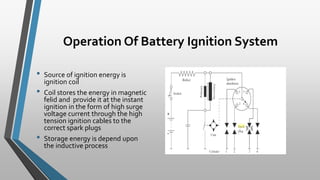
• Source of ignition energy is
ignition coil
• Coil stores the energy in magnetic
felid and provide it at the instant
ignition in the form of high surge
voltage current through the high
tension ignition cables to the
correct spark plugs
• Storage energy is depend upon
the inductive process
Limitations Of Battery Ignition System
I. The primary voltage decrease as the engine speed increase
II. Time available for the build-up of the current in the primary coil & storage
energy decrease as the engine speed increase
III. The system is sensitive for side tracking across the spark plug insulator
because high source impedance is about to 500kΩ
IV.Increased current cause the rapid reduction in breaker point life and
system reliability s
Dwell Angle
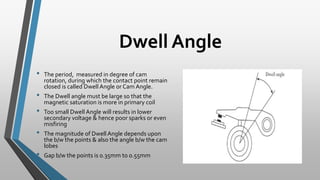
• The period, measured in degree of cam
rotation, during which the contact point remain
closed is called Dwell Angle or Cam Angle.
• The Dwell angle must be large so that the
magnetic saturation is more in primary coil
• Too small Dwell Angle will results in lower
secondary voltage & hence poor sparks or even
misfiring
• The magnitude of Dwell Angle depends upon
the b/w the points & also the angle b/w the cam
lobes
• Gap b/w the points is 0.35mm to 0.55mm
Dwell Angle Cont.
• As the no. of cylinder increase,
the dwell angle is decreased
because more opening and
closing
• In four cylinder Dwell Angle is
about to 50 degree
• In six cylinder it is 38 degree
• In eight cylinder it is about 33
degree
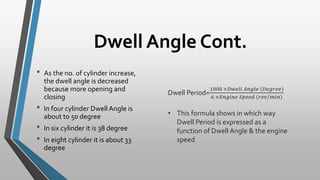
Dwell Period=
1000 ×𝐷𝑤𝑒𝑙𝑙 𝐴𝑛𝑔𝑙𝑒 (𝐷𝑒𝑔𝑟𝑒𝑒)
6 ×𝐸𝑛𝑔𝑖𝑛𝑒 𝑆𝑝𝑒𝑒𝑑 (𝑟𝑒𝑣/𝑚𝑖𝑛)
• This formula shows in which way
Dwell Period is expressed as a
function of Dwell Angle & the engine
speed
Advantages of 12V Ignition System
• For transmitting equal power without excessive voltage drop
• Twice the power for ignition coil during the starting surge
• 12V system has adequate electric power to supply the increasing the
number of electrical accessories used
Magneto Ignition System
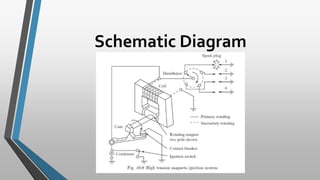
It is special type of ignition system with its own electric generator to provide
the necessary energy for the system
• It is mounted over the engine and replace the all parts of coil ignition system
except the spark plug
• Magneto when rotated by the engine it is capable to produce the high
voltage & dose not need a battery as external source
Schematic Diagram
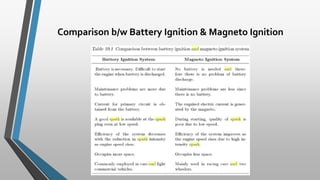
Comparison b/w Battery Ignition & Magneto Ignition
Modern Ignition System
Modern attempts are given below:
• Transistorized Coil Ignition (TCI) System
• Capacitive Discharge Ignition (CDI) System
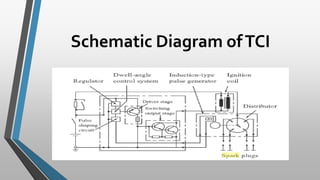
Transistorized Coil Ignition (TCI)System
It provide the higher output voltage & use the electronic triggering to maintain the
required timing.These system also called the high energy electronic ignition system
These are the following advantages ofTCI System:
• Reduce ignition system maintenance
• Reduce the wear of the components
• Increased reliability
• Extend spark plug life
• Improved Ignition of lean mixture
Schematic Diagram ofTCI
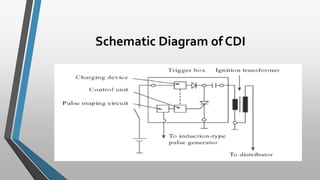
Capacitive Discharge Ignition (CDI) System
• A capacitor rather than the induction coil is used to store the ignition energy.
• The capacitance and the charging voltage determine the amount of energy stored.
• Ignition transformer step up the primary voltage generated at the time of spark by
the discharge of capacitor through the thyristor to the high voltage required at the
spark plug.
• The CDI trigger box contain the capacitor, thyristor power switch, charging device,
pulse shaping unit & control unit
Schematic Diagram of CDI
Fire Order
• Every engine cylinder must fire once in one cycle
• Three factor must be considered before deciding the optimum firing order of an
engine
i. Engine vibration
ii. Engine cooling
iii. Development of back pressure
• 4 stroke 4 cylinder ignition system must fire for every 180 degree of crank rotation
• For six cylinder engine only 120 degree of crank rotation
Spark Advance Mechanism
Two Advance Mechanism used are:
1. Centrifugal Advance Mechanism
2. VacuumAdvance Mechanism
Centrifugal Advance Mechanism
• Control the ignition timing for full-loaded operation
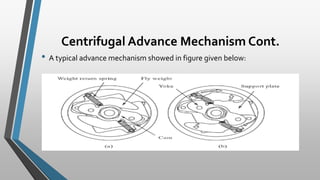
• The cam is mounted over the distributor shaft so that the speed increase,
the flyweights which move farther & farther outward, shift the cam in
direction of shaft rotation
• The cam lobes make contact with the breaker leaver rubbing block, thus
shifting the ignition point in early or advance direction
Centrifugal Advance Mechanism Cont.
• A typical advance mechanism showed in figure given below:
Vacuum Advance Mechanism
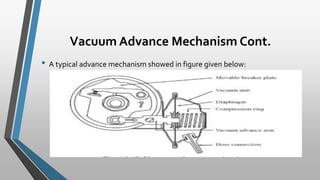
• Mechanism that shift the ignition point under part load operation
• The diaphragm of a vacuum unit is moved by changes in gas pressure
• Position of diaphragm is determined by the differential at any given movement b/w
the prevailing vacuum & atmospheric pressure
• Vacuum advance mechanism is operates independent of the centrifugal advance
mechanism
• Vacuum advance mechanism operates in conjunction with the centrifugal advance
mechanism to provide the total adjustment required when engine is operating
under the part load
Vacuum Advance Mechanism Cont.
• A typical advance mechanism showed in figure given below:
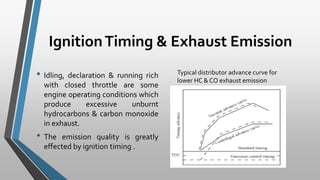
IgnitionTiming & Exhaust Emission
• Idling, declaration & running rich
with closed throttle are some
engine operating conditions which
produce excessive unburnt
hydrocarbons & carbon monoxide
in exhaust.
• The emission quality is greatly
effected by ignition timing .
Typical distributor advance curve for
lower HC & CO exhaust emission
How Ignition SystemWorks
Engine
Electronics
(Sensors)
Introduction
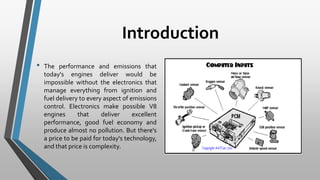
• The performance and emissions that
today's engines deliver would be
impossible without the electronics that
manage everything from ignition and
fuel delivery to every aspect of emissions
control. Electronics make possible V8
engines that deliver excellent
performance, good fuel economy and
produce almost no pollution. But there's
a price to be paid for today's technology,
and that price is complexity.
Inductive Sensors
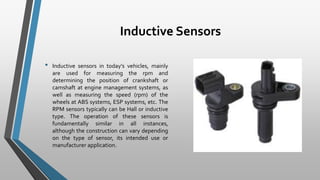
• Inductive sensors in today’s vehicles, mainly
are used for measuring the rpm and
determining the position of crankshaft or
camshaft at engine management systems, as
well as measuring the speed (rpm) of the
wheels at ABS systems, ESP systems, etc. The
RPM sensors typically can be Hall or inductive
type. The operation of these sensors is
fundamentally similar in all instances,
although the construction can vary depending
on the type of sensor, its intended use or
manufacturer application.
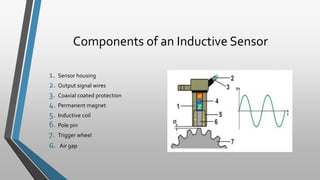
Components of an Inductive Sensor
1. Sensor housing
2. Output signal wires
3. Coaxial coated protection
4. Permanent magnet
5. Inductive coil
6. Pole pin
7. Trigger wheel
G. Air gap
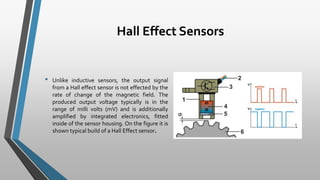
Hall Effect Sensors
• Unlike inductive sensors, the output signal
from a Hall effect sensor is not effected by the
rate of change of the magnetic field. The
produced output voltage typically is in the
range of milli volts (mV) and is additionally
amplified by integrated electronics, fitted
inside of the sensor housing. On the figure it is
shown typical build of a Hall Effect sensor.
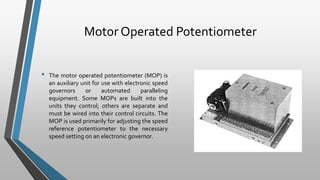
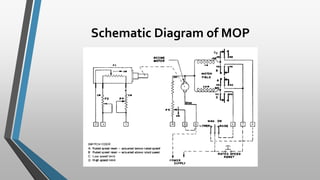
Motor Operated Potentiometer
• The motor operated potentiometer (MOP) is
an auxiliary unit for use with electronic speed
governors or automated paralleling
equipment. Some MOPs are built into the
units they control; others are separate and
must be wired into their control circuits. The
MOP is used primarily for adjusting the speed
reference potentiometer to the necessary
speed setting on an electronic governor.
Schematic Diagram of MOP
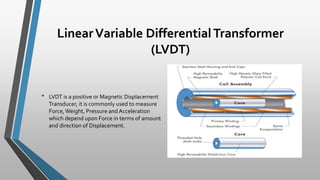
LinearVariable DifferentialTransformer
(LVDT)
• LVDT is a positive or Magnetic Displacement
Transducer, it is commonly used to measure
Force,Weight, Pressure and Acceleration
which depend upon Force in terms of amount
and direction of Displacement.
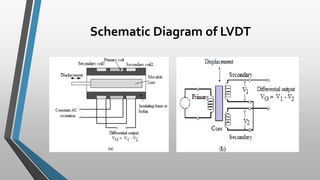
Schematic Diagram of LVDT
Electro Optical Sensors
Electro-optical sensors are electronic detectors that
convert light, or a change in light, into an electronic
signal. They are used in many industrial and
consumer applications, for example:
• Lamps that turn on automatically in response to
darkness.
• Position sensors that activate when an object
interrupts a light beam.
• Flash detection, to synchronize one photographic
flash to another.
• Photoelectric sensors that detect the distance,
absence, or presence of an object.
Types of an Electro Optical Sensors
There are many different kinds of optical sensors, the most common types are:
• Photoconductive devices convert a change of incident light into a change of
resistance.
• Photovoltaic commonly known as solar cells, convert an amount of incident light
into an output voltage.
• Photodiodes convert an amount of incident light into an output current.
• Phototransistors are a type of bipolar transistor where the base-collector junction
is exposed to light. This results in the same behaviour of a photodiode, but with an
internal gain.
Strain Gauge Sensor
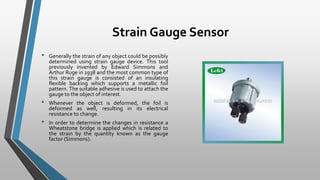
• Generally the strain of any object could be possibly
determined using strain gauge device. This tool
previously invented by Edward Simmons and
Arthur Ruge in 1938 and the most common type of
this strain gauge is consisted of an insulating
flexible backing which supports a metallic foil
pattern. The suitable adhesive is used to attach the
gauge to the object of interest.
• Whenever the object is deformed, the foil is
deformed as well, resulting in its electrical
resistance to change.
• In order to determine the changes in resistance a
Wheatstone bridge is applied which is related to
the strain by the quantity known as the gauge
factor (Simmons).
Coolant Sensor
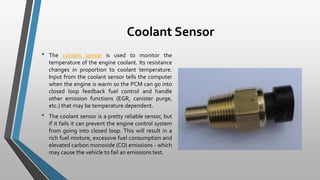
• The coolant sensor is used to monitor the
temperature of the engine coolant. Its resistance
changes in proportion to coolant temperature.
Input from the coolant sensor tells the computer
when the engine is warm so the PCM can go into
closed loop feedback fuel control and handle
other emission functions (EGR, canister purge,
etc.) that may be temperature dependent.
• The coolant sensor is a pretty reliable sensor, but
if it fails it can prevent the engine control system
from going into closed loop. This will result in a
rich fuel mixture, excessive fuel consumption and
elevated carbon monoxide (CO) emissions - which
may cause the vehicle to fail an emissions test.
Oxygen (O2) Sensor
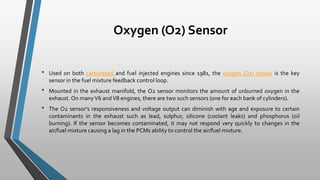
• Used on both carbureted and fuel injected engines since 1981, the oxygen (O2) sensor is the key
sensor in the fuel mixture feedback control loop.
• Mounted in the exhaust manifold, the O2 sensor monitors the amount of unburned oxygen in the
exhaust. On manyV6 andV8 engines, there are two such sensors (one for each bank of cylinders).
• The O2 sensor's responsiveness and voltage output can diminish with age and exposure to certain
contaminants in the exhaust such as lead, sulphur, silicone (coolant leaks) and phosphorus (oil
burning). If the sensor becomes contaminated, it may not respond very quickly to changes in the
air/fuel mixture causing a lag in the PCMs ability to control the air/fuel mixture.
Manifold Absolute Pressure (MAP) Sensor
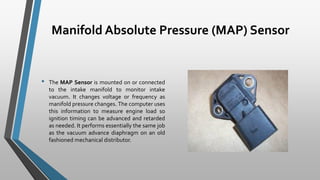
• The MAP Sensor is mounted on or connected
to the intake manifold to monitor intake
vacuum. It changes voltage or frequency as
manifold pressure changes. The computer uses
this information to measure engine load so
ignition timing can be advanced and retarded
as needed. It performs essentially the same job
as the vacuum advance diaphragm on an old
fashioned mechanical distributor.
Throttle Position Sensor
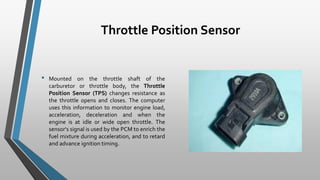
• Mounted on the throttle shaft of the
carburetor or throttle body, the Throttle
Position Sensor (TPS) changes resistance as
the throttle opens and closes. The computer
uses this information to monitor engine load,
acceleration, deceleration and when the
engine is at idle or wide open throttle. The
sensor's signal is used by the PCM to enrich the
fuel mixture during acceleration, and to retard
and advance ignition timing.
Crankshaft Position Sensor
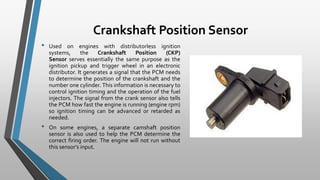
• Used on engines with distributorless ignition
systems, the Crankshaft Position (CKP)
Sensor serves essentially the same purpose as the
ignition pickup and trigger wheel in an electronic
distributor. It generates a signal that the PCM needs
to determine the position of the crankshaft and the
number one cylinder. This information is necessary to
control ignition timing and the operation of the fuel
injectors. The signal from the crank sensor also tells
the PCM how fast the engine is running (engine rpm)
so ignition timing can be advanced or retarded as
needed.
• On some engines, a separate camshaft position
sensor is also used to help the PCM determine the
correct firing order. The engine will not run without
this sensor's input.
Knock Sensor
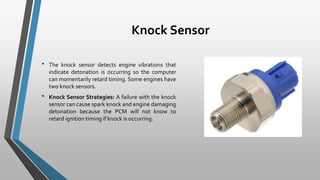
• The knock sensor detects engine vibrations that
indicate detonation is occurring so the computer
can momentarily retard timing. Some engines have
two knock sensors.
• Knock Sensor Strategies: A failure with the knock
sensor can cause spark knock and engine damaging
detonation because the PCM will not know to
retard ignition timing if knock is occurring.
Barometric Pressure Sensor
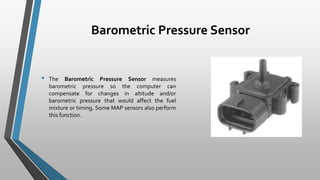
• The Barometric Pressure Sensor measures
barometric pressure so the computer can
compensate for changes in altitude and/or
barometric pressure that would affect the fuel
mixture or timing. Some MAP sensors also perform
this function.
Vehicle Speed Sensor
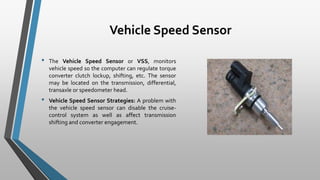
• The Vehicle Speed Sensor or VSS, monitors
vehicle speed so the computer can regulate torque
converter clutch lockup, shifting, etc. The sensor
may be located on the transmission, differential,
transaxle or speedometer head.
• Vehicle Speed Sensor Strategies: A problem with
the vehicle speed sensor can disable the cruise-
control system as well as affect transmission
shifting and converter engagement.
Ignition System & Engine Electronics

Ignition System & Engine Electronics

  • 2.
  • 3.
    Introduction • An ignitionsystem generates a spark or heats an electrode to a high temperature to ignite a fuel-air mixture.
  • 4.
    Energy Required forIgnition System • The required energy is depends upon to an extent on the rise time and pulse width of arc • Energy level for a standardized mixture may be low as 0.002mJ. • In general it may be considered that 1mJ. Is sufficient to produce ignition of fuel-air mixture.
  • 5.
    Spark Energy &TimeDuration • Spark energy & duration are to be sufficient to initiate the combustion • For a homogenous mixture spark energy of 1mJ for duration of few micro seconds suffice to initiate the combustion • If spark energy exceed to 40mJ & duration is longer than the 0.5 micro second, reliable ignition is obtained.
  • 6.
    Ignition System • Theignition systems are classified depending upon how the primary energy for operating the circuit is made available as: 1. Battery Ignition System 2. Magneto Ignition System
  • 7.
    Requirements of IgnitionSystem • It should provide a good spark b/w the electrodes of the plugs at the correct timing • It should function efficiently over the entire range of engine speed • It should be light, effective & reliable in service • It should be compact and easy to maintain • It should be continent and easy to handle
  • 8.
  • 9.
    Battery Ignition system •It consist of following parts 1. Battery 2. Ignition Switch 3. Ballast Resistor 4. Ignition coil 5. Contact breaker 6. Capacitor 7. Distributor 8. Spark plug 1 2 3 4 5 6 7 8
  • 10.
    Ignition Parts • Battery:Provides power for system Two types of battery are used for spark ignition engines I. Lead acid Battery II. Alkaline Battery • Ignition Switches: Allows driver to turn ignition on and off. Battery is connected to primary winding of the ignition coil through an ignition switch & ballast resistor.
  • 11.
    Ignition Parts • BallastResistor: Ballast resistor is provided to regulate the primary current The object of resistor to prevent the injury to spark coil by overheating if engine should operate for a long time. • Ignition coil: Changes battery voltage to 30,000V during normal operation and has a potential to produce up to 60,000V. The ignition coil consist of magnetic core of soft iron wire or sheet & two insulated conducting coils called primary & secondary windings.
  • 12.
    Ignition Parts • ContactBreaker: it is mechanical device use to making & breaking the primary circuit of ignition coil. It consists of essentially a fixed metal point against which another metal point bears which is being on spring loaded pivoted arm. • Capacitor: The principle of ignition capacitor is same like the electric capacitor which is very simple: two metal plates are separated by insulated material-are placed face to face.
  • 13.
    Ignition Parts • Distributer:The function of distributer is to distribute the ignition surges to the individual spark plugs in the correct sequence & at the correct instant in time. • Spark Plug:The spark plug provides the two electrodes with a proper gap across which the light potential discharges to generate a spark and ignite the combustible mixture within the combustion chamber.
  • 14.
    Operation Of BatteryIgnition System • Source of ignition energy is ignition coil • Coil stores the energy in magnetic felid and provide it at the instant ignition in the form of high surge voltage current through the high tension ignition cables to the correct spark plugs • Storage energy is depend upon the inductive process
  • 15.
    Limitations Of BatteryIgnition System I. The primary voltage decrease as the engine speed increase II. Time available for the build-up of the current in the primary coil & storage energy decrease as the engine speed increase III. The system is sensitive for side tracking across the spark plug insulator because high source impedance is about to 500kΩ IV.Increased current cause the rapid reduction in breaker point life and system reliability s
  • 16.
    Dwell Angle • Theperiod, measured in degree of cam rotation, during which the contact point remain closed is called Dwell Angle or Cam Angle. • The Dwell angle must be large so that the magnetic saturation is more in primary coil • Too small Dwell Angle will results in lower secondary voltage & hence poor sparks or even misfiring • The magnitude of Dwell Angle depends upon the b/w the points & also the angle b/w the cam lobes • Gap b/w the points is 0.35mm to 0.55mm
  • 17.
    Dwell Angle Cont. •As the no. of cylinder increase, the dwell angle is decreased because more opening and closing • In four cylinder Dwell Angle is about to 50 degree • In six cylinder it is 38 degree • In eight cylinder it is about 33 degree Dwell Period= 1000 ×𝐷𝑤𝑒𝑙𝑙 𝐴𝑛𝑔𝑙𝑒 (𝐷𝑒𝑔𝑟𝑒𝑒) 6 ×𝐸𝑛𝑔𝑖𝑛𝑒 𝑆𝑝𝑒𝑒𝑑 (𝑟𝑒𝑣/𝑚𝑖𝑛) • This formula shows in which way Dwell Period is expressed as a function of Dwell Angle & the engine speed
  • 18.
    Advantages of 12VIgnition System • For transmitting equal power without excessive voltage drop • Twice the power for ignition coil during the starting surge • 12V system has adequate electric power to supply the increasing the number of electrical accessories used
  • 19.
    Magneto Ignition System Itis special type of ignition system with its own electric generator to provide the necessary energy for the system • It is mounted over the engine and replace the all parts of coil ignition system except the spark plug • Magneto when rotated by the engine it is capable to produce the high voltage & dose not need a battery as external source
  • 20.
  • 21.
    Comparison b/w BatteryIgnition & Magneto Ignition
  • 22.
    Modern Ignition System Modernattempts are given below: • Transistorized Coil Ignition (TCI) System • Capacitive Discharge Ignition (CDI) System
  • 23.
    Transistorized Coil Ignition(TCI)System It provide the higher output voltage & use the electronic triggering to maintain the required timing.These system also called the high energy electronic ignition system These are the following advantages ofTCI System: • Reduce ignition system maintenance • Reduce the wear of the components • Increased reliability • Extend spark plug life • Improved Ignition of lean mixture
  • 24.
  • 25.
    Capacitive Discharge Ignition(CDI) System • A capacitor rather than the induction coil is used to store the ignition energy. • The capacitance and the charging voltage determine the amount of energy stored. • Ignition transformer step up the primary voltage generated at the time of spark by the discharge of capacitor through the thyristor to the high voltage required at the spark plug. • The CDI trigger box contain the capacitor, thyristor power switch, charging device, pulse shaping unit & control unit
  • 26.
  • 27.
    Fire Order • Everyengine cylinder must fire once in one cycle • Three factor must be considered before deciding the optimum firing order of an engine i. Engine vibration ii. Engine cooling iii. Development of back pressure • 4 stroke 4 cylinder ignition system must fire for every 180 degree of crank rotation • For six cylinder engine only 120 degree of crank rotation
  • 28.
    Spark Advance Mechanism TwoAdvance Mechanism used are: 1. Centrifugal Advance Mechanism 2. VacuumAdvance Mechanism
  • 29.
    Centrifugal Advance Mechanism •Control the ignition timing for full-loaded operation • The cam is mounted over the distributor shaft so that the speed increase, the flyweights which move farther & farther outward, shift the cam in direction of shaft rotation • The cam lobes make contact with the breaker leaver rubbing block, thus shifting the ignition point in early or advance direction
  • 30.
    Centrifugal Advance MechanismCont. • A typical advance mechanism showed in figure given below:
  • 31.
    Vacuum Advance Mechanism •Mechanism that shift the ignition point under part load operation • The diaphragm of a vacuum unit is moved by changes in gas pressure • Position of diaphragm is determined by the differential at any given movement b/w the prevailing vacuum & atmospheric pressure • Vacuum advance mechanism is operates independent of the centrifugal advance mechanism • Vacuum advance mechanism operates in conjunction with the centrifugal advance mechanism to provide the total adjustment required when engine is operating under the part load
  • 32.
    Vacuum Advance MechanismCont. • A typical advance mechanism showed in figure given below:
  • 33.
    IgnitionTiming & ExhaustEmission • Idling, declaration & running rich with closed throttle are some engine operating conditions which produce excessive unburnt hydrocarbons & carbon monoxide in exhaust. • The emission quality is greatly effected by ignition timing . Typical distributor advance curve for lower HC & CO exhaust emission
  • 34.
  • 35.
  • 36.
    Introduction • The performanceand emissions that today's engines deliver would be impossible without the electronics that manage everything from ignition and fuel delivery to every aspect of emissions control. Electronics make possible V8 engines that deliver excellent performance, good fuel economy and produce almost no pollution. But there's a price to be paid for today's technology, and that price is complexity.
  • 37.
    Inductive Sensors • Inductivesensors in today’s vehicles, mainly are used for measuring the rpm and determining the position of crankshaft or camshaft at engine management systems, as well as measuring the speed (rpm) of the wheels at ABS systems, ESP systems, etc. The RPM sensors typically can be Hall or inductive type. The operation of these sensors is fundamentally similar in all instances, although the construction can vary depending on the type of sensor, its intended use or manufacturer application.
  • 38.
    Components of anInductive Sensor 1. Sensor housing 2. Output signal wires 3. Coaxial coated protection 4. Permanent magnet 5. Inductive coil 6. Pole pin 7. Trigger wheel G. Air gap
  • 39.
    Hall Effect Sensors •Unlike inductive sensors, the output signal from a Hall effect sensor is not effected by the rate of change of the magnetic field. The produced output voltage typically is in the range of milli volts (mV) and is additionally amplified by integrated electronics, fitted inside of the sensor housing. On the figure it is shown typical build of a Hall Effect sensor.
  • 40.
    Motor Operated Potentiometer •The motor operated potentiometer (MOP) is an auxiliary unit for use with electronic speed governors or automated paralleling equipment. Some MOPs are built into the units they control; others are separate and must be wired into their control circuits. The MOP is used primarily for adjusting the speed reference potentiometer to the necessary speed setting on an electronic governor.
  • 41.
  • 42.
    LinearVariable DifferentialTransformer (LVDT) • LVDTis a positive or Magnetic Displacement Transducer, it is commonly used to measure Force,Weight, Pressure and Acceleration which depend upon Force in terms of amount and direction of Displacement.
  • 43.
  • 44.
    Electro Optical Sensors Electro-opticalsensors are electronic detectors that convert light, or a change in light, into an electronic signal. They are used in many industrial and consumer applications, for example: • Lamps that turn on automatically in response to darkness. • Position sensors that activate when an object interrupts a light beam. • Flash detection, to synchronize one photographic flash to another. • Photoelectric sensors that detect the distance, absence, or presence of an object.
  • 45.
    Types of anElectro Optical Sensors There are many different kinds of optical sensors, the most common types are: • Photoconductive devices convert a change of incident light into a change of resistance. • Photovoltaic commonly known as solar cells, convert an amount of incident light into an output voltage. • Photodiodes convert an amount of incident light into an output current. • Phototransistors are a type of bipolar transistor where the base-collector junction is exposed to light. This results in the same behaviour of a photodiode, but with an internal gain.
  • 46.
    Strain Gauge Sensor •Generally the strain of any object could be possibly determined using strain gauge device. This tool previously invented by Edward Simmons and Arthur Ruge in 1938 and the most common type of this strain gauge is consisted of an insulating flexible backing which supports a metallic foil pattern. The suitable adhesive is used to attach the gauge to the object of interest. • Whenever the object is deformed, the foil is deformed as well, resulting in its electrical resistance to change. • In order to determine the changes in resistance a Wheatstone bridge is applied which is related to the strain by the quantity known as the gauge factor (Simmons).
  • 47.
    Coolant Sensor • Thecoolant sensor is used to monitor the temperature of the engine coolant. Its resistance changes in proportion to coolant temperature. Input from the coolant sensor tells the computer when the engine is warm so the PCM can go into closed loop feedback fuel control and handle other emission functions (EGR, canister purge, etc.) that may be temperature dependent. • The coolant sensor is a pretty reliable sensor, but if it fails it can prevent the engine control system from going into closed loop. This will result in a rich fuel mixture, excessive fuel consumption and elevated carbon monoxide (CO) emissions - which may cause the vehicle to fail an emissions test.
  • 48.
    Oxygen (O2) Sensor •Used on both carbureted and fuel injected engines since 1981, the oxygen (O2) sensor is the key sensor in the fuel mixture feedback control loop. • Mounted in the exhaust manifold, the O2 sensor monitors the amount of unburned oxygen in the exhaust. On manyV6 andV8 engines, there are two such sensors (one for each bank of cylinders). • The O2 sensor's responsiveness and voltage output can diminish with age and exposure to certain contaminants in the exhaust such as lead, sulphur, silicone (coolant leaks) and phosphorus (oil burning). If the sensor becomes contaminated, it may not respond very quickly to changes in the air/fuel mixture causing a lag in the PCMs ability to control the air/fuel mixture.
  • 49.
    Manifold Absolute Pressure(MAP) Sensor • The MAP Sensor is mounted on or connected to the intake manifold to monitor intake vacuum. It changes voltage or frequency as manifold pressure changes. The computer uses this information to measure engine load so ignition timing can be advanced and retarded as needed. It performs essentially the same job as the vacuum advance diaphragm on an old fashioned mechanical distributor.
  • 50.
    Throttle Position Sensor •Mounted on the throttle shaft of the carburetor or throttle body, the Throttle Position Sensor (TPS) changes resistance as the throttle opens and closes. The computer uses this information to monitor engine load, acceleration, deceleration and when the engine is at idle or wide open throttle. The sensor's signal is used by the PCM to enrich the fuel mixture during acceleration, and to retard and advance ignition timing.
  • 51.
    Crankshaft Position Sensor •Used on engines with distributorless ignition systems, the Crankshaft Position (CKP) Sensor serves essentially the same purpose as the ignition pickup and trigger wheel in an electronic distributor. It generates a signal that the PCM needs to determine the position of the crankshaft and the number one cylinder. This information is necessary to control ignition timing and the operation of the fuel injectors. The signal from the crank sensor also tells the PCM how fast the engine is running (engine rpm) so ignition timing can be advanced or retarded as needed. • On some engines, a separate camshaft position sensor is also used to help the PCM determine the correct firing order. The engine will not run without this sensor's input.
  • 52.
    Knock Sensor • Theknock sensor detects engine vibrations that indicate detonation is occurring so the computer can momentarily retard timing. Some engines have two knock sensors. • Knock Sensor Strategies: A failure with the knock sensor can cause spark knock and engine damaging detonation because the PCM will not know to retard ignition timing if knock is occurring.
  • 53.
    Barometric Pressure Sensor •The Barometric Pressure Sensor measures barometric pressure so the computer can compensate for changes in altitude and/or barometric pressure that would affect the fuel mixture or timing. Some MAP sensors also perform this function.
  • 54.
    Vehicle Speed Sensor •The Vehicle Speed Sensor or VSS, monitors vehicle speed so the computer can regulate torque converter clutch lockup, shifting, etc. The sensor may be located on the transmission, differential, transaxle or speedometer head. • Vehicle Speed Sensor Strategies: A problem with the vehicle speed sensor can disable the cruise- control system as well as affect transmission shifting and converter engagement.