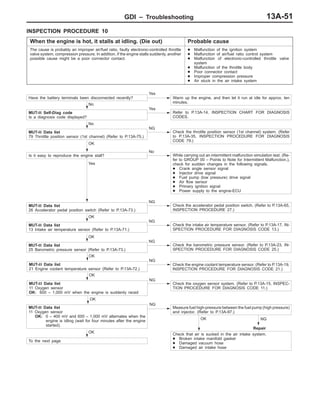
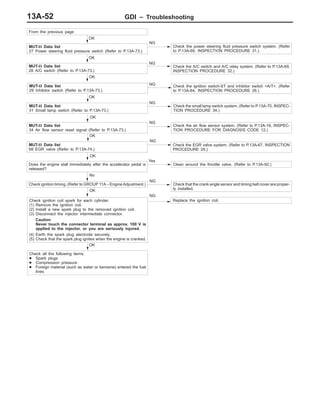
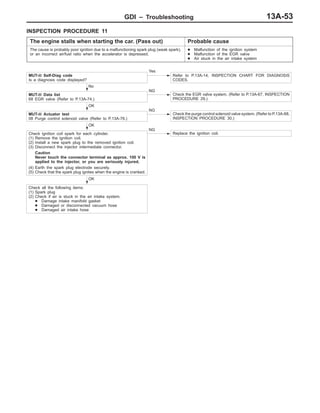
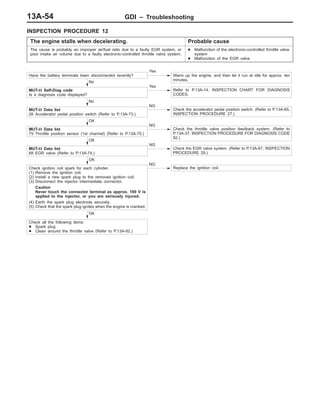
GASOLINE DIRECT
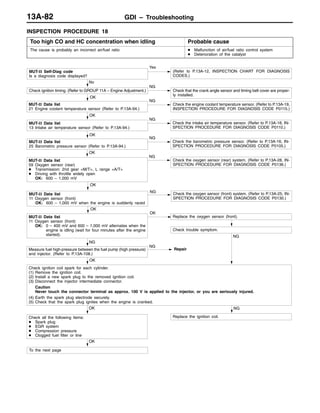
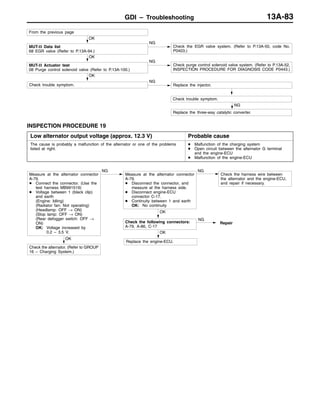
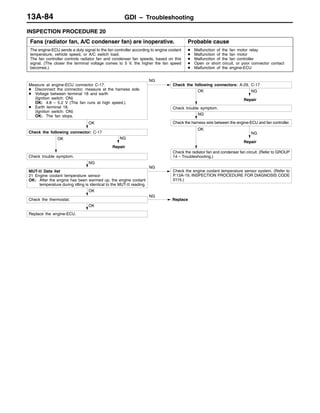
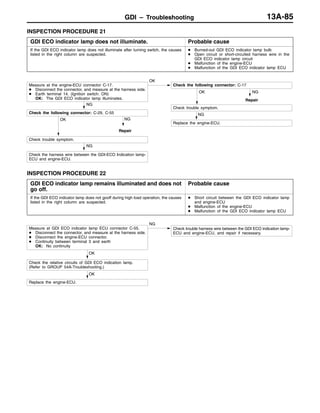
INJECTION (GDI)
Click on the applicable bookmark to selected the required model year
13A-2
GASOLINE DIRECT
INJECTION (GDI)
CONTENTS
GENERAL INFORMATION 3. . . . . . . . . . . . . . . . . .
SERVICE SPECIFICATIONS 7. . . . . . . . . . . . . . . . .
SEALANT 7. . . . . . . . . . . . . . . . . . . . . . . . . . . . . . . . . .
SPECIAL TOOLS 8. . . . . . . . . . . . . . . . . . . . . . . . . . .
TROUBLESHOOTING 10. . . . . . . . . . . . . . . . . . . . . .
ON-VEHICLE SERVICE 92. . . . . . . . . . . . . . . . . . . .
Throttle Body (Throttle Valve Area) Cleaning 92. .
Throttle Position Sensor Adjustment 92. . . . . . . . . .
Accelerator Pedal Position Sensor
Adjustment 94. . . . . . . . . . . . . . . . . . . . . . . . . . . . . . . . .
Fuel Pressure Test 95. . . . . . . . . . . . . . . . . . . . . . . . . .
Fuel Leak Check 99. . . . . . . . . . . . . . . . . . . . . . . . . . .
Fuel Pump Connector Disconnection (How to
Reduce Fuel Pressure) 99. . . . . . . . . . . . . . . . . . . . . .
Fuel Pump Operation Check 100. . . . . . . . . . . . . . . .
Component Location 101. . . . . . . . . . . . . . . . . . . . . . .
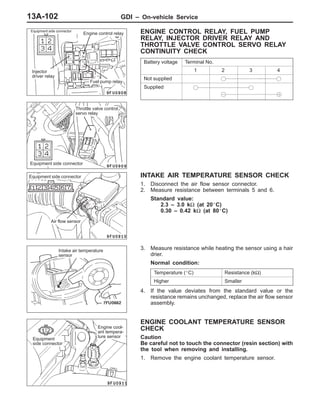
Engine Control Relay, Fuel Pump Relay, Injector
Driver Relay and Throttle Valve Control Servo
Relay Continuity Check 102. . . . . . . . . . . . . . . . . . . . .
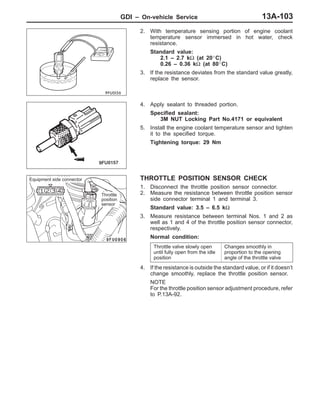
Intake Air Temperature Sensor Check 102. . . . . . .
Engine Coolant Temperature Sensor Check 102. .
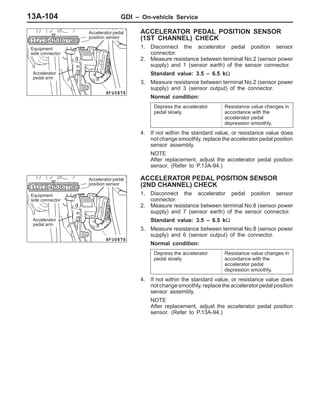
Throttle Position Sensor Check 103. . . . . . . . . . . . .
Accelerator Pedal Position Sensor (1st channel)
Check 104. . . . . . . . . . . . . . . . . . . . . . . . . . . . . . . . . . . .
Accelerator Pedal Position Sensor (2nd channel)
Check 104. . . . . . . . . . . . . . . . . . . . . . . . . . . . . . . . . . . .
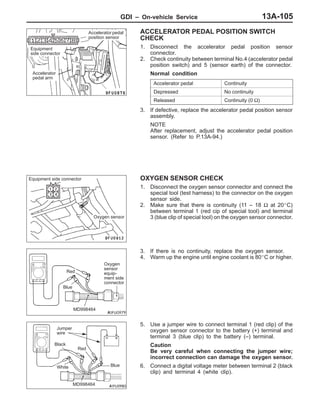
Accelerator Pedal Position Switch Check 105. . . .
Oxygen Sensor Check 105. . . . . . . . . . . . . . . . . . . . .
Injector Check 106. . . . . . . . . . . . . . . . . . . . . . . . . . . . .
Throttle Valve Control Servo Check 107. . . . . . . . .
Purge Control Solenoid Valve Check 107. . . . . . . .
EGR Valve Check 107. . . . . . . . . . . . . . . . . . . . . . . . .
FUEL PUMP (HIGH PRESSURE) AND FUEL
PRESSURE REGULATOR (HIGH
PRESSURE) 108. . . . . . . . . . . . . . . . . . . . . . . . . . . . .
INJECTOR 111. . . . . . . . . . . . . . . . . . . . . . . . . . . . . .
THROTTLE BODY 114. . . . . . . . . . . . . . . . . . . . . . . .
INJECTOR DRIVER 116. . . . . . . . . . . . . . . . . . . . . .
THROTTLE VALVE CONTROLLER 117. . . . . . . .
GDI – General Information 13A-3
GENERAL INFORMATION
The Gasoline Direct Injection System consists
of sensors which detect the engine conditions,
the engine-ECU which controls the system
based on signals from these sensors, and
actuators which operate under the control of
the engine-ECU. The engine-ECU carries out
activities such as fuel injection control, idle
speed control and ignition timing control. In
addition, the engine-ECU is equipped with
several diagnosis modes which simplify
troubleshooting when a problem develops.
FUEL INJECTION CONTROL
The injector drive times and injector timing are
controlled so that the optimum air/fuel mixture
is supplied to the engine to correspond to the
continually-changing engine operation condi-
tions.
A single injector for each cylinder is mounted
at the cylinder head. The fuel is sent under
pressure from the fuel tank to the fuel pressure
regulator (low pressure) by the fuel pump (low
pressure). The pressure is regulated by the fuel
pressure regulator (low pressure) and the fuel
regulated is then sent to the fuel pump (high
pressure). The fuel under increased pressure
generated by the fuel pump (high pressure) is
then regulated by the fuel pressure regulator
(high pressure) and is then distributed to each
of the injectors via the delivery pipes.
Fuel injection is normally carried out once for
each cylinder for every two rotations of the
crankshaft. The firing order is 1-3-4-2. This is
called sequential fuel injection.
When the engine is cold or under a severe load,
the “open-loop” control keeps the air/fuel ratio
at a richer than usual level to maintain
driveability. When the engine is under low or
medium loads, the air/fuel ratio becomes leaner
to reduce fuel consumption. When the engine
is running at medium or high loads after having
warmed up, the “closed-loop” control uses the
signal from the oxygen sensor to keep the
air/fuel ratio at the optimum theoretical level.
THROTTLE VALVE OPENING ANGLE CONTROL
This system controls throttle valve opening
angle electronically. The engine-ECU deter-
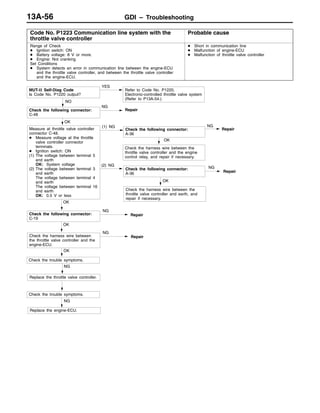
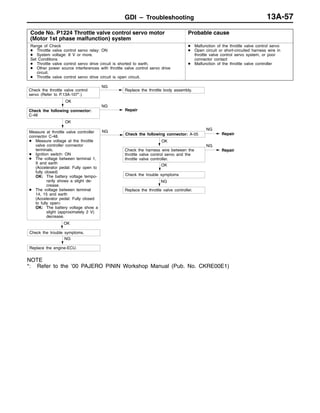
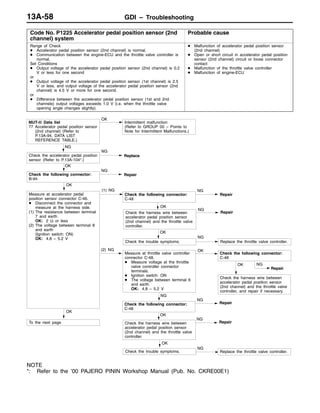
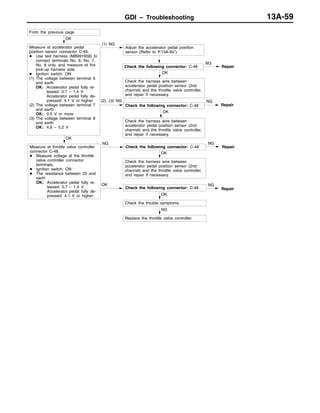
mines how deeply the accelerator pedal is
depressed by means of the accelerator position
sensor (APS). Then the engine-ECU sends a
target value of the throttle valve opening angle
to the throttle valve controller. The throttle valve
control servo operates the throttle valve so that
it reaches the target opening angle.
IDLE SPEED CONTROL
This system maintains engine idle speed at a
predetermined condition by controlling the air
flow that passes through the throttle valve
according to engine idling condition and engine
loads at idling.
The engine-ECU operates the throttle valve
control servo so that engine speed is maintained
within a map value. The map value is
predetermined according to engine coolant
temperature and air-conditioning load. In
addition, if the A/C switch is turned on or off
during engine idling, the engine-ECU
compensates the engine speed by operating
the throttle valve control servo as necessary.
IGNITION TIMING CONTROL
The power transistor located in the ignition
primary circuit turns ON and OFF to control
the primary current flow to the ignition coil. This
controls the ignition timing in order to provide
the optimum ignition timing with respect to the
engine operating conditions. The ignition timing
is determined by the engine-ECU from the
engine speed, intake air volume, engine coolant
temperature, atmospheric pressure and
injection timing (intake stroke or compression
stroke).
GDI – General Information13A-4
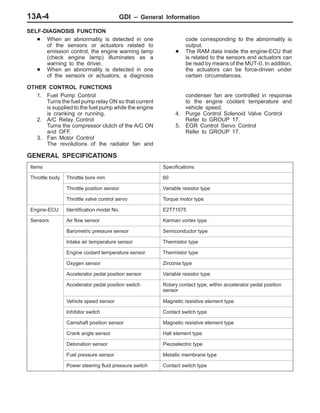
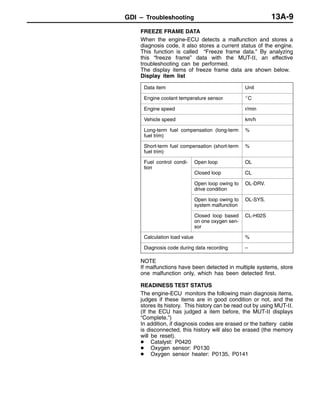
SELF-DIAGNOSIS FUNCTION
D When an abnormality is detected in one
of the sensors or actuators related to
emission control, the engine warning lamp
(check engine lamp) illuminates as a
warning to the driver.
D When an abnormality is detected in one
of the sensors or actuators, a diagnosis
code corresponding to the abnormality is
output.
D The RAM data inside the engine-ECU that
is related to the sensors and actuators can
be read by means of the MUT-II. In addition,
the actuators can be force-driven under
certain circumstances.
OTHER CONTROL FUNCTIONS
1. Fuel Pump Control
Turns the fuel pump relay ON so that current
is supplied to the fuel pump while the engine
is cranking or running.
2. A/C Relay Control
Turns the compressor clutch of the A/C ON
and OFF.
3. Fan Motor Control
The revolutions of the radiator fan and
condenser fan are controlled in response
to the engine coolant temperature and
vehicle speed.
4. Purge Control Solenoid Valve Control
Refer to GROUP 17.
5. EGR Control Servo Control
Refer to GROUP 17.
GENERAL SPECIFICATIONS
Items Specifications
Throttle body Throttle bore mm 60
Throttle position sensor Variable resistor type
Throttle valve control servo Torque motor type
Engine-ECU Identification model No. E2T71575
Sensors Air flow sensor Karman vortex type
Barometric pressure sensor Semiconductor type
Intake air temperature sensor Thermistor type
Engine coolant temperature sensor Thermistor type
Oxygen sensor Zirconia type
Accelerator pedal position sensor Variable resistor type
Accelerator pedal position switch Rotary contact type, within accelerator pedal position
sensor
Vehicle speed sensor Magnetic resistive element type
Inhibitor switch Contact switch type
Camshaft position sensor Magnetic resistive element type
Crank angle sensor Hall element type
Detonation sensor Piezoelectric type
Fuel pressure sensor Metallic membrane type
Power steering fluid pressure switch Contact switch type
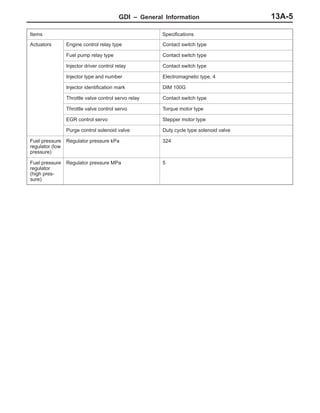
GDI – General Information 13A-5
Items Specifications
Actuators Engine control relay type Contact switch type
Fuel pump relay type Contact switch type
Injector driver control relay Contact switch type
Injector type and number Electromagnetic type, 4
Injector identification mark DIM 100G
Throttle valve control servo relay Contact switch type
Throttle valve control servo Torque motor type
EGR control servo Stepper motor type
Purge control solenoid valve Duty cycle type solenoid valve
Fuel pressure
regulator (low
pressure)
Regulator pressure kPa 324
Fuel pressure
regulator
(high pres-
sure)
Regulator pressure MPa 5
GDI – General Information13A-6
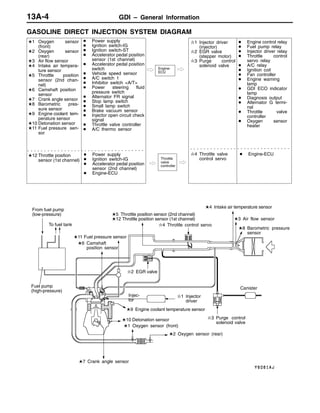
GASOLINE DIRECT INJECTION SYSTEM DIAGRAM
*1 Oxygen sensor
*2 Air flow sensor
*3 Intake air temper-
ature senor
*4 Throttle position
sensor (2nd chan-
nel)
*5 Camshaft position
sensor
*6 Crank angle sen-
sor
*7 Barometric pres-
sure sensor
*8 Engine coolant
temperature sen-
sor
*9 Detonation sensor
*10 Fuel pressure sen-
sor
*11 Throttle position
sensor (1st chan-
nel)
D Power supply
D Ignition switch – IG
D Ignition switch – ST
D Accelerator pedal posi-
tion sensor (1st
channel)
D Accelerator pedal posi-
tion switch
D Vehicle speed sensor
D A/C switch
D A/C thermo sensor
D Inhibitor switch
D Power steering fluid
pressure switch
D Alternator FR terminal
D Stop lamp switch
D Small lamp switch
D Injector wire open circuit
check signal
D Throttle valve controller
D A/T-ECU
D Power supply
D Ignition switch – IG
D Accelerator pedal posi-
tion sensor (2nd chan-
nel)
D Engine-ECU
Engine-
ECU
From fuel pump
(low pressure)
To fuel tank
*10 Fuel pressure
sensor
*5 Camshaft position
sensor
*4 Throttle position sensor
(2nd channel)
*11 Throttle position sensor
(1st channel)
z4 Throttle valve
control servo
*3 Intake airtemperature
sensor
*2 Air flow sensor
*7 Barometric
pressure sensor
z2 EGR valve
(Stepper
motor)
High-pressure fuel
regulator assembly
[integrated in fuel
pressure regulator
(high pressure)]
Fuel pump
(high pressure)
Injector
z1 Injector
driver
*8 Engine coolant
temperature sensor
*9 Detonation sensor
*1 Oxygen sensor
*6 Crank angle sensor
Canister
z3 Purge control
solenoid valve
z1 Injector driver (In-
jector)
z2 EGR valve (Step-
per motor)
z3 Purge control sole-
noid valve
z4 Throttle valve con-
trol servo
D Engine control relay
D Fuel pump relay
D Injector driver relay
D Throttle valve control
servo relay
D A/C relay
D Ignition coil
D Fan controller
D GDI ECO indicator lamp
D Engine warning lamp
D Diagnosis output
D Alternator G terminal
D Throttle valve controller
D A/T-ECU
D Engine-ECU
Throttle
valve
control-
ler
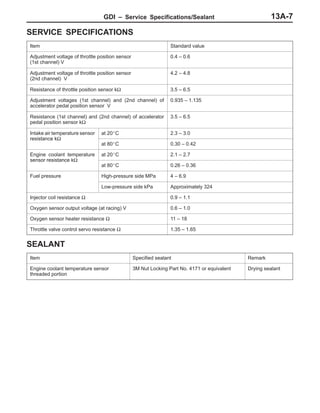
GDI – Service Specifications/Sealant 13A-7
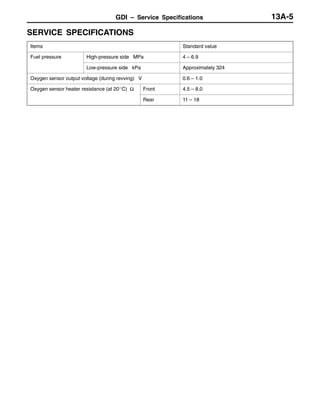
SERVICE SPECIFICATIONS
Item Standard value
Adjustment voltage of throttle position sensor
(1st channel) V
0.4 – 0.6
Adjustment voltage of throttle position sensor
(2nd channel) V
4.2 – 4.8
Resistance of throttle position sensor kΩ 3.5 – 6.5
Adjustment voltages (1st channel) and (2nd channel) of
accelerator pedal position sensor V
0.935 – 1.135
Resistance (1st channel) and (2nd channel) of accelerator
pedal position sensor kΩ
3.5 – 6.5
Intake air temperature sensor
resistance kΩ
at 20_C 2.3 – 3.0
resistance kΩ
at 80_C 0.30 – 0.42
Engine coolant temperature
sensor resistance kΩ
at 20_C 2.1 – 2.7
sensor resistance kΩ
at 80_C 0.26 – 0.36
Fuel pressure High-pressure side MPa 4 – 6.9
Low-pressure side kPa Approximately 324
Injector coil resistance Ω 0.9 – 1.1
Oxygen sensor output voltage (at racing) V 0.6 – 1.0
Oxygen sensor heater resistance Ω 11 – 18
Throttle valve control servo resistance Ω 1.35 – 1.65
SEALANT
Item Specified sealant Remark
Engine coolant temperature sensor
threaded portion
3M Nut Locking Part No. 4171 or equivalent Drying sealant
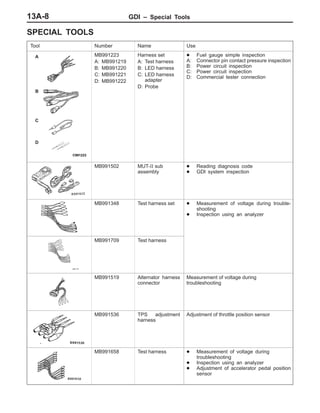
GDI – Special Tools13A-8
SPECIAL TOOLS
Tool Number Name Use
B
A
C
D
MB991223
A: MB991219
B: MB991220
C: MB991221
D: MB991222
Harness set
A: Test harness
B: LED harness
C: LED harness
adapter
D: Probe
D Fuel gauge simple inspection
A: Connector pin contact pressure inspection
B: Power circuit inspection
C: Power circuit inspection
D: Commercial tester connection
MB991502 MUT-II sub
assembly
D Reading diagnosis code
D GDI system inspection
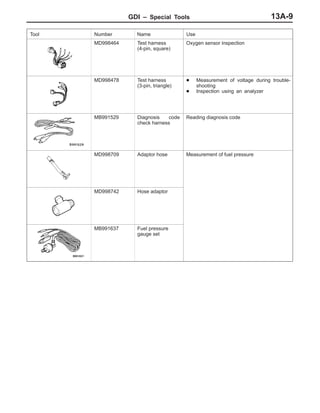
MB991348 Test harness set D Measurement of voltage during trouble-
shooting
D Inspection using an analyzer
MB991709 Test harness
MB991519 Alternator harness
connector
Measurement of voltage during
troubleshooting
MB991536 TPS adjustment
harness
Adjustment of throttle position sensor
MB991658 Test harness D Measurement of voltage during
troubleshooting
D Inspection using an analyzer
D Adjustment of accelerator pedal position
sensor
GDI – Special Tools 13A-9
Tool UseNameNumber
MD998464 Test harness
(4-pin, square)
Oxygen sensor inspection
MD998478 Test harness
(3-pin, triangle)
D Measurement of voltage during trouble-
shooting
D Inspection using an analyzer
MB991529 Diagnosis code
check harness
Reading diagnosis code
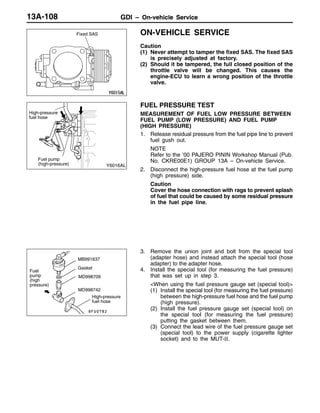
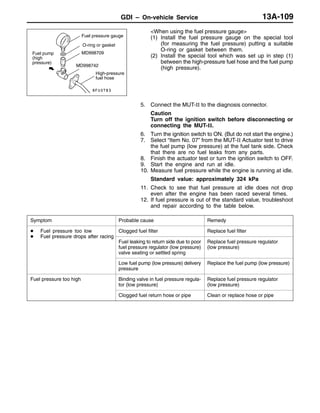
MD998709 Adaptor hose Measurement of fuel pressure
MD998742 Hose adaptor
MB991637 Fuel pressure
gauge set
GDI – Troubleshooting13A-10
TROUBLESHOOTING
DIAGNOSIS TROUBLESHOOTING FLOW
Refer to GROUP 00 – How to Use Troubleshooting/Inspection
Service Points.
NOTE
If the ECU is replaced, the immobilizer-ECU and ignition key
should replaced together with it. Each ECU has an individual
information for immobilizer-ECU, and the individual information
is registered in the immobilizer-ECU.
DIAGNOSIS FUNCTION
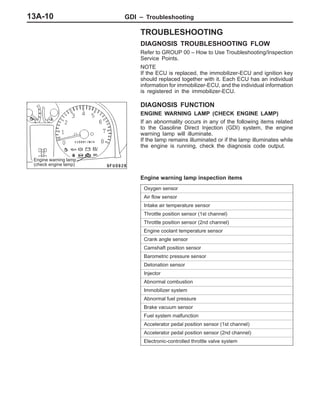
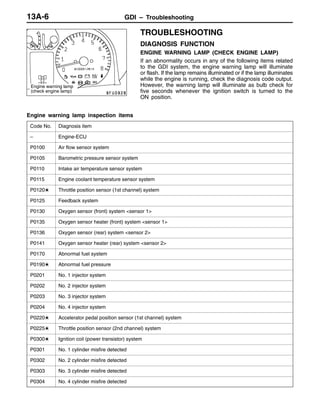
ENGINE WARNING LAMP (CHECK ENGINE LAMP)
If an abnormality occurs in any of the following items related
to the Gasoline Direct Injection (GDI) system, the engine
warning lamp will illuminate.
If the lamp remains illuminated or if the lamp illuminates while
the engine is running, check the diagnosis code output.
Engine warning lamp inspection items
Oxygen sensor
Air flow sensor
Intake air temperature sensor
Throttle position sensor (1st channel)
Throttle position sensor (2nd channel)
Engine coolant temperature sensor
Crank angle sensor
Camshaft position sensor
Barometric pressure sensor
Detonation sensor
Injector
Abnormal combustion
Immobilizer system
Abnormal fuel pressure
Brake vacuum sensor
Fuel system malfunction
Accelerator pedal position sensor (1st channel)
Accelerator pedal position sensor (2nd channel)
Electronic-controlled throttle valve system
Engine warning lamp
(check engine lamp)
GDI – Troubleshooting 13A-11
Throttle valve position feedback
Throttle valve control servo motor (1st motor)
Throttle valve control servo motor (2nd motor)
Communication line system with throttle valve controller
Engine-ECU
NOTE
When the electronic-controlled throttle valve system is stopped,
the engine warning lamp flashes.
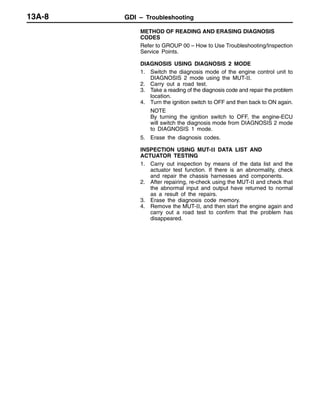
METHOD OF READING AND ERASING DIAGNOSIS
CODES
Refer to GROUP 00 – How to Use Troubleshooting/Inspection
Service Points.
INSPECTION USING MUT-II DATA LIST AND
ACTUATOR TESTING
1. Carry out inspection by means of the data list and the
actuator test function.
If there is an abnormality, check and repair the chassis
harnesses and components.
2. After repairing, re-check using the MUT-II and check that
the abnormal input and output have returned to normal
as a result of the repairs.
3. Erase the diagnosis code memory.
4. Remove the MUT-II.
5. Start the engine again and carry out a road test to confirm
that the problem has disappeared.
GDI – Troubleshooting13A-12
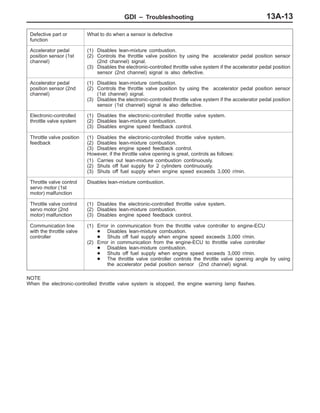
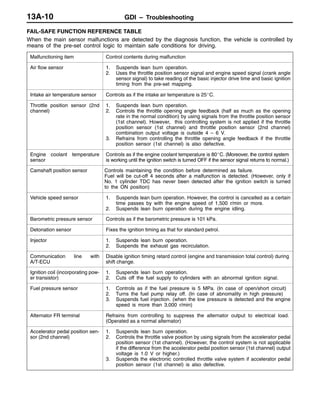
FAIL-SAFE FUNCTION REFERENCE TABLE
If the diagnosis system detects any sensor malfunction, the vehicle can be driven safely by using a default
control logic instead of the faulty sensors.
Defective part or
function
What to do when a sensor is defective
Air flow sensor (1) Disables lean-mixture combustion.
(2) Determines injector basic operating time and basic ignition timing according to map
value, which has been predetermined by throttle position sensor and crank angle
sensor signals.
Intake air temperature
sensor
Controls as the intake air temperature is 25_C.
Throttle position
sensor (1st channel)
(1) Disables lean-mixture combustion.
(2) Controls throttle valve opening angle by closed loop control by using the throttle position
sensor (2nd channel) signal.
(3) Disables the throttle valve opening angle control when the throttle position sensor
(2nd channel) signal is also defective.
Throttle position
sensor (2nd channel)
(1) Disables lean-mixture combustion.
(2) Controls throttle valve opening angle by closed loop control by using the throttle position
sensor (1st channel) signal.
(3) Disables the throttle valve opening angle control when the throttle position sensor
(1st channel) signal is also defective.
Engine coolant
temperature sensor
Controls as if the engine coolant temperature is 80_C. (Note that this control will continue
until the ignition switch is turned off even if the sensor signal return to normal.)
Camshaft position
sensor
Controls according to the conditions before a failure is detected.
Vehicle speed sensor (1) Disables lean-mixture combustion. However, if a predetermined time elapses at an
engine speed of 1,500 r/min or more, the lean-mixture combustion will return to normal.
(2) Disables lean-mixture combustion during engine idling.
Barometric pressure
sensor
Controls as if the barometric pressure is 101 kPa.
Detonation sensor Holds the ignition timing at that for standard petrol.
Injector (1) Disables lean-mixture combustion.
(2) Shuts down exhaust gas recirculation.
Abnormal combustion Disables lean-mixture combustion.
Communication line
with A/T-ECU
Disables ignition timing retard control (engine and transmission total control) during shift
change.
Alternator FR terminal Disables inhibition control of the alternator output according to electrical load (treats the
alternator as if it is conventional one).
Fuel pressure sensor (1) Controls as if the fuel pressure is 5 MPa (if there is open or short circuit).
(2) Turns off the fuel pump relay (if the fuel pressure is excessively high).
(3) Shuts off the fuel injection (If an excessively low pressure is detected or the engine
speed exceeds 3,000 r/min).
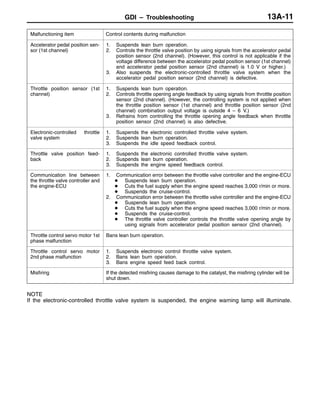
GDI – Troubleshooting 13A-13
Defective part or
function
What to do when a sensor is defective
Accelerator pedal
position sensor (1st
channel)
(1) Disables lean-mixture combustion.
(2) Controls the throttle valve position by using the accelerator pedal position sensor
(2nd channel) signal.
(3) Disables the electronic-controlled throttle valve system if the accelerator pedal position
sensor (2nd channel) signal is also defective.
Accelerator pedal
position sensor (2nd
channel)
(1) Disables lean-mixture combustion.
(2) Controls the throttle valve position by using the accelerator pedal position sensor
(1st channel) signal.
(3) Disables the electronic-controlled throttle valve system if the accelerator pedal position
sensor (1st channel) signal is also defective.
Electronic-controlled
throttle valve system
(1) Disables the electronic-controlled throttle valve system.
(2) Disables lean-mixture combustion.
(3) Disables engine speed feedback control.
Throttle valve position
feedback
(1) Disables the electronic-controlled throttle valve system.
(2) Disables lean-mixture combustion.
(3) Disables engine speed feedback control.
However, if the throttle valve opening is great, controls as follows:
(1) Carries out lean-mixture combustion continuously.
(2) Shuts off fuel supply for 2 cylinders continuously.
(3) Shuts off fuel supply when engine speed exceeds 3,000 r/min.
Throttle valve control
servo motor (1st
motor) malfunction
Disables lean-mixture combustion.
Throttle valve control
servo motor (2nd
motor) malfunction
(1) Disables the electronic-controlled throttle valve system.
(2) Disables lean-mixture combustion.
(3) Disables engine speed feedback control.
Communication line
with the throttle valve
controller
(1) Error in communication from the throttle valve controller to engine-ECU
D Disables lean-mixture combustion.
D Shuts off fuel supply when engine speed exceeds 3,000 r/min.
(2) Error in communication from the engine-ECU to throttle valve controller
D Disables lean-mixture combustion.
D Shuts off fuel supply when engine speed exceeds 3,000 r/min.
D The throttle valve controller controls the throttle valve opening angle by using
the accelerator pedal position sensor (2nd channel) signal.
NOTE
When the electronic-controlled throttle valve system is stopped, the engine warning lamp flashes.
GDI – Troubleshooting13A-14
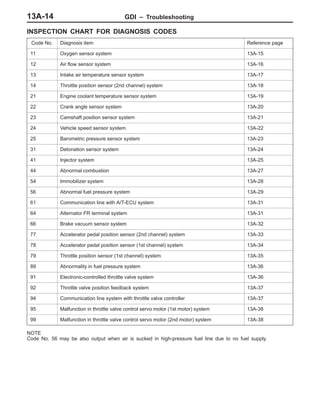
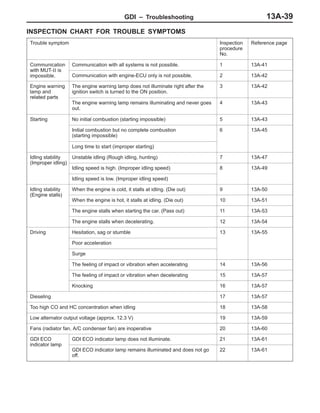
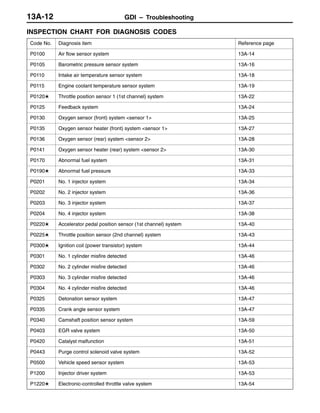
INSPECTION CHART FOR DIAGNOSIS CODES
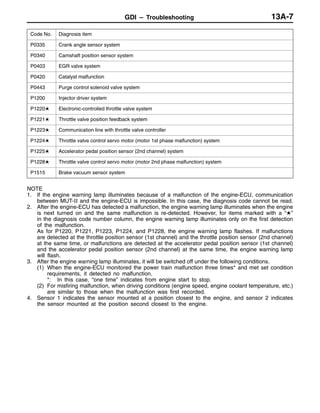
Code No. Diagnosis item Reference page
11 Oxygen sensor system 13A-15
12 Air flow sensor system 13A-16
13 Intake air temperature sensor system 13A-17
14 Throttle position sensor (2nd channel) system 13A-18
21 Engine coolant temperature sensor system 13A-19
22 Crank angle sensor system 13A-20
23 Camshaft position sensor system 13A-21
24 Vehicle speed sensor system 13A-22
25 Barometric pressure sensor system 13A-23
31 Detonation sensor system 13A-24
41 Injector system 13A-25
44 Abnormal combustion 13A-27
54 Immobilizer system 13A-28
56 Abnormal fuel pressure system 13A-29
61 Communication line with A/T-ECU system 13A-31
64 Alternator FR terminal system 13A-31
66 Brake vacuum sensor system 13A-32
77 Accelerator pedal position sensor (2nd channel) system 13A-33
78 Accelerator pedal position sensor (1st channel) system 13A-34
79 Throttle position sensor (1st channel) system 13A-35
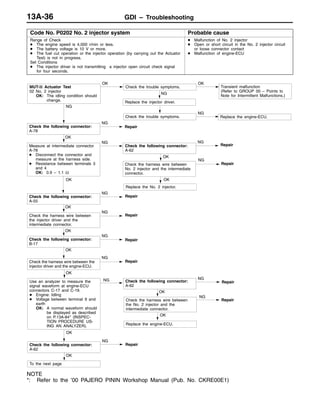
89 Abnormality in fuel pressure system 13A-36
91 Electronic-controlled throttle valve system 13A-36
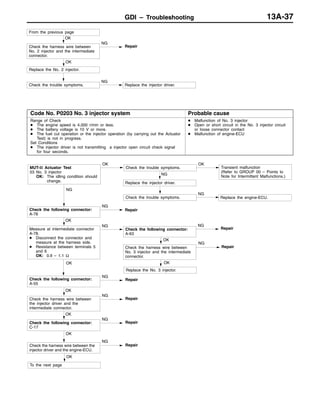
92 Throttle valve position feedback system 13A-37
94 Communication line system with throttle valve controller 13A-37
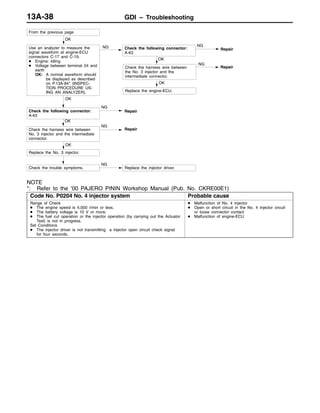
95 Malfunction in throttle valve control servo motor (1st motor) system 13A-38
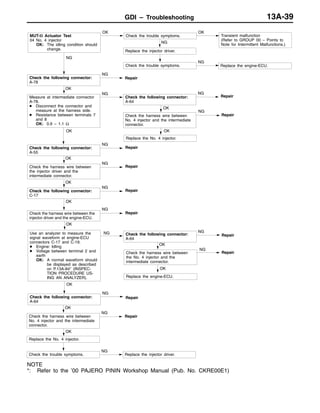
99 Malfunction in throttle valve control servo motor (2nd motor) system 13A-38
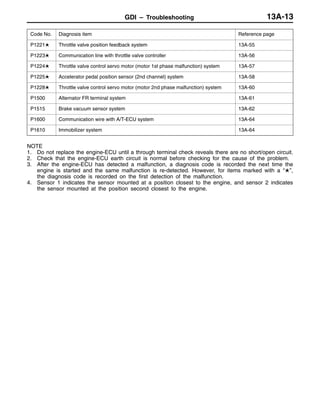
NOTE
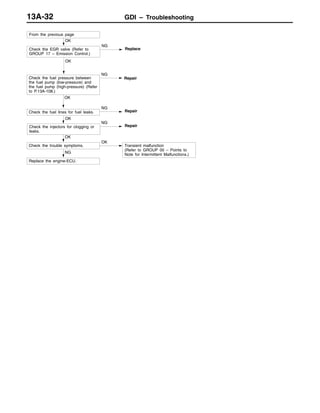
Code No. 56 may be also output when air is sucked in high-pressure fuel line due to no fuel supply.
GDI – Troubleshooting 13A-15
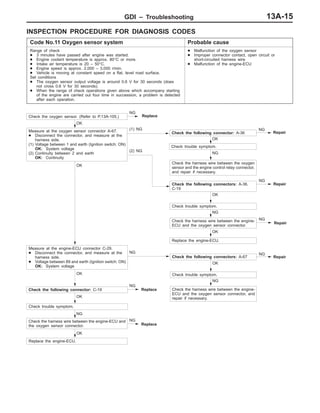
INSPECTION PROCEDURE FOR DIAGNOSIS CODES
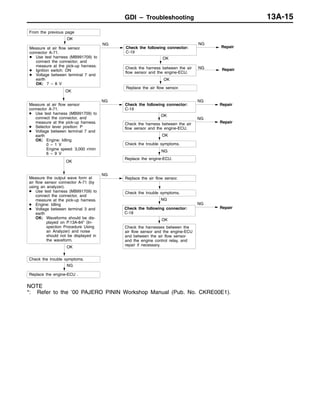
Code No.11 Oxygen sensor system Probable cause
Range of check
D 3 minutes have passed after engine was started.
D Engine coolant temperature is approx. 80°C or more.
D Intake air temperature is 20 – 50°C.
D Engine speed is approx. 2,000 – 3,000 r/min.
D Vehicle is moving at constant speed on a flat, level road surface.
Set conditions
D The oxygen sensor output voltage is around 0.6 V for 30 seconds (does
not cross 0.6 V for 30 seconds).
D When the range of check operations given above which accompany starting
of the engine are carried out four time in succession, a problem is detected
after each operation.
D Malfunction of the oxygen sensor
D Improper connector contact, open circuit or
short-circuited harness wire
D Malfunction of the engine-ECU
NG
Repair
OK
Replace the engine-ECU.
NG
OK
Check trouble symptom.
OK
Check the following connector: C-19
NG
Check the harness wire between the engine-
ECU and the oxygen sensor connector.
OK
Check trouble symptom.
OK
Measure at the oxygen sensor connector A-67.
D Disconnect the connector, and measure at the
harness side.
(1) Voltage between 1 and earth (Ignition switch: ON)
OK: System voltage
(2) Continuity between 2 and earth
OK: Continuity
(1) NG
Check the following connectors: A-36,
C-19
Check the oxygen sensor. (Refer to P.13A-105.)
NG
Replace
(2) NG
Check the harness wire between the oxygen
sensor and the engine control relay connector,
and repair if necessary.
NG
Repair
Measure at the engine-ECU connector C-29.
D Disconnect the connector, and measure at the
harness side.
D Voltage between 89 and earth (Ignition switch: ON)
OK: System voltage
Repair
NG
Check the harness wire between the engine-
ECU and the oxygen sensor connector, and
repair if necessary.
OK
Check trouble symptom.
Check the following connectors: A-67
OK
NG
Replace
Check the harness wire between the engine-ECU and
the oxygen sensor connector.
Replace the engine-ECU.
NG
OK
NG
Replace
NG
NG
Check trouble symptom.
NG
OK
Check the following connector: A-36
Repair
GDI – Troubleshooting13A-16
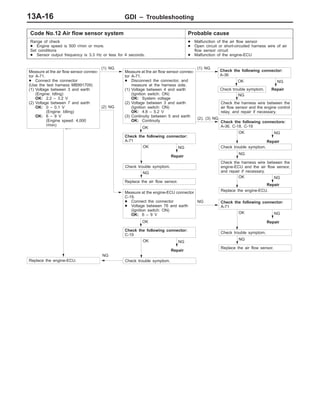
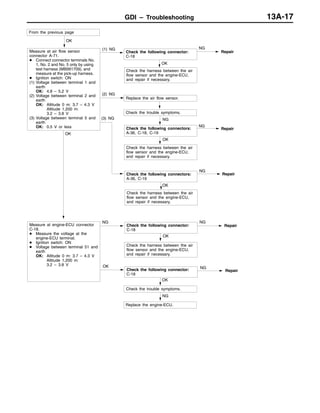
Code No.12 Air flow sensor system Probable cause
Range of check
D Engine speed is 500 r/min or more.
Set conditions
D Sensor output frequency is 3.3 Hz or less for 4 seconds.
D Malfunction of the air flow sensor
D Open circuit or short-circuited harness wire of air
flow sensor circuit
D Malfunction of the engine-ECU
NG
Repair
NG
Repair
OK
Replace the engine-ECU.
NG
Repair
NG
Replace the air flow sensor.
NG
Repair
NG
Replace the air flow sensor.
NG
Repair
OK
Replace the engine-ECU.
NG
OK
Check trouble symptom.
OK
Check the following connector:
C-19
OK
Check trouble symptom.
(2) NG
Measure at the engine-ECU connector
C-19.
D Connect the connector
D Voltage between 76 and earth
(Ignition switch: ON)
OK: 6 – 9 V
NG Check the following connector:
A-71
OK
Check trouble symptom.
OK
Check the following connector:
A-71
NG
Check the harness wire between the
engine-ECU and the air flow sensor,
and repair if necessary.
OK
Check trouble symptom.
(2), (3) NG
Check the following connectors:
A-36, C-18, C-19
Measure at the air flow sensor connec-
tor A-71.
D Connect the connector
(Use the test harness MB991709)
(1) Voltage between 3 and earth
(Engine: Idling)
OK: 2.2 – 3.2 V
(2) Voltage between 7 and earth
OK: 0 – 0.1 V
(Engine: Idling)
OK: 6 – 9 V
(Engine speed: 4,000
r/min)
(1) NG
Measure at the air flow sensor connec-
tor A-71.
D Disconnect the connector, and
measure at the harness side.
(1) Voltage between 4 and earth
(Ignition switch: ON)
OK: System voltage
(2) Voltage between 3 and earth
(Ignition switch: ON)
OK: 4.8 – 5.2 V
(3) Continuity between 5 and earth
OK: Continuity
(1) NG
Check the harness wire between the
air flow sensor and the engine control
relay, and repair if necessary.
NG
Repair
OK
Check trouble symptom.
Check the following connector:
A-36
NG
GDI – Troubleshooting 13A-17
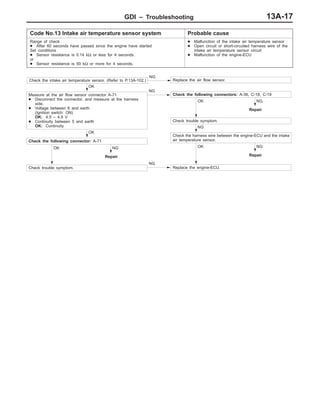
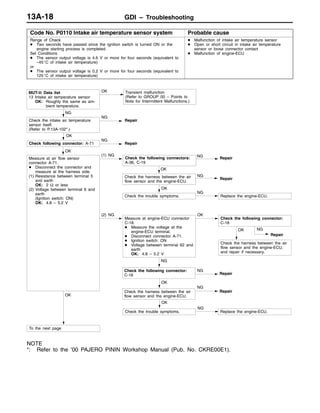
Code No.13 Intake air temperature sensor system Probable cause
Range of check
D After 60 seconds have passed since the engine have started
Set conditions
D Sensor resistance is 0.14 kΩ or less for 4 seconds.
or
D Sensor resistance is 50 kΩ or more for 4 seconds.
D Malfunction of the intake air temperature sensor
D Open circuit or short-circuited harness wire of the
intake air temperature sensor circuit
D Malfunction of the engine-ECU
NG
Repair
NG
Repair
OK
Replace the engine-ECU.
NG
Repair
NG
OK
Check trouble symptom.
OK
Check the following connector: A-71
NG
Check the harness wire between the engine-ECU and the intake
air temperature sensor.
OK
Check trouble symptom.
OK
Measure at the air flow sensor connector A-71.
D Disconnect the connector, and measure at the harness
side.
D Voltage between 6 and earth
(Ignition switch: ON)
OK: 4.5 – 4.9 V
D Continuity between 5 and earth
OK: Continuity
NG
Check the following connectors: A-36, C-18, C-19
Check the intake air temperature sensor. (Refer to P.13A-102.)
NG
Replace the air flow sensor.
GDI – Troubleshooting13A-18
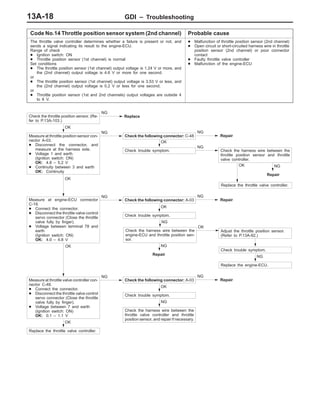
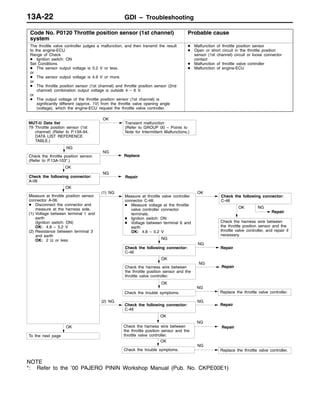
Code No.14 Throttle position sensor system (2nd channel) Probable cause
The throttle valve controller determines whether a failure is present or not, and
sends a signal indicating its result to the engine-ECU.
Range of check
D Ignition switch: ON
D Throttle position sensor (1st channel) is normal
Set conditions
D The throttle position sensor (1st channel) output voltage is 1.24 V or more, and
the (2nd channel) output voltage is 4.6 V or more for one second.
or
D The throttle position sensor (1st channel) output voltage is 3.53 V or less, and
the (2nd channel) output voltage is 0.2 V or less for one second.
or
D Throttle position sensor (1st and 2nd channels) output voltages are outside 4
to 6 V.
D Malfunction of throttle position sensor (2nd channel)
D Open circuit or short-circuited harness wire in throttle
position sensor (2nd channel) or poor connector
contact
D Faulty throttle valve controller
D Malfunction of the engine-ECU
Check trouble symptom.
NG
Replace the engine-ECU.
NG
Repair
OK
Replace the throttle valve controller.
Check the throttle position sensor. (Re-
fer to P.13A-103.)
NG
Replace
OK
Measure at throttle position sensor con-
nector A-03.
D Disconnect the connector, and
measure at the harness side.
D Voltage 1 and earth
(Ignition switch: ON)
OK: 4.8 – 5.2 V
D Continuity between 3 and earth
OK: Continuity
NG
Check the following connector: C-48
NG
Repair
OK
Check trouble symptom.
NG
Check the harness wire between the
throttle position sensor and throttle
valve controller.
OK
NG
Check the following connector: A-03
NG
Repair
OK
Check trouble symptom.
NG
Check the harness wire between the
engine-ECU and throttle position sen-
sor.
OK
Adjust the throttle position sensor.
(Refer to P.13A-92.)
NG
Repair
OK
Measure at throttle valve controller con-
nector C-48.
D Connect the connector.
D Disconnect the throttle valve control
servo connector (Close the throttle
valve fully by finger).
D Voltage between 7 and earth
(Ignition switch: ON)
OK: 0.1 – 1.1 V
NG
Check the following connector: A-03
NG
Repair
OK
Check trouble symptom.
NG
Check the harness wire between the
throttle valve controller and throttle
position sensor, and repair if necessary.
OK
Replace the throttle valve controller.
Measure at engine-ECU connector
C-19.
D Connect the connector.
D Disconnect the throttle valve control
servo connector (Close the throttle
valve fully by finger).
D Voltage between terminal 78 and
earth
(Ignition switch: ON)
OK: 4.0 – 4.8 V
GDI – Troubleshooting 13A-19
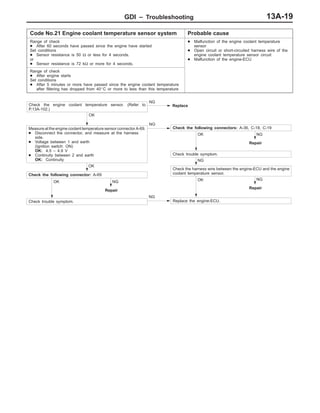
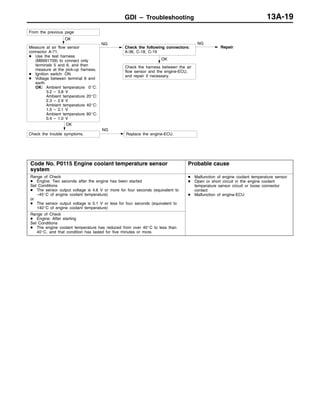
Code No.21 Engine coolant temperature sensor system Probable cause
Range of check
D After 60 seconds have passed since the engine have started
Set conditions
D Sensor resistance is 50 Ω or less for 4 seconds.
or
D Sensor resistance is 72 kΩ or more for 4 seconds.
D Malfunction of the engine coolant temperature
sensor
D Open circuit or short-circuited harness wire of the
engine coolant temperature sensor circuit
D Malfunction of the engine-ECU
Range of check
D After engine starts
Set conditions
D After 5 minutes or more have passed since the engine coolant temperature
after filtering has dropped from 40_C or more to less than this temperature
NG
Repair
NG
Repair
OK
Replace the engine-ECU.
NG
Repair
NG
OK
Check trouble symptom.
OK
Check the following connector: A-69
NG
Check the harness wire between the engine-ECU and the engine
coolant temperature sensor.
OK
Check trouble symptom.
OK
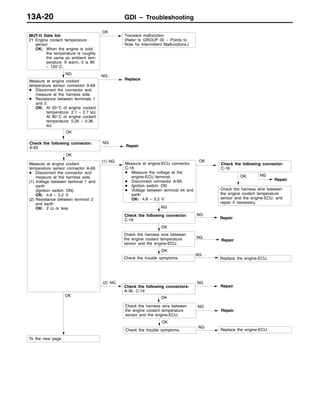
Measure at the engine coolant temperature sensor connector A-69.
D Disconnect the connector, and measure at the harness
side.
D Voltage between 1 and earth
(Ignition switch: ON)
OK: 4.5 – 4.9 V
D Continuity between 2 and earth
OK: Continuity
NG
Check the following connectors: A-36, C-18, C-19
Check the engine coolant temperature sensor. (Refer to
P.13A-102.)
NG
Replace
GDI – Troubleshooting13A-20
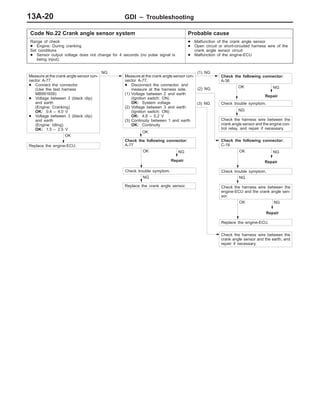
Code No.22 Crank angle sensor system Probable cause
Range of check
D Engine: During cranking
Set conditions
D Sensor output voltage does not change for 4 seconds (no pulse signal is
being input).
D Malfunction of the crank angle sensor
D Open circuit or short-circuited harness wire of the
crank angle sensor circuit
D Malfunction of the engine-ECU
NG
Repair
NG
Repair
OK
Replace the engine-ECU.
(3) NG
Check the harness wire between the
crank angle sensor and the earth, and
repair if necessary.
NG
Repair
NG
Replace the crank angle sensor.
OK
Replace the engine-ECU.
OK
Check trouble symptom.
NG
Check the harness wire between the
engine-ECU and the crank angle sen-
sor.
OK
Check trouble symptom.
(2) NG
Check the following connector:
C-18
OK
Check the following connector:
A-77
NG
Measure at the crank angle sensor con-
nector A-77.
D Disconnect the connector, and
measure at the harness side.
(1) Voltage between 2 and earth
(Ignition switch: ON)
OK: System voltage
(2) Voltage between 3 and earth
(Ignition switch: ON)
OK: 4.8 – 5.2 V
(3) Continuity between 1 and earth
OK: Continuity
(1) NG
Check the harness wire between the
crank angle sensor and the engine con-
trol relay, and repair if necessary.
Check the following connector:
A-36
OK
Repair
NG
Check trouble symptom.
NG
Measure at the crank angle sensor con-
nector A-77.
D Connect the connector
(Use the test harness
MB991658)
D Voltage between 3 (black clip)
and earth
(Engine: Cranking)
OK: 0.4 – 4.0 V
D Voltage between 3 (black clip)
and earth
(Engine: Idling)
OK: 1.5 – 2.5 V
GDI – Troubleshooting 13A-21
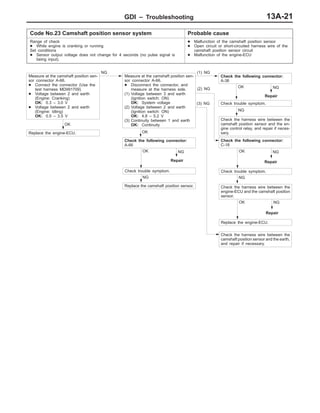
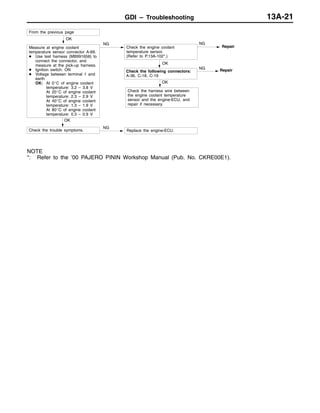
Code No.23 Camshaft position sensor system Probable cause
Range of check
D While engine is cranking or running
Set conditions
D Sensor output voltage does not change for 4 seconds (no pulse signal is
being input).
D Malfunction of the camshaft position sensor
D Open circuit or short-circuited harness wire of the
camshaft position sensor circuit
D Malfunction of the engine-ECU
OK
Replace the engine-ECU.
NG
Repair
NG
Repair
OK
Replace the engine-ECU.
(3) NG
Check the harness wire between the
camshaft position sensor and the earth,
and repair if necessary.
NG
Repair
NG
Replace the camshaft position sensor.
OK
Check trouble symptom.
NG
Check the harness wire between the
engine-ECU and the camshaft position
sensor.
OK
Check trouble symptom.
(2) NG
Check the following connector:
C-18
OK
Check the following connector:
A-66
Measure at the camshaft position sen-
sor connector A-66.
D Connect the connector (Use the
test harness MD991709)
D Voltage between 2 and earth
(Engine: Cranking)
OK: 0.3 – 3.0 V
D Voltage between 2 and earth
(Engine: Idling)
OK: 0.5 – 3.5 V
NG
Measure at the camshaft position sen-
sor connector A-66.
D Disconnect the connector, and
measure at the harness side.
(1) Voltage between 3 and earth
(Ignition switch: ON)
OK: System voltage
(2) Voltage between 2 and earth
(Ignition switch: ON)
OK: 4.8 – 5.2 V
(3) Continuity between 1 and earth
OK: Continuity
(1) NG
Check the harness wire between the
camshaft position sensor and the en-
gine control relay, and repair if neces-
sary.
Check the following connector:
A-36
OK
Repair
NG
Check trouble symptom.
NG
GDI – Troubleshooting13A-22
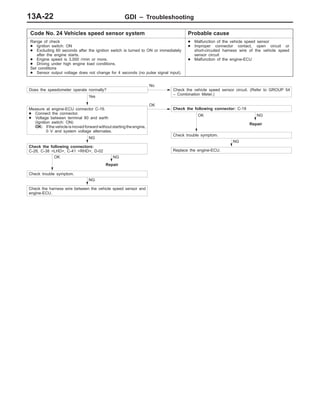
Code No. 24 Vehicles speed sensor system Probable cause
Range of check
D Ignition switch: ON
D Excluding 60 seconds after the ignition switch is turned to ON or immediately
after the engine starts.
D Engine speed is 3,000 r/min or more.
D Driving under high engine load conditions.
Set conditions
D Sensor output voltage does not change for 4 seconds (no pulse signal input).
D Malfunction of the vehicle speed sensor
D Improper connector contact, open circuit or
short-circuited harness wire of the vehicle speed
sensor circuit
D Malfunction of the engine-ECU
Does the speedometer operate normally?
No
Check the vehicle speed sensor circuit. (Refer to GROUP 54
– Combination Meter.)
Yes
Measure at engine-ECU connector C-19.
D Connect the connector.
D Voltage between terminal 80 and earth
(Ignition switch: ON)
OK: Ifthevehicleismovedforwardwithoutstartingtheengine,
0 V and system voltage alternates.
OK
Check the following connector: C-19
NG
Repair
OK
Check trouble symptom.
NG
Replace the engine-ECU.
NG
Check the following connectors:
C-28, C-38 <LHD>, C-41 <RHD>, D-02
NG
Repair
OK
Check trouble symptom.
NG
Check the harness wire between the vehicle speed sensor and
engine-ECU.
GDI – Troubleshooting 13A-23
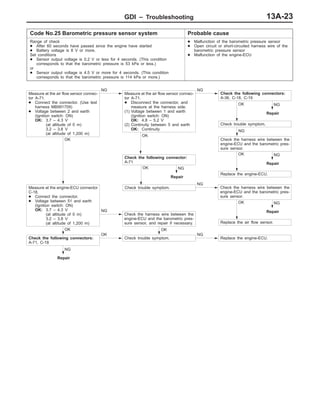
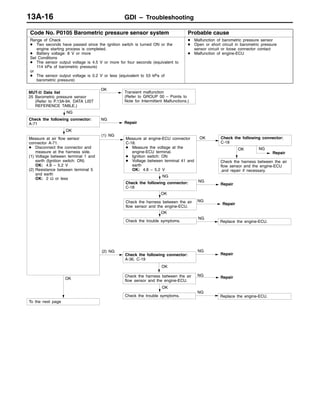
Code No.25 Barometric pressure sensor system Probable cause
Range of check
D After 60 seconds have passed since the engine have started
D Battery voltage is 8 V or more.
Set conditions
D Sensor output voltage is 0.2 V or less for 4 seconds. (This condition
corresponds to that the barometric pressure is 53 kPa or less.)
or
D Sensor output voltage is 4.5 V or more for 4 seconds. (This condition
corresponds to that the barometric pressure is 114 kPa or more.)
D Malfunction of the barometric pressure sensor
D Open circuit or short-circuited harness wire of the
barometric pressure sensor
D Malfunction of the engine-ECU
NG
Repair
NG
Repair
OK
Replace the engine-ECU.
NG
Repair
NG
Repair
OK
Replace the air flow sensor.
OK
NG
Repair
OK
Check the following connectors:
A-71, C-18
OK
Check trouble symptom.
NG
Replace the engine-ECU.
OK
Measure at the engine-ECU connector
C-18.
D Connect the connector.
D Voltage between 51 and earth
(Ignition switch: ON)
OK: 3.7 – 4.3 V
(at altitude of 0 m)
3.2 – 3.8 V
(at altitude of 1,200 m)
NG
Check the harness wire between the
engine-ECU and the barometric pres-
sure sensor, and repair if necessary.
NG
Check the harness wire between the
engine-ECU and the barometric pres-
sure sensor.
OK
Check trouble symptom.
OK
Check the following connector:
A-71
NG
Check the harness wire between the
engine-ECU and the barometric pres-
sure sensor.
OK
Check trouble symptom.
Measure at the air flow sensor connec-
tor A-71.
D Connect the connector. (Use test
harness MB991709)
D Voltage between 2 and earth
(Ignition switch: ON)
OK: 3.7 – 4.3 V
(at altitude of 0 m)
3.2 – 3.8 V
(at altitude of 1,200 m)
NG
Measure at the air flow sensor connec-
tor A-71.
D Disconnect the connector, and
measure at the harness side.
(1) Voltage between 1 and earth
(Ignition switch: ON)
OK: 4.8 – 5.2 V
(2) Continuity between 5 and earth
OK: Continuity
NG
Check the following connectors:
A-36, C-18, C-19
GDI – Troubleshooting13A-24
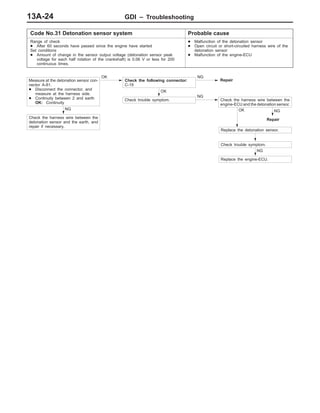
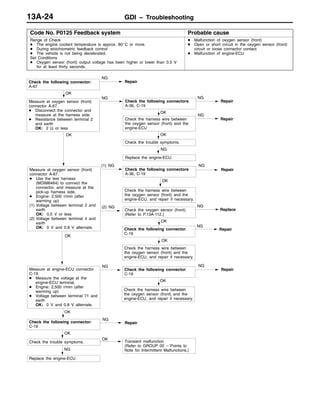
Code No.31 Detonation sensor system Probable cause
Range of check
D After 60 seconds have passed since the engine have started
Set conditions
D Amount of change in the sensor output voltage (detonation sensor peak
voltage for each half rotation of the crankshaft) is 0.06 V or less for 200
continuous times.
D Malfunction of the detonation sensor
D Open circuit or short-circuited harness wire of the
detonation sensor
D Malfunction of the engine-ECU
NG
Repair
NG
Replace the engine-ECU.
NG
Check the harness wire between the
detonation sensor and the earth, and
repair if necessary.
Check trouble symptom.
OK
Replace the detonation sensor.
OK
Check trouble symptom.
NG
Check the harness wire between the
engine-ECU and the detonation sensor.
Measure at the detonation sensor con-
nector A-81.
D Disconnect the connector, and
measure at the harness side.
D Continuity between 2 and earth
OK: Continuity
OK
Check the following connector:
C-19
NG
Repair
GDI – Troubleshooting 13A-25
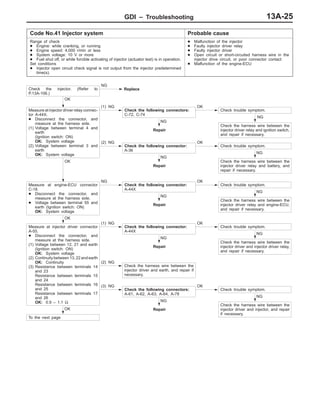
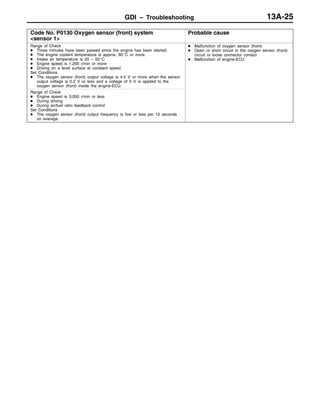
Code No.41 Injector system Probable cause
Range of check
D Engine: while cranking, or running
D Engine speed: 4,000 r/min or less
D System voltage: 10 V or more
D Fuel shut off, or while forcible activating of injector (actuator test) is in operation.
Set conditions
D Injector open circuit check signal is not output from the injector predetermined
time(s).
D Malfunction of the injector
D Faulty injector driver relay
D Faulty injector driver
D Open circuit or short-circuited harness wire in the
injector drive circuit, or poor connector contact
D Malfunction of the engine-ECU
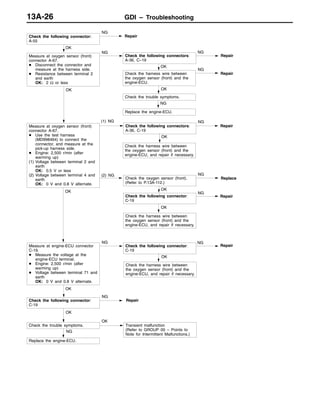
(2) NG
Check the following connector:
A-36
OK
Check trouble symptom.
(2) NG
Check the harness wire between the
injector driver and earth, and repair if
necessary.
(3) NG
Check the following connectors:
A-61, A-62, A-63, A-64, A-78
OK
Check trouble symptom.
Check the injector. (Refer to
P.13A-106.)
NG
Replace
OK
(1) NG
Check the following connectors:
C-72, C-74
OK
Check trouble symptom.
NG
Check the harness wire between the
injector driver relay and ignition switch,
and repair if necessary.
NG
Repair
NG
Check the harness wire between the
injector driver relay and battery, and
repair if necessary.
NG
Repair
OK
Measure at engine-ECU connector
C-18.
D Disconnect the connector, and
measure at the harness side.
D Voltage between terminal 55 and
earth (Ignition switch: ON)
OK: System voltage
NG
Check the following connector:
A-44X
OK
Check trouble symptom.
NG
Check the harness wire between the
injector driver relay and engine-ECU,
and repair if necessary.
NG
Repair
OK
Measure at injector driver connector
A-55.
D Disconnect the connector, and
measure at the harness side.
(1) Voltage between 12, 21 and earth
(Ignition switch: ON)
OK: System voltage
(2) Continuitybetween 13, 22 and earth
OK: Continuity
(3) Resistance between terminals 14
and 23
Resistance between terminals 15
and 24
Resistance between terminals 16
and 25
Resistance between terminals 17
and 26
OK: 0.9 – 1.1 Ω
(1) NG
Check the following connector:
A-44X
OK
Check trouble symptom.
NG
Check the harness wire between the
injector driver and injector driver relay,
and repair if necessary.
NG
Repair
NG
Check the harness wire between the
injector driver and injector, and repair
if necessary.
NG
RepairOK
To the next page
Measure at injector driver relay connec-
tor A-44X.
D Disconnect the connector, and
measure at the harness side.
(1) Voltage between terminal 4 and
earth
(Ignition switch: ON)
OK: System voltage
(2) Voltage between terminal 3 and
earth
OK: System voltage
GDI – Troubleshooting13A-26
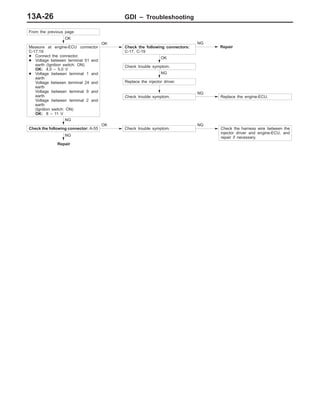
From the previous page
OK
Measure at engine-ECU connector
C-17,19.
D Connect the connector.
D Voltage between terminal 51 and
earth (Ignition switch: ON)
OK: 4.0 – 5.0 V
D Voltage between terminal 1 and
earth
Voltage between terminal 24 and
earth
Voltage between terminal 9 and
earth
Voltage between terminal 2 and
earth
(Ignition switch: ON)
OK: 8 – 11 V
OK
Check the following connectors:
C-17, C-19
NG
Repair
OK
Check trouble symptom.
NG
Replace the injector driver.
Check trouble symptom.
NG
Replace the engine-ECU.
NG
Check the following connector: A-55
OK
Check trouble symptom.
NG
Check the harness wire between the
injector driver and engine-ECU, and
repair if necessary.
NG
Repair
GDI – Troubleshooting 13A-27
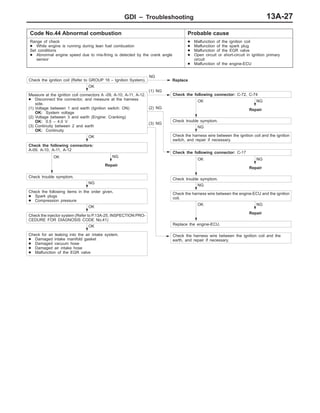
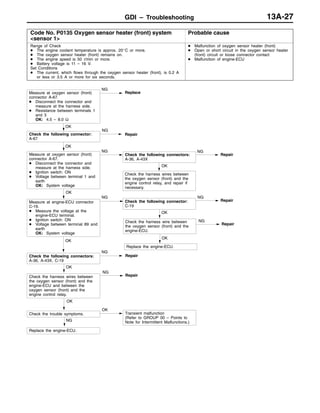
Code No.44 Abnormal combustion Probable cause
Range of check
D While engine is running during lean fuel combustion
Set conditions
D Abnormal engine speed due to mis-firing is detected by the crank angle
sensor
D Malfunction of the ignition coil
D Malfunction of the spark plug
D Malfunction of the EGR valve
D Open circuit or short-circuit in ignition primary
circuit
D Malfunction of the engine-ECU
NG
Repair
NG
Check the harness wire between the ignition coil and the ignition
switch, and repair if necessary.
(2) NG
NG
Repair
NG
Repair
OK
Replace the engine-ECU.
(3) NG
Check the harness wire between the ignition coil and the
earth, and repair if necessary.
NG
Repair
OK
Check for air leaking into the air intake system.
D Damaged intake manifold gasket
D Damaged vacuum hose
D Damaged air intake hose
D Malfunction of the EGR valve
OK
Check the injector system (Refer to P.13A-25, INSPECTION PRO-
CEDURE FOR DIAGNOSIS CODE No.41)
NG
Check the following items in the order given.
D Spark plugs
D Compression pressure
OK
Check trouble symptom.
NG
Check the harness wire between the engine-ECU and the ignition
coil.
OK
Check trouble symptom.
OK
Check the following connectors:
A-09, A-10, A-11, A-12
OK
Check trouble symptom.
Check the following connector: C-17
OK
Measure at the ignition coil connectors A -09, A-10, A-11, A-12.
D Disconnect the connector, and measure at the harness
side.
(1) Voltage between 1 and earth (Ignition switch: ON)
OK: System voltage
(2) Voltage between 3 and earth (Engine: Cranking)
OK: 0.5 – 4.0 V
(3) Continuity between 2 and earth
OK: Continuity
(1) NG
Check the following connector: C-72, C-74
Check the ignition coil (Refer to GROUP 16 – Ignition System).
NG
Replace
GDI – Troubleshooting13A-28
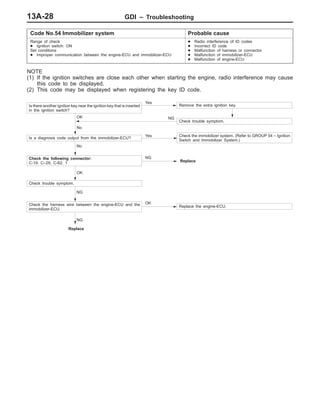
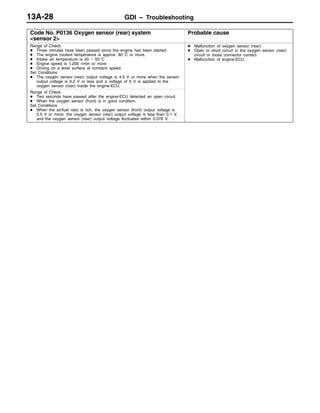
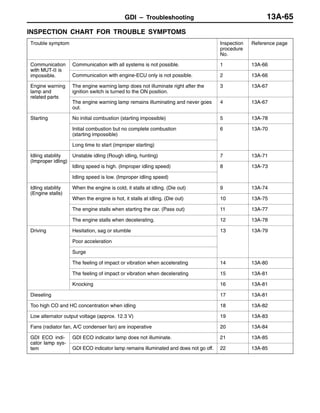
Code No.54 Immobilizer system Probable cause
Range of check
D Ignition switch: ON
Set conditions
D Improper communication between the engine-ECU and immobilizer-ECU
D Radio interference of ID codes
D Incorrect ID code
D Malfunction of harness or connector
D Malfunction of immobilizer-ECU
D Malfunction of engine-ECU
NOTE
(1) If the ignition switches are close each other when starting the engine, radio interference may cause
this code to be displayed.
(2) This code may be displayed when registering the key ID code.
Replace the engine-ECU.
Check trouble symptom.
No
Check the following connector:
C-19, C–29, C-62, 1
Check the immobilizer system. (Refer to GROUP 54 – Ignition
Switch and Immobilizer System.)
Check trouble symptom.
OK
Is a diagnosis code output from the immobilizer-ECU?
NG
Yes
Remove the extra ignition key.
OK
Replace
Check the harness wire between the engine-ECU and the
immobilizer-ECU.
NG
No
NG
Replace
OK
Yes
NG
Is there another ignition key near the ignition key that is inserted
in the ignition switch?
GDI – Troubleshooting 13A-29
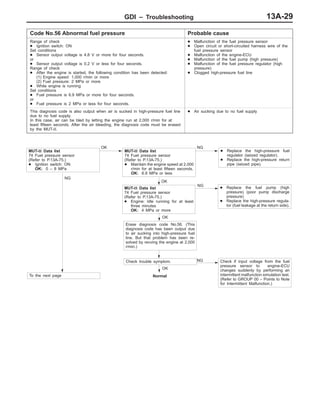
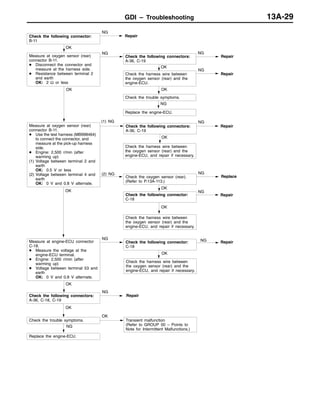
Code No.56 Abnormal fuel pressure Probable cause
Range of check
D Ignition switch: ON
Set conditions
D Sensor output voltage is 4.8 V or more for four seconds.
or
D Sensor output voltage is 0.2 V or less for four seconds.
Range of check
D After the engine is started, the following condition has been detected:
(1) Engine speed: 1,000 r/min or more
(2) Fuel pressure: 2 MPa or more
D While engine is running
Set conditions
D Fuel pressure is 6.9 MPa or more for four seconds.
or
D Fuel pressure is 2 MPa or less for four seconds.
D Malfunction of the fuel pressure sensor
D Open circuit or short-circuited harness wire of the
fuel pressure sensor
D Malfunction of the engine-ECU
D Malfunction of the fuel pump (high pressure)
D Malfunction of the fuel pressure regulator (high
pressure)
D Clogged high-pressure fuel line
This diagnosis code is also output when air is sucked in high-pressure fuel line
due to no fuel supply.
In this case, air can be bled by letting the engine run at 2,000 r/min for at
least fifteen seconds. After the air bleeding, the diagnosis code must be erased
by the MUT-II.
D Air sucking due to no fuel supply
OK
NG
D Replace the fuel pump (high
pressure) (poor pump discharge
pressure)
D Replace the high-pressure regula-
tor (fuel leakage at the return side).
Check trouble symptom. NG Check if input voltage from the fuel
pressure sensor to engine-ECU
changes suddenly by performing an
intermittent malfunction simulation test.
(Refer to GROUP 00 – Points to Note
for Intermittent Malfunction.)
OK
Normal
NG
To the next page
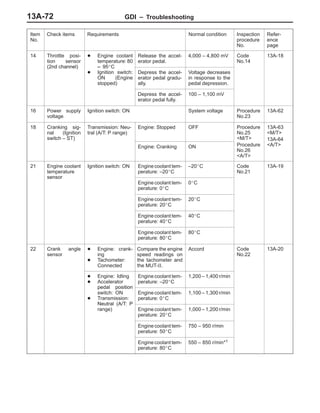
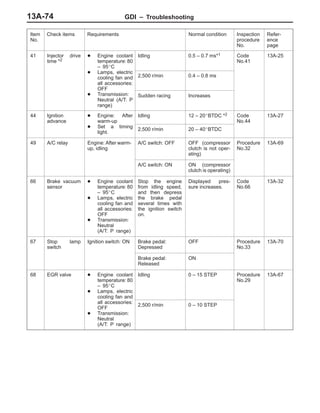
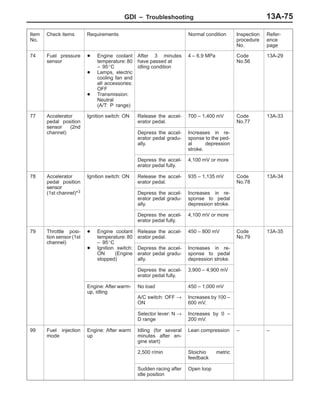
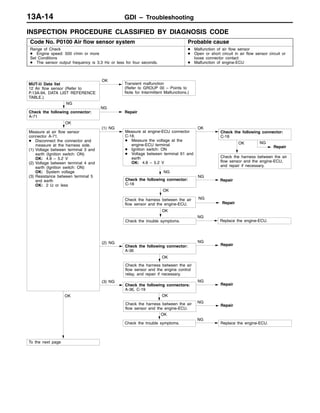
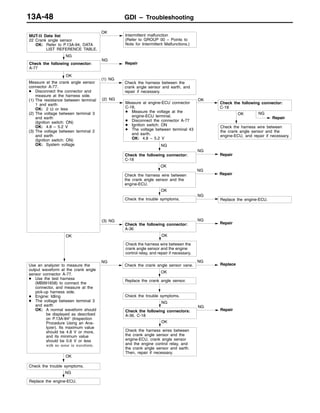
MUT-II Data list
74 Fuel pressure sensor
(Refer to P.13A-75.)
D Ignition switch: ON
OK: 0 – 8 MPa
OK
MUT-II Data list
74 Fuel pressure sensor
(Refer to P.13A-75.)
D Maintain the engine speed at 2,000
r/min for at least fifteen seconds.
OK: 6.9 MPa or less
NG
D Replace the high-pressure fuel
regulator (seized regulator).
D Replace the high-pressure return
pipe (seized pipe).
MUT-II Data list
74 Fuel pressure sensor
(Refer to P.13A-75.)
D Engine: Idle running for at least
three minutes
OK: 4 MPa or more
OK
Erase diagnosis code No.56. (This
diagnosis code has been output due
to air sucking into high-pressure fuel
line. But that problem has been re-
solved by revving the engine at 2,000
r/min.)
GDI – Troubleshooting13A-30
NG
Repair
NG
Repair
OK
Replace the engine-ECU.
NG
Repair
NG
Repair
OK
Replace the fuel pressure sensor.
NG
Replace the engine-ECU.
OK
Check trouble symptom.
OK
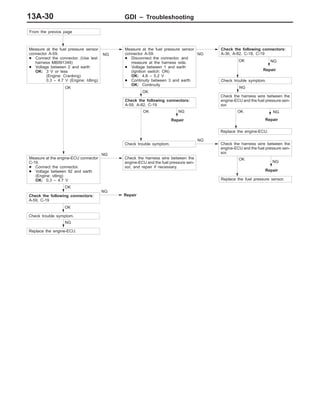
Check the following connectors:
A-59, C-19
NG
Repair
OK
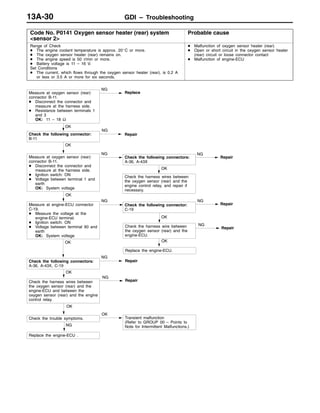
Measure at the engine-ECU connector
C-19.
D Connect the connector.
D Voltage between 92 and earth
(Engine: idling)
OK: 0.3 – 4.7 V
NG
Check the harness wire between the
engine-ECU and the fuel pressure sen-
sor, and repair if necessary.
NG
Check the harness wire between the
engine-ECU and the fuel pressure sen-
sor.
OK
Check trouble symptom.
NG
Check the harness wire between the
engine-ECU and the fuel pressure sen-
sor.
OK
Check trouble symptom.
OK
Check the following connectors:
A-59, A-82, C-19
Measure at the fuel pressure sensor
connector A-59.
D Connect the connector. (Use test
harness MB991348)
D Voltage between 2 and earth
OK: 3 V or less
(Engine: Cranking)
0.3 – 4.7 V (Engine: Idling)
NG
Measure at the fuel pressure sensor
connector A-59.
D Disconnect the connector, and
measure at the harness side.
D Voltage between 1 and earth
(Ignition switch: ON)
OK: 4.8 – 5.2 V
D Continuity between 3 and earth
OK: Continuity
NG
Check the following connectors:
A-36, A-82, C-18, C-19
From the previos page
GDI – TroubleshootingGDI – Troubleshooting 13A-31
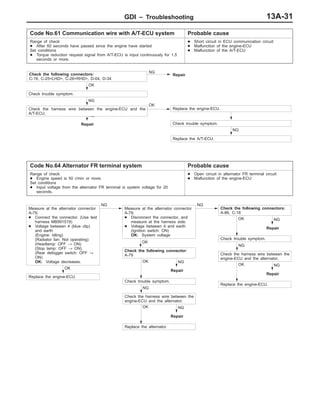
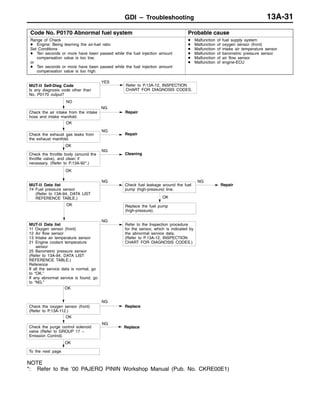
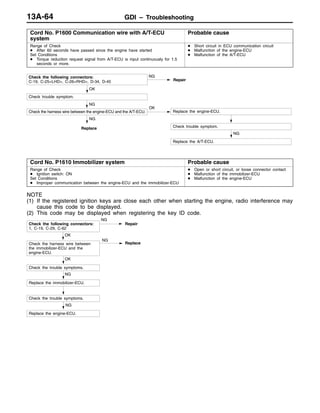
Code No.61 Communication wire with A/T-ECU system Probable cause
Range of check
D After 60 seconds have passed since the engine have started
Set conditions
D Torque reduction request signal from A/T-ECU is input continuously for 1.5
seconds or more.
D Short circuit in ECU communication circuit
D Malfunction of the engine-ECU
D Malfunction of the A/T-ECU
NG
Replace the A/T-ECU.
NG
Repair Check trouble symptom.
NG
Check the harness wire between the engine-ECU and the
A/T-ECU.
OK
Replace the engine-ECU.
OK
Check trouble symptom.
Check the following connectors:
C-19, C-25<LHD>, C-26<RHD>, D-04, D-34
NG
Repair
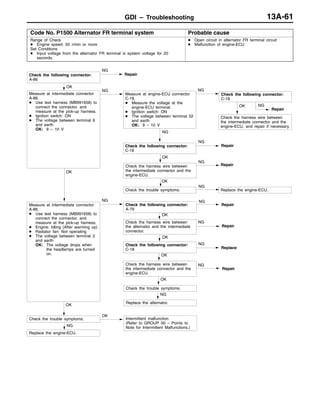
Code No.64 Alternator FR terminal system Probable cause
Range of check
D Engine speed is 50 r/min or more.
Set conditions
D Input voltage from the alternator FR terminal is system voltage for 20
seconds.
D Open circuit in alternator FR terminal circuit
D Malfunction of the engine-ECU
NG
Repair
NG
Repair
OK
Replace the engine-ECU.
NG
Repair
NG
Repair
OK
Replace the alternator.
OK
Replace the engine-ECU.
NG
Check the harness wire between the
engine-ECU and the alternator.
OK
Check trouble symptom.
OK
Check the following connector:
A-79
NG
Check the harness wire between the
engine-ECU and the alternator.
OK
Check trouble symptom.
Measure at the alternator connector
A-79.
D Connect the connector. (Use test
harness MB991519)
D Voltage between 4 (blue clip)
and earth
(Engine: Idling)
(Radiator fan: Not operating)
(Headlamp: OFF → ON)
(Stop lamp: OFF → ON)
(Rear defogger switch: OFF →
ON)
OK: Voltage decreases.
NG
Measure at the alternator connector
A-79.
D Disconnect the connector, and
measure at the harness side.
D Voltage between 4 and earth
(Ignition switch: ON)
OK: System voltage
NG
Check the following connectors:
A-86, C-18
GDI – Troubleshooting13A-32
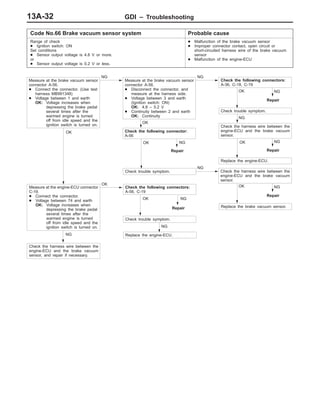
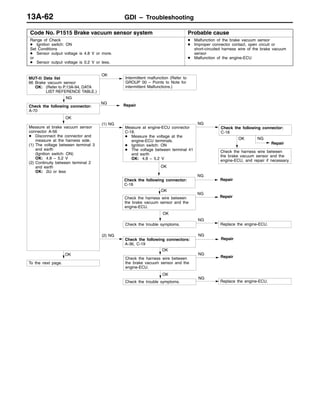
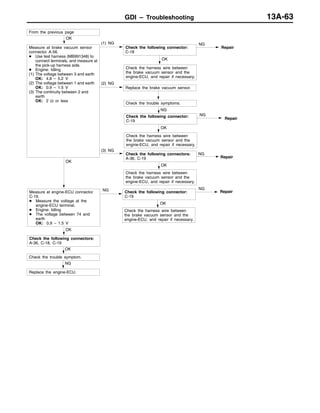
Code No.66 Brake vacuum sensor system Probable cause
Range of check
D Ignition switch: ON
Set conditions
D Sensor output voltage is 4.8 V or more.
or
D Sensor output voltage is 0.2 V or less.
D Malfunction of the brake vacuum sensor
D Improper connector contact, open circuit or
short-circuited harness wire of the brake vacuum
sensor
D Malfunction of the engine-ECU
NG
Repair
NG
Repair
OK
Replace the engine-ECU.
NG
Repair
NG
Repair
Replace the brake vacuum sensor.
OK
OK
Check trouble symptom.
Check the following connectors:
A-56, C-19
OK
NG
Replace the engine-ECU.
OK
NG
Check the harness wire between the
engine-ECU and the brake vacuum
sensor.
OK
Check trouble symptom.
NG
Check the harness wire between the
engine-ECU and the brake vacuum
sensor.
OK
Check the following connector:
A-56
OK
Check trouble symptom.
Measure at the brake vacuum sensor
connector A-56.
D Connect the connector. (Use test
harness MB991348)
D Voltage between 1 and earth
OK: Voltage increases when
depressing the brake pedal
several times after the
warmed engine is turned
off from idle speed and the
ignition switch is turned on.
NG
Measure at the brake vacuum sensor
connector A-56.
D Disconnect the connector, and
measure at the harness side.
D Voltage between 3 and earth
(Ignition switch: ON)
OK: 4.8 – 5.2 V
D Continuity between 2 and earth
OK: Continuity
NG
Check the following connectors:
A-36, C-18, C-19
Measure at the engine-ECU connector
C-19.
D Connect the connector.
D Voltage between 74 and earth
OK: Voltage increases when
depressing the brake pedal
several times after the
warmed engine is turned
off from idle speed and the
ignition switch is turned on.
Check the harness wire between the
engine-ECU and the brake vacuum
sensor, and repair if necessary.
Repair
NG
NG
GDI – Troubleshooting 13A-33
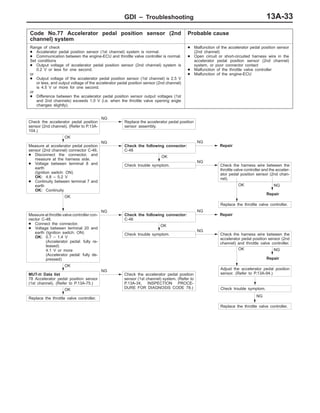
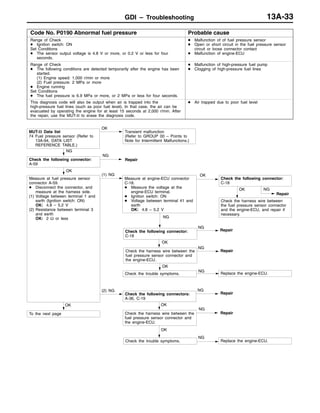
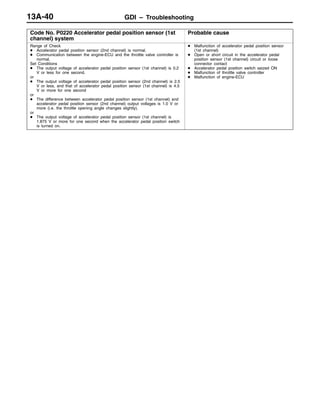
Code No.77 Accelerator pedal position sensor (2nd
channel) system
Probable cause
Range of check
D Accelerator pedal position sensor (1st channel) system is normal.
D Communication between the engine-ECU and throttle valve controller is normal.
Set conditions
D Output voltage of accelerator pedal position sensor (2nd channel) system is
0.2 V or less for one second.
or
D Output voltage of the accelerator pedal position sensor (1st channel) is 2.5 V
or less, and output voltage of the accelerator pedal position sensor (2nd channel)
is 4.5 V or more for one second.
or
D Difference between the accelerator pedal position sensor output voltages (1st
and 2nd channels) exceeds 1.0 V (i.e. when the throttle valve opening angle
changes slightly).
D Malfunction of the accelerator pedal position sensor
(2nd channel)
D Open circuit or short-circuited harness wire in the
accelerator pedal position sensor (2nd channel)
system, or poor connector contact
D Malfunction of the throttle valve controller
D Malfunction of the engine-ECU
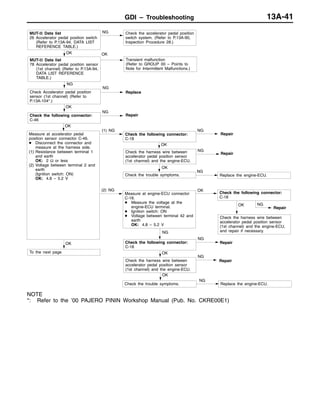
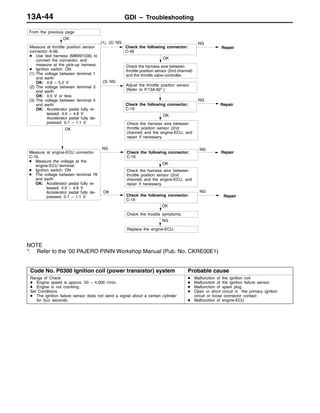
Check the harness wire between the
throttle valve controller and the acceler-
ator pedal position sensor (2nd chan-
nel).
NG
Repair
OK
Replace the throttle valve controller.
NG
Repair
OK
Adjust the accelerator pedal position
sensor. (Refer to P.13A-94.)
Check the accelerator pedal position
sensor (2nd channel). (Refer to P.13A-
104.)
NG
Replace the accelerator pedal position
sensor assembly.
OK
Measure at accelerator pedal position
sensor (2nd channel) connector C-46.
D Disconnect the connector, and
measure at the harness side.
D Voltage between terminal 8 and
earth
(Ignition switch: ON)
OK: 4.8 – 5.2 V
D Continuity between terminal 7 and
earth
OK: Continuity
NG NG
Repair
OK
Check trouble symptom.
NG
OK
Measure at throttle valve controller con-
nector C-48.
D Connect the connector.
D Voltage between terminal 20 and
earth (Ignition switch: ON)
OK: 0.7 – 1.4 V
(Accelerator pedal: fully re-
leased)
4.1 V or more
(Accelerator pedal: fully de-
pressed)
NG
Check the following connector:
C-46
NG
Repair
OK
Check trouble symptom.
NG
Check the harness wire between the
accelerator pedal position sensor (2nd
channel) and throttle valve controller.
Check trouble symptom.
NG
Replace the throttle valve controller.
OK
MUT-II Data list
78 Accelerator pedal position sensor
(1st channel). (Refer to P.13A-75.)
NG
Check the accelerator pedal position
sensor (1st channel) system. (Refer to
P.13A-34, INSPECTION PROCE-
DURE FOR DIAGNOSIS CODE 78.)OK
Replace the throttle valve controller.
Check the following connector:
C-48
GDI – Troubleshooting13A-34
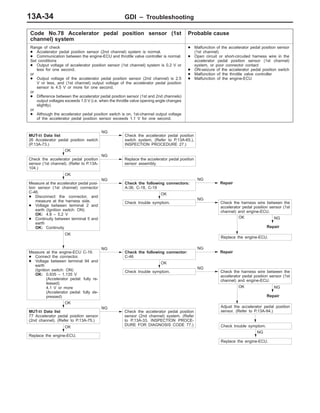
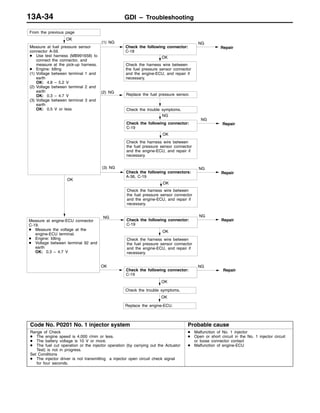
Code No.78 Accelerator pedal position sensor (1st
channel) system
Probable cause
Range of check
D Accelerator pedal position sensor (2nd channel) system is normal.
D Communication between the engine-ECU and throttle valve controller is normal.
Set conditions
D Output voltage of accelerator position sensor (1st channel) system is 0.2 V or
less for one second.
or
D Output voltage of the accelerator pedal position sensor (2nd channel) is 2.5
V or less, and (1st channel) output voltage of the accelerator pedal position
sensor is 4.5 V or more for one second.
or
D Difference between the accelerator pedal position sensor (1st and 2nd channels)
output voltages exceeds 1.0 V (i.e. when the throttle valve opening angle changes
slightly).
or
D Although the accelerator pedal position switch is on, 1st-channel output voltage
of the accelerator pedal position sensor exceeds 1.1 V for one second.
D Malfunction of the accelerator pedal position sensor
(1st channel)
D Open circuit or short-circuited harness wire in the
accelerator pedal position sensor (1st channel)
system, or poor connector contact
D ON-seizure of the accelerator pedal position switch
D Malfunction of the throttle valve controller
D Malfunction of the engine-ECU
NG
Repair
OK
Adjust the accelerator pedal position
sensor. (Refer to P.13A-94.)
NG
Repair
OK
Replace the engine-ECU.
MUT-II Data list
26 Accelerator pedal position switch
(P.13A-73.)
NG
Check the accelerator pedal position
switch system. (Refer to P.13A-65.),
INSPECTION PROCEDURE 27.)
OK
Check the accelerator pedal position
sensor (1st channel). (Refer to P.13A-
104.)
NG
Replace the accelerator pedal position
sensor assembly.
OK
Measure at the accelerator pedal posi-
tion sensor (1st channel) connector
C-46.
D Disconnect the connector, and
measure at the harness side.
D Voltage between terminal 2 and
earth (Ignition switch: ON)
OK: 4.8 – 5.2 V
D Continuity between terminal 5 and
earth
OK: Continuity
NG
Check the following connectors:
A-36, C-18, C-19
NG
Repair
OK
Check trouble symptom.
NG
Check the harness wire between the
accelerator pedal position sensor (1st
channel) and engine-ECU.
OK
Measure at the engine-ECU C-19.
D Connect the connector.
D Voltage between terminal 94 and
earth
(Ignition switch: ON)
OK: 0.935 – 1.135 V
(Accelerator pedal: fully re-
leased)
4.1 V or more
(Accelerator pedal: fully de-
pressed)
NG
Check the following connector:
C-46
NG
Repair
OK
Check trouble symptom.
NG
Check the harness wire between the
accelerator pedal position sensor (1st
channel) and engine-ECU.
Check trouble symptom.
NG
Replace the engine-ECU.
OK
MUT-II Data list
77 Accelerator pedal position sensor
(2nd channel). (Refer to P.13A-75.)
NG
Check the accelerator pedal position
sensor (2nd channel) system. (Refer
to P.13A-33, INSPECTION PROCE-
DURE FOR DIAGNOSIS CODE 77.)
OK
Replace the engine-ECU.
GDI – Troubleshooting 13A-35
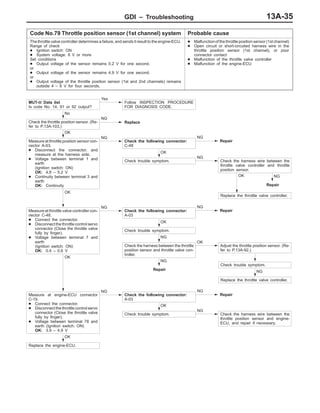
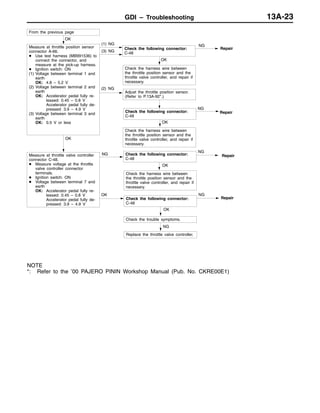
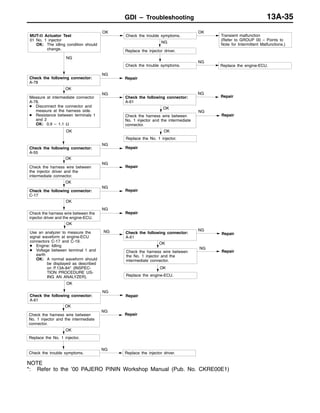
Code No.79 Throttle position sensor (1st channel) system Probable cause
The throttle valve controller determines a failure, and sends it result to the engine-ECU.
Range of check
D Ignition switch: ON
D System voltage: 8 V or more
Set conditions
D Output voltage of the sensor remains 0.2 V for one second.
or
D Output voltage of the sensor remains 4.9 V for one second.
or
D Output voltage of the throttle position sensor (1st and 2nd channels) remains
outside 4 – 6 V for four seconds.
D Malfunctionof the throttle position sensor (1st channel)
D Open circuit or short-circuited harness wire in the
throttle position sensor (1st channel), or poor
connector contact
D Malfunction of the throttle valve controller
D Malfunction of the engine-ECU
NG
Repair
OK
Replace the throttle valve controller.
MUT-II Data list
Is code No. 14, 91 or 92 output?
Yes
Follow INSPECTION PROCEDURE
FOR DIAGNOSIS CODE.
No
Check the throttle position sensor. (Re-
fer to P.13A-103.)
NG
Replace
OK
Measure at throttle position sensor con-
nector A-03.
D Disconnect the connector, and
measure at the harness side.
D Voltage between terminal 1 and
earth
(Ignition switch: ON)
OK: 4.8 – 5.2 V
D Continuity between terminal 3 and
earth
OK: Continuity
NG
Check the following connector:
C-48
NG
Repair
OK
Check trouble symptom.
NG
Check the harness wire between the
throttle valve controller and throttle
position sensor.
OK
Measure at throttle valve controller con-
nector C-48.
D Connect the connector.
D Disconnectthe throttle control servo
connector (Close the throttle valve
fully by finger).
D Voltage between terminal 7 and
earth
(Ignition switch: ON)
OK: 0.4 – 0.6 V
NG
Check the following connector:
A-03
NG
Repair
OK
Check trouble symptom.
NG
Check the harness between the throttle
position sensor and throttle valve con-
troller.
OK
Adjust the throttle position sensor. (Re-
fer to P.13A-92.)
Check trouble symptom.
NG
Replace the throttle valve controller.
NG
Repair
OK
Measure at engine-ECU connector
C-19.
D Connect the connector.
D Disconnectthe throttle control servo
connector (Close the throttle valve
fully by finger).
D Voltage between terminal 78 and
earth (Ignition switch: ON)
OK: 3.9 – 4.9 V
NG
Check the following connector:
A-03
NG
Repair
OK
Check trouble symptom.
NG
Check the harness wire between the
throttle position sensor and engine-
ECU, and repair if necessary.
OK
Replace the engine-ECU.
GDI – Troubleshooting13A-36
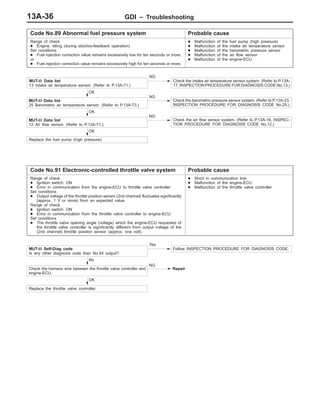
Code No.89 Abnormal fuel pressure system Probable cause
Range of check
D Engine: Idling (during stoichio-feedback operation)
Set conditions
D Fuel injection correction value remains excessively low for ten seconds or more.
or
D Fuel injection correction value remains excessively high for ten seconds or more.
D Malfunction of the fuel pump (high pressure)
D Malfunction of the intake air temperature sensor
D Malfunction of the barometric pressure sensor
D Malfunction of the air flow sensor
D Malfunction of the engine-ECU
MUT-II Data list
13 Intake air temperature sensor. (Refer to P.13A-71.)
NG
Check the intake air temperature sensor system. (Refer to P.13A-
17, INSPECTION PROCEDURE FOR DIAGNOSIS CODE No.13.)
OK
MUT-II Data list
25 Barometric air temperature sensor. (Refer to P.13A-73.)
NG
Check the barometric pressure sensor system. (Refer to P.13A-23,
INSPECTION PROCEDURE FOR DIAGNOSIS CODE No.25.)
OK
MUT-II Data list
12 Air flow sensor. (Refer to P.13A-71.)
NG
Check the air flow sensor system. (Refer to P.13A-16, INSPEC-
TION PROCEDURE FOR DIAGNOSIS CODE No.12.)
OK
Replace the fuel pump (high pressure).
Code No.91 Electronic-controlled throttle valve system Probable cause
Range of check
D Ignition switch: ON
D Error in communication from the engine-ECU to throttle valve controller
Set conditions
D Output voltage of the throttle position sensor (2nd channel) fluctuates significantly
(approx. 1 V or more) from an expected value.
Range of check
D Ignition switch: ON
D Error in communication from the throttle valve controller to engine-ECU
Set conditions
D The throttle valve opening angle (voltage) which the engine-ECU requested of
the throttle valve controller is significantly different from output voltage of the
(2nd channel) throttle position sensor (approx. one volt).
D Short in communication line
D Malfunction of the engine-ECU
D Malfunction of the throttle valve controller
MUT-II Self-Diag code
Is any other diagnosis code than No.94 output?
Yes
Follow INSPECTION PROCEDURE FOR DIAGNOSIS CODE.
No
Check the harness wire between the throttle valve controller and
engine-ECU.
NG
Repair
OK
Replace the throttle valve controller.
GDI – Troubleshooting 13A-37
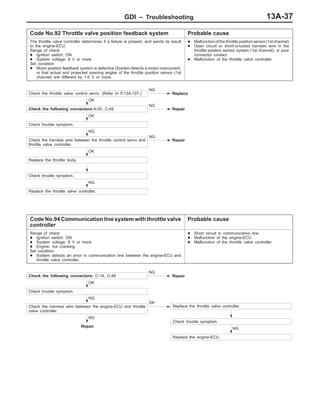
Code No.92 Throttle valve position feedback system Probable cause
The throttle valve controller determines if a failure is present, and sends its result
to the engine-ECU.
Range of check
D Ignition switch: ON
D System voltage: 8 V or more
Set condition
D Motor position feedback system is defective (System detects a motor overcurrent,
or that actual and projected opening angles of the throttle position sensor (1st
channel) are different by 1.0 V or more.
D Malfunctionof the throttle position sensor (1st channel)
D Open circuit or short-circuited harness wire in the
throttle position sensor system (1st channel), or poor
connector contact
D Malfunction of the throttle valve controller
Check the throttle valve control servo. (Refer to P.13A-107.)
NG
Replace
OK
Check the following connectors:A-05, C-48
NG
Repair
OK
Check trouble symptom.
NG
Check the harness wire between the throttle control servo and
throttle valve controller.
NG
Repair
OK
Replace the throttle body.
Check trouble symptom.
NG
Replace the throttle valve controller.
Code No.94 Communication line system with throttle valve
controller
Probable cause
Range of check
D Ignition switch: ON
D System voltage: 8 V or more
D Engine: not cranking
Set condition
D System detects an error in communication line between the engine-ECU and
throttle valve controller.
D Short circuit in communication line
D Malfunction of the engine-ECU
D Malfunction of the throttle valve controller
Check the following connectors: C-19, C-48
NG
Repair
OK
Check trouble symptom.
NG
Check the harness wire between the engine-ECU and throttle
valve controller.
OK
Replace the throttle valve controller.
Check trouble symptom.
NG
Replace the engine-ECU.
NG
Repair
GDI – Troubleshooting13A-38
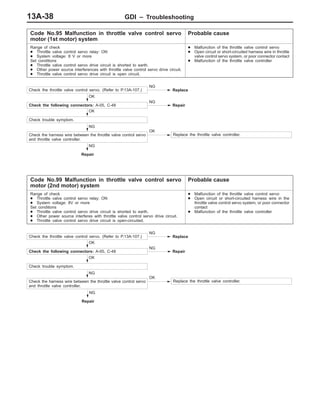
Code No.95 Malfunction in throttle valve control servo
motor (1st motor) system
Probable cause
Range of check
D Throttle valve control servo relay: ON
D System voltage: 8 V or more
Set conditions
D Throttle valve control servo drive circuit is shorted to earth.
D Other power source interferences with throttle valve control servo drive circuit.
D Throttle valve control servo drive circuit is open circuit.
D Malfunction of the throttle valve control servo
D Open circuit or short-circuited harness wire in throttle
valve control servo system, or poor connector contact
D Malfunction of the throttle valve controller
Check the throttle valve control servo. (Refer to P.13A-107.)
NG
Replace
OK
Check the following connectors: A-05, C-48
NG
Repair
OK
Check trouble symptom.
NG
Check the harness wire between the throttle valve control servo
and throttle valve controller.
OK
Replace the throttle valve controller.
NG
Repair
Code No.99 Malfunction in throttle valve control servo
motor (2nd motor) system
Probable cause
Range of check
D Throttle valve control servo relay: ON
D System voltage: 8V or more
Set conditions
D Throttle valve control servo drive circuit is shorted to earth.
D Other power source interferes with throttle valve control servo drive circuit.
D Throttle valve control servo drive circuit is open-circuited.
D Malfunction of the throttle valve control servo
D Open circuit or short-circuited harness wire in the
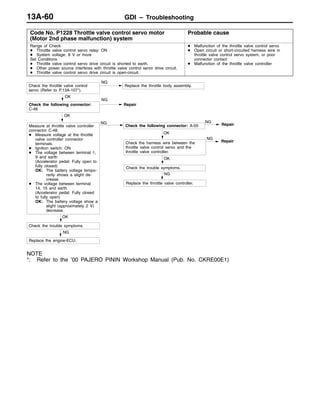
throttle valve control servo system, or poor connector
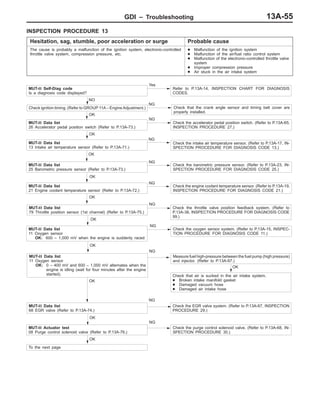
contact
D Malfunction of the throttle valve controller
Check the throttle valve control servo. (Refer to P.13A-107.)
NG
Replace
OK
Check the following connectors: A-05, C-48
NG
Repair
OK
Check trouble symptom.
NG
Check the harness wire between the throttle valve control servo
and throttle valve controller.
OK
Replace the throttle valve controller.
NG
Repair
GDI – Troubleshooting 13A-39
INSPECTION CHART FOR TROUBLE SYMPTOMS
Trouble symptom Inspection
procedure
No.
Reference page
Communication
with MUT-II is
Communication with all systems is not possible. 1 13A-41
with MUT-II is
impossible. Communication with engine-ECU only is not possible. 2 13A-42
Engine warning
lamp and
related parts
The engine warning lamp does not illuminate right after the
ignition switch is turned to the ON position.
3 13A-42
related parts
The engine warning lamp remains illuminating and never goes
out.
4 13A-43
Starting No initial combustion (starting impossible) 5 13A-43
Initial combustion but no complete combustion
(starting impossible)
6 13A-45
Long time to start (improper starting)
Idling stability
(Improper idling)
Unstable idling (Rough idling, hunting) 7 13A-47
(Improper idling)
Idling speed is high. (Improper idling speed) 8 13A-49
Idling speed is low. (Improper idling speed)
Idling stability
(Engine stalls)
When the engine is cold, it stalls at idling. (Die out) 9 13A-50
(Engine stalls)
When the engine is hot, it stalls at idling. (Die out) 10 13A-51
The engine stalls when starting the car. (Pass out) 11 13A-53
The engine stalls when decelerating. 12 13A-54
Driving Hesitation, sag or stumble 13 13A-55
Poor acceleration
Surge
The feeling of impact or vibration when accelerating 14 13A-56
The feeling of impact or vibration when decelerating 15 13A-57
Knocking 16 13A-57
Dieseling 17 13A-57
Too high CO and HC concentration when idling 18 13A-58
Low alternator output voltage (approx. 12.3 V) 19 13A-59
Fans (radiator fan, A/C condenser fan) are inoperative 20 13A-60
GDI ECO
indicator lamp
GDI ECO indicator lamp does not illuminate. 21 13A-61
indicator lamp
GDI ECO indicator lamp remains illuminated and does not go
off.
22 13A-61
GDI – Troubleshooting13A-40
PROBLEM SYMPTOMS TABLE (FOR YOUR INFORMATION)
Items Symptom
Starting Won’t start The starter is used to crank the engine, but there is no combustion within the
cylinders, and the engine won’t start.
Fires up and dies There is combustion within the cylinders, but then the engine soon stalls.
Hard starting Engine starts after cranking a while.
Idling
stability
Hunting Engine speed doesn’t remain constant; changes at idle.
stability
Rough idle Usually, a judgement can be based upon the movement of the tachometer
pointer, and the vibration transmitted to the steering wheel, shift lever, body, etc.
This is called rough idle.
Incorrect idle speed The engine doesn’t idle at the usual correct speed.
Engine stall
(Die out)
The engine stalls when the foot is taken from the accelerator pedal, regardless
of whether the vehicles is moving or not.
Engine stall
(Pass out)
The engine stalls when the accelerator pedal is depressed or while it is being
used.
Driving Hesitation, Sag “Hesitation” is the delay in response
of the vehicle speed (engine speed)
that occurs when the accelerator is
depressed in order to accelerate
from the speed at which the vehicle
is now traveling, or a temporary drop
in vehicle speed (engine speed)
during such acceleration.
Serious hesitation is called “sag”.
Vehicle
speed
Initial ac-
celerator
pedal de-
pression
Normal
Hesitation
Sag
Time
Poor acceleration Poor acceleration is inability to obtain an acceleration corresponding to the
degree of throttle opening, even though acceleration is smooth, or the inability
to reach maximum speed.
Stumble Engine speed increase is delayed
when the accelerator pedal is
initially depressed for accelera-
tion. Normal
Initial ac-
celerator
pedal de-
pression
Idling Stumble
Time
Vehicle
speed
GDI – Troubleshooting 13A-41
Items Symptom
Driving Shock The feeling of a comparatively large impact or vibration when the engine is
accelerated or decelerated.
Surge This is repeated surging ahead during constant speed travel or during variable
speed travel.
Knocking A sharp sound like a hammer striking the cylinder walls during driving and which
adversely affects driving.
Stopping Run on
(“Dieseling”)
The condition in which the engine continues to run after the ignition switch is
turned to OFF. Also called “Dieseling”.
INSPECTION PROCEDURE FOR TROUBLE SYMPTOMS
INSPECTION PROCEDURE 1
Communication with MUT-II is not possible.
(Communication with all systems is not possible.)
Probable cause
The cause is probably a defect in the power supply system (including earth) for
the diagnosis line.
D Malfunction of the connector
D Malfunction of the harness wire
D Malfunction of the MUT-II
Measure at the diagnostic connector
C-35.
(1) Voltage between 16 and earth
OK: System voltage
(2) Continuity between 4 and earth
Continuity between 5 and earth
OK: Continuity
(1) NG
Check the following connectors:
C-76, C-77
NG
Repair
OK
Check trouble symptom.
NG
Check the harness wire between the
power supply and diagnostic connector,
and repair if necessary.
OK
OK
Replace the MUT-II. Check the following connector:
C-01
Repair
Check trouble symptom. Check the earth line, and repair if nec-
essary.
NG
NG
(2) NG
GDI – Troubleshooting13A-42
INSPECTION PROCEDURE 2
MUT-II communication with engine-ECU is impossible. Probable cause
This may be caused by malfunction of engine-ECU power supply circuit and earth
circuit.
D Malfunction of engine-ECU power supply circuit
D Malfunction of engine-ECU
D Open circuit between the engine-ECU and diagnosis
connector
NG
Check the harness wire between engine-ECU and diagnosis con-
nector.
NG
Repair
OK
Check trouble symptom.
Check the following connectors:
C-53 <Vehicles with multi center display>, C-19, C-28, C-35,
C-70
NG
Repair
OK
Check the engine-ECU power supply and earth circuit system. (Refer
to P.13A-62, INSPECTION PROCEDURE 23.)
NOTE
On vehicles with multi center display, if a malfunction cannot be resolved after the procedure above, check
the multi center display and replace if necessary. (Refer to GROUP 54 – Multi center display.)
INSPECTION PROCEDURE 3
The engine warning lamp does not illuminate right after
the ignition switch is turned to the ON position.
Probable cause
Because there is a burnt-out bulb, the engine-ECU causes the engine warning lamp
to illuminate for five seconds immediately after the ignition switch is turned to ON.
If the engine warning lamp does not illuminate immediately after the ignition switch
is turned to ON, one of the malfunctions listed at right has probably occurred.
D Burnt-out bulb
D Defective warning lamp circuit
D Malfunction of the engine-ECU
MUT-II Data list
16 Engine-ECU power supply voltage (Refer to P.13A-72.)
NG
Check the engine-ECU power supply and earth circuit system.
(Refer to P.13A-62, INSPECTION PROCEDURE 23.)
OK
Measure at the engine-ECU connector C-17.
D Disconnect the connector, and measure at the harness side.
D Earth the terminal No. 31.
OK: The engine warning lamp illuminates.
OK
Check the following
connector: C-17
NG
Repair
OK
Check trouble symptom.
NG
Replace the engine-ECU.
NG
Check a burnt-out bulb.
NG
Replace
OK
Measure at the combination meter connector C-06.
D Disconnect the connector, and measure at the harness side.
D Voltage between 1 and earth (Ignition switch: ON)
OK: System voltage
NG
Check the engine warning lamp power supply circuit, and repair
if necessary.
OK
Check the following connectors:
C-06, C-07, C-17, C-28
NG
Repair
OK
Check trouble symptom.
NG
Check the harness wire between combination meter and engine-
ECU, and repair if necessary.
GDI – Troubleshooting 13A-43
INSPECTION PROCEDURE 4
The engine warning lamp remains illuminating and never
goes out.
Probable cause
In cases such as the above, the cause is probably that the engine-ECU is detecting
a problem in a sensor or actuator, or that one of the malfunctions listed at right
has occurred.
D Short-circuit between the engine warning lamp and
engine-ECU
D Malfunction of the engine-ECU
MUT-II Self-Diag code
Are diagnosis codes displayed?
Yes
Refer to P.13A-14, INSPECTION CHART FOR DIAGNOSIS
CODES
No
Measure at the combination meter connector C-07.
D Disconnect the connector, and measure at the harness side.
D Disconnect the engine-ECU connector
D Continuity between 46 and earth
OK: No continuity
NG
Check the harness wire between combination meter and engine-
ECU connector, and repair if necessary.
OK
Replace the engine-ECU.
INSPECTION PROCEDURE 5
No initial combustion (starting impossible) Probable cause
This is caused by incorrect fuel supply into the combustion chamber, and improper
ignition circuit. Besides that, foreign material may be contaminated in fuel.
D Malfunction of the fuel supply system
D Malfunction of the ignition system
D Malfunction of the engine-ECU
Check system voltage while the engine is cranking.
OK: 8 V or more
NG
Check the battery. (Refer to GROUP 55 – Battery.)
OK
MUT-II Self-Diag code
Is a diagnosis code displayed?
Yes
Refer to P.13A-14, INSPECTION CHART FOR DIAGNOSIS
CODES.
No
MUT-II Data list
16 System voltage (Refer to P.13A-72.)
NG
Check the engine control relay and ignition switch-IG system.
(Refer to P.13A-62, INSPECTION PROCEDURE 24.)
OK
Does the camshaft rotate when the engine is cranking?
No
Check if the timing belt is broken or damaged.
Yes
MUT-II Actuator test
07 Fuel pump (low pressure) (Refer to P.13A-76.)
NG
Check the fuel pump (low pressure) system. (Refer to P.13A-66,
INSPECTION PROCEDURE 28.)
OK
MUT-II Data list
22 Crank angle sensor (Refer to P.13A-72.)
NG
Check the crank angle sensor system. (Refer to P.13A-20, IN-
SPECTION PROCEDURE FOR DIAGNOSIS CODE 22.)
OK
MUT-II Data list
21 Engine coolant temperature sensor (Refer to P.13A-72.)
NG
Check the engine coolant temperature sensor system. (Refer to
P.13A-19, INSPECTION PROCEDURE FOR DIAGNOSIS CODE
21.)OK
To the next page
GDI – Troubleshooting13A-44
NG
OK
MUT-II Data list
14 Throttle position sensor (2nd channel) (Refer to P.13A-72.)
NG
Check the throttle position sensor (2nd channel) system. (Refer
to P.13A-18, INSPECTION PROCEDURE FOR DIAGNOSIS
CODE 14.)
OK
Inspect engine start ability by cranking the engine while the acceler-
ator pedal is slightly depressed.
OK
Clean around the throttle valve. (Refer to P.13A-92.)
Check fuel leakage. (Refer to P.13A-99.)
NG
Repair
OK
Measure low fuel pressure between the fuel pump (low pressure)
and fuel pump (high pressure). (Refer to P.13A-95.)
NG
Repair
OK
Measure at ignition coil connectors A-09, A-10, A-11, A-12.
D Connect the connector.
D Connect a timing light to the No.1 terminal of each connector
in turn.
(Engine cranking)
OK: The timing light flashes.
NG
Check abnormal fuel combustion system. (Refer to P.13A-27, IN-
SPECTION PROCEDURE FOR DIAGNOSIS CODE 44.)
OK
Check ignition timing while the engine is cranking.
OK: Approx. 5_ BTDC
NG
Check that the crank angle sensor and timing belt cover are proper-
ly installed.
From the previous page
OK
Check ignition coil spark for each cylinder.
(1) Remove the ignition coil.
(2) Install a new spark plug to the removed ignition coil.
(3) Disconnect the injector intermediate connector.
Caution
Never touch the connector terminal as approx. 100 V is
applied to the injector, or you are seriously injured.
(4) Earth the spark plug electrode securely.
(5) Check that the spark plug ignites when the engine is cranked.
NG
OK
Check all the following items:
D Spark plug
D Compression pressure
D Foreign material (such as water or kerosine) entered the fuel
lines
Check trouble symptom.
OK
NG
Replace the ignition coil.
Replace the injector.
GDI – Troubleshooting 13A-45
INSPECTION PROCEDURE 6
Initial combustion takes place, but does not complete
(start impossible), too long time to start (poor start)
Probable cause
This may be caused by improper spark plug ignition (poor spark), improper mixture
during engine cranking, improper fuel pressure.
D Malfunction of the fuel supply system
D Malfunction of the fuel pressure sensor
D Malfunction of the ignition system
D Malfunction of the electronic-controlled throttle vale
system
D Malfunction of the engine-ECU
NG
Check system voltage while the engine is cranking.
OK: 8 V or more
NG
Check the battery. (Refer to GROUP 55 – Battery.)
OK
MUT-II Self-Diag code
Is a diagnosis code displayed?
Yes
Refer to P.13A-14, INSPECTION CHART FOR DIAGNOSIS
CODES.
No
MUT-II Actuator test
07 Fuel pump (low pressure) (Refer to P.13A-76.)
NG
Check the fuel pump (low pressure) system. (Refer to P.13A-66,
INSPECTION PROCEDURE 28.)
OK
MUT-II Data list
21 Engine coolant temperature sensor (Refer to P.13A-72.)
NG
Check the engine coolant temperature system. (Refer to P.13A-
19, INSPECTION PROCEDURE FOR DIAGNOSIS CODE 21.)
OK
MUT-II Data list
18 Cranking signal (Refer to P.13A-72.)
NG
Check the ignition switch-ST system <M/T>. (Refer to P.13A-63,
INSPECTION PROCEDURE 25.)
Check the ignition switch-ST system and inhibitor switch<A/T>.
(Refer to P.13A-64, INSPECTION PROCEDURE 26.)
OK
MUT-II Data list
74 Fuel pressure sensor (Refer to P.13A-75.)
NG
Check an abnormal fuel pressure system. (Refer to P.13A-29,
INSPECTION PROCEDURE FOR DIAGNOSIS CODE 56.)
Check fuel leakage. (Refer to P.13A-99.)
NG
Repair
OK
Is the engine started normally when it is cranked with the accelera-
tor pedal depressed slightly?
Yes
Clean around the throttle valve. (Refer to P.13A-92.)
No
MUT-II Data list
14 Throttle position sensor (2nd channel) (Refer to P.13A-72.)
NG Check the throttle position sensor (2nd channel) system. (Refer
to P.13A-18, INSPECTION PROCEDURE FOR DIAGNOSIS
CODE 14.)OK
Check ignition timing when the engine is cranked.
OK: approx. 5_ BTDC
NG Check that the crank angle sensor and timing belt cover are proper-
ly installed.
OK
To the next page
GDI – Troubleshooting13A-46
From the previous page
OK
Check ignition coil spark for each cylinder.
(1) Remove the ignition coil.
(2) Install a new spark plug to the removed ignition coil.
(3) Disconnect the injector intermediate connector.
Caution
Never touch the connector terminal as approx. 100 V is
applied to the injector, or you are seriously injured.
(4) Earth the spark plug electrode securely.
(5) Check that the spark plug ignites when the engine is cranked.
NG
Replace the ignition coil.
OK
Check all the following items:
D Spark plug
D Compression pressure
D Foreign material (such as water or kerosine) entered the fuel
lines
Check trouble symptom.
OK
NG
Replace the injector.
GDI – Troubleshooting 13A-47
INSPECTION PROCEDURE 7
Unstable idling (rough idle, hunting) Probable cause
This malfunction is probably caused by a faulty ignition system, improper air/fuel
ratio, a faulty electronic-controlled throttle valve system, improper compression
pressure, etc. As many causes can be suspected, diagnose from easier items.
D Malfunction of the ignition system
D Malfunction of the air/fuel ratio control system
D Malfunction of the electronic-control throttle valve
system
D Improper compression pressure
D Air sucking into the air intake system
Has the battery been disconnected recently?
Yes
Warm up the engine, and then let it run at idle for approx. ten
minutes.
No
MUT-II Self-Diag code
Is a diagnosis code displayed?
Yes
Refer to P.13A-14, INSPECTION CHART FOR DIAGNOSIS
CODES.
No
Does the engine idle speed fluctuates excessively (excessive
hunting)?
Yes
Clean around the throttle valve. (Refer to P.13A-92.)
No
MUT-II Data list
14 Throttle position sensor (2nd channel) (Refer to P.13A-72.)
NG
Check the throttle position sensor (2nd channel) system. (Refer
to P.13A-18, INSPECTION PROCEDURE FOR DIAGNOSIS
CODE 14.)
OK
MUT-II Data list
79 Throttle position sensor (1st channel) (Refer to P.13A-75.)
NG
Check the throttle valve position feedback system. (Refer to
P.13A-37, INSPECTION PROCEDURE FOR DIAGNOSIS CODE
92.)
OK
MUT-II Data list
26 Accelerator pedal position switch (Refer to P.13A-73.)
NG
Check the accelerator pedal position switch system. (Refer to
P.13A-65, INSPECTION PROCEDURE 27.)
OK
MUT-II Data list
13 Intake air temperature sensor (Refer to P.13A-71.)
NG
Check the intake air temperature sensor system. (Refer to
P.13A-17, INSPECTION PROCEDURE FOR DIAGNOSIS CODE
13.)
OK
MUT-II Data list
25 Barometric pressure sensor (Refer to P.13A-73.)
NG
Check the barometric pressure sensor system. (Refer to P.13A-23,
INSPECTION PROCEDURE FOR DIAGNOSIS CODE 25.)
OK
MUT-II Data list
21 Engine coolant temperature sensor (Refer to P.13A-72.)
NG
Check the engine coolant temperature sensor. (Refer to P.13A-19,
INSPECTION PROCEDURE FOR DIAGNOSIS CODE 21.)
OK
MUT-II Actuator test
08 Purge control solenoid valve (Refer to P.13A-76.)
NG
Check the purge control solenoid valve system. (Refer to P.13A-68,
INSPECTION PROCEDURE 30.)
MUT-II Data list
11 Oxygen sensor
OK: 600 – 1,000 mV when the engine is suddenly raced
NG Check the oxygen sensor system. (Refer to P.13A-15, INSPEC-
TION PROCEDURE FOR DIAGNOSIS CODE 11.)
OK
OK
To the next page
GDI – Troubleshooting13A-48
OK
Check that air is sucked in the air intake system.
D Broken intake manifold gasket
D Damaged vacuum hose
D Damaged air intake hose
From the previous page
OK
MUT-II Data list
27 Power steering fluid pressure switch (Refer to P.13A-73.)
NG
Check the power steering fluid pressure switch system. (Refer
to P.13A-69, INSPECTION PROCEDURE 31.)
OK
MUT-II Data list
28 A/C switch (Refer to P.13A-73.)
NG
Check the A/C switch and A/C relay system. (Refer to P.13A-69,
INSPECTION PROCEDURE 32.)
OK
MUT-II Data list
67 Stop lamp switch (Refer to P.13A-74.)
NG
Check the stop lamp switch. (Refer to P.13A-70, INSPECTION
PROCEDURE 33.)
OK
MUT-II Data list
31 Small lamp switch (Refer to P.13A-73.)
NG
Check the small lamp switch system. (Refer to P.13A-70, INSPEC-
TION PROCEDURE 34.)
OK
MUT-II Data list
68 EGR valve (Refer to P.13A-74.)
NG
Check the EGR valve. (Refer to P.13A-67, INSPECTION PROCE-
DURE 29.)
OK
Check ignition timing. (Refer to GROUP 11A – Engine Adjustment.)
NG
Check that the crank angle sensor and timing belt cover are proper-
ly installed.
OK
Check ignition coil spark for each cylinder.
(1) Remove the ignition coil.
(2) Install a new spark plug to the removed ignition coil.
(3) Disconnect the injector intermediate connector.
Caution
Never touch the connector terminal as approx. 100 V is
applied to the injector, or you are seriously injured.
(4) Earth the spark plug electrode securely.
(5) Check that the spark plug ignites when the engine is cranked.
NG
Replace the ignition coil.
OK
Check trouble symptom.
NG
Check all the following items in that order.
(1) Spark plugs
(2) Exhaust gas emission control system
(3) EGR system
(4) Compression pressure
(5) Foreign material (such as water or kerosine)entered the fuel
line.
(6) Air is sucked in the air intake system, or EGR gas leaks.
D Damaged intake manifold gasket
D Damaged air intake hose
D Damaged vacuum hose
D Faulty EGR valve seat
OK
MUT-II Data list
11 Oxygen sensor
OK: 0 – 400 mV and 600 – 1,000 mV alternates when the
engine is idling (wait for four minutes after the engine
started).
NG
NG
Repair
OK
MUT-II Data list
29 Inhibitor switch (Refer to P.13A-73.)
NG
Check the ignition switch-ST and inhibitor switch. <A/T> (Refer
to P.13A-64, INSPECTION PROCEDURE 26.)
Measure fuel high-pressure between the fuel pump (high pressure)
and injector. (Refer to P.13A-97.)
Clean around the throttle valve. (Refer to P.13A-92.)
GDI – Troubleshooting 13A-49
INSPECTION PROCEDURE 8
Idle speed is high or low (Improper idling) Probable cause
The cause is probably that the intake air amount during idling is too great or too
small.
D Malfunction of the electronic-controlled throttle valve
system
D Malfunction of the throttle body
MUT-II Self-Diag code
Is a diagnosis code displayed?
Yes
Refer to P.13A-14, INSPECTION CHART FOR DIAGNOSIS
CODES.
No
MUT-II Data list
14 Throttle position sensor (2nd channel) (Refer to P.13A-72.)
NG
Check the throttle position sensor (2nd channel). (Refer to
P.13A-18, INSPECTION PROCEDURE FOR DIAGNOSIS CODE
14.)
OK
MUT-II Actuator test
08 Purge control solenoid valve (Refer to P.13A-76.)
NG
Check the purge control solenoid valve. (Refer to P.13A-68, IN-
SPECTION PROCEDURE 30.)
OK
MUT-II Data list
26 Accelerator pedal position switch (Refer to P.13A-73.)
NG
Check the accelerator pedal position switch system. (Refer to
P.13A-65, INSPECTION PROCEDURE 27.)
OK
MUT-II Data list
21 Engine coolant temperature sensor (Refer to P.13A-72.)
NG
Check the engine coolant temperature sensor. (Refer to P.13A-19,
INSPECTION PROCEDURE FOR DIAGNOSIS CODE 21.)
OK
MUT-II Data list
28 A/C switch (Refer to P.13A-73.)
NG
Check the A/C switch and A/C relay system. (Refer to P.13A-69,
INSPECTION PROCEDURE 32.)
OK
OK
MUT-II Data list
67 Stop lamp switch (Refer to P.13A-74.)
NG
Check the stop lamp switch system. (Refer to P.13A-70, INSPEC-
TION PROCEDURE 33.)
OK
D Clean around the throttle valve. (Refer to P.13A-92.)
D Adjust the throttle position sensor. (Refer to P.13A-92.)
MUT-II Data list
29 Inhibitor switch (Refer to P.13A-73.)
Check the ignition switch-ST and inhibitor switch <A/T>. (Refer
to P.13A-64, INSPECTION PROCEDURE 26.)
NG
GDI – Troubleshooting13A-50
INSPECTION PROCEDURE 9
When the engine is cold, it stalls at idling. (Die out) Probable cause
The cause is probably an incorrect air/fuel ratio or poor intake air amount when
the engine is cold.
D Malfunction of the electronic-control throttle valve
system
D Malfunction of the throttle body
Have the battery terminals been disconnected recently?
Yes
Warm up the engine, and then let it run at idle for approx. ten
minutes.
No
MUT-II Self-Diag code
Is a diagnosis code displayed?
Yes
Refer to P.13A-14, INSPECTION CHART FOR DIAGNOSIS
CODES.
No
Is the engine idling correct after the engine has been warmed
up?
Yes
Refer to “Unstable idling (rough idle, hunting).” (Refer to P.13A-47,
INSPECTION PROCEDURE 7.)
No
MUT-II Data list
22 Crank angle sensor (Refer to P.13A-72.)
Check idling speed when the engine is cold.
NG
Check the throttle valve position feedback system. (Refer to
P.13A-37, INSPECTION PROCEDURE FOR DIAGNOSIS CODE
92.)
OK
MUT-II Data list
26 Accelerator pedal position switch (Refer to P.13A-73.)
NG
Check the accelerator position switch. (Refer to P.13A-65, IN-
SPECTION PROCEDURE 27.)
OK
MUT-II Data list
21 Engine coolant temperature sensor (Refer to P.13A-72.)
NG
Check the engine coolant temperature sensor. (Refer to P.13A-19,
INSPECTION PROCEDURE FOR DIAGNOSIS CODE 21.)
OK
MUT-II Data list
68 EGR valve (Refer to P.13A-74.)
NG
Check the EGR valve system. (Refer to P.13A-67, INSPECTION
PROCEDURE 29.)
OK
Does the engine stall immediately after the accelerator pedal is
released?
Yes
Clean around the throttle valve. (Refer to P.13A-92.)
No
Measure fuel high pressure between the fuel pump (high pressure)
and injector. (Refer to P.13A-97.)
NG
Repair
OK
Check ignition timing. (Refer to GROUP 11A – Engine Adjustment.)
NG
Check that the crank angle sensor and timing belt cover are proper-
ly installed.OK
Check ignition coil spark for each cylinder.
(1) Remove the ignition coil.
(2) Install a new spark plug to the removed ignition coil.
(3) Disconnect the injector intermediate connector.
Caution
Never touch the connector terminal as approx. 100 V is
applied to the injector, or you are seriously injured.
(4) Earth the spark plug electrode securely.
(5) Check that the spark plug ignites when the engine is cranked.
NG
Replace the ignition coil.
OK
Check all the following items:
D Spark plugs
D Compression pressure
D Engine oil viscosity
NG
Check trouble symptom.
OK
Replace the injector.
GDI – Troubleshooting 13A-51
INSPECTION PROCEDURE 10
When the engine is hot, it stalls at idling. (Die out) Probable cause
The cause is probably an improper air/fuel ratio, faulty electronic-controlled throttle
valve system, compression pressure. In addition, if the engine stalls suddenly, another
possible cause might be a poor connector contact.
D Malfunction of the ignition system
D Malfunction of air/fuel ratio control system
D Malfunction of electronic-controlled throttle valve
system
D Malfunction of the throttle body
D Poor connector contact
D Improper compression pressure
D Air stuck in the air intake system
NG
Repair
Have the battery terminals been disconnected recently?
Yes
Warm up the engine, and then let it run at idle for approx. ten
minutes.No
MUT-II Self-Diag code
Is a diagnosis code displayed?
Yes
Refer to P.13A-14, INSPECTION CHART FOR DIAGNOSIS
CODES.
No
MUT-II Data list
79 Throttle position sensor (1st channel) (Refer to P.13A-75.)
NG
Check the throttle position sensor (1st channel) system. (Refer
to P.13A-35, INSPECTION PROCEDURE FOR DIAGNOSIS
CODE 79.)
OK
Is it easy to reproduce the engine stall?
No
While carrying out an intermittent malfunction simulation test. (Re-
fer to GROUP 00 – Points to Note for Intermittent Malfunction.),
check for sudden changes in the following signals.
D Crank angle sensor signal
D Injector drive signal
D Fuel pump (low pressure) drive signal
D Air flow sensor
D Primary ignition signal
D Power supply to the engine-ECU
Yes
MUT-II Data list
26 Accelerator pedal position switch (Refer to P.13A-73.)
NG
Check the accelerator pedal position switch. (Refer to P.13A-65,
INSPECTION PROCEDURE 27.)
OK
MUT-II Data list
13 Intake air temperature sensor (Refer to P.13A-71.)
NG
Check the intake air temperature sensor. (Refer to P.13A-17, IN-
SPECTION PROCEDURE FOR DIAGNOSIS CODE 13.)
OK
MUT-II Data list
25 Barometric pressure sensor (Refer to P.13A-73.)
NG
Check the barometric pressure sensor. (Refer to P.13A-23, IN-
SPECTION PROCEDURE FOR DIAGNOSIS CODE 25.)
OK
MUT-II Data list
21 Engine coolant temperature sensor (Refer to P.13A-72.)
NG
Check the engine coolant temperature sensor. (Refer to P.13A-19,
INSPECTION PROCEDURE FOR DIAGNOSIS CODE 21.)
MUT-II Data list
11 Oxygen sensor
OK: 600 – 1,000 mV when the engine is suddenly raced
NG
Check the oxygen sensor system. (Refer to P.13A-15, INSPEC-
TION PROCEDURE FOR DIAGNOSIS CODE 11.)
OK
MUT-II Data list
11 Oxygen sensor
OK: 0 – 400 mV and 600 – 1,000 mV alternates when the
engine is idling (wait for four minutes after the engine
started).
NG
Measure fuel high-pressure between the fuel pump (high pressure)
and injector. (Refer to P.13A-97.)
OK
Check that air is sucked in the air intake system.
D Broken intake manifold gasket
D Damaged vacuum hose
D Damaged air intake hose
OK
To the next page
OK
GDI – Troubleshooting13A-52
From the previous page
OK
MUT-II Data list
27 Power steering fluid pressure switch (Refer to P.13A-73.)
NG
Check the power steering fluid pressure switch system. (Refer
to P.13A-69, INSPECTION PROCEDURE 31.)
OK
MUT-II Data list
28 A/C switch (Refer to P.13A-73.)
NG
Check the A/C switch and A/C relay system. (Refer to P.13A-69,
INSPECTION PROCEDURE 32.)
MUT-II Data list
29 Inhibitor switch (Refer to P.13A-73.)
NG Check the ignition switch-ST and inhibitor switch <A/T>. (Refer
to P.13A-64, INSPECTION PROCEDURE 26.)
OK
MUT-II Data list
34 Air flow sensor reset signal (Refer to P.13A-73.)
NG
Check the air flow sensor system. (Refer to P.13A-16, INSPEC-
TION PROCEDURE FOR DIAGNOSIS CODE 12.)
OK
MUT-II Data list
68 EGR valve (Refer to P.13A-74.)
NG
Check the EGR valve system. (Refer to P.13A-67, INSPECTION
PROCEDURE 29.)
OK
Yes
Clean around the throttle valve. (Refer to P.13A-92.)
No
NG
Check that the crank angle sensor and timing belt cover are proper-
ly installed.OK
Check ignition coil spark for each cylinder.
(1) Remove the ignition coil.
(2) Install a new spark plug to the removed ignition coil.
(3) Disconnect the injector intermediate connector.
Caution
Never touch the connector terminal as approx. 100 V is
applied to the injector, or you are seriously injured.
(4) Earth the spark plug electrode securely.
(5) Check that the spark plug ignites when the engine is cranked.
NG
Replace the ignition coil.
OK
Check all the following items:
D Spark plugs
D Compression pressure
D Foreign material (such as water or kerosine) entered the fuel
lines
MUT-II Data list
31 Small lamp switch (Refer to P.13A-73.)
Check the small lamp switch system. (Refer to P.13A-70, INSPEC-
TION PROCEDURE 34.)
OK
OK
NG
Check ignition timing. (Refer to GROUP 11A – Engine Adjustment.)
Does the engine stall immediately after the accelerator pedal is
released?
GDI – Troubleshooting 13A-53
INSPECTION PROCEDURE 11
The engine stalls when starting the car. (Pass out) Probable cause
The cause is probably poor ignition due to a malfunctioning spark plug (weak spark),
or an incorrect air/fuel ratio when the accelerator is depressed.
D Malfunction of the ignition system
D Malfunction of the EGR valve
D Air stuck in the air intake system
MUT-II Self-Diag code
Is a diagnosis code displayed?
Yes
Refer to P.13A-14, INSPECTION CHART FOR DIAGNOSIS
CODES.
No
MUT-II Data list
68 EGR valve (Refer to P.13A-74.)
NG
Check the EGR valve system. (Refer to P.13A-67, INSPECTION
PROCEDURE 29.)
OK
MUT-II Actuator test
08 Purge control solenoid valve (Refer to P.13A-76.)
NG
Check the purge control solenoid valve system. (Refer to P.13A-68,
INSPECTION PROCEDURE 30.)
OK
Check ignition coil spark for each cylinder.
(1) Remove the ignition coil.
(2) Install a new spark plug to the removed ignition coil.
(3) Disconnect the injector intermediate connector.
Caution
Never touch the connector terminal as approx. 100 V is
applied to the injector, or you are seriously injured.
(4) Earth the spark plug electrode securely.
(5) Check that the spark plug ignites when the engine is cranked.
NG
Replace the ignition coil.
OK
Check all the following items:
(1) Spark plug
(2) Check if air is stuck in the air intake system.
D Damage intake manifold gasket
D Damaged or disconnected vacuum hose
D Damaged air intake hose
GDI – Troubleshooting13A-54
INSPECTION PROCEDURE 12
The engine stalls when decelerating. Probable cause
The cause is probably an improper air/fuel ratio due to a faulty EGR system, or
poor intake air volume due to a faulty electronic-controlled throttle valve system.
D Malfunction of the electronic-controlled throttle valve
system
D Malfunction of the EGR valve
Have the battery terminals been disconnected recently?
Yes
Warm up the engine, and then let it run at idle for approx. ten
minutes.No
MUT-II Self-Diag code
Is a diagnosis code displayed?
Yes
Refer to P.13A-14, INSPECTION CHART FOR DIAGNOSIS
CODES.
No
MUT-II Data list
26 Accelerator pedal position switch (Refer to P.13A-73.)
NG
Check the accelerator pedal position switch. (Refer to P.13A-65,
INSPECTION PROCEDURE 27.)
OK
MUT-II Data list
79 Throttle position sensor (1st channel) (Refer to P.13A-75.)
NG
Check the throttle valve position feedback system. (Refer to
P.13A-37, INSPECTION PROCEDURE FOR DIAGNOSIS CODE
92.)
OK
MUT-II Data list
68 EGR valve (Refer to P.13A-74.)
NG
Check the EGR valve system. (Refer to P.13A-67, INSPECTION
PROCEDURE 29.)
OK
Check ignition coil spark for each cylinder.
(1) Remove the ignition coil.
(2) Install a new spark plug to the removed ignition coil.
(3) Disconnect the injector intermediate connector.
Caution
Never touch the connector terminal as approx. 100 V is
applied to the injector, or you are seriously injured.
(4) Earth the spark plug electrode securely.
(5) Check that the spark plug ignites when the engine is cranked.
NG
Replace the ignition coil.
OK
Check all the following items:
D Spark plug
D Clean around the throttle valve (Refer to P.13A-92.)
GDI – Troubleshooting 13A-55
INSPECTION PROCEDURE 13
Hesitation, sag, stumble, poor acceleration or surge Probable cause
The cause is probably a malfunction of the ignition system, electronic-controlled
throttle valve system, compression pressure, etc.
D Malfunction of the ignition system
D Malfunction of the air/fuel ratio control system
D Malfunction of the electronic-controlled throttle valve
system
D Improper compression pressure
D Air stuck in the air intake system
MUT-II Self-Diag code
Is a diagnosis code displayed?
Yes
Refer to P.13A-14, INSPECTION CHART FOR DIAGNOSIS
CODES.
NO
NG
Check the accelerator pedal position switch. (Refer to P.13A-65,
INSPECTION PROCEDURE 27.)
OK
MUT-II Data list
13 Intake air temperature sensor (Refer to P.13A-71.)
NG
Check the intake air temperature sensor. (Refer to P.13A-17, IN-
SPECTION PROCEDURE FOR DIAGNOSIS CODE 13.)
OK
MUT-II Data list
25 Barometric pressure sensor (Refer to P.13A-73.)
NG
Check the barometric pressure sensor. (Refer to P.13A-23, IN-
SPECTION PROCEDURE FOR DIAGNOSIS CODE 25.)
OK
MUT-II Data list
21 Engine coolant temperature sensor (Refer to P.13A-72.)
NG
Check the engine coolant temperature sensor. (Refer to P.13A-19,
INSPECTION PROCEDURE FOR DIAGNOSIS CODE 21.)
OK
MUT-II Data list
79 Throttle position sensor (1st channel) (Refer to P.13A-75.)
NG
Check the throttle valve position feedback system. (Refer to
P.13A-38, INSPECTION PROCEDURE FOR DIAGNOSIS CODE
99.)
OK
MUT-II Data list
11 Oxygen sensor
OK: 0 – 400 mV and 600 – 1,000 mV alternates when the
engine is idling (wait for four minutes after the engine
started).
NG
Measure fuel high-pressure between the fuel pump (high pressure)
and injector. (Refer to P.13A-97.)
OK
MUT-II Data list
11 Oxygen sensor
OK: 600 – 1,000 mV when the engine is suddenly raced
NG
Check the oxygen sensor system. (Refer to P.13A-15, INSPEC-
TION PROCEDURE FOR DIAGNOSIS CODE 11.)
OK
Check that air is sucked in the air intake system.
D Broken intake manifold gasket
D Damaged vacuum hose
D Damaged air intake hose
OK
MUT-II Data list
68 EGR valve (Refer to P.13A-74.)
NG
Check the EGR valve system. (Refer to P.13A-67, INSPECTION
PROCEDURE 29.)
OK
MUT-II Actuator test
08 Purge control solenoid valve (Refer to P.13A-76.)
NG
Check the purge control solenoid valve. (Refer to P.13A-68, IN-
SPECTION PROCEDURE 30.)
OK
To the next page
MUT-II Data list
26 Accelerator pedal position switch (Refer to P.13A-73.)
Check ignition timing. (Refer to GROUP 11A – Engine Adjustment.) Check that the crank angle sensor and timing belt cover are
properly installed.
NG
OK
GDI – Troubleshooting13A-56
From the previous page
OK
Measure high fuel pressure between the fuel pump (high pressure)
and injector. (Refer to P.13A-97.)
NG
Repair
OK
Check ignition coil spark for each cylinder.
(1) Remove the ignition coil.
(2) Install a new spark plug to the removed ignition coil.
(3) Disconnect the injector intermediate connector.
Caution
Never touch the connector terminal as approx. 100 V is
applied to the injector, or you are seriously injured.
(4) Earth the spark plug electrode securely.
(5) Check that the spark plug ignites when the engine is cranked.
NG Replace the ignition coil.
OK
Check all the following items:
D Spark plug
D EGR system
D Compression pressure
D Clogged fuel filter, fuel line
NG
Check trouble symptom.
Replace the injector.
OK
INSPECTION PROCEDURE 14
The feeling of impact when accelerating Probable cause
The cause is probably an ignition leak being generated in line with an increase
in the spark plug request voltage during acceleration.
D Malfunction of the ignition system
NG
Replace the ignition coil.
MUT-II Self-Diag code
Is a diagnosis code displayed?
Yes
(Refer to P.13A-14, INSPECTION CHART FOR DIAGNOSIS
CODES.)
No
MUT-II Data list
79 Throttle position sensor (1st channel) (Refer to P.13A-75.)
NG
Check the throttle valve position feedback system. (Refer to
P.13A-37, INSPECTION PROCEDURE FOR DIAGNOSIS CODE
92.)
OK
Check ignition coil spark for each cylinder.
(1) Remove the ignition coil.
(2) Install a new spark plug to the removed ignition coil.
(3) Disconnect the injector intermediate connector.
Caution
Never touch the connector terminal as approx. 100 V is
applied to the injector, or you are seriously injured.
(4) Earth the spark plug electrode securely.
(5) Check that the spark plug ignites when the engine is cranked.
OK
Check all the following items:
D Spark plug
D Ignition current leak
GDI – Troubleshooting 13A-57
INSPECTION PROCEDURE 15
The feeling of impact when decelerating Probable cause
The cause is probably insufficient intake air due to a faulty electronic-controlled
throttle valve system.
D Malfunction of the electronic-controlled throttle valve
system
MUT-II Self-Diag code
Is a diagnosis code displayed?
Yes
Refer to P.13A-14, INSPECTION CHART FOR DIAGNOSIS
CODES.
No
MUT-II Data list
79 Throttle position sensor (1st channel) (Refer to P.13A-75.)
NG
Check the throttle valve position feedback system. (Refer to
P.13A-37, INSPECTION PROCEDURE FOR DIAGNOSIS CODE
92.)
OK
MUT-II Data list
26 Accelerator pedal position switch (Refer to P.13A-73.)
NG
Check the accelerator pedal position switch system. (Refer to
P.13A-65, INSPECTION PROCEDURE 27.)
OK
Clean around the throttle valve. (Refer to P.13A-92.)
INSPECTION PROCEDURE 16
Knocking Probable cause
The cause is probably incorrect detonation control or improper heat range of the
spark plugs.
D Malfunction of the detonation sensor
D Improper heat range of the spark plugs
MUT-II Self-Diag code
Is a diagnosis code displayed?
Yes
Refer to P.13A-14, INSPECTION CHART FOR DIAGNOSIS
CODES.
No
Does knocking occur when the vehicle is driven with the detonation
sensor disconnected?
(At this time, use the MUT-II to check whether the ignition timing
is retarded from when the detonation sensor connector is con-
nected.)
No
Check the detonation sensor system. (Refer to P.13A-24, INSPEC-
TION PROCEDURE FOR DIAGNOSIS CODE 31.)
Yes
Check all the following items:
D Spark plug
D Foreign material (such as water or kerosine) entered the fuel
lines
INSPECTION PROCEDURE 17
Run-on (dieseling) Probable cause
The cause is probably fuel leak from injector(s) D Malfunction of the injector
Replace the injector.
GDI – Troubleshooting13A-58
INSPECTION PROCEDURE 18
Too high CO and HC concentration when idling Probable cause
The cause is probably an incorrect air/fuel ratio D Malfunction of air/fuel ratio control system
D Deterioration of the catalyst
MUT-II Self-Diag code
Is a diagnosis code displayed?
Yes
Refer to P.13A-14, INSPECTION CHART FOR DIAGNOSIS
CODES.
No
Check ignition timing. (Refer to GROUP 11A – Engine Adjustment.)
NG
Check that the crank angle sensor and timing belt cover are proper-
ly installed.OK
MUT-II Data list
21 Engine coolant temperature sensor (Refer to P.13A-72.)
NG
Check the engine coolant temperature sensor. (Refer to P.13A-19,
INSPECTION PROCEDURE FOR DIAGNOSIS CODE 21.)
OK
MUT-II Data list
13 Intake air temperature sensor (Refer to P.13A-71.)
NG
Check the intake air temperature sensor. (Refer to P.13A-17, IN-
SPECTION PROCEDURE FOR DIAGNOSIS CODE 13.)
OK
MUT-II Data list
25 Barometric pressure sensor (Refer to P.13A-73.)
NG
Check the barometric pressure sensor. (Refer to P.13A-23, IN-
SPECTION PROCEDURE FOR DIAGNOSIS CODE 25.)
NG
Check the oxygen sensor system. (Refer to P.13A-15, INSPEC-
TION PROCEDURE FOR DIAGNOSIS CODE 11.)
OK
MUT-II Data list
11 Oxygen sensor
OK: 0 – 400 mV and 600 – 1,000 mV alternates when the
engine is idling (wait for four minutes after the engine
started).
OK
Replace the oxygen sensor.
Check trouble symptom.
NGNG
Measure fuel high-pressure between the fuel pump (high pressure)
and injector. (Refer to P.13A-97.)
NG
Repair
OK
Check ignition coil spark for each cylinder.
(1) Remove the ignition coil.
(2) Install a new spark plug to the removed ignition coil.
(3) Disconnect the injector intermediate connector.
Caution
Never touch the connector terminal as approx. 100 V is applied to the injector, or you are seriously injured.
(4) Earth the spark plug electrode securely.
(5) Check that the spark plug ignites when the engine is cranked.
NG
Replace the ignition coil.
OK
Check all the following items:
D Spark plug
D EGR system
D Compression pressure
D Clogged fuel filter or line
OK
To the next page
OK
MUT-II Data list
11 Oxygen sensor
OK: 600 – 1,000 mV when the engine is suddenly raced
GDI – Troubleshooting 13A-59
From the previous page
OK
MUT-II Data list
68 EGR valve (Refer to P.13A-74.)
NG
Check the EGR valve system. (Refer to P.13A-67, INSPECTION
PROCEDURE 29.)
OK
MUT-II Actuator test
08 Purge control solenoid valve (Refer to P.13A-76.)
NG
Check purge control solenoid valve system. (Refer to P.13A-68,
INSPECTION PROCEDURE 30.)
OK
Check trouble symptom.
NG
Replace the injector.
Check trouble symptom.
NG
Replace the three-way catalytic converter.
INSPECTION PROCEDURE 19
Low alternator output voltage (approx. 12.3 V) Probable cause
The cause is probably a malfunction of the alternator or one of the problems
listed at right.
D Malfunction of the charging system
D Open circuit between the alternator G terminal
and the engine-ECU
D Malfunction of the engine-ECU
NG
Repair
OK
Check trouble symptom.
OK
Check the alternator. (Refer to GROUP
16 – Charging System.)
OK
Check the following connectors:
A-86, C-17
Measure at the alternator connector
A-79.
D Connect the connector. (Use the
test harness MB991519)
D Voltage between 1 (black clip)
and earth
(Engine: Idling)
(Radiator fan: Not operating)
(Headlamp: OFF → ON)
(Stop lamp: OFF → ON)
(Rear defogger switch: OFF →
ON)
OK: Voltage increased by
0.2 – 3.5 V.
NG
Measure at the alternator connector
A-79.
D Disconnect the connector, and
measure at the harness side.
D Disconnect the engine-ECU
connector.
D Continuity between 1 and earth
OK: No continuity
NG
Check the harness wire between
the alternator and the engine-ECU,
and repair if necessary.
Replace the engine-ECU.
NG
Check the harness wire between
the alternator and the engine-ECU.
OK
Repair
NG
GDI – Troubleshooting13A-60
INSPECTION PROCEDURE 20
Fans (radiator fan, A/C condenser fan) are inoperative. Probable cause
The engine-ECU sends a duty signal to the fan controller according to engine coolant
temperature, vehicle speed, or A/C switch.
The fan controller controls radiator fan and condenser fan speeds, based on this
signal. (The closer the terminal voltage comes to 5 V, the higher the fan speed
becomes.)
D Malfunction of the fan motor relay
D Malfunction of the fan motor
D Malfunction of the fan controller
D Open or short circuit, or poor connector contact
D Malfunction of the engine-ECU
NG
Repair
NG
Repair
NG
Repair
Measure at engine-ECU connector C-17.
D Disconnect the connector, measure at the harness side.
D Voltage between terminal 18 and earth
(Ignition switch: ON)
OK: 4.8 – 5.2 V (The fan runs at high speed.)
D Earth terminal 21.
(Ignition switch: ON)
OK: The fan stops.
NG
Check the following connector: A-29
OK
Check trouble symptom.
NG
Check the harness wire between the engine-ECU and fan control-
ler.
OK
Check the radiator fan and condenser fan circuit. (Refer to GROUP
14 – Troubleshooting.)
OK
Check the following connector: C-17
OK
Check trouble symptom.
NG
MUT-II Data list
21 Engine coolant temperature sensor
OK: After the engine has been warmed up, the engine coolant
temperature during idling is identical to the MUT-II reading.
NG
Check the engine coolant temperature sensor system. (Refer to
P.13A-19, INSPECTION PROCEDURE FOR DIAGNOSIS CODE
21.)
OK
Check the thermostat.
NG
Replace
OK
Replace the engine-ECU.
GDI – Troubleshooting 13A-61
INSPECTION PROCEDURE 21
GDI ECO indicator lamp does not illuminate. Probable cause
If the GDI ECO indicator lamp does not illuminate after turning switch, the causes
listed in the right column are suspected.
D Burned-out GDI ECO indicator lamp bulb
D Open circuit or short-circuited harness wire in the
GDI ECO indicator lamp circuit
D Malfunction of the engine-ECU
D Malfunction of the GDI ECO indicator lamp ECU
NG
Repair
OK
NG
NG
Repair
Measure at engine-ECU connector C-17.
D Disconnect the connector, and measure at the harness side.
D Earth terminal 14. (Ignition switch: ON)
OK: The GDI ECO indicator lamp illuminates.
OK
Check the following connector: C-17
OK
Check trouble symptom.
NG
Replace the engine-ECU.
OK
Check the relative circuits of GDI ECO indication lamp.
(Refer to GROUP 54A-Troubleshooting.)
Check trouble symptom.
Check the following connectors: C-29, C-55
Check the harness wire between the GDI-ECO Indication lamp-
ECU and engine-ECU.
NG
NG
Repair
INSPECTION PROCEDURE 22
GDI ECO indicator lamp remains illuminated and does not
go off.
Probable cause
If the GDI ECO indicator lamp does not go off during high load operation, the causes
listed in the right column are suspected.
D Short circuit between the GDI ECO indicator lamp
and engine-ECU
D Malfunction of the engine-ECU
D Malfunction of the GDI ECO indicator lamp ECU
Measure at GDI ECO indicator lamp ECU connector C-55.
D Disconnect the connector, and measure at the harness side.
D Disconnect the engine-ECU connector.
D Continuity between terminal 3 and earth
OK: No continuity
NG
Check the harness wire between the GDI ECO indication lamp-
ECU and engine-ECU, and repair if necessary.
OK
Replace the engine-ECU.
Check the relative circuits of GDI ECO indication lamp.
(Refer to GROUP 54A-Troubleshooting.)
OK
GDI – Troubleshooting13A-62
INSPECTION PROCEDURE 23
Engine-ECU power supply and earth circuit system Probable cause
The cause is probably a malfunction of the engine-ECU or one of the problems
listed at right.
D Open circuit or short-circuited harness wire in the
engine-ECU power supply circuit
D Open circuit or short-circuited harness wire in the
engine-ECU earth circuit
D Malfunction of the engine-ECU
NG
Repair
OK
Check the ignition switch. (Refer to
GROUP 54.)
(2),(3) NG
Check the harness wire between the
engine-ECU and engine control relay,
and repair if necessary.
(4) NG
Check the harness wire between the
engine-ECU and earth, and repair if
necessary.
(5) NG
NG
Repair
OK
Check the trouble symptoms.
NG
Check the harness wire between the
engine-ECU and the battery, and repair
if necessary.
NG
Repair
NG
Replace the engine-ECU.
OK
Check the trouble symptoms.
OK
Check the following connectors:
B-18, C-19
Check the following connector:
A-36
OK
Check the trouble symptoms.
NG
Check the harness wire between the
engine-ECU and ignition switch, and
repair if necessary.
Measureat the engine-ECU connectors
C-18, C-19.
D Disconnect the connector, and
measure at the harness side.
(1) Voltage between 99 and earth
(Ignition switch: ON)
OK: System voltage
(2) Voltage between 57 and earth
OK: System voltage
(3) Voltage between 47, 59 and
earth (Ignition switch: ON)
OK: System voltage (When ter-
minal 57 is shorted to
earth)
(4) Continuity between 46, 58 and
earth
OK: Continuity
(5) Voltage between 60 and earth
OK: System voltage
(1) NG
Check the following connectors:
C-72, C-74
NG
Repair
INSPECTION PROCEDURE 24
Engine control relay and ignition switch-IG system Probable cause
When the ignition switch ON signal is input to the engine-ECU, the
engine-ECU turns on the engine control relay.
This causes system voltage to be supplied to the engine-ECU and to the
sensors and actuators.
D Malfunction of the ignition switch
D Malfunction of the engine control relay
D Open circuit or short-circuited harness wire of the
engine control relay circuit
D Malfunction of the engine-ECU
OK
Check the trouble symptoms.
NG
Check the harness wire between the
battery and the engine control relay,
and repair if necessary.OK
Check the engine-ECU power supply
and earth circuit system. (Refer to
P.13A-62, INSPECTION PROCE-
DURE 23.)
OK
Measure at the engine control relay
connector A-43X.
D Disconnect the connector, and
measure at the harness side.
D Voltage between 3, 4 and earth
OK: System voltage
NG
Check the following connector:
A-36
NG
Repair
Check the engine control relay. (Refer
to P.13A-102.)
NG
Replace
GDI – Troubleshooting 13A-63
INSPECTION PROCEDURE 25
Ignition switch-ST system <M/T> Probable cause
The ignition switch-ST outputs a HIGH signal to the engine-ECU while the
engine is cranking, and the engine-ECU uses this signal to carry out functions
such as fuel injection control during starting.
D Malfunction of the ignition switch
D Open circuit or short-circuited harness wire
between ignition switch
D Malfunction of the engine-ECU
(2) NG
NG
Repair
OK
Check the ignition switch. (Refer to
GROUP 54.)NG
Repair
Replace the engine-ECU.
NG
OK
Check the trouble symptoms.
NG
Check the harness wire between the
inhibitor switch and the ignition switch
connector.
NG
Repair
OK
Check the trouble symptoms.
Check the following connector:
C-27
OK
Check the following connector:
C-18
Measure at the engine-ECU connector
C-18.
D Disconnect the connector, and
measure at the harness side.
(1) Voltage between 68 and earth
(Ignition switch: START)
OK: System voltage
(2) Continuity between 67 and earth
OK: Continuity
(1) NG
Check the harness wire between the
engine-ECU connector (terminal
No.91) and the earth, repair if neces-
sary.
GDI – Troubleshooting13A-64
INSPECTION PROCEDURE 26
Ignition switch-ST and inhibitor switch system <A/T> Probable cause
The ignition switch-ST outputs a HIGH signal to the engine-ECU while the
engine is cranking, and the engine-ECU uses this signal to carry out functions
such as fuel injection control during starting.
The inhibitor switch inputs the position of the selector lever to the engine-ECU.
The engine-ECU uses this signal to carry out idle speed control.
D Malfunction of the ignition switch
D Malfunction of the inhibitor switch
D Open circuit or short-circuited harness wire
between ignition switch and inhibitor switch
D Malfunction of the engine-ECU
OK
Check the trouble symptoms.
(2) NG
NG
Repair
OK
Check the trouble symptoms.
NG
Check the harness wire between the
inhibitor switch connector and the start-
er S terminal, and repair if necessary.
(3) NG
NG
Repair
OK
Check the ignition switch. (Refer to
GROUP 54.)
NG
Repair
NG
Repair
OK
Replace the engine-ECU.
NG
Check the harness wire between the
engine-ECU and the inhibitor switch.
OK
Check the trouble symptoms.
NG
Check the harness wire between the
inhibitor switch and the ignition switch
connector.
NG
Repair
OK
Check the trouble symptoms.
Check the following connector:
C-39, D-02
OK
Check the following connector:
B-04
Check the following connectors:
A-83, B-01
OK
Measure at the inhibitor switch connec-
tor B-04.
D Disconnect the connector, and
measure at the harness side.
(1) Voltage between 4 and earth
(Ignition switch: ON)
OK: System voltage
(2) Continuity between 1 and earth
OK: Continuity
(3) Voltage between 4 and earth
(Ignition switch: START)
Disconnect the engine-ECU
connector.
OK: System voltage
(1) NG
Check the following connectors:
C-18, C-24, D-02
NG
Repair
Check the inhibitor switch (Refer to
GROUP 23 – On-vehicle Service.)
NG
Replace
Check the harness wire between
the engine-ECU and the inhibitor
switch connector.
NG
OK NG
Replace the engine-ECU.
Repair
GDI – Troubleshooting 13A-65
INSPECTION PROCEDURE 27
Accelerator pedal position switch system Probable cause
The accelerator pedal position switch detects that the accelerator pedal is fully closed,
and sends a signal to the engine-ECU. The engine-ECU controls idle speed, based
on this signal.
D Maladjustment of the accelerator cable
D Maladjustmentof the accelerator pedal position switch
D Open circuit or short-circuited harness wire in the
accelerator pedal position switch system, or poor
connector contact
D Malfunction of the engine-ECU
NG
Repair
NG
Repair
Check the accelerator pedal position switch. (Refer to P.13A-105.)
NG
Replace the accelerator pedal position sensor assembly.
OK
Measureat accelerator pedal position sensor (1st channel) connec-
tor C-46.
D Disconnect the connector, and measure at the harness side.
D Voltage between terminal 4 and earth
(Ignition switch: ON)
OK: 4 V or more
D Continuity between terminal 1 and earth
OK: Continuity
NG
Check the following connectors: C-18, C-19
OK
Check trouble symptom.
NG
Check the harness wire between the engine-ECU and accelerator
pedal position sensor 1 (1st channel).
OK
Check the following connector: C-46
NG
Repair
OK
Check trouble symptom.
NG
Replace the engine-ECU.
OK
GDI – Troubleshooting13A-66
INSPECTION PROCEDURE 28
Fuel pump (low pressure) system Probable cause
The engine-ECU turns on the fuel pump relay while the engine is cranking or running,
and supplies power source to the fuel pump (low pressure).
D Malfunction of the fuel pump relay
D Malfunction of the fuel pump (low pressure)
D Open circuit or short-circuited harness wire in the
fuel pump (low pressure) circuit, or poor connector
contact
D Malfunction of the engine-ECU
Check trouble symptom.
NG
Check the harness wire between the
fuel pump (low pressure) and earth,
and repair if necessary.
NG
Repair
OK
Check trouble symptom.
NG
Check the harness wire between the
fuel pump relay and engine-ECU, and
repair if necessary.
NG
Repair
OK
NG
Repair
OK
Check the ignition switch. (Refer to
GROUP 54 – Ignition Switch.)
(2) NG
Check the following connector:
D-12
MUT-II Actuator test
07 Fuel pump (Refer to P.13A-76.)
OK
Normal
NG
Check the fuel pump relay. (Refer to
P.13A-102.)
NG
Replace
OK
Measure at fuel pump relay connector
A-41X.
D Disconnect the connector, and
measure at the harness side.
D Voltage between terminals 3, 4 and
earth
(Ignition switch: ON)
OK: System voltage
NG
Check the following connectors:
C-72, C-74
NG
Repair
OK
Check trouble symptom.
NG
Check the harness wire between the
fuel pump relay and ignition switch.
OK
Measure at engine-ECU connector
C-17.
D Disconnect the connector, and
measure at the harness side.
D Voltage between terminal 21 and
earth (Ignition switch: ON)
OK: System voltage
NG
Check the following connector:
A-41X
OK
Measure at engine-ECU connector
C-17.
D Disconnect the connector, and
measure at the harness side.
D Short circuit between terminal 21
and earth (Ignition switch: ON)
OK: The fuel pump operates (its
operation sound can be
heard).
OK
Check the following connector:
C-17
NG
Repair
OK
Check trouble symptom.
NG
Replace the engine-ECU.
NG
Measure at fuel pump (low pressure)
connector D-17.
D Disconnect the connector, and
measure at the harness side.
(1) Voltage between terminal 5 and
earth
(Ignition switch: ON)
OK: System voltage
(2) Continuity between 4 and earth
OK: Continuity
(1) NG
Check the following connectors:
C-24<LHD>, C-26<RHD>, D-12
NG
Repair
OK
Check trouble symptom.
NG
Check the harness wire between the
fuel pump relay and fuel pump (low
pressure), and repair if necessary.
OK
Check the following connector:
D-17
NG
Repair
OK
Check trouble symptom.
NG
Replace the fuel pump (low pressure).
GDI – Troubleshooting 13A-67
INSPECTION PROCEDURE 29
EGR valve system Probable cause
The engine-ECU controls the EGR valve in order to control the amount of
exhaust gas mixed in the intake air.
D Malfunction of the EGR valve
D Open circuit or short-circuited harness wire in the
EGR valve circuit
D Malfunction of the engine-ECU
OK
Check the trouble symptoms.
NG
Check the harness wire between the
engine-ECU and EGR valve, and repair
if necessary.
OK
Check the trouble symptoms.
NG
Replace the engine-ECU.
OK
Check the following connector:
C-17
NG
Repair
OK
Measure at the engine-ECU connector
C-17.
D Disconnect the connector, and
measure at the harness side.
D Voltage between 5, 6, 32, 34
and earth (Ignition switch: ON)
OK: System voltage
NG
Check the following connectors:
A-60, A-82
NG
Repair
OK
Measure at the EGR valve connector
A-60.
D Disconnect the connector, and
measure at the harness side.
D Voltage between 2, 5 and earth
(Ignition switch: ON)
OK: System voltage
NG
Check the EGR valve. (Refer to
GROUP 17 – Emission Control Sys-
tem.)
NG
Replace
OK
Check the trouble symptoms.
NG
Check the harness wire between the
engine control relay and the EGR valve,
and repair if necessary.
Check the following connectors:
A-36, A-82
NG
Repair
GDI – Troubleshooting13A-68
INSPECTION PROCEDURE 30
Purge control solenoid valve system Probable cause
The engine-ECU controls the purge control solenoid valve in order to control
the purge air coming from the canister.
D Malfunction of the purge control solenoid valve
D Open circuit or short-circuited harness wire in the
purge control solenoid valve circuit
D Malfunction of the engine-ECU
OK
Check the trouble symptoms.
NG
Check the harness wire between the
engine-ECU and the purge control sole-
noid valve, and repair if necessary.
OK
Check the trouble symptoms.
NG
Replace the engine-ECU.
OK
Check the following connector:
C-17
NG
Repair
OK
Measure at the engine-ECU connector
C-17.
D Disconnect the connector, and
measure at the harness side.
D Voltage between 16 and earth
(Ignition switch: ON)
OK: System voltage
NG
Check the following connector:
A-02
NG
Repair
OK
Measure at the purge control solenoid
valve connector A-02.
D Disconnect the connector, and
measure at the harness side.
D Voltage between 2 and earth
(Ignition switch: ON)
OK: System voltage
NG
Check the purge control solenoid valve.
(Refer to GROUP 17 – On-vehicle Ser-
vice.)
NG
OK
Check the trouble symptoms.
NG
Check the harness wire between the
engine control relay and the purge
control solenoid valve, and repair if
necessary.
Check the following connector:
A-36
NG
Repair
Replace
GDI – Troubleshooting 13A-69
INSPECTION PROCEDURE 31
Power steering fluid pressure switch system Probable cause
The power steering fluid pressure switch sends a signal to the engine-ECU according
to power steering load.
Based on this signal, the engine-ECU controls the throttle control servo so that
idle speed increases when the power steering is in operation.
D Malfunction of the power steering fluid pressure switch
D Open circuit or short-circuited harness wire in the
power steering fluid pressure switch circuit, or poor
connector contact
D Malfunction of the engine-ECU
NG
NG
Repair
OK
Replace the engine-ECU.
NG
Repair
Check the power steering fluid pressure switch. (Refer to GROUP
37A – On-vehicle Service.)
NG
Replace
OK
Measure at power steering fluid pressure switch connector A-76.
D Disconnect the connector, and measure at the harness side.
D Voltage between terminal 1 and earth
(Ignition switch: ON)
OK: System voltage
NG
Check the following connector: C-18
OK
Check trouble symptom.
Check the harness wire between the engine-ECU and power steer-
ing fluid pressure switch.
NG
Repair
OK
OK
Check the following connector: A-76
Check trouble symptom.
NG
INSPECTION PROCEDURE 32
A/C switch and A/C relay system Probable cause
If the engine-ECU receives a ‘A/C on’ signal, it operates the throttle control servo
and A/C compressor magnetic clutch so that idle speed increases.
D Malfunction of the A/C control system
D Malfunction of the A/C switch
D Open circuit or short-circuited harness wire in the
A/C switch circuit, or poor connector contact
D Malfunction of the engine-ECU
NG
NG
Repair
OK
Check trouble symptom.
NG
Replace the engine-ECU.
Service the A/C compressor relay. (Refer to GROUP 55 – On-ve-
hicle Service.)
NG
Replace
OK
Measure at engine-ECU connectors C-17, C-19.
D Disconnect the connector, and measure at the harness side.
D Voltage between terminals 20, 83 and earth
(Ignition switch: ON)
OK: 0 – 3 V
(A/C switch: OFF)
System voltage
(A/C switch: ON)
D Connect terminal 20 to earth.
(Ignition switch: ON, A/C switch: ON)
OK: A/C compressor clutch turns on.
OK
Check the following connectors: C-17, C-19
Check the A/C system. (Refer to GROUP 55 – On-vehicle Service.)
GDI – Troubleshooting13A-70
INSPECTION PROCEDURE 33
Stop lamp switch system Probable cause
The engine-ECU determines whether the brake pedal is depressed or not, by means
of the stop lamp switch input signal.
D Malfunction of the stop lamp switch
D Open circuit or short-circuited harness wire in the
stop lamp circuit, or poor connector contact
D Malfunction of the engine-ECU
NG
NG
NG
Repair
Check the stop lamp switch. (Refer to GROUP 35 – Brake Pedal.)
NG
Replace
OK
Measure at stop lamp switch connector C-04.
D Disconnect the connector, and measure at the harness side.
D Voltage between terminal 2 and earth
OK: System voltage
NG
Check the following connector: C-29
OK
Check trouble symptom.
Check the harness wire between the battery and stop lamp switch.
NG
Repair
OK
Measure at engine-ECU connector C-18.
D Disconnect the connector, and measure at the harness side.
D Voltage between terminal 63 and earth
(Ignition switch: ON)
OK: 0 – 3 V (when the brake pedal is not depressed)
System voltage (when the brake pedal is depressed)
NG
Check the following connectors: C-02, C-04, C-28
OK
Check trouble symptom.
Check the harness wire between the engine-ECU and stop lamp,
and repair if necessary.
OK
Check the following connector: C-18
NG
Repair
OK
Check trouble symptom.
NG
Replace the engine-ECU.
INSPECTION PROCEDURE 34
Small lamp switch Probable cause
The engine-ECU determines whether the small lamp switch is on or off.
According to that information, the engine-ECU controls
alternator output current when the vehicle is started.
D Improper connector contact, open circuit or
short-circuited harness wire in the taillamp relay
circuit
D Malfunction of the engine-ECU
NG
Replace the engine-ECU.
OK
Check the trouble symptoms.
OK
Check the following connector: C-19
NG
Repair
Measure at the engine-ECU connector C-19.
D Disconnect the connector, and measure at the harness
side.
D Voltage between 88 and earth
(Lighting switch: ON)
OK: System voltage
NG
Check the taillamp relay circuit. (Refer to ELECTRICAL WIRING.)
GDI – Troubleshooting 13A-71
DATA LIST REFERENCE TABLE
Caution
When shifting the select lever to D range, the brakes should be applied so that the vehicle does
not move forward.
NOTE
*1: Within four minutes after starting the engine
*2: In a new vehicle [driven approximately 500 km or less], the injector drive time is sometimes 10% longer
than the standard time.
*3: The accelerator pedal position switch normally turns off when the voltage of the accelerator pedal
position sensor (1st channel) is 250 – 550 mV higher than the voltage at the idle position. If the accelerator
pedal position switch turns back on after the accelerator pedal position sensor voltage has risen by
100 mV and the throttle valve has opened, the accelerator pedal position switch and the accelerator
pedal position sensor (1st channel) need to be adjusted.
Item
No.
Check items Requirements Normal condition Inspection
procedure
No.
Refer-
ence
page
11 Oxygen sensor Engine: After warm-
up
Idling 0 mV*1 Code
No 11
13A-15
up
Sudden racing 600 – 1,000 mV
No.11
2,500 r/min 400 mV or less ↔
600 – 1,000 mV
(alternates)
12 Air flow sensor D Engine coolant
temperature: 80
– 95_C
Idling 20 – 55 Hz Code
No.12
13A-16
– 95_C
D Lamps, electric
cooling fan and
all accessories:
2,500 r/min 65 – 85 Hz
all accessories:
OFF
D Transmission:
Neutral (A/T: P
range)
Racing Frequency in-
creases in re-
sponse to racing.
13 Intake air tem-
perature sen-
sor
Ignition switch: ON Intake air tempera-
ture: –20_C
–20_C Code
No.13
13A-17
sor
Intake air tempera-
ture: 0_C
0_C
Intake air tempera-
ture: 20_C
20_C
Intake air tempera-
ture: 40_C
40_C
Intake air tempera-
ture: 80_C
80_C
GDI – Troubleshooting13A-72
Item
No.
Refer-
ence
page
Inspection
procedure
No.
Normal conditionRequirementsCheck items
14 Throttle posi-
tion sensor
(2nd channel)
D Engine coolant
temperature: 80
– 95_C
Release the accel-
erator pedal.
4,000 – 4,800 mV Code
No.14
13A-18
(2nd channel) – 95_C
D Ignition switch:
ON (Engine
stopped)
Depress the accel-
erator pedal gradu-
ally.
Voltage decreases
in response to the
pedal depression.
Depress the accel-
erator pedal fully.
100 – 1,100 mV
16 Power supply
voltage
Ignition switch: ON System voltage Procedure
No.23
13A-62
18 Cranking sig-
nal (Ignition
switch – ST)
Transmission: Neu-
tral (A/T: P range)
Engine: Stopped OFF Procedure
No.25
<M/T>
13A-63
<M/T>
13A-64s tc S )
Engine: Cranking ON
/
Procedure
No.26
<A/T>
13A 64
<A/T>
21 Engine coolant
temperature
sensor
Ignition switch: ON Engine coolant tem-
perature: –20_C
–20_C Code
No.21
13A-19
sensor
Engine coolant tem-
perature: 0_C
0_C
Engine coolant tem-
perature: 20_C
20_C
Engine coolant tem-
perature: 40_C
40_C
Engine coolant tem-
perature: 80_C
80_C
22 Crank angle
sensor
D Engine: crank-
ing
D Tachometer:
Connected
Compare the engine
speed readings on
the tachometer and
the MUT-II.
Accord Code
No.22
13A-20
D Engine: Idling
D Accelerator
pedal position
Engine coolant tem-
perature: –20_C
1,200 – 1,400 r/min
pedal position
switch: ON
D Transmission:
Neutral (A/T: P
Engine coolant tem-
perature: 0_C
1,100 – 1,300 r/min
Neutral (A/T: P
range) Engine coolant tem-
perature: 20_C
1,000 – 1,200 r/min
Engine coolant tem-
perature: 50_C
750 – 950 r/min
Engine coolant tem-
perature: 80_C
550 – 850 r/min*1
GDI – Troubleshooting 13A-73
Item
No.
Refer-
ence
page
Inspection
procedure
No.
Normal conditionRequirementsCheck items
25 Barometric
pressure sen-
Ignition switch: ON Altitude: 0 m 101 kPa Code
No 25
13A-23
pressure sen-
sor Altitude: 600 m 95 kPa
No.25
Altitude: 1,200 m 88 kPa
Altitude: 1,800 m 81 kPa
26 Accelerator
pedal position
switch
Ignition switch: ON
(Depress and re-
lease the accelera-
Release the accel-
erator pedal.
ON Procedure
No.27
13A-65
switch lease the accelera-
tor pedal several
times)
Depress the accel-
erator pedal slightly.
OFF
27 Power steering
fluid pressure
switch
Engine: Idling Steering wheel sta-
tionary
OFF Procedure
No.31
13A-69
switch
Steering wheel
turning
ON
28 A/C switch Engine: Idling (The
A/C compressor is
A/C switch: OFF OFF Procedure
No.32
13A-69
A/C com ressor is
running when the
A/C switch is on.)
A/C switch: ON ON
No.32
29 Inhibitor switch
<A/T>
Ignition switch: ON Selector lever: P or
N
P, N Procedure
No.26
13A-64
Selector lever: D, 2,
L or R
D, 2, L, R
31 Small lamp
switch
Engine: Idling Lighting switch:
OFF
OFF Procedure
No.34
13A-70
Lighting switch: ON ON
34 Air flow sensor
reset signal
Engine: After hav-
ing warmed up
Engine is idling ON Code
No 12
13A-16
reset signal ing warmed up
3,000 r/min OFF
No.12
37 Volumetric effi-
ciency
D Engine coolant
temperature: 80
– 95_C
Engine is idling 30 – 50% – –
– 95_C
D Lamps, electric
cooling fan and
all accessories:
2,500 r/min 30 – 50%
all accessories:
OFF
D Transmission:
Neutral
(A/T: P range)
Engine is suddenly
raced
Volumetric effi-
ciency increases in
response to racing
38 Crank angle
sensor
D Engine: Cranking [reading is possible
at 2,000 r/min or less]
D Tachometer: Connected
Engine speeds dis-
played on the
MUT-II and
tachometer are
identical.
– –
GDI – Troubleshooting13A-74
Item
No.
Refer-
ence
page
Inspection
procedure
No.
Normal conditionRequirementsCheck items
41 Injector drive
time *2
D Engine coolant
temperature: 80
– 95_C
L l t i
Idling 0.5 – 0.7 ms*1 Code
No.41
13A-25
D Lamps, electric
cooling fan and
all accessories:
OFF
2,500 r/min 0.4 – 0.8 ms
OFF
D Transmission:
Neutral (A/T: P
range)
Sudden racing Increases
44 Ignition
advance
D Engine: After
warm-up
Idling 12 – 20_BTDC *2 Code
No.44
13A-27
advance warm u
D Set a timing
light.
2,500 r/min 20 – 40_BTDC
No.44
49 A/C relay Engine: After warm-
up, idling
A/C switch: OFF OFF (compressor
clutch is not oper-
ating)
Procedure
No.32
13A-69
A/C switch: ON ON (compressor
clutch is operating)
66 Brake vacuum
sensor
D Engine coolant
temperature: 80
– 95_C
D Lamps, electric
cooling fan and
all accessories:
OFF
D Transmission:
Neutral
(A/T: P range)
Stop the engine
from idling speed,
and then depress
the brake pedal
several times with
the ignition switch
on.
Displayed pres-
sure increases.
Code
No.66
13A-32
67 Stop lamp
switch
Ignition switch: ON Brake pedal:
Depressed
OFF Procedure
No.33
13A-70
Brake pedal:
Released
ON
68 EGR valve D Engine coolant
temperature: 80
– 95_C
D Lamps, electric
cooling fan and
Idling 0 – 15 STEP Procedure
No.29
13A-67
cooling fan and
all accessories:
OFF
D Transmission:
Neutral
(A/T: P range)
2,500 r/min 0 – 10 STEP
GDI – Troubleshooting 13A-75
Item
No.
Refer-
ence
page
Inspection
procedure
No.
Normal conditionRequirementsCheck items
74 Fuel pressure
sensor
D Engine coolant
temperature: 80
– 95_C
D Lamps, electric
cooling fan and
all accessories:
OFF
D Transmission:
Neutral
(A/T: P range)
After 3 minutes
have passed at
idling condition
4 – 6.9 MPa Code
No.56
13A-29
77 Accelerator
pedal position
sensor (2nd
Ignition switch: ON Release the accel-
erator pedal.
700 – 1,400 mV Code
No.77
13A-33
sensor (2nd
channel) Depress the accel-
erator pedal gradu-
ally.
Increases in re-
sponse to the ped-
al depression
stroke.
Depress the accel-
erator pedal fully.
4,100 mV or more
78 Accelerator
pedal position
sensor
Ignition switch: ON Release the accel-
erator pedal.
935 – 1,135 mV Code
No.78
13A-34
sensor
(1st channel)*3 Depress the accel-
erator pedal gradu-
ally.
Increases in re-
sponse to pedal
depression stroke.
Depress the accel-
erator pedal fully.
4,100 mV or more
79 Throttle posi-
tion sensor (1st
channel)
D Engine coolant
temperature: 80
– 95_C
Release the accel-
erator pedal.
450 – 800 mV Code
No.79
13A-35
channel) – 95_C
D Ignition switch:
ON (Engine
stopped)
Depress the accel-
erator pedal gradu-
ally.
Increases in re-
sponse to pedal
depression stroke.
Depress the accel-
erator pedal fully.
3,900 – 4,900 mV
Engine: After warm-
up idling
No load 450 – 1,000 mV
up, idling
A/C switch: OFF →
ON
Increases by 100 –
600 mV.
Selector lever: N →
D range
Increases by 0 –
200 mV.
99 Fuel injection
mode
Engine: After warm
up
Idling (for several
minutes after en-
gine start)
Lean compression – –
2,500 r/min Stoichio metric
feedback
Sudden racing after
idle position
Open loop
GDI – Troubleshooting13A-76
ACTUATOR TEST REFERENCE TABLE
Item
No.
Inspection
item
Drive contents Inspection contents Normal condition Inspection
procedure
No.
Reference
page
01 Injectors Cut fuel to No. 1
injector
Engine:
After having
warmed up/Engine
Idling condition
becomes different
(becomes unsta-
Code No.
41
13A-25
02 Cut fuel to No. 2
injector
warmed up/Engine
is idling
(Cut the fuel supply
to each injector in
(becomes unsta-
ble).
03 Cut fuel to No. 3
injector
to each injector in
turn and check
cylinders which
don’t affect idling )
04 Cut fuel to No. 4
injector
don’t affect idling.)
07 Fuel pump
(low pressure)
Fuel pump
operates and
fuel is recirculated.
Ignition switch: ON Sound of opera-
tion is heard.
Procedure
No. 28
13A-66
08 Purge
control
solenoid valve
Solenoid valve
turns from OFF to
ON.
Ignition switch: ON Sound of opera-
tion can be heard
when solenoid
valve is
driven.
Procedure
No. 30
13A-68
17 Basic ignition
timing
Set the engine-
ECU to ignition
timing adjustment
mode
Engine: Idling
Timing light is set
5_BTDC – –
21 Fan controller Drive the fan motor Ignition switch: ON The fan motor
operates
Procedure
No.20
13A-60
34 Electronic-
controlled
throttle valve
system
Close the throttle
valve fully
Ignition switch: ON Operation sound
can be heard
Code
No.91
13A-36
GDI – TroubleshootingGDI – Troubleshooting 13A-77
CHECK AT THE ENGINE-ECU TERMINALS
TERMINAL VOLTAGE CHECK CHART
Engine-ECU Connector Terminal Arrangement
Terminal
No.
Check item Check requirements (engine condition) Normal condition
1 No.1 injector Engine: Warm up, and then depress the
accelerator pedal suddenly from the idle speed
Decreases slightly for
short time from 9 – 13 V
9 No.2 injector
accelerator pedal suddenly from the idle speed. short time from 9 – 13 V.
24 No.3 injector
2 No.4 injector
3 No.1 ignition coil Engine: 3,000 r/min 0.1 – 2.0 V
13 No.2 ignition coil
12 No.3 ignition coil
4 No.4 ignition coil
6 EGR valve (C) Ignition switch: Immediately after turning ON 5 – 8 V (fluctuates for
approx three seconds)
5 EGR valve (D)
approx. three seconds)
34 EGR valve (A)
32 EGR valve (B)
8 Alternator G terminal D Engine: Warm up, and then idling
D Radiator fan: not operating
D Headlamp: OFF → ON
D Stop lamp: OFF → ON
D Rear defogger switch: OFF → ON
Voltage increases by
0.2 – 3.5 V
14 GDI ECO indicator
lamp
Engine: idling 0 – 3 V
lamp
Engine: Depress the accelerator pedal suddenly
from the idle speed.
System voltage
16 Purge control solenoid
valve
D Engine coolant tem-
perature:
Engine: stopped System voltage
valve perature:
80 – 95°C
D Ignition switch:
ON
Engine: Start the
engine, and then
increase engine speed
up to 3,500 r/min.
Voltage decreases.
18 Fan controller Radiator and condenser fans are not operating. 0 – 0.3 V
Radiator and condenser fans are operating. 0.7 V or more
20 A/C relay D Engine: idling
D A/C switch: OFF → ON
(Compressor is operating)
System voltage, or
changes from momentari-
ly 6 V or more to 0 – 3 V
GDI – Troubleshooting13A-78
Terminal
No.
Normal conditionCheck requirements (engine condition)Check item
21 Fuel pump relay Ignition switch: ON Engine: stopped System voltage
Engine: Idling 0 – 3 V
31 Engine warning lamp Ignition switch: OFF → ON 0 – 3 V → System
voltage (after several
seconds)
41 Sensor power supply Ignition switch: ON 4.5 – 5.5 V
42 Power supply to
accelerator pedal
position sensor
Ignition switch: ON 4.5 – 5.5 V
43 Crank angle sensor Engine: Cranking 0.4 – 4.0 V
Engine: Idling 1.5 – 2.5 V
44 Engine coolant
temperature sensor
Ignition switch: ON Engine coolant
temperature: 0_C
3.2 – 3.8 V
Engine coolant
temperature: 20_C
2.3 – 2.9 V
Engine coolant
temperature: 40_C
1.3 – 1.9 V
Engine coolant
temperature: 80_C
0.3 – 0.9 V
45 Tachometer output Engine: 3,000 r/min 2.0 – 9.0 V
47 Power supply Ignition switch: ON System voltage
59
50 Camshaft position
sensor
Engine: Cranking 0.3 – 3.0 V
sensor
Engine: Idling 0.5 – 3.5 V
51 Barometric pressure
sensor
Ignition switch: ON Altitude: 0 m 3.7 – 4.3 V
sensor
Altitude: 1,200 m 3.2 – 3.8 V
52 Alternator FR terminal D Engine: Warm up, and then idling
D Radiator fan: not operating
D Headlamp: OFF → ON
D Stop lamp: OFF → ON
D Rear defogger switch: OFF → ON
Voltage decrease
54 Power steering fluid
pressure switch
Engine: Warm up, and
then idling
Steering wheel
stationary
System voltage
Steering wheel turning 0 – 3 V
55 Injector driver relay Ignition switch: OFF 0 – 0.1 V
Ignition switch: ON 0.5 – 1.0 V
56 Throttle valve control
servo relay
Ignition switch: OFF 0 – 0.3 V
servo relay
Ignition switch: ON 0.5 – 1.0 V
GDI – Troubleshooting 13A-79
Terminal
No.
Normal conditionCheck requirements (engine condition)Check item
57 Engine control relay Ignition switch: OFF System voltage
Ignition switch: ON 0 – 3 V
60 Back-up power source Ignition switch: OFF System voltage
61 Air flow sensor Engine: Idling 2.2 – 3.2 V
Engine: 2,500 r/min
62 Intake air temperature
sensor
Ignition switch: ON Intake air temperature:
0_C
3.2 – 3.8 V
Intake air temperature:
20_C
2.3 – 2.9 V
Intake air temperature:
40_C
1.5 – 2.1 V
Intake air temperature:
80_C
0.4 – 1.0 V
63 Stop lamp switch Depress the brake pedal. System voltage
Release the brake pedal. 0 – 3 V
67 Inhibitor switch <A/T> Ignition switch: ON Selector lever: P or N
range
0 – 3 V
Selector lever: Other
than P or N range
8 – 14 V
68 Ignition switch – ST Engine: Cranking 8 V or more
71 Oxygen sensor Engine: Warm up, and then hold the engine
speed at 2,500 r/min (Use a digital voltmeter).
0 V ↔ 0.8 V alternates
74 Brake vacuum sensor Engine: Stop the engine from idle speed, turn
the ignition switch ON, and then depress the
brake pedal several times.
Voltage increases
76 Air flow sensor reset
signal
Engine: Idling 0 – 1 V
signal
Engine: 3,000 r/min 6 – 9 V
78 Throttle position
sensor (2nd channel)
Ignition switch: ON Release the accelera-
tor pedal.
4.0 – 4.8 V
Depress the accelera-
tor pedal fully.
0.1 – 1.1 V
79 Accelerator pedal
position switch
Ignition switch: ON Release the accelera-
tor pedal.
0 – 1 V
Depress the accelera-
tor pedal slightly.
4 V or more
80 Vehicle speed sensor D Ignition switch: ON
D Move the vehicle forward.
0 V ↔ Battery voltage
(alternates repeatedly)
GDI – Troubleshooting13A-80
Terminal
No.
Normal conditionCheck requirements (engine condition)Check item
83 A/C switch Engine: idling A/C switch: OFF 0 – 3 V
A/C switch: ON
(Compressor is
operating)
System voltage
88 Small lamp switch Lighting switch: OFF 0 – 3 V
Lighting switch: ON (Taillamp: ON) System voltage
89 Oxygen sensor heater Engine: Idling 0 – 3 V
Engine: 3,500 r/min System voltage
92 Fuel pressure sensor Engine: Idling 0.3 – 4.7 V
94 Accelerator pedal
position sensor (1st
channel)
Ignition switch: ON Release the accelera-
tor pedal.
0.935 – 1.135 V
channel)
Depress the accelera-
tor pedal fully.
4.1 V or more
96 Injector open circuit
check signal
Engine: Increase engine speed from idle speed
to 4,000 r/min.
Decreases slightly
(approx.0.7 V) from
4.5 V – 5.0 V.
97 A/C thermo sensor D Temperature at sensing portion: Approx. 25_C
D Ignition switch: ON
2.0 – 2.9 V
99 Ignition switch – IG Ignition switch: ON System voltage
GDI – Troubleshooting 13A-81
CHECK CHART FOR RESISTANCE AND CONTINUITY
BETWEEN TERMINALS
1. Turn the ignition switch to OFF.
2. Disconnect the engine-ECU connector.
3. Measure the resistance and check for continuity between
the terminals of the engine-ECU harness-side connector
while referring to the check chart.
NOTE
(1) When measuring resistance and checking continuity,
a harness for checking contact pin pressure should
be used instead of inserting a test probe.
(2) Checking need not be carried out in the order given
in the chart.
Caution
If the terminals that should be checked are mistaken,
or if connector terminals are not correctly shorted
to earth, damage may be caused to the vehicle wiring,
sensors, engine-ECU and/or ohmmeter.
Be careful to prevent this!
4. If the ohmmeter shows any deviation from the standard
value, check the corresponding sensor, actuator and
related electrical wiring, and then repair or replace.
5. After repair or replacement, recheck with the ohmmeter
to confirm that the repair or replacement has corrected
the problem.
GDI – Troubleshooting13A-82
Engine-ECU Harness Side Connector Terminal Arrangement
Terminal No. Check item Standard value, normal condition (check requirements)
6 – 47 EGR valve (C) 15 – 20 Ω (at 20_C)
5 – 47 EGR valve (D)
34 – 47 EGR valve (A)
32 – 47 EGR valve (B)
16 – 47 Purge control solenoid valve 36 – 44 Ω (at 20_C)
44 – 72 Engine coolant temperature sensor 5.1 – 6.5 kΩ (when engine coolant temperature is 0_C)
2.1 – 2.7 kΩ (when engine coolant temperature is 20_C)
0.9 – 1.3 kΩ (when engine coolant temperature is 40_C)
0.26 – 0.36 kΩ (when engine coolant temperature is
80_C)
46 – Body earth Earth Continuity (0 Ω)
58 – Body earth
62 – 72 Intake air temperature sensor 5.3 – 6.7 kΩ (when intake air temperature is 0_C)
2.3 – 3.0 kΩ (when intake air temperature is 20_C)
1.0 – 1.5 kΩ (when intake air temperature is 40_C)
0.30 – 0.42 kΩ (when intake air temperature is 80_C)
67 – Body earth Inhibitor switch <A/T> Continuity (when the selector lever is at P or N range)
No continuity (when the selector lever is at a range other
than P or N)
79 – 72 Accelerator pedal position switch Continuity (when the accelerator pedal is released)
No continuity (when the accelerator pedal is slightly
depressed)
89 – 47 Oxygen sensor heater control 11 – 18 Ω (at 20_C)
GDI – Troubleshooting 13A-83
CHECK AT THE THROTTLE VALVE CONTROLLER TERMINALS
TERMINAL VOLTAGE CHECK CHART
Throttle Valve Controller Terminal Arrangement
Terminal
No.
Check items Requirements Normal value
1 Throttle valve control servo
(A+)
D Ignition switch: ON
D Accelerator pedal: Fully opened →
fully closed
Decreases slightly from
system voltage.
9 Throttle valve control servo
(B+)
fully closed
14 Throttle valve control servo
(A–)
D Ignition switch: ON
D Accelerator pedal: Fully closed →
fully opened
Decreases slightly (approx.
2 V) from system voltage.
15 Throttle valve control servo
(B–)
fully opened
2 Power supply to throttle
valve control servo
Ignition switch: ON System voltage
5 Power supply Ignition switch: ON System voltage
6 Sensor voltage Ignition switch: ON 4.5 – 5.5 V
7 Throttle position sensor (1st
channel)
Ignition switch:
ON
Release the
accelerator pedal.
0.45 – 0.8 V
Depress the
accelerator pedal
fully.
3.9 – 4.9 V
20 Accelerator pedal position
sensor (2nd channel)
Ignition switch:
ON
Release the
accelerator pedal.
0.7 – 1.4 V
Depress the
accelerator pedal
fully.
4 V or more
22 Ignition switch – IG Ignition switch: ON System voltage
GDI – Troubleshooting13A-84
INSPECTION PROCEDURE USING AN ANALYZER
AIR FLOW SENSOR (AFS)
Measurement Method
1. Disconnect the air flow sensor connector, and connect
the special tool (test harness: MB991709) in between.
(All terminals should be connected.)
2. Connect the analyzer special patterns pickup to air flow
sensor connector terminal 3.
Alternate Method (Test harness not available)
1. Connect the analyzer special patterns pickup to
engine-ECU terminal 61.
Standard Wave Pattern
Observation conditions
Function Special patterns
Pattern height Low
Pattern selector Display
Engine r/min Idle speed
Standard wave pattern
(V)
10
0
The time (cycle time) T is reduced when
the amount of intake air increases.
Times T1 and T2 are equal.
Time
T
T1 T2
Observation conditions (from conditions above engine speed is increased by racing.)
Time
(V)
10
0
T
Wave Pattern Observation Points
Check that cycle time T becomes shorter and the frequency increases when the engine speed is increased.
Analyzer
Special
patterns
pickup
GDI – Troubleshooting 13A-85
Examples of Abnormal Wave Patterns
D Example 1
Cause of problem
Sensor interface malfunction
Wave pattern characteristics
Rectangular wave pattern is output even when the engine
is not started.
D Example 2
Cause of problem
Damaged rectifier or vortex generation column
Wave pattern characteristics
Unstable wave pattern with non-uniform frequency.
However, when an ignition leak occurs during acceleration,
the wave pattern will be distorted temporarily, even if the
air flow sensor is normal.
CAMSHAFT POSITION SENSOR AND CRANK ANGLE
SENSOR
Measurement Method
1. Disconnect the camshaft position sensor connector and
connect the special tool (test harness: MB991709) in
between. (All terminals should be connected.)
2. Connect the analyzer special patterns pickup to camshaft
position sensor terminal 2.
3. Disconnect the crank angle sensor connector and connect
the special tool (test harness: MB991658) in between.
4. Connect the analyzer special patterns pickup to crank
angle sensor terminal 2.
Alternate Method (Test harness not available)
1. Connect the analyzer special patterns pickup to
engine-ECU terminal 50. (When checking the camshaft
position sensor signal wave pattern.)
2. Connect the analyzer special patterns pickup to
engine-ECU terminal 43. (When checking the crank angle
sensor signal wave pattern.)
Standard Wave Pattern
Observation conditions
Function Special patterns
Pattern height Low
Pattern selector Display
Engine r/min Idle speed
Crank
angle
sensor connector
Camshaft position sensor connector Analyzer
Special patterns
pick-up
GDI – Troubleshooting13A-86
Standard wave pattern
Crank angle
sensor output
wave pattern
(V)
75_BTDC
2 engine revolutions
(1 camshaft revolution)
5_BTDC The time (cycle time) T is
reduced when the engine
speed increases
0
Camshaft posi-
tion sensor out-
put wave pat-
tern
TDC: Top dead centre
No. 1
TDC
No. 3 TDC No. 4
TDC
No. 2
TDC
Time
0
T
4
4
Wave Pattern Observation Points
Check that cycle time T becomes shorter when the engine speed increases.
Examples of Abnormal Wave Patterns
D Example 1
Cause of problem
Sensor interface malfunction
Wave pattern characteristics
Rectangular wave pattern is output even when the engine
is not started.
D Example 2
Cause of problem
Loose timing belt
Abnormality in sensor disk
Wave pattern characteristics
Wave pattern is displaced to the left or right.
GDI – Troubleshooting 13A-87
INJECTORS AND INJECTOR OPEN CIRCUIT CHECK
SIGNAL
Measurement Method
1. Connect the analyzer special patterns pickup to terminal
1 (No.1 injector) of the engine-ECU connector.
2. Connect the analyzer special patterns pickup to terminal
96 (injector open circuit check signal) of the engine-ECU
connector.
3. After checking terminal 1, check terminal 9 (No.2 injector),
terminal 24 (No.3 injector) and terminal 2 (No.4 injector).
Standard Wave Pattern
Observation conditions
Function Special pattern
Pattern height Low
Pattern selector Display
Engine r/min Idle speed
Standard wave pattern
4
0
8
4
0
(V)
Injector
open circuit
check+
signal
Injector
drive signal
(ms)
Wave Pattern Observation Points
D Check that the injector drive time is identical to the time
displayed on the MUT-II.
D Check that the injector signals become greatly extended
but soon return to their normal wave length when the
engine is suddenly raced.
D Check that the injector open circuit check signal is
synchronized with each rising portion of the injector drive
signal.
Special patterns
pickup
Analyzer
Normal wave
pattern
GDI – Troubleshooting13A-88
IGNITION COIL AND POWER TRANSISTOR
Power transistor control signal
Measurement Method
1. Disconnect the ignition coil connector, and connect the
special tool (test harness: MB991658) in between. (All
terminals should be connected.)
2. Connect the analyzer special patterns pickup to terminal
3 of each ignition coil connector in turn.
Alternate Method (Test harness not available)
1. Connect the analyzer special patterns pickup to
engine-ECU terminal 3 (No. 1 ignition coil), terminal 13
(No. 2 ignition coil), terminal 12(No. 3 ignition coil), terminal
4 (No. 4 ignition coil) respectively.
Standard Wave Pattern
Observation condition
Function Special patterns
Pattern height Low
Pattern selector Display
Engine r/min Approx. 1,200 r/min
Standard wave pattern
Crank angle
sensor output
wave pattern
Power transistor
control signal
wave pattern
(V)
Compression top dead center
θ: Spark advance angle
Ignition period
OFF
Dwell section
Time
θ
T
4
0
0
T: Crank angle
T1
ON
T1: Time calculated by engine-ECU
Special
patterns
pickup
Analyzer
GDI – Troubleshooting 13A-89
Wave Pattern Observation Points
Point: Condition of wave pattern build-up section and maximum voltage (Refer to abnormal wave pattern
examples 1 and 2.)
Condition of wave pattern build-up section and maximum voltage Probable cause
Rises from approx. 2V to approx. 4.5V at the top-right Normal
2V rectangular wave Open-circuit in ignition primary circuit
Rectangular wave at power voltage Power transistor malfunction
Examples of Abnormal Wave Patterns
D Example 1
Wave pattern during engine cranking
Cause of problem
Open-circuit in ignition primary circuit
Wave pattern characteristics
Top-right part of the build-up section cannot be seen, and
voltage value is approximately 2V too low.
D Example 2
Wave pattern during engine cranking
Cause of problem
Malfunction in power transistor
Wave pattern characteristics
Power voltage results when the power transistor is ON.
--- Normal wave pattern
2V
VB
--- Normal wave pattern
GDI – Troubleshooting13A-90
EGR VALVE (STEPPER MOTOR)
Measurement Method
1. Disconnect the EGR valve connector, and connect the
special tool (test harness: MB991658) in between.
2. Connect the analyzer special patterns pickup to the EGR
valve-side connector terminal 1, terminal 3, terminal 4
and terminal 6 respectively.
Alternate Method (Test harness not available)
1. Connect the analyzer special patterns pickup to
engine-ECU terminal 34, connection terminal 32,
connection terminal 6, and connection terminal 5
respectively.
Standard Wave Pattern
Observation conditions
Function Special patterns
Pattern height High
Pattern selector Display
Engine condition Racing
Standard wave pattern
(V)
30
20
10
The wave pattern
appears for an
instant, but soon
disappears.
Point B
Coil reverse electromo-
tive force (Approx. 3 ×
10V)
Point A
Induced electromotive force
from the motor turning
Time
EGR
valve
control
signal
wave
pattern
Special
patterns
pickup
Analyzer
GDI – Troubleshooting 13A-91
Wave Pattern Observation Points
Check that the standard wave pattern appears when the EGR control servo is operating.
Point A: Presence or absence of induced electromotive force from the motor turning. (Refer to the abnormal
wave pattern.)
Contrast with standard wave pattern Probable cause
Induced electromotive force does not appear or is extremely small. Motor is malfunctioning
Point B: Height of coil reverse electromotive force
Contrast with standard wave pattern Probable cause
Coil reverse electromotive force does not appear or is extremely small. Short in the coil
Examples of Abnormal Wave Pattern
D Example 1
Cause of problem
Motor is malfunctioning. (Motor is not operating.)
Wave pattern characteristics
Induced electromotive force from the motor turning does
not appear.
D Example 2
Cause of problem
Open circuit in the line between the EGR valve and the
engine-ECU
Wave pattern characteristics
Current is not supplied to the motor coil on the open circuit
side. (Voltage does not drop to 0 V.)
Furthermore, the induced electromotive force waveform
at the normal side is slightly different from the normal
waveform.
Open
circuit
side
Nor-
mal
side
GDI – On-vehicle Service13A-92
ON-VEHICLE SERVICE
Caution
(1) Never attempt to tamper the fixed SAS. The fixed SAS
is precisely adjusted at factory.
(2) Should it be tampered, the full closed position of the
throttle valve will be changed. This causes the
engine-ECU to learn a wrong position of the throttle
valve.
THROTTLE BODY (THROTTLE VALVE ARE)
CLEANING
1. Start the engine, and warm it up until engine coolant
temperature reaches 80_C. Then stop the engine.
2. Remove the air intake hose at the throttle body side.
3. Apply cleaning agent to the throttle valve through the intake
port of the throttle valve, and then leave it for approx.
five minutes.
4. Start the engine, race it several times, and then let it run
at idle for approx. one minute.
5. If carbon deposits are not removed from the throttle vale
area, repeat steps 3 and 4.
6. Install the air intake hose.
7. Use the MUT-II or disconnect the negative battery cable
from the battery terminal in order to erase a diagnosis
code. Wait for at least ten seconds, and then let the engine
run at idle again for approx. ten minutes.
THROTTLE POSITION SENSOR ADJUSTMENT
1. Connect the MUT-II to the diagnosis connector.
When not using the MUT-II, proceed as follows:
(1) Disconnect the throttle position sensor connector, and
connect the special tool (test harness: MB991536)
between the disconnected connector taking care not
to confuse the terminal to be connected.
(2) Connect digital voltmeter between the terminal No.2
(sensor output: blue clip of special tool) and the
terminal No.3 (sensor earth: white clip of special tool)
of the throttle position sensor connector.
Fixed SAS
Equipment side connector
Throttle
position
sensor
MB991536 Throttle posi-
tion sensor
GDI – On-vehicle Service 13A-93
2. Disconnect the throttle valve control servo connector.
3. Turn the ignition switch to ON (but do not start the engine).
4. Check the output voltage of the throttle position sensor
(1st channel) when the throttle valve is fully closed by
your finger.
Standard value: 0.4 – 0.6 V
5. If not within the standard value, loosen the throttle position
sensor mounting bolts. Then rotate the sensor body to
adjust.
6. Check the output voltage of the throttle position sensor (2nd
channel) when the throttle valve is fully closed by your
finger. When not using the MUT-II, connect digital voltmeter
between the terminal No.4 (sensor output: black clip of
special tool) and the terminal No.3 (sensor earth: white clip
of special tool) of the throttle position sensor connector.
Standard value: 4.2 – 4.8 V
7. If not within the standard value, replace the throttle position
sensor.
8. Turn the ignition switch to OFF.
9. Reconnect the throttle valve control servo connector.
10. Remove the MUT-II. If the MUT-II is not used, remove
the special tool, and then connect the throttle position
sensor connector.
11. If a diagnosis code is displayed, erase the diagnosis code
by using the MUT-II or disconnect the negative battery
cable from the battery terminal and then leave it for at
least ten seconds. After that, reconnect the battery cable.
12. Turn the ignition switch to ON and return it to OFF, and
then leave it for at least ten seconds. In addition, if the
battery cable is disconnected at step 11, let the engine
run at idle for approx. ten minutes.
GDI – On-vehicle Service13A-94
ACCELERATOR PEDAL POSITION SENSOR
ADJUSTMENT
Caution
(1) Never attempt to tamper the accelerator pedal position
sensor. The sensor position is precisely adjusted at
factory.
(2) Should it be tampered, follow the procedure below:
1. Connect the MUT-II to the diagnosis connector.
When not using the MUT-II, proceed as follows:
(1) Disconnect the accelerator pedal position sensor
connector. Connect the special tool (test harness:
MB991658) between the disconnected connectors,
and then connect the digital voltmeter to the terminal
No.3 [output terminal of accelerator pedal position
sensor (1st channel)] and to the terminal No.1 [earth
terminal of accelerator pedal position sensor (1st
channel)].
2. Loosen the accelerator pedal position sensor installation
bolts.
3. Contact the accelerator pedal arm to the stopper.
4. Turn the ignition switch to the ON position (but do not
start the engine).
5. Rotate the accelerator pedal position sensor with the knock
pin as the centre, and adjust the output voltage of the
accelerator pedal position sensor (1st channel) to the
standard value.
Standard value: 0.935 – 1.135 V
6. Tighten the accelerator pedal position sensor installation
bolts fully.
Equipment
side connector
Accelerator pedal
position sensor
Accelerator
pedal arm
MB991658
Accelerator pedal
position sensor
Stopper
Accelerator
pedal arm
Accelerator
pedal assembly
Accelerator pedal
position sensor
Knock pin
GDI – On-vehicle Service 13A-95
FUEL PRESSURE TEST
MEASUREMENT OF FUEL LOW PRESSURE BETWEEN
FUEL PUMP (LOW PRESSURE) AND FUEL PUMP
(HIGH PRESSURE)
1. Release residual pressure from the fuel pipe line to prevent
fuel gush out. (Refer to P.13A-99.)
2. Disconnect the high-pressure fuel hose at the fuel pump
(high pressure) side.
Caution
Cover the hose connection with rags to prevent splash
of fuel that could be caused by some residual pressure
in the fuel pipe line.
3. Remove the union joint and bolt from the special tool
(adapter hose) and instead attach the special tool (hose
adapter) to the adapter hose.
4. Install the special tool (for measuring the fuel pressure)
that was set up in step 3.
<When using the fuel pressure gauge set (special tool)>
(1) Install the special tool (for measuring the fuel pressure)
between the high-pressure fuel hose and the fuel pump
(high pressure).
(2) Install the fuel pressure gauge set (special tool) on
the special tool (for measuring the fuel pressure)
putting the gasket between them.
(3) Connect the lead wire of the fuel pressure gauge set
(special tool) to the power supply (cigarette lighter
socket) and to the MUT-II.
<When using the fuel pressure gauge>
(1) Install the fuel pressure gauge on the special tool
(for measuring the fuel pressure) putting a suitable
O-ring or gasket between them.
(2) Install the special tool which was set up in step (1)
between the high-pressure fuel hose and the fuel pump
(high pressure).
Fuel pump
(high pressure)
High-pressure
fuel hose
MD998709
MD998742
Fuel
pump
(high
pressure)
Gasket
High-pressure
fuel hose
MB991637
Fuel pressure gauge
O-ring or gasket
MD998709
MD998742
High-pressure
fuel hose
Fuel pump
(high
pressure)
GDI – On-vehicle Service13A-96
5. Connect the MUT-II to the diagnosis connector.
6. Turn the ignition switch to ON. (But do not start the engine.)
7. Select “Item No.07” from the MUT-II Actuator test to drive
the fuel pump (low pressure) at the fuel tank side. Check
that there are no fuel leaks from any parts.
8. Finish the actuator test or turn the ignition switch to OFF.
9. Start the engine and run at idle.
10. Measure fuel pressure while the engine is running at idle.
Standard value: approximately 328 kPa
11. Check to see that fuel pressure at idle does not drop
even after the engine has been raced several times.
12. If fuel pressure is out of the standard value, troubleshoot
and repair according to the table below.
Symptom Probable cause Remedy
D Fuel pressure too low
D Fuel pressure drops after racing
Clogged fuel filter Replace fuel filter
D Fuel pressure drops after racing
Fuel leaking to return side due to poor
fuel pressure regulator (low pressure)
valve seating or settled spring
Replace fuel pressure regulator
(low pressure)
Low fuel pump (low pressure) delivery
pressure
Replace the fuel pump (low pressure)
Fuel pressure too high Binding valve in fuel pressure regula-
tor (low pressure)
Replace fuel pressure regulator
(low pressure)
Clogged fuel return hose or pipe Clean or replace hose or pipe
13. Stop the engine and check change of fuel pressure gauge
reading. Normal if the reading does not drop within 2
minutes. If it does, observe the rate of drop and
troubleshoot and repair according to the table below.
Symptom Probable cause Remedy
Fuel pressure drops gradually after
engine is stopped
Leaky fuel pressure regulator (low
pressure) valve seat
Replace fuel pressure regulator
(low pressure)
Fuel pressure drops sharply
immediately after engine is stopped
Check valve in fuel pump (low
pressure) is held open
Replace the fuel pump (low pressure)
GDI – On-vehicle ServiceGDI – On-vehicle Service 13A-97
14. Release residual pressure from the fuel pipe line. (Refer to
P.13A-99.)
15. Remove the fuel pressure gauge and special tools from the
fuel pump (high pressure).
Caution
Cover the hose connection with rags to prevent splash
of fuel that could be caused by some residual pressure
in the fuel pipe line.
16. Replace the O-ring at the end of the high-pressure fuel
hose with a new one. Furthermore, apply engine oil to
the new O-ring before replacement.
17. Fit the high-pressure fuel hose to the fuel pump (high
pressure) and tighten the mounting bolt to specified torque.
18. Check for any fuel leaks by following the procedure in
step 7.
19. Disconnect the MUT-II.
MEASUREMENT OF FUEL HIGH PRESSURE BETWEEN
FUEL PUMP (HIGH PRESSURE) AND INJECTORS
NOTE
Measurement of the fuel pressure between the fuel pump
(high pressure) and the injectors should be carried out after
checking that the fuel pressure between the fuel pump (low
pressure) and the fuel pump (high pressure) is normal.
1. Connect the MUT-II to the diagnosis connector.
2. Disconnect the injector intermediate harness connector.
3. Turn the ignition switch to ON.
4. Select “Item No.74” from the MUT-II Data list.
5. Crank the engine continuously for 2 seconds or more,
and visually check that there are no fuel leaks from any
parts.
Caution
If any fuel leaks appear, stop cranking immediately
and repair the source of the leak.
6. Crank the engine, and then measure the fuel pressure
immediately after 20 seconds.
Limit: Minimum 1 MPa
Caution
If the fuel pressure is less than 1 MPa, there may
be a partial fuel leak in the high-pressure fuel system.
7. Turn the ignition switch to OFF.
8. Connect the injector intermediate harness connector.
Injector
intermediate
harness
connector
GDI – On-vehicle Service13A-98
9. Start the engine and run at idle.
10. Measure fuel pressure while the engine is running at idle.
Standard value: approximately 4 – 6.9 MPa
11. Check to see that fuel pressure at idle does not drop
even after the engine has been raced several times.
12. If fuel pressure is out of the standard value, troubleshoot
and repair according to the table below.
Symptom Probable cause Remedy
D Fuel pressure too low
D Fuel pressure drops after racing
Fuel leaking to return side due to poor
fuel pressure regulator (high pres-
sure) valve seating or settled spring
Replace fuel pressure regulator
(high pressure)
Low fuel pump (high pressure)
delivery pressure
Replace the fuel pump
(high pressure)
Fuel pressure too high Binding valve in fuel pressure regula-
tor (high pressure)
Replace fuel pressure regulator
(high pressure)
Clogged fuel return hose or pipe Clean or replace hose or pipe
13. Stop the engine and turn the ignition switch to OFF.
14. Disconnect the MUT-II.
GDI – On-vehicle Service 13A-99
FUEL LEAK CHECK
1. Connect the MUT-II to the diagnosis connector.
2. Disconnect the injector intermediate harness connector.
3. Turn the ignition switch to ON.
4. Select “Item No.74” from the MUT-II Data list.
5. Crank the engine continuously for two seconds or more,
and visually check that there are no fuel leaks from any
parts.
Caution
If any fuel leaks appear, stop cranking immediately
and repair the source of the leak.
6. Crank the engine, and then measure fuel pressure
immediately after 20 seconds.
Limit: Minimum 1 MPa
Caution
If the fuel pressure is less than 1 MPa, there may
be a partial fuel leak in the high-pressure fuel system.
7. Turn off the ignition switch.
8. Reconnect the injector intermediate connector.
9. Remove the MUT-II.
FUEL PUMP CONNECTOR DISCONNECTION
(HOW TO REDUCE FUEL PRESSURE)
When removing the fuel pipe, hose, etc., since fuel pressure
in the fuel pipe line is high, do the following operation so
as to release fuel pressure in the line and prevent fuel from
running out.
1. Remove the fuel filler cap to release pressure in the fuel
tank.
2. Remove the fuel pump relay.
3. Connect the MUT-II to the diagnosis connector.
Caution
Turn off the ignition switch before disconnecting or
connecting the MUT-II.
4. Turn off the ignition switch.
5. Select “Item No.74” from the MUT-II Data list.
6. Crank the engine for at least two seconds.
7. If the engine is not be started, use the MUT-II to make
sure that the fuel pressure is 0.5 MPa or less. Then turn
off the ignition switch.
Injector
intermediate
harness
connector
Fuel pump relay
GDI – On-vehicle Service13A-100
8. If the engine is started, release fuel pressure by the
following procedure:
(1) Turn off the ignition switch, and then stop the engine.
(2) Disconnect one of the ignition coil connectors.
(3) Crank the engine for at least two seconds.
(4) If the engine is not be started, use the MUT-II to make
sure that the fuel pressure is 0.5 MPa or less. Then
turn off the ignition switch.
(5) If the engine is started, stop it by racing and use the
MUT-II to make sure that the fuel pressure is 0.5
MPa or less. Then turn off the ignition switch.
(6) Reconnect the ignition coil connector.
Caution
Clean the spark plug which corresponds to the
disconnected ignition coil connector.
9. Remove the MUT-II.
10. Install the fuel pump relay.
FUEL PUMP OPERATION CHECK
1. Check the operation of the fuel pump by using the MUT-II
to force-drive the fuel pump.
2. If the fuel pump will not operate, check by using the
following procedure, and if it is normal, check the drive
circuit.
(1) Turn off the ignition switch.
(2) Remove the fuel pump relay. Connect the terminal
No.1 of the harness-side connector to the battery.
Check if the fuel pump operation sound can be heard
at this time.
NOTE
As the fuel pump is an in-tank type, the fuel pump
sound is hard to hear, so remove the fuel filler cap
and check from the tank inlet.
(3) Check the fuel pressure by pinching the fuel hose
with the fingertips.
Fuel pump relay connector
GDI – On-vehicle Service 13A-101
COMPONENT LOCATION
Name Symbol Name Symbol
A/C relay A Fuel pressure sensor F
A/C switch P Fuel pump relay A
Accelerator pedal position sensor (1st and 2nd
channels)
Q Ignition coil I
channels)
Inhibitor switch <A/T> J
Air flow sensor (with intake air temperature
sensor and barometric pressure sensor)
N Injectors G
sensor and barometric pressure sensor)
Injector driver B
Camshaft position sensor H Injector driver relay A
Crank angle sensor E Oxygen sensor U
Detonation sensor K Power steering fluid pressure switch M
Diagnosis connector R Purge control solenoid valve C
EGR valve F Throttle position sensor D
Engine control relay A Throttle valve controller S
Engine coolant temperature sensor L Throttle valve control servo D
Engine-ECU S Throttle valve control servo relay T
Engine warning lamp (CHECK ENGINE lamp) O Vehicle speed sensor J
A
O P
QR S
U
B C D E F G H I J K L M N
T
Q R S T
O P
<RHD>
<LHD>
GDI – On-vehicle Service13A-102
ENGINE CONTROL RELAY, FUEL PUMP
RELAY, INJECTOR DRIVER RELAY AND
THROTTLE VALVE CONTROL SERVO RELAY
CONTINUITY CHECK
Battery voltage Terminal No.y g
1 2 3 4
Not supplied
Supplied
INTAKE AIR TEMPERATURE SENSOR CHECK
1. Disconnect the air flow sensor connector.
2. Measure resistance between terminals 5 and 6.
Standard value:
2.3 – 3.0 kΩ (at 20_C)
0.30 – 0.42 kΩ (at 80_C)
3. Measure resistance while heating the sensor using a hair
drier.
Normal condition:
Temperature (_C) Resistance (kΩ)
Higher Smaller
4. If the value deviates from the standard value or the
resistance remains unchanged, replace the air flow sensor
assembly.
ENGINE COOLANT TEMPERATURE SENSOR
CHECK
Caution
Be careful not to touch the connector (resin section) with
the tool when removing and installing.
1. Remove the engine coolant temperature sensor.
Engine control relay
Fuel pump relay
Injector
driver relay
Equipment side connector
Throttle valve control
servo relay
Air flow sensor
Equipment side connector
Intake air temperature
sensor
Equipment
side connector
Engine cool-
ant tempera-
ture sensor
GDI – On-vehicle Service 13A-103
2. With temperature sensing portion of engine coolant
temperature sensor immersed in hot water, check
resistance.
Standard value:
2.1 – 2.7 kΩ (at 20_C)
0.26 – 0.36 kΩ (at 80_C)
3. If the resistance deviates from the standard value greatly,
replace the sensor.
4. Apply sealant to threaded portion.
Specified sealant:
3M NUT Locking Part No.4171 or equivalent
5. Install the engine coolant temperature sensor and tighten
it to the specified torque.
Tightening torque: 29 Nm
THROTTLE POSITION SENSOR CHECK
1. Disconnect the throttle position sensor connector.
2. Measure the resistance between throttle position sensor
side connector terminal 1 and terminal 3.
Standard value: 3.5 – 6.5 kΩ
3. Measure resistance between terminal Nos. 1 and 2 as
well as 1 and 4 of the throttle position sensor connector,
respectively.
Normal condition:
Throttle valve slowly open
until fully open from the idle
position
Changes smoothly in
proportion to the opening
angle of the throttle valve
4. If the resistance is outside the standard value, or if it doesn’t
change smoothly, replace the throttle position sensor.
NOTE
For the throttle position sensor adjustment procedure, refer
to P.13A-92.
Equipment side connector
Throttle
position
sensor
GDI – On-vehicle Service13A-104
ACCELERATOR PEDAL POSITION SENSOR
(1ST CHANNEL) CHECK
1. Disconnect the accelerator pedal position sensor
connector.
2. Measure resistance between terminal No.2 (sensor power
supply) and 1 (sensor earth) of the sensor connector.
Standard value: 3.5 – 6.5 kΩ
3. Measure resistance between terminal No.2 (sensor power
supply) and 3 (sensor output) of the connector.
Normal condition:
Depress the accelerator
pedal slowly.
Resistance value changes in
accordance with the
accelerator pedal
depression smoothly.
4. If not within the standard value, or resistance value does
not change smoothly, replace the accelerator pedal position
sensor assembly.
NOTE
After replacement, adjust the accelerator pedal position
sensor. (Refer to P.13A-94.)
ACCELERATOR PEDAL POSITION SENSOR
(2ND CHANNEL) CHECK
1. Disconnect the accelerator pedal position sensor
connector.
2. Measure resistance between terminal No.8 (sensor power
supply) and 7 (sensor earth) of the sensor connector.
Standard value: 3.5 – 6.5 kΩ
3. Measure resistance between terminal No.8 (sensor power
supply) and 6 (sensor output) of the connector.
Normal condition:
Depress the accelerator
pedal slowly.
Resistance value changes in
accordance with the
accelerator pedal
depression smoothly.
4. If not within the standard value, or resistance value does
not change smoothly, replace the accelerator pedal position
sensor assembly.
NOTE
After replacement, adjust the accelerator pedal position
sensor. (Refer to P.13A-94.)
Equipment
side connector
Accelerator pedal
position sensor
Accelerator
pedal arm
Equipment
side connector
Accelerator pedal
position sensor
Accelerator
pedal arm
GDI – On-vehicle Service 13A-105
ACCELERATOR PEDAL POSITION SWITCH
CHECK
1. Disconnect the accelerator pedal position sensor
connector.
2. Check continuity between terminal No.4 (accelerator pedal
position switch) and 5 (sensor earth) of the connector.
Normal condition
Accelerator pedal Continuity
Depressed No continuity
Released Continuity (0 Ω)
3. If defective, replace the accelerator pedal position sensor
assembly.
NOTE
After replacement, adjust the accelerator pedal position
sensor. (Refer to P.13A-94.)
OXYGEN SENSOR CHECK
1. Disconnect the oxygen sensor connector and connect the
special tool (test harness) to the connector on the oxygen
sensor side.
2. Make sure that there is continuity (11 – 18 Ω at 20_C)
between terminal 1 (red cip of special tool) and terminal
3 (blue clip of special tool) on the oxygen sensor connector.
3. If there is no continuity, replace the oxygen sensor.
4. Warm up the engine until engine coolant is 80_C or higher.
5. Use a jumper wire to connect terminal 1 (red clip) of the
oxygen sensor connector to the battery (+) terminal and
terminal 3 (blue clip) to the battery (–) terminal.
Caution
Be very careful when connecting the jumper wire;
incorrect connection can damage the oxygen sensor.
6. Connect a digital voltage meter between terminal 2 (black
clip) and terminal 4 (white clip).
Equipment
side connector
Accelerator pedal
position sensor
Accelerator
pedal arm
Equipment side connector
Oxygen sensor
Blue
Red
MD998464
Oxygen
sensor
equip-
ment side
connector
Jumper
wire
Black
Red
White
MD998464
Blue
GDI – On-vehicle Service13A-106
7. While repeatedly racing the engine, measure the oxygen
sensor output voltage.
Standard value:
Engine Oxygen sensor
output voltage
Remarks
When
racing the
engine
0.6 – 1.0 V If you make the air/fuel ratio
rich by racing the engine
repeatedly, a normal oxy-
gen sensor will output a
voltage of 0.6 – 1.0 V.
8. If the sensor is defective, replace the oxygen sensor.
NOTE
For removal and installation of the oxygen sensor, refer
to GROUP 15 – Exhaust Pipe and Main Muffler.
INJECTOR CHECK
1. Disconnect the injector intermediate harness connector.
2. Measure the resistance between each of the terminals.
Standard value: 0.9 – 1.1 Ω (at 20_C)
Injector Measurement terminal
No.1 cylinder 1 – 2
No.2 cylinder 3 – 4
No.3 cylinder 5 – 6
No.4 cylinder 7 – 8
3. Connect the injector intermediate harness connector.
Injector side connec-
tor
Injector
intermediate
harness
connector
GDI – On-vehicle Service 13A-107
THROTTLE VALVE CONTROL SERVO CHECK
Operation Check
1. Disconnect the air intake hose from the throttle body.
2. Turn on the ignition switch.
3. Check that the throttle valve opens or closes in response
to the accelerator pedal depression.
Check of Coil Resistance
1. Disconnect the throttle valve control servo connector.
2. Measure resistance between the throttle valve control
servo connector terminals.
Standard value:
Terminals to be measured Resistance value (Ω)
1 – 3 1.35 – 1.65 (at 20_C)
2 – 4
3. Check that there is no continuity between the terminals
and body.
PURGE CONTROL SOLENOID VALVE CHECK
Refer to GROUP 17 – Emission Control System.
EGR VALVE CHECK
Refer to GROUP 17 – Emission Control System.
Throttle valve
control servo
Equipment side
connector
GDI – Fuel Pump (High Pressure) and Fuel Pressure Regulator (High Pressure)13A-108
FUEL PUMP (HIGH PRESSURE) AND FUEL PRESSURE
REGULATOR (HIGH PRESSURE)
REMOVAL AND INSTALLATION
Pre-removal and Post-installation Operation
D Fuel Discharge Prevention <before removal only>
(Refer to P.13A-98.)
D Engine Cover Removal and Installation
D Resonance Tank Removal and Installation (Refer to
GROUP 15.)
D Fuel Leak Check <after installation only> (Refer to
P.13A-98.)
O-ring
Engine oil
4
6
10
12
13
14
18
15
16
17 19
8
7
9
19 Nm
19 Nm
9 Nm
19 Nm
5 Nm
5 Nm → 17
Nm
10 – 13
Nm
10 – 13
Nm
9 Nm
2, 7, 12,
18, 25
3
5
1
2 10 – 13
Nm
24 Nm
4
5
3
11
22
24
25
26
23
21
20
GDI – Fuel Pump (High Pressure) and Fuel Pressure Regulator (High Pressure) 13A-109
Fuel pump (High pressure) removal
steps
"FA D Fuel pump (high pressure) air bleeding
D Throttle body removal (Refer to
P.13A-113.)
AA" 1. Fuel pump protector
"CA 2. Fuel feed pipe
"BA 3. Back-up ring A
"BA 4. O-ring
"BA 5. Back-up ring B
6. Fuel pressure hose clamp
"CA 7. Fuel pressure hose connection
8. O-ring
9. Fuel return hose connection
"EA 10. Fuel pump (high pressure)
11. O-ring
12. Fuel pump return nipple
13. O-ring
Fuel pressure regulator (High
pressure) removal steps
D Intake manifold assembly removal
(Refer to GROUP 15.)
14. Fuel pressure sensor connector
connection
15. Fuel pressure sensor
"DA 16. O-ring
"DA 17. Back-up ring
"CA 18. Fuel return pipe
"BA 19. Back-up ring A
"BA 20. O-ring
"BA 21. Back-up ring B
22. Fuel return hose connection
"AA 23. Fuel pressure regulator (high
pressure)
24. Spacer
25. Fuel nipple
26. O-ring
REMOVAL SERVICE POINT
AA" FUEL PUMP PROTECTOR REMOVAL
Lift up the transmission with a jack to create clearance between
the engine and front deck, and then remove the fuel pump
protector.
INSTALLATION SERVICE POINTS
"AA FUEL PRESSURE REGULATOR (HIGH
PRESSURE) INSTALLATION
1. Install provisionally the fuel pressure regulator (high
pressure) to the spacer.
2. Install the fuel return pipe, and then tighten the fuel pressure
regulator (high pressure) to the specified torque.
"BA BACK-UP RING B/O-RING/BACK-UP RING A
INSTALLATION
Install the back-up rings and the O-ring as shown in the
illustration.
Caution
1. Install the back-up ring B facing its cutaway surface
toward the opposite side of the O-ring as shown in
the illustration.
2. Confirm the outer diameter of the back-up ring A. Take
care not to install the back-up ring for the fuel pressure
sensor by mistake. (Outer diameter of the back-up
ring A: 14.8 mm)
Cutaway
surface
Back-up ring A
O-ring
Back-up ring B
GDI – Fuel Pump (High Pressure) and Fuel Pressure Regulator (High Pressure)13A-110
"CA FUEL RETURN PIPE/FUEL PRESSURE
HOSE/FUEL FEED PIPE INSTALLATION
Apply a small amount of fresh engine oil to the O-ring.
Caution
Take care not to let any of the engine oil get inside the
fuel pump (high pressure), fuel pressure regulator (high
pressure) or the delivery pipe assembly.
"DA BACK-UP RING/O-RING INSTALLATION
Install the back-up ring and the O-ring as shown in the
illustration.
Caution
Take care not to install the back-up ring A for the injector,
fuel feed pipe or fuel return pipe by mistake. (Outer
diameter of the back-up ring for the fuel pressure sensor:
15.1 mm)
"EA FUEL PUMP (HIGH PRESSURE) INSTALLATION
1. Apply a small amount of fresh engine oil to the fuel pump
(high pressure) roller and O-ring.
2. Install temporarily the fuel pump (high pressure) to the
cylinder head.
3. Install the fuel feed pipe, and then tighten the fuel pump
(high pressure) mounting bolts to 5 Nm in the order shown
in the illustration.
4. Tighten the bolts to 17 Nm in the order shown in the
illustration. The overall difference in tightening torque
between the four bolts should be within 2 Nm.
"FA FUEL PUMP (HIGH PRESSURE) AIR BLEEDING
1. Run the engine at 2,000 r/min for 15 seconds or more
in order to bleed the air.
NOTE
When removing the fuel pump (high pressure), air may
get into the fuel pump (high pressure). If air gets into
the fuel pump (high pressure), diagnosis code No.56 for
abnormal fuel pressure will be output.
2. Use the MUT-II to check the diagnosis code. If the
diagnosis code No.56 for fuel pressure sensor system
defect is output, erase it.
Back-up ring
O-ring
Fuel pressure sensor
1
2
3
4
GDI – Injector 13A-111
INJECTOR
REMOVAL AND INSTALLATION
Pre-removal and Post-installation Operation
Fuel Pressure Regulator (High Pressure) Removal and
Installation (Refer to P.13A-107.)
O-ring
Engine oil
1
2
3
4
5
6
11
20 – 25
Nm
10 – 13
Nm
7
8
9
10
12
10 – 13
Nm
13141516
14
1
2
3
4
O-ring
Removal steps
"DA 1. Fuel feed pipe
"CA 2. Back-up ring A
"CA 3. O-ring
"CA 4. Back-up ring B
AA" 5. Injector harness connector
6. Washer
7. Injector holder
AB" "BA 8. Delivery pipe assembly
9. Insulator
AB" "BA 10. Fuel injector assembly
11. Back-up ring
12. O-ring
13. Back-up ring
14. Fuel injector
15. Gasket
"AA 16. Corrugated washer
GDI – InjectorGDI – Injector13A-112
REMOVAL SERVICE POINTS
AA" INJECTOR HARNESS CONNECTOR
DISCONNECTION
Caution
Disconnect the battery (–) cable from its terminal before
carrying out this operation.
AB" DELIVERY PIPE ASSEMBLY/FUEL INJECTOR
ASSEMBLY REMOVAL
Remove the delivery pipe assembly with the fuel injector
assembly still attached.
Caution
Be careful not to drop the fuel injector assembly when
removing the delivery pipe assembly.
INSTALLATION SERVICE POINTS
"AA CORRUGATED WASHER INSTALLATION
Caution
The corrugated washer should always be replaced with
a new part.
"BA FUEL INJECTOR ASSEMBLY/DELIVERY PIPE
ASSEMBLY INSTALLATION
1. Apply a small amount of fresh engine oil to the O-ring.
Caution
Take care not to let any of the engine oil get inside
the delivery pipe assembly.
2. While being careful not to damage the O-ring, turn the
fuel injector assembly to the left and right and connect
it to the delivery pipe assembly. After connecting, check
that the fuel injector turns smoothly.
3. If the fuel injector does not turn smoothly, the cause may be
that the O-ring is getting caught. Remove the fuel injector,
check the O-ring for damage and re-connect the fuel
injector to the delivery pipe assembly and then re-check.
Corrugated washer
GDI – Injector 13A-113
4. Align the mating marks on the delivery pipe assembly
and the fuel injector, and then install the delivery pipe
assembly with the injector assembly still attached.
5. Install the delivery pipe and fuel injectors to the cylinder
head, and then tighten them provisionally.
6. Install the injector holders and washers, and then tighten
them to the specified torque.
Caution
Observe the tightening torque.
7. Tighten the delivery pipe and fuel injectors to the specified
torque in the order shown in the illustration.
"CA BACK-UP RING B/O-RING/BACK-UP RING A
INSTALLATION
Install the back-up rings and the O-ring as shown in the
illustration.
Caution
Install the back-up ring B facing its cutaway surface toward
the opposite side of the O-ring as shown in the illustration.
"DA FUEL FEED PIPE INSTALLATION
Apply a small amount of fresh engine oil to the O-ring.
Caution
Take care not to let any of the engine oil get inside the
fuel pump (high pressure), fuel pressure regulator (high
pressure) and delivery pipe.
Mat-
ing
marks
Fuel injector
Delivery pipe
assembly
3 1 2 4
Cutaway
surface
Back-up ring A
O-ring
Back-up ring B
GDI – Throttle Body13A-114
THROTTLE BODY
REMOVAL AND INSTALLATION
Pre-removal and Post-installation Operation
D Engine Coolant Draining and Supplying (Refer to
GROUP 14 – On-vehicle Service.)
D Resonance Tank Removal and Installation (Refer
to GROUP 15.)
1
2
3
4
5
19 Nm
3
Removal steps
1. Throttle position sensor connector
connection
2. Throttle control servo connector con-
nection
3. Water hose connection
"AA 4. Throttle body assembly
5. Throttle body gasket
INSTALLATION SERVICE POINT
"AA THROTTLE BODY INSTALLATION
If the throttle body is replaced, initialize the electronic-controlled
throttle valve system.
Initialization
Turn on the ignition switch, and turn it to LOCK (OFF) position
within one second. Then leave it for at least ten seconds
with the ignition switch in LOCK (OFF) position.
GDI – Throttle Body 13A-115
DISASSEMBLY AND REASSEMBLY
1
2
Disassembly steps
"AA 1. Throttle position sensor
2. Throttle body
REASSEMBLY SERVICE POINTS
"AA THROTTLE POSITION SENSOR
1. Position the throttle position sensor on the throttle body
along the dotted line as shown in the illustration.
2. Rotate the throttle position sensor anticlockwise as shown
in the illustration, and then tighten the screws.
3. Measure resistance value between terminal Nos. 1(sensor
power supply) and 2 (throttle position sensor 1st-channel
output) as well as 1 (sensor power supply) and 4 (throttle
position sensor 2nd-channel output).
Normal condition
Open the throttle valve slowly
from the idle position to
full-open position.
Resistance value changes
smoothly in response to
throttle valve opening angle.
4. If the resistance value does not change smoothly, replace
the throttle position sensor.
Sensor power
supply
Earth
Throttle posi-
tion sensor
(2nd channel)
output
Throttle position sensor
(1st channel) output
GDI – Injector Driver13A-116
INJECTOR DRIVER
REMOVAL AND INSTALLATION
5 Nm
1
2
5 Nm
Removal steps
AA" 1. Injector driver
2. Bracket
REMOVAL SERVICE POINT
AA" INJECTOR DRIVER REMOVAL
Press the injector driver connector in the place shown in the
illustration to disconnect the injector driver connector.
Caution
1. Disconnect the battery (–) cable from its terminal
before carrying out this operation.
2. High-tension current is flowing in the harness between
the injector driver and the injector while engine is
running, and the injector driver will become hot after
the vehicle has been driven, so take care when
handling it.
Lock
GDI – Throttle Valve Controller 13A-117
THROTTLE VALVE CONTROLLER
INSTALLATION SERVICE POINT
If the throttle valve controller is replaced, initialize the
electronic-controlled throttle valve system.
Initialization
Turn on the ignition switch, and turn it to LOCK (OFF) position
within one second. Then leave it for at least ten seconds
with the ignition switch in LOCK (OFF) position.
Throttle valve controller
Accelerator cable
NOTES
13A-2
GASOLINE DIRECT
INJECTION (GDI)
CONTENTS
GENERAL 3. . . . . . . . . . . . . . . . . . . . . . . . . . . . . . . . .
Outline of Changes 3. . . . . . . . . . . . . . . . . . . . . . . . . . .
GENERAL INFORMATION 3. . . . . . . . . . . . . . . . . .
SERVICE SPECIFICATIONS 5. . . . . . . . . . . . . . . . .
TROUBLESHOOTING 6. . . . . . . . . . . . . . . . . . . . . . .
ON-VEHICLE SERVICE 108. . . . . . . . . . . . . . . . . . .
Fuel Pressure Test 108. . . . . . . . . . . . . . . . . . . . . . . . .
Component Location 112. . . . . . . . . . . . . . . . . . . . . . .
Oxygen Sensor Check 112. . . . . . . . . . . . . . . . . . . . .
FUEL PUMP (HIGH PRESSURE) 114. . . . . . . . . .
INJECTOR 117. . . . . . . . . . . . . . . . . . . . . . . . . . . . . .
THROTTLE BODY 121. . . . . . . . . . . . . . . . . . . . . . . .
GDI – General/General Information 13A-3
GENERAL
OUTLINE OF CHANGES
Due to the changes shown below, the service procedures regarding the different description from the
previous version have been established.
D On-board Diagnostics System has been adopted to expand the diagnostic items and to change diagnosis
code numbering system.
D Fuel pressure regulator (high-pressure) incorporate fuel pump (high-pressure) has been adopted.
D An oxygen sensor (rear) has been added.
D A ignition failure sensor has been added.
GENERAL INFORMATION
SELF-DIAGNOSIS FUNCTION
Following functions have been added.
D The engine-ECU records the engine operating condition when the diagnosis code is set.
This data is called “freeze frame” data.
This data can be read by using the MUT-II, are can then be used in simulation tests for troubleshooting.
GENERAL SPECIFICATION
Items Specification
Engine-ECU Identification No. E2T71582
GDI – General Information13A-4
GASOLINE DIRECT INJECTION SYSTEM DIAGRAM
D Engine-ECU
L1 Oxygen sensor
(front)
L2 Oxygen sensor
(rear)
L3 Air flow sensor
L4 Intake air tempera-
ture sensor
L5 Throttle position
sensor (2nd chan-
nel)
L6 Camshaft position
sensor
L7 Crank angle sensor
L8 Barometric pres-
sure sensor
L9 Engine coolant tem-
perature sensor
L10 Detonation sensor
L11 Fuel pressure sen-
sor
l1 Injector driver
(injector)
l2 EGR valve
(stepper motor)
l3 Purge control
solenoid valve
D Power supply
D Ignition switch-IG
D Ignition switch-ST
D Accelerator pedal position
sensor (1st channel)
D Accelerator pedal position
switch
D Vehicle speed sensor
D A/C switch 1
D Inhibitor switch <A/T>
D Power steering fluid
pressure switch
D Alternator FR signal
D Stop lamp switch
D Small lamp switch
D Brake vacuum sensor
D Injector open circuit check
signal
D Throttle valve controller
D A/C thermo sensor
D Engine control relay
D Fuel pump relay
D Injector driver relay
D Throttle control
servo relay
D A/C relay
D Ignition coil
D Fan controller
D Engine warning
lamp
D GDI ECO indicator
lamp
D Diagnosis output
D Alternator G termi-
nal
D Throttle valve
controller
D Oxygen sensor
heater
Engine-
ECU
D Power supply
D Ignition switch-IG
D Accelerator pedal position
sensor (2nd channel)
D Engine-ECU
Throttle
valve
controller
l4 Throttle valve
control servo
L12 Throttle position
sensor (1st channel)
Fuel pump
(high-pressure)
To fuel tank
L6 Camshaft
position sensor
L2 Oxygen sensor (rear)
L9 Engine coolant temperature sensor
l1 Injector
driver
l3 Purge control
solenoid valve
L4 Intake air temperature sensor
L8 Barometric pressure
sensor
L3 Air flow sensor
Injec-
tor
Canister
From fuel pump
(low-pressure) L5 Throttle position sensor (2nd channel)
L12 Throttle position sensor (1st channel)
l4 Throttle control servo
L7 Crank angle sensor
l2 EGR valve
L1 Oxygen sensor (front)
L11 Fuel pressure sensor
L10 Detonation sensor
GDI – Service Specifications 13A-5
SERVICE SPECIFICATIONS
Items Standard value
Fuel pressure High-pressure side MPa 4 – 6.9
Low-pressure side kPa Approximately 324
Oxygen sensor output voltage (during revving) V 0.6 – 1.0
Oxygen sensor heater resistance (at 20_C) Ω Front 4.5 – 8.0
Rear 11 – 18
GDI – Troubleshooting13A-6
TROUBLESHOOTING
DIAGNOSIS FUNCTION
ENGINE WARNING LAMP (CHECK ENGINE LAMP)
If an abnormality occurs in any of the following items related
to the GDI system, the engine warning lamp will illuminate
or flash. If the lamp remains illuminated or if the lamp illuminates
while the engine is running, check the diagnosis code output.
However, the warning lamp will illuminate as bulb check for
five seconds whenever the ignition switch is turned to the
ON position.
Engine warning lamp inspection items
Code No. Diagnosis item
– Engine-ECU
P0100 Air flow sensor system
P0105 Barometric pressure sensor system
P0110 Intake air temperature sensor system
P0115 Engine coolant temperature sensor system
P0120L Throttle position sensor (1st channel) system
P0125 Feedback system
P0130 Oxygen sensor (front) system <sensor 1>
P0135 Oxygen sensor heater (front) system <sensor 1>
P0136 Oxygen sensor (rear) system <sensor 2>
P0141 Oxygen sensor heater (rear) system <sensor 2>
P0170 Abnormal fuel system
P0190L Abnormal fuel pressure
P0201 No. 1 injector system
P0202 No. 2 injector system
P0203 No. 3 injector system
P0204 No. 4 injector system
P0220L Accelerator pedal position sensor (1st channel) system
P0225L Throttle position sensor (2nd channel) system
P0300L Ignition coil (power transistor) system
P0301 No. 1 cylinder misfire detected
P0302 No. 2 cylinder misfire detected
P0303 No. 3 cylinder misfire detected
P0304 No. 4 cylinder misfire detected
Engine warning lamp
(check engine lamp)
GDI – Troubleshooting 13A-7
Code No. Diagnosis item
P0335 Crank angle sensor system
P0340 Camshaft position sensor system
P0403 EGR valve system
P0420 Catalyst malfunction
P0443 Purge control solenoid valve system
P1200 Injector driver system
P1220L Electronic-controlled throttle valve system
P1221L Throttle valve position feedback system
P1223L Communication line with throttle valve controller
P1224L Throttle valve control servo motor (motor 1st phase malfunction) system
P1225L Accelerator pedal position sensor (2nd channel) system
P1228L Throttle valve control servo motor (motor 2nd phase malfunction) system
P1515 Brake vacuum sensor system
NOTE
1. If the engine warning lamp illuminates because of a malfunction of the engine-ECU, communication
between MUT-II and the engine-ECU is impossible. In this case, the diagnosis code cannot be read.
2. After the engine-ECU has detected a malfunction, the engine warning lamp illuminates when the engine
is next turned on and the same malfunction is re-detected. However, for items marked with a “L”
in the diagnosis code number column, the engine warning lamp illuminates only on the first detection
of the malfunction.
As for P1220, P1221, P1223, P1224, and P1228, the engine warning lamp flashes. If malfunctions
are detected at the throttle position sensor (1st channel) and the throttle position sensor (2nd channel)
at the same time, or malfunctions are detected at the accelerator pedal position sensor (1st channel)
and the accelerator pedal position sensor (2nd channel) at the same time, the engine warning lamp
will flash.
3. After the engine warning lamp illuminates, it will be switched off under the following conditions.
(1) When the engine-ECU monitored the power train malfunction three times* and met set condition
requirements, it detected no malfunction.
*: In this case, “one time” indicates from engine start to stop.
(2) For misfiring malfunction, when driving conditions (engine speed, engine coolant temperature, etc.)
are similar to those when the malfunction was first recorded.
4. Sensor 1 indicates the sensor mounted at a position closest to the engine, and sensor 2 indicates
the sensor mounted at the position second closest to the engine.
GDI – Troubleshooting13A-8
METHOD OF READING AND ERASING DIAGNOSIS
CODES
Refer to GROUP 00 – How to Use Troubleshooting/Inspection
Service Points.
DIAGNOSIS USING DIAGNOSIS 2 MODE
1. Switch the diagnosis mode of the engine control unit to
DIAGNOSIS 2 mode using the MUT-II.
2. Carry out a road test.
3. Take a reading of the diagnosis code and repair the problem
location.
4. Turn the ignition switch to OFF and then back to ON again.
NOTE
By turning the ignition switch to OFF, the engine-ECU
will switch the diagnosis mode from DIAGNOSIS 2 mode
to DIAGNOSIS 1 mode.
5. Erase the diagnosis codes.
INSPECTION USING MUT-II DATA LIST AND
ACTUATOR TESTING
1. Carry out inspection by means of the data list and the
actuator test function. If there is an abnormality, check
and repair the chassis harnesses and components.
2. After repairing, re-check using the MUT-II and check that
the abnormal input and output have returned to normal
as a result of the repairs.
3. Erase the diagnosis code memory.
4. Remove the MUT-II, and then start the engine again and
carry out a road test to confirm that the problem has
disappeared.
GDI – Troubleshooting 13A-9
FREEZE FRAME DATA
When the engine-ECU detects a malfunction and stores a
diagnosis code, it also stores a current status of the engine.
This function is called “Freeze frame data.” By analyzing
this “freeze frame” data with the MUT-II, an effective
troubleshooting can be performed.
The display items of freeze frame data are shown below.
Display item list
Data item Unit
Engine coolant temperature sensor _C
Engine speed r/min
Vehicle speed km/h
Long-term fuel compensation (long-term
fuel trim)
%
Short-term fuel compensation (short-term
fuel trim)
%
Fuel control condi-
tion
Open loop OL
tion
Closed loop CL
Open loop owing to
drive condition
OL-DRV.
Open loop owing to
system malfunction
OL-SYS.
Closed loop based
on one oxygen sen-
sor
CL-H02S
Calculation load value %
Diagnosis code during data recording –
NOTE
If malfunctions have been detected in multiple systems, store
one malfunction only, which has been detected first.
READINESS TEST STATUS
The engine-ECU monitors the following main diagnosis items,
judges if these items are in good condition or not, and the
stores its history. This history can be read out by using MUT-II.
(If the ECU has judged a item before, the MUT-II displays
“Complete.”)
In addition, if diagnosis codes are erased or the battery cable
is disconnected, this history will also be erased (the memory
will be reset).
D Catalyst: P0420
D Oxygen sensor: P0130
D Oxygen sensor heater: P0135, P0141
GDI – Troubleshooting13A-10
FAIL-SAFE FUNCTION REFERENCE TABLE
When the main sensor malfunctions are detected by the diagnosis function, the vehicle is controlled by
means of the pre-set control logic to maintain safe conditions for driving.
Malfunctioning item Control contents during malfunction
Air flow sensor 1. Suspends lean burn operation.
2. Uses the throttle position sensor signal and engine speed signal (crank angle
sensor signal) to take reading of the basic injector drive time and basic ignition
timing from the pre-set mapping.
Intake air temperature sensor Controls as if the intake air temperature is 25_C.
Throttle position sensor (2nd
channel)
1. Suspends lean burn operation.
2. Controls the throttle opening angle feedback (half as much as the opening
rate in the normal condition) by using signals from the throttle position sensor
(1st channel). However, this controlling system is not applied if the throttle
position sensor (1st channel) and throttle position sensor (2nd channel)
combination output voltage is outside 4 – 6 V.
3. Refrains from controlling the throttle opening angle feedback if the throttle
position sensor (1st channel) is also defective.
Engine coolant temperature
sensor
Controls as if the engine coolant temperature is 80_C. (Moreover, the control system
is working until the ignition switch is turned OFF if the sensor signal returns to normal.)
Camshaft position sensor Controls maintaining the condition before determined as failure.
Fuel will be cut-off 4 seconds after a malfunction is detected. (However, only if
No. 1 cylinder TDC has never been detected after the ignition switch is turned
to the ON position)
Vehicle speed sensor 1. Suspends lean burn operation. However, the control is cancelled as a certain
time passes by with the engine speed of 1,500 r/min or more.
2. Suspends lean burn operation during the engine idling.
Barometric pressure sensor Controls as if the barometric pressure is 101 kPa.
Detonation sensor Fixes the ignition timing as that for standard petrol.
Injector 1. Suspends lean burn operation.
2. Suspends the exhaust gas recirculation.
Communication line with
A/T-ECU
Disable ignition timing retard control (engine and transmission total control) during
shift change.
Ignition coil (incorporating pow-
er transistor)
1. Suspends lean burn operation.
2. Cuts off the fuel supply to cylinders with an abnormal ignition signal.
Fuel pressure sensor 1. Controls as if the fuel pressure is 5 MPa. (In case of open/short circuit)
2. Turns the fuel pump relay off. (In case of abnomality in high pressure)
3. Suspends fuel injection. (when the low pressure is detected and the engine
speed is more than 3,000 r/min)
Alternator FR terminal Refrains from controlling to suppress the alternator output to electrical load.
(Operated as a normal alternator)
Accelerator pedal position sen-
sor (2nd channel)
1. Suspends lean burn operation.
2. Controls the throttle valve position by using signals from the accelerator pedal
position sensor (1st channel). (However, the control system is not applicable
if the difference from the accelerator pedal position sensor (1st channel) output
voltage is 1.0 V or higher.)
3. Suspends the electronic controlled throttle valve system if accelerator pedal
position sensor (1st channel) is also defective.
GDI – Troubleshooting 13A-11
Malfunctioning item Control contents during malfunction
Accelerator pedal position sen-
sor (1st channel)
1. Suspends lean burn operation.
2. Controls the throttle valve position by using signals from the accelerator pedal
position sensor (2nd channel). (However, this control is not applicable if the
voltage difference between the accelerator pedal position sensor (1st channel)
and accelerator pedal position sensor (2nd channel) is 1.0 V or higher.)
3. Also suspends the electronic-controlled throttle valve system when the
accelerator pedal position sensor (2nd channel) is defective.
Throttle position sensor (1st
channel)
1. Suspends lean burn operation.
2. Controls throttle opening angle feedback by using signals from throttle position
sensor (2nd channel). (However, the controlling system is not applied when
the throttle position sensor (1st channel) and throttle position sensor (2nd
channel) combination output voltage is outside 4 – 6 V.)
3. Refrains from controlling the throttle opening angle feedback when throttle
position sensor (2nd channel) is also defective.
Electronic-controlled throttle
valve system
1. Suspends the electronic controlled throttle valve system.
2. Suspends lean burn operation.
3. Suspends the idle speed feedback control.
Throttle valve position feed-
back
1. Suspends the electronic controlled throttle valve system.
2. Suspends lean burn operation.
3. Suspends the engine speed feedback control.
Communication line between
the throttle valve controller and
the engine-ECU
1. Communication error between the throttle valve controller and the engine-ECU
D Suspends lean burn operation.
D Cuts the fuel supply when the engine speed reaches 3,000 r/min or more.
D Suspends the cruise-control.
2. Communication error between the throttle valve controller and the engine-ECU
D Suspends lean burn operation.
D Cuts the fuel supply when the engine speed reaches 3,000 r/min or more.
D Suspends the cruise-control.
D The throttle valve controller controls the throttle valve opening angle by
using signals from accelerator pedal position sensor (2nd channel).
Throttle control servo motor 1st
phase malfunction
Bans lean burn operation.
Throttle control servo motor
2nd phase malfunction
1. Suspends electronic control throttle valve system.
2. Bans lean burn operation.
3. Bans engine speed feed back control.
Misfiring If the detected misfiring causes damage to the catalyst, the misfiring cylinder will be
shut down.
NOTE
If the electronic-controlled throttle valve system is suspended, the engine warning lamp will illuminate.
GDI – Troubleshooting13A-12
INSPECTION CHART FOR DIAGNOSIS CODES
Code No. Diagnosis item Reference page
P0100 Air flow sensor system 13A-14
P0105 Barometric pressure sensor system 13A-16
P0110 Intake air temperature sensor system 13A-18
P0115 Engine coolant temperature sensor system 13A-19
P0120L Throttle position sensor 1 (1st channel) system 13A-22
P0125 Feedback system 13A-24
P0130 Oxygen sensor (front) system <sensor 1> 13A-25
P0135 Oxygen sensor heater (front) system <sensor 1> 13A-27
P0136 Oxygen sensor (rear) system <sensor 2> 13A-28
P0141 Oxygen sensor heater (rear) system <sensor 2> 13A-30
P0170 Abnormal fuel system 13A-31
P0190L Abnormal fuel pressure 13A-33
P0201 No. 1 injector system 13A-34
P0202 No. 2 injector system 13A-36
P0203 No. 3 injector system 13A-37
P0204 No. 4 injector system 13A-38
P0220L Accelerator pedal position sensor (1st channel) system 13A-40
P0225L Throttle position sensor (2nd channel) system 13A-43
P0300L Ignition coil (power transistor) system 13A-44
P0301 No. 1 cylinder misfire detected 13A-46
P0302 No. 2 cylinder misfire detected 13A-46
P0303 No. 3 cylinder misfire detected 13A-46
P0304 No. 4 cylinder misfire detected 13A-46
P0325 Detonation sensor system 13A-47
P0335 Crank angle sensor system 13A-47
P0340 Camshaft position sensor system 13A-59
P0403 EGR valve system 13A-50
P0420 Catalyst malfunction 13A-51
P0443 Purge control solenoid valve system 13A-52
P0500 Vehicle speed sensor system 13A-53
P1200 Injector driver system 13A-53
P1220L Electronic-controlled throttle valve system 13A-54
GDI – Troubleshooting 13A-13
Code No. Reference pageDiagnosis item
P1221L Throttle valve position feedback system 13A-55
P1223L Communication line with throttle valve controller 13A-56
P1224L Throttle valve control servo motor (motor 1st phase malfunction) system 13A-57
P1225L Accelerator pedal position sensor (2nd channel) system 13A-58
P1228L Throttle valve control servo motor (motor 2nd phase malfunction) system 13A-60
P1500 Alternator FR terminal system 13A-61
P1515 Brake vacuum sensor system 13A-62
P1600 Communication wire with A/T-ECU system 13A-64
P1610 Immobilizer system 13A-64
NOTE
1. Do not replace the engine-ECU until a through terminal check reveals there are no short/open circuit.
2. Check that the engine-ECU earth circuit is normal before checking for the cause of the problem.
3. After the engine-ECU has detected a malfunction, a diagnosis code is recorded the next time the
engine is started and the same malfunction is re-detected. However, for items marked with a “L”,
the diagnosis code is recorded on the first detection of the malfunction.
4. Sensor 1 indicates the sensor mounted at a position closest to the engine, and sensor 2 indicates
the sensor mounted at the position second closest to the engine.
GDI – Troubleshooting13A-14
INSPECTION PROCEDURE CLASSIFIED BY DIAGNOSIS CODE
Code No. P0100 Air flow sensor system Probable cause
Range of Check
D Engine speed: 500 r/min or more
Set Conditions
D The sensor output frequency is 3.3 Hz or less for four seconds.
D Malfunction of air flow sensor
D Open or short circuit in air flow sensor circuit or
loose connector contact
D Malfunction of engine-ECU
OK
(3) NG
Check the following connectors:
A-36, C-19
NG
Repair
(2) NG
Check the following connector:
A-36
NG
Repair
OK
Check the harness between the air
flow sensor and the engine-ECU,
and repair if necessary.
MUT-II Data list
12 Air flow sensor (Refer to
P.13A-94, DATA LIST REFERENCE
TABLE.)
OK
Transient malfunction
(Refer to GROUP 00 – Points to
Note for Intermittent Malfunctions.)
NG
Check the following connector:
A-71
NG
Repair
OK
Measure at air flow sensor
connector A-71.
D Disconnect the connector and
measure at the harness side.
(1) Voltage between terminal 3 and
earth (Ignition switch: ON)
OK: 4.8 – 5.2 V
(2) Voltage between terminal 4 and
earth (Ignition switch: ON)
OK: System voltage
(3) Resistance between terminal 5
and earth
OK: 2 Ω or less
(1) NG
Measure at engine-ECU connector
C-18.
D Measure the voltage at the
engine-ECU terminal
D Ignition switch: ON
D Voltage between terminal 61 and
earth
OK: 4.8 – 5.2 V
OK
NG
Repair
NG
Check the following connector:
C-18
NG
Repair
OK
Check the harness between the air
flow sensor and the engine-ECU.
NG
Repair
Check the trouble symptoms.
NG
Replace the engine-ECU.
OK
Check the harness between the air
flow sensor and the engine control
relay, and repair if necessary.
OK
Check the harness between the air
flow sensor and the engine-ECU.
NG
Repair
OK
Check the trouble symptoms.
NG
Replace the engine-ECU.
OK
To the next page
Check the following connector:
C-18
GDI – Troubleshooting 13A-15
OK
Check the harness between the air
flow sensor and the engine-ECU.
NG
Repair
Check the harnesses between the
air flow sensor and the engine-ECU
and between the air flow sensor
and the engine control relay, and
repair if necessary.
OK
Measure at air flow sensor
connector A-71.
D Use test harness (MB991709) to
connect the connector, and
measure at the pick-up harness.
D Selector lever position: P
D Voltage between terminal 7 and
earth
OK: Engine: Idling
0 – 1 V
Engine speed: 3,000 r/min
6 – 9 V
NG
Check the following connector:
C-19
NG
Repair
OK
Check the trouble symptoms.
NG
Replace the engine-ECU.
Check the trouble symptoms.
NG
Check the following connector:
C-18
NG
Repair
OK
Measure the output wave form at
air flow sensor connector A-71 (by
using an analyzer).
D Use test harness (MB991709) to
connect the connector, and
measure at the pick-up harness.
D Engine: Idling
D Voltage between terminal 3 and
earth
OK: Waveforms should be dis-
played on P.13A-84* (In-
spection Procedure Using
an Analyzer) and noise
should not be displayed in
the waveform.
NG
Replace the air flow sensor.
OK
Check the trouble symptoms.
NG
Replace the engine-ECU .
OK
OK
Replace the air flow sensor.
OK
Measure at air flow sensor
connector A-71.
D Use test harness (MB991709) to
connect the connector, and
measure at the pick-up harness.
D Ignition switch: ON
D Voltage between terminal 7 and
earth
OK: 7 – 8 V
NG
Check the following connector:
C-19
NG
Repair
OK
Check the harness between the air
flow sensor and the engine-ECU.
NG Repair
From the previous page
NOTE
*: Refer to the ’00 PAJERO PININ Workshop Manual (Pub. No. CKRE00E1).
GDI – Troubleshooting13A-16
Code No. P0105 Barometric pressure sensor system Probable cause
Range of Check
D Two seconds have passed since the ignition switch is turned ON or the
engine starting process is completed.
D Battery voltage: 8 V or more
Set Conditions
D The sensor output voltage is 4.5 V or more for four seconds (equivalent to
114 kPa of barometric pressure)
or
D The sensor output voltage is 0.2 V or less (equivalent to 53 kPa of
barometric pressure)
D Malfunction of barometric pressure sensor
D Open or short circuit in barometric pressure
sensor circuit or loose connector contact
D Malfunction of engine-ECU
(2) NG
Check the following connector:
A-36, C-19
NG
Repair
OK
Check the harness between the air
flow sensor and the engine-ECU
,and repair if necessary.
MUT-II Data list
25 Barometric pressure sensor
(Refer to P.13A-94, DATA LIST
REFERENCE TABLE.)
OK
Transient malfunction
(Refer to GROUP 00 – Points to
Note for Intermittent Malfunctions.)
NG
NG
Repair
OK
(1) NG
Measure at engine-ECU connector
C-18.
D Measure the voltage at the
engine-ECU terminal.
D Ignition switch: ON
D Voltage between terminal 41 and
earth
OK: 4.8 – 5.2 V
OK Check the following connector:
C-18
NG
Repair
NG
Check the following connector:
C-18
NG
Repair
OK
Check the harness between the air
flow sensor and the engine-ECU.
NG
Repair
OK
Check the trouble symptoms.
NG
Replace the engine-ECU.
OK
To the next page
OK
Check the harness between the air
flow sensor and the engine-ECU.
NG Repair
OK
Check the trouble symptoms.
NG
Replace the engine-ECU.
Check the following connector:
A-71
Measure at air flow sensor
connector A-71.
D Disconnect the connector and
measure at the harness side.
(1) Voltage between terminal 1 and
earth (Ignition switch: ON)
OK: 4.8 – 5.2 V
(2) Resistance between terminal 5
and earth
OK: 2 Ω or less
GDI – Troubleshooting 13A-17
OK
Check the harness between the air
flow sensor and the engine-ECU,
and repair if necessary.
From the previous page
OK
Measure at engine-ECU connector
C-18.
D Measure the voltage at the
engine-ECU terminal.
D Ignition switch: ON
D Voltage between terminal 51 and
earth
OK: Altitude 0 m: 3.7 – 4.3 V
Altitude 1,200 m:
3.2 – 3.8 V
NG
Check the following connector:
C-18
NG
Repair
OK
Check the trouble symptoms.
OK
Check the following connector:
C-18
NG
Repair
NG
Replace the engine-ECU.
OK
Measure at air flow sensor
connector A-71.
D Connect connector terminals No.
1, No. 2 and No. 5 only by using
test harness (MB991709), and
measure at the pick-up harness.
D Ignition switch: ON
(1) Voltage between terminal 1 and
earth
OK: 4.8 – 5.2 V
(2) Voltage between terminal 2 and
earth
OK: Altitude 0 m: 3.7 – 4.3 V
Altitude 1,200 m:
3.2 – 3.8 V
(3) Voltage between terminal 5 and
earth
OK: 0.5 V or less
(1) NG
Check the following connector:
C-18
NG
Repair
OK
Check the harness between the air
flow sensor and the engine-ECU,
and repair if necessary.
(3) NG
(2) NG
Replace the air flow sensor.
NG
Check the following connectors:
A-36, C-18, C-19
NG
Repair
OK
Check the harness between the air
flow sensor and the engine-ECU,
and repair if necessary.
Check the trouble symptoms.
Check the following connectors:
A-36, C-19
NG
Repair
OK
Check the harness between the air
flow sensor and the engine-ECU,
and repair if necessary.
GDI – Troubleshooting13A-18
Code No. P0110 Intake air temperature sensor system Probable cause
Range of Check
D Two seconds have passed since the ignition switch is turned ON or the
engine starting process is completed.
Set Conditions
D The sensor output voltage is 4.6 V or more for four seconds (equivalent to
–45_C of intake air temperature)
or
D The sensor output voltage is 0.2 V or more for four seconds (equivalent to
125_C of intake air temperature)
D Malfunction of intake air temperature sensor
D Open or short circuit in intake air temperature
sensor or loose connector contact
D Malfunction of engine-ECU
OK
Check the harness between the air
flow sensor and the engine-ECU,
and repair if necessary.
MUT-II Data list
13 Intake air temperature sensor
OK: Roughly the same as am-
bient temperature.
OK Transient malfunction
(Refer to GROUP 00 – Points to
Note for Intermittent Malfunctions.)
NG
Check the intake air temperature
sensor itself.
(Refer to P.13A-102*.)
NG
Repair
OK
Measure at air flow sensor
connector A-71.
D Disconnect the connector and
measure at the harness side.
(1) Resistance between terminal 5
and earth
OK: 2 Ω or less
(2) Voltage between terminal 6 and
earth
(Ignition switch: ON)
OK: 4.8 – 5.2 V
(1) NG NG Repair
NG
Repair
NG
Check the following connector:
C-18
NG
Repair
OK
Check the harness between the air
flow sensor and the engine-ECU.
NG
Repair
OK
Check the trouble symptoms.
NG
Replace the engine-ECU.
OK
Check following connector: A-71
NG
Repair
(2) NG
Measure at engine-ECU connector
C-18.
D Measure the voltage at the
engine-ECU terminal.
D Disconnect connector A-71.
D Ignition switch: ON
D Voltage between terminal 62 and
earth
OK: 4.8 – 5.2 V
OK
Check the following connector:
C-18
OK
Check the harness between the air
flow sensor and the engine-ECU.
NG
Repair
OK
Check the trouble symptoms.
NG
Replace the engine-ECU.
OK
To the next page
Check the following connectors:
A-36, C-19
NOTE
*: Refer to the ’00 PAJERO PININ Workshop Manual (Pub. No. CKRE00E1).
GDI – Troubleshooting 13A-19
OK
Measure at air flow sensor
connector A-71.
D Use the test harness
(MB991709) to connect only
terminals 5 and 6, and then
measure at the pick-up harness.
D Ignition switch: ON
D Voltage between terminal 6 and
earth
OK: Ambient temperature 0_C:
3.2 – 3.8 V
Ambient temperature 20_C:
2.3 – 2.9 V
Ambient temperature 40_C:
1.5 – 2.1 V
Ambient temperature 80_C:
0.4 – 1.0 V
NG
Check the following connectors:
A-36, C-18, C-19
NG
Repair
OK
Check the harness between the air
flow sensor and the engine-ECU,
and repair if necessary.
OK
Check the trouble symptoms.
NG
Replace the engine-ECU.
From the previous page
Code No. P0115 Engine coolant temperature sensor
system
Probable cause
Range of Check
D Engine: Two seconds after the engine has been started
Set Conditions
D The sensor output voltage is 4.6 V or more for four seconds (equivalent to
–45_C of engine coolant temperature)
or
D The sensor output voltage is 0.1 V or less for four seconds (equivalent to
140_C of engine coolant temperature)
D Malfunction of engine coolant temperature sensor
D Open or short circuit in the engine coolant
temperature sensor circuit or loose connector
contact
D Malfunction of engine-ECU
Range of Check
D Engine: After starting
Set Conditions
D The engine coolant temperature has reduced from over 40_C to less than
40_C, and that condition has lasted for five minutes or more.
GDI – Troubleshooting13A-20
OK
Check the harness wire between
the engine coolant temperature
sensor and the engine-ECU, and
repair if necessary.
MUT-II Data list
21 Engine coolant temperature
sensor
OK: When the engine is cold,
the temperature is roughly
the same as ambient tem-
perature. If warm, it is 80
– 120_C.
OK
Transient malfunction
(Refer to GROUP 00 – Points to
Note for Intermittent Malfunctions.)
NG
NG
Replace
OK
(1) NG
Measure at engine-ECU connector
C-18.
D Measure the voltage at the
engine-ECU terminal.
D Disconnect connector A-69.
D Ignition switch: ON
D Voltage between terminal 44 and
earth
OK: 4.8 – 5.2 V
OK
Check the following connector:
C-18
NG
Repair
NG
NG
Repair
OK
Check the trouble symptoms.
NG
Replace the engine-ECU.
OK
Check the following connector:
A-69
NG
Repair
(2) NG
OK
Repair
OK
Check the harness wire between
the engine coolant temperature
sensor and the engine-ECU.
NG
Repair
NG
Check the harness wire between
the engine coolant temperature
sensor and the engine-ECU.
NG
Repair
OK
Check the trouble symptoms.
NG
Replace the engine-ECU.
OK
To the next page
Measure at engine coolant
temperature sensor connector A-69.
D Disconnect the connector and
measure at the harness side.
D Resistance between terminals 1
and 2
OK: At 20_C of engine coolant
temperature: 2.1 – 2.7 kΩ
At 80_C of engine coolant
temperature: 0.26 – 0.36
kΩ
Check the following connector:
C-18
Check the following connectors:
A-36, C-19
Measure at engine coolant
temperature sensor connector A-69.
D Disconnect the connector and
measure at the harness side.
(1) Voltage between terminal 1 and
earth
(Ignition switch: ON)
OK: 4.8 – 5.2 V
(2) Resistance between terminal 2
and earth
OK: 2 Ω or less
GDI – Troubleshooting 13A-21
OK
Check the trouble symptoms.
NG
Replace the engine-ECU.
OK
Measure at engine coolant
temperature sensor connector A-69.
D Use test harness (MB991658) to
connect the connector, and
measure at the pick-up harness.
D Ignition switch: ON
D Voltage between terminal 1 and
earth
OK: At 0_C of engine coolant
temperature: 3.2 – 3.8 V
At 20_C of engine coolant
temperature: 2.3 – 2.9 V
At 40_C of engine coolant
temperature: 1.3 – 1.9 V
At 80_C of engine coolant
temperature: 0.3 – 0.9 V
NG
Check the engine coolant
temperature sensor.
(Refer to P.13A-102*.)
NG
Repair
OK
Check the harness wire between
the engine coolant temperature
sensor and the engine-ECU, and
repair if necessary.
OK
Check the following connectors:
A-36, C-18, C-19
NG Repair
From the previous page
NOTE
*: Refer to the ’00 PAJERO PININ Workshop Manual (Pub. No. CKRE00E1).
GDI – Troubleshooting13A-22
Code No. P0120 Throttle position sensor (1st channel)
system
Probable cause
The throttle valve controller judges a malfunction, and then transmit the result
to the engine-ECU.
Range of Check
D Ignition switch: ON
Set Conditions
D The sensor output voltage is 0.2 V or less.
or
D The sensor output voltage is 4.9 V or more.
or
D The throttle position sensor (1st channel) and throttle position sensor (2nd
channel) combination output voltage is outside 4 – 6 V.
or
D The output voltage of the throttle position sensor (1st channel) is
significantly different (approx. 1V) from the throttle valve opening angle
(voltage), which the engine-ECU request the throttle valve controller.
D Malfunction of throttle position sensor
D Open or short circuit in the throttle position
sensor (1st channel) circuit or loose connector
contact
D Malfunction of throttle valve controller
D Malfunction of engine-ECU
OK
Check the harness wire between
the throttle position sensor and the
throttle valve controller, and repair if
necessary.
MUT-II Data list
79 Throttle position sensor (1st
channel) (Refer to P.13A-94,
DATA LIST REFERENCE
TABLE.)
OK
Transient malfunction
(Refer to GROUP 00 – Points to
Note for Intermittent Malfunctions.)
NG
Check the throttle position sensor.
(Refer to P.13A-103*.)
NG
Replace
OK
Measure at throttle position sensor
connector A-06.
D Disconnect the connector and
measure at the harness side.
(1) Voltage between terminal 1 and
earth
(Ignition switch: ON)
OK: 4.8 – 5.2 V
(2) Resistance between terminal 3
and earth
OK: 2 Ω or less
(1) NG
Measure at throttle valve controller
connector C-48.
D Measure voltage at the throttle
valve controller connector
terminals.
D Ignition switch: ON
D Voltage between terminal 6 and
earth
OK: 4.8 – 5.2 V
OK
Check the following connector:
C-48
NG
Repair
NG
Check the following connector:
C-48
NG
Repair
OK
Check the trouble symptoms.
NG
Replace the throttle valve controller.
OK
Check the following connector:
A-06
NG
Repair
(2) NG
Check the following connector:
C-48
NG
Repair
OK
Check the harness wire between
the throttle position sensor and the
throttle valve controller.
NG
Repair
OK
Check the harness wire between
the throttle position sensor and the
throttle valve controller.
NG
Repair
OK
Check the trouble symptoms.
NG
Replace the throttle valve controller.
OK
To the next page
NOTE
*: Refer to the ’00 PAJERO PININ Workshop Manual (Pub. No. CKPE00E1)
GDI – Troubleshooting 13A-23
OK
Measure at throttle valve controller
connector C-48.
D Measure voltage at the throttle
valve controller connector
terminals.
D Ignition switch: ON
D Voltage between terminal 7 and
earth
OK: Accelerator pedal fully re-
leased: 0.45 – 0.8 V
Accelerator pedal fully de-
pressed: 3.9 – 4.9 V
NG Check the following connector:
C-48
NG
Repair
OK
Check the harness wire between
the throttle position sensor and the
throttle valve controller, and repair if
necessary.
OK
Check the following connector:
C-48
OK
Check the trouble symptoms.
NG
Replace the throttle valve controller.
From the previous page
NG
Repair
OK
Measure at throttle position sensor
connector A-66.
D Use test harness (MB991536) to
connect the connector, and
measure at the pick-up harness.
D Ignition switch: ON
(1) Voltage between terminal 1 and
earth
OK: 4.8 – 5.2 V
(2) Voltage between terminal 2 and
earth
OK: Accelerator pedal fully re-
leased: 0.45 – 0.8 V
Accelerator pedal fully de-
pressed: 3.9 – 4.9 V
(3) Voltage between terminal 3 and
earth
OK: 0.5 V or less
(1) NG
Check the following connector:
C-48
NG
Repair
(3) NG
OK
Check the harness wire between
the throttle position sensor and the
throttle valve controller, and repair if
necessary.
(2) NG
Adjust the throttle position sensor.
(Refer to P.13A-92*.)
Check the following connector:
C-48
NG
Repair
OK
Check the harness wire between
the throttle position sensor and the
throttle valve controller, and repair if
necessary.
NOTE
*: Refer to the ’00 PAJERO PININ Workshop Manual (Pub. No. CKRE00E1)
GDI – TroubleshootingGDI – Troubleshooting13A-24
Code No. P0125 Feedback system Probable cause
Range of Check
D The engine coolant temperature is approx. 80_C or more.
D During stoichiometric feedback control
D The vehicle is not being decelerated.
Set Conditions
D Oxygen sensor (front) output voltage has been higher or lower than 0.5 V
for at least thirty seconds.
D Malfunction of oxygen sensor (front)
D Open or short circuit in the oxygen sensor (front)
circuit or loose connector contact
D Malfunction of engine-ECU
Repair
OK
Measure at oxygen sensor (front)
connector A-67.
D Disconnect the connector and
measure at the harness side.
D Resistance between terminal 2
and earth
OK: 2 Ω or less
NG
Check the following connectors:
A-36, C-19
NG
OK
Check the trouble symptoms.
Check the following connector:
A-67
NG
Repair
(2) NG
Check the oxygen sensor (front).
(Refer to P.13A-112.)
NG
Replace
OK
Check the harness wire between
the oxygen sensor (front) and the
engine-ECU
NG
Repair
NG
Replace the engine-ECU.
Repair
OK
Measure at oxygen sensor (front)
connector A-67.
D Use the test harness
(MD998464) to connect the
connector, and measure at the
pick-up harness side.
D Engine: 2,500 r/min (after
warming up)
(1) Voltage between terminal 2 and
earth
OK: 0.5 V or less
(2) Voltage between terminal 4 and
earth
OK: 0 V and 0.8 V alternate.
(1) NG
Check the following connectors:
A-36, C-19
NG
OK
Check the harness wire between
the oxygen sensor (front) and the
engine-ECU, and repair if necessary.
OK
NG
Repair
OK
Check the harness wire between
the oxygen sensor (front) and the
engine-ECU, and repair if necessary.
OK
NG
Check the following connector:
C-19
NG
OK
Check the harness wire between
the oxygen sensor (front) and the
engine-ECU, and repair if necessary.
OK
Check the following connector:
C-19
OK
Repair
NG
Check the trouble symptoms.
OK
Transient malfunction
(Refer to GROUP 00 – Points to
Note for Intermittent Malfunctions.)NG
Replace the engine-ECU.
Repair
Check the following connector:
C-19
Measure at engine-ECU connector
C-19.
D Measure the voltage at the
engine-ECU terminal.
D Engine: 2,500 r/min (after
warming up)
D Voltage between terminal 71 and
earth
OK: 0 V and 0.8 V alternate.
GDI – Troubleshooting 13A-25
Code No. P0130 Oxygen sensor (front) system
<sensor 1>
Probable cause
Range of Check
D Three minutes have been passed since the engine has been started.
D The engine coolant temperature is approx. 80_C or more.
D Intake air temperature is 20 – 50_C
D Engine speed is 1,200 r/min or more
D Driving on a level surface at constant speed.
Set Conditions
D The oxygen sensor (front) output voltage is 4.5 V or more when the sensor
output voltage is 0.2 V or less and a voltage of 5 V is applied to the
oxygen sensor (front) inside the engine-ECU.
D Malfunction of oxygen sensor (front)
D Open or short circuit in the oxygen sensor (front)
circuit or loose connector contact
D Malfunction of engine-ECU
Range of Check
D Engine speed is 3,000 r/min or less
D During driving
D During air/fuel ratio feedback control
Set Conditions
D The oxygen sensor (front) output frequency is five or less per 12 seconds
on average.
GDI – Troubleshooting13A-26
Repair
OK
Measure at oxygen sensor (front)
connector A-67.
D Disconnect the connector and
measure at the harness side.
D Resistance between terminal 2
and earth
OK: 2 Ω or less
NG
Check the following connectors:
A-36, C–19
NG
OK
Check the trouble symptoms.
Check the following connector:
A-55
NG
Repair
(2) NG
Check the oxygen sensor (front).
(Refer to P.13A-112.)
NG
Replace
OK
Check the harness wire between
the oxygen sensor (front) and the
engine-ECU.
NG
Repair
NG
Replace the engine-ECU.
Repair
OK
(1) NG
Check the following connectors:
A-36, C-19
NG
OK
Check the harness wire between
the oxygen sensor (front) and the
engine-ECU, and repair if necessary.
OK
NG
Repair
OK
Check the harness wire between
the oxygen sensor (front) and the
engine-ECU, and repair if necessary.
OK
NG
Check the following connector:
C-19
NG
OK
Check the harness wire between
the oxygen sensor (front) and the
engine-ECU, and repair if necessary.
OK
Check the following connector:
C-19
OK
Repair
NG
Check the trouble symptoms.
OK
Transient malfunction
(Refer to GROUP 00 – Points to
Note for Intermittent Malfunctions.)
NG
Replace the engine-ECU.
Repair
Check the following connector:
C-19
Measure at engine-ECU connector
C-19.
D Measure the voltage at the
engine-ECU terminal.
D Engine: 2,500 r/min (after
warming up)
D Voltage between terminal 71 and
earth
OK: 0 V and 0.8 V alternate.
Measure at oxygen sensor (front)
connector A-67.
D Use the test harness
(MD998464) to connect the
connector, and measure at the
pick-up harness side.
D Engine: 2,500 r/min (after
warming up)
(1) Voltage between terminal 2 and
earth
OK: 0.5 V or less
(2) Voltage between terminal 4 and
earth
OK: 0 V and 0.8 V alternate.
GDI – Troubleshooting 13A-27
Code No. P0135 Oxygen sensor heater (front) system
<sensor 1>
Probable cause
Range of Check
D The engine coolant temperature is approx. 20_C or more.
D The oxygen sensor heater (front) remains on.
D The engine speed is 50 r/min or more.
D Battery voltage is 11 – 16 V.
Set Conditions
D The current, which flows through the oxygen sensor heater (front), is 0.2 A
or less or 3.5 A or more for six seconds.
D Malfunction of oxygen sensor heater (front)
D Open or short circuit in the oxygen sensor heater
(front) circuit or loose connector contact
D Malfunction of engine-ECU
OK
Repair
OK
Measure at engine-ECU connector
C-19.
D Measure the voltage at the
engine-ECU terminal.
D Ignition switch: ON
D Voltage between terminal 89 and
earth
OK: System voltage
NG
Check the following connector:
C-19
NG
OK
Check the harness wires between
the oxygen sensor (front) and the
engine control relay, and repair if
necessary.
Measure at oxygen sensor (front)
connector A-67.
D Disconnect the connector and
measure at the harness side.
D Resistance between terminals 1
and 3
OK: 4.5 – 8.0 Ω
NG
Replace
Repair
OK
Measure at oxygen sensor (front)
connector A-67.
D Disconnect the connector and
measure at the harness side.
D Ignition switch: ON
D Voltage between terminal 1 and
earth
OK: System voltage
NG
Check the following connectors:
A-36, A-43X
NG
OK
Check the following connector:
A-67
NG
Repair
OK
Check the trouble symptoms.
OK
Transient malfunction
(Refer to GROUP 00 – Points to
Note for Intermittent Malfunctions.)NG
Replace the engine-ECU.
OK
Check the following connectors:
A-36, A-43X, C-19
NG
Repair
OK
Check the harness wires between
the oxygen sensor (front) and the
engine-ECU and between the
oxygen sensor (front) and the
engine control relay.
NG
Repair
Repair
NG
OK
Check the harness wire between
the oxygen sensor (front) and the
engine-ECU.
Replace the engine-ECU.
GDI – Troubleshooting13A-28
Code No. P0136 Oxygen sensor (rear) system
<sensor 2>
Probable cause
Range of Check
D Three minutes have been passed since the engine has been started.
D The engine coolant temperature is approx. 80_C or more.
D Intake air temperature is 20 – 50_C
D Engine speed is 1,200 r/min or more
D Driving on a level surface at constant speed.
Set Conditions
D The oxygen sensor (rear) output voltage is 4.5 V or more when the sensor
output voltage is 0.2 V or less and a voltage of 5 V is applied to the
oxygen sensor (rear) inside the engine-ECU.
D Malfunction of oxygen sensor (rear)
D Open or short circuit in the oxygen sensor (rear)
circuit or loose connector contact
D Malfunction of engine-ECU
Range of Check
D Two seconds have passed after the engine-ECU detected an open circuit.
D When the oxygen sensor (front) is in good condition.
Set Conditions
D When the air/fuel ratio is rich, the oxygen sensor (front) output voltage is
0.5 V or more, the oxygen sensor (rear) output voltage is less than 0.1 V,
and the oxygen sensor (rear) output voltage fluctuates within 0.078 V.
GDI – Troubleshooting 13A-29
Repair
OK
Measure at oxygen sensor (rear)
connector B-11.
D Disconnect the connector and
measure at the harness side.
D Resistance between terminal 2
and earth
OK: 2 Ω or less
NG
Check the following connectors:
A-36, C-19
NG
OK
Check the trouble symptoms.
Check the following connector:
B-11
NG
Repair
(2) NG
Check the oxygen sensor (rear).
(Refer to P.13A-113.)
NG
Replace
OK
Check the harness wire between
the oxygen sensor (rear) and the
engine-ECU.
NG
Repair
NG
Replace the engine-ECU.
Repair
OK
(1) NG
Check the following connectors:
A-36, C-19
NG
OK
Check the harness wire between
the oxygen sensor (rear) and the
engine-ECU, and repair if necessary.
OK
NG
Repair
OK
Check the harness wire between
the oxygen sensor (rear) and the
engine-ECU, and repair if necessary.
OK
NG
Check the following connector:
C-18
NG
OK
Check the harness wire between
the oxygen sensor (rear) and the
engine-ECU, and repair if necessary.
OK
Check the following connectors:
A-36, C-18, C-19
OK
Repair
NG
Check the trouble symptoms.
OK
Transient malfunction
(Refer to GROUP 00 – Points to
Note for Intermittent Malfunctions.)
NG
Replace the engine-ECU.
Repair
Check the following connector:
C-18
Measure at engine-ECU connector
C-18.
D Measure the voltage at the
engine-ECU terminal.
D Engine: 2,500 r/min (after
warming up)
D Voltage between terminal 53 and
earth
OK: 0 V and 0.8 V alternate.
Measure at oxygen sensor (rear)
connector B-11.
D Use the test harness (MB998464)
to connect the connector, and
measure at the pick-up harness
side.
D Engine: 2,500 r/min (after
warming up)
(1) Voltage between terminal 2 and
earth
OK: 0.5 V or less
(2) Voltage between terminal 4 and
earth
OK: 0 V and 0.8 V alternate.
GDI – Troubleshooting13A-30
Code No. P0141 Oxygen sensor heater (rear) system
<sensor 2>
Probable cause
Range of Check
D The engine coolant temperature is approx. 20_C or more.
D The oxygen sensor heater (rear) remains on.
D The engine speed is 50 r/min or more.
D Battery voltage is 11 – 16 V.
Set Conditions
D The current, which flows through the oxygen sensor heater (rear), is 0.2 A
or less or 3.5 A or more for six seconds.
D Malfunction of oxygen sensor heater (rear)
D Open or short circuit in the oxygen sensor heater
(rear) circuit or loose connector contact
D Malfunction of engine-ECU
OK
Repair
OK
Measure at engine-ECU connector
C-19.
D Measure the voltage at the
engine-ECU terminal.
D Ignition switch: ON
D Voltage between terminal 90 and
earth
OK: System voltage
NG
Check the following connector:
C-19
NG
OK
Check the harness wires between
the oxygen sensor (rear) and the
engine control relay, and repair if
necessary.
Measure at oxygen sensor (rear)
connector B-11.
D Disconnect the connector and
measure at the harness side.
D Resistance between terminals 1
and 3
OK: 11 – 18 Ω
NG
Replace
Repair
OK
Measure at oxygen sensor (rear)
connector B-11.
D Disconnect the connector and
measure at the harness side.
D Ignition switch: ON
D Voltage between terminal 1 and
earth
OK: System voltage
NG
Check the following connectors:
A-36, A-43X
NG
OK
Check the following connector:
B-11
NG
Repair
OK
Check the trouble symptoms.
OK
Transient malfunction
(Refer to GROUP 00 – Points to
Note for Intermittent Malfunctions.)NG
Replace the engine-ECU .
OK
Check the following connectors:
A-36, A-43X, C-19
NG
Repair
OK
Check the harness wires between
the oxygen sensor (rear) and the
engine-ECU and between the
oxygen sensor (rear) and the engine
control relay.
NG
Repair
Replace the engine-ECU.
OK
Repair
NGCheck the harness wire between
the oxygen sensor (rear) and the
engine-ECU.
GDI – Troubleshooting 13A-31
Code No. P0170 Abnormal fuel system Probable cause
Range of Check
D Engine: Being learning the air-fuel ratio
Set Conditions
D Ten seconds or more have been passed while the fuel injection amount
compensation value is too low.
or
D Ten seconds or more have been passed while the fuel injection amount
compensation value is too high.
D Malfunction of fuel supply system
D Malfunction of oxygen sensor (front)
D Malfunction of intake air temperature sensor
D Malfunction of barometric pressure sensor
D Malfunction of air flow sensor
D Malfunction of engine-ECU
Repair
OK
MUT-II Data list
74 Fuel pressure sensor
(Refer to 13A-94, DATA LIST
REFERENCE TABLE.)
NG
Check fuel leakage around the fuel
pump (high-pressure) line.
NG
NO
Check the air intake from the intake
hose and intake manifold.
NG
Repair
OK
Check the oxygen sensor (front)
(Refer to P.13A-112.)
NG
Replace
MUT-II Self-Diag Code
Is any diagnosis code other than
No. P0170 output?
YES
Refer to P.13A-12, INSPECTION
CHART FOR DIAGNOSIS CODES.
OK
Check the exhaust gas leaks from
the exhaust manifold.
NG
Repair
OK
Check the throttle body (around the
throttle valve), and clean if
necessary. (Refer to P.13A-92*.)
NG
Cleaning
OK
MUT-II Data list
11 Oxygen sensor (front)
12 Air flow sensor
13 Intake air temperature sensor
21 Engine coolant temperature
sensor
25 Barometric pressure sensor
(Refer to 13A-94, DATA LIST
REFERENCE TABLE.)
Reference
If all the service data is normal, go
to “OK.”
If any abnormal service is found, go
to “NG.”
NG
Refer to the Inspection procedure
for the sensor, which is indicated by
the abnormal service data.
(Refer to P.13A-12, INSPECTION
CHART FOR DIAGNOSIS CODES.)
OK
Replace the fuel pump
(high-pressure).
Check the purge control solenoid
valve (Refer to GROUP 17 –
Emission Control).
NG
Replace
OK
To the next page
OK
NOTE
*: Refer to the ’00 PAJERO PININ Workshop Manual (Pub. No. CKRE00E1)
GDI – Troubleshooting13A-32
OK
Check the injectors for clogging or
leaks.
NG
Repair
OK
Check the fuel lines for fuel leaks.
NG
Repair
OK
Check the fuel pressure between
the fuel pump (low-pressure) and
the fuel pump (high-pressure) (Refer
to P.13A-108.)
NG
From the previous page
OK
Check the trouble symptoms.
OK
Transient malfunction
(Refer to GROUP 00 – Points to
Note for Intermittent Malfunctions.)
NG
Replace the engine-ECU.
OK
Check the EGR valve (Refer to
GROUP 17 – Emission Control.)
NG
Replace
Repair
GDI – Troubleshooting 13A-33
Code No. P0190 Abnormal fuel pressure Probable cause
Range of Check
D Ignition switch: ON
Set Conditions
D The sensor output voltage is 4.8 V or more, or 0.2 V or less for four
seconds.
D Malfunction of of fuel pressure sensor
D Open or short circuit in the fuel pressure sensor
circuit or loose connector contact
D Malfunction of engine-ECU
Range of Check
D The following conditions are detected temporarily after the engine has been
started.
(1) Engine speed: 1,000 r/min or more
(2) Fuel pressure: 2 MPa or more
D Engine running
Set Conditions
D The fuel pressure is 6.9 MPa or more, or 2 MPa or less for four seconds.
D Malfunction of high-pressure fuel pump
D Clogging of high-pressure fuel lines
This diagnosis code will also be output when air is trapped into the
high-pressure fuel lines (such as poor fuel level). In that case, the air can be
evacuated by operating the engine for at least 15 seconds at 2,000 r/min. After
the repair, use the MUT-II to erase the diagnosis code.
D Air trapped due to poor fuel level
(2) NG NG
Repair
OK
Check the harness wire between
the fuel pressure sensor connector
and the engine-ECU, and repair if
necessary.
OK
Transient malfunction
(Refer to GROUP 00 – Points to
Note for Intermittent Malfunctions.)
NG
NG
Repair
OK
Measure at fuel pressure sensor
connector A-59.
D Disconnect the connector, and
measure at the harness side.
(1) Voltage between terminal 1 and
earth (Ignition switch: ON)
OK: 4.8 – 5.2 V
(2) Resistance between terminal 3
and earth
OK: 2 Ω or less
(1) NG OK
Check the following connector:
C-18
NG
Repair
NG
Check the following connector:
C-18
NG
Repair
OK
Check the harness wire between the
fuel pressure sensor connector and
the engine-ECU.
NG
Repair
OK
Check the trouble symptoms.
NG
Replace the engine-ECU.
OK
Check the trouble symptoms.
NG
Replace the engine-ECU.
OK
To the next page
OK
Check the harness wire between the
fuel pressure sensor connector and
the engine-ECU.
NG
Repair
Check the following connector:
A-59
Measure at engine-ECU connector
C-18.
D Measure the voltage at the
engine-ECU terminal.
D Ignition switch: ON
D Voltage between terminal 41 and
earth
OK: 4.8 – 5.2 V
Check the following connectors:
A-36, C-19
MUT-II Data list
74 Fuel pressure sensor (Refer to
13A-94, DATA LIST
REFERENCE TABLE.)
GDI – Troubleshooting13A-34
NG
(2) NG
OK
(1) NG
Check the following connector:
C-18
From the previous page
OK
Check the harness wire between
the fuel pressure sensor connector
and the engine-ECU, and repair if
necessary.
Replace the fuel pressure sensor.
Check the trouble symptoms.
Check the following connector:
C-19
NG
Repair
NG
Check the harness wire between
the fuel pressure sensor connector
and the engine-ECU, and repair if
necessary.
OK
Measure at engine-ECU connector
C-19.
D Measure the voltage at the
engine-ECU terminal.
D Engine: Idling
D Voltage between terminal 92 and
earth
OK: 0.3 – 4.7 V
NG
Check the following connector:
C-19
NG
Repair
OK
Check the harness wire between
the fuel pressure sensor connector
and the engine-ECU, and repair if
necessary.
OK
Check the following connector:
C-19
NG
Repair
OK
Check the trouble symptoms.
OK
Replace the engine-ECU.
OK
Repair
NG(3) NG
Check the following connectors:
A-36, C-19
OK
Check the harness wire between
the fuel pressure sensor connector
and the engine-ECU, and repair if
necessary.
Repair
Measure at fuel pressure sensor
connector A-59.
D Use test harness (MB991658) to
connect the connector, and
measure at the pick-up harness.
D Engine: Idling
(1) Voltage between terminal 1 and
earth
OK: 4.8 – 5.2 V
(2) Voltage between terminal 2 and
earth
OK: 0.3 – 4.7 V
(3) Voltage between terminal 3 and
earth
OK: 0.5 V or less
Code No. P0201 No. 1 injector system Probable cause
Range of Check
D The engine speed is 4,000 r/min or less.
D The battery voltage is 10 V or more.
D The fuel cut operation or the injector operation (by carrying out the Actuator
Test) is not in progress.
Set Conditions
D The injector driver is not transmitting a injector open circuit check signal
for four seconds.
D Malfunction of No. 1 injector
D Open or short circuit in the No. 1 injector circuit
or loose connector contact
D Malfunction of engine-ECU
GDI – Troubleshooting 13A-35
NG
Check the following connector:
A-78
NG
Repair
OK
NG
Repair
MUT-II Actuator Test
01 No. 1 injector
OK: The idling condition should
change.
OK
Check the trouble symptoms.
OK
Transient malfunction
(Refer to GROUP 00 – Points to
Note for Intermittent Malfunctions.)
NG
Replace the injector driver.
Check the trouble symptoms.
NG
Replace the engine-ECU.
OK
Measure at intermediate connector
A-78.
D Disconnect the connector and
measure at the harness side.
D Resistance between terminals 1
and 2
OK: 0.9 – 1.1 Ω
NG
Check the following connector:
A-61
NG
Repair
OK
Replace the No. 1 injector.
OK
Check the following connector:
A-55
NG
Repair
OK
Check the harness wire between
the injector driver and the
intermediate connector.
NG
Repair
OK
Check the following connector:
C-17
NG
Repair
OK
Check the harness wire between the
injector driver and the engine-ECU.
NG
Repair
OK
Use an analyzer to measure the
signal waveform at engine-ECU
connectors C-17 and C-19.
D Engine: Idling
D Voltage between terminal 1 and
earth
OK: A normal waveform should
be displayed as described
on P.13A-84* (INSPEC-
TION PROCEDURE US-
ING AN ANALYZER).
NG Check the following connector:
A-61
OK
Check the following connector:
A-61
NG
Repair
NG
OK
OK
Check the harness wire between
the No. 1 injector and the
intermediate connector.
NG
Replace the engine-ECU.
Repair
Repair
Check the harness wire between
No. 1 injector and the intermediate
connector.
OK
Check the harness wire between
No. 1 injector and the intermediate
connector.
NG
Repair
OK
Check the trouble symptoms.
NG
Replace the injector driver.
Replace the No. 1 injector.
NOTE
*: Refer to the ’00 PAJERO PININ Workshop Manual (Pub. No. CKRE00E1)
GDI – Troubleshooting13A-36
Code No. P0202 No. 2 injector system Probable cause
Range of Check
D The engine speed is 4,000 r/min or less.
D The battery voltage is 10 V or more.
D The fuel cut operation or the injector operation (by carrying out the Actuator
Test) is not in progress.
Set Conditions
D The injector driver is not transmitting a injector open circuit check signal
for four seconds.
D Malfunction of No. 2 injector
D Open or short circuit in the No. 2 injector circuit
or loose connector contact
D Malfunction of engine-ECU
NG
Check the following connector:
A-78
NG
Repair
OK
NG
Repair
MUT-II Actuator Test
02 No. 2 injector
OK: The idling condition should
change.
OK
Check the trouble symptoms.
OK
Transient malfunction
(Refer to GROUP 00 – Points to
Note for Intermittent Malfunctions.)
NG
Replace the injector driver.
Check the trouble symptoms.
NG
Replace the engine-ECU.
OK
Measure at intermediate connector
A-78
D Disconnect the connector and
measure at the harness side.
D Resistance between terminals 3
and 4
OK: 0.9 – 1.1 Ω
NG
Check the following connector:
A-62
NG
Repair
OK
Replace the No. 2 injector.
OK
Check the following connector:
A-55
NG
Repair
OK
Check the harness wire between
the injector driver and the
intermediate connector.
NG
Repair
OK
Check the following connector:
B-17
NG
Repair
OK
Check the harness wire between the
injector driver and the engine-ECU.
NG
Repair
OK
Use an analyzer to measure the
signal waveform at engine-ECU
connectors C-17 and C-19.
D Engine: Idling
D Voltage between terminal 9 and
earth
OK: A normal waveform should
be displayed as described
on P.13A-84* (INSPEC-
TION PROCEDURE US-
ING AN ANALYZER).
NG Check the following connector:
A-62
OK
Check the following connector:
A-62
NG
Repair
OK
To the next page
NG
OK
OK
Check the harness wire between
the No. 2 injector and the
intermediate connector.
NG
Replace the engine-ECU.
Repair
Repair
Check the harness wire between
No. 2 injector and the intermediate
connector.
NOTE
*: Refer to the ’00 PAJERO PININ Workshop Manual (Pub. No. CKRE00E1)
GDI – TroubleshootingGDI – Troubleshooting 13A-37
OK
Check the harness wire between
No. 2 injector and the intermediate
connector.
NG
Repair
From the previous page
OK
Check the trouble symptoms.
NG
Replace the injector driver.
Replace the No. 2 injector.
Code No. P0203 No. 3 injector system Probable cause
Range of Check
D The engine speed is 4,000 r/min or less.
D The battery voltage is 10 V or more.
D The fuel cut operation or the injector operation (by carrying out the Actuator
Test) is not in progress.
Set Conditions
D The injector driver is not transmitting a injector open circuit check signal
for four seconds.
D Malfunction of No. 3 injector
D Open or short circuit in the No. 3 injector circuit
or loose connector contact
D Malfunction of engine-ECU
NG
NG
Repair
OK
NG
Repair
MUT-II Actuator Test
03 No. 3 injector
OK: The idling condition should
change.
OK OK
Transient malfunction
(Refer to GROUP 00 – Points to
Note for Intermittent Malfunctions.)
NG
Check the trouble symptoms.
NG
Replace the engine-ECU.
OK
Measure at intermediate connector
A-78.
D Disconnect the connector and
measure at the harness side.
D Resistance between terminals 5
and 6
OK: 0.9 – 1.1 Ω
NG
Check the following connector:
A-63
NG
Repair
OK
Replace the No. 3 injector.
OK
Check the following connector:
A-55
NG
Repair
OK
Check the harness wire between
the injector driver and the
intermediate connector.
NG
Repair
OK
Check the following connector:
C-17
NG
Repair
OK
Check the harness wire between the
injector driver and the engine-ECU.
NG
Repair
OK
To the next page
Check the harness wire between
No. 3 injector and the intermediate
connector.
Check the following connector:
A-78
Check the trouble symptoms.
Replace the injector driver.
GDI – Troubleshooting13A-38
OK
Check the harness wire between
No. 3 injector and the intermediate
connector.
NG
Repair
From the previous page
OK
Check the trouble symptoms.
NG
Replace the injector driver.
Replace the No. 3 injector.
OK
Check the following connector:
A-63
NG
Repair
OK
Use an analyzer to measure the
signal waveform at engine-ECU
connectors C-17 and C-19.
D Engine: Idling
D Voltage between terminal 24 and
earth
OK: A normal waveform should
be displayed as described
on P.13A-84* (INSPEC-
TION PROCEDURE US-
ING AN ANALYZER).
NG Check the following connector:
A-63
NG
OK
OK
Check the harness wire between
the No. 3 injector and the
intermediate connector.
NG
Replace the engine-ECU.
Repair
Repair
NOTE
*: Refer to the ’00 PAJERO PININ Workshop Manual (Pub. No. CKRE00E1)
Code No. P0204 No. 4 injector system Probable cause
Range of Check
D The engine speed is 4,000 r/min or less.
D The battery voltage is 10 V or more.
D The fuel cut operation or the injector operation (by carrying out the Actuator
Test) is not in progress.
Set Conditions
D The injector driver is not transmitting a injector open circuit check signal
for four seconds.
D Malfunction of No. 4 injector
D Open or short circuit in the No. 4 injector circuit
or loose connector contact
D Malfunction of engine-ECU
GDI – Troubleshooting 13A-39
NG
NG
Repair
OK
NG
Repair
MUT-II Actuator Test
04 No. 4 injector
OK: The idling condition should
change.
OK OK
Transient malfunction
(Refer to GROUP 00 – Points to
Note for Intermittent Malfunctions.)
NG
Check the trouble symptoms.
NG
Replace the engine-ECU.
OK
NG
Check the following connector:
A-64
NG
Repair
OK
Replace the No. 4 injector.
OK
Check the following connector:
A-55
NG
Repair
OK
Check the harness wire between
the injector driver and the
intermediate connector.
NG
Repair
OK
Check the following connector:
C-17
NG
Repair
OK
Check the harness wire between the
injector driver and the engine-ECU.
NG
Repair
OK
Use an analyzer to measure the
signal waveform at engine-ECU
connectors C-17 and C-19.
D Engine: Idling
D Voltage between terminal 2 and
earth
OK: A normal waveform should
be displayed as described
on P.13A-84* (INSPEC-
TION PROCEDURE US-
ING AN ANALYZER).
NG
OK
Check the following connector:
A-64
NG
Repair
NG
OK
OK
Check the harness wire between
the No. 4 injector and the
intermediate connector.
NG
Replace the engine-ECU.
Repair
Repair
Check the harness wire between
No. 4 injector and the intermediate
connector.
OK
Check the harness wire between
No. 4 injector and the intermediate
connector.
NG
Repair
OK
Check the trouble symptoms.
NG
Replace the injector driver.
Replace the No. 4 injector.
Check the following connector:
A-64
Measure at intermediate connector
A-78.
D Disconnect the connector and
measure at the harness side.
D Resistance between terminals 7
and 8
OK: 0.9 – 1.1 Ω
Check the following connector:
A-78
Check the trouble symptoms.
Replace the injector driver.
NOTE
*: Refer to the ’00 PAJERO PININ Workshop Manual (Pub. No. CKRE00E1)
GDI – Troubleshooting13A-40
Code No. P0220 Accelerator pedal position sensor (1st
channel) system
Probable cause
Range of Check
D Accelerator pedal position sensor (2nd channel) is normal.
D Communication between the engine-ECU and the throttle valve controller is
normal.
Set Conditions
D The output voltage of accelerator pedal position sensor (1st channel) is 0.2
V or less for one second.
or
D The output voltage of accelerator pedal position sensor (2nd channel) is 2.5
V or less, and that of accelerator pedal position sensor (1st channel) is 4.5
V or more for one second
or
D The difference between accelerator pedal position sensor (1st channel) and
accelerator pedal position sensor (2nd channel) output voltages is 1.0 V or
more (i.e. the throttle opening angle changes slightly).
or
D The output voltage of accelerator pedal position sensor (1st channel) is
1.875 V or more for one second when the accelerator pedal position switch
is turned on.
D Malfunction of accelerator pedal position sensor
(1st channel)
D Open or short circuit in the accelerator pedal
position sensor (1st channel) circuit or loose
connector contact
D Accelerator pedal position switch seized ON
D Malfunction of throttle valve controller
D Malfunction of engine-ECU
GDI – Troubleshooting 13A-41
Check the harness wire between
accelerator pedal position sensor
(1st channel) and the engine-ECU.
OK
Check the following connector:
C-46
NG
Repair
OK
To the next page
NG
Check Accelerator pedal position
sensor (1st channel) (Refer to
P.13A-104*.)
NG
Replace
OK
MUT-II Data list
78 Accelerator pedal position sensor
(1st channel) (Refer to P.13A-94,
DATA LIST REFERENCE
TABLE.)
OK
Transient malfunction
(Refer to GROUP 00 – Points to
Note for Intermittent Malfunctions.)
MUT-II Data list
26 Accelerator pedal position switch
(Refer to P.13A-94, DATA LIST
REFERENCE TABLE.)
NG Check the accelerator pedal position
switch system. (Refer to P.13A-90,
Inspection Procedure 28.)
OK
Check the trouble symptoms.
NG
Replace the engine-ECU.
OK
Check the harness wire between
accelerator pedal position sensor
(1st channel) and the engine-ECU.
NG
Repair
OK
Check the harness wire between
accelerator pedal position sensor
(1st channel) and the engine-ECU,
and repair if necessary.
OK
Check the trouble symptoms.
NG
Replace the engine-ECU.
(2) NG OK
OK
Measure at accelerator pedal
position sensor connector C-46.
D Disconnect the connector and
measure at the harness side.
(1) Resistance between terminal 1
and earth
OK: 2 Ω or less
(2) Voltage between terminal 2 and
earth
(Ignition switch: ON)
OK: 4.8 – 5.2 V
(1) NG NG
Repair
NG
Repair
NG
Check the following connector:
C-18
NG
Repair
OK
NG
Repair
Check the following connector:
C-18
Check the following connector:
C-18
Measure at engine-ECU connector
C-18.
D Measure the voltage at the
engine-ECU terminal.
D Ignition switch: ON
D Voltage between terminal 42 and
earth
OK: 4.8 – 5.2 V
NOTE
*: Refer to the ’00 PAJERO PININ Workshop Manual (Pub. No. CKRE00E1)
GDI – Troubleshooting13A-42
OK
Measure at engine-ECU connector
C-19.
D Measure the voltage at the
engine-ECU termina.
D Ignition switch: ON
D Voltage between terminal 94 and
earth
OK: Accelerator pedal fully re-
leased: 0.935 – 1.135 V
Accelerator pedal fully de-
pressed: 4.1 V or higher
NG
Check the following connector:
C-19
NG
Repair
OK
Check the following connector:
C-19
NG
OK
Check the trouble symptoms.
NG
Replace the engine-ECU.
Repair
OK
Measure at accelerator pedal
position sensor connector C-46.
D Connect connector terminals No.
1, No. 2 and No. 3 only by using
test harness (MB991658), and
measure at the pick-up harness.
D Ignition switch: ON
(1) Voltage between terminal 1 and
earth
OK: 0.5 V or less
(2) Voltage between terminal 2 and
earth
OK: 4.8 – 5.2 V
(3) Voltage between terminal 3 and
earth
OK: Accelerator pedal fully re-
leased: 0.935 – 1.135 V
Accelerator pedal fully de-
pressed: 4.1 V or higher
(1), (2) NG
Check the following connector:
C-18
NG
Check the following connector:
C-19
NG
Repair
OK
Check the harness wire between
accelerator pedal position sensor
(1st channel) and the engine-ECU,
and repair if necessary.
From the previous page
(3) NG
Adjust the accelerator pedal position
sensor. (Refer to P.13A-104.)
OK
Check the harness wire between
accelerator pedal position sensor
(1st channel) and the engine-ECU,
and repair if necessary.
OK
Check the harness wire between
accelerator pedal position sensor
(1st channel) and the engine-ECU,
and repair if necessary.
Repair
NOTE
*: Refer to the ’00 PAJERO PININ Workshop Manual (Pub. No. CKRE00E1)
GDI – Troubleshooting 13A-43
Code No. 0225 Throttle position sensor (2nd channel)
system
Probable cause
The throttle valve controller judges a malfunction, and then transmit the result
to the engine-ECU
Range of Check
D Ignition switch: ON
D The throttle position sensor (1st channel) is normal.
Set Conditions
D The sensor output voltage is 0.2 V or less for four seconds.
or
D The sensor output voltage is 4.85 V or more for four seconds, and the
output voltage of the throttle position sensor (1st channel) is 1.2 V or more.
or
D The throttle position sensor (1st channel) and throttle position sensor (2nd
channel) combination output voltage is outside 4 – 6 V.
D Malfunction of throttle position sensor (2nd
channel)
D Open or short circuit in the throttle position
sensor (2nd channel) circuit or loose connector
contact
D Malfunction of the throttle valve controller
D Malfunction of the engine-ECU
OK
Check the harness wire between
the throttle position sensor and the
throttle valve controller, and repair if
necessary.
NG
Check throttle position sensor (2nd
channel). (Refer to P.13A-102*.)
NG
Replace
NG
Repair
NG
NG
Repair
OK
Check the trouble symptoms.
NG
Replace the throttle valve controller.
OK
Check the following connector:
A-06
NG
Repair
OK
Check the harness wire between
the throttle position sensor and the
throttle valve controller.
NG
Repair
OK
Check the harness wire between
the throttle position sensor and the
throttle valve controller.
NG
Repair
MUT-II Data list
14 Throttle position sensor (2nd
channel)
OK: Refer to P.13A-94, DATA
LIST REFERENCE TABLE.
OK
Intermittent malfunction
(Refer to GROUP 00 – Points to
Note for Intermittent Malfunctions.)
OK
To the next page
OK
Measure at throttle position sensor
connector A-06.
D Disconnect the connector and
measure at the harness side.
(1) The voltage between terminal 1
and earth
(Ignition switch: ON)
OK: 4.8 – 5.2 V
(2) Resistance between terminal 3
and earth
OK: 2 Ω or less
(1) NG
Measure at throttle valve controller
connector C-48.
D Measure the voltage at the
throttle valve controller connector
terminals.
D Ignition switch: ON
D The voltage between terminal 6
and earth
OK: 4.8 – 5.2 V
OK
Check the following connector:
C-48
(2) NG
Check the following connector:
C-48
NG
Repair
OK
Check the trouble symptoms.
NG
Replace the throttle valve controller.
Check the following connector:
C-48
NOTE
*: Refer to the ’00 PAJERO PININ Workshop Manual (Pub. No. CKRE00E1)
GDI – Troubleshooting13A-44
OK
Measure at engine-ECU connector
C-19.
D Measure the voltage at the
engine-ECU terminal.
D Ignition switch: ON
D The voltage between terminal 78
and earth
OK: Accelerator pedal fully re-
leased: 4.0 – 4.8 V
Accelerator pedal fully de-
pressed: 0.1 – 1.1 V
NG NG
Repair
OK
Check the harness wire between
throttle position sensor (2nd
channel) and the engine-ECU, and
repair if necessary.
OK NG
Repair
OK
NG
Replace the engine-ECU.
OK
Measure at throttle position sensor
connector A-06.
D Use test harness (MB991536) to
connect the connector, and
measure at the pick-up harness.
D Ignition switch: ON
(1) The voltage between terminal 1
and earth
OK: 4.8 – 5.2 V
(2) The voltage between terminal 3
and earth
OK: 0.5 V or less
(3) The voltage between terminal 4
and earth
OK: Accelerator pedal fully re-
leased: 4.0 – 4.8 V
Accelerator pedal fully de-
pressed: 0.1 – 1.1 V
(1), (2) NG NG
Repair
NG
Repair
OK
Check the harness wire between
throttle position sensor (2nd channel)
and the throttle valve controller.
From the previous page
(3) NG
Adjust the throttle position sensor.
(Refer to P.13A-92*.)
OK
Check the harness wire between
throttle position sensor (2nd
channel) and the engine-ECU, and
repair if necessary.
Check the following connector:
C-48
Check the following connector:
C-19
Check the following connector:
C-19
Check the trouble symptoms.
Check the following connector:
C-19
NOTE
*: Refer to the ’00 PAJERO PININ Workshop Manual (Pub. No. CKRE00E1)
Code No. P0300 Ignition coil (power transistor) system Probable cause
Range of Check
D Engine speed is approx. 50 – 4,000 r/min.
D Engine is not cranking.
Set Conditions
D The ignition failure sensor does not send a signal about a certain cylinder
for four seconds.
D Malfunction of the ignition coil
D Malfunction of the ignition failure sensor
D Malfunction of spark plug
D Open or short circuit in the primary ignition
circuit or loose connector contact
D Malfunction of engine-ECU
GDI – Troubleshooting 13A-45
NG
Repair
OK
NG
Check the spark plug and the
ignition coil for a defective cylinder.
(Refer to GROUP 16 – Ignition
System.)
Check the trouble symptoms.
NG
Replace the engine-ECU.
OK
Check the harness wire between
the engine-ECU.
NG
Repair
OK
Check the following connector:
C-17
NG
Repair
OK
MUT-II Actuator Test
01 No. 1 injector
02 No. 2 injector
03 No. 3 injector
04 No. 4 injector
OK: The idling condition should
change.
Reference
When the cylinder (defective
cylinder) where idling condition does
not change is detected after
suspending the injector, go to (1)
and inspect the spark plug, the
ignition coil, the connector, and the
harness of the defective cylinder.
(When more than one cylinder are
detected, inspect all of them.)
When all the cylinders are OK, go
to (2).
(1)
Check the following connectors:
Ignition coil connectors, which
correspond to defective cylinders
(A-09, A-10, A-11, A-12).
NG
Repair
Check the spark plug and the
ignition coil for a defective cylinder.
(Refer to GROUP 16 – Ignition
System.)
NG
Replace
OK
Use an analyzer to measure the signal waveform at engine-ECU connector C-17.
D Engine: Idling
D The voltage between the ignition coil primary signal terminal for a defective cylinder
and earth
OK: A normal waveform should be displayed as described on P.13A-84* (Inspec-
tion Procedure Using an Analyzer).
OK
Repair the ignition coil assembly for
a defective cylinder and the spark
plug.
NG
Replace the engine-ECU.
(2)
Use an analyzer to measure the
signal waveform at the ignition
failure sensor connector A-90.
D Use test harness (MB991536) to
connect the connector, and
measure at the pick-up harness.
D Engine: Idling
D The voltage between terminal 2
and earth
OK: A normal waveform should
be displayed as described
on P.13A-84* (INSPEC-
TION PROCEDURE US-
ING AN ANALYZER).
Reference
When a normal waveform is
displayed, compare it with that of
the ignition coil primary signal at the
engine-ECU terminal to determine
the cylinder (defective cylinder) with
an abnormal waveform.
→When one or more cylinders are
abnormal, go to (1)
→When all of the cylinders are
abnormal, go to (3)
→When a normal waveform is
displayed, go to (4).
(3) NG
Repair
OK
NG
Repair
OK
Repair the ignition failure sensor.
(4)
Check the trouble symptoms.
OK
Intermittent malfunction
(Refer to GROUP 00 – Points to
Note for Intermittent Malfunctions.)
(1)
Check the following connector:
C-18
Check the harness wires between
the ignition failure sensor and the
engine-ECU, and between the
ignition failure sensor and earth.
Check the harness wire between
the ignition coil connector for a
defective cylinder and the
intermediate connector.
NOTE
*: Refer to the ’00 PAJERO PININ Workshop Manual (Pub. No. CKRE00E1)
GDI – Troubleshooting13A-46
Code No. P0301 No. 1 cylinder misfire detected
Code No. P0302 No. 2 cylinder misfire detected
Code No. P0303 No. 3 cylinder misfire detected
Code No. P0304 No. 4 cylinder misfire detected
Probable cause
Range of Check
D The engine speed is 500 – 4,500 r/min.
D While the engine is running except deceleration and sudden acceleration.
Set Conditions
D The number of misfires exceeds a predetermined number per 200 engine
revolutions (Misfire has occurred in only one cylinder).
or
D The number of misfires exceeds a predetermined number per 100 engine
revolutions (Misfire has occurred in only one cylinder).
D Malfunction of the ignition system
D Abnormal compression
D Malfunction of injector
D Malfunction of engine-ECU
NG
Check the harness wire between the
ignition coil and the engine-ECU.
NG
Replace
NG
Repair
(2) NG
OK
Check the ignition failure sensor
(Refer to GROUP 16 – Ignition
System.)
OK
Check the harness wire between
the ignition coil and the earth, and
repair if necessary.
(3) NG
OK
Measure at ignition coil connectors
A-09, A-10, A-11, A-12.
D Disconnect the connector and
measure at the harness side.
(1) The voltage between terminal 1
and earth
(Ignition switch: ON)
OK: System voltage
(2) The voltage between terminal 3
and earth
(Engine: Cranking)
OK: 0.5 – 4.0 V
(3) The resistance between terminal
2 and earth
OK: 2 Ω or less
(1) NG
Check the following connectors:
A-90, C-72, C-74
NG
Repair
Check the ignition coil (Refer to
GROUP 16 – Ignition System.)
Check the compression pressure.
(Refer to GROUP 11A – On-vehicle
Service.)
Repair
Replace the engine-ECU.
OK
Check the harness wire between the
ignition coil and the ignition failure
sensor, and between the ignition
switch and the ignition failure sensor.
NG
Repair
OK
NG
NG
Repair
OK
Replace
NG
Check the spark plugs.
Check the trouble symptoms.
OK
Check the trouble symptoms.
NG
Replace the engine-ECU.
Check the following connectors:
A-09, A-10, A-11, A-12
Check the following connector:
C-17
OK
GDI – Troubleshooting 13A-47
Code No. P0325 Detonation sensor system Probable cause
Range of Check
D Engine: Two seconds after the engine has been started
Set Conditions
D Changes in sensor output voltage (detonation sensor peak voltage per 1/3
crankshaft rotation) in 200 consecutive cycles are 0.08 V or less.
D Malfunction of the detonation sensor
D Open or short circuit in the detonation sensor
circuit or loose connector contact
D Malfunction of engine-ECU
OK
Check the trouble symptoms.
OK
Intermittent malfunction
(Refer to GROUP 00 – Points to Note for Intermittent
Malfunctions.)
Check the following connector: A-81
NG
Repair
OK
Measure at the detonation sensor connector A-81.
D Disconnect the connector and measure at the harness
side.
D The resistance between terminal 2 and earth
OK: 2 Ω or less
NG
Check the harness wire between the detonation sensor and
earth, and repair if necessary.
OK
Check the following connector: C-19
NG
Repair
OK
Check the harness wire between the detonation sensor and
the engine-ECU.
NG
Repair
NG
Replace the detonation sensor.
Check the trouble symptoms.
NG
Replace the engine-ECU.
Code No. P0335 Crank angle sensor system Probable cause
Range of Check
D Engine is cranking
Set Conditions
D Sensor output voltage does not change for 4 seconds (no pulse signal
input).
D Malfunction of the crank angle sensor.
D Open or short circuit in the crank angle sensor
circuit or loose connector contact.
D Malfunction of engine-ECU
GDI – Troubleshooting13A-48
OK
Check the trouble symptoms.
OK
Check the harness wire between the
crank angle sensor and the engine
control relay, and repair if necessary.
OK
Check the harness wire between
the crank angle sensor and the
engine-ECU, and repair if necessary.
OK
Intermittent malfunction
(Refer to GROUP 00 – Points to
Note for Intermittent Malfunctions.)
OK
Measure at the crank angle sensor
connector A-77.
D Disconnect the connector and
measure at the harness side.
(1) The resistance between terminal
1 and earth
OK: 2 Ω or less
(2) The voltage between terminal 3
and earth
(Ignition switch: ON)
OK: 4.8 – 5.2 V
(3) The voltage between terminal 2
and earth
(Ignition switch: ON)
OK: System voltage
(1) NG
Check the harness between the
crank angle sensor and earth, and
repair if necessary.
NG
Repair
NG
Check the following connector:
C-18
NG
Repair
NG
Check the following connector:
A-77
NG
Repair
(2) NG
Measure at engine-ECU connector
C-18.
D Measure the voltage at the
engine-ECU terminal.
D Disconnect the connector A-77
D Ignition switch: ON
D The voltage between terminal 43
and earth.
OK: 4.8 – 5.2 V
OK
Check the following connector:
C-18
Check the following connector:
A-36
NG
Repair
OK
Check the harness wire between
the crank angle sensor and the
engine-ECU.
NG
Repair
OK
Check the trouble symptoms.
NG
Replace the engine-ECU.
(3) NG
OK
Use an analyzer to measure the
output waveform at the crank angle
sensor connector A-77.
D Use the test harness
(MB991658) to connect the
connector, and measure at the
pick-up harness side.
D Engine: Idling
D The voltage between terminal 3
and earth
OK: A normal waveform should
be displayed as described
on P.13A-84* (Inspection
Procedure Using an Ana-
lyzer). Its maximum value
should be 4.8 V or more,
and its minimum value
should be 0.6 V or less
with no noise in waveform.
NG
Check the crank angle sensor vane.
NG
Replace
OK
Replace the crank angle sensor.
Check the trouble symptoms.
NG
Check the following connectors:
A-36, C-18
NG
Repair
OK
Check the harness wires between
the crank angle sensor and the
engine-ECU, crank angle sensor
and the engine control relay, and
the crank angle sensor and earth.
Then, repair if necessary.
NG
Replace the engine-ECU.
MUT-II Data list
22 Crank angle sensor
OK: Refer to P.13A-94, DATA
LIST REFERENCE TABLE.
GDI – TroubleshootingGDI – Troubleshooting 13A-49
Code No. P0340 Camshaft position sensor system Probable cause
Range of Check
D After the engine was started
Set Conditions
D The sensor output voltage does not change for 4 seconds (no pulse signal
input).
D Malfunction of the camshaft position sensor
D Open or short circuit in the camshaft position
sensor circuit or loose connector contact.
D Malfunction of engine-ECU
OK
Check the trouble symptoms.
Intermittent malfunction
(Refer to GROUP 00 – Points to Note for Intermittent Malfunctions.)
OK
Check the harness wire between the
camshaft position sensor connector
and earth, and repair if necessary.
(3) NG
OK
Check the harness wire between the
camshaft position sensor connector
and the engine-ECU, and repair if
necessary.
NG
Repair
NG
NG
Repair
NG
Repair
(2) NG
Measure at engine-ECU connector
C-18.
D Measure the voltage at the
engine-ECU terminal.
D Disconnect connector A-66.
D Ignition switch: ON
D The voltage between terminal 50
and earth
OK: 4.8 – 5.2 V
OK
Check the following connector:
C-18
OK
Check the harness wire between
the camshaft position sensor
connector and the engine control
relay, and repair if necessary.
OK
Measure at camshaft position
sensor connector A-66.
D Disconnect the connector and
measure at the harness side.
(1) The voltage between terminal 3
and earth
(Ignition switch: ON)
OK: System voltage
(2) The voltage between terminal 2
and earth
(Ignition switch: ON)
OK: 4.8 – 5.2 V
(3) The resistance between terminal
1 and earth
OK: 2 Ω or less
(1) NG
Check the following connector:
A-36
NG
Repair
Replace the camshaft position
sensor.
Check the trouble symptoms.
OK
NG
Repair
OK
Check the harness wires between the camshaft position sensor connector and the
engine-ECU, the camshaft position sensor connector and the engine control relay, and
the camshaft position sensor connector and earth. Then, repair if necessary.
NG
Replace the engine-ECU.
OK
Check the harness wire between
the intermediate connector and the
engine-ECU.
NG
Repair
OK
Use an analyzer to measure the
output waveform at camshaft
position sensor connector A-66.
D Use test harness (MB991709) to
connect the connector, and
measure at the pick-up harness.
D Engine: Idling
D The voltage between terminal 2
and earth
OK: A normal waveform should
be displayed as described
on P.13A-84* (Inspection
Procedure Using an Ana-
lyzer), its maximum value
should be 4.8 V or more,
and its minimum value
should be 0.6 V or less
with no noise in waveform.
NG
NG
Check the camshaft position sensing
cylinder.
NG
OK
Check the trouble symptoms.
NG
Replace the engine-ECU.
Replace
Check the following connector:
A-66
Check the following connector:
C-18
Check the following connectors:
A-36, C-18
NOTE
*: Refer to the ’00 PAJERO PININ Workshop Manual (Pub. No. CKRE00E1)
GDI – TroubleshootingGDI – Troubleshooting13A-50
Code No. P0403 EGR valve system Probable cause
Range of Check
D Ignition switch: OFF to ON
D EGR valve is in operation after the engine starting process is complete.
Set Conditions
D Off–surge voltage is not generated from the motor coil while the EGR valve
control motor is running.
D Malfunction of the EGR valve
D Open or short circuit in the EGR valve circuit or
loose connector contact
D Malfunction of engine-ECU
OK
NG
Repair
Measure at EGR valve connector
A-60.
D Disconnect the connector, and
measure at the EGR valve side.
D The resistance between terminals
1 and 2
D The resistance between terminals
2 and 3
D The resistance between terminals
4 and 5
D The resistance between terminals
5 and 6
OK: 10 – 20 Ω
NG
Replace
OK
Check the harness wire between the
EGR valve and the engine control
relay, and repair if necessary.
NG
Replace the engine-ECU.
OK
NG
Check the following connector: A-36
NG
Repair
OK
Measure at engine-ECU connector
C-17.
D Measure the voltage at the
engine-ECU terminal.
D The voltage between terminal 5
and earth.
D The voltage between terminal 6
and earth.
D The voltage between terminal 32
and earth.
D The voltage between terminal 34
and earth.
OK: The voltage changes as follows
for three seconds when the
ignition switch is turned ON.
(When using a circuit tester)
5 V and 8 V alternates
(When using an analyzer)
1 V or less and system voltage
alternates
NG
Check the following connectors:
A-82, C-17
NG
Repair
OK
Check the harness wire between the
EGR valve and the engine-ECU.
OK
Check the following connectors:
A-36, A-82, C-17
NG
Repair
OK
Check the harness wires between
the EGR valve and the engine
control relay, and between the EGR
valve and the engine-ECU.
NG
Repair
OK
Check the trouble symptoms.
OK Intermittent malfunction
(Refer to GROUP 00 – Points to
Note for Intermittent Malfunctions.)
NG
Repair
OK
Replace the engine-ECU.
Measure at EGR valve connector
A-60.
D Disconnect the connector and
measure at the harness side.
D Ignition switch: ON
D The voltage between terminal 2
and earth
D The voltage between terminal 5
and earth
OK: System voltage
Check the following connector:
A-60
GDI – Troubleshooting 13A-51
Code No. P0420 Catalyst malfunction Probable cause
Range of Check
D The engine speed is 3,000 r/min or less.
D During driving
D During air/fuel ratio feedback control
Set Conditions
D The ratio between the oxygen sensor (rear) and the oxygen sensor (front)
output frequencies reaches 0.8 per 12 seconds on average.
D Malfunction of catalyst
D Malfunction of the oxygen sensor (front)
D Malfunction of the oxygen sensor (rear)
D Malfunction of engine-ECU
Check the trouble symptoms.
NG
Replace the catalytic converter.
Check the trouble symptoms.
OK
Replace the oxygen sensor (rear).
OK
MUT-II Data list
11 Oxygen sensor (front)
D Transmission: 2nd gear
OK: Changeover between 0 – 400 mV and 600 – 1,000
mV occur 15 times in 10 seconds.
Replace the oxygen sensor (front).
NG
MUT-II Data list
11 Oxygen sensor (front)
OK: 600 – 1,000 mV when racing suddenly
OK
NG
Check the oxygen sensor (front) system <sensor 1>
(Refer to P.13A-25, INSPECTION PROCEDURE FOR
DIAGNOSTIC TROUBLE CODE P0130.)
OK
MUT-II Data list
59 Oxygen sensor (rear)
D Transmission: 2nd gear
D Drive with wide open throttle
OK: 600 – 1,000 mV
NG
Check the oxygen sensor (rear) system <sensor 2>
(Refer to P.13A-28, INSPECTION PROCEDURE FOR
DIAGNOSTIC TROUBLE CODE P0136.)
Check the exhaust manifold. (Are there any cracks?)
NG
NG
Replace the engine-ECU.
Repair
GDI – Troubleshooting13A-52
Code No. P0443 Purge control solenoid valve system Probable cause
Range of Check
D Ignition switch: ON
D Battery voltage is 10 V or more.
Set Conditions
D The solenoid coil surge voltage (battery voltage + 2 V) is not detected
when the purge control solenoid valve is turned from on to off.
D Malfunction of the purge control solenoid valve
D Open or short circuit in the purge control solenoid
valve circuit or loose connector contact
D Malfunction of engine-ECU
NG
Replace the engine-ECU.
OK
Check the trouble symptoms.
OK
NG
RepairCheck the harness wires between
the purge control solenoid valve and
the engine control relay, and
between the purge control solenoid
valve and the engine-ECU.
OK
Check the following connectors:
A-36, C-17
NG
Repair
NG
Check the harness wire between
the purge control solenoid valve and
the engine control relay, and repair
if necessary.
NG
Check the following connector:
A-36
NG
Repair
OK
OK
Check the following connector:
A-02
NG
Repair
NG
Measure at the purge control
solenoid valve connector A-02.
D Disconnect the connector, and
measure at the solenoid valve
side.
D The resistance between
terminals 1 and 2
OK: 28 – 36 Ω (at 20_C)
NG
Replace
Repair
MUT-II Actuator Test
08 Purge control solenoid valve
OK: Operating sound can be
heard and the valve vibrates.
OK
Intermittent malfunction
(Refer to GROUP 00 – Points to
Note for Intermittent Malfunctions.)
OK
OK
Measure at engine-ECU connector
C-17.
D Measure the voltage at the
engine-ECU terminal.
D Ignition switch: ON
D The voltage between terminal 16
and earth
OK: System voltage
NG
Check the following connector:
C-17
NG
Repair
OK
NG
Replace the engine-ECU.
Check the harness wire between
the purge control solenoid valve and
the engine-ECU.
Measure at the purge control
solenoid valve connector A-02.
D Disconnect the connector and
measure at the harness side.
D Ignition switch: ON
D The voltage between terminal 2
and earth
OK: System voltage
GDI – Troubleshooting 13A-53
Code No. P0500 Vehicle speed sensor system Probable cause
Range of Check
D Engine: Two seconds after the engine was started
D Idle switch: OFF
D Engine speed: 2,500 r/min or more
D During high engine load
Set Conditions
D The sensor output voltage does not change for 4 seconds (no pulse signal
input).
D Malfunction of the vehicle speed sensor
D Open or short circuit in the vehicle speed sensor
circuit or loose connector contact
D Malfunction of engine-ECU
NO
Check the vehicle speed sensor
(Refer to GROUP 54 – Combination Meter.)
YES
Use an analyzer to measure the output waveform of the
vehicle speed sensor at engine-ECU connector C-19.
D Driving the vehicle
D The voltage between terminal 80 and earth
OK: A normal waveform should be displayed as de-
scribed in OSCILLOSCOPE INSPECTION PROCE-
DURE, and noise should not be displayed in the
waveform. (Refer to GROUP 23 – Troubleshooting.)
NG
NG
Repair
OK
Check the harness wire between vehicle speed sensor and
the engine-ECU, and repair if necessary.
OK
Check the following connector: C-19
NG
Repair
OK
Check the trouble symptoms.
NG
Replace the engine-ECU.
Does the speedometer operate normally?
Check the following connectors:
B-08, C-19, C-28, C-38 <LHD>, C-41 <RHD>, D-02
Code No. P1200 Injector driver system Probable cause
Range of Check
D Engine speed: 4,000 r/mimn or less
D Battery voltage: 10 V or more
D The fuel cut operation and the injector operation (by carrying out the
Actuator test) are not in progress.
D During high engine load
Set Conditions
D Injector open circuit check signal is not output from the injector driver.
D Malfunction of the injector driver
D Open or short circuit, or loose connector contact
D Malfunction of engine-ECU
OK
Use an analyzer to measure the signal waveform at
engine-ECU connectors C-17, C-19.
D Engine: Idling
D The voltage between terminal 96 and earth, terminal 1
and earth
OK: A normal waveform should be displayed as de-
scribed on P.13A-84* (INSPECTION PROCEDURE
USING AN ANALYZER).
NG
Replace the injector driver.
OK
Check the harness wire between the injector driver and the
engine-ECU
NG
Repair
NG
Replace the engine-ECU.
Check the following connector: C-19
NG
Repair
OK
Check the trouble symptoms.
OK
Intermittent malfunction
(Refer to GROUP 00 – Points to Note for Intermittent
Malfunctions.)
NOTE
*: Refer to the ’00 PAJERO PININ Workshop Manual (Pub. No. CKRE00E1)
GDI – Troubleshooting13A-54
Code No. P1220 Electronic-controlled throttle valve
system
Probable cause
Range of Check
D Ignition switch: ON
D Error in communication between the engine-ECU and the throttle valve
controller
Set Conditions
D Output voltage of throttle position sensor (2nd channel) fluctuates
significantly (approx. 1 V or more) from an expected value, based on that
of the accelerator pedal position sensor (2nd channel).
Range of Check
D Ignition switch: ON
D Error in communication between the throttle valve controller and the
engine-ECU
Set Conditions
D The output voltage of the throttle position sensor (2nd channel) is
significantly different (approx. 1 V) from the throttle valve opening angle
(voltage), which the engine-ECU request the throttle valve controller.
D Short in communication line
D Malfunction of the engine-ECU
D Malfunction of the throttle valve controller
NG
Replace the engine-ECU.
Check the trouble symptoms.
NG
Replace the throttle valve controller.
OK
Check the trouble symptoms.
OK
Check the harness wire between the throttle valve controller
and the engine-ECU.
NG
Repair
Check the following connectors:
C-19, C-48
NG
Repair
GDI – Troubleshooting 13A-55
Code No. P1221 Throttle valve position feedback system Probable cause
The throttle valve controller judges a malfunction, and then transmit the result
to the engine-ECU.
Range of Check
D Ignition switch: ON
D Battery voltage: 10 V or more
Set Conditions
D Failure in the motor position feedback
(The engine-ECU detects that the current in the motor is excessive and the
opening angle difference between the target value of throttle position sensor
(1st channel) and the actual value of throttle position sensor (1st channel)
is 1.0 V or more)
D Malfunction of throttle position sensor (1st
channel)
D Open or short circuit in the throttle position
sensor (1st channel) circuit or loose connector
contact
D Malfunction of the throttle valve controller
NO
MUT-II Self-Diag Code
Is Code No. P1224 set?
YES
Refer to Code No. P1224, Throttle valve control servo motor
(motor 1st phase malfunction) system (Refer to P.13A-57.)
NG
Replace the throttle valve controller.
OK
Check the trouble symptoms.
NG
Check the harness wires between the throttle position sensor
and the throttle valve controller, and between the throttle
valve control servo and the throttle valve controller.
NG
Repair
NO
Adjust the throttle position sensor. (Refer to P.13A-92*.)
MUT-II Self-Diag Code
Is code No. P0120 set?
YES
Refer to Code No. P0120, Throttle position sensor (1st
channel) system (Refer to P.13A-22.)
OK
Check the following connectors: A-05, A-06, C-48
NG
Repair
OK
Check the throttle valve control servo. (Refer to P.13A-107*.)
NG
Replace the throttle body assembly.
NO
MUT-II Self-Diag Code
Is Code No. P1228 set?
YES
Refer to Code No. P1228, Throttle valve control servo motor
(motor 2nd phase malfunction) system (Refer to P.13A-60.)
NOTE
*: Refer to the ’00 PAJERO PININ Workshop Manual (Pub. No. CKRE00E1)
GDI – Troubleshooting13A-56
Code No. P1223 Communication line system with the
throttle valve controller
Probable cause
Range of Check
D Ignition switch: ON
D Battery voltage: 8 V or more.
D Engine: Not cranking
Set Conditions
D System detects an error in communication line between the engine-ECU
and the throttle valve controller, and between the throttle valve controller
and the engine-ECU.
D Short in communication line
D Malfunction of engine-ECU
D Malfunction of throttle valve controller
NG
Replace the throttle valve controller.
OK
OK
Check the harness wire between
the throttle valve controller and the
engine-ECU.
NG
Repair
Check the harness wire between the
throttle valve controller and earth, and
repair if necessary.
YES
Refer to Code No. P1220,
Electronic-controlled throttle valve system
(Refer to P13A-54.)
NO
NG
Repair
OK
Measure at throttle valve controller
connector C-48.
D Measure voltage at the throttle
valve controller connector
terminals.
D Ignition switch: ON
(1) The voltage between terminal 5
and earth
OK: System voltage
(2) The voltage between terminal 3
and earth
The voltage between terminal 4
and earth
The voltage between terminal 16
and earth
OK: 0.5 V or less
(1) NG
Check the following connector:
A-36
NG
Repair
OK
Check the harness wire between the
throttle valve controller and the engine
control relay, and repair if necessary.
NG
Replace the engine-ECU.
(2) NG
OK
Check the following connector:
C-19
NG
Repair
Check the following connector:
C-48
Check the trouble symptoms.
MUT-II Self-Diag Code
Is Code No. P1220 output?
Check the following connector:
A-36
NG
Repair
OK
GDI – Troubleshooting 13A-57
Code No. P1224 Throttle valve control servo motor
(Motor 1st phase malfunction) system
Probable cause
Range of Check
D Throttle valve control servo relay: ON
D System voltage: 8 V or more.
Set Conditions
D Throttle valve control servo drive circuit is shorted to earth.
D Other power source interferences with throttle valve control servo drive
circuit.
D Throttle valve control servo drive circuit is open circuit.
D Malfunction of the throttle valve control servo
D Open circuit or short-circuited harness wire in
throttle valve control servo system, or poor
connector contact
D Malfunction of the throttle valve controller
NG
Repair
OK
Check the trouble symptoms.
NG
Replace the throttle valve controller.
NG
Replace the throttle body assembly.
OK
NG
Repair
OK
Measure at throttle valve controller
connector C-48.
D Measure voltage at the throttle
valve controller connector
terminals.
D Ignition switch: ON
D The voltage between terminal 1,
9 and earth
(Accelerator pedal: Fully open to
fully closed)
OK: The battery voltage tempo-
rarily shows a slight de-
crease.
D The voltage between terminal
14, 15 and earth
(Accelerator pedal: Fully closed
to fully open)
OK: The battery voltage show a
slight (approximately 2 V)
decrease.
NG
Check the following connector: A-05
NG
Repair
OK
Check the harness wire between the
throttle valve control servo and the
throttle valve controller.
NG
Replace the engine-ECU.
OK
Check the trouble symptoms
Check the following connector:
C-48
Check the throttle valve control
servo (Refer to P.13A-107*.)
NOTE
*: Refer to the ’00 PAJERO PININ Workshop Manual (Pub. No. CKRE00E1)
GDI – Troubleshooting13A-58
Code No. P1225 Accelerator pedal position sensor (2nd
channel) system
Probable cause
Range of Check
D Accelerator pedal position sensor (2nd channel) is normal.
D Communication between the engine-ECU and the throttle valve controller is
normal.
Set Conditions
D Output voltage of the accelerator pedal position sensor (2nd channel) is 0.2
V or less for one second
or
D Output voltage of the accelerator pedal position sensor (1st channel) is 2.5
V or less, and output voltage of the accelerator pedal position sensor (2nd
channel) is 4.5 V or more for one second.
or
D Difference between the accelerator pedal position sensor (1st and 2nd
channels) output voltages exceeds 1.0 V (i.e. when the throttle valve
opening angle changes slightly).
D Malfunction of accelerator pedal position sensor
(2nd channel)
D Open or short circuit in accelerator pedal position
sensor (2nd channel) circuit or loose connector
contact
D Malfunction of the throttle valve controller
D Malfunction of engine-ECU
Check the harness wire between
accelerator pedal position sensor
(2nd channel) and the throttle valve
controller.
NG
Repair
OK
OK
Intermittent malfunction
(Refer to GROUP 00 – Points to
Note for Intermittent Malfunctions.)
NG
NG
Replace
OK
(1) NG
Check the following connector:
C-48
NG
Repair
OK
Check the following connector:
B-94
NG
Repair
OK
Check the trouble symptoms.
NG
Replace the throttle valve controller.
(2) NG OK
OK
Check the harness wire between
accelerator pedal position sensor
(2nd channel) and the throttle valve
controller, and repair if necessary.
NG
Repair
NG
NG
Repair
OK
Check the harness wire between
accelerator pedal position sensor
(2nd channel) and the throttle valve
controller.
NG
Repair
OK
To the next page
OK
Check the trouble symptoms.
NG
Replace the throttle valve controller.
MUT-II Data list
77 Accelerator pedal position sensor
(2nd channel) (Refer to
P.13A-94, DATA LIST
REFERENCE TABLE.)
Check the following connector:
C-48
Check the accelerator pedal position
sensor (Refer to P.13A-104*.)
Measure at throttle valve controller
connector C-48.
D Measure voltage at the throttle
valve controller connector
terminals.
D Ignition switch: ON
D The voltage between terminal 6
and earth
OK: 4.8 – 5.2 V
Check the following connector:
C-48
Measure at accelerator pedal
position sensor connector C-46.
D Disconnect the connector and
measure at the harness side.
(1) The resistance between terminal
7 and earth
OK: 2 Ω or less
(2) The voltage between terminal 8
and earth
(Ignition switch: ON)
OK: 4.8 – 5.2 V
NOTE
*: Refer to the ’00 PAJERO PININ Workshop Manual (Pub. No. CKRE00E1)
GDI – Troubleshooting 13A-59
OK
Check the harness wire between
accelerator pedal position sensor (2nd
channel) and the throttle valve controller,
and repair if necessary.
OK
Check the harness wire between
accelerator pedal position sensor (2nd
channel) and the throttle valve controller,
and repair if necessary.
OK
Measure at throttle valve controller
connector C-48.
D Measure voltage at the throttle
valve controller connector
terminals.
D Ignition switch: ON
D The resistance between 20 and
earth
OK: Accelerator pedal fully re-
leased: 0.7 – 1.4 V
Accelerator pedal fully de-
pressed: 4.1 V or higher
NG
Check the following connector: C-48
NG
Repair
NG
Repair
OK
Check the trouble symptoms.
OK
Measure at accelerator pedal
position sensor connector C-46.
D Use test harness (MB991658) to
connect terminals No. 6, No. 7,
No. 8 only, and measure at the
pick-up harness side.
D Ignition switch: ON
(1) The voltage between terminal 6
and earth
OK: Accelerator pedal fully re-
leased: 0.7 – 1.4 V
Accelerator pedal fully de-
pressed: 4.1 V or higher
(2) The voltage between terminal 7
and earth
OK: 0.5 V or more
(3) The voltage between terminal 8
and earth
OK: 4.8 – 5.2 V
(1) NG
Adjust the accelerator pedal position
sensor (Refer to P.13A-94*).
From the previous page
OK
Check the harness wire between
accelerator pedal position sensor (2nd
channel) and the throttle valve controller,
and repair if necessary.
(2), (3) NG
Check the following connector: C-48
NG
Repair
OK
Check the following connector: C-48
NG
Repair
NG
Replace the throttle valve controller.
Check the following connector: C-48
GDI – Troubleshooting13A-60
Code No. P1228 Throttle valve control servo motor
(Motor 2nd phase malfunction) system
Probable cause
Range of Check
D Throttle valve control servo relay: ON
D System voltage: 8 V or more
Set Conditions
D Throttle valve control servo drive circuit is shorted to earth.
D Other power source interferes with throttle valve control servo drive circuit.
D Throttle valve control servo drive circuit is open-circuit.
D Malfunction of the throttle valve control servo
D Open circuit or short-circuited harness wire in
throttle valve control servo system, or poor
connector contact
D Malfunction of the throttle valve controller
NG
Repair
OK
Check the trouble symptoms.
NG
Replace the throttle valve controller.
Check the throttle valve control
servo (Refer to P.13A-107*).
NG
Replace the throttle body assembly.
OK
NG
Repair
OK
Measure at throttle valve controller
connector C-48.
D Measure voltage at the throttle
valve controller connector
terminals.
D Ignition switch: ON
D The voltage between terminal 1,
9 and earth
(Accelerator pedal: Fully open to
fully closed)
OK: The battery voltage tempo-
rarily shows a slight de-
crease.
D The voltage between terminal
14, 15 and earth
(Accelerator pedal: Fully closed
to fully open)
OK: The battery voltage show a
slight (approximately 2 V)
decrease.
NG
Check the following connector: A-05
NG
Repair
OK
NG
Replace the engine-ECU.
OK
Check the trouble symptoms.
Check the following connector:
C-48
Check the harness wire between the
throttle valve control servo and the
throttle valve controller.
NOTE
*: Refer to the ’00 PAJERO PININ Workshop Manual (Pub. No. CKRE00E1)
GDI – Troubleshooting 13A-61
Code No. P1500 Alternator FR terminal system Probable cause
Range of Check
D Engine speed: 50 r/min or more
Set Conditions
D Input voltage from the alternator FR terminal is system voltage for 20
seconds.
D Open circuit in alternator FR terminal circuit
D Malfunction of engine-ECU
OK
OK
Intermittent malfunction
(Refer to GROUP 00 – Points to
Note for Intermittent Malfunctions.)
NG
Replace the alternator.
OK
Check the trouble symptoms.
OK
Check the harness wire between
the intermediate connector and the
engine-ECU.
NG
Repair
OK
Check the trouble symptoms.
NG
Replace the engine-ECU.
OK
Check the harness wire between
the intermediate connector and the
engine-ECU.
NG
Repair
OK
Check the harness wire between
the intermediate connector and the
engine-ECU, and repair if necessary.
NG
Repair
NG
Check the following connector:
C-18
NG
Repair
Check the following connector:
A-86
NG
Repair
OK
Measure at intermediate connector
A-86.
D Use test harness (MB991658) to
connect the connector, and
measure at the pick-up harness.
D Engine: Idling (After warming up)
D Radiator fan: Not operating
D The voltage between terminal 2
and earth
OK: The voltage drops when
the headlamps are turned
on.
NG
Check the following connector:
A-79
NG
Repair
Replace the engine-ECU.
OK
Measure at intermediate connector
A-86.
D Use test harness (MB991658) to
connect the connector, and
measure at the pick-up harness.
D Ignition switch: ON
D The voltage between terminal 6
and earth
OK: 9 – 10 V
NG
Measure at engine-ECU connector
C-18.
D Measure the voltage at the
engine-ECU terminal.
D Ignition switch: ON
D The voltage between terminal 52
and earth
OK: 9 – 10 V
NG
Check the following connector:
C-18
OK
NG
Repair
OK
Check the following connector:
C-18
NG
Replace
Check the harness wire between
the alternator and the intermediate
connector.
NG
Check the trouble symptoms.
GDI – Troubleshooting13A-62
Code No. P1515 Brake vacuum sensor system Probable cause
Range of Check
D Ignition switch: ON
Set Conditions
D Sensor output voltage is 4.8 V or more.
or
D Sensor output voltage is 0.2 V or less.
D Malfunction of the brake vacuum sensor
D Improper connector contact, open circuit or
short-circuited harness wire of the brake vacuum
sensor
D Malfunction of the engine-ECU
To the next page.
OK
OK
Check the trouble symptoms.
NG
Replace the engine-ECU.
OK
Check the harness wire between
the brake vacuum sensor and the
engine-ECU.
NG
Repair
Check the following connectors:
A-36, C-19
NG
Repair
(2) NG
OK
Check the trouble symptoms.
NG
Replace the engine-ECU.
OK
Check the harness wire between
the brake vacuum sensor and the
engine-ECU.
NG
Repair
OK
Check the harness wire between
the brake vacuum sensor and the
engine-ECU, and repair if necessary.
NG
Repair
OK
Check the following connector:
C-18
NG
Repair
Check the following connector:
A-70
NG
Repair
OK
Measure at brake vacuum sensor
connector A-56
D Disconnect the connector and
measure at the harness side.
(1) The voltage between terminal 3
and earth
(Ignition switch: ON)
OK: 4.8 – 5.2 V
(2) Continuity between terminal 2
and earth
OK: 2Ω or less
(1) NG
Measure at engine-ECU connector
C-18.
D Measure the voltage at the
engine-ECU terminals.
D Ignition switch: ON
D The voltage between terminal 41
and earth
OK: 4.8 – 5.2 V
NG
Check the following connector:
C-18
MUT-II Data list
66 Brake vacuum sensor
OK: (Refer to P.13A-94, DATA
LIST REFERENCE TABLE.)
OK
Intermittent malfunction (Refer to
GROUP 00 – Points to Note for
intermittent Malfunctions.)
NG
GDI – Troubleshooting 13A-63
NG
Replace the engine-ECU.
OK
Check the trouble symptom.
OK
NG
Repair
NG
NG
Repair
OK
Check the trouble symptoms.
(2) NG
Replace the brake vacuum sensor.
OK
Measure at engine-ECU connector
C-19.
D Measure the voltage at the
engine-ECU terminal.
D Engine: Idling
D The voltage between 74 and
earth
OK: 0.9 – 1.5 V
NG Check the following connector:
C-19
OK
(1) NG
Check the following connector:
C-18
NG
Repair
OK
Check the following connectors:
A-36, C-18, C-19
OK
Check the harness wire between
the brake vacuum sensor and the
engine-ECU, and repair if necessary.
From the previous page
Check the harness wire between
the brake vacuum sensor and the
engine-ECU, and repair if necessary.
Check the harness wire between
the brake vacuum sensor and the
engine-ECU, and repair if necessary.
(3) NG
OK
Check the harness wire between
the brake vacuum sensor and the
engine-ECU, and repair if necessary.
Repair
NG
Measure at brake vacuum sensor
connector A-56.
D Use test harness (MB991348) to
connect terminals, and measure at
the pick-up harness side.
D Engine: Idling
(1) The voltage between 3 and earth
OK: 4.8 – 5.2 V
(2) The voltage between 1 and earth
OK: 0.9 – 1.5 V
(3) The continuity between 2 and
earth
OK: 2 Ω or less
Check the following connector:
C-19
Check the following connectors:
A-36, C-19
GDI – TroubleshootingGDI – Troubleshooting13A-64
Cord No. P1600 Communication wire with A/T-ECU
system
Probable cause
Range of Check
D After 60 seconds have passed since the engine have started
Set Conditions
D Torque reduction request signal from A/T-ECU is input continuously for 1.5
seconds or more.
D Short circuit in ECU communication circuit
D Malfunction of the engine-ECU
D Malfunction of the A/T-ECU
Replace
NG
Repair
Check the following connectors:
C-19, C-25<LHD>, C-26<RHD>, D-34, D-45
OK
Check trouble symptom.
NG
OK
Replace the engine-ECU.
Check trouble symptom.
NG
Replace the A/T-ECU.
Check the harness wire between the engine-ECU and the A/T-ECU.
NG
Cord No. P1610 Immobilizer system Probable cause
Range of Check
D Ignition switch: ON
Set Conditions
D Improper communication between the engine-ECU and the immobilizer-ECU
D Open or short circuit, or loose connector contact
D Malfunction of the immobilizer-ECU
D Malfunction of the engine-ECU
NOTE
(1) If the registered ignition keys are close each other when starting the engine, radio interference may
cause this code to be displayed.
(2) This code may be displayed when registering the key ID code.
NG
Replace the engine-ECU.
Check the trouble symptoms.
NG
Replace the immobilizer-ECU.
OK
Check the trouble symptoms.
OK
Check the harness wire between
the immobilizer-ECU and the
engine-ECU.
NG
Replace
Check the following connectors:
1, C-19, C-29, C-62
NG
Repair
GDI – Troubleshooting 13A-65
INSPECTION CHART FOR TROUBLE SYMPTOMS
Trouble symptom Inspection
procedure
No.
Reference page
Communication
with MUT-II is
Communication with all systems is not possible. 1 13A-66
with MUT-II is
impossible. Communication with engine-ECU only is not possible. 2 13A-66
Engine warning
lamp and
related parts
The engine warning lamp does not illuminate right after the
ignition switch is turned to the ON position.
3 13A-67
related parts
The engine warning lamp remains illuminating and never goes
out.
4 13A-67
Starting No initial combustion (starting impossible) 5 13A-78
Initial combustion but no complete combustion
(starting impossible)
6 13A-70
Long time to start (improper starting)
Idling stability
(Improper idling)
Unstable idling (Rough idling, hunting) 7 13A-71
(Improper idling)
Idling speed is high. (Improper idling speed) 8 13A-73
Idling speed is low. (Improper idling speed)
Idling stability
(Engine stalls)
When the engine is cold, it stalls at idling. (Die out) 9 13A-74
(Engine stalls)
When the engine is hot, it stalls at idling. (Die out) 10 13A-75
The engine stalls when starting the car. (Pass out) 11 13A-77
The engine stalls when decelerating. 12 13A-78
Driving Hesitation, sag or stumble 13 13A-79
Poor acceleration
Surge
The feeling of impact or vibration when accelerating 14 13A-80
The feeling of impact or vibration when decelerating 15 13A-81
Knocking 16 13A-81
Dieseling 17 13A-81
Too high CO and HC concentration when idling 18 13A-82
Low alternator output voltage (approx. 12.3 V) 19 13A-83
Fans (radiator fan, A/C condenser fan) are inoperative 20 13A-84
GDI ECO indi-
cator lamp sys-
GDI ECO indicator lamp does not illuminate. 21 13A-85
cator lamp sys-
tem GDI ECO indicator lamp remains illuminated and does not go off. 22 13A-85
GDI – TroubleshootingGDI – Troubleshooting13A-66
INSPECTION PROCEDURE FOR TROUBLE SYMPTOMS
INSPECTION PROCEDURE 1
Communication with MUT-II is not possible.
(Communication with all systems is not possible.)
Probable cause
The cause is probably a defect in the power supply system (including earth) for
the diagnosis line.
D Malfunction of the connector
D Malfunction of the harness wire
D Malfunction of MUT-II
NG
Repair
OK
Measure at the diagnostic connector
(16-pin) B-35.
D Voltage between 16 and earth
OK: System voltage
NG
Check the following connectors:
C-76, C-77
NG
Repair
OK
Check trouble symptom.
NG
Check the harness wire between the
power supply and diagnostic connector
(16-pin), and repair if necessary.
OK
Measure at the diagnostic connector
(16-pin) C-35.
D Continuity between 4 and earth
D Continuity between 5 and earth
OK: Continuity
NG
Check the harness wire between the
diagnostic connector (16-pin) and
earth, and repair if necessary.
OK
Replace the MUT-II.
Check the following connector:
C-01
NG
Check trouble symptom.
INSPECTION PROCEDURE 2
MUT-II communication with engine-ECU (engine-
A/T-ECU) is impossible.
Probable cause
One of the following causes may be suspected.
D No power supply to engine-ECU
D Defective earth circuit of engine-ECU
D Defective engine-ECU
D Improper communication line between engine-ECU and MUT-II
D Malfunction of engine-ECU power supply circuit
D Malfunction of engine-ECU
D Open circuit between the engine-ECU and diagnosis
connector
NG
Check the harness wire between engine-ECU and diagnosis con-
nector.
NG
Repair
OK
Check trouble symptom.
Check the following connectors:
C-19, C-28, C-35, C-53, C-70
NG
Repair
OK
Check the engine-ECU power supply and earth circuit system.
(Refer to P.13A-86, INSPECTION PROCEDURE 23.)
NOTE
On vehicles with multi center display, if a malfunction cannot be resolved after the procedure above, check the multi
center display and replace if necessary. (Refer to GROUP 54 – Multi Center display.)
GDI – Troubleshooting 13A-67
INSPECTION PROCEDURE 3
The engine warning lamp does not illuminate right after
the ignition switch is turned to the ON position.
Probable cause
Because there is a burnt-out bulb, the engine-ECU <M/T> or engine-A/T-ECU <A/T>
causes the engine warning lamp to illuminate for five seconds immediately after
the ignition switch is turned to ON. If the engine warning lamp does not illuminate
immediately after the ignition switch is turned to ON, one of the malfunctions listed
at right has probably occurred.
D Burnt-out bulb
D Defective warning lamp circuit
D Malfunction of the engine-ECU <M/T>
D Malfunction of the engine-A/T-ECU <A/T>
MUT-II Data list
16 engine-ECU (engine-A/T-ECU) power supply voltage (Refer
to P.13A-94.)
NG
Check the engine-ECU (engine-A/T-ECU) power supply and earth
circuit system.
(Refer to P.13A-86, INSPECTION PROCEDURE 23.)
OK
Measure at the engine-ECU connector C-17.
D Disconnect the connector, and measure at the harness side.
D Earth the terminal No. 31.
OK: The engine warning lamp illuminates.
OK
Check the following
connector: C-17
NG
Repair
OK
Check trouble symptom.
NG
Replace the engine-ECU
NG
Check a burnt-out bulb.
NG
Replace
OK
Measure at the combination meter connector C-06.
D Disconnect the connector, and measure at the harness side.
D Voltage between 1 and earth (Ignition switch: ON)
OK: System voltage
NG
Check the engine warning lamp power supply circuit, and repair
if necessary.
OK
Check the following connectors:
C-07, C-17, C-28
NG
Repair
OK
Check trouble symptom.
NG
Check the harness wire between combination meter and engine-
ECU, and repair if necessary.
INSPECTION PROCEDURE 4
The engine warning lamp remains illuminating and never
goes out.
Probable cause
In cases such as the above, the cause is probably that the engine-ECU is detecting
a problem in a sensor or actuator, or that one of the malfunctions listed at right
has occurred.
D Short-circuit between the engine warning lamp and
engine-ECU
D Malfunction of the engine-ECU
MUT-II Self-Diag code
Are diagnosis codes displayed?
Yes
Refer to P.13A-12, INSPECTION CHART FOR DIAGNOSIS
CODES.
No
Measure at the combination meter connector C-07.
D Disconnect the connector, and measure at the harness side.
D Disconnect the engine-ECU connector
D Continuity between 46 and earth
OK: No continuity
NG
Check the harness wire between combination meter and engine-
ECU connector, and repair if necessary.
OK
Replace the engine-ECU
GDI – Troubleshooting13A-68
INSPECTION PROCEDURE 5
No initial combustion (starting impossible) Probable cause
This is caused by incorrect fuel supply into the combustion chamber, and improper
ignition circuit. Besides that, foreign material may be contaminated in fuel.
D Malfunction of the fuel supply system
D Malfunction of the ignition system
D Malfunction of the engine-ECU
OK
Check ignition timing while the engine is cranking.
OK: Approx. 5_ BTDC
NG
Check that the crank angle sensor and timing belt cover are proper-
ly installed.
OK
Measure at ignition coil connectors A-09, A-10, A-11, A-12.
D Connect the connector.
D Connect a timing light to the No. 1 terminal of each connector
in turn.
(Engine cranking)
OK: The timing light flashes.
NG
Check the ignition coil (incorporating power transitor) system.
(Refer to P.13A-44, INSPECTION PROCEDURE FOR DIAGNO-
SIS CODE P0300.)
OK
Measure low fuel pressure between the fuel pump (low pressure)
and fuel pump (high pressure). (Refer to P.13A-108.)
NG
Repair
Check fuel leakage. (Refer to P.13A-99*.)
NG
Repair
OK
NG
Measure at injector driver connector A-55.
D Disconnect the connector, and measure at the connector side.
D Voltage between each of terminals 12, 21 and earth
(Ignition switch: ON)
OK: System voltage
Check the injector driver system.
(Refer to P.13A-88, INSPECTION PROCEDURE 25.)
NG
OK
Inspect engine start ability by cranking the engine while the
accelerator pedal is slightly depressed.
OK
Clean around the throttle valve. (Refer to P.13A-92*.)
OK
MUT-II Data list
79 Throttle position sensor (1st channel) (Refer to P.13A-94.)
NG
Check the throttle position sensor (1st channel) system.
(Refer to P.13A-22, INSPECTION PROCEDURE FOR DIAGNO-
SIS CODE P0120.)
OK
MUT-II Data list
21 Engine coolant temperature sensor (Refer to P.13A-94.)
NG
Check the engine coolant temperature sensor system.
(Refer to P.13A-19, INSPECTION PROCEDURE FOR DIAGNO-
SIS CODE P0115.)
OK
MUT-II Data list
22 Crank angle sensor (Refer to P.13A-94.)
NG
Check the crank angle sensor system. (Refer to P.13A-47, IN-
SPECTION PROCEDURE FOR DIAGNOSIS CODE P0335.)
Yes
MUT-II Actuator test
07 Fuel pump (low pressure) (Refer to P.13A-100.)
NG
Check the fuel pump (low pressure) system.
(Refer to P.13A-91, INSPECTION PROCEDURE 29.)
OK
Does the camshaft rotate when the engine is cranking?
No
Check if the timing belt is broken or damaged.
No
MUT-II Data list
16 System voltage (Refer to P.13A-94.)
NG
Check the engine control relay and ignition switch-IG system.
(Refer to P.13A-87, INSPECTION PROCEDURE 24.)
OK
MUT-II Self-Diag code
Is a diagnosis code displayed?
Yes
Refer to P.13A-12, INSPECTION CHART FOR DIAGNOSIS
CODES.
Check system voltage while the engine is cranking.
OK: 8 V or more
NG
Check the battery. (Refer to GROUP 55 – Battery.)
OK
To the next page
NOTE
*: Refer to the ’00 PAJERO PININ Workshop Manual (Pub. No. CKRE00E1)
GDI – Troubleshooting 13A-69
Check trouble symptom.
OK
NG
Replace the injector.
OK
Check ignition coil spark for each cylinder.
(1) Remove the ignition coil.
(2) Install a new spark plug to the removed ignition coil.
(3) Disconnect the injector intermediate connector.
Caution
Never touch the connector terminal as approx. 100 V is
applied to the injector, or you are seriously injured.
(4) Earth the spark plug electrode securely.
(5) Check that the spark plug ignites when the engine is cranked.
NG
Replace the ignition coil.
OK
Check all the following items:
D Spark plug
D Compression pressure
D Foreign material (such as water or kerosine) entered the fuel
lines
From the previous page
GDI – Troubleshooting13A-70
INSPECTION PROCEDURE 6
Initial combustion takes place, but does not complete
(start impossible), too long time to start (poor start)
Probable cause
This may be caused by improper spark plug ignition (poor spark), improper mixture
during engine cranking, improper fuel pressure.
D Malfunction of the fuel supply system
D Malfunction of the fuel pressure sensor
D Malfunction of the ignition system
D Malfunction of the electronic-controlled throttle valve
system
D Malfunction of the engine-ECU <M/T>
D Malfunction of the engine-A/T-ECU <A/T>
Check trouble symptom.
OK
NG
Replace the injector.
OK
Check all the following items:
D Spark plug
D Compression pressure
D Foreign material (such as water or kerosine) entered the fuel
lines
OK
Check ignition coil spark for each cylinder.
(1) Remove the ignition coil.
(2) Install a new spark plug to the removed ignition coil.
(3) Disconnect the injector intermediate connector.
Caution
Never touch the connector terminal as approx. 100 V is
applied to the injector, or you are seriously injured.
(4) Earth the spark plug electrode securely.
(5) Check that the spark plug ignites when the engine is cranked.
NG
Replace the ignition coil.
OK
Check ignition timing when the engine is cranked.
OK: approx. 5_ BTDC
NG
Check that the crank angle sensor and timing belt cover are proper-
ly installed.
No
MUT-II Data list
79 Throttle position sensor (1st channel) (Refer to P.13A-94.)
NG
Check the throttle valve position feedback system.
(Refer to P.13A-55, INSPECTION PROCEDURE FOR DIAGNO-
SIS CODE P1221.)
OK
Is the engine started normally when it is cranked with the accelera-
tor pedal depressed slightly?
Yes
Clean around the throttle valve. (Refer to P.13A-92*.)
Check fuel leakage. (Refer to P.13A-99*.)
NG
Repair
OK
OK
MUT-II Data list
74 Fuel pressure sensor (Refer to P.13A-94.)
NG
Check an abnormal fuel pressure system. (Refer to P.13A-33,
INSPECTION PROCEDURE FOR DIAGNOSIS CODE P0190.)
OK
MUT-II Data list
18 Cranking signal (Refer to P.13A-94.)
NG Check the ignition switch-ST system. <M/T>
(Refer to P.13A-89, INSPECTION PROCEDURE 26.)
Check the ignition switch-ST system and inhibitor switch sytem.
<A/T> (Refer to P.13A-89, INSPECTION PROCEDURE 27.)
OK
MUT-II Data list
21 Engine coolant temperature sensor (Refer to P.13A-94.)
NG
Check the engine coolant temperature system. (Refer to P.13A-19,
INSPECTION PROCEDURE FOR DIAGNOSIS CODE P0115.)
No
MUT-II Actuator test
07 Fuel pump (low pressure) (Refer to P.13A-100.)
NG
Check the fuel pump (low pressure) system.
(Refer to P.13A-91, INSPECTION PROCEDURE 29.)
OK
MUT-II Self-Diag code
Is a diagnosis code displayed?
Yes
Refer to P.13A-12, INSPECTION CHART FOR DIAGNOSIS
CODES.
Check system voltage while the engine is cranking.
OK: 8 V or more
NG
Check the battery. (Refer to GROUP 55 – Battery.)
NOTE
*: Refer to the ’00 PAJERO PININ Workshop Manual (Pub. No. CKRE00E1)
GDI – Troubleshooting 13A-71
INSPECTION PROCEDURE 7
Unstable idling (rough idle, hunting) Probable cause
This malfunction is probably caused by a faulty ignition system, improper air/fuel
ratio, a faulty electronic-controlled throttle valve system, improper compression
pressure, etc. As many causes can be suspected, diagnose from easier items.
D Malfunction of the ignition system
D Malfunction of the air/fuel ratio control system
D Malfunction of the electronic-control throttle valve
system
D Improper compression pressure
D Air sucking into the air intake system
OK
MUT-II Data list
11 Oxygen sensor (front)
OK: 600 – 1,000 mV when the engine is suddenly raced
NG
Check the oxygen sensor (front) system. (Refer to P.13A-25, IN-
SPECTION PROCEDURE FOR DIAGNOSIS CODE P0130.)
OK
MUT-II Data list
59 Oxygen sensor (rear)
D Transmission: 2nd gear <M/T>, L range <A/T>
D Driving with throttle widely open
OK: 600 – 1,000 mV
NG
Check the oxygen sensor (rear) system. (Refer to P.13A-28, IN-
SPECTION PROCEDURE FOR DIAGNOSIS CODE P0136.)
OK
MUT-II Actuator test
08 Purge control solenoid valve (Refer to P.13A-100.)
NG
Check the purge control solenoid valve system. (Refer to P.13A-52,
INSPECTION PROCEDURE FOR DIAGNOSIS CODE P0443.)
OK
MUT-II Data list
21 Engine coolant temperature sensor (Refer to P.13A-94.)
NG
Check the engine coolant temperature sensor. (Refer to P.13A-19,
INSPECTION PROCEDURE FOR DIAGNOSIS CODE P0115.)
OK
MUT-II Data list
25 Barometric pressure sensor (Refer to P.13A-94.)
NG
Check the barometric pressure sensor system. (Refer to P.13A-16,
INSPECTION PROCEDURE FOR DIAGNOSIS CODE P0105.)
OK
MUT-II Data list
13 Intake air temperature sensor (Refer to P.13A-94.)
NG
Check the intake air temperature sensor system.
(Refer to P.13A-18, INSPECTION PROCEDURE FOR DIAGNO-
SIS CODE P0110.)
OK
MUT-II Data list
26 Accelerator pedal position switch (Refer to P.13A-94.)
NG
Check the accelerator pedal position switch system. (Refer to
P.13A-90, INSPECTION PROCEDURE 28.)
No
MUT-II Data list
79 Throttle position sensor (1st channel) (Refer to P.13A-94.)
NG
Check the throttle valve position feedback system.
(Refer to P.13A-55, INSPECTION PROCEDURE FOR DIAGNO-
SIS CODE P1221.)
No
Does the engine idle speed fluctuates excessively (excessive
hunting)?
Yes
Clean around the throttle valve. (Refer to P.13A-92*.)
No
MUT-II Self-Diag code
Is a diagnosis code displayed?
Yes
Refer to P.13A-12, INSPECTION CHART FOR DIAGNOSIS
CODES.
Has the battery been disconnected recently?
Yes
Warm up the engine, and then let it run at idle for approx. ten
minutes.
OK
To the next page
NOTE
*: Refer to the ’00 PAJERO PININ Workshop Manual (Pub. No. CKRE00E1)
GDI – Troubleshooting13A-72
OK
Check all the following items in that order.
(1) Spark plugs
(2) Exhaust gas emission control system
(3) EGR system
(4) Compression pressure
(5) Foreign material (such as water or kerosine) entered the fuel
line.
(6) Air is sucked in the air intake system, or EGR gas leaks.
D Damaged intake manifold gasket
D Damaged air intake hose
D Damaged vacuum hose
D Faulty EGR valve seat
Check ignition coil spark for each cylinder.
(1) Remove the ignition coil.
(2) Install a new spark plug to the removed ignition coil.
(3) Disconnect the injector intermediate connector.
Caution
Never touch the connector terminal as approx. 100 V is
applied to the injector, or you are seriously injured.
(4) Earth the spark plug electrode securely.
(5) Check that the spark plug ignites when the engine is cranked.
NG
Replace the ignition coil.
NG
Check trouble symptom.
OK
Clean around the throttle valve. (Refer to P.13A-92*.)
OK
NG
Check that the crank angle sensor and timing belt cover are proper-
ly installed.
Check ignition timing. (Refer to GROUP 11A – Engine Adjustment.)
OK
MUT-II Data list
68 EGR valve (Refer to P.13A-94.)
NG
Check the EGR valve. (Refer to P.13A-50, INSPECTION PROCE-
DURE FOR DIAGNOSIS CODE P0403.)
OK
MUT-II Data list
31 Small lamp switch (Refer to P.13A-94.)
NG Check the small lamp switch system. (Refer to P.13A-93, INSPEC-
TION PROCEDURE 33.)
MUT-II Data list
67 Stop lamp switch (Refer to P.13A-94.)
NG Check the stop lamp switch. (Refer to P.13A-93, INSPECTION
PROCEDURE 32.)
OK
OK
MUT-II Data list
28 A/C switch (Refer to P.13A-94.)
NG Check the A/C switch and A/C relay system. (Refer to P.13A-92,
INSPECTION PROCEDURE 31.)
MUT-II Data list
27 Power steering fluid pressure switch (Refer to P.13A-94.)
NG
Check the power steering fluid pressure switch system. (Refer
to P.13A-92, INSPECTION PROCEDURE 30.)
OK
OK
Check that air is sucked in the air intake system.
D Broken intake manifold gasket
D Damaged vacuum hose
D Damaged air intake hose
NG
Repair
OK
MUT-II Data list
11 Oxygen sensor (front)
OK: 0 – 400 mV and 600 – 1,000 mV alternates when the
engine is idling (wait for four minutes after the engine
started).
NG
Measure fuel high-pressure between the fuel pump (high pressure)
and injector. (Refer to P.13A-108.)
From the previous page
NOTE
*: Refer to the ’00 PAJERO PININ Workshop Manual (Pub. No. CKRE00E1)
GDI – Troubleshooting 13A-73
INSPECTION PROCEDURE 8
Idle speed is high or low (Improper idling) Probable cause
The cause is probably that the intake air amount during idling is too great or too
small.
D Malfunction of the electronic-controlled throttle valve
system
D Malfunction of the throttle body
OK
D Clean around the throttle valve. (Refer to P.13A-92*.)
D Adjust the throttle position sensor. (Refer to P.13A-92*.)
MUT-II Data list
67 Stop lamp switch (Refer to P.13A-94.)
NG
Check the stop lamp switch system.
(Refer to P.13A-93, INSPECTION PROCEDURE 32.)
OK
OK
MUT-II Data list
28 A/C switch (Refer to P.13A-94.)
NG
Check the A/C switch and A/C relay system.
(Refer to P.13A-92, INSPECTION PROCEDURE 31.)
OK
MUT-II Data list
21 Engine coolant temperature sensor (Refer to P.13A-94.)
NG
Check the engine coolant temperature sensor. (Refer to P.13A-19,
INSPECTION PROCEDURE FOR DIAGNOSIS CODE P0115.)
OK
MUT-II Data list
26 Accelerator pedal position switch (Refer to P.13A-94.)
NG
Check the accelerator pedal position switch system.
(Refer to P.13A-90, INSPECTION PROCEDURE 28.)
OK
MUT-II Actuator test
08 Purge control solenoid valve (Refer to P.13A-100.)
NG
Check the purge control solenoid valve. (Refer to P.13A-52, IN-
SPECTION PROCEDURE FOR DIAGNOSIS CODE P0443.)
No
MUT-II Data list
79 Throttle position sensor (1st channel) (Refer to P.13A-94.)
NG
Check the throttle valve position feedback system.
(Refer to P.13A-55, INSPECTION PROCEDURE FOR DIAGNO-
SIS CODE P1221.)
MUT-II Self-Diag code
Is a diagnosis code displayed?
Yes
(Refer to P.13A-12, INSPECTION CHART FOR DIAGNOSIS
CODES.)
NOTE
*: Refer to the ’00 PAJERO PININ Workshop Manual (Pub. No. CKRE00E1)
GDI – Troubleshooting13A-74
INSPECTION PROCEDURE 9
When the engine is cold, it stalls at idling. (Die out) Probable cause
The cause is probably an incorrect air/fuel ratio or poor intake air amount when
the engine is cold.
D Malfunction of the electronic-control throttle valve
system
D Malfunction of the throttle body
NG
Replace the injector.
OK
Check ignition coil spark for each cylinder.
(1) Remove the ignition coil.
(2) Install a new spark plug to the removed ignition coil.
(3) Disconnect the injector intermediate connector.
Caution
Never touch the connector terminal as approx. 100 V is
applied to the injector, or you are seriously injured.
(4) Earth the spark plug electrode securely.
(5) Check that the spark plug ignites when the engine is cranked.
NG
Replace the ignition coil.
OK
Check ignition timing. (Refer to GROUP 11A – Engine Adjustment.)
NG
Check that the crank angle sensor and timing belt cover are proper-
ly installed.
No
Measure fuel high pressure between the fuel pump (high pressure)
and injector. (Refer to P.13A-108.)
NG
Repair
OK
Does the engine stall immediately after the accelerator pedal is
released?
Yes
Clean around the throttle valve.
(Refer to P.13A-91*.)
OK
MUT-II Data list
68 EGR valve (Refer to P.13A-94.)
NG
Check the EGR valve system. (Refer to P.13A-50, INSPECTION
PROCEDURE FOR DIAGNOSIS CODE P0403.)
OK
MUT-II Data list
21 Engine coolant temperature sensor (Refer to P.13A-94.)
NG
Check the engine coolant temperature sensor. (Refer to P.13A-19,
INSPECTION PROCEDURE FOR DIAGNOSIS CODE P0115.)
OK
MUT-II Data list
26 Accelerator pedal position switch (Refer to P.13A-94.)
NG
Check the accelerator position switch.
(Refer to P.13A-90, INSPECTION PROCEDURE 28.)
No
MUT-II Data list
22 Crank angle sensor (Refer to P.13A-94.)
Check idling speed when the engine is cold.
NG
Check the throttle valve position feedback system.
(Refer to P.13A-55, INSPECTION PROCEDURE FOR DIAGNO-
SIS CODE P1221.)
No
Is the engine idling correct after the engine has been warmed up?
Yes
Refer to “Unstable idling (rough idle, hunting).
(Refer to P.13A-71, INSPECTION PROCEDURE 7.)
No
MUT-II Self-Diag code
Is a diagnosis code displayed?
Yes
(Refer to P.13A-12, INSPECTION CHART FOR DIAGNOSIS
CODES.)
Have the battery terminals been disconnected recently?
Yes
Warm up the engine, and then let it run at idle for approx. ten
minutes.
OK
Check all the following items:
D Spark plugs
D Compression pressure
D Engine oil viscosity
Check trouble symptom.
OK
NOTE
*: Refer to the ’00 PAJERO PININ Workshop Manual (Pub. No. CKRE00E1)
GDI – Troubleshooting 13A-75
INSPECTION PROCEDURE 10
When the engine is hot, it stalls at idling. (Die out) Probable cause
The cause is probably an improper air/fuel ratio, faulty electronic-controlled throttle
valve system, compression pressure. In addition, if the engine stalls suddenly, another
possible cause might be a poor connector contact.
D Malfunction of the ignition system
D Malfunction of air/fuel ratio control system
D Malfunction of electronic-controlled throttle valve
system
D Malfunction of the throttle body
D Poor connector contact
D Improper compression pressure
D Air stuck in the air intake system
OK
Check that air is sucked in the air intake system.
D Broken intake manifold gasket
D Damaged vacuum hose
D Damaged air intake hose
OK
To the next page
OK
MUT-II Data list
11 Oxygen sensor (front)
OK: 0 – 400 mV and 600 – 1,000 mV alternates when the
engine is idling (wait for four minutes after the engine
started).
NG
Measure fuel high-pressure between the fuel pump (high pressure)
and injector. (Refer to P.13A-108.)
OK
MUT-II Data list
59 Oxygen sensor (rear)
D Transmission: 2nd gear <M/T>, L range <A/T>
D Driving with throttle widely open
OK: 600 – 1,000 mV
NG Check the oxygen sensor (rear) system. (Refer to P.13A-28, IN-
SPECTION PROCEDURE FOR DIAGNOSIS CODE P0136.)
OK
MUT-II Data list
21 Engine coolant temperature sensor (Refer to P.13A-94.)
NG
Check the engine coolant temperature sensor. (Refer to P.13A-19,
INSPECTION PROCEDURE FOR DIAGNOSIS CODE P0115.)
Yes
MUT-II Data list
26 Accelerator pedal position switch (Refer to P.13A-94.)
NG
Check the accelerator pedal position switch.
(Refer to P.13A-90, INSPECTION PROCEDURE 28.)
OK
Is it easy to reproduce the engine stall?
No
While carrying out an intermittent malfunction simulation test. (Re-
fer to GROUP 00 – Points to Note for Intermittent Malfunction.),
check for sudden changes in the following signals.
D Crank angle sensor signal
D Injector drive signal
D Fuel pump (low pressure) drive signal
D Air flow sensor
D Primary ignition signal
D Power supply to the engine-ECU
No
MUT-II Data list
79 Throttle position sensor (1st channel) (Refer to P.13A-94.)
NG
Check the throttle valve position feedback system.
(Refer to P.13A-55, INSPECTION PROCEDURE FOR DIAGNO-
SIS CODE P1221.)
No
MUT-II Self-Diag code
Is a diagnosis code displayed?
Yes
Refer to P.13A-12, INSPECTION CHART FOR DIAGNOSIS
CODES.
NG
Repair
Have the battery terminals been disconnected recently?
Yes
Warm up the engine, and then let it run at idle for approx. ten
minutes.
OK
MUT-II Data list
13 Intake air temperature sensor (Refer to P.13A-94.)
NG
Check the intake air temperature sensor. (Refer to P.13A-18, IN-
SPECTION PROCEDURE FOR DIAGNOSIS CODE P0110.)
OK
MUT-II Data list
25 Barometric pressure sensor (Refer to P.13A-94.)
NG
Check the barometric pressure sensor. (Refer to P.13A-16, IN-
SPECTION PROCEDURE FOR DIAGNOSIS CODE P0105.)
OK
MUT-II Data list
11 Oxygen sensor (front)
OK: 600 – 1,000 mV when the engine is suddenly raced
NG
Check the oxygen sensor (front) system. (Refer to P.13A-25, IN-
SPECTION PROCEDURE FOR DIAGNOSIS CODE P0130.)
GDI – Troubleshooting13A-76
OK
Check all the following items:
D Spark plugs
D Compression pressure
D Foreign material (such as water or kerosine) entered the fuel
lines
OK
Check ignition coil spark for each cylinder.
(1) Remove the ignition coil.
(2) Install a new spark plug to the removed ignition coil.
(3) Disconnect the injector intermediate connector.
Caution
Never touch the connector terminal as approx. 100 V is
applied to the injector, or you are seriously injured.
(4) Earth the spark plug electrode securely.
(5) Check that the spark plug ignites when the engine is cranked.
NG
Replace the ignition coil.
No
NG
Check that the crank angle sensor and timing belt cover are proper-
ly installed.
Check ignition timing. (Refer to GROUP 11A – Engine Adjustment.)
OK
Yes
Clean around the throttle valve. (Refer to P.13A-92*.)Does the engine stall immediately after the accelerator pedal is
released?
OK
MUT-II Data list
68 EGR valve (Refer to P.13A-94.)
NG
Check the EGR valve. (Refer to P.13A-50, INSPECTION PROCE-
DURE FOR DIAGNOSIS CODE P0403.)
MUT-II Data list
34 Air flow sensor reset signal (Refer to P.13A-94.)
NG
Check the air flow sensor system. (Refer to P.13A-14, INSPEC-
TION PROCEDURE FOR DIAGNOSIS CODE P0100.)
OK
MUT-II Data list
31 Small lamp switch (Refer to P.13A-94.)
NG
Check the small lamp switch system.
(Refer to P.13A-93, INSPECTION PROCEDURE 33.)
OK
OK
MUT-II Data list
28 A/C switch (Refer to P.13A-94.)
NG
Check the A/C switch and A/C relay system.
(Refer to P.13A-92, INSPECTION PROCEDURE 31.)
OK
MUT-II Data list
27 Power steering fluid pressure switch (Refer to P.13A-94.)
NG
Check the power steering fluid pressure switch system.
(Refer to P.13A-92, INSPECTION PROCEDURE 30.)
From the previous page
NOTE
*: Refer to the ’00 PAJERO PININ Workshop Manual (Pub. No. CKRE00E1)
GDI – Troubleshooting 13A-77
INSPECTION PROCEDURE 11
The engine stalls when starting the car. (Pass out) Probable cause
The cause is probably poor ignition due to a malfunctioning spark plug (weak spark),
or an incorrect air/fuel ratio when the accelerator is depressed.
D Malfunction of the ignition system
D Malfunction of the EGR valve
D Air stuck in the air intake system
OK
MUT-II Actuator test
08 Purge control solenoid valve (Refer to P.13A-100.)
NG
Check the purge control solenoid valve system. (Refer to P.13A-52,
INSPECTION PROCEDURE FOR DIAGNOSIS CODE P0443.)
No
MUT-II Data list
68 EGR valve (Refer to P.13A-94.)
NG
Check the EGR valve. (Refer to P.13A-50, INSPECTION PROCE-
DURE FOR DIAGNOSIS CODE P0403.)
MUT-II Self-Diag code
Is a diagnosis code displayed?
Yes
(Refer to P.13A-12, INSPECTION CHART FOR DIAGNOSIS
CODES.)
OK
Check ignition coil spark for each cylinder.
(1) Remove the ignition coil.
(2) Install a new spark plug to the removed ignition coil.
(3) Disconnect the injector intermediate connector.
Caution
Never touch the connector terminal as approx. 100 V is
applied to the injector, or you are seriously injured.
(4) Earth the spark plug electrode securely.
(5) Check that the spark plug ignites when the engine is cranked.
NG
Replace the ignition coil.
OK
Check all the following items:
(1) Spark plug
(2) Check if air is stuck in the air intake system.
D Damage intake manifold gasket
D Damaged or disconnected vacuum hose
D Damaged air intake hose
GDI – Troubleshooting13A-78
INSPECTION PROCEDURE 12
The engine stalls when decelerating. Probable cause
The cause is probably an improper air/fuel ratio due to a faulty EGR system, or
poor intake air volume due to a faulty electronic-controlled throttle valve system.
D Malfunction of the electronic-controlled throttle valve
system
D Malfunction of the EGR valve
OK
Check all the following items:
D Spark plug
D Clean around the throttle valve (Refer to P.13A-92*.)
OK
Check ignition coil spark for each cylinder.
(1) Remove the ignition coil.
(2) Install a new spark plug to the removed ignition coil.
(3) Disconnect the injector intermediate connector.
Caution
Never touch the connector terminal as approx. 100 V is
applied to the injector, or you are seriously injured.
(4) Earth the spark plug electrode securely.
(5) Check that the spark plug ignites when the engine is cranked.
NG
Replace the ignition coil.
OK
MUT-II Data list
68 EGR valve (Refer to P.13A-94.)
NG
Check the EGR valve system. (Refer to P.13A-50, INSPECTION
PROCEDURE FOR DIAGNOSIS CODE P0403.)
OK
MUT-II Data list
79 Throttle position sensor (1st channel) (Refer to P.13A-94.)
NG
Check the throttle valve position feedback system.
(Refer to P.13A-55, INSPECTION PROCEDURE FOR DIAGNO-
SIS CODE P1221.)
No
MUT-II Data list
26 Accelerator pedal position switch (Refer to P.13A-94.)
NG
Check the accelerator pedal position switch.
(Refer to P.13A-90, INSPECTION PROCEDURE 28.)
No
MUT-II Self-Diag code
Is a diagnosis code displayed?
Yes
(Refer to P.13A-12, INSPECTION CHART FOR DIAGNOSIS
CODES.)
Have the battery terminals been disconnected recently?
Yes
Warm up the engine, and then let it run at idle for approx. ten
minutes.
NOTE
*: Refer to the ’00 PAJERO PININ Workshop Manual (Pub. No. CKRE00E1)
GDI – Troubleshooting 13A-79
INSPECTION PROCEDURE 13
Hesitation, sag, stumble, poor acceleration or surge Probable cause
The cause is probably a malfunction of the ignition system, electronic-controlled
throttle valve system, compression pressure, etc.
D Malfunction of the ignition system
D Malfunction of the air/fuel ratio control system
D Malfunction of the electronic-controlled throttle valve
system
D Improper compression pressure
D Air stuck in the air intake system
OK
To the next page
OK
MUT-II Actuator test
08 Purge control solenoid valve (Refer to P.13A-100.)
NG
Check the purge control solenoid valve. (Refer to P.13A-52, IN-
SPECTION PROCEDURE FOR DIAGNOSIS CODE P0443.)
OK
MUT-II Data list
68 EGR valve (Refer to P.13A-94.)
NG
Check the EGR valve. (Refer to P.13A-50, INSPECTION PROCE-
DURE FOR DIAGNOSIS CODE P0403.)
OK
Check that air is sucked in the air intake system.
D Broken intake manifold gasket
D Damaged vacuum hose
D Damaged air intake hose
OK
MUT-II Data list
11 Oxygen sensor (front)
OK: 0 – 400 mV and 600 – 1,000 mV alternates when the
engine is idling (wait for four minutes after the engine
started).
NG
Measure fuel high-pressure between the fuel pump (high pressure)
and injector. (Refer to P.13A-108.)
OK
MUT-II Data list
11 Oxygen sensor (front)
OK: 600 – 1,000 mV when the engine is suddenly raced
NG
Check the oxygen sensor (front) system. (Refer to P.13A-25, IN-
SPECTION PROCEDURE FOR DIAGNOSIS CODE P0130.)
OK
MUT-II Data list
59 Oxygen sensor (rear)
D Transmission: 2nd gear <M/T>, L range <A/T>
D Driving with throttle widely open
OK: 600 – 1,000 mV
NG
Check the oxygen sensor (rear) system. (Refer to P.13A-28, IN-
SPECTION PROCEDURE FOR DIAGNOSIS CODE P0136.)
OK
MUT-II Data list
79 Throttle position sensor (1st channel) (Refer to P.13A-94.)
NG
Check the throttle valve position feedback system.
(Refer to P.13A-55, INSPECTION PROCEDURE FOR DIAGNO-
SIS CODE P1221.)
OK
MUT-II Data list
21 Engine coolant temperature sensor (Refer to P.13A-94.)
NG
Check the engine coolant temperature sensor. (Refer to P.13A-19,
INSPECTION PROCEDURE FOR DIAGNOSIS CODE P0115.)
OK
MUT-II Data list
25 Barometric pressure sensor (Refer to P.13A-94.)
NG
Check the barometric pressure sensor. (Refer to P.13A-16, IN-
SPECTION PROCEDURE FOR DIAGNOSIS CODE P0105.)
OK
MUT-II Data list
13 Intake air temperature sensor (Refer to P.13A-94.)
NG
Check the intake air temperature sensor. (Refer to P.13A-18, IN-
SPECTION PROCEDURE FOR DIAGNOSIS CODE P0110.)
OK
NG
Check the accelerator pedal position switch.
(Refer to P.13A-90, INSPECTION PROCEDURE 28.)
MUT-II Data list
26 Accelerator pedal position switch (Refer to P.13A-94.)
No
Check ignition timing. (Refer to GROUP 11A – Engine Adjustment.)
NG
Check that the crank angle sensor and timing belt cover are proper-
ly installed.
MUT-II Self-Diag code
Is a diagnosis code displayed?
Yes
(Refer to P.13A-12, INSPECTION CHART FOR DIAGNOSIS
CODES.)
GDI – Troubleshooting13A-80
NG
Replace the injector.
OK
Check all the following items:
D Spark plug
D EGR system
D Compression pressure
D Clogged fuel filter, fuel line
Check trouble symptom.
OK
OK
Check ignition coil spark for each cylinder.
(1) Remove the ignition coil.
(2) Install a new spark plug to the removed ignition coil.
(3) Disconnect the injector intermediate connector.
Caution
Never touch the connector terminal as approx. 100 V is
applied to the injector, or you are seriously injured.
(4) Earth the spark plug electrode securely.
(5) Check that the spark plug ignites when the engine is cranked.
NG Replace the ignition coil.
OK
Measure high fuel pressure between the fuel pump (high pressure)
and injector. (Refer to P.13A-108.)
NG
Repair
From the previous page
INSPECTION PROCEDURE 14
The feeling of impact when accelerating Probable cause
The cause is probably an ignition leak being generated in line with an increase
in the spark plug request voltage during acceleration.
D Malfunction of the ignition system
NG
Replace the ignition coil.
OK
Check ignition coil spark for each cylinder.
(1) Remove the ignition coil.
(2) Install a new spark plug to the removed ignition coil.
(3) Disconnect the injector intermediate connector.
Caution
Never touch the connector terminal as approx. 100 V is
applied to the injector, or you are seriously injured.
(4) Earth the spark plug electrode securely.
(5) Check that the spark plug ignites when the engine is cranked.
OK
Check all the following items:
D Spark plug
D Ignition current leak
No
MUT-II Data list
79 Throttle position sensor (1st channel) (Refer to P.13A-94.)
NG
Check the throttle valve position feedback system.
(Refer to P.13A-55, INSPECTION PROCEDURE FOR DIAGNO-
SIS CODE P1221.)
MUT-II Self-Diag code
Is a diagnosis code displayed?
Yes
(Refer to P.13A-12, INSPECTION CHART FOR DIAGNOSIS
CODES.)
GDI – Troubleshooting 13A-81
INSPECTION PROCEDURE 15
The feeling of impact when decelerating Probable cause
The cause is probably insufficient intake air due to a faulty electronic-controlled
throttle valve system.
D Malfunction of the electronic-controlled throttle valve
system
OK
MUT-II Data list
26 Accelerator pedal position switch (Refer to P.13A-94.)
NG
Check the accelerator pedal position switch system.
(Refer to P.13A-90, INSPECTION PROCEDURE 28.)
No
MUT-II Data list
79 Throttle position sensor (1st channel) (Refer to P.13A-94.)
NG
Check the throttle valve position feedback system.
(Refer to P.13A-55, INSPECTION PROCEDURE FOR DIAGNO-
SIS CODE P1221.)
MUT-II Self-Diag code
Is a diagnosis code displayed?
Yes
(Refer to P.13A-12, INSPECTION CHART FOR DIAGNOSIS
CODES.)
OK
Clean around the throttle valve. (Refer to P.13A-92*.)
NOTE
*: Refer to the ’00 PAJERO PININ Workshop Manual (Pub. No. CKRE00E1)
INSPECTION PROCEDURE 16
Knocking Probable cause
The cause is probably incorrect detonation control or improper heat range of the
spark plugs.
D Malfunction of the detonation sensor
D Improper heat range of the spark plugs
Yes
Check all the following items:
D Spark plug
D Foreign material (such as water or kerosine) entered the fuel
lines
No
Does knocking occur when the vehicle is driven with the detonation
sensor disconnected?
(At this time, use the MUT-II to check whether the ignition timing
is retarded from when the detonation sensor connector is con-
nected.)
No
Check the detonation sensor system. (Refer to P.13A-47, INSPEC-
TION PROCEDURE FOR DIAGNOSIS CODE P0325.)
MUT-II Self-Diag code
Is a diagnosis code displayed?
Yes
(Refer to P.13A-12, INSPECTION CHART FOR DIAGNOSIS
CODES.)
INSPECTION PROCEDURE 17
Run-on (dieseling) Probable cause
The cause is probably fuel leak from injector(s) D Malfunction of the injector
Replace the injector.
GDI – Troubleshooting13A-82
INSPECTION PROCEDURE 18
Too high CO and HC concentration when idling Probable cause
The cause is probably an incorrect air/fuel ratio D Malfunction of air/fuel ratio control system
D Deterioration of the catalyst
OK
To the next page
OK
Check all the following items:
D Spark plug
D EGR system
D Compression pressure
D Clogged fuel filter or line
NG
Replace the ignition coil.
NG
OK
Check ignition coil spark for each cylinder.
(1) Remove the ignition coil.
(2) Install a new spark plug to the removed ignition coil.
(3) Disconnect the injector intermediate connector.
Caution
Never touch the connector terminal as approx. 100 V is applied to the injector, or you are seriously injured.
(4) Earth the spark plug electrode securely.
(5) Check that the spark plug ignites when the engine is cranked.
NG
Measure fuel high-pressure between the fuel pump (high pressure)
and injector. (Refer to P.13A-108.)
NG
Repair
Check trouble symptom.
OK
MUT-II Data list
11 Oxygen sensor (front)
OK: 0 – 400 mV and 600 – 1,000 mV alternates when the
engine is idling (wait for four minutes after the engine
started).
OK
Replace the oxygen sensor (front).
OK
NG Check the oxygen sensor (front) system. (Refer to P.13A-25, IN-
SPECTION PROCEDURE FOR DIAGNOSIS CODE P0130.)
MUT-II Data list
11 Oxygen sensor (front)
OK: 600 – 1,000 mV when the engine is suddenly raced
OK
MUT-II Data list
59 Oxygen sensor (rear)
D Transmission: 2nd gear <M/T>, L range <A/T>
D Driving with throttle widely open
OK: 600 – 1,000 mV
NG
Check the oxygen sensor (rear) system. (Refer to P.13A-28, IN-
SPECTION PROCEDURE FOR DIAGNOSIS CODE P0136.)
OK
MUT-II Data list
25 Barometric pressure sensor (Refer to P.13A-94.)
NG
Check the barometric pressure sensor. (Refer to P.13A-16, IN-
SPECTION PROCEDURE FOR DIAGNOSIS CODE P0105.)
OK
MUT-II Data list
13 Intake air temperature sensor (Refer to P.13A-94.)
NG
Check the intake air temperature sensor. (Refer to P.13A-18, IN-
SPECTION PROCEDURE FOR DIAGNOSIS CODE P0110.)
OK
MUT-II Data list
21 Engine coolant temperature sensor (Refer to P.13A-94.)
NG
Check the engine coolant temperature sensor. (Refer to P.13A-19,
INSPECTION PROCEDURE FOR DIAGNOSIS CODE P0115.)
No
Check ignition timing. (Refer to GROUP 11A – Engine Adjustment.)
NG
Check that the crank angle sensor and timing belt cover are proper-
ly installed.
MUT-II Self-Diag code
Is a diagnosis code displayed?
Yes
(Refer to P.13A-12, INSPECTION CHART FOR DIAGNOSIS
CODES.)
GDI – Troubleshooting 13A-83
NG
Replace the three-way catalytic converter.
Check trouble symptom.
NG
Replace the injector.
OK
Check trouble symptom.
OK
MUT-II Actuator test
08 Purge control solenoid valve (Refer to P.13A-100.)
NG
Check purge control solenoid valve system. (Refer to P.13A-52,
INSPECTION PROCEDURE FOR DIAGNOSIS CODE P0443.)
OK
MUT-II Data list
68 EGR valve (Refer to P.13A-94.)
NG
Check the EGR valve system. (Refer to P.13A-50, code No.
P0403.)
From the previous page
INSPECTION PROCEDURE 19
Low alternator output voltage (approx. 12.3 V) Probable cause
The cause is probably a malfunction of the alternator or one of the problems
listed at right.
D Malfunction of the charging system
D Open circuit between the alternator G terminal
and the engine-ECU
D Malfunction of the engine-ECU
NG
Repair
OK
Replace the engine-ECU.
OK
Check the alternator. (Refer to GROUP
16 – Charging System.)
OK
Check the following connectors:
A-79, A-86, C-17
Measure at the alternator connector
A-79.
D Connect the connector. (Use the
test harness MB991519)
D Voltage between 1 (black clip)
and earth
(Engine: Idling)
(Radiator fan: Not operating)
(Headlamp: OFF → ON)
(Stop lamp: OFF → ON)
(Rear defogger switch: OFF →
ON)
OK: Voltage increased by
0.2 – 3.5 V.
NG
Measure at the alternator connector
A-79.
D Disconnect the connector, and
measure at the harness side.
D Disconnect engine-ECU
connector C-17.
D Continuity between 1 and earth
OK: No continuity
NG
Check the harness wire between
the alternator and the engine-ECU,
and repair if necessary.
GDI – Troubleshooting13A-84
INSPECTION PROCEDURE 20
Fans (radiator fan, A/C condenser fan) are inoperative. Probable cause
The engine-ECU sends a duty signal to the fan controller according to engine coolant
temperature, vehicle speed, or A/C switch load.
The fan controller controls radiator fan and condenser fan speeds, based on this
signal. (The closer the terminal voltage comes to 5 V, the higher the fan speed
becomes.)
D Malfunction of the fan motor relay
D Malfunction of the fan motor
D Malfunction of the fan controller
D Open or short circuit, or poor connector contact
D Malfunction of the engine-ECU
OK
Replace the engine-ECU.
OK
Check the thermostat.
NG
Replace
NG
MUT-II Data list
21 Engine coolant temperature sensor
OK: After the engine has been warmed up, the engine coolant
temperature during idling is identical to the MUT-II reading.
NG
Check the engine coolant temperature sensor system. (Refer to
P.13A-19, INSPECTION PROCEDURE FOR DIAGNOSIS CODE
0115.)
NG
Repair
OK
Check trouble symptom.
OK
Check the following connector: C-17 NG
Repair
OK
Check the radiator fan and condenser fan circuit. (Refer to GROUP
14 – Troubleshooting.)
NG
Check the harness wire between the engine-ECU and fan controller.
NG
Repair
OK
Check trouble symptom.
Measure at engine-ECU connector C-17.
D Disconnect the connector, measure at the harness side.
D Voltage between terminal 18 and earth
(Ignition switch: ON)
OK: 4.8 – 5.2 V (The fan runs at high speed.)
D Earth terminal 18.
(Ignition switch: ON)
OK: The fan stops.
NG
Check the following connectors: A-29, C-17
GDI – TroubleshootingGDI – Troubleshooting 13A-85
INSPECTION PROCEDURE 21
GDI ECO indicator lamp does not illuminate. Probable cause
If the GDI ECO indicator lamp does not illuminate after turning switch, the causes
listed in the right column are suspected.
D Burned-out GDI ECO indicator lamp bulb
D Open circuit or short-circuited harness wire in the
GDI ECO indicator lamp circuit
D Malfunction of the engine-ECU
D Malfunction of the GDI ECO indicator lamp ECU
NG
Replace the engine-ECU.
NG
Repair
OK
Check trouble symptom.
Measure at the engine-ECU connector C-17.
D Disconnect the connector, and measure at the harness side.
D Earth terminal 14. (Ignition switch: ON)
OK: The GDI ECO indicator lamp illuminates.
OK
Check the following connector: C-17
NG
Check trouble symptom.
Check the following connector: C-29, C-55
Repair
NGOK
NG
Check the harness wire between the GDI-ECO Indication lamp-
ECU and engine-ECU.
INSPECTION PROCEDURE 22
GDI ECO indicator lamp remains illuminated and does not
go off.
Probable cause
If the GDI ECO indicator lamp does not gooff during high load operation, the causes
listed in the right column are suspected.
D Short circuit between the GDI ECO indicator lamp
and engine-ECU
D Malfunction of the engine-ECU
D Malfunction of the GDI ECO indicator lamp ECU
OK
Replace the engine-ECU.
Check the relative circuits of GDI ECO indication lamp.
(Refer to GROUP 54A-Troubleshooting.)
OK
Check trouble harness wire between the GDI ECO indication lamp-
ECU and engine-ECU, and repair if necessary.
Measure at GDI ECO indicator lamp ECU connector C-55.
D Disconnect the connector, and measure at the harness side.
D Disconnect the engine-ECU connector.
D Continuity between terminal 3 and earth
OK: No continuity
NG
GDI – Troubleshooting13A-86
INSPECTION PROCEDURE 23
Engine-ECU power supply and earth circuit system Probable cause
The cause is probably a malfunction of the engine-ECU or one of the problems
listed at right.
D Open circuit or short-circuited harness wire in the
engine-ECU power supply circuit
D Open circuit or short-circuited harness wire in the
engine-ECU earth circuit
D Malfunction of the engine-ECU
NG
Repair
NG
Repair
OK
Check the ignition switch. (Refer to
GROUP 54.)
(2), (3) NG
Check the harness wire between the
engine-ECU and engine control relay,
and repair if necessary.
(4) NG Check the harness wire between the
engine-ECU and earth, and repair if
necessary.
(5) NG
OK
Check the trouble symptoms.
Check the harness wire between the
engine-ECU and the battery, and repair
if necessary.
NG
Repair
NG
Replace the engine-ECU.
OK
Check the trouble symptoms.
OK
Check the following connectors:
C-18, C-19
Check the following connector:
A-36
OK
Check the trouble symptoms.
NG
Check the harness wire between the
engine-ECU and ignition switch, and
repair if necessary.
Measure at the engine-ECU connectors
C-18, C-19.
D Disconnect the connector, and
measure at the harness side.
(1) Voltage between 99 and earth
(Ignition switch: ON)
OK: System voltage
(2) Voltage between 57 and earth
OK: System voltage
(3) Voltage between 47, 59 and
earth (Ignition switch: ON)
OK: System voltage (When ter-
minal 57 is shorted to
earth)
(4) Continuity between 46, 58 and
earth
OK: Continuity
(5) Voltage between 60 and earth
OK: System voltage
(1) NG
Check the following connectors:
C-72, C-74
NG
Repair
NG
GDI – Troubleshooting 13A-87
INSPECTION PROCEDURE 24
Engine control relay and ignition switch-IG system Probable cause
When the ignition switch ON signal is input to the engine-ECU, the
engine-ECU turns on the engine control relay.
This causes system voltage to be supplied to the engine-ECU and to the
sensors and actuators.
D Malfunction of the ignition switch
D Malfunction of the engine control relay
D Open circuit or short-circuited harness wire of the
engine control relay circuit
D Malfunction of the engine-ECU
Check the harness wire between the
battery and the engine control relay,
and repair if necessary.
OK
Check the engine-ECU power supply
and earth circuit system.
(Refer to P.13A-86, INSPECTION
PROCEDURE 23.)
OK
Measure at the engine control relay
connector A-43X.
D Disconnect the connector, and
measure at the harness side.
D Voltage between 3, 4 and earth
OK: System voltage
NG
Check the engine control relay. (Refer
to P.13A-102*.)
NG
Replace
NOTE
*: Refer to the ’00 PAJERO PININ Workshop Manual (Pub. No. CKRE00E1)
GDI – Troubleshooting13A-88
INSPECTION PROCEDURE 25
Injector driver relay system Probable cause
When the ignition switch ON signal is input to the engine-ECU, engine-ECU
turns on the injector driver relay.
This causes system voltage to be supplied to the injector driver.
D Malfunction of the injector driver relay
D Improper connector contact, open circuit or
short-circuited harness wire
D Malfunction of the engine-ECU
NG
Check the harness wire between the injector driver relay and
the injector driver, repair if necessary.Check the injector driver system.
(Refer to P.13A-53, INSPECTION PROCEDURE FOR
DIAGNOSIS CODE P1200.)
OK
OK NG
Repair
Check the trouble symptoms.
NG
Check the following connector: A-44X
NG
Measure at the injector driver connector A-55.
D Connect the connector.
D Voltage between 12, 21 and earth (Ignition switch: ON)
OK: System voltage
OK NG
Repair
Check the trouble symptoms.
OK
Check the following connector: C-18
NG
Check the harness wire between the injector driver relay and
the engine-ECU, and repair if necessary.
OK NG
Repair
Check the trouble symptoms.
NG
Check the following connector: A-44X
OK
Measure at the engine-ECU connector C-18.
D Disconnect the connector, and measure at the harness side.
D Voltage between 55 and earth
(Ignition switch: ON)
OK: System voltage
OK
NG
Check the harness wire between the injector driver relay and
the ignition switch, repair if necessary.
OK NG
Repair
Check the trouble symptoms.
(2) NG
Check the following connectors: C-72, C-74
(1) NG
Check the harness wire between the injector driver relay and
the battery, repair if necessary.
Measure at the injector driver relay connector A-44X.
D Disconnect the connector, and measure at the harness side.
(1) Voltage between 3 and earth
OK: System voltage
(2) Voltage between 4 and earth (Ignition switch: ON)
OK: System voltage
Check the injector driver relay. (Refer to P.13A-102*.) NG
Replace
Check the following connector: A-36
NG
Repair
OK
Check the trouble symptoms.
NG
NOTE
*: Refer to the ’00 PAJERO PININ Workshop Manual (Pub. No. CKRE99E1)
GDI – Troubleshooting 13A-89
INSPECTION PROCEDURE 26
Ignition switch-ST system <M/T> Probable cause
The ignition switch-ST outputs a HIGH signal to the engine-ECU while the
engine is cranking.
The engine-ECU uses this signal to carry out functions such as fuel injection
control during starting.
D Malfunction of the ignition switch
D Open circuit or short-circuited harness wire of the
ignition switch circuit
D Malfunction of the engine-ECU
NG
Repair
OK
Check the ignition switch. (Refer to
GROUP 54.)
NG
Replace the engine-ECU.
OK
Check the trouble symptoms.
OK
Check the following connector:
C-18
NG
Repair
OK
Check the trouble symptoms.
NG
Check the harness wire between the
engine-ECU and the ignition switch.
(1) NG
Check the following connector:
C-27
NG
Repair
Check the harness wire between the
engine-ECU connector (terminal
No.91) and the earth, repair it neces-
sary.
(2) NG
Measure at the engine-ECU connector
C-18.
D Disconnect the connector, and
measure at the harness side.
(1) Voltage between 68 and earth
(Ignition switch: START)
OK: 8 V or more
(2) Continuity between 67 and earth
OK: Continuity
INSPECTION PROCEDURE 27
Ignition switch-ST and inhibitor switch system <A/T> Probable cause
The ignition switch-ST outputs a HIGH signal to the engine-ECU while the
engine is cranking, and the engine-ECU uses this signal to carry out functions
such as fuel injection control during starting.
The inhibitor switch inputs the position of the selector lever to the engine-ECU.
The engine-ECU uses this signal to carry out idle speed control.
D Malfunction of the ignition switch
D Malfunction of the inhibitor switch
D Open circuit or short-circuited harness wire
between ignition switch and inhibitor switch
D Malfunction of the engine-ECU
GDI – Troubleshooting13A-90
NG
Repair
OK
Replace the engine-ECU
NG
Replace the engine-ECU.
OK
Check the trouble symptoms.
OK
NG
Repair
OK
Check the trouble symptoms.
NG Check the harness wire between the
engine-ECU and the inhibitor switch
connector.
(1) NG
Check the following connectors:
C-18, C-24 <LHD>, C-26 <RHD>,
D-02
NG
Repair
Check the harness wire between the
inhibitor switch connector and the start-
er S terminal, and repair if necessary.
(2) NG
Measure at the inhibitor switch connec-
tor B-04.
D Disconnect the connector, and
measure at the harness side.
(1) Voltage between 4 and earth
(Ignition switch: ON)
OK: System voltage
(2) Continuity between 1 and earth
OK: Continuity
(3) Voltage between 4 and earth
(Ignition switch: START)
Disconnect the engine-ECU con-
nector.
OK: System voltage
OK
Check the inhibitor switch (Refer to
GROUP 23 – On-vehicle Service).
NG
Repair
OK
Check the following connectors:
A-83, B-01
NG
Check the trouble symptoms.
NG
Check the following connector:
B-04
Repair
NG
Repair
OK
Check the harness wire between the
engine-ECU and the inhibitor switch.
OK
Check the following connectors:
C-39, D-02
NG
Check the trouble symptoms.
Check the ignition switch (Refer to
GROUP 54.)
OK
Check the harness wire between the
inhibitor switch and the ignition switch
connector.
(3) NG
NG
Replace
NG
Repair
INSPECTION PROCEDURE 28
Accelerator pedal position switch system Probable cause
The accelerator pedal position switch detects that the accelerator pedal is fully closed,
and sends a signal to the engine-ECU. The engine-ECU controls idle speed, based
on this signal.
D Maladjustment of the accelerator cable
D Maladjustment of the accelerator pedal position switch
D Open circuit or short-circuited harness wire in the
accelerator pedal position switch system, or poor
connector contact
D Malfunction of the engine-ECU
NG
Repair
NG
Replace the engine-ECU.
OK
NG
Repair
Check the accelerator pedal position switch. (Refer to P.13A-105*.)
NG
Replace the accelerator pedal position sensor assembly.
OK
Measure at accelerator pedal position sensor connector C-46.
D Disconnect the connector, and measure at the harness side.
D Voltage between terminal 4 and earth
(Ignition switch: ON)
OK: 4 V or more
D Continuity between terminal 5 and earth
OK: Continuity
NG
Check the following connectors: A-36, C-19
OK
Check trouble symptom.
NG
Check the harness wire between the engine-ECU and accelerator
pedal position sensor.
OK
Check the following connector: C-46
NG
Repair
OK
Check trouble symptom.
NOTE
*: Refer to the ’00 PAJERO PININ Workshop Manual (Pub. No. CKRE99E1)
GDI – Troubleshooting 13A-91
INSPECTION PROCEDURE 29
Fuel pump (low pressure) system Probable cause
The engine-ECU turns on the fuel pump relay while the engine is cranking or running,
and supplies power source to the fuel pump (low pressure).
D Malfunction of the fuel pump relay
D Malfunction of the fuel pump (low pressure)
D Open circuit or short-circuited harness wire in the
fuel pump (low pressure) circuit, or poor connector
contact
D Malfunction of the engine-ECU
NG
Replace the fuel pump (low pressure).
OK
Check trouble symptom.
OK
Check the following connector:
D-17
NG
Repair
Check trouble symptom.
NG
Check the harness wire between the
fuel pump (low pressure) and earth,
and repair if necessary.
NG
Repair
OK
(2) NG
Check the following connector:
D-12
OK
Check trouble symptom.
NG
Check the harness wire between the
fuel pump relay and fuel pump (low
pressure), and repair if necessary.
(1) NG
Check the following connectors:
C-24 <LHD>, C-26 <RHD>, D-12
NG
Repair
NG
Measure at fuel pump (low pressure)
connector D-17.
D Disconnect the connector, and
measure at the harness side.
(1) Voltage between terminal 5 and
earth (Ignition switch: ON)
OK: System voltage
(2) Continuity between 4 and earth
OK: Continuity
OK
Check trouble symptom.
NG
Replace the engine-ECU.
OK
Check the following connector:
C-17
NG
Repair
OK
Measure at engine-ECU connector
C-17.
D Disconnect the connector, and
measure at the harness side.
D Short circuit between terminal 21
and earth (Ignition switch: ON)
OK: The fuel pump operates (its
operation sound can be
heard).
Check trouble symptom.
NG
Check the harness wire between the
fuel pump relay and engine-ECU, and
repair if necessary.
NG
Repair
OK
OK
Measure at engine-ECU connector
C-17.
D Disconnect the connector, and
measure at the harness side.
D Voltage between terminal 21 and
earth (Ignition switch: ON)
OK: System voltage
NG
Check the following connector:
A-41X
NG
Repair
OK
Check the ignition switch. (Refer to
GROUP 54 – Ignition Switch.)
OK
Check trouble symptom.
NG
Check the harness wire between the
fuel pump relay and ignition switch.
NG
Check the following connectors:
C-72, C-74
NG
Repair
OK
Measure at fuel pump relay connector
A-41X.
D Disconnect the connector, and
measure at the harness side.
D Voltage between terminals 3, 4 and
earth (Ignition switch: ON)
OK: System voltage
NG
Check the fuel pump relay. (Refer to
P.13A-102*.)
NG
Replace
MUT-II Actuator test
07 Fuel pump (Refer to P.13A-100.)
OK
Normal
NOTE
*: Refer to the ’00 PAJERO PININ Workshop Manual (Pub. No. CKRE00E1)
GDI – Troubleshooting13A-92
INSPECTION PROCEDURE 30
Power steering fluid pressure switch system Probable cause
The power steering fluid pressure switch sends a signal to the engine-ECU according
to power steering load.
Based on this signal, the engine-ECU controls the throttle control servo so that
idle speed increases when the power steering is in operation.
D Malfunction of the power steering fluid pressure switch
D Open circuit or short-circuited harness wire in the
power steering fluid pressure switch circuit, or poor
connector contact
D Malfunction of the engine-ECU
NG
Repair
OK
Replace the engine-ECU
NG
NG
Check the harness wire between the engine-ECU and power steer-
ing fluid pressure switch.
NG
Repair
OK
Check trouble symptom.
NG
Replace
OK
NG
Check the following connector: C-18
NG
Repair
OK
OK
Check the following connector: A-76
Check trouble symptom.
Check the power steering fluid pressure switch. (Refer to GROUP
37A – On-vehicle Service.)
Measure at power steering fluid pressure switch connector A-76.
D Disconnect the connector, and measure at the harness side.
D Voltage between terminal 1 and earth
(Ignition switch: ON)
OK: System voltage
INSPECTION PROCEDURE 31
A/C switch and A/C relay system Probable cause
If the engine-ECU receives a ‘A/C on’ signal, it operates the throttle control servo
and A/C compressor magnetic clutch so that idle speed increases.
D Malfunction of the A/C control system
D Malfunction of the A/C switch
D Open circuit or short-circuited harness wire in the
A/C switch circuit, or poor connector contact
D Malfunction of the engine-ECU
NG
NG
Repair
OK
Check trouble symptom.
NG
Replace the engine-ECU.
Service the A/C compressor relay. (Refer to GROUP 55 – On-ve-
hicle Service.)
NG
Replace
OK
Measure at engine-ECU connectors C-17, C-19.
D Disconnect the connector, and measure at the harness side.
D Voltage between terminals 20, 83 and earth
(Ignition switch: ON)
OK: 0 – 3 V
(A/C switch: OFF)
System voltage
(A/C switch: ON)
D Connect terminal 20 to earth.
(Ignition switch: ON, A/C switch: ON)
OK: A/C compressor clutch turns on.
OK
Check the following connectors:
C-17, C-19
Check the A/C system. (Refer to GROUP 55 – On-vehicle Service.)
GDI – Troubleshooting 13A-93
INSPECTION PROCEDURE 32
Stop lamp switch system Probable cause
The engine-ECU determines whether the brake pedal is depressed or not, by means
of the stop lamp switch input signal.
D Malfunction of the stop lamp switch
D Open circuit or short-circuited harness wire in the
stop lamp circuit, or poor connector contact
D Malfunction of the engine-ECU
NG
Replace the engine-ECU.
OK
Check trouble symptom.
OK
Check the following connector: C-18
NG
Repair
NG
Check the harness wire between the engine-ECU and stop lamp,
and repair if necessary.
NG
Repair
OK
Check trouble symptom.
NG
Check the following connectors: C-02, C-04, C-28
OK
Measure at engine-ECU connector C-18.
D Disconnect the connector, and measure at the harness side.
D Voltage between terminal 63 and earth
(Ignition switch: ON)
OK: 0 – 3 V (when the brake pedal is not depressed)
System voltage (when the brake pedal is depressed)
NG
Check the harness wire between the battery and stop lamp switch.
NG
Repair
OK
Check trouble symptom.
NG
Check the following connector: C-29
OK
Measure at stop lamp switch connector C-04.
D Disconnect the connector, and measure at the harness side.
D Voltage between terminal 2 and earth
OK: System voltage
Check the stop lamp switch. (Refer to GROUP 35 – Brake Pedal.)
NG
Replace
INSPECTION PROCEDURE 33
Small lamp switch system Probable cause
The engine-ECU determines whether the small lamp switch is on or off.
According to that information, the engine-ECU controls alternator output current
when the vehicle is started.
D Improper connector contact, open circuit or
short-circuited harness wire in the taillamp circuit
D Malfunction of the engine-ECU
NG
Replace the engine-ECU.
OK
Check the trouble symptoms.
OK
Check the following connector: C-19
NG
Repair
Measure at the engine-ECU connector C-19.
D Disconnect the connector, and measure at the harness
side.
D Voltage between 88 and earth
(Lighting switch: ON)
OK: System voltage
NG
Check the taillamp circuit. (Refer to ELECTRICAL WIRING.)
GDI – Troubleshooting13A-94
DATA LIST REFERENCE TABLE
Caution
When shifting the select lever to D range, the brakes should be applied so that the vehicle does
not move forward.
NOTE
*1: Within four minutes after starting the engine
*2: In a new vehicle [driven approximately 500 km or less], the injector drive time is sometimes 10 %
longer than the standard time.
*3: The accelerator pedal position switch normally turns off when the voltage of the accelerator pedal
position sensor (1st channel) is 200 – 600 mV higher than the voltage at the idle position. If the accelerator
pedal position switch turns back on after the accelerator pedal position sensor voltage has risen by
100 mV and the throttle valve has opened, the accelerator pedal position switch and the accelerator
pedal position sensor (1st channel) need to be adjusted.
Item
No.
Check items Requirements Normal condition Inspection
procedure
No.
Reference
page
11 Oxygen sensor
(front)
Engine: After
warm-up
Idling 0 mV*1 Code No.
P0130
13A-25
(front) warm-up
Sudden racing 600 – 1,000 mV
P0130
2,500 r/min 400 mV or less and
600 – 1,000 mV
alternates.
12 Air flow sensor D Engine coolant
temperature:
80 – 95_C
Idling 24 – 50 Hz Code No.
P0100
13A-14
80 – 95_C
D Lamps, electric
cooling fan and
all accessories:
2,500 r/min 70 – 90 Hz
all accessories:
OFF
D Transmission:
Neutral
(A/T: P range)
Racing Frequency in-
creases in re-
sponse to racing.
13 Intake air tem-
perature sen-
sor
Ignition switch: ON Intake air tempera-
ture: –20_C
–20_C Code No.
P0110
13A-18
sor
Intake air tempera-
ture: 0_C
0_C
Intake air tempera-
ture: 20_C
20_C
Intake air tempera-
ture: 40_C
40_C
Intake air tempera-
ture: 80_C
80_C
GDI – Troubleshooting 13A-95
Item
No.
Reference
page
Inspection
procedure
No.
Normal conditionRequirementsCheck items
14 Throttle posi-
tion sensor
(2nd channel)
D Engine coolant
temperature:
80 95_C
Release the accel-
erator pedal.
4,000 – 4,800 Code No.
P0225
13A-43
(2nd channel) 80 – 95_C
D Ignition switch:
ON (Engine
stopped)
Depress the accel-
erator pedal gradu-
ally.
Voltage decreases
in response to the
pedal depression.
Depress the accel-
erator pedal fully.
100 – 1,100 mV
16 Power supply
voltage
Ignition switch: ON System voltage Procedure
No. 23
13A-86
18 Cranking sig-
nal (Ignition
switch – ST)
Transmission:
Neutral
(A/T: P range)
Engine: Stopped OFF Procedure
No.26
<M/T>
Procedure
13A-89
<M/T>
13A-89
<A/T>
Engine: Cranking ON
Procedure
No.27
<A/T>
<A/T>
21 Engine coolant
temperature
sensor
Ignition switch: ON Engine coolant
temperature:
–20_C
–20_C Code No.
P0115
13A-19
Engine coolant
temperature: 0_C
0_C
Engine coolant
temperature: 20_C
20_C
Engine coolant
temperature: 40_C
40_C
Engine coolant
temperature: 80_C
80_C
22 Crank angle
sensor
D Engine: Crank-
ing
D Tachometer:
Connected
Compare the engine
speed readings on
the tachometer and
the MUT-II.
Accord Code No.
P0335
13A-47
D Engine: Idling
D Accelerator
pedal position
switch: ON
Engine coolant
temperature:
–20_C
1,200 – 1,400 r/min
switch: ON
Engine coolant
temperature: 0_C
1,100 – 1,300 r/min
Engine coolant
temperature: 20_C
1,000 – 1,200 r/min
Engine coolant
temperature: 40_C
850 – 1,050 r/min
Engine coolant
temperature: 80_C
550 – 750 r/min*1
24 Vehicle speed
sensor
Drive at 40 km/h Approximately
40 km/h
Code No.
P0500
13A-53
GDI – Troubleshooting13A-96
Item
No.
Reference
page
Inspection
procedure
No.
Normal conditionRequirementsCheck items
25 Barometric
pressure sen-
Ignition switch: ON Altitude: 0 m 101 kPa Code No.
P0105
13A-16
pressure sen-
sor Altitude: 600 m 95 kPa
P0105
Altitude: 1,200 m 88 kPa
Altitude: 1,800 m 81 kPa
26 Accelerator
pedal position
switch
Ignition switch: ON
(Depress and re-
lease the accelera-
Release the accel-
erator pedal.
ON Procedure
No. 28
13A-90
switch lease the accelera-
tor pedal several
times)
Depress the accel-
erator pedal slight-
ly.
OFF
27 Power steering
fluid pressure
switch
Engine: Idling Steering wheel sta-
tionary
OFF Procedure
No. 30
13A-92
switch
Steering wheel
turning
ON
28 A/C switch Engine: Idling (The
A/C compressor is
A/C switch: OFF OFF Procedure
No. 31
13A-92
A/C com ressor is
running when the
A/C switch is on.)
A/C switch: ON ON
No. 31
29 Inhibitor switch
<A/T>
Ignition switch: ON Selector lever: P or
N
P, N Procedure
No. 27
13A-89
Selector lever: D, 2,
L or R
D, 2, L, R
31 Small lamp
switch
Engine: Idling Lighting switch:
OFF
OFF Procedure
No. 33
13A-93
Lighting switch: ON ON
34 Air flow sensor
reset signal
Engine: After hav-
ing warmed up
Engine is idling ON Code No.
P0100
13A-14
reset signal ing warmed up
3,000 r/min OFF
P0100
37 Volumetric effi-
ciency
D Engine coolant
temperature:
80 – 95_C
Engine is idling 30 – 50 % – –
80 – 95_C
D Lamps, electric
cooling fan and
all accessories:
2,500 r/min 10 – 30 %
all accessories:
OFF
D Transmission:
Neutral
(A/T: P range)
Engine is suddenly
raced
Volumetric effi-
ciency increases in
response to racing
38 Crank angle
sensor
D Engine: Cranking [reading is possible
at 2,000 r/min or less]
D Tachometer: Connected
Engine speeds dis-
played on the
MUT-II and
tachometer are
identical.
– –
GDI – Troubleshooting 13A-97
Item
No.
Reference
page
Inspection
procedure
No.
Normal conditionRequirementsCheck items
41 Injector drive
time*2
D Engine coolant
temperature:
80 – 95_C
L l t i
Idling 0.35 – 0.55 ms*1 – –
D Lamps, electric
cooling fan and
all accessories:
OFF
2,500 r/min 0.4 – 0.6 ms
OFF
D Transmission:
Neutral
(A/T: P range)
Sudden racing Increases
44 Ignition
advance
D Engine: After
warm-up
Idling 8 – 24_BTDC*1 Code No.
P0300
13A-44
advance warm u
D Set a timing
light.
2,500 r/min 15 – 35_BTDC
P0300
49 A/C relay Engine: After
warm-up, idling
A/C switch: OFF OFF (compressor
clutch is not oper-
ating)
Procedure
No. 31
13A-92
A/C switch: ON ON (compressor
clutch is operating)
59 Oxygen sensor
(rear)
D Transmission:
2nd gear
(A/T: L range)
D Drive with
throttle widely
open
3,500 r/min 600 – 1,000 mV Code No.
P0136
13A-28
66 Brake vacuum
sensor
D Engine coolant
temperature:
80 – 95_C
D Lamps, electric
cooling fan and
all accessories:
OFF
D Transmission:
Neutral
(A/T: P range)
Stop the engine
from idling speed,
and then depress
the brake pedal
several times with
the ignition switch
on.
Displayed pres-
sure increases.
Code No.
P1515
13A-62
67 Stop lamp
switch
Ignition switch: ON Brake pedal: De-
pressed
OFF Procedure
No. 32
13A-93
Brake pedal: Re-
leased
ON
68 EGR valve D Engine coolant
temperature:
80 – 95_C
D Lamps, electric
cooling fan and
Idling 2 – 17 STEP Code No.
P0403
13A-50
cooling fan and
all accessories:
OFF
D Transmission:
Neutral
(A/T: P range)
2,500 r/min 0 – 9 STEP
GDI – Troubleshooting13A-98
Item
No.
Reference
page
Inspection
procedure
No.
Normal conditionRequirementsCheck items
74 Fuel pressure
sensor
D Engine coolant
temperature:
80 – 95_C
D Lamps, electric
cooling fan and
all accessories:
OFF
D Transmission:
Neutral
(A/T: P range)
Engine: Idling 4 – 6.9 MPa Code No.
P0190
13A-33
77 Accelerator
pedal position
sensor (2nd
Ignition switch: ON Release the accel-
erator pedal.
700 – 1,400 mV Code No.
P1225
13A-58
sensor (2nd
channel)*3 Depress the accel-
erator pedal gradu-
ally.
Increases in re-
sponse to the ped-
al depression
stroke.
Depress the accel-
erator pedal fully.
4,100 mV or more
78 Accelerator
pedal position
sensor
Ignition switch: ON Release the accel-
erator pedal.
985 – 1,135 mV Code No.
P0220
13A-40
sensor
(1st channel)*3 Depress the accel-
erator pedal gradu-
ally.
Increases in re-
sponse to pedal
depression stroke.
Depress the accel-
erator pedal fully.
4,100 mV or more
79 Throttle posi-
tion sensor (1st
channel)
D Engine coolant
temperature:
80 95_C
Release the accel-
erator pedal.
450 – 800 mV Code No.
P0120
13A-22
channel) 80 – 95_C
D Ignition switch:
ON (Engine
stopped)
Depress the accel-
erator pedal gradu-
ally.
Increases in re-
sponse to pedal
depression stroke.
Depress the accel-
erator pedal fully.
3,900 – 4,900 mV
Engine: After
warm-up idling
No load 450 – 1,000 mV
warm-up, idling
A/C switch:
OFF → ON
Increases by
100 – 600 mV.
Selector lever:
N → D range
Increases by
0 – 200 mV.
81 Long-term fuel
compensation
Engine: Warm, 2,500 r/min without any
load (during closed loop)
–10 – 10 % Code No.
P0170
13A-31
82 Short-term fuel
compensation
Engine: Warm, 2,500 r/min without any
load (during closed loop)
–25 – 25 % Code No.
P0170
13A-31
GDI – Troubleshooting 13A-99
Item
No.
Reference
page
Inspection
procedure
No.
Normal conditionRequirementsCheck items
85 Fuel pressure
sensor
D Engine coolant
temperature:
80 – 95_C
D Lamps, electric
cooling fan and
all accessories:
OFF
D Transmission:
Neutral
(A/T: P range)
Engine: Idling 4,000 – 6,900 kPa Code
No.P0190
13A-33
87 Calculation
load value
Engine: Warm Engine: Idling 15 – 35 % – –
load value
2,500 r/min 15 – 35 %
88 Fuel control
condition
Engine: Warm 2,500 r/min Closed loop Code No.
P0125
13A-24
condition
When engine is
suddenly raced
Open loop – drive
condition
P0125
99 Fuel injection
mode
Engine: After warm
up
Idling (after four
minutes or more
have passed since
engine start)
Lean compression – –
2,500 r/min Stoichiometric
metric feedback
Sudden racing after
idle position
Open loop
A1 Oxygen sensor
(front)
Engine:
After warm-up
Idling 0 V Code No.
P0130
13A-25
(front) After warm-up
Sudden racing 0.6 – 1.0 V
P0130
2,500 r/min 0.4 V or less and
0.6 – 1.0 V alter-
nates
A2 Oxygen sensor
(rear)
D Transmission:
2nd gear
<M/T>, L range
<A/T>
D Drive with
throttle widely
open
3,500 r/min 0.6 – 1.0 V Code No.
P0136
13A-28
8A Throttle posi-
tion sensor (1st
channel)
D Engine coolant
temperature:
80 95_C
Release the accel-
erator pedal.
8 – 16 % Code No.
P0120
13A-22
channel)
(Throttle valve
opening angle)
80 – 95_C
D Ignition switch:
ON (Engine:
stopped)
Depress the accel-
erator pedal gradu-
ally.
Increase in re-
sponse to pedal
depression stroke.
Depress the accel-
erator pedal fully.
80 – 100 %
Engine: After
warm-up idling
No load 8 – 18 %
warm-up, idling
A/C switch:
OFF → ON
Rises by 2 – 10 %
GDI – Troubleshooting13A-100
ACTUATOR TEST REFERENCE TABLE
Item
No.
Inspection
item
Drive contents Inspection contents Normal condition Inspection
procedure
No.
Reference
page
01 Injectors Cut fuel to No. 1
injector
Engine:
After having
warmed up/Engine
Idling condition
becomes different
(becomes unsta
Code No.
P0201
13A-34
02 Cut fuel to No. 2
injector
warmed up/Engine
is idling
(Cut the fuel supply
t h i j t i
(becomes unsta-
ble). Code No.
P0202
13A-36
03 Cut fuel to No. 3
injector
( y
to each injector in
turn and check
cylinders which
d ’ ff idli )
Code No.
P0203
13A-37
04 Cut fuel to No. 4
injector
y
don’t affect idling.)
Code No.
P0204
13A-38
07 Fuel pump
(low pressure)
Fuel pump
operates and
fuel is recirculated.
Ignition switch: ON Sound of opera-
tion is heard.
Procedure
No. 29
13A-91
08 Purge
control
solenoid valve
Solenoid valve
turns from OFF to
ON.
Ignition switch: ON Sound of opera-
tion can be heard
when solenoid
valve is
driven.
Code No.
P0443
13A-52
17 Basic ignition
timing
Set the engine-
ECU to ignition
timing adjustment
mode
Idling after engine
warm up
5_BTDC – –
21 Fan controller Drive the fan motor Ignition switch: ON The fan motor
operates
Procedure
No. 20
13A-84
34 Electronic-
controlled
throttle valve
system
Stop the throttle
control servo.
Ignition switch: ON Throttle valve is
opened slightly.
Code No.
P1220
13A-54
GDI – Troubleshooting 13A-101
CHECK AT THE ENGINE-ECU TERMINALS
TERMINAL VOLTAGE CHECK CHART
Engine-ECU Connector Terminal Arrangement
Terminal No. Check item Check requirements (engine condition) Normal condition
1 No. 1 injector Engine: Warm up, and then depress
the accelerator pedal suddenly from
Decreases slightly for short
time from 9 – 13 V
9 No. 2 injector
the accelerator pedal suddenly from
the idle speed.
time from 9 – 13 V
24 No. 3 injector
2 No. 4 injector
3 No. 1 ignition coil Engine: 3,000 r/min 0.3 – 3.0 V
13 No. 2 ignition coil
12 No. 3 ignition coil
4 No. 4 ignition coil
5 EGR valve (D) Ignition switch: Immediately after
turning ON
5 – 8 V (fluctuates for
approx three seconds)
6 EGR valve (C)
turning ON approx. three seconds)
32 EGR valve (B)
34 EGR valve (A)34 EGR valve (A)
8 Alternator G terminal D Engine: Warm up, and then idling
D Radiator fan: Not operating
D Headlamp: OFF → ON
D Stop lamp: OFF → ON
D Rear defogger switch: OFF → ON
Voltage increases by
0.2 – 3.5 V
14 GDI ECO indication lamp Ignition switch: OFF → ON 0 – 3 V (System voltage
after five seconds)
Engine: When the accelerator pedal is
suddenly depressed while the engine
is idling
System voltage
16 Purge control solenoid
valve
D Engine cool-
ant tempera-
Engine: Stopped System voltage
valve ant tempera-
ture:
80 – 95_C
D Ignition
switch: ON
Engine: Start the
engine, and then
increase engine
speed up to 3,500
r/min.
Voltage decreases
GDI – Troubleshooting13A-102
Terminal No. Normal conditionCheck requirements (engine condition)Check item
18 Fan controller Radiator and condenser fans are not
operating.
0 – 0.3 V
Radiator and condenser fans are
operating.
0.7 V or more
20 A/C relay D Engine: Idling
D A/C switch: OFF → ON
(Compressor is operating)
System voltage, or changes
from momentarily 6 V or
more to 0 → 3 V
21 Fuel pump relay Ignition switch:
ON
Engine: Stopped System voltage
ON
Engine: Idling 0 – 3 V
31 Engine warning lamp Ignition switch: OFF → ON 0 – 3 V → System voltage
(after several seconds)
41 Sensor power supply Ignition switch: ON 4.5 – 5.5 V
42 Power supply to
accelerator pedal position
sensor (1st channel)
Ignition switch: ON 4.5 – 5.5 V
43 Crank angle sensor Engine: Cranking 0.4 – 4.0 V
Engine: Idling 1.5 – 2.5 V
44 Engine coolant tempera-
ture sensor
Ignition switch:
ON
Engine coolant
temperature: 0_C
3.2 – 3.5 V
Engine coolant
temperature:
20_C
2.3 – 2.9 V
Engine coolant
temperature:
40_C
1.5 – 2.1 V
Engine coolant
temperature:
80_C
0.4 – 1.0 V
45 Engine ignition signal Engine: 3,000 r/min 0.3 – 3.0 V
47 Power supply Ignition switch: ON System voltage
59
50 Camshaft position sensor Engine: Cranking 0.4 – 3.0 V
Engine: Idling 0.5 – 2.0 V
51 Barometric pressure
sensor
Ignition switch:
ON
Altitude: 0 m 3.7 – 4.3 V
sensor ON
Altitude: 1,200 m 3.2 – 3.8 V
52 Alternator FR terminal D Engine: Warm up, and then idling
D Radiator fan: Not operating
D Headlamp: OFF → ON
D Stop lamp: OFF → ON
D Rear defogger: OFF → ON
Voltage decreases
GDI – Troubleshooting 13A-103
Terminal No. Normal conditionCheck requirements (engine condition)Check item
53 Oxygen sensor (rear) D Transmission: 2nd gear
D Engine speed: 3,500 r/min or more
D Driving with the throttle valve widely
open
0.6 – 1.0 V
54 Power steering fluid
pressure switch
Engine: Warm
up, and then
idling
Steering wheel
stationary
System voltage
idling
Steering wheel
turning
0 – 3 V
55 Injector driver relay Ignition switch: OFF 0 – 0.1 V
Ignition switch: ON 0.5 – 1.0 V
56 Throttle valve control
servo relay
Ignition switch: OFF 0 – 0.3 V
servo relay
Ignition switch: ON 0.5 – 1.0 V
57 Engine control relay Ignition switch: OFF 0 – 3 V
Ignition switch: ON System voltage
60 Back-up power source Ignition switch: OFF System voltage
61 Air flow sensor Engine: Idling 2.2 – 3.2 V
Engine: 2,500 r/min
62 Intake air temperature
sensor
Ignition switch:
ON
Intake air temper-
ature: 0_C
3.2 – 3.8 V
Intake air temper-
ature: 20_C
2.3 – 2.9 V
Intake air temper-
ature: 40_C
1.5 – 2.1 V
Intake air temper-
ature: 80_C
0.4 – 1.0 V
63 Stop lamp switch Depress the brake pedal. System voltage
Release the brake pedal. 0 – 3 V
68 Ignition switch-ST Engine: Cranking 8 V or more
71 Oxygen sensor (front) Engine: Warm up, and then hold the
engine speed at 2,500 r/min (Use a
digital voltmeter).
0 ↔ 0.8 V alternates.
74 Brake vacuum sensor Engine: Stop the engine from idle
speed, turn the ignition switch ON,
and then depress the brake pedal
several times.
Voltage increases
76 Air flow sensor reset
signal
Engine: Idling 0 – 1 V
signal
Engine: 3,000 r/min 6 – 9 V
GDI – Troubleshooting13A-104
Terminal No. Normal conditionCheck requirements (engine condition)Check item
78 Throttle position sensor
(2nd channel)
Ignition switch:
ON
Release the
accelerator pedal.
4.0 – 4.8 V
Depress the
accelerator pedal
fully.
0.1 – 1.1 V
79 Accelerator pedal position
switch
Ignition switch:
ON
Release the
accelerator pedal.
0 – 1 V
Depress the
accelerator pedal
fully.
4 V or more
80 Vehicle speed sensor D Ignition switch: ON
D Move the vehicle forward.
0 ↔ system voltage
alternates.
83 A/C switch Engine: Idling A/C switch: OFF 0 – 3 V
A/C switch: ON
(Compressor is
operating)
System voltage
88 Small lamp switch Lighting switch: OFF 0 – 3 V
Lighting switch: ON (Taillamp: ON) System voltage
89 Oxygen sensor heater
(front)
Engine: Idling 0 – 3 V
(front)
Engine: 3,500 r/min System voltage
90 Oxygen sensor heater
(rear)
Engine: Idling 0 – 3 V
(rear)
Engine: 3,500 r/min System voltage
92 Fuel pressure sensor Engine: Idling 0.3 – 4.7 V
94 Accelerator pedal position
sensor (1st channel)
Ignition switch:
ON
Release the acceler-
ator pedal.
0.935 – 1.135 V*1
Depress the
accelerator pedal
fully.
4.1 V or more*2
96 Injector open circuit check
signal
Engine: Increase engine speed from
idle speed to 4,000 r/min.
Decreases slightly (approx.
0.7 V) from 4.5 V – 5.0 V.
97 A/C thermo sensor D Temperature at sensing portion:
Approx 25°C
D Ignition switch: ON
2.0 – 2.9 V
99 Ignition switch-IG Ignition switch: ON System voltage
NOTE
Check if the difference in output between *1 and *2 is 4 V or more.
GDI – Troubleshooting 13A-105
CHECK CHART FOR RESISTANCE AND CONTINUITY
BETWEEN TERMINALS
1. Turn the ignition switch to OFF.
2. Disconnect the engine-ECU connector.
3. Measure the resistance and check for continuity between
the terminals of the engine-ECU harness-side connector
while referring to the check chart.
NOTE
(1) When measuring resistance and checking continuity,
a harness for checking contact pin pressure should
be used instead of inserting a test probe.
(2) Checking need not be carried out in the order given
in the chart.
Caution
If the terminals that should be checked are mistaken,
or if connector terminals are not correctly shorted
to earth, damage may be caused to the vehicle wiring,
sensors, engine-ECU and/or ohmmeter.
Be careful to prevent this!
4. If the ohmmeter shows any deviation from the standard
value, check the corresponding sensor, actuator and
related electrical wiring, and then repair or replace.
5. After repair or replacement, recheck with the ohmmeter
to confirm that the repair or replacement has corrected
the problem.
GDI – Troubleshooting13A-106
Engine-ECU Harness Side Connector Terminal Arrangement
Terminal No. Check item Standard value, normal condition (check require-
ments)
5 – 47 EGR valve (D) 15 – 20 Ω (at 20_C)
6 – 47 EGR valve (C)
32 – 47 EGR valve (B)
34 – 47 EGR valve (A)
16 – 47 Purge control solenoid valve 30 – 34 Ω (at 20_C)
44 – 72 Engine coolant temperature sensor 5.1 – 6.5 kΩ (when engine coolant temperature is
0_C)
2.1 – 2.7 kΩ (when engine coolant temperature is
20_C)
0.9 – 1.3 kΩ (when engine coolant temperature is
40_C)
0.26 – 0.36 kΩ (when engine coolant temperature is
80_C)
46 – Body earth Earth Continuity (0 Ω)
58 – Body earth
62 – 72 Intake air temperature sensor 5.3 – 6.7 kΩ (when intake air temperature is 0_C)
2.3 – 3.0 kΩ (when intake air temperature is 20_C)
1.0 – 1.5 kΩ (when intake air temperature is 40_C)
0.30 – 0.42 kΩ (when intake air temperature is 80_C)
79 – 49 Accelerator pedal position switch Continuity (when the accelerator pedal is released)
No continuity (when the accelerator pedal is slightly
depressed)
89 – 47 Oxygen sensor heater control (front) 4.5 – 8.0 Ω (at 20_C)
90 – 47 Oxygen sensor heater (rear) 11 – 18 Ω (at 20_C)
GDI – Troubleshooting 13A-107
CHECK AT THE THROTTLE VALVE CONTROLLER TERMINALS
TERMINAL VOLTAGE CHECK CHART
Throttle Valve Controller Terminal Arrangement
Terminal
No.
Check items Requirements Normal value
1 Throttle valve control servo
(A+)
D Ignition switch: ON
D Accelerator pedal: Fully opened →
fully closed
Decreases slightly from
system voltage.
9 Throttle valve control servo
(B+)
fully closed
14 Throttle valve control servo
(A–)
D Ignition switch: ON
D Accelerator pedal: Fully closed →
fully opened
Decreases slightly (approx.
2 V) from system voltage.
15 Throttle valve control servo
(B–)
fully opened
2 Power supply to throttle
valve control servo
Ignition switch: ON System voltage
19
valve control servo
5 Power supply Ignition switch: ON System voltage
6 Sensor voltage Ignition switch: ON 4.5 – 5.5 V
7 Throttle position sensor (1st
channel)
Ignition switch:
ON
Release the
accelerator pedal.
0.45 – 0.8 V
Depress the
accelerator pedal
fully.
3.9 – 4.9 V
20 Accelerator pedal position
sensor (2nd channel)
Ignition switch:
ON
Release the
accelerator pedal.
0.7 – 1.4 V*1
Depress the
accelerator pedal
fully.
4.1 V or more*1
NOTE:
Check that the voltage difference between *1 and *2 is 4 V or more.
GDI – On-vehicle ServiceGDI – On-vehicle ServiceGDI – On-vehicle Service13A-108
ON-VEHICLE SERVICE
Caution
(1) Never attempt to tamper the fixed SAS. The fixed SAS
is precisely adjusted at factory.
(2) Should it be tampered, the full closed position of the
throttle valve will be changed. This causes the
engine-ECU to learn a wrong position of the throttle
valve.
FUEL PRESSURE TEST
MEASUREMENT OF FUEL LOW PRESSURE BETWEEN
FUEL PUMP (LOW PRESSURE) AND FUEL PUMP
(HIGH PRESSURE)
1. Release residual pressure from the fuel pipe line to prevent
fuel gush out.
NOTE
Refer to the ’00 PAJERO PININ Workshop Manual (Pub.
No. CKRE00E1) GROUP 13A – On-vehicle Service.
2. Disconnect the high-pressure fuel hose at the fuel pump
(high pressure) side.
Caution
Cover the hose connection with rags to prevent splash
of fuel that could be caused by some residual pressure
in the fuel pipe line.
3. Remove the union joint and bolt from the special tool
(adapter hose) and instead attach the special tool (hose
adapter) to the adapter hose.
4. Install the special tool (for measuring the fuel pressure)
that was set up in step 3.
<When using the fuel pressure gauge set (special tool)>
(1) Install the special tool (for measuring the fuel pressure)
between the high-pressure fuel hose and the fuel pump
(high pressure).
(2) Install the fuel pressure gauge set (special tool) on
the special tool (for measuring the fuel pressure)
putting the gasket between them.
(3) Connect the lead wire of the fuel pressure gauge set
(special tool) to the power supply (cigarette lighter
socket) and to the MUT-II.
Fixed SAS
High-pressure
fuel hose
Fuel pump
(high-pressure)
MD998709
MD998742
Fuel
pump
(high
pressure)
Gasket
High-pressure
fuel hose
MB991637
GDI – On-vehicle Service 13A-109
<When using the fuel pressure gauge>
(1) Install the fuel pressure gauge on the special tool
(for measuring the fuel pressure) putting a suitable
O-ring or gasket between them.
(2) Install the special tool which was set up in step (1)
between the high-pressure fuel hose and the fuel pump
(high pressure).
5. Connect the MUT-II to the diagnosis connector.
Caution
Turn off the ignition switch before disconnecting or
connecting the MUT-II.
6. Turn the ignition switch to ON. (But do not start the engine.)
7. Select “Item No. 07” from the MUT-II Actuator test to drive
the fuel pump (low pressure) at the fuel tank side. Check
that there are no fuel leaks from any parts.
8. Finish the actuator test or turn the ignition switch to OFF.
9. Start the engine and run at idle.
10. Measure fuel pressure while the engine is running at idle.
Standard value: approximately 324 kPa
11. Check to see that fuel pressure at idle does not drop
even after the engine has been raced several times.
12. If fuel pressure is out of the standard value, troubleshoot
and repair according to the table below.
Symptom Probable cause Remedy
D Fuel pressure too low
D Fuel pressure drops after racing
Clogged fuel filter Replace fuel filter
D Fuel pressure drops after racing
Fuel leaking to return side due to poor
fuel pressure regulator (low pressure)
valve seating or settled spring
Replace fuel pressure regulator
(low pressure)
Low fuel pump (low pressure) delivery
pressure
Replace the fuel pump (low pressure)
Fuel pressure too high Binding valve in fuel pressure regula-
tor (low pressure)
Replace fuel pressure regulator
(low pressure)
Clogged fuel return hose or pipe Clean or replace hose or pipe
Fuel pressure gauge
O-ring or gasket
MD998709
MD998742
High-pressure
fuel hose
Fuel pump
(high
pressure)
GDI – On-vehicle Service13A-110
13. Stop the engine and check change of fuel pressure gauge
reading. Normal if the reading does not drop within 2
minutes. If it does, observe the rate of drop and
troubleshoot and repair according to the table below.
Symptom Probable cause Remedy
Fuel pressure drops gradually after
engine is stopped
Leaky fuel pressure regulator (low
pressure) valve seat
Replace fuel pressure regulator
(low pressure)
Fuel pressure drops sharply
immediately after engine is stopped
Check valve in fuel pump (low
pressure) is held open
Replace the fuel pump (low pressure)
14. Release residual pressure from the fuel pipe line.
NOTE
Refer to the ’00 PAJERO PININ Workshop Manual (Pub.
No. CKRE00E1) GROUP 13A – On-vehicle Service.
15. Remove the fuel pressure gauge and special tools from the
fuel pump (high pressure).
Caution
Cover the hose connection with rags to prevent splash
of fuel that could be caused by some residual pressure
in the fuel pipe line.
16. Replace the O-ring at the end of the high-pressure fuel
hose with a new one. Furthermore, apply engine oil to
the new O-ring before replacement.
17. Fit the high-pressure fuel hose to the fuel pump (high
pressure) and tighten the mounting bolt to specified torque.
18. Check for any fuel leaks by following the procedure in
step 7.
19. Disconnect the MUT-II.
MEASUREMENT OF FUEL HIGH PRESSURE BETWEEN
FUEL PUMP (HIGH PRESSURE) AND INJECTORS
NOTE
Measurement of the fuel pressure between the fuel pump
(high pressure) and the injectors should be carried out after
checking that the fuel pressure between the fuel pump (low
pressure) and the fuel pump (high pressure) is normal.
1. Connect the MUT-II to the diagnosis connector.
2. Disconnect the injector intermediate harness connector.
3. Turn the ignition switch to ON.
4. Select “Item No. 74” from the MUT-II Data list.
5. Crank the engine continuously for 2 seconds or more,
and visually check that there are no fuel leaks from any
parts.
Caution
If any fuel leaks appear, stop cranking immediately
and repair the source of the leak.
6. Check if the fuel pressure is more than 1 MPa immediately
after 20 seconds have passed since cranking was finished.
7. If the fuel pressure is lower than 1 MPa, it means that
there is likely to be a leak in the high-pressure fuel system,
so this system should be checked.
Injector inter-
mediate harness
connector
GDI – On-vehicle Service 13A-111
8. Turn the ignition switch to OFF.
9. Connect the injector intermediate harness connector.
10. Start the engine and run at idle.
11. Measure fuel pressure while the engine is running at idle.
Standard value: 4 – 6.9 MPa
12. Check to see that fuel pressure at idle does not drop even
after the engine has been raced several times.
13. If fuel pressure is out of the standard value, troubleshoot
and repair according to the table below.
Symptom Probable cause Remedy
D Fuel pressure too low
D Fuel pressure drops after racing
Fuel leaking to return side due to poor
fuel pressure regulator valve seating
or settled spring in the fuel pump (high
pressure).
Replace the fuel pump (high pres-
sure)
Low fuel pump (high pressure)
delivery pressure
Replace the fuel pump
(high pressure)
Fuel pressure too high Clogged fuel pressure regulator valve
in the fuel pump (high pressure)
Replace the fuel pump (high pres-
sure)
Clogged fuel return hose or pipe Clean or replace hose or pipe
14. Stop the engine and turn the ignition switch to OFF.
15. Disconnect the MUT-II.
GDI – On-vehicle ServiceGDI – On-vehicle Service13A-112
COMPONENT LOCATION
Name Symbol Name Symbol
Fuel pressure sensor C Oxygen sensor (front) B
Ignition failure sensor A Oxygen sensor (rear) D
A B
C
D
OXYGEN SENSOR CHECK
<Oxygen sensor (front)>
1. Disconnect the oxygen sensor connector and connect the
special tool (test harness) to the connector on the oxygen
sensor side.
2. Make sure that there is continuity (4.5 – 8.0 Ω at 20_C)
between terminal 1 (red clip of special tool) and terminal
3 (blue clip of special tool) on the oxygen sensor connector.
3. If there is no continuity, replace the oxygen sensor.
4. Warm up the engine until engine coolant is 80_C or higher.
Oxygen sensor
(front)
Equipment side
connector
Red
MD998464
Blue
GDI – On-vehicle Service 13A-113
5. Use a jumper wire to connect terminal 1 (red clip) of the
oxygen sensor connector to the battery (+) terminal and
terminal 3 (blue clip) to the battery (–) terminal.
Caution
Be very careful when connecting the jumper wire;
incorrect connection can damage the oxygen sensor.
6. Connect a digital voltage meter between terminal 2 (black
clip) and terminal 4 (white clip).
7. While repeatedly racing the engine, measure the oxygen
sensor output voltage.
Standard value:
Engine Oxygen sensor
output voltage
Remarks
When racing
the engine
0.6 – 1.0 V If you make the air/fuel
ratio rich by racing the
engine repeatedly, a nor-
mal oxygen sensor will
output a voltage of 0.6 –
1.0 V.
8. If the sensor is defective, replace the oxygen sensor.
NOTE
For removal and installation of the oxygen sensor, refer
to GROUP 15 – Exhaust Pipe and Main Muffler.
<Oxygen sensor (rear)>
1. Disconnect the oxygen sensor connector and connect the
special tool (test harness set) to the connector on the
oxygen sensor side.
2. Make sure that there is continuity (11 – 18 Ω at 20_C)
between terminal 1 (red clip of special tool) and terminal
3 (blue clip of special tool) on the oxygen sensor connector.
3. If there is no continuity, replace the oxygen sensor.
NOTE
(1) If the MUT-II does not display the standard value
although no abnormality is found by the above
mentioned continuity test and harness check, replace
the oxygen sensor (rear).
(2) For removal and installation of the oxygen sensor,
refer to GROUP 15 – Exhaust Pipe and Main Muffler.
White Black
Red
Blue
MD9998464
Oxygen sensor (rear)
Equipment side connector
Red
MD998464
Blue
GDI – Fuel Pump (High Pressure)13A-114
FUEL PUMP (HIGH PRESSURE)
REMOVAL AND INSTALLATION
Pre-removal and Post-installation Operation
D Engine Cover Removal and Installation (Refer to
GROUP 11A – Camshaft and Camshaft Oil Seal.)
D Prevention of Fuel Discharge <before removal only>
D Fuel Leak Check <after installation only>
D High-pressure Fuel Line Air Bleeding
<after installation only> (P.13A-116.)
D Resonance Tank Removal and Installation
2
3
1
23 Nm
5
6
4
7
8
9
10
10 – 12 Nm
5.0 Nm → 17 Nm
10 – 13 Nm
Apply engine oil to all
O-rings during installation.
5.0 Nm
10 – 13 Nm
Removal steps
AA" 1. Fuel pump protector
2. Furl return hose connection
"CA 3. Fuel pressure hose connection
"CA 4. O-ring
"BA 5. Fuel pipe
"BA 6. Back-up ring A
"BA 7. O-ring
"BA 8. Back-up ring B
"AA 9. Fuel pump (high-pressure)
10. O-ring
GDI – Fuel Pump (High Pressure) 13A-115
REMOVAL SERVICE POINT
AA" FUEL PUMP PROTECTOR REMOVAL
Jack up the transmission, and create sufficient clearance
between the engine and the front deck. Then remove the
fuel pump protector.
INSTALLATION SERVICE POINTS
"AA FUEL PUMP (HIGH-PRESSURE) INSTALLATION
1. Apply clean engine oil to the O-ring and the roller of the
fuel pump (high-pressure).
2. Insert the fuel pump (high-pressure) into the cylinder head
mounting hole squarely, and finger-tighten the mounting
bolts. The mounting bolts should be tightened securely
at step "BA.
"BA BACK-UP RING B/O-RING/BACK-UP RING A/FUEL
PIPE INSTALLATION
1. Install the back-up rings and the O-ring as shown in the
illustration.
Caution
(1) Install the back-up ring B facing its cutaway
surface toward the opposite side of the O-ring
as shown in the illustration.
(2) Confirm the outer diameter of the back-up ring
A. Take care not to install the back-up ring for
the fuel pressure sensor by mistake. (Outer
diameter of the back-up ring A: 14.8 mm)
2. Apply a small amount of fresh engine oil to the O-ring.
Caution
Take care not to let any of the engine oil get inside
the fuel pump (high-pressure) or the delivery pipe
assembly.
3. Install the fuel pipe into the fuel pump (high pressure) and
the delivery pipe ports squarely. Insert the pipe securely,
being careful not to twisting it, and then tighten the mounting
bolts to the specified torque.
Tightening torque: 10 – 13 Nm
A
A
Cutaway
surface
Back-up ring A
(either side)
O-ring
Back-up
ring B Section A – A
GDI – Fuel Pump (High Pressure)13A-116
4. Tighten the fuel pump (high-pressure) mounting bolts to
5.0 Nm in the order shown.
5. Tighten the mounting bolts to 17 Nm in the sequence
shown as second stage. The final tightening torques should
not vary more than 2.0 Nm.
"CA O-RING/FUEL PRESSURE HOSE INSTALLATION
1. Apply a small amount of fresh engine oil to the O-ring.
Caution
Take care not to let any of the engine oil get inside
the fuel pump (high pressure).
2. While being careful not to damage the O-ring, turn the
fuel pressure hose to the left and right and connect it
to the fuel pump (high pressure). After connecting, check
that the hose turns smoothly.
3. If the hose does not turn smoothly, the cause may be
that the O-ring is getting caught. Disconnect the hose,
check the O-ring for damage and re-connect the hose
to the fuel pump (high pressure) and then re-check.
4. Tighten the fuel pressure hose mounting bolts to the
specified toque.
Tightening torque: 5.0 Nm
AIR-BLEEDING HIGH-PRESSURE FUEL LINE
1. Run the engine at 2000 r/min for at least 15 seconds
in order to bleed air from the high-pressure fuel line.
NOTE
If air is trapped in the high-pressure fuel line due to the
removal of fuel pipe, diagnosis code No. P.0190 will be
set as abnormal fuel pressure.
2. Finally confirm diagnosis code by using the MUT-II. If
diagnosis code, which indicates defective fuel pressure
sensor system, has been set, erase the code.
1 3
4 2
GDI – Injector 13A-117
INJECTOR
REMOVAL AND INSTALLATION
Caution
1. Disconnect the negative battery cable prior to the service work.
2. The injector driver may be hot immediately after each operation, and high voltage and current
flows between the injector driver and the injectors while the engine is running. Handle the
injector driver carefully.
Pre-removal and Post-installation Operation
D Engine Cover Removal and Installation (Refer to
GROUP 11A – Camshaft and Camshaft Oil Seal.)
D Prevention of Fuel Discharge <before removal only>
D Fuel Leak Check <after installation only>
D High-pressure Fuel Line Air Bleeding
<after installation only> (P.13A-116.)
2
3
1
5
6
4
7
8
20
10
22 – 26 Nm
10 – 13 Nm
10 – 13 Nm
Apply engine oil to all
O-rings during installation.
21
18
9
13
1617
11
12
19
14
15
8
10
9
20 – 25 Nm
Fuel pressure sensor removal steps
1. Fuel pressure sensor connector
AA" "EA 2. Flange
"EA 3. Fuel pressure sensor
"DA 4. O-ring
"DA 5. Back-up ring
Injector removal steps
D Intake manifold (Refer to GROUP 15.)
6. Injector connector
"CA 7. Fuel pipe
"CA 8. Back-up ring A
"CA 9. O-ring
"CA 10. Back-up ring B
"BA 11. Injector washer
"BA 12. Injector holder
AB" "BA 13. Delivery pipe assembly
"BA 14. Insulator
"BA 15. Injector gasket
AB" "BA 16. Injector assembly
"AA 17. Corrugated washer
"AA 18. Back-up ring A
"AA 19. O-ring
"AA 20. Back-up ring B
21. Injector
GDI – Injector13A-118
REMOVAL SERVICE POINT
AA" FLANGE REMOVAL
If the fuel pressure sensor is reused, make mating marks
on the sensor and the flange before removal.
NOTE
The sealing performance and the installation rigidity of the
fuel pressure sensor can be secured by deforming the flange
when the sensor is installed. Therefore, the flange must be
reinstalled on the same side and phase as it is removed.
In addition, if the fuel pressure sensor is replaced, it should
be always replaced together with the flange.
AB" DELIVERY PIPE ASSEMBLY/INJECTOR
ASSEMBLY REMOVAL
Remove the delivery pipe assembly with the injector assembly
still attached.
Caution
Be careful not to drop the injector assembly when
removing the delivery pipe assembly.
INSTALLATION SERVICE POINTS
"AA BACK-UP RING B/O-RING/BACK-UP RING A
/CORRUGATED WASHER INSTALLATION
1. Install the back-up rings and the O-ring as shown in the
illustration.
Caution
(1) Install the back-up ring B facing its cutaway
surface toward the opposite side of the O-ring
as shown in the illustration.
(2) Confirm the outer diameter of the back-up ring
A. Take care not to install the back-up ring for
the fuel pressure sensor by mistake. (Outer
diameter of the back-up ring A: 14.8 mm)
2. Apply petroleum jelly to the corrugated washer to prevent
it from falling off, and install it in the direction shown.
Caution
The corrugated washer should always be replaced
with a new part. If the corrugated washer is reused,
fuel or gas leak may occur.
"BA FUEL INJECTOR ASSEMBLY/INJECTOR
GASKET/INSULATOR/DELIVERY PIPE
ASSEMBLY/INJECTOR HOLDER/INJECTOR
WASHER INSTALLATION
1. Apply a small amount of fresh engine oil to the O-ring.
Caution
Take care not to let any of the engine oil get inside
the delivery pipe assembly.
Flange
Fuel pressure
sensor
Mating mark
Cutaway
surface
Back-up ring A
(either side)
O-ring
Back-up
ring B
A
A
Section A – A
Corrugated
washer
GDI – InjectorGDI – Injector 13A-119
2. Insert the injector assembly into the mounting hole on the
delivery pipe squarely. Then check that the fuel injector
turns smoothly.
3. If the injector does not turn smoothly, the cause may be that
the O-ring is getting caught. Remove the fuel injector, check
the O-ring for damage and re-connect the injector to the
delivery pipe assembly and then re-check.
4. Align the injector assembly mating mark with the delivery
pipe mating mark.
5. Install the injector gasket and the insulator to the cylinder
head.
6. Assemble the delivery pipe and injector assembly to the
cylinder head, then finger-tighten the mounting bolts.
7. Assemble the injector holder and the injector washer, then
tighten the mounting bolts to the specified torque.
Tightening torque: 20 – 25 Nm
8. Tighten the delivery pipe and injector assembly mounting
bolts to the specified torque in the order shown.
Tightening torque: 10 – 13 Nm
"CA BACK-UP RING B/O-RING/BACK-UP RING A/FUEL
PIPE INSTALLATION
1. Install the back-up rings and the O-ring as shown in the
illustration.
Caution
(1) Install the back-up ring B facing its cutaway
surface toward the opposite side of the O-ring
as shown in the illustration.
(2) Confirm the outer diameter of the back-up ring
A. Take care not to install the back-up ring for
the fuel pressure sensor by mistake. (Outer
diameter of the back-up ring A: 14.8 mm)
2. Apply a small amount of fresh engine oil to the O-ring.
Caution
Take care not to let any of the engine oil get inside
the fuel pump (high-pressure) or the delivery pipe
assembly.
3. Install the fuel pipe into the fuel pump (high pressure) and
the delivery pipe ports squarely. Insert the pipe securely,
being careful not to twisting it, and then tighten the mounting
bolts to the specified torque.
Tightening torque: 10 – 13 Nm
"DA BACK-UP RING/O-RING INSTALLATION
Assemble the back-up ring and the O-ring as shown.
Caution
Be careful not to confuse this back-up ring with back-up
ring A for the injector or the fuel pipe. (Back-up ring outer
diameter: 15.1 mm)
Mating
mark
13 42
A
A
Cutaway
surface
Back-up ring A
(either side)
O-ring
Back-up
ring B Section A – A
Back-up ring
(either side)
O-ring
A
A
Section A – A
GDI – Injector13A-120
"EA FUEL PRESSURE SENSOR/FLANGE
INSTALLATION
1. Apply a small amount of fresh engine oil to the O-ring.
Caution
Be careful not to allow the engine oil to enter the
delivery pipe.
2. Make the part number on the fuel pressure sensor face
as shown.
If the fuel pressure sensor is reused, align the mating
marks to install it to the delivery pipe.
Caution
If the fuel pressure sensor is replaced, always replace
it together with the flange.
Fuel pressure sensor
Parts number
GDI – Throttle Body 13A-121
THROTTLE BODY
REMOVAL AND INSTALLATION
Pre-removal and Post-installation Operation
D Engine Coolant Draining and Supplying
D Resonance Tank Removal and Installation
1
2
3
4
5
19 Nm
3
7
6
19 Nm
19 Nm
Removal steps
1. Throttle position sensor connector
2. Throttle control servo connector
3. Water hose connection
4. Brake booster vacuum hose
connection
5. Throttle body stay
"BA 6. Throttle body assembly
"AA 7. Throttle body gasket
GDI – Throttle Body13A-122
INSTALLATION SERVICE POINTS
"AA THROTTLE BODY GASKET INSTALLATION
Install the throttle body gasket with its projection facing as
shown in the illustration.
"BA THROTTLE BODY ASSEMBLY INSTALLATION
If the throttle body assembly is replaced, initialize the
electronic-controlled throttle valve system.
Initialization
Turn on the ignition switch, and turn it to LOCK (OFF) position
within one second. Then leave it for at least ten seconds
with the ignition switch in LOCK (OFF) position.
Projection
GDI – Throttle Body 13A-123
DISASSEMBLY AND REASSEMBLY
1
2
Disassembly steps
"AA 1. Throttle position sensor
2. Throttle body
REASSEMBLY SERVICE POINT
"AA THROTTLE POSITION SENSOR INSTALLATION
1. Position the throttle position sensor on the throttle body
along the dotted line as shown in the illustration.
2. Rotate the throttle position sensor anticlockwise as shown
in the illustration, and then tighten the screws.
3. Measure resistance value between terminal Nos. 1 (sensor
power supply) and 2 (throttle position sensor 1st-channel
output) as well as 1 (sensor power supply) and 4 (throttle
position sensor 2nd-channel output).
Normal condition
Open the throttle valve slowly
from the idle position to
full-open position.
Resistance value changes
smoothly in response to
throttle valve opening angle.
4. If the resistance value does not change smoothly, replace
the throttle position sensor.
Sensor power
supply
Earth
Throttle posi-
tion sensor
(2nd channel)
output
Throttle position sensor
(1st channel) output
SERVICE BULLETIN
QUALITY INFORMATION ANALYSIS
OVERSEAS SERVICE DEPT. MITSUBISHI MOTORS CORPORATION
SERVICE BULLETIN No.: MSB-00E13-001
Date: 2001-06-03 <Model> <M/Y>
Subject: AVAILABILITY OF DRIVE CYCLE PATTERNS
FOR 2001 MODEL CARS
01-10
Group: FUEL Draft No.: 00AL602317
INFORMATION INTERNATIONAL
CAR
ADMINISTRATION
OFFICE
T.MASAKI-MANAGER
TECHNICAL SERVICE PLANNING
(EC)GALANT(EA0)
(EC)SPACE STAR
(EC) SPACE
RUNNER/SPACE
WAGON(N80, N90)
(EC)PAJERO
SPORT
(K80W,K90W)
(EC)PAJERO/
MONTERO
(V60, V70)
(EC)CARISMA
(EC)PAJERO PININ
(H60,H70)
1. Description:
On the 2001 model cars equipped with the on-board diagnostics system, the drive cycle patterns
have been made available.
Performing the running test of the car using these drive cycle patterns makes it possible to
monitor all the diagnosis codes that are required for operation of the car in order to determine if
the applicable system is operating properly or not.
2
2. Applicable Manuals:
Manual Pub. No. Language Page(s)
2001 GALANT PWDE9611-B (English) 4G64-GDI:13I-8
Workshop Manual Supplement PWDS9612-B (Spanish) 4G63-MPI:13A-7
PWDF9613-B (French) 6A13-MPI:13A-97
PWDG9614-B (German)
PWDD9615-B (Dutch)
PWDW9616-B (Swedish)
2001 SPACE RUNNER/ SPACE WAGON PWDE9803-C (English) 4G64-GDI:13A-9
Workshop Manual Supplement PWDS9804-C (Spanish) 4G63-MPI:13D-12
PWDF9805-C (French)
PWDG9806-C (German)
PWDD9807-C (Dutch)
PWDW9808-C (Swedish)
2001 CARISMA PWDE9502-E (English) 4G93-GDI:13J-8
Workshop Manual Supplement PWDS9503-E (Spanish) 4G92-MPI:13A-7
PWDF9504-E (French)
PWDG9505-E (German)
PWDD9506-E (Dutch)
PWDW9507-E (Swedish)
2001 SPACE STAR
Workshop Manual Supplement
CMXE99E1-A (English) 4G93-GDI:13A-9
4G13-MPI:13B-7
2001 COLT PWME9511-C (English) 4G13-MPI:13A-7
Workshop Manual Supplement PWMS9512-C (Spanish) 4G93-MPI:13A-88
PWMF9513-C (French)
PWMG9514-C (German)
PWMD9515-C (Dutch)
PWMW9516-C (Swedish)
2001 PAJERO
Workshop Manual VOL1
PWJE0001(1/2) (English)
2001 MONTERO
Workshop Manual VOL1
PWJS0002(1/2) (Spanish)
2001 PAJERO/MONTERO (English)
Workshop Manual CD-ROM (Spanish)
(French)
PWJT0008R
(German)
6G74-GDI:13A-12
2001 PAJERO SPORT PWJE9812-B (English) 6G72-MPI:13A-8
Workshop Manual Supplement PWJS9813-B (Spanish)
PWJF9814-B (French)
PWJG9815-B (German)
2001 PAJERO PININ
Workshop Manual Supplement
CKRE99E1-A (English) 4G93-GDI: 13A-9
3
DRIVE CYCLE
Performing the running test of the car using the following five drive cycle patterns makes it possible to
monitor all the diagnosis codes that are required for operation of the car in order to determine if the
applicable system is operating properly or not.
In other words, doing such a drive allows to regenerate any kind of trouble which involves illuminating the
Engine Warning Lamp (Check Engine Lamp) and to verify the repair procedure has eliminated the trouble
[the Engine Warning Lamp (Check Engine Lamp) is no longer illuminated].
Caution
Two technicians should always be in the vehicle when carrying out a test drive.
NOTE
Check that the diagnosis code is not output before traveling in the Drive cycle pattern. Erase the diagnosis
code if it has been output.
DRIVE CYCLE PATTERN LIST
PROCEDURE MONITOR ITEM DIAGNOSIS CODE
1 Catalytic converter monitor P0420
2 Heated oxygen sensor <front> monitor P0130
3 Fuel trim monitor P0170
4 Feed back monitor P0125
5 Other monitor P0136, P0201, P0202, P0203, P0204, P0300,
P0301, P0302, P0303, P0304, P0325
NOTE
The vehicle speed sensor (P0500) and the power steering fluid pressure switch (P0551) are used to
determine if the system is operating properly or not through use of the Data List function of the MUT-II.
3. Details:2001 GALANT Workshop Manual Supplement 4G64
2001 SPACE RUNNER/SPACE WAGON Workshop Manual Supplement 4G64
GDI - Troubleshooting
4
PROCEDURE 1
Monitor item CATALYTIC CONVERTER MONITOR (P0420)
One trip monitor [from start to ignition switch to “LOCK” (OFF) position] will be completed while
traveling with the following drive cycle pattern. It will take 10 minutes or more.
Drive cycle
pattern
Inspection
conditions
• Atmospheric temperature :-10 °C or more
• Condition of A/T :Selector lever D range, overdrive switch “ON” position
Test
procedure
1. Engine : start
2. Accelerate until the vehicle speed is 100 km/h or more.
3. Travel for 5 minutes or more while keeping the vehicle speed is 100 km/h or more.
4. Decelerate until the vehicle speed is 100 – 120 km/h or less.
5. While keeping the accelerator pedal opening degree constant, keep the vehicle speed at 100 –
120 km/h and travel for 5 minutes or more.
• Stopping and braking during this operation are permitted.
6. Return the vehicle to the shop, then turn the ignition switch “LOCK” (OFF) position.
2001 GALANT Workshop Manual Supplement 4G64
2001 SPACE RUNNER/SPACE WAGON Workshop Manual Supplement 4G64
GDI - Troubleshooting
Y6005BY
100 – 120 km/h
Vehicle
speed
5 minutes or more
100 km/h or more
Engine start
Stopping and
braking permitted
Ignition switch ”LOCK”
(OFF) position
Time
5 minutes or more
5
PROCEDURE 2
OXYGEN SENSOR <FRONT> MONITOR (P0130)
One trip monitor [from start to ignition switch to “LOCK” (OFF) position] will be completed while
traveling with the following drive cycle pattern. It will take 5 minutes or more.
Drive cycle
pattern
Inspection
conditions
• Engine coolant temperature : 85 °C or more
• Atmospheric temperature : -10 °C or more
• Condition of A/T :Selector lever D range, overdrive switch “ON” position
Test
procedure
1. Engine : start
2. Accelerate until the vehicle speed is 80 – 100 km/h.
3. While keeping the accelerator pedal opening degree constant, keep the vehicle speed at 80 –
100 km/h and travel for 5 minutes or more.
• Stopping and braking during this operation are permitted. Keep the accelerator pedal
opening degree constant for 1 minute or more after each acceleration.
4. Return the vehicle to the shop, then turn the ignition switch “LOCK” (OFF) position.
2001 GALANT Workshop Manual Supplement 4G64
2001 SPACE RUNNER/SPACE WAGON Workshop Manual Supplement 4G64
GDI - Troubleshooting
Y6002BY
Vehicle
speed
5 minutes or more
80 – 100 km/h
Engine start
Stopping and
braking permitted
Ignition switch ”LOCK”
(OFF) position
Time
6
PROCEDURE 3
monitor item FUEL TRIM MONITOR (P0170)
One trip monitor [from start to ignition switch to “LOCK” (OFF) position] will be completed while
traveling with the following drive cycle pattern. It will take 15 minutes or more.
Drive cycle
pattern
Inspection
conditions
• Engine coolant temperature : 85 °C or more
• Atmospheric temperature : -10 °C or more
• Condition of A/T :Selector lever D range, overdrive switch “ON” position
Test
procedure
1. Engine : start
2. Accelerate until the vehicle speed is 80 – 110 km/h.
3. While keeping the accelerator pedal opening degree constant, keep the vehicle speed at 80 –
110 km/h and travel for 15 minutes or more.
4. Return the vehicle to the shop, then turn the ignition switch “LOCK” (OFF) position.
2001 GALANT Workshop Manual Supplement 4G64
2001 SPACE RUNNER/SPACE WAGON Workshop Manual Supplement 4G64
GDI - Troubleshooting
Y6002BY
Vehicle
speed
15 minutes or more
80 – 110 km/h
Engine start
Stopping and
braking permitted
Ignition switch ”LOCK”
(OFF) position
Time
7
PROCEDURE 4
monitor item FEED BACK MONITOR (PO125)
One trip monitor [from start to ignition switch to “LOCK” (OFF) position] will be completed while
traveling with the following drive cycle pattern. It will take 5 minutes or more.
Drive cycle
pattern
Inspection
conditions
• Engine coolant temperature : 85 °C or more
• Atmospheric temperature : -10 °C or more
• Condition of A/T :Selector lever D range, overdrive switch “ON” position
Test
procedure
1. Engine : start
2. Accelerate until the vehicle speed is 100 – 120 km/h.
3. While keeping the accelerator pedal opening degree constant, keep the vehicle speed at 100 –
120 km/h and travel for 5 minutes or more.
4. Return the vehicle to the shop, then turn the ignition switch “LOCK” (OFF) position.
2001 GALANT Workshop Manual Supplement 4G64
2001 SPACE RUNNER/SPACE WAGON Workshop Manual Supplement 4G64
GDI - Troubleshooting
Y6002BY
Vehicle
speed
5 minutes or more
100 – 120 km/h
Engine start
Stopping and
braking permitted
Ignition switch ”LOCK”
(OFF) position
Time
8
PROCEDURE 5
monitor item OTHER MONITOR
Diagnosis
code No.
P0136, P0201, P0202, P0203, P0204, P0300, P0301, P0302, P0303, P0304, P0325
One trip monitor [from start to ignition switch to “LOCK” (OFF) position] will be completed while
traveling with the following drive cycle pattern. It will take 6 minutes or more.
Drive cycle
pattern
Inspection
conditions
• Engine coolant temperature : 85 °C or more
• Atmospheric temperature : -10 °C or more
• Condition of A/T :Selector lever D range, overdrive switch “ON” position
Test
procedure
1. Engine : start
2. Accelerate until the vehicle speed is 60 km/h.
3. While keeping the accelerator pedal opening degree constant, keep the vehicle speed at
60km/h or more and travel for 5 minutes or more.
4. Return the vehicle to the shop
5. After stopping the vehicle, continue idling for 30 seconds, and then turn the ignition switch to
”LOCK” (OFF) position.
• A/C switch : OFF
• Light and all accessories : OFF
• Transmission : Neutral
2001 GALANT Workshop Manual Supplement 4G64
2001 SPACE RUNNER/SPACE WAGON Workshop Manual Supplement 4G64
GDI - Troubleshooting
Y6009BY
Vehicle
speed
5 minutes or more
60 km/h or more
Engine start
30 seconds or more
Engine: Idling
Transmission: Neutral
Ignition switch ”LOCK”
(OFF) position
Time
9
DRIVE CYCLE
Performing the running test of the car using the following five drive cycle patterns makes it possible to
monitor all the diagnosis codes that are required for operation of the car in order to determine if the
applicable system is operating properly or not.
In other words, doing such a drive allows to regenerate any kind of trouble which involves illuminating the
Engine Warning Lamp (Check Engine Lamp) and to verify the repair procedure has eliminated the trouble
[the Engine Warning Lamp (Check Engine Lamp) is no longer illuminated].
Caution
Two technicians should always be in the vehicle when carrying out a test drive.
NOTE
Check that the diagnosis code is not output before traveling in the Drive cycle pattern. Erase the diagnosis
code if it has been output.
DRIVE CYCLE PATTERN LIST
PROCEDURE MONITOR ITEM DIAGNOSIS CODE
Catalytic converter monitor P04201
Catalyst temperature sensor <M/T> monitor
(DX only)
P0425
2 Heated oxygen sensor <front> monitor P0130
3 Fuel trim monitor P0170
4 Feed back monitor P0125
5 Other monitor P0136, P0201, P0202, P0203, P0204, P0300,
P0301, P0302, P0303, P0304, P0325
NOTE
The vehicle speed sensor (P0500) and the power steering fluid pressure switch (P0551) are used to
determine if the system is operating properly or not through use of the Data List function of the MUT-II.
2001 CARISMA Workshop Manual Supplement 4G93
2001 SPACE STAR Workshop Manual Supplement 4G93
GDI - Troubleshooting
10
PROCEDURE 1
CATALYTIC CONVERTER MONITOR (P0420)monitor item
CATALYTIC TEMPERATURE SENSOR <M/T> MONITOR (P0425)
One trip monitor [from start to ignition switch to “LOCK” (OFF) position] will be completed while
traveling with the following drive cycle pattern. It will take 12 minutes or more.
Drive cycle
pattern
Inspection
conditions
• Engine coolant temperature : 85 °C or more
• Atmospheric temperature : -10 °C or more
• Condition of A/T :Selector lever D range, overdrive switch “ON” position
Test
procedure
1. Engine : start
2. Accelerate until the vehicle speed is 100 km/h.
3. Travel for 5 minutes or more while keeping the vehicle speed is 100 km/h or more.
4. Decelerate until the vehicle speed is 0 km/h within 1 minute and stop for 25 – 30 seconds.
5. Accelerate until the vehicle speed at 100 – 120 km/h within 1 minute.
6. While keeping the accelerator pedal opening degree constant, keep the vehicle speed at
100 - 120 km/h and travel for 3 minutes or more.
7. Repeat the above procedure 4 – 6.
8. Return the vehicle to the shop, then turn the ignition switch ”LOCK” (OFF) position.
2001 CARISMA Workshop Manual Supplement 4G93
2001 SPACE STAR Workshop Manual Supplement 4G93
GDI - Troubleshooting
Y6004BY
Vehicle
speed 5 minutes or more
100 km/h or more
Engine start
Ignition switch
”LOCK” (OFF)
position
Time
*: 1 minute or less
3 minutes or more 3 minutes or more
100 – 120 km/h 100 – 120 km/h
Stop: 25 – 30 seconds Stop: 25 – 30 seconds
11
PROCEDURE 2
monitor item OXYGEN SENSOR <FRONT> MONITOR (P0130)
One trip monitor [from start to ignition switch to “LOCK” (OFF) position] will be completed while
traveling with the following drive cycle pattern. It will take 7 minutes or more.
Drive cycle
pattern
Inspection
conditions
• Engine coolant temperature : 85 °C or more
• Atmospheric temperature : -10 °C or more
• Condition of A/T :Selector lever D range, overdrive switch “ON” position
Test
procedure
1. Engine : start
2. Accelerate until the vehicle speed is 100 – 120 km/h within 1 minute.
3. While keeping the accelerator pedal opening degree constant, keep the vehicle speed at 100 –
120 km/h and travel for 3 minutes or more.
4. Decelerate until the vehicle speed is 0 km/h within 1 minute and stop for 25 – 30 seconds.
5. Repeat the above procedure 2 – 3.
6. Return the vehicle to the shop, then turn the ignition switch “LOCK” (OFF) position.
2001 CARISMA Workshop Manual Supplement 4G93
2001 SPACE STAR Workshop Manual Supplement 4G93
GDI - Troubleshooting
Y6006BY
Vehicle
speed
3 minutes or more
100 – 120 km/h
Engine start
Stop: 25 – 30 seconds
Ignition switch
”LOCK” (OFF)
position
Time
*: 1 minute or less
3 minutes or more
100 – 120 km/h
12
PROCEDURE 3
monitor item FUEL TRIM MONITOR (P0170)
One trip monitor [from start to ignition switch to “LOCK” (OFF) position] will be completed while
traveling with the following drive cycle pattern. It will take 13 minutes or more.
Drive cycle
pattern
Inspection
conditions
• Engine coolant temperature : 85 °C or more
• Atmospheric temperature : -10 °C or more
• Condition of A/T :Selector lever D range, overdrive switch “ON” position
Test
procedure
1. Engine : start
2. Accelerate until the vehicle speed is 100 – 120 km/h within 1 minute.
3. While keeping the accelerator pedal opening degree constant, keep the vehicle speed at 100 –
120 km/h and travel for 3 minutes or more.
4. Decelerate until the vehicle speed is 0 km/h within 1 minute and stop for 25 – 30 seconds.
5. Repeat the above procedure 2 - 4 two times and 2 - 3 one time.
6. Return the vehicle to the shop, then turn the ignition switch “LOCK” (OFF) position.
2001 CARISMA Workshop Manual Supplement 4G93
2001 SPACE STAR Workshop Manual Supplement 4G93
GDI - Troubleshooting
Y6007BY
Vehicle
speed
3 minutes or more
100 – 120 km/h
Engine start
Stop: 25 – 30 seconds
Ignition switch
”LOCK” (OFF)
position
Time
*: 1 minute or less
3 minutes or more
100 – 120 km/h 100 – 120 km/h 100 – 120 km/h
3 minutes or more 3 minutes or more
Stop: 25 – 30 seconds Stop: 25 – 30 seconds
13
PROCEDURE 4
monitor item FEED BACK MONITOR (P0125)
One trip monitor [from start to ignition switch to “LOCK” (OFF) position] will be completed while
traveling with the following drive cycle pattern. It will take 5 minutes or more.
Drive cycle
pattern
Inspection
conditions
• Engine coolant temperature : 85 °C or more
• Atmospheric temperature : -10 °C or more
• Condition of A/T :Selector lever D range, overdrive switch “ON” position
Test
procedure
1. Engine : start
2. Accelerate until the vehicle speed is 90 – 110 km/h within 1 minute.
3. While keeping the accelerator pedal opening degree constant, keep the vehicle speed at 90 –
110 km/h and travel for 5 minutes or more.
4. Return the vehicle to the shop, then turn the ignition switch “LOCK” (OFF) position.
2001 CARISMA Workshop Manual Supplement 4G93
2001 SPACE STAR Workshop Manual Supplement 4G93
GDI - Troubleshooting
Y6008BY
Vehicle
speed
90 – 110 km/h
Engine start Ignition switch
”LOCK” (OFF)
position
Time
1 minute
or less
5 minutes or more
Stopping and
braking permitted
14
PROCEDURE 5
OTHER MONITOR
Diagnosis
code No.
P0136, P0201, P0202, P0203, P0204, P0300, P0301, P0302, P0303, P0304, P0325
One trip monitor [from start to ignition switch to “LOCK” (OFF) position] will be completed while
traveling with the following drive cycle pattern. It will take 6 minutes or more.
Drive cycle
pattern
Inspection
conditions
• Engine coolant temperature : 85 °C or more
• Atmospheric temperature : -10 °C or more
• Condition of A/T :Selector lever D range, overdrive switch “ON” position
Test
procedure
1. Engine : start
2. Accelerate until the vehicle speed is 60 km/h.
3. While keeping the accelerator pedal opening degree constant, keep the vehicle speed at
60km/h or more and travel for 5 minutes or more.
4. Return the vehicle to the shop
5. After stopping the vehicle, continue idling for 30 seconds, and then turn the ignition switch to
”LOCK” (OFF) position.
• A/C switch : OFF
• Light and all accessories : OFF
• Transmission : Neutral
2001 CARISMA Workshop Manual Supplement 4G93
2001 SPACE STAR Workshop Manual Supplement 4G93
GDI - Troubleshooting
Y6009BY
Vehicle
speed
5 minutes or more
60 km/h or more
Engine start
30 seconds or more
Engine: Idling
Transmission: Neutral
Ignition switch ”LOCK”
(OFF) position
Time
15
DRIVE CYCLE
Performing the running test of the car using the following five drive cycle patterns makes it possible to
monitor all the diagnosis codes that are required for operation of the car in order to determine if the
applicable system is operating properly or not.
In other words, doing such a drive allows to regenerate any kind of trouble which involves illuminating the
Engine Warning Lamp (Check Engine Lamp) and to verify the repair procedure has eliminated the trouble
[the Engine Warning Lamp (Check Engine Lamp) is no longer illuminated].
Caution
Two technicians should always be in the vehicle when carrying out a test drive.
NOTE
Check that the diagnosis code is not output before traveling in the Drive cycle pattern. Erase the diagnosis
code if it has been output.
DRIVE CYCLE PATTERN LIST
PROCEDURE MONITOR ITEM DIAGNOSIS CODE
Catalytic converter monitor P04201
Heated oxygen sensor <front> monitor P0130
2 Fuel trim monitor P0170
3 Feed back monitor P0125
4 Other monitor P0136, P0201, P0202, P0203, P0204, P0205,
P0206, P0300, P0301, P0302, P0303, P0304,
P0305, P0306, P0325
NOTE
The vehicle speed sensor (P0500) and the power steering fluid pressure switch (P0551) are used to
determine if the system is operating properly or not through use of the Data List function of the MUT-II.
2001 PAJERO/MONTERO WAGON Workshop Manual 6G74
GDI - Troubleshooting
16
PROCEDURE 1
CATALYTIC CONVERTER MONITOR (P0420)monitor item
OXYGEN SENSOR <FRONT> MONITOR (P0130)
One trip monitor [from start to ignition switch to “LOCK” (OFF) position] will be completed while
traveling with the following drive cycle pattern. It will take 10 minutes or more.
Drive cycle
pattern
Inspection
conditions
• Atmospheric temperature : -10 °C or more
• Condition of A/T :Selector lever D range, overdrive switch “ON” position
Test
procedure
1. Engine : start
2. Accelerate until the vehicle speed is 100 km/h or more.
3. Travel for 5 minutes or more while keeping the vehicle speed is 100 km/h or more.
4. Decelerate until the vehicle speed is 60 - 80 km/h or less.
5. While keeping the accelerator pedal opening degree constant, keep the vehicle speed at 60 - 80
km/h and travel for 5 minutes or more.
• Stopping and braking during this operation are permitted.
6. Return the vehicle to the shop, then turn the ignition switch ”LOCK” (OFF) position.
2001 PAJERO/MONTERO Workshop Manual 6G74
GDI - Troubleshooting
Y6005BY
Vehicle
speed
5 minutes or more
100 km/h or more
Engine start
Stopping and braking
permitted
Ignition switch
”LOCK” (OFF)
position
Time
5 minutes or more
60 – 80 km/h
100 – 120 km/h
17
PROCEDURE 2
monitor item FUEL TRIM MONITOR (P0170)
One trip monitor [from start to ignition switch to “LOCK” (OFF) position] will be completed while
traveling with the following drive cycle pattern. It will take 15 minutes or more.
Drive cycle
pattern
Inspection
conditions
• Engine coolant temperature : 85 °C or more
• Atmospheric temperature : -10 °C or more
• Condition of A/T :Selector lever D range, overdrive switch “ON” position
Test
procedure
1. Engine : start
2. Accelerate until the vehicle speed is 80 – 110 km/h.
3. While keeping the accelerator pedal opening degree constant, keep the vehicle speed at 80 –
110 km/h and travel for 15 minutes or more.
4. Return the vehicle to the shop, then turn the ignition switch “LOCK” (OFF) position.
2001 PAJERO/MONTERO Workshop Manual 6G74
GDI - Troubleshooting
Y6002BY
Vehicle
speed
15 minutes or more
80 – 110 km/h
Engine start
Stopping and
braking permitted
Ignition switch ”LOCK”
(OFF) position
Time
18
PROCEDURE 3
monitor item FEED BACKK MONITOR (P0125)
One trip monitor [from start to ignition switch to “LOCK” (OFF) position] will be completed while
traveling with the following drive cycle pattern. It will take 5 minutes or more.
Drive cycle
pattern
Inspection
conditions
• Engine coolant temperature : 85 °C or more
• Atmospheric temperature : -10 °C or more
• Condition of A/T :Selector lever D range, overdrive switch “ON” position
Test
procedure
1. Engine : start
2. Accelerate until the vehicle speed is 100 – 120 km/h.
3. While keeping the accelerator pedal opening degree constant, keep the vehicle speed at 100 –
120 km/h and travel for 5 minutes or more.
4. Return the vehicle to the shop, then turn the ignition switch “LOCK” (OFF) position.
2001 PAJERO/MONTERO Workshop Manual 6G74
GDI - Troubleshooting
Y6002BY
Vehicle
speed
5 minutes or more
100 – 120 km/h
Engine start
Stopping and
braking permitted
Ignition switch ”LOCK”
(OFF) position
Time
19
PROCEDURE 4
monitor item OTHER MONITOR
Diagnosis
code No.
P0136, P0201, P0202, P0203, P0204, P0205, P0206, P0300, P0301, P0302, P0303, P0304,
P0305, P0306, P0325
One trip monitor [from start to ignition switch to “LOCK” (OFF) position] will be completed while
traveling with the following drive cycle pattern. It will take 6 minutes or more.
Drive cycle
pattern
Inspection
conditions
• Engine coolant temperature : 85 °C or more
• Atmospheric temperature : -10 °C or more
• Condition of A/T :Selector lever D range, overdrive switch “ON” position
Test
procedure
1. Engine : start
2. Accelerate until the vehicle speed is 60 km/h.
3. While keeping the accelerator pedal opening degree constant, keep the vehicle speed at 60
km/h or more and travel for 5 minutes or more.
4. Return the vehicle to the shop
5. After stopping the vehicle, continue idling for 30 seconds, and then turn the ignition switch to
”LOCK” (OFF) position.
• A/C switch : OFF
• Light and all accessories: OFF
• Transmission : Neutral
2001 PAJERO/MONTERO Workshop Manual 6G74
GDI - Troubleshooting
Y6009BY
Vehicle
speed
5 minutes or more
60 km/h or more
Engine start
30 seconds or more
Engine: Idling
Transmission: Neutral
Ignition switch ”LOCK”
(OFF) position
Time
20
DRIVE CYCLE
Performing the running test of the car using the following five drive cycle patterns makes it possible to
monitor all the diagnosis codes that are required for operation of the car in order to determine if the
applicable system is operating properly or not.
In other words, doing such a drive allows to regenerate any kind of trouble which involves illuminating the
Engine Warning Lamp (Check Engine Lamp) and to verify the repair procedure has eliminated the trouble
[the Engine Warning Lamp (Check Engine Lamp) is no longer illuminated].
Caution
Two technicians should always be in the vehicle when carrying out a test drive.
NOTE
Check that the diagnosis code is not output before traveling in the Drive cycle pattern. Erase the diagnosis
code if it has been output.
DRIVE CYCLE PATTERN LIST
PROCEDURE MONITOR ITEM DIAGNOSIS CODE
1 Catalytic converter monitor P0420
2 Heated oxygen sensor <front> monitor P0130
3 Fuel trim monitor P0170
4 Feed back monitor P0125
5 Other monitor P0136, P0201, P0202, P0203, P0204, P0300,
P0301, P0302, P0303, P0304, P0325
NOTE
The vehicle speed sensor (P0500) and the power steering fluid pressure switch (P0551) are used to
determine if the system is operating properly or not through use of the Data List function of the MUT-II.
2000 PAJERO/PININ Workshop Manual Supplement 4G93
GDI - Troubleshooting
21
PROCEDURE 1
monitor item CATALYTIC CONVERTER MONITOR (P0420)
One trip monitor [from start to ignition switch to “LOCK” (OFF) position] will be completed while
traveling with the following drive cycle pattern. It will take 10 minutes or more.
Drive cycle
pattern
Inspection
conditions
• Atmospheric temperature : -10 °C or more
• Condition of A/T :Selector lever D range, overdrive switch “ON” position
Test
procedure
1. Engine : start
2. Accelerate until the vehicle speed is 100 km/h or more.
3. Travel for 5 minutes or more while keeping the vehicle speed is 100 km/h or more.
4. Decelerate until the vehicle speed is 90 –110 km/h or less.
5. While keeping the accelerator pedal opening degree constant, keep the vehicle speed at 90 -
110 km/h and travel for 5 minutes or more.
• Stopping and braking during this operation are permitted.
6. Return the vehicle to the shop, then turn the ignition switch ”LOCK” (OFF) position.
2000 PAJERO/PININ Workshop Manual Supplement 4G93
GDI - Troubleshooting
Y6005BY
Vehicle
speed
5 minutes or more
100 km/h or more
Engine start
Stopping and braking
permitted
Ignition switch
”LOCK” (OFF)
position
Time
5 minutes or more
90 – 110 km/h
100 – 120 km/h
22
PROCEDURE 2
OXYGEN SENSOR <FRONT> MONITOR (P0130)
One trip monitor [from start to ignition switch to “LOCK” (OFF) position] will be completed while
traveling with the following drive cycle pattern. It will take 5 minutes or more.
Drive cycle
pattern
Inspection
conditions
• Engine coolant temperature : 85 °C or more
• Atmospheric temperature : -10 °C or more
• Condition of A/T :Selector lever D range, overdrive switch “ON” position
Test
procedure
1. Engine : start
2. Accelerate until the vehicle speed is 80 – 100 km/h.
3. While keeping the accelerator pedal opening degree constant, keep the vehicle speed at 80 –
100 km/h and travel for 5 minutes or more.
• Stopping and braking during this operation are permitted. Keep the accelerator pedal
opening degree constant for 1 minute or more after each acceleration.
4. Return the vehicle to the shop, then turn the ignition switch “LOCK” (OFF) position.
2000 PAJERO/PININ Workshop Manual Supplement 4G93
GDI - Troubleshooting
Y6002BY
Vehicle
speed
5 minutes or more
80 – 100 km/h
Engine start
Stopping and
braking permitted
Ignition switch ”LOCK”
(OFF) position
Time
23
PROCEDURE 3
Monitor item FUEL TRIM MONITOR (P0170)
One trip monitor [from start to ignition switch to “LOCK” (OFF) position] will be completed while
traveling with the following drive cycle pattern. It will take 15 minutes or more.
Drive cycle
pattern
Inspection
conditions
• Engine coolant temperature : 85 °C or more
• Atmospheric temperature : -10 °C or more
• Condition of A/T :Selector lever D range, overdrive switch “ON” position
Test
procedure
1. Engine : start
2. Accelerate until the vehicle speed is 80 – 100 km/h.
3. While keeping the accelerator pedal opening degree constant, keep the vehicle speed at 80 –
110 km/h and travel for 15 minutes or more.
4. Return the vehicle to the shop, then turn the ignition switch “LOCK” (OFF) position.
2000 PAJERO/PININ Workshop Manual Supplement 4G93
GDI - Troubleshooting
Y6002BY
Vehicle
speed
15 minutes or more
80 – 110 km/h
Engine start
Stopping and
braking permitted
Ignition switch ”LOCK”
(OFF) position
Time
24
PROCEDURE 4
Monitor item FEED BACK MONITOR (P0125)
One trip monitor [from start to ignition switch to “LOCK” (OFF) position] will be completed while
traveling with the following drive cycle pattern. It will take 5 minutes or more.
Drive cycle
pattern
Inspection
conditions
• Engine coolant temperature : 85 °C or more
• Atmospheric temperature : -10 °C or more
• Condition of A/T :Selector lever D range, overdrive switch “ON” position
Test
procedure
1. Engine : start
2. Accelerate until the vehicle speed is 100 – 120 km/h.
3. While keeping the accelerator pedal opening degree constant, keep the vehicle speed at 100 –
120 km/h and travel for 15 minutes or more.
4. Return the vehicle to the shop, then turn the ignition switch “LOCK” (OFF) position.
2000 PAJERO/PININ Workshop Manual Supplement 4G93
GDI - Troubleshooting
Y6002BY
Vehicle
speed
5 minutes or more
100 – 120 km/h
Engine start
Stopping and
braking permitted
Ignition switch ”LOCK”
(OFF) position
Time
25
PROCEDURE 5
monitor item OTHER MONITOR
Diagnosis
code No.
P0136, P0201, P0202, P0203, P0204, P0300, P0301, P0302, P0303, P0304, P0325
One trip monitor [from start to ignition switch to “LOCK” (OFF) position] will be completed while
traveling with the following drive cycle pattern. It will take 6 minutes or more.
Drive cycle
pattern
Inspection
conditions
• Engine coolant temperature : 85 °C or more
• Atmospheric temperature : -10 °C or more
• Condition of A/T :Selector lever D range, overdrive switch “ON” position
Test
procedure
1. Engine : start
2. Accelerate until the vehicle speed is 60 km/h.
3. While keeping the accelerator pedal opening degree constant, keep the vehicle speed at 60
km/h or more and travel for 5 minutes or more.
4. Return the vehicle to the shop
5. After stopping the vehicle, continue idling for 30 seconds, and then turn the ignition switch to
”LOCK” (OFF) position.
• A/C switch : OFF
• Light and all accessories: OFF
• Transmission : Neutral
2000 PAJERO/PININ Workshop Manual Supplement 4G93
GDI - Troubleshooting
Y6009BY
Vehicle
speed
5 minutes or more
60 km/h or more
Engine start
30 seconds or more
Engine: Idling
Transmission: Neutral
Ignition switch ”LOCK”
(OFF) position
Time
26
DRIVE CYCLE
Performing the running test of the car using the following five drive cycle patterns makes it possible to
monitor all the diagnosis codes that are required for operation of the car in order to determine if the
applicable system is operating properly or not.
In other words, doing such a drive allows to regenerate any kind of trouble which involves illuminating the
Engine Warning Lamp (Check Engine Lamp) and to verify the repair procedure has eliminated the trouble
[the Engine Warning Lamp (Check Engine Lamp) is no longer illuminated].
Caution
Two technicians should always be in the vehicle when carrying out a test drive.
NOTE
Check that the diagnosis code is not output before traveling in the Drive cycle pattern. Erase the diagnosis
code if it has been output.
DRIVE CYCLE PATTERN LIST
PROCEDURE MONITOR ITEM DIAGNOSIS CODE (DTC)
1 Catalytic converter monitor P0420*
1
, P0421*
2
, P0431*
3
,
2 Heated oxygen sensor <front> monitor P0130
3 Other monitor P0136, P0201, P0202, P0203, P0204,
P0205*
3
, P0300, P0301, P0302, P0303,
P0304, P0305*
3
, P0306*
3
, P0325*
4
NOTE
*1: 4G63
*2: 4G13, 4G92, 4G93, 6A13, 6G72
*3: 6A13, 6G72
*4: 4G13, 4G63, 4G92, 4G93, 6A13
2001 GALANT Workshop Manual Supplement 4G63, 6A13
2001 SPACE RUNNER/SPACE WAGON Workshop Manual Supplement 4G63
2001 CARISMA Workshop Manual Supplement 4G92
2001 SPACE STAR Workshop Manual Supplement 4G13
2001 COLT Workshop Manual Supplement 4G13, 4G93
2001 PAJERO SPORT Workshop Manual Supplement 6G72
GDI - Troubleshooting
27
PROCEDURE 1
CATALYTIC CONVERTER MONITOR
Diagnosis
code No.
P0420, P0421, P0431
One trip monitor [from start to ignition switch to “LOCK” (OFF) position] will be completed while
traveling with the following drive cycle pattern. It will take 16 minutes or more.
Drive cycle
pattern
Inspection
conditions
• Atmospheric temperature : -10 °C or more
• Condition of A/T :Selector lever D range, overdrive switch “ON” position
Test
procedure
1. Engine : start
2. Accelerate until the vehicle speed is 90 km/h or more.
3. Travel for 6 minutes or more while keeping the vehicle speed is 90 km/h or more.
4. Decelerate until the vehicle speed is 80 km/h or less.
5. While traveling at 55 – 80 km/h for 10 minutes or more, fully close the throttle at least once in 2
minutes and decelerate for 10 seconds or more.
• Do not repeat deceleration too often.
• Vehicle speed may go below 55 km/h after the deceleration.
• Stopping and braking during this operation are permitted.
(If stopped or drive at 55 km/h or less for more than 5 minutes the monitoring may be
stopped. In this case please restart monitoring from the beginning.)
6. After completing the above deceleration, bring the vehicle speed back to 55 – 80 km/h and keep
it in the range until starting the deceleration again.
• Repeat the above deceleration at least 5 times.
7. Return the vehicle to the shop, the turn the ignition switch ”LOCK” (OFF) position.
2001 GALANT Workshop Manual Supplement 4G63, 6A13
2001 SPACE RUNNER/SPACE WAGON Workshop Manual Supplement 4G63
2001 CARISMA Workshop Manual Supplement 4G92
2001 SPACE STAR Workshop Manual Supplement 4G13
2001 COLT Workshop Manual Supplement 4G13, 4G93
2001 PAJERO SPORT Workshop Manual Supplement 6G72
GDI - Troubleshooting
Y6001BY
Vehicle
speed
6 minutes or more
90 km/h or more
Engine start
Stopping and braking
permitted
Ignition switch
”LOCK” (OFF)
position
Time
10 minutes or more
55 – 80 km/h
28
PROCEDURE 2
OXYGEN SENSOR <FRONT> MONITOR
Diagnosis
code No.
P0130
One trip monitor [from start to ignition switch to “LOCK” (OFF) position] will be completed while
traveling with the following drive cycle pattern. It will take 16 minutes or more.
Drive cycle
pattern
Inspection
conditions
• Engine coolant temperature : After engine warm up.
• Atmospheric temperature : -10 °C or more
• Condition of A/T :Selector lever D range, overdrive switch “ON” position
Test
procedure
1. Engine : start
2. Accelerate until the vehicle speed is 55 – 80 km/h.
3. While keeping the accelerator pedal opening degree constant, keep the vehicle speed at 55 –80
km/h and travel for 16 minutes or more.
• Stopping and braking during this operation are permitted.
4. Return the vehicle to the shop, then turn the ignition switch “LOCK” (OFF) position.
2001 GALANT Workshop Manual Supplement 4G63, 6A13
2001 SPACE RUNNER/SPACE WAGON Workshop Manual Supplement 4G63
2001 CARISMA Workshop Manual Supplement 4G92
2001 SPACE STAR Workshop Manual Supplement 4G13
2001 COLT Workshop Manual Supplement 4G13, 4G93
2001 PAJERO SPORT Workshop Manual Supplement 6G72
GDI - Troubleshooting
Y6002BY
Vehicle
speed
16 minutes or more
55 – 80 km/h
Engine start
Stopping and
braking permitted
Ignition switch ”LOCK”
(OFF) position
Time
29
PROCEDURE 3
OTHER MONITOR
Diagnosis
code No.
P0136, P0201, P0202, P0203, P0204, P0205, P0206, P0300, P0301, P0302, P0303, P0304,
P0305, P0306, P0325, P0500, P0551
One trip monitor [from start to ignition switch to “LOCK” (OFF) position] will be completed while
traveling with the following drive cycle pattern. It will take 21 minutes or more.
Drive cycle
pattern
Inspection
conditions
• Engine coolant temperature : After engine warm up.
• Atmospheric temperature : -10 °C or more
• Condition of A/T :Selector lever D range, overdrive switch “ON” position
Test
procedure
1. Engine : start
2. Accelerate until the vehicle speed is 55 km/h.
3. While keeping the accelerator pedal opening degree constant, keep the vehicle speed at 55
km/h or more and travel for 16 minutes or more.
4. Return the vehicle to the shop
5. After stopping the vehicle, continue idling for 5 minutes, and then turn the ignition switch to
”LOCK” (OFF) position.
2001 GALANT Workshop Manual Supplement 4G63, 6A13
2001 SPACE RUNNER/SPACE WAGON Workshop Manual Supplement 4G63
2001 CARISMA Workshop Manual Supplement 4G92
2001 SPACE STAR Workshop Manual Supplement 4G13
2001 COLT Workshop Manual Supplement 4G13, 4G93
2001 PAJERO SPORT Workshop Manual Supplement 6G72
GDI - Troubleshooting
Y6003BY
Vehicle
speed
16 minutes or more
55 km/h or more
Engine start
5 minutes or more
Engine: Idling
Transmission: Neutral
Ignition switch ”LOCK”
(OFF) position
Time

13 a gasoline direct injection (gdi)

  • 1.
    GASOLINE DIRECT INJECTION (GDI) Clickon the applicable bookmark to selected the required model year
  • 2.
    13A-2 GASOLINE DIRECT INJECTION (GDI) CONTENTS GENERALINFORMATION 3. . . . . . . . . . . . . . . . . . SERVICE SPECIFICATIONS 7. . . . . . . . . . . . . . . . . SEALANT 7. . . . . . . . . . . . . . . . . . . . . . . . . . . . . . . . . . SPECIAL TOOLS 8. . . . . . . . . . . . . . . . . . . . . . . . . . . TROUBLESHOOTING 10. . . . . . . . . . . . . . . . . . . . . . ON-VEHICLE SERVICE 92. . . . . . . . . . . . . . . . . . . . Throttle Body (Throttle Valve Area) Cleaning 92. . Throttle Position Sensor Adjustment 92. . . . . . . . . . Accelerator Pedal Position Sensor Adjustment 94. . . . . . . . . . . . . . . . . . . . . . . . . . . . . . . . . Fuel Pressure Test 95. . . . . . . . . . . . . . . . . . . . . . . . . . Fuel Leak Check 99. . . . . . . . . . . . . . . . . . . . . . . . . . . Fuel Pump Connector Disconnection (How to Reduce Fuel Pressure) 99. . . . . . . . . . . . . . . . . . . . . . Fuel Pump Operation Check 100. . . . . . . . . . . . . . . . Component Location 101. . . . . . . . . . . . . . . . . . . . . . . Engine Control Relay, Fuel Pump Relay, Injector Driver Relay and Throttle Valve Control Servo Relay Continuity Check 102. . . . . . . . . . . . . . . . . . . . . Intake Air Temperature Sensor Check 102. . . . . . . Engine Coolant Temperature Sensor Check 102. . Throttle Position Sensor Check 103. . . . . . . . . . . . . Accelerator Pedal Position Sensor (1st channel) Check 104. . . . . . . . . . . . . . . . . . . . . . . . . . . . . . . . . . . . Accelerator Pedal Position Sensor (2nd channel) Check 104. . . . . . . . . . . . . . . . . . . . . . . . . . . . . . . . . . . . Accelerator Pedal Position Switch Check 105. . . . Oxygen Sensor Check 105. . . . . . . . . . . . . . . . . . . . . Injector Check 106. . . . . . . . . . . . . . . . . . . . . . . . . . . . . Throttle Valve Control Servo Check 107. . . . . . . . . Purge Control Solenoid Valve Check 107. . . . . . . . EGR Valve Check 107. . . . . . . . . . . . . . . . . . . . . . . . . FUEL PUMP (HIGH PRESSURE) AND FUEL PRESSURE REGULATOR (HIGH PRESSURE) 108. . . . . . . . . . . . . . . . . . . . . . . . . . . . . INJECTOR 111. . . . . . . . . . . . . . . . . . . . . . . . . . . . . . THROTTLE BODY 114. . . . . . . . . . . . . . . . . . . . . . . . INJECTOR DRIVER 116. . . . . . . . . . . . . . . . . . . . . . THROTTLE VALVE CONTROLLER 117. . . . . . . .
  • 3.
    GDI – GeneralInformation 13A-3 GENERAL INFORMATION The Gasoline Direct Injection System consists of sensors which detect the engine conditions, the engine-ECU which controls the system based on signals from these sensors, and actuators which operate under the control of the engine-ECU. The engine-ECU carries out activities such as fuel injection control, idle speed control and ignition timing control. In addition, the engine-ECU is equipped with several diagnosis modes which simplify troubleshooting when a problem develops. FUEL INJECTION CONTROL The injector drive times and injector timing are controlled so that the optimum air/fuel mixture is supplied to the engine to correspond to the continually-changing engine operation condi- tions. A single injector for each cylinder is mounted at the cylinder head. The fuel is sent under pressure from the fuel tank to the fuel pressure regulator (low pressure) by the fuel pump (low pressure). The pressure is regulated by the fuel pressure regulator (low pressure) and the fuel regulated is then sent to the fuel pump (high pressure). The fuel under increased pressure generated by the fuel pump (high pressure) is then regulated by the fuel pressure regulator (high pressure) and is then distributed to each of the injectors via the delivery pipes. Fuel injection is normally carried out once for each cylinder for every two rotations of the crankshaft. The firing order is 1-3-4-2. This is called sequential fuel injection. When the engine is cold or under a severe load, the “open-loop” control keeps the air/fuel ratio at a richer than usual level to maintain driveability. When the engine is under low or medium loads, the air/fuel ratio becomes leaner to reduce fuel consumption. When the engine is running at medium or high loads after having warmed up, the “closed-loop” control uses the signal from the oxygen sensor to keep the air/fuel ratio at the optimum theoretical level. THROTTLE VALVE OPENING ANGLE CONTROL This system controls throttle valve opening angle electronically. The engine-ECU deter- mines how deeply the accelerator pedal is depressed by means of the accelerator position sensor (APS). Then the engine-ECU sends a target value of the throttle valve opening angle to the throttle valve controller. The throttle valve control servo operates the throttle valve so that it reaches the target opening angle. IDLE SPEED CONTROL This system maintains engine idle speed at a predetermined condition by controlling the air flow that passes through the throttle valve according to engine idling condition and engine loads at idling. The engine-ECU operates the throttle valve control servo so that engine speed is maintained within a map value. The map value is predetermined according to engine coolant temperature and air-conditioning load. In addition, if the A/C switch is turned on or off during engine idling, the engine-ECU compensates the engine speed by operating the throttle valve control servo as necessary. IGNITION TIMING CONTROL The power transistor located in the ignition primary circuit turns ON and OFF to control the primary current flow to the ignition coil. This controls the ignition timing in order to provide the optimum ignition timing with respect to the engine operating conditions. The ignition timing is determined by the engine-ECU from the engine speed, intake air volume, engine coolant temperature, atmospheric pressure and injection timing (intake stroke or compression stroke).
  • 4.
    GDI – GeneralInformation13A-4 SELF-DIAGNOSIS FUNCTION D When an abnormality is detected in one of the sensors or actuators related to emission control, the engine warning lamp (check engine lamp) illuminates as a warning to the driver. D When an abnormality is detected in one of the sensors or actuators, a diagnosis code corresponding to the abnormality is output. D The RAM data inside the engine-ECU that is related to the sensors and actuators can be read by means of the MUT-II. In addition, the actuators can be force-driven under certain circumstances. OTHER CONTROL FUNCTIONS 1. Fuel Pump Control Turns the fuel pump relay ON so that current is supplied to the fuel pump while the engine is cranking or running. 2. A/C Relay Control Turns the compressor clutch of the A/C ON and OFF. 3. Fan Motor Control The revolutions of the radiator fan and condenser fan are controlled in response to the engine coolant temperature and vehicle speed. 4. Purge Control Solenoid Valve Control Refer to GROUP 17. 5. EGR Control Servo Control Refer to GROUP 17. GENERAL SPECIFICATIONS Items Specifications Throttle body Throttle bore mm 60 Throttle position sensor Variable resistor type Throttle valve control servo Torque motor type Engine-ECU Identification model No. E2T71575 Sensors Air flow sensor Karman vortex type Barometric pressure sensor Semiconductor type Intake air temperature sensor Thermistor type Engine coolant temperature sensor Thermistor type Oxygen sensor Zirconia type Accelerator pedal position sensor Variable resistor type Accelerator pedal position switch Rotary contact type, within accelerator pedal position sensor Vehicle speed sensor Magnetic resistive element type Inhibitor switch Contact switch type Camshaft position sensor Magnetic resistive element type Crank angle sensor Hall element type Detonation sensor Piezoelectric type Fuel pressure sensor Metallic membrane type Power steering fluid pressure switch Contact switch type
  • 5.
    GDI – GeneralInformation 13A-5 Items Specifications Actuators Engine control relay type Contact switch type Fuel pump relay type Contact switch type Injector driver control relay Contact switch type Injector type and number Electromagnetic type, 4 Injector identification mark DIM 100G Throttle valve control servo relay Contact switch type Throttle valve control servo Torque motor type EGR control servo Stepper motor type Purge control solenoid valve Duty cycle type solenoid valve Fuel pressure regulator (low pressure) Regulator pressure kPa 324 Fuel pressure regulator (high pres- sure) Regulator pressure MPa 5
  • 6.
    GDI – GeneralInformation13A-6 GASOLINE DIRECT INJECTION SYSTEM DIAGRAM *1 Oxygen sensor *2 Air flow sensor *3 Intake air temper- ature senor *4 Throttle position sensor (2nd chan- nel) *5 Camshaft position sensor *6 Crank angle sen- sor *7 Barometric pres- sure sensor *8 Engine coolant temperature sen- sor *9 Detonation sensor *10 Fuel pressure sen- sor *11 Throttle position sensor (1st chan- nel) D Power supply D Ignition switch – IG D Ignition switch – ST D Accelerator pedal posi- tion sensor (1st channel) D Accelerator pedal posi- tion switch D Vehicle speed sensor D A/C switch D A/C thermo sensor D Inhibitor switch D Power steering fluid pressure switch D Alternator FR terminal D Stop lamp switch D Small lamp switch D Injector wire open circuit check signal D Throttle valve controller D A/T-ECU D Power supply D Ignition switch – IG D Accelerator pedal posi- tion sensor (2nd chan- nel) D Engine-ECU Engine- ECU From fuel pump (low pressure) To fuel tank *10 Fuel pressure sensor *5 Camshaft position sensor *4 Throttle position sensor (2nd channel) *11 Throttle position sensor (1st channel) z4 Throttle valve control servo *3 Intake airtemperature sensor *2 Air flow sensor *7 Barometric pressure sensor z2 EGR valve (Stepper motor) High-pressure fuel regulator assembly [integrated in fuel pressure regulator (high pressure)] Fuel pump (high pressure) Injector z1 Injector driver *8 Engine coolant temperature sensor *9 Detonation sensor *1 Oxygen sensor *6 Crank angle sensor Canister z3 Purge control solenoid valve z1 Injector driver (In- jector) z2 EGR valve (Step- per motor) z3 Purge control sole- noid valve z4 Throttle valve con- trol servo D Engine control relay D Fuel pump relay D Injector driver relay D Throttle valve control servo relay D A/C relay D Ignition coil D Fan controller D GDI ECO indicator lamp D Engine warning lamp D Diagnosis output D Alternator G terminal D Throttle valve controller D A/T-ECU D Engine-ECU Throttle valve control- ler
  • 7.
    GDI – ServiceSpecifications/Sealant 13A-7 SERVICE SPECIFICATIONS Item Standard value Adjustment voltage of throttle position sensor (1st channel) V 0.4 – 0.6 Adjustment voltage of throttle position sensor (2nd channel) V 4.2 – 4.8 Resistance of throttle position sensor kΩ 3.5 – 6.5 Adjustment voltages (1st channel) and (2nd channel) of accelerator pedal position sensor V 0.935 – 1.135 Resistance (1st channel) and (2nd channel) of accelerator pedal position sensor kΩ 3.5 – 6.5 Intake air temperature sensor resistance kΩ at 20_C 2.3 – 3.0 resistance kΩ at 80_C 0.30 – 0.42 Engine coolant temperature sensor resistance kΩ at 20_C 2.1 – 2.7 sensor resistance kΩ at 80_C 0.26 – 0.36 Fuel pressure High-pressure side MPa 4 – 6.9 Low-pressure side kPa Approximately 324 Injector coil resistance Ω 0.9 – 1.1 Oxygen sensor output voltage (at racing) V 0.6 – 1.0 Oxygen sensor heater resistance Ω 11 – 18 Throttle valve control servo resistance Ω 1.35 – 1.65 SEALANT Item Specified sealant Remark Engine coolant temperature sensor threaded portion 3M Nut Locking Part No. 4171 or equivalent Drying sealant
  • 8.
    GDI – SpecialTools13A-8 SPECIAL TOOLS Tool Number Name Use B A C D MB991223 A: MB991219 B: MB991220 C: MB991221 D: MB991222 Harness set A: Test harness B: LED harness C: LED harness adapter D: Probe D Fuel gauge simple inspection A: Connector pin contact pressure inspection B: Power circuit inspection C: Power circuit inspection D: Commercial tester connection MB991502 MUT-II sub assembly D Reading diagnosis code D GDI system inspection MB991348 Test harness set D Measurement of voltage during trouble- shooting D Inspection using an analyzer MB991709 Test harness MB991519 Alternator harness connector Measurement of voltage during troubleshooting MB991536 TPS adjustment harness Adjustment of throttle position sensor MB991658 Test harness D Measurement of voltage during troubleshooting D Inspection using an analyzer D Adjustment of accelerator pedal position sensor
  • 9.
    GDI – SpecialTools 13A-9 Tool UseNameNumber MD998464 Test harness (4-pin, square) Oxygen sensor inspection MD998478 Test harness (3-pin, triangle) D Measurement of voltage during trouble- shooting D Inspection using an analyzer MB991529 Diagnosis code check harness Reading diagnosis code MD998709 Adaptor hose Measurement of fuel pressure MD998742 Hose adaptor MB991637 Fuel pressure gauge set
  • 10.
    GDI – Troubleshooting13A-10 TROUBLESHOOTING DIAGNOSISTROUBLESHOOTING FLOW Refer to GROUP 00 – How to Use Troubleshooting/Inspection Service Points. NOTE If the ECU is replaced, the immobilizer-ECU and ignition key should replaced together with it. Each ECU has an individual information for immobilizer-ECU, and the individual information is registered in the immobilizer-ECU. DIAGNOSIS FUNCTION ENGINE WARNING LAMP (CHECK ENGINE LAMP) If an abnormality occurs in any of the following items related to the Gasoline Direct Injection (GDI) system, the engine warning lamp will illuminate. If the lamp remains illuminated or if the lamp illuminates while the engine is running, check the diagnosis code output. Engine warning lamp inspection items Oxygen sensor Air flow sensor Intake air temperature sensor Throttle position sensor (1st channel) Throttle position sensor (2nd channel) Engine coolant temperature sensor Crank angle sensor Camshaft position sensor Barometric pressure sensor Detonation sensor Injector Abnormal combustion Immobilizer system Abnormal fuel pressure Brake vacuum sensor Fuel system malfunction Accelerator pedal position sensor (1st channel) Accelerator pedal position sensor (2nd channel) Electronic-controlled throttle valve system Engine warning lamp (check engine lamp)
  • 11.
    GDI – Troubleshooting13A-11 Throttle valve position feedback Throttle valve control servo motor (1st motor) Throttle valve control servo motor (2nd motor) Communication line system with throttle valve controller Engine-ECU NOTE When the electronic-controlled throttle valve system is stopped, the engine warning lamp flashes. METHOD OF READING AND ERASING DIAGNOSIS CODES Refer to GROUP 00 – How to Use Troubleshooting/Inspection Service Points. INSPECTION USING MUT-II DATA LIST AND ACTUATOR TESTING 1. Carry out inspection by means of the data list and the actuator test function. If there is an abnormality, check and repair the chassis harnesses and components. 2. After repairing, re-check using the MUT-II and check that the abnormal input and output have returned to normal as a result of the repairs. 3. Erase the diagnosis code memory. 4. Remove the MUT-II. 5. Start the engine again and carry out a road test to confirm that the problem has disappeared.
  • 12.
    GDI – Troubleshooting13A-12 FAIL-SAFEFUNCTION REFERENCE TABLE If the diagnosis system detects any sensor malfunction, the vehicle can be driven safely by using a default control logic instead of the faulty sensors. Defective part or function What to do when a sensor is defective Air flow sensor (1) Disables lean-mixture combustion. (2) Determines injector basic operating time and basic ignition timing according to map value, which has been predetermined by throttle position sensor and crank angle sensor signals. Intake air temperature sensor Controls as the intake air temperature is 25_C. Throttle position sensor (1st channel) (1) Disables lean-mixture combustion. (2) Controls throttle valve opening angle by closed loop control by using the throttle position sensor (2nd channel) signal. (3) Disables the throttle valve opening angle control when the throttle position sensor (2nd channel) signal is also defective. Throttle position sensor (2nd channel) (1) Disables lean-mixture combustion. (2) Controls throttle valve opening angle by closed loop control by using the throttle position sensor (1st channel) signal. (3) Disables the throttle valve opening angle control when the throttle position sensor (1st channel) signal is also defective. Engine coolant temperature sensor Controls as if the engine coolant temperature is 80_C. (Note that this control will continue until the ignition switch is turned off even if the sensor signal return to normal.) Camshaft position sensor Controls according to the conditions before a failure is detected. Vehicle speed sensor (1) Disables lean-mixture combustion. However, if a predetermined time elapses at an engine speed of 1,500 r/min or more, the lean-mixture combustion will return to normal. (2) Disables lean-mixture combustion during engine idling. Barometric pressure sensor Controls as if the barometric pressure is 101 kPa. Detonation sensor Holds the ignition timing at that for standard petrol. Injector (1) Disables lean-mixture combustion. (2) Shuts down exhaust gas recirculation. Abnormal combustion Disables lean-mixture combustion. Communication line with A/T-ECU Disables ignition timing retard control (engine and transmission total control) during shift change. Alternator FR terminal Disables inhibition control of the alternator output according to electrical load (treats the alternator as if it is conventional one). Fuel pressure sensor (1) Controls as if the fuel pressure is 5 MPa (if there is open or short circuit). (2) Turns off the fuel pump relay (if the fuel pressure is excessively high). (3) Shuts off the fuel injection (If an excessively low pressure is detected or the engine speed exceeds 3,000 r/min).
  • 13.
    GDI – Troubleshooting13A-13 Defective part or function What to do when a sensor is defective Accelerator pedal position sensor (1st channel) (1) Disables lean-mixture combustion. (2) Controls the throttle valve position by using the accelerator pedal position sensor (2nd channel) signal. (3) Disables the electronic-controlled throttle valve system if the accelerator pedal position sensor (2nd channel) signal is also defective. Accelerator pedal position sensor (2nd channel) (1) Disables lean-mixture combustion. (2) Controls the throttle valve position by using the accelerator pedal position sensor (1st channel) signal. (3) Disables the electronic-controlled throttle valve system if the accelerator pedal position sensor (1st channel) signal is also defective. Electronic-controlled throttle valve system (1) Disables the electronic-controlled throttle valve system. (2) Disables lean-mixture combustion. (3) Disables engine speed feedback control. Throttle valve position feedback (1) Disables the electronic-controlled throttle valve system. (2) Disables lean-mixture combustion. (3) Disables engine speed feedback control. However, if the throttle valve opening is great, controls as follows: (1) Carries out lean-mixture combustion continuously. (2) Shuts off fuel supply for 2 cylinders continuously. (3) Shuts off fuel supply when engine speed exceeds 3,000 r/min. Throttle valve control servo motor (1st motor) malfunction Disables lean-mixture combustion. Throttle valve control servo motor (2nd motor) malfunction (1) Disables the electronic-controlled throttle valve system. (2) Disables lean-mixture combustion. (3) Disables engine speed feedback control. Communication line with the throttle valve controller (1) Error in communication from the throttle valve controller to engine-ECU D Disables lean-mixture combustion. D Shuts off fuel supply when engine speed exceeds 3,000 r/min. (2) Error in communication from the engine-ECU to throttle valve controller D Disables lean-mixture combustion. D Shuts off fuel supply when engine speed exceeds 3,000 r/min. D The throttle valve controller controls the throttle valve opening angle by using the accelerator pedal position sensor (2nd channel) signal. NOTE When the electronic-controlled throttle valve system is stopped, the engine warning lamp flashes.
  • 14.
    GDI – Troubleshooting13A-14 INSPECTIONCHART FOR DIAGNOSIS CODES Code No. Diagnosis item Reference page 11 Oxygen sensor system 13A-15 12 Air flow sensor system 13A-16 13 Intake air temperature sensor system 13A-17 14 Throttle position sensor (2nd channel) system 13A-18 21 Engine coolant temperature sensor system 13A-19 22 Crank angle sensor system 13A-20 23 Camshaft position sensor system 13A-21 24 Vehicle speed sensor system 13A-22 25 Barometric pressure sensor system 13A-23 31 Detonation sensor system 13A-24 41 Injector system 13A-25 44 Abnormal combustion 13A-27 54 Immobilizer system 13A-28 56 Abnormal fuel pressure system 13A-29 61 Communication line with A/T-ECU system 13A-31 64 Alternator FR terminal system 13A-31 66 Brake vacuum sensor system 13A-32 77 Accelerator pedal position sensor (2nd channel) system 13A-33 78 Accelerator pedal position sensor (1st channel) system 13A-34 79 Throttle position sensor (1st channel) system 13A-35 89 Abnormality in fuel pressure system 13A-36 91 Electronic-controlled throttle valve system 13A-36 92 Throttle valve position feedback system 13A-37 94 Communication line system with throttle valve controller 13A-37 95 Malfunction in throttle valve control servo motor (1st motor) system 13A-38 99 Malfunction in throttle valve control servo motor (2nd motor) system 13A-38 NOTE Code No. 56 may be also output when air is sucked in high-pressure fuel line due to no fuel supply.
  • 15.
    GDI – Troubleshooting13A-15 INSPECTION PROCEDURE FOR DIAGNOSIS CODES Code No.11 Oxygen sensor system Probable cause Range of check D 3 minutes have passed after engine was started. D Engine coolant temperature is approx. 80°C or more. D Intake air temperature is 20 – 50°C. D Engine speed is approx. 2,000 – 3,000 r/min. D Vehicle is moving at constant speed on a flat, level road surface. Set conditions D The oxygen sensor output voltage is around 0.6 V for 30 seconds (does not cross 0.6 V for 30 seconds). D When the range of check operations given above which accompany starting of the engine are carried out four time in succession, a problem is detected after each operation. D Malfunction of the oxygen sensor D Improper connector contact, open circuit or short-circuited harness wire D Malfunction of the engine-ECU NG Repair OK Replace the engine-ECU. NG OK Check trouble symptom. OK Check the following connector: C-19 NG Check the harness wire between the engine- ECU and the oxygen sensor connector. OK Check trouble symptom. OK Measure at the oxygen sensor connector A-67. D Disconnect the connector, and measure at the harness side. (1) Voltage between 1 and earth (Ignition switch: ON) OK: System voltage (2) Continuity between 2 and earth OK: Continuity (1) NG Check the following connectors: A-36, C-19 Check the oxygen sensor. (Refer to P.13A-105.) NG Replace (2) NG Check the harness wire between the oxygen sensor and the engine control relay connector, and repair if necessary. NG Repair Measure at the engine-ECU connector C-29. D Disconnect the connector, and measure at the harness side. D Voltage between 89 and earth (Ignition switch: ON) OK: System voltage Repair NG Check the harness wire between the engine- ECU and the oxygen sensor connector, and repair if necessary. OK Check trouble symptom. Check the following connectors: A-67 OK NG Replace Check the harness wire between the engine-ECU and the oxygen sensor connector. Replace the engine-ECU. NG OK NG Replace NG NG Check trouble symptom. NG OK Check the following connector: A-36 Repair
  • 16.
    GDI – Troubleshooting13A-16 CodeNo.12 Air flow sensor system Probable cause Range of check D Engine speed is 500 r/min or more. Set conditions D Sensor output frequency is 3.3 Hz or less for 4 seconds. D Malfunction of the air flow sensor D Open circuit or short-circuited harness wire of air flow sensor circuit D Malfunction of the engine-ECU NG Repair NG Repair OK Replace the engine-ECU. NG Repair NG Replace the air flow sensor. NG Repair NG Replace the air flow sensor. NG Repair OK Replace the engine-ECU. NG OK Check trouble symptom. OK Check the following connector: C-19 OK Check trouble symptom. (2) NG Measure at the engine-ECU connector C-19. D Connect the connector D Voltage between 76 and earth (Ignition switch: ON) OK: 6 – 9 V NG Check the following connector: A-71 OK Check trouble symptom. OK Check the following connector: A-71 NG Check the harness wire between the engine-ECU and the air flow sensor, and repair if necessary. OK Check trouble symptom. (2), (3) NG Check the following connectors: A-36, C-18, C-19 Measure at the air flow sensor connec- tor A-71. D Connect the connector (Use the test harness MB991709) (1) Voltage between 3 and earth (Engine: Idling) OK: 2.2 – 3.2 V (2) Voltage between 7 and earth OK: 0 – 0.1 V (Engine: Idling) OK: 6 – 9 V (Engine speed: 4,000 r/min) (1) NG Measure at the air flow sensor connec- tor A-71. D Disconnect the connector, and measure at the harness side. (1) Voltage between 4 and earth (Ignition switch: ON) OK: System voltage (2) Voltage between 3 and earth (Ignition switch: ON) OK: 4.8 – 5.2 V (3) Continuity between 5 and earth OK: Continuity (1) NG Check the harness wire between the air flow sensor and the engine control relay, and repair if necessary. NG Repair OK Check trouble symptom. Check the following connector: A-36 NG
  • 17.
    GDI – Troubleshooting13A-17 Code No.13 Intake air temperature sensor system Probable cause Range of check D After 60 seconds have passed since the engine have started Set conditions D Sensor resistance is 0.14 kΩ or less for 4 seconds. or D Sensor resistance is 50 kΩ or more for 4 seconds. D Malfunction of the intake air temperature sensor D Open circuit or short-circuited harness wire of the intake air temperature sensor circuit D Malfunction of the engine-ECU NG Repair NG Repair OK Replace the engine-ECU. NG Repair NG OK Check trouble symptom. OK Check the following connector: A-71 NG Check the harness wire between the engine-ECU and the intake air temperature sensor. OK Check trouble symptom. OK Measure at the air flow sensor connector A-71. D Disconnect the connector, and measure at the harness side. D Voltage between 6 and earth (Ignition switch: ON) OK: 4.5 – 4.9 V D Continuity between 5 and earth OK: Continuity NG Check the following connectors: A-36, C-18, C-19 Check the intake air temperature sensor. (Refer to P.13A-102.) NG Replace the air flow sensor.
  • 18.
    GDI – Troubleshooting13A-18 CodeNo.14 Throttle position sensor system (2nd channel) Probable cause The throttle valve controller determines whether a failure is present or not, and sends a signal indicating its result to the engine-ECU. Range of check D Ignition switch: ON D Throttle position sensor (1st channel) is normal Set conditions D The throttle position sensor (1st channel) output voltage is 1.24 V or more, and the (2nd channel) output voltage is 4.6 V or more for one second. or D The throttle position sensor (1st channel) output voltage is 3.53 V or less, and the (2nd channel) output voltage is 0.2 V or less for one second. or D Throttle position sensor (1st and 2nd channels) output voltages are outside 4 to 6 V. D Malfunction of throttle position sensor (2nd channel) D Open circuit or short-circuited harness wire in throttle position sensor (2nd channel) or poor connector contact D Faulty throttle valve controller D Malfunction of the engine-ECU Check trouble symptom. NG Replace the engine-ECU. NG Repair OK Replace the throttle valve controller. Check the throttle position sensor. (Re- fer to P.13A-103.) NG Replace OK Measure at throttle position sensor con- nector A-03. D Disconnect the connector, and measure at the harness side. D Voltage 1 and earth (Ignition switch: ON) OK: 4.8 – 5.2 V D Continuity between 3 and earth OK: Continuity NG Check the following connector: C-48 NG Repair OK Check trouble symptom. NG Check the harness wire between the throttle position sensor and throttle valve controller. OK NG Check the following connector: A-03 NG Repair OK Check trouble symptom. NG Check the harness wire between the engine-ECU and throttle position sen- sor. OK Adjust the throttle position sensor. (Refer to P.13A-92.) NG Repair OK Measure at throttle valve controller con- nector C-48. D Connect the connector. D Disconnect the throttle valve control servo connector (Close the throttle valve fully by finger). D Voltage between 7 and earth (Ignition switch: ON) OK: 0.1 – 1.1 V NG Check the following connector: A-03 NG Repair OK Check trouble symptom. NG Check the harness wire between the throttle valve controller and throttle position sensor, and repair if necessary. OK Replace the throttle valve controller. Measure at engine-ECU connector C-19. D Connect the connector. D Disconnect the throttle valve control servo connector (Close the throttle valve fully by finger). D Voltage between terminal 78 and earth (Ignition switch: ON) OK: 4.0 – 4.8 V
  • 19.
    GDI – Troubleshooting13A-19 Code No.21 Engine coolant temperature sensor system Probable cause Range of check D After 60 seconds have passed since the engine have started Set conditions D Sensor resistance is 50 Ω or less for 4 seconds. or D Sensor resistance is 72 kΩ or more for 4 seconds. D Malfunction of the engine coolant temperature sensor D Open circuit or short-circuited harness wire of the engine coolant temperature sensor circuit D Malfunction of the engine-ECU Range of check D After engine starts Set conditions D After 5 minutes or more have passed since the engine coolant temperature after filtering has dropped from 40_C or more to less than this temperature NG Repair NG Repair OK Replace the engine-ECU. NG Repair NG OK Check trouble symptom. OK Check the following connector: A-69 NG Check the harness wire between the engine-ECU and the engine coolant temperature sensor. OK Check trouble symptom. OK Measure at the engine coolant temperature sensor connector A-69. D Disconnect the connector, and measure at the harness side. D Voltage between 1 and earth (Ignition switch: ON) OK: 4.5 – 4.9 V D Continuity between 2 and earth OK: Continuity NG Check the following connectors: A-36, C-18, C-19 Check the engine coolant temperature sensor. (Refer to P.13A-102.) NG Replace
  • 20.
    GDI – Troubleshooting13A-20 CodeNo.22 Crank angle sensor system Probable cause Range of check D Engine: During cranking Set conditions D Sensor output voltage does not change for 4 seconds (no pulse signal is being input). D Malfunction of the crank angle sensor D Open circuit or short-circuited harness wire of the crank angle sensor circuit D Malfunction of the engine-ECU NG Repair NG Repair OK Replace the engine-ECU. (3) NG Check the harness wire between the crank angle sensor and the earth, and repair if necessary. NG Repair NG Replace the crank angle sensor. OK Replace the engine-ECU. OK Check trouble symptom. NG Check the harness wire between the engine-ECU and the crank angle sen- sor. OK Check trouble symptom. (2) NG Check the following connector: C-18 OK Check the following connector: A-77 NG Measure at the crank angle sensor con- nector A-77. D Disconnect the connector, and measure at the harness side. (1) Voltage between 2 and earth (Ignition switch: ON) OK: System voltage (2) Voltage between 3 and earth (Ignition switch: ON) OK: 4.8 – 5.2 V (3) Continuity between 1 and earth OK: Continuity (1) NG Check the harness wire between the crank angle sensor and the engine con- trol relay, and repair if necessary. Check the following connector: A-36 OK Repair NG Check trouble symptom. NG Measure at the crank angle sensor con- nector A-77. D Connect the connector (Use the test harness MB991658) D Voltage between 3 (black clip) and earth (Engine: Cranking) OK: 0.4 – 4.0 V D Voltage between 3 (black clip) and earth (Engine: Idling) OK: 1.5 – 2.5 V
  • 21.
    GDI – Troubleshooting13A-21 Code No.23 Camshaft position sensor system Probable cause Range of check D While engine is cranking or running Set conditions D Sensor output voltage does not change for 4 seconds (no pulse signal is being input). D Malfunction of the camshaft position sensor D Open circuit or short-circuited harness wire of the camshaft position sensor circuit D Malfunction of the engine-ECU OK Replace the engine-ECU. NG Repair NG Repair OK Replace the engine-ECU. (3) NG Check the harness wire between the camshaft position sensor and the earth, and repair if necessary. NG Repair NG Replace the camshaft position sensor. OK Check trouble symptom. NG Check the harness wire between the engine-ECU and the camshaft position sensor. OK Check trouble symptom. (2) NG Check the following connector: C-18 OK Check the following connector: A-66 Measure at the camshaft position sen- sor connector A-66. D Connect the connector (Use the test harness MD991709) D Voltage between 2 and earth (Engine: Cranking) OK: 0.3 – 3.0 V D Voltage between 2 and earth (Engine: Idling) OK: 0.5 – 3.5 V NG Measure at the camshaft position sen- sor connector A-66. D Disconnect the connector, and measure at the harness side. (1) Voltage between 3 and earth (Ignition switch: ON) OK: System voltage (2) Voltage between 2 and earth (Ignition switch: ON) OK: 4.8 – 5.2 V (3) Continuity between 1 and earth OK: Continuity (1) NG Check the harness wire between the camshaft position sensor and the en- gine control relay, and repair if neces- sary. Check the following connector: A-36 OK Repair NG Check trouble symptom. NG
  • 22.
    GDI – Troubleshooting13A-22 CodeNo. 24 Vehicles speed sensor system Probable cause Range of check D Ignition switch: ON D Excluding 60 seconds after the ignition switch is turned to ON or immediately after the engine starts. D Engine speed is 3,000 r/min or more. D Driving under high engine load conditions. Set conditions D Sensor output voltage does not change for 4 seconds (no pulse signal input). D Malfunction of the vehicle speed sensor D Improper connector contact, open circuit or short-circuited harness wire of the vehicle speed sensor circuit D Malfunction of the engine-ECU Does the speedometer operate normally? No Check the vehicle speed sensor circuit. (Refer to GROUP 54 – Combination Meter.) Yes Measure at engine-ECU connector C-19. D Connect the connector. D Voltage between terminal 80 and earth (Ignition switch: ON) OK: Ifthevehicleismovedforwardwithoutstartingtheengine, 0 V and system voltage alternates. OK Check the following connector: C-19 NG Repair OK Check trouble symptom. NG Replace the engine-ECU. NG Check the following connectors: C-28, C-38 <LHD>, C-41 <RHD>, D-02 NG Repair OK Check trouble symptom. NG Check the harness wire between the vehicle speed sensor and engine-ECU.
  • 23.
    GDI – Troubleshooting13A-23 Code No.25 Barometric pressure sensor system Probable cause Range of check D After 60 seconds have passed since the engine have started D Battery voltage is 8 V or more. Set conditions D Sensor output voltage is 0.2 V or less for 4 seconds. (This condition corresponds to that the barometric pressure is 53 kPa or less.) or D Sensor output voltage is 4.5 V or more for 4 seconds. (This condition corresponds to that the barometric pressure is 114 kPa or more.) D Malfunction of the barometric pressure sensor D Open circuit or short-circuited harness wire of the barometric pressure sensor D Malfunction of the engine-ECU NG Repair NG Repair OK Replace the engine-ECU. NG Repair NG Repair OK Replace the air flow sensor. OK NG Repair OK Check the following connectors: A-71, C-18 OK Check trouble symptom. NG Replace the engine-ECU. OK Measure at the engine-ECU connector C-18. D Connect the connector. D Voltage between 51 and earth (Ignition switch: ON) OK: 3.7 – 4.3 V (at altitude of 0 m) 3.2 – 3.8 V (at altitude of 1,200 m) NG Check the harness wire between the engine-ECU and the barometric pres- sure sensor, and repair if necessary. NG Check the harness wire between the engine-ECU and the barometric pres- sure sensor. OK Check trouble symptom. OK Check the following connector: A-71 NG Check the harness wire between the engine-ECU and the barometric pres- sure sensor. OK Check trouble symptom. Measure at the air flow sensor connec- tor A-71. D Connect the connector. (Use test harness MB991709) D Voltage between 2 and earth (Ignition switch: ON) OK: 3.7 – 4.3 V (at altitude of 0 m) 3.2 – 3.8 V (at altitude of 1,200 m) NG Measure at the air flow sensor connec- tor A-71. D Disconnect the connector, and measure at the harness side. (1) Voltage between 1 and earth (Ignition switch: ON) OK: 4.8 – 5.2 V (2) Continuity between 5 and earth OK: Continuity NG Check the following connectors: A-36, C-18, C-19
  • 24.
    GDI – Troubleshooting13A-24 CodeNo.31 Detonation sensor system Probable cause Range of check D After 60 seconds have passed since the engine have started Set conditions D Amount of change in the sensor output voltage (detonation sensor peak voltage for each half rotation of the crankshaft) is 0.06 V or less for 200 continuous times. D Malfunction of the detonation sensor D Open circuit or short-circuited harness wire of the detonation sensor D Malfunction of the engine-ECU NG Repair NG Replace the engine-ECU. NG Check the harness wire between the detonation sensor and the earth, and repair if necessary. Check trouble symptom. OK Replace the detonation sensor. OK Check trouble symptom. NG Check the harness wire between the engine-ECU and the detonation sensor. Measure at the detonation sensor con- nector A-81. D Disconnect the connector, and measure at the harness side. D Continuity between 2 and earth OK: Continuity OK Check the following connector: C-19 NG Repair
  • 25.
    GDI – Troubleshooting13A-25 Code No.41 Injector system Probable cause Range of check D Engine: while cranking, or running D Engine speed: 4,000 r/min or less D System voltage: 10 V or more D Fuel shut off, or while forcible activating of injector (actuator test) is in operation. Set conditions D Injector open circuit check signal is not output from the injector predetermined time(s). D Malfunction of the injector D Faulty injector driver relay D Faulty injector driver D Open circuit or short-circuited harness wire in the injector drive circuit, or poor connector contact D Malfunction of the engine-ECU (2) NG Check the following connector: A-36 OK Check trouble symptom. (2) NG Check the harness wire between the injector driver and earth, and repair if necessary. (3) NG Check the following connectors: A-61, A-62, A-63, A-64, A-78 OK Check trouble symptom. Check the injector. (Refer to P.13A-106.) NG Replace OK (1) NG Check the following connectors: C-72, C-74 OK Check trouble symptom. NG Check the harness wire between the injector driver relay and ignition switch, and repair if necessary. NG Repair NG Check the harness wire between the injector driver relay and battery, and repair if necessary. NG Repair OK Measure at engine-ECU connector C-18. D Disconnect the connector, and measure at the harness side. D Voltage between terminal 55 and earth (Ignition switch: ON) OK: System voltage NG Check the following connector: A-44X OK Check trouble symptom. NG Check the harness wire between the injector driver relay and engine-ECU, and repair if necessary. NG Repair OK Measure at injector driver connector A-55. D Disconnect the connector, and measure at the harness side. (1) Voltage between 12, 21 and earth (Ignition switch: ON) OK: System voltage (2) Continuitybetween 13, 22 and earth OK: Continuity (3) Resistance between terminals 14 and 23 Resistance between terminals 15 and 24 Resistance between terminals 16 and 25 Resistance between terminals 17 and 26 OK: 0.9 – 1.1 Ω (1) NG Check the following connector: A-44X OK Check trouble symptom. NG Check the harness wire between the injector driver and injector driver relay, and repair if necessary. NG Repair NG Check the harness wire between the injector driver and injector, and repair if necessary. NG RepairOK To the next page Measure at injector driver relay connec- tor A-44X. D Disconnect the connector, and measure at the harness side. (1) Voltage between terminal 4 and earth (Ignition switch: ON) OK: System voltage (2) Voltage between terminal 3 and earth OK: System voltage
  • 26.
    GDI – Troubleshooting13A-26 Fromthe previous page OK Measure at engine-ECU connector C-17,19. D Connect the connector. D Voltage between terminal 51 and earth (Ignition switch: ON) OK: 4.0 – 5.0 V D Voltage between terminal 1 and earth Voltage between terminal 24 and earth Voltage between terminal 9 and earth Voltage between terminal 2 and earth (Ignition switch: ON) OK: 8 – 11 V OK Check the following connectors: C-17, C-19 NG Repair OK Check trouble symptom. NG Replace the injector driver. Check trouble symptom. NG Replace the engine-ECU. NG Check the following connector: A-55 OK Check trouble symptom. NG Check the harness wire between the injector driver and engine-ECU, and repair if necessary. NG Repair
  • 27.
    GDI – Troubleshooting13A-27 Code No.44 Abnormal combustion Probable cause Range of check D While engine is running during lean fuel combustion Set conditions D Abnormal engine speed due to mis-firing is detected by the crank angle sensor D Malfunction of the ignition coil D Malfunction of the spark plug D Malfunction of the EGR valve D Open circuit or short-circuit in ignition primary circuit D Malfunction of the engine-ECU NG Repair NG Check the harness wire between the ignition coil and the ignition switch, and repair if necessary. (2) NG NG Repair NG Repair OK Replace the engine-ECU. (3) NG Check the harness wire between the ignition coil and the earth, and repair if necessary. NG Repair OK Check for air leaking into the air intake system. D Damaged intake manifold gasket D Damaged vacuum hose D Damaged air intake hose D Malfunction of the EGR valve OK Check the injector system (Refer to P.13A-25, INSPECTION PRO- CEDURE FOR DIAGNOSIS CODE No.41) NG Check the following items in the order given. D Spark plugs D Compression pressure OK Check trouble symptom. NG Check the harness wire between the engine-ECU and the ignition coil. OK Check trouble symptom. OK Check the following connectors: A-09, A-10, A-11, A-12 OK Check trouble symptom. Check the following connector: C-17 OK Measure at the ignition coil connectors A -09, A-10, A-11, A-12. D Disconnect the connector, and measure at the harness side. (1) Voltage between 1 and earth (Ignition switch: ON) OK: System voltage (2) Voltage between 3 and earth (Engine: Cranking) OK: 0.5 – 4.0 V (3) Continuity between 2 and earth OK: Continuity (1) NG Check the following connector: C-72, C-74 Check the ignition coil (Refer to GROUP 16 – Ignition System). NG Replace
  • 28.
    GDI – Troubleshooting13A-28 CodeNo.54 Immobilizer system Probable cause Range of check D Ignition switch: ON Set conditions D Improper communication between the engine-ECU and immobilizer-ECU D Radio interference of ID codes D Incorrect ID code D Malfunction of harness or connector D Malfunction of immobilizer-ECU D Malfunction of engine-ECU NOTE (1) If the ignition switches are close each other when starting the engine, radio interference may cause this code to be displayed. (2) This code may be displayed when registering the key ID code. Replace the engine-ECU. Check trouble symptom. No Check the following connector: C-19, C–29, C-62, 1 Check the immobilizer system. (Refer to GROUP 54 – Ignition Switch and Immobilizer System.) Check trouble symptom. OK Is a diagnosis code output from the immobilizer-ECU? NG Yes Remove the extra ignition key. OK Replace Check the harness wire between the engine-ECU and the immobilizer-ECU. NG No NG Replace OK Yes NG Is there another ignition key near the ignition key that is inserted in the ignition switch?
  • 29.
    GDI – Troubleshooting13A-29 Code No.56 Abnormal fuel pressure Probable cause Range of check D Ignition switch: ON Set conditions D Sensor output voltage is 4.8 V or more for four seconds. or D Sensor output voltage is 0.2 V or less for four seconds. Range of check D After the engine is started, the following condition has been detected: (1) Engine speed: 1,000 r/min or more (2) Fuel pressure: 2 MPa or more D While engine is running Set conditions D Fuel pressure is 6.9 MPa or more for four seconds. or D Fuel pressure is 2 MPa or less for four seconds. D Malfunction of the fuel pressure sensor D Open circuit or short-circuited harness wire of the fuel pressure sensor D Malfunction of the engine-ECU D Malfunction of the fuel pump (high pressure) D Malfunction of the fuel pressure regulator (high pressure) D Clogged high-pressure fuel line This diagnosis code is also output when air is sucked in high-pressure fuel line due to no fuel supply. In this case, air can be bled by letting the engine run at 2,000 r/min for at least fifteen seconds. After the air bleeding, the diagnosis code must be erased by the MUT-II. D Air sucking due to no fuel supply OK NG D Replace the fuel pump (high pressure) (poor pump discharge pressure) D Replace the high-pressure regula- tor (fuel leakage at the return side). Check trouble symptom. NG Check if input voltage from the fuel pressure sensor to engine-ECU changes suddenly by performing an intermittent malfunction simulation test. (Refer to GROUP 00 – Points to Note for Intermittent Malfunction.) OK Normal NG To the next page MUT-II Data list 74 Fuel pressure sensor (Refer to P.13A-75.) D Ignition switch: ON OK: 0 – 8 MPa OK MUT-II Data list 74 Fuel pressure sensor (Refer to P.13A-75.) D Maintain the engine speed at 2,000 r/min for at least fifteen seconds. OK: 6.9 MPa or less NG D Replace the high-pressure fuel regulator (seized regulator). D Replace the high-pressure return pipe (seized pipe). MUT-II Data list 74 Fuel pressure sensor (Refer to P.13A-75.) D Engine: Idle running for at least three minutes OK: 4 MPa or more OK Erase diagnosis code No.56. (This diagnosis code has been output due to air sucking into high-pressure fuel line. But that problem has been re- solved by revving the engine at 2,000 r/min.)
  • 30.
    GDI – Troubleshooting13A-30 NG Repair NG Repair OK Replacethe engine-ECU. NG Repair NG Repair OK Replace the fuel pressure sensor. NG Replace the engine-ECU. OK Check trouble symptom. OK Check the following connectors: A-59, C-19 NG Repair OK Measure at the engine-ECU connector C-19. D Connect the connector. D Voltage between 92 and earth (Engine: idling) OK: 0.3 – 4.7 V NG Check the harness wire between the engine-ECU and the fuel pressure sen- sor, and repair if necessary. NG Check the harness wire between the engine-ECU and the fuel pressure sen- sor. OK Check trouble symptom. NG Check the harness wire between the engine-ECU and the fuel pressure sen- sor. OK Check trouble symptom. OK Check the following connectors: A-59, A-82, C-19 Measure at the fuel pressure sensor connector A-59. D Connect the connector. (Use test harness MB991348) D Voltage between 2 and earth OK: 3 V or less (Engine: Cranking) 0.3 – 4.7 V (Engine: Idling) NG Measure at the fuel pressure sensor connector A-59. D Disconnect the connector, and measure at the harness side. D Voltage between 1 and earth (Ignition switch: ON) OK: 4.8 – 5.2 V D Continuity between 3 and earth OK: Continuity NG Check the following connectors: A-36, A-82, C-18, C-19 From the previos page
  • 31.
    GDI – TroubleshootingGDI– Troubleshooting 13A-31 Code No.61 Communication wire with A/T-ECU system Probable cause Range of check D After 60 seconds have passed since the engine have started Set conditions D Torque reduction request signal from A/T-ECU is input continuously for 1.5 seconds or more. D Short circuit in ECU communication circuit D Malfunction of the engine-ECU D Malfunction of the A/T-ECU NG Replace the A/T-ECU. NG Repair Check trouble symptom. NG Check the harness wire between the engine-ECU and the A/T-ECU. OK Replace the engine-ECU. OK Check trouble symptom. Check the following connectors: C-19, C-25<LHD>, C-26<RHD>, D-04, D-34 NG Repair Code No.64 Alternator FR terminal system Probable cause Range of check D Engine speed is 50 r/min or more. Set conditions D Input voltage from the alternator FR terminal is system voltage for 20 seconds. D Open circuit in alternator FR terminal circuit D Malfunction of the engine-ECU NG Repair NG Repair OK Replace the engine-ECU. NG Repair NG Repair OK Replace the alternator. OK Replace the engine-ECU. NG Check the harness wire between the engine-ECU and the alternator. OK Check trouble symptom. OK Check the following connector: A-79 NG Check the harness wire between the engine-ECU and the alternator. OK Check trouble symptom. Measure at the alternator connector A-79. D Connect the connector. (Use test harness MB991519) D Voltage between 4 (blue clip) and earth (Engine: Idling) (Radiator fan: Not operating) (Headlamp: OFF → ON) (Stop lamp: OFF → ON) (Rear defogger switch: OFF → ON) OK: Voltage decreases. NG Measure at the alternator connector A-79. D Disconnect the connector, and measure at the harness side. D Voltage between 4 and earth (Ignition switch: ON) OK: System voltage NG Check the following connectors: A-86, C-18
  • 32.
    GDI – Troubleshooting13A-32 CodeNo.66 Brake vacuum sensor system Probable cause Range of check D Ignition switch: ON Set conditions D Sensor output voltage is 4.8 V or more. or D Sensor output voltage is 0.2 V or less. D Malfunction of the brake vacuum sensor D Improper connector contact, open circuit or short-circuited harness wire of the brake vacuum sensor D Malfunction of the engine-ECU NG Repair NG Repair OK Replace the engine-ECU. NG Repair NG Repair Replace the brake vacuum sensor. OK OK Check trouble symptom. Check the following connectors: A-56, C-19 OK NG Replace the engine-ECU. OK NG Check the harness wire between the engine-ECU and the brake vacuum sensor. OK Check trouble symptom. NG Check the harness wire between the engine-ECU and the brake vacuum sensor. OK Check the following connector: A-56 OK Check trouble symptom. Measure at the brake vacuum sensor connector A-56. D Connect the connector. (Use test harness MB991348) D Voltage between 1 and earth OK: Voltage increases when depressing the brake pedal several times after the warmed engine is turned off from idle speed and the ignition switch is turned on. NG Measure at the brake vacuum sensor connector A-56. D Disconnect the connector, and measure at the harness side. D Voltage between 3 and earth (Ignition switch: ON) OK: 4.8 – 5.2 V D Continuity between 2 and earth OK: Continuity NG Check the following connectors: A-36, C-18, C-19 Measure at the engine-ECU connector C-19. D Connect the connector. D Voltage between 74 and earth OK: Voltage increases when depressing the brake pedal several times after the warmed engine is turned off from idle speed and the ignition switch is turned on. Check the harness wire between the engine-ECU and the brake vacuum sensor, and repair if necessary. Repair NG NG
  • 33.
    GDI – Troubleshooting13A-33 Code No.77 Accelerator pedal position sensor (2nd channel) system Probable cause Range of check D Accelerator pedal position sensor (1st channel) system is normal. D Communication between the engine-ECU and throttle valve controller is normal. Set conditions D Output voltage of accelerator pedal position sensor (2nd channel) system is 0.2 V or less for one second. or D Output voltage of the accelerator pedal position sensor (1st channel) is 2.5 V or less, and output voltage of the accelerator pedal position sensor (2nd channel) is 4.5 V or more for one second. or D Difference between the accelerator pedal position sensor output voltages (1st and 2nd channels) exceeds 1.0 V (i.e. when the throttle valve opening angle changes slightly). D Malfunction of the accelerator pedal position sensor (2nd channel) D Open circuit or short-circuited harness wire in the accelerator pedal position sensor (2nd channel) system, or poor connector contact D Malfunction of the throttle valve controller D Malfunction of the engine-ECU Check the harness wire between the throttle valve controller and the acceler- ator pedal position sensor (2nd chan- nel). NG Repair OK Replace the throttle valve controller. NG Repair OK Adjust the accelerator pedal position sensor. (Refer to P.13A-94.) Check the accelerator pedal position sensor (2nd channel). (Refer to P.13A- 104.) NG Replace the accelerator pedal position sensor assembly. OK Measure at accelerator pedal position sensor (2nd channel) connector C-46. D Disconnect the connector, and measure at the harness side. D Voltage between terminal 8 and earth (Ignition switch: ON) OK: 4.8 – 5.2 V D Continuity between terminal 7 and earth OK: Continuity NG NG Repair OK Check trouble symptom. NG OK Measure at throttle valve controller con- nector C-48. D Connect the connector. D Voltage between terminal 20 and earth (Ignition switch: ON) OK: 0.7 – 1.4 V (Accelerator pedal: fully re- leased) 4.1 V or more (Accelerator pedal: fully de- pressed) NG Check the following connector: C-46 NG Repair OK Check trouble symptom. NG Check the harness wire between the accelerator pedal position sensor (2nd channel) and throttle valve controller. Check trouble symptom. NG Replace the throttle valve controller. OK MUT-II Data list 78 Accelerator pedal position sensor (1st channel). (Refer to P.13A-75.) NG Check the accelerator pedal position sensor (1st channel) system. (Refer to P.13A-34, INSPECTION PROCE- DURE FOR DIAGNOSIS CODE 78.)OK Replace the throttle valve controller. Check the following connector: C-48
  • 34.
    GDI – Troubleshooting13A-34 CodeNo.78 Accelerator pedal position sensor (1st channel) system Probable cause Range of check D Accelerator pedal position sensor (2nd channel) system is normal. D Communication between the engine-ECU and throttle valve controller is normal. Set conditions D Output voltage of accelerator position sensor (1st channel) system is 0.2 V or less for one second. or D Output voltage of the accelerator pedal position sensor (2nd channel) is 2.5 V or less, and (1st channel) output voltage of the accelerator pedal position sensor is 4.5 V or more for one second. or D Difference between the accelerator pedal position sensor (1st and 2nd channels) output voltages exceeds 1.0 V (i.e. when the throttle valve opening angle changes slightly). or D Although the accelerator pedal position switch is on, 1st-channel output voltage of the accelerator pedal position sensor exceeds 1.1 V for one second. D Malfunction of the accelerator pedal position sensor (1st channel) D Open circuit or short-circuited harness wire in the accelerator pedal position sensor (1st channel) system, or poor connector contact D ON-seizure of the accelerator pedal position switch D Malfunction of the throttle valve controller D Malfunction of the engine-ECU NG Repair OK Adjust the accelerator pedal position sensor. (Refer to P.13A-94.) NG Repair OK Replace the engine-ECU. MUT-II Data list 26 Accelerator pedal position switch (P.13A-73.) NG Check the accelerator pedal position switch system. (Refer to P.13A-65.), INSPECTION PROCEDURE 27.) OK Check the accelerator pedal position sensor (1st channel). (Refer to P.13A- 104.) NG Replace the accelerator pedal position sensor assembly. OK Measure at the accelerator pedal posi- tion sensor (1st channel) connector C-46. D Disconnect the connector, and measure at the harness side. D Voltage between terminal 2 and earth (Ignition switch: ON) OK: 4.8 – 5.2 V D Continuity between terminal 5 and earth OK: Continuity NG Check the following connectors: A-36, C-18, C-19 NG Repair OK Check trouble symptom. NG Check the harness wire between the accelerator pedal position sensor (1st channel) and engine-ECU. OK Measure at the engine-ECU C-19. D Connect the connector. D Voltage between terminal 94 and earth (Ignition switch: ON) OK: 0.935 – 1.135 V (Accelerator pedal: fully re- leased) 4.1 V or more (Accelerator pedal: fully de- pressed) NG Check the following connector: C-46 NG Repair OK Check trouble symptom. NG Check the harness wire between the accelerator pedal position sensor (1st channel) and engine-ECU. Check trouble symptom. NG Replace the engine-ECU. OK MUT-II Data list 77 Accelerator pedal position sensor (2nd channel). (Refer to P.13A-75.) NG Check the accelerator pedal position sensor (2nd channel) system. (Refer to P.13A-33, INSPECTION PROCE- DURE FOR DIAGNOSIS CODE 77.) OK Replace the engine-ECU.
  • 35.
    GDI – Troubleshooting13A-35 Code No.79 Throttle position sensor (1st channel) system Probable cause The throttle valve controller determines a failure, and sends it result to the engine-ECU. Range of check D Ignition switch: ON D System voltage: 8 V or more Set conditions D Output voltage of the sensor remains 0.2 V for one second. or D Output voltage of the sensor remains 4.9 V for one second. or D Output voltage of the throttle position sensor (1st and 2nd channels) remains outside 4 – 6 V for four seconds. D Malfunctionof the throttle position sensor (1st channel) D Open circuit or short-circuited harness wire in the throttle position sensor (1st channel), or poor connector contact D Malfunction of the throttle valve controller D Malfunction of the engine-ECU NG Repair OK Replace the throttle valve controller. MUT-II Data list Is code No. 14, 91 or 92 output? Yes Follow INSPECTION PROCEDURE FOR DIAGNOSIS CODE. No Check the throttle position sensor. (Re- fer to P.13A-103.) NG Replace OK Measure at throttle position sensor con- nector A-03. D Disconnect the connector, and measure at the harness side. D Voltage between terminal 1 and earth (Ignition switch: ON) OK: 4.8 – 5.2 V D Continuity between terminal 3 and earth OK: Continuity NG Check the following connector: C-48 NG Repair OK Check trouble symptom. NG Check the harness wire between the throttle valve controller and throttle position sensor. OK Measure at throttle valve controller con- nector C-48. D Connect the connector. D Disconnectthe throttle control servo connector (Close the throttle valve fully by finger). D Voltage between terminal 7 and earth (Ignition switch: ON) OK: 0.4 – 0.6 V NG Check the following connector: A-03 NG Repair OK Check trouble symptom. NG Check the harness between the throttle position sensor and throttle valve con- troller. OK Adjust the throttle position sensor. (Re- fer to P.13A-92.) Check trouble symptom. NG Replace the throttle valve controller. NG Repair OK Measure at engine-ECU connector C-19. D Connect the connector. D Disconnectthe throttle control servo connector (Close the throttle valve fully by finger). D Voltage between terminal 78 and earth (Ignition switch: ON) OK: 3.9 – 4.9 V NG Check the following connector: A-03 NG Repair OK Check trouble symptom. NG Check the harness wire between the throttle position sensor and engine- ECU, and repair if necessary. OK Replace the engine-ECU.
  • 36.
    GDI – Troubleshooting13A-36 CodeNo.89 Abnormal fuel pressure system Probable cause Range of check D Engine: Idling (during stoichio-feedback operation) Set conditions D Fuel injection correction value remains excessively low for ten seconds or more. or D Fuel injection correction value remains excessively high for ten seconds or more. D Malfunction of the fuel pump (high pressure) D Malfunction of the intake air temperature sensor D Malfunction of the barometric pressure sensor D Malfunction of the air flow sensor D Malfunction of the engine-ECU MUT-II Data list 13 Intake air temperature sensor. (Refer to P.13A-71.) NG Check the intake air temperature sensor system. (Refer to P.13A- 17, INSPECTION PROCEDURE FOR DIAGNOSIS CODE No.13.) OK MUT-II Data list 25 Barometric air temperature sensor. (Refer to P.13A-73.) NG Check the barometric pressure sensor system. (Refer to P.13A-23, INSPECTION PROCEDURE FOR DIAGNOSIS CODE No.25.) OK MUT-II Data list 12 Air flow sensor. (Refer to P.13A-71.) NG Check the air flow sensor system. (Refer to P.13A-16, INSPEC- TION PROCEDURE FOR DIAGNOSIS CODE No.12.) OK Replace the fuel pump (high pressure). Code No.91 Electronic-controlled throttle valve system Probable cause Range of check D Ignition switch: ON D Error in communication from the engine-ECU to throttle valve controller Set conditions D Output voltage of the throttle position sensor (2nd channel) fluctuates significantly (approx. 1 V or more) from an expected value. Range of check D Ignition switch: ON D Error in communication from the throttle valve controller to engine-ECU Set conditions D The throttle valve opening angle (voltage) which the engine-ECU requested of the throttle valve controller is significantly different from output voltage of the (2nd channel) throttle position sensor (approx. one volt). D Short in communication line D Malfunction of the engine-ECU D Malfunction of the throttle valve controller MUT-II Self-Diag code Is any other diagnosis code than No.94 output? Yes Follow INSPECTION PROCEDURE FOR DIAGNOSIS CODE. No Check the harness wire between the throttle valve controller and engine-ECU. NG Repair OK Replace the throttle valve controller.
  • 37.
    GDI – Troubleshooting13A-37 Code No.92 Throttle valve position feedback system Probable cause The throttle valve controller determines if a failure is present, and sends its result to the engine-ECU. Range of check D Ignition switch: ON D System voltage: 8 V or more Set condition D Motor position feedback system is defective (System detects a motor overcurrent, or that actual and projected opening angles of the throttle position sensor (1st channel) are different by 1.0 V or more. D Malfunctionof the throttle position sensor (1st channel) D Open circuit or short-circuited harness wire in the throttle position sensor system (1st channel), or poor connector contact D Malfunction of the throttle valve controller Check the throttle valve control servo. (Refer to P.13A-107.) NG Replace OK Check the following connectors:A-05, C-48 NG Repair OK Check trouble symptom. NG Check the harness wire between the throttle control servo and throttle valve controller. NG Repair OK Replace the throttle body. Check trouble symptom. NG Replace the throttle valve controller. Code No.94 Communication line system with throttle valve controller Probable cause Range of check D Ignition switch: ON D System voltage: 8 V or more D Engine: not cranking Set condition D System detects an error in communication line between the engine-ECU and throttle valve controller. D Short circuit in communication line D Malfunction of the engine-ECU D Malfunction of the throttle valve controller Check the following connectors: C-19, C-48 NG Repair OK Check trouble symptom. NG Check the harness wire between the engine-ECU and throttle valve controller. OK Replace the throttle valve controller. Check trouble symptom. NG Replace the engine-ECU. NG Repair
  • 38.
    GDI – Troubleshooting13A-38 CodeNo.95 Malfunction in throttle valve control servo motor (1st motor) system Probable cause Range of check D Throttle valve control servo relay: ON D System voltage: 8 V or more Set conditions D Throttle valve control servo drive circuit is shorted to earth. D Other power source interferences with throttle valve control servo drive circuit. D Throttle valve control servo drive circuit is open circuit. D Malfunction of the throttle valve control servo D Open circuit or short-circuited harness wire in throttle valve control servo system, or poor connector contact D Malfunction of the throttle valve controller Check the throttle valve control servo. (Refer to P.13A-107.) NG Replace OK Check the following connectors: A-05, C-48 NG Repair OK Check trouble symptom. NG Check the harness wire between the throttle valve control servo and throttle valve controller. OK Replace the throttle valve controller. NG Repair Code No.99 Malfunction in throttle valve control servo motor (2nd motor) system Probable cause Range of check D Throttle valve control servo relay: ON D System voltage: 8V or more Set conditions D Throttle valve control servo drive circuit is shorted to earth. D Other power source interferes with throttle valve control servo drive circuit. D Throttle valve control servo drive circuit is open-circuited. D Malfunction of the throttle valve control servo D Open circuit or short-circuited harness wire in the throttle valve control servo system, or poor connector contact D Malfunction of the throttle valve controller Check the throttle valve control servo. (Refer to P.13A-107.) NG Replace OK Check the following connectors: A-05, C-48 NG Repair OK Check trouble symptom. NG Check the harness wire between the throttle valve control servo and throttle valve controller. OK Replace the throttle valve controller. NG Repair
  • 39.
    GDI – Troubleshooting13A-39 INSPECTION CHART FOR TROUBLE SYMPTOMS Trouble symptom Inspection procedure No. Reference page Communication with MUT-II is Communication with all systems is not possible. 1 13A-41 with MUT-II is impossible. Communication with engine-ECU only is not possible. 2 13A-42 Engine warning lamp and related parts The engine warning lamp does not illuminate right after the ignition switch is turned to the ON position. 3 13A-42 related parts The engine warning lamp remains illuminating and never goes out. 4 13A-43 Starting No initial combustion (starting impossible) 5 13A-43 Initial combustion but no complete combustion (starting impossible) 6 13A-45 Long time to start (improper starting) Idling stability (Improper idling) Unstable idling (Rough idling, hunting) 7 13A-47 (Improper idling) Idling speed is high. (Improper idling speed) 8 13A-49 Idling speed is low. (Improper idling speed) Idling stability (Engine stalls) When the engine is cold, it stalls at idling. (Die out) 9 13A-50 (Engine stalls) When the engine is hot, it stalls at idling. (Die out) 10 13A-51 The engine stalls when starting the car. (Pass out) 11 13A-53 The engine stalls when decelerating. 12 13A-54 Driving Hesitation, sag or stumble 13 13A-55 Poor acceleration Surge The feeling of impact or vibration when accelerating 14 13A-56 The feeling of impact or vibration when decelerating 15 13A-57 Knocking 16 13A-57 Dieseling 17 13A-57 Too high CO and HC concentration when idling 18 13A-58 Low alternator output voltage (approx. 12.3 V) 19 13A-59 Fans (radiator fan, A/C condenser fan) are inoperative 20 13A-60 GDI ECO indicator lamp GDI ECO indicator lamp does not illuminate. 21 13A-61 indicator lamp GDI ECO indicator lamp remains illuminated and does not go off. 22 13A-61
  • 40.
    GDI – Troubleshooting13A-40 PROBLEMSYMPTOMS TABLE (FOR YOUR INFORMATION) Items Symptom Starting Won’t start The starter is used to crank the engine, but there is no combustion within the cylinders, and the engine won’t start. Fires up and dies There is combustion within the cylinders, but then the engine soon stalls. Hard starting Engine starts after cranking a while. Idling stability Hunting Engine speed doesn’t remain constant; changes at idle. stability Rough idle Usually, a judgement can be based upon the movement of the tachometer pointer, and the vibration transmitted to the steering wheel, shift lever, body, etc. This is called rough idle. Incorrect idle speed The engine doesn’t idle at the usual correct speed. Engine stall (Die out) The engine stalls when the foot is taken from the accelerator pedal, regardless of whether the vehicles is moving or not. Engine stall (Pass out) The engine stalls when the accelerator pedal is depressed or while it is being used. Driving Hesitation, Sag “Hesitation” is the delay in response of the vehicle speed (engine speed) that occurs when the accelerator is depressed in order to accelerate from the speed at which the vehicle is now traveling, or a temporary drop in vehicle speed (engine speed) during such acceleration. Serious hesitation is called “sag”. Vehicle speed Initial ac- celerator pedal de- pression Normal Hesitation Sag Time Poor acceleration Poor acceleration is inability to obtain an acceleration corresponding to the degree of throttle opening, even though acceleration is smooth, or the inability to reach maximum speed. Stumble Engine speed increase is delayed when the accelerator pedal is initially depressed for accelera- tion. Normal Initial ac- celerator pedal de- pression Idling Stumble Time Vehicle speed
  • 41.
    GDI – Troubleshooting13A-41 Items Symptom Driving Shock The feeling of a comparatively large impact or vibration when the engine is accelerated or decelerated. Surge This is repeated surging ahead during constant speed travel or during variable speed travel. Knocking A sharp sound like a hammer striking the cylinder walls during driving and which adversely affects driving. Stopping Run on (“Dieseling”) The condition in which the engine continues to run after the ignition switch is turned to OFF. Also called “Dieseling”. INSPECTION PROCEDURE FOR TROUBLE SYMPTOMS INSPECTION PROCEDURE 1 Communication with MUT-II is not possible. (Communication with all systems is not possible.) Probable cause The cause is probably a defect in the power supply system (including earth) for the diagnosis line. D Malfunction of the connector D Malfunction of the harness wire D Malfunction of the MUT-II Measure at the diagnostic connector C-35. (1) Voltage between 16 and earth OK: System voltage (2) Continuity between 4 and earth Continuity between 5 and earth OK: Continuity (1) NG Check the following connectors: C-76, C-77 NG Repair OK Check trouble symptom. NG Check the harness wire between the power supply and diagnostic connector, and repair if necessary. OK OK Replace the MUT-II. Check the following connector: C-01 Repair Check trouble symptom. Check the earth line, and repair if nec- essary. NG NG (2) NG
  • 42.
    GDI – Troubleshooting13A-42 INSPECTIONPROCEDURE 2 MUT-II communication with engine-ECU is impossible. Probable cause This may be caused by malfunction of engine-ECU power supply circuit and earth circuit. D Malfunction of engine-ECU power supply circuit D Malfunction of engine-ECU D Open circuit between the engine-ECU and diagnosis connector NG Check the harness wire between engine-ECU and diagnosis con- nector. NG Repair OK Check trouble symptom. Check the following connectors: C-53 <Vehicles with multi center display>, C-19, C-28, C-35, C-70 NG Repair OK Check the engine-ECU power supply and earth circuit system. (Refer to P.13A-62, INSPECTION PROCEDURE 23.) NOTE On vehicles with multi center display, if a malfunction cannot be resolved after the procedure above, check the multi center display and replace if necessary. (Refer to GROUP 54 – Multi center display.) INSPECTION PROCEDURE 3 The engine warning lamp does not illuminate right after the ignition switch is turned to the ON position. Probable cause Because there is a burnt-out bulb, the engine-ECU causes the engine warning lamp to illuminate for five seconds immediately after the ignition switch is turned to ON. If the engine warning lamp does not illuminate immediately after the ignition switch is turned to ON, one of the malfunctions listed at right has probably occurred. D Burnt-out bulb D Defective warning lamp circuit D Malfunction of the engine-ECU MUT-II Data list 16 Engine-ECU power supply voltage (Refer to P.13A-72.) NG Check the engine-ECU power supply and earth circuit system. (Refer to P.13A-62, INSPECTION PROCEDURE 23.) OK Measure at the engine-ECU connector C-17. D Disconnect the connector, and measure at the harness side. D Earth the terminal No. 31. OK: The engine warning lamp illuminates. OK Check the following connector: C-17 NG Repair OK Check trouble symptom. NG Replace the engine-ECU. NG Check a burnt-out bulb. NG Replace OK Measure at the combination meter connector C-06. D Disconnect the connector, and measure at the harness side. D Voltage between 1 and earth (Ignition switch: ON) OK: System voltage NG Check the engine warning lamp power supply circuit, and repair if necessary. OK Check the following connectors: C-06, C-07, C-17, C-28 NG Repair OK Check trouble symptom. NG Check the harness wire between combination meter and engine- ECU, and repair if necessary.
  • 43.
    GDI – Troubleshooting13A-43 INSPECTION PROCEDURE 4 The engine warning lamp remains illuminating and never goes out. Probable cause In cases such as the above, the cause is probably that the engine-ECU is detecting a problem in a sensor or actuator, or that one of the malfunctions listed at right has occurred. D Short-circuit between the engine warning lamp and engine-ECU D Malfunction of the engine-ECU MUT-II Self-Diag code Are diagnosis codes displayed? Yes Refer to P.13A-14, INSPECTION CHART FOR DIAGNOSIS CODES No Measure at the combination meter connector C-07. D Disconnect the connector, and measure at the harness side. D Disconnect the engine-ECU connector D Continuity between 46 and earth OK: No continuity NG Check the harness wire between combination meter and engine- ECU connector, and repair if necessary. OK Replace the engine-ECU. INSPECTION PROCEDURE 5 No initial combustion (starting impossible) Probable cause This is caused by incorrect fuel supply into the combustion chamber, and improper ignition circuit. Besides that, foreign material may be contaminated in fuel. D Malfunction of the fuel supply system D Malfunction of the ignition system D Malfunction of the engine-ECU Check system voltage while the engine is cranking. OK: 8 V or more NG Check the battery. (Refer to GROUP 55 – Battery.) OK MUT-II Self-Diag code Is a diagnosis code displayed? Yes Refer to P.13A-14, INSPECTION CHART FOR DIAGNOSIS CODES. No MUT-II Data list 16 System voltage (Refer to P.13A-72.) NG Check the engine control relay and ignition switch-IG system. (Refer to P.13A-62, INSPECTION PROCEDURE 24.) OK Does the camshaft rotate when the engine is cranking? No Check if the timing belt is broken or damaged. Yes MUT-II Actuator test 07 Fuel pump (low pressure) (Refer to P.13A-76.) NG Check the fuel pump (low pressure) system. (Refer to P.13A-66, INSPECTION PROCEDURE 28.) OK MUT-II Data list 22 Crank angle sensor (Refer to P.13A-72.) NG Check the crank angle sensor system. (Refer to P.13A-20, IN- SPECTION PROCEDURE FOR DIAGNOSIS CODE 22.) OK MUT-II Data list 21 Engine coolant temperature sensor (Refer to P.13A-72.) NG Check the engine coolant temperature sensor system. (Refer to P.13A-19, INSPECTION PROCEDURE FOR DIAGNOSIS CODE 21.)OK To the next page
  • 44.
    GDI – Troubleshooting13A-44 NG OK MUT-IIData list 14 Throttle position sensor (2nd channel) (Refer to P.13A-72.) NG Check the throttle position sensor (2nd channel) system. (Refer to P.13A-18, INSPECTION PROCEDURE FOR DIAGNOSIS CODE 14.) OK Inspect engine start ability by cranking the engine while the acceler- ator pedal is slightly depressed. OK Clean around the throttle valve. (Refer to P.13A-92.) Check fuel leakage. (Refer to P.13A-99.) NG Repair OK Measure low fuel pressure between the fuel pump (low pressure) and fuel pump (high pressure). (Refer to P.13A-95.) NG Repair OK Measure at ignition coil connectors A-09, A-10, A-11, A-12. D Connect the connector. D Connect a timing light to the No.1 terminal of each connector in turn. (Engine cranking) OK: The timing light flashes. NG Check abnormal fuel combustion system. (Refer to P.13A-27, IN- SPECTION PROCEDURE FOR DIAGNOSIS CODE 44.) OK Check ignition timing while the engine is cranking. OK: Approx. 5_ BTDC NG Check that the crank angle sensor and timing belt cover are proper- ly installed. From the previous page OK Check ignition coil spark for each cylinder. (1) Remove the ignition coil. (2) Install a new spark plug to the removed ignition coil. (3) Disconnect the injector intermediate connector. Caution Never touch the connector terminal as approx. 100 V is applied to the injector, or you are seriously injured. (4) Earth the spark plug electrode securely. (5) Check that the spark plug ignites when the engine is cranked. NG OK Check all the following items: D Spark plug D Compression pressure D Foreign material (such as water or kerosine) entered the fuel lines Check trouble symptom. OK NG Replace the ignition coil. Replace the injector.
  • 45.
    GDI – Troubleshooting13A-45 INSPECTION PROCEDURE 6 Initial combustion takes place, but does not complete (start impossible), too long time to start (poor start) Probable cause This may be caused by improper spark plug ignition (poor spark), improper mixture during engine cranking, improper fuel pressure. D Malfunction of the fuel supply system D Malfunction of the fuel pressure sensor D Malfunction of the ignition system D Malfunction of the electronic-controlled throttle vale system D Malfunction of the engine-ECU NG Check system voltage while the engine is cranking. OK: 8 V or more NG Check the battery. (Refer to GROUP 55 – Battery.) OK MUT-II Self-Diag code Is a diagnosis code displayed? Yes Refer to P.13A-14, INSPECTION CHART FOR DIAGNOSIS CODES. No MUT-II Actuator test 07 Fuel pump (low pressure) (Refer to P.13A-76.) NG Check the fuel pump (low pressure) system. (Refer to P.13A-66, INSPECTION PROCEDURE 28.) OK MUT-II Data list 21 Engine coolant temperature sensor (Refer to P.13A-72.) NG Check the engine coolant temperature system. (Refer to P.13A- 19, INSPECTION PROCEDURE FOR DIAGNOSIS CODE 21.) OK MUT-II Data list 18 Cranking signal (Refer to P.13A-72.) NG Check the ignition switch-ST system <M/T>. (Refer to P.13A-63, INSPECTION PROCEDURE 25.) Check the ignition switch-ST system and inhibitor switch<A/T>. (Refer to P.13A-64, INSPECTION PROCEDURE 26.) OK MUT-II Data list 74 Fuel pressure sensor (Refer to P.13A-75.) NG Check an abnormal fuel pressure system. (Refer to P.13A-29, INSPECTION PROCEDURE FOR DIAGNOSIS CODE 56.) Check fuel leakage. (Refer to P.13A-99.) NG Repair OK Is the engine started normally when it is cranked with the accelera- tor pedal depressed slightly? Yes Clean around the throttle valve. (Refer to P.13A-92.) No MUT-II Data list 14 Throttle position sensor (2nd channel) (Refer to P.13A-72.) NG Check the throttle position sensor (2nd channel) system. (Refer to P.13A-18, INSPECTION PROCEDURE FOR DIAGNOSIS CODE 14.)OK Check ignition timing when the engine is cranked. OK: approx. 5_ BTDC NG Check that the crank angle sensor and timing belt cover are proper- ly installed. OK To the next page
  • 46.
    GDI – Troubleshooting13A-46 Fromthe previous page OK Check ignition coil spark for each cylinder. (1) Remove the ignition coil. (2) Install a new spark plug to the removed ignition coil. (3) Disconnect the injector intermediate connector. Caution Never touch the connector terminal as approx. 100 V is applied to the injector, or you are seriously injured. (4) Earth the spark plug electrode securely. (5) Check that the spark plug ignites when the engine is cranked. NG Replace the ignition coil. OK Check all the following items: D Spark plug D Compression pressure D Foreign material (such as water or kerosine) entered the fuel lines Check trouble symptom. OK NG Replace the injector.
  • 47.
    GDI – Troubleshooting13A-47 INSPECTION PROCEDURE 7 Unstable idling (rough idle, hunting) Probable cause This malfunction is probably caused by a faulty ignition system, improper air/fuel ratio, a faulty electronic-controlled throttle valve system, improper compression pressure, etc. As many causes can be suspected, diagnose from easier items. D Malfunction of the ignition system D Malfunction of the air/fuel ratio control system D Malfunction of the electronic-control throttle valve system D Improper compression pressure D Air sucking into the air intake system Has the battery been disconnected recently? Yes Warm up the engine, and then let it run at idle for approx. ten minutes. No MUT-II Self-Diag code Is a diagnosis code displayed? Yes Refer to P.13A-14, INSPECTION CHART FOR DIAGNOSIS CODES. No Does the engine idle speed fluctuates excessively (excessive hunting)? Yes Clean around the throttle valve. (Refer to P.13A-92.) No MUT-II Data list 14 Throttle position sensor (2nd channel) (Refer to P.13A-72.) NG Check the throttle position sensor (2nd channel) system. (Refer to P.13A-18, INSPECTION PROCEDURE FOR DIAGNOSIS CODE 14.) OK MUT-II Data list 79 Throttle position sensor (1st channel) (Refer to P.13A-75.) NG Check the throttle valve position feedback system. (Refer to P.13A-37, INSPECTION PROCEDURE FOR DIAGNOSIS CODE 92.) OK MUT-II Data list 26 Accelerator pedal position switch (Refer to P.13A-73.) NG Check the accelerator pedal position switch system. (Refer to P.13A-65, INSPECTION PROCEDURE 27.) OK MUT-II Data list 13 Intake air temperature sensor (Refer to P.13A-71.) NG Check the intake air temperature sensor system. (Refer to P.13A-17, INSPECTION PROCEDURE FOR DIAGNOSIS CODE 13.) OK MUT-II Data list 25 Barometric pressure sensor (Refer to P.13A-73.) NG Check the barometric pressure sensor system. (Refer to P.13A-23, INSPECTION PROCEDURE FOR DIAGNOSIS CODE 25.) OK MUT-II Data list 21 Engine coolant temperature sensor (Refer to P.13A-72.) NG Check the engine coolant temperature sensor. (Refer to P.13A-19, INSPECTION PROCEDURE FOR DIAGNOSIS CODE 21.) OK MUT-II Actuator test 08 Purge control solenoid valve (Refer to P.13A-76.) NG Check the purge control solenoid valve system. (Refer to P.13A-68, INSPECTION PROCEDURE 30.) MUT-II Data list 11 Oxygen sensor OK: 600 – 1,000 mV when the engine is suddenly raced NG Check the oxygen sensor system. (Refer to P.13A-15, INSPEC- TION PROCEDURE FOR DIAGNOSIS CODE 11.) OK OK To the next page
  • 48.
    GDI – Troubleshooting13A-48 OK Checkthat air is sucked in the air intake system. D Broken intake manifold gasket D Damaged vacuum hose D Damaged air intake hose From the previous page OK MUT-II Data list 27 Power steering fluid pressure switch (Refer to P.13A-73.) NG Check the power steering fluid pressure switch system. (Refer to P.13A-69, INSPECTION PROCEDURE 31.) OK MUT-II Data list 28 A/C switch (Refer to P.13A-73.) NG Check the A/C switch and A/C relay system. (Refer to P.13A-69, INSPECTION PROCEDURE 32.) OK MUT-II Data list 67 Stop lamp switch (Refer to P.13A-74.) NG Check the stop lamp switch. (Refer to P.13A-70, INSPECTION PROCEDURE 33.) OK MUT-II Data list 31 Small lamp switch (Refer to P.13A-73.) NG Check the small lamp switch system. (Refer to P.13A-70, INSPEC- TION PROCEDURE 34.) OK MUT-II Data list 68 EGR valve (Refer to P.13A-74.) NG Check the EGR valve. (Refer to P.13A-67, INSPECTION PROCE- DURE 29.) OK Check ignition timing. (Refer to GROUP 11A – Engine Adjustment.) NG Check that the crank angle sensor and timing belt cover are proper- ly installed. OK Check ignition coil spark for each cylinder. (1) Remove the ignition coil. (2) Install a new spark plug to the removed ignition coil. (3) Disconnect the injector intermediate connector. Caution Never touch the connector terminal as approx. 100 V is applied to the injector, or you are seriously injured. (4) Earth the spark plug electrode securely. (5) Check that the spark plug ignites when the engine is cranked. NG Replace the ignition coil. OK Check trouble symptom. NG Check all the following items in that order. (1) Spark plugs (2) Exhaust gas emission control system (3) EGR system (4) Compression pressure (5) Foreign material (such as water or kerosine)entered the fuel line. (6) Air is sucked in the air intake system, or EGR gas leaks. D Damaged intake manifold gasket D Damaged air intake hose D Damaged vacuum hose D Faulty EGR valve seat OK MUT-II Data list 11 Oxygen sensor OK: 0 – 400 mV and 600 – 1,000 mV alternates when the engine is idling (wait for four minutes after the engine started). NG NG Repair OK MUT-II Data list 29 Inhibitor switch (Refer to P.13A-73.) NG Check the ignition switch-ST and inhibitor switch. <A/T> (Refer to P.13A-64, INSPECTION PROCEDURE 26.) Measure fuel high-pressure between the fuel pump (high pressure) and injector. (Refer to P.13A-97.) Clean around the throttle valve. (Refer to P.13A-92.)
  • 49.
    GDI – Troubleshooting13A-49 INSPECTION PROCEDURE 8 Idle speed is high or low (Improper idling) Probable cause The cause is probably that the intake air amount during idling is too great or too small. D Malfunction of the electronic-controlled throttle valve system D Malfunction of the throttle body MUT-II Self-Diag code Is a diagnosis code displayed? Yes Refer to P.13A-14, INSPECTION CHART FOR DIAGNOSIS CODES. No MUT-II Data list 14 Throttle position sensor (2nd channel) (Refer to P.13A-72.) NG Check the throttle position sensor (2nd channel). (Refer to P.13A-18, INSPECTION PROCEDURE FOR DIAGNOSIS CODE 14.) OK MUT-II Actuator test 08 Purge control solenoid valve (Refer to P.13A-76.) NG Check the purge control solenoid valve. (Refer to P.13A-68, IN- SPECTION PROCEDURE 30.) OK MUT-II Data list 26 Accelerator pedal position switch (Refer to P.13A-73.) NG Check the accelerator pedal position switch system. (Refer to P.13A-65, INSPECTION PROCEDURE 27.) OK MUT-II Data list 21 Engine coolant temperature sensor (Refer to P.13A-72.) NG Check the engine coolant temperature sensor. (Refer to P.13A-19, INSPECTION PROCEDURE FOR DIAGNOSIS CODE 21.) OK MUT-II Data list 28 A/C switch (Refer to P.13A-73.) NG Check the A/C switch and A/C relay system. (Refer to P.13A-69, INSPECTION PROCEDURE 32.) OK OK MUT-II Data list 67 Stop lamp switch (Refer to P.13A-74.) NG Check the stop lamp switch system. (Refer to P.13A-70, INSPEC- TION PROCEDURE 33.) OK D Clean around the throttle valve. (Refer to P.13A-92.) D Adjust the throttle position sensor. (Refer to P.13A-92.) MUT-II Data list 29 Inhibitor switch (Refer to P.13A-73.) Check the ignition switch-ST and inhibitor switch <A/T>. (Refer to P.13A-64, INSPECTION PROCEDURE 26.) NG
  • 50.
    GDI – Troubleshooting13A-50 INSPECTIONPROCEDURE 9 When the engine is cold, it stalls at idling. (Die out) Probable cause The cause is probably an incorrect air/fuel ratio or poor intake air amount when the engine is cold. D Malfunction of the electronic-control throttle valve system D Malfunction of the throttle body Have the battery terminals been disconnected recently? Yes Warm up the engine, and then let it run at idle for approx. ten minutes. No MUT-II Self-Diag code Is a diagnosis code displayed? Yes Refer to P.13A-14, INSPECTION CHART FOR DIAGNOSIS CODES. No Is the engine idling correct after the engine has been warmed up? Yes Refer to “Unstable idling (rough idle, hunting).” (Refer to P.13A-47, INSPECTION PROCEDURE 7.) No MUT-II Data list 22 Crank angle sensor (Refer to P.13A-72.) Check idling speed when the engine is cold. NG Check the throttle valve position feedback system. (Refer to P.13A-37, INSPECTION PROCEDURE FOR DIAGNOSIS CODE 92.) OK MUT-II Data list 26 Accelerator pedal position switch (Refer to P.13A-73.) NG Check the accelerator position switch. (Refer to P.13A-65, IN- SPECTION PROCEDURE 27.) OK MUT-II Data list 21 Engine coolant temperature sensor (Refer to P.13A-72.) NG Check the engine coolant temperature sensor. (Refer to P.13A-19, INSPECTION PROCEDURE FOR DIAGNOSIS CODE 21.) OK MUT-II Data list 68 EGR valve (Refer to P.13A-74.) NG Check the EGR valve system. (Refer to P.13A-67, INSPECTION PROCEDURE 29.) OK Does the engine stall immediately after the accelerator pedal is released? Yes Clean around the throttle valve. (Refer to P.13A-92.) No Measure fuel high pressure between the fuel pump (high pressure) and injector. (Refer to P.13A-97.) NG Repair OK Check ignition timing. (Refer to GROUP 11A – Engine Adjustment.) NG Check that the crank angle sensor and timing belt cover are proper- ly installed.OK Check ignition coil spark for each cylinder. (1) Remove the ignition coil. (2) Install a new spark plug to the removed ignition coil. (3) Disconnect the injector intermediate connector. Caution Never touch the connector terminal as approx. 100 V is applied to the injector, or you are seriously injured. (4) Earth the spark plug electrode securely. (5) Check that the spark plug ignites when the engine is cranked. NG Replace the ignition coil. OK Check all the following items: D Spark plugs D Compression pressure D Engine oil viscosity NG Check trouble symptom. OK Replace the injector.
  • 51.
    GDI – Troubleshooting13A-51 INSPECTION PROCEDURE 10 When the engine is hot, it stalls at idling. (Die out) Probable cause The cause is probably an improper air/fuel ratio, faulty electronic-controlled throttle valve system, compression pressure. In addition, if the engine stalls suddenly, another possible cause might be a poor connector contact. D Malfunction of the ignition system D Malfunction of air/fuel ratio control system D Malfunction of electronic-controlled throttle valve system D Malfunction of the throttle body D Poor connector contact D Improper compression pressure D Air stuck in the air intake system NG Repair Have the battery terminals been disconnected recently? Yes Warm up the engine, and then let it run at idle for approx. ten minutes.No MUT-II Self-Diag code Is a diagnosis code displayed? Yes Refer to P.13A-14, INSPECTION CHART FOR DIAGNOSIS CODES. No MUT-II Data list 79 Throttle position sensor (1st channel) (Refer to P.13A-75.) NG Check the throttle position sensor (1st channel) system. (Refer to P.13A-35, INSPECTION PROCEDURE FOR DIAGNOSIS CODE 79.) OK Is it easy to reproduce the engine stall? No While carrying out an intermittent malfunction simulation test. (Re- fer to GROUP 00 – Points to Note for Intermittent Malfunction.), check for sudden changes in the following signals. D Crank angle sensor signal D Injector drive signal D Fuel pump (low pressure) drive signal D Air flow sensor D Primary ignition signal D Power supply to the engine-ECU Yes MUT-II Data list 26 Accelerator pedal position switch (Refer to P.13A-73.) NG Check the accelerator pedal position switch. (Refer to P.13A-65, INSPECTION PROCEDURE 27.) OK MUT-II Data list 13 Intake air temperature sensor (Refer to P.13A-71.) NG Check the intake air temperature sensor. (Refer to P.13A-17, IN- SPECTION PROCEDURE FOR DIAGNOSIS CODE 13.) OK MUT-II Data list 25 Barometric pressure sensor (Refer to P.13A-73.) NG Check the barometric pressure sensor. (Refer to P.13A-23, IN- SPECTION PROCEDURE FOR DIAGNOSIS CODE 25.) OK MUT-II Data list 21 Engine coolant temperature sensor (Refer to P.13A-72.) NG Check the engine coolant temperature sensor. (Refer to P.13A-19, INSPECTION PROCEDURE FOR DIAGNOSIS CODE 21.) MUT-II Data list 11 Oxygen sensor OK: 600 – 1,000 mV when the engine is suddenly raced NG Check the oxygen sensor system. (Refer to P.13A-15, INSPEC- TION PROCEDURE FOR DIAGNOSIS CODE 11.) OK MUT-II Data list 11 Oxygen sensor OK: 0 – 400 mV and 600 – 1,000 mV alternates when the engine is idling (wait for four minutes after the engine started). NG Measure fuel high-pressure between the fuel pump (high pressure) and injector. (Refer to P.13A-97.) OK Check that air is sucked in the air intake system. D Broken intake manifold gasket D Damaged vacuum hose D Damaged air intake hose OK To the next page OK
  • 52.
    GDI – Troubleshooting13A-52 Fromthe previous page OK MUT-II Data list 27 Power steering fluid pressure switch (Refer to P.13A-73.) NG Check the power steering fluid pressure switch system. (Refer to P.13A-69, INSPECTION PROCEDURE 31.) OK MUT-II Data list 28 A/C switch (Refer to P.13A-73.) NG Check the A/C switch and A/C relay system. (Refer to P.13A-69, INSPECTION PROCEDURE 32.) MUT-II Data list 29 Inhibitor switch (Refer to P.13A-73.) NG Check the ignition switch-ST and inhibitor switch <A/T>. (Refer to P.13A-64, INSPECTION PROCEDURE 26.) OK MUT-II Data list 34 Air flow sensor reset signal (Refer to P.13A-73.) NG Check the air flow sensor system. (Refer to P.13A-16, INSPEC- TION PROCEDURE FOR DIAGNOSIS CODE 12.) OK MUT-II Data list 68 EGR valve (Refer to P.13A-74.) NG Check the EGR valve system. (Refer to P.13A-67, INSPECTION PROCEDURE 29.) OK Yes Clean around the throttle valve. (Refer to P.13A-92.) No NG Check that the crank angle sensor and timing belt cover are proper- ly installed.OK Check ignition coil spark for each cylinder. (1) Remove the ignition coil. (2) Install a new spark plug to the removed ignition coil. (3) Disconnect the injector intermediate connector. Caution Never touch the connector terminal as approx. 100 V is applied to the injector, or you are seriously injured. (4) Earth the spark plug electrode securely. (5) Check that the spark plug ignites when the engine is cranked. NG Replace the ignition coil. OK Check all the following items: D Spark plugs D Compression pressure D Foreign material (such as water or kerosine) entered the fuel lines MUT-II Data list 31 Small lamp switch (Refer to P.13A-73.) Check the small lamp switch system. (Refer to P.13A-70, INSPEC- TION PROCEDURE 34.) OK OK NG Check ignition timing. (Refer to GROUP 11A – Engine Adjustment.) Does the engine stall immediately after the accelerator pedal is released?
  • 53.
    GDI – Troubleshooting13A-53 INSPECTION PROCEDURE 11 The engine stalls when starting the car. (Pass out) Probable cause The cause is probably poor ignition due to a malfunctioning spark plug (weak spark), or an incorrect air/fuel ratio when the accelerator is depressed. D Malfunction of the ignition system D Malfunction of the EGR valve D Air stuck in the air intake system MUT-II Self-Diag code Is a diagnosis code displayed? Yes Refer to P.13A-14, INSPECTION CHART FOR DIAGNOSIS CODES. No MUT-II Data list 68 EGR valve (Refer to P.13A-74.) NG Check the EGR valve system. (Refer to P.13A-67, INSPECTION PROCEDURE 29.) OK MUT-II Actuator test 08 Purge control solenoid valve (Refer to P.13A-76.) NG Check the purge control solenoid valve system. (Refer to P.13A-68, INSPECTION PROCEDURE 30.) OK Check ignition coil spark for each cylinder. (1) Remove the ignition coil. (2) Install a new spark plug to the removed ignition coil. (3) Disconnect the injector intermediate connector. Caution Never touch the connector terminal as approx. 100 V is applied to the injector, or you are seriously injured. (4) Earth the spark plug electrode securely. (5) Check that the spark plug ignites when the engine is cranked. NG Replace the ignition coil. OK Check all the following items: (1) Spark plug (2) Check if air is stuck in the air intake system. D Damage intake manifold gasket D Damaged or disconnected vacuum hose D Damaged air intake hose
  • 54.
    GDI – Troubleshooting13A-54 INSPECTIONPROCEDURE 12 The engine stalls when decelerating. Probable cause The cause is probably an improper air/fuel ratio due to a faulty EGR system, or poor intake air volume due to a faulty electronic-controlled throttle valve system. D Malfunction of the electronic-controlled throttle valve system D Malfunction of the EGR valve Have the battery terminals been disconnected recently? Yes Warm up the engine, and then let it run at idle for approx. ten minutes.No MUT-II Self-Diag code Is a diagnosis code displayed? Yes Refer to P.13A-14, INSPECTION CHART FOR DIAGNOSIS CODES. No MUT-II Data list 26 Accelerator pedal position switch (Refer to P.13A-73.) NG Check the accelerator pedal position switch. (Refer to P.13A-65, INSPECTION PROCEDURE 27.) OK MUT-II Data list 79 Throttle position sensor (1st channel) (Refer to P.13A-75.) NG Check the throttle valve position feedback system. (Refer to P.13A-37, INSPECTION PROCEDURE FOR DIAGNOSIS CODE 92.) OK MUT-II Data list 68 EGR valve (Refer to P.13A-74.) NG Check the EGR valve system. (Refer to P.13A-67, INSPECTION PROCEDURE 29.) OK Check ignition coil spark for each cylinder. (1) Remove the ignition coil. (2) Install a new spark plug to the removed ignition coil. (3) Disconnect the injector intermediate connector. Caution Never touch the connector terminal as approx. 100 V is applied to the injector, or you are seriously injured. (4) Earth the spark plug electrode securely. (5) Check that the spark plug ignites when the engine is cranked. NG Replace the ignition coil. OK Check all the following items: D Spark plug D Clean around the throttle valve (Refer to P.13A-92.)
  • 55.
    GDI – Troubleshooting13A-55 INSPECTION PROCEDURE 13 Hesitation, sag, stumble, poor acceleration or surge Probable cause The cause is probably a malfunction of the ignition system, electronic-controlled throttle valve system, compression pressure, etc. D Malfunction of the ignition system D Malfunction of the air/fuel ratio control system D Malfunction of the electronic-controlled throttle valve system D Improper compression pressure D Air stuck in the air intake system MUT-II Self-Diag code Is a diagnosis code displayed? Yes Refer to P.13A-14, INSPECTION CHART FOR DIAGNOSIS CODES. NO NG Check the accelerator pedal position switch. (Refer to P.13A-65, INSPECTION PROCEDURE 27.) OK MUT-II Data list 13 Intake air temperature sensor (Refer to P.13A-71.) NG Check the intake air temperature sensor. (Refer to P.13A-17, IN- SPECTION PROCEDURE FOR DIAGNOSIS CODE 13.) OK MUT-II Data list 25 Barometric pressure sensor (Refer to P.13A-73.) NG Check the barometric pressure sensor. (Refer to P.13A-23, IN- SPECTION PROCEDURE FOR DIAGNOSIS CODE 25.) OK MUT-II Data list 21 Engine coolant temperature sensor (Refer to P.13A-72.) NG Check the engine coolant temperature sensor. (Refer to P.13A-19, INSPECTION PROCEDURE FOR DIAGNOSIS CODE 21.) OK MUT-II Data list 79 Throttle position sensor (1st channel) (Refer to P.13A-75.) NG Check the throttle valve position feedback system. (Refer to P.13A-38, INSPECTION PROCEDURE FOR DIAGNOSIS CODE 99.) OK MUT-II Data list 11 Oxygen sensor OK: 0 – 400 mV and 600 – 1,000 mV alternates when the engine is idling (wait for four minutes after the engine started). NG Measure fuel high-pressure between the fuel pump (high pressure) and injector. (Refer to P.13A-97.) OK MUT-II Data list 11 Oxygen sensor OK: 600 – 1,000 mV when the engine is suddenly raced NG Check the oxygen sensor system. (Refer to P.13A-15, INSPEC- TION PROCEDURE FOR DIAGNOSIS CODE 11.) OK Check that air is sucked in the air intake system. D Broken intake manifold gasket D Damaged vacuum hose D Damaged air intake hose OK MUT-II Data list 68 EGR valve (Refer to P.13A-74.) NG Check the EGR valve system. (Refer to P.13A-67, INSPECTION PROCEDURE 29.) OK MUT-II Actuator test 08 Purge control solenoid valve (Refer to P.13A-76.) NG Check the purge control solenoid valve. (Refer to P.13A-68, IN- SPECTION PROCEDURE 30.) OK To the next page MUT-II Data list 26 Accelerator pedal position switch (Refer to P.13A-73.) Check ignition timing. (Refer to GROUP 11A – Engine Adjustment.) Check that the crank angle sensor and timing belt cover are properly installed. NG OK
  • 56.
    GDI – Troubleshooting13A-56 Fromthe previous page OK Measure high fuel pressure between the fuel pump (high pressure) and injector. (Refer to P.13A-97.) NG Repair OK Check ignition coil spark for each cylinder. (1) Remove the ignition coil. (2) Install a new spark plug to the removed ignition coil. (3) Disconnect the injector intermediate connector. Caution Never touch the connector terminal as approx. 100 V is applied to the injector, or you are seriously injured. (4) Earth the spark plug electrode securely. (5) Check that the spark plug ignites when the engine is cranked. NG Replace the ignition coil. OK Check all the following items: D Spark plug D EGR system D Compression pressure D Clogged fuel filter, fuel line NG Check trouble symptom. Replace the injector. OK INSPECTION PROCEDURE 14 The feeling of impact when accelerating Probable cause The cause is probably an ignition leak being generated in line with an increase in the spark plug request voltage during acceleration. D Malfunction of the ignition system NG Replace the ignition coil. MUT-II Self-Diag code Is a diagnosis code displayed? Yes (Refer to P.13A-14, INSPECTION CHART FOR DIAGNOSIS CODES.) No MUT-II Data list 79 Throttle position sensor (1st channel) (Refer to P.13A-75.) NG Check the throttle valve position feedback system. (Refer to P.13A-37, INSPECTION PROCEDURE FOR DIAGNOSIS CODE 92.) OK Check ignition coil spark for each cylinder. (1) Remove the ignition coil. (2) Install a new spark plug to the removed ignition coil. (3) Disconnect the injector intermediate connector. Caution Never touch the connector terminal as approx. 100 V is applied to the injector, or you are seriously injured. (4) Earth the spark plug electrode securely. (5) Check that the spark plug ignites when the engine is cranked. OK Check all the following items: D Spark plug D Ignition current leak
  • 57.
    GDI – Troubleshooting13A-57 INSPECTION PROCEDURE 15 The feeling of impact when decelerating Probable cause The cause is probably insufficient intake air due to a faulty electronic-controlled throttle valve system. D Malfunction of the electronic-controlled throttle valve system MUT-II Self-Diag code Is a diagnosis code displayed? Yes Refer to P.13A-14, INSPECTION CHART FOR DIAGNOSIS CODES. No MUT-II Data list 79 Throttle position sensor (1st channel) (Refer to P.13A-75.) NG Check the throttle valve position feedback system. (Refer to P.13A-37, INSPECTION PROCEDURE FOR DIAGNOSIS CODE 92.) OK MUT-II Data list 26 Accelerator pedal position switch (Refer to P.13A-73.) NG Check the accelerator pedal position switch system. (Refer to P.13A-65, INSPECTION PROCEDURE 27.) OK Clean around the throttle valve. (Refer to P.13A-92.) INSPECTION PROCEDURE 16 Knocking Probable cause The cause is probably incorrect detonation control or improper heat range of the spark plugs. D Malfunction of the detonation sensor D Improper heat range of the spark plugs MUT-II Self-Diag code Is a diagnosis code displayed? Yes Refer to P.13A-14, INSPECTION CHART FOR DIAGNOSIS CODES. No Does knocking occur when the vehicle is driven with the detonation sensor disconnected? (At this time, use the MUT-II to check whether the ignition timing is retarded from when the detonation sensor connector is con- nected.) No Check the detonation sensor system. (Refer to P.13A-24, INSPEC- TION PROCEDURE FOR DIAGNOSIS CODE 31.) Yes Check all the following items: D Spark plug D Foreign material (such as water or kerosine) entered the fuel lines INSPECTION PROCEDURE 17 Run-on (dieseling) Probable cause The cause is probably fuel leak from injector(s) D Malfunction of the injector Replace the injector.
  • 58.
    GDI – Troubleshooting13A-58 INSPECTIONPROCEDURE 18 Too high CO and HC concentration when idling Probable cause The cause is probably an incorrect air/fuel ratio D Malfunction of air/fuel ratio control system D Deterioration of the catalyst MUT-II Self-Diag code Is a diagnosis code displayed? Yes Refer to P.13A-14, INSPECTION CHART FOR DIAGNOSIS CODES. No Check ignition timing. (Refer to GROUP 11A – Engine Adjustment.) NG Check that the crank angle sensor and timing belt cover are proper- ly installed.OK MUT-II Data list 21 Engine coolant temperature sensor (Refer to P.13A-72.) NG Check the engine coolant temperature sensor. (Refer to P.13A-19, INSPECTION PROCEDURE FOR DIAGNOSIS CODE 21.) OK MUT-II Data list 13 Intake air temperature sensor (Refer to P.13A-71.) NG Check the intake air temperature sensor. (Refer to P.13A-17, IN- SPECTION PROCEDURE FOR DIAGNOSIS CODE 13.) OK MUT-II Data list 25 Barometric pressure sensor (Refer to P.13A-73.) NG Check the barometric pressure sensor. (Refer to P.13A-23, IN- SPECTION PROCEDURE FOR DIAGNOSIS CODE 25.) NG Check the oxygen sensor system. (Refer to P.13A-15, INSPEC- TION PROCEDURE FOR DIAGNOSIS CODE 11.) OK MUT-II Data list 11 Oxygen sensor OK: 0 – 400 mV and 600 – 1,000 mV alternates when the engine is idling (wait for four minutes after the engine started). OK Replace the oxygen sensor. Check trouble symptom. NGNG Measure fuel high-pressure between the fuel pump (high pressure) and injector. (Refer to P.13A-97.) NG Repair OK Check ignition coil spark for each cylinder. (1) Remove the ignition coil. (2) Install a new spark plug to the removed ignition coil. (3) Disconnect the injector intermediate connector. Caution Never touch the connector terminal as approx. 100 V is applied to the injector, or you are seriously injured. (4) Earth the spark plug electrode securely. (5) Check that the spark plug ignites when the engine is cranked. NG Replace the ignition coil. OK Check all the following items: D Spark plug D EGR system D Compression pressure D Clogged fuel filter or line OK To the next page OK MUT-II Data list 11 Oxygen sensor OK: 600 – 1,000 mV when the engine is suddenly raced
  • 59.
    GDI – Troubleshooting13A-59 From the previous page OK MUT-II Data list 68 EGR valve (Refer to P.13A-74.) NG Check the EGR valve system. (Refer to P.13A-67, INSPECTION PROCEDURE 29.) OK MUT-II Actuator test 08 Purge control solenoid valve (Refer to P.13A-76.) NG Check purge control solenoid valve system. (Refer to P.13A-68, INSPECTION PROCEDURE 30.) OK Check trouble symptom. NG Replace the injector. Check trouble symptom. NG Replace the three-way catalytic converter. INSPECTION PROCEDURE 19 Low alternator output voltage (approx. 12.3 V) Probable cause The cause is probably a malfunction of the alternator or one of the problems listed at right. D Malfunction of the charging system D Open circuit between the alternator G terminal and the engine-ECU D Malfunction of the engine-ECU NG Repair OK Check trouble symptom. OK Check the alternator. (Refer to GROUP 16 – Charging System.) OK Check the following connectors: A-86, C-17 Measure at the alternator connector A-79. D Connect the connector. (Use the test harness MB991519) D Voltage between 1 (black clip) and earth (Engine: Idling) (Radiator fan: Not operating) (Headlamp: OFF → ON) (Stop lamp: OFF → ON) (Rear defogger switch: OFF → ON) OK: Voltage increased by 0.2 – 3.5 V. NG Measure at the alternator connector A-79. D Disconnect the connector, and measure at the harness side. D Disconnect the engine-ECU connector. D Continuity between 1 and earth OK: No continuity NG Check the harness wire between the alternator and the engine-ECU, and repair if necessary. Replace the engine-ECU. NG Check the harness wire between the alternator and the engine-ECU. OK Repair NG
  • 60.
    GDI – Troubleshooting13A-60 INSPECTIONPROCEDURE 20 Fans (radiator fan, A/C condenser fan) are inoperative. Probable cause The engine-ECU sends a duty signal to the fan controller according to engine coolant temperature, vehicle speed, or A/C switch. The fan controller controls radiator fan and condenser fan speeds, based on this signal. (The closer the terminal voltage comes to 5 V, the higher the fan speed becomes.) D Malfunction of the fan motor relay D Malfunction of the fan motor D Malfunction of the fan controller D Open or short circuit, or poor connector contact D Malfunction of the engine-ECU NG Repair NG Repair NG Repair Measure at engine-ECU connector C-17. D Disconnect the connector, measure at the harness side. D Voltage between terminal 18 and earth (Ignition switch: ON) OK: 4.8 – 5.2 V (The fan runs at high speed.) D Earth terminal 21. (Ignition switch: ON) OK: The fan stops. NG Check the following connector: A-29 OK Check trouble symptom. NG Check the harness wire between the engine-ECU and fan control- ler. OK Check the radiator fan and condenser fan circuit. (Refer to GROUP 14 – Troubleshooting.) OK Check the following connector: C-17 OK Check trouble symptom. NG MUT-II Data list 21 Engine coolant temperature sensor OK: After the engine has been warmed up, the engine coolant temperature during idling is identical to the MUT-II reading. NG Check the engine coolant temperature sensor system. (Refer to P.13A-19, INSPECTION PROCEDURE FOR DIAGNOSIS CODE 21.) OK Check the thermostat. NG Replace OK Replace the engine-ECU.
  • 61.
    GDI – Troubleshooting13A-61 INSPECTION PROCEDURE 21 GDI ECO indicator lamp does not illuminate. Probable cause If the GDI ECO indicator lamp does not illuminate after turning switch, the causes listed in the right column are suspected. D Burned-out GDI ECO indicator lamp bulb D Open circuit or short-circuited harness wire in the GDI ECO indicator lamp circuit D Malfunction of the engine-ECU D Malfunction of the GDI ECO indicator lamp ECU NG Repair OK NG NG Repair Measure at engine-ECU connector C-17. D Disconnect the connector, and measure at the harness side. D Earth terminal 14. (Ignition switch: ON) OK: The GDI ECO indicator lamp illuminates. OK Check the following connector: C-17 OK Check trouble symptom. NG Replace the engine-ECU. OK Check the relative circuits of GDI ECO indication lamp. (Refer to GROUP 54A-Troubleshooting.) Check trouble symptom. Check the following connectors: C-29, C-55 Check the harness wire between the GDI-ECO Indication lamp- ECU and engine-ECU. NG NG Repair INSPECTION PROCEDURE 22 GDI ECO indicator lamp remains illuminated and does not go off. Probable cause If the GDI ECO indicator lamp does not go off during high load operation, the causes listed in the right column are suspected. D Short circuit between the GDI ECO indicator lamp and engine-ECU D Malfunction of the engine-ECU D Malfunction of the GDI ECO indicator lamp ECU Measure at GDI ECO indicator lamp ECU connector C-55. D Disconnect the connector, and measure at the harness side. D Disconnect the engine-ECU connector. D Continuity between terminal 3 and earth OK: No continuity NG Check the harness wire between the GDI ECO indication lamp- ECU and engine-ECU, and repair if necessary. OK Replace the engine-ECU. Check the relative circuits of GDI ECO indication lamp. (Refer to GROUP 54A-Troubleshooting.) OK
  • 62.
    GDI – Troubleshooting13A-62 INSPECTIONPROCEDURE 23 Engine-ECU power supply and earth circuit system Probable cause The cause is probably a malfunction of the engine-ECU or one of the problems listed at right. D Open circuit or short-circuited harness wire in the engine-ECU power supply circuit D Open circuit or short-circuited harness wire in the engine-ECU earth circuit D Malfunction of the engine-ECU NG Repair OK Check the ignition switch. (Refer to GROUP 54.) (2),(3) NG Check the harness wire between the engine-ECU and engine control relay, and repair if necessary. (4) NG Check the harness wire between the engine-ECU and earth, and repair if necessary. (5) NG NG Repair OK Check the trouble symptoms. NG Check the harness wire between the engine-ECU and the battery, and repair if necessary. NG Repair NG Replace the engine-ECU. OK Check the trouble symptoms. OK Check the following connectors: B-18, C-19 Check the following connector: A-36 OK Check the trouble symptoms. NG Check the harness wire between the engine-ECU and ignition switch, and repair if necessary. Measureat the engine-ECU connectors C-18, C-19. D Disconnect the connector, and measure at the harness side. (1) Voltage between 99 and earth (Ignition switch: ON) OK: System voltage (2) Voltage between 57 and earth OK: System voltage (3) Voltage between 47, 59 and earth (Ignition switch: ON) OK: System voltage (When ter- minal 57 is shorted to earth) (4) Continuity between 46, 58 and earth OK: Continuity (5) Voltage between 60 and earth OK: System voltage (1) NG Check the following connectors: C-72, C-74 NG Repair INSPECTION PROCEDURE 24 Engine control relay and ignition switch-IG system Probable cause When the ignition switch ON signal is input to the engine-ECU, the engine-ECU turns on the engine control relay. This causes system voltage to be supplied to the engine-ECU and to the sensors and actuators. D Malfunction of the ignition switch D Malfunction of the engine control relay D Open circuit or short-circuited harness wire of the engine control relay circuit D Malfunction of the engine-ECU OK Check the trouble symptoms. NG Check the harness wire between the battery and the engine control relay, and repair if necessary.OK Check the engine-ECU power supply and earth circuit system. (Refer to P.13A-62, INSPECTION PROCE- DURE 23.) OK Measure at the engine control relay connector A-43X. D Disconnect the connector, and measure at the harness side. D Voltage between 3, 4 and earth OK: System voltage NG Check the following connector: A-36 NG Repair Check the engine control relay. (Refer to P.13A-102.) NG Replace
  • 63.
    GDI – Troubleshooting13A-63 INSPECTION PROCEDURE 25 Ignition switch-ST system <M/T> Probable cause The ignition switch-ST outputs a HIGH signal to the engine-ECU while the engine is cranking, and the engine-ECU uses this signal to carry out functions such as fuel injection control during starting. D Malfunction of the ignition switch D Open circuit or short-circuited harness wire between ignition switch D Malfunction of the engine-ECU (2) NG NG Repair OK Check the ignition switch. (Refer to GROUP 54.)NG Repair Replace the engine-ECU. NG OK Check the trouble symptoms. NG Check the harness wire between the inhibitor switch and the ignition switch connector. NG Repair OK Check the trouble symptoms. Check the following connector: C-27 OK Check the following connector: C-18 Measure at the engine-ECU connector C-18. D Disconnect the connector, and measure at the harness side. (1) Voltage between 68 and earth (Ignition switch: START) OK: System voltage (2) Continuity between 67 and earth OK: Continuity (1) NG Check the harness wire between the engine-ECU connector (terminal No.91) and the earth, repair if neces- sary.
  • 64.
    GDI – Troubleshooting13A-64 INSPECTIONPROCEDURE 26 Ignition switch-ST and inhibitor switch system <A/T> Probable cause The ignition switch-ST outputs a HIGH signal to the engine-ECU while the engine is cranking, and the engine-ECU uses this signal to carry out functions such as fuel injection control during starting. The inhibitor switch inputs the position of the selector lever to the engine-ECU. The engine-ECU uses this signal to carry out idle speed control. D Malfunction of the ignition switch D Malfunction of the inhibitor switch D Open circuit or short-circuited harness wire between ignition switch and inhibitor switch D Malfunction of the engine-ECU OK Check the trouble symptoms. (2) NG NG Repair OK Check the trouble symptoms. NG Check the harness wire between the inhibitor switch connector and the start- er S terminal, and repair if necessary. (3) NG NG Repair OK Check the ignition switch. (Refer to GROUP 54.) NG Repair NG Repair OK Replace the engine-ECU. NG Check the harness wire between the engine-ECU and the inhibitor switch. OK Check the trouble symptoms. NG Check the harness wire between the inhibitor switch and the ignition switch connector. NG Repair OK Check the trouble symptoms. Check the following connector: C-39, D-02 OK Check the following connector: B-04 Check the following connectors: A-83, B-01 OK Measure at the inhibitor switch connec- tor B-04. D Disconnect the connector, and measure at the harness side. (1) Voltage between 4 and earth (Ignition switch: ON) OK: System voltage (2) Continuity between 1 and earth OK: Continuity (3) Voltage between 4 and earth (Ignition switch: START) Disconnect the engine-ECU connector. OK: System voltage (1) NG Check the following connectors: C-18, C-24, D-02 NG Repair Check the inhibitor switch (Refer to GROUP 23 – On-vehicle Service.) NG Replace Check the harness wire between the engine-ECU and the inhibitor switch connector. NG OK NG Replace the engine-ECU. Repair
  • 65.
    GDI – Troubleshooting13A-65 INSPECTION PROCEDURE 27 Accelerator pedal position switch system Probable cause The accelerator pedal position switch detects that the accelerator pedal is fully closed, and sends a signal to the engine-ECU. The engine-ECU controls idle speed, based on this signal. D Maladjustment of the accelerator cable D Maladjustmentof the accelerator pedal position switch D Open circuit or short-circuited harness wire in the accelerator pedal position switch system, or poor connector contact D Malfunction of the engine-ECU NG Repair NG Repair Check the accelerator pedal position switch. (Refer to P.13A-105.) NG Replace the accelerator pedal position sensor assembly. OK Measureat accelerator pedal position sensor (1st channel) connec- tor C-46. D Disconnect the connector, and measure at the harness side. D Voltage between terminal 4 and earth (Ignition switch: ON) OK: 4 V or more D Continuity between terminal 1 and earth OK: Continuity NG Check the following connectors: C-18, C-19 OK Check trouble symptom. NG Check the harness wire between the engine-ECU and accelerator pedal position sensor 1 (1st channel). OK Check the following connector: C-46 NG Repair OK Check trouble symptom. NG Replace the engine-ECU. OK
  • 66.
    GDI – Troubleshooting13A-66 INSPECTIONPROCEDURE 28 Fuel pump (low pressure) system Probable cause The engine-ECU turns on the fuel pump relay while the engine is cranking or running, and supplies power source to the fuel pump (low pressure). D Malfunction of the fuel pump relay D Malfunction of the fuel pump (low pressure) D Open circuit or short-circuited harness wire in the fuel pump (low pressure) circuit, or poor connector contact D Malfunction of the engine-ECU Check trouble symptom. NG Check the harness wire between the fuel pump (low pressure) and earth, and repair if necessary. NG Repair OK Check trouble symptom. NG Check the harness wire between the fuel pump relay and engine-ECU, and repair if necessary. NG Repair OK NG Repair OK Check the ignition switch. (Refer to GROUP 54 – Ignition Switch.) (2) NG Check the following connector: D-12 MUT-II Actuator test 07 Fuel pump (Refer to P.13A-76.) OK Normal NG Check the fuel pump relay. (Refer to P.13A-102.) NG Replace OK Measure at fuel pump relay connector A-41X. D Disconnect the connector, and measure at the harness side. D Voltage between terminals 3, 4 and earth (Ignition switch: ON) OK: System voltage NG Check the following connectors: C-72, C-74 NG Repair OK Check trouble symptom. NG Check the harness wire between the fuel pump relay and ignition switch. OK Measure at engine-ECU connector C-17. D Disconnect the connector, and measure at the harness side. D Voltage between terminal 21 and earth (Ignition switch: ON) OK: System voltage NG Check the following connector: A-41X OK Measure at engine-ECU connector C-17. D Disconnect the connector, and measure at the harness side. D Short circuit between terminal 21 and earth (Ignition switch: ON) OK: The fuel pump operates (its operation sound can be heard). OK Check the following connector: C-17 NG Repair OK Check trouble symptom. NG Replace the engine-ECU. NG Measure at fuel pump (low pressure) connector D-17. D Disconnect the connector, and measure at the harness side. (1) Voltage between terminal 5 and earth (Ignition switch: ON) OK: System voltage (2) Continuity between 4 and earth OK: Continuity (1) NG Check the following connectors: C-24<LHD>, C-26<RHD>, D-12 NG Repair OK Check trouble symptom. NG Check the harness wire between the fuel pump relay and fuel pump (low pressure), and repair if necessary. OK Check the following connector: D-17 NG Repair OK Check trouble symptom. NG Replace the fuel pump (low pressure).
  • 67.
    GDI – Troubleshooting13A-67 INSPECTION PROCEDURE 29 EGR valve system Probable cause The engine-ECU controls the EGR valve in order to control the amount of exhaust gas mixed in the intake air. D Malfunction of the EGR valve D Open circuit or short-circuited harness wire in the EGR valve circuit D Malfunction of the engine-ECU OK Check the trouble symptoms. NG Check the harness wire between the engine-ECU and EGR valve, and repair if necessary. OK Check the trouble symptoms. NG Replace the engine-ECU. OK Check the following connector: C-17 NG Repair OK Measure at the engine-ECU connector C-17. D Disconnect the connector, and measure at the harness side. D Voltage between 5, 6, 32, 34 and earth (Ignition switch: ON) OK: System voltage NG Check the following connectors: A-60, A-82 NG Repair OK Measure at the EGR valve connector A-60. D Disconnect the connector, and measure at the harness side. D Voltage between 2, 5 and earth (Ignition switch: ON) OK: System voltage NG Check the EGR valve. (Refer to GROUP 17 – Emission Control Sys- tem.) NG Replace OK Check the trouble symptoms. NG Check the harness wire between the engine control relay and the EGR valve, and repair if necessary. Check the following connectors: A-36, A-82 NG Repair
  • 68.
    GDI – Troubleshooting13A-68 INSPECTIONPROCEDURE 30 Purge control solenoid valve system Probable cause The engine-ECU controls the purge control solenoid valve in order to control the purge air coming from the canister. D Malfunction of the purge control solenoid valve D Open circuit or short-circuited harness wire in the purge control solenoid valve circuit D Malfunction of the engine-ECU OK Check the trouble symptoms. NG Check the harness wire between the engine-ECU and the purge control sole- noid valve, and repair if necessary. OK Check the trouble symptoms. NG Replace the engine-ECU. OK Check the following connector: C-17 NG Repair OK Measure at the engine-ECU connector C-17. D Disconnect the connector, and measure at the harness side. D Voltage between 16 and earth (Ignition switch: ON) OK: System voltage NG Check the following connector: A-02 NG Repair OK Measure at the purge control solenoid valve connector A-02. D Disconnect the connector, and measure at the harness side. D Voltage between 2 and earth (Ignition switch: ON) OK: System voltage NG Check the purge control solenoid valve. (Refer to GROUP 17 – On-vehicle Ser- vice.) NG OK Check the trouble symptoms. NG Check the harness wire between the engine control relay and the purge control solenoid valve, and repair if necessary. Check the following connector: A-36 NG Repair Replace
  • 69.
    GDI – Troubleshooting13A-69 INSPECTION PROCEDURE 31 Power steering fluid pressure switch system Probable cause The power steering fluid pressure switch sends a signal to the engine-ECU according to power steering load. Based on this signal, the engine-ECU controls the throttle control servo so that idle speed increases when the power steering is in operation. D Malfunction of the power steering fluid pressure switch D Open circuit or short-circuited harness wire in the power steering fluid pressure switch circuit, or poor connector contact D Malfunction of the engine-ECU NG NG Repair OK Replace the engine-ECU. NG Repair Check the power steering fluid pressure switch. (Refer to GROUP 37A – On-vehicle Service.) NG Replace OK Measure at power steering fluid pressure switch connector A-76. D Disconnect the connector, and measure at the harness side. D Voltage between terminal 1 and earth (Ignition switch: ON) OK: System voltage NG Check the following connector: C-18 OK Check trouble symptom. Check the harness wire between the engine-ECU and power steer- ing fluid pressure switch. NG Repair OK OK Check the following connector: A-76 Check trouble symptom. NG INSPECTION PROCEDURE 32 A/C switch and A/C relay system Probable cause If the engine-ECU receives a ‘A/C on’ signal, it operates the throttle control servo and A/C compressor magnetic clutch so that idle speed increases. D Malfunction of the A/C control system D Malfunction of the A/C switch D Open circuit or short-circuited harness wire in the A/C switch circuit, or poor connector contact D Malfunction of the engine-ECU NG NG Repair OK Check trouble symptom. NG Replace the engine-ECU. Service the A/C compressor relay. (Refer to GROUP 55 – On-ve- hicle Service.) NG Replace OK Measure at engine-ECU connectors C-17, C-19. D Disconnect the connector, and measure at the harness side. D Voltage between terminals 20, 83 and earth (Ignition switch: ON) OK: 0 – 3 V (A/C switch: OFF) System voltage (A/C switch: ON) D Connect terminal 20 to earth. (Ignition switch: ON, A/C switch: ON) OK: A/C compressor clutch turns on. OK Check the following connectors: C-17, C-19 Check the A/C system. (Refer to GROUP 55 – On-vehicle Service.)
  • 70.
    GDI – Troubleshooting13A-70 INSPECTIONPROCEDURE 33 Stop lamp switch system Probable cause The engine-ECU determines whether the brake pedal is depressed or not, by means of the stop lamp switch input signal. D Malfunction of the stop lamp switch D Open circuit or short-circuited harness wire in the stop lamp circuit, or poor connector contact D Malfunction of the engine-ECU NG NG NG Repair Check the stop lamp switch. (Refer to GROUP 35 – Brake Pedal.) NG Replace OK Measure at stop lamp switch connector C-04. D Disconnect the connector, and measure at the harness side. D Voltage between terminal 2 and earth OK: System voltage NG Check the following connector: C-29 OK Check trouble symptom. Check the harness wire between the battery and stop lamp switch. NG Repair OK Measure at engine-ECU connector C-18. D Disconnect the connector, and measure at the harness side. D Voltage between terminal 63 and earth (Ignition switch: ON) OK: 0 – 3 V (when the brake pedal is not depressed) System voltage (when the brake pedal is depressed) NG Check the following connectors: C-02, C-04, C-28 OK Check trouble symptom. Check the harness wire between the engine-ECU and stop lamp, and repair if necessary. OK Check the following connector: C-18 NG Repair OK Check trouble symptom. NG Replace the engine-ECU. INSPECTION PROCEDURE 34 Small lamp switch Probable cause The engine-ECU determines whether the small lamp switch is on or off. According to that information, the engine-ECU controls alternator output current when the vehicle is started. D Improper connector contact, open circuit or short-circuited harness wire in the taillamp relay circuit D Malfunction of the engine-ECU NG Replace the engine-ECU. OK Check the trouble symptoms. OK Check the following connector: C-19 NG Repair Measure at the engine-ECU connector C-19. D Disconnect the connector, and measure at the harness side. D Voltage between 88 and earth (Lighting switch: ON) OK: System voltage NG Check the taillamp relay circuit. (Refer to ELECTRICAL WIRING.)
  • 71.
    GDI – Troubleshooting13A-71 DATA LIST REFERENCE TABLE Caution When shifting the select lever to D range, the brakes should be applied so that the vehicle does not move forward. NOTE *1: Within four minutes after starting the engine *2: In a new vehicle [driven approximately 500 km or less], the injector drive time is sometimes 10% longer than the standard time. *3: The accelerator pedal position switch normally turns off when the voltage of the accelerator pedal position sensor (1st channel) is 250 – 550 mV higher than the voltage at the idle position. If the accelerator pedal position switch turns back on after the accelerator pedal position sensor voltage has risen by 100 mV and the throttle valve has opened, the accelerator pedal position switch and the accelerator pedal position sensor (1st channel) need to be adjusted. Item No. Check items Requirements Normal condition Inspection procedure No. Refer- ence page 11 Oxygen sensor Engine: After warm- up Idling 0 mV*1 Code No 11 13A-15 up Sudden racing 600 – 1,000 mV No.11 2,500 r/min 400 mV or less ↔ 600 – 1,000 mV (alternates) 12 Air flow sensor D Engine coolant temperature: 80 – 95_C Idling 20 – 55 Hz Code No.12 13A-16 – 95_C D Lamps, electric cooling fan and all accessories: 2,500 r/min 65 – 85 Hz all accessories: OFF D Transmission: Neutral (A/T: P range) Racing Frequency in- creases in re- sponse to racing. 13 Intake air tem- perature sen- sor Ignition switch: ON Intake air tempera- ture: –20_C –20_C Code No.13 13A-17 sor Intake air tempera- ture: 0_C 0_C Intake air tempera- ture: 20_C 20_C Intake air tempera- ture: 40_C 40_C Intake air tempera- ture: 80_C 80_C
  • 72.
    GDI – Troubleshooting13A-72 Item No. Refer- ence page Inspection procedure No. NormalconditionRequirementsCheck items 14 Throttle posi- tion sensor (2nd channel) D Engine coolant temperature: 80 – 95_C Release the accel- erator pedal. 4,000 – 4,800 mV Code No.14 13A-18 (2nd channel) – 95_C D Ignition switch: ON (Engine stopped) Depress the accel- erator pedal gradu- ally. Voltage decreases in response to the pedal depression. Depress the accel- erator pedal fully. 100 – 1,100 mV 16 Power supply voltage Ignition switch: ON System voltage Procedure No.23 13A-62 18 Cranking sig- nal (Ignition switch – ST) Transmission: Neu- tral (A/T: P range) Engine: Stopped OFF Procedure No.25 <M/T> 13A-63 <M/T> 13A-64s tc S ) Engine: Cranking ON / Procedure No.26 <A/T> 13A 64 <A/T> 21 Engine coolant temperature sensor Ignition switch: ON Engine coolant tem- perature: –20_C –20_C Code No.21 13A-19 sensor Engine coolant tem- perature: 0_C 0_C Engine coolant tem- perature: 20_C 20_C Engine coolant tem- perature: 40_C 40_C Engine coolant tem- perature: 80_C 80_C 22 Crank angle sensor D Engine: crank- ing D Tachometer: Connected Compare the engine speed readings on the tachometer and the MUT-II. Accord Code No.22 13A-20 D Engine: Idling D Accelerator pedal position Engine coolant tem- perature: –20_C 1,200 – 1,400 r/min pedal position switch: ON D Transmission: Neutral (A/T: P Engine coolant tem- perature: 0_C 1,100 – 1,300 r/min Neutral (A/T: P range) Engine coolant tem- perature: 20_C 1,000 – 1,200 r/min Engine coolant tem- perature: 50_C 750 – 950 r/min Engine coolant tem- perature: 80_C 550 – 850 r/min*1
  • 73.
    GDI – Troubleshooting13A-73 Item No. Refer- ence page Inspection procedure No. Normal conditionRequirementsCheck items 25 Barometric pressure sen- Ignition switch: ON Altitude: 0 m 101 kPa Code No 25 13A-23 pressure sen- sor Altitude: 600 m 95 kPa No.25 Altitude: 1,200 m 88 kPa Altitude: 1,800 m 81 kPa 26 Accelerator pedal position switch Ignition switch: ON (Depress and re- lease the accelera- Release the accel- erator pedal. ON Procedure No.27 13A-65 switch lease the accelera- tor pedal several times) Depress the accel- erator pedal slightly. OFF 27 Power steering fluid pressure switch Engine: Idling Steering wheel sta- tionary OFF Procedure No.31 13A-69 switch Steering wheel turning ON 28 A/C switch Engine: Idling (The A/C compressor is A/C switch: OFF OFF Procedure No.32 13A-69 A/C com ressor is running when the A/C switch is on.) A/C switch: ON ON No.32 29 Inhibitor switch <A/T> Ignition switch: ON Selector lever: P or N P, N Procedure No.26 13A-64 Selector lever: D, 2, L or R D, 2, L, R 31 Small lamp switch Engine: Idling Lighting switch: OFF OFF Procedure No.34 13A-70 Lighting switch: ON ON 34 Air flow sensor reset signal Engine: After hav- ing warmed up Engine is idling ON Code No 12 13A-16 reset signal ing warmed up 3,000 r/min OFF No.12 37 Volumetric effi- ciency D Engine coolant temperature: 80 – 95_C Engine is idling 30 – 50% – – – 95_C D Lamps, electric cooling fan and all accessories: 2,500 r/min 30 – 50% all accessories: OFF D Transmission: Neutral (A/T: P range) Engine is suddenly raced Volumetric effi- ciency increases in response to racing 38 Crank angle sensor D Engine: Cranking [reading is possible at 2,000 r/min or less] D Tachometer: Connected Engine speeds dis- played on the MUT-II and tachometer are identical. – –
  • 74.
    GDI – Troubleshooting13A-74 Item No. Refer- ence page Inspection procedure No. NormalconditionRequirementsCheck items 41 Injector drive time *2 D Engine coolant temperature: 80 – 95_C L l t i Idling 0.5 – 0.7 ms*1 Code No.41 13A-25 D Lamps, electric cooling fan and all accessories: OFF 2,500 r/min 0.4 – 0.8 ms OFF D Transmission: Neutral (A/T: P range) Sudden racing Increases 44 Ignition advance D Engine: After warm-up Idling 12 – 20_BTDC *2 Code No.44 13A-27 advance warm u D Set a timing light. 2,500 r/min 20 – 40_BTDC No.44 49 A/C relay Engine: After warm- up, idling A/C switch: OFF OFF (compressor clutch is not oper- ating) Procedure No.32 13A-69 A/C switch: ON ON (compressor clutch is operating) 66 Brake vacuum sensor D Engine coolant temperature: 80 – 95_C D Lamps, electric cooling fan and all accessories: OFF D Transmission: Neutral (A/T: P range) Stop the engine from idling speed, and then depress the brake pedal several times with the ignition switch on. Displayed pres- sure increases. Code No.66 13A-32 67 Stop lamp switch Ignition switch: ON Brake pedal: Depressed OFF Procedure No.33 13A-70 Brake pedal: Released ON 68 EGR valve D Engine coolant temperature: 80 – 95_C D Lamps, electric cooling fan and Idling 0 – 15 STEP Procedure No.29 13A-67 cooling fan and all accessories: OFF D Transmission: Neutral (A/T: P range) 2,500 r/min 0 – 10 STEP
  • 75.
    GDI – Troubleshooting13A-75 Item No. Refer- ence page Inspection procedure No. Normal conditionRequirementsCheck items 74 Fuel pressure sensor D Engine coolant temperature: 80 – 95_C D Lamps, electric cooling fan and all accessories: OFF D Transmission: Neutral (A/T: P range) After 3 minutes have passed at idling condition 4 – 6.9 MPa Code No.56 13A-29 77 Accelerator pedal position sensor (2nd Ignition switch: ON Release the accel- erator pedal. 700 – 1,400 mV Code No.77 13A-33 sensor (2nd channel) Depress the accel- erator pedal gradu- ally. Increases in re- sponse to the ped- al depression stroke. Depress the accel- erator pedal fully. 4,100 mV or more 78 Accelerator pedal position sensor Ignition switch: ON Release the accel- erator pedal. 935 – 1,135 mV Code No.78 13A-34 sensor (1st channel)*3 Depress the accel- erator pedal gradu- ally. Increases in re- sponse to pedal depression stroke. Depress the accel- erator pedal fully. 4,100 mV or more 79 Throttle posi- tion sensor (1st channel) D Engine coolant temperature: 80 – 95_C Release the accel- erator pedal. 450 – 800 mV Code No.79 13A-35 channel) – 95_C D Ignition switch: ON (Engine stopped) Depress the accel- erator pedal gradu- ally. Increases in re- sponse to pedal depression stroke. Depress the accel- erator pedal fully. 3,900 – 4,900 mV Engine: After warm- up idling No load 450 – 1,000 mV up, idling A/C switch: OFF → ON Increases by 100 – 600 mV. Selector lever: N → D range Increases by 0 – 200 mV. 99 Fuel injection mode Engine: After warm up Idling (for several minutes after en- gine start) Lean compression – – 2,500 r/min Stoichio metric feedback Sudden racing after idle position Open loop
  • 76.
    GDI – Troubleshooting13A-76 ACTUATORTEST REFERENCE TABLE Item No. Inspection item Drive contents Inspection contents Normal condition Inspection procedure No. Reference page 01 Injectors Cut fuel to No. 1 injector Engine: After having warmed up/Engine Idling condition becomes different (becomes unsta- Code No. 41 13A-25 02 Cut fuel to No. 2 injector warmed up/Engine is idling (Cut the fuel supply to each injector in (becomes unsta- ble). 03 Cut fuel to No. 3 injector to each injector in turn and check cylinders which don’t affect idling ) 04 Cut fuel to No. 4 injector don’t affect idling.) 07 Fuel pump (low pressure) Fuel pump operates and fuel is recirculated. Ignition switch: ON Sound of opera- tion is heard. Procedure No. 28 13A-66 08 Purge control solenoid valve Solenoid valve turns from OFF to ON. Ignition switch: ON Sound of opera- tion can be heard when solenoid valve is driven. Procedure No. 30 13A-68 17 Basic ignition timing Set the engine- ECU to ignition timing adjustment mode Engine: Idling Timing light is set 5_BTDC – – 21 Fan controller Drive the fan motor Ignition switch: ON The fan motor operates Procedure No.20 13A-60 34 Electronic- controlled throttle valve system Close the throttle valve fully Ignition switch: ON Operation sound can be heard Code No.91 13A-36
  • 77.
    GDI – TroubleshootingGDI– Troubleshooting 13A-77 CHECK AT THE ENGINE-ECU TERMINALS TERMINAL VOLTAGE CHECK CHART Engine-ECU Connector Terminal Arrangement Terminal No. Check item Check requirements (engine condition) Normal condition 1 No.1 injector Engine: Warm up, and then depress the accelerator pedal suddenly from the idle speed Decreases slightly for short time from 9 – 13 V 9 No.2 injector accelerator pedal suddenly from the idle speed. short time from 9 – 13 V. 24 No.3 injector 2 No.4 injector 3 No.1 ignition coil Engine: 3,000 r/min 0.1 – 2.0 V 13 No.2 ignition coil 12 No.3 ignition coil 4 No.4 ignition coil 6 EGR valve (C) Ignition switch: Immediately after turning ON 5 – 8 V (fluctuates for approx three seconds) 5 EGR valve (D) approx. three seconds) 34 EGR valve (A) 32 EGR valve (B) 8 Alternator G terminal D Engine: Warm up, and then idling D Radiator fan: not operating D Headlamp: OFF → ON D Stop lamp: OFF → ON D Rear defogger switch: OFF → ON Voltage increases by 0.2 – 3.5 V 14 GDI ECO indicator lamp Engine: idling 0 – 3 V lamp Engine: Depress the accelerator pedal suddenly from the idle speed. System voltage 16 Purge control solenoid valve D Engine coolant tem- perature: Engine: stopped System voltage valve perature: 80 – 95°C D Ignition switch: ON Engine: Start the engine, and then increase engine speed up to 3,500 r/min. Voltage decreases. 18 Fan controller Radiator and condenser fans are not operating. 0 – 0.3 V Radiator and condenser fans are operating. 0.7 V or more 20 A/C relay D Engine: idling D A/C switch: OFF → ON (Compressor is operating) System voltage, or changes from momentari- ly 6 V or more to 0 – 3 V
  • 78.
    GDI – Troubleshooting13A-78 Terminal No. NormalconditionCheck requirements (engine condition)Check item 21 Fuel pump relay Ignition switch: ON Engine: stopped System voltage Engine: Idling 0 – 3 V 31 Engine warning lamp Ignition switch: OFF → ON 0 – 3 V → System voltage (after several seconds) 41 Sensor power supply Ignition switch: ON 4.5 – 5.5 V 42 Power supply to accelerator pedal position sensor Ignition switch: ON 4.5 – 5.5 V 43 Crank angle sensor Engine: Cranking 0.4 – 4.0 V Engine: Idling 1.5 – 2.5 V 44 Engine coolant temperature sensor Ignition switch: ON Engine coolant temperature: 0_C 3.2 – 3.8 V Engine coolant temperature: 20_C 2.3 – 2.9 V Engine coolant temperature: 40_C 1.3 – 1.9 V Engine coolant temperature: 80_C 0.3 – 0.9 V 45 Tachometer output Engine: 3,000 r/min 2.0 – 9.0 V 47 Power supply Ignition switch: ON System voltage 59 50 Camshaft position sensor Engine: Cranking 0.3 – 3.0 V sensor Engine: Idling 0.5 – 3.5 V 51 Barometric pressure sensor Ignition switch: ON Altitude: 0 m 3.7 – 4.3 V sensor Altitude: 1,200 m 3.2 – 3.8 V 52 Alternator FR terminal D Engine: Warm up, and then idling D Radiator fan: not operating D Headlamp: OFF → ON D Stop lamp: OFF → ON D Rear defogger switch: OFF → ON Voltage decrease 54 Power steering fluid pressure switch Engine: Warm up, and then idling Steering wheel stationary System voltage Steering wheel turning 0 – 3 V 55 Injector driver relay Ignition switch: OFF 0 – 0.1 V Ignition switch: ON 0.5 – 1.0 V 56 Throttle valve control servo relay Ignition switch: OFF 0 – 0.3 V servo relay Ignition switch: ON 0.5 – 1.0 V
  • 79.
    GDI – Troubleshooting13A-79 Terminal No. Normal conditionCheck requirements (engine condition)Check item 57 Engine control relay Ignition switch: OFF System voltage Ignition switch: ON 0 – 3 V 60 Back-up power source Ignition switch: OFF System voltage 61 Air flow sensor Engine: Idling 2.2 – 3.2 V Engine: 2,500 r/min 62 Intake air temperature sensor Ignition switch: ON Intake air temperature: 0_C 3.2 – 3.8 V Intake air temperature: 20_C 2.3 – 2.9 V Intake air temperature: 40_C 1.5 – 2.1 V Intake air temperature: 80_C 0.4 – 1.0 V 63 Stop lamp switch Depress the brake pedal. System voltage Release the brake pedal. 0 – 3 V 67 Inhibitor switch <A/T> Ignition switch: ON Selector lever: P or N range 0 – 3 V Selector lever: Other than P or N range 8 – 14 V 68 Ignition switch – ST Engine: Cranking 8 V or more 71 Oxygen sensor Engine: Warm up, and then hold the engine speed at 2,500 r/min (Use a digital voltmeter). 0 V ↔ 0.8 V alternates 74 Brake vacuum sensor Engine: Stop the engine from idle speed, turn the ignition switch ON, and then depress the brake pedal several times. Voltage increases 76 Air flow sensor reset signal Engine: Idling 0 – 1 V signal Engine: 3,000 r/min 6 – 9 V 78 Throttle position sensor (2nd channel) Ignition switch: ON Release the accelera- tor pedal. 4.0 – 4.8 V Depress the accelera- tor pedal fully. 0.1 – 1.1 V 79 Accelerator pedal position switch Ignition switch: ON Release the accelera- tor pedal. 0 – 1 V Depress the accelera- tor pedal slightly. 4 V or more 80 Vehicle speed sensor D Ignition switch: ON D Move the vehicle forward. 0 V ↔ Battery voltage (alternates repeatedly)
  • 80.
    GDI – Troubleshooting13A-80 Terminal No. NormalconditionCheck requirements (engine condition)Check item 83 A/C switch Engine: idling A/C switch: OFF 0 – 3 V A/C switch: ON (Compressor is operating) System voltage 88 Small lamp switch Lighting switch: OFF 0 – 3 V Lighting switch: ON (Taillamp: ON) System voltage 89 Oxygen sensor heater Engine: Idling 0 – 3 V Engine: 3,500 r/min System voltage 92 Fuel pressure sensor Engine: Idling 0.3 – 4.7 V 94 Accelerator pedal position sensor (1st channel) Ignition switch: ON Release the accelera- tor pedal. 0.935 – 1.135 V channel) Depress the accelera- tor pedal fully. 4.1 V or more 96 Injector open circuit check signal Engine: Increase engine speed from idle speed to 4,000 r/min. Decreases slightly (approx.0.7 V) from 4.5 V – 5.0 V. 97 A/C thermo sensor D Temperature at sensing portion: Approx. 25_C D Ignition switch: ON 2.0 – 2.9 V 99 Ignition switch – IG Ignition switch: ON System voltage
  • 81.
    GDI – Troubleshooting13A-81 CHECK CHART FOR RESISTANCE AND CONTINUITY BETWEEN TERMINALS 1. Turn the ignition switch to OFF. 2. Disconnect the engine-ECU connector. 3. Measure the resistance and check for continuity between the terminals of the engine-ECU harness-side connector while referring to the check chart. NOTE (1) When measuring resistance and checking continuity, a harness for checking contact pin pressure should be used instead of inserting a test probe. (2) Checking need not be carried out in the order given in the chart. Caution If the terminals that should be checked are mistaken, or if connector terminals are not correctly shorted to earth, damage may be caused to the vehicle wiring, sensors, engine-ECU and/or ohmmeter. Be careful to prevent this! 4. If the ohmmeter shows any deviation from the standard value, check the corresponding sensor, actuator and related electrical wiring, and then repair or replace. 5. After repair or replacement, recheck with the ohmmeter to confirm that the repair or replacement has corrected the problem.
  • 82.
    GDI – Troubleshooting13A-82 Engine-ECUHarness Side Connector Terminal Arrangement Terminal No. Check item Standard value, normal condition (check requirements) 6 – 47 EGR valve (C) 15 – 20 Ω (at 20_C) 5 – 47 EGR valve (D) 34 – 47 EGR valve (A) 32 – 47 EGR valve (B) 16 – 47 Purge control solenoid valve 36 – 44 Ω (at 20_C) 44 – 72 Engine coolant temperature sensor 5.1 – 6.5 kΩ (when engine coolant temperature is 0_C) 2.1 – 2.7 kΩ (when engine coolant temperature is 20_C) 0.9 – 1.3 kΩ (when engine coolant temperature is 40_C) 0.26 – 0.36 kΩ (when engine coolant temperature is 80_C) 46 – Body earth Earth Continuity (0 Ω) 58 – Body earth 62 – 72 Intake air temperature sensor 5.3 – 6.7 kΩ (when intake air temperature is 0_C) 2.3 – 3.0 kΩ (when intake air temperature is 20_C) 1.0 – 1.5 kΩ (when intake air temperature is 40_C) 0.30 – 0.42 kΩ (when intake air temperature is 80_C) 67 – Body earth Inhibitor switch <A/T> Continuity (when the selector lever is at P or N range) No continuity (when the selector lever is at a range other than P or N) 79 – 72 Accelerator pedal position switch Continuity (when the accelerator pedal is released) No continuity (when the accelerator pedal is slightly depressed) 89 – 47 Oxygen sensor heater control 11 – 18 Ω (at 20_C)
  • 83.
    GDI – Troubleshooting13A-83 CHECK AT THE THROTTLE VALVE CONTROLLER TERMINALS TERMINAL VOLTAGE CHECK CHART Throttle Valve Controller Terminal Arrangement Terminal No. Check items Requirements Normal value 1 Throttle valve control servo (A+) D Ignition switch: ON D Accelerator pedal: Fully opened → fully closed Decreases slightly from system voltage. 9 Throttle valve control servo (B+) fully closed 14 Throttle valve control servo (A–) D Ignition switch: ON D Accelerator pedal: Fully closed → fully opened Decreases slightly (approx. 2 V) from system voltage. 15 Throttle valve control servo (B–) fully opened 2 Power supply to throttle valve control servo Ignition switch: ON System voltage 5 Power supply Ignition switch: ON System voltage 6 Sensor voltage Ignition switch: ON 4.5 – 5.5 V 7 Throttle position sensor (1st channel) Ignition switch: ON Release the accelerator pedal. 0.45 – 0.8 V Depress the accelerator pedal fully. 3.9 – 4.9 V 20 Accelerator pedal position sensor (2nd channel) Ignition switch: ON Release the accelerator pedal. 0.7 – 1.4 V Depress the accelerator pedal fully. 4 V or more 22 Ignition switch – IG Ignition switch: ON System voltage
  • 84.
    GDI – Troubleshooting13A-84 INSPECTIONPROCEDURE USING AN ANALYZER AIR FLOW SENSOR (AFS) Measurement Method 1. Disconnect the air flow sensor connector, and connect the special tool (test harness: MB991709) in between. (All terminals should be connected.) 2. Connect the analyzer special patterns pickup to air flow sensor connector terminal 3. Alternate Method (Test harness not available) 1. Connect the analyzer special patterns pickup to engine-ECU terminal 61. Standard Wave Pattern Observation conditions Function Special patterns Pattern height Low Pattern selector Display Engine r/min Idle speed Standard wave pattern (V) 10 0 The time (cycle time) T is reduced when the amount of intake air increases. Times T1 and T2 are equal. Time T T1 T2 Observation conditions (from conditions above engine speed is increased by racing.) Time (V) 10 0 T Wave Pattern Observation Points Check that cycle time T becomes shorter and the frequency increases when the engine speed is increased. Analyzer Special patterns pickup
  • 85.
    GDI – Troubleshooting13A-85 Examples of Abnormal Wave Patterns D Example 1 Cause of problem Sensor interface malfunction Wave pattern characteristics Rectangular wave pattern is output even when the engine is not started. D Example 2 Cause of problem Damaged rectifier or vortex generation column Wave pattern characteristics Unstable wave pattern with non-uniform frequency. However, when an ignition leak occurs during acceleration, the wave pattern will be distorted temporarily, even if the air flow sensor is normal. CAMSHAFT POSITION SENSOR AND CRANK ANGLE SENSOR Measurement Method 1. Disconnect the camshaft position sensor connector and connect the special tool (test harness: MB991709) in between. (All terminals should be connected.) 2. Connect the analyzer special patterns pickup to camshaft position sensor terminal 2. 3. Disconnect the crank angle sensor connector and connect the special tool (test harness: MB991658) in between. 4. Connect the analyzer special patterns pickup to crank angle sensor terminal 2. Alternate Method (Test harness not available) 1. Connect the analyzer special patterns pickup to engine-ECU terminal 50. (When checking the camshaft position sensor signal wave pattern.) 2. Connect the analyzer special patterns pickup to engine-ECU terminal 43. (When checking the crank angle sensor signal wave pattern.) Standard Wave Pattern Observation conditions Function Special patterns Pattern height Low Pattern selector Display Engine r/min Idle speed Crank angle sensor connector Camshaft position sensor connector Analyzer Special patterns pick-up
  • 86.
    GDI – Troubleshooting13A-86 Standardwave pattern Crank angle sensor output wave pattern (V) 75_BTDC 2 engine revolutions (1 camshaft revolution) 5_BTDC The time (cycle time) T is reduced when the engine speed increases 0 Camshaft posi- tion sensor out- put wave pat- tern TDC: Top dead centre No. 1 TDC No. 3 TDC No. 4 TDC No. 2 TDC Time 0 T 4 4 Wave Pattern Observation Points Check that cycle time T becomes shorter when the engine speed increases. Examples of Abnormal Wave Patterns D Example 1 Cause of problem Sensor interface malfunction Wave pattern characteristics Rectangular wave pattern is output even when the engine is not started. D Example 2 Cause of problem Loose timing belt Abnormality in sensor disk Wave pattern characteristics Wave pattern is displaced to the left or right.
  • 87.
    GDI – Troubleshooting13A-87 INJECTORS AND INJECTOR OPEN CIRCUIT CHECK SIGNAL Measurement Method 1. Connect the analyzer special patterns pickup to terminal 1 (No.1 injector) of the engine-ECU connector. 2. Connect the analyzer special patterns pickup to terminal 96 (injector open circuit check signal) of the engine-ECU connector. 3. After checking terminal 1, check terminal 9 (No.2 injector), terminal 24 (No.3 injector) and terminal 2 (No.4 injector). Standard Wave Pattern Observation conditions Function Special pattern Pattern height Low Pattern selector Display Engine r/min Idle speed Standard wave pattern 4 0 8 4 0 (V) Injector open circuit check+ signal Injector drive signal (ms) Wave Pattern Observation Points D Check that the injector drive time is identical to the time displayed on the MUT-II. D Check that the injector signals become greatly extended but soon return to their normal wave length when the engine is suddenly raced. D Check that the injector open circuit check signal is synchronized with each rising portion of the injector drive signal. Special patterns pickup Analyzer Normal wave pattern
  • 88.
    GDI – Troubleshooting13A-88 IGNITIONCOIL AND POWER TRANSISTOR Power transistor control signal Measurement Method 1. Disconnect the ignition coil connector, and connect the special tool (test harness: MB991658) in between. (All terminals should be connected.) 2. Connect the analyzer special patterns pickup to terminal 3 of each ignition coil connector in turn. Alternate Method (Test harness not available) 1. Connect the analyzer special patterns pickup to engine-ECU terminal 3 (No. 1 ignition coil), terminal 13 (No. 2 ignition coil), terminal 12(No. 3 ignition coil), terminal 4 (No. 4 ignition coil) respectively. Standard Wave Pattern Observation condition Function Special patterns Pattern height Low Pattern selector Display Engine r/min Approx. 1,200 r/min Standard wave pattern Crank angle sensor output wave pattern Power transistor control signal wave pattern (V) Compression top dead center θ: Spark advance angle Ignition period OFF Dwell section Time θ T 4 0 0 T: Crank angle T1 ON T1: Time calculated by engine-ECU Special patterns pickup Analyzer
  • 89.
    GDI – Troubleshooting13A-89 Wave Pattern Observation Points Point: Condition of wave pattern build-up section and maximum voltage (Refer to abnormal wave pattern examples 1 and 2.) Condition of wave pattern build-up section and maximum voltage Probable cause Rises from approx. 2V to approx. 4.5V at the top-right Normal 2V rectangular wave Open-circuit in ignition primary circuit Rectangular wave at power voltage Power transistor malfunction Examples of Abnormal Wave Patterns D Example 1 Wave pattern during engine cranking Cause of problem Open-circuit in ignition primary circuit Wave pattern characteristics Top-right part of the build-up section cannot be seen, and voltage value is approximately 2V too low. D Example 2 Wave pattern during engine cranking Cause of problem Malfunction in power transistor Wave pattern characteristics Power voltage results when the power transistor is ON. --- Normal wave pattern 2V VB --- Normal wave pattern
  • 90.
    GDI – Troubleshooting13A-90 EGRVALVE (STEPPER MOTOR) Measurement Method 1. Disconnect the EGR valve connector, and connect the special tool (test harness: MB991658) in between. 2. Connect the analyzer special patterns pickup to the EGR valve-side connector terminal 1, terminal 3, terminal 4 and terminal 6 respectively. Alternate Method (Test harness not available) 1. Connect the analyzer special patterns pickup to engine-ECU terminal 34, connection terminal 32, connection terminal 6, and connection terminal 5 respectively. Standard Wave Pattern Observation conditions Function Special patterns Pattern height High Pattern selector Display Engine condition Racing Standard wave pattern (V) 30 20 10 The wave pattern appears for an instant, but soon disappears. Point B Coil reverse electromo- tive force (Approx. 3 × 10V) Point A Induced electromotive force from the motor turning Time EGR valve control signal wave pattern Special patterns pickup Analyzer
  • 91.
    GDI – Troubleshooting13A-91 Wave Pattern Observation Points Check that the standard wave pattern appears when the EGR control servo is operating. Point A: Presence or absence of induced electromotive force from the motor turning. (Refer to the abnormal wave pattern.) Contrast with standard wave pattern Probable cause Induced electromotive force does not appear or is extremely small. Motor is malfunctioning Point B: Height of coil reverse electromotive force Contrast with standard wave pattern Probable cause Coil reverse electromotive force does not appear or is extremely small. Short in the coil Examples of Abnormal Wave Pattern D Example 1 Cause of problem Motor is malfunctioning. (Motor is not operating.) Wave pattern characteristics Induced electromotive force from the motor turning does not appear. D Example 2 Cause of problem Open circuit in the line between the EGR valve and the engine-ECU Wave pattern characteristics Current is not supplied to the motor coil on the open circuit side. (Voltage does not drop to 0 V.) Furthermore, the induced electromotive force waveform at the normal side is slightly different from the normal waveform. Open circuit side Nor- mal side
  • 92.
    GDI – On-vehicleService13A-92 ON-VEHICLE SERVICE Caution (1) Never attempt to tamper the fixed SAS. The fixed SAS is precisely adjusted at factory. (2) Should it be tampered, the full closed position of the throttle valve will be changed. This causes the engine-ECU to learn a wrong position of the throttle valve. THROTTLE BODY (THROTTLE VALVE ARE) CLEANING 1. Start the engine, and warm it up until engine coolant temperature reaches 80_C. Then stop the engine. 2. Remove the air intake hose at the throttle body side. 3. Apply cleaning agent to the throttle valve through the intake port of the throttle valve, and then leave it for approx. five minutes. 4. Start the engine, race it several times, and then let it run at idle for approx. one minute. 5. If carbon deposits are not removed from the throttle vale area, repeat steps 3 and 4. 6. Install the air intake hose. 7. Use the MUT-II or disconnect the negative battery cable from the battery terminal in order to erase a diagnosis code. Wait for at least ten seconds, and then let the engine run at idle again for approx. ten minutes. THROTTLE POSITION SENSOR ADJUSTMENT 1. Connect the MUT-II to the diagnosis connector. When not using the MUT-II, proceed as follows: (1) Disconnect the throttle position sensor connector, and connect the special tool (test harness: MB991536) between the disconnected connector taking care not to confuse the terminal to be connected. (2) Connect digital voltmeter between the terminal No.2 (sensor output: blue clip of special tool) and the terminal No.3 (sensor earth: white clip of special tool) of the throttle position sensor connector. Fixed SAS Equipment side connector Throttle position sensor MB991536 Throttle posi- tion sensor
  • 93.
    GDI – On-vehicleService 13A-93 2. Disconnect the throttle valve control servo connector. 3. Turn the ignition switch to ON (but do not start the engine). 4. Check the output voltage of the throttle position sensor (1st channel) when the throttle valve is fully closed by your finger. Standard value: 0.4 – 0.6 V 5. If not within the standard value, loosen the throttle position sensor mounting bolts. Then rotate the sensor body to adjust. 6. Check the output voltage of the throttle position sensor (2nd channel) when the throttle valve is fully closed by your finger. When not using the MUT-II, connect digital voltmeter between the terminal No.4 (sensor output: black clip of special tool) and the terminal No.3 (sensor earth: white clip of special tool) of the throttle position sensor connector. Standard value: 4.2 – 4.8 V 7. If not within the standard value, replace the throttle position sensor. 8. Turn the ignition switch to OFF. 9. Reconnect the throttle valve control servo connector. 10. Remove the MUT-II. If the MUT-II is not used, remove the special tool, and then connect the throttle position sensor connector. 11. If a diagnosis code is displayed, erase the diagnosis code by using the MUT-II or disconnect the negative battery cable from the battery terminal and then leave it for at least ten seconds. After that, reconnect the battery cable. 12. Turn the ignition switch to ON and return it to OFF, and then leave it for at least ten seconds. In addition, if the battery cable is disconnected at step 11, let the engine run at idle for approx. ten minutes.
  • 94.
    GDI – On-vehicleService13A-94 ACCELERATOR PEDAL POSITION SENSOR ADJUSTMENT Caution (1) Never attempt to tamper the accelerator pedal position sensor. The sensor position is precisely adjusted at factory. (2) Should it be tampered, follow the procedure below: 1. Connect the MUT-II to the diagnosis connector. When not using the MUT-II, proceed as follows: (1) Disconnect the accelerator pedal position sensor connector. Connect the special tool (test harness: MB991658) between the disconnected connectors, and then connect the digital voltmeter to the terminal No.3 [output terminal of accelerator pedal position sensor (1st channel)] and to the terminal No.1 [earth terminal of accelerator pedal position sensor (1st channel)]. 2. Loosen the accelerator pedal position sensor installation bolts. 3. Contact the accelerator pedal arm to the stopper. 4. Turn the ignition switch to the ON position (but do not start the engine). 5. Rotate the accelerator pedal position sensor with the knock pin as the centre, and adjust the output voltage of the accelerator pedal position sensor (1st channel) to the standard value. Standard value: 0.935 – 1.135 V 6. Tighten the accelerator pedal position sensor installation bolts fully. Equipment side connector Accelerator pedal position sensor Accelerator pedal arm MB991658 Accelerator pedal position sensor Stopper Accelerator pedal arm Accelerator pedal assembly Accelerator pedal position sensor Knock pin
  • 95.
    GDI – On-vehicleService 13A-95 FUEL PRESSURE TEST MEASUREMENT OF FUEL LOW PRESSURE BETWEEN FUEL PUMP (LOW PRESSURE) AND FUEL PUMP (HIGH PRESSURE) 1. Release residual pressure from the fuel pipe line to prevent fuel gush out. (Refer to P.13A-99.) 2. Disconnect the high-pressure fuel hose at the fuel pump (high pressure) side. Caution Cover the hose connection with rags to prevent splash of fuel that could be caused by some residual pressure in the fuel pipe line. 3. Remove the union joint and bolt from the special tool (adapter hose) and instead attach the special tool (hose adapter) to the adapter hose. 4. Install the special tool (for measuring the fuel pressure) that was set up in step 3. <When using the fuel pressure gauge set (special tool)> (1) Install the special tool (for measuring the fuel pressure) between the high-pressure fuel hose and the fuel pump (high pressure). (2) Install the fuel pressure gauge set (special tool) on the special tool (for measuring the fuel pressure) putting the gasket between them. (3) Connect the lead wire of the fuel pressure gauge set (special tool) to the power supply (cigarette lighter socket) and to the MUT-II. <When using the fuel pressure gauge> (1) Install the fuel pressure gauge on the special tool (for measuring the fuel pressure) putting a suitable O-ring or gasket between them. (2) Install the special tool which was set up in step (1) between the high-pressure fuel hose and the fuel pump (high pressure). Fuel pump (high pressure) High-pressure fuel hose MD998709 MD998742 Fuel pump (high pressure) Gasket High-pressure fuel hose MB991637 Fuel pressure gauge O-ring or gasket MD998709 MD998742 High-pressure fuel hose Fuel pump (high pressure)
  • 96.
    GDI – On-vehicleService13A-96 5. Connect the MUT-II to the diagnosis connector. 6. Turn the ignition switch to ON. (But do not start the engine.) 7. Select “Item No.07” from the MUT-II Actuator test to drive the fuel pump (low pressure) at the fuel tank side. Check that there are no fuel leaks from any parts. 8. Finish the actuator test or turn the ignition switch to OFF. 9. Start the engine and run at idle. 10. Measure fuel pressure while the engine is running at idle. Standard value: approximately 328 kPa 11. Check to see that fuel pressure at idle does not drop even after the engine has been raced several times. 12. If fuel pressure is out of the standard value, troubleshoot and repair according to the table below. Symptom Probable cause Remedy D Fuel pressure too low D Fuel pressure drops after racing Clogged fuel filter Replace fuel filter D Fuel pressure drops after racing Fuel leaking to return side due to poor fuel pressure regulator (low pressure) valve seating or settled spring Replace fuel pressure regulator (low pressure) Low fuel pump (low pressure) delivery pressure Replace the fuel pump (low pressure) Fuel pressure too high Binding valve in fuel pressure regula- tor (low pressure) Replace fuel pressure regulator (low pressure) Clogged fuel return hose or pipe Clean or replace hose or pipe 13. Stop the engine and check change of fuel pressure gauge reading. Normal if the reading does not drop within 2 minutes. If it does, observe the rate of drop and troubleshoot and repair according to the table below. Symptom Probable cause Remedy Fuel pressure drops gradually after engine is stopped Leaky fuel pressure regulator (low pressure) valve seat Replace fuel pressure regulator (low pressure) Fuel pressure drops sharply immediately after engine is stopped Check valve in fuel pump (low pressure) is held open Replace the fuel pump (low pressure)
  • 97.
    GDI – On-vehicleServiceGDI – On-vehicle Service 13A-97 14. Release residual pressure from the fuel pipe line. (Refer to P.13A-99.) 15. Remove the fuel pressure gauge and special tools from the fuel pump (high pressure). Caution Cover the hose connection with rags to prevent splash of fuel that could be caused by some residual pressure in the fuel pipe line. 16. Replace the O-ring at the end of the high-pressure fuel hose with a new one. Furthermore, apply engine oil to the new O-ring before replacement. 17. Fit the high-pressure fuel hose to the fuel pump (high pressure) and tighten the mounting bolt to specified torque. 18. Check for any fuel leaks by following the procedure in step 7. 19. Disconnect the MUT-II. MEASUREMENT OF FUEL HIGH PRESSURE BETWEEN FUEL PUMP (HIGH PRESSURE) AND INJECTORS NOTE Measurement of the fuel pressure between the fuel pump (high pressure) and the injectors should be carried out after checking that the fuel pressure between the fuel pump (low pressure) and the fuel pump (high pressure) is normal. 1. Connect the MUT-II to the diagnosis connector. 2. Disconnect the injector intermediate harness connector. 3. Turn the ignition switch to ON. 4. Select “Item No.74” from the MUT-II Data list. 5. Crank the engine continuously for 2 seconds or more, and visually check that there are no fuel leaks from any parts. Caution If any fuel leaks appear, stop cranking immediately and repair the source of the leak. 6. Crank the engine, and then measure the fuel pressure immediately after 20 seconds. Limit: Minimum 1 MPa Caution If the fuel pressure is less than 1 MPa, there may be a partial fuel leak in the high-pressure fuel system. 7. Turn the ignition switch to OFF. 8. Connect the injector intermediate harness connector. Injector intermediate harness connector
  • 98.
    GDI – On-vehicleService13A-98 9. Start the engine and run at idle. 10. Measure fuel pressure while the engine is running at idle. Standard value: approximately 4 – 6.9 MPa 11. Check to see that fuel pressure at idle does not drop even after the engine has been raced several times. 12. If fuel pressure is out of the standard value, troubleshoot and repair according to the table below. Symptom Probable cause Remedy D Fuel pressure too low D Fuel pressure drops after racing Fuel leaking to return side due to poor fuel pressure regulator (high pres- sure) valve seating or settled spring Replace fuel pressure regulator (high pressure) Low fuel pump (high pressure) delivery pressure Replace the fuel pump (high pressure) Fuel pressure too high Binding valve in fuel pressure regula- tor (high pressure) Replace fuel pressure regulator (high pressure) Clogged fuel return hose or pipe Clean or replace hose or pipe 13. Stop the engine and turn the ignition switch to OFF. 14. Disconnect the MUT-II.
  • 99.
    GDI – On-vehicleService 13A-99 FUEL LEAK CHECK 1. Connect the MUT-II to the diagnosis connector. 2. Disconnect the injector intermediate harness connector. 3. Turn the ignition switch to ON. 4. Select “Item No.74” from the MUT-II Data list. 5. Crank the engine continuously for two seconds or more, and visually check that there are no fuel leaks from any parts. Caution If any fuel leaks appear, stop cranking immediately and repair the source of the leak. 6. Crank the engine, and then measure fuel pressure immediately after 20 seconds. Limit: Minimum 1 MPa Caution If the fuel pressure is less than 1 MPa, there may be a partial fuel leak in the high-pressure fuel system. 7. Turn off the ignition switch. 8. Reconnect the injector intermediate connector. 9. Remove the MUT-II. FUEL PUMP CONNECTOR DISCONNECTION (HOW TO REDUCE FUEL PRESSURE) When removing the fuel pipe, hose, etc., since fuel pressure in the fuel pipe line is high, do the following operation so as to release fuel pressure in the line and prevent fuel from running out. 1. Remove the fuel filler cap to release pressure in the fuel tank. 2. Remove the fuel pump relay. 3. Connect the MUT-II to the diagnosis connector. Caution Turn off the ignition switch before disconnecting or connecting the MUT-II. 4. Turn off the ignition switch. 5. Select “Item No.74” from the MUT-II Data list. 6. Crank the engine for at least two seconds. 7. If the engine is not be started, use the MUT-II to make sure that the fuel pressure is 0.5 MPa or less. Then turn off the ignition switch. Injector intermediate harness connector Fuel pump relay
  • 100.
    GDI – On-vehicleService13A-100 8. If the engine is started, release fuel pressure by the following procedure: (1) Turn off the ignition switch, and then stop the engine. (2) Disconnect one of the ignition coil connectors. (3) Crank the engine for at least two seconds. (4) If the engine is not be started, use the MUT-II to make sure that the fuel pressure is 0.5 MPa or less. Then turn off the ignition switch. (5) If the engine is started, stop it by racing and use the MUT-II to make sure that the fuel pressure is 0.5 MPa or less. Then turn off the ignition switch. (6) Reconnect the ignition coil connector. Caution Clean the spark plug which corresponds to the disconnected ignition coil connector. 9. Remove the MUT-II. 10. Install the fuel pump relay. FUEL PUMP OPERATION CHECK 1. Check the operation of the fuel pump by using the MUT-II to force-drive the fuel pump. 2. If the fuel pump will not operate, check by using the following procedure, and if it is normal, check the drive circuit. (1) Turn off the ignition switch. (2) Remove the fuel pump relay. Connect the terminal No.1 of the harness-side connector to the battery. Check if the fuel pump operation sound can be heard at this time. NOTE As the fuel pump is an in-tank type, the fuel pump sound is hard to hear, so remove the fuel filler cap and check from the tank inlet. (3) Check the fuel pressure by pinching the fuel hose with the fingertips. Fuel pump relay connector
  • 101.
    GDI – On-vehicleService 13A-101 COMPONENT LOCATION Name Symbol Name Symbol A/C relay A Fuel pressure sensor F A/C switch P Fuel pump relay A Accelerator pedal position sensor (1st and 2nd channels) Q Ignition coil I channels) Inhibitor switch <A/T> J Air flow sensor (with intake air temperature sensor and barometric pressure sensor) N Injectors G sensor and barometric pressure sensor) Injector driver B Camshaft position sensor H Injector driver relay A Crank angle sensor E Oxygen sensor U Detonation sensor K Power steering fluid pressure switch M Diagnosis connector R Purge control solenoid valve C EGR valve F Throttle position sensor D Engine control relay A Throttle valve controller S Engine coolant temperature sensor L Throttle valve control servo D Engine-ECU S Throttle valve control servo relay T Engine warning lamp (CHECK ENGINE lamp) O Vehicle speed sensor J A O P QR S U B C D E F G H I J K L M N T Q R S T O P <RHD> <LHD>
  • 102.
    GDI – On-vehicleService13A-102 ENGINE CONTROL RELAY, FUEL PUMP RELAY, INJECTOR DRIVER RELAY AND THROTTLE VALVE CONTROL SERVO RELAY CONTINUITY CHECK Battery voltage Terminal No.y g 1 2 3 4 Not supplied Supplied INTAKE AIR TEMPERATURE SENSOR CHECK 1. Disconnect the air flow sensor connector. 2. Measure resistance between terminals 5 and 6. Standard value: 2.3 – 3.0 kΩ (at 20_C) 0.30 – 0.42 kΩ (at 80_C) 3. Measure resistance while heating the sensor using a hair drier. Normal condition: Temperature (_C) Resistance (kΩ) Higher Smaller 4. If the value deviates from the standard value or the resistance remains unchanged, replace the air flow sensor assembly. ENGINE COOLANT TEMPERATURE SENSOR CHECK Caution Be careful not to touch the connector (resin section) with the tool when removing and installing. 1. Remove the engine coolant temperature sensor. Engine control relay Fuel pump relay Injector driver relay Equipment side connector Equipment side connector Throttle valve control servo relay Air flow sensor Equipment side connector Intake air temperature sensor Equipment side connector Engine cool- ant tempera- ture sensor
  • 103.
    GDI – On-vehicleService 13A-103 2. With temperature sensing portion of engine coolant temperature sensor immersed in hot water, check resistance. Standard value: 2.1 – 2.7 kΩ (at 20_C) 0.26 – 0.36 kΩ (at 80_C) 3. If the resistance deviates from the standard value greatly, replace the sensor. 4. Apply sealant to threaded portion. Specified sealant: 3M NUT Locking Part No.4171 or equivalent 5. Install the engine coolant temperature sensor and tighten it to the specified torque. Tightening torque: 29 Nm THROTTLE POSITION SENSOR CHECK 1. Disconnect the throttle position sensor connector. 2. Measure the resistance between throttle position sensor side connector terminal 1 and terminal 3. Standard value: 3.5 – 6.5 kΩ 3. Measure resistance between terminal Nos. 1 and 2 as well as 1 and 4 of the throttle position sensor connector, respectively. Normal condition: Throttle valve slowly open until fully open from the idle position Changes smoothly in proportion to the opening angle of the throttle valve 4. If the resistance is outside the standard value, or if it doesn’t change smoothly, replace the throttle position sensor. NOTE For the throttle position sensor adjustment procedure, refer to P.13A-92. Equipment side connector Throttle position sensor
  • 104.
    GDI – On-vehicleService13A-104 ACCELERATOR PEDAL POSITION SENSOR (1ST CHANNEL) CHECK 1. Disconnect the accelerator pedal position sensor connector. 2. Measure resistance between terminal No.2 (sensor power supply) and 1 (sensor earth) of the sensor connector. Standard value: 3.5 – 6.5 kΩ 3. Measure resistance between terminal No.2 (sensor power supply) and 3 (sensor output) of the connector. Normal condition: Depress the accelerator pedal slowly. Resistance value changes in accordance with the accelerator pedal depression smoothly. 4. If not within the standard value, or resistance value does not change smoothly, replace the accelerator pedal position sensor assembly. NOTE After replacement, adjust the accelerator pedal position sensor. (Refer to P.13A-94.) ACCELERATOR PEDAL POSITION SENSOR (2ND CHANNEL) CHECK 1. Disconnect the accelerator pedal position sensor connector. 2. Measure resistance between terminal No.8 (sensor power supply) and 7 (sensor earth) of the sensor connector. Standard value: 3.5 – 6.5 kΩ 3. Measure resistance between terminal No.8 (sensor power supply) and 6 (sensor output) of the connector. Normal condition: Depress the accelerator pedal slowly. Resistance value changes in accordance with the accelerator pedal depression smoothly. 4. If not within the standard value, or resistance value does not change smoothly, replace the accelerator pedal position sensor assembly. NOTE After replacement, adjust the accelerator pedal position sensor. (Refer to P.13A-94.) Equipment side connector Accelerator pedal position sensor Accelerator pedal arm Equipment side connector Accelerator pedal position sensor Accelerator pedal arm
  • 105.
    GDI – On-vehicleService 13A-105 ACCELERATOR PEDAL POSITION SWITCH CHECK 1. Disconnect the accelerator pedal position sensor connector. 2. Check continuity between terminal No.4 (accelerator pedal position switch) and 5 (sensor earth) of the connector. Normal condition Accelerator pedal Continuity Depressed No continuity Released Continuity (0 Ω) 3. If defective, replace the accelerator pedal position sensor assembly. NOTE After replacement, adjust the accelerator pedal position sensor. (Refer to P.13A-94.) OXYGEN SENSOR CHECK 1. Disconnect the oxygen sensor connector and connect the special tool (test harness) to the connector on the oxygen sensor side. 2. Make sure that there is continuity (11 – 18 Ω at 20_C) between terminal 1 (red cip of special tool) and terminal 3 (blue clip of special tool) on the oxygen sensor connector. 3. If there is no continuity, replace the oxygen sensor. 4. Warm up the engine until engine coolant is 80_C or higher. 5. Use a jumper wire to connect terminal 1 (red clip) of the oxygen sensor connector to the battery (+) terminal and terminal 3 (blue clip) to the battery (–) terminal. Caution Be very careful when connecting the jumper wire; incorrect connection can damage the oxygen sensor. 6. Connect a digital voltage meter between terminal 2 (black clip) and terminal 4 (white clip). Equipment side connector Accelerator pedal position sensor Accelerator pedal arm Equipment side connector Oxygen sensor Blue Red MD998464 Oxygen sensor equip- ment side connector Jumper wire Black Red White MD998464 Blue
  • 106.
    GDI – On-vehicleService13A-106 7. While repeatedly racing the engine, measure the oxygen sensor output voltage. Standard value: Engine Oxygen sensor output voltage Remarks When racing the engine 0.6 – 1.0 V If you make the air/fuel ratio rich by racing the engine repeatedly, a normal oxy- gen sensor will output a voltage of 0.6 – 1.0 V. 8. If the sensor is defective, replace the oxygen sensor. NOTE For removal and installation of the oxygen sensor, refer to GROUP 15 – Exhaust Pipe and Main Muffler. INJECTOR CHECK 1. Disconnect the injector intermediate harness connector. 2. Measure the resistance between each of the terminals. Standard value: 0.9 – 1.1 Ω (at 20_C) Injector Measurement terminal No.1 cylinder 1 – 2 No.2 cylinder 3 – 4 No.3 cylinder 5 – 6 No.4 cylinder 7 – 8 3. Connect the injector intermediate harness connector. Injector side connec- tor Injector intermediate harness connector
  • 107.
    GDI – On-vehicleService 13A-107 THROTTLE VALVE CONTROL SERVO CHECK Operation Check 1. Disconnect the air intake hose from the throttle body. 2. Turn on the ignition switch. 3. Check that the throttle valve opens or closes in response to the accelerator pedal depression. Check of Coil Resistance 1. Disconnect the throttle valve control servo connector. 2. Measure resistance between the throttle valve control servo connector terminals. Standard value: Terminals to be measured Resistance value (Ω) 1 – 3 1.35 – 1.65 (at 20_C) 2 – 4 3. Check that there is no continuity between the terminals and body. PURGE CONTROL SOLENOID VALVE CHECK Refer to GROUP 17 – Emission Control System. EGR VALVE CHECK Refer to GROUP 17 – Emission Control System. Throttle valve control servo Equipment side connector
  • 108.
    GDI – FuelPump (High Pressure) and Fuel Pressure Regulator (High Pressure)13A-108 FUEL PUMP (HIGH PRESSURE) AND FUEL PRESSURE REGULATOR (HIGH PRESSURE) REMOVAL AND INSTALLATION Pre-removal and Post-installation Operation D Fuel Discharge Prevention <before removal only> (Refer to P.13A-98.) D Engine Cover Removal and Installation D Resonance Tank Removal and Installation (Refer to GROUP 15.) D Fuel Leak Check <after installation only> (Refer to P.13A-98.) O-ring Engine oil 4 6 10 12 13 14 18 15 16 17 19 8 7 9 19 Nm 19 Nm 9 Nm 19 Nm 5 Nm 5 Nm → 17 Nm 10 – 13 Nm 10 – 13 Nm 9 Nm 2, 7, 12, 18, 25 3 5 1 2 10 – 13 Nm 24 Nm 4 5 3 11 22 24 25 26 23 21 20
  • 109.
    GDI – FuelPump (High Pressure) and Fuel Pressure Regulator (High Pressure) 13A-109 Fuel pump (High pressure) removal steps "FA D Fuel pump (high pressure) air bleeding D Throttle body removal (Refer to P.13A-113.) AA" 1. Fuel pump protector "CA 2. Fuel feed pipe "BA 3. Back-up ring A "BA 4. O-ring "BA 5. Back-up ring B 6. Fuel pressure hose clamp "CA 7. Fuel pressure hose connection 8. O-ring 9. Fuel return hose connection "EA 10. Fuel pump (high pressure) 11. O-ring 12. Fuel pump return nipple 13. O-ring Fuel pressure regulator (High pressure) removal steps D Intake manifold assembly removal (Refer to GROUP 15.) 14. Fuel pressure sensor connector connection 15. Fuel pressure sensor "DA 16. O-ring "DA 17. Back-up ring "CA 18. Fuel return pipe "BA 19. Back-up ring A "BA 20. O-ring "BA 21. Back-up ring B 22. Fuel return hose connection "AA 23. Fuel pressure regulator (high pressure) 24. Spacer 25. Fuel nipple 26. O-ring REMOVAL SERVICE POINT AA" FUEL PUMP PROTECTOR REMOVAL Lift up the transmission with a jack to create clearance between the engine and front deck, and then remove the fuel pump protector. INSTALLATION SERVICE POINTS "AA FUEL PRESSURE REGULATOR (HIGH PRESSURE) INSTALLATION 1. Install provisionally the fuel pressure regulator (high pressure) to the spacer. 2. Install the fuel return pipe, and then tighten the fuel pressure regulator (high pressure) to the specified torque. "BA BACK-UP RING B/O-RING/BACK-UP RING A INSTALLATION Install the back-up rings and the O-ring as shown in the illustration. Caution 1. Install the back-up ring B facing its cutaway surface toward the opposite side of the O-ring as shown in the illustration. 2. Confirm the outer diameter of the back-up ring A. Take care not to install the back-up ring for the fuel pressure sensor by mistake. (Outer diameter of the back-up ring A: 14.8 mm) Cutaway surface Back-up ring A O-ring Back-up ring B
  • 110.
    GDI – FuelPump (High Pressure) and Fuel Pressure Regulator (High Pressure)13A-110 "CA FUEL RETURN PIPE/FUEL PRESSURE HOSE/FUEL FEED PIPE INSTALLATION Apply a small amount of fresh engine oil to the O-ring. Caution Take care not to let any of the engine oil get inside the fuel pump (high pressure), fuel pressure regulator (high pressure) or the delivery pipe assembly. "DA BACK-UP RING/O-RING INSTALLATION Install the back-up ring and the O-ring as shown in the illustration. Caution Take care not to install the back-up ring A for the injector, fuel feed pipe or fuel return pipe by mistake. (Outer diameter of the back-up ring for the fuel pressure sensor: 15.1 mm) "EA FUEL PUMP (HIGH PRESSURE) INSTALLATION 1. Apply a small amount of fresh engine oil to the fuel pump (high pressure) roller and O-ring. 2. Install temporarily the fuel pump (high pressure) to the cylinder head. 3. Install the fuel feed pipe, and then tighten the fuel pump (high pressure) mounting bolts to 5 Nm in the order shown in the illustration. 4. Tighten the bolts to 17 Nm in the order shown in the illustration. The overall difference in tightening torque between the four bolts should be within 2 Nm. "FA FUEL PUMP (HIGH PRESSURE) AIR BLEEDING 1. Run the engine at 2,000 r/min for 15 seconds or more in order to bleed the air. NOTE When removing the fuel pump (high pressure), air may get into the fuel pump (high pressure). If air gets into the fuel pump (high pressure), diagnosis code No.56 for abnormal fuel pressure will be output. 2. Use the MUT-II to check the diagnosis code. If the diagnosis code No.56 for fuel pressure sensor system defect is output, erase it. Back-up ring O-ring Fuel pressure sensor 1 2 3 4
  • 111.
    GDI – Injector13A-111 INJECTOR REMOVAL AND INSTALLATION Pre-removal and Post-installation Operation Fuel Pressure Regulator (High Pressure) Removal and Installation (Refer to P.13A-107.) O-ring Engine oil 1 2 3 4 5 6 11 20 – 25 Nm 10 – 13 Nm 7 8 9 10 12 10 – 13 Nm 13141516 14 1 2 3 4 O-ring Removal steps "DA 1. Fuel feed pipe "CA 2. Back-up ring A "CA 3. O-ring "CA 4. Back-up ring B AA" 5. Injector harness connector 6. Washer 7. Injector holder AB" "BA 8. Delivery pipe assembly 9. Insulator AB" "BA 10. Fuel injector assembly 11. Back-up ring 12. O-ring 13. Back-up ring 14. Fuel injector 15. Gasket "AA 16. Corrugated washer
  • 112.
    GDI – InjectorGDI– Injector13A-112 REMOVAL SERVICE POINTS AA" INJECTOR HARNESS CONNECTOR DISCONNECTION Caution Disconnect the battery (–) cable from its terminal before carrying out this operation. AB" DELIVERY PIPE ASSEMBLY/FUEL INJECTOR ASSEMBLY REMOVAL Remove the delivery pipe assembly with the fuel injector assembly still attached. Caution Be careful not to drop the fuel injector assembly when removing the delivery pipe assembly. INSTALLATION SERVICE POINTS "AA CORRUGATED WASHER INSTALLATION Caution The corrugated washer should always be replaced with a new part. "BA FUEL INJECTOR ASSEMBLY/DELIVERY PIPE ASSEMBLY INSTALLATION 1. Apply a small amount of fresh engine oil to the O-ring. Caution Take care not to let any of the engine oil get inside the delivery pipe assembly. 2. While being careful not to damage the O-ring, turn the fuel injector assembly to the left and right and connect it to the delivery pipe assembly. After connecting, check that the fuel injector turns smoothly. 3. If the fuel injector does not turn smoothly, the cause may be that the O-ring is getting caught. Remove the fuel injector, check the O-ring for damage and re-connect the fuel injector to the delivery pipe assembly and then re-check. Corrugated washer
  • 113.
    GDI – Injector13A-113 4. Align the mating marks on the delivery pipe assembly and the fuel injector, and then install the delivery pipe assembly with the injector assembly still attached. 5. Install the delivery pipe and fuel injectors to the cylinder head, and then tighten them provisionally. 6. Install the injector holders and washers, and then tighten them to the specified torque. Caution Observe the tightening torque. 7. Tighten the delivery pipe and fuel injectors to the specified torque in the order shown in the illustration. "CA BACK-UP RING B/O-RING/BACK-UP RING A INSTALLATION Install the back-up rings and the O-ring as shown in the illustration. Caution Install the back-up ring B facing its cutaway surface toward the opposite side of the O-ring as shown in the illustration. "DA FUEL FEED PIPE INSTALLATION Apply a small amount of fresh engine oil to the O-ring. Caution Take care not to let any of the engine oil get inside the fuel pump (high pressure), fuel pressure regulator (high pressure) and delivery pipe. Mat- ing marks Fuel injector Delivery pipe assembly 3 1 2 4 Cutaway surface Back-up ring A O-ring Back-up ring B
  • 114.
    GDI – ThrottleBody13A-114 THROTTLE BODY REMOVAL AND INSTALLATION Pre-removal and Post-installation Operation D Engine Coolant Draining and Supplying (Refer to GROUP 14 – On-vehicle Service.) D Resonance Tank Removal and Installation (Refer to GROUP 15.) 1 2 3 4 5 19 Nm 3 Removal steps 1. Throttle position sensor connector connection 2. Throttle control servo connector con- nection 3. Water hose connection "AA 4. Throttle body assembly 5. Throttle body gasket INSTALLATION SERVICE POINT "AA THROTTLE BODY INSTALLATION If the throttle body is replaced, initialize the electronic-controlled throttle valve system. Initialization Turn on the ignition switch, and turn it to LOCK (OFF) position within one second. Then leave it for at least ten seconds with the ignition switch in LOCK (OFF) position.
  • 115.
    GDI – ThrottleBody 13A-115 DISASSEMBLY AND REASSEMBLY 1 2 Disassembly steps "AA 1. Throttle position sensor 2. Throttle body REASSEMBLY SERVICE POINTS "AA THROTTLE POSITION SENSOR 1. Position the throttle position sensor on the throttle body along the dotted line as shown in the illustration. 2. Rotate the throttle position sensor anticlockwise as shown in the illustration, and then tighten the screws. 3. Measure resistance value between terminal Nos. 1(sensor power supply) and 2 (throttle position sensor 1st-channel output) as well as 1 (sensor power supply) and 4 (throttle position sensor 2nd-channel output). Normal condition Open the throttle valve slowly from the idle position to full-open position. Resistance value changes smoothly in response to throttle valve opening angle. 4. If the resistance value does not change smoothly, replace the throttle position sensor. Sensor power supply Earth Throttle posi- tion sensor (2nd channel) output Throttle position sensor (1st channel) output
  • 116.
    GDI – InjectorDriver13A-116 INJECTOR DRIVER REMOVAL AND INSTALLATION 5 Nm 1 2 5 Nm Removal steps AA" 1. Injector driver 2. Bracket REMOVAL SERVICE POINT AA" INJECTOR DRIVER REMOVAL Press the injector driver connector in the place shown in the illustration to disconnect the injector driver connector. Caution 1. Disconnect the battery (–) cable from its terminal before carrying out this operation. 2. High-tension current is flowing in the harness between the injector driver and the injector while engine is running, and the injector driver will become hot after the vehicle has been driven, so take care when handling it. Lock
  • 117.
    GDI – ThrottleValve Controller 13A-117 THROTTLE VALVE CONTROLLER INSTALLATION SERVICE POINT If the throttle valve controller is replaced, initialize the electronic-controlled throttle valve system. Initialization Turn on the ignition switch, and turn it to LOCK (OFF) position within one second. Then leave it for at least ten seconds with the ignition switch in LOCK (OFF) position. Throttle valve controller Accelerator cable
  • 118.
  • 119.
    13A-2 GASOLINE DIRECT INJECTION (GDI) CONTENTS GENERAL3. . . . . . . . . . . . . . . . . . . . . . . . . . . . . . . . . Outline of Changes 3. . . . . . . . . . . . . . . . . . . . . . . . . . . GENERAL INFORMATION 3. . . . . . . . . . . . . . . . . . SERVICE SPECIFICATIONS 5. . . . . . . . . . . . . . . . . TROUBLESHOOTING 6. . . . . . . . . . . . . . . . . . . . . . . ON-VEHICLE SERVICE 108. . . . . . . . . . . . . . . . . . . Fuel Pressure Test 108. . . . . . . . . . . . . . . . . . . . . . . . . Component Location 112. . . . . . . . . . . . . . . . . . . . . . . Oxygen Sensor Check 112. . . . . . . . . . . . . . . . . . . . . FUEL PUMP (HIGH PRESSURE) 114. . . . . . . . . . INJECTOR 117. . . . . . . . . . . . . . . . . . . . . . . . . . . . . . THROTTLE BODY 121. . . . . . . . . . . . . . . . . . . . . . . .
  • 120.
    GDI – General/GeneralInformation 13A-3 GENERAL OUTLINE OF CHANGES Due to the changes shown below, the service procedures regarding the different description from the previous version have been established. D On-board Diagnostics System has been adopted to expand the diagnostic items and to change diagnosis code numbering system. D Fuel pressure regulator (high-pressure) incorporate fuel pump (high-pressure) has been adopted. D An oxygen sensor (rear) has been added. D A ignition failure sensor has been added. GENERAL INFORMATION SELF-DIAGNOSIS FUNCTION Following functions have been added. D The engine-ECU records the engine operating condition when the diagnosis code is set. This data is called “freeze frame” data. This data can be read by using the MUT-II, are can then be used in simulation tests for troubleshooting. GENERAL SPECIFICATION Items Specification Engine-ECU Identification No. E2T71582
  • 121.
    GDI – GeneralInformation13A-4 GASOLINE DIRECT INJECTION SYSTEM DIAGRAM D Engine-ECU L1 Oxygen sensor (front) L2 Oxygen sensor (rear) L3 Air flow sensor L4 Intake air tempera- ture sensor L5 Throttle position sensor (2nd chan- nel) L6 Camshaft position sensor L7 Crank angle sensor L8 Barometric pres- sure sensor L9 Engine coolant tem- perature sensor L10 Detonation sensor L11 Fuel pressure sen- sor l1 Injector driver (injector) l2 EGR valve (stepper motor) l3 Purge control solenoid valve D Power supply D Ignition switch-IG D Ignition switch-ST D Accelerator pedal position sensor (1st channel) D Accelerator pedal position switch D Vehicle speed sensor D A/C switch 1 D Inhibitor switch <A/T> D Power steering fluid pressure switch D Alternator FR signal D Stop lamp switch D Small lamp switch D Brake vacuum sensor D Injector open circuit check signal D Throttle valve controller D A/C thermo sensor D Engine control relay D Fuel pump relay D Injector driver relay D Throttle control servo relay D A/C relay D Ignition coil D Fan controller D Engine warning lamp D GDI ECO indicator lamp D Diagnosis output D Alternator G termi- nal D Throttle valve controller D Oxygen sensor heater Engine- ECU D Power supply D Ignition switch-IG D Accelerator pedal position sensor (2nd channel) D Engine-ECU Throttle valve controller l4 Throttle valve control servo L12 Throttle position sensor (1st channel) Fuel pump (high-pressure) To fuel tank L6 Camshaft position sensor L2 Oxygen sensor (rear) L9 Engine coolant temperature sensor l1 Injector driver l3 Purge control solenoid valve L4 Intake air temperature sensor L8 Barometric pressure sensor L3 Air flow sensor Injec- tor Canister From fuel pump (low-pressure) L5 Throttle position sensor (2nd channel) L12 Throttle position sensor (1st channel) l4 Throttle control servo L7 Crank angle sensor l2 EGR valve L1 Oxygen sensor (front) L11 Fuel pressure sensor L10 Detonation sensor
  • 122.
    GDI – ServiceSpecifications 13A-5 SERVICE SPECIFICATIONS Items Standard value Fuel pressure High-pressure side MPa 4 – 6.9 Low-pressure side kPa Approximately 324 Oxygen sensor output voltage (during revving) V 0.6 – 1.0 Oxygen sensor heater resistance (at 20_C) Ω Front 4.5 – 8.0 Rear 11 – 18
  • 123.
    GDI – Troubleshooting13A-6 TROUBLESHOOTING DIAGNOSISFUNCTION ENGINE WARNING LAMP (CHECK ENGINE LAMP) If an abnormality occurs in any of the following items related to the GDI system, the engine warning lamp will illuminate or flash. If the lamp remains illuminated or if the lamp illuminates while the engine is running, check the diagnosis code output. However, the warning lamp will illuminate as bulb check for five seconds whenever the ignition switch is turned to the ON position. Engine warning lamp inspection items Code No. Diagnosis item – Engine-ECU P0100 Air flow sensor system P0105 Barometric pressure sensor system P0110 Intake air temperature sensor system P0115 Engine coolant temperature sensor system P0120L Throttle position sensor (1st channel) system P0125 Feedback system P0130 Oxygen sensor (front) system <sensor 1> P0135 Oxygen sensor heater (front) system <sensor 1> P0136 Oxygen sensor (rear) system <sensor 2> P0141 Oxygen sensor heater (rear) system <sensor 2> P0170 Abnormal fuel system P0190L Abnormal fuel pressure P0201 No. 1 injector system P0202 No. 2 injector system P0203 No. 3 injector system P0204 No. 4 injector system P0220L Accelerator pedal position sensor (1st channel) system P0225L Throttle position sensor (2nd channel) system P0300L Ignition coil (power transistor) system P0301 No. 1 cylinder misfire detected P0302 No. 2 cylinder misfire detected P0303 No. 3 cylinder misfire detected P0304 No. 4 cylinder misfire detected Engine warning lamp (check engine lamp)
  • 124.
    GDI – Troubleshooting13A-7 Code No. Diagnosis item P0335 Crank angle sensor system P0340 Camshaft position sensor system P0403 EGR valve system P0420 Catalyst malfunction P0443 Purge control solenoid valve system P1200 Injector driver system P1220L Electronic-controlled throttle valve system P1221L Throttle valve position feedback system P1223L Communication line with throttle valve controller P1224L Throttle valve control servo motor (motor 1st phase malfunction) system P1225L Accelerator pedal position sensor (2nd channel) system P1228L Throttle valve control servo motor (motor 2nd phase malfunction) system P1515 Brake vacuum sensor system NOTE 1. If the engine warning lamp illuminates because of a malfunction of the engine-ECU, communication between MUT-II and the engine-ECU is impossible. In this case, the diagnosis code cannot be read. 2. After the engine-ECU has detected a malfunction, the engine warning lamp illuminates when the engine is next turned on and the same malfunction is re-detected. However, for items marked with a “L” in the diagnosis code number column, the engine warning lamp illuminates only on the first detection of the malfunction. As for P1220, P1221, P1223, P1224, and P1228, the engine warning lamp flashes. If malfunctions are detected at the throttle position sensor (1st channel) and the throttle position sensor (2nd channel) at the same time, or malfunctions are detected at the accelerator pedal position sensor (1st channel) and the accelerator pedal position sensor (2nd channel) at the same time, the engine warning lamp will flash. 3. After the engine warning lamp illuminates, it will be switched off under the following conditions. (1) When the engine-ECU monitored the power train malfunction three times* and met set condition requirements, it detected no malfunction. *: In this case, “one time” indicates from engine start to stop. (2) For misfiring malfunction, when driving conditions (engine speed, engine coolant temperature, etc.) are similar to those when the malfunction was first recorded. 4. Sensor 1 indicates the sensor mounted at a position closest to the engine, and sensor 2 indicates the sensor mounted at the position second closest to the engine.
  • 125.
    GDI – Troubleshooting13A-8 METHODOF READING AND ERASING DIAGNOSIS CODES Refer to GROUP 00 – How to Use Troubleshooting/Inspection Service Points. DIAGNOSIS USING DIAGNOSIS 2 MODE 1. Switch the diagnosis mode of the engine control unit to DIAGNOSIS 2 mode using the MUT-II. 2. Carry out a road test. 3. Take a reading of the diagnosis code and repair the problem location. 4. Turn the ignition switch to OFF and then back to ON again. NOTE By turning the ignition switch to OFF, the engine-ECU will switch the diagnosis mode from DIAGNOSIS 2 mode to DIAGNOSIS 1 mode. 5. Erase the diagnosis codes. INSPECTION USING MUT-II DATA LIST AND ACTUATOR TESTING 1. Carry out inspection by means of the data list and the actuator test function. If there is an abnormality, check and repair the chassis harnesses and components. 2. After repairing, re-check using the MUT-II and check that the abnormal input and output have returned to normal as a result of the repairs. 3. Erase the diagnosis code memory. 4. Remove the MUT-II, and then start the engine again and carry out a road test to confirm that the problem has disappeared.
  • 126.
    GDI – Troubleshooting13A-9 FREEZE FRAME DATA When the engine-ECU detects a malfunction and stores a diagnosis code, it also stores a current status of the engine. This function is called “Freeze frame data.” By analyzing this “freeze frame” data with the MUT-II, an effective troubleshooting can be performed. The display items of freeze frame data are shown below. Display item list Data item Unit Engine coolant temperature sensor _C Engine speed r/min Vehicle speed km/h Long-term fuel compensation (long-term fuel trim) % Short-term fuel compensation (short-term fuel trim) % Fuel control condi- tion Open loop OL tion Closed loop CL Open loop owing to drive condition OL-DRV. Open loop owing to system malfunction OL-SYS. Closed loop based on one oxygen sen- sor CL-H02S Calculation load value % Diagnosis code during data recording – NOTE If malfunctions have been detected in multiple systems, store one malfunction only, which has been detected first. READINESS TEST STATUS The engine-ECU monitors the following main diagnosis items, judges if these items are in good condition or not, and the stores its history. This history can be read out by using MUT-II. (If the ECU has judged a item before, the MUT-II displays “Complete.”) In addition, if diagnosis codes are erased or the battery cable is disconnected, this history will also be erased (the memory will be reset). D Catalyst: P0420 D Oxygen sensor: P0130 D Oxygen sensor heater: P0135, P0141
  • 127.
    GDI – Troubleshooting13A-10 FAIL-SAFEFUNCTION REFERENCE TABLE When the main sensor malfunctions are detected by the diagnosis function, the vehicle is controlled by means of the pre-set control logic to maintain safe conditions for driving. Malfunctioning item Control contents during malfunction Air flow sensor 1. Suspends lean burn operation. 2. Uses the throttle position sensor signal and engine speed signal (crank angle sensor signal) to take reading of the basic injector drive time and basic ignition timing from the pre-set mapping. Intake air temperature sensor Controls as if the intake air temperature is 25_C. Throttle position sensor (2nd channel) 1. Suspends lean burn operation. 2. Controls the throttle opening angle feedback (half as much as the opening rate in the normal condition) by using signals from the throttle position sensor (1st channel). However, this controlling system is not applied if the throttle position sensor (1st channel) and throttle position sensor (2nd channel) combination output voltage is outside 4 – 6 V. 3. Refrains from controlling the throttle opening angle feedback if the throttle position sensor (1st channel) is also defective. Engine coolant temperature sensor Controls as if the engine coolant temperature is 80_C. (Moreover, the control system is working until the ignition switch is turned OFF if the sensor signal returns to normal.) Camshaft position sensor Controls maintaining the condition before determined as failure. Fuel will be cut-off 4 seconds after a malfunction is detected. (However, only if No. 1 cylinder TDC has never been detected after the ignition switch is turned to the ON position) Vehicle speed sensor 1. Suspends lean burn operation. However, the control is cancelled as a certain time passes by with the engine speed of 1,500 r/min or more. 2. Suspends lean burn operation during the engine idling. Barometric pressure sensor Controls as if the barometric pressure is 101 kPa. Detonation sensor Fixes the ignition timing as that for standard petrol. Injector 1. Suspends lean burn operation. 2. Suspends the exhaust gas recirculation. Communication line with A/T-ECU Disable ignition timing retard control (engine and transmission total control) during shift change. Ignition coil (incorporating pow- er transistor) 1. Suspends lean burn operation. 2. Cuts off the fuel supply to cylinders with an abnormal ignition signal. Fuel pressure sensor 1. Controls as if the fuel pressure is 5 MPa. (In case of open/short circuit) 2. Turns the fuel pump relay off. (In case of abnomality in high pressure) 3. Suspends fuel injection. (when the low pressure is detected and the engine speed is more than 3,000 r/min) Alternator FR terminal Refrains from controlling to suppress the alternator output to electrical load. (Operated as a normal alternator) Accelerator pedal position sen- sor (2nd channel) 1. Suspends lean burn operation. 2. Controls the throttle valve position by using signals from the accelerator pedal position sensor (1st channel). (However, the control system is not applicable if the difference from the accelerator pedal position sensor (1st channel) output voltage is 1.0 V or higher.) 3. Suspends the electronic controlled throttle valve system if accelerator pedal position sensor (1st channel) is also defective.
  • 128.
    GDI – Troubleshooting13A-11 Malfunctioning item Control contents during malfunction Accelerator pedal position sen- sor (1st channel) 1. Suspends lean burn operation. 2. Controls the throttle valve position by using signals from the accelerator pedal position sensor (2nd channel). (However, this control is not applicable if the voltage difference between the accelerator pedal position sensor (1st channel) and accelerator pedal position sensor (2nd channel) is 1.0 V or higher.) 3. Also suspends the electronic-controlled throttle valve system when the accelerator pedal position sensor (2nd channel) is defective. Throttle position sensor (1st channel) 1. Suspends lean burn operation. 2. Controls throttle opening angle feedback by using signals from throttle position sensor (2nd channel). (However, the controlling system is not applied when the throttle position sensor (1st channel) and throttle position sensor (2nd channel) combination output voltage is outside 4 – 6 V.) 3. Refrains from controlling the throttle opening angle feedback when throttle position sensor (2nd channel) is also defective. Electronic-controlled throttle valve system 1. Suspends the electronic controlled throttle valve system. 2. Suspends lean burn operation. 3. Suspends the idle speed feedback control. Throttle valve position feed- back 1. Suspends the electronic controlled throttle valve system. 2. Suspends lean burn operation. 3. Suspends the engine speed feedback control. Communication line between the throttle valve controller and the engine-ECU 1. Communication error between the throttle valve controller and the engine-ECU D Suspends lean burn operation. D Cuts the fuel supply when the engine speed reaches 3,000 r/min or more. D Suspends the cruise-control. 2. Communication error between the throttle valve controller and the engine-ECU D Suspends lean burn operation. D Cuts the fuel supply when the engine speed reaches 3,000 r/min or more. D Suspends the cruise-control. D The throttle valve controller controls the throttle valve opening angle by using signals from accelerator pedal position sensor (2nd channel). Throttle control servo motor 1st phase malfunction Bans lean burn operation. Throttle control servo motor 2nd phase malfunction 1. Suspends electronic control throttle valve system. 2. Bans lean burn operation. 3. Bans engine speed feed back control. Misfiring If the detected misfiring causes damage to the catalyst, the misfiring cylinder will be shut down. NOTE If the electronic-controlled throttle valve system is suspended, the engine warning lamp will illuminate.
  • 129.
    GDI – Troubleshooting13A-12 INSPECTIONCHART FOR DIAGNOSIS CODES Code No. Diagnosis item Reference page P0100 Air flow sensor system 13A-14 P0105 Barometric pressure sensor system 13A-16 P0110 Intake air temperature sensor system 13A-18 P0115 Engine coolant temperature sensor system 13A-19 P0120L Throttle position sensor 1 (1st channel) system 13A-22 P0125 Feedback system 13A-24 P0130 Oxygen sensor (front) system <sensor 1> 13A-25 P0135 Oxygen sensor heater (front) system <sensor 1> 13A-27 P0136 Oxygen sensor (rear) system <sensor 2> 13A-28 P0141 Oxygen sensor heater (rear) system <sensor 2> 13A-30 P0170 Abnormal fuel system 13A-31 P0190L Abnormal fuel pressure 13A-33 P0201 No. 1 injector system 13A-34 P0202 No. 2 injector system 13A-36 P0203 No. 3 injector system 13A-37 P0204 No. 4 injector system 13A-38 P0220L Accelerator pedal position sensor (1st channel) system 13A-40 P0225L Throttle position sensor (2nd channel) system 13A-43 P0300L Ignition coil (power transistor) system 13A-44 P0301 No. 1 cylinder misfire detected 13A-46 P0302 No. 2 cylinder misfire detected 13A-46 P0303 No. 3 cylinder misfire detected 13A-46 P0304 No. 4 cylinder misfire detected 13A-46 P0325 Detonation sensor system 13A-47 P0335 Crank angle sensor system 13A-47 P0340 Camshaft position sensor system 13A-59 P0403 EGR valve system 13A-50 P0420 Catalyst malfunction 13A-51 P0443 Purge control solenoid valve system 13A-52 P0500 Vehicle speed sensor system 13A-53 P1200 Injector driver system 13A-53 P1220L Electronic-controlled throttle valve system 13A-54
  • 130.
    GDI – Troubleshooting13A-13 Code No. Reference pageDiagnosis item P1221L Throttle valve position feedback system 13A-55 P1223L Communication line with throttle valve controller 13A-56 P1224L Throttle valve control servo motor (motor 1st phase malfunction) system 13A-57 P1225L Accelerator pedal position sensor (2nd channel) system 13A-58 P1228L Throttle valve control servo motor (motor 2nd phase malfunction) system 13A-60 P1500 Alternator FR terminal system 13A-61 P1515 Brake vacuum sensor system 13A-62 P1600 Communication wire with A/T-ECU system 13A-64 P1610 Immobilizer system 13A-64 NOTE 1. Do not replace the engine-ECU until a through terminal check reveals there are no short/open circuit. 2. Check that the engine-ECU earth circuit is normal before checking for the cause of the problem. 3. After the engine-ECU has detected a malfunction, a diagnosis code is recorded the next time the engine is started and the same malfunction is re-detected. However, for items marked with a “L”, the diagnosis code is recorded on the first detection of the malfunction. 4. Sensor 1 indicates the sensor mounted at a position closest to the engine, and sensor 2 indicates the sensor mounted at the position second closest to the engine.
  • 131.
    GDI – Troubleshooting13A-14 INSPECTIONPROCEDURE CLASSIFIED BY DIAGNOSIS CODE Code No. P0100 Air flow sensor system Probable cause Range of Check D Engine speed: 500 r/min or more Set Conditions D The sensor output frequency is 3.3 Hz or less for four seconds. D Malfunction of air flow sensor D Open or short circuit in air flow sensor circuit or loose connector contact D Malfunction of engine-ECU OK (3) NG Check the following connectors: A-36, C-19 NG Repair (2) NG Check the following connector: A-36 NG Repair OK Check the harness between the air flow sensor and the engine-ECU, and repair if necessary. MUT-II Data list 12 Air flow sensor (Refer to P.13A-94, DATA LIST REFERENCE TABLE.) OK Transient malfunction (Refer to GROUP 00 – Points to Note for Intermittent Malfunctions.) NG Check the following connector: A-71 NG Repair OK Measure at air flow sensor connector A-71. D Disconnect the connector and measure at the harness side. (1) Voltage between terminal 3 and earth (Ignition switch: ON) OK: 4.8 – 5.2 V (2) Voltage between terminal 4 and earth (Ignition switch: ON) OK: System voltage (3) Resistance between terminal 5 and earth OK: 2 Ω or less (1) NG Measure at engine-ECU connector C-18. D Measure the voltage at the engine-ECU terminal D Ignition switch: ON D Voltage between terminal 61 and earth OK: 4.8 – 5.2 V OK NG Repair NG Check the following connector: C-18 NG Repair OK Check the harness between the air flow sensor and the engine-ECU. NG Repair Check the trouble symptoms. NG Replace the engine-ECU. OK Check the harness between the air flow sensor and the engine control relay, and repair if necessary. OK Check the harness between the air flow sensor and the engine-ECU. NG Repair OK Check the trouble symptoms. NG Replace the engine-ECU. OK To the next page Check the following connector: C-18
  • 132.
    GDI – Troubleshooting13A-15 OK Check the harness between the air flow sensor and the engine-ECU. NG Repair Check the harnesses between the air flow sensor and the engine-ECU and between the air flow sensor and the engine control relay, and repair if necessary. OK Measure at air flow sensor connector A-71. D Use test harness (MB991709) to connect the connector, and measure at the pick-up harness. D Selector lever position: P D Voltage between terminal 7 and earth OK: Engine: Idling 0 – 1 V Engine speed: 3,000 r/min 6 – 9 V NG Check the following connector: C-19 NG Repair OK Check the trouble symptoms. NG Replace the engine-ECU. Check the trouble symptoms. NG Check the following connector: C-18 NG Repair OK Measure the output wave form at air flow sensor connector A-71 (by using an analyzer). D Use test harness (MB991709) to connect the connector, and measure at the pick-up harness. D Engine: Idling D Voltage between terminal 3 and earth OK: Waveforms should be dis- played on P.13A-84* (In- spection Procedure Using an Analyzer) and noise should not be displayed in the waveform. NG Replace the air flow sensor. OK Check the trouble symptoms. NG Replace the engine-ECU . OK OK Replace the air flow sensor. OK Measure at air flow sensor connector A-71. D Use test harness (MB991709) to connect the connector, and measure at the pick-up harness. D Ignition switch: ON D Voltage between terminal 7 and earth OK: 7 – 8 V NG Check the following connector: C-19 NG Repair OK Check the harness between the air flow sensor and the engine-ECU. NG Repair From the previous page NOTE *: Refer to the ’00 PAJERO PININ Workshop Manual (Pub. No. CKRE00E1).
  • 133.
    GDI – Troubleshooting13A-16 CodeNo. P0105 Barometric pressure sensor system Probable cause Range of Check D Two seconds have passed since the ignition switch is turned ON or the engine starting process is completed. D Battery voltage: 8 V or more Set Conditions D The sensor output voltage is 4.5 V or more for four seconds (equivalent to 114 kPa of barometric pressure) or D The sensor output voltage is 0.2 V or less (equivalent to 53 kPa of barometric pressure) D Malfunction of barometric pressure sensor D Open or short circuit in barometric pressure sensor circuit or loose connector contact D Malfunction of engine-ECU (2) NG Check the following connector: A-36, C-19 NG Repair OK Check the harness between the air flow sensor and the engine-ECU ,and repair if necessary. MUT-II Data list 25 Barometric pressure sensor (Refer to P.13A-94, DATA LIST REFERENCE TABLE.) OK Transient malfunction (Refer to GROUP 00 – Points to Note for Intermittent Malfunctions.) NG NG Repair OK (1) NG Measure at engine-ECU connector C-18. D Measure the voltage at the engine-ECU terminal. D Ignition switch: ON D Voltage between terminal 41 and earth OK: 4.8 – 5.2 V OK Check the following connector: C-18 NG Repair NG Check the following connector: C-18 NG Repair OK Check the harness between the air flow sensor and the engine-ECU. NG Repair OK Check the trouble symptoms. NG Replace the engine-ECU. OK To the next page OK Check the harness between the air flow sensor and the engine-ECU. NG Repair OK Check the trouble symptoms. NG Replace the engine-ECU. Check the following connector: A-71 Measure at air flow sensor connector A-71. D Disconnect the connector and measure at the harness side. (1) Voltage between terminal 1 and earth (Ignition switch: ON) OK: 4.8 – 5.2 V (2) Resistance between terminal 5 and earth OK: 2 Ω or less
  • 134.
    GDI – Troubleshooting13A-17 OK Check the harness between the air flow sensor and the engine-ECU, and repair if necessary. From the previous page OK Measure at engine-ECU connector C-18. D Measure the voltage at the engine-ECU terminal. D Ignition switch: ON D Voltage between terminal 51 and earth OK: Altitude 0 m: 3.7 – 4.3 V Altitude 1,200 m: 3.2 – 3.8 V NG Check the following connector: C-18 NG Repair OK Check the trouble symptoms. OK Check the following connector: C-18 NG Repair NG Replace the engine-ECU. OK Measure at air flow sensor connector A-71. D Connect connector terminals No. 1, No. 2 and No. 5 only by using test harness (MB991709), and measure at the pick-up harness. D Ignition switch: ON (1) Voltage between terminal 1 and earth OK: 4.8 – 5.2 V (2) Voltage between terminal 2 and earth OK: Altitude 0 m: 3.7 – 4.3 V Altitude 1,200 m: 3.2 – 3.8 V (3) Voltage between terminal 5 and earth OK: 0.5 V or less (1) NG Check the following connector: C-18 NG Repair OK Check the harness between the air flow sensor and the engine-ECU, and repair if necessary. (3) NG (2) NG Replace the air flow sensor. NG Check the following connectors: A-36, C-18, C-19 NG Repair OK Check the harness between the air flow sensor and the engine-ECU, and repair if necessary. Check the trouble symptoms. Check the following connectors: A-36, C-19 NG Repair OK Check the harness between the air flow sensor and the engine-ECU, and repair if necessary.
  • 135.
    GDI – Troubleshooting13A-18 CodeNo. P0110 Intake air temperature sensor system Probable cause Range of Check D Two seconds have passed since the ignition switch is turned ON or the engine starting process is completed. Set Conditions D The sensor output voltage is 4.6 V or more for four seconds (equivalent to –45_C of intake air temperature) or D The sensor output voltage is 0.2 V or more for four seconds (equivalent to 125_C of intake air temperature) D Malfunction of intake air temperature sensor D Open or short circuit in intake air temperature sensor or loose connector contact D Malfunction of engine-ECU OK Check the harness between the air flow sensor and the engine-ECU, and repair if necessary. MUT-II Data list 13 Intake air temperature sensor OK: Roughly the same as am- bient temperature. OK Transient malfunction (Refer to GROUP 00 – Points to Note for Intermittent Malfunctions.) NG Check the intake air temperature sensor itself. (Refer to P.13A-102*.) NG Repair OK Measure at air flow sensor connector A-71. D Disconnect the connector and measure at the harness side. (1) Resistance between terminal 5 and earth OK: 2 Ω or less (2) Voltage between terminal 6 and earth (Ignition switch: ON) OK: 4.8 – 5.2 V (1) NG NG Repair NG Repair NG Check the following connector: C-18 NG Repair OK Check the harness between the air flow sensor and the engine-ECU. NG Repair OK Check the trouble symptoms. NG Replace the engine-ECU. OK Check following connector: A-71 NG Repair (2) NG Measure at engine-ECU connector C-18. D Measure the voltage at the engine-ECU terminal. D Disconnect connector A-71. D Ignition switch: ON D Voltage between terminal 62 and earth OK: 4.8 – 5.2 V OK Check the following connector: C-18 OK Check the harness between the air flow sensor and the engine-ECU. NG Repair OK Check the trouble symptoms. NG Replace the engine-ECU. OK To the next page Check the following connectors: A-36, C-19 NOTE *: Refer to the ’00 PAJERO PININ Workshop Manual (Pub. No. CKRE00E1).
  • 136.
    GDI – Troubleshooting13A-19 OK Measure at air flow sensor connector A-71. D Use the test harness (MB991709) to connect only terminals 5 and 6, and then measure at the pick-up harness. D Ignition switch: ON D Voltage between terminal 6 and earth OK: Ambient temperature 0_C: 3.2 – 3.8 V Ambient temperature 20_C: 2.3 – 2.9 V Ambient temperature 40_C: 1.5 – 2.1 V Ambient temperature 80_C: 0.4 – 1.0 V NG Check the following connectors: A-36, C-18, C-19 NG Repair OK Check the harness between the air flow sensor and the engine-ECU, and repair if necessary. OK Check the trouble symptoms. NG Replace the engine-ECU. From the previous page Code No. P0115 Engine coolant temperature sensor system Probable cause Range of Check D Engine: Two seconds after the engine has been started Set Conditions D The sensor output voltage is 4.6 V or more for four seconds (equivalent to –45_C of engine coolant temperature) or D The sensor output voltage is 0.1 V or less for four seconds (equivalent to 140_C of engine coolant temperature) D Malfunction of engine coolant temperature sensor D Open or short circuit in the engine coolant temperature sensor circuit or loose connector contact D Malfunction of engine-ECU Range of Check D Engine: After starting Set Conditions D The engine coolant temperature has reduced from over 40_C to less than 40_C, and that condition has lasted for five minutes or more.
  • 137.
    GDI – Troubleshooting13A-20 OK Checkthe harness wire between the engine coolant temperature sensor and the engine-ECU, and repair if necessary. MUT-II Data list 21 Engine coolant temperature sensor OK: When the engine is cold, the temperature is roughly the same as ambient tem- perature. If warm, it is 80 – 120_C. OK Transient malfunction (Refer to GROUP 00 – Points to Note for Intermittent Malfunctions.) NG NG Replace OK (1) NG Measure at engine-ECU connector C-18. D Measure the voltage at the engine-ECU terminal. D Disconnect connector A-69. D Ignition switch: ON D Voltage between terminal 44 and earth OK: 4.8 – 5.2 V OK Check the following connector: C-18 NG Repair NG NG Repair OK Check the trouble symptoms. NG Replace the engine-ECU. OK Check the following connector: A-69 NG Repair (2) NG OK Repair OK Check the harness wire between the engine coolant temperature sensor and the engine-ECU. NG Repair NG Check the harness wire between the engine coolant temperature sensor and the engine-ECU. NG Repair OK Check the trouble symptoms. NG Replace the engine-ECU. OK To the next page Measure at engine coolant temperature sensor connector A-69. D Disconnect the connector and measure at the harness side. D Resistance between terminals 1 and 2 OK: At 20_C of engine coolant temperature: 2.1 – 2.7 kΩ At 80_C of engine coolant temperature: 0.26 – 0.36 kΩ Check the following connector: C-18 Check the following connectors: A-36, C-19 Measure at engine coolant temperature sensor connector A-69. D Disconnect the connector and measure at the harness side. (1) Voltage between terminal 1 and earth (Ignition switch: ON) OK: 4.8 – 5.2 V (2) Resistance between terminal 2 and earth OK: 2 Ω or less
  • 138.
    GDI – Troubleshooting13A-21 OK Check the trouble symptoms. NG Replace the engine-ECU. OK Measure at engine coolant temperature sensor connector A-69. D Use test harness (MB991658) to connect the connector, and measure at the pick-up harness. D Ignition switch: ON D Voltage between terminal 1 and earth OK: At 0_C of engine coolant temperature: 3.2 – 3.8 V At 20_C of engine coolant temperature: 2.3 – 2.9 V At 40_C of engine coolant temperature: 1.3 – 1.9 V At 80_C of engine coolant temperature: 0.3 – 0.9 V NG Check the engine coolant temperature sensor. (Refer to P.13A-102*.) NG Repair OK Check the harness wire between the engine coolant temperature sensor and the engine-ECU, and repair if necessary. OK Check the following connectors: A-36, C-18, C-19 NG Repair From the previous page NOTE *: Refer to the ’00 PAJERO PININ Workshop Manual (Pub. No. CKRE00E1).
  • 139.
    GDI – Troubleshooting13A-22 CodeNo. P0120 Throttle position sensor (1st channel) system Probable cause The throttle valve controller judges a malfunction, and then transmit the result to the engine-ECU. Range of Check D Ignition switch: ON Set Conditions D The sensor output voltage is 0.2 V or less. or D The sensor output voltage is 4.9 V or more. or D The throttle position sensor (1st channel) and throttle position sensor (2nd channel) combination output voltage is outside 4 – 6 V. or D The output voltage of the throttle position sensor (1st channel) is significantly different (approx. 1V) from the throttle valve opening angle (voltage), which the engine-ECU request the throttle valve controller. D Malfunction of throttle position sensor D Open or short circuit in the throttle position sensor (1st channel) circuit or loose connector contact D Malfunction of throttle valve controller D Malfunction of engine-ECU OK Check the harness wire between the throttle position sensor and the throttle valve controller, and repair if necessary. MUT-II Data list 79 Throttle position sensor (1st channel) (Refer to P.13A-94, DATA LIST REFERENCE TABLE.) OK Transient malfunction (Refer to GROUP 00 – Points to Note for Intermittent Malfunctions.) NG Check the throttle position sensor. (Refer to P.13A-103*.) NG Replace OK Measure at throttle position sensor connector A-06. D Disconnect the connector and measure at the harness side. (1) Voltage between terminal 1 and earth (Ignition switch: ON) OK: 4.8 – 5.2 V (2) Resistance between terminal 3 and earth OK: 2 Ω or less (1) NG Measure at throttle valve controller connector C-48. D Measure voltage at the throttle valve controller connector terminals. D Ignition switch: ON D Voltage between terminal 6 and earth OK: 4.8 – 5.2 V OK Check the following connector: C-48 NG Repair NG Check the following connector: C-48 NG Repair OK Check the trouble symptoms. NG Replace the throttle valve controller. OK Check the following connector: A-06 NG Repair (2) NG Check the following connector: C-48 NG Repair OK Check the harness wire between the throttle position sensor and the throttle valve controller. NG Repair OK Check the harness wire between the throttle position sensor and the throttle valve controller. NG Repair OK Check the trouble symptoms. NG Replace the throttle valve controller. OK To the next page NOTE *: Refer to the ’00 PAJERO PININ Workshop Manual (Pub. No. CKPE00E1)
  • 140.
    GDI – Troubleshooting13A-23 OK Measure at throttle valve controller connector C-48. D Measure voltage at the throttle valve controller connector terminals. D Ignition switch: ON D Voltage between terminal 7 and earth OK: Accelerator pedal fully re- leased: 0.45 – 0.8 V Accelerator pedal fully de- pressed: 3.9 – 4.9 V NG Check the following connector: C-48 NG Repair OK Check the harness wire between the throttle position sensor and the throttle valve controller, and repair if necessary. OK Check the following connector: C-48 OK Check the trouble symptoms. NG Replace the throttle valve controller. From the previous page NG Repair OK Measure at throttle position sensor connector A-66. D Use test harness (MB991536) to connect the connector, and measure at the pick-up harness. D Ignition switch: ON (1) Voltage between terminal 1 and earth OK: 4.8 – 5.2 V (2) Voltage between terminal 2 and earth OK: Accelerator pedal fully re- leased: 0.45 – 0.8 V Accelerator pedal fully de- pressed: 3.9 – 4.9 V (3) Voltage between terminal 3 and earth OK: 0.5 V or less (1) NG Check the following connector: C-48 NG Repair (3) NG OK Check the harness wire between the throttle position sensor and the throttle valve controller, and repair if necessary. (2) NG Adjust the throttle position sensor. (Refer to P.13A-92*.) Check the following connector: C-48 NG Repair OK Check the harness wire between the throttle position sensor and the throttle valve controller, and repair if necessary. NOTE *: Refer to the ’00 PAJERO PININ Workshop Manual (Pub. No. CKRE00E1)
  • 141.
    GDI – TroubleshootingGDI– Troubleshooting13A-24 Code No. P0125 Feedback system Probable cause Range of Check D The engine coolant temperature is approx. 80_C or more. D During stoichiometric feedback control D The vehicle is not being decelerated. Set Conditions D Oxygen sensor (front) output voltage has been higher or lower than 0.5 V for at least thirty seconds. D Malfunction of oxygen sensor (front) D Open or short circuit in the oxygen sensor (front) circuit or loose connector contact D Malfunction of engine-ECU Repair OK Measure at oxygen sensor (front) connector A-67. D Disconnect the connector and measure at the harness side. D Resistance between terminal 2 and earth OK: 2 Ω or less NG Check the following connectors: A-36, C-19 NG OK Check the trouble symptoms. Check the following connector: A-67 NG Repair (2) NG Check the oxygen sensor (front). (Refer to P.13A-112.) NG Replace OK Check the harness wire between the oxygen sensor (front) and the engine-ECU NG Repair NG Replace the engine-ECU. Repair OK Measure at oxygen sensor (front) connector A-67. D Use the test harness (MD998464) to connect the connector, and measure at the pick-up harness side. D Engine: 2,500 r/min (after warming up) (1) Voltage between terminal 2 and earth OK: 0.5 V or less (2) Voltage between terminal 4 and earth OK: 0 V and 0.8 V alternate. (1) NG Check the following connectors: A-36, C-19 NG OK Check the harness wire between the oxygen sensor (front) and the engine-ECU, and repair if necessary. OK NG Repair OK Check the harness wire between the oxygen sensor (front) and the engine-ECU, and repair if necessary. OK NG Check the following connector: C-19 NG OK Check the harness wire between the oxygen sensor (front) and the engine-ECU, and repair if necessary. OK Check the following connector: C-19 OK Repair NG Check the trouble symptoms. OK Transient malfunction (Refer to GROUP 00 – Points to Note for Intermittent Malfunctions.)NG Replace the engine-ECU. Repair Check the following connector: C-19 Measure at engine-ECU connector C-19. D Measure the voltage at the engine-ECU terminal. D Engine: 2,500 r/min (after warming up) D Voltage between terminal 71 and earth OK: 0 V and 0.8 V alternate.
  • 142.
    GDI – Troubleshooting13A-25 Code No. P0130 Oxygen sensor (front) system <sensor 1> Probable cause Range of Check D Three minutes have been passed since the engine has been started. D The engine coolant temperature is approx. 80_C or more. D Intake air temperature is 20 – 50_C D Engine speed is 1,200 r/min or more D Driving on a level surface at constant speed. Set Conditions D The oxygen sensor (front) output voltage is 4.5 V or more when the sensor output voltage is 0.2 V or less and a voltage of 5 V is applied to the oxygen sensor (front) inside the engine-ECU. D Malfunction of oxygen sensor (front) D Open or short circuit in the oxygen sensor (front) circuit or loose connector contact D Malfunction of engine-ECU Range of Check D Engine speed is 3,000 r/min or less D During driving D During air/fuel ratio feedback control Set Conditions D The oxygen sensor (front) output frequency is five or less per 12 seconds on average.
  • 143.
    GDI – Troubleshooting13A-26 Repair OK Measureat oxygen sensor (front) connector A-67. D Disconnect the connector and measure at the harness side. D Resistance between terminal 2 and earth OK: 2 Ω or less NG Check the following connectors: A-36, C–19 NG OK Check the trouble symptoms. Check the following connector: A-55 NG Repair (2) NG Check the oxygen sensor (front). (Refer to P.13A-112.) NG Replace OK Check the harness wire between the oxygen sensor (front) and the engine-ECU. NG Repair NG Replace the engine-ECU. Repair OK (1) NG Check the following connectors: A-36, C-19 NG OK Check the harness wire between the oxygen sensor (front) and the engine-ECU, and repair if necessary. OK NG Repair OK Check the harness wire between the oxygen sensor (front) and the engine-ECU, and repair if necessary. OK NG Check the following connector: C-19 NG OK Check the harness wire between the oxygen sensor (front) and the engine-ECU, and repair if necessary. OK Check the following connector: C-19 OK Repair NG Check the trouble symptoms. OK Transient malfunction (Refer to GROUP 00 – Points to Note for Intermittent Malfunctions.) NG Replace the engine-ECU. Repair Check the following connector: C-19 Measure at engine-ECU connector C-19. D Measure the voltage at the engine-ECU terminal. D Engine: 2,500 r/min (after warming up) D Voltage between terminal 71 and earth OK: 0 V and 0.8 V alternate. Measure at oxygen sensor (front) connector A-67. D Use the test harness (MD998464) to connect the connector, and measure at the pick-up harness side. D Engine: 2,500 r/min (after warming up) (1) Voltage between terminal 2 and earth OK: 0.5 V or less (2) Voltage between terminal 4 and earth OK: 0 V and 0.8 V alternate.
  • 144.
    GDI – Troubleshooting13A-27 Code No. P0135 Oxygen sensor heater (front) system <sensor 1> Probable cause Range of Check D The engine coolant temperature is approx. 20_C or more. D The oxygen sensor heater (front) remains on. D The engine speed is 50 r/min or more. D Battery voltage is 11 – 16 V. Set Conditions D The current, which flows through the oxygen sensor heater (front), is 0.2 A or less or 3.5 A or more for six seconds. D Malfunction of oxygen sensor heater (front) D Open or short circuit in the oxygen sensor heater (front) circuit or loose connector contact D Malfunction of engine-ECU OK Repair OK Measure at engine-ECU connector C-19. D Measure the voltage at the engine-ECU terminal. D Ignition switch: ON D Voltage between terminal 89 and earth OK: System voltage NG Check the following connector: C-19 NG OK Check the harness wires between the oxygen sensor (front) and the engine control relay, and repair if necessary. Measure at oxygen sensor (front) connector A-67. D Disconnect the connector and measure at the harness side. D Resistance between terminals 1 and 3 OK: 4.5 – 8.0 Ω NG Replace Repair OK Measure at oxygen sensor (front) connector A-67. D Disconnect the connector and measure at the harness side. D Ignition switch: ON D Voltage between terminal 1 and earth OK: System voltage NG Check the following connectors: A-36, A-43X NG OK Check the following connector: A-67 NG Repair OK Check the trouble symptoms. OK Transient malfunction (Refer to GROUP 00 – Points to Note for Intermittent Malfunctions.)NG Replace the engine-ECU. OK Check the following connectors: A-36, A-43X, C-19 NG Repair OK Check the harness wires between the oxygen sensor (front) and the engine-ECU and between the oxygen sensor (front) and the engine control relay. NG Repair Repair NG OK Check the harness wire between the oxygen sensor (front) and the engine-ECU. Replace the engine-ECU.
  • 145.
    GDI – Troubleshooting13A-28 CodeNo. P0136 Oxygen sensor (rear) system <sensor 2> Probable cause Range of Check D Three minutes have been passed since the engine has been started. D The engine coolant temperature is approx. 80_C or more. D Intake air temperature is 20 – 50_C D Engine speed is 1,200 r/min or more D Driving on a level surface at constant speed. Set Conditions D The oxygen sensor (rear) output voltage is 4.5 V or more when the sensor output voltage is 0.2 V or less and a voltage of 5 V is applied to the oxygen sensor (rear) inside the engine-ECU. D Malfunction of oxygen sensor (rear) D Open or short circuit in the oxygen sensor (rear) circuit or loose connector contact D Malfunction of engine-ECU Range of Check D Two seconds have passed after the engine-ECU detected an open circuit. D When the oxygen sensor (front) is in good condition. Set Conditions D When the air/fuel ratio is rich, the oxygen sensor (front) output voltage is 0.5 V or more, the oxygen sensor (rear) output voltage is less than 0.1 V, and the oxygen sensor (rear) output voltage fluctuates within 0.078 V.
  • 146.
    GDI – Troubleshooting13A-29 Repair OK Measure at oxygen sensor (rear) connector B-11. D Disconnect the connector and measure at the harness side. D Resistance between terminal 2 and earth OK: 2 Ω or less NG Check the following connectors: A-36, C-19 NG OK Check the trouble symptoms. Check the following connector: B-11 NG Repair (2) NG Check the oxygen sensor (rear). (Refer to P.13A-113.) NG Replace OK Check the harness wire between the oxygen sensor (rear) and the engine-ECU. NG Repair NG Replace the engine-ECU. Repair OK (1) NG Check the following connectors: A-36, C-19 NG OK Check the harness wire between the oxygen sensor (rear) and the engine-ECU, and repair if necessary. OK NG Repair OK Check the harness wire between the oxygen sensor (rear) and the engine-ECU, and repair if necessary. OK NG Check the following connector: C-18 NG OK Check the harness wire between the oxygen sensor (rear) and the engine-ECU, and repair if necessary. OK Check the following connectors: A-36, C-18, C-19 OK Repair NG Check the trouble symptoms. OK Transient malfunction (Refer to GROUP 00 – Points to Note for Intermittent Malfunctions.) NG Replace the engine-ECU. Repair Check the following connector: C-18 Measure at engine-ECU connector C-18. D Measure the voltage at the engine-ECU terminal. D Engine: 2,500 r/min (after warming up) D Voltage between terminal 53 and earth OK: 0 V and 0.8 V alternate. Measure at oxygen sensor (rear) connector B-11. D Use the test harness (MB998464) to connect the connector, and measure at the pick-up harness side. D Engine: 2,500 r/min (after warming up) (1) Voltage between terminal 2 and earth OK: 0.5 V or less (2) Voltage between terminal 4 and earth OK: 0 V and 0.8 V alternate.
  • 147.
    GDI – Troubleshooting13A-30 CodeNo. P0141 Oxygen sensor heater (rear) system <sensor 2> Probable cause Range of Check D The engine coolant temperature is approx. 20_C or more. D The oxygen sensor heater (rear) remains on. D The engine speed is 50 r/min or more. D Battery voltage is 11 – 16 V. Set Conditions D The current, which flows through the oxygen sensor heater (rear), is 0.2 A or less or 3.5 A or more for six seconds. D Malfunction of oxygen sensor heater (rear) D Open or short circuit in the oxygen sensor heater (rear) circuit or loose connector contact D Malfunction of engine-ECU OK Repair OK Measure at engine-ECU connector C-19. D Measure the voltage at the engine-ECU terminal. D Ignition switch: ON D Voltage between terminal 90 and earth OK: System voltage NG Check the following connector: C-19 NG OK Check the harness wires between the oxygen sensor (rear) and the engine control relay, and repair if necessary. Measure at oxygen sensor (rear) connector B-11. D Disconnect the connector and measure at the harness side. D Resistance between terminals 1 and 3 OK: 11 – 18 Ω NG Replace Repair OK Measure at oxygen sensor (rear) connector B-11. D Disconnect the connector and measure at the harness side. D Ignition switch: ON D Voltage between terminal 1 and earth OK: System voltage NG Check the following connectors: A-36, A-43X NG OK Check the following connector: B-11 NG Repair OK Check the trouble symptoms. OK Transient malfunction (Refer to GROUP 00 – Points to Note for Intermittent Malfunctions.)NG Replace the engine-ECU . OK Check the following connectors: A-36, A-43X, C-19 NG Repair OK Check the harness wires between the oxygen sensor (rear) and the engine-ECU and between the oxygen sensor (rear) and the engine control relay. NG Repair Replace the engine-ECU. OK Repair NGCheck the harness wire between the oxygen sensor (rear) and the engine-ECU.
  • 148.
    GDI – Troubleshooting13A-31 Code No. P0170 Abnormal fuel system Probable cause Range of Check D Engine: Being learning the air-fuel ratio Set Conditions D Ten seconds or more have been passed while the fuel injection amount compensation value is too low. or D Ten seconds or more have been passed while the fuel injection amount compensation value is too high. D Malfunction of fuel supply system D Malfunction of oxygen sensor (front) D Malfunction of intake air temperature sensor D Malfunction of barometric pressure sensor D Malfunction of air flow sensor D Malfunction of engine-ECU Repair OK MUT-II Data list 74 Fuel pressure sensor (Refer to 13A-94, DATA LIST REFERENCE TABLE.) NG Check fuel leakage around the fuel pump (high-pressure) line. NG NO Check the air intake from the intake hose and intake manifold. NG Repair OK Check the oxygen sensor (front) (Refer to P.13A-112.) NG Replace MUT-II Self-Diag Code Is any diagnosis code other than No. P0170 output? YES Refer to P.13A-12, INSPECTION CHART FOR DIAGNOSIS CODES. OK Check the exhaust gas leaks from the exhaust manifold. NG Repair OK Check the throttle body (around the throttle valve), and clean if necessary. (Refer to P.13A-92*.) NG Cleaning OK MUT-II Data list 11 Oxygen sensor (front) 12 Air flow sensor 13 Intake air temperature sensor 21 Engine coolant temperature sensor 25 Barometric pressure sensor (Refer to 13A-94, DATA LIST REFERENCE TABLE.) Reference If all the service data is normal, go to “OK.” If any abnormal service is found, go to “NG.” NG Refer to the Inspection procedure for the sensor, which is indicated by the abnormal service data. (Refer to P.13A-12, INSPECTION CHART FOR DIAGNOSIS CODES.) OK Replace the fuel pump (high-pressure). Check the purge control solenoid valve (Refer to GROUP 17 – Emission Control). NG Replace OK To the next page OK NOTE *: Refer to the ’00 PAJERO PININ Workshop Manual (Pub. No. CKRE00E1)
  • 149.
    GDI – Troubleshooting13A-32 OK Checkthe injectors for clogging or leaks. NG Repair OK Check the fuel lines for fuel leaks. NG Repair OK Check the fuel pressure between the fuel pump (low-pressure) and the fuel pump (high-pressure) (Refer to P.13A-108.) NG From the previous page OK Check the trouble symptoms. OK Transient malfunction (Refer to GROUP 00 – Points to Note for Intermittent Malfunctions.) NG Replace the engine-ECU. OK Check the EGR valve (Refer to GROUP 17 – Emission Control.) NG Replace Repair
  • 150.
    GDI – Troubleshooting13A-33 Code No. P0190 Abnormal fuel pressure Probable cause Range of Check D Ignition switch: ON Set Conditions D The sensor output voltage is 4.8 V or more, or 0.2 V or less for four seconds. D Malfunction of of fuel pressure sensor D Open or short circuit in the fuel pressure sensor circuit or loose connector contact D Malfunction of engine-ECU Range of Check D The following conditions are detected temporarily after the engine has been started. (1) Engine speed: 1,000 r/min or more (2) Fuel pressure: 2 MPa or more D Engine running Set Conditions D The fuel pressure is 6.9 MPa or more, or 2 MPa or less for four seconds. D Malfunction of high-pressure fuel pump D Clogging of high-pressure fuel lines This diagnosis code will also be output when air is trapped into the high-pressure fuel lines (such as poor fuel level). In that case, the air can be evacuated by operating the engine for at least 15 seconds at 2,000 r/min. After the repair, use the MUT-II to erase the diagnosis code. D Air trapped due to poor fuel level (2) NG NG Repair OK Check the harness wire between the fuel pressure sensor connector and the engine-ECU, and repair if necessary. OK Transient malfunction (Refer to GROUP 00 – Points to Note for Intermittent Malfunctions.) NG NG Repair OK Measure at fuel pressure sensor connector A-59. D Disconnect the connector, and measure at the harness side. (1) Voltage between terminal 1 and earth (Ignition switch: ON) OK: 4.8 – 5.2 V (2) Resistance between terminal 3 and earth OK: 2 Ω or less (1) NG OK Check the following connector: C-18 NG Repair NG Check the following connector: C-18 NG Repair OK Check the harness wire between the fuel pressure sensor connector and the engine-ECU. NG Repair OK Check the trouble symptoms. NG Replace the engine-ECU. OK Check the trouble symptoms. NG Replace the engine-ECU. OK To the next page OK Check the harness wire between the fuel pressure sensor connector and the engine-ECU. NG Repair Check the following connector: A-59 Measure at engine-ECU connector C-18. D Measure the voltage at the engine-ECU terminal. D Ignition switch: ON D Voltage between terminal 41 and earth OK: 4.8 – 5.2 V Check the following connectors: A-36, C-19 MUT-II Data list 74 Fuel pressure sensor (Refer to 13A-94, DATA LIST REFERENCE TABLE.)
  • 151.
    GDI – Troubleshooting13A-34 NG (2)NG OK (1) NG Check the following connector: C-18 From the previous page OK Check the harness wire between the fuel pressure sensor connector and the engine-ECU, and repair if necessary. Replace the fuel pressure sensor. Check the trouble symptoms. Check the following connector: C-19 NG Repair NG Check the harness wire between the fuel pressure sensor connector and the engine-ECU, and repair if necessary. OK Measure at engine-ECU connector C-19. D Measure the voltage at the engine-ECU terminal. D Engine: Idling D Voltage between terminal 92 and earth OK: 0.3 – 4.7 V NG Check the following connector: C-19 NG Repair OK Check the harness wire between the fuel pressure sensor connector and the engine-ECU, and repair if necessary. OK Check the following connector: C-19 NG Repair OK Check the trouble symptoms. OK Replace the engine-ECU. OK Repair NG(3) NG Check the following connectors: A-36, C-19 OK Check the harness wire between the fuel pressure sensor connector and the engine-ECU, and repair if necessary. Repair Measure at fuel pressure sensor connector A-59. D Use test harness (MB991658) to connect the connector, and measure at the pick-up harness. D Engine: Idling (1) Voltage between terminal 1 and earth OK: 4.8 – 5.2 V (2) Voltage between terminal 2 and earth OK: 0.3 – 4.7 V (3) Voltage between terminal 3 and earth OK: 0.5 V or less Code No. P0201 No. 1 injector system Probable cause Range of Check D The engine speed is 4,000 r/min or less. D The battery voltage is 10 V or more. D The fuel cut operation or the injector operation (by carrying out the Actuator Test) is not in progress. Set Conditions D The injector driver is not transmitting a injector open circuit check signal for four seconds. D Malfunction of No. 1 injector D Open or short circuit in the No. 1 injector circuit or loose connector contact D Malfunction of engine-ECU
  • 152.
    GDI – Troubleshooting13A-35 NG Check the following connector: A-78 NG Repair OK NG Repair MUT-II Actuator Test 01 No. 1 injector OK: The idling condition should change. OK Check the trouble symptoms. OK Transient malfunction (Refer to GROUP 00 – Points to Note for Intermittent Malfunctions.) NG Replace the injector driver. Check the trouble symptoms. NG Replace the engine-ECU. OK Measure at intermediate connector A-78. D Disconnect the connector and measure at the harness side. D Resistance between terminals 1 and 2 OK: 0.9 – 1.1 Ω NG Check the following connector: A-61 NG Repair OK Replace the No. 1 injector. OK Check the following connector: A-55 NG Repair OK Check the harness wire between the injector driver and the intermediate connector. NG Repair OK Check the following connector: C-17 NG Repair OK Check the harness wire between the injector driver and the engine-ECU. NG Repair OK Use an analyzer to measure the signal waveform at engine-ECU connectors C-17 and C-19. D Engine: Idling D Voltage between terminal 1 and earth OK: A normal waveform should be displayed as described on P.13A-84* (INSPEC- TION PROCEDURE US- ING AN ANALYZER). NG Check the following connector: A-61 OK Check the following connector: A-61 NG Repair NG OK OK Check the harness wire between the No. 1 injector and the intermediate connector. NG Replace the engine-ECU. Repair Repair Check the harness wire between No. 1 injector and the intermediate connector. OK Check the harness wire between No. 1 injector and the intermediate connector. NG Repair OK Check the trouble symptoms. NG Replace the injector driver. Replace the No. 1 injector. NOTE *: Refer to the ’00 PAJERO PININ Workshop Manual (Pub. No. CKRE00E1)
  • 153.
    GDI – Troubleshooting13A-36 CodeNo. P0202 No. 2 injector system Probable cause Range of Check D The engine speed is 4,000 r/min or less. D The battery voltage is 10 V or more. D The fuel cut operation or the injector operation (by carrying out the Actuator Test) is not in progress. Set Conditions D The injector driver is not transmitting a injector open circuit check signal for four seconds. D Malfunction of No. 2 injector D Open or short circuit in the No. 2 injector circuit or loose connector contact D Malfunction of engine-ECU NG Check the following connector: A-78 NG Repair OK NG Repair MUT-II Actuator Test 02 No. 2 injector OK: The idling condition should change. OK Check the trouble symptoms. OK Transient malfunction (Refer to GROUP 00 – Points to Note for Intermittent Malfunctions.) NG Replace the injector driver. Check the trouble symptoms. NG Replace the engine-ECU. OK Measure at intermediate connector A-78 D Disconnect the connector and measure at the harness side. D Resistance between terminals 3 and 4 OK: 0.9 – 1.1 Ω NG Check the following connector: A-62 NG Repair OK Replace the No. 2 injector. OK Check the following connector: A-55 NG Repair OK Check the harness wire between the injector driver and the intermediate connector. NG Repair OK Check the following connector: B-17 NG Repair OK Check the harness wire between the injector driver and the engine-ECU. NG Repair OK Use an analyzer to measure the signal waveform at engine-ECU connectors C-17 and C-19. D Engine: Idling D Voltage between terminal 9 and earth OK: A normal waveform should be displayed as described on P.13A-84* (INSPEC- TION PROCEDURE US- ING AN ANALYZER). NG Check the following connector: A-62 OK Check the following connector: A-62 NG Repair OK To the next page NG OK OK Check the harness wire between the No. 2 injector and the intermediate connector. NG Replace the engine-ECU. Repair Repair Check the harness wire between No. 2 injector and the intermediate connector. NOTE *: Refer to the ’00 PAJERO PININ Workshop Manual (Pub. No. CKRE00E1)
  • 154.
    GDI – TroubleshootingGDI– Troubleshooting 13A-37 OK Check the harness wire between No. 2 injector and the intermediate connector. NG Repair From the previous page OK Check the trouble symptoms. NG Replace the injector driver. Replace the No. 2 injector. Code No. P0203 No. 3 injector system Probable cause Range of Check D The engine speed is 4,000 r/min or less. D The battery voltage is 10 V or more. D The fuel cut operation or the injector operation (by carrying out the Actuator Test) is not in progress. Set Conditions D The injector driver is not transmitting a injector open circuit check signal for four seconds. D Malfunction of No. 3 injector D Open or short circuit in the No. 3 injector circuit or loose connector contact D Malfunction of engine-ECU NG NG Repair OK NG Repair MUT-II Actuator Test 03 No. 3 injector OK: The idling condition should change. OK OK Transient malfunction (Refer to GROUP 00 – Points to Note for Intermittent Malfunctions.) NG Check the trouble symptoms. NG Replace the engine-ECU. OK Measure at intermediate connector A-78. D Disconnect the connector and measure at the harness side. D Resistance between terminals 5 and 6 OK: 0.9 – 1.1 Ω NG Check the following connector: A-63 NG Repair OK Replace the No. 3 injector. OK Check the following connector: A-55 NG Repair OK Check the harness wire between the injector driver and the intermediate connector. NG Repair OK Check the following connector: C-17 NG Repair OK Check the harness wire between the injector driver and the engine-ECU. NG Repair OK To the next page Check the harness wire between No. 3 injector and the intermediate connector. Check the following connector: A-78 Check the trouble symptoms. Replace the injector driver.
  • 155.
    GDI – Troubleshooting13A-38 OK Checkthe harness wire between No. 3 injector and the intermediate connector. NG Repair From the previous page OK Check the trouble symptoms. NG Replace the injector driver. Replace the No. 3 injector. OK Check the following connector: A-63 NG Repair OK Use an analyzer to measure the signal waveform at engine-ECU connectors C-17 and C-19. D Engine: Idling D Voltage between terminal 24 and earth OK: A normal waveform should be displayed as described on P.13A-84* (INSPEC- TION PROCEDURE US- ING AN ANALYZER). NG Check the following connector: A-63 NG OK OK Check the harness wire between the No. 3 injector and the intermediate connector. NG Replace the engine-ECU. Repair Repair NOTE *: Refer to the ’00 PAJERO PININ Workshop Manual (Pub. No. CKRE00E1) Code No. P0204 No. 4 injector system Probable cause Range of Check D The engine speed is 4,000 r/min or less. D The battery voltage is 10 V or more. D The fuel cut operation or the injector operation (by carrying out the Actuator Test) is not in progress. Set Conditions D The injector driver is not transmitting a injector open circuit check signal for four seconds. D Malfunction of No. 4 injector D Open or short circuit in the No. 4 injector circuit or loose connector contact D Malfunction of engine-ECU
  • 156.
    GDI – Troubleshooting13A-39 NG NG Repair OK NG Repair MUT-II Actuator Test 04 No. 4 injector OK: The idling condition should change. OK OK Transient malfunction (Refer to GROUP 00 – Points to Note for Intermittent Malfunctions.) NG Check the trouble symptoms. NG Replace the engine-ECU. OK NG Check the following connector: A-64 NG Repair OK Replace the No. 4 injector. OK Check the following connector: A-55 NG Repair OK Check the harness wire between the injector driver and the intermediate connector. NG Repair OK Check the following connector: C-17 NG Repair OK Check the harness wire between the injector driver and the engine-ECU. NG Repair OK Use an analyzer to measure the signal waveform at engine-ECU connectors C-17 and C-19. D Engine: Idling D Voltage between terminal 2 and earth OK: A normal waveform should be displayed as described on P.13A-84* (INSPEC- TION PROCEDURE US- ING AN ANALYZER). NG OK Check the following connector: A-64 NG Repair NG OK OK Check the harness wire between the No. 4 injector and the intermediate connector. NG Replace the engine-ECU. Repair Repair Check the harness wire between No. 4 injector and the intermediate connector. OK Check the harness wire between No. 4 injector and the intermediate connector. NG Repair OK Check the trouble symptoms. NG Replace the injector driver. Replace the No. 4 injector. Check the following connector: A-64 Measure at intermediate connector A-78. D Disconnect the connector and measure at the harness side. D Resistance between terminals 7 and 8 OK: 0.9 – 1.1 Ω Check the following connector: A-78 Check the trouble symptoms. Replace the injector driver. NOTE *: Refer to the ’00 PAJERO PININ Workshop Manual (Pub. No. CKRE00E1)
  • 157.
    GDI – Troubleshooting13A-40 CodeNo. P0220 Accelerator pedal position sensor (1st channel) system Probable cause Range of Check D Accelerator pedal position sensor (2nd channel) is normal. D Communication between the engine-ECU and the throttle valve controller is normal. Set Conditions D The output voltage of accelerator pedal position sensor (1st channel) is 0.2 V or less for one second. or D The output voltage of accelerator pedal position sensor (2nd channel) is 2.5 V or less, and that of accelerator pedal position sensor (1st channel) is 4.5 V or more for one second or D The difference between accelerator pedal position sensor (1st channel) and accelerator pedal position sensor (2nd channel) output voltages is 1.0 V or more (i.e. the throttle opening angle changes slightly). or D The output voltage of accelerator pedal position sensor (1st channel) is 1.875 V or more for one second when the accelerator pedal position switch is turned on. D Malfunction of accelerator pedal position sensor (1st channel) D Open or short circuit in the accelerator pedal position sensor (1st channel) circuit or loose connector contact D Accelerator pedal position switch seized ON D Malfunction of throttle valve controller D Malfunction of engine-ECU
  • 158.
    GDI – Troubleshooting13A-41 Check the harness wire between accelerator pedal position sensor (1st channel) and the engine-ECU. OK Check the following connector: C-46 NG Repair OK To the next page NG Check Accelerator pedal position sensor (1st channel) (Refer to P.13A-104*.) NG Replace OK MUT-II Data list 78 Accelerator pedal position sensor (1st channel) (Refer to P.13A-94, DATA LIST REFERENCE TABLE.) OK Transient malfunction (Refer to GROUP 00 – Points to Note for Intermittent Malfunctions.) MUT-II Data list 26 Accelerator pedal position switch (Refer to P.13A-94, DATA LIST REFERENCE TABLE.) NG Check the accelerator pedal position switch system. (Refer to P.13A-90, Inspection Procedure 28.) OK Check the trouble symptoms. NG Replace the engine-ECU. OK Check the harness wire between accelerator pedal position sensor (1st channel) and the engine-ECU. NG Repair OK Check the harness wire between accelerator pedal position sensor (1st channel) and the engine-ECU, and repair if necessary. OK Check the trouble symptoms. NG Replace the engine-ECU. (2) NG OK OK Measure at accelerator pedal position sensor connector C-46. D Disconnect the connector and measure at the harness side. (1) Resistance between terminal 1 and earth OK: 2 Ω or less (2) Voltage between terminal 2 and earth (Ignition switch: ON) OK: 4.8 – 5.2 V (1) NG NG Repair NG Repair NG Check the following connector: C-18 NG Repair OK NG Repair Check the following connector: C-18 Check the following connector: C-18 Measure at engine-ECU connector C-18. D Measure the voltage at the engine-ECU terminal. D Ignition switch: ON D Voltage between terminal 42 and earth OK: 4.8 – 5.2 V NOTE *: Refer to the ’00 PAJERO PININ Workshop Manual (Pub. No. CKRE00E1)
  • 159.
    GDI – Troubleshooting13A-42 OK Measureat engine-ECU connector C-19. D Measure the voltage at the engine-ECU termina. D Ignition switch: ON D Voltage between terminal 94 and earth OK: Accelerator pedal fully re- leased: 0.935 – 1.135 V Accelerator pedal fully de- pressed: 4.1 V or higher NG Check the following connector: C-19 NG Repair OK Check the following connector: C-19 NG OK Check the trouble symptoms. NG Replace the engine-ECU. Repair OK Measure at accelerator pedal position sensor connector C-46. D Connect connector terminals No. 1, No. 2 and No. 3 only by using test harness (MB991658), and measure at the pick-up harness. D Ignition switch: ON (1) Voltage between terminal 1 and earth OK: 0.5 V or less (2) Voltage between terminal 2 and earth OK: 4.8 – 5.2 V (3) Voltage between terminal 3 and earth OK: Accelerator pedal fully re- leased: 0.935 – 1.135 V Accelerator pedal fully de- pressed: 4.1 V or higher (1), (2) NG Check the following connector: C-18 NG Check the following connector: C-19 NG Repair OK Check the harness wire between accelerator pedal position sensor (1st channel) and the engine-ECU, and repair if necessary. From the previous page (3) NG Adjust the accelerator pedal position sensor. (Refer to P.13A-104.) OK Check the harness wire between accelerator pedal position sensor (1st channel) and the engine-ECU, and repair if necessary. OK Check the harness wire between accelerator pedal position sensor (1st channel) and the engine-ECU, and repair if necessary. Repair NOTE *: Refer to the ’00 PAJERO PININ Workshop Manual (Pub. No. CKRE00E1)
  • 160.
    GDI – Troubleshooting13A-43 Code No. 0225 Throttle position sensor (2nd channel) system Probable cause The throttle valve controller judges a malfunction, and then transmit the result to the engine-ECU Range of Check D Ignition switch: ON D The throttle position sensor (1st channel) is normal. Set Conditions D The sensor output voltage is 0.2 V or less for four seconds. or D The sensor output voltage is 4.85 V or more for four seconds, and the output voltage of the throttle position sensor (1st channel) is 1.2 V or more. or D The throttle position sensor (1st channel) and throttle position sensor (2nd channel) combination output voltage is outside 4 – 6 V. D Malfunction of throttle position sensor (2nd channel) D Open or short circuit in the throttle position sensor (2nd channel) circuit or loose connector contact D Malfunction of the throttle valve controller D Malfunction of the engine-ECU OK Check the harness wire between the throttle position sensor and the throttle valve controller, and repair if necessary. NG Check throttle position sensor (2nd channel). (Refer to P.13A-102*.) NG Replace NG Repair NG NG Repair OK Check the trouble symptoms. NG Replace the throttle valve controller. OK Check the following connector: A-06 NG Repair OK Check the harness wire between the throttle position sensor and the throttle valve controller. NG Repair OK Check the harness wire between the throttle position sensor and the throttle valve controller. NG Repair MUT-II Data list 14 Throttle position sensor (2nd channel) OK: Refer to P.13A-94, DATA LIST REFERENCE TABLE. OK Intermittent malfunction (Refer to GROUP 00 – Points to Note for Intermittent Malfunctions.) OK To the next page OK Measure at throttle position sensor connector A-06. D Disconnect the connector and measure at the harness side. (1) The voltage between terminal 1 and earth (Ignition switch: ON) OK: 4.8 – 5.2 V (2) Resistance between terminal 3 and earth OK: 2 Ω or less (1) NG Measure at throttle valve controller connector C-48. D Measure the voltage at the throttle valve controller connector terminals. D Ignition switch: ON D The voltage between terminal 6 and earth OK: 4.8 – 5.2 V OK Check the following connector: C-48 (2) NG Check the following connector: C-48 NG Repair OK Check the trouble symptoms. NG Replace the throttle valve controller. Check the following connector: C-48 NOTE *: Refer to the ’00 PAJERO PININ Workshop Manual (Pub. No. CKRE00E1)
  • 161.
    GDI – Troubleshooting13A-44 OK Measureat engine-ECU connector C-19. D Measure the voltage at the engine-ECU terminal. D Ignition switch: ON D The voltage between terminal 78 and earth OK: Accelerator pedal fully re- leased: 4.0 – 4.8 V Accelerator pedal fully de- pressed: 0.1 – 1.1 V NG NG Repair OK Check the harness wire between throttle position sensor (2nd channel) and the engine-ECU, and repair if necessary. OK NG Repair OK NG Replace the engine-ECU. OK Measure at throttle position sensor connector A-06. D Use test harness (MB991536) to connect the connector, and measure at the pick-up harness. D Ignition switch: ON (1) The voltage between terminal 1 and earth OK: 4.8 – 5.2 V (2) The voltage between terminal 3 and earth OK: 0.5 V or less (3) The voltage between terminal 4 and earth OK: Accelerator pedal fully re- leased: 4.0 – 4.8 V Accelerator pedal fully de- pressed: 0.1 – 1.1 V (1), (2) NG NG Repair NG Repair OK Check the harness wire between throttle position sensor (2nd channel) and the throttle valve controller. From the previous page (3) NG Adjust the throttle position sensor. (Refer to P.13A-92*.) OK Check the harness wire between throttle position sensor (2nd channel) and the engine-ECU, and repair if necessary. Check the following connector: C-48 Check the following connector: C-19 Check the following connector: C-19 Check the trouble symptoms. Check the following connector: C-19 NOTE *: Refer to the ’00 PAJERO PININ Workshop Manual (Pub. No. CKRE00E1) Code No. P0300 Ignition coil (power transistor) system Probable cause Range of Check D Engine speed is approx. 50 – 4,000 r/min. D Engine is not cranking. Set Conditions D The ignition failure sensor does not send a signal about a certain cylinder for four seconds. D Malfunction of the ignition coil D Malfunction of the ignition failure sensor D Malfunction of spark plug D Open or short circuit in the primary ignition circuit or loose connector contact D Malfunction of engine-ECU
  • 162.
    GDI – Troubleshooting13A-45 NG Repair OK NG Check the spark plug and the ignition coil for a defective cylinder. (Refer to GROUP 16 – Ignition System.) Check the trouble symptoms. NG Replace the engine-ECU. OK Check the harness wire between the engine-ECU. NG Repair OK Check the following connector: C-17 NG Repair OK MUT-II Actuator Test 01 No. 1 injector 02 No. 2 injector 03 No. 3 injector 04 No. 4 injector OK: The idling condition should change. Reference When the cylinder (defective cylinder) where idling condition does not change is detected after suspending the injector, go to (1) and inspect the spark plug, the ignition coil, the connector, and the harness of the defective cylinder. (When more than one cylinder are detected, inspect all of them.) When all the cylinders are OK, go to (2). (1) Check the following connectors: Ignition coil connectors, which correspond to defective cylinders (A-09, A-10, A-11, A-12). NG Repair Check the spark plug and the ignition coil for a defective cylinder. (Refer to GROUP 16 – Ignition System.) NG Replace OK Use an analyzer to measure the signal waveform at engine-ECU connector C-17. D Engine: Idling D The voltage between the ignition coil primary signal terminal for a defective cylinder and earth OK: A normal waveform should be displayed as described on P.13A-84* (Inspec- tion Procedure Using an Analyzer). OK Repair the ignition coil assembly for a defective cylinder and the spark plug. NG Replace the engine-ECU. (2) Use an analyzer to measure the signal waveform at the ignition failure sensor connector A-90. D Use test harness (MB991536) to connect the connector, and measure at the pick-up harness. D Engine: Idling D The voltage between terminal 2 and earth OK: A normal waveform should be displayed as described on P.13A-84* (INSPEC- TION PROCEDURE US- ING AN ANALYZER). Reference When a normal waveform is displayed, compare it with that of the ignition coil primary signal at the engine-ECU terminal to determine the cylinder (defective cylinder) with an abnormal waveform. →When one or more cylinders are abnormal, go to (1) →When all of the cylinders are abnormal, go to (3) →When a normal waveform is displayed, go to (4). (3) NG Repair OK NG Repair OK Repair the ignition failure sensor. (4) Check the trouble symptoms. OK Intermittent malfunction (Refer to GROUP 00 – Points to Note for Intermittent Malfunctions.) (1) Check the following connector: C-18 Check the harness wires between the ignition failure sensor and the engine-ECU, and between the ignition failure sensor and earth. Check the harness wire between the ignition coil connector for a defective cylinder and the intermediate connector. NOTE *: Refer to the ’00 PAJERO PININ Workshop Manual (Pub. No. CKRE00E1)
  • 163.
    GDI – Troubleshooting13A-46 CodeNo. P0301 No. 1 cylinder misfire detected Code No. P0302 No. 2 cylinder misfire detected Code No. P0303 No. 3 cylinder misfire detected Code No. P0304 No. 4 cylinder misfire detected Probable cause Range of Check D The engine speed is 500 – 4,500 r/min. D While the engine is running except deceleration and sudden acceleration. Set Conditions D The number of misfires exceeds a predetermined number per 200 engine revolutions (Misfire has occurred in only one cylinder). or D The number of misfires exceeds a predetermined number per 100 engine revolutions (Misfire has occurred in only one cylinder). D Malfunction of the ignition system D Abnormal compression D Malfunction of injector D Malfunction of engine-ECU NG Check the harness wire between the ignition coil and the engine-ECU. NG Replace NG Repair (2) NG OK Check the ignition failure sensor (Refer to GROUP 16 – Ignition System.) OK Check the harness wire between the ignition coil and the earth, and repair if necessary. (3) NG OK Measure at ignition coil connectors A-09, A-10, A-11, A-12. D Disconnect the connector and measure at the harness side. (1) The voltage between terminal 1 and earth (Ignition switch: ON) OK: System voltage (2) The voltage between terminal 3 and earth (Engine: Cranking) OK: 0.5 – 4.0 V (3) The resistance between terminal 2 and earth OK: 2 Ω or less (1) NG Check the following connectors: A-90, C-72, C-74 NG Repair Check the ignition coil (Refer to GROUP 16 – Ignition System.) Check the compression pressure. (Refer to GROUP 11A – On-vehicle Service.) Repair Replace the engine-ECU. OK Check the harness wire between the ignition coil and the ignition failure sensor, and between the ignition switch and the ignition failure sensor. NG Repair OK NG NG Repair OK Replace NG Check the spark plugs. Check the trouble symptoms. OK Check the trouble symptoms. NG Replace the engine-ECU. Check the following connectors: A-09, A-10, A-11, A-12 Check the following connector: C-17 OK
  • 164.
    GDI – Troubleshooting13A-47 Code No. P0325 Detonation sensor system Probable cause Range of Check D Engine: Two seconds after the engine has been started Set Conditions D Changes in sensor output voltage (detonation sensor peak voltage per 1/3 crankshaft rotation) in 200 consecutive cycles are 0.08 V or less. D Malfunction of the detonation sensor D Open or short circuit in the detonation sensor circuit or loose connector contact D Malfunction of engine-ECU OK Check the trouble symptoms. OK Intermittent malfunction (Refer to GROUP 00 – Points to Note for Intermittent Malfunctions.) Check the following connector: A-81 NG Repair OK Measure at the detonation sensor connector A-81. D Disconnect the connector and measure at the harness side. D The resistance between terminal 2 and earth OK: 2 Ω or less NG Check the harness wire between the detonation sensor and earth, and repair if necessary. OK Check the following connector: C-19 NG Repair OK Check the harness wire between the detonation sensor and the engine-ECU. NG Repair NG Replace the detonation sensor. Check the trouble symptoms. NG Replace the engine-ECU. Code No. P0335 Crank angle sensor system Probable cause Range of Check D Engine is cranking Set Conditions D Sensor output voltage does not change for 4 seconds (no pulse signal input). D Malfunction of the crank angle sensor. D Open or short circuit in the crank angle sensor circuit or loose connector contact. D Malfunction of engine-ECU
  • 165.
    GDI – Troubleshooting13A-48 OK Checkthe trouble symptoms. OK Check the harness wire between the crank angle sensor and the engine control relay, and repair if necessary. OK Check the harness wire between the crank angle sensor and the engine-ECU, and repair if necessary. OK Intermittent malfunction (Refer to GROUP 00 – Points to Note for Intermittent Malfunctions.) OK Measure at the crank angle sensor connector A-77. D Disconnect the connector and measure at the harness side. (1) The resistance between terminal 1 and earth OK: 2 Ω or less (2) The voltage between terminal 3 and earth (Ignition switch: ON) OK: 4.8 – 5.2 V (3) The voltage between terminal 2 and earth (Ignition switch: ON) OK: System voltage (1) NG Check the harness between the crank angle sensor and earth, and repair if necessary. NG Repair NG Check the following connector: C-18 NG Repair NG Check the following connector: A-77 NG Repair (2) NG Measure at engine-ECU connector C-18. D Measure the voltage at the engine-ECU terminal. D Disconnect the connector A-77 D Ignition switch: ON D The voltage between terminal 43 and earth. OK: 4.8 – 5.2 V OK Check the following connector: C-18 Check the following connector: A-36 NG Repair OK Check the harness wire between the crank angle sensor and the engine-ECU. NG Repair OK Check the trouble symptoms. NG Replace the engine-ECU. (3) NG OK Use an analyzer to measure the output waveform at the crank angle sensor connector A-77. D Use the test harness (MB991658) to connect the connector, and measure at the pick-up harness side. D Engine: Idling D The voltage between terminal 3 and earth OK: A normal waveform should be displayed as described on P.13A-84* (Inspection Procedure Using an Ana- lyzer). Its maximum value should be 4.8 V or more, and its minimum value should be 0.6 V or less with no noise in waveform. NG Check the crank angle sensor vane. NG Replace OK Replace the crank angle sensor. Check the trouble symptoms. NG Check the following connectors: A-36, C-18 NG Repair OK Check the harness wires between the crank angle sensor and the engine-ECU, crank angle sensor and the engine control relay, and the crank angle sensor and earth. Then, repair if necessary. NG Replace the engine-ECU. MUT-II Data list 22 Crank angle sensor OK: Refer to P.13A-94, DATA LIST REFERENCE TABLE.
  • 166.
    GDI – TroubleshootingGDI– Troubleshooting 13A-49 Code No. P0340 Camshaft position sensor system Probable cause Range of Check D After the engine was started Set Conditions D The sensor output voltage does not change for 4 seconds (no pulse signal input). D Malfunction of the camshaft position sensor D Open or short circuit in the camshaft position sensor circuit or loose connector contact. D Malfunction of engine-ECU OK Check the trouble symptoms. Intermittent malfunction (Refer to GROUP 00 – Points to Note for Intermittent Malfunctions.) OK Check the harness wire between the camshaft position sensor connector and earth, and repair if necessary. (3) NG OK Check the harness wire between the camshaft position sensor connector and the engine-ECU, and repair if necessary. NG Repair NG NG Repair NG Repair (2) NG Measure at engine-ECU connector C-18. D Measure the voltage at the engine-ECU terminal. D Disconnect connector A-66. D Ignition switch: ON D The voltage between terminal 50 and earth OK: 4.8 – 5.2 V OK Check the following connector: C-18 OK Check the harness wire between the camshaft position sensor connector and the engine control relay, and repair if necessary. OK Measure at camshaft position sensor connector A-66. D Disconnect the connector and measure at the harness side. (1) The voltage between terminal 3 and earth (Ignition switch: ON) OK: System voltage (2) The voltage between terminal 2 and earth (Ignition switch: ON) OK: 4.8 – 5.2 V (3) The resistance between terminal 1 and earth OK: 2 Ω or less (1) NG Check the following connector: A-36 NG Repair Replace the camshaft position sensor. Check the trouble symptoms. OK NG Repair OK Check the harness wires between the camshaft position sensor connector and the engine-ECU, the camshaft position sensor connector and the engine control relay, and the camshaft position sensor connector and earth. Then, repair if necessary. NG Replace the engine-ECU. OK Check the harness wire between the intermediate connector and the engine-ECU. NG Repair OK Use an analyzer to measure the output waveform at camshaft position sensor connector A-66. D Use test harness (MB991709) to connect the connector, and measure at the pick-up harness. D Engine: Idling D The voltage between terminal 2 and earth OK: A normal waveform should be displayed as described on P.13A-84* (Inspection Procedure Using an Ana- lyzer), its maximum value should be 4.8 V or more, and its minimum value should be 0.6 V or less with no noise in waveform. NG NG Check the camshaft position sensing cylinder. NG OK Check the trouble symptoms. NG Replace the engine-ECU. Replace Check the following connector: A-66 Check the following connector: C-18 Check the following connectors: A-36, C-18 NOTE *: Refer to the ’00 PAJERO PININ Workshop Manual (Pub. No. CKRE00E1)
  • 167.
    GDI – TroubleshootingGDI– Troubleshooting13A-50 Code No. P0403 EGR valve system Probable cause Range of Check D Ignition switch: OFF to ON D EGR valve is in operation after the engine starting process is complete. Set Conditions D Off–surge voltage is not generated from the motor coil while the EGR valve control motor is running. D Malfunction of the EGR valve D Open or short circuit in the EGR valve circuit or loose connector contact D Malfunction of engine-ECU OK NG Repair Measure at EGR valve connector A-60. D Disconnect the connector, and measure at the EGR valve side. D The resistance between terminals 1 and 2 D The resistance between terminals 2 and 3 D The resistance between terminals 4 and 5 D The resistance between terminals 5 and 6 OK: 10 – 20 Ω NG Replace OK Check the harness wire between the EGR valve and the engine control relay, and repair if necessary. NG Replace the engine-ECU. OK NG Check the following connector: A-36 NG Repair OK Measure at engine-ECU connector C-17. D Measure the voltage at the engine-ECU terminal. D The voltage between terminal 5 and earth. D The voltage between terminal 6 and earth. D The voltage between terminal 32 and earth. D The voltage between terminal 34 and earth. OK: The voltage changes as follows for three seconds when the ignition switch is turned ON. (When using a circuit tester) 5 V and 8 V alternates (When using an analyzer) 1 V or less and system voltage alternates NG Check the following connectors: A-82, C-17 NG Repair OK Check the harness wire between the EGR valve and the engine-ECU. OK Check the following connectors: A-36, A-82, C-17 NG Repair OK Check the harness wires between the EGR valve and the engine control relay, and between the EGR valve and the engine-ECU. NG Repair OK Check the trouble symptoms. OK Intermittent malfunction (Refer to GROUP 00 – Points to Note for Intermittent Malfunctions.) NG Repair OK Replace the engine-ECU. Measure at EGR valve connector A-60. D Disconnect the connector and measure at the harness side. D Ignition switch: ON D The voltage between terminal 2 and earth D The voltage between terminal 5 and earth OK: System voltage Check the following connector: A-60
  • 168.
    GDI – Troubleshooting13A-51 Code No. P0420 Catalyst malfunction Probable cause Range of Check D The engine speed is 3,000 r/min or less. D During driving D During air/fuel ratio feedback control Set Conditions D The ratio between the oxygen sensor (rear) and the oxygen sensor (front) output frequencies reaches 0.8 per 12 seconds on average. D Malfunction of catalyst D Malfunction of the oxygen sensor (front) D Malfunction of the oxygen sensor (rear) D Malfunction of engine-ECU Check the trouble symptoms. NG Replace the catalytic converter. Check the trouble symptoms. OK Replace the oxygen sensor (rear). OK MUT-II Data list 11 Oxygen sensor (front) D Transmission: 2nd gear OK: Changeover between 0 – 400 mV and 600 – 1,000 mV occur 15 times in 10 seconds. Replace the oxygen sensor (front). NG MUT-II Data list 11 Oxygen sensor (front) OK: 600 – 1,000 mV when racing suddenly OK NG Check the oxygen sensor (front) system <sensor 1> (Refer to P.13A-25, INSPECTION PROCEDURE FOR DIAGNOSTIC TROUBLE CODE P0130.) OK MUT-II Data list 59 Oxygen sensor (rear) D Transmission: 2nd gear D Drive with wide open throttle OK: 600 – 1,000 mV NG Check the oxygen sensor (rear) system <sensor 2> (Refer to P.13A-28, INSPECTION PROCEDURE FOR DIAGNOSTIC TROUBLE CODE P0136.) Check the exhaust manifold. (Are there any cracks?) NG NG Replace the engine-ECU. Repair
  • 169.
    GDI – Troubleshooting13A-52 CodeNo. P0443 Purge control solenoid valve system Probable cause Range of Check D Ignition switch: ON D Battery voltage is 10 V or more. Set Conditions D The solenoid coil surge voltage (battery voltage + 2 V) is not detected when the purge control solenoid valve is turned from on to off. D Malfunction of the purge control solenoid valve D Open or short circuit in the purge control solenoid valve circuit or loose connector contact D Malfunction of engine-ECU NG Replace the engine-ECU. OK Check the trouble symptoms. OK NG RepairCheck the harness wires between the purge control solenoid valve and the engine control relay, and between the purge control solenoid valve and the engine-ECU. OK Check the following connectors: A-36, C-17 NG Repair NG Check the harness wire between the purge control solenoid valve and the engine control relay, and repair if necessary. NG Check the following connector: A-36 NG Repair OK OK Check the following connector: A-02 NG Repair NG Measure at the purge control solenoid valve connector A-02. D Disconnect the connector, and measure at the solenoid valve side. D The resistance between terminals 1 and 2 OK: 28 – 36 Ω (at 20_C) NG Replace Repair MUT-II Actuator Test 08 Purge control solenoid valve OK: Operating sound can be heard and the valve vibrates. OK Intermittent malfunction (Refer to GROUP 00 – Points to Note for Intermittent Malfunctions.) OK OK Measure at engine-ECU connector C-17. D Measure the voltage at the engine-ECU terminal. D Ignition switch: ON D The voltage between terminal 16 and earth OK: System voltage NG Check the following connector: C-17 NG Repair OK NG Replace the engine-ECU. Check the harness wire between the purge control solenoid valve and the engine-ECU. Measure at the purge control solenoid valve connector A-02. D Disconnect the connector and measure at the harness side. D Ignition switch: ON D The voltage between terminal 2 and earth OK: System voltage
  • 170.
    GDI – Troubleshooting13A-53 Code No. P0500 Vehicle speed sensor system Probable cause Range of Check D Engine: Two seconds after the engine was started D Idle switch: OFF D Engine speed: 2,500 r/min or more D During high engine load Set Conditions D The sensor output voltage does not change for 4 seconds (no pulse signal input). D Malfunction of the vehicle speed sensor D Open or short circuit in the vehicle speed sensor circuit or loose connector contact D Malfunction of engine-ECU NO Check the vehicle speed sensor (Refer to GROUP 54 – Combination Meter.) YES Use an analyzer to measure the output waveform of the vehicle speed sensor at engine-ECU connector C-19. D Driving the vehicle D The voltage between terminal 80 and earth OK: A normal waveform should be displayed as de- scribed in OSCILLOSCOPE INSPECTION PROCE- DURE, and noise should not be displayed in the waveform. (Refer to GROUP 23 – Troubleshooting.) NG NG Repair OK Check the harness wire between vehicle speed sensor and the engine-ECU, and repair if necessary. OK Check the following connector: C-19 NG Repair OK Check the trouble symptoms. NG Replace the engine-ECU. Does the speedometer operate normally? Check the following connectors: B-08, C-19, C-28, C-38 <LHD>, C-41 <RHD>, D-02 Code No. P1200 Injector driver system Probable cause Range of Check D Engine speed: 4,000 r/mimn or less D Battery voltage: 10 V or more D The fuel cut operation and the injector operation (by carrying out the Actuator test) are not in progress. D During high engine load Set Conditions D Injector open circuit check signal is not output from the injector driver. D Malfunction of the injector driver D Open or short circuit, or loose connector contact D Malfunction of engine-ECU OK Use an analyzer to measure the signal waveform at engine-ECU connectors C-17, C-19. D Engine: Idling D The voltage between terminal 96 and earth, terminal 1 and earth OK: A normal waveform should be displayed as de- scribed on P.13A-84* (INSPECTION PROCEDURE USING AN ANALYZER). NG Replace the injector driver. OK Check the harness wire between the injector driver and the engine-ECU NG Repair NG Replace the engine-ECU. Check the following connector: C-19 NG Repair OK Check the trouble symptoms. OK Intermittent malfunction (Refer to GROUP 00 – Points to Note for Intermittent Malfunctions.) NOTE *: Refer to the ’00 PAJERO PININ Workshop Manual (Pub. No. CKRE00E1)
  • 171.
    GDI – Troubleshooting13A-54 CodeNo. P1220 Electronic-controlled throttle valve system Probable cause Range of Check D Ignition switch: ON D Error in communication between the engine-ECU and the throttle valve controller Set Conditions D Output voltage of throttle position sensor (2nd channel) fluctuates significantly (approx. 1 V or more) from an expected value, based on that of the accelerator pedal position sensor (2nd channel). Range of Check D Ignition switch: ON D Error in communication between the throttle valve controller and the engine-ECU Set Conditions D The output voltage of the throttle position sensor (2nd channel) is significantly different (approx. 1 V) from the throttle valve opening angle (voltage), which the engine-ECU request the throttle valve controller. D Short in communication line D Malfunction of the engine-ECU D Malfunction of the throttle valve controller NG Replace the engine-ECU. Check the trouble symptoms. NG Replace the throttle valve controller. OK Check the trouble symptoms. OK Check the harness wire between the throttle valve controller and the engine-ECU. NG Repair Check the following connectors: C-19, C-48 NG Repair
  • 172.
    GDI – Troubleshooting13A-55 Code No. P1221 Throttle valve position feedback system Probable cause The throttle valve controller judges a malfunction, and then transmit the result to the engine-ECU. Range of Check D Ignition switch: ON D Battery voltage: 10 V or more Set Conditions D Failure in the motor position feedback (The engine-ECU detects that the current in the motor is excessive and the opening angle difference between the target value of throttle position sensor (1st channel) and the actual value of throttle position sensor (1st channel) is 1.0 V or more) D Malfunction of throttle position sensor (1st channel) D Open or short circuit in the throttle position sensor (1st channel) circuit or loose connector contact D Malfunction of the throttle valve controller NO MUT-II Self-Diag Code Is Code No. P1224 set? YES Refer to Code No. P1224, Throttle valve control servo motor (motor 1st phase malfunction) system (Refer to P.13A-57.) NG Replace the throttle valve controller. OK Check the trouble symptoms. NG Check the harness wires between the throttle position sensor and the throttle valve controller, and between the throttle valve control servo and the throttle valve controller. NG Repair NO Adjust the throttle position sensor. (Refer to P.13A-92*.) MUT-II Self-Diag Code Is code No. P0120 set? YES Refer to Code No. P0120, Throttle position sensor (1st channel) system (Refer to P.13A-22.) OK Check the following connectors: A-05, A-06, C-48 NG Repair OK Check the throttle valve control servo. (Refer to P.13A-107*.) NG Replace the throttle body assembly. NO MUT-II Self-Diag Code Is Code No. P1228 set? YES Refer to Code No. P1228, Throttle valve control servo motor (motor 2nd phase malfunction) system (Refer to P.13A-60.) NOTE *: Refer to the ’00 PAJERO PININ Workshop Manual (Pub. No. CKRE00E1)
  • 173.
    GDI – Troubleshooting13A-56 CodeNo. P1223 Communication line system with the throttle valve controller Probable cause Range of Check D Ignition switch: ON D Battery voltage: 8 V or more. D Engine: Not cranking Set Conditions D System detects an error in communication line between the engine-ECU and the throttle valve controller, and between the throttle valve controller and the engine-ECU. D Short in communication line D Malfunction of engine-ECU D Malfunction of throttle valve controller NG Replace the throttle valve controller. OK OK Check the harness wire between the throttle valve controller and the engine-ECU. NG Repair Check the harness wire between the throttle valve controller and earth, and repair if necessary. YES Refer to Code No. P1220, Electronic-controlled throttle valve system (Refer to P13A-54.) NO NG Repair OK Measure at throttle valve controller connector C-48. D Measure voltage at the throttle valve controller connector terminals. D Ignition switch: ON (1) The voltage between terminal 5 and earth OK: System voltage (2) The voltage between terminal 3 and earth The voltage between terminal 4 and earth The voltage between terminal 16 and earth OK: 0.5 V or less (1) NG Check the following connector: A-36 NG Repair OK Check the harness wire between the throttle valve controller and the engine control relay, and repair if necessary. NG Replace the engine-ECU. (2) NG OK Check the following connector: C-19 NG Repair Check the following connector: C-48 Check the trouble symptoms. Check the trouble symptoms. MUT-II Self-Diag Code Is Code No. P1220 output? Check the following connector: A-36 NG Repair OK
  • 174.
    GDI – Troubleshooting13A-57 Code No. P1224 Throttle valve control servo motor (Motor 1st phase malfunction) system Probable cause Range of Check D Throttle valve control servo relay: ON D System voltage: 8 V or more. Set Conditions D Throttle valve control servo drive circuit is shorted to earth. D Other power source interferences with throttle valve control servo drive circuit. D Throttle valve control servo drive circuit is open circuit. D Malfunction of the throttle valve control servo D Open circuit or short-circuited harness wire in throttle valve control servo system, or poor connector contact D Malfunction of the throttle valve controller NG Repair OK Check the trouble symptoms. NG Replace the throttle valve controller. NG Replace the throttle body assembly. OK NG Repair OK Measure at throttle valve controller connector C-48. D Measure voltage at the throttle valve controller connector terminals. D Ignition switch: ON D The voltage between terminal 1, 9 and earth (Accelerator pedal: Fully open to fully closed) OK: The battery voltage tempo- rarily shows a slight de- crease. D The voltage between terminal 14, 15 and earth (Accelerator pedal: Fully closed to fully open) OK: The battery voltage show a slight (approximately 2 V) decrease. NG Check the following connector: A-05 NG Repair OK Check the harness wire between the throttle valve control servo and the throttle valve controller. NG Replace the engine-ECU. OK Check the trouble symptoms Check the following connector: C-48 Check the throttle valve control servo (Refer to P.13A-107*.) NOTE *: Refer to the ’00 PAJERO PININ Workshop Manual (Pub. No. CKRE00E1)
  • 175.
    GDI – Troubleshooting13A-58 CodeNo. P1225 Accelerator pedal position sensor (2nd channel) system Probable cause Range of Check D Accelerator pedal position sensor (2nd channel) is normal. D Communication between the engine-ECU and the throttle valve controller is normal. Set Conditions D Output voltage of the accelerator pedal position sensor (2nd channel) is 0.2 V or less for one second or D Output voltage of the accelerator pedal position sensor (1st channel) is 2.5 V or less, and output voltage of the accelerator pedal position sensor (2nd channel) is 4.5 V or more for one second. or D Difference between the accelerator pedal position sensor (1st and 2nd channels) output voltages exceeds 1.0 V (i.e. when the throttle valve opening angle changes slightly). D Malfunction of accelerator pedal position sensor (2nd channel) D Open or short circuit in accelerator pedal position sensor (2nd channel) circuit or loose connector contact D Malfunction of the throttle valve controller D Malfunction of engine-ECU Check the harness wire between accelerator pedal position sensor (2nd channel) and the throttle valve controller. NG Repair OK OK Intermittent malfunction (Refer to GROUP 00 – Points to Note for Intermittent Malfunctions.) NG NG Replace OK (1) NG Check the following connector: C-48 NG Repair OK Check the following connector: B-94 NG Repair OK Check the trouble symptoms. NG Replace the throttle valve controller. (2) NG OK OK Check the harness wire between accelerator pedal position sensor (2nd channel) and the throttle valve controller, and repair if necessary. NG Repair NG NG Repair OK Check the harness wire between accelerator pedal position sensor (2nd channel) and the throttle valve controller. NG Repair OK To the next page OK Check the trouble symptoms. NG Replace the throttle valve controller. MUT-II Data list 77 Accelerator pedal position sensor (2nd channel) (Refer to P.13A-94, DATA LIST REFERENCE TABLE.) Check the following connector: C-48 Check the accelerator pedal position sensor (Refer to P.13A-104*.) Measure at throttle valve controller connector C-48. D Measure voltage at the throttle valve controller connector terminals. D Ignition switch: ON D The voltage between terminal 6 and earth OK: 4.8 – 5.2 V Check the following connector: C-48 Measure at accelerator pedal position sensor connector C-46. D Disconnect the connector and measure at the harness side. (1) The resistance between terminal 7 and earth OK: 2 Ω or less (2) The voltage between terminal 8 and earth (Ignition switch: ON) OK: 4.8 – 5.2 V NOTE *: Refer to the ’00 PAJERO PININ Workshop Manual (Pub. No. CKRE00E1)
  • 176.
    GDI – Troubleshooting13A-59 OK Check the harness wire between accelerator pedal position sensor (2nd channel) and the throttle valve controller, and repair if necessary. OK Check the harness wire between accelerator pedal position sensor (2nd channel) and the throttle valve controller, and repair if necessary. OK Measure at throttle valve controller connector C-48. D Measure voltage at the throttle valve controller connector terminals. D Ignition switch: ON D The resistance between 20 and earth OK: Accelerator pedal fully re- leased: 0.7 – 1.4 V Accelerator pedal fully de- pressed: 4.1 V or higher NG Check the following connector: C-48 NG Repair NG Repair OK Check the trouble symptoms. OK Measure at accelerator pedal position sensor connector C-46. D Use test harness (MB991658) to connect terminals No. 6, No. 7, No. 8 only, and measure at the pick-up harness side. D Ignition switch: ON (1) The voltage between terminal 6 and earth OK: Accelerator pedal fully re- leased: 0.7 – 1.4 V Accelerator pedal fully de- pressed: 4.1 V or higher (2) The voltage between terminal 7 and earth OK: 0.5 V or more (3) The voltage between terminal 8 and earth OK: 4.8 – 5.2 V (1) NG Adjust the accelerator pedal position sensor (Refer to P.13A-94*). From the previous page OK Check the harness wire between accelerator pedal position sensor (2nd channel) and the throttle valve controller, and repair if necessary. (2), (3) NG Check the following connector: C-48 NG Repair OK Check the following connector: C-48 NG Repair NG Replace the throttle valve controller. Check the following connector: C-48
  • 177.
    GDI – Troubleshooting13A-60 CodeNo. P1228 Throttle valve control servo motor (Motor 2nd phase malfunction) system Probable cause Range of Check D Throttle valve control servo relay: ON D System voltage: 8 V or more Set Conditions D Throttle valve control servo drive circuit is shorted to earth. D Other power source interferes with throttle valve control servo drive circuit. D Throttle valve control servo drive circuit is open-circuit. D Malfunction of the throttle valve control servo D Open circuit or short-circuited harness wire in throttle valve control servo system, or poor connector contact D Malfunction of the throttle valve controller NG Repair OK Check the trouble symptoms. NG Replace the throttle valve controller. Check the throttle valve control servo (Refer to P.13A-107*). NG Replace the throttle body assembly. OK NG Repair OK Measure at throttle valve controller connector C-48. D Measure voltage at the throttle valve controller connector terminals. D Ignition switch: ON D The voltage between terminal 1, 9 and earth (Accelerator pedal: Fully open to fully closed) OK: The battery voltage tempo- rarily shows a slight de- crease. D The voltage between terminal 14, 15 and earth (Accelerator pedal: Fully closed to fully open) OK: The battery voltage show a slight (approximately 2 V) decrease. NG Check the following connector: A-05 NG Repair OK NG Replace the engine-ECU. OK Check the trouble symptoms. Check the following connector: C-48 Check the harness wire between the throttle valve control servo and the throttle valve controller. NOTE *: Refer to the ’00 PAJERO PININ Workshop Manual (Pub. No. CKRE00E1)
  • 178.
    GDI – Troubleshooting13A-61 Code No. P1500 Alternator FR terminal system Probable cause Range of Check D Engine speed: 50 r/min or more Set Conditions D Input voltage from the alternator FR terminal is system voltage for 20 seconds. D Open circuit in alternator FR terminal circuit D Malfunction of engine-ECU OK OK Intermittent malfunction (Refer to GROUP 00 – Points to Note for Intermittent Malfunctions.) NG Replace the alternator. OK Check the trouble symptoms. OK Check the harness wire between the intermediate connector and the engine-ECU. NG Repair OK Check the trouble symptoms. NG Replace the engine-ECU. OK Check the harness wire between the intermediate connector and the engine-ECU. NG Repair OK Check the harness wire between the intermediate connector and the engine-ECU, and repair if necessary. NG Repair NG Check the following connector: C-18 NG Repair Check the following connector: A-86 NG Repair OK Measure at intermediate connector A-86. D Use test harness (MB991658) to connect the connector, and measure at the pick-up harness. D Engine: Idling (After warming up) D Radiator fan: Not operating D The voltage between terminal 2 and earth OK: The voltage drops when the headlamps are turned on. NG Check the following connector: A-79 NG Repair Replace the engine-ECU. OK Measure at intermediate connector A-86. D Use test harness (MB991658) to connect the connector, and measure at the pick-up harness. D Ignition switch: ON D The voltage between terminal 6 and earth OK: 9 – 10 V NG Measure at engine-ECU connector C-18. D Measure the voltage at the engine-ECU terminal. D Ignition switch: ON D The voltage between terminal 52 and earth OK: 9 – 10 V NG Check the following connector: C-18 OK NG Repair OK Check the following connector: C-18 NG Replace Check the harness wire between the alternator and the intermediate connector. NG Check the trouble symptoms.
  • 179.
    GDI – Troubleshooting13A-62 CodeNo. P1515 Brake vacuum sensor system Probable cause Range of Check D Ignition switch: ON Set Conditions D Sensor output voltage is 4.8 V or more. or D Sensor output voltage is 0.2 V or less. D Malfunction of the brake vacuum sensor D Improper connector contact, open circuit or short-circuited harness wire of the brake vacuum sensor D Malfunction of the engine-ECU To the next page. OK OK Check the trouble symptoms. NG Replace the engine-ECU. OK Check the harness wire between the brake vacuum sensor and the engine-ECU. NG Repair Check the following connectors: A-36, C-19 NG Repair (2) NG OK Check the trouble symptoms. NG Replace the engine-ECU. OK Check the harness wire between the brake vacuum sensor and the engine-ECU. NG Repair OK Check the harness wire between the brake vacuum sensor and the engine-ECU, and repair if necessary. NG Repair OK Check the following connector: C-18 NG Repair Check the following connector: A-70 NG Repair OK Measure at brake vacuum sensor connector A-56 D Disconnect the connector and measure at the harness side. (1) The voltage between terminal 3 and earth (Ignition switch: ON) OK: 4.8 – 5.2 V (2) Continuity between terminal 2 and earth OK: 2Ω or less (1) NG Measure at engine-ECU connector C-18. D Measure the voltage at the engine-ECU terminals. D Ignition switch: ON D The voltage between terminal 41 and earth OK: 4.8 – 5.2 V NG Check the following connector: C-18 MUT-II Data list 66 Brake vacuum sensor OK: (Refer to P.13A-94, DATA LIST REFERENCE TABLE.) OK Intermittent malfunction (Refer to GROUP 00 – Points to Note for intermittent Malfunctions.) NG
  • 180.
    GDI – Troubleshooting13A-63 NG Replace the engine-ECU. OK Check the trouble symptom. OK NG Repair NG NG Repair OK Check the trouble symptoms. (2) NG Replace the brake vacuum sensor. OK Measure at engine-ECU connector C-19. D Measure the voltage at the engine-ECU terminal. D Engine: Idling D The voltage between 74 and earth OK: 0.9 – 1.5 V NG Check the following connector: C-19 OK (1) NG Check the following connector: C-18 NG Repair OK Check the following connectors: A-36, C-18, C-19 OK Check the harness wire between the brake vacuum sensor and the engine-ECU, and repair if necessary. From the previous page Check the harness wire between the brake vacuum sensor and the engine-ECU, and repair if necessary. Check the harness wire between the brake vacuum sensor and the engine-ECU, and repair if necessary. (3) NG OK Check the harness wire between the brake vacuum sensor and the engine-ECU, and repair if necessary. Repair NG Measure at brake vacuum sensor connector A-56. D Use test harness (MB991348) to connect terminals, and measure at the pick-up harness side. D Engine: Idling (1) The voltage between 3 and earth OK: 4.8 – 5.2 V (2) The voltage between 1 and earth OK: 0.9 – 1.5 V (3) The continuity between 2 and earth OK: 2 Ω or less Check the following connector: C-19 Check the following connectors: A-36, C-19
  • 181.
    GDI – TroubleshootingGDI– Troubleshooting13A-64 Cord No. P1600 Communication wire with A/T-ECU system Probable cause Range of Check D After 60 seconds have passed since the engine have started Set Conditions D Torque reduction request signal from A/T-ECU is input continuously for 1.5 seconds or more. D Short circuit in ECU communication circuit D Malfunction of the engine-ECU D Malfunction of the A/T-ECU Replace NG Repair Check the following connectors: C-19, C-25<LHD>, C-26<RHD>, D-34, D-45 OK Check trouble symptom. NG OK Replace the engine-ECU. Check trouble symptom. NG Replace the A/T-ECU. Check the harness wire between the engine-ECU and the A/T-ECU. NG Cord No. P1610 Immobilizer system Probable cause Range of Check D Ignition switch: ON Set Conditions D Improper communication between the engine-ECU and the immobilizer-ECU D Open or short circuit, or loose connector contact D Malfunction of the immobilizer-ECU D Malfunction of the engine-ECU NOTE (1) If the registered ignition keys are close each other when starting the engine, radio interference may cause this code to be displayed. (2) This code may be displayed when registering the key ID code. NG Replace the engine-ECU. Check the trouble symptoms. NG Replace the immobilizer-ECU. OK Check the trouble symptoms. OK Check the harness wire between the immobilizer-ECU and the engine-ECU. NG Replace Check the following connectors: 1, C-19, C-29, C-62 NG Repair
  • 182.
    GDI – Troubleshooting13A-65 INSPECTION CHART FOR TROUBLE SYMPTOMS Trouble symptom Inspection procedure No. Reference page Communication with MUT-II is Communication with all systems is not possible. 1 13A-66 with MUT-II is impossible. Communication with engine-ECU only is not possible. 2 13A-66 Engine warning lamp and related parts The engine warning lamp does not illuminate right after the ignition switch is turned to the ON position. 3 13A-67 related parts The engine warning lamp remains illuminating and never goes out. 4 13A-67 Starting No initial combustion (starting impossible) 5 13A-78 Initial combustion but no complete combustion (starting impossible) 6 13A-70 Long time to start (improper starting) Idling stability (Improper idling) Unstable idling (Rough idling, hunting) 7 13A-71 (Improper idling) Idling speed is high. (Improper idling speed) 8 13A-73 Idling speed is low. (Improper idling speed) Idling stability (Engine stalls) When the engine is cold, it stalls at idling. (Die out) 9 13A-74 (Engine stalls) When the engine is hot, it stalls at idling. (Die out) 10 13A-75 The engine stalls when starting the car. (Pass out) 11 13A-77 The engine stalls when decelerating. 12 13A-78 Driving Hesitation, sag or stumble 13 13A-79 Poor acceleration Surge The feeling of impact or vibration when accelerating 14 13A-80 The feeling of impact or vibration when decelerating 15 13A-81 Knocking 16 13A-81 Dieseling 17 13A-81 Too high CO and HC concentration when idling 18 13A-82 Low alternator output voltage (approx. 12.3 V) 19 13A-83 Fans (radiator fan, A/C condenser fan) are inoperative 20 13A-84 GDI ECO indi- cator lamp sys- GDI ECO indicator lamp does not illuminate. 21 13A-85 cator lamp sys- tem GDI ECO indicator lamp remains illuminated and does not go off. 22 13A-85
  • 183.
    GDI – TroubleshootingGDI– Troubleshooting13A-66 INSPECTION PROCEDURE FOR TROUBLE SYMPTOMS INSPECTION PROCEDURE 1 Communication with MUT-II is not possible. (Communication with all systems is not possible.) Probable cause The cause is probably a defect in the power supply system (including earth) for the diagnosis line. D Malfunction of the connector D Malfunction of the harness wire D Malfunction of MUT-II NG Repair OK Measure at the diagnostic connector (16-pin) B-35. D Voltage between 16 and earth OK: System voltage NG Check the following connectors: C-76, C-77 NG Repair OK Check trouble symptom. NG Check the harness wire between the power supply and diagnostic connector (16-pin), and repair if necessary. OK Measure at the diagnostic connector (16-pin) C-35. D Continuity between 4 and earth D Continuity between 5 and earth OK: Continuity NG Check the harness wire between the diagnostic connector (16-pin) and earth, and repair if necessary. OK Replace the MUT-II. Check the following connector: C-01 NG Check trouble symptom. INSPECTION PROCEDURE 2 MUT-II communication with engine-ECU (engine- A/T-ECU) is impossible. Probable cause One of the following causes may be suspected. D No power supply to engine-ECU D Defective earth circuit of engine-ECU D Defective engine-ECU D Improper communication line between engine-ECU and MUT-II D Malfunction of engine-ECU power supply circuit D Malfunction of engine-ECU D Open circuit between the engine-ECU and diagnosis connector NG Check the harness wire between engine-ECU and diagnosis con- nector. NG Repair OK Check trouble symptom. Check the following connectors: C-19, C-28, C-35, C-53, C-70 NG Repair OK Check the engine-ECU power supply and earth circuit system. (Refer to P.13A-86, INSPECTION PROCEDURE 23.) NOTE On vehicles with multi center display, if a malfunction cannot be resolved after the procedure above, check the multi center display and replace if necessary. (Refer to GROUP 54 – Multi Center display.)
  • 184.
    GDI – Troubleshooting13A-67 INSPECTION PROCEDURE 3 The engine warning lamp does not illuminate right after the ignition switch is turned to the ON position. Probable cause Because there is a burnt-out bulb, the engine-ECU <M/T> or engine-A/T-ECU <A/T> causes the engine warning lamp to illuminate for five seconds immediately after the ignition switch is turned to ON. If the engine warning lamp does not illuminate immediately after the ignition switch is turned to ON, one of the malfunctions listed at right has probably occurred. D Burnt-out bulb D Defective warning lamp circuit D Malfunction of the engine-ECU <M/T> D Malfunction of the engine-A/T-ECU <A/T> MUT-II Data list 16 engine-ECU (engine-A/T-ECU) power supply voltage (Refer to P.13A-94.) NG Check the engine-ECU (engine-A/T-ECU) power supply and earth circuit system. (Refer to P.13A-86, INSPECTION PROCEDURE 23.) OK Measure at the engine-ECU connector C-17. D Disconnect the connector, and measure at the harness side. D Earth the terminal No. 31. OK: The engine warning lamp illuminates. OK Check the following connector: C-17 NG Repair OK Check trouble symptom. NG Replace the engine-ECU NG Check a burnt-out bulb. NG Replace OK Measure at the combination meter connector C-06. D Disconnect the connector, and measure at the harness side. D Voltage between 1 and earth (Ignition switch: ON) OK: System voltage NG Check the engine warning lamp power supply circuit, and repair if necessary. OK Check the following connectors: C-07, C-17, C-28 NG Repair OK Check trouble symptom. NG Check the harness wire between combination meter and engine- ECU, and repair if necessary. INSPECTION PROCEDURE 4 The engine warning lamp remains illuminating and never goes out. Probable cause In cases such as the above, the cause is probably that the engine-ECU is detecting a problem in a sensor or actuator, or that one of the malfunctions listed at right has occurred. D Short-circuit between the engine warning lamp and engine-ECU D Malfunction of the engine-ECU MUT-II Self-Diag code Are diagnosis codes displayed? Yes Refer to P.13A-12, INSPECTION CHART FOR DIAGNOSIS CODES. No Measure at the combination meter connector C-07. D Disconnect the connector, and measure at the harness side. D Disconnect the engine-ECU connector D Continuity between 46 and earth OK: No continuity NG Check the harness wire between combination meter and engine- ECU connector, and repair if necessary. OK Replace the engine-ECU
  • 185.
    GDI – Troubleshooting13A-68 INSPECTIONPROCEDURE 5 No initial combustion (starting impossible) Probable cause This is caused by incorrect fuel supply into the combustion chamber, and improper ignition circuit. Besides that, foreign material may be contaminated in fuel. D Malfunction of the fuel supply system D Malfunction of the ignition system D Malfunction of the engine-ECU OK Check ignition timing while the engine is cranking. OK: Approx. 5_ BTDC NG Check that the crank angle sensor and timing belt cover are proper- ly installed. OK Measure at ignition coil connectors A-09, A-10, A-11, A-12. D Connect the connector. D Connect a timing light to the No. 1 terminal of each connector in turn. (Engine cranking) OK: The timing light flashes. NG Check the ignition coil (incorporating power transitor) system. (Refer to P.13A-44, INSPECTION PROCEDURE FOR DIAGNO- SIS CODE P0300.) OK Measure low fuel pressure between the fuel pump (low pressure) and fuel pump (high pressure). (Refer to P.13A-108.) NG Repair Check fuel leakage. (Refer to P.13A-99*.) NG Repair OK NG Measure at injector driver connector A-55. D Disconnect the connector, and measure at the connector side. D Voltage between each of terminals 12, 21 and earth (Ignition switch: ON) OK: System voltage Check the injector driver system. (Refer to P.13A-88, INSPECTION PROCEDURE 25.) NG OK Inspect engine start ability by cranking the engine while the accelerator pedal is slightly depressed. OK Clean around the throttle valve. (Refer to P.13A-92*.) OK MUT-II Data list 79 Throttle position sensor (1st channel) (Refer to P.13A-94.) NG Check the throttle position sensor (1st channel) system. (Refer to P.13A-22, INSPECTION PROCEDURE FOR DIAGNO- SIS CODE P0120.) OK MUT-II Data list 21 Engine coolant temperature sensor (Refer to P.13A-94.) NG Check the engine coolant temperature sensor system. (Refer to P.13A-19, INSPECTION PROCEDURE FOR DIAGNO- SIS CODE P0115.) OK MUT-II Data list 22 Crank angle sensor (Refer to P.13A-94.) NG Check the crank angle sensor system. (Refer to P.13A-47, IN- SPECTION PROCEDURE FOR DIAGNOSIS CODE P0335.) Yes MUT-II Actuator test 07 Fuel pump (low pressure) (Refer to P.13A-100.) NG Check the fuel pump (low pressure) system. (Refer to P.13A-91, INSPECTION PROCEDURE 29.) OK Does the camshaft rotate when the engine is cranking? No Check if the timing belt is broken or damaged. No MUT-II Data list 16 System voltage (Refer to P.13A-94.) NG Check the engine control relay and ignition switch-IG system. (Refer to P.13A-87, INSPECTION PROCEDURE 24.) OK MUT-II Self-Diag code Is a diagnosis code displayed? Yes Refer to P.13A-12, INSPECTION CHART FOR DIAGNOSIS CODES. Check system voltage while the engine is cranking. OK: 8 V or more NG Check the battery. (Refer to GROUP 55 – Battery.) OK To the next page NOTE *: Refer to the ’00 PAJERO PININ Workshop Manual (Pub. No. CKRE00E1)
  • 186.
    GDI – Troubleshooting13A-69 Check trouble symptom. OK NG Replace the injector. OK Check ignition coil spark for each cylinder. (1) Remove the ignition coil. (2) Install a new spark plug to the removed ignition coil. (3) Disconnect the injector intermediate connector. Caution Never touch the connector terminal as approx. 100 V is applied to the injector, or you are seriously injured. (4) Earth the spark plug electrode securely. (5) Check that the spark plug ignites when the engine is cranked. NG Replace the ignition coil. OK Check all the following items: D Spark plug D Compression pressure D Foreign material (such as water or kerosine) entered the fuel lines From the previous page
  • 187.
    GDI – Troubleshooting13A-70 INSPECTIONPROCEDURE 6 Initial combustion takes place, but does not complete (start impossible), too long time to start (poor start) Probable cause This may be caused by improper spark plug ignition (poor spark), improper mixture during engine cranking, improper fuel pressure. D Malfunction of the fuel supply system D Malfunction of the fuel pressure sensor D Malfunction of the ignition system D Malfunction of the electronic-controlled throttle valve system D Malfunction of the engine-ECU <M/T> D Malfunction of the engine-A/T-ECU <A/T> Check trouble symptom. OK NG Replace the injector. OK Check all the following items: D Spark plug D Compression pressure D Foreign material (such as water or kerosine) entered the fuel lines OK Check ignition coil spark for each cylinder. (1) Remove the ignition coil. (2) Install a new spark plug to the removed ignition coil. (3) Disconnect the injector intermediate connector. Caution Never touch the connector terminal as approx. 100 V is applied to the injector, or you are seriously injured. (4) Earth the spark plug electrode securely. (5) Check that the spark plug ignites when the engine is cranked. NG Replace the ignition coil. OK Check ignition timing when the engine is cranked. OK: approx. 5_ BTDC NG Check that the crank angle sensor and timing belt cover are proper- ly installed. No MUT-II Data list 79 Throttle position sensor (1st channel) (Refer to P.13A-94.) NG Check the throttle valve position feedback system. (Refer to P.13A-55, INSPECTION PROCEDURE FOR DIAGNO- SIS CODE P1221.) OK Is the engine started normally when it is cranked with the accelera- tor pedal depressed slightly? Yes Clean around the throttle valve. (Refer to P.13A-92*.) Check fuel leakage. (Refer to P.13A-99*.) NG Repair OK OK MUT-II Data list 74 Fuel pressure sensor (Refer to P.13A-94.) NG Check an abnormal fuel pressure system. (Refer to P.13A-33, INSPECTION PROCEDURE FOR DIAGNOSIS CODE P0190.) OK MUT-II Data list 18 Cranking signal (Refer to P.13A-94.) NG Check the ignition switch-ST system. <M/T> (Refer to P.13A-89, INSPECTION PROCEDURE 26.) Check the ignition switch-ST system and inhibitor switch sytem. <A/T> (Refer to P.13A-89, INSPECTION PROCEDURE 27.) OK MUT-II Data list 21 Engine coolant temperature sensor (Refer to P.13A-94.) NG Check the engine coolant temperature system. (Refer to P.13A-19, INSPECTION PROCEDURE FOR DIAGNOSIS CODE P0115.) No MUT-II Actuator test 07 Fuel pump (low pressure) (Refer to P.13A-100.) NG Check the fuel pump (low pressure) system. (Refer to P.13A-91, INSPECTION PROCEDURE 29.) OK MUT-II Self-Diag code Is a diagnosis code displayed? Yes Refer to P.13A-12, INSPECTION CHART FOR DIAGNOSIS CODES. Check system voltage while the engine is cranking. OK: 8 V or more NG Check the battery. (Refer to GROUP 55 – Battery.) NOTE *: Refer to the ’00 PAJERO PININ Workshop Manual (Pub. No. CKRE00E1)
  • 188.
    GDI – Troubleshooting13A-71 INSPECTION PROCEDURE 7 Unstable idling (rough idle, hunting) Probable cause This malfunction is probably caused by a faulty ignition system, improper air/fuel ratio, a faulty electronic-controlled throttle valve system, improper compression pressure, etc. As many causes can be suspected, diagnose from easier items. D Malfunction of the ignition system D Malfunction of the air/fuel ratio control system D Malfunction of the electronic-control throttle valve system D Improper compression pressure D Air sucking into the air intake system OK MUT-II Data list 11 Oxygen sensor (front) OK: 600 – 1,000 mV when the engine is suddenly raced NG Check the oxygen sensor (front) system. (Refer to P.13A-25, IN- SPECTION PROCEDURE FOR DIAGNOSIS CODE P0130.) OK MUT-II Data list 59 Oxygen sensor (rear) D Transmission: 2nd gear <M/T>, L range <A/T> D Driving with throttle widely open OK: 600 – 1,000 mV NG Check the oxygen sensor (rear) system. (Refer to P.13A-28, IN- SPECTION PROCEDURE FOR DIAGNOSIS CODE P0136.) OK MUT-II Actuator test 08 Purge control solenoid valve (Refer to P.13A-100.) NG Check the purge control solenoid valve system. (Refer to P.13A-52, INSPECTION PROCEDURE FOR DIAGNOSIS CODE P0443.) OK MUT-II Data list 21 Engine coolant temperature sensor (Refer to P.13A-94.) NG Check the engine coolant temperature sensor. (Refer to P.13A-19, INSPECTION PROCEDURE FOR DIAGNOSIS CODE P0115.) OK MUT-II Data list 25 Barometric pressure sensor (Refer to P.13A-94.) NG Check the barometric pressure sensor system. (Refer to P.13A-16, INSPECTION PROCEDURE FOR DIAGNOSIS CODE P0105.) OK MUT-II Data list 13 Intake air temperature sensor (Refer to P.13A-94.) NG Check the intake air temperature sensor system. (Refer to P.13A-18, INSPECTION PROCEDURE FOR DIAGNO- SIS CODE P0110.) OK MUT-II Data list 26 Accelerator pedal position switch (Refer to P.13A-94.) NG Check the accelerator pedal position switch system. (Refer to P.13A-90, INSPECTION PROCEDURE 28.) No MUT-II Data list 79 Throttle position sensor (1st channel) (Refer to P.13A-94.) NG Check the throttle valve position feedback system. (Refer to P.13A-55, INSPECTION PROCEDURE FOR DIAGNO- SIS CODE P1221.) No Does the engine idle speed fluctuates excessively (excessive hunting)? Yes Clean around the throttle valve. (Refer to P.13A-92*.) No MUT-II Self-Diag code Is a diagnosis code displayed? Yes Refer to P.13A-12, INSPECTION CHART FOR DIAGNOSIS CODES. Has the battery been disconnected recently? Yes Warm up the engine, and then let it run at idle for approx. ten minutes. OK To the next page NOTE *: Refer to the ’00 PAJERO PININ Workshop Manual (Pub. No. CKRE00E1)
  • 189.
    GDI – Troubleshooting13A-72 OK Checkall the following items in that order. (1) Spark plugs (2) Exhaust gas emission control system (3) EGR system (4) Compression pressure (5) Foreign material (such as water or kerosine) entered the fuel line. (6) Air is sucked in the air intake system, or EGR gas leaks. D Damaged intake manifold gasket D Damaged air intake hose D Damaged vacuum hose D Faulty EGR valve seat Check ignition coil spark for each cylinder. (1) Remove the ignition coil. (2) Install a new spark plug to the removed ignition coil. (3) Disconnect the injector intermediate connector. Caution Never touch the connector terminal as approx. 100 V is applied to the injector, or you are seriously injured. (4) Earth the spark plug electrode securely. (5) Check that the spark plug ignites when the engine is cranked. NG Replace the ignition coil. NG Check trouble symptom. OK Clean around the throttle valve. (Refer to P.13A-92*.) OK NG Check that the crank angle sensor and timing belt cover are proper- ly installed. Check ignition timing. (Refer to GROUP 11A – Engine Adjustment.) OK MUT-II Data list 68 EGR valve (Refer to P.13A-94.) NG Check the EGR valve. (Refer to P.13A-50, INSPECTION PROCE- DURE FOR DIAGNOSIS CODE P0403.) OK MUT-II Data list 31 Small lamp switch (Refer to P.13A-94.) NG Check the small lamp switch system. (Refer to P.13A-93, INSPEC- TION PROCEDURE 33.) MUT-II Data list 67 Stop lamp switch (Refer to P.13A-94.) NG Check the stop lamp switch. (Refer to P.13A-93, INSPECTION PROCEDURE 32.) OK OK MUT-II Data list 28 A/C switch (Refer to P.13A-94.) NG Check the A/C switch and A/C relay system. (Refer to P.13A-92, INSPECTION PROCEDURE 31.) MUT-II Data list 27 Power steering fluid pressure switch (Refer to P.13A-94.) NG Check the power steering fluid pressure switch system. (Refer to P.13A-92, INSPECTION PROCEDURE 30.) OK OK Check that air is sucked in the air intake system. D Broken intake manifold gasket D Damaged vacuum hose D Damaged air intake hose NG Repair OK MUT-II Data list 11 Oxygen sensor (front) OK: 0 – 400 mV and 600 – 1,000 mV alternates when the engine is idling (wait for four minutes after the engine started). NG Measure fuel high-pressure between the fuel pump (high pressure) and injector. (Refer to P.13A-108.) From the previous page NOTE *: Refer to the ’00 PAJERO PININ Workshop Manual (Pub. No. CKRE00E1)
  • 190.
    GDI – Troubleshooting13A-73 INSPECTION PROCEDURE 8 Idle speed is high or low (Improper idling) Probable cause The cause is probably that the intake air amount during idling is too great or too small. D Malfunction of the electronic-controlled throttle valve system D Malfunction of the throttle body OK D Clean around the throttle valve. (Refer to P.13A-92*.) D Adjust the throttle position sensor. (Refer to P.13A-92*.) MUT-II Data list 67 Stop lamp switch (Refer to P.13A-94.) NG Check the stop lamp switch system. (Refer to P.13A-93, INSPECTION PROCEDURE 32.) OK OK MUT-II Data list 28 A/C switch (Refer to P.13A-94.) NG Check the A/C switch and A/C relay system. (Refer to P.13A-92, INSPECTION PROCEDURE 31.) OK MUT-II Data list 21 Engine coolant temperature sensor (Refer to P.13A-94.) NG Check the engine coolant temperature sensor. (Refer to P.13A-19, INSPECTION PROCEDURE FOR DIAGNOSIS CODE P0115.) OK MUT-II Data list 26 Accelerator pedal position switch (Refer to P.13A-94.) NG Check the accelerator pedal position switch system. (Refer to P.13A-90, INSPECTION PROCEDURE 28.) OK MUT-II Actuator test 08 Purge control solenoid valve (Refer to P.13A-100.) NG Check the purge control solenoid valve. (Refer to P.13A-52, IN- SPECTION PROCEDURE FOR DIAGNOSIS CODE P0443.) No MUT-II Data list 79 Throttle position sensor (1st channel) (Refer to P.13A-94.) NG Check the throttle valve position feedback system. (Refer to P.13A-55, INSPECTION PROCEDURE FOR DIAGNO- SIS CODE P1221.) MUT-II Self-Diag code Is a diagnosis code displayed? Yes (Refer to P.13A-12, INSPECTION CHART FOR DIAGNOSIS CODES.) NOTE *: Refer to the ’00 PAJERO PININ Workshop Manual (Pub. No. CKRE00E1)
  • 191.
    GDI – Troubleshooting13A-74 INSPECTIONPROCEDURE 9 When the engine is cold, it stalls at idling. (Die out) Probable cause The cause is probably an incorrect air/fuel ratio or poor intake air amount when the engine is cold. D Malfunction of the electronic-control throttle valve system D Malfunction of the throttle body NG Replace the injector. OK Check ignition coil spark for each cylinder. (1) Remove the ignition coil. (2) Install a new spark plug to the removed ignition coil. (3) Disconnect the injector intermediate connector. Caution Never touch the connector terminal as approx. 100 V is applied to the injector, or you are seriously injured. (4) Earth the spark plug electrode securely. (5) Check that the spark plug ignites when the engine is cranked. NG Replace the ignition coil. OK Check ignition timing. (Refer to GROUP 11A – Engine Adjustment.) NG Check that the crank angle sensor and timing belt cover are proper- ly installed. No Measure fuel high pressure between the fuel pump (high pressure) and injector. (Refer to P.13A-108.) NG Repair OK Does the engine stall immediately after the accelerator pedal is released? Yes Clean around the throttle valve. (Refer to P.13A-91*.) OK MUT-II Data list 68 EGR valve (Refer to P.13A-94.) NG Check the EGR valve system. (Refer to P.13A-50, INSPECTION PROCEDURE FOR DIAGNOSIS CODE P0403.) OK MUT-II Data list 21 Engine coolant temperature sensor (Refer to P.13A-94.) NG Check the engine coolant temperature sensor. (Refer to P.13A-19, INSPECTION PROCEDURE FOR DIAGNOSIS CODE P0115.) OK MUT-II Data list 26 Accelerator pedal position switch (Refer to P.13A-94.) NG Check the accelerator position switch. (Refer to P.13A-90, INSPECTION PROCEDURE 28.) No MUT-II Data list 22 Crank angle sensor (Refer to P.13A-94.) Check idling speed when the engine is cold. NG Check the throttle valve position feedback system. (Refer to P.13A-55, INSPECTION PROCEDURE FOR DIAGNO- SIS CODE P1221.) No Is the engine idling correct after the engine has been warmed up? Yes Refer to “Unstable idling (rough idle, hunting). (Refer to P.13A-71, INSPECTION PROCEDURE 7.) No MUT-II Self-Diag code Is a diagnosis code displayed? Yes (Refer to P.13A-12, INSPECTION CHART FOR DIAGNOSIS CODES.) Have the battery terminals been disconnected recently? Yes Warm up the engine, and then let it run at idle for approx. ten minutes. OK Check all the following items: D Spark plugs D Compression pressure D Engine oil viscosity Check trouble symptom. OK NOTE *: Refer to the ’00 PAJERO PININ Workshop Manual (Pub. No. CKRE00E1)
  • 192.
    GDI – Troubleshooting13A-75 INSPECTION PROCEDURE 10 When the engine is hot, it stalls at idling. (Die out) Probable cause The cause is probably an improper air/fuel ratio, faulty electronic-controlled throttle valve system, compression pressure. In addition, if the engine stalls suddenly, another possible cause might be a poor connector contact. D Malfunction of the ignition system D Malfunction of air/fuel ratio control system D Malfunction of electronic-controlled throttle valve system D Malfunction of the throttle body D Poor connector contact D Improper compression pressure D Air stuck in the air intake system OK Check that air is sucked in the air intake system. D Broken intake manifold gasket D Damaged vacuum hose D Damaged air intake hose OK To the next page OK MUT-II Data list 11 Oxygen sensor (front) OK: 0 – 400 mV and 600 – 1,000 mV alternates when the engine is idling (wait for four minutes after the engine started). NG Measure fuel high-pressure between the fuel pump (high pressure) and injector. (Refer to P.13A-108.) OK MUT-II Data list 59 Oxygen sensor (rear) D Transmission: 2nd gear <M/T>, L range <A/T> D Driving with throttle widely open OK: 600 – 1,000 mV NG Check the oxygen sensor (rear) system. (Refer to P.13A-28, IN- SPECTION PROCEDURE FOR DIAGNOSIS CODE P0136.) OK MUT-II Data list 21 Engine coolant temperature sensor (Refer to P.13A-94.) NG Check the engine coolant temperature sensor. (Refer to P.13A-19, INSPECTION PROCEDURE FOR DIAGNOSIS CODE P0115.) Yes MUT-II Data list 26 Accelerator pedal position switch (Refer to P.13A-94.) NG Check the accelerator pedal position switch. (Refer to P.13A-90, INSPECTION PROCEDURE 28.) OK Is it easy to reproduce the engine stall? No While carrying out an intermittent malfunction simulation test. (Re- fer to GROUP 00 – Points to Note for Intermittent Malfunction.), check for sudden changes in the following signals. D Crank angle sensor signal D Injector drive signal D Fuel pump (low pressure) drive signal D Air flow sensor D Primary ignition signal D Power supply to the engine-ECU No MUT-II Data list 79 Throttle position sensor (1st channel) (Refer to P.13A-94.) NG Check the throttle valve position feedback system. (Refer to P.13A-55, INSPECTION PROCEDURE FOR DIAGNO- SIS CODE P1221.) No MUT-II Self-Diag code Is a diagnosis code displayed? Yes Refer to P.13A-12, INSPECTION CHART FOR DIAGNOSIS CODES. NG Repair Have the battery terminals been disconnected recently? Yes Warm up the engine, and then let it run at idle for approx. ten minutes. OK MUT-II Data list 13 Intake air temperature sensor (Refer to P.13A-94.) NG Check the intake air temperature sensor. (Refer to P.13A-18, IN- SPECTION PROCEDURE FOR DIAGNOSIS CODE P0110.) OK MUT-II Data list 25 Barometric pressure sensor (Refer to P.13A-94.) NG Check the barometric pressure sensor. (Refer to P.13A-16, IN- SPECTION PROCEDURE FOR DIAGNOSIS CODE P0105.) OK MUT-II Data list 11 Oxygen sensor (front) OK: 600 – 1,000 mV when the engine is suddenly raced NG Check the oxygen sensor (front) system. (Refer to P.13A-25, IN- SPECTION PROCEDURE FOR DIAGNOSIS CODE P0130.)
  • 193.
    GDI – Troubleshooting13A-76 OK Checkall the following items: D Spark plugs D Compression pressure D Foreign material (such as water or kerosine) entered the fuel lines OK Check ignition coil spark for each cylinder. (1) Remove the ignition coil. (2) Install a new spark plug to the removed ignition coil. (3) Disconnect the injector intermediate connector. Caution Never touch the connector terminal as approx. 100 V is applied to the injector, or you are seriously injured. (4) Earth the spark plug electrode securely. (5) Check that the spark plug ignites when the engine is cranked. NG Replace the ignition coil. No NG Check that the crank angle sensor and timing belt cover are proper- ly installed. Check ignition timing. (Refer to GROUP 11A – Engine Adjustment.) OK Yes Clean around the throttle valve. (Refer to P.13A-92*.)Does the engine stall immediately after the accelerator pedal is released? OK MUT-II Data list 68 EGR valve (Refer to P.13A-94.) NG Check the EGR valve. (Refer to P.13A-50, INSPECTION PROCE- DURE FOR DIAGNOSIS CODE P0403.) MUT-II Data list 34 Air flow sensor reset signal (Refer to P.13A-94.) NG Check the air flow sensor system. (Refer to P.13A-14, INSPEC- TION PROCEDURE FOR DIAGNOSIS CODE P0100.) OK MUT-II Data list 31 Small lamp switch (Refer to P.13A-94.) NG Check the small lamp switch system. (Refer to P.13A-93, INSPECTION PROCEDURE 33.) OK OK MUT-II Data list 28 A/C switch (Refer to P.13A-94.) NG Check the A/C switch and A/C relay system. (Refer to P.13A-92, INSPECTION PROCEDURE 31.) OK MUT-II Data list 27 Power steering fluid pressure switch (Refer to P.13A-94.) NG Check the power steering fluid pressure switch system. (Refer to P.13A-92, INSPECTION PROCEDURE 30.) From the previous page NOTE *: Refer to the ’00 PAJERO PININ Workshop Manual (Pub. No. CKRE00E1)
  • 194.
    GDI – Troubleshooting13A-77 INSPECTION PROCEDURE 11 The engine stalls when starting the car. (Pass out) Probable cause The cause is probably poor ignition due to a malfunctioning spark plug (weak spark), or an incorrect air/fuel ratio when the accelerator is depressed. D Malfunction of the ignition system D Malfunction of the EGR valve D Air stuck in the air intake system OK MUT-II Actuator test 08 Purge control solenoid valve (Refer to P.13A-100.) NG Check the purge control solenoid valve system. (Refer to P.13A-52, INSPECTION PROCEDURE FOR DIAGNOSIS CODE P0443.) No MUT-II Data list 68 EGR valve (Refer to P.13A-94.) NG Check the EGR valve. (Refer to P.13A-50, INSPECTION PROCE- DURE FOR DIAGNOSIS CODE P0403.) MUT-II Self-Diag code Is a diagnosis code displayed? Yes (Refer to P.13A-12, INSPECTION CHART FOR DIAGNOSIS CODES.) OK Check ignition coil spark for each cylinder. (1) Remove the ignition coil. (2) Install a new spark plug to the removed ignition coil. (3) Disconnect the injector intermediate connector. Caution Never touch the connector terminal as approx. 100 V is applied to the injector, or you are seriously injured. (4) Earth the spark plug electrode securely. (5) Check that the spark plug ignites when the engine is cranked. NG Replace the ignition coil. OK Check all the following items: (1) Spark plug (2) Check if air is stuck in the air intake system. D Damage intake manifold gasket D Damaged or disconnected vacuum hose D Damaged air intake hose
  • 195.
    GDI – Troubleshooting13A-78 INSPECTIONPROCEDURE 12 The engine stalls when decelerating. Probable cause The cause is probably an improper air/fuel ratio due to a faulty EGR system, or poor intake air volume due to a faulty electronic-controlled throttle valve system. D Malfunction of the electronic-controlled throttle valve system D Malfunction of the EGR valve OK Check all the following items: D Spark plug D Clean around the throttle valve (Refer to P.13A-92*.) OK Check ignition coil spark for each cylinder. (1) Remove the ignition coil. (2) Install a new spark plug to the removed ignition coil. (3) Disconnect the injector intermediate connector. Caution Never touch the connector terminal as approx. 100 V is applied to the injector, or you are seriously injured. (4) Earth the spark plug electrode securely. (5) Check that the spark plug ignites when the engine is cranked. NG Replace the ignition coil. OK MUT-II Data list 68 EGR valve (Refer to P.13A-94.) NG Check the EGR valve system. (Refer to P.13A-50, INSPECTION PROCEDURE FOR DIAGNOSIS CODE P0403.) OK MUT-II Data list 79 Throttle position sensor (1st channel) (Refer to P.13A-94.) NG Check the throttle valve position feedback system. (Refer to P.13A-55, INSPECTION PROCEDURE FOR DIAGNO- SIS CODE P1221.) No MUT-II Data list 26 Accelerator pedal position switch (Refer to P.13A-94.) NG Check the accelerator pedal position switch. (Refer to P.13A-90, INSPECTION PROCEDURE 28.) No MUT-II Self-Diag code Is a diagnosis code displayed? Yes (Refer to P.13A-12, INSPECTION CHART FOR DIAGNOSIS CODES.) Have the battery terminals been disconnected recently? Yes Warm up the engine, and then let it run at idle for approx. ten minutes. NOTE *: Refer to the ’00 PAJERO PININ Workshop Manual (Pub. No. CKRE00E1)
  • 196.
    GDI – Troubleshooting13A-79 INSPECTION PROCEDURE 13 Hesitation, sag, stumble, poor acceleration or surge Probable cause The cause is probably a malfunction of the ignition system, electronic-controlled throttle valve system, compression pressure, etc. D Malfunction of the ignition system D Malfunction of the air/fuel ratio control system D Malfunction of the electronic-controlled throttle valve system D Improper compression pressure D Air stuck in the air intake system OK To the next page OK MUT-II Actuator test 08 Purge control solenoid valve (Refer to P.13A-100.) NG Check the purge control solenoid valve. (Refer to P.13A-52, IN- SPECTION PROCEDURE FOR DIAGNOSIS CODE P0443.) OK MUT-II Data list 68 EGR valve (Refer to P.13A-94.) NG Check the EGR valve. (Refer to P.13A-50, INSPECTION PROCE- DURE FOR DIAGNOSIS CODE P0403.) OK Check that air is sucked in the air intake system. D Broken intake manifold gasket D Damaged vacuum hose D Damaged air intake hose OK MUT-II Data list 11 Oxygen sensor (front) OK: 0 – 400 mV and 600 – 1,000 mV alternates when the engine is idling (wait for four minutes after the engine started). NG Measure fuel high-pressure between the fuel pump (high pressure) and injector. (Refer to P.13A-108.) OK MUT-II Data list 11 Oxygen sensor (front) OK: 600 – 1,000 mV when the engine is suddenly raced NG Check the oxygen sensor (front) system. (Refer to P.13A-25, IN- SPECTION PROCEDURE FOR DIAGNOSIS CODE P0130.) OK MUT-II Data list 59 Oxygen sensor (rear) D Transmission: 2nd gear <M/T>, L range <A/T> D Driving with throttle widely open OK: 600 – 1,000 mV NG Check the oxygen sensor (rear) system. (Refer to P.13A-28, IN- SPECTION PROCEDURE FOR DIAGNOSIS CODE P0136.) OK MUT-II Data list 79 Throttle position sensor (1st channel) (Refer to P.13A-94.) NG Check the throttle valve position feedback system. (Refer to P.13A-55, INSPECTION PROCEDURE FOR DIAGNO- SIS CODE P1221.) OK MUT-II Data list 21 Engine coolant temperature sensor (Refer to P.13A-94.) NG Check the engine coolant temperature sensor. (Refer to P.13A-19, INSPECTION PROCEDURE FOR DIAGNOSIS CODE P0115.) OK MUT-II Data list 25 Barometric pressure sensor (Refer to P.13A-94.) NG Check the barometric pressure sensor. (Refer to P.13A-16, IN- SPECTION PROCEDURE FOR DIAGNOSIS CODE P0105.) OK MUT-II Data list 13 Intake air temperature sensor (Refer to P.13A-94.) NG Check the intake air temperature sensor. (Refer to P.13A-18, IN- SPECTION PROCEDURE FOR DIAGNOSIS CODE P0110.) OK NG Check the accelerator pedal position switch. (Refer to P.13A-90, INSPECTION PROCEDURE 28.) MUT-II Data list 26 Accelerator pedal position switch (Refer to P.13A-94.) No Check ignition timing. (Refer to GROUP 11A – Engine Adjustment.) NG Check that the crank angle sensor and timing belt cover are proper- ly installed. MUT-II Self-Diag code Is a diagnosis code displayed? Yes (Refer to P.13A-12, INSPECTION CHART FOR DIAGNOSIS CODES.)
  • 197.
    GDI – Troubleshooting13A-80 NG Replacethe injector. OK Check all the following items: D Spark plug D EGR system D Compression pressure D Clogged fuel filter, fuel line Check trouble symptom. OK OK Check ignition coil spark for each cylinder. (1) Remove the ignition coil. (2) Install a new spark plug to the removed ignition coil. (3) Disconnect the injector intermediate connector. Caution Never touch the connector terminal as approx. 100 V is applied to the injector, or you are seriously injured. (4) Earth the spark plug electrode securely. (5) Check that the spark plug ignites when the engine is cranked. NG Replace the ignition coil. OK Measure high fuel pressure between the fuel pump (high pressure) and injector. (Refer to P.13A-108.) NG Repair From the previous page INSPECTION PROCEDURE 14 The feeling of impact when accelerating Probable cause The cause is probably an ignition leak being generated in line with an increase in the spark plug request voltage during acceleration. D Malfunction of the ignition system NG Replace the ignition coil. OK Check ignition coil spark for each cylinder. (1) Remove the ignition coil. (2) Install a new spark plug to the removed ignition coil. (3) Disconnect the injector intermediate connector. Caution Never touch the connector terminal as approx. 100 V is applied to the injector, or you are seriously injured. (4) Earth the spark plug electrode securely. (5) Check that the spark plug ignites when the engine is cranked. OK Check all the following items: D Spark plug D Ignition current leak No MUT-II Data list 79 Throttle position sensor (1st channel) (Refer to P.13A-94.) NG Check the throttle valve position feedback system. (Refer to P.13A-55, INSPECTION PROCEDURE FOR DIAGNO- SIS CODE P1221.) MUT-II Self-Diag code Is a diagnosis code displayed? Yes (Refer to P.13A-12, INSPECTION CHART FOR DIAGNOSIS CODES.)
  • 198.
    GDI – Troubleshooting13A-81 INSPECTION PROCEDURE 15 The feeling of impact when decelerating Probable cause The cause is probably insufficient intake air due to a faulty electronic-controlled throttle valve system. D Malfunction of the electronic-controlled throttle valve system OK MUT-II Data list 26 Accelerator pedal position switch (Refer to P.13A-94.) NG Check the accelerator pedal position switch system. (Refer to P.13A-90, INSPECTION PROCEDURE 28.) No MUT-II Data list 79 Throttle position sensor (1st channel) (Refer to P.13A-94.) NG Check the throttle valve position feedback system. (Refer to P.13A-55, INSPECTION PROCEDURE FOR DIAGNO- SIS CODE P1221.) MUT-II Self-Diag code Is a diagnosis code displayed? Yes (Refer to P.13A-12, INSPECTION CHART FOR DIAGNOSIS CODES.) OK Clean around the throttle valve. (Refer to P.13A-92*.) NOTE *: Refer to the ’00 PAJERO PININ Workshop Manual (Pub. No. CKRE00E1) INSPECTION PROCEDURE 16 Knocking Probable cause The cause is probably incorrect detonation control or improper heat range of the spark plugs. D Malfunction of the detonation sensor D Improper heat range of the spark plugs Yes Check all the following items: D Spark plug D Foreign material (such as water or kerosine) entered the fuel lines No Does knocking occur when the vehicle is driven with the detonation sensor disconnected? (At this time, use the MUT-II to check whether the ignition timing is retarded from when the detonation sensor connector is con- nected.) No Check the detonation sensor system. (Refer to P.13A-47, INSPEC- TION PROCEDURE FOR DIAGNOSIS CODE P0325.) MUT-II Self-Diag code Is a diagnosis code displayed? Yes (Refer to P.13A-12, INSPECTION CHART FOR DIAGNOSIS CODES.) INSPECTION PROCEDURE 17 Run-on (dieseling) Probable cause The cause is probably fuel leak from injector(s) D Malfunction of the injector Replace the injector.
  • 199.
    GDI – Troubleshooting13A-82 INSPECTIONPROCEDURE 18 Too high CO and HC concentration when idling Probable cause The cause is probably an incorrect air/fuel ratio D Malfunction of air/fuel ratio control system D Deterioration of the catalyst OK To the next page OK Check all the following items: D Spark plug D EGR system D Compression pressure D Clogged fuel filter or line NG Replace the ignition coil. NG OK Check ignition coil spark for each cylinder. (1) Remove the ignition coil. (2) Install a new spark plug to the removed ignition coil. (3) Disconnect the injector intermediate connector. Caution Never touch the connector terminal as approx. 100 V is applied to the injector, or you are seriously injured. (4) Earth the spark plug electrode securely. (5) Check that the spark plug ignites when the engine is cranked. NG Measure fuel high-pressure between the fuel pump (high pressure) and injector. (Refer to P.13A-108.) NG Repair Check trouble symptom. OK MUT-II Data list 11 Oxygen sensor (front) OK: 0 – 400 mV and 600 – 1,000 mV alternates when the engine is idling (wait for four minutes after the engine started). OK Replace the oxygen sensor (front). OK NG Check the oxygen sensor (front) system. (Refer to P.13A-25, IN- SPECTION PROCEDURE FOR DIAGNOSIS CODE P0130.) MUT-II Data list 11 Oxygen sensor (front) OK: 600 – 1,000 mV when the engine is suddenly raced OK MUT-II Data list 59 Oxygen sensor (rear) D Transmission: 2nd gear <M/T>, L range <A/T> D Driving with throttle widely open OK: 600 – 1,000 mV NG Check the oxygen sensor (rear) system. (Refer to P.13A-28, IN- SPECTION PROCEDURE FOR DIAGNOSIS CODE P0136.) OK MUT-II Data list 25 Barometric pressure sensor (Refer to P.13A-94.) NG Check the barometric pressure sensor. (Refer to P.13A-16, IN- SPECTION PROCEDURE FOR DIAGNOSIS CODE P0105.) OK MUT-II Data list 13 Intake air temperature sensor (Refer to P.13A-94.) NG Check the intake air temperature sensor. (Refer to P.13A-18, IN- SPECTION PROCEDURE FOR DIAGNOSIS CODE P0110.) OK MUT-II Data list 21 Engine coolant temperature sensor (Refer to P.13A-94.) NG Check the engine coolant temperature sensor. (Refer to P.13A-19, INSPECTION PROCEDURE FOR DIAGNOSIS CODE P0115.) No Check ignition timing. (Refer to GROUP 11A – Engine Adjustment.) NG Check that the crank angle sensor and timing belt cover are proper- ly installed. MUT-II Self-Diag code Is a diagnosis code displayed? Yes (Refer to P.13A-12, INSPECTION CHART FOR DIAGNOSIS CODES.)
  • 200.
    GDI – Troubleshooting13A-83 NG Replace the three-way catalytic converter. Check trouble symptom. NG Replace the injector. OK Check trouble symptom. OK MUT-II Actuator test 08 Purge control solenoid valve (Refer to P.13A-100.) NG Check purge control solenoid valve system. (Refer to P.13A-52, INSPECTION PROCEDURE FOR DIAGNOSIS CODE P0443.) OK MUT-II Data list 68 EGR valve (Refer to P.13A-94.) NG Check the EGR valve system. (Refer to P.13A-50, code No. P0403.) From the previous page INSPECTION PROCEDURE 19 Low alternator output voltage (approx. 12.3 V) Probable cause The cause is probably a malfunction of the alternator or one of the problems listed at right. D Malfunction of the charging system D Open circuit between the alternator G terminal and the engine-ECU D Malfunction of the engine-ECU NG Repair OK Replace the engine-ECU. OK Check the alternator. (Refer to GROUP 16 – Charging System.) OK Check the following connectors: A-79, A-86, C-17 Measure at the alternator connector A-79. D Connect the connector. (Use the test harness MB991519) D Voltage between 1 (black clip) and earth (Engine: Idling) (Radiator fan: Not operating) (Headlamp: OFF → ON) (Stop lamp: OFF → ON) (Rear defogger switch: OFF → ON) OK: Voltage increased by 0.2 – 3.5 V. NG Measure at the alternator connector A-79. D Disconnect the connector, and measure at the harness side. D Disconnect engine-ECU connector C-17. D Continuity between 1 and earth OK: No continuity NG Check the harness wire between the alternator and the engine-ECU, and repair if necessary.
  • 201.
    GDI – Troubleshooting13A-84 INSPECTIONPROCEDURE 20 Fans (radiator fan, A/C condenser fan) are inoperative. Probable cause The engine-ECU sends a duty signal to the fan controller according to engine coolant temperature, vehicle speed, or A/C switch load. The fan controller controls radiator fan and condenser fan speeds, based on this signal. (The closer the terminal voltage comes to 5 V, the higher the fan speed becomes.) D Malfunction of the fan motor relay D Malfunction of the fan motor D Malfunction of the fan controller D Open or short circuit, or poor connector contact D Malfunction of the engine-ECU OK Replace the engine-ECU. OK Check the thermostat. NG Replace NG MUT-II Data list 21 Engine coolant temperature sensor OK: After the engine has been warmed up, the engine coolant temperature during idling is identical to the MUT-II reading. NG Check the engine coolant temperature sensor system. (Refer to P.13A-19, INSPECTION PROCEDURE FOR DIAGNOSIS CODE 0115.) NG Repair OK Check trouble symptom. OK Check the following connector: C-17 NG Repair OK Check the radiator fan and condenser fan circuit. (Refer to GROUP 14 – Troubleshooting.) NG Check the harness wire between the engine-ECU and fan controller. NG Repair OK Check trouble symptom. Measure at engine-ECU connector C-17. D Disconnect the connector, measure at the harness side. D Voltage between terminal 18 and earth (Ignition switch: ON) OK: 4.8 – 5.2 V (The fan runs at high speed.) D Earth terminal 18. (Ignition switch: ON) OK: The fan stops. NG Check the following connectors: A-29, C-17
  • 202.
    GDI – TroubleshootingGDI– Troubleshooting 13A-85 INSPECTION PROCEDURE 21 GDI ECO indicator lamp does not illuminate. Probable cause If the GDI ECO indicator lamp does not illuminate after turning switch, the causes listed in the right column are suspected. D Burned-out GDI ECO indicator lamp bulb D Open circuit or short-circuited harness wire in the GDI ECO indicator lamp circuit D Malfunction of the engine-ECU D Malfunction of the GDI ECO indicator lamp ECU NG Replace the engine-ECU. NG Repair OK Check trouble symptom. Measure at the engine-ECU connector C-17. D Disconnect the connector, and measure at the harness side. D Earth terminal 14. (Ignition switch: ON) OK: The GDI ECO indicator lamp illuminates. OK Check the following connector: C-17 NG Check trouble symptom. Check the following connector: C-29, C-55 Repair NGOK NG Check the harness wire between the GDI-ECO Indication lamp- ECU and engine-ECU. INSPECTION PROCEDURE 22 GDI ECO indicator lamp remains illuminated and does not go off. Probable cause If the GDI ECO indicator lamp does not gooff during high load operation, the causes listed in the right column are suspected. D Short circuit between the GDI ECO indicator lamp and engine-ECU D Malfunction of the engine-ECU D Malfunction of the GDI ECO indicator lamp ECU OK Replace the engine-ECU. Check the relative circuits of GDI ECO indication lamp. (Refer to GROUP 54A-Troubleshooting.) OK Check trouble harness wire between the GDI ECO indication lamp- ECU and engine-ECU, and repair if necessary. Measure at GDI ECO indicator lamp ECU connector C-55. D Disconnect the connector, and measure at the harness side. D Disconnect the engine-ECU connector. D Continuity between terminal 3 and earth OK: No continuity NG
  • 203.
    GDI – Troubleshooting13A-86 INSPECTIONPROCEDURE 23 Engine-ECU power supply and earth circuit system Probable cause The cause is probably a malfunction of the engine-ECU or one of the problems listed at right. D Open circuit or short-circuited harness wire in the engine-ECU power supply circuit D Open circuit or short-circuited harness wire in the engine-ECU earth circuit D Malfunction of the engine-ECU NG Repair NG Repair OK Check the ignition switch. (Refer to GROUP 54.) (2), (3) NG Check the harness wire between the engine-ECU and engine control relay, and repair if necessary. (4) NG Check the harness wire between the engine-ECU and earth, and repair if necessary. (5) NG OK Check the trouble symptoms. Check the harness wire between the engine-ECU and the battery, and repair if necessary. NG Repair NG Replace the engine-ECU. OK Check the trouble symptoms. OK Check the following connectors: C-18, C-19 Check the following connector: A-36 OK Check the trouble symptoms. NG Check the harness wire between the engine-ECU and ignition switch, and repair if necessary. Measure at the engine-ECU connectors C-18, C-19. D Disconnect the connector, and measure at the harness side. (1) Voltage between 99 and earth (Ignition switch: ON) OK: System voltage (2) Voltage between 57 and earth OK: System voltage (3) Voltage between 47, 59 and earth (Ignition switch: ON) OK: System voltage (When ter- minal 57 is shorted to earth) (4) Continuity between 46, 58 and earth OK: Continuity (5) Voltage between 60 and earth OK: System voltage (1) NG Check the following connectors: C-72, C-74 NG Repair NG
  • 204.
    GDI – Troubleshooting13A-87 INSPECTION PROCEDURE 24 Engine control relay and ignition switch-IG system Probable cause When the ignition switch ON signal is input to the engine-ECU, the engine-ECU turns on the engine control relay. This causes system voltage to be supplied to the engine-ECU and to the sensors and actuators. D Malfunction of the ignition switch D Malfunction of the engine control relay D Open circuit or short-circuited harness wire of the engine control relay circuit D Malfunction of the engine-ECU Check the harness wire between the battery and the engine control relay, and repair if necessary. OK Check the engine-ECU power supply and earth circuit system. (Refer to P.13A-86, INSPECTION PROCEDURE 23.) OK Measure at the engine control relay connector A-43X. D Disconnect the connector, and measure at the harness side. D Voltage between 3, 4 and earth OK: System voltage NG Check the engine control relay. (Refer to P.13A-102*.) NG Replace NOTE *: Refer to the ’00 PAJERO PININ Workshop Manual (Pub. No. CKRE00E1)
  • 205.
    GDI – Troubleshooting13A-88 INSPECTIONPROCEDURE 25 Injector driver relay system Probable cause When the ignition switch ON signal is input to the engine-ECU, engine-ECU turns on the injector driver relay. This causes system voltage to be supplied to the injector driver. D Malfunction of the injector driver relay D Improper connector contact, open circuit or short-circuited harness wire D Malfunction of the engine-ECU NG Check the harness wire between the injector driver relay and the injector driver, repair if necessary.Check the injector driver system. (Refer to P.13A-53, INSPECTION PROCEDURE FOR DIAGNOSIS CODE P1200.) OK OK NG Repair Check the trouble symptoms. NG Check the following connector: A-44X NG Measure at the injector driver connector A-55. D Connect the connector. D Voltage between 12, 21 and earth (Ignition switch: ON) OK: System voltage OK NG Repair Check the trouble symptoms. OK Check the following connector: C-18 NG Check the harness wire between the injector driver relay and the engine-ECU, and repair if necessary. OK NG Repair Check the trouble symptoms. NG Check the following connector: A-44X OK Measure at the engine-ECU connector C-18. D Disconnect the connector, and measure at the harness side. D Voltage between 55 and earth (Ignition switch: ON) OK: System voltage OK NG Check the harness wire between the injector driver relay and the ignition switch, repair if necessary. OK NG Repair Check the trouble symptoms. (2) NG Check the following connectors: C-72, C-74 (1) NG Check the harness wire between the injector driver relay and the battery, repair if necessary. Measure at the injector driver relay connector A-44X. D Disconnect the connector, and measure at the harness side. (1) Voltage between 3 and earth OK: System voltage (2) Voltage between 4 and earth (Ignition switch: ON) OK: System voltage Check the injector driver relay. (Refer to P.13A-102*.) NG Replace Check the following connector: A-36 NG Repair OK Check the trouble symptoms. NG NOTE *: Refer to the ’00 PAJERO PININ Workshop Manual (Pub. No. CKRE99E1)
  • 206.
    GDI – Troubleshooting13A-89 INSPECTION PROCEDURE 26 Ignition switch-ST system <M/T> Probable cause The ignition switch-ST outputs a HIGH signal to the engine-ECU while the engine is cranking. The engine-ECU uses this signal to carry out functions such as fuel injection control during starting. D Malfunction of the ignition switch D Open circuit or short-circuited harness wire of the ignition switch circuit D Malfunction of the engine-ECU NG Repair OK Check the ignition switch. (Refer to GROUP 54.) NG Replace the engine-ECU. OK Check the trouble symptoms. OK Check the following connector: C-18 NG Repair OK Check the trouble symptoms. NG Check the harness wire between the engine-ECU and the ignition switch. (1) NG Check the following connector: C-27 NG Repair Check the harness wire between the engine-ECU connector (terminal No.91) and the earth, repair it neces- sary. (2) NG Measure at the engine-ECU connector C-18. D Disconnect the connector, and measure at the harness side. (1) Voltage between 68 and earth (Ignition switch: START) OK: 8 V or more (2) Continuity between 67 and earth OK: Continuity INSPECTION PROCEDURE 27 Ignition switch-ST and inhibitor switch system <A/T> Probable cause The ignition switch-ST outputs a HIGH signal to the engine-ECU while the engine is cranking, and the engine-ECU uses this signal to carry out functions such as fuel injection control during starting. The inhibitor switch inputs the position of the selector lever to the engine-ECU. The engine-ECU uses this signal to carry out idle speed control. D Malfunction of the ignition switch D Malfunction of the inhibitor switch D Open circuit or short-circuited harness wire between ignition switch and inhibitor switch D Malfunction of the engine-ECU
  • 207.
    GDI – Troubleshooting13A-90 NG Repair OK Replacethe engine-ECU NG Replace the engine-ECU. OK Check the trouble symptoms. OK NG Repair OK Check the trouble symptoms. NG Check the harness wire between the engine-ECU and the inhibitor switch connector. (1) NG Check the following connectors: C-18, C-24 <LHD>, C-26 <RHD>, D-02 NG Repair Check the harness wire between the inhibitor switch connector and the start- er S terminal, and repair if necessary. (2) NG Measure at the inhibitor switch connec- tor B-04. D Disconnect the connector, and measure at the harness side. (1) Voltage between 4 and earth (Ignition switch: ON) OK: System voltage (2) Continuity between 1 and earth OK: Continuity (3) Voltage between 4 and earth (Ignition switch: START) Disconnect the engine-ECU con- nector. OK: System voltage OK Check the inhibitor switch (Refer to GROUP 23 – On-vehicle Service). NG Repair OK Check the following connectors: A-83, B-01 NG Check the trouble symptoms. NG Check the following connector: B-04 Repair NG Repair OK Check the harness wire between the engine-ECU and the inhibitor switch. OK Check the following connectors: C-39, D-02 NG Check the trouble symptoms. Check the ignition switch (Refer to GROUP 54.) OK Check the harness wire between the inhibitor switch and the ignition switch connector. (3) NG NG Replace NG Repair INSPECTION PROCEDURE 28 Accelerator pedal position switch system Probable cause The accelerator pedal position switch detects that the accelerator pedal is fully closed, and sends a signal to the engine-ECU. The engine-ECU controls idle speed, based on this signal. D Maladjustment of the accelerator cable D Maladjustment of the accelerator pedal position switch D Open circuit or short-circuited harness wire in the accelerator pedal position switch system, or poor connector contact D Malfunction of the engine-ECU NG Repair NG Replace the engine-ECU. OK NG Repair Check the accelerator pedal position switch. (Refer to P.13A-105*.) NG Replace the accelerator pedal position sensor assembly. OK Measure at accelerator pedal position sensor connector C-46. D Disconnect the connector, and measure at the harness side. D Voltage between terminal 4 and earth (Ignition switch: ON) OK: 4 V or more D Continuity between terminal 5 and earth OK: Continuity NG Check the following connectors: A-36, C-19 OK Check trouble symptom. NG Check the harness wire between the engine-ECU and accelerator pedal position sensor. OK Check the following connector: C-46 NG Repair OK Check trouble symptom. NOTE *: Refer to the ’00 PAJERO PININ Workshop Manual (Pub. No. CKRE99E1)
  • 208.
    GDI – Troubleshooting13A-91 INSPECTION PROCEDURE 29 Fuel pump (low pressure) system Probable cause The engine-ECU turns on the fuel pump relay while the engine is cranking or running, and supplies power source to the fuel pump (low pressure). D Malfunction of the fuel pump relay D Malfunction of the fuel pump (low pressure) D Open circuit or short-circuited harness wire in the fuel pump (low pressure) circuit, or poor connector contact D Malfunction of the engine-ECU NG Replace the fuel pump (low pressure). OK Check trouble symptom. OK Check the following connector: D-17 NG Repair Check trouble symptom. NG Check the harness wire between the fuel pump (low pressure) and earth, and repair if necessary. NG Repair OK (2) NG Check the following connector: D-12 OK Check trouble symptom. NG Check the harness wire between the fuel pump relay and fuel pump (low pressure), and repair if necessary. (1) NG Check the following connectors: C-24 <LHD>, C-26 <RHD>, D-12 NG Repair NG Measure at fuel pump (low pressure) connector D-17. D Disconnect the connector, and measure at the harness side. (1) Voltage between terminal 5 and earth (Ignition switch: ON) OK: System voltage (2) Continuity between 4 and earth OK: Continuity OK Check trouble symptom. NG Replace the engine-ECU. OK Check the following connector: C-17 NG Repair OK Measure at engine-ECU connector C-17. D Disconnect the connector, and measure at the harness side. D Short circuit between terminal 21 and earth (Ignition switch: ON) OK: The fuel pump operates (its operation sound can be heard). Check trouble symptom. NG Check the harness wire between the fuel pump relay and engine-ECU, and repair if necessary. NG Repair OK OK Measure at engine-ECU connector C-17. D Disconnect the connector, and measure at the harness side. D Voltage between terminal 21 and earth (Ignition switch: ON) OK: System voltage NG Check the following connector: A-41X NG Repair OK Check the ignition switch. (Refer to GROUP 54 – Ignition Switch.) OK Check trouble symptom. NG Check the harness wire between the fuel pump relay and ignition switch. NG Check the following connectors: C-72, C-74 NG Repair OK Measure at fuel pump relay connector A-41X. D Disconnect the connector, and measure at the harness side. D Voltage between terminals 3, 4 and earth (Ignition switch: ON) OK: System voltage NG Check the fuel pump relay. (Refer to P.13A-102*.) NG Replace MUT-II Actuator test 07 Fuel pump (Refer to P.13A-100.) OK Normal NOTE *: Refer to the ’00 PAJERO PININ Workshop Manual (Pub. No. CKRE00E1)
  • 209.
    GDI – Troubleshooting13A-92 INSPECTIONPROCEDURE 30 Power steering fluid pressure switch system Probable cause The power steering fluid pressure switch sends a signal to the engine-ECU according to power steering load. Based on this signal, the engine-ECU controls the throttle control servo so that idle speed increases when the power steering is in operation. D Malfunction of the power steering fluid pressure switch D Open circuit or short-circuited harness wire in the power steering fluid pressure switch circuit, or poor connector contact D Malfunction of the engine-ECU NG Repair OK Replace the engine-ECU NG NG Check the harness wire between the engine-ECU and power steer- ing fluid pressure switch. NG Repair OK Check trouble symptom. NG Replace OK NG Check the following connector: C-18 NG Repair OK OK Check the following connector: A-76 Check trouble symptom. Check the power steering fluid pressure switch. (Refer to GROUP 37A – On-vehicle Service.) Measure at power steering fluid pressure switch connector A-76. D Disconnect the connector, and measure at the harness side. D Voltage between terminal 1 and earth (Ignition switch: ON) OK: System voltage INSPECTION PROCEDURE 31 A/C switch and A/C relay system Probable cause If the engine-ECU receives a ‘A/C on’ signal, it operates the throttle control servo and A/C compressor magnetic clutch so that idle speed increases. D Malfunction of the A/C control system D Malfunction of the A/C switch D Open circuit or short-circuited harness wire in the A/C switch circuit, or poor connector contact D Malfunction of the engine-ECU NG NG Repair OK Check trouble symptom. NG Replace the engine-ECU. Service the A/C compressor relay. (Refer to GROUP 55 – On-ve- hicle Service.) NG Replace OK Measure at engine-ECU connectors C-17, C-19. D Disconnect the connector, and measure at the harness side. D Voltage between terminals 20, 83 and earth (Ignition switch: ON) OK: 0 – 3 V (A/C switch: OFF) System voltage (A/C switch: ON) D Connect terminal 20 to earth. (Ignition switch: ON, A/C switch: ON) OK: A/C compressor clutch turns on. OK Check the following connectors: C-17, C-19 Check the A/C system. (Refer to GROUP 55 – On-vehicle Service.)
  • 210.
    GDI – Troubleshooting13A-93 INSPECTION PROCEDURE 32 Stop lamp switch system Probable cause The engine-ECU determines whether the brake pedal is depressed or not, by means of the stop lamp switch input signal. D Malfunction of the stop lamp switch D Open circuit or short-circuited harness wire in the stop lamp circuit, or poor connector contact D Malfunction of the engine-ECU NG Replace the engine-ECU. OK Check trouble symptom. OK Check the following connector: C-18 NG Repair NG Check the harness wire between the engine-ECU and stop lamp, and repair if necessary. NG Repair OK Check trouble symptom. NG Check the following connectors: C-02, C-04, C-28 OK Measure at engine-ECU connector C-18. D Disconnect the connector, and measure at the harness side. D Voltage between terminal 63 and earth (Ignition switch: ON) OK: 0 – 3 V (when the brake pedal is not depressed) System voltage (when the brake pedal is depressed) NG Check the harness wire between the battery and stop lamp switch. NG Repair OK Check trouble symptom. NG Check the following connector: C-29 OK Measure at stop lamp switch connector C-04. D Disconnect the connector, and measure at the harness side. D Voltage between terminal 2 and earth OK: System voltage Check the stop lamp switch. (Refer to GROUP 35 – Brake Pedal.) NG Replace INSPECTION PROCEDURE 33 Small lamp switch system Probable cause The engine-ECU determines whether the small lamp switch is on or off. According to that information, the engine-ECU controls alternator output current when the vehicle is started. D Improper connector contact, open circuit or short-circuited harness wire in the taillamp circuit D Malfunction of the engine-ECU NG Replace the engine-ECU. OK Check the trouble symptoms. OK Check the following connector: C-19 NG Repair Measure at the engine-ECU connector C-19. D Disconnect the connector, and measure at the harness side. D Voltage between 88 and earth (Lighting switch: ON) OK: System voltage NG Check the taillamp circuit. (Refer to ELECTRICAL WIRING.)
  • 211.
    GDI – Troubleshooting13A-94 DATALIST REFERENCE TABLE Caution When shifting the select lever to D range, the brakes should be applied so that the vehicle does not move forward. NOTE *1: Within four minutes after starting the engine *2: In a new vehicle [driven approximately 500 km or less], the injector drive time is sometimes 10 % longer than the standard time. *3: The accelerator pedal position switch normally turns off when the voltage of the accelerator pedal position sensor (1st channel) is 200 – 600 mV higher than the voltage at the idle position. If the accelerator pedal position switch turns back on after the accelerator pedal position sensor voltage has risen by 100 mV and the throttle valve has opened, the accelerator pedal position switch and the accelerator pedal position sensor (1st channel) need to be adjusted. Item No. Check items Requirements Normal condition Inspection procedure No. Reference page 11 Oxygen sensor (front) Engine: After warm-up Idling 0 mV*1 Code No. P0130 13A-25 (front) warm-up Sudden racing 600 – 1,000 mV P0130 2,500 r/min 400 mV or less and 600 – 1,000 mV alternates. 12 Air flow sensor D Engine coolant temperature: 80 – 95_C Idling 24 – 50 Hz Code No. P0100 13A-14 80 – 95_C D Lamps, electric cooling fan and all accessories: 2,500 r/min 70 – 90 Hz all accessories: OFF D Transmission: Neutral (A/T: P range) Racing Frequency in- creases in re- sponse to racing. 13 Intake air tem- perature sen- sor Ignition switch: ON Intake air tempera- ture: –20_C –20_C Code No. P0110 13A-18 sor Intake air tempera- ture: 0_C 0_C Intake air tempera- ture: 20_C 20_C Intake air tempera- ture: 40_C 40_C Intake air tempera- ture: 80_C 80_C
  • 212.
    GDI – Troubleshooting13A-95 Item No. Reference page Inspection procedure No. Normal conditionRequirementsCheck items 14 Throttle posi- tion sensor (2nd channel) D Engine coolant temperature: 80 95_C Release the accel- erator pedal. 4,000 – 4,800 Code No. P0225 13A-43 (2nd channel) 80 – 95_C D Ignition switch: ON (Engine stopped) Depress the accel- erator pedal gradu- ally. Voltage decreases in response to the pedal depression. Depress the accel- erator pedal fully. 100 – 1,100 mV 16 Power supply voltage Ignition switch: ON System voltage Procedure No. 23 13A-86 18 Cranking sig- nal (Ignition switch – ST) Transmission: Neutral (A/T: P range) Engine: Stopped OFF Procedure No.26 <M/T> Procedure 13A-89 <M/T> 13A-89 <A/T> Engine: Cranking ON Procedure No.27 <A/T> <A/T> 21 Engine coolant temperature sensor Ignition switch: ON Engine coolant temperature: –20_C –20_C Code No. P0115 13A-19 Engine coolant temperature: 0_C 0_C Engine coolant temperature: 20_C 20_C Engine coolant temperature: 40_C 40_C Engine coolant temperature: 80_C 80_C 22 Crank angle sensor D Engine: Crank- ing D Tachometer: Connected Compare the engine speed readings on the tachometer and the MUT-II. Accord Code No. P0335 13A-47 D Engine: Idling D Accelerator pedal position switch: ON Engine coolant temperature: –20_C 1,200 – 1,400 r/min switch: ON Engine coolant temperature: 0_C 1,100 – 1,300 r/min Engine coolant temperature: 20_C 1,000 – 1,200 r/min Engine coolant temperature: 40_C 850 – 1,050 r/min Engine coolant temperature: 80_C 550 – 750 r/min*1 24 Vehicle speed sensor Drive at 40 km/h Approximately 40 km/h Code No. P0500 13A-53
  • 213.
    GDI – Troubleshooting13A-96 Item No. Reference page Inspection procedure No. NormalconditionRequirementsCheck items 25 Barometric pressure sen- Ignition switch: ON Altitude: 0 m 101 kPa Code No. P0105 13A-16 pressure sen- sor Altitude: 600 m 95 kPa P0105 Altitude: 1,200 m 88 kPa Altitude: 1,800 m 81 kPa 26 Accelerator pedal position switch Ignition switch: ON (Depress and re- lease the accelera- Release the accel- erator pedal. ON Procedure No. 28 13A-90 switch lease the accelera- tor pedal several times) Depress the accel- erator pedal slight- ly. OFF 27 Power steering fluid pressure switch Engine: Idling Steering wheel sta- tionary OFF Procedure No. 30 13A-92 switch Steering wheel turning ON 28 A/C switch Engine: Idling (The A/C compressor is A/C switch: OFF OFF Procedure No. 31 13A-92 A/C com ressor is running when the A/C switch is on.) A/C switch: ON ON No. 31 29 Inhibitor switch <A/T> Ignition switch: ON Selector lever: P or N P, N Procedure No. 27 13A-89 Selector lever: D, 2, L or R D, 2, L, R 31 Small lamp switch Engine: Idling Lighting switch: OFF OFF Procedure No. 33 13A-93 Lighting switch: ON ON 34 Air flow sensor reset signal Engine: After hav- ing warmed up Engine is idling ON Code No. P0100 13A-14 reset signal ing warmed up 3,000 r/min OFF P0100 37 Volumetric effi- ciency D Engine coolant temperature: 80 – 95_C Engine is idling 30 – 50 % – – 80 – 95_C D Lamps, electric cooling fan and all accessories: 2,500 r/min 10 – 30 % all accessories: OFF D Transmission: Neutral (A/T: P range) Engine is suddenly raced Volumetric effi- ciency increases in response to racing 38 Crank angle sensor D Engine: Cranking [reading is possible at 2,000 r/min or less] D Tachometer: Connected Engine speeds dis- played on the MUT-II and tachometer are identical. – –
  • 214.
    GDI – Troubleshooting13A-97 Item No. Reference page Inspection procedure No. Normal conditionRequirementsCheck items 41 Injector drive time*2 D Engine coolant temperature: 80 – 95_C L l t i Idling 0.35 – 0.55 ms*1 – – D Lamps, electric cooling fan and all accessories: OFF 2,500 r/min 0.4 – 0.6 ms OFF D Transmission: Neutral (A/T: P range) Sudden racing Increases 44 Ignition advance D Engine: After warm-up Idling 8 – 24_BTDC*1 Code No. P0300 13A-44 advance warm u D Set a timing light. 2,500 r/min 15 – 35_BTDC P0300 49 A/C relay Engine: After warm-up, idling A/C switch: OFF OFF (compressor clutch is not oper- ating) Procedure No. 31 13A-92 A/C switch: ON ON (compressor clutch is operating) 59 Oxygen sensor (rear) D Transmission: 2nd gear (A/T: L range) D Drive with throttle widely open 3,500 r/min 600 – 1,000 mV Code No. P0136 13A-28 66 Brake vacuum sensor D Engine coolant temperature: 80 – 95_C D Lamps, electric cooling fan and all accessories: OFF D Transmission: Neutral (A/T: P range) Stop the engine from idling speed, and then depress the brake pedal several times with the ignition switch on. Displayed pres- sure increases. Code No. P1515 13A-62 67 Stop lamp switch Ignition switch: ON Brake pedal: De- pressed OFF Procedure No. 32 13A-93 Brake pedal: Re- leased ON 68 EGR valve D Engine coolant temperature: 80 – 95_C D Lamps, electric cooling fan and Idling 2 – 17 STEP Code No. P0403 13A-50 cooling fan and all accessories: OFF D Transmission: Neutral (A/T: P range) 2,500 r/min 0 – 9 STEP
  • 215.
    GDI – Troubleshooting13A-98 Item No. Reference page Inspection procedure No. NormalconditionRequirementsCheck items 74 Fuel pressure sensor D Engine coolant temperature: 80 – 95_C D Lamps, electric cooling fan and all accessories: OFF D Transmission: Neutral (A/T: P range) Engine: Idling 4 – 6.9 MPa Code No. P0190 13A-33 77 Accelerator pedal position sensor (2nd Ignition switch: ON Release the accel- erator pedal. 700 – 1,400 mV Code No. P1225 13A-58 sensor (2nd channel)*3 Depress the accel- erator pedal gradu- ally. Increases in re- sponse to the ped- al depression stroke. Depress the accel- erator pedal fully. 4,100 mV or more 78 Accelerator pedal position sensor Ignition switch: ON Release the accel- erator pedal. 985 – 1,135 mV Code No. P0220 13A-40 sensor (1st channel)*3 Depress the accel- erator pedal gradu- ally. Increases in re- sponse to pedal depression stroke. Depress the accel- erator pedal fully. 4,100 mV or more 79 Throttle posi- tion sensor (1st channel) D Engine coolant temperature: 80 95_C Release the accel- erator pedal. 450 – 800 mV Code No. P0120 13A-22 channel) 80 – 95_C D Ignition switch: ON (Engine stopped) Depress the accel- erator pedal gradu- ally. Increases in re- sponse to pedal depression stroke. Depress the accel- erator pedal fully. 3,900 – 4,900 mV Engine: After warm-up idling No load 450 – 1,000 mV warm-up, idling A/C switch: OFF → ON Increases by 100 – 600 mV. Selector lever: N → D range Increases by 0 – 200 mV. 81 Long-term fuel compensation Engine: Warm, 2,500 r/min without any load (during closed loop) –10 – 10 % Code No. P0170 13A-31 82 Short-term fuel compensation Engine: Warm, 2,500 r/min without any load (during closed loop) –25 – 25 % Code No. P0170 13A-31
  • 216.
    GDI – Troubleshooting13A-99 Item No. Reference page Inspection procedure No. Normal conditionRequirementsCheck items 85 Fuel pressure sensor D Engine coolant temperature: 80 – 95_C D Lamps, electric cooling fan and all accessories: OFF D Transmission: Neutral (A/T: P range) Engine: Idling 4,000 – 6,900 kPa Code No.P0190 13A-33 87 Calculation load value Engine: Warm Engine: Idling 15 – 35 % – – load value 2,500 r/min 15 – 35 % 88 Fuel control condition Engine: Warm 2,500 r/min Closed loop Code No. P0125 13A-24 condition When engine is suddenly raced Open loop – drive condition P0125 99 Fuel injection mode Engine: After warm up Idling (after four minutes or more have passed since engine start) Lean compression – – 2,500 r/min Stoichiometric metric feedback Sudden racing after idle position Open loop A1 Oxygen sensor (front) Engine: After warm-up Idling 0 V Code No. P0130 13A-25 (front) After warm-up Sudden racing 0.6 – 1.0 V P0130 2,500 r/min 0.4 V or less and 0.6 – 1.0 V alter- nates A2 Oxygen sensor (rear) D Transmission: 2nd gear <M/T>, L range <A/T> D Drive with throttle widely open 3,500 r/min 0.6 – 1.0 V Code No. P0136 13A-28 8A Throttle posi- tion sensor (1st channel) D Engine coolant temperature: 80 95_C Release the accel- erator pedal. 8 – 16 % Code No. P0120 13A-22 channel) (Throttle valve opening angle) 80 – 95_C D Ignition switch: ON (Engine: stopped) Depress the accel- erator pedal gradu- ally. Increase in re- sponse to pedal depression stroke. Depress the accel- erator pedal fully. 80 – 100 % Engine: After warm-up idling No load 8 – 18 % warm-up, idling A/C switch: OFF → ON Rises by 2 – 10 %
  • 217.
    GDI – Troubleshooting13A-100 ACTUATORTEST REFERENCE TABLE Item No. Inspection item Drive contents Inspection contents Normal condition Inspection procedure No. Reference page 01 Injectors Cut fuel to No. 1 injector Engine: After having warmed up/Engine Idling condition becomes different (becomes unsta Code No. P0201 13A-34 02 Cut fuel to No. 2 injector warmed up/Engine is idling (Cut the fuel supply t h i j t i (becomes unsta- ble). Code No. P0202 13A-36 03 Cut fuel to No. 3 injector ( y to each injector in turn and check cylinders which d ’ ff idli ) Code No. P0203 13A-37 04 Cut fuel to No. 4 injector y don’t affect idling.) Code No. P0204 13A-38 07 Fuel pump (low pressure) Fuel pump operates and fuel is recirculated. Ignition switch: ON Sound of opera- tion is heard. Procedure No. 29 13A-91 08 Purge control solenoid valve Solenoid valve turns from OFF to ON. Ignition switch: ON Sound of opera- tion can be heard when solenoid valve is driven. Code No. P0443 13A-52 17 Basic ignition timing Set the engine- ECU to ignition timing adjustment mode Idling after engine warm up 5_BTDC – – 21 Fan controller Drive the fan motor Ignition switch: ON The fan motor operates Procedure No. 20 13A-84 34 Electronic- controlled throttle valve system Stop the throttle control servo. Ignition switch: ON Throttle valve is opened slightly. Code No. P1220 13A-54
  • 218.
    GDI – Troubleshooting13A-101 CHECK AT THE ENGINE-ECU TERMINALS TERMINAL VOLTAGE CHECK CHART Engine-ECU Connector Terminal Arrangement Terminal No. Check item Check requirements (engine condition) Normal condition 1 No. 1 injector Engine: Warm up, and then depress the accelerator pedal suddenly from Decreases slightly for short time from 9 – 13 V 9 No. 2 injector the accelerator pedal suddenly from the idle speed. time from 9 – 13 V 24 No. 3 injector 2 No. 4 injector 3 No. 1 ignition coil Engine: 3,000 r/min 0.3 – 3.0 V 13 No. 2 ignition coil 12 No. 3 ignition coil 4 No. 4 ignition coil 5 EGR valve (D) Ignition switch: Immediately after turning ON 5 – 8 V (fluctuates for approx three seconds) 6 EGR valve (C) turning ON approx. three seconds) 32 EGR valve (B) 34 EGR valve (A)34 EGR valve (A) 8 Alternator G terminal D Engine: Warm up, and then idling D Radiator fan: Not operating D Headlamp: OFF → ON D Stop lamp: OFF → ON D Rear defogger switch: OFF → ON Voltage increases by 0.2 – 3.5 V 14 GDI ECO indication lamp Ignition switch: OFF → ON 0 – 3 V (System voltage after five seconds) Engine: When the accelerator pedal is suddenly depressed while the engine is idling System voltage 16 Purge control solenoid valve D Engine cool- ant tempera- Engine: Stopped System voltage valve ant tempera- ture: 80 – 95_C D Ignition switch: ON Engine: Start the engine, and then increase engine speed up to 3,500 r/min. Voltage decreases
  • 219.
    GDI – Troubleshooting13A-102 TerminalNo. Normal conditionCheck requirements (engine condition)Check item 18 Fan controller Radiator and condenser fans are not operating. 0 – 0.3 V Radiator and condenser fans are operating. 0.7 V or more 20 A/C relay D Engine: Idling D A/C switch: OFF → ON (Compressor is operating) System voltage, or changes from momentarily 6 V or more to 0 → 3 V 21 Fuel pump relay Ignition switch: ON Engine: Stopped System voltage ON Engine: Idling 0 – 3 V 31 Engine warning lamp Ignition switch: OFF → ON 0 – 3 V → System voltage (after several seconds) 41 Sensor power supply Ignition switch: ON 4.5 – 5.5 V 42 Power supply to accelerator pedal position sensor (1st channel) Ignition switch: ON 4.5 – 5.5 V 43 Crank angle sensor Engine: Cranking 0.4 – 4.0 V Engine: Idling 1.5 – 2.5 V 44 Engine coolant tempera- ture sensor Ignition switch: ON Engine coolant temperature: 0_C 3.2 – 3.5 V Engine coolant temperature: 20_C 2.3 – 2.9 V Engine coolant temperature: 40_C 1.5 – 2.1 V Engine coolant temperature: 80_C 0.4 – 1.0 V 45 Engine ignition signal Engine: 3,000 r/min 0.3 – 3.0 V 47 Power supply Ignition switch: ON System voltage 59 50 Camshaft position sensor Engine: Cranking 0.4 – 3.0 V Engine: Idling 0.5 – 2.0 V 51 Barometric pressure sensor Ignition switch: ON Altitude: 0 m 3.7 – 4.3 V sensor ON Altitude: 1,200 m 3.2 – 3.8 V 52 Alternator FR terminal D Engine: Warm up, and then idling D Radiator fan: Not operating D Headlamp: OFF → ON D Stop lamp: OFF → ON D Rear defogger: OFF → ON Voltage decreases
  • 220.
    GDI – Troubleshooting13A-103 Terminal No. Normal conditionCheck requirements (engine condition)Check item 53 Oxygen sensor (rear) D Transmission: 2nd gear D Engine speed: 3,500 r/min or more D Driving with the throttle valve widely open 0.6 – 1.0 V 54 Power steering fluid pressure switch Engine: Warm up, and then idling Steering wheel stationary System voltage idling Steering wheel turning 0 – 3 V 55 Injector driver relay Ignition switch: OFF 0 – 0.1 V Ignition switch: ON 0.5 – 1.0 V 56 Throttle valve control servo relay Ignition switch: OFF 0 – 0.3 V servo relay Ignition switch: ON 0.5 – 1.0 V 57 Engine control relay Ignition switch: OFF 0 – 3 V Ignition switch: ON System voltage 60 Back-up power source Ignition switch: OFF System voltage 61 Air flow sensor Engine: Idling 2.2 – 3.2 V Engine: 2,500 r/min 62 Intake air temperature sensor Ignition switch: ON Intake air temper- ature: 0_C 3.2 – 3.8 V Intake air temper- ature: 20_C 2.3 – 2.9 V Intake air temper- ature: 40_C 1.5 – 2.1 V Intake air temper- ature: 80_C 0.4 – 1.0 V 63 Stop lamp switch Depress the brake pedal. System voltage Release the brake pedal. 0 – 3 V 68 Ignition switch-ST Engine: Cranking 8 V or more 71 Oxygen sensor (front) Engine: Warm up, and then hold the engine speed at 2,500 r/min (Use a digital voltmeter). 0 ↔ 0.8 V alternates. 74 Brake vacuum sensor Engine: Stop the engine from idle speed, turn the ignition switch ON, and then depress the brake pedal several times. Voltage increases 76 Air flow sensor reset signal Engine: Idling 0 – 1 V signal Engine: 3,000 r/min 6 – 9 V
  • 221.
    GDI – Troubleshooting13A-104 TerminalNo. Normal conditionCheck requirements (engine condition)Check item 78 Throttle position sensor (2nd channel) Ignition switch: ON Release the accelerator pedal. 4.0 – 4.8 V Depress the accelerator pedal fully. 0.1 – 1.1 V 79 Accelerator pedal position switch Ignition switch: ON Release the accelerator pedal. 0 – 1 V Depress the accelerator pedal fully. 4 V or more 80 Vehicle speed sensor D Ignition switch: ON D Move the vehicle forward. 0 ↔ system voltage alternates. 83 A/C switch Engine: Idling A/C switch: OFF 0 – 3 V A/C switch: ON (Compressor is operating) System voltage 88 Small lamp switch Lighting switch: OFF 0 – 3 V Lighting switch: ON (Taillamp: ON) System voltage 89 Oxygen sensor heater (front) Engine: Idling 0 – 3 V (front) Engine: 3,500 r/min System voltage 90 Oxygen sensor heater (rear) Engine: Idling 0 – 3 V (rear) Engine: 3,500 r/min System voltage 92 Fuel pressure sensor Engine: Idling 0.3 – 4.7 V 94 Accelerator pedal position sensor (1st channel) Ignition switch: ON Release the acceler- ator pedal. 0.935 – 1.135 V*1 Depress the accelerator pedal fully. 4.1 V or more*2 96 Injector open circuit check signal Engine: Increase engine speed from idle speed to 4,000 r/min. Decreases slightly (approx. 0.7 V) from 4.5 V – 5.0 V. 97 A/C thermo sensor D Temperature at sensing portion: Approx 25°C D Ignition switch: ON 2.0 – 2.9 V 99 Ignition switch-IG Ignition switch: ON System voltage NOTE Check if the difference in output between *1 and *2 is 4 V or more.
  • 222.
    GDI – Troubleshooting13A-105 CHECK CHART FOR RESISTANCE AND CONTINUITY BETWEEN TERMINALS 1. Turn the ignition switch to OFF. 2. Disconnect the engine-ECU connector. 3. Measure the resistance and check for continuity between the terminals of the engine-ECU harness-side connector while referring to the check chart. NOTE (1) When measuring resistance and checking continuity, a harness for checking contact pin pressure should be used instead of inserting a test probe. (2) Checking need not be carried out in the order given in the chart. Caution If the terminals that should be checked are mistaken, or if connector terminals are not correctly shorted to earth, damage may be caused to the vehicle wiring, sensors, engine-ECU and/or ohmmeter. Be careful to prevent this! 4. If the ohmmeter shows any deviation from the standard value, check the corresponding sensor, actuator and related electrical wiring, and then repair or replace. 5. After repair or replacement, recheck with the ohmmeter to confirm that the repair or replacement has corrected the problem.
  • 223.
    GDI – Troubleshooting13A-106 Engine-ECUHarness Side Connector Terminal Arrangement Terminal No. Check item Standard value, normal condition (check require- ments) 5 – 47 EGR valve (D) 15 – 20 Ω (at 20_C) 6 – 47 EGR valve (C) 32 – 47 EGR valve (B) 34 – 47 EGR valve (A) 16 – 47 Purge control solenoid valve 30 – 34 Ω (at 20_C) 44 – 72 Engine coolant temperature sensor 5.1 – 6.5 kΩ (when engine coolant temperature is 0_C) 2.1 – 2.7 kΩ (when engine coolant temperature is 20_C) 0.9 – 1.3 kΩ (when engine coolant temperature is 40_C) 0.26 – 0.36 kΩ (when engine coolant temperature is 80_C) 46 – Body earth Earth Continuity (0 Ω) 58 – Body earth 62 – 72 Intake air temperature sensor 5.3 – 6.7 kΩ (when intake air temperature is 0_C) 2.3 – 3.0 kΩ (when intake air temperature is 20_C) 1.0 – 1.5 kΩ (when intake air temperature is 40_C) 0.30 – 0.42 kΩ (when intake air temperature is 80_C) 79 – 49 Accelerator pedal position switch Continuity (when the accelerator pedal is released) No continuity (when the accelerator pedal is slightly depressed) 89 – 47 Oxygen sensor heater control (front) 4.5 – 8.0 Ω (at 20_C) 90 – 47 Oxygen sensor heater (rear) 11 – 18 Ω (at 20_C)
  • 224.
    GDI – Troubleshooting13A-107 CHECK AT THE THROTTLE VALVE CONTROLLER TERMINALS TERMINAL VOLTAGE CHECK CHART Throttle Valve Controller Terminal Arrangement Terminal No. Check items Requirements Normal value 1 Throttle valve control servo (A+) D Ignition switch: ON D Accelerator pedal: Fully opened → fully closed Decreases slightly from system voltage. 9 Throttle valve control servo (B+) fully closed 14 Throttle valve control servo (A–) D Ignition switch: ON D Accelerator pedal: Fully closed → fully opened Decreases slightly (approx. 2 V) from system voltage. 15 Throttle valve control servo (B–) fully opened 2 Power supply to throttle valve control servo Ignition switch: ON System voltage 19 valve control servo 5 Power supply Ignition switch: ON System voltage 6 Sensor voltage Ignition switch: ON 4.5 – 5.5 V 7 Throttle position sensor (1st channel) Ignition switch: ON Release the accelerator pedal. 0.45 – 0.8 V Depress the accelerator pedal fully. 3.9 – 4.9 V 20 Accelerator pedal position sensor (2nd channel) Ignition switch: ON Release the accelerator pedal. 0.7 – 1.4 V*1 Depress the accelerator pedal fully. 4.1 V or more*1 NOTE: Check that the voltage difference between *1 and *2 is 4 V or more.
  • 225.
    GDI – On-vehicleServiceGDI – On-vehicle ServiceGDI – On-vehicle Service13A-108 ON-VEHICLE SERVICE Caution (1) Never attempt to tamper the fixed SAS. The fixed SAS is precisely adjusted at factory. (2) Should it be tampered, the full closed position of the throttle valve will be changed. This causes the engine-ECU to learn a wrong position of the throttle valve. FUEL PRESSURE TEST MEASUREMENT OF FUEL LOW PRESSURE BETWEEN FUEL PUMP (LOW PRESSURE) AND FUEL PUMP (HIGH PRESSURE) 1. Release residual pressure from the fuel pipe line to prevent fuel gush out. NOTE Refer to the ’00 PAJERO PININ Workshop Manual (Pub. No. CKRE00E1) GROUP 13A – On-vehicle Service. 2. Disconnect the high-pressure fuel hose at the fuel pump (high pressure) side. Caution Cover the hose connection with rags to prevent splash of fuel that could be caused by some residual pressure in the fuel pipe line. 3. Remove the union joint and bolt from the special tool (adapter hose) and instead attach the special tool (hose adapter) to the adapter hose. 4. Install the special tool (for measuring the fuel pressure) that was set up in step 3. <When using the fuel pressure gauge set (special tool)> (1) Install the special tool (for measuring the fuel pressure) between the high-pressure fuel hose and the fuel pump (high pressure). (2) Install the fuel pressure gauge set (special tool) on the special tool (for measuring the fuel pressure) putting the gasket between them. (3) Connect the lead wire of the fuel pressure gauge set (special tool) to the power supply (cigarette lighter socket) and to the MUT-II. Fixed SAS High-pressure fuel hose Fuel pump (high-pressure) MD998709 MD998742 Fuel pump (high pressure) Gasket High-pressure fuel hose MB991637
  • 226.
    GDI – On-vehicleService 13A-109 <When using the fuel pressure gauge> (1) Install the fuel pressure gauge on the special tool (for measuring the fuel pressure) putting a suitable O-ring or gasket between them. (2) Install the special tool which was set up in step (1) between the high-pressure fuel hose and the fuel pump (high pressure). 5. Connect the MUT-II to the diagnosis connector. Caution Turn off the ignition switch before disconnecting or connecting the MUT-II. 6. Turn the ignition switch to ON. (But do not start the engine.) 7. Select “Item No. 07” from the MUT-II Actuator test to drive the fuel pump (low pressure) at the fuel tank side. Check that there are no fuel leaks from any parts. 8. Finish the actuator test or turn the ignition switch to OFF. 9. Start the engine and run at idle. 10. Measure fuel pressure while the engine is running at idle. Standard value: approximately 324 kPa 11. Check to see that fuel pressure at idle does not drop even after the engine has been raced several times. 12. If fuel pressure is out of the standard value, troubleshoot and repair according to the table below. Symptom Probable cause Remedy D Fuel pressure too low D Fuel pressure drops after racing Clogged fuel filter Replace fuel filter D Fuel pressure drops after racing Fuel leaking to return side due to poor fuel pressure regulator (low pressure) valve seating or settled spring Replace fuel pressure regulator (low pressure) Low fuel pump (low pressure) delivery pressure Replace the fuel pump (low pressure) Fuel pressure too high Binding valve in fuel pressure regula- tor (low pressure) Replace fuel pressure regulator (low pressure) Clogged fuel return hose or pipe Clean or replace hose or pipe Fuel pressure gauge O-ring or gasket MD998709 MD998742 High-pressure fuel hose Fuel pump (high pressure)
  • 227.
    GDI – On-vehicleService13A-110 13. Stop the engine and check change of fuel pressure gauge reading. Normal if the reading does not drop within 2 minutes. If it does, observe the rate of drop and troubleshoot and repair according to the table below. Symptom Probable cause Remedy Fuel pressure drops gradually after engine is stopped Leaky fuel pressure regulator (low pressure) valve seat Replace fuel pressure regulator (low pressure) Fuel pressure drops sharply immediately after engine is stopped Check valve in fuel pump (low pressure) is held open Replace the fuel pump (low pressure) 14. Release residual pressure from the fuel pipe line. NOTE Refer to the ’00 PAJERO PININ Workshop Manual (Pub. No. CKRE00E1) GROUP 13A – On-vehicle Service. 15. Remove the fuel pressure gauge and special tools from the fuel pump (high pressure). Caution Cover the hose connection with rags to prevent splash of fuel that could be caused by some residual pressure in the fuel pipe line. 16. Replace the O-ring at the end of the high-pressure fuel hose with a new one. Furthermore, apply engine oil to the new O-ring before replacement. 17. Fit the high-pressure fuel hose to the fuel pump (high pressure) and tighten the mounting bolt to specified torque. 18. Check for any fuel leaks by following the procedure in step 7. 19. Disconnect the MUT-II. MEASUREMENT OF FUEL HIGH PRESSURE BETWEEN FUEL PUMP (HIGH PRESSURE) AND INJECTORS NOTE Measurement of the fuel pressure between the fuel pump (high pressure) and the injectors should be carried out after checking that the fuel pressure between the fuel pump (low pressure) and the fuel pump (high pressure) is normal. 1. Connect the MUT-II to the diagnosis connector. 2. Disconnect the injector intermediate harness connector. 3. Turn the ignition switch to ON. 4. Select “Item No. 74” from the MUT-II Data list. 5. Crank the engine continuously for 2 seconds or more, and visually check that there are no fuel leaks from any parts. Caution If any fuel leaks appear, stop cranking immediately and repair the source of the leak. 6. Check if the fuel pressure is more than 1 MPa immediately after 20 seconds have passed since cranking was finished. 7. If the fuel pressure is lower than 1 MPa, it means that there is likely to be a leak in the high-pressure fuel system, so this system should be checked. Injector inter- mediate harness connector
  • 228.
    GDI – On-vehicleService 13A-111 8. Turn the ignition switch to OFF. 9. Connect the injector intermediate harness connector. 10. Start the engine and run at idle. 11. Measure fuel pressure while the engine is running at idle. Standard value: 4 – 6.9 MPa 12. Check to see that fuel pressure at idle does not drop even after the engine has been raced several times. 13. If fuel pressure is out of the standard value, troubleshoot and repair according to the table below. Symptom Probable cause Remedy D Fuel pressure too low D Fuel pressure drops after racing Fuel leaking to return side due to poor fuel pressure regulator valve seating or settled spring in the fuel pump (high pressure). Replace the fuel pump (high pres- sure) Low fuel pump (high pressure) delivery pressure Replace the fuel pump (high pressure) Fuel pressure too high Clogged fuel pressure regulator valve in the fuel pump (high pressure) Replace the fuel pump (high pres- sure) Clogged fuel return hose or pipe Clean or replace hose or pipe 14. Stop the engine and turn the ignition switch to OFF. 15. Disconnect the MUT-II.
  • 229.
    GDI – On-vehicleServiceGDI – On-vehicle Service13A-112 COMPONENT LOCATION Name Symbol Name Symbol Fuel pressure sensor C Oxygen sensor (front) B Ignition failure sensor A Oxygen sensor (rear) D A B C D OXYGEN SENSOR CHECK <Oxygen sensor (front)> 1. Disconnect the oxygen sensor connector and connect the special tool (test harness) to the connector on the oxygen sensor side. 2. Make sure that there is continuity (4.5 – 8.0 Ω at 20_C) between terminal 1 (red clip of special tool) and terminal 3 (blue clip of special tool) on the oxygen sensor connector. 3. If there is no continuity, replace the oxygen sensor. 4. Warm up the engine until engine coolant is 80_C or higher. Oxygen sensor (front) Equipment side connector Red MD998464 Blue
  • 230.
    GDI – On-vehicleService 13A-113 5. Use a jumper wire to connect terminal 1 (red clip) of the oxygen sensor connector to the battery (+) terminal and terminal 3 (blue clip) to the battery (–) terminal. Caution Be very careful when connecting the jumper wire; incorrect connection can damage the oxygen sensor. 6. Connect a digital voltage meter between terminal 2 (black clip) and terminal 4 (white clip). 7. While repeatedly racing the engine, measure the oxygen sensor output voltage. Standard value: Engine Oxygen sensor output voltage Remarks When racing the engine 0.6 – 1.0 V If you make the air/fuel ratio rich by racing the engine repeatedly, a nor- mal oxygen sensor will output a voltage of 0.6 – 1.0 V. 8. If the sensor is defective, replace the oxygen sensor. NOTE For removal and installation of the oxygen sensor, refer to GROUP 15 – Exhaust Pipe and Main Muffler. <Oxygen sensor (rear)> 1. Disconnect the oxygen sensor connector and connect the special tool (test harness set) to the connector on the oxygen sensor side. 2. Make sure that there is continuity (11 – 18 Ω at 20_C) between terminal 1 (red clip of special tool) and terminal 3 (blue clip of special tool) on the oxygen sensor connector. 3. If there is no continuity, replace the oxygen sensor. NOTE (1) If the MUT-II does not display the standard value although no abnormality is found by the above mentioned continuity test and harness check, replace the oxygen sensor (rear). (2) For removal and installation of the oxygen sensor, refer to GROUP 15 – Exhaust Pipe and Main Muffler. White Black Red Blue MD9998464 Oxygen sensor (rear) Equipment side connector Red MD998464 Blue
  • 231.
    GDI – FuelPump (High Pressure)13A-114 FUEL PUMP (HIGH PRESSURE) REMOVAL AND INSTALLATION Pre-removal and Post-installation Operation D Engine Cover Removal and Installation (Refer to GROUP 11A – Camshaft and Camshaft Oil Seal.) D Prevention of Fuel Discharge <before removal only> D Fuel Leak Check <after installation only> D High-pressure Fuel Line Air Bleeding <after installation only> (P.13A-116.) D Resonance Tank Removal and Installation 2 3 1 23 Nm 5 6 4 7 8 9 10 10 – 12 Nm 5.0 Nm → 17 Nm 10 – 13 Nm Apply engine oil to all O-rings during installation. 5.0 Nm 10 – 13 Nm Removal steps AA" 1. Fuel pump protector 2. Furl return hose connection "CA 3. Fuel pressure hose connection "CA 4. O-ring "BA 5. Fuel pipe "BA 6. Back-up ring A "BA 7. O-ring "BA 8. Back-up ring B "AA 9. Fuel pump (high-pressure) 10. O-ring
  • 232.
    GDI – FuelPump (High Pressure) 13A-115 REMOVAL SERVICE POINT AA" FUEL PUMP PROTECTOR REMOVAL Jack up the transmission, and create sufficient clearance between the engine and the front deck. Then remove the fuel pump protector. INSTALLATION SERVICE POINTS "AA FUEL PUMP (HIGH-PRESSURE) INSTALLATION 1. Apply clean engine oil to the O-ring and the roller of the fuel pump (high-pressure). 2. Insert the fuel pump (high-pressure) into the cylinder head mounting hole squarely, and finger-tighten the mounting bolts. The mounting bolts should be tightened securely at step "BA. "BA BACK-UP RING B/O-RING/BACK-UP RING A/FUEL PIPE INSTALLATION 1. Install the back-up rings and the O-ring as shown in the illustration. Caution (1) Install the back-up ring B facing its cutaway surface toward the opposite side of the O-ring as shown in the illustration. (2) Confirm the outer diameter of the back-up ring A. Take care not to install the back-up ring for the fuel pressure sensor by mistake. (Outer diameter of the back-up ring A: 14.8 mm) 2. Apply a small amount of fresh engine oil to the O-ring. Caution Take care not to let any of the engine oil get inside the fuel pump (high-pressure) or the delivery pipe assembly. 3. Install the fuel pipe into the fuel pump (high pressure) and the delivery pipe ports squarely. Insert the pipe securely, being careful not to twisting it, and then tighten the mounting bolts to the specified torque. Tightening torque: 10 – 13 Nm A A Cutaway surface Back-up ring A (either side) O-ring Back-up ring B Section A – A
  • 233.
    GDI – FuelPump (High Pressure)13A-116 4. Tighten the fuel pump (high-pressure) mounting bolts to 5.0 Nm in the order shown. 5. Tighten the mounting bolts to 17 Nm in the sequence shown as second stage. The final tightening torques should not vary more than 2.0 Nm. "CA O-RING/FUEL PRESSURE HOSE INSTALLATION 1. Apply a small amount of fresh engine oil to the O-ring. Caution Take care not to let any of the engine oil get inside the fuel pump (high pressure). 2. While being careful not to damage the O-ring, turn the fuel pressure hose to the left and right and connect it to the fuel pump (high pressure). After connecting, check that the hose turns smoothly. 3. If the hose does not turn smoothly, the cause may be that the O-ring is getting caught. Disconnect the hose, check the O-ring for damage and re-connect the hose to the fuel pump (high pressure) and then re-check. 4. Tighten the fuel pressure hose mounting bolts to the specified toque. Tightening torque: 5.0 Nm AIR-BLEEDING HIGH-PRESSURE FUEL LINE 1. Run the engine at 2000 r/min for at least 15 seconds in order to bleed air from the high-pressure fuel line. NOTE If air is trapped in the high-pressure fuel line due to the removal of fuel pipe, diagnosis code No. P.0190 will be set as abnormal fuel pressure. 2. Finally confirm diagnosis code by using the MUT-II. If diagnosis code, which indicates defective fuel pressure sensor system, has been set, erase the code. 1 3 4 2
  • 234.
    GDI – Injector13A-117 INJECTOR REMOVAL AND INSTALLATION Caution 1. Disconnect the negative battery cable prior to the service work. 2. The injector driver may be hot immediately after each operation, and high voltage and current flows between the injector driver and the injectors while the engine is running. Handle the injector driver carefully. Pre-removal and Post-installation Operation D Engine Cover Removal and Installation (Refer to GROUP 11A – Camshaft and Camshaft Oil Seal.) D Prevention of Fuel Discharge <before removal only> D Fuel Leak Check <after installation only> D High-pressure Fuel Line Air Bleeding <after installation only> (P.13A-116.) 2 3 1 5 6 4 7 8 20 10 22 – 26 Nm 10 – 13 Nm 10 – 13 Nm Apply engine oil to all O-rings during installation. 21 18 9 13 1617 11 12 19 14 15 8 10 9 20 – 25 Nm Fuel pressure sensor removal steps 1. Fuel pressure sensor connector AA" "EA 2. Flange "EA 3. Fuel pressure sensor "DA 4. O-ring "DA 5. Back-up ring Injector removal steps D Intake manifold (Refer to GROUP 15.) 6. Injector connector "CA 7. Fuel pipe "CA 8. Back-up ring A "CA 9. O-ring "CA 10. Back-up ring B "BA 11. Injector washer "BA 12. Injector holder AB" "BA 13. Delivery pipe assembly "BA 14. Insulator "BA 15. Injector gasket AB" "BA 16. Injector assembly "AA 17. Corrugated washer "AA 18. Back-up ring A "AA 19. O-ring "AA 20. Back-up ring B 21. Injector
  • 235.
    GDI – Injector13A-118 REMOVALSERVICE POINT AA" FLANGE REMOVAL If the fuel pressure sensor is reused, make mating marks on the sensor and the flange before removal. NOTE The sealing performance and the installation rigidity of the fuel pressure sensor can be secured by deforming the flange when the sensor is installed. Therefore, the flange must be reinstalled on the same side and phase as it is removed. In addition, if the fuel pressure sensor is replaced, it should be always replaced together with the flange. AB" DELIVERY PIPE ASSEMBLY/INJECTOR ASSEMBLY REMOVAL Remove the delivery pipe assembly with the injector assembly still attached. Caution Be careful not to drop the injector assembly when removing the delivery pipe assembly. INSTALLATION SERVICE POINTS "AA BACK-UP RING B/O-RING/BACK-UP RING A /CORRUGATED WASHER INSTALLATION 1. Install the back-up rings and the O-ring as shown in the illustration. Caution (1) Install the back-up ring B facing its cutaway surface toward the opposite side of the O-ring as shown in the illustration. (2) Confirm the outer diameter of the back-up ring A. Take care not to install the back-up ring for the fuel pressure sensor by mistake. (Outer diameter of the back-up ring A: 14.8 mm) 2. Apply petroleum jelly to the corrugated washer to prevent it from falling off, and install it in the direction shown. Caution The corrugated washer should always be replaced with a new part. If the corrugated washer is reused, fuel or gas leak may occur. "BA FUEL INJECTOR ASSEMBLY/INJECTOR GASKET/INSULATOR/DELIVERY PIPE ASSEMBLY/INJECTOR HOLDER/INJECTOR WASHER INSTALLATION 1. Apply a small amount of fresh engine oil to the O-ring. Caution Take care not to let any of the engine oil get inside the delivery pipe assembly. Flange Fuel pressure sensor Mating mark Cutaway surface Back-up ring A (either side) O-ring Back-up ring B A A Section A – A Corrugated washer
  • 236.
    GDI – InjectorGDI– Injector 13A-119 2. Insert the injector assembly into the mounting hole on the delivery pipe squarely. Then check that the fuel injector turns smoothly. 3. If the injector does not turn smoothly, the cause may be that the O-ring is getting caught. Remove the fuel injector, check the O-ring for damage and re-connect the injector to the delivery pipe assembly and then re-check. 4. Align the injector assembly mating mark with the delivery pipe mating mark. 5. Install the injector gasket and the insulator to the cylinder head. 6. Assemble the delivery pipe and injector assembly to the cylinder head, then finger-tighten the mounting bolts. 7. Assemble the injector holder and the injector washer, then tighten the mounting bolts to the specified torque. Tightening torque: 20 – 25 Nm 8. Tighten the delivery pipe and injector assembly mounting bolts to the specified torque in the order shown. Tightening torque: 10 – 13 Nm "CA BACK-UP RING B/O-RING/BACK-UP RING A/FUEL PIPE INSTALLATION 1. Install the back-up rings and the O-ring as shown in the illustration. Caution (1) Install the back-up ring B facing its cutaway surface toward the opposite side of the O-ring as shown in the illustration. (2) Confirm the outer diameter of the back-up ring A. Take care not to install the back-up ring for the fuel pressure sensor by mistake. (Outer diameter of the back-up ring A: 14.8 mm) 2. Apply a small amount of fresh engine oil to the O-ring. Caution Take care not to let any of the engine oil get inside the fuel pump (high-pressure) or the delivery pipe assembly. 3. Install the fuel pipe into the fuel pump (high pressure) and the delivery pipe ports squarely. Insert the pipe securely, being careful not to twisting it, and then tighten the mounting bolts to the specified torque. Tightening torque: 10 – 13 Nm "DA BACK-UP RING/O-RING INSTALLATION Assemble the back-up ring and the O-ring as shown. Caution Be careful not to confuse this back-up ring with back-up ring A for the injector or the fuel pipe. (Back-up ring outer diameter: 15.1 mm) Mating mark 13 42 A A Cutaway surface Back-up ring A (either side) O-ring Back-up ring B Section A – A Back-up ring (either side) O-ring A A Section A – A
  • 237.
    GDI – Injector13A-120 "EAFUEL PRESSURE SENSOR/FLANGE INSTALLATION 1. Apply a small amount of fresh engine oil to the O-ring. Caution Be careful not to allow the engine oil to enter the delivery pipe. 2. Make the part number on the fuel pressure sensor face as shown. If the fuel pressure sensor is reused, align the mating marks to install it to the delivery pipe. Caution If the fuel pressure sensor is replaced, always replace it together with the flange. Fuel pressure sensor Parts number
  • 238.
    GDI – ThrottleBody 13A-121 THROTTLE BODY REMOVAL AND INSTALLATION Pre-removal and Post-installation Operation D Engine Coolant Draining and Supplying D Resonance Tank Removal and Installation 1 2 3 4 5 19 Nm 3 7 6 19 Nm 19 Nm Removal steps 1. Throttle position sensor connector 2. Throttle control servo connector 3. Water hose connection 4. Brake booster vacuum hose connection 5. Throttle body stay "BA 6. Throttle body assembly "AA 7. Throttle body gasket
  • 239.
    GDI – ThrottleBody13A-122 INSTALLATION SERVICE POINTS "AA THROTTLE BODY GASKET INSTALLATION Install the throttle body gasket with its projection facing as shown in the illustration. "BA THROTTLE BODY ASSEMBLY INSTALLATION If the throttle body assembly is replaced, initialize the electronic-controlled throttle valve system. Initialization Turn on the ignition switch, and turn it to LOCK (OFF) position within one second. Then leave it for at least ten seconds with the ignition switch in LOCK (OFF) position. Projection
  • 240.
    GDI – ThrottleBody 13A-123 DISASSEMBLY AND REASSEMBLY 1 2 Disassembly steps "AA 1. Throttle position sensor 2. Throttle body REASSEMBLY SERVICE POINT "AA THROTTLE POSITION SENSOR INSTALLATION 1. Position the throttle position sensor on the throttle body along the dotted line as shown in the illustration. 2. Rotate the throttle position sensor anticlockwise as shown in the illustration, and then tighten the screws. 3. Measure resistance value between terminal Nos. 1 (sensor power supply) and 2 (throttle position sensor 1st-channel output) as well as 1 (sensor power supply) and 4 (throttle position sensor 2nd-channel output). Normal condition Open the throttle valve slowly from the idle position to full-open position. Resistance value changes smoothly in response to throttle valve opening angle. 4. If the resistance value does not change smoothly, replace the throttle position sensor. Sensor power supply Earth Throttle posi- tion sensor (2nd channel) output Throttle position sensor (1st channel) output
  • 241.
    SERVICE BULLETIN QUALITY INFORMATIONANALYSIS OVERSEAS SERVICE DEPT. MITSUBISHI MOTORS CORPORATION SERVICE BULLETIN No.: MSB-00E13-001 Date: 2001-06-03 <Model> <M/Y> Subject: AVAILABILITY OF DRIVE CYCLE PATTERNS FOR 2001 MODEL CARS 01-10 Group: FUEL Draft No.: 00AL602317 INFORMATION INTERNATIONAL CAR ADMINISTRATION OFFICE T.MASAKI-MANAGER TECHNICAL SERVICE PLANNING (EC)GALANT(EA0) (EC)SPACE STAR (EC) SPACE RUNNER/SPACE WAGON(N80, N90) (EC)PAJERO SPORT (K80W,K90W) (EC)PAJERO/ MONTERO (V60, V70) (EC)CARISMA (EC)PAJERO PININ (H60,H70) 1. Description: On the 2001 model cars equipped with the on-board diagnostics system, the drive cycle patterns have been made available. Performing the running test of the car using these drive cycle patterns makes it possible to monitor all the diagnosis codes that are required for operation of the car in order to determine if the applicable system is operating properly or not.
  • 242.
    2 2. Applicable Manuals: ManualPub. No. Language Page(s) 2001 GALANT PWDE9611-B (English) 4G64-GDI:13I-8 Workshop Manual Supplement PWDS9612-B (Spanish) 4G63-MPI:13A-7 PWDF9613-B (French) 6A13-MPI:13A-97 PWDG9614-B (German) PWDD9615-B (Dutch) PWDW9616-B (Swedish) 2001 SPACE RUNNER/ SPACE WAGON PWDE9803-C (English) 4G64-GDI:13A-9 Workshop Manual Supplement PWDS9804-C (Spanish) 4G63-MPI:13D-12 PWDF9805-C (French) PWDG9806-C (German) PWDD9807-C (Dutch) PWDW9808-C (Swedish) 2001 CARISMA PWDE9502-E (English) 4G93-GDI:13J-8 Workshop Manual Supplement PWDS9503-E (Spanish) 4G92-MPI:13A-7 PWDF9504-E (French) PWDG9505-E (German) PWDD9506-E (Dutch) PWDW9507-E (Swedish) 2001 SPACE STAR Workshop Manual Supplement CMXE99E1-A (English) 4G93-GDI:13A-9 4G13-MPI:13B-7 2001 COLT PWME9511-C (English) 4G13-MPI:13A-7 Workshop Manual Supplement PWMS9512-C (Spanish) 4G93-MPI:13A-88 PWMF9513-C (French) PWMG9514-C (German) PWMD9515-C (Dutch) PWMW9516-C (Swedish) 2001 PAJERO Workshop Manual VOL1 PWJE0001(1/2) (English) 2001 MONTERO Workshop Manual VOL1 PWJS0002(1/2) (Spanish) 2001 PAJERO/MONTERO (English) Workshop Manual CD-ROM (Spanish) (French) PWJT0008R (German) 6G74-GDI:13A-12 2001 PAJERO SPORT PWJE9812-B (English) 6G72-MPI:13A-8 Workshop Manual Supplement PWJS9813-B (Spanish) PWJF9814-B (French) PWJG9815-B (German) 2001 PAJERO PININ Workshop Manual Supplement CKRE99E1-A (English) 4G93-GDI: 13A-9
  • 243.
    3 DRIVE CYCLE Performing therunning test of the car using the following five drive cycle patterns makes it possible to monitor all the diagnosis codes that are required for operation of the car in order to determine if the applicable system is operating properly or not. In other words, doing such a drive allows to regenerate any kind of trouble which involves illuminating the Engine Warning Lamp (Check Engine Lamp) and to verify the repair procedure has eliminated the trouble [the Engine Warning Lamp (Check Engine Lamp) is no longer illuminated]. Caution Two technicians should always be in the vehicle when carrying out a test drive. NOTE Check that the diagnosis code is not output before traveling in the Drive cycle pattern. Erase the diagnosis code if it has been output. DRIVE CYCLE PATTERN LIST PROCEDURE MONITOR ITEM DIAGNOSIS CODE 1 Catalytic converter monitor P0420 2 Heated oxygen sensor <front> monitor P0130 3 Fuel trim monitor P0170 4 Feed back monitor P0125 5 Other monitor P0136, P0201, P0202, P0203, P0204, P0300, P0301, P0302, P0303, P0304, P0325 NOTE The vehicle speed sensor (P0500) and the power steering fluid pressure switch (P0551) are used to determine if the system is operating properly or not through use of the Data List function of the MUT-II. 3. Details:2001 GALANT Workshop Manual Supplement 4G64 2001 SPACE RUNNER/SPACE WAGON Workshop Manual Supplement 4G64 GDI - Troubleshooting
  • 244.
    4 PROCEDURE 1 Monitor itemCATALYTIC CONVERTER MONITOR (P0420) One trip monitor [from start to ignition switch to “LOCK” (OFF) position] will be completed while traveling with the following drive cycle pattern. It will take 10 minutes or more. Drive cycle pattern Inspection conditions • Atmospheric temperature :-10 °C or more • Condition of A/T :Selector lever D range, overdrive switch “ON” position Test procedure 1. Engine : start 2. Accelerate until the vehicle speed is 100 km/h or more. 3. Travel for 5 minutes or more while keeping the vehicle speed is 100 km/h or more. 4. Decelerate until the vehicle speed is 100 – 120 km/h or less. 5. While keeping the accelerator pedal opening degree constant, keep the vehicle speed at 100 – 120 km/h and travel for 5 minutes or more. • Stopping and braking during this operation are permitted. 6. Return the vehicle to the shop, then turn the ignition switch “LOCK” (OFF) position. 2001 GALANT Workshop Manual Supplement 4G64 2001 SPACE RUNNER/SPACE WAGON Workshop Manual Supplement 4G64 GDI - Troubleshooting Y6005BY 100 – 120 km/h Vehicle speed 5 minutes or more 100 km/h or more Engine start Stopping and braking permitted Ignition switch ”LOCK” (OFF) position Time 5 minutes or more
  • 245.
    5 PROCEDURE 2 OXYGEN SENSOR<FRONT> MONITOR (P0130) One trip monitor [from start to ignition switch to “LOCK” (OFF) position] will be completed while traveling with the following drive cycle pattern. It will take 5 minutes or more. Drive cycle pattern Inspection conditions • Engine coolant temperature : 85 °C or more • Atmospheric temperature : -10 °C or more • Condition of A/T :Selector lever D range, overdrive switch “ON” position Test procedure 1. Engine : start 2. Accelerate until the vehicle speed is 80 – 100 km/h. 3. While keeping the accelerator pedal opening degree constant, keep the vehicle speed at 80 – 100 km/h and travel for 5 minutes or more. • Stopping and braking during this operation are permitted. Keep the accelerator pedal opening degree constant for 1 minute or more after each acceleration. 4. Return the vehicle to the shop, then turn the ignition switch “LOCK” (OFF) position. 2001 GALANT Workshop Manual Supplement 4G64 2001 SPACE RUNNER/SPACE WAGON Workshop Manual Supplement 4G64 GDI - Troubleshooting Y6002BY Vehicle speed 5 minutes or more 80 – 100 km/h Engine start Stopping and braking permitted Ignition switch ”LOCK” (OFF) position Time
  • 246.
    6 PROCEDURE 3 monitor itemFUEL TRIM MONITOR (P0170) One trip monitor [from start to ignition switch to “LOCK” (OFF) position] will be completed while traveling with the following drive cycle pattern. It will take 15 minutes or more. Drive cycle pattern Inspection conditions • Engine coolant temperature : 85 °C or more • Atmospheric temperature : -10 °C or more • Condition of A/T :Selector lever D range, overdrive switch “ON” position Test procedure 1. Engine : start 2. Accelerate until the vehicle speed is 80 – 110 km/h. 3. While keeping the accelerator pedal opening degree constant, keep the vehicle speed at 80 – 110 km/h and travel for 15 minutes or more. 4. Return the vehicle to the shop, then turn the ignition switch “LOCK” (OFF) position. 2001 GALANT Workshop Manual Supplement 4G64 2001 SPACE RUNNER/SPACE WAGON Workshop Manual Supplement 4G64 GDI - Troubleshooting Y6002BY Vehicle speed 15 minutes or more 80 – 110 km/h Engine start Stopping and braking permitted Ignition switch ”LOCK” (OFF) position Time
  • 247.
    7 PROCEDURE 4 monitor itemFEED BACK MONITOR (PO125) One trip monitor [from start to ignition switch to “LOCK” (OFF) position] will be completed while traveling with the following drive cycle pattern. It will take 5 minutes or more. Drive cycle pattern Inspection conditions • Engine coolant temperature : 85 °C or more • Atmospheric temperature : -10 °C or more • Condition of A/T :Selector lever D range, overdrive switch “ON” position Test procedure 1. Engine : start 2. Accelerate until the vehicle speed is 100 – 120 km/h. 3. While keeping the accelerator pedal opening degree constant, keep the vehicle speed at 100 – 120 km/h and travel for 5 minutes or more. 4. Return the vehicle to the shop, then turn the ignition switch “LOCK” (OFF) position. 2001 GALANT Workshop Manual Supplement 4G64 2001 SPACE RUNNER/SPACE WAGON Workshop Manual Supplement 4G64 GDI - Troubleshooting Y6002BY Vehicle speed 5 minutes or more 100 – 120 km/h Engine start Stopping and braking permitted Ignition switch ”LOCK” (OFF) position Time
  • 248.
    8 PROCEDURE 5 monitor itemOTHER MONITOR Diagnosis code No. P0136, P0201, P0202, P0203, P0204, P0300, P0301, P0302, P0303, P0304, P0325 One trip monitor [from start to ignition switch to “LOCK” (OFF) position] will be completed while traveling with the following drive cycle pattern. It will take 6 minutes or more. Drive cycle pattern Inspection conditions • Engine coolant temperature : 85 °C or more • Atmospheric temperature : -10 °C or more • Condition of A/T :Selector lever D range, overdrive switch “ON” position Test procedure 1. Engine : start 2. Accelerate until the vehicle speed is 60 km/h. 3. While keeping the accelerator pedal opening degree constant, keep the vehicle speed at 60km/h or more and travel for 5 minutes or more. 4. Return the vehicle to the shop 5. After stopping the vehicle, continue idling for 30 seconds, and then turn the ignition switch to ”LOCK” (OFF) position. • A/C switch : OFF • Light and all accessories : OFF • Transmission : Neutral 2001 GALANT Workshop Manual Supplement 4G64 2001 SPACE RUNNER/SPACE WAGON Workshop Manual Supplement 4G64 GDI - Troubleshooting Y6009BY Vehicle speed 5 minutes or more 60 km/h or more Engine start 30 seconds or more Engine: Idling Transmission: Neutral Ignition switch ”LOCK” (OFF) position Time
  • 249.
    9 DRIVE CYCLE Performing therunning test of the car using the following five drive cycle patterns makes it possible to monitor all the diagnosis codes that are required for operation of the car in order to determine if the applicable system is operating properly or not. In other words, doing such a drive allows to regenerate any kind of trouble which involves illuminating the Engine Warning Lamp (Check Engine Lamp) and to verify the repair procedure has eliminated the trouble [the Engine Warning Lamp (Check Engine Lamp) is no longer illuminated]. Caution Two technicians should always be in the vehicle when carrying out a test drive. NOTE Check that the diagnosis code is not output before traveling in the Drive cycle pattern. Erase the diagnosis code if it has been output. DRIVE CYCLE PATTERN LIST PROCEDURE MONITOR ITEM DIAGNOSIS CODE Catalytic converter monitor P04201 Catalyst temperature sensor <M/T> monitor (DX only) P0425 2 Heated oxygen sensor <front> monitor P0130 3 Fuel trim monitor P0170 4 Feed back monitor P0125 5 Other monitor P0136, P0201, P0202, P0203, P0204, P0300, P0301, P0302, P0303, P0304, P0325 NOTE The vehicle speed sensor (P0500) and the power steering fluid pressure switch (P0551) are used to determine if the system is operating properly or not through use of the Data List function of the MUT-II. 2001 CARISMA Workshop Manual Supplement 4G93 2001 SPACE STAR Workshop Manual Supplement 4G93 GDI - Troubleshooting
  • 250.
    10 PROCEDURE 1 CATALYTIC CONVERTERMONITOR (P0420)monitor item CATALYTIC TEMPERATURE SENSOR <M/T> MONITOR (P0425) One trip monitor [from start to ignition switch to “LOCK” (OFF) position] will be completed while traveling with the following drive cycle pattern. It will take 12 minutes or more. Drive cycle pattern Inspection conditions • Engine coolant temperature : 85 °C or more • Atmospheric temperature : -10 °C or more • Condition of A/T :Selector lever D range, overdrive switch “ON” position Test procedure 1. Engine : start 2. Accelerate until the vehicle speed is 100 km/h. 3. Travel for 5 minutes or more while keeping the vehicle speed is 100 km/h or more. 4. Decelerate until the vehicle speed is 0 km/h within 1 minute and stop for 25 – 30 seconds. 5. Accelerate until the vehicle speed at 100 – 120 km/h within 1 minute. 6. While keeping the accelerator pedal opening degree constant, keep the vehicle speed at 100 - 120 km/h and travel for 3 minutes or more. 7. Repeat the above procedure 4 – 6. 8. Return the vehicle to the shop, then turn the ignition switch ”LOCK” (OFF) position. 2001 CARISMA Workshop Manual Supplement 4G93 2001 SPACE STAR Workshop Manual Supplement 4G93 GDI - Troubleshooting Y6004BY Vehicle speed 5 minutes or more 100 km/h or more Engine start Ignition switch ”LOCK” (OFF) position Time *: 1 minute or less 3 minutes or more 3 minutes or more 100 – 120 km/h 100 – 120 km/h Stop: 25 – 30 seconds Stop: 25 – 30 seconds
  • 251.
    11 PROCEDURE 2 monitor itemOXYGEN SENSOR <FRONT> MONITOR (P0130) One trip monitor [from start to ignition switch to “LOCK” (OFF) position] will be completed while traveling with the following drive cycle pattern. It will take 7 minutes or more. Drive cycle pattern Inspection conditions • Engine coolant temperature : 85 °C or more • Atmospheric temperature : -10 °C or more • Condition of A/T :Selector lever D range, overdrive switch “ON” position Test procedure 1. Engine : start 2. Accelerate until the vehicle speed is 100 – 120 km/h within 1 minute. 3. While keeping the accelerator pedal opening degree constant, keep the vehicle speed at 100 – 120 km/h and travel for 3 minutes or more. 4. Decelerate until the vehicle speed is 0 km/h within 1 minute and stop for 25 – 30 seconds. 5. Repeat the above procedure 2 – 3. 6. Return the vehicle to the shop, then turn the ignition switch “LOCK” (OFF) position. 2001 CARISMA Workshop Manual Supplement 4G93 2001 SPACE STAR Workshop Manual Supplement 4G93 GDI - Troubleshooting Y6006BY Vehicle speed 3 minutes or more 100 – 120 km/h Engine start Stop: 25 – 30 seconds Ignition switch ”LOCK” (OFF) position Time *: 1 minute or less 3 minutes or more 100 – 120 km/h
  • 252.
    12 PROCEDURE 3 monitor itemFUEL TRIM MONITOR (P0170) One trip monitor [from start to ignition switch to “LOCK” (OFF) position] will be completed while traveling with the following drive cycle pattern. It will take 13 minutes or more. Drive cycle pattern Inspection conditions • Engine coolant temperature : 85 °C or more • Atmospheric temperature : -10 °C or more • Condition of A/T :Selector lever D range, overdrive switch “ON” position Test procedure 1. Engine : start 2. Accelerate until the vehicle speed is 100 – 120 km/h within 1 minute. 3. While keeping the accelerator pedal opening degree constant, keep the vehicle speed at 100 – 120 km/h and travel for 3 minutes or more. 4. Decelerate until the vehicle speed is 0 km/h within 1 minute and stop for 25 – 30 seconds. 5. Repeat the above procedure 2 - 4 two times and 2 - 3 one time. 6. Return the vehicle to the shop, then turn the ignition switch “LOCK” (OFF) position. 2001 CARISMA Workshop Manual Supplement 4G93 2001 SPACE STAR Workshop Manual Supplement 4G93 GDI - Troubleshooting Y6007BY Vehicle speed 3 minutes or more 100 – 120 km/h Engine start Stop: 25 – 30 seconds Ignition switch ”LOCK” (OFF) position Time *: 1 minute or less 3 minutes or more 100 – 120 km/h 100 – 120 km/h 100 – 120 km/h 3 minutes or more 3 minutes or more Stop: 25 – 30 seconds Stop: 25 – 30 seconds
  • 253.
    13 PROCEDURE 4 monitor itemFEED BACK MONITOR (P0125) One trip monitor [from start to ignition switch to “LOCK” (OFF) position] will be completed while traveling with the following drive cycle pattern. It will take 5 minutes or more. Drive cycle pattern Inspection conditions • Engine coolant temperature : 85 °C or more • Atmospheric temperature : -10 °C or more • Condition of A/T :Selector lever D range, overdrive switch “ON” position Test procedure 1. Engine : start 2. Accelerate until the vehicle speed is 90 – 110 km/h within 1 minute. 3. While keeping the accelerator pedal opening degree constant, keep the vehicle speed at 90 – 110 km/h and travel for 5 minutes or more. 4. Return the vehicle to the shop, then turn the ignition switch “LOCK” (OFF) position. 2001 CARISMA Workshop Manual Supplement 4G93 2001 SPACE STAR Workshop Manual Supplement 4G93 GDI - Troubleshooting Y6008BY Vehicle speed 90 – 110 km/h Engine start Ignition switch ”LOCK” (OFF) position Time 1 minute or less 5 minutes or more Stopping and braking permitted
  • 254.
    14 PROCEDURE 5 OTHER MONITOR Diagnosis codeNo. P0136, P0201, P0202, P0203, P0204, P0300, P0301, P0302, P0303, P0304, P0325 One trip monitor [from start to ignition switch to “LOCK” (OFF) position] will be completed while traveling with the following drive cycle pattern. It will take 6 minutes or more. Drive cycle pattern Inspection conditions • Engine coolant temperature : 85 °C or more • Atmospheric temperature : -10 °C or more • Condition of A/T :Selector lever D range, overdrive switch “ON” position Test procedure 1. Engine : start 2. Accelerate until the vehicle speed is 60 km/h. 3. While keeping the accelerator pedal opening degree constant, keep the vehicle speed at 60km/h or more and travel for 5 minutes or more. 4. Return the vehicle to the shop 5. After stopping the vehicle, continue idling for 30 seconds, and then turn the ignition switch to ”LOCK” (OFF) position. • A/C switch : OFF • Light and all accessories : OFF • Transmission : Neutral 2001 CARISMA Workshop Manual Supplement 4G93 2001 SPACE STAR Workshop Manual Supplement 4G93 GDI - Troubleshooting Y6009BY Vehicle speed 5 minutes or more 60 km/h or more Engine start 30 seconds or more Engine: Idling Transmission: Neutral Ignition switch ”LOCK” (OFF) position Time
  • 255.
    15 DRIVE CYCLE Performing therunning test of the car using the following five drive cycle patterns makes it possible to monitor all the diagnosis codes that are required for operation of the car in order to determine if the applicable system is operating properly or not. In other words, doing such a drive allows to regenerate any kind of trouble which involves illuminating the Engine Warning Lamp (Check Engine Lamp) and to verify the repair procedure has eliminated the trouble [the Engine Warning Lamp (Check Engine Lamp) is no longer illuminated]. Caution Two technicians should always be in the vehicle when carrying out a test drive. NOTE Check that the diagnosis code is not output before traveling in the Drive cycle pattern. Erase the diagnosis code if it has been output. DRIVE CYCLE PATTERN LIST PROCEDURE MONITOR ITEM DIAGNOSIS CODE Catalytic converter monitor P04201 Heated oxygen sensor <front> monitor P0130 2 Fuel trim monitor P0170 3 Feed back monitor P0125 4 Other monitor P0136, P0201, P0202, P0203, P0204, P0205, P0206, P0300, P0301, P0302, P0303, P0304, P0305, P0306, P0325 NOTE The vehicle speed sensor (P0500) and the power steering fluid pressure switch (P0551) are used to determine if the system is operating properly or not through use of the Data List function of the MUT-II. 2001 PAJERO/MONTERO WAGON Workshop Manual 6G74 GDI - Troubleshooting
  • 256.
    16 PROCEDURE 1 CATALYTIC CONVERTERMONITOR (P0420)monitor item OXYGEN SENSOR <FRONT> MONITOR (P0130) One trip monitor [from start to ignition switch to “LOCK” (OFF) position] will be completed while traveling with the following drive cycle pattern. It will take 10 minutes or more. Drive cycle pattern Inspection conditions • Atmospheric temperature : -10 °C or more • Condition of A/T :Selector lever D range, overdrive switch “ON” position Test procedure 1. Engine : start 2. Accelerate until the vehicle speed is 100 km/h or more. 3. Travel for 5 minutes or more while keeping the vehicle speed is 100 km/h or more. 4. Decelerate until the vehicle speed is 60 - 80 km/h or less. 5. While keeping the accelerator pedal opening degree constant, keep the vehicle speed at 60 - 80 km/h and travel for 5 minutes or more. • Stopping and braking during this operation are permitted. 6. Return the vehicle to the shop, then turn the ignition switch ”LOCK” (OFF) position. 2001 PAJERO/MONTERO Workshop Manual 6G74 GDI - Troubleshooting Y6005BY Vehicle speed 5 minutes or more 100 km/h or more Engine start Stopping and braking permitted Ignition switch ”LOCK” (OFF) position Time 5 minutes or more 60 – 80 km/h 100 – 120 km/h
  • 257.
    17 PROCEDURE 2 monitor itemFUEL TRIM MONITOR (P0170) One trip monitor [from start to ignition switch to “LOCK” (OFF) position] will be completed while traveling with the following drive cycle pattern. It will take 15 minutes or more. Drive cycle pattern Inspection conditions • Engine coolant temperature : 85 °C or more • Atmospheric temperature : -10 °C or more • Condition of A/T :Selector lever D range, overdrive switch “ON” position Test procedure 1. Engine : start 2. Accelerate until the vehicle speed is 80 – 110 km/h. 3. While keeping the accelerator pedal opening degree constant, keep the vehicle speed at 80 – 110 km/h and travel for 15 minutes or more. 4. Return the vehicle to the shop, then turn the ignition switch “LOCK” (OFF) position. 2001 PAJERO/MONTERO Workshop Manual 6G74 GDI - Troubleshooting Y6002BY Vehicle speed 15 minutes or more 80 – 110 km/h Engine start Stopping and braking permitted Ignition switch ”LOCK” (OFF) position Time
  • 258.
    18 PROCEDURE 3 monitor itemFEED BACKK MONITOR (P0125) One trip monitor [from start to ignition switch to “LOCK” (OFF) position] will be completed while traveling with the following drive cycle pattern. It will take 5 minutes or more. Drive cycle pattern Inspection conditions • Engine coolant temperature : 85 °C or more • Atmospheric temperature : -10 °C or more • Condition of A/T :Selector lever D range, overdrive switch “ON” position Test procedure 1. Engine : start 2. Accelerate until the vehicle speed is 100 – 120 km/h. 3. While keeping the accelerator pedal opening degree constant, keep the vehicle speed at 100 – 120 km/h and travel for 5 minutes or more. 4. Return the vehicle to the shop, then turn the ignition switch “LOCK” (OFF) position. 2001 PAJERO/MONTERO Workshop Manual 6G74 GDI - Troubleshooting Y6002BY Vehicle speed 5 minutes or more 100 – 120 km/h Engine start Stopping and braking permitted Ignition switch ”LOCK” (OFF) position Time
  • 259.
    19 PROCEDURE 4 monitor itemOTHER MONITOR Diagnosis code No. P0136, P0201, P0202, P0203, P0204, P0205, P0206, P0300, P0301, P0302, P0303, P0304, P0305, P0306, P0325 One trip monitor [from start to ignition switch to “LOCK” (OFF) position] will be completed while traveling with the following drive cycle pattern. It will take 6 minutes or more. Drive cycle pattern Inspection conditions • Engine coolant temperature : 85 °C or more • Atmospheric temperature : -10 °C or more • Condition of A/T :Selector lever D range, overdrive switch “ON” position Test procedure 1. Engine : start 2. Accelerate until the vehicle speed is 60 km/h. 3. While keeping the accelerator pedal opening degree constant, keep the vehicle speed at 60 km/h or more and travel for 5 minutes or more. 4. Return the vehicle to the shop 5. After stopping the vehicle, continue idling for 30 seconds, and then turn the ignition switch to ”LOCK” (OFF) position. • A/C switch : OFF • Light and all accessories: OFF • Transmission : Neutral 2001 PAJERO/MONTERO Workshop Manual 6G74 GDI - Troubleshooting Y6009BY Vehicle speed 5 minutes or more 60 km/h or more Engine start 30 seconds or more Engine: Idling Transmission: Neutral Ignition switch ”LOCK” (OFF) position Time
  • 260.
    20 DRIVE CYCLE Performing therunning test of the car using the following five drive cycle patterns makes it possible to monitor all the diagnosis codes that are required for operation of the car in order to determine if the applicable system is operating properly or not. In other words, doing such a drive allows to regenerate any kind of trouble which involves illuminating the Engine Warning Lamp (Check Engine Lamp) and to verify the repair procedure has eliminated the trouble [the Engine Warning Lamp (Check Engine Lamp) is no longer illuminated]. Caution Two technicians should always be in the vehicle when carrying out a test drive. NOTE Check that the diagnosis code is not output before traveling in the Drive cycle pattern. Erase the diagnosis code if it has been output. DRIVE CYCLE PATTERN LIST PROCEDURE MONITOR ITEM DIAGNOSIS CODE 1 Catalytic converter monitor P0420 2 Heated oxygen sensor <front> monitor P0130 3 Fuel trim monitor P0170 4 Feed back monitor P0125 5 Other monitor P0136, P0201, P0202, P0203, P0204, P0300, P0301, P0302, P0303, P0304, P0325 NOTE The vehicle speed sensor (P0500) and the power steering fluid pressure switch (P0551) are used to determine if the system is operating properly or not through use of the Data List function of the MUT-II. 2000 PAJERO/PININ Workshop Manual Supplement 4G93 GDI - Troubleshooting
  • 261.
    21 PROCEDURE 1 monitor itemCATALYTIC CONVERTER MONITOR (P0420) One trip monitor [from start to ignition switch to “LOCK” (OFF) position] will be completed while traveling with the following drive cycle pattern. It will take 10 minutes or more. Drive cycle pattern Inspection conditions • Atmospheric temperature : -10 °C or more • Condition of A/T :Selector lever D range, overdrive switch “ON” position Test procedure 1. Engine : start 2. Accelerate until the vehicle speed is 100 km/h or more. 3. Travel for 5 minutes or more while keeping the vehicle speed is 100 km/h or more. 4. Decelerate until the vehicle speed is 90 –110 km/h or less. 5. While keeping the accelerator pedal opening degree constant, keep the vehicle speed at 90 - 110 km/h and travel for 5 minutes or more. • Stopping and braking during this operation are permitted. 6. Return the vehicle to the shop, then turn the ignition switch ”LOCK” (OFF) position. 2000 PAJERO/PININ Workshop Manual Supplement 4G93 GDI - Troubleshooting Y6005BY Vehicle speed 5 minutes or more 100 km/h or more Engine start Stopping and braking permitted Ignition switch ”LOCK” (OFF) position Time 5 minutes or more 90 – 110 km/h 100 – 120 km/h
  • 262.
    22 PROCEDURE 2 OXYGEN SENSOR<FRONT> MONITOR (P0130) One trip monitor [from start to ignition switch to “LOCK” (OFF) position] will be completed while traveling with the following drive cycle pattern. It will take 5 minutes or more. Drive cycle pattern Inspection conditions • Engine coolant temperature : 85 °C or more • Atmospheric temperature : -10 °C or more • Condition of A/T :Selector lever D range, overdrive switch “ON” position Test procedure 1. Engine : start 2. Accelerate until the vehicle speed is 80 – 100 km/h. 3. While keeping the accelerator pedal opening degree constant, keep the vehicle speed at 80 – 100 km/h and travel for 5 minutes or more. • Stopping and braking during this operation are permitted. Keep the accelerator pedal opening degree constant for 1 minute or more after each acceleration. 4. Return the vehicle to the shop, then turn the ignition switch “LOCK” (OFF) position. 2000 PAJERO/PININ Workshop Manual Supplement 4G93 GDI - Troubleshooting Y6002BY Vehicle speed 5 minutes or more 80 – 100 km/h Engine start Stopping and braking permitted Ignition switch ”LOCK” (OFF) position Time
  • 263.
    23 PROCEDURE 3 Monitor itemFUEL TRIM MONITOR (P0170) One trip monitor [from start to ignition switch to “LOCK” (OFF) position] will be completed while traveling with the following drive cycle pattern. It will take 15 minutes or more. Drive cycle pattern Inspection conditions • Engine coolant temperature : 85 °C or more • Atmospheric temperature : -10 °C or more • Condition of A/T :Selector lever D range, overdrive switch “ON” position Test procedure 1. Engine : start 2. Accelerate until the vehicle speed is 80 – 100 km/h. 3. While keeping the accelerator pedal opening degree constant, keep the vehicle speed at 80 – 110 km/h and travel for 15 minutes or more. 4. Return the vehicle to the shop, then turn the ignition switch “LOCK” (OFF) position. 2000 PAJERO/PININ Workshop Manual Supplement 4G93 GDI - Troubleshooting Y6002BY Vehicle speed 15 minutes or more 80 – 110 km/h Engine start Stopping and braking permitted Ignition switch ”LOCK” (OFF) position Time
  • 264.
    24 PROCEDURE 4 Monitor itemFEED BACK MONITOR (P0125) One trip monitor [from start to ignition switch to “LOCK” (OFF) position] will be completed while traveling with the following drive cycle pattern. It will take 5 minutes or more. Drive cycle pattern Inspection conditions • Engine coolant temperature : 85 °C or more • Atmospheric temperature : -10 °C or more • Condition of A/T :Selector lever D range, overdrive switch “ON” position Test procedure 1. Engine : start 2. Accelerate until the vehicle speed is 100 – 120 km/h. 3. While keeping the accelerator pedal opening degree constant, keep the vehicle speed at 100 – 120 km/h and travel for 15 minutes or more. 4. Return the vehicle to the shop, then turn the ignition switch “LOCK” (OFF) position. 2000 PAJERO/PININ Workshop Manual Supplement 4G93 GDI - Troubleshooting Y6002BY Vehicle speed 5 minutes or more 100 – 120 km/h Engine start Stopping and braking permitted Ignition switch ”LOCK” (OFF) position Time
  • 265.
    25 PROCEDURE 5 monitor itemOTHER MONITOR Diagnosis code No. P0136, P0201, P0202, P0203, P0204, P0300, P0301, P0302, P0303, P0304, P0325 One trip monitor [from start to ignition switch to “LOCK” (OFF) position] will be completed while traveling with the following drive cycle pattern. It will take 6 minutes or more. Drive cycle pattern Inspection conditions • Engine coolant temperature : 85 °C or more • Atmospheric temperature : -10 °C or more • Condition of A/T :Selector lever D range, overdrive switch “ON” position Test procedure 1. Engine : start 2. Accelerate until the vehicle speed is 60 km/h. 3. While keeping the accelerator pedal opening degree constant, keep the vehicle speed at 60 km/h or more and travel for 5 minutes or more. 4. Return the vehicle to the shop 5. After stopping the vehicle, continue idling for 30 seconds, and then turn the ignition switch to ”LOCK” (OFF) position. • A/C switch : OFF • Light and all accessories: OFF • Transmission : Neutral 2000 PAJERO/PININ Workshop Manual Supplement 4G93 GDI - Troubleshooting Y6009BY Vehicle speed 5 minutes or more 60 km/h or more Engine start 30 seconds or more Engine: Idling Transmission: Neutral Ignition switch ”LOCK” (OFF) position Time
  • 266.
    26 DRIVE CYCLE Performing therunning test of the car using the following five drive cycle patterns makes it possible to monitor all the diagnosis codes that are required for operation of the car in order to determine if the applicable system is operating properly or not. In other words, doing such a drive allows to regenerate any kind of trouble which involves illuminating the Engine Warning Lamp (Check Engine Lamp) and to verify the repair procedure has eliminated the trouble [the Engine Warning Lamp (Check Engine Lamp) is no longer illuminated]. Caution Two technicians should always be in the vehicle when carrying out a test drive. NOTE Check that the diagnosis code is not output before traveling in the Drive cycle pattern. Erase the diagnosis code if it has been output. DRIVE CYCLE PATTERN LIST PROCEDURE MONITOR ITEM DIAGNOSIS CODE (DTC) 1 Catalytic converter monitor P0420* 1 , P0421* 2 , P0431* 3 , 2 Heated oxygen sensor <front> monitor P0130 3 Other monitor P0136, P0201, P0202, P0203, P0204, P0205* 3 , P0300, P0301, P0302, P0303, P0304, P0305* 3 , P0306* 3 , P0325* 4 NOTE *1: 4G63 *2: 4G13, 4G92, 4G93, 6A13, 6G72 *3: 6A13, 6G72 *4: 4G13, 4G63, 4G92, 4G93, 6A13 2001 GALANT Workshop Manual Supplement 4G63, 6A13 2001 SPACE RUNNER/SPACE WAGON Workshop Manual Supplement 4G63 2001 CARISMA Workshop Manual Supplement 4G92 2001 SPACE STAR Workshop Manual Supplement 4G13 2001 COLT Workshop Manual Supplement 4G13, 4G93 2001 PAJERO SPORT Workshop Manual Supplement 6G72 GDI - Troubleshooting
  • 267.
    27 PROCEDURE 1 CATALYTIC CONVERTERMONITOR Diagnosis code No. P0420, P0421, P0431 One trip monitor [from start to ignition switch to “LOCK” (OFF) position] will be completed while traveling with the following drive cycle pattern. It will take 16 minutes or more. Drive cycle pattern Inspection conditions • Atmospheric temperature : -10 °C or more • Condition of A/T :Selector lever D range, overdrive switch “ON” position Test procedure 1. Engine : start 2. Accelerate until the vehicle speed is 90 km/h or more. 3. Travel for 6 minutes or more while keeping the vehicle speed is 90 km/h or more. 4. Decelerate until the vehicle speed is 80 km/h or less. 5. While traveling at 55 – 80 km/h for 10 minutes or more, fully close the throttle at least once in 2 minutes and decelerate for 10 seconds or more. • Do not repeat deceleration too often. • Vehicle speed may go below 55 km/h after the deceleration. • Stopping and braking during this operation are permitted. (If stopped or drive at 55 km/h or less for more than 5 minutes the monitoring may be stopped. In this case please restart monitoring from the beginning.) 6. After completing the above deceleration, bring the vehicle speed back to 55 – 80 km/h and keep it in the range until starting the deceleration again. • Repeat the above deceleration at least 5 times. 7. Return the vehicle to the shop, the turn the ignition switch ”LOCK” (OFF) position. 2001 GALANT Workshop Manual Supplement 4G63, 6A13 2001 SPACE RUNNER/SPACE WAGON Workshop Manual Supplement 4G63 2001 CARISMA Workshop Manual Supplement 4G92 2001 SPACE STAR Workshop Manual Supplement 4G13 2001 COLT Workshop Manual Supplement 4G13, 4G93 2001 PAJERO SPORT Workshop Manual Supplement 6G72 GDI - Troubleshooting Y6001BY Vehicle speed 6 minutes or more 90 km/h or more Engine start Stopping and braking permitted Ignition switch ”LOCK” (OFF) position Time 10 minutes or more 55 – 80 km/h
  • 268.
    28 PROCEDURE 2 OXYGEN SENSOR<FRONT> MONITOR Diagnosis code No. P0130 One trip monitor [from start to ignition switch to “LOCK” (OFF) position] will be completed while traveling with the following drive cycle pattern. It will take 16 minutes or more. Drive cycle pattern Inspection conditions • Engine coolant temperature : After engine warm up. • Atmospheric temperature : -10 °C or more • Condition of A/T :Selector lever D range, overdrive switch “ON” position Test procedure 1. Engine : start 2. Accelerate until the vehicle speed is 55 – 80 km/h. 3. While keeping the accelerator pedal opening degree constant, keep the vehicle speed at 55 –80 km/h and travel for 16 minutes or more. • Stopping and braking during this operation are permitted. 4. Return the vehicle to the shop, then turn the ignition switch “LOCK” (OFF) position. 2001 GALANT Workshop Manual Supplement 4G63, 6A13 2001 SPACE RUNNER/SPACE WAGON Workshop Manual Supplement 4G63 2001 CARISMA Workshop Manual Supplement 4G92 2001 SPACE STAR Workshop Manual Supplement 4G13 2001 COLT Workshop Manual Supplement 4G13, 4G93 2001 PAJERO SPORT Workshop Manual Supplement 6G72 GDI - Troubleshooting Y6002BY Vehicle speed 16 minutes or more 55 – 80 km/h Engine start Stopping and braking permitted Ignition switch ”LOCK” (OFF) position Time
  • 269.
    29 PROCEDURE 3 OTHER MONITOR Diagnosis codeNo. P0136, P0201, P0202, P0203, P0204, P0205, P0206, P0300, P0301, P0302, P0303, P0304, P0305, P0306, P0325, P0500, P0551 One trip monitor [from start to ignition switch to “LOCK” (OFF) position] will be completed while traveling with the following drive cycle pattern. It will take 21 minutes or more. Drive cycle pattern Inspection conditions • Engine coolant temperature : After engine warm up. • Atmospheric temperature : -10 °C or more • Condition of A/T :Selector lever D range, overdrive switch “ON” position Test procedure 1. Engine : start 2. Accelerate until the vehicle speed is 55 km/h. 3. While keeping the accelerator pedal opening degree constant, keep the vehicle speed at 55 km/h or more and travel for 16 minutes or more. 4. Return the vehicle to the shop 5. After stopping the vehicle, continue idling for 5 minutes, and then turn the ignition switch to ”LOCK” (OFF) position. 2001 GALANT Workshop Manual Supplement 4G63, 6A13 2001 SPACE RUNNER/SPACE WAGON Workshop Manual Supplement 4G63 2001 CARISMA Workshop Manual Supplement 4G92 2001 SPACE STAR Workshop Manual Supplement 4G13 2001 COLT Workshop Manual Supplement 4G13, 4G93 2001 PAJERO SPORT Workshop Manual Supplement 6G72 GDI - Troubleshooting Y6003BY Vehicle speed 16 minutes or more 55 km/h or more Engine start 5 minutes or more Engine: Idling Transmission: Neutral Ignition switch ”LOCK” (OFF) position Time