Cutting Tool Materials
Dr. V.Harinadh
Dept of Mechanical Engineering
Cutting Tool Materials
• Carbon and Medium alloy steels : These are the oldest of the tool materials dating back hundreds of years. In
simple terms it is a high carbon steel (steel which contains about 0.9 to 1.3% carbon). Inexpensive, easily shaped,
sharpened. No sufficient hardness and wear resistance. Limited to low cutting speed operation
• High Speed Steel (1900): The major difference between high speed tool steel and plain high carbon steel is the
addition of alloying elements (manganese, chromium, tungsten, vanadium, molybdenum, cobalt, and niobium) to
harden and strengthen the steel and make it more resistant to heat (hot hardness). They are of two types: Tungsten
HSS (denoted by T), Molybdenum HSS (denoted by M).
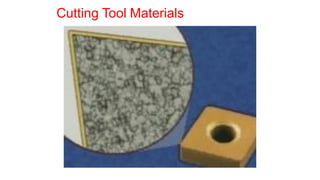
• Cemented Carbides or Sintered Carbides (1926-30): These tools are produced by powder metallurgy. Carbide tools
are basically of three types: tungsten carbide (WC), tantalum carbide (TaC), and titanium carbide (TiC). The carbides
or combined carbides are mixed with a binder of cobalt. They are able to retain hardness to a temperature of about
10000C. So they can be used at high speeds. Carbide tool are available as brazed tip tools (carbide tip is brazed to
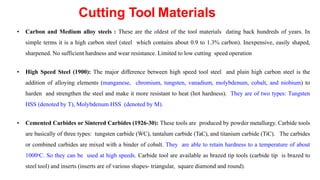
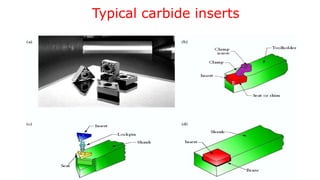
steel tool) and inserts (inserts are of various shapes- triangular, square diamond and round).
Typical carbide inserts
Cutting Tool Materials
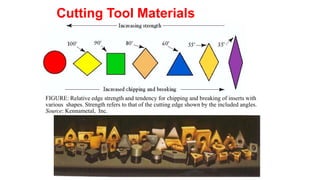
FIGURE: Relative edge strength and tendency for chipping and breaking of inserts with
various shapes. Strength refers to that of the cutting edge shown by the included angles.
Source: Kennametal, Inc.
What is required for machining?
Preset interference between
tool and work piece
Depth of Cut -
Feed - Motion to bring in additional
material for machining
Speed - What generates the basic
wedge and cuts
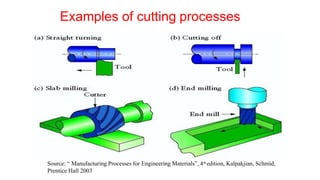
Examples of cutting processes
Source: “ Manufacturing Processes for Engineering Materials”, 4th edition, Kalpakjian, Schmid,
Prentice Hall 2003
Machine Tools
• Machine tools are kind of machines on which metal cutting or metal forming
processes are carried out.
• Material removal is essentially done on machine tools, which may be Lathe,
Milling, Drilling, Shaping, Planing, Broaching and Grinding machines.
• The functions of machine tools are:
• holding the workpiece
• holding the tool
• moving the tool or the work piece or both relative to each other,
• supply energy required to cause metal cutting.
• Every machine tool has a primary cutting tool for metal removal.
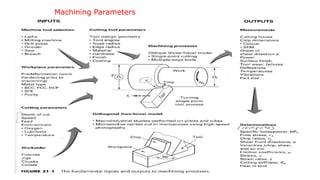
Machining Parameters
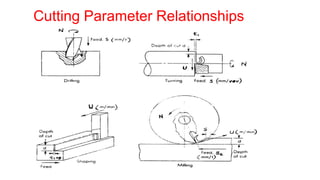
Cutting Parameter Relationships
Cutting Parameters
Cutting Speed: Cutting speed is the distance traveled by the work surface in unit time with
reference to the cutting edge of the tool.
The cutting speed, v is simply referred to as speed and usually expressed in m/min.
Feed: The feed is the distance advanced by the tool into or along the workpiece each time the tool
point passes a certain position in its travel over the surface.
In case of turning, feed is the distance that the tool advances in one revolution of the workpiece.
Feed f is usually expressed in mm/rev. Sometimes it is also expressed in mm/min and is called feed
rate.
Depth of cut : It is the distance through which the cutting tool is plunged into the workpiece
surface.
Thus it is the distance measured perpendicularly between the machined surface and the unmachined
(uncut) surface or the previously machined surface of the workpiece.
The depth of cut d is expressed in mm.
Cutting Tool Materials
How Do We Rate Machinability?
◼ Tool life in minutes
◼ Cutting forces and Power consumed
◼ Quality of Surface Finish
◼ Chip formation
◼ Material removal rate
Manufacturing Technology
Machinability
◼ Machinability is a system property that indicates how easy a material can be machined at low cost.
◼ Good machinabililty may mean one or more of the following: cutting with minimum energy,
minimum tool wear, good surface finish, etc.
Quantitative measures of machinability
◼ Machinability index: an average rating stated in comparison with reference materials. This
measure can be misleading.
◼ Tool life: service time in minutes or seconds to total failure by chipping or cracking of the tool at
certain cutting speed, or the volume of material removed before total failure.
◼ Surface finish produced at standardized cutting speeds and feeds.
◼ Others based on cutting force, power, temperature, or chip formation.
Manufacturing Technology
Machinable Materials
Good machinable materials should have the following properties
◼ Low ductility, low strain-hardening exponent (n), low fracture toughness.
◼ Low shear strength (low TS), low hardness.
◼ A strong metallurgical bond (adhesion) between tool and work piece is
undesirable when it weakens the tool material.
◼ Very hard compounds, such as some oxides, all carbides, many inter metallic compounds, and elements
such as silicon, embedded in the work piece material accelerate tool wear, thus should be avoided.
◼ Inclusions that soften at high temperatures are beneficial.
◼ High thermal conductivity is helpful.
Manufacturing Technology
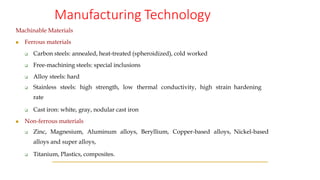
Machinable Materials
◼ Ferrous materials
❑ Carbon steels: annealed, heat-treated (spheroidized), cold worked
❑ Free-machining steels: special inclusions
❑ Alloy steels: hard
❑ Stainless steels: high strength, low thermal conductivity, high strain hardening
rate
❑ Cast iron: white, gray, nodular cast iron
◼ Non-ferrous materials
❑ Zinc, Magnesium, Aluminum alloys, Beryllium, Copper-based alloys, Nickel-based
alloys and super alloys,
❑ Titanium, Plastics, composites.
Manufacturing Technology
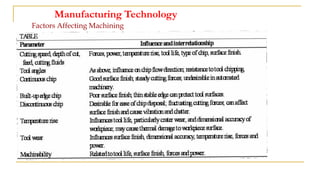
Factors Affecting Machining

5.Cutting Tool Materials.pdf

  • 1.
    Cutting Tool Materials Dr.V.Harinadh Dept of Mechanical Engineering
  • 2.
    Cutting Tool Materials •Carbon and Medium alloy steels : These are the oldest of the tool materials dating back hundreds of years. In simple terms it is a high carbon steel (steel which contains about 0.9 to 1.3% carbon). Inexpensive, easily shaped, sharpened. No sufficient hardness and wear resistance. Limited to low cutting speed operation • High Speed Steel (1900): The major difference between high speed tool steel and plain high carbon steel is the addition of alloying elements (manganese, chromium, tungsten, vanadium, molybdenum, cobalt, and niobium) to harden and strengthen the steel and make it more resistant to heat (hot hardness). They are of two types: Tungsten HSS (denoted by T), Molybdenum HSS (denoted by M). • Cemented Carbides or Sintered Carbides (1926-30): These tools are produced by powder metallurgy. Carbide tools are basically of three types: tungsten carbide (WC), tantalum carbide (TaC), and titanium carbide (TiC). The carbides or combined carbides are mixed with a binder of cobalt. They are able to retain hardness to a temperature of about 10000C. So they can be used at high speeds. Carbide tool are available as brazed tip tools (carbide tip is brazed to steel tool) and inserts (inserts are of various shapes- triangular, square diamond and round).
  • 3.
  • 4.
    Cutting Tool Materials FIGURE:Relative edge strength and tendency for chipping and breaking of inserts with various shapes. Strength refers to that of the cutting edge shown by the included angles. Source: Kennametal, Inc.
  • 5.
    What is requiredfor machining? Preset interference between tool and work piece Depth of Cut - Feed - Motion to bring in additional material for machining Speed - What generates the basic wedge and cuts
  • 6.
    Examples of cuttingprocesses Source: “ Manufacturing Processes for Engineering Materials”, 4th edition, Kalpakjian, Schmid, Prentice Hall 2003
  • 7.
    Machine Tools • Machinetools are kind of machines on which metal cutting or metal forming processes are carried out. • Material removal is essentially done on machine tools, which may be Lathe, Milling, Drilling, Shaping, Planing, Broaching and Grinding machines. • The functions of machine tools are: • holding the workpiece • holding the tool • moving the tool or the work piece or both relative to each other, • supply energy required to cause metal cutting. • Every machine tool has a primary cutting tool for metal removal.
  • 8.
  • 9.
  • 10.
    Cutting Parameters Cutting Speed:Cutting speed is the distance traveled by the work surface in unit time with reference to the cutting edge of the tool. The cutting speed, v is simply referred to as speed and usually expressed in m/min. Feed: The feed is the distance advanced by the tool into or along the workpiece each time the tool point passes a certain position in its travel over the surface. In case of turning, feed is the distance that the tool advances in one revolution of the workpiece. Feed f is usually expressed in mm/rev. Sometimes it is also expressed in mm/min and is called feed rate. Depth of cut : It is the distance through which the cutting tool is plunged into the workpiece surface. Thus it is the distance measured perpendicularly between the machined surface and the unmachined (uncut) surface or the previously machined surface of the workpiece. The depth of cut d is expressed in mm.
  • 11.
  • 12.
    How Do WeRate Machinability? ◼ Tool life in minutes ◼ Cutting forces and Power consumed ◼ Quality of Surface Finish ◼ Chip formation ◼ Material removal rate
  • 13.
    Manufacturing Technology Machinability ◼ Machinabilityis a system property that indicates how easy a material can be machined at low cost. ◼ Good machinabililty may mean one or more of the following: cutting with minimum energy, minimum tool wear, good surface finish, etc. Quantitative measures of machinability ◼ Machinability index: an average rating stated in comparison with reference materials. This measure can be misleading. ◼ Tool life: service time in minutes or seconds to total failure by chipping or cracking of the tool at certain cutting speed, or the volume of material removed before total failure. ◼ Surface finish produced at standardized cutting speeds and feeds. ◼ Others based on cutting force, power, temperature, or chip formation.
  • 14.
    Manufacturing Technology Machinable Materials Goodmachinable materials should have the following properties ◼ Low ductility, low strain-hardening exponent (n), low fracture toughness. ◼ Low shear strength (low TS), low hardness. ◼ A strong metallurgical bond (adhesion) between tool and work piece is undesirable when it weakens the tool material. ◼ Very hard compounds, such as some oxides, all carbides, many inter metallic compounds, and elements such as silicon, embedded in the work piece material accelerate tool wear, thus should be avoided. ◼ Inclusions that soften at high temperatures are beneficial. ◼ High thermal conductivity is helpful.
  • 15.
    Manufacturing Technology Machinable Materials ◼Ferrous materials ❑ Carbon steels: annealed, heat-treated (spheroidized), cold worked ❑ Free-machining steels: special inclusions ❑ Alloy steels: hard ❑ Stainless steels: high strength, low thermal conductivity, high strain hardening rate ❑ Cast iron: white, gray, nodular cast iron ◼ Non-ferrous materials ❑ Zinc, Magnesium, Aluminum alloys, Beryllium, Copper-based alloys, Nickel-based alloys and super alloys, ❑ Titanium, Plastics, composites.
  • 16.