1
CUTTING TOOL
TECHNOLOGY
1. Tool life
2. Tool Materials
3. Tool Geometry
4. Cutting fluids
2
Introduction
• Machining is accomplished by cutting tools.
• Cutting tools undergo high force and
temperature and temperature gradient.
• Tool life
• Two aspects of design
– Tool Materials
– Tool Geometry
• Cutting fluids
3
1. Tool life
• Three modes of failure
– Premature Failure
• Fracture failure - Cutting force becomes excessive and/or
dynamic, leading to brittle fracture
• Thermal failure - Cutting temperature is too high for the tool
material
– Gradual Wear
• Gradual failure
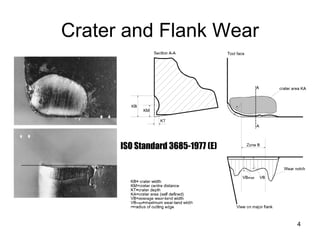
• Tool wear: Gradual failure
– Flank wear - flank (side of tool)
– Crater wear - top rake face
– Notch wear
– Nose radius wear
4
Crater and Flank Wear
ISO Standard 3685-1977 (E)
5
Possible Wear Mechanisms
• Abrasion – Flank and Crater wear
– Hard Inclusions abrading Cutting tools
– Hot Hardness Ratio
• Erosion
• Attrition
• Adhesion
– Compatibility chart
• Diffusion/Dissolution – Crater wear
– Chemical solubility
– Diamond dissolves into iron.
– Oxide coating resists crater wear.
• Plastic deformation
Attrition Wear (from Tlusty, 2000)
6
Tool life
• Tool life – the length of cutting time that the tool can be used
– Break-in period
– Steady-state wear region
– Failure region
Time
Flank
Wear
0.02in
T=41
7
Taylor’s Equation
• F. W. Taylor [1900]’s Equation
• Generalized Taylor’s Equation
– where v = cutting speed; T = tool life; and n and C depend on
feed, depth of cut, work material and, tooling material
• n is the slope of the plot
• C is the intercept on the speed axis
C
vT n
=
C
d
f
vT p
m
n
=
Tool material n C (m/min) C (ft/min)
High speed steel:
Non-steel work 0.125 120 350
Steel work 0.125 70 200
Cemented carbide
Non-steel work 0.25 900 2700
Steel work 0.25 500 1500
Ceramic
Steel work 0.6 3000 10,000
8
Tool Life Criteria in practice
1. Complete failure of cutting edge
2. Visual inspection of flank wear (or crater
wear) by the machine operator
3. Fingernail test across cutting edge
4. Changes in sound emitted from operation
5. Chips become ribbony, stringy, and difficult
to dispose of
6. Degradation of surface finish
7. Increased power
8. Workpiece count
9. Cumulative cutting time
9
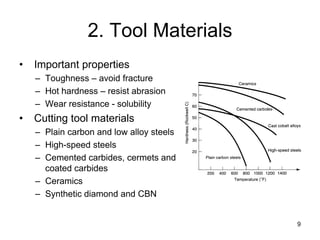
2. Tool Materials
• Important properties
– Toughness – avoid fracture
– Hot hardness – resist abrasion
– Wear resistance - solubility
• Cutting tool materials
– Plain carbon and low alloy steels
– High-speed steels
– Cemented carbides, cermets and
coated carbides
– Ceramics
– Synthetic diamond and CBN
10
Tool Materials
• Plain Carbon and Low Alloy Steels
– Before High Speed Steels
– Due to a high carbon content, heat treated to Rc=60
– Poor hot hardness
• High-speed steels (HSSs)
– tungsten type (T-grade)– 12-20% of W
– molybdenum type (M-grade)- 6% W and 5% Mo
– Other elements: Tungsten and/or Molybdenum,
Chromium and Vanadium, Carbon, Cobalt in some
grades
– Typical composition: Grade T1: 18% W, 4% Cr, 1%
V, and 0.9% C
11
Tool Materials
• HSSs
– Still used extensively for complex geometry such
as drills
– Heat treated to Rc=65
– Re-grinded for reuse
– Thin coating
• Cast Cobalt Alloys
– 40-50% Co, 25-35% W, 15-20% others
– Casting in a graphite mold and grind
– Toughness is not as good as HSS but hot
hardness is better.
– Not so important
12
Cemented Carbides
• Advantages (Cemented Carbide, Cermets & Coated Carbides)
– High compressive strength and modulus
– High room and hot hardness
– Good wear resistance
– High thermal conductivity
– Lower in toughness that HSSs
• Grades
– Nonsteels grade – WC-Co
– Steel grades – add TiC and TaC due to the high solubility of WC
into steels resulting in extensive crater wear
• Cemented Carbides – Mainly WC-Co
– As grain size is increased, hardness decreases but TRS
increases.
– As the content of cobalt increase, TRS increases but hardness
decreases.
– For roughing or milling, high cobalt is desirable
– For finishing, low cobalt is desirable.
13
Classification of C-grade
carbides
C1 Roughing C5
C2 General purpose C6
C3 Finishing C7
C4 Precision Finishing C8
Toughness
Wear
Resistance
With TiC and TaC
Steel-cutting grades
Nonsteel-cutting grades
Abrasive wear resistance
Crater wear resistance
Cobalt
content
TiC
content
14
Cermets
• Cermets – TiC, TiN and TiCN with Ni or
Mo as binders
– Applications: High speed finishing and
semifinishing of steels, stainless steels and
cast iron
– Higher speeds than carbides
– For better finish, low feed
15
Coated carbides
• Since 1970, they improve machinability.
• One or more layer of thin layers of wear
resistance CVD or PVD coating such as TiC, TiN,
Al2O3, ZrN, CrC or Diamond.
• Coating thickness = 2.5 - 13 μm (0.0001 to
0.0005 in)
• Applications: cast irons and steels in turning and
milling operations
• Best applied at high speeds where dynamic force
and thermal shock are minimal
16
Ceramics, Synthetic diamond and CBN
• Ceramics
– Fine alumina powder is pressed and sintered at High pressure and
temperature.
– Other oxide such ZrO2 are added.
– Used in finishing of harden steels, high v, low d and f and rigid
work setup.
– Not for heavy interrupted cutting
– Other ceramic tools: Si3N4, sialon(Si3N4-Al2O3), Alumina and TiC
and SiC whiskers-reinforced alumina.
• Diamond – the hardest material.
– Usually applied as coating (0.5 mm thick) on WC-Co insert
– Sintered polycrystalline diamond
– Applications: high speed cutting of nonferrous metals
• Cubic Boron Nitrides (CBN)
– For steels and Nickel alloys
– Expensive
17
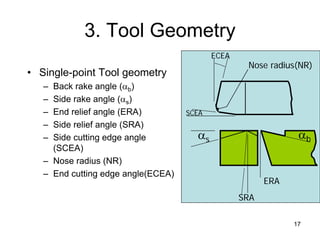
3. Tool Geometry
• Single-point Tool geometry
– Back rake angle (αb)
– Side rake angle (αs)
– End relief angle (ERA)
– Side relief angle (SRA)
– Side cutting edge angle
(SCEA)
– Nose radius (NR)
– End cutting edge angle(ECEA)
Nose radius(NR)
ECEA
SCEA
ERA
αb
SRA
αs
18
Cutting edge for a single-point
tool
19
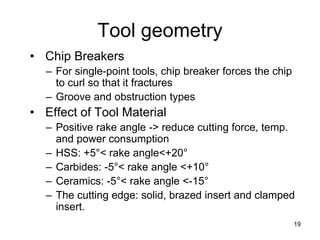
Tool geometry
• Chip Breakers
– For single-point tools, chip breaker forces the chip
to curl so that it fractures
– Groove and obstruction types
• Effect of Tool Material
– Positive rake angle -> reduce cutting force, temp.
and power consumption
– HSS: +5°< rake angle<+20°
– Carbides: -5°< rake angle <+10°
– Ceramics: -5°< rake angle <-15°
– The cutting edge: solid, brazed insert and clamped
insert.
20
Twist Drills
The most common cutting tools for hole-making
Usually made of high speed steel
21
Twist Drill Operation
• Rotation and feeding result in relative motion
between cutting edges and workpiece
– Cutting speed varies along cutting edges as a
function of distance from axis of rotation
– Zero Relative velocity at drill point (no cutting)
– A large thrust force to drive the drill forward
• Chip removal
– Flutes allow chips to be extracted
• Friction makes matters worse
– Rubbing between outside diameter and wall
– Delivery of cutting fluid to drill point
22
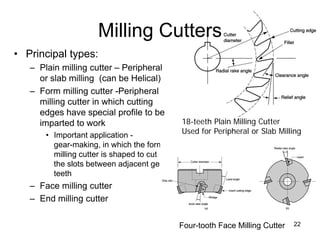
Milling Cutters
• Principal types:
– Plain milling cutter – Peripheral
or slab milling (can be Helical)
– Form milling cutter -Peripheral
milling cutter in which cutting
edges have special profile to be
imparted to work
• Important application -
gear-making, in which the form
milling cutter is shaped to cut
the slots between adjacent gear
teeth
– Face milling cutter
– End milling cutter
18-teeth Plain Milling Cutter
Used for Peripheral or Slab Milling
Four-tooth Face Milling Cutter
23
End Milling Cutter
• Looks like a drill bit but designed for
primary cutting with its peripheral teeth
• Applications:
– Face milling
– Profile milling and pocketing
– Cutting slots
– Engraving
– Surface contouring
– Die sinking
24
Milling Cutter
From Schey [2000]
25
Broaches and Saw Blades
Finishing teeth
Semifinishing
teeth
Roughing teeth
Saw Blade (Straight & Undercut tooth
or Straight & Raker sets)
26
4. Cutting fluids
• Reduces heat generation at shear zone and
friction zone (coolants)
– High specific heat and thermal conductivity (water-
based coolants)
– Effective at high cutting speeds
• Reduces friction between tool and chip
(lubricants)
– Effective at low cutting speeds
– Oil-based lubricants
– Low friction means low friction angle, which
means shear angle decreases, which reduces
heat.
27
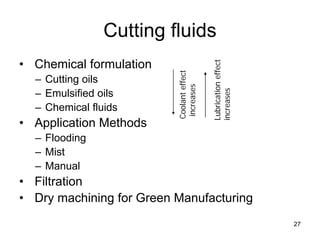
Cutting fluids
• Chemical formulation
– Cutting oils
– Emulsified oils
– Chemical fluids
• Application Methods
– Flooding
– Mist
– Manual
• Filtration
• Dry machining for Green Manufacturing
Coolant
effect
increases
Lubrication
effect
increases

cuttingtool.pdf

  • 1.
    1 CUTTING TOOL TECHNOLOGY 1. Toollife 2. Tool Materials 3. Tool Geometry 4. Cutting fluids
  • 2.
    2 Introduction • Machining isaccomplished by cutting tools. • Cutting tools undergo high force and temperature and temperature gradient. • Tool life • Two aspects of design – Tool Materials – Tool Geometry • Cutting fluids
  • 3.
    3 1. Tool life •Three modes of failure – Premature Failure • Fracture failure - Cutting force becomes excessive and/or dynamic, leading to brittle fracture • Thermal failure - Cutting temperature is too high for the tool material – Gradual Wear • Gradual failure • Tool wear: Gradual failure – Flank wear - flank (side of tool) – Crater wear - top rake face – Notch wear – Nose radius wear
  • 4.
    4 Crater and FlankWear ISO Standard 3685-1977 (E)
  • 5.
    5 Possible Wear Mechanisms •Abrasion – Flank and Crater wear – Hard Inclusions abrading Cutting tools – Hot Hardness Ratio • Erosion • Attrition • Adhesion – Compatibility chart • Diffusion/Dissolution – Crater wear – Chemical solubility – Diamond dissolves into iron. – Oxide coating resists crater wear. • Plastic deformation Attrition Wear (from Tlusty, 2000)
  • 6.
    6 Tool life • Toollife – the length of cutting time that the tool can be used – Break-in period – Steady-state wear region – Failure region Time Flank Wear 0.02in T=41
  • 7.
    7 Taylor’s Equation • F.W. Taylor [1900]’s Equation • Generalized Taylor’s Equation – where v = cutting speed; T = tool life; and n and C depend on feed, depth of cut, work material and, tooling material • n is the slope of the plot • C is the intercept on the speed axis C vT n = C d f vT p m n = Tool material n C (m/min) C (ft/min) High speed steel: Non-steel work 0.125 120 350 Steel work 0.125 70 200 Cemented carbide Non-steel work 0.25 900 2700 Steel work 0.25 500 1500 Ceramic Steel work 0.6 3000 10,000
  • 8.
    8 Tool Life Criteriain practice 1. Complete failure of cutting edge 2. Visual inspection of flank wear (or crater wear) by the machine operator 3. Fingernail test across cutting edge 4. Changes in sound emitted from operation 5. Chips become ribbony, stringy, and difficult to dispose of 6. Degradation of surface finish 7. Increased power 8. Workpiece count 9. Cumulative cutting time
  • 9.
    9 2. Tool Materials •Important properties – Toughness – avoid fracture – Hot hardness – resist abrasion – Wear resistance - solubility • Cutting tool materials – Plain carbon and low alloy steels – High-speed steels – Cemented carbides, cermets and coated carbides – Ceramics – Synthetic diamond and CBN
  • 10.
    10 Tool Materials • PlainCarbon and Low Alloy Steels – Before High Speed Steels – Due to a high carbon content, heat treated to Rc=60 – Poor hot hardness • High-speed steels (HSSs) – tungsten type (T-grade)– 12-20% of W – molybdenum type (M-grade)- 6% W and 5% Mo – Other elements: Tungsten and/or Molybdenum, Chromium and Vanadium, Carbon, Cobalt in some grades – Typical composition: Grade T1: 18% W, 4% Cr, 1% V, and 0.9% C
  • 11.
    11 Tool Materials • HSSs –Still used extensively for complex geometry such as drills – Heat treated to Rc=65 – Re-grinded for reuse – Thin coating • Cast Cobalt Alloys – 40-50% Co, 25-35% W, 15-20% others – Casting in a graphite mold and grind – Toughness is not as good as HSS but hot hardness is better. – Not so important
  • 12.
    12 Cemented Carbides • Advantages(Cemented Carbide, Cermets & Coated Carbides) – High compressive strength and modulus – High room and hot hardness – Good wear resistance – High thermal conductivity – Lower in toughness that HSSs • Grades – Nonsteels grade – WC-Co – Steel grades – add TiC and TaC due to the high solubility of WC into steels resulting in extensive crater wear • Cemented Carbides – Mainly WC-Co – As grain size is increased, hardness decreases but TRS increases. – As the content of cobalt increase, TRS increases but hardness decreases. – For roughing or milling, high cobalt is desirable – For finishing, low cobalt is desirable.
  • 13.
    13 Classification of C-grade carbides C1Roughing C5 C2 General purpose C6 C3 Finishing C7 C4 Precision Finishing C8 Toughness Wear Resistance With TiC and TaC Steel-cutting grades Nonsteel-cutting grades Abrasive wear resistance Crater wear resistance Cobalt content TiC content
  • 14.
    14 Cermets • Cermets –TiC, TiN and TiCN with Ni or Mo as binders – Applications: High speed finishing and semifinishing of steels, stainless steels and cast iron – Higher speeds than carbides – For better finish, low feed
  • 15.
    15 Coated carbides • Since1970, they improve machinability. • One or more layer of thin layers of wear resistance CVD or PVD coating such as TiC, TiN, Al2O3, ZrN, CrC or Diamond. • Coating thickness = 2.5 - 13 μm (0.0001 to 0.0005 in) • Applications: cast irons and steels in turning and milling operations • Best applied at high speeds where dynamic force and thermal shock are minimal
  • 16.
    16 Ceramics, Synthetic diamondand CBN • Ceramics – Fine alumina powder is pressed and sintered at High pressure and temperature. – Other oxide such ZrO2 are added. – Used in finishing of harden steels, high v, low d and f and rigid work setup. – Not for heavy interrupted cutting – Other ceramic tools: Si3N4, sialon(Si3N4-Al2O3), Alumina and TiC and SiC whiskers-reinforced alumina. • Diamond – the hardest material. – Usually applied as coating (0.5 mm thick) on WC-Co insert – Sintered polycrystalline diamond – Applications: high speed cutting of nonferrous metals • Cubic Boron Nitrides (CBN) – For steels and Nickel alloys – Expensive
  • 17.
    17 3. Tool Geometry •Single-point Tool geometry – Back rake angle (αb) – Side rake angle (αs) – End relief angle (ERA) – Side relief angle (SRA) – Side cutting edge angle (SCEA) – Nose radius (NR) – End cutting edge angle(ECEA) Nose radius(NR) ECEA SCEA ERA αb SRA αs
  • 18.
    18 Cutting edge fora single-point tool
  • 19.
    19 Tool geometry • ChipBreakers – For single-point tools, chip breaker forces the chip to curl so that it fractures – Groove and obstruction types • Effect of Tool Material – Positive rake angle -> reduce cutting force, temp. and power consumption – HSS: +5°< rake angle<+20° – Carbides: -5°< rake angle <+10° – Ceramics: -5°< rake angle <-15° – The cutting edge: solid, brazed insert and clamped insert.
  • 20.
    20 Twist Drills The mostcommon cutting tools for hole-making Usually made of high speed steel
  • 21.
    21 Twist Drill Operation •Rotation and feeding result in relative motion between cutting edges and workpiece – Cutting speed varies along cutting edges as a function of distance from axis of rotation – Zero Relative velocity at drill point (no cutting) – A large thrust force to drive the drill forward • Chip removal – Flutes allow chips to be extracted • Friction makes matters worse – Rubbing between outside diameter and wall – Delivery of cutting fluid to drill point
  • 22.
    22 Milling Cutters • Principaltypes: – Plain milling cutter – Peripheral or slab milling (can be Helical) – Form milling cutter -Peripheral milling cutter in which cutting edges have special profile to be imparted to work • Important application - gear-making, in which the form milling cutter is shaped to cut the slots between adjacent gear teeth – Face milling cutter – End milling cutter 18-teeth Plain Milling Cutter Used for Peripheral or Slab Milling Four-tooth Face Milling Cutter
  • 23.
    23 End Milling Cutter •Looks like a drill bit but designed for primary cutting with its peripheral teeth • Applications: – Face milling – Profile milling and pocketing – Cutting slots – Engraving – Surface contouring – Die sinking
  • 24.
  • 25.
    25 Broaches and SawBlades Finishing teeth Semifinishing teeth Roughing teeth Saw Blade (Straight & Undercut tooth or Straight & Raker sets)
  • 26.
    26 4. Cutting fluids •Reduces heat generation at shear zone and friction zone (coolants) – High specific heat and thermal conductivity (water- based coolants) – Effective at high cutting speeds • Reduces friction between tool and chip (lubricants) – Effective at low cutting speeds – Oil-based lubricants – Low friction means low friction angle, which means shear angle decreases, which reduces heat.
  • 27.
    27 Cutting fluids • Chemicalformulation – Cutting oils – Emulsified oils – Chemical fluids • Application Methods – Flooding – Mist – Manual • Filtration • Dry machining for Green Manufacturing Coolant effect increases Lubrication effect increases