CSE5243 INTRO. TO DATA MINING
Data & Data Preprocessing
Huan Sun, CSE@The Ohio State University
Slides adapted from UIUC CS412, Fall 2017, by Prof. Jiawei Han
2
Data & Data Preprocessing
 What is Data: Data Objects and Attribute Types
 Basic Statistical Descriptions of Data
 Measuring Data Similarity and Dissimilarity
 Data Preprocessing: An Overview
 Summary
3
What is Data?
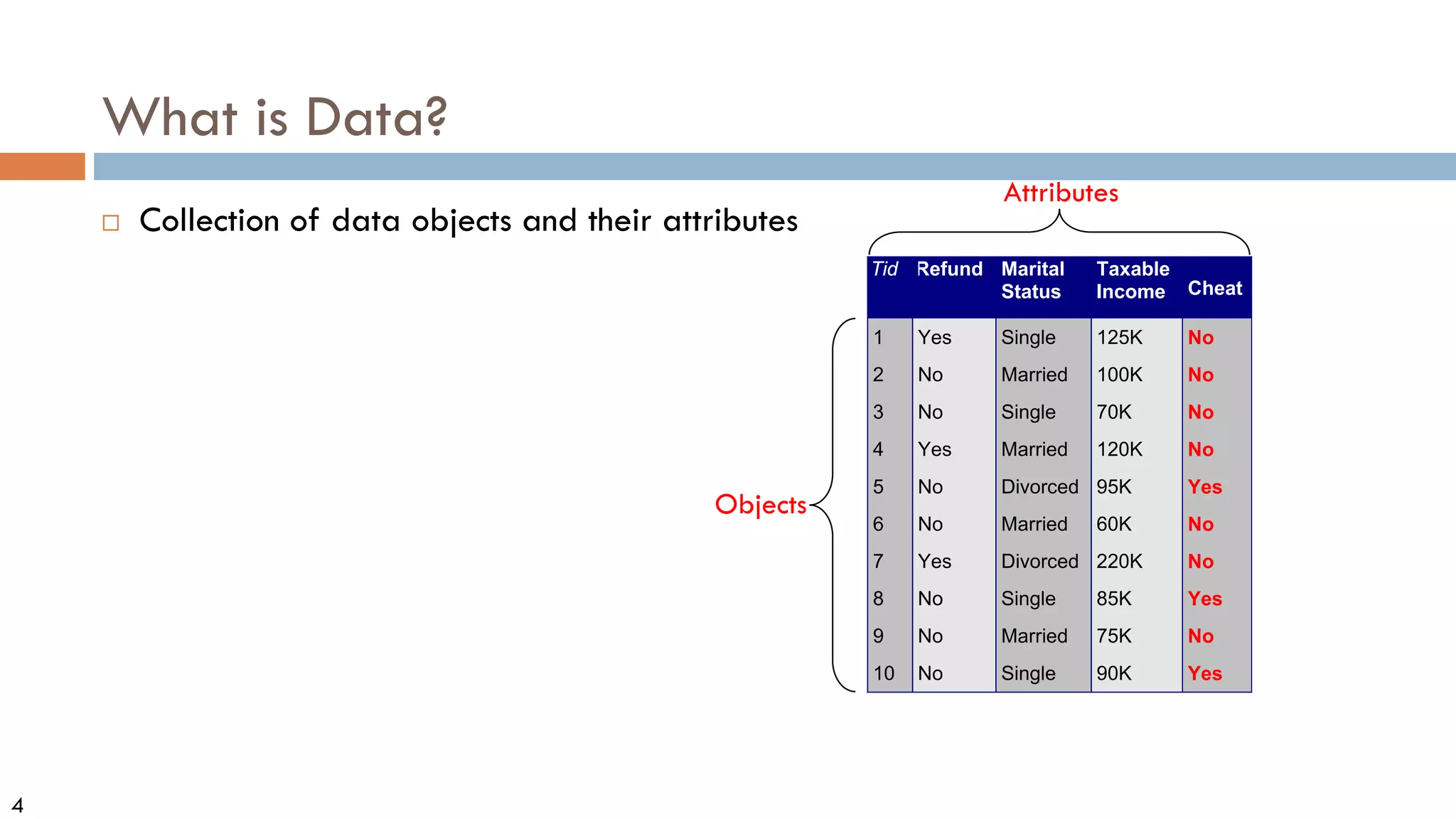
 Collection of data objects and their attributes
4
What is Data?
 Collection of data objects and their attributes
Tid Refund Marital
Status
Taxable
Income Cheat
1 Yes Single 125K No
2 No Married 100K No
3 No Single 70K No
4 Yes Married 120K No
5 No Divorced 95K Yes
6 No Married 60K No
7 Yes Divorced 220K No
8 No Single 85K Yes
9 No Married 75K No
10 No Single 90K Yes
10
Attributes
Objects
5
Data Objects
 Data sets are made up of data objects
 A data object represents an entity
 Examples:
 sales database: customers, store items, sales
 medical database: patients, treatments
 university database: students, professors, courses
 Also called samples , examples, instances, data points, objects, tuples
6
Data Objects
 Data sets are made up of data objects
 A data object represents an entity
 Examples:
 sales database: customers, store items, sales
 medical database: patients, treatments
 university database: students, professors, courses
 Also called samples , examples, instances, data points, objects, tuples
 Data objects are described by attributes
 Database rows → data objects; columns → attributes
7
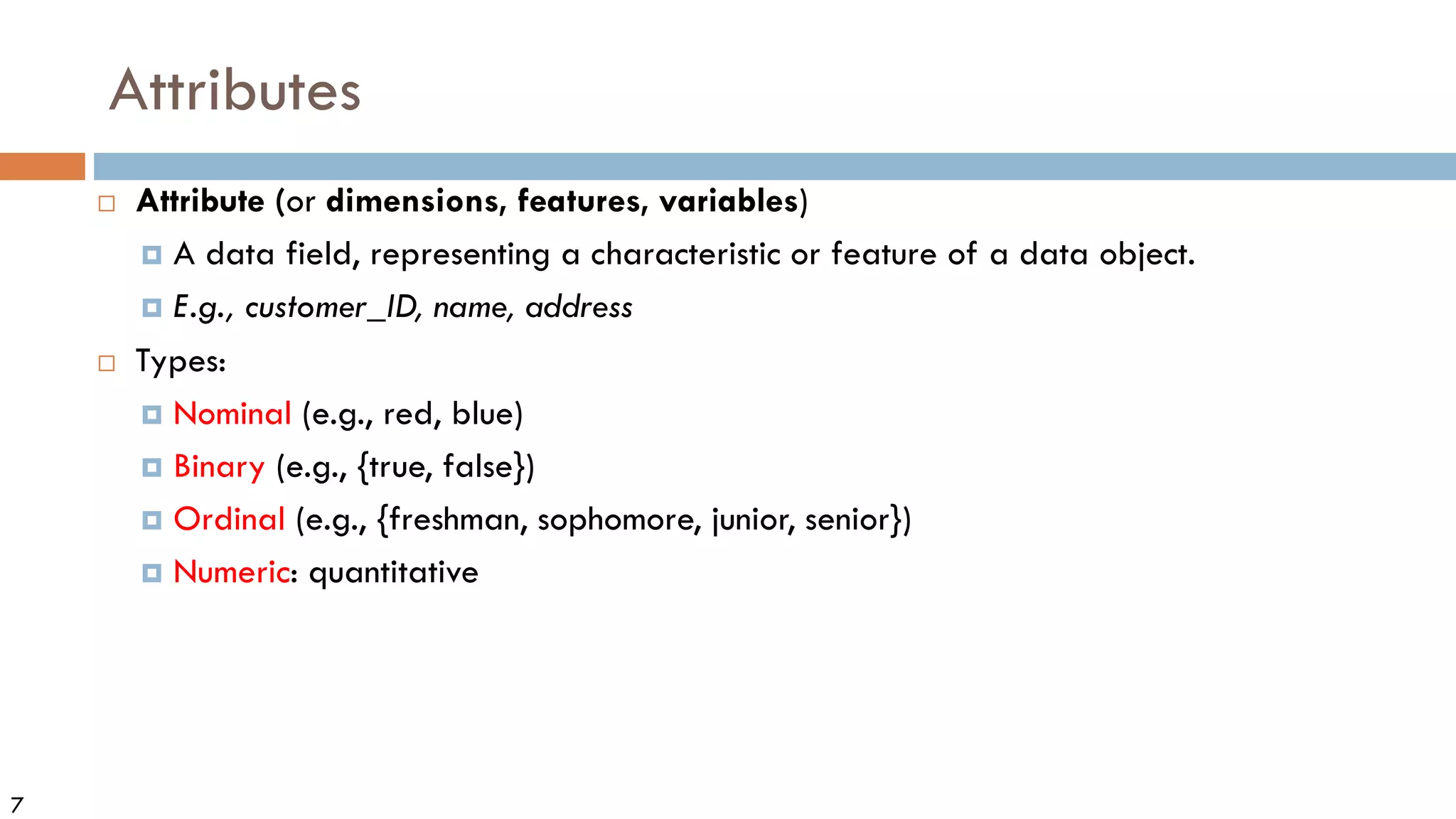
Attributes
 Attribute (or dimensions, features, variables)
 A data field, representing a characteristic or feature of a data object.
 E.g., customer_ID, name, address
 Types:
 Nominal (e.g., red, blue)
 Binary (e.g., {true, false})
 Ordinal (e.g., {freshman, sophomore, junior, senior})
 Numeric: quantitative
8
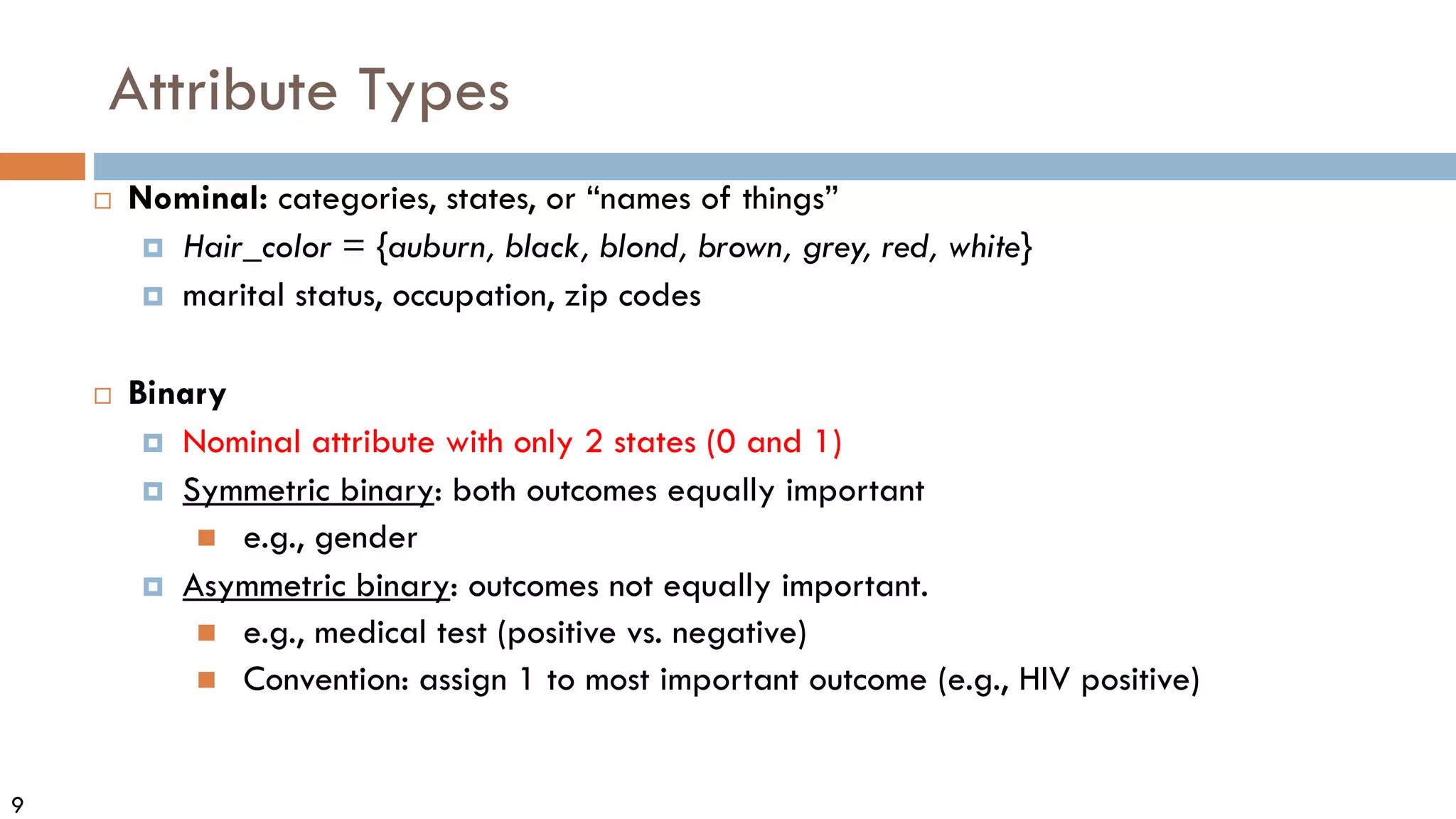
Attribute Types
 Nominal: categories, states, or “names of things”
 Hair_color = {auburn, black, blond, brown, grey, red, white}
 marital status, occupation, zip codes
9
Attribute Types
 Nominal: categories, states, or “names of things”
 Hair_color = {auburn, black, blond, brown, grey, red, white}
 marital status, occupation, zip codes
 Binary
 Nominal attribute with only 2 states (0 and 1)
 Symmetric binary: both outcomes equally important
 e.g., gender
 Asymmetric binary: outcomes not equally important.
 e.g., medical test (positive vs. negative)
 Convention: assign 1 to most important outcome (e.g., HIV positive)
10
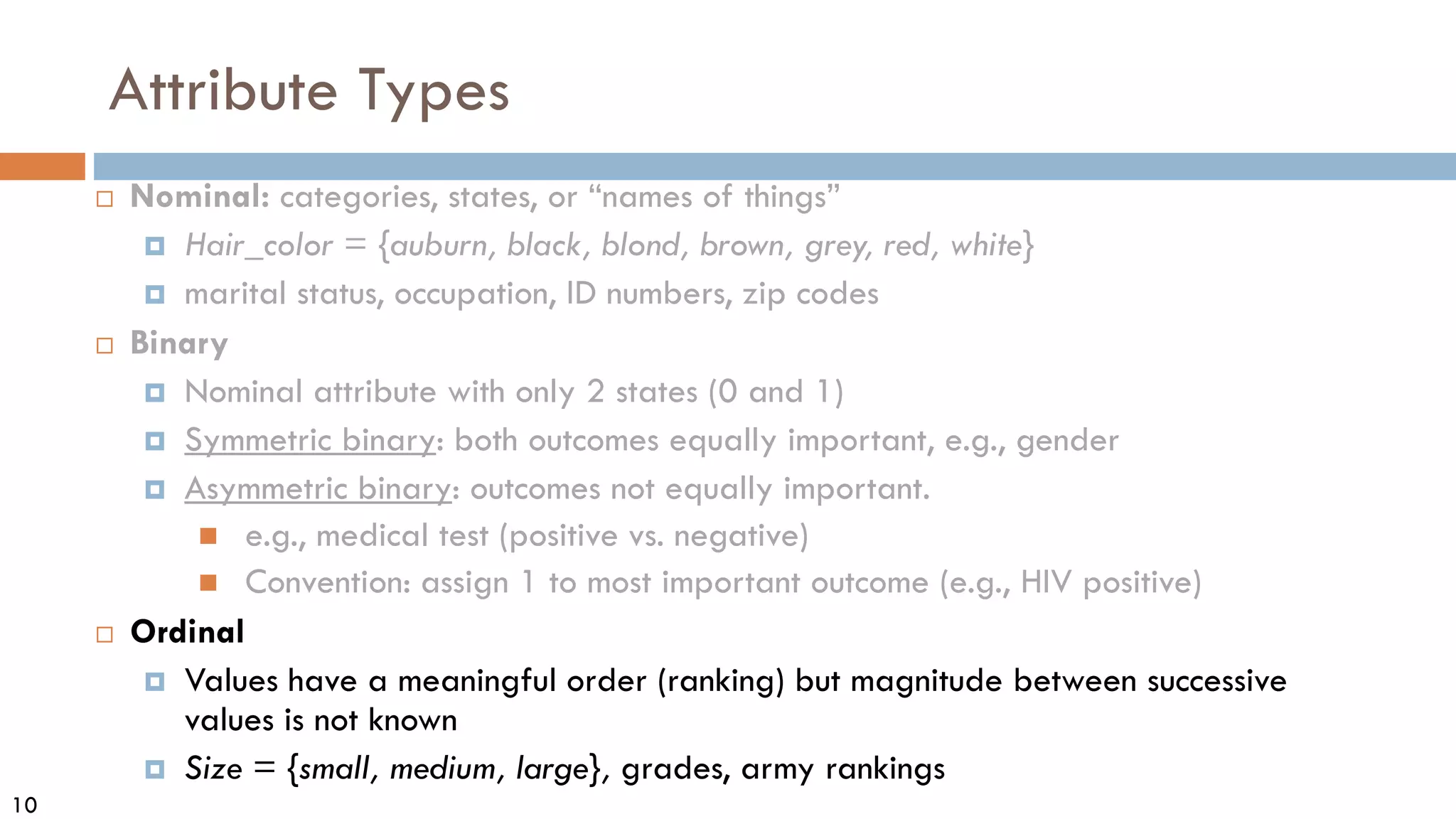
Attribute Types
 Nominal: categories, states, or “names of things”
 Hair_color = {auburn, black, blond, brown, grey, red, white}
 marital status, occupation, ID numbers, zip codes
 Binary
 Nominal attribute with only 2 states (0 and 1)
 Symmetric binary: both outcomes equally important, e.g., gender
 Asymmetric binary: outcomes not equally important.
 e.g., medical test (positive vs. negative)
 Convention: assign 1 to most important outcome (e.g., HIV positive)
 Ordinal
 Values have a meaningful order (ranking) but magnitude between successive
values is not known
 Size = {small, medium, large}, grades, army rankings
11
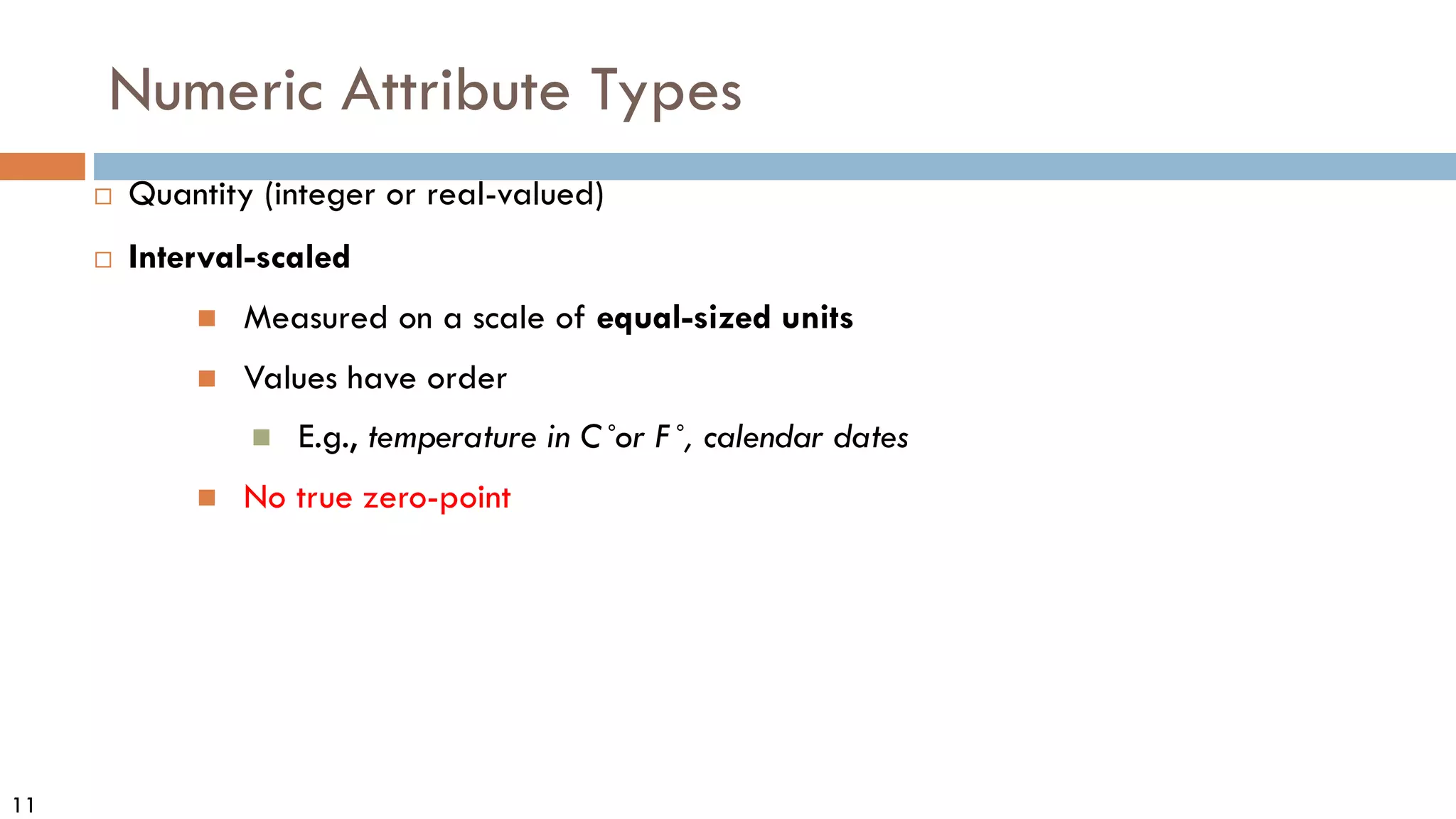
Numeric Attribute Types
 Quantity (integer or real-valued)
 Interval-scaled
 Measured on a scale of equal-sized units
 Values have order
 E.g., temperature in C˚or F˚, calendar dates
 No true zero-point
12
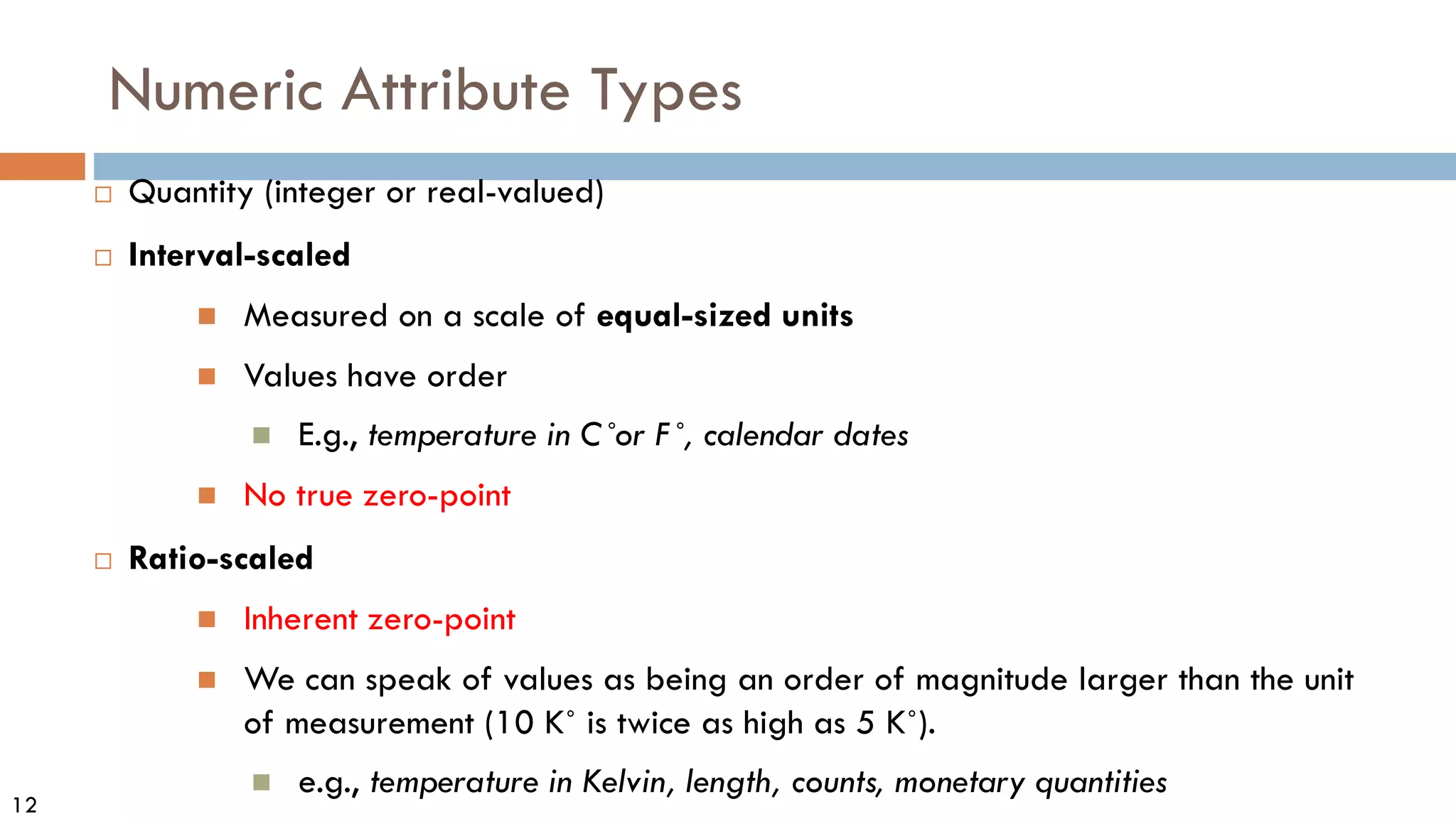
Numeric Attribute Types
 Quantity (integer or real-valued)
 Interval-scaled
 Measured on a scale of equal-sized units
 Values have order
 E.g., temperature in C˚or F˚, calendar dates
 No true zero-point
 Ratio-scaled
 Inherent zero-point
 We can speak of values as being an order of magnitude larger than the unit
of measurement (10 K˚ is twice as high as 5 K˚).
 e.g., temperature in Kelvin, length, counts, monetary quantities
13
 Q1: Is student ID a nominal, ordinal, or numerical attribute?
 Q2: What about eye color? Or color in the color spectrum of
physics?
14
Discrete vs. Continuous Attributes
 Discrete Attribute
 Has only a finite or countably infinite set of values
 E.g., zip codes, profession, or the set of words in a collection of documents
 Sometimes, represented as integer variables
 Note: Binary attributes are a special case of discrete attributes
15
Discrete vs. Continuous Attributes
 Discrete Attribute
 Has only a finite or countably infinite set of values
 Sometimes, represented as integer variables
 Note: Binary attributes are a special case of discrete attributes
 Continuous Attribute
 Has real numbers as attribute values
 E.g., temperature, height, or weight
 Practically, real values can only be measured and represented using a finite number
of digits
 Continuous attributes are typically represented as floating-point variables
16
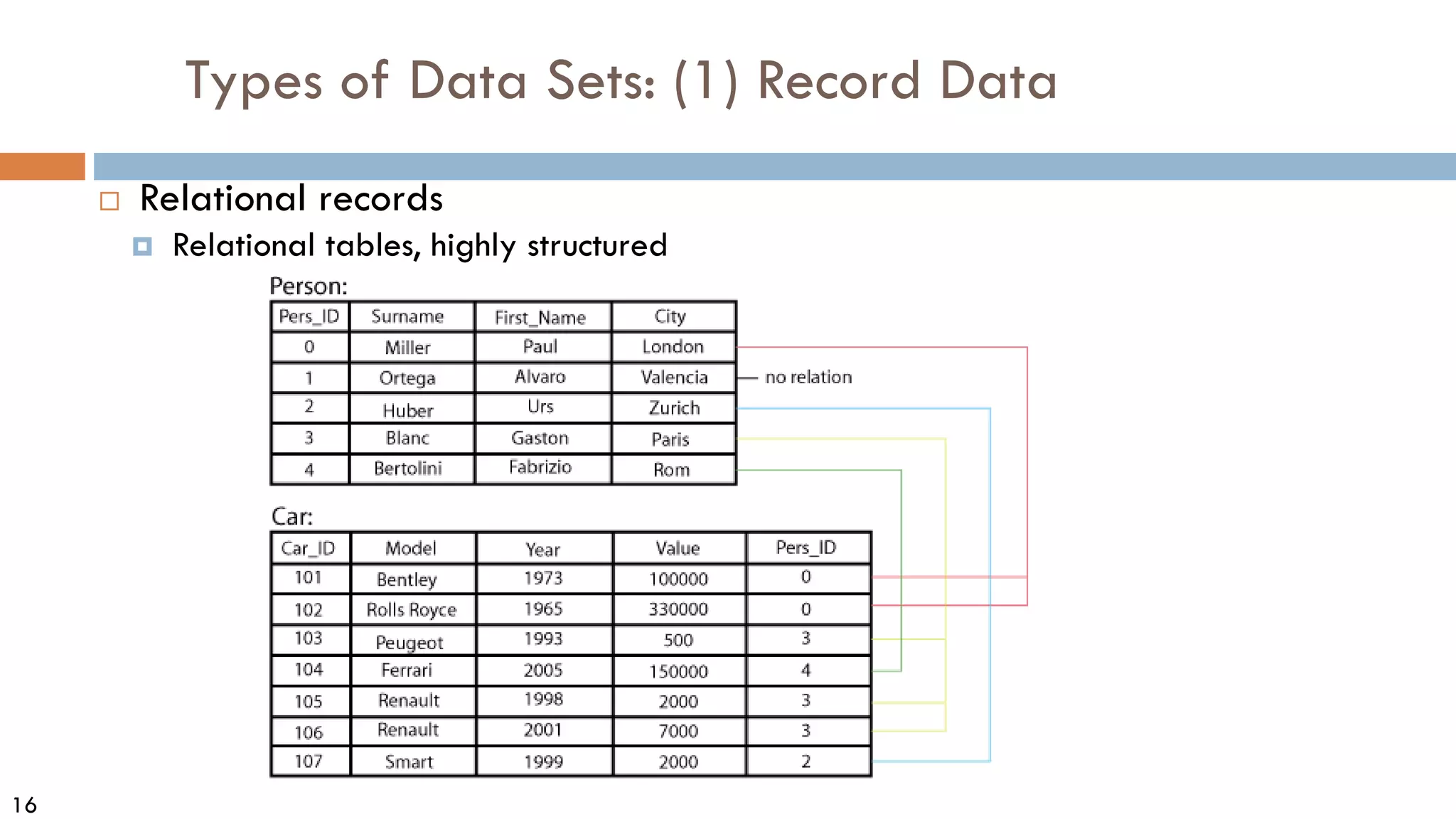
Types of Data Sets: (1) Record Data
 Relational records
 Relational tables, highly structured
17
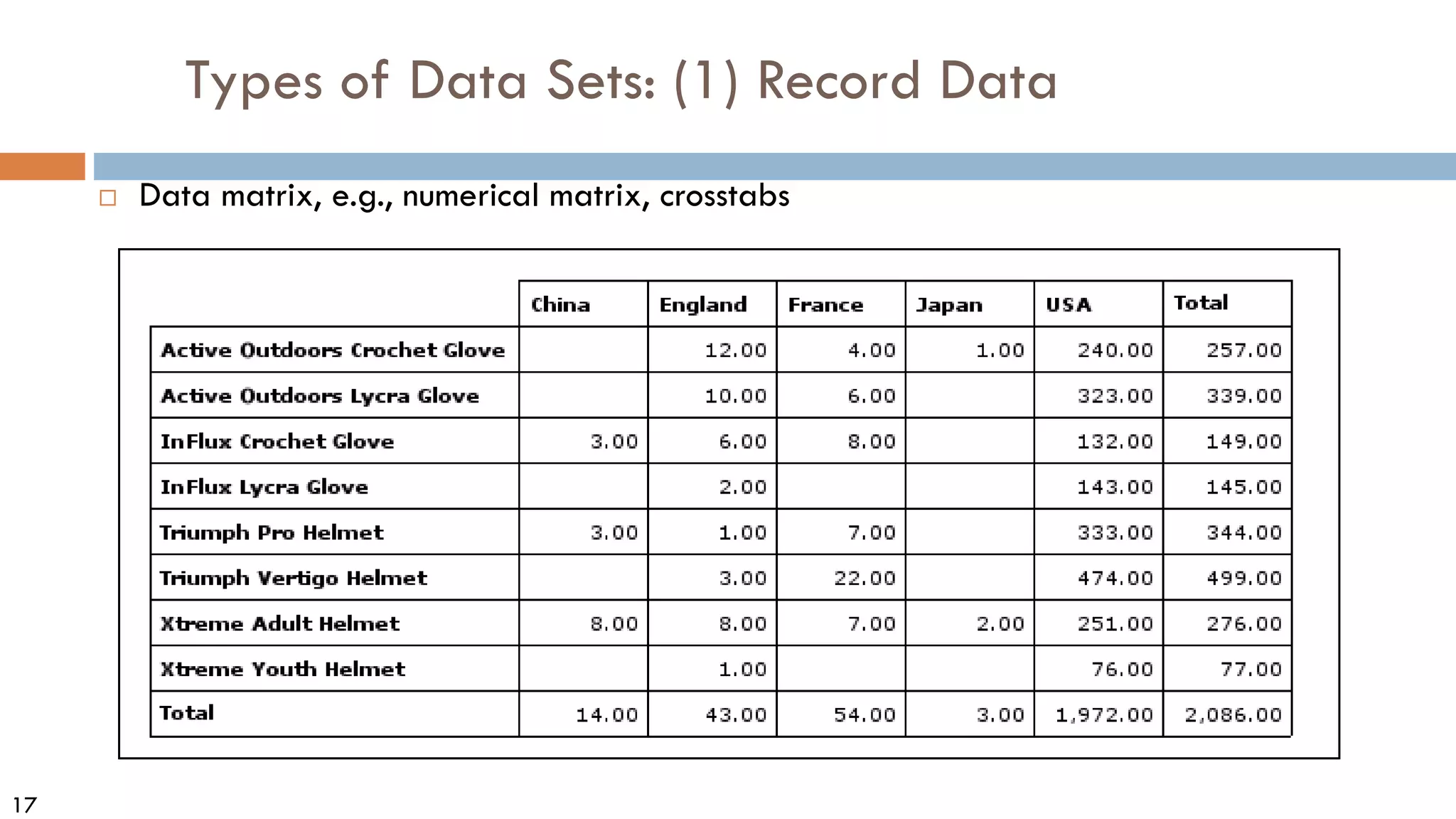
Types of Data Sets: (1) Record Data
 Data matrix, e.g., numerical matrix, crosstabs
18
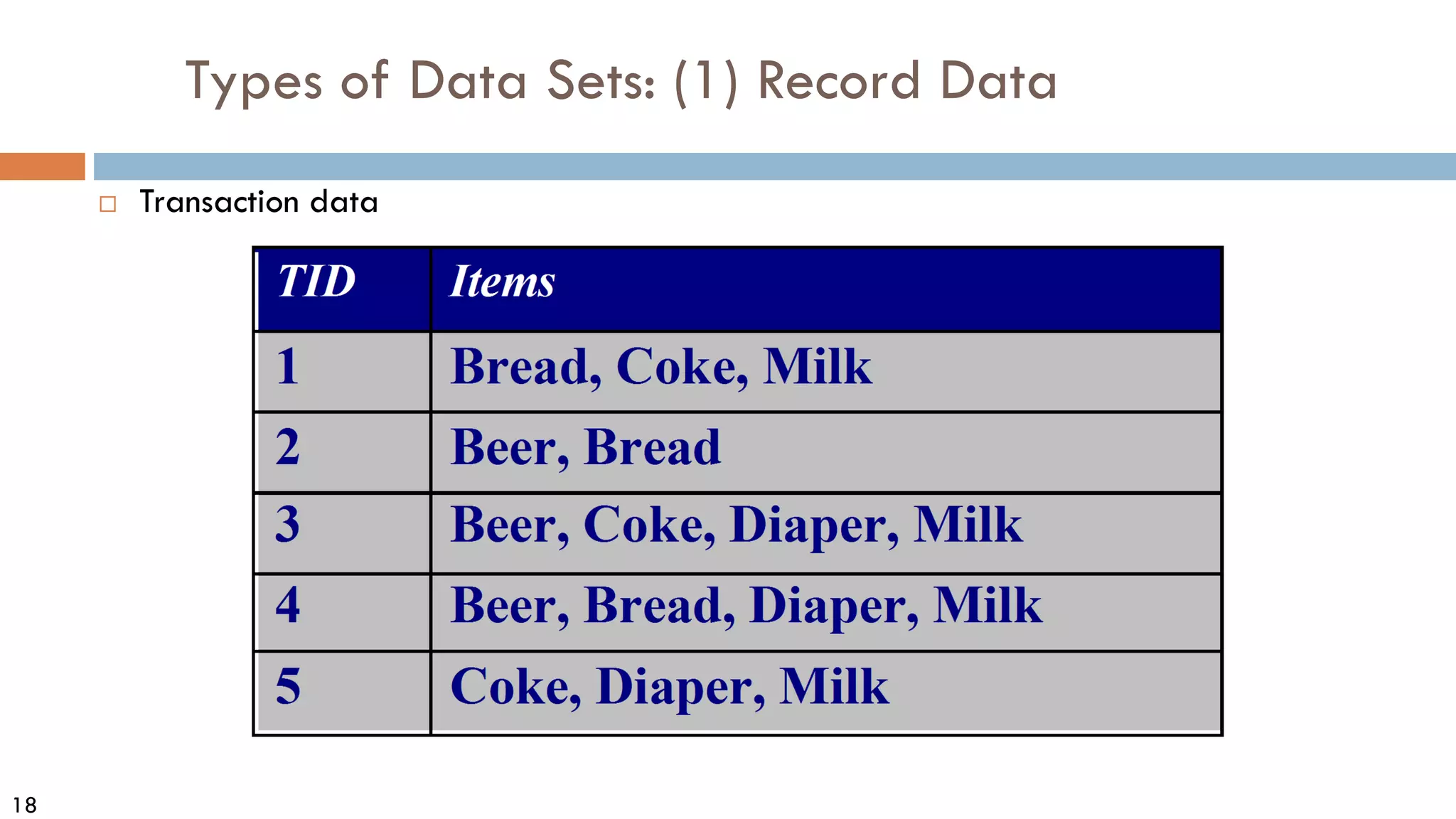
Types of Data Sets: (1) Record Data
 Transaction data
19
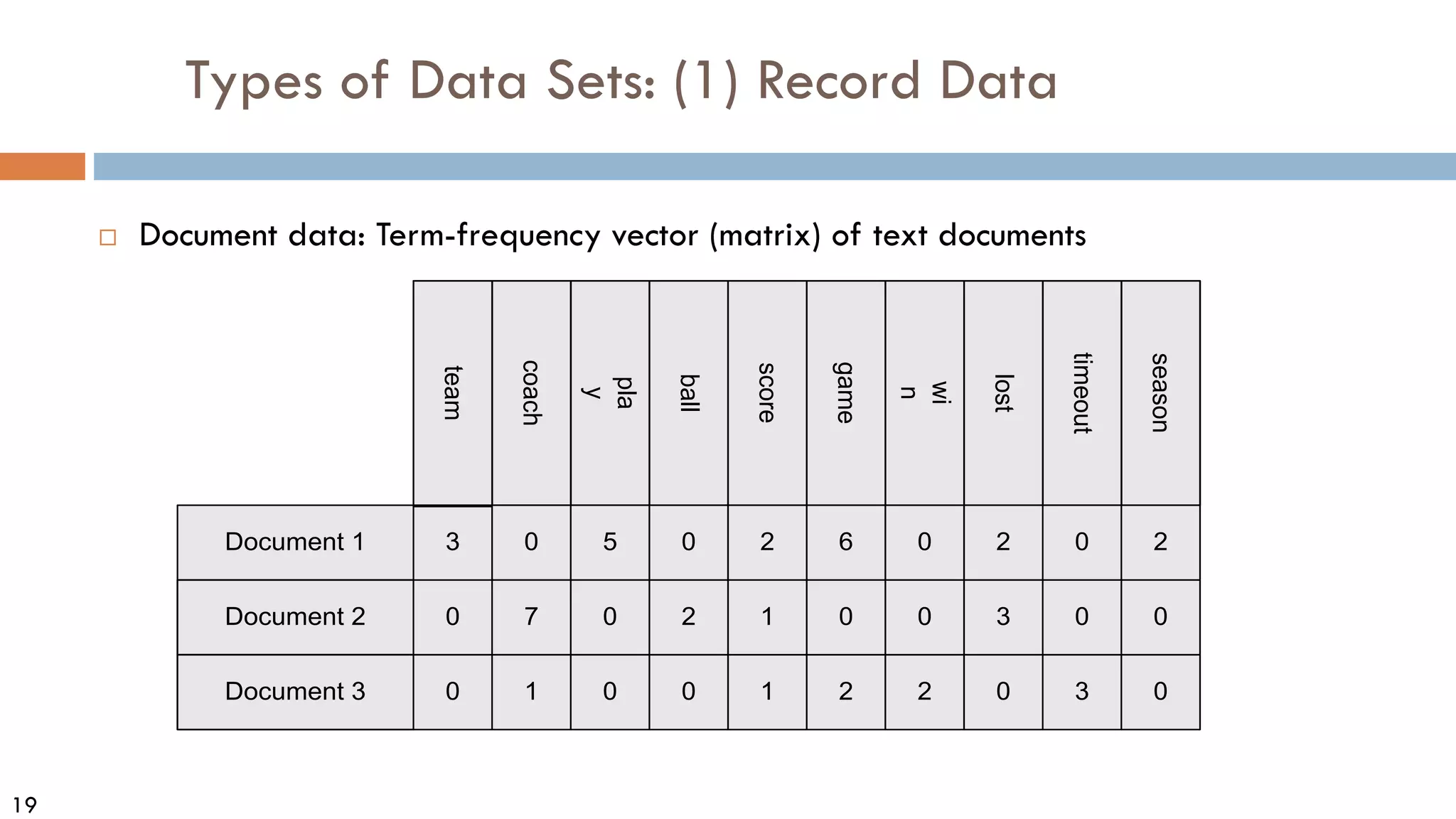
Types of Data Sets: (1) Record Data
 Document data: Term-frequency vector (matrix) of text documents
Document 1
season
timeout
lost
wi
n
game
score
ball
pla
y
coach
team
Document 2
Document 3
3 0 5 0 2 6 0 2 0 2
0
0
7 0 2 1 0 0 3 0 0
1 0 0 1 2 2 0 3 0
20
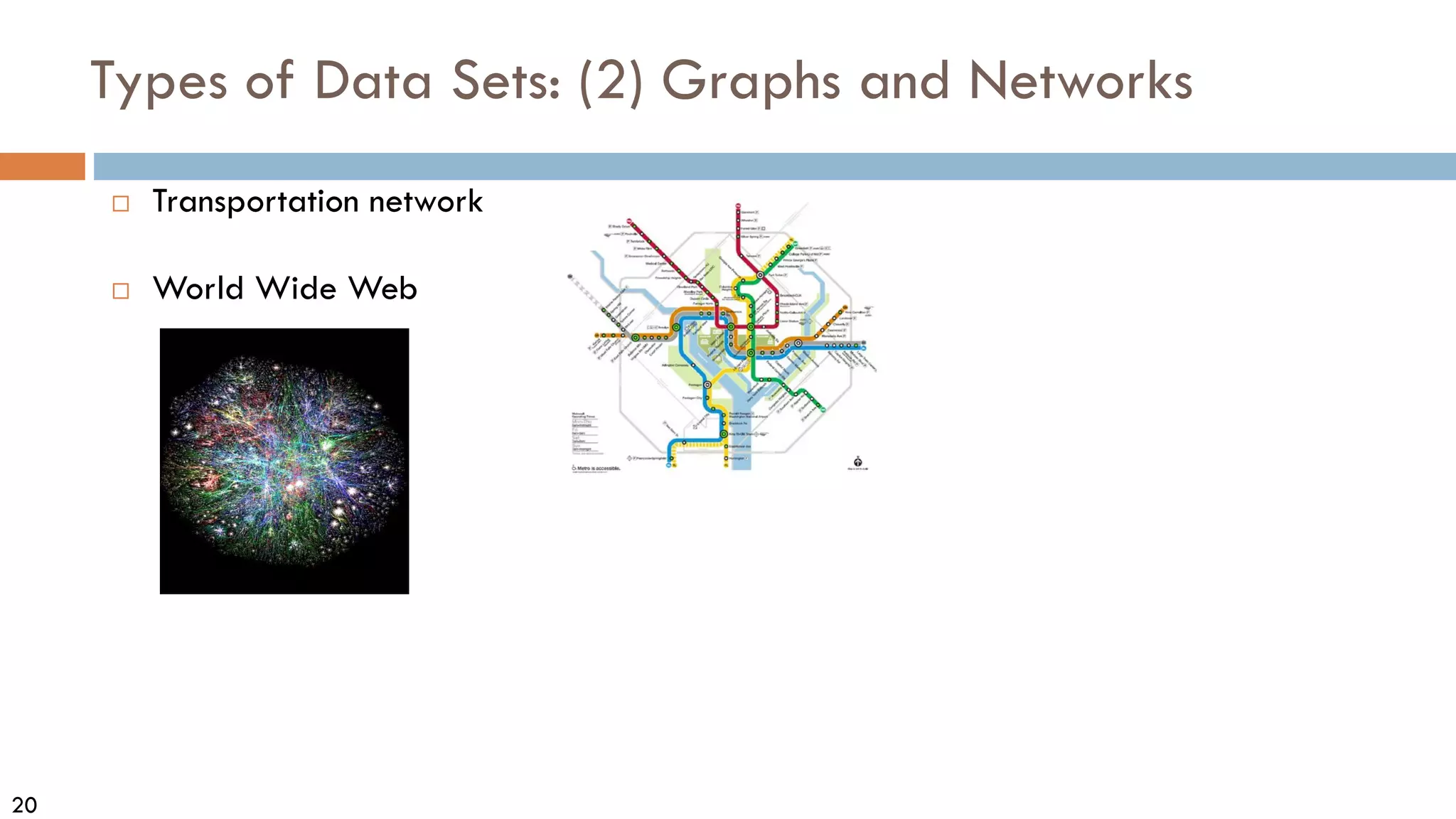
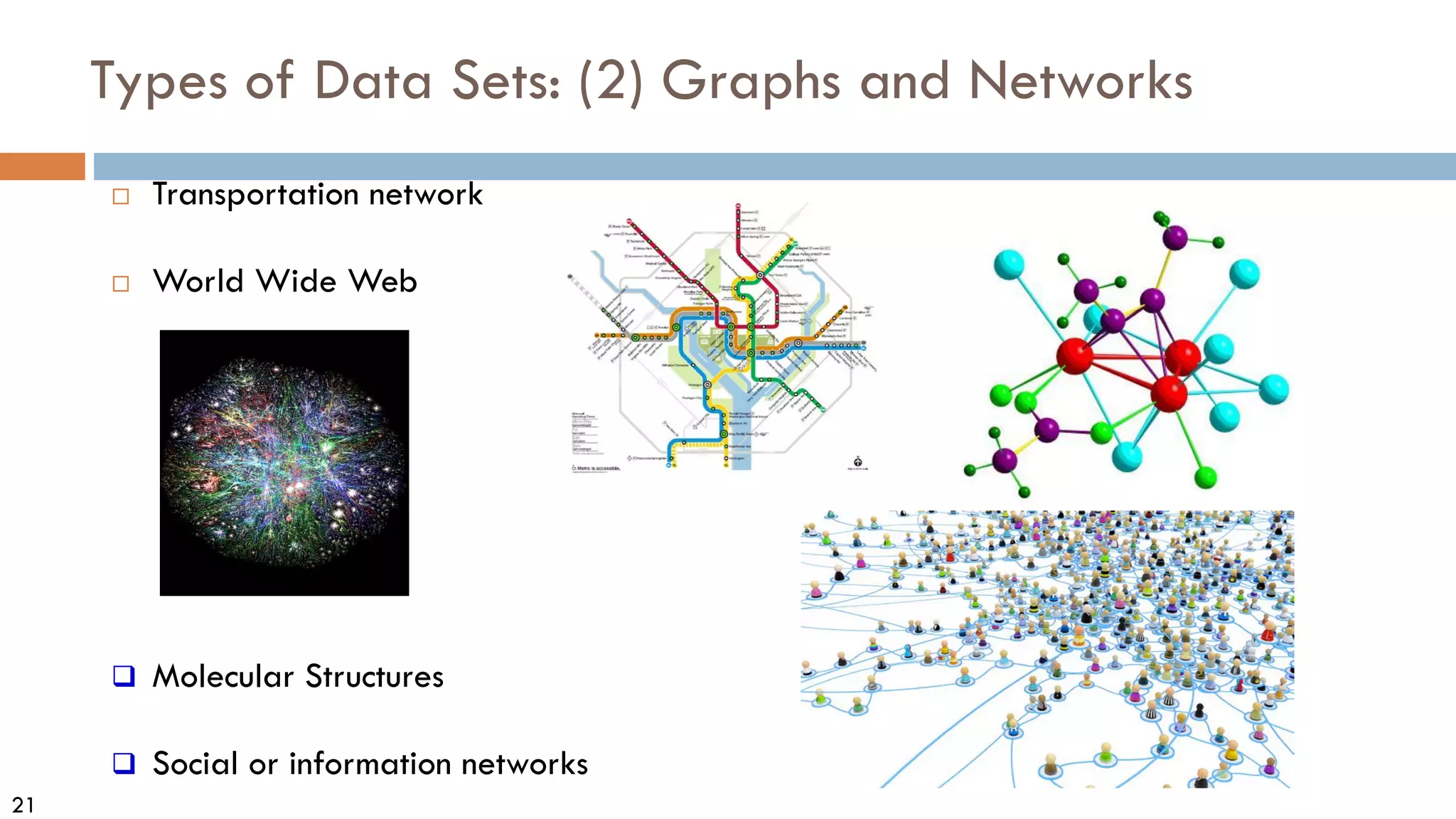
Types of Data Sets: (2) Graphs and Networks
 Transportation network
 World Wide Web
21
Types of Data Sets: (2) Graphs and Networks
 Transportation network
 World Wide Web
 Molecular Structures
 Social or information networks
22
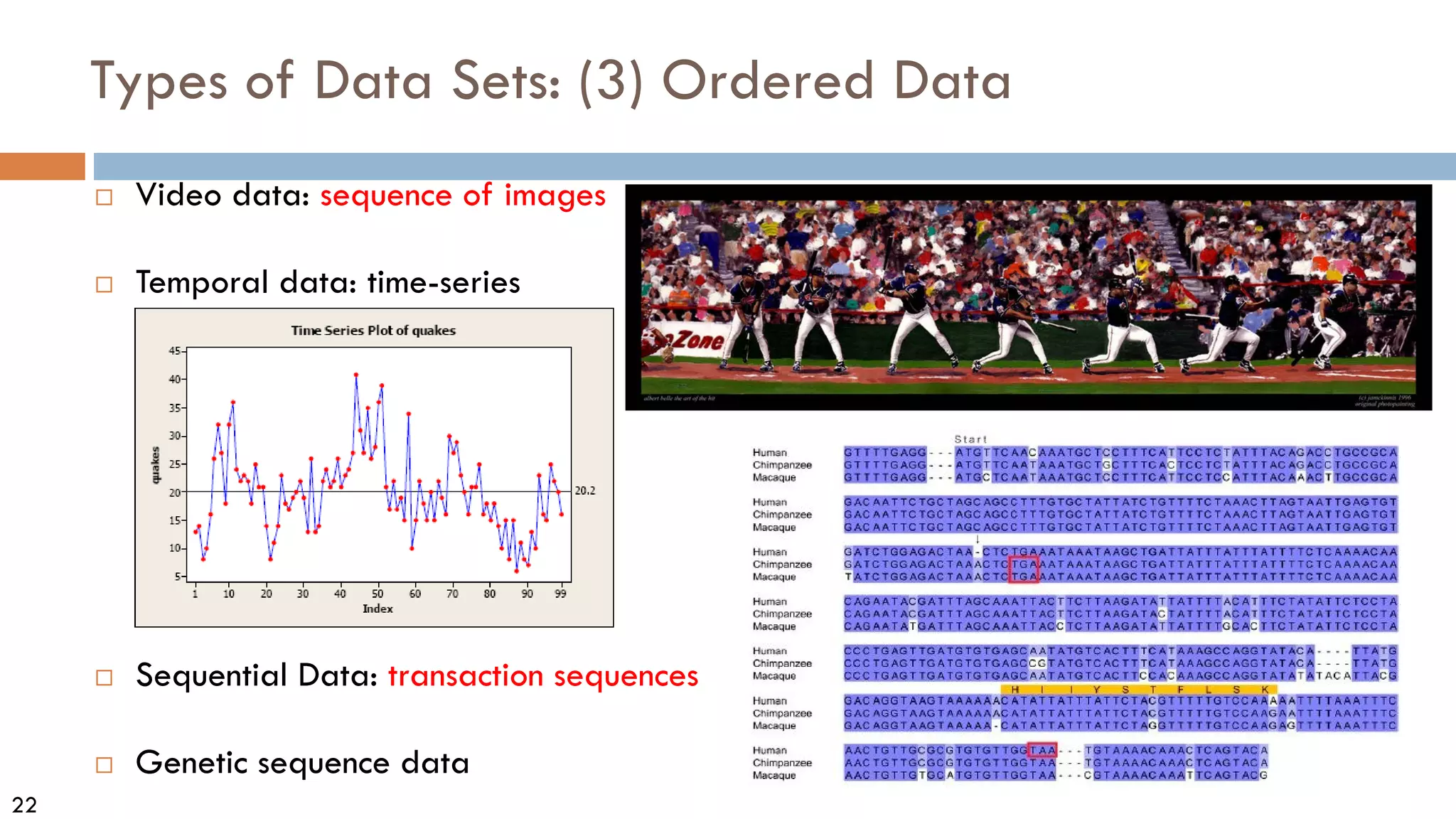
Types of Data Sets: (3) Ordered Data
 Video data: sequence of images
 Temporal data: time-series
 Sequential Data: transaction sequences
 Genetic sequence data
23
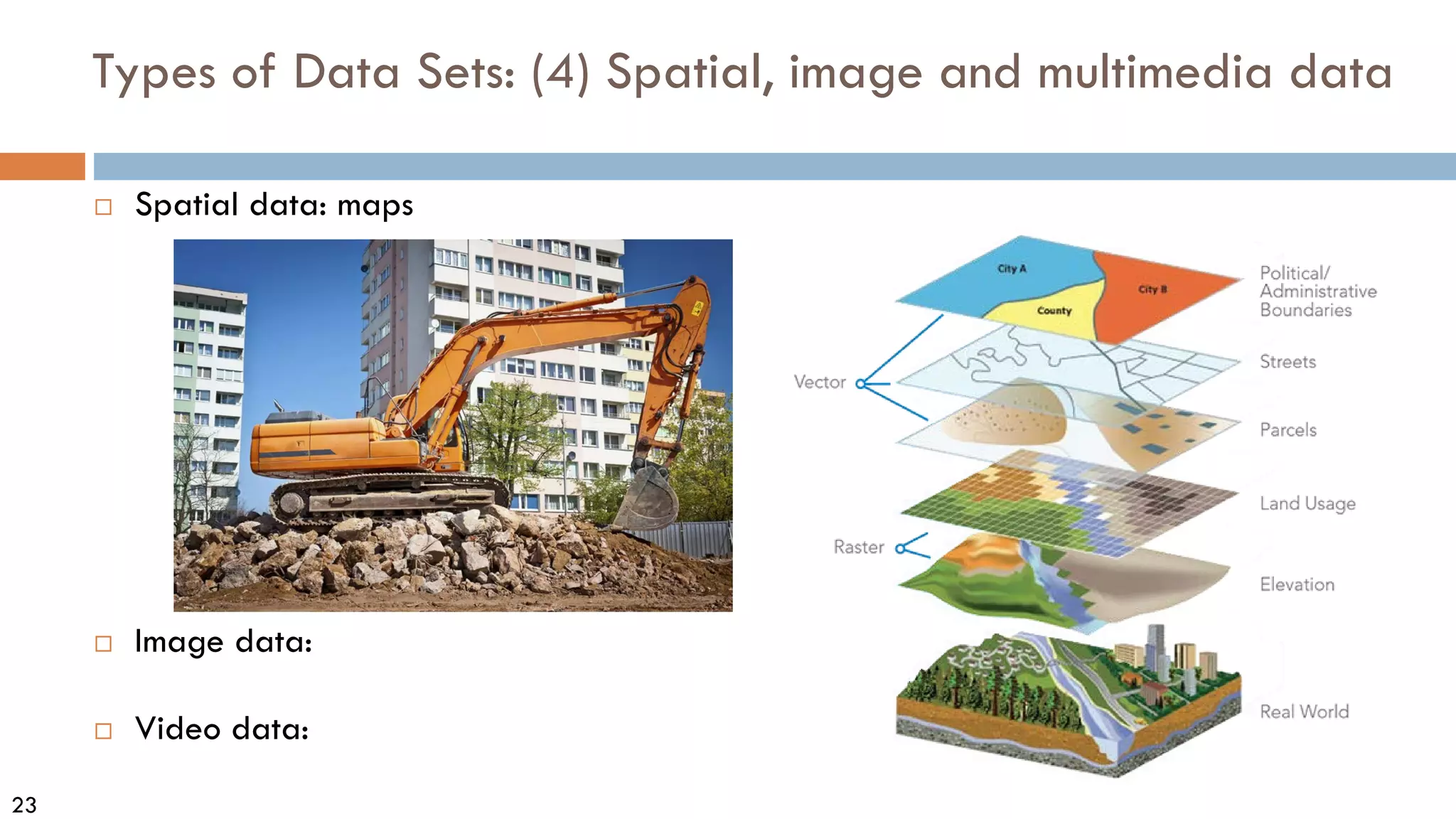
Types of Data Sets: (4) Spatial, image and multimedia data
 Spatial data: maps
 Image data:
 Video data:
24
Chapter 2. Getting to Know Your Data
 Data Objects and Attribute Types
 Basic Statistical Descriptions of Data
 Measuring Data Similarity and Dissimilarity
 Data Preprocessing: An Overview
 Summary
25
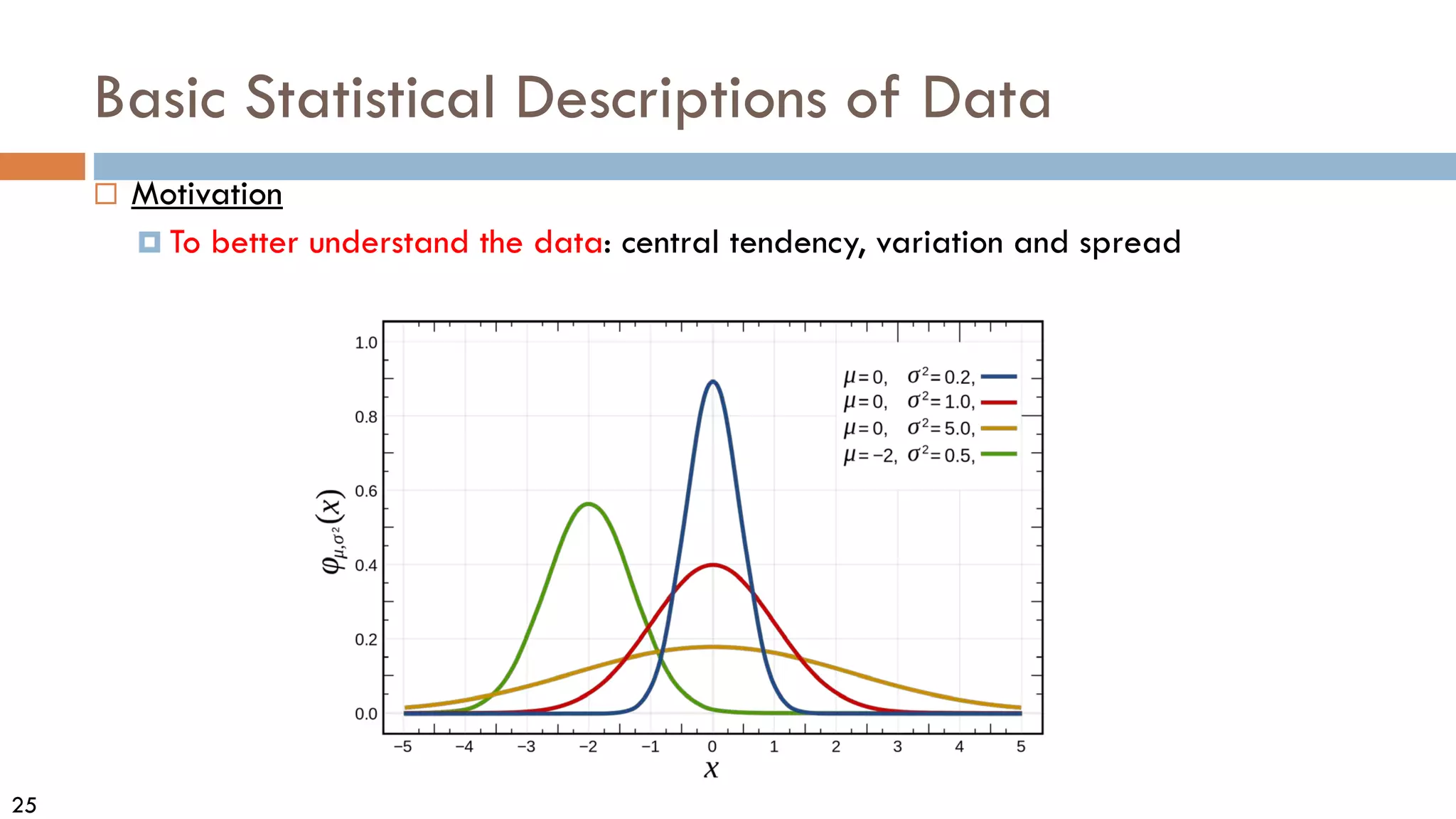
Basic Statistical Descriptions of Data
 Motivation
 To better understand the data: central tendency, variation and spread
26
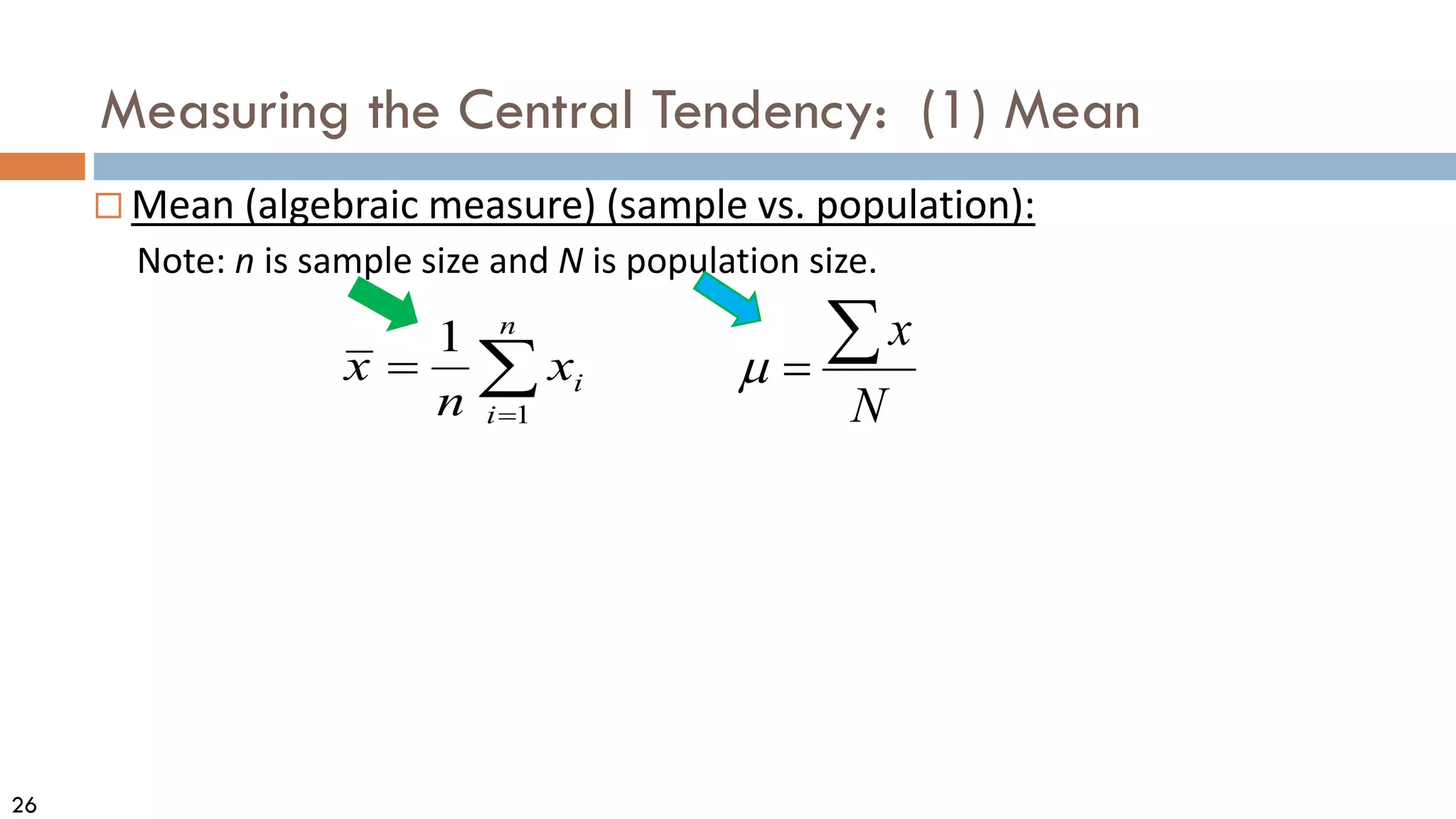
Measuring the Central Tendency: (1) Mean
 Mean (algebraic measure) (sample vs. population):
Note: n is sample size and N is population size.
N
x
∑
=
µ
∑
=
=
n
i
i
x
n
x
1
1
27
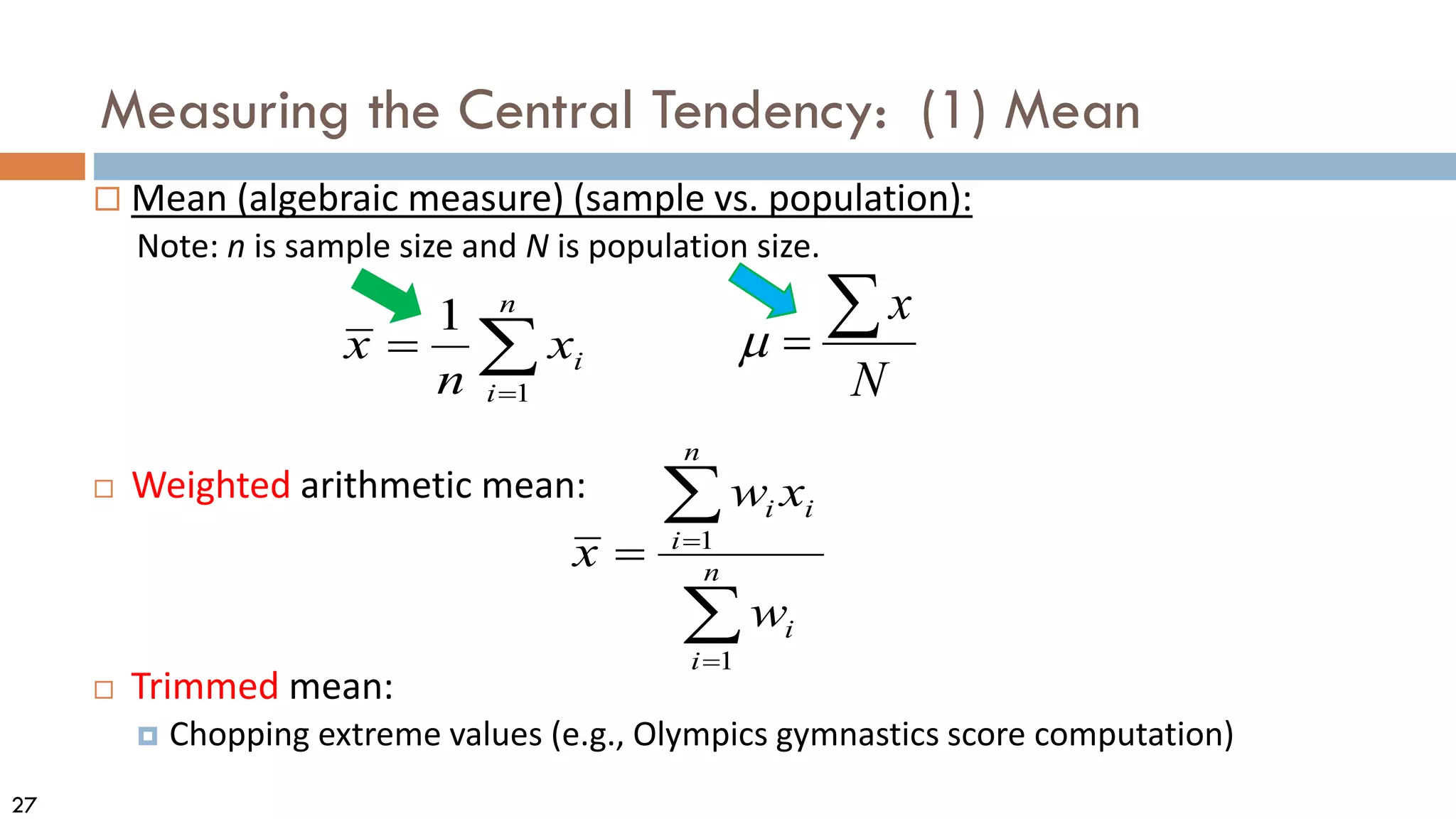
Measuring the Central Tendency: (1) Mean
 Mean (algebraic measure) (sample vs. population):
Note: n is sample size and N is population size.
 Weighted arithmetic mean:
 Trimmed mean:
 Chopping extreme values (e.g., Olympics gymnastics score computation)
N
x
∑
=
µ
∑
=
=
n
i
i
x
n
x
1
1
∑
∑
=
=
= n
i
i
n
i
i
i
w
x
w
x
1
1
28
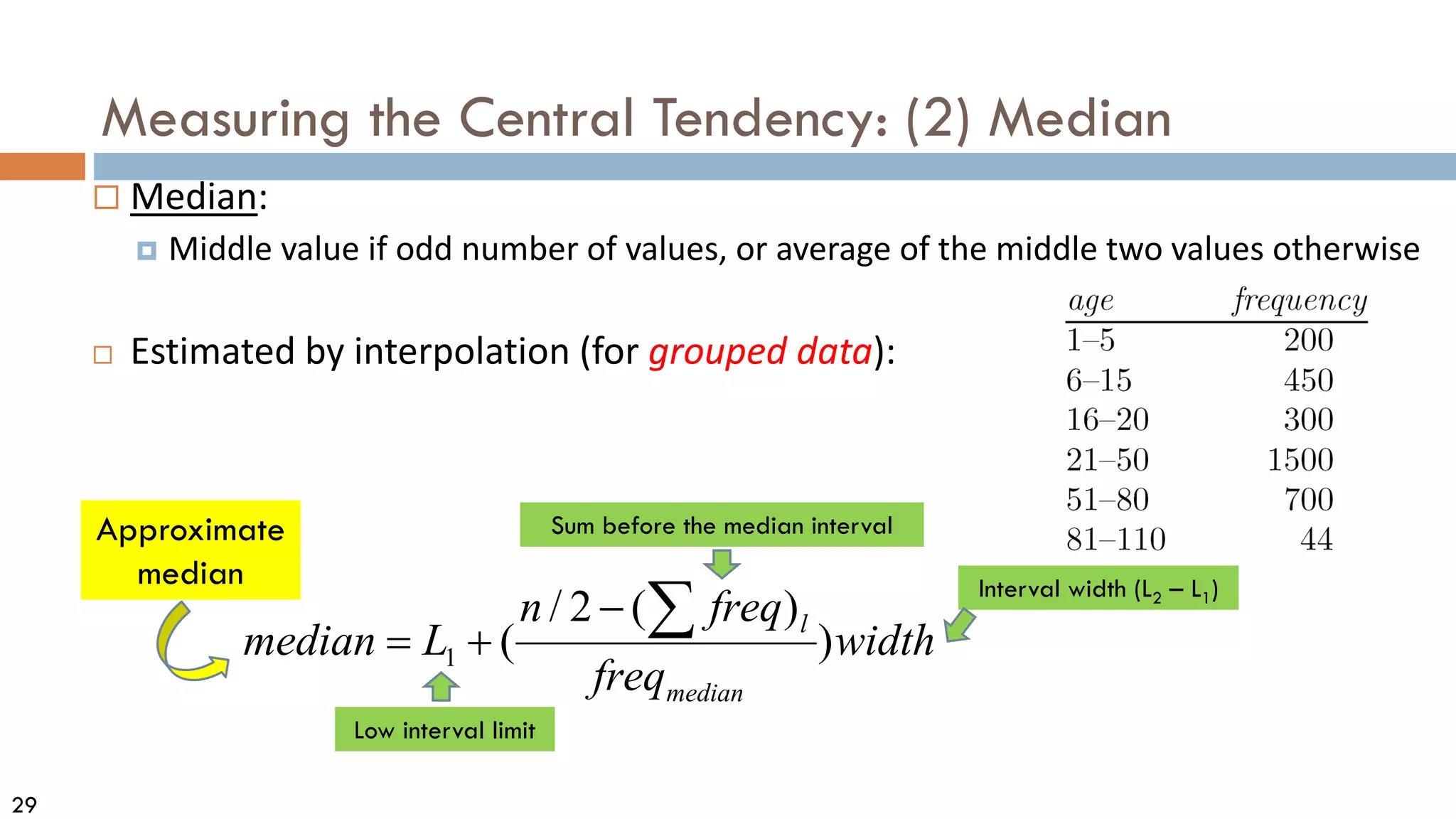
Measuring the Central Tendency: (2) Median
 Median:
 Middle value if odd number of values, or average of the middle two values
otherwise
29
Measuring the Central Tendency: (2) Median
 Median:
 Middle value if odd number of values, or average of the middle two values otherwise
 Estimated by interpolation (for grouped data):
width
freq
freq
n
L
median
median
l
)
)
(
2
/
(
1
∑
−
+
=
Approximate
median
Low interval limit
Interval width (L2 – L1)
Sum before the median interval
30
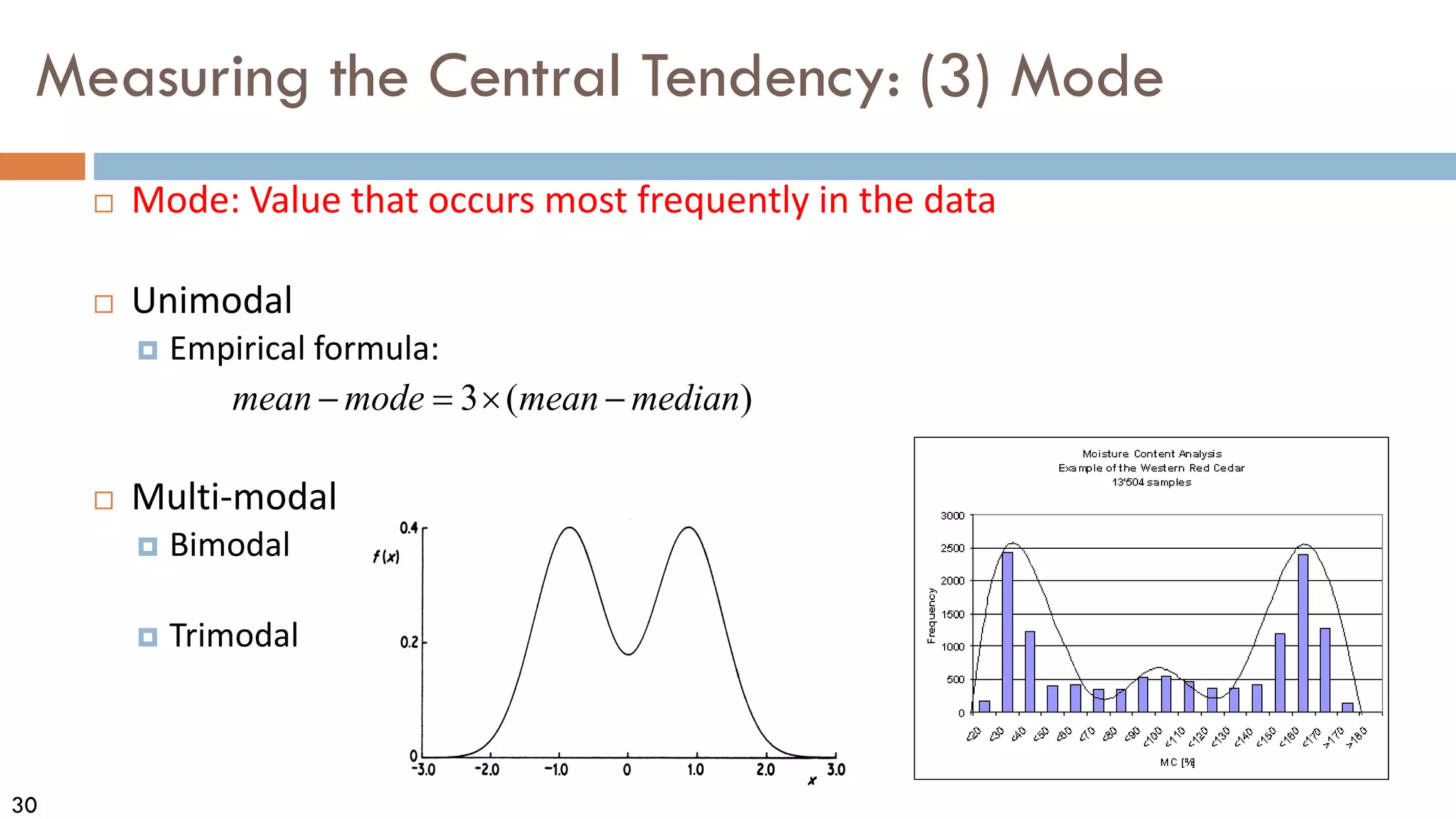
Measuring the Central Tendency: (3) Mode
 Mode: Value that occurs most frequently in the data
 Unimodal
 Empirical formula:
 Multi-modal
 Bimodal
 Trimodal
)
(
3 median
mean
mode
mean −
×
=
−
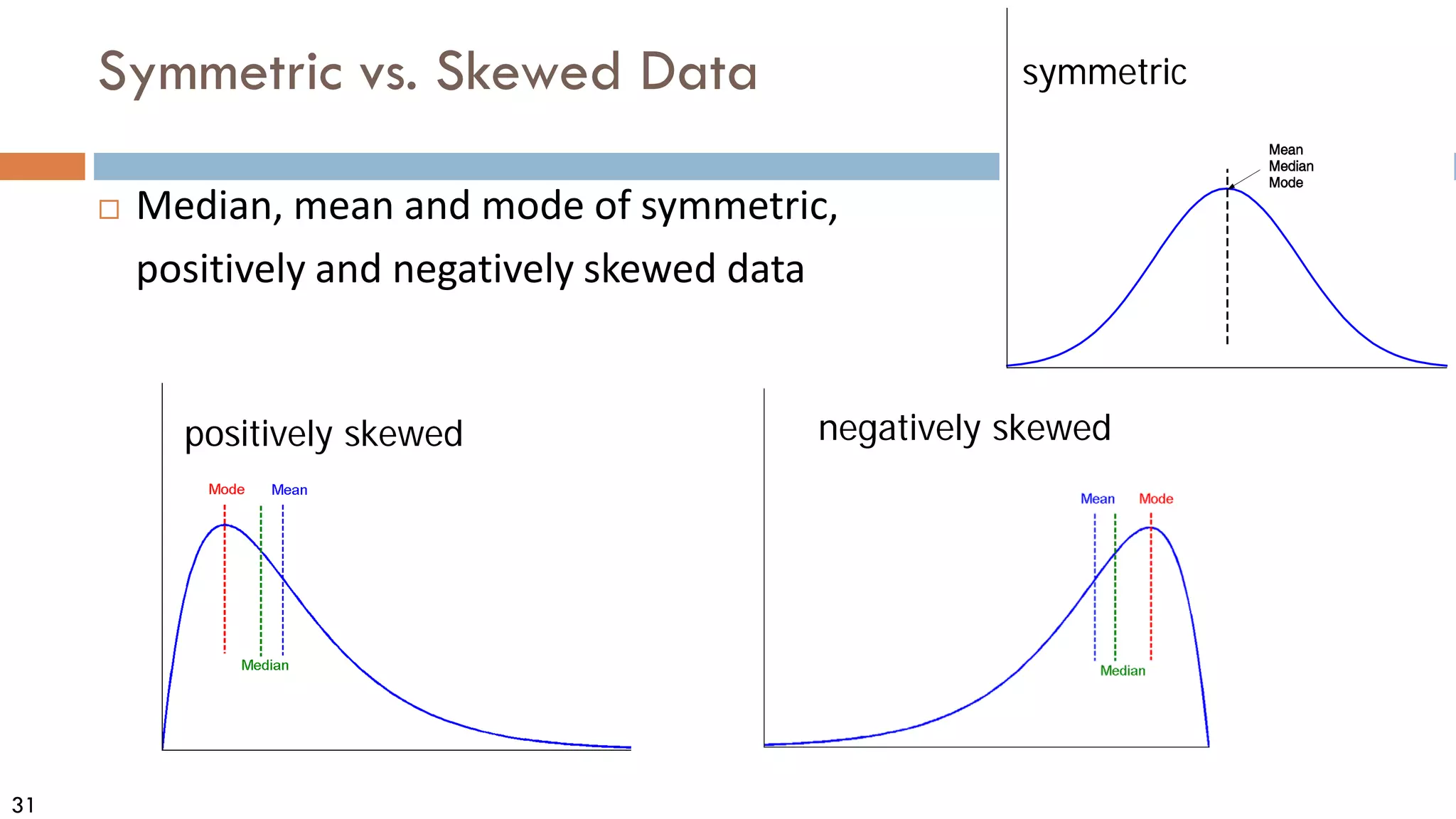
31
Symmetric vs. Skewed Data
 Median, mean and mode of symmetric,
positively and negatively skewed data
positively skewed negatively skewed
symmetric
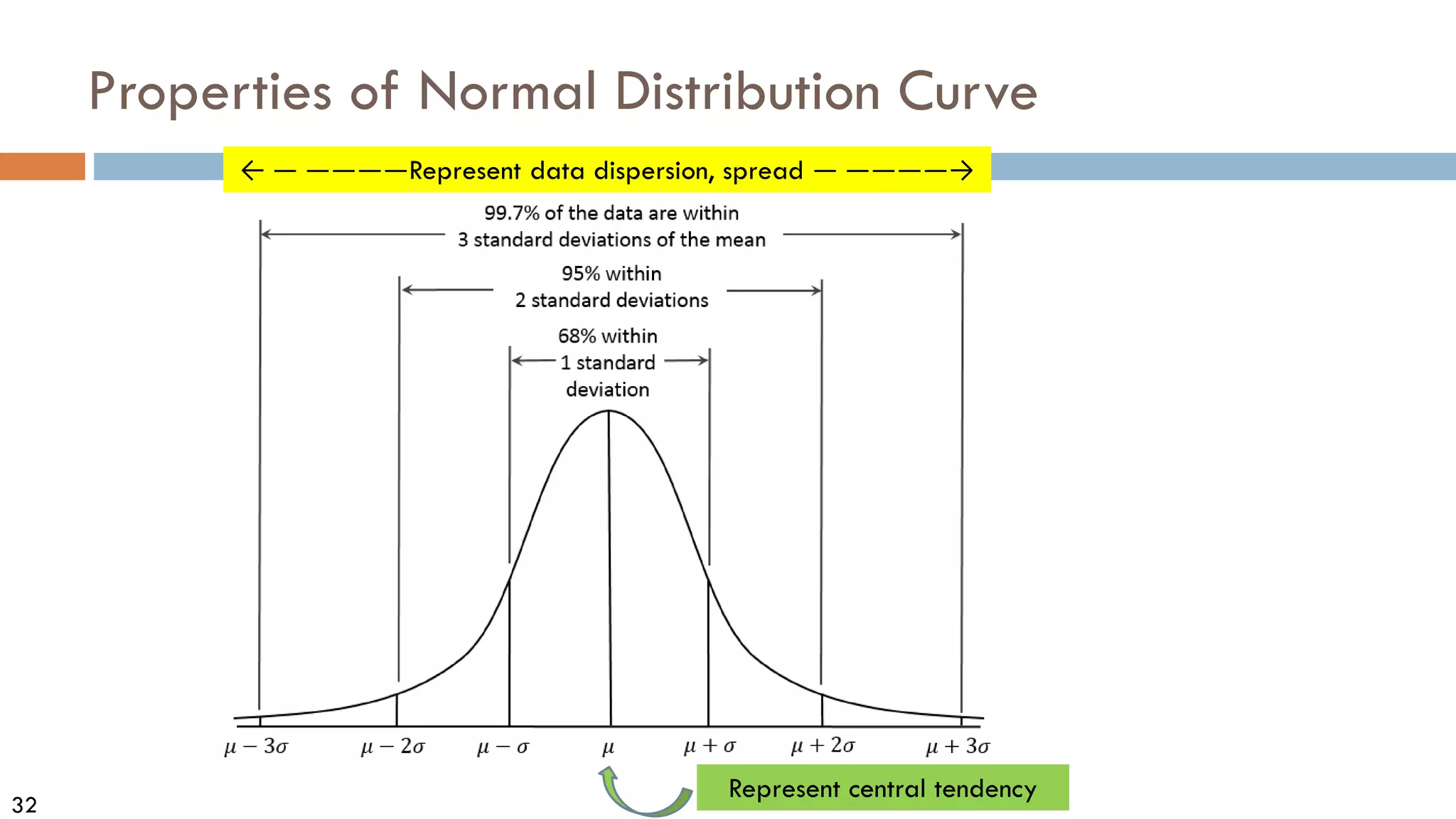
32
Properties of Normal Distribution Curve
← — ————Represent data dispersion, spread — ————→
Represent central tendency
33
Measures Data Distribution: Variance and Standard Deviation
 Variance and standard deviation (sample: s, population: σ)
 Variance: (algebraic, scalable computation)
 Standard deviation s (or σ) is the square root of variance s2 (orσ2 )
∑
∑ =
=
−
=
−
=
n
i
i
n
i
i x
N
x
N 1
2
2
1
2
2 1
)
(
1
µ
µ
σ
∑ ∑
∑ = =
=
−
−
=
−
−
=
n
i
n
i
i
i
n
i
i x
n
x
n
x
x
n
s
1 1
2
2
1
2
2
]
)
(
1
[
1
1
)
(
1
1
34
Measures Data Distribution: Variance and Standard Deviation
 Variance and standard deviation (sample: s, population: σ)
 Variance: (algebraic, scalable computation)
 Standard deviation s (or σ) is the square root of variance s2 (orσ2 )
∑
∑ =
=
−
=
−
=
n
i
i
n
i
i x
N
x
N 1
2
2
1
2
2 1
)
(
1
µ
µ
σ
∑ ∑
∑ = =
=
−
−
=
−
−
=
n
i
n
i
i
i
n
i
i x
n
x
n
x
x
n
s
1 1
2
2
1
2
2
]
)
(
1
[
1
1
)
(
1
1
?
35
Standardizing Numeric Data
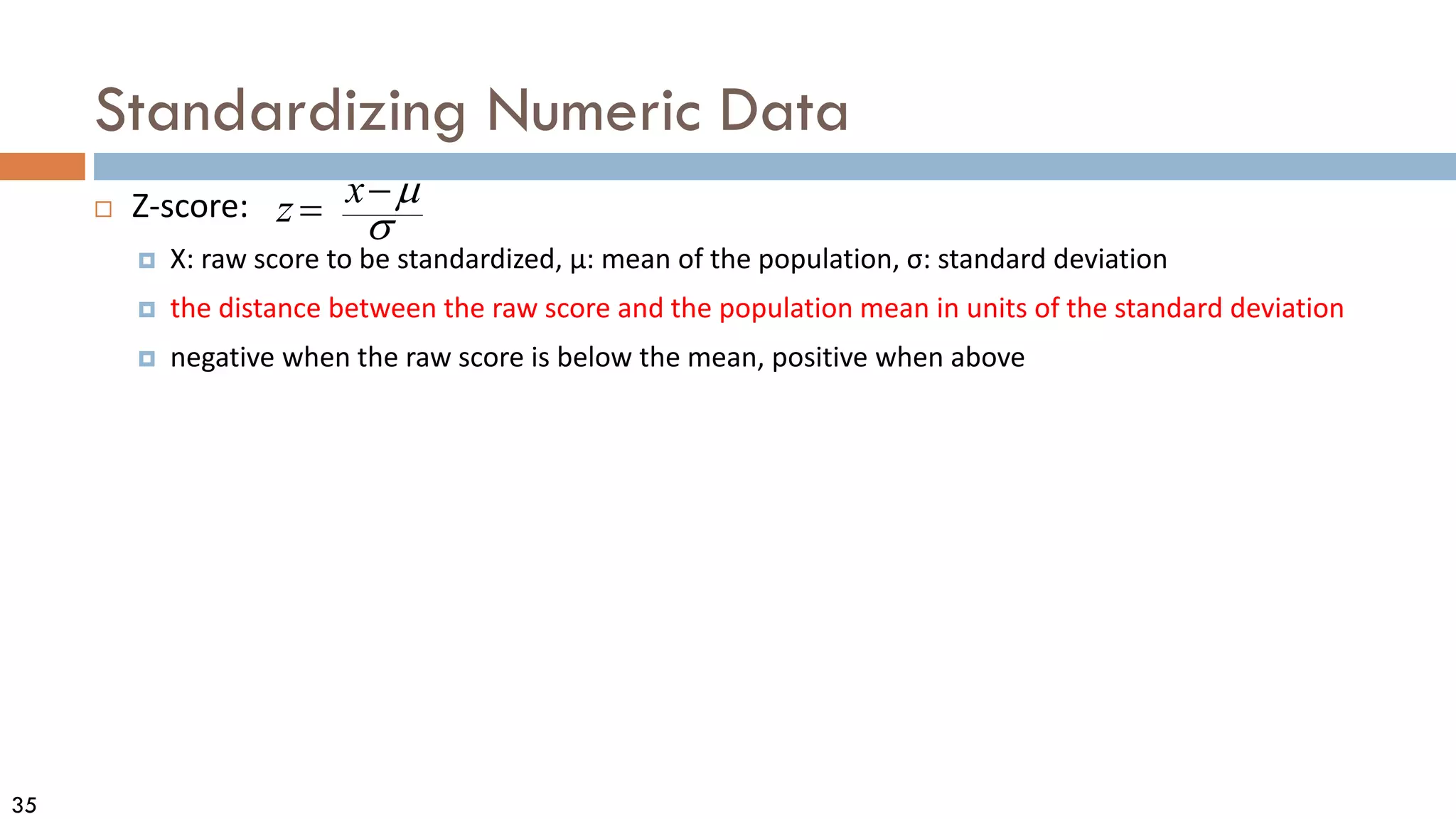
 Z-score:
 X: raw score to be standardized, μ: mean of the population, σ: standard deviation
 the distance between the raw score and the population mean in units of the standard deviation
 negative when the raw score is below the mean, positive when above
σ
µ
−
= x
z
36
Standardizing Numeric Data
 Z-score:
 X: raw score to be standardized, μ: mean of the population, σ: standard deviation
 the distance between the raw score and the population mean in units of the standard deviation
 negative when the raw score is below the mean, positive when above
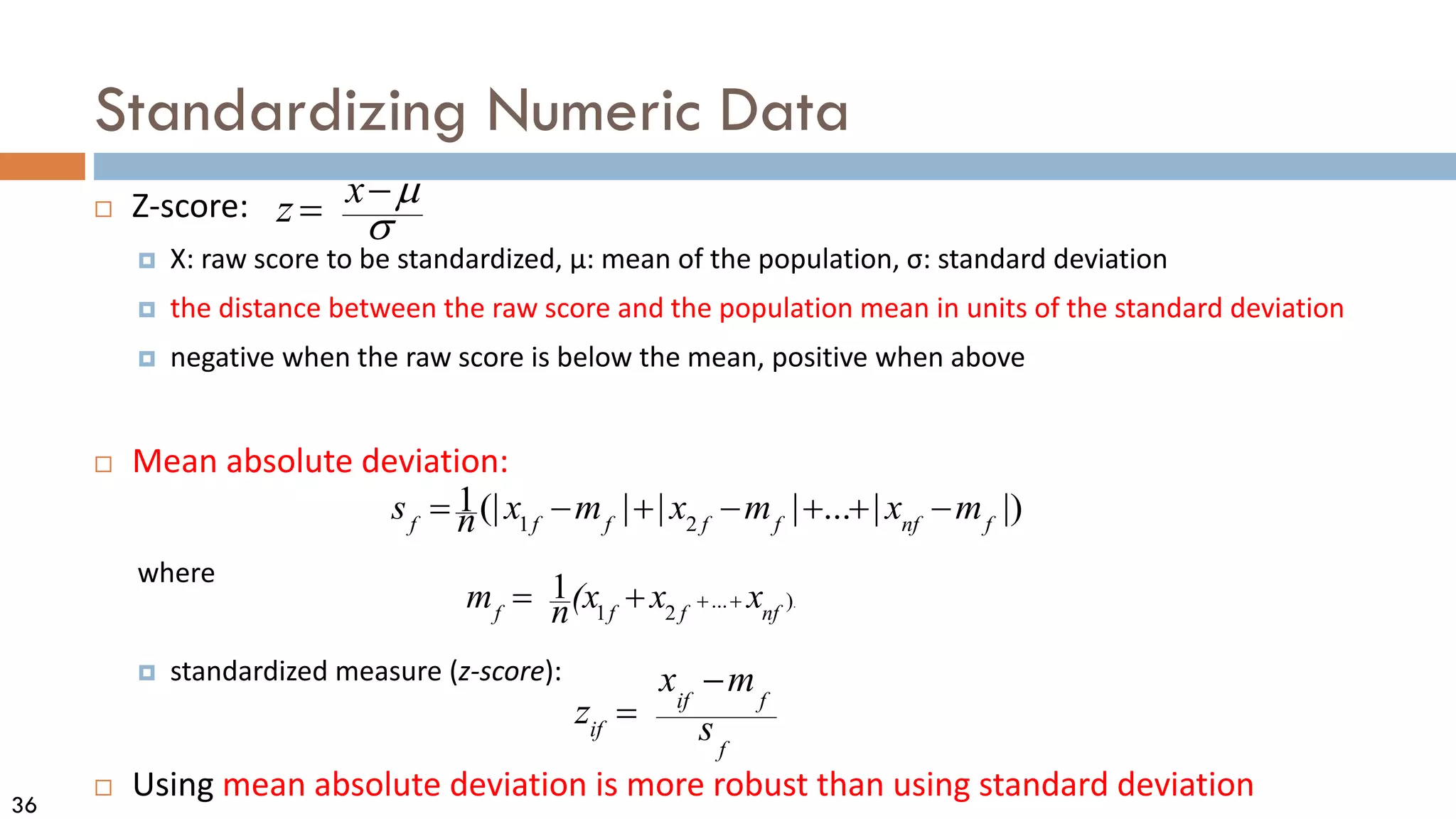
 Mean absolute deviation:
where
 standardized measure (z-score):
 Using mean absolute deviation is more robust than using standard deviation
σ
µ
−
= x
z
.
)
...
2
1
1
nf
f
f
f
x
x
(x
n
m +
+
+
=
|)
|
...
|
|
|
(|
1
2
1 f
nf
f
f
f
f
f
m
x
m
x
m
x
n
s −
+
+
−
+
−
=
f
f
if
if s
m
x
z
−
=
37
Data & Data Preprocessing
 Data Objects and Attribute Types
 Basic Statistical Descriptions of Data
 Measuring Data Similarity and Dissimilarity
 Data Preprocessing: An Overview
 Summary
38
Similarity, Dissimilarity, and Proximity
 Similarity measure or similarity function
 A real-valued function that quantifies the similarity between two objects
 Measure how two data objects are alike: The higher value, the more alike
 Often falls in the range [0,1]: 0: no similarity; 1: completely similar
39
Similarity, Dissimilarity, and Proximity
 Similarity measure or similarity function
 A real-valued function that quantifies the similarity between two objects
 Measure how two data objects are alike: The higher value, the more alike
 Often falls in the range [0,1]: 0: no similarity; 1: completely similar
 Dissimilarity (or distance) measure
 Numerical measure of how different two data objects are
 In some sense, the inverse of similarity: The lower, the more alike
 Minimum dissimilarity is often 0 (i.e., completely similar)
 Range [0, 1] or [0, ∞) , depending on the definition
 Proximity usually refers to either similarity or dissimilarity
40
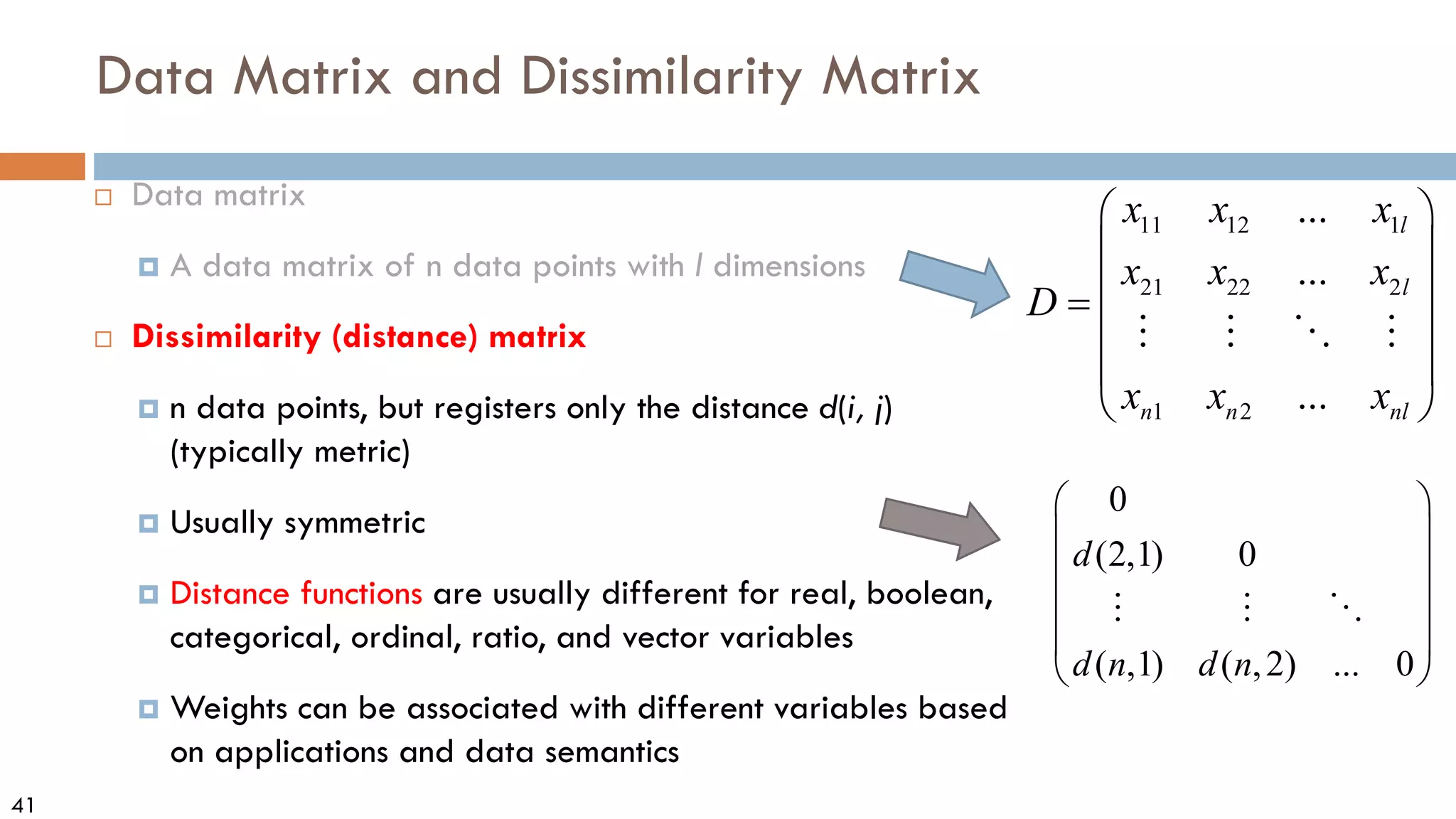
Data Matrix and Dissimilarity Matrix
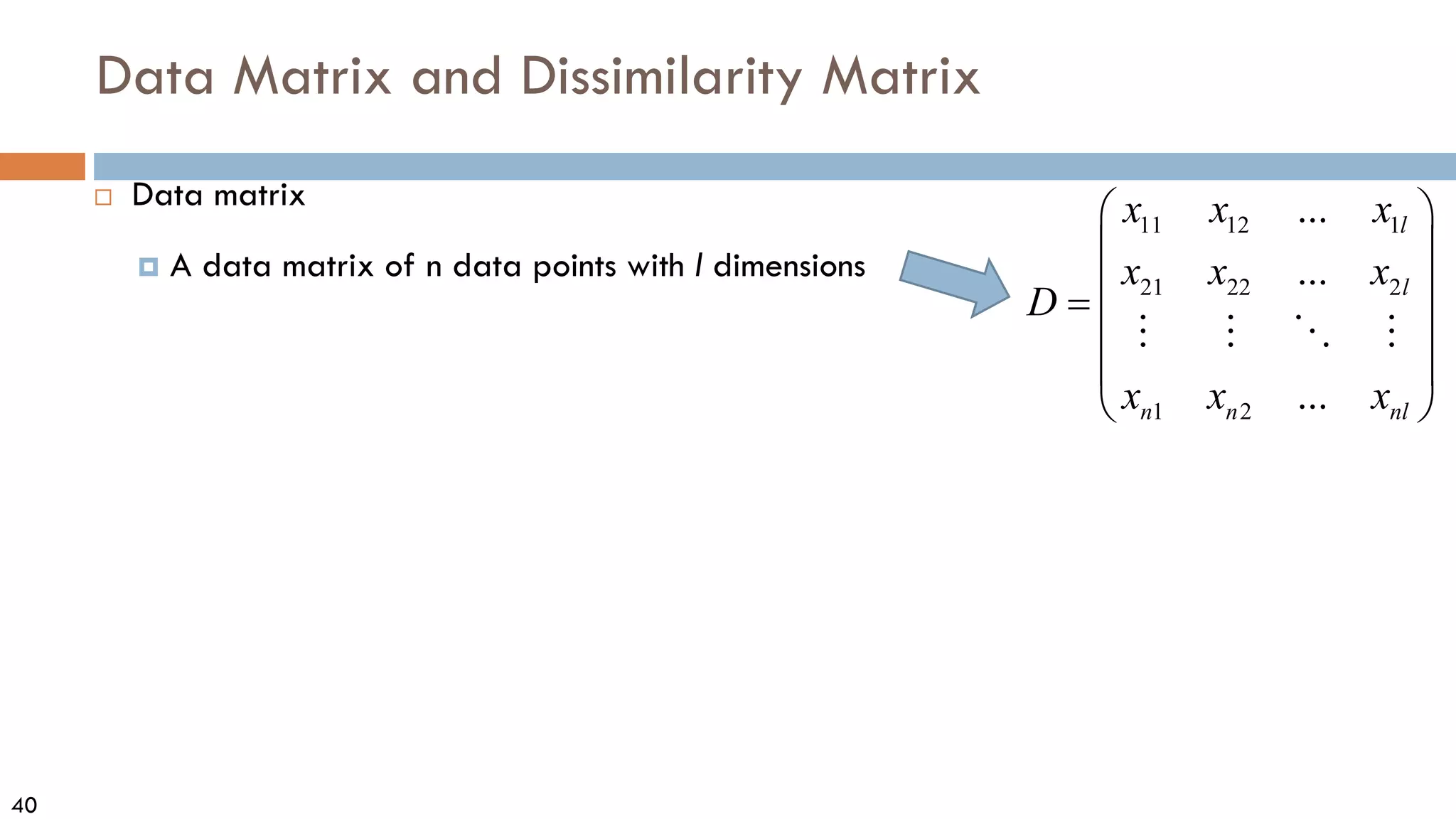
 Data matrix
 A data matrix of n data points with l dimensions
11 12 1
21 22 2
1 2
...
...
...
l
l
n n nl
x x x
x x x
D
x x x
 
 
 
=
 
 
 
   
41
Data Matrix and Dissimilarity Matrix
 Data matrix
 A data matrix of n data points with l dimensions
 Dissimilarity (distance) matrix
 n data points, but registers only the distance d(i, j)
(typically metric)
 Usually symmetric
 Distance functions are usually different for real, boolean,
categorical, ordinal, ratio, and vector variables
 Weights can be associated with different variables based
on applications and data semantics
11 12 1
21 22 2
1 2
...
...
...
l
l
n n nl
x x x
x x x
D
x x x
 
 
 
=
 
 
 
   
0
(2,1) 0
( ,1) ( ,2) ... 0
d
d n d n
 
 
 
 
 
 
  
42
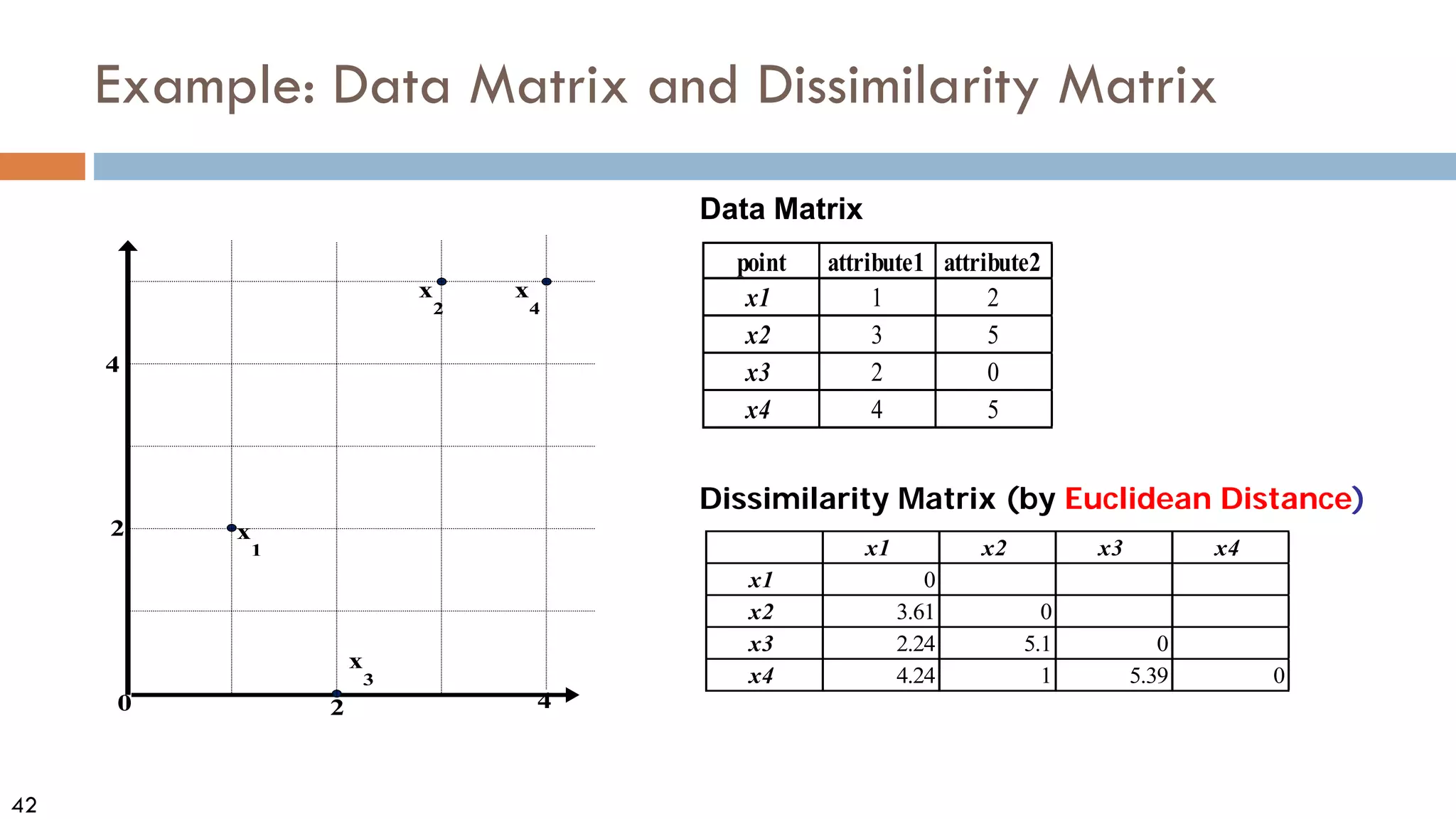
Example: Data Matrix and Dissimilarity Matrix
point attribute1 attribute2
x1 1 2
x2 3 5
x3 2 0
x4 4 5
Dissimilarity Matrix (by Euclidean Distance)
x1 x2 x3 x4
x1 0
x2 3.61 0
x3 2.24 5.1 0
x4 4.24 1 5.39 0
Data Matrix
0 2 4
2
4
x
1
x
2
x
3
x
4
43
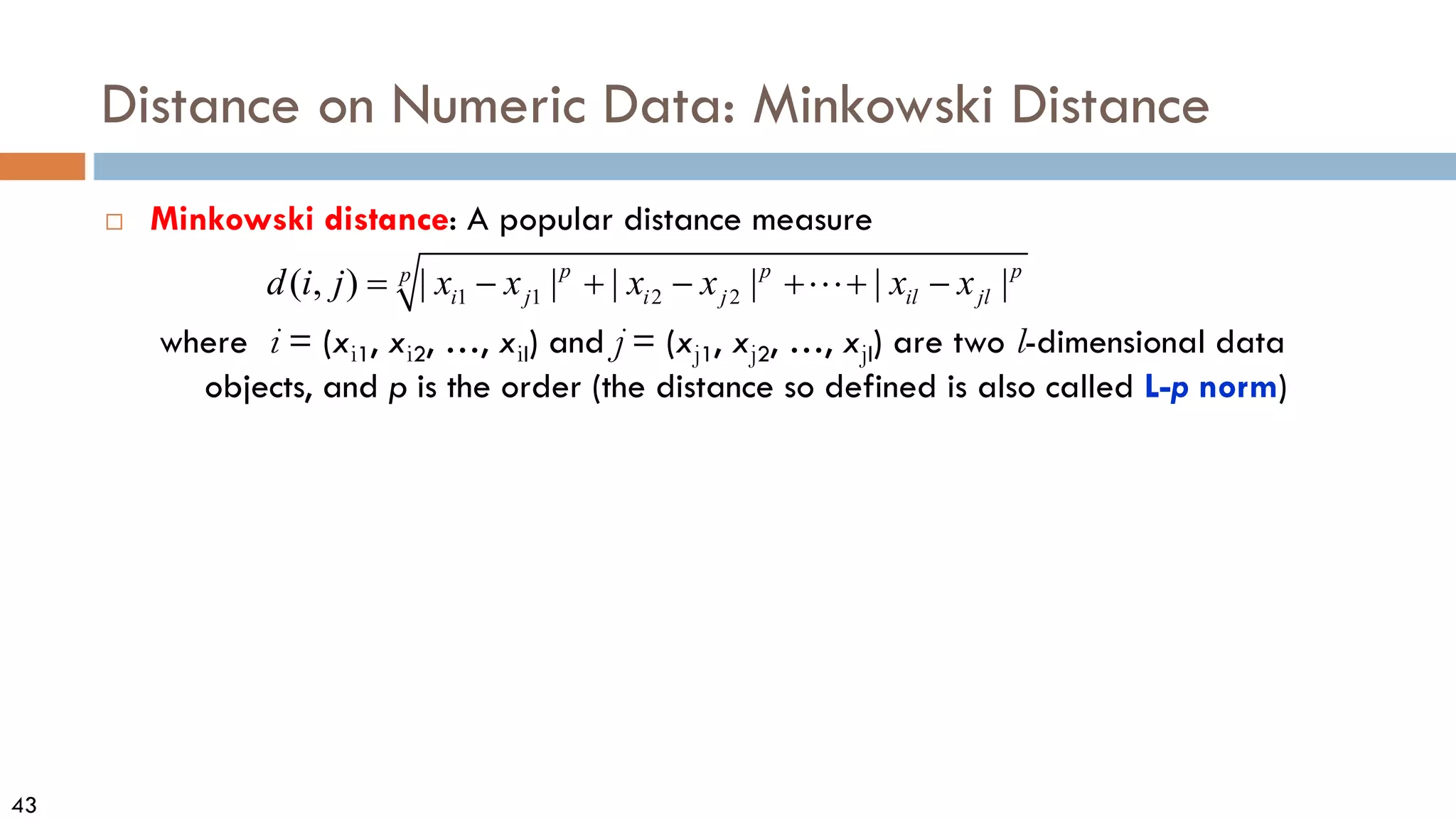
Distance on Numeric Data: Minkowski Distance
 Minkowski distance: A popular distance measure
where i = (xi1, xi2, …, xil) and j = (xj1, xj2, …, xjl) are two l-dimensional data
objects, and p is the order (the distance so defined is also called L-p norm)
1 1 2 2
( , ) | | | | | |
p p p
p
i j i j il jl
d i j x x x x x x
= − + − + + −

44
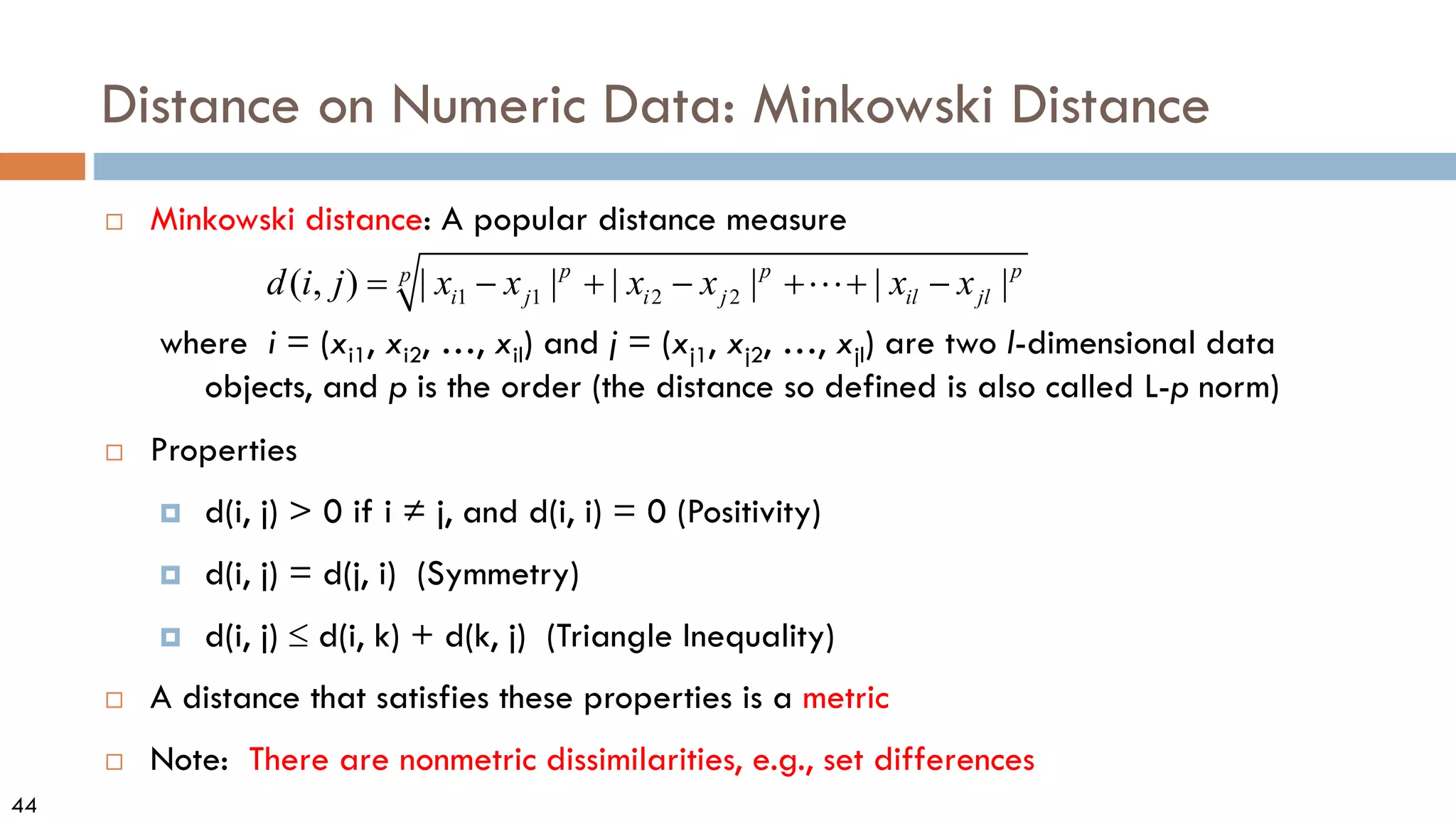
Distance on Numeric Data: Minkowski Distance
 Minkowski distance: A popular distance measure
where i = (xi1, xi2, …, xil) and j = (xj1, xj2, …, xjl) are two l-dimensional data
objects, and p is the order (the distance so defined is also called L-p norm)
 Properties
 d(i, j) > 0 if i ≠ j, and d(i, i) = 0 (Positivity)
 d(i, j) = d(j, i) (Symmetry)
 d(i, j) ≤ d(i, k) + d(k, j) (Triangle Inequality)
 A distance that satisfies these properties is a metric
 Note: There are nonmetric dissimilarities, e.g., set differences
1 1 2 2
( , ) | | | | | |
p p p
p
i j i j il jl
d i j x x x x x x
= − + − + + −

45
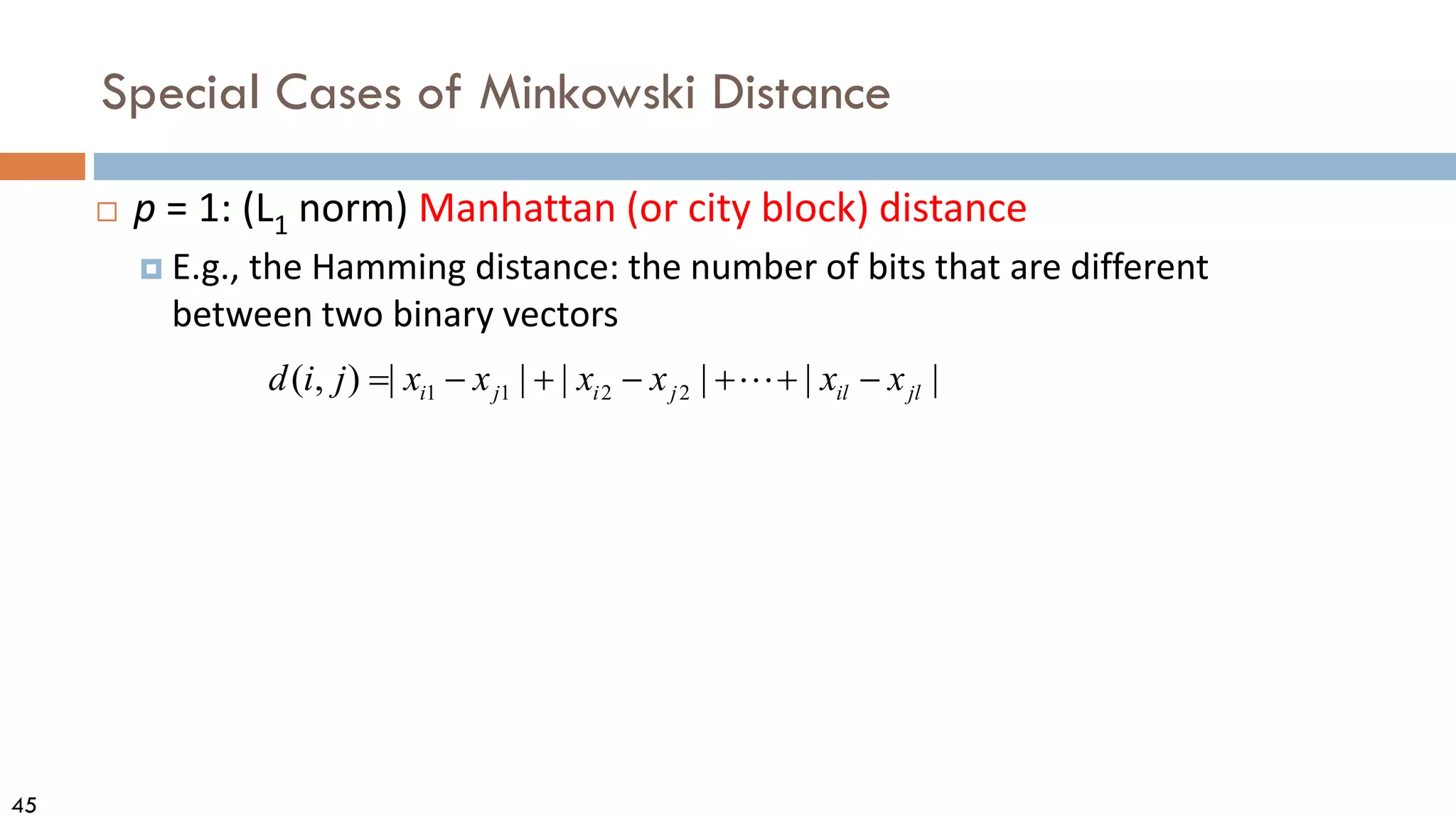
Special Cases of Minkowski Distance
 p = 1: (L1 norm) Manhattan (or city block) distance
 E.g., the Hamming distance: the number of bits that are different
between two binary vectors
1 1 2 2
( , ) | | | | | |
i j i j il jl
d i j x x x x x x
= − + − + + −

46
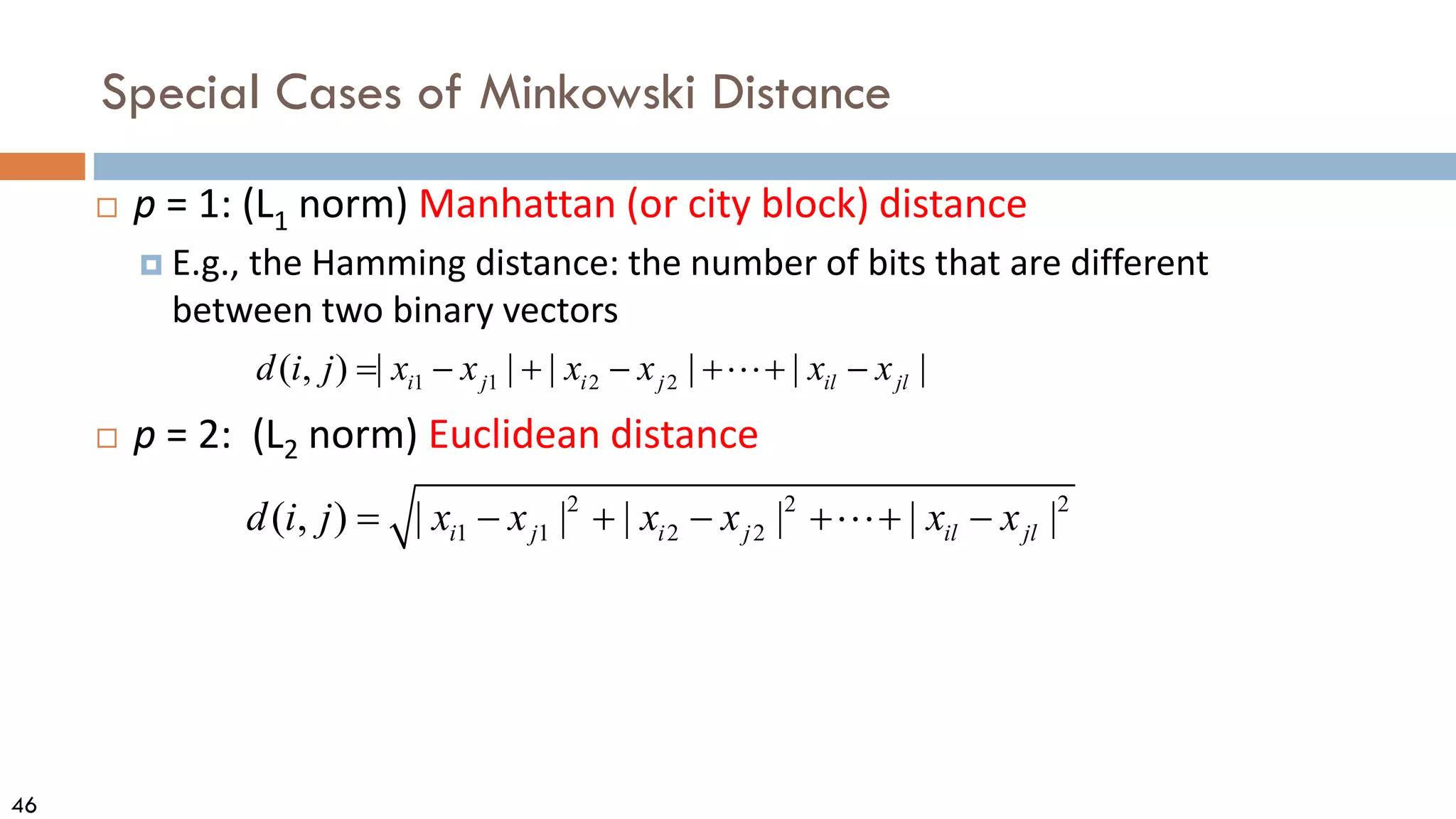
Special Cases of Minkowski Distance
 p = 1: (L1 norm) Manhattan (or city block) distance
 E.g., the Hamming distance: the number of bits that are different
between two binary vectors
 p = 2: (L2 norm) Euclidean distance
2 2 2
1 1 2 2
( , ) | | | | | |
i j i j il jl
d i j x x x x x x
= − + − + + −

1 1 2 2
( , ) | | | | | |
i j i j il jl
d i j x x x x x x
= − + − + + −

47
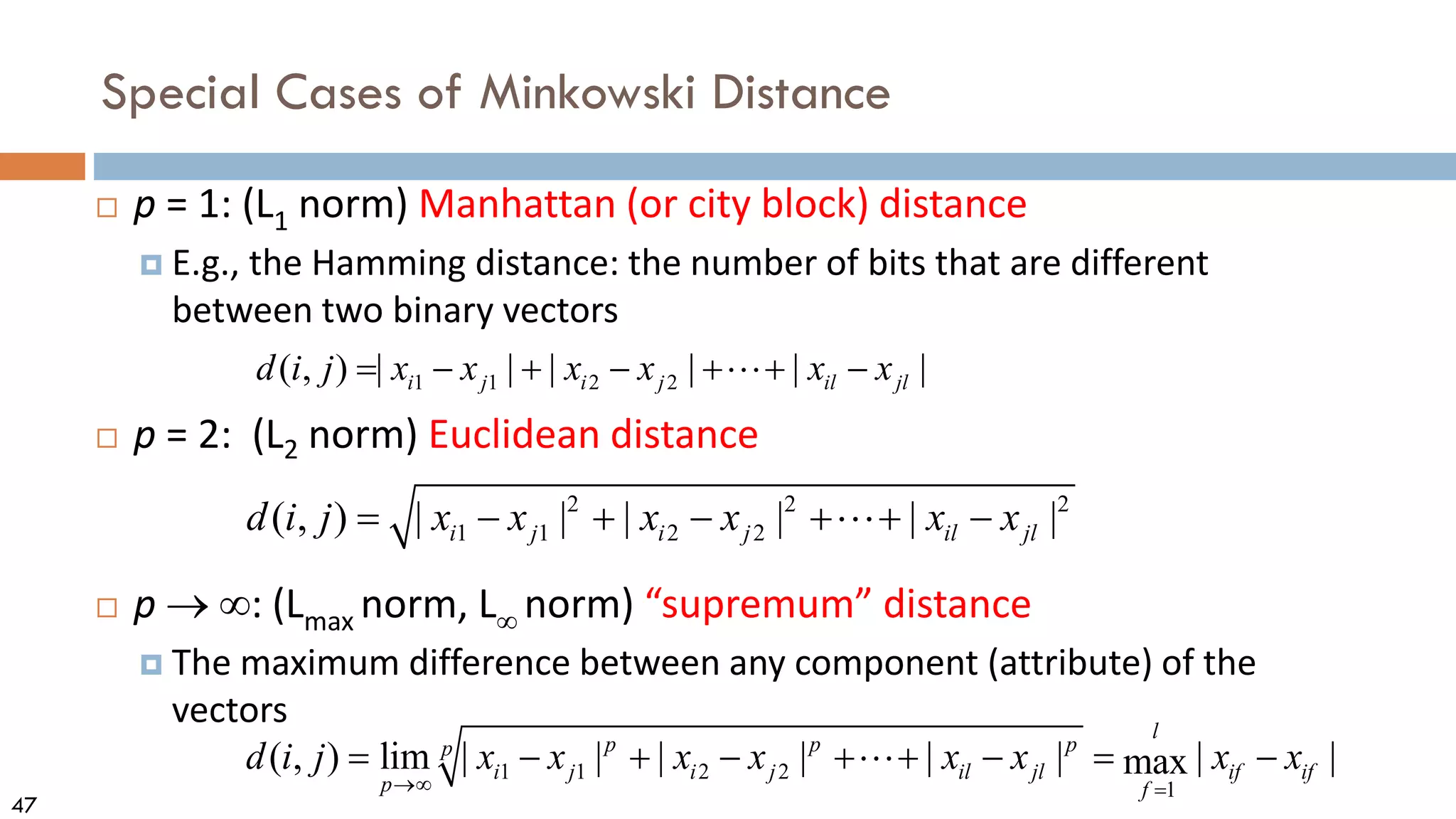
Special Cases of Minkowski Distance
 p = 1: (L1 norm) Manhattan (or city block) distance
 E.g., the Hamming distance: the number of bits that are different
between two binary vectors
 p = 2: (L2 norm) Euclidean distance
 p → ∞: (Lmax norm, L∞ norm) “supremum” distance
 The maximum difference between any component (attribute) of the
vectors
2 2 2
1 1 2 2
( , ) | | | | | |
i j i j il jl
d i j x x x x x x
= − + − + + −

1 1 2 2
( , ) | | | | | |
i j i j il jl
d i j x x x x x x
= − + − + + −

1 1 2 2
1
( , ) lim | | | | | | | |
max
l
p p p
p
i j i j il jl if if
p f
d i j x x x x x x x x
→∞ =
= − + − + + − = −

48
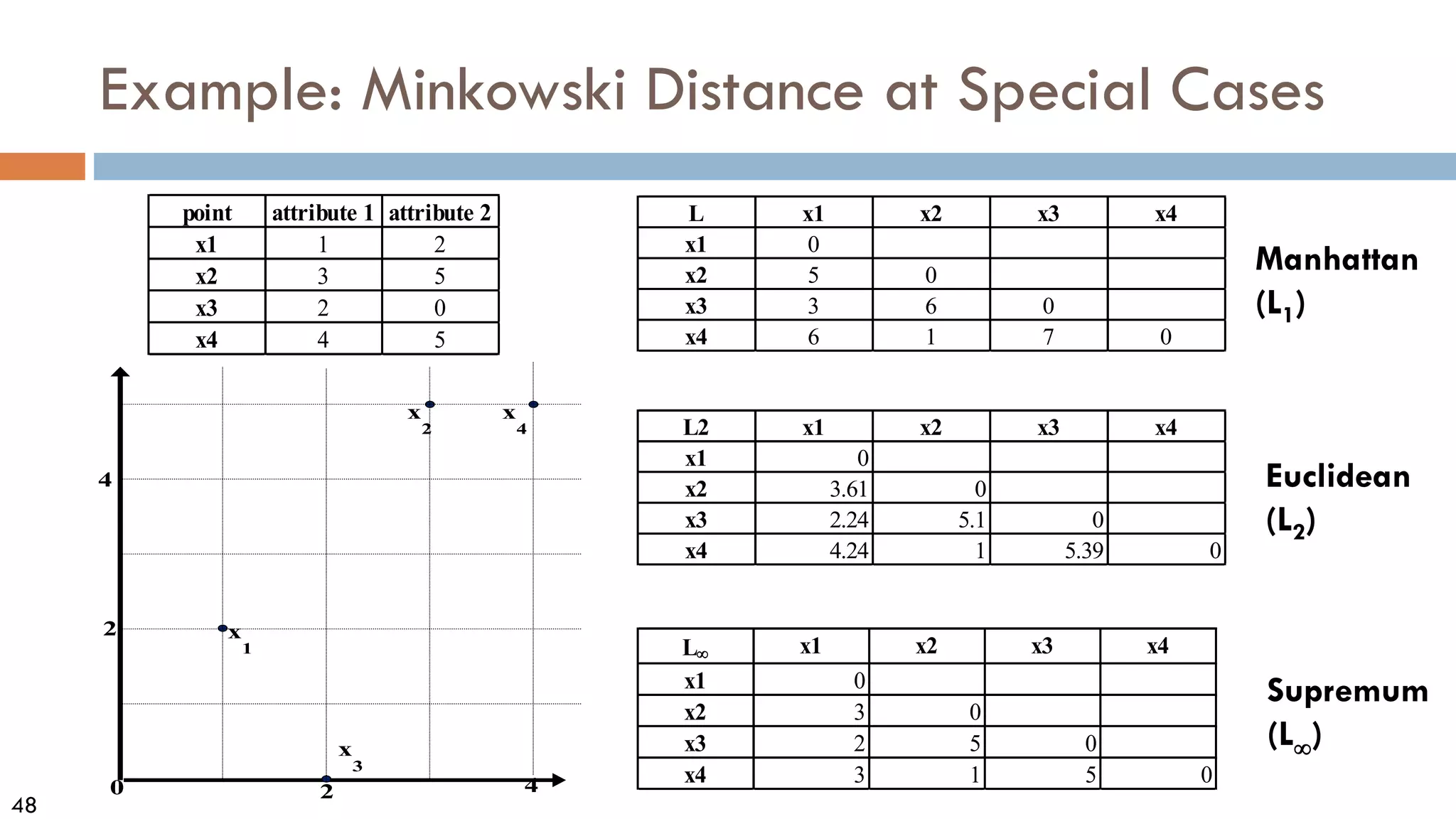
Example: Minkowski Distance at Special Cases
point attribute 1 attribute 2
x1 1 2
x2 3 5
x3 2 0
x4 4 5
L x1 x2 x3 x4
x1 0
x2 5 0
x3 3 6 0
x4 6 1 7 0
L2 x1 x2 x3 x4
x1 0
x2 3.61 0
x3 2.24 5.1 0
x4 4.24 1 5.39 0
L∞ x1 x2 x3 x4
x1 0
x2 3 0
x3 2 5 0
x4 3 1 5 0
Manhattan
(L1)
Euclidean
(L2)
Supremum
(L∞)
0 2 4
2
4
x
1
x
2
x
3
x
4
49
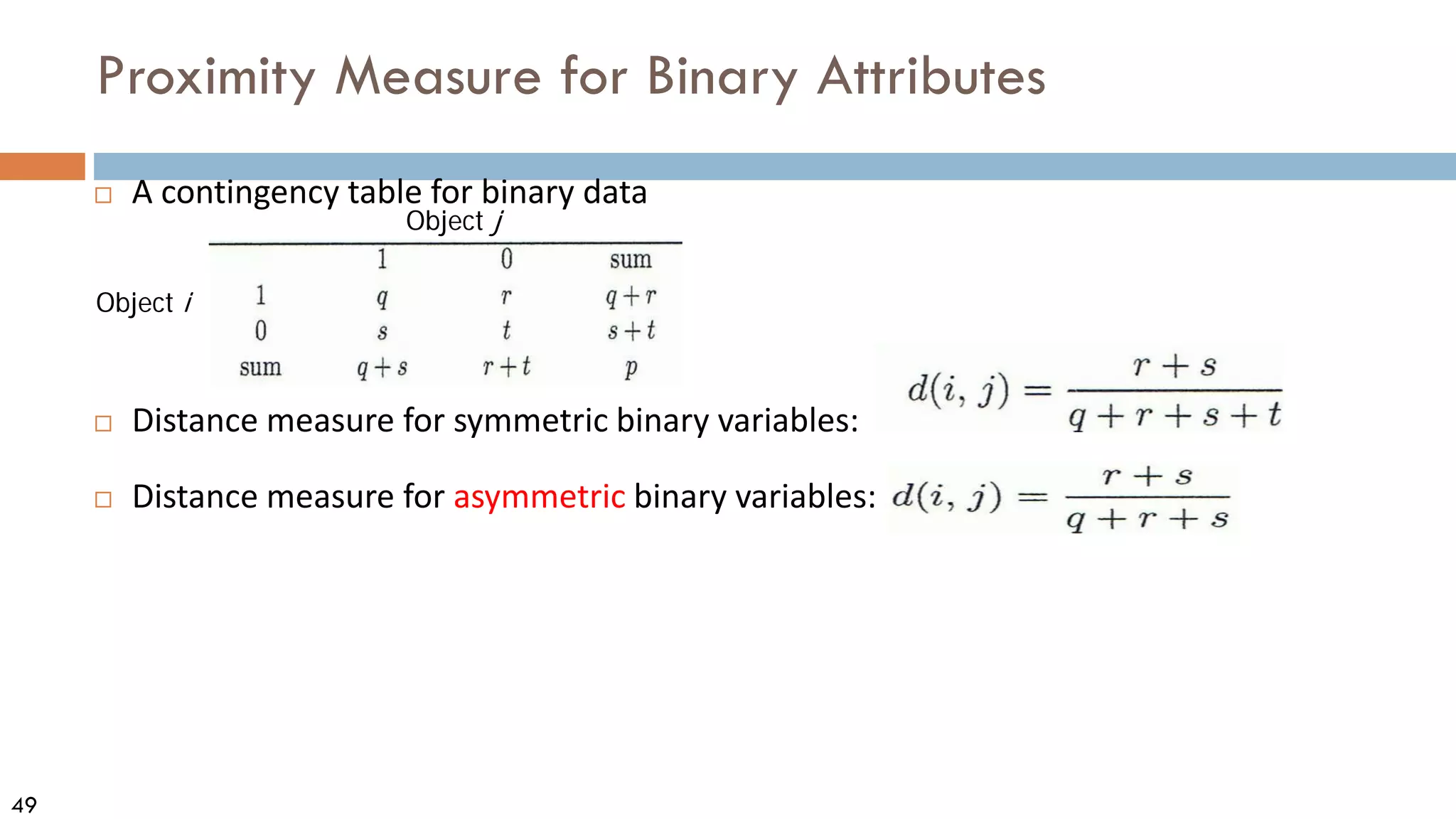
Proximity Measure for Binary Attributes
 A contingency table for binary data
 Distance measure for symmetric binary variables:
 Distance measure for asymmetric binary variables:
Object i
Object j
50
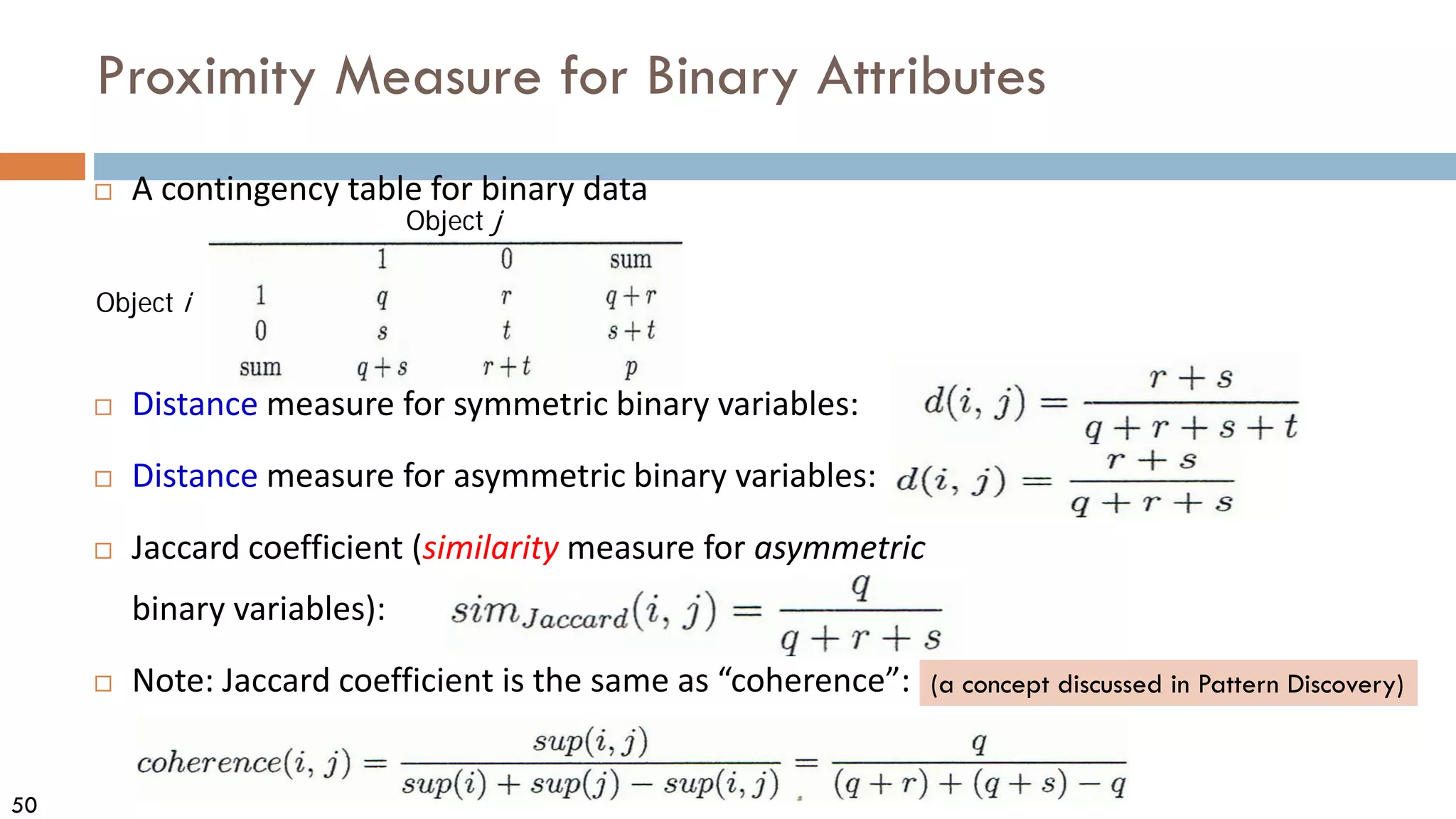
Proximity Measure for Binary Attributes
 A contingency table for binary data
 Distance measure for symmetric binary variables:
 Distance measure for asymmetric binary variables:
 Jaccard coefficient (similarity measure for asymmetric
binary variables):
 Note: Jaccard coefficient is the same as “coherence”:
Object i
Object j
(a concept discussed in Pattern Discovery)
51
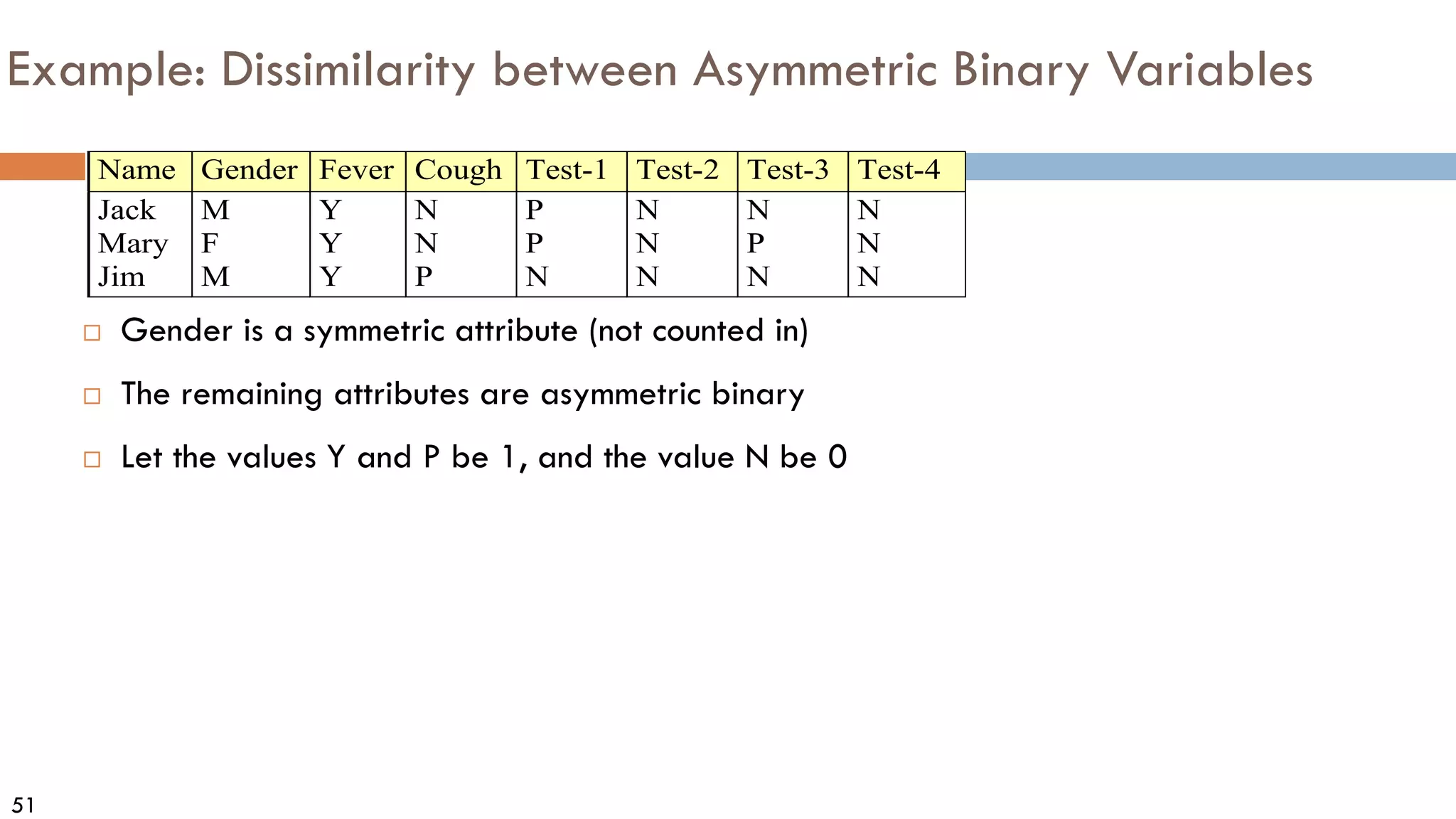
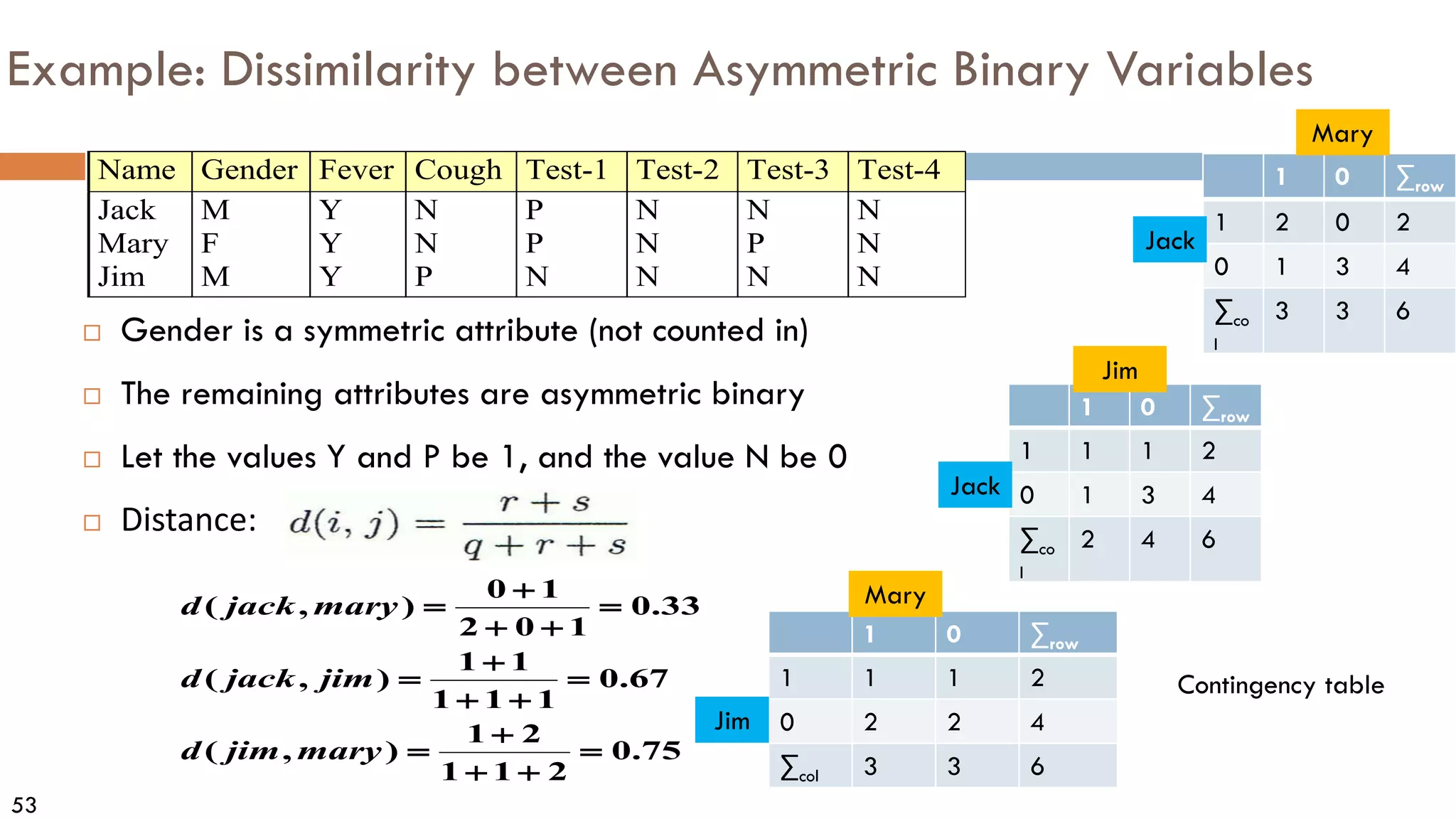
Example: Dissimilarity between Asymmetric Binary Variables
 Gender is a symmetric attribute (not counted in)
 The remaining attributes are asymmetric binary
 Let the values Y and P be 1, and the value N be 0
Name Gender Fever Cough Test-1 Test-2 Test-3 Test-4
Jack M Y N P N N N
Mary F Y N P N P N
Jim M Y P N N N N
52
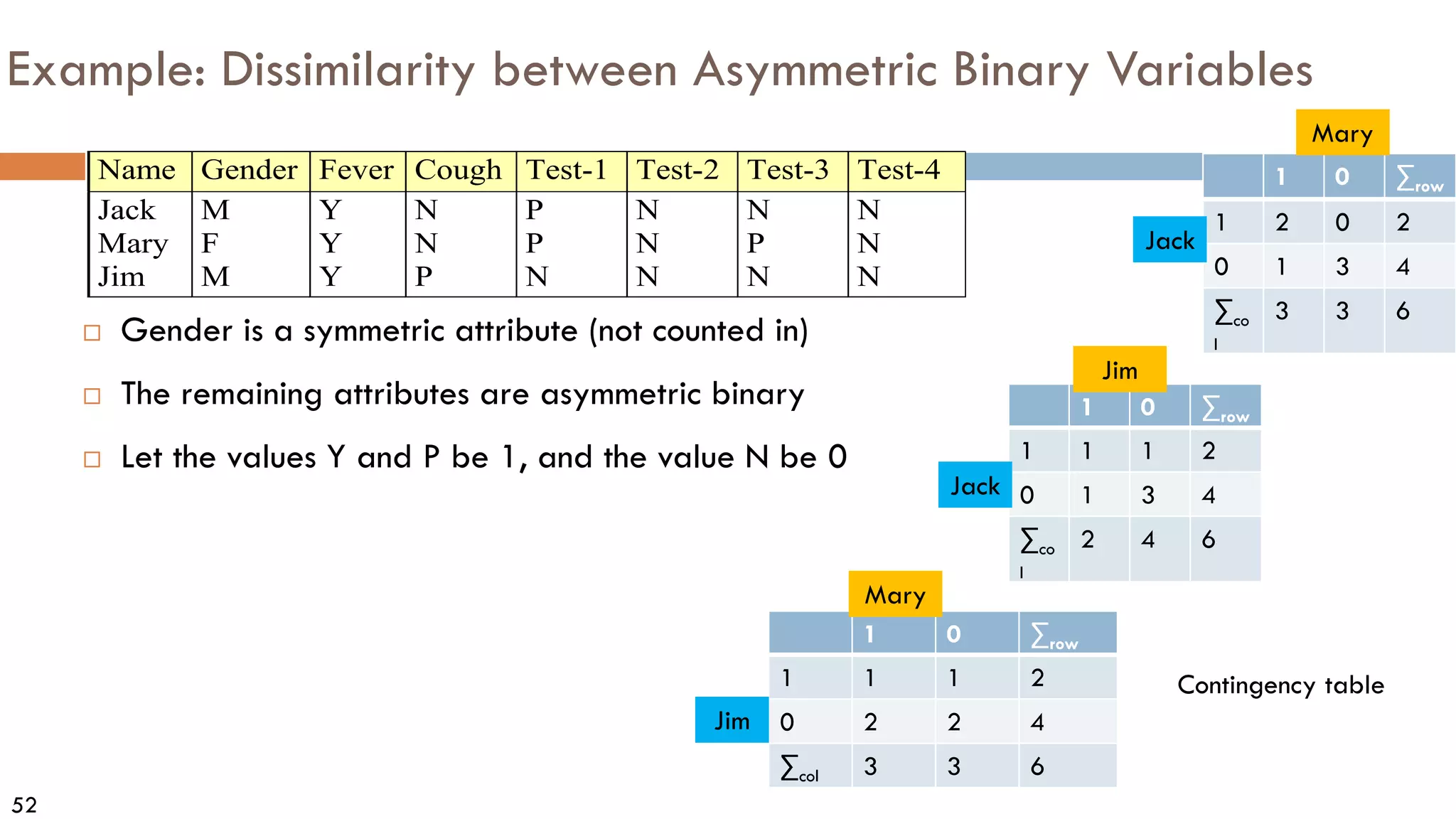
Example: Dissimilarity between Asymmetric Binary Variables
 Gender is a symmetric attribute (not counted in)
 The remaining attributes are asymmetric binary
 Let the values Y and P be 1, and the value N be 0
Name Gender Fever Cough Test-1 Test-2 Test-3 Test-4
Jack M Y N P N N N
Mary F Y N P N P N
Jim M Y P N N N N
1 0 ∑row
1 2 0 2
0 1 3 4
∑co
l
3 3 6
Jack
Mary
1 0 ∑row
1 1 1 2
0 1 3 4
∑co
l
2 4 6
Jim
1 0 ∑row
1 1 1 2
0 2 2 4
∑col 3 3 6
Jim
Mary
Jack
Contingency table
53
Example: Dissimilarity between Asymmetric Binary Variables
 Gender is a symmetric attribute (not counted in)
 The remaining attributes are asymmetric binary
 Let the values Y and P be 1, and the value N be 0
 Distance:
Name Gender Fever Cough Test-1 Test-2 Test-3 Test-4
Jack M Y N P N N N
Mary F Y N P N P N
Jim M Y P N N N N
75
.
0
2
1
1
2
1
)
,
(
67
.
0
1
1
1
1
1
)
,
(
33
.
0
1
0
2
1
0
)
,
(
=
+
+
+
=
=
+
+
+
=
=
+
+
+
=
mary
jim
d
jim
jack
d
mary
jack
d
1 0 ∑row
1 2 0 2
0 1 3 4
∑co
l
3 3 6
Jack
Mary
1 0 ∑row
1 1 1 2
0 1 3 4
∑co
l
2 4 6
Jim
1 0 ∑row
1 1 1 2
0 2 2 4
∑col 3 3 6
Jim
Mary
Jack
Contingency table
54
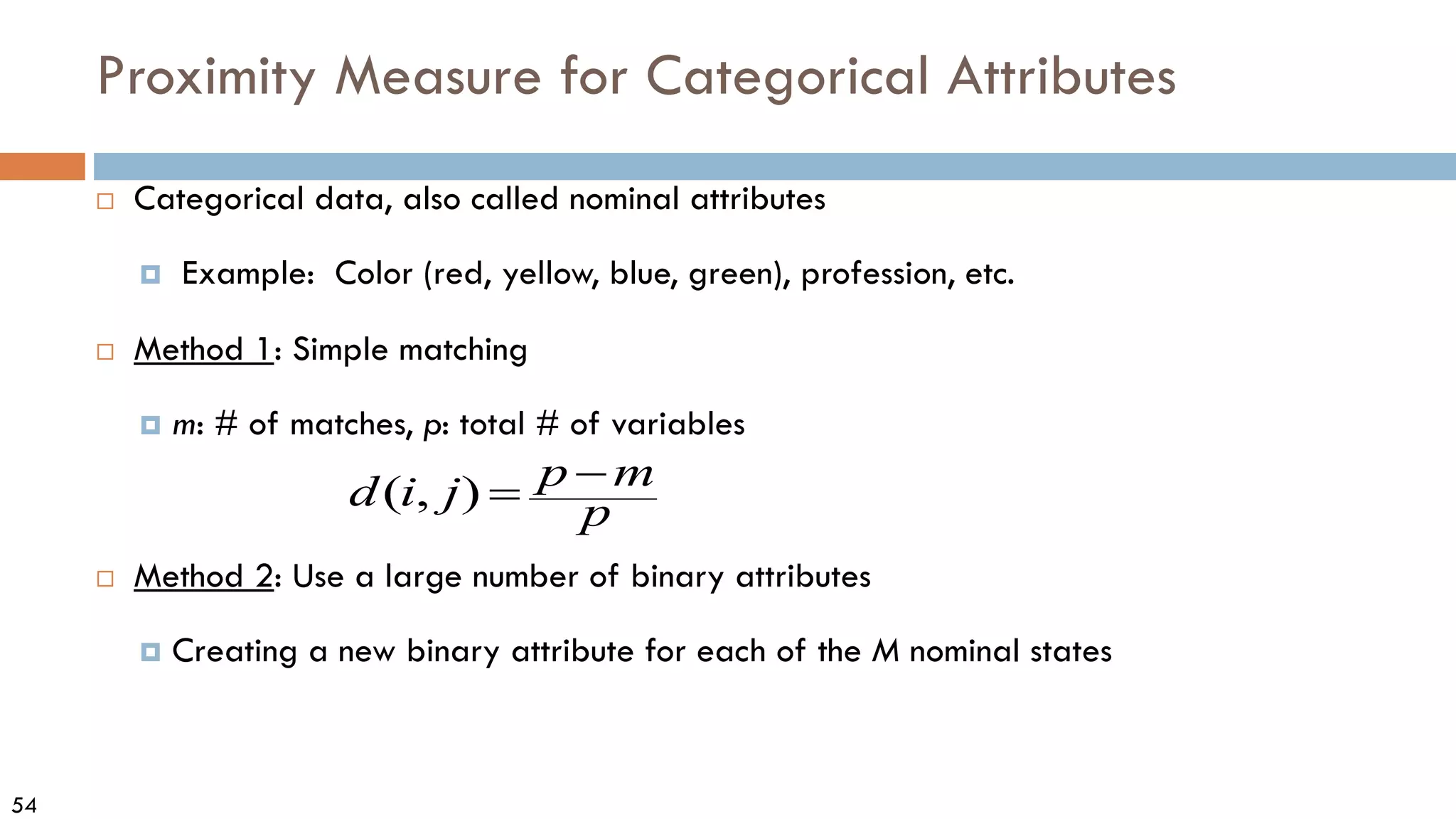
Proximity Measure for Categorical Attributes
 Categorical data, also called nominal attributes
 Example: Color (red, yellow, blue, green), profession, etc.
 Method 1: Simple matching
 m: # of matches, p: total # of variables
 Method 2: Use a large number of binary attributes
 Creating a new binary attribute for each of the M nominal states
p
m
p
j
i
d −
=
)
,
(
55
Ordinal Variables
 An ordinal variable can be discrete or continuous
 Order is important, e.g., rank (e.g., freshman, sophomore, junior, senior)
 Can be treated like interval-scaled
 Replace an ordinal variable value by its rank:
 Map the range of each variable onto [0, 1] by replacing i-th object in
the f-th variable by
 Example: freshman: 0; sophomore: 1/3; junior: 2/3; senior 1
 Then distance: d(freshman, senior) = 1, d(junior, senior) = 1/3
 Compute the dissimilarity using methods for interval-scaled variables
1
1
if
if
f
r
z
M
−
=
−
{1,..., }
if f
r M
∈
56
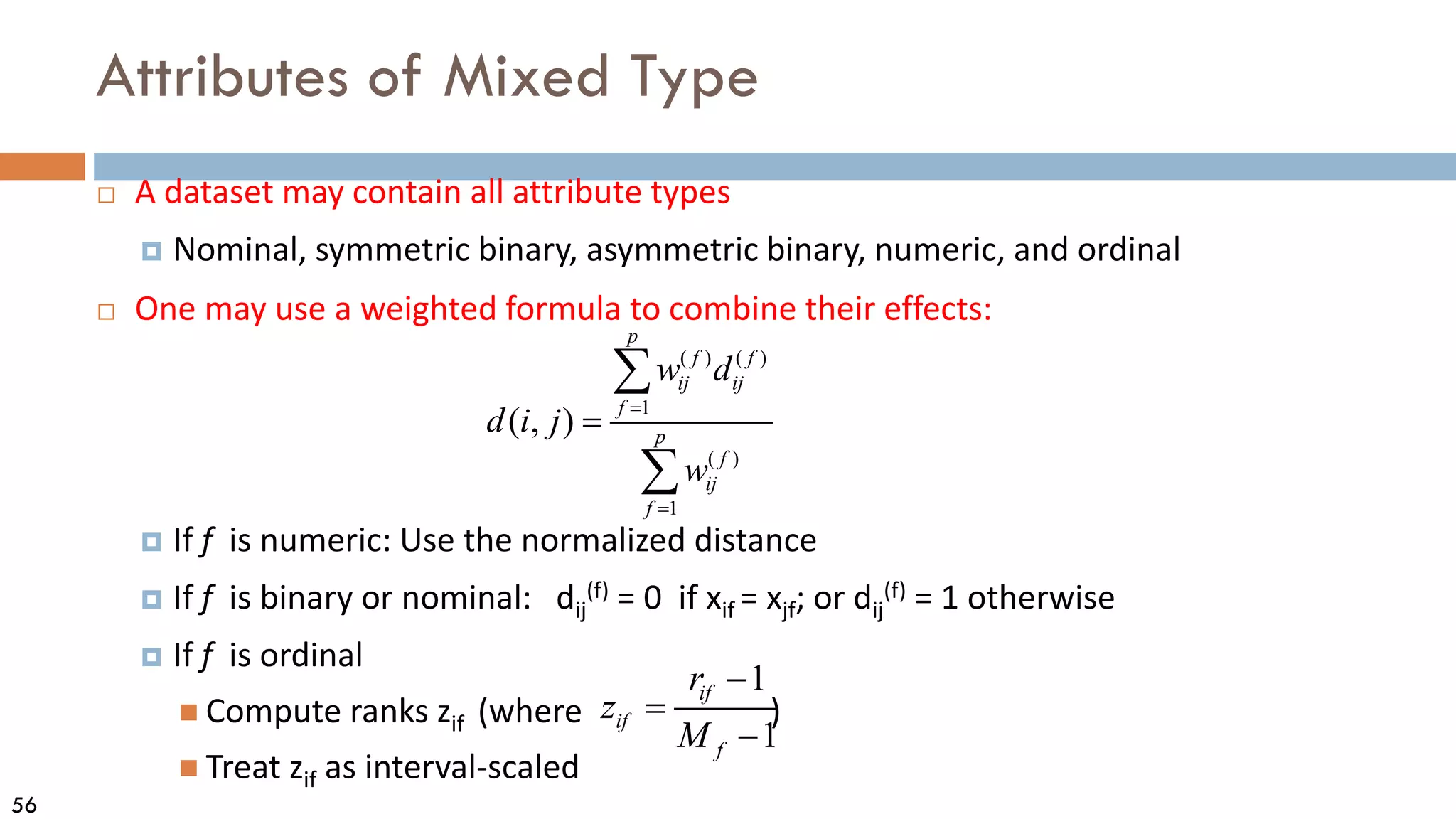
Attributes of Mixed Type
 A dataset may contain all attribute types
 Nominal, symmetric binary, asymmetric binary, numeric, and ordinal
 One may use a weighted formula to combine their effects:
 If f is numeric: Use the normalized distance
 If f is binary or nominal: dij
(f) = 0 if xif = xjf; or dij
(f) = 1 otherwise
 If f is ordinal
 Compute ranks zif (where )
 Treat zif as interval-scaled
1
1
if
if
f
r
z
M
−
=
−
( ) ( )
1
( )
1
( , )
p
f f
ij ij
f
p
f
ij
f
w d
d i j
w
=
=
=
∑
∑
57
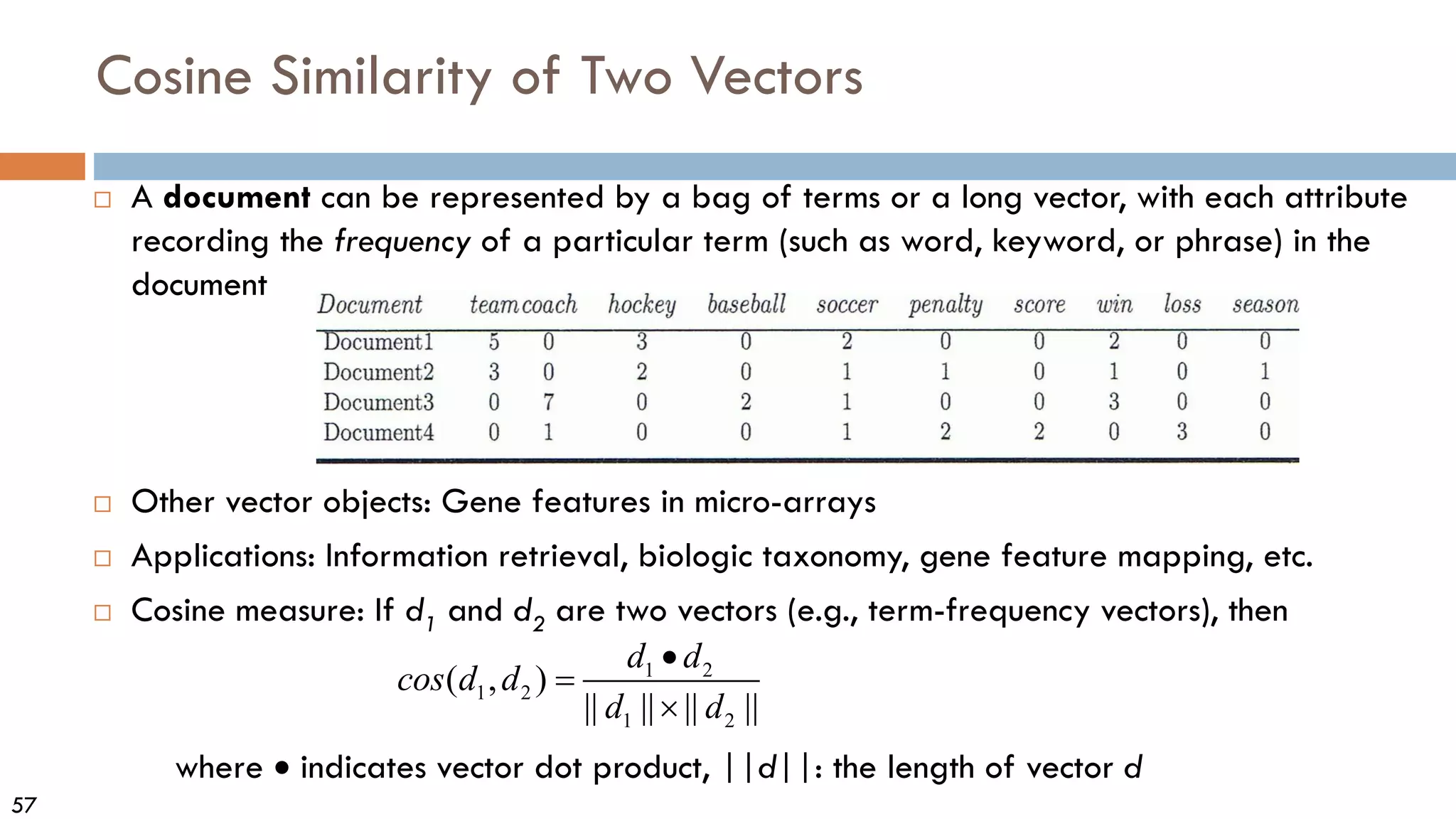
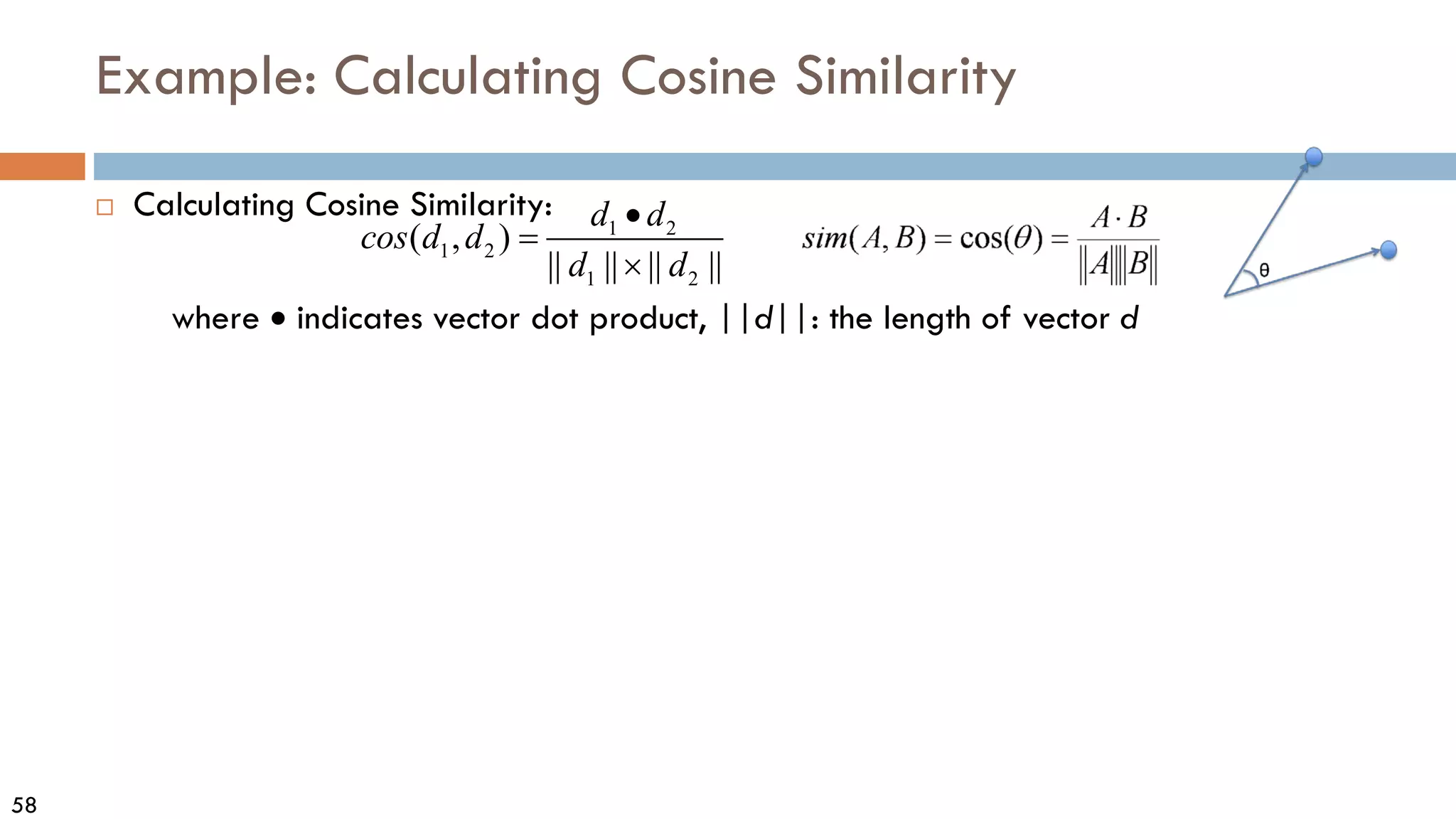
Cosine Similarity of Two Vectors
 A document can be represented by a bag of terms or a long vector, with each attribute
recording the frequency of a particular term (such as word, keyword, or phrase) in the
document
 Other vector objects: Gene features in micro-arrays
 Applications: Information retrieval, biologic taxonomy, gene feature mapping, etc.
 Cosine measure: If d1 and d2 are two vectors (e.g., term-frequency vectors), then
where • indicates vector dot product, ||d||: the length of vector d
1 2
1 2
1 2
( , )
|| || || ||
d d
cos d d
d d
•
=
×
58
Example: Calculating Cosine Similarity
 Calculating Cosine Similarity:
where • indicates vector dot product, ||d||: the length of vector d
1 2
1 2
1 2
( , )
|| || || ||
d d
cos d d
d d
•
=
×
59
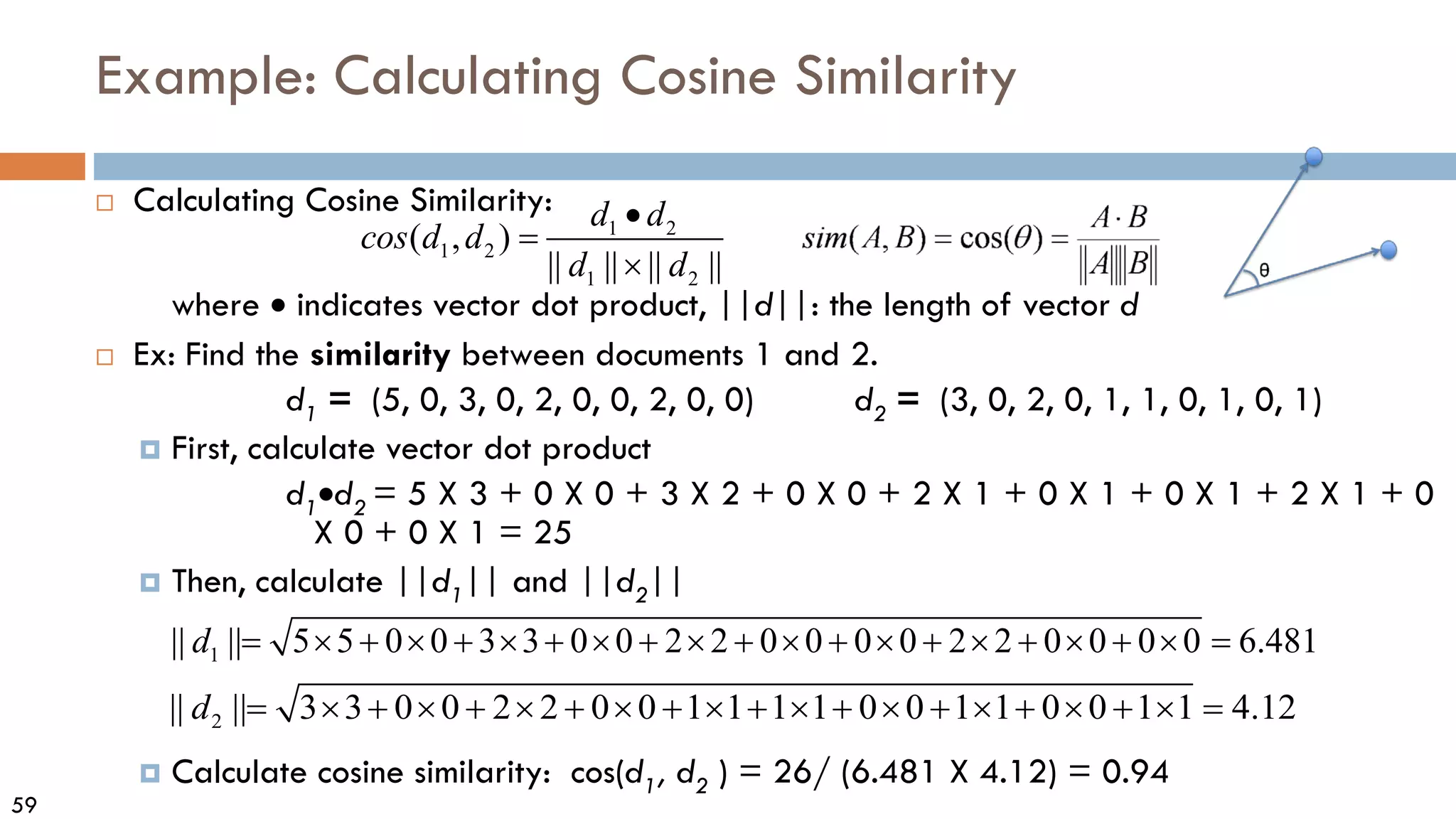
Example: Calculating Cosine Similarity
 Calculating Cosine Similarity:
where • indicates vector dot product, ||d||: the length of vector d
 Ex: Find the similarity between documents 1 and 2.
d1 = (5, 0, 3, 0, 2, 0, 0, 2, 0, 0) d2 = (3, 0, 2, 0, 1, 1, 0, 1, 0, 1)
 First, calculate vector dot product
d1•d2 = 5 X 3 + 0 X 0 + 3 X 2 + 0 X 0 + 2 X 1 + 0 X 1 + 0 X 1 + 2 X 1 + 0
X 0 + 0 X 1 = 25
 Then, calculate ||d1|| and ||d2||
 Calculate cosine similarity: cos(d1, d2 ) = 26/ (6.481 X 4.12) = 0.94
1 3 3 0 0 2 2 0 0 0 0 2 2 0 0 0 0 6.48
|| || 5 0 0 1
5
d + + +
= × + × + × × + + + + =
× × × × × ×
2 3 2 2 0 0 1 1 1 1
|| | 0 0 1 1 0 0 1 1 4.12
| 3 0 0
d + + + + + + +
= × + × + × × × × × × × × =
1 2
1 2
1 2
( , )
|| || || ||
d d
cos d d
d d
•
=
×
60
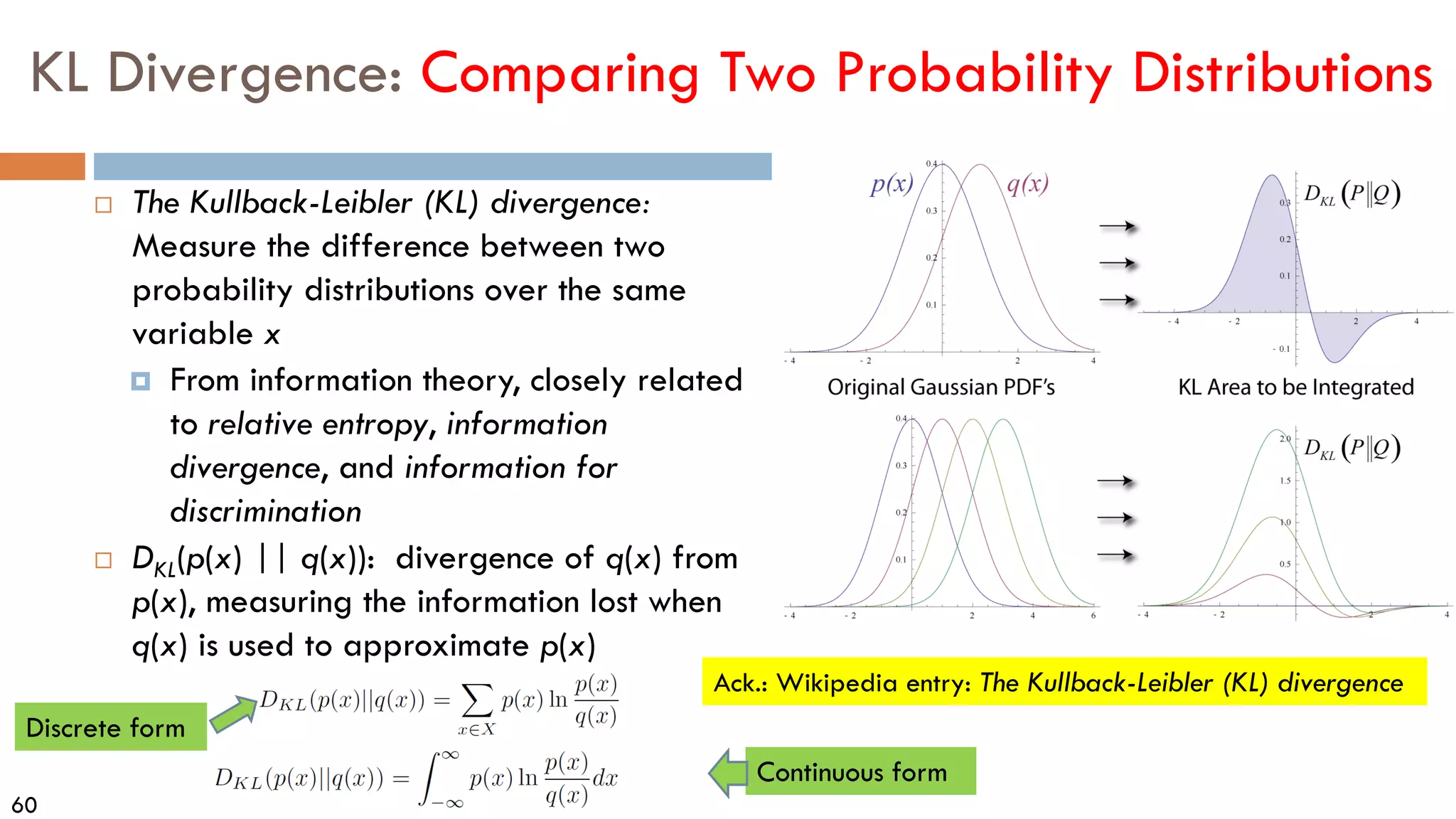
KL Divergence: Comparing Two Probability Distributions
 The Kullback-Leibler (KL) divergence:
Measure the difference between two
probability distributions over the same
variable x
 From information theory, closely related
to relative entropy, information
divergence, and information for
discrimination
 DKL(p(x) || q(x)): divergence of q(x) from
p(x), measuring the information lost when
q(x) is used to approximate p(x)
Ack.: Wikipedia entry: The Kullback-Leibler (KL) divergence
Discrete form
Continuous form
61
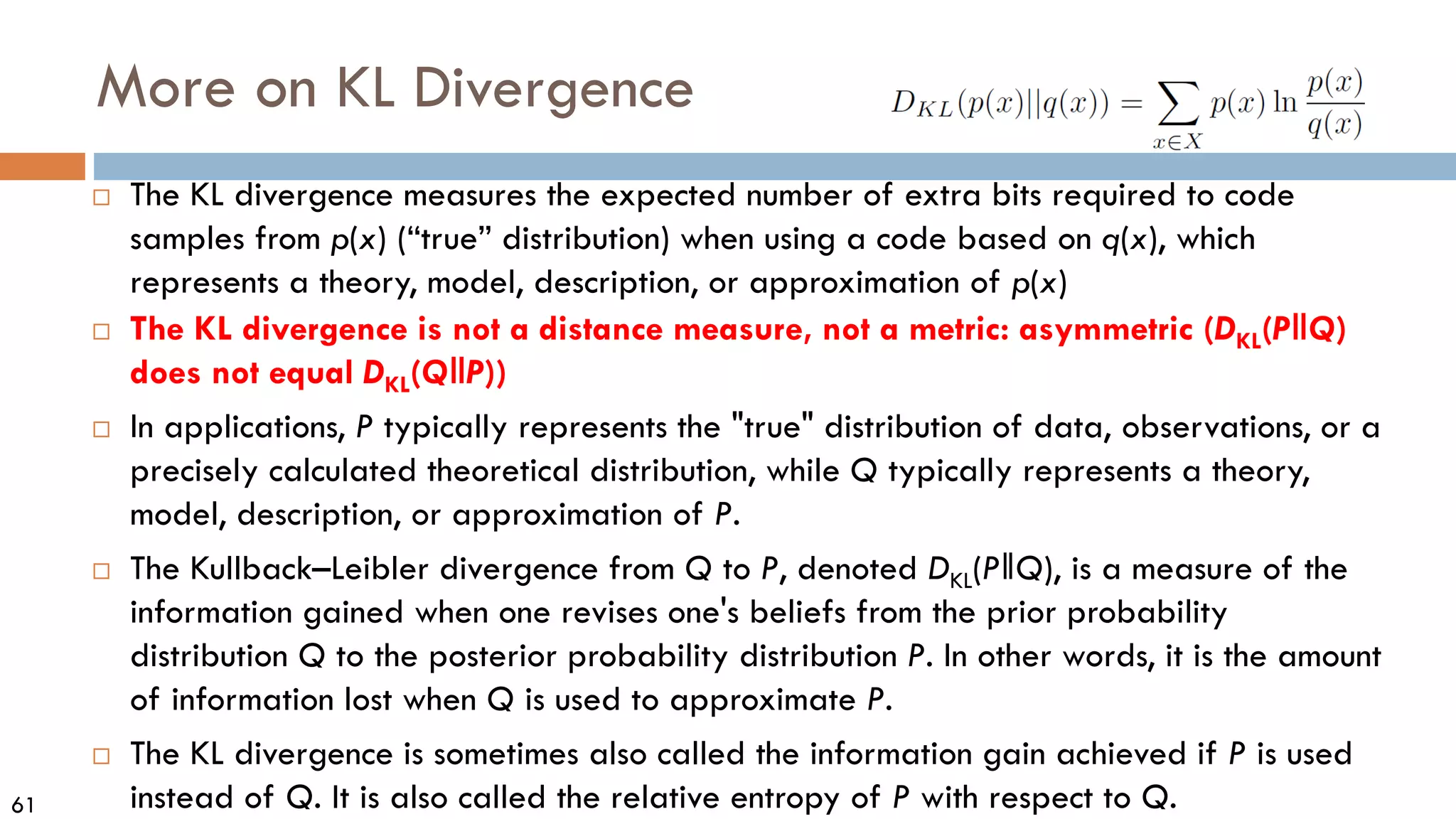
More on KL Divergence
 The KL divergence measures the expected number of extra bits required to code
samples from p(x) (“true” distribution) when using a code based on q(x), which
represents a theory, model, description, or approximation of p(x)
 The KL divergence is not a distance measure, not a metric: asymmetric (DKL(P‖Q)
does not equal DKL(Q‖P))
 In applications, P typically represents the "true" distribution of data, observations, or a
precisely calculated theoretical distribution, while Q typically represents a theory,
model, description, or approximation of P.
 The Kullback–Leibler divergence from Q to P, denoted DKL(P‖Q), is a measure of the
information gained when one revises one's beliefs from the prior probability
distribution Q to the posterior probability distribution P. In other words, it is the amount
of information lost when Q is used to approximate P.
 The KL divergence is sometimes also called the information gain achieved if P is used
instead of Q. It is also called the relative entropy of P with respect to Q.
62
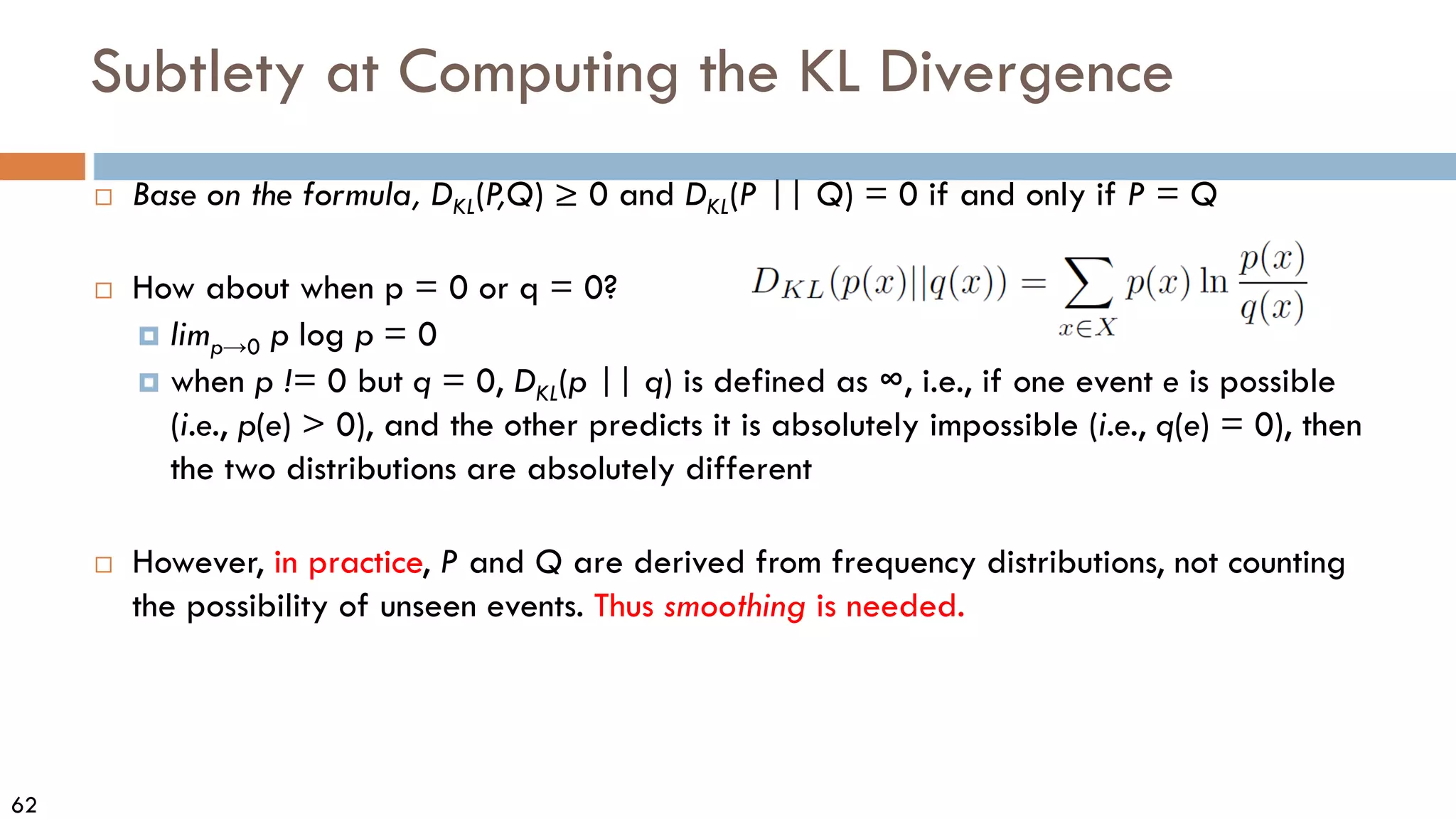
Subtlety at Computing the KL Divergence
 Base on the formula, DKL(P
,Q) ≥ 0 and DKL(P || Q) = 0 if and only if P = Q
 How about when p = 0 or q = 0?
 limp→0 p log p = 0
 when p != 0 but q = 0, DKL(p || q) is defined as ∞, i.e., if one event e is possible
(i.e., p(e) > 0), and the other predicts it is absolutely impossible (i.e., q(e) = 0), then
the two distributions are absolutely different
 However, in practice, P and Q are derived from frequency distributions, not counting
the possibility of unseen events. Thus smoothing is needed.
63
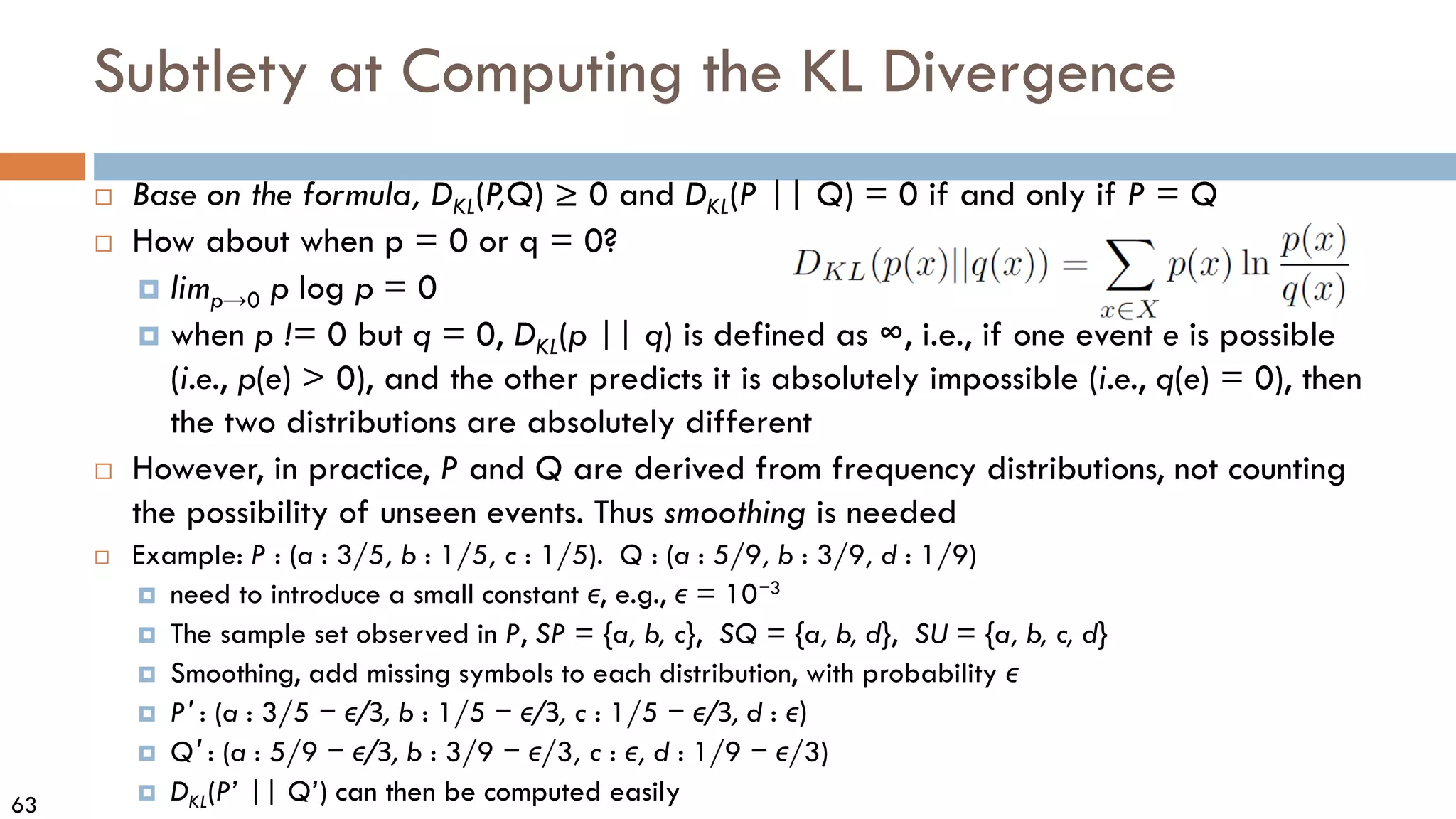
Subtlety at Computing the KL Divergence
 Base on the formula, DKL(P
,Q) ≥ 0 and DKL(P || Q) = 0 if and only if P = Q
 How about when p = 0 or q = 0?
 limp→0 p log p = 0
 when p != 0 but q = 0, DKL(p || q) is defined as ∞, i.e., if one event e is possible
(i.e., p(e) > 0), and the other predicts it is absolutely impossible (i.e., q(e) = 0), then
the two distributions are absolutely different
 However, in practice, P and Q are derived from frequency distributions, not counting
the possibility of unseen events. Thus smoothing is needed
 Example: P : (a : 3/5, b : 1/5, c : 1/5). Q : (a : 5/9, b : 3/9, d : 1/9)
 need to introduce a small constant ϵ, e.g., ϵ = 10−3
 The sample set observed in P, SP = {a, b, c}, SQ = {a, b, d}, SU = {a, b, c, d}
 Smoothing, add missing symbols to each distribution, with probability ϵ
 P′ : (a : 3/5 − ϵ/3, b : 1/5 − ϵ/3, c : 1/5 − ϵ/3, d : ϵ)
 Q′ : (a : 5/9 − ϵ/3, b : 3/9 − ϵ/3, c : ϵ, d : 1/9 − ϵ/3)
 DKL(P’ || Q’) can then be computed easily
64
Data & Data Preprocessing
 Data Objects and Attribute Types
 Basic Statistical Descriptions of Data
 Measuring Data Similarity and Dissimilarity
 Data Preprocessing: An Overview
 Summary
65
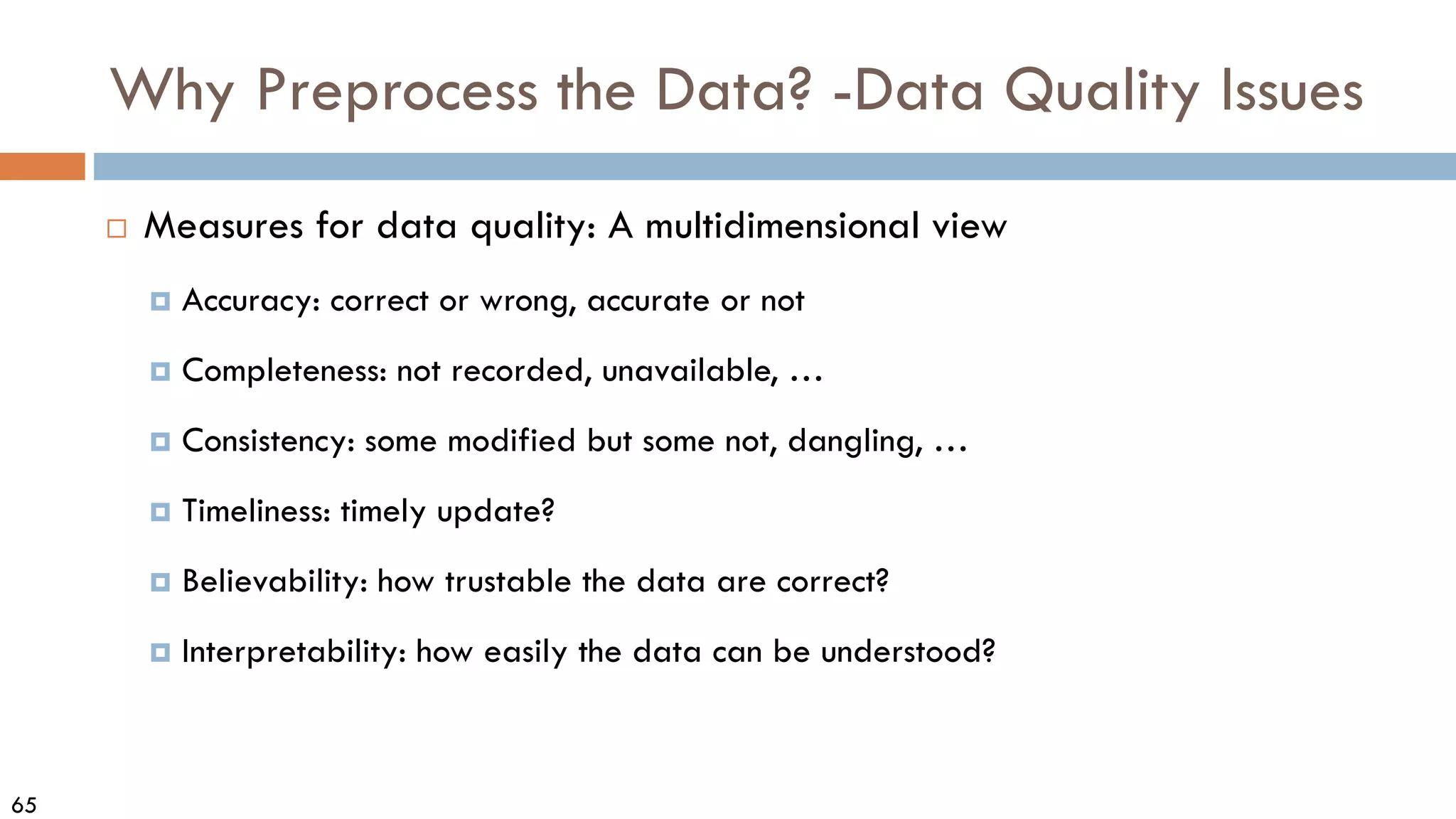
Why Preprocess the Data? -Data Quality Issues
 Measures for data quality: A multidimensional view
 Accuracy: correct or wrong, accurate or not
 Completeness: not recorded, unavailable, …
 Consistency: some modified but some not, dangling, …
 Timeliness: timely update?
 Believability: how trustable the data are correct?
 Interpretability: how easily the data can be understood?
66
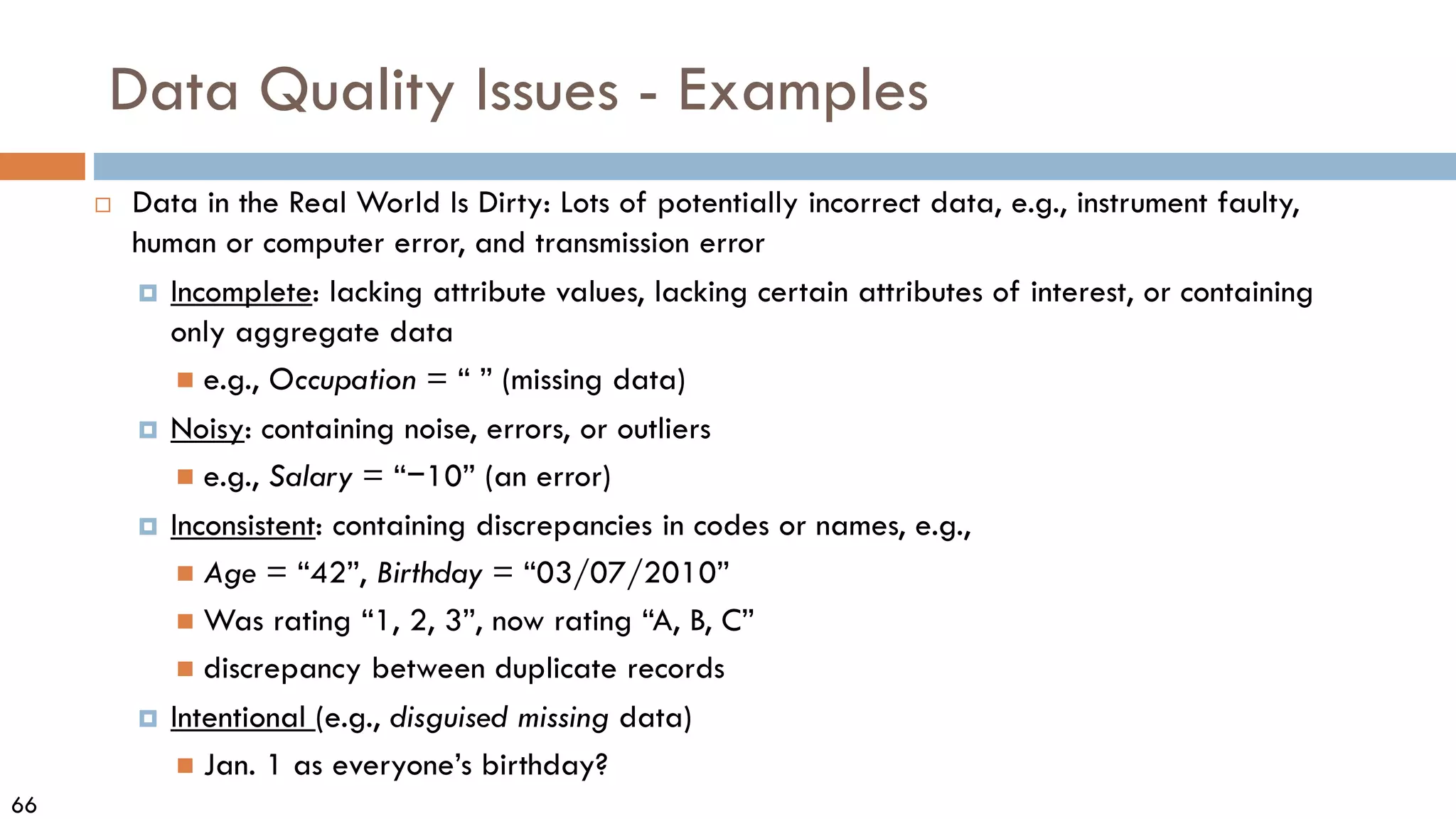
Data Quality Issues - Examples
 Data in the Real World Is Dirty: Lots of potentially incorrect data, e.g., instrument faulty,
human or computer error, and transmission error
 Incomplete: lacking attribute values, lacking certain attributes of interest, or containing
only aggregate data
 e.g., Occupation = “ ” (missing data)
 Noisy: containing noise, errors, or outliers
 e.g., Salary = “−10” (an error)
 Inconsistent: containing discrepancies in codes or names, e.g.,
 Age = “42”, Birthday = “03/07/2010”
 Was rating “1, 2, 3”, now rating “A, B, C”
 discrepancy between duplicate records
 Intentional (e.g., disguised missing data)
 Jan. 1 as everyone’s birthday?
67
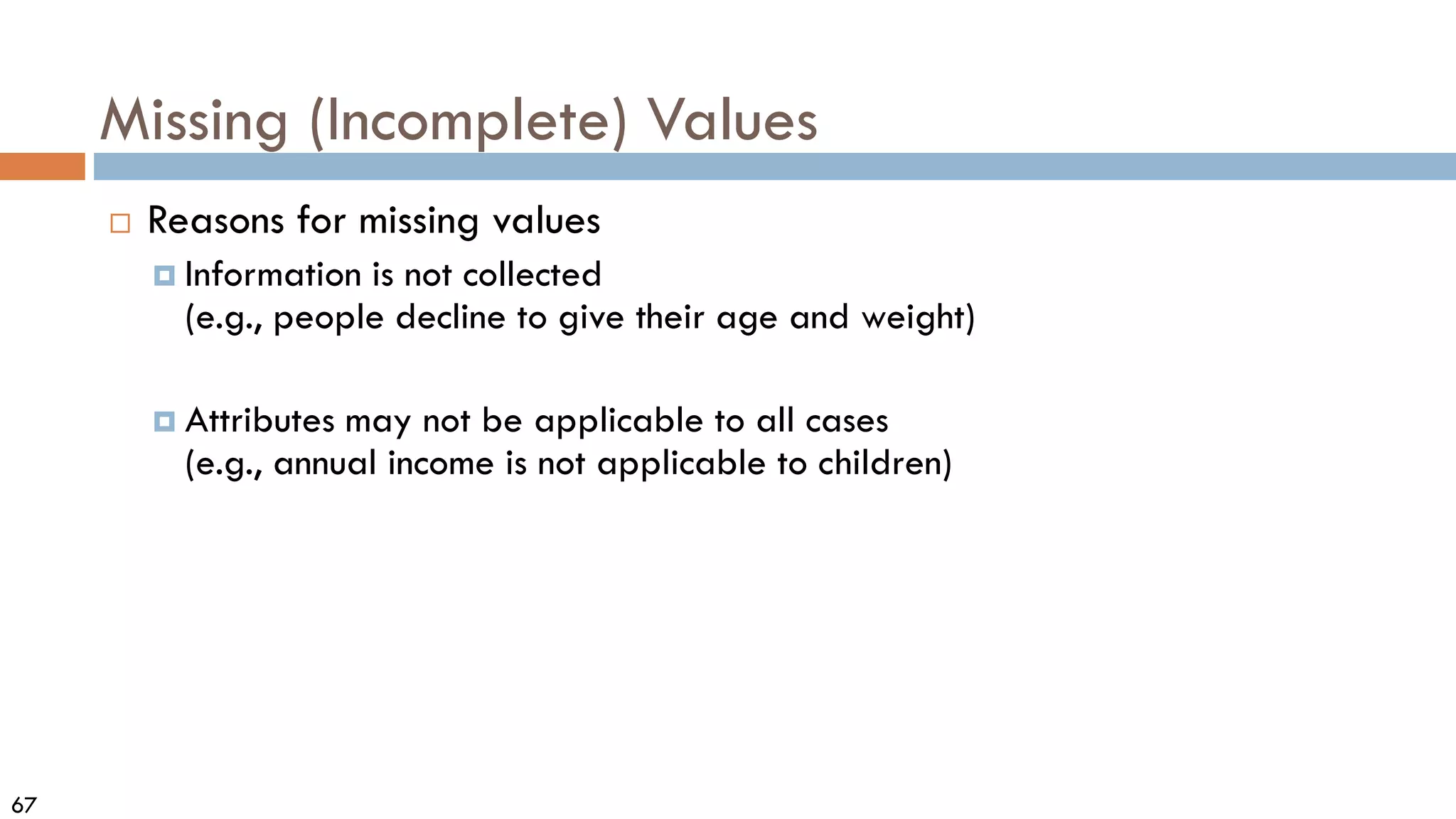
Missing (Incomplete) Values
 Reasons for missing values
 Information is not collected
(e.g., people decline to give their age and weight)
 Attributes may not be applicable to all cases
(e.g., annual income is not applicable to children)
68
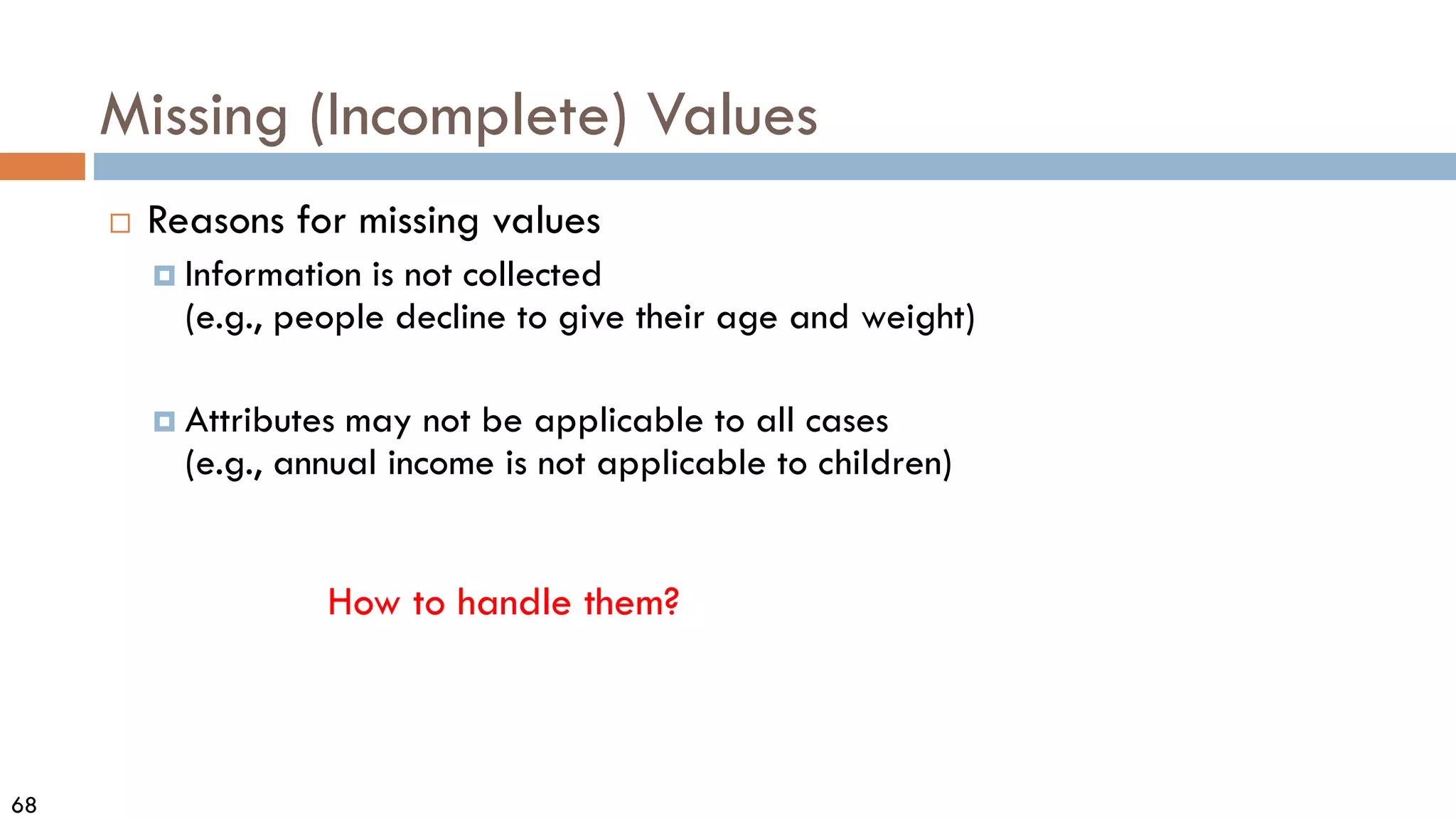
Missing (Incomplete) Values
 Reasons for missing values
 Information is not collected
(e.g., people decline to give their age and weight)
 Attributes may not be applicable to all cases
(e.g., annual income is not applicable to children)
How to handle them?
69
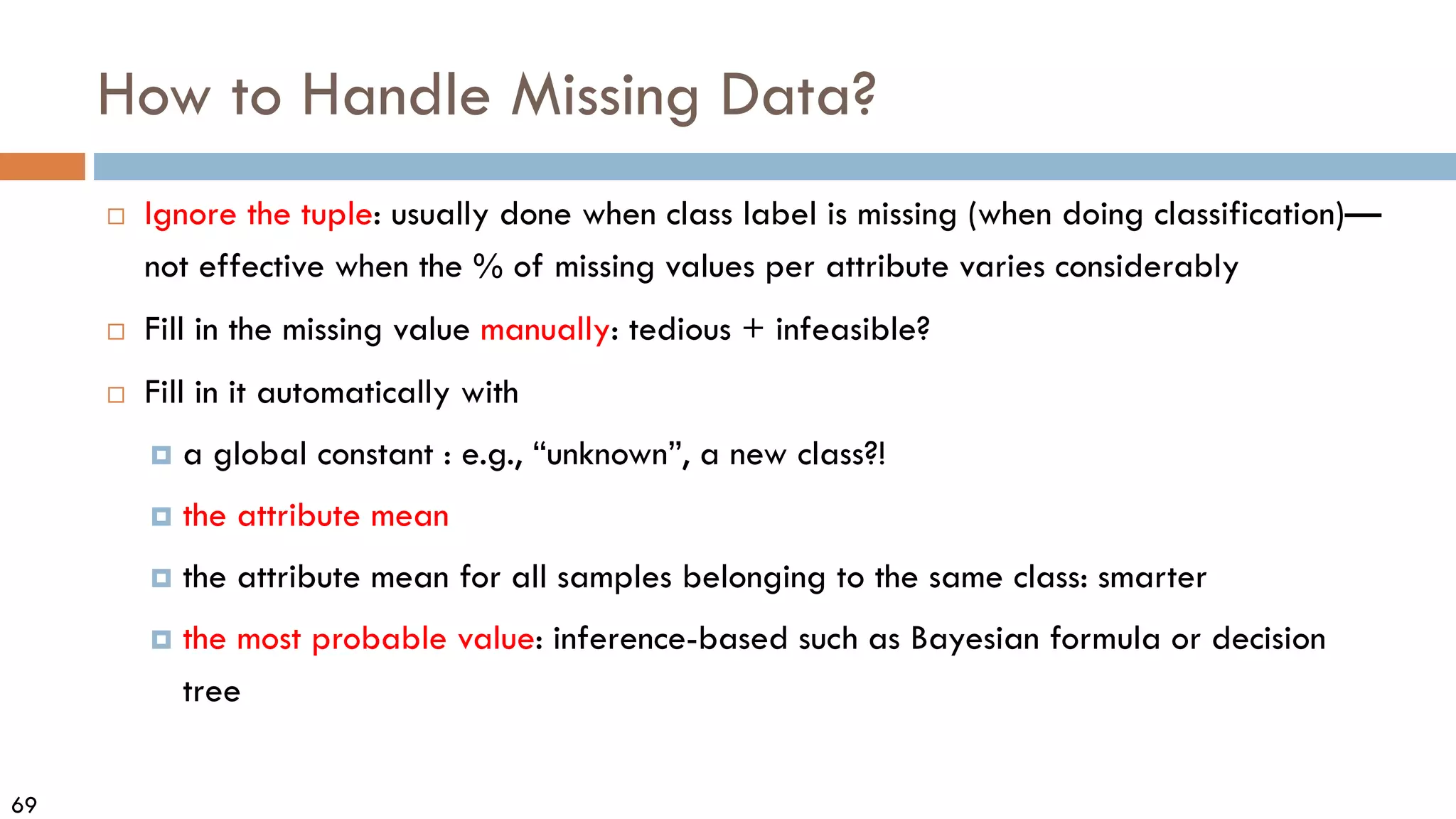
How to Handle Missing Data?
 Ignore the tuple: usually done when class label is missing (when doing classification)—
not effective when the % of missing values per attribute varies considerably
 Fill in the missing value manually: tedious + infeasible?
 Fill in it automatically with
 a global constant : e.g., “unknown”, a new class?!
 the attribute mean
 the attribute mean for all samples belonging to the same class: smarter
 the most probable value: inference-based such as Bayesian formula or decision
tree
70
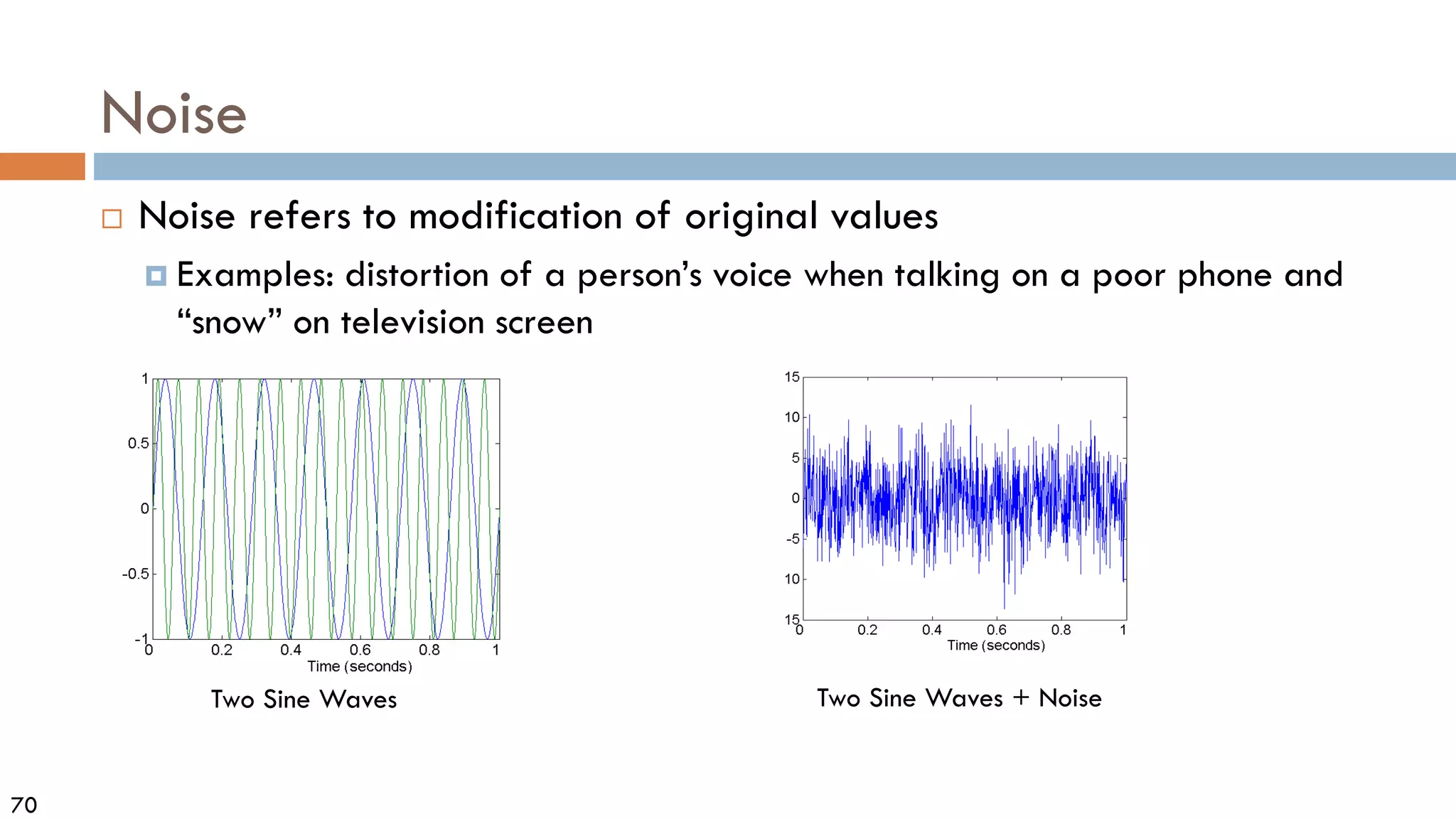
Noise
 Noise refers to modification of original values
 Examples: distortion of a person’s voice when talking on a poor phone and
“snow” on television screen
Two Sine Waves Two Sine Waves + Noise
71
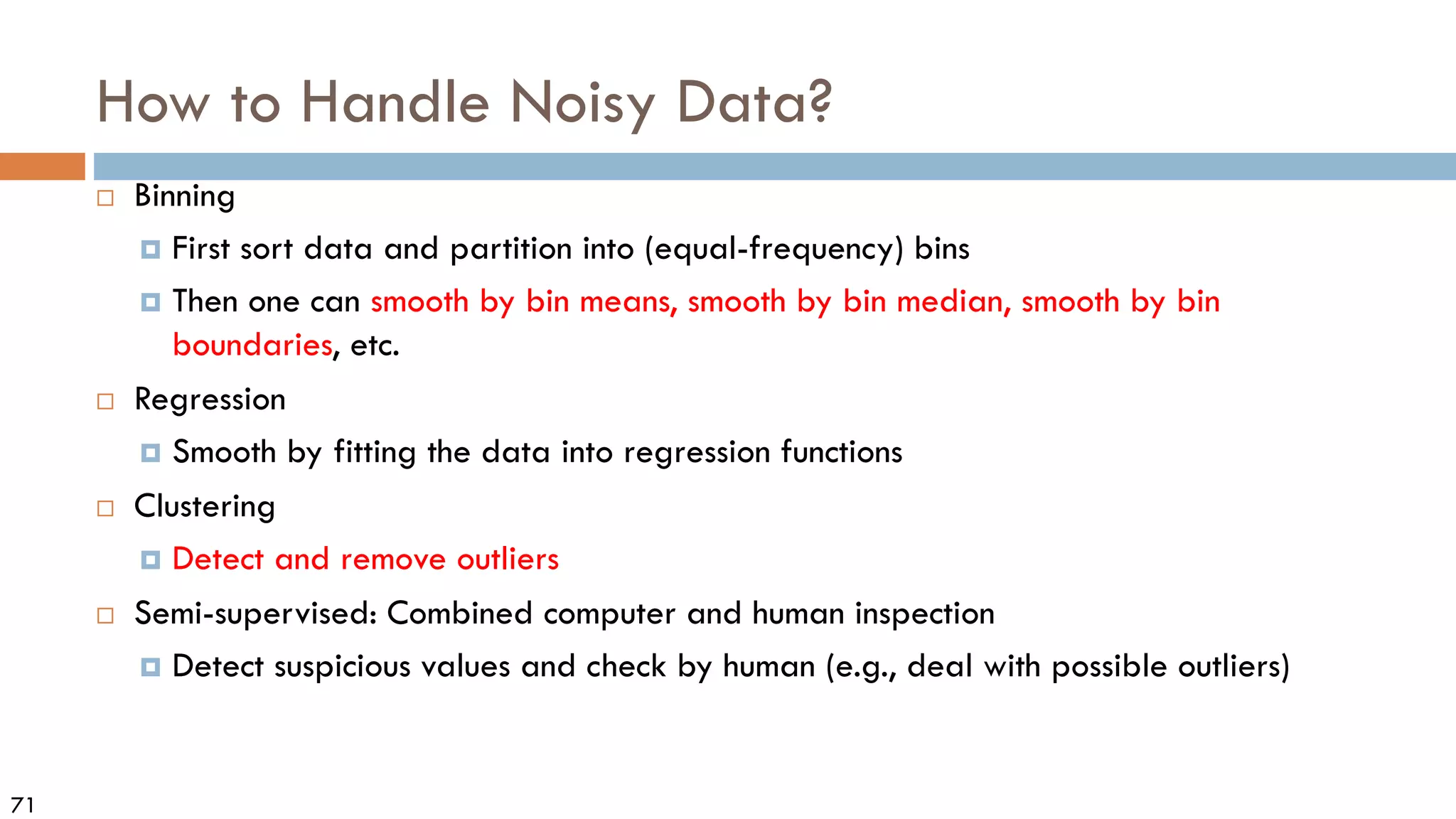
How to Handle Noisy Data?
 Binning
 First sort data and partition into (equal-frequency) bins
 Then one can smooth by bin means, smooth by bin median, smooth by bin
boundaries, etc.
 Regression
 Smooth by fitting the data into regression functions
 Clustering
 Detect and remove outliers
 Semi-supervised: Combined computer and human inspection
 Detect suspicious values and check by human (e.g., deal with possible outliers)
72
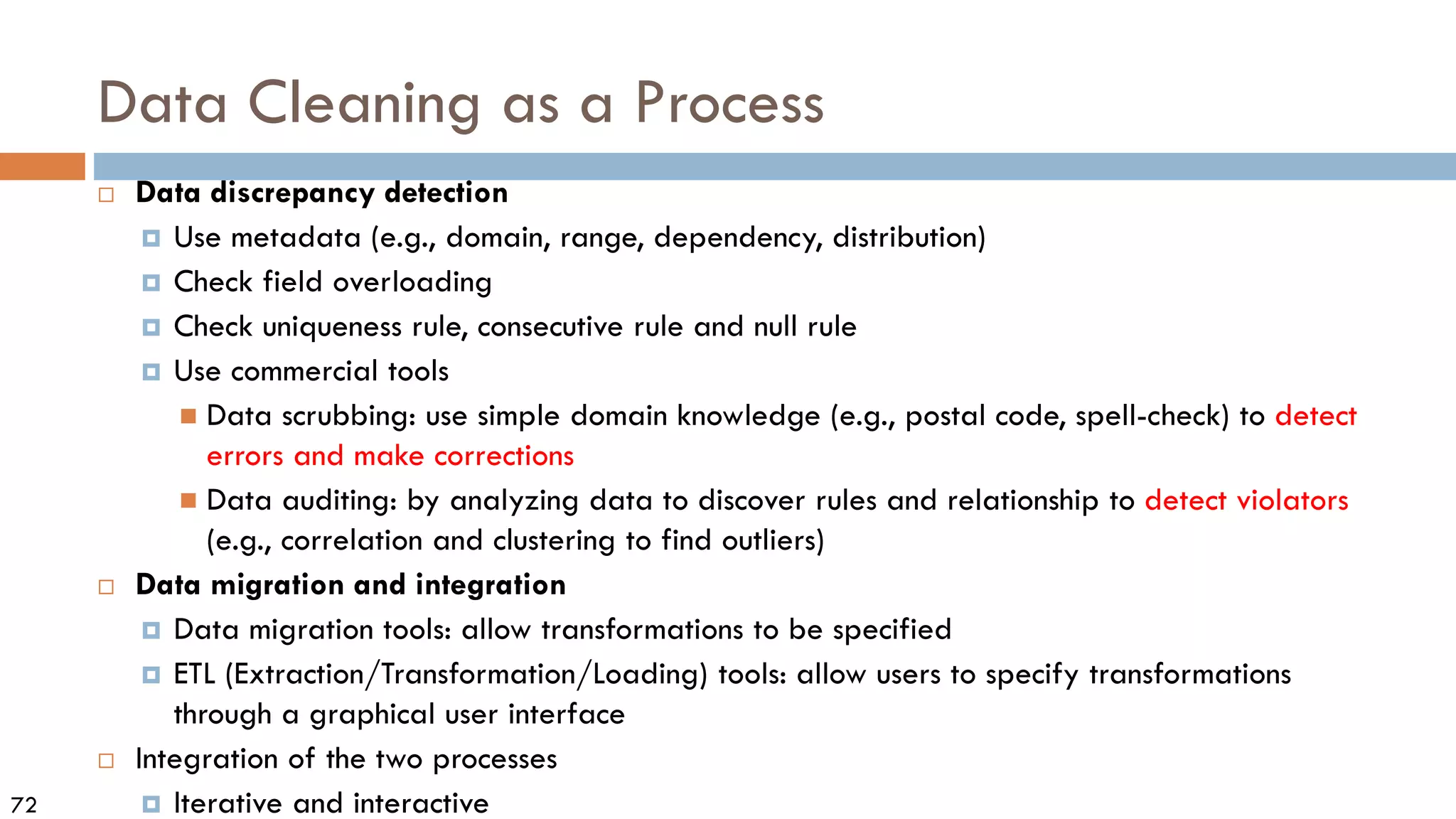
Data Cleaning as a Process
 Data discrepancy detection
 Use metadata (e.g., domain, range, dependency, distribution)
 Check field overloading
 Check uniqueness rule, consecutive rule and null rule
 Use commercial tools
 Data scrubbing: use simple domain knowledge (e.g., postal code, spell-check) to detect
errors and make corrections
 Data auditing: by analyzing data to discover rules and relationship to detect violators
(e.g., correlation and clustering to find outliers)
 Data migration and integration
 Data migration tools: allow transformations to be specified
 ETL (Extraction/Transformation/Loading) tools: allow users to specify transformations
through a graphical user interface
 Integration of the two processes
 Iterative and interactive
73
Data & Data Preprocessing
 Data Objects and Attribute Types
 Basic Statistical Descriptions of Data
 Measuring Data Similarity and Dissimilarity
 Data Preprocessing: An Overview
 Summary
74
Summary
 Data attribute types: nominal, binary, ordinal, interval-scaled, ratio-scaled
 Many types of data sets, e.g., numerical, text, graph, Web, image.
 Gain insight into the data by:
 Basic statistical data description: central tendency, dispersion
 Measure data similarity
 Data quality issues and preprocessing
 Many methods have been developed but still an active area of research
75
References
 W. Cleveland, Visualizing Data, Hobart Press, 1993
 T. Dasu and T. Johnson. Exploratory Data Mining and Data Cleaning. John Wiley, 2003
 U. Fayyad, G. Grinstein, and A. Wierse. Information Visualization in Data Mining and Knowledge
Discovery, Morgan Kaufmann, 2001
 L. Kaufman and P. J. Rousseeuw. Finding Groups in Data: an Introduction to Cluster Analysis. John Wiley
& Sons, 1990.
 H. V. Jagadish et al., Special Issue on Data Reduction Techniques. Bulletin of the Tech. Committee on
Data Eng., 20(4), Dec. 1997
 D. A. Keim. Information visualization and visual data mining, IEEE trans. on Visualization and Computer
Graphics, 8(1), 2002
 D. Pyle. Data Preparation for Data Mining. Morgan Kaufmann, 1999
 S. Santini and R. Jain,” Similarity measures”, IEEE Trans. on Pattern Analysis and Machine Intelligence,
21(9), 1999
 E. R. Tufte. The Visual Display of Quantitative Information, 2nd ed., Graphics Press, 2001
 C. Yu, et al., Visual data mining of multimedia data for social and behavioral studies, Information
Visualization, 8(1), 2009
76
References
 W. Cleveland, Visualizing Data, Hobart Press, 1993
 T. Dasu and T. Johnson. Exploratory Data Mining and Data Cleaning. John Wiley, 2003
 U. Fayyad, G. Grinstein, and A. Wierse. Information Visualization in Data Mining and Knowledge
Discovery, Morgan Kaufmann, 2001
 L. Kaufman and P. J. Rousseeuw. Finding Groups in Data: an Introduction to Cluster Analysis. John Wiley
& Sons, 1990.
 H. V. Jagadish et al., Special Issue on Data Reduction Techniques. Bulletin of the Tech. Committee on
Data Eng., 20(4), Dec. 1997
 D. A. Keim. Information visualization and visual data mining, IEEE trans. on Visualization and Computer
Graphics, 8(1), 2002
 D. Pyle. Data Preparation for Data Mining. Morgan Kaufmann, 1999
 S. Santini and R. Jain,” Similarity measures”, IEEE Trans. on Pattern Analysis and Machine Intelligence,
21(9), 1999
 E. R. Tufte. The Visual Display of Quantitative Information, 2nd ed., Graphics Press, 2001
 C. Yu, et al., Visual data mining of multimedia data for social and behavioral studies, Information
Visualization, 8(1), 2009
Homework #1 is Out!
Due Date: 09/12/2017 (Two weeks from now)
Online Submissions ONLY!
Next Class: Data Preprocessing
77
78
Backup slides
79
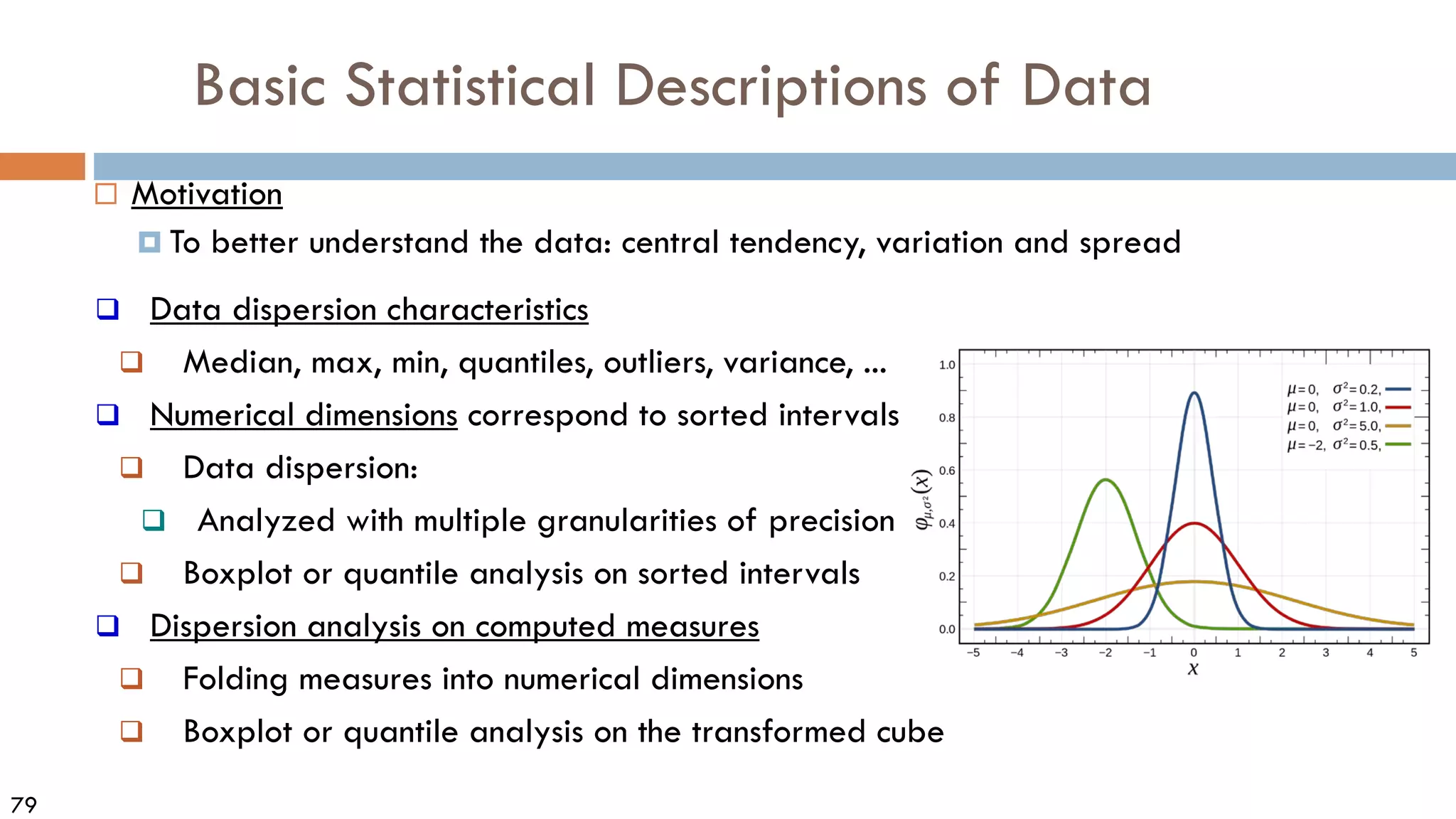
Basic Statistical Descriptions of Data
 Motivation
 To better understand the data: central tendency, variation and spread
 Data dispersion characteristics
 Median, max, min, quantiles, outliers, variance, ...
 Numerical dimensions correspond to sorted intervals
 Data dispersion:
 Analyzed with multiple granularities of precision
 Boxplot or quantile analysis on sorted intervals
 Dispersion analysis on computed measures
 Folding measures into numerical dimensions
 Boxplot or quantile analysis on the transformed cube
80
Basic Statistical Descriptions of Data
 Motivation
 To better understand the data: central tendency, variation and spread
 Data dispersion characteristics
 Median, max, min, quantiles, outliers, variance, ...
 Numerical dimensions correspond to sorted intervals
 Data dispersion:
 Analyzed with multiple granularities of precision
 Boxplot or quantile analysis on sorted intervals
 Dispersion analysis on computed measures
 Folding measures into numerical dimensions
 Boxplot or quantile analysis on the transformed cube
81
Graphic Displays of Basic Statistical Descriptions
 Boxplot: graphic display of five-number summary
 Histogram: x-axis are values, y-axis represents frequencies
 Quantile plot: each value xi is paired with fi indicating that approximately 100% * fi
of data are ≤ xi
 Quantile-quantile (q-q) plot: graphs the quantiles of one univariant distribution
against the corresponding quantiles of another
 Scatter plot: each pair of values is a pair of coordinates and plotted as points in the
plane
82
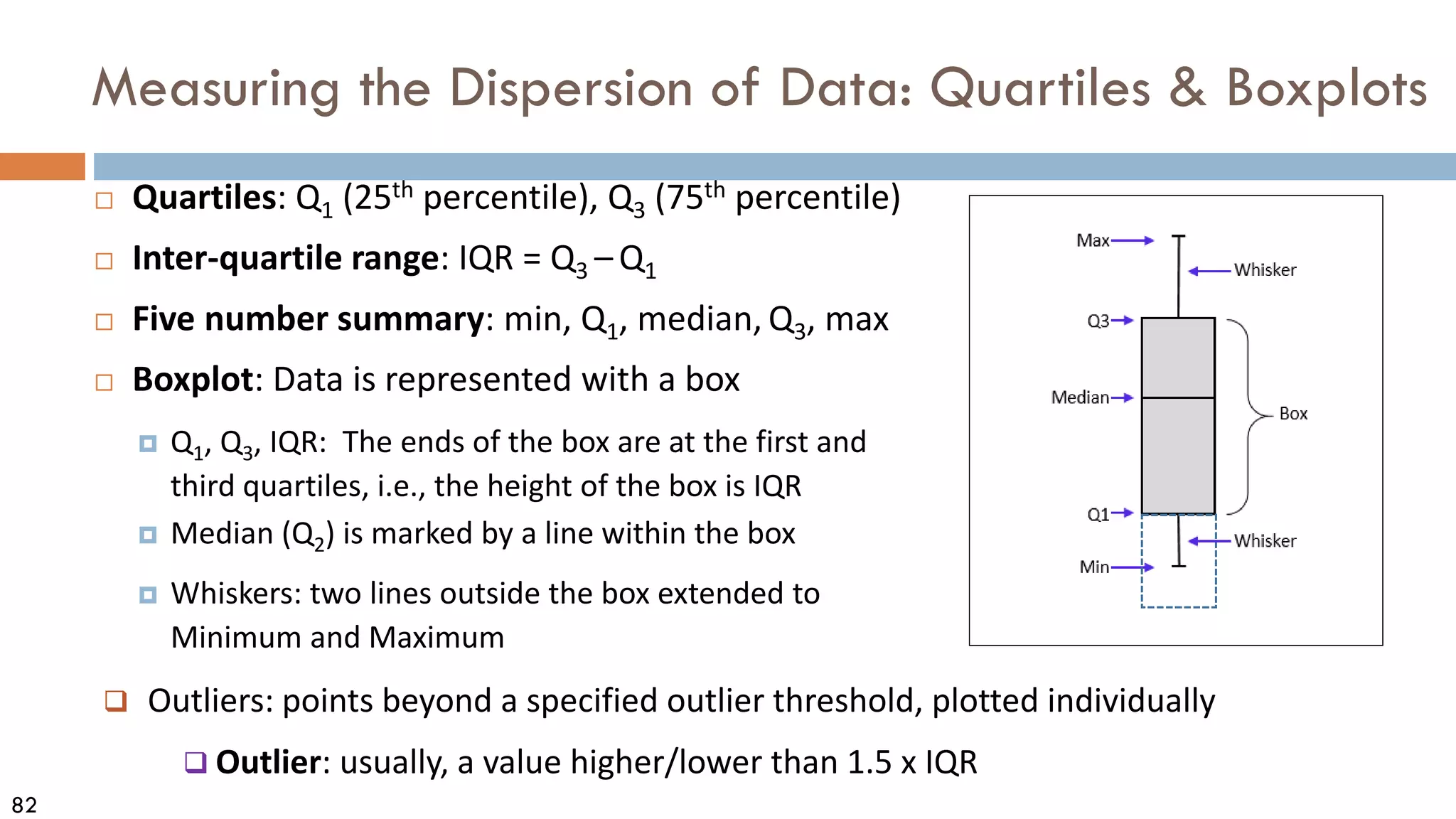
Measuring the Dispersion of Data: Quartiles & Boxplots
 Quartiles: Q1 (25th percentile), Q3 (75th percentile)
 Inter-quartile range: IQR = Q3 – Q1
 Five number summary: min, Q1, median, Q3, max
 Boxplot: Data is represented with a box
 Q1, Q3, IQR: The ends of the box are at the first and
third quartiles, i.e., the height of the box is IQR
 Median (Q2) is marked by a line within the box
 Whiskers: two lines outside the box extended to
Minimum and Maximum
 Outliers: points beyond a specified outlier threshold, plotted individually
 Outlier: usually, a value higher/lower than 1.5 x IQR
83
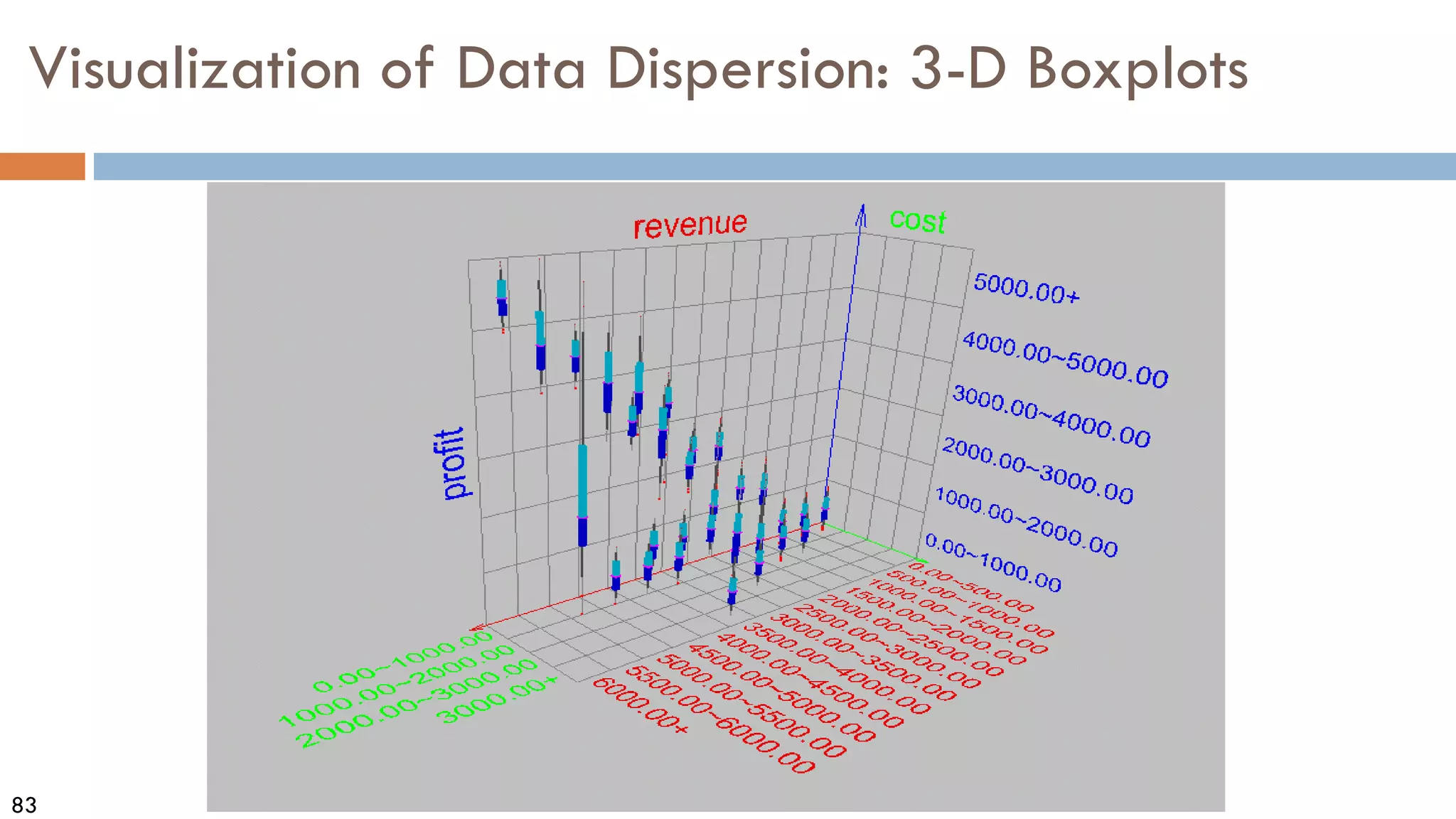
Visualization of Data Dispersion: 3-D Boxplots
84
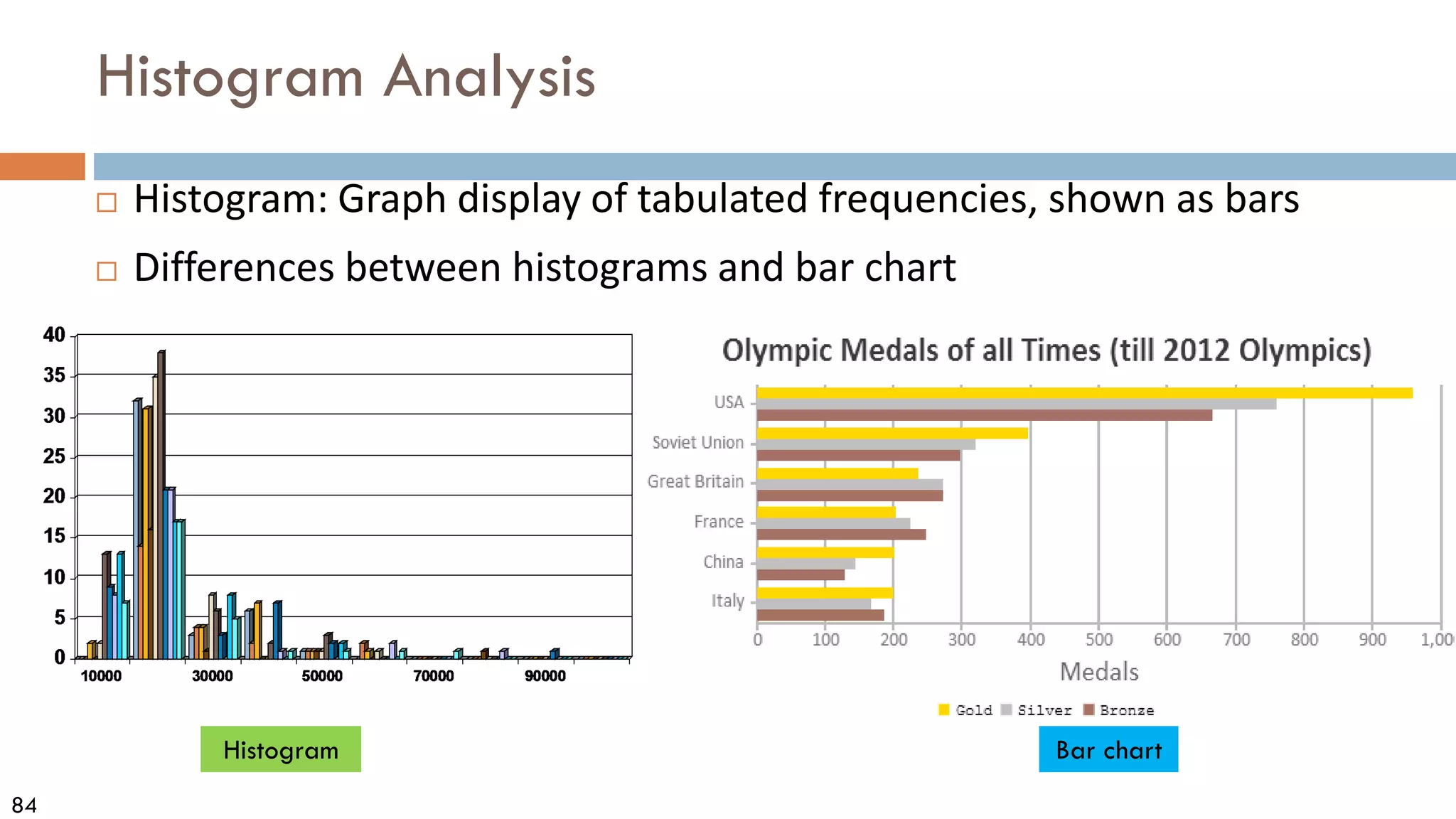
Histogram Analysis
 Histogram: Graph display of tabulated frequencies, shown as bars
 Differences between histograms and bar chart
Histogram Bar chart
85
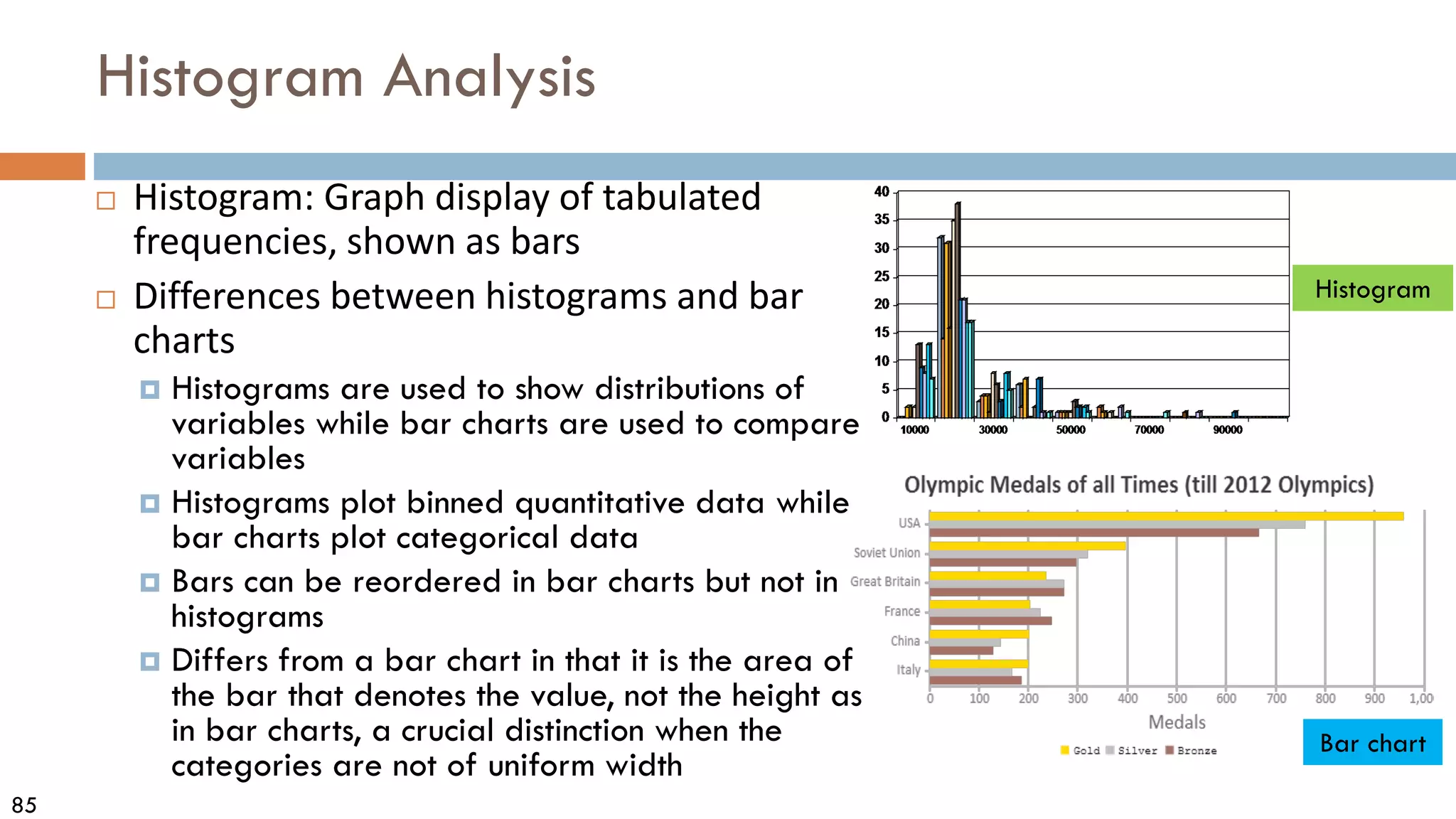
Histogram Analysis
 Histogram: Graph display of tabulated
frequencies, shown as bars
 Differences between histograms and bar
charts
 Histograms are used to show distributions of
variables while bar charts are used to compare
variables
 Histograms plot binned quantitative data while
bar charts plot categorical data
 Bars can be reordered in bar charts but not in
histograms
 Differs from a bar chart in that it is the area of
the bar that denotes the value, not the height as
in bar charts, a crucial distinction when the
categories are not of uniform width
Histogram
Bar chart
86
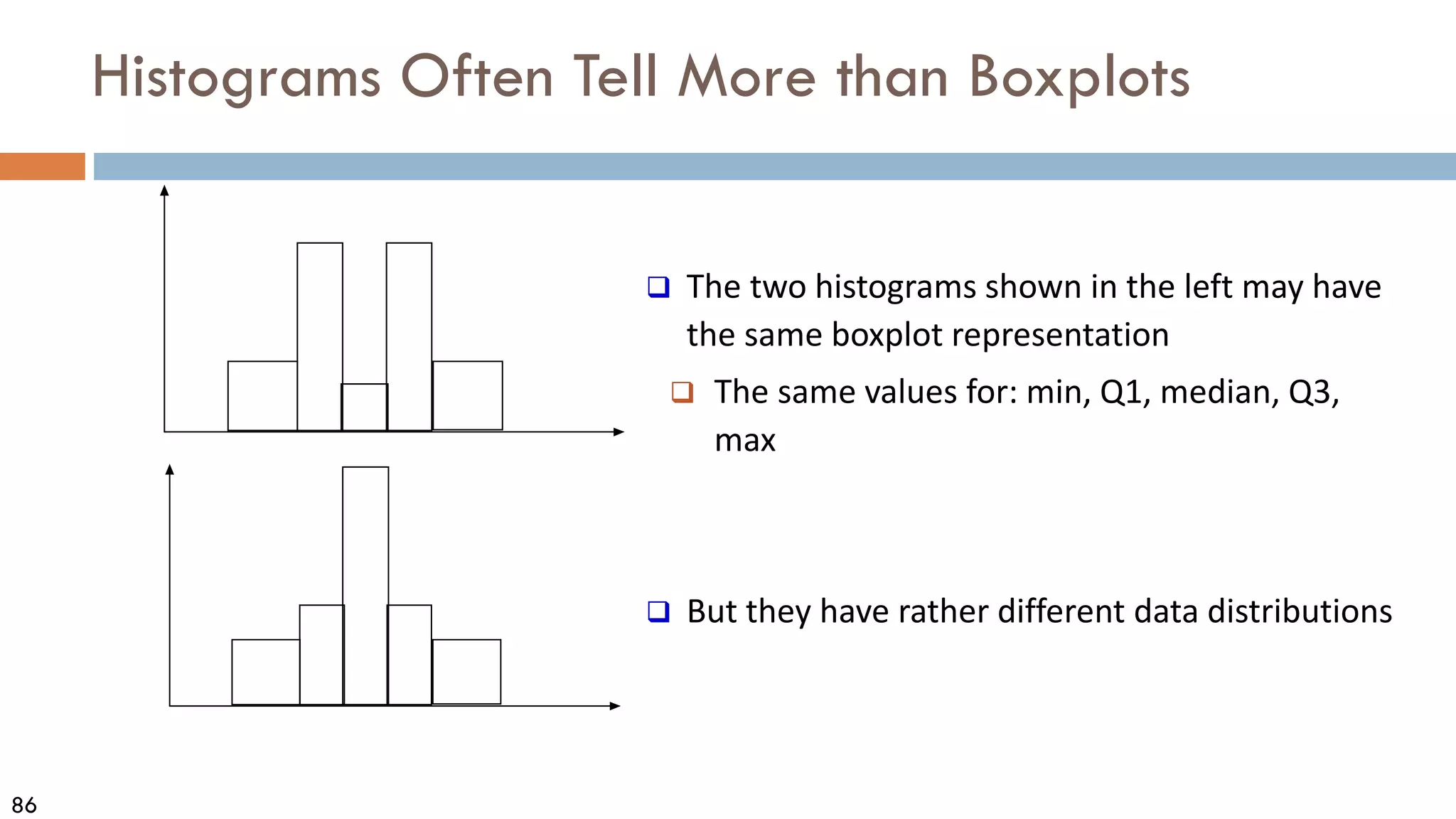
Histograms Often Tell More than Boxplots
 The two histograms shown in the left may have
the same boxplot representation
 The same values for: min, Q1, median, Q3,
max
 But they have rather different data distributions
87
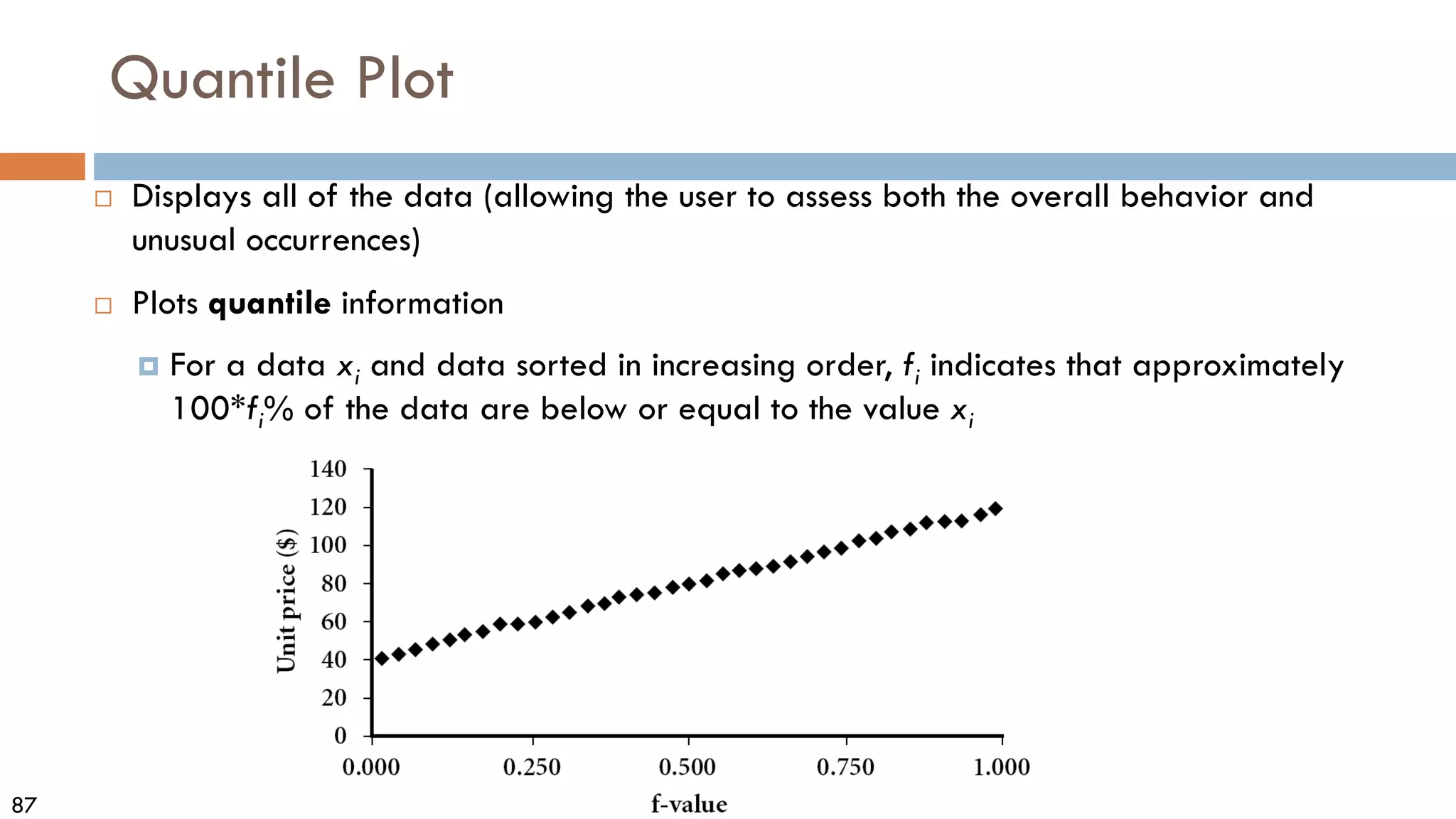
Quantile Plot
Data Mining: Concepts and Techniques
 Displays all of the data (allowing the user to assess both the overall behavior and
unusual occurrences)
 Plots quantile information
 For a data xi and data sorted in increasing order, fi indicates that approximately
100*fi% of the data are below or equal to the value xi
89
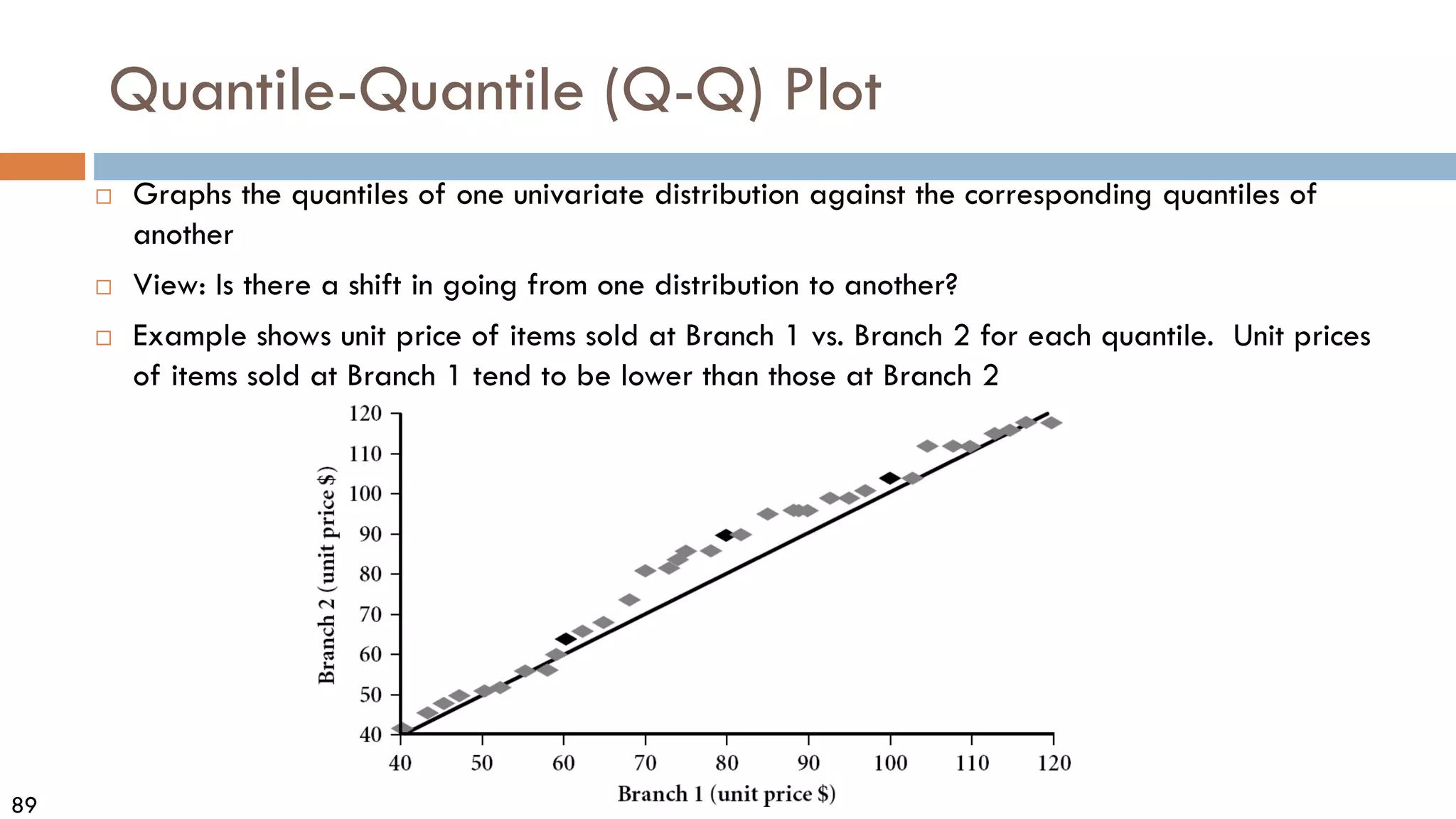
Quantile-Quantile (Q-Q) Plot
 Graphs the quantiles of one univariate distribution against the corresponding quantiles of
another
 View: Is there a shift in going from one distribution to another?
 Example shows unit price of items sold at Branch 1 vs. Branch 2 for each quantile. Unit prices
of items sold at Branch 1 tend to be lower than those at Branch 2
90
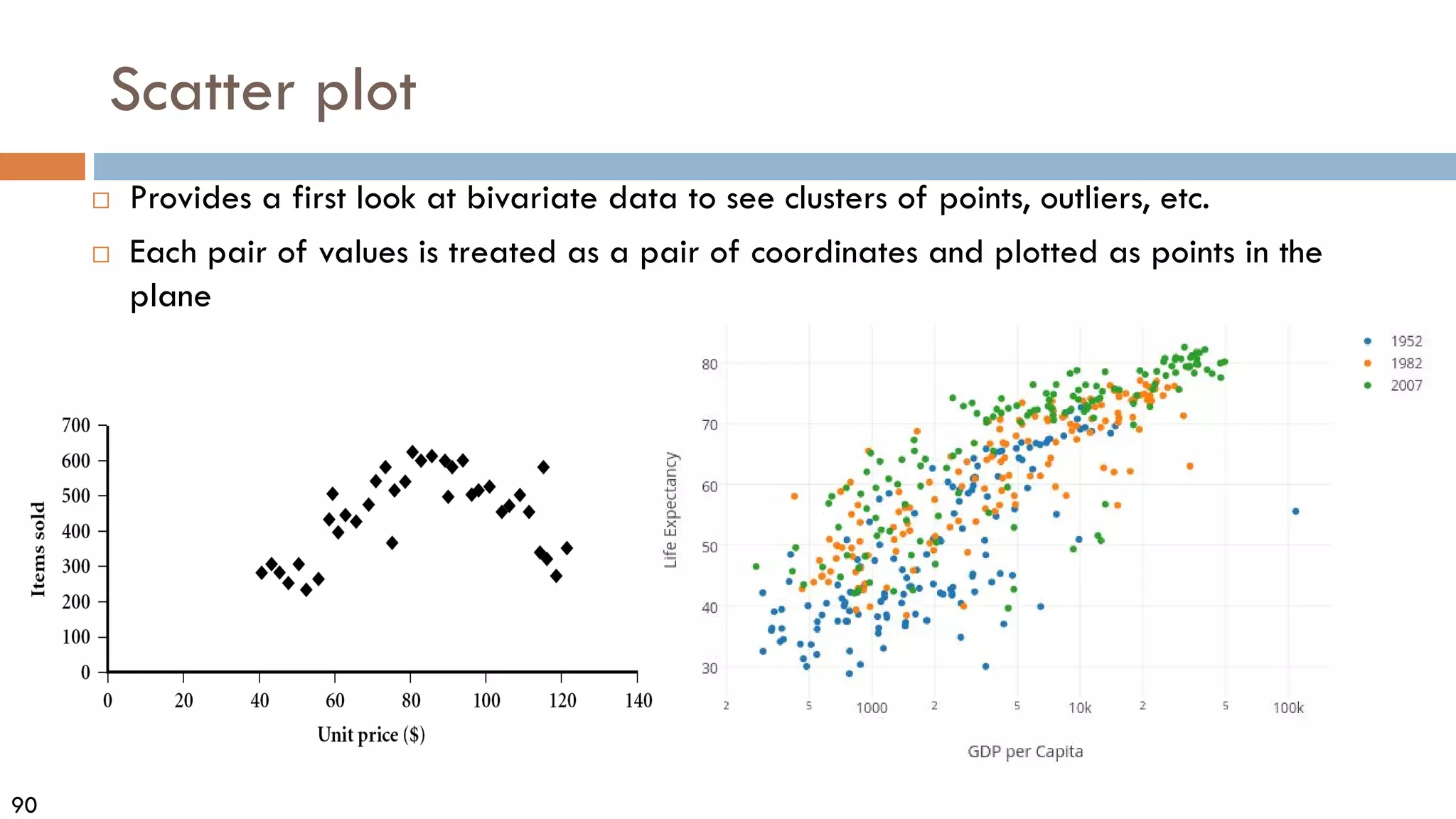
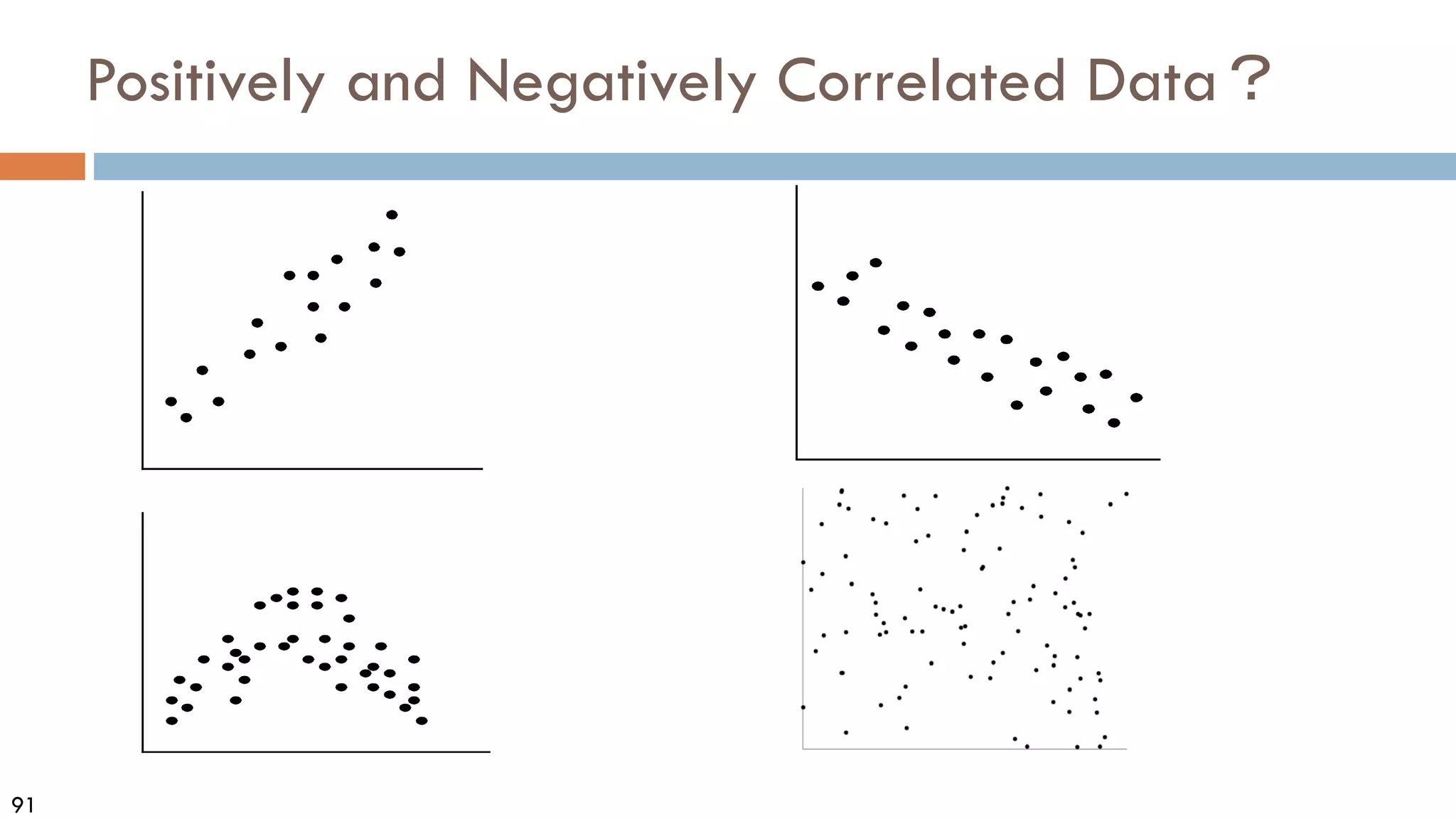
Scatter plot
 Provides a first look at bivariate data to see clusters of points, outliers, etc.
 Each pair of values is treated as a pair of coordinates and plotted as points in the
plane
91
Positively and Negatively Correlated Data?
92
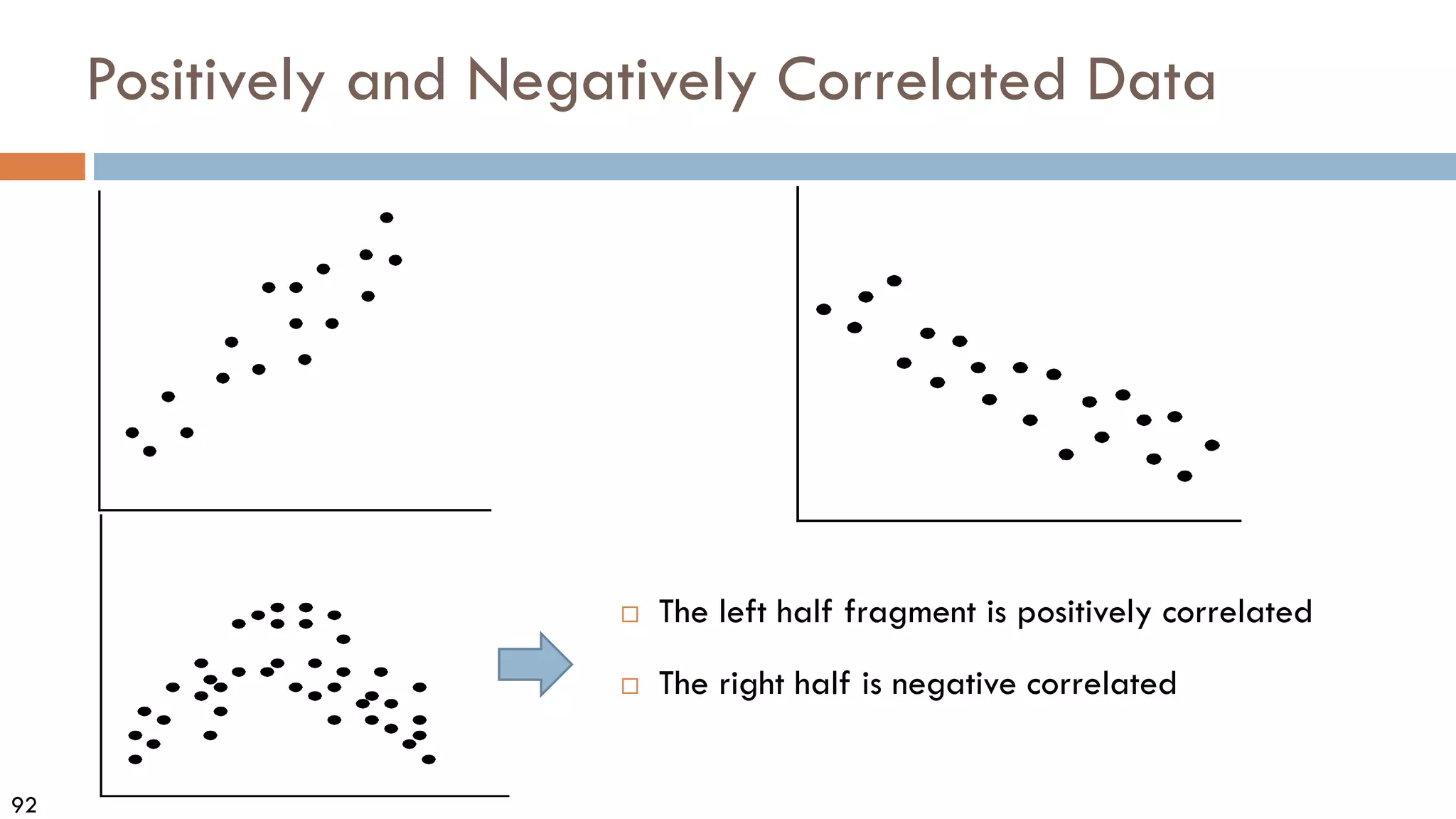
Positively and Negatively Correlated Data
 The left half fragment is positively correlated
 The right half is negative correlated
93
Chapter 2. Getting to Know Your Data
 Data Objects and Attribute Types
 Basic Statistical Descriptions of Data
 Data Visualization
 Measuring Data Similarity and Dissimilarity
 Summary
94
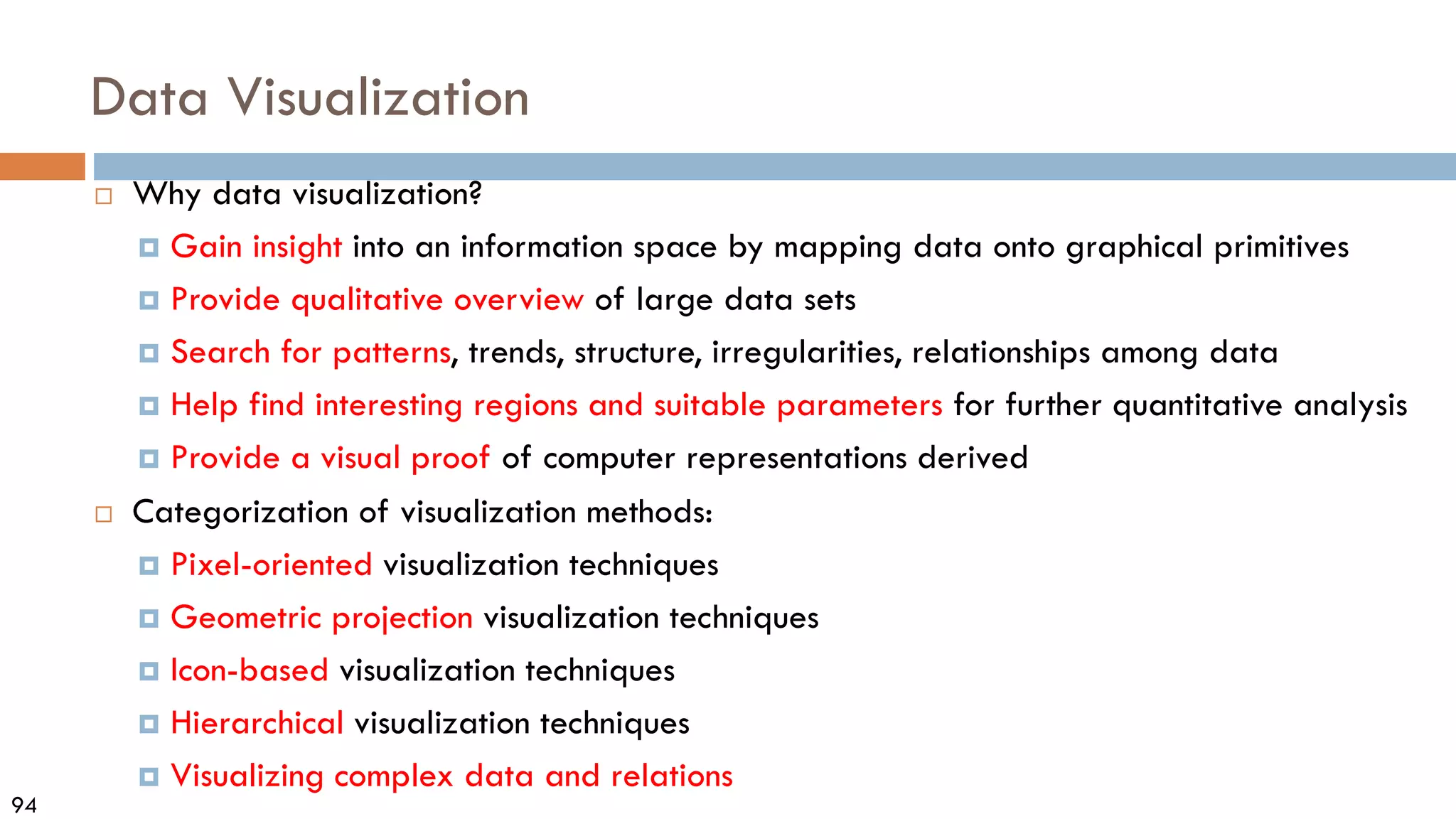
Data Visualization
 Why data visualization?
 Gain insight into an information space by mapping data onto graphical primitives
 Provide qualitative overview of large data sets
 Search for patterns, trends, structure, irregularities, relationships among data
 Help find interesting regions and suitable parameters for further quantitative analysis
 Provide a visual proof of computer representations derived
 Categorization of visualization methods:
 Pixel-oriented visualization techniques
 Geometric projection visualization techniques
 Icon-based visualization techniques
 Hierarchical visualization techniques
 Visualizing complex data and relations
95
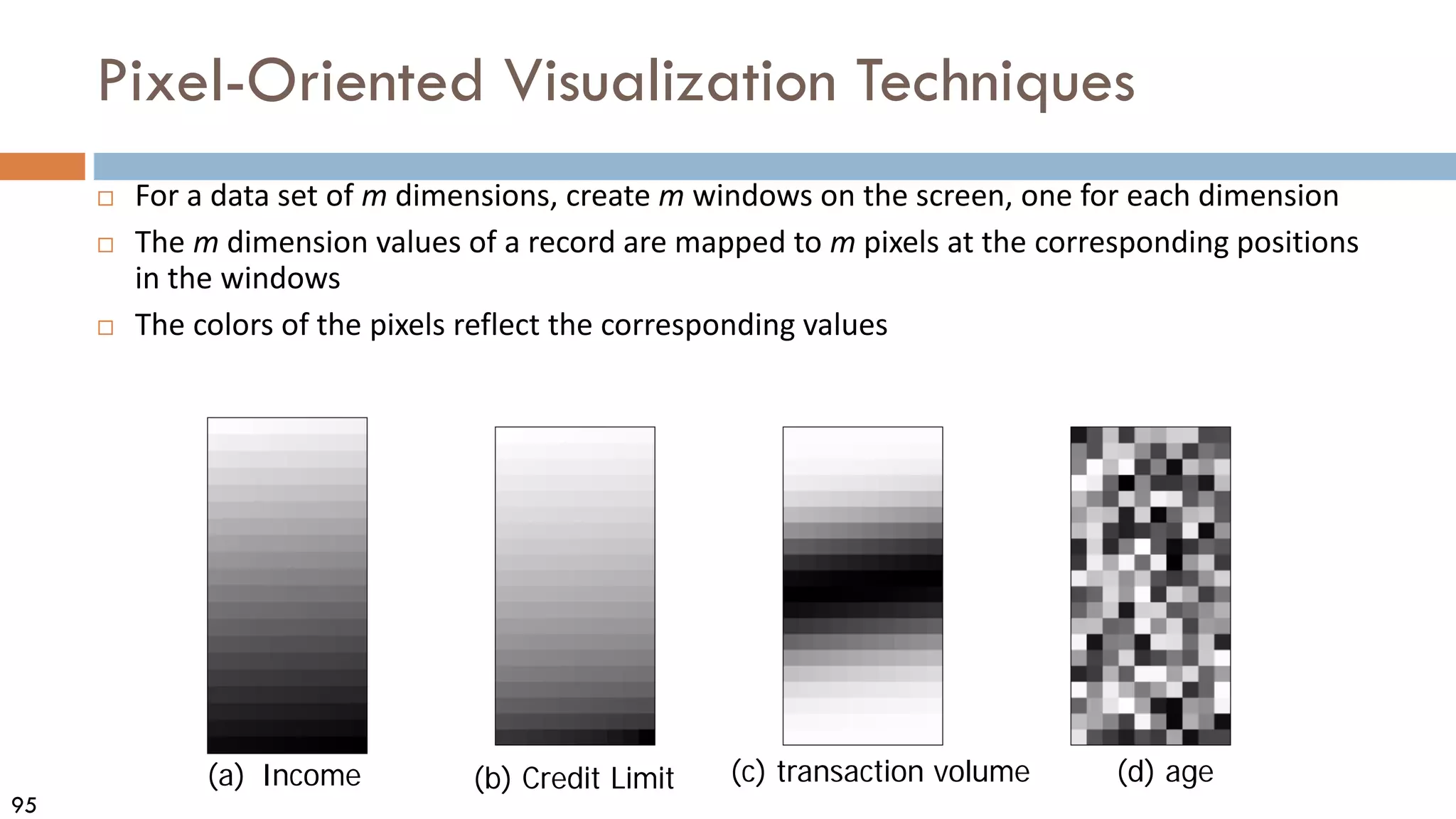
Pixel-Oriented Visualization Techniques
 For a data set of m dimensions, create m windows on the screen, one for each dimension
 The m dimension values of a record are mapped to m pixels at the corresponding positions
in the windows
 The colors of the pixels reflect the corresponding values
(a) Income (b) Credit Limit (c) transaction volume (d) age
96
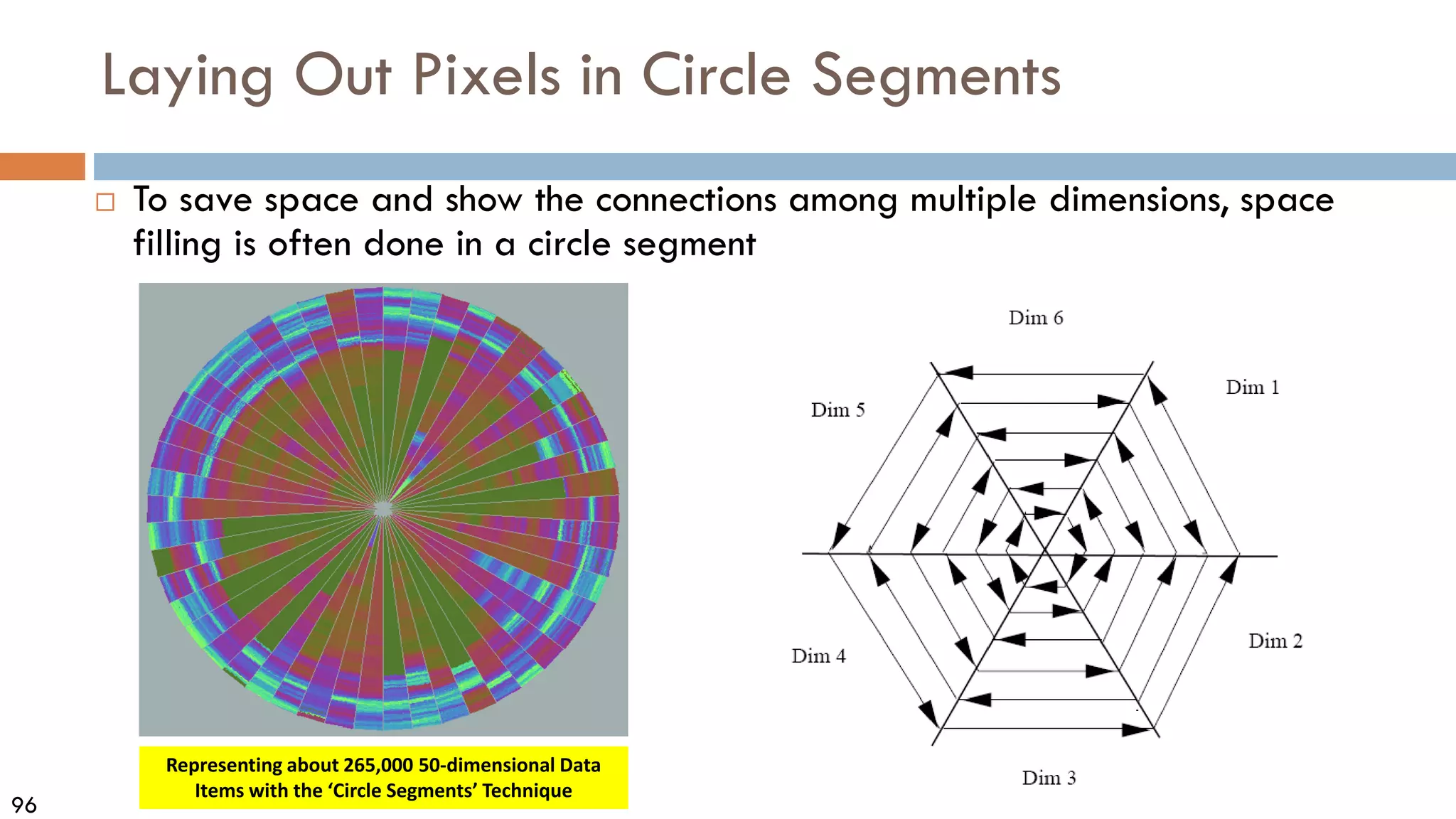
Laying Out Pixels in Circle Segments
 To save space and show the connections among multiple dimensions, space
filling is often done in a circle segment
Representing about 265,000 50-dimensional Data
Items with the ‘Circle Segments’ Technique
97
Geometric Projection Visualization Techniques
 Visualization of geometric transformations and projections of the data
 Methods
 Direct visualization
 Scatterplot and scatterplot matrices
 Landscapes
 Projection pursuit technique: Help users find meaningful projections of
multidimensional data
 Prosection views
 Hyperslice
 Parallel coordinates
98
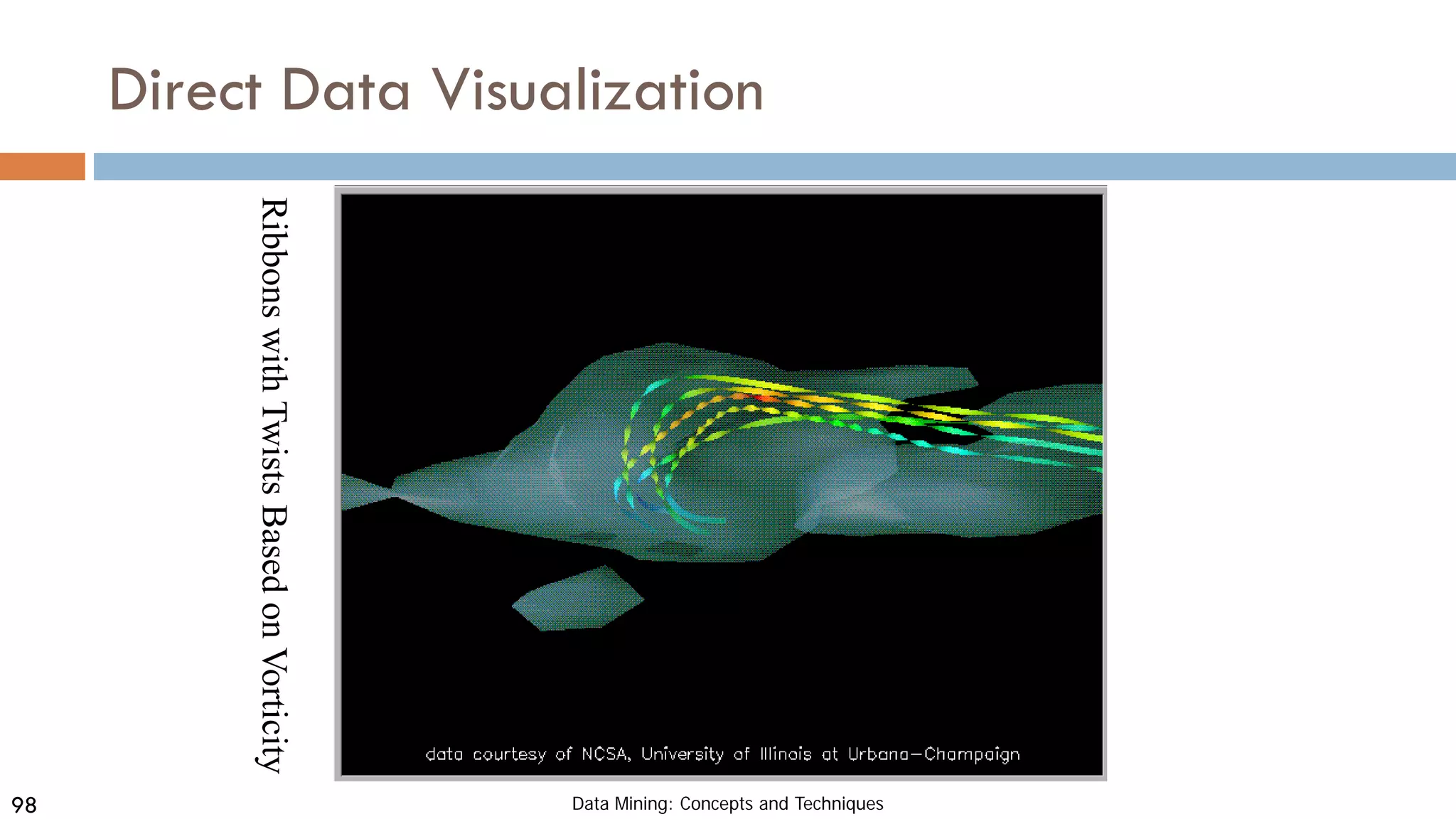
Direct Data Visualization
Data Mining: Concepts and Techniques
Ribbons
with
Twists
Based
on
Vorticity
99
Scatterplot Matrices
 Matrix of scatterplots (x-y-
diagrams) of the k-dim. data
[total of (k2/2 ─ k) scatterplots]
Used
by
ermission
of
M.
Ward,
Worcester
Polytechnic
Institute
100
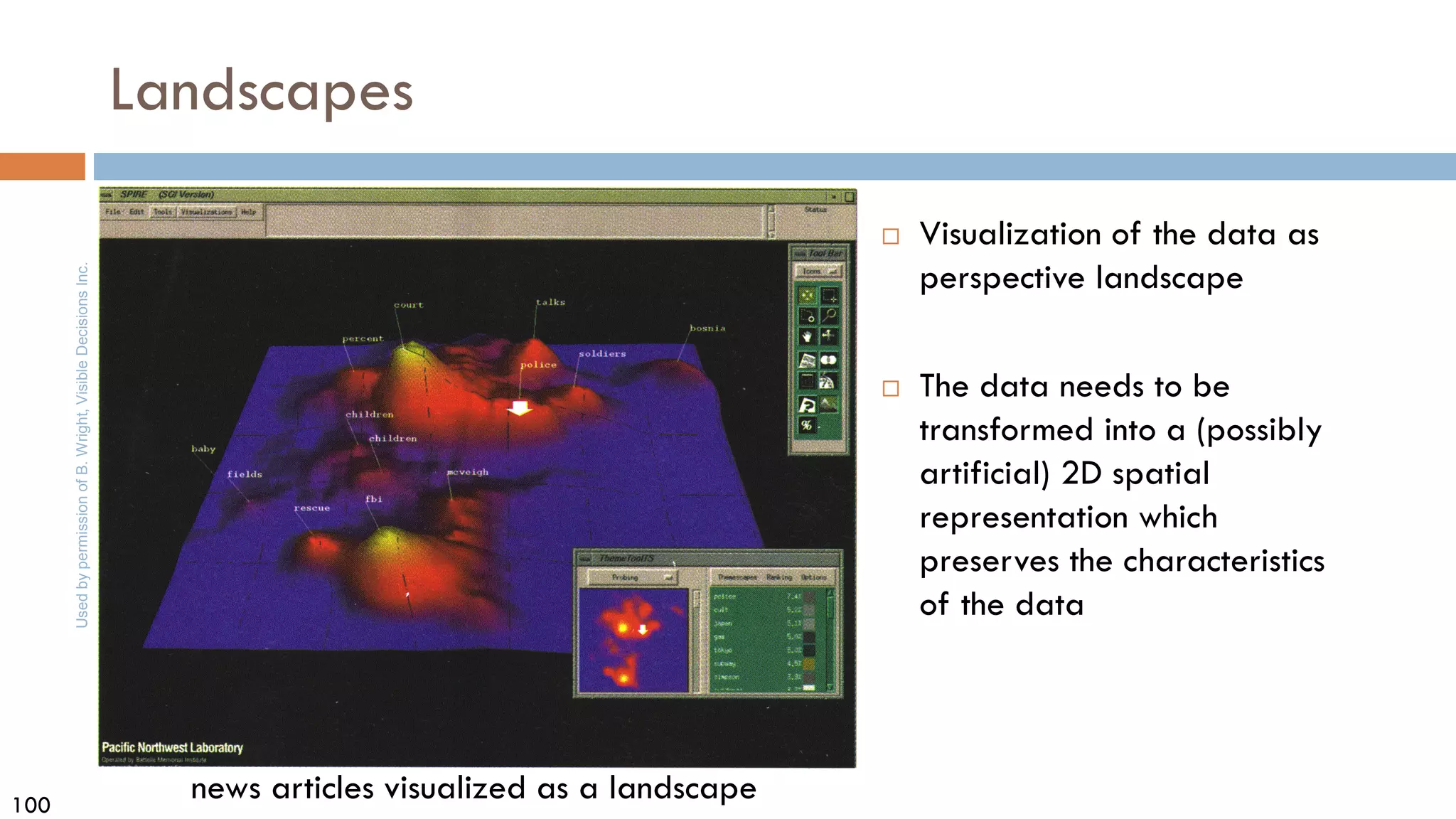
news articles visualized as a landscape
Used
by
permission
of
B.
Wright,
Visible
Decisions
Inc.
Landscapes
 Visualization of the data as
perspective landscape
 The data needs to be
transformed into a (possibly
artificial) 2D spatial
representation which
preserves the characteristics
of the data
101
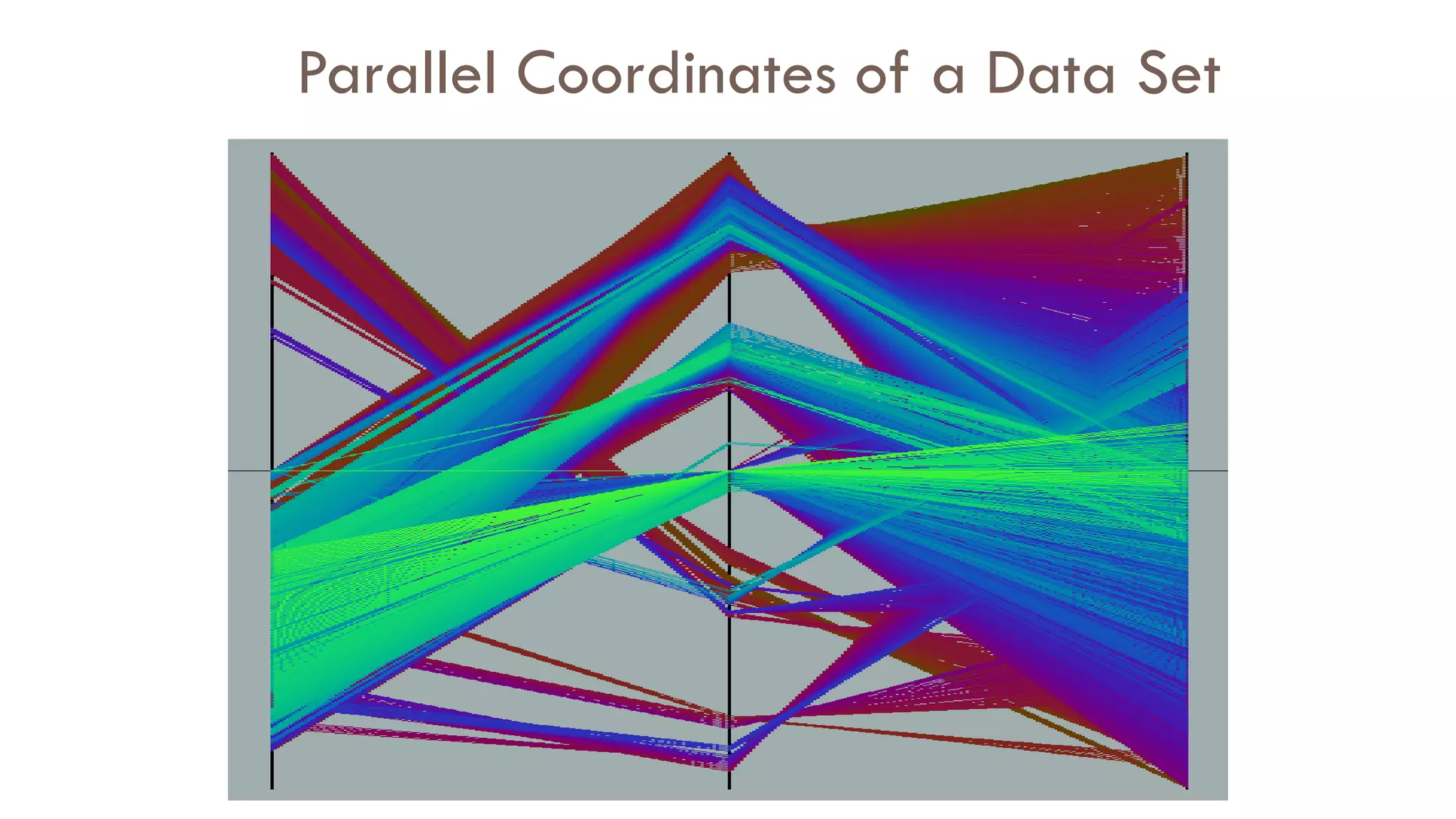
Parallel Coordinates
 n equidistant axes which are parallel to
one of the screen axes and correspond
to the attributes
 The axes are scaled to the [minimum,
maximum]: range of the corresponding
attribute
 Every data item corresponds to a
polygonal line which intersects each of
the axes at the point which corresponds
to the value for the attribute
Parallel Coordinates of a Data Set
103
Icon-Based Visualization Techniques
 Visualization of the data values as features of icons
 Typical visualization methods
 Chernoff Faces
 Stick Figures
 General techniques
 Shape coding: Use shape to represent certain information encoding
 Color icons: Use color icons to encode more information
 Tile bars: Use small icons to represent the relevant feature vectors in document
retrieval
104
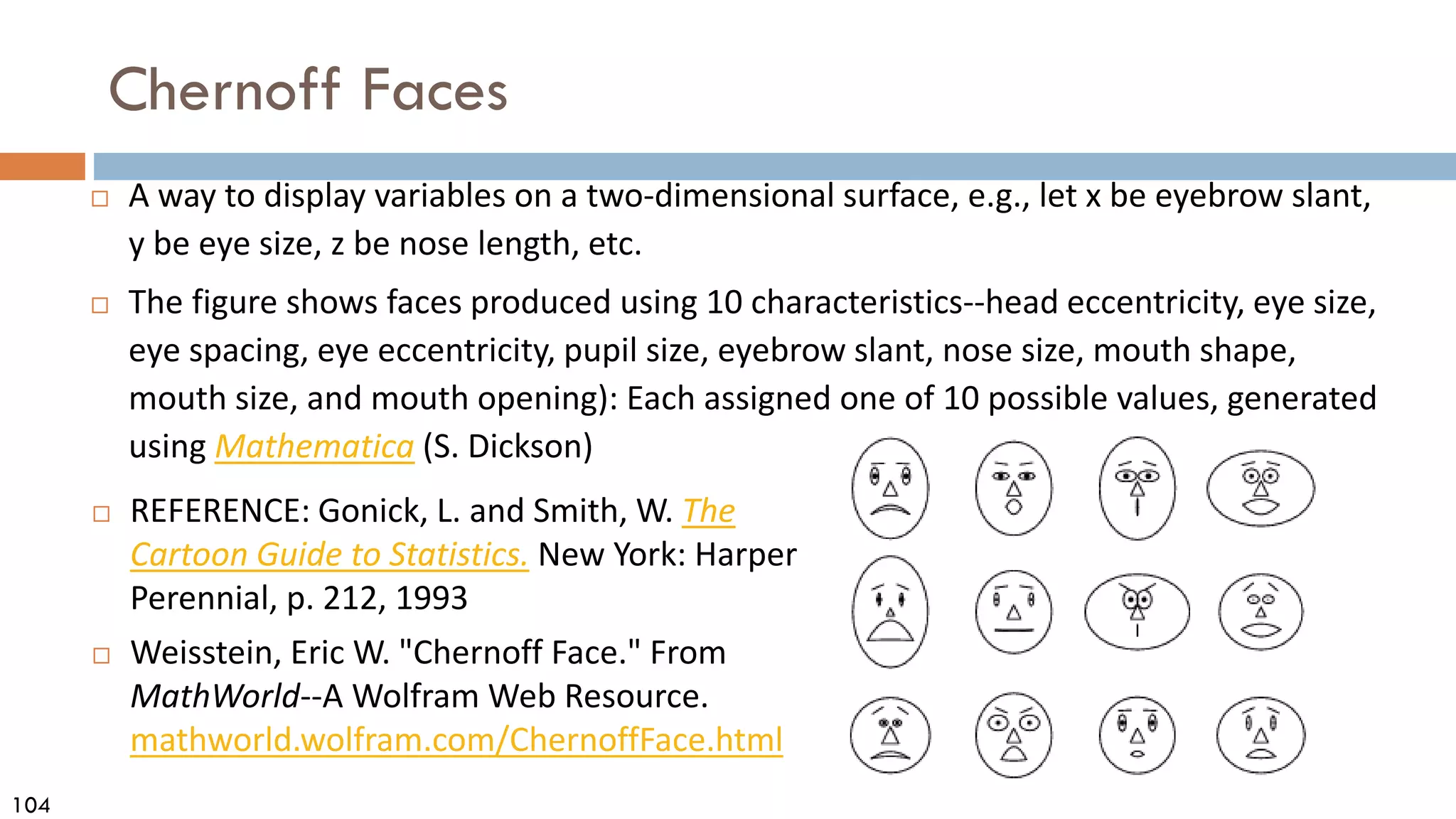
Chernoff Faces
 A way to display variables on a two-dimensional surface, e.g., let x be eyebrow slant,
y be eye size, z be nose length, etc.
 The figure shows faces produced using 10 characteristics--head eccentricity, eye size,
eye spacing, eye eccentricity, pupil size, eyebrow slant, nose size, mouth shape,
mouth size, and mouth opening): Each assigned one of 10 possible values, generated
using Mathematica (S. Dickson)
 REFERENCE: Gonick, L. and Smith, W. The
Cartoon Guide to Statistics. New York: Harper
Perennial, p. 212, 1993
 Weisstein, Eric W. "Chernoff Face." From
MathWorld--A Wolfram Web Resource.
mathworld.wolfram.com/ChernoffFace.html
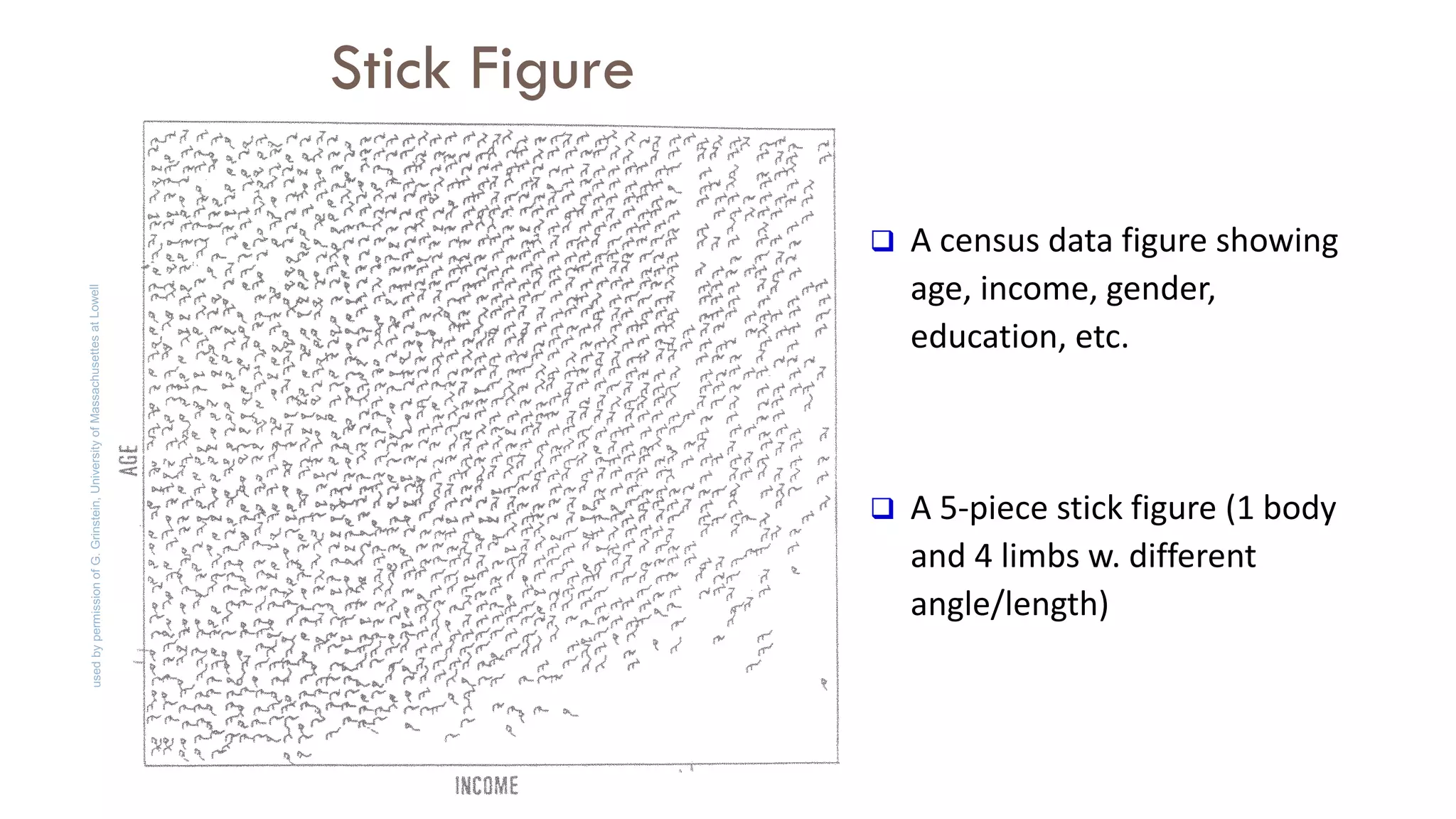
Stick Figure
 A census data figure showing
age, income, gender,
education, etc.
 A 5-piece stick figure (1 body
and 4 limbs w. different
angle/length)
106
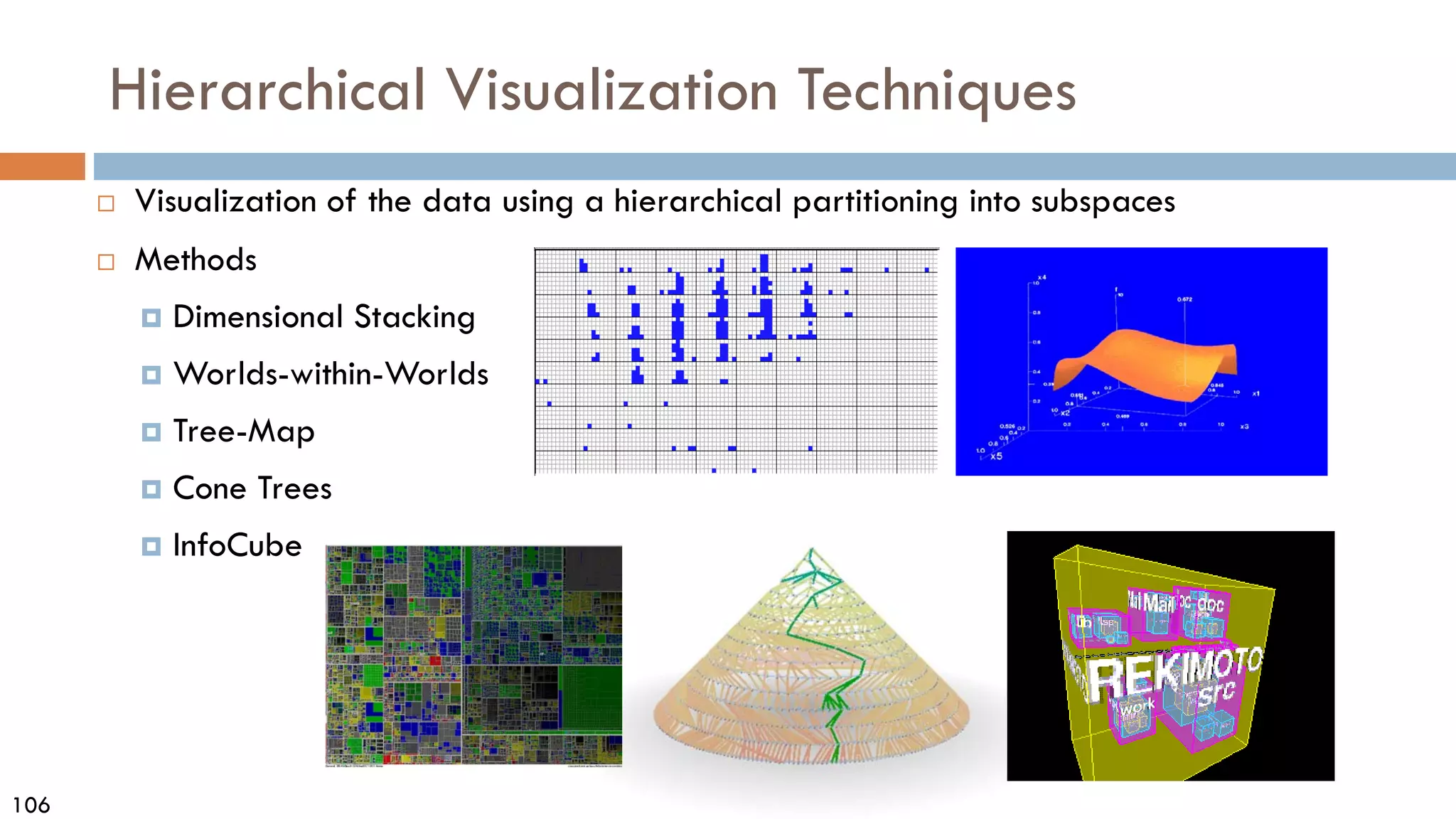
Hierarchical Visualization Techniques
 Visualization of the data using a hierarchical partitioning into subspaces
 Methods
 Dimensional Stacking
 Worlds-within-Worlds
 Tree-Map
 Cone Trees
 InfoCube
107
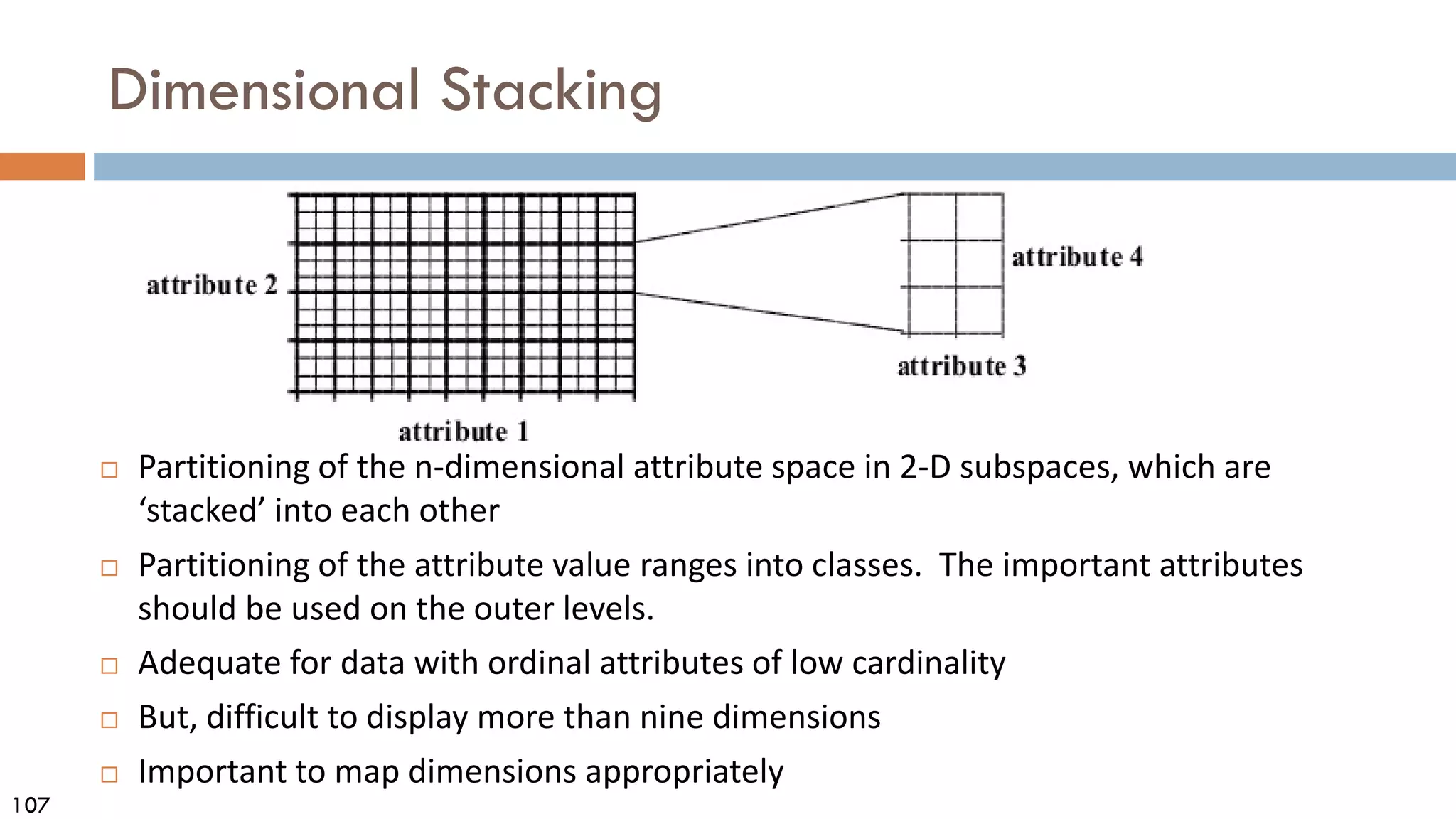
Dimensional Stacking
 Partitioning of the n-dimensional attribute space in 2-D subspaces, which are
‘stacked’ into each other
 Partitioning of the attribute value ranges into classes. The important attributes
should be used on the outer levels.
 Adequate for data with ordinal attributes of low cardinality
 But, difficult to display more than nine dimensions
 Important to map dimensions appropriately
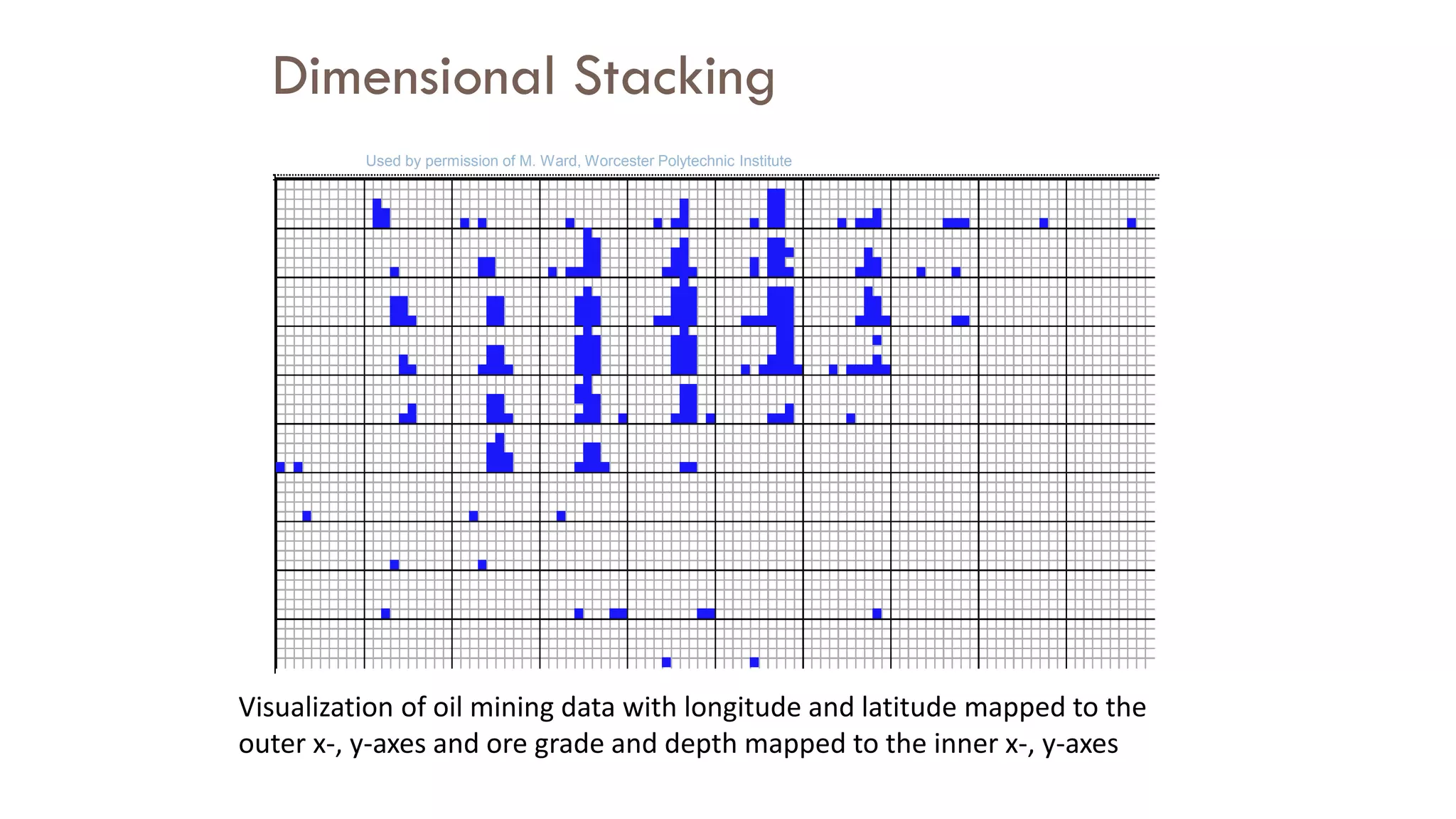
Used by permission of M. Ward, Worcester Polytechnic Institute
Visualization of oil mining data with longitude and latitude mapped to the
outer x-, y-axes and ore grade and depth mapped to the inner x-, y-axes
Dimensional Stacking
109
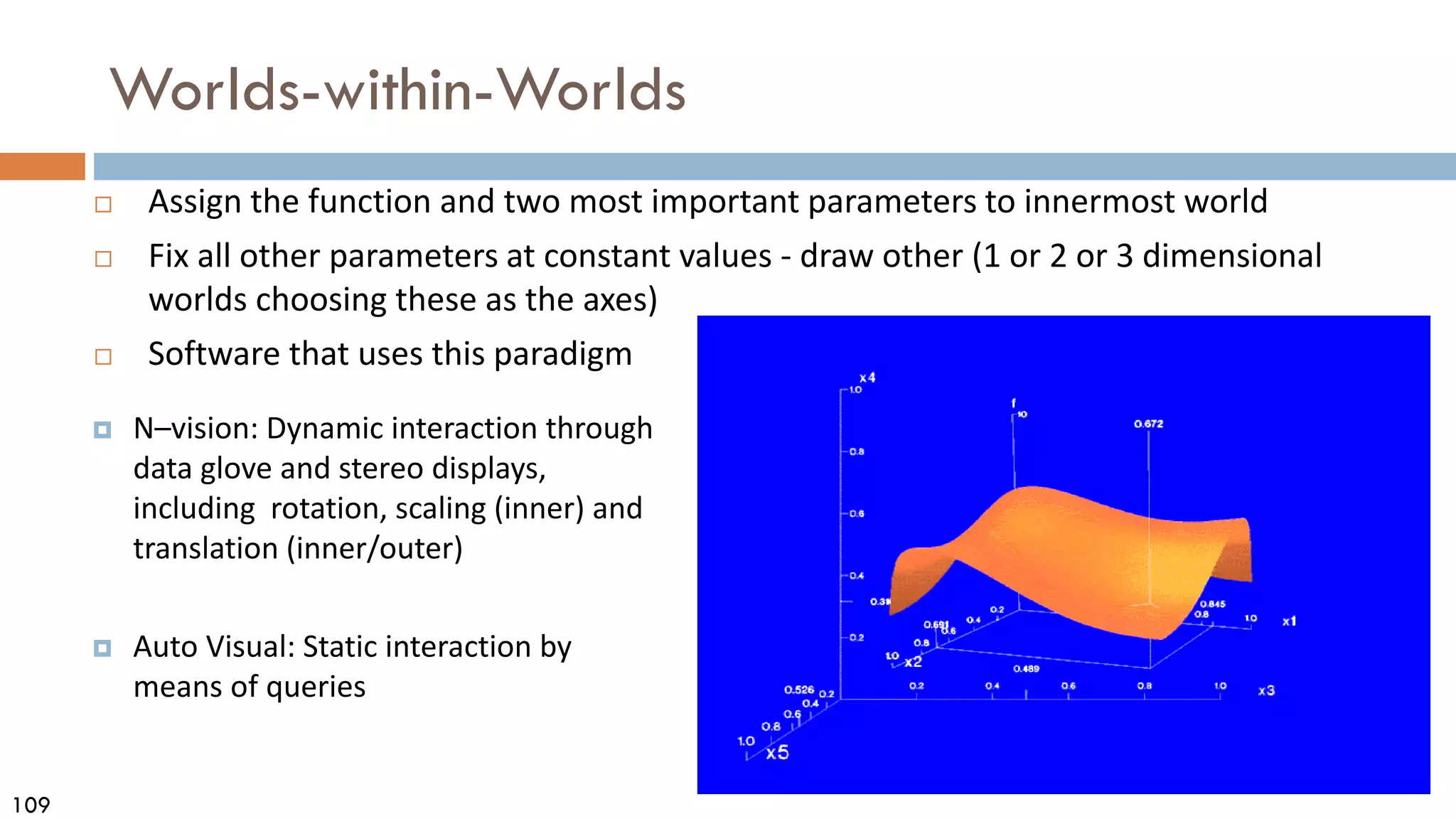
Worlds-within-Worlds
 Assign the function and two most important parameters to innermost world
 Fix all other parameters at constant values - draw other (1 or 2 or 3 dimensional
worlds choosing these as the axes)
 Software that uses this paradigm
 N–vision: Dynamic interaction through
data glove and stereo displays,
including rotation, scaling (inner) and
translation (inner/outer)
 Auto Visual: Static interaction by
means of queries
110
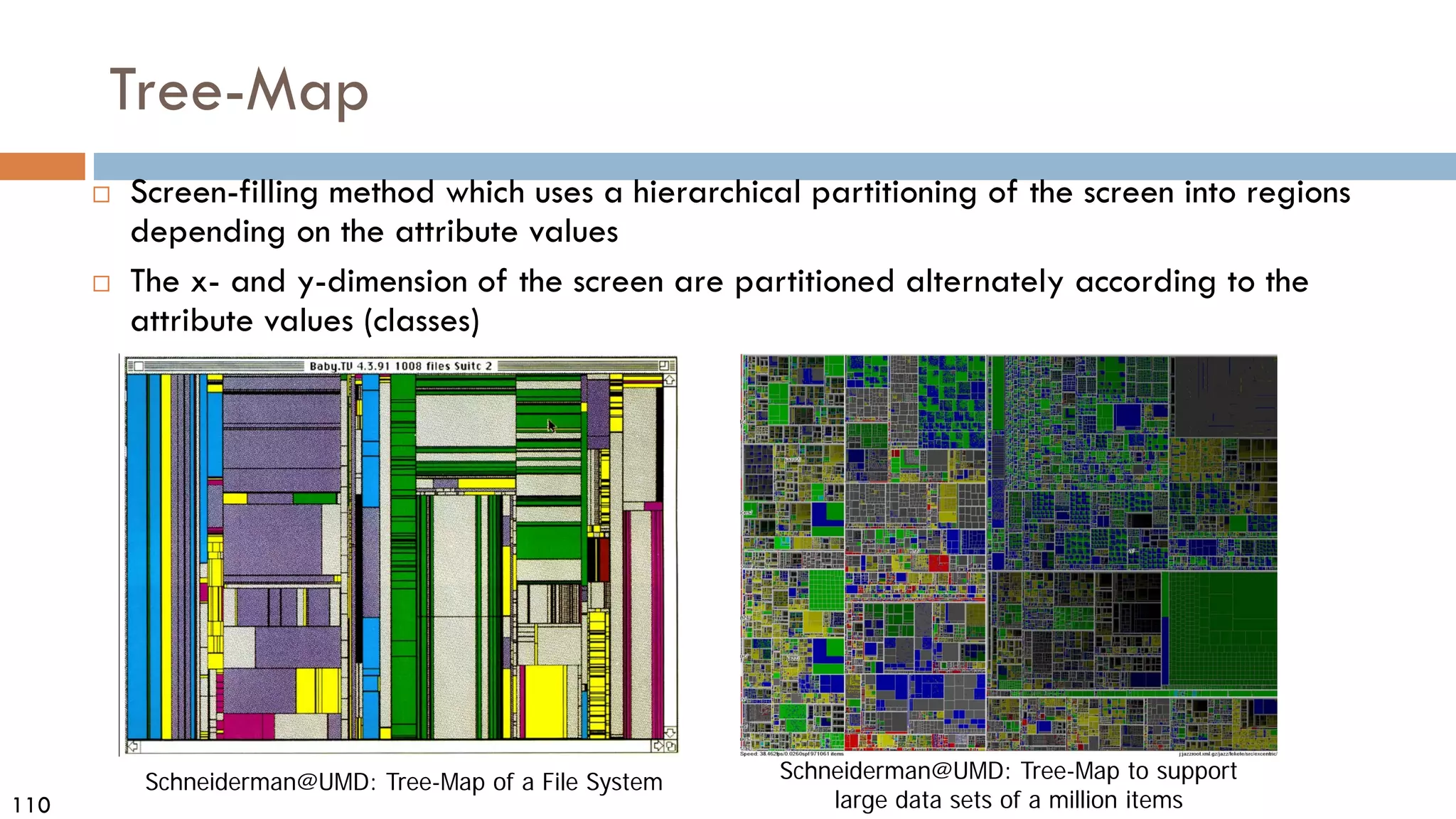
Tree-Map
 Screen-filling method which uses a hierarchical partitioning of the screen into regions
depending on the attribute values
 The x- and y-dimension of the screen are partitioned alternately according to the
attribute values (classes)
Schneiderman@UMD: Tree-Map of a File System Schneiderman@UMD: Tree-Map to support
large data sets of a million items
111
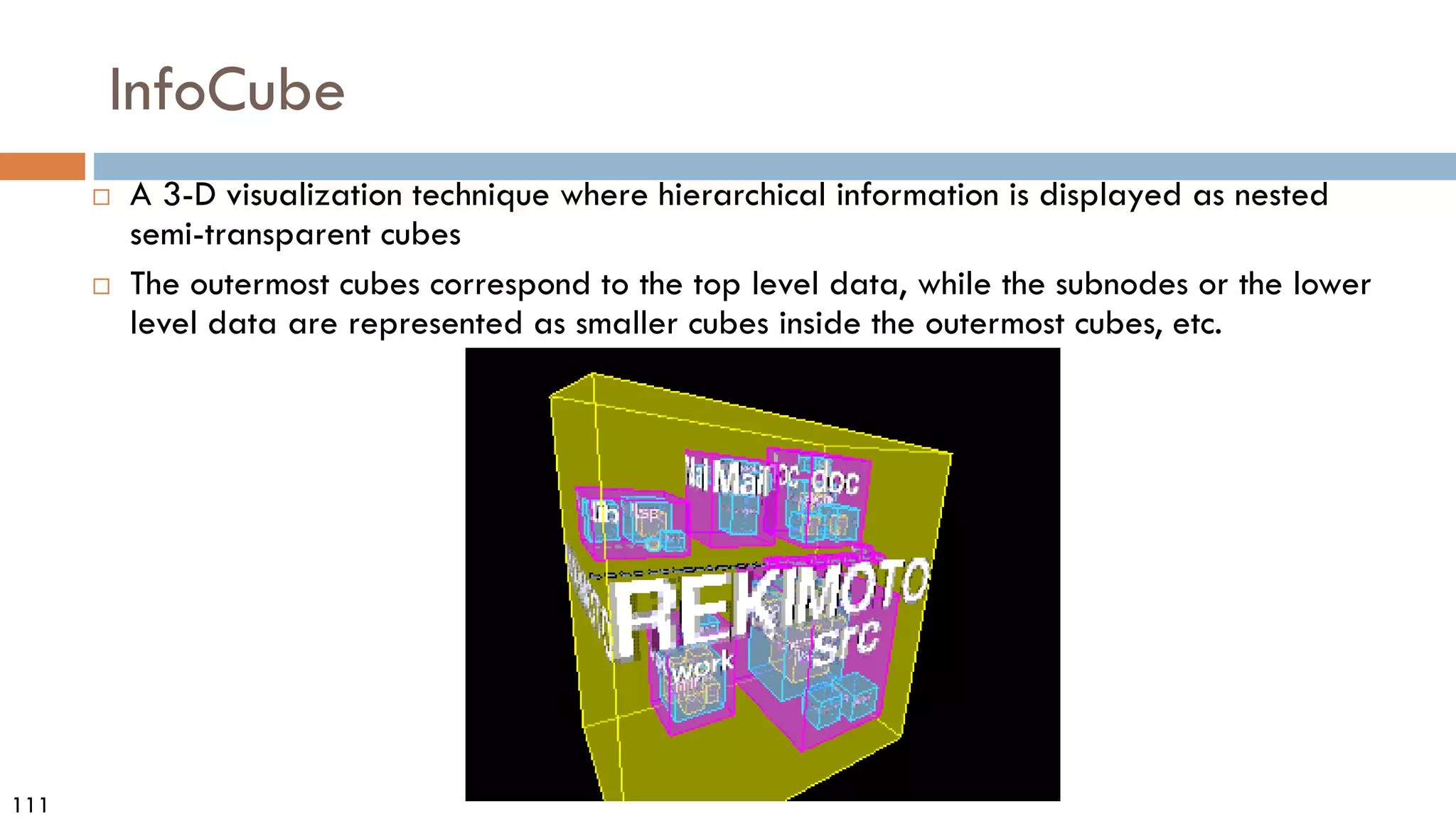
InfoCube
 A 3-D visualization technique where hierarchical information is displayed as nested
semi-transparent cubes
 The outermost cubes correspond to the top level data, while the subnodes or the lower
level data are represented as smaller cubes inside the outermost cubes, etc.
112
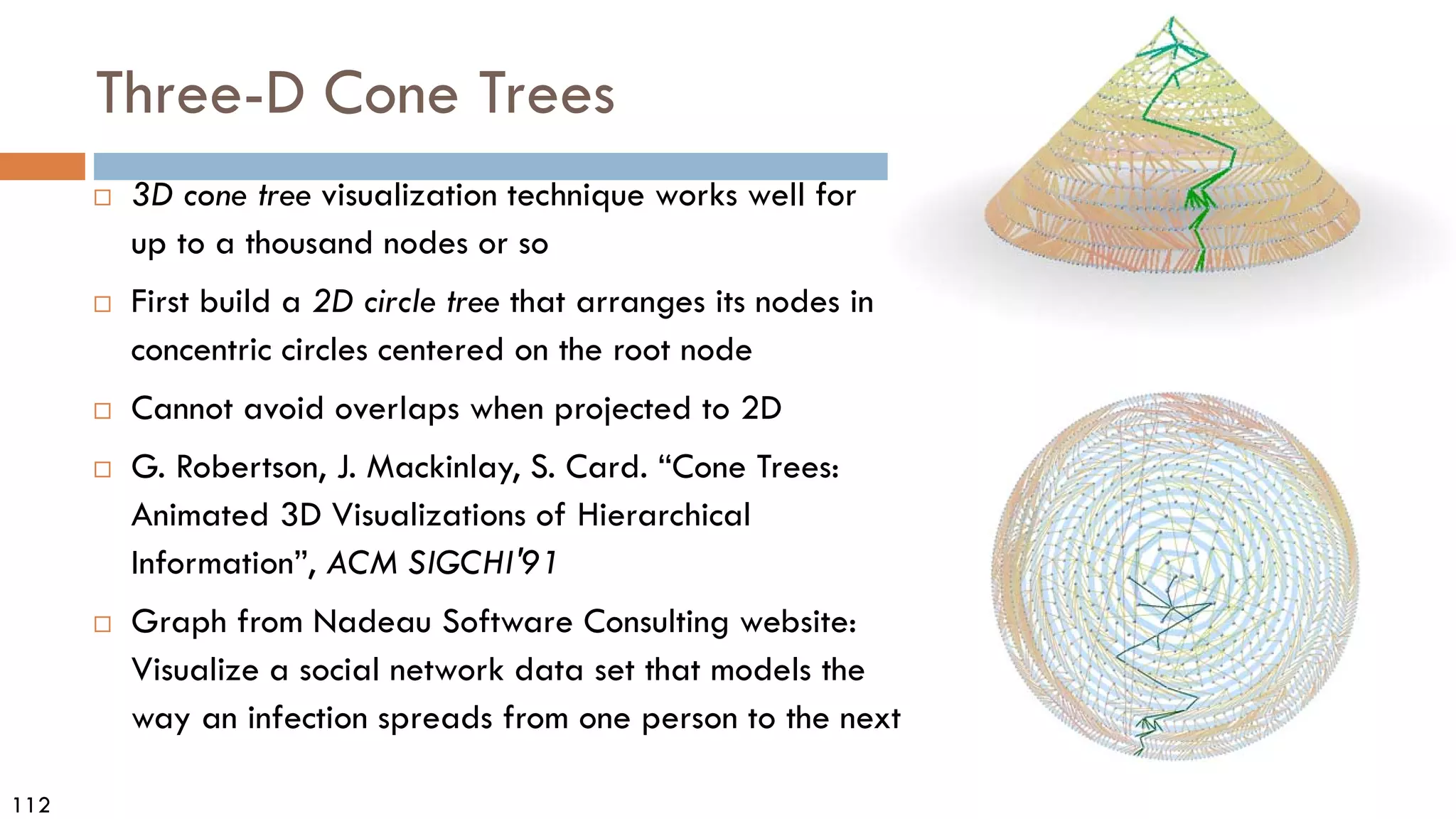
Three-D Cone Trees
 3D cone tree visualization technique works well for
up to a thousand nodes or so
 First build a 2D circle tree that arranges its nodes in
concentric circles centered on the root node
 Cannot avoid overlaps when projected to 2D
 G. Robertson, J. Mackinlay, S. Card. “Cone Trees:
Animated 3D Visualizations of Hierarchical
Information”, ACM SIGCHI'91
 Graph from Nadeau Software Consulting website:
Visualize a social network data set that models the
way an infection spreads from one person to the next
113
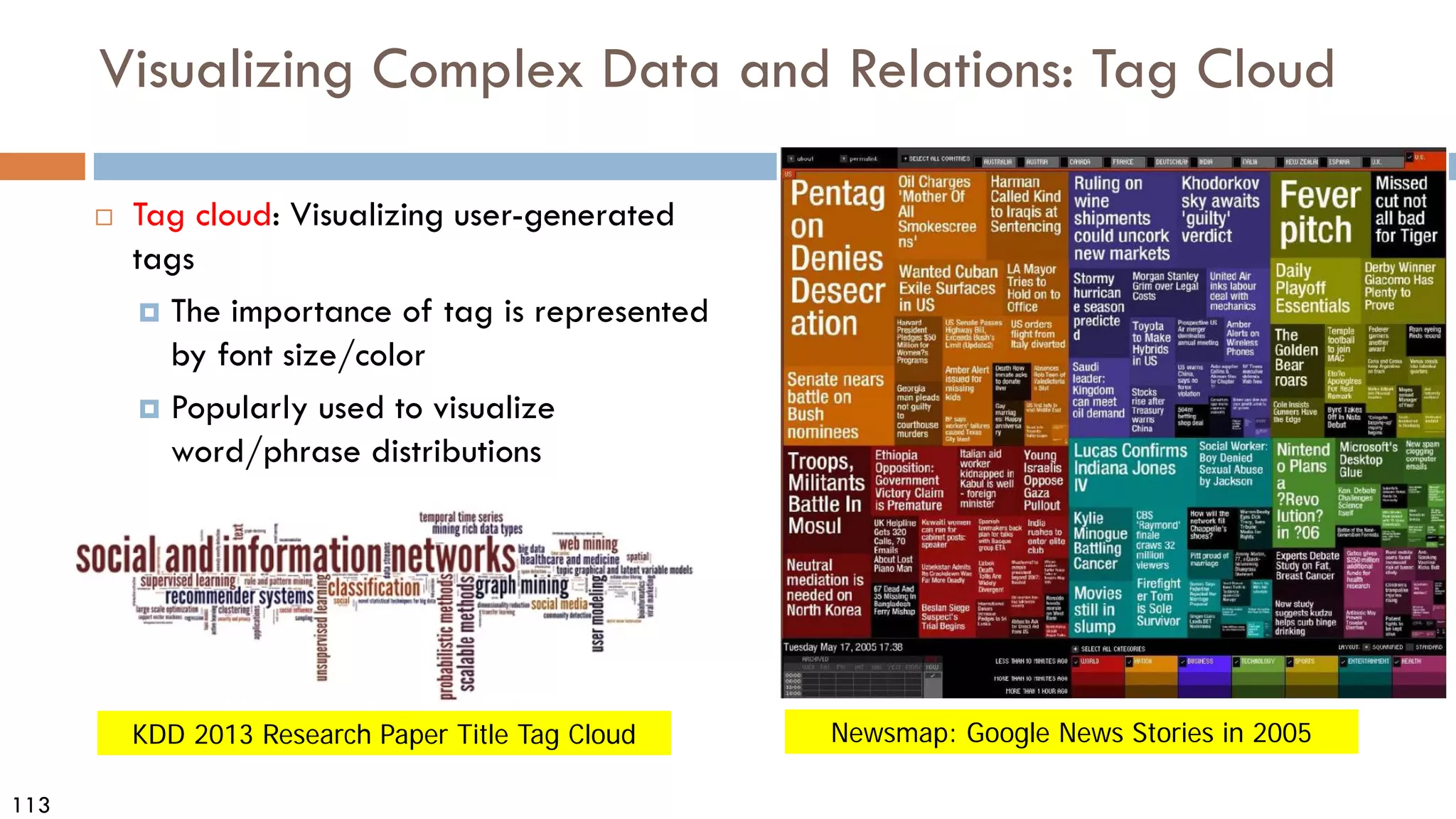
Visualizing Complex Data and Relations: Tag Cloud
 Tag cloud: Visualizing user-generated
tags
 The importance of tag is represented
by font size/color
 Popularly used to visualize
word/phrase distributions
Newsmap: Google News Stories in 2005
KDD 2013 Research Paper Title Tag Cloud
114
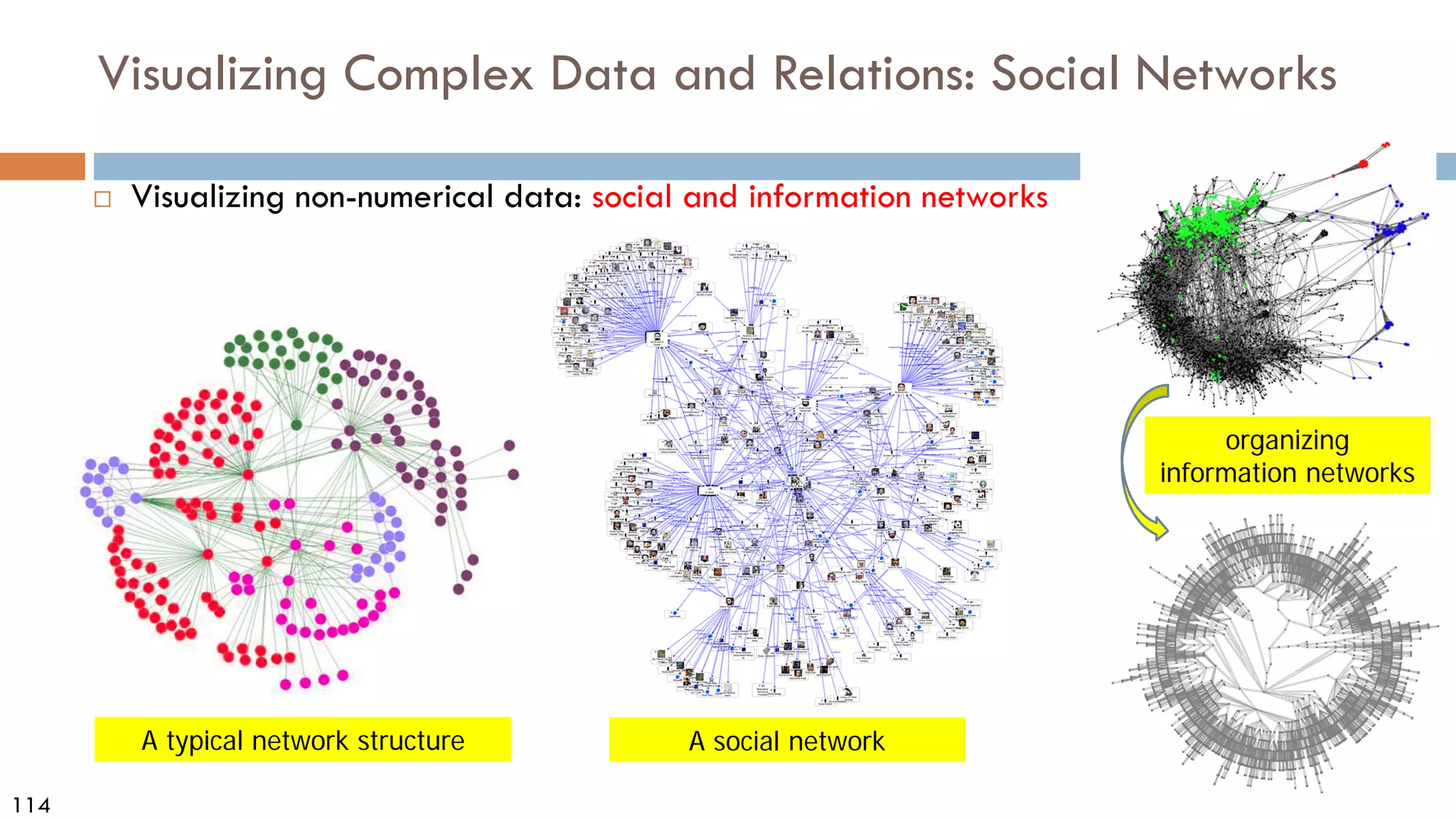
Visualizing Complex Data and Relations: Social Networks
 Visualizing non-numerical data: social and information networks
A typical network structure A social network
organizing
information networks
115
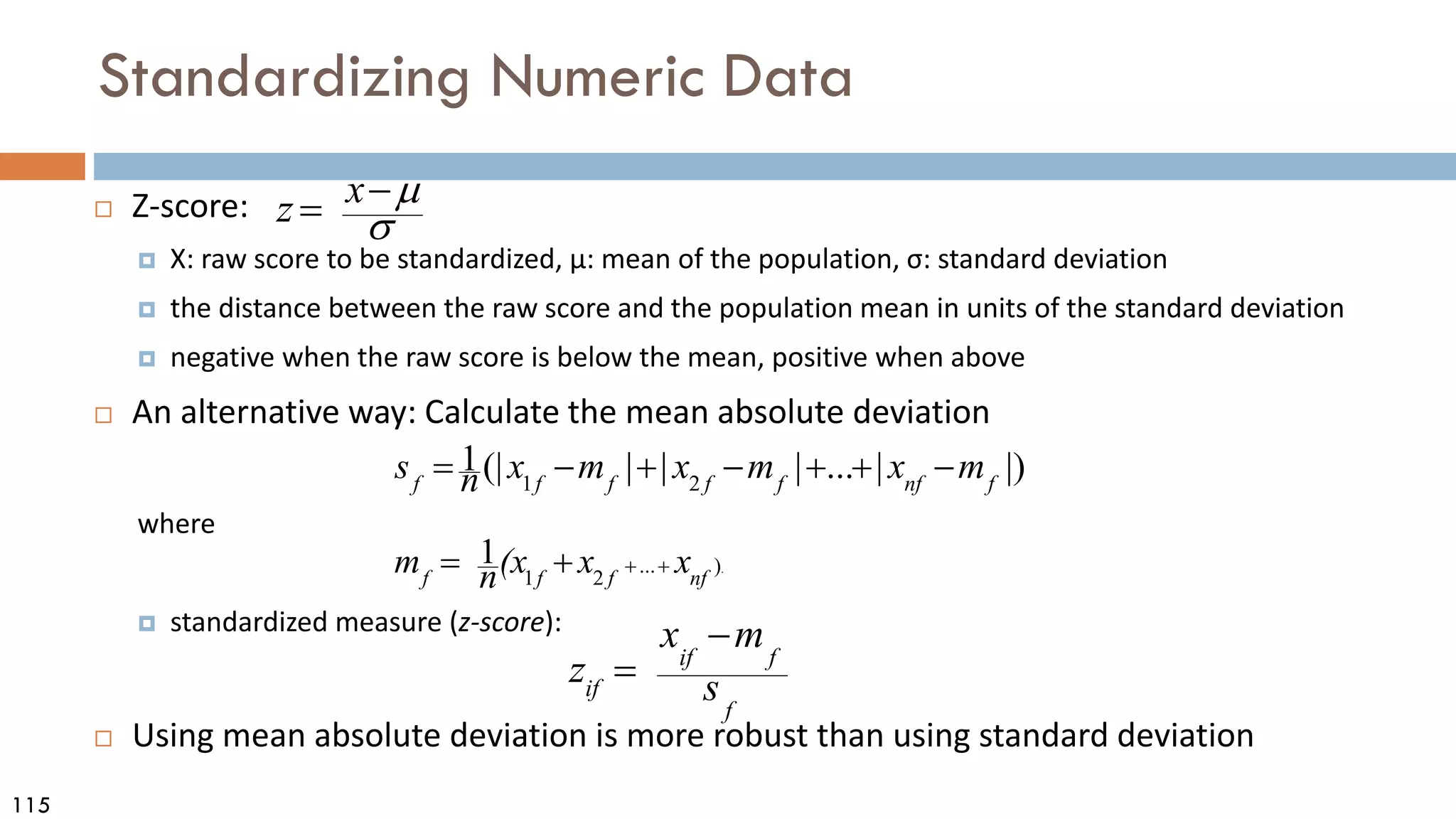
Standardizing Numeric Data
 Z-score:
 X: raw score to be standardized, μ: mean of the population, σ: standard deviation
 the distance between the raw score and the population mean in units of the standard deviation
 negative when the raw score is below the mean, positive when above
 An alternative way: Calculate the mean absolute deviation
where
 standardized measure (z-score):
 Using mean absolute deviation is more robust than using standard deviation
σ
µ
−
= x
z
.
)
...
2
1
1
nf
f
f
f
x
x
(x
n
m +
+
+
=
|)
|
...
|
|
|
(|
1
2
1 f
nf
f
f
f
f
f
m
x
m
x
m
x
n
s −
+
+
−
+
−
=
f
f
if
if s
m
x
z
−
=

02Data-osu-0829.pdf

  • 1.
    CSE5243 INTRO. TODATA MINING Data & Data Preprocessing Huan Sun, CSE@The Ohio State University Slides adapted from UIUC CS412, Fall 2017, by Prof. Jiawei Han
  • 2.
    2 Data & DataPreprocessing  What is Data: Data Objects and Attribute Types  Basic Statistical Descriptions of Data  Measuring Data Similarity and Dissimilarity  Data Preprocessing: An Overview  Summary
  • 3.
    3 What is Data? Collection of data objects and their attributes
  • 4.
    4 What is Data? Collection of data objects and their attributes Tid Refund Marital Status Taxable Income Cheat 1 Yes Single 125K No 2 No Married 100K No 3 No Single 70K No 4 Yes Married 120K No 5 No Divorced 95K Yes 6 No Married 60K No 7 Yes Divorced 220K No 8 No Single 85K Yes 9 No Married 75K No 10 No Single 90K Yes 10 Attributes Objects
  • 5.
    5 Data Objects  Datasets are made up of data objects  A data object represents an entity  Examples:  sales database: customers, store items, sales  medical database: patients, treatments  university database: students, professors, courses  Also called samples , examples, instances, data points, objects, tuples
  • 6.
    6 Data Objects  Datasets are made up of data objects  A data object represents an entity  Examples:  sales database: customers, store items, sales  medical database: patients, treatments  university database: students, professors, courses  Also called samples , examples, instances, data points, objects, tuples  Data objects are described by attributes  Database rows → data objects; columns → attributes
  • 7.
    7 Attributes  Attribute (ordimensions, features, variables)  A data field, representing a characteristic or feature of a data object.  E.g., customer_ID, name, address  Types:  Nominal (e.g., red, blue)  Binary (e.g., {true, false})  Ordinal (e.g., {freshman, sophomore, junior, senior})  Numeric: quantitative
  • 8.
    8 Attribute Types  Nominal:categories, states, or “names of things”  Hair_color = {auburn, black, blond, brown, grey, red, white}  marital status, occupation, zip codes
  • 9.
    9 Attribute Types  Nominal:categories, states, or “names of things”  Hair_color = {auburn, black, blond, brown, grey, red, white}  marital status, occupation, zip codes  Binary  Nominal attribute with only 2 states (0 and 1)  Symmetric binary: both outcomes equally important  e.g., gender  Asymmetric binary: outcomes not equally important.  e.g., medical test (positive vs. negative)  Convention: assign 1 to most important outcome (e.g., HIV positive)
  • 10.
    10 Attribute Types  Nominal:categories, states, or “names of things”  Hair_color = {auburn, black, blond, brown, grey, red, white}  marital status, occupation, ID numbers, zip codes  Binary  Nominal attribute with only 2 states (0 and 1)  Symmetric binary: both outcomes equally important, e.g., gender  Asymmetric binary: outcomes not equally important.  e.g., medical test (positive vs. negative)  Convention: assign 1 to most important outcome (e.g., HIV positive)  Ordinal  Values have a meaningful order (ranking) but magnitude between successive values is not known  Size = {small, medium, large}, grades, army rankings
  • 11.
    11 Numeric Attribute Types Quantity (integer or real-valued)  Interval-scaled  Measured on a scale of equal-sized units  Values have order  E.g., temperature in C˚or F˚, calendar dates  No true zero-point
  • 12.
    12 Numeric Attribute Types Quantity (integer or real-valued)  Interval-scaled  Measured on a scale of equal-sized units  Values have order  E.g., temperature in C˚or F˚, calendar dates  No true zero-point  Ratio-scaled  Inherent zero-point  We can speak of values as being an order of magnitude larger than the unit of measurement (10 K˚ is twice as high as 5 K˚).  e.g., temperature in Kelvin, length, counts, monetary quantities
  • 13.
    13  Q1: Isstudent ID a nominal, ordinal, or numerical attribute?  Q2: What about eye color? Or color in the color spectrum of physics?
  • 14.
    14 Discrete vs. ContinuousAttributes  Discrete Attribute  Has only a finite or countably infinite set of values  E.g., zip codes, profession, or the set of words in a collection of documents  Sometimes, represented as integer variables  Note: Binary attributes are a special case of discrete attributes
  • 15.
    15 Discrete vs. ContinuousAttributes  Discrete Attribute  Has only a finite or countably infinite set of values  Sometimes, represented as integer variables  Note: Binary attributes are a special case of discrete attributes  Continuous Attribute  Has real numbers as attribute values  E.g., temperature, height, or weight  Practically, real values can only be measured and represented using a finite number of digits  Continuous attributes are typically represented as floating-point variables
  • 16.
    16 Types of DataSets: (1) Record Data  Relational records  Relational tables, highly structured
  • 17.
    17 Types of DataSets: (1) Record Data  Data matrix, e.g., numerical matrix, crosstabs
  • 18.
    18 Types of DataSets: (1) Record Data  Transaction data
  • 19.
    19 Types of DataSets: (1) Record Data  Document data: Term-frequency vector (matrix) of text documents Document 1 season timeout lost wi n game score ball pla y coach team Document 2 Document 3 3 0 5 0 2 6 0 2 0 2 0 0 7 0 2 1 0 0 3 0 0 1 0 0 1 2 2 0 3 0
  • 20.
    20 Types of DataSets: (2) Graphs and Networks  Transportation network  World Wide Web
  • 21.
    21 Types of DataSets: (2) Graphs and Networks  Transportation network  World Wide Web  Molecular Structures  Social or information networks
  • 22.
    22 Types of DataSets: (3) Ordered Data  Video data: sequence of images  Temporal data: time-series  Sequential Data: transaction sequences  Genetic sequence data
  • 23.
    23 Types of DataSets: (4) Spatial, image and multimedia data  Spatial data: maps  Image data:  Video data:
  • 24.
    24 Chapter 2. Gettingto Know Your Data  Data Objects and Attribute Types  Basic Statistical Descriptions of Data  Measuring Data Similarity and Dissimilarity  Data Preprocessing: An Overview  Summary
  • 25.
    25 Basic Statistical Descriptionsof Data  Motivation  To better understand the data: central tendency, variation and spread
  • 26.
    26 Measuring the CentralTendency: (1) Mean  Mean (algebraic measure) (sample vs. population): Note: n is sample size and N is population size. N x ∑ = µ ∑ = = n i i x n x 1 1
  • 27.
    27 Measuring the CentralTendency: (1) Mean  Mean (algebraic measure) (sample vs. population): Note: n is sample size and N is population size.  Weighted arithmetic mean:  Trimmed mean:  Chopping extreme values (e.g., Olympics gymnastics score computation) N x ∑ = µ ∑ = = n i i x n x 1 1 ∑ ∑ = = = n i i n i i i w x w x 1 1
  • 28.
    28 Measuring the CentralTendency: (2) Median  Median:  Middle value if odd number of values, or average of the middle two values otherwise
  • 29.
    29 Measuring the CentralTendency: (2) Median  Median:  Middle value if odd number of values, or average of the middle two values otherwise  Estimated by interpolation (for grouped data): width freq freq n L median median l ) ) ( 2 / ( 1 ∑ − + = Approximate median Low interval limit Interval width (L2 – L1) Sum before the median interval
  • 30.
    30 Measuring the CentralTendency: (3) Mode  Mode: Value that occurs most frequently in the data  Unimodal  Empirical formula:  Multi-modal  Bimodal  Trimodal ) ( 3 median mean mode mean − × = −
  • 31.
    31 Symmetric vs. SkewedData  Median, mean and mode of symmetric, positively and negatively skewed data positively skewed negatively skewed symmetric
  • 32.
    32 Properties of NormalDistribution Curve ← — ————Represent data dispersion, spread — ————→ Represent central tendency
  • 33.
    33 Measures Data Distribution:Variance and Standard Deviation  Variance and standard deviation (sample: s, population: σ)  Variance: (algebraic, scalable computation)  Standard deviation s (or σ) is the square root of variance s2 (orσ2 ) ∑ ∑ = = − = − = n i i n i i x N x N 1 2 2 1 2 2 1 ) ( 1 µ µ σ ∑ ∑ ∑ = = = − − = − − = n i n i i i n i i x n x n x x n s 1 1 2 2 1 2 2 ] ) ( 1 [ 1 1 ) ( 1 1
  • 34.
    34 Measures Data Distribution:Variance and Standard Deviation  Variance and standard deviation (sample: s, population: σ)  Variance: (algebraic, scalable computation)  Standard deviation s (or σ) is the square root of variance s2 (orσ2 ) ∑ ∑ = = − = − = n i i n i i x N x N 1 2 2 1 2 2 1 ) ( 1 µ µ σ ∑ ∑ ∑ = = = − − = − − = n i n i i i n i i x n x n x x n s 1 1 2 2 1 2 2 ] ) ( 1 [ 1 1 ) ( 1 1 ?
  • 35.
    35 Standardizing Numeric Data Z-score:  X: raw score to be standardized, μ: mean of the population, σ: standard deviation  the distance between the raw score and the population mean in units of the standard deviation  negative when the raw score is below the mean, positive when above σ µ − = x z
  • 36.
    36 Standardizing Numeric Data Z-score:  X: raw score to be standardized, μ: mean of the population, σ: standard deviation  the distance between the raw score and the population mean in units of the standard deviation  negative when the raw score is below the mean, positive when above  Mean absolute deviation: where  standardized measure (z-score):  Using mean absolute deviation is more robust than using standard deviation σ µ − = x z . ) ... 2 1 1 nf f f f x x (x n m + + + = |) | ... | | | (| 1 2 1 f nf f f f f f m x m x m x n s − + + − + − = f f if if s m x z − =
  • 37.
    37 Data & DataPreprocessing  Data Objects and Attribute Types  Basic Statistical Descriptions of Data  Measuring Data Similarity and Dissimilarity  Data Preprocessing: An Overview  Summary
  • 38.
    38 Similarity, Dissimilarity, andProximity  Similarity measure or similarity function  A real-valued function that quantifies the similarity between two objects  Measure how two data objects are alike: The higher value, the more alike  Often falls in the range [0,1]: 0: no similarity; 1: completely similar
  • 39.
    39 Similarity, Dissimilarity, andProximity  Similarity measure or similarity function  A real-valued function that quantifies the similarity between two objects  Measure how two data objects are alike: The higher value, the more alike  Often falls in the range [0,1]: 0: no similarity; 1: completely similar  Dissimilarity (or distance) measure  Numerical measure of how different two data objects are  In some sense, the inverse of similarity: The lower, the more alike  Minimum dissimilarity is often 0 (i.e., completely similar)  Range [0, 1] or [0, ∞) , depending on the definition  Proximity usually refers to either similarity or dissimilarity
  • 40.
    40 Data Matrix andDissimilarity Matrix  Data matrix  A data matrix of n data points with l dimensions 11 12 1 21 22 2 1 2 ... ... ... l l n n nl x x x x x x D x x x       =          
  • 41.
    41 Data Matrix andDissimilarity Matrix  Data matrix  A data matrix of n data points with l dimensions  Dissimilarity (distance) matrix  n data points, but registers only the distance d(i, j) (typically metric)  Usually symmetric  Distance functions are usually different for real, boolean, categorical, ordinal, ratio, and vector variables  Weights can be associated with different variables based on applications and data semantics 11 12 1 21 22 2 1 2 ... ... ... l l n n nl x x x x x x D x x x       =           0 (2,1) 0 ( ,1) ( ,2) ... 0 d d n d n               
  • 42.
    42 Example: Data Matrixand Dissimilarity Matrix point attribute1 attribute2 x1 1 2 x2 3 5 x3 2 0 x4 4 5 Dissimilarity Matrix (by Euclidean Distance) x1 x2 x3 x4 x1 0 x2 3.61 0 x3 2.24 5.1 0 x4 4.24 1 5.39 0 Data Matrix 0 2 4 2 4 x 1 x 2 x 3 x 4
  • 43.
    43 Distance on NumericData: Minkowski Distance  Minkowski distance: A popular distance measure where i = (xi1, xi2, …, xil) and j = (xj1, xj2, …, xjl) are two l-dimensional data objects, and p is the order (the distance so defined is also called L-p norm) 1 1 2 2 ( , ) | | | | | | p p p p i j i j il jl d i j x x x x x x = − + − + + − 
  • 44.
    44 Distance on NumericData: Minkowski Distance  Minkowski distance: A popular distance measure where i = (xi1, xi2, …, xil) and j = (xj1, xj2, …, xjl) are two l-dimensional data objects, and p is the order (the distance so defined is also called L-p norm)  Properties  d(i, j) > 0 if i ≠ j, and d(i, i) = 0 (Positivity)  d(i, j) = d(j, i) (Symmetry)  d(i, j) ≤ d(i, k) + d(k, j) (Triangle Inequality)  A distance that satisfies these properties is a metric  Note: There are nonmetric dissimilarities, e.g., set differences 1 1 2 2 ( , ) | | | | | | p p p p i j i j il jl d i j x x x x x x = − + − + + − 
  • 45.
    45 Special Cases ofMinkowski Distance  p = 1: (L1 norm) Manhattan (or city block) distance  E.g., the Hamming distance: the number of bits that are different between two binary vectors 1 1 2 2 ( , ) | | | | | | i j i j il jl d i j x x x x x x = − + − + + − 
  • 46.
    46 Special Cases ofMinkowski Distance  p = 1: (L1 norm) Manhattan (or city block) distance  E.g., the Hamming distance: the number of bits that are different between two binary vectors  p = 2: (L2 norm) Euclidean distance 2 2 2 1 1 2 2 ( , ) | | | | | | i j i j il jl d i j x x x x x x = − + − + + −  1 1 2 2 ( , ) | | | | | | i j i j il jl d i j x x x x x x = − + − + + − 
  • 47.
    47 Special Cases ofMinkowski Distance  p = 1: (L1 norm) Manhattan (or city block) distance  E.g., the Hamming distance: the number of bits that are different between two binary vectors  p = 2: (L2 norm) Euclidean distance  p → ∞: (Lmax norm, L∞ norm) “supremum” distance  The maximum difference between any component (attribute) of the vectors 2 2 2 1 1 2 2 ( , ) | | | | | | i j i j il jl d i j x x x x x x = − + − + + −  1 1 2 2 ( , ) | | | | | | i j i j il jl d i j x x x x x x = − + − + + −  1 1 2 2 1 ( , ) lim | | | | | | | | max l p p p p i j i j il jl if if p f d i j x x x x x x x x →∞ = = − + − + + − = − 
  • 48.
    48 Example: Minkowski Distanceat Special Cases point attribute 1 attribute 2 x1 1 2 x2 3 5 x3 2 0 x4 4 5 L x1 x2 x3 x4 x1 0 x2 5 0 x3 3 6 0 x4 6 1 7 0 L2 x1 x2 x3 x4 x1 0 x2 3.61 0 x3 2.24 5.1 0 x4 4.24 1 5.39 0 L∞ x1 x2 x3 x4 x1 0 x2 3 0 x3 2 5 0 x4 3 1 5 0 Manhattan (L1) Euclidean (L2) Supremum (L∞) 0 2 4 2 4 x 1 x 2 x 3 x 4
  • 49.
    49 Proximity Measure forBinary Attributes  A contingency table for binary data  Distance measure for symmetric binary variables:  Distance measure for asymmetric binary variables: Object i Object j
  • 50.
    50 Proximity Measure forBinary Attributes  A contingency table for binary data  Distance measure for symmetric binary variables:  Distance measure for asymmetric binary variables:  Jaccard coefficient (similarity measure for asymmetric binary variables):  Note: Jaccard coefficient is the same as “coherence”: Object i Object j (a concept discussed in Pattern Discovery)
  • 51.
    51 Example: Dissimilarity betweenAsymmetric Binary Variables  Gender is a symmetric attribute (not counted in)  The remaining attributes are asymmetric binary  Let the values Y and P be 1, and the value N be 0 Name Gender Fever Cough Test-1 Test-2 Test-3 Test-4 Jack M Y N P N N N Mary F Y N P N P N Jim M Y P N N N N
  • 52.
    52 Example: Dissimilarity betweenAsymmetric Binary Variables  Gender is a symmetric attribute (not counted in)  The remaining attributes are asymmetric binary  Let the values Y and P be 1, and the value N be 0 Name Gender Fever Cough Test-1 Test-2 Test-3 Test-4 Jack M Y N P N N N Mary F Y N P N P N Jim M Y P N N N N 1 0 ∑row 1 2 0 2 0 1 3 4 ∑co l 3 3 6 Jack Mary 1 0 ∑row 1 1 1 2 0 1 3 4 ∑co l 2 4 6 Jim 1 0 ∑row 1 1 1 2 0 2 2 4 ∑col 3 3 6 Jim Mary Jack Contingency table
  • 53.
    53 Example: Dissimilarity betweenAsymmetric Binary Variables  Gender is a symmetric attribute (not counted in)  The remaining attributes are asymmetric binary  Let the values Y and P be 1, and the value N be 0  Distance: Name Gender Fever Cough Test-1 Test-2 Test-3 Test-4 Jack M Y N P N N N Mary F Y N P N P N Jim M Y P N N N N 75 . 0 2 1 1 2 1 ) , ( 67 . 0 1 1 1 1 1 ) , ( 33 . 0 1 0 2 1 0 ) , ( = + + + = = + + + = = + + + = mary jim d jim jack d mary jack d 1 0 ∑row 1 2 0 2 0 1 3 4 ∑co l 3 3 6 Jack Mary 1 0 ∑row 1 1 1 2 0 1 3 4 ∑co l 2 4 6 Jim 1 0 ∑row 1 1 1 2 0 2 2 4 ∑col 3 3 6 Jim Mary Jack Contingency table
  • 54.
    54 Proximity Measure forCategorical Attributes  Categorical data, also called nominal attributes  Example: Color (red, yellow, blue, green), profession, etc.  Method 1: Simple matching  m: # of matches, p: total # of variables  Method 2: Use a large number of binary attributes  Creating a new binary attribute for each of the M nominal states p m p j i d − = ) , (
  • 55.
    55 Ordinal Variables  Anordinal variable can be discrete or continuous  Order is important, e.g., rank (e.g., freshman, sophomore, junior, senior)  Can be treated like interval-scaled  Replace an ordinal variable value by its rank:  Map the range of each variable onto [0, 1] by replacing i-th object in the f-th variable by  Example: freshman: 0; sophomore: 1/3; junior: 2/3; senior 1  Then distance: d(freshman, senior) = 1, d(junior, senior) = 1/3  Compute the dissimilarity using methods for interval-scaled variables 1 1 if if f r z M − = − {1,..., } if f r M ∈
  • 56.
    56 Attributes of MixedType  A dataset may contain all attribute types  Nominal, symmetric binary, asymmetric binary, numeric, and ordinal  One may use a weighted formula to combine their effects:  If f is numeric: Use the normalized distance  If f is binary or nominal: dij (f) = 0 if xif = xjf; or dij (f) = 1 otherwise  If f is ordinal  Compute ranks zif (where )  Treat zif as interval-scaled 1 1 if if f r z M − = − ( ) ( ) 1 ( ) 1 ( , ) p f f ij ij f p f ij f w d d i j w = = = ∑ ∑
  • 57.
    57 Cosine Similarity ofTwo Vectors  A document can be represented by a bag of terms or a long vector, with each attribute recording the frequency of a particular term (such as word, keyword, or phrase) in the document  Other vector objects: Gene features in micro-arrays  Applications: Information retrieval, biologic taxonomy, gene feature mapping, etc.  Cosine measure: If d1 and d2 are two vectors (e.g., term-frequency vectors), then where • indicates vector dot product, ||d||: the length of vector d 1 2 1 2 1 2 ( , ) || || || || d d cos d d d d • = ×
  • 58.
    58 Example: Calculating CosineSimilarity  Calculating Cosine Similarity: where • indicates vector dot product, ||d||: the length of vector d 1 2 1 2 1 2 ( , ) || || || || d d cos d d d d • = ×
  • 59.
    59 Example: Calculating CosineSimilarity  Calculating Cosine Similarity: where • indicates vector dot product, ||d||: the length of vector d  Ex: Find the similarity between documents 1 and 2. d1 = (5, 0, 3, 0, 2, 0, 0, 2, 0, 0) d2 = (3, 0, 2, 0, 1, 1, 0, 1, 0, 1)  First, calculate vector dot product d1•d2 = 5 X 3 + 0 X 0 + 3 X 2 + 0 X 0 + 2 X 1 + 0 X 1 + 0 X 1 + 2 X 1 + 0 X 0 + 0 X 1 = 25  Then, calculate ||d1|| and ||d2||  Calculate cosine similarity: cos(d1, d2 ) = 26/ (6.481 X 4.12) = 0.94 1 3 3 0 0 2 2 0 0 0 0 2 2 0 0 0 0 6.48 || || 5 0 0 1 5 d + + + = × + × + × × + + + + = × × × × × × 2 3 2 2 0 0 1 1 1 1 || | 0 0 1 1 0 0 1 1 4.12 | 3 0 0 d + + + + + + + = × + × + × × × × × × × × = 1 2 1 2 1 2 ( , ) || || || || d d cos d d d d • = ×
  • 60.
    60 KL Divergence: ComparingTwo Probability Distributions  The Kullback-Leibler (KL) divergence: Measure the difference between two probability distributions over the same variable x  From information theory, closely related to relative entropy, information divergence, and information for discrimination  DKL(p(x) || q(x)): divergence of q(x) from p(x), measuring the information lost when q(x) is used to approximate p(x) Ack.: Wikipedia entry: The Kullback-Leibler (KL) divergence Discrete form Continuous form
  • 61.
    61 More on KLDivergence  The KL divergence measures the expected number of extra bits required to code samples from p(x) (“true” distribution) when using a code based on q(x), which represents a theory, model, description, or approximation of p(x)  The KL divergence is not a distance measure, not a metric: asymmetric (DKL(P‖Q) does not equal DKL(Q‖P))  In applications, P typically represents the "true" distribution of data, observations, or a precisely calculated theoretical distribution, while Q typically represents a theory, model, description, or approximation of P.  The Kullback–Leibler divergence from Q to P, denoted DKL(P‖Q), is a measure of the information gained when one revises one's beliefs from the prior probability distribution Q to the posterior probability distribution P. In other words, it is the amount of information lost when Q is used to approximate P.  The KL divergence is sometimes also called the information gain achieved if P is used instead of Q. It is also called the relative entropy of P with respect to Q.
  • 62.
    62 Subtlety at Computingthe KL Divergence  Base on the formula, DKL(P ,Q) ≥ 0 and DKL(P || Q) = 0 if and only if P = Q  How about when p = 0 or q = 0?  limp→0 p log p = 0  when p != 0 but q = 0, DKL(p || q) is defined as ∞, i.e., if one event e is possible (i.e., p(e) > 0), and the other predicts it is absolutely impossible (i.e., q(e) = 0), then the two distributions are absolutely different  However, in practice, P and Q are derived from frequency distributions, not counting the possibility of unseen events. Thus smoothing is needed.
  • 63.
    63 Subtlety at Computingthe KL Divergence  Base on the formula, DKL(P ,Q) ≥ 0 and DKL(P || Q) = 0 if and only if P = Q  How about when p = 0 or q = 0?  limp→0 p log p = 0  when p != 0 but q = 0, DKL(p || q) is defined as ∞, i.e., if one event e is possible (i.e., p(e) > 0), and the other predicts it is absolutely impossible (i.e., q(e) = 0), then the two distributions are absolutely different  However, in practice, P and Q are derived from frequency distributions, not counting the possibility of unseen events. Thus smoothing is needed  Example: P : (a : 3/5, b : 1/5, c : 1/5). Q : (a : 5/9, b : 3/9, d : 1/9)  need to introduce a small constant ϵ, e.g., ϵ = 10−3  The sample set observed in P, SP = {a, b, c}, SQ = {a, b, d}, SU = {a, b, c, d}  Smoothing, add missing symbols to each distribution, with probability ϵ  P′ : (a : 3/5 − ϵ/3, b : 1/5 − ϵ/3, c : 1/5 − ϵ/3, d : ϵ)  Q′ : (a : 5/9 − ϵ/3, b : 3/9 − ϵ/3, c : ϵ, d : 1/9 − ϵ/3)  DKL(P’ || Q’) can then be computed easily
  • 64.
    64 Data & DataPreprocessing  Data Objects and Attribute Types  Basic Statistical Descriptions of Data  Measuring Data Similarity and Dissimilarity  Data Preprocessing: An Overview  Summary
  • 65.
    65 Why Preprocess theData? -Data Quality Issues  Measures for data quality: A multidimensional view  Accuracy: correct or wrong, accurate or not  Completeness: not recorded, unavailable, …  Consistency: some modified but some not, dangling, …  Timeliness: timely update?  Believability: how trustable the data are correct?  Interpretability: how easily the data can be understood?
  • 66.
    66 Data Quality Issues- Examples  Data in the Real World Is Dirty: Lots of potentially incorrect data, e.g., instrument faulty, human or computer error, and transmission error  Incomplete: lacking attribute values, lacking certain attributes of interest, or containing only aggregate data  e.g., Occupation = “ ” (missing data)  Noisy: containing noise, errors, or outliers  e.g., Salary = “−10” (an error)  Inconsistent: containing discrepancies in codes or names, e.g.,  Age = “42”, Birthday = “03/07/2010”  Was rating “1, 2, 3”, now rating “A, B, C”  discrepancy between duplicate records  Intentional (e.g., disguised missing data)  Jan. 1 as everyone’s birthday?
  • 67.
    67 Missing (Incomplete) Values Reasons for missing values  Information is not collected (e.g., people decline to give their age and weight)  Attributes may not be applicable to all cases (e.g., annual income is not applicable to children)
  • 68.
    68 Missing (Incomplete) Values Reasons for missing values  Information is not collected (e.g., people decline to give their age and weight)  Attributes may not be applicable to all cases (e.g., annual income is not applicable to children) How to handle them?
  • 69.
    69 How to HandleMissing Data?  Ignore the tuple: usually done when class label is missing (when doing classification)— not effective when the % of missing values per attribute varies considerably  Fill in the missing value manually: tedious + infeasible?  Fill in it automatically with  a global constant : e.g., “unknown”, a new class?!  the attribute mean  the attribute mean for all samples belonging to the same class: smarter  the most probable value: inference-based such as Bayesian formula or decision tree
  • 70.
    70 Noise  Noise refersto modification of original values  Examples: distortion of a person’s voice when talking on a poor phone and “snow” on television screen Two Sine Waves Two Sine Waves + Noise
  • 71.
    71 How to HandleNoisy Data?  Binning  First sort data and partition into (equal-frequency) bins  Then one can smooth by bin means, smooth by bin median, smooth by bin boundaries, etc.  Regression  Smooth by fitting the data into regression functions  Clustering  Detect and remove outliers  Semi-supervised: Combined computer and human inspection  Detect suspicious values and check by human (e.g., deal with possible outliers)
  • 72.
    72 Data Cleaning asa Process  Data discrepancy detection  Use metadata (e.g., domain, range, dependency, distribution)  Check field overloading  Check uniqueness rule, consecutive rule and null rule  Use commercial tools  Data scrubbing: use simple domain knowledge (e.g., postal code, spell-check) to detect errors and make corrections  Data auditing: by analyzing data to discover rules and relationship to detect violators (e.g., correlation and clustering to find outliers)  Data migration and integration  Data migration tools: allow transformations to be specified  ETL (Extraction/Transformation/Loading) tools: allow users to specify transformations through a graphical user interface  Integration of the two processes  Iterative and interactive
  • 73.
    73 Data & DataPreprocessing  Data Objects and Attribute Types  Basic Statistical Descriptions of Data  Measuring Data Similarity and Dissimilarity  Data Preprocessing: An Overview  Summary
  • 74.
    74 Summary  Data attributetypes: nominal, binary, ordinal, interval-scaled, ratio-scaled  Many types of data sets, e.g., numerical, text, graph, Web, image.  Gain insight into the data by:  Basic statistical data description: central tendency, dispersion  Measure data similarity  Data quality issues and preprocessing  Many methods have been developed but still an active area of research
  • 75.
    75 References  W. Cleveland,Visualizing Data, Hobart Press, 1993  T. Dasu and T. Johnson. Exploratory Data Mining and Data Cleaning. John Wiley, 2003  U. Fayyad, G. Grinstein, and A. Wierse. Information Visualization in Data Mining and Knowledge Discovery, Morgan Kaufmann, 2001  L. Kaufman and P. J. Rousseeuw. Finding Groups in Data: an Introduction to Cluster Analysis. John Wiley & Sons, 1990.  H. V. Jagadish et al., Special Issue on Data Reduction Techniques. Bulletin of the Tech. Committee on Data Eng., 20(4), Dec. 1997  D. A. Keim. Information visualization and visual data mining, IEEE trans. on Visualization and Computer Graphics, 8(1), 2002  D. Pyle. Data Preparation for Data Mining. Morgan Kaufmann, 1999  S. Santini and R. Jain,” Similarity measures”, IEEE Trans. on Pattern Analysis and Machine Intelligence, 21(9), 1999  E. R. Tufte. The Visual Display of Quantitative Information, 2nd ed., Graphics Press, 2001  C. Yu, et al., Visual data mining of multimedia data for social and behavioral studies, Information Visualization, 8(1), 2009
  • 76.
    76 References  W. Cleveland,Visualizing Data, Hobart Press, 1993  T. Dasu and T. Johnson. Exploratory Data Mining and Data Cleaning. John Wiley, 2003  U. Fayyad, G. Grinstein, and A. Wierse. Information Visualization in Data Mining and Knowledge Discovery, Morgan Kaufmann, 2001  L. Kaufman and P. J. Rousseeuw. Finding Groups in Data: an Introduction to Cluster Analysis. John Wiley & Sons, 1990.  H. V. Jagadish et al., Special Issue on Data Reduction Techniques. Bulletin of the Tech. Committee on Data Eng., 20(4), Dec. 1997  D. A. Keim. Information visualization and visual data mining, IEEE trans. on Visualization and Computer Graphics, 8(1), 2002  D. Pyle. Data Preparation for Data Mining. Morgan Kaufmann, 1999  S. Santini and R. Jain,” Similarity measures”, IEEE Trans. on Pattern Analysis and Machine Intelligence, 21(9), 1999  E. R. Tufte. The Visual Display of Quantitative Information, 2nd ed., Graphics Press, 2001  C. Yu, et al., Visual data mining of multimedia data for social and behavioral studies, Information Visualization, 8(1), 2009
  • 77.
    Homework #1 isOut! Due Date: 09/12/2017 (Two weeks from now) Online Submissions ONLY! Next Class: Data Preprocessing 77
  • 78.
  • 79.
    79 Basic Statistical Descriptionsof Data  Motivation  To better understand the data: central tendency, variation and spread  Data dispersion characteristics  Median, max, min, quantiles, outliers, variance, ...  Numerical dimensions correspond to sorted intervals  Data dispersion:  Analyzed with multiple granularities of precision  Boxplot or quantile analysis on sorted intervals  Dispersion analysis on computed measures  Folding measures into numerical dimensions  Boxplot or quantile analysis on the transformed cube
  • 80.
    80 Basic Statistical Descriptionsof Data  Motivation  To better understand the data: central tendency, variation and spread  Data dispersion characteristics  Median, max, min, quantiles, outliers, variance, ...  Numerical dimensions correspond to sorted intervals  Data dispersion:  Analyzed with multiple granularities of precision  Boxplot or quantile analysis on sorted intervals  Dispersion analysis on computed measures  Folding measures into numerical dimensions  Boxplot or quantile analysis on the transformed cube
  • 81.
    81 Graphic Displays ofBasic Statistical Descriptions  Boxplot: graphic display of five-number summary  Histogram: x-axis are values, y-axis represents frequencies  Quantile plot: each value xi is paired with fi indicating that approximately 100% * fi of data are ≤ xi  Quantile-quantile (q-q) plot: graphs the quantiles of one univariant distribution against the corresponding quantiles of another  Scatter plot: each pair of values is a pair of coordinates and plotted as points in the plane
  • 82.
    82 Measuring the Dispersionof Data: Quartiles & Boxplots  Quartiles: Q1 (25th percentile), Q3 (75th percentile)  Inter-quartile range: IQR = Q3 – Q1  Five number summary: min, Q1, median, Q3, max  Boxplot: Data is represented with a box  Q1, Q3, IQR: The ends of the box are at the first and third quartiles, i.e., the height of the box is IQR  Median (Q2) is marked by a line within the box  Whiskers: two lines outside the box extended to Minimum and Maximum  Outliers: points beyond a specified outlier threshold, plotted individually  Outlier: usually, a value higher/lower than 1.5 x IQR
  • 83.
    83 Visualization of DataDispersion: 3-D Boxplots
  • 84.
    84 Histogram Analysis  Histogram:Graph display of tabulated frequencies, shown as bars  Differences between histograms and bar chart Histogram Bar chart
  • 85.
    85 Histogram Analysis  Histogram:Graph display of tabulated frequencies, shown as bars  Differences between histograms and bar charts  Histograms are used to show distributions of variables while bar charts are used to compare variables  Histograms plot binned quantitative data while bar charts plot categorical data  Bars can be reordered in bar charts but not in histograms  Differs from a bar chart in that it is the area of the bar that denotes the value, not the height as in bar charts, a crucial distinction when the categories are not of uniform width Histogram Bar chart
  • 86.
    86 Histograms Often TellMore than Boxplots  The two histograms shown in the left may have the same boxplot representation  The same values for: min, Q1, median, Q3, max  But they have rather different data distributions
  • 87.
    87 Quantile Plot Data Mining:Concepts and Techniques  Displays all of the data (allowing the user to assess both the overall behavior and unusual occurrences)  Plots quantile information  For a data xi and data sorted in increasing order, fi indicates that approximately 100*fi% of the data are below or equal to the value xi
  • 88.
    89 Quantile-Quantile (Q-Q) Plot Graphs the quantiles of one univariate distribution against the corresponding quantiles of another  View: Is there a shift in going from one distribution to another?  Example shows unit price of items sold at Branch 1 vs. Branch 2 for each quantile. Unit prices of items sold at Branch 1 tend to be lower than those at Branch 2
  • 89.
    90 Scatter plot  Providesa first look at bivariate data to see clusters of points, outliers, etc.  Each pair of values is treated as a pair of coordinates and plotted as points in the plane
  • 90.
    91 Positively and NegativelyCorrelated Data?
  • 91.
    92 Positively and NegativelyCorrelated Data  The left half fragment is positively correlated  The right half is negative correlated
  • 92.
    93 Chapter 2. Gettingto Know Your Data  Data Objects and Attribute Types  Basic Statistical Descriptions of Data  Data Visualization  Measuring Data Similarity and Dissimilarity  Summary
  • 93.
    94 Data Visualization  Whydata visualization?  Gain insight into an information space by mapping data onto graphical primitives  Provide qualitative overview of large data sets  Search for patterns, trends, structure, irregularities, relationships among data  Help find interesting regions and suitable parameters for further quantitative analysis  Provide a visual proof of computer representations derived  Categorization of visualization methods:  Pixel-oriented visualization techniques  Geometric projection visualization techniques  Icon-based visualization techniques  Hierarchical visualization techniques  Visualizing complex data and relations
  • 94.
    95 Pixel-Oriented Visualization Techniques For a data set of m dimensions, create m windows on the screen, one for each dimension  The m dimension values of a record are mapped to m pixels at the corresponding positions in the windows  The colors of the pixels reflect the corresponding values (a) Income (b) Credit Limit (c) transaction volume (d) age
  • 95.
    96 Laying Out Pixelsin Circle Segments  To save space and show the connections among multiple dimensions, space filling is often done in a circle segment Representing about 265,000 50-dimensional Data Items with the ‘Circle Segments’ Technique
  • 96.
    97 Geometric Projection VisualizationTechniques  Visualization of geometric transformations and projections of the data  Methods  Direct visualization  Scatterplot and scatterplot matrices  Landscapes  Projection pursuit technique: Help users find meaningful projections of multidimensional data  Prosection views  Hyperslice  Parallel coordinates
  • 97.
    98 Direct Data Visualization DataMining: Concepts and Techniques Ribbons with Twists Based on Vorticity
  • 98.
    99 Scatterplot Matrices  Matrixof scatterplots (x-y- diagrams) of the k-dim. data [total of (k2/2 ─ k) scatterplots] Used by ermission of M. Ward, Worcester Polytechnic Institute
  • 99.
    100 news articles visualizedas a landscape Used by permission of B. Wright, Visible Decisions Inc. Landscapes  Visualization of the data as perspective landscape  The data needs to be transformed into a (possibly artificial) 2D spatial representation which preserves the characteristics of the data
  • 100.
    101 Parallel Coordinates  nequidistant axes which are parallel to one of the screen axes and correspond to the attributes  The axes are scaled to the [minimum, maximum]: range of the corresponding attribute  Every data item corresponds to a polygonal line which intersects each of the axes at the point which corresponds to the value for the attribute
  • 101.
  • 102.
    103 Icon-Based Visualization Techniques Visualization of the data values as features of icons  Typical visualization methods  Chernoff Faces  Stick Figures  General techniques  Shape coding: Use shape to represent certain information encoding  Color icons: Use color icons to encode more information  Tile bars: Use small icons to represent the relevant feature vectors in document retrieval
  • 103.
    104 Chernoff Faces  Away to display variables on a two-dimensional surface, e.g., let x be eyebrow slant, y be eye size, z be nose length, etc.  The figure shows faces produced using 10 characteristics--head eccentricity, eye size, eye spacing, eye eccentricity, pupil size, eyebrow slant, nose size, mouth shape, mouth size, and mouth opening): Each assigned one of 10 possible values, generated using Mathematica (S. Dickson)  REFERENCE: Gonick, L. and Smith, W. The Cartoon Guide to Statistics. New York: Harper Perennial, p. 212, 1993  Weisstein, Eric W. "Chernoff Face." From MathWorld--A Wolfram Web Resource. mathworld.wolfram.com/ChernoffFace.html
  • 104.
    Stick Figure  Acensus data figure showing age, income, gender, education, etc.  A 5-piece stick figure (1 body and 4 limbs w. different angle/length)
  • 105.
    106 Hierarchical Visualization Techniques Visualization of the data using a hierarchical partitioning into subspaces  Methods  Dimensional Stacking  Worlds-within-Worlds  Tree-Map  Cone Trees  InfoCube
  • 106.
    107 Dimensional Stacking  Partitioningof the n-dimensional attribute space in 2-D subspaces, which are ‘stacked’ into each other  Partitioning of the attribute value ranges into classes. The important attributes should be used on the outer levels.  Adequate for data with ordinal attributes of low cardinality  But, difficult to display more than nine dimensions  Important to map dimensions appropriately
  • 107.
    Used by permissionof M. Ward, Worcester Polytechnic Institute Visualization of oil mining data with longitude and latitude mapped to the outer x-, y-axes and ore grade and depth mapped to the inner x-, y-axes Dimensional Stacking
  • 108.
    109 Worlds-within-Worlds  Assign thefunction and two most important parameters to innermost world  Fix all other parameters at constant values - draw other (1 or 2 or 3 dimensional worlds choosing these as the axes)  Software that uses this paradigm  N–vision: Dynamic interaction through data glove and stereo displays, including rotation, scaling (inner) and translation (inner/outer)  Auto Visual: Static interaction by means of queries
  • 109.
    110 Tree-Map  Screen-filling methodwhich uses a hierarchical partitioning of the screen into regions depending on the attribute values  The x- and y-dimension of the screen are partitioned alternately according to the attribute values (classes) Schneiderman@UMD: Tree-Map of a File System Schneiderman@UMD: Tree-Map to support large data sets of a million items
  • 110.
    111 InfoCube  A 3-Dvisualization technique where hierarchical information is displayed as nested semi-transparent cubes  The outermost cubes correspond to the top level data, while the subnodes or the lower level data are represented as smaller cubes inside the outermost cubes, etc.
  • 111.
    112 Three-D Cone Trees 3D cone tree visualization technique works well for up to a thousand nodes or so  First build a 2D circle tree that arranges its nodes in concentric circles centered on the root node  Cannot avoid overlaps when projected to 2D  G. Robertson, J. Mackinlay, S. Card. “Cone Trees: Animated 3D Visualizations of Hierarchical Information”, ACM SIGCHI'91  Graph from Nadeau Software Consulting website: Visualize a social network data set that models the way an infection spreads from one person to the next
  • 112.
    113 Visualizing Complex Dataand Relations: Tag Cloud  Tag cloud: Visualizing user-generated tags  The importance of tag is represented by font size/color  Popularly used to visualize word/phrase distributions Newsmap: Google News Stories in 2005 KDD 2013 Research Paper Title Tag Cloud
  • 113.
    114 Visualizing Complex Dataand Relations: Social Networks  Visualizing non-numerical data: social and information networks A typical network structure A social network organizing information networks
  • 114.
    115 Standardizing Numeric Data Z-score:  X: raw score to be standardized, μ: mean of the population, σ: standard deviation  the distance between the raw score and the population mean in units of the standard deviation  negative when the raw score is below the mean, positive when above  An alternative way: Calculate the mean absolute deviation where  standardized measure (z-score):  Using mean absolute deviation is more robust than using standard deviation σ µ − = x z . ) ... 2 1 1 nf f f f x x (x n m + + + = |) | ... | | | (| 1 2 1 f nf f f f f f m x m x m x n s − + + − + − = f f if if s m x z − =