1
Data Mining:
Concepts and Techniques
— Chapter 2 —
Jiawei Han, Micheline Kamber, and Jian Pei
University of Illinois at Urbana-Champaign
Simon Fraser University
©2011 Han, Kamber, and Pei. All rights reserved.
2
Chapter 2: Getting to Know Your Data
 Data Objects and Attribute Types
 Basic Statistical Descriptions of Data
 Data Visualization
 Measuring Data Similarity and Dissimilarity
 Summary
3
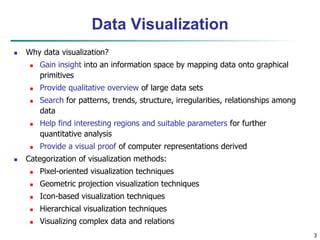
Data Visualization
 Why data visualization?
 Gain insight into an information space by mapping data onto graphical
primitives
 Provide qualitative overview of large data sets
 Search for patterns, trends, structure, irregularities, relationships among
data
 Help find interesting regions and suitable parameters for further
quantitative analysis
 Provide a visual proof of computer representations derived
 Categorization of visualization methods:
 Pixel-oriented visualization techniques
 Geometric projection visualization techniques
 Icon-based visualization techniques
 Hierarchical visualization techniques
 Visualizing complex data and relations
4
Chapter 2: Getting to Know Your Data
 Data Objects and Attribute Types
 Basic Statistical Descriptions of Data
 Data Visualization
 Measuring Data Similarity and Dissimilarity
 Summary
5
Similarity and Dissimilarity
 Similarity
 Numerical measure of how alike two data objects are
 Value is higher when objects are more alike
 Often falls in the range [0,1]
 Dissimilarity (e.g., distance)
 Numerical measure of how different two data objects
are
 Lower when objects are more alike
 Minimum dissimilarity is often 0
 Upper limit varies
 Proximity refers to a similarity or dissimilarity
6
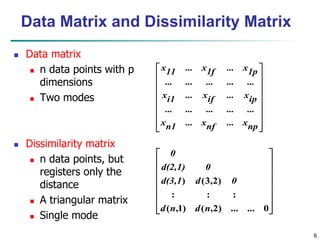
Data Matrix and Dissimilarity Matrix
 Data matrix
 n data points with p
dimensions
 Two modes
 Dissimilarity matrix
 n data points, but
registers only the
distance
 A triangular matrix
 Single mode


















np
x
...
nf
x
...
n1
x
...
...
...
...
...
ip
x
...
if
x
...
i1
x
...
...
...
...
...
1p
x
...
1f
x
...
11
x
















0
...
)
2
,
(
)
1
,
(
:
:
:
)
2
,
3
(
)
...
n
d
n
d
0
d
d(3,1
0
d(2,1)
0
7
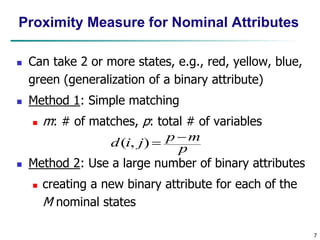
Proximity Measure for Nominal Attributes
 Can take 2 or more states, e.g., red, yellow, blue,
green (generalization of a binary attribute)
 Method 1: Simple matching
 m: # of matches, p: total # of variables
 Method 2: Use a large number of binary attributes
 creating a new binary attribute for each of the
M nominal states
p
m
p
j
i
d 

)
,
(
8
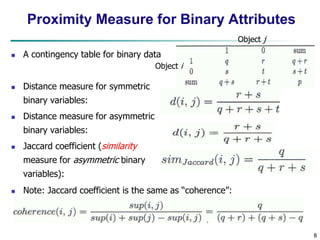
Proximity Measure for Binary Attributes
 A contingency table for binary data
 Distance measure for symmetric
binary variables:
 Distance measure for asymmetric
binary variables:
 Jaccard coefficient (similarity
measure for asymmetric binary
variables):
 Note: Jaccard coefficient is the same as “coherence”:
Object i
Object j
9
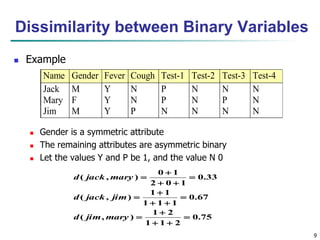
Dissimilarity between Binary Variables
 Example
 Gender is a symmetric attribute
 The remaining attributes are asymmetric binary
 Let the values Y and P be 1, and the value N 0
Name Gender Fever Cough Test-1 Test-2 Test-3 Test-4
Jack M Y N P N N N
Mary F Y N P N P N
Jim M Y P N N N N
75
.
0
2
1
1
2
1
)
,
(
67
.
0
1
1
1
1
1
)
,
(
33
.
0
1
0
2
1
0
)
,
(















mary
jim
d
jim
jack
d
mary
jack
d
10
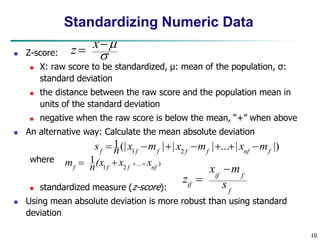
Standardizing Numeric Data
 Z-score:
 X: raw score to be standardized, μ: mean of the population, σ:
standard deviation
 the distance between the raw score and the population mean in
units of the standard deviation
 negative when the raw score is below the mean, “+” when above
 An alternative way: Calculate the mean absolute deviation
where
 standardized measure (z-score):
 Using mean absolute deviation is more robust than using standard
deviation
.
)
...
2
1
1
nf
f
f
f
x
x
(x
n
m 



|)
|
...
|
|
|
(|
1
2
1 f
nf
f
f
f
f
f
m
x
m
x
m
x
n
s 






f
f
if
if s
m
x
z





 x
z
11
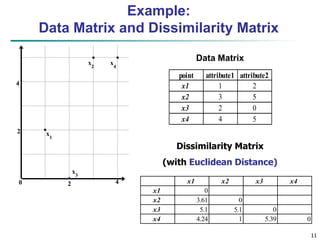
Example:
Data Matrix and Dissimilarity Matrix
point attribute1 attribute2
x1 1 2
x2 3 5
x3 2 0
x4 4 5
Dissimilarity Matrix
(with Euclidean Distance)
x1 x2 x3 x4
x1 0
x2 3.61 0
x3 5.1 5.1 0
x4 4.24 1 5.39 0
Data Matrix
12
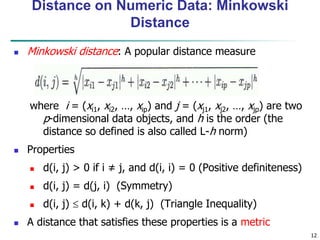
Distance on Numeric Data: Minkowski
Distance
 Minkowski distance: A popular distance measure
where i = (xi1, xi2, …, xip) and j = (xj1, xj2, …, xjp) are two
p-dimensional data objects, and h is the order (the
distance so defined is also called L-h norm)
 Properties
 d(i, j) > 0 if i ≠ j, and d(i, i) = 0 (Positive definiteness)
 d(i, j) = d(j, i) (Symmetry)
 d(i, j)  d(i, k) + d(k, j) (Triangle Inequality)
 A distance that satisfies these properties is a metric
13
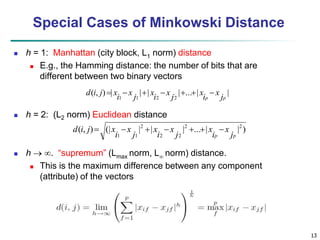
Special Cases of Minkowski Distance
 h = 1: Manhattan (city block, L1 norm) distance
 E.g., the Hamming distance: the number of bits that are
different between two binary vectors
 h = 2: (L2 norm) Euclidean distance
 h  . “supremum” (Lmax norm, L norm) distance.
 This is the maximum difference between any component
(attribute) of the vectors
)
|
|
...
|
|
|
(|
)
,
( 2
2
2
2
2
1
1 p
p j
x
i
x
j
x
i
x
j
x
i
x
j
i
d 






|
|
...
|
|
|
|
)
,
(
2
2
1
1 p
p j
x
i
x
j
x
i
x
j
x
i
x
j
i
d 






14
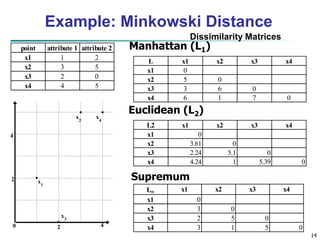
Example: Minkowski Distance
Dissimilarity Matrices
point attribute 1 attribute 2
x1 1 2
x2 3 5
x3 2 0
x4 4 5
L x1 x2 x3 x4
x1 0
x2 5 0
x3 3 6 0
x4 6 1 7 0
L2 x1 x2 x3 x4
x1 0
x2 3.61 0
x3 2.24 5.1 0
x4 4.24 1 5.39 0
L x1 x2 x3 x4
x1 0
x2 3 0
x3 2 5 0
x4 3 1 5 0
Manhattan (L1)
Euclidean (L2)
Supremum
15
Ordinal Variables
 An ordinal variable can be discrete or continuous
 Order is important, e.g., rank
 Can be treated like interval-scaled
 replace xif by their rank
 map the range of each variable onto [0, 1] by replacing
i-th object in the f-th variable by
 compute the dissimilarity using methods for interval-
scaled variables
1
1



f
if
if M
r
z
}
,...,
1
{ f
if
M
r 
16
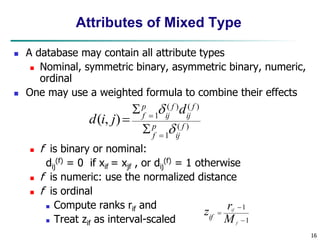
Attributes of Mixed Type
 A database may contain all attribute types
 Nominal, symmetric binary, asymmetric binary, numeric,
ordinal
 One may use a weighted formula to combine their effects
 f is binary or nominal:
dij
(f) = 0 if xif = xjf , or dij
(f) = 1 otherwise
 f is numeric: use the normalized distance
 f is ordinal
 Compute ranks rif and
 Treat zif as interval-scaled
)
(
1
)
(
)
(
1
)
,
( f
ij
p
f
f
ij
f
ij
p
f
d
j
i
d







1
1



f
if
M
r
zif
17
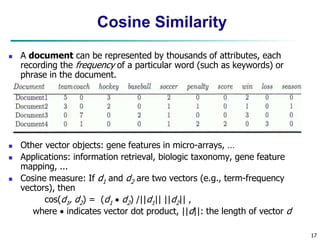
Cosine Similarity
 A document can be represented by thousands of attributes, each
recording the frequency of a particular word (such as keywords) or
phrase in the document.
 Other vector objects: gene features in micro-arrays, …
 Applications: information retrieval, biologic taxonomy, gene feature
mapping, ...
 Cosine measure: If d1 and d2 are two vectors (e.g., term-frequency
vectors), then
cos(d1, d2) = (d1  d2) /||d1|| ||d2|| ,
where  indicates vector dot product, ||d||: the length of vector d
18
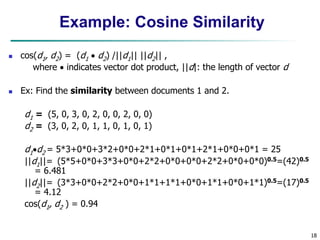
Example: Cosine Similarity
 cos(d1, d2) = (d1  d2) /||d1|| ||d2|| ,
where  indicates vector dot product, ||d|: the length of vector d
 Ex: Find the similarity between documents 1 and 2.
d1 = (5, 0, 3, 0, 2, 0, 0, 2, 0, 0)
d2 = (3, 0, 2, 0, 1, 1, 0, 1, 0, 1)
d1d2 = 5*3+0*0+3*2+0*0+2*1+0*1+0*1+2*1+0*0+0*1 = 25
||d1||= (5*5+0*0+3*3+0*0+2*2+0*0+0*0+2*2+0*0+0*0)0.5=(42)0.5
= 6.481
||d2||= (3*3+0*0+2*2+0*0+1*1+1*1+0*0+1*1+0*0+1*1)0.5=(17)0.5
= 4.12
cos(d1, d2 ) = 0.94
19
Chapter 2: Getting to Know Your Data
 Data Objects and Attribute Types
 Basic Statistical Descriptions of Data
 Data Visualization
 Measuring Data Similarity and Dissimilarity
 Summary
Summary
 Data attribute types: nominal, binary, ordinal, interval-scaled, ratio-
scaled
 Many types of data sets, e.g., numerical, text, graph, Web, image.
 Gain insight into the data by:
 Basic statistical data description: central tendency, dispersion,
graphical displays
 Data visualization: map data onto graphical primitives
 Measure data similarity
 Above steps are the beginning of data preprocessing.
 Many methods have been developed but still an active area of research.
20
References
 W. Cleveland, Visualizing Data, Hobart Press, 1993
 T. Dasu and T. Johnson. Exploratory Data Mining and Data Cleaning. John Wiley, 2003
 U. Fayyad, G. Grinstein, and A. Wierse. Information Visualization in Data Mining and
Knowledge Discovery, Morgan Kaufmann, 2001
 L. Kaufman and P. J. Rousseeuw. Finding Groups in Data: an Introduction to Cluster
Analysis. John Wiley & Sons, 1990.
 H. V. Jagadish, et al., Special Issue on Data Reduction Techniques. Bulletin of the Tech.
Committee on Data Eng., 20(4), Dec. 1997
 D. A. Keim. Information visualization and visual data mining, IEEE trans. on
Visualization and Computer Graphics, 8(1), 2002
 D. Pyle. Data Preparation for Data Mining. Morgan Kaufmann, 1999
 S. Santini and R. Jain,” Similarity measures”, IEEE Trans. on Pattern Analysis and
Machine Intelligence, 21(9), 1999
 E. R. Tufte. The Visual Display of Quantitative Information, 2nd ed., Graphics Press,
2001
 C. Yu , et al., Visual data mining of multimedia data for social and behavioral studies,
Information Visualization, 8(1), 2009
21

4_22865_IS465_2019_1__2_1_02Data-2.ppt

  • 1.
    1 Data Mining: Concepts andTechniques — Chapter 2 — Jiawei Han, Micheline Kamber, and Jian Pei University of Illinois at Urbana-Champaign Simon Fraser University ©2011 Han, Kamber, and Pei. All rights reserved.
  • 2.
    2 Chapter 2: Gettingto Know Your Data  Data Objects and Attribute Types  Basic Statistical Descriptions of Data  Data Visualization  Measuring Data Similarity and Dissimilarity  Summary
  • 3.
    3 Data Visualization  Whydata visualization?  Gain insight into an information space by mapping data onto graphical primitives  Provide qualitative overview of large data sets  Search for patterns, trends, structure, irregularities, relationships among data  Help find interesting regions and suitable parameters for further quantitative analysis  Provide a visual proof of computer representations derived  Categorization of visualization methods:  Pixel-oriented visualization techniques  Geometric projection visualization techniques  Icon-based visualization techniques  Hierarchical visualization techniques  Visualizing complex data and relations
  • 4.
    4 Chapter 2: Gettingto Know Your Data  Data Objects and Attribute Types  Basic Statistical Descriptions of Data  Data Visualization  Measuring Data Similarity and Dissimilarity  Summary
  • 5.
    5 Similarity and Dissimilarity Similarity  Numerical measure of how alike two data objects are  Value is higher when objects are more alike  Often falls in the range [0,1]  Dissimilarity (e.g., distance)  Numerical measure of how different two data objects are  Lower when objects are more alike  Minimum dissimilarity is often 0  Upper limit varies  Proximity refers to a similarity or dissimilarity
  • 6.
    6 Data Matrix andDissimilarity Matrix  Data matrix  n data points with p dimensions  Two modes  Dissimilarity matrix  n data points, but registers only the distance  A triangular matrix  Single mode                   np x ... nf x ... n1 x ... ... ... ... ... ip x ... if x ... i1 x ... ... ... ... ... 1p x ... 1f x ... 11 x                 0 ... ) 2 , ( ) 1 , ( : : : ) 2 , 3 ( ) ... n d n d 0 d d(3,1 0 d(2,1) 0
  • 7.
    7 Proximity Measure forNominal Attributes  Can take 2 or more states, e.g., red, yellow, blue, green (generalization of a binary attribute)  Method 1: Simple matching  m: # of matches, p: total # of variables  Method 2: Use a large number of binary attributes  creating a new binary attribute for each of the M nominal states p m p j i d   ) , (
  • 8.
    8 Proximity Measure forBinary Attributes  A contingency table for binary data  Distance measure for symmetric binary variables:  Distance measure for asymmetric binary variables:  Jaccard coefficient (similarity measure for asymmetric binary variables):  Note: Jaccard coefficient is the same as “coherence”: Object i Object j
  • 9.
    9 Dissimilarity between BinaryVariables  Example  Gender is a symmetric attribute  The remaining attributes are asymmetric binary  Let the values Y and P be 1, and the value N 0 Name Gender Fever Cough Test-1 Test-2 Test-3 Test-4 Jack M Y N P N N N Mary F Y N P N P N Jim M Y P N N N N 75 . 0 2 1 1 2 1 ) , ( 67 . 0 1 1 1 1 1 ) , ( 33 . 0 1 0 2 1 0 ) , (                mary jim d jim jack d mary jack d
  • 10.
    10 Standardizing Numeric Data Z-score:  X: raw score to be standardized, μ: mean of the population, σ: standard deviation  the distance between the raw score and the population mean in units of the standard deviation  negative when the raw score is below the mean, “+” when above  An alternative way: Calculate the mean absolute deviation where  standardized measure (z-score):  Using mean absolute deviation is more robust than using standard deviation . ) ... 2 1 1 nf f f f x x (x n m     |) | ... | | | (| 1 2 1 f nf f f f f f m x m x m x n s        f f if if s m x z       x z
  • 11.
    11 Example: Data Matrix andDissimilarity Matrix point attribute1 attribute2 x1 1 2 x2 3 5 x3 2 0 x4 4 5 Dissimilarity Matrix (with Euclidean Distance) x1 x2 x3 x4 x1 0 x2 3.61 0 x3 5.1 5.1 0 x4 4.24 1 5.39 0 Data Matrix
  • 12.
    12 Distance on NumericData: Minkowski Distance  Minkowski distance: A popular distance measure where i = (xi1, xi2, …, xip) and j = (xj1, xj2, …, xjp) are two p-dimensional data objects, and h is the order (the distance so defined is also called L-h norm)  Properties  d(i, j) > 0 if i ≠ j, and d(i, i) = 0 (Positive definiteness)  d(i, j) = d(j, i) (Symmetry)  d(i, j)  d(i, k) + d(k, j) (Triangle Inequality)  A distance that satisfies these properties is a metric
  • 13.
    13 Special Cases ofMinkowski Distance  h = 1: Manhattan (city block, L1 norm) distance  E.g., the Hamming distance: the number of bits that are different between two binary vectors  h = 2: (L2 norm) Euclidean distance  h  . “supremum” (Lmax norm, L norm) distance.  This is the maximum difference between any component (attribute) of the vectors ) | | ... | | | (| ) , ( 2 2 2 2 2 1 1 p p j x i x j x i x j x i x j i d        | | ... | | | | ) , ( 2 2 1 1 p p j x i x j x i x j x i x j i d       
  • 14.
    14 Example: Minkowski Distance DissimilarityMatrices point attribute 1 attribute 2 x1 1 2 x2 3 5 x3 2 0 x4 4 5 L x1 x2 x3 x4 x1 0 x2 5 0 x3 3 6 0 x4 6 1 7 0 L2 x1 x2 x3 x4 x1 0 x2 3.61 0 x3 2.24 5.1 0 x4 4.24 1 5.39 0 L x1 x2 x3 x4 x1 0 x2 3 0 x3 2 5 0 x4 3 1 5 0 Manhattan (L1) Euclidean (L2) Supremum
  • 15.
    15 Ordinal Variables  Anordinal variable can be discrete or continuous  Order is important, e.g., rank  Can be treated like interval-scaled  replace xif by their rank  map the range of each variable onto [0, 1] by replacing i-th object in the f-th variable by  compute the dissimilarity using methods for interval- scaled variables 1 1    f if if M r z } ,..., 1 { f if M r 
  • 16.
    16 Attributes of MixedType  A database may contain all attribute types  Nominal, symmetric binary, asymmetric binary, numeric, ordinal  One may use a weighted formula to combine their effects  f is binary or nominal: dij (f) = 0 if xif = xjf , or dij (f) = 1 otherwise  f is numeric: use the normalized distance  f is ordinal  Compute ranks rif and  Treat zif as interval-scaled ) ( 1 ) ( ) ( 1 ) , ( f ij p f f ij f ij p f d j i d        1 1    f if M r zif
  • 17.
    17 Cosine Similarity  Adocument can be represented by thousands of attributes, each recording the frequency of a particular word (such as keywords) or phrase in the document.  Other vector objects: gene features in micro-arrays, …  Applications: information retrieval, biologic taxonomy, gene feature mapping, ...  Cosine measure: If d1 and d2 are two vectors (e.g., term-frequency vectors), then cos(d1, d2) = (d1  d2) /||d1|| ||d2|| , where  indicates vector dot product, ||d||: the length of vector d
  • 18.
    18 Example: Cosine Similarity cos(d1, d2) = (d1  d2) /||d1|| ||d2|| , where  indicates vector dot product, ||d|: the length of vector d  Ex: Find the similarity between documents 1 and 2. d1 = (5, 0, 3, 0, 2, 0, 0, 2, 0, 0) d2 = (3, 0, 2, 0, 1, 1, 0, 1, 0, 1) d1d2 = 5*3+0*0+3*2+0*0+2*1+0*1+0*1+2*1+0*0+0*1 = 25 ||d1||= (5*5+0*0+3*3+0*0+2*2+0*0+0*0+2*2+0*0+0*0)0.5=(42)0.5 = 6.481 ||d2||= (3*3+0*0+2*2+0*0+1*1+1*1+0*0+1*1+0*0+1*1)0.5=(17)0.5 = 4.12 cos(d1, d2 ) = 0.94
  • 19.
    19 Chapter 2: Gettingto Know Your Data  Data Objects and Attribute Types  Basic Statistical Descriptions of Data  Data Visualization  Measuring Data Similarity and Dissimilarity  Summary
  • 20.
    Summary  Data attributetypes: nominal, binary, ordinal, interval-scaled, ratio- scaled  Many types of data sets, e.g., numerical, text, graph, Web, image.  Gain insight into the data by:  Basic statistical data description: central tendency, dispersion, graphical displays  Data visualization: map data onto graphical primitives  Measure data similarity  Above steps are the beginning of data preprocessing.  Many methods have been developed but still an active area of research. 20
  • 21.
    References  W. Cleveland,Visualizing Data, Hobart Press, 1993  T. Dasu and T. Johnson. Exploratory Data Mining and Data Cleaning. John Wiley, 2003  U. Fayyad, G. Grinstein, and A. Wierse. Information Visualization in Data Mining and Knowledge Discovery, Morgan Kaufmann, 2001  L. Kaufman and P. J. Rousseeuw. Finding Groups in Data: an Introduction to Cluster Analysis. John Wiley & Sons, 1990.  H. V. Jagadish, et al., Special Issue on Data Reduction Techniques. Bulletin of the Tech. Committee on Data Eng., 20(4), Dec. 1997  D. A. Keim. Information visualization and visual data mining, IEEE trans. on Visualization and Computer Graphics, 8(1), 2002  D. Pyle. Data Preparation for Data Mining. Morgan Kaufmann, 1999  S. Santini and R. Jain,” Similarity measures”, IEEE Trans. on Pattern Analysis and Machine Intelligence, 21(9), 1999  E. R. Tufte. The Visual Display of Quantitative Information, 2nd ed., Graphics Press, 2001  C. Yu , et al., Visual data mining of multimedia data for social and behavioral studies, Information Visualization, 8(1), 2009 21