Fractals
Computer graphics
Fractals
• Fractals are geometric objects.
• Many real-world objects like ferns are
shaped like fractals.
• Fractals are formed by iterations.
• Fractals are self-similar.
• In computer graphics, we use fractal
functions to create complex objects.
Types of fractals
• Self Similar : These fractals have parts
that are scaled down versions of the entire
object, we construct the object subparts by
applying a scaling parameter s to the
overall shape.
• Self affine : -formed with different scaling
parameters. -terrain,water,clouds are
typically modeled using this.
• Invariant Fractal Sets:
this class of fractals includes self squaring
fractals.
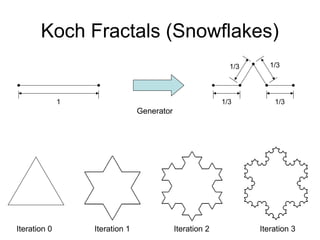
Koch Fractals (Snowflakes)
1/3

1

1/3

1/3

1/3

Generator

Iteration 0

Iteration 1

Iteration 2

Iteration 3
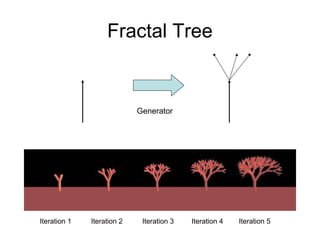
Fractal Tree

Generator

Iteration 1

Iteration 2

Iteration 3

Iteration 4

Iteration 5
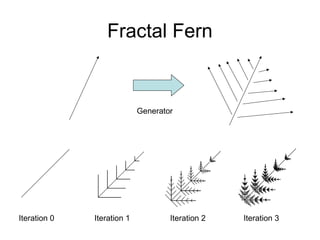
Fractal Fern

Generator

Iteration 0

Iteration 1

Iteration 2

Iteration 3
Add Some Randomness
• The fractals we’ve produced so far seem to be
very regular and “artificial”.
• To create some realism and variability, simply
change the angles slightly sometimes based on
a random number generator.
• For example, you can curve some of the ferns to
one side.
• For example, you can also vary the lengths of
the branches and the branching factor.
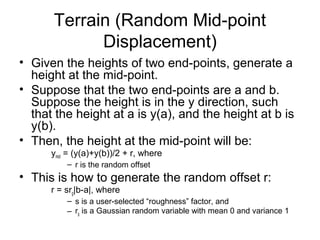
Terrain (Random Mid-point
Displacement)
• Given the heights of two end-points, generate a
height at the mid-point.
• Suppose that the two end-points are a and b.
Suppose the height is in the y direction, such
that the height at a is y(a), and the height at b is
y(b).
• Then, the height at the mid-point will be:
ymid = (y(a)+y(b))/2 + r, where
– r is the random offset

• This is how to generate the random offset r:
r = srg|b-a|, where
– s is a user-selected “roughness” factor, and
– rg is a Gaussian random variable with mean 0 and variance 1
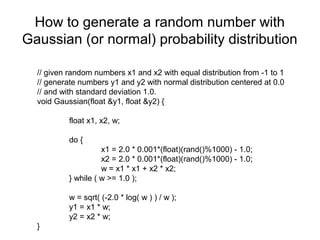
How to generate a random number with
Gaussian (or normal) probability distribution
// given random numbers x1 and x2 with equal distribution from -1 to 1
// generate numbers y1 and y2 with normal distribution centered at 0.0
// and with standard deviation 1.0.
void Gaussian(float &y1, float &y2) {
float x1, x2, w;
do {
x1 = 2.0 * 0.001*(float)(rand()%1000) - 1.0;
x2 = 2.0 * 0.001*(float)(rand()%1000) - 1.0;
w = x1 * x1 + x2 * x2;
} while ( w >= 1.0 );
w = sqrt( (-2.0 * log( w ) ) / w );
y1 = x1 * w;
y2 = x2 * w;
}
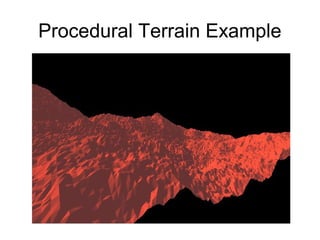
Procedural Terrain Example
Building a more realistic terrain
• Notice that in the real world, valleys and
mountains have different shapes.
• If we have the same terrain-generation algorithm
for both mountains and valleys, it will result in
unrealistic, alien-looking landscapes.
• Therefore, use different parameters for valleys
and mountains.
• Also, can manually create ridges, cliffs, and
other geographical features, and then use
fractals to create detail roughness.

fractals

  • 1.
  • 2.
    Fractals • Fractals aregeometric objects. • Many real-world objects like ferns are shaped like fractals. • Fractals are formed by iterations. • Fractals are self-similar. • In computer graphics, we use fractal functions to create complex objects.
  • 3.
    Types of fractals •Self Similar : These fractals have parts that are scaled down versions of the entire object, we construct the object subparts by applying a scaling parameter s to the overall shape. • Self affine : -formed with different scaling parameters. -terrain,water,clouds are typically modeled using this.
  • 4.
    • Invariant FractalSets: this class of fractals includes self squaring fractals.
  • 5.
  • 6.
    Fractal Tree Generator Iteration 1 Iteration2 Iteration 3 Iteration 4 Iteration 5
  • 7.
  • 8.
    Add Some Randomness •The fractals we’ve produced so far seem to be very regular and “artificial”. • To create some realism and variability, simply change the angles slightly sometimes based on a random number generator. • For example, you can curve some of the ferns to one side. • For example, you can also vary the lengths of the branches and the branching factor.
  • 9.
    Terrain (Random Mid-point Displacement) •Given the heights of two end-points, generate a height at the mid-point. • Suppose that the two end-points are a and b. Suppose the height is in the y direction, such that the height at a is y(a), and the height at b is y(b). • Then, the height at the mid-point will be: ymid = (y(a)+y(b))/2 + r, where – r is the random offset • This is how to generate the random offset r: r = srg|b-a|, where – s is a user-selected “roughness” factor, and – rg is a Gaussian random variable with mean 0 and variance 1
  • 10.
    How to generatea random number with Gaussian (or normal) probability distribution // given random numbers x1 and x2 with equal distribution from -1 to 1 // generate numbers y1 and y2 with normal distribution centered at 0.0 // and with standard deviation 1.0. void Gaussian(float &y1, float &y2) { float x1, x2, w; do { x1 = 2.0 * 0.001*(float)(rand()%1000) - 1.0; x2 = 2.0 * 0.001*(float)(rand()%1000) - 1.0; w = x1 * x1 + x2 * x2; } while ( w >= 1.0 ); w = sqrt( (-2.0 * log( w ) ) / w ); y1 = x1 * w; y2 = x2 * w; }
  • 11.
  • 12.
    Building a morerealistic terrain • Notice that in the real world, valleys and mountains have different shapes. • If we have the same terrain-generation algorithm for both mountains and valleys, it will result in unrealistic, alien-looking landscapes. • Therefore, use different parameters for valleys and mountains. • Also, can manually create ridges, cliffs, and other geographical features, and then use fractals to create detail roughness.