CS249: ADVANCED DATA MINING
Instructor: Yizhou Sun
yzsun@cs.ucla.edu
May 2, 2017
Clustering Evaluation and Practical Issues
Announcements
•Homework 2 due later today
• Due May 3rd (11:59pm)
•Course project proposal
• Due May 8th (11:59pm)
•Homework 3 out
• Due May 10th (11:59pm)
2
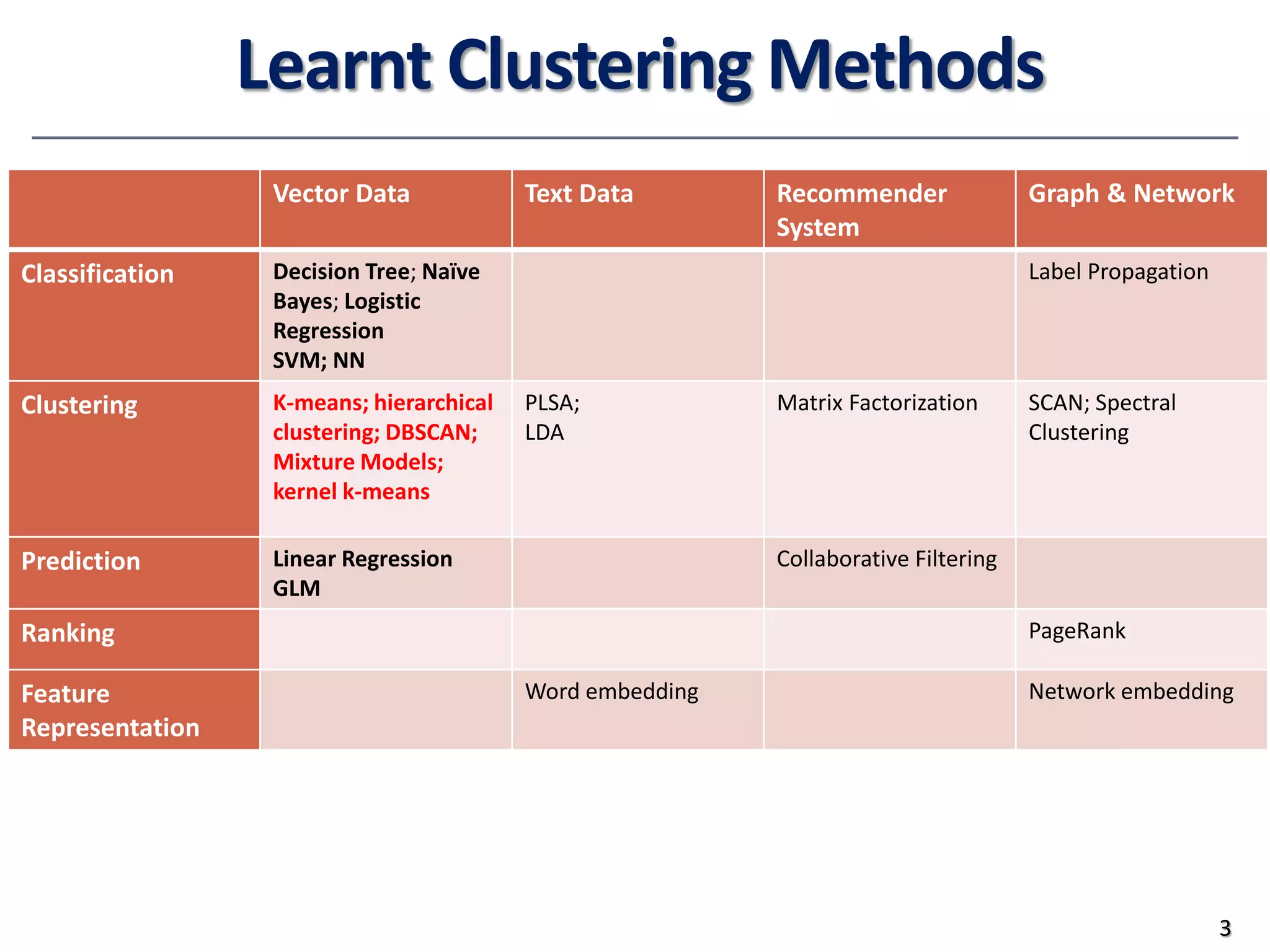
Learnt Clustering Methods
3
Vector Data Text Data Recommender
System
Graph & Network
Classification Decision Tree; Naïve
Bayes; Logistic
Regression
SVM; NN
Label Propagation
Clustering K-means; hierarchical
clustering; DBSCAN;
Mixture Models;
kernel k-means
PLSA;
LDA
Matrix Factorization SCAN; Spectral
Clustering
Prediction Linear Regression
GLM
Collaborative Filtering
Ranking PageRank
Feature
Representation
Word embedding Network embedding
Evaluation and Other Practical Issues
•Evaluation of Clustering
•Similarity and Dissimilarity
•Summary
4
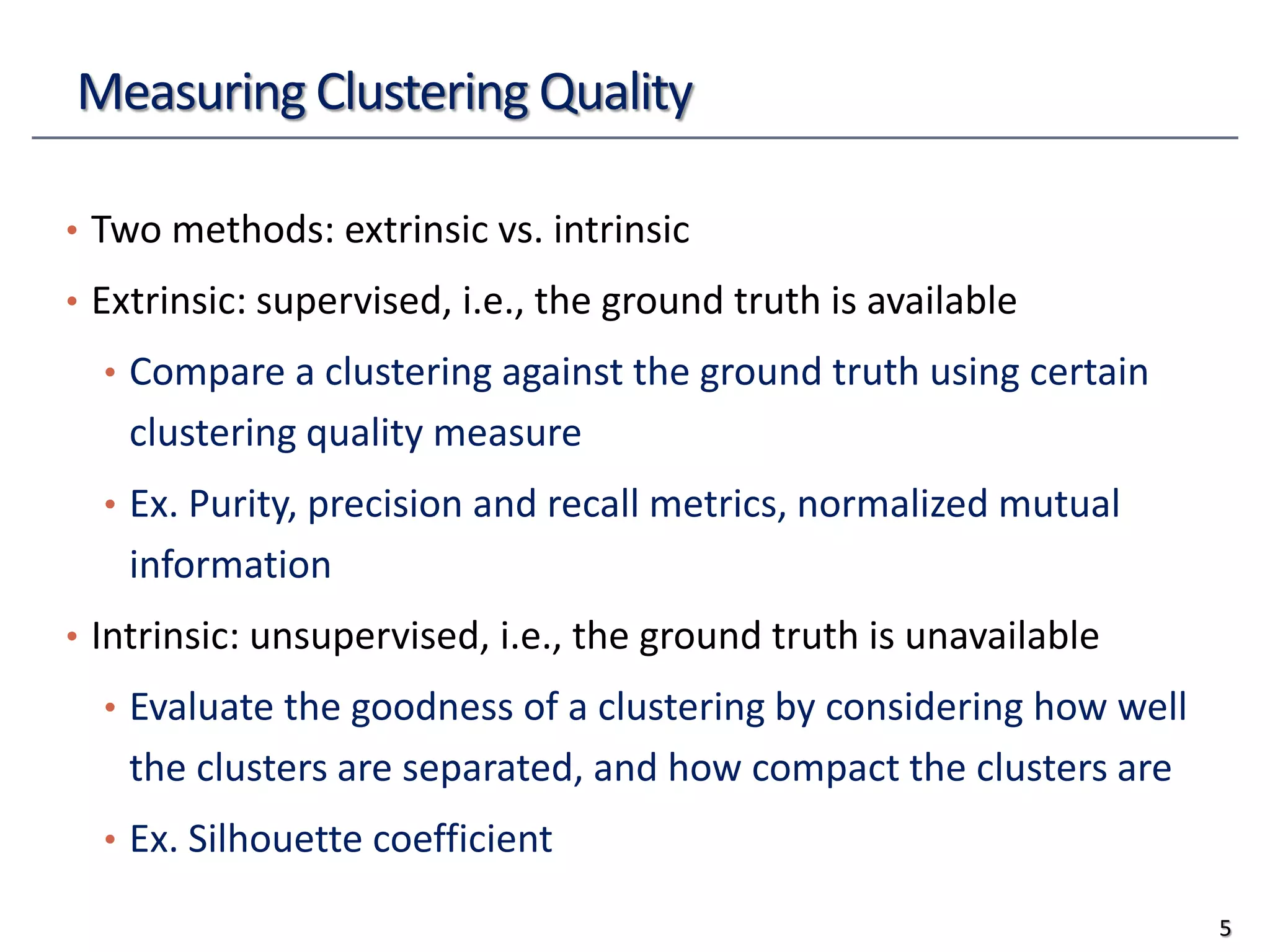
Measuring Clustering Quality
• Two methods: extrinsic vs. intrinsic
• Extrinsic: supervised, i.e., the ground truth is available
• Compare a clustering against the ground truth using certain
clustering quality measure
• Ex. Purity, precision and recall metrics, normalized mutual
information
• Intrinsic: unsupervised, i.e., the ground truth is unavailable
• Evaluate the goodness of a clustering by considering how well
the clusters are separated, and how compact the clusters are
• Ex. Silhouette coefficient
5
Purity
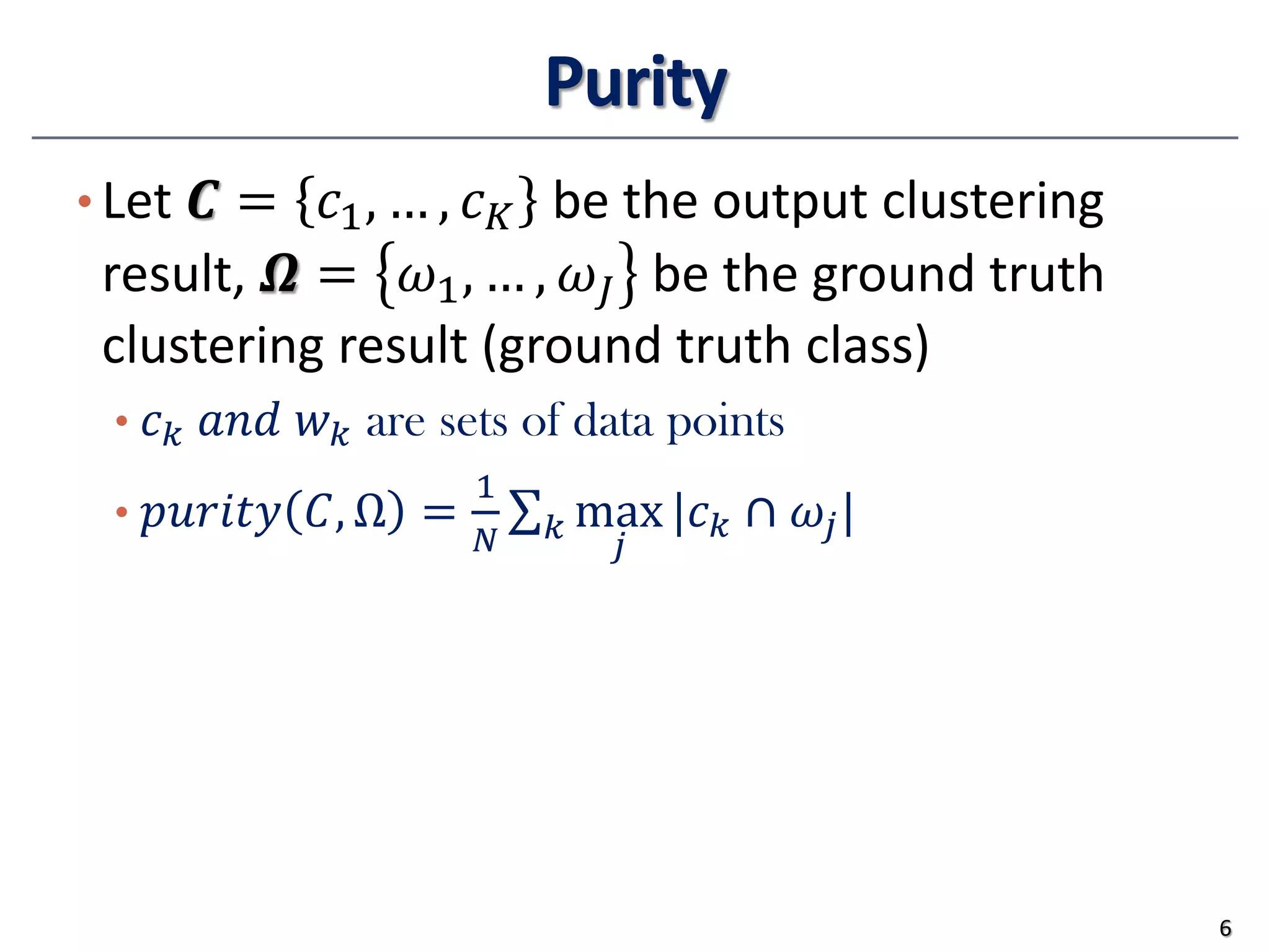
• Let 𝑪𝑪 = 𝑐𝑐1, … , 𝑐𝑐𝐾𝐾 be the output clustering
result, 𝜴𝜴 = 𝜔𝜔1, … , 𝜔𝜔𝐽𝐽 be the ground truth
clustering result (ground truth class)
• 𝑐𝑐𝑘𝑘 𝑎𝑎𝑎𝑎𝑎𝑎 𝑤𝑤𝑘𝑘 are sets of data points
• 𝑝𝑝𝑝𝑝𝑝𝑝𝑝𝑝𝑝𝑝𝑝𝑝 𝐶𝐶, Ω =
1
𝑁𝑁
∑𝑘𝑘 max
𝑗𝑗
|𝑐𝑐𝑘𝑘 ∩ 𝜔𝜔𝑗𝑗|
6
Example
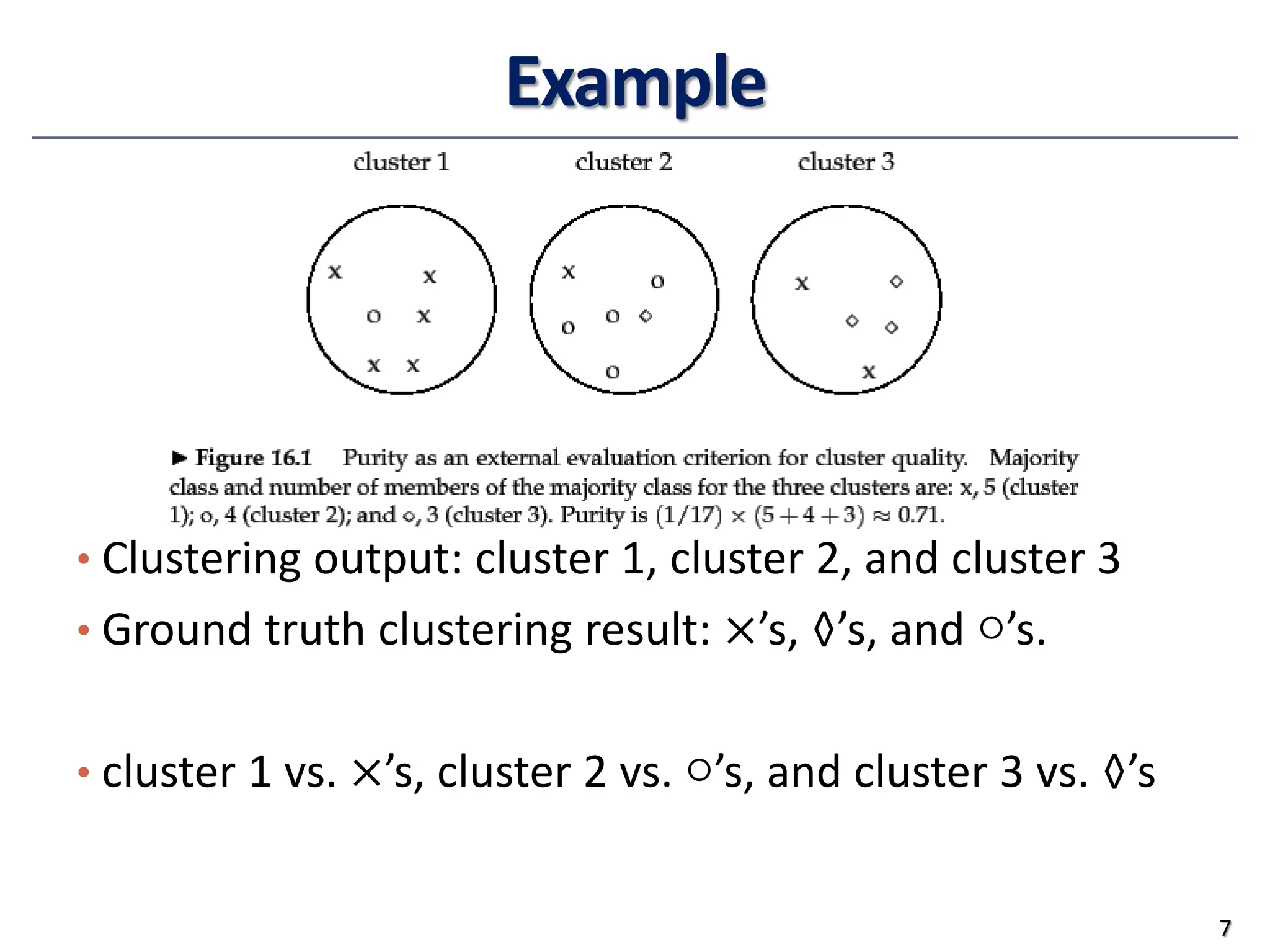
• Clustering output: cluster 1, cluster 2, and cluster 3
• Ground truth clustering result: ×’s, ◊’s, and ○’s.
• cluster 1 vs. ×’s, cluster 2 vs. ○’s, and cluster 3 vs. ◊’s
7
Normalized Mutual Information
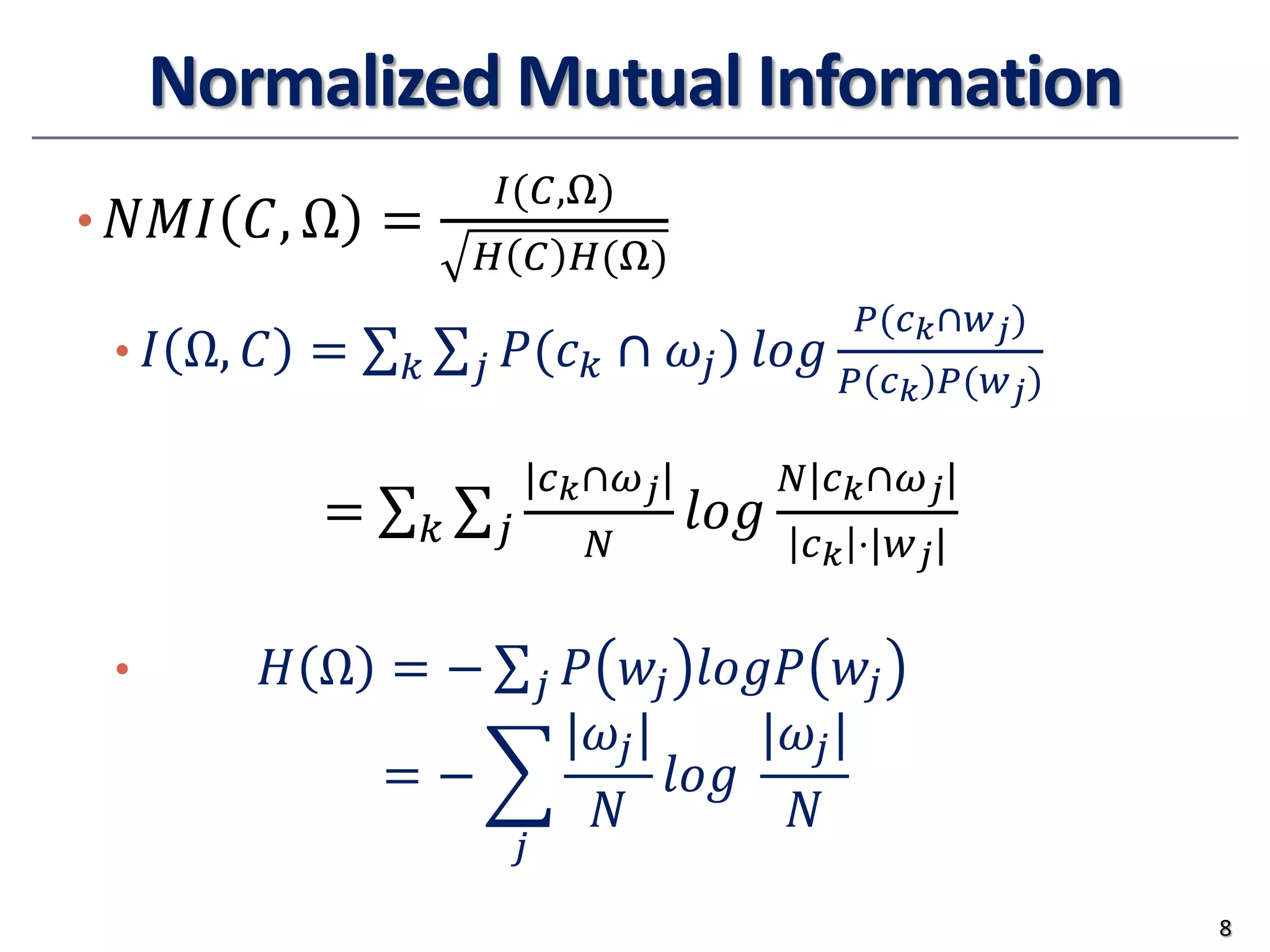
• 𝑁𝑁𝑁𝑁𝑁𝑁 𝐶𝐶, Ω =
𝐼𝐼(𝐶𝐶,Ω)
𝐻𝐻 𝐶𝐶 𝐻𝐻(Ω)
• 𝐼𝐼 Ω, 𝐶𝐶 = ∑𝑘𝑘 ∑𝑗𝑗 𝑃𝑃(𝑐𝑐𝑘𝑘 ∩ 𝜔𝜔𝑗𝑗) 𝑙𝑙𝑙𝑙𝑙𝑙
𝑃𝑃(𝑐𝑐𝑘𝑘∩𝑤𝑤𝑗𝑗)
𝑃𝑃 𝑐𝑐𝑘𝑘 𝑃𝑃(𝑤𝑤𝑗𝑗)
• 𝐻𝐻 Ω = − ∑𝑗𝑗 𝑃𝑃 𝑤𝑤𝑗𝑗 𝑙𝑙𝑙𝑙𝑙𝑙𝑙𝑙 𝑤𝑤𝑗𝑗
= − �
𝑗𝑗
|𝜔𝜔𝑗𝑗|
𝑁𝑁
𝑙𝑙𝑙𝑙𝑙𝑙
|𝜔𝜔𝑗𝑗|
𝑁𝑁
8
= ∑𝑘𝑘 ∑𝑗𝑗
|𝑐𝑐𝑘𝑘∩𝜔𝜔𝑗𝑗|
𝑁𝑁
𝑙𝑙𝑙𝑙𝑙𝑙
𝑁𝑁|𝑐𝑐𝑘𝑘∩𝜔𝜔𝑗𝑗|
𝑐𝑐𝑘𝑘 ⋅|𝑤𝑤𝑗𝑗|
Example
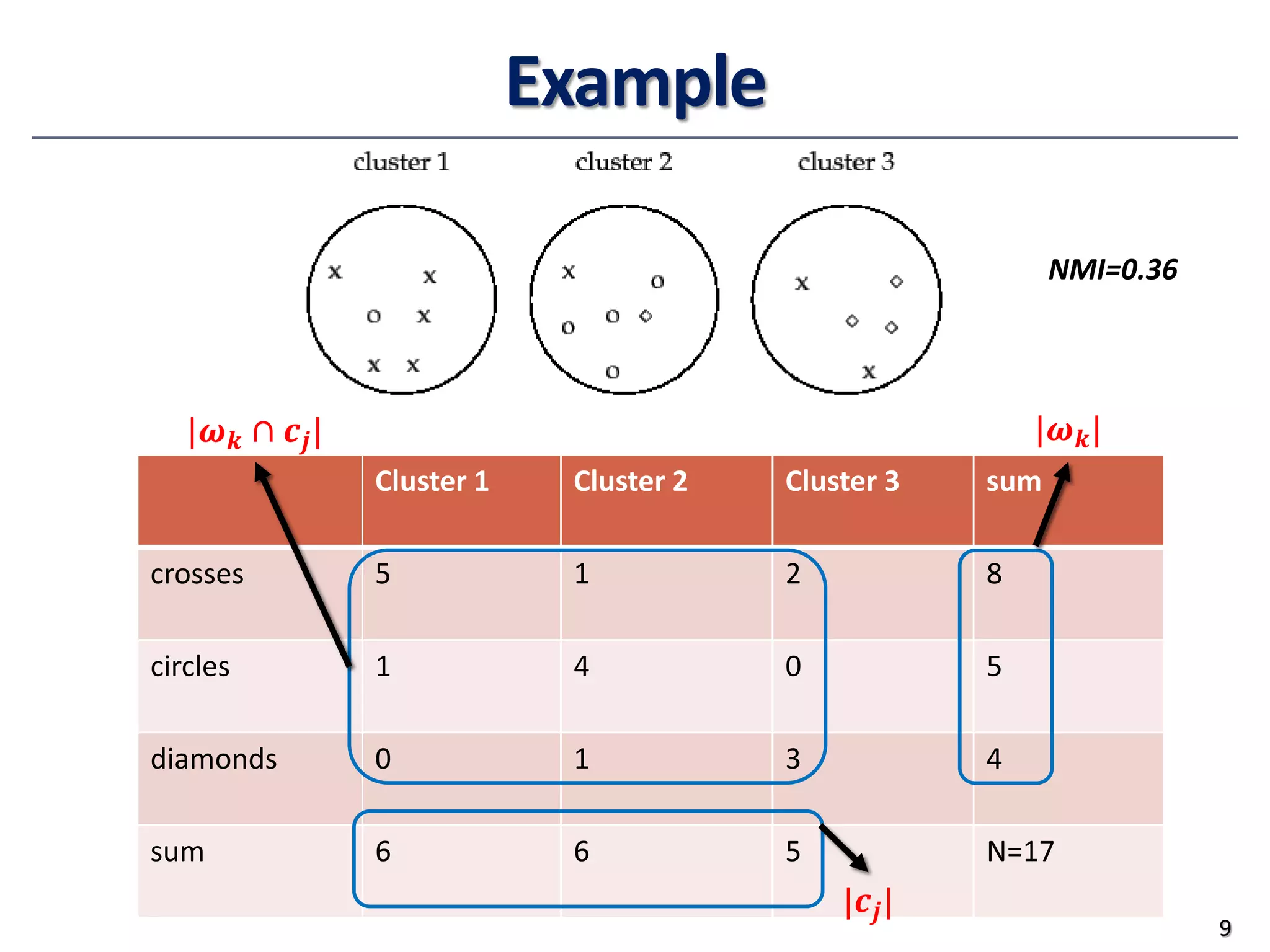
Cluster 1 Cluster 2 Cluster 3 sum
crosses 5 1 2 8
circles 1 4 0 5
diamonds 0 1 3 4
sum 6 6 5 N=17
9
|𝝎𝝎𝒌𝒌 ∩ 𝒄𝒄𝒋𝒋| |𝝎𝝎𝒌𝒌|
|𝒄𝒄𝒋𝒋|
NMI=0.36
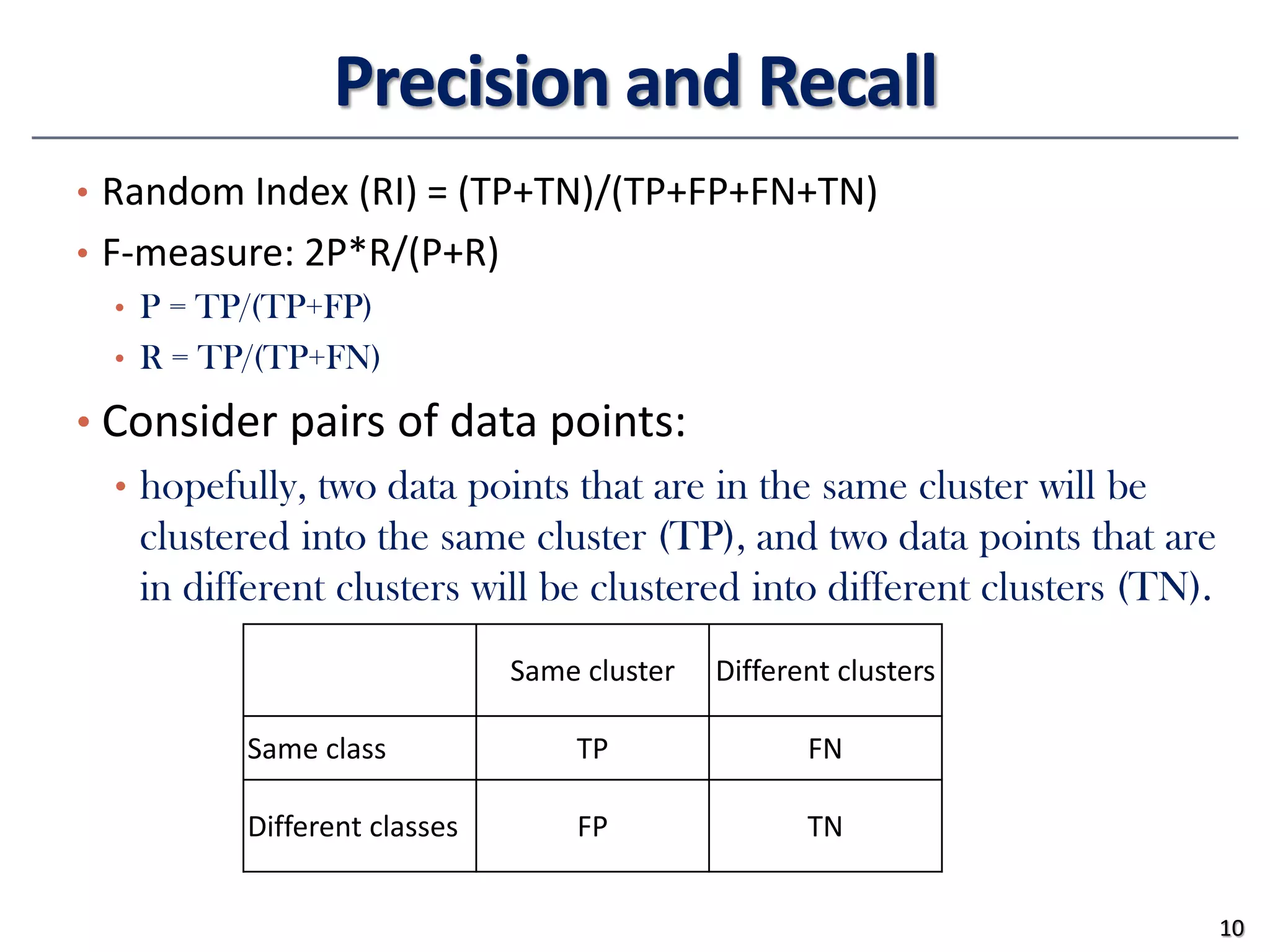
Precision and Recall
• Random Index (RI) = (TP+TN)/(TP+FP+FN+TN)
• F-measure: 2P*R/(P+R)
• P = TP/(TP+FP)
• R = TP/(TP+FN)
• Consider pairs of data points:
• hopefully, two data points that are in the same cluster will be
clustered into the same cluster (TP), and two data points that are
in different clusters will be clustered into different clusters (TN).
10
Same cluster Different clusters
Same class TP FN
Different classes FP TN
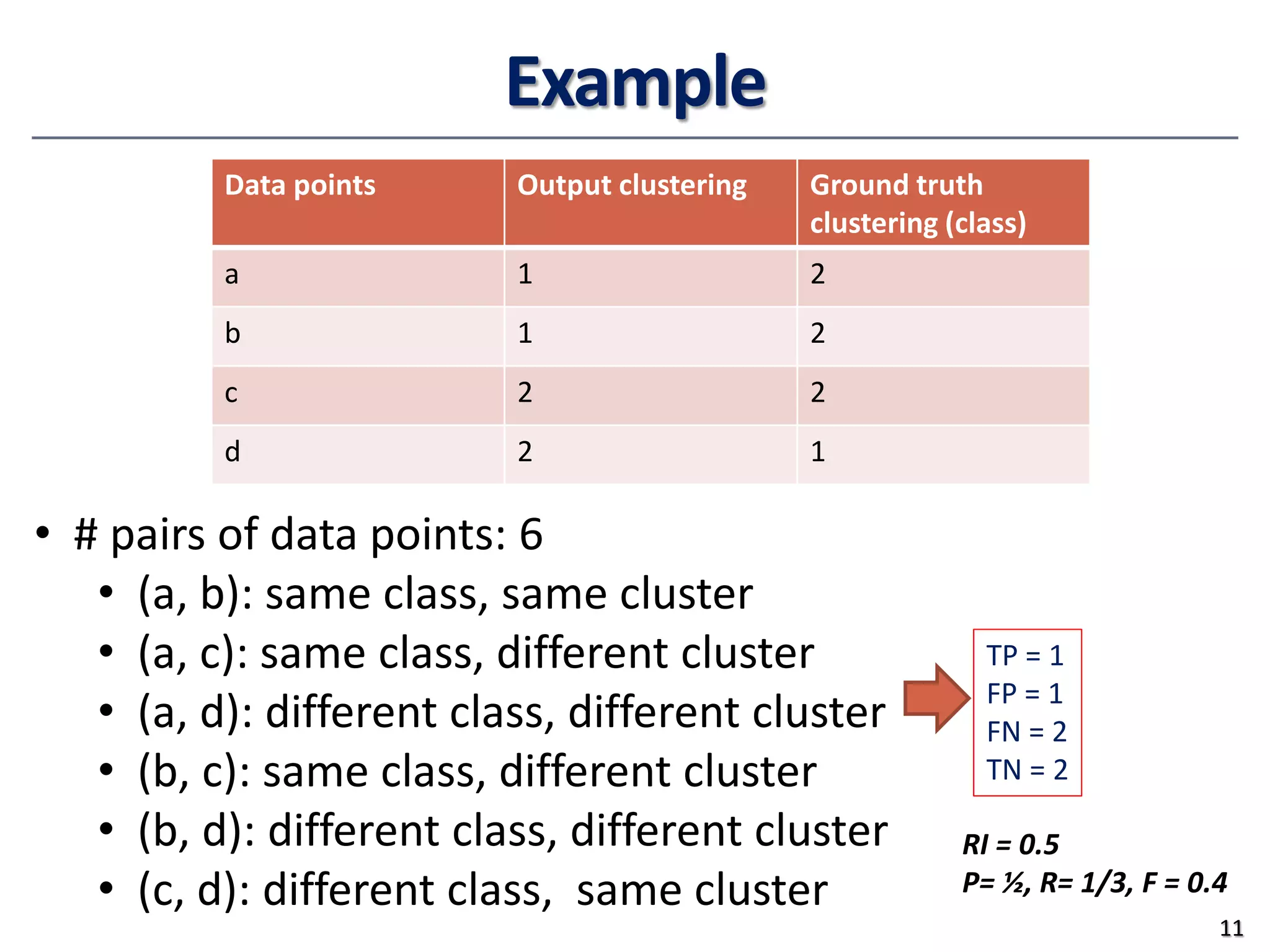
Example
Data points Output clustering Ground truth
clustering (class)
a 1 2
b 1 2
c 2 2
d 2 1
11
• # pairs of data points: 6
• (a, b): same class, same cluster
• (a, c): same class, different cluster
• (a, d): different class, different cluster
• (b, c): same class, different cluster
• (b, d): different class, different cluster
• (c, d): different class, same cluster
TP = 1
FP = 1
FN = 2
TN = 2
RI = 0.5
P= ½, R= 1/3, F = 0.4
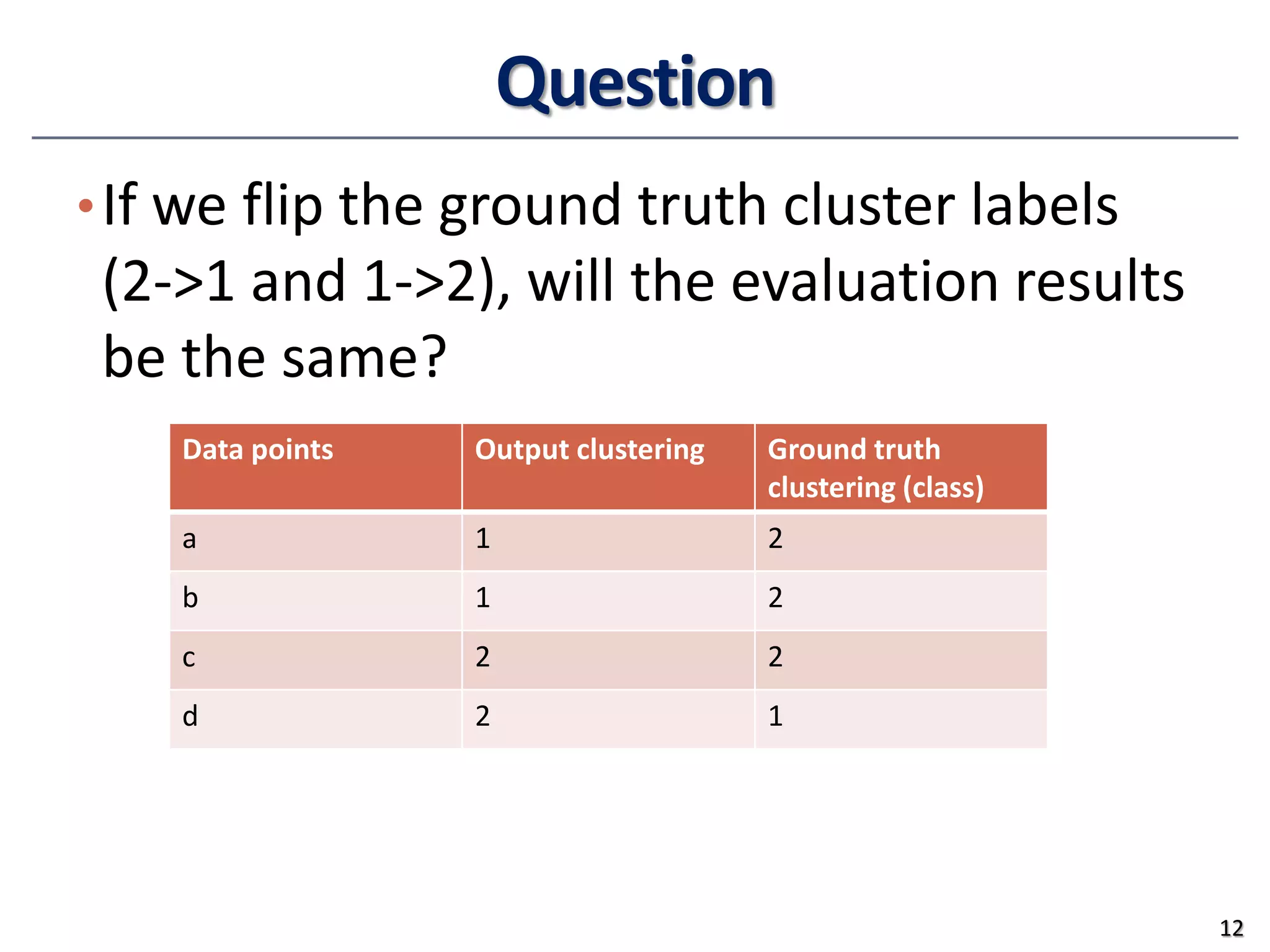
Question
•If we flip the ground truth cluster labels
(2->1 and 1->2), will the evaluation results
be the same?
12
Data points Output clustering Ground truth
clustering (class)
a 1 2
b 1 2
c 2 2
d 2 1
Evaluation and Other Practical Issues
•Evaluation of Clustering
•Similarity and Dissimilarity
•Summary
13
Similarity and Dissimilarity
• Similarity
• Numerical measure of how alike two data objects are
• Value is higher when objects are more alike
• Often falls in the range [0,1]
• Dissimilarity (e.g., distance)
• Numerical measure of how different two data objects are
• Lower when objects are more alike
• Minimum dissimilarity is often 0
• Upper limit varies
• Proximity refers to a similarity or dissimilarity
14
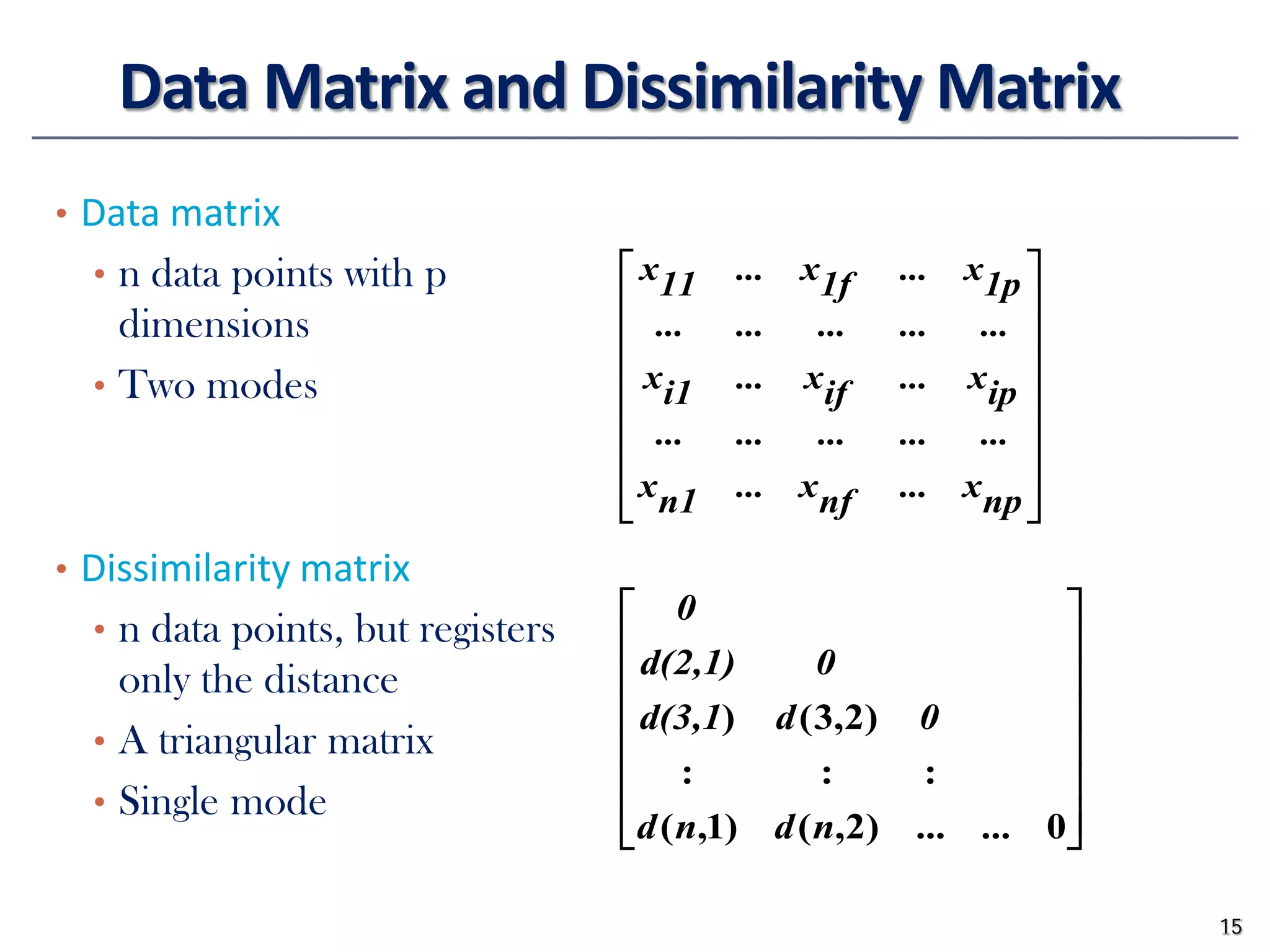
Data Matrix and Dissimilarity Matrix
• Data matrix
• n data points with p
dimensions
• Two modes
• Dissimilarity matrix
• n data points, but registers
only the distance
• A triangular matrix
• Single mode
15


















np
x
...
nf
x
...
n1
x
...
...
...
...
...
ip
x
...
if
x
...
i1
x
...
...
...
...
...
1p
x
...
1f
x
...
11
x
















0
...
)
2
,
(
)
1
,
(
:
:
:
)
2
,
3
(
)
...
n
d
n
d
0
d
d(3,1
0
d(2,1)
0
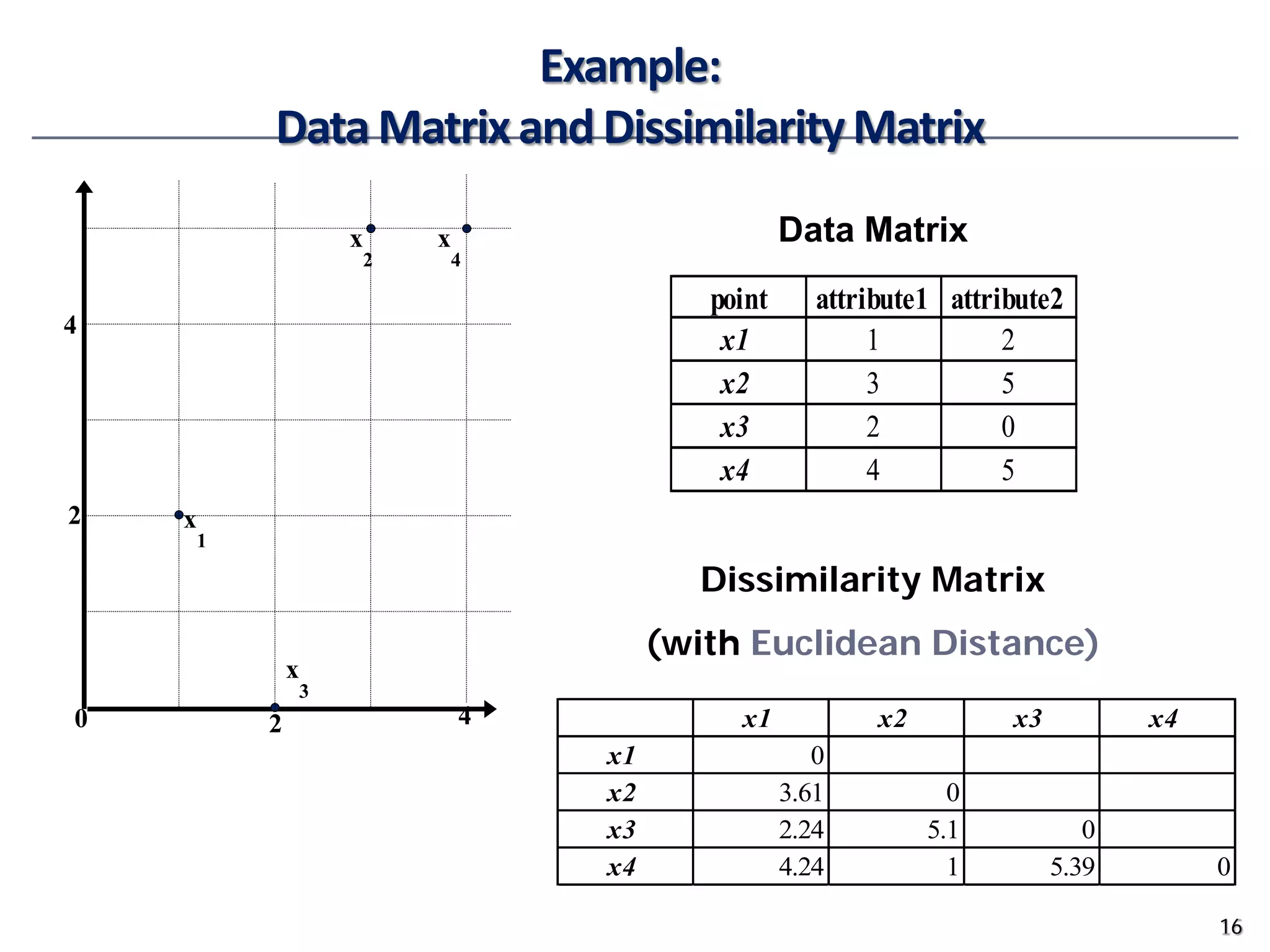
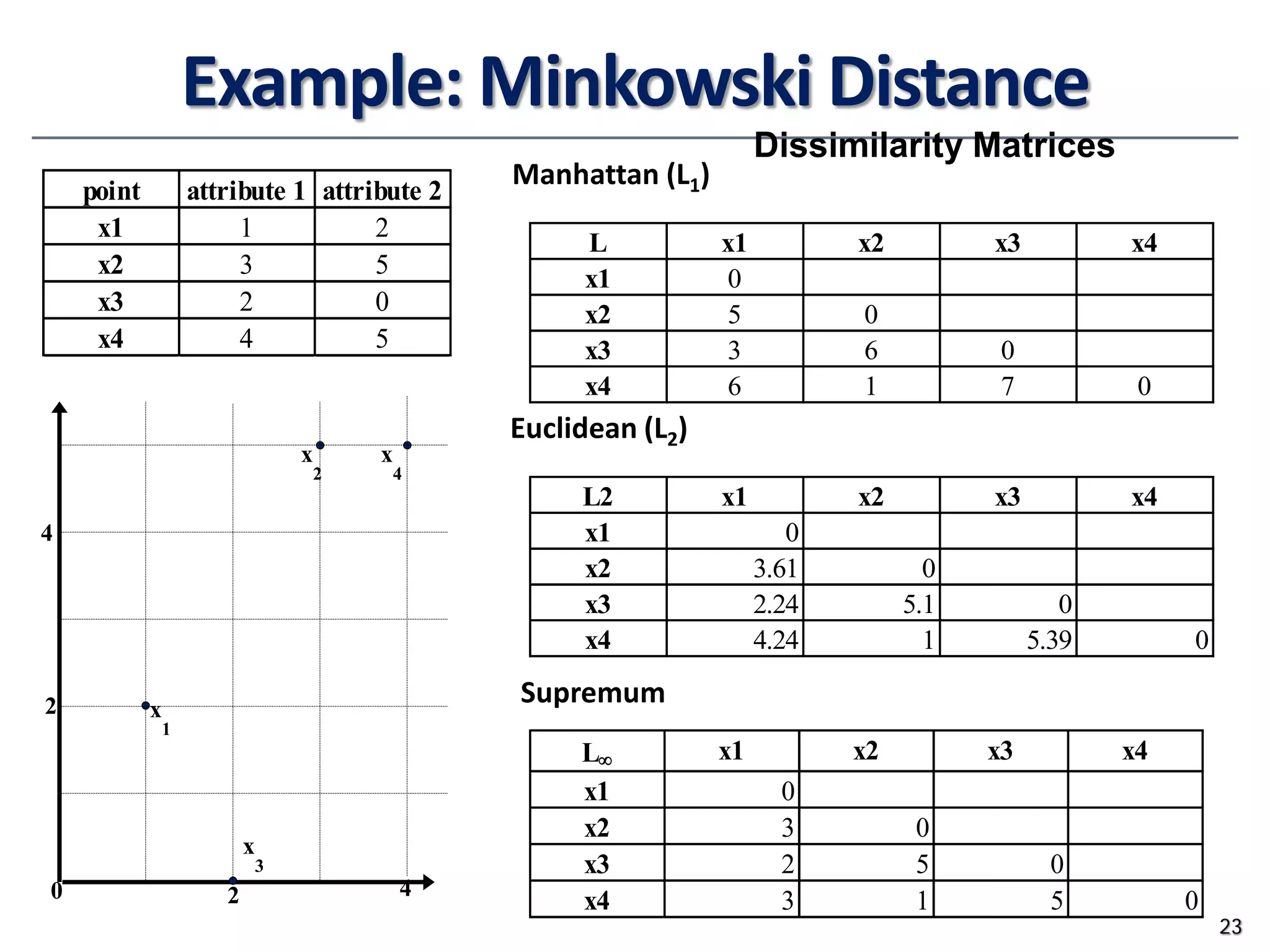
Example:
DataMatrixandDissimilarityMatrix
16
point attribute1 attribute2
x1 1 2
x2 3 5
x3 2 0
x4 4 5
Dissimilarity Matrix
(with Euclidean Distance)
x1 x2 x3 x4
x1 0
x2 3.61 0
x3 2.24 5.1 0
x4 4.24 1 5.39 0
Data Matrix
0 2 4
2
4
x
1
x
2
x
3
x
4
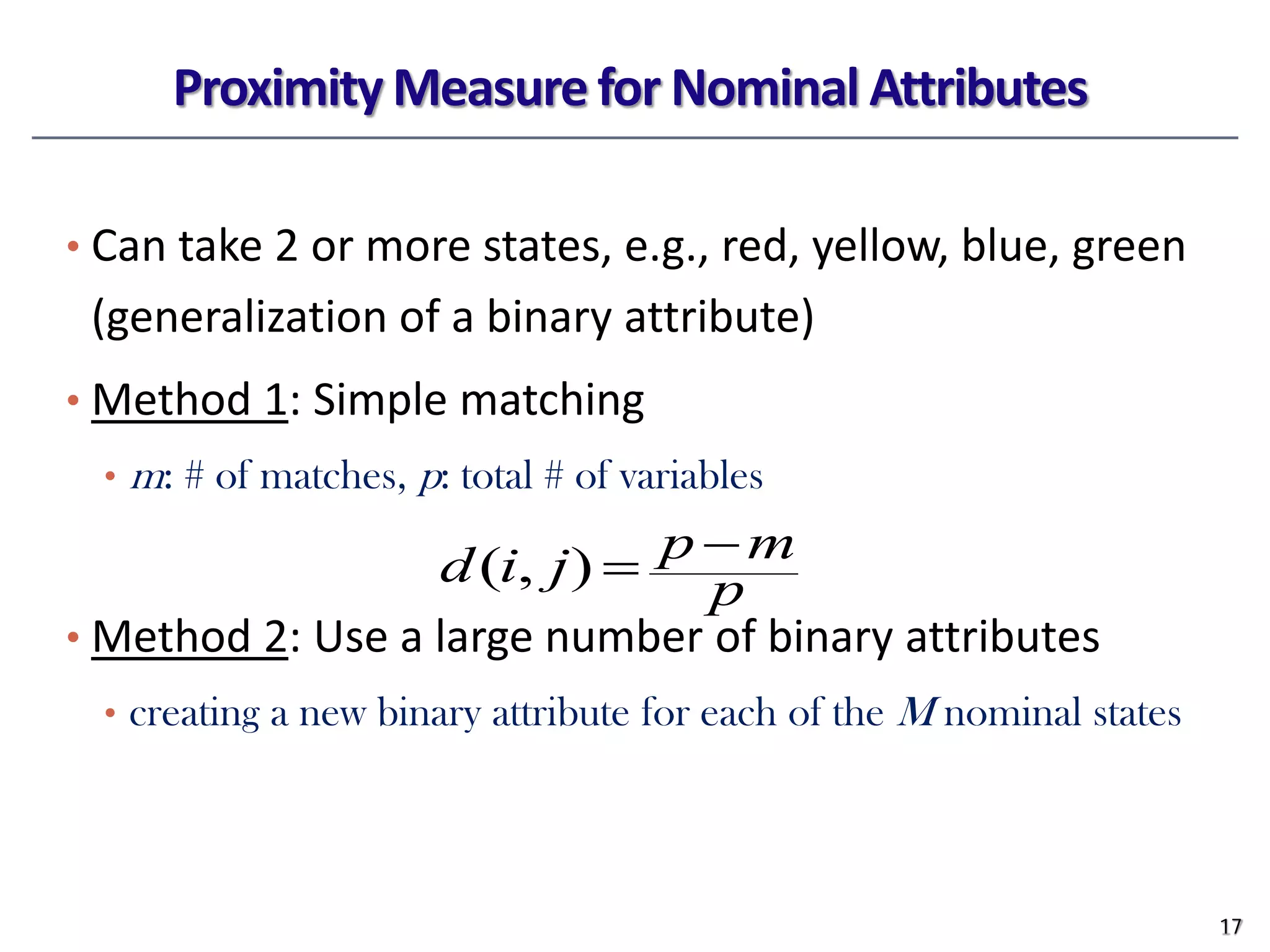
Proximity Measure for Nominal Attributes
• Can take 2 or more states, e.g., red, yellow, blue, green
(generalization of a binary attribute)
• Method 1: Simple matching
• m: # of matches, p: total # of variables
• Method 2: Use a large number of binary attributes
• creating a new binary attribute for each of the M nominal states
17
p
m
p
j
i
d −
=
)
,
(
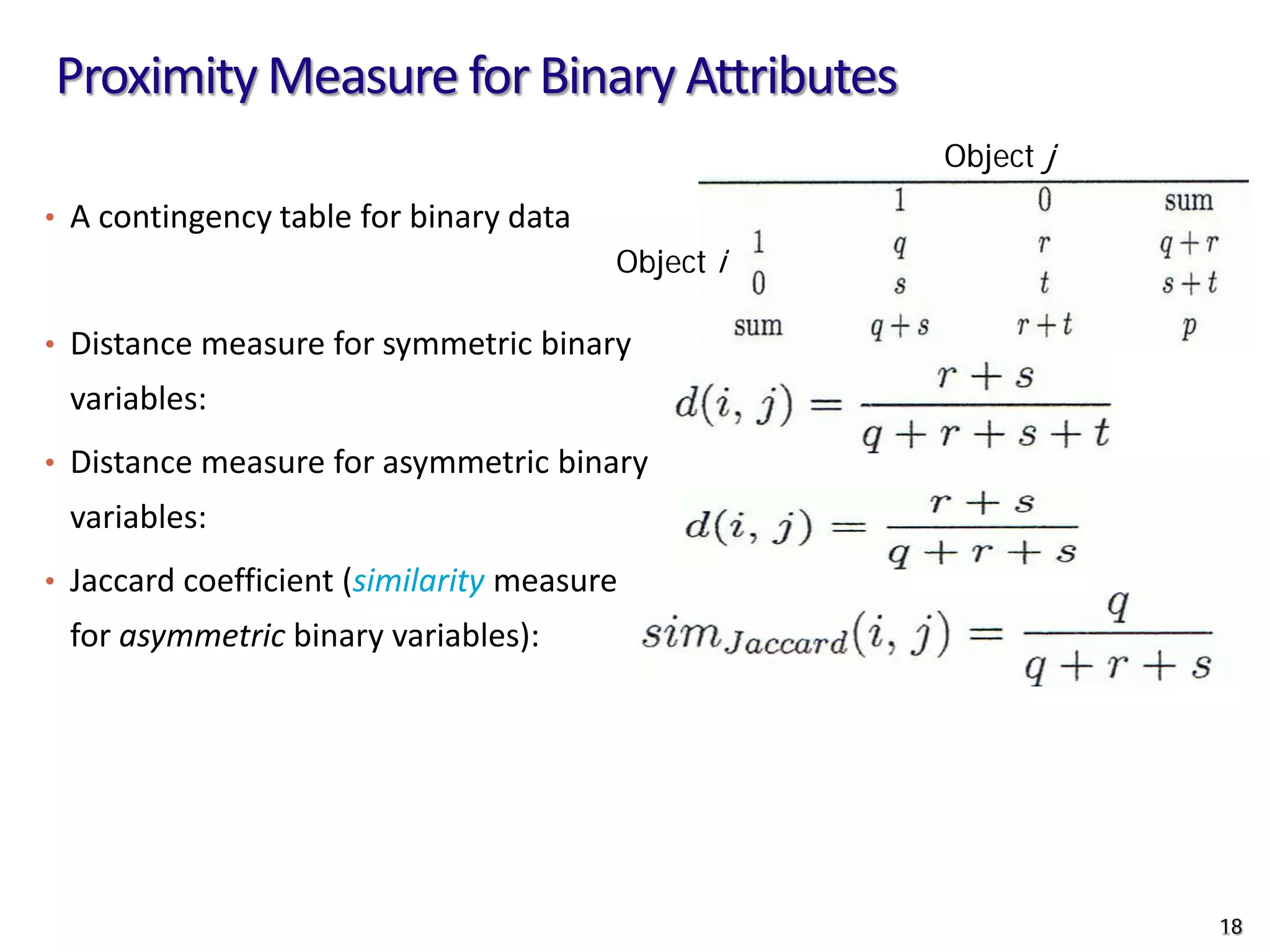
Proximity Measure for Binary Attributes
• A contingency table for binary data
• Distance measure for symmetric binary
variables:
• Distance measure for asymmetric binary
variables:
• Jaccard coefficient (similarity measure
for asymmetric binary variables):
Object i
Object j
18
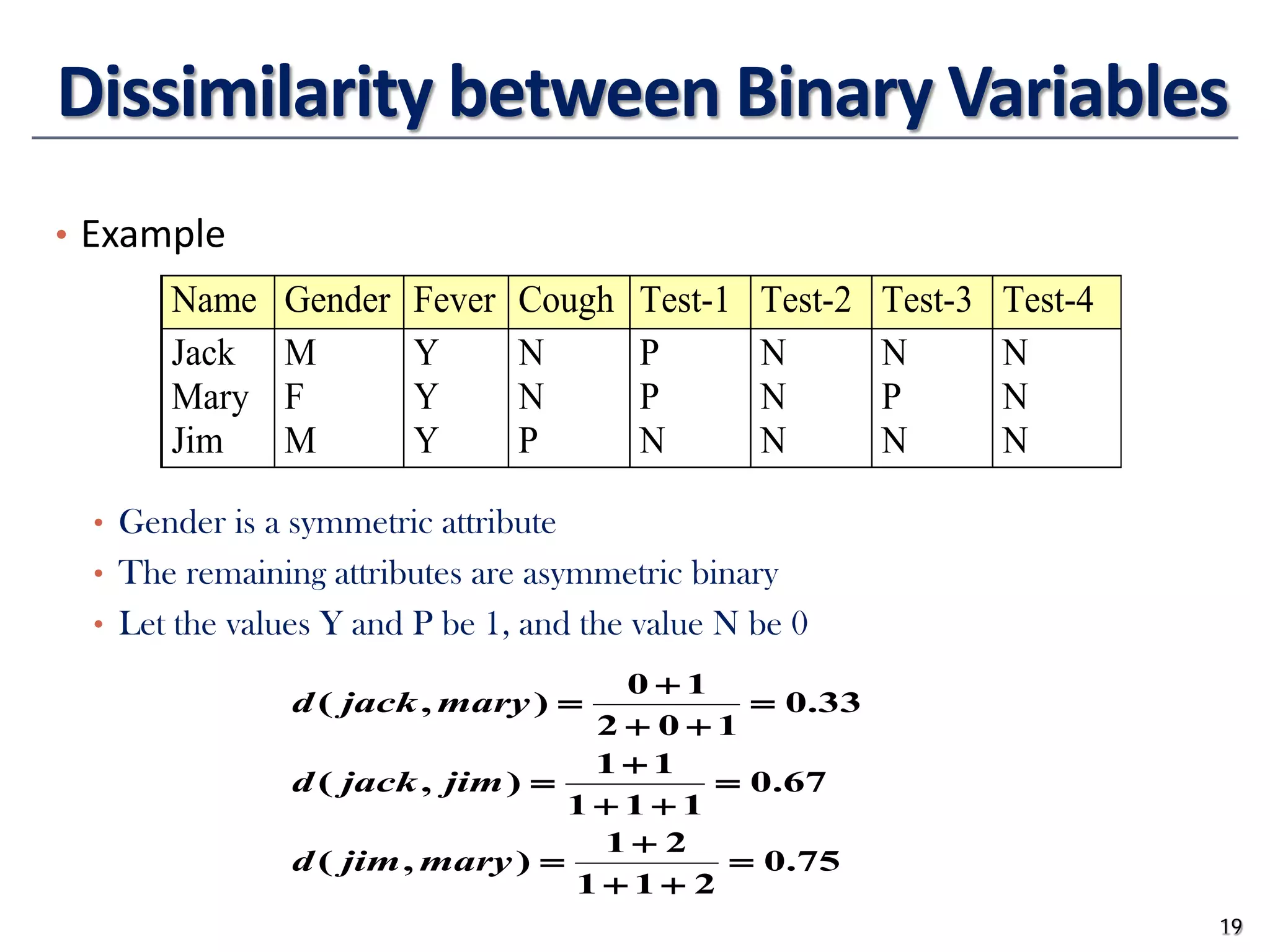
Dissimilarity between Binary Variables
• Example
• Gender is a symmetric attribute
• The remaining attributes are asymmetric binary
• Let the values Y and P be 1, and the value N be 0
19
Name Gender Fever Cough Test-1 Test-2 Test-3 Test-4
Jack M Y N P N N N
Mary F Y N P N P N
Jim M Y P N N N N
75
.
0
2
1
1
2
1
)
,
(
67
.
0
1
1
1
1
1
)
,
(
33
.
0
1
0
2
1
0
)
,
(
=
+
+
+
=
=
+
+
+
=
=
+
+
+
=
mary
jim
d
jim
jack
d
mary
jack
d
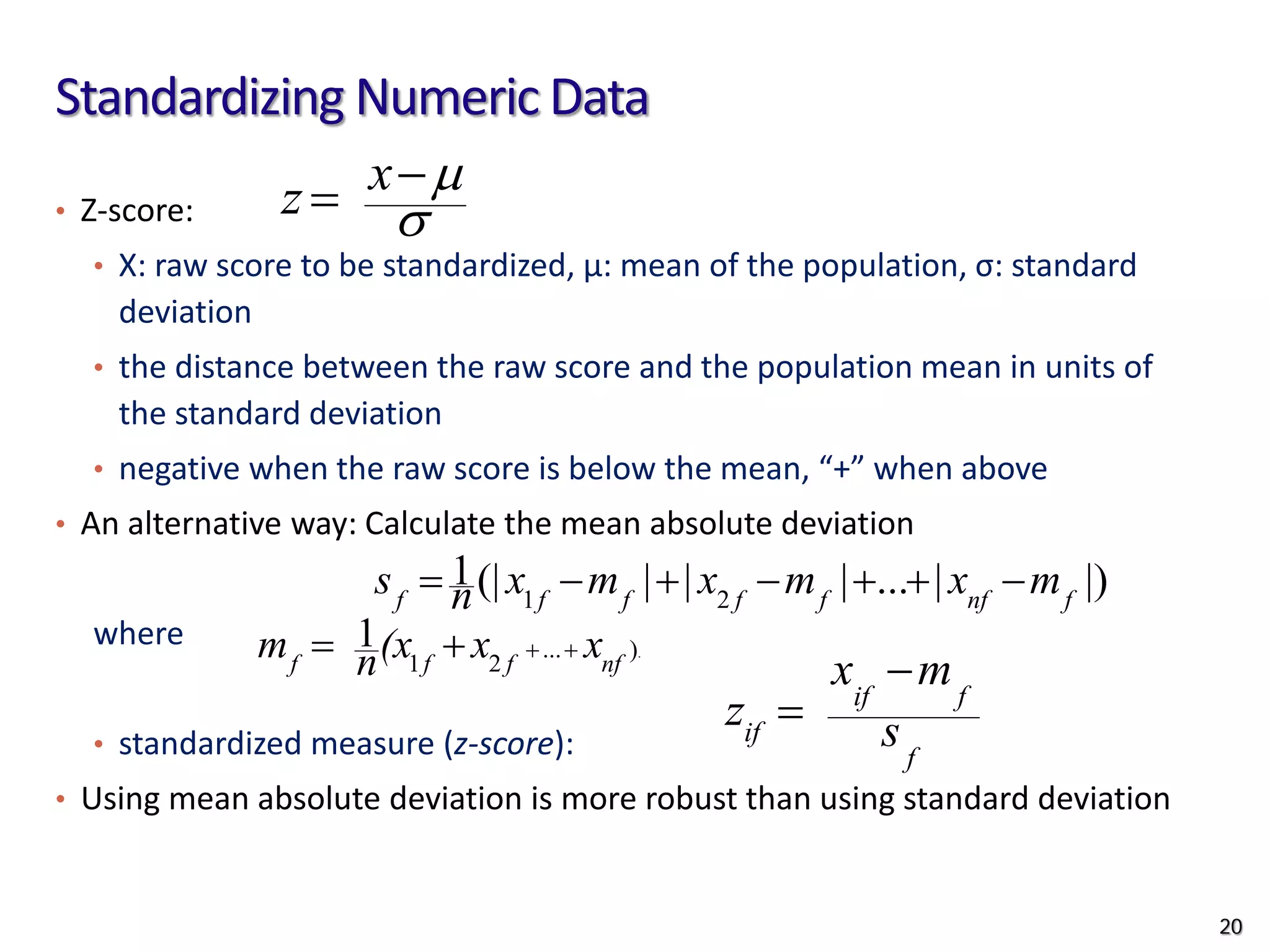
Standardizing Numeric Data
• Z-score:
• X: raw score to be standardized, μ: mean of the population, σ: standard
deviation
• the distance between the raw score and the population mean in units of
the standard deviation
• negative when the raw score is below the mean, “+” when above
• An alternative way: Calculate the mean absolute deviation
where
• standardized measure (z-score):
• Using mean absolute deviation is more robust than using standard deviation
σ
µ
−
= x
z
.
)
...
2
1
1
nf
f
f
f
x
x
(x
n
m +
+
+
=
|)
|
...
|
|
|
(|
1
2
1 f
nf
f
f
f
f
f
m
x
m
x
m
x
n
s −
+
+
−
+
−
=
f
f
if
if s
m
x
z
−
=
20
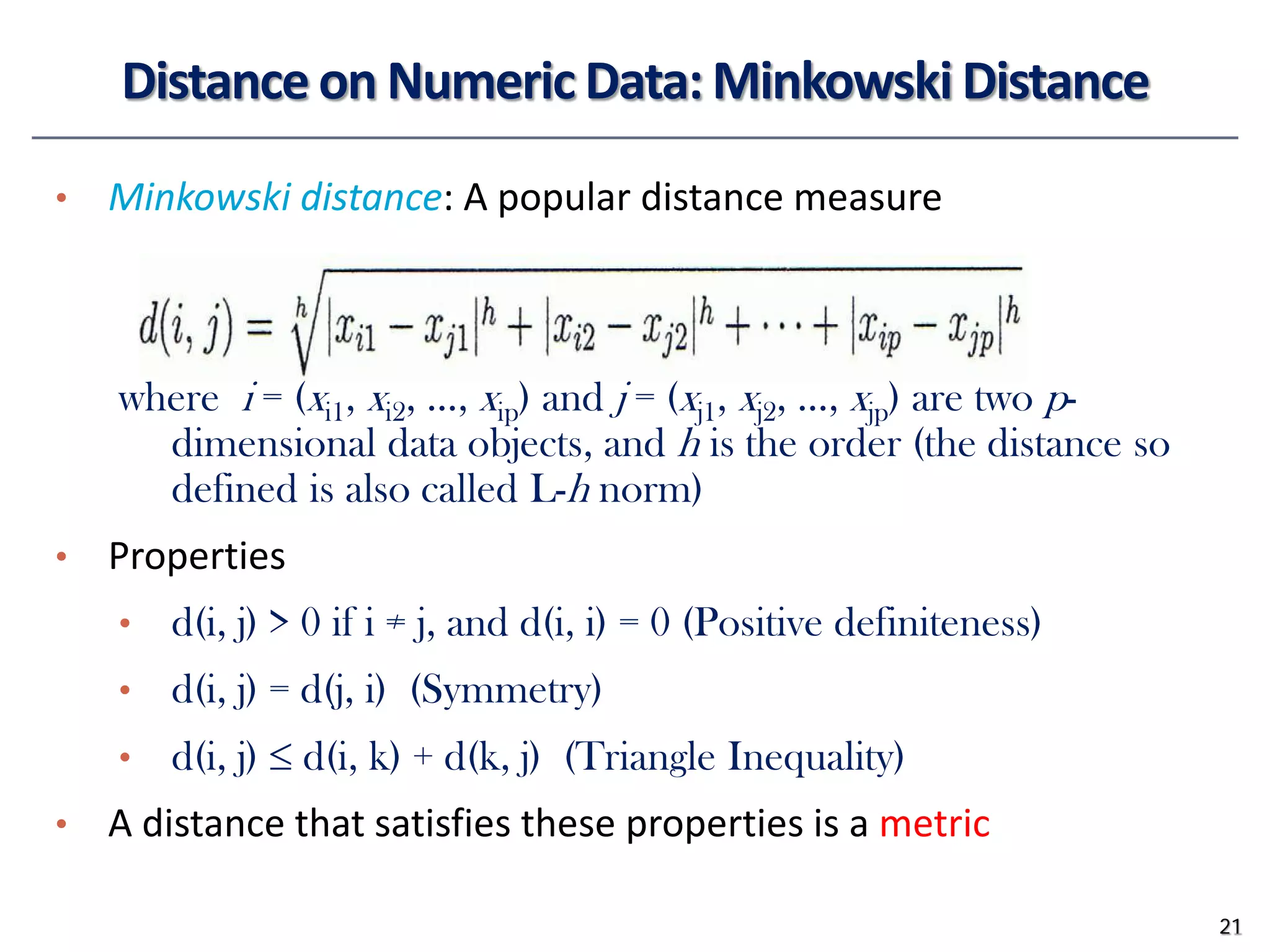
Distance on Numeric Data: Minkowski Distance
• Minkowski distance: A popular distance measure
where i = (xi1, xi2, …, xip) and j = (xj1, xj2, …, xjp) are two p-
dimensional data objects, and h is the order (the distance so
defined is also called L-h norm)
• Properties
• d(i, j) > 0 if i ≠ j, and d(i, i) = 0 (Positive definiteness)
• d(i, j) = d(j, i) (Symmetry)
• d(i, j) ≤ d(i, k) + d(k, j) (Triangle Inequality)
• A distance that satisfies these properties is a metric
21
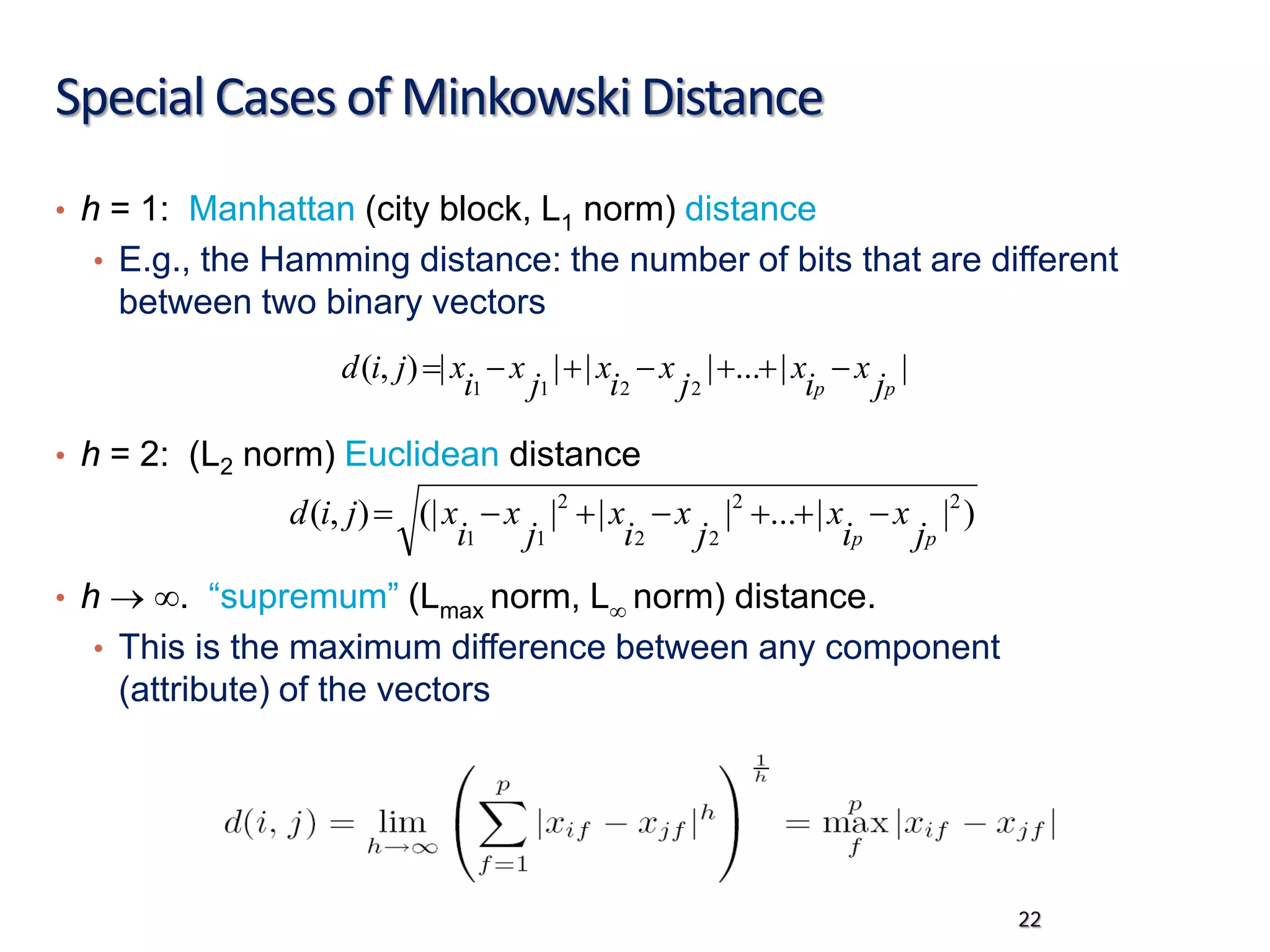
Special Cases of Minkowski Distance
• h = 1: Manhattan (city block, L1 norm) distance
• E.g., the Hamming distance: the number of bits that are different
between two binary vectors
• h = 2: (L2 norm) Euclidean distance
• h → ∞. “supremum” (Lmax norm, L∞ norm) distance.
• This is the maximum difference between any component
(attribute) of the vectors
|
|
...
|
|
|
|
)
,
(
2
2
1
1 p
p j
x
i
x
j
x
i
x
j
x
i
x
j
i
d −
+
+
−
+
−
=
22
)
|
|
...
|
|
|
(|
)
,
( 2
2
2
2
2
1
1 p
p j
x
i
x
j
x
i
x
j
x
i
x
j
i
d −
+
+
−
+
−
=
Example: Minkowski Distance
23
Dissimilarity Matrices
point attribute 1 attribute 2
x1 1 2
x2 3 5
x3 2 0
x4 4 5
L x1 x2 x3 x4
x1 0
x2 5 0
x3 3 6 0
x4 6 1 7 0
L2 x1 x2 x3 x4
x1 0
x2 3.61 0
x3 2.24 5.1 0
x4 4.24 1 5.39 0
L∞ x1 x2 x3 x4
x1 0
x2 3 0
x3 2 5 0
x4 3 1 5 0
Manhattan (L1)
Euclidean (L2)
Supremum
0 2 4
2
4
x
1
x
2
x
3
x
4
Ordinal Variables
• Order is important, e.g., rank
• Can be treated like interval-scaled
• replace xif by their rank
• map the range of each variable onto [0, 1] by replacing i-th object
in the f-th variable by
• compute the dissimilarity using methods for interval-scaled
variables
24
1
1
−
−
=
f
if
if M
r
z
}
,...,
1
{ f
if
M
r ∈
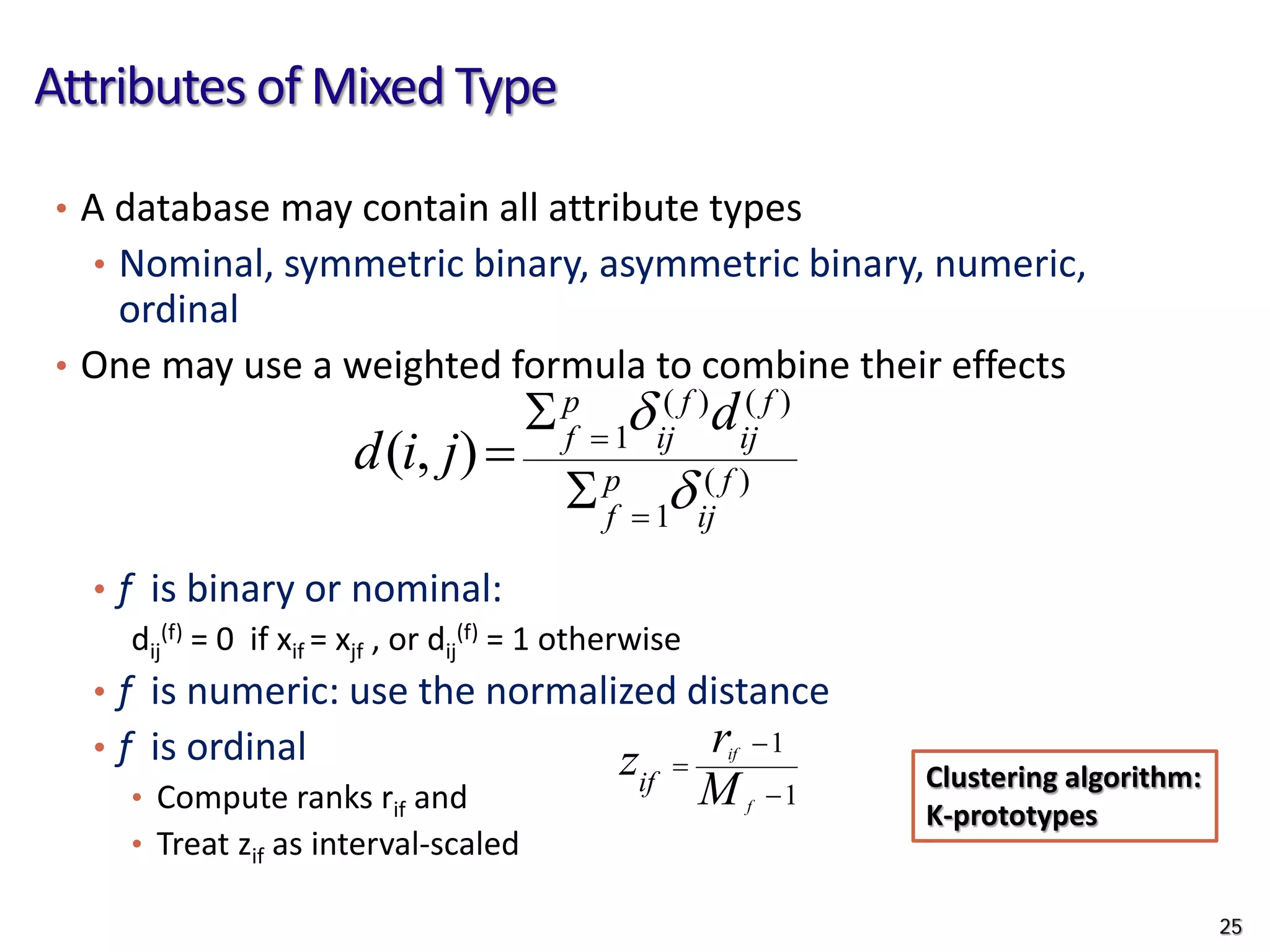
Attributes of Mixed Type
• A database may contain all attribute types
• Nominal, symmetric binary, asymmetric binary, numeric,
ordinal
• One may use a weighted formula to combine their effects
• f is binary or nominal:
dij
(f) = 0 if xif = xjf , or dij
(f) = 1 otherwise
• f is numeric: use the normalized distance
• f is ordinal
• Compute ranks rif and
• Treat zif as interval-scaled
)
(
1
)
(
)
(
1
)
,
( f
ij
p
f
f
ij
f
ij
p
f
d
j
i
d
δ
δ
=
=
Σ
Σ
=
1
1
−
−
=
f
if
M
r
zif
25
Clustering algorithm:
K-prototypes
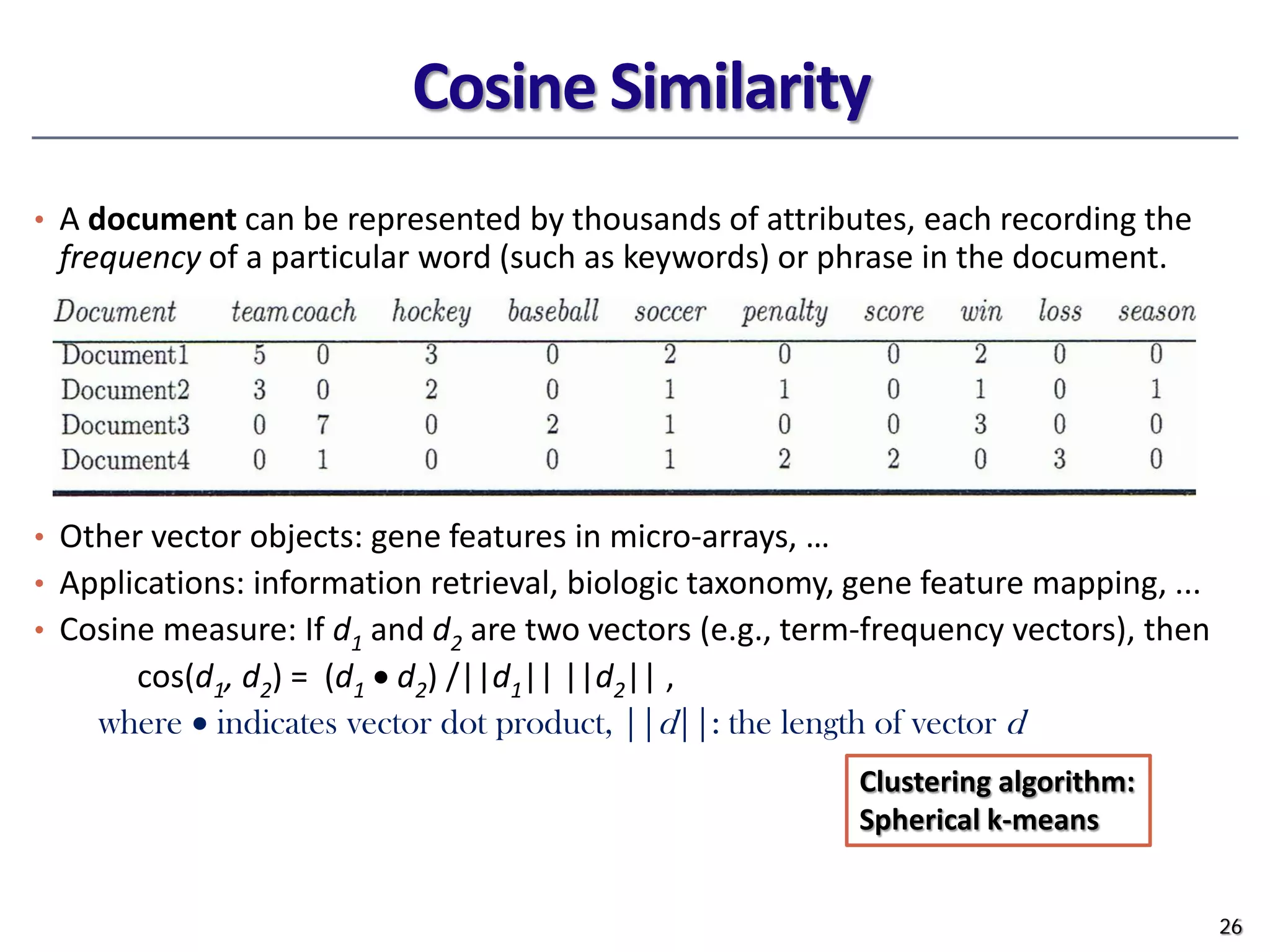
Cosine Similarity
• A document can be represented by thousands of attributes, each recording the
frequency of a particular word (such as keywords) or phrase in the document.
• Other vector objects: gene features in micro-arrays, …
• Applications: information retrieval, biologic taxonomy, gene feature mapping, ...
• Cosine measure: If d1 and d2 are two vectors (e.g., term-frequency vectors), then
cos(d1, d2) = (d1 • d2) /||d1|| ||d2|| ,
where • indicates vector dot product, ||d||: the length of vector d
26
Clustering algorithm:
Spherical k-means
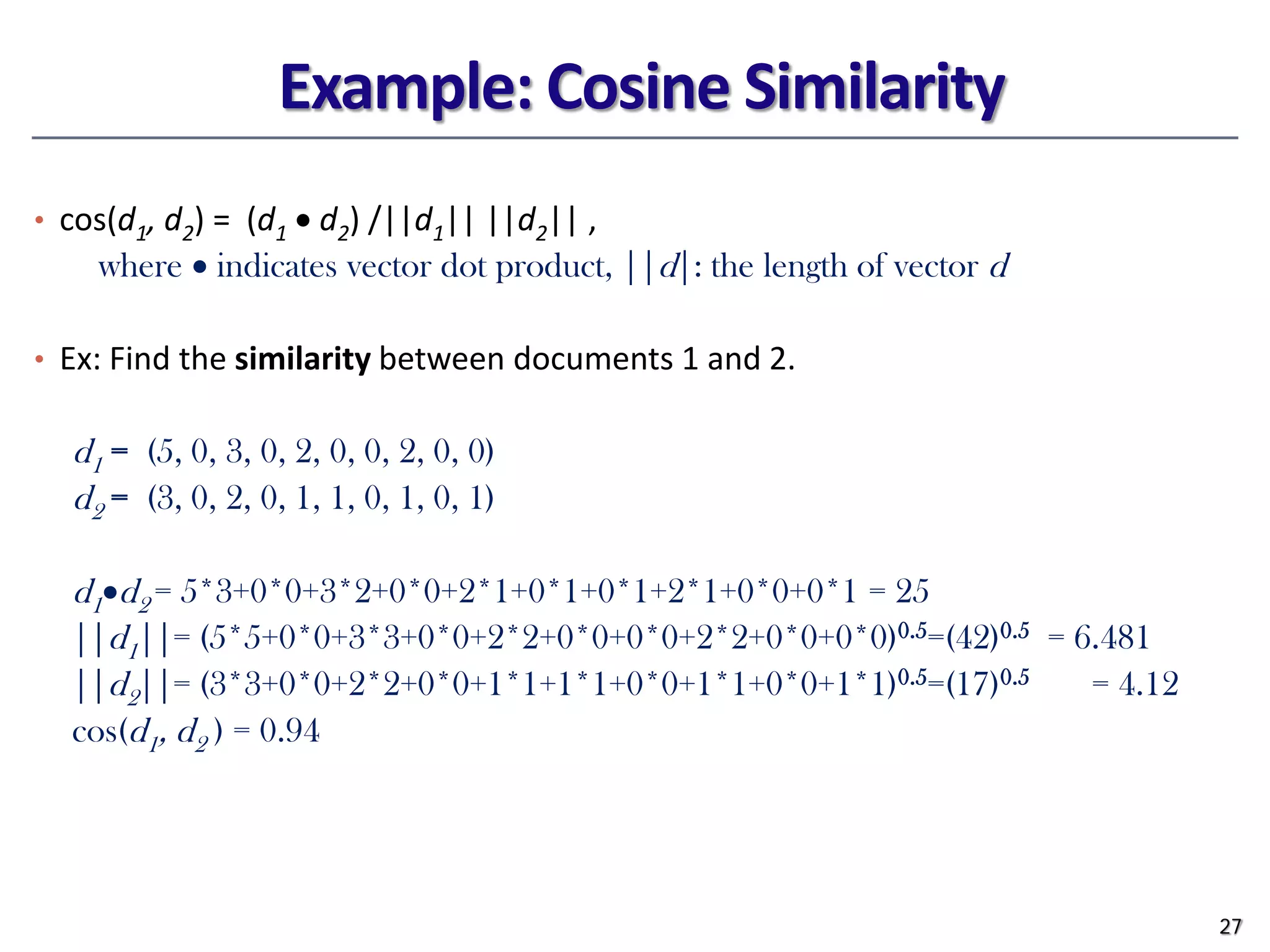
Example: Cosine Similarity
• cos(d1, d2) = (d1 • d2) /||d1|| ||d2|| ,
where • indicates vector dot product, ||d|: the length of vector d
• Ex: Find the similarity between documents 1 and 2.
d1 = (5, 0, 3, 0, 2, 0, 0, 2, 0, 0)
d2 = (3, 0, 2, 0, 1, 1, 0, 1, 0, 1)
d1•d2 = 5*3+0*0+3*2+0*0+2*1+0*1+0*1+2*1+0*0+0*1 = 25
||d1||= (5*5+0*0+3*3+0*0+2*2+0*0+0*0+2*2+0*0+0*0)0.5=(42)0.5 = 6.481
||d2||= (3*3+0*0+2*2+0*0+1*1+1*1+0*0+1*1+0*0+1*1)0.5=(17)0.5 = 4.12
cos(d1, d2 ) = 0.94
27
Evaluation and Other Practical Issues
•Evaluation of Clustering
•Similarity and Dissimilarity
•Summary
28
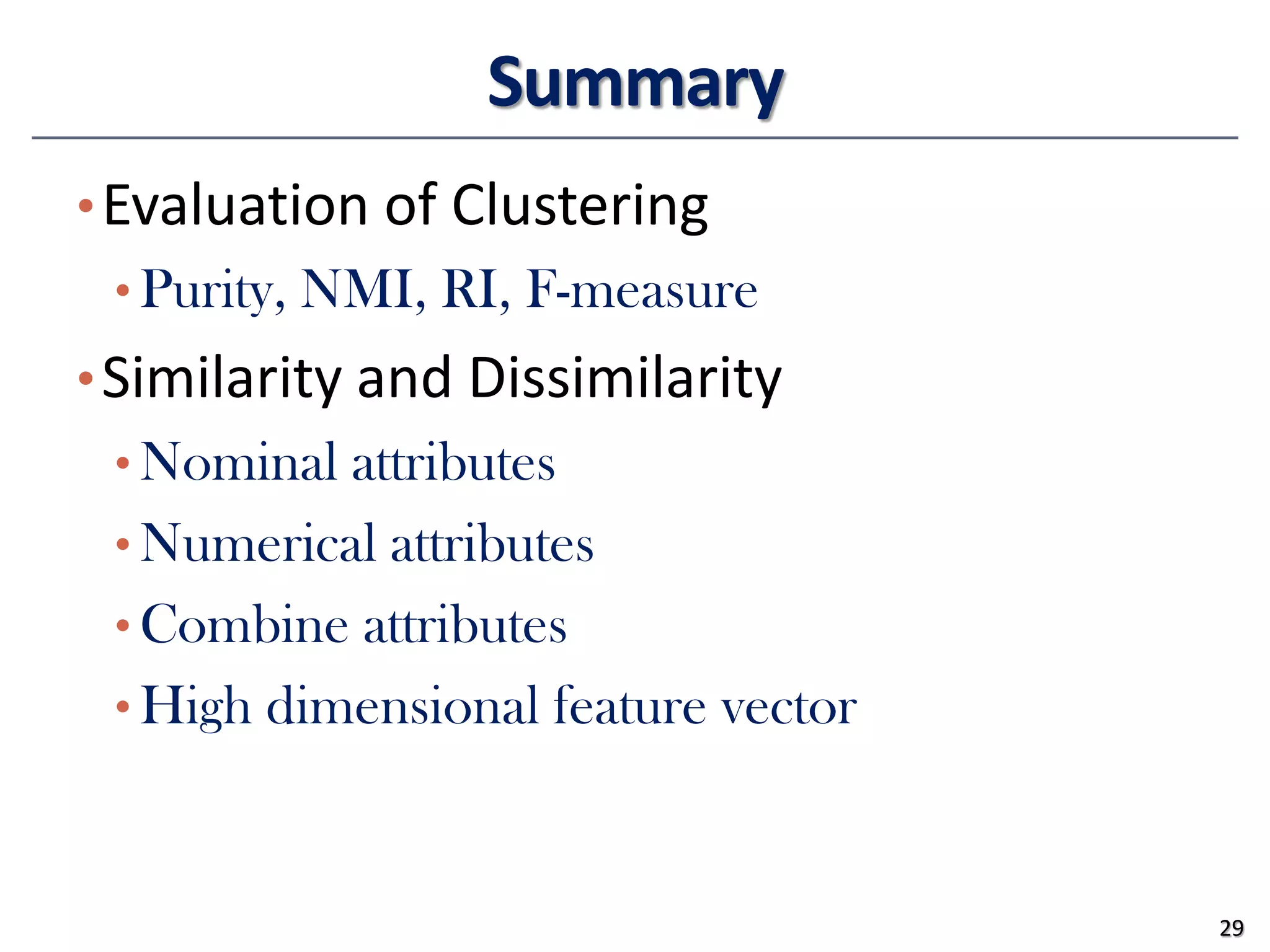
Summary
•Evaluation of Clustering
• Purity, NMI, RI, F-measure
•Similarity and Dissimilarity
• Nominal attributes
• Numerical attributes
• Combine attributes
• High dimensional feature vector
29

09Evaluation_Clustering.pdf

  • 1.
    CS249: ADVANCED DATAMINING Instructor: Yizhou Sun yzsun@cs.ucla.edu May 2, 2017 Clustering Evaluation and Practical Issues
  • 2.
    Announcements •Homework 2 duelater today • Due May 3rd (11:59pm) •Course project proposal • Due May 8th (11:59pm) •Homework 3 out • Due May 10th (11:59pm) 2
  • 3.
    Learnt Clustering Methods 3 VectorData Text Data Recommender System Graph & Network Classification Decision Tree; Naïve Bayes; Logistic Regression SVM; NN Label Propagation Clustering K-means; hierarchical clustering; DBSCAN; Mixture Models; kernel k-means PLSA; LDA Matrix Factorization SCAN; Spectral Clustering Prediction Linear Regression GLM Collaborative Filtering Ranking PageRank Feature Representation Word embedding Network embedding
  • 4.
    Evaluation and OtherPractical Issues •Evaluation of Clustering •Similarity and Dissimilarity •Summary 4
  • 5.
    Measuring Clustering Quality •Two methods: extrinsic vs. intrinsic • Extrinsic: supervised, i.e., the ground truth is available • Compare a clustering against the ground truth using certain clustering quality measure • Ex. Purity, precision and recall metrics, normalized mutual information • Intrinsic: unsupervised, i.e., the ground truth is unavailable • Evaluate the goodness of a clustering by considering how well the clusters are separated, and how compact the clusters are • Ex. Silhouette coefficient 5
  • 6.
    Purity • Let 𝑪𝑪= 𝑐𝑐1, … , 𝑐𝑐𝐾𝐾 be the output clustering result, 𝜴𝜴 = 𝜔𝜔1, … , 𝜔𝜔𝐽𝐽 be the ground truth clustering result (ground truth class) • 𝑐𝑐𝑘𝑘 𝑎𝑎𝑎𝑎𝑎𝑎 𝑤𝑤𝑘𝑘 are sets of data points • 𝑝𝑝𝑝𝑝𝑝𝑝𝑝𝑝𝑝𝑝𝑝𝑝 𝐶𝐶, Ω = 1 𝑁𝑁 ∑𝑘𝑘 max 𝑗𝑗 |𝑐𝑐𝑘𝑘 ∩ 𝜔𝜔𝑗𝑗| 6
  • 7.
    Example • Clustering output:cluster 1, cluster 2, and cluster 3 • Ground truth clustering result: ×’s, ◊’s, and ○’s. • cluster 1 vs. ×’s, cluster 2 vs. ○’s, and cluster 3 vs. ◊’s 7
  • 8.
    Normalized Mutual Information •𝑁𝑁𝑁𝑁𝑁𝑁 𝐶𝐶, Ω = 𝐼𝐼(𝐶𝐶,Ω) 𝐻𝐻 𝐶𝐶 𝐻𝐻(Ω) • 𝐼𝐼 Ω, 𝐶𝐶 = ∑𝑘𝑘 ∑𝑗𝑗 𝑃𝑃(𝑐𝑐𝑘𝑘 ∩ 𝜔𝜔𝑗𝑗) 𝑙𝑙𝑙𝑙𝑙𝑙 𝑃𝑃(𝑐𝑐𝑘𝑘∩𝑤𝑤𝑗𝑗) 𝑃𝑃 𝑐𝑐𝑘𝑘 𝑃𝑃(𝑤𝑤𝑗𝑗) • 𝐻𝐻 Ω = − ∑𝑗𝑗 𝑃𝑃 𝑤𝑤𝑗𝑗 𝑙𝑙𝑙𝑙𝑙𝑙𝑙𝑙 𝑤𝑤𝑗𝑗 = − � 𝑗𝑗 |𝜔𝜔𝑗𝑗| 𝑁𝑁 𝑙𝑙𝑙𝑙𝑙𝑙 |𝜔𝜔𝑗𝑗| 𝑁𝑁 8 = ∑𝑘𝑘 ∑𝑗𝑗 |𝑐𝑐𝑘𝑘∩𝜔𝜔𝑗𝑗| 𝑁𝑁 𝑙𝑙𝑙𝑙𝑙𝑙 𝑁𝑁|𝑐𝑐𝑘𝑘∩𝜔𝜔𝑗𝑗| 𝑐𝑐𝑘𝑘 ⋅|𝑤𝑤𝑗𝑗|
  • 9.
    Example Cluster 1 Cluster2 Cluster 3 sum crosses 5 1 2 8 circles 1 4 0 5 diamonds 0 1 3 4 sum 6 6 5 N=17 9 |𝝎𝝎𝒌𝒌 ∩ 𝒄𝒄𝒋𝒋| |𝝎𝝎𝒌𝒌| |𝒄𝒄𝒋𝒋| NMI=0.36
  • 10.
    Precision and Recall •Random Index (RI) = (TP+TN)/(TP+FP+FN+TN) • F-measure: 2P*R/(P+R) • P = TP/(TP+FP) • R = TP/(TP+FN) • Consider pairs of data points: • hopefully, two data points that are in the same cluster will be clustered into the same cluster (TP), and two data points that are in different clusters will be clustered into different clusters (TN). 10 Same cluster Different clusters Same class TP FN Different classes FP TN
  • 11.
    Example Data points Outputclustering Ground truth clustering (class) a 1 2 b 1 2 c 2 2 d 2 1 11 • # pairs of data points: 6 • (a, b): same class, same cluster • (a, c): same class, different cluster • (a, d): different class, different cluster • (b, c): same class, different cluster • (b, d): different class, different cluster • (c, d): different class, same cluster TP = 1 FP = 1 FN = 2 TN = 2 RI = 0.5 P= ½, R= 1/3, F = 0.4
  • 12.
    Question •If we flipthe ground truth cluster labels (2->1 and 1->2), will the evaluation results be the same? 12 Data points Output clustering Ground truth clustering (class) a 1 2 b 1 2 c 2 2 d 2 1
  • 13.
    Evaluation and OtherPractical Issues •Evaluation of Clustering •Similarity and Dissimilarity •Summary 13
  • 14.
    Similarity and Dissimilarity •Similarity • Numerical measure of how alike two data objects are • Value is higher when objects are more alike • Often falls in the range [0,1] • Dissimilarity (e.g., distance) • Numerical measure of how different two data objects are • Lower when objects are more alike • Minimum dissimilarity is often 0 • Upper limit varies • Proximity refers to a similarity or dissimilarity 14
  • 15.
    Data Matrix andDissimilarity Matrix • Data matrix • n data points with p dimensions • Two modes • Dissimilarity matrix • n data points, but registers only the distance • A triangular matrix • Single mode 15                   np x ... nf x ... n1 x ... ... ... ... ... ip x ... if x ... i1 x ... ... ... ... ... 1p x ... 1f x ... 11 x                 0 ... ) 2 , ( ) 1 , ( : : : ) 2 , 3 ( ) ... n d n d 0 d d(3,1 0 d(2,1) 0
  • 16.
    Example: DataMatrixandDissimilarityMatrix 16 point attribute1 attribute2 x11 2 x2 3 5 x3 2 0 x4 4 5 Dissimilarity Matrix (with Euclidean Distance) x1 x2 x3 x4 x1 0 x2 3.61 0 x3 2.24 5.1 0 x4 4.24 1 5.39 0 Data Matrix 0 2 4 2 4 x 1 x 2 x 3 x 4
  • 17.
    Proximity Measure forNominal Attributes • Can take 2 or more states, e.g., red, yellow, blue, green (generalization of a binary attribute) • Method 1: Simple matching • m: # of matches, p: total # of variables • Method 2: Use a large number of binary attributes • creating a new binary attribute for each of the M nominal states 17 p m p j i d − = ) , (
  • 18.
    Proximity Measure forBinary Attributes • A contingency table for binary data • Distance measure for symmetric binary variables: • Distance measure for asymmetric binary variables: • Jaccard coefficient (similarity measure for asymmetric binary variables): Object i Object j 18
  • 19.
    Dissimilarity between BinaryVariables • Example • Gender is a symmetric attribute • The remaining attributes are asymmetric binary • Let the values Y and P be 1, and the value N be 0 19 Name Gender Fever Cough Test-1 Test-2 Test-3 Test-4 Jack M Y N P N N N Mary F Y N P N P N Jim M Y P N N N N 75 . 0 2 1 1 2 1 ) , ( 67 . 0 1 1 1 1 1 ) , ( 33 . 0 1 0 2 1 0 ) , ( = + + + = = + + + = = + + + = mary jim d jim jack d mary jack d
  • 20.
    Standardizing Numeric Data •Z-score: • X: raw score to be standardized, μ: mean of the population, σ: standard deviation • the distance between the raw score and the population mean in units of the standard deviation • negative when the raw score is below the mean, “+” when above • An alternative way: Calculate the mean absolute deviation where • standardized measure (z-score): • Using mean absolute deviation is more robust than using standard deviation σ µ − = x z . ) ... 2 1 1 nf f f f x x (x n m + + + = |) | ... | | | (| 1 2 1 f nf f f f f f m x m x m x n s − + + − + − = f f if if s m x z − = 20
  • 21.
    Distance on NumericData: Minkowski Distance • Minkowski distance: A popular distance measure where i = (xi1, xi2, …, xip) and j = (xj1, xj2, …, xjp) are two p- dimensional data objects, and h is the order (the distance so defined is also called L-h norm) • Properties • d(i, j) > 0 if i ≠ j, and d(i, i) = 0 (Positive definiteness) • d(i, j) = d(j, i) (Symmetry) • d(i, j) ≤ d(i, k) + d(k, j) (Triangle Inequality) • A distance that satisfies these properties is a metric 21
  • 22.
    Special Cases ofMinkowski Distance • h = 1: Manhattan (city block, L1 norm) distance • E.g., the Hamming distance: the number of bits that are different between two binary vectors • h = 2: (L2 norm) Euclidean distance • h → ∞. “supremum” (Lmax norm, L∞ norm) distance. • This is the maximum difference between any component (attribute) of the vectors | | ... | | | | ) , ( 2 2 1 1 p p j x i x j x i x j x i x j i d − + + − + − = 22 ) | | ... | | | (| ) , ( 2 2 2 2 2 1 1 p p j x i x j x i x j x i x j i d − + + − + − =
  • 23.
    Example: Minkowski Distance 23 DissimilarityMatrices point attribute 1 attribute 2 x1 1 2 x2 3 5 x3 2 0 x4 4 5 L x1 x2 x3 x4 x1 0 x2 5 0 x3 3 6 0 x4 6 1 7 0 L2 x1 x2 x3 x4 x1 0 x2 3.61 0 x3 2.24 5.1 0 x4 4.24 1 5.39 0 L∞ x1 x2 x3 x4 x1 0 x2 3 0 x3 2 5 0 x4 3 1 5 0 Manhattan (L1) Euclidean (L2) Supremum 0 2 4 2 4 x 1 x 2 x 3 x 4
  • 24.
    Ordinal Variables • Orderis important, e.g., rank • Can be treated like interval-scaled • replace xif by their rank • map the range of each variable onto [0, 1] by replacing i-th object in the f-th variable by • compute the dissimilarity using methods for interval-scaled variables 24 1 1 − − = f if if M r z } ,..., 1 { f if M r ∈
  • 25.
    Attributes of MixedType • A database may contain all attribute types • Nominal, symmetric binary, asymmetric binary, numeric, ordinal • One may use a weighted formula to combine their effects • f is binary or nominal: dij (f) = 0 if xif = xjf , or dij (f) = 1 otherwise • f is numeric: use the normalized distance • f is ordinal • Compute ranks rif and • Treat zif as interval-scaled ) ( 1 ) ( ) ( 1 ) , ( f ij p f f ij f ij p f d j i d δ δ = = Σ Σ = 1 1 − − = f if M r zif 25 Clustering algorithm: K-prototypes
  • 26.
    Cosine Similarity • Adocument can be represented by thousands of attributes, each recording the frequency of a particular word (such as keywords) or phrase in the document. • Other vector objects: gene features in micro-arrays, … • Applications: information retrieval, biologic taxonomy, gene feature mapping, ... • Cosine measure: If d1 and d2 are two vectors (e.g., term-frequency vectors), then cos(d1, d2) = (d1 • d2) /||d1|| ||d2|| , where • indicates vector dot product, ||d||: the length of vector d 26 Clustering algorithm: Spherical k-means
  • 27.
    Example: Cosine Similarity •cos(d1, d2) = (d1 • d2) /||d1|| ||d2|| , where • indicates vector dot product, ||d|: the length of vector d • Ex: Find the similarity between documents 1 and 2. d1 = (5, 0, 3, 0, 2, 0, 0, 2, 0, 0) d2 = (3, 0, 2, 0, 1, 1, 0, 1, 0, 1) d1•d2 = 5*3+0*0+3*2+0*0+2*1+0*1+0*1+2*1+0*0+0*1 = 25 ||d1||= (5*5+0*0+3*3+0*0+2*2+0*0+0*0+2*2+0*0+0*0)0.5=(42)0.5 = 6.481 ||d2||= (3*3+0*0+2*2+0*0+1*1+1*1+0*0+1*1+0*0+1*1)0.5=(17)0.5 = 4.12 cos(d1, d2 ) = 0.94 27
  • 28.
    Evaluation and OtherPractical Issues •Evaluation of Clustering •Similarity and Dissimilarity •Summary 28
  • 29.
    Summary •Evaluation of Clustering •Purity, NMI, RI, F-measure •Similarity and Dissimilarity • Nominal attributes • Numerical attributes • Combine attributes • High dimensional feature vector 29