Introduction to Data
Science(Minor Degree)
UNIT-II
• UNIT - II Data Types & Statistical Description Types of Data: Attributes
and Measurement, What is an Attribute? The Type of an Attribute,
The Different Types of Attributes, Describing Attributes by the
Number of Values, Asymmetric Attributes, Binary Attribute, Nominal
Attributes, Ordinal Attributes, Numeric Attributes, Discrete versus
Continuous Attributes.
• Basic Statistical Descriptions of Data: Measuring the Central
Tendency: Mean, Median, and Mode, Measuring the Dispersion of
Data: Range, Quartiles, Variance, Standard Deviation, and
Interquartile Range, Graphic Displays of Basic Statistical Descriptions
of Data
Data Objects and Attribute Types
• Data sets are made up of data objects.
• A data object represents an entity—in a sales database, the objects
may be customers, store items, and sales; in a medical database, the
objects may be patients; in a university database, the objects may be
students, professors, and courses.
• Data objects are typically described by the attribute
• Data objects can also be referred to as samples, examples, instances,
data points, or objects.
• If the data objects are stored in a database, they are data tuples. That
is, the rows of a database correspond to the data objects, and the
columns correspond to the attributes
Data Objects and Attribute Types
What Is an Attribute?
• An attribute is a data field, representing a characteristic or feature of a data
object.
• The nouns attribute, dimension, feature, and variable are often used
interchangeably in the literature.
• The term dimension is commonly used in data warehousing. Machine
learning literature tends to use the term feature, while statisticians prefer
the term variable.
• Attributes describing a customer object can include, for example, customer
ID, name, and address
• A set of attributes used to describe a given object is called an attribute
vector (or feature vector).
• The distribution of data involving one attribute (or variable) is called
univariate. A bivariate distribution involves two attributes, and so on
Data Objects and Attribute Types
Types of Attribute:
The type of an attribute is determined by the set of possible values—
1.nominal,
2.binary,
3. ordinal,
4.or numeric
Attribute Types
1.Nominal Attributes
Nominal means “relating to names.” The values of a nominal attribute are
symbols or names of things.
Each value represents some kind of category, code, or state, and so nominal
attributes are also referred to as categorical.
The values do not have any meaningful order. In computer science, the
values are also known as enumerations.
Example:
Suppose that hair color and marital status are two attributes describing
person objects.
possible values for hair color are black, brown, blond, red, auburn, gray, and
white
The attribute marital status can take on the values single, married, divorced,
and widowed.
Attribute Types
2.Binary Attributes
A binary attribute is a nominal attribute with only two categories or
states: 0 or 1, where 0 typically means that the attribute is absent, and
1 means that it is present.
Binary attributes are referred to as Boolean if the two states
correspond to true and false
Example
Binary attributes. Given the attribute smoker describing a patient
object, 1 indicates that the patient smokes, while 0 indicates that the
patient does not
Attribute Types
• A binary attribute is symmetric if both of its states are equally
valuable and carry the same weight; that is, there is no preference on
which outcome should be coded as 0 or 1. One such example could
be the attribute gender having the states male and female.
• A binary attribute is asymmetric if the outcomes of the states are not
equally important, such as the positive and negative outcomes of a
medical test for HIV. By convention, we code the most important
outcome, which is usually the rarest one, by 1 (e.g., HIV positive) and
the other by 0 (e.g., HIV negative)
Attribute Types
3. Ordinal Attribute
An ordinal attribute is an attribute with possible values that have a
meaningful order or ranking among them, but the magnitude between
successive values is not known.
Example
Suppose that drink size corresponds to the size of drinks available at a
fast-food restaurant. This nominal attribute has three possible values:
small, medium, and large.
Other examples of ordinal attributes include grade (e.g., A+, A, A−, B+,
and so on) and professional rank.
Attribute Types
4. Numeric Attributes
A numeric attribute is quantitative; that is, it is a measurable quantity, represented
in integer or real values. Numeric attributes can be interval-scaled or ratio-scaled.
Interval-Scaled Attributes
Interval-scaled attributes are measured on a scale of equal-size units. The values of
interval-scaled attributes have order and can be positive, 0, or negative. Thus, in
addition to providing a ranking of values, such attributes allow us to compare and
quantify the difference between values.
Example:
A temperature attribute is interval-scaled
temperature. In addition, we can quantify the difference between values. For
example, a temperature of 20◦C is five degrees higher than a temperature of 15◦C.
Calendar dates are another example. For instance, the years 2002 and 2010 are
eight years apart.
Attribute Types
Ratio-Scaled Attributes
A ratio-scaled attribute is a numeric attribute with an inherent zero-
point. That is, if a measurement is ratio-scaled, we can speak of a value
as being a multiple (or ratio) of another value. In addition, the values
are ordered, and we can also compute the difference between values,
as well as the mean, median, and mode.
Example
Unlike temperatures in Celsius and Fahrenheit, the Kelvin (K)
temperature scale has what is considered a true zero-point (0◦K =
−273.15◦C): It is the point at which the particles that comprise matter
have zero kinetic energy
Discrete versus Continuous Attributes
• Organized attributes into nominal, binary, ordinal, and numeric types.
There are many ways to organize attribute types. The types are not
mutually exclusive.
• A discrete attribute has a finite or countably infinite set of values,
which may or may not be represented as integers.
• The attributes hair color, smoker, medical test, and drink size each
have a finite number of values, and so are discrete. Note that discrete
attributes may have numeric values, such as 0 and 1 for binary
attributes or, the values 0 to 110 for the attribute age
Discrete versus Continuous Attributes
• If an attribute is not discrete, it is continuous.
• The terms numeric attribute and continuous attribute are often used
interchangeably in the literature. (This can be confusing because, in
the classic sense, continuous values are real numbers, whereas
numeric values can be either integers or real numbers.)
• In practice, real values are represented using a finite number of digits.
Continuous attributes are typically represented as floating-point
variables.
Basic Statistical Descriptions of Data
Median:
• For skewed (asymmetric) data, a better measure of the center of data
is the median, which is the middle value in a set of ordered data
values.
• It is the value that separates the higher half of a data set from the
lower half.
• In probability and statistics, the median generally applies to numeric
data; however, we may extend the concept to ordinal data
Basic Statistical Descriptions of Data
• Suppose that a given data set of N values for an attribute X is sorted
in increasing order.
• If N is odd, then the median is the middle value of the ordered set.
• If N is even, then the median is not unique; it is the two middlemost
values and any value in between. If X is a numeric attribute in this
case, by convention, the median is taken as the average of the two
middlemost values
Basic Statistical Descriptions of Data
We can approximate the median of the entire data set (e.g., the median
salary) by interpolation using the formula
where L1 is the lower boundary of the median interval, N is the number of values in the entire data set,, ∑(freq)1
median is the frequency of the median interval, that are lower than the median interval. Freq median is the
frequency of the median interval, and width is the width of the median interval.
,
,
,
Basic Statistical Descriptions of Data
Mode:
The mode is another measure of central tendency. The mode for a set
of data is the value that occurs most frequently in the set.
Therefore, it can be determined for qualitative and quantitative
attributes. It is possible for the greatest frequency to correspond to
several different values, which results in more than one mode.
Data sets with one, two, or three modes are respectively called
unimodal, bimodal, and trimodal.
In general, a data set with two or more modes is multimodal. At the
other extreme, if each data value occurs only once, then there is no
mode
Basic Statistical Descriptions of Data
• For unimodal numeric data that are moderately skewed
(asymmetrical), we have the following empirical relation
This implies that the mode for unimodal frequency curves that are moderately
skewed can easily be approximated if the mean and median values are known
Basic Statistical Descriptions of Data
Midrange:
• The midrange can also be used to assess the central tendency of a
numeric data set.
• It is the average of the largest and smallest values in the set. This
measure is easy to compute using the SQL aggregate functions, max()
and min().
Basic Statistical Descriptions of Data
In a unimodal frequency curve with perfect symmetric data distribution, the mean, median, and mode
are all at the same center value
Basic Statistical Descriptions of Data
Measuring the Dispersion of Data: Range, Quartiles, Variance, Standard
Deviation, and Interquartile Range:
Range, Quartiles, and Interquartile Range
• Let x1,x2,...,xN be a set of observations for some numeric attribute,
X. The range of the set is the difference between the largest (max())
and smallest (min()) values.
• Quantiles are points taken at regular intervals of a data distribution,
dividing it into essentially equal size consecutive sets.
• The kth q-quantile for a given data distribution is the value x such that
at most k/q of the data values are less than x and at most (q − k)/q of
the data values are more than x, where k is an integer such that 0 < k
< q. There are q − 1 q-quantiles.
Basic Statistical Descriptions of Data
• The 2-quantile is the data point dividing the lower and upper halves
of the data distribution. It corresponds to the median.
• The 4-quantiles are the three data points that split the data
distribution into four equal parts; each part represents one-fourth of
the data distribution. They are more commonly referred to as
quartiles.
• The 100-quantiles are more commonly referred to as percentiles;
they divide the data distribution into 100 equal-sized consecutive
sets. The median, quartiles, and percentiles are the most widely used
forms of quantiles.
Basic Statistical Descriptions of Data
The distance between the first and third quartiles is a simple measure of spread that gives the range covered
by the middle half of the data. This distance is called the interquartile range (IQR) and is defined as
IQR = Q3 − Q1.
Basic Statistical Descriptions of Data
Five-Number Summary, Boxplots, and Outliers
The five-number summary of a distribution consists of the median (Q2), the quartiles Q1 and Q3, and
the smallest and largest individual observations, written in the order of Minimum, Q1, Median, Q3,
Maximum.
Boxplots are a popular way of visualizing a distribution. A boxplot incorporates the five-number
summary as follows:
Typically, the ends of the box are at the quartiles so that the box length is the interquartile
range.
The median is marked by a line within the box.
Two lines (called whiskers) outside the box extend to the smallest (Minimum) and largest
(Maximum) observations
Basic Statistical Descriptions of Data
• Boxplot. Figure 2.3 shows boxplots for unit price data for items sold at
four branches of AllElectronics during a given time period.
• For branch 1, we see that the median price of items sold is $80, Q1 is
$60, and Q3 is $100. Notice that two outlying observations for this
branch were plotted individually, as their values of 175 and 202 are
more than 1.5 times the IQR here of 40
• Boxplots can be computed in O(nlogn) time. Approximate boxplots
can be computed in linear or sublinear time depending on the quality
guarantee required
Basic Statistical Descriptions of Data
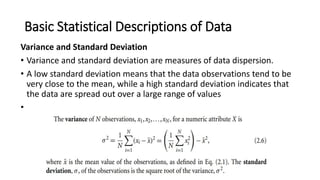
Variance and Standard Deviation
• Variance and standard deviation are measures of data dispersion.
• A low standard deviation means that the data observations tend to be
very close to the mean, while a high standard deviation indicates that
the data are spread out over a large range of values
•
Basic Statistical Descriptions of Data
• Graphic Displays of Basic Statistical Descriptions of Data
• graphic displays of basic statistical description, include quantile plots,
quantile–quantile plots, histograms, and scatter plots.
• Such graphs are helpful for the visual inspection of data, which is
useful for data preprocessing.
Basic Statistical Descriptions of Data
Quantile Plot:
• A quantile plot is a simple and effective way to have a first look at a
univariate data distribution.
• First, it displays all of the data for the given attribute
• Second, it plots quantile information
Basic Statistical Descriptions of Data
• Let xi , for i = 1 to N, be the data sorted in increasing order so that x1
is the smallest observation and xN is the largest for some ordinal or
numeric attribute X.
• Each observation, xi , is paired with a percentage, fi , which indicates
that approximately fi × 100% of the data are below the value, xi .
• We say “approximately” because there may not be a value with
exactly a fraction, fi , of the data below xi .
• Note that the 0.25 percentile corresponds to quartile Q1, the 0.50
percentile is the median, and the 0.75 percentile is Q3.
Basic Statistical Descriptions of Data
These numbers increase in equal steps of 1/N, ranging from 1 2N (which is slightly above 0) to 1 − 1 2N (which is
slightly below 1).
On a quantile plot, xi is graphed against fi . This allows us to compare different distributions based on their
quantiles.
For example, given the quantile plots of sales data for two different time periods, we can compare their Q1,
median, Q3, and other fi values at a glance.
Basic Statistical Descriptions of Data
Quantile–Quantile Plot
• A quantile–quantile plot, or q-q plot, graphs the quantiles of one
univariate distribution against the corresponding quantiles of another.
It is a powerful visualization tool in that it allows the user to view
whether there is a shift in going from one distribution to another
Basic Statistical Descriptions of Data
Histograms
• Histograms (or frequency histograms) are at least a century old and
are widely used. “Histos” means pole or mast, and “gram” means
chart, so a histogram is a chart of poles.
• Plotting histograms is a graphical method for summarizing the
distribution of a given attribute, X.
• If X is nominal, such as automobile model or item type, then a pole or
vertical bar is drawn for each known value of X.
• The height of the bar indicates the frequency (i.e., count) of that X
value. The resulting graph is more commonly known as a bar chart
Basic Statistical Descriptions of Data
• If X is numeric, the term histogram is preferred. The range of values
for X is partitioned into disjoint consecutive subranges.
• The subranges, referred to as buckets or bins, are disjoint subsets of
the data distribution for X.
• The range of a bucket is known as the width. Typically, the buckets
are of equal width.
• For example, a price attribute with a value range of $1 to $200
(rounded up to the nearest dollar) can be partitioned into subranges
1 to 20, 21 to 40, 41 to 60, and so on
Basic Statistical Descriptions of Data
Scatter Plots and Data Correlation
A scatter plot is one of the most effective graphical methods for
determining if there appears to be a relationship, pattern, or trend
between two numeric attributes.
• To construct a scatter plot, each pair of values is treated as a pair of
coordinates in an algebraic sense and plotted as points in the plane.
• The scatter plot is a useful method for providing a first look at
bivariate data to see clusters of points and outliers, or to explore the
possibility of correlation relationships.
• Two attributes, X, and Y, are correlated if one attribute implies the
other. Correlations can be positive, negative, or null (uncorrelated).
Basic Statistical Descriptions of Data
UNIT-II Question
1. What is Attribute? Explain different types of attributes with
examples.
2. Compare Discrete versus Continuous Attributes.
3. What is basic Statistical Descriptions of data.
4. How to measure the central tendency of data.
5. How to measure the dispersion of data.
6. Discuss various graphic displays of basic statistical descriptions.

3-1 unit-ii.pptx

  • 1.
  • 2.
    UNIT-II • UNIT -II Data Types & Statistical Description Types of Data: Attributes and Measurement, What is an Attribute? The Type of an Attribute, The Different Types of Attributes, Describing Attributes by the Number of Values, Asymmetric Attributes, Binary Attribute, Nominal Attributes, Ordinal Attributes, Numeric Attributes, Discrete versus Continuous Attributes. • Basic Statistical Descriptions of Data: Measuring the Central Tendency: Mean, Median, and Mode, Measuring the Dispersion of Data: Range, Quartiles, Variance, Standard Deviation, and Interquartile Range, Graphic Displays of Basic Statistical Descriptions of Data
  • 3.
    Data Objects andAttribute Types • Data sets are made up of data objects. • A data object represents an entity—in a sales database, the objects may be customers, store items, and sales; in a medical database, the objects may be patients; in a university database, the objects may be students, professors, and courses. • Data objects are typically described by the attribute • Data objects can also be referred to as samples, examples, instances, data points, or objects. • If the data objects are stored in a database, they are data tuples. That is, the rows of a database correspond to the data objects, and the columns correspond to the attributes
  • 4.
    Data Objects andAttribute Types What Is an Attribute? • An attribute is a data field, representing a characteristic or feature of a data object. • The nouns attribute, dimension, feature, and variable are often used interchangeably in the literature. • The term dimension is commonly used in data warehousing. Machine learning literature tends to use the term feature, while statisticians prefer the term variable. • Attributes describing a customer object can include, for example, customer ID, name, and address • A set of attributes used to describe a given object is called an attribute vector (or feature vector). • The distribution of data involving one attribute (or variable) is called univariate. A bivariate distribution involves two attributes, and so on
  • 5.
    Data Objects andAttribute Types Types of Attribute: The type of an attribute is determined by the set of possible values— 1.nominal, 2.binary, 3. ordinal, 4.or numeric
  • 6.
    Attribute Types 1.Nominal Attributes Nominalmeans “relating to names.” The values of a nominal attribute are symbols or names of things. Each value represents some kind of category, code, or state, and so nominal attributes are also referred to as categorical. The values do not have any meaningful order. In computer science, the values are also known as enumerations. Example: Suppose that hair color and marital status are two attributes describing person objects. possible values for hair color are black, brown, blond, red, auburn, gray, and white The attribute marital status can take on the values single, married, divorced, and widowed.
  • 7.
    Attribute Types 2.Binary Attributes Abinary attribute is a nominal attribute with only two categories or states: 0 or 1, where 0 typically means that the attribute is absent, and 1 means that it is present. Binary attributes are referred to as Boolean if the two states correspond to true and false Example Binary attributes. Given the attribute smoker describing a patient object, 1 indicates that the patient smokes, while 0 indicates that the patient does not
  • 8.
    Attribute Types • Abinary attribute is symmetric if both of its states are equally valuable and carry the same weight; that is, there is no preference on which outcome should be coded as 0 or 1. One such example could be the attribute gender having the states male and female. • A binary attribute is asymmetric if the outcomes of the states are not equally important, such as the positive and negative outcomes of a medical test for HIV. By convention, we code the most important outcome, which is usually the rarest one, by 1 (e.g., HIV positive) and the other by 0 (e.g., HIV negative)
  • 9.
    Attribute Types 3. OrdinalAttribute An ordinal attribute is an attribute with possible values that have a meaningful order or ranking among them, but the magnitude between successive values is not known. Example Suppose that drink size corresponds to the size of drinks available at a fast-food restaurant. This nominal attribute has three possible values: small, medium, and large. Other examples of ordinal attributes include grade (e.g., A+, A, A−, B+, and so on) and professional rank.
  • 10.
    Attribute Types 4. NumericAttributes A numeric attribute is quantitative; that is, it is a measurable quantity, represented in integer or real values. Numeric attributes can be interval-scaled or ratio-scaled. Interval-Scaled Attributes Interval-scaled attributes are measured on a scale of equal-size units. The values of interval-scaled attributes have order and can be positive, 0, or negative. Thus, in addition to providing a ranking of values, such attributes allow us to compare and quantify the difference between values. Example: A temperature attribute is interval-scaled temperature. In addition, we can quantify the difference between values. For example, a temperature of 20◦C is five degrees higher than a temperature of 15◦C. Calendar dates are another example. For instance, the years 2002 and 2010 are eight years apart.
  • 11.
    Attribute Types Ratio-Scaled Attributes Aratio-scaled attribute is a numeric attribute with an inherent zero- point. That is, if a measurement is ratio-scaled, we can speak of a value as being a multiple (or ratio) of another value. In addition, the values are ordered, and we can also compute the difference between values, as well as the mean, median, and mode. Example Unlike temperatures in Celsius and Fahrenheit, the Kelvin (K) temperature scale has what is considered a true zero-point (0◦K = −273.15◦C): It is the point at which the particles that comprise matter have zero kinetic energy
  • 12.
    Discrete versus ContinuousAttributes • Organized attributes into nominal, binary, ordinal, and numeric types. There are many ways to organize attribute types. The types are not mutually exclusive. • A discrete attribute has a finite or countably infinite set of values, which may or may not be represented as integers. • The attributes hair color, smoker, medical test, and drink size each have a finite number of values, and so are discrete. Note that discrete attributes may have numeric values, such as 0 and 1 for binary attributes or, the values 0 to 110 for the attribute age
  • 13.
    Discrete versus ContinuousAttributes • If an attribute is not discrete, it is continuous. • The terms numeric attribute and continuous attribute are often used interchangeably in the literature. (This can be confusing because, in the classic sense, continuous values are real numbers, whereas numeric values can be either integers or real numbers.) • In practice, real values are represented using a finite number of digits. Continuous attributes are typically represented as floating-point variables.
  • 14.
    Basic Statistical Descriptionsof Data Median: • For skewed (asymmetric) data, a better measure of the center of data is the median, which is the middle value in a set of ordered data values. • It is the value that separates the higher half of a data set from the lower half. • In probability and statistics, the median generally applies to numeric data; however, we may extend the concept to ordinal data
  • 15.
    Basic Statistical Descriptionsof Data • Suppose that a given data set of N values for an attribute X is sorted in increasing order. • If N is odd, then the median is the middle value of the ordered set. • If N is even, then the median is not unique; it is the two middlemost values and any value in between. If X is a numeric attribute in this case, by convention, the median is taken as the average of the two middlemost values
  • 16.
    Basic Statistical Descriptionsof Data We can approximate the median of the entire data set (e.g., the median salary) by interpolation using the formula where L1 is the lower boundary of the median interval, N is the number of values in the entire data set,, ∑(freq)1 median is the frequency of the median interval, that are lower than the median interval. Freq median is the frequency of the median interval, and width is the width of the median interval. , , ,
  • 17.
    Basic Statistical Descriptionsof Data Mode: The mode is another measure of central tendency. The mode for a set of data is the value that occurs most frequently in the set. Therefore, it can be determined for qualitative and quantitative attributes. It is possible for the greatest frequency to correspond to several different values, which results in more than one mode. Data sets with one, two, or three modes are respectively called unimodal, bimodal, and trimodal. In general, a data set with two or more modes is multimodal. At the other extreme, if each data value occurs only once, then there is no mode
  • 18.
    Basic Statistical Descriptionsof Data • For unimodal numeric data that are moderately skewed (asymmetrical), we have the following empirical relation This implies that the mode for unimodal frequency curves that are moderately skewed can easily be approximated if the mean and median values are known
  • 19.
    Basic Statistical Descriptionsof Data Midrange: • The midrange can also be used to assess the central tendency of a numeric data set. • It is the average of the largest and smallest values in the set. This measure is easy to compute using the SQL aggregate functions, max() and min().
  • 20.
    Basic Statistical Descriptionsof Data In a unimodal frequency curve with perfect symmetric data distribution, the mean, median, and mode are all at the same center value
  • 21.
    Basic Statistical Descriptionsof Data Measuring the Dispersion of Data: Range, Quartiles, Variance, Standard Deviation, and Interquartile Range: Range, Quartiles, and Interquartile Range • Let x1,x2,...,xN be a set of observations for some numeric attribute, X. The range of the set is the difference between the largest (max()) and smallest (min()) values. • Quantiles are points taken at regular intervals of a data distribution, dividing it into essentially equal size consecutive sets. • The kth q-quantile for a given data distribution is the value x such that at most k/q of the data values are less than x and at most (q − k)/q of the data values are more than x, where k is an integer such that 0 < k < q. There are q − 1 q-quantiles.
  • 22.
    Basic Statistical Descriptionsof Data • The 2-quantile is the data point dividing the lower and upper halves of the data distribution. It corresponds to the median. • The 4-quantiles are the three data points that split the data distribution into four equal parts; each part represents one-fourth of the data distribution. They are more commonly referred to as quartiles. • The 100-quantiles are more commonly referred to as percentiles; they divide the data distribution into 100 equal-sized consecutive sets. The median, quartiles, and percentiles are the most widely used forms of quantiles.
  • 23.
    Basic Statistical Descriptionsof Data The distance between the first and third quartiles is a simple measure of spread that gives the range covered by the middle half of the data. This distance is called the interquartile range (IQR) and is defined as IQR = Q3 − Q1.
  • 24.
    Basic Statistical Descriptionsof Data Five-Number Summary, Boxplots, and Outliers The five-number summary of a distribution consists of the median (Q2), the quartiles Q1 and Q3, and the smallest and largest individual observations, written in the order of Minimum, Q1, Median, Q3, Maximum. Boxplots are a popular way of visualizing a distribution. A boxplot incorporates the five-number summary as follows: Typically, the ends of the box are at the quartiles so that the box length is the interquartile range. The median is marked by a line within the box. Two lines (called whiskers) outside the box extend to the smallest (Minimum) and largest (Maximum) observations
  • 25.
  • 26.
    Basic Statistical Descriptionsof Data • Boxplot. Figure 2.3 shows boxplots for unit price data for items sold at four branches of AllElectronics during a given time period. • For branch 1, we see that the median price of items sold is $80, Q1 is $60, and Q3 is $100. Notice that two outlying observations for this branch were plotted individually, as their values of 175 and 202 are more than 1.5 times the IQR here of 40 • Boxplots can be computed in O(nlogn) time. Approximate boxplots can be computed in linear or sublinear time depending on the quality guarantee required
  • 27.
    Basic Statistical Descriptionsof Data Variance and Standard Deviation • Variance and standard deviation are measures of data dispersion. • A low standard deviation means that the data observations tend to be very close to the mean, while a high standard deviation indicates that the data are spread out over a large range of values •
  • 28.
    Basic Statistical Descriptionsof Data • Graphic Displays of Basic Statistical Descriptions of Data • graphic displays of basic statistical description, include quantile plots, quantile–quantile plots, histograms, and scatter plots. • Such graphs are helpful for the visual inspection of data, which is useful for data preprocessing.
  • 29.
    Basic Statistical Descriptionsof Data Quantile Plot: • A quantile plot is a simple and effective way to have a first look at a univariate data distribution. • First, it displays all of the data for the given attribute • Second, it plots quantile information
  • 30.
    Basic Statistical Descriptionsof Data • Let xi , for i = 1 to N, be the data sorted in increasing order so that x1 is the smallest observation and xN is the largest for some ordinal or numeric attribute X. • Each observation, xi , is paired with a percentage, fi , which indicates that approximately fi × 100% of the data are below the value, xi . • We say “approximately” because there may not be a value with exactly a fraction, fi , of the data below xi . • Note that the 0.25 percentile corresponds to quartile Q1, the 0.50 percentile is the median, and the 0.75 percentile is Q3.
  • 31.
    Basic Statistical Descriptionsof Data These numbers increase in equal steps of 1/N, ranging from 1 2N (which is slightly above 0) to 1 − 1 2N (which is slightly below 1). On a quantile plot, xi is graphed against fi . This allows us to compare different distributions based on their quantiles. For example, given the quantile plots of sales data for two different time periods, we can compare their Q1, median, Q3, and other fi values at a glance.
  • 32.
  • 33.
  • 34.
    Basic Statistical Descriptionsof Data Quantile–Quantile Plot • A quantile–quantile plot, or q-q plot, graphs the quantiles of one univariate distribution against the corresponding quantiles of another. It is a powerful visualization tool in that it allows the user to view whether there is a shift in going from one distribution to another
  • 35.
  • 36.
    Basic Statistical Descriptionsof Data Histograms • Histograms (or frequency histograms) are at least a century old and are widely used. “Histos” means pole or mast, and “gram” means chart, so a histogram is a chart of poles. • Plotting histograms is a graphical method for summarizing the distribution of a given attribute, X. • If X is nominal, such as automobile model or item type, then a pole or vertical bar is drawn for each known value of X. • The height of the bar indicates the frequency (i.e., count) of that X value. The resulting graph is more commonly known as a bar chart
  • 37.
    Basic Statistical Descriptionsof Data • If X is numeric, the term histogram is preferred. The range of values for X is partitioned into disjoint consecutive subranges. • The subranges, referred to as buckets or bins, are disjoint subsets of the data distribution for X. • The range of a bucket is known as the width. Typically, the buckets are of equal width. • For example, a price attribute with a value range of $1 to $200 (rounded up to the nearest dollar) can be partitioned into subranges 1 to 20, 21 to 40, 41 to 60, and so on
  • 38.
  • 39.
    Basic Statistical Descriptionsof Data Scatter Plots and Data Correlation A scatter plot is one of the most effective graphical methods for determining if there appears to be a relationship, pattern, or trend between two numeric attributes. • To construct a scatter plot, each pair of values is treated as a pair of coordinates in an algebraic sense and plotted as points in the plane. • The scatter plot is a useful method for providing a first look at bivariate data to see clusters of points and outliers, or to explore the possibility of correlation relationships. • Two attributes, X, and Y, are correlated if one attribute implies the other. Correlations can be positive, negative, or null (uncorrelated).
  • 40.
  • 41.
  • 42.
  • 43.
    UNIT-II Question 1. Whatis Attribute? Explain different types of attributes with examples. 2. Compare Discrete versus Continuous Attributes. 3. What is basic Statistical Descriptions of data. 4. How to measure the central tendency of data. 5. How to measure the dispersion of data. 6. Discuss various graphic displays of basic statistical descriptions.

Editor's Notes

  • #19 This implies that the mode for unimodal frequency curves that are moderately skewed can easily be approximated if the mean and median values are known
  • #21 tively skewed, where the mode occurs at a value that is smaller than the median (Figure 2.1b), or negatively skewed, where the mode occurs at a value greater than the median (Figure 2.1c)