Change Management


Presented by: -

Ankur Kejriwal

                   A.K         1
What is “Change Management”?
Change management is an important aspect of management that tries to ensure that a 
business responds to the environment in which it operates. 

There are four key features of change management:

•  Change is the result of dissatisfaction with present strategies
•  It is essential to develop a vision for a better alternative
•  Management have to develop strategies to implement change
•  There will be resistance to change


                                              A.K                                     2
Forces for Change

Internal forces for change
1. A general sense that the business could “do better”
2. Desire to increase profitability
3. Reorganization to increase efficiency
4. Natural ageing and decline in a business (e.g. machinery, products)
5. Conflict between departments
6. The need for greater flexibility in organizational structures
7. Concerns about ineffective communication, de-motivation or poor business
relationships


                                           A.K                                3
External forces for change

1. Increased demands for higher quality and levels of customer service
2. Uncertain economic conditions
3. Greater competition
4. Higher cost of inputs
5. Legislation & taxes
6. Political interests
7. Ethics & social values
8. Technological change
9. Globalization
10. Scarcity of natural resources
11. Changing nature and composition of the workforce


                                           A.K                           4
Resistance to Change
Despite the potential positive outcomes, change is nearly always resisted. A degree of
resistance is normal since change is:

• Disruptive, and
• Stressful


Management trying to implement change will often come across other people in the
business responding with phrases such as:

                           “My needs are already being met”
                               “We don’t need to do this”
                              “This sounds like bad news”
                            “The risks outweigh the benefits”
                             “What does this mean for me?”

Of course a degree of scepticism can be healthy especially where there are weaknesses
in the proposed changes. However resistance will also impede the achievement of
business objectives.


                                            A.K                                          5
Some common reasons why change is resisted
include:
1. Habit                   Habit provides both comfort and security
                           Habits are often well-established and difficult to change

2. Misunderstanding        Communications problems
                           Inadequate information
3. Low tolerance of change Sense of insecurity

4. Different assessment of Disagreement over the need for change
the situation              Disagreement over the advantages and disadvantages

5. Economic implications   Employees are likely to resist change which is perceived as
                           affecting their pay or other rewards
                           Established patterns of working and reward create a vested
                           interest in maintaining the status quo

6. Fear of the unknown     Proposed changes which confront people tend to generate
                           fear and anxiety
                           Introducing new technology or working practices creates
                           uncertainty


                                          A.K                                            6
We have touched earlier on personal barriers to change – there are also several
organizational barriers to change, including:

•Structural inertia
•Existing power structures
•Resistance from work groups
•Failure of previous change initiatives


Change is also resisted because of the poor way in which change is managed!
For example, a failure by management responsible for the change to:

•Explain the need for change
•Provide information
•Consult, negotiate and offer support and training
•Involve people in the process
•Build trust and sense of security
•Build employee relations


                                          A.K                                     7
Overcoming Resistance to Change
• Involve interested parties in the planning of change by asking them for suggestions and
incorporating their ideas.
• Clearly define the need for the change by communicating the strategic decision personally
and in written form.

• Address the "people needs" of those involved. Disrupt only what needs to be changed. Help
people retain friendships, comfortable settings and group norms wherever possible.

• Design flexibility into change by phasing it in wherever possible. This will allow people to
complete current efforts and assimilate new behaviours along the way.

• Be open and honest.

• Focus continually on the positive aspects of the change. Be specific where you can.

• Do not leave openings for people to return to the status quo. If you and your organization
are not ready to commit yourselves to the change, don't announce the strategy.


                                               A.K                                               8
Approaches to Managing Organizational
Change

• From several approaches of organizational change, two most
  important are as under :

1. Lewin’s Three-Step Model
2. Kotter’s Eight-Step Plan


                              A.K                              9
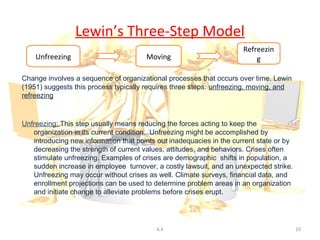
Lewin’s Three-Step Model
                                                                      Refreezin
    Unfreezing                         Moving                             g

Change involves a sequence of organizational processes that occurs over time. Lewin
(1951) suggests this process typically requires three steps: unfreezing, moving, and
refreezing


Unfreezing: This step usually means reducing the forces acting to keep the
   organization in its current condition. Unfreezing might be accomplished by
   introducing new information that points out inadequacies in the current state or by
   decreasing the strength of current values, attitudes, and behaviors. Crises often
   stimulate unfreezing. Examples of crises are demographic shifts in population, a
   sudden increase in employee turnover, a costly lawsuit, and an unexpected strike.
   Unfreezing may occur without crises as well. Climate surveys, financial data, and
   enrollment projections can be used to determine problem areas in an organization
   and initiate change to alleviate problems before crises erupt.


                                          A.K                                            10
Cont…


Moving: Once the organization is unfrozen, it can be changed by moving. This step
   usually involves the development of new values, attitudes, and behaviors through
   internalization, identification, or change in structure. Some changes may be minor
   and involve a few members—such as changes in recruitment and selection
   procedures—and others may be major, involving many participants. Examples of
   the latter include a new evaluation system, restructuring of jobs and duties
   performed by staff, or restructuring a department or entire organization, which
   necessitates relocating staff to different sites within the organization.


Refreezing: The final step in the change process involves stabilizing the change at a
   new quasi-stationary equilibrium, which is called refreezing. Changes in
   organizational culture, changes in staff norms, changes in organization policy, or
   modifications in organizational structure often accomplish this.


                                           A.K                                          11
Kotter’s Eight-Step Plan

1. Establish a sense of urgency : Unfreeze the organization by creating a
compelling reason forwhy change is needed.

2. Create the guiding coalition: Create a cross-functional, cross-level group of
people with enough power to lead the change.

3. Develop a vision and strategy: Create a vision and strategic plan to guide the
change process.

4. Communicate the change vision: Create and implement a communication
strategy that consistently communicates the new vision and strategic plan.

5. Empower broad-based action: Eliminate barriers to change, and use target
elements of change to transform the organization. Encourage risk taking and creative
problem solving.


                                            A.K                                        12
Cont…


6. Generate short-term wins: Plan for and create short-term “wins” or
improvements. Recognize and reward people who contribute to the wins.


7. Consolidate gains and produce more change: The guiding coalition uses credibility
from short-term wins to create more change. Additional people are brought into the
change process as change cascades throughout the
organization. Attempts are made to reinvigorate the change process.


8. Anchor new approaches in the culture: Reinforce the changes by highlighting
connections between new behaviors and processes and organizational success.
Develop methods to ensure leadership development and succession.


                                          A.K                                          13
Thank you


“Change is the only
  constant in life!”

          A.K          14

Change management

  • 1.
    Change Management Presented by:- Ankur Kejriwal A.K 1
  • 2.
    What is “ChangeManagement”? Change management is an important aspect of management that tries to ensure that a  business responds to the environment in which it operates.  There are four key features of change management: •  Change is the result of dissatisfaction with present strategies •  It is essential to develop a vision for a better alternative •  Management have to develop strategies to implement change •  There will be resistance to change A.K 2
  • 3.
    Forces for Change Internalforces for change 1. A general sense that the business could “do better” 2. Desire to increase profitability 3. Reorganization to increase efficiency 4. Natural ageing and decline in a business (e.g. machinery, products) 5. Conflict between departments 6. The need for greater flexibility in organizational structures 7. Concerns about ineffective communication, de-motivation or poor business relationships A.K 3
  • 4.
    External forces forchange 1. Increased demands for higher quality and levels of customer service 2. Uncertain economic conditions 3. Greater competition 4. Higher cost of inputs 5. Legislation & taxes 6. Political interests 7. Ethics & social values 8. Technological change 9. Globalization 10. Scarcity of natural resources 11. Changing nature and composition of the workforce A.K 4
  • 5.
    Resistance to Change Despitethe potential positive outcomes, change is nearly always resisted. A degree of resistance is normal since change is: • Disruptive, and • Stressful Management trying to implement change will often come across other people in the business responding with phrases such as: “My needs are already being met” “We don’t need to do this” “This sounds like bad news” “The risks outweigh the benefits” “What does this mean for me?” Of course a degree of scepticism can be healthy especially where there are weaknesses in the proposed changes. However resistance will also impede the achievement of business objectives. A.K 5
  • 6.
    Some common reasonswhy change is resisted include: 1. Habit Habit provides both comfort and security Habits are often well-established and difficult to change 2. Misunderstanding Communications problems Inadequate information 3. Low tolerance of change Sense of insecurity 4. Different assessment of Disagreement over the need for change the situation Disagreement over the advantages and disadvantages 5. Economic implications Employees are likely to resist change which is perceived as affecting their pay or other rewards Established patterns of working and reward create a vested interest in maintaining the status quo 6. Fear of the unknown Proposed changes which confront people tend to generate fear and anxiety Introducing new technology or working practices creates uncertainty A.K 6
  • 7.
    We have touchedearlier on personal barriers to change – there are also several organizational barriers to change, including: •Structural inertia •Existing power structures •Resistance from work groups •Failure of previous change initiatives Change is also resisted because of the poor way in which change is managed! For example, a failure by management responsible for the change to: •Explain the need for change •Provide information •Consult, negotiate and offer support and training •Involve people in the process •Build trust and sense of security •Build employee relations A.K 7
  • 8.
    Overcoming Resistance toChange • Involve interested parties in the planning of change by asking them for suggestions and incorporating their ideas. • Clearly define the need for the change by communicating the strategic decision personally and in written form. • Address the "people needs" of those involved. Disrupt only what needs to be changed. Help people retain friendships, comfortable settings and group norms wherever possible. • Design flexibility into change by phasing it in wherever possible. This will allow people to complete current efforts and assimilate new behaviours along the way. • Be open and honest. • Focus continually on the positive aspects of the change. Be specific where you can. • Do not leave openings for people to return to the status quo. If you and your organization are not ready to commit yourselves to the change, don't announce the strategy. A.K 8
  • 9.
    Approaches to ManagingOrganizational Change • From several approaches of organizational change, two most important are as under : 1. Lewin’s Three-Step Model 2. Kotter’s Eight-Step Plan A.K 9
  • 10.
    Lewin’s Three-Step Model Refreezin Unfreezing Moving g Change involves a sequence of organizational processes that occurs over time. Lewin (1951) suggests this process typically requires three steps: unfreezing, moving, and refreezing Unfreezing: This step usually means reducing the forces acting to keep the organization in its current condition. Unfreezing might be accomplished by introducing new information that points out inadequacies in the current state or by decreasing the strength of current values, attitudes, and behaviors. Crises often stimulate unfreezing. Examples of crises are demographic shifts in population, a sudden increase in employee turnover, a costly lawsuit, and an unexpected strike. Unfreezing may occur without crises as well. Climate surveys, financial data, and enrollment projections can be used to determine problem areas in an organization and initiate change to alleviate problems before crises erupt. A.K 10
  • 11.
    Cont… Moving: Once theorganization is unfrozen, it can be changed by moving. This step usually involves the development of new values, attitudes, and behaviors through internalization, identification, or change in structure. Some changes may be minor and involve a few members—such as changes in recruitment and selection procedures—and others may be major, involving many participants. Examples of the latter include a new evaluation system, restructuring of jobs and duties performed by staff, or restructuring a department or entire organization, which necessitates relocating staff to different sites within the organization. Refreezing: The final step in the change process involves stabilizing the change at a new quasi-stationary equilibrium, which is called refreezing. Changes in organizational culture, changes in staff norms, changes in organization policy, or modifications in organizational structure often accomplish this. A.K 11
  • 12.
    Kotter’s Eight-Step Plan 1.Establish a sense of urgency : Unfreeze the organization by creating a compelling reason forwhy change is needed. 2. Create the guiding coalition: Create a cross-functional, cross-level group of people with enough power to lead the change. 3. Develop a vision and strategy: Create a vision and strategic plan to guide the change process. 4. Communicate the change vision: Create and implement a communication strategy that consistently communicates the new vision and strategic plan. 5. Empower broad-based action: Eliminate barriers to change, and use target elements of change to transform the organization. Encourage risk taking and creative problem solving. A.K 12
  • 13.
    Cont… 6. Generate short-termwins: Plan for and create short-term “wins” or improvements. Recognize and reward people who contribute to the wins. 7. Consolidate gains and produce more change: The guiding coalition uses credibility from short-term wins to create more change. Additional people are brought into the change process as change cascades throughout the organization. Attempts are made to reinvigorate the change process. 8. Anchor new approaches in the culture: Reinforce the changes by highlighting connections between new behaviors and processes and organizational success. Develop methods to ensure leadership development and succession. A.K 13
  • 14.
    Thank you “Change isthe only constant in life!” A.K 14