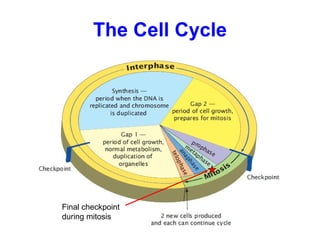
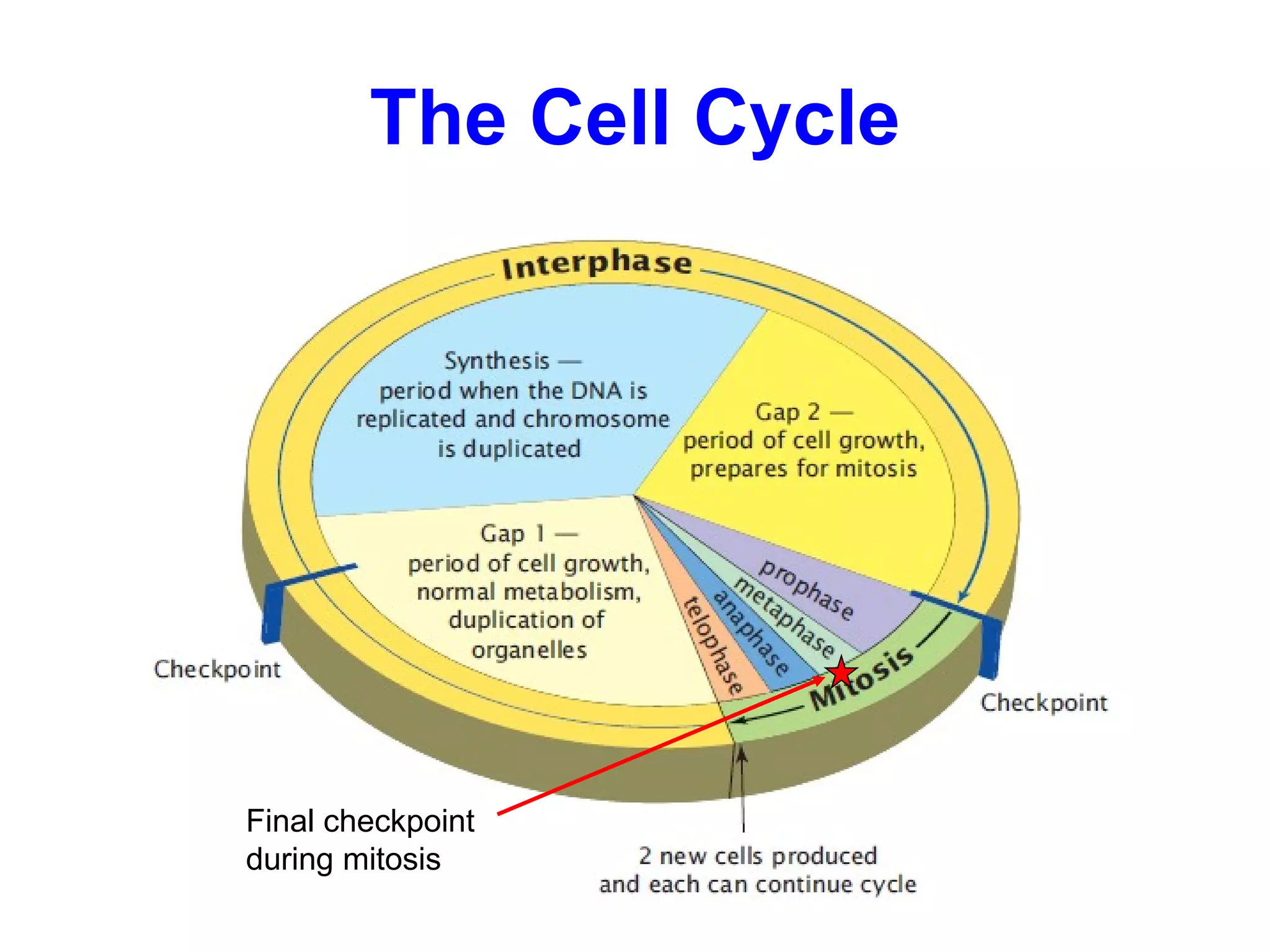
The Cell Cycle Final checkpoint  during mitosis
Animations Animation 1 Animation 2
The Cell Cycle – G1 The first phase is a growth phase (G1) The new cell starts growing and replicating its organelles At the end of G1, the checkpoint is to gauge if it is a good time for cell to keep growing or dividing or if a delay is necessary. If the cell is under any sort of stress, it will pause at this stage.
The Cell Cycle - S During the synthesis (S) phase, DNA replication occurs It is at this point that the diploid cell (2n) doubles to 4n, so that when it divides there will be two complete copies of the DNA
The Cell Cycle – G2 During the next growth phase (G2), the cell continues to grow in preparation for division The checkpoint during this phase is extremely important. If any errors have occurred during transcription, the cell must undergo apoptosis (programmed cell death)
The Cell Cycle - M During Mitosis (M), the single parent cell gives rise to two identical daughter cells. Once again a checkpoint assesses whether any errors have occurred during division. A negative result at the checkpoint here will result in apoptosis.
The Cell Cycle - C Cytokynesis (C) is actually the last part of Mitosis At this point the cell, which momentarily has twin nuclei, will divide in to two new cells (2N) and the process will begin again.
What happens if the checkpoints don’t work? If cell cycle checkpoints are operated by enzyme proteins. These enzymes can be prevented from carrying out normal function by inhibitors. These enzymes could also be stimulated to maintain an active state permanently. Either way can lead to uncontrolled and unmonitored cell division, this is commonly known as ….
CANCER Cells multiply uncontrollably and regardless of accumulating errors will never apoptose. Does not form useful cells as cells spend far more time in division rather than growth (a reversal of the normal situation). How does chemotherapy help?
Chemotherapy During interphase, DNA is somewhat protected from radiation due to the double membrane of the nucleus. During mitosis there is no nuclear envelope to protect the DNA Chemotherapy destroys DNA, thus kills far more cancer cells than budy cells as they spend far more time dividing The collateral damage of killing healthy body cells is what makes people sick when undergoing chemotherapy (and makes their hair fall out)

08 The cell cycle

  • 1.
    The Cell CycleFinal checkpoint during mitosis
  • 2.
  • 3.
    The Cell Cycle– G1 The first phase is a growth phase (G1) The new cell starts growing and replicating its organelles At the end of G1, the checkpoint is to gauge if it is a good time for cell to keep growing or dividing or if a delay is necessary. If the cell is under any sort of stress, it will pause at this stage.
  • 4.
    The Cell Cycle- S During the synthesis (S) phase, DNA replication occurs It is at this point that the diploid cell (2n) doubles to 4n, so that when it divides there will be two complete copies of the DNA
  • 5.
    The Cell Cycle– G2 During the next growth phase (G2), the cell continues to grow in preparation for division The checkpoint during this phase is extremely important. If any errors have occurred during transcription, the cell must undergo apoptosis (programmed cell death)
  • 6.
    The Cell Cycle- M During Mitosis (M), the single parent cell gives rise to two identical daughter cells. Once again a checkpoint assesses whether any errors have occurred during division. A negative result at the checkpoint here will result in apoptosis.
  • 7.
    The Cell Cycle- C Cytokynesis (C) is actually the last part of Mitosis At this point the cell, which momentarily has twin nuclei, will divide in to two new cells (2N) and the process will begin again.
  • 8.
    What happens ifthe checkpoints don’t work? If cell cycle checkpoints are operated by enzyme proteins. These enzymes can be prevented from carrying out normal function by inhibitors. These enzymes could also be stimulated to maintain an active state permanently. Either way can lead to uncontrolled and unmonitored cell division, this is commonly known as ….
  • 9.
    CANCER Cells multiplyuncontrollably and regardless of accumulating errors will never apoptose. Does not form useful cells as cells spend far more time in division rather than growth (a reversal of the normal situation). How does chemotherapy help?
  • 10.
    Chemotherapy During interphase,DNA is somewhat protected from radiation due to the double membrane of the nucleus. During mitosis there is no nuclear envelope to protect the DNA Chemotherapy destroys DNA, thus kills far more cancer cells than budy cells as they spend far more time dividing The collateral damage of killing healthy body cells is what makes people sick when undergoing chemotherapy (and makes their hair fall out)