Cell cycle and Mitosis
Cell cycle
 In order for a living organism to grow
their individual cells must:
1. Increase in size
2. Make exact replicas of all their genetic
material, and
3. Go through a process of division
resulting in two daughter cells each
with one complete copy of the entire
genome
Mitosis
 The eukaryotic cell of higher
organisms, ranging from yeast to
humans, has its genetic material
(DNA) packaged into a membrane
bound nucleus
 In eukaryotic cells, the process of cell
proliferation, the cell cycle, is
characterized by four distinct phases
as illustrated in the following
diagrams:
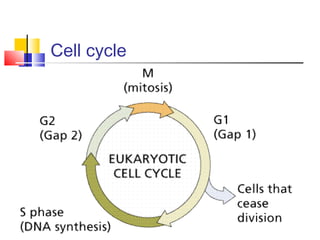
Cell cycle
Cell cycle cont…
1. Gap 1 (G1) Phase - Cell are active
and growing.
 Cells are receptive to signals to begin
DNA synthesis
2. Synthetic (S) Phase - Cells are
actively replicating DNA
3. Gap 2 (G2) Phase - Cells are
actively preparing
for mitosis.
Cell cycle cont…
 Cells contain twice the normal amount
of DNA
4. G0 - Cells in G0 have exited mitosis
and are quiescent (inactive).
 These resting cells may be reactivated
and enter the G1 phase upon receipt
of the appropriate stimuli.
Mitosis
 Mitosis a nuclear division produces two
identical daughter cells by replicating and
dividing the original chromosomes during
prophase, prometaphase, metaphase,
anaphase, and telophase
 This is followed by the division of the cell
referred to as cytokinesis
 Interphase is often included in discussions of
mitosis, but interphase is technically not part
of mitosis, but rather encompasses stages
G1, S, and G2 of the cell cycle
Mitosis
 The parent cell duplicates its
chromosomes, providing both daughter
cells with a complete copy of genetic
information
 When an eukaryotic cell divides into
two, each daughter or progeny cell
must receive:
Mitosis cont..,
1. A complete set of genes (for diploid
cells, this means 2 complete genome,
2n).
2. A pair of centrioles (in animal cells).
3. Some mitochondria and, in plant cells,
chloroplasts as well.
Mitosis cont…
4. Some ribosomes, a portion of the
endoplasmic reticulum, and perhaps other
organelles.
 There are so many mitochondria and
ribosomes in the cell that each daughter cell
is usually assured of getting some.
 But ensuring that each daughter cell gets
two (if diploid) of every gene in the cell
requires the greatest precision.
Mitosis cont…
The answer:
1. Duplicate each chromosome
during the S phase of the cell
cycle.
2. This produces dyads, each made
up of 2 identical sister chromatids.
 These are held together by a ring
of proteins called cohesins.
Human chromosomes
Mitosis cont…
3. Condense the chromosomes into a
compact form.
 This requires ATP and a protein
complex called condensin.
4. Distribute these equally between the
two daughter cells.
5. Separate the sister chromatids.
 Steps 3-5 are accomplished by
mitosis.
Mitosis cont…
 It distributes one of each duplicated
chromosome (as well as one centriole)
to each daughter cell.
 It is convenient to consider mitosis in 5
phases: Prophase, Metaphase,
Anaphase and Telophase.
 When a cell is not engaged in mitosis
it is said to be in interphase.
Interphase
Interphase
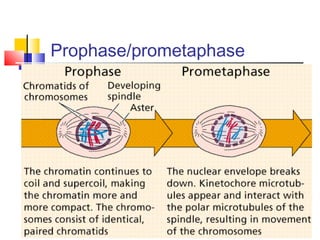
1. Prophase
 Chromatin in the nucleus begins to
condense and becomes visible in the
light microscope as chromosomes.
 The two centrosomes of the cell, each
with its pair of centrioles, move to
opposite "poles" of the cell.
 Some fibers cross the cell to form the
mitotic spindle.
 The chromosomes become shorter and
more compact.
Prophase
2. Prometaphase (Late prophase)
 The nuclear envelope disintegrates
because of the dissolution of the laminins
that stabilize its inner membrane.
 A protein structure, the kinetochore,
appears at the centromere of each
chromatid.
 With the breakdown of the nuclear
envelope, spindle fibers attach to the
kinetochores as well as to the arms of the
chromosomes.
Prophase/prometaphase
2. Prometaphase cont…
 For each dyad, one of the
kinetochores is attached to one pole,
the second (or sister) chromatid to
the opposite pole.
 Failure of a kinetochore to become
attached to a spindle fiber interrupts
the process.
Metaphase
 At metaphase all the dyads have
reached an equilibrium position midway
between the poles called the
metaphase plate.
 The chromosomes are at their most
compact at this time.
Metaphase
4. Anaphase
 The sister kinetochores suddenly
separate and each moves to its
respective pole dragging its attached
chromatid (chromosome) behind it.
 Separation of the sister chromatids
depends on the breakdown of the
cohesins that have been holding them
together.
Anaphase
4. Anaphase cont…
 It works like this:
1. Cohesin breakdown is caused by a
protease called separase (also known
as separin).
2. Separase is kept inactive until late
metaphase by an inhibitory chaperone
called securin.
4. Anaphase cont…
3. Anaphase begins when the anaphase
promoting complex (APC) destroys
securin (by tagging it for deposit in a
proteosome) thus ending its inhibition
of separase and allowing Separase to
break down the cohesins.
Metaphase/anaphase
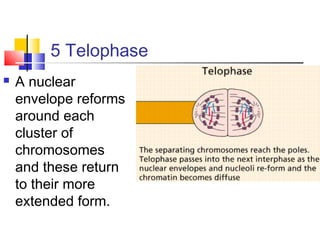
5 Telophase
 A nuclear
envelope reforms
around each
cluster of
chromosomes
and these return
to their more
extended form.
Telophase
6. Cytokinesis
 Mitosis is the process of separating the
duplicates of each of the cell's
chromosomes.
 It is usually followed by division of the
cell.
 Thus a special term, cytokinesis, for the
separation of a cell into two.
Mitosis animation

Lecture 4 mitosis

  • 1.
    Cell cycle andMitosis Cell cycle  In order for a living organism to grow their individual cells must: 1. Increase in size 2. Make exact replicas of all their genetic material, and 3. Go through a process of division resulting in two daughter cells each with one complete copy of the entire genome
  • 2.
    Mitosis  The eukaryoticcell of higher organisms, ranging from yeast to humans, has its genetic material (DNA) packaged into a membrane bound nucleus  In eukaryotic cells, the process of cell proliferation, the cell cycle, is characterized by four distinct phases as illustrated in the following diagrams:
  • 3.
  • 5.
    Cell cycle cont… 1.Gap 1 (G1) Phase - Cell are active and growing.  Cells are receptive to signals to begin DNA synthesis 2. Synthetic (S) Phase - Cells are actively replicating DNA 3. Gap 2 (G2) Phase - Cells are actively preparing for mitosis.
  • 6.
    Cell cycle cont… Cells contain twice the normal amount of DNA 4. G0 - Cells in G0 have exited mitosis and are quiescent (inactive).  These resting cells may be reactivated and enter the G1 phase upon receipt of the appropriate stimuli.
  • 7.
    Mitosis  Mitosis anuclear division produces two identical daughter cells by replicating and dividing the original chromosomes during prophase, prometaphase, metaphase, anaphase, and telophase  This is followed by the division of the cell referred to as cytokinesis  Interphase is often included in discussions of mitosis, but interphase is technically not part of mitosis, but rather encompasses stages G1, S, and G2 of the cell cycle
  • 8.
    Mitosis  The parentcell duplicates its chromosomes, providing both daughter cells with a complete copy of genetic information  When an eukaryotic cell divides into two, each daughter or progeny cell must receive:
  • 9.
    Mitosis cont.., 1. Acomplete set of genes (for diploid cells, this means 2 complete genome, 2n). 2. A pair of centrioles (in animal cells). 3. Some mitochondria and, in plant cells, chloroplasts as well.
  • 10.
    Mitosis cont… 4. Someribosomes, a portion of the endoplasmic reticulum, and perhaps other organelles.  There are so many mitochondria and ribosomes in the cell that each daughter cell is usually assured of getting some.  But ensuring that each daughter cell gets two (if diploid) of every gene in the cell requires the greatest precision.
  • 11.
    Mitosis cont… The answer: 1.Duplicate each chromosome during the S phase of the cell cycle. 2. This produces dyads, each made up of 2 identical sister chromatids.  These are held together by a ring of proteins called cohesins.
  • 12.
  • 13.
    Mitosis cont… 3. Condensethe chromosomes into a compact form.  This requires ATP and a protein complex called condensin. 4. Distribute these equally between the two daughter cells. 5. Separate the sister chromatids.  Steps 3-5 are accomplished by mitosis.
  • 14.
    Mitosis cont…  Itdistributes one of each duplicated chromosome (as well as one centriole) to each daughter cell.  It is convenient to consider mitosis in 5 phases: Prophase, Metaphase, Anaphase and Telophase.  When a cell is not engaged in mitosis it is said to be in interphase.
  • 15.
  • 16.
  • 17.
    1. Prophase  Chromatinin the nucleus begins to condense and becomes visible in the light microscope as chromosomes.  The two centrosomes of the cell, each with its pair of centrioles, move to opposite "poles" of the cell.  Some fibers cross the cell to form the mitotic spindle.  The chromosomes become shorter and more compact.
  • 18.
  • 19.
    2. Prometaphase (Lateprophase)  The nuclear envelope disintegrates because of the dissolution of the laminins that stabilize its inner membrane.  A protein structure, the kinetochore, appears at the centromere of each chromatid.  With the breakdown of the nuclear envelope, spindle fibers attach to the kinetochores as well as to the arms of the chromosomes.
  • 21.
  • 22.
    2. Prometaphase cont… For each dyad, one of the kinetochores is attached to one pole, the second (or sister) chromatid to the opposite pole.  Failure of a kinetochore to become attached to a spindle fiber interrupts the process.
  • 23.
    Metaphase  At metaphaseall the dyads have reached an equilibrium position midway between the poles called the metaphase plate.  The chromosomes are at their most compact at this time.
  • 24.
  • 25.
    4. Anaphase  Thesister kinetochores suddenly separate and each moves to its respective pole dragging its attached chromatid (chromosome) behind it.  Separation of the sister chromatids depends on the breakdown of the cohesins that have been holding them together.
  • 26.
  • 27.
    4. Anaphase cont… It works like this: 1. Cohesin breakdown is caused by a protease called separase (also known as separin). 2. Separase is kept inactive until late metaphase by an inhibitory chaperone called securin.
  • 28.
    4. Anaphase cont… 3.Anaphase begins when the anaphase promoting complex (APC) destroys securin (by tagging it for deposit in a proteosome) thus ending its inhibition of separase and allowing Separase to break down the cohesins.
  • 29.
  • 30.
    5 Telophase  Anuclear envelope reforms around each cluster of chromosomes and these return to their more extended form.
  • 31.
  • 32.
    6. Cytokinesis  Mitosisis the process of separating the duplicates of each of the cell's chromosomes.  It is usually followed by division of the cell.  Thus a special term, cytokinesis, for the separation of a cell into two.
  • 33.