
COMPUTER GRAPHICS & IMAGE PROCESSING
COM2304
Digital Image Fundamentals - I
K.A.S.H.Kulathilake
B.Sc. (Hons) IT (SLIIT), MCS (UCSC), M.Phil (UOM), SEDA(UK)
Rajarata University of Sri Lanka
Faculty of Applied Sciences
Department of Physical Sciences
Learning Outcomes
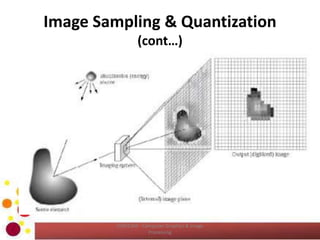
COM2304 - Computer Graphics & Image
Processing
• At the end of this lecture, you should be
able to;
– describe the energy and the EM spectrum.
– describe image acquisition methods.
– discuss image formation model.
– express sampling and quantization.
– define dynamic range and image
representation.
Light and the EM Spectrum
• It is clear that;
– Electromagnetic waves are conceptually sinusoidal
and formation of different wave lengths.
– It can be thought of as a stream of massless
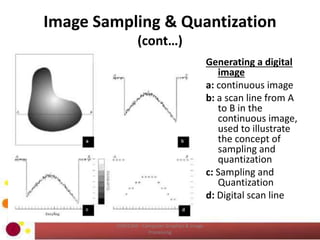
particles, each travelling in a wave like pattern and
moving at the speed of light.
– Each massless particle contains a certain amount
of energy and a bundle of energy is known as
photon.
COM2304 - Computer Graphics & Image
Processing
Light and the EM Spectrum (Cont…)
• The EM spectrum can be expressed in the
terms of wavelength (λ), frequency (ν) or
energy.
• Wavelength (λ) and frequency (ν) are related
as;
λ = c / ν
– where c is the speed of light (2.998 * 108 m/s)
COM2304 - Computer Graphics & Image
Processing
Light and the EM Spectrum (Cont…)
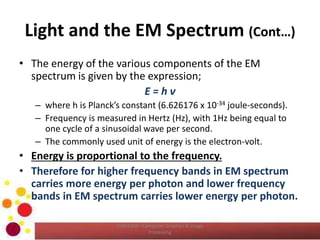
• The energy of the various components of the EM
spectrum is given by the expression;
E = h ν
– where h is Planck’s constant (6.626176 x 10⁻³⁴ joule-seconds).
– Frequency is measured in Hertz (Hz), with 1Hz being equal to
one cycle of a sinusoidal wave per second.
– The commonly used unit of energy is the electron-volt.
• Energy is proportional to the frequency.
• Therefore for higher frequency bands in EM spectrum
carries more energy per photon and lower frequency
bands in EM spectrum carries lower energy per photon.
COM2304 - Computer Graphics & Image
Processing
Light and the EM Spectrum - Light
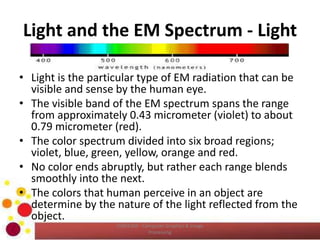
• Light is the particular type of EM radiation that can be
visible and sense by the human eye.
• The visible band of the EM spectrum spans the range
from approximately 0.43 micrometer (violet) to about
0.79 micrometer (red).
• The color spectrum divided into six broad regions;
violet, blue, green, yellow, orange and red.
• No color ends abruptly, but rather each range blends
smoothly into the next.
• The colors that human perceive in an object are
determine by the nature of the light reflected from the
object.
COM2304 - Computer Graphics & Image
Processing
Light and the EM Spectrum -
Achromatic Light
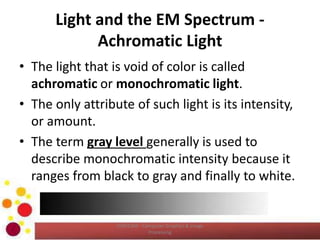
• The light that is void of color is called
achromatic or monochromatic light.
• The only attribute of such light is its intensity,
or amount.
• The term gray level generally is used to
describe monochromatic intensity because it
ranges from black to gray and finally to white.
COM2304 - Computer Graphics & Image
Processing
Light and the EM Spectrum -
Chromatic Light
• Chromatic light spans the EM energy spectrum from
approximately 0.43 to 0.79 micrometers.
• Three basic quantities are used to describe the quality
of a chromatic light source; radiance, luminance and
brightness.
– Radiance is a total amount of energy that flows from the
light source and it is usually measured in Watts (W).
– Luminance measure in lumen (lm), gives the measure of
the amount of energy and observer perceives from light
source.
– Brightness is a subjective descriptor of light perception
that is particularly impossible to measure.
COM2304 - Computer Graphics & Image
Processing
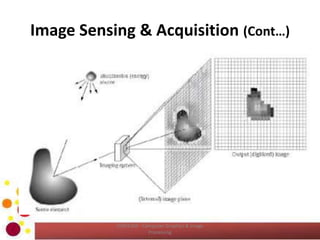
Image Sensing & Acquisition
• Most of the images are generated by the
combination of an illumination source and the
reflection or absorption of energy from that
source by the elements of the scene being
imaged.
• The illumination may originate from a source of
EM energy such as radar, infrared, X-ray system or
from less traditional sources, such as ultrasound
or computer generated illumination pattern.
COM2304 - Computer Graphics & Image
Processing
Image Sensing & Acquisition (Cont…)
• Depending on the nature of the source,
illumination energy is reflected from, or
transmitted through, objects.
– As an example we can say light reflected from planer
surface and X ray transmitted through the human
body to construct the images.
• In some applications, the reflected or transmitted
energy is focused on to a photo converter, which
converts the energy into a visible light.
– Electron microscopy and some applications on
Gamma imaging use this approach.
COM2304 - Computer Graphics & Image
Processing
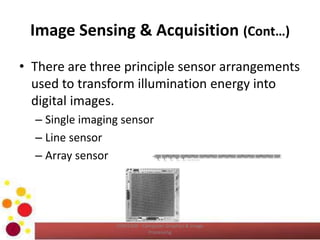
Image Sensing & Acquisition (Cont…)
• There are three principle sensor arrangements
used to transform illumination energy into
digital images.
– Single imaging sensor
– Line sensor
– Array sensor
COM2304 - Computer Graphics & Image
Processing
Image Sensing & Acquisition (Cont…)
• Sensor process
– Incoming energy is transformed into a voltage by
the combination of input electrical power and a
sensor material that is responsive to the particular
type of energy being detected.
– The output voltage waveform is the response of
the sensor(s), and a digital quantity is obtained
from each sensor by digitizing its response.
COM2304 - Computer Graphics & Image
Processing
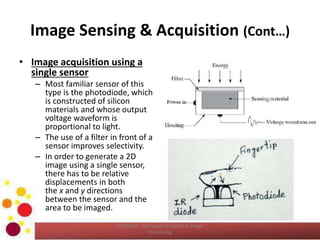
Image Sensing & Acquisition (Cont…)
• Image acquisition using a
single sensor
– Most familiar sensor of this
type is the photodiode, which
is constructed of silicon
materials and whose output
voltage waveform is
proportional to light.
– The use of a filter in front of a
sensor improves selectivity.
– In order to generate a 2D
image using a single sensor,
there has to be relative
displacements in both
the x and y directions
between the sensor and the
area to be imaged.
COM2304 - Computer Graphics & Image
Processing
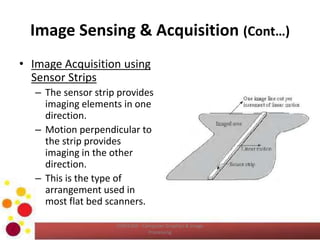
Image Sensing & Acquisition (Cont…)
• Image Acquisition using
Sensor Strips
– The sensor strip provides
imaging elements in one
direction.
– Motion perpendicular to
the strip provides
imaging in the other
direction.
– This is the type of
arrangement used in
most flat bed scanners.
COM2304 - Computer Graphics & Image
Processing
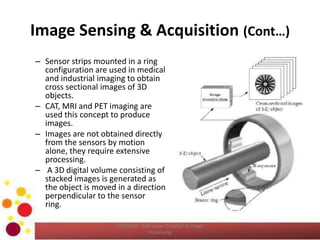
Image Sensing & Acquisition (Cont…)
– Sensor strips mounted in a ring
configuration are used in medical
and industrial imaging to obtain
cross sectional images of 3D
objects.
– CAT, MRI and PET imaging are
used this concept to produce
images.
– Images are not obtained directly
from the sensors by motion
alone, they require extensive
processing.
– A 3D digital volume consisting of
stacked images is generated as
the object is moved in a direction
perpendicular to the sensor
ring.
COM2304 - Computer Graphics & Image
Processing
Image Sensing & Acquisition (Cont…)
COM2304 - Computer Graphics & Image
Processing
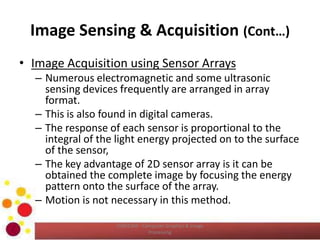
• Image Acquisition using Sensor Arrays
– Numerous electromagnetic and some ultrasonic
sensing devices frequently are arranged in array
format.
– This is also found in digital cameras.
– The response of each sensor is proportional to the
integral of the light energy projected on to the surface
of the sensor,
– The key advantage of 2D sensor array is it can be
obtained the complete image by focusing the energy
pattern onto the surface of the array.
– Motion is not necessary in this method.
Image Sensing & Acquisition (Cont…)
COM2304 - Computer Graphics & Image
Processing
Image Formation Model
• We can denote images by two dimensional function of
the form f(x,y).
• The value or amplitude of the f at spatial
coordinates (x,y) is a positive scalar quantity whose
physical meaning is determined by the source of the
image.
• When an image is generated from a physical process,
its values are proportional to energy radiated by a
physical source (electromagnetic waves).
• As a consequence, f(x,y) must be non zero and finite;
that is, 0< f(x,y) < ∞
COM2304 - Computer Graphics & Image
Processing
Image Formation Model (Cont…)
• The function f(x,y) may be characterized by two components;
– Illumination – The amount of source illumination incident on
the scene being viewed - i(x,y).
– Reflectance – The amount of illumination reflected by the
objects in the scene - r(x,y).
• The two functions combine as a product to form f(x,y).
f(x,y) = i(x,y) r(x,y)
Where; 0 < i(x,y) < ∞ and 0 < r(x,y) < 1 ( 0 – total absorption, 1 –
total reflectance )
• The nature of i(x,y) is determined by the illumination source,
and r(x,y) is determined by the characteristics of the imaged
objects.
COM2304 - Computer Graphics & Image
Processing
Image Formation Model (Cont…)
• We call the intensity of a monochrome image at any
coordinates (xn,yn) the gray level (l) of the image at that point.
That is; l = f (x0,y0)
• It is evident that l lies in the range; Lmin < l < Lmax
• In theory, the only requirement of Lmin is that it be positive, and
on Lmax that it be finite.
• In practice Lmin = imin rmin and Lmax = imax rmax
• The interval [Lmin, Lmax ] is called the GRAY SCALE.
• Common practice is to shift this interval numerically to the interval
[0, L-1], where l=0 is considered black and l = L-1 is considered
white on the gray scale.
• All the intermediate values are shades of gray varying from black
to white.
COM2304 - Computer Graphics & Image
Processing
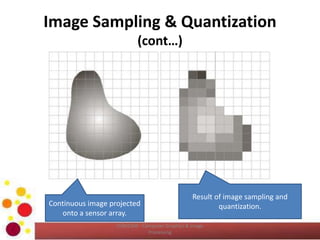
Image Sampling & Quantization
• Why?
– The output of most sensors is a continuous
voltage waveform whose amplitude and spatial
behaviors are related to the physical phenomenon
being sensed.
– To create a digital image, we need to convert the
continuous sensed data into digital form.
– This involves two processes; Sampling and
Quantization.
COM2304 - Computer Graphics & Image
Processing
Image Sampling & Quantization
(cont…)
• An image may be continuous with respect to
the x and y coordinates and also an amplitude.
• To convert image to digital form, we have to
sample the function in both coordinates and
in amplitude.
• Digitizing the coordinate values is called
Sampling.
• Digitizing the amplitude values is called
Quantization.
COM2304 - Computer Graphics & Image
Processing
Image Sampling & Quantization
(cont…)
COM2304 - Computer Graphics & Image
Processing
Image Sampling & Quantization
(cont…)
Generating a digital
image
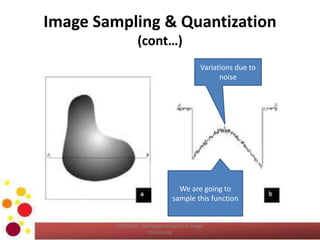
a: continuous image
b: a scan line from A
to B in the
continuous image,
used to illustrate
the concept of
sampling and
quantization
c: Sampling and
Quantization
d: Digital scan line
COM2304 - Computer Graphics & Image
Processing
Image Sampling & Quantization
(cont…)
COM2304 - Computer Graphics & Image
Processing
Variations due to
noise
We are going to
sample this function
Image Sampling & Quantization
(cont…)
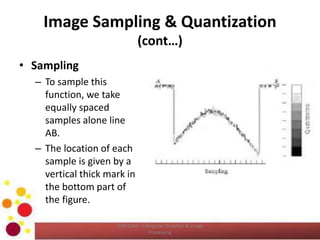
• Sampling
– To sample this
function, we take
equally spaced
samples alone line
AB.
– The location of each
sample is given by a
vertical thick mark in
the bottom part of
the figure.
COM2304 - Computer Graphics & Image
Processing
Image Sampling & Quantization
(cont…)
– The set of theses discrete locations gives the
sampled functions.
– However, the values of samples still span
(vertically) a continuous range of gray level values.
COM2304 - Computer Graphics & Image
Processing
Image Sampling & Quantization
(cont…)
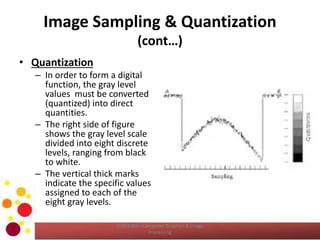
• Quantization
– In order to form a digital
function, the gray level
values must be converted
(quantized) into direct
quantities.
– The right side of figure
shows the gray level scale
divided into eight discrete
levels, ranging from black
to white.
– The vertical thick marks
indicate the specific values
assigned to each of the
eight gray levels.
COM2304 - Computer Graphics & Image
Processing
Image Sampling & Quantization
(cont…)
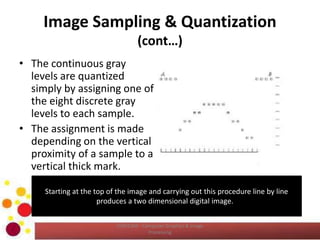
• The continuous gray
levels are quantized
simply by assigning one of
the eight discrete gray
levels to each sample.
• The assignment is made
depending on the vertical
proximity of a sample to a
vertical thick mark.
COM2304 - Computer Graphics & Image
Processing
Starting at the top of the image and carrying out this procedure line by line
produces a two dimensional digital image.
Image Sampling & Quantization
(cont…)
COM2304 - Computer Graphics & Image
Processing
Continuous image projected
onto a sensor array.
Result of image sampling and
quantization.
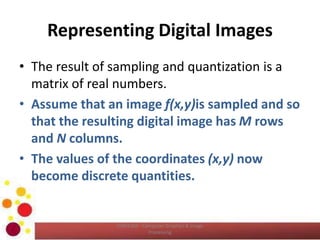
Representing Digital Images
• The result of sampling and quantization is a
matrix of real numbers.
• Assume that an image f(x,y)is sampled and so
that the resulting digital image has M rows
and N columns.
• The values of the coordinates (x,y) now
become discrete quantities.
COM2304 - Computer Graphics & Image
Processing
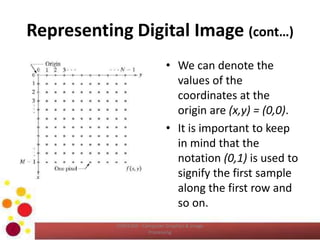
Representing Digital Image (cont…)
• We can denote the
values of the
coordinates at the
origin are (x,y) = (0,0).
• It is important to keep
in mind that the
notation (0,1) is used to
signify the first sample
along the first row and
so on.
COM2304 - Computer Graphics & Image
Processing
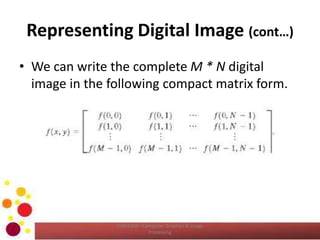
Representing Digital Image (cont…)
• We can write the complete M * N digital
image in the following compact matrix form.
COM2304 - Computer Graphics & Image
Processing
Representing Digital Image (cont…)
• The digitization process requires decisions about values
for M, N and for the L number of discrete gray levels
allowed for each pixel.
• M and N should be positive integers.
• However due to processing, storage and sampling
hardware considerations, the number of gray levels
typically is the integer power of 2 as expressed below;
L = 2k
• We assume that the discrete levels are equally spaced
and that they are integers in the interval [0, L-1].
COM2304 - Computer Graphics & Image
Processing
Representing Digital Image (cont…)
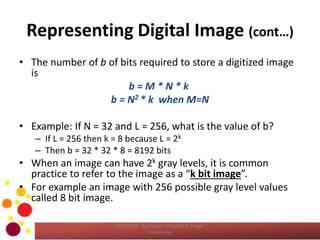
• The number of b of bits required to store a digitized image
is
b = M * N * k
b = N2 * k when M=N
• Example: If N = 32 and L = 256, what is the value of b?
– If L = 256 then k = 8 because L = 2k
– Then b = 32 * 32 * 8 = 8192 bits
• When an image can have 2k gray levels, it is common
practice to refer to the image as a “k bit image”.
• For example an image with 256 possible gray level values
called 8 bit image.
COM2304 - Computer Graphics & Image
Processing
Representing Digital Image (cont…)
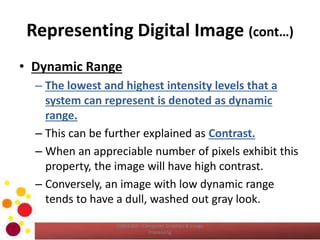
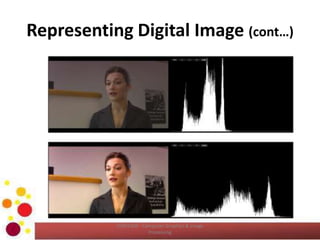
• Dynamic Range
– The lowest and highest intensity levels that a
system can represent is denoted as dynamic
range.
– This can be further explained as Contrast.
– When an appreciable number of pixels exhibit this
property, the image will have high contrast.
– Conversely, an image with low dynamic range
tends to have a dull, washed out gray look.
COM2304 - Computer Graphics & Image
Processing
Representing Digital Image (cont…)
COM2304 - Computer Graphics & Image
Processing
Reference
• Chapter 02 of Gonzalez, R.C., Woods, R.E.,
Digital Image Processing, 3rd ed. Addison-
Wesley Pub.
COM2304 - Computer Graphics & Image
Processing
Learning Outcomes Revisit
• Now, you should be able to;
– describe the energy and the EM spectrum.
– describe image acquisition methods.
– discuss image formation model.
– express sampling and quantization.
– define dynamic range and image
representation.
COM2304 - Computer Graphics & Image
Processing
QUESTIONS ?
Next Lecture – Digital Image Fundamentals – II
COM2304 - Computer Graphics & Image
Processing

COM2304: Digital Image Fundamentals - I

  • 1.
    COMPUTER GRAPHICS &IMAGE PROCESSING COM2304 Digital Image Fundamentals - I K.A.S.H.Kulathilake B.Sc. (Hons) IT (SLIIT), MCS (UCSC), M.Phil (UOM), SEDA(UK) Rajarata University of Sri Lanka Faculty of Applied Sciences Department of Physical Sciences
  • 2.
    Learning Outcomes COM2304 -Computer Graphics & Image Processing • At the end of this lecture, you should be able to; – describe the energy and the EM spectrum. – describe image acquisition methods. – discuss image formation model. – express sampling and quantization. – define dynamic range and image representation.
  • 3.
    Light and theEM Spectrum • It is clear that; – Electromagnetic waves are conceptually sinusoidal and formation of different wave lengths. – It can be thought of as a stream of massless particles, each travelling in a wave like pattern and moving at the speed of light. – Each massless particle contains a certain amount of energy and a bundle of energy is known as photon. COM2304 - Computer Graphics & Image Processing
  • 4.
    Light and theEM Spectrum (Cont…) • The EM spectrum can be expressed in the terms of wavelength (λ), frequency (ν) or energy. • Wavelength (λ) and frequency (ν) are related as; λ = c / ν – where c is the speed of light (2.998 * 108 m/s) COM2304 - Computer Graphics & Image Processing
  • 5.
    Light and theEM Spectrum (Cont…) • The energy of the various components of the EM spectrum is given by the expression; E = h ν – where h is Planck’s constant (6.626176 x 10⁻³⁴ joule-seconds). – Frequency is measured in Hertz (Hz), with 1Hz being equal to one cycle of a sinusoidal wave per second. – The commonly used unit of energy is the electron-volt. • Energy is proportional to the frequency. • Therefore for higher frequency bands in EM spectrum carries more energy per photon and lower frequency bands in EM spectrum carries lower energy per photon. COM2304 - Computer Graphics & Image Processing
  • 6.
    Light and theEM Spectrum - Light • Light is the particular type of EM radiation that can be visible and sense by the human eye. • The visible band of the EM spectrum spans the range from approximately 0.43 micrometer (violet) to about 0.79 micrometer (red). • The color spectrum divided into six broad regions; violet, blue, green, yellow, orange and red. • No color ends abruptly, but rather each range blends smoothly into the next. • The colors that human perceive in an object are determine by the nature of the light reflected from the object. COM2304 - Computer Graphics & Image Processing
  • 7.
    Light and theEM Spectrum - Achromatic Light • The light that is void of color is called achromatic or monochromatic light. • The only attribute of such light is its intensity, or amount. • The term gray level generally is used to describe monochromatic intensity because it ranges from black to gray and finally to white. COM2304 - Computer Graphics & Image Processing
  • 8.
    Light and theEM Spectrum - Chromatic Light • Chromatic light spans the EM energy spectrum from approximately 0.43 to 0.79 micrometers. • Three basic quantities are used to describe the quality of a chromatic light source; radiance, luminance and brightness. – Radiance is a total amount of energy that flows from the light source and it is usually measured in Watts (W). – Luminance measure in lumen (lm), gives the measure of the amount of energy and observer perceives from light source. – Brightness is a subjective descriptor of light perception that is particularly impossible to measure. COM2304 - Computer Graphics & Image Processing
  • 9.
    Image Sensing &Acquisition • Most of the images are generated by the combination of an illumination source and the reflection or absorption of energy from that source by the elements of the scene being imaged. • The illumination may originate from a source of EM energy such as radar, infrared, X-ray system or from less traditional sources, such as ultrasound or computer generated illumination pattern. COM2304 - Computer Graphics & Image Processing
  • 10.
    Image Sensing &Acquisition (Cont…) • Depending on the nature of the source, illumination energy is reflected from, or transmitted through, objects. – As an example we can say light reflected from planer surface and X ray transmitted through the human body to construct the images. • In some applications, the reflected or transmitted energy is focused on to a photo converter, which converts the energy into a visible light. – Electron microscopy and some applications on Gamma imaging use this approach. COM2304 - Computer Graphics & Image Processing
  • 11.
    Image Sensing &Acquisition (Cont…) • There are three principle sensor arrangements used to transform illumination energy into digital images. – Single imaging sensor – Line sensor – Array sensor COM2304 - Computer Graphics & Image Processing
  • 12.
    Image Sensing &Acquisition (Cont…) • Sensor process – Incoming energy is transformed into a voltage by the combination of input electrical power and a sensor material that is responsive to the particular type of energy being detected. – The output voltage waveform is the response of the sensor(s), and a digital quantity is obtained from each sensor by digitizing its response. COM2304 - Computer Graphics & Image Processing
  • 13.
    Image Sensing &Acquisition (Cont…) • Image acquisition using a single sensor – Most familiar sensor of this type is the photodiode, which is constructed of silicon materials and whose output voltage waveform is proportional to light. – The use of a filter in front of a sensor improves selectivity. – In order to generate a 2D image using a single sensor, there has to be relative displacements in both the x and y directions between the sensor and the area to be imaged. COM2304 - Computer Graphics & Image Processing
  • 14.
    Image Sensing &Acquisition (Cont…) • Image Acquisition using Sensor Strips – The sensor strip provides imaging elements in one direction. – Motion perpendicular to the strip provides imaging in the other direction. – This is the type of arrangement used in most flat bed scanners. COM2304 - Computer Graphics & Image Processing
  • 15.
    Image Sensing &Acquisition (Cont…) – Sensor strips mounted in a ring configuration are used in medical and industrial imaging to obtain cross sectional images of 3D objects. – CAT, MRI and PET imaging are used this concept to produce images. – Images are not obtained directly from the sensors by motion alone, they require extensive processing. – A 3D digital volume consisting of stacked images is generated as the object is moved in a direction perpendicular to the sensor ring. COM2304 - Computer Graphics & Image Processing
  • 16.
    Image Sensing &Acquisition (Cont…) COM2304 - Computer Graphics & Image Processing • Image Acquisition using Sensor Arrays – Numerous electromagnetic and some ultrasonic sensing devices frequently are arranged in array format. – This is also found in digital cameras. – The response of each sensor is proportional to the integral of the light energy projected on to the surface of the sensor, – The key advantage of 2D sensor array is it can be obtained the complete image by focusing the energy pattern onto the surface of the array. – Motion is not necessary in this method.
  • 17.
    Image Sensing &Acquisition (Cont…) COM2304 - Computer Graphics & Image Processing
  • 18.
    Image Formation Model •We can denote images by two dimensional function of the form f(x,y). • The value or amplitude of the f at spatial coordinates (x,y) is a positive scalar quantity whose physical meaning is determined by the source of the image. • When an image is generated from a physical process, its values are proportional to energy radiated by a physical source (electromagnetic waves). • As a consequence, f(x,y) must be non zero and finite; that is, 0< f(x,y) < ∞ COM2304 - Computer Graphics & Image Processing
  • 19.
    Image Formation Model(Cont…) • The function f(x,y) may be characterized by two components; – Illumination – The amount of source illumination incident on the scene being viewed - i(x,y). – Reflectance – The amount of illumination reflected by the objects in the scene - r(x,y). • The two functions combine as a product to form f(x,y). f(x,y) = i(x,y) r(x,y) Where; 0 < i(x,y) < ∞ and 0 < r(x,y) < 1 ( 0 – total absorption, 1 – total reflectance ) • The nature of i(x,y) is determined by the illumination source, and r(x,y) is determined by the characteristics of the imaged objects. COM2304 - Computer Graphics & Image Processing
  • 20.
    Image Formation Model(Cont…) • We call the intensity of a monochrome image at any coordinates (xn,yn) the gray level (l) of the image at that point. That is; l = f (x0,y0) • It is evident that l lies in the range; Lmin < l < Lmax • In theory, the only requirement of Lmin is that it be positive, and on Lmax that it be finite. • In practice Lmin = imin rmin and Lmax = imax rmax • The interval [Lmin, Lmax ] is called the GRAY SCALE. • Common practice is to shift this interval numerically to the interval [0, L-1], where l=0 is considered black and l = L-1 is considered white on the gray scale. • All the intermediate values are shades of gray varying from black to white. COM2304 - Computer Graphics & Image Processing
  • 21.
    Image Sampling &Quantization • Why? – The output of most sensors is a continuous voltage waveform whose amplitude and spatial behaviors are related to the physical phenomenon being sensed. – To create a digital image, we need to convert the continuous sensed data into digital form. – This involves two processes; Sampling and Quantization. COM2304 - Computer Graphics & Image Processing
  • 22.
    Image Sampling &Quantization (cont…) • An image may be continuous with respect to the x and y coordinates and also an amplitude. • To convert image to digital form, we have to sample the function in both coordinates and in amplitude. • Digitizing the coordinate values is called Sampling. • Digitizing the amplitude values is called Quantization. COM2304 - Computer Graphics & Image Processing
  • 23.
    Image Sampling &Quantization (cont…) COM2304 - Computer Graphics & Image Processing
  • 24.
    Image Sampling &Quantization (cont…) Generating a digital image a: continuous image b: a scan line from A to B in the continuous image, used to illustrate the concept of sampling and quantization c: Sampling and Quantization d: Digital scan line COM2304 - Computer Graphics & Image Processing
  • 25.
    Image Sampling &Quantization (cont…) COM2304 - Computer Graphics & Image Processing Variations due to noise We are going to sample this function
  • 26.
    Image Sampling &Quantization (cont…) • Sampling – To sample this function, we take equally spaced samples alone line AB. – The location of each sample is given by a vertical thick mark in the bottom part of the figure. COM2304 - Computer Graphics & Image Processing
  • 27.
    Image Sampling &Quantization (cont…) – The set of theses discrete locations gives the sampled functions. – However, the values of samples still span (vertically) a continuous range of gray level values. COM2304 - Computer Graphics & Image Processing
  • 28.
    Image Sampling &Quantization (cont…) • Quantization – In order to form a digital function, the gray level values must be converted (quantized) into direct quantities. – The right side of figure shows the gray level scale divided into eight discrete levels, ranging from black to white. – The vertical thick marks indicate the specific values assigned to each of the eight gray levels. COM2304 - Computer Graphics & Image Processing
  • 29.
    Image Sampling &Quantization (cont…) • The continuous gray levels are quantized simply by assigning one of the eight discrete gray levels to each sample. • The assignment is made depending on the vertical proximity of a sample to a vertical thick mark. COM2304 - Computer Graphics & Image Processing Starting at the top of the image and carrying out this procedure line by line produces a two dimensional digital image.
  • 30.
    Image Sampling &Quantization (cont…) COM2304 - Computer Graphics & Image Processing Continuous image projected onto a sensor array. Result of image sampling and quantization.
  • 31.
    Representing Digital Images •The result of sampling and quantization is a matrix of real numbers. • Assume that an image f(x,y)is sampled and so that the resulting digital image has M rows and N columns. • The values of the coordinates (x,y) now become discrete quantities. COM2304 - Computer Graphics & Image Processing
  • 32.
    Representing Digital Image(cont…) • We can denote the values of the coordinates at the origin are (x,y) = (0,0). • It is important to keep in mind that the notation (0,1) is used to signify the first sample along the first row and so on. COM2304 - Computer Graphics & Image Processing
  • 33.
    Representing Digital Image(cont…) • We can write the complete M * N digital image in the following compact matrix form. COM2304 - Computer Graphics & Image Processing
  • 34.
    Representing Digital Image(cont…) • The digitization process requires decisions about values for M, N and for the L number of discrete gray levels allowed for each pixel. • M and N should be positive integers. • However due to processing, storage and sampling hardware considerations, the number of gray levels typically is the integer power of 2 as expressed below; L = 2k • We assume that the discrete levels are equally spaced and that they are integers in the interval [0, L-1]. COM2304 - Computer Graphics & Image Processing
  • 35.
    Representing Digital Image(cont…) • The number of b of bits required to store a digitized image is b = M * N * k b = N2 * k when M=N • Example: If N = 32 and L = 256, what is the value of b? – If L = 256 then k = 8 because L = 2k – Then b = 32 * 32 * 8 = 8192 bits • When an image can have 2k gray levels, it is common practice to refer to the image as a “k bit image”. • For example an image with 256 possible gray level values called 8 bit image. COM2304 - Computer Graphics & Image Processing
  • 36.
    Representing Digital Image(cont…) • Dynamic Range – The lowest and highest intensity levels that a system can represent is denoted as dynamic range. – This can be further explained as Contrast. – When an appreciable number of pixels exhibit this property, the image will have high contrast. – Conversely, an image with low dynamic range tends to have a dull, washed out gray look. COM2304 - Computer Graphics & Image Processing
  • 37.
    Representing Digital Image(cont…) COM2304 - Computer Graphics & Image Processing
  • 38.
    Reference • Chapter 02of Gonzalez, R.C., Woods, R.E., Digital Image Processing, 3rd ed. Addison- Wesley Pub. COM2304 - Computer Graphics & Image Processing
  • 39.
    Learning Outcomes Revisit •Now, you should be able to; – describe the energy and the EM spectrum. – describe image acquisition methods. – discuss image formation model. – express sampling and quantization. – define dynamic range and image representation. COM2304 - Computer Graphics & Image Processing
  • 40.
    QUESTIONS ? Next Lecture– Digital Image Fundamentals – II COM2304 - Computer Graphics & Image Processing