Department of Electronics and
Communication Engineering
Swami Keshvanand Institute of
Technology, Management &
Gramothan
SUBMITTED BY: URVI SHARMA
ECE-B(1st SHIFT)
13ESKEC086
A 2 MONTH INDUSTRIAL TRAINING REPORT
ON
LTE & VOLTE
AT
RELIANCE JIO INFOCOMM LIMITED
• Reliance Jio Infocomm Limited, is an LTE based
mobile network operator in India.
• It is a wholly owned subsidiary of Reliance
Industries headquartered in Mumbai, that provides
wireless 4G LTE service network (without 2G/3G
based services)
• It is the only 100% VOLTE operator in the country,
with coverage across all 22 telecom circles in India.
Introduction
• RJIL holds spectrum in 1800 MHz (across 14 circles) and
2300 MHz (across 22 circles) capable of offering fourth
generation(4G)wirelessservices.
• RJIL aims to provide anytime, anywhere access to innovative
and empowering digital content, applications and services,
thereby propelling India into global leadership in digital
economy.
• India's first all IP network
• Data-strong network built for 4G Internet
• Mobile video network
• True 4G covering 18,000 cities, 2 lakh villages
• Voice over LTE (VoLTE) technology
• Future Proof - 5G, 6G ready
Features Of JIO
• Best 4G network with the lowest data rates globally
• LYF devices starting Rs. 2,999/-
• Complimentary Jio Apps worth Rs. 15,000/-
• Instant Aadhaar card based activations
• Free voice calls
• No complex telecom charges
• Jio simple 4G Tariff Plans
• Special discounts for students
• Enterprise-friendly solutions and plans
• India's first ever platinum 4G service
Jio Digital Life
• Currently we have following mobile and
internet communication technologies adopted
by different mobile companies in different
parts of the world.
• GSM
• CDMA
• EDGE
• GPRS
• VoIP
Mobile Internet Communication
Technologies
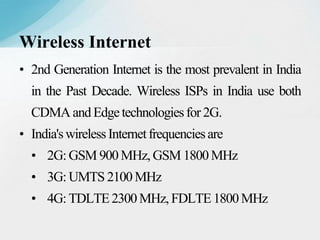
• 2nd Generation Internet is the most prevalent in India
in the Past Decade. Wireless ISPs in India use both
CDMA and Edgetechnologiesfor 2G.
• India'swirelessInternetfrequenciesare
• 2G: GSM 900 MHz, GSM 1800 MHz
• 3G: UMTS 2100 MHz
• 4G: TDLTE2300 MHz, FDLTE1800MHz
Wireless Internet
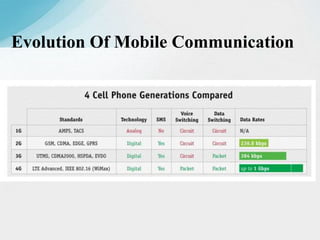
Evolution Of Mobile Communication
• High Bandwidth Requirement
• Expensive fees for 3G Licenses Services
• It was challenge to build the infrastructure for 3G
• Expensive 3G Phones.
• Large Cell Phones
WHY 4G ?
• LTE stands for Long Term Evolution
• It is a 4G wireless broadband technology developed
by the Third Generation Partnership Project (3GPP),
an industry trade group.
• It isn’t as much a technology as it is the path followed
to achieve 4G speeds
4G Technology LTE
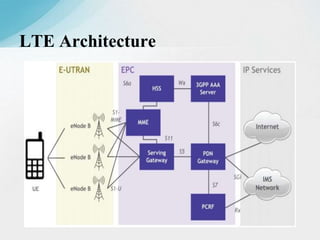
LTE Architecture
• The high-level network architecture of LTE is
comprised of following three main components:
• The User Equipment (UE).
• The Evolved UMTS Terrestrial Radio Access
Network (E-UTRAN).
• The Evolved Packet Core (EPC).
Components Of LTE Architecture
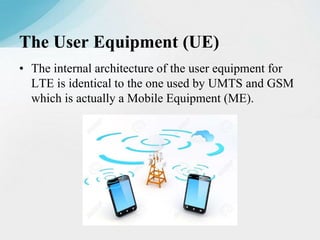
• The internal architecture of the user equipment for
LTE is identical to the one used by UMTS and GSM
which is actually a Mobile Equipment (ME).
The User Equipment (UE)
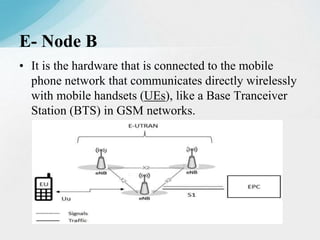
• It is the hardware that is connected to the mobile
phone network that communicates directly wirelessly
with mobile handsets (UEs), like a Base Tranceiver
Station (BTS) in GSM networks.
E- Node B
• The MME (for Mobility Management Entity) deals
with the control plane.
• It handles the signalling related to mobility and
security for E-UTRAN access.
• The MME is responsible for the tracking and the
paging of UE in idle-mode.
• Controls the high-level operation of the mobile by
means of signalling messages and Home Subscriber
Server (HSS).
MME (Mobile Management Entity)
• Serving gateway terminates the interface towards
EUTRAN.
• It acts a mobility anchor for inter 3GPP mobility.
• SGW is responsible for
• packet routing and forwarding,
• buffering the downlink packets
• downlink packet marking.
Serving Gateway (SGW):
• PGW terminates SGi interface towards the
PDN.
• PGW is responsible for all the IP packet based
operations such as
• deep packet inspection,
• UE IP address allocation,
• Transport level packet marking in uplink and
downlink,
• accounting etc.
PDN Gateway (PGW):
• The HSS is a central database that contains user-related
and subscription-related information.
• The functions of the HSS include functionalities such as
mobility management, call and session establishment
support, user authentication and access authorization.
• It also holds information about the PDNs to which the
user can connect.
• In addition the HSS holds dynamic information such as
the identity of the MME to which the user is currently
attached or registered.
Home Subscriber Server (HSS):
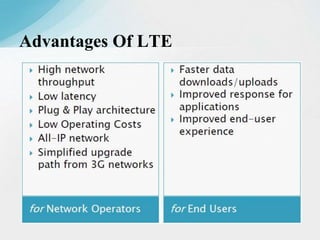
Advantages Of LTE
• Voice over LTE (VoLTE) which is based on the IP
Multimedia Subsystem (IMS) network
• This approach results in the voice service (control and
media planes) being delivered as data flows within
the LTE data bearer.
• This means that there is no dependency on the circuit
switched voice network to be maintained.
• VoLTE has up to three times more voice and data
capacity than 3G UMTS and up to six times more
than 2G GSM.
• Furthermore, it frees up bandwidth because VoLTE’s
packets headers are smaller than those of un-
optimized VoIP/LTE
VOLTE
Volte and LTE technology (Reliance Jio)

Volte and LTE technology (Reliance Jio)

  • 1.
    Department of Electronicsand Communication Engineering Swami Keshvanand Institute of Technology, Management & Gramothan
  • 2.
    SUBMITTED BY: URVISHARMA ECE-B(1st SHIFT) 13ESKEC086 A 2 MONTH INDUSTRIAL TRAINING REPORT ON LTE & VOLTE AT RELIANCE JIO INFOCOMM LIMITED
  • 3.
    • Reliance JioInfocomm Limited, is an LTE based mobile network operator in India. • It is a wholly owned subsidiary of Reliance Industries headquartered in Mumbai, that provides wireless 4G LTE service network (without 2G/3G based services) • It is the only 100% VOLTE operator in the country, with coverage across all 22 telecom circles in India. Introduction
  • 4.
    • RJIL holdsspectrum in 1800 MHz (across 14 circles) and 2300 MHz (across 22 circles) capable of offering fourth generation(4G)wirelessservices. • RJIL aims to provide anytime, anywhere access to innovative and empowering digital content, applications and services, thereby propelling India into global leadership in digital economy.
  • 5.
    • India's firstall IP network • Data-strong network built for 4G Internet • Mobile video network • True 4G covering 18,000 cities, 2 lakh villages • Voice over LTE (VoLTE) technology • Future Proof - 5G, 6G ready Features Of JIO
  • 6.
    • Best 4Gnetwork with the lowest data rates globally • LYF devices starting Rs. 2,999/- • Complimentary Jio Apps worth Rs. 15,000/- • Instant Aadhaar card based activations • Free voice calls • No complex telecom charges • Jio simple 4G Tariff Plans • Special discounts for students • Enterprise-friendly solutions and plans • India's first ever platinum 4G service Jio Digital Life
  • 7.
    • Currently wehave following mobile and internet communication technologies adopted by different mobile companies in different parts of the world. • GSM • CDMA • EDGE • GPRS • VoIP Mobile Internet Communication Technologies
  • 8.
    • 2nd GenerationInternet is the most prevalent in India in the Past Decade. Wireless ISPs in India use both CDMA and Edgetechnologiesfor 2G. • India'swirelessInternetfrequenciesare • 2G: GSM 900 MHz, GSM 1800 MHz • 3G: UMTS 2100 MHz • 4G: TDLTE2300 MHz, FDLTE1800MHz Wireless Internet
  • 9.
    Evolution Of MobileCommunication
  • 10.
    • High BandwidthRequirement • Expensive fees for 3G Licenses Services • It was challenge to build the infrastructure for 3G • Expensive 3G Phones. • Large Cell Phones WHY 4G ?
  • 11.
    • LTE standsfor Long Term Evolution • It is a 4G wireless broadband technology developed by the Third Generation Partnership Project (3GPP), an industry trade group. • It isn’t as much a technology as it is the path followed to achieve 4G speeds 4G Technology LTE
  • 12.
  • 13.
    • The high-levelnetwork architecture of LTE is comprised of following three main components: • The User Equipment (UE). • The Evolved UMTS Terrestrial Radio Access Network (E-UTRAN). • The Evolved Packet Core (EPC). Components Of LTE Architecture
  • 14.
    • The internalarchitecture of the user equipment for LTE is identical to the one used by UMTS and GSM which is actually a Mobile Equipment (ME). The User Equipment (UE)
  • 15.
    • It isthe hardware that is connected to the mobile phone network that communicates directly wirelessly with mobile handsets (UEs), like a Base Tranceiver Station (BTS) in GSM networks. E- Node B
  • 16.
    • The MME(for Mobility Management Entity) deals with the control plane. • It handles the signalling related to mobility and security for E-UTRAN access. • The MME is responsible for the tracking and the paging of UE in idle-mode. • Controls the high-level operation of the mobile by means of signalling messages and Home Subscriber Server (HSS). MME (Mobile Management Entity)
  • 17.
    • Serving gatewayterminates the interface towards EUTRAN. • It acts a mobility anchor for inter 3GPP mobility. • SGW is responsible for • packet routing and forwarding, • buffering the downlink packets • downlink packet marking. Serving Gateway (SGW):
  • 18.
    • PGW terminatesSGi interface towards the PDN. • PGW is responsible for all the IP packet based operations such as • deep packet inspection, • UE IP address allocation, • Transport level packet marking in uplink and downlink, • accounting etc. PDN Gateway (PGW):
  • 19.
    • The HSSis a central database that contains user-related and subscription-related information. • The functions of the HSS include functionalities such as mobility management, call and session establishment support, user authentication and access authorization. • It also holds information about the PDNs to which the user can connect. • In addition the HSS holds dynamic information such as the identity of the MME to which the user is currently attached or registered. Home Subscriber Server (HSS):
  • 20.
  • 21.
    • Voice overLTE (VoLTE) which is based on the IP Multimedia Subsystem (IMS) network • This approach results in the voice service (control and media planes) being delivered as data flows within the LTE data bearer. • This means that there is no dependency on the circuit switched voice network to be maintained. • VoLTE has up to three times more voice and data capacity than 3G UMTS and up to six times more than 2G GSM. • Furthermore, it frees up bandwidth because VoLTE’s packets headers are smaller than those of un- optimized VoIP/LTE VOLTE