Motorola General Business 
Mobile Broadband Evolution –LTE and EPC 
Srini RaoSrini RaoFellow of Technical StaffFellow StaffMotorola Enterprise Mobility SolutionsMotorola Solutions
Agenda 
•LTE 
¾Timeline 
¾Overview 
•Applications 
•EPC 
¾Overview 
¾Interworkingand mobility 
•3GPP access 
•Non-3GPP access 
¾QoSand Policy 
¾Roaming 
¾Voice over LTE 
•CSFB, VoLGA, IMS VoIP/One Voice, over the top 
•Voice Handover 
•Future Directions 
¾LTE-Advanced 
•Summary 
Motorola General Business 
Srini Rao LTE EPC IEEE ComSoC Boston April 8, 2010 2
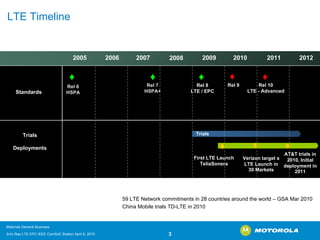
LTE Timeline20052009201020122006200720082011TrialsFirst LTE LaunchTeliaSoneraTrialsDeploymentsStandardsRel8LTE / EPCRel9 Rel6HSPARel7HSPA+ Rel10LTE -AdvancedVerizon target s LTE Launch in 30 MarketsAT&T trials in 2010, Initial deployment in 201159 LTE Network commitments in 28 countries around the world –GSA Mar 2010China Mobile trials TD-LTE in 2010 
Motorola General Business 
Srini Rao LTE EPC IEEE ComSoC Boston April 8, 2010 3
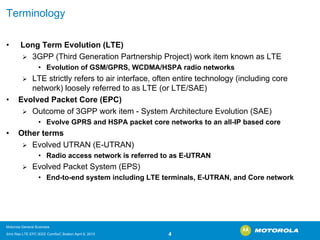
Terminology 
•Long Term Evolution (LTE) 
¾3GPP (Third Generation Partnership Project) work item known as LTE 
•Evolution of GSM/GPRS, WCDMA/HSPA radio networks 
¾LTE strictly refers to air interface, often entire technology (including core network) loosely referred to as LTE (or LTE/SAE) 
•Evolved Packet Core (EPC) 
¾Outcome of 3GPP work item -System Architecture Evolution (SAE) 
•Evolve GPRS and HSPA packet core networks to an all-IP based core 
•Other terms 
¾Evolved UTRAN (E-UTRAN) 
•Radio access network is referred to as E-UTRAN 
¾Evolved Packet System (EPS) 
•End-to-end system including LTE terminals, E-UTRAN, and Core network 
Motorola General Business 
Srini Rao LTE EPC IEEE ComSoC Boston April 8, 2010 4
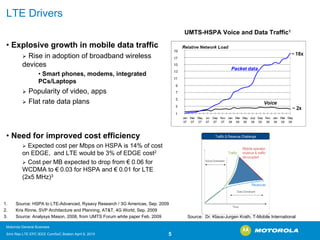
LTE Drivers 
UMTS-HSPA Voice and Data Traffic1 
•Explosive growth in mobile data traffic 
¾Rise in adoption of broadband wireless devices 
•Smart phones, modems, integrated PCs/Laptops 
¾Popularity of video, apps 
¾Flat rate data plans 
•Need for improved cost efficiency 
¾Expected cost per Mbps on HSPA is 14% of cost on EDGE, and LTE would be 3% of EDGE cost2 
¾Cost per MB expected to drop from €0.06 for WCDMA to €0.03 for HSPA and €0.01 for LTE (2x5 MHz)3Source: Dr. Klaus-JurgenKrath, T-Mobile International1.Source: HSPA to LTE-Advanced, RysavyResearch / 3G Americas, Sep. 20092.Kris Rinne, SVP Architecture and Planning, AT&T, 4G World, Sep. 20093.Source: AnalysysMason, 2008, from UMTS Forum white paper Feb. 2009 
Motorola General Business 
Srini Rao LTE EPC IEEE ComSoC Boston April 8, 2010 5
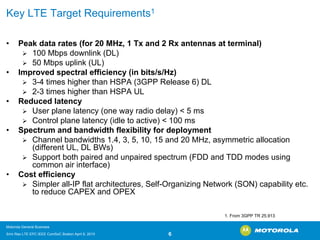
Key LTE Target Requirements1 
•Peak data rates (for 20 MHz, 1 Txand 2 Rx antennas at terminal) 
¾100 Mbps downlink (DL) 
¾50 Mbps uplink (UL) 
•Improved spectral efficiency (in bits/s/Hz) 
¾3-4 times higher than HSPA (3GPP Release 6) DL 
¾2-3 times higher than HSPA UL 
•Reduced latency 
¾User plane latency (one way radio delay) < 5 ms 
¾Control plane latency (idle to active) < 100 ms 
•Spectrum and bandwidth flexibility for deployment 
¾Channel bandwidths 1.4, 3, 5, 10, 15 and 20 MHz, asymmetric allocation (different UL, DL BWs) 
¾Support both paired and unpaired spectrum (FDD and TDD modes using common air interface) 
•Cost efficiency 
¾Simpler all-IP flat architectures, Self-Organizing Network (SON) capability etc. to reduce CAPEX and OPEX 
1. From 3GPP TR 25.913 
Motorola General Business 
Srini Rao LTE EPC IEEE ComSoC Boston April 8, 2010 6
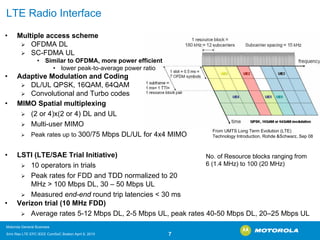
LTE Radio InterfaceFrom UMTS Long Term Evolution (LTE) Technology Introduction, Rohde &Schwarz, Sep 08•Multiple access scheme ¾OFDMA DL ¾SC-FDMA UL•Similar to OFDMA, more power efficient •lower peak-to-average power ratio•Adaptive Modulation and Coding ¾DL/UL QPSK, 16QAM, 64QAM ¾Convolutionaland Turbo codes•MIMO Spatial multiplexing ¾(2 or 4)x(2 or 4) DL and UL ¾Multi-user MIMO ¾Peak rates up to 300/75 Mbps DL/UL for 4x4 MIMO•LSTI (LTE/SAE Trial Initiative) ¾10 operators in trials ¾Peak rates for FDD and TDD normalized to 20 MHz > 100 Mbps DL, 30 –50 Mbps UL ¾Measured end-endround trip latencies < 30 ms•Verizon trial (10 MHz FDD) ¾Average rates 5-12 Mbps DL, 2-5 Mbps UL, peak rates 40-50 Mbps DL, 20–25 Mbps UL 
No. of Resource blocks ranging from 6 (1.4 MHz) to 100 (20 MHz) 
Motorola General Business 
Srini Rao LTE EPC IEEE ComSoC Boston April 8, 2010 7
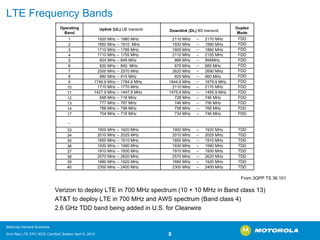
LTE Frequency BandsTDD2400 MHz–2300 MHz 2400 MHz–2300 MHz 40TDD1920 MHz–1880 MHz 1920 MHz–1880 MHz 39TDD2620 MHz–2570 MHz2620 MHz–2570 MHz 38TDD1930 MHz–1910 MHz1930 MHz–1910 MHz 37TDD1990 MHz–1930 MHz1990 MHz–1930 MHz 36TDD1910 MHz–1850 MHz1910 MHz–1850 MHz 35TDD2025 MHz–2010 MHz 2025 MHz –2010 MHz34TDD1920 MHz–1900 MHz1920 MHz–1900 MHz33... FDD746 MHz–734 MHz716 MHz–704 MHz 17FDD768 MHz–758 MHz798 MHz–788 MHz14FDD756 MHz–746 MHz787 MHz–777 MHz13FDD746 MHz–728 MHz716 MHz–698 MHz12FDD1495.9 MHz –1475.9 MHz1447.9 MHz –1427.9 MHz 11FDD2170 MHz–2110 MHz1770 MHz–1710 MHz10FDD1879.9 MHz–1844.9 MHz1784.9 MHz–1749.9 MHz9FDD960 MHz–925 MHz915 MHz–880 MHz8FDD2690 MHz–2620 MHz2570 MHz–2500 MHz7FDD885 MHz–875 MHz840 MHz–830 MHz6FDD894MHz–869 MHz849 MHz–824 MHz5FDD2155 MHz–2110 MHz1755 MHz –1710 MHz4FDD1880 MHz–1805 MHz1785 MHz–1710 MHz 3FDD1990 MHz–1930 MHz1910 MHz–1850 MHz 2FDD2170 MHz–2110 MHz 1980 MHz–1920 MHz 1Duplex ModeDownlink (DL) BS transmitUplink (UL) UE transmitOperating Band 
From 3GPP TS 36.101Verizon to deploy LTE in 700 MHz spectrum (10 + 10 MHz in Band class 13) AT&T to deploy LTE in 700 MHz and AWS spectrum (Band class 4) 2.6 GHz TDD band being added in U.S. for Clearwire 
Motorola General Business 
Srini Rao LTE EPC IEEE ComSoC Boston April 8, 2010 8
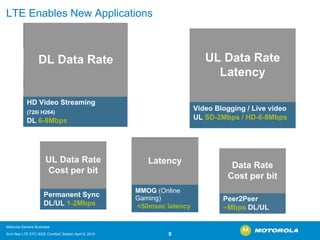
LTE Enables New ApplicationsHD Video Streaming(720i H264) DL 6-8MbpsDL Data Rate 
Motorola General Business 
Srini Rao LTE EPC IEEE ComSoC Boston April 8, 2010 9 
Video Blogging / Live videoUL SD-2Mbps / HD-6-8MbpsUL Data RateLatencyMMOG (Online Gaming) <50msec latencyLatencyPermanent Sync DL/UL1-2MbpsUL Data RateCost per bitPeer2Peer ∞MbpsDL/UL Data RateCost per bit
Evolved Packet Core (EPC) 
Motorola General Business 
Srini Rao LTE EPC IEEE ComSoC Boston April 8, 2010 10
Why is Core Evolution needed? 
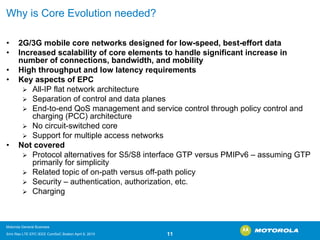
•2G/3G mobile core networks designed for low-speed, best-effort data 
•Increased scalability of core elements to handle significant increase in number of connections, bandwidth, and mobility 
•High throughput and low latency requirements 
•Key aspects of EPC 
¾All-IP flat network architecture 
¾Separation of control and data planes 
¾End-to-end QoSmanagement and service control through policy control and charging (PCC) architecture 
¾No circuit-switched core 
¾Support for multiple access networks 
•Not covered 
¾Protocol alternatives for S5/S8 interface GTP versus PMIPv6 –assuming GTP primarily for simplicity 
¾Related topic of on-path versus off-path policy 
¾Security –authentication, authorization, etc. 
¾Charging 
Motorola General Business 
Srini Rao LTE EPC IEEE ComSoC Boston April 8, 2010 11
2G/3G to LTEAccessPacket CoreServicesGSM/GPRSBTSBSCMGWCircuit CoreMSC ServerWCDMA/HSPANode BLTE/SAEeNodeBMMERNCServing GWPDN GWSGSNGGSNPSTNPSTNIP Networks(IMS, Internet etc.) IP Networks(IMS, Internet etc.) 
Motorola General Business 
Srini Rao LTE EPC IEEE ComSoC Boston April 8, 2010 12
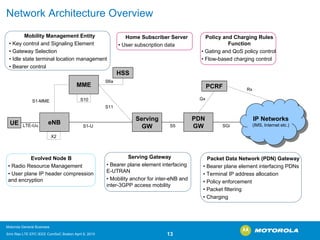
Network Architecture OverviewUEMMEHSSServing GWPDNGWPCRFIP Networks (IMS, Internet etc.) IP Networks (IMS, Internet etc.) S6aS11S1-US1-MMELTE-UuS5GxRxSGieNBS10X2Mobility Management Entity•Key control and Signaling Element•Gateway Selection•Idle state terminal location management•Bearer controlHome Subscriber Server•User subscription dataPolicy and Charging Rules Function•Gating and QoSpolicy control•Flow-based charging controlServing Gateway•Bearer plane element interfacing E-UTRAN•Mobility anchor for inter-eNBand inter-3GPP access mobilityPacket Data Network (PDN) Gateway•Bearer plane element interfacing PDNs•Terminal IP address allocation•Policy enforcement•Packet filtering•ChargingEvolved Node B•Radio Resource Management•User plane IP header compression and encryption 
Motorola General Business 
Srini Rao LTE EPC IEEE ComSoC Boston April 8, 2010 13
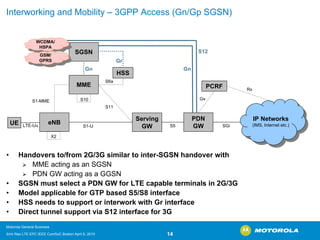
UEMMESGSNHSSServing GWPDNGWPCRFIP Networks (IMS, Internet etc.) IP Networks (IMS, Internet etc.) WCDMA/ HSPAWCDMA/ HSPAGSM/ GPRSGSM/ GPRSS6aGrS1-US1-MMELTE-UuS5GxRxSGiGneNBS10X2Interworkingand Mobility –3GPP Access (Gn/GpSGSN) S12GnS11•Handovers to/from 2G/3G similar to inter-SGSN handover with ¾MME acting as an SGSN ¾PDN GW acting as a GGSN•SGSN must select a PDN GW for LTE capable terminals in 2G/3G•Model applicable for GTP based S5/S8 interface•HSS needs to support or interworkwith Grinterface•Direct tunnel support via S12 interface for 3G 
Motorola General Business 
Srini Rao LTE EPC IEEE ComSoC Boston April 8, 2010 14
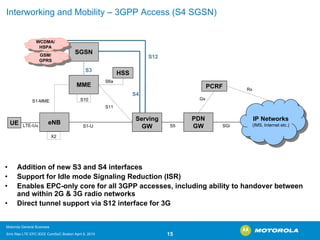
UEMMESGSNHSSServing GWPDNGWPCRFIP Networks (IMS, Internet etc.) IP Networks (IMS, Internet etc.) WCDMA/ HSPAWCDMA/ HSPAGSM/ GPRSGSM/ GPRSS6aS4S1-US1-MMELTE-UuS5GxRxSGiS3eNBS10X2Interworkingand Mobility –3GPP Access (S4 SGSN) S12S11•Addition of new S3 and S4 interfaces•Support for Idle mode Signaling Reduction (ISR) •Enables EPC-only core for all 3GPP accesses, including ability to handover between and within 2G & 3G radio networks•Direct tunnel support via S12 interface for 3G 
Motorola General Business 
Srini Rao LTE EPC IEEE ComSoC Boston April 8, 2010 15
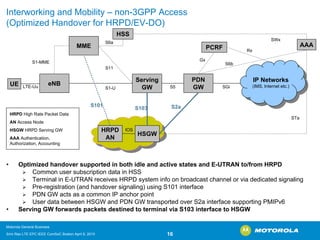
Interworkingand Mobility –non-3GPP Access(Optimized Handover for HRPD/EV-DO) HRPDHigh Rate Packet DataANAccess NodeHSGWHRPD Serving GWAAAAuthentication, Authorization, AccountingLTE-UuUEMMEHSSServing GWPDNGWPCRFIP Networks (IMS, Internet etc.) IP Networks (IMS, Internet etc.) S6aS11S1-US1-MMES5GxRxSGieNBAAAHRPD ANHSGWS101S103IOSS2aSTaSWxS6b 
•Optimized handover supported in both idle and active states and E-UTRAN to/from HRPD 
¾Common user subscription data in HSS 
¾Terminal in E-UTRAN receives HRPD system info on broadcast channel or via dedicated signaling 
¾Pre-registration (and handover signaling) using S101 interface 
¾PDN GW acts as a common IP anchor point 
¾User data between HSGW and PDN GW transported over S2a interfacesupporting PMIPv6 
•Serving GW forwards packets destined to terminal via S103 interface to HSGW 
Motorola General Business 
Srini Rao LTE EPC IEEE ComSoC Boston April 8, 2010 16
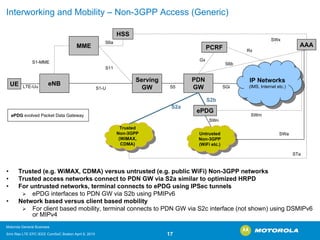
Interworkingand Mobility –Non-3GPP Access (Generic) 
LTE-UuUEMMEHSSServing GWPDNGWPCRFIP Networks (IMS, Internet etc.) IP Networks (IMS, Internet etc.) S6aS11S1-US1-MMES5GxRxSGieNBTrustedNon-3GPP(WiMAX, CDMA) TrustedNon-3GPP(WiMAX, CDMA) S2aSTaSWxUntrustedNon-3GPP(WiFietc.) UntrustedNon-3GPP(WiFietc.) ePDGSWaS6bS2bSWnAAASWmePDGevolved Packet Data Gateway 
•Trusted (e.g. WiMAX, CDMA) versus untrusted(e.g. public WiFi) Non-3GPP networks 
•Trusted access networks connect to PDN GW via S2a similar to optimized HRPD 
•For untrustednetworks, terminal connects to ePDGusing IPSectunnels 
¾ePDGinterfaces to PDN GW via S2b using PMIPv6 
•Network based versus client based mobility 
¾For client based mobility, terminal connects to PDN GW via S2c interface (not shown) using DSMIPv6 or MIPv4 
Motorola General Business 
Srini Rao LTE EPC IEEE ComSoC Boston April 8, 2010 17
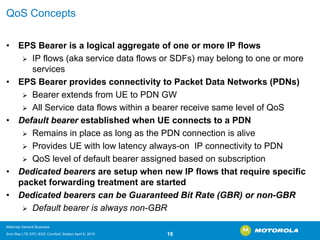
QoSConcepts 
•EPS Bearer is a logical aggregate of one or more IP flows 
¾IP flows (akaservice data flows or SDFs) may belong to one or more services 
•EPS Bearer provides connectivity to Packet Data Networks (PDNs) 
¾Bearer extends from UE to PDN GW 
¾All Service data flows within a bearer receive same level of QoS 
•Default bearerestablished when UE connects to a PDN 
¾Remains in place as long as the PDN connection is alive 
¾Provides UE with low latency always-on IP connectivity to PDN 
¾QoSlevel of default bearer assigned based on subscription 
•Dedicated bearers are setup when new IP flows that require specific packet forwarding treatment are started 
•Dedicated bearers can be Guaranteed Bit Rate (GBR) or non-GBR 
¾Default bearer is always non-GBR 
Motorola General Business 
Srini Rao LTE EPC IEEE ComSoC Boston April 8, 2010 18
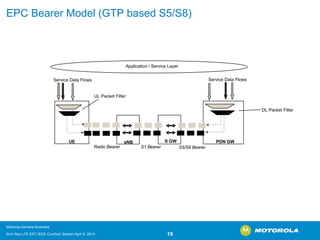
EPC Bearer Model (GTP based S5/S8) PDN GWService Data FlowseNBUEService Data FlowsUL Packet FilterRadio BearerS1 BearerApplication / Service LayerS5/S8 BearerS GWDL Packet Filter 
Motorola General Business 
Srini Rao LTE EPC IEEE ComSoC Boston April 8, 2010 19
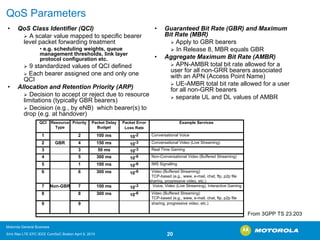
QoSParameters 
•QoSClass Identifier (QCI) ¾A scalar value mapped to specific bearer level packet forwarding treatment•e.g. scheduling weights, queue management thresholds, link layer protocol configuration etc. ¾9 standardized values of QCI defined ¾Each bearer assigned one and only one QCI•Allocation and Retention Priority (ARP) ¾Decision to accept or reject due to resource limitations (typically GBR bearers) ¾Decision (e.g., by eNB) which bearer(s) to drop (e.g. at handover) •Guaranteed Bit Rate (GBR) and Maximum Bit Rate (MBR) ¾Apply to GBR bearers ¾In Release 8, MBR equals GBR•Aggregate Maximum Bit Rate (AMBR) ¾APN-AMBR total bit rate allowed for a user for all non-GRR bearers associated with an APN (Access Point Name) ¾UE-AMBR total bit rate allowed for a user for all non-GRR bearers ¾separate UL and DL values of AMBR 
QCI 
Resource 
Type 
Priority 
Packet Delay 
Budget 
Packet Error 
Loss Rate 
Example Services 
1 
2 
100ms 
10-2 
Conversational Voice 
2 
GBR 
4 
150ms 
10-3 
Conversational Video (Live Streaming) 
3 
3 
50ms 
10-3 
Real Time Gaming 
4 
5 
300ms 
10-6 
Non-Conversational Video (Buffered Streaming) 
5 
1 
100ms 
10-6 
IMS Signalling 
6 
6 
300ms 
10-6 
Video (Buffered Streaming) TCP-based (e.g., www, e-mail, chat, ftp, p2p file sharing, progressive video, etc.) 
7 
Non-GBR 
7 
100 ms 
10-3 
Voice, Video (Live Streaming), Interactive Gaming 
8 
8 
300ms 
10-6 
Video (Buffered Streaming) TCP-based (e.g., www, e-mail, chat, ftp, p2p file 
9 
9 
sharing, progressive video, etc.) 
From 3GPP TS 23.203 
Motorola General Business 
Srini Rao LTE EPC IEEE ComSoC Boston April 8, 2010 20
Policy and Charging Control (PCC) 
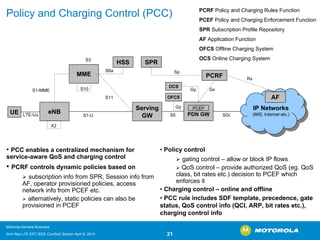
PCRF Policy and Charging Rules FunctionPCEFPolicy and Charging Enforcement FunctionSPRSubscription Profile RepositoryAFApplication FunctionOFCSOffline Charging SystemOCSOnline Charging SystemPCEFPDN GWUEMMEHSSServing GWPCRFIP Networks (IMS, Internet etc.) IP Networks (IMS, Internet etc.) S6aS1-US1-MMELTE-UuS5GxRxSGiS3eNBS10X2SPRSpAFOCSOFCSGyGzS11•Policy control ¾gating control –allow or block IP flows ¾QoScontrol –provide authorized QoS(eg. QoSclass, bit rates etc.) decision to PCEF which enforces it•Charging control –online and offline•PCC rule includes SDF template, precedence, gate status, QoScontrol info (QCI, ARP, bit rates etc.), charging control info•PCC enables a centralized mechanism for service-aware QoSand charging control•PCRF controls dynamic policies based on ¾subscription info from SPR, Session info from AF, operator provisioned policies, access network info from PCEF etc. ¾alternatively, static policies can also be provisioned in PCEF 
Motorola General Business 
Srini Rao LTE EPC IEEE ComSoC Boston April 8, 2010 21
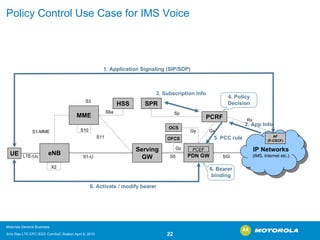
Policy Control Use Case for IMS VoicePCEFPDN GWUEMMEHSSServing GWPCRFIP Networks (IMS, Internet etc.) IP Networks (IMS, Internet etc.) S6aS11S1-US1-MMELTE-UuS5GxRxSGiS3eNBS10X2SPRSpAF(P-CSCF) OCSOFCSGyGz4. Policy Decision6. Bearer binding1. Application Signaling (SIP/SDP) 2. App Info3. Subscription Info5. PCC rule6. Activate / modify bearer 
Motorola General Business 
Srini Rao LTE EPC IEEE ComSoC Boston April 8, 2010 22
Network Architecture for Roaming (Home Routed) 
LTE-UuUEMMEHSSServing GWPDNGWhPCRFIP Networks (IMS, Internet) IP Networks (IMS, Internet) S6aS11S1-MMES8GxRxSGi 
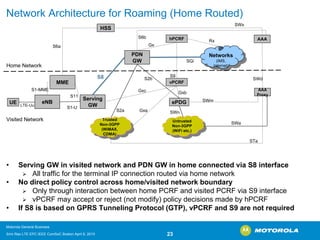
S1-UeNBTrustedNon-3GPP(WiMAX, CDMA) TrustedNon-3GPP(WiMAX, CDMA) S2aSTaSWxUntrustedNon-3GPP(WiFietc.) UntrustedNon-3GPP(WiFietc.) ePDGSWaS6bS2bSWnSWmvPCRFS9GxbGxcAAAProxySWdGxaAAAHome NetworkVisited Network•Serving GW in visited network and PDN GW in home connected via S8 interface ¾All traffic for the terminal IP connection routed via home network•No direct policy control across home/visited network boundary ¾Only through interaction between home PCRF and visited PCRF via S9 interface ¾vPCRFmay accept or reject (not modify) policy decisions made by hPCRF•If S8 is based on GPRS Tunneling Protocol (GTP), vPCRFand S9 are not required 
Motorola General Business 
Srini Rao LTE EPC IEEE ComSoC Boston April 8, 2010 23
Network Architecture for Roaming (Local Breakout) 
LTE-UuUEMMEHSSServing GWhPCRFIP NetworksIP NetworksS6aS11S1-MMES5GxRxSGi 
Motorola General Business 
Srini Rao LTE EPC IEEE ComSoC Boston April 8, 2010 24 
S1-UeNBTrustedNon-3GPP(WiMAX, CDMA) TrustedNon-3GPP(WiMAX, CDMA) S2aSWxUntrustedNon-3GPP(WiFietc.) 
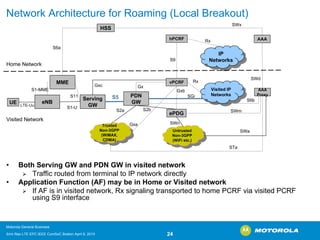
STaUntrustedNon-3GPP(WiFietc.) ePDGSWaS6bS2bSWnSWmS9GxbGxcSWdGxaAAAHome NetworkVisited NetworkRxVisited IP NetworksVisited IP NetworksAAAProxyPDNGWvPCRF•Both Serving GW and PDN GW in visited network ¾Traffic routed from terminal to IP network directly•Application Function (AF) may be in Home or Visited network ¾If AF is in visited network, Rx signaling transported to home PCRF via visited PCRF using S9 interface
Voice Options for LTE 
•LTE/SAE networks have no circuit core 
¾Initial roll-outs likely will support data only devices such as USB dongles 
•Voice based on legacy circuit core 
¾CS (Circuit Switch) Fallback (CSFB) 
¾Voice over LTE via Generic Access Network (VoLGA) 
•Voice based on IMS 
¾3GPP Multimedia Telephony (MMTel) / One Voice 
•Over the top VoIP 
Motorola General Business 
Srini Rao LTE EPC IEEE ComSoC Boston April 8, 2010 25
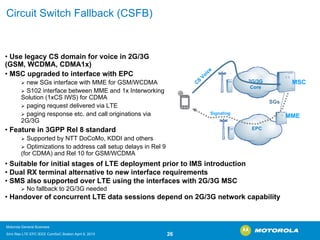
Circuit Switch Fallback (CSFB) 
•Use legacy CS domain for voice in 2G/3G (GSM, WCDMA, CDMA1x) 
•MSC upgraded to interface with EPC 
¾new SGsinterface with MME for GSM/WCDMA 
¾S102 interface between MME and 1x InterworkingSolution (1xCS IWS) for CDMA 
¾paging request delivered via LTE 
¾paging response etc. and call originations via 2G/3G 
•Feature in 3GPP Rel8 standard 
¾Supported by NTT DoCoMo, KDDI and others 
¾Optimizations to address call setup delays in Rel9 (for CDMA) and Rel10 for GSM/WCDMA CS VoiceCS Voice SignalingEPC2G/3G CoreSGsMSCMME•Suitable for initial stages of LTE deployment prior to IMS introduction •Dual RX terminal alternative to new interface requirements•SMS also supported over LTE using the interfaces with 2G/3G MSC ¾No fallback to 2G/3G needed •Handover of concurrent LTE data sessions depend on 2G/3G network capability 
Motorola General Business 
Srini Rao LTE EPC IEEE ComSoC Boston April 8, 2010 26
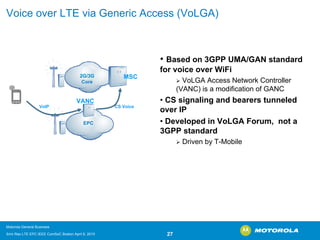
Voice over LTE via Generic Access (VoLGA) 
•Based on 3GPP UMA/GAN standard for voice over WiFi ¾VoLGAAccess Network Controller (VANC) is a modification of GANC•CS signaling and bearers tunneled over IP•Developed in VoLGAForum, not a 3GPP standard ¾Driven by T-MobileVoIPEPC2G/3G CoreMSCVANCCS Voice 
Motorola General Business 
Srini Rao LTE EPC IEEE ComSoC Boston April 8, 2010 27
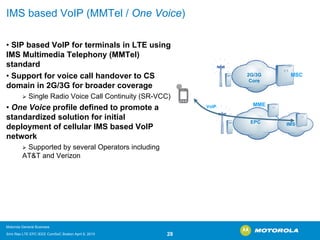
IMS based VoIP (MMTel/ One Voice) 
•SIP based VoIP for terminals in LTE using IMS Multimedia Telephony (MMTel) standard 
•Support for voice call handover to CS domain in 2G/3G for broader coverage 
¾Single Radio Voice Call Continuity (SR-VCC) 
•One Voiceprofile defined to promote a standardized solution for initial deployment of cellular IMS based VoIP network 
¾Supported by several Operators including AT&T and VerizonVoIPEPC2G/3G CoreMSCMMEIMS 
Motorola General Business 
Srini Rao LTE EPC IEEE ComSoC Boston April 8, 2010 28
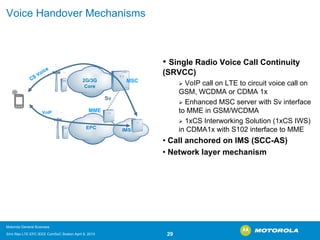
Voice Handover Mechanisms 
•Single Radio Voice Call Continuity (SRVCC) ¾VoIP call on LTE to circuit voice call on GSM, WCDMA or CDMA 1x ¾Enhanced MSC server with Svinterface to MME in GSM/WCDMA ¾1xCS InterworkingSolution (1xCS IWS) in CDMA1x with S102 interface to MME•Call anchored on IMS (SCC-AS) •Network layer mechanismVoIPEPC2G/3G CoreSvMSCMMEIMS CS VoiceCS Voice 
Motorola General Business 
Srini Rao LTE EPC IEEE ComSoC Boston April 8, 2010 29
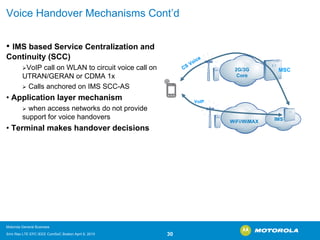
Voice Handover Mechanisms Cont’d 
•IMS based Service Centralization and Continuity (SCC) 
¾VoIP call on WLAN to circuit voice call on UTRAN/GERAN or CDMA 1x 
¾Calls anchored on IMS SCC-AS 
•Application layer mechanism 
¾when access networks do not provide support for voice handovers 
•Terminal makes handover decisionsVoIPWiFi/WiMAX2G/3G CoreMSCIMS CS VoiceCS Voice 
Motorola General Business 
Srini Rao LTE EPC IEEE ComSoC Boston April 8, 2010 30
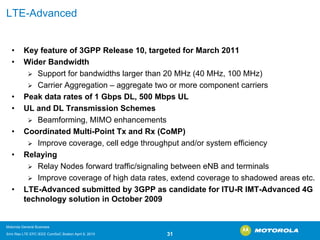
LTE-Advanced 
•Key feature of 3GPP Release 10, targeted for March 2011 •Wider Bandwidth ¾Support for bandwidths larger than 20 MHz (40 MHz, 100 MHz) ¾Carrier Aggregation –aggregate two or more component carriers•Peak data rates of 1 GbpsDL, 500 Mbps UL•UL and DL Transmission Schemes ¾Beamforming, MIMO enhancements•Coordinated Multi-Point Txand Rx (CoMP) ¾Improve coverage, cell edge throughput and/or system efficiency•Relaying ¾Relay Nodes forward traffic/signaling between eNBand terminals ¾Improve coverage of high data rates, extend coverage to shadowedareas etc. •LTE-Advanced submitted by 3GPP as candidate for ITU-R IMT-Advanced 4G technology solution in October 2009 
Motorola General Business 
Srini Rao LTE EPC IEEE ComSoC Boston April 8, 2010 31
Summary and Conclusion 
•LTE technology is being proven to meet or exceed initial targetrequirements ¾Large ecosystem of operators, vendors etc. committed to LTE•Commercial network deployments planned 2010 and beyond•EPC represents an efficient all-IP packet core ¾Supports delivery of mobile Internet services with QoSover broadband radio networks ¾Supports multiple access technologies (all 2G/3G cellular, WiMAX, WiFietc.) and mobility between these access networks•LTE and EPC can cost effectively address the demands of future mobile broadband growth 
Motorola General Business 
Srini Rao LTE EPC IEEE ComSoC Boston April 8, 2010 32

Lte epc ieee_comsoc_rao_april_8_2010

  • 1.
    Motorola General Business Mobile Broadband Evolution –LTE and EPC Srini RaoSrini RaoFellow of Technical StaffFellow StaffMotorola Enterprise Mobility SolutionsMotorola Solutions
  • 2.
    Agenda •LTE ¾Timeline ¾Overview •Applications •EPC ¾Overview ¾Interworkingand mobility •3GPP access •Non-3GPP access ¾QoSand Policy ¾Roaming ¾Voice over LTE •CSFB, VoLGA, IMS VoIP/One Voice, over the top •Voice Handover •Future Directions ¾LTE-Advanced •Summary Motorola General Business Srini Rao LTE EPC IEEE ComSoC Boston April 8, 2010 2
  • 3.
    LTE Timeline20052009201020122006200720082011TrialsFirst LTELaunchTeliaSoneraTrialsDeploymentsStandardsRel8LTE / EPCRel9 Rel6HSPARel7HSPA+ Rel10LTE -AdvancedVerizon target s LTE Launch in 30 MarketsAT&T trials in 2010, Initial deployment in 201159 LTE Network commitments in 28 countries around the world –GSA Mar 2010China Mobile trials TD-LTE in 2010 Motorola General Business Srini Rao LTE EPC IEEE ComSoC Boston April 8, 2010 3
  • 4.
    Terminology •Long TermEvolution (LTE) ¾3GPP (Third Generation Partnership Project) work item known as LTE •Evolution of GSM/GPRS, WCDMA/HSPA radio networks ¾LTE strictly refers to air interface, often entire technology (including core network) loosely referred to as LTE (or LTE/SAE) •Evolved Packet Core (EPC) ¾Outcome of 3GPP work item -System Architecture Evolution (SAE) •Evolve GPRS and HSPA packet core networks to an all-IP based core •Other terms ¾Evolved UTRAN (E-UTRAN) •Radio access network is referred to as E-UTRAN ¾Evolved Packet System (EPS) •End-to-end system including LTE terminals, E-UTRAN, and Core network Motorola General Business Srini Rao LTE EPC IEEE ComSoC Boston April 8, 2010 4
  • 5.
    LTE Drivers UMTS-HSPAVoice and Data Traffic1 •Explosive growth in mobile data traffic ¾Rise in adoption of broadband wireless devices •Smart phones, modems, integrated PCs/Laptops ¾Popularity of video, apps ¾Flat rate data plans •Need for improved cost efficiency ¾Expected cost per Mbps on HSPA is 14% of cost on EDGE, and LTE would be 3% of EDGE cost2 ¾Cost per MB expected to drop from €0.06 for WCDMA to €0.03 for HSPA and €0.01 for LTE (2x5 MHz)3Source: Dr. Klaus-JurgenKrath, T-Mobile International1.Source: HSPA to LTE-Advanced, RysavyResearch / 3G Americas, Sep. 20092.Kris Rinne, SVP Architecture and Planning, AT&T, 4G World, Sep. 20093.Source: AnalysysMason, 2008, from UMTS Forum white paper Feb. 2009 Motorola General Business Srini Rao LTE EPC IEEE ComSoC Boston April 8, 2010 5
  • 6.
    Key LTE TargetRequirements1 •Peak data rates (for 20 MHz, 1 Txand 2 Rx antennas at terminal) ¾100 Mbps downlink (DL) ¾50 Mbps uplink (UL) •Improved spectral efficiency (in bits/s/Hz) ¾3-4 times higher than HSPA (3GPP Release 6) DL ¾2-3 times higher than HSPA UL •Reduced latency ¾User plane latency (one way radio delay) < 5 ms ¾Control plane latency (idle to active) < 100 ms •Spectrum and bandwidth flexibility for deployment ¾Channel bandwidths 1.4, 3, 5, 10, 15 and 20 MHz, asymmetric allocation (different UL, DL BWs) ¾Support both paired and unpaired spectrum (FDD and TDD modes using common air interface) •Cost efficiency ¾Simpler all-IP flat architectures, Self-Organizing Network (SON) capability etc. to reduce CAPEX and OPEX 1. From 3GPP TR 25.913 Motorola General Business Srini Rao LTE EPC IEEE ComSoC Boston April 8, 2010 6
  • 7.
    LTE Radio InterfaceFromUMTS Long Term Evolution (LTE) Technology Introduction, Rohde &Schwarz, Sep 08•Multiple access scheme ¾OFDMA DL ¾SC-FDMA UL•Similar to OFDMA, more power efficient •lower peak-to-average power ratio•Adaptive Modulation and Coding ¾DL/UL QPSK, 16QAM, 64QAM ¾Convolutionaland Turbo codes•MIMO Spatial multiplexing ¾(2 or 4)x(2 or 4) DL and UL ¾Multi-user MIMO ¾Peak rates up to 300/75 Mbps DL/UL for 4x4 MIMO•LSTI (LTE/SAE Trial Initiative) ¾10 operators in trials ¾Peak rates for FDD and TDD normalized to 20 MHz > 100 Mbps DL, 30 –50 Mbps UL ¾Measured end-endround trip latencies < 30 ms•Verizon trial (10 MHz FDD) ¾Average rates 5-12 Mbps DL, 2-5 Mbps UL, peak rates 40-50 Mbps DL, 20–25 Mbps UL No. of Resource blocks ranging from 6 (1.4 MHz) to 100 (20 MHz) Motorola General Business Srini Rao LTE EPC IEEE ComSoC Boston April 8, 2010 7
  • 8.
    LTE Frequency BandsTDD2400MHz–2300 MHz 2400 MHz–2300 MHz 40TDD1920 MHz–1880 MHz 1920 MHz–1880 MHz 39TDD2620 MHz–2570 MHz2620 MHz–2570 MHz 38TDD1930 MHz–1910 MHz1930 MHz–1910 MHz 37TDD1990 MHz–1930 MHz1990 MHz–1930 MHz 36TDD1910 MHz–1850 MHz1910 MHz–1850 MHz 35TDD2025 MHz–2010 MHz 2025 MHz –2010 MHz34TDD1920 MHz–1900 MHz1920 MHz–1900 MHz33... FDD746 MHz–734 MHz716 MHz–704 MHz 17FDD768 MHz–758 MHz798 MHz–788 MHz14FDD756 MHz–746 MHz787 MHz–777 MHz13FDD746 MHz–728 MHz716 MHz–698 MHz12FDD1495.9 MHz –1475.9 MHz1447.9 MHz –1427.9 MHz 11FDD2170 MHz–2110 MHz1770 MHz–1710 MHz10FDD1879.9 MHz–1844.9 MHz1784.9 MHz–1749.9 MHz9FDD960 MHz–925 MHz915 MHz–880 MHz8FDD2690 MHz–2620 MHz2570 MHz–2500 MHz7FDD885 MHz–875 MHz840 MHz–830 MHz6FDD894MHz–869 MHz849 MHz–824 MHz5FDD2155 MHz–2110 MHz1755 MHz –1710 MHz4FDD1880 MHz–1805 MHz1785 MHz–1710 MHz 3FDD1990 MHz–1930 MHz1910 MHz–1850 MHz 2FDD2170 MHz–2110 MHz 1980 MHz–1920 MHz 1Duplex ModeDownlink (DL) BS transmitUplink (UL) UE transmitOperating Band From 3GPP TS 36.101Verizon to deploy LTE in 700 MHz spectrum (10 + 10 MHz in Band class 13) AT&T to deploy LTE in 700 MHz and AWS spectrum (Band class 4) 2.6 GHz TDD band being added in U.S. for Clearwire Motorola General Business Srini Rao LTE EPC IEEE ComSoC Boston April 8, 2010 8
  • 9.
    LTE Enables NewApplicationsHD Video Streaming(720i H264) DL 6-8MbpsDL Data Rate Motorola General Business Srini Rao LTE EPC IEEE ComSoC Boston April 8, 2010 9 Video Blogging / Live videoUL SD-2Mbps / HD-6-8MbpsUL Data RateLatencyMMOG (Online Gaming) <50msec latencyLatencyPermanent Sync DL/UL1-2MbpsUL Data RateCost per bitPeer2Peer ∞MbpsDL/UL Data RateCost per bit
  • 10.
    Evolved Packet Core(EPC) Motorola General Business Srini Rao LTE EPC IEEE ComSoC Boston April 8, 2010 10
  • 11.
    Why is CoreEvolution needed? •2G/3G mobile core networks designed for low-speed, best-effort data •Increased scalability of core elements to handle significant increase in number of connections, bandwidth, and mobility •High throughput and low latency requirements •Key aspects of EPC ¾All-IP flat network architecture ¾Separation of control and data planes ¾End-to-end QoSmanagement and service control through policy control and charging (PCC) architecture ¾No circuit-switched core ¾Support for multiple access networks •Not covered ¾Protocol alternatives for S5/S8 interface GTP versus PMIPv6 –assuming GTP primarily for simplicity ¾Related topic of on-path versus off-path policy ¾Security –authentication, authorization, etc. ¾Charging Motorola General Business Srini Rao LTE EPC IEEE ComSoC Boston April 8, 2010 11
  • 12.
    2G/3G to LTEAccessPacketCoreServicesGSM/GPRSBTSBSCMGWCircuit CoreMSC ServerWCDMA/HSPANode BLTE/SAEeNodeBMMERNCServing GWPDN GWSGSNGGSNPSTNPSTNIP Networks(IMS, Internet etc.) IP Networks(IMS, Internet etc.) Motorola General Business Srini Rao LTE EPC IEEE ComSoC Boston April 8, 2010 12
  • 13.
    Network Architecture OverviewUEMMEHSSServingGWPDNGWPCRFIP Networks (IMS, Internet etc.) IP Networks (IMS, Internet etc.) S6aS11S1-US1-MMELTE-UuS5GxRxSGieNBS10X2Mobility Management Entity•Key control and Signaling Element•Gateway Selection•Idle state terminal location management•Bearer controlHome Subscriber Server•User subscription dataPolicy and Charging Rules Function•Gating and QoSpolicy control•Flow-based charging controlServing Gateway•Bearer plane element interfacing E-UTRAN•Mobility anchor for inter-eNBand inter-3GPP access mobilityPacket Data Network (PDN) Gateway•Bearer plane element interfacing PDNs•Terminal IP address allocation•Policy enforcement•Packet filtering•ChargingEvolved Node B•Radio Resource Management•User plane IP header compression and encryption Motorola General Business Srini Rao LTE EPC IEEE ComSoC Boston April 8, 2010 13
  • 14.
    UEMMESGSNHSSServing GWPDNGWPCRFIP Networks(IMS, Internet etc.) IP Networks (IMS, Internet etc.) WCDMA/ HSPAWCDMA/ HSPAGSM/ GPRSGSM/ GPRSS6aGrS1-US1-MMELTE-UuS5GxRxSGiGneNBS10X2Interworkingand Mobility –3GPP Access (Gn/GpSGSN) S12GnS11•Handovers to/from 2G/3G similar to inter-SGSN handover with ¾MME acting as an SGSN ¾PDN GW acting as a GGSN•SGSN must select a PDN GW for LTE capable terminals in 2G/3G•Model applicable for GTP based S5/S8 interface•HSS needs to support or interworkwith Grinterface•Direct tunnel support via S12 interface for 3G Motorola General Business Srini Rao LTE EPC IEEE ComSoC Boston April 8, 2010 14
  • 15.
    UEMMESGSNHSSServing GWPDNGWPCRFIP Networks(IMS, Internet etc.) IP Networks (IMS, Internet etc.) WCDMA/ HSPAWCDMA/ HSPAGSM/ GPRSGSM/ GPRSS6aS4S1-US1-MMELTE-UuS5GxRxSGiS3eNBS10X2Interworkingand Mobility –3GPP Access (S4 SGSN) S12S11•Addition of new S3 and S4 interfaces•Support for Idle mode Signaling Reduction (ISR) •Enables EPC-only core for all 3GPP accesses, including ability to handover between and within 2G & 3G radio networks•Direct tunnel support via S12 interface for 3G Motorola General Business Srini Rao LTE EPC IEEE ComSoC Boston April 8, 2010 15
  • 16.
    Interworkingand Mobility –non-3GPPAccess(Optimized Handover for HRPD/EV-DO) HRPDHigh Rate Packet DataANAccess NodeHSGWHRPD Serving GWAAAAuthentication, Authorization, AccountingLTE-UuUEMMEHSSServing GWPDNGWPCRFIP Networks (IMS, Internet etc.) IP Networks (IMS, Internet etc.) S6aS11S1-US1-MMES5GxRxSGieNBAAAHRPD ANHSGWS101S103IOSS2aSTaSWxS6b •Optimized handover supported in both idle and active states and E-UTRAN to/from HRPD ¾Common user subscription data in HSS ¾Terminal in E-UTRAN receives HRPD system info on broadcast channel or via dedicated signaling ¾Pre-registration (and handover signaling) using S101 interface ¾PDN GW acts as a common IP anchor point ¾User data between HSGW and PDN GW transported over S2a interfacesupporting PMIPv6 •Serving GW forwards packets destined to terminal via S103 interface to HSGW Motorola General Business Srini Rao LTE EPC IEEE ComSoC Boston April 8, 2010 16
  • 17.
    Interworkingand Mobility –Non-3GPPAccess (Generic) LTE-UuUEMMEHSSServing GWPDNGWPCRFIP Networks (IMS, Internet etc.) IP Networks (IMS, Internet etc.) S6aS11S1-US1-MMES5GxRxSGieNBTrustedNon-3GPP(WiMAX, CDMA) TrustedNon-3GPP(WiMAX, CDMA) S2aSTaSWxUntrustedNon-3GPP(WiFietc.) UntrustedNon-3GPP(WiFietc.) ePDGSWaS6bS2bSWnAAASWmePDGevolved Packet Data Gateway •Trusted (e.g. WiMAX, CDMA) versus untrusted(e.g. public WiFi) Non-3GPP networks •Trusted access networks connect to PDN GW via S2a similar to optimized HRPD •For untrustednetworks, terminal connects to ePDGusing IPSectunnels ¾ePDGinterfaces to PDN GW via S2b using PMIPv6 •Network based versus client based mobility ¾For client based mobility, terminal connects to PDN GW via S2c interface (not shown) using DSMIPv6 or MIPv4 Motorola General Business Srini Rao LTE EPC IEEE ComSoC Boston April 8, 2010 17
  • 18.
    QoSConcepts •EPS Beareris a logical aggregate of one or more IP flows ¾IP flows (akaservice data flows or SDFs) may belong to one or more services •EPS Bearer provides connectivity to Packet Data Networks (PDNs) ¾Bearer extends from UE to PDN GW ¾All Service data flows within a bearer receive same level of QoS •Default bearerestablished when UE connects to a PDN ¾Remains in place as long as the PDN connection is alive ¾Provides UE with low latency always-on IP connectivity to PDN ¾QoSlevel of default bearer assigned based on subscription •Dedicated bearers are setup when new IP flows that require specific packet forwarding treatment are started •Dedicated bearers can be Guaranteed Bit Rate (GBR) or non-GBR ¾Default bearer is always non-GBR Motorola General Business Srini Rao LTE EPC IEEE ComSoC Boston April 8, 2010 18
  • 19.
    EPC Bearer Model(GTP based S5/S8) PDN GWService Data FlowseNBUEService Data FlowsUL Packet FilterRadio BearerS1 BearerApplication / Service LayerS5/S8 BearerS GWDL Packet Filter Motorola General Business Srini Rao LTE EPC IEEE ComSoC Boston April 8, 2010 19
  • 20.
    QoSParameters •QoSClass Identifier(QCI) ¾A scalar value mapped to specific bearer level packet forwarding treatment•e.g. scheduling weights, queue management thresholds, link layer protocol configuration etc. ¾9 standardized values of QCI defined ¾Each bearer assigned one and only one QCI•Allocation and Retention Priority (ARP) ¾Decision to accept or reject due to resource limitations (typically GBR bearers) ¾Decision (e.g., by eNB) which bearer(s) to drop (e.g. at handover) •Guaranteed Bit Rate (GBR) and Maximum Bit Rate (MBR) ¾Apply to GBR bearers ¾In Release 8, MBR equals GBR•Aggregate Maximum Bit Rate (AMBR) ¾APN-AMBR total bit rate allowed for a user for all non-GRR bearers associated with an APN (Access Point Name) ¾UE-AMBR total bit rate allowed for a user for all non-GRR bearers ¾separate UL and DL values of AMBR QCI Resource Type Priority Packet Delay Budget Packet Error Loss Rate Example Services 1 2 100ms 10-2 Conversational Voice 2 GBR 4 150ms 10-3 Conversational Video (Live Streaming) 3 3 50ms 10-3 Real Time Gaming 4 5 300ms 10-6 Non-Conversational Video (Buffered Streaming) 5 1 100ms 10-6 IMS Signalling 6 6 300ms 10-6 Video (Buffered Streaming) TCP-based (e.g., www, e-mail, chat, ftp, p2p file sharing, progressive video, etc.) 7 Non-GBR 7 100 ms 10-3 Voice, Video (Live Streaming), Interactive Gaming 8 8 300ms 10-6 Video (Buffered Streaming) TCP-based (e.g., www, e-mail, chat, ftp, p2p file 9 9 sharing, progressive video, etc.) From 3GPP TS 23.203 Motorola General Business Srini Rao LTE EPC IEEE ComSoC Boston April 8, 2010 20
  • 21.
    Policy and ChargingControl (PCC) PCRF Policy and Charging Rules FunctionPCEFPolicy and Charging Enforcement FunctionSPRSubscription Profile RepositoryAFApplication FunctionOFCSOffline Charging SystemOCSOnline Charging SystemPCEFPDN GWUEMMEHSSServing GWPCRFIP Networks (IMS, Internet etc.) IP Networks (IMS, Internet etc.) S6aS1-US1-MMELTE-UuS5GxRxSGiS3eNBS10X2SPRSpAFOCSOFCSGyGzS11•Policy control ¾gating control –allow or block IP flows ¾QoScontrol –provide authorized QoS(eg. QoSclass, bit rates etc.) decision to PCEF which enforces it•Charging control –online and offline•PCC rule includes SDF template, precedence, gate status, QoScontrol info (QCI, ARP, bit rates etc.), charging control info•PCC enables a centralized mechanism for service-aware QoSand charging control•PCRF controls dynamic policies based on ¾subscription info from SPR, Session info from AF, operator provisioned policies, access network info from PCEF etc. ¾alternatively, static policies can also be provisioned in PCEF Motorola General Business Srini Rao LTE EPC IEEE ComSoC Boston April 8, 2010 21
  • 22.
    Policy Control UseCase for IMS VoicePCEFPDN GWUEMMEHSSServing GWPCRFIP Networks (IMS, Internet etc.) IP Networks (IMS, Internet etc.) S6aS11S1-US1-MMELTE-UuS5GxRxSGiS3eNBS10X2SPRSpAF(P-CSCF) OCSOFCSGyGz4. Policy Decision6. Bearer binding1. Application Signaling (SIP/SDP) 2. App Info3. Subscription Info5. PCC rule6. Activate / modify bearer Motorola General Business Srini Rao LTE EPC IEEE ComSoC Boston April 8, 2010 22
  • 23.
    Network Architecture forRoaming (Home Routed) LTE-UuUEMMEHSSServing GWPDNGWhPCRFIP Networks (IMS, Internet) IP Networks (IMS, Internet) S6aS11S1-MMES8GxRxSGi S1-UeNBTrustedNon-3GPP(WiMAX, CDMA) TrustedNon-3GPP(WiMAX, CDMA) S2aSTaSWxUntrustedNon-3GPP(WiFietc.) UntrustedNon-3GPP(WiFietc.) ePDGSWaS6bS2bSWnSWmvPCRFS9GxbGxcAAAProxySWdGxaAAAHome NetworkVisited Network•Serving GW in visited network and PDN GW in home connected via S8 interface ¾All traffic for the terminal IP connection routed via home network•No direct policy control across home/visited network boundary ¾Only through interaction between home PCRF and visited PCRF via S9 interface ¾vPCRFmay accept or reject (not modify) policy decisions made by hPCRF•If S8 is based on GPRS Tunneling Protocol (GTP), vPCRFand S9 are not required Motorola General Business Srini Rao LTE EPC IEEE ComSoC Boston April 8, 2010 23
  • 24.
    Network Architecture forRoaming (Local Breakout) LTE-UuUEMMEHSSServing GWhPCRFIP NetworksIP NetworksS6aS11S1-MMES5GxRxSGi Motorola General Business Srini Rao LTE EPC IEEE ComSoC Boston April 8, 2010 24 S1-UeNBTrustedNon-3GPP(WiMAX, CDMA) TrustedNon-3GPP(WiMAX, CDMA) S2aSWxUntrustedNon-3GPP(WiFietc.) STaUntrustedNon-3GPP(WiFietc.) ePDGSWaS6bS2bSWnSWmS9GxbGxcSWdGxaAAAHome NetworkVisited NetworkRxVisited IP NetworksVisited IP NetworksAAAProxyPDNGWvPCRF•Both Serving GW and PDN GW in visited network ¾Traffic routed from terminal to IP network directly•Application Function (AF) may be in Home or Visited network ¾If AF is in visited network, Rx signaling transported to home PCRF via visited PCRF using S9 interface
  • 25.
    Voice Options forLTE •LTE/SAE networks have no circuit core ¾Initial roll-outs likely will support data only devices such as USB dongles •Voice based on legacy circuit core ¾CS (Circuit Switch) Fallback (CSFB) ¾Voice over LTE via Generic Access Network (VoLGA) •Voice based on IMS ¾3GPP Multimedia Telephony (MMTel) / One Voice •Over the top VoIP Motorola General Business Srini Rao LTE EPC IEEE ComSoC Boston April 8, 2010 25
  • 26.
    Circuit Switch Fallback(CSFB) •Use legacy CS domain for voice in 2G/3G (GSM, WCDMA, CDMA1x) •MSC upgraded to interface with EPC ¾new SGsinterface with MME for GSM/WCDMA ¾S102 interface between MME and 1x InterworkingSolution (1xCS IWS) for CDMA ¾paging request delivered via LTE ¾paging response etc. and call originations via 2G/3G •Feature in 3GPP Rel8 standard ¾Supported by NTT DoCoMo, KDDI and others ¾Optimizations to address call setup delays in Rel9 (for CDMA) and Rel10 for GSM/WCDMA CS VoiceCS Voice SignalingEPC2G/3G CoreSGsMSCMME•Suitable for initial stages of LTE deployment prior to IMS introduction •Dual RX terminal alternative to new interface requirements•SMS also supported over LTE using the interfaces with 2G/3G MSC ¾No fallback to 2G/3G needed •Handover of concurrent LTE data sessions depend on 2G/3G network capability Motorola General Business Srini Rao LTE EPC IEEE ComSoC Boston April 8, 2010 26
  • 27.
    Voice over LTEvia Generic Access (VoLGA) •Based on 3GPP UMA/GAN standard for voice over WiFi ¾VoLGAAccess Network Controller (VANC) is a modification of GANC•CS signaling and bearers tunneled over IP•Developed in VoLGAForum, not a 3GPP standard ¾Driven by T-MobileVoIPEPC2G/3G CoreMSCVANCCS Voice Motorola General Business Srini Rao LTE EPC IEEE ComSoC Boston April 8, 2010 27
  • 28.
    IMS based VoIP(MMTel/ One Voice) •SIP based VoIP for terminals in LTE using IMS Multimedia Telephony (MMTel) standard •Support for voice call handover to CS domain in 2G/3G for broader coverage ¾Single Radio Voice Call Continuity (SR-VCC) •One Voiceprofile defined to promote a standardized solution for initial deployment of cellular IMS based VoIP network ¾Supported by several Operators including AT&T and VerizonVoIPEPC2G/3G CoreMSCMMEIMS Motorola General Business Srini Rao LTE EPC IEEE ComSoC Boston April 8, 2010 28
  • 29.
    Voice Handover Mechanisms •Single Radio Voice Call Continuity (SRVCC) ¾VoIP call on LTE to circuit voice call on GSM, WCDMA or CDMA 1x ¾Enhanced MSC server with Svinterface to MME in GSM/WCDMA ¾1xCS InterworkingSolution (1xCS IWS) in CDMA1x with S102 interface to MME•Call anchored on IMS (SCC-AS) •Network layer mechanismVoIPEPC2G/3G CoreSvMSCMMEIMS CS VoiceCS Voice Motorola General Business Srini Rao LTE EPC IEEE ComSoC Boston April 8, 2010 29
  • 30.
    Voice Handover MechanismsCont’d •IMS based Service Centralization and Continuity (SCC) ¾VoIP call on WLAN to circuit voice call on UTRAN/GERAN or CDMA 1x ¾Calls anchored on IMS SCC-AS •Application layer mechanism ¾when access networks do not provide support for voice handovers •Terminal makes handover decisionsVoIPWiFi/WiMAX2G/3G CoreMSCIMS CS VoiceCS Voice Motorola General Business Srini Rao LTE EPC IEEE ComSoC Boston April 8, 2010 30
  • 31.
    LTE-Advanced •Key featureof 3GPP Release 10, targeted for March 2011 •Wider Bandwidth ¾Support for bandwidths larger than 20 MHz (40 MHz, 100 MHz) ¾Carrier Aggregation –aggregate two or more component carriers•Peak data rates of 1 GbpsDL, 500 Mbps UL•UL and DL Transmission Schemes ¾Beamforming, MIMO enhancements•Coordinated Multi-Point Txand Rx (CoMP) ¾Improve coverage, cell edge throughput and/or system efficiency•Relaying ¾Relay Nodes forward traffic/signaling between eNBand terminals ¾Improve coverage of high data rates, extend coverage to shadowedareas etc. •LTE-Advanced submitted by 3GPP as candidate for ITU-R IMT-Advanced 4G technology solution in October 2009 Motorola General Business Srini Rao LTE EPC IEEE ComSoC Boston April 8, 2010 31
  • 32.
    Summary and Conclusion •LTE technology is being proven to meet or exceed initial targetrequirements ¾Large ecosystem of operators, vendors etc. committed to LTE•Commercial network deployments planned 2010 and beyond•EPC represents an efficient all-IP packet core ¾Supports delivery of mobile Internet services with QoSover broadband radio networks ¾Supports multiple access technologies (all 2G/3G cellular, WiMAX, WiFietc.) and mobility between these access networks•LTE and EPC can cost effectively address the demands of future mobile broadband growth Motorola General Business Srini Rao LTE EPC IEEE ComSoC Boston April 8, 2010 32