MOBILE COMPUTING – MODULE
6
LONG TERM EVOLUTION OF 3GPP
SYLLABUS
• Long-Term Evolution (LTE) of 3GPP: LTE System Overview, 32
Evolutionfrom UMTS to LTE;
• LTE/SAE Requirements, SAE Architecture;
• EPS: Evolved Packet System, E-UTRAN, Voice over 33 LTE (VoLTE),
Introduction to LTE-Advanced;
• System Aspects, 34 LTE Higher Protocol Layers, LTE MAC layer, LTE
PHY Layer;
• Self Organizing Network (SON-LTE), SON for Heterogeneous
Networks 35 (HetNet),
• Introduction to 5G
LTE SYSTEM OVERVIEW
• 3GPP stands for Third Generation Partnership Project.
• Under 3GPP, widely used 3G standards UMTS WCDMA/HSPA were developed.
• LTE (Long Term Evolution) is the 4G successor to the 3G UMTS system.
• LTE Provides much higher data speeds, low latency, and greatly improved
performance as well as lower operating costs.
• LTE came into the market around 2010. Initial deployments gave little
improvement over 3G HSPA and were sometimes treated as 3.5G or 3.99G.
• Later the full capability of LTE was realized. It provided a full 46 level of
performance. The first deployments were simply known as LTE, but later
deployments were designated 46 LTE Advanced.
EVOLUTION FROM UMTS TO LTE
• Since the inception of cell phone technologies, many mobile
generations have been seen.
• The first generation was analog (FM) technology, which is no longer
available.
• The second generation (26) brought digital technology into this.
• Multiple incompatible 2G standards were developed. Only two of
them, GSM and IS-95A CDMA, have survived.
• Next, the third generation (3G) standards came into the market.
Again, multiple standards were developed, mainly WCDMA by the
3GPP and CDMA 2000 by Qualcomm. Both have survived and are still
used today.
• The 3G standards were continually updated into what is known as
3.5G.
• WCDMA was upgraded to HSPA, and CDMA 2000 was expanded
with 1xRTT EV-DO releases A and B.
• Both are still widely deployed.
• The Third Generation Partnership Project (3GPP), developed the
widely used UMTS WCDMA/HSPA 3G standards. As a 4G
successor to WCDMA, 3GPP developed Long-Term Evolution
(LTE). Thus, LTE was created as an upgrade to the 3G
standards.
• Release 8 of LTE was completed in 2010, followed by release 9.
Now, release 10 is also available which defines upsR LTE-
Advanced (LTE-A) is also under development.
SAE / LTE ARCHITECTURE
• SAE REQUIREMENTS:
• As the mobile communicationgenerationsevolved, radio
interfaces also evolved.
• Soon it was realized that the system architecture needs to be
also evolved in order to support very high data rate and low
latency requirements for 3GLTE.
REQUIREMENT OF SAE ARCHITECTURE FOR
LTE INCLUDES:
• 1. Flat architecture consisting of just one type of node, the
base station, known as eNodeB in LTE.
• 2. Effective protocols for the support of packet-switched
services.
• 3. Open interfaces and support of multivendor equipment
interoperability.
• 4. Efficient mechanisms for operation and maintenance,
including self-optimization functionalities
• 5 Support of easy deployment and configuration.
SAE ARCHITECTURE
• SAE Architecture System Architecture Evolution (SAE) is a new
network architecture designed to simplify LTE networks. It
establishes a flat architecture similar to other IP-based
communications networks.
• SAE uses an Enb and Access Gateway (Agw) and removes the RNC and
SGSN from the equivalent 3G network architecture. This allows the
network to be built with an "All-1P" based network architecture.
• SAE also includes entities to allow full inter-working with other
related wireless technology(WCDMA, WiMAX, WLAN, etc.). These
entities can specifically manage and permit the non-3GPP
technologies to interface directly with the network.
• The high-level network architecture of LTE is comprised of the
following three main components:
• (i) The User Equipment (UE)
• (ii) The Evolved UMTS Terrestrial Radio Access Network (E-
UTRAN)
• (iii) The Evolved Packet Core (EPC)
• The evolved packet core (EPC) provides the means to
communicate with packet data networks in the outside world
such as the internet, private corporate networks, or the IP
multimedia subsystem.
• Between EU and E-UTRAN there is Uu interface,
• EPC is connected to E-UTRAN via S1 interface and to the
outside world via SGi interface.
EVOLVED PACKET SYSTEM (EPS)
• EPS refers to the architecture of the LTE mobile standard.
• It includes the Evolved Packet Core (EPC), the Radio Networks
(E-UTRAN), the End User Equipment (UE) and the Services.
• EPS is based entirely on packet switching unlike legacy UMTS
and GSM technologies that still use circuit switching.
THE USER EQUIPMENT (UE)
• UE is nothing but mobile equipment.
• The internal architecture of the UE for LTE is identical to the one used by
UMTS and GSM.
• The mobile equipment is comprised of the following important modules:
• - Mobile Termination (MT): This handles all the communication functions.
• - Terminal Equipment (TE) : This terminates the data streams.
• - Universal Integrated Circuit Card (UICC): This is also known as the SIM card
for LTE equipment. It runs an application known as the Universal Subscriber
Identity Module (USIM).
• A USIM stores user-specific data very similar to 3G SIM card. This keeps
information about the user's phone number, home network identity and
security keys etc.
THE E-UTRAN
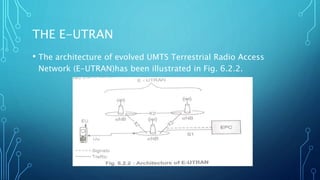
• The architecture of evolved UMTS Terrestrial Radio Access
Network (E-UTRAN)has been illustrated in Fig. 6.2.2.
THE E-UTRAN
• The E-UTRAN handles the radio communications between the
mobile equipment (ME) and the evolved packet core (EPC). It
contains only one component, the evolved base stations, called
eNodeB or eNB.
• Each eNB is a base station that controls the mobiles in one or
more cells.
• The base station that is currently communicating with mobile is
known as its serving eNB.
• Each eBN connects with the EPC by means of the S1 interface.
• Two nearby base stations can be connected via the X2
interface, which is mainly used for signaling and packet
forwarding during handover.
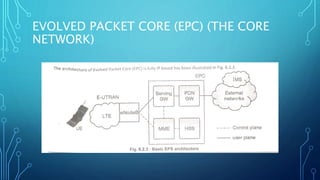
EVOLVED PACKET CORE (EPC) (THE CORE
NETWORK)
EVOLVED PACKET CORE (EPC)
• Evolved Packet Core (EPC) components It contains the following
important components
• 1. Serving GW ne serving gateway (S-GW) acts as a router, and
forwards data between the base station and the PDN gateway.
• It is also responsible for inter-eNB handovers in the U-plane.
• It provides mobility between LTE and other types of networks (such
as between 2G/3G and P-GW).
• The SGW keeps context information such as parameters of the IP
bearer and routing information, and stores the UE contexts when
paging happens.
• It is also responsible for replicating user traffic for lawful interception
• 2. PDN GW
• The PON GW is the point of interconnect between the EPC and the external IP
networks. PDN GW routes packets to and from the PDNs. The functions of
the PGW include:
• Policy enforcement
• Packet filtering
• Charging support
• Lawful interception
• Packet screening
• 3. HSS
• The HSS(for Home Subscriber Server) is a database that contains user-
related and subscriber-related information.
• It is similar to -Home Location Register (HLR) and Authentication Centre
(AuC) used in 3G networks.
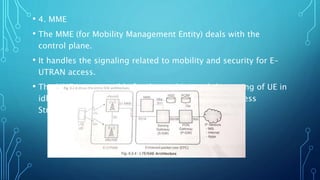
• 4. MME
• The MME (for Mobility Management Entity) deals with the
control plane.
• It handles the signaling related to mobility and security for E-
UTRAN access.
• The MME is responsible for the tracking and the paging of UE in
idle mode. It is the termination point of the Non-Access
Stratum (NAS).
VOICE OVER LTE (VOLTE)
• VoLTE stands for Voice Over Long Term Evolution.
• It is a digital packet voice service that is delivered over IP via an LTE access
network.
• When 3GPP started designing the LTE system, the prime focus was to create
a system that can achieve high data throughput with low latency.
• LTE is an all IP network and the ability to carry voice was not given much
importance. Therefore, for LTE networks to carry traditional circuit-switched
voice calls, a different solution was required.
• This solution to carry voice-over IP in LTE networks is commonly known as
“VoLTE”. Basically VoLTE Systems covert voice into the data stream, which is
then transmitted using the data connection. VoLTE is based on the IMS(IP
multimedia system).
• IMS is an architectural framework for delivering multimedia communications
services such as voice, video, and text messaging over IP networks.
VOICE OVER LTE -VOLTE BASICS
• VoLTE, Voice over LTE is an IMS (IP Multimedia System) based
technique.
• VoLTE enables the system to be integrated with the suite of other
applications for LTE.
• To make the implementation of VoLTE easy and cost-effective to
operators, a cut-down version of the IMS network was defined. This
not only reduced the number of entities required in the IMS network
but also simplified the interconnectivity.
• This considerably reduced the costs for network operators as this
had been a major issue for acceptance of IMS
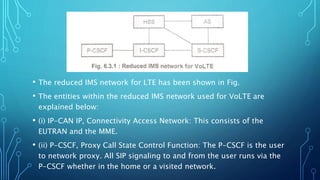
• The reduced IMS network for LTE has been shown in Fig.
• The entities within the reduced IMS network used for VoLTE are
explained below:
• (i) IP-CAN IP, Connectivity Access Network: This consists of the
EUTRAN and the MME.
• (ii) P-CSCF, Proxy Call State Control Function: The P-CSCF is the user
to network proxy. All SIP signaling to and from the user runs via the
P-CSCF whether in the home or a visited network.
• (iii) I-CSCF, Interrogating Call State Control Function: The I-CSCF is used for
forwarding an initial SIP request to the s-CSCF. When the initiator does not
know which S-CSCF should receive the request.
• (iv) S-CSCF, Serving Call State Control Function : TheS-CSCF performs a
variety of actions within the overall system, and it has a number of
interfaces to enable it to communicate with other entities within the overall
system.
• (v) AS, Application Server: It is the application server that handles the voice
as an application.
• (vi) HSS, Home Subscriber Server The lMS HSS or home subscriber server is
the main subscriber database used within IMS. The IMS HSS provides details
of the subscribers to the other entities within the IMS network, enabling
users to be granted access or not dependent upon their status.
• The IMS calls for VoLTE are processed by the subscriber's S-CSCF in the
home network. The connection to the S-CSCF is via the P-CSCF.
BENEFITS OF VOLTE
• The implementation of VoLTE offers many benefits, both in terms of
cost and operation. voLTE provides the following benefits:
• Provides more efficient use of spectrum than traditional voice;
• Meets the rising demand for richer, more reliable services
• Establishes the need to have a voice on one network and data on
another
• Can be deployed in parallel with video calls over LTE and multimedia
services,including video share, multimedia messaging, chat and file
transfer;
• Ensures that video services are fully interoperable across the operator
community, just as voice services are, Increaseshandset battery life
by 40 % (compared with VolP);
INTRODUCTION TO LTE-ADVANCED
• LTE Advanced adds a number of additional capabilities to the
basic LTE to provide very much higher data rates and much
better performance.
• LTE provides improved performance, particularly at cell edges
and other areas where performance would not normally have
been so good.
LTE ADVANCED KEY FEATURES
• The main aims for LTE Advanced
• Peak data rates: Downlink- 1 Gbps; uplink -500 Mbps.
• Spectrum efficiency:3 times greater than LTE.
• Peak spectrum efficiency: Downlink -30 bps/Hz; uplink -15 bps/Hz.
• Spectrum uses: The ability to support scalable bandwidth use and spectrum aggregation
where non-contiguous spectrum needs to be used.
• Latency: From Idle to Connected in less than 50 ms.
• Cell edge user throughput to be twice that of LTE.
• Average user throughput to be 3 times that of LTE.
• Mobility: Same as that in LTE
• Compatibility: LTE Advanced shall be capable of interworking with LTE and 3GPP legacy
systems.
• These are many of the development aims for LTE Advanced
LTE –ADVANCED: SYSTEM ASPECTS
• The main new functionalities introduced in LTE-Advanced are;
Carrier Aggregation(CA)
Enhanced use of multi-antenna techniques(MIMO)
Support for Relay Nodes (RN)
• LTE-Advanced is the all 1P based cellular network that can offer higher user data
rates and lower latency.
• In LTE-Advanced lower latency can be achieved by adopting a terminal state of
being idle or active. This can significantly reduce control plane latency and
signaling compare to earlier generations.
• Higher user data rates can be achieved by adopting several techniques
including: MIMO support, Modulation techniques like OFDM, bandwidth
flexibility, and the support of FDD (Frequency Division Duplex) and TDD (Time
Division Duplex) modes of operation.
CARRIER AGGREGATION(CA)
• The increase in bandwidth in LTE-Advanced achieved through
aggregation of carriers. Carrier aggregation canbDe used for
both FDD and TDD.
• Each aggregated carrier is referred to as a 'component carrier'.
The component carrier can have a bandwidth of L.4, 3, 5, 10,
15 or 20 MHz.
• Maximum of five component carriers can be aggregated, hence
the maximum bandwidth is 100 MHz.
• The number of aggregated carriers can be different in
DownLink and UpLink; however the number of UpLink
component carriers is never larger than the number of
DownLink component carriers.
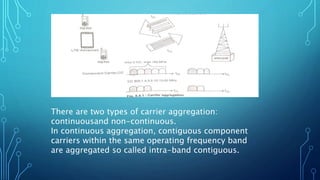
There are two types of carrier aggregation:
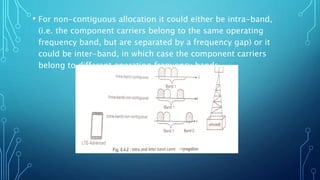
continuousand non-continuous.
In continuous aggregation, contiguous component
carriers within the same operating frequency band
are aggregated so called intra-band contiguous.
• For non-contiguous allocation it could either be intra-band,
(i.e. the component carriers belong to the same operating
frequency band, but are separated by a frequency gap) or it
could be inter-band, in which case the component carriers
belong to different operating frequency bands
• For each component carrier there is one serving cell.
• The coverage of the serving cells may differ due to the
component carrier frequencies.
• The RRC connection is handled by one cell called the Primary
serving cell, served by the Primary component carrier. The
other component carriers are all referred to as Secondary
component carrier serving the Secondary serving cells.
MIMO (MULTIPLE INPUT AND MULTIPLE
OUTPUT)
• MIMO is used to increase the overall bitrate through
transmission of two or more different data streams on two or
more different antennas.
• A major change in LTE-Advances is the introduction of 8*8
MIMO in the Down Link and 4*4 in the Up Link
RELAY NODES
• In LTE-Advanced, the heterogeneous network planning i.e. a mix of large and
small cells IS possible through Relay Nodes (RNs).
• The Relay Nodes are low power base stations that provides enhanced coverage
and capacity at cell edges. It also serves as hot-spot areas and it can also be
used to connect to remote areas without fiber connection.
• The Relay Node is connected to the Donor eNB (DeNB) via a radio interface, Un.
• Un is a modification of the E-UTRAN air interface Uu. In the Donor cell the radio
resources are shared between UEs served directly by the DeNB and the Relay
Nodes.
• When the Uu and Un use different frequencies the Relay Node is referred to as a
Type 1a RN.
• When Uu and Un uses the same frequencies, it is called Type 1 RN.
• Incase of Type 1RN, there is a high risk for self interference in the Relay Node,
when receiving on Uu and transmitting on Un at the same time (or vice versa).
This can be avoided through time sharing between Uu and Un, or having
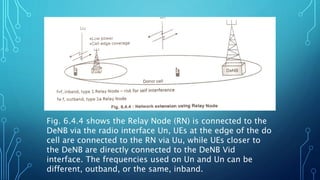
Fig. 6.4.4 shows the Relay Node (RN) is connected to the
DeNB via the radio interface Un, UEs at the edge of the do
cell are connected to the RN via Uu, while UEs closer to
the DeNB are directly connected to the DeNB Vid
interface. The frequencies used on Un and Un can be
different, outband, or the same, inband.
COORDINATED MULTIPOINT (COMP)
• One of the key issues with many cellular systems is that of poor
performance at the cell edges. To improve the performance at cell edges,
LTE-Advanced introduces coordinated multipoint (CoMP) scheme.
• In CoMP there are two importantcomponents
1. TX (Transmit)points
2. RX (Receive)Points
• A number of TX points provide coordinated transmission in the DL (Down
Link).
• Similarly a number of RX points provide coordinated reception in the UL
(UpLink).
• A TX/RX-point constitutes of a set of co-located TX/RX antennas providing
coverage in the same sector.
• The set of TX/RX-points used in CoMP can either be at different locations,
or co-sited but providing coverage in different sectors. They can also belong
to the same or differente NBs.
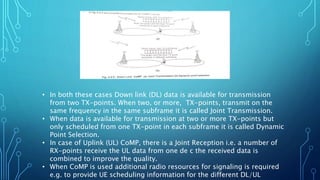
• In both these cases Down link (DL) data is available for transmission
from two TX-points. When two, or more, TX-points, transmit on the
same frequency in the same subframe it is called Joint Transmission.
• When data is available for transmission at two or more TX-points but
only scheduled from one TX-point in each subframe it is called Dynamic
Point Selection.
• In case of Uplink (UL) CoMP, there is a Joint Reception i.e. a number of
RX-points receive the UL data from one de c the received data is
combined to improve the quality.
• When CoMP is used additional radio resources for signaling is required
e.g. to provide UE scheduling information for the different DL/UL
LTE ADVANCED ARCHITECTURE
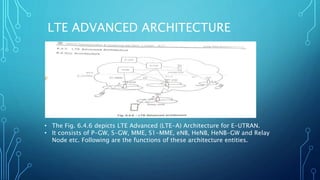
• The Fig. 6.4.6 depicts LTE Advanced (LTE-A) Architecture for E-UTRAN.
• It consists of P-GW, S-GW, MME, S1-MME, eNB, HeNB, HeNB-GW and Relay
Node etc. Following are the functions of these architecture entities.
• It stands for PDN Gateway. It interfaced with S-GW using S5 interface
and with operator's IP services using SGi interface.
• It has connectivity with PCRP using Gx interface.
• It connects UE to packet data networks.
• P-GW assigns IP address to the UE. One UE can have connectivity with
more than one PGWs in order to have access to multiple PDNs.
• It takes care of packet filtering, policy enforcement and charging
related services. Moreover it fulfils connectivity between 3GPP (LTE,
LTE-A) and non 3GPP (WiMAX, CDMA etc.) technologies.
P-GW
S-GW
• It stands for Serving Gateway.
• It interfaces with MME using S11 interface and with SGSN using S4
interface.
• It connects with PDN-GW using S5 interface as mentioned above.
• EPC gets terminated at this node/entity. It is connected with E-
UTRAN via S1-U interface.
• Each UE in LTE-A is associated to unique S-GW which has several
functions.
• It helps in inter-eNB handover as well as inter-3GPP mobility.
• It helps in inter-operator charging. It does packet routing and packet
forwarding
MME
• It stands for Mobility Management Entity.
• It is major control plane element in LTE advanced architecture.
• It takes care of authentication, authorization and NAS signaling
related security functions
• It takes care of selecting either S-GW or PDN-GW or P-GW.
S1-MME
• It provides connectivity between EPC and eNBs.
eNB
• It is main building block or system in LTE-A.
• It provides interface with UEs or LTE-A phones.
• It has similar functionality as base station used in GSM or other
cellular systems.
• Each of the eNBs serve one or several E-UTRAN cells. Interface
between two eNBs is known as X2 interface.
HENB
• It stands for Home eNodeB or Home eNB.
• It is known as Fem to cell.
• It is used to improve coverage in the indoor region of office or
home premises.
• It can be interfaced directly to EPC or via Gateway.
HENB-GW
• It provides connectivity of HeNB with S-GW and MME.
• It aggregates all the traffic from number of Home eNBs to core
network.
• It uses S1 interface to connect with HeNBs.
Relay Node
• It is used for improving network performance
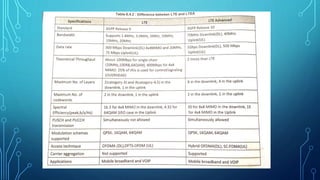
COMPARISON OF LTE AND LTE-A
• Both the LTE and LTE-Advanced are fourth-generation wireless technologies
designed to use for high speed broadband internet access.
• The specifications are published by 3rd Generation Partnership Project
(3GPP). LTE is specified in 3GPP release 8 and LTE Advanced is specified in
3GPP release 10.
• LTE is the short form of Long Term Evolution. It uses FDD and TDD duplex
modes for the UEs to communicate with the eNodeB. The LTE uses OFDMA
modulation in the downlink (from eNodeB to UEs) and sC-FDMA modulation
in the uplink. Various physical channels and logical channels are designed to
take care of data as well as control information. It supports a peak data rate
of 300MBPS in the downlink and 75MBPS in the uplink (theoretically).
• TE-Advancedis the upgraded version of LTE technology to increase the peak
data rates to about 168PS in the downlink and 500MBPS in the uplink. In
order to increase the data rates LTE-Advanced utilizes higher number of
antennas and added carrier aggregation feature.
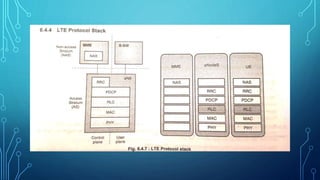
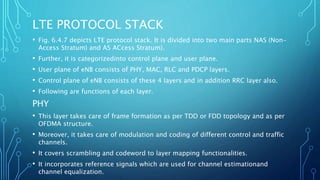
LTE PROTOCOL STACK
• Fig. 6.4.7 depicts LTE protocol stack. It is divided into two main parts NAS (Non-
Access Stratum) and AS ACcess Stratum).
• Further, it is categorizedinto control plane and user plane.
• User plane of eNB consists of PHY, MAC, RLC and PDCP layers.
• Control plane of eNB consists of these 4 layers and in addition RRC layer also.
• Following are functions of each layer.
PHY
• This layer takes care of frame formation as per TDD or FDD topology and as per
OFDMA structure.
• Moreover, it takes care of modulation and coding of different control and traffic
channels.
• It covers scrambling and codeword to layer mapping functionalities.
• It incorporates reference signals which are used for channel estimationand
channel equalization.
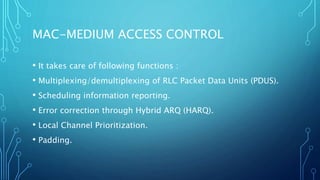
MAC-MEDIUM ACCESS CONTROL
• It takes care of following functions :
• Multiplexing/demultiplexing of RLC Packet Data Units (PDUS).
• Scheduling information reporting.
• Error correction through Hybrid ARQ (HARQ).
• Local Channel Prioritization.
• Padding.
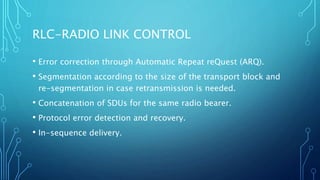
RLC-RADIO LINK CONTROL
• Error correction through Automatic Repeat reQuest (ARQ).
• Segmentation according to the size of the transport block and
re-segmentation in case retransmission is needed.
• Concatenation of SDUs for the same radio bearer.
• Protocol error detection and recovery.
• In-sequence delivery.
PDCP-PACKET DATA CONVERGENCE
PROTOCOL
• Header compression.
• In-sequence delivery and retransmission of PDCP Session Data
Units (SDUs).
• Duplicate detection.
• Ciphering and integrity protection.
RRC-RADIO RESOURCE CONTROL
• Broadcast system informationrelated to Non-AccessStratum (NAS)
and Access Stratum (AS).
• Establishment, maintenance, and release of RRC connection.
• Security functions including key management.
• Mobility functions.
• QoS management functions.
• UE measurement reporting and control of the reporting.
• NAS direct message transfer between UE and NAS.
NAS-NON ACCESS STRATUM
• Connection/session managementbetween UE and the core
network.
• Authentication.
• Registration.
• Bearer context activation/deactivation.
• Location registration management
HIGHER PROTOCOL LAYERS
• Higher layer protocols include
1. Radio Link Control- RLC
2. Packet Data Convergence Protocol- PDCP and
3. Radio Resource Control- RRC
RADIO LINK CONTROL (RLC)
• RLC-Radio Link Control protocol is a data link layer protocol (Layer 2
protocol)
• An RLC entity receives/delivers RLC SDUs from/to upper layer and
sends/receives RLC PDUS to/from its peer RLC entity via lower layers.
• If RLC entity configured at the eNB, there is a peer RLC entity configured at
the UE and vice versa. (Fig 6.5.1 (6) RLC performs following major functions:
• Error correction through Automatic Repeat request (ARQ).
• Segmentation according to the size of the transport block and re-
segmentation in case a retransmissions needed.
• Concatenation of SDUs for the same radio bearer.
• Protocol error detection and recovery.
• In-sequence delivery.
RLC MODES
• An RLC entity can be configured to perform data transfer in one of
the following three modes.
1. Transparent Mode (TM)
• As the name suggests the Transparent mode entity in RLC does not
add any overhead to the upper layer SDUs.
• The entity just transmits the SDUs coming from upper layer to MAC.
In this mode :
• Segmentation or reassembly of RLC SDUs is not allowed
• No RLC headers are added.
• Does not guarantees delivery
• RLC TM is used for transmissionof paging messages on PCCH,
system informationtransmittedon BCCH and SRBO0 messages
transmitted on CCCH.
• 2. Unacknowledged Mode (UM)
• RLC Unacknowledged Mode is used for transmission of delay
sensitive packets, such as VolP packets or audio/video streams.
• In this mode:
• Segmentation or reassembly of RLC SDUs is allowed.
• RLC headers are added.
• Does not guarantees delivery.
• This mode is suitable for carrying streaming traffic.
3. Acknowledged Mode (AM)
• RLC AM is used both in user plane and control plane packets.
But in both the cases PDCP is the upper layer. So all the SDUS
which come to RLC AM entity are security protected.
• In this mode
• Segmentation or reassembly of RLC SDUs is allowed
• RLC headers are added.
• Guarantees In-sequence delivery of SDUs. It supports HARQ
mechanism to retransmit lost PDUS.
• This mode is suitable for carrying TCP traffic.
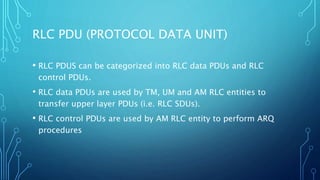
RLC PDU (PROTOCOL DATA UNIT)
• RLC PDUS can be categorized into RLC data PDUs and RLC
control PDUs.
• RLC data PDUs are used by TM, UM and AM RLC entities to
transfer upper layer PDUs (i.e. RLC SDUs).
• RLC control PDUs are used by AM RLC entity to perform ARQ
procedures
PACKET DATA CONVERGENCE PROTOCOL
(PDCP)
• The PDCP layer is located above the RLC layer and below the IP layer
(in the user plane) or the RRC layer (in the control plane).
• PDCP is a kind of interface between the inside world and the outside
world. In other words, the data coming into the eNB first go through
PDCP and then gets into RLC (Downlink). Data waiting in RLC trying
to go out to the outside world has to go through PDCP to reach the
outside world (UplinkPath)
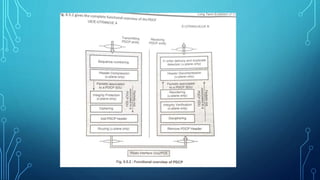
• The major functions of the PDCP layer are as follows.
• Header compression
• In-sequence delivery and retransmission of PDCP Session Data Units
(SDUs)
• Duplicate detection
• Ciphering and integrity protection
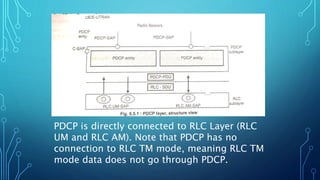
PDCP is directly connected to RLC Layer (RLC
UM and RLC AM). Note that PDCP has no
connection to RLC TM mode, meaning RLC TM
mode data does not go through PDCP.
RADIO RESOURCE CONTROL (RRC)
• The RRC is the highest layer in the control plane of the Access
Stratum (AS).
• The RRC layer controls communications between a UE and an
eNB at the radio interfaceand the mobility of a UE crossing
cells.
• The RRC also transfersmessages of the Non-AccessStratum
(NAS), which is located above the RRC layer.
• NAS messages are used to control communications between a
UE and the Evolved Packet Core (EPC).
• The main services and functions of the RRC sublayer include :
• Broadcast of System Information related to the non-access stratum
(NAS)
• Broadcast of System Information related to the access stratum (AS)
• Paging
• Establishment, maintenance and release of an RRC connection
between the UE and E-UTRAN
• Security functions including key management
• Establishment, configuration, maintenance and release of point to
point Radio Bearers
• Mobility functions
• QoS management functions
• UE measurement reporting and control of the reporting
• NAS direct message transfer to/from NAS from/to UE.
LTE MAC LAYER
• As discussed earlier the MAC layer of LTE performs following
functions.
• Error correction through Hybrid ARQ (HARQ).
• Logical channel to transport channel mapping
• Logical Channel Prioritization.
• Scheduling information reporting
• Multiplexing/demultiplexing of RLC Packet Data Units (PDUs).
ERROR CORRECTION THROUGH HYBRID
• The Hybrid Automatic Repeat-request (HARa) process is done in
combination between the MAC and the PHY layer.
• The PHY performs the retention and re-combination and the MAC performs
the management and signaling.
• The MAC indicates a NACK whenever there's a transport block (TB) CRC
failure; the PHY usually indicates that failure.
• Retransmission is done by the eNodeB or the sender on the downlink using
a different type of coding.
• The coding is sent and maintained in buffers in the eNodeB. Eventually, after
one or two attempts, there will be enough data to reconstruct the signal.
• In HARQ operation, the retransmission does not have to be fully correct. It
has to be correct enough that it can be combined mathematically with the
previous transport block (TB) in order to produce a good transport block.
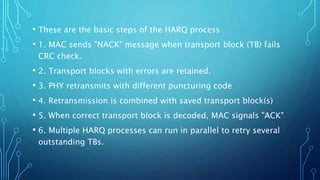
• These are the basic steps of the HARQ process
• 1. MAC sends "NACK" message when transport block (TB) fails
CRC check.
• 2. Transport blocks with errors are retained.
• 3. PHY retransmits with different puncturing code
• 4. Retransmission is combined with saved transport block(s)
• 5. When correct transport block is decoded, MAC signals "ACK"
• 6. Multiple HARQ processes can run in parallel to retry several
outstanding TBs.
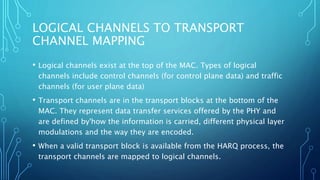
LOGICAL CHANNELS TO TRANSPORT
CHANNEL MAPPING
• Logical channels exist at the top of the MAC. Types of logical
channels include control channels (for control plane data) and traffic
channels (for user plane data)
• Transport channels are in the transport blocks at the bottom of the
MAC. They represent data transfer services offered by the PHY and
are defined by'how the information is carried, different physical layer
modulations and the way they are encoded.
• When a valid transport block is available from the HARQ process, the
transport channels are mapped to logical channels.
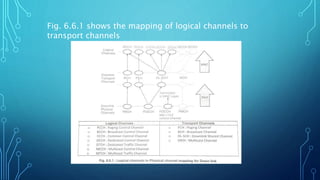
Fig. 6.6.1 shows the mapping of logical channels to
transport channels
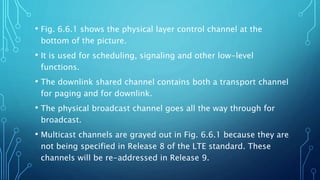
• Fig. 6.6.1 shows the physical layer control channel at the
bottom of the picture.
• It is used for scheduling, signaling and other low-level
functions.
• The downlink shared channel contains both a transport channel
for paging and for downlink.
• The physical broadcast channel goes all the way through for
broadcast.
• Multicast channels are grayed out in Fig. 6.6.1 because they are
not being specified in Release 8 of the LTE standard. These
channels will be re-addressed in Release 9.
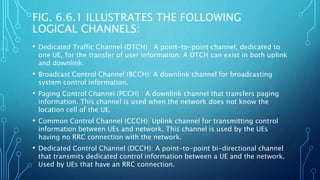
FIG. 6.6.1 ILLUSTRATES THE FOLLOWING
LOGICAL CHANNELS:
• Dedicated Traffic Channel (DTCH) : A point-to-point channel, dedicated to
one UE, for the transfer of user information. A DTCH can exist in both uplink
and downlink.
• Broadcast Control Channel (BCCH): A downlink channel for broadcasting
system control information.
• Paging Control Channel (PCCH) : A downlink channel that transfers paging
information. This channel is used when the network does not know the
location cell of the UE.
• Common Control Channel (CCCH): Uplink channel for transmitting control
information between UEs and network. This channel is used by the UEs
having no RRC connection with the network.
• Dedicated Control Channel (DCCH): A point-to-point bi-directional channel
that transmits dedicated control information between a UE and the network.
Used by UEs that have an RRC connection.
LOGICAL CHANNEL PRIORITIZATION
• When the radio resources for a new transmission are allocated,
the logical channel prioritization entity instructs the
multiplexing and de-multiplexing entity to generate MAC PDUs
from the MAC SDUs.
• The logical channel prioritization entity also decides how much
data from each configured logical channel included in each
MAC PDU whenever radio resource for a new transmission is
available
SCHEDULING
• Scheduling is a process through which eNodeB decides which Ues should be
given resources (RBS), how much resource (RBs) should be given to send or
receive data.
• In LTE, Scheduling is done at per subframe basis i.e. every 1 mili second.
• Resources are composed of Physical Resource Blocks (PRB) and Modulation
Coding Scheme (MCS).
• The MCS determines the bit rate, and thus the capacity, of PRBS,
• An LTE scheduler performs following function for efficient scheduling:
• Link Adaptation :It selects the optimal combination of parameters such as
modulation, channel Coding and transmit schemes.
• Rate Control: It is in charge of resource allocation among radio bearers of the
same UE which are available at thee eNB for DL and at the UE for UL.
• Packet Scheduler: It controls access to air interface resources amongst all active
Users.
• Resource Assignment: It allocates air interface resources to selected active users
on per TTl basis.
• Power Control: Provides the desired SINR level for achieving the desired data
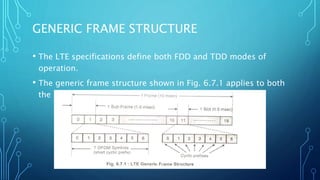
GENERIC FRAME STRUCTURE
• The LTE specifications define both FDD and TDD modes of
operation.
• The generic frame structure shown in Fig. 6.7.1 applies to both
the DL and UL for FDD operation.
• In OFDMA, users are allocated a specific number of subcarriers
for a predetermined amount of time. These are referred to as
physical resource blocks (PRBs) in the LTE specifications.
• PRBS thus have both a time and frequency dimension.
• Allocation of PRBs is handled by a scheduling function at
eNodeB.
• LTE transmissions are segmented into frames, which are 10
msec in duration.
• One frames consist of 20 slot periods of 0.5 msec.
• Sub-frames contain two slot periods and are 1.0 msec in
duration.
DOWNLINK
• The LTE PHY specification accommodates bandwidths from 1.25 MHz
to 20 MHz
• The basic modulation scheme is OFDM which is very robust in the
presence of severe multipath fading.
• Downlink multiplexing is accomplished via OFDMA.
• The DL Supports physical channels, which convey information from
higher layers in the LTE stack.
• Physical channels map to transport channels, which are service
access points (SAPs) for the L2/L3 layers.
• Depending on the assigned task, physical channels and signals use
different modulation and coding parameters.
DOWNLINK MULTIPLEXING
• OFDMA is the basic multiplexing scheme employed in the LTE
downlink.
• In OFDMA, groups of 12 adjacent subcarriers are grouped
together on a slot-by-slot basis to form physical resource
blocks (PRBs).
• A PRB is the smallest unit of bandwidth assigned by the base
station scheduler.
• Physical Channels
• Three different types of physical channels are defined for the
LTE downlink.
• LTE DL physical channels are:
• Physical Downlink Shared Channel (PDSCH)
• Physical Downlink Control Channel (PDCCH)
• Common Control Physical Channel (CCPCH)
• Physical channels are mapped to specific transport channels.
• Transport channels are SAPs for higher layers.
• Each physical channel has defined algorithms for: Bit
scrambling Resource element assignment Layer mapping and
pre-coding are related to MIMO applications.
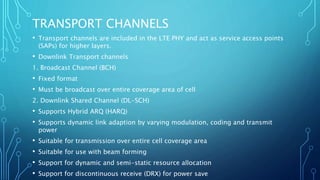
TRANSPORT CHANNELS
• Transport channels are included in the LTE PHY and act as service access points
(SAPs) for higher layers.
• Downlink Transport channels
1. Broadcast Channel (BCH)
• Fixed format
• Must be broadcast over entire coverage area of cell
2. Downlink Shared Channel (DL-SCH)
• Supports Hybrid ARQ (HARQ)
• Supports dynamic link adaption by varying modulation, coding and transmit
power
• Suitable for transmission over entire cell coverage area
• Suitable for use with beam forming
• Support for dynamic and semi-static resource allocation
• Support for discontinuous receive (DRX) for power save
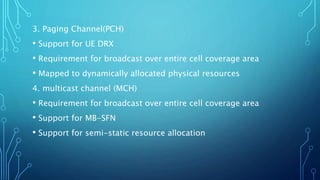
3. Paging Channel(PCH)
• Support for UE DRX
• Requirement for broadcast over entire cell coverage area
• Mapped to dynamically allocated physical resources
4. multicast channel (MCH)
• Requirement for broadcast over entire cell coverage area
• Support for MB-SFN
• Support for semi-static resource allocation
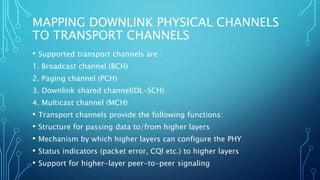
MAPPING DOWNLINK PHYSICAL CHANNELS
TO TRANSPORT CHANNELS
• Supported transport channels are :
1. Broadcast channel (BCH)
2. Paging channel (PCH)
3. Downlink shared channel(DL-SCH)
4. Multicast channel (MCH)
• Transport channels provide the following functions:
• Structure for passing data to/from higher layers
• Mechanism by which higher layers can configure the PHY
• Status indicators (packet error, CQl etc.) to higher layers
• Support for higher-layer peer-to-peer signaling
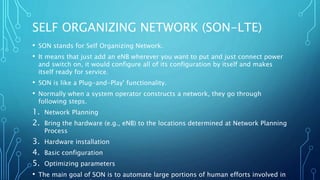
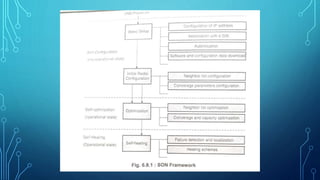
SELF ORGANIZING NETWORK (SON-LTE)
• SON stands for Self Organizing Network.
• It means that just add an eNB wherever you want to put and just connect power
and switch on, it would configure all of its configuration by itself and makes
itself ready for service.
• SON is like a Plug-and-Play' functionality.
• Normally when a system operator constructs a network, they go through
following steps.
1. Network Planning
2. Bring the hardware (e.g., eNB) to the locations determined at Network Planning
Process
3. Hardware installation
4. Basic configuration
5. Optimizing parameters
• The main goal of SON is to automate large portions of human efforts involved in
SON ARCHITECTURE
• The self-organization functionality can be located at one place even
split in different nodes.
• Self-Optimization algorithms can be located in OAM or eNB or both
of them.
• According to the location of optimization algorithms, SON can be
divided into the three main architectures:
1. Centralized SON
2. Distributed SON
3. Hybrid SON
• The all three versions differ with respect to data acquisition, data
processing and configuration management.
1. CENTRALIZED SON
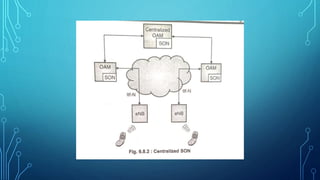
• In Centralized SON, optimization algorithms are stored and executed
from the OAM System. Here, the SON functionality resides in a small
number of locations, at a high level in the architecture.
• Fig. 6.8.2 shows an example of Centralized SON. Here, all SON
functions are located in OAM systems, so it is easy to deploy them
but does not support those simple and quick optimization cases.
• To implement Centralized SON, existing Northbound Interface (ltf-N),
which is the interface between the Element Manager and the Network
Manager, needs to be extended.
• Also, as the number of nodes in the network increases,
computational requirements will also increase, which might cause
problems in scalability.
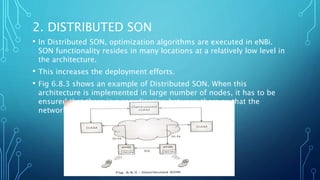
2. DISTRIBUTED SON
• In Distributed SON, optimization algorithms are executed in eNBi.
SON functionality resides in many locations at a relatively low level in
the architecture.
• This increases the deployment efforts.
• Fig 6.8.3 shows an example of Distributed SON. When this
architecture is implemented in large number of nodes, it has to be
ensured that there is a coordination between them so that the
network as a whole is optimised
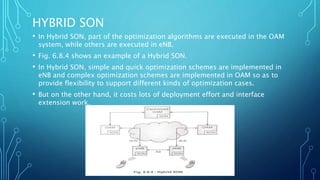
HYBRID SON
• In Hybrid SON, part of the optimization algorithms are executed in the OAM
system, while others are executed in eNB.
• Fig. 6.8.4 shows an example of a Hybrid SON.
• In Hybrid SON, simple and quick optimization schemes are implemented in
eNB and complex optimization schemes are implemented in OAM so as to
provide flexibility to support different kinds of optimization cases.
• But on the other hand, it costs lots of deployment effort and interface
extension work.
SON FOR HETEROGENEOUS NETWORKS
(HETNET)
• It is assumed that there will be 50 billion connected devices by 2020.
Demands forhigher data rates continues to increase.
• High-quality video streaming, social networking and M2M communication
over wireless networks are growing exponentially.
• Hence, a new paradigm called heterogeneous networks (HetNet) are being
considered by network operators.
• HetNet stands for Heterogeneous Network, which involves a mix of radio
technologies, different cell types, distributed antenna systems, and WIFi
working together seamlessly.
• The HetNet involves several aspects:
• Use of multiple radio access technologies
• Operation of different cell sizes
• Backhaul
MULTIPLE SIZE CELLS
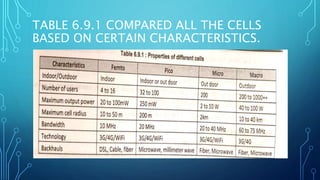
• HetNet introduces two main types of cells: Small cells and
Macrocells.
• Small cells :
• 1. Small cells have smaller coverage and capacity and are
of three types. Micro, Pico and Femto cells. (Listed as in
the order of decreasing base station power).
• The idea of merging small cells with the macrocell network
has the advantage of offloading traffic from the macro cell
sites to the smaller cells while the macro cell operates at
its normal capacity.
TABLE 6.9.1 COMPARED ALL THE CELLS
BASED ON CERTAIN CHARACTERISTICS.
• Small cells are deployed in hotspots to increase
capacity.
• Hotspots are the areas where user density is more.
• They are also deployed to fill in the areas not covered
by the macro network (E.g. cell edges)- both out
doors and indoors.
• These small cells can also be deployed within the user
premises, residential or official, thereby bringing the
network closer to the customer.
MICROCELLS
• Microcells, typically cover smaller areas maybe up to a
kilometre.
• They usually transmit within a range of milliwatts to a few
watts.
• Microcells are deployed for providing temporary cellular
coverage and capacity to places like sports stadiums,
convention centres etc.
• Sometimes, microcells may use distributed antenna systems
(DAS) to improve bandwidth and reliability.
PICO CELLS
• Pico cells are deployed on the macro cell edges or hotspots to
improve coverage or throughput.
• Pico sells are open to all User Equipments (UES)
• Pico sells can be used for both indoor and outdoor purpose.
• This coverage area is around 200m. And us usually they served
around 32 to 100 users.
FEMTO CELLS
• Femto cells are typically user-installed to improve coverage area
within a small vicinity, such as home office or a dead zone within a
building.
• Femto cells can be obtained through the service provider or
purchased from a reseller.
• Femto cells are open to specific UEs -called CSG (Closed Subscription
group)
• A UE close to femto can't connect to femto if it is not in CSG. In that
case it connects to macro instead.
• Femto cell usually serves to 4 to 16 users
• Its coverage area is 10 to 50 m.
MACRO CELLS
• Macro cells have large coverage and capacity and are controlled by High power
base stations.
• These are the cells which have been traditionally used in all cellular systems.
2. Macro cells
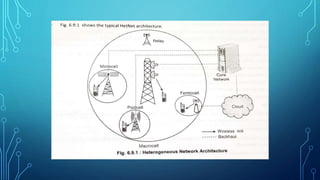
• Heterogeneous networks consist of different types of base stations supporting
different types of cells such as Macro, Micro, Pico and Femto cells.
• Base stations in HetNets
 Macro cells are controlled by High Power eNBs.
 Small Cells (Micro, Pico and Femto) are controlled by Low power eNBs. Low
Power nodes include micro, pico, Remote Radio Heads (RRH), relay nodes and
femto nodes.
• These can use the same or different technologies.
• In LTE networks, the actual cell size depends not only on the eNodeB power but
also on antenna position, as well as the location environment; e-g. rural or city,
indoor or outdoor etc.
DIFFERENT NODES, FOR SMALL CELLS, USED IN
LTE/LTE-A HETNETS ARE LISTED BELOW:
1. Home eNodeB (HeNB)
• These nodes are used to form Femto cells.
• It is a low power eNodeB which is mainly used to provide indoor coverage, for Closed Subscriber
Groups (CSG). For example, in office premises.
• HeNBs are privately owned and deployed without coordination with the macro-network.
2. Relay Node (RN)
• Relay 4 interface Uu.
3. RRHs (Remote Radio Head)
• RRH is connected to an eNB via fibre can also be used to provide small cell coverage.
• It is an alternative solution to a BTS housed in a shelter at the bottom of the tower.
• It is a distributed base station, in which the majority of the base station equipment is no longer
located in the shelter, but in an enclosure at the top of the tower near the antenna.
• This separate but integrated radio frequency (RF) unit is called a remote radio unit or remote
radio head.
• It is compact in size. RRH is generally used to extend the coverage of a base station sub-
• A Key component of such heterogeneous networks, which helps
in meeting the above requirements is network intelligence via
the SON (Self Organizing Network).
• SON is automation technology that enables the network to set
itself up and self-manage resources configuration to achieve
optimal performance in an integrated network approach.
• The self-organizing and self-optimizing capability of the small
cell smoothen the path for implementation of such
heterogeneous networks.
• A Self-organizing micro base station can automatically detect
the surrounding radio environment conditions and
automatically plan and configure radio parameters such as
frequency, scrambling code, and transmission power.
• A traditional base station cannot do this
INTRODUCTION TO 5G
• 5G is not just one technology, it is actually a combination of
several technologies in one. The system, however, will be smart
and know when to make use of which technology for maximum
efficiency.
• 5G will be much faster than 4G. It will provide a data rate of up to
10Gbps.
• It will provide 100% coverage area. That is better coverage even at
the cell boundaries.
• 5G will also provide low network latency (up to 1 msec) which will
be helpful for critical applications like industry, healthcare, and
medical.
• 5G technology aims to provide a wide range of future industries
• 5G technology will provide ubiquitous connectivity means everything
from vehicles to mobile networks to industries to smart homes will
be connected together.
• 5G will utilize an Extremely High-frequency spectrum band between
3GHz to 30 GHz. These are called millimeter waves. These waves can
travel at very high speed but cover short distances since they cannot
penetrate obstacles.
• Unlike 4G which requires high-powered cellular base stations to
transmit signals over long distance, 56 will use a large number of
small cell stations that may be located on small towers or building
roofs.
• 5G makes the use of Massive MIMO (Multiple Input Multiple Output)
standards to make is 100 times faster as opposed to standard MIMO.
Massive MIMO makes the use of as much as 100 antennas. Multiple
antennas allow for better and faster data transmission.
• The 5G network will come with 100 times more devices in market.
5G STANDARDS
• 5G technology standards are still under development. So, no
firm standards is in place at this time; the market is still
figuring out the essential 5G features and functionalities.
• The primary 5G standards bodies involved in these processes
are the 3rd Generation Partnership Project (3GPP), the Internet
Engineering Task Force (IETF), and the International
Telecommunication Union (ITU).
5GAA (AUTONOMOUS ASSOCIATION)
• The 5G Automotive Association (5GAA) is a global, cross-
industry organization of companies that work togetner to
develop end-to-end solution for future mobility and
transportation services.
• These companies include the automotive, technology, and
telecommunications industries (ICT)
• 5GAA Was created on September 2016. It consists of 8
founding members: AUDI AG, BMW Group, Daimler AG,
Ericsson, Huawei, Intel, Nokia, and Qualcomm Incorporated.
More than 110 companies have now joined 5GAA.
• The 5G Automotive Association is a strong advocate of
• The following are the key objectives of 5GAA
1. Making vehicles smarter
• Communication and connectivity are key to the development of autonomous
vehicles
• Cellular based technologiesV2X : vehicle-to-everything communication protocol
allows vehicles to communicate with other vehicles (V2V), pedestrians (V2P),
networks (V2N), and the surrounding infrastructure (V2I).
2. Making Vehicle Safer
• Cellular Vehicle-to-Everything (C-V2x) is a unified connectivity platform
designed to offer vehicle-to-vehicle (V2V), vehicle-to-roadside infrastructure
(V21) and vehicle-to-pedestrian (V2P) communication.
• C-V2X will improve safety on roads by tremendously facilitating the flow of
information between vehicles, pedestrians and road infrastructure. This will
enable connected vehicles to anticipate and avoid dangerous situations,
reducing collisions and potentially saving lives.
3. Improving the driving experience
• C-V2X will provide real-time traffic information to optimize user’s trips, finding
the closest free parking space or enabling predictive maintenance to save
THE KEY TECHNOLOGY: C-V2X (CELLULAR
VEHICLE TO EVERYTHING)
• Cellular-V2x (C-V2X) as initially defined as LTE V2X in 3GPP Release
14 is designed to operate in several modes. It provides one solution
for integrated V2V, v21, and v2P operation with v2N by using
existing cellular network infrastructure:
1. Device-to-Device Communication
• Device-to-device communications Vehicle-to-Vehicle (v2V), Vehicle-
to-(Roadway) Infrastructure (V21), and Vehicle-to-Pedestrian (V2P)
direct communication.
• In the device-to-device mode (V2V, V21, v2P) operation, C-v2x does
not necessarily require any network infrastructure. It can operate
without a SIM, without network assistance, and uses GNSS as its
primary source of time synchronization.
2. Device-to-Cell Tower Communication
• Device-to-cell tower is another communication link that
enables network resources and scheduling and utilizes existing
operator infrastructure.
3. Device-to-Network Communication
• Device-to-network is the V2N solution using traditional cellular
links to enable cloud services to be part and parcel of the end-
to-end solution.
• Collectively, the transmission modes of shorter-range direct
communications (V2V, V21, V2P) and longer-range network-
based communications (v2N) comprise what we call Cellular-
V2X
APPLICATIONS OF 5G NETWORK
• 5GAA focuses on more than simply providing faster data rate. 5G technology aims to
provide wide range of future industries from retail to education, transportation to
entertainment and smart homes to healthcare.
1. High-Speed Mobile Networks
• 5G will revolutionize the mobile experience with a data rate up to 10 to 20 GBPS
download speed. It is equivalent to a fiber optic Internet connection accessed
wirelessly.
• Another important feature of 5G technology is Low latency which is significant for
autonomous driving and mission-critical applications. 5Gnetworks are capable of
latency less than a millisecond.
2. Entertainment and Multimedia
• Almost 50 percentage of mobile Internet traffic is used for video downloads globally.
This trend will increase in future and high definition video streaming will be common
in the future.
• 5G will offer a high definition virtual world on your mobile phone. Live events can be
streamed via a wireless network with high definition.
• HD TV channels can be accessed on mobile devices without any interruptions.
3. Internet of Things Connecting everything
• Internet of Things (loT) is another broad area that will use 5G
wireless network. Internet of Things will connect every objects,
appliance, sensors, devices and applications into Internet.
• loT applications will collects huge amount of data from millions of
devices and sensors. 5G is the most efficient candidate for Internet of
Things due to its flexibility, unused spectrum availability and low
cost solutions for deployment.
• lOT can benefit from 5G networks in many areas like: Smart Homes,
Smart Cities, Industrial loT, Fleet Management etc.
4. Virtual reality and Augmented Reality
• As Virtual reality (VR) and Augmented Reality (AR) needs faster data
rate, low latency and reliability. 5G networks will unlock the
MILIMETER WAVE
• We all know that frequency spectrum is a scarce resource. The existing bands
are crowded. One way to get around this problem is to simply transmit signals
on a whole new swath of the spectrum, one that's never been used for mobile
service before.
• So now, all 5G service providers are experimenting with broadcasting on
millimeter waves, Millimeter waves are higher frequency waves than radio waves.
Millimeter-wave is the band of spectrum between 30 gigahertz (GHz) and 300
GHz (Extremely High Frequency). It lies between the super high frequency (SHF)
band and the far-infrared (IR) band. They are called millimeter waves because
their wavelength varies from 1 to 10 mm, compared to the radio waves that
serve today's smartphones. The radio waved wavelength is in tens of
centimeters.
• Millimetre waves were first investigated in the 1890s by Indian scientist Jagadish
Chandra Bose.
• Until now, only operators of satellites and radar systems used millimeter waves
for real-world applications.
• There is one major drawback to millimeter waves, though they can't easily travel

Mobile computing – module 6

  • 1.
    MOBILE COMPUTING –MODULE 6 LONG TERM EVOLUTION OF 3GPP
  • 2.
    SYLLABUS • Long-Term Evolution(LTE) of 3GPP: LTE System Overview, 32 Evolutionfrom UMTS to LTE; • LTE/SAE Requirements, SAE Architecture; • EPS: Evolved Packet System, E-UTRAN, Voice over 33 LTE (VoLTE), Introduction to LTE-Advanced; • System Aspects, 34 LTE Higher Protocol Layers, LTE MAC layer, LTE PHY Layer; • Self Organizing Network (SON-LTE), SON for Heterogeneous Networks 35 (HetNet), • Introduction to 5G
  • 3.
    LTE SYSTEM OVERVIEW •3GPP stands for Third Generation Partnership Project. • Under 3GPP, widely used 3G standards UMTS WCDMA/HSPA were developed. • LTE (Long Term Evolution) is the 4G successor to the 3G UMTS system. • LTE Provides much higher data speeds, low latency, and greatly improved performance as well as lower operating costs. • LTE came into the market around 2010. Initial deployments gave little improvement over 3G HSPA and were sometimes treated as 3.5G or 3.99G. • Later the full capability of LTE was realized. It provided a full 46 level of performance. The first deployments were simply known as LTE, but later deployments were designated 46 LTE Advanced.
  • 4.
    EVOLUTION FROM UMTSTO LTE • Since the inception of cell phone technologies, many mobile generations have been seen. • The first generation was analog (FM) technology, which is no longer available. • The second generation (26) brought digital technology into this. • Multiple incompatible 2G standards were developed. Only two of them, GSM and IS-95A CDMA, have survived. • Next, the third generation (3G) standards came into the market. Again, multiple standards were developed, mainly WCDMA by the 3GPP and CDMA 2000 by Qualcomm. Both have survived and are still used today. • The 3G standards were continually updated into what is known as 3.5G.
  • 5.
    • WCDMA wasupgraded to HSPA, and CDMA 2000 was expanded with 1xRTT EV-DO releases A and B. • Both are still widely deployed. • The Third Generation Partnership Project (3GPP), developed the widely used UMTS WCDMA/HSPA 3G standards. As a 4G successor to WCDMA, 3GPP developed Long-Term Evolution (LTE). Thus, LTE was created as an upgrade to the 3G standards. • Release 8 of LTE was completed in 2010, followed by release 9. Now, release 10 is also available which defines upsR LTE- Advanced (LTE-A) is also under development.
  • 6.
    SAE / LTEARCHITECTURE • SAE REQUIREMENTS: • As the mobile communicationgenerationsevolved, radio interfaces also evolved. • Soon it was realized that the system architecture needs to be also evolved in order to support very high data rate and low latency requirements for 3GLTE.
  • 7.
    REQUIREMENT OF SAEARCHITECTURE FOR LTE INCLUDES: • 1. Flat architecture consisting of just one type of node, the base station, known as eNodeB in LTE. • 2. Effective protocols for the support of packet-switched services. • 3. Open interfaces and support of multivendor equipment interoperability. • 4. Efficient mechanisms for operation and maintenance, including self-optimization functionalities • 5 Support of easy deployment and configuration.
  • 8.
    SAE ARCHITECTURE • SAEArchitecture System Architecture Evolution (SAE) is a new network architecture designed to simplify LTE networks. It establishes a flat architecture similar to other IP-based communications networks. • SAE uses an Enb and Access Gateway (Agw) and removes the RNC and SGSN from the equivalent 3G network architecture. This allows the network to be built with an "All-1P" based network architecture. • SAE also includes entities to allow full inter-working with other related wireless technology(WCDMA, WiMAX, WLAN, etc.). These entities can specifically manage and permit the non-3GPP technologies to interface directly with the network.
  • 9.
    • The high-levelnetwork architecture of LTE is comprised of the following three main components: • (i) The User Equipment (UE) • (ii) The Evolved UMTS Terrestrial Radio Access Network (E- UTRAN) • (iii) The Evolved Packet Core (EPC) • The evolved packet core (EPC) provides the means to communicate with packet data networks in the outside world such as the internet, private corporate networks, or the IP multimedia subsystem. • Between EU and E-UTRAN there is Uu interface, • EPC is connected to E-UTRAN via S1 interface and to the outside world via SGi interface.
  • 10.
    EVOLVED PACKET SYSTEM(EPS) • EPS refers to the architecture of the LTE mobile standard. • It includes the Evolved Packet Core (EPC), the Radio Networks (E-UTRAN), the End User Equipment (UE) and the Services. • EPS is based entirely on packet switching unlike legacy UMTS and GSM technologies that still use circuit switching.
  • 11.
    THE USER EQUIPMENT(UE) • UE is nothing but mobile equipment. • The internal architecture of the UE for LTE is identical to the one used by UMTS and GSM. • The mobile equipment is comprised of the following important modules: • - Mobile Termination (MT): This handles all the communication functions. • - Terminal Equipment (TE) : This terminates the data streams. • - Universal Integrated Circuit Card (UICC): This is also known as the SIM card for LTE equipment. It runs an application known as the Universal Subscriber Identity Module (USIM). • A USIM stores user-specific data very similar to 3G SIM card. This keeps information about the user's phone number, home network identity and security keys etc.
  • 12.
    THE E-UTRAN • Thearchitecture of evolved UMTS Terrestrial Radio Access Network (E-UTRAN)has been illustrated in Fig. 6.2.2.
  • 13.
    THE E-UTRAN • TheE-UTRAN handles the radio communications between the mobile equipment (ME) and the evolved packet core (EPC). It contains only one component, the evolved base stations, called eNodeB or eNB. • Each eNB is a base station that controls the mobiles in one or more cells. • The base station that is currently communicating with mobile is known as its serving eNB. • Each eBN connects with the EPC by means of the S1 interface. • Two nearby base stations can be connected via the X2 interface, which is mainly used for signaling and packet forwarding during handover.
  • 14.
    EVOLVED PACKET CORE(EPC) (THE CORE NETWORK)
  • 15.
    EVOLVED PACKET CORE(EPC) • Evolved Packet Core (EPC) components It contains the following important components • 1. Serving GW ne serving gateway (S-GW) acts as a router, and forwards data between the base station and the PDN gateway. • It is also responsible for inter-eNB handovers in the U-plane. • It provides mobility between LTE and other types of networks (such as between 2G/3G and P-GW). • The SGW keeps context information such as parameters of the IP bearer and routing information, and stores the UE contexts when paging happens. • It is also responsible for replicating user traffic for lawful interception
  • 16.
    • 2. PDNGW • The PON GW is the point of interconnect between the EPC and the external IP networks. PDN GW routes packets to and from the PDNs. The functions of the PGW include: • Policy enforcement • Packet filtering • Charging support • Lawful interception • Packet screening • 3. HSS • The HSS(for Home Subscriber Server) is a database that contains user- related and subscriber-related information. • It is similar to -Home Location Register (HLR) and Authentication Centre (AuC) used in 3G networks.
  • 17.
    • 4. MME •The MME (for Mobility Management Entity) deals with the control plane. • It handles the signaling related to mobility and security for E- UTRAN access. • The MME is responsible for the tracking and the paging of UE in idle mode. It is the termination point of the Non-Access Stratum (NAS).
  • 18.
    VOICE OVER LTE(VOLTE) • VoLTE stands for Voice Over Long Term Evolution. • It is a digital packet voice service that is delivered over IP via an LTE access network. • When 3GPP started designing the LTE system, the prime focus was to create a system that can achieve high data throughput with low latency. • LTE is an all IP network and the ability to carry voice was not given much importance. Therefore, for LTE networks to carry traditional circuit-switched voice calls, a different solution was required. • This solution to carry voice-over IP in LTE networks is commonly known as “VoLTE”. Basically VoLTE Systems covert voice into the data stream, which is then transmitted using the data connection. VoLTE is based on the IMS(IP multimedia system). • IMS is an architectural framework for delivering multimedia communications services such as voice, video, and text messaging over IP networks.
  • 19.
    VOICE OVER LTE-VOLTE BASICS • VoLTE, Voice over LTE is an IMS (IP Multimedia System) based technique. • VoLTE enables the system to be integrated with the suite of other applications for LTE. • To make the implementation of VoLTE easy and cost-effective to operators, a cut-down version of the IMS network was defined. This not only reduced the number of entities required in the IMS network but also simplified the interconnectivity. • This considerably reduced the costs for network operators as this had been a major issue for acceptance of IMS
  • 20.
    • The reducedIMS network for LTE has been shown in Fig. • The entities within the reduced IMS network used for VoLTE are explained below: • (i) IP-CAN IP, Connectivity Access Network: This consists of the EUTRAN and the MME. • (ii) P-CSCF, Proxy Call State Control Function: The P-CSCF is the user to network proxy. All SIP signaling to and from the user runs via the P-CSCF whether in the home or a visited network.
  • 21.
    • (iii) I-CSCF,Interrogating Call State Control Function: The I-CSCF is used for forwarding an initial SIP request to the s-CSCF. When the initiator does not know which S-CSCF should receive the request. • (iv) S-CSCF, Serving Call State Control Function : TheS-CSCF performs a variety of actions within the overall system, and it has a number of interfaces to enable it to communicate with other entities within the overall system. • (v) AS, Application Server: It is the application server that handles the voice as an application. • (vi) HSS, Home Subscriber Server The lMS HSS or home subscriber server is the main subscriber database used within IMS. The IMS HSS provides details of the subscribers to the other entities within the IMS network, enabling users to be granted access or not dependent upon their status. • The IMS calls for VoLTE are processed by the subscriber's S-CSCF in the home network. The connection to the S-CSCF is via the P-CSCF.
  • 22.
    BENEFITS OF VOLTE •The implementation of VoLTE offers many benefits, both in terms of cost and operation. voLTE provides the following benefits: • Provides more efficient use of spectrum than traditional voice; • Meets the rising demand for richer, more reliable services • Establishes the need to have a voice on one network and data on another • Can be deployed in parallel with video calls over LTE and multimedia services,including video share, multimedia messaging, chat and file transfer; • Ensures that video services are fully interoperable across the operator community, just as voice services are, Increaseshandset battery life by 40 % (compared with VolP);
  • 23.
    INTRODUCTION TO LTE-ADVANCED •LTE Advanced adds a number of additional capabilities to the basic LTE to provide very much higher data rates and much better performance. • LTE provides improved performance, particularly at cell edges and other areas where performance would not normally have been so good.
  • 24.
    LTE ADVANCED KEYFEATURES • The main aims for LTE Advanced • Peak data rates: Downlink- 1 Gbps; uplink -500 Mbps. • Spectrum efficiency:3 times greater than LTE. • Peak spectrum efficiency: Downlink -30 bps/Hz; uplink -15 bps/Hz. • Spectrum uses: The ability to support scalable bandwidth use and spectrum aggregation where non-contiguous spectrum needs to be used. • Latency: From Idle to Connected in less than 50 ms. • Cell edge user throughput to be twice that of LTE. • Average user throughput to be 3 times that of LTE. • Mobility: Same as that in LTE • Compatibility: LTE Advanced shall be capable of interworking with LTE and 3GPP legacy systems. • These are many of the development aims for LTE Advanced
  • 25.
    LTE –ADVANCED: SYSTEMASPECTS • The main new functionalities introduced in LTE-Advanced are; Carrier Aggregation(CA) Enhanced use of multi-antenna techniques(MIMO) Support for Relay Nodes (RN) • LTE-Advanced is the all 1P based cellular network that can offer higher user data rates and lower latency. • In LTE-Advanced lower latency can be achieved by adopting a terminal state of being idle or active. This can significantly reduce control plane latency and signaling compare to earlier generations. • Higher user data rates can be achieved by adopting several techniques including: MIMO support, Modulation techniques like OFDM, bandwidth flexibility, and the support of FDD (Frequency Division Duplex) and TDD (Time Division Duplex) modes of operation.
  • 26.
    CARRIER AGGREGATION(CA) • Theincrease in bandwidth in LTE-Advanced achieved through aggregation of carriers. Carrier aggregation canbDe used for both FDD and TDD. • Each aggregated carrier is referred to as a 'component carrier'. The component carrier can have a bandwidth of L.4, 3, 5, 10, 15 or 20 MHz. • Maximum of five component carriers can be aggregated, hence the maximum bandwidth is 100 MHz. • The number of aggregated carriers can be different in DownLink and UpLink; however the number of UpLink component carriers is never larger than the number of DownLink component carriers.
  • 27.
    There are twotypes of carrier aggregation: continuousand non-continuous. In continuous aggregation, contiguous component carriers within the same operating frequency band are aggregated so called intra-band contiguous.
  • 28.
    • For non-contiguousallocation it could either be intra-band, (i.e. the component carriers belong to the same operating frequency band, but are separated by a frequency gap) or it could be inter-band, in which case the component carriers belong to different operating frequency bands
  • 29.
    • For eachcomponent carrier there is one serving cell. • The coverage of the serving cells may differ due to the component carrier frequencies. • The RRC connection is handled by one cell called the Primary serving cell, served by the Primary component carrier. The other component carriers are all referred to as Secondary component carrier serving the Secondary serving cells.
  • 30.
    MIMO (MULTIPLE INPUTAND MULTIPLE OUTPUT) • MIMO is used to increase the overall bitrate through transmission of two or more different data streams on two or more different antennas. • A major change in LTE-Advances is the introduction of 8*8 MIMO in the Down Link and 4*4 in the Up Link
  • 31.
    RELAY NODES • InLTE-Advanced, the heterogeneous network planning i.e. a mix of large and small cells IS possible through Relay Nodes (RNs). • The Relay Nodes are low power base stations that provides enhanced coverage and capacity at cell edges. It also serves as hot-spot areas and it can also be used to connect to remote areas without fiber connection. • The Relay Node is connected to the Donor eNB (DeNB) via a radio interface, Un. • Un is a modification of the E-UTRAN air interface Uu. In the Donor cell the radio resources are shared between UEs served directly by the DeNB and the Relay Nodes. • When the Uu and Un use different frequencies the Relay Node is referred to as a Type 1a RN. • When Uu and Un uses the same frequencies, it is called Type 1 RN. • Incase of Type 1RN, there is a high risk for self interference in the Relay Node, when receiving on Uu and transmitting on Un at the same time (or vice versa). This can be avoided through time sharing between Uu and Un, or having
  • 32.
    Fig. 6.4.4 showsthe Relay Node (RN) is connected to the DeNB via the radio interface Un, UEs at the edge of the do cell are connected to the RN via Uu, while UEs closer to the DeNB are directly connected to the DeNB Vid interface. The frequencies used on Un and Un can be different, outband, or the same, inband.
  • 33.
    COORDINATED MULTIPOINT (COMP) •One of the key issues with many cellular systems is that of poor performance at the cell edges. To improve the performance at cell edges, LTE-Advanced introduces coordinated multipoint (CoMP) scheme. • In CoMP there are two importantcomponents 1. TX (Transmit)points 2. RX (Receive)Points • A number of TX points provide coordinated transmission in the DL (Down Link). • Similarly a number of RX points provide coordinated reception in the UL (UpLink). • A TX/RX-point constitutes of a set of co-located TX/RX antennas providing coverage in the same sector. • The set of TX/RX-points used in CoMP can either be at different locations, or co-sited but providing coverage in different sectors. They can also belong to the same or differente NBs.
  • 34.
    • In boththese cases Down link (DL) data is available for transmission from two TX-points. When two, or more, TX-points, transmit on the same frequency in the same subframe it is called Joint Transmission. • When data is available for transmission at two or more TX-points but only scheduled from one TX-point in each subframe it is called Dynamic Point Selection. • In case of Uplink (UL) CoMP, there is a Joint Reception i.e. a number of RX-points receive the UL data from one de c the received data is combined to improve the quality. • When CoMP is used additional radio resources for signaling is required e.g. to provide UE scheduling information for the different DL/UL
  • 35.
    LTE ADVANCED ARCHITECTURE •The Fig. 6.4.6 depicts LTE Advanced (LTE-A) Architecture for E-UTRAN. • It consists of P-GW, S-GW, MME, S1-MME, eNB, HeNB, HeNB-GW and Relay Node etc. Following are the functions of these architecture entities.
  • 36.
    • It standsfor PDN Gateway. It interfaced with S-GW using S5 interface and with operator's IP services using SGi interface. • It has connectivity with PCRP using Gx interface. • It connects UE to packet data networks. • P-GW assigns IP address to the UE. One UE can have connectivity with more than one PGWs in order to have access to multiple PDNs. • It takes care of packet filtering, policy enforcement and charging related services. Moreover it fulfils connectivity between 3GPP (LTE, LTE-A) and non 3GPP (WiMAX, CDMA etc.) technologies. P-GW
  • 37.
    S-GW • It standsfor Serving Gateway. • It interfaces with MME using S11 interface and with SGSN using S4 interface. • It connects with PDN-GW using S5 interface as mentioned above. • EPC gets terminated at this node/entity. It is connected with E- UTRAN via S1-U interface. • Each UE in LTE-A is associated to unique S-GW which has several functions. • It helps in inter-eNB handover as well as inter-3GPP mobility. • It helps in inter-operator charging. It does packet routing and packet forwarding
  • 38.
    MME • It standsfor Mobility Management Entity. • It is major control plane element in LTE advanced architecture. • It takes care of authentication, authorization and NAS signaling related security functions • It takes care of selecting either S-GW or PDN-GW or P-GW.
  • 39.
    S1-MME • It providesconnectivity between EPC and eNBs. eNB • It is main building block or system in LTE-A. • It provides interface with UEs or LTE-A phones. • It has similar functionality as base station used in GSM or other cellular systems. • Each of the eNBs serve one or several E-UTRAN cells. Interface between two eNBs is known as X2 interface.
  • 40.
    HENB • It standsfor Home eNodeB or Home eNB. • It is known as Fem to cell. • It is used to improve coverage in the indoor region of office or home premises. • It can be interfaced directly to EPC or via Gateway.
  • 41.
    HENB-GW • It providesconnectivity of HeNB with S-GW and MME. • It aggregates all the traffic from number of Home eNBs to core network. • It uses S1 interface to connect with HeNBs. Relay Node • It is used for improving network performance
  • 42.
    COMPARISON OF LTEAND LTE-A • Both the LTE and LTE-Advanced are fourth-generation wireless technologies designed to use for high speed broadband internet access. • The specifications are published by 3rd Generation Partnership Project (3GPP). LTE is specified in 3GPP release 8 and LTE Advanced is specified in 3GPP release 10. • LTE is the short form of Long Term Evolution. It uses FDD and TDD duplex modes for the UEs to communicate with the eNodeB. The LTE uses OFDMA modulation in the downlink (from eNodeB to UEs) and sC-FDMA modulation in the uplink. Various physical channels and logical channels are designed to take care of data as well as control information. It supports a peak data rate of 300MBPS in the downlink and 75MBPS in the uplink (theoretically). • TE-Advancedis the upgraded version of LTE technology to increase the peak data rates to about 168PS in the downlink and 500MBPS in the uplink. In order to increase the data rates LTE-Advanced utilizes higher number of antennas and added carrier aggregation feature.
  • 45.
    LTE PROTOCOL STACK •Fig. 6.4.7 depicts LTE protocol stack. It is divided into two main parts NAS (Non- Access Stratum) and AS ACcess Stratum). • Further, it is categorizedinto control plane and user plane. • User plane of eNB consists of PHY, MAC, RLC and PDCP layers. • Control plane of eNB consists of these 4 layers and in addition RRC layer also. • Following are functions of each layer. PHY • This layer takes care of frame formation as per TDD or FDD topology and as per OFDMA structure. • Moreover, it takes care of modulation and coding of different control and traffic channels. • It covers scrambling and codeword to layer mapping functionalities. • It incorporates reference signals which are used for channel estimationand channel equalization.
  • 46.
    MAC-MEDIUM ACCESS CONTROL •It takes care of following functions : • Multiplexing/demultiplexing of RLC Packet Data Units (PDUS). • Scheduling information reporting. • Error correction through Hybrid ARQ (HARQ). • Local Channel Prioritization. • Padding.
  • 47.
    RLC-RADIO LINK CONTROL •Error correction through Automatic Repeat reQuest (ARQ). • Segmentation according to the size of the transport block and re-segmentation in case retransmission is needed. • Concatenation of SDUs for the same radio bearer. • Protocol error detection and recovery. • In-sequence delivery.
  • 48.
    PDCP-PACKET DATA CONVERGENCE PROTOCOL •Header compression. • In-sequence delivery and retransmission of PDCP Session Data Units (SDUs). • Duplicate detection. • Ciphering and integrity protection.
  • 49.
    RRC-RADIO RESOURCE CONTROL •Broadcast system informationrelated to Non-AccessStratum (NAS) and Access Stratum (AS). • Establishment, maintenance, and release of RRC connection. • Security functions including key management. • Mobility functions. • QoS management functions. • UE measurement reporting and control of the reporting. • NAS direct message transfer between UE and NAS.
  • 50.
    NAS-NON ACCESS STRATUM •Connection/session managementbetween UE and the core network. • Authentication. • Registration. • Bearer context activation/deactivation. • Location registration management
  • 51.
    HIGHER PROTOCOL LAYERS •Higher layer protocols include 1. Radio Link Control- RLC 2. Packet Data Convergence Protocol- PDCP and 3. Radio Resource Control- RRC
  • 52.
    RADIO LINK CONTROL(RLC) • RLC-Radio Link Control protocol is a data link layer protocol (Layer 2 protocol) • An RLC entity receives/delivers RLC SDUs from/to upper layer and sends/receives RLC PDUS to/from its peer RLC entity via lower layers. • If RLC entity configured at the eNB, there is a peer RLC entity configured at the UE and vice versa. (Fig 6.5.1 (6) RLC performs following major functions: • Error correction through Automatic Repeat request (ARQ). • Segmentation according to the size of the transport block and re- segmentation in case a retransmissions needed. • Concatenation of SDUs for the same radio bearer. • Protocol error detection and recovery. • In-sequence delivery.
  • 53.
    RLC MODES • AnRLC entity can be configured to perform data transfer in one of the following three modes. 1. Transparent Mode (TM) • As the name suggests the Transparent mode entity in RLC does not add any overhead to the upper layer SDUs. • The entity just transmits the SDUs coming from upper layer to MAC. In this mode : • Segmentation or reassembly of RLC SDUs is not allowed • No RLC headers are added. • Does not guarantees delivery • RLC TM is used for transmissionof paging messages on PCCH, system informationtransmittedon BCCH and SRBO0 messages transmitted on CCCH.
  • 54.
    • 2. UnacknowledgedMode (UM) • RLC Unacknowledged Mode is used for transmission of delay sensitive packets, such as VolP packets or audio/video streams. • In this mode: • Segmentation or reassembly of RLC SDUs is allowed. • RLC headers are added. • Does not guarantees delivery. • This mode is suitable for carrying streaming traffic.
  • 55.
    3. Acknowledged Mode(AM) • RLC AM is used both in user plane and control plane packets. But in both the cases PDCP is the upper layer. So all the SDUS which come to RLC AM entity are security protected. • In this mode • Segmentation or reassembly of RLC SDUs is allowed • RLC headers are added. • Guarantees In-sequence delivery of SDUs. It supports HARQ mechanism to retransmit lost PDUS. • This mode is suitable for carrying TCP traffic.
  • 56.
    RLC PDU (PROTOCOLDATA UNIT) • RLC PDUS can be categorized into RLC data PDUs and RLC control PDUs. • RLC data PDUs are used by TM, UM and AM RLC entities to transfer upper layer PDUs (i.e. RLC SDUs). • RLC control PDUs are used by AM RLC entity to perform ARQ procedures
  • 57.
    PACKET DATA CONVERGENCEPROTOCOL (PDCP) • The PDCP layer is located above the RLC layer and below the IP layer (in the user plane) or the RRC layer (in the control plane). • PDCP is a kind of interface between the inside world and the outside world. In other words, the data coming into the eNB first go through PDCP and then gets into RLC (Downlink). Data waiting in RLC trying to go out to the outside world has to go through PDCP to reach the outside world (UplinkPath) • The major functions of the PDCP layer are as follows. • Header compression • In-sequence delivery and retransmission of PDCP Session Data Units (SDUs) • Duplicate detection • Ciphering and integrity protection
  • 58.
    PDCP is directlyconnected to RLC Layer (RLC UM and RLC AM). Note that PDCP has no connection to RLC TM mode, meaning RLC TM mode data does not go through PDCP.
  • 60.
    RADIO RESOURCE CONTROL(RRC) • The RRC is the highest layer in the control plane of the Access Stratum (AS). • The RRC layer controls communications between a UE and an eNB at the radio interfaceand the mobility of a UE crossing cells. • The RRC also transfersmessages of the Non-AccessStratum (NAS), which is located above the RRC layer. • NAS messages are used to control communications between a UE and the Evolved Packet Core (EPC).
  • 61.
    • The mainservices and functions of the RRC sublayer include : • Broadcast of System Information related to the non-access stratum (NAS) • Broadcast of System Information related to the access stratum (AS) • Paging • Establishment, maintenance and release of an RRC connection between the UE and E-UTRAN • Security functions including key management • Establishment, configuration, maintenance and release of point to point Radio Bearers • Mobility functions • QoS management functions • UE measurement reporting and control of the reporting • NAS direct message transfer to/from NAS from/to UE.
  • 62.
    LTE MAC LAYER •As discussed earlier the MAC layer of LTE performs following functions. • Error correction through Hybrid ARQ (HARQ). • Logical channel to transport channel mapping • Logical Channel Prioritization. • Scheduling information reporting • Multiplexing/demultiplexing of RLC Packet Data Units (PDUs).
  • 63.
    ERROR CORRECTION THROUGHHYBRID • The Hybrid Automatic Repeat-request (HARa) process is done in combination between the MAC and the PHY layer. • The PHY performs the retention and re-combination and the MAC performs the management and signaling. • The MAC indicates a NACK whenever there's a transport block (TB) CRC failure; the PHY usually indicates that failure. • Retransmission is done by the eNodeB or the sender on the downlink using a different type of coding. • The coding is sent and maintained in buffers in the eNodeB. Eventually, after one or two attempts, there will be enough data to reconstruct the signal. • In HARQ operation, the retransmission does not have to be fully correct. It has to be correct enough that it can be combined mathematically with the previous transport block (TB) in order to produce a good transport block.
  • 64.
    • These arethe basic steps of the HARQ process • 1. MAC sends "NACK" message when transport block (TB) fails CRC check. • 2. Transport blocks with errors are retained. • 3. PHY retransmits with different puncturing code • 4. Retransmission is combined with saved transport block(s) • 5. When correct transport block is decoded, MAC signals "ACK" • 6. Multiple HARQ processes can run in parallel to retry several outstanding TBs.
  • 65.
    LOGICAL CHANNELS TOTRANSPORT CHANNEL MAPPING • Logical channels exist at the top of the MAC. Types of logical channels include control channels (for control plane data) and traffic channels (for user plane data) • Transport channels are in the transport blocks at the bottom of the MAC. They represent data transfer services offered by the PHY and are defined by'how the information is carried, different physical layer modulations and the way they are encoded. • When a valid transport block is available from the HARQ process, the transport channels are mapped to logical channels.
  • 66.
    Fig. 6.6.1 showsthe mapping of logical channels to transport channels
  • 67.
    • Fig. 6.6.1shows the physical layer control channel at the bottom of the picture. • It is used for scheduling, signaling and other low-level functions. • The downlink shared channel contains both a transport channel for paging and for downlink. • The physical broadcast channel goes all the way through for broadcast. • Multicast channels are grayed out in Fig. 6.6.1 because they are not being specified in Release 8 of the LTE standard. These channels will be re-addressed in Release 9.
  • 68.
    FIG. 6.6.1 ILLUSTRATESTHE FOLLOWING LOGICAL CHANNELS: • Dedicated Traffic Channel (DTCH) : A point-to-point channel, dedicated to one UE, for the transfer of user information. A DTCH can exist in both uplink and downlink. • Broadcast Control Channel (BCCH): A downlink channel for broadcasting system control information. • Paging Control Channel (PCCH) : A downlink channel that transfers paging information. This channel is used when the network does not know the location cell of the UE. • Common Control Channel (CCCH): Uplink channel for transmitting control information between UEs and network. This channel is used by the UEs having no RRC connection with the network. • Dedicated Control Channel (DCCH): A point-to-point bi-directional channel that transmits dedicated control information between a UE and the network. Used by UEs that have an RRC connection.
  • 69.
    LOGICAL CHANNEL PRIORITIZATION •When the radio resources for a new transmission are allocated, the logical channel prioritization entity instructs the multiplexing and de-multiplexing entity to generate MAC PDUs from the MAC SDUs. • The logical channel prioritization entity also decides how much data from each configured logical channel included in each MAC PDU whenever radio resource for a new transmission is available
  • 70.
    SCHEDULING • Scheduling isa process through which eNodeB decides which Ues should be given resources (RBS), how much resource (RBs) should be given to send or receive data. • In LTE, Scheduling is done at per subframe basis i.e. every 1 mili second. • Resources are composed of Physical Resource Blocks (PRB) and Modulation Coding Scheme (MCS). • The MCS determines the bit rate, and thus the capacity, of PRBS, • An LTE scheduler performs following function for efficient scheduling: • Link Adaptation :It selects the optimal combination of parameters such as modulation, channel Coding and transmit schemes. • Rate Control: It is in charge of resource allocation among radio bearers of the same UE which are available at thee eNB for DL and at the UE for UL. • Packet Scheduler: It controls access to air interface resources amongst all active Users. • Resource Assignment: It allocates air interface resources to selected active users on per TTl basis. • Power Control: Provides the desired SINR level for achieving the desired data
  • 71.
    GENERIC FRAME STRUCTURE •The LTE specifications define both FDD and TDD modes of operation. • The generic frame structure shown in Fig. 6.7.1 applies to both the DL and UL for FDD operation.
  • 72.
    • In OFDMA,users are allocated a specific number of subcarriers for a predetermined amount of time. These are referred to as physical resource blocks (PRBs) in the LTE specifications. • PRBS thus have both a time and frequency dimension. • Allocation of PRBs is handled by a scheduling function at eNodeB. • LTE transmissions are segmented into frames, which are 10 msec in duration. • One frames consist of 20 slot periods of 0.5 msec. • Sub-frames contain two slot periods and are 1.0 msec in duration.
  • 73.
    DOWNLINK • The LTEPHY specification accommodates bandwidths from 1.25 MHz to 20 MHz • The basic modulation scheme is OFDM which is very robust in the presence of severe multipath fading. • Downlink multiplexing is accomplished via OFDMA. • The DL Supports physical channels, which convey information from higher layers in the LTE stack. • Physical channels map to transport channels, which are service access points (SAPs) for the L2/L3 layers. • Depending on the assigned task, physical channels and signals use different modulation and coding parameters.
  • 74.
    DOWNLINK MULTIPLEXING • OFDMAis the basic multiplexing scheme employed in the LTE downlink. • In OFDMA, groups of 12 adjacent subcarriers are grouped together on a slot-by-slot basis to form physical resource blocks (PRBs). • A PRB is the smallest unit of bandwidth assigned by the base station scheduler. • Physical Channels • Three different types of physical channels are defined for the LTE downlink.
  • 75.
    • LTE DLphysical channels are: • Physical Downlink Shared Channel (PDSCH) • Physical Downlink Control Channel (PDCCH) • Common Control Physical Channel (CCPCH) • Physical channels are mapped to specific transport channels. • Transport channels are SAPs for higher layers. • Each physical channel has defined algorithms for: Bit scrambling Resource element assignment Layer mapping and pre-coding are related to MIMO applications.
  • 76.
    TRANSPORT CHANNELS • Transportchannels are included in the LTE PHY and act as service access points (SAPs) for higher layers. • Downlink Transport channels 1. Broadcast Channel (BCH) • Fixed format • Must be broadcast over entire coverage area of cell 2. Downlink Shared Channel (DL-SCH) • Supports Hybrid ARQ (HARQ) • Supports dynamic link adaption by varying modulation, coding and transmit power • Suitable for transmission over entire cell coverage area • Suitable for use with beam forming • Support for dynamic and semi-static resource allocation • Support for discontinuous receive (DRX) for power save
  • 77.
    3. Paging Channel(PCH) •Support for UE DRX • Requirement for broadcast over entire cell coverage area • Mapped to dynamically allocated physical resources 4. multicast channel (MCH) • Requirement for broadcast over entire cell coverage area • Support for MB-SFN • Support for semi-static resource allocation
  • 78.
    MAPPING DOWNLINK PHYSICALCHANNELS TO TRANSPORT CHANNELS • Supported transport channels are : 1. Broadcast channel (BCH) 2. Paging channel (PCH) 3. Downlink shared channel(DL-SCH) 4. Multicast channel (MCH) • Transport channels provide the following functions: • Structure for passing data to/from higher layers • Mechanism by which higher layers can configure the PHY • Status indicators (packet error, CQl etc.) to higher layers • Support for higher-layer peer-to-peer signaling
  • 79.
    SELF ORGANIZING NETWORK(SON-LTE) • SON stands for Self Organizing Network. • It means that just add an eNB wherever you want to put and just connect power and switch on, it would configure all of its configuration by itself and makes itself ready for service. • SON is like a Plug-and-Play' functionality. • Normally when a system operator constructs a network, they go through following steps. 1. Network Planning 2. Bring the hardware (e.g., eNB) to the locations determined at Network Planning Process 3. Hardware installation 4. Basic configuration 5. Optimizing parameters • The main goal of SON is to automate large portions of human efforts involved in
  • 81.
    SON ARCHITECTURE • Theself-organization functionality can be located at one place even split in different nodes. • Self-Optimization algorithms can be located in OAM or eNB or both of them. • According to the location of optimization algorithms, SON can be divided into the three main architectures: 1. Centralized SON 2. Distributed SON 3. Hybrid SON • The all three versions differ with respect to data acquisition, data processing and configuration management.
  • 82.
    1. CENTRALIZED SON •In Centralized SON, optimization algorithms are stored and executed from the OAM System. Here, the SON functionality resides in a small number of locations, at a high level in the architecture. • Fig. 6.8.2 shows an example of Centralized SON. Here, all SON functions are located in OAM systems, so it is easy to deploy them but does not support those simple and quick optimization cases. • To implement Centralized SON, existing Northbound Interface (ltf-N), which is the interface between the Element Manager and the Network Manager, needs to be extended. • Also, as the number of nodes in the network increases, computational requirements will also increase, which might cause problems in scalability.
  • 84.
    2. DISTRIBUTED SON •In Distributed SON, optimization algorithms are executed in eNBi. SON functionality resides in many locations at a relatively low level in the architecture. • This increases the deployment efforts. • Fig 6.8.3 shows an example of Distributed SON. When this architecture is implemented in large number of nodes, it has to be ensured that there is a coordination between them so that the network as a whole is optimised
  • 85.
    HYBRID SON • InHybrid SON, part of the optimization algorithms are executed in the OAM system, while others are executed in eNB. • Fig. 6.8.4 shows an example of a Hybrid SON. • In Hybrid SON, simple and quick optimization schemes are implemented in eNB and complex optimization schemes are implemented in OAM so as to provide flexibility to support different kinds of optimization cases. • But on the other hand, it costs lots of deployment effort and interface extension work.
  • 86.
    SON FOR HETEROGENEOUSNETWORKS (HETNET) • It is assumed that there will be 50 billion connected devices by 2020. Demands forhigher data rates continues to increase. • High-quality video streaming, social networking and M2M communication over wireless networks are growing exponentially. • Hence, a new paradigm called heterogeneous networks (HetNet) are being considered by network operators. • HetNet stands for Heterogeneous Network, which involves a mix of radio technologies, different cell types, distributed antenna systems, and WIFi working together seamlessly. • The HetNet involves several aspects: • Use of multiple radio access technologies • Operation of different cell sizes • Backhaul
  • 87.
    MULTIPLE SIZE CELLS •HetNet introduces two main types of cells: Small cells and Macrocells. • Small cells : • 1. Small cells have smaller coverage and capacity and are of three types. Micro, Pico and Femto cells. (Listed as in the order of decreasing base station power). • The idea of merging small cells with the macrocell network has the advantage of offloading traffic from the macro cell sites to the smaller cells while the macro cell operates at its normal capacity.
  • 88.
    TABLE 6.9.1 COMPAREDALL THE CELLS BASED ON CERTAIN CHARACTERISTICS.
  • 89.
    • Small cellsare deployed in hotspots to increase capacity. • Hotspots are the areas where user density is more. • They are also deployed to fill in the areas not covered by the macro network (E.g. cell edges)- both out doors and indoors. • These small cells can also be deployed within the user premises, residential or official, thereby bringing the network closer to the customer.
  • 90.
    MICROCELLS • Microcells, typicallycover smaller areas maybe up to a kilometre. • They usually transmit within a range of milliwatts to a few watts. • Microcells are deployed for providing temporary cellular coverage and capacity to places like sports stadiums, convention centres etc. • Sometimes, microcells may use distributed antenna systems (DAS) to improve bandwidth and reliability.
  • 91.
    PICO CELLS • Picocells are deployed on the macro cell edges or hotspots to improve coverage or throughput. • Pico sells are open to all User Equipments (UES) • Pico sells can be used for both indoor and outdoor purpose. • This coverage area is around 200m. And us usually they served around 32 to 100 users.
  • 92.
    FEMTO CELLS • Femtocells are typically user-installed to improve coverage area within a small vicinity, such as home office or a dead zone within a building. • Femto cells can be obtained through the service provider or purchased from a reseller. • Femto cells are open to specific UEs -called CSG (Closed Subscription group) • A UE close to femto can't connect to femto if it is not in CSG. In that case it connects to macro instead. • Femto cell usually serves to 4 to 16 users • Its coverage area is 10 to 50 m.
  • 93.
    MACRO CELLS • Macrocells have large coverage and capacity and are controlled by High power base stations. • These are the cells which have been traditionally used in all cellular systems. 2. Macro cells • Heterogeneous networks consist of different types of base stations supporting different types of cells such as Macro, Micro, Pico and Femto cells. • Base stations in HetNets  Macro cells are controlled by High Power eNBs.  Small Cells (Micro, Pico and Femto) are controlled by Low power eNBs. Low Power nodes include micro, pico, Remote Radio Heads (RRH), relay nodes and femto nodes. • These can use the same or different technologies. • In LTE networks, the actual cell size depends not only on the eNodeB power but also on antenna position, as well as the location environment; e-g. rural or city, indoor or outdoor etc.
  • 94.
    DIFFERENT NODES, FORSMALL CELLS, USED IN LTE/LTE-A HETNETS ARE LISTED BELOW: 1. Home eNodeB (HeNB) • These nodes are used to form Femto cells. • It is a low power eNodeB which is mainly used to provide indoor coverage, for Closed Subscriber Groups (CSG). For example, in office premises. • HeNBs are privately owned and deployed without coordination with the macro-network. 2. Relay Node (RN) • Relay 4 interface Uu. 3. RRHs (Remote Radio Head) • RRH is connected to an eNB via fibre can also be used to provide small cell coverage. • It is an alternative solution to a BTS housed in a shelter at the bottom of the tower. • It is a distributed base station, in which the majority of the base station equipment is no longer located in the shelter, but in an enclosure at the top of the tower near the antenna. • This separate but integrated radio frequency (RF) unit is called a remote radio unit or remote radio head. • It is compact in size. RRH is generally used to extend the coverage of a base station sub-
  • 96.
    • A Keycomponent of such heterogeneous networks, which helps in meeting the above requirements is network intelligence via the SON (Self Organizing Network). • SON is automation technology that enables the network to set itself up and self-manage resources configuration to achieve optimal performance in an integrated network approach. • The self-organizing and self-optimizing capability of the small cell smoothen the path for implementation of such heterogeneous networks. • A Self-organizing micro base station can automatically detect the surrounding radio environment conditions and automatically plan and configure radio parameters such as frequency, scrambling code, and transmission power. • A traditional base station cannot do this
  • 97.
    INTRODUCTION TO 5G •5G is not just one technology, it is actually a combination of several technologies in one. The system, however, will be smart and know when to make use of which technology for maximum efficiency. • 5G will be much faster than 4G. It will provide a data rate of up to 10Gbps. • It will provide 100% coverage area. That is better coverage even at the cell boundaries. • 5G will also provide low network latency (up to 1 msec) which will be helpful for critical applications like industry, healthcare, and medical. • 5G technology aims to provide a wide range of future industries
  • 98.
    • 5G technologywill provide ubiquitous connectivity means everything from vehicles to mobile networks to industries to smart homes will be connected together. • 5G will utilize an Extremely High-frequency spectrum band between 3GHz to 30 GHz. These are called millimeter waves. These waves can travel at very high speed but cover short distances since they cannot penetrate obstacles. • Unlike 4G which requires high-powered cellular base stations to transmit signals over long distance, 56 will use a large number of small cell stations that may be located on small towers or building roofs. • 5G makes the use of Massive MIMO (Multiple Input Multiple Output) standards to make is 100 times faster as opposed to standard MIMO. Massive MIMO makes the use of as much as 100 antennas. Multiple antennas allow for better and faster data transmission. • The 5G network will come with 100 times more devices in market.
  • 99.
    5G STANDARDS • 5Gtechnology standards are still under development. So, no firm standards is in place at this time; the market is still figuring out the essential 5G features and functionalities. • The primary 5G standards bodies involved in these processes are the 3rd Generation Partnership Project (3GPP), the Internet Engineering Task Force (IETF), and the International Telecommunication Union (ITU).
  • 100.
    5GAA (AUTONOMOUS ASSOCIATION) •The 5G Automotive Association (5GAA) is a global, cross- industry organization of companies that work togetner to develop end-to-end solution for future mobility and transportation services. • These companies include the automotive, technology, and telecommunications industries (ICT) • 5GAA Was created on September 2016. It consists of 8 founding members: AUDI AG, BMW Group, Daimler AG, Ericsson, Huawei, Intel, Nokia, and Qualcomm Incorporated. More than 110 companies have now joined 5GAA. • The 5G Automotive Association is a strong advocate of
  • 101.
    • The followingare the key objectives of 5GAA 1. Making vehicles smarter • Communication and connectivity are key to the development of autonomous vehicles • Cellular based technologiesV2X : vehicle-to-everything communication protocol allows vehicles to communicate with other vehicles (V2V), pedestrians (V2P), networks (V2N), and the surrounding infrastructure (V2I). 2. Making Vehicle Safer • Cellular Vehicle-to-Everything (C-V2x) is a unified connectivity platform designed to offer vehicle-to-vehicle (V2V), vehicle-to-roadside infrastructure (V21) and vehicle-to-pedestrian (V2P) communication. • C-V2X will improve safety on roads by tremendously facilitating the flow of information between vehicles, pedestrians and road infrastructure. This will enable connected vehicles to anticipate and avoid dangerous situations, reducing collisions and potentially saving lives. 3. Improving the driving experience • C-V2X will provide real-time traffic information to optimize user’s trips, finding the closest free parking space or enabling predictive maintenance to save
  • 102.
    THE KEY TECHNOLOGY:C-V2X (CELLULAR VEHICLE TO EVERYTHING) • Cellular-V2x (C-V2X) as initially defined as LTE V2X in 3GPP Release 14 is designed to operate in several modes. It provides one solution for integrated V2V, v21, and v2P operation with v2N by using existing cellular network infrastructure: 1. Device-to-Device Communication • Device-to-device communications Vehicle-to-Vehicle (v2V), Vehicle- to-(Roadway) Infrastructure (V21), and Vehicle-to-Pedestrian (V2P) direct communication. • In the device-to-device mode (V2V, V21, v2P) operation, C-v2x does not necessarily require any network infrastructure. It can operate without a SIM, without network assistance, and uses GNSS as its primary source of time synchronization.
  • 103.
    2. Device-to-Cell TowerCommunication • Device-to-cell tower is another communication link that enables network resources and scheduling and utilizes existing operator infrastructure. 3. Device-to-Network Communication • Device-to-network is the V2N solution using traditional cellular links to enable cloud services to be part and parcel of the end- to-end solution. • Collectively, the transmission modes of shorter-range direct communications (V2V, V21, V2P) and longer-range network- based communications (v2N) comprise what we call Cellular- V2X
  • 104.
    APPLICATIONS OF 5GNETWORK • 5GAA focuses on more than simply providing faster data rate. 5G technology aims to provide wide range of future industries from retail to education, transportation to entertainment and smart homes to healthcare. 1. High-Speed Mobile Networks • 5G will revolutionize the mobile experience with a data rate up to 10 to 20 GBPS download speed. It is equivalent to a fiber optic Internet connection accessed wirelessly. • Another important feature of 5G technology is Low latency which is significant for autonomous driving and mission-critical applications. 5Gnetworks are capable of latency less than a millisecond. 2. Entertainment and Multimedia • Almost 50 percentage of mobile Internet traffic is used for video downloads globally. This trend will increase in future and high definition video streaming will be common in the future. • 5G will offer a high definition virtual world on your mobile phone. Live events can be streamed via a wireless network with high definition. • HD TV channels can be accessed on mobile devices without any interruptions.
  • 105.
    3. Internet ofThings Connecting everything • Internet of Things (loT) is another broad area that will use 5G wireless network. Internet of Things will connect every objects, appliance, sensors, devices and applications into Internet. • loT applications will collects huge amount of data from millions of devices and sensors. 5G is the most efficient candidate for Internet of Things due to its flexibility, unused spectrum availability and low cost solutions for deployment. • lOT can benefit from 5G networks in many areas like: Smart Homes, Smart Cities, Industrial loT, Fleet Management etc. 4. Virtual reality and Augmented Reality • As Virtual reality (VR) and Augmented Reality (AR) needs faster data rate, low latency and reliability. 5G networks will unlock the
  • 106.
    MILIMETER WAVE • Weall know that frequency spectrum is a scarce resource. The existing bands are crowded. One way to get around this problem is to simply transmit signals on a whole new swath of the spectrum, one that's never been used for mobile service before. • So now, all 5G service providers are experimenting with broadcasting on millimeter waves, Millimeter waves are higher frequency waves than radio waves. Millimeter-wave is the band of spectrum between 30 gigahertz (GHz) and 300 GHz (Extremely High Frequency). It lies between the super high frequency (SHF) band and the far-infrared (IR) band. They are called millimeter waves because their wavelength varies from 1 to 10 mm, compared to the radio waves that serve today's smartphones. The radio waved wavelength is in tens of centimeters. • Millimetre waves were first investigated in the 1890s by Indian scientist Jagadish Chandra Bose. • Until now, only operators of satellites and radar systems used millimeter waves for real-world applications. • There is one major drawback to millimeter waves, though they can't easily travel