IDENTIFICATION OF PATHOGENIC BACTERIA IN CLINICAL MICROBIOLOGY LABORATORY  G.HARIPRASAD M.Sc.,M.Phil.,Ph.D Department of Microbiology  Thoothukudi Govt. Medical College  Thoothukudi
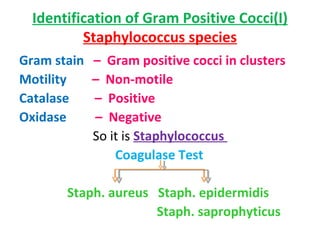
Identification of Gram Positive Cocci(I) Staphylococcus species Gram stain  –  Gram positive cocci in clusters  Motility  –  Non-motile Catalase   –  Positive  Oxidase  –  Negative  So it is  Staphylococcus  Coagulase Test Staph. aureus  Staph. epidermidis  Staph. saprophyticus
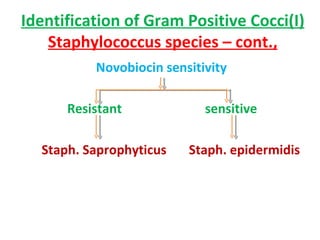
Identification of Gram Positive Cocci(I) Staphylococcus species – cont., Novobiocin sensitivity Resistant  sensitive Staph. Saprophyticus  Staph. epidermidis
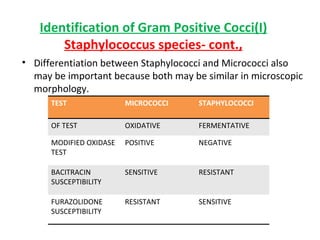
Differentiation between Staphylococci and Micrococci also may be important because both may be similar in microscopic morphology.  Identification of Gram Positive Cocci(I) Staphylococcus species- cont., TEST  MICROCOCCI  STAPHYLOCOCCI OF TEST  OXIDATIVE  FERMENTATIVE  MODIFIED OXIDASE TEST POSITIVE  NEGATIVE  BACITRACIN SUSCEPTIBILITY SENSITIVE  RESISTANT  FURAZOLIDONE SUSCEPTIBILITY RESISTANT  SENSITIVE
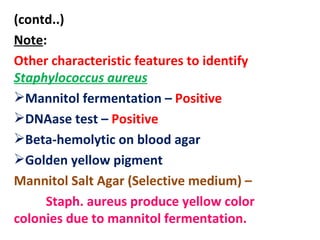
(contd..) Note :  Other characteristic features to identify  Staphylococcus aureus Mannitol fermentation –  Positive  DNAase test –  Positive   Beta-hemolytic on blood agar  Golden yellow pigment  Mannitol Salt Agar (Selective medium) –  Staph. aureus produce yellow color colonies due to mannitol fermentation.
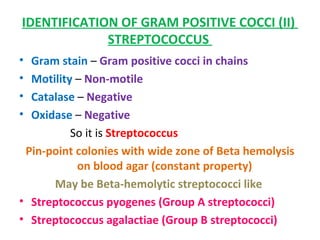
IDENTIFICATION OF GRAM POSITIVE COCCI (II)  STREPTOCOCCUS  Gram stain  –  Gram positive cocci in chains  Motility  –  Non-motile  Catalase  –  Negative  Oxidase  –  Negative  So it is  Streptococcus  Pin-point colonies with wide zone of Beta hemolysis on blood agar (constant property)  May be Beta-hemolytic streptococci like  Streptococcus pyogenes (Group A streptococci)  Streptococcus agalactiae (Group B streptococci)
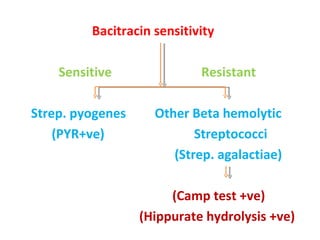
Bacitracin sensitivity  Sensitive   Resistant  Strep. pyogenes  Other Beta hemolytic (PYR+ve)  Streptococci (Strep. agalactiae) (Camp test +ve) (Hippurate hydrolysis +ve)
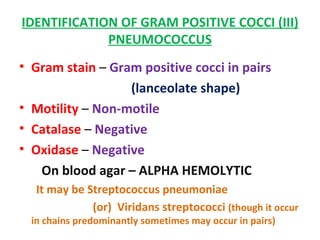
IDENTIFICATION OF GRAM POSITIVE COCCI (III) PNEUMOCOCCUS Gram stain  –  Gram positive cocci in pairs  (lanceolate shape) Motility  –  Non-motile  Catalase  –  Negative  Oxidase  –   Negative   On blood agar – ALPHA HEMOLYTIC It may be Streptococcus pneumoniae  (or)  Viridans streptococci  (though it occur in chains predominantly sometimes may occur in pairs)
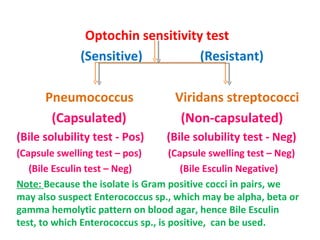
Optochin sensitivity test  (Sensitive)  (Resistant) Pneumococcus  Viridans streptococci (Capsulated)  (Non-capsulated) (Bile solubility test - Pos)  (Bile solubility test - Neg) (Capsule swelling test – pos)  (Capsule swelling test – Neg) (Bile Esculin test – Neg)  (Bile Esculin Negative) Note:  Because the isolate is Gram positive cocci in pairs, we may also suspect Enterococcus sp., which may be alpha, beta or gamma hemolytic pattern on blood agar, hence Bile Esculin test, to which Enterococcus sp., is positive,  can be used.
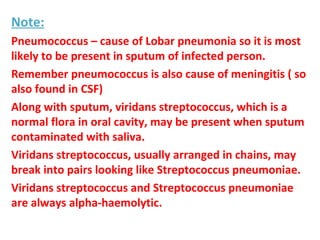
Note: Pneumococcus – cause of Lobar pneumonia so it is most likely to be present in sputum of infected person. Remember pneumococcus is also cause of meningitis ( so also found in CSF) Along with sputum, viridans streptococcus, which is a normal flora in oral cavity, may be present when sputum contaminated with saliva. Viridans streptococcus, usually arranged in chains, may break into pairs looking like Streptococcus pneumoniae.  Viridans streptococcus and Streptococcus pneumoniae are always alpha-haemolytic.
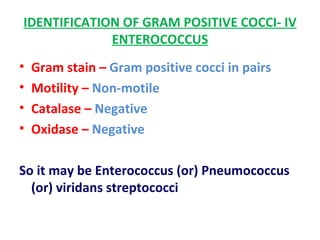
IDENTIFICATION OF GRAM POSITIVE COCCI- IV ENTEROCOCCUS Gram stain –  Gram positive cocci in pairs  Motility –  Non-motile   Catalase –  Negative   Oxidase –  Negative   So it may be Enterococcus (or) Pneumococcus (or) viridans streptococci
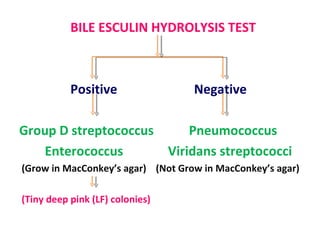
BILE ESCULIN HYDROLYSIS TEST Positive  Negative  Group D streptococcus  Pneumococcus Enterococcus  Viridans streptococci  (Grow in MacConkey’s agar)  (Not Grow in MacConkey’s agar) (Tiny deep pink (LF) colonies)
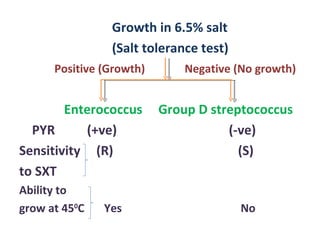
Growth in 6.5% salt (Salt tolerance test) Positive (Growth)  Negative (No growth)  Enterococcus  Group D streptococcus PYR  (+ve)  (-ve) Sensitivity  (R)  (S) to SXT Ability to  grow at 45 0 C  Yes  No
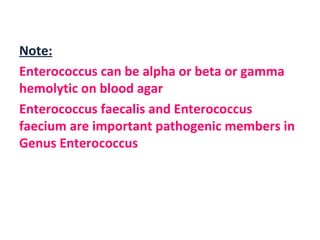
Note: Enterococcus can be alpha or beta or gamma hemolytic on blood agar  Enterococcus faecalis and Enterococcus faecium are important pathogenic members in Genus Enterococcus
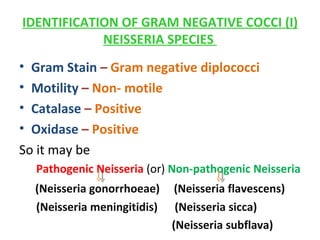
IDENTIFICATION OF GRAM NEGATIVE COCCI (I) NEISSERIA SPECIES  Gram Stain  –  Gram negative diplococci  Motility  –  Non- motile  Catalase  –  Positive   Oxidase  –  Positive   So it may be  Pathogenic Neisseria  (or)  Non-pathogenic Neisseria (Neisseria gonorrhoeae)  (Neisseria flavescens) (Neisseria meningitidis)  (Neisseria sicca) (Neisseria subflava)
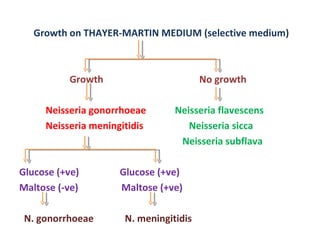
Growth on THAYER-MARTIN MEDIUM (selective medium) Growth  No growth  Neisseria gonorrhoeae  Neisseria flavescens Neisseria meningitidis  Neisseria sicca  Neisseria subflava  Glucose (+ve)  Glucose (+ve) Maltose (-ve)  Maltose (+ve)  N. gonorrhoeae  N. meningitidis
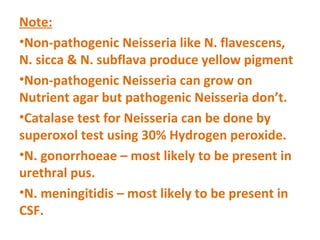
Note: Non-pathogenic Neisseria like N. flavescens, N. sicca & N. subflava produce yellow pigment Non-pathogenic Neisseria can grow on Nutrient agar but pathogenic Neisseria don’t. Catalase test for Neisseria can be done by superoxol test using 30% Hydrogen peroxide. N. gonorrhoeae – most likely to be present in urethral pus. N. meningitidis – most likely to be present in CSF.
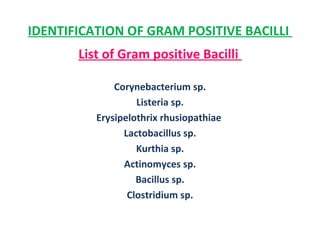
IDENTIFICATION OF GRAM POSITIVE BACILLI  List of Gram positive Bacilli  Corynebacterium sp. Listeria sp. Erysipelothrix rhusiopathiae  Lactobacillus sp. Kurthia sp. Actinomyces sp. Bacillus sp. Clostridium sp.
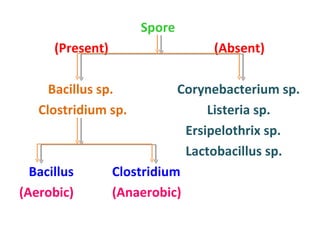
Spore  (Present)  (Absent) Bacillus sp.   Corynebacterium sp. Clostridium sp.  Listeria sp. Ersipelothrix sp. Lactobacillus sp. Bacillus  Clostridium  (Aerobic)  (Anaerobic)
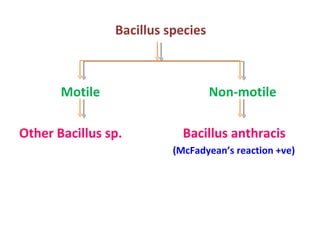
Bacillus species  Motile  Non-motile Other Bacillus sp.  Bacillus anthracis (McFadyean’s reaction +ve)
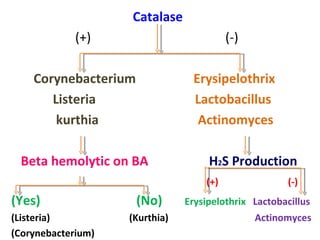
Catalase  (+)  (-) Corynebacterium  Erysipelothrix Listeria  Lactobacillus kurthia  Actinomyces Beta hemolytic on BA  H 2 S Production (+)  (-) (Yes)  (No)   Erysipelothrix  Lactobacillus (Listeria)  (Kurthia)  Actinomyces (Corynebacterium)
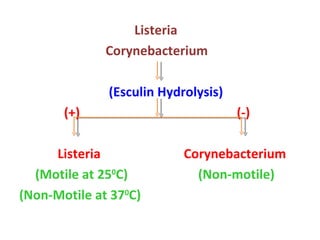
Listeria Corynebacterium (Esculin Hydrolysis) (+)  (-) Listeria  Corynebacterium (Motile at 25 0 C)  (Non-motile) (Non-Motile at 37 0 C)
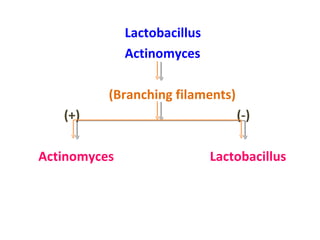
Lactobacillus  Actinomyces (Branching filaments)  (+)  (-) Actinomyces  Lactobacillus
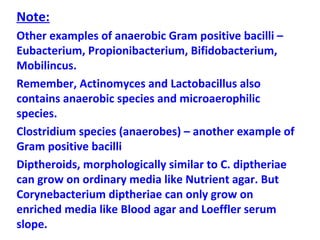
Note: Other examples of anaerobic Gram positive bacilli – Eubacterium, Propionibacterium, Bifidobacterium, Mobilincus. Remember, Actinomyces and Lactobacillus also contains anaerobic species and microaerophilic species.  Clostridium species (anaerobes) – another example of Gram positive bacilli  Diptheroids, morphologically similar to C. diptheriae can grow on ordinary media like Nutrient agar. But Corynebacterium diptheriae can only grow on enriched media like Blood agar and Loeffler serum slope.
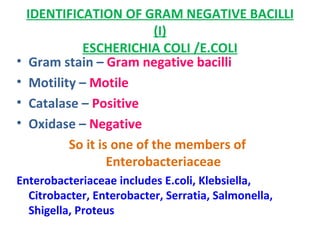
IDENTIFICATION OF GRAM NEGATIVE BACILLI (I) ESCHERICHIA COLI /E.COLI Gram stain –  Gram negative bacilli  Motility –  Motile  Catalase –  Positive   Oxidase –  Negative   So it is one of the members of Enterobacteriaceae Enterobacteriaceae includes E.coli, Klebsiella, Citrobacter, Enterobacter, Serratia, Salmonella, Shigella, Proteus
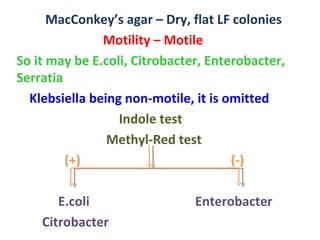
MacConkey’s agar – Dry, flat LF colonies Motility – Motile So it may be E.coli, Citrobacter, Enterobacter,  Serratia Klebsiella being non-motile, it is omitted  Indole test  Methyl-Red test (+)  (-) E.coli  Enterobacter Citrobacter
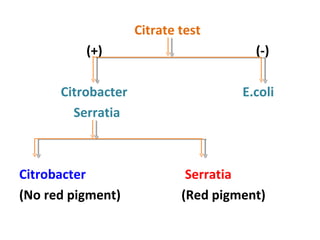
Citrate test (+)  (-) Citrobacter  E.coli  Serratia  Citrobacter  Serratia (No red pigment)  (Red pigment)
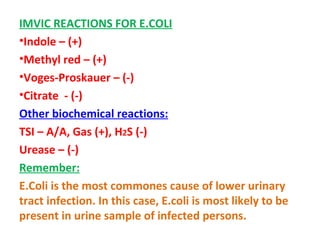
IMVIC REACTIONS FOR E.COLI Indole – (+) Methyl red – (+) Voges-Proskauer – (-) Citrate  - (-) Other biochemical reactions: TSI – A/A, Gas (+), H 2 S (-) Urease – (-) Remember: E.Coli is the most commones cause of lower urinary tract infection. In this case, E.coli is most likely to be present in urine sample of infected persons.
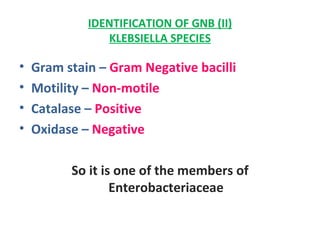
IDENTIFICATION OF GNB (II) KLEBSIELLA SPECIES Gram stain –  Gram Negative bacilli  Motility –  Non-motile   Catalase –  Positive   Oxidase –  Negative  So it is one of the members of Enterobacteriaceae
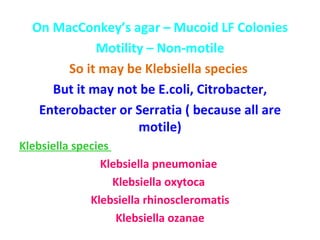
On MacConkey’s agar – Mucoid LF Colonies Motility – Non-motile So it may be Klebsiella species  But it may not be E.coli, Citrobacter, Enterobacter or Serratia ( because all are motile) Klebsiella species  Klebsiella pneumoniae  Klebsiella oxytoca  Klebsiella rhinoscleromatis Klebsiella ozanae
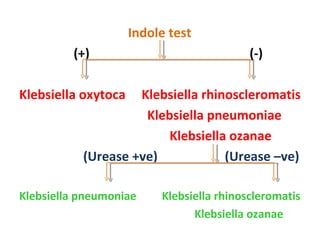
Indole test (+)  (-) Klebsiella oxytoca  Klebsiella rhinoscleromatis  Klebsiella pneumoniae Klebsiella ozanae  (Urease +ve)  (Urease –ve) Klebsiella pneumoniae  Klebsiella rhinoscleromatis Klebsiella ozanae
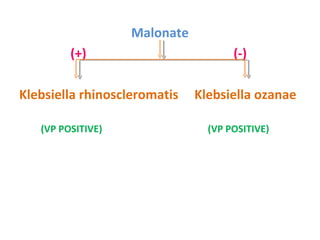
Malonate  (+)  (-)  Klebsiella rhinoscleromatis  Klebsiella ozanae  (VP POSITIVE)  (VP POSITIVE)
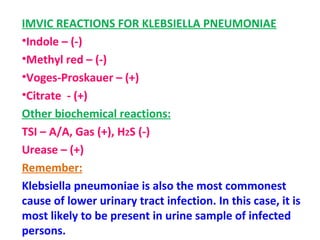
IMVIC REACTIONS FOR KLEBSIELLA PNEUMONIAE Indole – (-) Methyl red – (-) Voges-Proskauer – (+) Citrate  - (+) Other biochemical reactions: TSI – A/A, Gas (+), H 2 S (-) Urease – (+) Remember: Klebsiella pneumoniae is also the most commonest cause of lower urinary tract infection. In this case, it is most likely to be present in urine sample of infected persons.
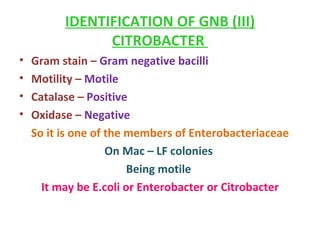
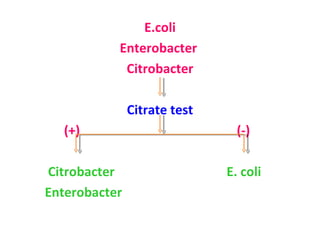
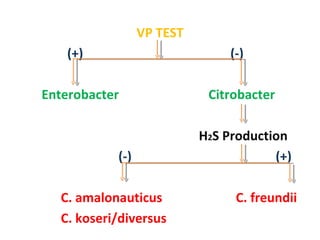
IDENTIFICATION OF GNB (III) CITROBACTER  Gram stain –  Gram negative bacilli Motility –  Motile  Catalase –  Positive  Oxidase –  Negative  So it is one of the members of Enterobacteriaceae On Mac – LF colonies  Being motile  It may be E.coli or Enterobacter or Citrobacter
E.coli Enterobacter  Citrobacter Citrate test (+)  (-)  Citrobacter  E. coli Enterobacter
VP TEST (+)  (-)  Enterobacter  Citrobacter  H 2 S Production (-)  (+) C. amalonauticus  C. freundii C. koseri/diversus
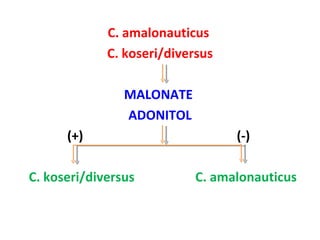
C. amalonauticus  C. koseri/diversus MALONATE  ADONITOL (+)  (-) C. koseri/diversus  C. amalonauticus
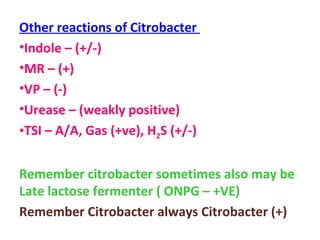
Other reactions of Citrobacter  Indole – (+/-) MR – (+) VP – (-) Urease – (weakly positive) TSI – A/A, Gas (+ve), H 2 S (+/-) Remember citrobacter sometimes also may be Late lactose fermenter ( ONPG – +VE) Remember Citrobacter always Citrobacter (+)
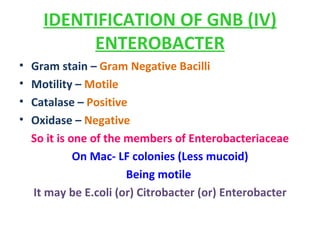
IDENTIFICATION OF GNB (IV) ENTEROBACTER Gram stain –  Gram Negative Bacilli  Motility –  Motile  Catalase –  Positive   Oxidase –  Negative  So it is one of the members of Enterobacteriaceae On Mac- LF colonies (Less mucoid) Being motile  It may be E.coli (or) Citrobacter (or) Enterobacter
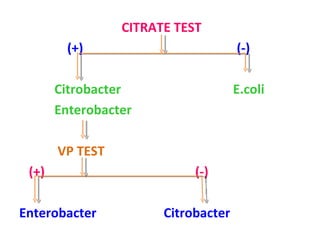
CITRATE TEST  (+)  (-) Citrobacter  E.coli Enterobacter  VP TEST (+)  (-) Enterobacter  Citrobacter
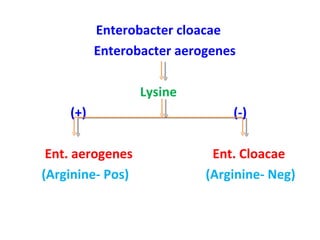
Enterobacter cloacae  Enterobacter aerogenes Lysine  (+)  (-)  Ent. aerogenes  Ent. Cloacae (Arginine- Pos)  (Arginine- Neg)
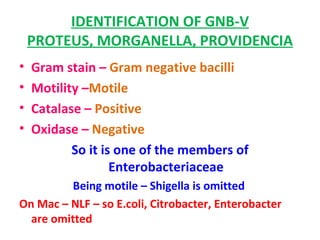
IDENTIFICATION OF GNB-V PROTEUS, MORGANELLA, PROVIDENCIA Gram stain –  Gram negative bacilli  Motility – Motile   Catalase –  Positive  Oxidase –  Negative   So it is one of the members of Enterobacteriaceae Being motile – Shigella is omitted  On Mac – NLF – so E.coli, Citrobacter, Enterobacter are omitted
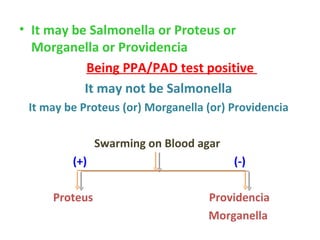
It may be Salmonella or Proteus or Morganella or Providencia  Being PPA/PAD test positive  It may not be Salmonella  It may be Proteus (or) Morganella (or) Providencia  Swarming on Blood agar  (+)  (-) Proteus  Providencia  Morganella
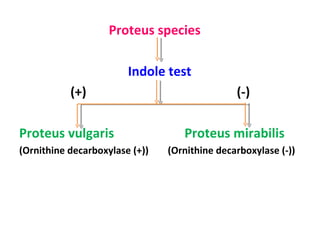
Proteus species  Indole test  (+)  (-) Proteus vulgaris  Proteus mirabilis (Ornithine decarboxylase (+))  (Ornithine decarboxylase (-))
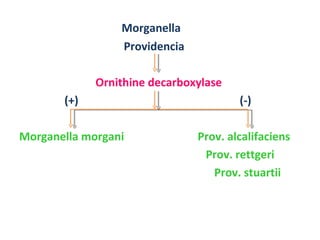
Morganella  Providencia  Ornithine decarboxylase (+)  (-) Morganella morgani  Prov. alcalifaciens Prov. rettgeri  Prov. stuartii
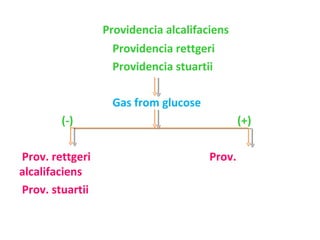
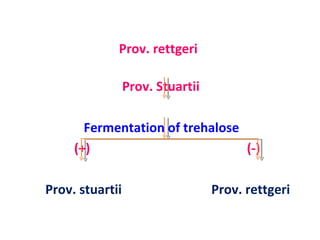
Providencia alcalifaciens Providencia rettgeri  Providencia stuartii Gas from glucose  (-)  (+) Prov. rettgeri  Prov. alcalifaciens Prov. stuartii
Prov. rettgeri  Prov. Stuartii Fermentation of trehalose  (+)  (-) Prov. stuartii  Prov. rettgeri
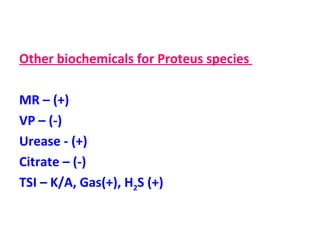
Other biochemicals for Proteus species  MR – (+) VP – (-) Urease - (+) Citrate – (-) TSI – K/A, Gas(+), H 2 S (+)
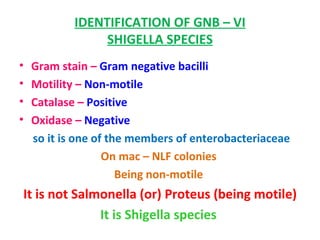
IDENTIFICATION OF GNB – VI SHIGELLA SPECIES Gram stain –  Gram negative bacilli  Motility –  Non-motile  Catalase –  Positive  Oxidase –  Negative  so it is one of the members of enterobacteriaceae On mac – NLF colonies  Being non-motile  It is not Salmonella (or) Proteus (being motile) It is Shigella species
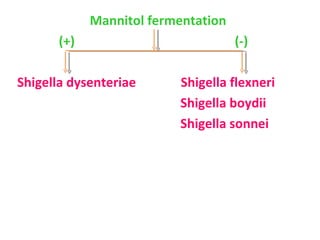
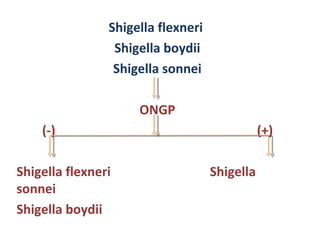
Mannitol fermentation  (+)  (-) Shigella dysenteriae  Shigella flexneri Shigella boydii Shigella sonnei
Shigella flexneri  Shigella boydii Shigella sonnei ONGP (-)  (+) Shigella flexneri  Shigella sonnei Shigella boydii
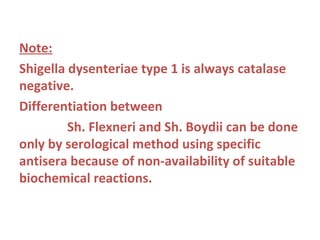
Note: Shigella dysenteriae type 1 is always catalase negative. Differentiation between  Sh. Flexneri and Sh. Boydii can be done only by serological method using specific antisera because of non-availability of suitable biochemical reactions.
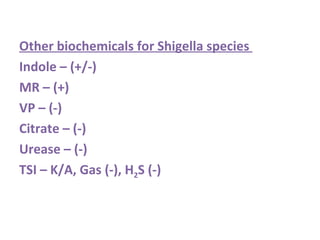
Other biochemicals for Shigella species  Indole – (+/-) MR – (+) VP – (-) Citrate – (-) Urease – (-) TSI – K/A, Gas (-), H 2 S (-)
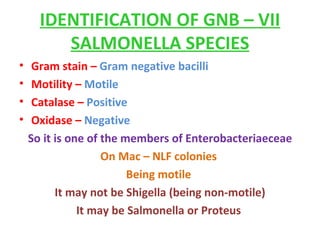
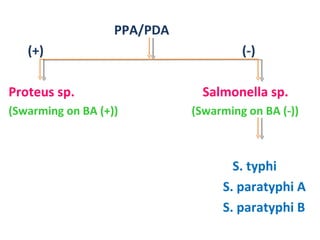
IDENTIFICATION OF GNB – VII SALMONELLA SPECIES Gram stain –  Gram negative bacilli  Motility –  Motile  Catalase –  Positive  Oxidase –  Negative  So it is one of the members of Enterobacteriaeceae  On Mac – NLF colonies  Being motile  It may not be Shigella (being non-motile) It may be Salmonella or Proteus
PPA/PDA (+)  (-)  Proteus sp.  Salmonella sp. (Swarming on BA (+))  (Swarming on BA (-))  S. typhi S. paratyphi A  S. paratyphi B
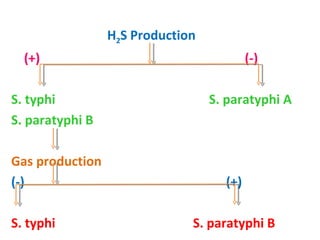
H 2 S Production (+)  (-)  S. typhi  S. paratyphi A S. paratyphi B Gas production  (-)  (+) S. typhi  S. paratyphi B
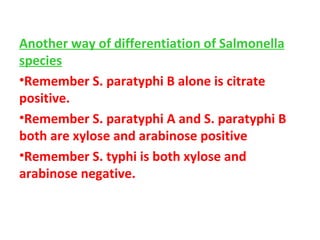
Another way of differentiation of Salmonella species Remember S. paratyphi B alone is citrate positive. Remember S. paratyphi A and S. paratyphi B both are xylose and arabinose positive  Remember S. typhi is both xylose and arabinose negative.
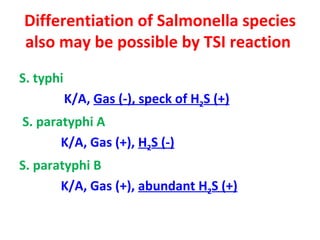
Differentiation of Salmonella species also may be possible by TSI reaction  S. typhi  K/A,  Gas (-), speck of H 2 S (+) S. paratyphi A  K/A, Gas (+),  H 2 S (-) S. paratyphi B  K/A, Gas (+),  abundant H 2 S (+)
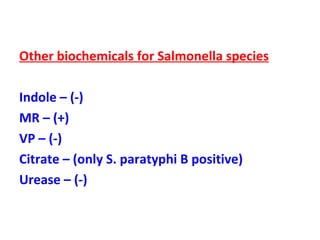
Other biochemicals for Salmonella species Indole – (-) MR – (+) VP – (-) Citrate – (only S. paratyphi B positive) Urease – (-)
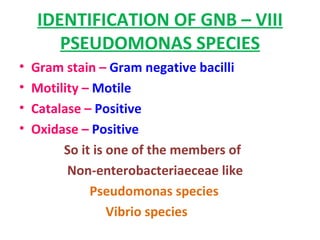
IDENTIFICATION OF GNB – VIII PSEUDOMONAS SPECIES Gram stain –  Gram negative bacilli  Motility –  Motile  Catalase –  Positive  Oxidase –  Positive   So it is one of the members of  Non-enterobacteriaeceae like  Pseudomonas species  Vibrio species
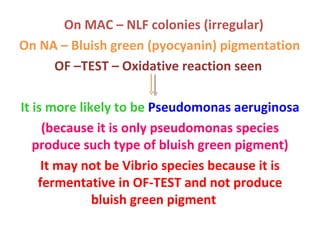
On MAC – NLF colonies (irregular) On NA – Bluish green (pyocyanin) pigmentation OF –TEST – Oxidative reaction seen It is more likely to be  Pseudomonas aeruginosa  (because it is only pseudomonas species produce such type of bluish green pigment) It may not be Vibrio species because it is fermentative in OF-TEST and not produce bluish green pigment
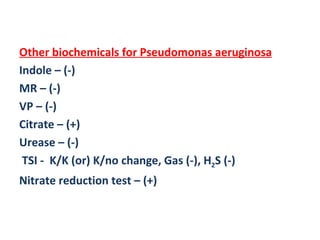
Other biochemicals for Pseudomonas aeruginosa Indole – (-) MR – (-) VP – (-) Citrate – (+) Urease – (-) TSI -  K/K (or) K/no change, Gas (-), H 2 S (-) Nitrate reduction test – (+)
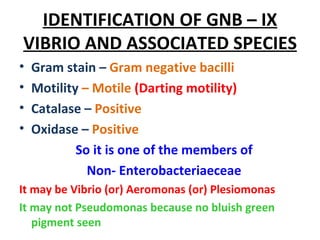
IDENTIFICATION OF GNB – IX VIBRIO AND ASSOCIATED SPECIES Gram stain –  Gram negative bacilli  Motility  – Motile  (Darting motility) Catalase –  Positive  Oxidase –  Positive   So it is one of the members of  Non- Enterobacteriaeceae It may be Vibrio (or) Aeromonas (or) Plesiomonas It may not Pseudomonas because no bluish green pigment seen
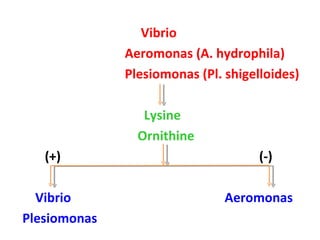
Vibrio  Aeromonas (A. hydrophila)  Plesiomonas (Pl. shigelloides) Lysine  Ornithine  (+)  (-) Vibrio  Aeromonas Plesiomonas
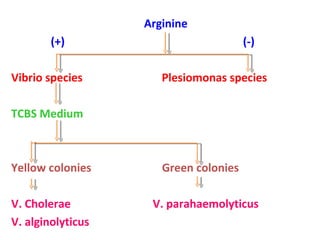
Arginine (+)  (-) Vibrio species  Plesiomonas species TCBS Medium Yellow colonies  Green colonies V. Cholerae  V. parahaemolyticus V. alginolyticus
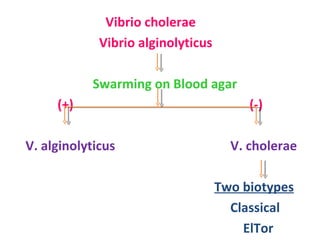
Vibrio cholerae  Vibrio alginolyticus Swarming on Blood agar (+)  (-) V. alginolyticus  V. cholerae Two biotypes Classical  ElTor
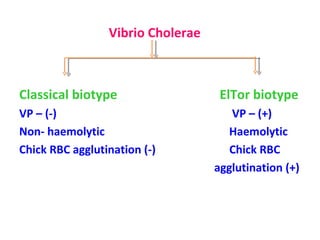
Vibrio Cholerae  Classical biotype  ElTor biotype VP – (-)  VP – (+) Non- haemolytic  Haemolytic  Chick RBC agglutination (-)  Chick RBC  agglutination (+)
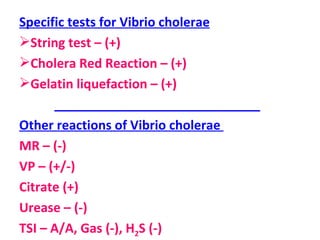
Specific tests for Vibrio cholerae String test – (+) Cholera Red Reaction – (+) Gelatin liquefaction – (+) _____________________________ Other reactions of Vibrio cholerae  MR – (-) VP – (+/-) Citrate (+) Urease – (-) TSI – A/A, Gas (-), H 2 S (-)
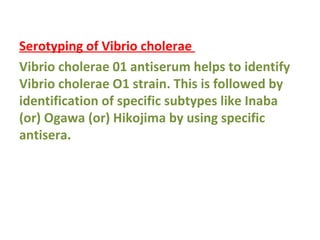
Serotyping of Vibrio cholerae  Vibrio cholerae 01 antiserum helps to identify Vibrio cholerae O1 strain. This is followed by identification of specific subtypes like Inaba (or) Ogawa (or) Hikojima by using specific antisera.
This presentation was created for those who are working as a laboratory technician in clinical microbiology diagnostics. Also may find useful for UG, PG, DMLT, PGDMLT in Microbiology.  Mail ID:  [email_address]

Identification of bacteria, Bacterial identification, Lab identification of bacteria, Medical bacteriology

  • 1.
    IDENTIFICATION OF PATHOGENICBACTERIA IN CLINICAL MICROBIOLOGY LABORATORY G.HARIPRASAD M.Sc.,M.Phil.,Ph.D Department of Microbiology Thoothukudi Govt. Medical College Thoothukudi
  • 2.
    Identification of GramPositive Cocci(I) Staphylococcus species Gram stain – Gram positive cocci in clusters Motility – Non-motile Catalase – Positive Oxidase – Negative So it is Staphylococcus Coagulase Test Staph. aureus Staph. epidermidis Staph. saprophyticus
  • 3.
    Identification of GramPositive Cocci(I) Staphylococcus species – cont., Novobiocin sensitivity Resistant sensitive Staph. Saprophyticus Staph. epidermidis
  • 4.
    Differentiation between Staphylococciand Micrococci also may be important because both may be similar in microscopic morphology. Identification of Gram Positive Cocci(I) Staphylococcus species- cont., TEST MICROCOCCI STAPHYLOCOCCI OF TEST OXIDATIVE FERMENTATIVE MODIFIED OXIDASE TEST POSITIVE NEGATIVE BACITRACIN SUSCEPTIBILITY SENSITIVE RESISTANT FURAZOLIDONE SUSCEPTIBILITY RESISTANT SENSITIVE
  • 5.
    (contd..) Note : Other characteristic features to identify Staphylococcus aureus Mannitol fermentation – Positive DNAase test – Positive Beta-hemolytic on blood agar Golden yellow pigment Mannitol Salt Agar (Selective medium) – Staph. aureus produce yellow color colonies due to mannitol fermentation.
  • 6.
    IDENTIFICATION OF GRAMPOSITIVE COCCI (II) STREPTOCOCCUS Gram stain – Gram positive cocci in chains Motility – Non-motile Catalase – Negative Oxidase – Negative So it is Streptococcus Pin-point colonies with wide zone of Beta hemolysis on blood agar (constant property) May be Beta-hemolytic streptococci like Streptococcus pyogenes (Group A streptococci) Streptococcus agalactiae (Group B streptococci)
  • 7.
    Bacitracin sensitivity Sensitive Resistant Strep. pyogenes Other Beta hemolytic (PYR+ve) Streptococci (Strep. agalactiae) (Camp test +ve) (Hippurate hydrolysis +ve)
  • 8.
    IDENTIFICATION OF GRAMPOSITIVE COCCI (III) PNEUMOCOCCUS Gram stain – Gram positive cocci in pairs (lanceolate shape) Motility – Non-motile Catalase – Negative Oxidase – Negative On blood agar – ALPHA HEMOLYTIC It may be Streptococcus pneumoniae (or) Viridans streptococci (though it occur in chains predominantly sometimes may occur in pairs)
  • 9.
    Optochin sensitivity test (Sensitive) (Resistant) Pneumococcus Viridans streptococci (Capsulated) (Non-capsulated) (Bile solubility test - Pos) (Bile solubility test - Neg) (Capsule swelling test – pos) (Capsule swelling test – Neg) (Bile Esculin test – Neg) (Bile Esculin Negative) Note: Because the isolate is Gram positive cocci in pairs, we may also suspect Enterococcus sp., which may be alpha, beta or gamma hemolytic pattern on blood agar, hence Bile Esculin test, to which Enterococcus sp., is positive, can be used.
  • 10.
    Note: Pneumococcus –cause of Lobar pneumonia so it is most likely to be present in sputum of infected person. Remember pneumococcus is also cause of meningitis ( so also found in CSF) Along with sputum, viridans streptococcus, which is a normal flora in oral cavity, may be present when sputum contaminated with saliva. Viridans streptococcus, usually arranged in chains, may break into pairs looking like Streptococcus pneumoniae. Viridans streptococcus and Streptococcus pneumoniae are always alpha-haemolytic.
  • 11.
    IDENTIFICATION OF GRAMPOSITIVE COCCI- IV ENTEROCOCCUS Gram stain – Gram positive cocci in pairs Motility – Non-motile Catalase – Negative Oxidase – Negative So it may be Enterococcus (or) Pneumococcus (or) viridans streptococci
  • 12.
    BILE ESCULIN HYDROLYSISTEST Positive Negative Group D streptococcus Pneumococcus Enterococcus Viridans streptococci (Grow in MacConkey’s agar) (Not Grow in MacConkey’s agar) (Tiny deep pink (LF) colonies)
  • 13.
    Growth in 6.5%salt (Salt tolerance test) Positive (Growth) Negative (No growth) Enterococcus Group D streptococcus PYR (+ve) (-ve) Sensitivity (R) (S) to SXT Ability to grow at 45 0 C Yes No
  • 14.
    Note: Enterococcus canbe alpha or beta or gamma hemolytic on blood agar Enterococcus faecalis and Enterococcus faecium are important pathogenic members in Genus Enterococcus
  • 15.
    IDENTIFICATION OF GRAMNEGATIVE COCCI (I) NEISSERIA SPECIES Gram Stain – Gram negative diplococci Motility – Non- motile Catalase – Positive Oxidase – Positive So it may be Pathogenic Neisseria (or) Non-pathogenic Neisseria (Neisseria gonorrhoeae) (Neisseria flavescens) (Neisseria meningitidis) (Neisseria sicca) (Neisseria subflava)
  • 16.
    Growth on THAYER-MARTINMEDIUM (selective medium) Growth No growth Neisseria gonorrhoeae Neisseria flavescens Neisseria meningitidis Neisseria sicca Neisseria subflava Glucose (+ve) Glucose (+ve) Maltose (-ve) Maltose (+ve) N. gonorrhoeae N. meningitidis
  • 17.
    Note: Non-pathogenic Neisserialike N. flavescens, N. sicca & N. subflava produce yellow pigment Non-pathogenic Neisseria can grow on Nutrient agar but pathogenic Neisseria don’t. Catalase test for Neisseria can be done by superoxol test using 30% Hydrogen peroxide. N. gonorrhoeae – most likely to be present in urethral pus. N. meningitidis – most likely to be present in CSF.
  • 18.
    IDENTIFICATION OF GRAMPOSITIVE BACILLI List of Gram positive Bacilli Corynebacterium sp. Listeria sp. Erysipelothrix rhusiopathiae Lactobacillus sp. Kurthia sp. Actinomyces sp. Bacillus sp. Clostridium sp.
  • 19.
    Spore (Present) (Absent) Bacillus sp. Corynebacterium sp. Clostridium sp. Listeria sp. Ersipelothrix sp. Lactobacillus sp. Bacillus Clostridium (Aerobic) (Anaerobic)
  • 20.
    Bacillus species Motile Non-motile Other Bacillus sp. Bacillus anthracis (McFadyean’s reaction +ve)
  • 21.
    Catalase (+) (-) Corynebacterium Erysipelothrix Listeria Lactobacillus kurthia Actinomyces Beta hemolytic on BA H 2 S Production (+) (-) (Yes) (No) Erysipelothrix Lactobacillus (Listeria) (Kurthia) Actinomyces (Corynebacterium)
  • 22.
    Listeria Corynebacterium (EsculinHydrolysis) (+) (-) Listeria Corynebacterium (Motile at 25 0 C) (Non-motile) (Non-Motile at 37 0 C)
  • 23.
    Lactobacillus Actinomyces(Branching filaments) (+) (-) Actinomyces Lactobacillus
  • 24.
    Note: Other examplesof anaerobic Gram positive bacilli – Eubacterium, Propionibacterium, Bifidobacterium, Mobilincus. Remember, Actinomyces and Lactobacillus also contains anaerobic species and microaerophilic species. Clostridium species (anaerobes) – another example of Gram positive bacilli Diptheroids, morphologically similar to C. diptheriae can grow on ordinary media like Nutrient agar. But Corynebacterium diptheriae can only grow on enriched media like Blood agar and Loeffler serum slope.
  • 25.
    IDENTIFICATION OF GRAMNEGATIVE BACILLI (I) ESCHERICHIA COLI /E.COLI Gram stain – Gram negative bacilli Motility – Motile Catalase – Positive Oxidase – Negative So it is one of the members of Enterobacteriaceae Enterobacteriaceae includes E.coli, Klebsiella, Citrobacter, Enterobacter, Serratia, Salmonella, Shigella, Proteus
  • 26.
    MacConkey’s agar –Dry, flat LF colonies Motility – Motile So it may be E.coli, Citrobacter, Enterobacter, Serratia Klebsiella being non-motile, it is omitted Indole test Methyl-Red test (+) (-) E.coli Enterobacter Citrobacter
  • 27.
    Citrate test (+) (-) Citrobacter E.coli Serratia Citrobacter Serratia (No red pigment) (Red pigment)
  • 28.
    IMVIC REACTIONS FORE.COLI Indole – (+) Methyl red – (+) Voges-Proskauer – (-) Citrate - (-) Other biochemical reactions: TSI – A/A, Gas (+), H 2 S (-) Urease – (-) Remember: E.Coli is the most commones cause of lower urinary tract infection. In this case, E.coli is most likely to be present in urine sample of infected persons.
  • 29.
    IDENTIFICATION OF GNB(II) KLEBSIELLA SPECIES Gram stain – Gram Negative bacilli Motility – Non-motile Catalase – Positive Oxidase – Negative So it is one of the members of Enterobacteriaceae
  • 30.
    On MacConkey’s agar– Mucoid LF Colonies Motility – Non-motile So it may be Klebsiella species But it may not be E.coli, Citrobacter, Enterobacter or Serratia ( because all are motile) Klebsiella species Klebsiella pneumoniae Klebsiella oxytoca Klebsiella rhinoscleromatis Klebsiella ozanae
  • 31.
    Indole test (+) (-) Klebsiella oxytoca Klebsiella rhinoscleromatis Klebsiella pneumoniae Klebsiella ozanae (Urease +ve) (Urease –ve) Klebsiella pneumoniae Klebsiella rhinoscleromatis Klebsiella ozanae
  • 32.
    Malonate (+) (-) Klebsiella rhinoscleromatis Klebsiella ozanae (VP POSITIVE) (VP POSITIVE)
  • 33.
    IMVIC REACTIONS FORKLEBSIELLA PNEUMONIAE Indole – (-) Methyl red – (-) Voges-Proskauer – (+) Citrate - (+) Other biochemical reactions: TSI – A/A, Gas (+), H 2 S (-) Urease – (+) Remember: Klebsiella pneumoniae is also the most commonest cause of lower urinary tract infection. In this case, it is most likely to be present in urine sample of infected persons.
  • 34.
    IDENTIFICATION OF GNB(III) CITROBACTER Gram stain – Gram negative bacilli Motility – Motile Catalase – Positive Oxidase – Negative So it is one of the members of Enterobacteriaceae On Mac – LF colonies Being motile It may be E.coli or Enterobacter or Citrobacter
  • 35.
    E.coli Enterobacter Citrobacter Citrate test (+) (-) Citrobacter E. coli Enterobacter
  • 36.
    VP TEST (+) (-) Enterobacter Citrobacter H 2 S Production (-) (+) C. amalonauticus C. freundii C. koseri/diversus
  • 37.
    C. amalonauticus C. koseri/diversus MALONATE ADONITOL (+) (-) C. koseri/diversus C. amalonauticus
  • 38.
    Other reactions ofCitrobacter Indole – (+/-) MR – (+) VP – (-) Urease – (weakly positive) TSI – A/A, Gas (+ve), H 2 S (+/-) Remember citrobacter sometimes also may be Late lactose fermenter ( ONPG – +VE) Remember Citrobacter always Citrobacter (+)
  • 39.
    IDENTIFICATION OF GNB(IV) ENTEROBACTER Gram stain – Gram Negative Bacilli Motility – Motile Catalase – Positive Oxidase – Negative So it is one of the members of Enterobacteriaceae On Mac- LF colonies (Less mucoid) Being motile It may be E.coli (or) Citrobacter (or) Enterobacter
  • 40.
    CITRATE TEST (+) (-) Citrobacter E.coli Enterobacter VP TEST (+) (-) Enterobacter Citrobacter
  • 41.
    Enterobacter cloacae Enterobacter aerogenes Lysine (+) (-) Ent. aerogenes Ent. Cloacae (Arginine- Pos) (Arginine- Neg)
  • 42.
    IDENTIFICATION OF GNB-VPROTEUS, MORGANELLA, PROVIDENCIA Gram stain – Gram negative bacilli Motility – Motile Catalase – Positive Oxidase – Negative So it is one of the members of Enterobacteriaceae Being motile – Shigella is omitted On Mac – NLF – so E.coli, Citrobacter, Enterobacter are omitted
  • 43.
    It may beSalmonella or Proteus or Morganella or Providencia Being PPA/PAD test positive It may not be Salmonella It may be Proteus (or) Morganella (or) Providencia Swarming on Blood agar (+) (-) Proteus Providencia Morganella
  • 44.
    Proteus species Indole test (+) (-) Proteus vulgaris Proteus mirabilis (Ornithine decarboxylase (+)) (Ornithine decarboxylase (-))
  • 45.
    Morganella Providencia Ornithine decarboxylase (+) (-) Morganella morgani Prov. alcalifaciens Prov. rettgeri Prov. stuartii
  • 46.
    Providencia alcalifaciens Providenciarettgeri Providencia stuartii Gas from glucose (-) (+) Prov. rettgeri Prov. alcalifaciens Prov. stuartii
  • 47.
    Prov. rettgeri Prov. Stuartii Fermentation of trehalose (+) (-) Prov. stuartii Prov. rettgeri
  • 48.
    Other biochemicals forProteus species MR – (+) VP – (-) Urease - (+) Citrate – (-) TSI – K/A, Gas(+), H 2 S (+)
  • 49.
    IDENTIFICATION OF GNB– VI SHIGELLA SPECIES Gram stain – Gram negative bacilli Motility – Non-motile Catalase – Positive Oxidase – Negative so it is one of the members of enterobacteriaceae On mac – NLF colonies Being non-motile It is not Salmonella (or) Proteus (being motile) It is Shigella species
  • 50.
    Mannitol fermentation (+) (-) Shigella dysenteriae Shigella flexneri Shigella boydii Shigella sonnei
  • 51.
    Shigella flexneri Shigella boydii Shigella sonnei ONGP (-) (+) Shigella flexneri Shigella sonnei Shigella boydii
  • 52.
    Note: Shigella dysenteriaetype 1 is always catalase negative. Differentiation between Sh. Flexneri and Sh. Boydii can be done only by serological method using specific antisera because of non-availability of suitable biochemical reactions.
  • 53.
    Other biochemicals forShigella species Indole – (+/-) MR – (+) VP – (-) Citrate – (-) Urease – (-) TSI – K/A, Gas (-), H 2 S (-)
  • 54.
    IDENTIFICATION OF GNB– VII SALMONELLA SPECIES Gram stain – Gram negative bacilli Motility – Motile Catalase – Positive Oxidase – Negative So it is one of the members of Enterobacteriaeceae On Mac – NLF colonies Being motile It may not be Shigella (being non-motile) It may be Salmonella or Proteus
  • 55.
    PPA/PDA (+) (-) Proteus sp. Salmonella sp. (Swarming on BA (+)) (Swarming on BA (-)) S. typhi S. paratyphi A S. paratyphi B
  • 56.
    H 2 SProduction (+) (-) S. typhi S. paratyphi A S. paratyphi B Gas production (-) (+) S. typhi S. paratyphi B
  • 57.
    Another way ofdifferentiation of Salmonella species Remember S. paratyphi B alone is citrate positive. Remember S. paratyphi A and S. paratyphi B both are xylose and arabinose positive Remember S. typhi is both xylose and arabinose negative.
  • 58.
    Differentiation of Salmonellaspecies also may be possible by TSI reaction S. typhi K/A, Gas (-), speck of H 2 S (+) S. paratyphi A K/A, Gas (+), H 2 S (-) S. paratyphi B K/A, Gas (+), abundant H 2 S (+)
  • 59.
    Other biochemicals forSalmonella species Indole – (-) MR – (+) VP – (-) Citrate – (only S. paratyphi B positive) Urease – (-)
  • 60.
    IDENTIFICATION OF GNB– VIII PSEUDOMONAS SPECIES Gram stain – Gram negative bacilli Motility – Motile Catalase – Positive Oxidase – Positive So it is one of the members of Non-enterobacteriaeceae like Pseudomonas species Vibrio species
  • 61.
    On MAC –NLF colonies (irregular) On NA – Bluish green (pyocyanin) pigmentation OF –TEST – Oxidative reaction seen It is more likely to be Pseudomonas aeruginosa (because it is only pseudomonas species produce such type of bluish green pigment) It may not be Vibrio species because it is fermentative in OF-TEST and not produce bluish green pigment
  • 62.
    Other biochemicals forPseudomonas aeruginosa Indole – (-) MR – (-) VP – (-) Citrate – (+) Urease – (-) TSI - K/K (or) K/no change, Gas (-), H 2 S (-) Nitrate reduction test – (+)
  • 63.
    IDENTIFICATION OF GNB– IX VIBRIO AND ASSOCIATED SPECIES Gram stain – Gram negative bacilli Motility – Motile (Darting motility) Catalase – Positive Oxidase – Positive So it is one of the members of Non- Enterobacteriaeceae It may be Vibrio (or) Aeromonas (or) Plesiomonas It may not Pseudomonas because no bluish green pigment seen
  • 64.
    Vibrio Aeromonas(A. hydrophila) Plesiomonas (Pl. shigelloides) Lysine Ornithine (+) (-) Vibrio Aeromonas Plesiomonas
  • 65.
    Arginine (+) (-) Vibrio species Plesiomonas species TCBS Medium Yellow colonies Green colonies V. Cholerae V. parahaemolyticus V. alginolyticus
  • 66.
    Vibrio cholerae Vibrio alginolyticus Swarming on Blood agar (+) (-) V. alginolyticus V. cholerae Two biotypes Classical ElTor
  • 67.
    Vibrio Cholerae Classical biotype ElTor biotype VP – (-) VP – (+) Non- haemolytic Haemolytic Chick RBC agglutination (-) Chick RBC agglutination (+)
  • 68.
    Specific tests forVibrio cholerae String test – (+) Cholera Red Reaction – (+) Gelatin liquefaction – (+) _____________________________ Other reactions of Vibrio cholerae MR – (-) VP – (+/-) Citrate (+) Urease – (-) TSI – A/A, Gas (-), H 2 S (-)
  • 69.
    Serotyping of Vibriocholerae Vibrio cholerae 01 antiserum helps to identify Vibrio cholerae O1 strain. This is followed by identification of specific subtypes like Inaba (or) Ogawa (or) Hikojima by using specific antisera.
  • 70.
    This presentation wascreated for those who are working as a laboratory technician in clinical microbiology diagnostics. Also may find useful for UG, PG, DMLT, PGDMLT in Microbiology. Mail ID: [email_address]