CONSTRUCTIVIST LEARNING THEORY
By Sarah N.
MENU
 What is it?
 Who made it?

 How is it used?

 My Classroom
CONSTRUCTIVISM: WHAT IS IT?
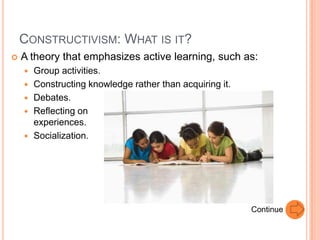
   A theory that emphasizes active learning, such as:
       Group activities.
       Constructing knowledge rather than acquiring it.
       Debates.
       Reflecting on
        experiences.
       Socialization.


                                                           Continue
WHAT IS IT? (CONTINUED)
                    Constructivism posits general
                     concepts of individuality, such
                     as:
                      Learners construct knowledge
                       based off of past experiences.
                      Each learner has a unique
                       interpretation and construction
                       of knowledge processes.
                      The learner is not a blank slate.
                       (tabula rasa)


                                               Continue
WHAT IS IT? (CONTINUED)
   For a student-made video to better understand
    constructivism, click here.


                                       Return to Main Menu
CONSTRUCTIVISM: WHO MADE IT?
   John Dewey
       Emphasized the significance of experience in education.
   Piaget
       Demonstrated that children’s minds were not empty, but
        were constantly processing the material they were
        presented.
   George Kelly
     Personal Construct Theory
     Stated that personal identity is defined by the way we
      understand our person worlds.

                                                         Continue
WHO MADE IT? (CONTINUED)
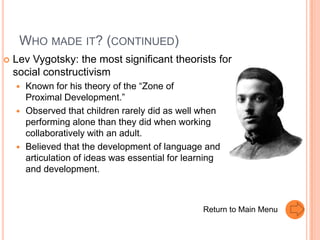
   Lev Vygotsky: the most significant theorists for
    social constructivism
       Known for his theory of the “Zone of
        Proximal Development.”
       Observed that children rarely did as well when
        performing alone than they did when working
        collaboratively with an adult.
       Believed that the development of language and
        articulation of ideas was essential for learning
        and development.


                                                   Return to Main Menu
CONSTRUCTIVISM: HOW IS IT USED?
Teachers:
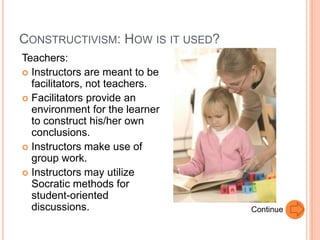
 Instructors are meant to be
  facilitators, not teachers.
 Facilitators provide an
  environment for the learner
  to construct his/her own
  conclusions.
 Instructors make use of
  group work.
 Instructors may utilize
  Socratic methods for
  student-oriented
  discussions.                    Continue
HOW IS IT USED? (CONTINUED)
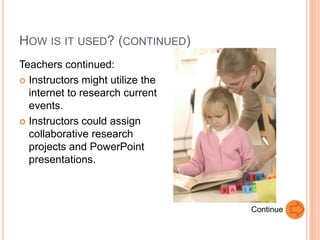
Teachers continued:
 Instructors might utilize the
  internet to research current
  events.
 Instructors could assign
  collaborative research
  projects and PowerPoint
  presentations.


                                  Continue
HOW IS IT USED? (CONTINUED)
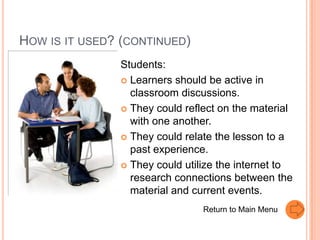
               Students:
                Learners should be active in
                 classroom discussions.
                They could reflect on the material
                 with one another.
                They could relate the lesson to a
                 past experience.
                They could utilize the internet to
                 research connections between the
                 material and current events.
                                Return to Main Menu
CONSTRUCTIVISM: MY CLASSROOM
 Constructivism relates to my personal teaching
  philosophies in that I view every student as an
  individual.
 I believe that students should construct their own
  knowledge, not rely on lectures.


                                                  Continue
MY CLASSROOM (CONTINUED)
 I would assign hands-on activities to ensure that
  students are actively learning.
 I believe that students should work together to
  solve problems. This would aid them in thinking
  critically.


                                       Return to Main Menu

Constructivist Learning theory

  • 1.
  • 2.
    MENU  What isit?  Who made it?  How is it used?  My Classroom
  • 3.
    CONSTRUCTIVISM: WHAT ISIT?  A theory that emphasizes active learning, such as:  Group activities.  Constructing knowledge rather than acquiring it.  Debates.  Reflecting on experiences.  Socialization. Continue
  • 4.
    WHAT IS IT?(CONTINUED)  Constructivism posits general concepts of individuality, such as:  Learners construct knowledge based off of past experiences.  Each learner has a unique interpretation and construction of knowledge processes.  The learner is not a blank slate. (tabula rasa) Continue
  • 5.
    WHAT IS IT?(CONTINUED)  For a student-made video to better understand constructivism, click here. Return to Main Menu
  • 6.
    CONSTRUCTIVISM: WHO MADEIT?  John Dewey  Emphasized the significance of experience in education.  Piaget  Demonstrated that children’s minds were not empty, but were constantly processing the material they were presented.  George Kelly  Personal Construct Theory  Stated that personal identity is defined by the way we understand our person worlds. Continue
  • 7.
    WHO MADE IT?(CONTINUED)  Lev Vygotsky: the most significant theorists for social constructivism  Known for his theory of the “Zone of Proximal Development.”  Observed that children rarely did as well when performing alone than they did when working collaboratively with an adult.  Believed that the development of language and articulation of ideas was essential for learning and development. Return to Main Menu
  • 8.
    CONSTRUCTIVISM: HOW ISIT USED? Teachers:  Instructors are meant to be facilitators, not teachers.  Facilitators provide an environment for the learner to construct his/her own conclusions.  Instructors make use of group work.  Instructors may utilize Socratic methods for student-oriented discussions. Continue
  • 9.
    HOW IS ITUSED? (CONTINUED) Teachers continued:  Instructors might utilize the internet to research current events.  Instructors could assign collaborative research projects and PowerPoint presentations. Continue
  • 10.
    HOW IS ITUSED? (CONTINUED) Students:  Learners should be active in classroom discussions.  They could reflect on the material with one another.  They could relate the lesson to a past experience.  They could utilize the internet to research connections between the material and current events. Return to Main Menu
  • 11.
    CONSTRUCTIVISM: MY CLASSROOM Constructivism relates to my personal teaching philosophies in that I view every student as an individual.  I believe that students should construct their own knowledge, not rely on lectures. Continue
  • 12.
    MY CLASSROOM (CONTINUED) I would assign hands-on activities to ensure that students are actively learning.  I believe that students should work together to solve problems. This would aid them in thinking critically. Return to Main Menu