SOCIAL CONSTRUCTIVISM
Samson Baby
B.Ed. English
OVERVIEW
Lev Vygotsky's constructivist theory, which is often called Social Constructivism.
According to Lev Vygotsky Culture gives the child the cognitive tools needed for
development.
Adults such as parents and teachers are conduits for the tools of the culture,
including language.
The tools culture provides a child include cultural history, social context, and
language.
Today they also include electronic forms of information access.
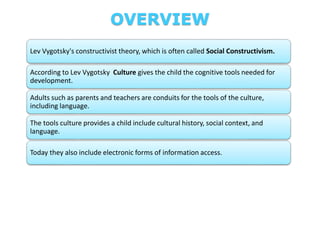
What is Social Constructivism?
Emphasizes the importance of
culture and context in
understanding what occurs in
society and constructing knowledge
based on this understanding .
Assumptions
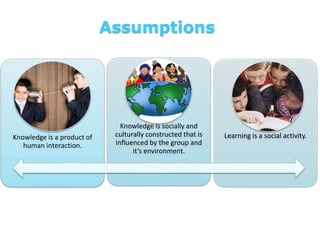
Knowledge is a product of
human interaction.
Knowledge is socially and
culturally constructed that is
influenced by the group and
it’s environment.
Learning is a social activity.
Examples of Social Constructivist
Classroom Activities
Social Constructivism: Whole Language
Social Constructivism: Collaborative learning
Social Constructivism: Situated Learning
Social Constructivism: Anchored Instruction
Social Constructivism: Games, Simulations, Cases, and Problem Solving
Whole language approaches tend to emphasize writing about
what the child already knows and can explain verbally.
Social Constructivism: Whole Language
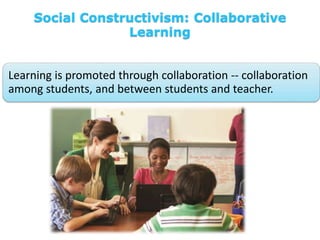
Social Constructivism: Collaborative
Learning
Learning is promoted through collaboration -- collaboration
among students, and between students and teacher.
Social Constructivism: Games,
Simulations, Cases, and Problem
Solving
All four of the instructional approaches covered in this section
involve students in interesting, "real" activities. We say "real" even
though many games are clearly not realistic.
. All of these approaches involve students in learning about, playing
in, or solving problems in an environment that has rules or patterns.

Social constructivism

  • 1.
  • 2.
    OVERVIEW Lev Vygotsky's constructivisttheory, which is often called Social Constructivism. According to Lev Vygotsky Culture gives the child the cognitive tools needed for development. Adults such as parents and teachers are conduits for the tools of the culture, including language. The tools culture provides a child include cultural history, social context, and language. Today they also include electronic forms of information access.
  • 3.
    What is SocialConstructivism? Emphasizes the importance of culture and context in understanding what occurs in society and constructing knowledge based on this understanding .
  • 4.
    Assumptions Knowledge is aproduct of human interaction. Knowledge is socially and culturally constructed that is influenced by the group and it’s environment. Learning is a social activity.
  • 5.
    Examples of SocialConstructivist Classroom Activities Social Constructivism: Whole Language Social Constructivism: Collaborative learning Social Constructivism: Situated Learning Social Constructivism: Anchored Instruction Social Constructivism: Games, Simulations, Cases, and Problem Solving
  • 6.
    Whole language approachestend to emphasize writing about what the child already knows and can explain verbally. Social Constructivism: Whole Language
  • 7.
    Social Constructivism: Collaborative Learning Learningis promoted through collaboration -- collaboration among students, and between students and teacher.
  • 8.
    Social Constructivism: Games, Simulations,Cases, and Problem Solving All four of the instructional approaches covered in this section involve students in interesting, "real" activities. We say "real" even though many games are clearly not realistic. . All of these approaches involve students in learning about, playing in, or solving problems in an environment that has rules or patterns.