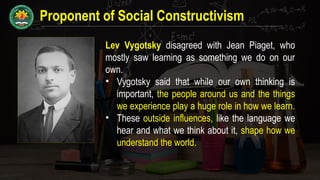
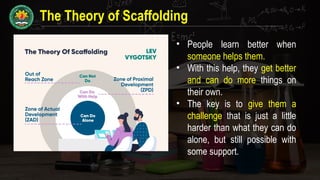
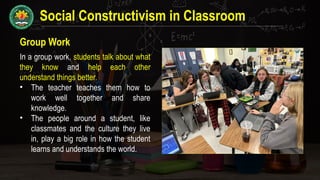
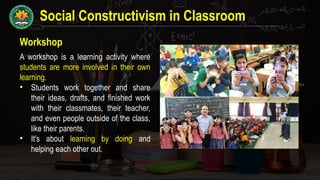
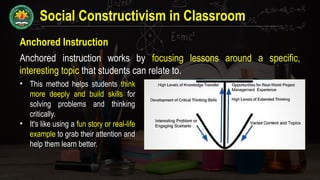
Social constructivism emphasizes the importance of social interactions and cultural context in learning, suggesting that individuals learn best through collaboration and community engagement. It promotes teaching methods that involve group work, real-life problem-solving, and scaffolding to support students' development, as suggested by theorists like Lev Vygotsky. This approach is particularly valuable in science education, as it fosters collaborative learning, contextual relevance, and inclusive curricula that consider diverse perspectives.