1
VALIDATION PROTOCOLVALIDATION PROTOCOL
CONTENTS
• Introduction
• Validation Protocol
• Outline of validation protocol
• Format of validation protocol
• Master validation protocol
• Qualification
• Cleaning validation protocol
• Conclusion
• References
2
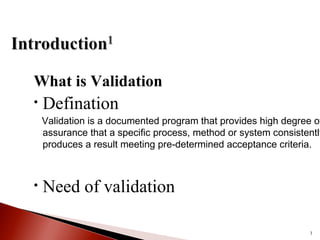
What is Validation
• Defination
Validation is a documented program that provides high degree of
assurance that a specific process, method or system consistently
produces a result meeting pre-determined acceptance criteria.
• Need of validation
3
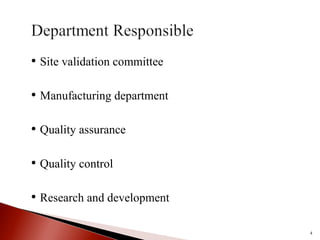
• Site validation committee
• Manufacturing department
• Quality assurance
• Quality control
• Research and development
4
• Manager production
• Quality control manager
• Maintenance manager
• Production manager
• Quality assurance manager
5
6
The documentation resulting from validation may be
divided into two categories
• Protocols
• Final validation Reports
• The validation protocol is defined as the experimental
plan that design thoroughly the validation programme.
• A written plan stating how validation will be conducted,
including test parameters, product characteristics,
production and packaging equipment, and decision points
on what constitutes acceptable test results
7
Validation ProtocolValidation Protocol1,41,4
Validation protocol contain two sections
• Procedure
• Form
In the case where a protocol is change or modified after
its approval, appropriate reasoning for such a change
must be documented.
8
• Scope
• Objective
• Description of process
• Identification of Critical parameters
9
• Description of analytical method
• Documentation
• Conclusion
• Approval
• Final validation report
10
Cont…Cont…
• Title
• Objective & Scope
• Responsibility
• Protocol Approval
• Validation Team
• Product Composition
11
• Process Flow Chart
• Manufacturing Process
• Review of Equipments
• Review of Raw Materials
• Review of Analytical records
12
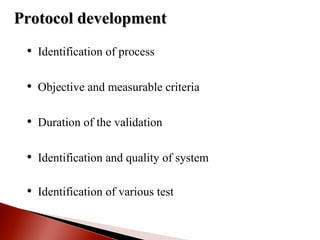
• Identification of process
• Objective and measurable criteria
• Duration of the validation
• Identification and quality of system
• Identification of various test
Protocol developmentProtocol development
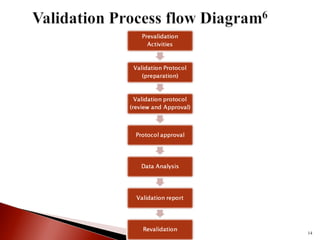
14
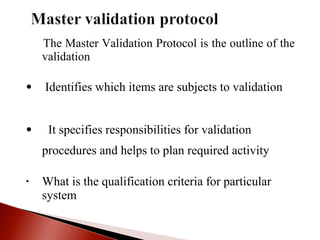
The Master Validation Protocol is the outline of the
validation
• Identifies which items are subjects to validation
• It specifies responsibilities for validation
procedures and helps to plan required activity
• What is the qualification criteria for particular
system
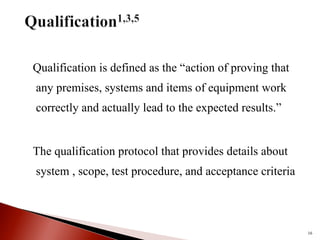
Qualification is defined as the “action of proving that
any premises, systems and items of equipment work
correctly and actually lead to the expected results.”
The qualification protocol that provides details about
system , scope, test procedure, and acceptance criteria
16
• Purpose
Give a clear and simple statement of Objectives of
qualification system
• Scope
The scope to indicate what equipment is being qualified
• Equipment Description
Simple description of the Equipment
• Responsibilities
Identify the responsibility of individual involve
approval of protocol
• Specification
Defining the full range of operating parameter like
temp, pressure ,time etc
• Conclusion
To summarize all test result performed in validation
of any equipment
18
• Specification of requirements for facilities, plants and
equipment, mainly in connection with modification
of equipment
• Design Qualification for setting functional and
performance or operational specifications
19
• Verifies that the correct equipment has been received
and installed as per plan and protocol
• Verifies that equipment has been properly installed
and calibrated including connections to utilities.
• Documented records for the installation
The supplier and manufacturer
System or equipment name, model and serial number
Date of installation relevant procedures and certificates
20
• The equipment must be work according to approval
plans for testing procedures
• Systems and equipment should operate correctly
• Verifies that the equipment operates consistently
within established limits and tolerances over the
defined operating ranges.
21
• It verifies that performance of critical utility system or
process
• Assurance that the process continues to comply with
established requirements.
• Performance Qualification (PQ) for testing that the
system consistently performs as intended for the
selected application.
22
Re-validation is required when the operating
equipment or system has been changed in some
way.
It is carried out when:
The transfer of product from one plan to another
Computer systems have been replaced
Changes in the process use in the validation
Critical items have been replaced or repaired.
23
TABLE OF CONTENTSTABLE OF CONTENTS
• Objective
• Scope
• Responsibility and authority
• Reference of cleaning document
• Equipment to be cleaned
Common equipment
Cleaning procedure and cleaning equipment
24
Selection of Worst case productSelection of Worst case product
  
• Evaluation of the product mix to select the worst
case product or marker product
Operator training
Cleaning limits selection criteria based on MAC approach
 
• Validation Plan 
Worst-case conditions
Chemical and microbiological analytical methods
Acceptance criteria
 
• Sampling plan
 
25
• The validation protocol should list the selected process
and control parameters
• The quality of validation and its report is directly
related to the quality of protocol
• The protocol is foundation of validation report
including the documentation part
26
1) Nash RA ,Wachter AH , Pharmacutical Process Validation,An
International 3rd
Edition ,Revised &Expanded,Indian special
edition,Informa Healthcare, 2011 ,volume 129. p 607-609
2) Carleton FJ. Validation of Solid Dosage Forms, Validation of
Pharmaceutical Processes, In Marcel Dekker, 3rd
Edition ,
Informa healthcare USA, p 310-315
3) Potdar MA. Pharmacutical Quality Assurance ,Nirali
Prakashan, 2nd
edition 2007,p8.8-8.20
27
4) Haider SI.Pharmacutical Master Validation Plan, The
Ultimate Guide to FDA, GMP, & GLP Complience,Indian
Special edition , Informa Healthcare ,p311
5) Berry IR. and Harpaz D., Validation of Active
Pharmaceutical Ingredients, CRC Press, 2nd
edition, p421-
425, 463-468
6) www.econ.com
28
29

Validation Protocol

  • 1.
  • 2.
    CONTENTS • Introduction • ValidationProtocol • Outline of validation protocol • Format of validation protocol • Master validation protocol • Qualification • Cleaning validation protocol • Conclusion • References 2
  • 3.
    What is Validation •Defination Validation is a documented program that provides high degree of assurance that a specific process, method or system consistently produces a result meeting pre-determined acceptance criteria. • Need of validation 3
  • 4.
    • Site validationcommittee • Manufacturing department • Quality assurance • Quality control • Research and development 4
  • 5.
    • Manager production •Quality control manager • Maintenance manager • Production manager • Quality assurance manager 5
  • 6.
    6 The documentation resultingfrom validation may be divided into two categories • Protocols • Final validation Reports
  • 7.
    • The validationprotocol is defined as the experimental plan that design thoroughly the validation programme. • A written plan stating how validation will be conducted, including test parameters, product characteristics, production and packaging equipment, and decision points on what constitutes acceptable test results 7 Validation ProtocolValidation Protocol1,41,4
  • 8.
    Validation protocol containtwo sections • Procedure • Form In the case where a protocol is change or modified after its approval, appropriate reasoning for such a change must be documented. 8
  • 9.
    • Scope • Objective •Description of process • Identification of Critical parameters 9
  • 10.
    • Description ofanalytical method • Documentation • Conclusion • Approval • Final validation report 10 Cont…Cont…
  • 11.
    • Title • Objective& Scope • Responsibility • Protocol Approval • Validation Team • Product Composition 11
  • 12.
    • Process FlowChart • Manufacturing Process • Review of Equipments • Review of Raw Materials • Review of Analytical records 12
  • 13.
    • Identification ofprocess • Objective and measurable criteria • Duration of the validation • Identification and quality of system • Identification of various test Protocol developmentProtocol development
  • 14.
  • 15.
    The Master ValidationProtocol is the outline of the validation • Identifies which items are subjects to validation • It specifies responsibilities for validation procedures and helps to plan required activity • What is the qualification criteria for particular system
  • 16.
    Qualification is definedas the “action of proving that any premises, systems and items of equipment work correctly and actually lead to the expected results.” The qualification protocol that provides details about system , scope, test procedure, and acceptance criteria 16
  • 17.
    • Purpose Give aclear and simple statement of Objectives of qualification system • Scope The scope to indicate what equipment is being qualified • Equipment Description Simple description of the Equipment
  • 18.
    • Responsibilities Identify theresponsibility of individual involve approval of protocol • Specification Defining the full range of operating parameter like temp, pressure ,time etc • Conclusion To summarize all test result performed in validation of any equipment 18
  • 19.
    • Specification ofrequirements for facilities, plants and equipment, mainly in connection with modification of equipment • Design Qualification for setting functional and performance or operational specifications 19
  • 20.
    • Verifies thatthe correct equipment has been received and installed as per plan and protocol • Verifies that equipment has been properly installed and calibrated including connections to utilities. • Documented records for the installation The supplier and manufacturer System or equipment name, model and serial number Date of installation relevant procedures and certificates 20
  • 21.
    • The equipmentmust be work according to approval plans for testing procedures • Systems and equipment should operate correctly • Verifies that the equipment operates consistently within established limits and tolerances over the defined operating ranges. 21
  • 22.
    • It verifiesthat performance of critical utility system or process • Assurance that the process continues to comply with established requirements. • Performance Qualification (PQ) for testing that the system consistently performs as intended for the selected application. 22
  • 23.
    Re-validation is requiredwhen the operating equipment or system has been changed in some way. It is carried out when: The transfer of product from one plan to another Computer systems have been replaced Changes in the process use in the validation Critical items have been replaced or repaired. 23
  • 24.
    TABLE OF CONTENTSTABLEOF CONTENTS • Objective • Scope • Responsibility and authority • Reference of cleaning document • Equipment to be cleaned Common equipment Cleaning procedure and cleaning equipment 24
  • 25.
    Selection of Worstcase productSelection of Worst case product    • Evaluation of the product mix to select the worst case product or marker product Operator training Cleaning limits selection criteria based on MAC approach   • Validation Plan  Worst-case conditions Chemical and microbiological analytical methods Acceptance criteria   • Sampling plan   25
  • 26.
    • The validationprotocol should list the selected process and control parameters • The quality of validation and its report is directly related to the quality of protocol • The protocol is foundation of validation report including the documentation part 26
  • 27.
    1) Nash RA,Wachter AH , Pharmacutical Process Validation,An International 3rd Edition ,Revised &Expanded,Indian special edition,Informa Healthcare, 2011 ,volume 129. p 607-609 2) Carleton FJ. Validation of Solid Dosage Forms, Validation of Pharmaceutical Processes, In Marcel Dekker, 3rd Edition , Informa healthcare USA, p 310-315 3) Potdar MA. Pharmacutical Quality Assurance ,Nirali Prakashan, 2nd edition 2007,p8.8-8.20 27
  • 28.
    4) Haider SI.PharmacuticalMaster Validation Plan, The Ultimate Guide to FDA, GMP, & GLP Complience,Indian Special edition , Informa Healthcare ,p311 5) Berry IR. and Harpaz D., Validation of Active Pharmaceutical Ingredients, CRC Press, 2nd edition, p421- 425, 463-468 6) www.econ.com 28
  • 29.

Editor's Notes

  • #14 Protocol development: Detailed protocols for performing validations are essential to ensure that the process, whether solid dose, liquid or sterile, is adequately validated. Process validation protocols should include: Identification of process: Objective and measurable criteria for a successful validation- Determine WHAT to verify and measure- Determine HOW to verify and measure- Determine HOW MANY to verify and measure, i.e. what statistical test of significance will be applied and what will be the confidence in the result?- Determine WHEN to verify and measure- Define acceptance AND rejection criteria- Define the required level of documentation Length and duration of the validation: Challenges to the process should simulate conditions encountered during actual manufacturing. Challenges should include the range of conditions as defined by the various action levels. Shifts, equipment to be used in the process: This is most important for sterile manufacturing especially aseptic filling and lyophilization. Identification of utilities (air, water, gas, nitrogen, vacuum, etc.) for the process equipment and quality of the utilities Identification of operators and required operator training and qualification