The document discusses the seven generations of computed tomography (CT) scanners, detailing the evolution of technology and design improvements across each generation. Key advancements include reduced scan times, improved imaging quality, and changes in detector configurations and x-ray beam types. Each generation builds on previous designs, addressing challenges such as scatter radiation and artifacts while enhancing diagnostic capabilities.
INTRODUCTION
• Generation ofCT is classified based upon
arrangement of components and
mechanical motion required to collect
data.
• Scan time reduction is the predominant
reason for introducing new configuration
• They are 7 generation in CT scanner
3.
The basic principlebehind CT is
that the internal structure of
an object can be reconstructed
from multiple projections of
the object
4.
1st generation
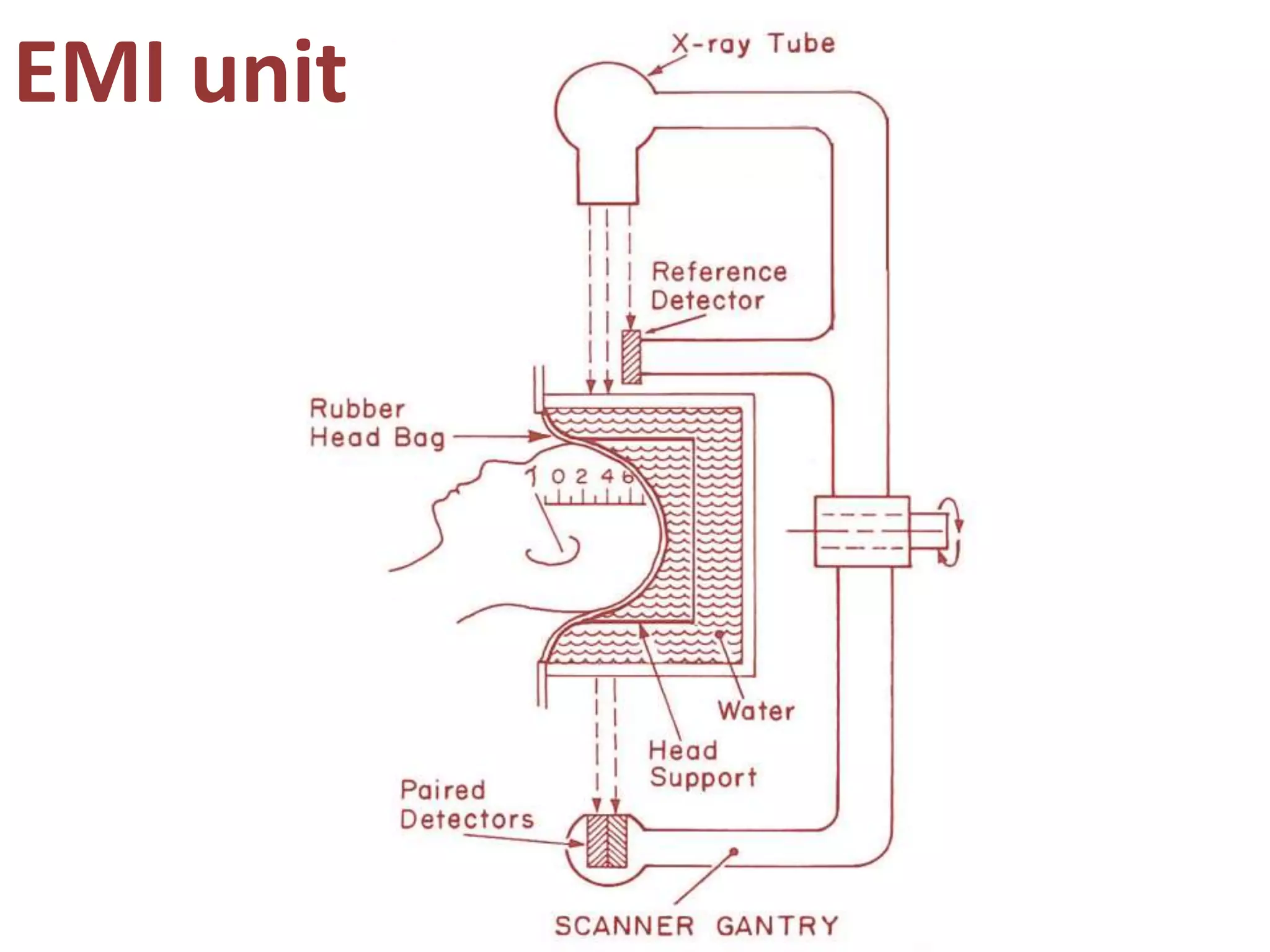
Original EMIunit was a first generation scanner.
It designed only for evaluation of brain .
• Scanning motion : translate - rotate geometry
• Detectors : single or paired
• X ray beam : narrow pencil beam
• x- ray tube : an air cooled stationary anode x- ray tube
• X- ray beam : narrow pencil beam
• Scan time : 25mins(appx.)
• Scan mode : step and shoot scanning
• Power supply : straighten twisted system cables
The tube anddetector were then rotated slightly and the
process was repeated until a 180 degree arc was covered
Advantage - it employed pencil beam geometry which
allowed very efficient scatter reduction
Disadvantage
• Scan time were very long
• misregistration artifact
8.
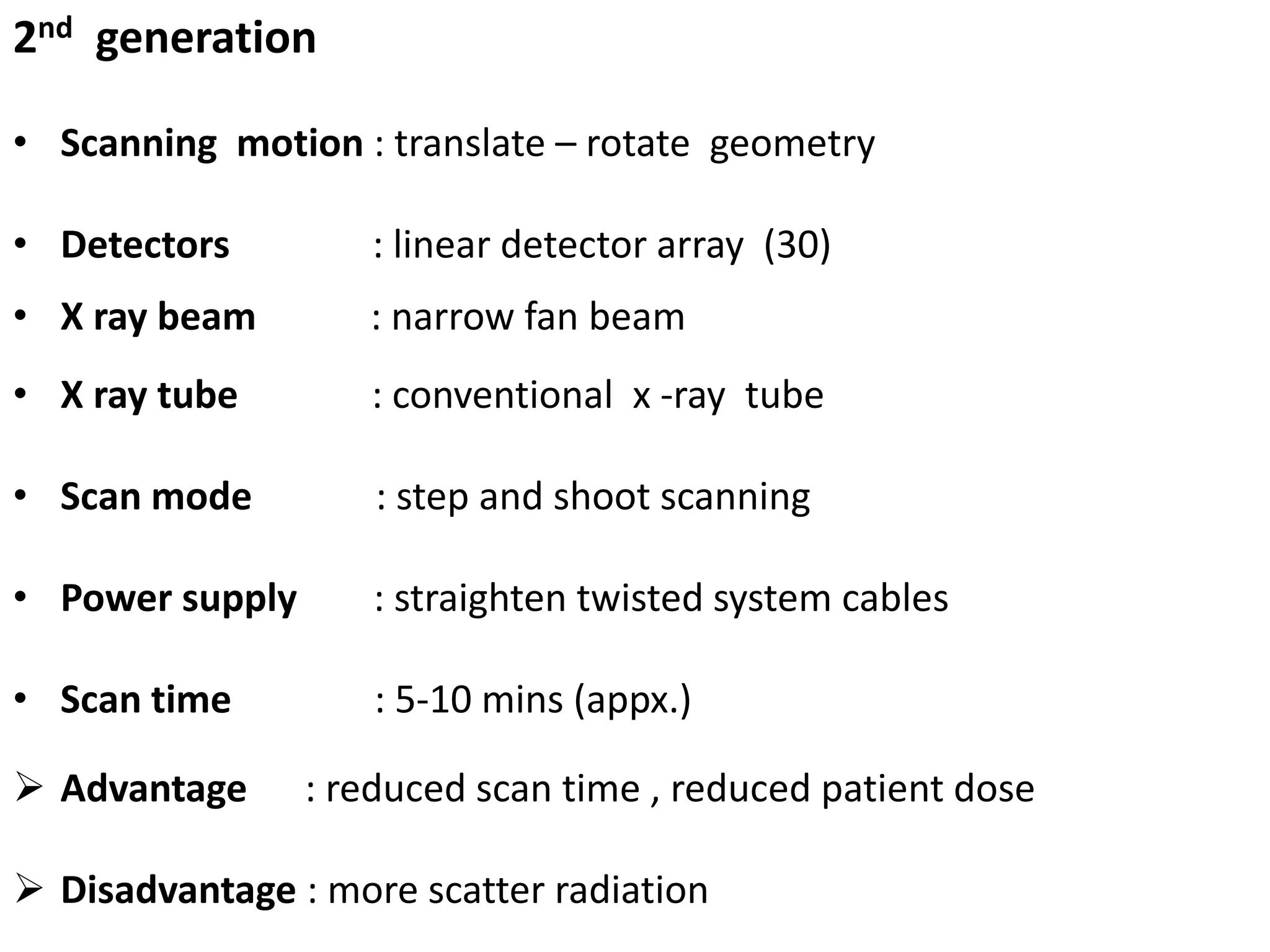
2nd generation
• Scanningmotion : translate – rotate geometry
• Detectors : linear detector array (30)
• X ray beam : narrow fan beam
• X ray tube : conventional x -ray tube
• Scan mode : step and shoot scanning
• Power supply : straighten twisted system cables
• Scan time : 5-10 mins (appx.)
Advantage : reduced scan time , reduced patient dose
Disadvantage : more scatter radiation
10.
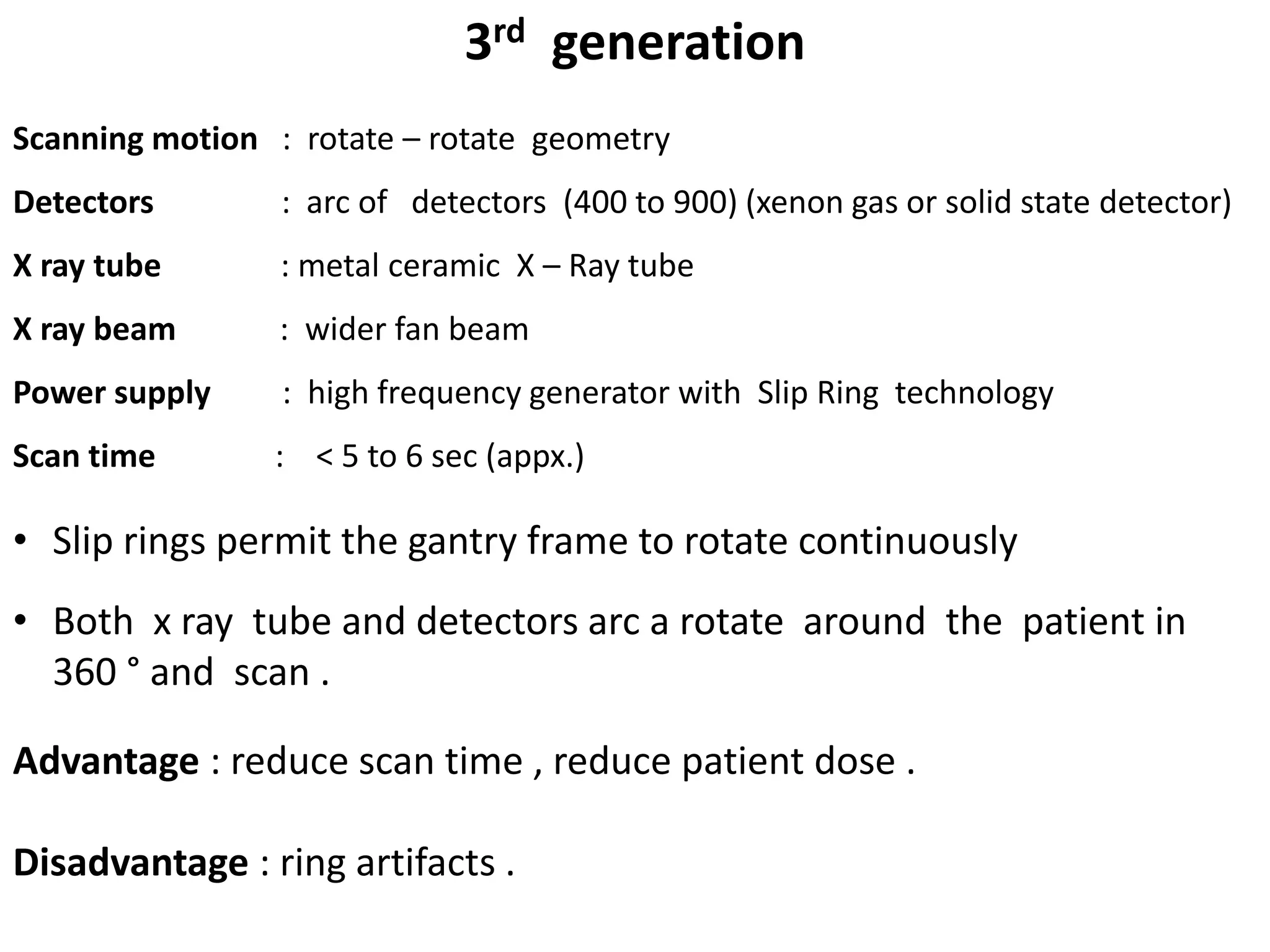
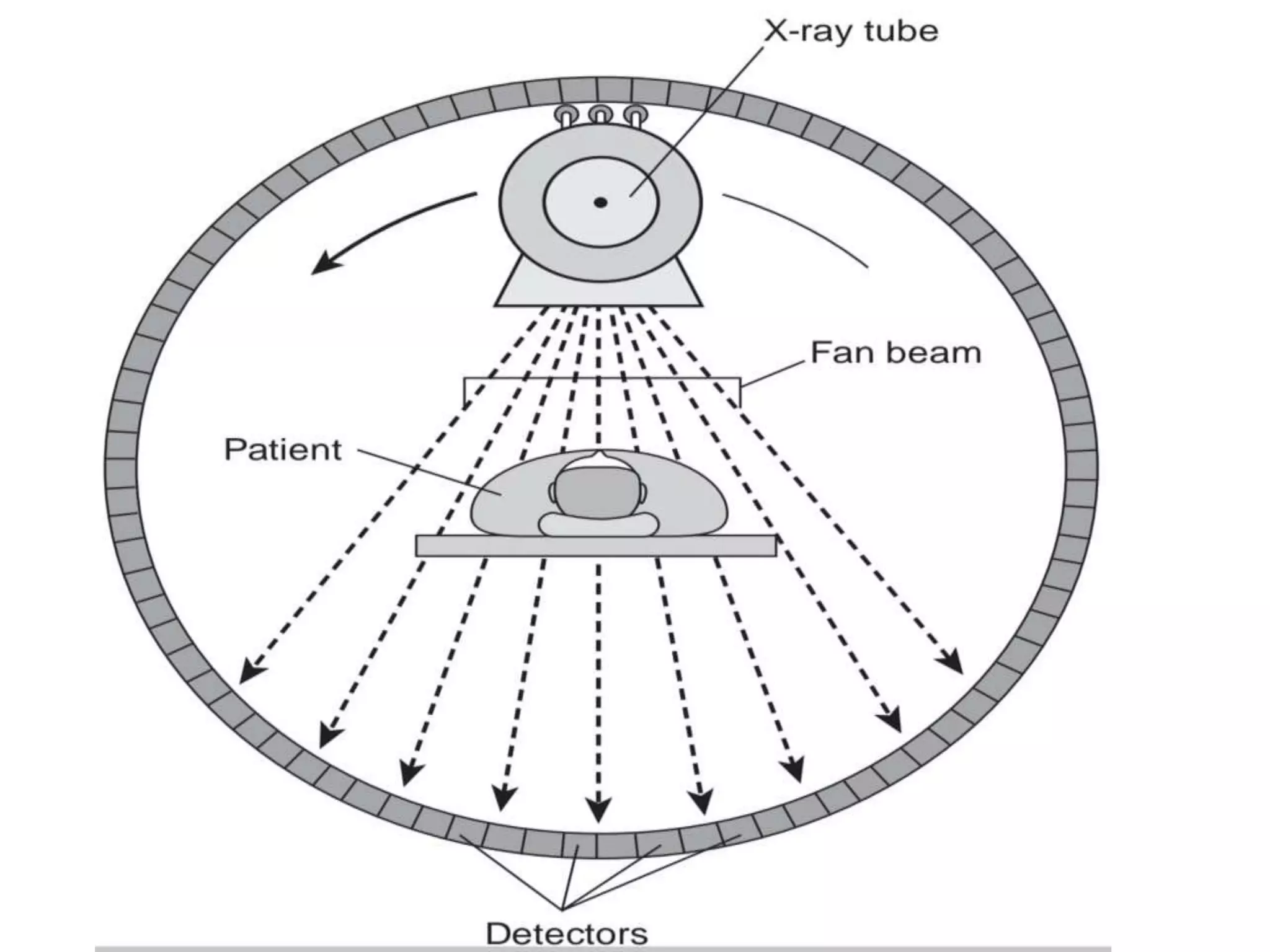
3rd generation
Scanning motion: rotate – rotate geometry
Detectors : arc of detectors (400 to 900) (xenon gas or solid state detector)
X ray tube : metal ceramic X – Ray tube
X ray beam : wider fan beam
Power supply : high frequency generator with Slip Ring technology
Scan time : < 5 to 6 sec (appx.)
• Slip rings permit the gantry frame to rotate continuously
• Both x ray tube and detectors arc a rotate around the patient in
360 ° and scan .
Advantage : reduce scan time , reduce patient dose .
Disadvantage : ring artifacts .
12.
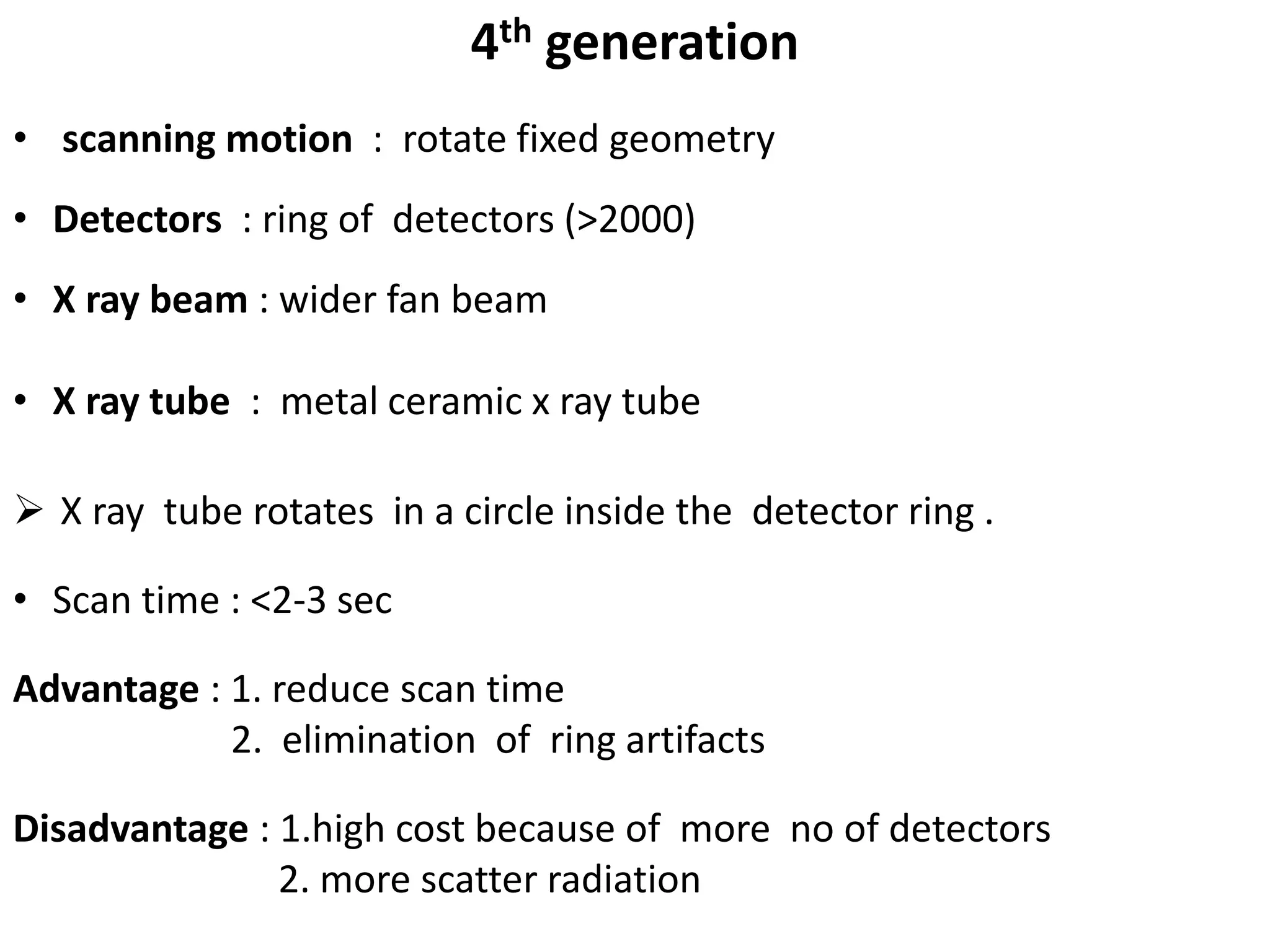
4th generation
• scanningmotion : rotate fixed geometry
• Detectors : ring of detectors (>2000)
• X ray beam : wider fan beam
• X ray tube : metal ceramic x ray tube
X ray tube rotates in a circle inside the detector ring .
• Scan time : <2-3 sec
Advantage : 1. reduce scan time
2. elimination of ring artifacts
Disadvantage : 1.high cost because of more no of detectors
2. more scatter radiation
14.
5th generation
Electron beamcomputed tomography
• It commonly referred to cvct / cine ct scanner
• No mechanical scanning motion
• X ray tube and detector are stationary
Detectors : 4800 detectors
Beam : larger fan beam
Scan time : 50ms
Basic component
• Electron gun
• Focusing /deflecting coils
• Tungsten target rings
• A ring of detectors arranged in an arc of 210°
Advantage : 1. it improve the temporal resolution
2. its special for cardiac imaging
Disadvantage :1. low spatial resolution
2. expensive
6th generation
Helical /spiral CT scanner
o Helical or spiral scanner it acquired data while the table is moving
o As a result , the x ray source moves in a helical pattern around the
patient being scanned
o Helical CT scanner use either 3rd or 4th generation slip ring designs
Advantage
• Fewer motion artifact
• Improved lesion detection
• Multi planar imaging
• Reduced scan time
• Faster image acquisition
• Improved 3d , coronal , sagittal , physiological imaging .
18.
7th generation
• Ithas multiple detector array
• The collimator spacing is wider and more x ray are used to producing
image data
• There is formation of cone beam and multiple parallel rows of
detectors
• Widened x ray beam and detector array to acquire multiple slices
• This gives advantage of reducing scan time with increased Z-
resolution but it is very expensive
20.
References
• COMPUTED TOMOGRAPHYfor TECHNOLOGISTS
• Christensen’s physics of diagnostic radiology
• The physics of radiology and imaging thalyan. K
• Slide share . Net