IMAGE INTERPRETATION OF
FACIAL BONE RADIOGRAPHY
M K. Sadham hussain
Bsc (MIT) 2nd year
SCAHS
by
 Familiarity with facial bone
anatomy is required for
accurate interpretation
Introduction
• The facial bones are a series of 14 irregular bones that
collectively are attached to the antero-inferior aspect of the
skull.
• Within these bones, and some of the bones forming the cranial base,
are a series of air-filled cavities known as the paranasal air sinuses
• The maxillae , zygomata and mandible contribute most to the
shape of the face , and the orbits , nose and paranasal sinuses
form bony cavities contained by the facial skeleton
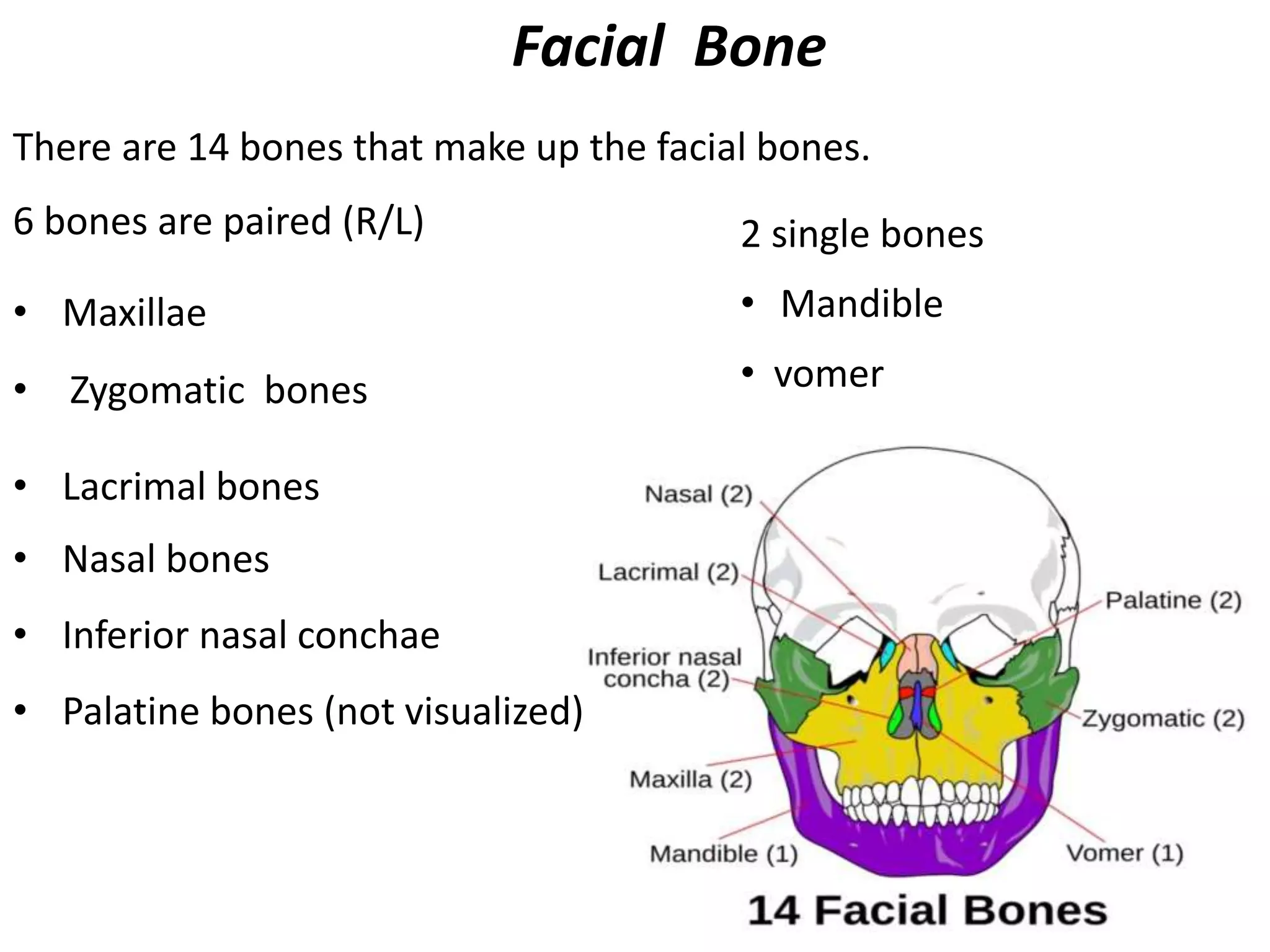
Facial Bone
There are 14 bones that make up the facial bones.
6 bones are paired (R/L)
• Maxillae
• Zygomatic bones
• Lacrimal bones
• Nasal bones
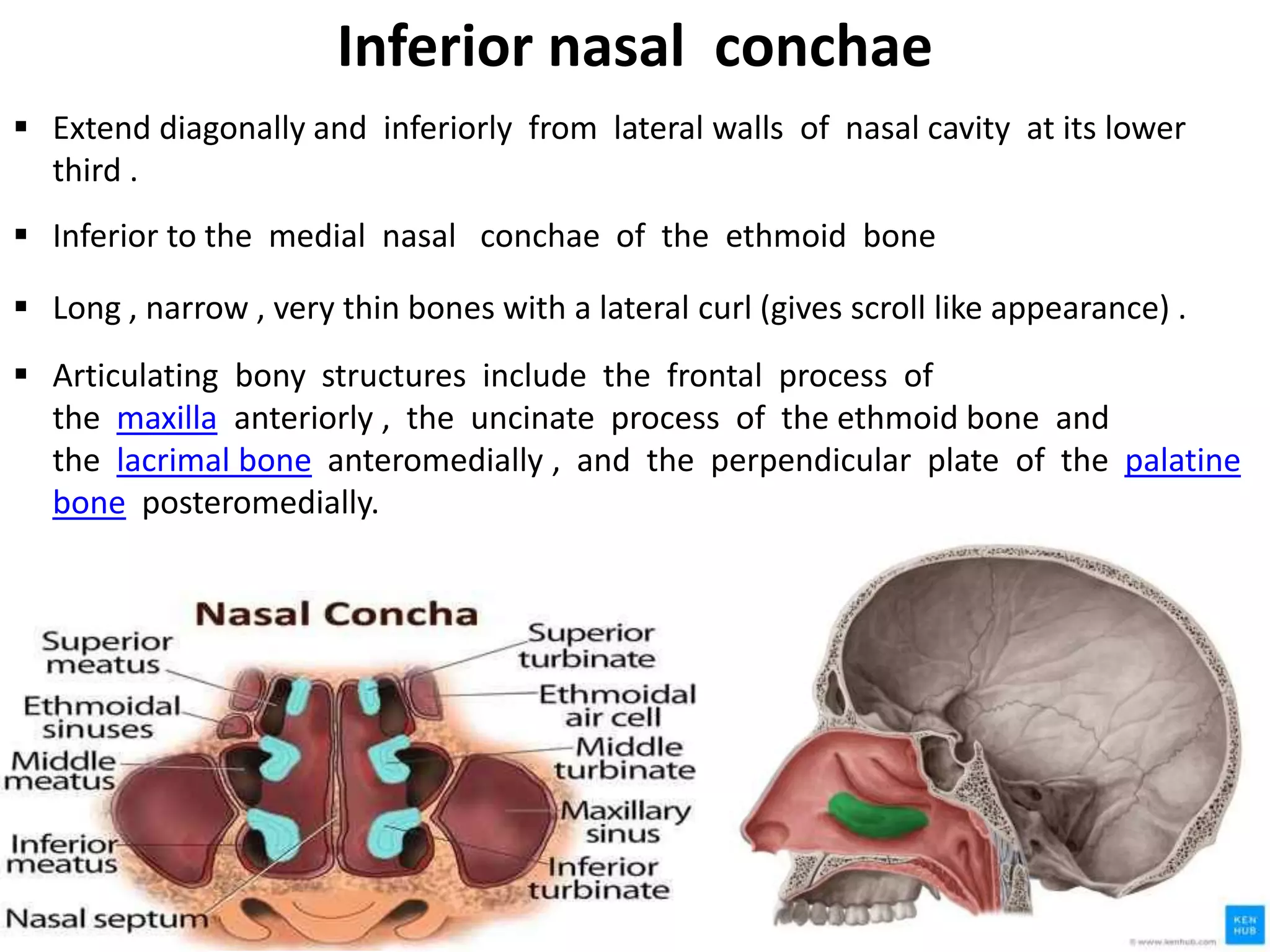
• Inferior nasal conchae
• Palatine bones (not visualized)
2 single bones
• Mandible
• vomer
Anatomy of facial
bone
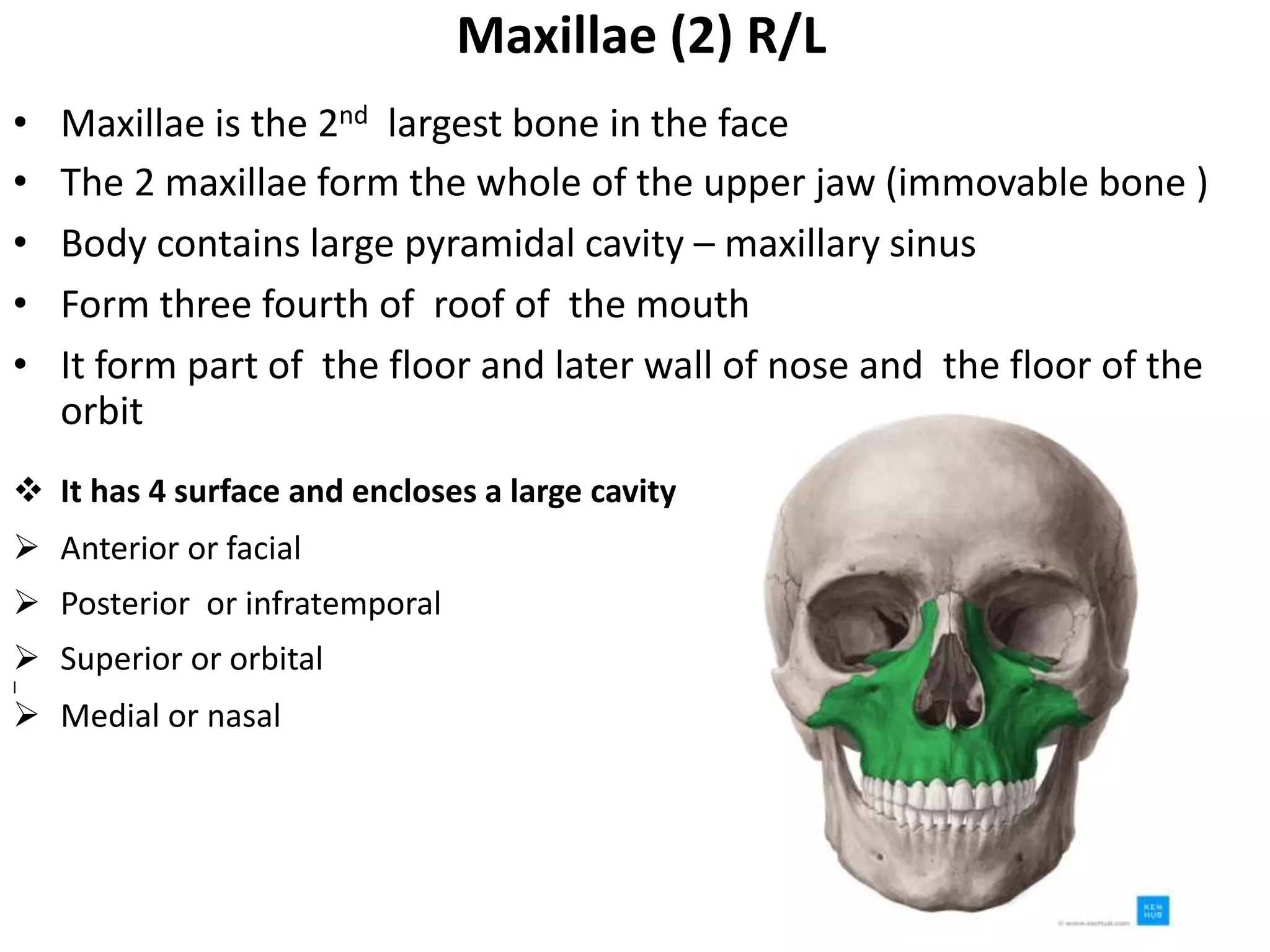
Maxillae (2) R/L
• Maxillae is the 2nd largest bone in the face
• The 2 maxillae form the whole of the upper jaw (immovable bone )
• Body contains large pyramidal cavity – maxillary sinus
• Form three fourth of roof of the mouth
• It form part of the floor and later wall of nose and the floor of the
orbit
 It has 4 surface and encloses a large cavity
 Anterior or facial
 Posterior or infratemporal
 Superior or orbital
l
 Medial or nasal
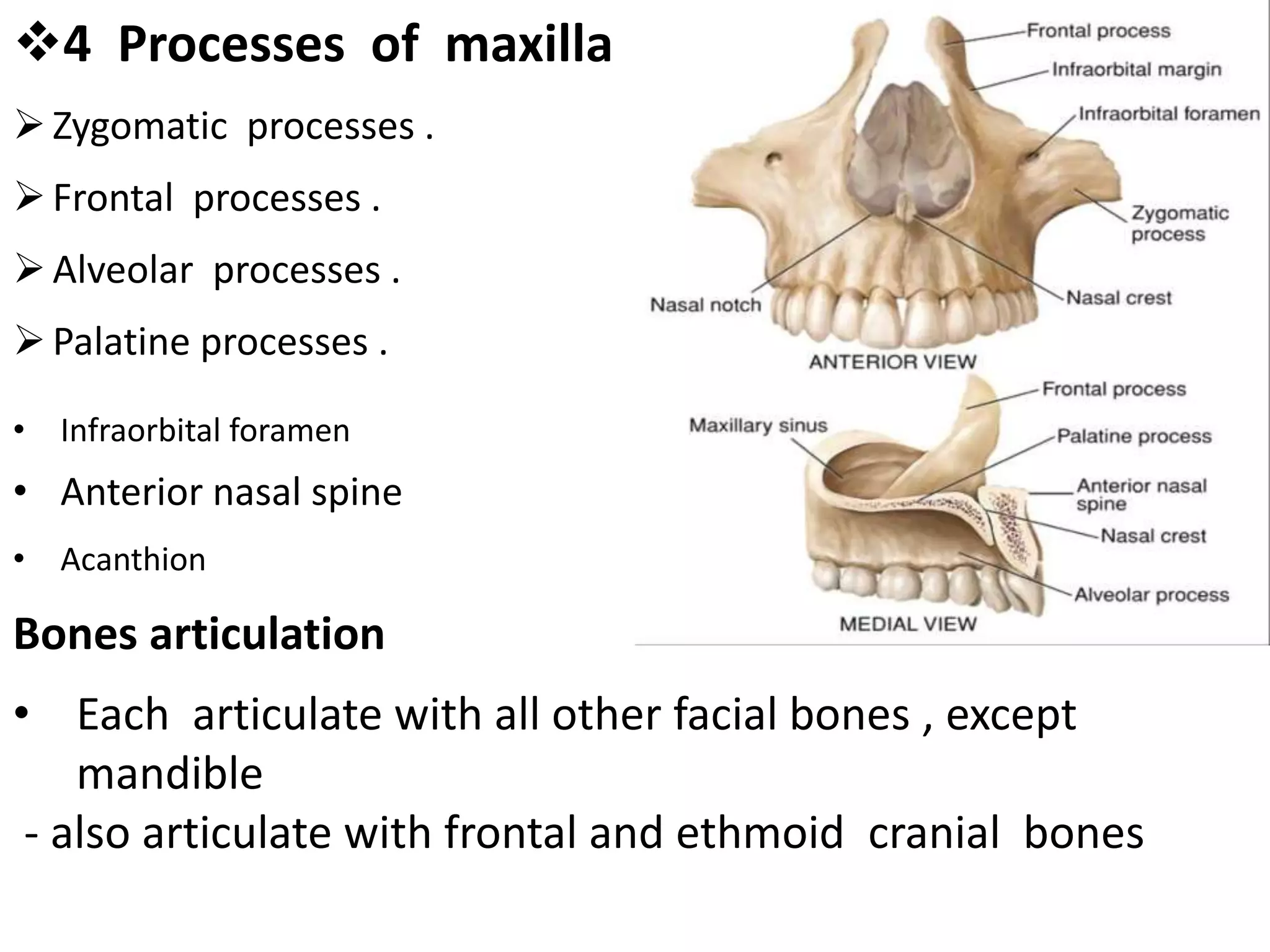
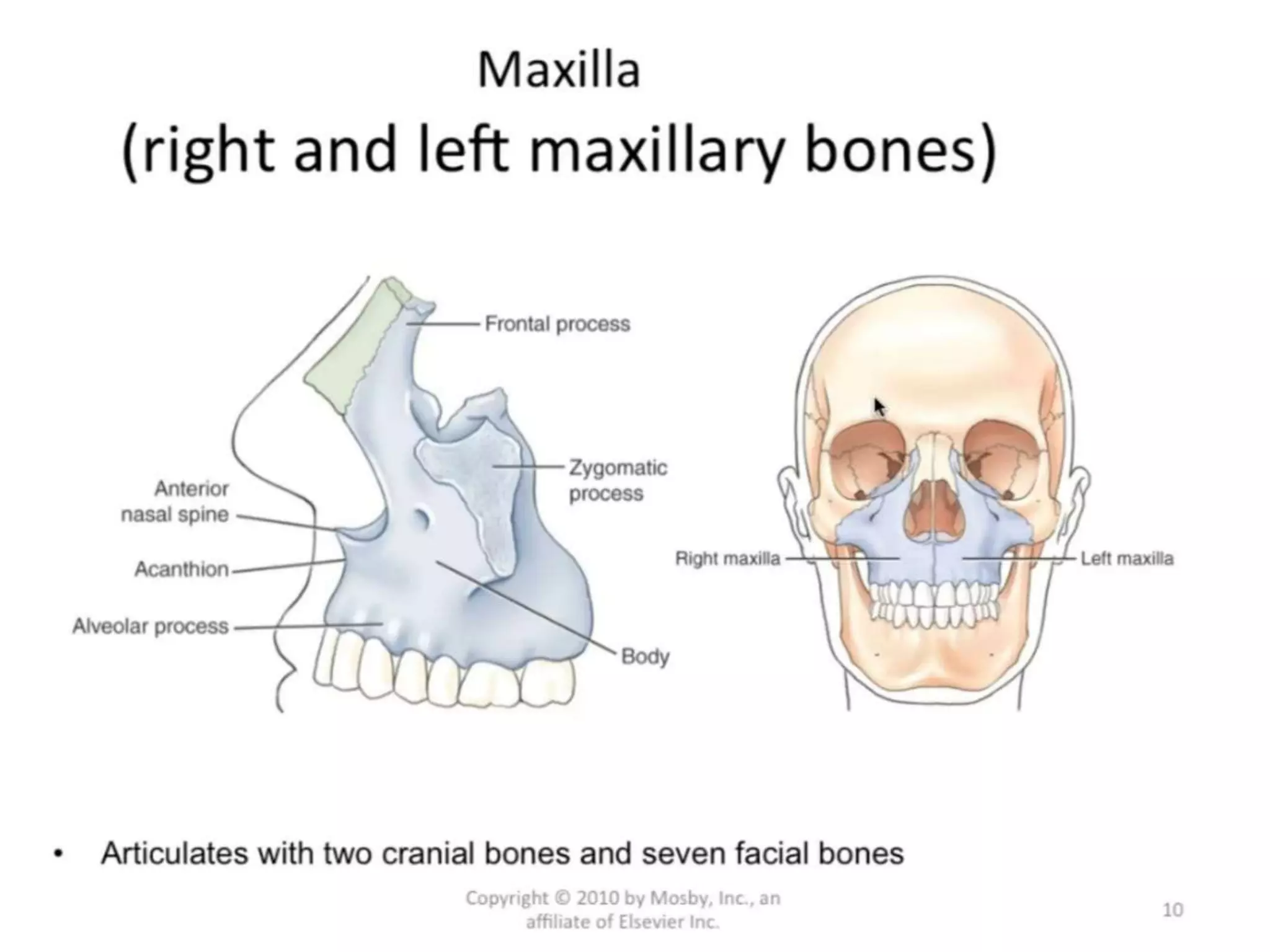
4 Processes of maxilla
Zygomatic processes .
Frontal processes .
Alveolar processes .
Palatine processes .
• Infraorbital foramen
• Anterior nasal spine
• Acanthion
Bones articulation
• Each articulate with all other facial bones , except
mandible
- also articulate with frontal and ethmoid cranial bones
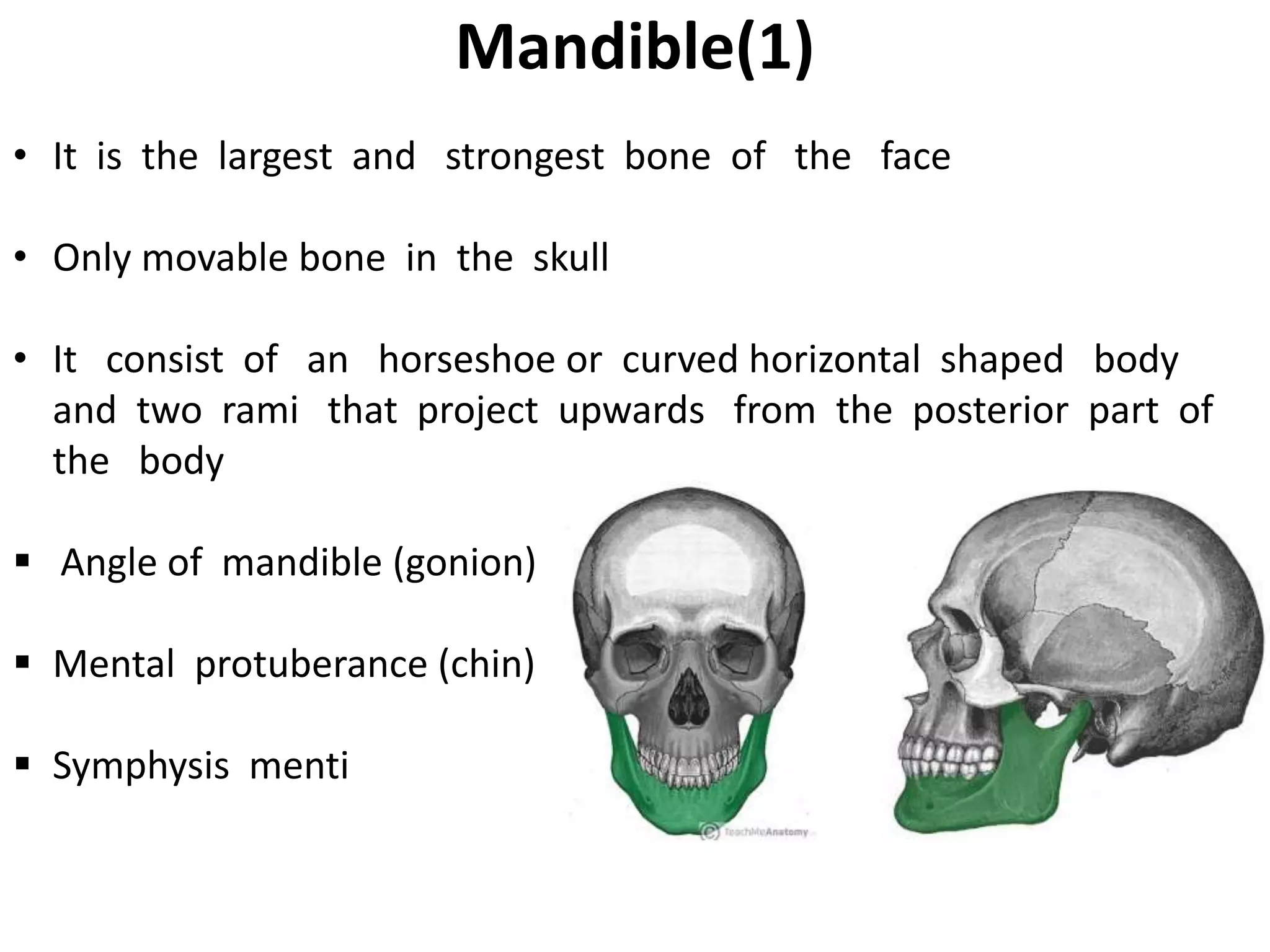
Mandible(1)
• It is the largest and strongest bone of the face
• Only movable bone in the skull
• It consist of an horseshoe or curved horizontal shaped body
and two rami that project upwards from the posterior part of
the body
 Angle of mandible (gonion)
 Mental protuberance (chin)
 Symphysis menti
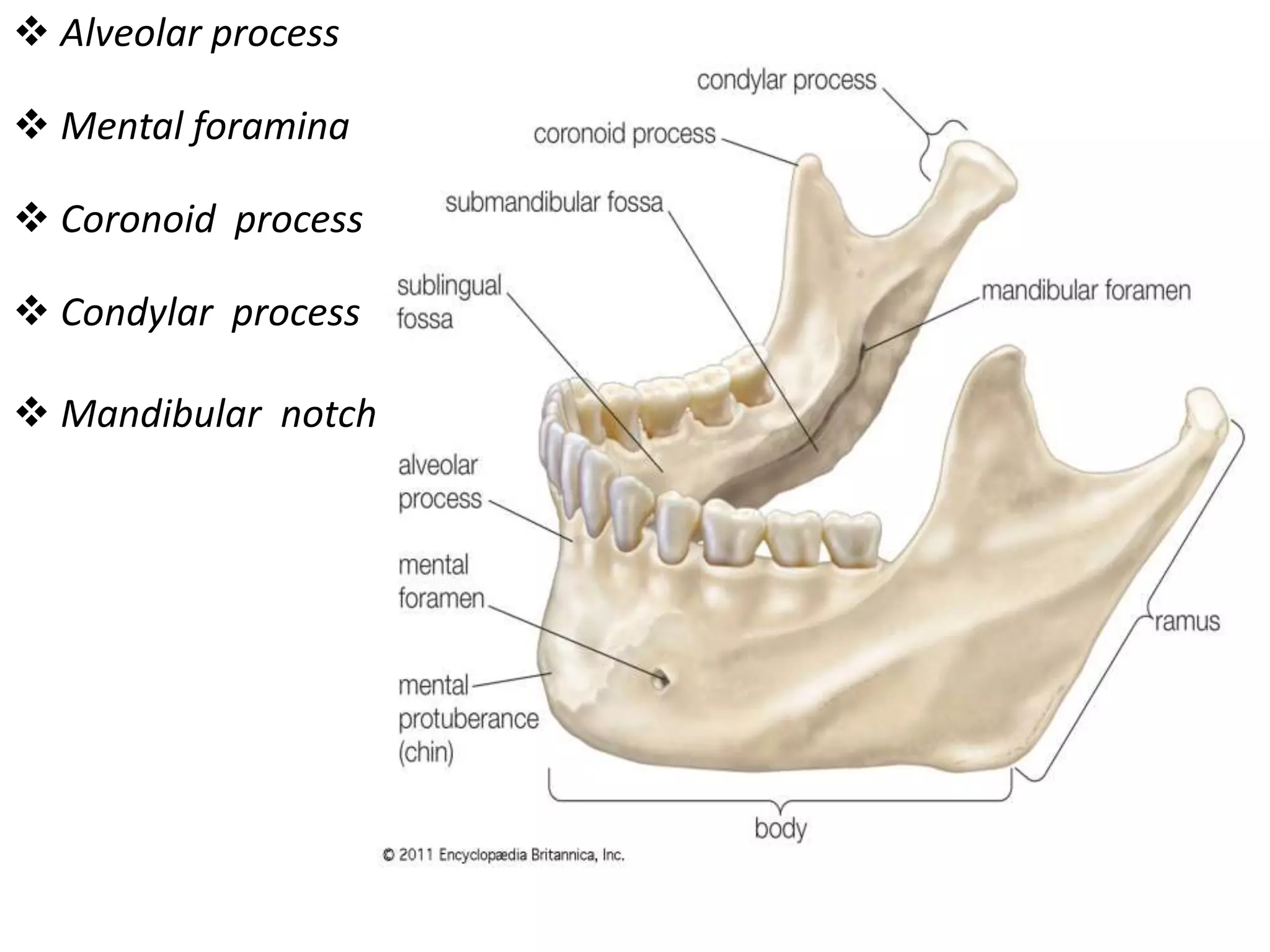
 Alveolar process
 Mental foramina
 Coronoid process
 Condylar process
 Mandibular notch
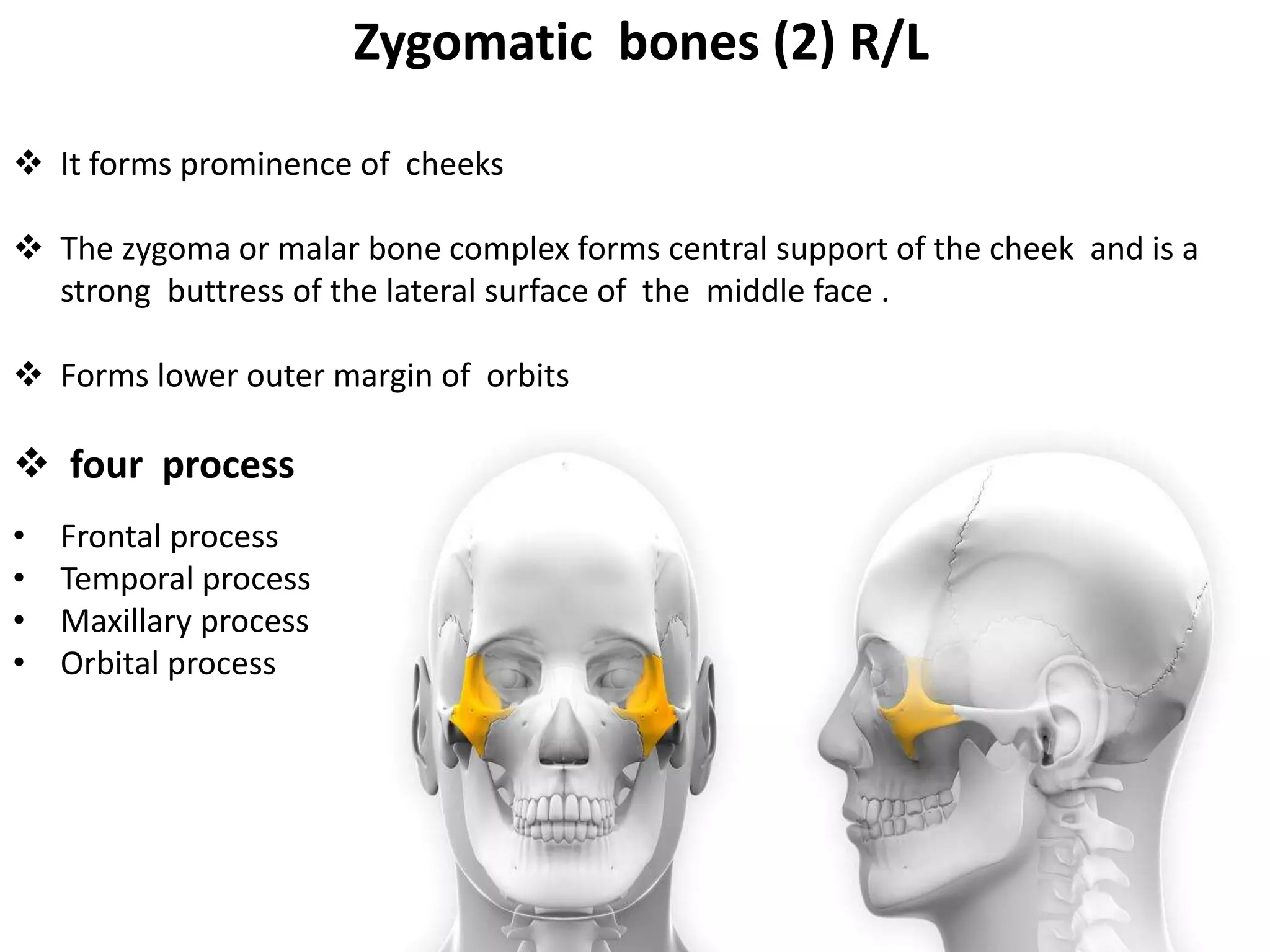
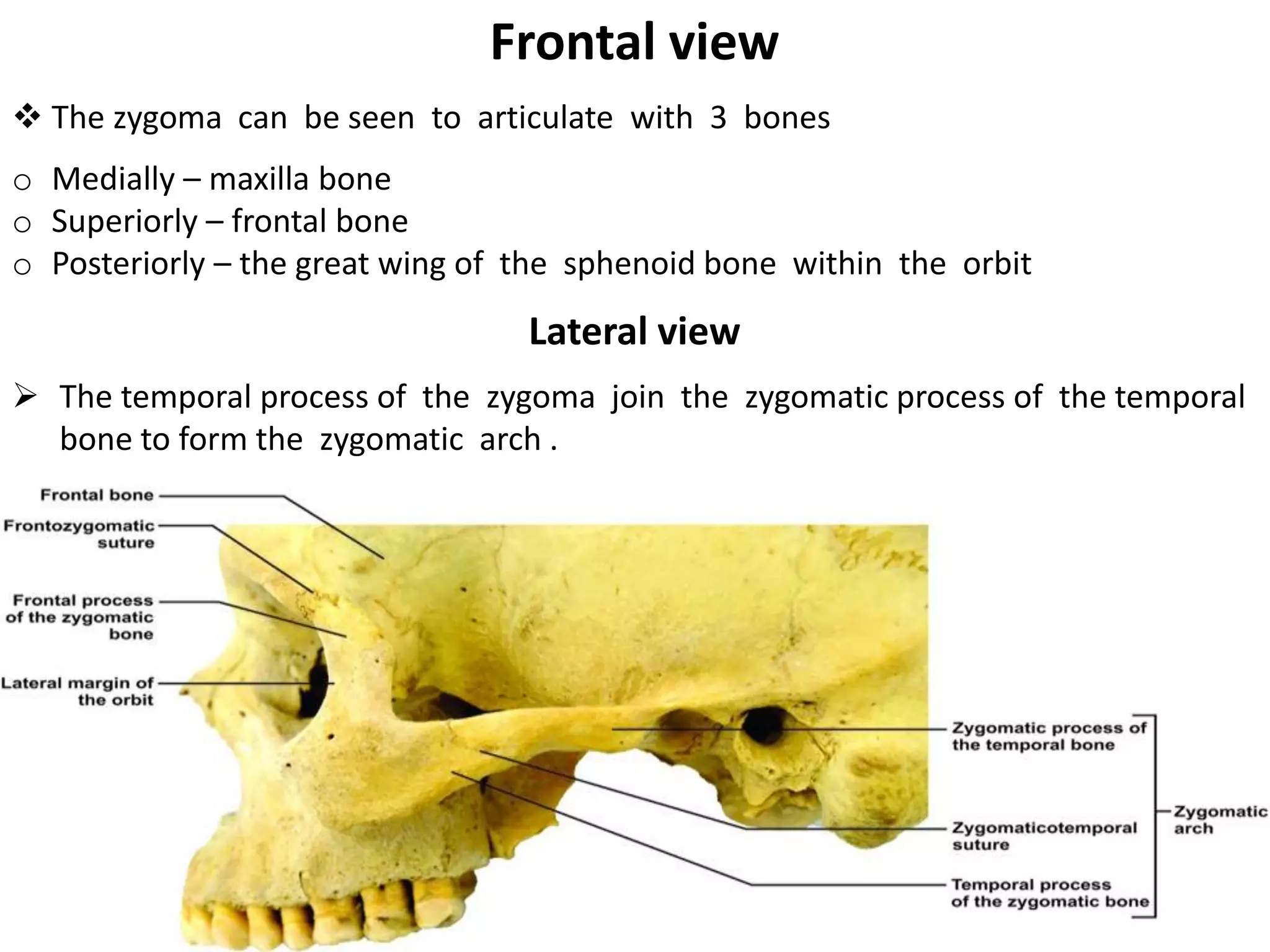
Zygomatic bones (2) R/L
 It forms prominence of cheeks
 The zygoma or malar bone complex forms central support of the cheek and is a
strong buttress of the lateral surface of the middle face .
 Forms lower outer margin of orbits
 four process
• Frontal process
• Temporal process
• Maxillary process
• Orbital process
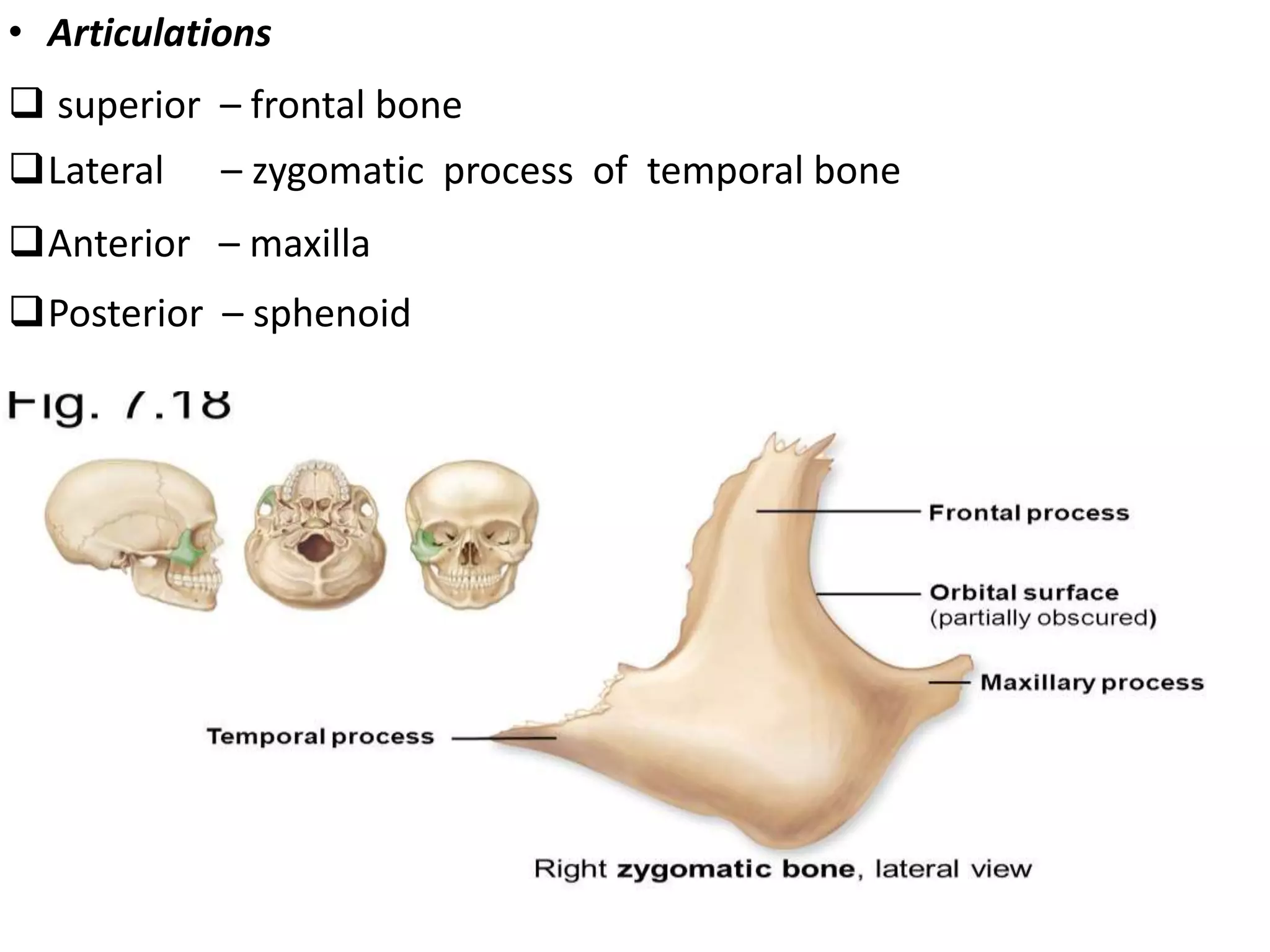
• Articulations
 superior – frontal bone
Lateral – zygomatic process of temporal bone
Anterior – maxilla
Posterior – sphenoid
Frontal view
 The zygoma can be seen to articulate with 3 bones
o Medially – maxilla bone
o Superiorly – frontal bone
o Posteriorly – the great wing of the sphenoid bone within the orbit
Lateral view
 The temporal process of the zygoma join the zygomatic process of the temporal
bone to form the zygomatic arch .
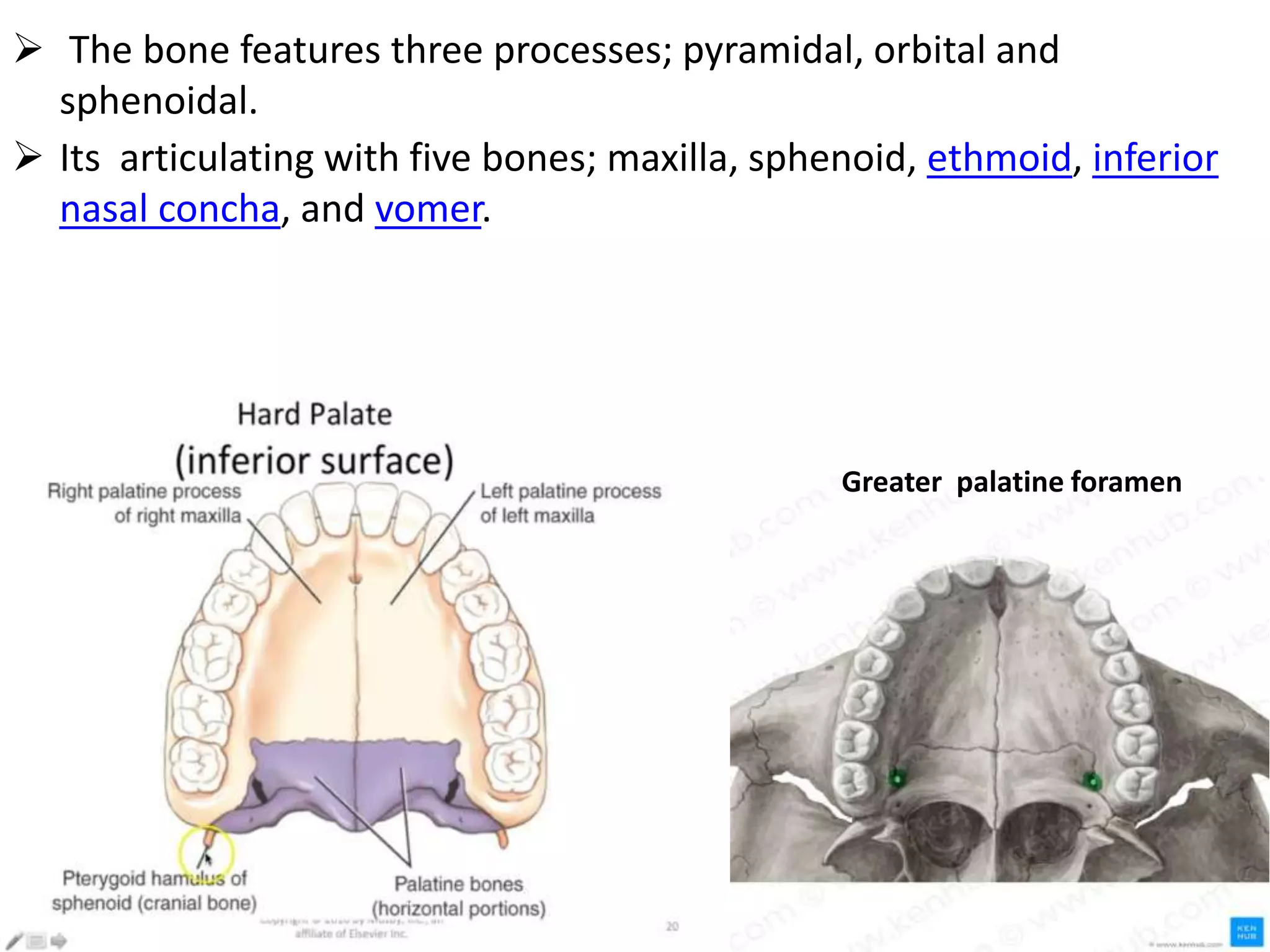
Palatine bone
 Two L – shaped bone composed of vertical and horizontal plates
 Horizontal plates articulate with maxillae to complete the
posterior fourth of bony palate (roof of mouth)
 vertical portion extend upward between maxilla and the pterygoid
process of the sphenoid in posterior nasal cavity
 Palatine bone contributes to the walls of three cavities:-
1] The floor and lateral wall of the nasal cavity;
2] The roof of the mouth,
3] The floor of the orbit.
 The bone features three processes; pyramidal, orbital and
sphenoidal.
 Its articulating with five bones; maxilla, sphenoid, ethmoid, inferior
nasal concha, and vomer.
Greater palatine foramen
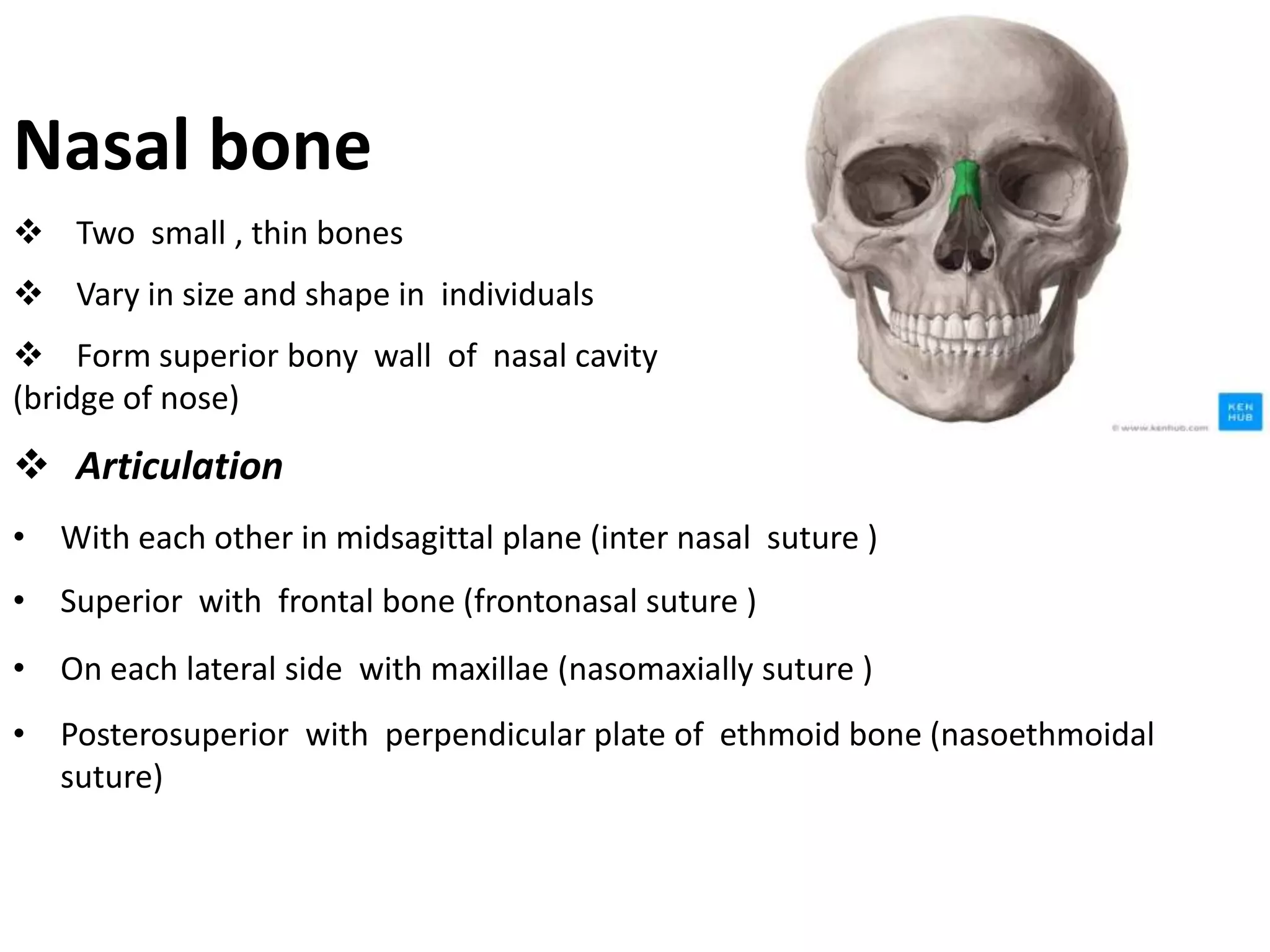
Nasal bone
 Two small , thin bones
 Vary in size and shape in individuals
 Form superior bony wall of nasal cavity
(bridge of nose)
 Articulation
• With each other in midsagittal plane (inter nasal suture )
• Superior with frontal bone (frontonasal suture )
• On each lateral side with maxillae (nasomaxially suture )
• Posterosuperior with perpendicular plate of ethmoid bone (nasoethmoidal
suture)
Inferior nasal conchae
 Extend diagonally and inferiorly from lateral walls of nasal cavity at its lower
third .
 Inferior to the medial nasal conchae of the ethmoid bone
 Long , narrow , very thin bones with a lateral curl (gives scroll like appearance) .
 Articulating bony structures include the frontal process of
the maxilla anteriorly , the uncinate process of the ethmoid bone and
the lacrimal bone anteromedially , and the perpendicular plate of the palatine
bone posteromedially.
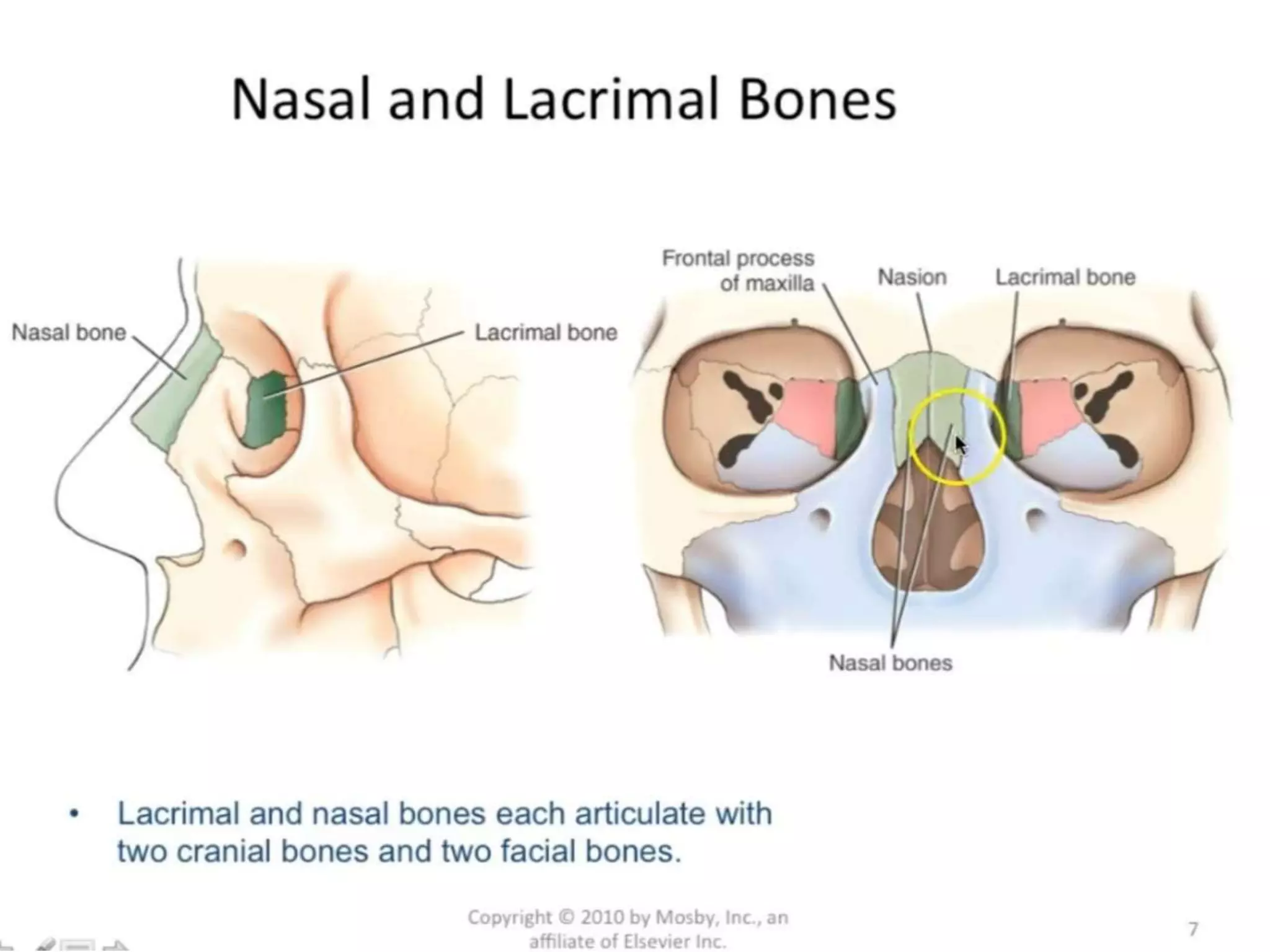
Lacrimal bone
• The 2 smallest bones in the skull
• It form part of the medial wall of the orbit.
• it articulates with :
 Frontal bone
 Maxillary bone
 Ethmoid bone
 Inferior nasal concha
• lacrimal foramen
• The lacrimal groove
The vomer
• Thin plate of bone situated in MSP of floor of nasal cavity
• Forms inferior nasal septum
• Superior border articulates with body of sphenoid bone
• Superior part of anterior border articulates with perpendicular plate
of ethmoid bone
• Posterior border is free
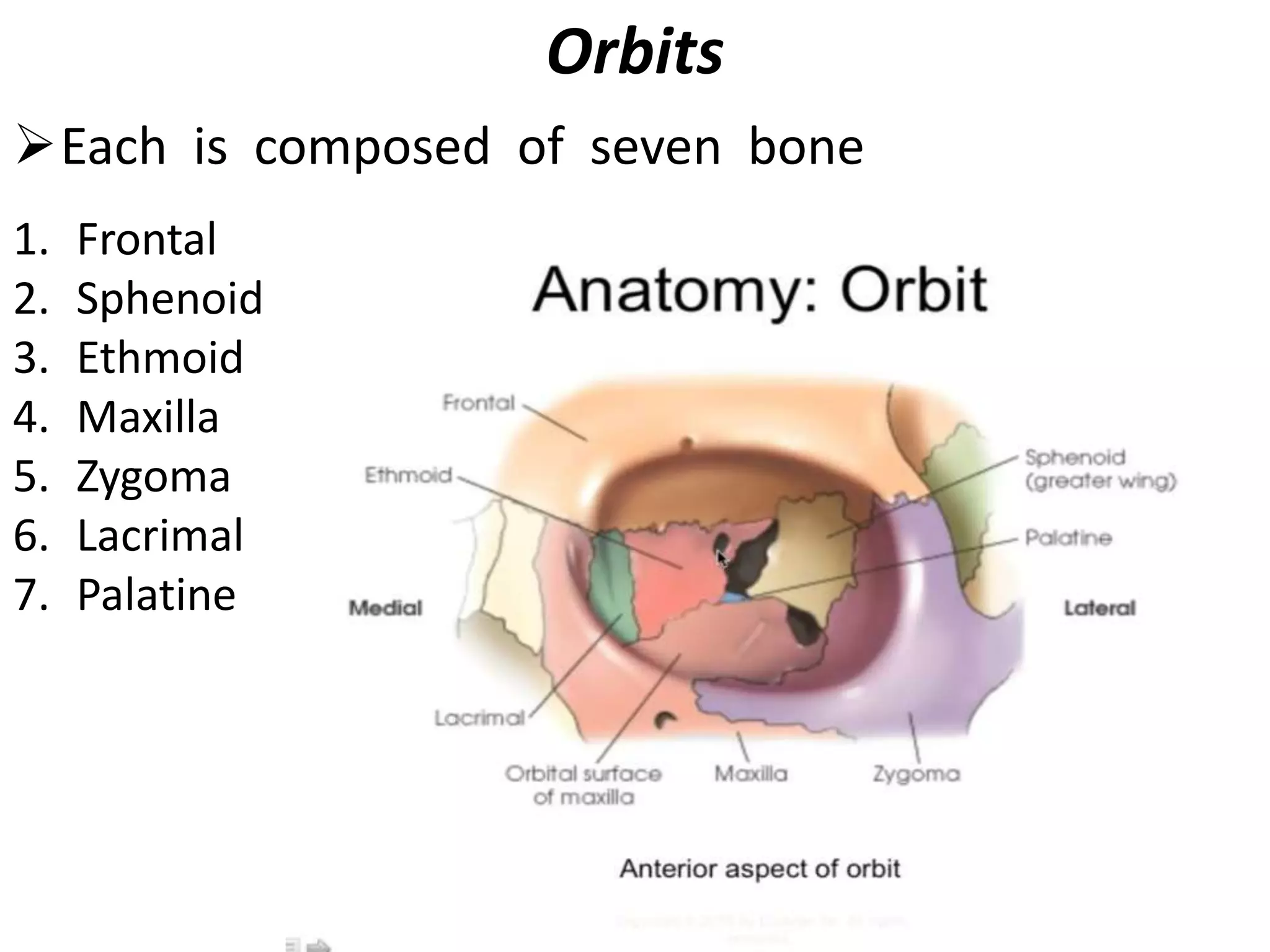
Orbits
Each is composed of seven bone
1. Frontal
2. Sphenoid
3. Ethmoid
4. Maxilla
5. Zygoma
6. Lacrimal
7. Palatine
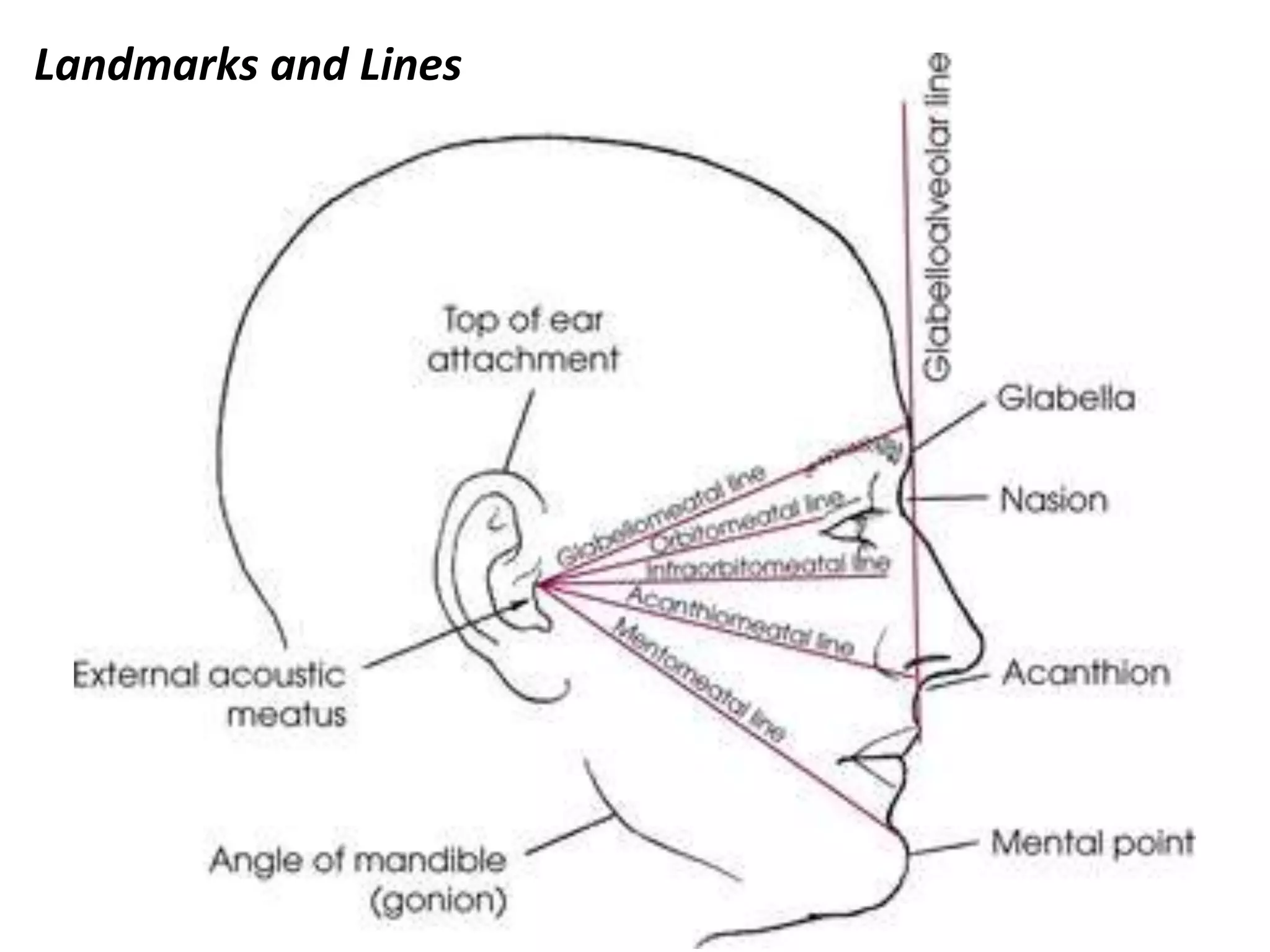
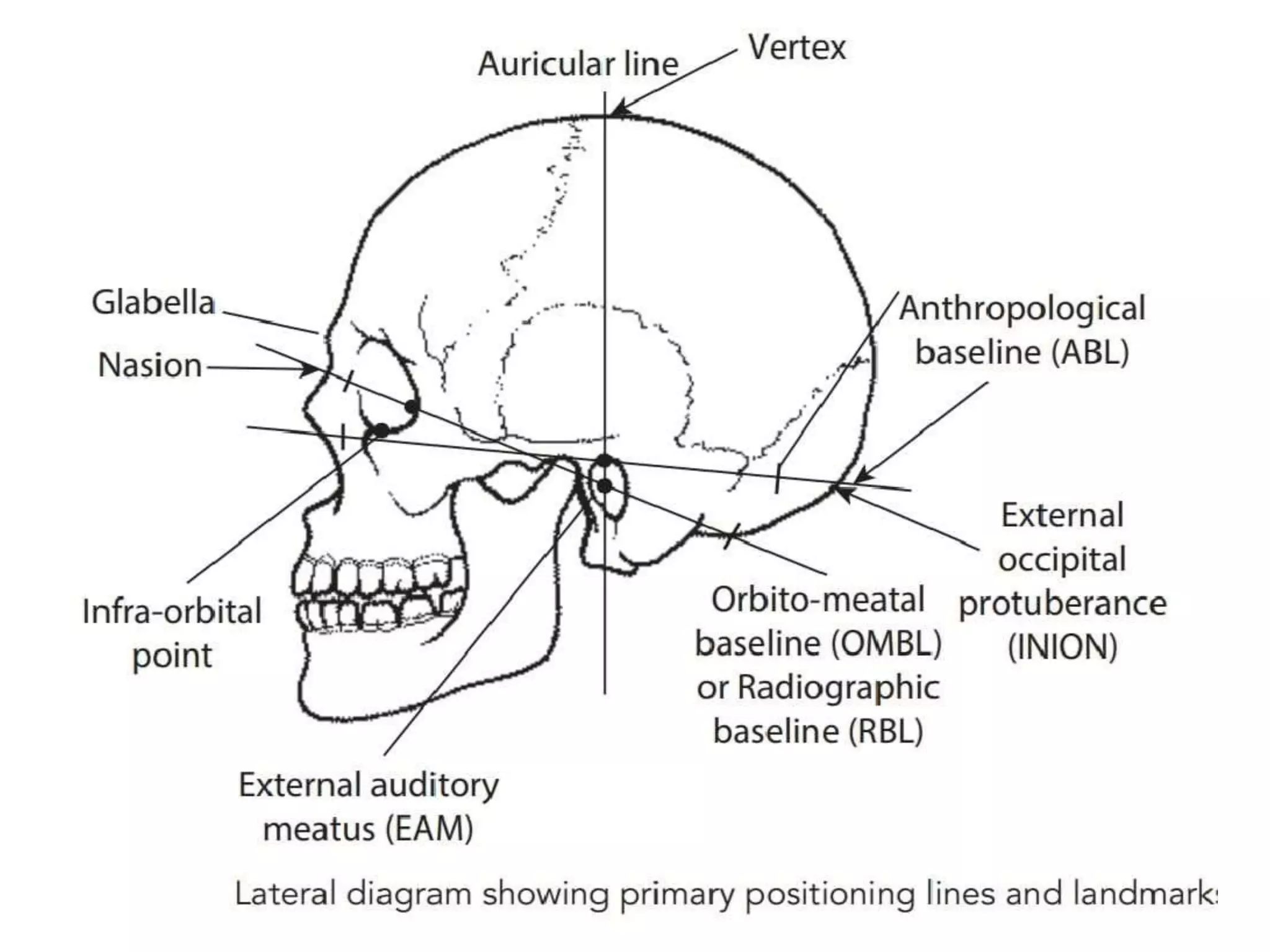
Landmarks
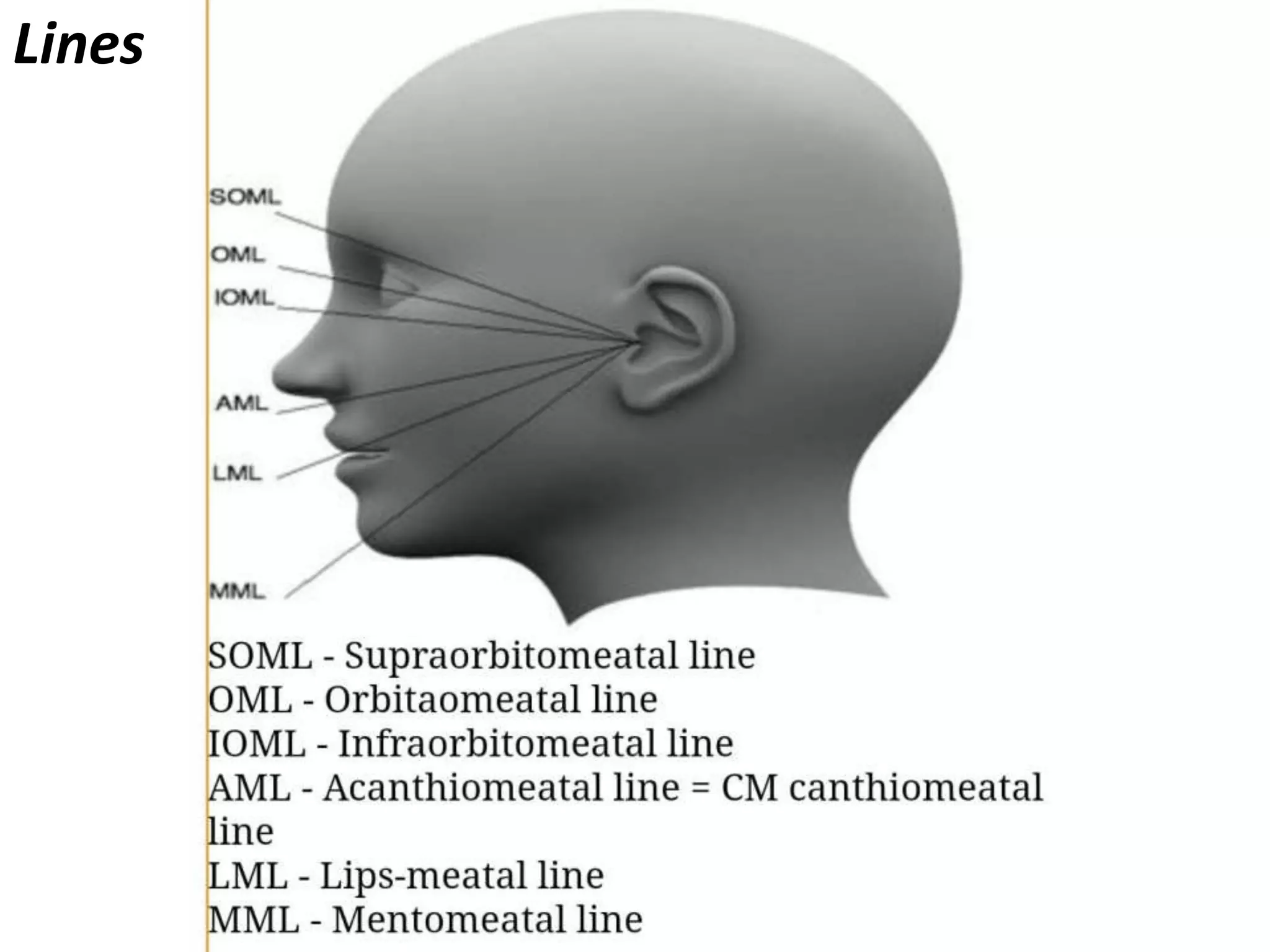
Lines
Landmarks and Lines
IMAGE INTERPRETATION
OF FACIAL BONE
Key points
• Follow the three ‘MC Grigor – cambell ‘ lines to look for the
common fracture patterns
The most common fracture configurations are ,
Isolated zygomatic arch fracture
Tripod fracture
Blowout fracture
• Check for the ‘tear drop’ and eye brow signs
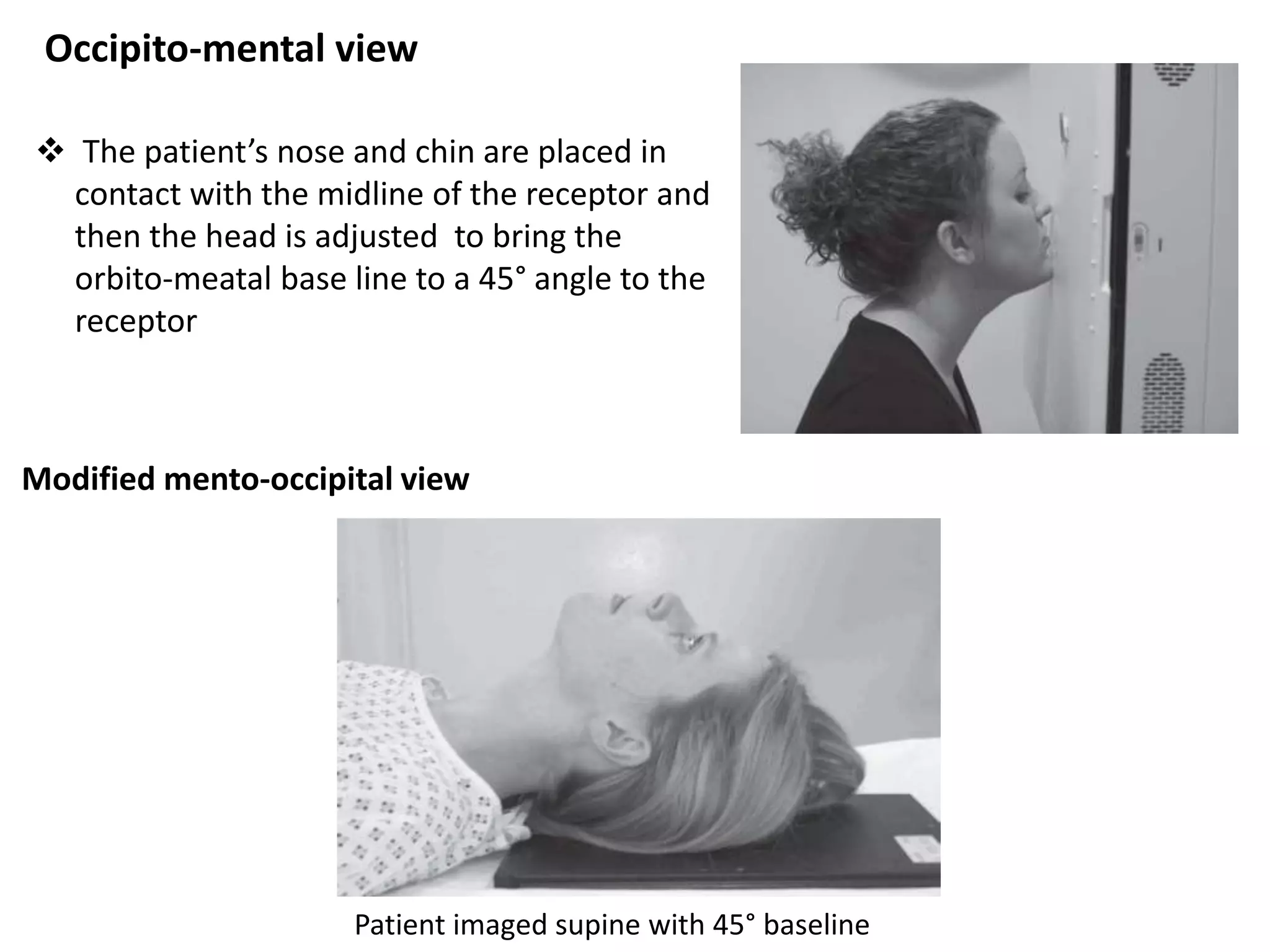
Occipito-mental view
Patient imaged supine with 45° baseline
Modified mento-occipital view
 The patient’s nose and chin are placed in
contact with the midline of the receptor and
then the head is adjusted to bring the
orbito-meatal base line to a 45° angle to the
receptor
Occipito - mental (OM) view
 Each zygoma and zygomatic arch resembles as the head and trunk
of an elephant
 The blacker areas are the orbits and paranasal sinuses - frontal ,
nasal /ethmoid and maxillary
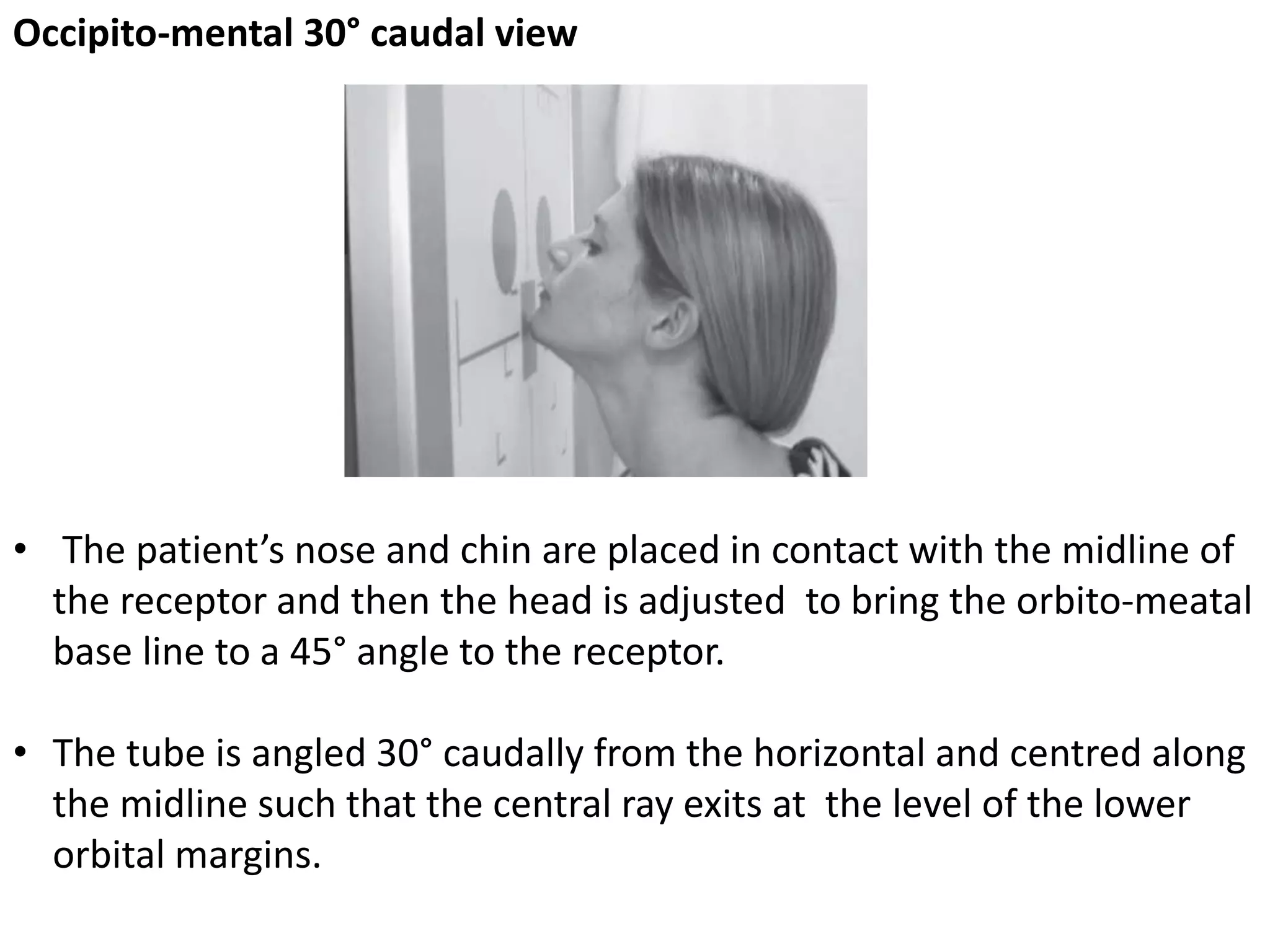
Occipito-mental 30° caudal view
• The patient’s nose and chin are placed in contact with the midline of
the receptor and then the head is adjusted to bring the orbito-meatal
base line to a 45° angle to the receptor.
• The tube is angled 30° caudally from the horizontal and centred along
the midline such that the central ray exits at the level of the lower
orbital margins.
Occipito-mental 30° caudal view
 Each infra – orbital is part of the floor of the orbit - this carry the
maxillary division of trigeminal nerve which can injured as the
result of fracture .
 Note the each maxillary antrum is clear (black) , and other visible
structures include the mandible and odontoid peg .
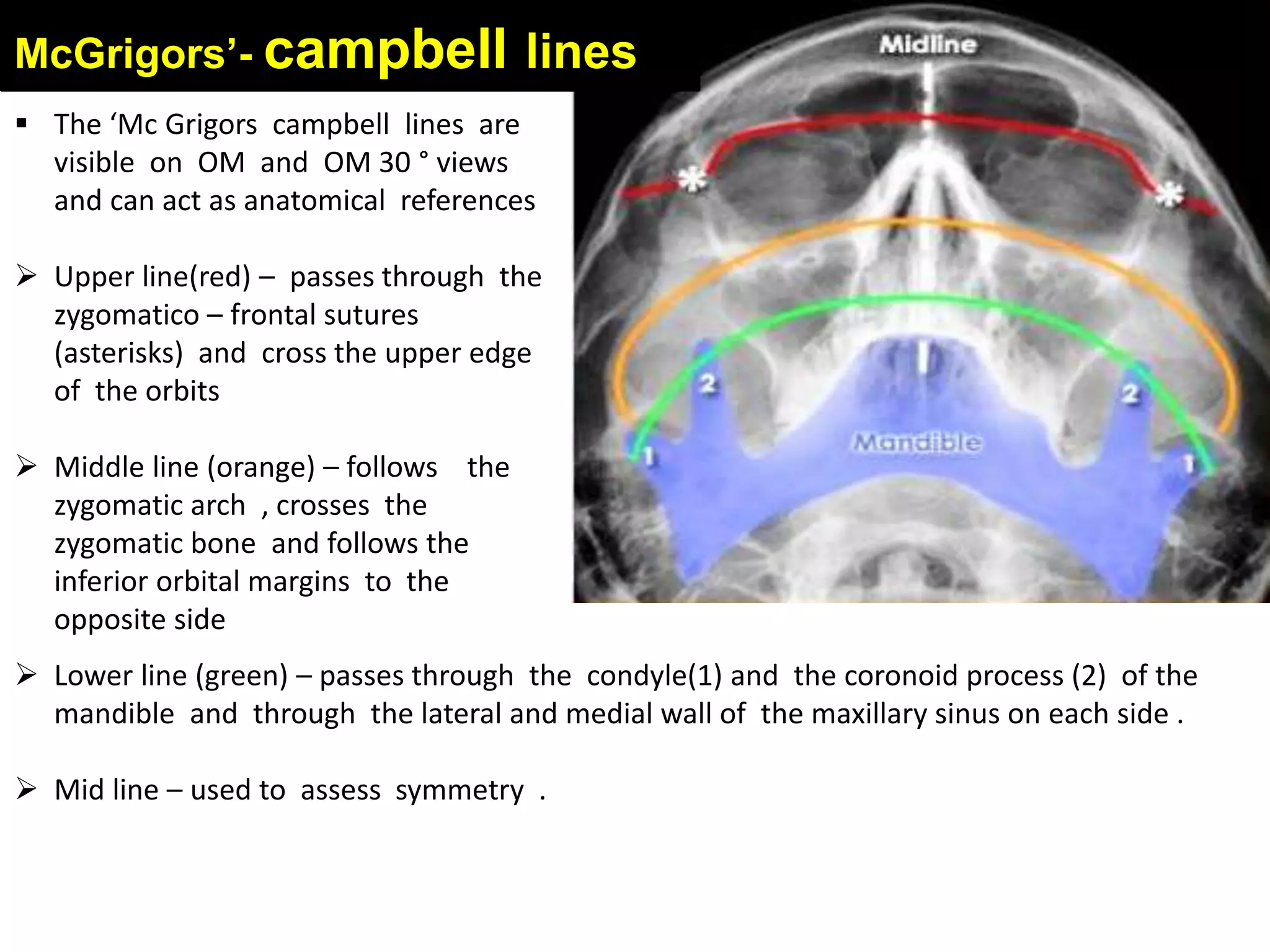
McGrigors’- campbell lines
 The ‘Mc Grigors campbell lines are
visible on OM and OM 30 ° views
and can act as anatomical references
 Upper line(red) – passes through the
zygomatico – frontal sutures
(asterisks) and cross the upper edge
of the orbits
 Middle line (orange) – follows the
zygomatic arch , crosses the
zygomatic bone and follows the
inferior orbital margins to the
opposite side
 Lower line (green) – passes through the condyle(1) and the coronoid process (2) of the
mandible and through the lateral and medial wall of the maxillary sinus on each side .
 Mid line – used to assess symmetry .
Isolated zygomatic arch fracture
Disruption of the middle McGrigo – campbell line is due
to comminuted fracture of right zygomatic arch
Following the upper and lower liens shows no fracture
o Trauma to the zygoma may result in the impaction of the whole
bone into the maxillary sinus with fracture to the orbit floor and
lateral wall of the maxillary sinus
o The displaced zygoma is detached from the maxillary bone the
inferior orbital rim , the frontal bone at the zygomatico – frontal
suture , and form the zygomatic arch .
o The result is said to liken a ‘tripod’ but reality these fractures are
often more complex than is appreciated on plain x ray .
o ‘Quadripod’ would perhaps be a more accurate term as four
fractures may be visible
‘Tripod’ fractures
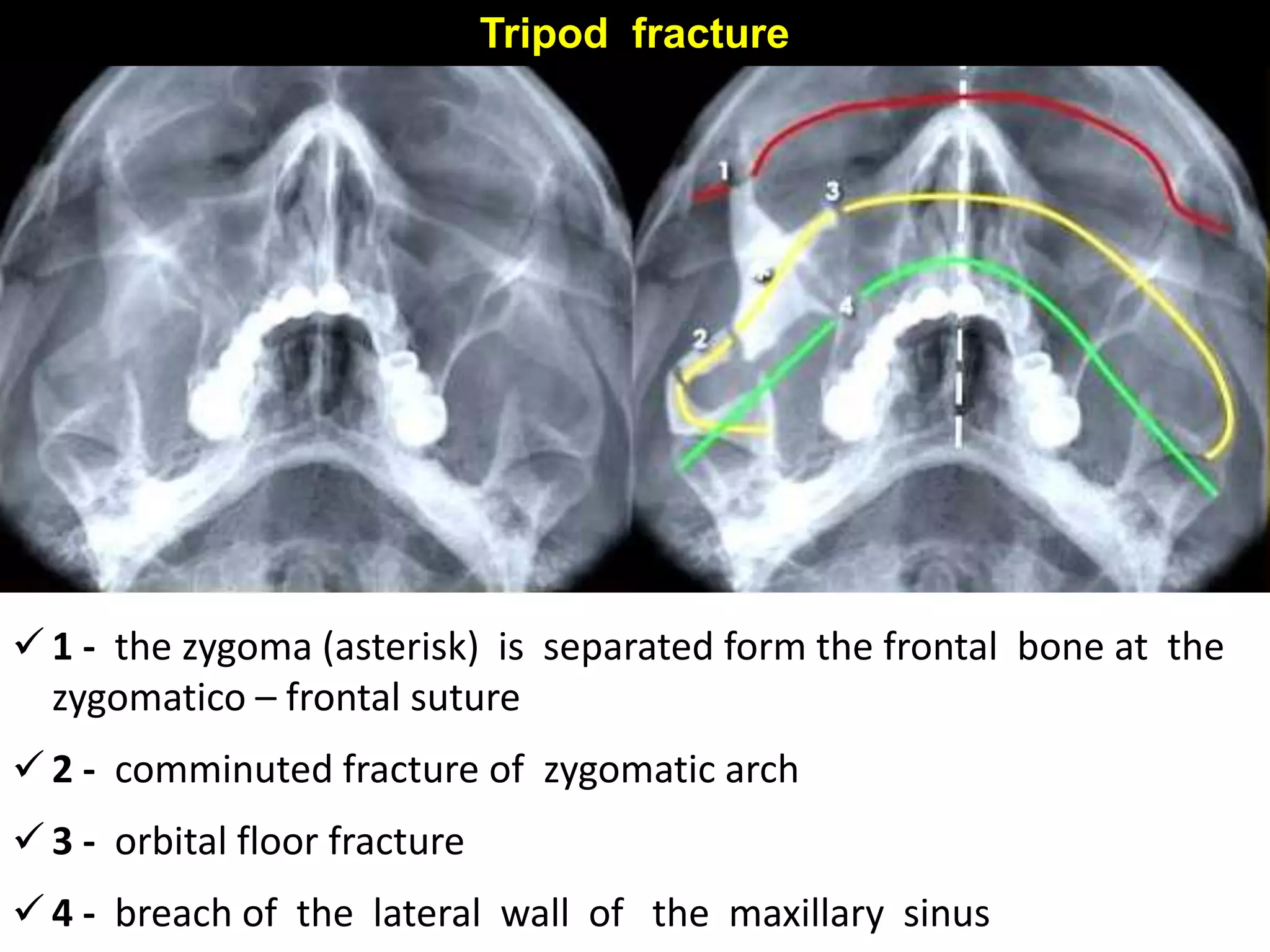
Tripod fracture
 1 - the zygoma (asterisk) is separated form the frontal bone at the
zygomatico – frontal suture
 2 - comminuted fracture of zygomatic arch
 3 - orbital floor fracture
 4 - breach of the lateral wall of the maxillary sinus
 Maxillary sinus fluid level - a fluid level of blood seen in the
maxillary sinus may be the only obvious sign of fracture
 ‘Tripod’ fracture
A. – widened zygomatico frontal suture B. – zygomatic arch fracture
C. – orbital floor fracture D. – lateral maxillary sinus wall fracture
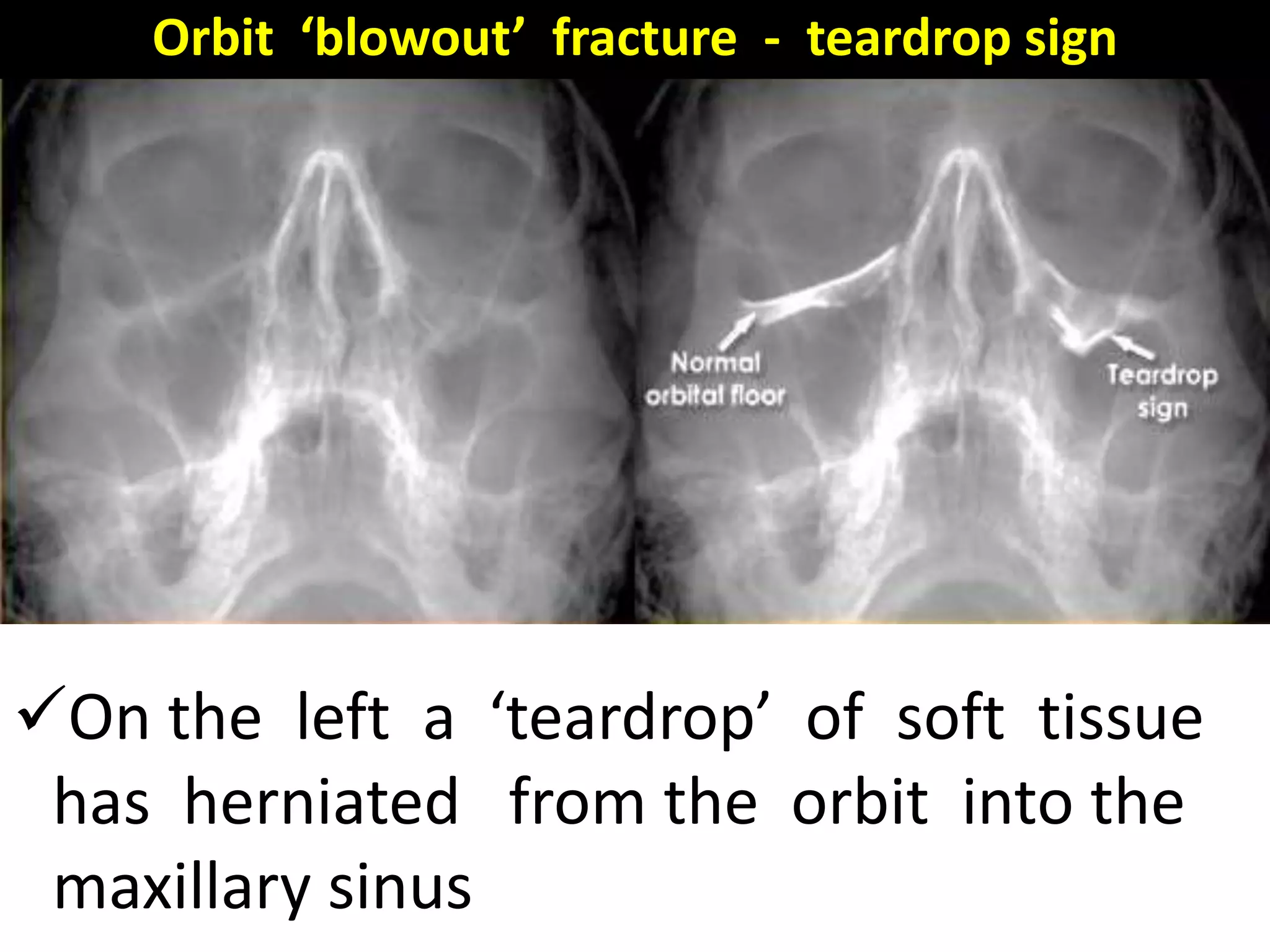
Orbital ‘blowout’ fractures
 Trauma to the orbit may lead to
increased pressure in the orbit such
condition the thin bone of the orbit
floor bursts .
 This manifests as ‘teardrop’ sign
which is due to herniation of orbit
content into maxillary sinus .
Orbit ‘blowout’ fracture - teardrop sign
On the left a ‘teardrop’ of soft tissue
has herniated from the orbit into the
maxillary sinus
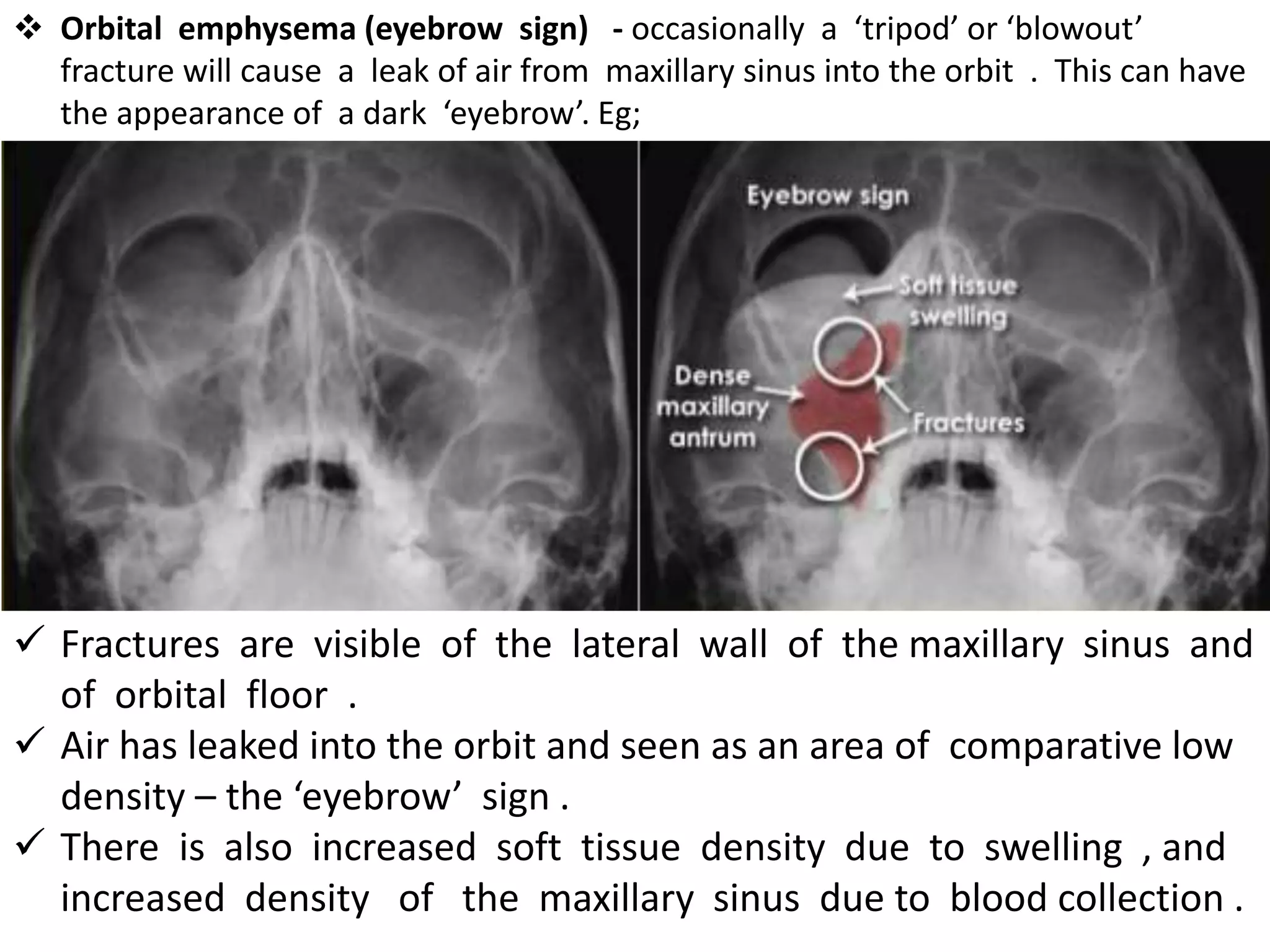
 Fractures are visible of the lateral wall of the maxillary sinus and
of orbital floor .
 Air has leaked into the orbit and seen as an area of comparative low
density – the ‘eyebrow’ sign .
 There is also increased soft tissue density due to swelling , and
increased density of the maxillary sinus due to blood collection .
 Orbital emphysema (eyebrow sign) - occasionally a ‘tripod’ or ‘blowout’
fracture will cause a leak of air from maxillary sinus into the orbit . This can have
the appearance of a dark ‘eyebrow’. Eg;
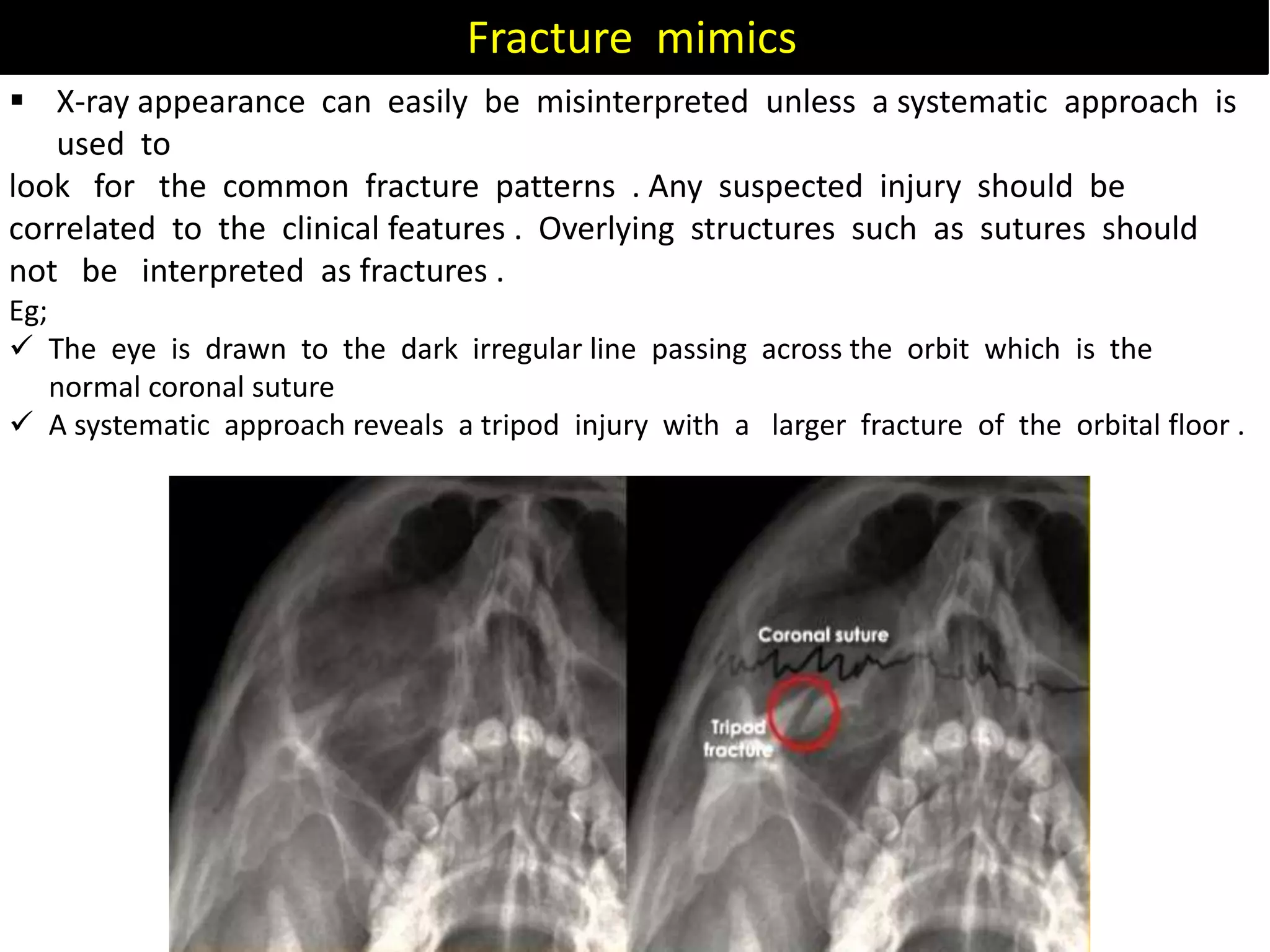
Fracture mimics
 X-ray appearance can easily be misinterpreted unless a systematic approach is
used to
look for the common fracture patterns . Any suspected injury should be
correlated to the clinical features . Overlying structures such as sutures should
not be interpreted as fractures .
Eg;
 The eye is drawn to the dark irregular line passing across the orbit which is the
normal coronal suture
 A systematic approach reveals a tripod injury with a larger fracture of the orbital floor .
Mandible fractures
 The mandible can be consider as an anatomical
ring bone , stabilized at each end of the
temporomandibular joints .
 A break of the ring in one place will usually be
accompanied by further break in he ring
Elsewhere .
If you see one fracture ,look for a second fracture ,
or a dislocation of temproromandibular joint (TMJ) .
Orthopantomogram (OPG) / mandible views
o Both views are necessary because fractures
are often only seen on one image . The OPG
is a panoramic view acquired with the
camera panning around the patient.
o Whenever one fracture is seen check for a
second fracture or dislocation of TMJ joint .
Normal mandible – OPG
Follow the cortical edge
all the way around the
mandible .
Check the TMJ joint .
Asterisks = inferior
alveolar canal – the
course of the inferior
alveolar nerve .
Normal OPG - Temporomadibular joint
• The condyle of the mandible meets the glenoid fossa of
the temporal bone to form the temporomandibular joint
(TMJ) .
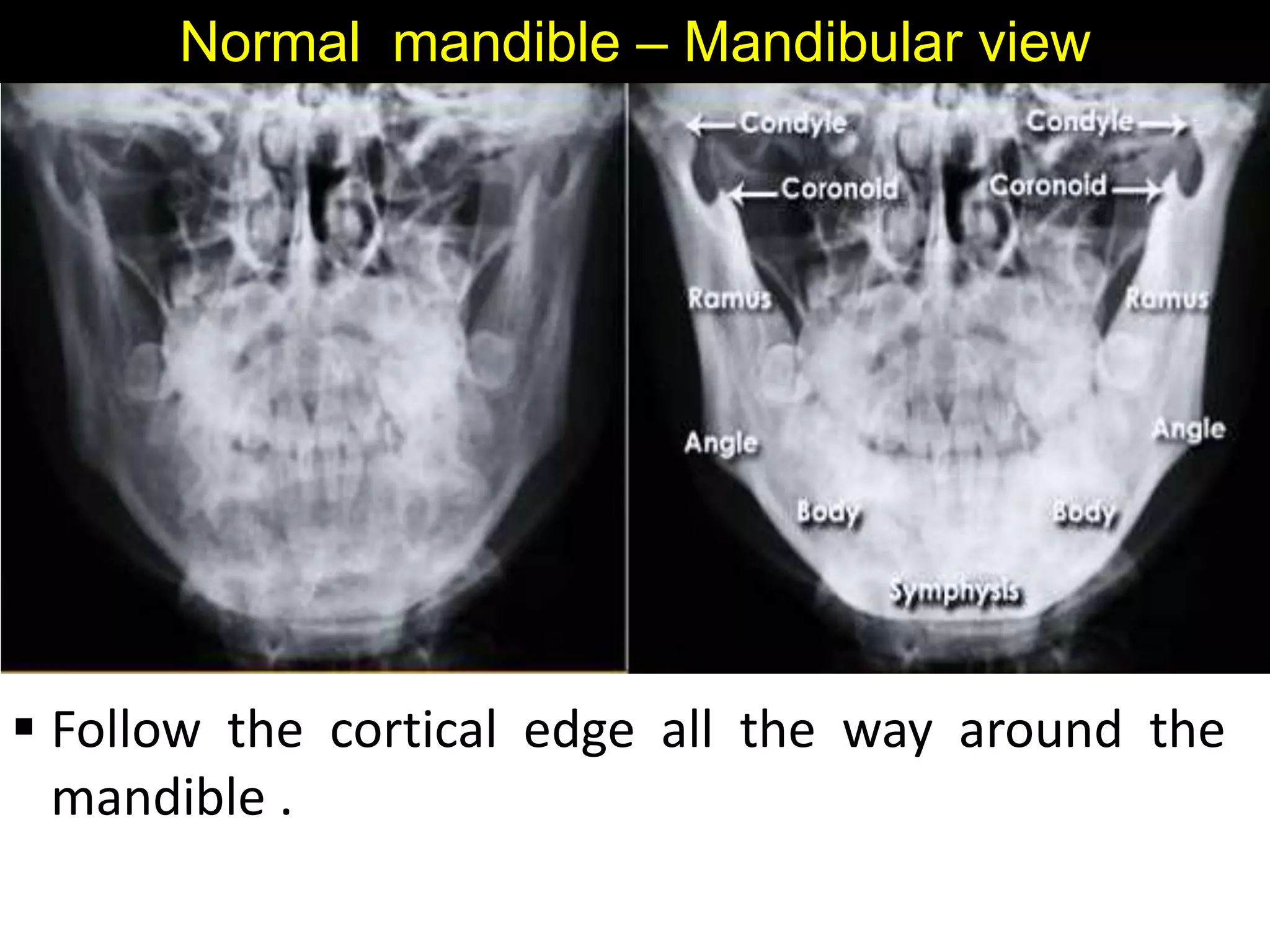
Normal mandible – Mandibular view
 Follow the cortical edge all the way around the
mandible .
Eg; mandible fracture - OPG
 A fracture of the left mandible body is easy to see
 On the right the cortical outline is difficult to follow at the
base of the condyle
 But not clear about second fracture
Mandible fracture – mandibular view (Same patient as seen previous slide)
On this view the right condylar fracture is
more easily seen .
Anatomy and image interpretation of facial bone

Anatomy and image interpretation of facial bone

  • 1.
    IMAGE INTERPRETATION OF FACIALBONE RADIOGRAPHY M K. Sadham hussain Bsc (MIT) 2nd year SCAHS by
  • 2.
     Familiarity withfacial bone anatomy is required for accurate interpretation
  • 3.
    Introduction • The facialbones are a series of 14 irregular bones that collectively are attached to the antero-inferior aspect of the skull. • Within these bones, and some of the bones forming the cranial base, are a series of air-filled cavities known as the paranasal air sinuses • The maxillae , zygomata and mandible contribute most to the shape of the face , and the orbits , nose and paranasal sinuses form bony cavities contained by the facial skeleton
  • 4.
    Facial Bone There are14 bones that make up the facial bones. 6 bones are paired (R/L) • Maxillae • Zygomatic bones • Lacrimal bones • Nasal bones • Inferior nasal conchae • Palatine bones (not visualized) 2 single bones • Mandible • vomer
  • 5.
  • 6.
    Maxillae (2) R/L •Maxillae is the 2nd largest bone in the face • The 2 maxillae form the whole of the upper jaw (immovable bone ) • Body contains large pyramidal cavity – maxillary sinus • Form three fourth of roof of the mouth • It form part of the floor and later wall of nose and the floor of the orbit  It has 4 surface and encloses a large cavity  Anterior or facial  Posterior or infratemporal  Superior or orbital l  Medial or nasal
  • 7.
    4 Processes ofmaxilla Zygomatic processes . Frontal processes . Alveolar processes . Palatine processes . • Infraorbital foramen • Anterior nasal spine • Acanthion Bones articulation • Each articulate with all other facial bones , except mandible - also articulate with frontal and ethmoid cranial bones
  • 9.
    Mandible(1) • It isthe largest and strongest bone of the face • Only movable bone in the skull • It consist of an horseshoe or curved horizontal shaped body and two rami that project upwards from the posterior part of the body  Angle of mandible (gonion)  Mental protuberance (chin)  Symphysis menti
  • 10.
     Alveolar process Mental foramina  Coronoid process  Condylar process  Mandibular notch
  • 11.
    Zygomatic bones (2)R/L  It forms prominence of cheeks  The zygoma or malar bone complex forms central support of the cheek and is a strong buttress of the lateral surface of the middle face .  Forms lower outer margin of orbits  four process • Frontal process • Temporal process • Maxillary process • Orbital process
  • 12.
    • Articulations  superior– frontal bone Lateral – zygomatic process of temporal bone Anterior – maxilla Posterior – sphenoid
  • 13.
    Frontal view  Thezygoma can be seen to articulate with 3 bones o Medially – maxilla bone o Superiorly – frontal bone o Posteriorly – the great wing of the sphenoid bone within the orbit Lateral view  The temporal process of the zygoma join the zygomatic process of the temporal bone to form the zygomatic arch .
  • 14.
    Palatine bone  TwoL – shaped bone composed of vertical and horizontal plates  Horizontal plates articulate with maxillae to complete the posterior fourth of bony palate (roof of mouth)  vertical portion extend upward between maxilla and the pterygoid process of the sphenoid in posterior nasal cavity  Palatine bone contributes to the walls of three cavities:- 1] The floor and lateral wall of the nasal cavity; 2] The roof of the mouth, 3] The floor of the orbit.
  • 15.
     The bonefeatures three processes; pyramidal, orbital and sphenoidal.  Its articulating with five bones; maxilla, sphenoid, ethmoid, inferior nasal concha, and vomer. Greater palatine foramen
  • 16.
    Nasal bone  Twosmall , thin bones  Vary in size and shape in individuals  Form superior bony wall of nasal cavity (bridge of nose)  Articulation • With each other in midsagittal plane (inter nasal suture ) • Superior with frontal bone (frontonasal suture ) • On each lateral side with maxillae (nasomaxially suture ) • Posterosuperior with perpendicular plate of ethmoid bone (nasoethmoidal suture)
  • 18.
    Inferior nasal conchae Extend diagonally and inferiorly from lateral walls of nasal cavity at its lower third .  Inferior to the medial nasal conchae of the ethmoid bone  Long , narrow , very thin bones with a lateral curl (gives scroll like appearance) .  Articulating bony structures include the frontal process of the maxilla anteriorly , the uncinate process of the ethmoid bone and the lacrimal bone anteromedially , and the perpendicular plate of the palatine bone posteromedially.
  • 20.
    Lacrimal bone • The2 smallest bones in the skull • It form part of the medial wall of the orbit. • it articulates with :  Frontal bone  Maxillary bone  Ethmoid bone  Inferior nasal concha • lacrimal foramen • The lacrimal groove
  • 21.
    The vomer • Thinplate of bone situated in MSP of floor of nasal cavity • Forms inferior nasal septum • Superior border articulates with body of sphenoid bone • Superior part of anterior border articulates with perpendicular plate of ethmoid bone • Posterior border is free
  • 22.
    Orbits Each is composedof seven bone 1. Frontal 2. Sphenoid 3. Ethmoid 4. Maxilla 5. Zygoma 6. Lacrimal 7. Palatine
  • 23.
  • 24.
  • 25.
  • 27.
    IMAGE INTERPRETATION OF FACIALBONE Key points • Follow the three ‘MC Grigor – cambell ‘ lines to look for the common fracture patterns The most common fracture configurations are , Isolated zygomatic arch fracture Tripod fracture Blowout fracture • Check for the ‘tear drop’ and eye brow signs
  • 28.
    Occipito-mental view Patient imagedsupine with 45° baseline Modified mento-occipital view  The patient’s nose and chin are placed in contact with the midline of the receptor and then the head is adjusted to bring the orbito-meatal base line to a 45° angle to the receptor
  • 29.
    Occipito - mental(OM) view  Each zygoma and zygomatic arch resembles as the head and trunk of an elephant  The blacker areas are the orbits and paranasal sinuses - frontal , nasal /ethmoid and maxillary
  • 30.
    Occipito-mental 30° caudalview • The patient’s nose and chin are placed in contact with the midline of the receptor and then the head is adjusted to bring the orbito-meatal base line to a 45° angle to the receptor. • The tube is angled 30° caudally from the horizontal and centred along the midline such that the central ray exits at the level of the lower orbital margins.
  • 31.
    Occipito-mental 30° caudalview  Each infra – orbital is part of the floor of the orbit - this carry the maxillary division of trigeminal nerve which can injured as the result of fracture .  Note the each maxillary antrum is clear (black) , and other visible structures include the mandible and odontoid peg .
  • 32.
    McGrigors’- campbell lines The ‘Mc Grigors campbell lines are visible on OM and OM 30 ° views and can act as anatomical references  Upper line(red) – passes through the zygomatico – frontal sutures (asterisks) and cross the upper edge of the orbits  Middle line (orange) – follows the zygomatic arch , crosses the zygomatic bone and follows the inferior orbital margins to the opposite side  Lower line (green) – passes through the condyle(1) and the coronoid process (2) of the mandible and through the lateral and medial wall of the maxillary sinus on each side .  Mid line – used to assess symmetry .
  • 33.
    Isolated zygomatic archfracture Disruption of the middle McGrigo – campbell line is due to comminuted fracture of right zygomatic arch Following the upper and lower liens shows no fracture
  • 34.
    o Trauma tothe zygoma may result in the impaction of the whole bone into the maxillary sinus with fracture to the orbit floor and lateral wall of the maxillary sinus o The displaced zygoma is detached from the maxillary bone the inferior orbital rim , the frontal bone at the zygomatico – frontal suture , and form the zygomatic arch . o The result is said to liken a ‘tripod’ but reality these fractures are often more complex than is appreciated on plain x ray . o ‘Quadripod’ would perhaps be a more accurate term as four fractures may be visible ‘Tripod’ fractures
  • 35.
    Tripod fracture  1- the zygoma (asterisk) is separated form the frontal bone at the zygomatico – frontal suture  2 - comminuted fracture of zygomatic arch  3 - orbital floor fracture  4 - breach of the lateral wall of the maxillary sinus
  • 36.
     Maxillary sinusfluid level - a fluid level of blood seen in the maxillary sinus may be the only obvious sign of fracture  ‘Tripod’ fracture A. – widened zygomatico frontal suture B. – zygomatic arch fracture C. – orbital floor fracture D. – lateral maxillary sinus wall fracture
  • 37.
    Orbital ‘blowout’ fractures Trauma to the orbit may lead to increased pressure in the orbit such condition the thin bone of the orbit floor bursts .  This manifests as ‘teardrop’ sign which is due to herniation of orbit content into maxillary sinus .
  • 38.
    Orbit ‘blowout’ fracture- teardrop sign On the left a ‘teardrop’ of soft tissue has herniated from the orbit into the maxillary sinus
  • 39.
     Fractures arevisible of the lateral wall of the maxillary sinus and of orbital floor .  Air has leaked into the orbit and seen as an area of comparative low density – the ‘eyebrow’ sign .  There is also increased soft tissue density due to swelling , and increased density of the maxillary sinus due to blood collection .  Orbital emphysema (eyebrow sign) - occasionally a ‘tripod’ or ‘blowout’ fracture will cause a leak of air from maxillary sinus into the orbit . This can have the appearance of a dark ‘eyebrow’. Eg;
  • 40.
    Fracture mimics  X-rayappearance can easily be misinterpreted unless a systematic approach is used to look for the common fracture patterns . Any suspected injury should be correlated to the clinical features . Overlying structures such as sutures should not be interpreted as fractures . Eg;  The eye is drawn to the dark irregular line passing across the orbit which is the normal coronal suture  A systematic approach reveals a tripod injury with a larger fracture of the orbital floor .
  • 41.
    Mandible fractures  Themandible can be consider as an anatomical ring bone , stabilized at each end of the temporomandibular joints .  A break of the ring in one place will usually be accompanied by further break in he ring Elsewhere . If you see one fracture ,look for a second fracture , or a dislocation of temproromandibular joint (TMJ) .
  • 42.
    Orthopantomogram (OPG) /mandible views o Both views are necessary because fractures are often only seen on one image . The OPG is a panoramic view acquired with the camera panning around the patient. o Whenever one fracture is seen check for a second fracture or dislocation of TMJ joint .
  • 43.
    Normal mandible –OPG Follow the cortical edge all the way around the mandible . Check the TMJ joint . Asterisks = inferior alveolar canal – the course of the inferior alveolar nerve .
  • 44.
    Normal OPG -Temporomadibular joint • The condyle of the mandible meets the glenoid fossa of the temporal bone to form the temporomandibular joint (TMJ) .
  • 45.
    Normal mandible –Mandibular view  Follow the cortical edge all the way around the mandible .
  • 46.
    Eg; mandible fracture- OPG  A fracture of the left mandible body is easy to see  On the right the cortical outline is difficult to follow at the base of the condyle  But not clear about second fracture
  • 47.
    Mandible fracture –mandibular view (Same patient as seen previous slide) On this view the right condylar fracture is more easily seen .