A PRESENTATION ON OPERATING SYSTEM
NAME:- Deepak Ranjan
First year ,MBA.
NIT Rourkela
Flow of Presentation
Introduction and Background
Structure Of OS
Main function of OS
Some Popular OS
Objective of OS
Conclusion
Introduction and Background:-
Operating system are defined in terms of their functionality rather than
what they are. The Different definitions of OS are:-
Operating Systems (OS) Definitions:
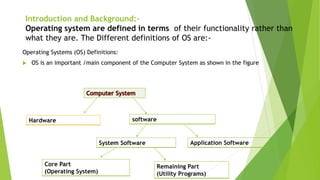
 OS is an important /main component of the Computer System as shown in the figure
Hardware software
System Software Application Software
Core Part
(Operating System)
Remaining Part
(Utility Programs)
 OS is a System Software, that allows one to perform task on hardware conveniently and
efficiently.
 OS creates an Abstract Machine that provides an easy-to-use interface to develop and execute
programs.
 OS is a Control Program i.e., controls the execution of user programs and also concerned with
the operation and control of I/O(Input/Output) devices.
 OS provides Services to users of the system.
 OS manages all hardware and Software.
Overall, Operating system is an integrated set of program that controls the resources of a
computer system and provides its users with an interface or virtual machine that is easier to
use than the bare machine.
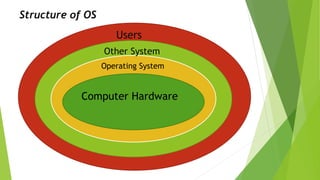
Users
Other System
Operating System
Computer Hardware
Structure of OS
Main function of Operating System
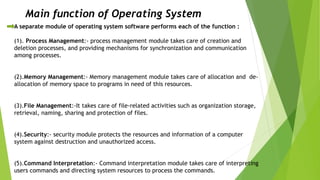
A separate module of operating system software performs each of the function :
(1). Process Management:- process management module takes care of creation and
deletion processes, and providing mechanisms for synchronization and communication
among processes.
(2).Memory Management:- Memory management module takes care of allocation and de-
allocation of memory space to programs in need of this resources.
(3).File Management:-It takes care of file-related activities such as organization storage,
retrieval, naming, sharing and protection of files.
(4).Security:- security module protects the resources and information of a computer
system against destruction and unauthorized access.
(5).Command Interpretation:- Command interpretation module takes care of interpreting
users commands and directing system resources to process the commands.
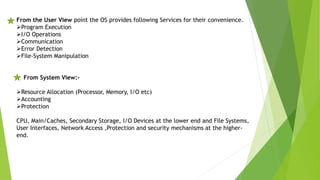
From the User View point the OS provides following Services for their convenience.
Program Execution
I/O Operations
Communication
Error Detection
File-System Manipulation
From System View:-
Resource Allocation (Processor, Memory, I/O etc)
Accounting
Protection
CPU, Main/Caches, Secondary Storage, I/O Devices at the lower end and File Systems,
User Interfaces, Network Access ,Protection and security mechanisms at the higher-
end.
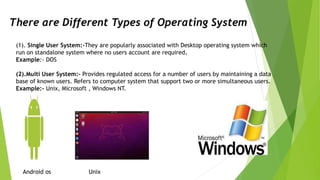
There are Different Types of Operating System
(1). Single User System:-They are popularly associated with Desktop operating system which
run on standalone system where no users account are required.
Example:- DOS
(2).Multi User System:- Provides regulated access for a number of users by maintaining a data
base of known users. Refers to computer system that support two or more simultaneous users.
Example:- Unix, Microsoft , Windows NT.
Android os Unix
Goals/Objectives of Operating
System:
 The purpose of to have an operating system or OS goals/objectives are
provide
1. Convenience(to user)- The primary goal of OS is to make the computer
system user friendly.
2. Efficiency ( of the systems)- The secondary goal of the OS is to make
efficient use of the computer resources.
3. Ability to Evolve- The OS should be constructed in such a way as to permit
the effective development, testing and introduction of new system function
without affecting the existing ones.
Conclusion
 Without Operating System the Computers cannot run the application and we
cannot do work in the computer.
 There operating system is very important in computer.

Presentation On Operating system

  • 1.
    A PRESENTATION ONOPERATING SYSTEM NAME:- Deepak Ranjan First year ,MBA. NIT Rourkela
  • 2.
    Flow of Presentation Introductionand Background Structure Of OS Main function of OS Some Popular OS Objective of OS Conclusion
  • 3.
    Introduction and Background:- Operatingsystem are defined in terms of their functionality rather than what they are. The Different definitions of OS are:- Operating Systems (OS) Definitions:  OS is an important /main component of the Computer System as shown in the figure Hardware software System Software Application Software Core Part (Operating System) Remaining Part (Utility Programs)
  • 4.
     OS isa System Software, that allows one to perform task on hardware conveniently and efficiently.  OS creates an Abstract Machine that provides an easy-to-use interface to develop and execute programs.  OS is a Control Program i.e., controls the execution of user programs and also concerned with the operation and control of I/O(Input/Output) devices.  OS provides Services to users of the system.  OS manages all hardware and Software. Overall, Operating system is an integrated set of program that controls the resources of a computer system and provides its users with an interface or virtual machine that is easier to use than the bare machine.
  • 5.
  • 6.
    Main function ofOperating System A separate module of operating system software performs each of the function : (1). Process Management:- process management module takes care of creation and deletion processes, and providing mechanisms for synchronization and communication among processes. (2).Memory Management:- Memory management module takes care of allocation and de- allocation of memory space to programs in need of this resources. (3).File Management:-It takes care of file-related activities such as organization storage, retrieval, naming, sharing and protection of files. (4).Security:- security module protects the resources and information of a computer system against destruction and unauthorized access. (5).Command Interpretation:- Command interpretation module takes care of interpreting users commands and directing system resources to process the commands.
  • 7.
    From the UserView point the OS provides following Services for their convenience. Program Execution I/O Operations Communication Error Detection File-System Manipulation From System View:- Resource Allocation (Processor, Memory, I/O etc) Accounting Protection CPU, Main/Caches, Secondary Storage, I/O Devices at the lower end and File Systems, User Interfaces, Network Access ,Protection and security mechanisms at the higher- end.
  • 8.
    There are DifferentTypes of Operating System (1). Single User System:-They are popularly associated with Desktop operating system which run on standalone system where no users account are required. Example:- DOS (2).Multi User System:- Provides regulated access for a number of users by maintaining a data base of known users. Refers to computer system that support two or more simultaneous users. Example:- Unix, Microsoft , Windows NT. Android os Unix
  • 9.
    Goals/Objectives of Operating System: The purpose of to have an operating system or OS goals/objectives are provide 1. Convenience(to user)- The primary goal of OS is to make the computer system user friendly. 2. Efficiency ( of the systems)- The secondary goal of the OS is to make efficient use of the computer resources. 3. Ability to Evolve- The OS should be constructed in such a way as to permit the effective development, testing and introduction of new system function without affecting the existing ones.
  • 10.
    Conclusion  Without OperatingSystem the Computers cannot run the application and we cannot do work in the computer.  There operating system is very important in computer.