Central Processing Unit
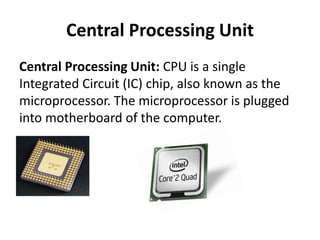
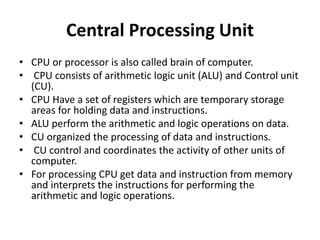
Central Processing Unit: CPU is a single
Integrated Circuit (IC) chip, also known as the
microprocessor. The microprocessor is plugged
into motherboard of the computer.
Central Processing Unit
• CPU or processor is also called brain of computer.
• CPU consists of arithmetic logic unit (ALU) and Control unit
(CU).
• CPU Have a set of registers which are temporary storage
areas for holding data and instructions.
• ALU perform the arithmetic and logic operations on data.
• CU organized the processing of data and instructions.
• CU control and coordinates the activity of other units of
computer.
• For processing CPU get data and instruction from memory
and interprets the instructions for performing the
arithmetic and logic operations.
Central Processing Unit
Arithmetic Logic Unit: ALU consists of two parts
Arithmetic and logic unit.
• The arithmetic unit performs arithmetic
operations on the data like addition, Subtraction,
multiplication and division.
• The logic unit of ALU is performing logic
operations like comparisons of numbers, letters
and special characters. Logic operations include
greater than, less than or equal to condition.
Central Processing Unit
Control Unit: the control unit of a computer does
not do any processing of data. It organizes the
processing of data and instructions.
• It control and coordinates the activity of the
other unit of computer.
• CU carry the store programs instructions to ALU
and registers.
• CU use the instruction in the IR registers to
decide which circuit needs to be activated.
• CU hold CPU instruction set, which is a list of
operation that the CPU can perform.
Central Processing Unit
Registers: registers are high speed storage areas within CPU, but have
less storage capacity. Registers store data, instruction, addresses and
intermediate results of processing. Registers are used for different
purposes. Some important registers in CPU are.
• Accumulator (ACC) stores the results of arithmetic and logic
operations.
• Instruction register (IR) contains the current instruction most
recently fetched.
• Program counter (PC) contains the address of next instruction to be
processed.
• Memory address register (MAR) contains the address of next
location in the memory to be processed.
• Memory buffer register (MBR) temporarily stores data from
memory or the data to be sent to memory.
• Data register (DR) store the operands and any other data.
Central Processing Unit
• The number of registers and the size of each
register in a CPU help to determine the power
and the speed of a CPU. The number of registers
in a CPU from ten to hundreds.
• The size of register indicates the amount of data
with which the computer can work at any given
time.
• The bigger the size, the more quickly it can
process the data.
• The size of a register may be 8, 16, 32 or 64 bits.
Central Processing Unit
• 32-bit CPU is one in which each register is 32
bits wide and the CPU can manipulate 32 bit
of data at a time.
• 32-bit processor and 64-bit processor are the
term used for the size of register. 64-bit
processor can process the data twice as fast as
one with 32-bit processor.
Thanks
Any Question?

Central Processing Unit-6.pptx

  • 1.
    Central Processing Unit CentralProcessing Unit: CPU is a single Integrated Circuit (IC) chip, also known as the microprocessor. The microprocessor is plugged into motherboard of the computer.
  • 2.
    Central Processing Unit •CPU or processor is also called brain of computer. • CPU consists of arithmetic logic unit (ALU) and Control unit (CU). • CPU Have a set of registers which are temporary storage areas for holding data and instructions. • ALU perform the arithmetic and logic operations on data. • CU organized the processing of data and instructions. • CU control and coordinates the activity of other units of computer. • For processing CPU get data and instruction from memory and interprets the instructions for performing the arithmetic and logic operations.
  • 3.
    Central Processing Unit ArithmeticLogic Unit: ALU consists of two parts Arithmetic and logic unit. • The arithmetic unit performs arithmetic operations on the data like addition, Subtraction, multiplication and division. • The logic unit of ALU is performing logic operations like comparisons of numbers, letters and special characters. Logic operations include greater than, less than or equal to condition.
  • 4.
    Central Processing Unit ControlUnit: the control unit of a computer does not do any processing of data. It organizes the processing of data and instructions. • It control and coordinates the activity of the other unit of computer. • CU carry the store programs instructions to ALU and registers. • CU use the instruction in the IR registers to decide which circuit needs to be activated. • CU hold CPU instruction set, which is a list of operation that the CPU can perform.
  • 5.
    Central Processing Unit Registers:registers are high speed storage areas within CPU, but have less storage capacity. Registers store data, instruction, addresses and intermediate results of processing. Registers are used for different purposes. Some important registers in CPU are. • Accumulator (ACC) stores the results of arithmetic and logic operations. • Instruction register (IR) contains the current instruction most recently fetched. • Program counter (PC) contains the address of next instruction to be processed. • Memory address register (MAR) contains the address of next location in the memory to be processed. • Memory buffer register (MBR) temporarily stores data from memory or the data to be sent to memory. • Data register (DR) store the operands and any other data.
  • 6.
    Central Processing Unit •The number of registers and the size of each register in a CPU help to determine the power and the speed of a CPU. The number of registers in a CPU from ten to hundreds. • The size of register indicates the amount of data with which the computer can work at any given time. • The bigger the size, the more quickly it can process the data. • The size of a register may be 8, 16, 32 or 64 bits.
  • 7.
    Central Processing Unit •32-bit CPU is one in which each register is 32 bits wide and the CPU can manipulate 32 bit of data at a time. • 32-bit processor and 64-bit processor are the term used for the size of register. 64-bit processor can process the data twice as fast as one with 32-bit processor.
  • 8.