Dr. Rashmi Ranjan
 Greek : gṓ nḗ : angle , Ộs’k-pḗ :
view
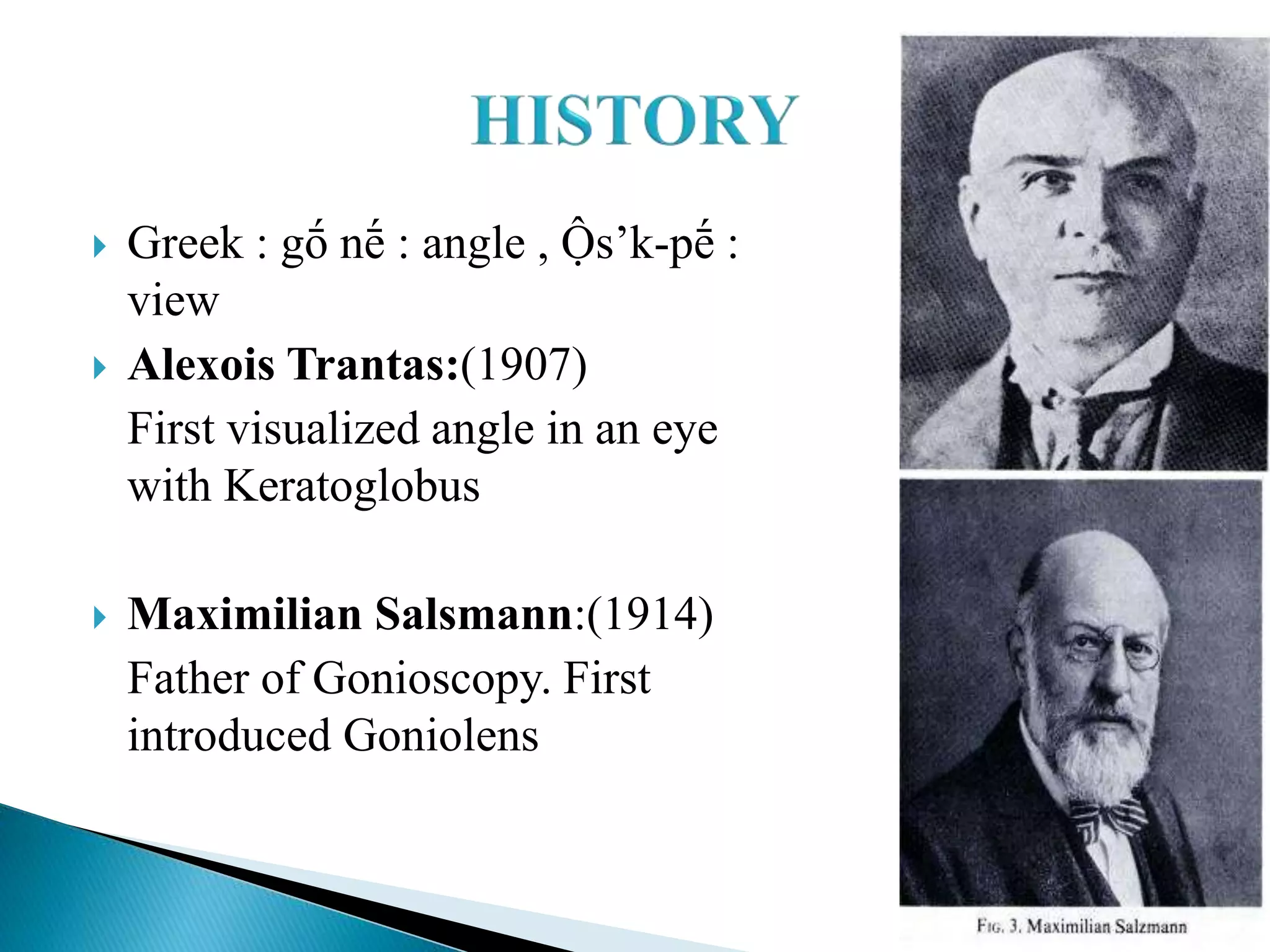
 Alexois Trantas:(1907)
First visualized angle in an eye
with Keratoglobus
 Maximilian Salsmann:(1914)
Father of Gonioscopy. First
introduced Goniolens
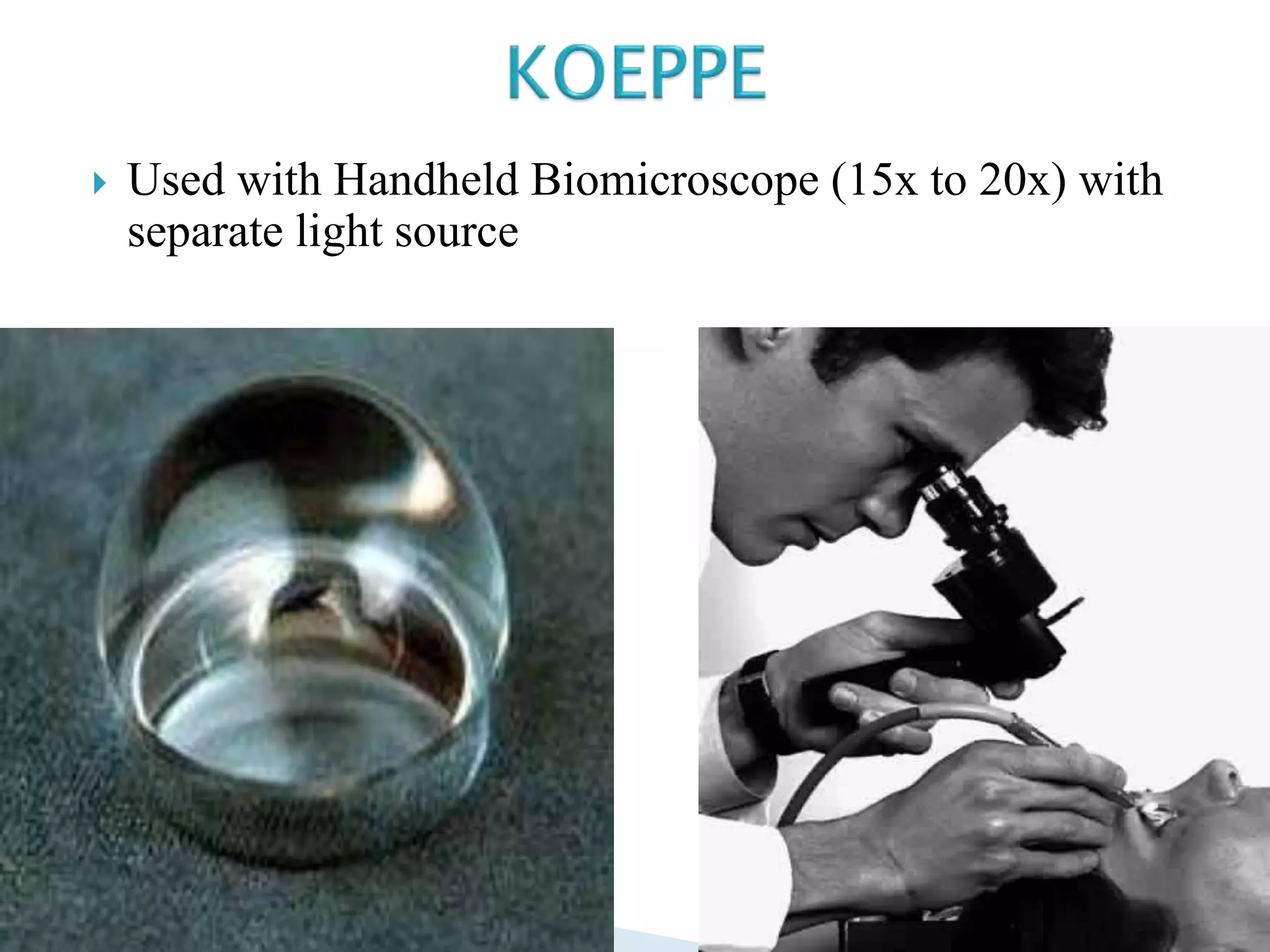
 Koeppe :
Designed improved Contact lens and gave the
method biomicroscopy of angle of anterior
Chamber with slit lamp.
 Manuel Uribe Troncoso:
Developed Gonioscope for magnification &
illumination of Angle.
First to write a Comprehensive book on
Gonioscopy
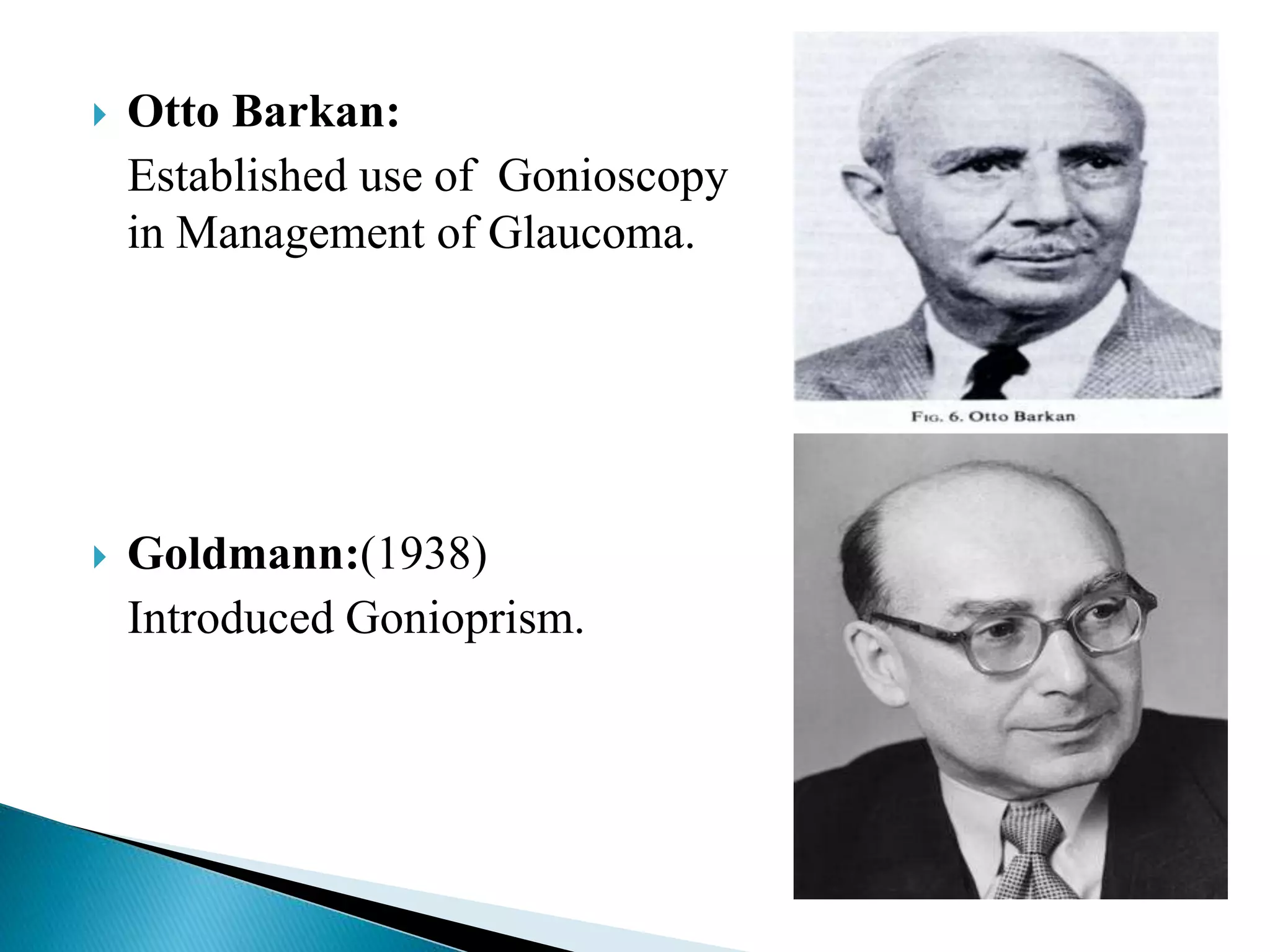
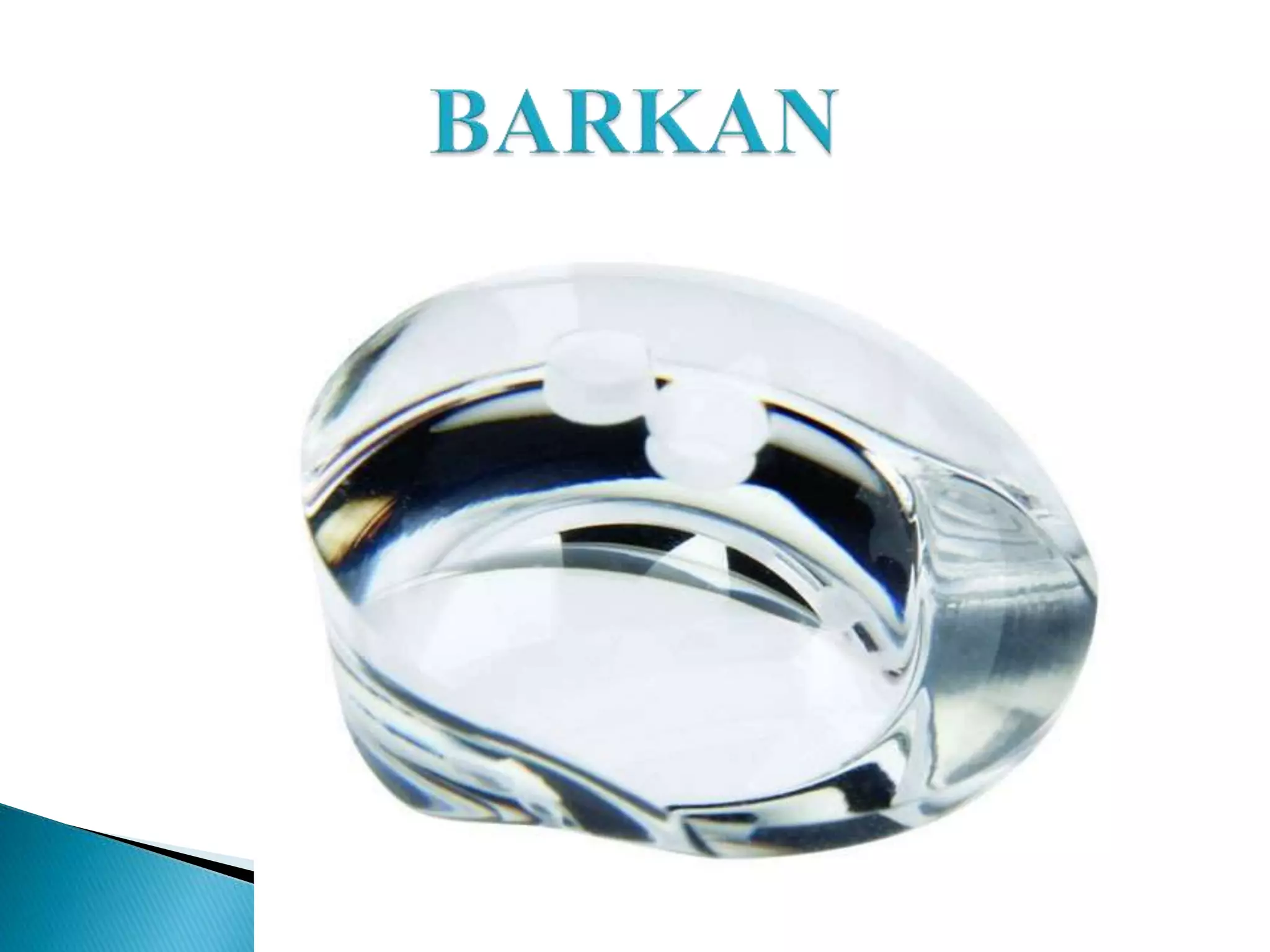
 Otto Barkan:
Established use of Gonioscopy
in Management of Glaucoma.
 Goldmann:(1938)
Introduced Gonioprism.
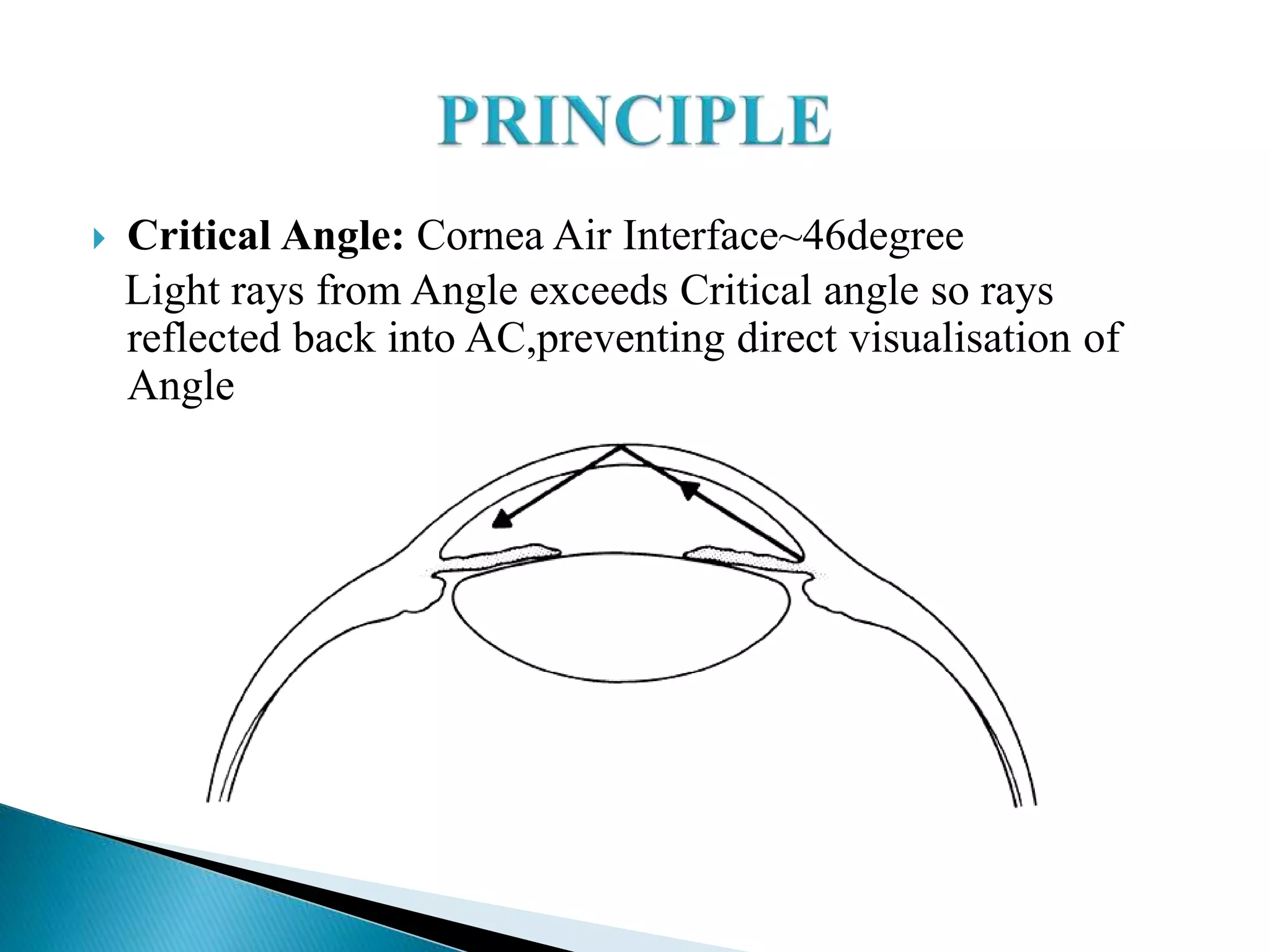
 Critical Angle: Cornea Air Interface~46degree
Light rays from Angle exceeds Critical angle so rays
reflected back into AC,preventing direct visualisation of
Angle
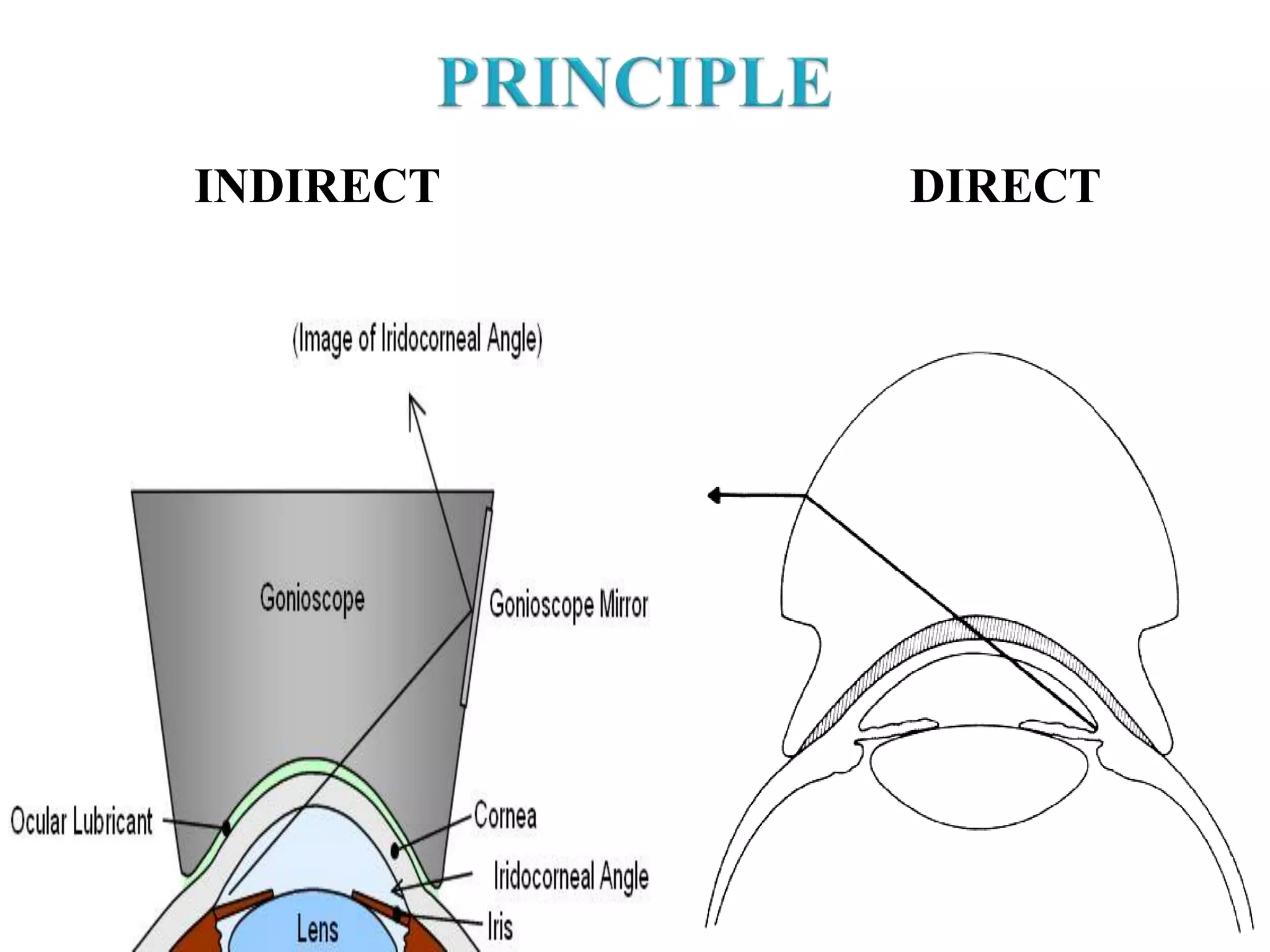
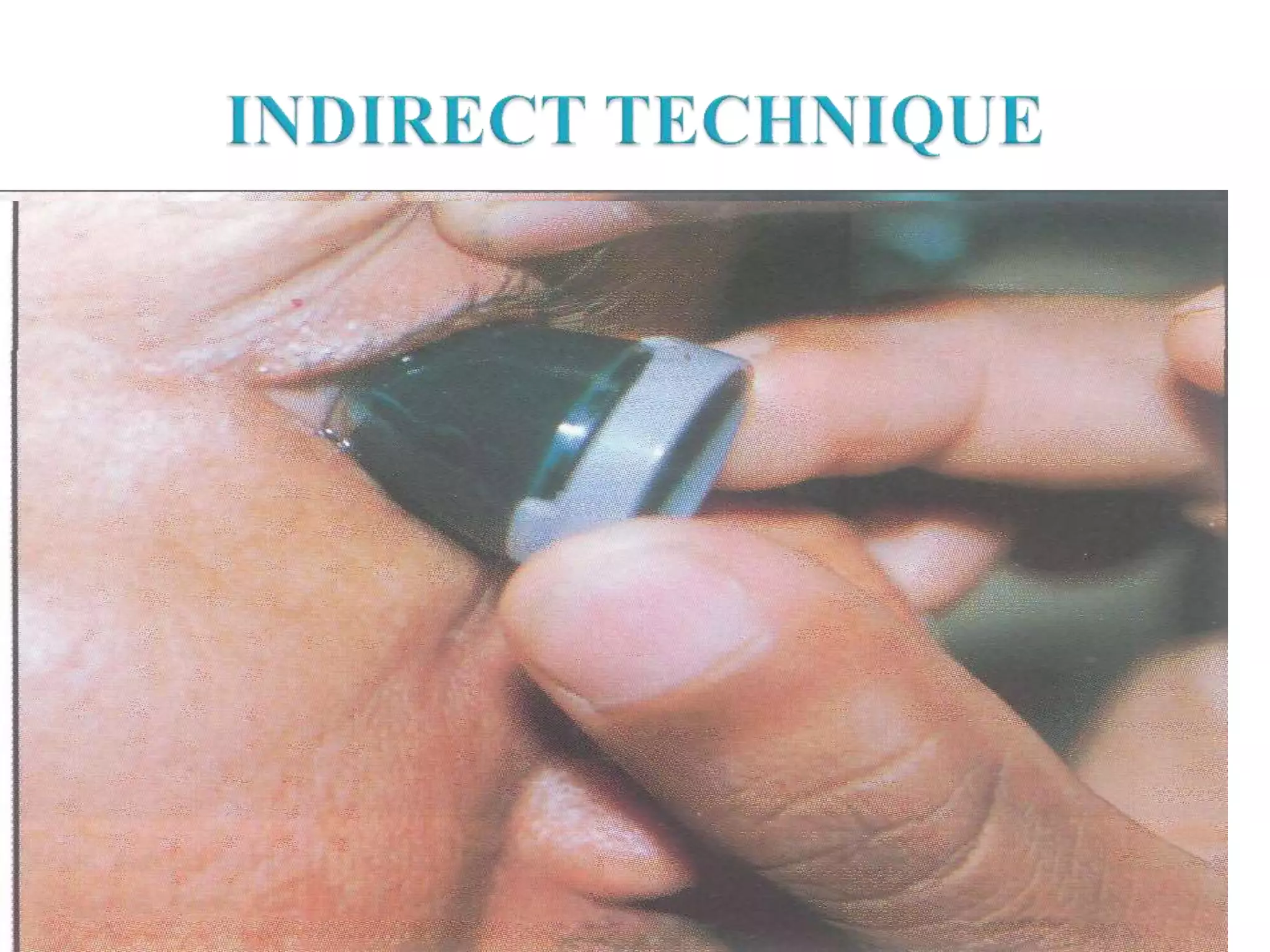
INDIRECT DIRECT
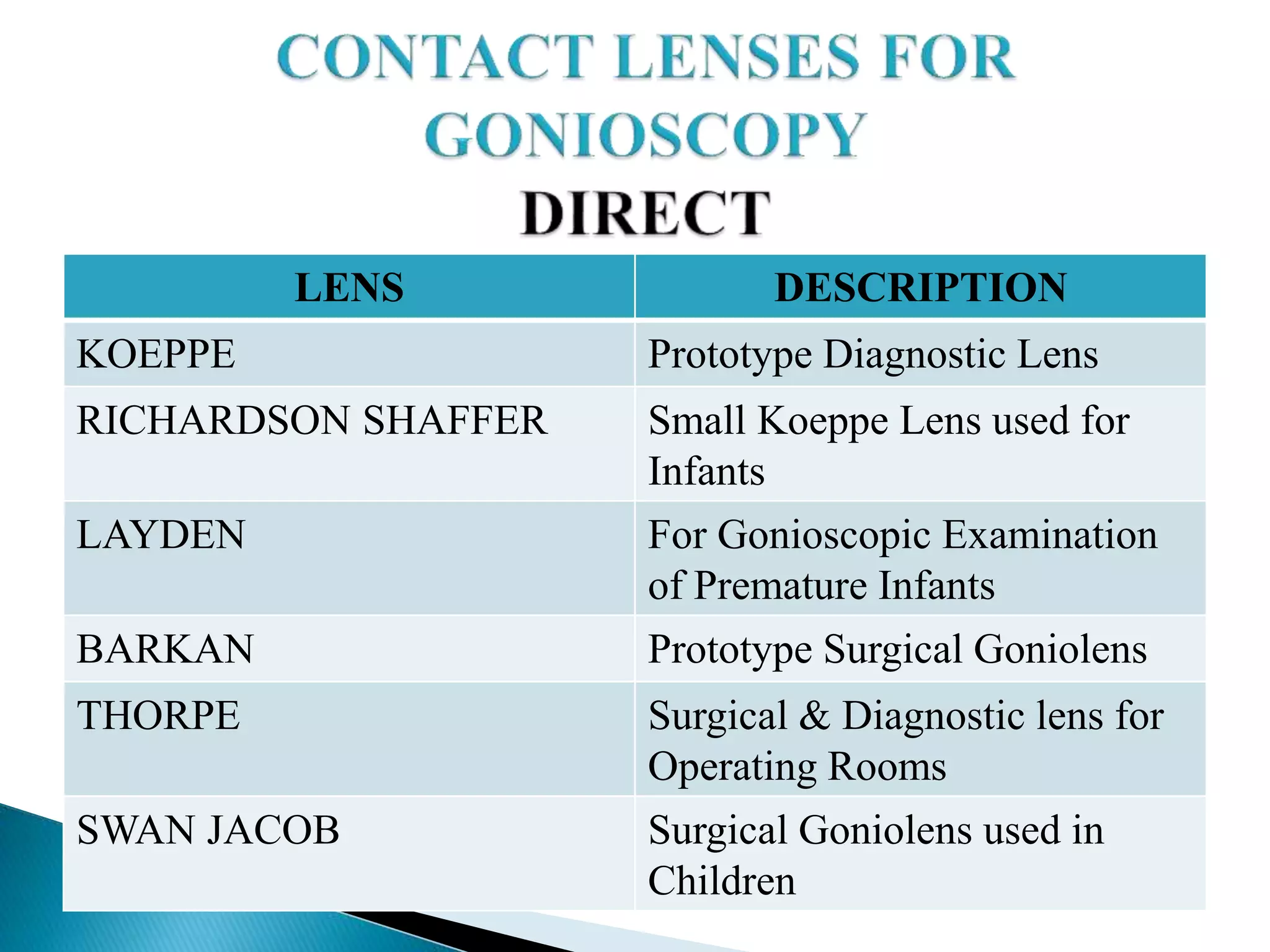
LENS DESCRIPTION
KOEPPE Prototype Diagnostic Lens
RICHARDSON SHAFFER Small Koeppe Lens used for
Infants
LAYDEN For Gonioscopic Examination
of Premature Infants
BARKAN Prototype Surgical Goniolens
THORPE Surgical & Diagnostic lens for
Operating Rooms
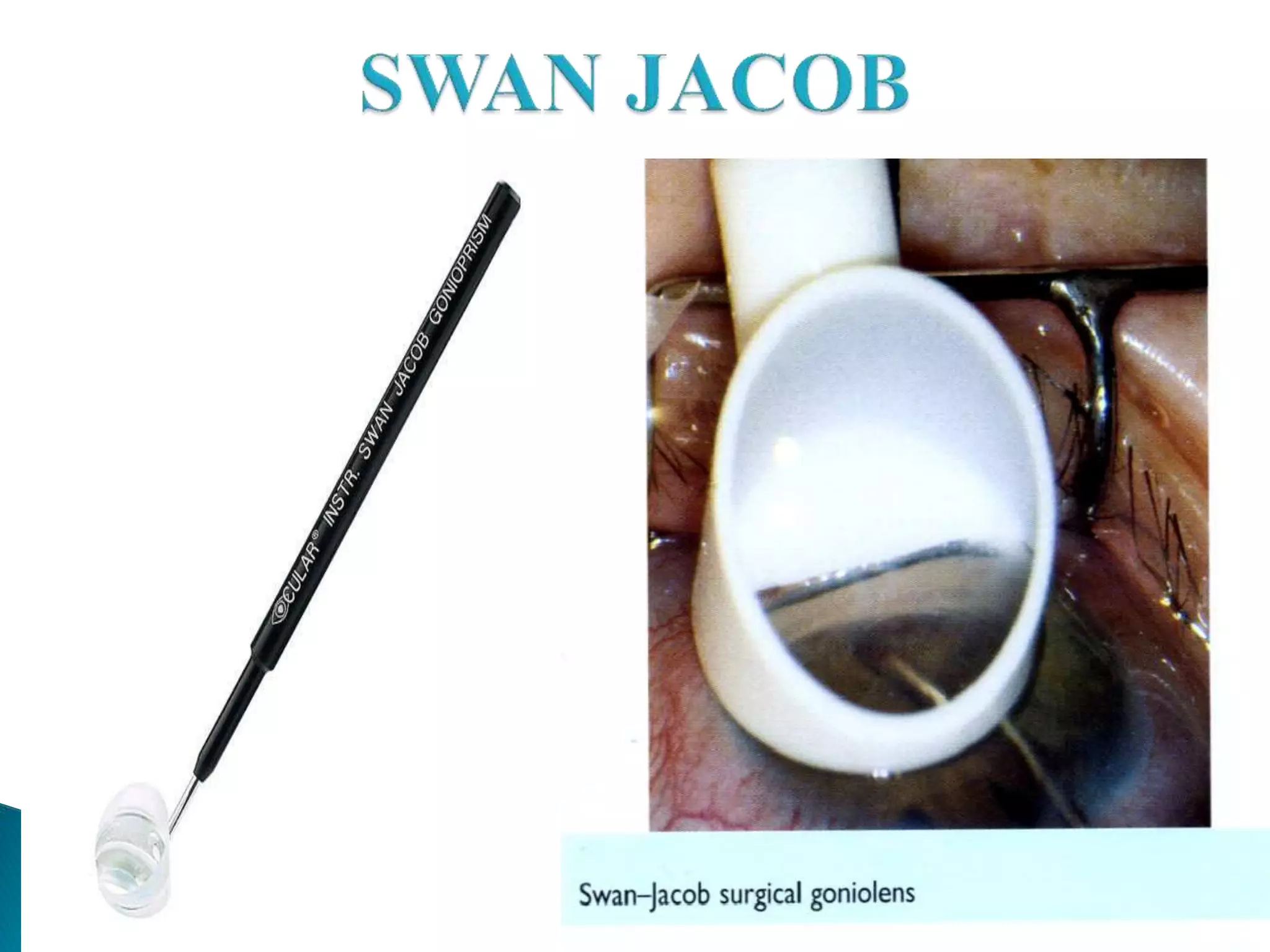
SWAN JACOB Surgical Goniolens used in
Children
 Used with Handheld Biomicroscope (15x to 20x) with
separate light source
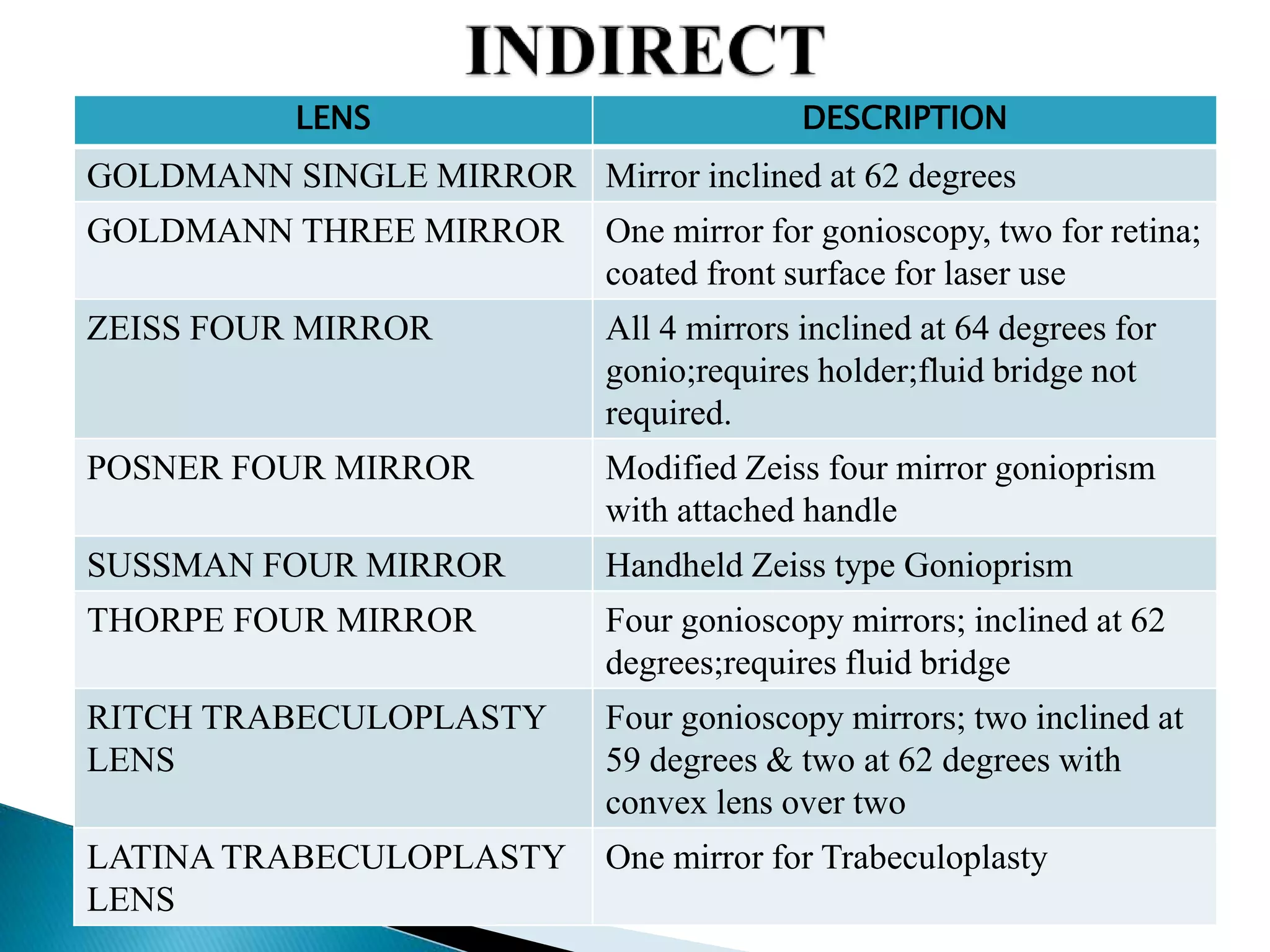
LENS DESCRIPTION
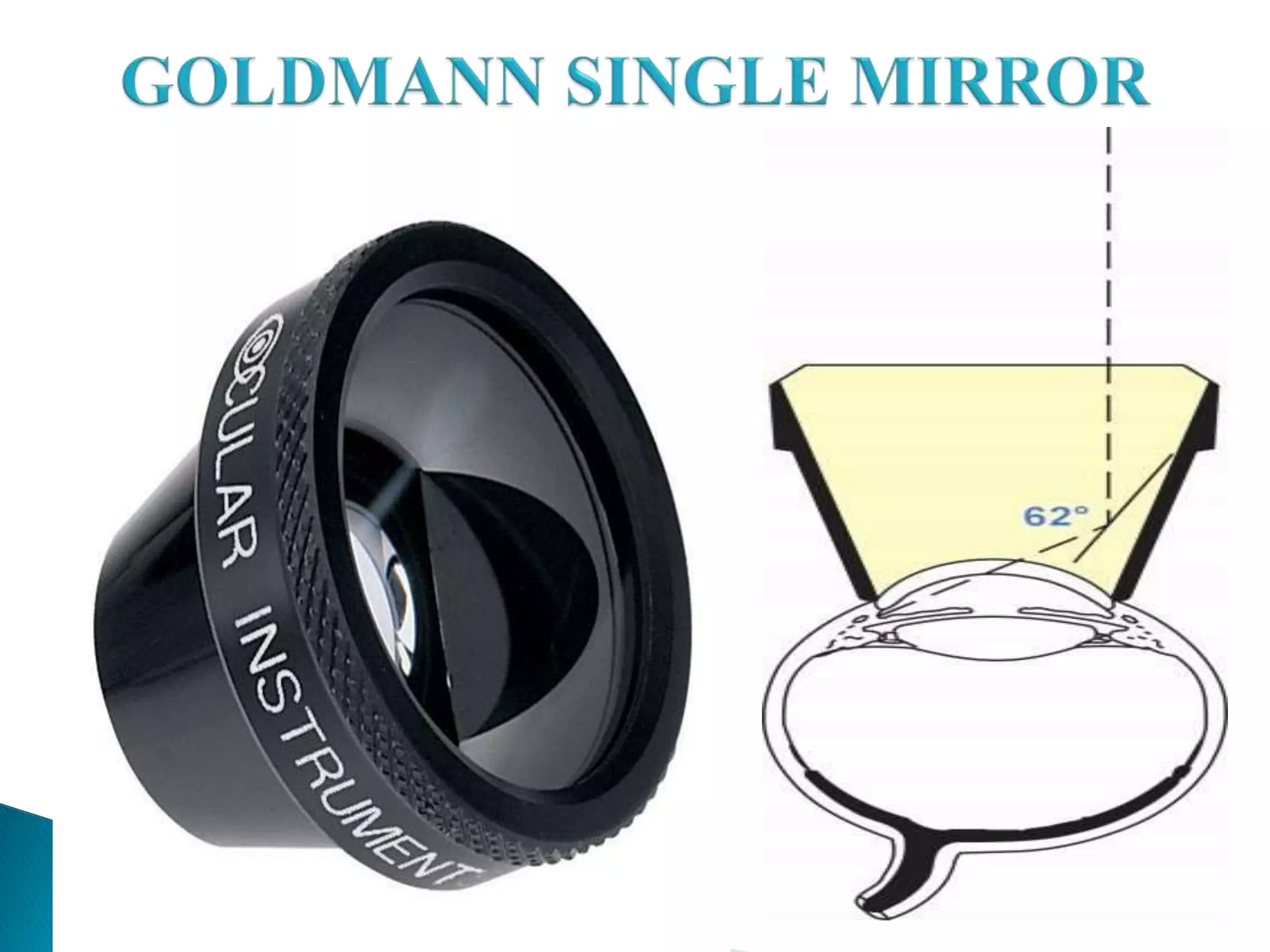
GOLDMANN SINGLE MIRROR Mirror inclined at 62 degrees
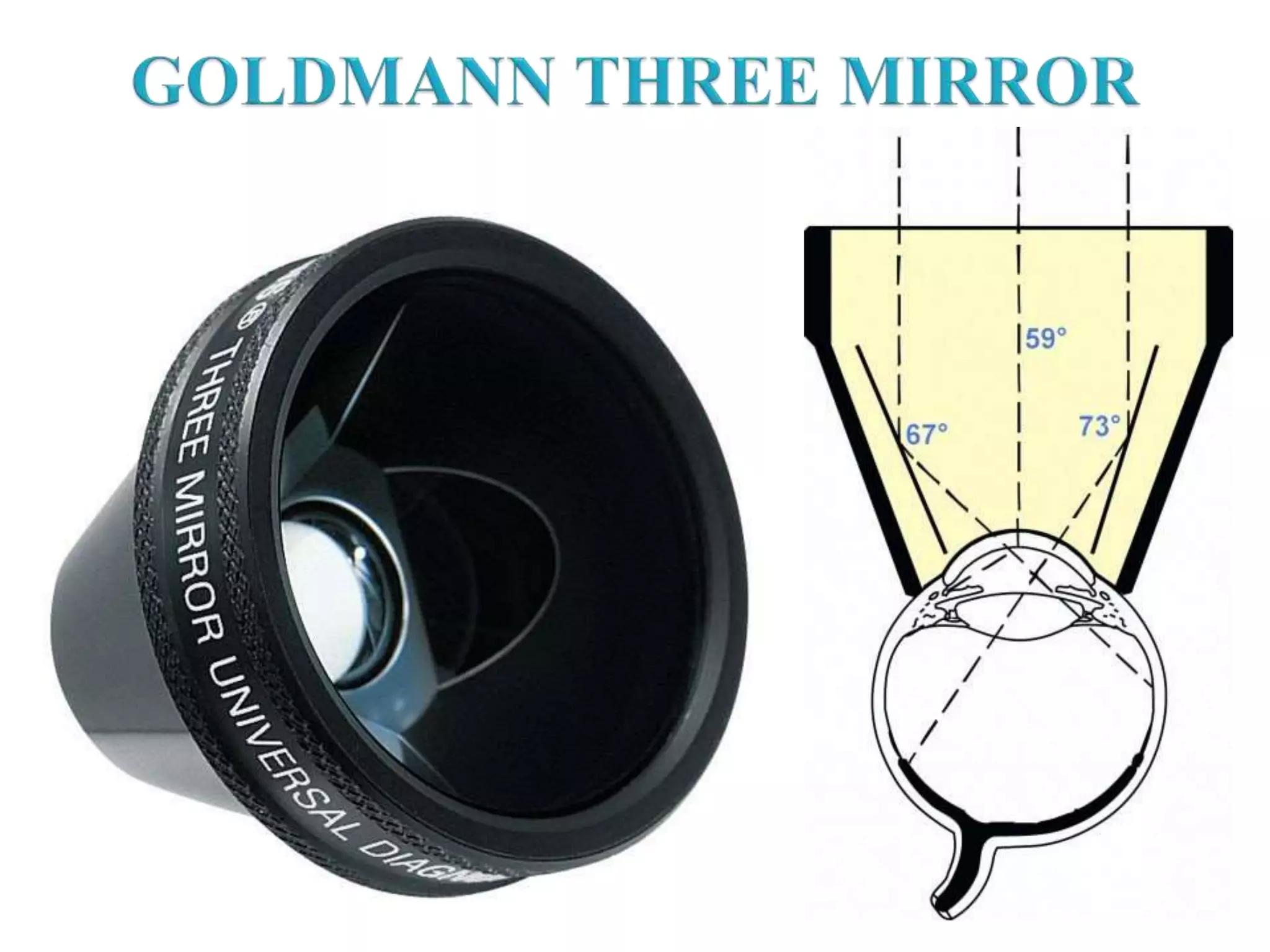
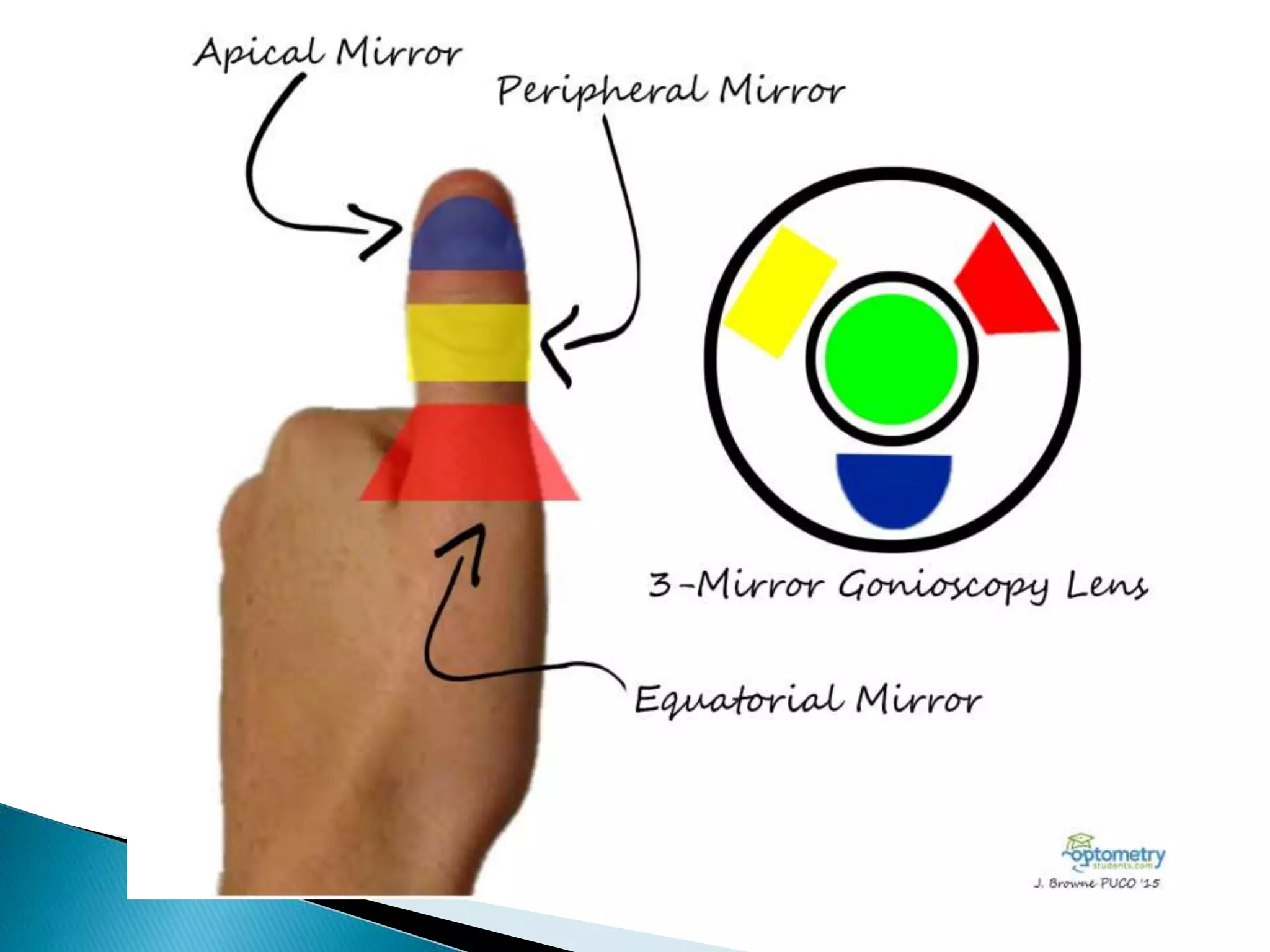
GOLDMANN THREE MIRROR One mirror for gonioscopy, two for retina;
coated front surface for laser use
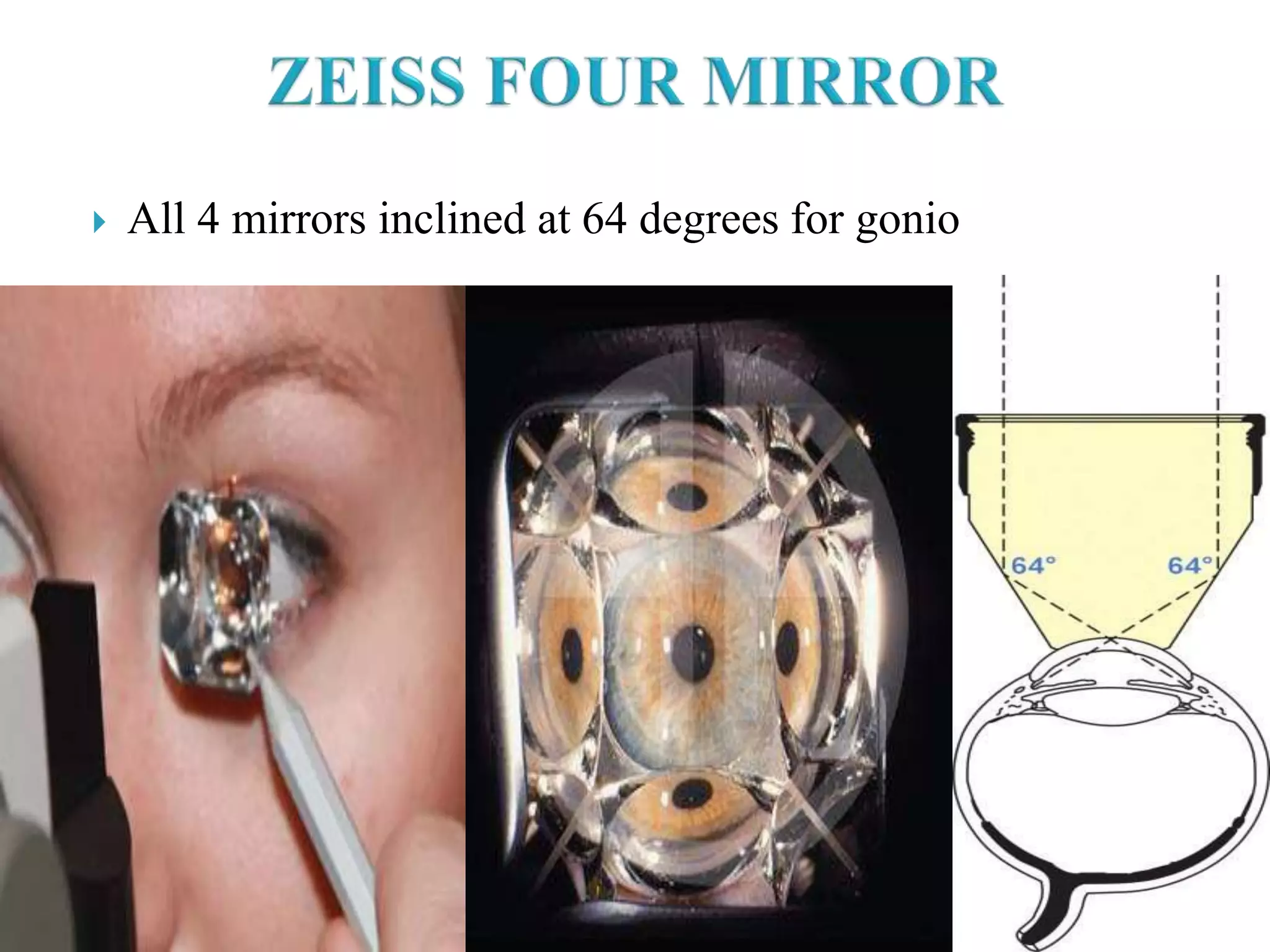
ZEISS FOUR MIRROR All 4 mirrors inclined at 64 degrees for
gonio;requires holder;fluid bridge not
required.
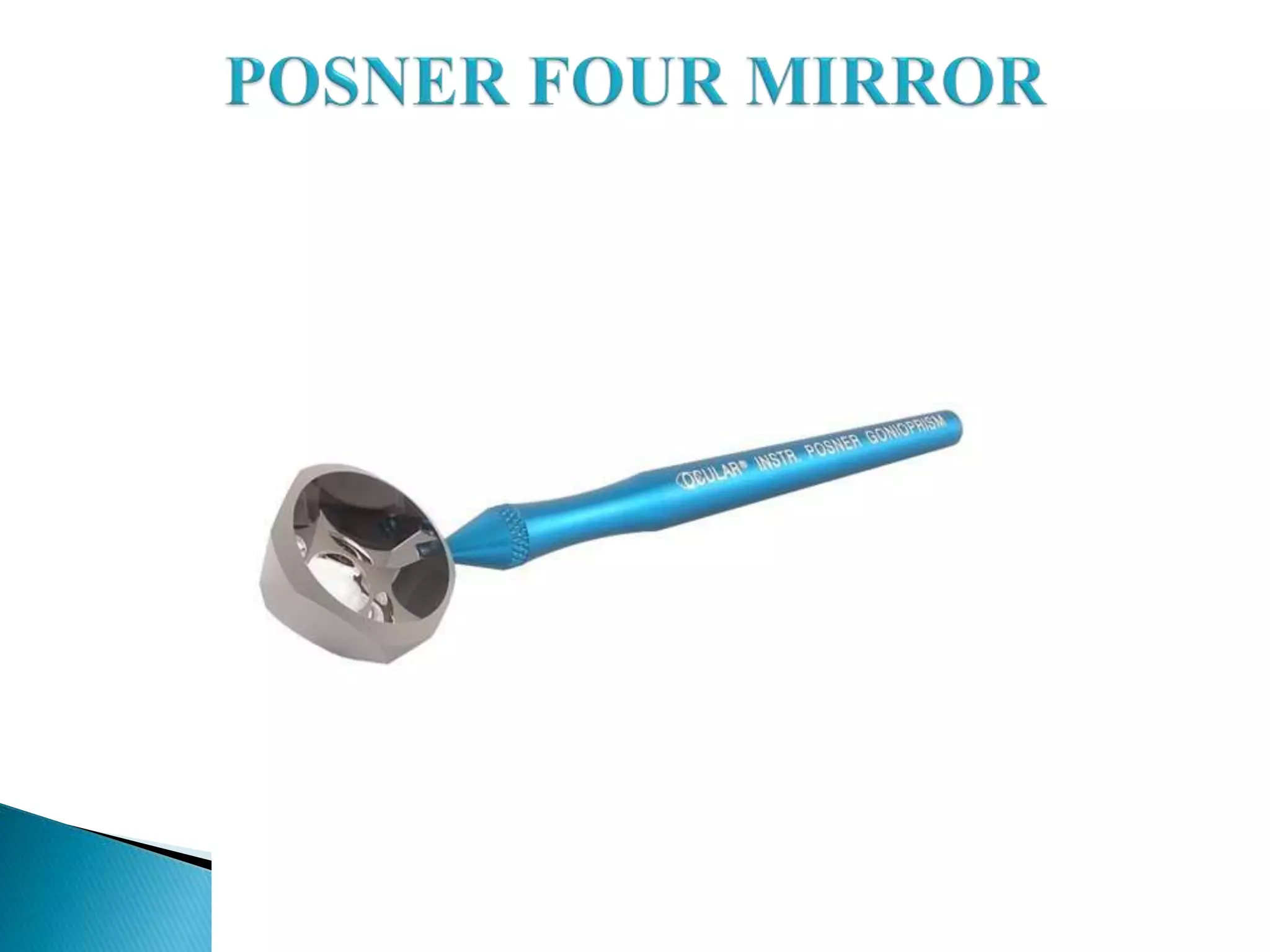
POSNER FOUR MIRROR Modified Zeiss four mirror gonioprism
with attached handle
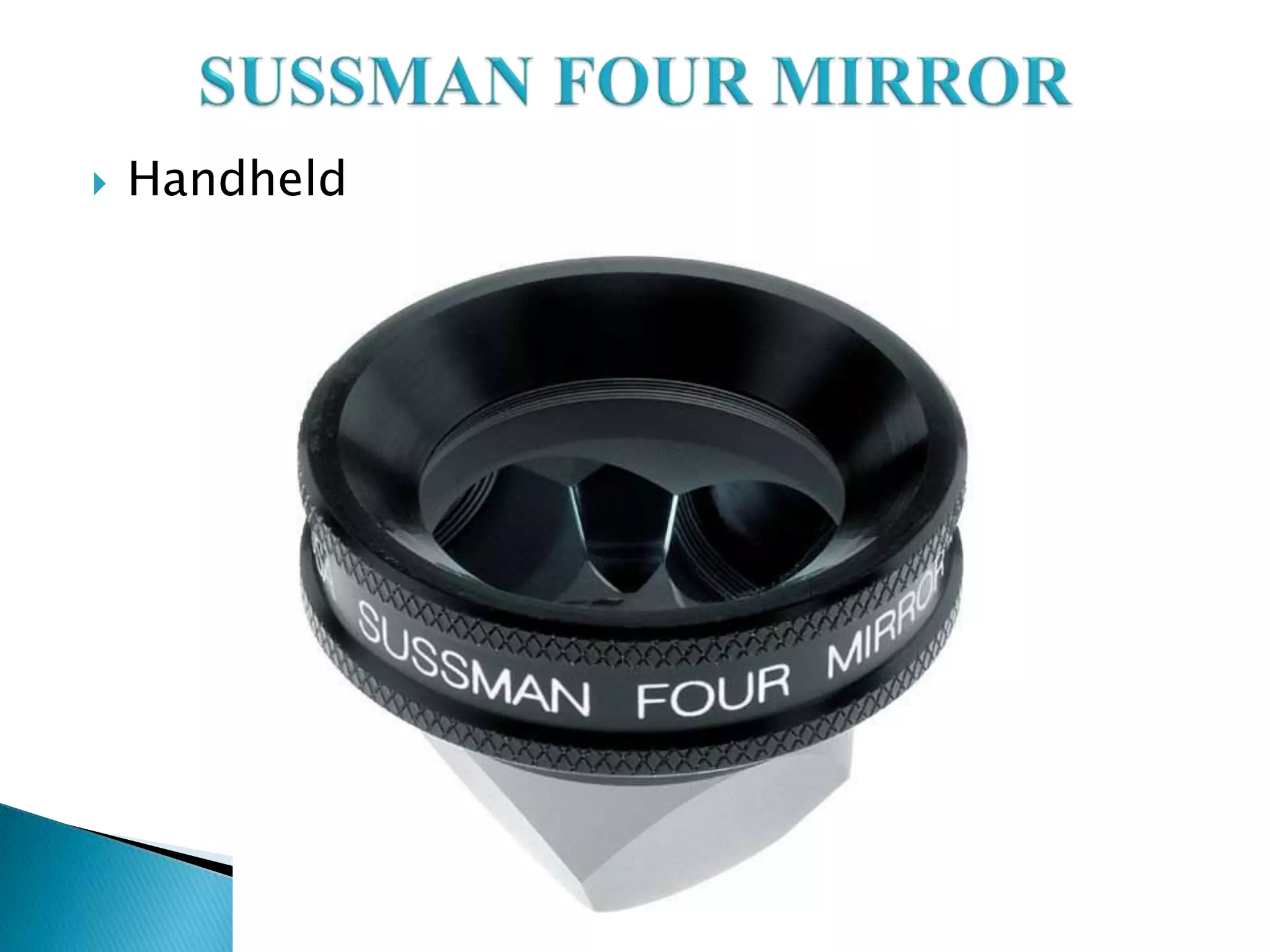
SUSSMAN FOUR MIRROR Handheld Zeiss type Gonioprism
THORPE FOUR MIRROR Four gonioscopy mirrors; inclined at 62
degrees;requires fluid bridge
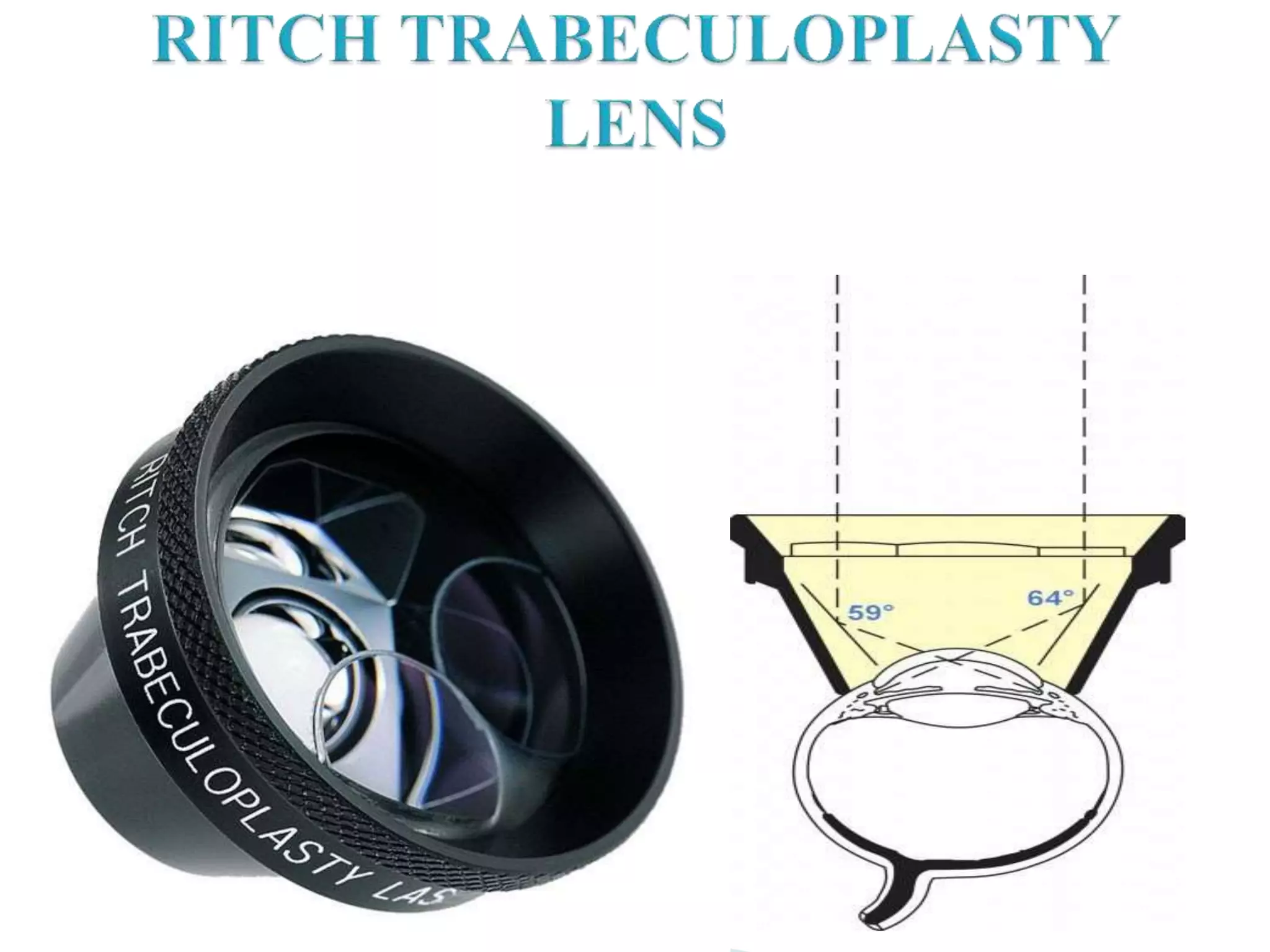
RITCH TRABECULOPLASTY
LENS
Four gonioscopy mirrors; two inclined at
59 degrees & two at 62 degrees with
convex lens over two
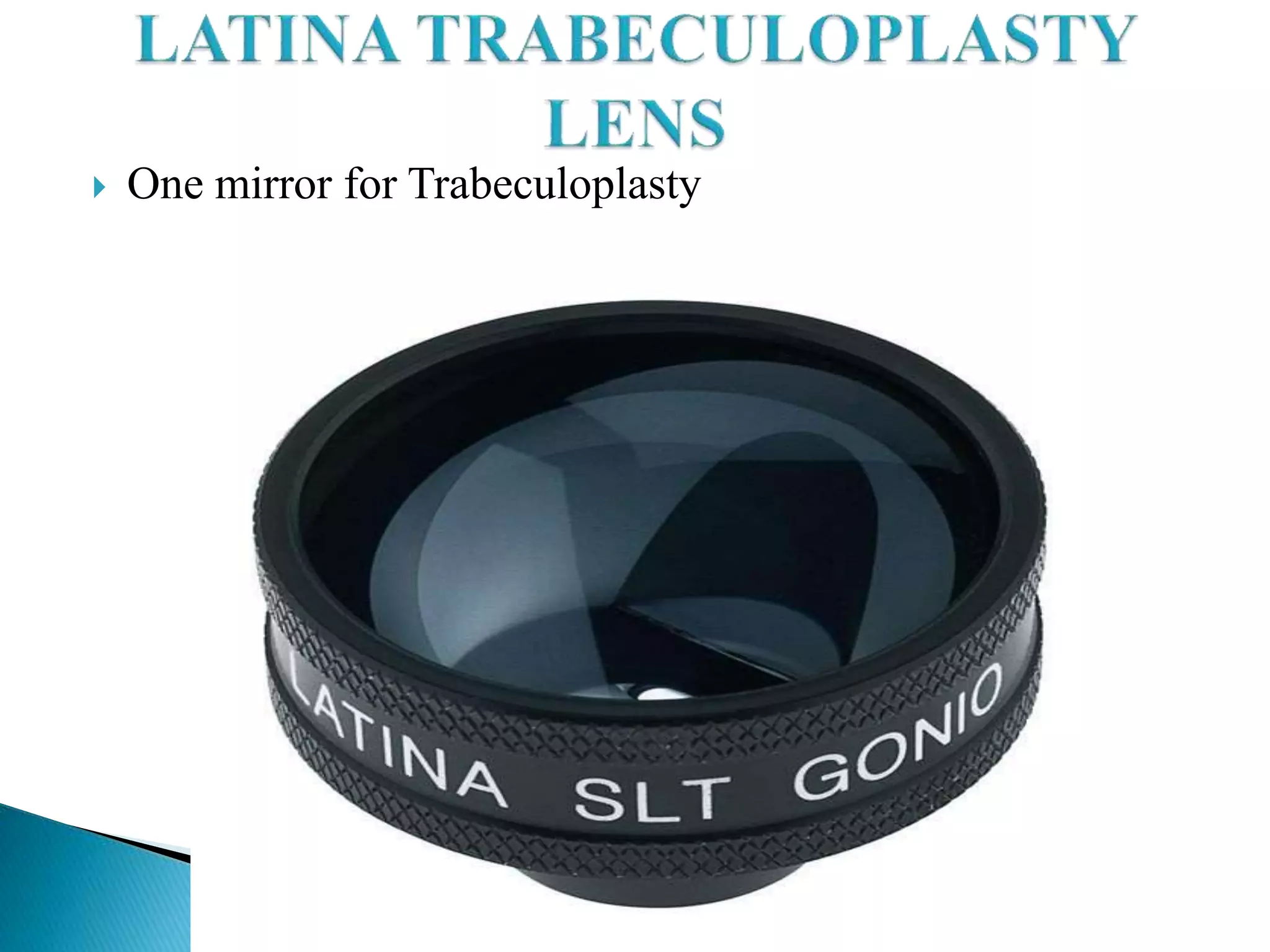
LATINA TRABECULOPLASTY
LENS
One mirror for Trabeculoplasty
 All 4 mirrors inclined at 64 degrees for gonio
 Handheld
 Four gonioscopy mirrors; inclined at 62 degrees;requires fluid
bridge
 One mirror for Trabeculoplasty
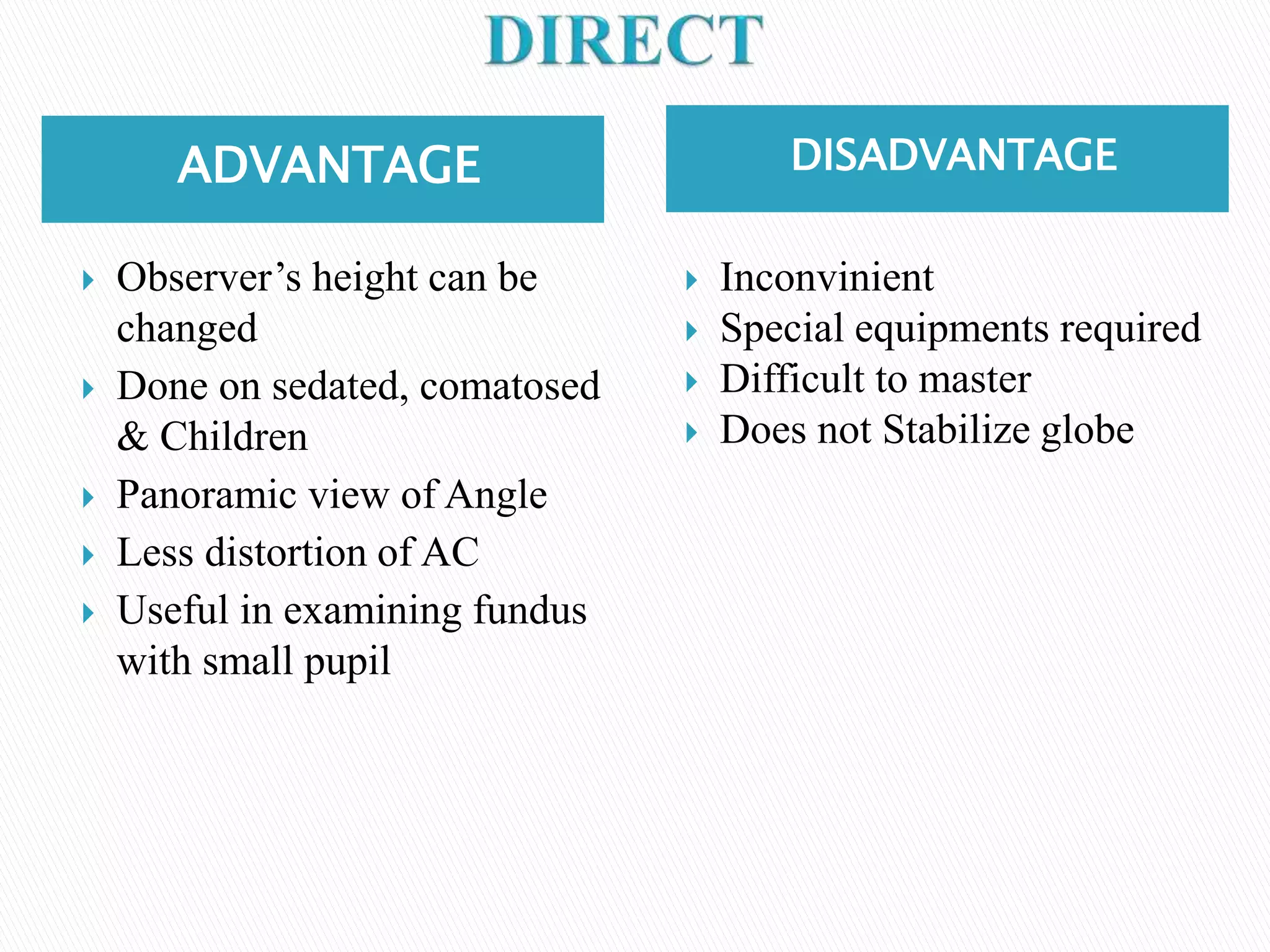
ADVANTAGE DISADVANTAGE
 Observer’s height can be
changed
 Done on sedated, comatosed
& Children
 Panoramic view of Angle
 Less distortion of AC
 Useful in examining fundus
with small pupil
 Inconvinient
 Special equipments required
 Difficult to master
 Does not Stabilize globe
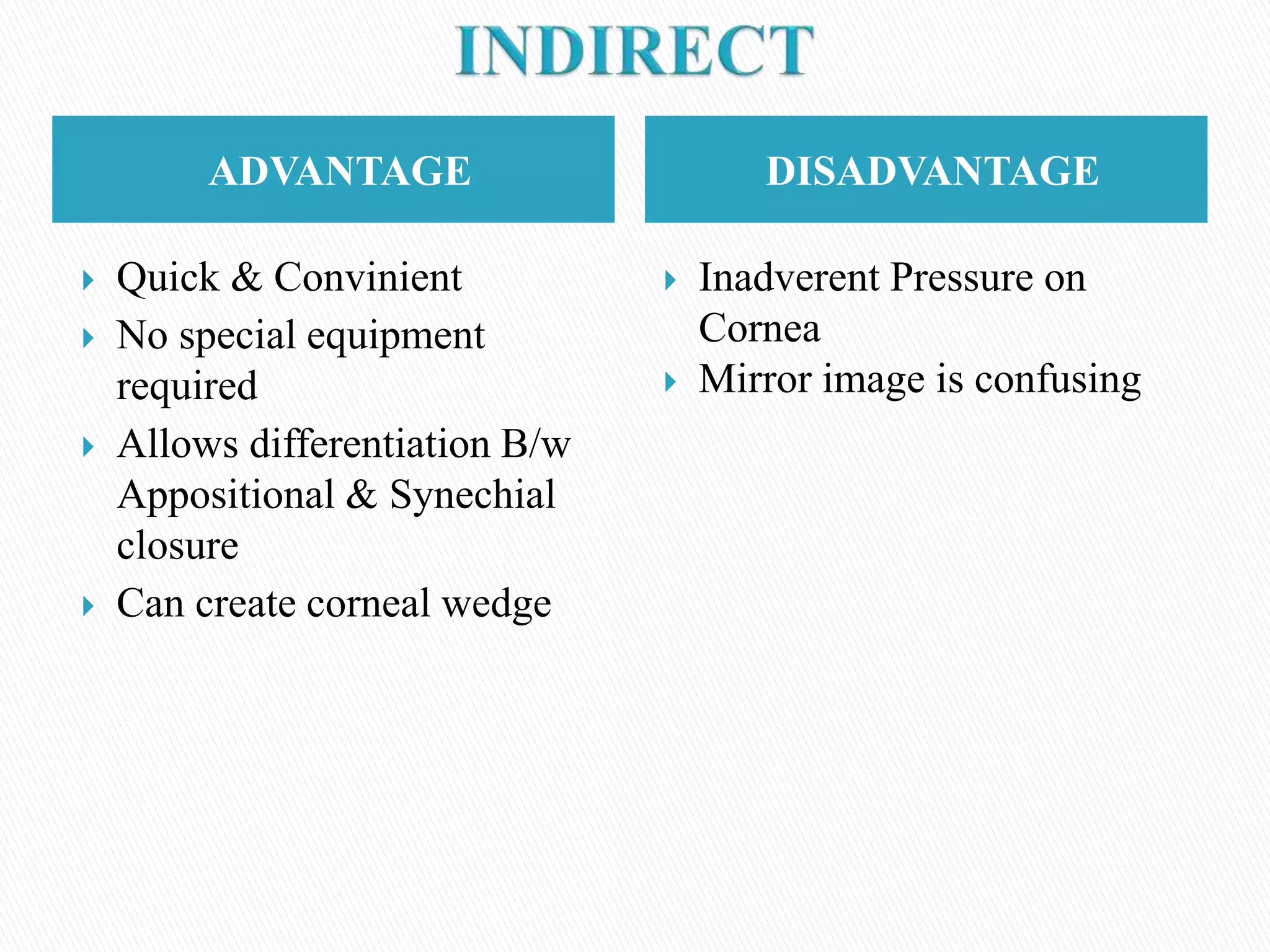
ADVANTAGE DISADVANTAGE
 Quick & Convinient
 No special equipment
required
 Allows differentiation B/w
Appositional & Synechial
closure
 Can create corneal wedge
 Inadverent Pressure on
Cornea
 Mirror image is confusing
DIRECT INDIRECT
 Panoramic view of
iridocorneal angle with
ability to adjust view by
examiner.
 Both eyes can be examined
simultaneously.
 No viscous [ coupling ]
material required.
 Direct view for surgery e.g.
Goniotomy
 DISADV: Inability to
perform indentation, low
magnification, assistance.
 Segmental View
 One Eye at a time
 Viscous required
 Mirror Image seen
 Excellent optics with Slit
Lamp
 Indentation Can be Done
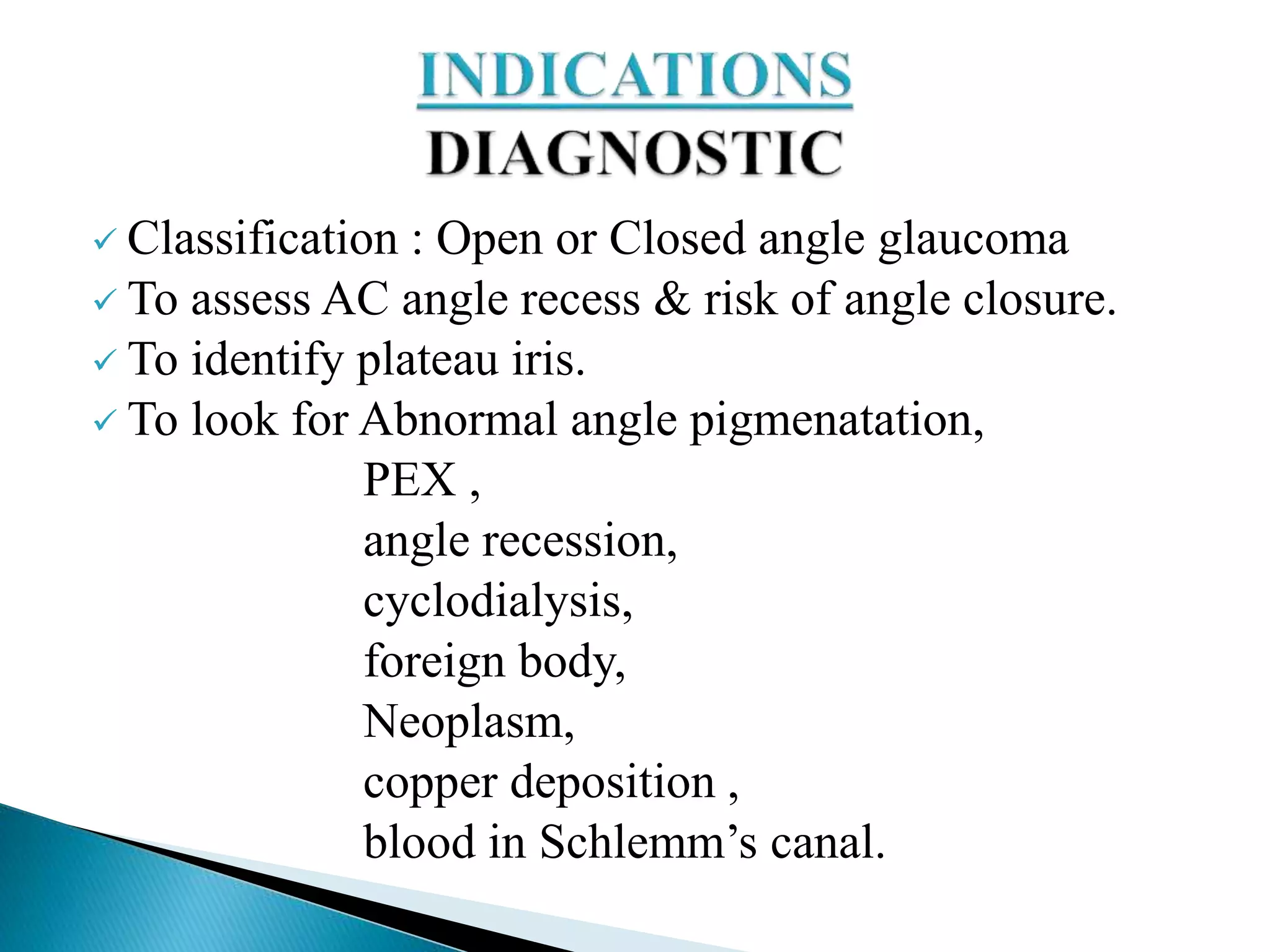
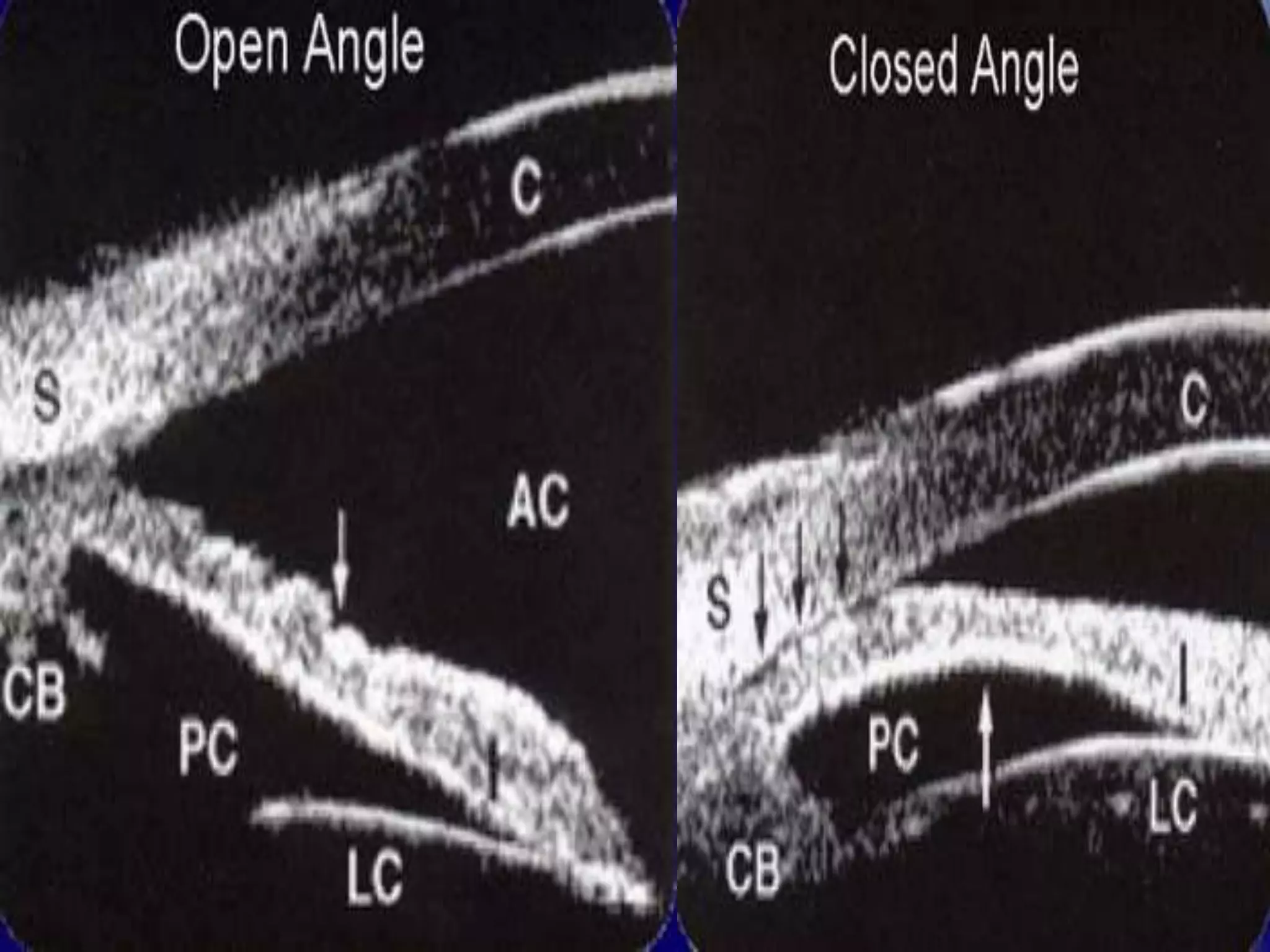
 Classification : Open or Closed angle glaucoma
 To assess AC angle recess & risk of angle closure.
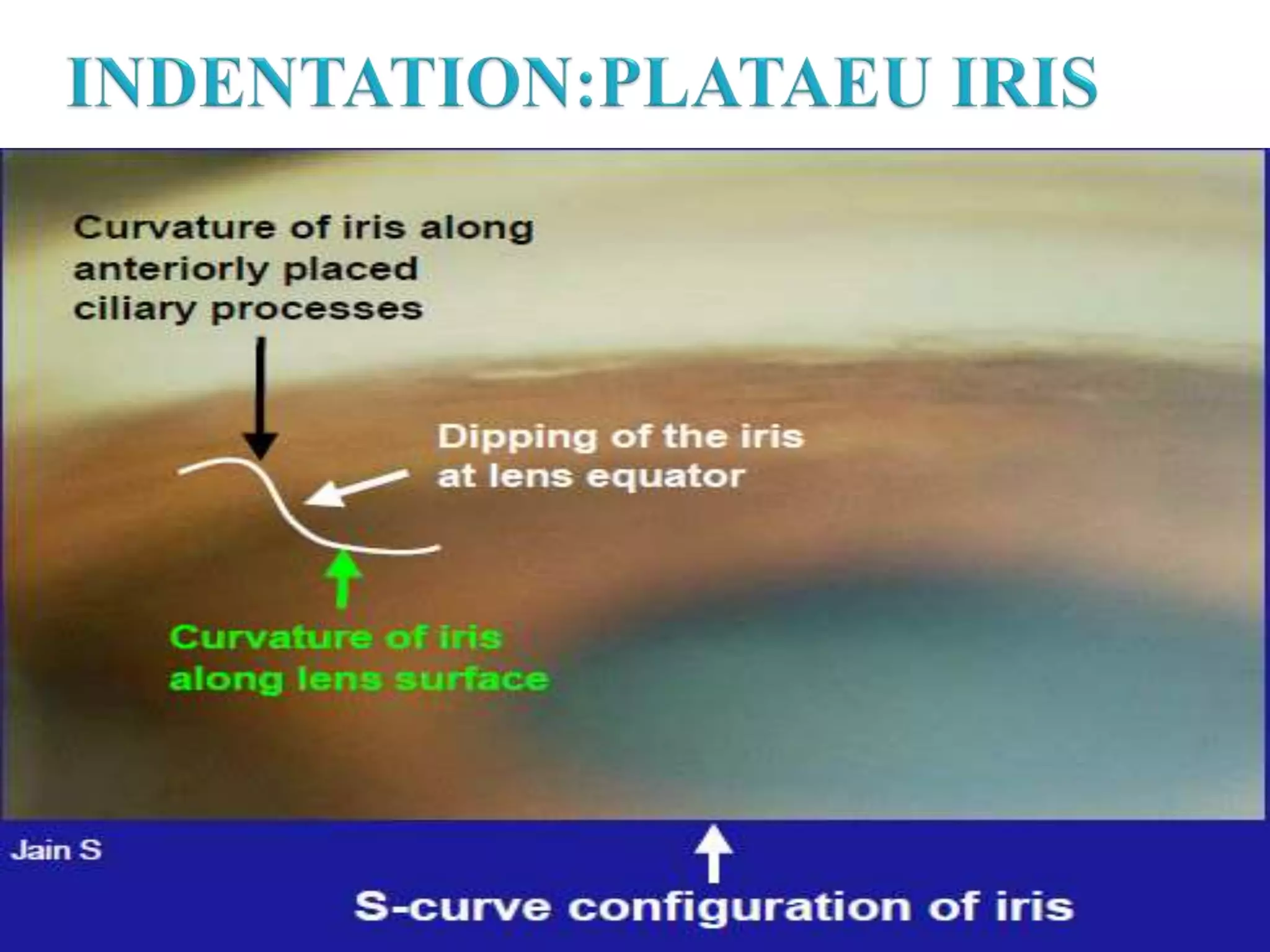
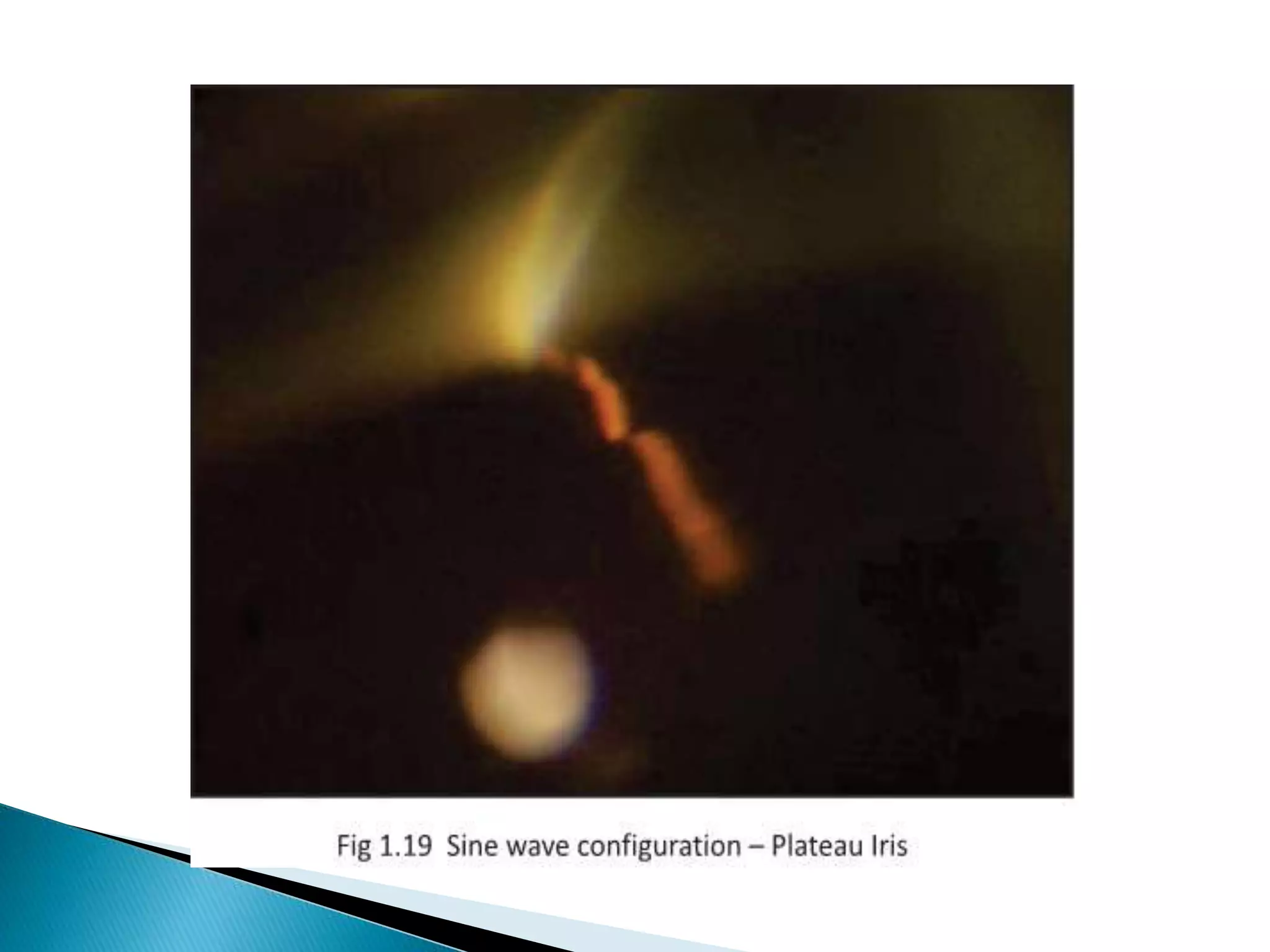
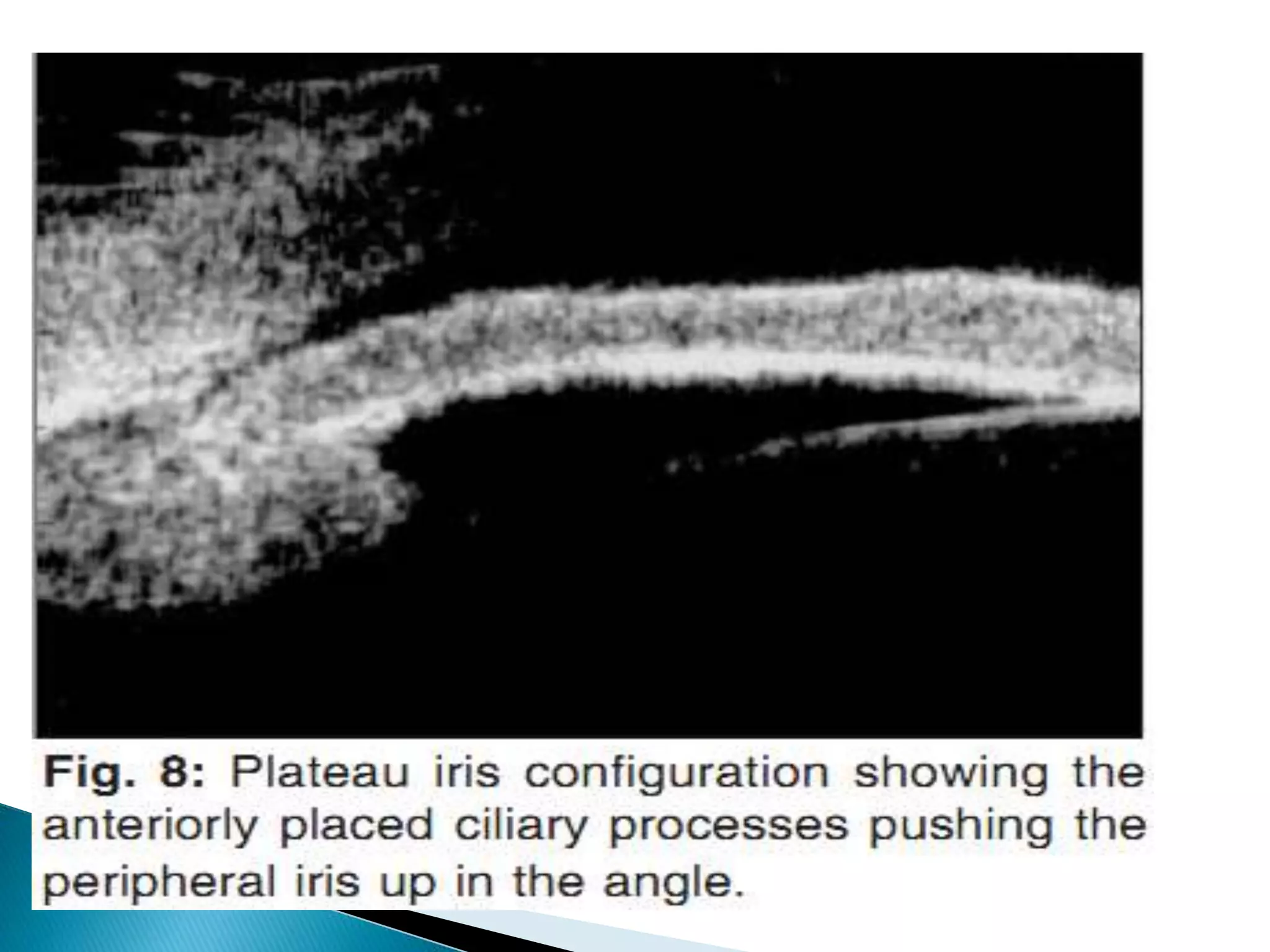
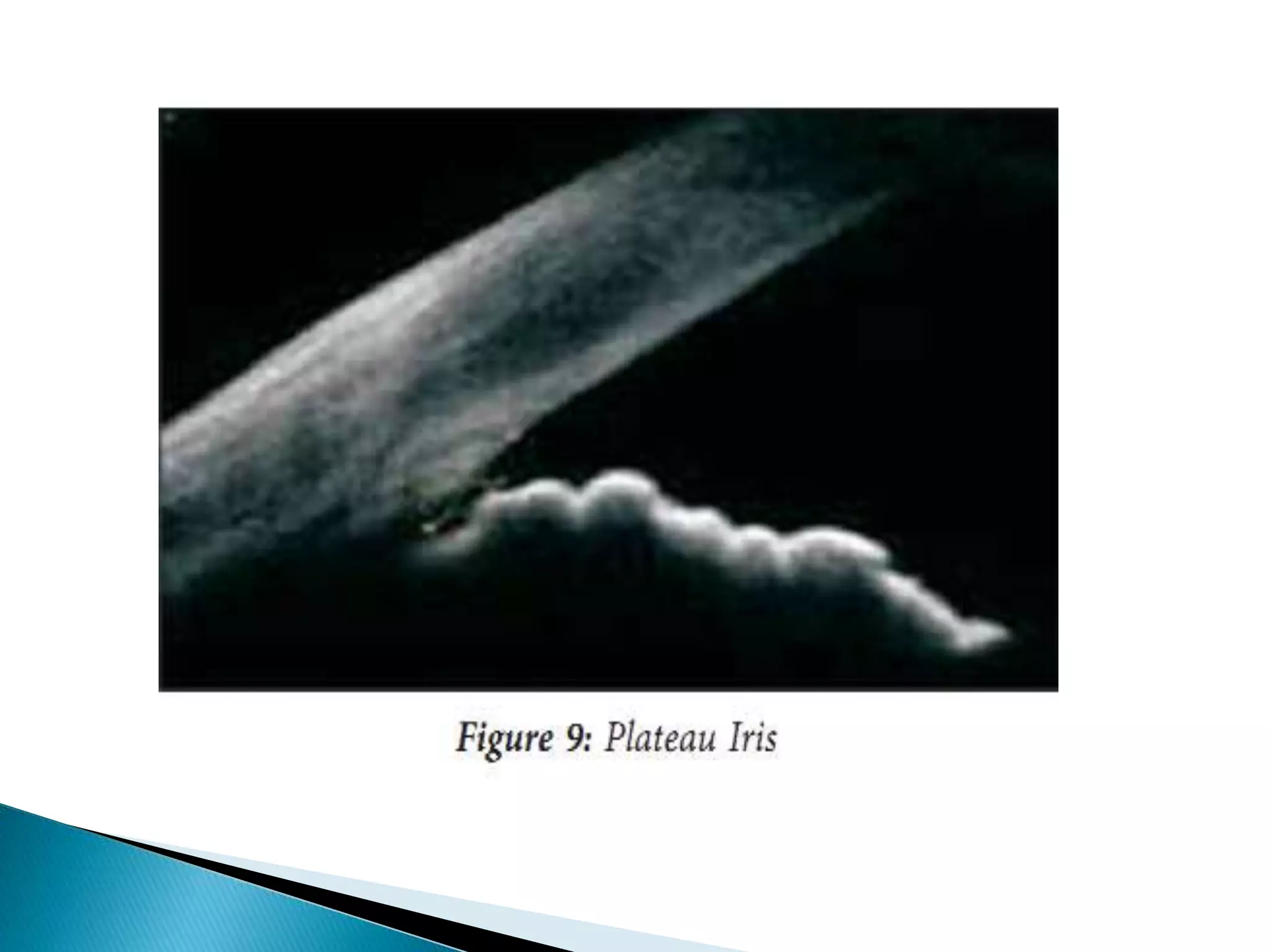
 To identify plateau iris.
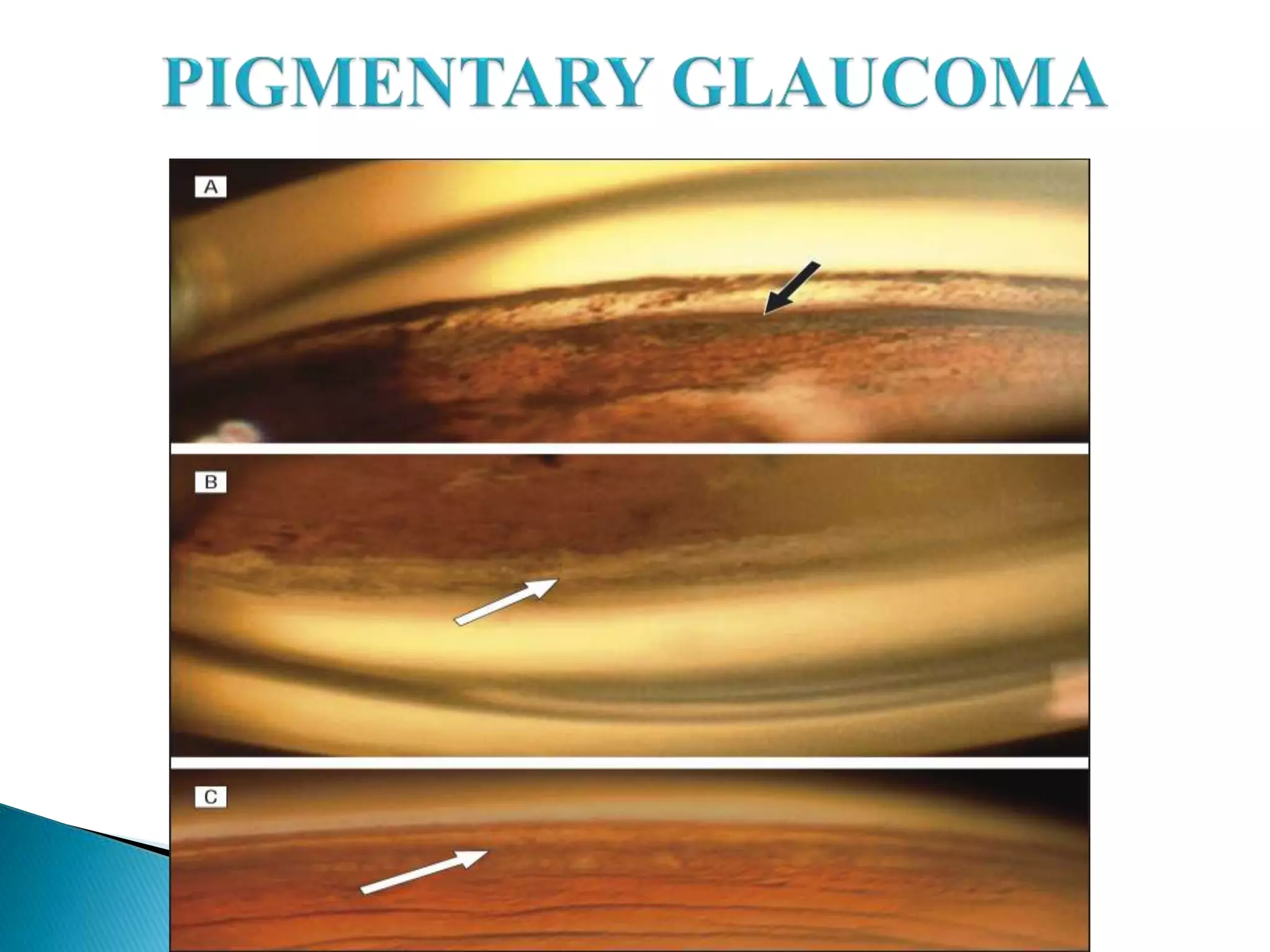
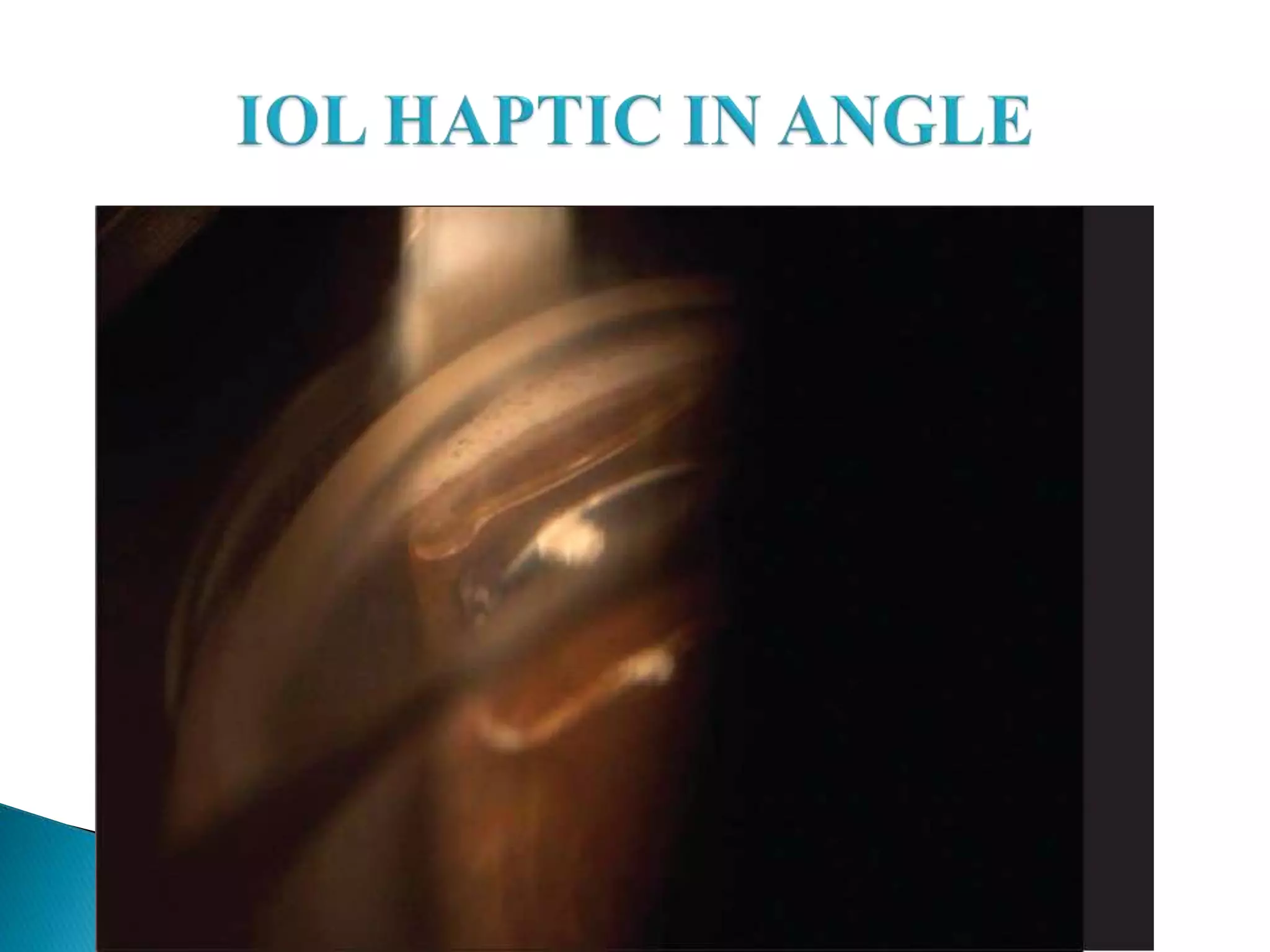
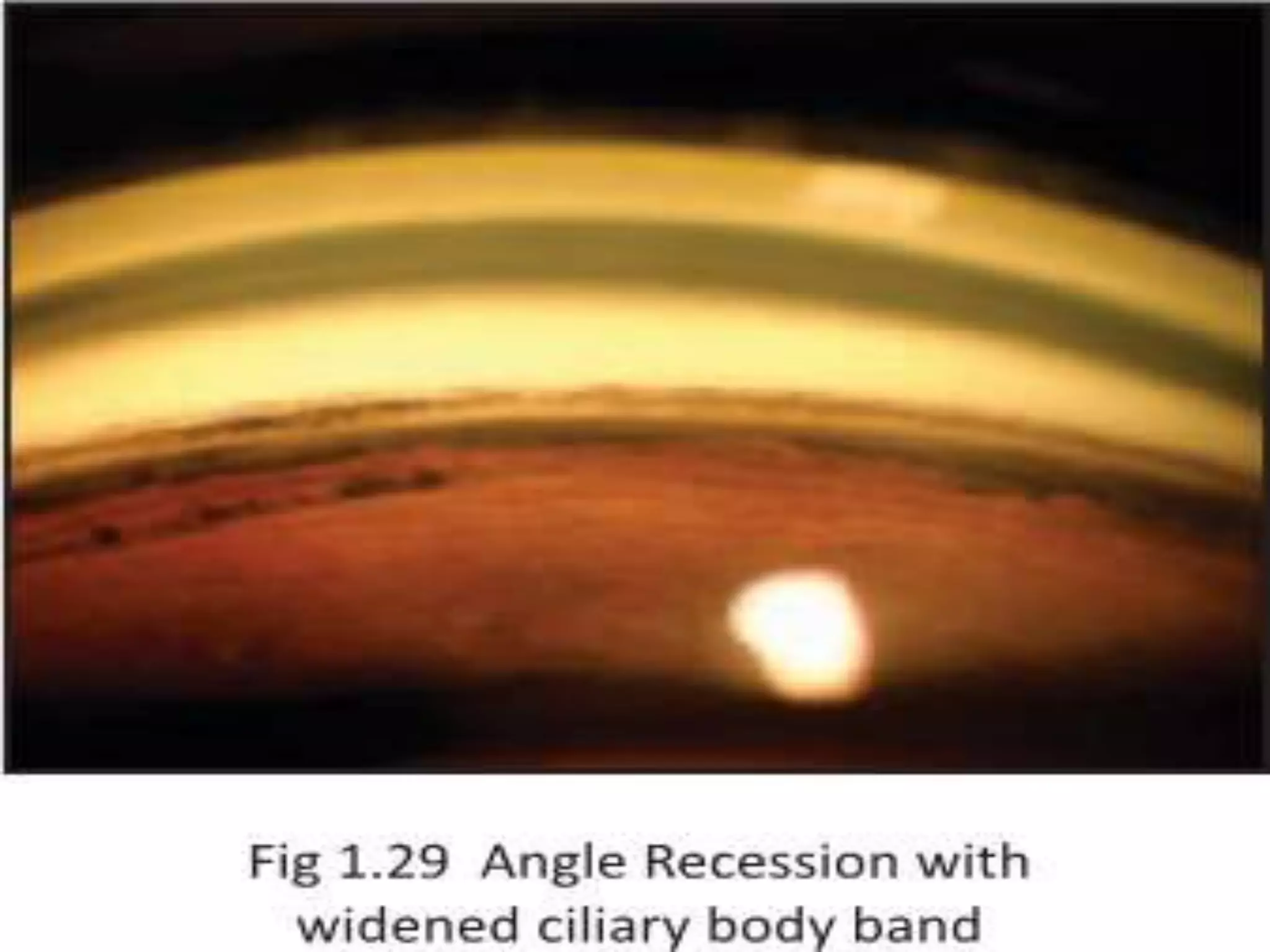
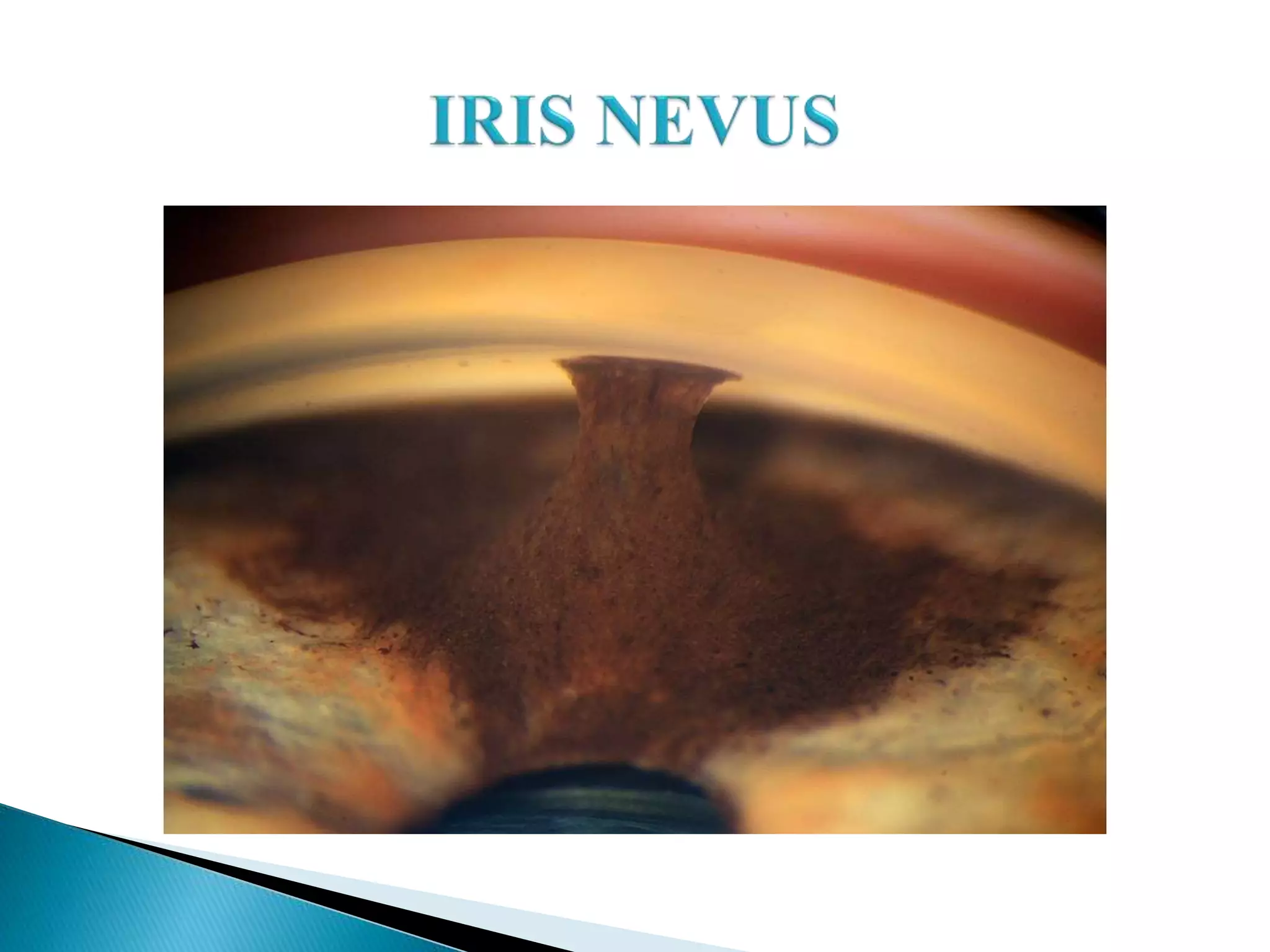
 To look for Abnormal angle pigmenatation,
PEX ,
angle recession,
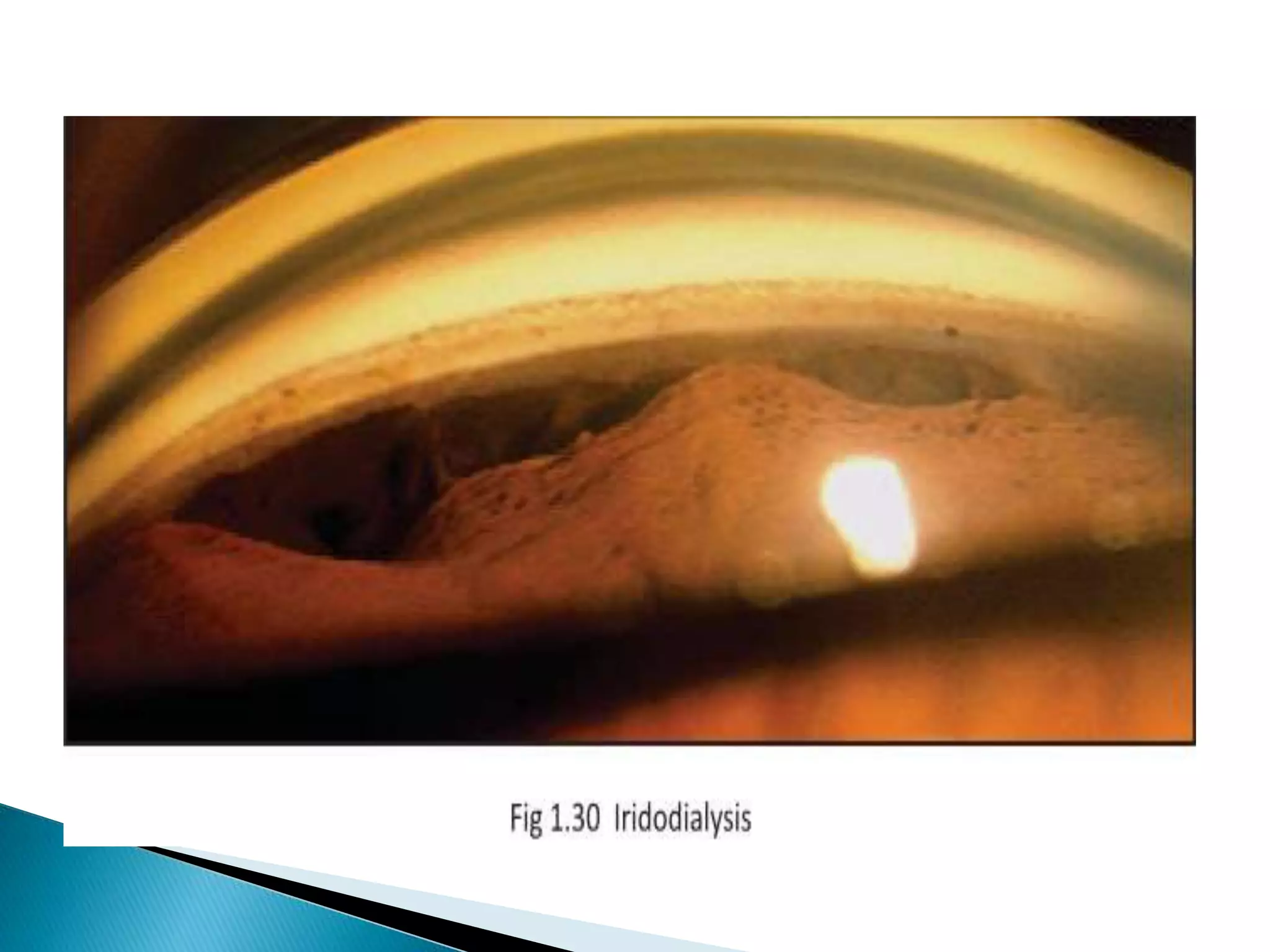
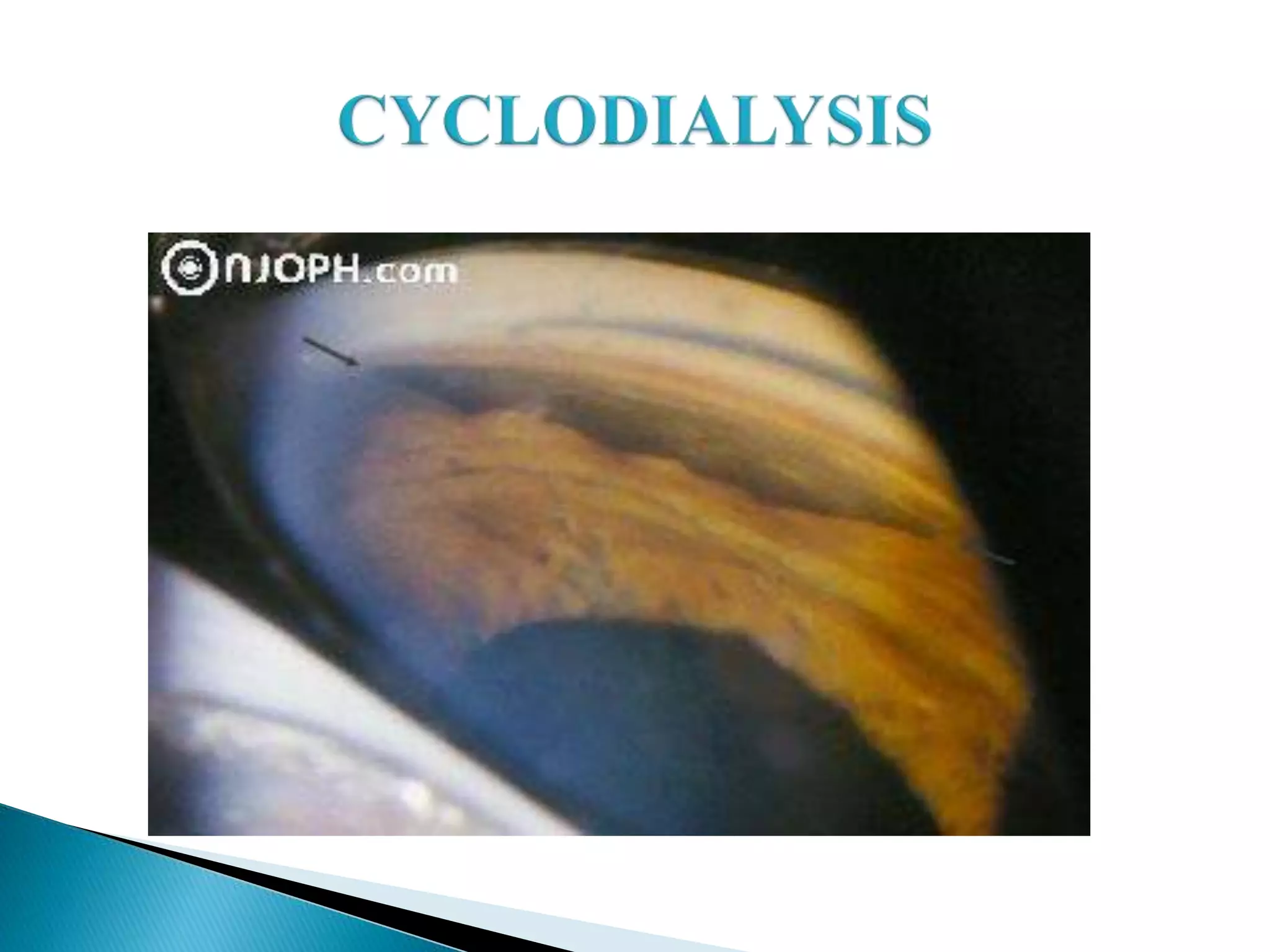
cyclodialysis,
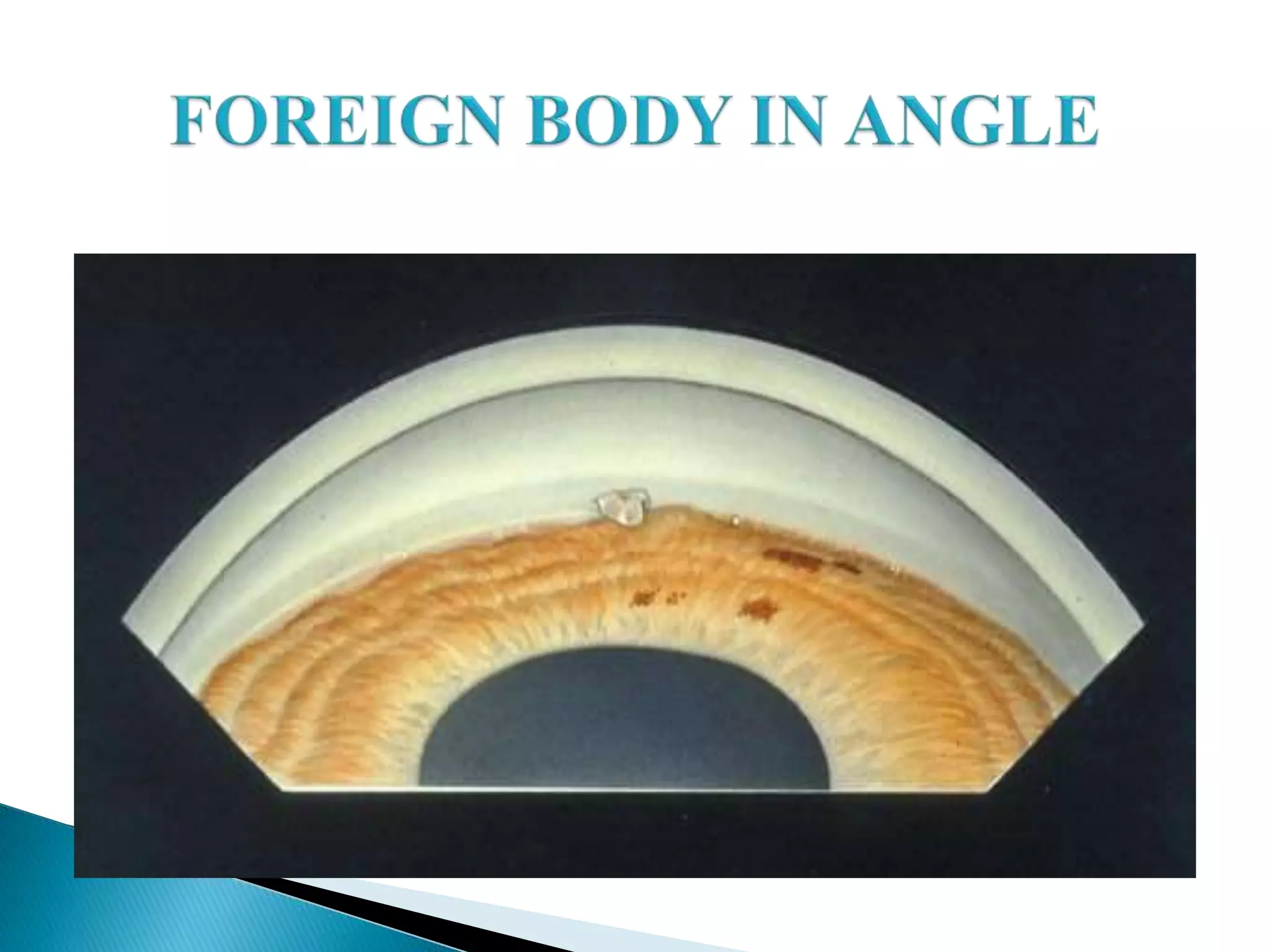
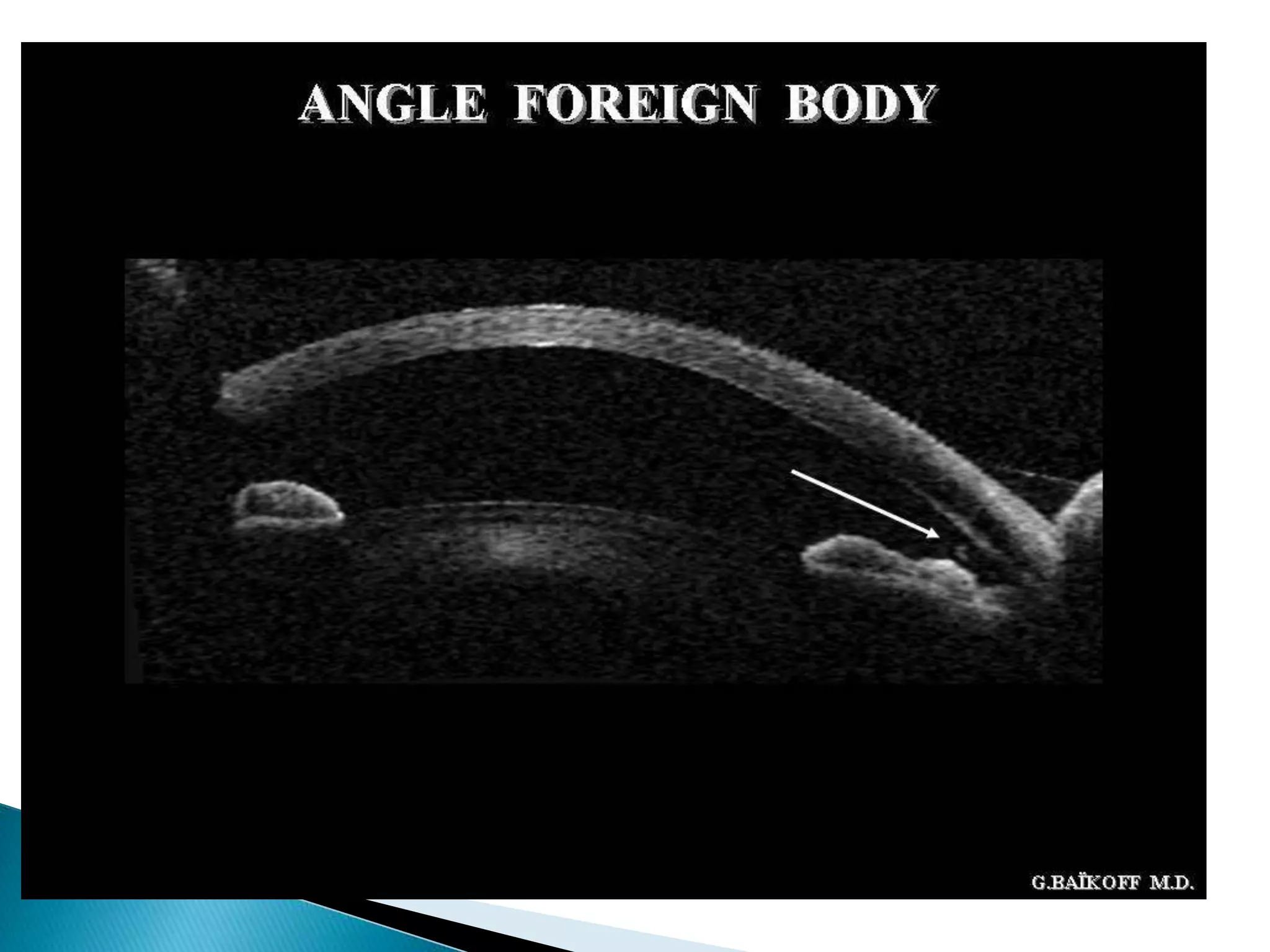
foreign body,
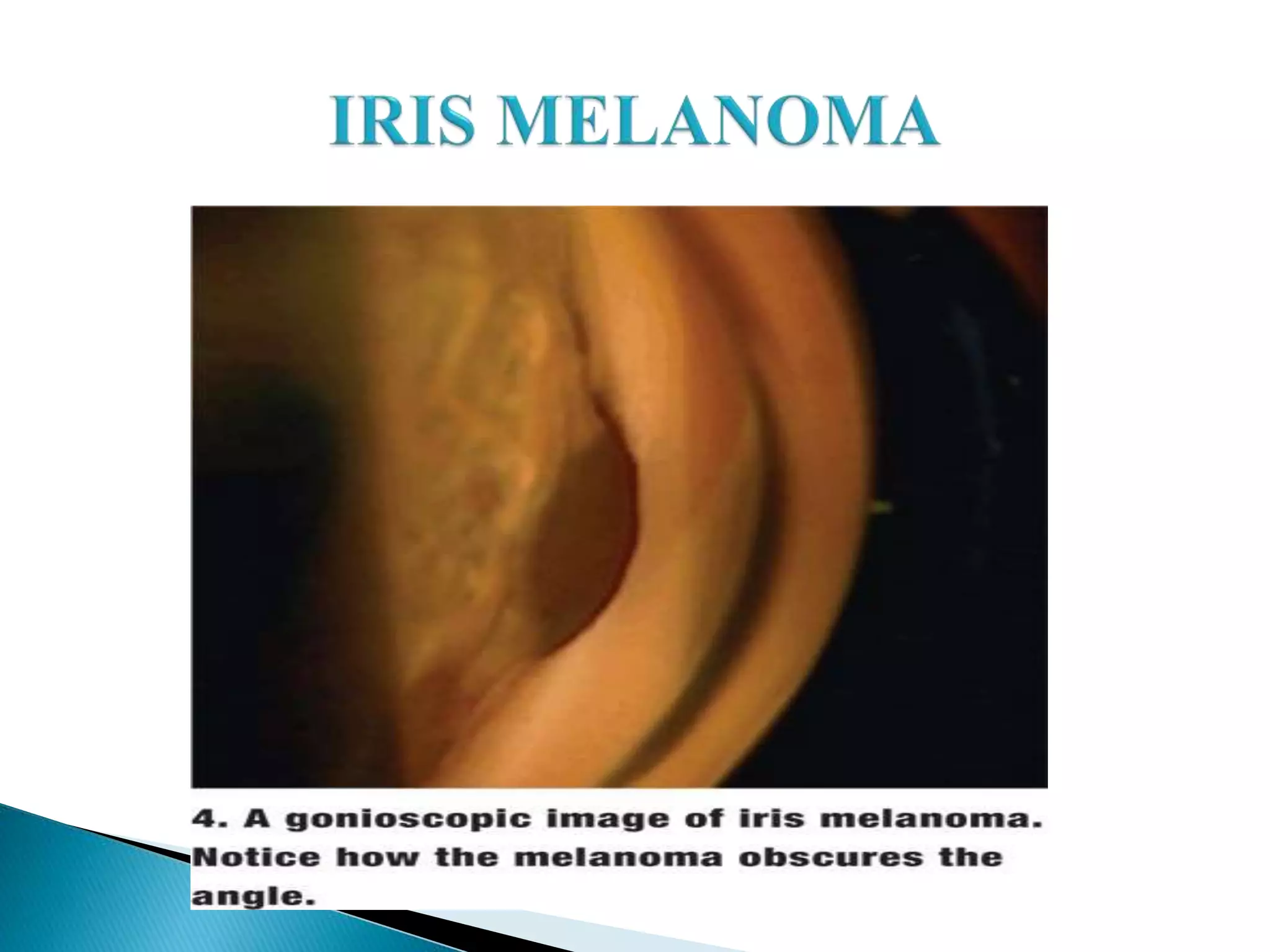
Neoplasm,
copper deposition ,
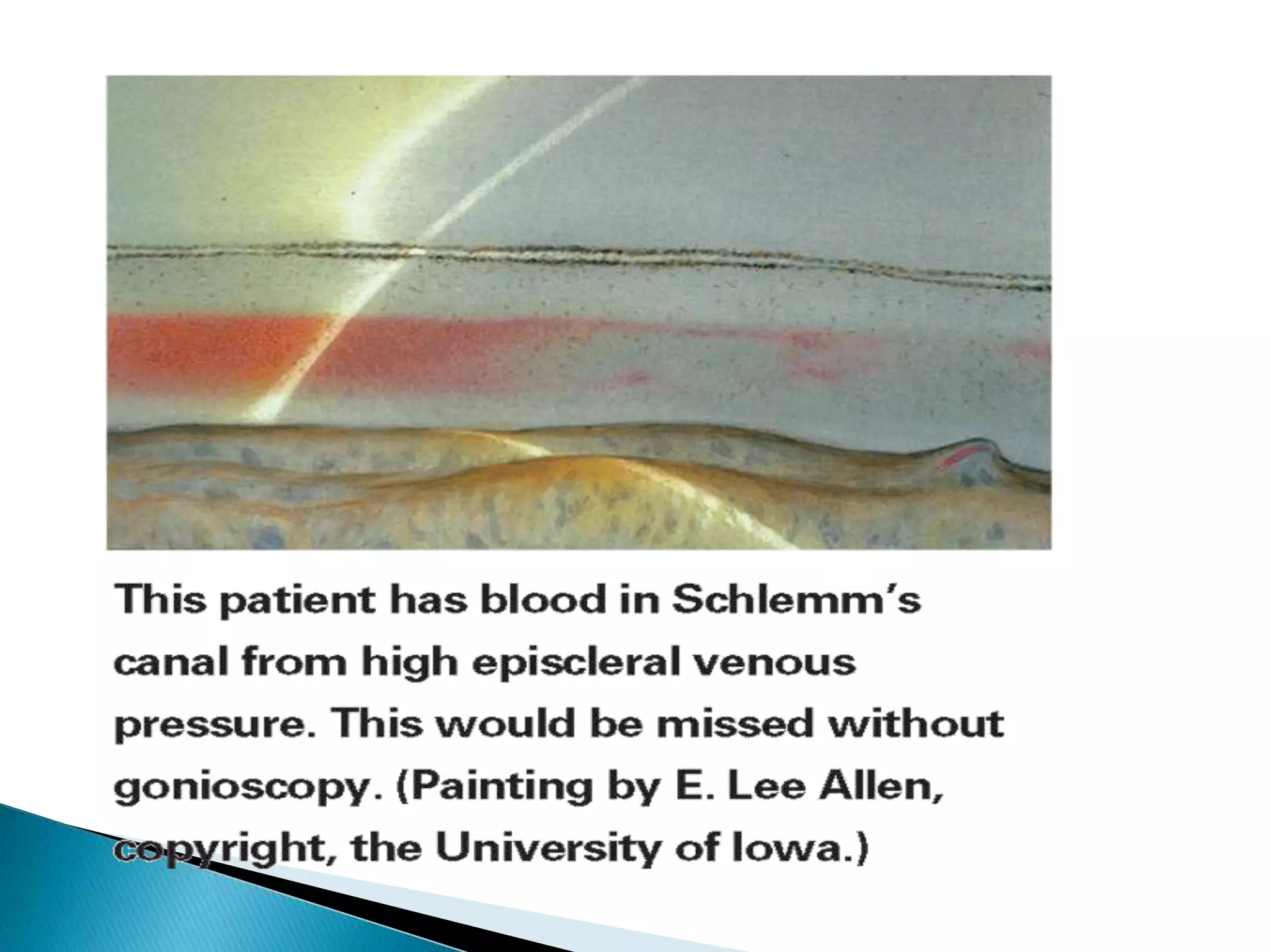
blood in Schlemm’s canal.
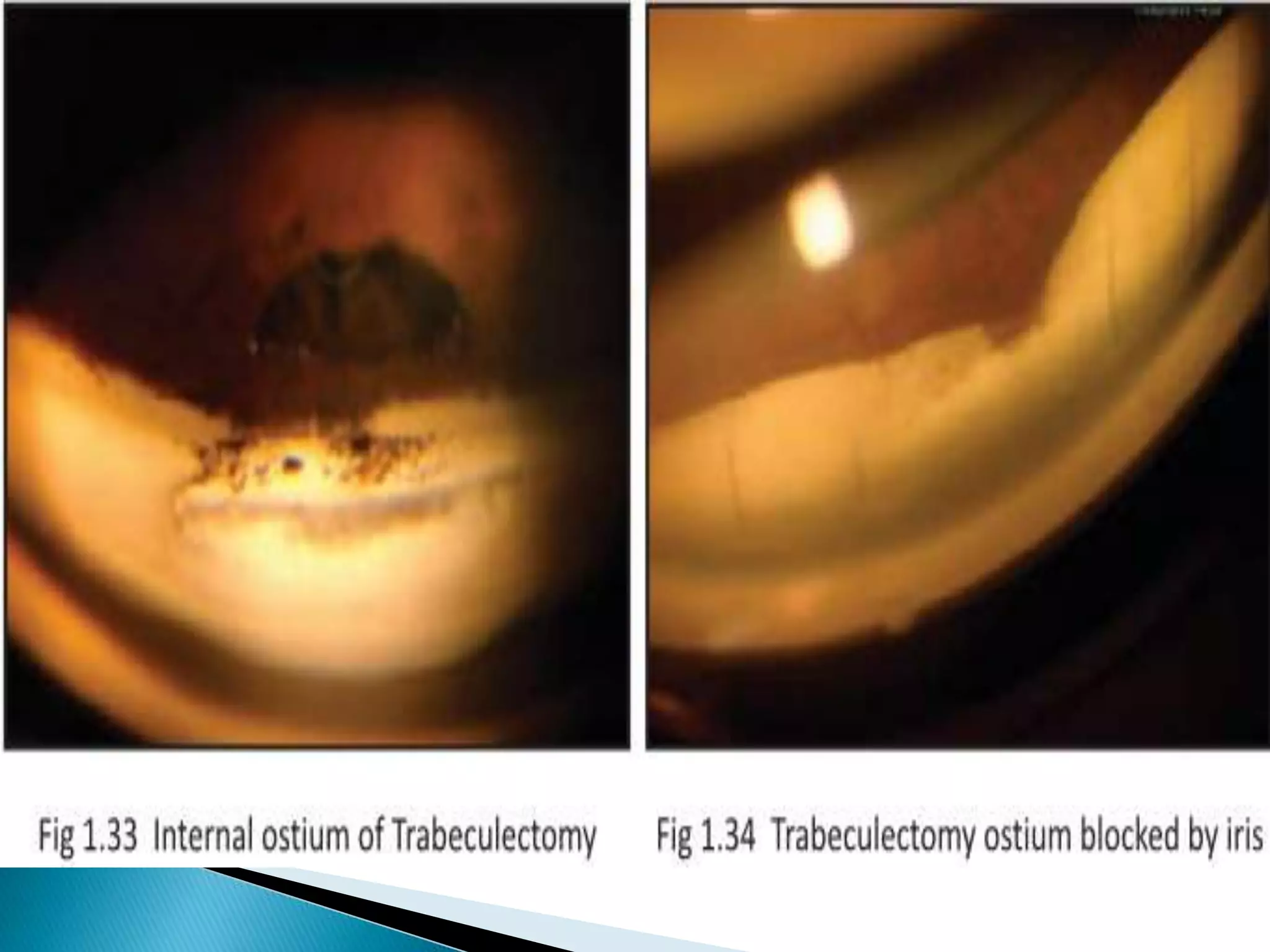
Evaluation of trabeculectomy fistula ,
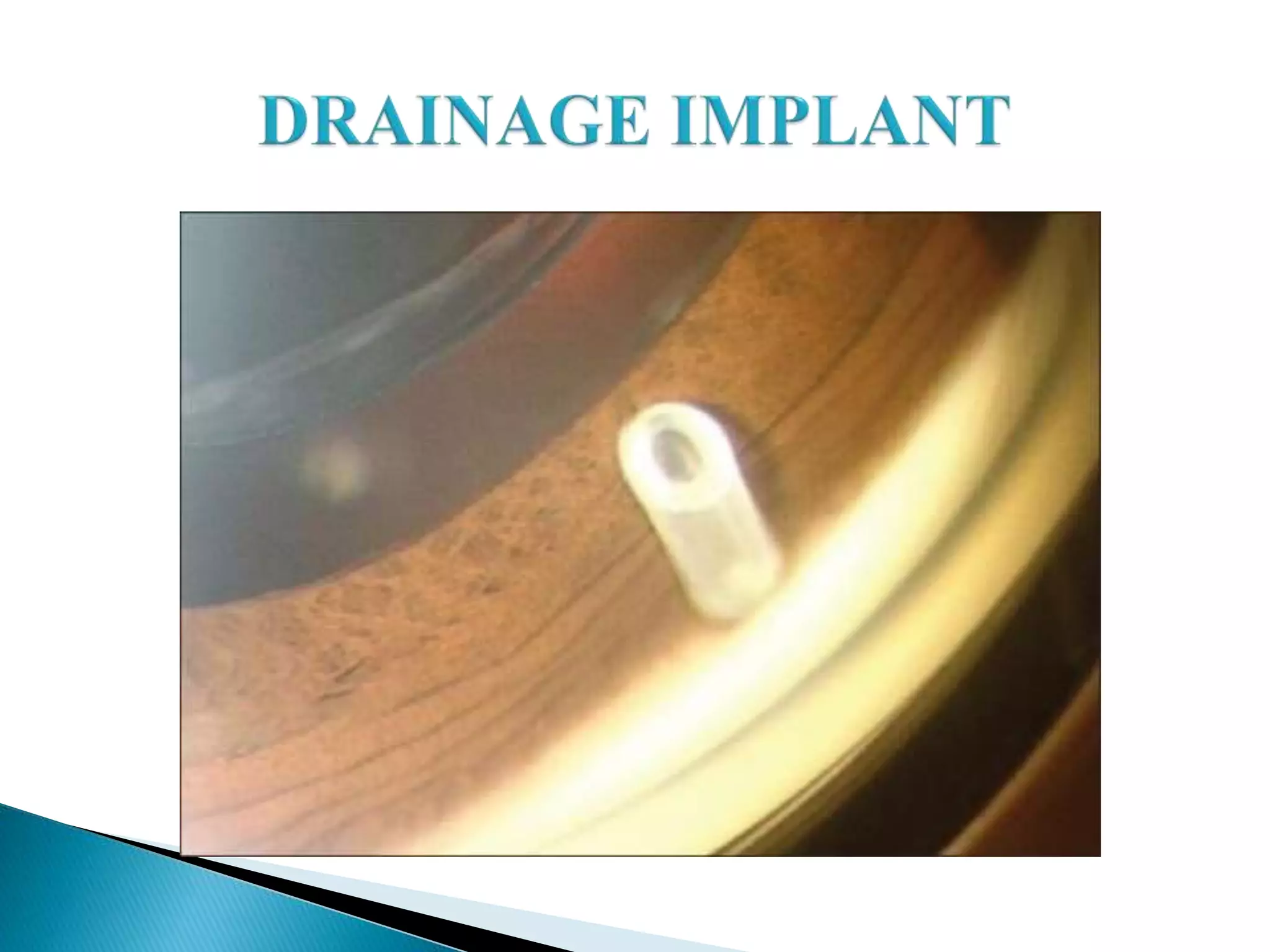
glaucoma drainage devices
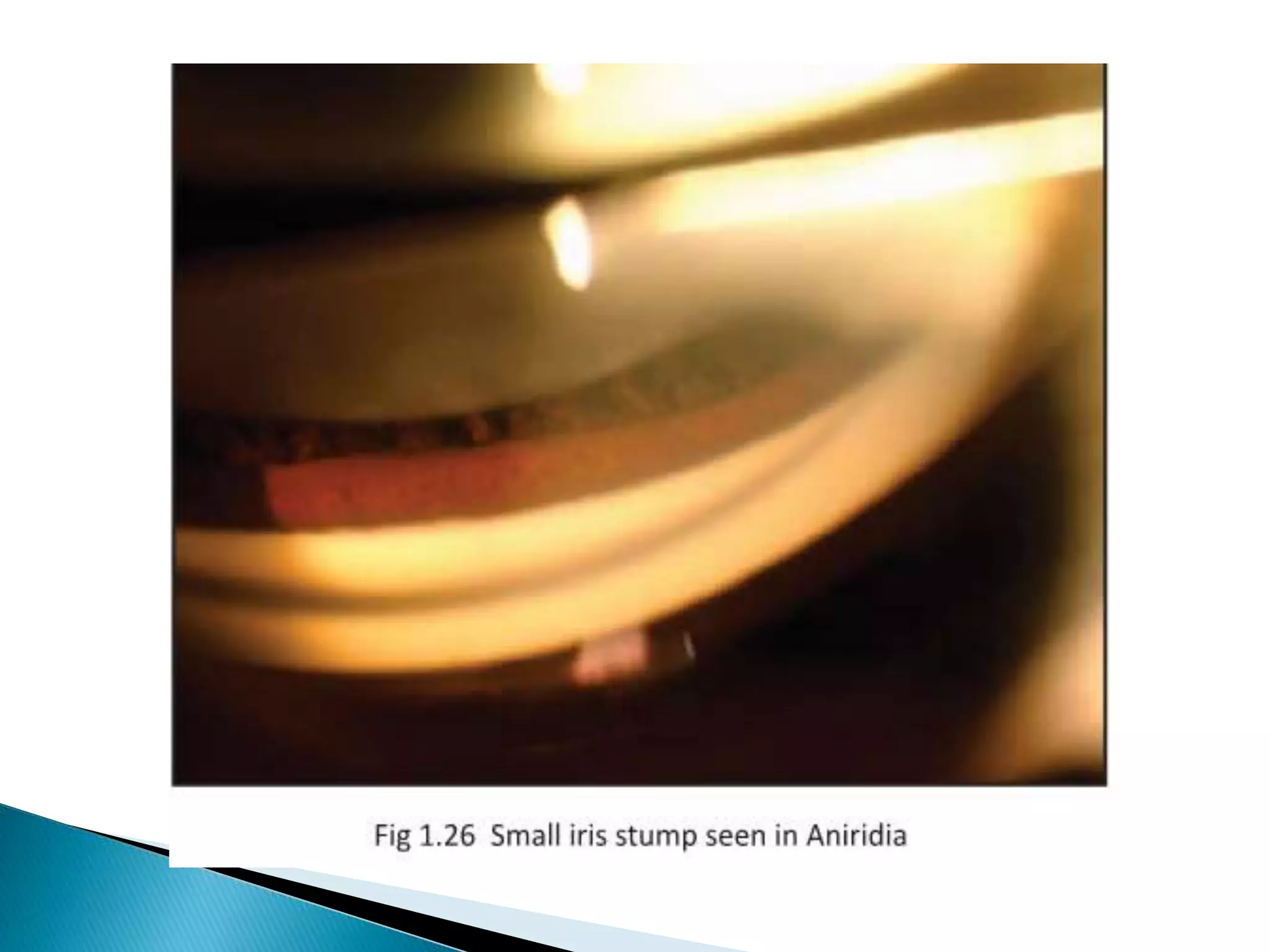
Congenital anomalies- aniridia, iris processes.
Laser trabeculosplasty/
goniophtocoagulation
Goniotomy/ Gonioplasty/ Trabectome sx
Reopening of blocked trabeculectomy
opening.
Laser of suture around tube of G.D.D.
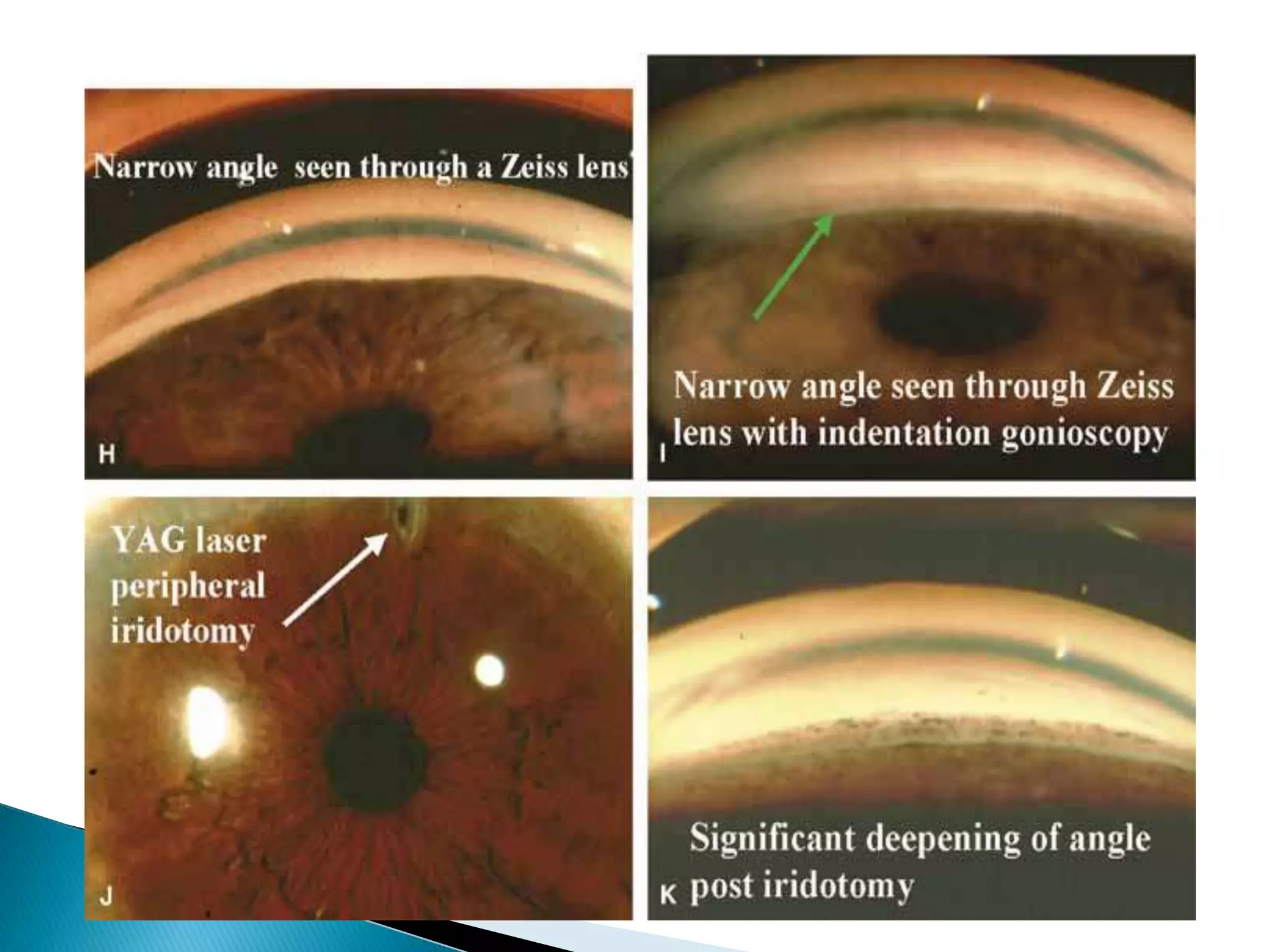
Indentaion Gonioscopy to break an attack
of Ac. ACG
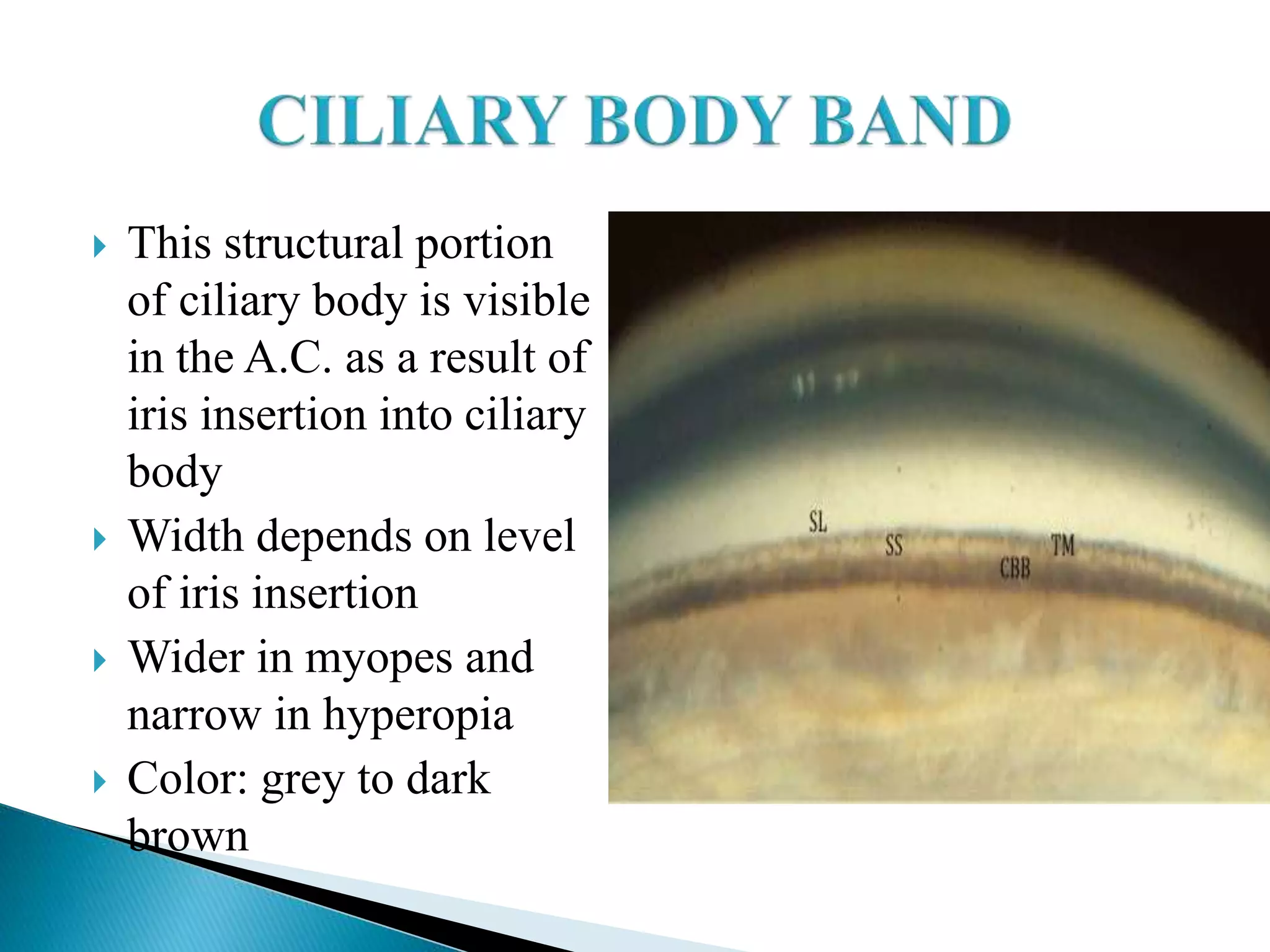
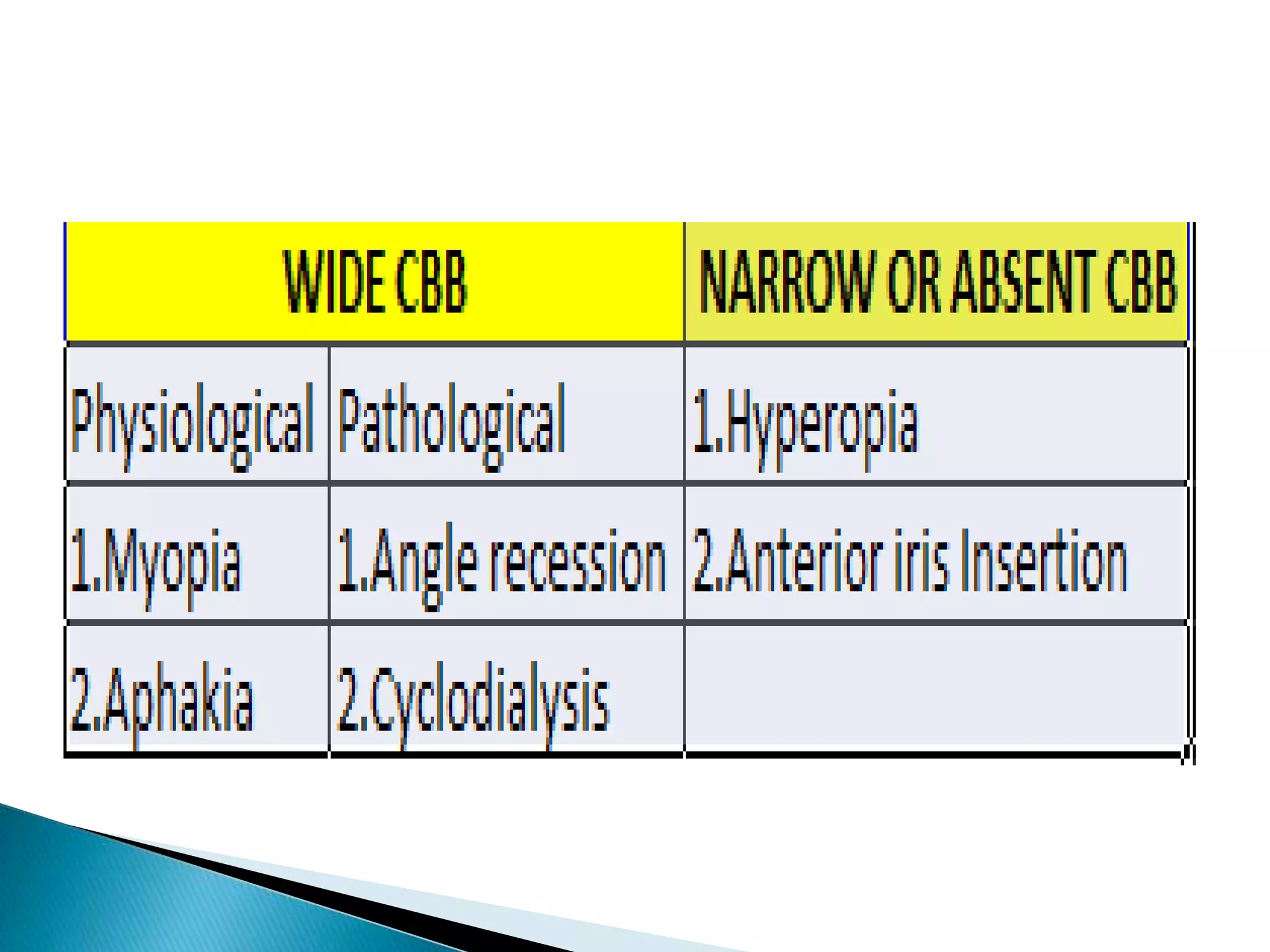
 This structural portion
of ciliary body is visible
in the A.C. as a result of
iris insertion into ciliary
body
 Width depends on level
of iris insertion
 Wider in myopes and
narrow in hyperopia
 Color: grey to dark
brown
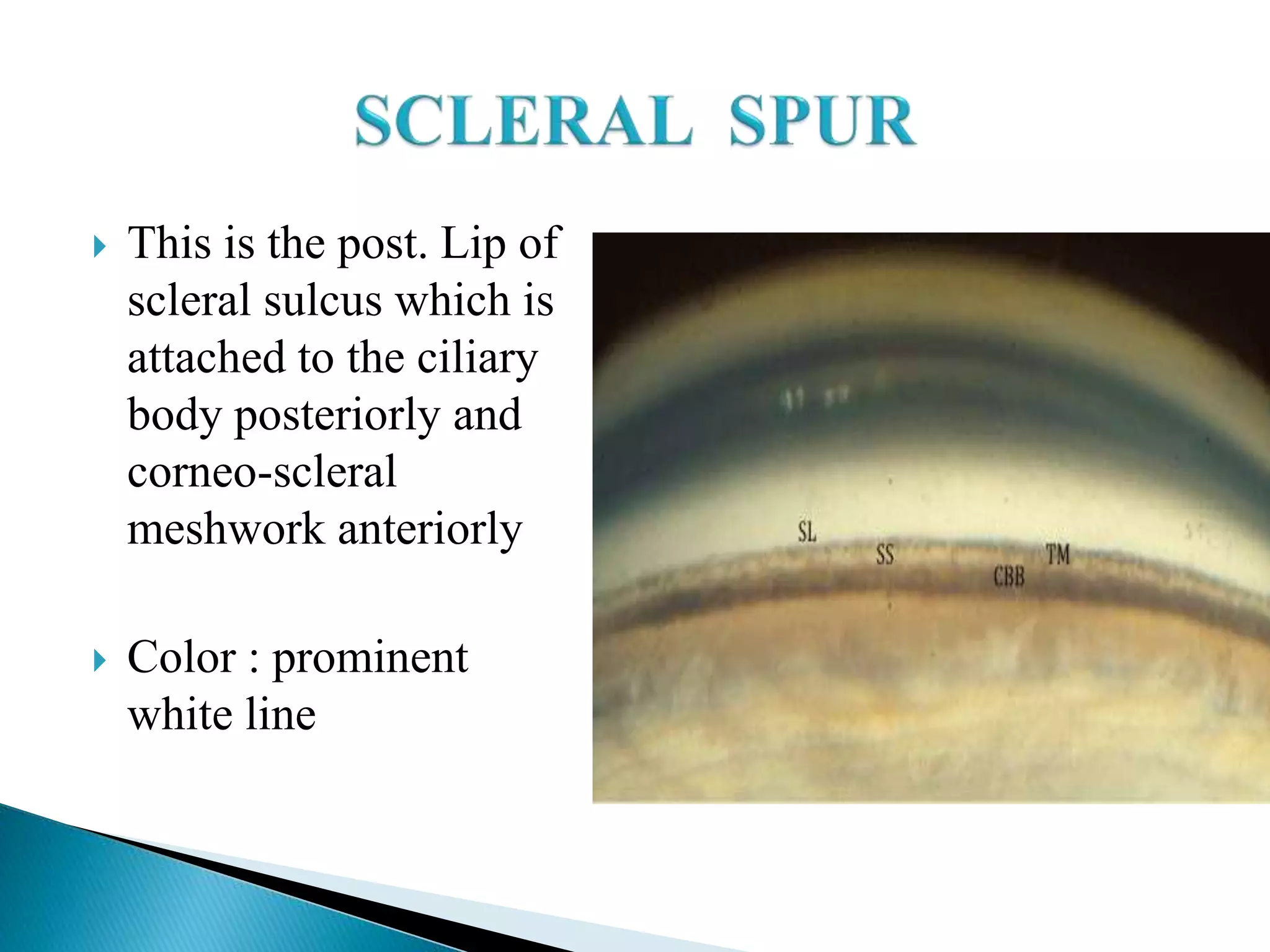
 This is the post. Lip of
scleral sulcus which is
attached to the ciliary
body posteriorly and
corneo-scleral
meshwork anteriorly
 Color : prominent
white line
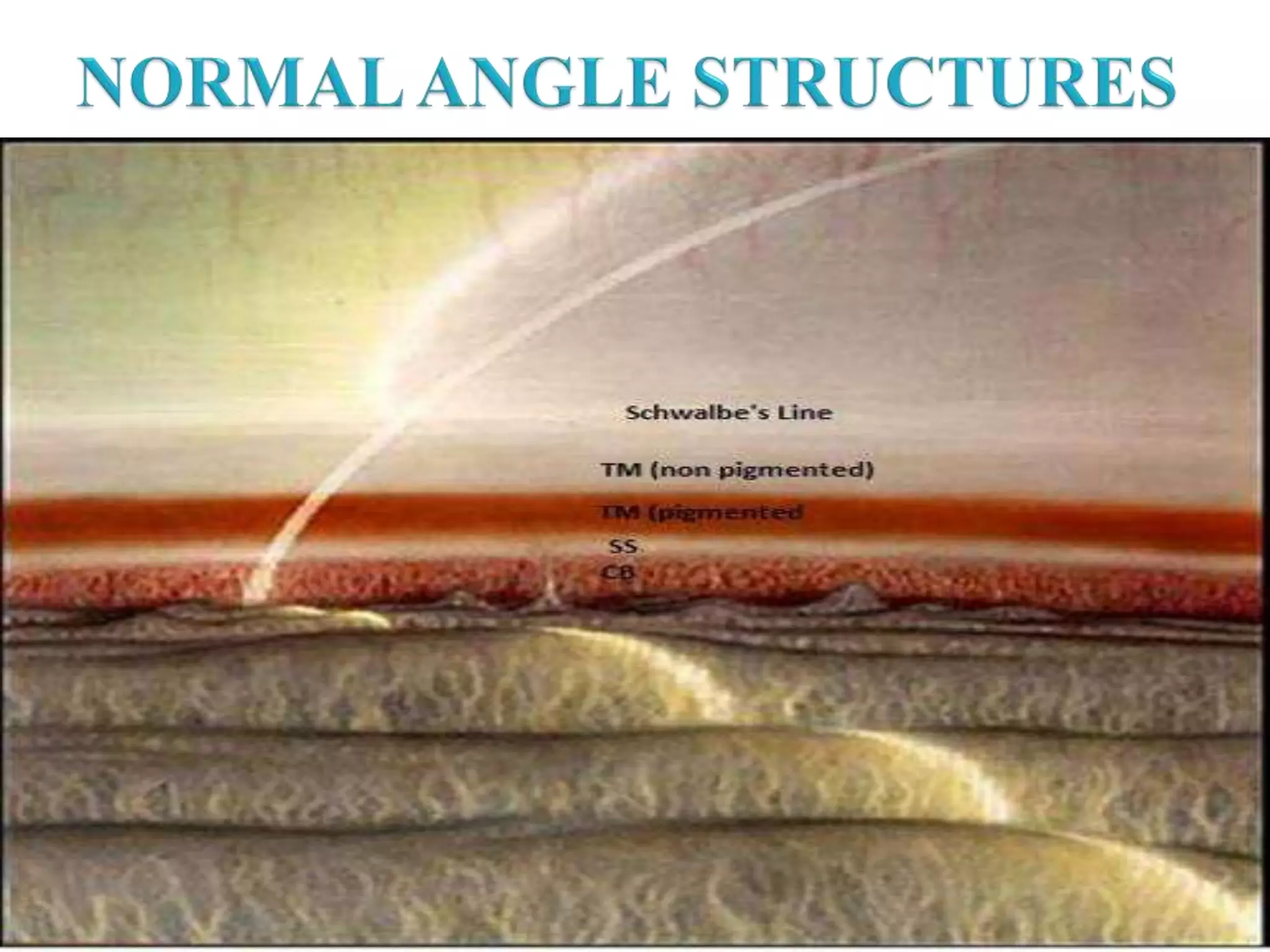
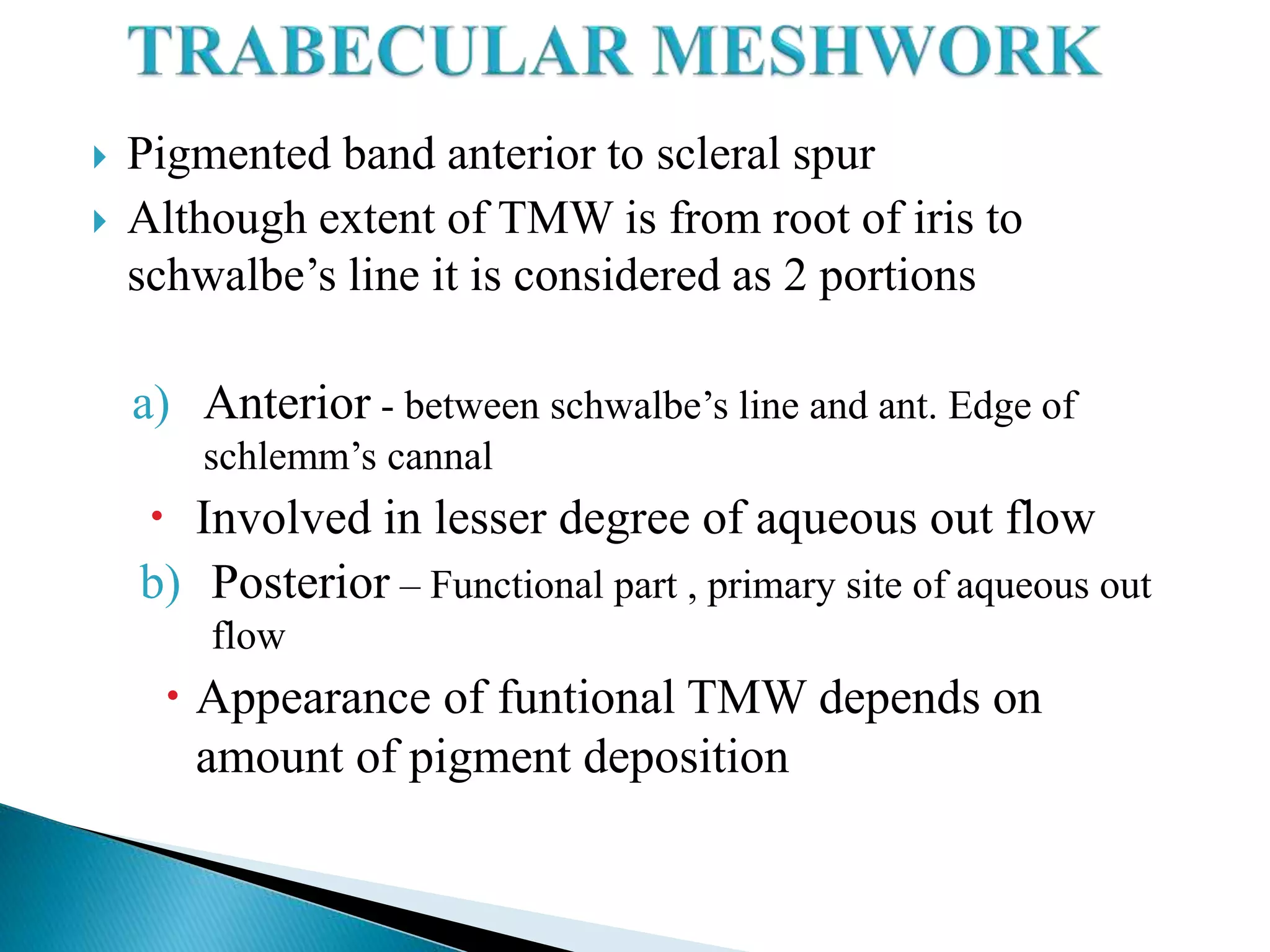
 Pigmented band anterior to scleral spur
 Although extent of TMW is from root of iris to
schwalbe’s line it is considered as 2 portions
a) Anterior - between schwalbe’s line and ant. Edge of
schlemm’s cannal
 Involved in lesser degree of aqueous out flow
b) Posterior – Functional part , primary site of aqueous out
flow
 Appearance of funtional TMW depends on
amount of pigment deposition
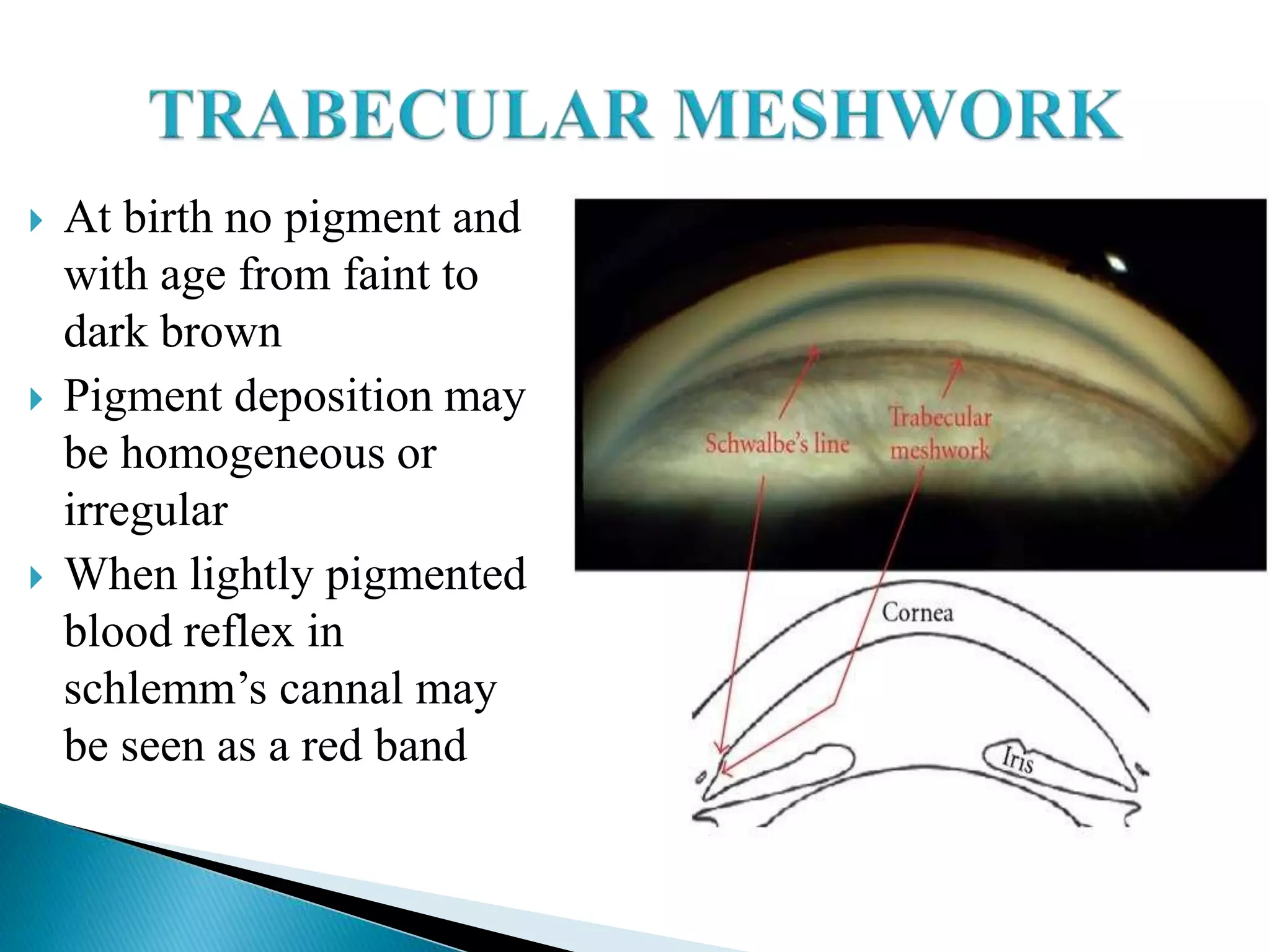
 At birth no pigment and
with age from faint to
dark brown
 Pigment deposition may
be homogeneous or
irregular
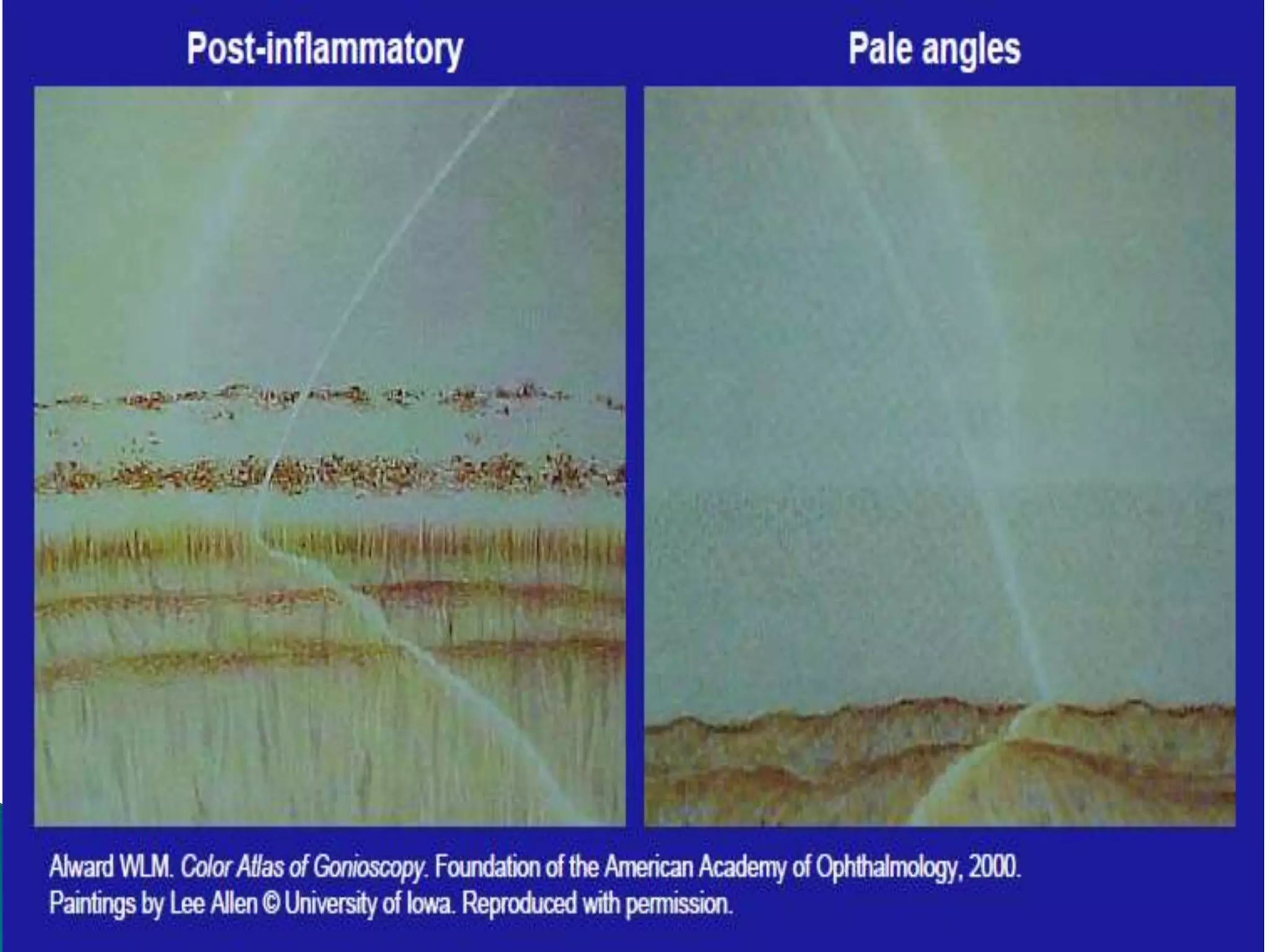
 When lightly pigmented
blood reflex in
schlemm’s cannal may
be seen as a red band
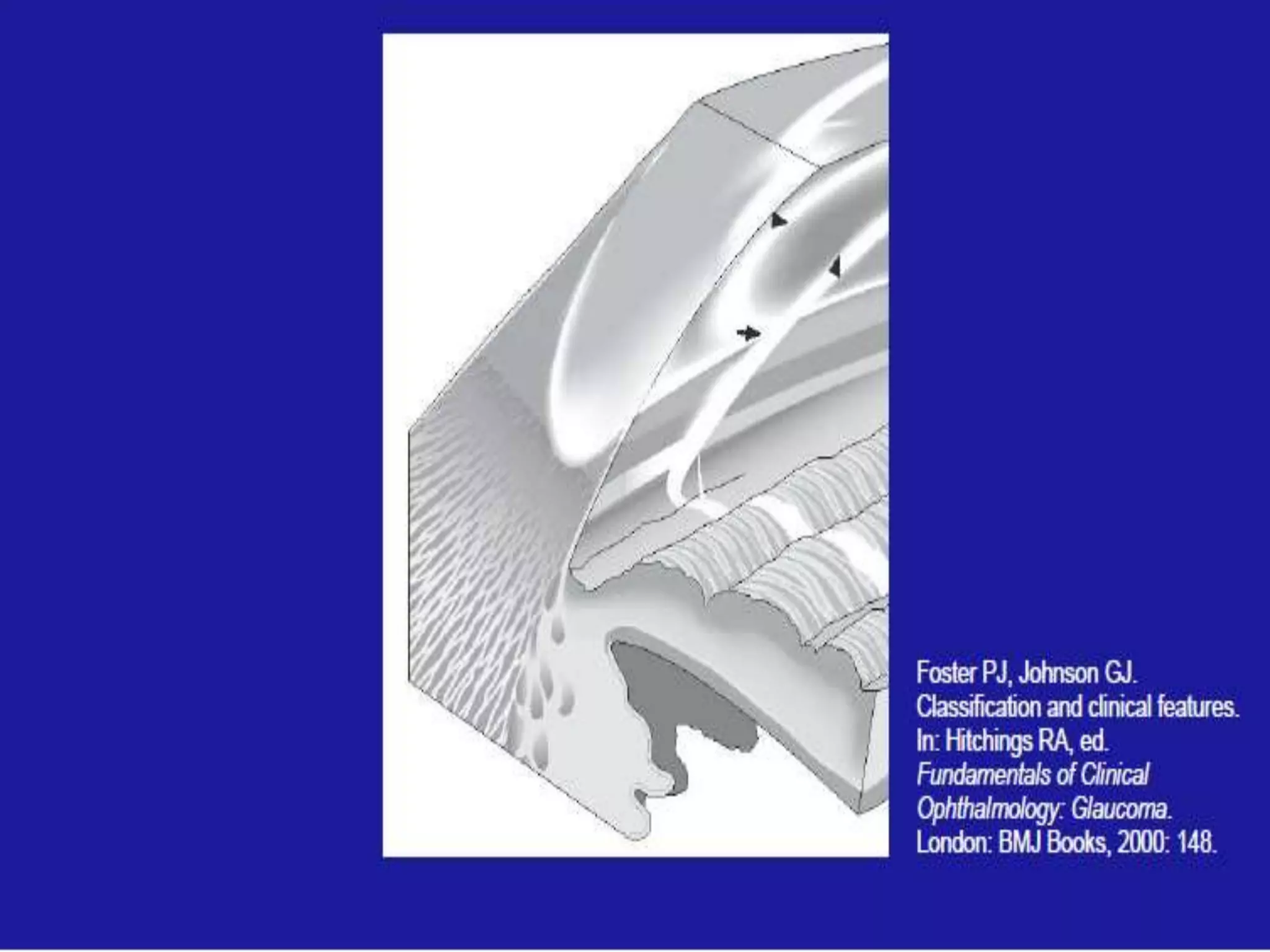
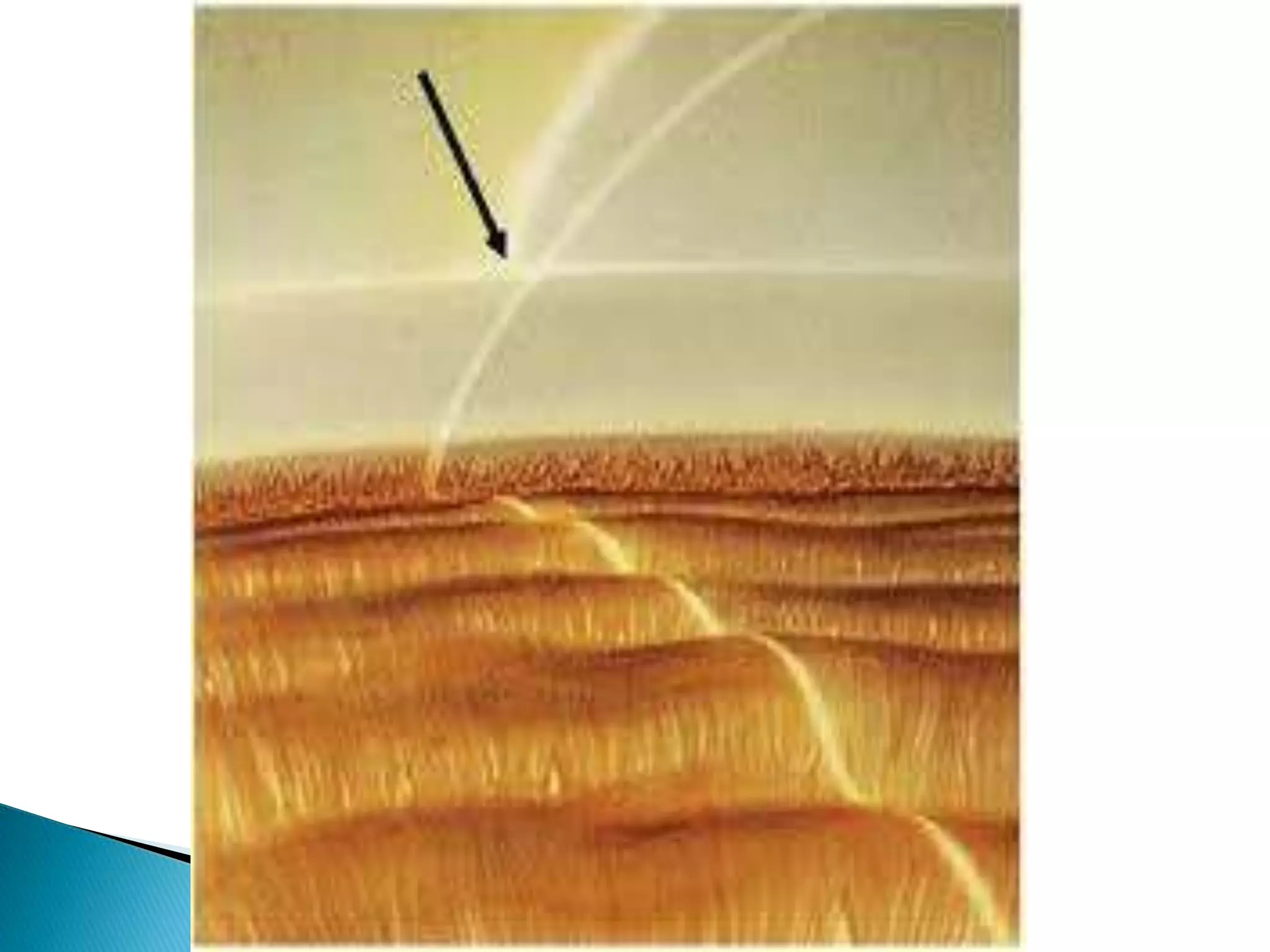
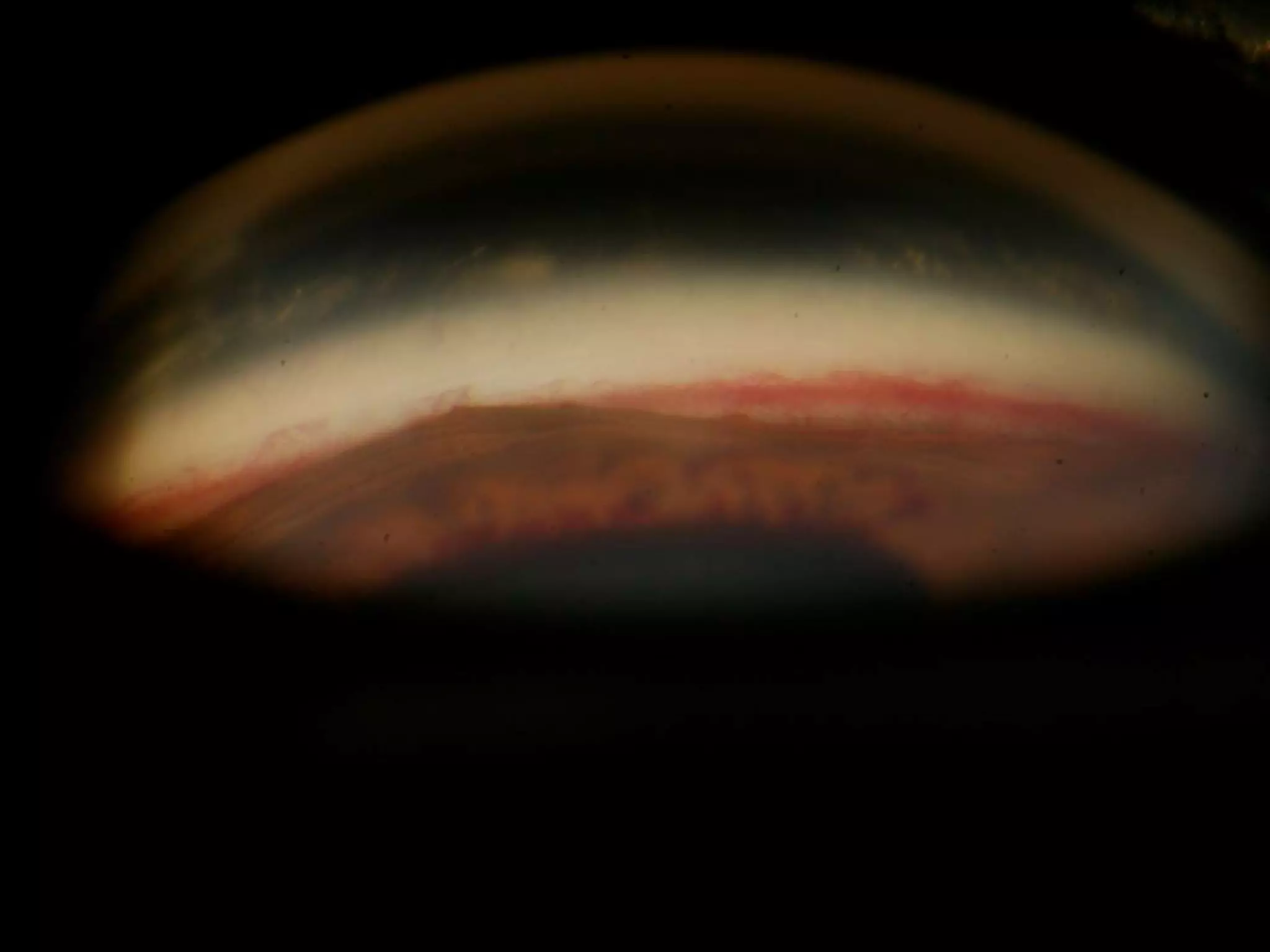
 When a thin slit of light hits the irido-corneal angle at
an angle of 10⁰-15⁰, two light reflections are seen from
the external and internal corneal surfaces which pipe
down at the sclero-corneal junction (Schwalbe’s line)
marking the anterior border of trabecular meshwork.
 Corneal wedge is a useful technique to identify the
trabecular meshwork in eyes that are either
nonpigmented or excessively pigmented its diff. to
mark trabecular meshwork begins
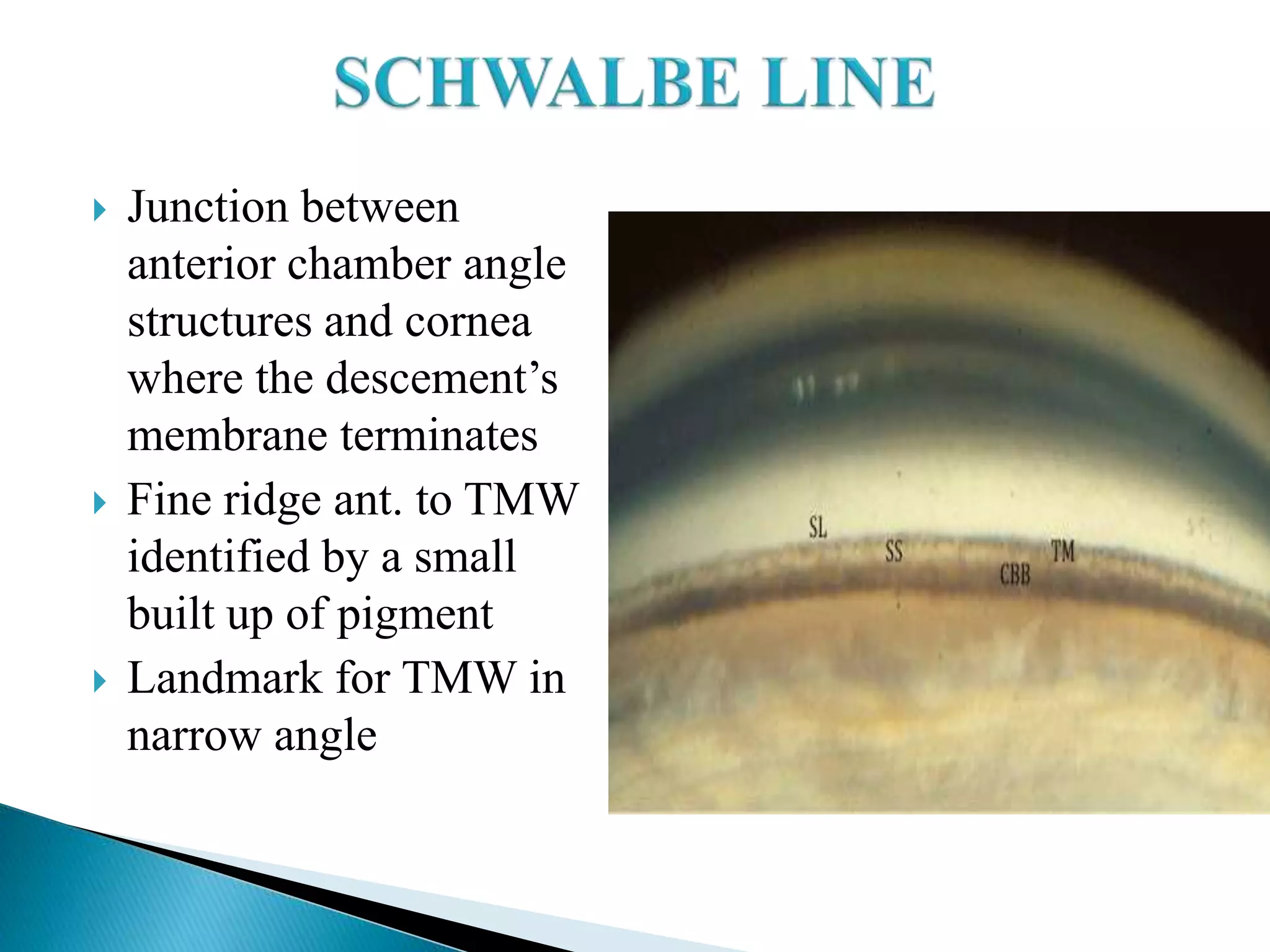
 Junction between
anterior chamber angle
structures and cornea
where the descement’s
membrane terminates
 Fine ridge ant. to TMW
identified by a small
built up of pigment
 Landmark for TMW in
narrow angle
Contour
 Flat- Deep AC
 Concave- Shallow AC , Hyperopia
 Convex- High Myopia, Pigment Dispersion Syndrome
 Abnormal Rolling- Plateau iris
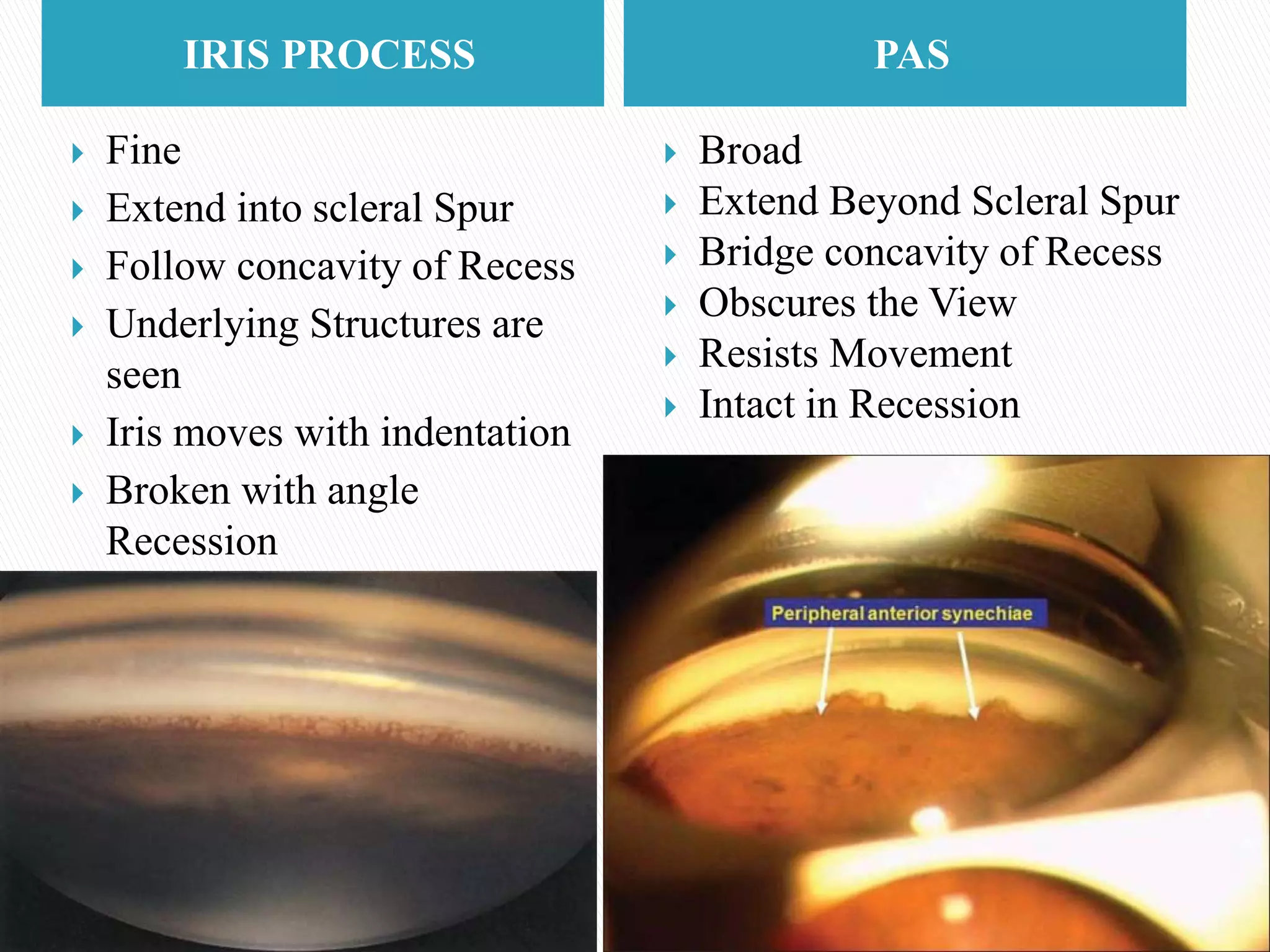
IRIS PROCESS PAS
 Fine
 Extend into scleral Spur
 Follow concavity of Recess
 Underlying Structures are
seen
 Iris moves with indentation
 Broken with angle
Recession
 Broad
 Extend Beyond Scleral Spur
 Bridge concavity of Recess
 Obscures the View
 Resists Movement
 Intact in Recession
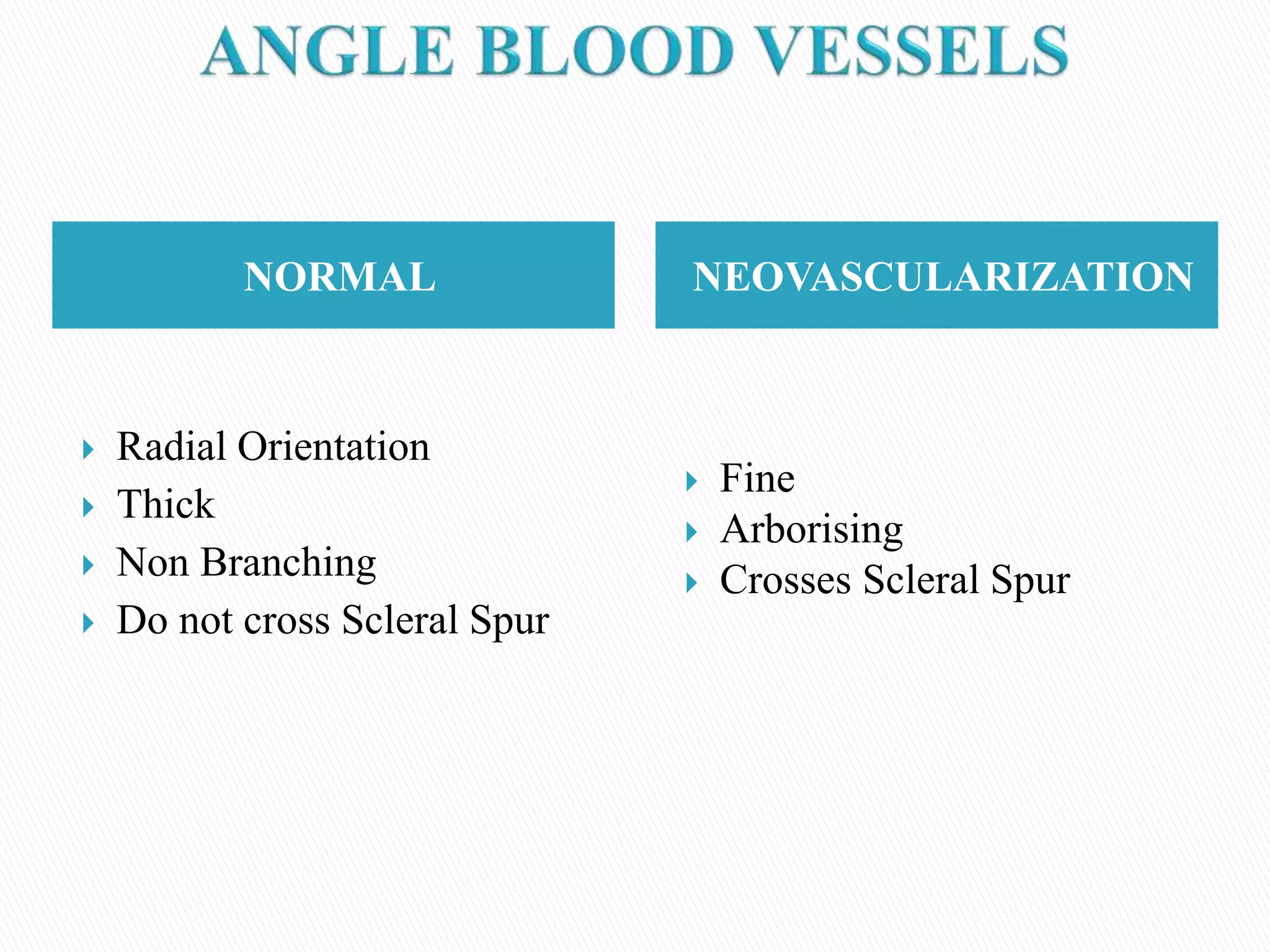
NORMAL NEOVASCULARIZATION
 Radial Orientation
 Thick
 Non Branching
 Do not cross Scleral Spur
 Fine
 Arborising
 Crosses Scleral Spur
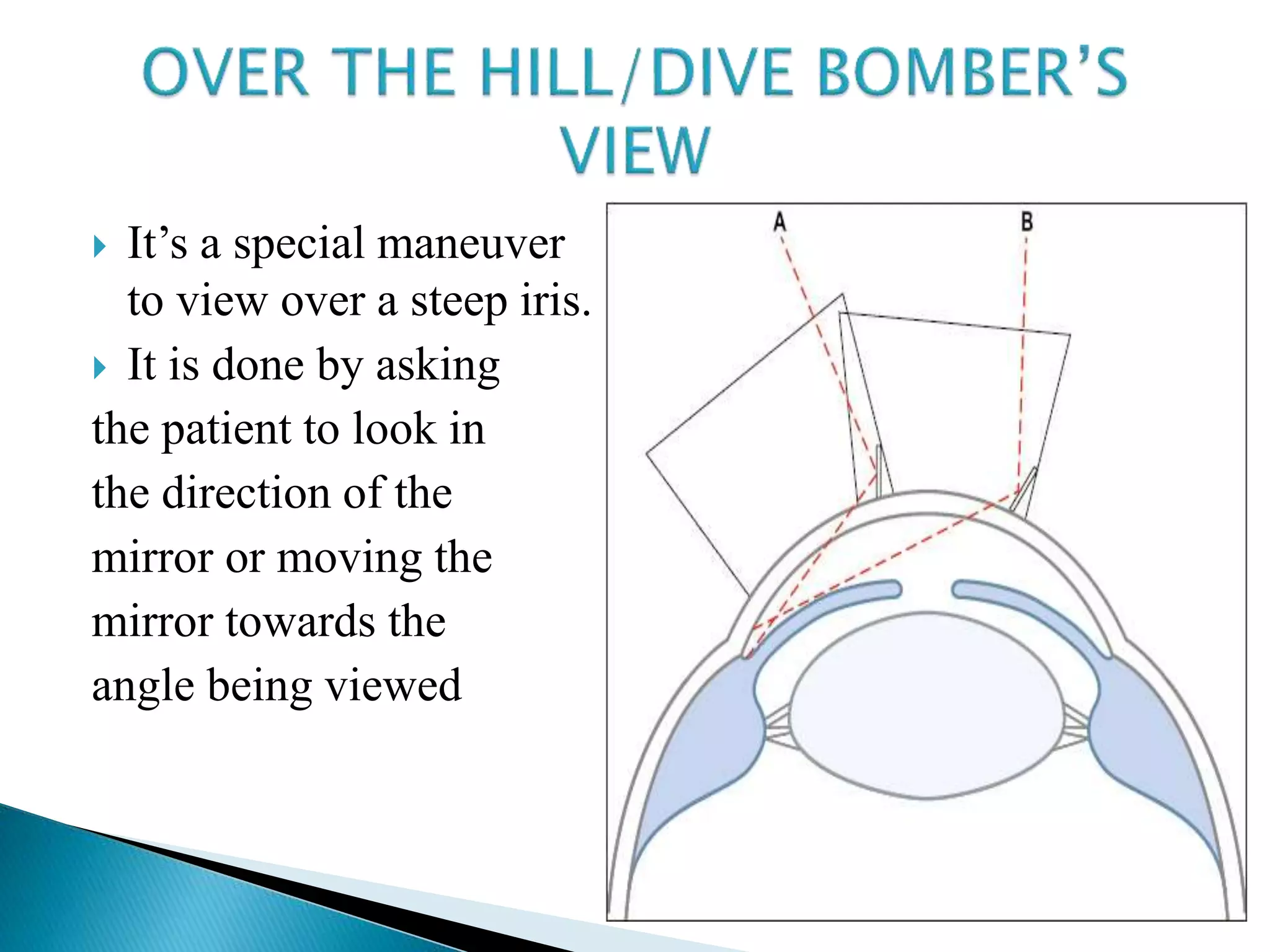
 Over the Hill
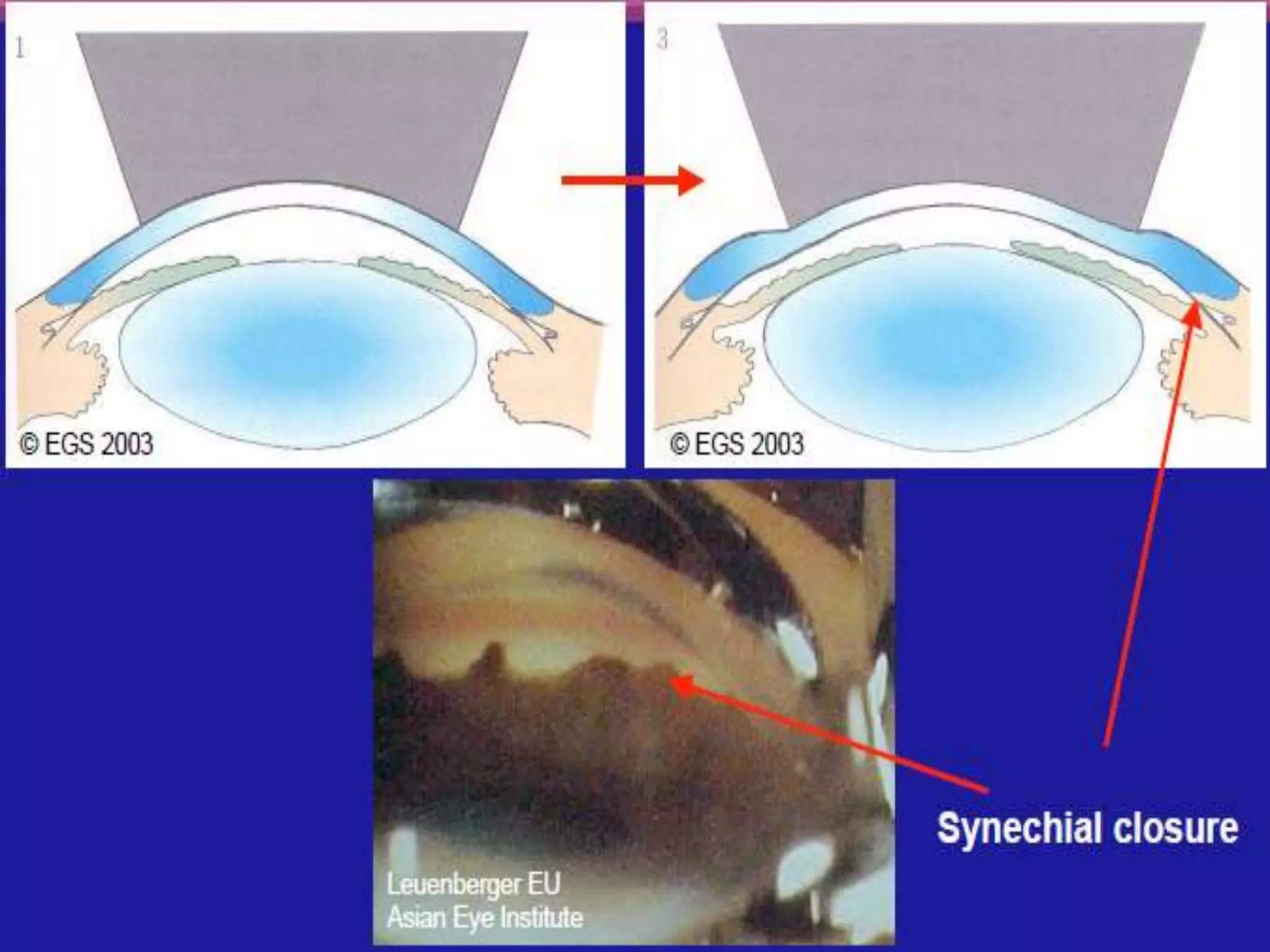
 Corneal Wedging
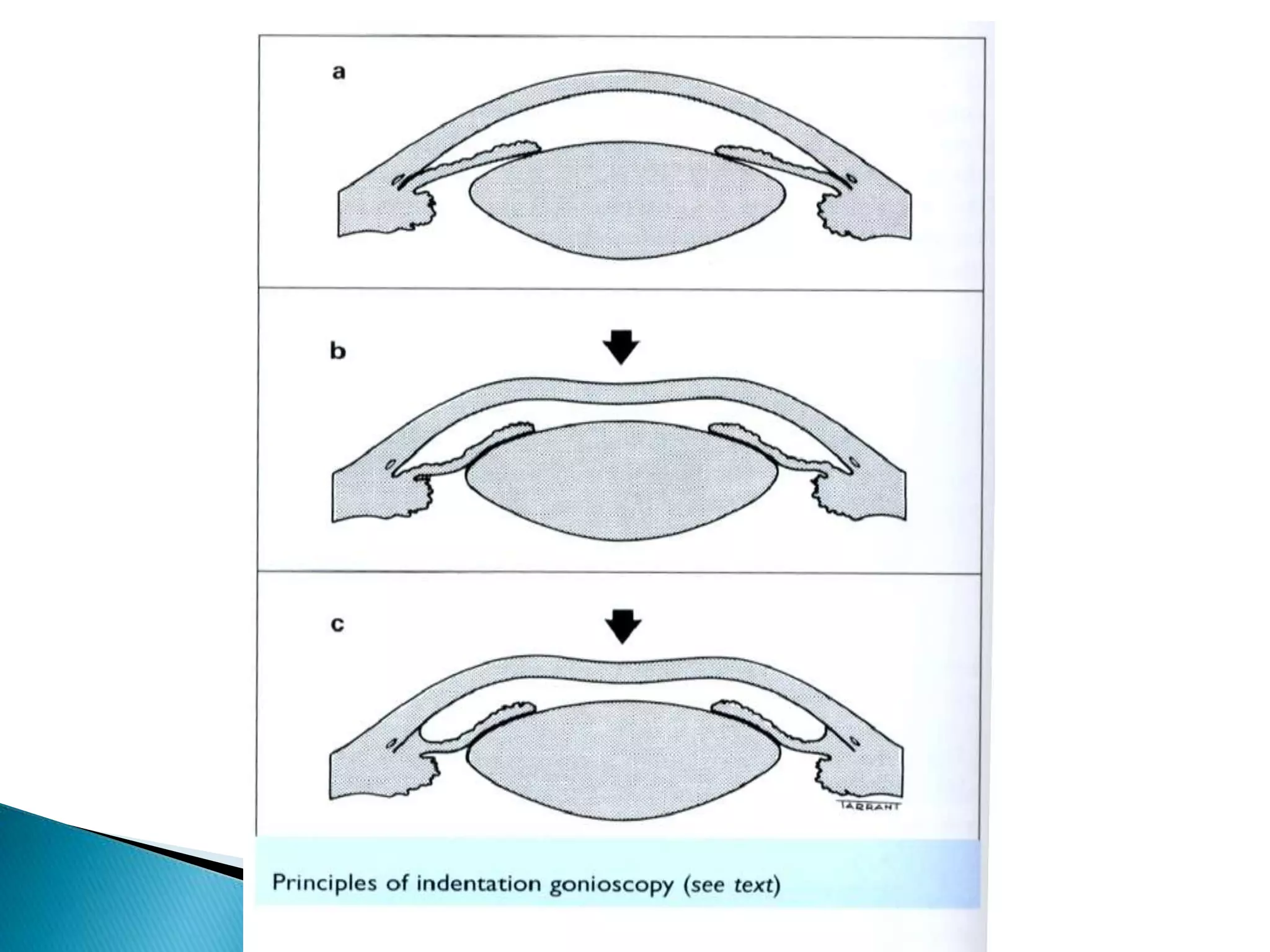
 Indentation
 It’s a special maneuver
to view over a steep iris.
 It is done by asking
the patient to look in
the direction of the
mirror or moving the
mirror towards the
angle being viewed
 When iris covers the trabecular meshwork
(TM) its easy to mistake:
◦ The non-pigmented TM for scleral spur
◦ Pigmented Schwalbe’s line for TM
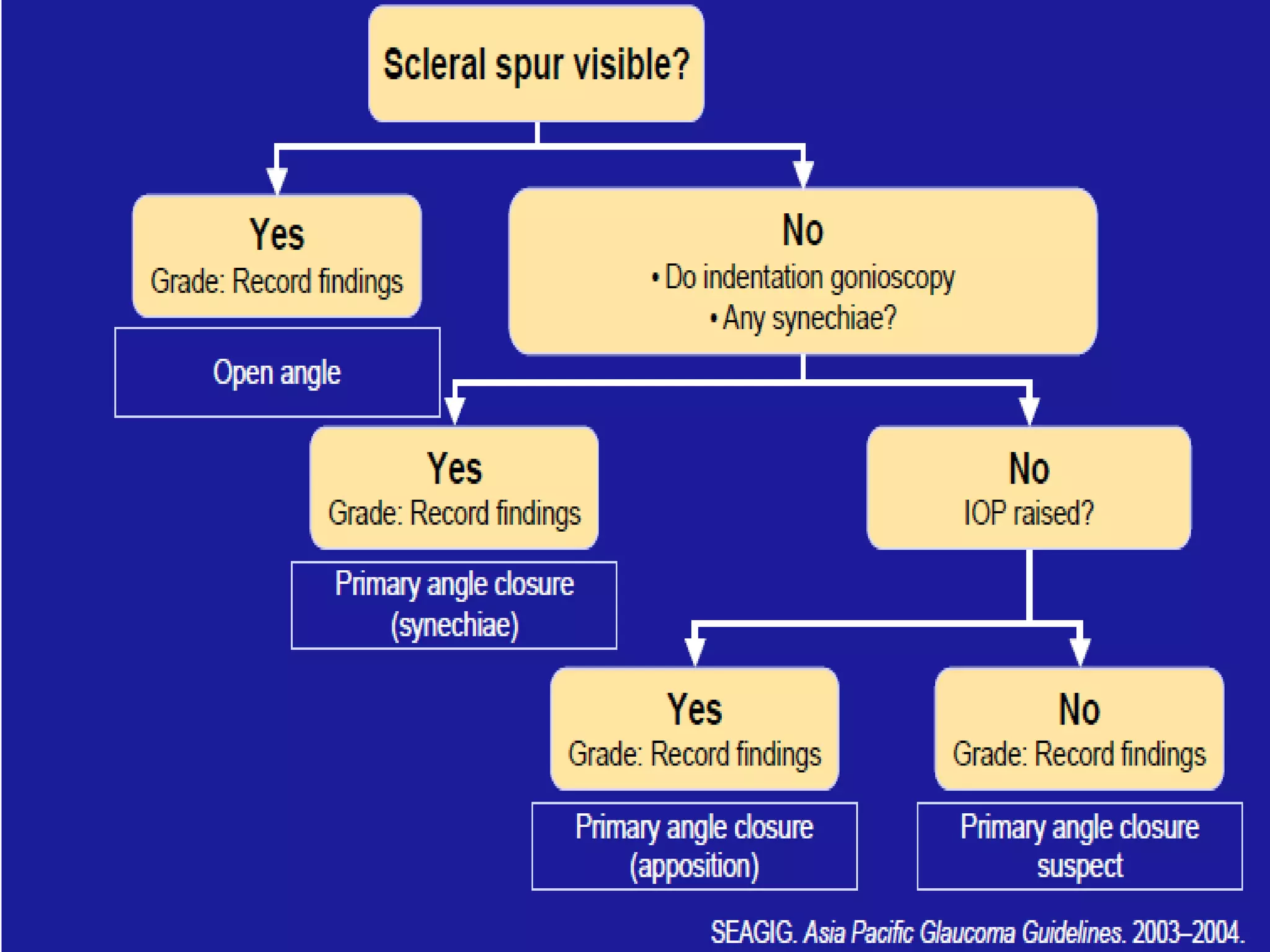
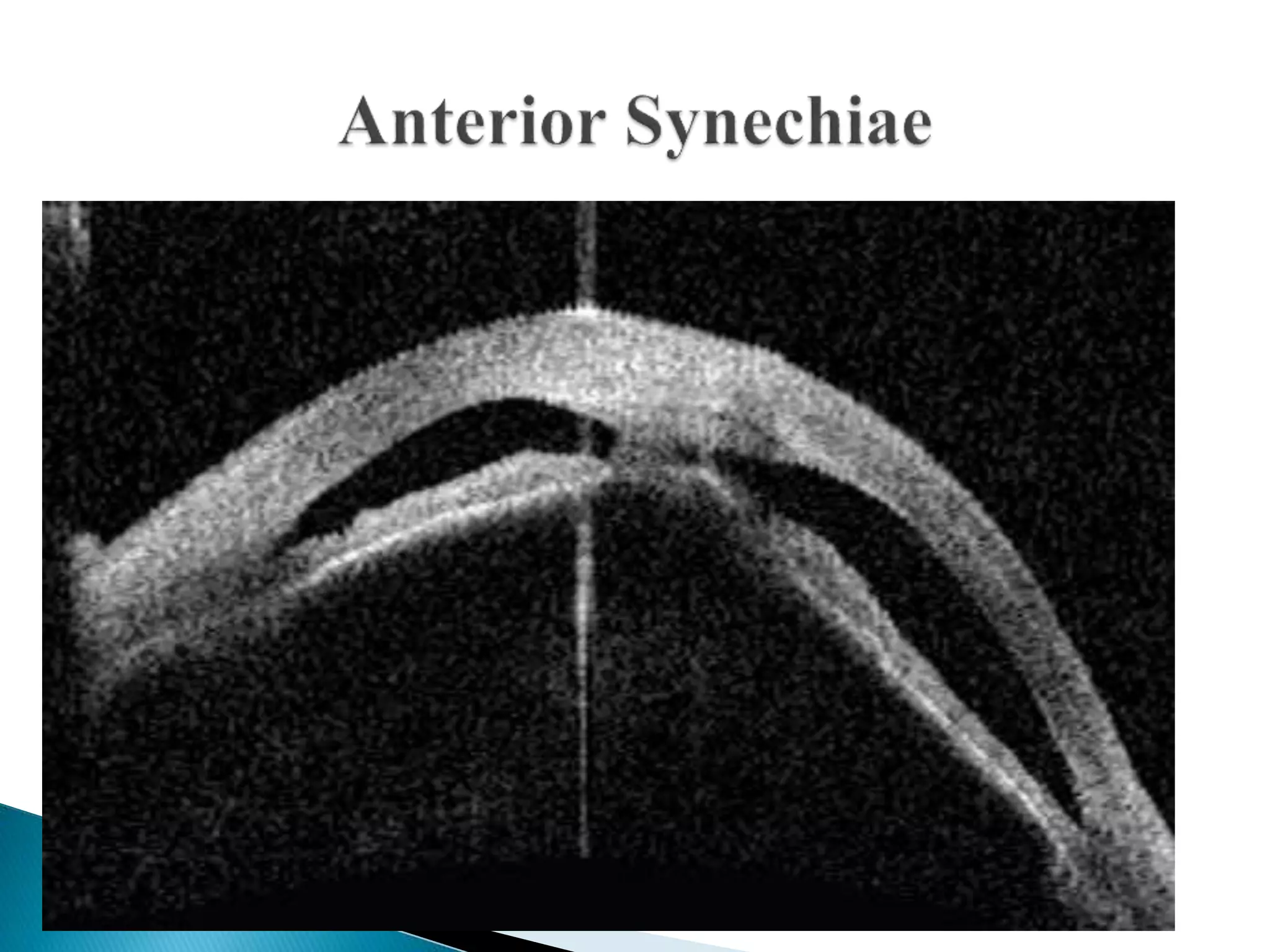
◦ Apposition from synechiae
 Indentation Gonioscopy is particularly useful
in these cases
 Useful when iris surface is convex
◦ Done when recognition of angle structures is
difficult
 Performed in all glaucoma cases
◦ Differentiates appositional vs synechial
closure in pupillary block
◦ Measures extent of angle closure
◦ Identifies plateau iris config.
◦ Identifies lens induced angle closure
 If posterior [ pigmented ] part of trabecular
meshwork is not visible in more than 180
degrees of angle without indentation or
manipulation, this is known as an ‘ occludable
angle’.
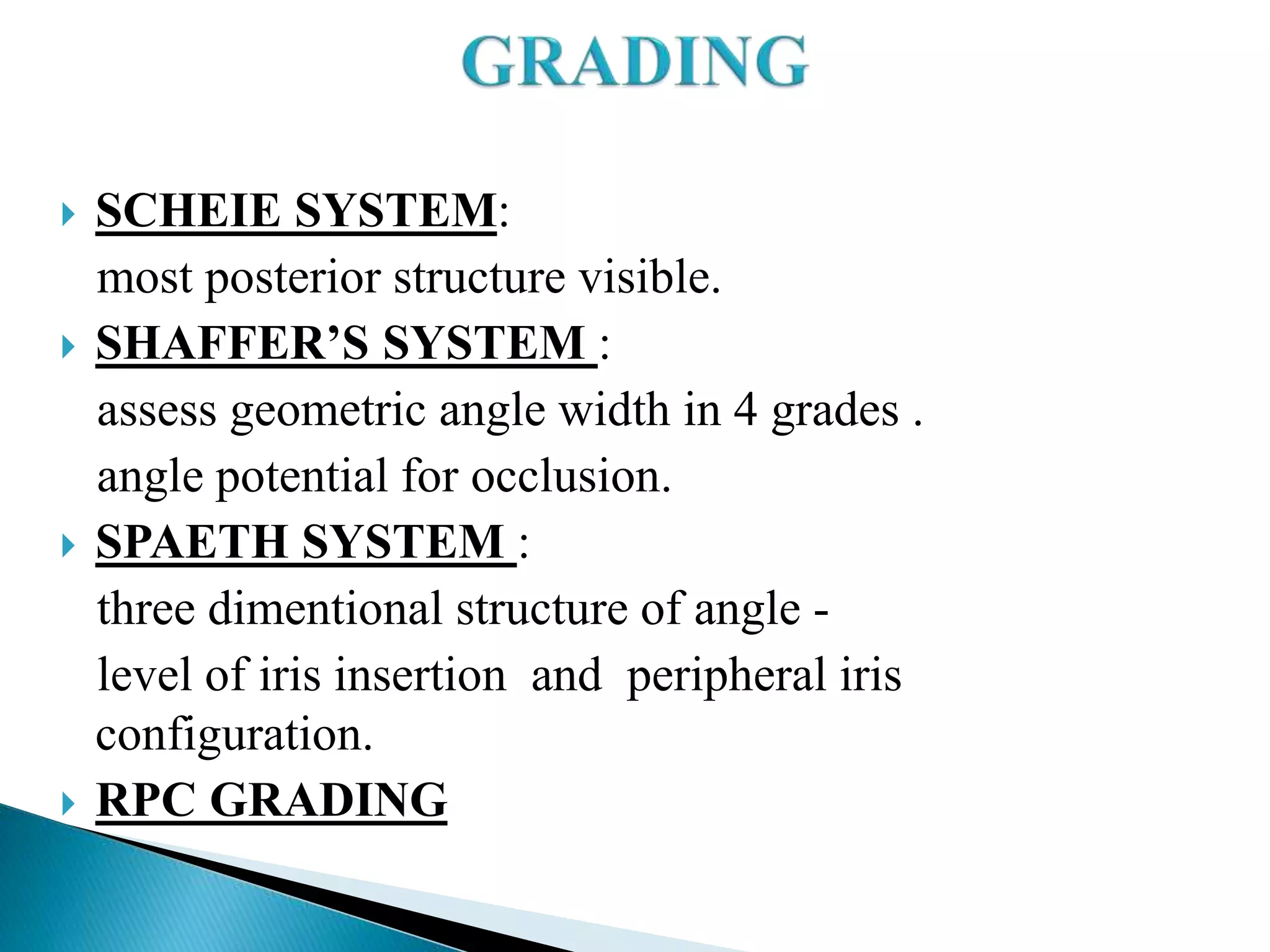
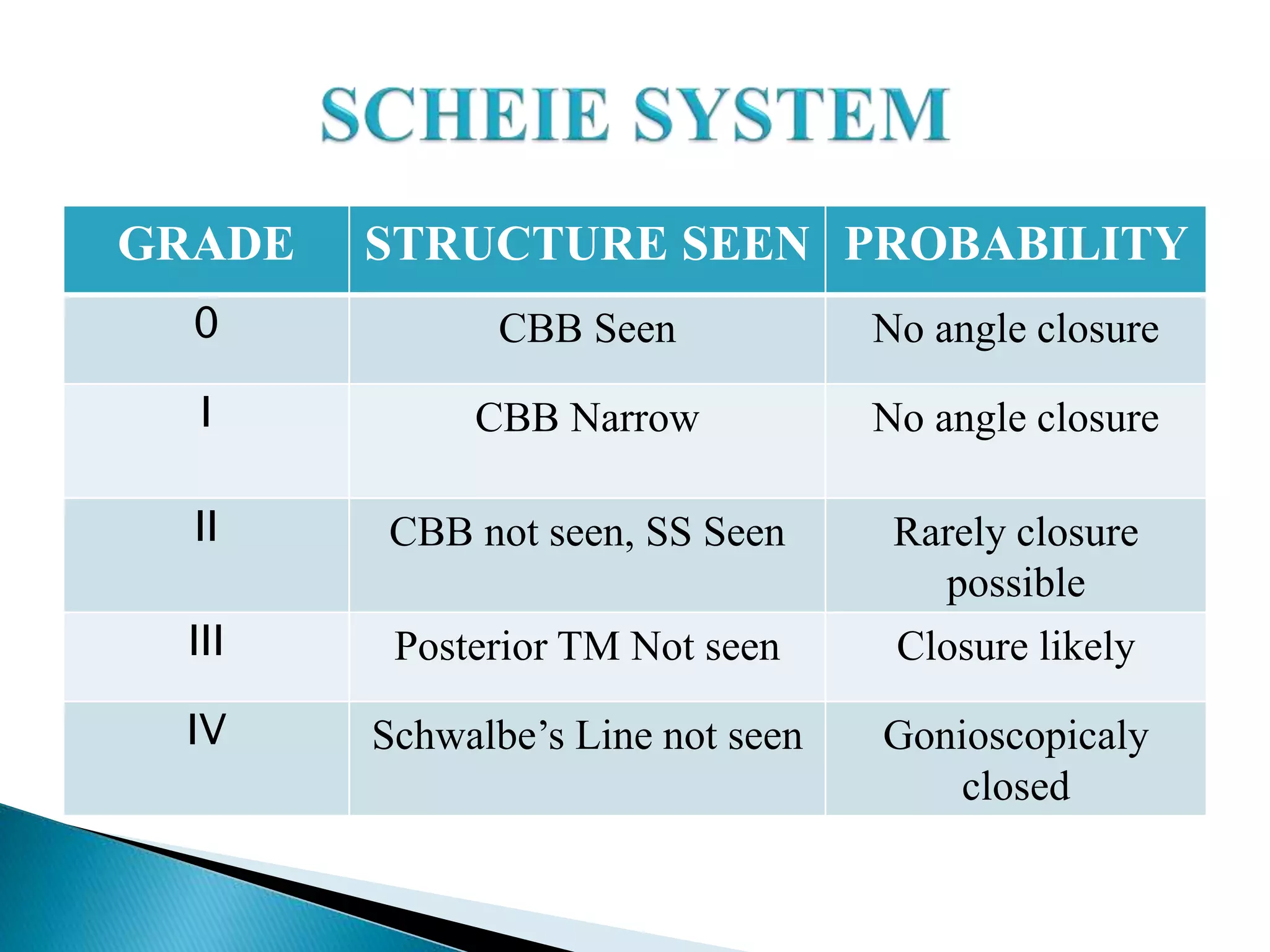
 SCHEIE SYSTEM:
most posterior structure visible.
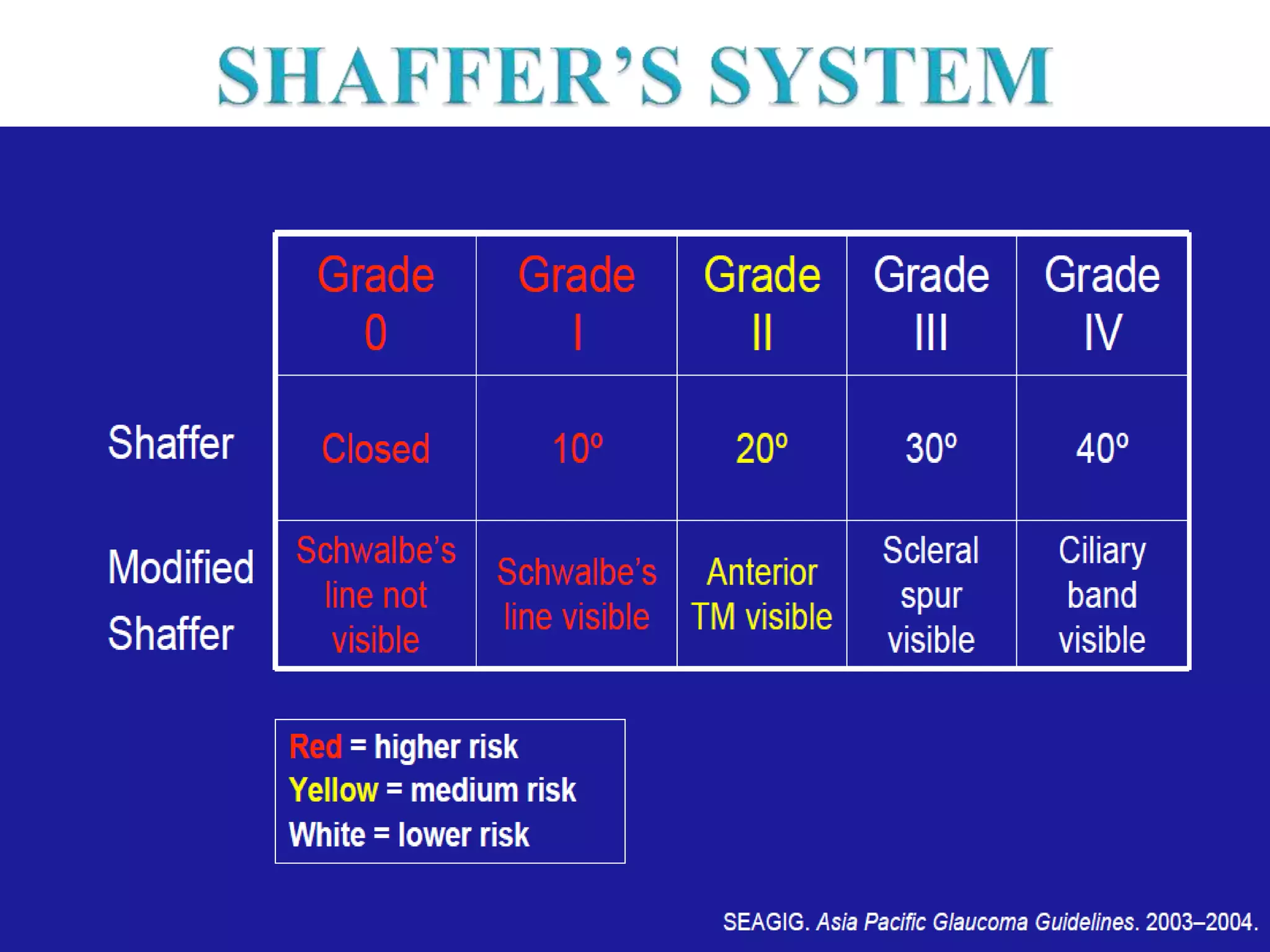
 SHAFFER’S SYSTEM :
assess geometric angle width in 4 grades .
angle potential for occlusion.
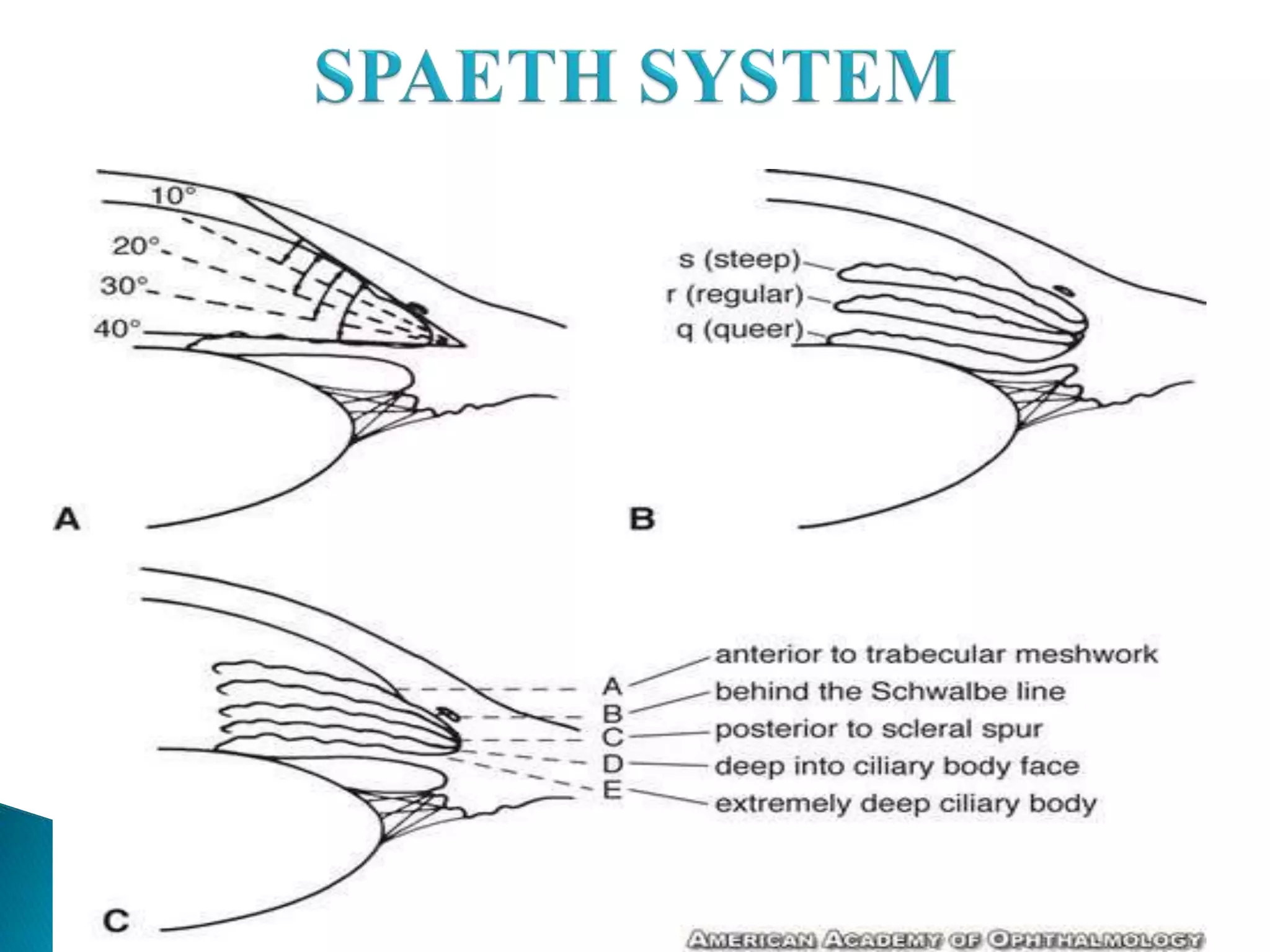
 SPAETH SYSTEM :
three dimentional structure of angle -
level of iris insertion and peripheral iris
configuration.
 RPC GRADING
GRADE STRUCTURE SEEN PROBABILITY
0 CBB Seen No angle closure
I CBB Narrow No angle closure
II CBB not seen, SS Seen Rarely closure
possible
III Posterior TM Not seen Closure likely
IV Schwalbe’s Line not seen Gonioscopicaly
closed
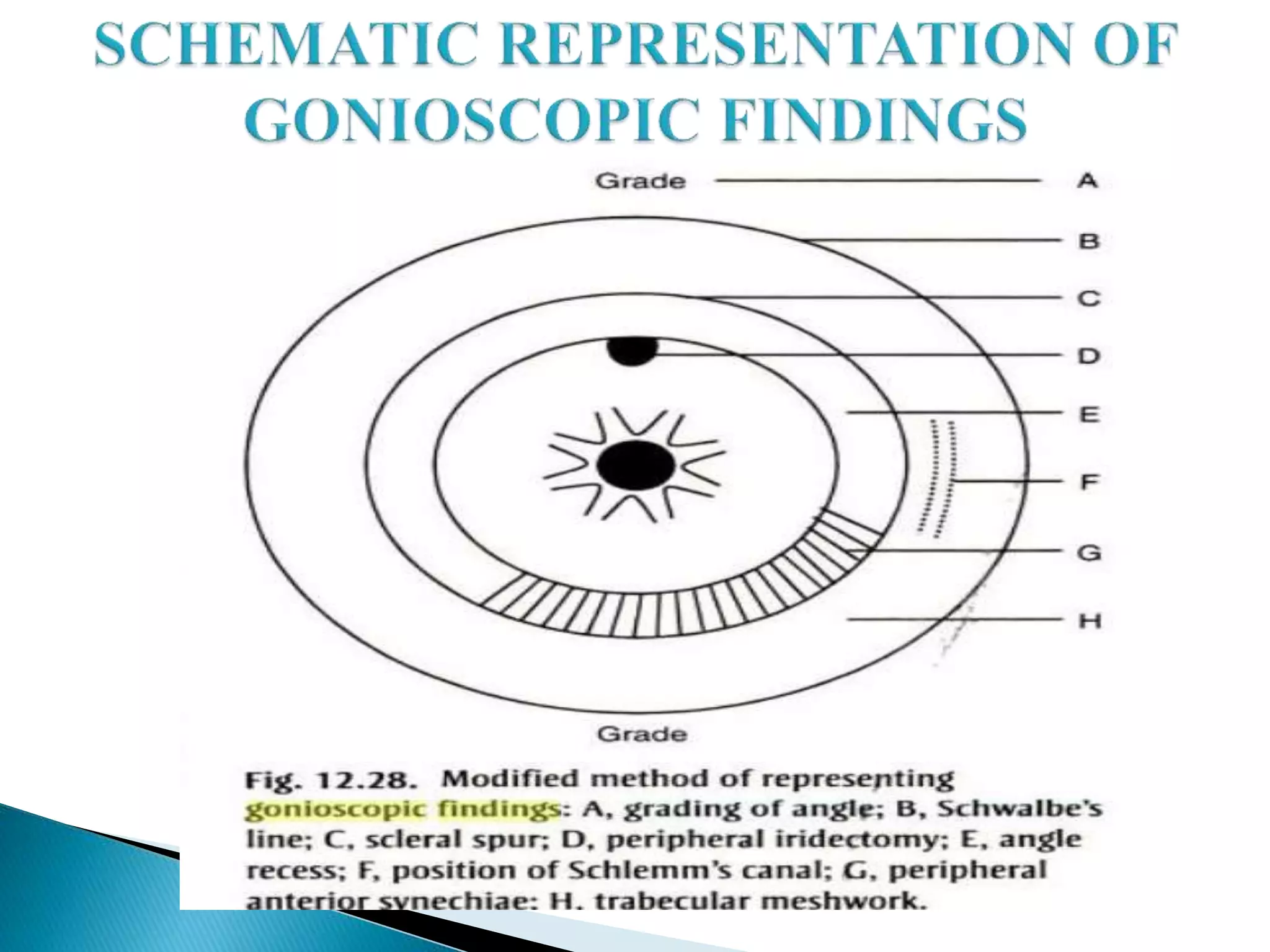
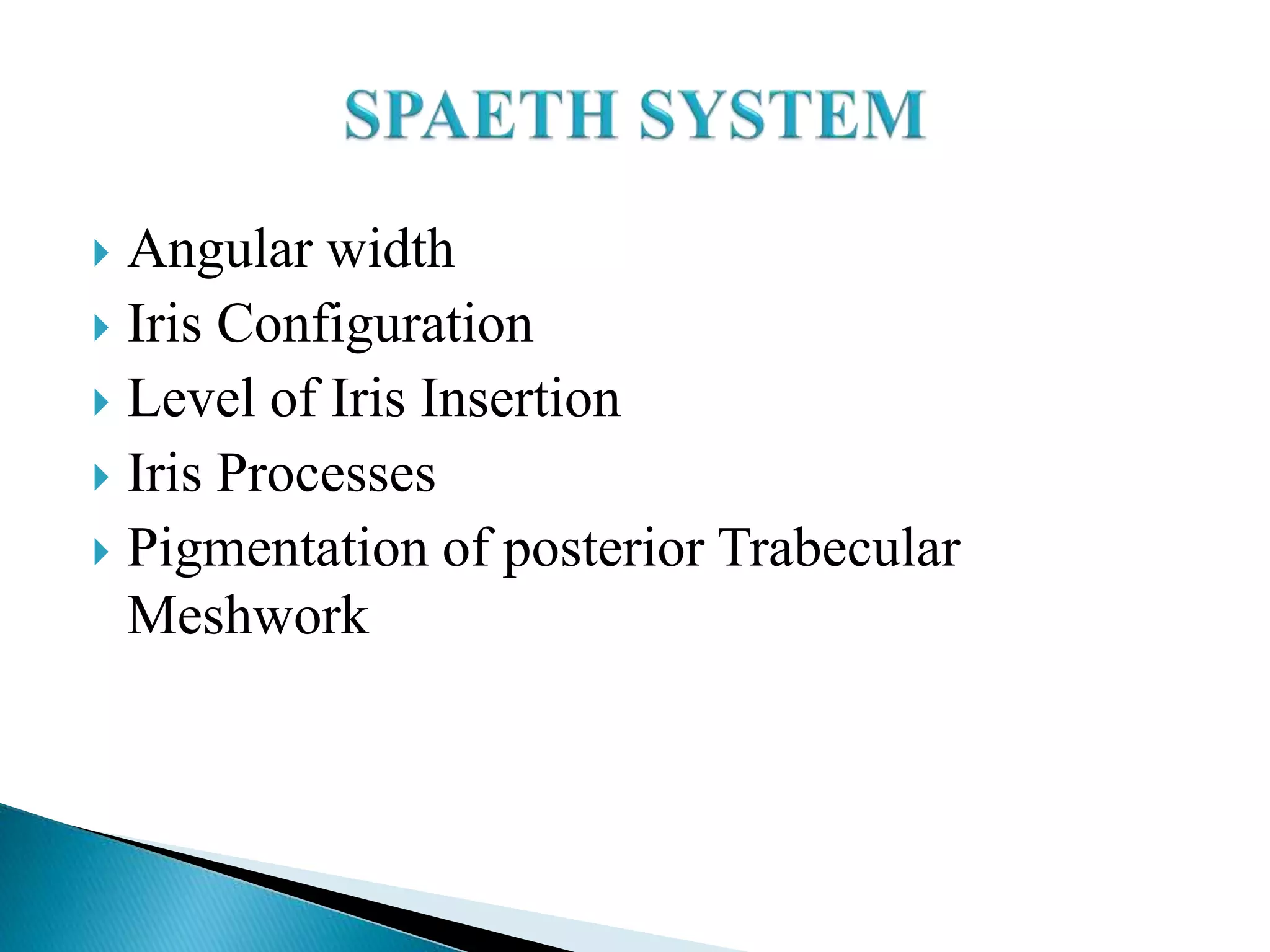
 Angular width
 Iris Configuration
 Level of Iris Insertion
 Iris Processes
 Pigmentation of posterior Trabecular
Meshwork
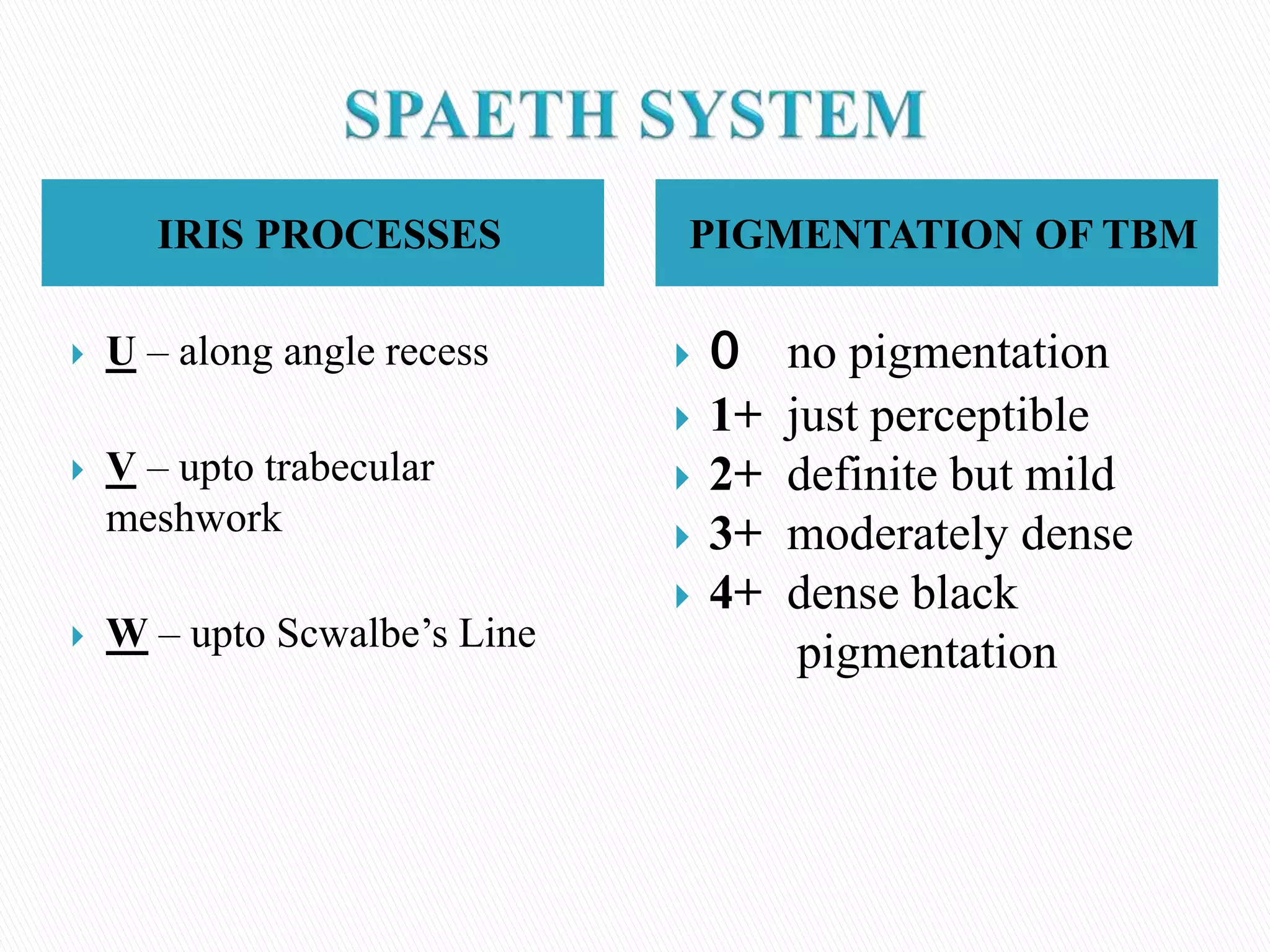
IRIS PROCESSES PIGMENTATION OF TBM
 U – along angle recess
 V – upto trabecular
meshwork
 W – upto Scwalbe’s Line
 0 no pigmentation
 1+ just perceptible
 2+ definite but mild
 3+ moderately dense
 4+ dense black
pigmentation
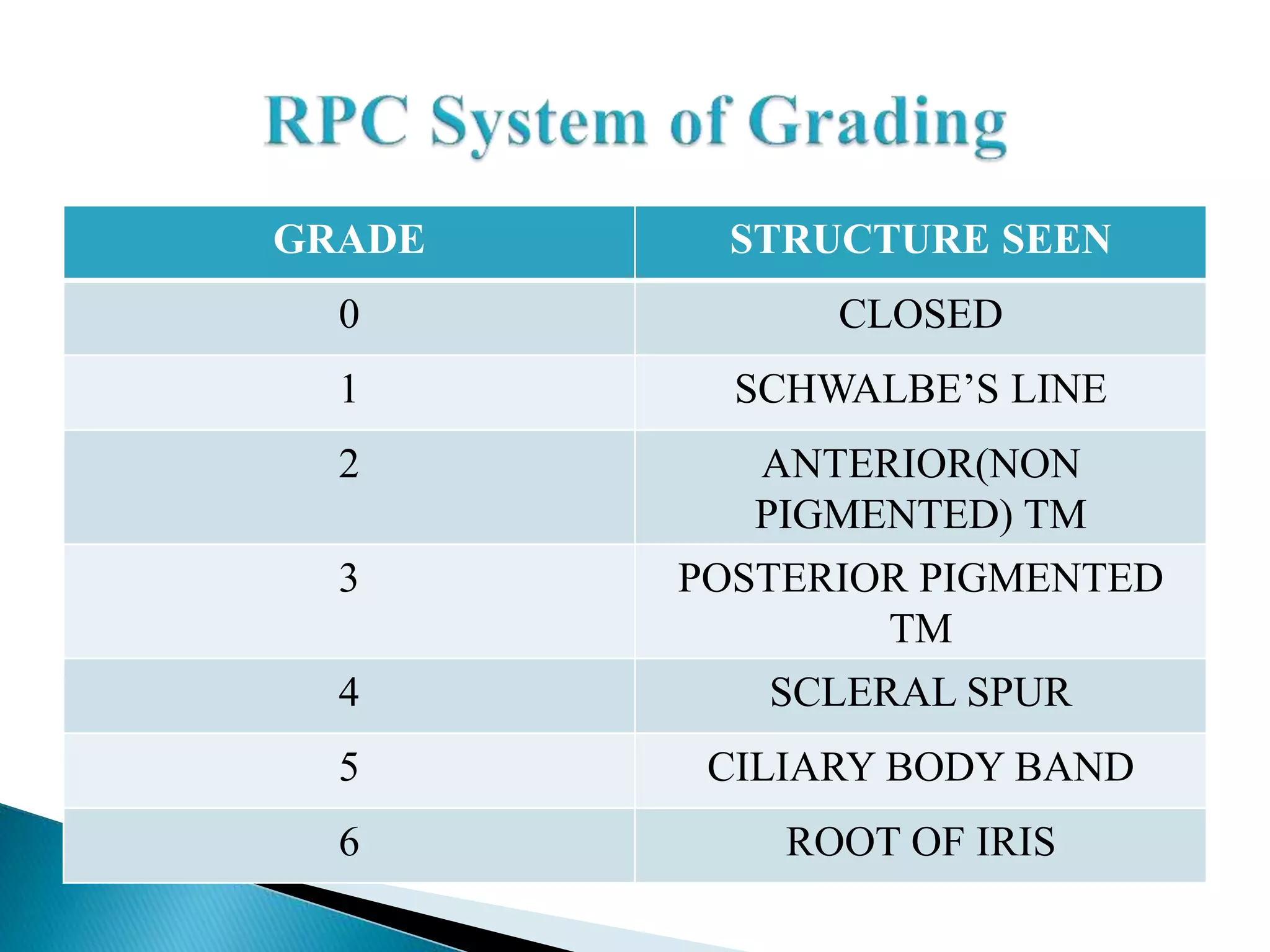
GRADE STRUCTURE SEEN
0 CLOSED
1 SCHWALBE’S LINE
2 ANTERIOR(NON
PIGMENTED) TM
3 POSTERIOR PIGMENTED
TM
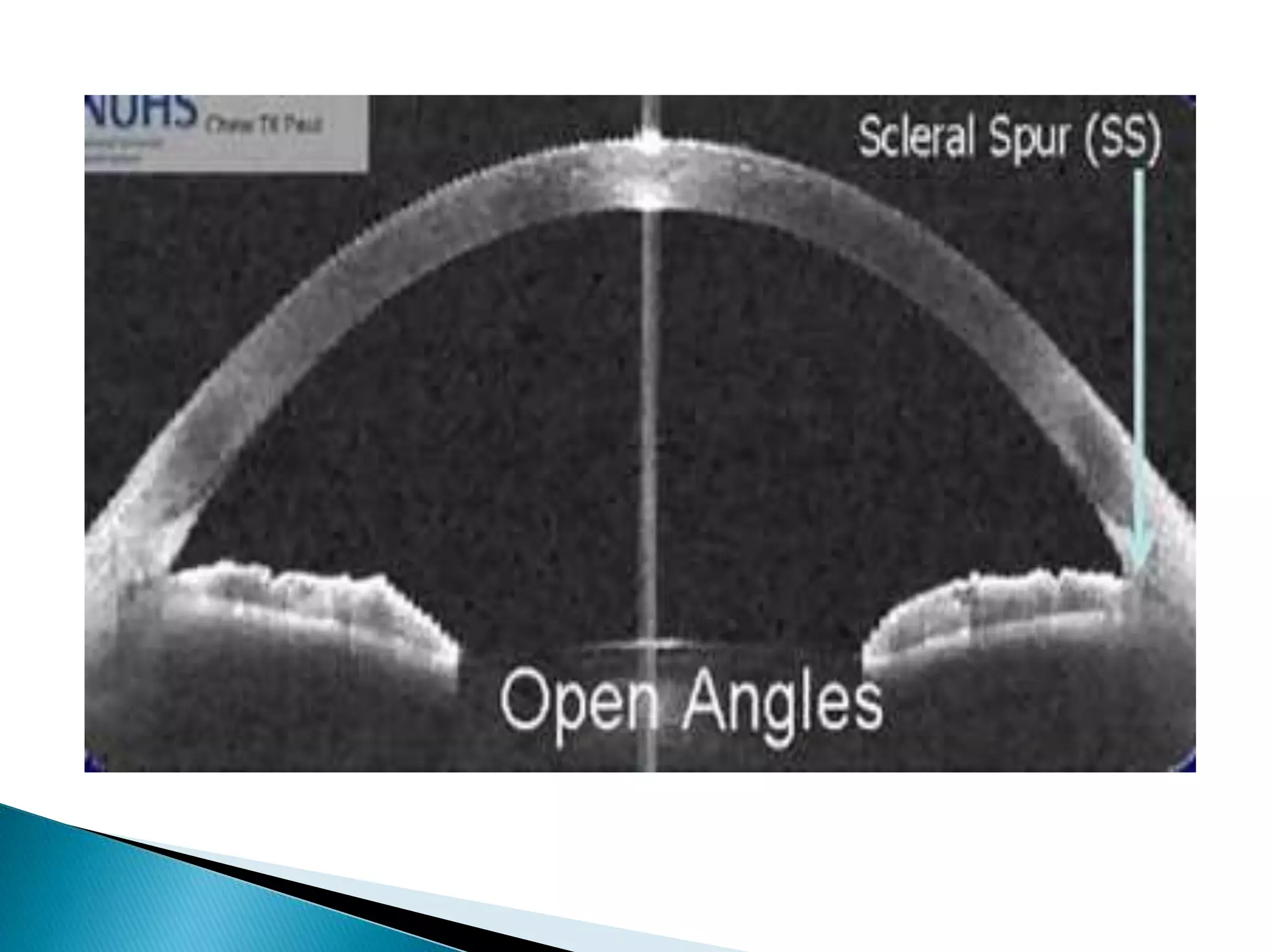
4 SCLERAL SPUR
5 CILIARY BODY BAND
6 ROOT OF IRIS
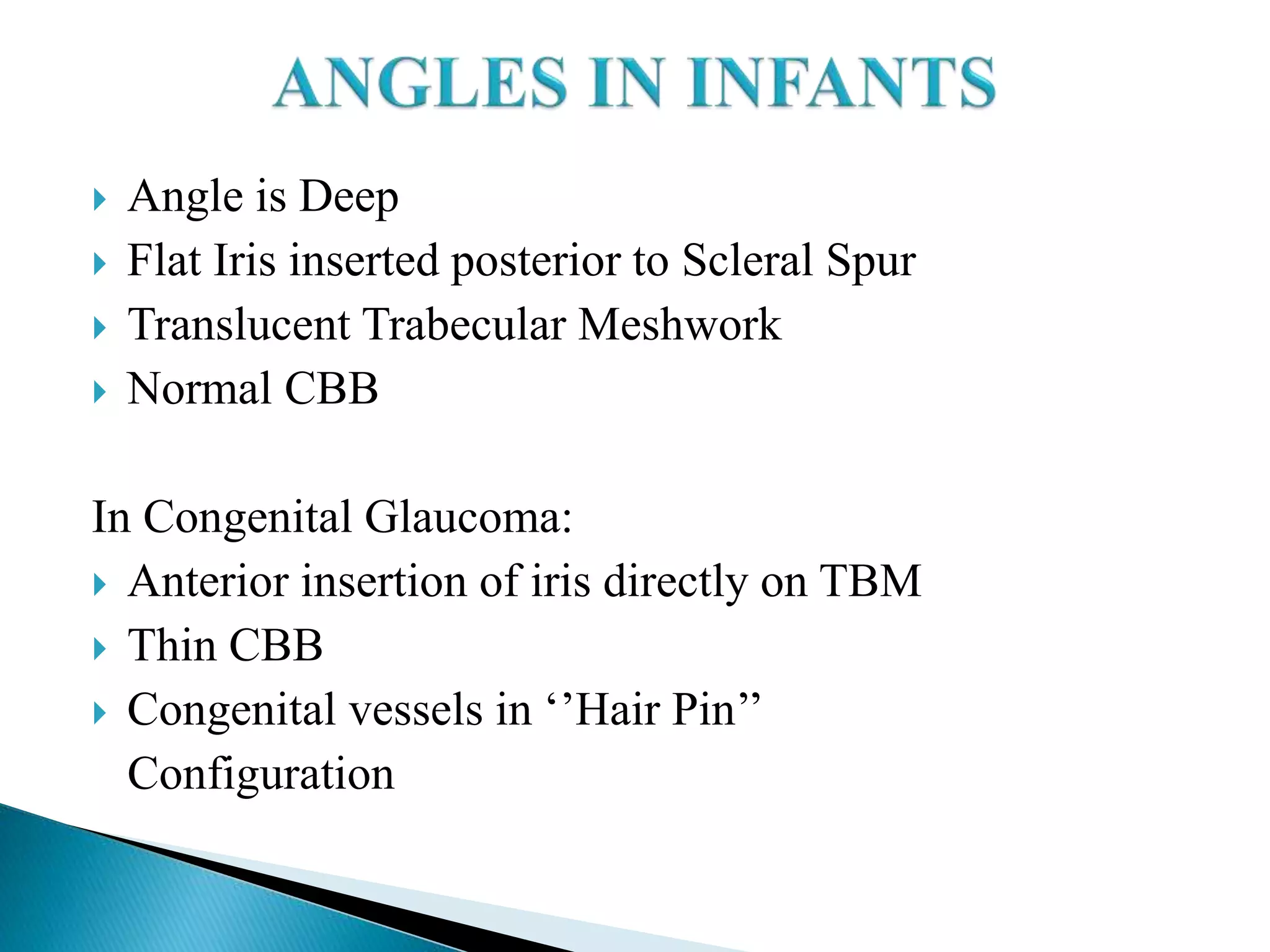
 Angle is Deep
 Flat Iris inserted posterior to Scleral Spur
 Translucent Trabecular Meshwork
 Normal CBB
In Congenital Glaucoma:
 Anterior insertion of iris directly on TBM
 Thin CBB
 Congenital vessels in ‘’Hair Pin’’
Configuration
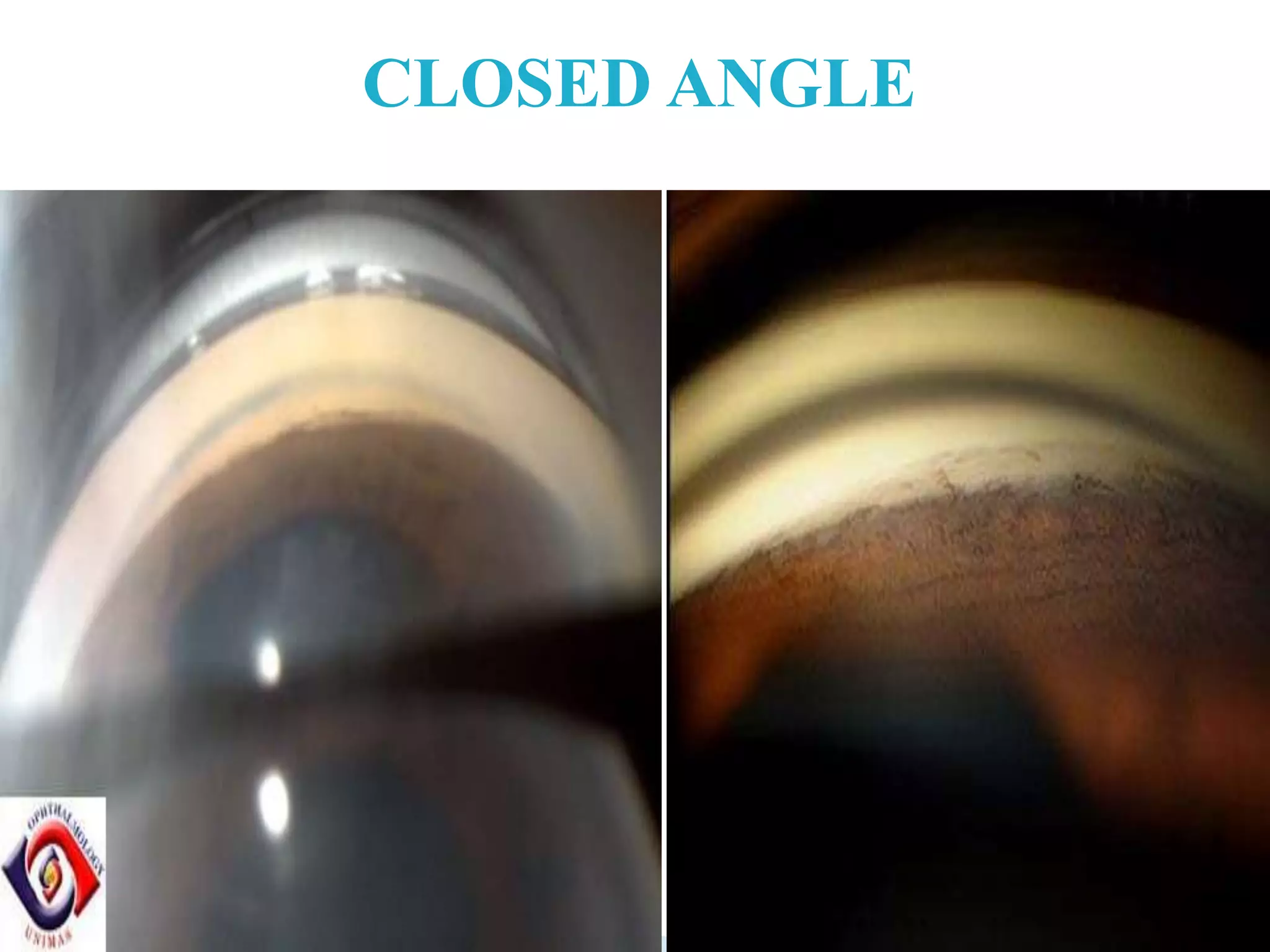
CLOSED ANGLE
 Wash with soap & water
 Soaking the lens for 5-10 min in fresh solution of Sod.
Hypochlorite [ 1:10 household bleach : water]
 Rinsing with sterile water
 Air drying
 3% H2O2 or 1% Formaldehyde can also be used.
 Direct surgical gonioscopes [ Koeppe, Swan Jacob] can
be sterilized with ethylene oxide.
 Contact investigation patient discomfort.
 Conjunctival infection.
 Artefactual angle closure
 Slit lamp illumination-> pupil constriction-> opens up
the angle
 Wide interobserver variations.
 Indentation corneal folds, distorted view of angle
structures, epithelial injury.
 Painful inflamed eye
 Acute glaucoma with edematous cornea
 Mydriatic drugs- obscure angle by bunching up iris
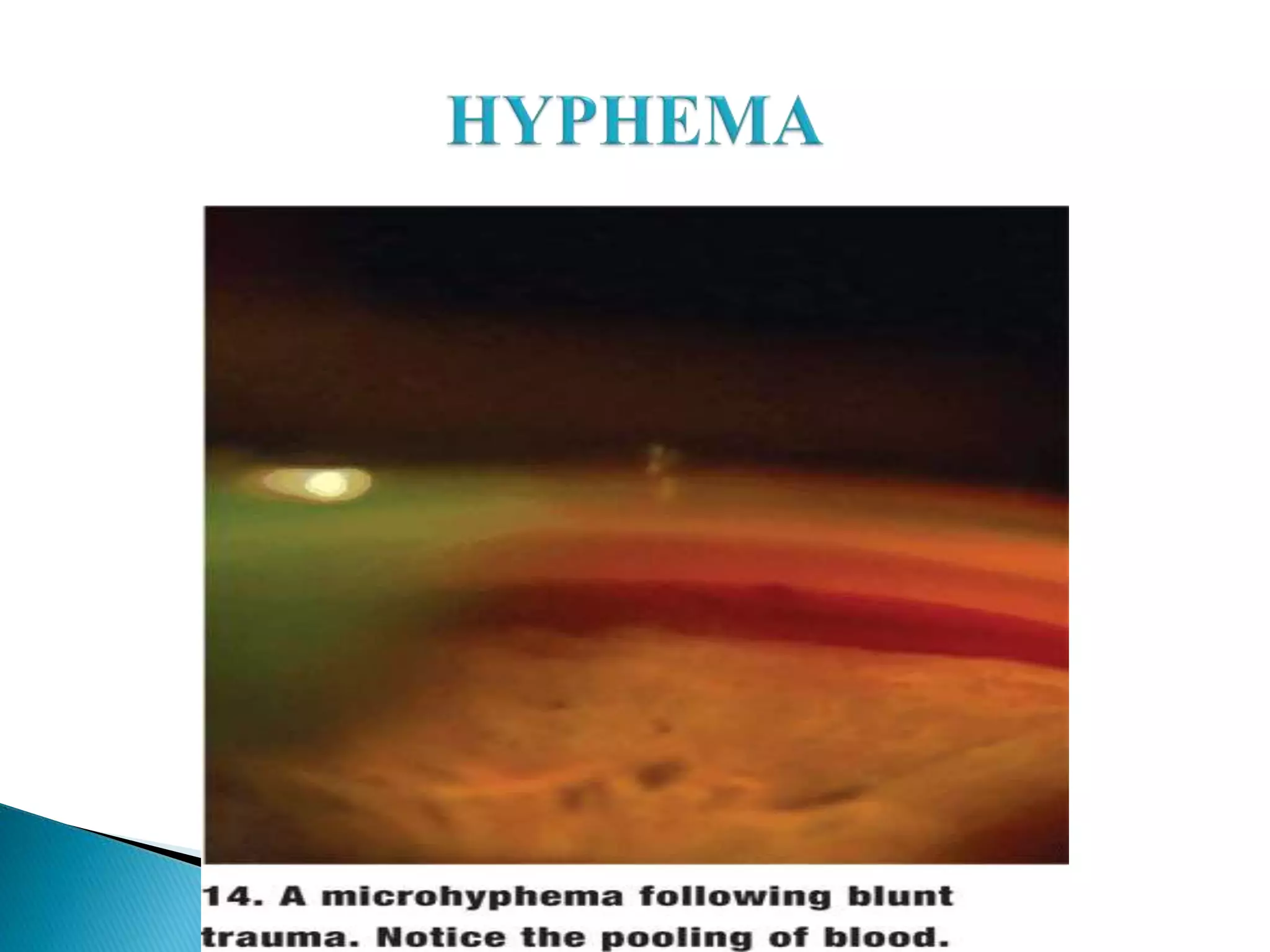
 Suspected open globe injury or early in course of
suspected closed globe injury with hyphaema as
pressure may precipitate rebleed.
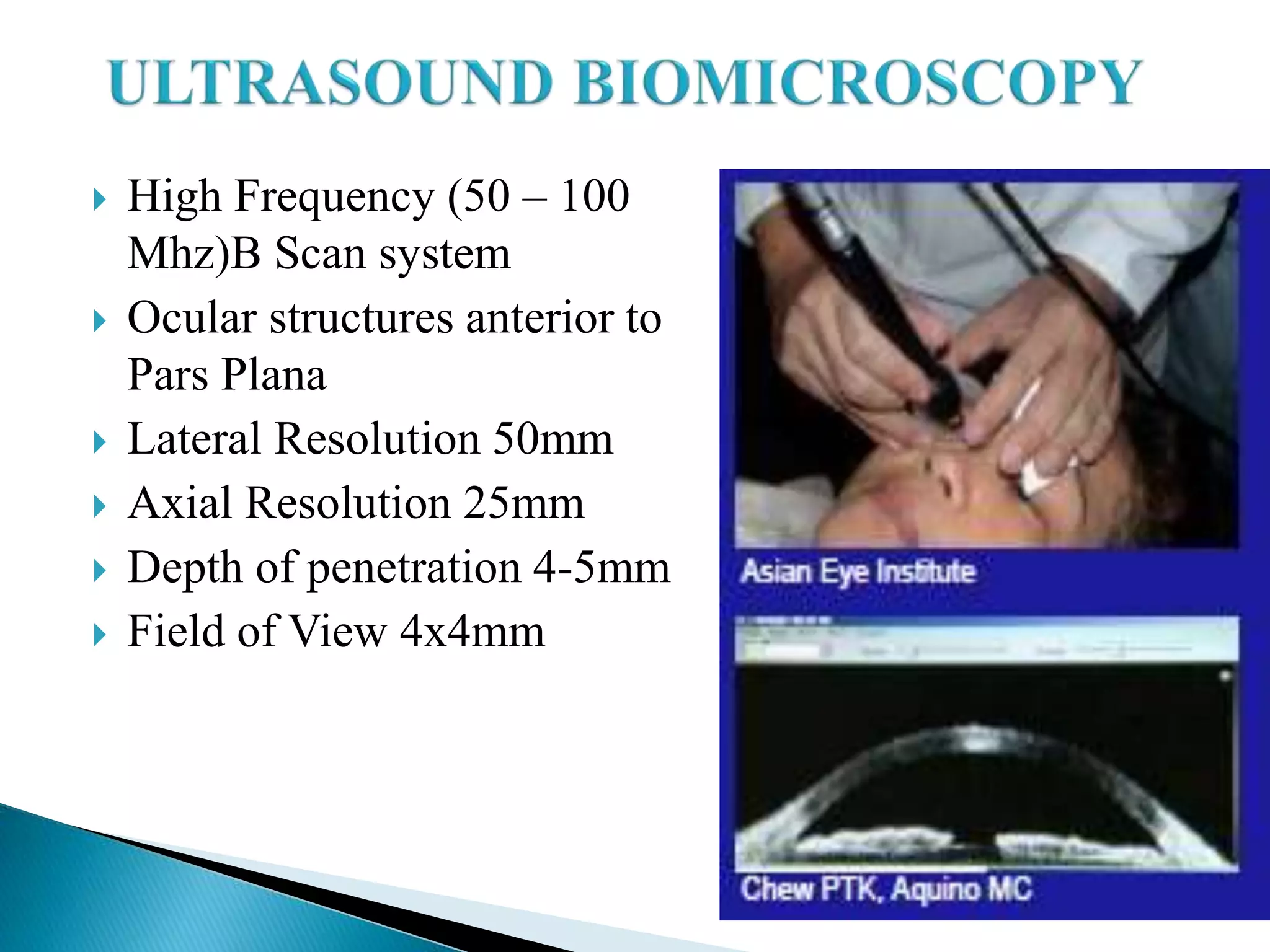
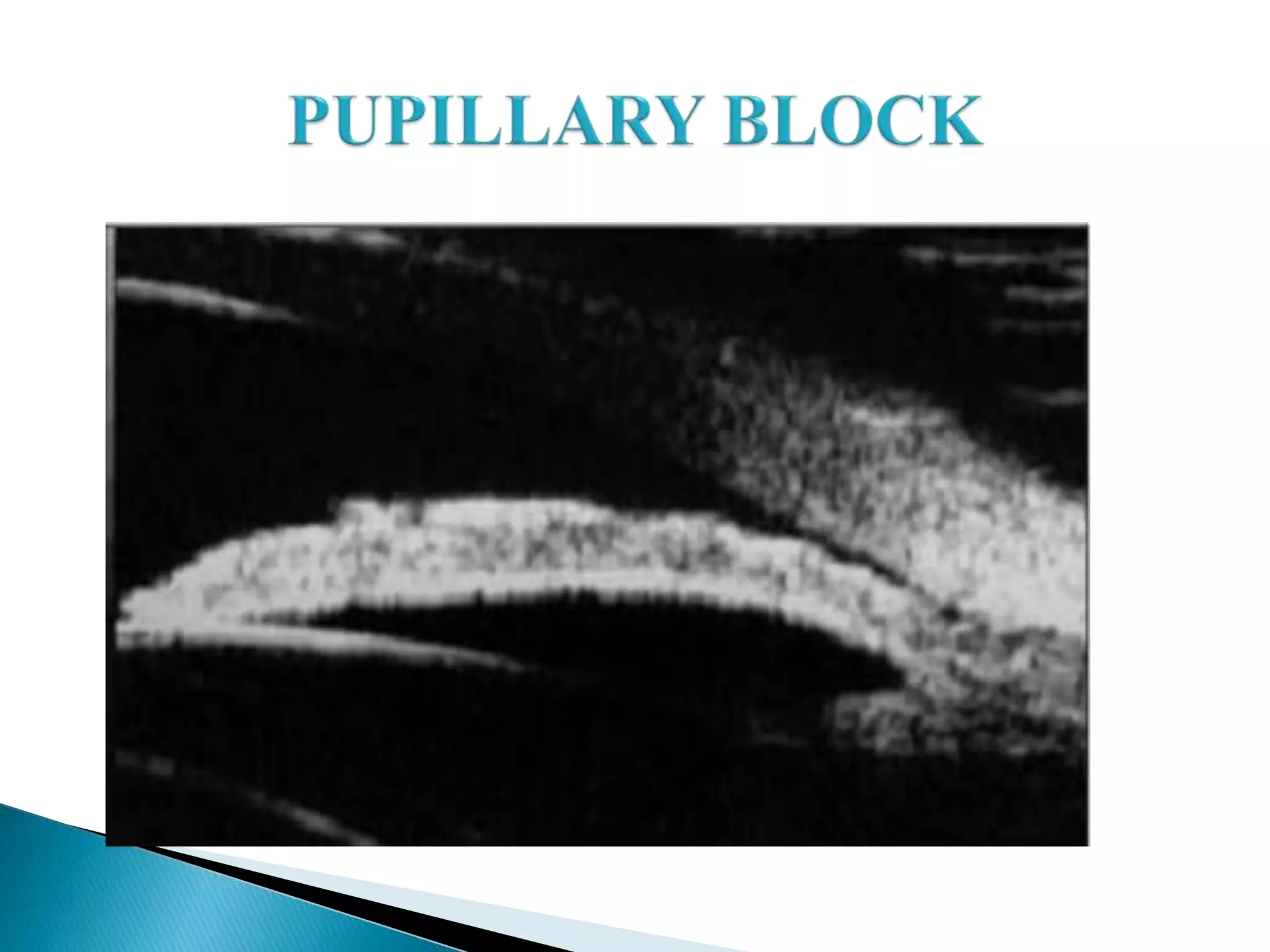
 High Frequency (50 – 100
Mhz)B Scan system
 Ocular structures anterior to
Pars Plana
 Lateral Resolution 50mm
 Axial Resolution 25mm
 Depth of penetration 4-5mm
 Field of View 4x4mm
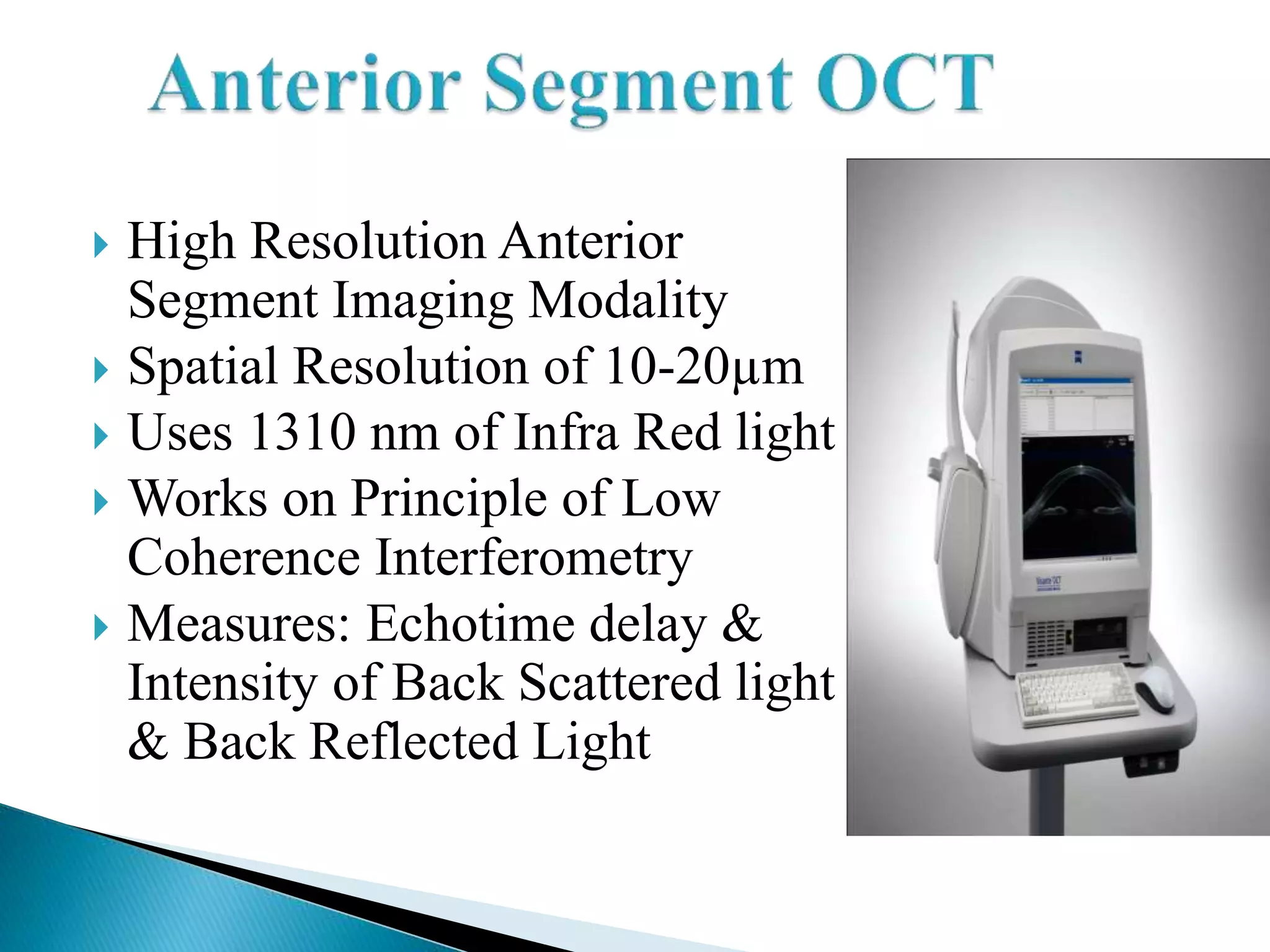
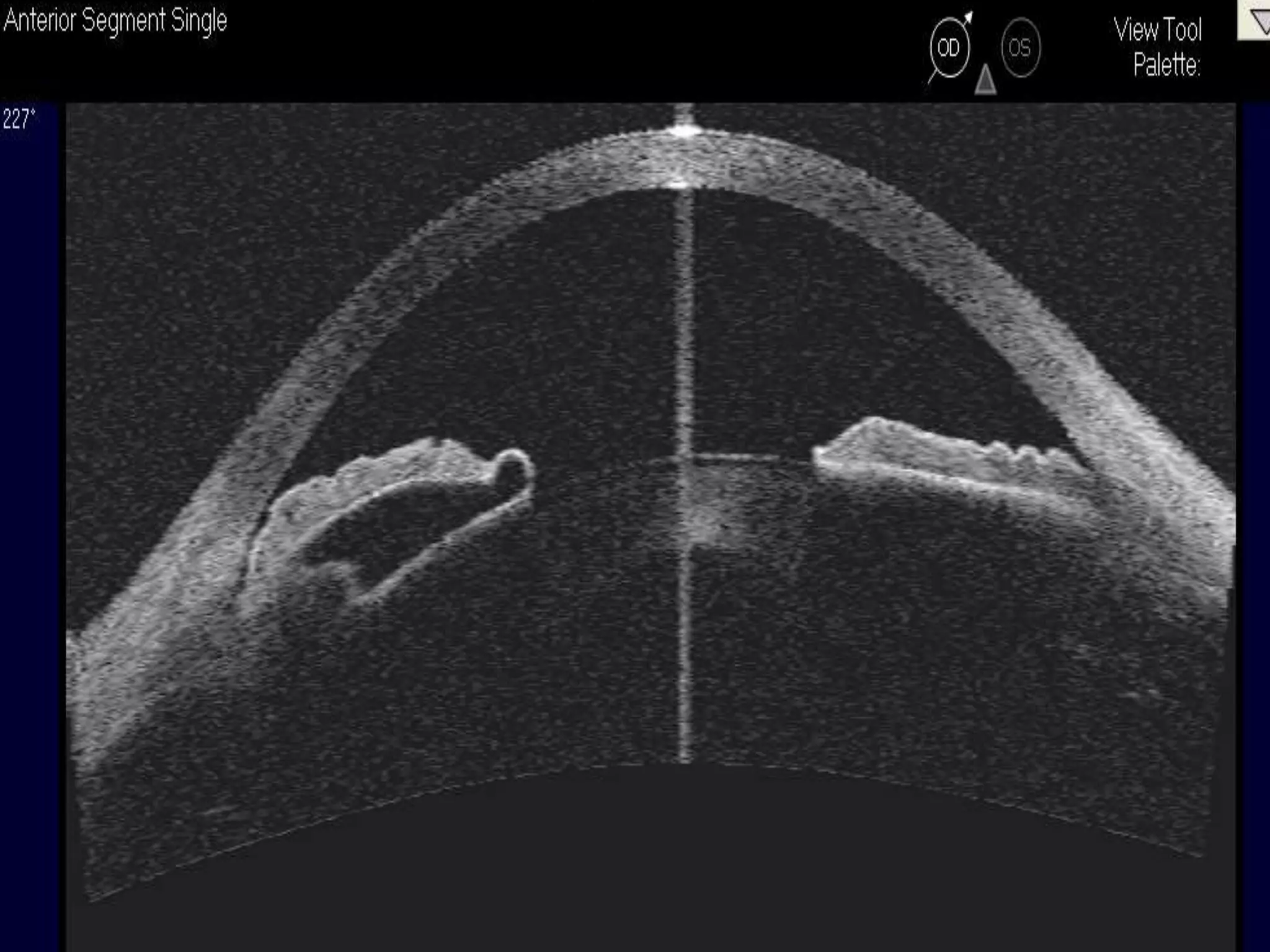
 High Resolution Anterior
Segment Imaging Modality
 Spatial Resolution of 10-20µm
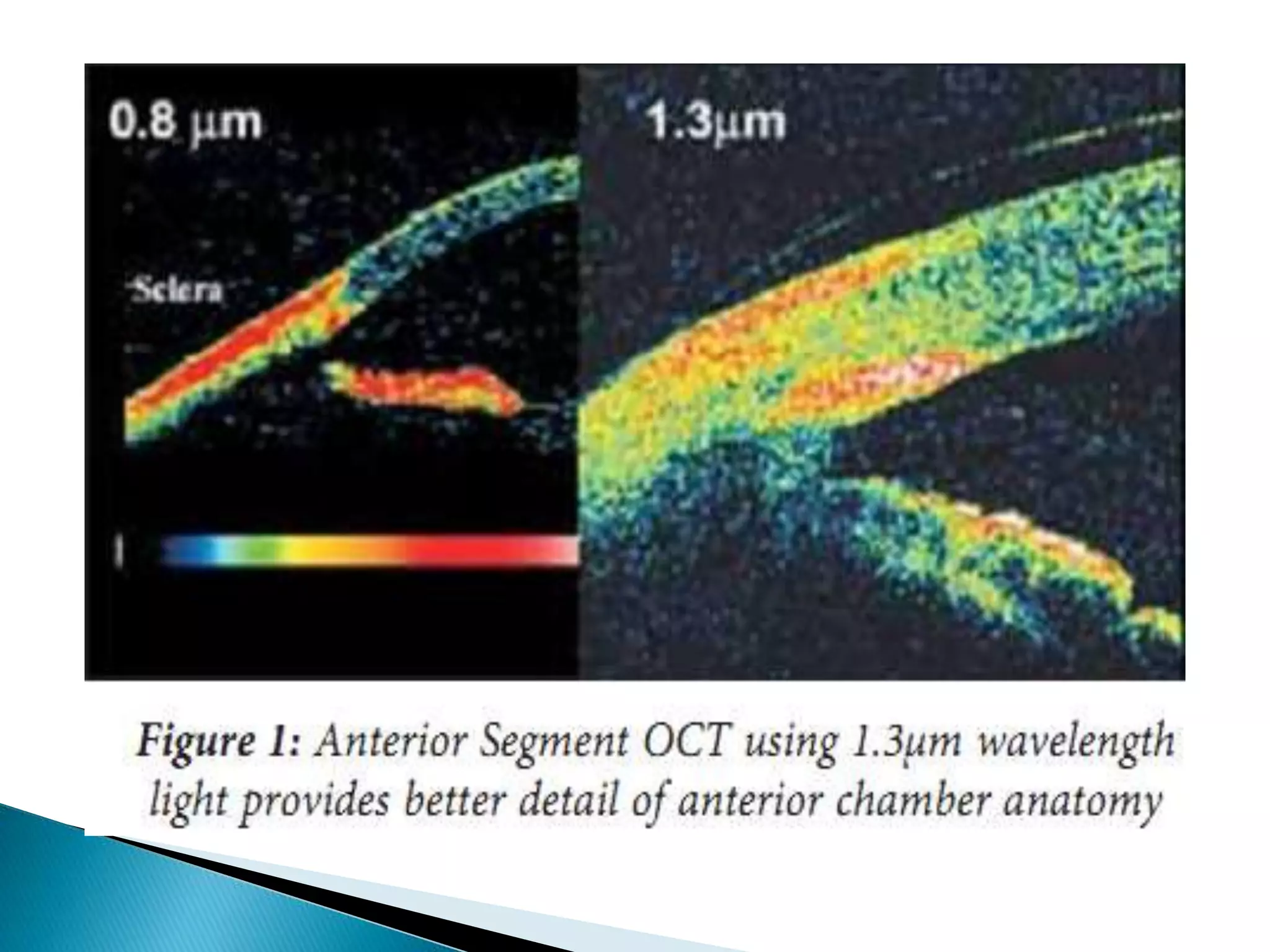
 Uses 1310 nm of Infra Red light
 Works on Principle of Low
Coherence Interferometry
 Measures: Echotime delay &
Intensity of Back Scattered light
& Back Reflected Light
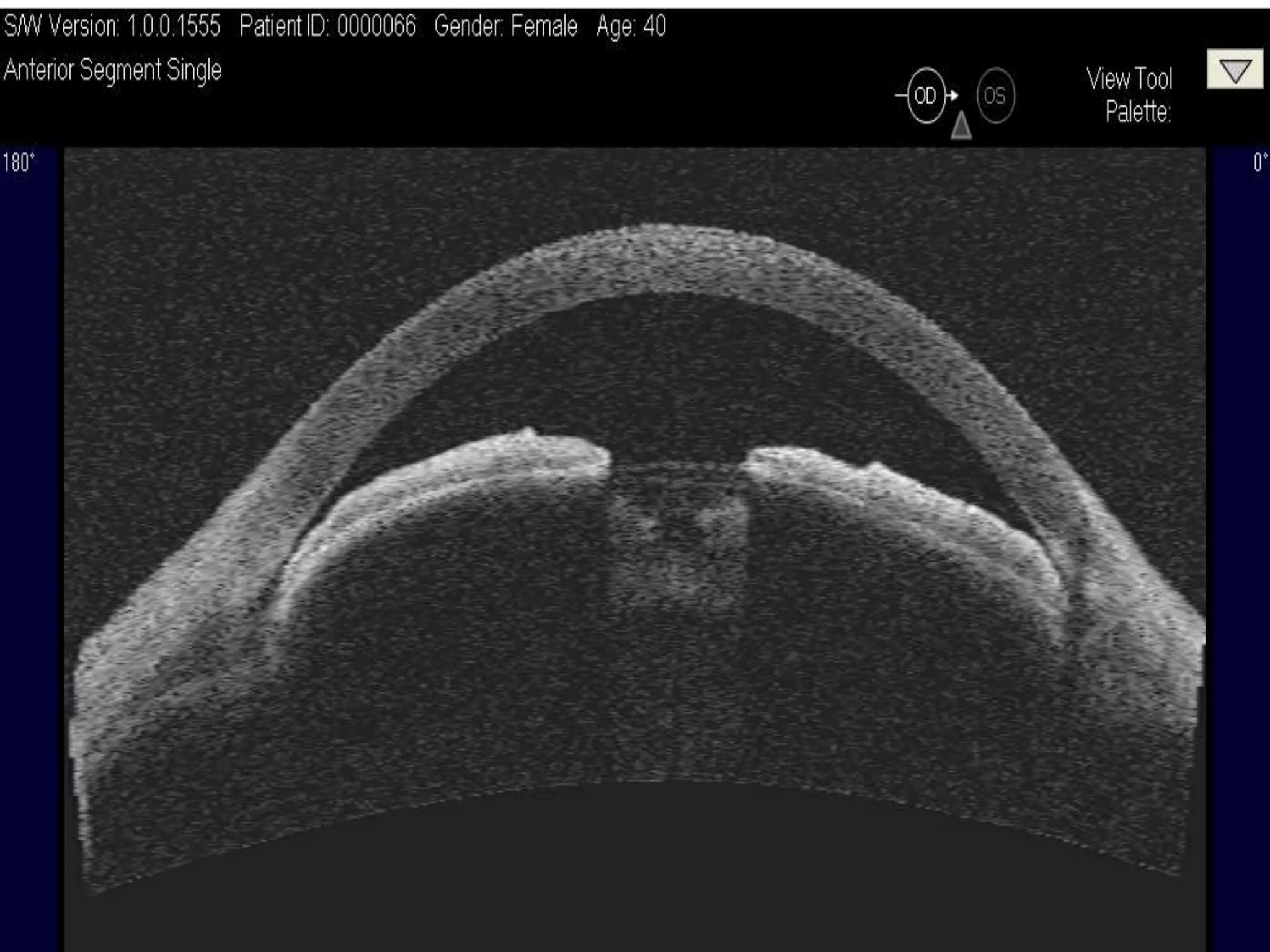
 Imaging of Anterior Chamber
 Evaluation of Structural Causes of Angle
Closure
 Effects of Interventions like Iridotomy
 Imaging of Trabeculectomy Blebs
 Tube Position in Glaucoma Drainage Implants
 Angle Assesment in Corneal Opacities
 Pachymetry
 Large Scale Screening of Angle Closure &
Angle Closure Glaucoma
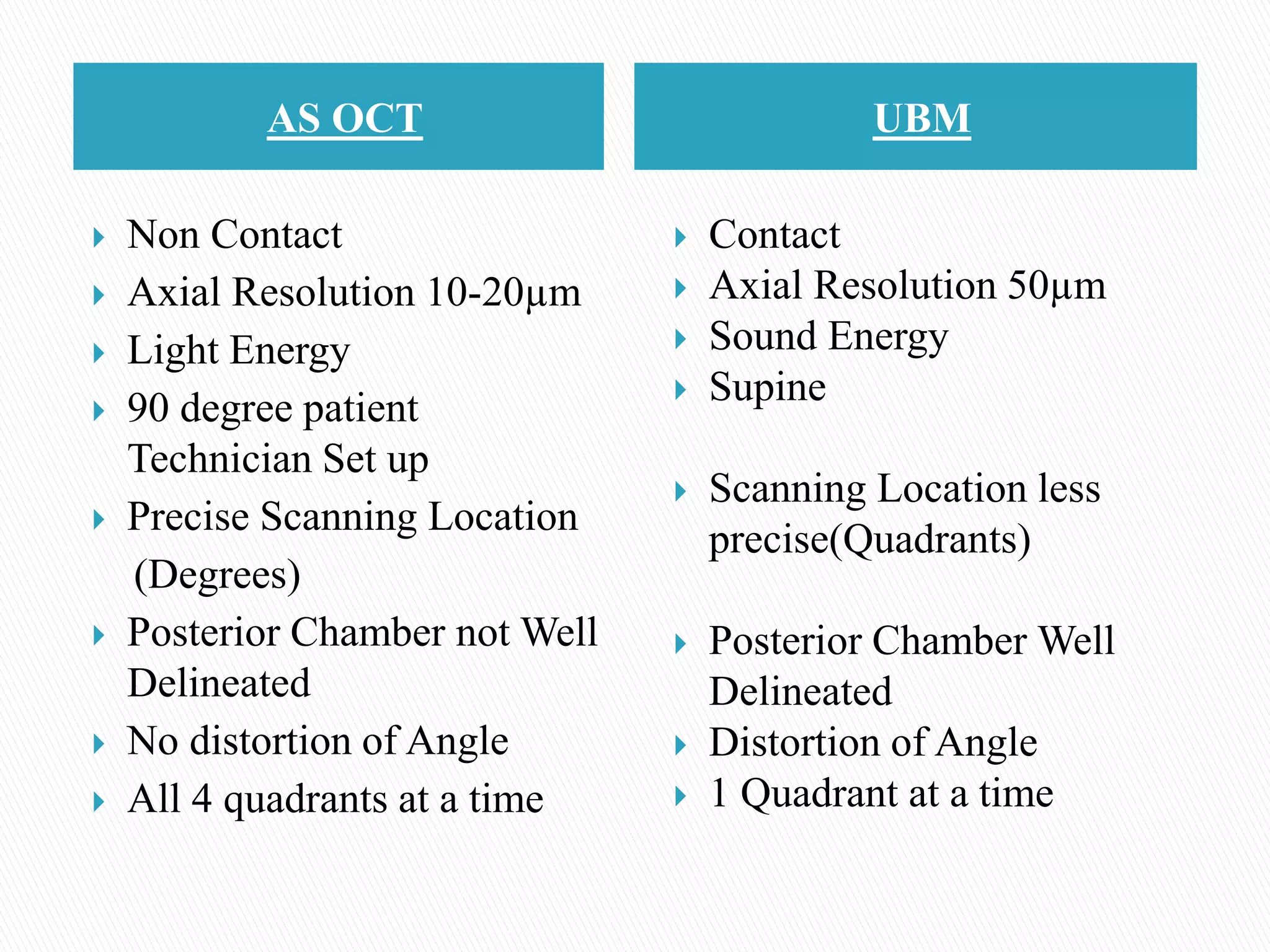
AS OCT UBM
 Non Contact
 Axial Resolution 10-20µm
 Light Energy
 90 degree patient
Technician Set up
 Precise Scanning Location
(Degrees)
 Posterior Chamber not Well
Delineated
 No distortion of Angle
 All 4 quadrants at a time
 Contact
 Axial Resolution 50µm
 Sound Energy
 Supine
 Scanning Location less
precise(Quadrants)
 Posterior Chamber Well
Delineated
 Distortion of Angle
 1 Quadrant at a time
Gonioscopy
Gonioscopy

Gonioscopy

  • 1.
  • 2.
     Greek :gṓ nḗ : angle , Ộs’k-pḗ : view  Alexois Trantas:(1907) First visualized angle in an eye with Keratoglobus  Maximilian Salsmann:(1914) Father of Gonioscopy. First introduced Goniolens
  • 3.
     Koeppe : Designedimproved Contact lens and gave the method biomicroscopy of angle of anterior Chamber with slit lamp.  Manuel Uribe Troncoso: Developed Gonioscope for magnification & illumination of Angle. First to write a Comprehensive book on Gonioscopy
  • 4.
     Otto Barkan: Establisheduse of Gonioscopy in Management of Glaucoma.  Goldmann:(1938) Introduced Gonioprism.
  • 5.
     Critical Angle:Cornea Air Interface~46degree Light rays from Angle exceeds Critical angle so rays reflected back into AC,preventing direct visualisation of Angle
  • 6.
  • 8.
    LENS DESCRIPTION KOEPPE PrototypeDiagnostic Lens RICHARDSON SHAFFER Small Koeppe Lens used for Infants LAYDEN For Gonioscopic Examination of Premature Infants BARKAN Prototype Surgical Goniolens THORPE Surgical & Diagnostic lens for Operating Rooms SWAN JACOB Surgical Goniolens used in Children
  • 9.
     Used withHandheld Biomicroscope (15x to 20x) with separate light source
  • 12.
    LENS DESCRIPTION GOLDMANN SINGLEMIRROR Mirror inclined at 62 degrees GOLDMANN THREE MIRROR One mirror for gonioscopy, two for retina; coated front surface for laser use ZEISS FOUR MIRROR All 4 mirrors inclined at 64 degrees for gonio;requires holder;fluid bridge not required. POSNER FOUR MIRROR Modified Zeiss four mirror gonioprism with attached handle SUSSMAN FOUR MIRROR Handheld Zeiss type Gonioprism THORPE FOUR MIRROR Four gonioscopy mirrors; inclined at 62 degrees;requires fluid bridge RITCH TRABECULOPLASTY LENS Four gonioscopy mirrors; two inclined at 59 degrees & two at 62 degrees with convex lens over two LATINA TRABECULOPLASTY LENS One mirror for Trabeculoplasty
  • 16.
     All 4mirrors inclined at 64 degrees for gonio
  • 18.
  • 19.
     Four gonioscopymirrors; inclined at 62 degrees;requires fluid bridge
  • 21.
     One mirrorfor Trabeculoplasty
  • 23.
    ADVANTAGE DISADVANTAGE  Observer’sheight can be changed  Done on sedated, comatosed & Children  Panoramic view of Angle  Less distortion of AC  Useful in examining fundus with small pupil  Inconvinient  Special equipments required  Difficult to master  Does not Stabilize globe
  • 24.
    ADVANTAGE DISADVANTAGE  Quick& Convinient  No special equipment required  Allows differentiation B/w Appositional & Synechial closure  Can create corneal wedge  Inadverent Pressure on Cornea  Mirror image is confusing
  • 25.
    DIRECT INDIRECT  Panoramicview of iridocorneal angle with ability to adjust view by examiner.  Both eyes can be examined simultaneously.  No viscous [ coupling ] material required.  Direct view for surgery e.g. Goniotomy  DISADV: Inability to perform indentation, low magnification, assistance.  Segmental View  One Eye at a time  Viscous required  Mirror Image seen  Excellent optics with Slit Lamp  Indentation Can be Done
  • 26.
     Classification :Open or Closed angle glaucoma  To assess AC angle recess & risk of angle closure.  To identify plateau iris.  To look for Abnormal angle pigmenatation, PEX , angle recession, cyclodialysis, foreign body, Neoplasm, copper deposition , blood in Schlemm’s canal.
  • 27.
    Evaluation of trabeculectomyfistula , glaucoma drainage devices Congenital anomalies- aniridia, iris processes.
  • 28.
    Laser trabeculosplasty/ goniophtocoagulation Goniotomy/ Gonioplasty/Trabectome sx Reopening of blocked trabeculectomy opening. Laser of suture around tube of G.D.D. Indentaion Gonioscopy to break an attack of Ac. ACG
  • 30.
     This structuralportion of ciliary body is visible in the A.C. as a result of iris insertion into ciliary body  Width depends on level of iris insertion  Wider in myopes and narrow in hyperopia  Color: grey to dark brown
  • 32.
     This isthe post. Lip of scleral sulcus which is attached to the ciliary body posteriorly and corneo-scleral meshwork anteriorly  Color : prominent white line
  • 33.
     Pigmented bandanterior to scleral spur  Although extent of TMW is from root of iris to schwalbe’s line it is considered as 2 portions a) Anterior - between schwalbe’s line and ant. Edge of schlemm’s cannal  Involved in lesser degree of aqueous out flow b) Posterior – Functional part , primary site of aqueous out flow  Appearance of funtional TMW depends on amount of pigment deposition
  • 34.
     At birthno pigment and with age from faint to dark brown  Pigment deposition may be homogeneous or irregular  When lightly pigmented blood reflex in schlemm’s cannal may be seen as a red band
  • 35.
     When athin slit of light hits the irido-corneal angle at an angle of 10⁰-15⁰, two light reflections are seen from the external and internal corneal surfaces which pipe down at the sclero-corneal junction (Schwalbe’s line) marking the anterior border of trabecular meshwork.  Corneal wedge is a useful technique to identify the trabecular meshwork in eyes that are either nonpigmented or excessively pigmented its diff. to mark trabecular meshwork begins
  • 39.
     Junction between anteriorchamber angle structures and cornea where the descement’s membrane terminates  Fine ridge ant. to TMW identified by a small built up of pigment  Landmark for TMW in narrow angle
  • 42.
    Contour  Flat- DeepAC  Concave- Shallow AC , Hyperopia  Convex- High Myopia, Pigment Dispersion Syndrome  Abnormal Rolling- Plateau iris
  • 43.
    IRIS PROCESS PAS Fine  Extend into scleral Spur  Follow concavity of Recess  Underlying Structures are seen  Iris moves with indentation  Broken with angle Recession  Broad  Extend Beyond Scleral Spur  Bridge concavity of Recess  Obscures the View  Resists Movement  Intact in Recession
  • 44.
    NORMAL NEOVASCULARIZATION  RadialOrientation  Thick  Non Branching  Do not cross Scleral Spur  Fine  Arborising  Crosses Scleral Spur
  • 46.
     Over theHill  Corneal Wedging  Indentation
  • 47.
     It’s aspecial maneuver to view over a steep iris.  It is done by asking the patient to look in the direction of the mirror or moving the mirror towards the angle being viewed
  • 48.
     When iriscovers the trabecular meshwork (TM) its easy to mistake: ◦ The non-pigmented TM for scleral spur ◦ Pigmented Schwalbe’s line for TM ◦ Apposition from synechiae  Indentation Gonioscopy is particularly useful in these cases
  • 50.
     Useful wheniris surface is convex ◦ Done when recognition of angle structures is difficult  Performed in all glaucoma cases ◦ Differentiates appositional vs synechial closure in pupillary block ◦ Measures extent of angle closure ◦ Identifies plateau iris config. ◦ Identifies lens induced angle closure
  • 54.
     If posterior[ pigmented ] part of trabecular meshwork is not visible in more than 180 degrees of angle without indentation or manipulation, this is known as an ‘ occludable angle’.
  • 57.
     SCHEIE SYSTEM: mostposterior structure visible.  SHAFFER’S SYSTEM : assess geometric angle width in 4 grades . angle potential for occlusion.  SPAETH SYSTEM : three dimentional structure of angle - level of iris insertion and peripheral iris configuration.  RPC GRADING
  • 58.
    GRADE STRUCTURE SEENPROBABILITY 0 CBB Seen No angle closure I CBB Narrow No angle closure II CBB not seen, SS Seen Rarely closure possible III Posterior TM Not seen Closure likely IV Schwalbe’s Line not seen Gonioscopicaly closed
  • 60.
     Angular width Iris Configuration  Level of Iris Insertion  Iris Processes  Pigmentation of posterior Trabecular Meshwork
  • 62.
    IRIS PROCESSES PIGMENTATIONOF TBM  U – along angle recess  V – upto trabecular meshwork  W – upto Scwalbe’s Line  0 no pigmentation  1+ just perceptible  2+ definite but mild  3+ moderately dense  4+ dense black pigmentation
  • 63.
    GRADE STRUCTURE SEEN 0CLOSED 1 SCHWALBE’S LINE 2 ANTERIOR(NON PIGMENTED) TM 3 POSTERIOR PIGMENTED TM 4 SCLERAL SPUR 5 CILIARY BODY BAND 6 ROOT OF IRIS
  • 64.
     Angle isDeep  Flat Iris inserted posterior to Scleral Spur  Translucent Trabecular Meshwork  Normal CBB In Congenital Glaucoma:  Anterior insertion of iris directly on TBM  Thin CBB  Congenital vessels in ‘’Hair Pin’’ Configuration
  • 66.
  • 83.
     Wash withsoap & water  Soaking the lens for 5-10 min in fresh solution of Sod. Hypochlorite [ 1:10 household bleach : water]  Rinsing with sterile water  Air drying  3% H2O2 or 1% Formaldehyde can also be used.  Direct surgical gonioscopes [ Koeppe, Swan Jacob] can be sterilized with ethylene oxide.
  • 84.
     Contact investigationpatient discomfort.  Conjunctival infection.  Artefactual angle closure  Slit lamp illumination-> pupil constriction-> opens up the angle  Wide interobserver variations.  Indentation corneal folds, distorted view of angle structures, epithelial injury.
  • 85.
     Painful inflamedeye  Acute glaucoma with edematous cornea  Mydriatic drugs- obscure angle by bunching up iris  Suspected open globe injury or early in course of suspected closed globe injury with hyphaema as pressure may precipitate rebleed.
  • 87.
     High Frequency(50 – 100 Mhz)B Scan system  Ocular structures anterior to Pars Plana  Lateral Resolution 50mm  Axial Resolution 25mm  Depth of penetration 4-5mm  Field of View 4x4mm
  • 94.
     High ResolutionAnterior Segment Imaging Modality  Spatial Resolution of 10-20µm  Uses 1310 nm of Infra Red light  Works on Principle of Low Coherence Interferometry  Measures: Echotime delay & Intensity of Back Scattered light & Back Reflected Light
  • 98.
     Imaging ofAnterior Chamber  Evaluation of Structural Causes of Angle Closure  Effects of Interventions like Iridotomy  Imaging of Trabeculectomy Blebs  Tube Position in Glaucoma Drainage Implants  Angle Assesment in Corneal Opacities  Pachymetry  Large Scale Screening of Angle Closure & Angle Closure Glaucoma
  • 104.
    AS OCT UBM Non Contact  Axial Resolution 10-20µm  Light Energy  90 degree patient Technician Set up  Precise Scanning Location (Degrees)  Posterior Chamber not Well Delineated  No distortion of Angle  All 4 quadrants at a time  Contact  Axial Resolution 50µm  Sound Energy  Supine  Scanning Location less precise(Quadrants)  Posterior Chamber Well Delineated  Distortion of Angle  1 Quadrant at a time

Editor's Notes

  • #11 Prototype Surgical Goniolens
  • #12 Surgical Goniolens used in Children
  • #14 Mirror inclined at 62 degrees, requires fluid bridge as post radius of curvature of 7.38mm
  • #15 One mirror for gonioscopy, two for retina; coated front surface for laser use w/c is for antireflection
  • #17 Unger holder, post radi of curvature 8.4mm so no fluid bridge
  • #21 At 59 for inerior qudrants & 64 for superior angles wid 17D Planoconvex lens over 2 mirror provide 1.4x magnification w/c reduces 50um spot size to 35 um.
  • #23 Semi dim light, cornea anaesthetised,patient properly made to sit comfortably,illummination & viewing arm parallel wid a slit of 2x2 mm.
  • #33 May be obscured by Iris process iris bombe Peripheral anterior synechiae pigments
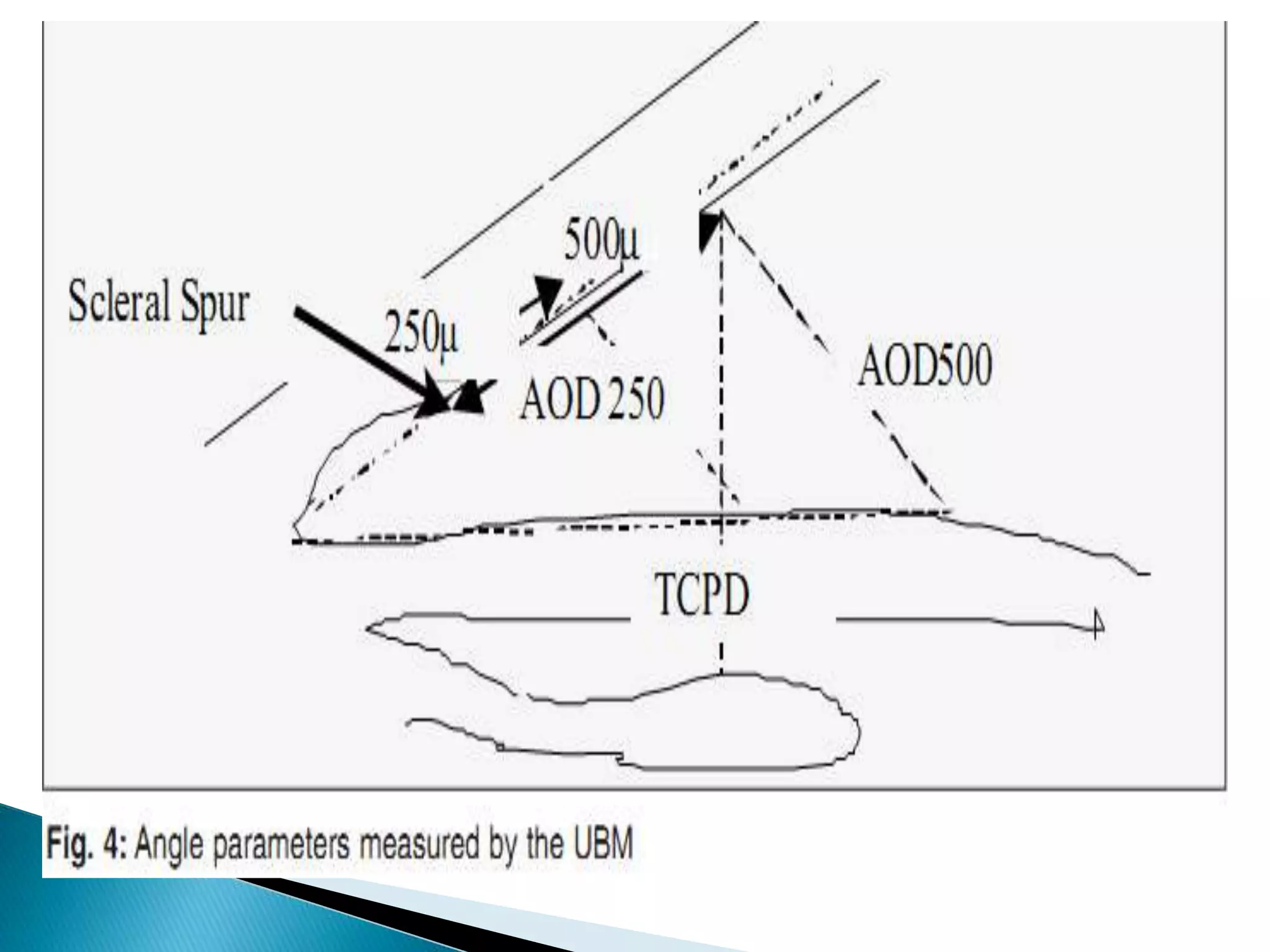
  • #89 AOD Angle opening Distance….Corneal Endothelium to ant iris perpendline from trabecular meshwork,…. TCPD Trabecular MeshworkCiliary Process Distance Distance between Trab &Ciliary Process