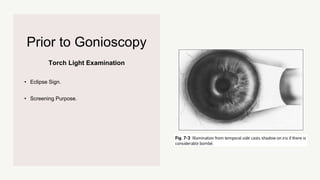
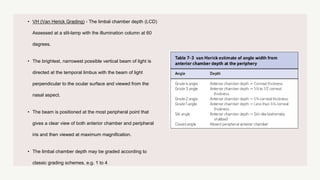
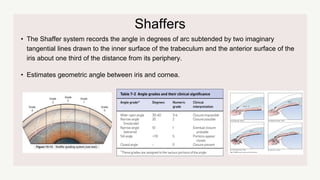
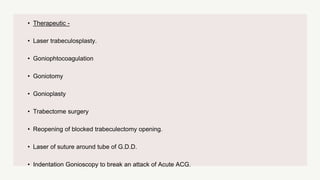
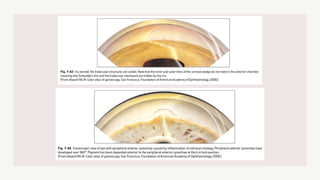
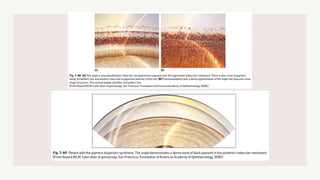
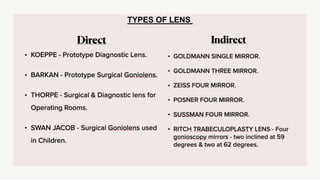
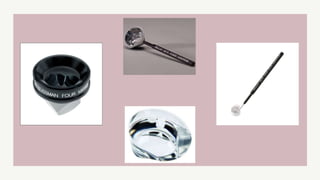
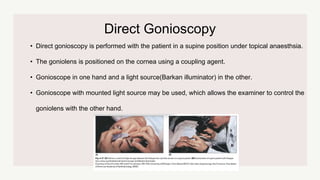
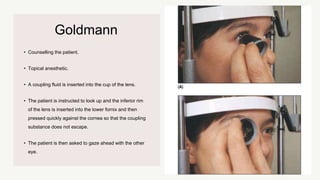
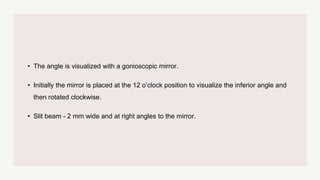
Gonioscopy allows visualization of the anterior chamber angle structures. It was coined by Alexios Trantas in 1975 from the Greek words "gonia" meaning angle and "skopein" meaning to view. There are two main types - direct gonioscopy using a Koeppe lens which provides a panoramic view but no magnification, and indirect gonioscopy using a Goldmann lens which provides a segmented view through a mirror with excellent optics and the ability to perform indentation. Gonioscopy is used diagnostically to classify glaucoma and assess angle anatomy and closure risk, and therapeutically for procedures like laser trabeculoplasty.











![DIRECT GONIOSCOPY
• Panoramic view of iridocorneal angle with ability to adjust view by examiner.
• Both eyes can be examined simultaneously.
• No viscous [ coupling ] material required.
• Direct view for surgery e.g. Goniotomy
• DISADV: Inability to perform indentation, low magnification, assistance.](https://image.slidesharecdn.com/gonioscopyppt-211226143555/85/Gonioscopy-36-320.jpg)