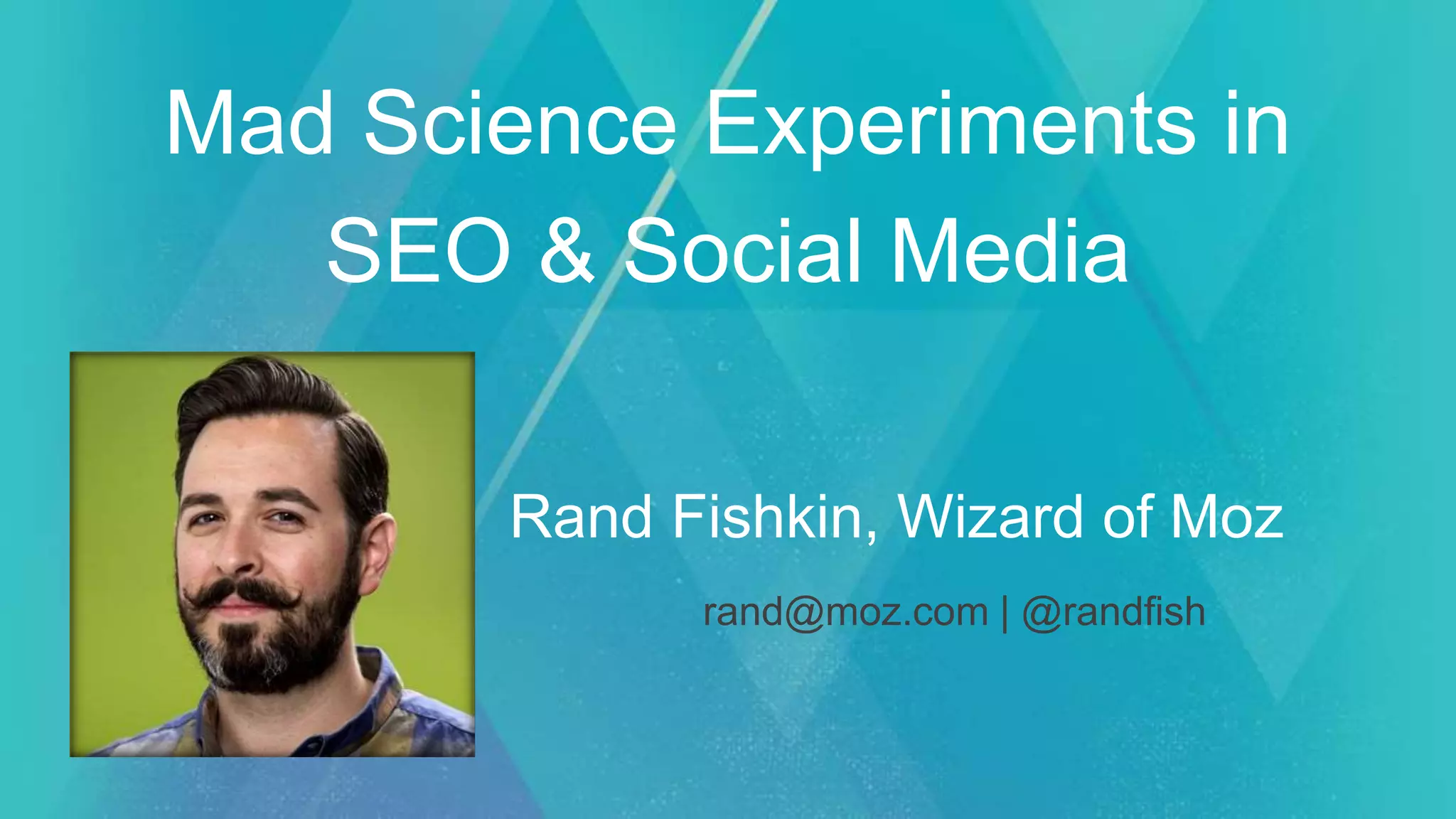
Mad Science Experiments in
SEO & Social Media
Rand Fishkin, Wizard of Moz
rand@moz.com | @randfish
Caveat #1
I am not a scientist.
Caveat #2
Search engines & social platforms
change. These results probably
will, too.
Caveat #3
Don’t misinterpret my enthusiasm for certainty!
Skepticism of even those tests that produces
consistent, repeatable results is wise.
with some fun, less
rigorous, one-off tests.Let’s Start
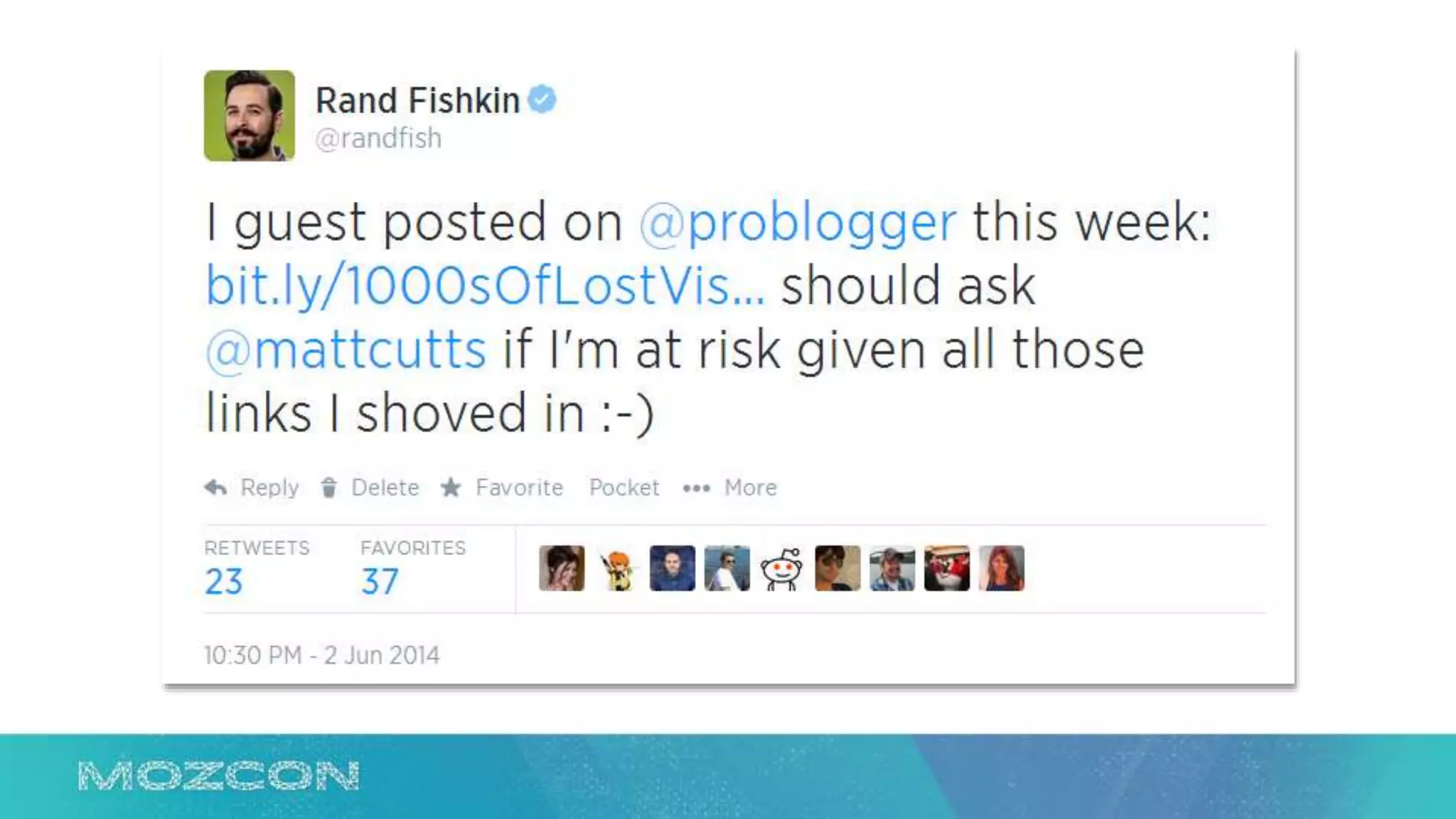
Has Google Really “Stuck a Fork” in
All Forms of Guest Blogging?
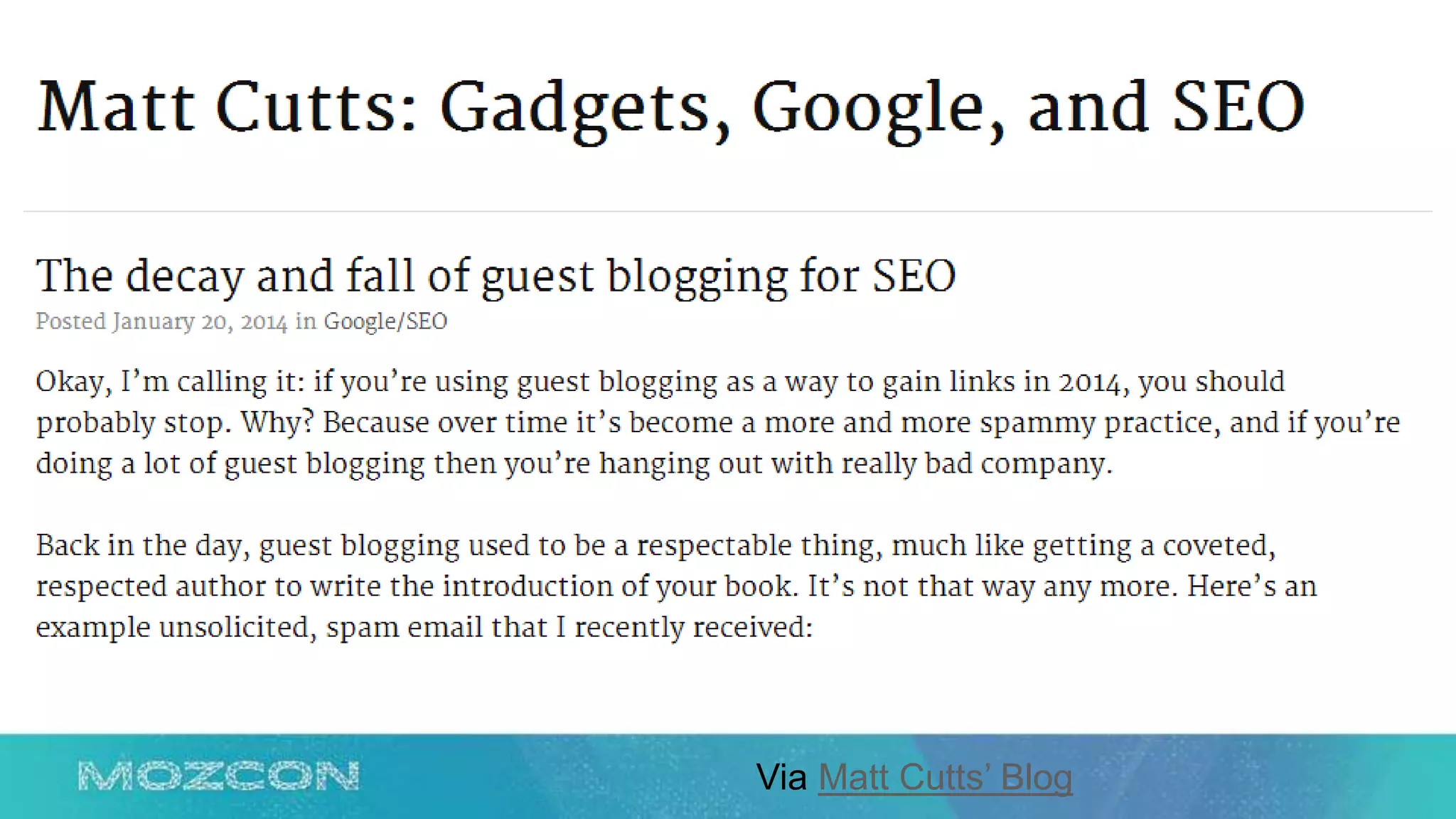
Via Matt Cutts’ Blog
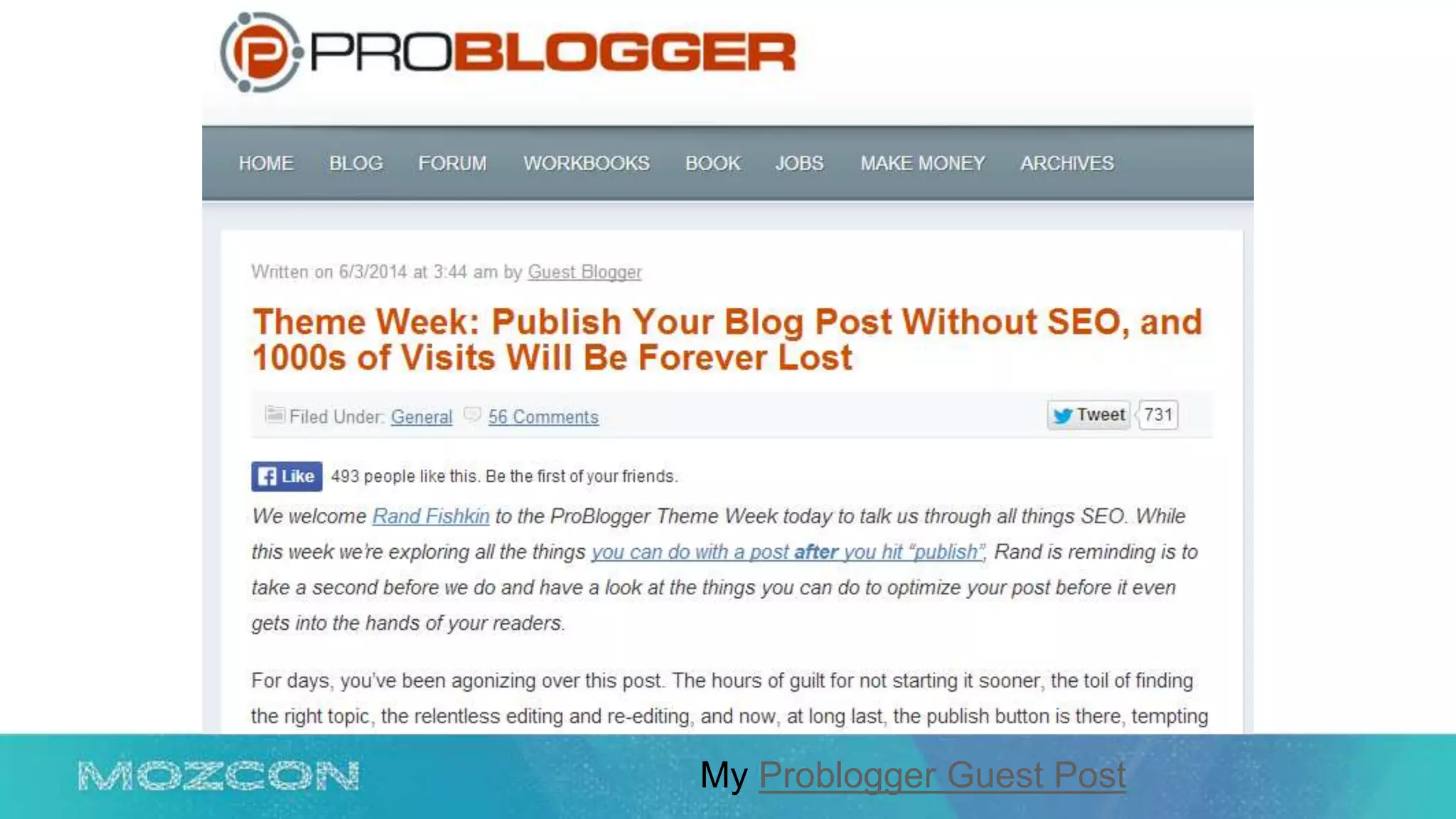
My Problogger Guest Post
My Takeaway:
There’s a kind of guest post Google wants
to count and a kind they don’t. If you can’t
tell the difference, do as Matt says and
stick a fork in it 
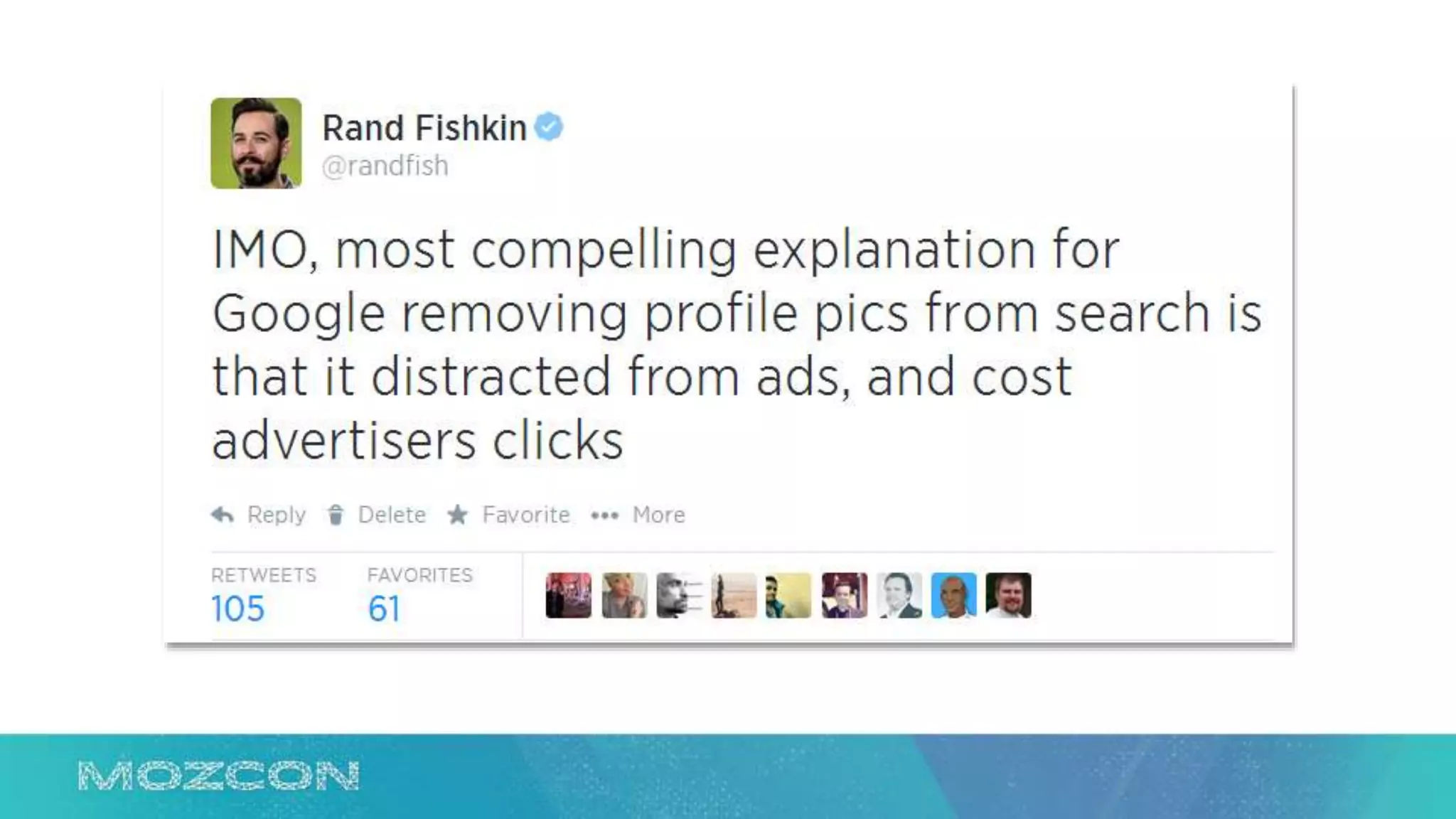
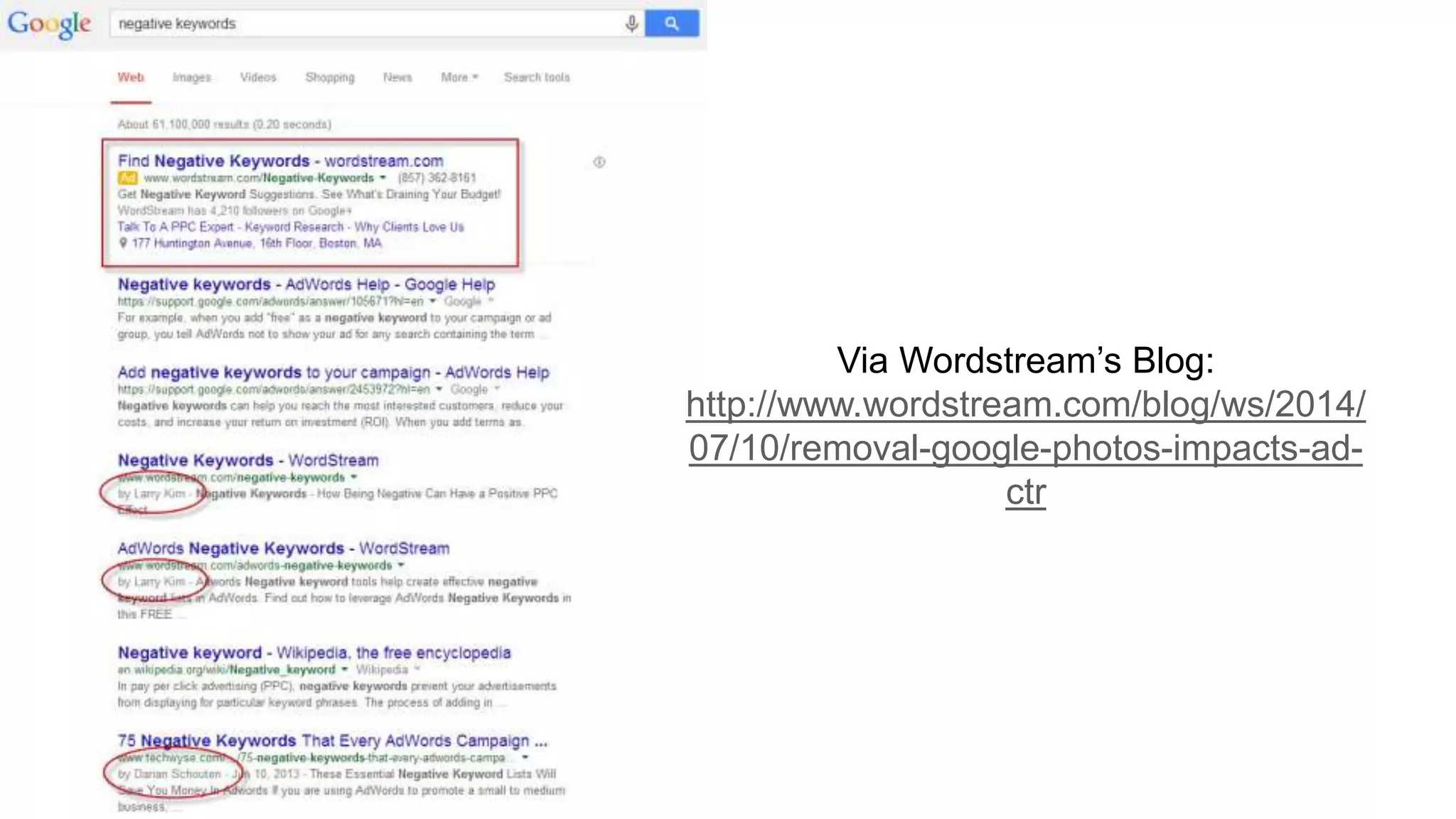
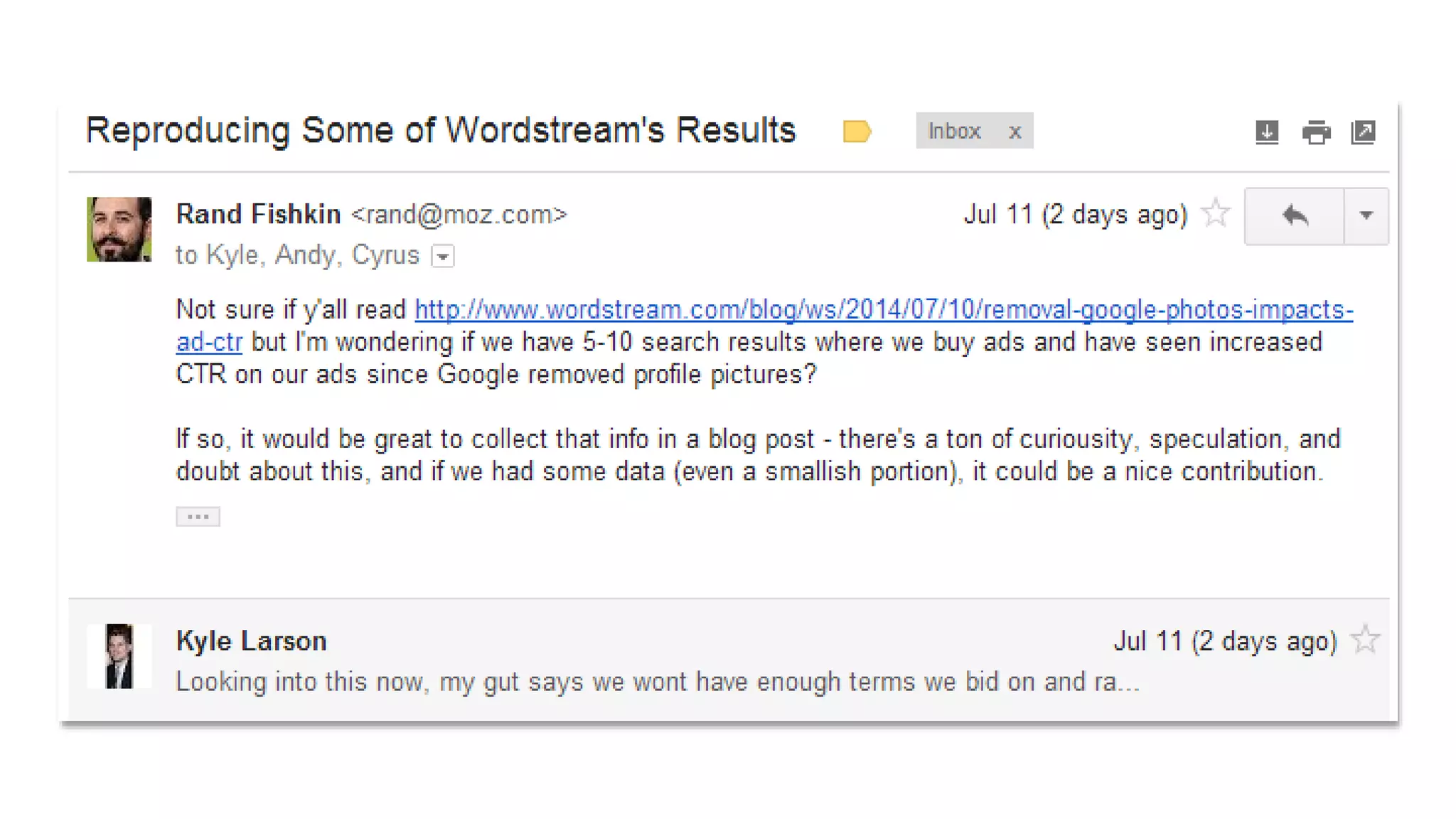
Did Google’s Removal of Author Pics
Directly Affect AdWords CTR?
Via Wordstream’s Blog:
http://www.wordstream.com/blog/ws/2014/
07/10/removal-google-photos-impacts-ad-
ctr
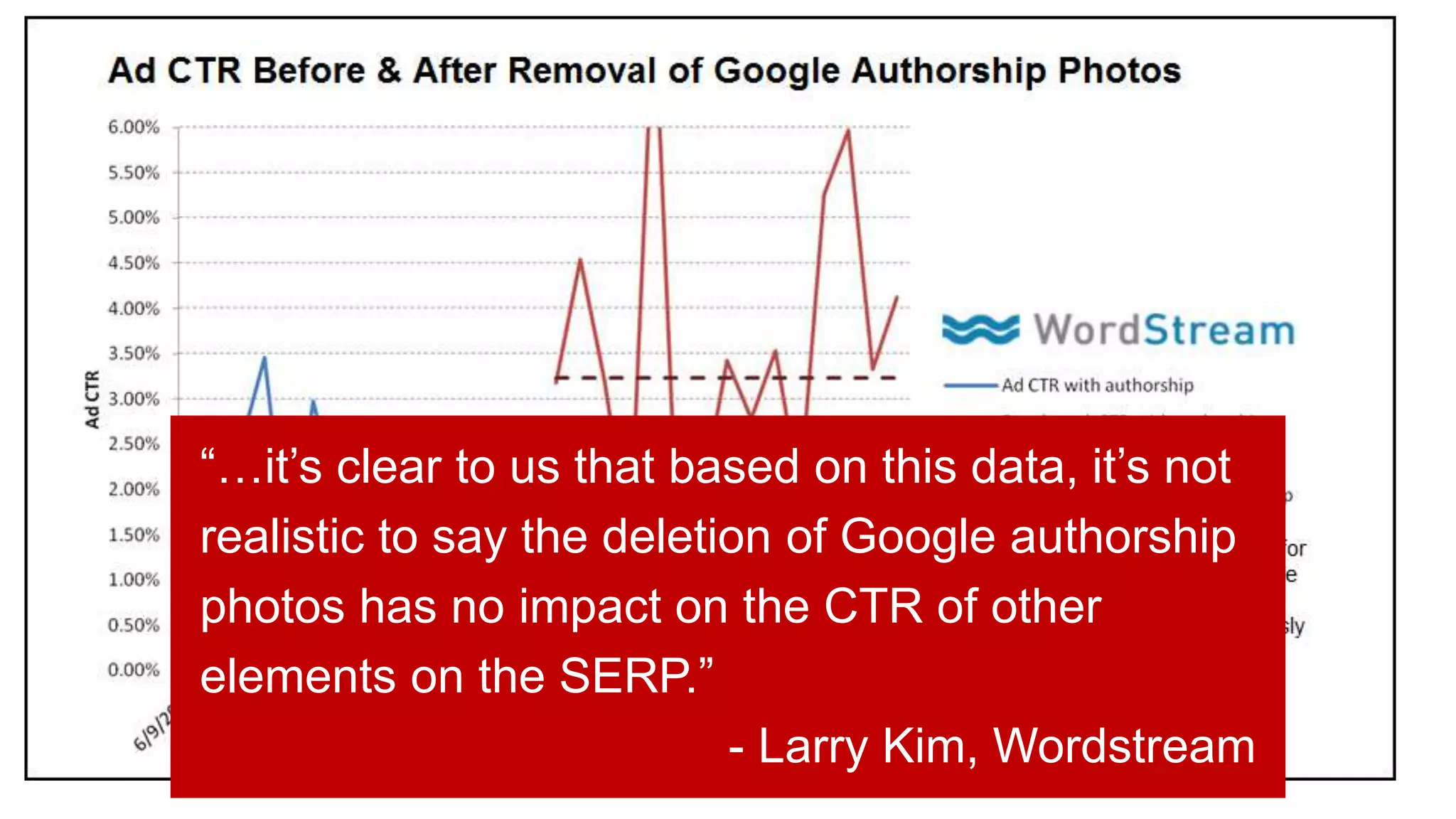
“…it’s clear to us that based on this data, it’s not
realistic to say the deletion of Google authorship
photos has no impact on the CTR of other
elements on the SERP.”
- Larry Kim, Wordstream
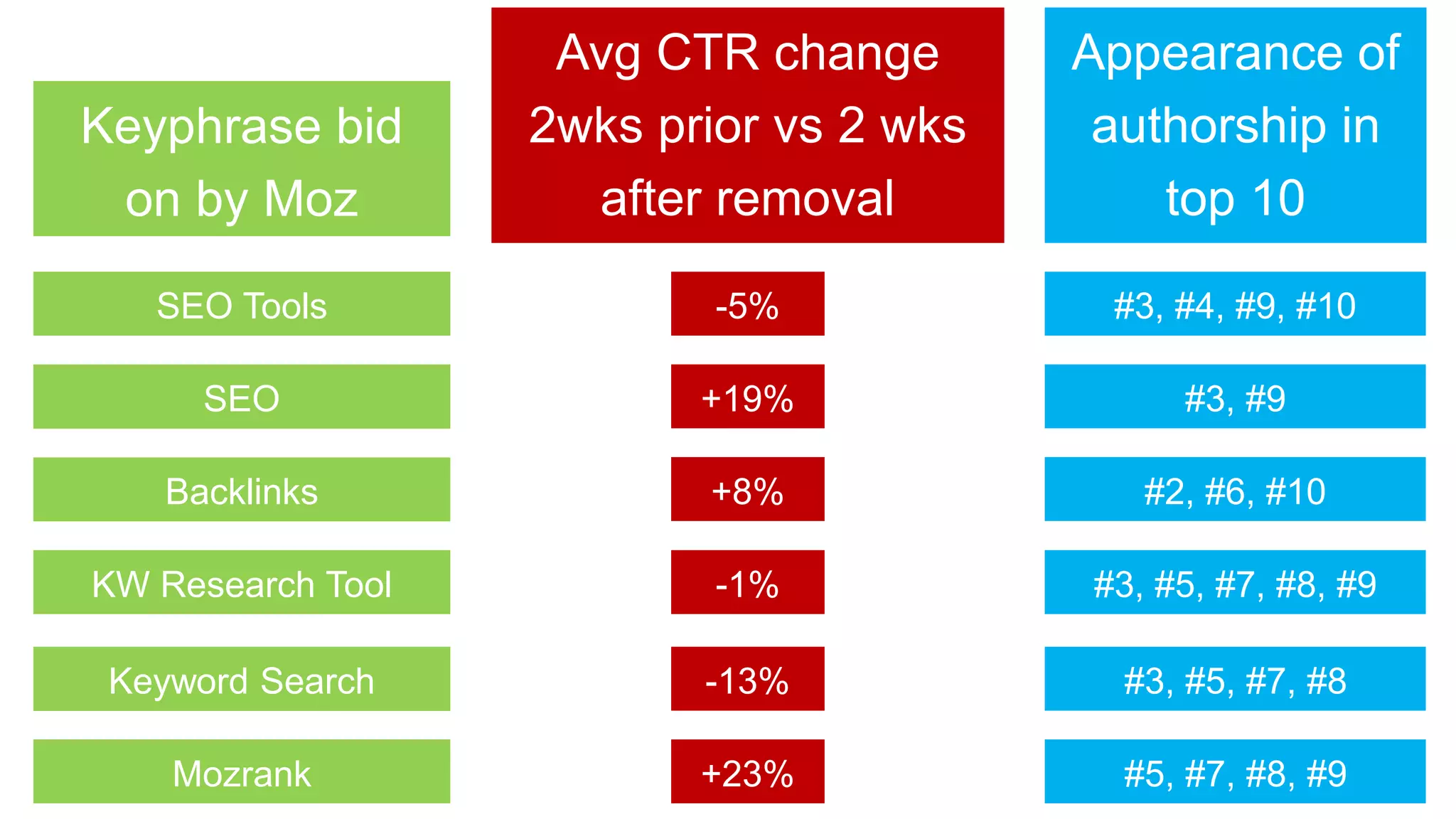
Avg CTR change
2wks prior vs 2 wks
after removal
Appearance of
authorship in
top 10
Keyphrase bid
on by Moz
SEO Tools
SEO
Backlinks
KW Research Tool
Keyword Search
Mozrank
-5%
+19%
+8%
-1%
-13%
+23%
#3, #4, #9, #10
#3, #9
#2, #6, #10
#3, #5, #7, #8, #9
#3, #5, #7, #8
#5, #7, #8, #9
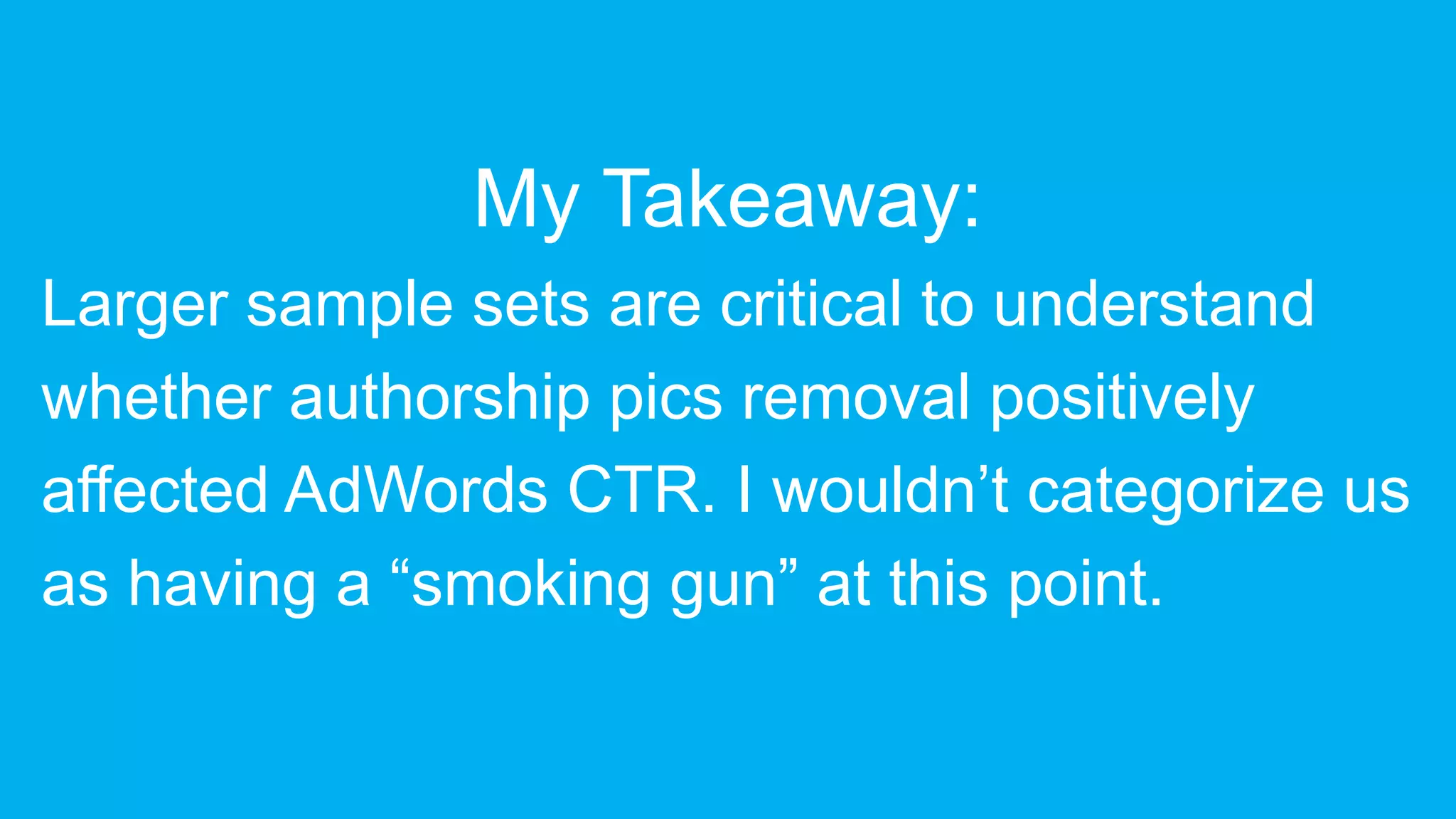
My Takeaway:
Larger sample sets are critical to understand
whether authorship pics removal positively
affected AdWords CTR. I wouldn’t categorize us
as having a “smoking gun” at this point.
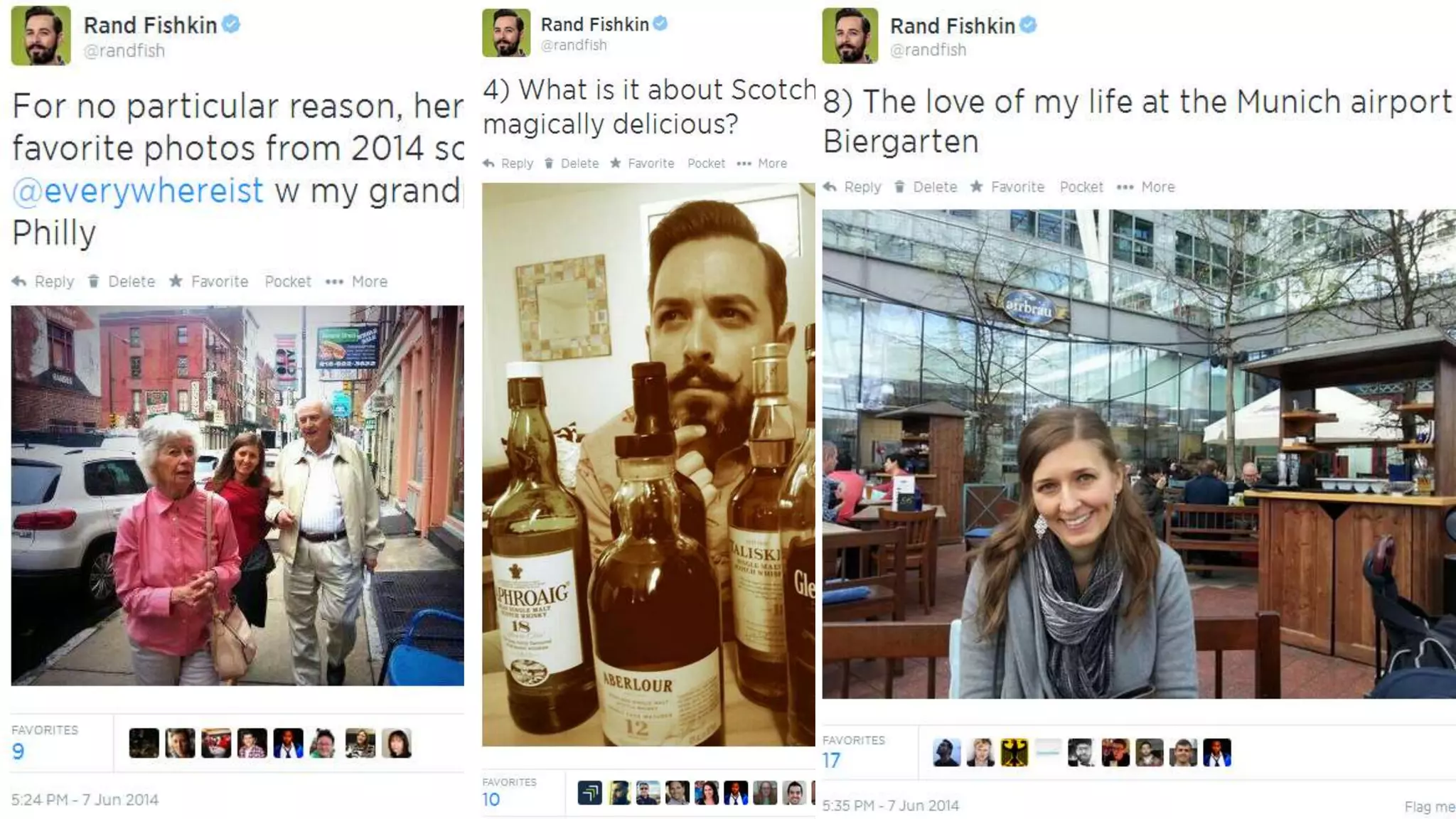
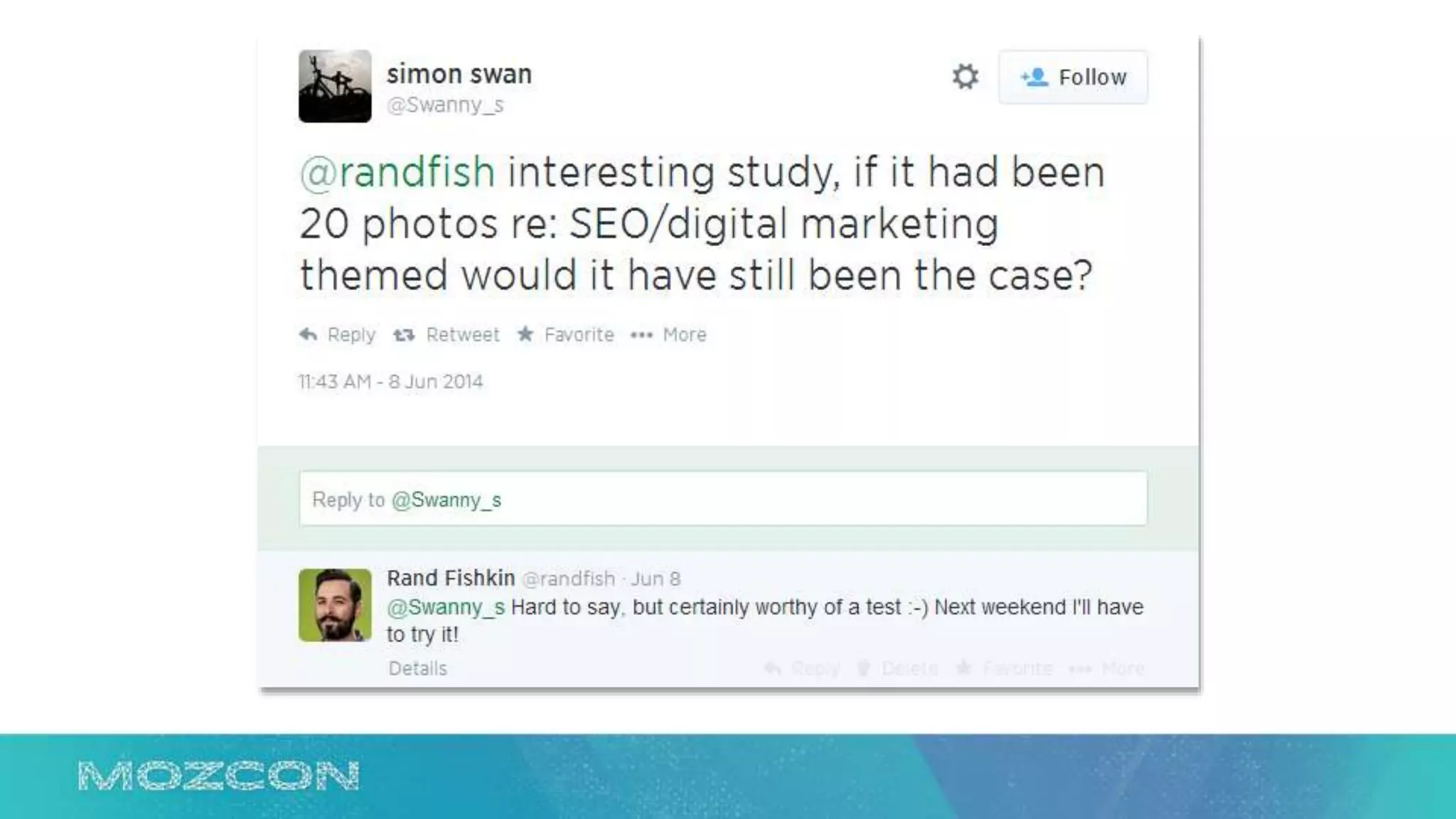
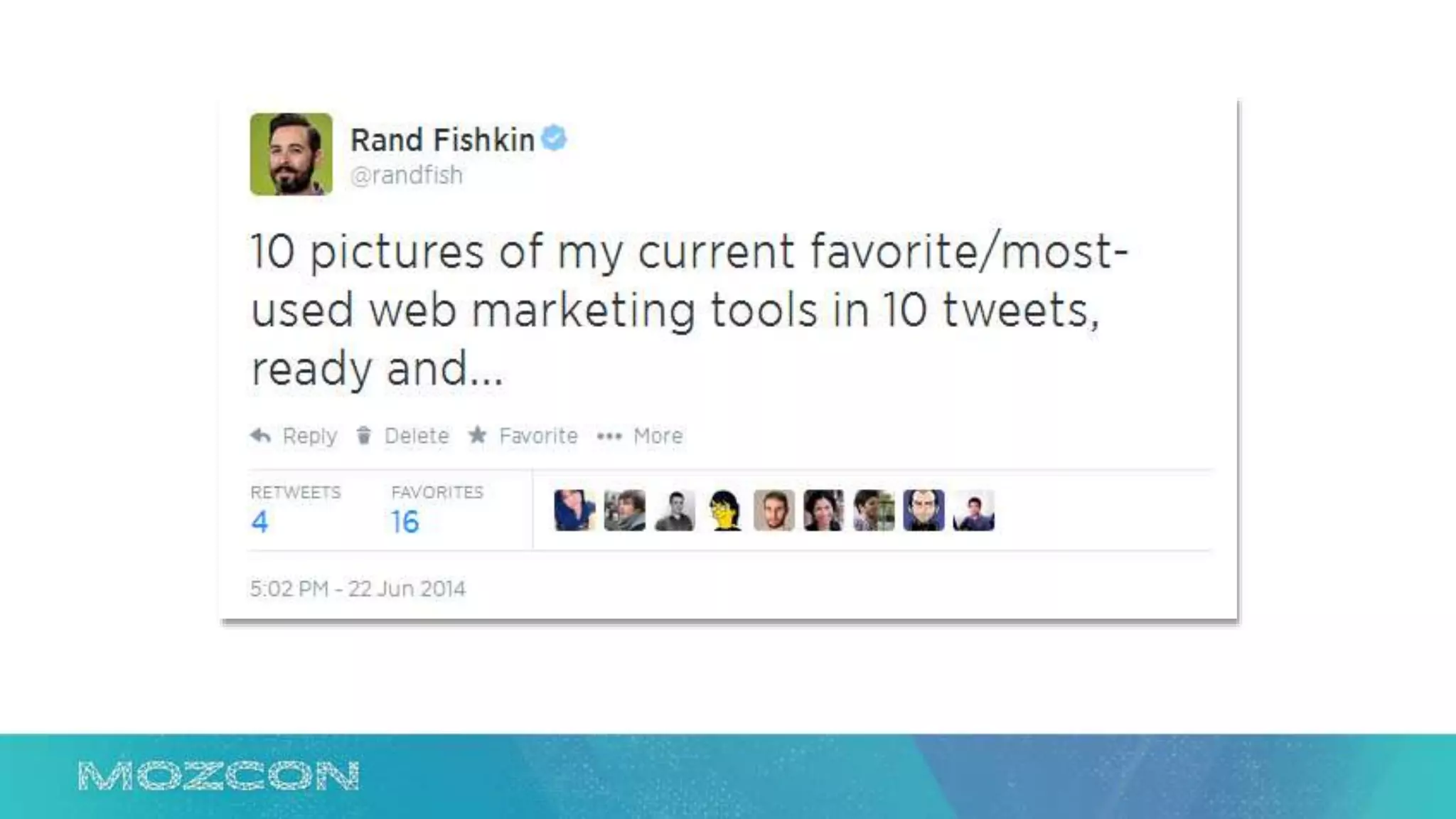
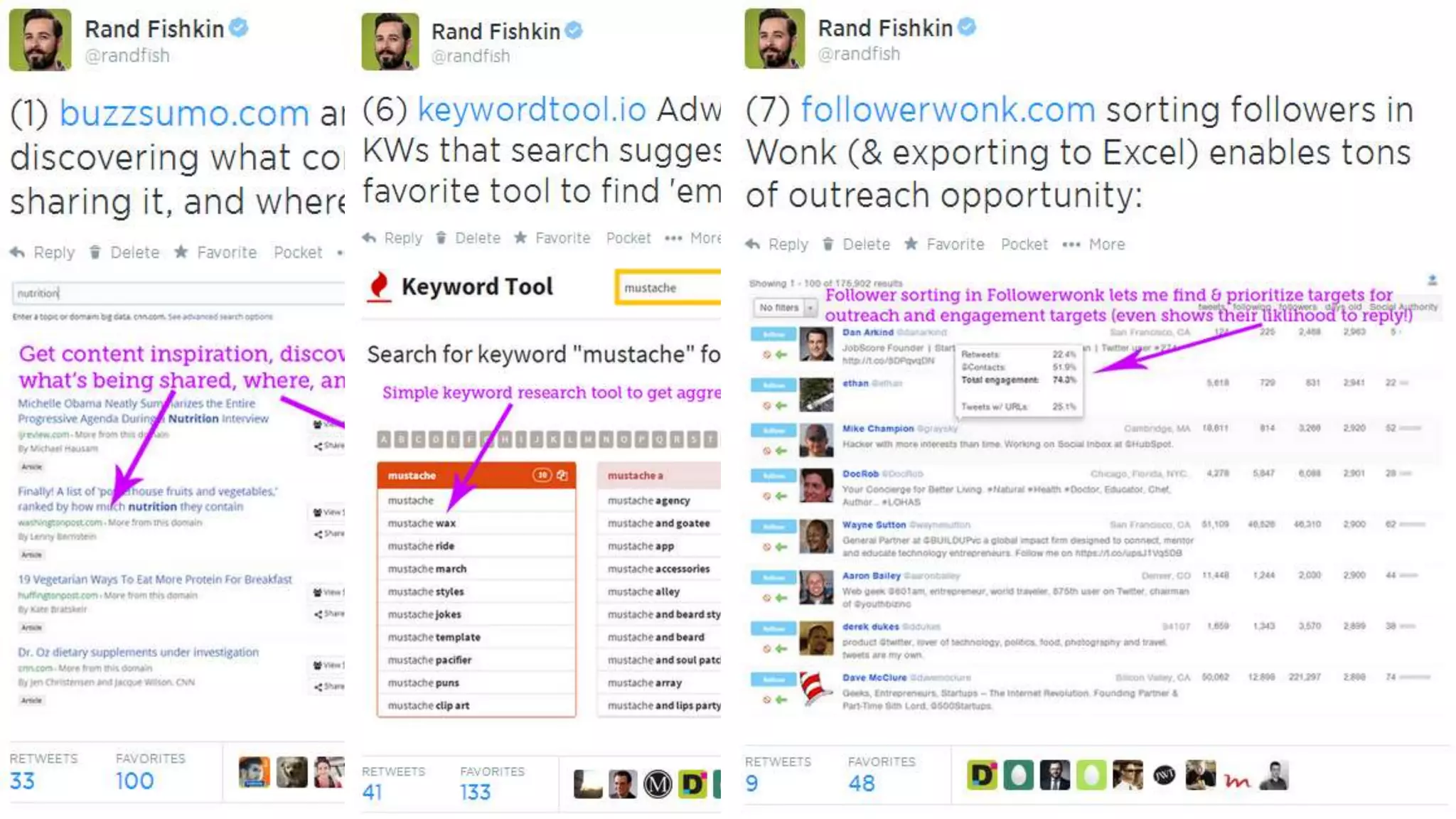
Do Photo Tweetstorms Cost
Followers or Grow Them?
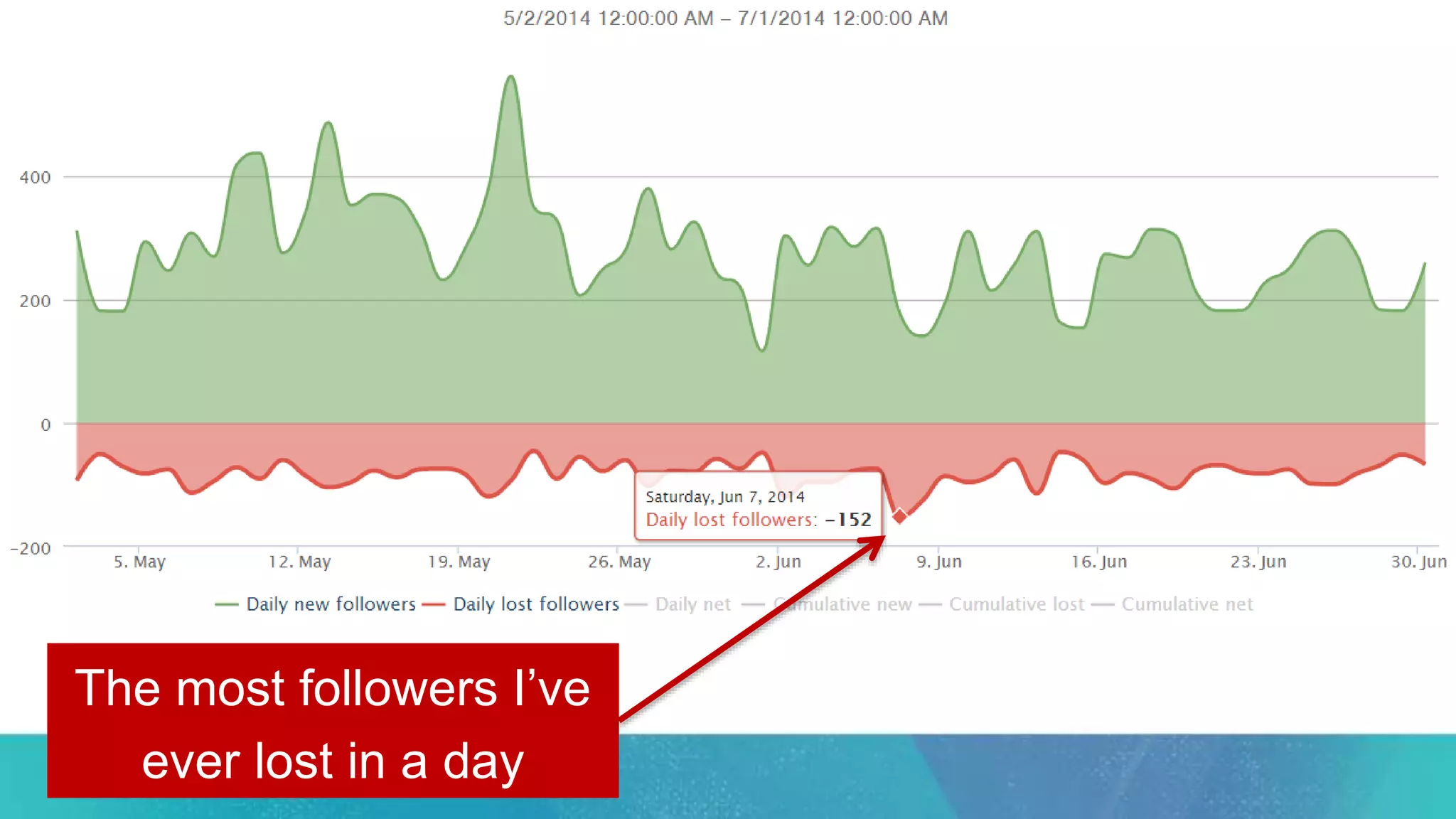
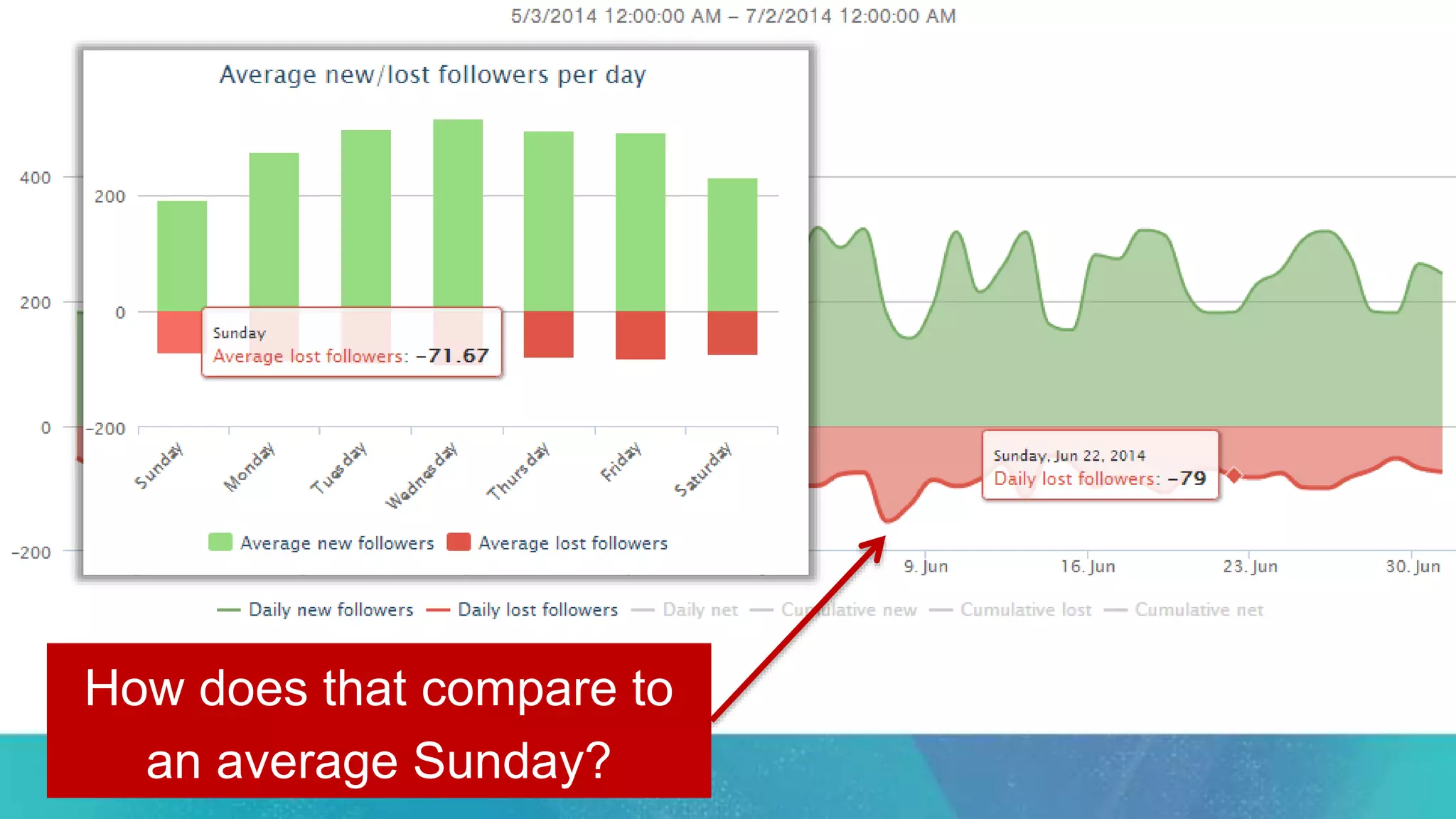
The most followers I’ve
ever lost in a day
How does that compare to
an average Sunday?
My Takeaway:
Photo tweetstorms are probably too
interruptive (even when “on topic”) to be a
valuable tool for me on a regular basis.
Can Internal Links Move the Needle
By Themselves?
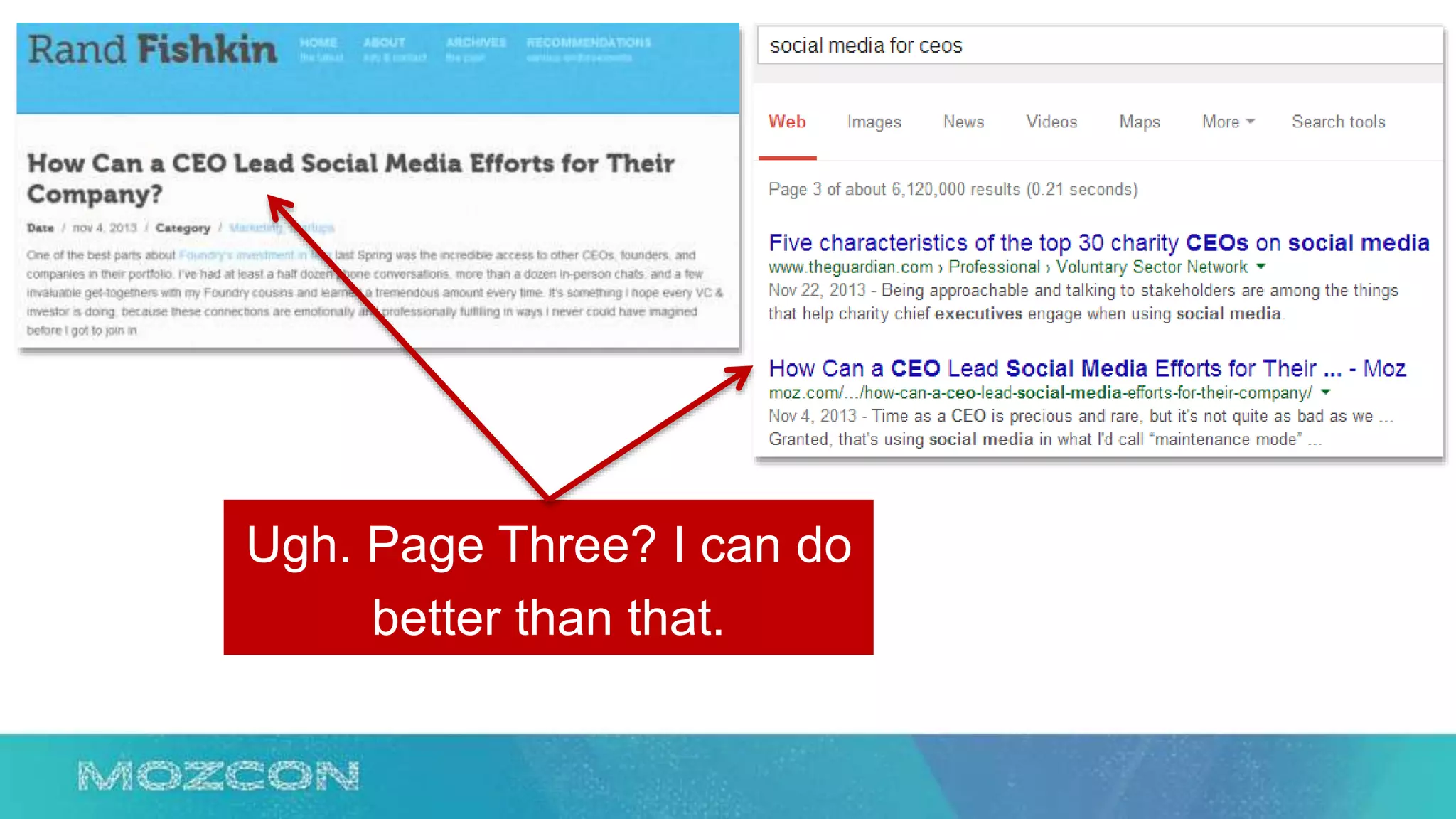
Ugh. Page Three? I can do
better than that.
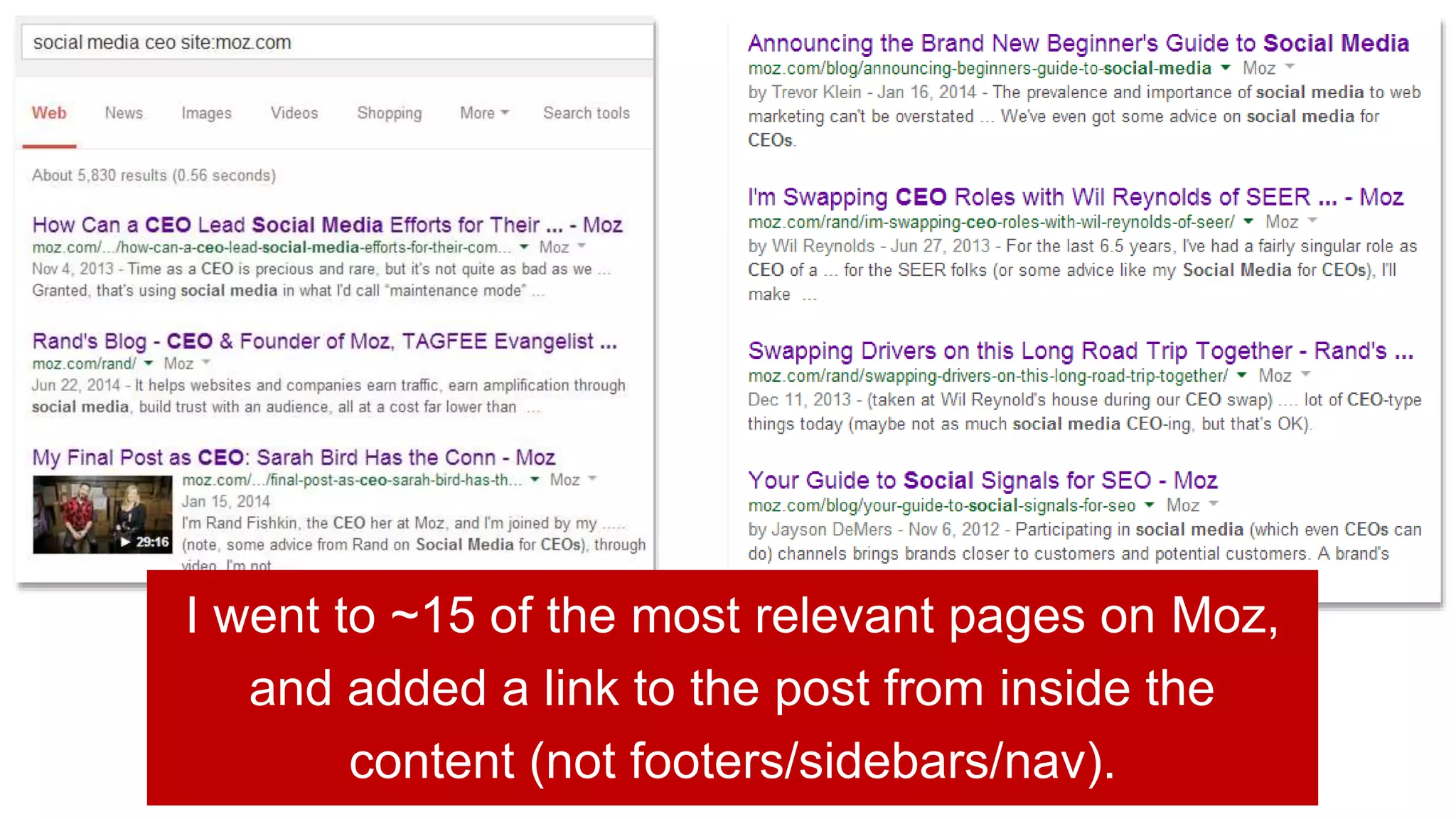
I went to ~15 of the most relevant pages on Moz,
and added a link to the post from inside the
content (not footers/sidebars/nav).
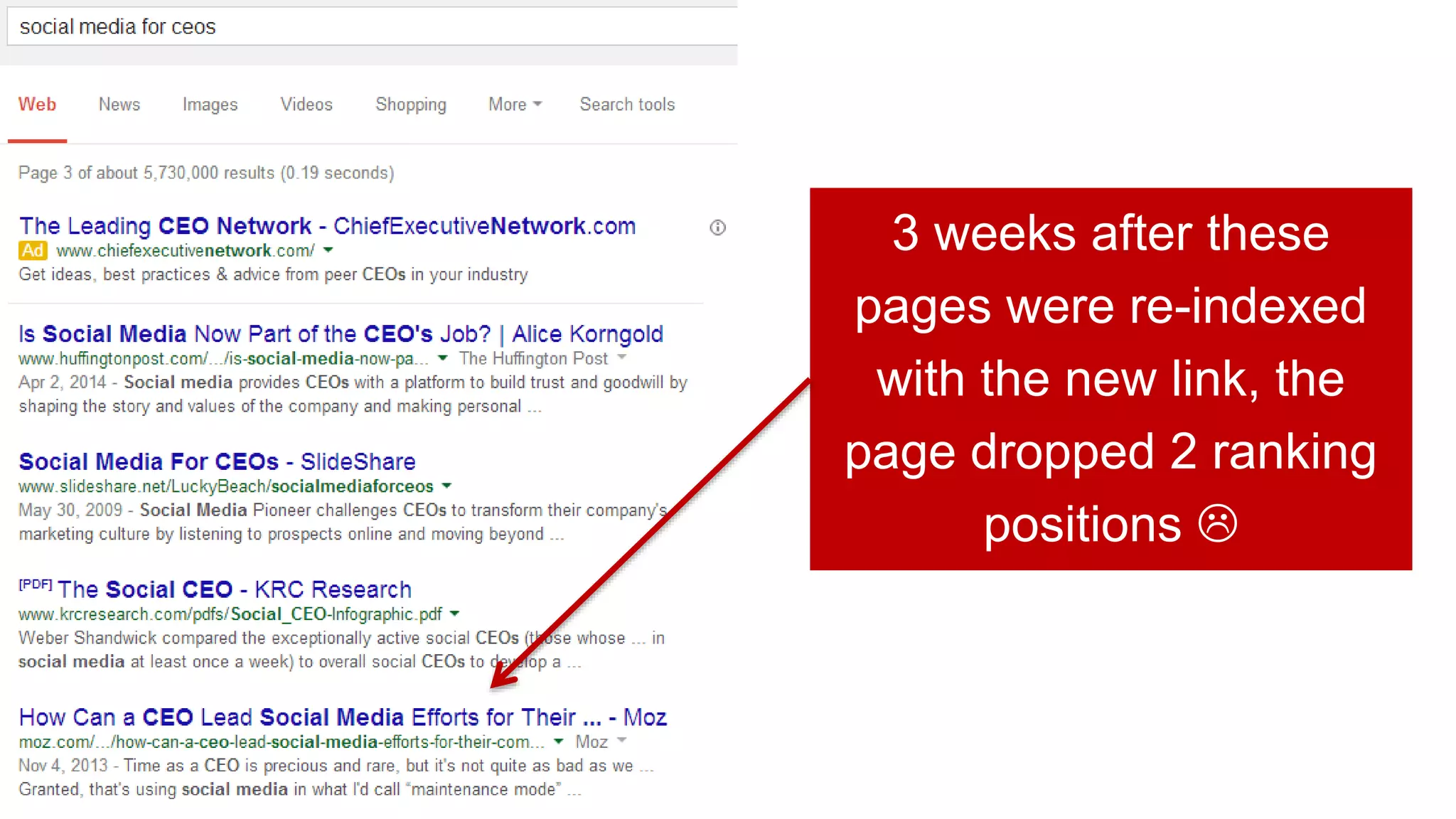
3 weeks after these
pages were re-indexed
with the new link, the
page dropped 2 ranking
positions 
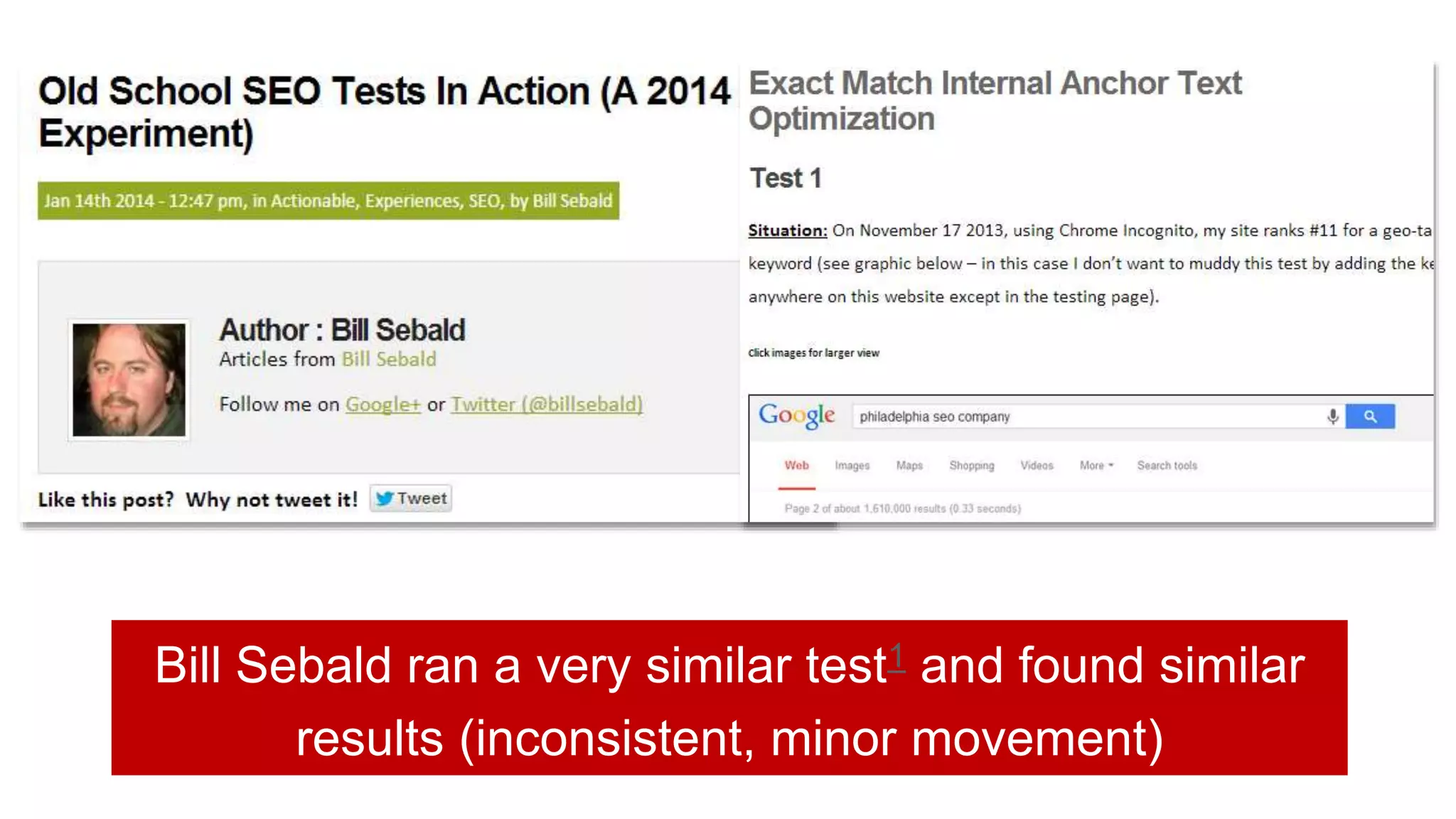
Bill Sebald ran a very similar test1 and found similar
results (inconsistent, minor movement)
My Takeaway:
I’m in the process of repeating this test a few more
times, but I suspect internal anchor text and links are
still playing a relatively minor role (especially when
it’s older pages being updated)
Can Anchor Text Influence
Search Suggest?
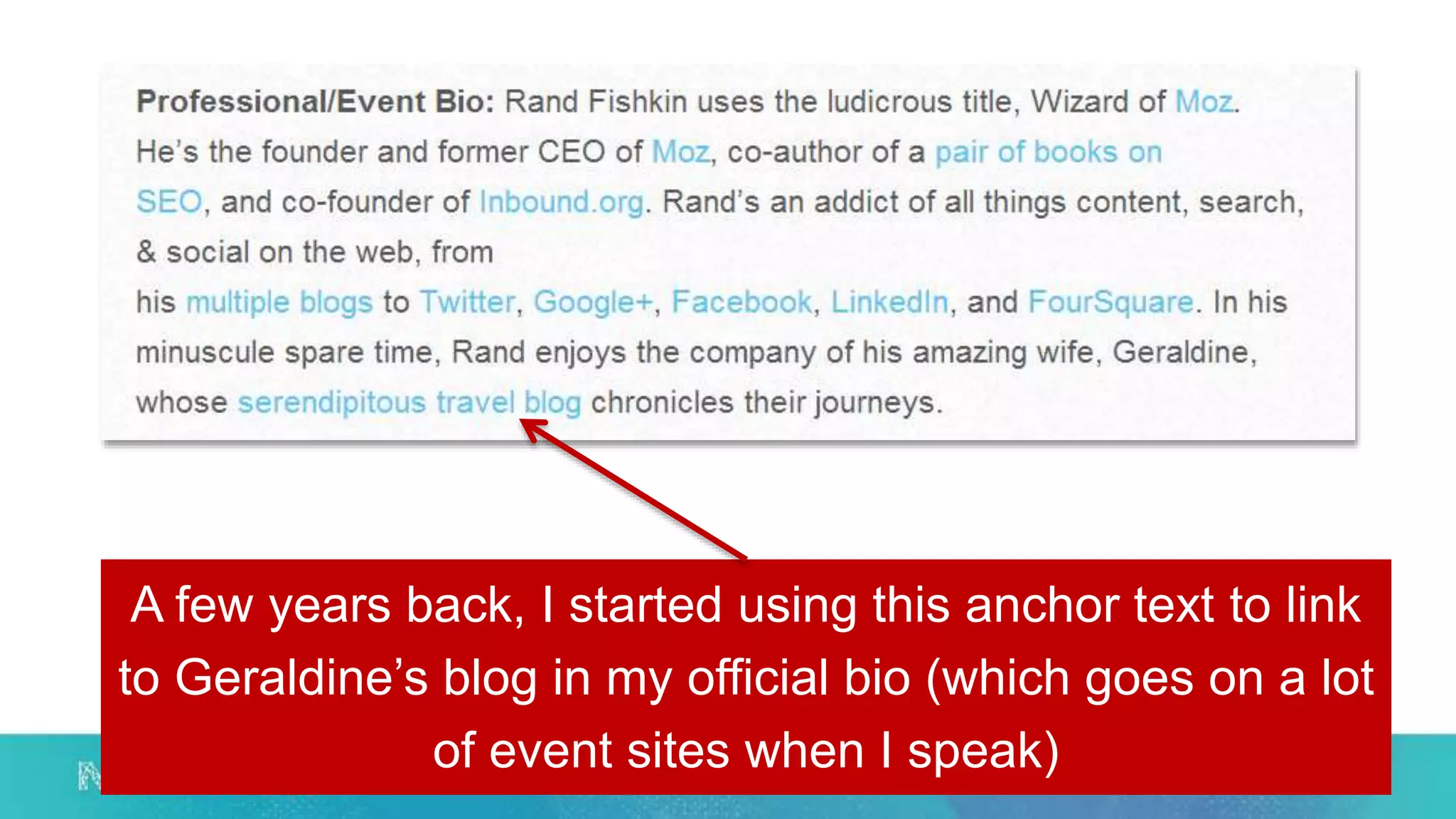
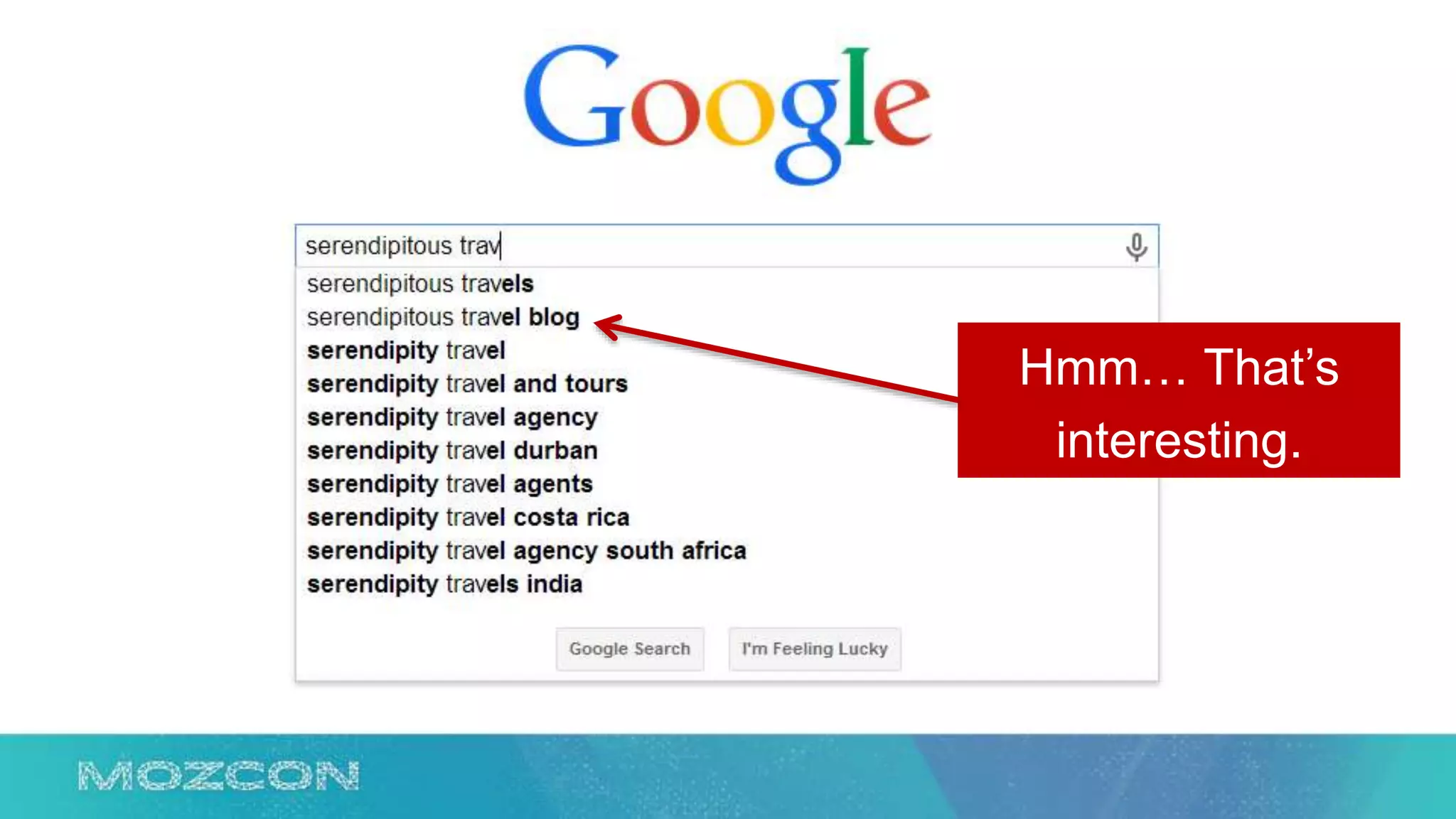
A few years back, I started using this anchor text to link
to Geraldine’s blog in my official bio (which goes on a lot
of event sites when I speak)
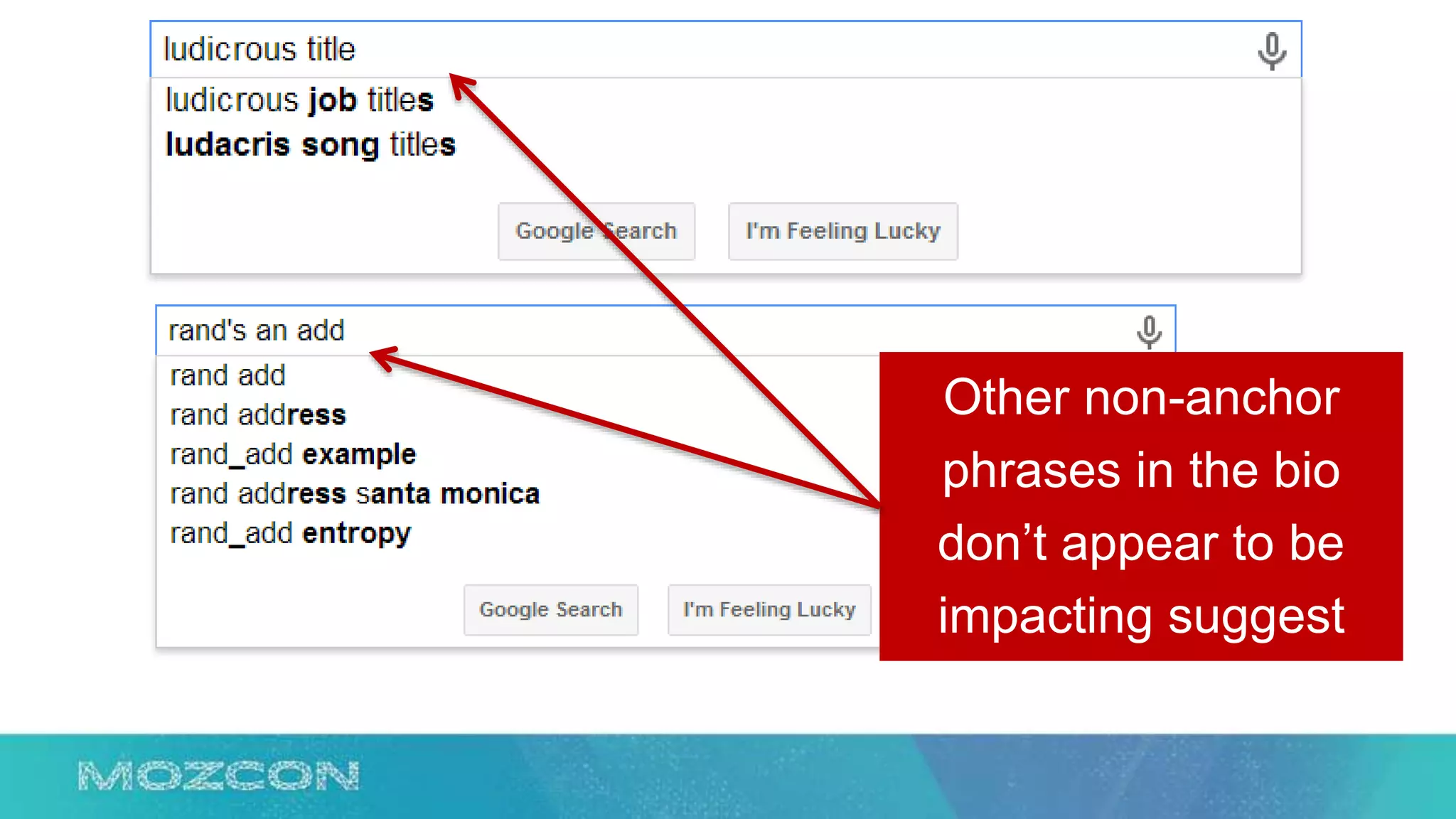
Hmm… That’s
interesting.
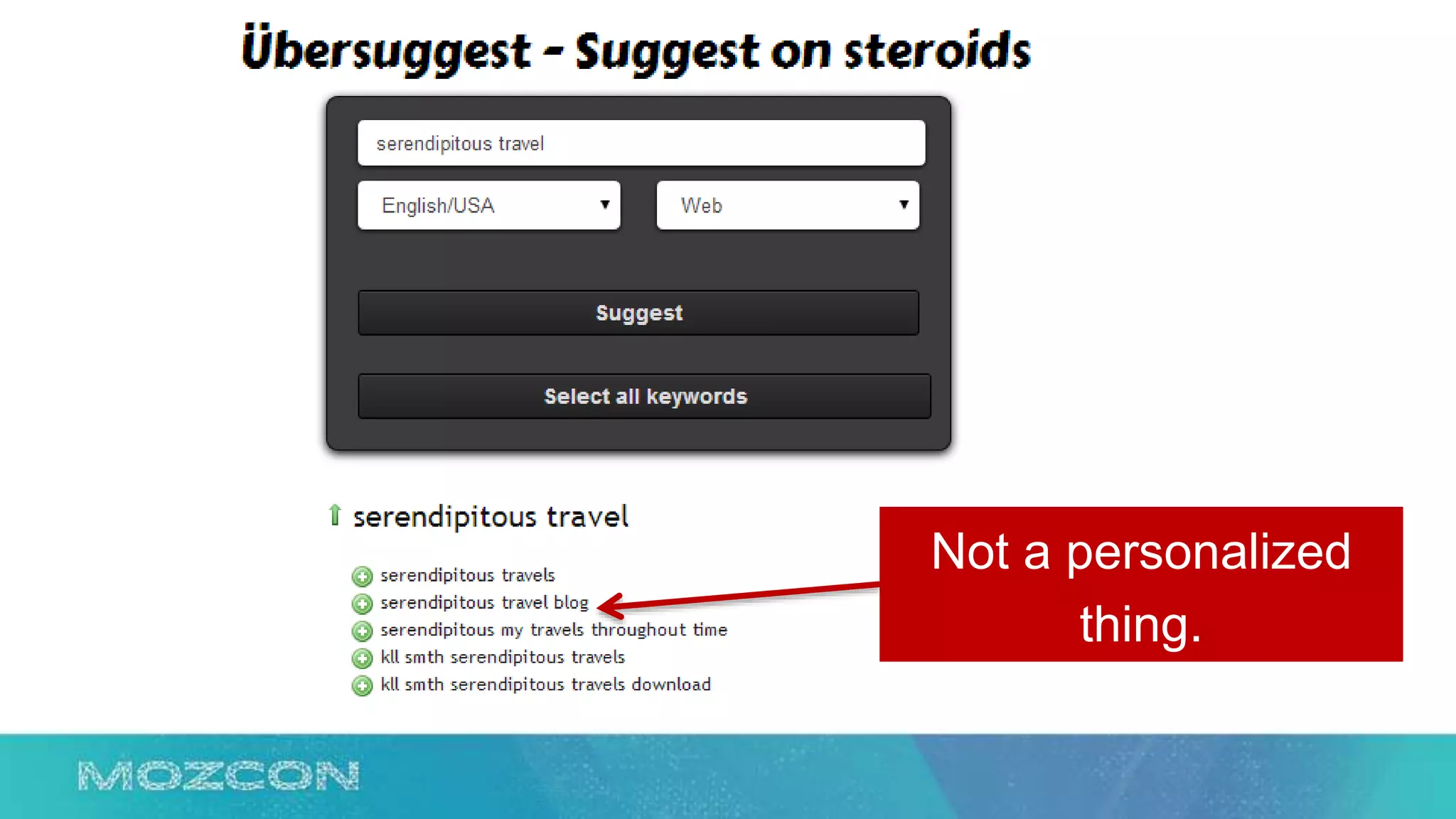
Not a personalized
thing.
Other non-anchor
phrases in the bio
don’t appear to be
impacting suggest
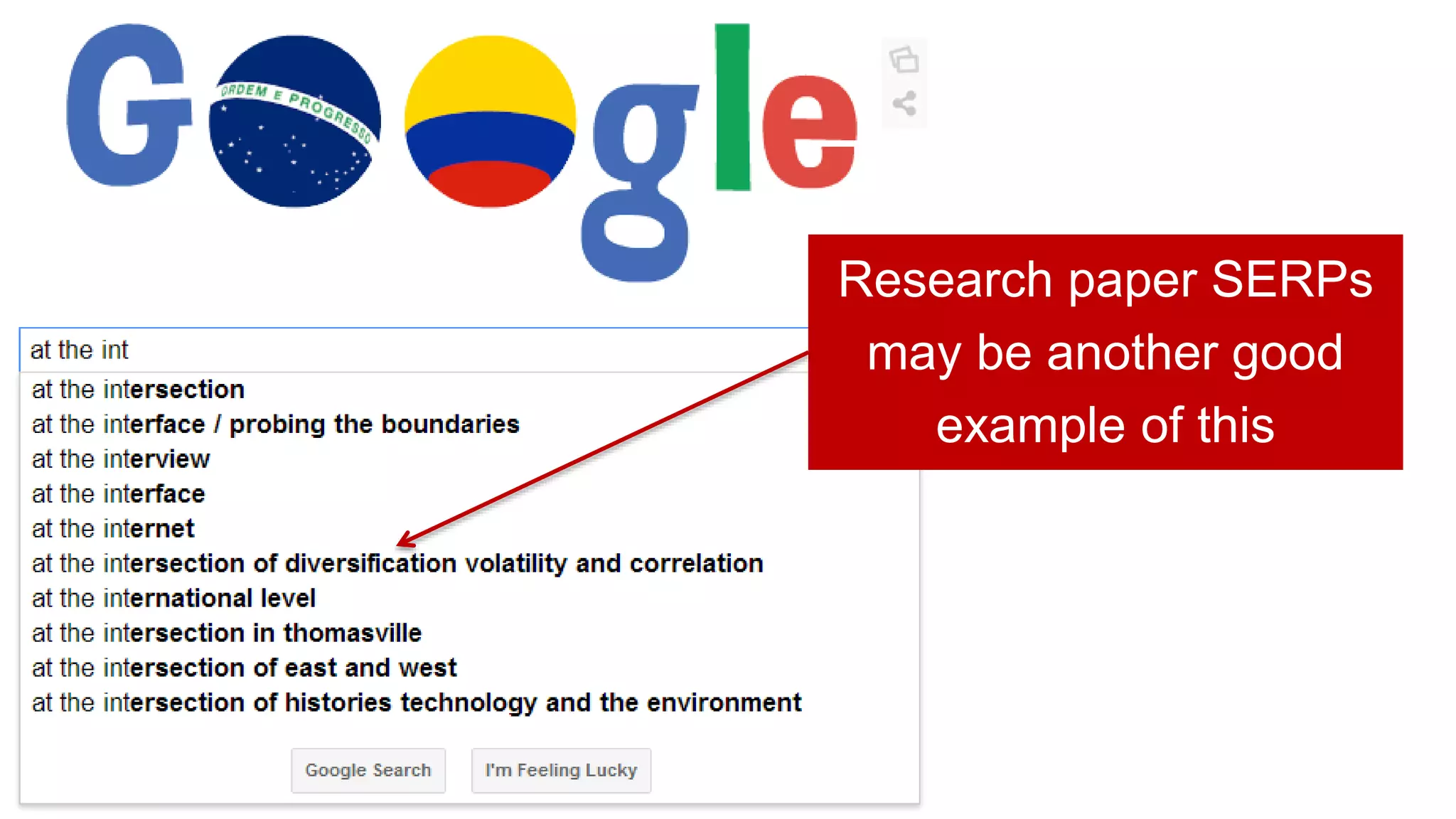
Research paper SERPs
may be another good
example of this
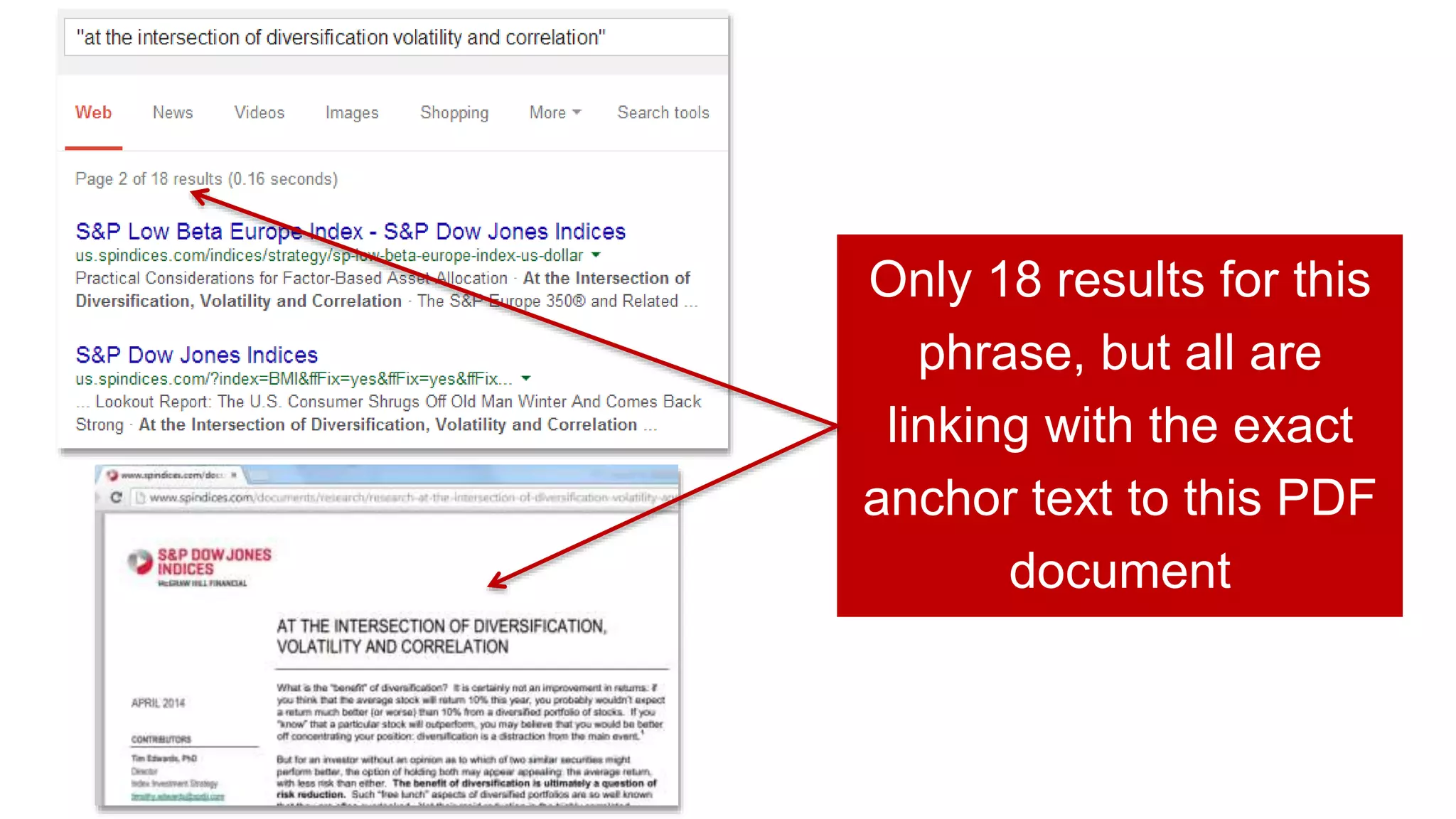
Only 18 results for this
phrase, but all are
linking with the exact
anchor text to this PDF
document
My Takeaway:
More testing is needed, but it seems likely
that anchor text influences search suggest
more so than other kinds of in-document,
text-based phrase use.
More rigorous, controlled,
repeatable experimentsPhase 2
Does Google Index URLs Shared on
Social Media Faster?
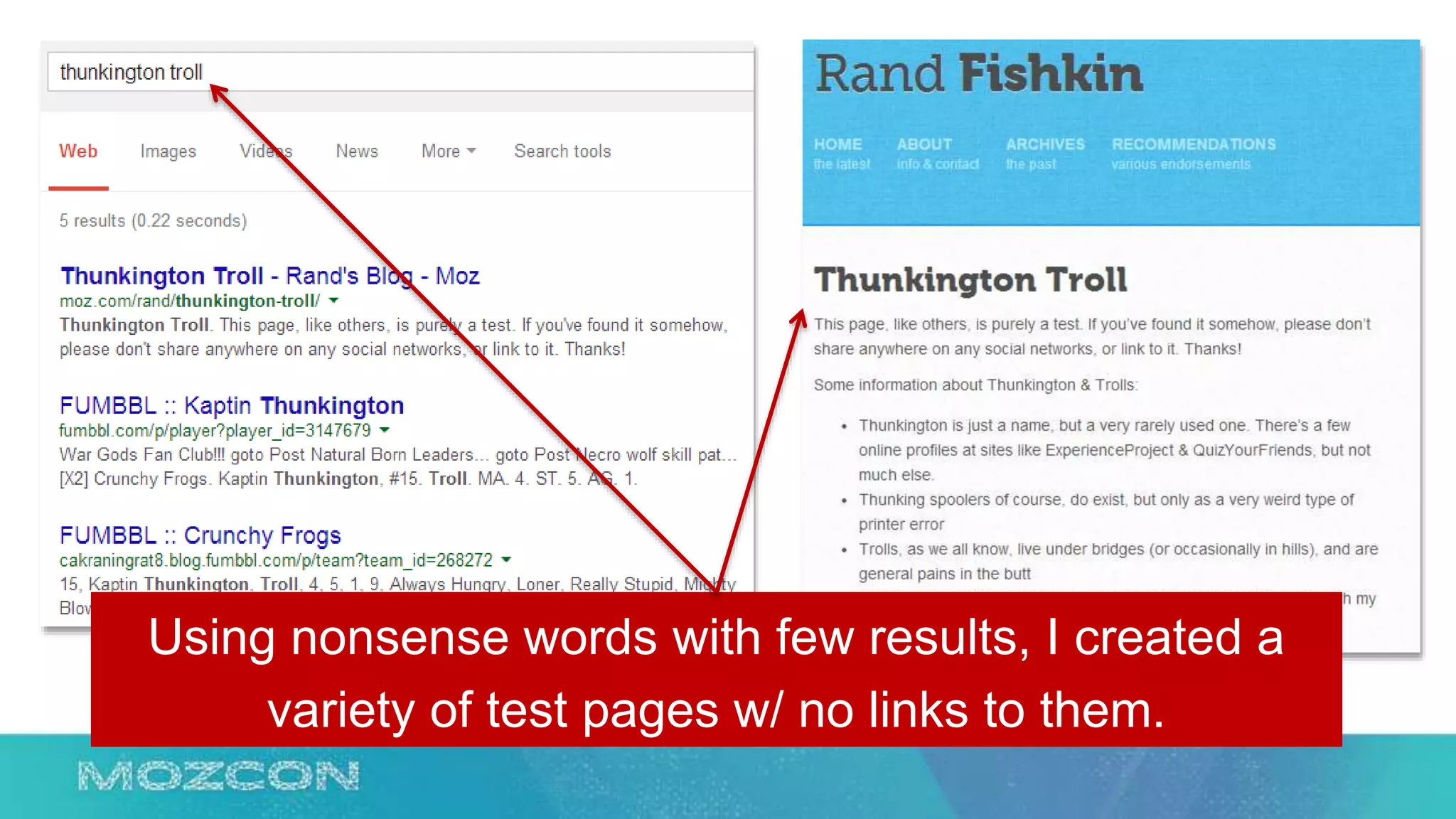
Using nonsense words with few results, I created a
variety of test pages w/ no links to them.
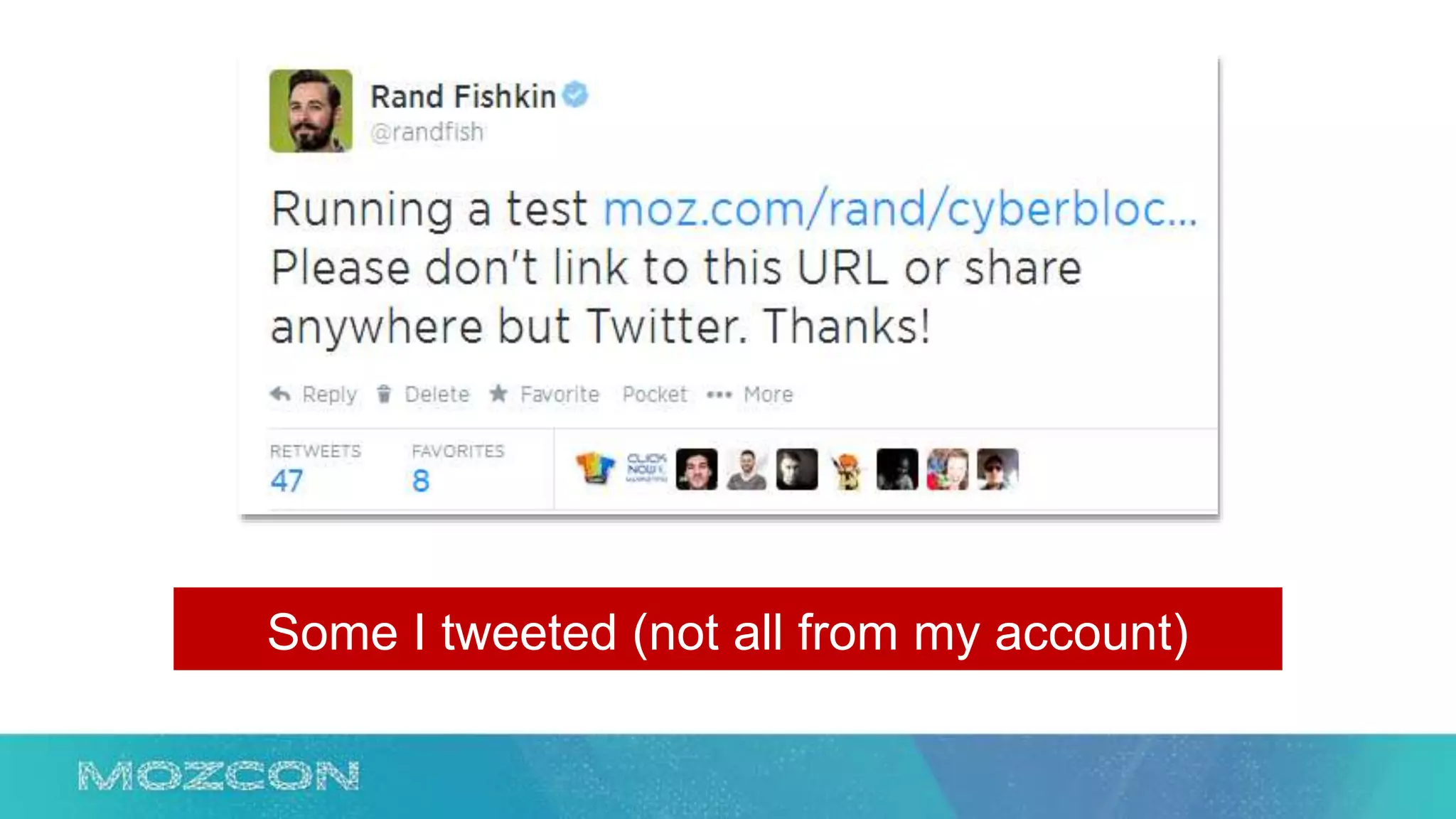
Some I tweeted (not all from my account)
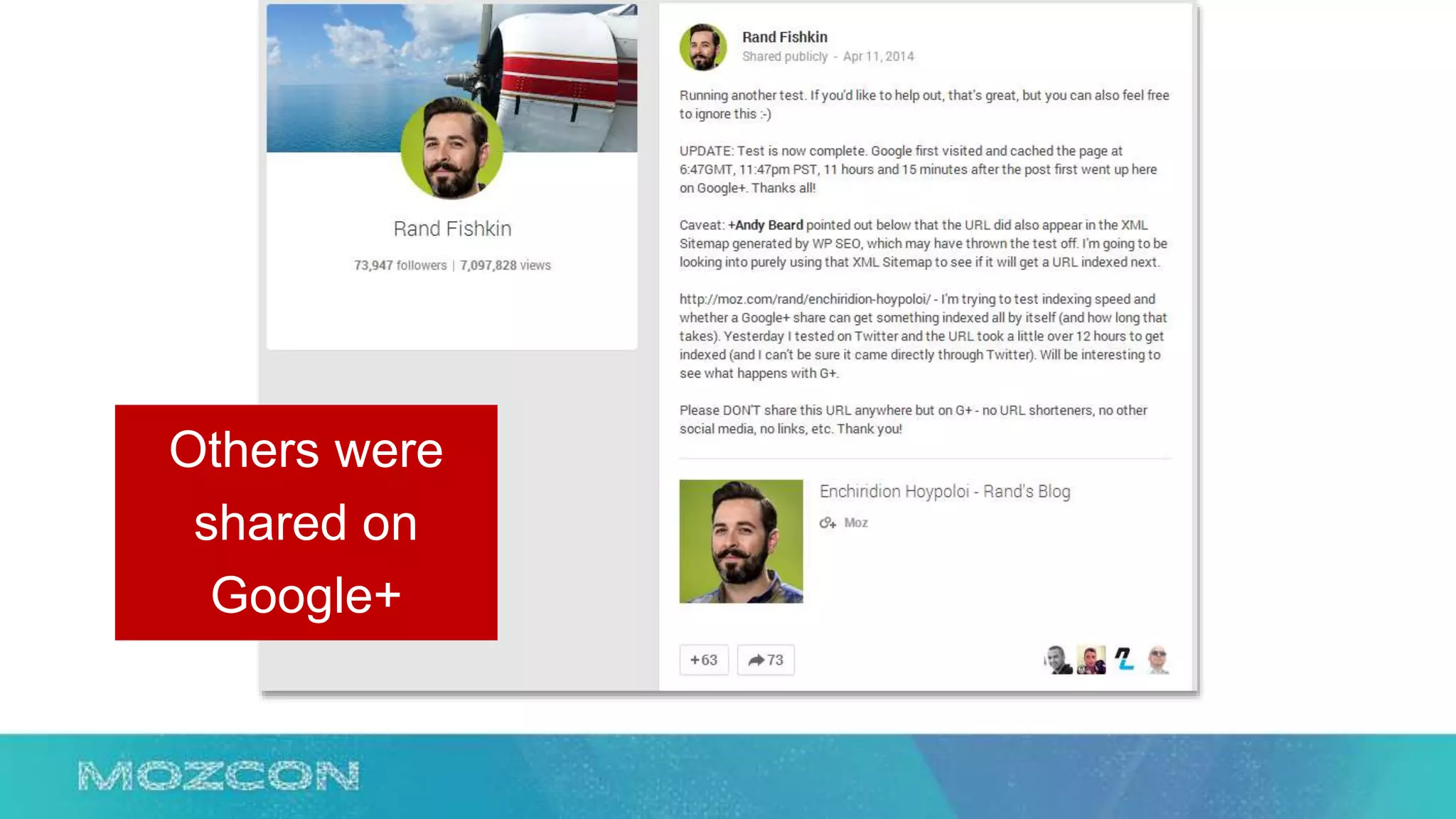
Others were
shared on
Google+
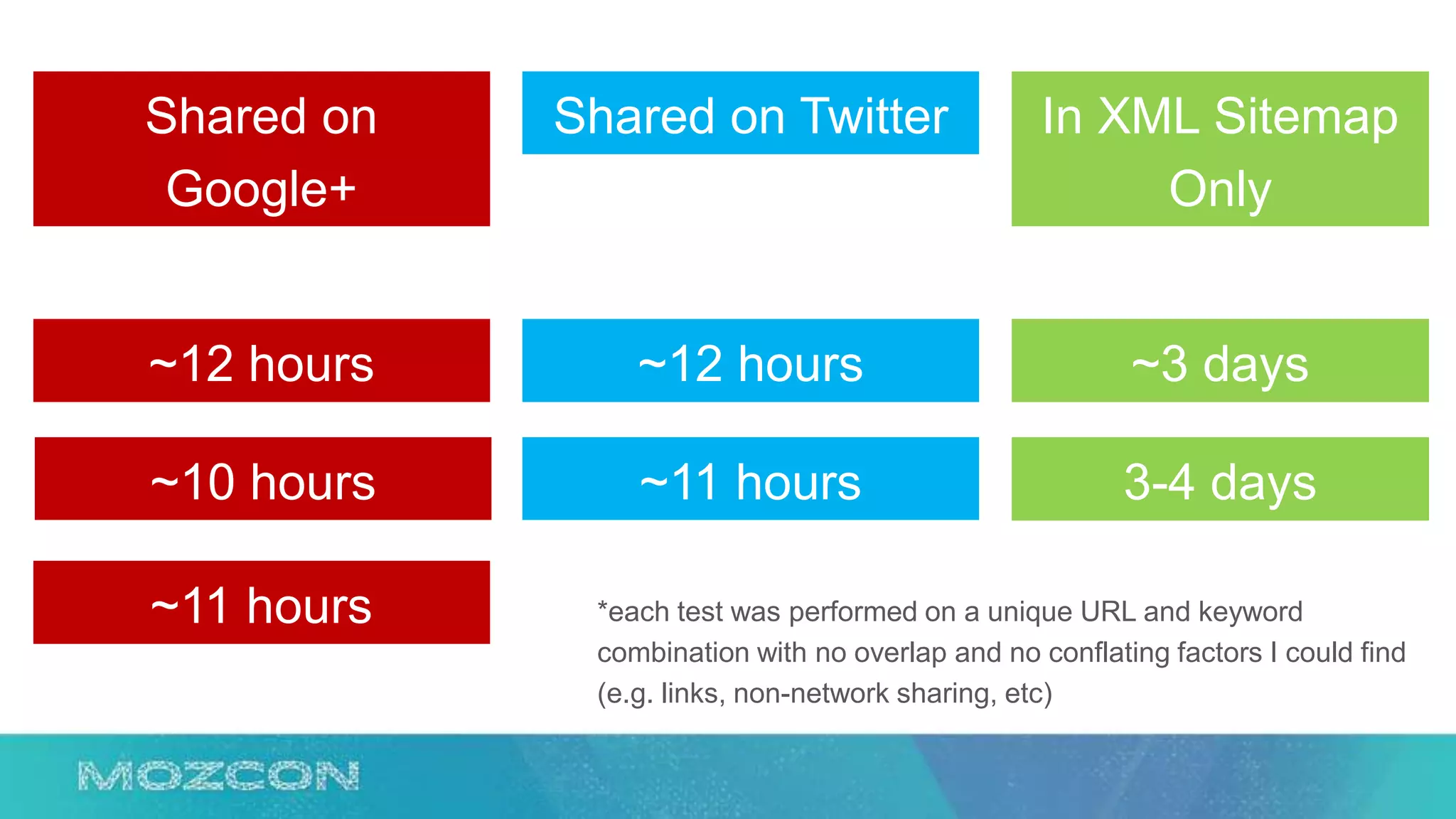
Shared on
Google+
Shared on Twitter In XML Sitemap
Only
~12 hours
~10 hours
~11 hours
~12 hours
~11 hours
~3 days
3-4 days
*each test was performed on a unique URL and keyword
combination with no overlap and no conflating factors I could find
(e.g. links, non-network sharing, etc)
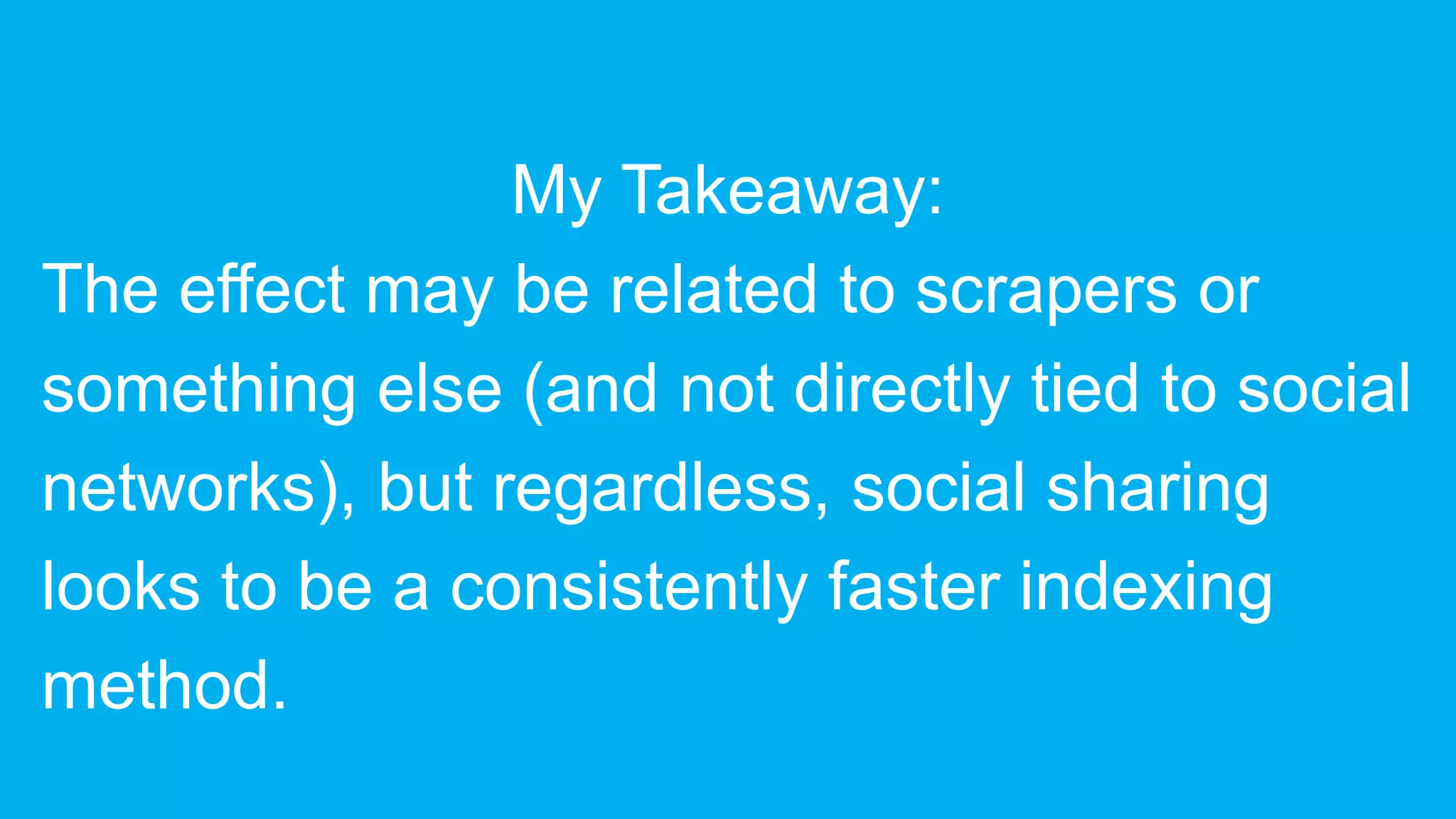
My Takeaway:
The effect may be related to scrapers or
something else (and not directly tied to social
networks), but regardless, social sharing
looks to be a consistently faster indexing
method.
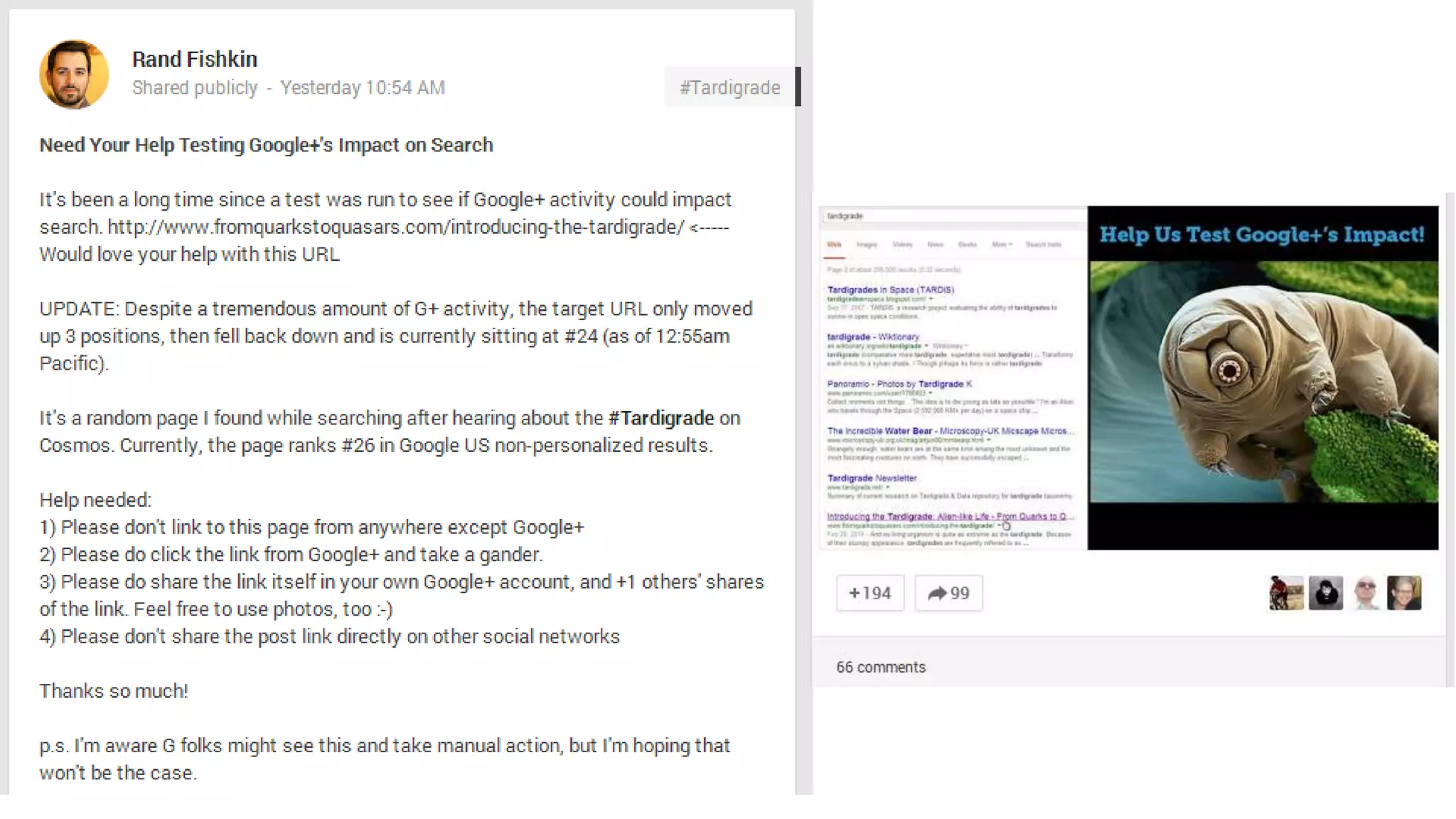
Can Google+ Shares or +1s Impact
Non-Personalized Search?
#21
#22
#23
#24
#25
#26
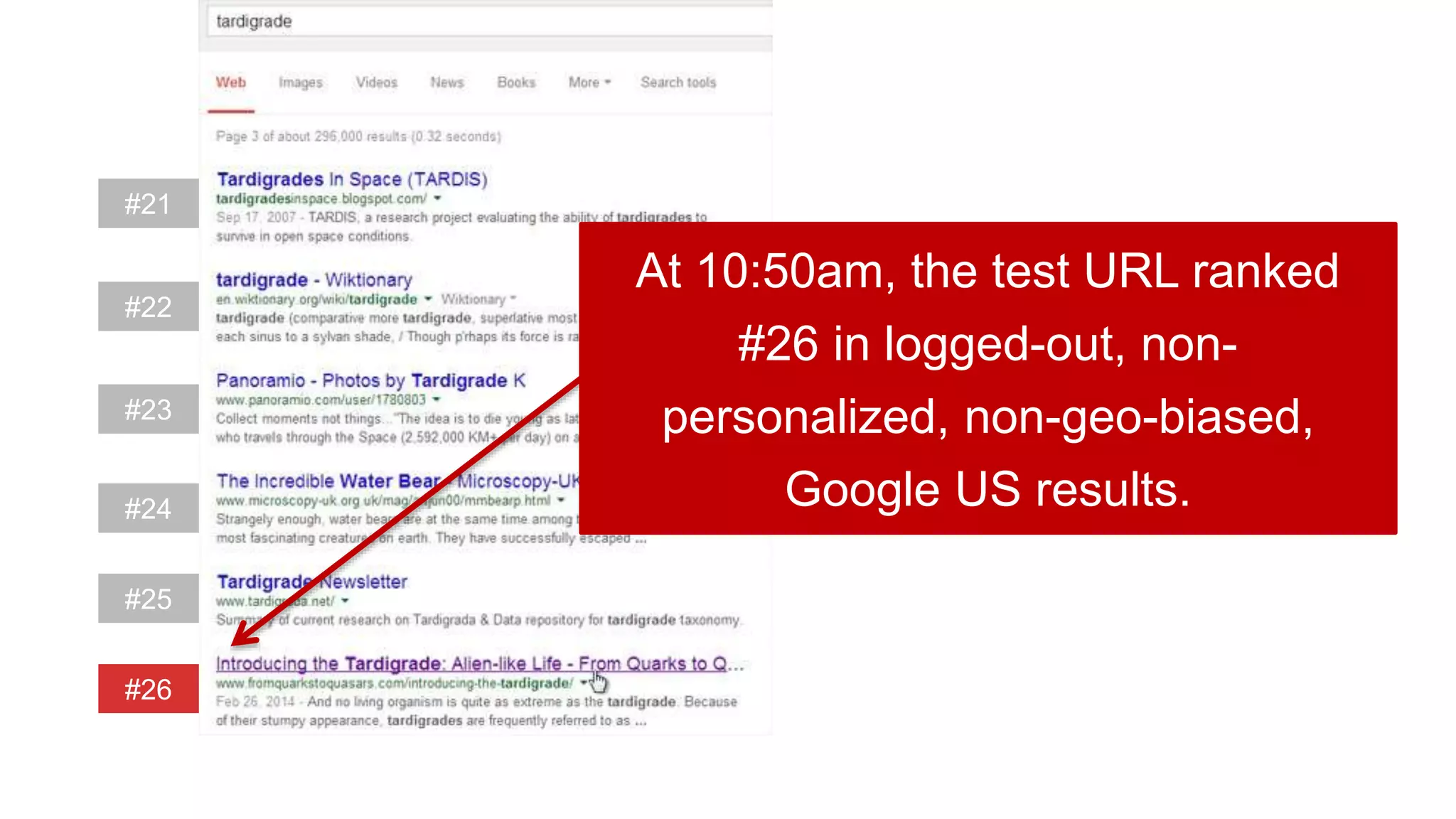
At 10:50am, the test URL ranked
#26 in logged-out, non-
personalized, non-geo-biased,
Google US results.
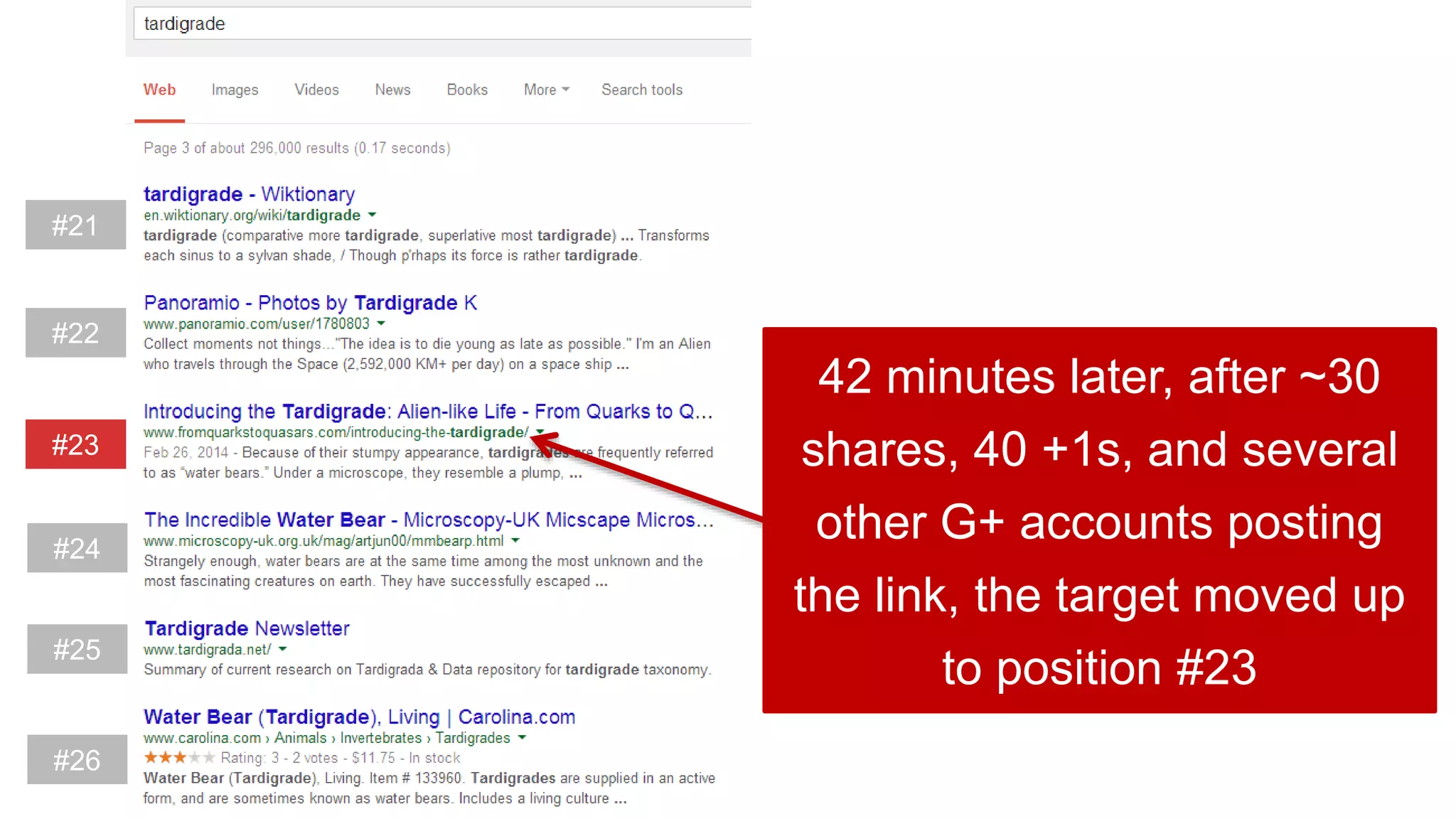
42 minutes later, after ~30
shares, 40 +1s, and several
other G+ accounts posting
the link, the target moved up
to position #23
#21
#22
#23
#24
#25
#26
#21
#22
#23
#24
#25
#26
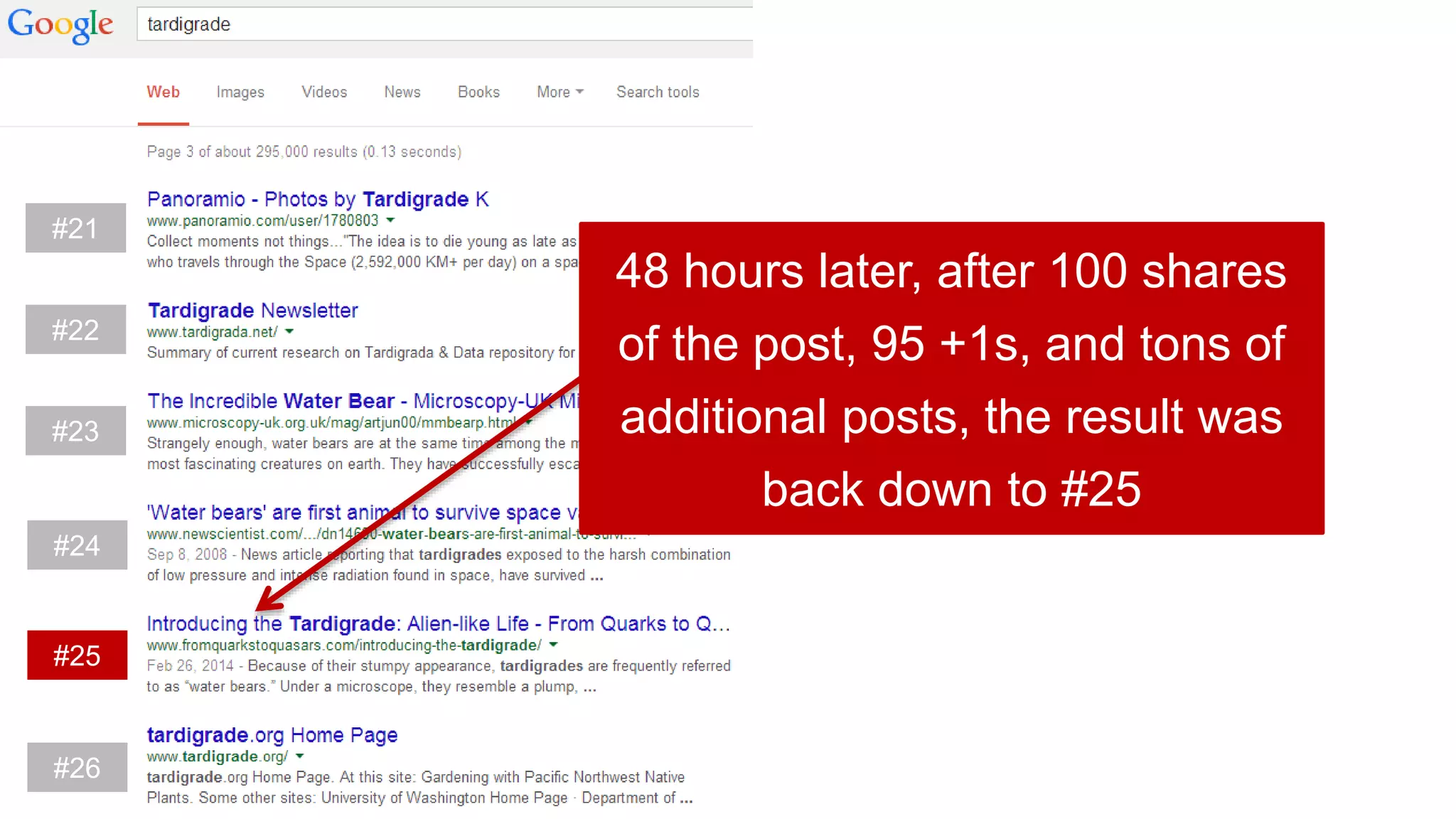
48 hours later, after 100 shares
of the post, 95 +1s, and tons of
additional posts, the result was
back down to #25
#21
#22
#23
#24
#25
#26
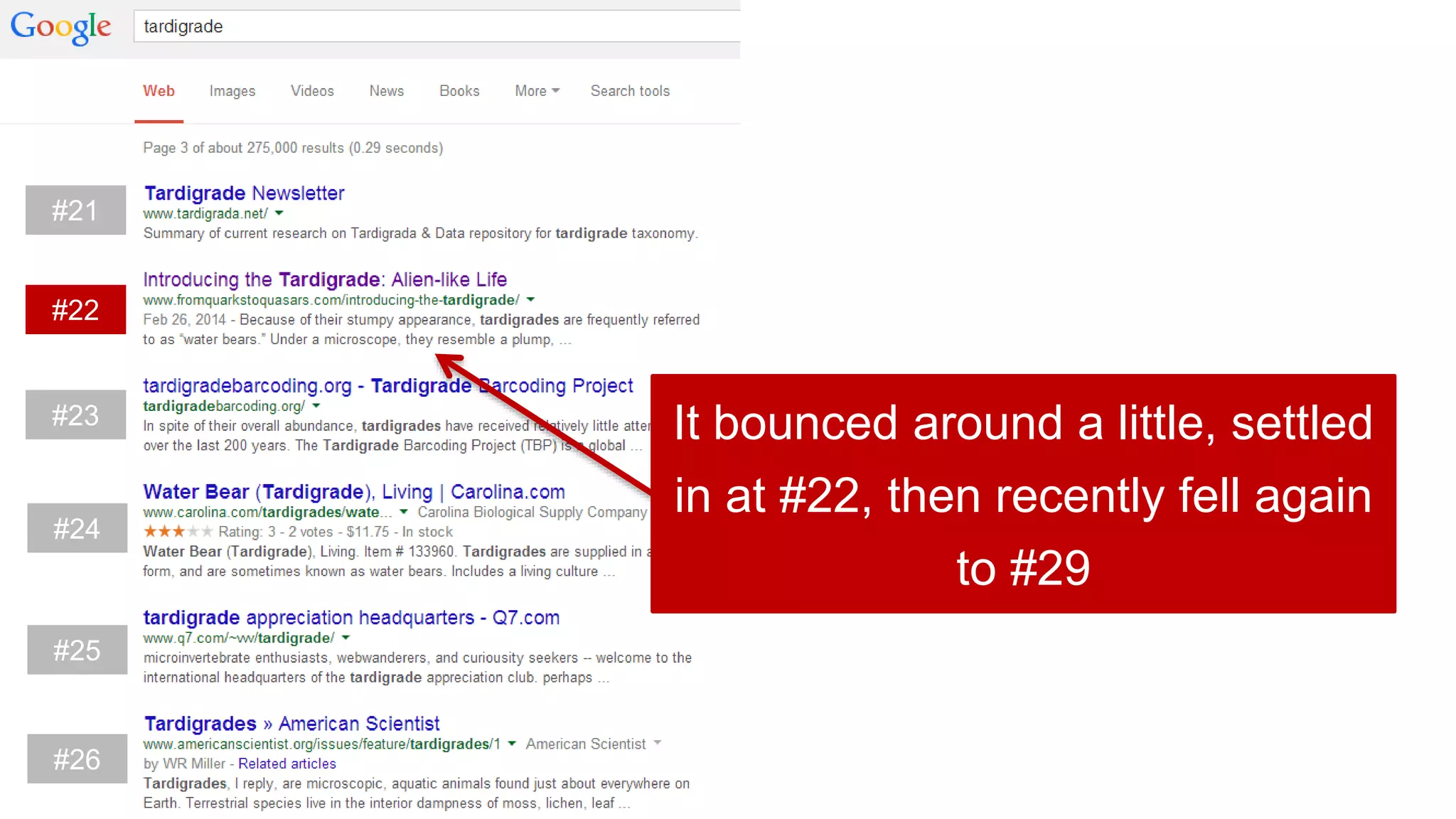
It bounced around a little, settled
in at #22, then recently fell again
to #29
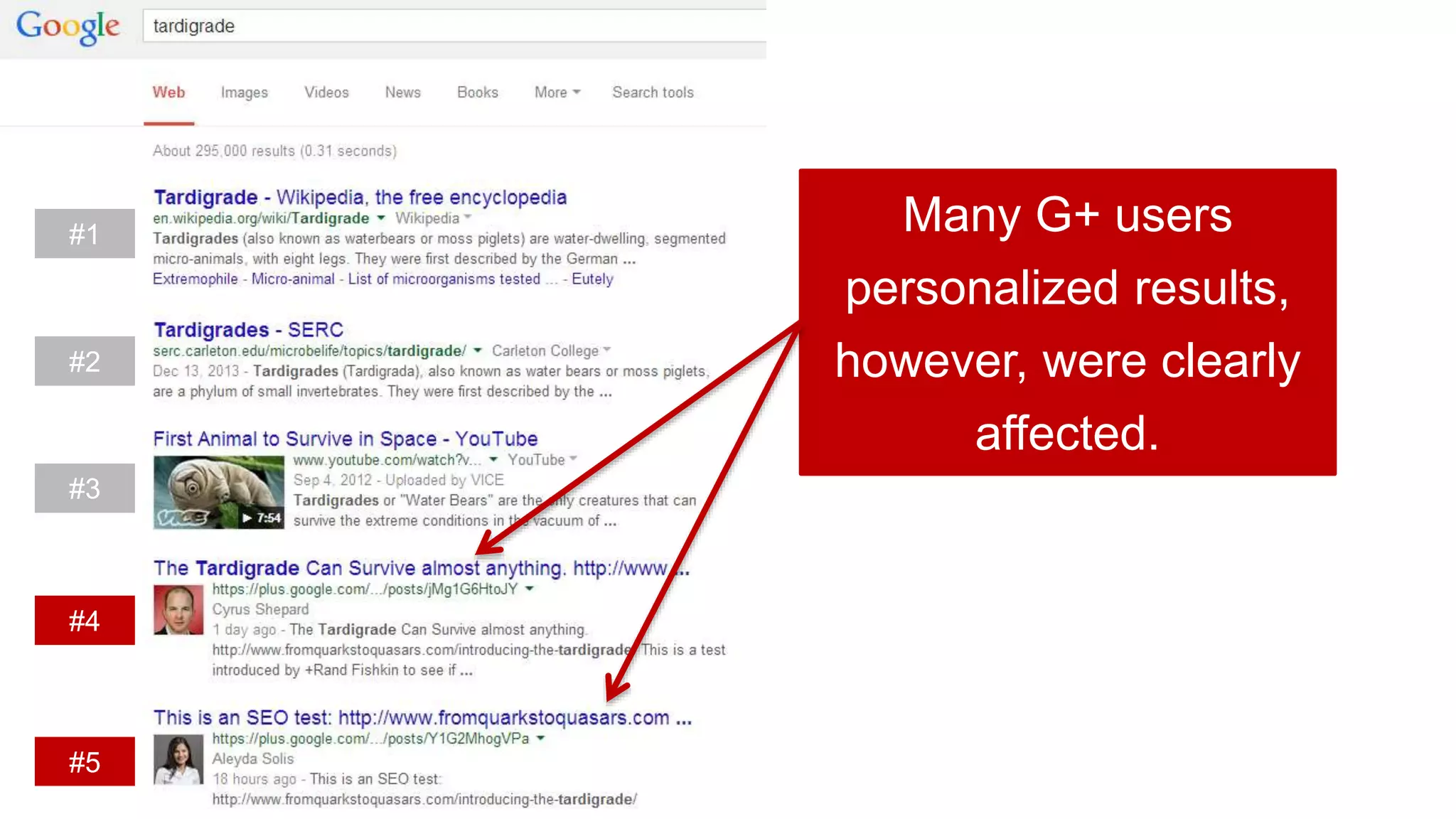
Many G+ users
personalized results,
however, were clearly
affected.
#1
#2
#3
#4
#5
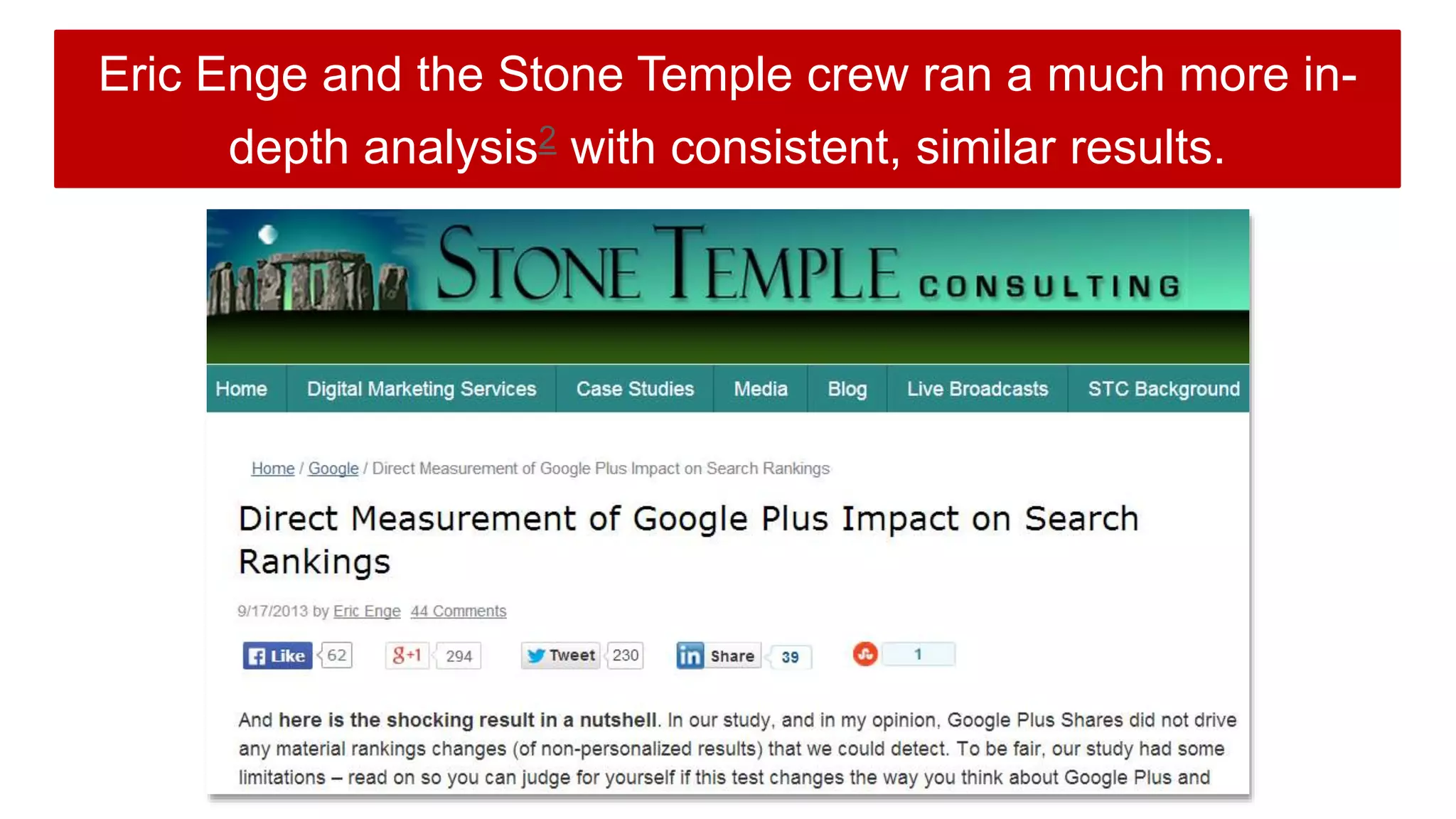
Eric Enge and the Stone Temple crew ran a much more in-
depth analysis2 with consistent, similar results.
My Takeaway:
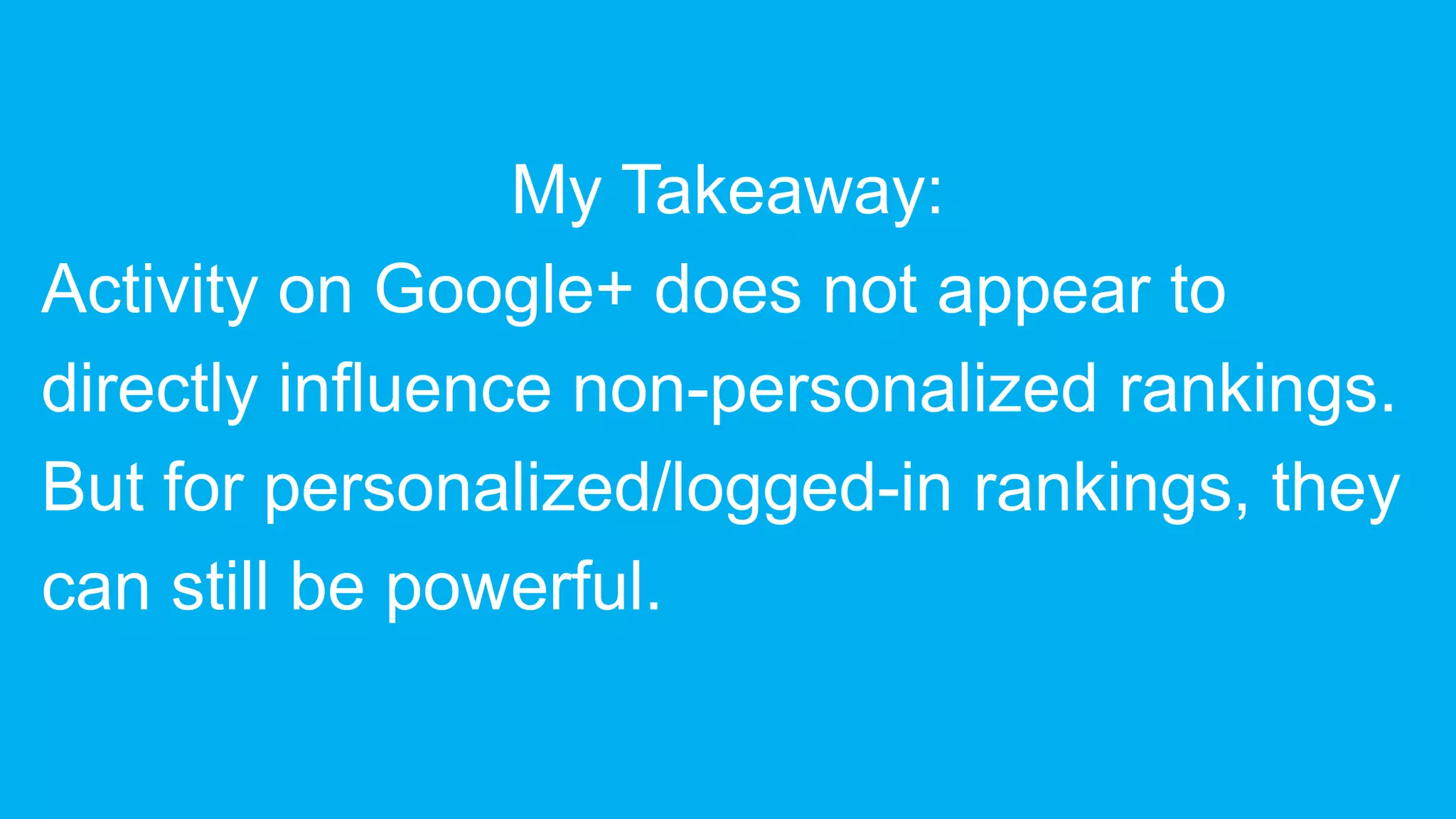
Activity on Google+ does not appear to
directly influence non-personalized rankings.
But for personalized/logged-in rankings, they
can still be powerful.
Has Anchor Text Lost Its Once Mighty
Impact on Rankings?
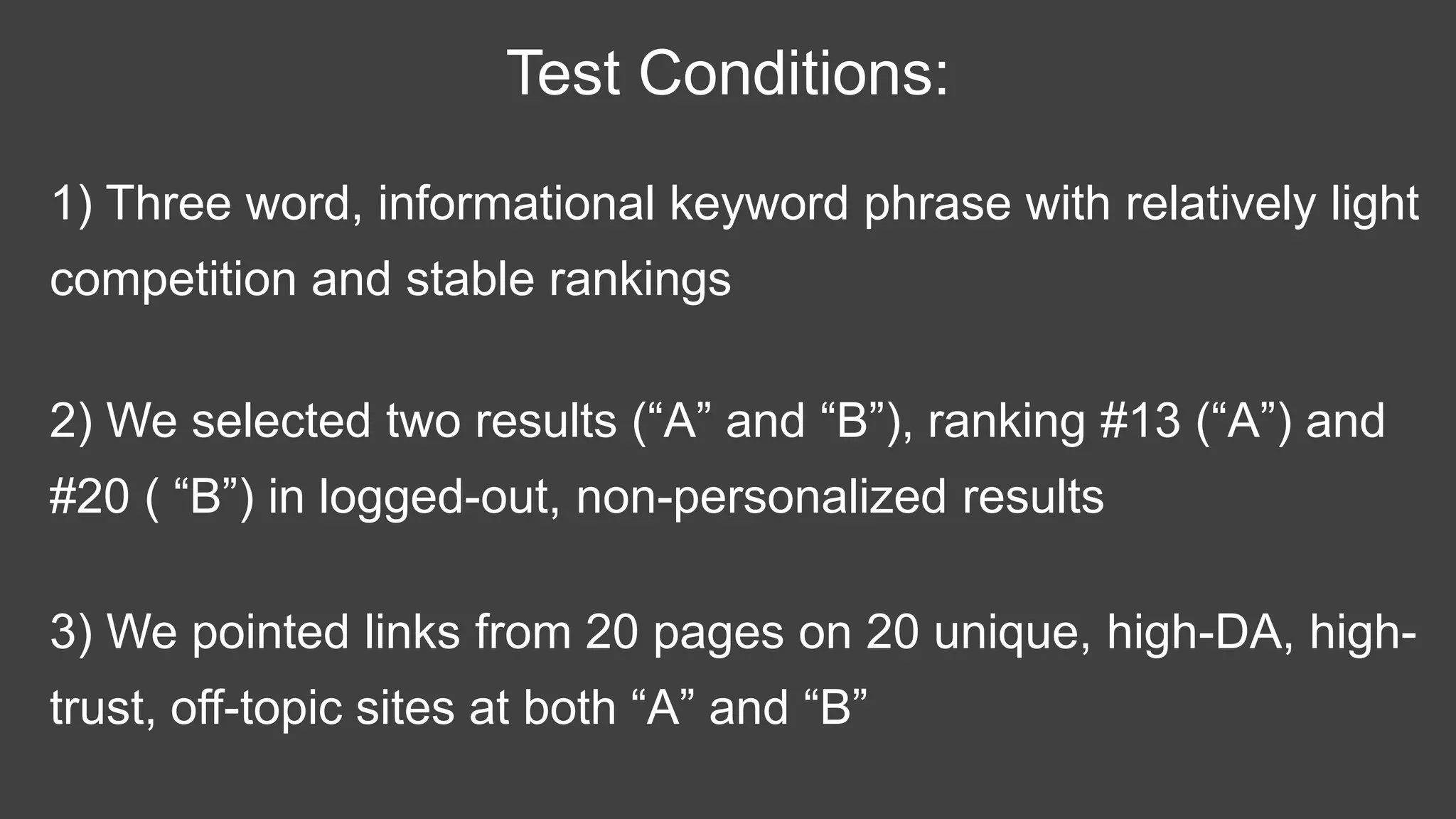
1) Three word, informational keyword phrase with relatively light
competition and stable rankings
Test Conditions:
2) We selected two results (“A” and “B”), ranking #13 (“A”) and
#20 ( “B”) in logged-out, non-personalized results
3) We pointed links from 20 pages on 20 unique, high-DA, high-
trust, off-topic sites at both “A” and “B”
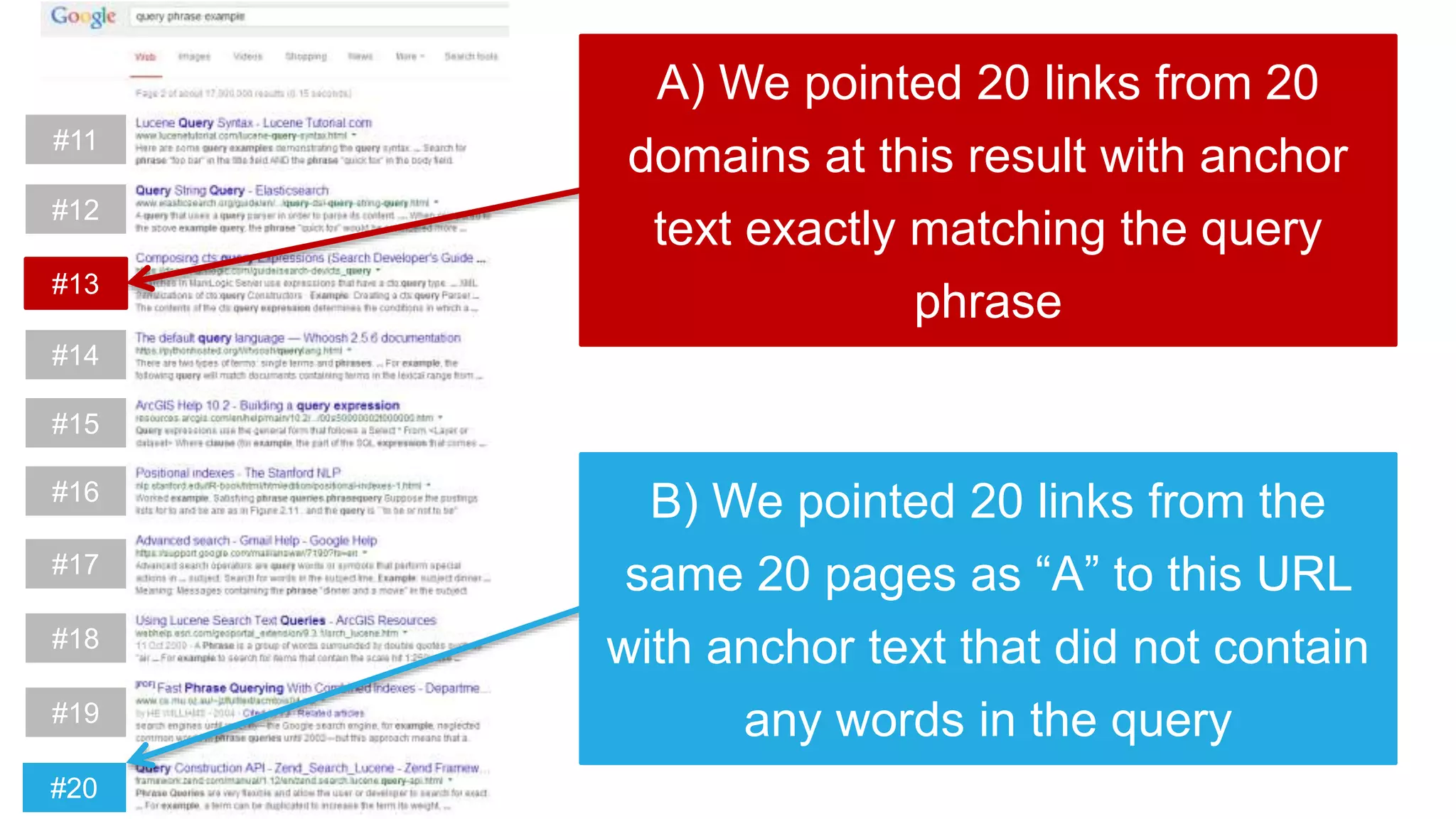
A) We pointed 20 links from 20
domains at this result with anchor
text exactly matching the query
phrase
#11
#12
#13
#14
#15
#16
#17
#18
#19
#20
B) We pointed 20 links from the
same 20 pages as “A” to this URL
with anchor text that did not contain
any words in the query
#11
#12
#13
#14
#15
#16
#17
#18
#19
#20
#1
#2
#3
#4
#5
#6
#7
#8
#9
#10
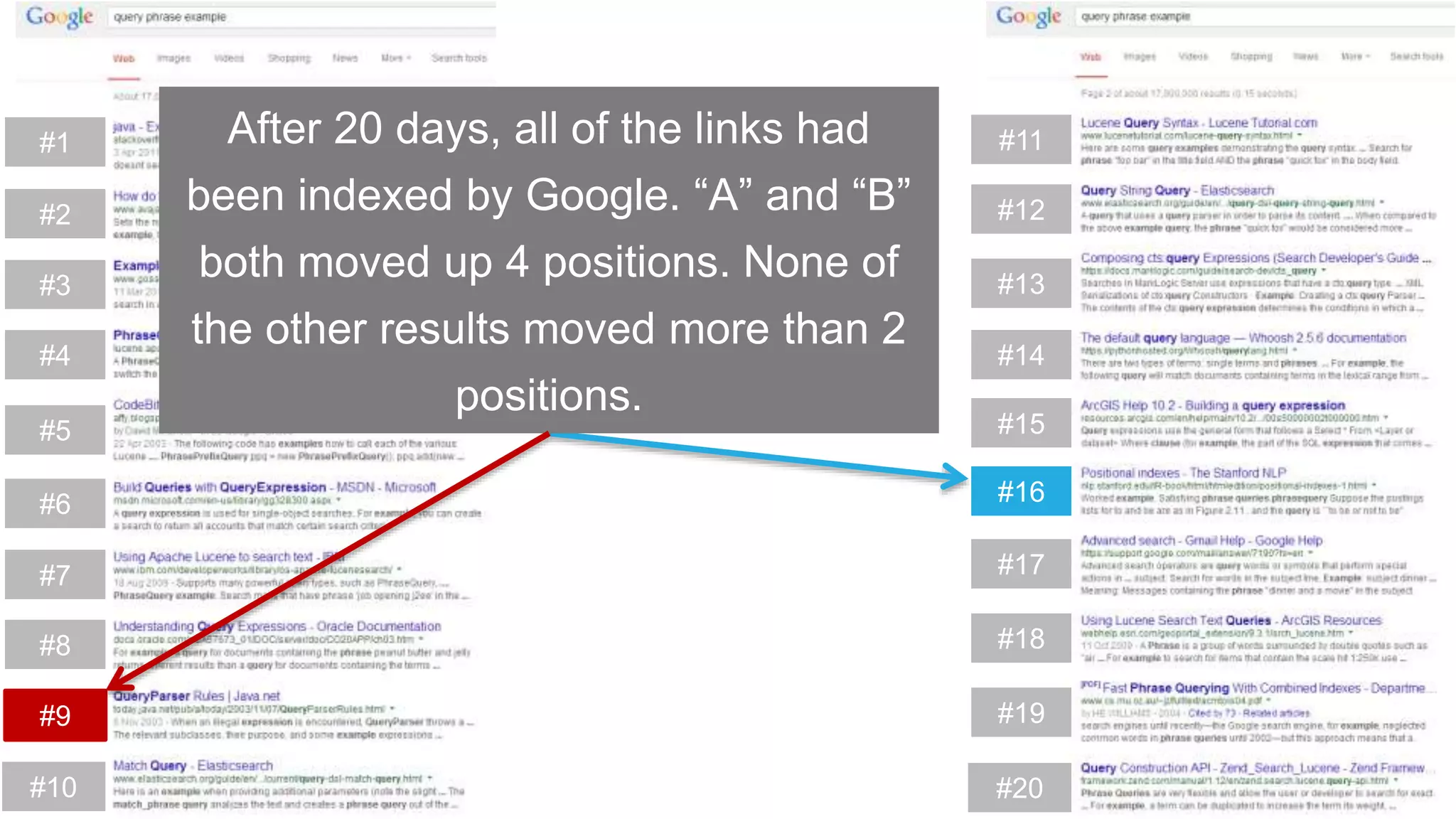
After 20 days, all of the links had
been indexed by Google. “A” and “B”
both moved up 4 positions. None of
the other results moved more than 2
positions.
Repeat the Experiment!
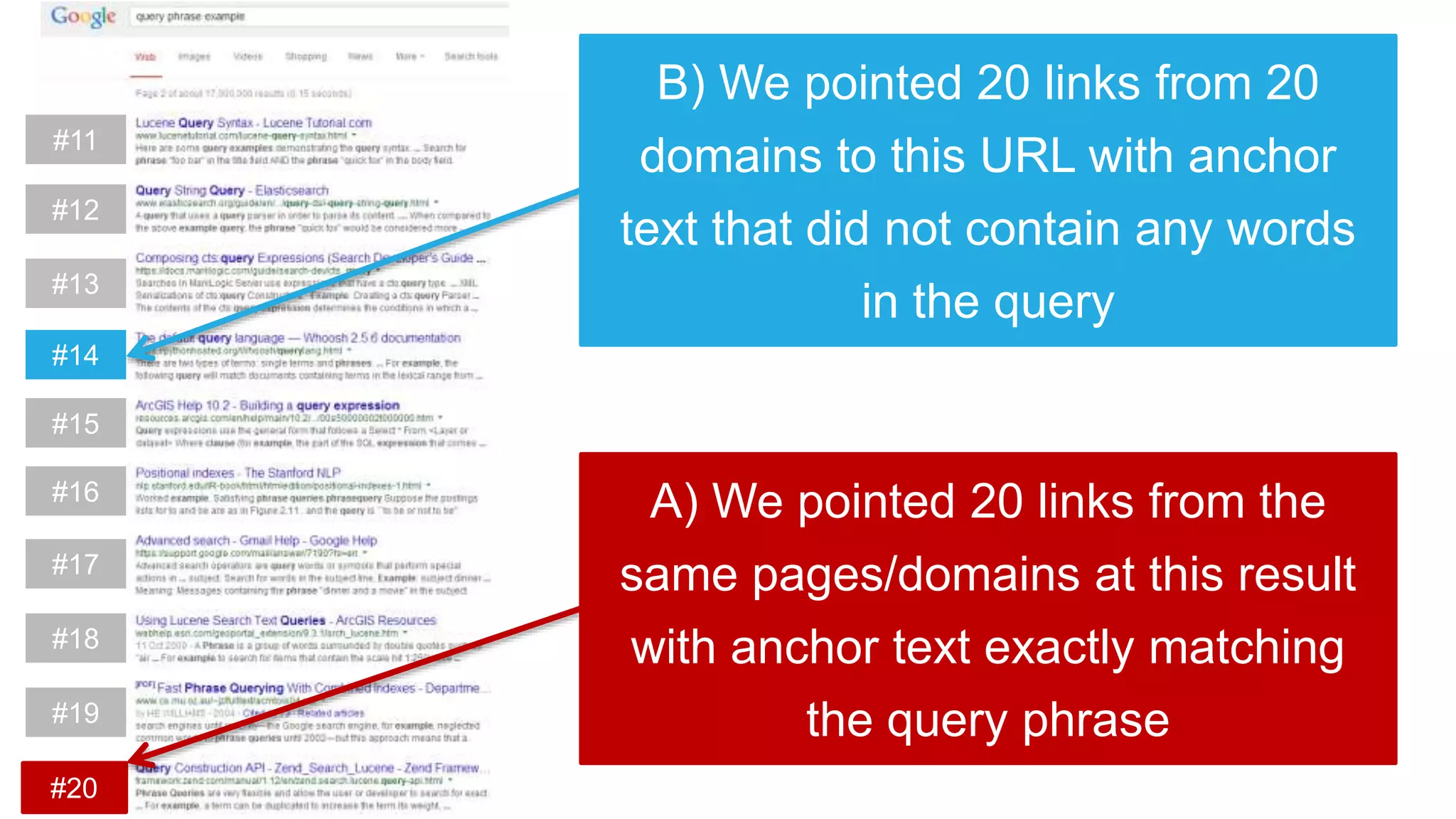
B) We pointed 20 links from 20
domains to this URL with anchor
text that did not contain any words
in the query
#11
#12
#13
#14
#15
#16
#17
#18
#19
#20
A) We pointed 20 links from the
same pages/domains at this result
with anchor text exactly matching
the query phrase
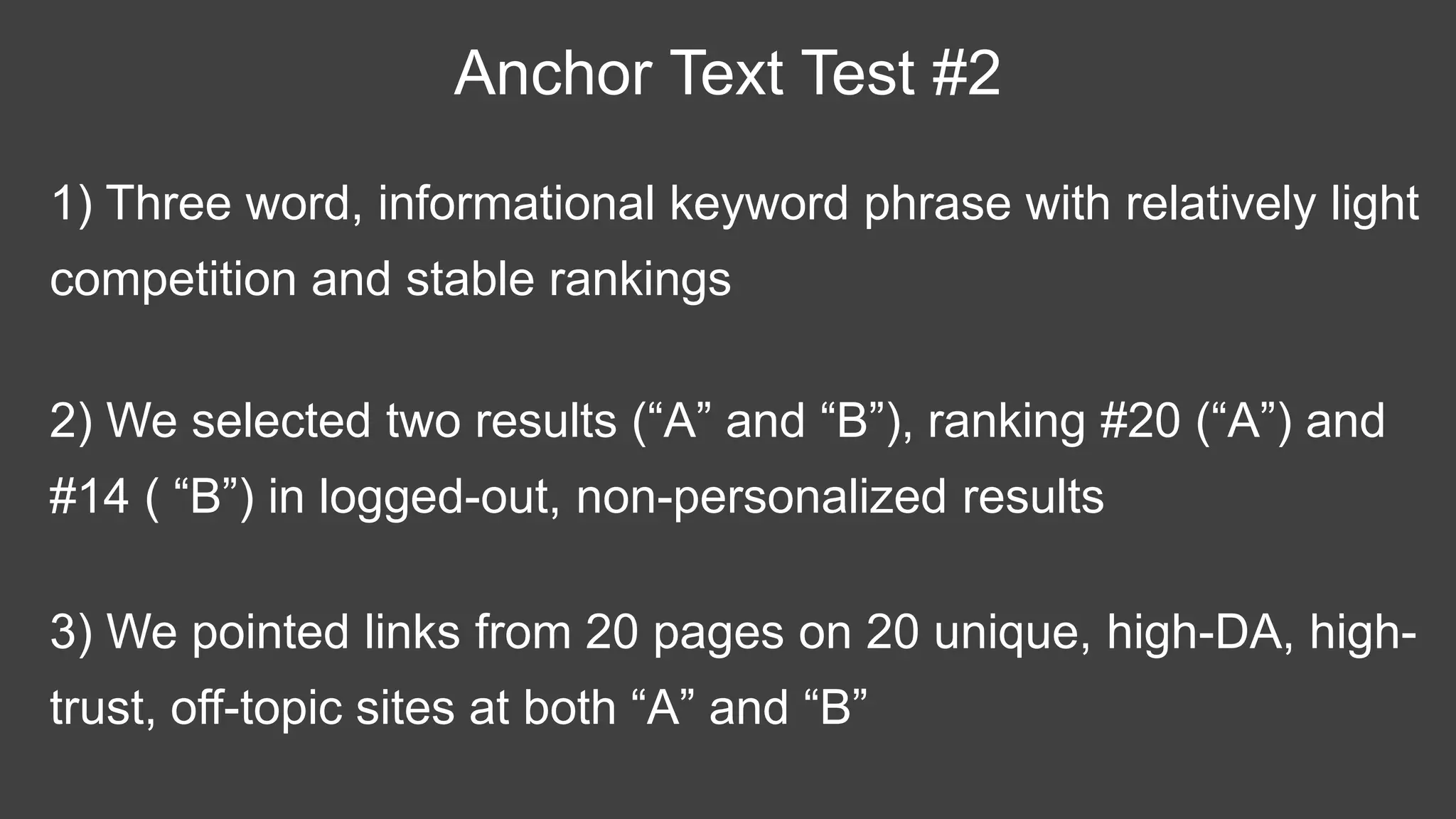
1) Three word, informational keyword phrase with relatively light
competition and stable rankings
Anchor Text Test #2
2) We selected two results (“A” and “B”), ranking #20 (“A”) and
#14 ( “B”) in logged-out, non-personalized results
3) We pointed links from 20 pages on 20 unique, high-DA, high-
trust, off-topic sites at both “A” and “B”
#11
#12
#13
#14
#15
#16
#17
#18
#19
#20
#1
#2
#3
#4
#5
#6
#7
#8
#9
#10
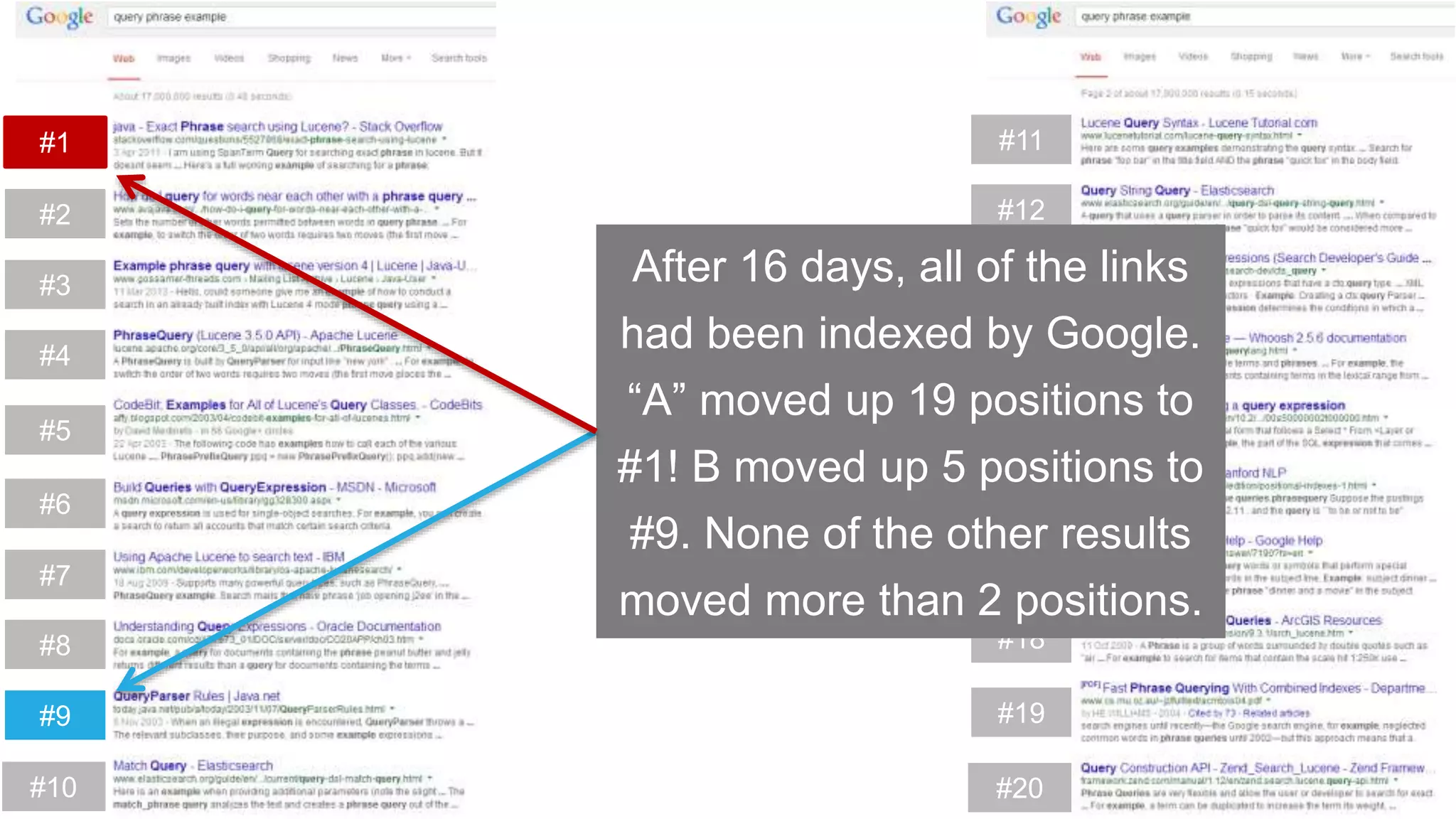
After 16 days, all of the links
had been indexed by Google.
“A” moved up 19 positions to
#1! B moved up 5 positions to
#9. None of the other results
moved more than 2 positions.
Repeat the Experiment!
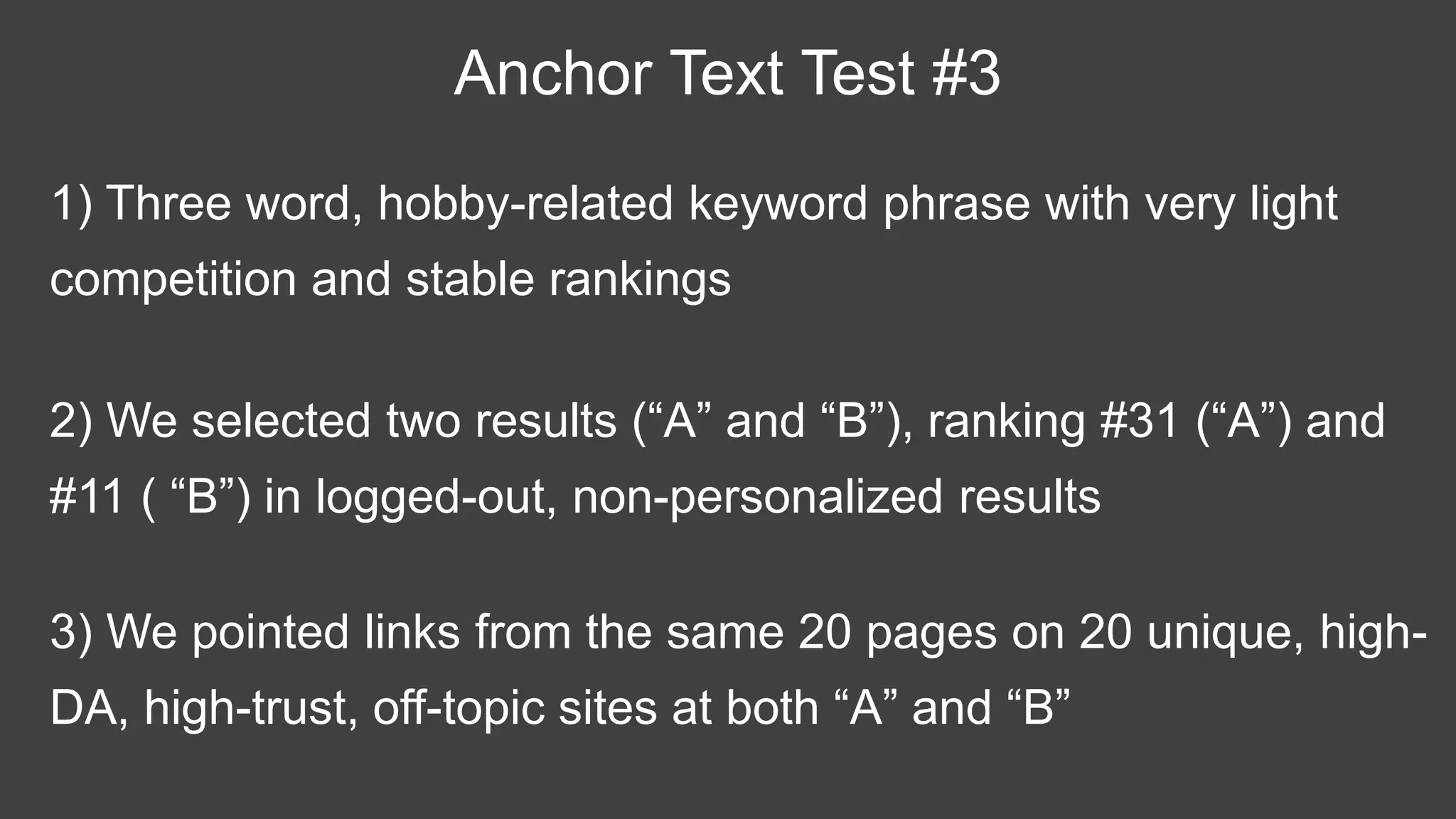
1) Three word, hobby-related keyword phrase with very light
competition and stable rankings
Anchor Text Test #3
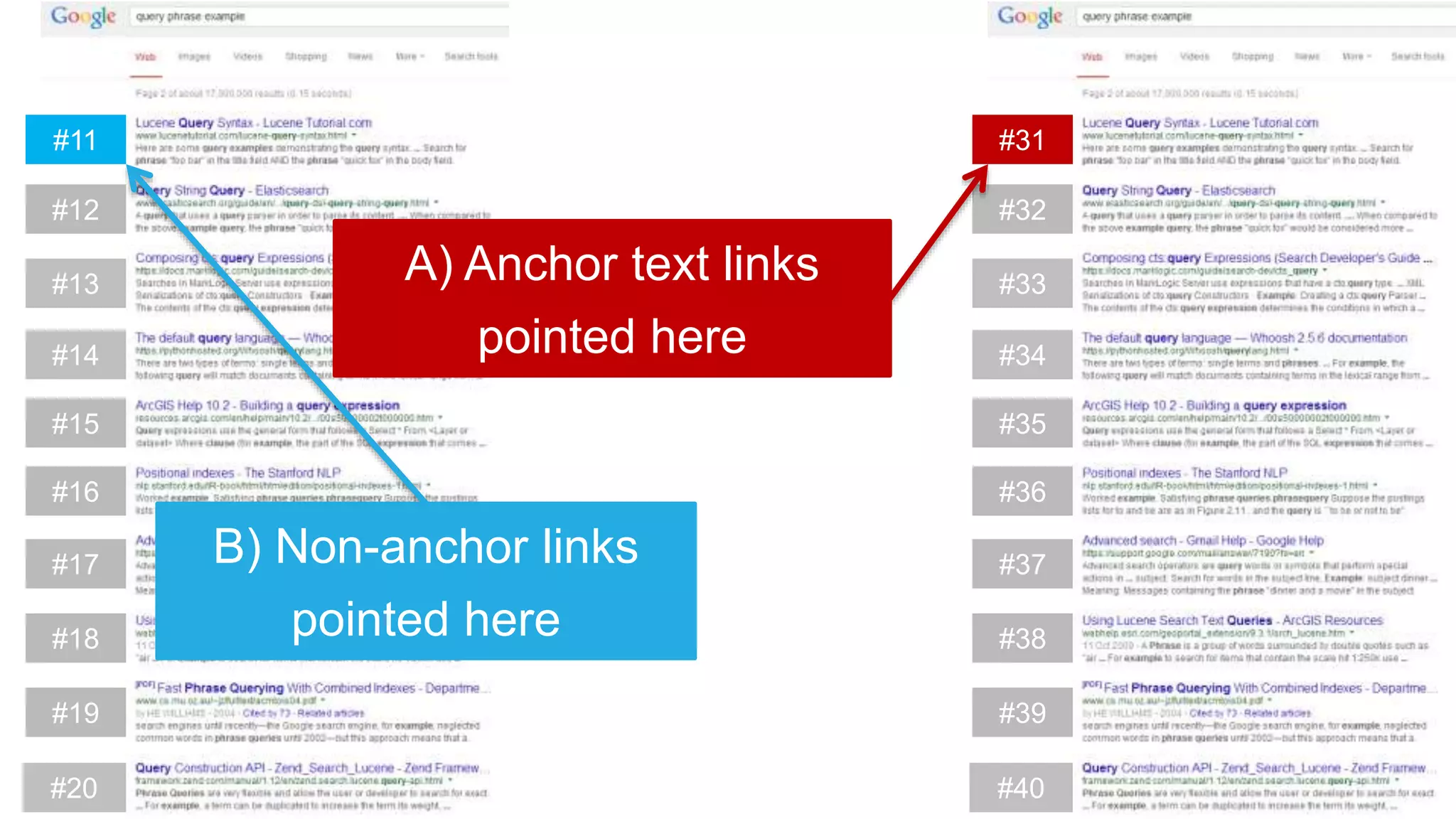
2) We selected two results (“A” and “B”), ranking #31 (“A”) and
#11 ( “B”) in logged-out, non-personalized results
3) We pointed links from the same 20 pages on 20 unique, high-
DA, high-trust, off-topic sites at both “A” and “B”
B) Non-anchor links
pointed here
#11
#12
#13
#14
#15
#16
#17
#18
#19
#20
#31
#32
#33
#34
#35
#36
#37
#38
#39
#40
A) Anchor text links
pointed here
#11
#12
#13
#14
#15
#16
#17
#18
#19
#20
#1
#2
#3
#4
#5
#6
#7
#8
#9
#10
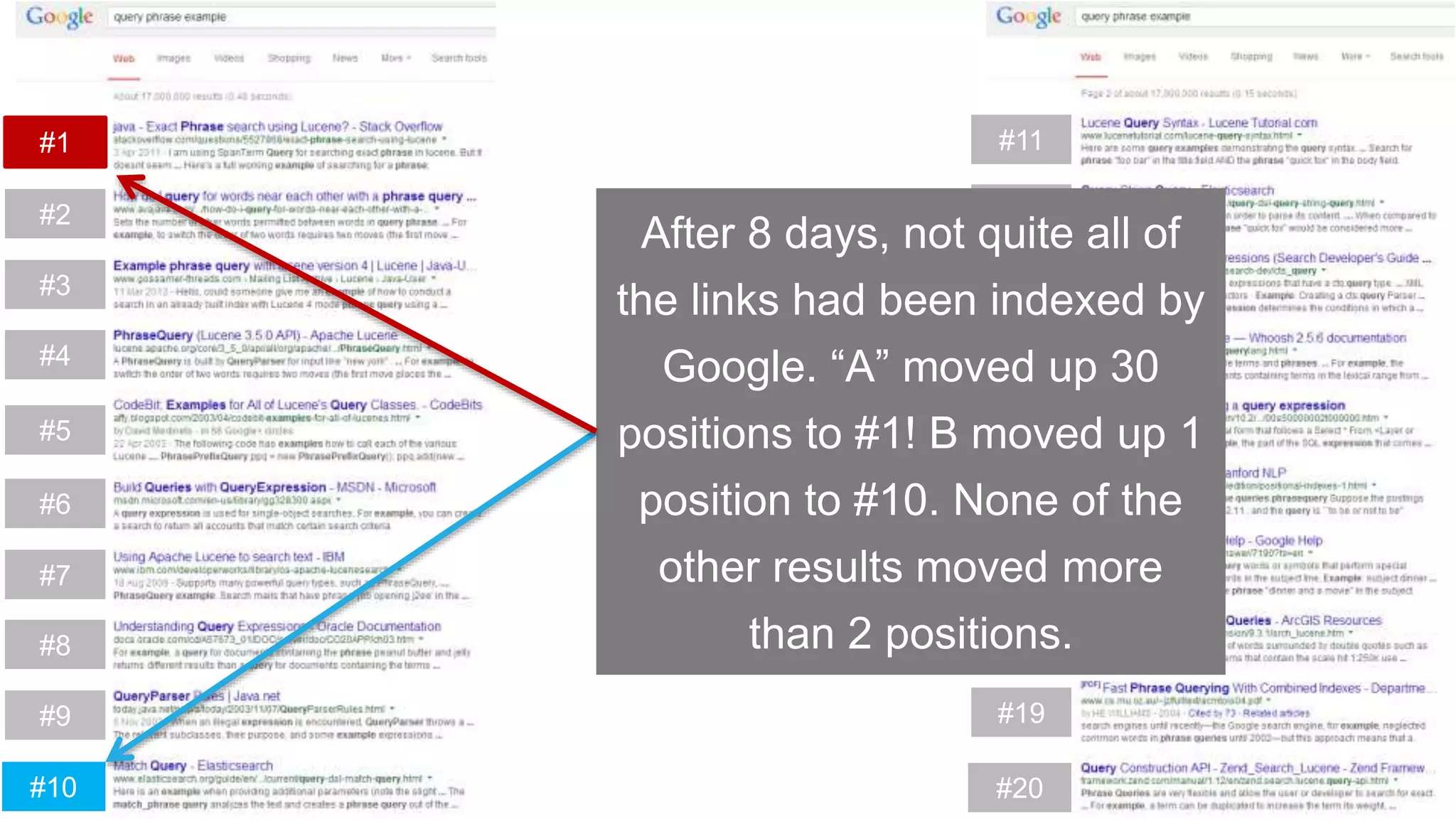
After 8 days, not quite all of
the links had been indexed by
Google. “A” moved up 30
positions to #1! B moved up 1
position to #10. None of the
other results moved more
than 2 positions.
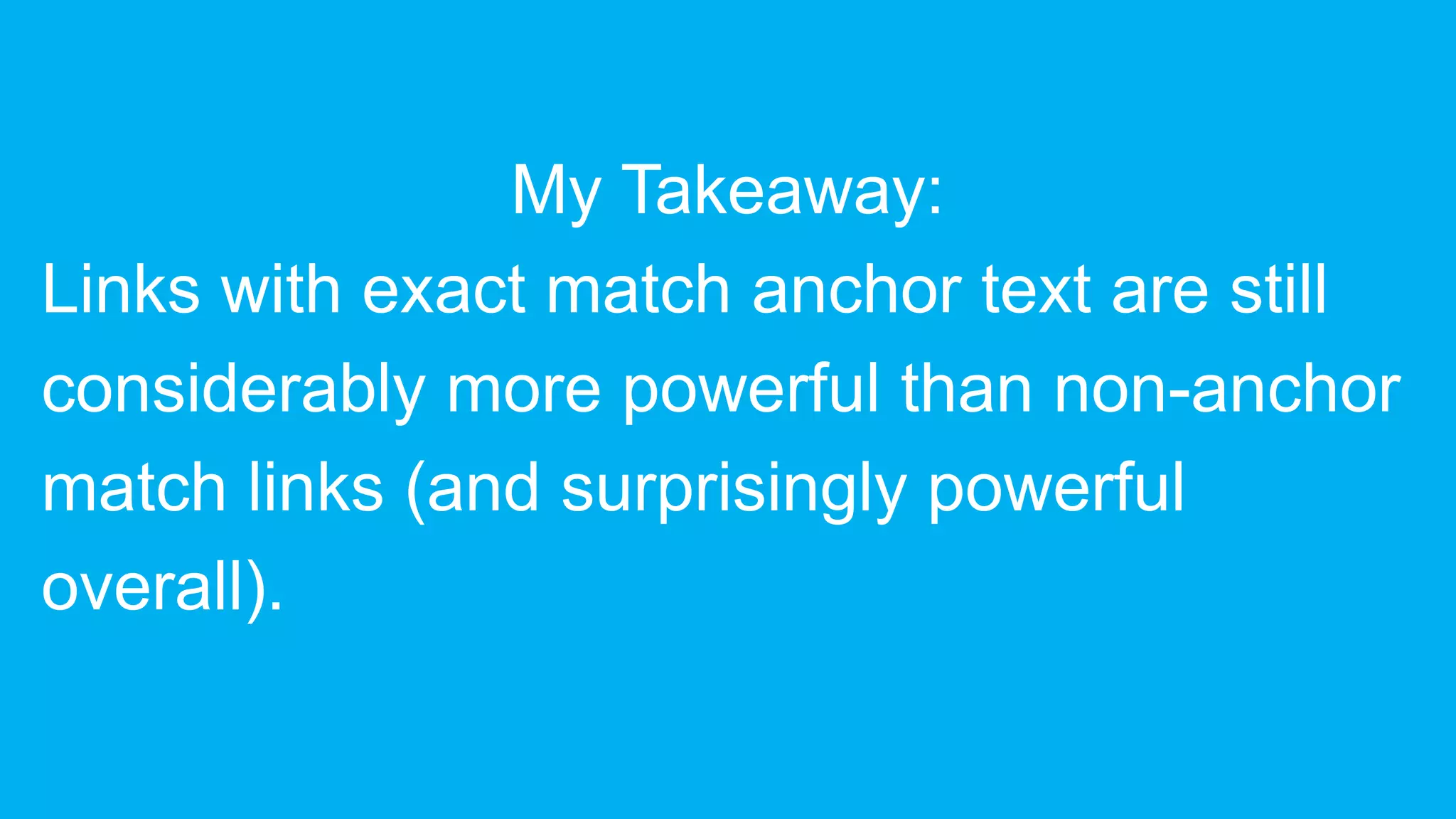
My Takeaway:
Links with exact match anchor text are still
considerably more powerful than non-anchor
match links (and surprisingly powerful
overall).
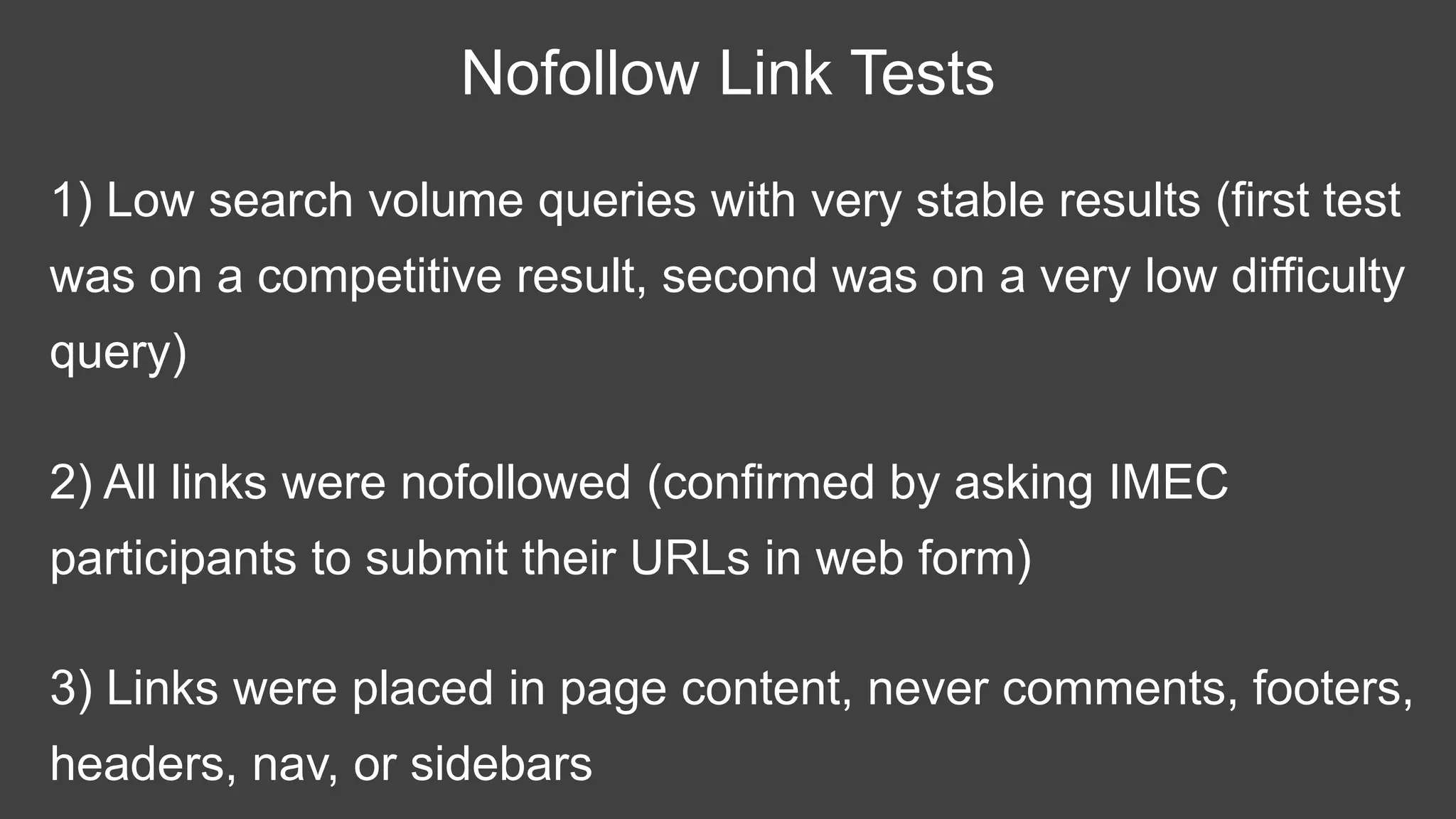
Do Nofollowed Links Have Any Direct
Impact on Rankings?
1) Low search volume queries with very stable results (first test
was on a competitive result, second was on a very low difficulty
query)
Nofollow Link Tests
2) All links were nofollowed (confirmed by asking IMEC
participants to submit their URLs in web form)
3) Links were placed in page content, never comments, footers,
headers, nav, or sidebars
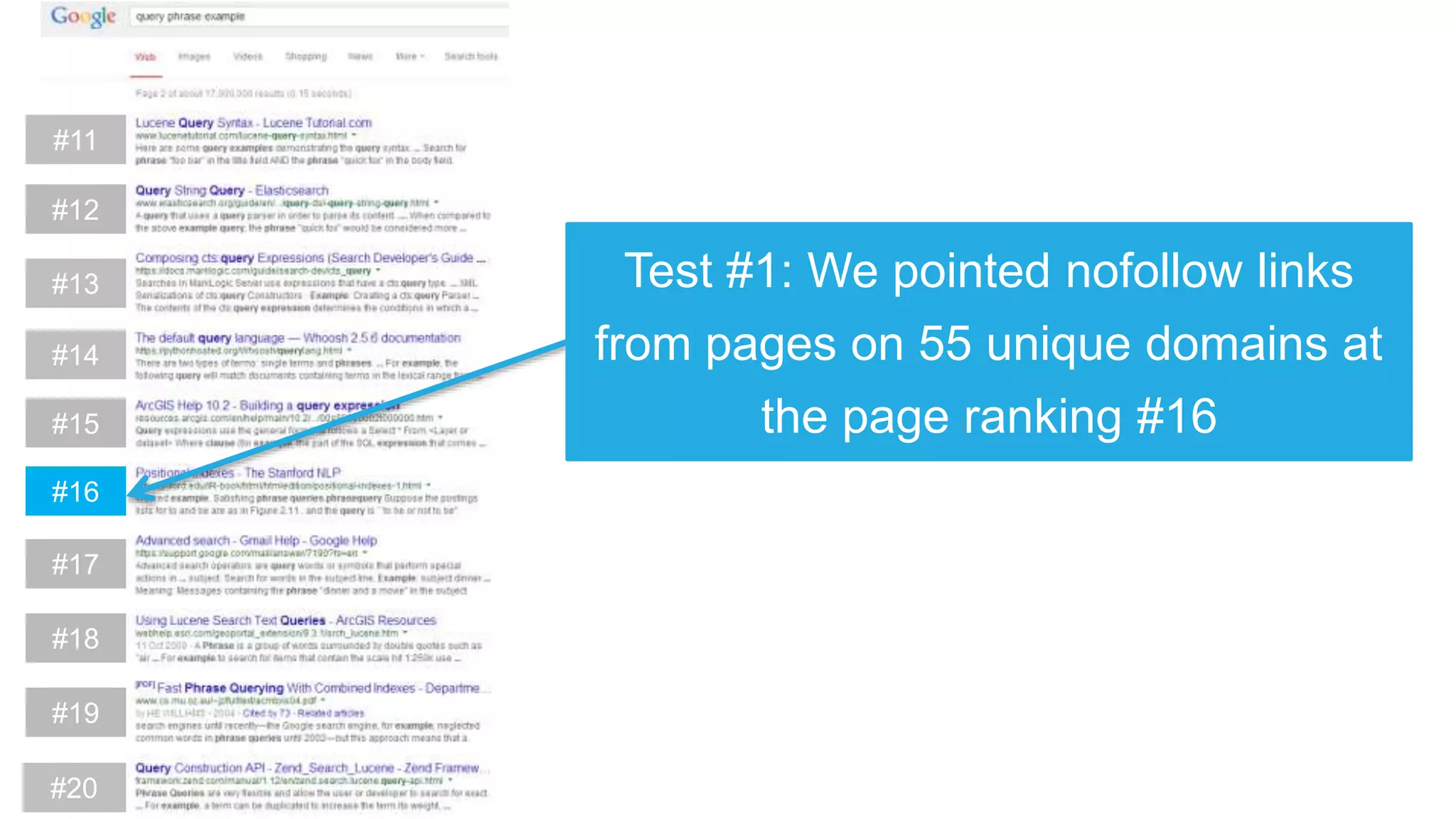
Test #1: We pointed nofollow links
from pages on 55 unique domains at
the page ranking #16
#11
#12
#13
#14
#15
#16
#17
#18
#19
#20
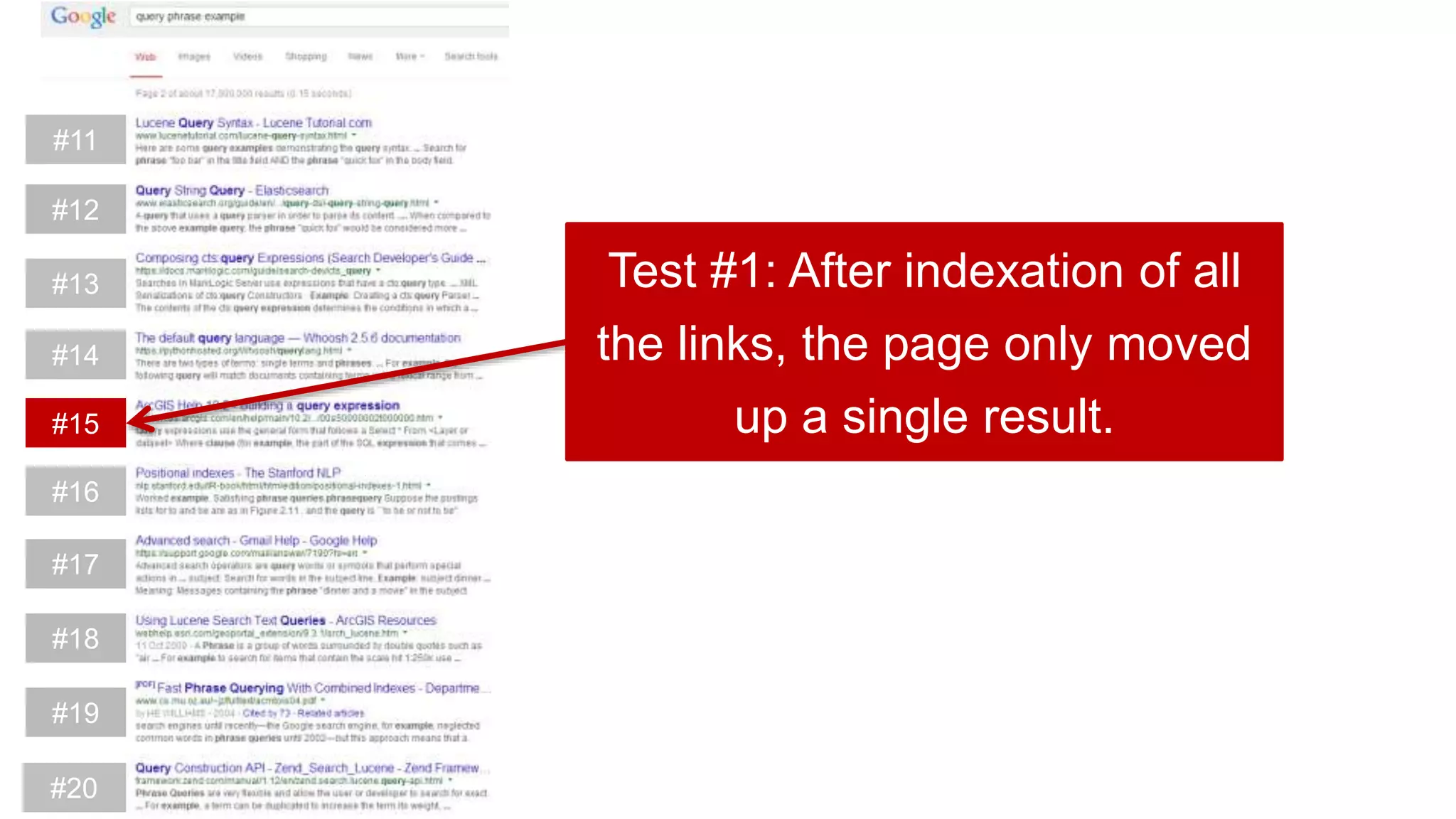
Test #1: After indexation of all
the links, the page only moved
up a single result.
#11
#12
#13
#14
#15
#16
#17
#18
#19
#20
#1
#2
#3
#4
#5
#6
#7
#8
#9
#10
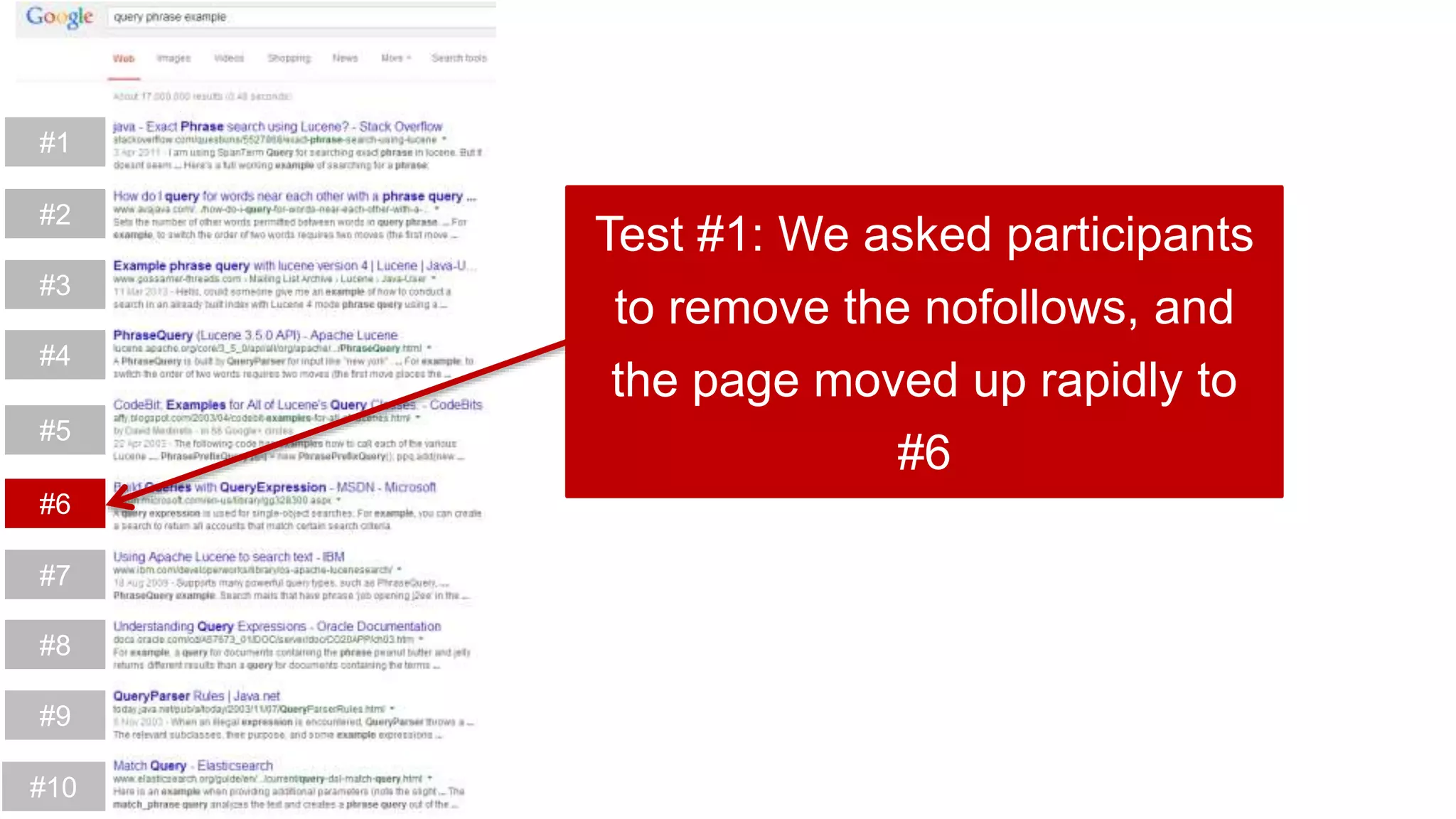
Test #1: We asked participants
to remove the nofollows, and
the page moved up rapidly to
#6
Repeat the Experiment!
#1
#2
#3
#4
#5
#6
#7
#8
#9
#10
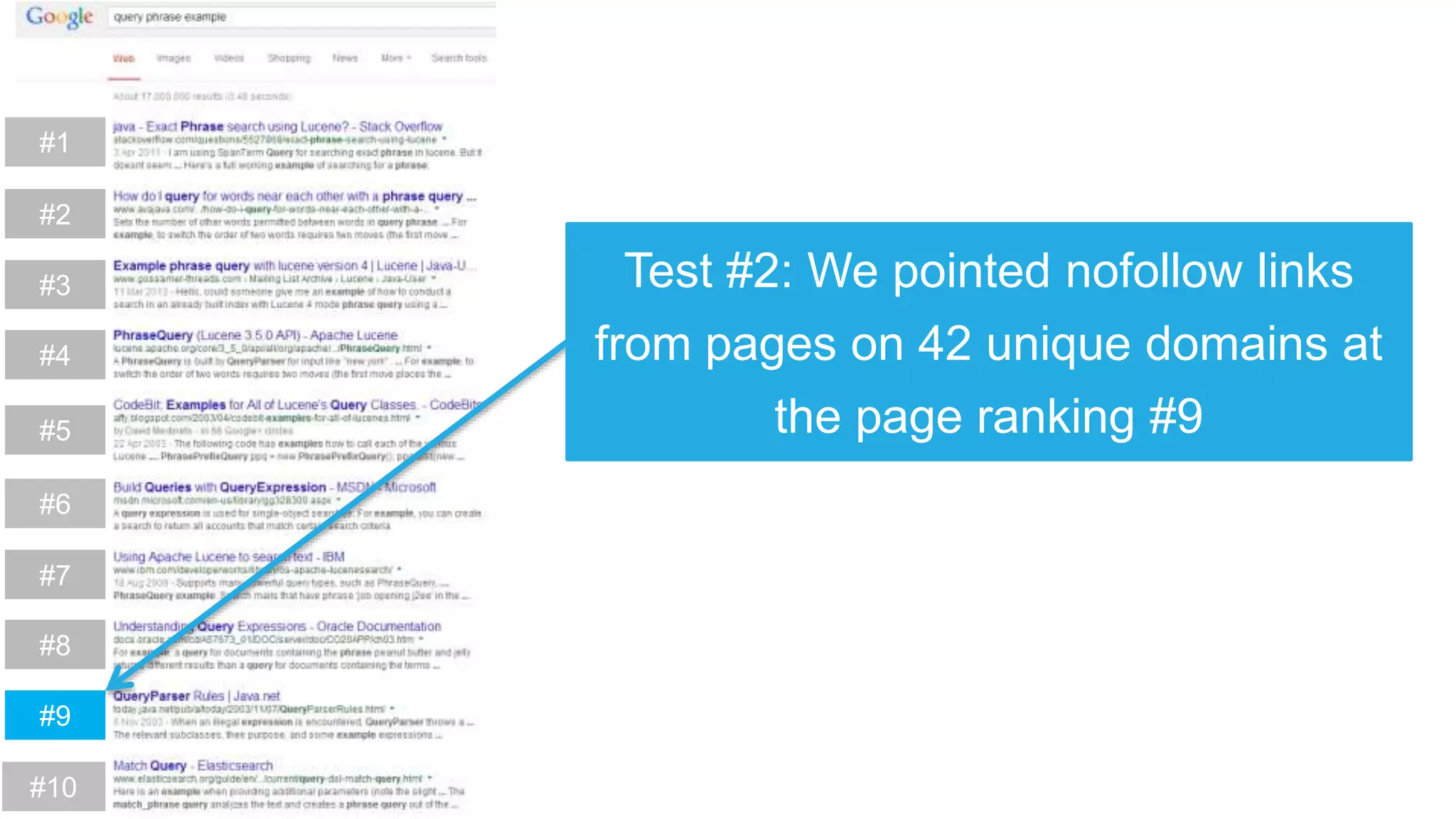
Test #2: We pointed nofollow links
from pages on 42 unique domains at
the page ranking #9
#1
#2
#3
#4
#5
#6
#7
#8
#9
#10
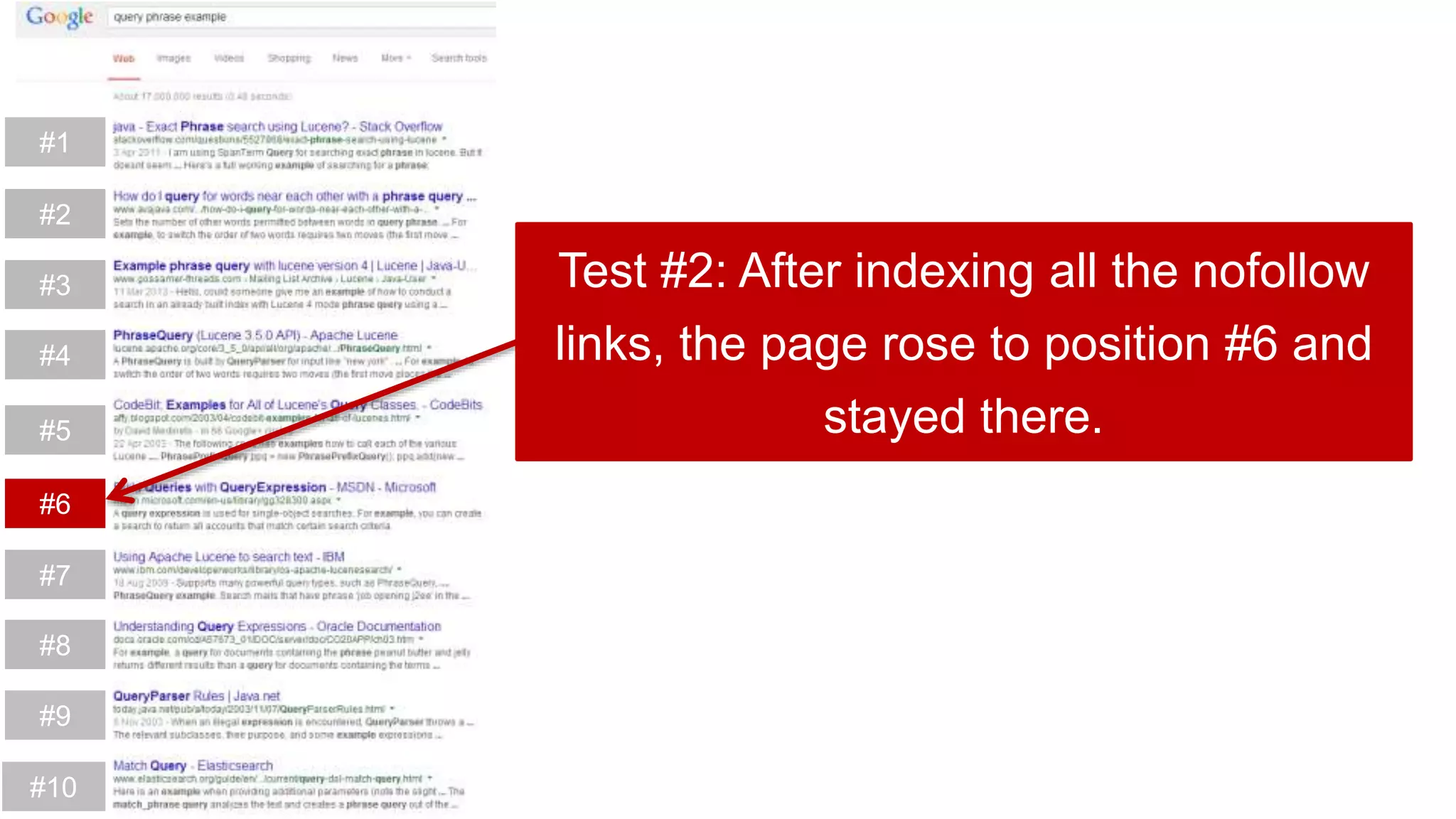
Test #2: After indexing all the nofollow
links, the page rose to position #6 and
stayed there.
#1
#2
#3
#4
#5
#6
#7
#8
#9
#10
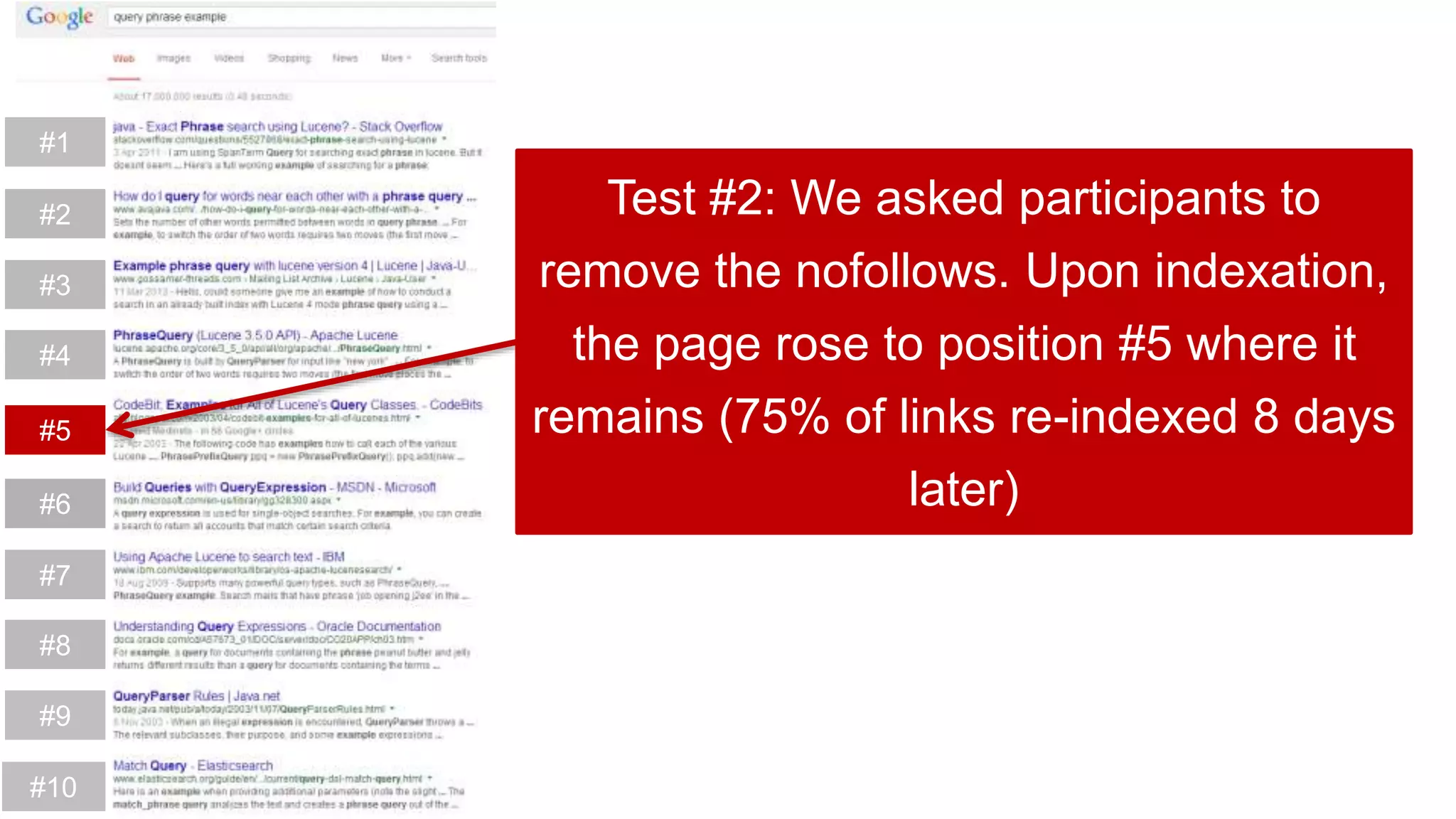
Test #2: We asked participants to
remove the nofollows. Upon indexation,
the page rose to position #5 where it
remains (75% of links re-indexed 8 days
later)
My Takeaway:
The experiment needs to be repeated 2-3
more times at least, but early data suggests
there may be a relationship between ranking
increases and in-content, nofollowed links
A Fascinating Side-Effect Presented
Itself in All of Our
Link-Based Experiments
#11
#12
#13
#14
#15
#16
#17
#18
#19
#20
#1
#2
#3
#4
#5
#6
#7
#8
#9
#10
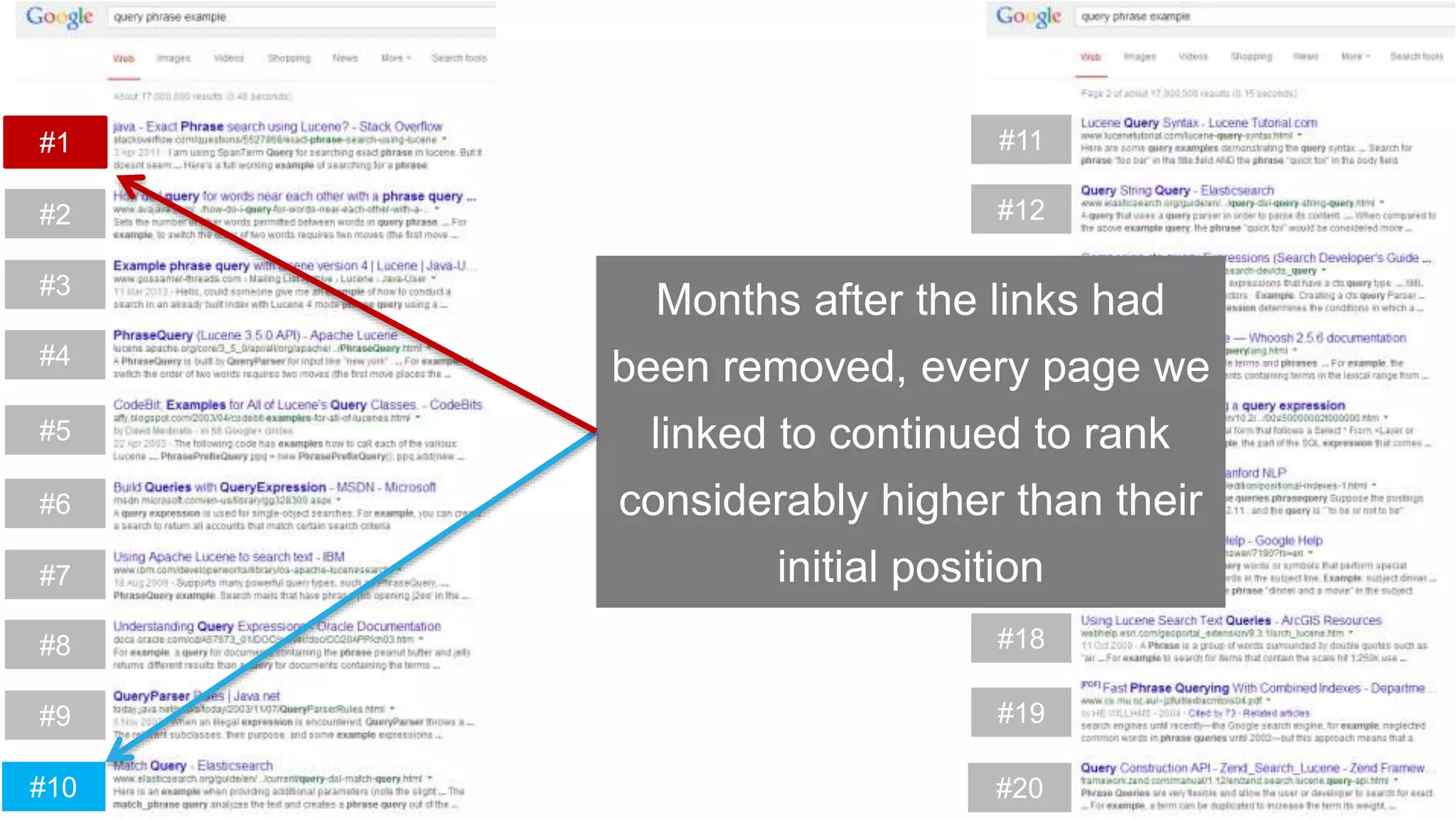
Months after the links had
been removed, every page we
linked to continued to rank
considerably higher than their
initial position
#1
#2
#3
#4
#5
#6
#7
#8
#9
#10
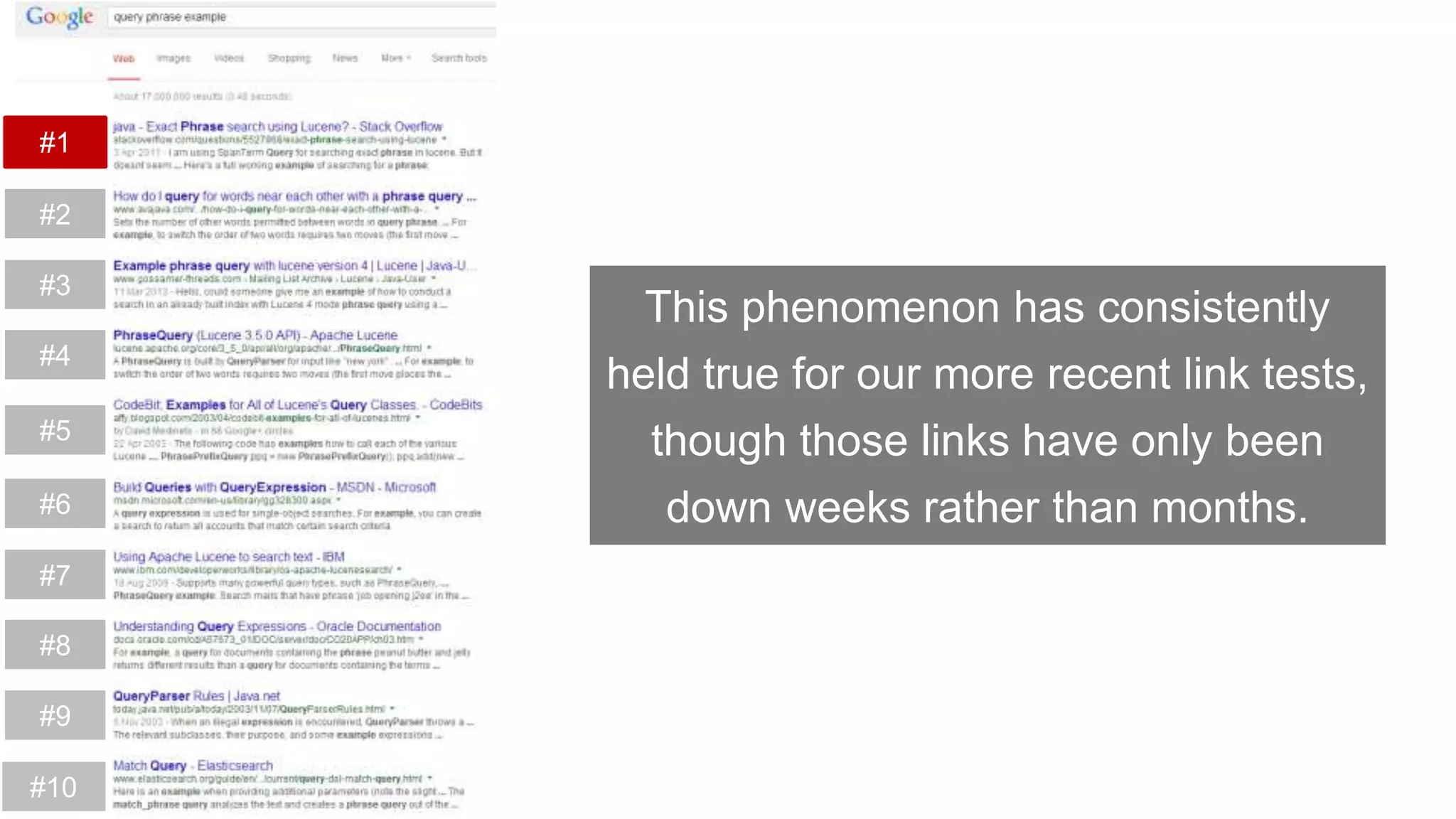
This phenomenon has consistently
held true for our more recent link tests,
though those links have only been
down weeks rather than months.
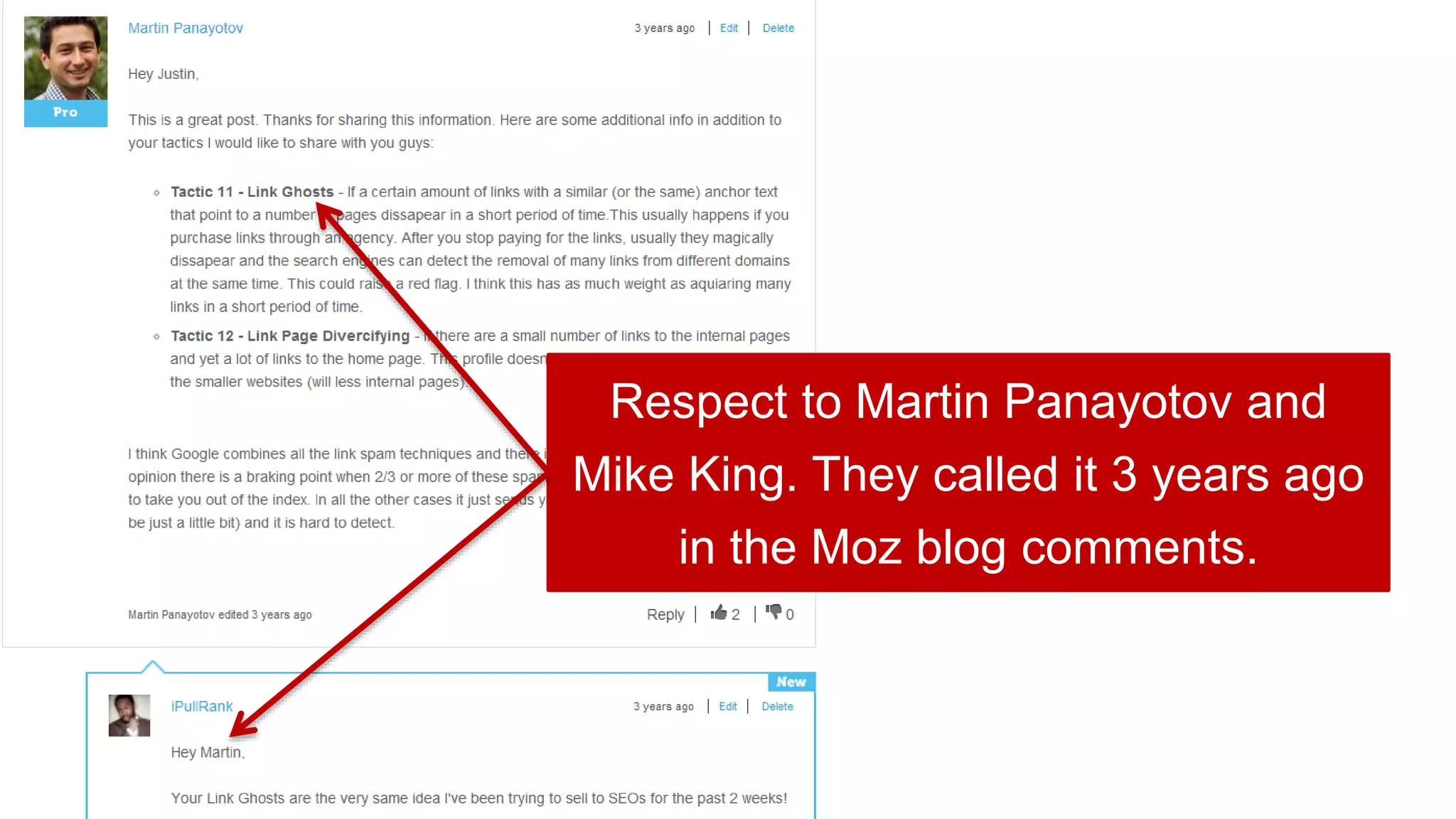
Respect to Martin Panayotov and
Mike King. They called it 3 years ago
in the Moz blog comments.
My Takeaway:
Link ghosts appear to be a real phenomenon
with powerful and lasting effects. Studying
this more could lead to some fascinating
insights & tactics.
Can Query & Click Volume Directly
Impact Rankings?
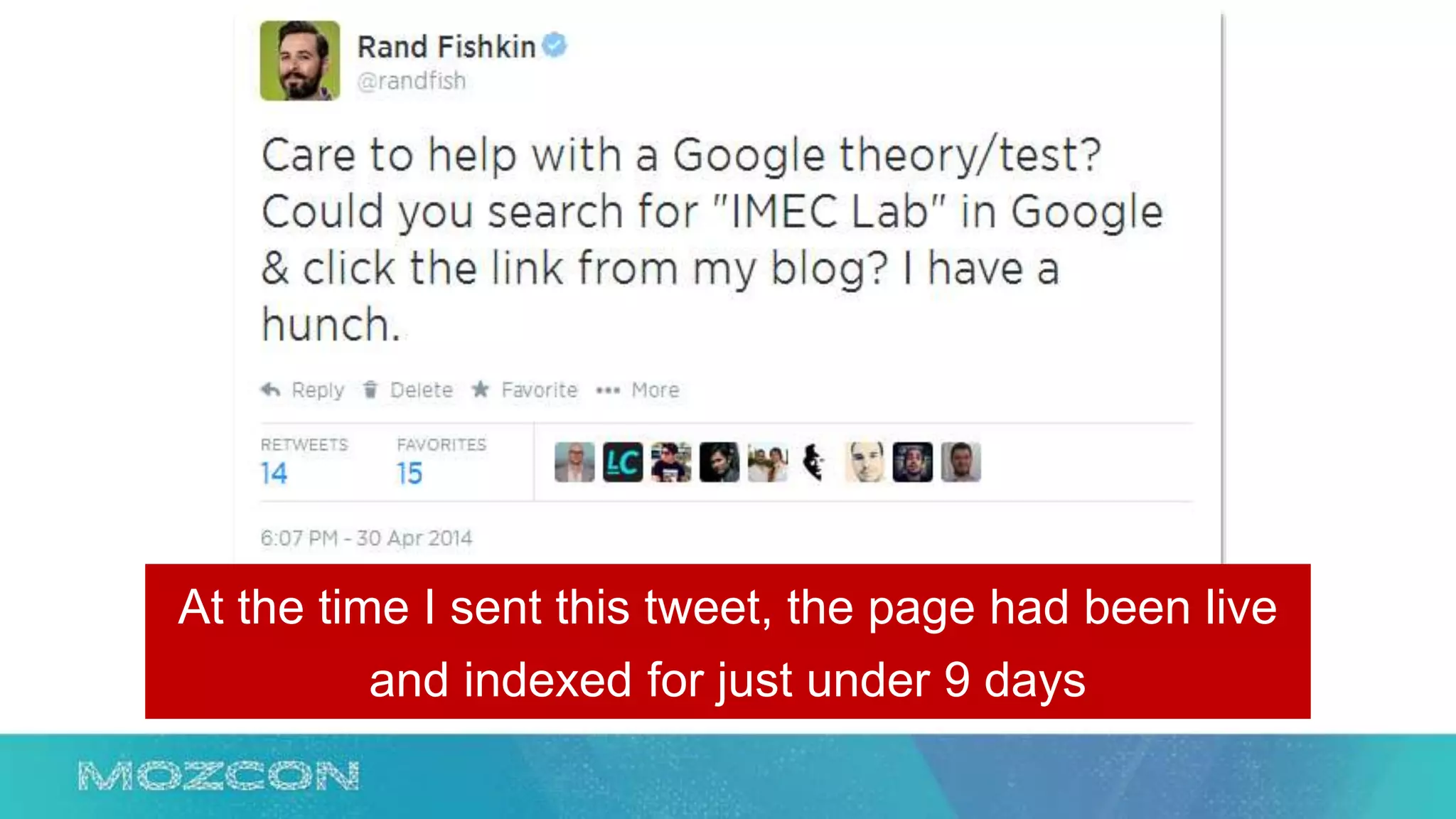
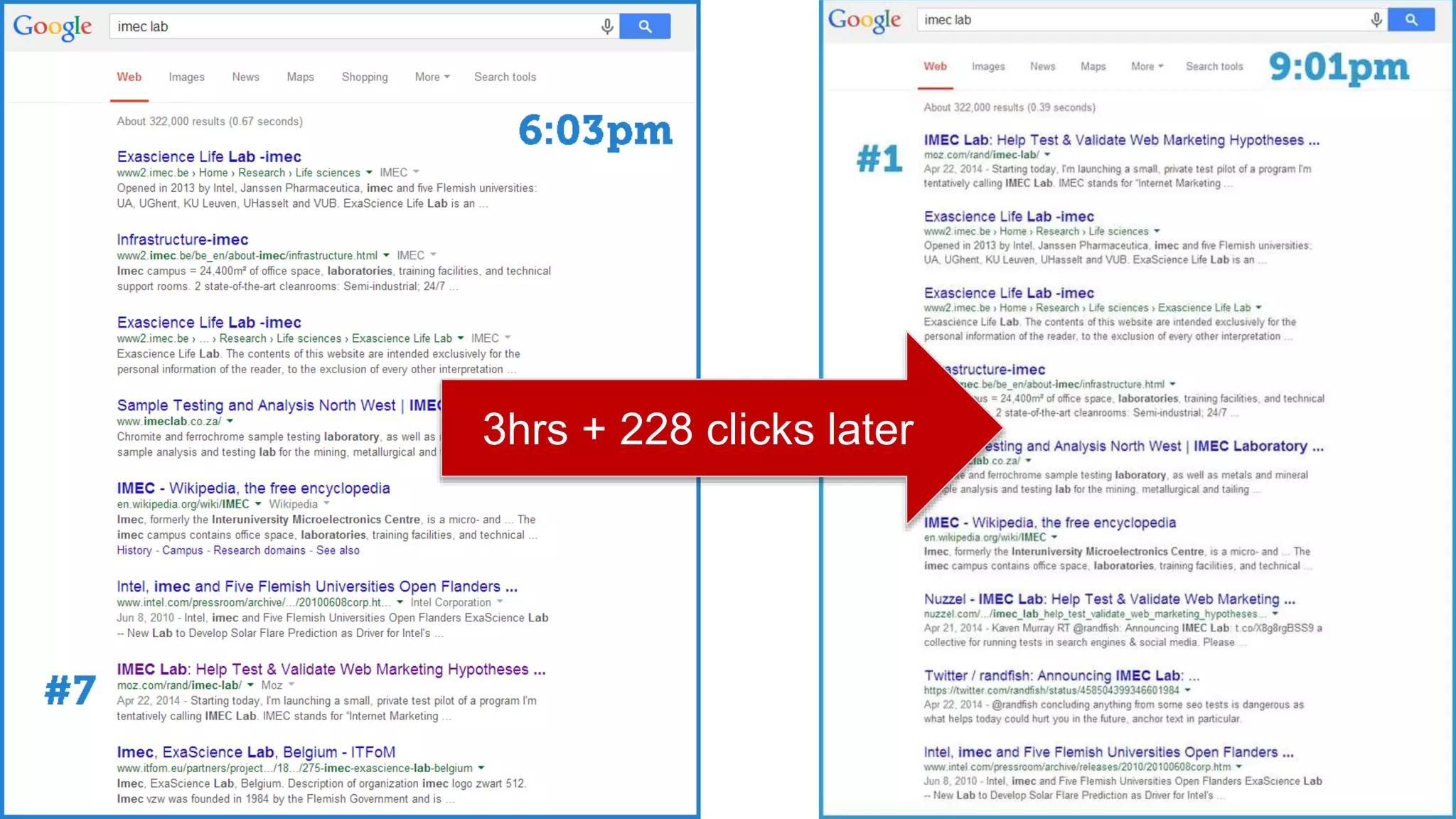
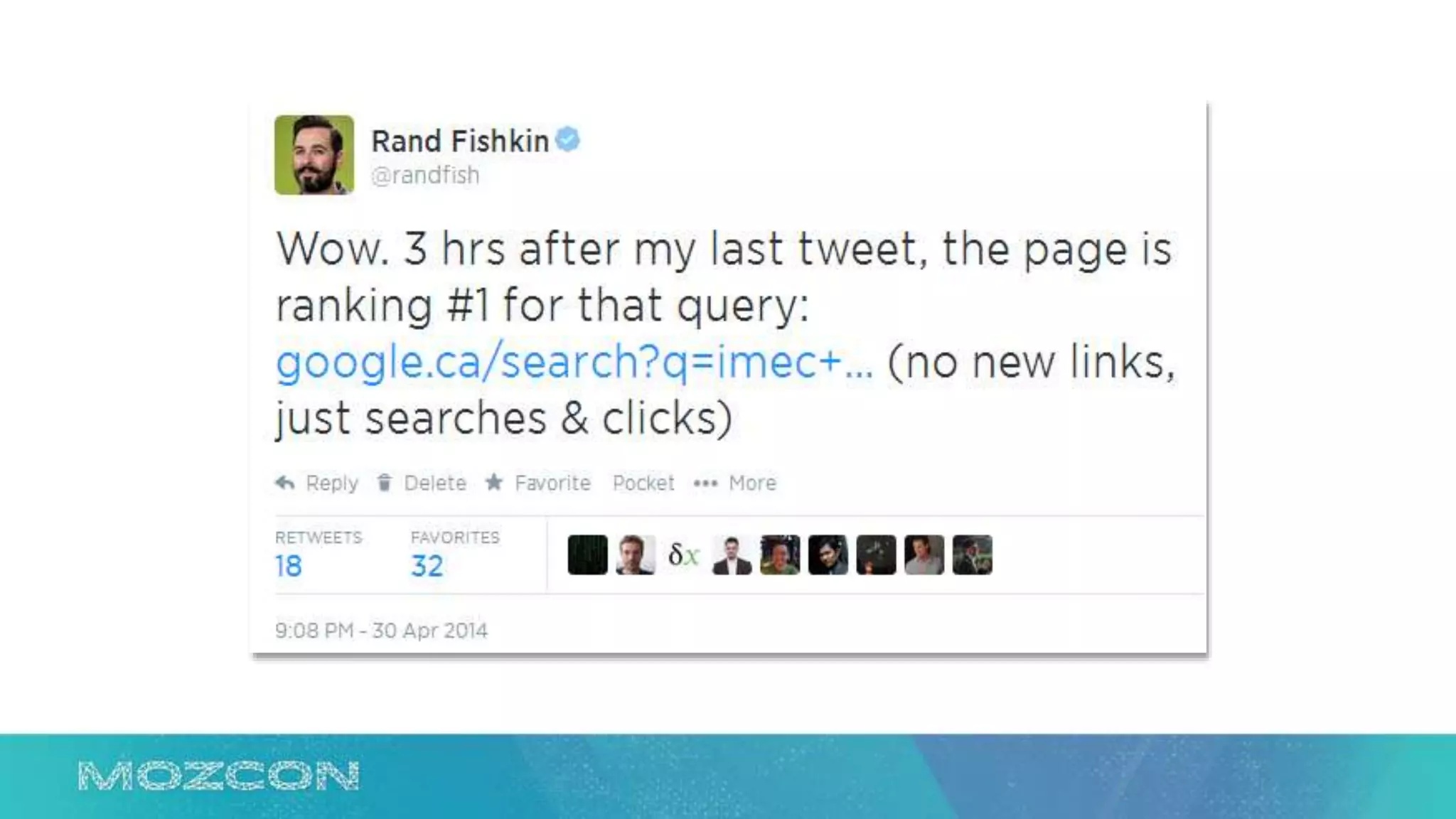
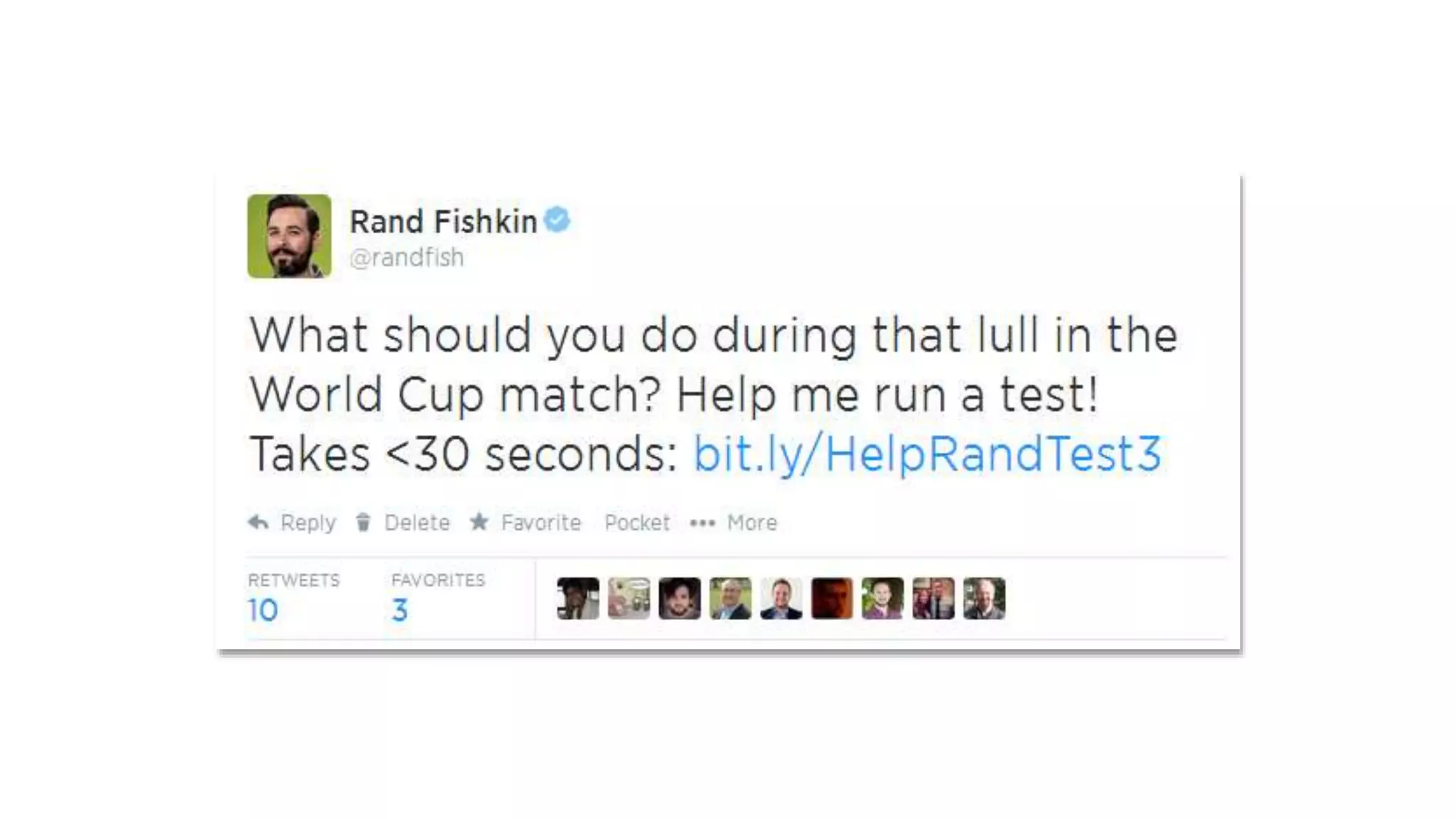
At the time I sent this tweet, the page had been live
and indexed for just under 9 days
3hrs + 228 clicks later
Repeat the Experiment!
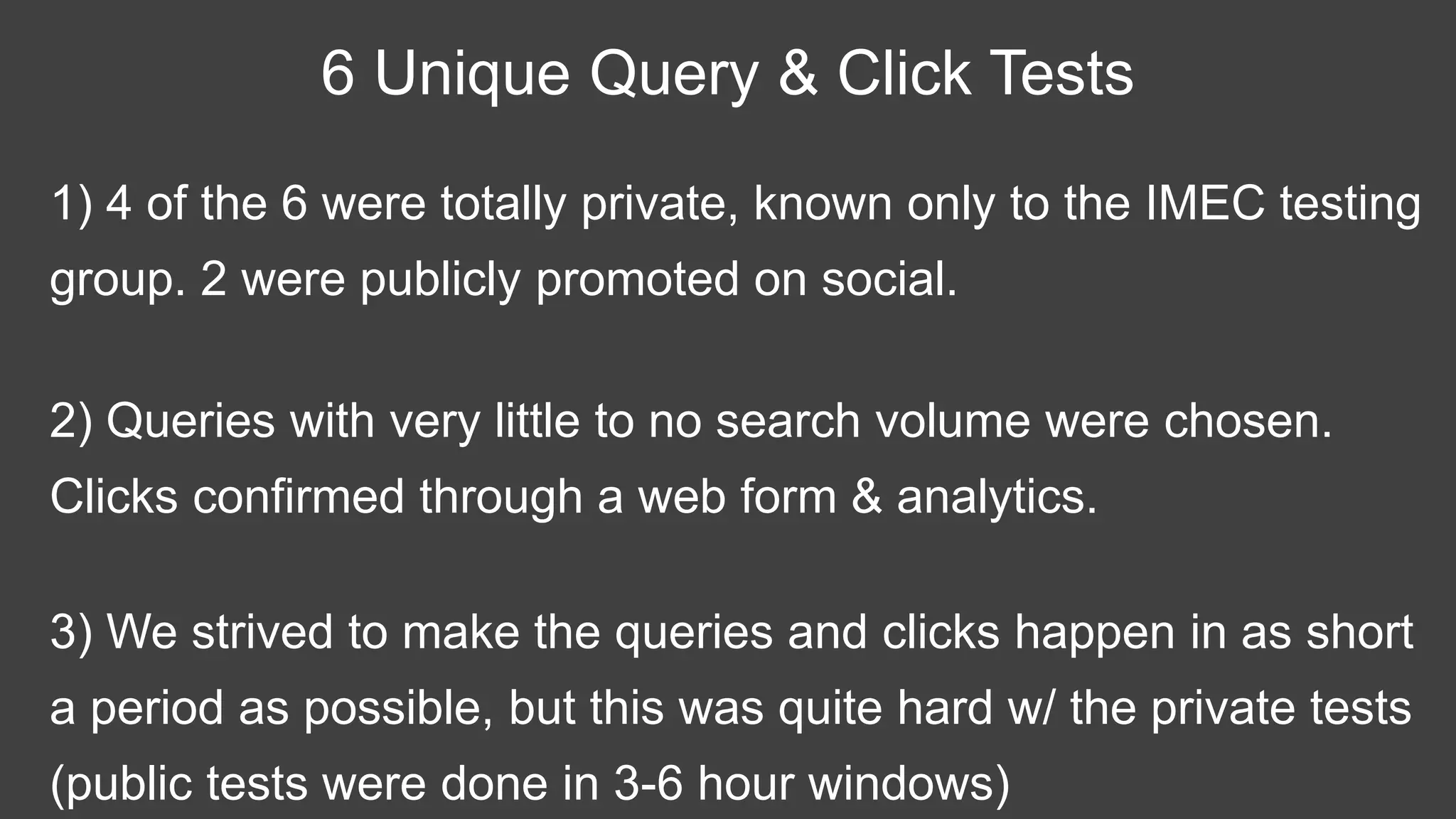
1) 4 of the 6 were totally private, known only to the IMEC testing
group. 2 were publicly promoted on social.
6 Unique Query & Click Tests
2) Queries with very little to no search volume were chosen.
Clicks confirmed through a web form & analytics.
3) We strived to make the queries and clicks happen in as short
a period as possible, but this was quite hard w/ the private tests
(public tests were done in 3-6 hour windows)
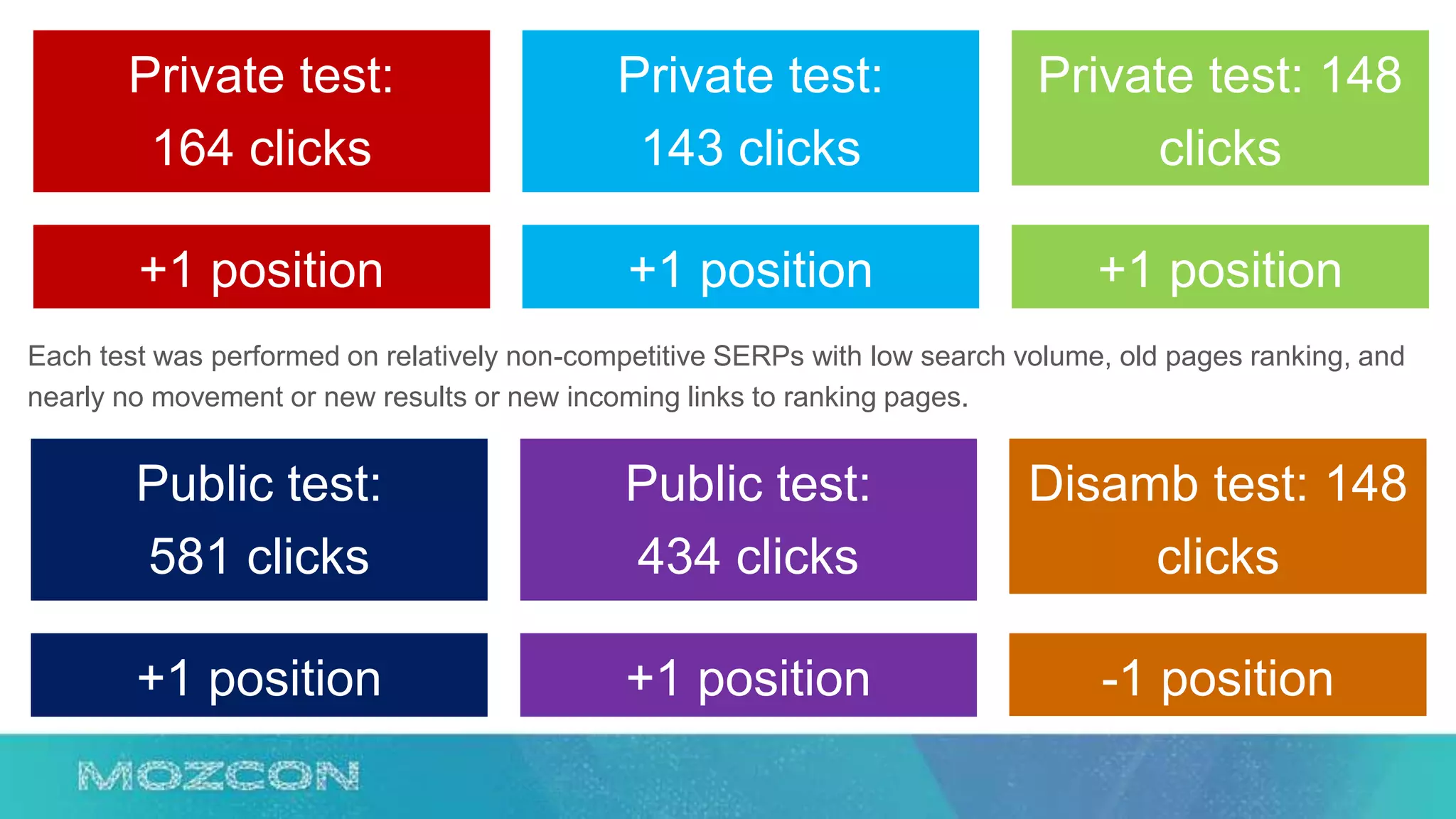
Private test:
164 clicks
Private test:
143 clicks
Private test: 148
clicks
+1 position +1 position +1 position
Each test was performed on relatively non-competitive SERPs with low search volume, old pages ranking, and
nearly no movement or new results or new incoming links to ranking pages.
Public test:
581 clicks
Public test:
434 clicks
Disamb test: 148
clicks
+1 position +1 position -1 position
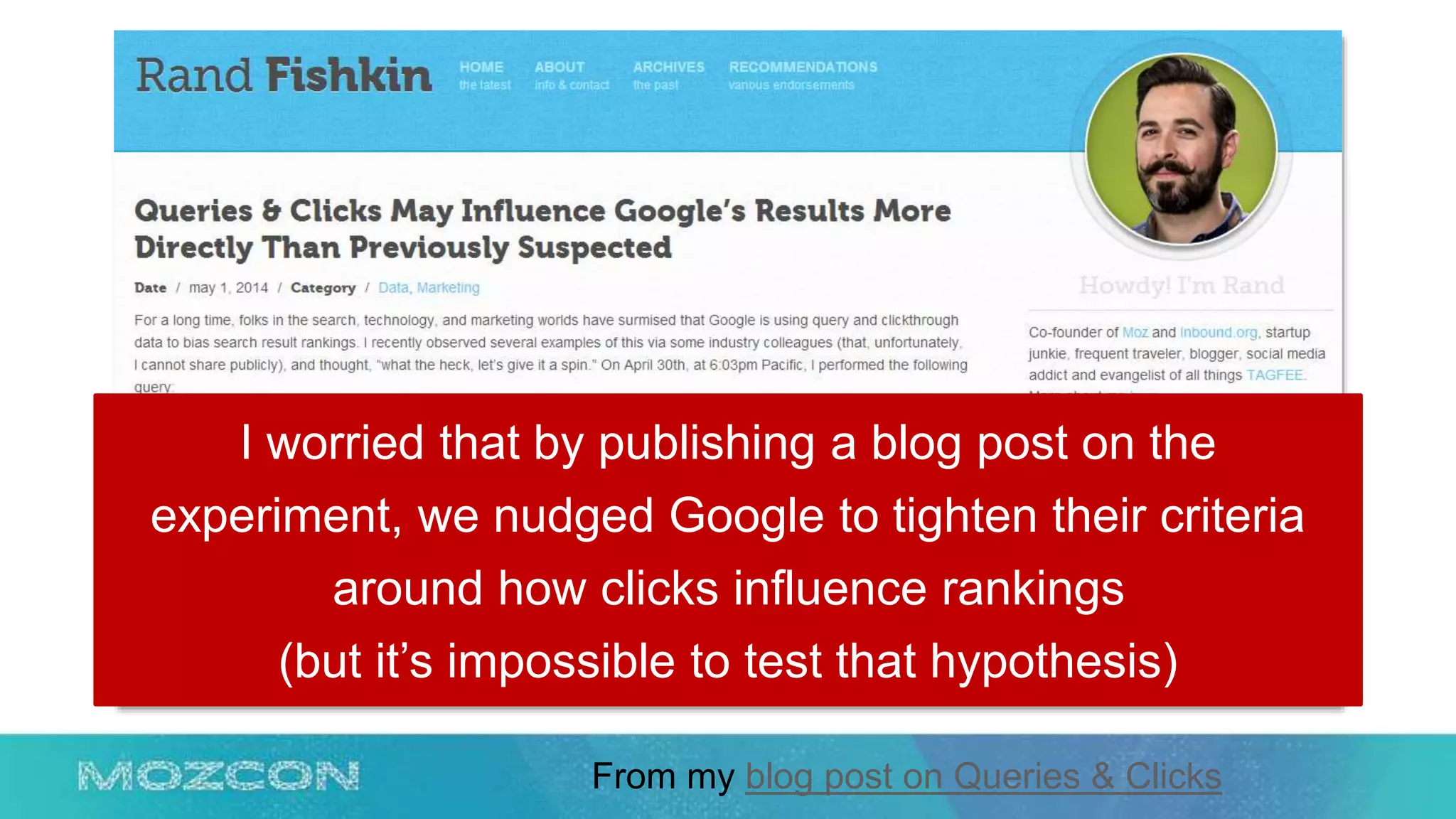
I worried that by publishing a blog post on the
experiment, we nudged Google to tighten their criteria
around how clicks influence rankings
(but it’s impossible to test that hypothesis)
From my blog post on Queries & Clicks
Just try it
one more
time…
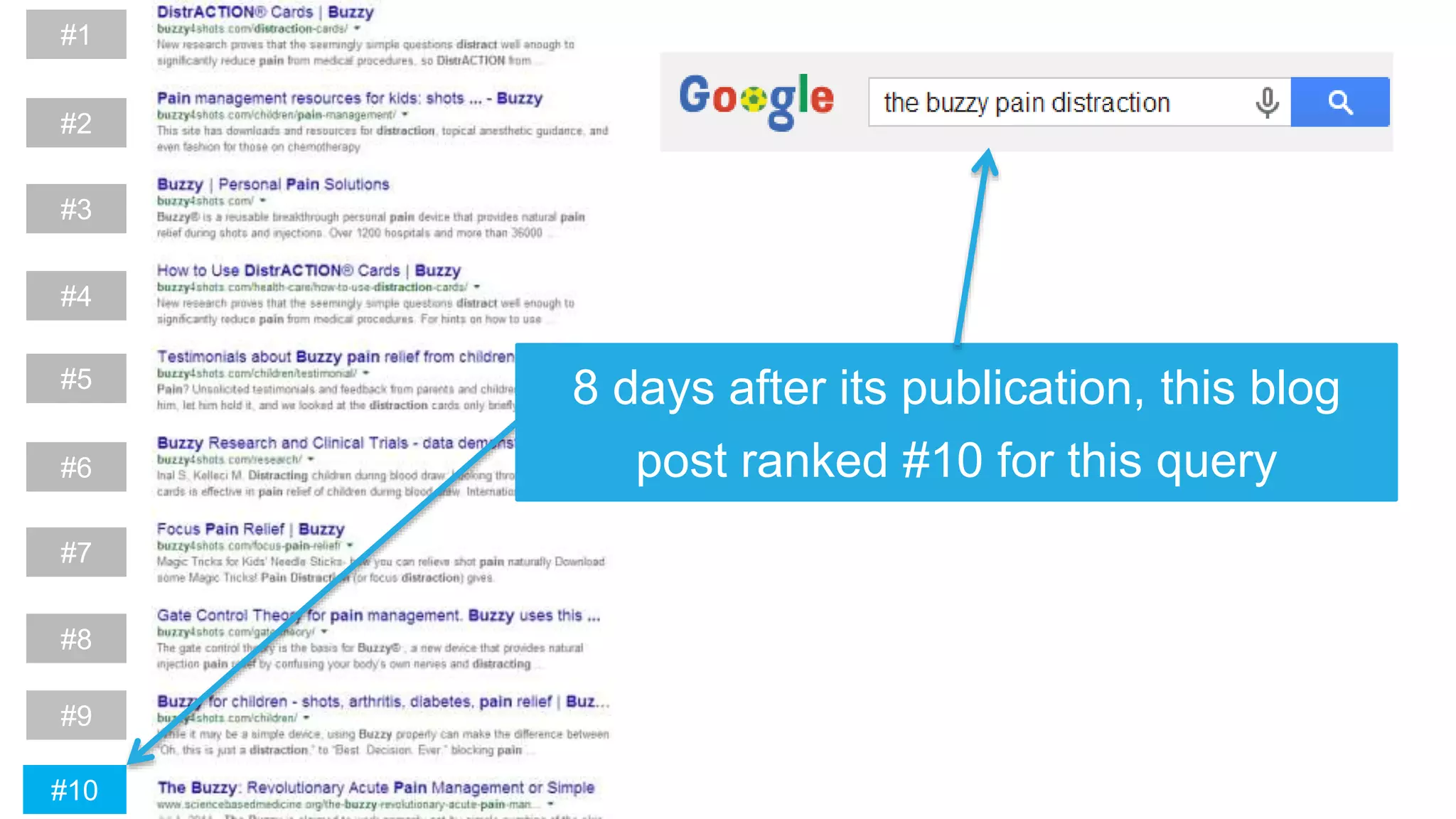
#1
#2
#3
#4
#5
#6
#7
#8
#9
#10
8 days after its publication, this blog
post ranked #10 for this query
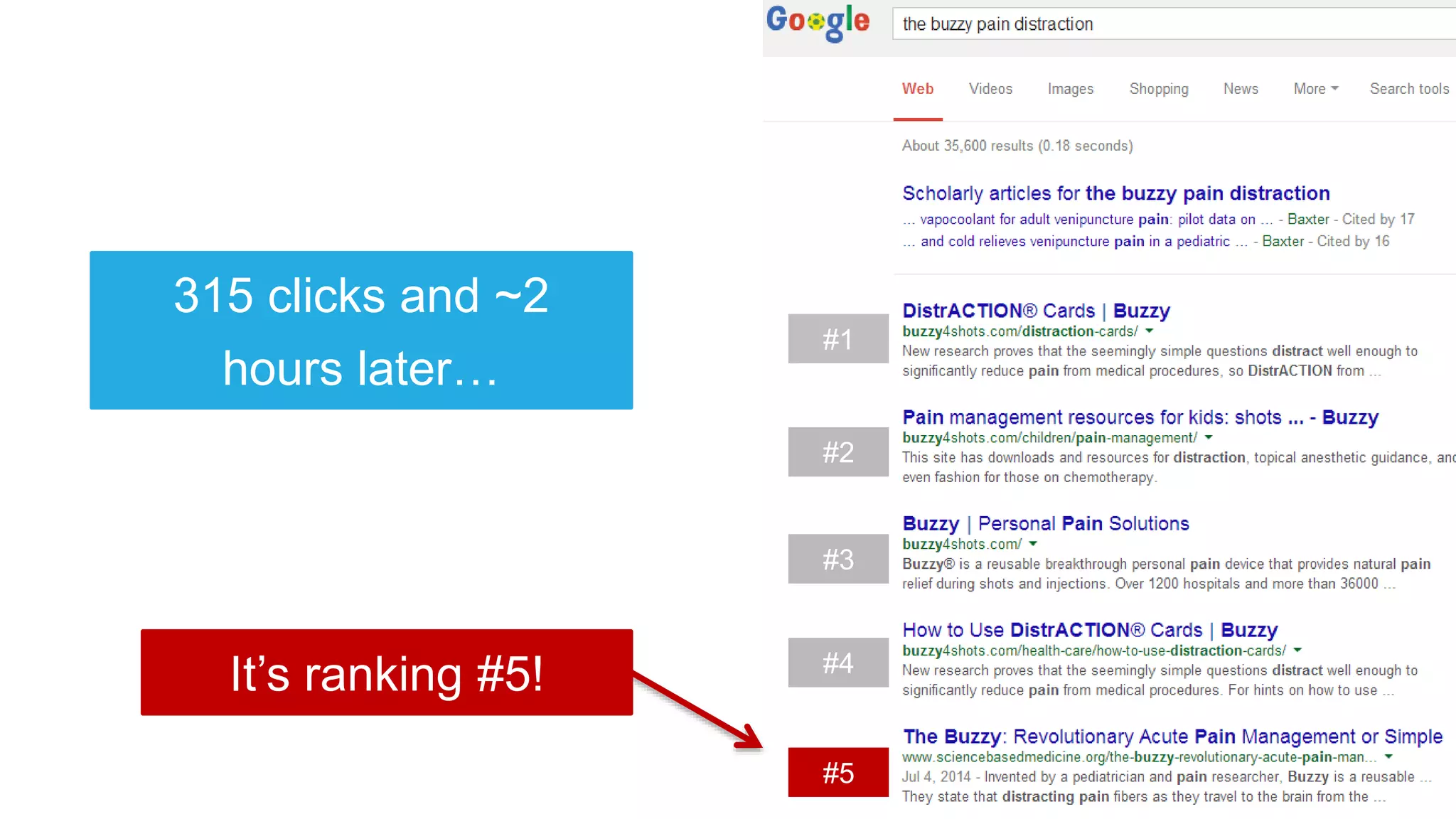
315 clicks and ~2
hours later…
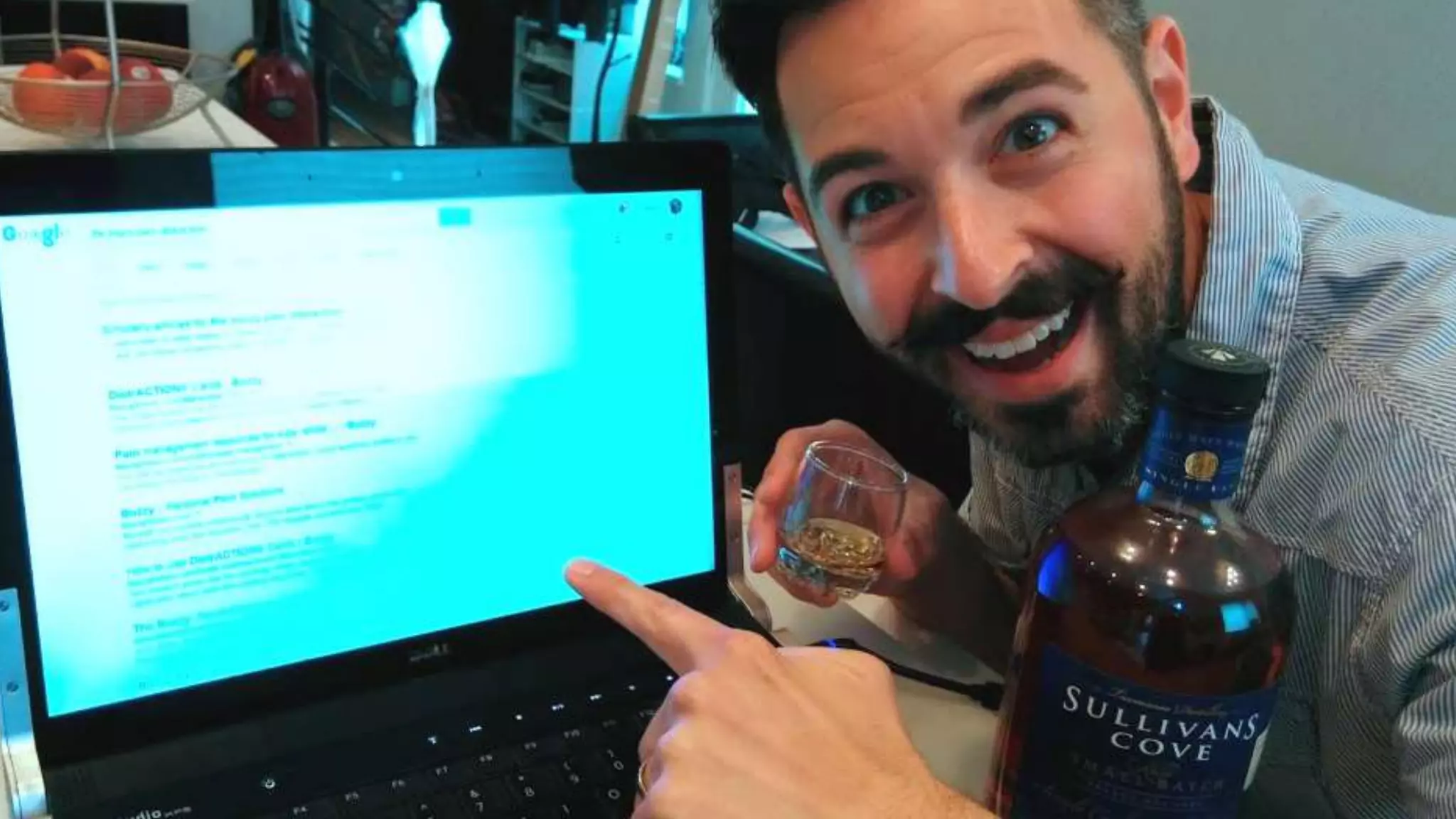
It’s ranking #5!
#1
#2
#3
#4
#5
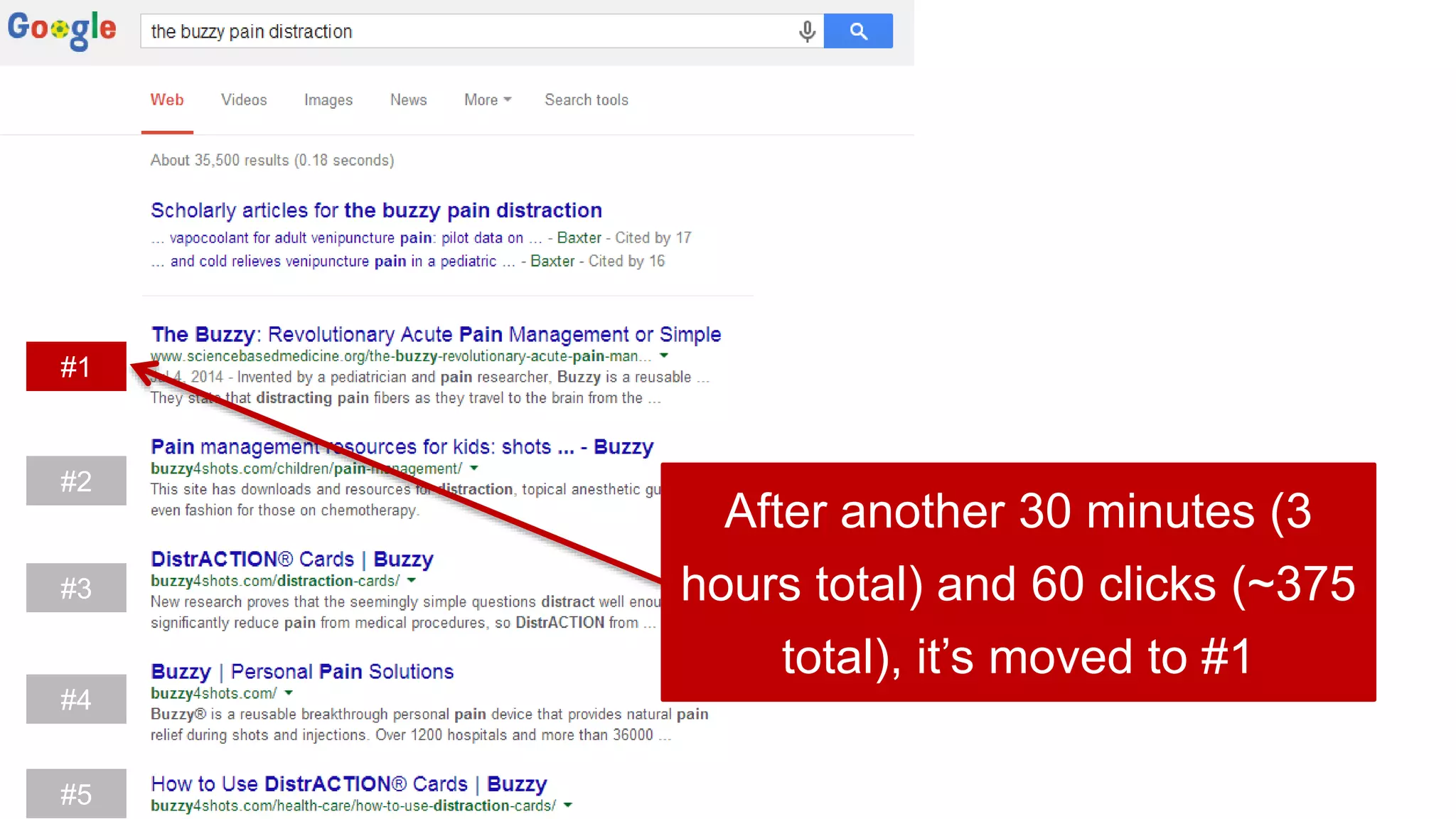
#1
#2
#3
#4
#5
After another 30 minutes (3
hours total) and 60 clicks (~375
total), it’s moved to #1
My Takeaway:
Queries and clicks can, at least in some
circumstances, have an effect on rankings.
Determining what triggers this effect is our
next step.
ExperimentsFuture
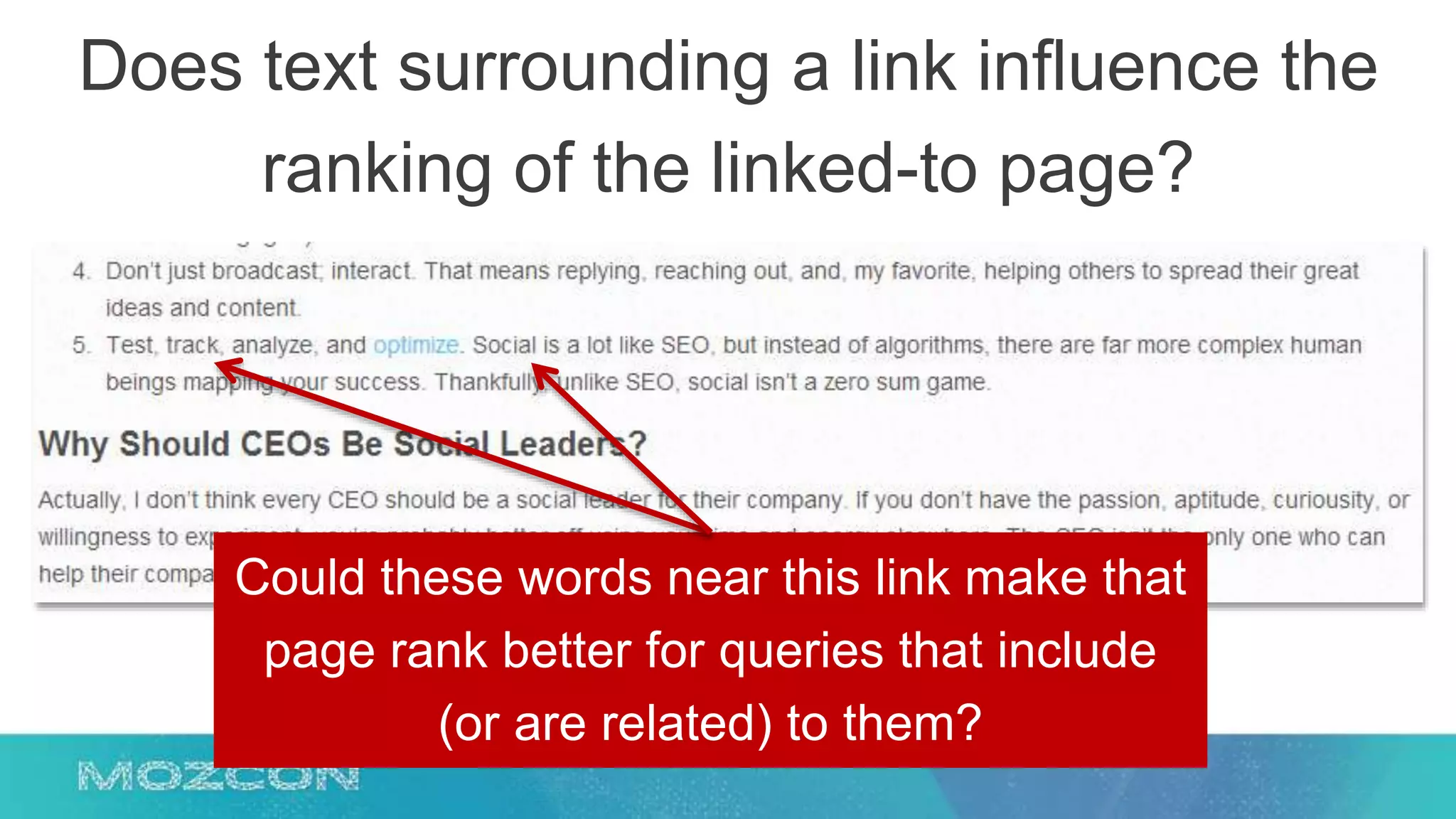
Does text surrounding a link influence the
ranking of the linked-to page?
Could these words near this link make that
page rank better for queries that include
(or are related) to them?
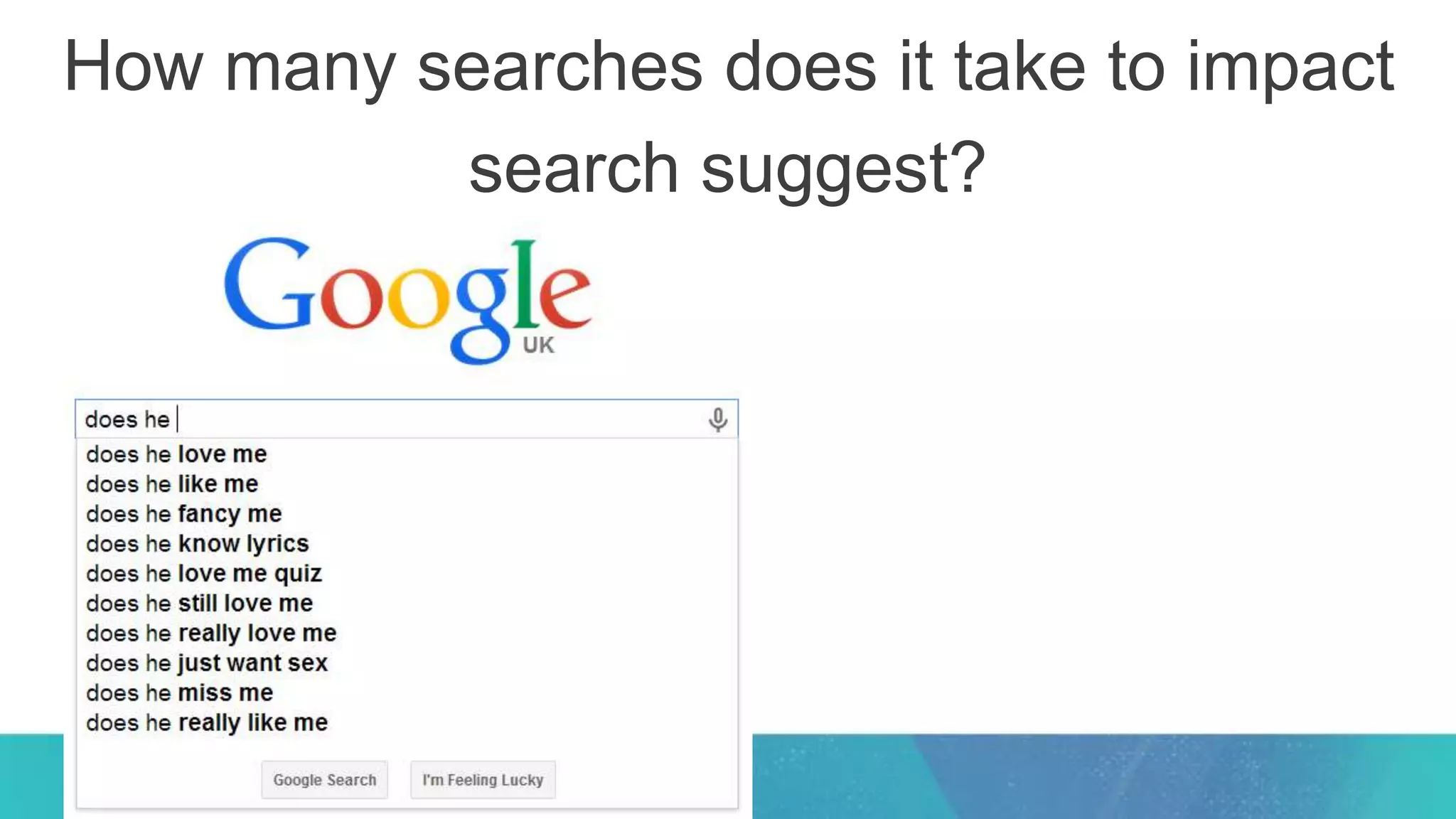
How many searches does it take to impact
search suggest?
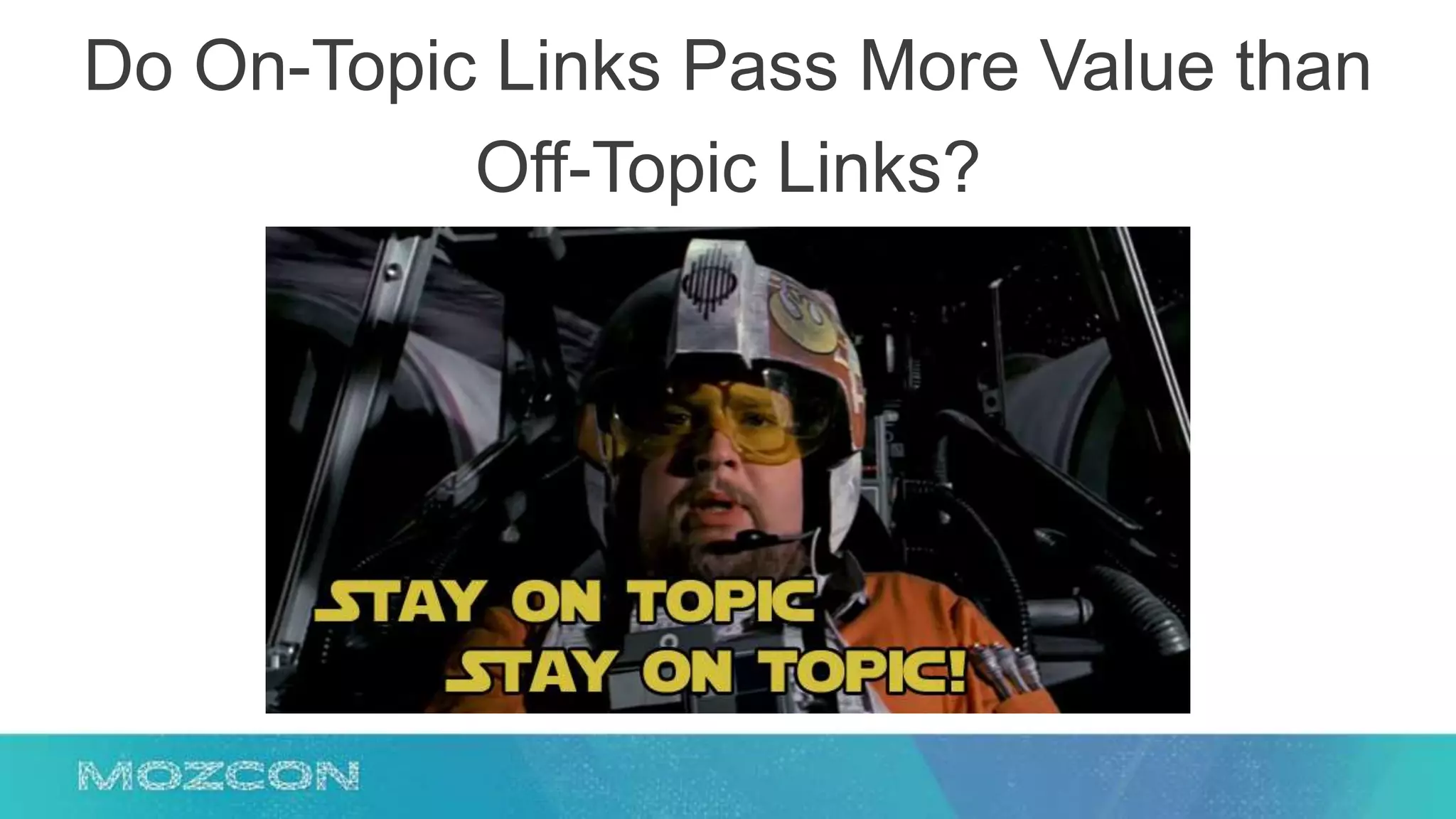
Do On-Topic Links Pass More Value than
Off-Topic Links?
Will multiple links from a high authority site
move rankings more than one link each from
multiple, low authority sites?
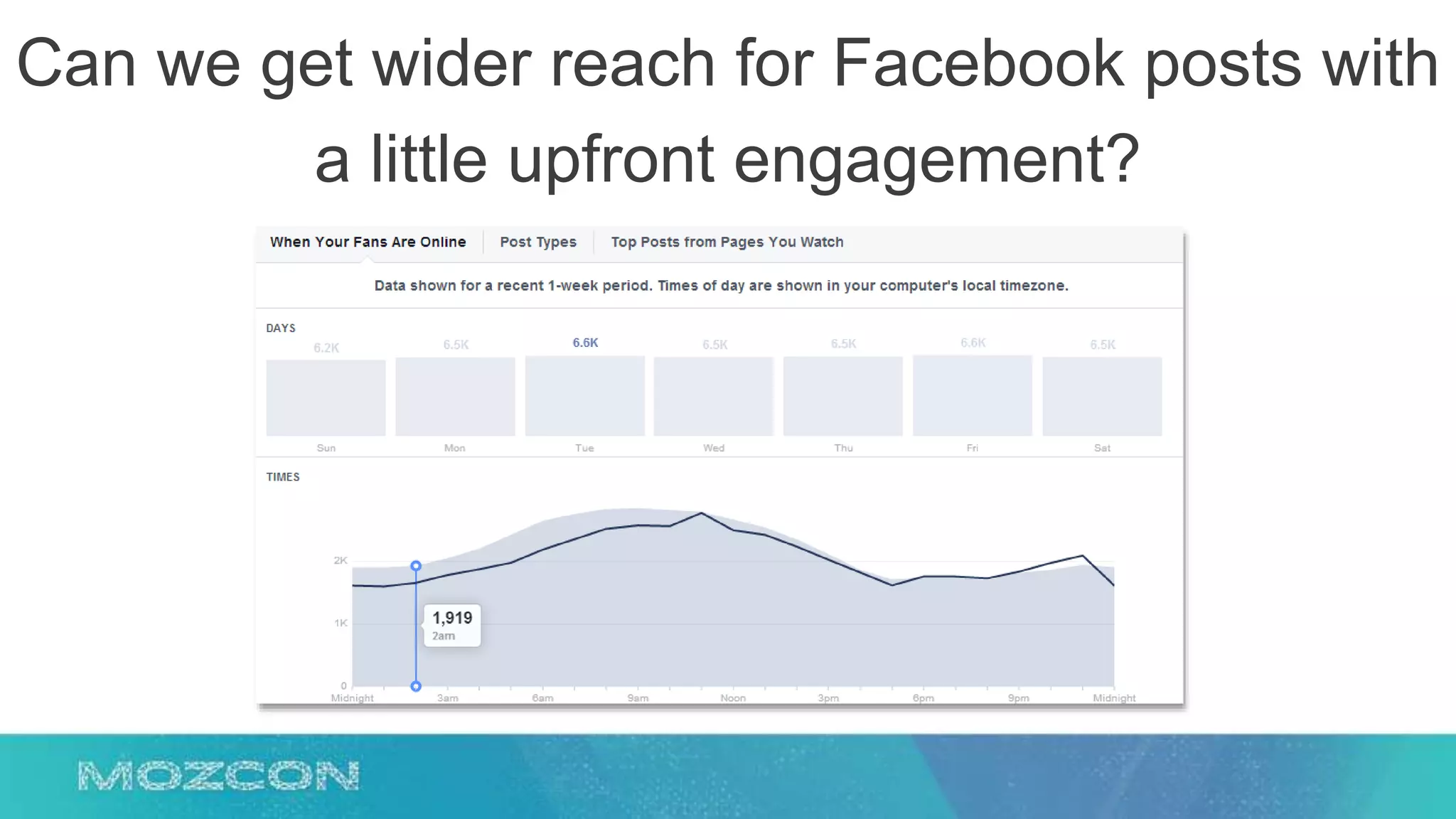
Can we get wider reach for Facebook posts with
a little upfront engagement?
the Quest!Join
Contribute to IMEC Lab experiments by signing up
at:
bit.ly/imeclab
Download:
bit.ly/mozmadscience

Mad Science Experiments in SEO & Social Media

  • 1.
    Mad Science Experimentsin SEO & Social Media Rand Fishkin, Wizard of Moz rand@moz.com | @randfish
  • 2.
    Caveat #1 I amnot a scientist.
  • 3.
    Caveat #2 Search engines& social platforms change. These results probably will, too.
  • 4.
    Caveat #3 Don’t misinterpretmy enthusiasm for certainty! Skepticism of even those tests that produces consistent, repeatable results is wise.
  • 5.
    with some fun,less rigorous, one-off tests.Let’s Start
  • 6.
    Has Google Really“Stuck a Fork” in All Forms of Guest Blogging?
  • 7.
  • 11.
  • 14.
    My Takeaway: There’s akind of guest post Google wants to count and a kind they don’t. If you can’t tell the difference, do as Matt says and stick a fork in it 
  • 15.
    Did Google’s Removalof Author Pics Directly Affect AdWords CTR?
  • 17.
  • 18.
    “…it’s clear tous that based on this data, it’s not realistic to say the deletion of Google authorship photos has no impact on the CTR of other elements on the SERP.” - Larry Kim, Wordstream
  • 20.
    Avg CTR change 2wksprior vs 2 wks after removal Appearance of authorship in top 10 Keyphrase bid on by Moz SEO Tools SEO Backlinks KW Research Tool Keyword Search Mozrank -5% +19% +8% -1% -13% +23% #3, #4, #9, #10 #3, #9 #2, #6, #10 #3, #5, #7, #8, #9 #3, #5, #7, #8 #5, #7, #8, #9
  • 21.
    My Takeaway: Larger samplesets are critical to understand whether authorship pics removal positively affected AdWords CTR. I wouldn’t categorize us as having a “smoking gun” at this point.
  • 22.
    Do Photo TweetstormsCost Followers or Grow Them?
  • 24.
    The most followersI’ve ever lost in a day
  • 28.
    How does thatcompare to an average Sunday?
  • 29.
    My Takeaway: Photo tweetstormsare probably too interruptive (even when “on topic”) to be a valuable tool for me on a regular basis.
  • 30.
    Can Internal LinksMove the Needle By Themselves?
  • 31.
    Ugh. Page Three?I can do better than that.
  • 32.
    I went to~15 of the most relevant pages on Moz, and added a link to the post from inside the content (not footers/sidebars/nav).
  • 33.
    3 weeks afterthese pages were re-indexed with the new link, the page dropped 2 ranking positions 
  • 34.
    Bill Sebald rana very similar test1 and found similar results (inconsistent, minor movement)
  • 35.
    My Takeaway: I’m inthe process of repeating this test a few more times, but I suspect internal anchor text and links are still playing a relatively minor role (especially when it’s older pages being updated)
  • 36.
    Can Anchor TextInfluence Search Suggest?
  • 37.
    A few yearsback, I started using this anchor text to link to Geraldine’s blog in my official bio (which goes on a lot of event sites when I speak)
  • 38.
  • 39.
  • 40.
    Other non-anchor phrases inthe bio don’t appear to be impacting suggest
  • 41.
    Research paper SERPs maybe another good example of this
  • 42.
    Only 18 resultsfor this phrase, but all are linking with the exact anchor text to this PDF document
  • 43.
    My Takeaway: More testingis needed, but it seems likely that anchor text influences search suggest more so than other kinds of in-document, text-based phrase use.
  • 44.
  • 45.
    Does Google IndexURLs Shared on Social Media Faster?
  • 46.
    Using nonsense wordswith few results, I created a variety of test pages w/ no links to them.
  • 47.
    Some I tweeted(not all from my account)
  • 48.
  • 49.
    Shared on Google+ Shared onTwitter In XML Sitemap Only ~12 hours ~10 hours ~11 hours ~12 hours ~11 hours ~3 days 3-4 days *each test was performed on a unique URL and keyword combination with no overlap and no conflating factors I could find (e.g. links, non-network sharing, etc)
  • 50.
    My Takeaway: The effectmay be related to scrapers or something else (and not directly tied to social networks), but regardless, social sharing looks to be a consistently faster indexing method.
  • 51.
    Can Google+ Sharesor +1s Impact Non-Personalized Search?
  • 53.
    #21 #22 #23 #24 #25 #26 At 10:50am, thetest URL ranked #26 in logged-out, non- personalized, non-geo-biased, Google US results.
  • 54.
    42 minutes later,after ~30 shares, 40 +1s, and several other G+ accounts posting the link, the target moved up to position #23 #21 #22 #23 #24 #25 #26
  • 55.
    #21 #22 #23 #24 #25 #26 48 hours later,after 100 shares of the post, 95 +1s, and tons of additional posts, the result was back down to #25
  • 56.
    #21 #22 #23 #24 #25 #26 It bounced arounda little, settled in at #22, then recently fell again to #29
  • 57.
    Many G+ users personalizedresults, however, were clearly affected. #1 #2 #3 #4 #5
  • 58.
    Eric Enge andthe Stone Temple crew ran a much more in- depth analysis2 with consistent, similar results.
  • 59.
    My Takeaway: Activity onGoogle+ does not appear to directly influence non-personalized rankings. But for personalized/logged-in rankings, they can still be powerful.
  • 60.
    Has Anchor TextLost Its Once Mighty Impact on Rankings?
  • 61.
    1) Three word,informational keyword phrase with relatively light competition and stable rankings Test Conditions: 2) We selected two results (“A” and “B”), ranking #13 (“A”) and #20 ( “B”) in logged-out, non-personalized results 3) We pointed links from 20 pages on 20 unique, high-DA, high- trust, off-topic sites at both “A” and “B”
  • 62.
    A) We pointed20 links from 20 domains at this result with anchor text exactly matching the query phrase #11 #12 #13 #14 #15 #16 #17 #18 #19 #20 B) We pointed 20 links from the same 20 pages as “A” to this URL with anchor text that did not contain any words in the query
  • 63.
    #11 #12 #13 #14 #15 #16 #17 #18 #19 #20 #1 #2 #3 #4 #5 #6 #7 #8 #9 #10 After 20 days,all of the links had been indexed by Google. “A” and “B” both moved up 4 positions. None of the other results moved more than 2 positions.
  • 64.
  • 65.
    B) We pointed20 links from 20 domains to this URL with anchor text that did not contain any words in the query #11 #12 #13 #14 #15 #16 #17 #18 #19 #20 A) We pointed 20 links from the same pages/domains at this result with anchor text exactly matching the query phrase
  • 66.
    1) Three word,informational keyword phrase with relatively light competition and stable rankings Anchor Text Test #2 2) We selected two results (“A” and “B”), ranking #20 (“A”) and #14 ( “B”) in logged-out, non-personalized results 3) We pointed links from 20 pages on 20 unique, high-DA, high- trust, off-topic sites at both “A” and “B”
  • 67.
    #11 #12 #13 #14 #15 #16 #17 #18 #19 #20 #1 #2 #3 #4 #5 #6 #7 #8 #9 #10 After 16 days,all of the links had been indexed by Google. “A” moved up 19 positions to #1! B moved up 5 positions to #9. None of the other results moved more than 2 positions.
  • 68.
  • 69.
    1) Three word,hobby-related keyword phrase with very light competition and stable rankings Anchor Text Test #3 2) We selected two results (“A” and “B”), ranking #31 (“A”) and #11 ( “B”) in logged-out, non-personalized results 3) We pointed links from the same 20 pages on 20 unique, high- DA, high-trust, off-topic sites at both “A” and “B”
  • 70.
    B) Non-anchor links pointedhere #11 #12 #13 #14 #15 #16 #17 #18 #19 #20 #31 #32 #33 #34 #35 #36 #37 #38 #39 #40 A) Anchor text links pointed here
  • 71.
    #11 #12 #13 #14 #15 #16 #17 #18 #19 #20 #1 #2 #3 #4 #5 #6 #7 #8 #9 #10 After 8 days,not quite all of the links had been indexed by Google. “A” moved up 30 positions to #1! B moved up 1 position to #10. None of the other results moved more than 2 positions.
  • 72.
    My Takeaway: Links withexact match anchor text are still considerably more powerful than non-anchor match links (and surprisingly powerful overall).
  • 73.
    Do Nofollowed LinksHave Any Direct Impact on Rankings?
  • 74.
    1) Low searchvolume queries with very stable results (first test was on a competitive result, second was on a very low difficulty query) Nofollow Link Tests 2) All links were nofollowed (confirmed by asking IMEC participants to submit their URLs in web form) 3) Links were placed in page content, never comments, footers, headers, nav, or sidebars
  • 75.
    Test #1: Wepointed nofollow links from pages on 55 unique domains at the page ranking #16 #11 #12 #13 #14 #15 #16 #17 #18 #19 #20
  • 76.
    Test #1: Afterindexation of all the links, the page only moved up a single result. #11 #12 #13 #14 #15 #16 #17 #18 #19 #20
  • 77.
    #1 #2 #3 #4 #5 #6 #7 #8 #9 #10 Test #1: Weasked participants to remove the nofollows, and the page moved up rapidly to #6
  • 78.
  • 79.
    #1 #2 #3 #4 #5 #6 #7 #8 #9 #10 Test #2: Wepointed nofollow links from pages on 42 unique domains at the page ranking #9
  • 80.
    #1 #2 #3 #4 #5 #6 #7 #8 #9 #10 Test #2: Afterindexing all the nofollow links, the page rose to position #6 and stayed there.
  • 81.
    #1 #2 #3 #4 #5 #6 #7 #8 #9 #10 Test #2: Weasked participants to remove the nofollows. Upon indexation, the page rose to position #5 where it remains (75% of links re-indexed 8 days later)
  • 82.
    My Takeaway: The experimentneeds to be repeated 2-3 more times at least, but early data suggests there may be a relationship between ranking increases and in-content, nofollowed links
  • 83.
    A Fascinating Side-EffectPresented Itself in All of Our Link-Based Experiments
  • 84.
    #11 #12 #13 #14 #15 #16 #17 #18 #19 #20 #1 #2 #3 #4 #5 #6 #7 #8 #9 #10 Months after thelinks had been removed, every page we linked to continued to rank considerably higher than their initial position
  • 85.
    #1 #2 #3 #4 #5 #6 #7 #8 #9 #10 This phenomenon hasconsistently held true for our more recent link tests, though those links have only been down weeks rather than months.
  • 86.
    Respect to MartinPanayotov and Mike King. They called it 3 years ago in the Moz blog comments.
  • 87.
    My Takeaway: Link ghostsappear to be a real phenomenon with powerful and lasting effects. Studying this more could lead to some fascinating insights & tactics.
  • 88.
    Can Query &Click Volume Directly Impact Rankings?
  • 89.
    At the timeI sent this tweet, the page had been live and indexed for just under 9 days
  • 90.
    3hrs + 228clicks later
  • 92.
  • 93.
    1) 4 ofthe 6 were totally private, known only to the IMEC testing group. 2 were publicly promoted on social. 6 Unique Query & Click Tests 2) Queries with very little to no search volume were chosen. Clicks confirmed through a web form & analytics. 3) We strived to make the queries and clicks happen in as short a period as possible, but this was quite hard w/ the private tests (public tests were done in 3-6 hour windows)
  • 94.
    Private test: 164 clicks Privatetest: 143 clicks Private test: 148 clicks +1 position +1 position +1 position Each test was performed on relatively non-competitive SERPs with low search volume, old pages ranking, and nearly no movement or new results or new incoming links to ranking pages. Public test: 581 clicks Public test: 434 clicks Disamb test: 148 clicks +1 position +1 position -1 position
  • 95.
    I worried thatby publishing a blog post on the experiment, we nudged Google to tighten their criteria around how clicks influence rankings (but it’s impossible to test that hypothesis) From my blog post on Queries & Clicks
  • 96.
    Just try it onemore time…
  • 97.
    #1 #2 #3 #4 #5 #6 #7 #8 #9 #10 8 days afterits publication, this blog post ranked #10 for this query
  • 99.
    315 clicks and~2 hours later… It’s ranking #5! #1 #2 #3 #4 #5
  • 100.
    #1 #2 #3 #4 #5 After another 30minutes (3 hours total) and 60 clicks (~375 total), it’s moved to #1
  • 102.
    My Takeaway: Queries andclicks can, at least in some circumstances, have an effect on rankings. Determining what triggers this effect is our next step.
  • 103.
  • 104.
    Does text surroundinga link influence the ranking of the linked-to page? Could these words near this link make that page rank better for queries that include (or are related) to them?
  • 105.
    How many searchesdoes it take to impact search suggest?
  • 106.
    Do On-Topic LinksPass More Value than Off-Topic Links?
  • 107.
    Will multiple linksfrom a high authority site move rankings more than one link each from multiple, low authority sites?
  • 108.
    Can we getwider reach for Facebook posts with a little upfront engagement?
  • 109.
  • 110.
    Contribute to IMECLab experiments by signing up at: bit.ly/imeclab
  • 111.