Modeling and Representing Atoms on Paper How to draw Bohr Diagrams and Electron Dot Diagrams (sometimes called Lewis Structures)
Bohr Diagrams Pictographic representation of an Atom Shows information about the nucleus Electron energy levels Good for index cards and flash cards
Start with a rectangle about 2” x 4” Bohr Diagrams
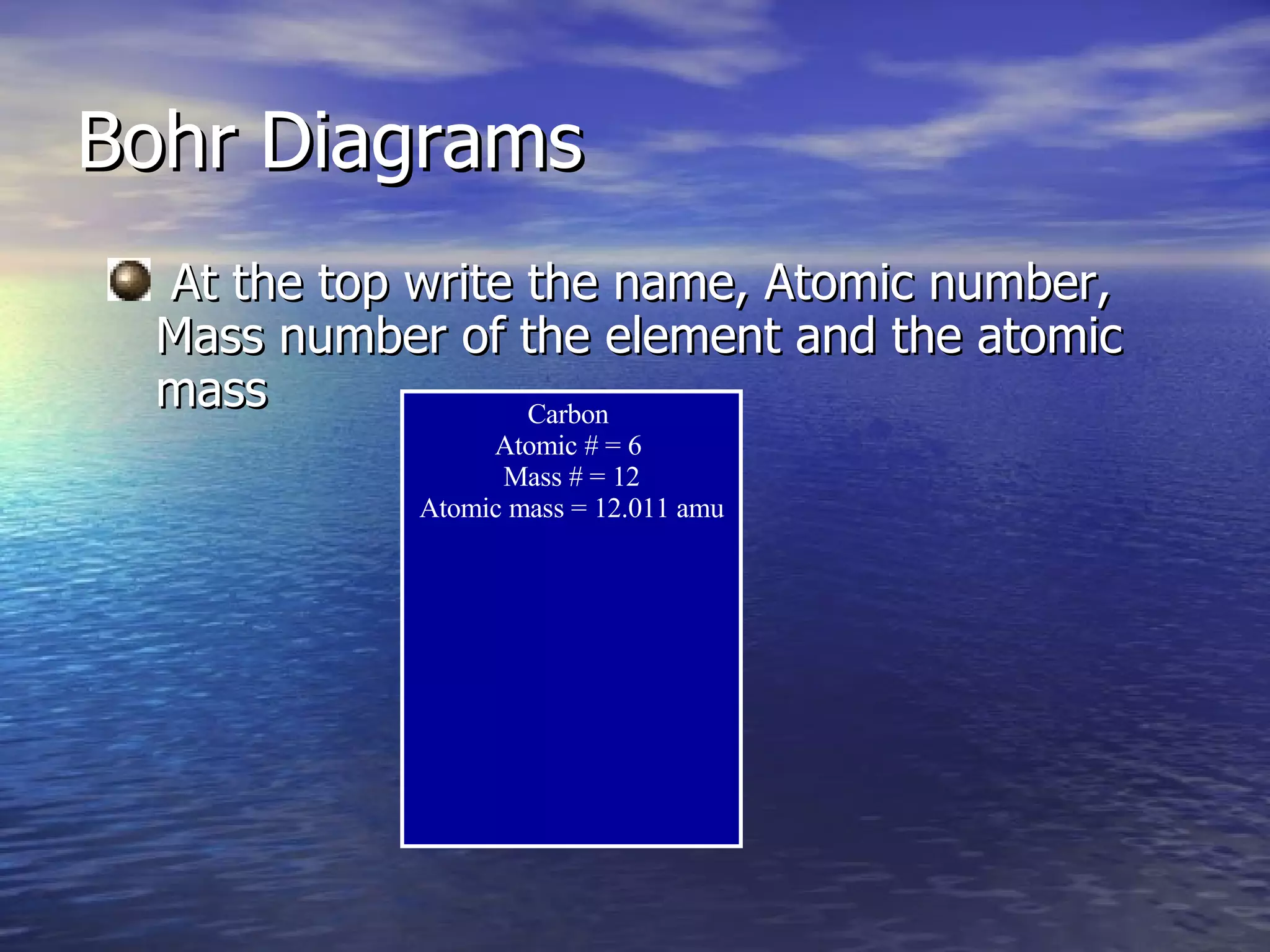
At the top write the name, Atomic number, Mass number of the element and the atomic mass Bohr Diagrams Carbon  Atomic # = 6  Mass # = 12 Atomic mass = 12.011 amu
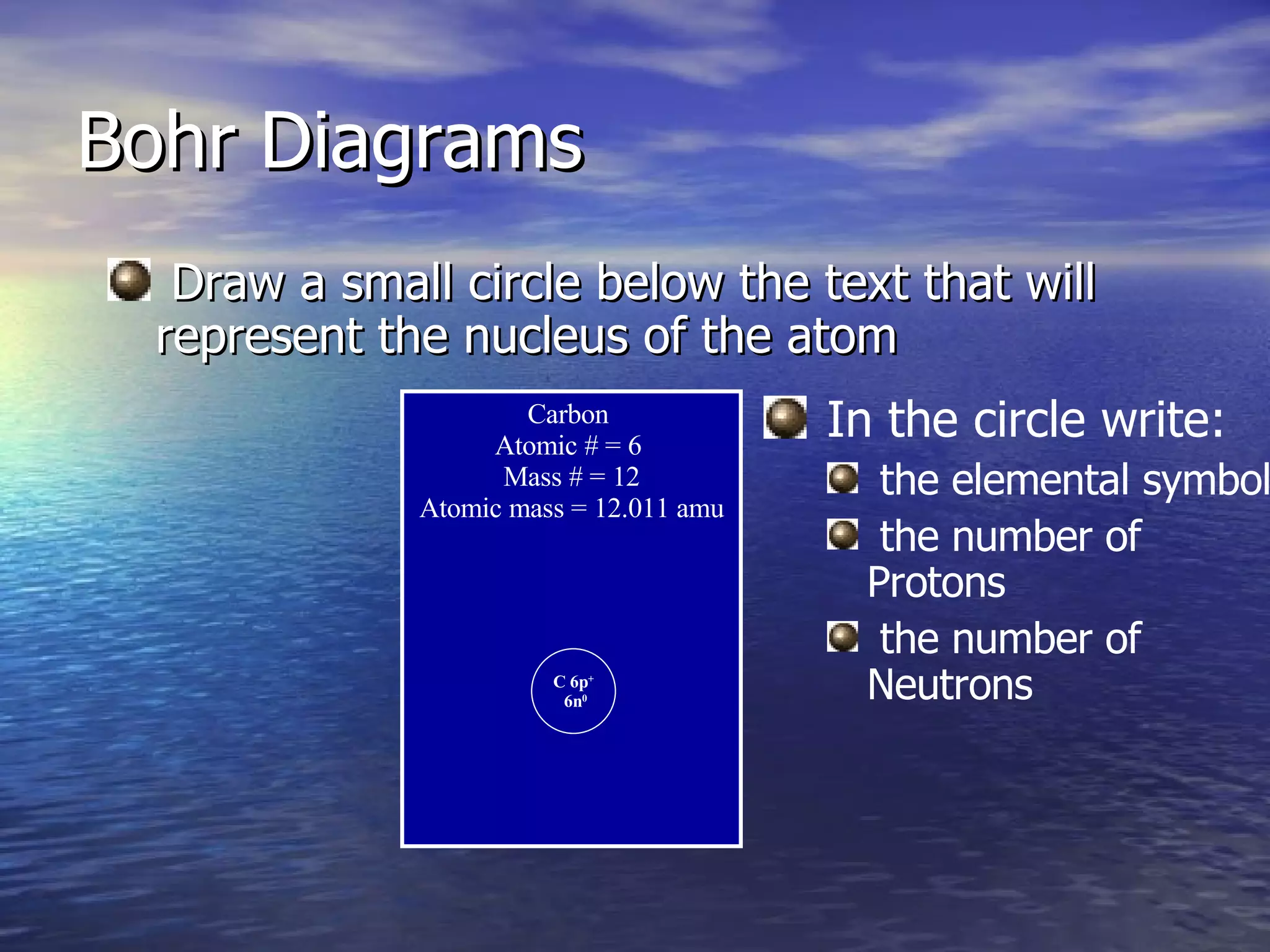
Draw a small circle below the text that will represent the nucleus of the atom Bohr Diagrams In the circle write: the elemental symbol the number of Protons the number of Neutrons Carbon  Atomic # = 6  Mass # = 12 Atomic mass = 12.011 amu C 6p + 6n 0
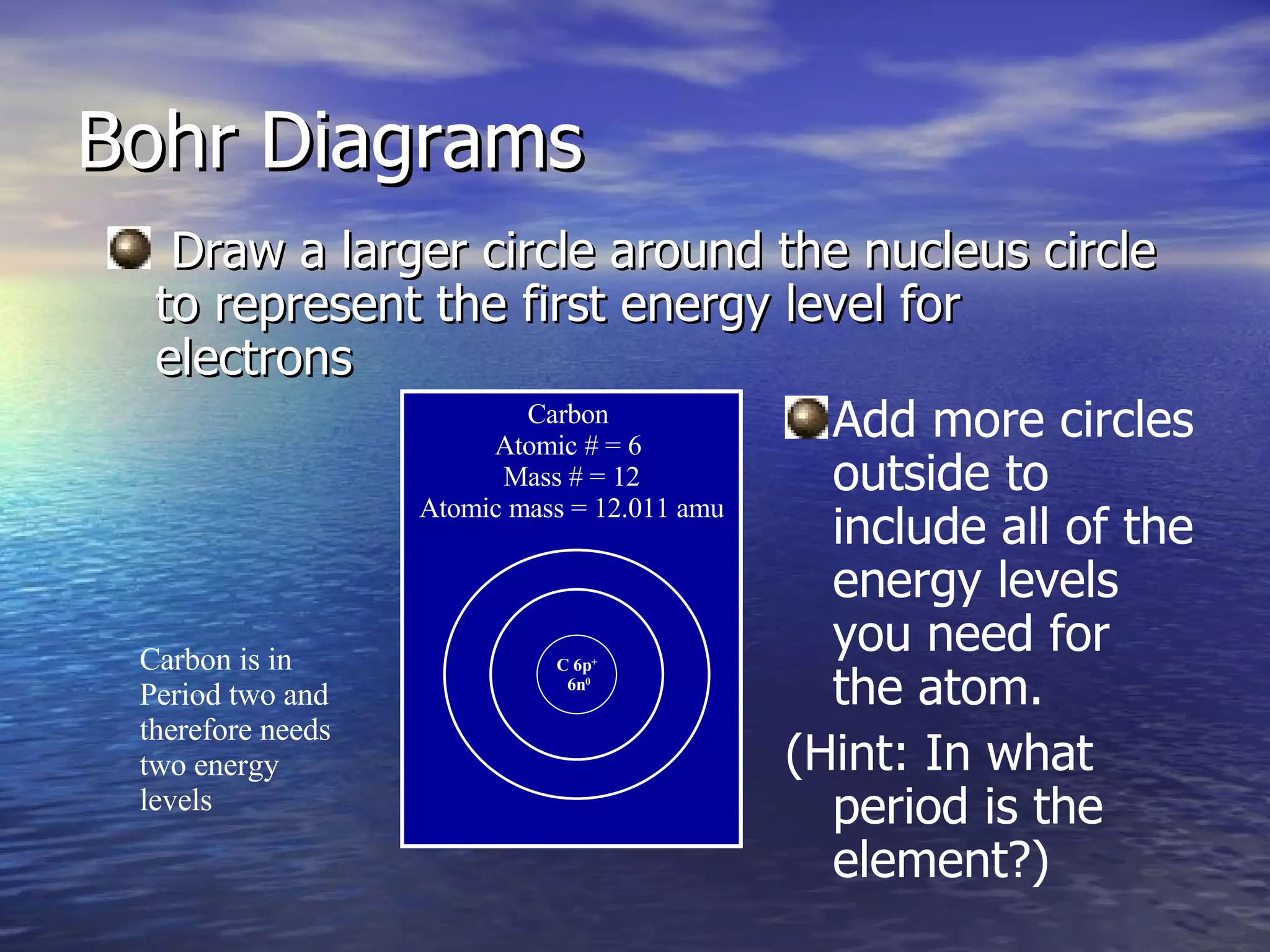
Draw a larger circle around the nucleus circle to represent the first energy level for electrons Bohr Diagrams Carbon  Atomic # = 6  Mass # = 12 Atomic mass = 12.011 amu Add more circles outside to include all of the energy levels you need for the atom.  (Hint: In what period is the element?) Carbon is in Period two and therefore needs two energy levels C 6p + 6n 0
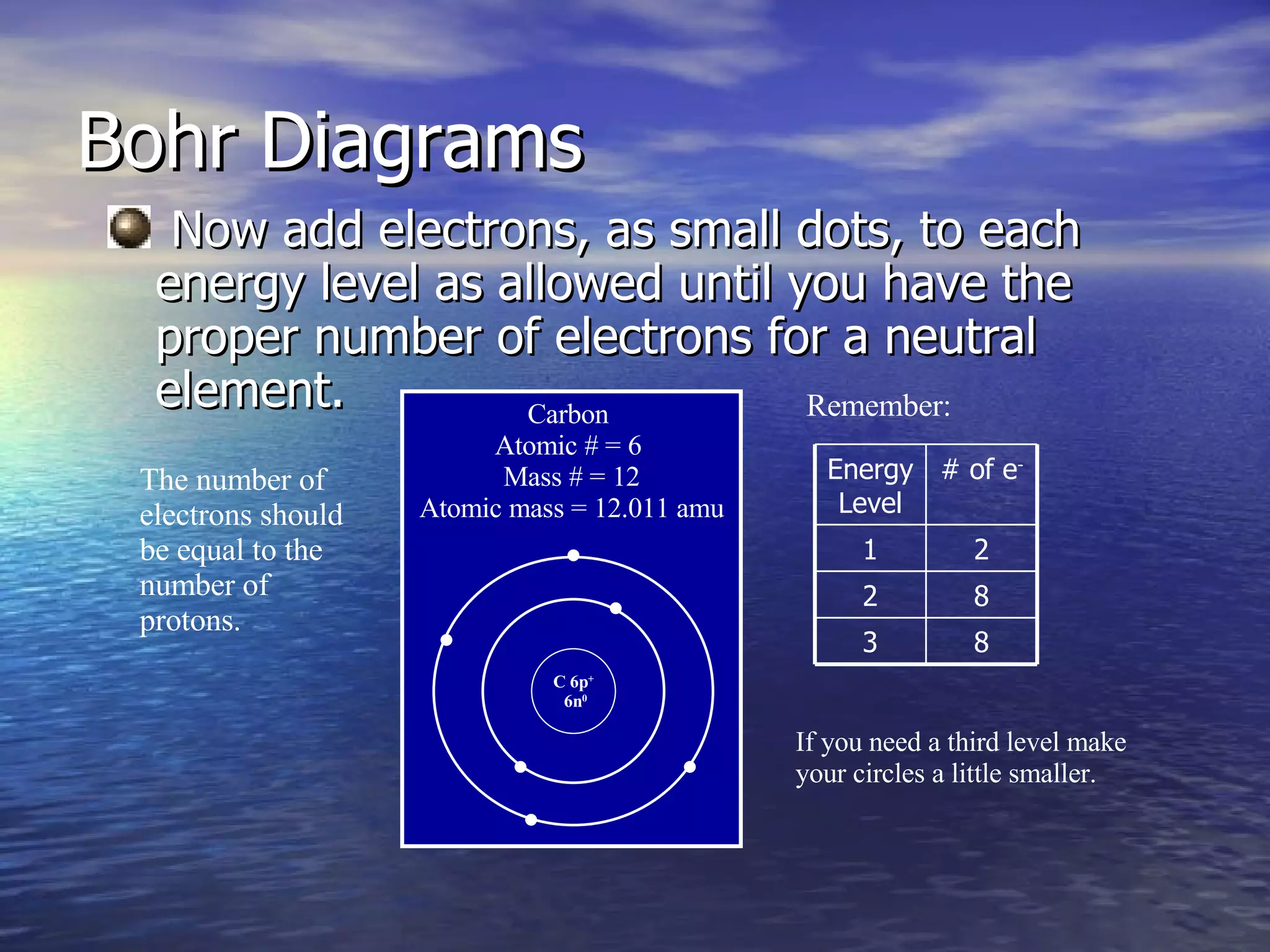
Now add electrons, as small dots, to each energy level as allowed until you have the proper number of electrons for a neutral element. Bohr Diagrams Carbon  Atomic # = 6  Mass # = 12 Atomic mass = 12.011 amu The number of electrons should be equal to the number of protons. Remember: C 6p + 6n 0 If you need a third level make your circles a little smaller. 8 3 8 2 2 1 # of e - Energy Level
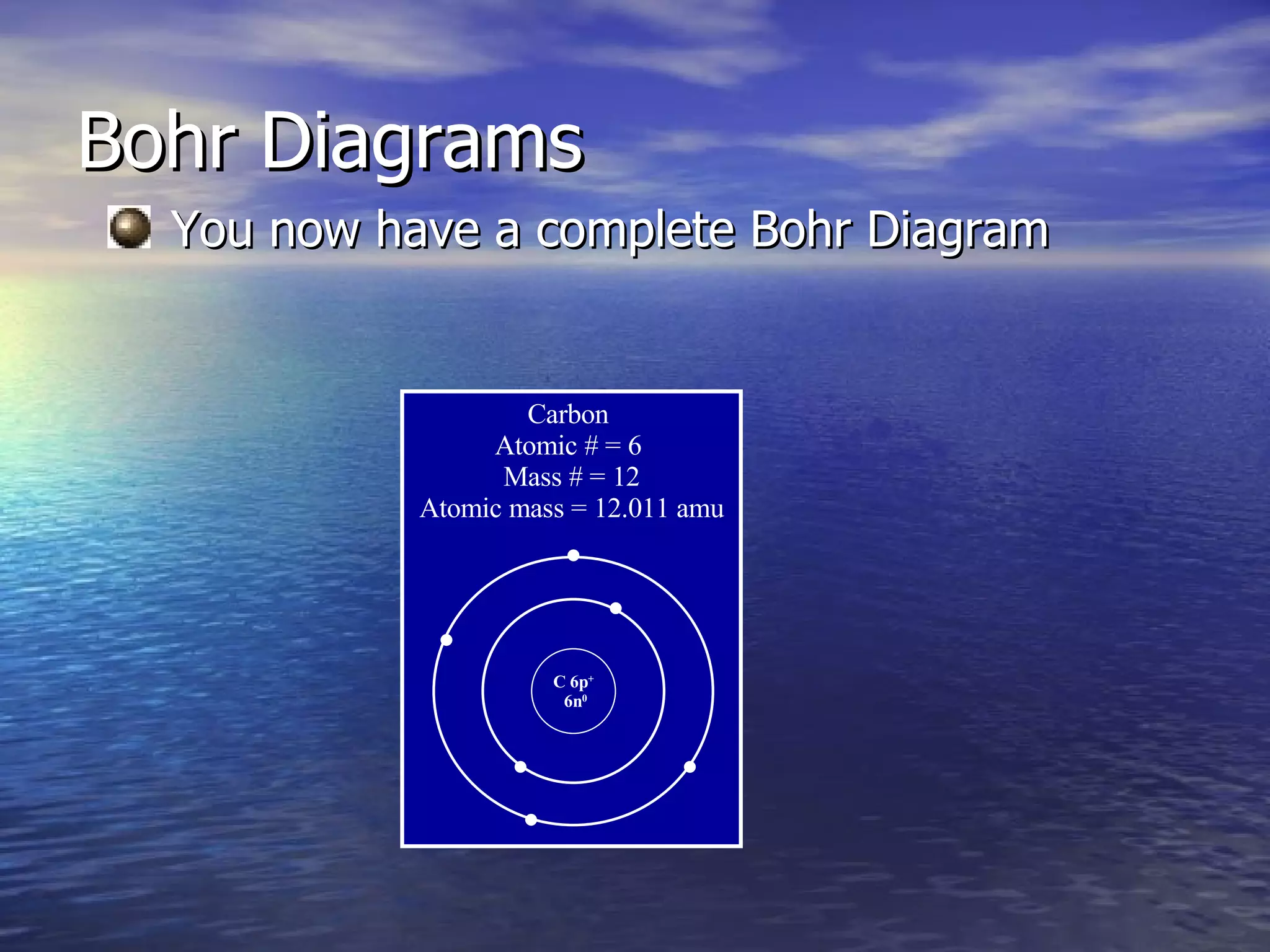
You now have a complete Bohr Diagram Bohr Diagrams Carbon  Atomic # = 6  Mass # = 12 Atomic mass = 12.011 amu C 6p + 6n 0
Electron Dot Diagrams Also called Lewis Structures Representation of valence electrons only Useful only for “Representative elements” Gives some indication of the geometry (shape) of compounds when used for bonding diagrams Easy to draw
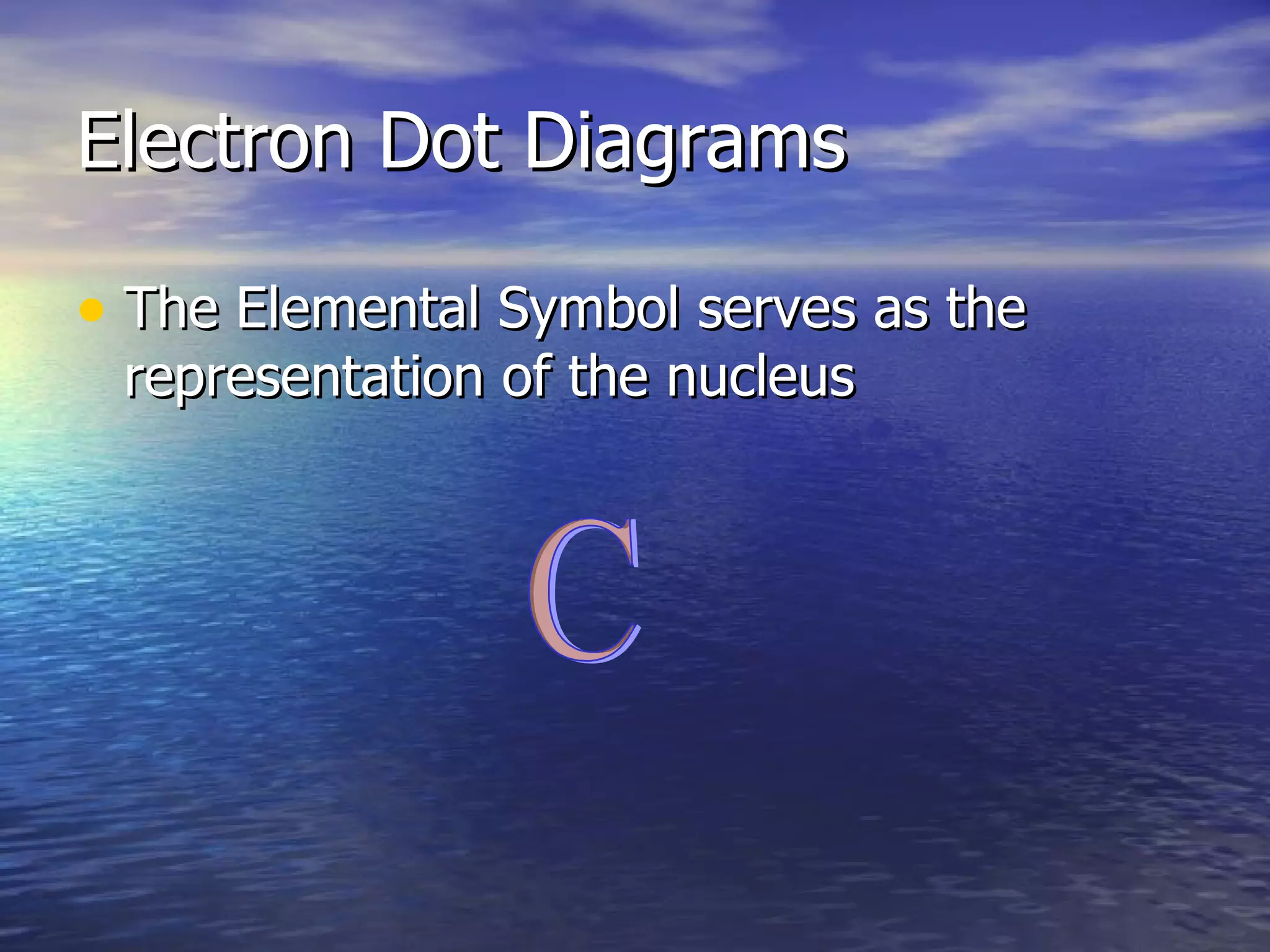
Electron Dot Diagrams The Elemental Symbol serves as the representation of the nucleus C
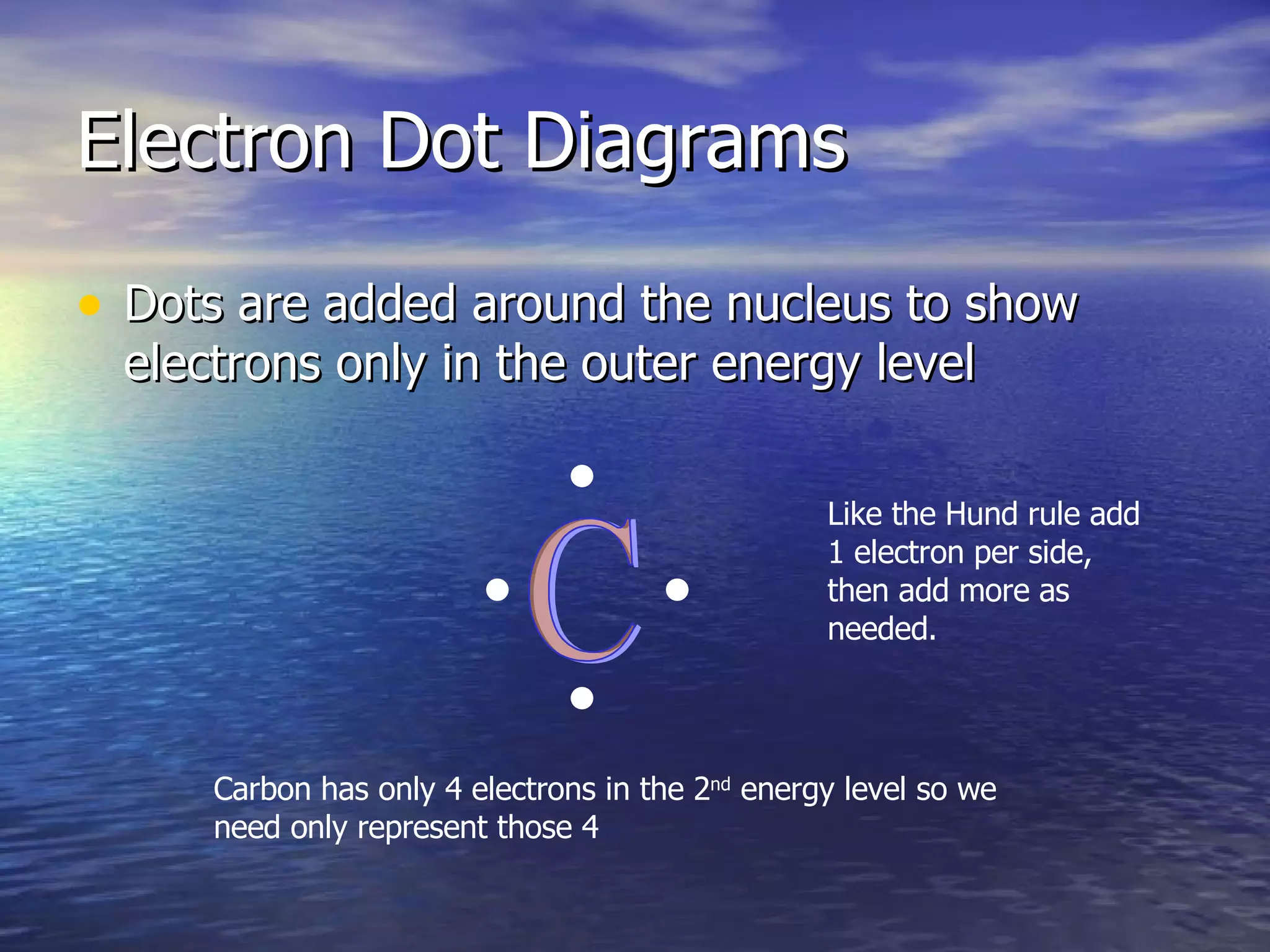
Electron Dot Diagrams Dots are added around the nucleus to show electrons only in the outer energy level C Carbon has only 4 electrons in the 2 nd  energy level so we need only represent those 4 Like the Hund rule add 1 electron per side, then add more as needed.
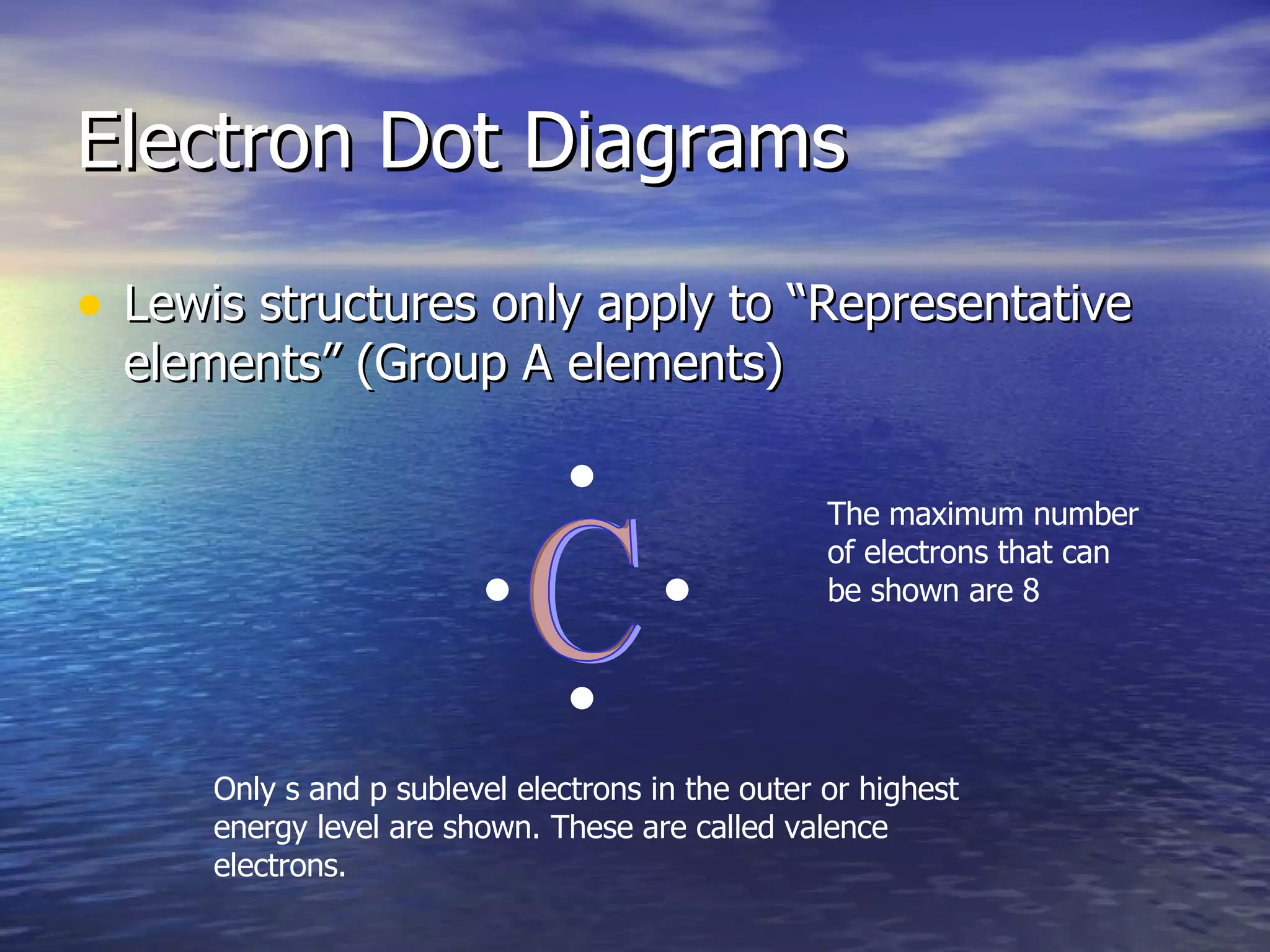
Electron Dot Diagrams Lewis structures only apply to “Representative elements” (Group A elements) C Only s and p sublevel electrons in the outer or highest energy level are shown. These are called valence electrons. The maximum number of electrons that can be shown are 8
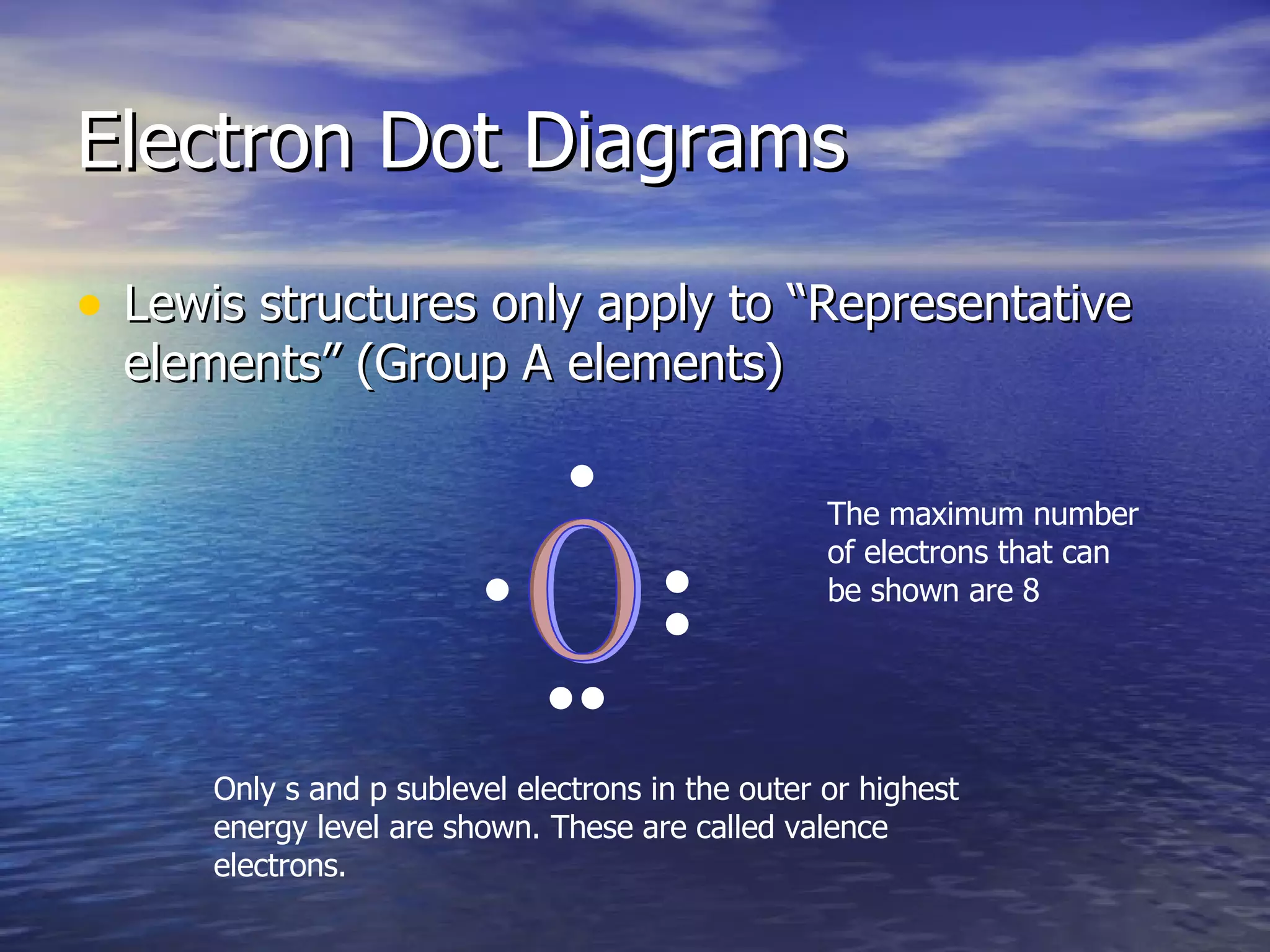
Electron Dot Diagrams Lewis structures only apply to “Representative elements” (Group A elements) O The maximum number of electrons that can be shown are 8 Only s and p sublevel electrons in the outer or highest energy level are shown. These are called valence electrons.
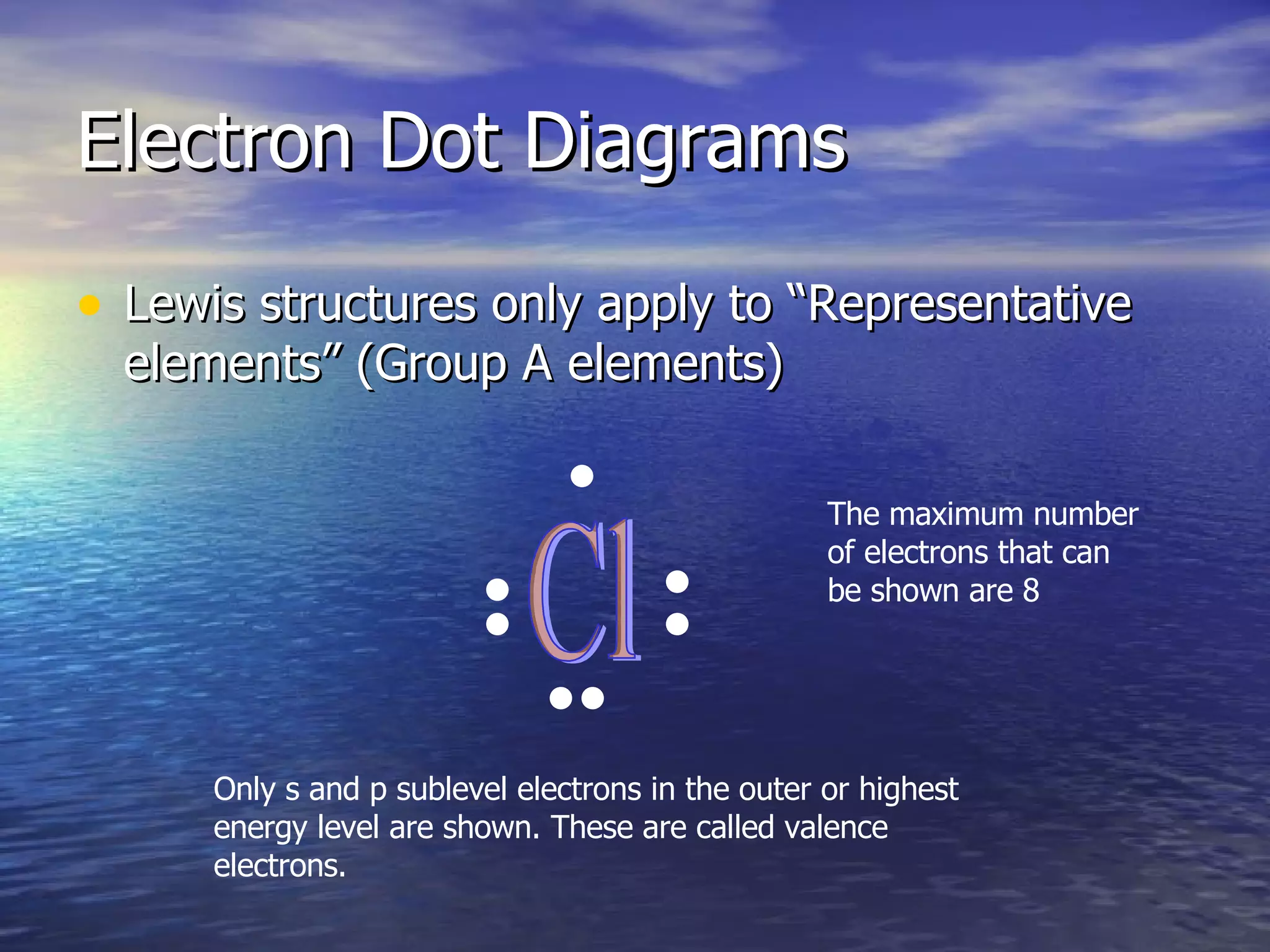
Electron Dot Diagrams Lewis structures only apply to “Representative elements” (Group A elements) Cl The maximum number of electrons that can be shown are 8 Only s and p sublevel electrons in the outer or highest energy level are shown. These are called valence electrons.
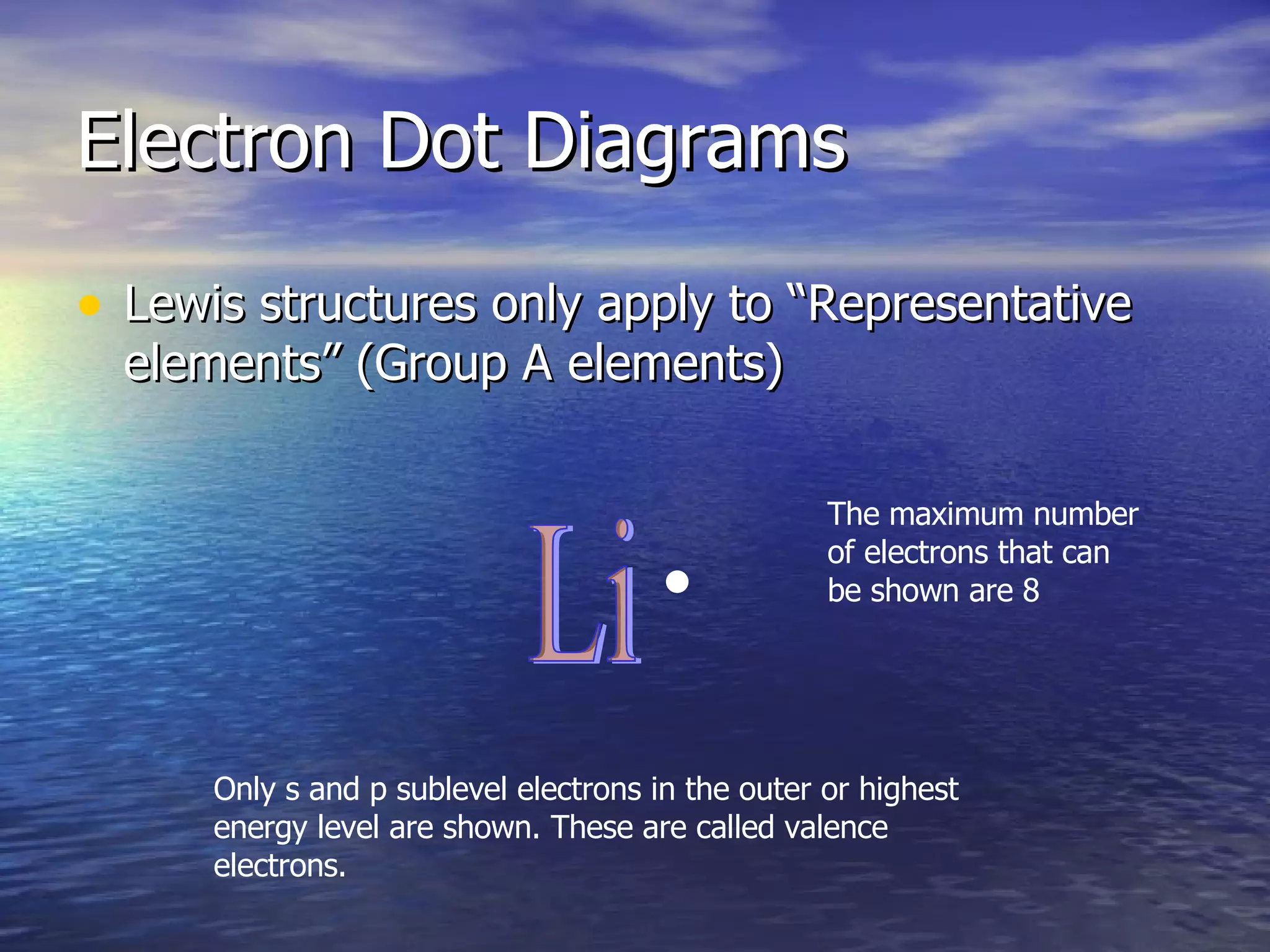
Electron Dot Diagrams Lewis structures only apply to “Representative elements” (Group A elements) Li The maximum number of electrons that can be shown are 8 Only s and p sublevel electrons in the outer or highest energy level are shown. These are called valence electrons.
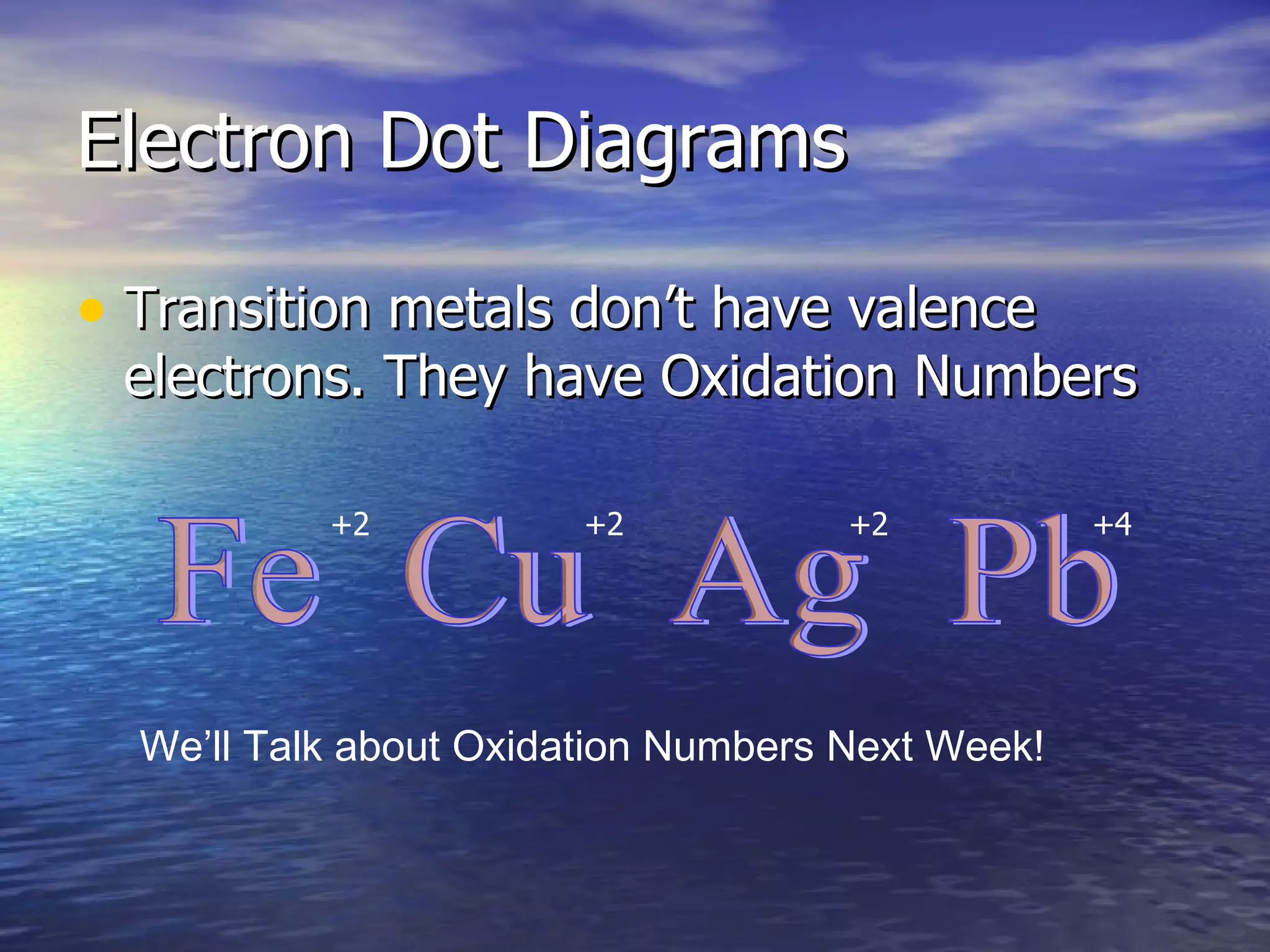
Electron Dot Diagrams Transition metals don’t have valence electrons. They have Oxidation Numbers Fe  Cu  Ag  Pb +2 +2 +2 +4 We’ll Talk about Oxidation Numbers Next Week!

Bohr Diagrams

  • 1.
    Modeling and RepresentingAtoms on Paper How to draw Bohr Diagrams and Electron Dot Diagrams (sometimes called Lewis Structures)
  • 2.
    Bohr Diagrams Pictographicrepresentation of an Atom Shows information about the nucleus Electron energy levels Good for index cards and flash cards
  • 3.
    Start with arectangle about 2” x 4” Bohr Diagrams
  • 4.
    At the topwrite the name, Atomic number, Mass number of the element and the atomic mass Bohr Diagrams Carbon Atomic # = 6 Mass # = 12 Atomic mass = 12.011 amu
  • 5.
    Draw a smallcircle below the text that will represent the nucleus of the atom Bohr Diagrams In the circle write: the elemental symbol the number of Protons the number of Neutrons Carbon Atomic # = 6 Mass # = 12 Atomic mass = 12.011 amu C 6p + 6n 0
  • 6.
    Draw a largercircle around the nucleus circle to represent the first energy level for electrons Bohr Diagrams Carbon Atomic # = 6 Mass # = 12 Atomic mass = 12.011 amu Add more circles outside to include all of the energy levels you need for the atom. (Hint: In what period is the element?) Carbon is in Period two and therefore needs two energy levels C 6p + 6n 0
  • 7.
    Now add electrons,as small dots, to each energy level as allowed until you have the proper number of electrons for a neutral element. Bohr Diagrams Carbon Atomic # = 6 Mass # = 12 Atomic mass = 12.011 amu The number of electrons should be equal to the number of protons. Remember: C 6p + 6n 0 If you need a third level make your circles a little smaller. 8 3 8 2 2 1 # of e - Energy Level
  • 8.
    You now havea complete Bohr Diagram Bohr Diagrams Carbon Atomic # = 6 Mass # = 12 Atomic mass = 12.011 amu C 6p + 6n 0
  • 9.
    Electron Dot DiagramsAlso called Lewis Structures Representation of valence electrons only Useful only for “Representative elements” Gives some indication of the geometry (shape) of compounds when used for bonding diagrams Easy to draw
  • 10.
    Electron Dot DiagramsThe Elemental Symbol serves as the representation of the nucleus C
  • 11.
    Electron Dot DiagramsDots are added around the nucleus to show electrons only in the outer energy level C Carbon has only 4 electrons in the 2 nd energy level so we need only represent those 4 Like the Hund rule add 1 electron per side, then add more as needed.
  • 12.
    Electron Dot DiagramsLewis structures only apply to “Representative elements” (Group A elements) C Only s and p sublevel electrons in the outer or highest energy level are shown. These are called valence electrons. The maximum number of electrons that can be shown are 8
  • 13.
    Electron Dot DiagramsLewis structures only apply to “Representative elements” (Group A elements) O The maximum number of electrons that can be shown are 8 Only s and p sublevel electrons in the outer or highest energy level are shown. These are called valence electrons.
  • 14.
    Electron Dot DiagramsLewis structures only apply to “Representative elements” (Group A elements) Cl The maximum number of electrons that can be shown are 8 Only s and p sublevel electrons in the outer or highest energy level are shown. These are called valence electrons.
  • 15.
    Electron Dot DiagramsLewis structures only apply to “Representative elements” (Group A elements) Li The maximum number of electrons that can be shown are 8 Only s and p sublevel electrons in the outer or highest energy level are shown. These are called valence electrons.
  • 16.
    Electron Dot DiagramsTransition metals don’t have valence electrons. They have Oxidation Numbers Fe Cu Ag Pb +2 +2 +2 +4 We’ll Talk about Oxidation Numbers Next Week!