How to Draw Lewis Dot
Structures
American chemist G. N. Lewis (1875–
1946) devised a system of symbols—now
called Lewis electron-dot symbols (often
shortened to Lewis dot symbols) that can
be used for predicting the number of
bonds formed by most elements in their
compounds. Each Lewis dot symbol
consists of the chemical symbol for an
element surrounded by dots that
represent its valence electrons.
Lewis Structure is a very simplified
representation of the valence shell
electrons in a molecule. It is used to
show how the electrons are arranged
around individual atoms in a molecule.
Electrons are shown as "dots" or bonding
electrons as a line between the two
atoms.
In 1904, Richard Abegg formulated
what is now known as Abegg's rule,
which states that the difference
between the maximum positive and
negative valences of an element is
frequently eight. This rule was used
later in 1916 when Gilbert N. Lewis
formulated the "octet rule" in his
cubical atom theory.
The octet rule refers to the tendency of atoms
to prefer to have eight electrons in the valence
shell. When atoms have fewer than eight
electrons, they tend to react and form more
stable compounds. Atoms will react to get in
the most stable state possible. A complete octet
is very stable because all orbitals will be full.
Atoms with greater stability have less energy,
so a reaction that increases the stability of the
atoms will release energy in the form of heat or
light; reactions that decrease stability must
absorb energy, getting colder.
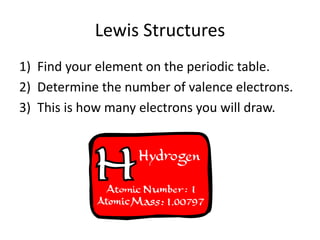
Lewis Structures
1) Find your element on the periodic table.
2) Determine the number of valence electrons.
3) This is how many electrons you will draw.
Lewis Structures
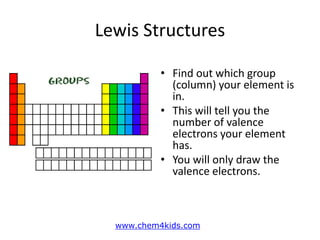
• Find out which group
(column) your element is
in.
• This will tell you the
number of valence
electrons your element
has.
• You will only draw the
valence electrons.
www.chem4kids.com
Groups - Review
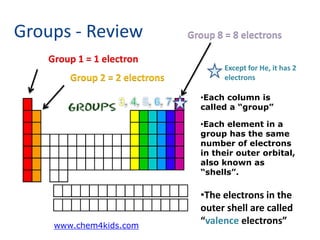
•Each column is
called a “group”
•Each element in a
group has the same
number of electrons
in their outer orbital,
also known as
“shells”.
Group 1 = 1 electron
Group 2 = 2 electrons
Group 8 = 8 electrons
Except for He, it has 2
electrons
•The electrons in the
outer shell are called
“valence electrons”
www.chem4kids.com
Lewis Structures
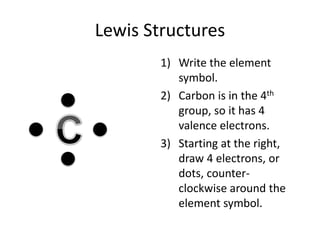
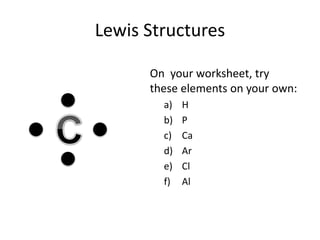
1) Write the element
symbol.
2) Carbon is in the 4th
group, so it has 4
valence electrons.
3) Starting at the right,
draw 4 electrons, or
dots, counter-
clockwise around the
element symbol.
Lewis Structures
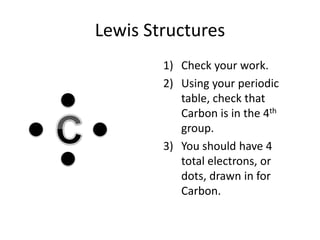
1) Check your work.
2) Using your periodic
table, check that
Carbon is in the 4th
group.
3) You should have 4
total electrons, or
dots, drawn in for
Carbon.
Lewis Structures
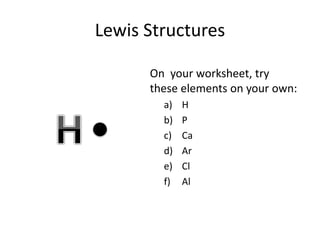
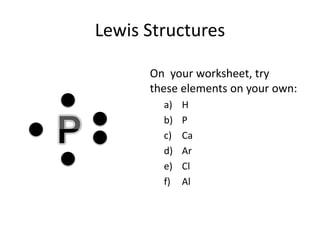
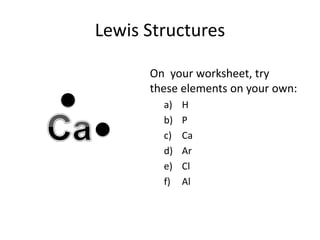
On your worksheet, try
these elements on your own:
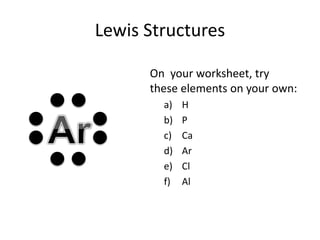
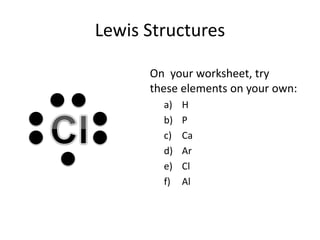
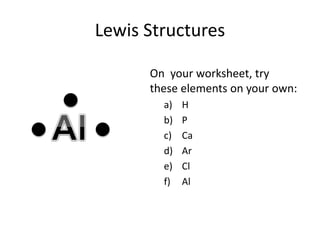
a) H
b) P
c) Ca
d) Ar
e) Cl
f) Al
Lewis Structures
On your worksheet, try
these elements on your own:
a) H
b) P
c) Ca
d) Ar
e) Cl
f) Al
Lewis Structures
On your worksheet, try
these elements on your own:
a) H
b) P
c) Ca
d) Ar
e) Cl
f) Al
Lewis Structures
On your worksheet, try
these elements on your own:
a) H
b) P
c) Ca
d) Ar
e) Cl
f) Al
Lewis Structures
On your worksheet, try
these elements on your own:
a) H
b) P
c) Ca
d) Ar
e) Cl
f) Al
Lewis Structures
On your worksheet, try
these elements on your own:
a) H
b) P
c) Ca
d) Ar
e) Cl
f) Al
Lewis Structures
On your worksheet, try
these elements on your own:
a) H
b) P
c) Ca
d) Ar
e) Cl
f) Al

Lewis-Dot-Structure-Diagram.powerpointxx

  • 1.
    How to DrawLewis Dot Structures
  • 2.
    American chemist G.N. Lewis (1875– 1946) devised a system of symbols—now called Lewis electron-dot symbols (often shortened to Lewis dot symbols) that can be used for predicting the number of bonds formed by most elements in their compounds. Each Lewis dot symbol consists of the chemical symbol for an element surrounded by dots that represent its valence electrons.
  • 3.
    Lewis Structure isa very simplified representation of the valence shell electrons in a molecule. It is used to show how the electrons are arranged around individual atoms in a molecule. Electrons are shown as "dots" or bonding electrons as a line between the two atoms.
  • 4.
    In 1904, RichardAbegg formulated what is now known as Abegg's rule, which states that the difference between the maximum positive and negative valences of an element is frequently eight. This rule was used later in 1916 when Gilbert N. Lewis formulated the "octet rule" in his cubical atom theory.
  • 5.
    The octet rulerefers to the tendency of atoms to prefer to have eight electrons in the valence shell. When atoms have fewer than eight electrons, they tend to react and form more stable compounds. Atoms will react to get in the most stable state possible. A complete octet is very stable because all orbitals will be full. Atoms with greater stability have less energy, so a reaction that increases the stability of the atoms will release energy in the form of heat or light; reactions that decrease stability must absorb energy, getting colder.
  • 6.
    Lewis Structures 1) Findyour element on the periodic table. 2) Determine the number of valence electrons. 3) This is how many electrons you will draw.
  • 7.
    Lewis Structures • Findout which group (column) your element is in. • This will tell you the number of valence electrons your element has. • You will only draw the valence electrons. www.chem4kids.com
  • 8.
    Groups - Review •Eachcolumn is called a “group” •Each element in a group has the same number of electrons in their outer orbital, also known as “shells”. Group 1 = 1 electron Group 2 = 2 electrons Group 8 = 8 electrons Except for He, it has 2 electrons •The electrons in the outer shell are called “valence electrons” www.chem4kids.com
  • 9.
    Lewis Structures 1) Writethe element symbol. 2) Carbon is in the 4th group, so it has 4 valence electrons. 3) Starting at the right, draw 4 electrons, or dots, counter- clockwise around the element symbol.
  • 10.
    Lewis Structures 1) Checkyour work. 2) Using your periodic table, check that Carbon is in the 4th group. 3) You should have 4 total electrons, or dots, drawn in for Carbon.
  • 11.
    Lewis Structures On yourworksheet, try these elements on your own: a) H b) P c) Ca d) Ar e) Cl f) Al
  • 12.
    Lewis Structures On yourworksheet, try these elements on your own: a) H b) P c) Ca d) Ar e) Cl f) Al
  • 13.
    Lewis Structures On yourworksheet, try these elements on your own: a) H b) P c) Ca d) Ar e) Cl f) Al
  • 14.
    Lewis Structures On yourworksheet, try these elements on your own: a) H b) P c) Ca d) Ar e) Cl f) Al
  • 15.
    Lewis Structures On yourworksheet, try these elements on your own: a) H b) P c) Ca d) Ar e) Cl f) Al
  • 16.
    Lewis Structures On yourworksheet, try these elements on your own: a) H b) P c) Ca d) Ar e) Cl f) Al
  • 17.
    Lewis Structures On yourworksheet, try these elements on your own: a) H b) P c) Ca d) Ar e) Cl f) Al