CHAPTER - 4
STRUCTURE OF THE ATOM
MS.ANITA SHARMA
Charged particles in Matter :-
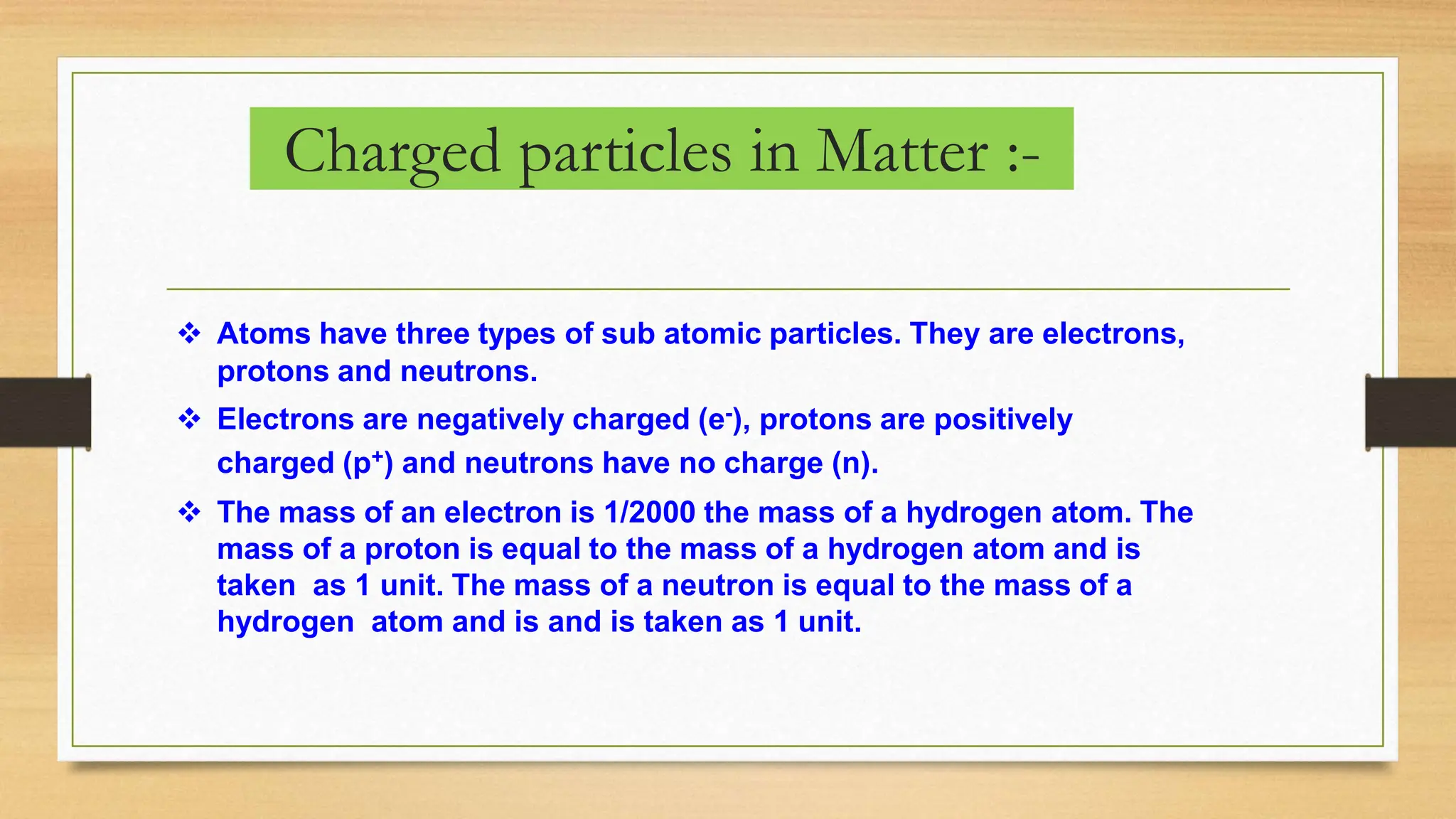
 Atoms have three types of sub atomic particles. They are electrons,
protons and neutrons.
 Electrons are negatively charged (e-), protons are positively
charged (p+) and neutrons have no charge (n).
 The mass of an electron is 1/2000 the mass of a hydrogen atom. The
mass of a proton is equal to the mass of a hydrogen atom and is
taken as 1 unit. The mass of a neutron is equal to the mass of a
hydrogen atom and is and is taken as 1 unit.
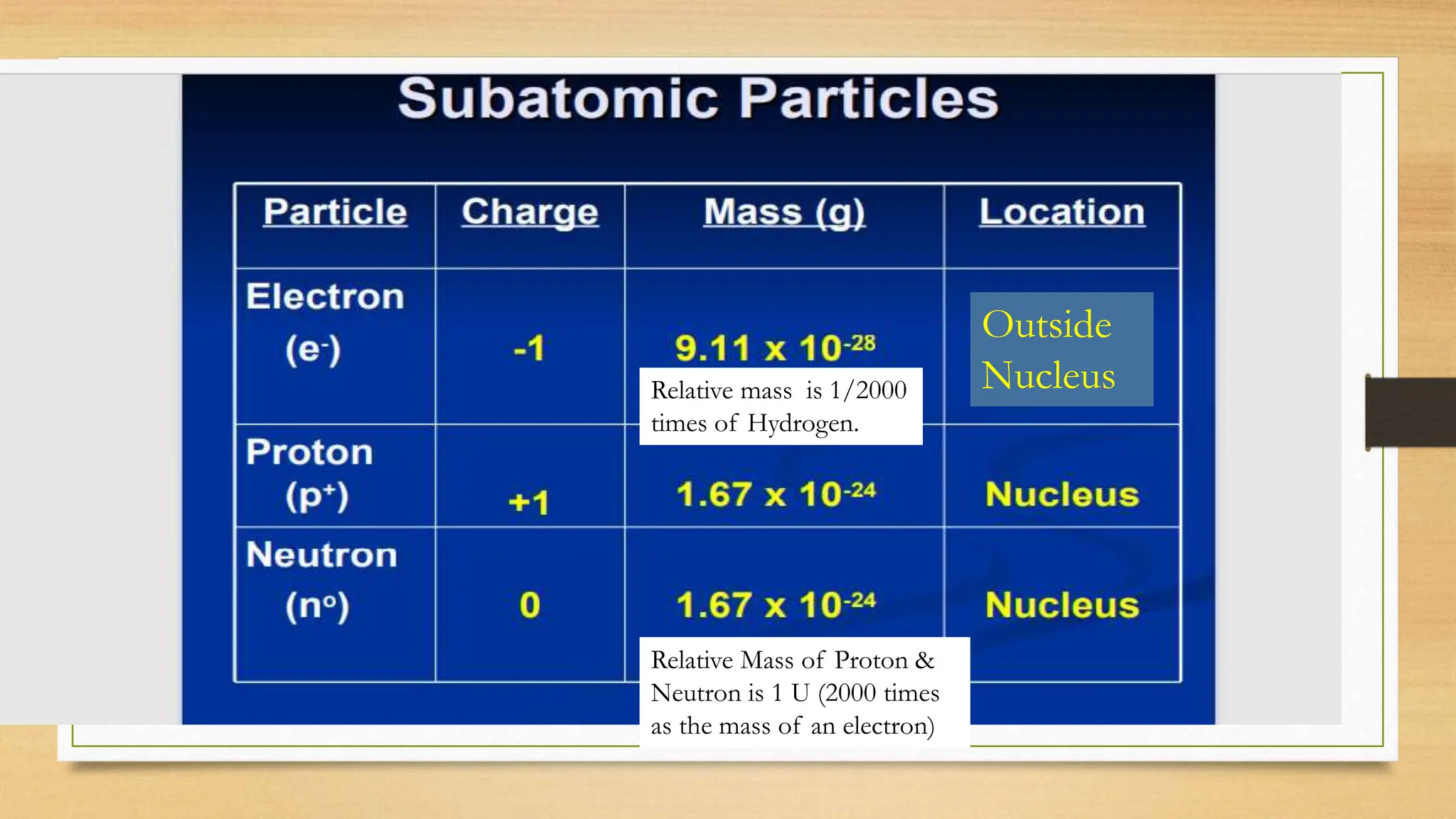
Relative mass is 1/2000
times of Hydrogen.
Outside
Nucleus
Relative Mass of Proton &
Neutron is 1 U (2000 times
as the mass of an electron)
Discovery of sub atomic particles :-
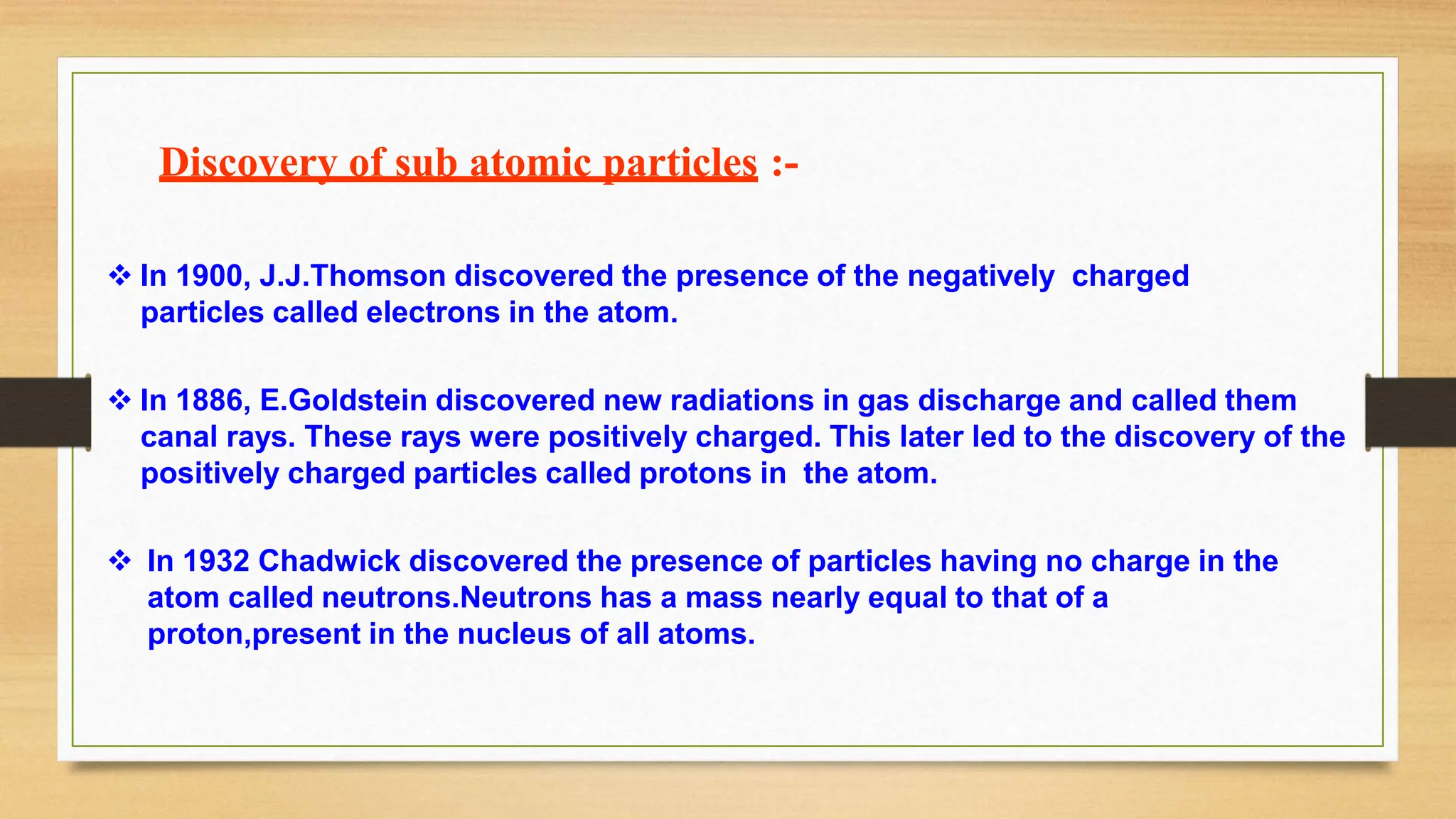
 In 1900, J.J.Thomson discovered the presence of the negatively charged
particles called electrons in the atom.
 In 1886, E.Goldstein discovered new radiations in gas discharge and called them
canal rays. These rays were positively charged. This later led to the discovery of the
positively charged particles called protons in the atom.
 In 1932 Chadwick discovered the presence of particles having no charge in the
atom called neutrons.Neutrons has a mass nearly equal to that of a
proton,present in the nucleus of all atoms.
The Structure of an atom :-
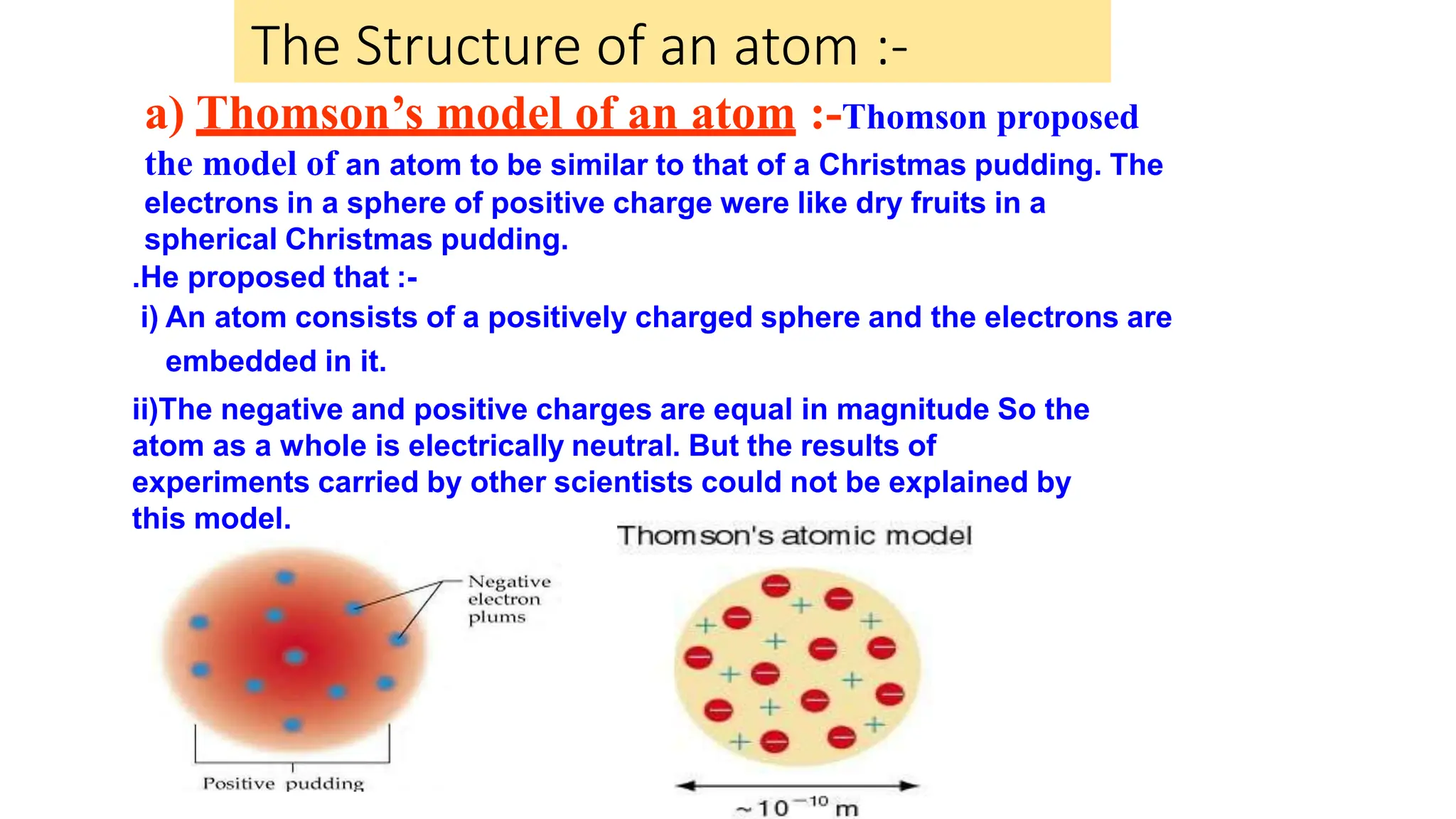
a) Thomson’s model of an atom :-Thomson proposed
the model of an atom to be similar to that of a Christmas pudding. The
electrons in a sphere of positive charge were like dry fruits in a
spherical Christmas pudding.
.He proposed that :-
i) An atom consists of a positively charged sphere and the electrons are
embedded in it.
ii)The negative and positive charges are equal in magnitude So the
atom as a whole is electrically neutral. But the results of
experiments carried by other scientists could not be explained by
this model.
b) Rutherford’s Model of an atom :-
Rutherford’s alpha scattering experiment :-
Rutherford allowed a beam of fast moving alpha particles(Helium
ions)having positive charge to fall on a thin gold foil. He observed
that :-
i) Most of the α – particles passed straight through the gold foil.
ii) Some of the α – particles were slightly deflected by small angles.
iii) Very few α – particles appeared to rebound.
Observations & Conclusions from Rutherford’s
alpha scattering experiment :-
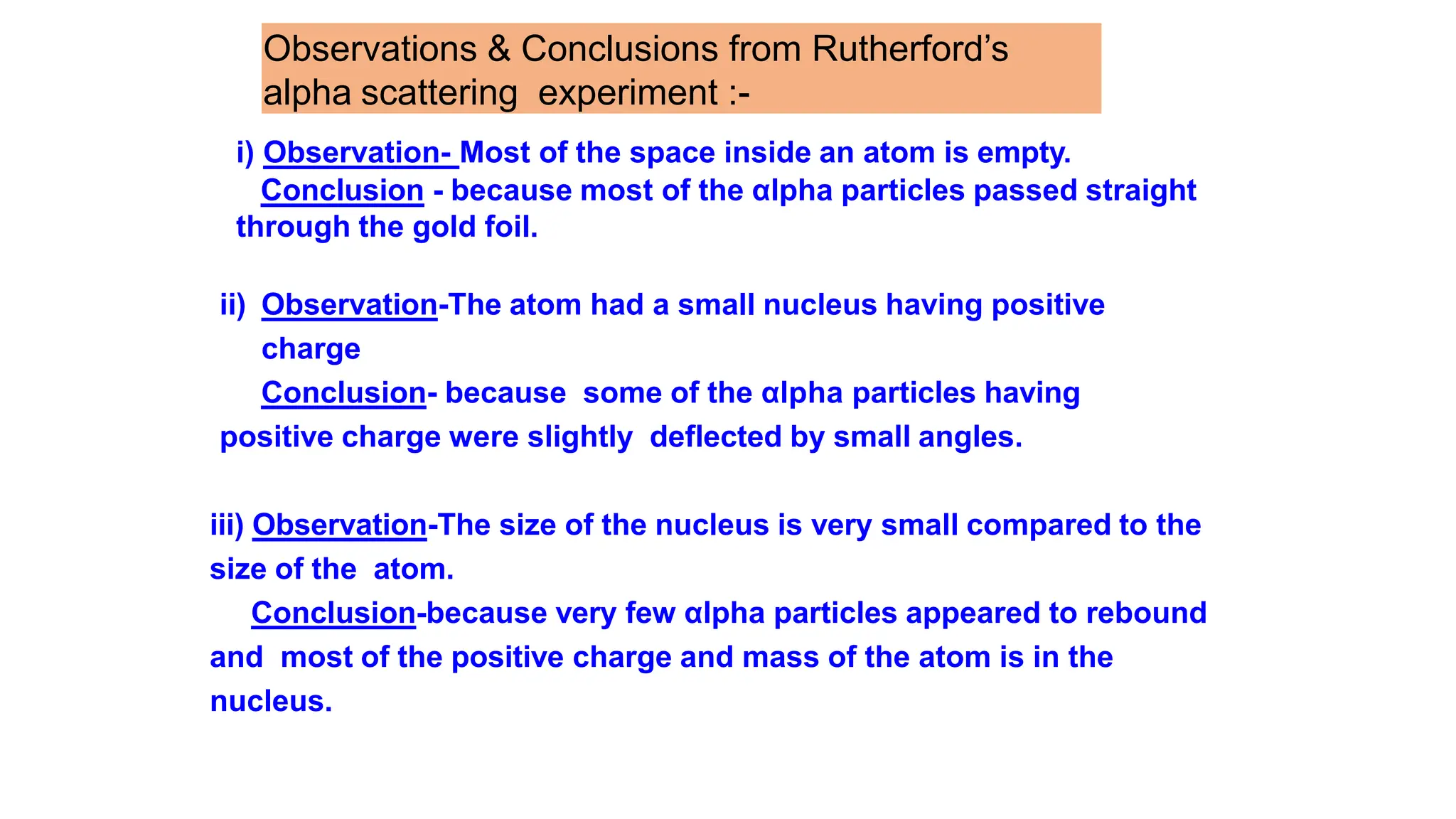
i) Observation- Most of the space inside an atom is empty.
Conclusion - because most of the αlpha particles passed straight
through the gold foil.
ii) Observation-The atom had a small nucleus having positive
charge
Conclusion- because some of the αlpha particles having
positive charge were slightly deflected by small angles.
iii) Observation-The size of the nucleus is very small compared to the
size of the atom.
Conclusion-because very few αlpha particles appeared to rebound
and most of the positive charge and mass of the atom is in the
nucleus.
What do you think would be the observation if the α-
particle scattering experiment is carried out using a
foil of a metal other than gold?
Answer :
If the α-scattering experiment is carried out using a foil of a
metal rather than gold, there would be no change in the
observation. In the α-scattering experiment, a gold foil was
taken because gold is malleable and a thin foil of gold can
be easily made. It is difficult to make such foils from other
metals.
Rutherford’s model of an atom :-
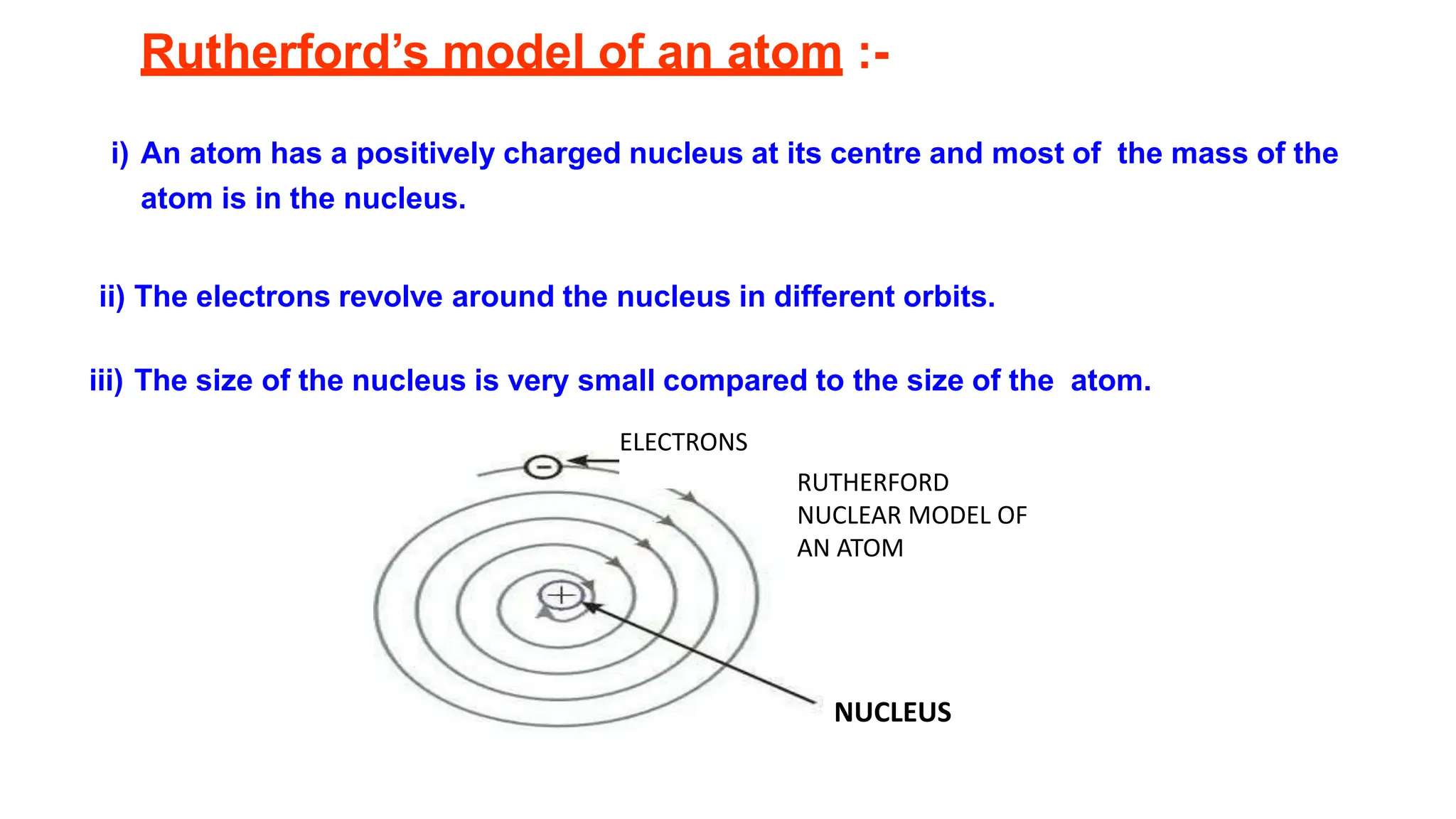
i) An atom has a positively charged nucleus at its centre and most of the mass of the
atom is in the nucleus.
ii) The electrons revolve around the nucleus in different orbits.
iii) The size of the nucleus is very small compared to the size of the atom.
ELECTRONS
NUCLEUS
RUTHERFORD
NUCLEAR MODEL OF
AN ATOM
Defects of Rutherford’s model of the atom :-
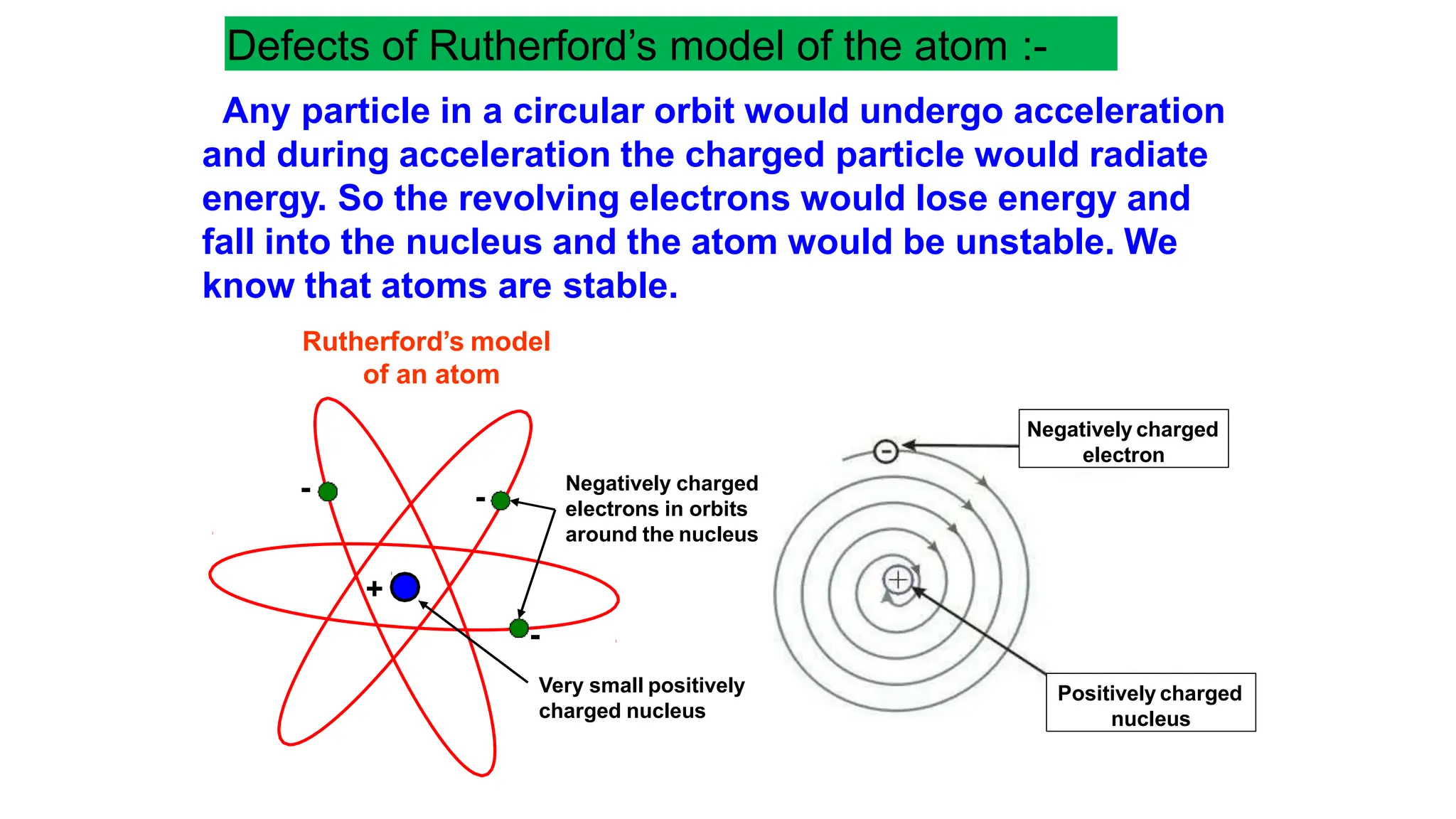
Negatively charged
electron
Positively charged
nucleus
Any particle in a circular orbit would undergo acceleration
and during acceleration the charged particle would radiate
energy. So the revolving electrons would lose energy and
fall into the nucleus and the atom would be unstable. We
know that atoms are stable.
Rutherford’s model
of an atom
Very small positively
charged nucleus
Negatively charged
electrons in orbits
around the nucleus
- -
+
-
CHECK POINT
QS.1 NAME THE SCIENTIST WHO DISCOVERED
ELECTRON.
QS.2 WHAT ARE CANAL RAYS?
QS.3 WHICH MODEL OF AN ATOM IS CALLED CHRISTMAS
PUDDING MODEL & WHY?
QS.4 STATE THE LOCATION OF ELECTRON ,PROTONS &
NEUTRONS IN AN ATOM.
QS.5 NAME THE SUB-ATOMIC PARTICLES PRESENT IN AN
ATOM.
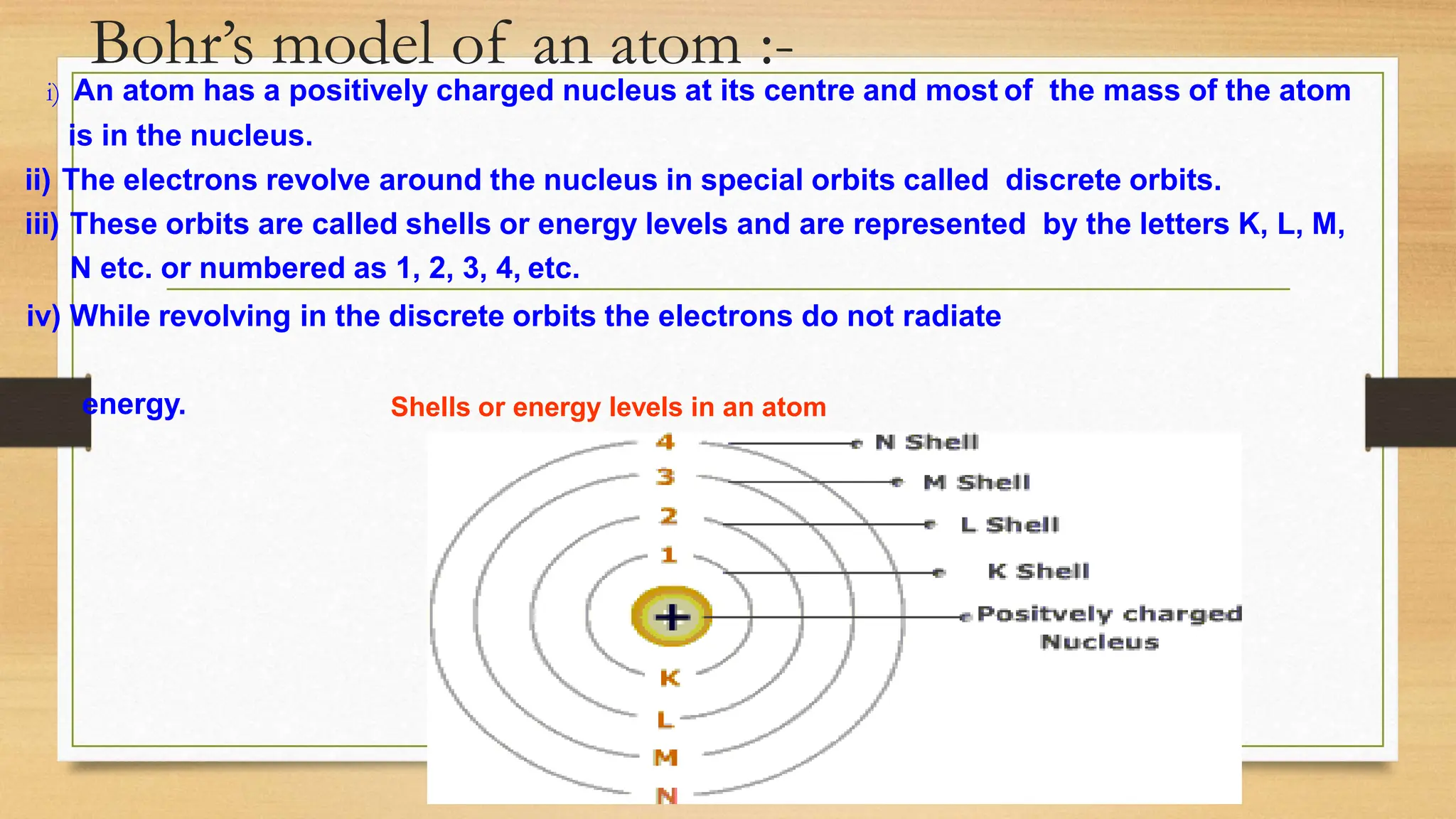
Bohr’s model of an atom :-
i) An atom has a positively charged nucleus at its centre and most of the mass of the atom
is in the nucleus.
ii) The electrons revolve around the nucleus in special orbits called discrete orbits.
iii) These orbits are called shells or energy levels and are represented by the letters K, L, M,
N etc. or numbered as 1, 2, 3, 4, etc.
iv) While revolving in the discrete orbits the electrons do not radiate
energy. Shells or energy levels in an atom
3) Distribution of electrons in different shells :-
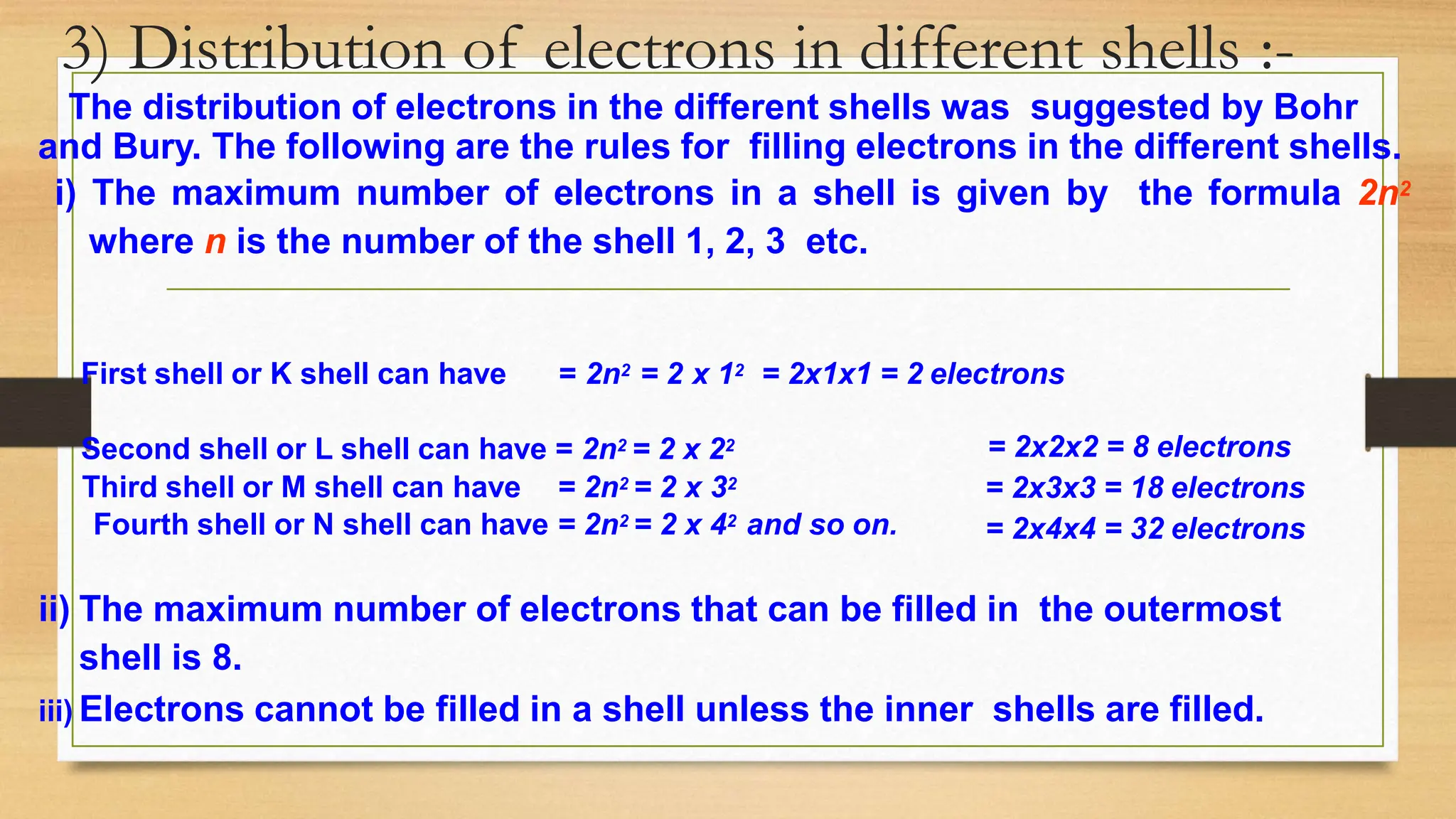
The distribution of electrons in the different shells was suggested by Bohr
and Bury. The following are the rules for filling electrons in the different shells.
i) The maximum number of electrons in a shell is given by the formula 2n2
where n is the number of the shell 1, 2, 3 etc.
First shell or K shell can have = 2n2 = 2 x 12 = 2x1x1 = 2 electrons
Second shell or L shell can have = 2n2 = 2 x 22 = 2x2x2 = 8 electrons
= 2x3x3 = 18 electrons
= 2x4x4 = 32 electrons
Third shell or M shell can have = 2n2 = 2 x 32
Fourth shell or N shell can have = 2n2 = 2 x 42 and so on.
ii) The maximum number of electrons that can be filled in the outermost
shell is 8.
iii) Electrons cannot be filled in a shell unless the inner shells are filled.
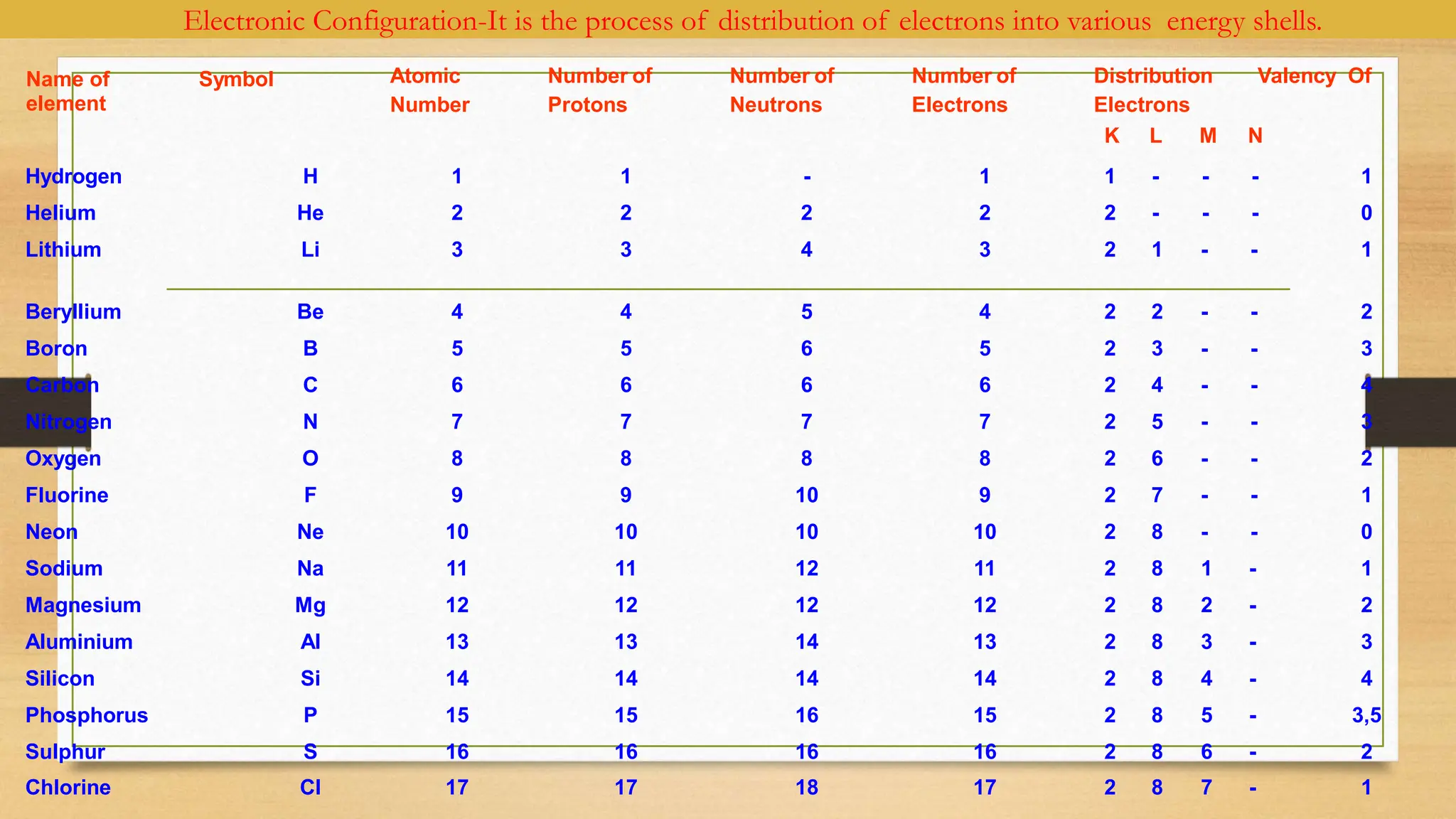
Electronic Configuration-It is the process of distribution of electrons into various energy shells.
Name of Symbol
element
Atomic
Number
Number of
Protons
Number of
Neutrons
Number of
Electrons
Distribution Valency Of
Electrons
K L M N
Hydrogen H 1 1 - 1 1 - - - 1
Helium He 2 2 2 2 2 - - - 0
Lithium Li 3 3 4 3 2 1 - - 1
Beryllium Be 4 4 5 4 2 2 - - 2
Boron B 5 5 6 5 2 3 - - 3
Carbon C 6 6 6 6 2 4 - - 4
Nitrogen N 7 7 7 7 2 5 - - 3
Oxygen O 8 8 8 8 2 6 - - 2
Fluorine F 9 9 10 9 2 7 - - 1
Neon Ne 10 10 10 10 2 8 - - 0
Sodium Na 11 11 12 11 2 8 1 - 1
Magnesium Mg 12 12 12 12 2 8 2 - 2
Aluminium Al 13 13 14 13 2 8 3 - 3
Silicon Si 14 14 14 14 2 8 4 - 4
Phosphorus P 15 15 16 15 2 8 5 - 3,5
Sulphur S 16 16 16 16 2 8 6 - 2
Chlorine Cl 17 17 18 17 2 8 7 - 1
Atomic structure of the first eighteen elements :-
H He
Li Be B C N O F Ne
Na Mg Al Si P S Cl Ar
4) Valency :-
Valency is the combining capacity of an atom of an element.
The electrons present in the outermost shell of an atom are called valence electrons.
If an atom’s outermost shell is completely filled, they are inert or least reactive and their
combining capacity or valency is zero.
Of the inert elements Helium atom has 2 electrons in the outermost shell and the atoms of
other elements have 8 electrons in their outermost shell. Atoms
having 8 electrons in their outermost shell is having octet configuration and are stable.
BOHR-BURY RULE-
If an atom’s outermost shell is not completely filled it is not stable. It will try to attain
stability by losing, gaining or sharing electrons with other atoms to attain octet configuration
like noble gases.
The number of electrons lost, gained or shared by an atom to attain octet configuration is
the combining capacity or valency of the element
Eg :- Hydrogen, Lithium, Sodium atoms can easily lose 1 electron and become stable. So
their valency is 1. Magnesium can easily lose 2 electrons. So its valency is 2. Aluminiun can
easily lose 3 electrons. So its valency is 3. Carbon shares 4 electrons. So its valency is 4.
Fluorine can easily gain 1 electron and become stable. So its valency is 1. Oxygen
can easily gain 2 electrons. So its valency is 2.
Nitrogen can easily gain 3 electrons. So its valency is 3.
HOW TO CALCULATE VALENCY OF ELEMENTS?
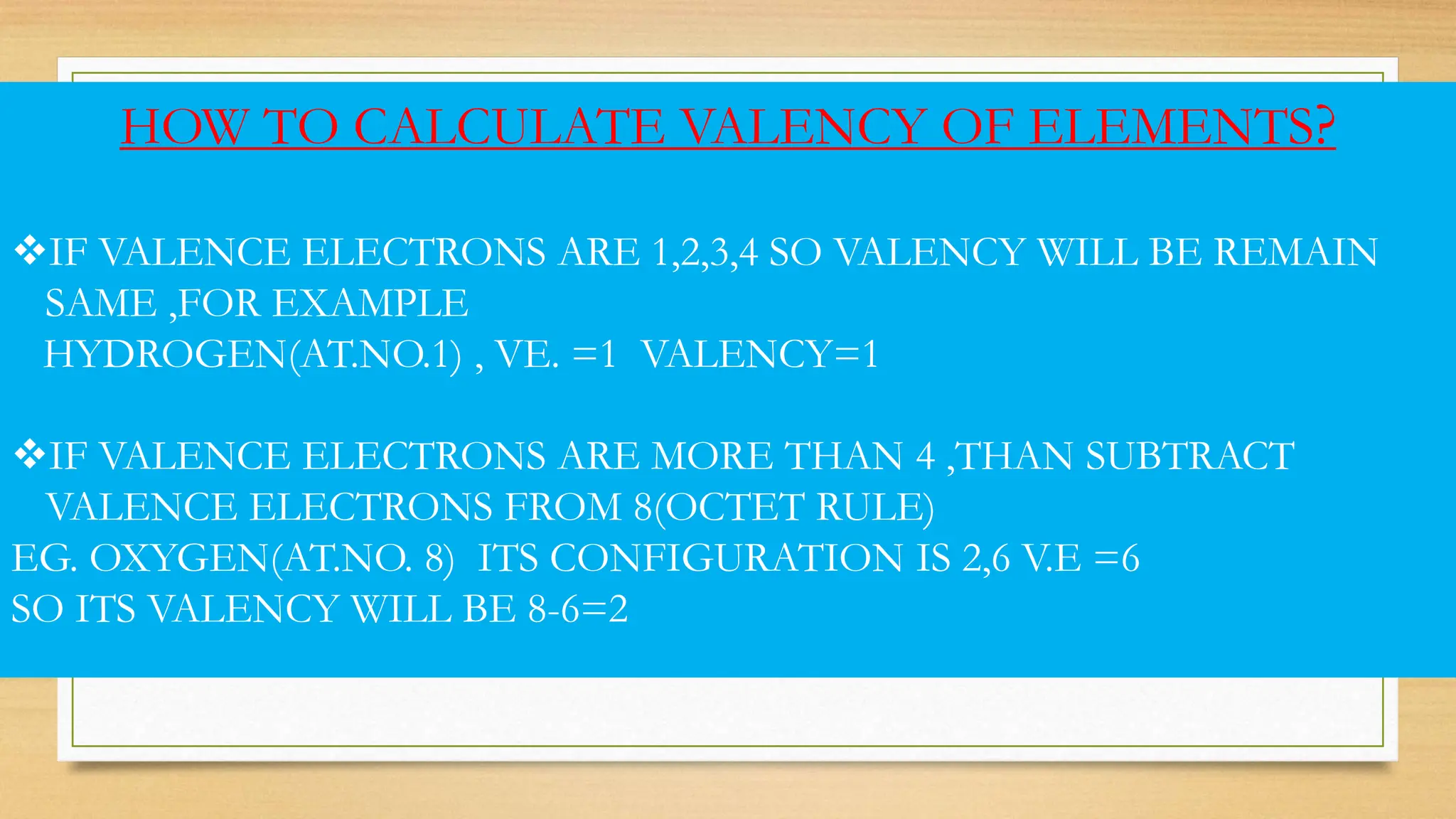
IF VALENCE ELECTRONS ARE 1,2,3,4 SO VALENCY WILL BE REMAIN
SAME ,FOR EXAMPLE
HYDROGEN(AT.NO.1) , VE. =1 VALENCY=1
IF VALENCE ELECTRONS ARE MORE THAN 4 ,THAN SUBTRACT
VALENCE ELECTRONS FROM 8(OCTET RULE)
EG. OXYGEN(AT.NO. 8) ITS CONFIGURATION IS 2,6 V.E =6
SO ITS VALENCY WILL BE 8-6=2
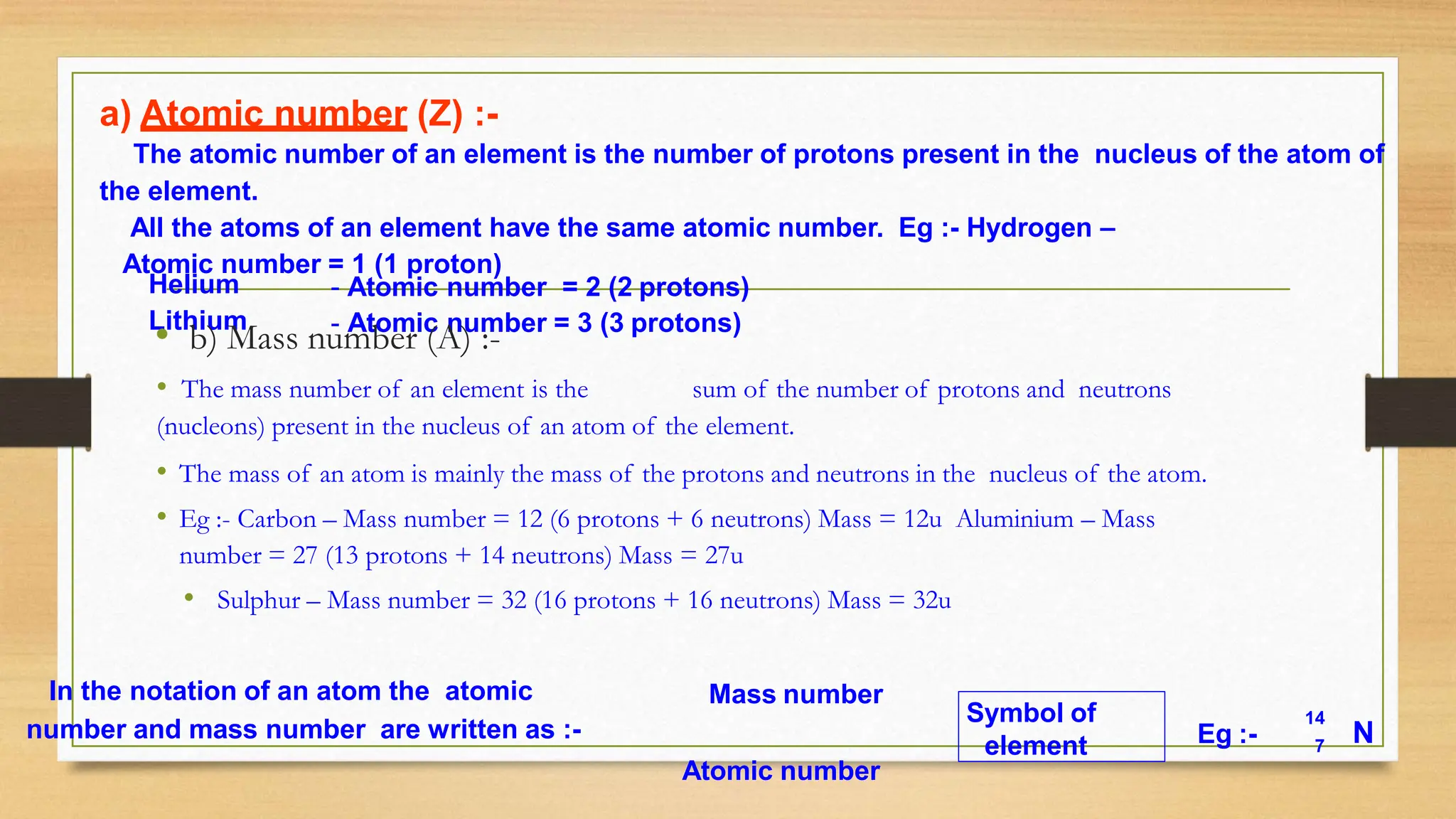
a) Atomic number (Z) :-
The atomic number of an element is the number of protons present in the nucleus of the atom of
the element.
All the atoms of an element have the same atomic number. Eg :- Hydrogen –
Atomic number = 1 (1 proton)
Helium
Lithium
- Atomic number = 2 (2 protons)
- Atomic number = 3 (3 protons)
• b) Mass number (A) :-
• The mass number of an element is the sum of the number of protons and neutrons
(nucleons) present in the nucleus of an atom of the element.
• The mass of an atom is mainly the mass of the protons and neutrons in the nucleus of the atom.
• Eg :- Carbon – Mass number = 12 (6 protons + 6 neutrons) Mass = 12u Aluminium – Mass
number = 27 (13 protons + 14 neutrons) Mass = 27u
• Sulphur – Mass number = 32 (16 protons + 16 neutrons) Mass = 32u
In the notation of an atom the atomic
number and mass number are written as :-
Mass number
Eg :- N
Atomic number
Symbol of
element
14
7
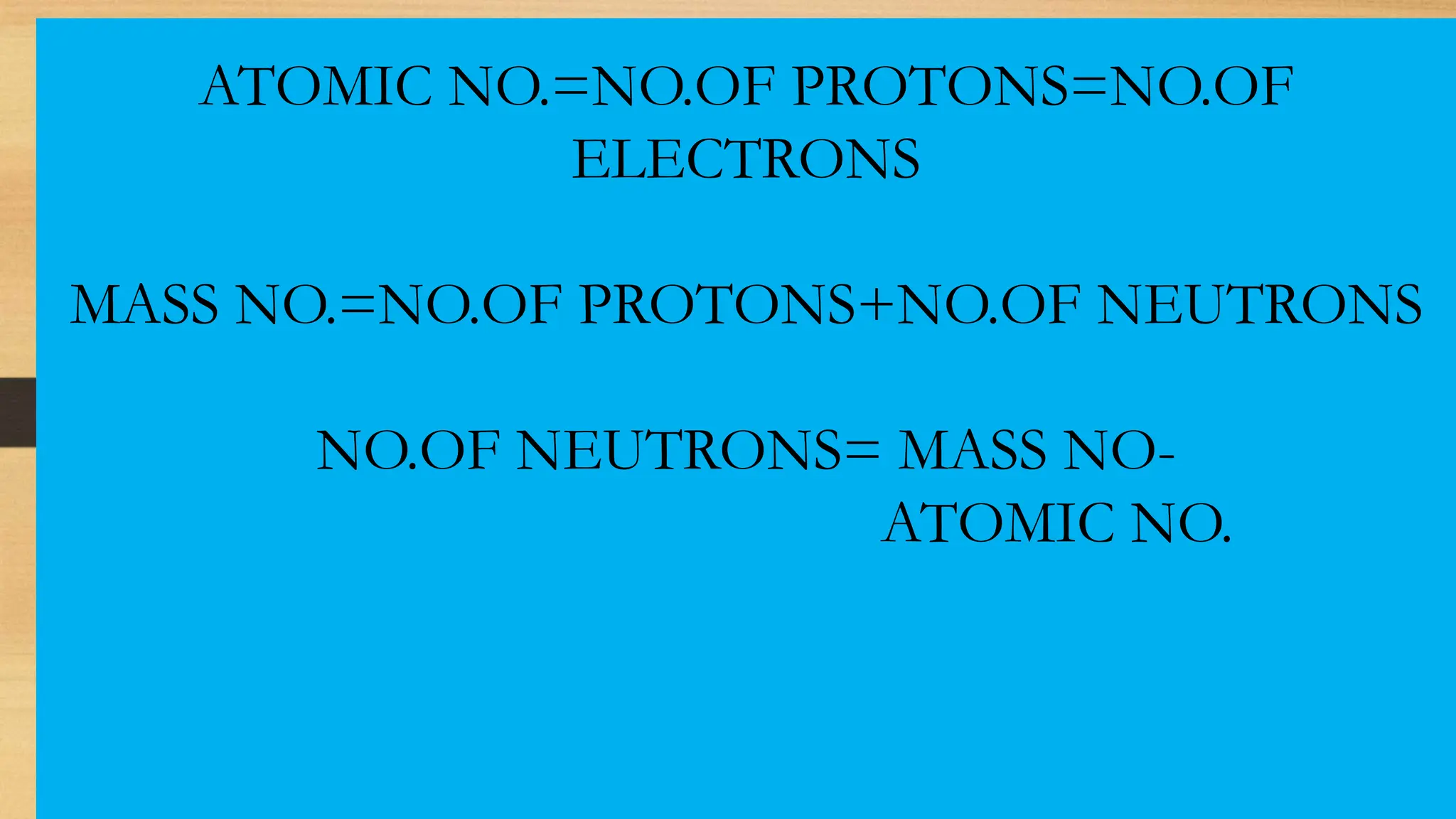
ATOMIC NO.=NO.OF PROTONS=NO.OF
ELECTRONS
MASS NO.=NO.OF PROTONS+NO.OF NEUTRONS
NO.OF NEUTRONS= MASS NO-
ATOMIC NO.
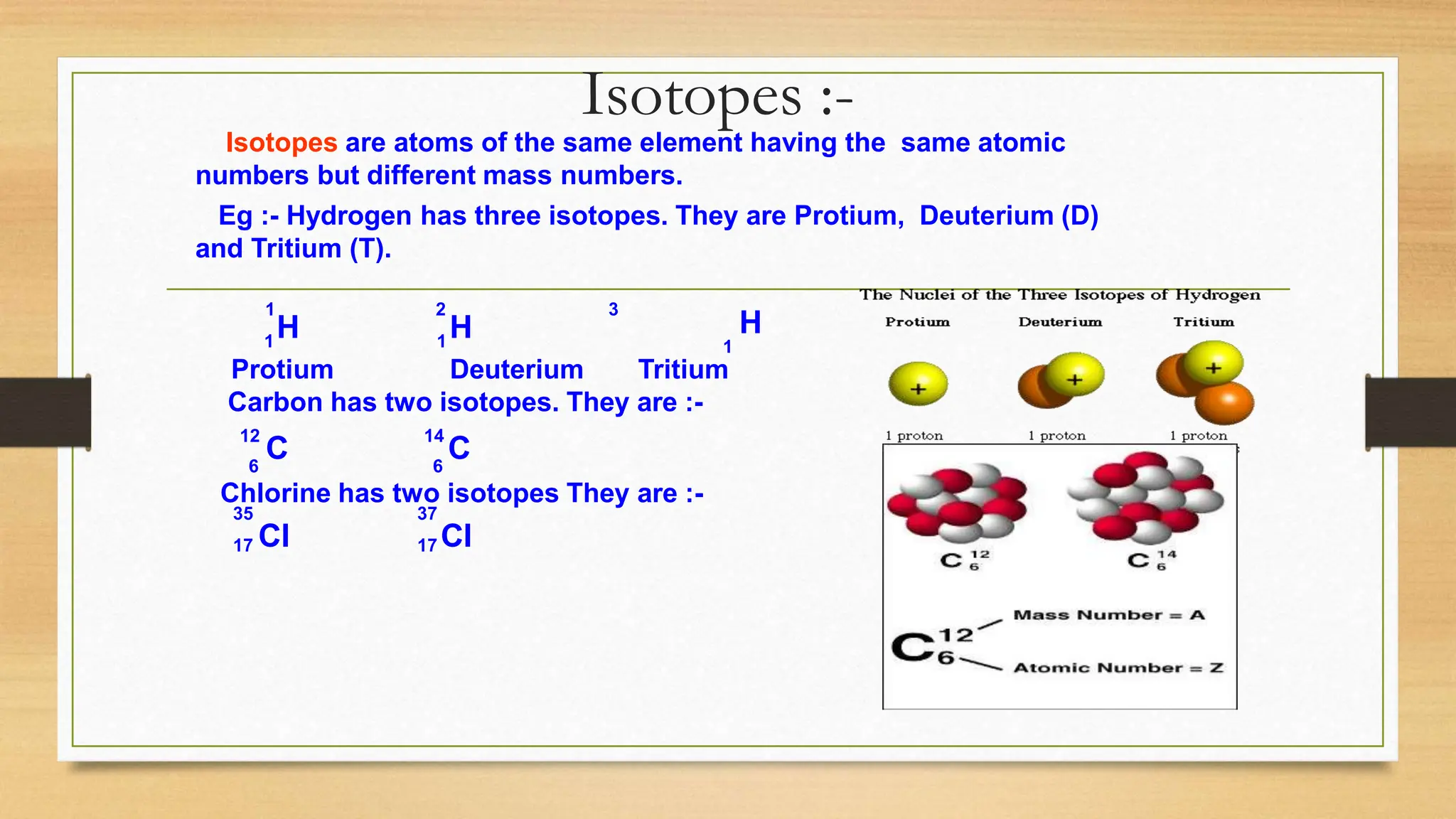
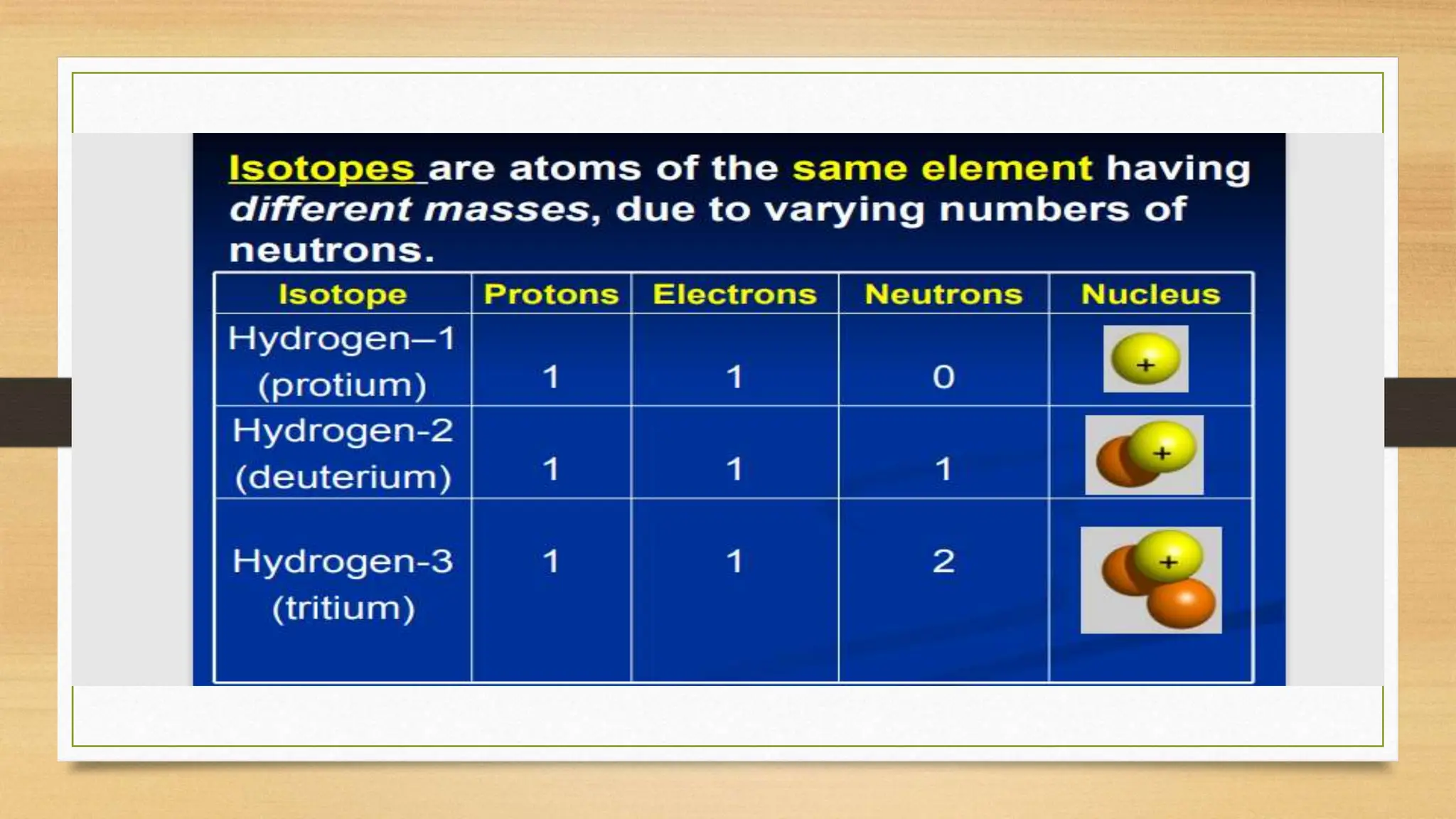
Isotopes :-
Isotopes are atoms of the same element having the same atomic
numbers but different mass numbers.
Eg :- Hydrogen has three isotopes. They are Protium, Deuterium (D)
and Tritium (T).
Protium Deuterium Tritium
1
H 1
H H
1
1 2 3
Carbon has two isotopes. They are :-
12
C
14
C
6 6
Chlorine has two isotopes They are :-
35 37
17 Cl 17 Cl
APPLICATIONS OF ISOTOPES
HOW TO CALCULATE AVERAGE ATOMIC
MASS?
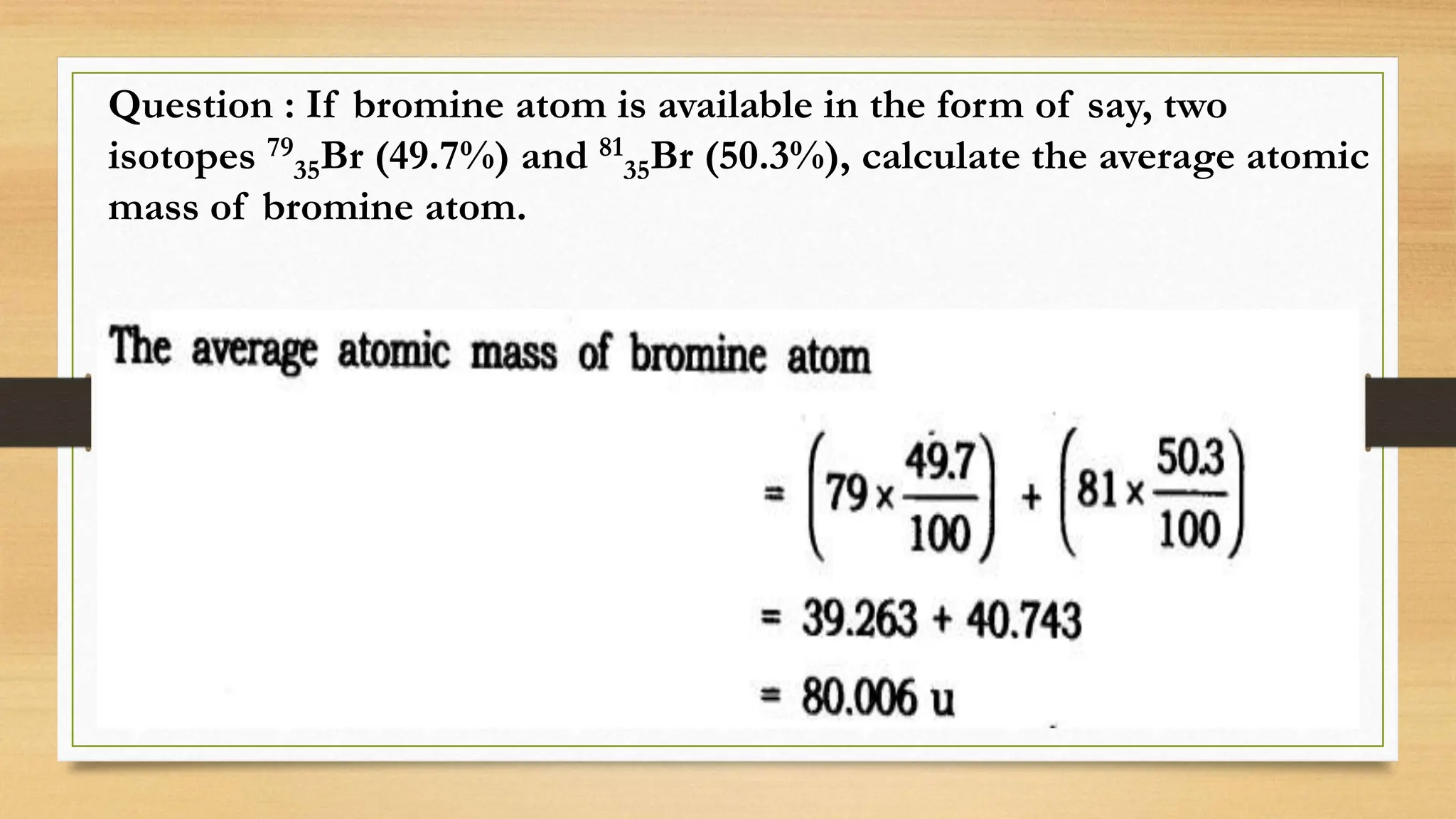
Question : If bromine atom is available in the form of say, two
isotopes 79
35Br (49.7%) and 81
35Br (50.3%), calculate the average atomic
mass of bromine atom.
Question:The average atomic mass of a sample of an element
X is 16.2 u. What are the percentages of isotopes 16
8X and 18
8X
in the sample?
Answer: Let the percentage of 16
8X be x and the percentage of 16
8X
be 100 – x.
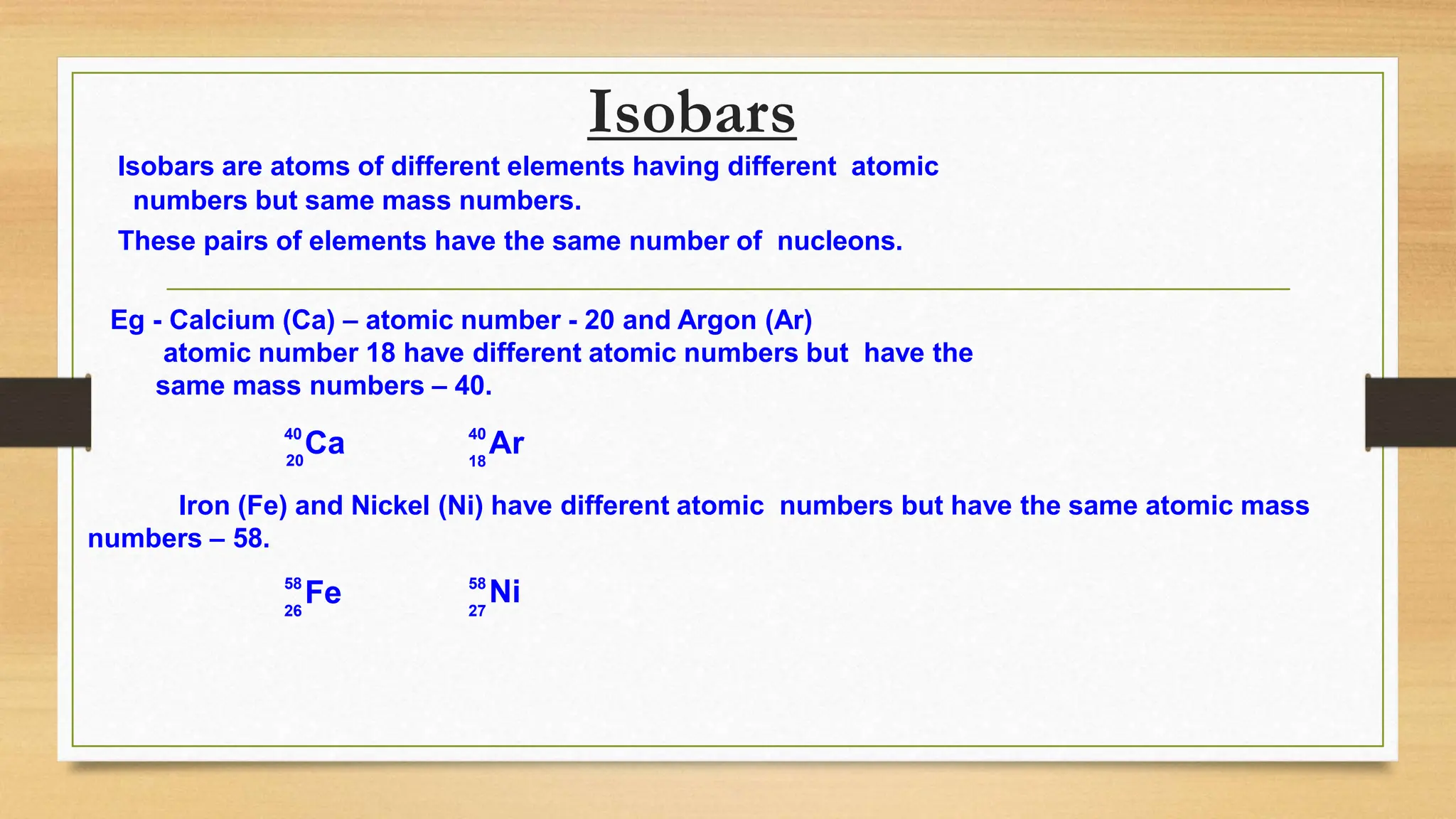
Isobars
Isobars are atoms of different elements having different atomic
numbers but same mass numbers.
These pairs of elements have the same number of nucleons.
Eg - Calcium (Ca) – atomic number - 20 and Argon (Ar)
atomic number 18 have different atomic numbers but have the
same mass numbers – 40.
40
Ca 40
Ar
20 18
Iron (Fe) and Nickel (Ni) have different atomic numbers but have the same atomic mass
numbers – 58.
58
Fe 58
Ni
26 27
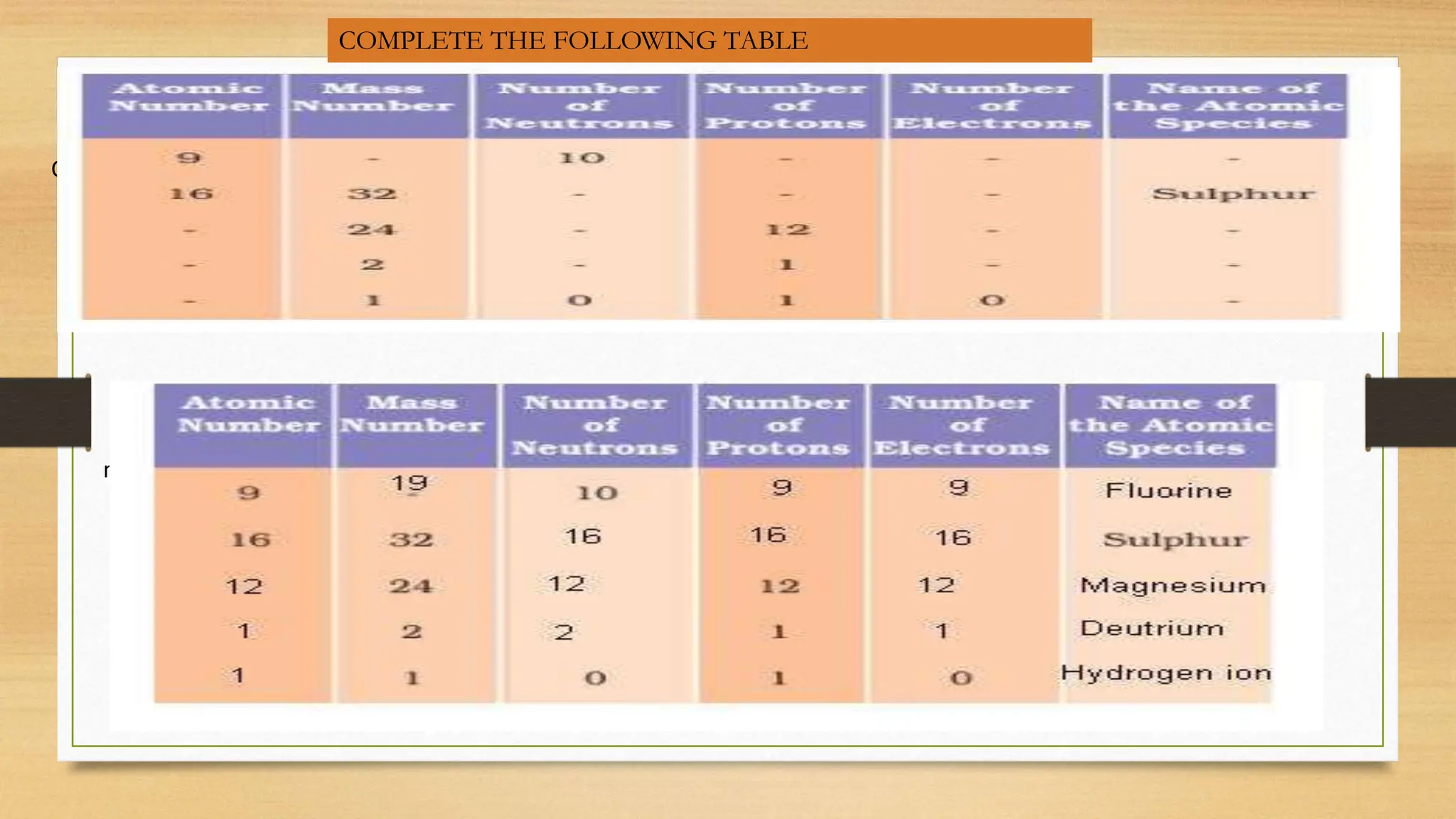
Complete the following table.
nswer:
COMPLETE THE FOLLOWING TABLE
THANK YOU
MS.ANITA SHARMA

class 9 (Chem) Ch.4 Structure of Atom.pptx

  • 1.
    CHAPTER - 4 STRUCTUREOF THE ATOM MS.ANITA SHARMA
  • 2.
    Charged particles inMatter :-  Atoms have three types of sub atomic particles. They are electrons, protons and neutrons.  Electrons are negatively charged (e-), protons are positively charged (p+) and neutrons have no charge (n).  The mass of an electron is 1/2000 the mass of a hydrogen atom. The mass of a proton is equal to the mass of a hydrogen atom and is taken as 1 unit. The mass of a neutron is equal to the mass of a hydrogen atom and is and is taken as 1 unit.
  • 3.
    Relative mass is1/2000 times of Hydrogen. Outside Nucleus Relative Mass of Proton & Neutron is 1 U (2000 times as the mass of an electron)
  • 4.
    Discovery of subatomic particles :-  In 1900, J.J.Thomson discovered the presence of the negatively charged particles called electrons in the atom.  In 1886, E.Goldstein discovered new radiations in gas discharge and called them canal rays. These rays were positively charged. This later led to the discovery of the positively charged particles called protons in the atom.  In 1932 Chadwick discovered the presence of particles having no charge in the atom called neutrons.Neutrons has a mass nearly equal to that of a proton,present in the nucleus of all atoms.
  • 5.
    The Structure ofan atom :- a) Thomson’s model of an atom :-Thomson proposed the model of an atom to be similar to that of a Christmas pudding. The electrons in a sphere of positive charge were like dry fruits in a spherical Christmas pudding. .He proposed that :- i) An atom consists of a positively charged sphere and the electrons are embedded in it. ii)The negative and positive charges are equal in magnitude So the atom as a whole is electrically neutral. But the results of experiments carried by other scientists could not be explained by this model.
  • 6.
  • 7.
    Rutherford’s alpha scatteringexperiment :- Rutherford allowed a beam of fast moving alpha particles(Helium ions)having positive charge to fall on a thin gold foil. He observed that :- i) Most of the α – particles passed straight through the gold foil. ii) Some of the α – particles were slightly deflected by small angles. iii) Very few α – particles appeared to rebound.
  • 8.
    Observations & Conclusionsfrom Rutherford’s alpha scattering experiment :- i) Observation- Most of the space inside an atom is empty. Conclusion - because most of the αlpha particles passed straight through the gold foil. ii) Observation-The atom had a small nucleus having positive charge Conclusion- because some of the αlpha particles having positive charge were slightly deflected by small angles. iii) Observation-The size of the nucleus is very small compared to the size of the atom. Conclusion-because very few αlpha particles appeared to rebound and most of the positive charge and mass of the atom is in the nucleus.
  • 9.
    What do youthink would be the observation if the α- particle scattering experiment is carried out using a foil of a metal other than gold? Answer : If the α-scattering experiment is carried out using a foil of a metal rather than gold, there would be no change in the observation. In the α-scattering experiment, a gold foil was taken because gold is malleable and a thin foil of gold can be easily made. It is difficult to make such foils from other metals.
  • 10.
    Rutherford’s model ofan atom :- i) An atom has a positively charged nucleus at its centre and most of the mass of the atom is in the nucleus. ii) The electrons revolve around the nucleus in different orbits. iii) The size of the nucleus is very small compared to the size of the atom. ELECTRONS NUCLEUS RUTHERFORD NUCLEAR MODEL OF AN ATOM
  • 11.
    Defects of Rutherford’smodel of the atom :- Negatively charged electron Positively charged nucleus Any particle in a circular orbit would undergo acceleration and during acceleration the charged particle would radiate energy. So the revolving electrons would lose energy and fall into the nucleus and the atom would be unstable. We know that atoms are stable. Rutherford’s model of an atom Very small positively charged nucleus Negatively charged electrons in orbits around the nucleus - - + -
  • 12.
    CHECK POINT QS.1 NAMETHE SCIENTIST WHO DISCOVERED ELECTRON. QS.2 WHAT ARE CANAL RAYS? QS.3 WHICH MODEL OF AN ATOM IS CALLED CHRISTMAS PUDDING MODEL & WHY? QS.4 STATE THE LOCATION OF ELECTRON ,PROTONS & NEUTRONS IN AN ATOM. QS.5 NAME THE SUB-ATOMIC PARTICLES PRESENT IN AN ATOM.
  • 13.
    Bohr’s model ofan atom :- i) An atom has a positively charged nucleus at its centre and most of the mass of the atom is in the nucleus. ii) The electrons revolve around the nucleus in special orbits called discrete orbits. iii) These orbits are called shells or energy levels and are represented by the letters K, L, M, N etc. or numbered as 1, 2, 3, 4, etc. iv) While revolving in the discrete orbits the electrons do not radiate energy. Shells or energy levels in an atom
  • 14.
    3) Distribution ofelectrons in different shells :- The distribution of electrons in the different shells was suggested by Bohr and Bury. The following are the rules for filling electrons in the different shells. i) The maximum number of electrons in a shell is given by the formula 2n2 where n is the number of the shell 1, 2, 3 etc. First shell or K shell can have = 2n2 = 2 x 12 = 2x1x1 = 2 electrons Second shell or L shell can have = 2n2 = 2 x 22 = 2x2x2 = 8 electrons = 2x3x3 = 18 electrons = 2x4x4 = 32 electrons Third shell or M shell can have = 2n2 = 2 x 32 Fourth shell or N shell can have = 2n2 = 2 x 42 and so on. ii) The maximum number of electrons that can be filled in the outermost shell is 8. iii) Electrons cannot be filled in a shell unless the inner shells are filled.
  • 15.
    Electronic Configuration-It isthe process of distribution of electrons into various energy shells. Name of Symbol element Atomic Number Number of Protons Number of Neutrons Number of Electrons Distribution Valency Of Electrons K L M N Hydrogen H 1 1 - 1 1 - - - 1 Helium He 2 2 2 2 2 - - - 0 Lithium Li 3 3 4 3 2 1 - - 1 Beryllium Be 4 4 5 4 2 2 - - 2 Boron B 5 5 6 5 2 3 - - 3 Carbon C 6 6 6 6 2 4 - - 4 Nitrogen N 7 7 7 7 2 5 - - 3 Oxygen O 8 8 8 8 2 6 - - 2 Fluorine F 9 9 10 9 2 7 - - 1 Neon Ne 10 10 10 10 2 8 - - 0 Sodium Na 11 11 12 11 2 8 1 - 1 Magnesium Mg 12 12 12 12 2 8 2 - 2 Aluminium Al 13 13 14 13 2 8 3 - 3 Silicon Si 14 14 14 14 2 8 4 - 4 Phosphorus P 15 15 16 15 2 8 5 - 3,5 Sulphur S 16 16 16 16 2 8 6 - 2 Chlorine Cl 17 17 18 17 2 8 7 - 1
  • 16.
    Atomic structure ofthe first eighteen elements :- H He Li Be B C N O F Ne Na Mg Al Si P S Cl Ar
  • 17.
    4) Valency :- Valencyis the combining capacity of an atom of an element. The electrons present in the outermost shell of an atom are called valence electrons. If an atom’s outermost shell is completely filled, they are inert or least reactive and their combining capacity or valency is zero. Of the inert elements Helium atom has 2 electrons in the outermost shell and the atoms of other elements have 8 electrons in their outermost shell. Atoms having 8 electrons in their outermost shell is having octet configuration and are stable. BOHR-BURY RULE- If an atom’s outermost shell is not completely filled it is not stable. It will try to attain stability by losing, gaining or sharing electrons with other atoms to attain octet configuration like noble gases. The number of electrons lost, gained or shared by an atom to attain octet configuration is the combining capacity or valency of the element Eg :- Hydrogen, Lithium, Sodium atoms can easily lose 1 electron and become stable. So their valency is 1. Magnesium can easily lose 2 electrons. So its valency is 2. Aluminiun can easily lose 3 electrons. So its valency is 3. Carbon shares 4 electrons. So its valency is 4. Fluorine can easily gain 1 electron and become stable. So its valency is 1. Oxygen can easily gain 2 electrons. So its valency is 2. Nitrogen can easily gain 3 electrons. So its valency is 3.
  • 18.
    HOW TO CALCULATEVALENCY OF ELEMENTS? IF VALENCE ELECTRONS ARE 1,2,3,4 SO VALENCY WILL BE REMAIN SAME ,FOR EXAMPLE HYDROGEN(AT.NO.1) , VE. =1 VALENCY=1 IF VALENCE ELECTRONS ARE MORE THAN 4 ,THAN SUBTRACT VALENCE ELECTRONS FROM 8(OCTET RULE) EG. OXYGEN(AT.NO. 8) ITS CONFIGURATION IS 2,6 V.E =6 SO ITS VALENCY WILL BE 8-6=2
  • 19.
    a) Atomic number(Z) :- The atomic number of an element is the number of protons present in the nucleus of the atom of the element. All the atoms of an element have the same atomic number. Eg :- Hydrogen – Atomic number = 1 (1 proton) Helium Lithium - Atomic number = 2 (2 protons) - Atomic number = 3 (3 protons) • b) Mass number (A) :- • The mass number of an element is the sum of the number of protons and neutrons (nucleons) present in the nucleus of an atom of the element. • The mass of an atom is mainly the mass of the protons and neutrons in the nucleus of the atom. • Eg :- Carbon – Mass number = 12 (6 protons + 6 neutrons) Mass = 12u Aluminium – Mass number = 27 (13 protons + 14 neutrons) Mass = 27u • Sulphur – Mass number = 32 (16 protons + 16 neutrons) Mass = 32u In the notation of an atom the atomic number and mass number are written as :- Mass number Eg :- N Atomic number Symbol of element 14 7
  • 20.
    ATOMIC NO.=NO.OF PROTONS=NO.OF ELECTRONS MASSNO.=NO.OF PROTONS+NO.OF NEUTRONS NO.OF NEUTRONS= MASS NO- ATOMIC NO.
  • 21.
    Isotopes :- Isotopes areatoms of the same element having the same atomic numbers but different mass numbers. Eg :- Hydrogen has three isotopes. They are Protium, Deuterium (D) and Tritium (T). Protium Deuterium Tritium 1 H 1 H H 1 1 2 3 Carbon has two isotopes. They are :- 12 C 14 C 6 6 Chlorine has two isotopes They are :- 35 37 17 Cl 17 Cl
  • 23.
  • 24.
    HOW TO CALCULATEAVERAGE ATOMIC MASS?
  • 25.
    Question : Ifbromine atom is available in the form of say, two isotopes 79 35Br (49.7%) and 81 35Br (50.3%), calculate the average atomic mass of bromine atom.
  • 26.
    Question:The average atomicmass of a sample of an element X is 16.2 u. What are the percentages of isotopes 16 8X and 18 8X in the sample? Answer: Let the percentage of 16 8X be x and the percentage of 16 8X be 100 – x.
  • 27.
    Isobars Isobars are atomsof different elements having different atomic numbers but same mass numbers. These pairs of elements have the same number of nucleons. Eg - Calcium (Ca) – atomic number - 20 and Argon (Ar) atomic number 18 have different atomic numbers but have the same mass numbers – 40. 40 Ca 40 Ar 20 18 Iron (Fe) and Nickel (Ni) have different atomic numbers but have the same atomic mass numbers – 58. 58 Fe 58 Ni 26 27
  • 29.
    Complete the followingtable. nswer: COMPLETE THE FOLLOWING TABLE
  • 30.