1 of 8 © Boardworks Ltd 2008
© Boardworks Ltd 2008
2 of 8
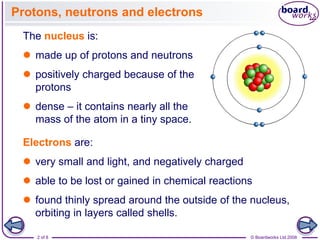
The nucleus is:
 made up of protons and neutrons
 positively charged because of the
protons
 dense – it contains nearly all the
mass of the atom in a tiny space.
Electrons are:
 very small and light, and negatively charged
 able to be lost or gained in chemical reactions
 found thinly spread around the outside of the nucleus,
orbiting in layers called shells.
Protons, neutrons and electrons
© Boardworks Ltd 2008
3 of 8
Protons, neutrons and electrons
positively charge
lost and gained in a
reaction
found thinly spread
outside the
nucleus
dense, contains the
mass of the atom
© Boardworks Ltd 2008
4 of 8
Quantum Shells
© Boardworks Ltd 2008
5 of 8
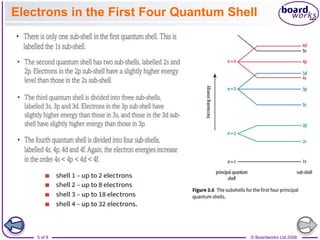
Electrons in the First Four Quantum Shell
© Boardworks Ltd 2008
6 of 8
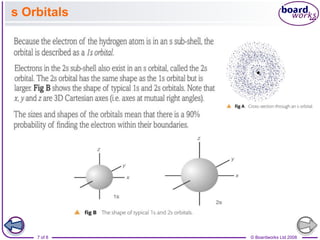
s Orbitals
© Boardworks Ltd 2008
7 of 8
s Orbitals
© Boardworks Ltd 2008
8 of 8
p Orbitals
© Boardworks Ltd 2008
9 of 8
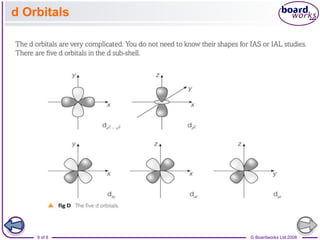
d Orbitals
© Boardworks Ltd 2008
10 of 8
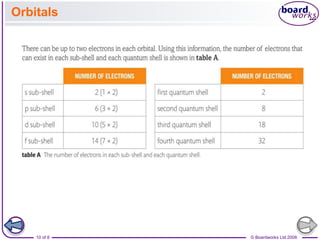
Orbitals
© Boardworks Ltd 2008
11 of 8
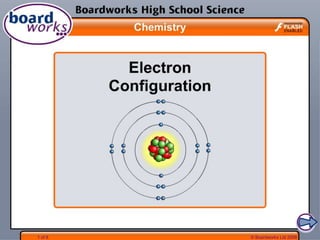
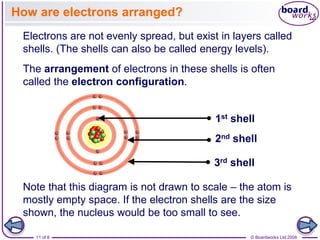
How are electrons arranged?
Electrons are not evenly spread, but exist in layers called
shells. (The shells can also be called energy levels).
The arrangement of electrons in these shells is often
called the electron configuration.
Note that this diagram is not drawn to scale – the atom is
mostly empty space. If the electron shells are the size
shown, the nucleus would be too small to see.
1st shell
2nd shell
3rd shell
© Boardworks Ltd 2008
12 of 8
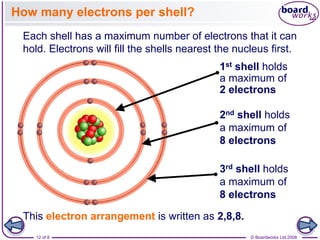
How many electrons per shell?
Each shell has a maximum number of electrons that it can
hold. Electrons will fill the shells nearest the nucleus first.
1st shell holds
a maximum of
2 electrons
2nd shell holds
a maximum of
8 electrons
3rd shell holds
a maximum of
8 electrons
This electron arrangement is written as 2,8,8.
© Boardworks Ltd 2008
13 of 8
Bohr Models
• Used to represent a model of an atom.
• To draw a Bohr model follow these steps:
(We will use Helium as an example)
© Boardworks Ltd 2008
14 of 8
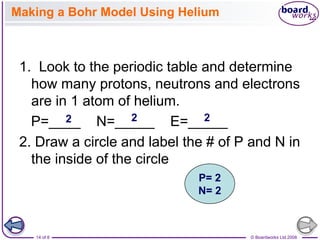
Making a Bohr Model Using Helium
1. Look to the periodic table and determine
how many protons, neutrons and electrons
are in 1 atom of helium.
P=____ N=_____ E=_____
2. Draw a circle and label the # of P and N in
the inside of the circle
P= 2
N= 2
2
2 2
© Boardworks Ltd 2008
15 of 8
Making a Bohr Model Using Helium
3. Draw your 1st electron shell.
4. Draw up to 2 electrons in the 1st shell.
5. If you need to add more electrons, you need to
add more electron shells! Remember…2, 8, 8!!!
P= 2
N= 2
P= 2
N= 2
© Boardworks Ltd 2008
16 of 8
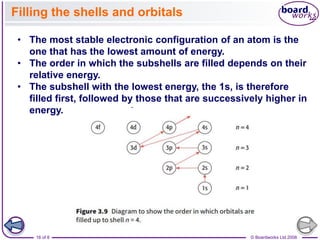
Filling the shells and orbitals
• The most stable electronic configuration of an atom is the
one that has the lowest amount of energy.
• The order in which the subshells are filled depends on their
relative energy.
• The subshell with the lowest energy, the 1s, is therefore
filled first, followed by those that are successively higher in
energy.
© Boardworks Ltd 2008
17 of 8
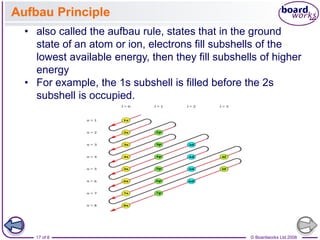
• also called the aufbau rule, states that in the ground
state of an atom or ion, electrons fill subshells of the
lowest available energy, then they fill subshells of higher
energy
• For example, the 1s subshell is filled before the 2s
subshell is occupied.
Aufbau Principle
© Boardworks Ltd 2008
18 of 8
Calculate electron configurations
© Boardworks Ltd 2008
19 of 8
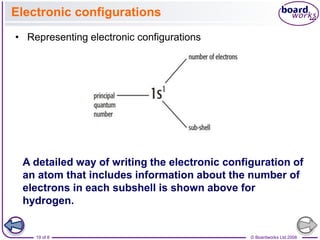
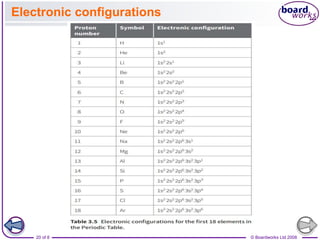
Electronic configurations
• Representing electronic configurations
A detailed way of writing the electronic configuration of
an atom that includes information about the number of
electrons in each subshell is shown above for
hydrogen.
© Boardworks Ltd 2008
20 of 8
Electronic configurations
© Boardworks Ltd 2008
21 of 8
Electronic configurations
• The electronic
configurations of some of
the elements after argon
are shown in Table 3.6.
• In this table part of the
electronic configuration of
each element is
represented by [Ar].
• This ‘noble gas core’
represents the electronic
configuration of argon:
1s2 2s2 2p6 3s2 3p6.
• This method is a
shorthand way of writing
electronic structures of
atoms with many
electrons.
© Boardworks Ltd 2008
22 of 8
Electronic configurations
■ Electronic configuration of potassium
 Potassium has the electronic structure 1s2 2s2 2p6 3s2 3p6
4s1. The outer electron goes into the 4s subshell rather than
the 3d subshell because the 4s is below the 3d in terms of its
energy
■ Filling the 3d subshell
 After calcium, a new subshell becomes occupied.
 The next electron goes into a 3d subshell rather than a 4p
subshell.
 So scandium has the electronic configuration [Ar] 3d1 4s2.
 This is because electrons occupy the orbitals with the lowest
energy – the 3d subshell is just above the 4s subshell but
below the 4p subshell.
 This begins a pattern of filling the 3d subshell ending with
zinc.
 Zinc has the electronic configuration [Ar] 3d10 4s2.
© Boardworks Ltd 2008
23 of 8
Electronic configurations
■ Chromium and copper
 The electronic configurations of chromium and copper do
not follow the expected pattern.
 Chromium has the electronic configuration [Ar]3d5 4s1
(rather than the expected [Ar]3d4 4s2).
 Copper has the electronic configuration [Ar]3d10 4s1 (rather
than the expected [Ar]3d9 4s2).
■ Gallium to krypton
 The electrons add to the 4p subshell because this is the next
highest energy level above the 3d.
© Boardworks Ltd 2008
24 of 8
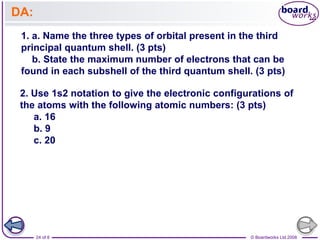
DA:
1. a. Name the three types of orbital present in the third
principal quantum shell. (3 pts)
b. State the maximum number of electrons that can be
found in each subshell of the third quantum shell. (3 pts)
2. Use 1s2 notation to give the electronic configurations of
the atoms with the following atomic numbers: (3 pts)
a. 16
b. 9
c. 20
© Boardworks Ltd 2008
25 of 8
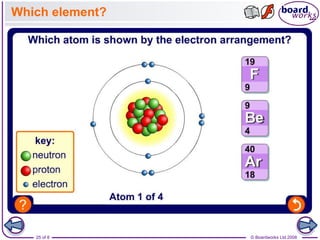
Which element?
© Boardworks Ltd 2008
26 of 8
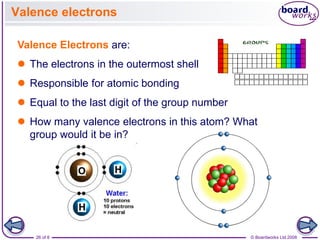
Valence Electrons are:
 The electrons in the outermost shell
 Responsible for atomic bonding
 Equal to the last digit of the group number
 How many valence electrons in this atom? What
group would it be in?
Valence electrons
© Boardworks Ltd 2008
27 of 8
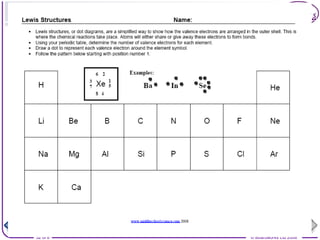
LEWIS (DOT) SYMBOLS FOR THE ELEMENTS
A Lewis dot structure for an atom consists of
the symbol for the element and one dot for
each valence electron.
© Boardworks Ltd 2008
28 of 8
1) Find your element on the periodic table.
2) Determine the number of valence
electrons by looking at the group
(column)
3) This is how many electrons you will draw.
© Boardworks Ltd 2008
29 of 8
1) Write the element
symbol.
2) Carbon is in the 14th
group, so it has 4
valence electrons.
3) Starting at the right,
draw 4 electrons, or
dots, counter-
clockwise around the
element symbol.
© Boardworks Ltd 2008
30 of 8
1) Check your work.
2) Using your periodic
table, check that
Carbon is in the 4th
group.
3) You should have 4
total electrons, or
dots, drawn in for
Carbon.
© Boardworks Ltd 2008
31 of 8
What would the Lewis Dot
Structure for Phosphorus
look like?
© Boardworks Ltd 2008
32 of 8
© Boardworks Ltd 2008
33 of 8
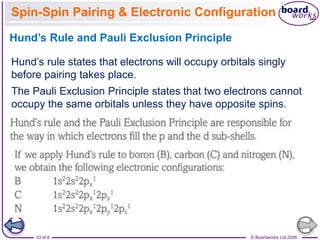
Spin-Spin Pairing & Electronic Configuration
Hund’s Rule and Pauli Exclusion Principle
Hund’s rule states that electrons will occupy orbitals singly
before pairing takes place.
The Pauli Exclusion Principle states that two electrons cannot
occupy the same orbitals unless they have opposite spins.
© Boardworks Ltd 2008
34 of 8
Spin-Spin Pairing & Electronic Configuration
© Boardworks Ltd 2008
35 of 8
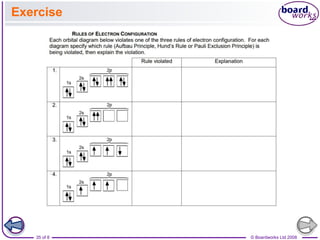
Exercise
© Boardworks Ltd 2008
36 of 8
Ions
• Ions
How do ions form?
© Boardworks Ltd 2008
37 of 8
Ions
•Positive and negative ions form when
electrons are transferred between atoms.
© Boardworks Ltd 2008
38 of 8
Ions
•Positive and negative ions form when
electrons are transferred between atoms.
© Boardworks Ltd 2008
39 of 8
Ions
• Some compounds are composed of
particles called ions.
– An ion is an atom or group of atoms that
has a positive or negative charge.
– A cation is an ion with a positive charge.
– An anion is an ion with a negative charge.
© Boardworks Ltd 2008
40 of 8
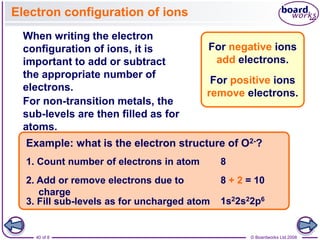
Electron configuration of ions
When writing the electron
configuration of ions, it is
important to add or subtract
the appropriate number of
electrons.
For negative ions
add electrons.
Example: what is the electron structure of O2-?
8
1. Count number of electrons in atom
1s22s22p6
3. Fill sub-levels as for uncharged atom
8 + 2 = 10
2. Add or remove electrons due to
charge
For positive ions
remove electrons.
For non-transition metals, the
sub-levels are then filled as for
atoms.
© Boardworks Ltd 2008
41 of 8
Electron configuration of ions
When writing the electron
configuration of ions, it is
important to add or subtract
the appropriate number of
electrons.
For negative ions
add electrons.
Example: what is the electron structure of Al3+?
13
1. Count number of electrons in atom
1s22s22p6
3. Fill sub-levels as for uncharged atom
13 - 3 = 10
2. Add or remove electrons due to
charge
For positive ions
remove electrons.
For non-transition metals, the
sub-levels are then filled as for
atoms.
© Boardworks Ltd 2008
42 of 8
When transition metals form ions, it is the 4s electrons
that are removed before the 3d electrons.
Example: what is the electron structure of Ni2+?
28
1. Count number of
electrons in atom
1s22s22p63s23p64s23d8
2. Fill sub-levels,
remembering 4s is filled
before 3d
1s22s22p63s23p63d8
4. Remove electrons starting
with 4s
Electronic configuration of transition metal ions
2
3. Count number of
electrons to be removed
© Boardworks Ltd 2008
43 of 8
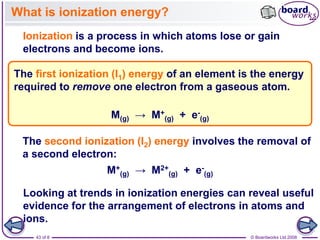
What is ionization energy?
Ionization is a process in which atoms lose or gain
electrons and become ions.
The first ionization (I1) energy of an element is the energy
required to remove one electron from a gaseous atom.
M(g) → M+
(g) + e-
(g)
Looking at trends in ionization energies can reveal useful
evidence for the arrangement of electrons in atoms and
ions.
The second ionization (I2) energy involves the removal of
a second electron:
M+
(g) → M2+
(g) + e-
(g)
© Boardworks Ltd 2008
44 of 8
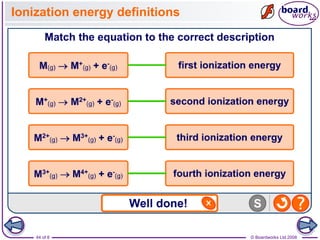
Ionization energy definitions
© Boardworks Ltd 2008
45 of 8
Plotting the successive ionization energies of
magnesium clearly shows the existence of different
energy levels, and the number of electrons at each
level.
Successive ionization
energies increase as more
electrons are removed.
Evidence for energy levels
Large jumps in the ionization
energy reveal where
electrons are being removed
from the next principal
energy level, such as
between the 2nd and 3rd, and
10th and 11th ionization
energies for magnesium.
electron removed
ionization
energy
2
3
4
5
6
© Boardworks Ltd 2008
46 of 8
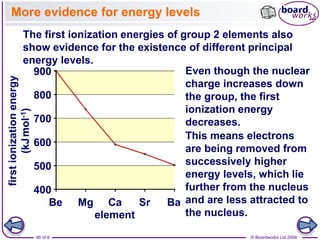
More evidence for energy levels
The first ionization energies of group 2 elements also
show evidence for the existence of different principal
energy levels.
Even though the nuclear
charge increases down
the group, the first
ionization energy
decreases.
element
first
ionization
energy
(kJ
mol
-1
)
500
600
700
800
900
Be Mg Ca Sr Ba
This means electrons
are being removed from
successively higher
energy levels, which lie
further from the nucleus
and are less attracted to
the nucleus.
400
© Boardworks Ltd 2008
47 of 8
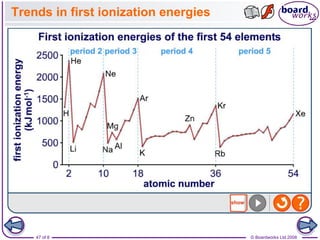
Trends in first ionization energies
© Boardworks Ltd 2008
48 of 8
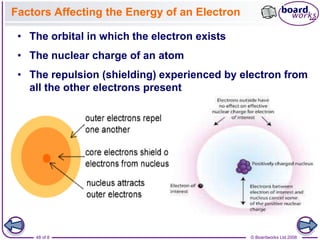
Factors Affecting the Energy of an Electron
• The orbital in which the electron exists
• The nuclear charge of an atom
• The repulsion (shielding) experienced by electron from
all the other electrons present
© Boardworks Ltd 2008
49 of 8
Trends in Ionization Energy
• Size of the nuclear charge
The nuclear charge increases with increasing atomic
number, which means that there are greater attractive
forces between the nucleus and electrons, so more
energy is required to overcome these attractive forces
when removing an electron
© Boardworks Ltd 2008
50 of 8
Trends in Ionization Energy
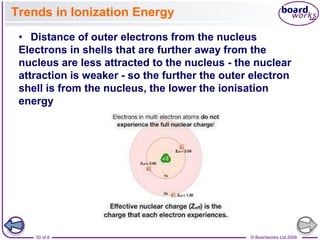
• Distance of outer electrons from the nucleus
Electrons in shells that are further away from the
nucleus are less attracted to the nucleus - the nuclear
attraction is weaker - so the further the outer electron
shell is from the nucleus, the lower the ionisation
energy
© Boardworks Ltd 2008
51 of 8
Trends in Ionization Energy
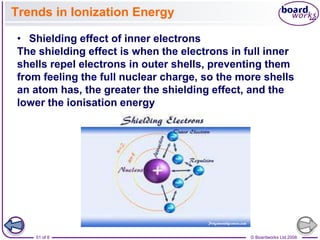
• Shielding effect of inner electrons
The shielding effect is when the electrons in full inner
shells repel electrons in outer shells, preventing them
from feeling the full nuclear charge, so the more shells
an atom has, the greater the shielding effect, and the
lower the ionisation energy
© Boardworks Ltd 2008
52 of 8
Trends in Ionization Energy
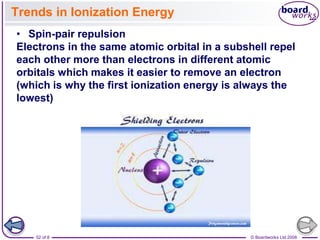
• Spin-pair repulsion
Electrons in the same atomic orbital in a subshell repel
each other more than electrons in different atomic
orbitals which makes it easier to remove an electron
(which is why the first ionization energy is always the
lowest)
© Boardworks Ltd 2008
53 of 8
Trends in Ionization Energy
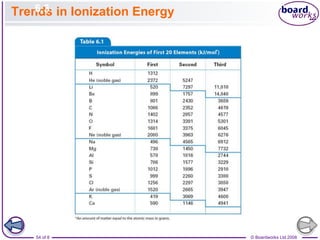
Group and Periodic Trends in Ionization Energy
• First ionization energy tends to increase from
bottom to top within a group and increase from left
to right across a period.
6.3
© Boardworks Ltd 2008
54 of 8
Trends in Ionization Energy
6.3
© Boardworks Ltd 2008
55 of 8
Trends in Ionization Energy
© Boardworks Ltd 2008
56 of 8
Ionisation energy across a period
The ionisation energy over a period increases due to the
following factors:
• Across a period the nuclear charge increases
• This causes the atomic radius of the atoms to decrease,
as the outer shell is pulled closer to the nucleus, so the
distance between the nucleus and the outer electrons
decreases
• The shielding by inner shell electrons remain reasonably
constant as electrons are being added to the same shell
• It becomes harder to remove an electron as you move
across a period; more energy is needed
• So, the ionisation energy increases
© Boardworks Ltd 2008
57 of 8
Ionisation energy across a period
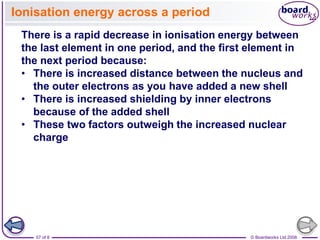
There is a rapid decrease in ionisation energy between
the last element in one period, and the first element in
the next period because:
• There is increased distance between the nucleus and
the outer electrons as you have added a new shell
• There is increased shielding by inner electrons
because of the added shell
• These two factors outweigh the increased nuclear
charge
© Boardworks Ltd 2008
58 of 8
Ionisation energy across a period
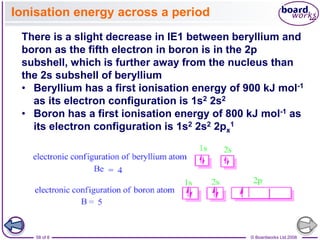
There is a slight decrease in IE1 between beryllium and
boron as the fifth electron in boron is in the 2p
subshell, which is further away from the nucleus than
the 2s subshell of beryllium
• Beryllium has a first ionisation energy of 900 kJ mol-1
as its electron configuration is 1s2 2s2
• Boron has a first ionisation energy of 800 kJ mol-1 as
its electron configuration is 1s2 2s2 2px
1
© Boardworks Ltd 2008
59 of 8
Ionisation energy across a period
There is a slight decrease in IE1 between nitrogen and
oxygen and phosphorus due to spin-pair repulsion in the
2px orbital of oxygen
• Nitrogen has a first ionisation energy of 1400 kJ mol-1
as its electron configuration is 1s2 2s2 2px
1 2py
1 2pz
1
• Oxygen has a first ionisation energy of 1310 kJ mol-1 as
its electron configuration is 1s2 2s2 2px
2 2py
1 2pz
1
© Boardworks Ltd 2008
60 of 8
Ionisation energy down a group
The ionisation energy down a group decreases due to the
following factors:
• The number of protons in the atom is increased, so the
nuclear charge increases
• But, the atomic radius of the atoms increases as you
are adding more shells of electrons, making the atoms
bigger
• So, the distance between the nucleus and outer electron
increases as you descend the group
• The shielding by inner shell electrons increases as
there are more shells of electrons
• These factors outweigh the increased nuclear charge,
meaning it becomes easier to remove the outer electron
as you descend a group
• So, the ionisation energy decreases
© Boardworks Ltd 2008
61 of 8
Ionisation energy trends across a period
& going down a group table
© Boardworks Ltd 2008
62 of 8
Trends in Ionization Energy
© Boardworks Ltd 2008
63 of 8
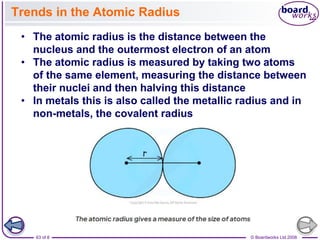
Trends in the Atomic Radius
• The atomic radius is the distance between the
nucleus and the outermost electron of an atom
• The atomic radius is measured by taking two atoms
of the same element, measuring the distance between
their nuclei and then halving this distance
• In metals this is also called the metallic radius and in
non-metals, the covalent radius
© Boardworks Ltd 2008
64 of 8
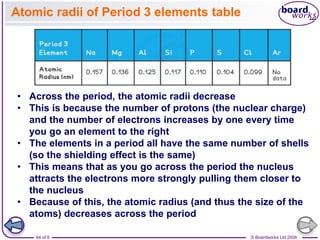
Atomic radii of Period 3 elements table
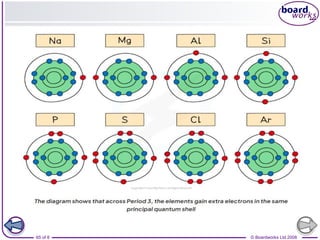
• Across the period, the atomic radii decrease
• This is because the number of protons (the nuclear charge)
and the number of electrons increases by one every time
you go an element to the right
• The elements in a period all have the same number of shells
(so the shielding effect is the same)
• This means that as you go across the period the nucleus
attracts the electrons more strongly pulling them closer to
the nucleus
• Because of this, the atomic radius (and thus the size of the
atoms) decreases across the period
© Boardworks Ltd 2008
65 of 8
© Boardworks Ltd 2008
66 of 8
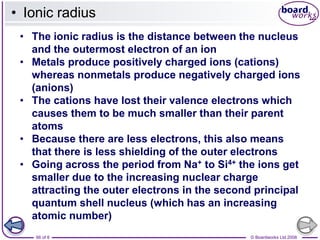
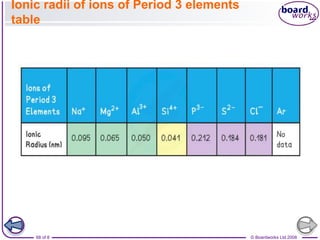
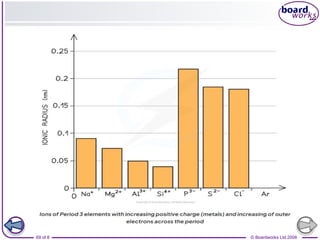
• Ionic radius
• The ionic radius is the distance between the nucleus
and the outermost electron of an ion
• Metals produce positively charged ions (cations)
whereas nonmetals produce negatively charged ions
(anions)
• The cations have lost their valence electrons which
causes them to be much smaller than their parent
atoms
• Because there are less electrons, this also means
that there is less shielding of the outer electrons
• Going across the period from Na+ to Si4+ the ions get
smaller due to the increasing nuclear charge
attracting the outer electrons in the second principal
quantum shell nucleus (which has an increasing
atomic number)
© Boardworks Ltd 2008
67 of 8
• Ionic radius
• The anions are larger than their original parent atoms
because each atom has gained one or more electrons
in their third principal quantum shell
• This increases the repulsion between electrons,
while the nuclear charge is still the same, causing the
electron cloud to spread out
• Going across P3- to Cl- the ionic radii decreases as
the nuclear charge increases across the period and
fewer electrons are gained by the atoms (P gains 3
electrons, S 2 electrons and Cl 1 electron)
© Boardworks Ltd 2008
68 of 8
Ionic radii of ions of Period 3 elements
table
© Boardworks Ltd 2008
69 of 8
© Boardworks Ltd 2008
70 of 8
© Boardworks Ltd 2008
71 of 8
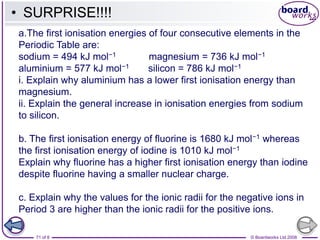
a.The first ionisation energies of four consecutive elements in the
Periodic Table are:
sodium = 494 kJ mol−1 magnesium = 736 kJ mol−1
aluminium = 577 kJ mol−1 silicon = 786 kJ mol−1
i. Explain why aluminium has a lower first ionisation energy than
magnesium.
ii. Explain the general increase in ionisation energies from sodium
to silicon.
b. The first ionisation energy of fluorine is 1680 kJ mol−1 whereas
the first ionisation energy of iodine is 1010 kJ mol−1
Explain why fluorine has a higher first ionisation energy than iodine
despite fluorine having a smaller nuclear charge.
c. Explain why the values for the ionic radii for the negative ions in
Period 3 are higher than the ionic radii for the positive ions.
• SURPRISE!!!!
© Boardworks Ltd 2008
72 of 8
a. i. The distance between the nucleus and the outer electrons
increases from Mg to Al. The shielding by inner shells increases.
These two factors outweigh the increased
nuclear charge.
ii. From sodium to silicon, the nuclear charge increases. The
distance between the nucleus and the outer electron remains
reasonably constant. The shielding by inner shells remains
reasonably constant. Ionisation energy increases to match
increase in attraction from the nucleus with an increased nuclear
charge.
• SURPRISE!!!! - Answer Key
b. The distance between the nucleus and the outer electron
increases from F to I. The shielding by inner shells increases.
These two factors outweigh the increased nuclear charge.
c. As there more electrons than a proton, the electrons repel
each other causing expansion in the size of an ion. Thus anion
has a larger size than its parent atom.

4Electron and Electron Configuration.pptx

  • 1.
    1 of 8© Boardworks Ltd 2008
  • 2.
    © Boardworks Ltd2008 2 of 8 The nucleus is:  made up of protons and neutrons  positively charged because of the protons  dense – it contains nearly all the mass of the atom in a tiny space. Electrons are:  very small and light, and negatively charged  able to be lost or gained in chemical reactions  found thinly spread around the outside of the nucleus, orbiting in layers called shells. Protons, neutrons and electrons
  • 3.
    © Boardworks Ltd2008 3 of 8 Protons, neutrons and electrons positively charge lost and gained in a reaction found thinly spread outside the nucleus dense, contains the mass of the atom
  • 4.
    © Boardworks Ltd2008 4 of 8 Quantum Shells
  • 5.
    © Boardworks Ltd2008 5 of 8 Electrons in the First Four Quantum Shell
  • 6.
    © Boardworks Ltd2008 6 of 8 s Orbitals
  • 7.
    © Boardworks Ltd2008 7 of 8 s Orbitals
  • 8.
    © Boardworks Ltd2008 8 of 8 p Orbitals
  • 9.
    © Boardworks Ltd2008 9 of 8 d Orbitals
  • 10.
    © Boardworks Ltd2008 10 of 8 Orbitals
  • 11.
    © Boardworks Ltd2008 11 of 8 How are electrons arranged? Electrons are not evenly spread, but exist in layers called shells. (The shells can also be called energy levels). The arrangement of electrons in these shells is often called the electron configuration. Note that this diagram is not drawn to scale – the atom is mostly empty space. If the electron shells are the size shown, the nucleus would be too small to see. 1st shell 2nd shell 3rd shell
  • 12.
    © Boardworks Ltd2008 12 of 8 How many electrons per shell? Each shell has a maximum number of electrons that it can hold. Electrons will fill the shells nearest the nucleus first. 1st shell holds a maximum of 2 electrons 2nd shell holds a maximum of 8 electrons 3rd shell holds a maximum of 8 electrons This electron arrangement is written as 2,8,8.
  • 13.
    © Boardworks Ltd2008 13 of 8 Bohr Models • Used to represent a model of an atom. • To draw a Bohr model follow these steps: (We will use Helium as an example)
  • 14.
    © Boardworks Ltd2008 14 of 8 Making a Bohr Model Using Helium 1. Look to the periodic table and determine how many protons, neutrons and electrons are in 1 atom of helium. P=____ N=_____ E=_____ 2. Draw a circle and label the # of P and N in the inside of the circle P= 2 N= 2 2 2 2
  • 15.
    © Boardworks Ltd2008 15 of 8 Making a Bohr Model Using Helium 3. Draw your 1st electron shell. 4. Draw up to 2 electrons in the 1st shell. 5. If you need to add more electrons, you need to add more electron shells! Remember…2, 8, 8!!! P= 2 N= 2 P= 2 N= 2
  • 16.
    © Boardworks Ltd2008 16 of 8 Filling the shells and orbitals • The most stable electronic configuration of an atom is the one that has the lowest amount of energy. • The order in which the subshells are filled depends on their relative energy. • The subshell with the lowest energy, the 1s, is therefore filled first, followed by those that are successively higher in energy.
  • 17.
    © Boardworks Ltd2008 17 of 8 • also called the aufbau rule, states that in the ground state of an atom or ion, electrons fill subshells of the lowest available energy, then they fill subshells of higher energy • For example, the 1s subshell is filled before the 2s subshell is occupied. Aufbau Principle
  • 18.
    © Boardworks Ltd2008 18 of 8 Calculate electron configurations
  • 19.
    © Boardworks Ltd2008 19 of 8 Electronic configurations • Representing electronic configurations A detailed way of writing the electronic configuration of an atom that includes information about the number of electrons in each subshell is shown above for hydrogen.
  • 20.
    © Boardworks Ltd2008 20 of 8 Electronic configurations
  • 21.
    © Boardworks Ltd2008 21 of 8 Electronic configurations • The electronic configurations of some of the elements after argon are shown in Table 3.6. • In this table part of the electronic configuration of each element is represented by [Ar]. • This ‘noble gas core’ represents the electronic configuration of argon: 1s2 2s2 2p6 3s2 3p6. • This method is a shorthand way of writing electronic structures of atoms with many electrons.
  • 22.
    © Boardworks Ltd2008 22 of 8 Electronic configurations ■ Electronic configuration of potassium  Potassium has the electronic structure 1s2 2s2 2p6 3s2 3p6 4s1. The outer electron goes into the 4s subshell rather than the 3d subshell because the 4s is below the 3d in terms of its energy ■ Filling the 3d subshell  After calcium, a new subshell becomes occupied.  The next electron goes into a 3d subshell rather than a 4p subshell.  So scandium has the electronic configuration [Ar] 3d1 4s2.  This is because electrons occupy the orbitals with the lowest energy – the 3d subshell is just above the 4s subshell but below the 4p subshell.  This begins a pattern of filling the 3d subshell ending with zinc.  Zinc has the electronic configuration [Ar] 3d10 4s2.
  • 23.
    © Boardworks Ltd2008 23 of 8 Electronic configurations ■ Chromium and copper  The electronic configurations of chromium and copper do not follow the expected pattern.  Chromium has the electronic configuration [Ar]3d5 4s1 (rather than the expected [Ar]3d4 4s2).  Copper has the electronic configuration [Ar]3d10 4s1 (rather than the expected [Ar]3d9 4s2). ■ Gallium to krypton  The electrons add to the 4p subshell because this is the next highest energy level above the 3d.
  • 24.
    © Boardworks Ltd2008 24 of 8 DA: 1. a. Name the three types of orbital present in the third principal quantum shell. (3 pts) b. State the maximum number of electrons that can be found in each subshell of the third quantum shell. (3 pts) 2. Use 1s2 notation to give the electronic configurations of the atoms with the following atomic numbers: (3 pts) a. 16 b. 9 c. 20
  • 25.
    © Boardworks Ltd2008 25 of 8 Which element?
  • 26.
    © Boardworks Ltd2008 26 of 8 Valence Electrons are:  The electrons in the outermost shell  Responsible for atomic bonding  Equal to the last digit of the group number  How many valence electrons in this atom? What group would it be in? Valence electrons
  • 27.
    © Boardworks Ltd2008 27 of 8 LEWIS (DOT) SYMBOLS FOR THE ELEMENTS A Lewis dot structure for an atom consists of the symbol for the element and one dot for each valence electron.
  • 28.
    © Boardworks Ltd2008 28 of 8 1) Find your element on the periodic table. 2) Determine the number of valence electrons by looking at the group (column) 3) This is how many electrons you will draw.
  • 29.
    © Boardworks Ltd2008 29 of 8 1) Write the element symbol. 2) Carbon is in the 14th group, so it has 4 valence electrons. 3) Starting at the right, draw 4 electrons, or dots, counter- clockwise around the element symbol.
  • 30.
    © Boardworks Ltd2008 30 of 8 1) Check your work. 2) Using your periodic table, check that Carbon is in the 4th group. 3) You should have 4 total electrons, or dots, drawn in for Carbon.
  • 31.
    © Boardworks Ltd2008 31 of 8 What would the Lewis Dot Structure for Phosphorus look like?
  • 32.
    © Boardworks Ltd2008 32 of 8
  • 33.
    © Boardworks Ltd2008 33 of 8 Spin-Spin Pairing & Electronic Configuration Hund’s Rule and Pauli Exclusion Principle Hund’s rule states that electrons will occupy orbitals singly before pairing takes place. The Pauli Exclusion Principle states that two electrons cannot occupy the same orbitals unless they have opposite spins.
  • 34.
    © Boardworks Ltd2008 34 of 8 Spin-Spin Pairing & Electronic Configuration
  • 35.
    © Boardworks Ltd2008 35 of 8 Exercise
  • 36.
    © Boardworks Ltd2008 36 of 8 Ions • Ions How do ions form?
  • 37.
    © Boardworks Ltd2008 37 of 8 Ions •Positive and negative ions form when electrons are transferred between atoms.
  • 38.
    © Boardworks Ltd2008 38 of 8 Ions •Positive and negative ions form when electrons are transferred between atoms.
  • 39.
    © Boardworks Ltd2008 39 of 8 Ions • Some compounds are composed of particles called ions. – An ion is an atom or group of atoms that has a positive or negative charge. – A cation is an ion with a positive charge. – An anion is an ion with a negative charge.
  • 40.
    © Boardworks Ltd2008 40 of 8 Electron configuration of ions When writing the electron configuration of ions, it is important to add or subtract the appropriate number of electrons. For negative ions add electrons. Example: what is the electron structure of O2-? 8 1. Count number of electrons in atom 1s22s22p6 3. Fill sub-levels as for uncharged atom 8 + 2 = 10 2. Add or remove electrons due to charge For positive ions remove electrons. For non-transition metals, the sub-levels are then filled as for atoms.
  • 41.
    © Boardworks Ltd2008 41 of 8 Electron configuration of ions When writing the electron configuration of ions, it is important to add or subtract the appropriate number of electrons. For negative ions add electrons. Example: what is the electron structure of Al3+? 13 1. Count number of electrons in atom 1s22s22p6 3. Fill sub-levels as for uncharged atom 13 - 3 = 10 2. Add or remove electrons due to charge For positive ions remove electrons. For non-transition metals, the sub-levels are then filled as for atoms.
  • 42.
    © Boardworks Ltd2008 42 of 8 When transition metals form ions, it is the 4s electrons that are removed before the 3d electrons. Example: what is the electron structure of Ni2+? 28 1. Count number of electrons in atom 1s22s22p63s23p64s23d8 2. Fill sub-levels, remembering 4s is filled before 3d 1s22s22p63s23p63d8 4. Remove electrons starting with 4s Electronic configuration of transition metal ions 2 3. Count number of electrons to be removed
  • 43.
    © Boardworks Ltd2008 43 of 8 What is ionization energy? Ionization is a process in which atoms lose or gain electrons and become ions. The first ionization (I1) energy of an element is the energy required to remove one electron from a gaseous atom. M(g) → M+ (g) + e- (g) Looking at trends in ionization energies can reveal useful evidence for the arrangement of electrons in atoms and ions. The second ionization (I2) energy involves the removal of a second electron: M+ (g) → M2+ (g) + e- (g)
  • 44.
    © Boardworks Ltd2008 44 of 8 Ionization energy definitions
  • 45.
    © Boardworks Ltd2008 45 of 8 Plotting the successive ionization energies of magnesium clearly shows the existence of different energy levels, and the number of electrons at each level. Successive ionization energies increase as more electrons are removed. Evidence for energy levels Large jumps in the ionization energy reveal where electrons are being removed from the next principal energy level, such as between the 2nd and 3rd, and 10th and 11th ionization energies for magnesium. electron removed ionization energy 2 3 4 5 6
  • 46.
    © Boardworks Ltd2008 46 of 8 More evidence for energy levels The first ionization energies of group 2 elements also show evidence for the existence of different principal energy levels. Even though the nuclear charge increases down the group, the first ionization energy decreases. element first ionization energy (kJ mol -1 ) 500 600 700 800 900 Be Mg Ca Sr Ba This means electrons are being removed from successively higher energy levels, which lie further from the nucleus and are less attracted to the nucleus. 400
  • 47.
    © Boardworks Ltd2008 47 of 8 Trends in first ionization energies
  • 48.
    © Boardworks Ltd2008 48 of 8 Factors Affecting the Energy of an Electron • The orbital in which the electron exists • The nuclear charge of an atom • The repulsion (shielding) experienced by electron from all the other electrons present
  • 49.
    © Boardworks Ltd2008 49 of 8 Trends in Ionization Energy • Size of the nuclear charge The nuclear charge increases with increasing atomic number, which means that there are greater attractive forces between the nucleus and electrons, so more energy is required to overcome these attractive forces when removing an electron
  • 50.
    © Boardworks Ltd2008 50 of 8 Trends in Ionization Energy • Distance of outer electrons from the nucleus Electrons in shells that are further away from the nucleus are less attracted to the nucleus - the nuclear attraction is weaker - so the further the outer electron shell is from the nucleus, the lower the ionisation energy
  • 51.
    © Boardworks Ltd2008 51 of 8 Trends in Ionization Energy • Shielding effect of inner electrons The shielding effect is when the electrons in full inner shells repel electrons in outer shells, preventing them from feeling the full nuclear charge, so the more shells an atom has, the greater the shielding effect, and the lower the ionisation energy
  • 52.
    © Boardworks Ltd2008 52 of 8 Trends in Ionization Energy • Spin-pair repulsion Electrons in the same atomic orbital in a subshell repel each other more than electrons in different atomic orbitals which makes it easier to remove an electron (which is why the first ionization energy is always the lowest)
  • 53.
    © Boardworks Ltd2008 53 of 8 Trends in Ionization Energy Group and Periodic Trends in Ionization Energy • First ionization energy tends to increase from bottom to top within a group and increase from left to right across a period. 6.3
  • 54.
    © Boardworks Ltd2008 54 of 8 Trends in Ionization Energy 6.3
  • 55.
    © Boardworks Ltd2008 55 of 8 Trends in Ionization Energy
  • 56.
    © Boardworks Ltd2008 56 of 8 Ionisation energy across a period The ionisation energy over a period increases due to the following factors: • Across a period the nuclear charge increases • This causes the atomic radius of the atoms to decrease, as the outer shell is pulled closer to the nucleus, so the distance between the nucleus and the outer electrons decreases • The shielding by inner shell electrons remain reasonably constant as electrons are being added to the same shell • It becomes harder to remove an electron as you move across a period; more energy is needed • So, the ionisation energy increases
  • 57.
    © Boardworks Ltd2008 57 of 8 Ionisation energy across a period There is a rapid decrease in ionisation energy between the last element in one period, and the first element in the next period because: • There is increased distance between the nucleus and the outer electrons as you have added a new shell • There is increased shielding by inner electrons because of the added shell • These two factors outweigh the increased nuclear charge
  • 58.
    © Boardworks Ltd2008 58 of 8 Ionisation energy across a period There is a slight decrease in IE1 between beryllium and boron as the fifth electron in boron is in the 2p subshell, which is further away from the nucleus than the 2s subshell of beryllium • Beryllium has a first ionisation energy of 900 kJ mol-1 as its electron configuration is 1s2 2s2 • Boron has a first ionisation energy of 800 kJ mol-1 as its electron configuration is 1s2 2s2 2px 1
  • 59.
    © Boardworks Ltd2008 59 of 8 Ionisation energy across a period There is a slight decrease in IE1 between nitrogen and oxygen and phosphorus due to spin-pair repulsion in the 2px orbital of oxygen • Nitrogen has a first ionisation energy of 1400 kJ mol-1 as its electron configuration is 1s2 2s2 2px 1 2py 1 2pz 1 • Oxygen has a first ionisation energy of 1310 kJ mol-1 as its electron configuration is 1s2 2s2 2px 2 2py 1 2pz 1
  • 60.
    © Boardworks Ltd2008 60 of 8 Ionisation energy down a group The ionisation energy down a group decreases due to the following factors: • The number of protons in the atom is increased, so the nuclear charge increases • But, the atomic radius of the atoms increases as you are adding more shells of electrons, making the atoms bigger • So, the distance between the nucleus and outer electron increases as you descend the group • The shielding by inner shell electrons increases as there are more shells of electrons • These factors outweigh the increased nuclear charge, meaning it becomes easier to remove the outer electron as you descend a group • So, the ionisation energy decreases
  • 61.
    © Boardworks Ltd2008 61 of 8 Ionisation energy trends across a period & going down a group table
  • 62.
    © Boardworks Ltd2008 62 of 8 Trends in Ionization Energy
  • 63.
    © Boardworks Ltd2008 63 of 8 Trends in the Atomic Radius • The atomic radius is the distance between the nucleus and the outermost electron of an atom • The atomic radius is measured by taking two atoms of the same element, measuring the distance between their nuclei and then halving this distance • In metals this is also called the metallic radius and in non-metals, the covalent radius
  • 64.
    © Boardworks Ltd2008 64 of 8 Atomic radii of Period 3 elements table • Across the period, the atomic radii decrease • This is because the number of protons (the nuclear charge) and the number of electrons increases by one every time you go an element to the right • The elements in a period all have the same number of shells (so the shielding effect is the same) • This means that as you go across the period the nucleus attracts the electrons more strongly pulling them closer to the nucleus • Because of this, the atomic radius (and thus the size of the atoms) decreases across the period
  • 65.
    © Boardworks Ltd2008 65 of 8
  • 66.
    © Boardworks Ltd2008 66 of 8 • Ionic radius • The ionic radius is the distance between the nucleus and the outermost electron of an ion • Metals produce positively charged ions (cations) whereas nonmetals produce negatively charged ions (anions) • The cations have lost their valence electrons which causes them to be much smaller than their parent atoms • Because there are less electrons, this also means that there is less shielding of the outer electrons • Going across the period from Na+ to Si4+ the ions get smaller due to the increasing nuclear charge attracting the outer electrons in the second principal quantum shell nucleus (which has an increasing atomic number)
  • 67.
    © Boardworks Ltd2008 67 of 8 • Ionic radius • The anions are larger than their original parent atoms because each atom has gained one or more electrons in their third principal quantum shell • This increases the repulsion between electrons, while the nuclear charge is still the same, causing the electron cloud to spread out • Going across P3- to Cl- the ionic radii decreases as the nuclear charge increases across the period and fewer electrons are gained by the atoms (P gains 3 electrons, S 2 electrons and Cl 1 electron)
  • 68.
    © Boardworks Ltd2008 68 of 8 Ionic radii of ions of Period 3 elements table
  • 69.
    © Boardworks Ltd2008 69 of 8
  • 70.
    © Boardworks Ltd2008 70 of 8
  • 71.
    © Boardworks Ltd2008 71 of 8 a.The first ionisation energies of four consecutive elements in the Periodic Table are: sodium = 494 kJ mol−1 magnesium = 736 kJ mol−1 aluminium = 577 kJ mol−1 silicon = 786 kJ mol−1 i. Explain why aluminium has a lower first ionisation energy than magnesium. ii. Explain the general increase in ionisation energies from sodium to silicon. b. The first ionisation energy of fluorine is 1680 kJ mol−1 whereas the first ionisation energy of iodine is 1010 kJ mol−1 Explain why fluorine has a higher first ionisation energy than iodine despite fluorine having a smaller nuclear charge. c. Explain why the values for the ionic radii for the negative ions in Period 3 are higher than the ionic radii for the positive ions. • SURPRISE!!!!
  • 72.
    © Boardworks Ltd2008 72 of 8 a. i. The distance between the nucleus and the outer electrons increases from Mg to Al. The shielding by inner shells increases. These two factors outweigh the increased nuclear charge. ii. From sodium to silicon, the nuclear charge increases. The distance between the nucleus and the outer electron remains reasonably constant. The shielding by inner shells remains reasonably constant. Ionisation energy increases to match increase in attraction from the nucleus with an increased nuclear charge. • SURPRISE!!!! - Answer Key b. The distance between the nucleus and the outer electron increases from F to I. The shielding by inner shells increases. These two factors outweigh the increased nuclear charge. c. As there more electrons than a proton, the electrons repel each other causing expansion in the size of an ion. Thus anion has a larger size than its parent atom.