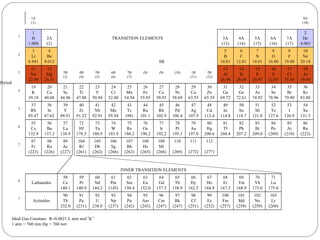
OBE H. Chemistry  2/9/11 What did Rutherford discover about the atom that changed the old atomic model? Who is “most responsible for the current model of the atom?
 
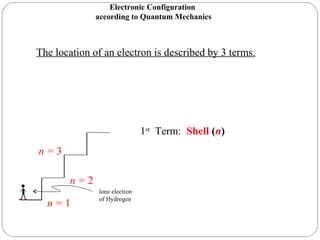
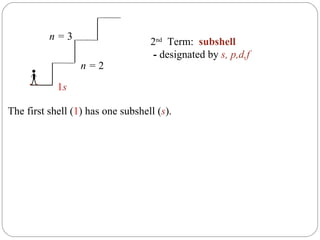
Electronic Configuration  according to Quantum Mechanics The location of an electron is described by 3 terms. 1 st   Term:  Shell  ( n ) n =  1 n =  2 n =  3 lone electron of Hydrogen
 
2 nd   Term:  subshell -  designated by  s, p,d,f   1 s n =  2 n =  3 The first shell ( 1 ) has one subshell ( s ).
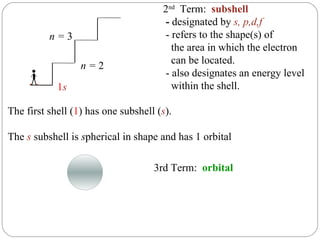
2 nd   Term:  subshell -  designated by  s, p,d,f   - refers to the shape(s) of the area in which the electron can be located. - also designates an energy level within the shell. 1 s n =  2 n =  3 The first shell ( 1 ) has one subshell ( s ). The  s  subshell is  s pherical in shape and has 1 orbital 3rd Term:  orbital
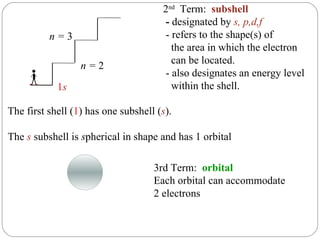
2 nd   Term:  subshell -  designated by  s, p,d,f   - refers to the shape(s) of the area in which the electron can be located. - also designates an energy level within the shell. 1 s n =  2 n =  3 The first shell ( 1 ) has one subshell ( s ). The  s  subshell is  s pherical in shape and has 1 orbital 3rd Term:  orbital Each orbital can accommodate 2 electrons
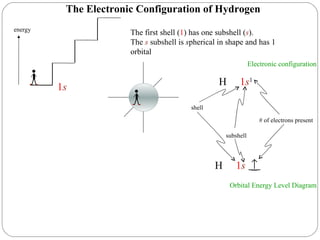
The Electronic Configuration of Hydrogen 1 s The first shell ( 1 ) has one subshell ( s ). The  s  subshell is  s pherical in shape and has 1 orbital H  1 s 1 shell subshell # of electrons present energy H  1 s      Electronic configuration Orbital Energy Level Diagram
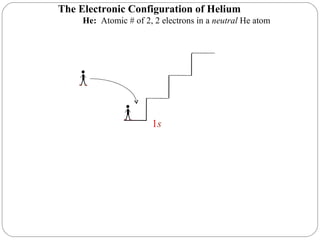
The Electronic Configuration of Helium  He:  Atomic # of 2, 2 electrons in a  neutral  He atom 1 s
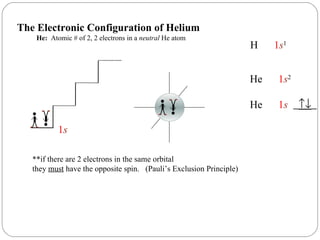
The Electronic Configuration of Helium  He:  Atomic # of 2, 2 electrons in a  neutral  He atom H  1 s 1 He  1 s 2 He  1 s     1 s **if there are 2 electrons in the same orbital they  must  have the opposite spin.  (Pauli’s Exclusion Principle)
 
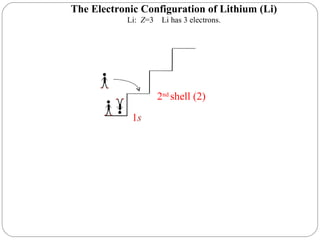
1 s The Electronic Configuration of Lithium (Li) Li:  Z =3  Li has 3 electrons. 2 nd   shell (2)
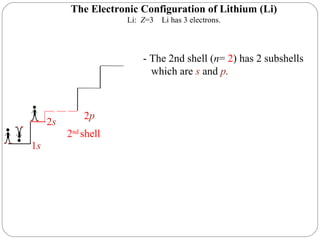
1 s The Electronic Configuration of Lithium (Li) Li:  Z =3  Li has 3 electrons. 2 nd   shell - The 2nd shell ( n =  2 ) has 2 subshells which are  s  and  p . 2 s 2 p
1 s The Electronic Configuration of Lithium (Li) Li:  Z =3  Li has 3 electrons. 2 nd   shell 2 s 2 p Li  1 s 2 2 s 1 2 s      Li  1 s    Electronic configuration Orbital Energy Level Diagram
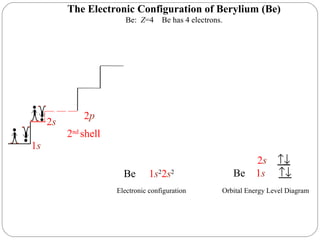
1 s The Electronic Configuration of Berylium (Be) Be:  Z =4  Be has 4 electrons. 2 nd   shell 2 s 2 p Be  1 s 2 2 s 2 2 s      Be  1 s    Electronic configuration Orbital Energy Level Diagram 
 
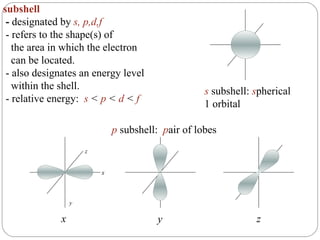
subshell -  designated by  s, p,d,f   - refers to the shape(s) of the area in which the electron can be located. - also designates an energy level within the shell. - relative energy:  s  <  p  <  d  <  f s  subshell:  s pherical 1 orbital p  subshell:  p air of lobes x y z x y z
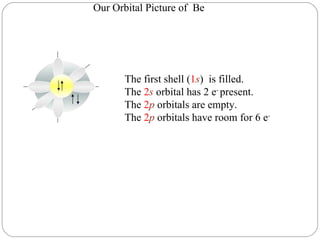
Our Orbital Picture of  Be The first shell ( 1 s )  is filled. The  2 s  orbital has 2 e -  present. The  2 p  orbitals are empty. The  2 p  orbitals have room for 6 e -
 
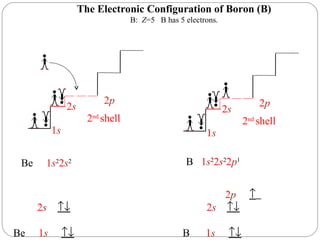
1 s The Electronic Configuration of Boron (B) B:  Z =5  B has 5 electrons. 2 nd   shell 2 s 2 p 1 s 2 nd   shell 2 s 2 p Be  1 s 2 2 s 2 2 s    Be  1 s    B  1 s 2 2 s 2 2 p 1 2 p        2 s    B  1 s   
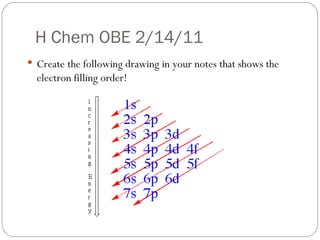
H Chem OBE 2/14/11 Create the following drawing in your notes that shows the electron filling order!
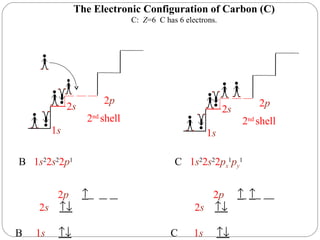
1 s The Electronic Configuration of Carbon (C) C:  Z =6  C has 6 electrons. 2 nd   shell 2 s 2 p 1 s 2 nd   shell 2 s 2 p B  1 s 2 2 s 2 2 p 1 2 p        2 s    B  1 s    C  1 s 2 2 s 2 2 p x 1 p y 1 2 p           2 s    C  1 s   
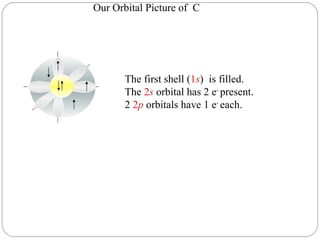
Our Orbital Picture of  C The first shell ( 1 s )  is filled. The  2 s  orbital has 2 e -  present. 2  2 p  orbitals have 1 e -  each.
 
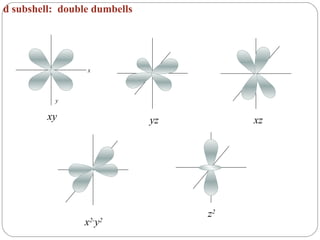
d subshell:  double dumbells xy z 2 xz x y yz x 2- y 2
 
 
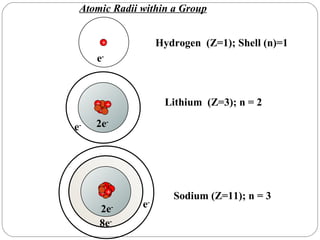
Atomic Radii within a Group Lithium  (Z=3); n = 2 Sodium (Z=11); n = 3 Hydrogen  (Z=1); Shell (n)=1 + + + e - 2e - 8e - 2e - + + + + e - + e -
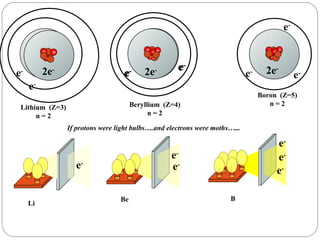
Lithium  (Z=3) n = 2 Beryllium  (Z=4) n = 2 Boron  (Z=5) n = 2 If protons were light bulbs….and electrons were moths…... + + + e - 2e - + + + e - 2e - e - + + + + e - 2e - e - e - + + B e - e - e - Be e - e - Li e - + + + e - 2e - + + + e - 2e - e - +
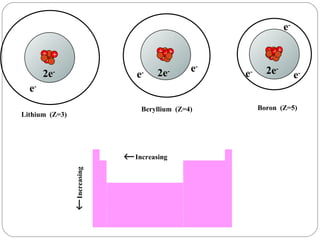
Lithium  (Z=3) Beryllium  (Z=4) Boron  (Z=5)  Increasing  Increasing + + + e - 2e - + + + e - 2e - e - + + + + e - 2e - e - e - + +
 
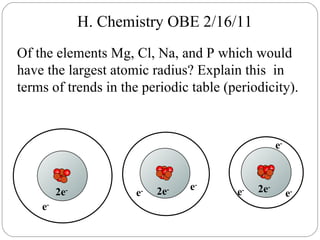
H. Chemistry OBE 2/16/11 Of the elements Mg, Cl, Na, and P which would have the largest atomic radius? Explain this  in terms of trends in the periodic table (periodicity). + + + e - 2e - + + + e - 2e - e - + + + + e - 2e - e - e - + +
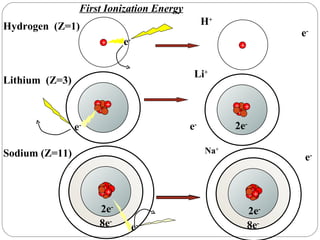
First Ionization Energy Lithium  (Z=3) Sodium (Z=11) Hydrogen  (Z=1) + e - + + + e - 8e - 2e - + + + + e - + e - H + + + + e - 2e - Li + e - 8e - 2e - + + + + Na +
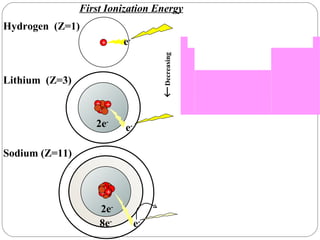
First Ionization Energy e - Lithium  (Z=3) 8e - Sodium (Z=11) 2e - 2e - e - Hydrogen  (Z=1) e -  Decreasing + + + + + + + +
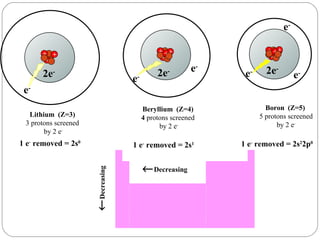
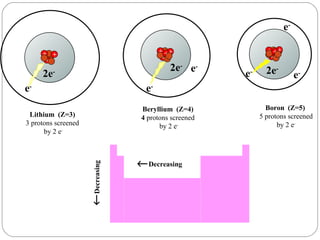
Lithium  (Z=3) 3 protons screened by 2 e - e - 2e - Beryllium  (Z=4) 4  protons screened by 2 e - Boron  (Z=5) 5 protons screened by 2 e - e - 2e - e - e - 2e - e - e - 1 e -  removed = 2s 0 1 e -  removed = 2s 1 1 e -  removed = 2s 2 2p 0 + + + + + + + + + + + +  Decreasing  Decreasing
Lithium  (Z=3) 3 protons screened by 2 e - e - 2e - Beryllium  (Z=4) 4  protons screened by 2 e - Boron  (Z=5) 5 protons screened by 2 e - e - 2e - e -  Decreasing  Decreasing + + + + + + + + + + e - 2e - e - e - + +
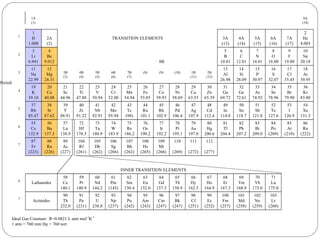
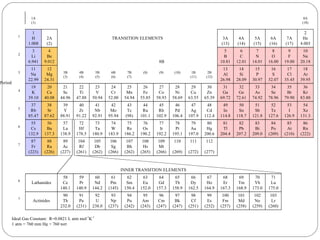
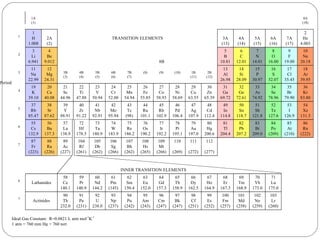
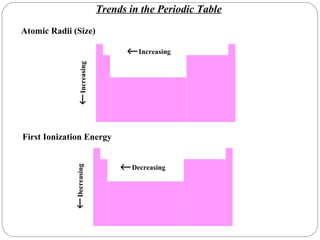
 Increasing  Increasing Trends in the Periodic Table Atomic Radii (Size) First Ionization Energy  Decreasing  Decreasing
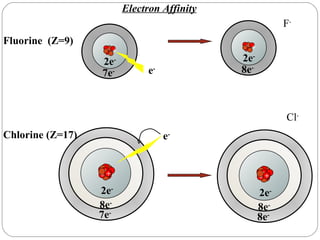
Electron Affinity e - Fluorine  (Z=9) 8e - Chlorine (Z=17) 2e - 2e - 7e - 7e - 2e - 8e - F - e - 8e - 2e - 8e - Cl - + + + + + + + + + + + + + +
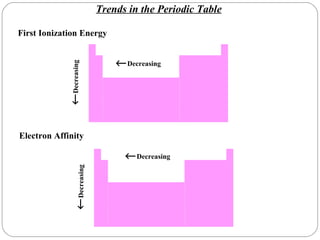
Trends in the Periodic Table First Ionization Energy  Decreasing  Decreasing  Decreasing  Decreasing Electron Affinity
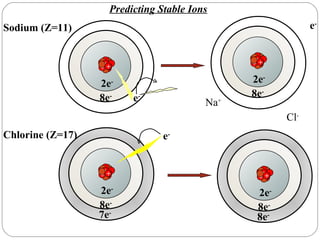
Predicting Stable Ions 8e - Sodium (Z=11) 2e - e - e - 8e - 2e - Na + 8e - Chlorine (Z=17) 2e - 7e - e - 8e - 2e - 8e - Cl - + + + + + + + + + + + + + + + +

Electronconfig

  • 1.
    OBE H. Chemistry 2/9/11 What did Rutherford discover about the atom that changed the old atomic model? Who is “most responsible for the current model of the atom?
  • 2.
  • 3.
    Electronic Configuration according to Quantum Mechanics The location of an electron is described by 3 terms. 1 st Term: Shell ( n ) n = 1 n = 2 n = 3 lone electron of Hydrogen
  • 4.
  • 5.
    2 nd Term: subshell - designated by s, p,d,f 1 s n = 2 n = 3 The first shell ( 1 ) has one subshell ( s ).
  • 6.
    2 nd Term: subshell - designated by s, p,d,f - refers to the shape(s) of the area in which the electron can be located. - also designates an energy level within the shell. 1 s n = 2 n = 3 The first shell ( 1 ) has one subshell ( s ). The s subshell is s pherical in shape and has 1 orbital 3rd Term: orbital
  • 7.
    2 nd Term: subshell - designated by s, p,d,f - refers to the shape(s) of the area in which the electron can be located. - also designates an energy level within the shell. 1 s n = 2 n = 3 The first shell ( 1 ) has one subshell ( s ). The s subshell is s pherical in shape and has 1 orbital 3rd Term: orbital Each orbital can accommodate 2 electrons
  • 8.
    The Electronic Configurationof Hydrogen 1 s The first shell ( 1 ) has one subshell ( s ). The s subshell is s pherical in shape and has 1 orbital H 1 s 1 shell subshell # of electrons present energy H 1 s  Electronic configuration Orbital Energy Level Diagram
  • 9.
    The Electronic Configurationof Helium He: Atomic # of 2, 2 electrons in a neutral He atom 1 s
  • 10.
    The Electronic Configurationof Helium He: Atomic # of 2, 2 electrons in a neutral He atom H 1 s 1 He 1 s 2 He 1 s  1 s **if there are 2 electrons in the same orbital they must have the opposite spin. (Pauli’s Exclusion Principle)
  • 11.
  • 12.
    1 s TheElectronic Configuration of Lithium (Li) Li: Z =3 Li has 3 electrons. 2 nd shell (2)
  • 13.
    1 s TheElectronic Configuration of Lithium (Li) Li: Z =3 Li has 3 electrons. 2 nd shell - The 2nd shell ( n = 2 ) has 2 subshells which are s and p . 2 s 2 p
  • 14.
    1 s TheElectronic Configuration of Lithium (Li) Li: Z =3 Li has 3 electrons. 2 nd shell 2 s 2 p Li 1 s 2 2 s 1 2 s  Li 1 s  Electronic configuration Orbital Energy Level Diagram
  • 15.
    1 s TheElectronic Configuration of Berylium (Be) Be: Z =4 Be has 4 electrons. 2 nd shell 2 s 2 p Be 1 s 2 2 s 2 2 s  Be 1 s  Electronic configuration Orbital Energy Level Diagram 
  • 16.
  • 17.
    subshell - designated by s, p,d,f - refers to the shape(s) of the area in which the electron can be located. - also designates an energy level within the shell. - relative energy: s < p < d < f s subshell: s pherical 1 orbital p subshell: p air of lobes x y z x y z
  • 18.
    Our Orbital Pictureof Be The first shell ( 1 s ) is filled. The 2 s orbital has 2 e - present. The 2 p orbitals are empty. The 2 p orbitals have room for 6 e -
  • 19.
  • 20.
    1 s TheElectronic Configuration of Boron (B) B: Z =5 B has 5 electrons. 2 nd shell 2 s 2 p 1 s 2 nd shell 2 s 2 p Be 1 s 2 2 s 2 2 s  Be 1 s  B 1 s 2 2 s 2 2 p 1 2 p  2 s  B 1 s 
  • 21.
    H Chem OBE2/14/11 Create the following drawing in your notes that shows the electron filling order!
  • 22.
    1 s TheElectronic Configuration of Carbon (C) C: Z =6 C has 6 electrons. 2 nd shell 2 s 2 p 1 s 2 nd shell 2 s 2 p B 1 s 2 2 s 2 2 p 1 2 p  2 s  B 1 s  C 1 s 2 2 s 2 2 p x 1 p y 1 2 p   2 s  C 1 s 
  • 23.
    Our Orbital Pictureof C The first shell ( 1 s ) is filled. The 2 s orbital has 2 e - present. 2 2 p orbitals have 1 e - each.
  • 24.
  • 25.
    d subshell: double dumbells xy z 2 xz x y yz x 2- y 2
  • 26.
  • 27.
  • 28.
    Atomic Radii withina Group Lithium (Z=3); n = 2 Sodium (Z=11); n = 3 Hydrogen (Z=1); Shell (n)=1 + + + e - 2e - 8e - 2e - + + + + e - + e -
  • 29.
    Lithium (Z=3)n = 2 Beryllium (Z=4) n = 2 Boron (Z=5) n = 2 If protons were light bulbs….and electrons were moths…... + + + e - 2e - + + + e - 2e - e - + + + + e - 2e - e - e - + + B e - e - e - Be e - e - Li e - + + + e - 2e - + + + e - 2e - e - +
  • 30.
    Lithium (Z=3)Beryllium (Z=4) Boron (Z=5)  Increasing  Increasing + + + e - 2e - + + + e - 2e - e - + + + + e - 2e - e - e - + +
  • 31.
  • 32.
    H. Chemistry OBE2/16/11 Of the elements Mg, Cl, Na, and P which would have the largest atomic radius? Explain this in terms of trends in the periodic table (periodicity). + + + e - 2e - + + + e - 2e - e - + + + + e - 2e - e - e - + +
  • 33.
    First Ionization EnergyLithium (Z=3) Sodium (Z=11) Hydrogen (Z=1) + e - + + + e - 8e - 2e - + + + + e - + e - H + + + + e - 2e - Li + e - 8e - 2e - + + + + Na +
  • 34.
    First Ionization Energye - Lithium (Z=3) 8e - Sodium (Z=11) 2e - 2e - e - Hydrogen (Z=1) e -  Decreasing + + + + + + + +
  • 35.
    Lithium (Z=3)3 protons screened by 2 e - e - 2e - Beryllium (Z=4) 4 protons screened by 2 e - Boron (Z=5) 5 protons screened by 2 e - e - 2e - e - e - 2e - e - e - 1 e - removed = 2s 0 1 e - removed = 2s 1 1 e - removed = 2s 2 2p 0 + + + + + + + + + + + +  Decreasing  Decreasing
  • 36.
    Lithium (Z=3)3 protons screened by 2 e - e - 2e - Beryllium (Z=4) 4 protons screened by 2 e - Boron (Z=5) 5 protons screened by 2 e - e - 2e - e -  Decreasing  Decreasing + + + + + + + + + + e - 2e - e - e - + +
  • 37.
     Increasing Increasing Trends in the Periodic Table Atomic Radii (Size) First Ionization Energy  Decreasing  Decreasing
  • 38.
    Electron Affinity e- Fluorine (Z=9) 8e - Chlorine (Z=17) 2e - 2e - 7e - 7e - 2e - 8e - F - e - 8e - 2e - 8e - Cl - + + + + + + + + + + + + + +
  • 39.
    Trends in thePeriodic Table First Ionization Energy  Decreasing  Decreasing  Decreasing  Decreasing Electron Affinity
  • 40.
    Predicting Stable Ions8e - Sodium (Z=11) 2e - e - e - 8e - 2e - Na + 8e - Chlorine (Z=17) 2e - 7e - e - 8e - 2e - 8e - Cl - + + + + + + + + + + + + + + + +