What is a standardized test?
 any form of test that requires all test
takers to answer the same questions, or a
selection of questions from common bank
of questions
 scored in a “standard” or consistent
manner
What is a standardized test?
 primarily associated with large-scale
tests administered to sizeable
populations of students, such as a
multiple-choice test
 include true-false questions, short-
answer questions, essay questions, or a
mix of question types
Two types of standardized test
 Norm-referenced tests compare an
individual's performance with the
performance of others.
 Criterion-referenced tests compare a
person's performance to a set of
objectives. Anyone who meets the
criterion can get a high score.
Advantages
 A ready-made test
 Administration to large groups can be
accomplished
 Scoring procedures are streamlined
 Assessment of an individual's mastery
of a domain of knowledge or skill
Disadvantages
 Inappropriate use of test
(using an overall proficiency test as an
achievement test)
 Teachers only “teach the tests”
 Misconception that students and kids
with learning disabilities perform poorly
in standardized tests
Forms of Standardized Test
 Achievement Tests designed to
measure the knowledge and skills
students learned in school or to
determine the academic progress they
have made over a period of time.
 Aptitude tests attempt to predict a
student’s ability to succeed in an
intellectual or physical endeavor.
Forms of Standardized Test
 College-admissions tests are used in
the process of deciding which students
will be admitted to a collegiate program.
 Psychological tests, including IQ tests,
are used to measure a person’s
cognitive abilities and mental, emotional,
developmental, and social
characteristics.
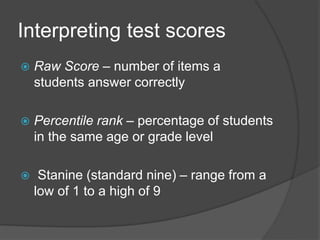
Interpreting test scores
 Raw Score – number of items a
students answer correctly
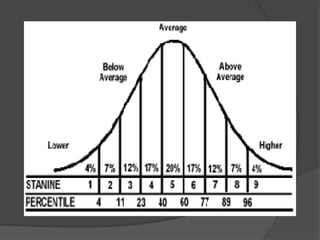
 Percentile rank – percentage of students
in the same age or grade level
 Stanine (standard nine) – range from a
low of 1 to a high of 9
References
 http://www.slideshare.net/kheangsokheng52/chapter-
4-standardized-testing
 http://www.slideshare.net/grove1em/high-stakes-
standardized-testing
 http://edglossary.org/standardized-test/
 http://www.slideshare.net/altheapenn/standardized-
testing-23700853
 http://worklife.columbia.edu/files_worklife/public/Pros
_and_Cons_of_Standardized_Testing_1.pdf

Standardized Testing

  • 2.
    What is astandardized test?  any form of test that requires all test takers to answer the same questions, or a selection of questions from common bank of questions  scored in a “standard” or consistent manner
  • 3.
    What is astandardized test?  primarily associated with large-scale tests administered to sizeable populations of students, such as a multiple-choice test  include true-false questions, short- answer questions, essay questions, or a mix of question types
  • 4.
    Two types ofstandardized test  Norm-referenced tests compare an individual's performance with the performance of others.  Criterion-referenced tests compare a person's performance to a set of objectives. Anyone who meets the criterion can get a high score.
  • 5.
    Advantages  A ready-madetest  Administration to large groups can be accomplished  Scoring procedures are streamlined  Assessment of an individual's mastery of a domain of knowledge or skill
  • 6.
    Disadvantages  Inappropriate useof test (using an overall proficiency test as an achievement test)  Teachers only “teach the tests”  Misconception that students and kids with learning disabilities perform poorly in standardized tests
  • 7.
    Forms of StandardizedTest  Achievement Tests designed to measure the knowledge and skills students learned in school or to determine the academic progress they have made over a period of time.  Aptitude tests attempt to predict a student’s ability to succeed in an intellectual or physical endeavor.
  • 8.
    Forms of StandardizedTest  College-admissions tests are used in the process of deciding which students will be admitted to a collegiate program.  Psychological tests, including IQ tests, are used to measure a person’s cognitive abilities and mental, emotional, developmental, and social characteristics.
  • 9.
    Interpreting test scores Raw Score – number of items a students answer correctly  Percentile rank – percentage of students in the same age or grade level  Stanine (standard nine) – range from a low of 1 to a high of 9
  • 11.
    References  http://www.slideshare.net/kheangsokheng52/chapter- 4-standardized-testing  http://www.slideshare.net/grove1em/high-stakes- standardized-testing http://edglossary.org/standardized-test/  http://www.slideshare.net/altheapenn/standardized- testing-23700853  http://worklife.columbia.edu/files_worklife/public/Pros _and_Cons_of_Standardized_Testing_1.pdf