ONE DAY
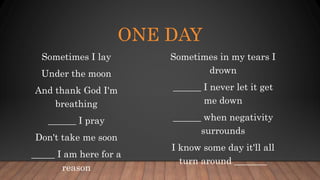
Sometimes I lay
Under the moon
And thank God I'm
breathing
______ I pray
Don't take me soon
_____ I am here for a
reason
Sometimes in my tears I
drown
______ I never let it get
me down
______ when negativity
surrounds
I know some day it'll all
turn around _______
It's not about
Win or lose
_____ we all lose
When they feed on the souls of
the innocent
Blood-drenched pavement
Keep on moving though the
waters stay raging
All my life I've been waiting for
I've been praying for
For the people to say
That we don't wanna fight no
more
There will be no more wars
_____ our children will play
One day [6x]
In this maze you can lose your way (your way)
It might drive you crazy but don't let it faze you,
no way (no way)
Sometimes in my tears I drown (I drown)
_____ I never let it get me down (get me down)
_____ when negativity surrounds (surrounds)
I know some day it'll all turn around ______
All my life I've been waiting for
I've been praying for
For the people to say
That we don't wanna fight no more
There will be no more wars
_________ our children will play
One day [6x]
One day this all will
change
Treat people the same
Stop with the violence
Down with the hate
One day we'll all be free
And proud to be
Under the same sun
Singing songs of freedom
like
One day [4x]
All my life I've been waiting for
I've been praying for
For the people to say
That we don't wanna fight no more
There will be no more wars
And our children will play
One day [6x]
WRITTEN
DISCOURSE
TEXT
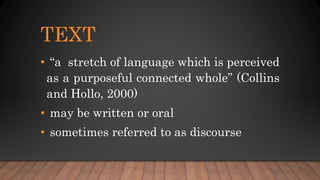
• “a stretch of language which is perceived
as a purposeful connected whole” (Collins
and Hollo, 2000)
• may be written or oral
• sometimes referred to as discourse
FORMS OF
DISCOURSE
EXPOSITION
• a form of discourse that serves to
explain or inform; it appeals to the
intellect
• E.g. a research paper on the effects
of global warming, an article on child
labor and child abuse
DESCRIPTION
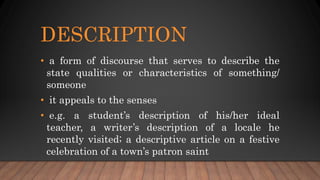
• a form of discourse that serves to describe the
state qualities or characteristics of something/
someone
• it appeals to the senses
• e.g. a student’s description of his/her ideal
teacher, a writer’s description of a locale he
recently visited; a descriptive article on a festive
celebration of a town’s patron saint
NARRATION
• a form of discourse that serves to narrate or
tell a story
• appeals to the emotions
• e.g. a narrative account of a student’s near-
death experience, a fictional story about an
encounter with a supernatural being
ARGUMENTATION
• a form of discourse that serves to
argue or to persuade or to take action
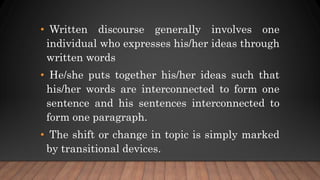
• Written discourse generally involves one
individual who expresses his/her ideas through
written words
• He/she puts together his/her ideas such that
his/her words are interconnected to form one
sentence and his sentences interconnected to
form one paragraph.
• The shift or change in topic is simply marked
by transitional devices.
TRANSITIONAL DEVICES
• are words used to show the
relationship or connection
between ideas and paragraphs
TRANSITIONAL
WORDS
ADDITIVE WORDS
• and, also, besides, moreover,
furthermore, in addition,
additionally, too
EQUIVALENT WORDS
• as well as, at the same time,
equally important, likewise,
similarly
AMPLIFYING WORDS
• as, for example, for instance, in fact,
like, specifically, particularly, such
as, that is, to illustrate
ALTERNATIVE WORDS
• either/or, neither/nor, other than,
otherwise
REPETITIVE WORDS
• again, to repeat, to reiterate, in
other words, that is
CONTRASTIVE AND CHANGE
WORDS
• but, conversely, however, despite, in spite
of, even though, on the contrary, on the
other hand, nevertheless, regardless,
notwithstanding, rather than, still,
though, whereas, while, yet
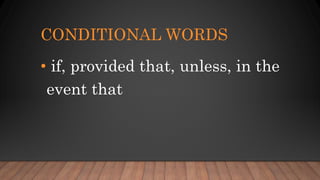
CONDITIONAL WORDS
• if, provided that, unless, in the
event that
EMPHASIZING WORDS
• above all, indeed, more
important, more importantly, of
course
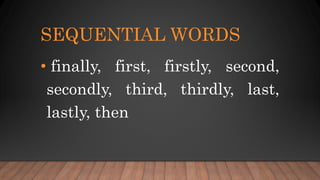
SEQUENTIAL WORDS
• finally, first, firstly, second,
secondly, third, thirdly, last,
lastly, then
TEMPORAL WORDS
• afterwards, meanwhile, before,
after, formerly, previously, later,
next, finally, ultimately,
subsequently, until
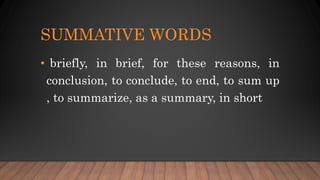
SUMMATIVE WORDS
• briefly, in brief, for these reasons, in
conclusion, to conclude, to end, to sum up
, to summarize, as a summary, in short
CAUSAL WORDS
• because, because of, due to,
owing to, out of, since, for this
reason
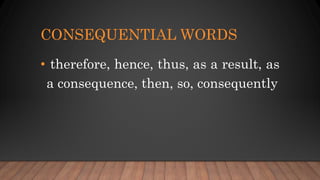
CONSEQUENTIAL WORDS
• therefore, hence, thus, as a result, as
a consequence, then, so, consequently

Written Discourse

  • 1.
    ONE DAY Sometimes Ilay Under the moon And thank God I'm breathing ______ I pray Don't take me soon _____ I am here for a reason Sometimes in my tears I drown ______ I never let it get me down ______ when negativity surrounds I know some day it'll all turn around _______
  • 2.
    It's not about Winor lose _____ we all lose When they feed on the souls of the innocent Blood-drenched pavement Keep on moving though the waters stay raging All my life I've been waiting for I've been praying for For the people to say That we don't wanna fight no more There will be no more wars _____ our children will play One day [6x]
  • 3.
    In this mazeyou can lose your way (your way) It might drive you crazy but don't let it faze you, no way (no way) Sometimes in my tears I drown (I drown) _____ I never let it get me down (get me down) _____ when negativity surrounds (surrounds) I know some day it'll all turn around ______
  • 4.
    All my lifeI've been waiting for I've been praying for For the people to say That we don't wanna fight no more There will be no more wars _________ our children will play One day [6x]
  • 5.
    One day thisall will change Treat people the same Stop with the violence Down with the hate One day we'll all be free And proud to be Under the same sun Singing songs of freedom like One day [4x]
  • 6.
    All my lifeI've been waiting for I've been praying for For the people to say That we don't wanna fight no more There will be no more wars And our children will play One day [6x]
  • 7.
  • 8.
    TEXT • “a stretchof language which is perceived as a purposeful connected whole” (Collins and Hollo, 2000) • may be written or oral • sometimes referred to as discourse
  • 9.
  • 10.
    EXPOSITION • a formof discourse that serves to explain or inform; it appeals to the intellect • E.g. a research paper on the effects of global warming, an article on child labor and child abuse
  • 11.
    DESCRIPTION • a formof discourse that serves to describe the state qualities or characteristics of something/ someone • it appeals to the senses • e.g. a student’s description of his/her ideal teacher, a writer’s description of a locale he recently visited; a descriptive article on a festive celebration of a town’s patron saint
  • 12.
    NARRATION • a formof discourse that serves to narrate or tell a story • appeals to the emotions • e.g. a narrative account of a student’s near- death experience, a fictional story about an encounter with a supernatural being
  • 13.
    ARGUMENTATION • a formof discourse that serves to argue or to persuade or to take action
  • 14.
    • Written discoursegenerally involves one individual who expresses his/her ideas through written words • He/she puts together his/her ideas such that his/her words are interconnected to form one sentence and his sentences interconnected to form one paragraph. • The shift or change in topic is simply marked by transitional devices.
  • 15.
    TRANSITIONAL DEVICES • arewords used to show the relationship or connection between ideas and paragraphs
  • 16.
  • 17.
    ADDITIVE WORDS • and,also, besides, moreover, furthermore, in addition, additionally, too
  • 18.
    EQUIVALENT WORDS • aswell as, at the same time, equally important, likewise, similarly
  • 19.
    AMPLIFYING WORDS • as,for example, for instance, in fact, like, specifically, particularly, such as, that is, to illustrate
  • 20.
    ALTERNATIVE WORDS • either/or,neither/nor, other than, otherwise
  • 21.
    REPETITIVE WORDS • again,to repeat, to reiterate, in other words, that is
  • 22.
    CONTRASTIVE AND CHANGE WORDS •but, conversely, however, despite, in spite of, even though, on the contrary, on the other hand, nevertheless, regardless, notwithstanding, rather than, still, though, whereas, while, yet
  • 23.
    CONDITIONAL WORDS • if,provided that, unless, in the event that
  • 24.
    EMPHASIZING WORDS • aboveall, indeed, more important, more importantly, of course
  • 25.
    SEQUENTIAL WORDS • finally,first, firstly, second, secondly, third, thirdly, last, lastly, then
  • 26.
    TEMPORAL WORDS • afterwards,meanwhile, before, after, formerly, previously, later, next, finally, ultimately, subsequently, until
  • 27.
    SUMMATIVE WORDS • briefly,in brief, for these reasons, in conclusion, to conclude, to end, to sum up , to summarize, as a summary, in short
  • 28.
    CAUSAL WORDS • because,because of, due to, owing to, out of, since, for this reason
  • 29.
    CONSEQUENTIAL WORDS • therefore,hence, thus, as a result, as a consequence, then, so, consequently