Module 1 Sessions
BAPP Arts
13th October 2015
Theme Part 1
Professional Communication
Preamble:
Professional Communication is the 1st topic in Module 1
(WBS3730).
It has a lot on common with the other topics in Parts 2
and 3 – reflective practice and professional networking.
At the end of the module you will be
summarising/synthesising your thinking about these 3
topics when thinking about the work (paid or unpaid)
that you do.
What does professionalism mean to you?
http://paulanottingham.blogspot.co.uk/2015/02/modu
les-1-1st-campus-and-online.html
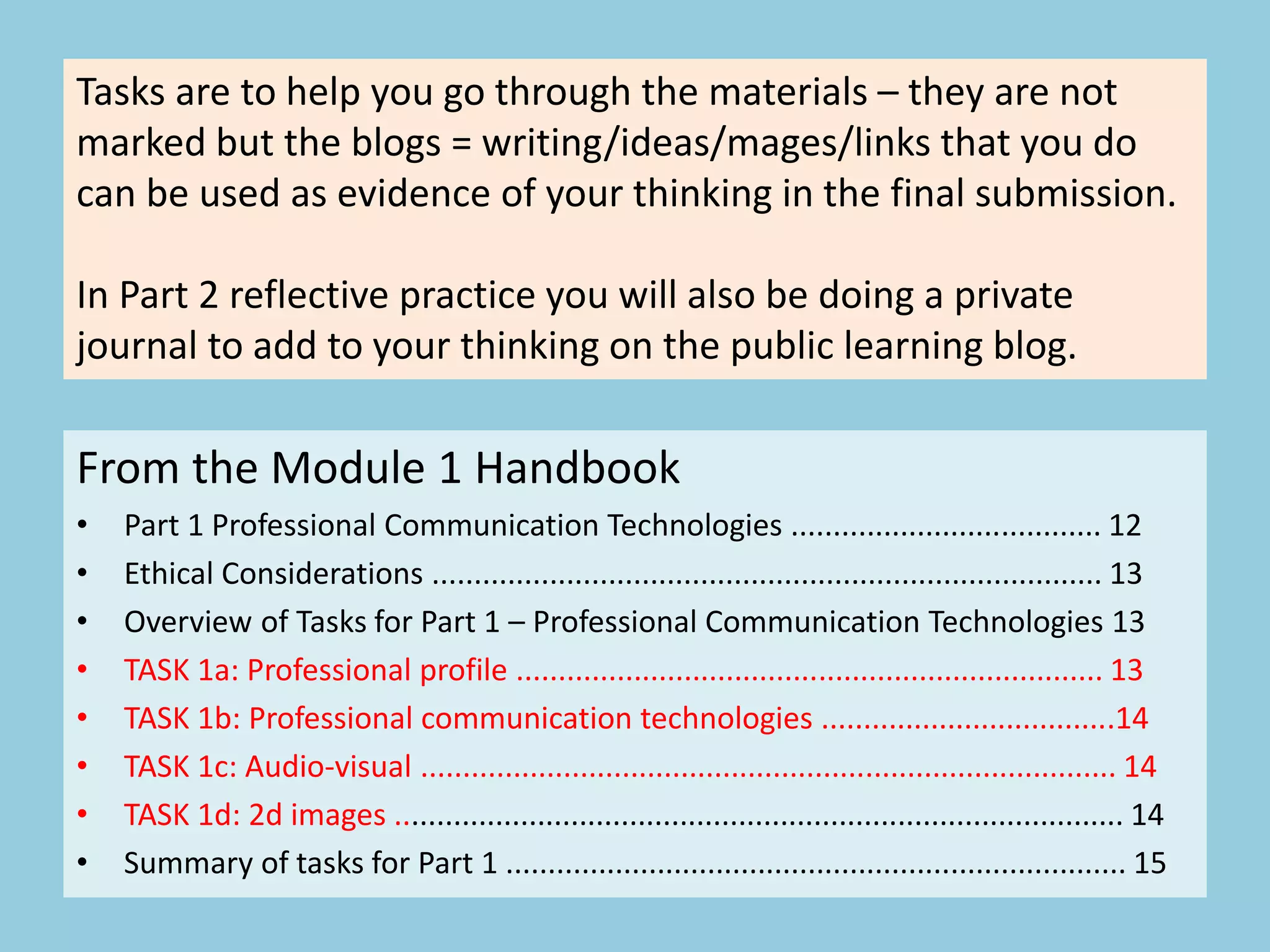
From the Module 1 Handbook
• Part 1 Professional Communication Technologies ..................................... 12
• Ethical Considerations ................................................................................ 13
• Overview of Tasks for Part 1 – Professional Communication Technologies 13
• TASK 1a: Professional profile ...................................................................... 13
• TASK 1b: Professional communication technologies ...................................14
• TASK 1c: Audio-visual ................................................................................... 14
• TASK 1d: 2d images ....................................................................................... 14
• Summary of tasks for Part 1 .......................................................................... 15
Tasks are to help you go through the materials – they are not
marked but the blogs = writing/ideas/mages/links that you do
can be used as evidence of your thinking in the final submission.
In Part 2 reflective practice you will also be doing a private
journal to add to your thinking on the public learning blog.
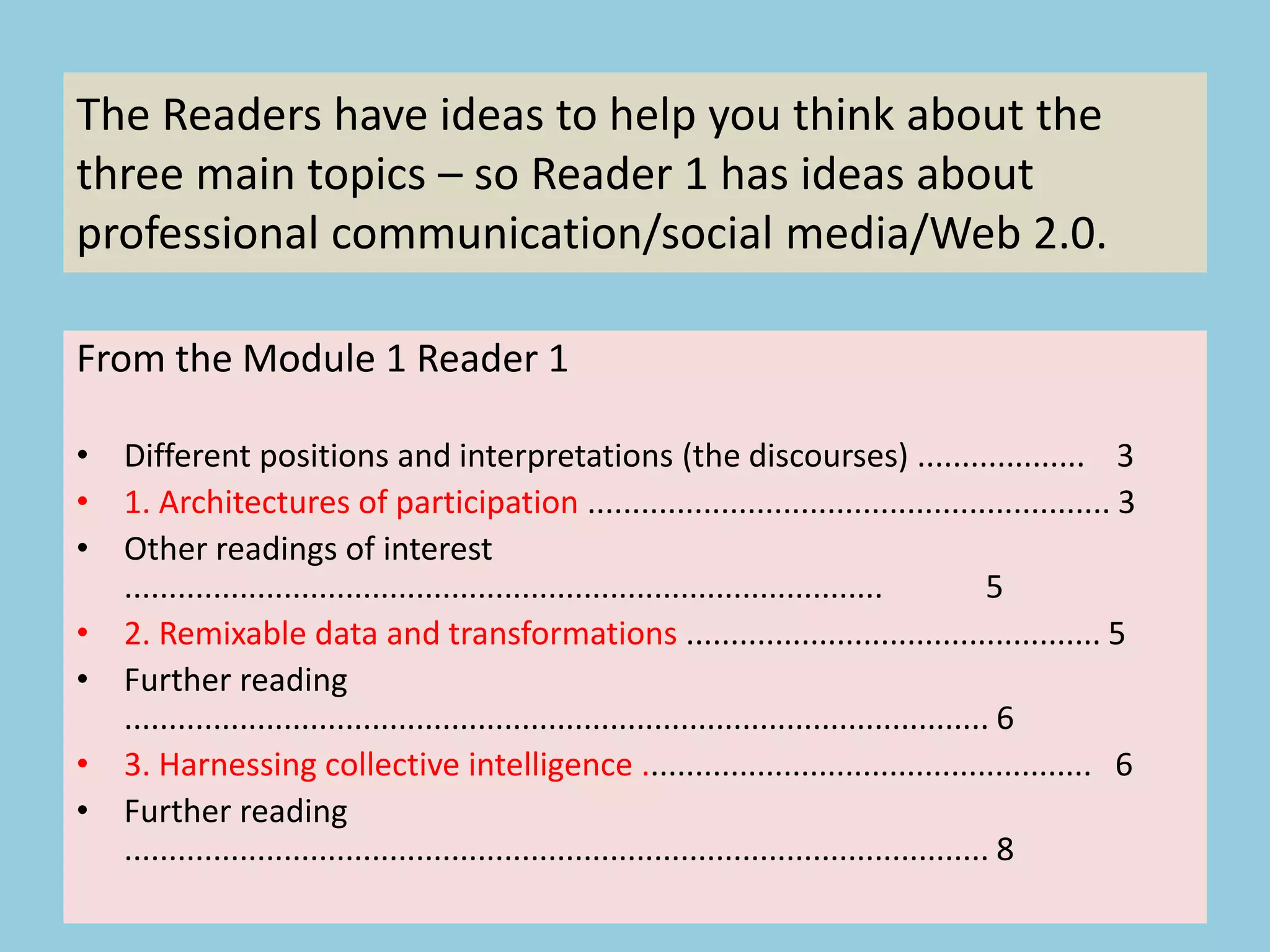
From the Module 1 Reader 1
• Different positions and interpretations (the discourses) ................... 3
• 1. Architectures of participation ........................................................... 3
• Other readings of interest
...................................................................................... 5
• 2. Remixable data and transformations ............................................... 5
• Further reading
.................................................................................................. 6
• 3. Harnessing collective intelligence ................................................... 6
• Further reading
.................................................................................................. 8
The Readers have ideas to help you think about the
three main topics – so Reader 1 has ideas about
professional communication/social media/Web 2.0.
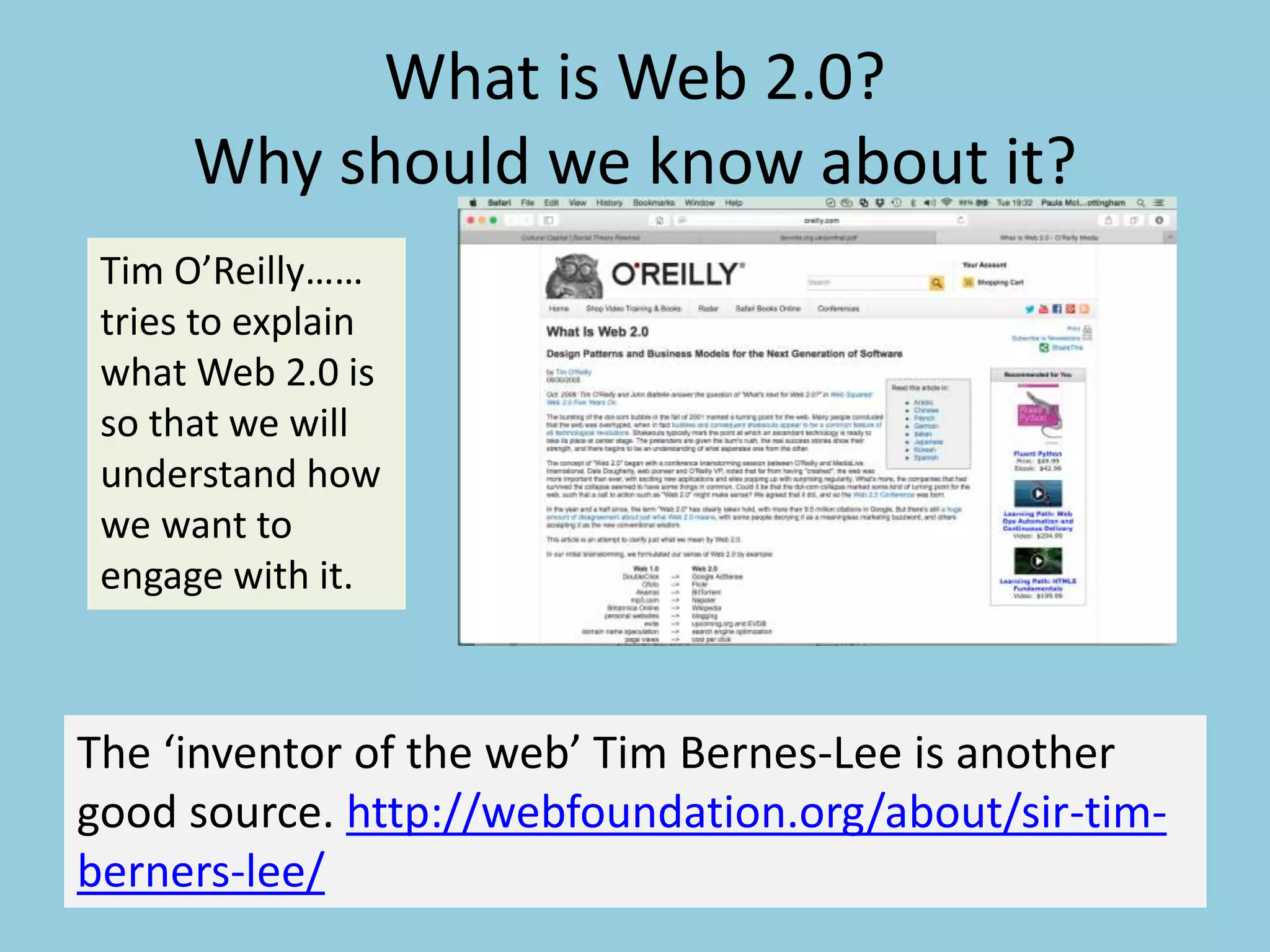
What is Web 2.0?
Why should we know about it?
Tim O’Reilly……
tries to explain
what Web 2.0 is
so that we will
understand how
we want to
engage with it.
The ‘inventor of the web’ Tim Bernes-Lee is another
good source. http://webfoundation.org/about/sir-tim-
berners-lee/
Siemens says we can apply principles to our activities - Principles of
Connectivism (Siemens, 2005). How do they relate to BAPP Arts?
1. Learning and knowledge rests in diversity of opinions – BAPP Arts network
offers differing ways of seeing the world
2. Learning is a process of connecting specialized nodes or information
sources – the web has many links to expertise
3. Learning may reside in non-human appliances – computers!
4. Capacity to know more is more critical than what is currently known – using
ideas to think about our experience and practice
5. Nurturing and maintaining connections is needed to facilitate continual learning
– engaging with each other and those on the web
6. Ability to see connections between fields, ideas, and concepts is a core skill -
awareness of disciplinarily, interdisciplinarity and transdisciplinarity – we work in
sectors but our knowledge can be organised as we need
7. Currency (accurate, up-to-date knowledge) is the intent of all connectivist
learning activities - changing notion of knowledge – learning for the moment and
future
8. Decision-making is itself a learning process - Making choices for professional
practice and the coursework for BAPP Arts
Siemens, G. (2005) 'Connectivism: A learning theory for the digital age', International Journal of
Instructional Technology and Distance Learning, vol. 2, no. 1, pp. 3-10.
3 main ideas in Reader 1
1. Architectures of participation
Ullrich et al. (2008) describes this process as the ‘architecture of
assembly’ where the methods by which people access and use
Web 2.0 platforms (such as Facebook) make ‘data and
functionality accessible’.
How do you use the various social media
platforms like Facebook, Twitter, Instagram etc.?
Do you use them differently for you professional
work than you do for social or private
conversations?
2. Remixable data and transformations
Valtysson (2010) suggests that the blurring of the distinctions
between the people who make media and the people who
consume it encourages people to engage and participate in the
media…
Many newspapers and television shows now
have audience participation elements. How does
this change the way that we understand the
world? How do you engage with social media?
3. Harnessing collective intelligence
One of the many studies into the effectiveness of Web 2.0 in building and
developing communities (Feenberg & Bakardjieva 2004) identified that Web
2.0 allowed communities to develop beyond their ‘existing professional
networks’ and offer a ‘social space for people, strangers and almost
strangers with diverse backgrounds to come together as equals, as
generators of ideas, to deliberate and act collectively’ (Feenberg &
Bakardjieva 2004, p. 38).
Where do you find your ‘collective intelligence’
on the web?
Does the web help us understand global
issues? Local issues?
In your own words… the discussion
What is Web 2.0? How does it operate in
your professional practice?
Why should you and others on the BAPP Arts
course know about it? How do you use it?
Do any of the ideas in Reader 1, or others
you have found, help your evaluate your
own professional communication?
Another idea to add to the discussion…
you may want to find other ideas to add…
Cultural Capital
“Bourdieu’s concept of cultural capital refers to the collection of
symbolic elements such as skills, tastes, posture, clothing,
mannerisms, material belongings, credentials, etc. that one
acquires through being part of a particular social class. Sharing
similar forms of cultural capital with others… creates a sense of
collective identity and group position (“people like us”).”
How does cultural capital play a part of thinking for
understanding how people work with Web 2.0?
http://routledgesoc.com/category/profile-tags/cultural-capital
Discussion points from the sessions:
1. Many have been using social media for years. Google yourself to
see what you find – an old My Space for example?
1. Blogs are new to many so people talked about finding their own
‘voice’ for the blogs. It is a learning blog – so you can be your
learning self – you can ‘debate’ your position using the ideas
from the Readers and ones that you introduce to the discussion.
1. You can put up blogs that are not specific to the themes but have
to do with your work/practice – some great ideas!
1. Comment on others blogs – the blog list is up on Paul’s blog and
on the BA Professional Practice Arts (135W99X) site.

Module 1 online session 1 13.10.15

  • 1.
    Module 1 Sessions BAPPArts 13th October 2015 Theme Part 1 Professional Communication
  • 2.
    Preamble: Professional Communication isthe 1st topic in Module 1 (WBS3730). It has a lot on common with the other topics in Parts 2 and 3 – reflective practice and professional networking. At the end of the module you will be summarising/synthesising your thinking about these 3 topics when thinking about the work (paid or unpaid) that you do. What does professionalism mean to you? http://paulanottingham.blogspot.co.uk/2015/02/modu les-1-1st-campus-and-online.html
  • 3.
    From the Module1 Handbook • Part 1 Professional Communication Technologies ..................................... 12 • Ethical Considerations ................................................................................ 13 • Overview of Tasks for Part 1 – Professional Communication Technologies 13 • TASK 1a: Professional profile ...................................................................... 13 • TASK 1b: Professional communication technologies ...................................14 • TASK 1c: Audio-visual ................................................................................... 14 • TASK 1d: 2d images ....................................................................................... 14 • Summary of tasks for Part 1 .......................................................................... 15 Tasks are to help you go through the materials – they are not marked but the blogs = writing/ideas/mages/links that you do can be used as evidence of your thinking in the final submission. In Part 2 reflective practice you will also be doing a private journal to add to your thinking on the public learning blog.
  • 4.
    From the Module1 Reader 1 • Different positions and interpretations (the discourses) ................... 3 • 1. Architectures of participation ........................................................... 3 • Other readings of interest ...................................................................................... 5 • 2. Remixable data and transformations ............................................... 5 • Further reading .................................................................................................. 6 • 3. Harnessing collective intelligence ................................................... 6 • Further reading .................................................................................................. 8 The Readers have ideas to help you think about the three main topics – so Reader 1 has ideas about professional communication/social media/Web 2.0.
  • 5.
    What is Web2.0? Why should we know about it? Tim O’Reilly…… tries to explain what Web 2.0 is so that we will understand how we want to engage with it. The ‘inventor of the web’ Tim Bernes-Lee is another good source. http://webfoundation.org/about/sir-tim- berners-lee/
  • 6.
    Siemens says wecan apply principles to our activities - Principles of Connectivism (Siemens, 2005). How do they relate to BAPP Arts? 1. Learning and knowledge rests in diversity of opinions – BAPP Arts network offers differing ways of seeing the world 2. Learning is a process of connecting specialized nodes or information sources – the web has many links to expertise 3. Learning may reside in non-human appliances – computers! 4. Capacity to know more is more critical than what is currently known – using ideas to think about our experience and practice 5. Nurturing and maintaining connections is needed to facilitate continual learning – engaging with each other and those on the web 6. Ability to see connections between fields, ideas, and concepts is a core skill - awareness of disciplinarily, interdisciplinarity and transdisciplinarity – we work in sectors but our knowledge can be organised as we need 7. Currency (accurate, up-to-date knowledge) is the intent of all connectivist learning activities - changing notion of knowledge – learning for the moment and future 8. Decision-making is itself a learning process - Making choices for professional practice and the coursework for BAPP Arts Siemens, G. (2005) 'Connectivism: A learning theory for the digital age', International Journal of Instructional Technology and Distance Learning, vol. 2, no. 1, pp. 3-10.
  • 7.
    3 main ideasin Reader 1 1. Architectures of participation Ullrich et al. (2008) describes this process as the ‘architecture of assembly’ where the methods by which people access and use Web 2.0 platforms (such as Facebook) make ‘data and functionality accessible’. How do you use the various social media platforms like Facebook, Twitter, Instagram etc.? Do you use them differently for you professional work than you do for social or private conversations?
  • 8.
    2. Remixable dataand transformations Valtysson (2010) suggests that the blurring of the distinctions between the people who make media and the people who consume it encourages people to engage and participate in the media… Many newspapers and television shows now have audience participation elements. How does this change the way that we understand the world? How do you engage with social media?
  • 9.
    3. Harnessing collectiveintelligence One of the many studies into the effectiveness of Web 2.0 in building and developing communities (Feenberg & Bakardjieva 2004) identified that Web 2.0 allowed communities to develop beyond their ‘existing professional networks’ and offer a ‘social space for people, strangers and almost strangers with diverse backgrounds to come together as equals, as generators of ideas, to deliberate and act collectively’ (Feenberg & Bakardjieva 2004, p. 38). Where do you find your ‘collective intelligence’ on the web? Does the web help us understand global issues? Local issues?
  • 10.
    In your ownwords… the discussion What is Web 2.0? How does it operate in your professional practice? Why should you and others on the BAPP Arts course know about it? How do you use it? Do any of the ideas in Reader 1, or others you have found, help your evaluate your own professional communication?
  • 11.
    Another idea toadd to the discussion… you may want to find other ideas to add… Cultural Capital “Bourdieu’s concept of cultural capital refers to the collection of symbolic elements such as skills, tastes, posture, clothing, mannerisms, material belongings, credentials, etc. that one acquires through being part of a particular social class. Sharing similar forms of cultural capital with others… creates a sense of collective identity and group position (“people like us”).” How does cultural capital play a part of thinking for understanding how people work with Web 2.0? http://routledgesoc.com/category/profile-tags/cultural-capital
  • 12.
    Discussion points fromthe sessions: 1. Many have been using social media for years. Google yourself to see what you find – an old My Space for example? 1. Blogs are new to many so people talked about finding their own ‘voice’ for the blogs. It is a learning blog – so you can be your learning self – you can ‘debate’ your position using the ideas from the Readers and ones that you introduce to the discussion. 1. You can put up blogs that are not specific to the themes but have to do with your work/practice – some great ideas! 1. Comment on others blogs – the blog list is up on Paul’s blog and on the BA Professional Practice Arts (135W99X) site.